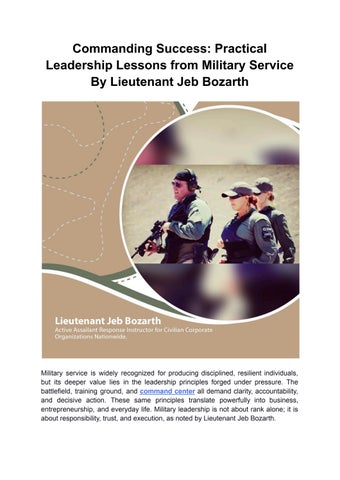
Commanding Success: Practical Leadership Lessons from Military Service
By Lieutenant Jeb Bozarth

Military service is widely recognized for producing disciplined, resilient individuals, but its deeper value lies in the leadership principles forged under pressure. The battlefield, training ground, and command center all demand clarity, accountability, and decisive action. These same principles translate powerfully into business, entrepreneurship, and everyday life. Military leadership is not about rank alone; it is about responsibility, trust, and execution, as noted by Lieutenant Jeb Bozarth.
One of the most practical lessons from military service is leading by example. In uniform, credibility is earned through action. Leaders are expected to meet the same standards, often higher ones than those they command. This creates respect that cannot be demanded; it can only be demonstrated. In business, leaders who model punctuality, integrity, and work ethic inspire teams to follow suit. When employees see consistency between words and behavior, trust grows naturally.
Another defining principle is clarity of mission. Military operations begin with a clearly defined objective and a structured plan. Every team member understands the goal and their role in achieving it. In corporate environments, confusion often weakens performance. Leaders who clearly communicate vision, define measurable outcomes, and align responsibilities eliminate uncertainty. A focused team moves faster and performs with greater confidence.
Preparation is another cornerstone of military success. Service members train repeatedly for high-stakes scenarios so that performance under pressure becomes instinctive. In business, preparation creates a competitive edge. Leaders who anticipate challenges, study market conditions, and rehearse presentations reduce risk and increase adaptability. When unexpected obstacles arise, preparation allows for calm adjustments rather than reactive decisions.
Accountability also stands at the heart of military leadership. Every action carries responsibility, and excuses rarely hold weight. This culture fosters ownership at every level. In civilian leadership, accountability builds high-performance teams. When individuals take responsibility for results, both successes and failures, continuous improvement becomes possible. Blame is replaced with problem-solving.
Resilience may be the most transferable lesson of all. Military service teaches individuals to operate effectively in the face of uncertainty, fatigue, or adversity Setbacks are viewed not as endings, but as challenges to overcome. In business, resilience enables leaders to navigate economic downturns, competitive pressure, and organizational change without losing direction.
Commanding success is not about authority; it is about influence earned through consistency, preparation, and character The leadership lessons cultivated in military service are practical, proven, and adaptable to any environment. By intentionally applying these principles, leaders can build stronger teams, make sound decisions under pressure, and create lasting impact in both business and life.