A & jm ISSN 0313-2080
i
H SEYMOUR CENTRE SYDNEY’S NEWEST ENTERTAINMENT CENTRE FOR THE PERFORMING ARTS CORNER CLEVELAND STREET & CITY ROAD • three live theatres • cinema • gallery • bars • restaurant • rehearsal studios* multi-level car park 24 hour booking service: 692 3711 all other enquiries: 692 0555
I HE OLD TOTE THEATRE COMPANY *J H E DANCE COMPANY (N.S.W.) CANADIAN MIME THEATRE N S W. THEATRE OF THE DEAF CHRISTIE'S AUCTIONS WORLD SNOOKER CHAMPIONSHIPS GOLDBERG AND SOLOMON .
Theatre - Australia
EDITORIAL
ISSN 0313 - 2080
A U S TR A LIA 'S N A T IO N A L TH E A TR E M A G A ZIN E
The battle over State subsidy for the performing arts is being fought in earnest. Last month we pub lished a coat-trailing article by Tom Markus (Sub sidy' A Cast to Answer); since then an I.A.C. re port has been released echoing much of what Markus was advocating. The report recommends phasing out subsidy for performing companies' running costs, thus throwing them to the mercy of the market place. Earlier rounds of the battle established the prin ciple that the governments had a duty to support the arts. A few massive organisations emerged, more-or-less effectively serving the cultural predilictions of a minority. Audience numbers cert ainly increased but little impact has been made on the proportion of total population these numbers represent.
O ct-Nov, 1976
EDITORIAL BOARD: Bruce Knappett Robert Page Lucy Wagner
CONTENTS THEATRE G U ID E ...............................................................................................................................2 QUOTES AND Q UERIES................................................................................................................... 4 LETTERS TO THE E D IT O R ............................................................................................................. 5 REVIEWS Game Hutchinson Diary o f a Madman, The O vercoat....................................................... 7 Jack Hibberd What the Butter S a w ........................................................................................8 John Smythe A Handful o f F rie n d s .................................................................................. 10 Katharine Brisbane A Handful o f F rie n d s ................................................................ . 12 Collin O'Brien A C /D C ............................................................................................................14 Don Batchelor A Toast to M e lb a .................... 15 Richard Fotheringham As You Like I t ...................................................................... .. 16 Roger Pulvers Kid Stakes, E q u u s ...................................................................................... ,\ 17 Guthrie Worby The Last o f the K nucktem en..................................................,■.............. 18 Lucy Wagner A Happy and Holy O cca sio n .......................................................................2 0 Maria Prerauer The Beast o f Belgrave S q u a re .........................................\ ..................... 21 Alexander Buzo A Doll's House ................................................................ Ss, . . , \ . . 22 Jill McRae Lunchtime Concert, The Lesson....................................................... . . . 23 Ron Blair W onderw om an..................................................................................................... 24 Ron Blair The Duchess o f M alfi ..........................................................................................25 PLAYSCRIPT Michael Cove Family Lore
The justifications are various: inter alia, our cultural heritage, self-evidently important, is preserved by productions of Verdi and Webster (too expensive to be paid for from popularity alone), and the chance is offered of developing a contemporary equivalent of that heritage through McGregor and Hibberd. What happens if the money dries up? Some vested interests are very seriously threatened, obviously. It presumably would not mean the end of the performing arts; but it is arguable that, if those arts are forced to be popular and economically viable, they would more urgently seek ways to exploit "distinctive characteristics of Australian community” (I.A.C. report)? Left unaided in the market place, did J.C. Williamson's ever really do that?
.................................................................................................. 26
In this issue we publish some replies to the Markus article - they necessarily relate to the I.A.C. recom mendations too. But the debate will continue.
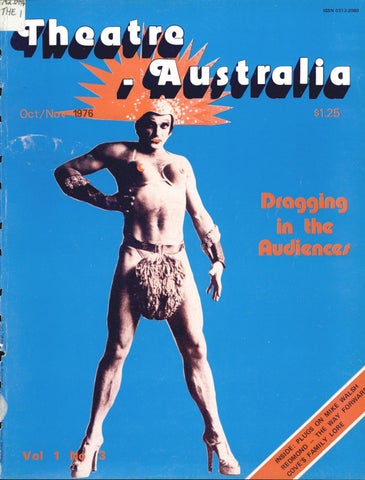
Mary Davies Dragging in the A u d ie n ce s ............................................................................ 32 Alexander Buzo, Rodney Fisher, John Motyn, David Williams on Subsidy Replies . . 36
Two interesting side lights on the debate come from Diana Sharpe and Bill Redmond. The former tells about a T.I.E. programme (under the segis of the Old Tote - one of those monoliths) which will see a small task force living in Armidale (NSW) for a period and fostering that region's own capac ities to develop and appreciate drama. The I.A.C. would approve. Bill Redmond uncovers a desperate lack of technical expertise and resources in our theatre. Remedying that lack, Redmond persuas ively argues, is a way forward. But who is to pay? Commercial theatre? O n th e lig h te r side we publish a collection of pieces on Reg Livermore. The Australian Council's recently commissioned Meadows Report claimed we need to develop more stars. No one would really dispute Livermore, currently mounting his second one-man show written within a year, is one. Reg himself talks about why drag; Mary Davies bathes in the aura of the star; Ron Blair says Livermore's Wonderwoman isn't quite all she could be. Theatres and their practitioners continue their real involvement in Theatre Australia. The M.T.C. who mounted a special benefit night (Diary o f a Madam) on 1st October (Perth's National Theatre has promised one in December), and David Will iamson in particular have contributed to the prod uction costs of this issue - helping a doubling of our print run from five to ten thousand.
AUSTRALIAN CURRENTS
TECHNICAL Bill Redmond The Way F o rw a rd .................................................................................
38
FILM, TELEVISION AND RADIO David Mitchell Putting in the P lu g .......................................................................................40 Stan Marks Wendy H u gh es:.................................................................................................. 41 THEATRE BUILDINGS Richard Fotheringham S.G.I.O. T h e a tre ...........................................................................43 THEATRE IN EDUCATION D ia n a Sharpe Armidale A m b itio n s ............................................................................................. 4 6 INTERNATIONAL Solrun Hoaas, Roger Pulvers A Fresh C o n te x t................................................................ 48 ITI N E W S ........................................................................................................................................... 49 AMATEUR Susan Vile Space Eight Festival .................................................................................................... 50
BALLET W illiam Shoubridge Dance Company (N S W ) ...........................................................................52
OPERA David Gyger Better Played Second H a lf .................................................................................... 54
BOOKS Helen van der Poorten Plays o f Hewett and S h e rm a n .........................................................56
PROMOTIONS ADVERTISING ADVISORY BOARD Ellen Braye Katharine Brisbane W.A. Enright Linda Gray
(Sydney) (Melbourne) Jack Hibberd Ken Horler Robert Jordan Phil Noyce Raymond Omodei
Sue Manger Tom Lisner Philip Parsons Julian Pringle John Romeril Ken Southgate Damion Stapleton
(02) 456-2068 (03) 232-9884 Elizabeth Sweeting John Timlin Anthony C. Trench Guthry Worby Richard Wherrett
THEATRE-AUSTRALIA is published by Theatre Publications Ltd., 7 President Place, New Lambton Heights, New South Wales 2305 (Tel 049 525976) on the 19th of every month. It is distributed by subscription and through theatre foyers etc., by Theatre Publications and to newsagents throughout Australia by Gordon and Gotch (A'asia) Ltd., MELBOURNE SYDNEY. Printed by Newey & Beath Pty. Ltd., 10 Belford St., Broadmeadow, 2292 Newcastle N.S.W. ADVERTISING AGENTS: TREWEEKE DURNFORD ASS. N. Sydney Tel. (02) 92-0247
Whilst every care is taken o f manuscripts and visual material for this magazine, the publishers and their agents accept no lia b ility for loss or damage which may occur. Unsolicited manuscripts and visual mat erial w ill not be returned unless accompanyed by a stamped addressed envelope. Opinions expressed in signed articles are not necess arily those o f the Editors. 1976 Theatre Publications Ltd. * Maximum recommended retail price only. Prices subject to change without notice. ©
Page 2 T he a tre-A u stra ü a Oct-Nov. 1976
Theatre Guidi O CTO BER
1976
NOVEI
NEW SOUTH WALES:
KILLARA COFFEE THEATRE
THEATRE ROYAL
ACTORS COMPANY (660 2503)
M em ories — A Tribute to Ten Years Devised by John Howitt (continuing)
Same Time N e xt Year by Morris Slade Directed by Gordon Hunt (to Oct 30th)
W aiting fo r G odot by Samuel Beckett Directed by Michael Edwards (Oct 27th for approx 4 weeks)
MARIAN STREET (498 3166) G etting On by Alan Bennett Directed by Alistair Duncan (to Nov 6th)
BALMAIN BIJOU (827 3652) Wonder Woman Reg Livermore (continuing)
Tarantara Gilbert & Sullivan Music Revue Directed by Ted Craig (Nov 11th - Dec 22nd)
SEYMOUR CENTRE York Theatre: Equus by Peter Shaffer Directed by Ted Craig (to Nov 13th) Downstairs: M en W ithou t Shadow s by J P Sartre C ount O derland by Max Frisch (in rep Oct 18th) - 30th) NSW Theatre of the Deaf (Nov 10th - Dec 4th)
MINERVA (358 1221) CAROUSEL (358 2333)
S aturday N ig h t at the Tiv Chelsea Brown (continuing)
QUEENSLAND
Hello H o llyw o o d Tracey Lee (continuing)
CIVIC, Newcastle (2 1977) Dick Emery (Oct 23rd)
MUSIC HALL THEATRE RESTAURANT (909 8222) The Beast o f Belgrave Square by Stanley Walsh Directed by Stanley Walsh (continuing)
ENSEMBLE (929 8877) A lp h a b e tica l Order by Michael Frayn Directed by Don Reid (continuing)
GENESIAN THEATRE (827 3023) S chool fo r Scandal by R B. Sheridan Directed by Elizabeth Farks (continuing)
NEW ARTS THEATRE, Glebe (660 3922) The E locution o f Benjam in Franklin by Steve J. Spears Directed by Richard Wherrett Starring Gordon Chater (starts Oct 22nd)
HER MAJESTY'S (212 1066)
NEW THEATRE (519 3403) Falling A p a rt by Monte Merrick Directed by Brian Syron (Oct 23rd - end Dec)
Happy and Holy Occasion by John O'Donoghue Directed by Terence Clarke (continuing)
INDEPENDENT (929 7377) B u llsh o t C ru m m o n d by Ron House, Dez White, John Neville-Andrews, Alan Sharman & Derek Cunningham. Directed by Rick Pellizzeri (Nov 10th - Dec 11 th) Turbo Reverso by Richmond Young (Every Sat afternoon)
M y Foot M y Tutor by Peter Handke Directed by Susan Parker (Oct 24th - 26th) A c: W ithou t Words by Samuel Beckett Directed by Rod Wissler (Nov 1st - 3rd)
Private Lives by Noel Coward (Nov 17th - Dec 18th)
HUNTER VALLEY THEATRE COMPANY, Newcastle (26 2526)
ARTS THEATRE (36 2344) Rebecca by Daphne du Maurier Directed by Jenepher Debenham (Oct,21st Nov 20th)
LA BOITE( 36 2296) Lysistrata by Aristophanes Directed by Ron Finney (to Nov 6th) H o w C ould You Believe M e When / Said I 'd Be Your Valet When You K n o w I've Been A Lmr A IIM y Life? adapted from Goldoni by John Bell Directed by Graeme Johnston (Nov 1 2th - Dec 18th)
QUEENSLAND THEATRE CO. (21 3861) NIMROD ( 69 5003) Upstairs: Duchess o f M a lfi by John Webster Directed by Rex Cramphorn (to Nov 6th) A H a nd fu l o f Friends by David Williamson Directed by John Bell (Nov 12th - Jan 8th)
OLD TOTE (663 6122) Drama Theatre: A D olls House by Henrik Ibsen Directed by Alexander Hay (to Oct 26th) The Season at Sarsaparilla by Patrick White Directed by Jim Sharman (Nov 3rd - Dec 18th) Parade Theatre. A Toast to M elba by Jack Hibberd Directed by Mick Rodger (to Nov 16th)
The Big M en Fly by Alan Hopgood Directed by Murray Foy Designed by James Ridwood. On tour throughout Old in association with the Old Arts Council (to Nov 20th) S.G.I.O. (Nov 24th - Dec 11 th)
TWELFTH NIGHT THEATRE (52 5811) Children's Theatre S hockerlock a n d M il/iP il/i Directed by Norbert Mayer (Oct 25th - Nov 12th) Adults: Children s Day by Keith Waterhouse and Willis Hall Directed by Jeremy Muir-Smith (Oct 21 st - Nov 13th)
|
l
I
I
_ T he atre-A ustraüa Oct-Nov. 16 Page 3
VICTORIA
ST. MARKS HALL Peer G ynt by Henrik Ibsen (from mid-Nov)
CAMEO THEATRE P rv a te Lives by Noel Coward (to Nov 13th)
HER MAJESTY'S M ore C anterbury Tales (from Oct 23rd)
ENJOY THE BEST MOMENTS OF AUSTRALIAN THEATRE
WINDSOR REGIS The Naked Vicar S ho w (from Oct 12th)
LA MAMA A lb e it Names Edw ard by Louise Nowra (to Nov 7th)
SOUTH AUSTRALIA
LAST LAUGH THEATRE
SOUTH AUSTRALIAN THEATRE COMPANY (51 5151)
D er W underkind R ocketship S h o w (to midNov)
MELBOURNE THEATRE COMPANY (645 1100) Russell Street: A H a nd fu l o f Friends by David Williamson Directed by Rodney Fisher Designed by Shaun Gurton (to Oct 30th) Arden adapted by Mick Rodger Directed by Mick Rodger Designed by Tony Tripp (Nov 2nd - Dec 11 th)
A n d M iss Reardon D rinks a L ittle by Paul Zindel Directed by George Ogilvie Designed by Fiona Reilly (to Nov 6th) M alb by Rodney Fisher Directed by Rodney Fisher (Nov 11th - Nov 27th) Lunchour: Joan by Alun Owen Directed by Brian Debnam (Oct 25th - 29th) C ow boys by Sam Shepard Directed by John Dick (Nov 2nd - 5th)
St Martin's: The Nuns by Eduardo Manet Directed by Ian Giles Designed by Tony Tripp (to Nov 6th) C ity Sugar by Stephen Poliakoff Directed by Ian Giles (Nov 9th - Jan 8th) Grant Street: The G ift by Michael Cove Directed by Ted Craig (to Nov 9th)
WESTERN AUSTRALIA
Toppling by Simon Hopkinson (from Nov 9th)
PLAYBOX (634 888) G odspell Directed & Choreographed by Betty Pounder
HOLE IN THE WALL (81 2403) Days in the Trees by Marguerite Duras Directed by John Milson Designed by David Young (to Oct 23rd) The M aids by Jean Genet Directed by Alexander Hay (Oct 27th - Nov 20th)
PRAM FACTORY (347 7133) Front Theatre: The O vercoat by Jack Hibberd Directed by Tim Robinson (to Nov 6th) The Dudders by John Romeril & John Timlin Directed by John Romeril (from 11th Nov) Back Theatre: S tretch o f the Im agina tion by Jack Hibberd Directed by Paul Hampton (from Nov 22nd)
A Gift Subscription to Theatre Australia is a Christmas present that lasts the whole year.
SUBSCRIBE NOW a •
• •
To Australia's first truly national and comp rehensive theatre magazine. For nationwide reviews and a full range of articles on Australian theatre practice. To a magazine which has the full support of the country's leading theatre companies.
By Post from the publishers — Theatre Pub lications Ltd., 7 President Place, New Lambton Heights, New South Wales, 2305 Australia.
PLAYHOUSE (23 3344)
Annual Subscriptions only accepted. Rates: Aus $15.00* ($20.00 overseas)* U.K. £12.00* U.S.A. $20.00*
Habeas Corpus by Alan Ben net Directed by Aarne Neeme (Return Season Nov 3rd - 6th)
Address....................................................................
A rsenic and O ld Lace by Joseph Kesselring Directed by Aarne Neeme (opens Nov 15th)
_______________________________ )
Name. .................................................................... ......................................... Postcode...................... By Hand: Please ask your newsagent to place a regular order of Theatre-Australia for you. Price per copy $1.25.* Please allow 21 days for first postal delivery
Page 4 T h e a tre -A u stra lia Sept-Oct, 1976
A.B.C. AXES PLUG RADIO SHOWS "It is true that Barry Eaton's Showtim e and the W orld o f Entertainm ent will cease after 31 st October as part of the arrangement for network relays. There are no plans to discontinue Soundstage and the theatre scene will continue to be covered by The Showman, though incidentally John West is on six weeks holiday, with Paul Maclay hosting the show for this period." Peter Tranter, Head of Radio Publicity, ABC.
GRAEME, GARRIE AND GRANT
IM
"Graeme Blundell and myself, after somewhat desperate search for a theatre have just reached an amiable arrangement with the Melbourne Theatre Company to take over the Grant Street Theatre in early December. We will be doing two plays there: Alma de Groen's Chidley, directed by myself, and Dorothy Hewett's The Golden Oldies to be directed by Graeme. Both of us, for different reasons want to do things in the theatre, as well astalk/w rite about it, and are especially happy to be able to make our comebacks with two such terrific plays — unaccountably unproduced by anyone else. I believe that the more critics can do in the theatre, the more that they can get their hands dirty, then the better off they (and the suffering workers they write about) will be." Garrie Hutchinson.
" Showtim e to me is a reflection of the growing interest in the A ustralian entertainment scene of things locally produced. Its demise will leave a gap which may never be filled. I have always endeavoured to give Australian actors, writers, directors, singers and musicians as much exposure as possible. Its loss, will, I fear, affect theatre in Sydney perhaps the most. The media is generally unsympathetic to theatre, particularly the smaller companies which are continuing to exist on a hand to mouth basis. Needless to say I am disappointed at losing the programme particularly in the light of recent audience reaction and support from all over New South Wales."
COCKSURE OR COCK-A-HOOP?
Barry Eaton
FEELERS?
Is the grapevine right about the novel promotion being planned to launch the world premiere of M ore Canterbury Tales (Her Majesty's Theatre October 23rd)? The competition is said to be for the biggest cock in Australia — but no Alvin Purple problems — it's to be judged on the radio.
"Actors are called actors because they act. If it was all about feeling they would be called feelers." Michael Blakemore, Director.
M
IT I C RITIC/
This magazine is concerned about critical stant accordingly publishes the following extracts: "Peter Shaffer's Equus fulfills a very ancient function of drama: it seeks to put dark, irrational forces that motivate much of our existence on to the stage. ... it works as an ecstatic conjuration of Dionysiac forces ... ... the boy's intemperate passion for horses becomes a metaphor for any form of deviant love. ... the spectacle of the boy seeking to become one with the horses ... ... only in the street outside dodoubts about the argument begin. ...He discovers that the child, with no music, art, friends or history to sustain him, finds in his worship of horses a substitute for religion and sex; and in the end he comes to question his right to eliminate that worship, however perverse a form it takes, and his duty to return the boy to our allegedly normal society. ...Intellectually, one can pick all kinds of holes in the play's thesis. It argues the sanctity of worshipand passion. But what if worship takes the form of racial intolerance (etc.-Ed.)...? Alec McCowen's psychiatrist was remarkable for its questing intellectual hunger Michael Billington (U.K. Critic of the Year 19 75 ) The Guardian April 21st 19 7 6 .
ijy n m s Raymond Omodei has been appointed Resident Director of the A rm idale Project (P46) "The project is unique, certainly in Australia, and of major significance. We have just returned from two days of discussion with community and educational representatives in Armidale and Tamworth where support and enthusiasm for the project have been tremendous. The state companies do have a responsibility to people outside the capital cities and obviously the occasional country tour of a full production from the city repertoire is not the answer. Costs alone for such tours, indeed for any tours, have always been dangerously high — they are now prohibitive. And of course touring had to be restricted to big population centres. More importantly, the variable and unpredictable dangers of touring often meant that productions were adversely affected technically and artistically despite the best efforts and intentions to maintain resident theatre standards. By joining forces with local resources the Old Tote/A.T.Y.P. hopes to change all this. They have taken a courageous and imaginative step in a new direction towards developing theatre that is positive and dynamic. Naturally I am delighted to be associated with the venture." Raymond Omodei.
Dear Sir, Two issues out already — high time I subscribed — hence the enclosed. Congratulations, if that's not too trite a comment. I give a special little cheer for the opera segment — because opera is so cumbersome and so costly, it is, I think, in even greater danger than most art forms of being "safe", conservative, and, in a crucial sense, irrelevant. I would hope that includingopera in an Australian theatre magazine may lend that little bit more support to the cause of making opera rub shoulders with what is happening in the rest of the real-political-social-artistictheatrical world. (I could go on here at great length, but won't ...) Looking forward to the next twelve issues. Looking forward to the next twelve issues. Peter Brock, Catholic Presbytery, Kurri Kurri, N.S.W . Dear Sir, I would like to thank you for a wonderfully informative and fascinating magazine. As a theatre fanatic it is extremely useful to know exactly what is going on in the Australian theatre world! Gratefully N I.D A Student Sydney
to
Dear Sir, I think your so-called quote — "Quotes and Q ueries", Septem ber-O ctober issue — misrepresented our phone conversation and my thoughts concerning the future of La Mama; either my explanation was unclear or you misunderstood it. The conversation I approached personally, ratherthan as material for your magazine. The lines that bore any similarity to our conversation were printed out of context and do not represent the present or future situation of La Mama. Also, ratherthan losing interest in La Mama, it has become geographically impossible for Betty Burstall to continue to run La Mama. I will continue to manage La Mama in the manner that it was founded — to encourage locally written theatre, priorily, lacking in that to produce other relevant theatre. (Sic - Ed) Yours faithfully Ann Eckersley La Mama Theatre, Carlton. Dear Editors, ...Drop Drill, a play of mine, has gone into rehearsal with Ralph Wilson directing for a November 3rd opening at the new A.N.U. Arts Centre (which really isn't ready to use yet ...) Roger Pulvers Canberra.
Theatre-AustraUa Sept-Oct, 1976 Page 5
> o m
; n i>
OUBLETAKE? tngst theatre reviewers in this country and
f 1
1
r I
"... it digs down into what drama was and still is about, fulfilling its most ancient function: trying to put on stage some of the dark, unknown, mysterious and irrational forces that can still frighten and move us. ... Equus works ... because it so effectively conjures up these forces. ...The boy's intemperate passion for horses becomes a metaphor for any form of deviant love. ... the boys (sic), for instance, seeking to become one with the horses ... ... so that your own doubts don't really start to nag until you're out of the theatre. ...Without education, art, history, skills or friends to sustain him, the boy has found in his worship of horses a substitute for religion and sex. And, in the end, Dysart doubts his right to take away that worship — however perverse, however much pain it causes the boy — and the value of returning him to normality. ...But Shaffer's thesis relies on sanctifying worship and passion no matter what form it takes ... Dysart should have more dimension — a hungry questing intelligence ..." Geraldine Pascall (Arts Editor) The A ustra lia n September 28th 1976.
FUNDING FROM TAX RELIEF
M. T.C. ATTRACTIONS
"I do wish that as well as making calls upon the private sector for financial assistance, arts administrators would direct their energies into seeking immediate action from the Federal Government to legislate for tax relief for contributions to the arts. Only then do we have a real chance of financial patronage. As in these times of economic difficulty we are obliged to accept cut backs in subsidy, we must push for this alternate method of fundraising to avoid widening the financial shortfall with which we are encumbered. In a labour-intensive industry — with a handcrafted product — in a mechanised age, we are just too vulnerable ..." Wayne Maddern General Manager South Australian Theatre Company.
Is Australia to New Zealand theatre hopefuls what London is to Sydney? A recent article in the prestigious Christchurch Star about local N. Z. lass Catherine Wilkin who has done so well in Aussie theatre circles since she came here from N.Z., via other theatre centres, would seem to indicate this. The Star mentions the opportunities in Australia after a waiting period and comments on the differing pace of life across the Tasman. Catherine, who has become one of the M.T.C.'s attractions, is enjoying a well-earned working break in N.Z. We look forward to her return. Another M.T.C. gal to watch' is Katie Shiel, currently appearing in David Williamson's A Handful of Friends. Brains and looks ably blend. Stan Marks
SECOND TIME ROUND "We re currently advertising for our second intake of students. The first thirty, who began in May this year, are well intothe scripting and rehearsal process of adapting Xavier Herbert's marvellous novel, Poor Fellow M y Country. It will be presented for the public at the Grant Street theatre in March of next year — and you'll have to come prepared to dance. We're holding an old-time Aussie barn-dance in the interval — 1850's style. So far we've learned Quadrilles, a Stockyard Dance, Barndance, Valetta Waltz, Thady U Gander ... it's all going so well! There's so many things happening! ... Sorry — I have to go and take my partner." Peter Oyston Dean of School of Drama, Victorian College of the Arts.
^
NUNS AND THRINGS? Lots of spiritual, or spirited, comment about Frank Thring's part of a nun in St. Martin's very amusing The Nuns. Interesting to note that Thring's first role many moons ago was in a Ray Lawler play, believed to be The Doll, the authors first staged play. With Lawler in residence at the M.T.C., and his trilogy comjng up, it certainly is shades of many years ago. Is it some sort of good omen?
Vmi EDITOR Dear Sir, In your article TIE-ing up Australia by Margaret Leask printed in the first edition of "Theatre Australia" you stated that the Early Childhood Drama Project was based at Twelfth Night Theatre. In fact, the Project has always been based at La Boite Theatre where it was originally founded. As the name may suggest the Early Childhood Drama Project's programmes are specially designed for children aged four to six. The project tours these programmes to Brisbane metropolitan schools, both junior primary and pre-school. The Artistic Policy of La Boite Theatre voices a concern for children and their introduction to theatre: "Children's introduction to theatre requires special care and deserves our finest efforts in communication; children give future meaning to our present aspirations. The recognition of this responsibility should be carried through all our work with these people". The early Childhood Drama Project has grown out of and identifies closely with this and other statements in La Boite's artistic policy. Yours faithfully, Philip Armit Early Childhood Drama Project, La Boite, Queensland.
Dear Sirs, Congratulations on your first issue, and may it be followed by many others. In the whole issue there is so little to cavil atthat I feel something of a boor for saying that your book page was, to me, a disappointment. I thought it a pity that the first issue of Theatre A ustralia should feature on its book pate an illustration from the New York Stage, and that your reviewer should treat so cavalierly that eminently actable Australian play, The Currency Lass. This play is, I believe, the right kind of play for amateur groups of all kinds. Lanty O'Liffey, properly acted, is anything but a tedious character, as audience reaction shows, and the part of Susan is not beyond the reach of any amateur who can "dance a bit and sing a bit,” as the original actress and those who have followed her have all been abletodo. It is a part calling for neither a prima donna nor a prima ballerina. In the hands of an enthusiastic producer with a sense of theatrical history this play can be brought to life very much to the satisfaction of modern audiences. Yours sincerely, Eric Irvin Normanhurst, N.S.W .
In March this year a small group of APG members presented a showcalledSfas/sin the Back Theatre of the Pram Factory, based on their own dreams and some of Sylvia Plath's poems. A show centred solely round Plath followed. This committed, dynamic, outgoing, unpretentious, honest trio discipline themselves to a small space, a fruit box and no words but Plath's (poems and letters to mother). They create true theatrical magic. The show is portable and still available (Melb 347 7133). Dare I suggest that Melbourne at last has a theatre group able to give true substance to those hitherto hollow labels "Alternative" and "experimental"? They even give meaning to that battered ideal, artistic and intellectual "freedom". But here is the awful irony: the APG collective which begat them is being less than supportive of its self-willed offspring both on financial (can they earn their keep?) and ideological (what is their political standpoint?) grounds. So they are forced to look elsewhere for funds and resources to keep their new Peer Gynt project going. John Smythe
Page 6 Theatre-AustraU a Oct-Nov. 1976
THE O IJ) TOTE THEATRE COMPANY SEASON ONE
1977
SUBSCRIBE & SAVE! D R A M A THEATRE, Sydney Opera
House
THE MAGISTRATE
by A rth u r Wing Pinero Sat. January 1 to Tue. February 15, 7 7
THE PLOUGH & THE STARS by Sean O'Casey Wed. February 23 to Tue. A pril 12, 7 7
CAESAR & CLEOPATRA
by George Bernard Shaw
Wed. A pril 20 to Tue. June 7, 7 7 .
PARADE THEATRE
j
Anzac Parade, Kensington.
THE FATHER
by August Strindberg Wed. February 9 to Tue. March 29, 7 7
THE ALCHEMIST
by Ben Jonson Wed. April 6 to Tue. May 24, 7 7
UNSPEAKABLE ACTS by co mFee Wed. June 1 to Tue. July 19, 7 7 BOOK N O W -S A V E $21.00 on a pair of subscriptions to the season. 'Phone 663 6122
P R IO R IT Y R E N E W A L P E R IO D - E N D S SEPT. 25 Brochures and Renewal Order Forms, w ith fu ll details o f 1977 Season One have now been posted to all current subscribers. Please phone us im m ediately if you have not received your copy (6 6 3 6 1 2 2 ). IT'S SO EASY TO SUBSCRIBE-SIMPLY COMPLETE AND RETURN THIS FORM
THE OLD TOTE THEATRE COMPANY-SEASON ONE 1977 -NEW SUBSCRIPTION ORDER FORM Num ber o f subscriptions required
1 Mr. Mrs. Miss. Ms..................................................................................
3
Address............................................. .................................................... Postcode................................ Phone: Bus.............................Private.
ADULT Subscriptions @ $30.90 each $ ...................
PER FO R M AN C E CHOICE M ark yo ur FIR ST preference 1 and SECOND preference 2. ; MON
TUES
WED
TH U R
FRI
r j
SAT
(/> <
WED
FRI
SAT
NOTE: Wednesday Matinees apply only to the Drama Theatre & Fridays to ’ Parade Theatre ‘ Youth Pensioner & C hildren's concessions apply on Mon. to Thurs. Eves and all mats. Youth Subscriptions are restricted to persons under 25 and are not transferable to older persons. Pensioners please w rite entitle m e n t No(s) here.................... Youth please give date(s) o f b irth .
□
Subscriptions @ $17.40 each $ ...................
Total payable
i
[ A Mail to : Sales D epartm ent, ^ O ld Tote Theatre Company, P.O. Box 1, Kensington, NSW. 2033 J
Y O U T H /P E N S IO N E R /C H IL D (Circle category)
$
I enclose Cheque/M oney Order in paym ent o f the above and a stamped self-addressed envelope fo r tic k e t re tu rn. Please make rem ittance payable to Old Tote Ltd.
'C all at: Parade Theatre, Anzac Pde., Kensington, (Opp. Round House, Uni o f NSW) k9.30 am to 6.30 pm M on.to Sat.
r Phone: S ubscription Secretary | 663 6122 L FOR A L L E N Q U IR IE S .
T h e a tre -A u stra lia Oct-Nov. 1976 Page 7
MELBOURNE THEATRE
AUSTRALIAN PERFORMING
COMPANY
GROUP
THE DIARY OF A M ADM AN
THE OVERCOAT
Garrie Hutchinson
THE DIARY OF A M A D M A N by Nikolai Gogol. Adapted by Jonathon Hardy and John Kim. Grant Street Theatre (opened 31.xiii.76.) Director. Andrew Ross; Designers, Andrew Ross and Steve Nolan. Ascenty Ivanov Propitchkin, JONATHAN HARDY.
Why Gogol of all the writers available should be privileged with two adaptions of his stories in the theatre in a city like Melbourne, within a couple of months... is a puzzle. If you happen to have a copy of the Penguin Classic, Diary o f a M adman and Other Stories handy, you'll have them both. They are the title story, Madman, and The Overcoat. Actually Madman has been used as a star vehicle by actors before Jonathon Hardy in this current version at Grant Street, just as The Overcoat has been made into at least two movies before Jack Hibbered performed some sort of operation on it to turn it into a "haunting musical farce". But Gogol like other nineteenth century Russians seems to have considerable attraction for 1970's audiences. Take Chekhov. One could make a case of him being a more bankable classic than Shakespeare, and certainly more actor proof. Gorky, too, has been making a new name for himself in English of late. Not to mention the novelists. Indeed the idea of Russia being a place where certain important issues are workedoutforthe benefit of Western intellectuals and artists is not deaf: vide Solzhenitzen and Yevtushenko, Mayakovsky and Lunacharsky. So we have an amount of angst 'Russian soul', a perception of the humanconditionthat seemed to have applied under the sprawling totalitarianism of the Czars and the red meritocratic totalitariansim of Bresnhevand, it appears, Australia. For, unmistakably, Gogol appeals. He has something to say to us. (So do a hundred others, but leave that aside). Gogol's little people, clerks, driven made, fantasising, exploited, are understandable human beings. Simpatico. .And they live in a very modern city. Not only
THE OVERCOAT adapted from Nikolai Gogol's short story by Jack Hibberd with music by Martin Friedel. Director, Pram Factory (opened 30.ix.76.) Director, Tim Robertson; Designer, Susy Potter. Man with the Big Red Fist, PAUL HAMPTON; Kak, PETER CUMMINS; Clerk. RICHARD MURPHETT; Tailor's Wife. EVELYN KRAPE; Tailor. JACK WEINER; Landlady, EVELYN KRAPE; Policeman. JACK WEINER; Departmental Head, PAUL HAMPTON; Very Important Person. RICHARD MURPHETT; Singer. JAN FRIEDL.
is it the sort of city in Fritz Lang's M etropolis it is also the city of Martin Scorsese's Taxidriver. It is thesilent, whirring, shadowy,symbolizing, yes, Expressionist city inhabited by Baal, and Lulu, Dr Mabuse, and Arturo Ui. By Pirandello, Witkiewicz, and Pinter. Not that all (or any) are Expressionists, but they do operate in an urban environment full of significance. The significant city. The problem then is that when thinking about Gogol there is the constant temptation to admire the stories. But the problem here is renovating these stories for the theatre. So, I admire the stories; I do not necessarily think they are best served by being read in the theatre. In the case of Diary of a Madman, the adaption is minimal. One section of the Diary, where Propitchkin awaits the deputation from Spain to take him there as King, has been put at the beginning. As for the rest the writing ofthis quill sharpener are recited vertatim. His tale is simple enough. Propitchkin is a clerk petrified in an eternal social system, on the bottom. He 'drives himself mad' by falling in love with the silly daughter of His Excellency. He begins to believe that dogs talk. And write letters to one another dealing with the scandals of the household. He muses on the problem of the Spanish Succession. He solves the problem of the Spanish Succession. He isthe Kingof Spain. He becomes erratic and preoccupied with this startling turn of the wheel. He is carted off to a nuthouse. He believes the rigors of this place are initiation stunts. After a while he begins to wonder. He relapses. This is wry, funny, ironical. It is the opportunity for Jonathon Hardy to give a bravura performance, a moving reading. What
Page 8 Theatre-AustraH a Oct-Nov. 1976 he does is certainly moving, but I kept wondering what it has to do with theatre, with the relationship between actor, audience, words. Being there was little different from reading Gogol in front of the fire. There were some rather mannered effects — the revelation of Hardy's shaved head, an Artaudian pose of the head at the end — but mostly it was a case of walking upand down an arrangement of lengths of wood, and reading from a diary. For me, the story wasn't enough to really make it in the theatre. But, with the exception of comics, there are perhaps no one man shows that work really satisfactorally. Hibberd's job on The Overcoat has been done not only with a scalpel but also with a bit of bionic creation as well. Here the idea is not to render a story in the theatre but to make a piece of theatre from a character and his fate, an idea given by another writer. Gogol. This is a kind of je u de theatre, pulling musical and theatrical ideas from all over the place, but especially from Brecht, Expressionist cabaret, literary bons mots, and the bizarre Hibberdian imagination. A clerk, Kak (Kark), whose job it is to transcribe letters and rectify procedural errors, has onlya threadbare overcoat. He is very poor. He is sneered upon by others in the office. He is full of pathos. Given a chance to improve himself, hierarchicly speaking, he flubs it. He then conceives that his mission in life is to have a new overcoat. He visits the tailors, a man and wife breughelesque intheirpassions. They con him into a dreamlike overcoat. He scrimps and saves. He gets the coat — it inspires a kind of optimism in him. He has it stolen by a person poorer than himself. He appeals to authority, which grinds his face in the ground. He dies. But he comes back as a naked nymph to haunt his oppressors, and steal their overcoats. This ironic homily is interrupted by a Singer, who warbles songs like Song of the City of the Future in a truly Brechtian manner. She provides a generalizing counterpoint to the Kakian particular.
Kak himself as played by Peter Cummins is full of shrugs and smirks, seizing the fun out of any bureaucratic irregularity in order to keep going. He is booted from pillar to post, but maintains a kind of determined happiness right to the end. Cummins obviously enjoys, and has mastered the Hibberdian language, the deliberately overblown images, continued undercutting of one sentence by the next, the self depreciation in nearly every line. There are flashes of Monk O'Neill now and again, just as there are quotes (theatrically speaking) from other Hibberd plays, and from the Expressionists. The whole play is more or less a jibe at that kind of theatre, and way for Hibberd to free up his language a bit. There are many fine moments — Jack Weiner and Evelyn Krape as the tailor and his wife in a grotesquely effective parody of the more overblown Wedekindesque expressions of sexual relationships; Jan Friedl dressed a bit like an experienced member of some bordello singing to Martin Friedl's Weillian melodies in fine style; the ghostly apparition of a naked Peter Cummins haunting the high and mighty like an acerbic Cupid; the delightful image of The Man with The Big Red Fist (yes, it is a huge red fist) pounding Cummin's Overcoat away from him ... these all tend to create a strange amalgam of Hibberd and Gogol that actually works and is enjoyable. That Hibberd should turn to such an idea should be no surprise to anyone who has watched his plays closely: they are littered with abstruse literary references as befits an Australian student of the world's work. In the end a production like this depends on its wit, humanity and theatricality as much as the text from which it started. Tim Robertson, perhaps the most weirdly theatrical director there is in Melbourne fills it out well given the cramped and somewhat dangerous setting he is working in. The Overcoat will not be one of the lasting works of Australian theatre, though I daresay it will be often produced. But it does show that Hibberdand his imagination are still in there stretching.
ALEXANDER THEATRE COMPANY
W HAT THE BUTLER SAW Jack Hibberd
WHA T THE BUTLER SA IVby Joe Orton. Monash University (opened 10.ix.76.) Director, Malcolm Robertson; Designer, Mervyn Trim. Geraldine Barclay, ELSPETH BALLANTYNE; Dr. Ranee. MICHAEL DUFFIELD; Mrs Prentice, JUDITH McGRATH; Dr Prentice. JOHN WOOD; Sergeant Match, JOHN BOWMAN. Nick, HARRY SCOTT.
The decade in England between 1957 and 1967 probably produced only two playwrights of real stature: Harold Pinter and John Arden. Pinter's achievement was to dramatize the inexplicable murk behind the mundane sunshine of our lives, to create an image of contemporary existence where irrational events and malignant forces prey claustrophobically upon individuals. Working within an absurdist tradition, he wrenched English theatre out of its comfortable representational naturalism and forged an evocative dramatic language from the colloquial. Arden, a stupendously neglected playwright, gave the corpulent theatrical anatomy of that same island some political sinew. More natively theatrical than Shaw, less bumptious than Osborne, opposed to the prosaic sentimentality of Wesker, he utilized his own poetic and intellectual gifts, as well as the techniques of Brecht, pageant and music hall, to sardonically examine social and historical processes. Joe Orton, a contemporary of Pinter and Arden but by no means a minor in comparison, worked more directly and bewitchingly inside an established theatrical mode: farce. Hence his allure and popularity in mainstream, conventional theatre, where plays of political and pathological flavour are largely eschewed due to their ostensibly dyspeptic effect upon the patrons. The coruscating facetious surface of Orton's plays, and the farce tradition, has I believe seduced directors and actors into jolly and innocuous interpretations of works whose intent is much more toxic and dislocating. T ra d itio n a l fa rc e is a b o u rg eo is entertainment form in which some benign deceit or folly leads ineluctably to a hectic avalanche of compromising circumstances —
T h e a tre -A u stra lia Oct-Nov. 1976 Page 9
untoward meetings, confused identities, disguises, characters hiding, characters exposed, characters at cross purposes, a plethora of puppet-like exits and entries; everything proliferating into a rampant and embarrassing confusion. Characters become for a time absurd and mechanical victims of social disorder. Farce is a comedy of the machine age, the industrial era, for the amusement and edification of its successful protagonists. For in traditional farce the tribulations are only temporary, the social order is re-established at the end and life's punches are seen as merely trite or ridiculous. Orton, however, has taken the farce and warped it to his own expressive purposes, purposes that are disruptive and almost anarchic. Often his plays intend to deride and explode a lot of the values of the very middleclasses that typically blandify them. Like Orton's own life, his plays do not end on a reassuring note or as an endorsement of the status quo. At the conclusion of Loot, for example, the innocent McLeavy is arrested by Truscott. The arrogant power-engendered logic of the policeman in the face of McLeavy's protestations force the victim to question his own sanity, yet it is really the authority figure that is unhinged and culpable in the sacred name of justice and social harmony. What the B utler Saw concludes in a ludicrous resolution which at one level lampoons the conventional farce denouement but at another level brutally confronts the characters with the demented nature of their behaviour and the sheer illusional dimensions of normality and sanity. Built into Orton's plays then is a critique of the form he so suavely and maliciously exploits. In this he is similar to the early Brecht who manipulated the hack moony expressionism of his time in Baal, and also plundered the bourgeois comedy of manners in the first part of Drum s in the Night. Brecht, a precocious burglar of forms and relatively long-lived, went however on to other things.
The action of What the B utler Saw occurs within the confines of a psychiatric clinic, yet there is not one psychiatric patient in the whole play. It is populated with 'normal'folk — a secretary, a page boy, a psychiatrist and his wife, another psychiatrist, and a policeman. Ironically, their behaviour is more in tune with that of a ward of lunatics. The balance between sanity and insanity, sex and perversity, conformity and chaos, is in Orton's view an exceedingly tenuous and even arbitrary one. He uses the morally outrageous to re scrutinize the morality of a class and time. No traditional farce-monger would dare attempt this. The cast of the Alexander Theatre production of W hat the B utler Saw have taken a customarily light, genial view of the play, despite some efforts I speculate on the part of the director Macolm Robertson to have it done at least straighter and more hard-edged. In doing sothe actors have supplied an hospitable and untaxing soiree at the theatre which, as Beckett has said in another context, is better than a kick in the crutch. A little lame at the beginning, the production then manages to antelope along with pace and coordination. There is humour in the performances but not the kind I'd imagine would do full justice to the text — humour that inverts our mores, knifes through conditioned expectations, exposes us as creatures of habit and motiveless appetite. Michael Duffield alone among the sextet of cast turns in an appropriately dead-faced yet mildly manic performance as the inspectorpsychiatrist Dr Ranee — a kind of gentleman snoop prone to instant and pat hypotheses. Nevertheless, even his interpretation finally lacks steel and real pressuring menace — behind the mask one suspects that the character is more bemused than outraged by the events that inundate him. Dr Ranee is a parodoxical blend of many elements. He is a man of power, a rigid conservative, a threat; he is a fatuous psychoanalyst who embodies a
satire of pseudo-science; he is also a detached observer and cynic: PRENTICE; I'm a rationalist. RANCE: You can't be a rationalist in an irrational world. It isn't rational. The rest of the company tend to go too literally with their parts and overplay in the accepted ersatz farcical fashion — the lecherous Dr Prentice beingtoo lecherous, the vacuous secretary just vacuous, the boyish page boy boyish, leaving little to tantalize or vitaminize the imaginations of the audience. There are at least twoexciting approaches to Orton — to have his characters represented as stylized grotesques or utterly real and trapped in a bombardment of absurd circumstance. There should be a gruesome logic at work; fear and hysteria should render credible the the production of guns, strait-jackets and syringes, dispsomania and violence. As John Lahr has pointed out, the best of Orton's twisted farces contain a dramatic correlative for a lot of modern instability — the bewildering and contradictory pressures that besiege his central characters force them into untenable corners and brittle states of mind, a condition not unlike that of neurosis and even schizophrenia. What the B utle r Saw is Orton's most powerful play because it incipiently questions and mocks a huge number of assumptions and compartmentalisations — those pertaining to normal behaviour, sex, gender, the family, mental hygiene, law and order. It finally erupts into macabre and violent imagery. Orton expressively pushes farce beyond its routine limits as cage-like grilles crash down around his characters and they are forced to climb a ladder into a blaze of light. Orton's last play has some but not all the features of a modern horror fable. These possibilities were not really entertained in the Alexander Theatre production which in the end seemed more like a slightly dated sexual romp yet updated boulevard farce.
Page 10 T h e a tre -A u s tra lia Oct-Nov. 1976
MELBOURNE THEATRE COMPANY
A HANDFUL OF FRIENDS John Smythe
A HANDFUL OF FRIENDS by David Williamson. Russell Street Theatre (opened 31.viii.76.) Director, Rodney Fisher; Designer, Shaun Gurton. Russell McAlister, GERARD MAGUIRE; Wendy McAlister, JULIE HAMILTON; Jill McAlister, LYNDELL ROWE; Mark Marshall, TOM OLIVER; Sally Marshall. KATE SHEIL.
To borrow from David Williamson's latest stage play film-maker Mark Marshall's judgement of his own most recent feature (a fiction based on real life people and situations), A Handful o f Friends 'ts "utterly competent". So too is this Melbourne Theatre Company production, which inherits director and part of the cast from the South Australian Theatre Company's premiere season. One is tempted to add too "competent" or at least too obviously so. The relaxed proficiency with which the actors discharge their roles is so much to the fore that it inhibits our understanding of how and why the people portrayed are less than competent in living out their lives. More art is needed to bring out more essential matter. The first performance I saw was the pre dinner show on the day after opening night. It is no excuse of course but the not quite sparking remoteness did seem to suggest both second night doldrums and matinee-itis. So I returned a fortnight later to see the later show this time. Barely a vocal inflection or physical gesture appeared to have changed. But the actors did seem more thoroughly absorbed in their roles and confidence even more noticeable garnished the competence. My basic responses were much the same. I couldn't help feeling by interval that if the season hadn't been pre-sold to subscribers they'd be pushing to get bods off streets and bums on seats. Nothing hadhappened asyetto really excite audience interest. It was hard to pin down why. The setting up who's who and what's what stuff, unavoidable in naturalistic drama, seemed very adeptly coped with. And the long pauses, even pacing and almost languid style didn't seem blatantly wrong. The second half was much more interesting.
But still I could not help feeling that the major events in the play had largely been reported on despite the fact that anyone could see that a lot had actually happened. So then I read the script. A Handful of Friends is an ambitious and thorough play. The them es actions interactions dramatic devices and emotional structure all serve to illuminate and explore those complex convoluted interdependent relationships commonly labelled friendships. Love admiration aspiration competition envy wants needs drives strength submission using abusing caring sharing respect protection restriction destruction ... it is all there in Williamson's comprehensive and tightly controlled dissection/discussion of his subject. Plot-wise it ranges over some thirty to forty years in probing the lives of five inter-acting individuals, although the physical action of the play is contained within eight scenes spanning less than a week. Personal and general history is recorded, individual and shared experiences are recalled and differing subjective responses to and interpretations of past and present events abound. Slowly but surely more details come into focus, new insights emerge, until the final composite is as complex and ambiguous as western life itself. It should be a rich and rewarding experience. Dramatically the play demands a great deal from actors and director. Williamson is going for much more than easy laughs. It is much more subtle than The Coming of Stork, The Removalists and Don's Party, more objectively controlled than Jugglers Threeand W hat If You Died Tomorrow, yet less restricted than The Department. And the female roles are no longer less substantial than the male roles. Each individual is liberally endowed with strengths weaknesses strike-capacity
defence-mechanisms fallibilities and saving graces. The challenge in production is to make all that compelling. To stimulate a desire in the observer to note all the details seek further clues conjour with equations ponder and grapple with unavoidable truths. And this is where Rodney Fisher's otherwise utterly competent production falls down. He seems to have given equal weight to past and present whereas if the dramatic focus favoured the immediate present which then was enhanced by what we gradually gleaned of past events, it would have more impact and be more interesting, to my mind anyway. Williamson has not made it easy mind you. There is lots of anecdotal chat over cups of coffee especially towards the end. For variety he uses Mark's recent film, an abrasively witty dictated (for transcription) attack on actress Sally and husband Mark by journalist Jill (in defence of brother Russell who was ridiculed in the film) and people's dreams as investigative devices. But still they are modes of reporting. And ironically the task of finding dramatic impact in the more immediate attitudes and responses is made all the harder by Williamson's verbal skill in evoking days gone by. The living present must actively compete with the past for attention. I firm ly believe there are given circumstances there in the script which could be used to greater effect. I know it says that history professor Russell McAlister, still famed for his highly entertaining lectures, has "lost a bit of sparkle over the years". But surely the business of setting up in a new home, coping with the in-fighting over his new position at Barton University, meeting a minor marital crisis when his wife whom he loves and needs very much discovers evidence of yet another sexual escapade (with a student back in
T h e a tre -A u stra iia Oct-Nov. 1976
*
>
his beloved sister (after seven years OS in the US), could have provided the basis for a bit more oomph and variegation than emerged from Gerard Maguire's otherwise utterly competent performance. The weakness vulnerability and laxiness need not have merged so pervasively into what seemed like relaxed complacency. Kate Sheil gave us a real enough Sally and indeed her immediate motives and strategies were always interesting to observe. But her languid style totally belied her character's reputation for "amazing vitality" — an ingredient with which the production could certainly have done. Lyndall Rowe's Jill was bright brittle and strong on the attack but perhaps too neatly packaged. More compelling insights might have emerged had the defensive mask slipped a little less precisely, to reveal more of her loneliness and vulnerability. Most successfully realised in all his complexity was Tom Oliver's Mark. To be sure he had the advantage of a dynamic volatile paranoid hypochondriac role but he astutely avoided obscuring the dangerous implications of his ego-bound naivety whilst thoroughly exploiting his character's entertainment potential. Julie Hamilton had the hardest job on the least obtrusive and most emotionally insecure role. Wendy's despair and disillusionment with herself husband and life in general was sensitively felt and subtly revealed as she valiantly coped with day-to-day life. The seemingly carefree moments added a lot to the overall texture, especially when one realised how much her low estimation of herself contributed to making her the useful pleasant and easy to cope with person most people saw her as.
That realisation came more from intellectual puzzling, however, than moments of truth pin pointed in production. During both viewings and again on reading the script I found myself wondering why Wendy offered Mark yet another cup of coffee then sat down to chat when in fact she wished he would go — then later revealed she felt she was "living through a nightmare" there that night. Reasons can be found in the text. She finds it hard to define herself except as Russell's wife. Even when she does resume her "development" it is his subject she studies, his profession (teaching) she tries to make it in. She completes the degree and teaching diploma but fails in the actual job. Now she is thinking of doing voluntary social work. She constantly considers others well before her relatively worthless (she thinks) self, which of course suits her oblivious self-obsessed "friends" down to the ground. It is she who feels the need most desperately for "a handful of good friends". So escaping to the living room away from the nightmare scene around the dinnertable then inviting the others to bring their coffee in, offering more coffee and pressing them to stay ("You've all got a lot to talk about") then filling Mark's cup yet again (while he waits for a taxi, long after Sally has stormed out) is certainly consistent behaviour. Her nightmare, it seems to me, would have come more from alienation and identity crisis than Mark and Sally's fighting or her concern for Russell. And that, more than Russell's return to drink or sudden violent outburst, must have been the key to her finally leaving to live on her own. But in performance all that remains unresolved. Neither the script nor this production provide the necessary moments of
Page 11
insight. To capture audience interest and understanding more clarification of which are the causes and which are just catalysts is needed. Perhaps if the actual dinner party scene was included, instead of just the aftermath, there would be more immediacy and a more compelling dramatic vehicle for exploring those hitherto remote areas. Or if all that is too much to expect from a play which quite validly attempts to cover so much of so many lives without making one person central, then maybe the answer could be a sequel built around Wendy's ongoing efforts to resolve her problems. But back to the play as it is. The conclusion is neatly devised and provides much to dwell on. The strong volatile constantly battling couple fulfil their needs achieve their aims and stay together. The weaker more vulnerable and fallible couple fail on all counts. As for Jill, now left with the brother through whom she is said to have lived — has she "succeeded" or what? It is a wrap-up which must move observers to back-track over the maze of paths leading up to it if that sense of satisfaction, of a night wellspent, is to be achieved. The aim in production must be to make each important component somehow memorable and to stimulate us into wanting to ponder in retrospect. More could be done to better effect at Russell Street, given the text as it stands and some rewrites might well be considered. But let me in fairness conclude with questions we should ask ourselves. How willing are we to work for our satisfaction? Has film and TV, in selecting editing and even interpreting for us, made us lazy? How much are we to blame for the boredom and disenchantment we so often express?
■\
Nimrod upstairs . . . Director & designer Rex Cramphorn whose exciting productions include The Tempest, The Dutch Courtesan, Berenice and Scapino and most recently, Le Chateau . . . has set Malfi in its original 16th century Italy. It's a stark revenge tragedy with Jennifer Claire as the Duchess, Ivar Kants as Antonio, John Gaden as Ferdinand, Peter Carroll as Bosola and John Krommel as the Cardinal. The Duchess of Malfi opens on October 2nd.
Page 12 T h e a tre -A u s tra lia Oct-Nov. 1976
NATIONAL THEATRE PERTH
A HANDFUL O F FRIENDS Katharine Brisbane
A HANDFUL OF FRIENDS by David Williamson Playhouse (opened 16.ix.76.) Director, Aarne Neeme; Designer, Bill Dowd Russell ROBERT FAGGETTER; Jill, MARY HAIRE; Wendy, PIPPA WILLIAMSON; Mark, DENNIS MILLER; Sally MERRIN CANNING.
If David Williamson's new play, A Handful of Friends, is remembered for nothing else, it will be remembered for Mark's line: "Creative artists are the sacrificial objects of a bored society." The play seems to have arrived at an appropriate moment this September at the Playhouse in Perth, where the press and her ex-husband, Perth barrister Lloyd Davies, are lambasting the playwright Dorothy Hewett, over her alleged libelof Daviesand his family in her published poem, The Uninvited Guest. The impending court case had, not surprisingly, been hanging like a sword over the heads of the Australian literary world, particularly poets, novelists and playwrights who are only too aware of how much they draw upon their own lives for source material and inspiration. In the event Ms Hewett has settled out of court for $6 ,0 0 0 , thus failing to be the first writer (so I am told) to be taken to court for libelling in a poem since Alexander Pope; and saving her fellow writers from a sticky legal precedent. Or has it? A court injunction has been granted against the poem being published again. Meanwhile a defence committee has been set up with headquarters in Melbourne; Mr Davies may prove to be the catalyst needed to explode the worst aspects of Australia's libel laws, which in the 50s sent Frank Hardy to gaol over Power W ithout Glory (and this year was still giving the ABC a few tremors) and in NSW still protect history from the full truth by making it possible to libel the dead. The existing laws of libel are of particular their very success and idiosyncratic style has derived its vitality from a blunt and honest reportage of contemporary life as they know it
most immediately. David Williamson has tackled the problem in this new play, executed with some sense of pain. A H andful o f Friends lays ba re by degrees the elements which make up the nature of five people in an intermingling relationship. At the storm centre is the question of libel, and from it no one emerges with honour. But Williamson uses the question, close to home as it is, neither as a justification for the artist's freedom of speech (though justification is offered) or for documentary study. As elsewhere he has used an incident of police violence, a federal election, a game of table tennis, a departmental meeting; here he uses an apparently libelous film scriptasa means of access to a more fundamental investigation of the causes of certain human behaviour. Failure in relationships and particularly in finer feelings, is the overriding material — and the end — of all Williamson's plays. A H andful of Friends opens with Russell and Wendy McAlister settling in to a house in Melbourne after seven years in Los Angeles. Russell, a historian, has been appointed to a chair at a fairly newly established university. H^ is urbane and witty in a fluent, academic way. Wendy is tense and clearly unhappy; the reasons seem to be several: Russell's habit of taking dirty weekends with strangers — forthe company, he says; a family tragedy, obliquely mentioned, the memory of which their return has revived; and a film just released, directed by Russell's mate from childhood, Mark Marshall, in which the leading character is a history professor with a drinking problem. Jill, Russell's sister and a successful journalist in the glossy magazines, arrives. She has seen the film. Mark, she says, has held up to ridicule her beloved brother and his wife:
CO URSES /
THE NATIO NAL IN STITU TE OF DRAM ATIC A RT at the
University of New South Wales
announces AUDITIONS for the THREE YEAR DIPLOMA COURSES (Acting, Design, Technical Production and the One Year Post Graduate Director's Course ) beginning March, 1977 Applications now invited. Auditions will be held in all capital cities from early November to mid-December. Write now for application forms to: NIDA, P.O. Box 1, KENSINGTON, N.S.W. 2033
Applicants may apply for assistance under The Tertiary Education Assistance Scheme.
------------------------------------------:--------------------------------------
The Victorian College of the Arts A College of Advanced Education providing courses in the fine and performing arts. Full time courses for
1977
ART * MUSIC • DRAMA
SCHOOL OF ART (Dean, W illiam Kelly) Diploma of Arts and Graduate Diploma in Fine Arts - Painting, Sculpture or Printmaking.
SCHOOL OF MUSIC
SCHOOL OF DRAMA^,
(Dean, John Hopkins) (Dean, Peter Oyston) Diploma of Arts in Music Diploma of Arts in Bachelor of Arts in Music Dramatic Arts. Graduate Diploma in Music. All Diploma courses are of three years duration. The Graduate Diploma courses are of tw o years duration. Applications for the School of Art close on 22 October 1976. Applications for the School of Music and School of Drama close on 30 October 1976. For further information and application form s contact - The Adm inistrator, The Victorian College of the Arts. 234 St. Kilda Road, Melbourne, Victoria, 3004 Telephone 62 5061.
T h e a tre -A u stra lia Oct-Nov. 1976
and Sally, Mark's wife and Jill's former work and play mate, has made a travesty of the role of the historian's wife. The critics apparently agree with her. Mark and Sally fly in to smooth things over. They first visit Jill, who welcomes them, pretends she has not seen the film to avoid a straight talk, and plans revenge in a magazine interview with Sally in which she alleges nepotism and the use of other foul means in Sally's ruthless climb to success. Dinner, later at the McAlisters', is an unfortunate affair, full of jolly reminiscence, evasions and a fierce quarrel between the Marshalls about the casting of Mark's new film, The Fortunes of Richard Mahony. The clear cut situation at first outlined, in which two self-centred members of the Sydney smart set have damaged friends who respected them, begins to cloud. The studious McAlister is beginning to look a bit childish; Marshall's ruthlessness takes on a tinge of artistic uncompromise. As they chew the fat together they begin to draw a picture of two country boys setting out in life together, ambivalently friends and rivals — one brilliant but weak, the other determined to be strong. We also get a glimpse of a society ungenerous and philistine, in which remarks like Sally's "Anyone can do anything if they really want to" is interpreted not as hopeful courage but as sleazy opportunism. It soon becomes apparent that Russell and Jill by their self-deception have become the destructive forces. The audience's sympathies have shifted and by this time the libel which began it all has become irrelevant. Friendships, like anything that lives and grows, must be cared for. The five friends lose theirs through selfish obtuseness and a lack of moral courage to talk about what is most important for their spiritual health. The price of their failure to survive in company is the necessity to survive in isolation. And this the play evokes in a handful of scenes at the end in which the characters have retreated to their separate boxes. It is not an easy play to perform and the Playhouse cast do not manage very well. Structurally it is sometimes uncomfortable, the set and the action split between Russell's house and Jill's flat. In both the Perth and the Adelaide productions blackouts and scene trucking were used to master the closing scenes at a moment when the play is contemplative and moving to its conclusion gently and musically — like the sound of the singing whales which ironically end Act One. The structure has a dispirited fragmentation — the characters talk in pairs oralone — which underlines their isolation and timidity. In only one scene, in which Russell performs a party turn on the life of Hitler, do the five characters join in the same game. The rhythm is careful but it requires inagination from the actors to grasp the subtle circle in which the action moves and the larger canvas to which the apparently trivial incidents contribute. Of the five Perth actors Pippa Williamson as Wendy stood out as the one most in sympathy with Williamson's intentions. It is a moving portrait of a talented woman whose bruised sensibilities have taken, in a feminine way, the same path as Russell's. The other four are pretty wide of the mark. Robert Faggetter's Russell had a touching vulnerability and desire to be obliging which added a dimension to John Gaden's asperity in the role in Adelaide. But he had nothing like Gaden's grasp of the precise rhythm of Williamson's lines, nor any sensé of the intellectual rigour behind
Pippa W illiam son and Robert Faggetter. academic wit. Dennis Miller's Mark is slow and easy-going, at odds with the restlessness and hypochondria indicated in the text; and as Jill and Sally, Mary Haire and Merrin Canning were too young and vocally unskilled. Aarne Neeme's production, despite some good scenes does not serve the play well. It gives little indication of the eleganceof Williamson's dialogue and it draws unfavourable attention to aspects of the play which some critics will certainlycall weaknesses but I which I prefer to see as challenges which in this case the director has not met. One such aspect, a long sequence in which Jill dictates a monologue on Sally, places great demands on the actress if it is not to appear a clumsy variation on the
Page 13
Photo: N ational Theatre
letter scene of the classic plays. Lyndall Rowe in Adelaide executed it with skill and worldly wisdom but the credibility gap remained. If the criterion of a good play is that it will support less than adequate performers, then the Perth season proves that the play does not yet have the strength. But for me the play is a new confirmation of the growing subtlety of perception and maturing noral sense in Williamson's work; and it extracts the playwright, probably for good this time, from his uncomfortable position as ruckman in the fray to that of referee. Only time and continued handling of his work will show whose judgement is fairest or best.
Page 14 T he a tre-A u stra lia Oct-Nov. 1976
HOLE IN THE WALL THEATRE
THE RIDE ACRO SS LAKE CO N STAN CE NATIONAL THEATRE, PERTH
A C /D C Collin O'Brien AC DC by Heathcote Williams. Green Room (opened 10.ix 76 ) Director & Designer, Mike Morris. Maurice, STEVE JODRELL; Ivor Bowen, PEROWNE; Sadie ADELE LEWIN; Melody, ROBYN WEAR; Gary, IGOR SAS
The play was performed by the workshop offshoot of the Hole in the Wall, and therefore had a mixed bag of talent and experience. I thinkthat the decision to worktheplay up from improvisation, confessed to in the programme, a wrong one for such a play. In my view it is precisely the odd and unusual plays which need that strong control of the rhythms of performance which only clear and% firm direction can give. But it is also true that it is just such plays that inexperienced directors go for. Whether out of youthful enthusiasm (my own first full length play was Brecht's The Good Woman o f Setzuan{or because faults in directing don't show up so much in plays noone understands anyway, I couldn't say. Suffice it to say that if you get Arsenic and Old Lace wrong everyone knows, but if you make W aiting for Godot boring who is going to be the wiser? The improvisation did lead to good rapport between the actors though, and I particularly like the performances of an actor new to me, Chris Ferguson, and of Elizabeth Crosby, released at last from the hell of the pouting teenager roles to which her part in Certain Women for a time condemned her. I suspect that performed in the context of German theatrical disciplines and traditions and with professional direction and design I might find my response to the work transformed; but done on a shoestring with both director and designer inexperienced, I wonder whether the Hole in the Wall was wise to give it a public showing rather than to leave it as a workshop exercise, to be judged in that context.
April may be the cruellest month in T.S. Eliot’s calender, but one could be forgiven for concluding that, in Perth at any rate, September runs it a close second. During the first month of spring we were treated to two mindbenders: Peter Handke's The Ride Across Lake Constance at the Hole in the Wall Theatre, and Heathcote Williams' A C /D C in the Greenroom at the Playhouse. After both plays people could be observed stumbling into the respective foyers with that stunned mullet air of a last man in who has just experienced a Dennis Lillee delivery passing within three centimetres of his right ear.
From Handke-panky to wanky-panky: Heathcote Williams' AC/DC. It opens with a bang, with what the tabloids would probably call a three-way sex act. Williams' stage directions say that the participants should be concealed — but for the odd arm, leg or article of clothing — behind the curtain of one ofthose do-it-yourself photo machines. But Mike Morris, bless his heart, struck the curtain and presumably cried 'A lot morel'. I must admit to mixed feelings about viewing simulated sex in the theatre. In the first place, what with the law the way it is, it is necessarily simulated, and since nothing so destroys the illusion of reality as the inescapable intrusion of reality itself (i.e. they're not doing anything), the whole exercise tends to be a fraud. Secondly, I am never quite sure precisely how I am expected to respond. Is it allowable, for instance, to grip the back of the seat in front and half rise out of your own to get a better view? Or should one study the decor of the theatre ceiling, thus not appearing too interested in what is going on? It is not a question of morals, you understand, but of decorum ...
After the aesthetic success and full houses accorded Mike Morris' production of Kaspar in the Greenroom earlier this year much was expected of the play Peter Handke considers its continuation. But in performance it proved curiously predictable, even boring. Not, I hasten to add, plotwise (plot? plot?), but in the whole style of the thing. It came across as a mixture of lonescoish, Absurdist verbal broohaha (The mustardl The hairbrush I') and the sort of mixture of aggression, power games and menace Pinter handles so well: you know, the kind of thing which runs A: Pick up that box. B: I, er...A : PICK UP THAT BOXI Bpicks up the box. But it is quite possible that I am doing Handke's play an injustice, that my irritation has its source not in the text but in this particular production.
Apart from being quite farout in its action (masturbation, trepanning), A C /D C is couched in a w ild , o fte n e x h ile r a tin g postMcluhan/Timothy Leary lingo with a strong underpinning of technological jargon. Take Sadie's explanation of the way to stop psychic capitalism; Cybersex. Set up directional electrodes. XRay Thermal Videos, Meat Heat pickup guns ... Set em all up outside Bucking-ham Palace, the White House, Apple, R.C. A., Ten Downing Street, whereever. Make a 5-D 8track Flesh Reception Movie of them all Fucking. Or Maurice accusing Sadie of bad faith: I thought you were going to discharge him. You been over-amping him. (To Perowne) Never mind, I can still demagnetise you. I've got a lot of schizophrenia left. Tuffnell didn't
THE RIDE ACROSS LAKE CONSTANCE by Peter Handke. Pocket Theatre Workshop (opened 15.ix.76). Director, Sally Holmes; Designer, Tony Harrison. Woman with White Scarf, MOLLY WORSNOP; Emil Jannings, CHRIS FERGUSON; Heinrich George, ALAN FLETCHER; Elisabeth Bergner, ELIZABETH CROSBY; Erich von Stroheim, INGLE KNIGHT; Henny Porten, TANYA UREN; Alic Kessler, JOY CUMING; Ellen Kessler, GRETA SCACCHI
hollow me out completely. Ha. Well, yes. Ha indeed. Such verbalization takes a lot of concentration to keep up with, and it does lead one to wonder whether Williams is not being outrageously selfindulgent. But who am I to question the winnerof both the Evening Standard and George Devine a wards for 1970? In addition to trying - seriously - to come to terms with the form of the thing, there is also the problem of deciding whether or not its a load of cobblers. It is interesting to note how commentators, not wishingtofall intothe 'they said Beethoven was made category, manage to avoid committing themselves to precision by making preposterous and unchallengeable claims for a play. My favourites in this case are 'the first play of the twenty-first century' (begs the question, that one) and 'likely to be seminal in the 70s' (seminal: they can say that again). Dr. Johnson considered a hundred years the time test of literary worth. This may well apply to drama quite as it does to other literary genres, but in the short term it is perhaps sufficient to take a fifteen to twenty year time span. If the play is still seriously considered after that time, it probably adds up to something. While watching A C /D C my thoughts went back to another play considered ahead of its time: Anne Jellicoe's The Sport of M y M ad Mother, which it seems to me has dropped over the horizon, now perhaps to fall into the whatever became of Mitzi Gaynor?' category. However I suppose we owe it to posterity to record how a play felt as a new experience, remembering that Pinter's The Birthday Party closed after one week and a tepid press, and that only Harold Hobson and Kenneth Tynan saw much of value in Look Back In Anger. Whatever its lasting qualities, for me at least A C /D C had one haunting, even terrifying central idea. It arises from a concern for what has happened to twentieth century man as a result of his technology. It is a concern which is anything but trite, tied in with a concept which Williams calls 'psychic capitalism': the destruction of our consciousness, of our spiritual essence, especially by electronic means such as television. This seems the justification for the particular language and imagery of this play — ironically in this case, the medium is the message. Television, and the power its masterminds have to use ittotrivialize, is notthe only culprit, but it is the most obvious one. Image follows image, the submoronic and possibly serious succeed one another until we are really not sure whether Chairman Mao was or was not a member of F Troop. Mind you there are other ways of getting there: Che Guevera became no more that a face on a poster or tee-shirt with very little televisual aid. If the projected image is all-important, the process breeds its own monsters as individuals are subsumed under an image. The outstanding current example seems to me to be jim m y Carter, a manufactured polysterene copy of the image of John F. Kennedy if ever there was one. Mike Morris both directed and designed this production, and to excellent effect. While in no way detracting from the fine work of the actors as individuals (Adele Lewin as Sadie was particularly powerful), I could not but notice yet again the quite remarkable strength Morris commands as a director, an ability to get thoroughly committed and highly competent performances from whoever works with him. He surely gets my vote as the most underacknowledged director currently working here.
T h e a tre -A u stra lia Oct-Nov. 1976 Page 15
QUEENSLAND THEATRE COMPANY
A TOAST TO MELBA Don Batchelor
A TOAST TO MELBA by Jack Hibberd. S.G.I.O. Theatre (opened 15.ix.76.) Director, Alan Edwards; Designer, Peter Cooke. Nellie Melba, GERALDINE TURNER; Gottlieb, DAVID CLENDINNING; John Lemmone. PETER KOWITZ; Pietro Cecchi/Buffalo Bill/Oscar Wilde/Caruso, KEN KENNETT; George Lupton/George Bernard Shaw/Frank Weedkind, BRUCE PARR; Father's voice/Duke of Orleans/Mayor of Brisbane/Sir Thomas Beecham, JOE JAMES; Treacle O'Cane/Augustus Harris, WARREN MEACHAM; Madame Marchesi/Eunice, HAZELHOWSON; Mother's Voice/Lady de Grey/Gladys Moncrief, KATE WILSON; The Girl/Amy Castles, GAYE POOLE; Nesboy/Jimmy Mullins, CORNELIUS BOOGAART; Charles Armstrong/Neville Cardus/John Norton, IAN DYSON.
From the moment Geraldine Turner hit Brisbane's S.G.I.O. Theatre stage like a onewoman Georgian Dance Troupe, to the whoops of the rest of the cast, I knew that A Toast to Melba would be more burps than badinage. Then, Ken Kennett, that prize pupil froim the tits and teeth academy of dramatic art, joined the action, and any lingering doubts about whether we were at a cocktail party or a rort were totally dispelled. The Queensland Theatre Company regulars, caught with their subscribers uniforms on — Gwen Gillam's (preferable long) for the ladies, Rothwell's suits (preferably upstairs) for the gents — were ready to respond with gusty roars than sniggers. We were in for that uniquely Australian school of play-wrighting — the theatre of raucity — and the Q.T.C. players had their throttles wide open. In this riot of theatrical primary colours, which the director Alan Edwards was right enough to encourage, one or two performers completely missed the style. Ian Dyson almost his part as Charles Armstrong with almost Stanislavskian seriousness, even miming a ludicrous buck-jumping sequence as if his spurs depended upon it. Joe James erred in another direction. Unable to take his Due d'Orleans part seriously he was at a loss, so that the man who was supposed to sweep Nellie off her feet in the ball-rooms of Vienna, looked more likethe 'before'character in an ad. for Arthur Murray. His portrayal of the Lord Mayor of Brisbane, on the other hand, showed precisely how far such a stage caricature should go without shading imperceptibly into real life. Kate Wilson, as Lady de Grey, carved a portrait in ice, battling against a steel wool wig
and an absurd stage direction which had her filing her nails over the tea things (symbolic do you think?). As Madame Marchesi, Hazel Howson looked good, but she travelled all over Europe in search of a suitable accent. Bruce Parr attacked all three of his parts with briskness and size, though he needs to learn that there are more ways to play a line than staccato. The dynamo of the production was, happily, Geraldine Turner in the leadingrole — andshe gave power to the whole team. Accepting Melba's remark that people like her happen "once in a century" Miss Turner made no attempt at impersonating the great lady. To hell with the cool colatura. She inhabited Hibberd's deliberately anachronistic and unrepresentational text with 'raunchy' energy, expressing the life, the personality, the magnetism, the will which fired the Melba legend. It was all broad and brassy, as if the trombone, in a tribute to the flute, was expressing admi ration and affection in the only tones it knew. The big mistake of her performance lay in trying to sing some of the arias seriously. Given the style of the rest of the performance, the singing needs to have its seriousness under cut in some way. The actress needs to let us know, by some gesture, that just as she does not mean to reproduce the person of Melba when she acts, nor does she mean to represent the opera star when she sings. Kate Wilson as "Our Glad" did this superbly with one mocking limp wrist during "Love Will Find a Way", which acknowledged in an amusing aside that she was trespassing on sacred Moncrieff territory, but intending only respect. That sense of respect was a feature of the production and Alan Edwards used every chance offered by the text to point up the pathos of Melba's life. In this regard the staging also made a nice comment. The set consisted of a false proscenium of painted marble decked out in o so roseate plush — theatrical tawdry straining to appear oppulent. Upstage, through the arch, were a few set pieces suggesting the rooms in which Nellie passed her years, largely faithful to Hibberd's original intention. The addition of the false proscenium served to set Nellie's life
clearly within the confines of the theatre, defining it and shaping it in all aspects. The touching effect was compounded by having most of the people who influenced her life intruding upon it from a pair of on-stage boxes built into the false proscenium — as if Melba were a creature of her predatory patrons. Not all the staging was such a success. Why, for example construct an elaborate bar which rolls on impresively for a brief scene in a Mackay pub, and then have the actors drinking mimed beer out of mimed glasses and talking to a mimed bar-attendant? Surely, too, a subsidised theatre can afford a real flower or two instead of presenting Melba with a posy of plastics. The same applies to the curtain call gimmick which has the assembled company raising their glasses to the lady and everyone of them is empty. We don't expect champagne, but surely the budget could stretch to Cold Duck. And now the play itself. It seems to Australian theatrical culture what the hot pie is to our culinary arts. Lots of bits of theatrical scrap, indifferently mixed with some local flavoured gravy, spilling out of a very flaky crust. And I for one say "Good on yer Jack!". There are occasions when the meat pie is unmatchable, specially, as the Hibberd well knows, when dolloped with hot sauce. I offer as an example the piquant line "fuckcivilisation", delivered by Charles Armstrong. Since the author's avowed intention is to speak to a "popular" audience all this seems fair enough — as long as it doesn't try todignify it all by describing it in elevated terms as "a theatre for the populace that deals with legendary figures and events, perennial and idiosyncratic rituals, mythically implanted in the nation's consciousness" — a chatty excerpt from a Q.T.C. programme note over Jack Hibberd's name. In the play itself words like "ebullition" and "hebetude" tumble from all his characters as if they had swallowed Roget's Thesaurus. Tis all, one suspects, "caviar to the general". In short the thing I like least about Hibberd's writing is the words, and there is little excuse for such verbal excess, unless, like Dame Nellie herself, he has decided to "give 'em much".
Page 16 T h e a tre -A u s tra iia Oct-Nov. 1976
GRIN AND TONIC THEATRICALTROUPE AND CIRCUS
AS YOU LKE IT Richard Fotheringham
AS YOU LIKE IT bv William Shakespeare. Theatre Studio L214. Kelvin Grove C.A.E. (opened 8.ix.76.) Director, Bryan Nason. Orlando, ROBERT ARTHUR; Adam, RICHARD MICHAEL; Oliver, ROD WISSLER; Dennis, JANICE IRVINE; Frederick, ERROL O'NEILL; Celia, VICTORIA ARTHUR; Rosalind, JENNIFER FLOWERS; Touchstone, DAVID H. GITTENS, Charles. JEFF HAYES; La Beau, MICHAEL McCAFFREY; Duke Senior, JEFF HAYES; Amiens, GREG PARKE; Jaques. BRYAN NASON; Corin, ROD WISSLER; Silvius, DAVID LESS; Phebe, PENNIE WISSLER; Sir Oliver M artext, R IC HA R D M IC H AEL; Audrey, M A R Y A NN /JANICE; Willies, RICHARD MICHAEL; Jack. DUNCAN WASS; Hymen. RICHARD MICHAEL; Foresters, JACQUI CONN, JANICE IRVINE. ROBERT KINDER, EDDIE MANTOVANI, RHONDA MIACHAEL, MARY ANNE MURPHY. DUNCAN WASS.
Inevitably in Queensland you have to begin with the political perspective. That the Grin and Tonic Troupe exists at all is a result of the political situation. That they remain on the fringe of things (with a repertoire no more dangerous than first rate productions of Shakespeare) is a further result. That they can repeatedly come up with excellent work is a measure of the depth of talent which prefers to work outside the profession. And that they are being actively persecuted by that profession (in the shape of the Arts Council of Australia, Queensland Division) is a good illustration of the kind of bigotry which exists here and which sets out to repress (usually with indifference but in this case by more direct means) any local or unorthodox theatrical activity. The core of the Troupe is a small group of production workers and actors who worked semi-professionally in Queensland (as the College Players) long before the State Government moved in with substantial arts funding. When funding did arrive in 1969, none of it went to them, in spite of some strenuous lobbying. The Troupe went into limbo and its members dispersed. Their principal director, Bryan Nason, continued in the theatre. He combined freelance directing with finding a new home base at Innisfail in North Queensland where he directs, takes workshops, and runs an annual drama school. Occasionally Nason comes back to Brisbane and the company regroups to help him present a major show. Shakespeare is their first love, and fine renditions of M uch Ado and Romeo and Ju lie t in previous years have been followed by the present As You Like it. As in other years, the production was preceded by a tour up the coast of Queensland. This time it was W ill Shakespeare In Love, an anthology of scenes which gave the troupe an opportunity to experiment with styles and themes — with
A s You Like It the central preoccupation. In North Queensland the Troupe is thought of as a distinguished local company, and the local Arts Council branches would rather present their shows than those of the major state companies. The Queensland Arts Council denies local branches the right to discriminate in this way, and their administrator recently went to North Queensland to enforce Arts Council policy — which issimply to ensure that the big official tours are always booked and that all other companies are denied local branch funding. He was met in many places with a flat refusal. The North stays loyal to the friends who prove themselves and who give them what they want, and Nason and the Grin and Tonic are on top of the list. Whether or not you can get into schools to perform is another power the Queensland Arts Council holds. It's a power they've only just gained from the Education Department, and bodes ill for the unorthodox. Townsville, July. W ill Shakespeare in Love at Pimlico High School (the largest in the State( Four actors, four pattern 123 lamps, and the back of an old red utility parked in a covered courtyard. Simple tie-dyed costumes. An admiring teacher begs forgetful students to pay their $ 1,0 0 s to assist the poverty -stricken actors (gesture indicating set and a gentle stamp on the rusty tailgate). He assures them they're going to see Shakespeare as it hasn't been done since the Bard himself went to the provinces and several students stand by as gravediggers and Audry's goats. The show is an inconsequential bauble, but the Troupe's energy and enjoyment of the texts is real, and they create an atmosphere with colour and music which holds thee attention of fivehundred students for eighty minutes through two bells, changing classes, and a dog. There's an excess of visual semaphore, verbal underlining, and textual updating — but the meaning of every line gets across. The one outstanding stylistic quality which the Troupe has is s obviously one learnt in circumstances like this — the ability to lookan audience in the eye and present the text with that same kind of knowing directness that stand up comedians have. Acknowledging the laughter, working with rather than against the distractions, and playing off the realities of time, place, and people. Brisbane, September. A large company of twenty plus actors presenting As You Like It in the Theatre Studio at Kelvin Grove College of Advanced Education. A large besser brick and
steel environment, with strong white light on a white floorcloth and the audience all around. Again the style is vivid and direct. Every section of text seeks an objective correlative in action. The actors are always doing something, and the play is choreographed like an artificial ballet. The results are not always helpful to the text, occasionally downright infuriating, and it was at a second performance (when it was possible to balance the text against the visual dazzle) that I warmed to the production. But occasionally the words and the actions really click, and the result is superb. Touchstone's description of the seven points of argument, as dull and obscure a piece of Shakespearean clownery as you can find, is gloriously set off against the actions of a wrestling match and bring the house down. If the production has an immediate flaw, it's that in its excess of fruit, flowers, and exuberance A s You Like It becomes a paean to romantic love which it isn't — quite. Rosalind, that more realistic lover, tends to be carried away on the bright surface of the production and it's left to Jacques to provide the discordant note of another view of things. By casting himself in this crucial role, Nason has I feel allowed a major weakness to creep in. A competent actor, he nevertheless stands out from his fellows by the lack of directed clarity of purpose which any actor/director risks. His interpretation varies from an extremely democratic distribution of focus in the seven ages of man speech, to some wildly selfindulgent melodrama. But when you draw back again and look at the achievements of the Grin and Tonic as a total phenomenon, its virtues are so great that you wonder how they could possibly invoke such antipathy in the offices of the Arts Council. Surely if there's a place for the classics on the modern Australian stage, then it must go to companies who can make them accessible and enjoyable to large numbers of people, and particularly the young. On that basis alone the Troupe deserves all the assistance it can get. But in Queensland it's considered heresy to suggest that theatrical excitement isn't exclusive to the orthodox club. And it's got to the point where the Arts Council is busy rushing around the back blocks trying to suppress the unorthodox. You'dthinkthat with all the administration and all the real money behind them, the powers that could be at least allow a few highly skilled heretics to pursue their calling in peace.
T h e a tre -A u stra lia Oct-Nov. 1976 Page 17
MELBOURNE THEATRE COMPANY
KID STAKES CANBERRA REPERTORY COMPANY
EQUUS Roger Pulvers
! KID STAKES by Ray Lawler, Canberra Theatre Centre (opened 14.ix.76.) Director, John Sumner; Designer, Anne Dicki Pouncett, DAVID DOWNER ; Emma Leech, IRENE INESCORT; Olive Leech, CAROLE SKINNER; Nancy Wells. SANDY GORE; Barney Ibbot. BRUCE MYLES; Roo Webber. PETER CURTIN EQUUS by Peter Shaffer. Theatre Three (opened 9.ix.76.) Director. Ross McGregor; Designer, Russell Brown. Martin Dysart. JOHN MCCARTHY; Nurse, ANN GREY; Hesther Saloman, MARGERY EHNUUS; Alan Strang, JOHN STEAD; Frank Strang, PHIL MACKENZIE; Dora Strang, PAT HUTCHINSON; Horseman nugget, DAVID BENNETT; Jill Mason, ELIZABETH BRADLEY; Harry Dalton, DENIS MACKAY; Horses, RALPH GOLDSTEIN, PHIL SCHWARTZ, HILARY SWARTZ. JOHN WALLIS, MICHAEL WILKIE.
The M elbourne Theatre Company's production of K id Stakes had a very lovely, mellow feel about it. The cast harmonized. The director, John Sumner, was as scrupulous with the rhythm of the piece as designer Anne Fraser was with the set. The play itself is a doily-fine work of characterisation of very neat structure. It is smack in the middle of the super-naturalistic mainstream; so much so, in fact, that if the mainstream had a dotted yellow line streaming down it, Lawler would be paddling his canoe right down the center! I am brimming with admiration forthis cast. But among them, Peter Curtin and Carole Skinner, as the young lovers Roo and Olive, were superlative. Both of them acted with the intensest subtlety. Roo's part is full of melodramatic traps, but he hopped over them. Sure, he was out for a holiday fling too, but he got stuck on Olive. His sincerity was believable! In another actor's hands, Roo can be a first-class drip. Carole Skinner, too, put the stars in her eyes for this performance: now I know what Simone Signoret was like as a teenager! In this way, John Sumner's direction avoided caricature and travesty. This is difficult, given characters which are essentially nostalgic portraits. Sandy Gore, as Nancy, chose an over-compensating technique from the start. Histrionic semi burlesque gestures did more than communicate a certain slick vivacity of her character. They reached beyond that and played up to the audience in the beginning. This got a response. But it was a dangerous thing to do in the beginning. With skill, however, She gradually toned this down and turned it into something extremely effective. Bruce Myles's Barney was perhaps a bit meek.
What he did, however, he did well; and it gave the others a chance to assert themselves. Irene Inescort played Emma Leech, Olive's mother, a woman as tidy as a starched antimacassar. What is she to do with "hard-hearted mama”? This is the most thinly drawn character of the drama and there is no choice but to wallow in all its wrinkly one-dimension. This play would work well on television. There are many scenes with two people talking which would be enchanced by a close-up psychology. And it has that attractive feature of television drama — theserialformat. We could see the same characters each week, in episodes, from scene to scene and play to play. The Lawler trilogy will have its season in Melbourne. It is nostalgia pure and simple, but it is neatly wrapped and nicely presented. I have now seen four productions ofE q uus— Sydney, Oslo, Tokyo, and Canberra. Wherever I have seen Equus it has always been the same. Why is it that such variant cultures as the Australian, Norwegian, and Japanese would produce this play with the same set, same technique, same spirit, and virtually the same character-interpretation? Was the original production so good that all others have to emulate it to be effective? What are the implications of a dramatic script that dictates, by global-village taste, one interpretation? First off, let me say that the Canberra production was the best. Ross McGregor as director had a cast that is one of the most impressive line-ups I have seen here. John McCarthy's psychiatrist was first in line. He played this heavy, wordy part without stiffness or pretense. He put his hands into his pants pockets and pleaded with us. We felt that he was being attacked himself, by society's rules that he upholds on one side, and by a very creative boy on the other. Pat Hutchinson played Alan Strang's mother
with that pinch-lipped piety and artistic control that come from seven years on the stage in England. Ann Grey, as the nurse, managed to do something with a non-descript part by creating a comic style. Her portrayal of this character stands out among three other drab nurses around the world. The one drawback of the Canberra Rep production was the horses, not the main horse, Nugget, played brilliantly by David Bennett, but the bit parts, if you will excuse the expression. They clomped their feet flat down, producing a very un-horsey sound. Their miming wasn't up to the rest of the cast's perfection. The main character in the play is, unfortunately, the psychiatrist. Alan's Biblepounding mother and hypocritical father are exposed before him. The boy himself is forced to confront his fixation before him. It is he who has the last word, who makes the pronouncements. Equus is, in a word, dated. It is written in the early 70's but its confrontation is of the early 6 0 ’s. It was then that people even believed in psychiatrists, in confessions, and psychologism. One reason, I believe, why this play became such a hit, on Broadway no less, is that it may appeal to the average theatre-goer who may just be catching up with to 60's himself. As in graphic art, it takes some time before the established viewer comes to grips with what is happening. Fifteen years ago may be his present. Of the four Equi I saw, the Tokyo production had the most stunning mime. The boy blinded the horses in six arched jumps. Abstraction underscored the act. And the owner of the stables was portrayed as a slick Japanesemafiatype, in shark-skinsuitandwrap-around sunglasses. Perhaps this difference was due to the translation of "owner" as keieisha, a word in Japanese that is used in the high echelons of business. Or perhaps stable-owning is not such a bad job in Japan.
Page 18 T he a tre-A u stra lia Oct-Nov. 1976
SO U TH
A U S T R A L IA N
T H E A T R E COMPANY
THE LAST O F THE KNUCKLEM EN Guthrie Worby
THE LAST OF THE KNUCKLEMEN by John Powers. The Playhouse (opened 16.ix.76.) Director, David Williamson; Designer, Anna French, Mad Dog, FRANK GALLACHER; Horse, GERARD BONK; Pansy, JOHN CLAYTON; Tassie, JOHN PAISLEY; Tom, DAVID HURSTHOUSE; Monk, JOHN DICK; Methuselah, EDWIN HODGEMAN; Tarzan, LLOYD CUNNINGHAM; Carl, BILL CHARLTON.
What's in a name? In the case of John Powers' Last of the Knucklemen, a great deal, I'd say! To begin with there is a paean to the past, which finishes off the job started by Ray Lawler twenty years ago, with Summer of the Seventeenth Doll; a reprise for the old myths. In the Roo — and — Barny 50's the city was the 'arsehole of the earth', and the wide-open North was the Sun country, the country of the Gods. In the Tarzan-and-Methuselah '70's it is the great outback that has become purgatory and the North is only the sun country in T V. ads for God's own state of Queensland. Powers packs into his play the re v e rb e ra tio n s of g e n e ra tio n s of Australianism; the sentiment of Esson's The Drovers; the irony and malaise of Locke Elliot's Rusty Bugles; the Darwinian fundamentals of Pritchard's Brumby Innes. Tarzan is the foreman of a wild-cat mine in northern W.A. His crew have gone on strike, led by a city gambler, con-man and tough called Pansy. This precipitates a feud which epitomises the challenge of new to old — new misfits, old diehards. The men gamble, argue and whore, and finally witness the inevitable showdown between Tarzan and Pansy. Tarzan's law of the Jungle is all but obsolete. Pansy has nothing to offer the group. Honour among thieves is a poor code of ethics. Tom, the payroll — robbing, Cop — clobbering Kung Fu expert with a heart of gold, shows that the new way might just be hit-and-run, not standand-deliver. The setting is the miner's bunkhouse. When first presented, in November, 1973 by the M.T.C., the play received a standing ovation. A U.S. tour was mooted, and now the play is to have an Edinburgh season. Meanwhile it has slowly moved West whilst
waiting to go East, as if to meet up with the living fossils — the Stone-Age Whitemen who are still out there somewhere — for a final tryst. It ispartoftheironyofourtheatrical heritage that plays which celebrate the end of an era are heralded as the banners of new beginnings. So we mark time with the fervour usually characteristic of great leaps forward. Perhaps this feeling which grips audiences, is a sublimated fear of letting the past slip away; a fear of facing new frontiers. Anyway, when the Knucklemen hit town the audience was in there boots and all, cheering with an enthusiasm which was purely Primitive (a good feeling whatever the inspiration). Like true believers in the Lang Hancockian philosophy that the earth is the Source, we praised this manifestation as though the Salt and none of the scum had been vouchsafed to us. Like old Methuselah, Tarzan's sidekick, we felt it mostly in our water. Maybe, like Methuselah, we also paid for it later with pains in the plumbing. I hope so, because only then would the full impact of the play have made its mark. David Williamson, the director, neglected much of the pain in the play. The production lacked an awareness of the vulnerable belly of Act two, the almost tragic ballast, which keeps the genuinely celebratory qualities in perspective. Williamson stays close to the play's own punctuation. Acts and scenes are end-stopped with the severe blackout convention, which is hard to take even when coupled with a 'regulation' three-act form, and presentation from within the oblong mouth of a lowered proscenium, and walled and roofed facsimile bunkhouse. The dark gaps are
WHEN IN SYDNEY
South Australian Theatre Company at the Playhouse presents PAUL ZINDEL’S
AND MISS REARDON DRINKS A LITTLE
GRAB AN
Directed by George Ogilvie
AND READ
Three sisters live out their fears and anxieties as women in modern New York society. with Jude Kuring, Myra Noblet, Daphne Grey, Barbara West, Diane Chamberlain, Leslie Dayman and Doug Gautier.
JOHN WEST'S
SHOW M AN'S DIARY EVERY WEEK IN THE
October 14 - November 6 PLAYHOUSE, Festival Centre BOOKINGS at Festival Theatre and John Martin’s (City and Elizabeth)
AT THE LOCAL NEWSAGENT OR NEWS STAND
_ T h e a tre -A u s tra lla Oct-Nov. 1976 Page 19
evidence of missing teeth. In essence the rough-diamond excitement was promoted above its station. It appeared unconnected to the second act confessions which reveal the dark fears which finger and stir this pocket of flotsam, where guns and knives are brandished to ward off the menace of things that go bump in the night. The whoring and mauling of the following day could have been tinged with nightmare overtones. The trip to town, and its fourwheeled ladies, might have been as much for exorcism as exercise. The punchups could have been confrontations of the possessed.Mr. Williamson didn't take up the options. Despite intimations to the contrary, these escapees from life, these inmates of the far Northwest appeared, in this production, to be having a good time ... or maybe it was just the beer talking. Detached from the pile of sweaty pent-up frustration is Methuselah — so called, according to the anonymous but insistent ways of the camp, because he's an 'old bastard'. The old timer has uncommon insight amongst these physical men, and the immunity of age permits him to use it with the subtlety of a roundhouse right ("... your balls stop being the centre of the universe. You adjust. Maybe that's what growin' up's all about ...") He recalls the days when the outback was 'wild' with men who really mattered; men who had done something; men who courted trouble as naturally as these blokes queue up for their warmed-up, chewed-over ration of other men's doings. Tarzan is the last of the breek, a one-time splitter of skulls, nowbroken-winded and bruised by the upper-cut of time. Moreover, 'civilization', in the form of 'these city kids' has cast its furtive and greedy eye over his pitch, his 'piece of turf'. Tarzan and Methuselah, these days, are keepers and curators in a zoo of endangered species — alimony dodgers cleaned out gamblers, Kung Fu bandits, one-legged helicopter jockeys and lapsed monks. The animals turn nasty and try to claim Tarzan's turf. He realises that he can't rule unchallenged indefinitely, but when the challenge comes, it is in city-slick form, with Pansy backing a hulking German, Carl, to do the Gladiatorial work for money. As it happens the Kung Fu renegade makes chop suey of the sour Kraut before Tarzan has a chance to do any more than protest and shape up. The city-outback confrontation is one of the preoccupations which magnetises writers in this country. Others which underpin the play are the Individualist and the Pack, Man communing with the Elemental Outback, Man and his Mate, Ritual Violence, inveterate Gambling, beery Anaesthesia of Feeling and Memory, and Men without Women. David Williamson and cast have scored with city-outback, individual-pack, men-withoutwomen, and beery-anaesthesia, but have missed with man-elements, gambling urge (surprisingly the performance only managed to point up the physical not the metaphysical stakes) and rituals of violence. It was surprising to see the violence factor fall short of the mark when Williamson has so effectively explored many of its facets in his play The RemovaUsts. The brawl between Tarzan and Pansy with which the play climaxes was a non-event. This is the battle for bush truth and bush justice. The crowd had been waiting for Tarzan to nail Pansy since the first moments of the performance (for them the Tom v. the Hun bout was really just a prelim.). The text indicates
Lloyd Cunningham, Frank Gallacher and John Clayton. Photo: S.A.T.C. that the outcome is by no means a foregone conclusion, but the production had the Knuckleman home by a K.O. before a punch was thrown. Neither play nor production inspires great individual performances, but the teamwork is certainly good. Lloyd Cunnington (the original Tarzan) makes hard work of the first act, but given the circumstances of the buildup to his entrance, that is to be expected. He'd need to be as big and unpredictable as a N.T. buffalo to pull it off. He tried to match his performance to the mythical anger conjured by the men, when he might have done better to let it do the work for him. For the rest of the play he had Tarzan's measure. The other characters who need to rise above the ruck are Pansy and Tom. John Clayton, as Pansy, managed the taking-care-of-numberone aspect, and brought some tension to the poker game in which Methuselah loses his life savings, but by and large he was not a
contender for the title of King of the Apes. His performance had the right amount of flab but insufficient genuine malice. As Tom, the outsider, David Hursthouse exploded like a well planted time-bomb in his fight with Carl. However, the precise choreography of the fight sequences, and the obviously figurative exchange of blows, were at odds with the naturalistic techniques of the rest of the play. The director might have prepared for this quite workable stylistic departure, earlier in the piece, by, for example, incorporating stylised transitions into the otherwise blacked out scene changes. As Methuselah, Edwin Hodgeman managed to blend the old no-hoper's bulldust and dreams with a stubborn courage in the face of losing odds, which humanized and heartened the production. His final shout might just have turned the clocks backfor a moment...� GOold knuckleman ... go, go, go!". Blackout.
Page 20 T he a tre-A u stra lia Oct-Nov. 1976
HUNTER VALLEY THEATRE COMPANY
A HAPPY AN D HOLY O C C A SIO N Lucy Wagner
A HAPPY AND HOLY OCCASION by John O'Donoghue. Arts Drama Theatre (opened 1.x.76.) Director, Terence Clarke; Designers, Terence Clarke. John Woodland. Mary O'Mahon, NANCY TARRAN; Denny O'Mahon, ROBERT ALEXANDER; Christy O'Mahon. STEPHEN CLARK; Rev Fr Thurlogh O'Gorman, VIC ROONEY; Tocky Keating, TONY SHELDON; Vincent de Paul O'Halloran, MICHAEL TAPER; Breda Mulcahy, KERRY WALKER; Cecilia McManus. JACQUELINE SIMON.
The world premiere of John O'Donoghue's award-winning play was a wholly happy occasion for Terence Clarke and the Hunter Valley Theatre Company; the response of the first night audience was the warmest and most immediate that any H.V.T.C. production has been greeted with so far. It is, of course, a home grown play, and the jokes and references to the Newcastle locale and situation were enthusiastically siezed upon, particularly the Irish and Catholic ones. The play is based around that tightly-knit community which has always had a strong hold in Newcastle. In fact the more superficial humour about this way of life went down so well — there were clearly many Catholics, including clergy, in the audience — that it seems at least debatable as to whether the real point of the play was taken; that the Catholic Church is a killer. All the characters are victims of the Church except the devouringly wealthy and witheringly ancient spinster Miss Sis, who by coming to represent the spirit of the Catholic Church in Newcastle, remains the only victor. The occasion' of the title is the small party held in Newcastle, 1942, at the home of B. H. P. worker Denny O'Mahon and his wife Mary, on the eve of their twelve years old son, Christy's entering the minors' seminary to train for the priesthood. Their respective choice of guests reveals their individual attitudes to and victimisation by the Catholic Church, and as the party progresses through the beers and merriment to tears and violence, everyone's interdependent insecurities and tensions are laid bare. Shades of Virginia Woolf, Don's Party, Long Day's Journey into Night — certainly, but in this play there is one crucial difference because of which there can be no hope at the
last, of possible fresh beginnings after the walpurgisnacht. The first half of the play is pure naturalism where real time and stage time correspond — Christy's last supper is eaten on stage during the interval — which leaves us unprepared for the surreally macabre flash forward in time of the second half. Miss Sis, an evil black crow of a woman, takes on the full force of her role as the Church and administers a communion of death to the others, relating in place of the words of communion the time and manner of each's death, and gives not bread and wine but a pinch of the cheek — a habit of hers to ensure corpses are not buried alive. She herself outlives tham all "physically, mentally or spiritually" and only young Christy is left to describe her death, but not to administer her last rites, implying that he later escapes the Church and priesthood. This scene sheds a whole new light — or darkness — on previous and following events; there can be no hopeful ambiguity in our view of them at the end because we know they all die victims — of the Church and the deformities of character it has wrought in them. 'Houses' O'Halloran (Michael Taper), Mary's father, partially escapes the pain by consciously keeping in with everyone, but it is this superficiality that kills him; hedies of laughter. Breda, played with zest by Kerry Walker, the barmaid invited by both Mary and Denny, tries to escape the Church altogether but is persecuted by the two guests of Denny's choice. Miss Sis (Jacqueline Simon) and his best friend Tocky. Tony Sheldon's Tocky had all the physical characteristics of the bitter mysoginist Irishman, but did not convey early enough the jealous, mentally almost homosexual attitude he has to Denny. He and Miss Sis pull Denny toward the celibate and sterile side of the Church which conflicts in a straightforward way with his natural desires and love for Mary. Robert Alexander's compelling and versatile acting made Denny, though weak, a thoroughly likeable and sympathetic man, which sadly was not adequately backed up by Nancy Tarran's Mary, whose knife-edge hold on sanity was not sufficiently delicately portrayed. Norwasthere enough evident sexuality — albeit sublimated — in her relationship with her invitee, Father
O'Gorman (Vic Rooney). To the Catholic Church, as Breda says to Tocky, "all women are either whores or virgins"; Breda is a whore, Miss Sis is the virgin, but Mary as a wife and mother can find no place for herself in the Church’s scheme. Mary's powerful imagination isolates her from Denny, and in the end he too endorses Tocky's hatred of her, leaving her still more confused as to her own identity. Only after her "mental death" when she goes insane, does "poor, silly Mary" find an answer; "God the Father, God the Son — so God the Holy Ghost must be a woman!" Somewhere there must be a place for woman. The set designers, Terry Clarke and John Woodland, are certainly to be congratulated on their use of the problematically deep stage of the Arts/Drama Theatre. By placing the seminaturalistic set to the back and blacking out the often cumbersome apron, rather than increasing the distance between stage and audience, we were drawn right into the claustrophobic lives of the O'Mahons, and the apron simply disappeared until darkly litforthe black communion. "But will it transfer?" everyone seemed to be asking afterwards. It would seem to be part of the Newcastle inferiority complex to think a play written about the town could not be of interest toothers. The play has a lottosay offar more than local interest; the influence of the Catholic Church in Australia has been strong, and though there are excellent reasons for setting the play particularly in Newcastle, for instance the strong worker/shareholder discrimination that is less evident in the bigger cities, it can be seen as an archetype of the Australian industrial town. The play is quite a marathon for present day standards — it ran for over two and a half hours; the form is still loose, especially in the first half where for example Miss Siss at least, could easily appear to still dominate the conversation without actually having so many lines. But this makes it an even greater tribute to Terence Clarke and the H.V.T.C. production team, that there was no sense of restlessness in the audience, indeed there was a feeling that with this production came the theatre company’s true inauguration with the people of Newcastle.
T h e a tre -A u s tra lia Oct-Nov. 1976
MUSIC HALL THEATRE RESTAURANT
THE BEAST OF BELGRAVE SQUARE
flirtations and an army of downtrodden maids fought a losing battle with dust-catching curlicued whatnots and the Stag at Bay. The fact that the entrance foyer and the restaurant have been faithfully furnished with as fine a collection of period monstrosities as any in captivity as well as some rather attractive plus-covered chaises longues, all helps the time-machine transportation to eras past. Even the Music Hall waiter service is oldfashioned cheerful and mine host attentive. The show itself, a brainchild of its director Stanley Walsh Esquire, is a gutsy potpourri of
Maria Prerauer
THE BEAST OF BELGE!AVE SQUAEÌE by Stanley Walsh, (opened 14.¡¡.76.) Director, Stanley Walsh, Music, Don Harvie; Choreography, Michael O’ Reilly. Aubrey Courtenay, STANLEY WALSH; Lord Cedric Harmsworthy, DON PASCOE; Nellie Wood, ANNE SEMLER; Penelope Harmsworthy, CATHY BRAY; Col Redvers Fuller. RON HACKETT; Lydia Fowler, ANNE CHARLESTON; Craven T Blackmore, ALFRED SANDOR; Gilbert Mortlock, HENRI SZEPS; Ernest Murgatroyd, DAVID WATERS; Howie Dunn, BARRY LOVETT; Wee Willie Wild TREVOR McCOSKER; Chairman. PETER MIHELL; Wan Low, BARRY LOVETT; The Daisy Belles, KERRY WOODS; SALLY CAHILL.
Maria Prerauer is music critic and arts feature writer for The A ustralian and writes by kind permission of the Editor. Hiss ... ss ... ssl Don't look now but that's the villain right behind you. What a cad, sir! He struck a woman! Watch it, mate. She's busting out all over ... Dr Jekyll I presume ... The scene is Sydney's leading theatre restaurant the Neutral Bay Music Hall. And the current neo-Victorian melodrama The Beast of Belgrave Square is in full ta-ra-ra-boomdeeay swing. In theaudiencethetraditionalhiss-thevillain routine is mounting to a crescendo. All around in the vast old cinema haunted by the ghosts of those fabulous flicks of yesteryear the capacity crowd of diners is jam-packed at candlelit tables against a backdrop of striped drapes and views of old London. The last of the lobster cocktails (delicious!), the rare roast beef and tender steaks, the strawberries in cream and the real liqueurcentred cassata are vanishing fast. The guests, relaxed and replete, go on sipping wine, letting their hair down and dropping their everyday inhibitions. They shout advice to the actors, the wardrobe-wits keepthe parties around them in stitches and at one point there is as much funny dialogue being tossed about on the floor as the stage. And when they stop the show to announce the Mafeking has been relieved and a girl in a Union Jack bikini comesshooting out of a cannon the entire auditorium leaps to its feet to join in the rollicking Land of Hope and Glory chorus. You could be — you are — back in the good Queen's final years when the sun never set on you-know-what, when Britannia ruled the breakers, when even the piano legs wore modesties, when aspidistras hid a multitude of
A lfre d Sandor;
THE BEAST
turn-of-the-century naughtiness. In Belgrave Square heroines meet fates-worse-than — well, almost — and the basement lodger is a second Mr Hyde with a lust for fresh corpses. Patter songs and dance, a sword-sticking variety show within the show, high kicks, black garters, Can-Can frou-frou, tongue-in-cheek double entendres, and risque jokes are presented with enormous high-spirit and with pace and zest. And for anyone who wants to see it there is much light-hearted sending-up of anything from a patriotism bordering on xenophobia to the whole unbuttoned
Page 21
melodramatic genre itself. Yet it is still genuine melodrama, the kind great grandfather would recognise instantly, not a Norman Gunstanesque knockabout variation on the theme. And the audience participation — jolly-humored, unforced, whole-hearted — is not only an integral part of the farce but also turns out to be asgooda way of exorcising hangups as any psychoanalytical couch. The nostalgia kick, asa Music Hall night reveals, has more to it than mere museum walking. It begins to assume the proportions of escapist therapy that sends you back to the late 20th century revived and renewed. Just as in its long-running predecessor The Spectre of Wycombe M anor when skeletons not only popped out of cupboards but swung across the theatre at you too, a large part of the Beast's success is due to designer Tom Lingwood of the Australian Opera. His revolving sets which waltz in a flash from fashionable drawing room to sinister laboratory or the stage of the Empire in Leicester Square, and his lavish period costumes recreate the atmosphere quite uncannily. And the music under the direction of Don Harvie is kept going at a bouncing speed with plenty of rhythmic zing and sparkle. The vital, nastily fascinating presence of Alfred Sandor's eminently hissable villain dominates the proceedings right through. Whether he's raging amok like a maniac or being suavely genteel, whether dancing a heel-clicking, teeth-flashing Claws-Jaws fandango burlesque or quaffing pink tonic to change into a beast complete with fur and paws, it would be difficult to imagine a more loathsome Craven T, Blackmore. And what better praise is there than that! Anne Semler as Nellie Wood the saucy blonde bombshell who looks as if butter wouldn't melt in her mouth when at home, while enjoying, after hours, a secret life of delectable vice walking streets and stage, is just as good value, full of bravura and bust. Barry Lovett as Howie Dunn, a plain clothes sleuth straight from the Noo York Police Department (hurrah! hurrah!) Don Pascoe as the penniless peer Lord Cedric Hamsworthy, Sally Cahill as sweet heroine Lady Penelope, Ron Hackett as a tipsy kilted Scot, Anne Charleston as Blackmore's "sister" and Henry Szeps and David Waters as shady undertakers are all most able at aiding and abetting. Indeed the whole cast, right down to the smallest parts, is professional in the very best sense of the word. They make it look damned easy, but that is just the art. One slip and the whole illusion is quickly destroyed in Music Hall. Timing is of the essence. And in thetrue must-go-on tradition it would have been hard to guess that director Stanley Walsh was stepping into the role of our cowardly hero Aubrey Courtenay because a fatal accident had just robbedthe performance of Andrew Grant. The Beast is now much more hilarious than when I first experienced it earlierthisyear. Not that it wasn't already most enjoyable then. But it has been tightened up, changed a little, rewritten here and there. And it now runs smoothly and irresistibly without having lost any of that first fine apparently careless rapture and spontaneity. It now seems set for as long a life as its predecessor The Spectre which lasted twenty months before it gave up the ghost (sorry ). Even Queen Victoria after a few quickies with the blue pencil would surely this time round have been most amused.
Page 22 T he a tre-A u stra lia Oct-Nov. 1976
OLD TOTE THEATRE COMPANY
A DOLL'S HOUSE Alexander Buzo
A DOLL'S HOUSE by Henrik Ibsen. Drama Theatre (opened 15.ix 76). Director, Alexander Hay; Designer, Silver Harris Ewell. Nora, JANE HARDERS; Helmer, PETER SUMNER; Doctor Rank, PETER COLLINGWOOD; Krogstad, MARTIN HARRIS; Mrs Christine Lind, DOROTHY VERNON; Nurse, JESSICA NOAD
A Doll's House is a sparse and clever play which the Old Tote has given an effective production. When I first saw it in London in 1973, where it was dominated by Claire Bloom's triumphant performance, I thought it more of a preamble than a play. What happens to Nora on the other side of the door she slams on her home? Does she find self-fulfillment? Or does she get a boring job like everybody else? Or what? The curtain fell just as things were warming up. Given a lower voltage Nora in the Tote production, the questions are answered by the minor characters. Christine assets herself through Dorothy Vernon's forceful performance and it is extremely tempting to see her as Nora's alter ego; that what happens to Nora is a Long March from a loveless marriage through poverty and unfulfilling jobs ("Yes, I'm very experienced at office work" says Christine with regret) to a little wedge of happiness with a fellow castaway (Krogstad). Similarly, Krogstad, rejected earlier by Christine, could be Torvald's alter ego, and demonstrates that Torvald must take a walk on the wild side before he has learned enough of human values to be re-united with Nora. This is all very cunning of Ibsen and is one in the eye for those wet souls who accuse him of being a "social critic". As it stands before the split, the relationship between Torvald and Nora is an empty shadow. No feelings above domestic trivia are displayed and both characters have evolved a park ranger/squirrel charade that is an excuse for not facing themselves or each other. Christine,
coming in from the cold, is envious until she realises the ice they arejumpingon isverythin indeed. But by forcing Nora into a confrontation with Torvald, she destroys the realtionship, for the better. She has learned a lot on the outer, and the chastening hope in the play is glimpsed in her reunion with Krogstad. Peter Sumner's Torvald is an extraordinary achievement. Apart from the technical accomplishment he grimly drags the character away from the natural bias towards caricature and beefs up the pace of a rather sedate production. Jessica Noad and Martin Harris bring their characters more finely into focus than their London counterparts, giving more sense of a whole society, as does Peter Collingwood, although Dr. Rank's most important scene, his moving confession of love for Nora, is horribly muffed by the direction. Jane Harders' Nora is technically superb, e c le c tic (G . J a c k s o n /D . R ig g /J . Greenwood/G. Johns), riveting, stylistically accomplished, and quite unmoving. The earlier scenes of fun and games seem to work better for this Nora than the dramatic naturalism of the last act. A D oll's House is not an adventurous choice of repertoire, and the competent production could not be classed as electrifying, but it is nonetheless absorbing and worth seeing for the kaleidoscopic picture it offers of an excellent play which is usually seen as a one character show. In decanting the text it also demonstrates that A Doll's House is a play, not a preamble.
CURRENCY METHUEN THE AUSTRALIAN DRAMA PUBLISHER Series Published;
* Contem porary Plays General Editor: Katharine Brisbane A series designed to make available the best of contem porary Australian w ritin g fo r the theatre in all its variety. * Currency Double Bills General Editor: Frank Bladwell Selected pairs o f one-act plays, old and new, in which many facets o f our Australian society spring to life. * The National Theatre General Editor: Philip Parsons Im p o rta n t plays from our colonial and more recent past in soundly edited and annotated texts with critical, biographical and social comment. * Documentary Specials and Collections.
New Titles: N O R M A ND AHM ED Alexander Buzo THÉ W O M A N TAMER Louis Esson A new Double Bill featuring Esson's play of low life in Melbourne at the turn of the century and Buzo's midnight encounter at a bus stop in the 1960's.
$ 2.20
THIS OLD M A N COMES ROLLING HOME Dorothy Hewett A detailed observation of the Dockertys — a Redfern working class family in the 50's. Introduced by Jack Beasley and with a note by M erv Lilley. $3.00
Recommended retail prices only
Currency Methuen Drama, 301 Kent Street, Sydney 2000. W rite f o r a fre e c a ta lo g u e n o w
!
T h e a tre -A u stra lia Oct-Nov. 1976 Page 23
ACTORS COMPANY
LUNCHTIME CO N CERT THE LESSO N Jill McRae
LUNCHTIME CONCERT by Olwen Wymark (opened 23.ix 76.) Director, Michael Edwards. Man, DON CHAPMAN; Boy, GLENN MASON; Old Woman, BETTY CHEAL. THE LESSON by Eugene Ionesco, (opened 23.ix.76) Director, Matthew O'Sullivan. The Professor. DICK MAY; The Pupil. DEBORAH FORMAN: The Maid, BETTY CHEAL.
On the night I attended these plays, which comprise the fifth season of the Actor's Company, it drizzled continuously and at the time I found the rain an appropriately sobering backdrop to thethematicconcerns which unite The Lesson and Lunchtim e Concert. Their particular savagery and relentlessly cyclic schema of hostility and torment could reduce anyone to a bout of depression. Of the two, however, Olwen Wymark endorses a more lighthearted aspect, particularly in the fine construction of the dialogue with which she articulates the relationship between the Old Woman and the Boy in Lunchtim e Concert. In this play we are invited to observe a bizarre picnic where our moderate curiosity is shared by another onlooker, an ornithologist, hidden, quite inadvertantly, in a tree. Betty Cheal fills out the Old Woman with a vaguely pugnacious certainty that re-created for the more nostalgic, the shadow of Bea Miles. She and her puckish companion the Boy, are quick to draw us into their delicate matrix of love and dependence. Were it not for the impertinent tongue of Don Chapman's Boy we would happily forget the fact of their fifty year age difference. The power struggle which preoccupies their wit and cunning has a suburban familiarity; as a matter of course and whim itebbstocupidityand venality in a breath and then flows to feigned indifference, or breaks into sexual rage. They are not entirely abrasive, these two. There is a reserve of latent fantasy upon which they draw at intervals, fashioning strange and unfinished parables. Into one of these more uncanny tales drops the hitherto unnoticed Ornithologist. Now here is a determined anti fantasy man if every there was one. He stamps on their world of 'let's pretend' with the zeal of
Betty Cheal and Glenn Mason in Lunchtime Concert. Photo: Actors Co. a fascist and feet as black and flat as his wretched little arguments in favour of rationality and the real. It takes him a longtime to realize that the Old Woman and the Boy, innately wiser and more honest, have abandoned th eir reality long ago, supplanting it with one of their own making. Ironically it is more potent than 'the reality' he escapes, for he submits to the Old Woman's fable of Prometheus. In a curdled blackness he enacts the myth, and private terrors are ripped from him in the dawn light. As the writhing, tormented Prometheus he sees life as a ritual of ensceration, thus confronting a truth he dared not face as the Ornithologist. He may, of course, have to scuttle back to his enveloping reality, but the Old Woman and the Boy know its hollow visions; reality follows them only as a grim shadow in their unfinished stories. Matthew O'Sullivan's adept production of The Lesson touched off some old regrets. I have often wished for the strident, burlesque comedy of Ionesco's plays in vain during the productions which are non-European. His characteristically Gallic excesses are so markedly diminished by Anglo-Saxon humour; the broadly comic style comes to us cramped and franked, in tight gestures and even tighter facial expressions. We are unable, it seems, to maintain those qualities which make the European productions of Ionesco so very funny. In The Lesson Ionesco addresses himself,
once more, to the petty-bourgeois, this time indicting its quasi-priesthood, the professors and their chicanery. Briefly the play exposes the implicit brutality of the teacher-pupil relationship, throwing into relief, on this more literal level, the associated evils of lust, physical violation and the sadistic victimization. During this, the fortieth lesson of the day, we flinch before a harsh transaction where the new pupil, a vivacious, fetching girl, is subjected to humiliation, rape and murder. It is part of Ionesco's cynical appreciation of 'education' that we cannot decide if she is stupid or intelligent, just as we do not know whether the Professor is learned, or an intellectual buffoon. At any rate, it's certainly impossible for them to understand each other. With the notion of communication out of the way we are free to concentrate on the true purpose of the lesson: it is a power game where the stakes are death. Matthew O'Sullivan's direction indulges Ionesco’s flair for parody; we see, through the figure of the Professor, how easily language provides a vehicle for power. The political implications of the hysterical monologue with its compressed banalities and pedantry are there to be drawn. Grim stuff you might say, and hardly comic, yet Ionesco calls this a drama comique'. I was left with the impression that Dick May's interpretation of the Professortookcognisance of the more apparently grotesque in Ionesco and left the playwright's more subtle and keen sense of the ridiculous to fend for itself.
Page 24 T h e a tre -A u s tra lia Oct-Nov. 1976
ERIC DARE
W ONDERW O M AN Ron Blair
WONDERWOMAN. Balmain Bijou, (opened 23.ix.76.) Director. Peter Batey; Choreography, Keith Bain; Music, Mike Wade. Wonderwoman, REG LIVERMORE.
Self pity is a potent ingredient in the theatre. It surely accounts for much of Ham let's durability, though that play does have one or two other things to commend it. Self pity runs through the work of Reg Livermore like a flood tide — he projects the lonely clown who if he could "only break down the walls of this theatre" could find whatever his heart desires. In Mr Livermore's last show, the Betty Blokk Buster Follies, there were three chief moods: I am so lonely; movie stars and theatre people are so lonely; and everyone can be a star. At the same time, Mr Livermore has a cheeky, surviving persona along with his soleful clown and it is in the mixture of these twothat he has his formula for success. For them both, he and his producer Peter Batey selected a number of tuneful tear jerkers by Leo Sayer, Elton John and others. I enjoyed it enough to buy the album / In Wonder Woman — his follow up to Betty Blokk Buster — both the songs and the revue sketches are below the standard he has already set. If anything, the evening must goto Thomas Edison and the electric light bulb. If all those gyfating lights could contrive to have a voice box it would not surprise me to hear them break into the Hallelujah chorus. However, on the first night anway, it seemed for most that the presence of Mr Livermore was more than enough. At the same time one was aware that expectations were not being met. A rapture of joy and relief would greet a good joke to make up for the last half doxen flat ones. One of the opening numbers extols the delights of Josephine Baker and when Mr Livermore sets up an entrance for someone who could only be Miss Baker's double as she looked fifty years ago, two of the Reginas (the quartet of dancers) walk on and shake a feather
or two. Not quite the same as one legendary black cabaret star. Possibly the biggest mistake of the evening is the Death of Butterfly, a monumental piece of self indulgence which satisfied neither the freckled fatties (who make up a large part of Mr Livermore's following) nor those who admire what he can do well. For one tense minute I thought he was going to sing "One Fine Day". As it was, he tried to out — Lindsay Lindsay Kemp with a seppuku to climax in blood red streamers and a fluttering, dying fall. It did not come off. In fact, Mr Batey should take it off. But how much attention does Mr Livermore pay to his producer? Is the latter as demanding on the star as he ought to be? Mr Livermore writes the revue sketches between the songs but does Mr Batey say what stays and what goes? I feel that a tougher producer would not have let so many of the sketches get past the first read-through. Only one had, to my mind, any real wit and that was of the fat lady who is addicted to stronger and stronger analgesics until she finally draws from her shopping basket a gas mask. Here is a character drawn with affection and compassion. Joyce, "the known prostitute" has potential but Mr Livermore doesn't quite know what to do with her. Beginnings are his forte but not endings. He doesn't know how to get his characters off stage although they invariably make very good entrances. The second time Joyce appears (in "Hi-Jack") the sketch just dwindles to nothing. As for Wonderwoman herself — nippled falsies and Aztec head dress — I am at a loss what to make of her at all. She seemed the culmination of the evening's anti-feminist bias. The lady I went with was in a high rage by the time Wonderwoman appeared. It was only when I got home and readtheprogrammethat I realised that Mr Livermore had intended a thesis for our delectation. Wonderwoman is meant to be his tribute to the pantomime dame. "My approach to drag is greatly overstated. It is in the grandtradition of the overkill. It is hanging somewhere between vaudeville and burlesque." That's about the middle of the Atlantic Ocean, for the traditions belong tothe U.K. and the U S A. respectively. However there is nothing to be gained by hitting an artist over the head with his own program note. The two traditions do meet in the offensive Archie Rice character Mr Livermore calls Mr Pig. Meant to be a send up of the male chauvinist pig standup comedian, Mr Pig is simply very boring indeed and should also go. What are the good things in W onderwoman? One sketch I have mentioned already. I enjoyed hearing "Lay Lady Lay" and the Brecht/Weill "Surabaya Johnny". Otherwise ... I missed a sense of positive growth. Mr Livermore has an electric stage presence and his face is as fascinating as ever. One minute it belongs to mother's little helper and then, quite suddenly, it can age a million years, the eyes becoming glinting embers in black holes, the mouth a sagging mulberry gash. Everyone in this country knows the talent is there and when he is content to feel, and not intellectualise, the talent is uncovered. He needs an editor as much as a producer. One technical moment of brilliance: when the closed circuit TV (as it seems) catches the performer backstage in a quick change. The zest and confidence of the on-stage Livermore is stripped to show the tense private person in the shadowy wings. Reality and myth merge for a split second.
Reg Livermore
T h e a tre -A u stra lia Oct-Nov. 1976 Page 25
NIMROD THEATRE
, THE DUCHESS OF MALFI I
Ron Blair
I
I
I
THE DUCHESS OF MALFI by John Webster Upstairs Theatre (opened 1.x.76). Director, Designer. Rex Cramphorn. Bosola. PETER CARROLL; Ferdinand, JOHN GADEN; The Cardinal. JOHN KRUMMEL. Antonio, IVAR KANTS; Delio, BJARNE OHLIN; Castruchio, BARRY OTTO; Marquis of Pescara, BILL CONN; Count Malateste, BARRY OTTO; Silvio, STUART CAMPBELL; Roderigo, BILL CONN; The Doctor, STUART CAMPBELL; Duchess of Malfi, JENNIFER CLAIRE; Cariola. CAROL BURNS; Julia, KRIS McQUADE. Madmen, BILL CONN, BARRY OTTO, BJARNE OHLIN, STUART CAMPBELL; Officers, BILL CONN BARRY OTTO. STUART CAMPBELL.
--------------------------------------------------
'They were children," writes Dr. Rowse. "They rioted in extremes of opulence, ardour, joy; they must even have derived pleasure from their exaggerated griefs." The Elizabethans continue to fascinate and at a time when England'sfortunes tremble, the English — through television series — are anxious to renewtheir acquaintance with their purposeful ancestors perhaps in an attempt to rediscover a sense of destiny which motivated the small population of an island which was, after all, considered by Europe as something of a barbarian outpost. The language was one, no one of any sense would actually learn if he could speak any of half a dozen others. Art and manners came from Italyand France and even the plots for their plays came from aborad. But a miracle was happening and we call it Jacobean Drama. The play is by John Webster — though the program says nothing of this fact — and is believed to have been performed in 1613. The producer, Rex Cramphorn, states that it has been his intention to "show the play as plainly as possible in the firm conviction of its ability to stand on its own merits." Mr Cramphorn has succeeded magnificently and I doubt I will see this play given a better production. He has placed his actors in an octagon scrim and instantly he evokes the closed world of plot and treachery at court, of great reckonings in a small room which is by turns a birdcage, a lantern, a one ring circus, a beehive made of glass where drones set a worker to murder the queen. Webster took his plot from an Italian incident. What matter that the plot is impossible? Webster makes us believe it — and so does Mr Cramphorn and his cast which is
the acid test of their worth. Critics who puff about the contortions of the plot are still content to suspend theirdisbeliefattheabsurd adventures of a handkerchief in a play by Webster's better known contemporary. This octagon on the Nimrod open stage (also designed by Rex Cramphorn) makes great sense of dramatic eavesdropping. Not once does someone have to dart behind an arras. The one drawback of the device is the constant sliding of doors. At first this cunningly evokes the cutting of so many throats, but by interval the effect is an annoyance. The producer has reduced the numberof the scenes with the madmen but they still don't work dramatically. The text calls for a masque when the madmen arrive but it is so formalised, that it seems a group of village idiots have run off with a maypole rather than part of a plot to dirve the Duchess mad. It says much for the production that of the many deaths in the play, several are chilling — I mean the Duchess's and Cariolas — and the rest are extremely well done in a time when violent death has become the prerogative of the cinecamera and the automobiles. Mr. Cramphorn has cast well too. As the Duchess, Jennifer Claire achieves the difficult fusion of dignity and passion, humility and pride. She plays a woman who, though past her best, can still employ her charms and the scene in which she woos her steward (Ivar Kants) was played with delicacy and concentration by both actors. The audience paid them appreciative attention, not missing a point — a feat in the close packed verse of this writer where complicated conceits are piled one upon the other. The terrible pair, cardinal and duke, are played by John Krummel and John Gaden with varying degrees of silken ferocity and fanged madness. Mr Krummel was particularly repellent in his frenzy of heterosexual lust but I
John Gaden and Jennifer Claire.
sometimes wished he spoke his lines less like tracer bullets; This has the effect of giving individual words more emphasis than the sentence or sometimes the meaning of the sentence. Mr Gaden's face is a gift to any period piece. A moustache puts him squarely in the Regency and only a spade beard is needed for him to join the portrait gallery of Elizabethan worthies. The supporting actors are — with one exception — all well cast. I did not enjoy Mr Ohlin's acting. Although he has fine looks, he has not sufficient vocal flexibility or grace of gesture to be given the importanttask of saying the play's last speech. Now a word about Bosola, the play's malcontent. This is a curious part. While we know what Hamlet was like before his father's death — at least on hearsay — we can never believe what anyone says about Bosola, least of all himself. It is like the image of a man in a shattered mirror. He seems to have been a scholar and a pedant at that. Then he has been so many years in the galleys. He loathes his masters yet no man has worked with such zeal for so little. One istemptedto conclude that the play was written in a hot rush that mujft have been part of the technique of the time, particularly as Webster spent most of his writing life working with other dramatists like an Elizabethan version of a Hollywood scriptwriter. But consistency never made a play great, not when the writer could pour out invective at white heat and passion and melancholy at the level of great poetry as Webster does. This makes Bosola not so much a great character as a great vehicle for poetic expression. Peter Carroll as Bosola sometimes had the man by the throat, as it were, and sometimes lets him veer away. Once or twice I thought, he gave up the chase near the end when greater vigilence was needed with lines which might cause mirth.
Photograph: W illy Young
Page 26 Theatre-AustraH a Oct-Nov. 1976
Family Lore michael cove’s
introduced by Colin George
Last October I arrived in Sydney from the University of New England, Armidale, to meet Ron Blair and Michael Cove. We discussed the possibility of the new Drama Department I was setting up commissioning and presenting new work, with help from the Australia Council Theatre and Literature Boards, as part of the initial first year course. The two playwrights were enthusiastic: what author isn't at meeting a prospective producer? We began to consider a possible theme fortheevening. Ron Blair already had a two-hander in mindabout a divorced couple dividing their property between them. As a springboard, however, "property" seemed restrictive: "possession" offered more scope. We made that our imaginative point of departure. My funds allowed for the engagement of only three professional actors but I was also able to cast from those students taking Drama. So it was that on Thursday, August 12th, three new short plays under the title "Family Possessions" were premiered by the University of New England Drama Department. Ron Blair had indeed come up with a searing exploration of the final moments in a relationship — entitled Perfect Strangers. Bob Herbert (the third playwright — probably best known for his Isolated Case o f Heterochromia) had reworked the Electra legend in A M an of Respect, transferring the House of Atreus and the "possessed" daughter of Agamemnon to present day Melbourne. Finally in Family Lore Michael Cove took for his starting point the tension in a Jewish household on the evening the daughter of the family has decided to leave home. The "possession" in the play is the Jewish tradition which the father, David Singer, has neglected to pass on to his two children, James and Wendy. Together with the mother, Frances, the four characters introduce
MICHAEL COVE was born in London in 1946. He worked as a film editor in England and in Australia when he came over to live here at the end of 1 9 7 1 . Since 19 7 3 he has been a full-time writer. In the theatre many of his plays have been produced since April 1973; Dazzle at the Australian Theatre, Sydney, D a pp lin g and The C o n vict C akew alk at the Q Theatre, Sydney Kookaburra. Jesters and Happy L a n d in g s (w hich opens at the South Australian Theatre Company in November), and The G ift, recently produced at the Stables Theatre, Sydney and now at the Melbourne Theatre Company's Grant Street Theatre. For TV Michael has written many episodes of Certain Women and for The P iggybilla Players, the A.B.C. half hour comedy programme. At the moment he is writing regularly for Crawford Productions' The Bluestone Boys and The Sullivans. He has done many adaptions for A.B.C. Radio's M o rn in g Serial, and his one-man radio play A ll the Livelong D ay has been broadcast nationally. Michael has written the screen plays to three full-length feature films; The Death Cheaters — Brian Trenchard Smith's film — is being shot at the moment. He lives with his Australian wife and lots of animals at Cobbity.
themselves to us in a series of soliloquies broken only hereandthere by passages of brief conversation. Then comes the confrontation: the articulate Wendy, with her brother's support, states her case for going away to begin a new life of her own, away from the family, and with a gentile, a man already married. The parents are uncomprehending. Their bewilderment, and their last minute attempts to find out more about the man for whom their daughter is prepared to leave them, merely expose the shallowness of their relationship with their daughter. The stock responses no longer serve. The children depart for the station, leaving the parents resigned over their cup of tea. David, however, left alone, ponders on the Jewish inheritance he has failed to bequeath his children — the tradition handed to him by his father. He comforts himself with the self justification that he has left James and Wendy to find their own values in their own world. Even so, the play closes ritually — with him donning the skull cap and prayer shawl to recite the mourners' Kaddish for his "dead" Wendy, the daughter who has left the family. The play is shot through with a Jewish humour familiar to us from many a T V. serial. The author's achievement, however, is to invest the relationships with a reality immediately and universally recognisable, and on a battlefield crossed continually by the playwrights of every age — the family. The characters are rounded and avoid the stereotype, surprising us with unexpected and illuminating comment in a way which any brief outline of the play does not begin to convey. In a country like Australia, which continues to attract the immigrant and the traditions and attitudes they bring with them, the play is both compassionate and relevant. Of equal importance — it plays well.
<-> u
S c Ç 03 O - t; 03 S aj tu S--V: § .S
g - 2. c — O
O
g « 2 c ;-m to x01 Q> ° i 05 «5 C > 1 Q) ? « ' G ^ l 03 3 0) (/) ** -c a nj D) P C g co ¡“ 2 to _2 O .E o C ™ ■. 3 « </) ° 5 £ CO < "O 0 0 S
'S S -* c"E ° -5 g £
I 0 0 _C JZ
03 03 05
® H o
.*2
E
2
? o x
> 5
o ^
>
05
-C c c°-o o) .E
O
J °
! ™ i 03 J
r S
CO 05 ® E
>- -a O 03
r °) § .E
- ° « co O ° co q) ° -£
co 05
"o
C
03 05
C0 C0
*■«
£
>■
0
B CT) C
O 1 co
*5 CT 0 CÛ i*' E 8 CT n GQ 0 X (/> o ¿ 0 o
^
z X
Ê
E
en ® E JS O
2 2
a) o
^
2
E
3 ® 2 ■a «
C 05 5 . CB 03 9 "O "O 05 i O r O) 03 O 05
5
05 ■¿ i ~ ° ? co 5 ■
O m ° ®
</)
T D T3 P ~-L ' l l 03 C CO O 05 03 •— w 05 S ' O) o E g 0 _c ¿= C ai " I 05 05 e £ ÏC C Q) O E C0 03 2 E en O o O CD o t s I sr; p 5 ® o — . 2 E cd CD 2 0 0 ® c E CT £ 03 "O •S 5 >■ E E I T3 := JO _ x : p > ° ^ 8 'E B Q5 a ï x o -O ~ £ co 2 o x : S O 05 T3 £ “ 05 2 x C D ^ CO c § >S 10 >■ 05 ■P § fCO 05 £ C 05 CO a . ro co ^ co -C E TJ ^ C > . 05 a ® oi o ai *“ <D > 05 O co CO J¿ 05 ^ = £ -a 2 -C _ 7 : CO i > . T3 X I — 0) CO > > CD * ' — CO § 3 £ CO 03 c 2 p o o c — 05 05 O 5 o u — X I :\J1* = s 5 — C0 05 o >•2 § g E 05 c/). x05 Q) C0 j i 0 £ n*. o « 05 0) 05 -Ü -C ^ 'E 2 0) c IS X3 ® ^ ^ 05 05 C > a 5 M- 0 05 O -h P* § £ £ in x o x: 05 . ‘ 3 -3¿ ■ö - s § s | c g C Z c § > < E £ _05 ^ O E 5 E c <55 Q- C S c 1 1 CT) O CD 03 OOs c5 ^ o 0 O CD CD i C I I c o o U- CO 8 5 ^ “ 3 x : co c/) co 8 I a 5 t
0
C/) —
I « = | ^ 8 (/> “ W 0
-°> . Z>
3
X t J X£
) r- eu E 05 — X3
X2
05 Q)
0 r^-
¡u jo
ïi
o o E 03
-C
°
° O **■ 03 E ¡2
co
O ço
® C 03 -Ç § 0) E
E 05 V—
ÇD l i C — Q3 X Q. 05
g "S
<0 3 ~o _ x: o c-
05 “ CD g
“CT O 0 >
E
j=
E >■ </5
8
CO c
03 CD
C
—
§■» ° 3 co CO X
05
■sa§ jj*
-9 O
O ¿ CD
0
£
l!
> " 4 _ i0
0 0 ■o _ c: ,
>■ O CB
,2
a!
B
0 )5
Q
> o
o > n
©
cô
A o
•H
co
g5 § a
E
z
i
.P
05 E
>
p
.P B P
P
5
ço >— E
e
r l -3É
>
P o. g
-
2 cj
C TJ
0 3° CO C LL p UJ g g 05
•- -Jf 0
05 P 2 > Z S_ Xï
> p
ï ■c «
c s
S
3
o>
S
i
i
2 > o -°i -U -O
I
p
p
■o o
03
»
>
p co
8 05 p E
2
C o
a
9
c
0)
"O
"
8 2
^
^ o “O -C — cn
2
i;
O
P
05 05 B) 05 X X X X I— t - H I—
co b ëro
p X
^ c o> > 3 9 ^ 05 2
a
ï
5
o O 03 O) s_ O
i ” E s p O Ä
o
® .« > D - ® co J5 x £
l i
2
i I
O —
^
c
•te P 3 X
-
J 9 P g
■a N w
S
T3 P +S u P .2 û
>•
O
Q.
O (*> • r- C O 0 i- (/> r ü) je ^ n ü
w
1 1
I I ? f
-
p 1 g ^
E ?? E ie 2 §■>
0)
o. 2 w û
8
E
i
p
o o Q.
CO S
0 g
CO Q CO X O 1-1 N _
3 -
CO X
s r
i
.* —
55 2
3 X
m
c/) ?
—
9C ro >2 p g >
X O)
LU
D
i
®r
°
0
•*.
l z
Q. û
l
O
Q- V
> P T3 co
sTJ
> E
0 o ¿ O
5 e £
n
0
S „ 5
> Q)
P
3 OJ 3 <
O O > A
P ü Oh g > — X P 0 .— 4^ m eu C/) 0 o %
-û
c
—
o
-Q x +-
t
P
3 ° E b) P > C 2 «O & > 0 C q _0
3 -2
C Q. <
„ 2 x 0
03 *5 X < 0" - 0 ^^
C5 ■Si "O
P C= QJ S
—
-,
s * o V
0 0
! 1 0 c xi 5-8 03 ■= C 4—1 CT
o co O) co
■- S P
<0
c S ci H O (5 »
!
Í-
c
o -R .03 03 o. o Q . CT
c
í¡
0
" S td . ¡ i C o -C Q. 2 C Cn
-8 d ii 2 §
s
n - § ^ - § _ "O
c t
S 9
o
« CL 9
p
s"1 03 2 E
E
0
-û
S £ O £ è
2
03
z. E
05 c c 1 2 ■C£ D OÛ
co 0) O CD 3 rO" >S ■c S «D <D - 1 u «z C5 CD CO f i ~3 "O i l î 5 e I O ô î ^
-£ s 8 -c 5 c ®m
C
C
c
5 c S c S ■çi OOj OCDOX;
2-
P
E
^ 0
>.CO 03 > c n
>
CO O
co
•=
f~
c §
8_
CD §
^
co co 03 eu x: t2 -"O C 05 O O % C o ^ r; x 2
w
'
i
8 I . ® *- 3 c o x: o
« -O
P *-
03 X3 03 E 2
® E
^ 3 ^ CT 0
1 U)
O ■*p 2
>- > Q5 x:
C0 E
ç
T3 > m Q
CT) CT) o C O O)
en o co y 05 g
05 E w co 03 X5
P C a) X
-------- U
"I CX
~
.
4-' C
Sb £ E x: O 03 05 l_ Q3 CD Q. -C Q5 El Q. CO I— Q. CD
0 p X
■2 0
° 5
I (0 X
CO 2
co 5
p -C
* 2 ¿5 1/5 IS
05 c 2 CO Q) 03 co r .
O
°
>-
os c o
05 CO S -C
o "E co 3 05
o C O
0 § c 0 -C §
Q. CD T j
ï
> -. 03 — g CJ
-q O 05' E 2 § _05 rT •» O 5 ■_— C to ** Q. _Q I f C O 05 S °- X3 05 "O 5 1 8 E " C r . -g 3 B E x i o f s CB 05 ® 0 E ^ CT co » ? ° s ® .'S W 03"00 "g 05 « i o CD « s o 2 c
. . 03 O o: -a 03 - CO - 3
z
en 5 >
OO 3
CX3 CO
® « ® >r 1 t 1- ^ t i ®
Q
< E a>
ü
05 D 5C
¡-S 05 *05 > ^
C/) 0 a> jé -g
g
c 0
co Ç C "O è
-g -2 I c H .c ^ V " 05 *§ I ■Ç c: s
03 +X CÖ
6 05 Q. ° 5 05 05 CO E C0 CO g a « g 3 -c o .
(/) C/) O _o o O 0 x : n0 0 0 0
2 o
o 5 05 -C ■£ CT = 5 | > > 3 O Í105 5 05 c C C c C ° /) g E r C 03 05 “ o 2 <D “ o E 03 O “ o ■5“ C — S C0 03 o co * ; ü E > X I 03 O T j O) r>-. 05 1 1 1 « 0) g I O _ — g c/> — — . C/) - c *20) w m
.05 CO Q .05 05 ü • 5 ..5 ^
Í.-C
i
- -£= ° C3) C
X
Q5 CO CO CO
•£ o 5
i:
t
« -C O — — 2 >
C0 03 — C E "> T 3 CO "O ^ 05
s | ° 05 -B
O
i
'o
O) ^3 j~
o *S «0 g 5 E =
2
«3 « *“
-S c
CD
+* Q.
| § Tj '5 £ Ö) 05 C 05 ~~
05 JE 03 o x: S5 g E 05
th a t.
r-
■C 05
.lj -c
•o o P OJ Z o P ü
- 10 CO i '
.2 O)
¡2
»
S .?
g ♦* - Ho
2 = <
c x
<3 B
o
C > o u
o o "S 2 B o o g ® x x .2 a. i d
S- » ? -c
® g» «3 .E I
i
© s
TJ co
io P C °
X
o oc 5 o - oo
0) "O -c c * - <0 C
3
S re ^
|
03
5
$
2 -C
■ *o
re ro-g
s ui io <0 a ® ^ Ì3
u.
V-0 W
§ ■ 2 C 03 'O c c '■s S jS2
^ W
®
o
c
. 9 . cd
è
o
'o £^
03 S
-2 o 2 2
^
i ì
® 1
-
. o ■C o
§
CO
o
P
x s 03 O
- ii
■ 5
O) — ■>- E 3 _ è Jg
: ro >. , -C ^ c c -2 13 -3 O C3.
o
03
2 E 2 S5 ® _ -£ ®
1 ■ 5 > rè o
<0 03 v ^ ^ ■S ^ >r 0) > C d ) i 3 o J .§ § SS £
®
O
Q
=
2 o
co 4-. u 03 c D £ C O
„ _ S s > . _ = S È re p» c re W O i 3 03 33 d x -fc x : Ì i C 5 C 2 § ^ § 2 ^ f w t— C5 i= 5 - 5 ®. | 5 <B c ' Sk ® ■>• ® .re 2 § ,£ ^<B . < CB 03 5O 2 .V. o i ' U ® $ JS qq i cd 5 c 5 S ^ C D ^
- c .2
■2 « o =3 <
(fc
CD
è
.
10 re co x I
E 0) -o N 0)
£ 03 O
>
|
®
e ®
2
CD B)
o QQ
e cb
£
Z
x
-O
CQ ^
S e
E
ti E E
<B O
CB O O
O
e
C^5
03 ■ re --
CÒ re
g x ro *
ro S Z ®
sQ .O 3
S) r- - ir -1<d E p *-• •s cò ro >i 10 I S co -C ro C 03 <D re — =3 _ 5 e ro -re 'S o re 5
^
X E ■S> E
re
z
e ^ CB ^
e £
■e
e
CD
CO ^ 03
IC x x ® E % ® E ® S; co ? o E -e h $
I
a
t3
03
o w co ■Q3
co O 03 « -C
2 £ S o x 3 j f 3 co X *co .2 co
a
(-
c co
■5
Q
3 Ss O £cd >• -. t ,;
o "3 OQ - § 03 ® ,
<
>
O ^S O
3
è « § 8 f 2 co C | o ® ^ < u 3 03 d h >- E > (D <
-X
| _ ' 3
■O 03 C
e
o vS — 03 O O o 05 (/)
ro
i g
p e 0)
c - -Q 2 2 ® p C o ro q i re "5 2 Si? Ó3 ro i- O) ~ 3 i p ¿5 Ì - > x ro ro ■ O d) — — 3 ro f 3 | t " i e w 8 £ o f § re ® E E "3 E ~ x 03 ro o ro ro ro x re o ° C -C -q 2 p _ > 2 53 co O 10 ^ CD ro > 0 si >: ro w O e 05 2 5- E o C o c B I 1-— m o5 « ro 05 0) 2 -3 X g O -C I 0 ° X E ro ,E è CD X h IO E x x
ro g o
P
® .a = e —
r-
0) ^
C
£ .S ro a -e re Gr Ss °3 3 o -S É ro i=
gì
e X e ro “ ~
X
o
*5
°
■- 03 x
u
r-
ro jj 5 t3 < '5 — ■=
p
«
Eo
g
O
cd
1 5 ^ 5
-1 • — C- X
03 o ro -P
o
i_
Ss
O
°Q 03 -e
3 O -O — =
5 o
>■— >® p v2 2 X CO 3 o 03 §
Ol Oj s a -S CO ^ ■§ 03 O ^ "■ £
q.
P 3
o
co t 3
^o
re Q
cu «o CT3 CJ
re -e .e < e
a;
S ®s_ <B ^
CD 3
03 O > >
O 03
|
°
f -> 5 <B
® S e
| re ~ ^
(0 s
§
^ g
«
CO 2
2 cnBs re
° CD
2 03 "C3 5 03 O O o p ■ O d i cò ò re S 5 5 ? <5 «tì CD QQ ^ p : e ai rei
oc
C
I
ro
°
co co
S
CD CD 03 <13
cs. X -e t= i i ro x C <D 05 I OL. 3 ro = IÈ | > : E Ì 5 Z „ ° ro E > ro O) "O x « ^ E C 3 rè 0 I I 3 -O E 2 o 5 05 0 O ^ C T3 Q . ^ 05 0 ro - ro — E 2 co ^ iz \ E x _* 8 ro xl > n (D /< X X 3 o Z 0 = 05 ^2 Z- ^ ro >- : ro O ro co -3 05 ■® co CO CD 3 0 C D o ■s » 03 >E C 0 X X E - E = § 3 — re CO g < ro ro io 2 — ro 3 CD •S E x 3 E I C U 03 co - ro 3 5 ■— ro O 3 o b 03 - * •— • - « o r o 15X (~ CD e- CD — — ro ro C .X 5 x i5 . - X X : x E 03 3 P X o rè E - .2 >- o D CD 3 ro 3 ' 3 e o ; o ro o X ro QQ ■£ l i 3 I I O CJ cj : o 1
. i «
CD 5
X
^ -
Q3 > • >
= ' C
ben
(D J)
«
!- §
“
cb
o
o
CQ
CD CD g 03 03 CO O O - 1 e
Ss
o QQ 0)
X X
X
tn
co — 3 v e o O Q .-P _C/5 _ re co
!'
U
-o rs. C 03 -03 P
2 5
® E
E col k_
M
& Z
sJ
^ e re re re p ¡ O D O r- ^ e:
'S -C e®
Q- {—
re ro o X r 03 o ■E "3 x x
Ss o rè
re $
P -C
S
re
•> X
Q QQ c„ 03 ro -e
— <33
co C re <B
2 E L.
o X X g s * E © 03 03 2 E
ÌJ
C 03 -3 O ÌO ro ^ ro
i l
§ 8
re
tp 5 ro o > x ro > ro 03
03 ro 9?
S i*
5 6 E 2 -5 03 — 03 > > 0) - ^ Co re 3 — 03 <0 ro „ re re X rco re ro ~ 03 03 co co 03 E- _c O ^ = o £ -e O 03 — w 1 ‘ co o > > — O — H >- > — ^ 03 -re 03 C O i: o -re o -re o s o B i co QQ O QQ CD QQ CD QQ CD qq CD 52. 03 « E Q3 CD
Ì
1 09s
J c - E >^ re ro x x Q3 re P O > ® Q. 0) 0) p ro § o o >- p > Q. (u x < u . ro x cj : ro rei <D
=* o 03 ~
P CD e s re i2 o 1^t jg - o -C o .O) -re 03 co -C cs P Zo re c
—
^
c
o
"3 55 Q3 ® e s § 3 5; O o ^ o o co x 2 §
cj cj
o e 2 x ^ o ^ X rè > 2 ro i ro *1 > .2 , ro £■ ro
5 <
^
X o
CD "
o > ^ z ^ O
è
>■ Q3 C " " = o XCD XCD
: O 03 I | Z r òm ® 03 x ro 2 E x £ x re o
? x ■E
> x c o
e>
CD ._ to
Ew
P ò O
5 io
.p
03 r" -1_ CO 03 Q, -2 rL ® p S o >- re 03 C i o x ® o w g re co
C
*
2
.2 >- >-
g
re o
e ^
03
è
Q . CO
® >-■0 5 è t CD co
rs .
c
C O CB CE So; O .< o .<
o
VU—
>■
XI o > ■ 0C a, X co ■O 03 O ^
Si
03
re ® w x re § ® s 5 X _ è s -P o ^ o o co Ss i r
CO Q) co CO CD ^ ^3 i r
co
C ^ ? C e -*
C re
C co
o o re
IÌK ®^ 03 C
o
■“
Ss ^ CD ^ e •^r co B3 . x i »2 CO <o -C § C 03 03 £ Q.
-C Q co re 0) "o ■ ■O Q. J t X 0)
s 2e§ re
SD 5 C
C S c
i . _c
c
C < Q)
o
E QQ CT C
*(D ; _Q Q> a? ^ ■si m > E _ CD C^3 0 CO
Q f 2 _ > , o -e
2 C
o "5. ¡2 co
■o ^ 0) u
— >
-O
,_• o 5 ® m c
c +j CD-c
C fS
B o i)
g
o
0) "O w re
03
"3
o c
CO 03 X
03 CD CO
: Ci S C
2
® <0
t:
LU
■ re *-
o cd s. Q. .s- s . e -p "
8 > i
; cb
5 X
CO
I
S
>~ 03 E ro “t r o E P ®
re ® E lU O £ £ X
§
re E
0) w °> *“ 03 CO . e- 03
o
X o E o ® l_ f^. 5 £ 3 3 2 " s u ! » o * co >. CD r 03 O) 03 c 0) 03
03 —
® x : JO CO CD
§ O.CD O
®
E
03
ò
a i 3
L. C o o — re S ‘ co = — > à 05 re to e 03 -e
X
e ì C £ § O cd 5 >■ O 2 - 2 03 0; -e5 ' Ss > 03 ® C s s o -ì: 03 ® IO O j ; 03 o CD ® 03 ;5 O QQ CD 2 cj QQ 03 CD QQ CD QQ
s ® S ro — x ¡2 E 03 .3
_
>• o
0 2 ® o QQ S 5 . 0 0
|
§2
_ I E cd E O W—
> C2 — > ® ®— 1 S ^ ^
il
03 C
P
®
CD
o
, i
3
CD O
E
o ■; o: CD ro
CO ^
E 03 o o <
I l i ■S5-^ CD 2
n
o x
5
<B ^ »f 3
f
"03 03 "O
C rs. 03 C C £
® -C o
-3C C3 O ^ CD
03 ro
2
c i : '- ' _
O
l = * = | 5 .2 x • w L o ^ CD a | | g
■e ^
CD -C
X
- § Z c . 3 - X
co X
=
5
> • CD .03
■c 2
Ò ^
G CD
f.
03 c
a
Ss
03 -e
03 O ~ >— .C
I
£
£ S CD 5
I
3 O C > “ •“
g w
2
t 3 03 e e CD * -
_ •> -n «
03 ® r -
®
^
=
X - _c >- c ~ CO O n,
c
™ Q * 03 >- o
03
O
=
£ £
£ * > 05 •. £ 5 6 5
W
>• ? £ 5 2 03 C . S S
03 0) 03 e 3 °
^
i |
CO 2
*J
CO è
I
3 5 O 2 03
E
Z
** £ x >■ o 5 03 - 5 ^ 3 Z. CD
O 03
® 03
S <c 9- o
§
(D 03
CD X
X
CD
*. ro 03 "3 -* re s
I
c
<s
5 .c
s
CD
1 $
>- o
3 3 CD x ro ai = -3 x 73 >~ ro o 2 .-3 Z
CD E 05 2
CD E C/5 3
ro S
2 03 S— -C | s 03 0) 2 5
I
03
■§ E e
Z z i : 5 re 03 re m m O co ■<
3 3 “ •re o CD CD , CD QQ 5 E I
QJ o
O QQCD
^
r» ^
^ sCT o e
2
0 c <13 *; 0 ~ 0 E § 3 03 JO > ~ « 5 • c
a
1É . > O
ü>
03
J¿ C
■§
o
co
~
- j
io
o -c
jo
> > CD 03 o
JO c E
E 0 TI 8 -“= .
T c O) T3 "o 05 O 03 03 i . ! “ £ 8 S3 O -C CD t o r O O í O) en O£ -C CD -* r^. ■p TI O) i_ " ° ° en (U 0 0 <-* C "O 7 ° R m CD 0 V- O 0 § JC 0 sz - CD"O Í2 0 I c 00 > CD < 3 CO I •q i w en < Q) : . en . JO 05— I co ? 1 - ■. -* ■Ce ® Q) 0 C□ d e © 8 C o O -Q -T_i <e 2 1 0 “ * z « i ce O ^ -1E i: ^ £ c ^ 5 ^- £ c ^ £ ^ " -C Jj C < 33 .0 ) .< O .< O .< O ce ■t o 1 « •fe S 'fe o ce .< O .< 0 CD i : cd i : cd i : 5 c5 £ § CD ^ CD es ^ cd
S1
"O 3
3 = o SL °
«S
|| !I
=S § 3 5 ^ > “
E
W CÛ
IS* 03
3
'S 03
2 I
c £
o <5 T 5 5
e l 8 § O <d "O .tí = D •- O"
0 £ §
<13
r i
05
O 3 O 0 co o
>->- 7
o’
c
0 5 T)' >- 3 O c en , *¿ o E > 5 CO H- o. JP en 0 a ; ._ c :<m o ' -O 3 o^ Î-* . (13 V ° c o I c n C „ 0
co co o . c. c £ 0 CD E «o
♦- en en 03 •.¿ "O v» <o 52 0 .en <D 8 Ç - í ! 5 03 0 ■> 0 c 0
-o
»- £ 2 ^ 0) o CD CO o >- -O 0 o § 5 ^
5 -S S «S í
I
"O
§ 0 (- CD ir m o O 3
« c £ 0
> c .E 3 o-
0 'P
03
£
<e
I
£
05
■£ co .co
s
0
03 .b
c
5 8
0
_c 03 3
Û
£
§ 03 CO o 3 O lp jo O 0
2.
J=
o. §
C. —
0' E 0 W C¡) 3
03
o E UJ £ c g
0 E
^ 0
ai
>■
-C 0 b -O 0 0 3 -0 C _Q O 0 -C
0 J*
S - E en _>- — " i 0 T V — 0 o u O o « . 3 ° c o O m o .o x: 0 o JO 0 W 0 0 § E J3 — s W W §- o0 £>.TO > 0 <D -n _ CD CD § E ^ 0 co ^0 ^ 3 _ C3 — 0 0 o « . « 0 § E E Q.JO CD OQ E
c) o> ® ^ £TO Q CD 05 tíO 12 — W O O 0 E sz -o QC ^ T3 P 03 r O ^0 o O C £ 3 0 >• 0 Tl g E 0 0 e 0 en u. 03 £ 0 8 0 O
E M 0 0
5
£ o
o. c - 3 0 o 0 T >-
3 o
o TI
0
£0 E
3 *- c c o 3 0 0 o o tr -o 0 >• o O.— Q. en
3
ic ? Q. l■73 0 Û. > § o § . O)
^0 5 > § ^ +- 0 c 0 3' "0 o
E 2 O
3
~ O O 03 >■ >■
.E -o 0 Ö § > .2 § O T3 3 E C £ ií p 0
£ o
P £ ^
O O °
3
.tí rs.. 3 0 0 >■ 03
5
. 2 .9?
c 0 o > L- O
> E
>
>13
0
^o _g 0
o TO 0 0 > § TO _ ^
d c z 0 < £ .< o CD ^
£ c o 0 ¿ £ £ o QQ è
8 CE 8
OÛ - C t "O 0 _ 2 >
CD è ô
R £ ^ 0 "O 0 °- O . 0
> o § i¡ . O
—
0 o ® jr >
w 0 0 03 +-■
0
te
> JO 0 0 0 V- c 0
0—
T o -E
c _ 3 — o 03 o 3 O 0 _ c C O o JO ro 3 sz I I 0 ^ 0 >~ 03 s i r g O o o w p c E 0 V. c- o > 0 - >-J0 CO 0 0 5 0 — .. -O 0 ¿ .Q b C >• c £ > ~ \- - > ^ 0 -p 3 D ffl e- < ^ r>w. 0 O ^ (j) £ 0 n -< 5 5 5 . C 5 . C o o .< í 0 0 ^ 0 ^ 3 E -fe o o 0 2 jo S CD § TI OQ § QQ 5 S £ CD i f è
0 E
1
0
C5 ^ '
-O
OC : §L 0 §
o « . 0 0 £ ^o < "
§
— 0
0
3
$
0
0 ^ 0
c
Z > 0 > JO C O„
TO .tí *0 C /5 C D 0 I D— 8 ? £ £ £ - 05 5 E ft .< o .< O S E > - 0 ® o ^O ; 0 .0 < ; . 0 p> èc3 ^ J t ô § 6 § e .e , ^ q q ^ e c d ^ c d R ^
o 8
ro
O
<o ^
^ t o ^ R 0 -Ë § -g “-o 55 E 03 C 0 .= C O 0 +- . e ® O £ 0 ^ >■ 0 TO 0 — W 0 ^ i -* C E > 5 ._ - 0 5 l | | 2 5 oí co r ® T 3 > E
TI > ¡_ V 0 0 0 r* -p. S 5 ? £3 O ^ c ^ 1 0 0 0 o ' 03 ■§
O O 3 1 ^ £ ® T3J ^O o- E
ì CD è £
"O
03
5 0
1 p
W e — "5 co 2 S 8 2 I 0 O ^ 2 0 w 0 .1 -O ** 0 03 ™ E :£ ^
03 o E
03 <0
« í£ |
t; CD
0 E I E > -Q
■*-’ o
o Ü .Ç0 3 8 ' —
ro
CO c > c _ m £ £ m 0 >~ 0 ° Î 5 l ? C0 C 2
¿ 8 § I s^ 3 5 c C T-3 03 -O '
o
03 0
ce £
* .< o E cd§
£
z
o
D 3 O QO O O ■
> ..2 ? ^ o 0 > > TI 03 C ■ C: C 0) ? , ' • JZ : cd O > : <
8§
03
s c
> |? - 2 8 e o -
c 3¡=
E 3 di € CO ® 5 2 0 ^ £ Ü ? S 03 JO .< o _• ce .< ce e 8 £ c 5 § - 03 CD ^ 75 5 (B 5 E
S o t
"D C0 05 CD E c C > O n 5 ° 2 s íc d £ 8 03 0 ® 03 03
03
03 03
Q -o
■ö3^ ® £
o > 0 5 ^ ■= .tí
M
S® CD 5
■o r-..
03 rv.. ■ C0 "O ■ 5 8 'c S ■ 2 «
o
TD O Q. O
3 0 £ O
T3 JZ JZ
>~ 3 lü L _03 .t; 5 § CD T3 < < E g ,_ H £ ® 03 — = t03: m — 3 ~ T D "O O -C 0 > 8 ^ o «-
os ce
£ c
c 00
CD ¿ñ O 5 2 QQ 5
0 3 0 ©L "O C (0
0 to ©
il
1
E
Ì a
t:
x g
-Ç -5 ©
fl
^
<0 P •fc S
°
E
■. © <B
S “
Ö3*“
f i e ç io ^ g
ro
to to ®
e r
i
J H
> -c
^
E
4^
— -r
© co
'Z
« t
-
•”
§ CL § 3 o
a
c
2 03 .E o
©
X
V- o
© Q -.
©
© ^
Z X ©
S c O -
©
c
s
J= « g j ■£
O
? © -c
©' ¡r o
© ^ ©
©
è 0 -=
©
1
oj>
1- -•_ = © 3 N Q) Í S 5 a c S ! © o ü c w o
c ©
© © E
< © £
ai
f i i ï Ï E
I S
Ia SS =ú ¡©i c to ^
O
0
^
ce a
© O
© .£ © © ©
> > © 4>- -Ò
£ . c to “T 4— <u o - o H. . e? r■o=
© ©
®
0
.
p
.P
c * © o
^ "S
- © © h © .g
->
ro o
l¿ ai '» ■^ © -C © ro *“ 2 .ço . § î - 0«5 r~ N.
II sl
© © O © CL
TJ P P C
©
© tu ^ ' ® I
i i © . : © i ' ;
.2
_
E
J=
0 £ 2 > c© 5 0 -g >
»o 4 C
^
f a © ■Q ~to © ©
1 1 Q. ©
4 .
c ©
° 2 -^ o 2
S o
s a è
0s
c © a S ■S © P .© S ©
44-4. © -fc r- fp. 2 CD © © CC 2
11 ©
© ï3*4 -a LA
o P © © X © ¡ S É £ ¿¿ o -C z o 0 ro ta ro O o © 2 ©' © o> I « 03 h © > ro g © © X c © (0 © O X •2 - - co O 03 h_ X Ï W c C ° 4: p ©' o '> ro © c ro e © > o ro c 4- P3 C X o C p c co — JS E l I © © c TJ O t_ o> co >- Ö ~ T P m > TJ C C O . 03 P © a ai E § p © -X P i- > - 2 I t X c: © o o ^ X CO 0 3 . 2 p ro 2 t ro c i x P p ro O © .2 ^ ro -Q w
i l i
Í2
o
1
E
& § ?
p
^
ffi 2
c
X
o
2
<f
§ 2
^ .. ’ C 0 1 g ! o
>- 00
c © c c >■
c U) c ^ © © © .*>
2 2 5 c B
5
p
; ^ TJ ■ c
tJ .'TO <-4 s.p <— 4 - 4 4. . —
44'
Ö3
E
4J «
2j >
44 ro © £
8
o o
2 ^
i a ü TJ © ©
> *" 2 I p
ï ^
,_ c ro o ro t j
2 aS .■© c t; g ■
O © S _ T C X a x _ ro < ©
a .s
© . © J^X
o
T ro
© > C L~ — O i - (O X >C © © >> >CD TJ -ë ,b C
© — 5 p — 44 > c § C o a § ■ o
t
P E X 4¡4 h
> -x o J x >■ 3 -2 ^ © 0 3 -± X >• c T C í/i e x — © © i; " © « X £ e i > -K c o
s 8
D
S ©
O
c
^
©
5 o ° °
a 5
> - X © o © o J i © w « + 4 C o o t j E f £ ~ a . r o © ¡ i3 - £
- © c £ © > ro ^ p § 0 -c;_
II
£
5
x
^
5
â § E § T
T © 5 © - C h
2 — Tl ©
© © — *4 ©
TJí 5. h O © © T3 _© © T) > © D
© ^- ©
o
è
>
X
S=*
© £— TJ 2 o ue .. ÿ S
-_ Jz P © © ^
t
o
% > v © ? © X
t:
® 0
P o h- X Ï O
E
0
s-
E —
4' c o §
I3 n u i£
>
'B § > 2 I X : © 2
<
X Q
©
£ © WJ -C © ©
ro — § «' _ ©
l!
QJ ■£
T3
C >< o ©
©
©
. © © . N
© © © Ls ©
© a
|
.2 I
■8 .S
©
©
©
© Q. J» 2
ro
a
s ©
©' ■>ro E
> > © E E p o X 2 =
C O | s -
ü
ro 5 i
c
0 0 0 o o 4 4.4 - TJ 2
i > ■ o O
|!
0
p
*>-1©
©
O) C E F c 4 4O ro O .ti w a) 0 a) 0 ï o
|
■è- ^
> © ? S © O .co 5 © 3 5 -5 3 .© s c: o cd © OJ E ^ S
X 44 © îô
C a © ©
Q. es.
Q. ©
X p O t ^CL Xp
I ta I X ^ © E 03 P
- Z,
c
^
j=
§■
> i
O
l : d) E p X
> C 0 0 $ ^
§
-P ■0!
e
1 1
«
’S -S2
8 "0 2
■ CT)
>
©
^ g
P ■C to o s ^ ^ § c Q ©
p
Ç 0 ^ © -P
^
«2 ^
^ -C ÿ -2 3 ^ Q ."
^ 0
©E—
© © > x
©
©
X■S x~
w © T> ? © - £ T O 1 c -g ro 2 ° E >Z e E © CL- XP © X 2 p p ® f s T J 3 ^ . > e 2 ? 45 © © 03 © X o ' >I- §-ro<g ro 13 X p t w . te©■ X *4 ,3> W E >4 o E © c - » £ ■ § . 5 p © F c Í > E © E P - TJ P 3 _ T3 £ , ^ TJ ^ ^ . a? © 0 © ° © C Tl 1
x
© a
c "o ©
© fc V. -C ©
S
©
^
^
â ® w > O N P © § CO © Tl © ro o E > > P ro 44 ü ro o TJ 0 0 5 © X 2 =2 C > ro o > o © tu 4 4 tu © © cl ro X O 03 h* E 2
c
2 “
©
§ o
O) ©
C .$
0
Ç
0 ^
"O co
04 ^ Q) O
-C S
=3 2
“ ■ to C X P o 2 - 5 ■*= « Xi o X ro - p o 2
£
©~ o ^ Ê t
o ù
©
p
«
s ^ g
p
I
Ì
© tjO
X ©
O
é © p X
ç
0 ’S a X aO
©
© Tj p
o
0 ■“ >- (13
jS
¿ S o X 5 qq^
X
a j Xa T
> 4
p4 ©. a 4
Ö3 ©
P © ?.2 § q « -
g-S
Le O P g ro > £
iOQlS
T j "O * j r
©
©
ex P P X X X
1 c ro .4 5
c d
©S .5I a 2
§ X 5
(-4. X co 'c X Ò I ¿ © .> 4.
h ©
©
© l é
3 .2
0 r^. X X ~ ©
E
5
8
o ^ ^
E
f —
c © !
g
C œ © Ê 4¡ î O p ©
4:
© o
p
P
2 c e F
c
F
o os 0 44 _
If o p
p
| => 5 X y
p
ro
ro CO ©' w < . © Q “ ■. c X 4¿^ § o ^ S ’j o -í: p qq§ © qqcd 5
©
P c
ro p
ro
S Ç o
f4. > © ^ O» L¿ P c p © p 5 © 11 ©
O
5
Ì S & «
« © P 44
2 4-
X
©
© E ro
> ©
p I c © 5 p 5 © S e ro o ©
co
p c
c ©
© s ro o
03 a c a o è
^ 5
5
p c>
a
p
«■5 p ©
3 o
© s e < © ^ © ^
C ro
S c S c S o
©
o
ro o
^ 5
p ro T -P c © ro x
E~ 2 o x
© c o E
© à P § 2 © _ 03 X V o © ro ; s s >* " © C4. © F. P E CO.tüp © .5 > E § : p X p X rv.. © x X » © 2 > P m -P ro o >- « © © *l © 2 . g x P § -c * *“ ro x x I E3 c . ro w a. g í O p Iho C X ^ c 4»v x" c 5 10 T c ò n c mo — c ò - P x c o ^ r o j f 5- — p è S ^ c S ¿ . S ^ S ^ © p © S - l.5 ¿ g © o í p o r o .< o © > - x ro o . * ro OQ g t S s è c S è ô è S i - S ^ ^ C D
1 ia
p Z © ro
|c o
o C
o y> '© X CO
?
E 03 o 4L 2 C > W >4
clrö a
tu ©
$ O
© —
S £ u- ©
p
— 5
T CO T © x
If
t4. Tj C X ro
l
■í U S
P P © © P i . ¡4 © ■?= p a < 2 © fA i© > 3 © C w -q © © - i.CD P 2 ü p S < 2 2 o © © p > 4CD ’S S e o O *- cq 2 X © a -4- © ■■ i l s Ö 3 X P c ro .C 4- © ” 6 ° ©
" I " «> O 03 o p T
W X
© < ? o ¿2 o p X g 3 . © c o 5 oQ g ä èl
S c o ©
è
c
a
© c o > C o -9 © Ö F © © X^ 0
©
& CO © ^
-E
s¿
I =* O 1/1
S
P
15 ©
p
"P C © > > © T ©
© > .
TJ c =3 £
Ils s - l i
1 E
.-* p _ 0 F co > O) h § Zp XP X© p JU 03 t p ro >■ ro P o o ■ £ p oc o > « © -* X o p © *" © ’ o p 0 rü) > © ^^ >-o D .• ro 4 4 ■. x — © X 2 C _ 1__ © ri © 4.. £ ° e ^ o 2 p o 5 ^
co -Q
2
g
§ o c
©
Ö J.Ö J^ . .C 33 c - c ■F © - -2
© I
•2
a > .£
c ü) ©
0
a
_> ©
2
a
D 0
=
CO V
0 x 2 1 TJ 03 © X — © c c ° ® O u -Q c o O o T. t- « c © O X p -2 c 03 « > 13 ro 0 cP >©' o© C > X * © (O N 0 O ^ : ‘ l i « ì © p © X ^ X ro ^ I E © © © 2 p > - i_ —, © O 2 P Lie « » © © 03 44 © © ro
p
§ © CD
CD
©
p ¡5 2 S fl ©
V-
§• o
I t
ti
2
>■ o> . C t X Q 2 t-
-© -Q
© ■£ E — ro o © Í:
®
c
© " -4 C © -g C © >- j~ ■C §
p 2 E © ; © © > © 03 P T l , 44 X O X I O *4 — © C S C Ü Z I ; -Q >- T 3 -- X C o o X c . Æ ? S ? . C Q, J; © 4 4 ; S Î " O O X ^ O 03 I -Q X E « X = c E -| ® C > © : © S t © > T3
§L c
p
^
© x
-c .— 2 Í: > © © 5: cü E O ç c t o —
a O j;
to to © Tj
©
Tj
5 "8
E
© 42 ^
^
r; '•j a © tO 5 ;
to -o © s - U
©
-e 5
00
- 0 CO 0
©
■tí-S •S c
c 2
. © © -C
. '
ro ’ >- 1 > > x - «o to CÔ ^ t « S TJ © „, X -5¿ -
e p § .©
O C
8 2 > 4 — 1 4-r -2 -c ^ CT) c o
p
jj-
■?
8
"
— '> £ © 5= ©
CT) 0 0
s
O
1 ®
© n 5 ■ ,2
E co >
2
E i_ ° ©
55
S S o c
^
- E o C <2 _ © X C — 44 © X 2
ÿJ ®©
>- © © © -C -Q
e ^
(O —
"© ©
.c © ç -5 -c © t : J" 5 S T3 C ^ -c ©
S >- ©
© « ■§ 2
<0 • ' . P
^
©
(O r
> > C
M
o ©
0 © c Q. X t CD ü 0 tó .<2 o g E ° a) •2 E I Z — TJ © ■S - t - c . . C © P © ^ 'S © ^ * - = « c X -p: a © •t
O
S o
-F
0 ): S >
°
1
- ö
o î : 3 Oí o . c
£
©
3
ço o ô j-Ç
3
I
g 13 ^
^
© -c | . §
© Jr "O "O ^ C © © "o co — © X X CO -F c ^ C O "* X © *“
§ l l5 ^< 5
s ii
“2
«5 8 < O
© ©
4.
o
x”
;= © .2 co
C to
0 £ >
;
— © © V© ©
to
X
©
ro 0 ni © E
•>
1 5
j = t© t! © o a © c © co - d S o > o <5 > Q
-5e
- 1
c
CA tO
I
ü
o
C © © -c © *à .c
i l
i §
4 - o
— O T © -1> © X
• 0
0 0 C _ o —
8 >c © 03 W C © o > > 3 > 4- o O m >• o © © -« >-
:« <
^
C/)
o
■Ô5 © 3
§ ■©
«c
-c
Q. C to © *- J; ©
^ C a
i
E CB
x
®
- ■£ ©
_
C
. 9 - -tí c
■ I|^
© x
c °i
co x ^ Cf 0 O -c
l l 5! - co TJ © — c C © Q .-r © Q. 3 S' (/) —
5
2
y
0 c
U”
00 0
<0 -
x
0 ^ 0 ,0 ** m m rC -C" ©
0 "0 c:
§
05 ©
=5 ro 2 © ■o £ c© E
■ l£ «o
o
3. §
O - ‘ O 10 E -p
ro v>
©
.
c Qo
.«o CJ
© +- 4. O C J) o
e
e
Je x : .t; o
© ©
.. © cf h © I 3
© © .c '> £ o
P to
O Q
*
p
o
© _c
p
■ to' © - .1 ” ■t -a c ’ a © -se ~ © c .=
O 5
■e . _* © 1 ç
« t O5
c
¡2
© >-
tO CO © O Ö
© x -C U to vw
P
e
Q.
o O
2
I-
o <13 L© © ■£ tu © - c C
10 © a x « to ~ ■o
© O
©
QJ S5 to'
O ®
Q) > to to e ï O 03 X ■° §
ato I§ X®
O
«3 ° to <13 4. -C Q
E £ .*
> tO
T
ro 5°,
S*
i
©S al 8«
-c 10
£ o *_ P X O
■= O © «
.2
I
§ >
■§
t,
ro TJ içj e t °
CO « ' Ss
> 0
-*
<0 >
£ © « ’S £ o E x
0 !
© Ci
u ro
© X
Z. 3
ro os
O O)
W
X
o £ © „ O T X P O 03 05 P .t = Xü c © > P . ro ro O ©
¡fc I©
E
©
^
o p X > c £ ro © ~ O
..
ro © co
¿
o © o ro o
p c8
s ¿s
2
© O O
X
>
X
_
X
©
C X
o a
8 5
2
w
e ro >- © © co■>ro O A 4 p > u. g- ro > ¿e
p
ro e
_
5 5 0
p
C x QQ S C Q S
— X o 5 > —
P co
C °O O O
x
ro §.
p
W 1
f
>
o x
P 44 X P °
I
ro x g
X
<
■o
©
§
Í i á
2
¡ a
è
2 “ ? 5 c p a -t
.2 5
è CD
T he atre-A ustraha Oct-Nov. 1976
ERIC DARE PROUDLY PRESENTS
w it h th e
A UG M ENTED
b a rte r funt ROCK ENSEMBLE Produced by
the rcginos
and
Devised and designed by REG LIVERMORE Directed by PETER BATEY Choreographed by KEITH Musical D irection by MIKE WADE Costumes by THE COSTUME AND BALLET CENTRE,
BAIN PERTH
ERIC DARE
BALMAIN BIJOU Phone: 827 3652 82 0198 Party B ookings: 82 0199
PERFORMANCE TIMES: Tuesday to Saturday at 8.15 Sunday at 7.30 Bookings also at Mitchell's and David Jones'.
Page 31
Page 32 T he a tre-A u stra /ia Oct-Nov. 1976
DRAGO Mary Dagmar Davies
After all the hassles of just trying to interview Reg Livermore I was quite justly antagonistic. The previous day I had sat for fourty minutes during rehearsals, impotently waiting for the promised interview. Not that the time was wasted,it was a delight to see this magnificent stage presence without the aid of makeup costumes and props, making the words he had written and the characters he had created come alive. Dressed in a blue shirt unbuttoned at the wrists, a red T-shirt with white stripes across the chest, faded denims thrust into black socks and incongruous patent shoes, he reflected all the coloursof the garish, vulgar upper lip of the proscenium. He won me completely. I was transfixed by the talent that strutted, challenged and cared, on the tongue of a stage set like a primeavai scream. Andamazed at the concentration of this consumate artist who can rehearse for seven hours a day to the backing of the Baxter Funt Bandband, a buzz saw, an intermittant hammer and a liberated toddler with an apparently unconcerned mother and a limitless vocal range. I was not surprisingly shocked to be told that Reg, was 'too nervous to be interviewed today' — Too nervous? A man who could transend all that cacophony to do his job. I left in quiet fury not with Australia's home-grown 'Superstar' but with his army of starstruck protectors. The following day everything was different. "Yes Mr Livermore can give you fifteen minutes at 1.30." I cancelled a lunch and whipped my complaining mini to the Bijou convinced that this would be yet another abortive trip. But No ... director Peter Batey met me at the door. 'Terribly sorry' he explained 'but no one had told us you were coming yesterday'. Reg was really upset sorry about all the noise let's find you somewhere quiet'. Any antagonism I still felt fell away when we found Reg, in a cloud of multi coloured costumes issuing from four steaming sewing machines in the circle foyer, and he led me into the theatre and dusted off a seat for me. The greatest star in Australia's theatrical firmament was looking after me like a solicitous usher in the theatre his father Bert Livermore managed in 1940. Had he ever been to the Bijou in those days? No,' he grinned 'I was a screaming kid in a flat in Strathfield then, not the sort of thing you would dare to
T he a tre-A u stra lia Oct-Nov. 1976 Page 33
nIG
IN THE AUDIENCES
iterviews REG LIVERMORE and... Drag shows have proved to be nothing short of a phenomenon here, in everything from backstreet ciubs, to R.S.L.'s to glittering theatres. Recently tw o of Australia's leading lights of the form Reg Livermore and Tracey Lee had shows opening. Mary Dagmar Davies in interview with each looks at the men behind the feminine masks and the theatricality of their work.
i i
r '
,
(
take out'. The carpenters, mechanists, and electricians were still hard at work, a construction team building a Circus Maximus for the lone gladiator Reg Livermore. I remarked on his concentration the day before 'Well you can't throw a tantrum', he explains simply. Both puppet and puppeteer— no Reg, no show. Does he ever want to cut the strings? Is he worried about getting locked in to the transexual role after Rocky Horror, Betty and now Wonderwoman. 'NO — this isn't a poetry reading or a B rie f Lives. I am obliged to be both men and women on the stage. I have never and never will allow myself to be put into a pigeonhole'. how does this theatrical alchemist manage to get it all together and wind up with his finger firmly on the fluttering pulse of the present. 'I don't really know where it comes from. I consider the show for a long time. I gather songs and characters. I said a year ago I thought that by now we might be ready to laugh at Women's Liberation. I see types and I could foolishly categorise them. It is very easy to go for surface values but I want to know why they are like that. I put myself into their situation, think about the background that has led them to this point, the family influences, the disappointments, the joys and the follies. Finally I just sit down and write it all out. It is usually in the twelfth draft that the character is writing it — then I know I have found the key. With men I create they don't come out so strongly. I don't know people like this — or maybe I do'.
Does anyone ever recognise themselves? 'I don't think they'd dare' he laughs, 'Idon'tthink anyone would come up and say 'that was me you bastard' and smash me in the face'. Is he nervous about comparison to Betty? 'I wouldn't compare it to Betty in any way. I don't think the audience will. Wonderwoman is a visual assault glaring and different. Of course Betty is still there, she is still in my mind but there are more of us on stage (the characters he has created) more problems to be shown and explored.' What about the responsibility? Suddenly the impish face looks tired 'Yes the responsibility. It has to be mine there is nobody else — I don't mean there is no one backing me and I am obviously not alone on stage there are the Reginas who are brilliant and the Baxter Funt Band. But I must pace the show and make it work for the audience. Eric Dare has lavished an enormous budget on my fantasies (W onderwoman has cost $110,000 to stage). It's not a wank by any means. I hope it says something to people.' 'Please don't think that I dislike women', as though it is something he has forgotten to mention. I didn't, anyone who can spend as much time as Reg Livermore searching for the sources of the myriad of problems that beset women in our society is certainly not a woman hater. And the music, why not original music for this very original talent? 'Isupposethe ultimate is a show with original compositions. But I respondto the music I hearandifthefeeling in a song is right there is no point in me writing a song that is going to say the same thing. My response to music is part of the context of the show and the show is about response to events and feelings'. How does he prepare? 'I get to the theatre about one and a half hours before the show. Then I wander round for a bit and talk myself into it. Then I might goand paint my fingernails and walk around again. It's really like putting it off because I know I am in for a gruelling time once I am up there. Twenty minutes beforehand I throw the face on and that's it — I'm committed'. And afterwards? 'I’m buggered. I've done it — there is no more'
Page 34 Theatre-AustraU a Oct-Nov. 1976 His entire day is geared to the performance. He moves like a man in pain protecting himself holding in his energy saving everything for the audience. 'It's a rather monk-like existence'. Who designed the set? 'Me,' he announces with Machiavellian glee. 'It's my fantasy and I am creating my own environment' he looks whistful as an idea whirls around that agile brain. He smiles 'I might take up set designing as a full time job — I really love it'. But don't you love performing? 'I suppose I do. Thank god I can'. Director Peter Batey says that the only fight he has ever had with Reg Livermore was about the set. They had received numerous designs, gaping pulsating illuminated throats, involved combination sets that did everything except step forward to take curtain calls. Finally Batey told him to design his own set. After all Reg Livermore is also a respected artist and has sold dozens of paintings to prove it. 'Now' says Batey, 'We have the right set it has all that wonderful vulgarity which personifies Reg and his work'. 'I don't direct Reg. I merely guide or suggest. After all the whole thing is Reg’s creation. I act as his audience mind. A pair of objective eyes'. The basic thing I need to know is — what is Reg getting at — what does he finally want to say. Nothing is as it seems on the surface he is a very complex person. 'Usually the visual impact is comedy, then the character goes through a metamorphic change and the audience often has the agony of wondering whether they should be laughing." Reg is full of contrasts and so is the W onderwoman concept. The level of performance depends on the performers in the seats as much as the performance on the stage. If I findthe audience not being involved it
LIFE IS NOT A DRAG — Reg Livermore You might say that drag for me is a tulle of trade. Contrary to popular belief I do not consider myself a drag queen. How could I entertain a future of serious drag, for God's sake? I am simply too beefy, too squat, too much a football hero physically for me ever to be a serious contestant in the Miss Australia quest. I have occasionally harboured secret ambitions to appear at Capriccio's and before that at The Purple Onion, but only on the understanding that it be known as the Ugliest Show in Town.. Now I have my own shows and my females are disturbingly and compromisingly masculine because I am a man. They are a healthy comic ruse. ...But my own interest in drag or otherwise is the least important aspect of my work. I have not spent hundreds of years aching to slip into a frock, a divine frock, nor have I considered shaving my legs or armpits. If I truly wanted to be a woman I would probably begin by having an operation ... ...It is important to rem em berthat in most cases the performer has a task before him (or her); a duty to the audience. I don't believe the theatre is the place for self-indulgence. The artist must speak for everyone. As a performer I am concerned w ith the human predicament as it applies to both men and women; that is, theirattitudes, theirfeelings, their motivations, their reactions. Most often . I find that the behaviour patterns — at least as one can express them in the theatre — are interchangeable between the sexes. In performance I have adopted a neutral role, a certain anonymity in myself, so that
the make-up mask enables me to be all things to all people. The artist must speak for everyone. As a solo performer, therefore, I have to make use of every bit of talent and skill I have. Perforce, therefore, I must appear as both sexes. I use drag as a means of awakening audiences to their own strengths and weaknesses. My particular approach to drag is the great overstatement. It is in the grand tradition of overkill, hanging somewhere between vaudeville and burlesque. It is grotesque, it is outrageous, it js bizarre. It is never pretty or glamorous. It is ultimately, I hope, poignant, lonely, pathetic and then beautiful. But I never want my audience to believe I am the woman in question. Remember I do occasionally appear before the public as myself. I sometimes appearas a man also.
P r in te d
fro m
th e
in tr o d u c tio n
to
DR AG SHO W w ith the kind perm ission o f Currency M eth u en .T h e book, to be published in late N o vem ber, n o t only includes The Elocution of Benjamin Franklin by S teve J. Spears and Mates by P eter Kenna b ut also over a hundred photographs (w ith eight pages in colour) o f drag queens transvestite shows such as Lindsay K em p's and R eg Liverm ore's. To com plete the m aterial on the drag scene there are interview s w ith Rose Jackson, Holly Brow n, and m em bers o f the Seahorse Club o f A u stratia.
is a total bore. It has to be an emotional experience for everyone. 'Reg is a shy rehearser to start off with. I try to make sure that the set grows at the same pace he develops his characters. There is something new there every day that way. The growth of Wonderwoman can be organic only ready to bloom full on the opening night. It is like building to concert pitch. 'Whether we take B etty Blockbuster or W onderwoman or part of both overseas is totally dependant on how Regfeelsatthetime. We should be at the Bijou for nine months, then there is Melbourne. There was talk of going overseas last year but when it came to the point Reg felt he was obliged to the Australian audiences first. Before Betty an Australian actor had to go away to be recognised in the theatre, nowthis is no longer important. All Reg's ego needs is every seat in the theatre full and everyone having a good time. 'Superstar is a term which usually is fabricated by the promotions people. In this case the press and the public gave him the title and it is genuine on so many levels.' Let's hope that success does not harm Reg Livermore; he is a star and he has earned that stardom. In Australia we build people up but take an even greater delight in tearing then down. Envy is the handmaiden of success, and so is sycophancy. Either can destroy an entertainer. Let's not run this talent out of the country on the rails of frustration. And let's not restrict him by demanding endless returns in the same genre. However I think Reg is brighter than all of us — after all if he gets sick of it all he can design sets for a living. Oddly enough the responsibility does not rest on his shoulders. It is squarely on that of the Australian Audience.
T he a tre-A u stra lia Oct-Nov. 1976 Page 35
.... TRA CEY LEE Tracey Lee's real success, as a female impersonator, first came 18 years ago at the 'Carousel' in Paris; it is ironic that he should say goodbye to the drag at the Carousel in his home town. Why is he giving it all away? 'Because' he says, There are not enough opportunities to progress. Who is there today to impersonate? There seems to be an absence of striking distinctive, womanly women. How could any of us do Raquel Welch or Fay Dunaway.' What a sad indictment — soon the fem ale impersonators w ill have to impersonate the female impersonators. One gets the impression women are simply dying out of the theatre. Will Tracey Lee miss the drag? 'No, not at all. It is a phase I have completed. I will write, hopefully do some straight acting and I can produce — I have a couple of ideas for television.' But where did this man, who knocked out London when he replaced Danny La Rue at Winston's, start. As a little boy sitting in the local cinema he fell in love. He fell in love with women, the glamorous women who paraded across the screen Marlene Deitrich, Dorothy Lamour, Bette Davis, and so many more. With kindness and integrity he built a living monument to the ladies he loved.__________ ...a s M argaret Rutherford
Even as a child he was a brilliant mimic. He started by imitating his mother on the telephone, cancelling dental appointments she had made for him, saying he wasn't well and couldn't go to school. He always mimicked women never men. His mother hada theatrical flair but it was hisaunt who nurtured thetalent and taught him how to sing, dance and recite. His father was very strict and hated the theatre — his parents were, not surprisingly, less than enthusiastic when they found where in the theatre their son's ambitions lay. His first booking was at Andreas Night Club in Sydney in 1959. He auditioned in a dress and after he had signed the contract the management was amazed to discoverthey had hired a man. That was even better, an added bonus. The french impressario Coccinelle saw his performance at Andres and booked him for 'Le Carousel'. That was just a start, he has played most of big theatres and topped the bill in the finest nightclubs throughout Europe and Africa. Eventually the stars he was impersonating came to see him. The first was Dorothy Lamour, they formed a lasting friendship and he stays with her whenever he is in the United States. It was Dorothy Lamour who introduced Tracey Lee to Bette Davis, who was fascinated to hear that he was playing the Margo Channing role in the stage version of AH About Eve in Australia. (One can't help feeling that had Tracey Lee produced and starred in Applause here it might still be running). Bette Davis then came to Australia. She was appearing in the Concert Hall at the Opera House playing herself and presenting clips from her films. In the Opera Theatre next door Tracey Lee strutted, and snapped the staccato smoking doppelganger of the great lady. Hello Hollywood naturally features Bette Davis together with Mae West, Marlene Deitrich plus a number of other characters we have not yet met. He has written most of the show himself, gathered and editorialised on people he knows personally. Quick changes and even quicker quips, all the verve and polish that eighteen years at the top can give you. Swirled in sequins and sentiment, he givesthe audience what they want — a look back at happier days. Hisshow is unashamedly aimed at the mums and dads. 'I like to play to a heterosexual audience who are out for a good time and like fun and glamour — not to mention a bit of spice'. How does he prepare? 'Well first of all there is a two hour makeup-job after all I'm not a woman so I start somewhere behind scratch. Then I don't do anything, I just switch on the moment I hit the stage. I know people who get right intothepartandeven must be called Miss Garland or Miss Streisand as soon as they are made up and costumed. I think that is sick. A good actor can be standing in the wings and be just ordinary Joe Blow who happens to be dressed as Mae West. It is on the stage where it must all happen. The moment I am off stage I am Tracey Lee and no one else.' But why does he want to give it up? Hello Hollywood has all the earmarks of another success for him. He does brilliant character impersonations. His Margaret Rutherford is a delight right down to the quivering jowels. His Edith Evans is spot on. He admits he finds kindness lacking in the theatre. 'I still do Marlene as the great cabaret star she was
...a s him self when I first met her — but people have suggested that I come on and do Marlene wearing a cast. Now just what is funny in that? What sort of mind would want to see me brutally feeding off someone's disasters. I don't believe it is clever or funny to denigrate anyone. How dare they want to destroy. There is enough backbiting and viciousness in the world without making the theatre into a bloodletting gladiatorial sport'. ... as Bette Davis
Page 36 T h e a tre -A u stra iia Oct-Nov. 1976
RODNEY FISHER Director
Dr. Markus refers to David Williamson as a fine writer. He then goes on to suggest that Williamson is crass enough to allow his plays to be premiered by a Company that understands neither his potential nor his needs. In other words, Markus thinks Williamson is a fine fool. For the record, the South Australian Theatre Company has established, in the past four years, a policy by which new Australian scripts have been more thoroughly prepared for production than has ever before been the case in Australian regional theatre. After several drafts of the play had been written. The Department was rehearsed for ten weeks during which the script underwent many small changes. The third draft of A Handful o f Friends was accepted and then rehearsed for six and a half weeks, again in consultation with the playwright, resulting in a play which is probably Williamson's most concise and penetrating todate. lam currently directing the play for the Melbourne Theatre Company; between productions no script alterations were thought necessary. It seems to me that Dr. Markus has overlooked a very basic aspect of theatre in his Australian theatre study: theatres. That is the problem, I guess, with such a study in onlyfour months: you cannot findthe wood because you are so busy on a guided tour of the trees. And, in Markus's case, his guides appear to have been theorists rather than the theatre practitioners who might have told him that most, if not all, Australian playwrights tend to communicate best with an audience on an intimate basis; that the Australian actor ideally requires a small space to convey the enigmatic self-conscious defensiveness of the Australian character; and that the policy, around this country, of building large all-pyirpose, de personalizing playhouses does Australian playwrights a disservice, serving only to escalate costs on all productions and hindering stage/audience communication, forestage or no forestage. How else can on.e explain the extraordinary difference between the rather tepid audience reaction to The Department and A H andful of Friends in Adelaide and the enthusiastic response in Melbourne and Sydney? Adelaide may well have the social divisions and cultural cliques suited to the parochial nature of an Australian city its size but they alone could not be responsible for dampening the spontaneous interaction between play and audience. After all, it is not as if Adelaide is allergic to Williamson. In 1972
George Ogilvie's production of Jugglers Three in the more intimate Union Hall was a sell-out success and enjoyed a return season. In my experience The Playhouse in Adelaide tends to hold the audience at arms length. The theatre is a spectacle in itself, better suited to music than to the emotional communication of actor, playwright and audience. The answer to this problem is, perhaps, to build several theatres in each major centres, serving a variety of needs — but this is a pipe dream. Just as Markus's suggestion (with which I thoroughly concur) that three theatres in each major city should be subsidized is also a pipe dream, at the moment. But what a dreaml In my three years as Associate Director of the South Australian Theatre Company, I would have given a great deal for some good solid professional competition instead of the limbo in which that Company exists; a flabby uniformly local press and a loose elitist forum of discontented "authorities” who carve up the local product and devour it. A lot of the suggestions that Dr. Markus makes are good, in theory, very good. They are the same recommendations that have been made by others, myself included, many times for the past fifteen years. Some of them work, some of them might work, and some of them do not work in Australia no matter what limited success they have enjoyed elsewhere. The fact remains that Australia is a land of conformity. There is little sense of adventure here, least of all in the arts — either administratively or aesthetically. I worked for three and a half years, until March this year, for a subsidized theatre in which, as Markus says, "a director is rewarded for such non-theatrical achievements as coming in on budget and offending no member of the Board or the audience". Therefore, it is reassuringly optimistic that I can report that I succumbed to neither of these pressures. It's really possiblel If Markus is right in sayingthat the standard of directing in this country is at a level of "smug mediocrity", then I am all the more determined topursuea personal policy of independence which, even as a lackey of subsidized theatre, enabled me to introduce to Australia new plays, to work closely with the same actors over a lengthy period in work that extended both them and me, towrite anddirect programmes of Brecht, Plath, history and politics; and to directly effect policy relating to conditions, salaries, and work opportunities for theatre artists. My one regret is that I was not able to do more to encourage respect, in the community and the profession, for the role of the theatre. And, like it or not, respect is an increasingly necessary ingredient for the theatre’s future. Television has usurped entirely the theatre's meaningless entertainment role (apart from the 'nice night out for Beryl' circuit) and if theatre in Australia is to realize its potential, then respect for the actor, respect for the playwright and respect for the audience must all grow in importance — both in the community and the profession. Only then will true contact be made. I am sorry that Dr. Markusdid notsethimself a more specific and less unwieldly task. Without a great knowledge and experience of Australia's scattered society, an in-depth study of Australian theatre seems a tall order in four months. No doubt closer contact with the day to day realities of Australian professional theatre would have given Dr. Markus something more pertinent and revealing to say.
SUBSDv DAVID WILLIAMSON Playwright
I've no great desire to reply to the Markus article. It contains some obvious truth such as the observation thattheatre would be better off if there were three or more flourishing alternatives in each major city, but his free enterprise philosophy seems too simplistic to warrant serious reply. The relationship between box office and 'quality' is extremely
JOHN MOSTYN Chairman, Theatre, Board, Aust. Cot I'm not in any way in disagreement with the claim that Australian drama companies are playing it safe at the box-office. There's no question of that. But its for the very opposite reason from that which Tom Markus puts forward: it's because of the shortage of funds. All of the large companies are working on the basis of a high percentage of seats sold. Even a minimum failure to sell seats creates severe hazards for them. Perhaps there's a lack of innovative or experimental work; but one can't just Impose artistic decisions on audiences. A show might be superbly experimental, crisp and vibrant — but people won't come. It takes time to educate audiences away from that with which they're familiar towards new styles. That's been shown time and time again. Witness the Nimrod and APG: and even they tendto be less adventurous now, because they're under financial stress. Markus argues for a 50 per cent drop in the subsidy level. In a way this has already been achieved. The top six to eight regional companies are already getting 30 to 50 per cent less than their real needs — and particularly if they are to operate with the type of programme he suggests. And by the way, directors' development fellowships have existed for the past couple of years under the Theatre Board. In the late 60's society was starved for high quality performances. Audiences were panting to get to shows. The Opera Company, even at Newtown, was operating on 100 per cent sales. Therefore when in about 1972 under the newly formed Australia Council there were very substantial increases in subsidy, there
_ T h e a tre -A u stra !ia Oct-Nov.1976
ALEX BUZO Playwright
? complex even if a satisfactory definition of quality can be agreed upon. The playwrights I most admire have only had their plays produced with the aid of subsidy. (Should Bond be dismissed as a playwright because Saved played to 28% capacity at the Royal Court in 1975?) Markus' dismissal of my latest work as being "muddy" because it confused its message is ludicrous. I don't write thesis plays and never have and if I did I certainly wouldn't write a play to propagate the idea that "incest was a device to shore up the family defences against creeping vulgarianism". I never pursue intellectual debate in my plays or construct them to illustrate an impossibly general and highly improbable sociological thesis; — they're about language, social process and in this case the irrationality of charismatic attraction. Markus' implication that the play was rushed, half-written, into production is also offensive. Handful of Friends was written over a period of six months and three drafts. God knows what theatre is about or what it's able to achieve but if plays are not regarded partly as aesthetic constructions (akin to music and sculpture) and not as theses or intellectual messages then we may as well give the game away and all become academics.
could then be more performances mounted to satisy the existing need. But it should be remembered that all performances still lost money, even with a sell-out.More money was still needed to bridge this gap. And though between 1972 and 1974 there was an increase in finding. Still companies had to budget on the basis not just of no failures but of a 90 per cent sale of seats. Then in 1 9 7 4 -5 came the enormous escalation of costs. Prices moved up in line with inflation, but then by 1975 a price resistance set in, and we saw a decline in box office. Certain more experimental works were no longer as interesting at the price — for instance,the A.O. s M ah ogonnyorA riadneauf Naxos. Every company was, and is, having this problem: the Old Tote, the MTC, the QTC....the minute the economic bite came they found themselves in strife. And subsidies haven't remotely kept up with inflation. Every b u s in es s man b uilds an entrepreneurial risk factor into any venture. But with subsidised theatre, no contemporary risk fund or allowance is possible: there's simply never enough money.
Dr. Markus is right when he says my play M artello Towers was put on before it was ready. Any new play needs a try-out, and this wasn't possible under present conditions. I would have liked a week's run in Canberra before opening so I could make the adjustments I later made during the seasons. The result in Sydney, for example, was that the production was much better over the last two to three weeks of the season — at the state is should have been on opening night. As anything innovative or effective in Australia only happens through subsidy, my suggestion is that the Australia Council fund a theatre in Canberra which would be used by all companies to try out new plays they think would benefit from it. Dr. Markus also says that there a re flaws in the play. I accept the charges and can only say that after having lived with the play through re writes and discussions with the directors Richard Wherrett (Nimrod) and John Sumner (MTC) and both casts, who tried out different sequences which were added or dropped, what stands now is finally what seems to work. The first point is undeniable — the play would benefit from an inventive scene concerning sleeping arrangements before interval, but this would also make the play more conventional and shift it into a genre. M artello Towers isn't a sex comedy; it only pretends to be. Accordingly, Ichose nottotry to write such a scene. The second point, that Edward's father is merely a deus ex sun deck, is more difficult. In an appalling piece of self-justification, I can only say that I intended to hold him back and then unleash him as one of the final keys to Edward Martello's character. He is of course meant to be a character in his own right, but like everyone else in the play is subordinate to Edward. Luckily, the part was played by Freddie Parslow (MTC) and Alex Ciobo (Nimrod) who established themselves forcefully despite the lack of build-up. It seemed to work, so I chose
Page 37
not to build up the character in the first act, despite several opinions to the contrary. Had I followed these contrary opinions, I think, once again, a more conventional play would have resulted. It is of course a toss-up as to which direction is the better one, and it's not known whether playwrights back off from certain scenes because they can't handle them or because they choose not to. My point is that M artello Towers was not rushed on half-baked; the flaws mentioned by Dr. Markus, and a few hundred other ones mentioned by members of the audience and several dressing room identities, were all worked on exhaustively in rehearsal and performance. The play might have opened prematurely, but we continued to work on it, and soon made upforthe lack of try out conditions. The only way we are going to overcome this problem is by creating try-out centres through subsidy, as no commercial management will put on new plays (they don't seem to put on anything at all these days). The malaise Dr. Markus has detected in the Australian theatre is not caused by the subsidised companies, as they provide the only energy and innovation we have. I don't condone for one minute the Byzantine, Parkinsonian excesses of some companies, but solutions to the problems we have must come from redistribution of subsidies, not reduction or abolition. Dr. Markus sees half-baked work as the major factor in the Australian theatre's failure to reach a wide cross-section of the public. But as fully baked work (it does happen) doesn't get the attention it deserves, it is obvious that other forces are at work, chiefly popular prejudice against the theatre. Given the philistine malice of the press and the endemic Australian suspicion of the arts, it's no wonder that theatre is not as popular as it could be. 2JJ posits an ermine world of dahlings and luvs; the theatre-is-dead brigade possess beards which reach to the footpath, but they're still hopeful of vindication; "theatre is capitalist and expensive" say young radicals off to a $9 rock concert promoted by Trotskyite Paul Dainty; the bourgeois are convinced theatre is for freaks; the freaks are convinced theatre is for the bourgeois. A campaign to overcome popular prejudice is obviously needed, but where would the money come from? The Catch 23 of Australia is that initiatives only come from subsidy. Australian films which have made millions of dollars of profits were subsidised because no private backer would touch them. Capitalism has shown itself to be a noble theory, but it just doesn't work in practice (eg. the bankruptcy of J.C. Williamsons). Australian plays have similarly proved their popularity and worth, but they all came from subsidised companies. I agree with most of the general points made by Dr. Markus, particularly those concerned with the raising of standards and the concentration on human resources, but to claim that "excessive subsidy" is at fault is to misunderstand the peculiar local conditions of Australia.
NEXT MONTH Theatre
Australia
begins
its series on
Federal and State government politics on the arts, particularly in relation to the theatre. We hope to begin w ith a state ment from A nthony Staley, Minister Assisting the P.M. for the Arts.
Page 38 Theatre-AustraHa Oct-Nov. 1976
BILL REDMOND is the Artistic Director of the Old Tote Theatre Company. He has been back in Australia fortwo and a half years. Before that he spent twenty four years in England playing and directing in the West End and throughout England including television. In Australia his notable successes have been Home, The Brass Hat. Abelard and Heloise and most recently Otherwise Engaged.
Before there can be any "way forward" in the theatre in Australia a giant step back is urgently needed — back totragically neglected basic training in every single department. There is a tremendous — a quite simply frightening — lack of trained personnel in all "backstage" departments of the theatre. Not, be it noted, lack of talent, but lack of opportunity and teachers to develop the talent that is undoubtedly here. Sadly one has to say that in matters of design, lighting, scene painting and construction, creation of props and production management we are the backwoods nation of the world. The few top people we have in these areas, very sparsely scattered throughout the continent, are fighting a losing battle against ignorance, insularity, apathy and lack of funds. We freely talk of "international standards" in our theatres when mostly what we put on our stages in the way of sets, costume, lighting — and the time we take to put itthere — would be better and quicker done by any provincial rep. And this applies equally to Opera, Drama and Ballet. Leading designers and directors leave our shores never to return, so appalled are they by what they find. And those few top designers who are here admit to designing down to what they know the various production departments can provide. One designer on working in Australia — "No-one able to paint, texture, cut, light, create wigs or hats — greatly willing but no skill and no hope of developing it. Were it not for the character of the people it would have been the most depressing experience of my life". And a director — "The production week was depressing to the point of despair. I felt I would never again direct — it simply wasn't worth it". Harsh words perhaps, but until and unless we can face the truth of them, we will never be able to develop the talents and technical
expertise that is necessary for the sort of theatre we so often pretend we have. Talking with designers throughout the Eastern States the concensus of opinion is that the "J.C. Williamson workshop has the greatest expertise"; "the best and nearest thing to a workshop such as one would find in London in expertise "... a building specially put together as a workshop and run like a workshop on the professional, business like lines that you can find in London and New York”. And what has happened to this workshop? With the demise of J.C. Williamson it has been disbanded. All are agreed that the Tote's new premises at Alexandria hold great potential. "... as a building they are tremendous; but why no paint frames? Some things are better painted on frames and it saves floor space". "To be ableto set up the complete sets oftwo productions as you can in the Tote's workshop is quite something". "Great potential — a lot of opportunity there to plan a large workshop — tobeabletotakeon a lot of outside work". "I think the problem with a building of that size is to be able to encourage enough talented persons to get together to make use of it, and I have a feeling that in many ways this tremendous potential may be left wasted — there's a lot to be said for one very good production division for everyone in Sydney — or even to be used by the other States as well". Various designers on other workshops — "Just extensions of what would be considered to be a repertory company's workshop activities and that's not good enough". And again — "None is good enough in either facilities or talent or administration for what is being demanded now by the public and the press in terms of the so-called international levels of theatre activity which we are supposed to have attained". And another — "There are various degrees of adequacy as small company workshop set ups. There is a big gap between that and first class facilities. You know, it is just not there". These, then, are the areas into which the young, the talented and the enthusiastic come fresh and eager from their various schools. A Production Manager — "Young people
aren t attracted to want to work in them When they see something higgeldy piggeldy, unimaginative, uninspired, they just aren't attracted". Spokesman for a group of students — "Well, why go into these areas which are terribly depressing with really no-one who is going to be of any value to our continued training". Asked where he and his particular group would find their "continued training". "Overseas of course — there just isn't any hope here". And so the endless, hopeless dreary round of driving away from Australia the very people we should be keeping here, begins again. A few tales taken from the Opera Company will illustrate vividly the morass into which we have sunk. Henry Bardon — about whom more later — designed, for Sydney and Covent Garden, a leaf border for CosiFan Tutti. At Covent Garden this was a brilliant feature of the work. In Sydney — after five attempts — we ended up with a deplorable and sketchy painted border which had no relation to Bardon's original concept. There was nobody who could realise his original design, simply nobody who could do it. And the five attempts must have cost as much as having the talent to do it in the first place. It was impossible to have the backcloth and gauzes designed by John Stoddard for M agic Flute, done in Australia — once again no-one capable of realising them. So it was decided to have them done in London where John could supervise them and then ship them out. Considerably increased cost but necessary. And they got wet on the way out! Costumes for Ralph Koltai's Tannhäuser — the sets were very imperfectly realised and the design itself won an International Gold Medal — also posed insuperable problems. There were simply no cutters who could do them. Certainly they were complicated to make; they posed a sort of technical engineering problem and demanded certain skills to construct, but there was no hope of them being done in this country. Sothe Opera Company was forced to fly from England a cutter and his assistant and keep them here for eight weeks. The same company found a splendid New
Theatre A u s tra lia Oct-Nov. 1976 Page 39
Zealand scene painter working with London's Royal Shakespeare Company and she agreed to come to work in Australia because she was close to her home in New Zealand (contrary to a popularly held myth, talented people in Europe are not waiting to rush here the moment we ask them — though many never want to leave once they do come). When she got here she found no adequate building, no adequate working facilities at all and was so dismayed by what confronted her that she fled back to Europe as soon as she could — and doubtless will influences number of others against coming here. A tragedy for us, and a preventable one. Visiting designers suffer most because they design for the facilities andthetalents they are used to in Europe and America. A great deal of trouble arises when work is designed overseas because the designers work on the labour and material costs they know, only to find that we have the highest labour costs in the world — I don't think New York can touch us. Sad mutilation of their original concept is then inevitable and inevitably ill done. What goes on our stages is only a rough approximation of the designer's concept. // Seraglio in design was a thing of delicate beauty. I personally thought what I saw on stage was both clumsy and coarse. Neither Boccanegra nor Carmen did more than vaguely approach their original concepts. That remarkably talented man Desmond Heeley who delighted everyone with The M erry Widow sets and costumes — incidentally it is heartening to hearthe warmth and respect with which his fellow designers and co-workers in Australia speak of both the man and his work — had to remake and paint some of his own gauzes simply because they could not be done to the standards to which he was accustomed. A leading Australian designer — "You take a look at the set when it finally arrives on the stage and you think 'Oh dear! Now what do I do?' And you then have to beg for a night or a Sunday when you can patch and makedo in an effort to salvage something out of it. But it is never what you wanted. And if you're unable to do this yourself there’s nothing you can do about it. I often ask myself — 'Why do they pay me this money if they don't intend to put on the stage what I've created?"' I don't mean to use the Opera Company as an Aunt Sally. Its problemsarethe problems faced by every company (Drama, Opera, Ballet) in Australia today — an almost total lack of craft skills. And nothing — nothing whatever is being done about it. There is a great generation gap. We are relying on a few older and trained people most of whom came into Australia from other countries. But where are there replacements? What is happening to our young people? What is being done for the future? Are we to repeat the appalling mistakes of the 60 s when the Opera House was built with no thought for the future? The specifications called for a small orchestra with a chorus of 32 because that is what existed then. Nobody thought of the future and nobody seems to be thinking of it now. It is pointless — quite pointless — bringing people here for the short term. In thefirst place we must find the money to attract the best people, (let's not talkof "A fford" — we cannot afford Not to do this). We must hunt out and find a voice expert who is prepared to spend three years here training teachers who will
remain in Australia and spread the benefits of their training. We need to bring great cutters, milliners, tailors, scenic artists, lighting designers, wig makers (to get a naturalistic wig suitable for the Drama as opposed to the more flamboyant requirements of Opera and Ballet is quite impossible) to teach their skills. They need to work in a supervisory capacity, watching over apprenticeship training. It is the essential craft skills which are in most urgent need of attention. Then it is possible that one day the theatres will be able to offer a suitable "back-up" to the young people coming from the academic training of the schools. A young designer may actually go into the workshops and wardrobes and learn how to paint, texture, cut, sew, make millinery, construct a set, make props, light, all of which his European and U.S. counterpart has had to do as part of his exhaustive apprenticeship. Perhaps we may even get to the stage to be found in America where he has to pass a special examination to be allowedto practice in New York. And workshops in which vital and interesting things are happening will attract the young into the careers from which they now turn away. That fine designer, Henry Bardon, who started his international career as an assistant painting sets for Lila de Nobili — one of the world's greats who could make a piece of hessian look like a genuine tapestry curtain from a distance of 3 feet — had been asked to gi ve a short course for designers and students when he was in Australia to design for the Opera Company. Regrettably that had to be abandoned when his visit was cut short by ill health. ( However, he returns to do Butterfly next year so something may eventuate then. Here is a man with the talents, the craftsmanship, the historical and practical background that Australia desperately needs. Bardon and
Heeley are two men we can scarcely afford not to have. Richard Bonynge brought with him from Canada a voice coach whose work has resulted in some quite amazing improvement in individual singers with the Opera in the short time she has been here. It can be done, but only the very best must be brought here to do it. The next best or the one below that, simply will not do; that is a waste of money — money that should be found by the Federal and State Governments to institute some sort of future for Australians who find themselves crippled in a rapidly expanding industry, by lack of training and skill in the job they are asked to do. There is no "way forward" until we are prepared to go back to do these things. The cracks are beginning to show; papering over will do no longer. Bringing fine people here to light or design a single show is a disservice to them, and in such a brief time, they can contribute little or nothing to the development of their Australian counterpart. It is a practice made necessary by the continued and disgraceful neglect of our native talent — and a costly practice at that. But it is still necessary. The government, which hasthe wisdom, the foresight and the courage, to spend money on proper training in these areas will not only save money in the long run, but will restore confidence and pride in their skills to a sorely neglected band of craftsmen. An Australian lighting designer had this to say to me recently. "I've gone as far as I can by myself; I feel I'm standing in front of a brick wall; I knowthere's another world on the other side. It frustrates me all the time. I can't get through to it;there's no-one to show me how; no-one to open it up to me". For generations now he and the people like him have had to leave the country to get to "the other side". They don't come back.
Page 40 T h e a tre -A u stra lia Oct-Nov. 1976
Mike Walsh, Sammy Gold Award Winner
PUTTING IN THE PLUG David Mitchell DA VID MITCHELL is a refugee from the School of Drama, University of N S W., has worked as writer and director in U K. and America and has worked on the Mike Walsh Show production team since 1974.
After munching the last crumbs of dietetic pizza, and before the credits of her daily show, Dinah Shore manages to carefully farewell her guests: 'And Carol, you're opening at Tahoe on the tenth. Raquel, your new movie should be out for Fall. Rabbi, your congress will be at the Hollywood Bowl till the fifth. And Glenda you're at the Shubert with your wonderful British company. Thank you all for being so wonderful. Bye now.' As a general rule, the television industry is quite happy to plunder the other media to provide 'talking heads' for 'talk shows', Australia's daytime M ike Walsh S how is no exception. The problem confronting producer, David Price, is that Hollywood stars are rather thin on the ground. The myth that well-known actors are by definition fascinating talkers was exploded in the first few shows when Walsh began four years ago. And yet the programme has managed to last into its nine hundredth episode, and shows no sign of flagging. This staying power can be attributed to Price's philosophy. It soon became apparent to him that it was necessary to lookfurtherforonM ike learns about "g lad dies" ...
camera personalities than his American counterparts. The oldadage that 'everyone has at least one book in them' was paraphrased to assume that 'most people have at least two anecdotes worth telling'. Personalities that fitted the talk show format emerged, until names like Jeannie Little and Dr. James Wright are more welcome to the viewing audience than many visiting stars. However, interviewing visiting actors to plug their latest play, film, or concert is still part of the game, and the task isto makethe interview entertaining for the ninety-nine percent of the audience who has no intention of patronizing the said play, film or concert. This task is shouldered by the show's research team and Walsh himself. He admits, "I am a showbiz person and I have to keep a check on myself to make sure the talk doesn't become too 'in' for our viewers. The 'cough count' among the studio audience is pretty fair indication of w hether the interest level is being maintained." One of the more eagerly awaited guests was the late Sid James who was touring Australia in The M atin g Season. It was hoped that he would be a riot. In fact, the most riotous thing he said was 'yes', closely followed by the hilarious rejoinder, 'no'. The interview lasted a record three and a half minutes. Walsh is an unabashed fan of musical comedy. When Gypsy made the transfer from Melbourne to Sydney he architected a special edition of the show to celebrate. It was not a fundamental departure from the show's usual format, but all of the segments had a relevance to the play. Included were a panel of stagemothers, a chat with Alfred Sandorand Denise McLaglan: veterans of the original Broadway production, and several musical selections performed by the cast, in costume. Alistair Mitchell has attributed the comparative success of the Sydney season of Gypsy to promotion such as that given by Mike Walsh. So the M ike Walsh Show audience is the potential commercial theatre audience. This assertion is born out when give-away tickets are offered as an incentive to encourage an audience for the monthly show which is compered by Philip Brady in Walsh's absence. The response to theatre tickets is markedly higher than to movie passes. Helping a musical to get an audience can be a headache. Yvonne De Carlo was in Sydney to star in No, No, Nannette. The lady was slightly distressed about the trip to Channel 10's North Ryde Studios. She feared that the 'Mafia' were
out to get her, and insisted on two other hirecars to precede and follow hers. She made it to the studio and the interview chair.Thechat got off to a fine start when Walsh introduced a clip from her 1947 epic, Slave Girl. The picture hit the screen. De Carlo whispered through gritted teeth, 'That isn't mel'. Walsh's smile froze on his lips. Christ, it isn't her. The producer was summoned, the show (fortunately being pre taped) ground to a halt. After much argument it was resolved. The lady was mistaken. She was the slave-girl in question. She had just forgotten. It was a far easier job helping Eve Arden plug Applause. She appeared with Walsh several times, discussing her marriage, hercareer, her adopted daughter, everything but the show she was rehearsing. The reason for her silence on this subject became apparent when the play opened ... and closed some days later. The M ike Walsh Show thrives on juxtaposition: from a mother talking frankly about killing herchildtothe presentation of the 'Raw Prawn Awards' for the worst in television. But one segment of the programme has proven too much for several visiting personalities. Glenda Jackson was touring A D olls House at the same time as the Osmonds were promoting pre-pubescence as an artform at the Hordern Pavilion. They were guests on the same M ike Walsh Show. At the end of each show is a segment called, somewhat dauntingly, 'Group Therapy'. It requires a selection of guests to answer the same trivial question: 'Who is your favourite world leader?', 'What is your pet hate?', 'What turns you on?'. Great fun. However, Miss Jackson did not see the advantage in appearing on the same panel as Donny Osmond, Jack Mundey, and Jeannie .from Dame Edna (Barry Humphries)
i
*
T h e a tre -A u stra lia Oct-Nov. 1976
Little. Ah, w e ll... Lady Fairfax was delighted to fill the gap. The most successful way of putting in the plug for a play is to present a short segment from it on the show. It takes the form of a 'sneak preview' for those people in Sydney who are a potential audience, while still entertaining the viewers on the forty other stations on which the show is seen. Drawbacks to presenting these play segments are multitude; The actors cannot be adequately rehearsed with the cameras; the theatre sets and props must be approximated with bits and pieces left over from 'Number 96'; because of staging problems, the segments have to be pre-taped without an audience present; any four-letter words have to be deleted; etc. etc. ad nauseum. But these play segments are still worth all the trouble. They stretch the studio staff, they stretch the actors who have to adapt to the different medium, and they stretch the audience, introducing them to a level of writing and performance not often seen on television. So it balances out the hassles. And what hassles they are. Bedfellows was playing at the Bondi Pavilion Theatre. The cast came to Channel 10 and presented a short segment before the cameras at 11.00 a.m. The show was due to go to air at 12.00. A junior executive happened to catch the tape of the scene being previewed by the technical staff. Fearing objections from the Broadcasting Control Board, he gave orders that the scene was not to go to air. The spot was cancelled and the actors sent home before the interview. The producer bellowed, the executive bellowed and Dr. Wright was called in to discuss haemorrhoids or tampons or something more 'acceptable'. Memos shot back and forth, and a much-bleeped version of the scene went to air a couple of days later. The resulting publicity was gold at the box-office and Bedfellows was a smash. It is difficult to dispute the appeal of a 'safe' comedy or musical to a daytime audience. But scenes from Flowers and Cycle Sluts have met with even more enthusiastic approbation from Mike Walsh's 'mums'. What fascination the decadent and grotesque has for the ladies of the suburbs has yet to be studied ... but the standing ovation the Guildford Mothers Club and the Mormon Relief Society accorded the Sluts' rendition of "You Made Me Love You" provides evidence that the programme for the musicals held by these associations could do with a re-think. It's true that the very outrageousness of Lindsay Kemp and the Sluts guarantee them instant 'freak appeal' but how does one present the intricacies of Roy Dotrice's B rie f Lives, the insanity of Barry Humphries, or the torment of the characters in A Breeze From the G ulf in a short segment of a daily talk show? The solutions inevitably differ. There is no set formula. Walsh can interview Dotrice as if he were Aubrey, he can incorporate a scene from Breeze into a discussion on housewife drug dependency, or he can employ Dame Edna Everage to be a judge on an audience flower arrangement contest. Whatever approach is adopted, the ultimate aim is to entertain the faceless audience and, in doing so, promote interest in the original. And so, after the last Group Therapy question, Walsh can quite generously say, 'And Liberace, you're at the Hordern on the fifth. Jackie, we'll expect your new film by Christmas. Gordon, let's hope you transfertoa bigger theatre. And Glenda, you're at the Elizabethan with your wonderful British company. Thakyou all for joining us. Bye now.'
Page 41
Wendy Hughes:
TV STANDARDS SHOULD BE HIGHER Stan Marks Wendy Hughes is much more than a pretty face, eye-catching figure and one of Australia's most talented young actresses. She is a concerned person, especially about Australian television, its achievements against its failures over 20 years and, above all, the place of women in the medium. She has appeared in a diversity of stage and television roles, including with Harry Miller productions, but it is as Mary West, daughter of controversial John West, in Frank Hardy's even more controversial Power W ithout Glory, on Channel 2, that she is becoming best known. And, those who know, predict that she will over the next few months emerge (in the role) as one of Australia's best talents, even becoming the female star. She has appeared in many Australian films, including Petersen and with American star Peter Graves in Sidecar Races. Modest Wendy, with sparkling eyes and a personality to match, sees Mary West as a challenge. "After all, Mary West of the programme was brought up a Catholic. I wasn't brought up anything — challengeone,"she insisted. "But, it's a wonderful role and I'm working with a great team where everything functions well — it's quite an amount of teamwork, planning and effort from more people than viewers realise. Just think what a huge undertaking it really is, and what it has done for Australian TV and drama in many ways." Wendy said she really enjoyed the part because Mary West was three dimensional. "She is a rare part in so many ways, because TV women't don't generally get to say much in Australian productions — they are restricted," she added. "Mary West gets to say what is inside of her. That is different from those women who only get to talk because something has to be said. There is in Power a consistent personality.” She added that she often became so involved in something, she felt like crying — that was sometimes also the case for the general state of Australian television. "TV is a large slice of family and community life here and has a great responsibility which it doesn't seem to acknowledge," she said. "We need more in-depth dramas and tight writing dealing with real issues." "The only way to get good TV is by producing it,” she insisted. "This means the only way to get first class television is for those in it to be professionals or working towards this goal, perhaps stumbling and falling along the way, but, above all, learning." Theatre training was goodforTV, butthe box was a different medium with its own special
Wendy Hughes talented youngster. dos and don'ts and lessons to be learnt. She thought training schools such as N.I.D.A. (to which she went) were useful for the theatre and TV. She also felt there was more need for strengthening methods of testing for TV roles. There was urgent need for in depth probe programmes in TV drama, including that of male-female relationships. "You know, nothing locally-made has really explored male-female relations on all levels, probed the whole female situation that is altering so much," she said. "After all, there is a change. Women are becoming more independent. Let's probe this in TV drama". She enthused as she urged — give women a chance on TV, on all levels. And right now. After all, women have talent and comprise a large viewing and buying segment. What would Wendy do if put in charge of programming for a commercial TV station or the ABC? "I'd worry about all levels of TV from education through general entertainment to all areas of drama," she replied. 'There is so much one could do. TV planners should be constantly learning their market, changing ideas, being innovative and ensure they make the best use of this medium — perhaps give, or discover some glory, for the power they have. Show the real world of conflicting emotions, of good and evil and try and foster understanding of ourselves and others." Wendy said if in charge of programming she would go on a talent hunt from designers to directors. After all what profession or trade would allow anyone to practise without knowing one's craft and being willing to learn constantly from professionals? Why should TV, theatre or films be any different? Because of their influence they should be professional, care what they do and keep improving standards. Wendy thought there was some lack of spark in the ABC but even though it did, at times, seem to miss out, it was certainly the flagwaver for Australian drama. She did feel the ABC should, like the BBC, have its own independent charter — this should be a must. Did she feel the same about women in the theatre and films? "Yes, why discriminate — if the talent is there, use it be itmaleorfemale. Whateverhas artistry to do with sex?" On that note, we had another champagne — a toast to more overall creativity, more use of women executives and higher general standards in our TV in the next 20 years. "More power with glory," winked Wendy.
Page 42 T h e a tre -A u stra lia Oct-Nov. 1976
LIGHTING & 4UDIO FO R ENTERTAINMENT H IR E - SALES & TE C H N IC A L SERVICE D IG IT A L C H A N N EL CALL UP OR LEVER PER C H A NN EL - STRAND H A V E BOTH In the past, any kind of memory lighting control system has tended to be rather expensive. But now there's the Rank Strand Compact from the people who invented the Modular Memory System. It's a compact, economical and fully portable unit with a memory that can cope with 200 cues or more so you can concentrate on the visual effects of lighting design. Yet at any time there is instant manual override. The Compact has a solid state core memory, which remains secure whether the equipment is switched on or off, and is almost immune to physical wear and damage.
COMB*CTiS
8
m u l t i-a A PRICE & PERFORMANCE BREAKTHROUGH
For theatrical productions — on the road or permanently based, for television studios large or small, Multi-Q gives you a choice of options to fit your specific needs. Select any or all of them and you'll have a virtually custom designed Memory Light Control System at about half the cost of most Memory installations, Multi-Q, Strand Century's new, programm able, software computer lighting control system is expandable to an unlimited number of channels and pre-sets. But its uniqueness lies in this fact: Now you can have a system with as few as 16 channels and still get the advanced features of the largest, most expensive, most complex Memory Installations. ■CRT dynamic video display ■Fail-safe Back-up Module
* »»it MV.V. i h
H i n
H i
M 'V ’ V
», »\
* .T \
■D isc L ib ra ry S torage o p e ra tio n
BACK-UP MODULE
SPLIT-FADE M O DULE
CONTROL M O DULE
Allows for operation completely indepen dently of main lighting control. Records 16 complete pre-sets. Allows cross-fading between pre-sets, selected via thumb wheel switches.
The E-F split fader fades between any pre sets loaded in the E and F displays. Allows for sequential operation.
Features 2 dipless cross-fade units, each with automatic’ sequence and with manual speed override. A single 12 button key board allows for the generation of pre-set, channel level time and link numbers.
RANK INDUSTRIES AUSTRALIA PTY. LTD. 19 TRENT STREET, BURWOOD, VIC. 3125
■Individual controller for each dimmer — and much more. Multi-Q combines the most advanced computer technology and Strand Century's extensive systems design experi ence to give you flexibility, reliability and creative potential unequalled in any competitively priced system available up to now. An independant Features fade time manual Pre-set recording. Record and Stage Cue insert/delete Record. capability. A Channel Control Combinations of area allows either manual settings and direct key-board memory pre-sets can entry of channel level be played back and or modification via recorded, live or blind. an infinite rotary control without matching. SE 2 /9
M ELBO URNE
S YD N EY
A D E L A ID E
TED MURLEY (SALES) (03) 29 37 24 OWEN BENTLEY (HIRE) (03) 29 22 13
MARK CARPENTER (SALES) (02 ) 4 3 9 2841 ROBERT NICHOLLS (HIRE) (02) 4 3 9 1374
TONY COCHRANE (08) 2 1 2 20 3 3 JOHN MURDOCH (08) 33 7 70 0 0
BRISBANE
PERTH
LAUNCESTON
BRUCE HARVEY (07) 262 4 6 2 2
PAT CAHILL (09 2) 28 39 3 3 MAL HOUGH (0 9 2 ) 28 1608
KEN McCULLOCH (00 3) 25 32 2
[
I
|
'
T h e a tre -A u stra lia Oct-Nov. 1976 Page 43
THE S.G.I.O. THEATRE Today, Yesterday and Tomorrow
The dully named State Government Insurance Office Theatre faces into Turbot Street; a one way road circumnavigating Brisbane's city centre. Apart from one or two very small stencil-light namestrips on the exterior and the poorly lit foyer displays behind glass walls, there is nothing to identify this square box of a building from the skyscraping insurance office it nestles under. It looks like a semi-detached annexe, a sub-department of the insurance business. It's an accurate impression. The story is told of Mr. Kenn Brodziac (of Aztec Services and now J.C. Williamson's) arriving in Brisbane shortly after the building's completion to see the General Manager of the S.G.I.O. Mr. B.E. Riding. Riding announced the total ban on external identification and advertising, and Brodziac agreed not to book any of his entertainments there. In that block of Turbot Street there's not a single building to which the general public would ordinarily go, and the street isn't visible from anywhere in the city. People can tell you where the S.G.I.O. is (the digital clock on top is a city landmark) but most still don't know there's a theatre there. Back in the sixties when the theatre was conceived, Brisbane had two city theatres ge n era lly acquainted with the live arts. The first was the old J.C.W. Opera House known as Her Majesty's Theatre — a huge 1387 seat stalls and balcony theatre to which the commercial companies and the Australian Opera and Ballet came (and still come). The other was the ramshackle Albert Hall, owned by the Methodist Church and used for chamber music recitals and productions by the amateur companies. When the S.G.I.O. bought up the area around the Albert Hall for their vast headquarters, the Church agreed to sell the site on certain conditions. One was that the office complex must include an auditorium as a replacement for the Albert Hall, and another was that the new auditorium must be made available to the Methodist Church for a fortnight each year for th eir annual conference. (In fact they normally only take it for a week, but it's still the number one priority booking). In complying with the Church conditions, the S.G.I.O. decided to go all the way and build a large multi-purpose theatre. In the General Manager's mind (and the end result was very much his vision) it was to be a soberly luxurious and internationally distinguished
RICHARD FOTHERINGHAM. a Brisbane writer, director and actor is our regular Queensland theatre critic and a member of the Brisbane based Popular Theatre Troupe which has toured widely throughout Australia.
centre for all the live arts, drawing the famous companies of the world to Brisbane. The then artistic director of the Elizabethan Theatre Trust, Stefan Haag, was asked to prepared a brief for just such a building. He did so. He was thanked for his pains, his name duly acknowledged by the architects, and then forgotten. The Brisbane architectural firm of Conrad and Gargett proceeded with the project under the stern financial thumb of Mr. Riding. No-one who had any theatrical expertise or who might conveivably work in the building had any real say in the final result. The auditorium was reduced from about 1000 in Haag's original brief to 615; while the stage, wing space, flies and hydraulic equipment were kept up to the dimensions of grand opera. The central design concept — an Armadillo shell with the armour on the inside — was extended to give a three dimensional parabolic proscenium curving backwards over the stage so that the curtain, fire curtain, and first fly line were 7'-10' behind the front edge the stage. The stage edge itself curves backwards in fright away from the audience the actors on the stage are trying to play to. It’s an astonishing design statement which has imposed itself on almost every performance which has taken place there. The theatre opened in May 1969 and for a time looked as if it would indeed be multi purpose. The Old Tote came up from Sydney with a season of plays; G.M.H. used it to unveil new Holden models; the Australian Opera moved in for a sellout season. The Opera discovered that they could average 200 patrons more per performance than they could fit into the S.G.I.O.; more than enough to cover the higher rental at Her Majesty's. So they moved out again. Pious hopes were expressed that the dispossessed "little theatres" would grow up and use the S.G.I.O. as a venue and the three main amateur groups promptly went ahead with their own plans for new theatres more suited to their needs. Occasionally a very successful amateur show did go professional and transfer to the S.G.I.O., and a few entrepreneurial groups risked musicals there. In spite of the already evident design flaws (the small seating capacity, the ban on advertising, the arch which they now discovered made the first 8 rows of counterweights and fly bars inoperable) it nevertheless appeared that the
Richard Fotheringham
theatre would be commercially viable, if for no other reason than lack of competition. Her Majesty's was considerably more expensive, unless you were sure of audiences comparable to those drawn to the Australian Opera. But in November 1969, six months after the theatre opened, a bill went before State Parliament for the establishm ent of a Queensland Theatre Company, commanding it to present plays "at the S.G.I.O. Theatre and els ew h e re” . An artistic director was appointed, one condition being that he/she was under no condition to be a Queenslander. The amateur groups naturally chose to puruse their own paths, and a totally new company moved into the S.G.I.O. As the Q.T.C. grew, its offices took over most of the available administrative space and its bookings, second in priority to the Methodist Church, now consume 36 weeks of the year. A subscription scheme (which costs as much as the ticket sales it produces) was introduced and lifted the average attendances to just over 50%, and the company pays out over half of its annual grant from the State Government straight back as rent into the coffers of the State Government controlled Insurance Office. The consequence is that no-one's happy. The seating capacity is too small for the national ballet and opera companies, and too big for the legitimate theatre which the Q.T.C. offers. The commercial circuit can hardly ever get into it, and the Q.T.C. isn't allowed to get out of it. Mr. Riding's vision of an international cultural centre has been overruled, Mr. Haag's workable theatre design has been butchered, the architects feel bewildered and persecuted by the buckets of criticism poured over them, directors and designers abhor it, and the taxi drivers still can't find it. All this might have been relegated to a small scale Opera House scandal — all in the past and nothing to be done — if it were not for three new developments. The S.G.I.O. has just asked the architects for a feasibility study on ripping out the boxes at the back and adding another 400 seats; J.C. Williamson's has gone to the wall and will presumably sell off Her Majesty's at some stage; and the State Government has just given out the first contract for Brisbane's Cultural Centre — a $47 million complexforall the arts — on the South Bank. There was to be a fo u rth fa c to r — a B ris b a n e C ity Coucil/Michael Edgley Centre (a la Perth) which seems to have ducked hastily out of sight tf.er a barrage of criticism. It's made 1976 a time to ask some basic questions about what we need in Brisbane and why; to find homes for the Queensland
Page 44 T h e a tre -A u stra iia Oct-Nov. 1976
Theatre, Opera, and Ballet Companies which are suited to their needs and capabilities; and to review existing facilities to find out what's worth preserving. What is desperately needed is an independent and powerful committee of review convened to assess those facilities, to recommend what new theatres if any are needed, and generally to sort out the present mess. Needless to say it won't happen, and in fact the mire is getting deeper. The Minister for Works (responsible for the design and construction of the Cultural Centre) is a Liberal politician. The Ministerforthe Arts is a Country Party man. So amicably do Queensland's coalition partners get along that up until very recently the Minister for the Arts was refused permission to even see the plans for the Centre — and has been presented with a fait accompli. And so the farce goes on, while artists try to make the S.G.I.O. work. Directors and Designers in the S.G .I.O . It's hard to find a director or designer who has a kind word for the S.G.I.O With the helpof Mr. Rick Billinghurst (director of two of the Q T.C.'s biggest hits Godspell and Pygmalion I compiled the following detailed notes on some of the major flaws: 1. The notion of a consistent actor/audience relationship is the crucial and fundamental omission in the theatre. The vertical section drawing shows some of the problems. The steeply raked auditorium is placed so that the front 4 rows look up at the actors and cannot see the floor; the next 8 or so rows have an acceptable middle distance view; and the back rows look down from a seemingly vast distance onto the actor's heads. An audience member in the front rows is confronted with looming father-like figures framed by an infinity of lights, borders, and flies; one at the back is treated to a cricket match taking place on a vast floor area. It makes the floor the major design component for most of the audience and the rest can't see it. 2. Both vertical and horizontal plans reveal sight lines which diverge at a wide angle. To minimize this and also to cut down the vast distance between actor and audience the No. 1 Stage Hoist is almost always used. Drama performances in particular tend to be set on the front lip of the stage, ignoring some 80%ofthe stage area and all of its facilities. 3. The curved proscenium shape imposes a central focus on the stage beneath. The effect is akin to that of a religious painting where all the lines of perspective converge onto the central Christ figure. One of the reasons forthe
standard rectangular shape of painting canvas and the film screen is its neutrality — it allows the artist to determine mass, balance and focus. Like Jonah, very few sets seem to know how to cope with the gigantic yawning throat into which they are hurled. Technically speaking: ... the theatre is a disaster. The high concave curve of the roof means that the Front of House lighting is an enormous distance from the stage, resulting in dim, generalized lighting straight down onto the top of the actors' heads. The curve of the arch also means thatthere is a huge gap between F.O.H. andthe first on-stage lighting bridge; that the first 8 counterweights are inoperable; and that all sets have to be able to break along the line where the concave fire curtain would descend if by some lucky chance the whole place went up in smoke. The loading bay is halfway between the basement and the stage — you have to load down andthen winch up — and the stage hoists are so noisy they cannot be used during a performance. Trains rumble by a few feet under the building, and the air conditioning vents crash about in a high wind. The acoustics are uneven due to a twoway spaghetti effect caused by the perforated holes in the walls and roof and the acoustic reflectors behind. There are huge rooms in the labyrinthine recesses which can only be reached by ladder; they were at one stage optimistically designated "workshops". So Where Do We Go From Here? The astonishing thing about Brisbane when compared to the other state capitals is that almost all the theatre groups are housed in new theatres built in the last 15 years. The only shortage of space is in the 600-1000 seat range; the size of the theatre required by commercial managements. If the S.G.I.O. expands to about 1000 seat capacity, then the city will have the following major live theatre premises: 1. Her Majesty's Theatre. Seating 1387, suitable for conventional large scale opera/ballet/musicals, but likely to be closed within 5 years, Rental $3500 bare walls plus staff salaries. 2. The S.G .I.O . Theatre. Seating 600 with extensions planned to 1000. Suitable for G.M.H. Conventions. Rental $1250 plus staff salaries. 3. The Schonell Theatre, (atthe Universityof Queensland) A well equiped end stage theatre seating 450; would be ideal for Q.T.C. but location, politics, and the present trend
towards using it as a cinema make this highly unlikely. Rental $2400 all inclusive. 4. Twelfth Night Theatre. A sparsely equipped building only two-thirds finished which the state government has just bought. It also would be a better home for the Q.T.C., but the now fully professional Twelfth Night Company appears to have been saved by the government takeover and to be settling in as a viable alternative professional company with a similar repertoire and standards as the Q.T.C. In addition the Arts Theatre and the Brisbane Repertory Theatre, housed in two small but also modern buildings, attract significant numbers of patrons to their shows, and further divide up the field for legitimate theatre. It seems clear therefore that there will be no increase in the number of theatre companies, nor will any one of them grow to eliminate the others. (This is a very different situation from say a year ago when Twelfth Night seemed about to collapse). If the Q.T.C. could go to the Schonell, if Her Majesty's stayed open, and if the S.G.I.O. wasn't such an artistic disaster zone, then there would be no need for further theatre buildings. But the Cultural Centre will forge ahead in different to even the most constructive criticism. It's a State which is obsessed by bricks and mortar in matters cultural, which has yet to support in any significant way whatsoever alternative companies who could successfully operate in low cost premises or on the road. And the S.G.I.O. Theatre may well be only the first in a series of unending disasters caused by political bigotry, beaurocratic s tu p id ity , and sh ee r b lo o dym ind ed indifference to what's happened in world theatre since the nineteenth century.
S.G.I.O. -
Cross section side elevatic
T h e a tre -A u stra iia Oct-Nov. 1976 Page 45
artistic d ire c ta I
I
The National Theatre Inc. of Western Australia is seeking an Artistic Director to succeed the present director. Aarne Neeme who will be leaving the theatre for overseas at the end of 1977. The appoi ntment is envisaged for a period of 3 years and the appointee woul d be expected to join the c ompany between July and Sept ember of 1977. The Artistic Di rec tor is directly responsible to the Board of M anagement for the artistic policy and conduc t of the theatre, and will be expected to direct a majority of producti ons and with the Administrator is responsible for the General Management of the Company.
I
I
The National Theatre presents product i ons at the Playhouse Theatre, Perth, and other venues from time to time and receives financial assistance from the Federal and State Governments.
I
Interested persons should write to the Administrator. National Theatre Inc.. 3 Pier Street. Perth. Western Australia, before O c t ober 31st. 1976.
<l'le w c a .ò tle
‘'R e p e r to r y
< n e w c a s t l E>
© u6 A R T IS T IC D IR E C T O R Newcastle Repertory Club is anxious to retain the services of a professional Artistic Director for a sixth month period covering approximately February to July, 1977. The successful applicant would be expected to direct four full length plays, conduct acting and technical classes and generally advise the Club on the organization and improvement of the Club's own theatre. A fee of $6000 is offered for the six month period. For further particulars contact the President, Mr. Peter Bloomfield, 30 Invermore Close, Wallsend, 2287 Phone (049) 51-2870 by 6/11/76 giving a brief outline of qualifications and exper ience. SITUATIONS VACANT
O
im rp d
le a fre is lo o k in g f o r a
THEATRE MANAGER to join its small team of all-rounders who manage the Up stairs and Downstairs spaces in this exciting theatre in Surry Hills. The ideal person will be between twenty and thirty with experience in front-of-house and box-office management, finance, wages and book-keeping, publicity and supervising a licensed bar. A knowledge of industrial awards and an interest in negotiations is desirable. After three very successful years the present manager is leaving and applications are now invited from people who would like to further a career in arts administration. Apply in writing with the names of two referees to the General Manager, Nimrod Street Theatre Company limited, 500 Elizabeth Street, Surry Hills, 2010.
Page 46 T h e a tre -A u s tra lia Oct-Nov. 1976
V b t tU w U n
ARMIDALE AM BITIO N S Diana Sharpe
DIANA SHARPE is Programme Controller for the Old Tote and Executive Director of the A T Y P. She recently got an Australia Council grant to make a world tour looking at Children s Theatre.
The Australian Theatre for Young People was founded thirteen years ago, initiated by the concern of Sydney playwright Eleanor Witcombe at the abysmal standard of entertainment offered to young people, particularly those under age of eighteen years. A meeting, an appeal — a joining together of talents resulted in an organisation which has progressed in numerous directions over the years. Based on a policy of total professionalism in all areas, plays were commissioned for holiday presentations and
Bob Hornery and Ronald Arnold, 1972
early casts read like a W ho's Who of the Sydney Theatre. The very first production, Hullabaloo Belay, was written by Barbara Vernon, directed by Nigel Lovell and featured among others the late Neva Carr Glynn, Marion Johns, Don Pascoe and John Norman. Artists of the calibre of Ron Haddrick, Diana Perryman, Max Meldrum, Ruth Cracknell and Alastair Duncan gave freely of their time and Reg Livermore, Owen Weingott, Wendy Blacklock and Gordon Chater were among the many involved in getting the project off the ground. Within six months requests came from Arts Councils and the Department of Education for special productions for primary schools and the first fully participative class room drama was launched. The time was right and schools productions proliferated with the demand. By 1967 there were four companies touring N.S.W., A.C.T. and Queensland and other programmes offered to speciality audiences at senior school level. Major productions toured the suburbs and played in city theatres each school vacation and in 1968 a brand new Australian play by Eleanor Witcombe was commissioned and presented at the Adelaide Festival of Arts starring Margo Lee, Ric Hutton, Jacki Weaver, Peter Whitford and Don Crosby. All this without subsidy or working capital. Eventually some small funding was afforded by the State Government, but significant assistance was elusive until 1969 when the first major Grants were made by the newly established Australian Council for the Arts. Major subsidy in N.S.W. wenttothe OldTote Theatre Company and it was clear that part of that organisation's brief would betoundertake youth work. So the A.T.Y.P. approached Robin Lovejoy and his Board with a request for a permanent home for its productions at the Parade Theatre and a base office, on the grounds that a sharing of facilities and e x p e rtis e could only b e n e fit both organisations. In spite of gloomy predictions by critics, the OldTote did not swallow up its un paying guest, but assured total artistic freedom whilst offering a great deal of support. This situation still applies. Whilst the administrator of the A.T.Y.P. is now also an executive of the Old Tote, the two companies are separately boarded, funded, and administered with separate artistic staff but share technical and service departments. Over the years, activities have spread into many areas unforeseen atthe beginning. Large scale professional productions have, per force, been replaced by other endeavours because of economic limitations. The last major production staged at the Parade, The O w l and The Pussycat, played
Diana Sharpe to capacity houses, but still lost money and it became apparent that either ticket prices would need to double or that we must move to a larger commercial house and take risks that could not, in all conscience, be afforded. Workshops were established for young people from twelve to twenty, first under the founding wing of Frank Hatherley who had had a great deal of experience in the U.K. He was succeeded by Richard Wherrett and he in turn by Raymond Omodei, before the appointment in 1975 of John Wregg as Artistic Director. The period 1 9 7 5 / 1976 saw many areas of expansion, research and developement. Three new plays were commissioned for schools. Infant Primary and secondary. Workshops w e re streamlined to encourage greater development of the individual's potential creativity and, most excitingly, a new TheatreIn-Education programme was researched, tested and found to be successful beyond our expectations. Money, Money, Money, examined the use of role playing and simulation games as a teaching method in the junior high school. In this we were fortunate to obtain the help of six metropolitan schools which acted as guinea pigs. The programme, although based on the economic systems of the world, was designed as a broad stimulus which could be used for almost any subject. A five part programme of ten hours (two hours each fortnight) is augmented by its application by the teacher between visits. The results of this project were quite spectacular and the In-Service Division of the Department of Education funded a ten week programme for Central Metropolitan Schools in 1976. To our knowledge this was the first time a Theatre-in-Education team had been funded outright by the Department — a break-through indeed. Requests for the development of a similar programme for the primary age group have led to further investigations and research in co-operation with the Five Dock Public School in Sydney. So much for the past! What of the future? Every so often a stock-taking is necessary in any organisation. I believe this applies Colorado) and renewing his acquaintance with
T h e a tre -A u stra lia Oct-Nov. 1976 Page 47
especially in the area of children's theatre. We can be so easily lulled into a sense of our worthiness — so readily fall into the trap of "culture provision" — so quickly be soothed by the sounds of the "god words" in the learned (and often mistaken) treatises on educational drama and children's theatre that there is a danger of providing what we would like to see required rather than serving needs which actually exist. There has been gross misuse of funds and resources here and overseas as fashion swings in this vulnerable field indicate possible avenues of prestige and money getting and it is veryeasy to be self indulgent in the name of progress. Stocktaking for us came early in 1976. The resumption of touring renewed all the old difficulties conveniently packed off to the backblocks of memory. There must be an alternative to the never ending "ribbon" tours. The one day - half day - stands; the weariness of constant travel andthe boredomof evenings in a country town bedded down for the night. There must be more stimulation that can be afforded by a group of three or four souls soldiering through the State for months with themselves for company and the same product for performance without the support of a base close at hand. And there must be an economical way of developing material, of harvesting the talents of a company tuned into the requirements of a particular audience. There wasl Artistic Director, Administrator, Management, Board — discussions on new policies took place in early 1976 and it was agreed that a new approach be tried. Whilst it is not the company's brief to turn itself into a regional theatre, there was no reason why it could not serve one region at a time — to provide entertainment, education and resource in depth rather than skating over N.S.W. frenetically skimming the surface and hoping to do some good. So a series of investigations were instituted to determine what area would be most receptive to such an idea, what ground most fallow for a fairly high risk pilot scheme. In August of this year the decision was taken to launch the 1977 programme in the north and north-west in an area centred on the Tamworth/Armidale axis. The decision was not taken lightly and in
reaching it we were greatly assisted by the enthusiasm and support of the Arts Council Regional Officer, Anna Glover, who paved the way for discussions with other organisations and was dynamic in her insistence that this region was the one which would serve — and would be served — the best. So in March 1977, God and funding willing, the Old Tote and A.T.Y.P. will, in association with the University of New England, field a company of eight which will be resident in Armidale for the first academic semester. The company will include a director and company manager and will have a repertoire of productions for all levels of the education system — infants, primary, secondary and tertiary. It will also offer the Money, Money, Money, programme for those schools requiring a full T.I.E. programme and a play for the general adult public. Research is already in progress concerning the special features of the area and it is intended to develop material particularly germaine to the district for future presentation. The Company's policy isdynamic — the repertoire will be in a state of constant change and expansion and there will be ample opportunity to test, evaluate and re-examine and to adjust the programme to current needs. Indeed, it is intended to undertake research intoone particularfield — drama andthe infant child — in association with the staff and students of a College of Advanced Education in the area. Since, with the generous assistance of the University, the Company will be fairly centrally located, it will be possible to avoid the long tedium of most country touring and arrange "loops", generally limited to four days. This will allow the actors a much more secure leisure pattern within a community, a greater opportunity for exchange of ideas both among themselves and at an interested, but non professional level and a solid framework within which to work. Their residence in one particular area over a period of months will also allow return visits and the possibility of resource availability for youth drama groups, amateur theatres and students. Liaison has already been established with several University Departments and special projects are envisaged in co-operation with both Drama and English. External students visiting the University in May will
doubtless see something of the Company's work and the school vacation in that month will allow concentration on more general work within the community. This is a most exciting project — one to which we look forward with pleasure and a certain amount of trepidation. To date there has been a great deal of encouragement and support, but this, a pilot scheme, must be soundly based with good forward planning and an assured box office. Naturally considerable amounts of subsidy will need to be applied, but the object of the exercise is to serve a region according to its needs and the availability of local support as long as that support is forthcoming. There will be a saturation point and it is important to establish the parameters of possibility for future planning — and not just for ourselves. For this is not to be a "regional company" foisted holus bolus onto a country centre from the city, but a rationalisation of the touring mode intended to build, not spread, and to foster perhaps the seeds from which future grass roots in theatre may spring. Other times — other areas, if this one succeeds. Though naturally such a company will not replace the occasional touring of large scale productions. I should not like it to appear that all activity will be out of town in the foreseeable future. New aspects of theatre-in-education for the junior school will be researched in Sydney in 1977. A Summertime Youth Theatre will be held in January at N.I .D.A. to which we hope to attract over a hundred and twenty young people to develop their onw production for the first Festival of Sydney, and Youth Workshops will continue to expand. The long search for premises to establish a proper Performing Arts Resource Centre continues and perhaps 1977 will be the year to see the realisation of this particular ambition. Thirteen years is a long time. Since 1963 there has been a slow acceptance of the importance of this work — incredibly slow, with miniscule funding, evidence of total apathy in areas which should be demanding and exciting and frustrations at every corner. But we have, I suppose, come a long way from the time when a small school girl in the country, nose pressed to staff room window, gazed wide eyed at the visiting actress having morning tea and said in awe to her small companion "Gee Shirley, — it eats!"
Page 48 T h e a tre -A u s tra lia Oct-Nov. 1976 _
THE JAPANESE SCENE
A FRESH C O N T E X T Solrun Hoaas, Roger Pulvers
SOLRUN HOAAS is a Noh Mask maker. She has written on theatre for many newspapers in Australia, Norway and Japan She is at present Research Assistant in the Department of Japanese at the A.N.U.
ROGER PULVERS, a playwright, has had six Australian productions of his work, two at La Mama. He has also had two of his translations — one of a Japanese and one of a Polish play — performed in Australia and New Zealand. He is a Lecturer in Japanese at the A.N.U.
which was a black comedy about killing to get ahead. Again he used many scene changes, songs, and super-presentation. Lately his plays seem to be more compact. He even wrote one with one setl The last time we saw him he said he intended to write a one-man show featuring a baseball player. Baseball has had a tremendous impact on Japan and it will no doubt allow him to discuss all sorts of political and social question through the drama. Inoue hasto be one of the world's leading humorists. Betsuyaku Minoru is the author of Elephant, a low-key and unsentimental look at that most embarrassing of all invalids in Japan, the Hiroshima A-bomb victim. Betsuyaku s victim is an old man who flaunts his keloids, scars which were once the symbol of suffering atthe hands of the Americans. No one wants to look at those scars now or think about them. Betsuyaku is unique among Japanese playwrights in that he has managed to survive on plays alone (he did write one children's book, however). His plays have a wonderful simple rhythmic language that brings out all the silences and pauses of Japanese. His latest plays, all successfully produced in Tokyo, are The Chairs and the Legend, M igration, and a piece written originally for radio. Broken Landscape. Betsuyaku has been called the Japanese Pinter, primarily for his dry theatricality and his language; and the comparison is apt.Perhaps he is an outsider in the new knock-about styles of Japanese theatre, but he is no less brilliant than Inoue and Kara. The youngest (27) playwright is Tsuka Kohei. He is riding a crest of popularity and manages to keep a theatre group, "Tsuka Kohei's Office , for the purpose of performing his own plays. Tsuka began as a director, at Waseda University, and this shows in his work. He directs his plays without going into the red, an admirable feat in itself. He has a tremendous following, especially among the young. It is obvious that he knows what appeals to the public and is trying hard to give it what it wants. I know the stage like the back of my hand," he told us recently. "The trouble with actors and established theatres today is that they have no philosophy. Even w h e n m y plays are put on by
It's a good year. The recent recession that found more than a few small theatres and theatre workers out in the cold seems to be over the new interest in traditional forms of theatre and how they can be blended, theatrically, into the modern, has created a fresh context. Last year and the year before it definitely looked as though the front line of the avantgarde (called angura, from "underground”) were collapsing. Little was heard from Sato Makoto or the Black Tent theatre of which he was a leading light. This group had done some spectacular work at the Jiyu Geki jo (The Free Theatre) in the Roppongi area of Tokyo. That little space in Roppongi barely functions now. Kara Juro and his Red Tent theatre appeared only rarely. There was a fascinating trip undertaken by them during which they presented plays to refugees in Palestinian camps. But Kara, flamboyant actor, prankster, and playwright, seemed to be spending his time at his desk. The Waseda Little Theatre, the team that presented a highly original explosion of a show in Seeking the Theatrical, a piece that explored
the theatricality of both ancient and ultra modern Japanese dramatic forms, was putting on only one or two shows a year. But now, if the loci of presentation have changed, theatrical activity is peaking. Playwrights are active: Inoue Hisashi, Betsuyaku Minoru, Tsuka Kohei. And directors and actors are inventive in some very exciting experiments: Kanze Hisao, Suzuki Tadashi, Ozawa Shoichi. Inoue Hisashi is presently Japan's most popular playwright and novelist. He recently spent five months in Australia, and the play hewrote here, Rain,tan to full houses throughout July in one of Tokyo's biggest theatres. Inoue usually works in period themes, but his plays are about the most present-day themes exploitation, power struggle, and society. His eaarlier plays, like The Belly B utton o f the Japanese and The Adventures o f Dogen a renoted for weldly complex structure, fantastic word-play, and quick-changes of characters and situations. Dogen is an irreverent spoof about the monk who popularised Zen in Japan. Then came The B lind M aster o f Yabuhara
other theatres, then ... they are directed poorly — structure only, no soul!" Tsuka has an average of three productions a month now, mostly in little La Mama-type theatres in Tokyoorthe Kyoto-Osaka area. Last year we saw a porduction of his Wait, W ait a M in u te Mr. Postman, a play that takes place in a country post office where the clerks are reading everybody's mail and acting out everybody's problems. Other important plays by Tsuka are A Lifetime, about an old man who appears at his own funeral and forms a club for frustrated death-wishers called "The Bucket Kickers' Association"; and For M y Father Who Couldn't Die in the War, about a man whose WW2 draft notice is stolen and is deprived of the chance to fight. Later this man decides to go to Vietnam to fight on whichever side, because of his earlier deprivation. Tsuka s best play is M urd er Incident at Atam i, which only three months ago he re wrote as a novel to become a big best-seller. It is a kind of farce about crime detection in which the suspect is more concerned about acting as "suspect" should, and detectives who return the compliment by posing in their roles. A lot of Tsuka s theatricality comes from such poses which are full of irony and theatrical power. Tsuka's latest play is Tales of a Stripper. In this the presentational concept is more interesting than the play. Tsuka has produced
Theatre-AustraH a Oct-Nov. 1976 Page 49
this play in three or four different venues, over a two-year period. In each case he revises the piece totally to suit the new audience. He also is able to discard what is not effective and polish the style as he goes along. The last presentation of Stripper was in July in one of Tokyo's biggest halls, in Shinjuku. There was rioting at the box-office. This, it must be said, was somewhat due to the very low cost of admission — less than two dollars Australian. But Tsuka is emphatic when it comes to access and the students appreciate this. Tsuka always uses the same actors, from his "Office”, and in Kato Kenichi and Miura Yoichi he has two amazing performers. As the tent theatres of a few years ago, Tsuka has been able to invent and perfect a new acting style within a closely knit group. There is always the danger of becoming manneristic this way, but as so much good Japanese theatre is precisely this, in style and presentation, there's no faulting him for keeping his group to himself. Kanze Hisao is one of the few actors who have successfully bridged the very wide gap between traditional and modern theatre in Japan. Perhaps Japan's most brilliant Noh actor and an amazing intellect, as much at home discussing anti-theatre in terms of the west as articulating his vision for a renewal in Noh, Kanze's interest lies mainly in the classics and the avant-garde. Anything in between bores him, especially anything that happens in or near drawing-rooms. He has acted in drama from Sophocles to Beckett. We first saw him on stage seven years ago in Yeats's A t the Hawks W ell done as a Noh play. Last year he appeared in the title role of Medea, Greek tragedy done as Noh in Greek dress.
Piaywright Inoue Hisashi wearing a Noh mask created especially for the production by Japan's only professional female Noh-mask maker, Taniguchi Akiko. Kanze wants to return the stiffened presentday Noh to the vigour of the times of Zeami when it was ever-changing and innovative. "The Noh of the future," he told us earlier this year, "should not worry about the conflict of the rational versus the irrational. In true Noh, everything is revealed — suddenly. The power of Noh is revelatory, in a sudden glimpse of truth." Kanze has often teamed up with Suzuki Tadashi, the director who began the Waseda Little Theatre and first directed Betsuyaku's Elephant back in 1963. Suzuki used Kanze in his The Trojan Women last year, a highly acclaimed but not altogether successful
experiment in classic-mixing. Suzuki here used principles from Noh, with actors entering in a formal way, accompanied by music from the shakuhachi (traditional bamboo flute) and electric guitar. The main actors then took up fixed positions from which they hardly moved. The play was literally recited. Suzuki's Waseda Little Theatre folded in the northern spring. He has now moved to a farm house several hours by train from Tokyo and, using actors like Kanze Hisao, is continuing his experiments far away from the center. If Betsuyaku is the Japanese Pinter, then Suzuki is the Japanese Grotowski. He is deep into experim entation of form in theatre, concentrating on the actor's art. F in a lly th e re is O zaw a S h o ic h i, actor/producer/comic/balladeer who can make everything from housewives on morning TV shows to Buddhist sermons come alive. Ozawa has been in everything! He has probably acted in every play Chekhov, Ibsen, Ionesco and Beckett ever wrote. He's been in all Sartre's plays. His approach is totally dynamic: "There is nothing sad about the loss of tradition," he said. "If people are no longer interested in something, it need not be continued and maintained." Two years ago Ozawa formed his own theatre group, The Geino-za (Arts Theatre). They've put on a great variety from one of Inoue's plays about the 3-billion yen gangster, to musicals. Shortly he'll be doing kabuki! (He didn't say what kind of kabuki, howeverl) Ozawa has asked Inoue to write him a play a year, for production. It is an amazing combination, those two, and God knows what they'll come up with.
AUSTRALIAN CEN TREINTERNATIONAL THEATRE INSTITUTE THEATRE DIRECTORY SCHEDULED FOR OCTOBER PUBLICATION Orders are now being taken for the new 1976-77 THEATRE DIRECTORY in advance of its October publication date. The new edition of this convenient-sized booklet includes information on approximately 180 non-profit professional theatres in the U.S. and brief descriptions of more than 20 service organizations, leagues, resource centres and other associations serving the profession. Theatre listings include names, addresses, phone numbers, artistic and managing directors and general performance schedule information. The DIRECTORY has been expanded to include theatres and updated to reflect the numerous changes in staff, addresses, phones and performance information that have occured since the last edition. Order forms at the ITI Sydney Office or write to Publication Dept., TCG 355 Lexington Avenue, New York, NY10017. Cost $1.00 TCG NATIONAL WORKING CONFERENCE. The 65 page Report on the Theatre Communication Group's National Working Conference is now available. The Conference was held on June 13-17 in New Haven. Two hundred and twenty three theatre people convened for four days of panel sessions addresses, and informal meetings designed to confront the conference title, "Examining
Priorities and Changing Perceptions." The full report also contains speech transcripts, panel reports and a participation list. Copies may be obtained from TCG for $2 but please note that only a limited number are available. BERLIN BECKETT IN LONDON. Just a fewdays after his70th birthday, Samuel Beckettwentto London to transplant his Berlin production of W aiting fo r Godot from the huge stage of the Schiller-Theater to the Royal Court Theatre where only a third of the width was at his disposal. The ten days of German guest performances, backed by the London Goethe Institute inaugurated a festival in honourof the Irish playwright, which also included the premiere of two new short plays, That Time and Footfalls — both of which will be given their first German performance at the SchillerTheater in September during the year's Berlin Festival. The British Press was unanimously enthusiastic about two aspects of the Godot production — the clarity and the articulation of Beckett's power of theatrical imagination and the unusually impressive achievement of the ensemble. Beckett himself was said to be "a masterly advocate of his own work" (The Times), providing practical refutations of the English disinclination to let authors into rehearsals. Kulturbrief.
LONDON HONOURS WAGNER. An exhibition on "Bayreuth 1876-1976" was opened at London's Festival Hall on May 21st in the presence of Wolfgang Wagner, the composer's grandson and director of the Bayrueth Festival. 400 exhibits document 100 years of Wagner productions, the opera house the composer built, and the festival he established. BBC Television's Second Channel transmitted two programmes on the history of the Bayrueth Festival on May 22 and 23rd. The exhibition was sponsored by the Bavarian Joint Bank and the BBC. THE N.S.W. THEATRE OF THE DEAF will present King Lear directed by Adam Salzer at the Seymour Centre in Sydney commencing on the 10th November, 1976. This first public season is a turning point for the N.S.W. Theatre of the Deaf "which we believe will firmly etch themselves in the minds of the public as a fully professional group with a great future." The season is presented by the Australian Elizabethan Theatre Trust and applications for attendance are now being received by them for — General public, A.E.T.T. Members, Children/Students/Pensioners and Party Booking (20 or more) Tel. 692.0555 or Seymour Centre, Box Office, 7 Cleveland Street, N.S.W., 2006. June Collis, ITI Editor
Page 50 T he a tre-A u stra lia Oct-No 1976
SPACE EIG H T FESTIVAL Susan Vile'
SUSAN VILtfis a Lecturer in Drama at Murray Park C. A.E., theatn critic for the Adelaide Advertiser and a member of the Guild Theatre Ensemble.
They hung from railings, swung from ropes. They shouted and screamed; they laughed and jeered, dancers combined with actors; puppets with musicians. No, it was not quite a circus. The sawdust was missing. But excitement was plentiful and the inevitable spills and cliff-hangers both in evidence. For three weeks the South Australian community at large was let loose in The Space. From August to September the 380-seat experimental theatre, the smallest, most flexible venue in Adelaide's Festival Centre, was opened for the first time to a season of
community theatre. It was a fitting culmination of sixteen months' activity by the Association of Community Theatres, formed in May 1975 by various non-professional theatre groups of South Australia who recognised the advantage of a united front for the futherance of their common objectives and interests. A.C.T. has already set up an office as a central clearing house of information. In November 1975 and March 1976 two successful and wellsupported full days of community theatre were held. In Space Eight barriers dissolved between the ivory tower of the Festival complex and those unpaid theatre enthusiasts of Adelaide who swarmed around, over and about the Centre (but never inside it) on Community Theatre Days. The community, by definition, comprises a range of aims and standards. It would be invidious, therefore, to judge all the productions by the same critical yardstick. Indeed, as it progressed. Space Eight was clearly setting up its own yardstick for the
M ichael Moody and Jeanne Roberts in S.A. W.C. 's Marat-Sade
consecutive items. We were left alone and unentertained for long periods, increasingly measurement of success: the use (or misuse) of The Space area. The S p ace, w h e n em p ty , is an uncompromisingly vacant hole. It is essentially square, and the cumbersome banks of seats cannot, it seems, be shifted in any position to diminish the squareness, nor to eliminate the curious lack of intimacy that results from the steepness of the tiers and the coldness of the blue-grey interior. (To say nothing of the cramped discomfort suffered by long-legged patrons). The Space, as I say, is an empty hole. So those productions worked best which seldom left the hole unfilled. Em inently successful, then, w ere Community Celebrations, a locally basedgroup of trained dancers and musicians who came together under the guidance of New Yorker Marilyn Wood during this year's Adelaide Festival. Led now by movement director Julia Cotton and musical director Nick Lyon, they are fast proving to be a tight, dedicated company of creative, talented people with a fine sense of their own capabilities and limitations. In a specially designed programme, Spacial Celebration, they provided a lively, polished and professional opening to the season. Variety of mood and movement was intelligently exploited in contrasted items which ebbed and flowed over the whole area without pause: up steps, along galleries, on ropes between gallery and floor. Changeovers were smooth, one item often overlapping another in pleasing concealment of that gaping hole. Choreography was entertainingly imaginative without being over-ambitious; changes of attention deftly handled with light and sound. Direction of the spoken piece, The Apology, an incident by Bruce McKendry, was less sure, though even here the natural humour of visual andaural contrasts tipped the final balance. Less comfortable was the South Australian Creative Workshops' presentation of M arat-Sade by Peter Weiss. The original production had depended on the smaller, more congenial auditorium of the University of Adelaide's Little Theatre for which it was designed. There a claustrophobic intimacy had often compensated for lack of visual and vocal focus. Transferring uneasily to the larger Space, it became, through a tendency to make every point with equal weight, over-long and even tedious in parts. Nevertheless, it remained a daring spectacle demonstrating the element of risk that is often only possible in alternate theatre. To attempt to walk the tight rope is better than never to be aware of the rope at all. And where M arat succeeded, it did so brilliantly. One will not readily forget the long heavy silence as de Sade prepared for the whipping scene; his shirt buttoned on to the back of a chair; his arm strapped to the arm of it; Corday then whipping the shirt while de Sade flinched; the Herald finally streaking de Sade's back with red inkand wiping it off witha white towel in two rapid movements. Acutely aware of the visual, this was a company too who showed sensitivity in their exploration of the area, particularly in the second half when the lunatic chorus spread all around the audience and the place reverberated with chanting and drumming. Such sensitivity was hardly apparent in Adelaide City Ballet's performance. To seek to produce classical ballet in a limited area with dancers in close proximity to the audience shows courage but little wisdom, especially when the programme is so designed that performers have to change costume between
T h e a tre -A u stra lia Oct-Nov. 1976
Richard Morecroft, Laon Gunn and Ciarissa Zorzan in Spacial Celebration conscious of the empty hole and its coldness. The items themselves, though competently and sincerely performed, lacked the im a g in a tiv e f la ir of u n p re d ic ta b le choreography and gained little from the general design. More endearing was the unaffected ingenuousness of Kingston College of Advanced Education Dancers, who shared the bill with the City Ballet. This large group of women students stepped and hopped their way through folk and ethnic dances with no pretensions to professionalism. Still, they filled the hole; costumes were neat and simple; changeovers fairly quick. The accent was on artless enjoyment, w ith an edge of nervousness, betrayed at times by lack of control. Concentration was best in the one original modern piece, inspired by Newton's Laws of Motion, and surely altogether a more worthwhile exercise than repetition of historical dances. Endearing, as I say; the kind of programme where enjoyment is increased if one knows someone in it. Endearing too wasthe Everyone Company in Puppet Patchwork. With lights, costumes and music, they transformed The Space to a place of puppet magic for children. They were less sure of themselvesoncethe initial atmosphere was established, however, poor voices and general vagueness of direction resulted in uneven (patchy!) presentation. More pragmatically, in the one other programme for children,the experienced Troika Theatre-in-Education team aimed for active, thinking participation from their audience. Here, transformation of The Space was effected simply but concretely through the guided imaginations of the youngsters themselves as they prepared for a voyage of discovery on the good ship Wanderer. Simplicity of a more formal and controlled kind marked the Adelaide Theatre Group's presentation of Neil Simon's The Good Doctor, a splendidly witty adaptation of Chekhov's stories and letters. Scene changes were skilful
and inconspciuous; blackouts minimal; direction adroit; acting pleasingly versatile. Besides allowing the delicate homour of the dialogue to emerge unimpeded, the uncluttered production could focus in on the wry facial expressions and muttered asides of David Griggs's Chekhov or pan out with equal ease to accommodate a moving recitation of The Three Sisters by Diane Chamberlain. And all within an acting area wisely defined by seating the audience on three sides. Q Theatre would have benefited from this arrangement. Instead, they chose, as did every other group in the season, to leave the seats along two adjoining sides of the square. Consequently, their two similarly constructed one-act plays sat uncomfortably across one corner. Neither Can't You Hear Me Talking To You? by Nora Dugon, nor Bananas by Richard Bradshaw has the clarity of original thought or the incisiveness of comic wit to appeal to an audience from a distance. And none of the actors, caught between the awkwardness of mining imaginary windows and drinking tea from actual cups, was wholly successful in communicating across the gap. Nomads set themselves the same difficulty in Austin Steele's Friends andNeighbours, but they nearly overcame it by confident, welltimed acting, a sense of comic playing and a surprisingly ambitious set. There, across the corner, was a solidly constructed threedim ensional living-room , w ith doors, windows, floor-covering, furniture, wall papered flats and even a lit exterior view through one window. Together with the generally well-observed character acting, it almost made up for the square-angled banks of seats and an uneven play with a superfluous third act. Almost. But The Space is not proscenium arch theatre and there's no use pretending that it is. It remains, in fact, a note to be filled. Space Eight offered pegs of all shapes. This is one square hole where square pegs don't always fit.
Page 51
MAKE UP HINT No. 3 — FROM LEICHNER OF LONDON Suggested basic make-up requirements for
YOUNG MAN Highlight prominent parts of bone structure If necessary, shape and colour with No 78 Spot-Lite pencil Add touch of No 9 to eyehollow No 16 mixed with No 25 crimson lake on eyelids Line along line of lashes, thinly but sharply with No 78 Spot-Lite pencil Touch of highlight on top of bone Shade sides of nose No 9 on cheeks If lip colouring is necessary use No. 9 very lightly - outlined faintly with No 25 crimson lake
This is a "straight" make-up. Foundation, highlights and shadows are used to accentuate your own features. Foundation — colouring should be selected according to type — e.g. Form C no. 3 1/2 gives a light tan which can be deepened by adding no. 8 or 9. — popular no. 5 /n o . 9 blend gives a slightly yellow tan — no. 4 1/2 is a fairly deep reddish tan. Shading — Form C no. 16 Deep Brown mixed with Form G no. 25 Crimson Lake. Highlights — Form C no. 5 Ivory most effective though may need no. 2 0 white under strong lighting. Cheeks — Form C no. 9 is most natural. Lips — when colour necessary, apply Form C no. 9 Brick Red lightly and outline faintly with Form G no. 25 Crimson Lake. Eyes — touch of no. 9 to eyehollow. Use both 'Shading' colours on upper lids — line along lashes w ith no. 78 Spot- Lite Wax Pencil (or long wooden Pencil) and the same, along directions or hairs, on Eyebrows. P o w d e r — with Rose or Brownish Blending Powder (or Neutral, if preferred) pat well in and dust off with soft cottonwool pad. Liquid make-up to neck, limbs and body if required. Copyright.
Page 52 T he a tre-A u stra lia Oct-Nov. 1976
DANCE William Shoubridge
CO M PAN Y (N SW )
It's hard enough starting any sort of dance company in Australian country by and large without a dance heritage, unresponsive to the more subtle language of dance and with a body movement marked by its gracelessness, but to start up a company that bases its framework on the "modern'' technique is asking for trouble. Audiences can adapt to Swan Lake and Giseiie, but a short, dense, unpretty dance theatre piece, unaided by such props as "story" leave them floundering, thrown back on their own sensibilities, and as such demands total concentration from an audience as well as an inate ability in them to fill and colour in the spaces. As one repeatedly notices at performances, audiences dislike having to do it and dance, especially modern dance, has been a bit of a theatrical Cinderella in Australia. To make matters worse, we are living in a cultural vacuum here. Audiences have never seen Martha Graham's company, or Alwin Nickolaias or Paul Taylor or any of the myriad modern dance groups in America and Europe. True they have seen a bit of "modern gymnastic stuff" buried between classical divertissements in programmes of the Australian Ballet and occasional overseas groups and true they have seen and been intrigued by the Nederlans Dans Theatre and Merce Cunningham's Company, but the experience is spasmodic and the event isn't sufficiently followed through. Or rather wouldn't be if it weren't for the Dance Company (NSW). This company is the only one totally devoted tothe exploration and presentation of modern dance. It doesn't sandwich it between pieces of classical frou frou and semi-modern masterpieces (like Petrushka) as does the Ballet Victoria. It doesn’t throw them almost apologetically onto the stage as does the Australian Ballet. It presents them continually, it redefines the axis of "modern dance ballet" and "dance theatre", and it specialises in discovering and encouraging choreographic talents from within its own ranks. The Company was first formed on a trial basis in 1965 under the administration of Suzzanne Musitz, a former soloist with the Australian Ballet and Bejart's Ballet of the 20th Century among others. She gathered together a small band of dancers and musicians, and under the auspices of the then State Opera Company of NSW, the company took its first tour of NSW country centres. Aided by Dame Peggy van Praagh and Margret Scott the group increased in scope, adding secondary, tertiary and finally adult performances to its programmes. The great bug bear was of course that there was not enough money. The group had no state or federal financial assistance and as such could not keep its performers on a contractual basis. So the company, if it wanted to survive and grow had to base itself as a legitimate company with a board of directors. Miss Musitz was fortunate enough to obtain a board with enough contacts, interest in the modern dance and most importantly business acumen to get the company rehearsal studios, equipment and financial backing against loss. By 1 971 the company had a grant of $5000 from the Australia Council, were presenting over 285 performances a year and were more or less together as a permanent company. In 1972 the Dance Company became the resident contemporary dance company in the Sydney Opera House and in 1973 their first
T h e a tre -A u stra lla Oct-Nov. 1976 Page 53
programme in the concert hall which included ; Frans Vervennes' Australia, Australia and Christine Koltai's Narnia was an over whelming success. Since then the Dance Company has gone from strength to strength, obtaining the services of Jaap Flier one time artistic director of the Nederlans Dans theatre as its guiding light. The Company is atthe level now where it can perform Glen Tetley's Pierrot Lunaire and Circles and have choreographers of the calibre of John Butler, Remy Charlip and Anna Sokolov to mount works for them and to consistently give performances of works by at least one of its dancers, Graham Watson. It is at the stage where it will suffer either artistically or financially by the departure of Jaap Flier. The standard is high and the dancers eager for more chances to perform. It can go further in its exploration of the range of modern dance. In the early days and in thatfirst Concert Hall programme the company's works were orientated more towards the dance theatre ideal. Meaning that is, that it used dance as a form of language with which to tell a story. But since then it has branched out into what for want of a better word could be called pure dance. Dance of this form does not depend on an argument, the form of such a work is its argument. As Balanchine said of his great modern ballet piece A gon,� .. there is theatre and there is theatre. Agon is a theatre of a different mind., it does not invoke the didactic sense, but it challenges the eye, the ear, the sense of form and the sensibility towards logic and inevitability." Some ca ll such m o d ern b a lle t
pieces soulless, mechanized.True they present a physical mathematics, but one that thinks and smiles and acts according to its own rules as does "legitimate theatre". One wishes that some theatre people would realize that dance was a verb before it was an adjective and that the theatre as we name it now came into being when physical movement was added to the recitation of the written word. When one takes into consideration that Meyerhold's ideas of mass theatre were crystalized by his witnessing a performance of Fokine's Petrushka, or that some of Grotowski's latest work is totally wordless, or that A Chorus Line has a basis of dance and is about dancers, one should come to a realization that the time is finished when we categorized what was "strict theatre" and what was not. We will never (I think) achieve a totally integrated art form, a gestmankunstwerk, but there is so much overlap and borrowing from one art form to another that the development of each is dependent on the other and that there is so much that can enrich each present aspect
of theatre. The new artistic director of the Dance Company (NSW) will be a young Australian born choreographer who has made a name for himself within a very short time. If the Company can get more opportunities to dance interstate, more often and with increasingly challenging works, I think it will probably become the well spring for indegenous choreographic talent in Australia as well as becoming the first dance company that toured overseas and gave the Australian Ballet a run for its money and international reputation. Because the company is small it is flexible and can develop and explore whatever fields it wants to. Dance is probably the only art form today that has so many different companies and choreographers and dancers altering, developing, restructuring and expanding its terminology and vocab. The Dance Company (NSW) is no slouch in this respect, it continually analyses the language it uses and as such is one of the freshest and most forward looking performing groups in this countr
l
I
Joan Barrie Pty. Ltd. ALL BALLET & THEATRICAL REQUIREMENTS
I
72-74 LIVERPOOL STREET, SYDNEY, 2000 -
F OR A C O M P L E T E
I
PHONE 26-3243 26 5934
R AN G E OF M A K E
UP &
B A LLE T WEAR
STA G E -
T H E A T R IC A L M A K E -U P
Sole Australian Agents for L. Leichner K.G., West Germany
Page 54 T he a tre-A u stra /ia Oct-Nov. 1976
BETTER PLAYED . SEC O N D HALF David Gyger
K iri Te Kanawa and Lamberto Furlan in La Boheme. The second half of this year's main Sydney season of the Australian Opera was much more impressive than the first — not because of the sudden unveiling of any spectacular new productions or the unexpected debut of any brilliant new stars, but because the general standard of the ensemble was so high. Only one truly new production was mounted during the period, Tom Lingwood's realisation of Bizet's Carmen, and that did not have a particularly auspicious debut; but John Copley was out from London to re-produce revivals of his 1 971 M arriage o f Figaro and 1974 Jenufa with spectacular results. The other two additions to the repertory in the second half of the season, each receiving only a handful of performances to mark the debut with the Australian Opera of Kir Te Kanawa, were less successful; but the two Copley triumphs, coupled with steady improvement in the works already in the repertory, meant thatthe season ended up being a good deal more satisfying overall achievement than it promised to be after the first few weeks. It is a sad fact of theatre life that it is by and large opening nights which get reviewed, though they are seldom the best performances; because of the sheer scale of the performing forces, just about never less
Photo: A.O. than a hundred if you count orchestra and chorus as well as soloists, this problem is immeasurably worse with opera than with spoken drama. And it is always necessary to prepare two or more operas simultaneously just beforea repertory season, so as to keep the number of costly dark nights — when you must pay rent but get no income at the box office — to a minimum. To these perennial problems were added the financial worries that were very much in the public eye during the first stages of this year's twenty week Sydney winter season:the unrest caused by the sudden dismissal of a number of members of the Elizabethan Sydney Orchestra; the general backstage unease when it was announced the A.O. would have to suspend operations for the last five months of 1977 unless further subsidy funds of the order of $1.5 million were obtained. These problems may not yet have been wholly solved but progress has been made and the disquiet seems at least to be under control. Of course, such behind-the-scenes considerations have no rightful place in the critic's mind when he is evaluating a performance; yet they do compromise the ability of performers, individually and collectively, to give of their best. Nowhere was the point better illustrated this year than with
Richard Strauss's Der Rosenkavalier, which opened the Sydney opera season but was still receiving performances more than three and a half months later. At opening, it was but a pale shadow of its original 1972 self; by the time I returned, in mid-September, it was in most respectable shape. William Reid was conducting with much more assurance, and getting an enormously more satisfying orchestral texture, and the stage action had been tightened up at innumerable points: where it had been dull, or even positively clashed with the overall sense of the work, it now flowed logically from one scene to the next. No small amount of the credit for this must go to the improvement of Margreta Elkins' performance as Octavian, though Neil WarrenSmith's Ochs got even better as it settled in. Ailene Fischer was a good, if not outstanding, first night Marschallin, and the same could be said of Rhonda Bruce's Sophie. Later in the season, Eilene Hannan made a charming new Sophie and John Germain a welcome return as Faninal. Marilyn Richardson seemed a little uneasy as the Marschallin — dramatically she would be a smashing Octavian, though the part would no doubt stretch her lower register too far. But to match voices and temperaments perfectly is a perennial impossibility in opera, and hers was a thoroughly professional Marcshallin which entwined with the voices of Miss Elkins and Miss Hannan to produce an ecstatic reading of the ethereal trio in Act III. Neither Nance Grant nor Lone Koppel Winther, seen late in the season as the Marschallin and Octavian respectively, added anything to the dimensions of the Rosenkava/ier's seen before. Indeed, it is a sad fact that none of the women who appeared this season was able to erase the glorious recollection of 1972 created by Rosemary Gordon, Yvonne Minton and Glenys Fowles. Though the time scale was not quite so extended, much the same sort of thing could be said of the new Carmen which opened on July 31st. Tom Lingwood's production looked very well from the start, but it was quite clear he had not been able to do nearly so much justice, before the premiere, to the director's half of his twin assignment. At the last moment, Ron Stevens was thrown unexpectedly into the premiere cast as Don Jose, and Hugette Tourangeau's initial performances of the title role were well below her best. And Richard Bonynge's tempos seamed eccentric, at times, on opening night: they were a major cause, along with inadequate planning of the detail of the stage action, for a very dull Act 1 which was to improve immensely over the succeeding weeks. Isobel Buchanan's charming Micaela, as sweet and unspoiled both of appearance and voice as the pure country lass she is supposed to be, but never soppy or cloying, was a predictable hit with audiences; but by far the greater achievement was Stevens' Don Jose. What he undeniably lacks in pure beauty of tone - his 'Flower Song' isalmost devoid ofthe lyrical radiance it ought by rights to contain — he more than atones for in sheer dramatic power. Right from the moment in Act I when he is first exposed to the animal magnetism of Carmen, his is a convincing portrayal of the development of passion to the point of obsession where it logically leads to murder. The cumulative effect of his last two acts, enhanced in this production by the decision to play them without an interval, is stunning: he is wholly credible as a crazed, unshaven madman, a truly tragic figure demanding the
T h e a tre -A u stra lia Oct-Nov. 1976 Page 55
i
i I
I
I '
sympathy of the audience at the final curtain. Miss Tourangeau's Carmen was tentative both vocally and dramatically on opening night; though she did improve considerably in subsequent performances, she never quite achieved the heights her previous Sydney appearances with Joan Sutherland in The Tales of Hoffmann, combined with her European TV Carmen screened by the ABC recently, had led me to expect. In a very real sense, the two Copley productions which were revived under his supervision this year were the artistic highlights of the season. The casts were little different than they were originally: a new Countess (Isobel Buchanan) in Figaro; a new Kostelnicka (Elizabeth Fretwell) and a new Steva (Robin Donald) in Jenufa. As Copley himself put it, not unkindly, the big difference was that the originals can do it so much better this time round: in five years (Figaro) and two years (Jenufa) they have matured immensely as performers. And both productions have tightened up under Copley's renewed presence: the sense of ensemble has increased in Figaro, and little new comic touches have been added; a stronger sense of dramatic cohesion has been added to the tense fabric of Jenufa. And the E.S.O. is now able to produce consistently better, more subtly sophisticated, sounds for Figaro; more frenzied, passionate outbursts during the climaxes of Jenufa. Miss Buchanan is still not quite up to the immense demands of Mozart's Countess, nor is Graeme Ewer quite comic enough as Don Basilio, though he captures the dirty old man part of the role perfectly. But it is hard to imagine a better Countthan John Pringle's has become; or a better Figaro than Ronald
Maconaghie's or a better Marcellina than Rosina Raisebeck's. Neil Warren-Smith makes a fine Bartolo and Cynthia Johnston's Susannah, never less than excellent rose at the end of this year's season to a superb last act aria which was the best piece of singing I have ever heard from her. Jennifer Bermingham's Cherubino is still occasionally prone to excesses of clowning which flirt dangerously close to sheer silliness; but it is no doubt better to err on that end of the spectrum than to allow the part to be merely insipid. In Jenufa, Elizabeth Fretwell's Kostelnicka is the best all-round performance we have had from her in some time: not so vocally stunning as was Elizabeth Connell's original, but every bit as dramatically effective in a more restrained way; and the overall cohesiveness of the production benefits. Lone KoppelWinther's Jenufa is still dramatically strong though marred at times by excessive vibrato; Robin Donald is a marvellously dissolute Steva, quite different from Robert Gard's original but just as plausible. Ron Stevens' Laca is marginally better than before ... no mean accomplishment in view of its considerable power in the first place. Georg Tintner conducted these few Jenufas with marvellous effect. The two productions which featured Kiri Te Kanawa were both less than wholly satisfying — SimonBoccanegra primarily for deficiencies in the supporting cast. La Boheme for deficiencies in the performance of Miss Te Kanawa herself. Boccanegra is not among the first rank of Verdi's operas, suffering from dramatic weaknesses even in its reworked version; but above all it cannot succeed on stage without towering performances in the two main male
roles. It was not a good choice, then, for Miss Te Kanawa's debut with the AO. for the action centres not around the heroine but the relationship between her father (Boccanegra) and her grandfather (Fiesco). Miss Te Kanawa's contribution was superb, and Reginald Byers was excellent as Adorno, showing marked improvement since last year. But John Shaw was not nearly as powerful a Boccanegra as Robert Allman was last year; nor was Neil Warren-Smith's Fiesco quite so impressive as Donald Shanks'. In Boheme, just about everything was right ... except Miss Te Kanawa, who seemed never really to warm to her Rodolfo or interact with the other Bohemians. She sang well but coldly from start to finish: almost as if she were in a different world from everyone else on stage. Finally she was not a credible love object, as Mimi must be; so there was little sense of tragedy when the time came for her to die. William Reid, who stepped in at the last moment, conducted magnificently. John Pringle, Donald Shanks and Robert Eddie were thoroughly congenial Bohemians, clowning with an infectious sense of spontaneity that set a perfect backdrop for the tragic ending. Etela Piha was a fine Musetta, though a trifle thin of voice; Alan Light a suitably scandalised Alcindoro. Lamberto Furlan was a promising Rodolfo, though he is not yet quite there vocally and his acting is still unconvincing; but the voice is blossoming, and he will be a marvel to listen to before many more seasons are out. And David Neal's reworking of Renzo Frusca's original 1970 production completed the job started in 1974 by Warner Whiteford: now that just about all the original nuttinesses have been eliminated, it is quite an outstanding Boheme both visually and dramatically.
CAROUSEL CABARET 2c ROSLYNST KINGS CROSS
* MR TRACEY LEE 358-2333
Mon-Sat 9pm & 11pm
*4 *
HELLO HOLLYWOOD
ft THE BEAUTIFUL BOYS OF THE
carousel follies
Page 56 Theatre-AustraU a Oct-Nov. 1976
PLAYS OF HEW ETT AND SHERMAN Melba, by Paul Sherman, University of Queensland Press, July 1976, edited Alrene Sykes. Recommended Retail Price: $ 4 .0 0 cloth; $2.50 paperback. This Old Man Came Rolling Home, by Dorothy Hewett, Currency-Methuen Drama Ltd., with notes on Redfern by Jack Beasley and Merv Lilley 1976. Recommended Retail Price: Paperback, $3.00 Bon- Bons and Roses for Dolly and The Tatty Hollow Story, by Dorothy Hewett, CurrencyMethuen Drama Ltd, 1976. Recommended Retail Price: Paperback, $4.00 Some recently published plays deal with the reality, often unpleasant, that lies behind some of our favourable female myths and dreams. Paul Sherman's Melba, for instance, first produced at the Brisbane Arts Theatre in 1 974, does not really celebrate the myth of our most illustrious diva as Hibberd has done in A Toast to Melba. Sherman is rather concerned to expose some vanities of the woman underneath the Melba legend, and, significantly, rejects the use of live, dramatically performed aria in favour of recorded music. As in his recent bushranger play The Hero o f Too, Paul Sherman deals with the ambivalence of myth, and he has seized on a facinating aspect of Melba's later life — her relationship with her ghost-writer, the young Beverley Nichols, whose cynical observations give the playwright a way of seeing through Dame Nellie. Nichols was later to write a controversial novel/play called Evensong which was thought to libel Melba, but his association with the singer is just the startingpoint of Sherman's play, which also focuses on Melba's protegee Stella Powers, and involves a good deal of research into Dame Nellie Melba's career. The domineering prim a donna in Melba tends to take over the play, of course, and there is a danger that the all knowing Nichols will tire audiences with his cynicism, but on the whole this attractivelypresented edition of a new play should arouse interest. Alrene Sykes clarifies the background for readers in her perceptive introduction to
Melba. Melba of course hailed originally from the canefields of Queensland, and so does Laurie Dockerty, former "Belle of Bundaberg" and heroine of Dorothy Hewett's This O ld M an Came Rolling Home. We have waited for eight years since this play was produced to see This Old M an published. Certain Woman fans will be puzzled to see John Bruce on the cover of Currency-Methuen's edition caressinga bottle of Yalumba Galway Pipe Port, but this discrimination is not a significant feature of Mum's character in a play which revolves around the battlers of Redfern's CommunistBelt in the 50's. The incredible energy of Dorothy Hewett's "survivors" dominates this assured first play. Although it is largely realistic, already Hewett is playing with antinaturalistic devices — the Greek Chorus of awful Redern ladies and the enclosing "Old Man" of the title are two examples. She is also experimenting with the poetic imagery so characteristic of her later plays, sothat Laurie, the Mother, a kind of Redfern Blanche Dubois who was once good at comprehension, sees herself as The Lady of Shallot. Her son's pregnant girlfriend threatenstodrown therself and float down the harbour. Strangely, in some ways thisjurns out to be Dorothy Hewett's most optimistic play. We are invited to see some conflicts as rounds in a fight, and it is remarkable how often the alcoholic mother can better her opponents. The abundance of babies at the end of the play ensures that life will go on, even though the dreams of escape from Redfern will never be realized. Myths and dreams are dealt with more explicitly in Bon-Bons and Roses fo r Dolly and The Tatty Hollow Story. The unreadable lollypink cover of this double-bill shows a Monroetype "Golden Girl” — the archetypal Hollywood star — and both plays look at modern mythical women. Dolly Garden is one of those casualties of the great Hollywood 30's dream, and Tatty, "all things to all men and women too" lives on in a subversive if glamourous fashion. The first of these plays, Dolly, is quite remarkable. The Crystal Palace cinema corresponds with the dreams of Dolly, and these dreams are fully dramatized through characters like the comically dangerous "boyfriend" ("Hellow bitch", he says; "Hellow louse", Dolly replies), the songs, and through the family history, in which we learn that Dolly's mother also was a myth — "men shot themselves in the scrub on her wedding day." But Dolly's life has been a failure, as the appropriately-named manager Mr Ortabee emphasizes. The resilience of the "forever menopausal" friend Ollie Pullitt and her effigy of a husband provide a final contrast with Dolly. Tatty Hollow is less satisfactory although, because of the subject matter, it is hilariously funny most of the time. The mythical 40's girl, Tatty, is seen by each individual in a different way, and the incongruity of these views provide many laughs, as do the parodies on film scenes. But the gap between the mythical Tatty and the painfully vulnerable one begging to be loved is in some ways too great, so that the real Tatty is too far from the reported one to be convincing in ordinary dramatic terms. But Dorothy Hewett again uses a dazzling range of theatrical devices in this play, and there is an extra level of mystery in the "son" P. Laureate. Arthur Ballett's introduction to these two plays is stimulating if contentious.
N O R T H SH O R E B A LLET CENTRE 494 V icto ria Avenue, Chatswood, 2067
Leotards - Shoes - Tights For Ballet - Gym - Yoga Theatrical Make-Up, Costume Hire, Latest Ballet Magazines Open: 11 a.m. - 5 p.m. weekends 11 a.m. - 7 p.m. Thursday 9.30 - 12 a.m. Saturdays
W ISE, WITTY AND HUM ANE MICHAEL FRAYN’S
AliJHaBEfiCAL ORDER DIRECTED by DON REID N ig h t ly a t 8 .0 0 p .m . S a t . 5 .0 0 p .m . & 8 .0 0 p .r B o o k in g s a t t h e a t re 9 2 9 8 8 7 7 a n d all a g e n c ie s
ensemble theres no business like...... SHOWBUSINESS BOOKSHOP YORK HOUSE BASEMENT ARCADE 294 LT. COLLINS STREET. MELBOURNE 3000 PHONE (03) 63 7508 H u g e s e le c tio n o f s c rip ts fr o m : E n g lis h T h e a tre G u ild , D ra m a tis ts P la y S e rv ic e , Evans B ro s. Sam uel F re n c h , F a b e r, C u r r e n c y — M e th u e n , D r a m a tic P u b . C o. We c a r r y T h e a tre A u s tr a lia . A f t e r D a rk , D a n c e M a g a z in e , P lays & P laye rs, D a n c e & D a n c e rs ,F ilm s & F ilm in g , S te in ’s T h e a tr ic a l M a k e -u p , L e ic h n e r M a k e -u p . S p e c ia l a tte n tio n t o M a il O rd e r C u s to m e rs .
CONTACT VIN FOSTER FOR PROMPT ATTENTION TELEPHONE: 25 4747
BLOCH' S BALLET CENTRE B A L L E T & PH Y SIC A L C U LTU R E REQ UIREM ENTS
69-73 "Gallery Level" The Strand Arcade, Sydney 2000
EXTENSIVE STOCKS NOW AVAILABLE OF DANCE WEAR BY DANSKIN U.S.A.
Next Month: BRODZIAK - Man & Manager HEWETT - Play & Playwright