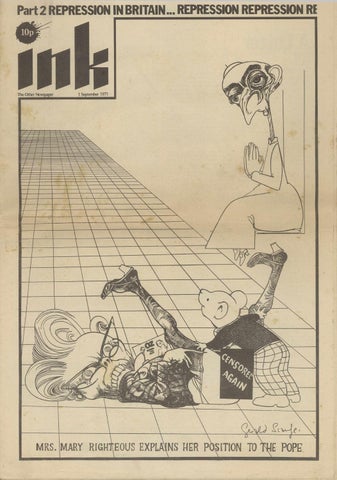
Part 2 REPRESSION IN B R ITAIN ... REPRESSION REPRESSION RE
The Other Newspaper
1 September 1971
s \ \ \ QaXJL) \ T ' V \ TJ—V --------- f ------\ MRS. MARY RIGH TEOUS EXPLMNS HER POSITION TO THE POPE
INK
Page 2
1 September 1971
REPRESSION REPRESSJONREPRESSIONREPRESSU
A Letter
To Ink from Germaine G reer
The outcome o f the OZ trial was expected. All over the western world governments are appealing to the most reactionary elements in the population. The disregard o f civil liberties and the setting aside o f expert evidence in the trial were part and parcel o f the process. The Tories have never supposed that OZ and its readers might overthrow the state; the politics o f the trial were simply those o f opportunism. In place o f the sagging tolerance o f the Labour govern ment, they were instilling the image o f the Conservative administration as the natural repository o f authority. The defendants were too sanguine in their supposition that they could alter the meaning o f the demonstration; their jokes and acts o f impiety were seldom reported and even less understood, and given the inevitability o f punishment, absurd. Insofar as the women’s movement is part o f the sexual revolution it must expect to suffer from the new repres siveness. Gay liberation movements w ill be h it first, but as soon as the reformist
women’s groups have gone the way o f conscious-raising towards revolution, they w ill meet harrassment. Surveillance they ought to know already, but they w ill discover new difficulties w ith accomoda tion and services. Indeed, as long as such difficulties are not encountered, it is only safe to assume that the group in question is considered insignificant. Tyranny is providing a perverse service; now we know that we must continually be educating ourselves and acquiring support. The time fo r preaching com fortably to the converted is past. Those o f us who believe that change is the only alternative to annihilation must struggle to communicate w ith the readers o f The News o f the World. Those who recoil in distaste or cry that it is impos sible have invalidated their own protest. Those who think it w ill be accomplished in a lifetim e are fools. It w ill take all the love, strength intelligence and patience that we have, and our children too. And then some.
An Editorial
Mike Foreman
For Ink by Bruce Page
I was asked to make some comment on the OZ trial. But in the interval between promise and performance, a sub ject o f wider importance has arisen: the internment in Ulster. No disrespect is intended to Richard Neville and his colleagues. Their case is still important. But at the time o f w riting there are 270 people locked up in Ulster, w ith no prospect o f trial, and w itho ut the right o f appeal which may yet m odify the grotesque penalty inflicted by Judge Argyle. Some people feel that the OZ case and the events in Ulster should be looked at as two different aspects o f the same repressive to ta lity. Although there are notable congruences between the philistine manners o f Argyle and Faulkner, I th ink that this approach con fuses more than it clarifies. And clarity is im portant in this matter, because it may produce movement. People are supporting, or anyway tolerat ing internment who find themselves uneasy in such a position. W ithout doubt, the Ulster Protestants are w orthy o f some sympathy: a people not w ithout virtue and energy, hopelessly confused by the ironies o f history. That said, only a frank reactionary can sensibly show an instant o f sympathy fo r the latest wild actions o f the leaders o f Ulster, or fo r the ruthless indifference o f the British Government which supports those actions.
One good general reason fo r this is the cultural and intellectual blight which is specifically produced by colonial relationships. It was Conor Cruise O ’Brien who pointed out that Camus does not depict any Algerians in Oran o f The Plague: just as the Frenchman Camus could not “ see” Algerians, so many Englishmen fail to “ see” the Irish. That special disability is being worked upon by the crude and alarming stereotypes which have distorted media coverage o f the events in Ulster. The argument, o f course, is that internment is required to preserve the security o f the state. You cannot have liberty until you firs t have order, the gunmen must be removed from the streets, etc. etc. Once touched upon, this argument can continue and continue, until we define that large gulf which exists between those who consider that we are progressing towards perfect freedom through the resolution o f contradictions, and those who regard freedom as a fortunate accident whose consequences may be preserved and extended. It takes a long time, perhaps an infinite time, to deal with that question, but in the matter o f Ulster some progress can be made w ithout doing so.
As it happens, I would not accept the argument that a state is entitled to intern in order to protect itself against its own citizens. But granting that many people find it a seductive argument, it is perhaps And yet they are condoned, even most useful to make them confront as supported, by people who should, as it regularly as possible the factual question: were, know better. It is not unfair, - who, i f anyone, was threatening Ulster with violence? perhaps, to select the Guardian, fo r it represents an English attitude o f some To a considerable extent,'the events o f importance. The Guardian, which would August 9-13 were dramatised in the not find imprisonment w ith o u t trial media as a “ battle” between the British acceptable in Greece, finds it acceptable Arm y and the IRA. For the firs t time, ran the official version, the Arm y was able to in Ireland.
engage the IRA in manly combat: naturally, the week ended w ith the claim “ we’ve licked them .” The spokesmen who were pushing this bill o f goods perhaps forgot that a “ major defeat” o f the IR A was claimed after a shooting incident only a few months ago. In any case, the strategists o f Public Relations Command certainly reduced the heirs o f Alamein to claiming victory on the basis o f a most picayune body count. One must at least think that the IRA lost one man killed in ten when “ defeated” otherwise they must be such cowards that they could scarcely be brought to battle. I do not think that there is evidence that any more than two or three o f the people killed had any serious connections o f an IR A kind, which would seem to mean that roughly th irty gunmen were engaging more than 5,000 troops. You can only get the total past 200 by including priests, old ladies and known Protestants as IRA gunmen. It is always said that you need local superiority to defeat guerrillas, but this surely is taking the principle rather far. There is no need here to labour the point. Although there are IR A men, especially from the Provisional wing, doing some shooting in what they conceive to be the defence o f their own people, and although there are quite enough armaments in Ulster to ensure regular death by sheer friction, it should be plain enough that armed might in Ulster does not reside upon the Catholic side. Essentially, it is the Protestants who have the guns: essentially, it was their threat to proceed to private violence which precipitated internment, and not any actual violence committed by IRA groups. (It remains, in fact, an open question who was responsible fo r a good many o f the more colourful killings in
Ireland this year.) Such o f the facts about the causes, consequences and purposes o f internment as have managed to penetrate the romantic imagery about stalwart soldiers and tommy-gunners in trench coats have already perceptibly eroded the uneasy support which the programme at firs t obtained. Already, in a desperate attempt to shore up their position, some official spokesmen in Belfast have had recourse to the Slansky syndrome — there is nothing else to call it. It w ill be recalled that one o f the items o f evidence against Slansky ran as follows: There was, w itho ut doubt, an Imperialist espionage conspiracy at work in the Czechoslovak Communist Party. Yet no evidence o f this conspiracy could be obtained. This indicated clearly that Slansky, First Secretary o f the Party, must be at the head o f the conspiracy. How else could the evidence have been suppressed? Thus the absence o f evidence is turned by theological means into the most convincing evidence o f all. A few days ago, Belfast officials were trying to maintain that internees like Farrell were indeed at the head o f a vast armed conspiracy: in the end, they too had recourse to the absence o f evidence. That absence, they said, showed the fiendish cunning o f the conspirators: hence the fantastic danger they represented, and therefore the urgency o f locking them up. Such a policy, once comprehensively exposed, can be supported only by the repressive genius o f a Stalin, and by the whole apparatus o f the KGB and the Soviet Arm y. Such powers do not exist in Britain — the Defence o f the Realm Acts apart — and that perhaps, is one o f the few perceptible slits in the dark curtain now enclosing Ireland.
This special issue of Ink (No.17) was put together by Rick Kemp, Judy Groves, Claudine Meissner, David Wills, Sandi Sparrow, Charlotte Veysey, Cassandra Wedd, Sue Small, Diana Shelley, Andrew Fisher, Steve Cox and Brian Winston (Editor). © INK Publishers Limited, 19 Great Newport Street, London WC2, Telephone: 836 8395. Printed by Daeha Publications Ltd. 4-5 Station Approach, Kidlington, Oxford. Distributed by Moore Harness Limited, 11a Lever Street, London EC1, Telephone: 226 0689.
■PRESSMNREPRESSIONREPRESSIONREPRESSION Northern Ireland 1971 The quality o f Ulster Ulster 71 coming exhibition and festival year
events
concerts exhibitions sport dancing parades angling
Life in Ulster is lived against a background of great natural beauty - wild, bare mountains and wooded glens, quiet rivers and loughs and miles of superb, unspoiled coastline; and this has always had a big influence on her people's quality of living. Ulster is famous too for its roses, which regularly win the world’s leading awards. Culturally, Ulster has as much to be proud of as any . other part of Britain - its list of famous writers, artists, musicians is impressive. But culture in Ulster has never been the preserve of the few. All participate, and there is hardly a town or village that does not have its drama group. Whatever your interest - artistic, sporting, educational - Ulster caters for it generously.
1. The Mountains of Mourne, famous in song, show Nature at her wildest and most impressive. 2. The 40-strong Ulster Orchestra brings serious music within the reach of the many. 3. The Glens of Antrim, remote and romantic, yet easily reached from Ulster’s capital city. 4. Ulster has more than its quota of first-class golf courses. 5. The varied beauties of Ulster’s coastline include many miles of sandy beaches as good as any in Europe. 6. The beauty of Ulster roses is acknowledged the world over. 7. First-class fishing amid beautiful . surroundings at the Water Gate, j Enniskillen, Co. Fermanagh.
Page 3
1 September 1971
U ls te r M FESTIVAL FO RTNIGHTS As part of the Province wide programme of events, there will be gay and colourful 'Festival Fort nights'throughout Northern Ireland during the period of ULSTER '71. Spread right across the Province, these events will be full of local colour and character istic of the spirit of Ulster '71, showing the partici pation of the people at all levels in the progress of their country.
FESTIVAL OF ARTS In a cultural sense, 1971 will be a very special year. The Northern Ireland Arts Council have devised a oroaramme which will
golf______
M y Ulster Holiday They are all interned, y e t the bombs are s till going off. The British A rm y has won a famous victory, y e t men and women are s till dying. The Belfast Regime’s story wears thinner and thinner. Below, a holiday diary from Ulster 71. I t was kept by an expatriate Irishman. He remains anonymous because he doesn’t want his friends identified. That’s the way things are in Ulster 71.
prominent people have resigned from public authorities. Rioting continued again mostly throughout that day.
k.
A
About 9.30 a.m. at the Lone Moor Road, which leads up into Essex International factory, the army tried to take down a barricade but failed. Two o f the Landrovers were set on fire. It was then we heard rifle shots ringing through the air, and the army retreated from the area with rifles firing (CS gas) rubber Arriving in ‘ Ulster’ on the 7/8/71. Drove bullets. Myself and my friend were in the down in a hired car from England. car on our way to collect some friends., Arriving in Derry, thought I was entering but it was impossible due to the situation. an occupied city. Armed troops on the I thought this was our end. side o f the streets; Tank jeeps, guns, Wednesday the 11th. We were about to machine guns, batons, CS gas, rubber go on a tour o f the west coast o f Ireland bullets. Surely this can’t be part o f Gt. and we heard there was going to be a Britain! march to the Diamond, the Centre o f Sunday we went fo r a tour in Donegal. Derry. It also has a m ilitary post so we On our return journey we were stopped decided not to go in case we would not by the ‘Ulster Defence Regiment’ to have be able to return to our friends. Everyone our car checked and I was allowed to seemed tensed . proceed on our journey back into Derry. A t about 3 p.m. we see approx. 2,000 Monday the 9th, we went on a tour o f people, mainly housewives and young the Antrim coast to the Giants Causeway, v women, marching towards the m ilitary then proceeded to Belfast to have a look post in the Diamond to protest about at the Shankhill Road and to people being interned w ithout a trial. Ballymurphy, and then down to the Falls The people seem to be peaceful Road. We have never seen so many enough. Later the tanks and the jeepsbarricades and destruction. We were started to come out o f various m ilitary always led to believe by our TV that the posts to surround the Catholic ghetto. police and the army had fu ll control o f all Then the trouble started. There was areas. continuous violence until right into the early hours o f the morning. Thursday the 12th. I heard there was supposed to be a big parade by the Apprentice Boys but it had been cancelled by the Prime Minister. I was greatly surprised to see the R.U.C. police in and around the areas we visited being armed. I was led to understand by the TV in England, that they no longer carry guns whilst on duty; also more violence on that day. We then tried to make our way back to Derry, on the advice o f the local people, as they said our lives may be in danger as the soldiers were preparing to make an attempt to take down the barricades; so we proceeded through the maze o f barricades, which stretched nearly out to the city boundary. We were thankful we arrived in Derry safely. Tuesday the 10th. People are not paying their rents or rates to the Derry Development Commission; also sixty
Friday the 13th. We visited Dublin. It was wonderful to have peace, but when I looked around Dublin I can see the same thing happening there. We arrived back in Derry w ith more trouble. Saturday the 14th. Five to six thousand people attended a civil rights meeting in the Guild Hall Square. A fter the meeting had finished the army once again came running out with their tanks and guns (CS gas) etc., started to seal o ff the Catholic ghetto once more and once again the stone throwing and the CS gas flying through the air, which I got a nasty dose of. It is not a very pleasant odour, your eyes stream, coughing, and a burning sensation to your skin. I think it must have a detrimental effect on the citizens o f that area when CS gas is used constantly on them.
Sunday the 15th. I watched the funeral o f a man who had been killed earlier during the week by British soldiers. About a thousand attended. He left a young fam ily and wife behind. Afterwards more disturbances occurred in the streets and the usual things started (CS gas, war machines etc.).
I was surprised when I listened to the BBC’s midnight news at the inaccuracy in the reporting o f the situation. They seemed not to have got any fact right. But how can they get their facts when they sit on their backsides from the time they get up until the time they go to their beds? In the hotel you w ill see these newsmen from all over the world discussing their stories and swapping information to each other, relying on local people that come into the hotel to get inform ation fo r them. It is more like a holiday to these people; they eat the best, they drink the best while outside the people are living below the poverty line. I have seen it fo r myself more than once when I happpened to be in the hotel with
friends o f mine, when some o f the lunches come to tw o pounds per meal this is not only on a Sunday, it happens every day o f the week, so I am told by my friends in Derry.
Monday the 16th. There wasa general strike in the city, most o f the public transport came to a halt, postmen on strike, docks, shops. Meetings were held. Again another rio t situation occurred. Four people were arrested violently by the troops. A man by the name o f Gerry Fergusson was arrested by the army. This man was knocked unconscious by a rubber bullet. It was also reported that he had 36 stitches put in his head. In the local paper, The Derry Journal, there is a photograph o f a soldier standing on this man’s body. The date o f this paper is 17/8/71. Tuesday the 17th. The last day o f our holiday. The factory known as Essex International was closed this day, due to the army because the workers would not pass the army sentries on the gate. This caused another situation to develop. Also in this area where Essex International is based there is a big m ilitary compound, and during our stay the army has made several attempts to relieve the soldiers who had been on duty there continuously fo r a week, due to barricades around this area which the army had not been able to pass through, but had failed with several attempts to take down these barricades and had to drop supplies by helicopter to the soldiers.
We would like to assure the people o f England, as we are British taxpayers and British citizens o f this country, that their money is being wasted on keeping troops on the side o f the streets in ‘ Ulster’ and this sort o f thing could happen in this country as well. .
INK
Page 4
1 September 1971
Fashion
R O ’RlSSW tittPRhSSKJNREPRtSSW NREPRESSI W hat To W ear For Ulster '7 1
CL
IE QJ2 00 c < +o-»
o
JZ CL
Auxiliary English Arm y Welcome to the Auxiliary English Army. The AEA. To-day we are going to shoot those gooks the Irish. They’re all we have left to shoot up, but never mind, i t ’s still fun. You don’t need a gun, just stay there and think about it, we’ve got all the guns we need. Your real task is to carry on doing what yo u ’ve been doing fo r the last six or seven centuries. Surprised? We don’t ask much in the AEA, just that you show your support fo r tine soldiers at the front. The fighters under fire, those standard bearers to all o f which is best and British, always on call, always ready to quell the riot. As long as they know the AEA is around they’ll continue with hope in their hearts. They may complain sometimes that they’re tired, they’ve been fighting fo r six or seven centuries, but i t ’s their job and as long as they know i t ’s their duty, and as long as you support them in their fight, in their duty, as long as they know we’re here, they’re fine. As long as they know i t ’s not Vietnam, and no-one’s saying i t ’s like Vietnam, as long as they know that they feel justified. They don’t have to th ink about it then, because they know y o u ’re thinking fo r them. They don’t hear about protests and demonstrations and all that shit, they don’t need them: they know no-one is undermining them. They don’t need all that dope the GIs and you need because they have a clear conscience, they feel right, they’re keeping your peace fo r you, fo r the AEA. Do you feel safe? They want you to be, those soldiers, that’s what we support them for. Don’t we? Every time they flick one o f those jokey rubber bullets at a crazy mob, i t ’s fo r you. Those gooks, those bastards on the streets, they must really feel isolated. They must feel as
though no-one gives a fu ck! And th a t’s good, because they just might get demoralised. Every time one o f their people gets beaten to death and no-one gets to hear about it, that must really screw them, because their fight really depends on that, really depends on good publicity. And they don't get it. It doesn’t exist. We o f the AEA make sure o f that. We know our army is out there fighting for Ireland’s good. Keeping the peace as it always has done, and the AEA has always been with them right through the ages. Historically we have marched side by side down the highway o f fortune. We have exterminated entire nations (over population?), plundered savage lands (they didn’t appreciate it), raped half the world, aborted their young embryos, dragged their children from a maimed womb and dressed them in bowler hats, and much more. T hat’s the AEA. What about it? Now we sit on our bony little asses and contemplate our actions with price. IN D IA, AFRICA. AU STR ALIA. M A LA Y A . IR E LA N D ’ Our heritage. Your fucking heritage. Our sons’ fucking heritage. And we o f the AEA can, and do, sit. That is our function. We sit while half the world spews up our shit. We can sit and turn on to the beauty o f life. Humanity is pointing i t ’s skeletal finger at us, and screaming fo f help and we can look elsewhere at the horrors. Wake up! I t ’s here. The horror is on its way. The AEA, guardian o f centuries is recruiting, and there is plenty o f space to f it you all in. As a nation we are the embodiment o f inflicted torture and real pain. Our sceptred Isle is dripping with blood. Every black starving white bloated child yo u ’ve ever seen is buried in the earth
you are sitting on. And th a t’s not all! There’s plenty more, just sit down and think about it! It is our history. I t ’s our day to day life. Some might call it death, day to day death. But it is us. It is our day to day history, if you like. And it is going on to-day, isn’t it? I t ’s going on now, right now. You know where. Ireland. Good. You know where Ireland is don’t you? Four hundred miles away. T hat’s not far it it? Where they drink Guinness and everyone says ‘O i’. Where Cromwell shut four hundred women and children up in a hut and sent our soldiers in with orders to have a good time? Where the women and children were raped and then had swords rammed up their asses and cunts? Swords, imagine that. Eight-year-old children fight in the streets in Ireland, just like Vietnam. But they don’t have a chance with the combined forces o f the English army defending our Irish streets. The AEA knows that. We know where Ireland is and we can see what is happening. We can see what is happening in Ireland, we can see what is happening in Vietnam, we can see all those American G l’s getting destroyed by H, and we can giggle at that, because that H is destroying the capitalistic pigs who are attacking a good country. Imagine all those soldiers going back home! Really needing a fix all the time because they’ll think they’re still fighting the enemy! But none o f that in Ireland. Our soldiers have never even heard o f H, let alone fe lt itNobody is turning anyone on in Ireland, and subsequently when our boys come home they w on’t be destroyed, they’ll be ready fo r the next foray, in some distant land. Clean, upright honest soldiers, and just look at that s tiff upper lip. I t ’s so s tiff it looks like i t ’ll never smile, and th a t’s good
because these men are men. Men o f England defending Ireland against the Irish. Remember the fig ht is against the Irish. Remember? The same guy who builds your house and pours your pint. He's d iffic u lt to recognise because he is white! Yes. He’s not even black — but white. He’s not like the Indians or the Africans we talked about, he’s the same colour as us. And nor our soldiers are out there killing him now, but humanely, quietly. No napalm yet fo r the lads in Ireland. No starvation. Anyway they had all that before we were born. They’ve lived with that all their lives. They’re used to it, can you imagine that? They know what it is to have been on the losing side fo r centuries and do you know who the winning side was? Right on. England and the AEA. You. Us. The continuation o f our age-old concentration camp. We are the guards at those gates, and if you can’t see the smoke from the ovens yet, don’t w orry, i t ’s there. Now fo r a warning. This is 1971. This nation is sick. There has been no major collective statement about the sickness we — as a nation — have perpetuated — ever. We have never with respect, with either understanding or compassion expressed ourselves, our disgust, collectively. Our insanity is deeper than we think. Any expression o f sanity does not exist. We are degenerate sycophants hanging from a bloated lip o f gluttony. That jumble o f letters spells guilt. This is 1971. Ireland exists. Before our eyes a major inhumanity is taking place. Ireland is the personification o f our empire. It stinks. It is all we deserve. And take care o f that lip.
PRESSIONREPRESSIONREPRESSIONREPRESSjON
Scotland Ulster apart, the English have other old colonies in which to play theirfavourite role o f cultural and economic repressor. For the moment Wales sleeps quietly under the aegis o f its cymrufied prince. For the moment Scotland faces the harsh reality o f having its national life ruled by Nabobs in Westminster. If Scotland is now being repressed by the Westminster government, then th a t’s its own fault, you could say, since it should never have committed the A ct o f Union in 1707. If Scotland is now being repressed by its ‘foreign’ rulers, it has to be remembered how repressed it has been by its ‘native’ rulers both before and after the Union. John Knox, Mary o f Scots and Prince Charles Edward Stewart - to mention the best known rulers spiritual and temporal — are a bonnie lo t indeed, working out the twists o f their fantasies on an ignorant populace. If Scotland is now being repressed at all (and it surely can’t escape it) i t ’s not in ways that the Nationalists or the liberal decentralists have, up to now, recognised.
Blacks
Page 5 1 September 1971
INK
by John Lloyd
It w ill not respond to their solutions. Freedom from the domination o f the English would mean submission to the domination o f the Scots, and who can say that would be any better? Workers It has to be said that the battle is being fought on the wrong ground fo r the wrong reasons. The Upper Clyde Ship yard workers show true solidarity in taking over their yards, but fo r what are they fighting? For the right to make ships more expensively, more slowly and less efficiently than their competitors in Germany and Japan? The shipyard workers’ anxiety is a natural one, certainly, o f loss o f job and money for themselves and their families. But more than that, its an anxiety o f having their very being amputated. Any man w ill fight, perhaps to the death, to stop the terms by which he identifies himself being taken from him. Natives Since the clearances o f the Highlands in
the early part o f last century, that area — more than half Scotland - has been a holiday ground fo r the wealthy. The model fo r the Highlander after the clearances was — and this still lingers — Queen V icto ria ’s favourite ghillie, John Brown — a man staunch, wise in local custom, utterly obedient and respectful. The psychic harm done by the brutal abolition o f the patriarchal clan system on the Highlanders is incalculable. The modern Highlander is now very often being pressured into an ‘ Uncle Mac’ role (‘Sho’ good eatin’ becomes ‘Ye’ll ha’e anither nip?’). His fellow countrymen are apply ing this pressure largely because o f the greedy need fo r the mighty dollar. Remote crofts take travellers cheques for bed and breakfast from American descendants o f the same dispossessed clansmen stock. The plans now being implemented fo r the Highlands are geared to increase this liberal scattering o f a new kind o f spiritual poverty. The industrial revolution required its workers to work: The manipulators o f the global village require those native villagers who are left
Burdens Scotland is as heterogenous as any other ethnic or national group reckoned in the millions. It has two root races, Gael and Anglo Saxon. It has a capital city, Edinburgh, -characterised or caricatured fo r its ‘culture’, and an industrial centre, Glasgow, characterised or caricatured for its lack o f it. Its natives tend to do well fo r themselves in England or overseas, but Scotland is still largely a ‘depressed area’. I t ’s tempting to see the Scots abroad as am bitiousjm d successful and the Scots at home as self paralysed. As I see it, Scotland’s main repressions in the present and to come lie here; its workers are saddled with a perverse love o f their chains; and its 'villagers’, both in the highlands and in the lowlands are happy to become stereotypes. These chains are not unavoidable. A t least half the shackling is done by the prisoners. The Scot, to be free, has to know himself as a man. Knowing himself only as a Scot enslaves him.
“ an anti-working class measure directed principally against the black section o f the working class, but affecting every other section as well . . . it is as much part o f the government’s overall strategy fo r disciplining the working class as the Industrial Relations Bill and all the other anti-working class measures being adopted. In the enormous agitation against the Industrial Relations Bill, that measure has been described as a scab’s charter. Yet here we have a measure in which the government is preparing, if necessary, to use the whole apparatus o f the State and law forcibly to turn one section o f the working class into scab labour; and there is hardly a murmur about it from the official trade union movement.” The British ruling class wants to make ordinary people work longer hours for less real money. In order to do this, it w ill have to divide the working class, destroy its solidarity, turn one section against another. That is the task o f the 1971 Immigration Bill. When it becomes law, it w ill create a legally separate class o f citizens with practically no rights and
under constant surveillance and super vision. With growing unemployment, this black sub-proletariat will be used as a scapegoat, to divert attention from the root causes o f injustice, insecurity and scarcity. The politically organised immigrant groups have already said that they will resist this Bill and w ill not allow them selves to be made into a source o f cheap scab labour. Immigrants have a proud record o f industrial militancy. They w ill resist. There is every indication, however, that the official trade union movement, unable or unwilling to fig ht the Industrial Relations Bill, w ill be as anxious to find a scapegoat as the Tories. Britain has a long history o f racial oppression and the m ajority o f the British have adopted the prejudice and intolerance that not only the reactionary press but also their own leaders (like Ernest Bevin and Ray Gunter) demonstrated over the years. If the ruling class’s present strategy o f attacking and dividing the working class succeeds, it will have generated a peculiarly British form o f fascism.
only to smile fo r the Instamatics.
by Robin Jenkins
Theoretically, individual racism is illegal in Britain. Practically, the law on racial discrimination is impossible to apply and has quckly become a sop to liberal consciences. The state does now forbid a publican to refuse to serve a black customer. But it empowers its paid officials to bar ordinary people from this country because o f the colour o f their skin. In fact institutionalised racism has been increasing since 1962. The racial legislation o f the Labour government was a compromise from the start. It contained a fundamental con tradiction between immigration and discrimination policies. Its immigration policy never wavered from the Keep Britain White policy initiated by the Tories with the Immigration A ct o f 1962. The only difference seems to be that while Tories are blatantly racist, Labour resorts to the rhetoric o f pragmatism. The result is the same. Proof: the 'Kenyan Asians A c t’ o f 1968. The 1971 Immigration Bill that the Tories are now making into law is simply the fru it o f Labour policies. There is every reason to believe that had they
been in government, Labour would have found it pragmatic to initiate similar legislation. In any case, Labour w ill never repeal the 1971 Bill. The Bill has fo ur major implications: 1: Immigrants will only be able to enter the country to take up a specific job in a specific place, and then fo r only one year in the first instance, leaving them under the total control o f their employers. 2: Extension o f the one-year permit w ill be conditional on the ‘good behaviour’ o f the immigrant, the proof resting with him. 3 : The immigrant w ill have to register with the police fo r the first five years o f his stay in Britain. Since the police w ill not be able to tell which blacks have lived in Britain fo r more than five years and which ones have not, this part o f the Bill forces the whole black com m unity to produce on demand identification papers. 4:T he immigrant can be ‘voluntarily’ repatriated if he and his fam ily ‘become a burden to the State’, i.e. if he loses his job. The political implications o f this Bill are clear. It is, as Ian MacDonald has said,
Ulster Mike Farrell is the leader o f the leftwing People’s Democracy party in Ulster, and a lecturer at Belfast College o f Technology. He is known and respected as a political theoretician and in no way regarded as a violent revolutionary. In the dawn swoops o f August 9 he was lifted and interned. Black Box spoke in Belfast w ith his wife, Orla Farrell, who has been permit ted to see her husband only once since his arrest under the Special Powers Act, and then only fo r a short period o f approximately fifteen minutes. It was during this brief visit that ‘Michael informed me o f some o f the tortures inflicted on him ’ said Orla Farrell. ‘My husband was forced to run bare fo o t over barbed wire, broken glass and sharp stones. A t one stage an Alsatian guard dog was set on him, badly ripping
Theatre 'his clothes. A ll the while British troops and RUC officers looked on jeering.’ She added that he was kept in solitary confinement for tw o days. Asked why she thought her husband and other lead ing PD members were interned, Orla Farrell said ‘ Faulkner not only wanted to get rid o f the m ilitary (IRA) set but used internment to silence those politically articulate sections o f the com m unity opposed to Storm ont.’ Orla is in almost daily contact with the wives o f other interned PD mem bers, including the wife o f John D. Murphy, editor o f Free Citizen, PD’s weekly paper. Since August 9 the paper has been appearing two or three times a week — only its title has been changed. I t ’s now the The Unfree Citizen. from Black Box
by Jeremy Beatty
Street theatre does away w ith all social distinction, presenting itself directly, w ithout mediation o f critic or box office, in an attempt to develop a language o f creative action which can be shared by everyone. That is why it is impeded and harassed by the police. E xhibit 1: In Euston station fore court a man wearing a grey suit, with short hair and carrying a small bay tree, moved at a steady pace, uttering a deep humming sound, like a figure from a dream. On reaching the far side o f the station entrance he was chased by a police sergeant, who told him that were he to reappear he would be thrown in the cells fo r the night and that the sergeant “ Would put the boot right in ” . The first principle o f the police seems to be: if i t ’s not understandable, stop it. Exhibit 2: In Trafalgar Square on November 5 last — supposedly a day o f tolerance — a man started to dance with some friends and about sjxty.
sympathetic bystanders formed a circle and began to clap rhythm ically. He was immediately pulled out by the police and subjected to search fo r drugs, apparently considered the oniy possible explanation fo r such subversive behaviour. On this occasion, and on many others, the whole e ffo rt and function o f the police was to prevent any possibility o f creative coming together (Theatre is a place where people meet’ — Grotowski). There are countless more examples, but the basic point is that you are welcome to believe that you are free until you try it, and if you don’t try it you need never know; that the basic repression operates not so much in terms o f law, though that is important, but in terms o f the opinions and pre judices o f the policemen on the spot; and what are restricted are not so much your views and ideas as forms o f behaviour.
Page 6
1 September 1971
REPRESSIONREPRESSIONREPRESSIONREPRESSt
Universities
Until a few years ago, university authorities were unchallenged. They pre scribed courses and syllabuses and con ducted examinations. Beneath them, lecturers lectured and students studied. The promotion o f lecturers was deter mined by seniority, by research, by
a
by John G riffith
acceptability. It was a gentlemanly, large ly undisturbed game. No one seriously questioned either the content or the structure. Both were classically authori tarian. Then student protest began in the late 60’s and rapidly widened its scope. The authorities reacted, in their deep
JACK ROLLINS-CHARLES H.J0FFE
ignorance o f what it was all about, with authoritative rebukes and irrelevant punishments which inevitably proved that the bases o f the protest were wellfounded. The actions were repressive and trivial. A t the LSE fo r instance, they refused to allow a student president sabbatical leave or to write to The Times', they banned the holding o f meetings and so on. But the authorities were not consciouly reacting to a general mood, only to isolated and (to them) inexplic able demands. As student protest in creased, the authorities were faced with the possibility that there was a general discontent with the way institutions were being managed. Robin Blackburn was dismissed from his lectureship at LSE fo r expressing an opinion in support o f his students; Laurence Harris (another lecturer at LSE) was pursued by the school authorities over many months on charges which were eventually dropped and the School re fused to contribute to the £1,000 which his defence cost him; Anthony Arblaster a t . Manchester and Dick Atkinson at Birmingham were refused appointments on political grounds (the only possible explanation); at East Anglia recently, 19 academics were threatened w ith dismissal because o f their public criticism o f Uni versity decisions; Warwick University L im ited tells its own story; Paul Hoch was imprisoned fo r several months after conviction on a minor charge and then deported; no one needs reminding about the Garden House affair at Cambridge, or about Hornsey and Guildford art colleges; students at a large number o f Universities have been subjected to court injunctions, expelled or suspended; students at colleges o f education and elsewhere have been disciplined because their sexual re lations w ith other students do not con form to the views o f governors; staff and
students convicted by the courts o f possession o f hashish have been dismissed, or expelled although their offence had nothing whatsoever to do w ith their academic institution; a very large number o f protesting students have been punished and the careers o f many academic staff set back or ended. These results were not too d iffic u lt to achieve. Apart from disciplinary pro cedures taken in the courts or in University tribunals, threats were made to students at large that grants would be stopped, examinations not held. A t LSE, the School was closed fo r several weeks. The governors first seemed to have panicked but they continued vindictively until enough o f the academic staff found the courage to insist that teaching be resumed. The authorities in Britain today react quite sw iftly and quite effectively. There is nothing new in this. But repression in Britain leaves behind an irremovable stain, a sediment that does not wash away. And this can be seen today in many institutions o f higher education. The failure o f the authorities to answer student and staff protest substantively has had the effect o f weakening those institutions more seriously than could have been achieved by any direct action. This weakness w ill not easily be remedied. And it can be remedied only by radical change. Repression can be effective in the short run but in the long run it is self-defeating. To some people, the “ strong” men have shown how to demolish those who wanted radical change. But to others (including myself) their actions have proved only their essential authoritarianism, and their un suitability to be in control o f educational institutions. Those institutions, under their tutelage, are become sepulchres. That is their epitaph.
Production
woody alien's bananas.
with
LOUISE LASSER ■Executive Producer C H A R L E S
H . J O F F E ' Produced by J A C K G R O S S B E R G ' Directed by W O O D Y A L L E N
Associate Producer and Editor R A L P H R O S E N B L U M , A .C . E . ■Written by W O O D Y A L L E N and M I C K E Y R O S E ’ Music by M A R V I N H A M L I S C H ’ C O L O U R by De Luxe UmtadArhalB
FROM THURSDAY SEPTEMBER 2
& PRINCE CHARLES cinem a
SEPARATE PERFORM ANCES Mon - Sat 2.30, 6.15, 9.00 Suns 3.30, 6.15, 9.00 Late Night Show Fri & Sat 11.45pm A LL SEATS BOOKABLE
iPRESSIONREPRESSIONREPRESSIONREPRESSION
Boroughs It is against the law to refuse to pay your rates. Given that you must therefore pay them you must elect a group o f people to decide how to spend the money. I, and a group o f my friends would like this job. What we propose to do is to meet regularly and secretly to determine what to do with your money. Will you vote for us? O f course, the Independent, Con servative and Labour candidates for municipal elections never say such a thing as they canvass their wards. The pinkwashed plump veterans o f the middle classes, the panjandrums o f local industry, and the army o f dayglo-shirted intellectual adventurers from the unionsponsored civics course who form this squalid army to pimp fo r votes each year believe in anything but presenting an honest face to the public. The one thing that unites all local councillors and aldermen is their belief in the same technique o f public admin istration — the celebrated ‘‘mushroom method” . This can be most succinctly defined as keeping the electorate in the dark and shovelling shit on them every six months. Which is not to say that there are NO honest council members among the general run o f jumped-up cheapskates who administer local affairs. All I am saying is that during 16 years o f studying the species I have not come across such an animal. They are in general deceitful, self-centred, devious, sycophantic, dullwitted, unprincipled, uniformed, inarticulate, and, above all, secretive. They are sensitive to nothing, except criticism. However, they are well protected against the perils o f their own deficiencies by a grovelling army o f local government officials, the pathetic and apathetic local newspapers, and the infamous Public Bodies (Admissions to Meetings) Act, 1960. Like most Acts o f its kind the Public Bodies (Admission to Meetings) A ct purports to be an instrument for democracy while effectively buttressing the forces which deny democracy; it enshrines rights fo r public bodies to deny rights to the public they supposedly represent. And it is all done in the name of public interest. The A ct provides for meetings o f local authorities to be open to the public except where the authority resolves that publicity would be prejudicial to the public interest. Authorities inevitably use this bolthole to keep press and public out when publicity would be prejudicial to the a uth ority’s interest. Thus are innumer able blunders hidden from public view. And at the slightest w h iff o f scandal inquirers find themselves being taken for a ride to nowhere on the merrygoround o f c le rk -c h a irm a n -tre a s u re r-c o m m itte e member-deputy clerk-deputy chairman
by Ron Knowles
etc. They have intense loyalty to each other; none to the members o f the public who elect them or pay their wages. Some councils are more cynical than others in ignoring their duties to the public. A t Haverhill, West Suffolk, the urban council (Labour controlled) recently informed the local evening paper that it must not use advance copies o f the minutes to alert the public about the council’s intentions. The paper must wait until the council has made its decisions — and it is too late fo r public protest — before it can report its activities. The
same council actually grants the press more rights than its electors. Reporters are allowed into some committee meet ings, but the public is not. Other councils are similarly indifferent to the public right to know. Their attempts to defend their indefensible positions produce some obscenely funny sophistry. One council lor at Saffron Walden recently declared that he was opposed to making infor mation more directly available to the press because newspapers sometimes printed stories unfavourable to the council. When the issue o f press admis sion to committees arose at Alsager, Cheshire, way back in 1959 a member o f the rural council, with typical eloquence, opposed the suggestion thus: “ I don’t
Page 7 1 September 1971
think we should have reporters here reporting what we say . . . because . . . err . . . because . . . anyway, we don’t want reporters here, do we? I mean . . . e r r . . . why should we have these people here . . . e r r . . . I mean .. . err.” He was demolished by a verbatim report in the follow ing day’s paper. It is little wonder that secrecy prospers in the town halls and that contempt for democracy is second nature to the geriatrics and mental eunuchs o f the council-chambers. A fter all, they give up endless time and effort, w ithout pay, and all they want in return is to push people around w ithout noise and fuss; and, in doing so, earn the undying respect o f the electorate.
Sandford
Houses
by Nick Cox
To be fed and clothed has been estab lished as a ‘right’. No ‘rig ht’ to work has been achieved. Unemployment is still deeply feared and its use as a control measure has been strengthened by the Industrial Relations Act. No ‘rig h t’ to be housed exists either. The social strains o f the housing situation are shown in every edition o f every local paper. The recent White Paper Fair Deal fo r Housing (H.M.S.O. 20p) w ill strengthen the fears which sap m ilitancy and arouse social discord. There are many homeless and a few squatters. Tenants’ and residents’ associations organise far fewer people than do the Trade Unions. Council tenants have no security o f tenure. Controlled tenants are the worst o ff - freedom, fo r them, excludes free dom from harassment and eviction. All these householders, as taxpayers and ratepayers, contribute to various housing subsidies, but the subsidies go
only to owner-occupiers and council tenants. Thus the housed are divided against themselves. And the most para sitic benefit the most from the present set-up. The £60 m illion extension o f the Victoria line in London raised develop ment values along its route by £70 m illion. These days, prick a new millionaire and i t ’s more than likely he made his pile ‘developing’. The boss o f Centre Point grows richer as his empty block in Tottenham Court grows more and more valuable each passing day! The Freshwaters control the biggest block o f rented property in the land and the head o f the clan has b uilt a £9 m illion personal fortune from scratch. The building societies are now the strongest financial institution about. The White Paper aims to satisfy the whole range o f those who p ro fit from the buying and selling o f property and their lackeys, the attendant land-owners, land
lords, money lenders, building society officials, estate agents, solicitors, barristers, and bailiffs. The Tory scheme w ill transfer £300 m illion a year from the pockets o f seven m illion rent-paying householders to the pockets o f landlords and money-lenders; from the consumers to the investors. It w ill in effect cut the wages o f the consumers and increase the rate o f p ro fit fo r the investors. And this wage cut will fall on workers not yet organised to resist it. It w ill bring the vast m ajority o f these rent-paying workers under the thumb o f a system depending if they want a rebate on a means test. If yo u ’re eligible fo r the dubious privilege o f joining the. Tories’ new game, your rent w ill go up. If yo u ’re rich enough to avoid playing, your rent w ill go up less. It may well be that the castrated Labour Party’s bi-partisanship w ill face its
severest test on the Fair Deal For Housing question. The heights o f Parliamentary and Trade Union leadership are well satisfied to ‘keep w ithin the law’ as Wilson advocates. It is rather different in the lower echelons. Local Labour Party members and councillors are mainly working class, most often live in rented dwellings, know the financial strains o f ‘fa ir’ rents and the ignominy o f sub m itting to means-tests. But they also know that an opposition by words alone w ill not be enough. Millions o f people are repressed enough already because their homes are subject to massive and continuous inter ference. Now its back to the bad old days with prying means tests and rising rents. I t ’s another prong o f the Tories’ blatant attack on the working class. Destroy the social services, disarm the trade unions and now desecrate the rent payers’ rights. The time has come fo r rent strikes. The call is being heard. It must spread.
INK
Page 8 1 September 1971
Rock
REPRESSION REPRESSION REPRESSION REPRESS
by Martin George
“ KICK OUT THE JAMS MOTHERFUCKERS” was the audial treat fo r you if you were one o f the super elite to buy a trendy im port copy o f MC5’s first album. If however you waited fo r the British release o f the album via Polydor you would have found that during the flig h t from 1855 Broadway to 12-19 Stratford Place a magical change had been wrought on the master tapes and that those Motherfuckers had become Brothers and Sisters. A relatively minor piece o f censorship, but it has to be seen against the background o f the Motor City 5’s relationship with Captain Hip, Jac Holzman, head o f Elektra Records. In less than a year the relationship ran from Jac telling me that they were the greatest band ever and very radical, to him telling them not to use the word fuck in adverts. He finally threw them o ff the label fo r supposedly ripping o ff equipment from his LA studio (a studio he paid fo r from the profits he made out o f us and our Amerikan brothers and sisters). This tactic falls quite neatly into the paternalistic attitude that record companies have towards their customers and their artists. Perhaps he didn’t want to screw his deal with the new “ super label” Kinney in which he sold out Elektra fo r a lo t o f cash, a big bunch o f Kinney stock and a job fo r life. Not bad if you can get it. The role o f the record company in the repression machine is to bleed o ff energy and turn it into p ro fit fo r the Man. When you can buy your revolutionary consciousness prewrapiped care o f Edgar
(Out Demons Out) Broughton, slipped in its fold-out 4-colour sleeve, why go out and do anything? Listen to the album fo r the cause o f Liberty. The problem is that i t ’s so hard to do anything while y o u ’re wearing stereo headphones. As long as you forget that every album you buy puts bullets in the Man’s guns, you can really get o ff on those revolutionary lyrics. Radio Caroline and the other pirates broke up the monopoly in airtime that EMI and Decca had. They opened the way fo r the independent labels. But the problem is that as soon as your Revolutionary Label Manager gets behind a big teak desk and £10 expense account lunches he finds that they become a necessary part o f his life. He’s not about to let some shithead rock’n’roll band screw that by saying something real on their album. The independents are now practically as bad as the majors. You have to he John Lennon and own your own label before you get to show your cock on a sleeve -*■ look at all the trouble the Stones had with the sleeve for Beggar’s Banquet. I t ’s not d iffic u lt recording albums, despite all that record production bullship. I t ’s not even hard to get them mastered and pressed. The bootleggers are now getting their albums pressed in Los Angeles. They send the masters 6,000 miles; the records are pressed and sent back another 6,000 miles fo r an all in cost including duty o f 35p per record. The problem is distribution? Right! those same fa t cats that had it before the
introduction o f the independent labels. If you don’t do a deal with the majors then your records don’t get in the shops. Remember how the majors threatened to cut supplies o f records to the shops that stocked bootlegs? You scratch my back or I’ll knife yours. The Deviants tried it the hard way. They recorded their own album, got it pressed and sold it. The album PTOOFF was possibly not the finest album ever made but it was good enough to sell between 8 and 14 thousand. Those sales are enough to put the album in the charts and thus breed new sales. But PTOOFF never appeared in the charts. Could it be that the majors didn’t want a record they weren’t distributing to appear in the charts that they control? The only hope fo r records free from the sort o f brain-numbing repression practised by the majors is fo r someone like Mick Jagger to actually do what he said he was going to do before he signed his £1,000,000 deal w ith Kinney Car Parks. That is, set up an alternative distribution machine so the fat cats can sit and play with their Humperdinks while we get it on and turn the album into the weapon in the class struggle it has been threatening to become fo r the last five years. But till that happens, remember children, buy an album for peace . . . that is if you dig the kind o f peace that comes from the barrel o f the Man’s gun.
Shop by Victoria Shields Last November Post Office sleuths seized 25 copies o f issue No 4 o f Jim Haynes’ occasional ly-jejune, usuallycute, always-inoffensive sex magazine Suck while en route to Camden Tow n’s Compendium Bookshop. They burned 24 o f them and sent one to the Depart ment o f Public Prosecution fo r its enlightenment. Raided in February, summoned in May, Compendium’s owners are now facing jail under the Post Office and Obscene Publications Acts (“ fo r gain” sections) — despite the fact that one month before the bust they were invited to advertise in the Metropolitan Police Rugby Football Diary because they owned “ the only clean bookshop in the neighbourhood” . Compendium took the ad, but misread the police. Could it be because they are also the only bookshop in the neigh bourhood which sells radical books, magazines and pamphlets?
by Nick Garnham British broadcasting, like broadcasting everywhere, grew up fo r good technical reasons under the shadow o f the state. It is a central tenet o f liberal mythology that Lord Reith managed, through the machinery o f the corporation and by the force o f his personality, to free the BBC from state control and to preserve its independence. But the price o f this in dependence was eternal obedience. Just before the BBC became a corporation Reith spelt out, in the light o f his experience o f the General Strike, his notion o f independence. It is a classic te xt o f the still prevailing ideology. “ There could be no question about our supporting the Government in general. This being so we were unable to perm it anything which m ight have prolonged or sought to ju s tify the stoppage, since the BBC was a national institution and since the Government in this crisis was acting fo r the people. The BBC was fo r the government in this too. Had we been commandeered we could have done nothing in the nature o f im partial news”
Sex
With such a view imposed from w ithin the BBC, direct state control was hardly necessary. What the BBC became, and very largely remains, was the spokesman, not fo r any political party it is true, but fo r the Establishment, fo r that narrow consensus upon which the political status quo is based. The odd radical programme can always be allowed through therefore as a nod towards tolerance, but broadcasting systems show their true face system atically. The Money Programme, for instance, implies by its very existence, week after week, an acceptance o f the capitalist system and in particular, o f the present power and influence o f private investment. To give share tips is to take an ideological position. But where is the weekly programme on BBC challenging the assumptions o f this capitalist system? How are these ideological norms im posed with so little fuss? For the fact that there is very little open censorship w ill be used as evidence against the view I have been expressing. Until recently such
action was unnecessary. There were other more effective means o f imposing con trol. There was recruitment which reflected the class bias o f our educational system. There was a hierarchical structure with deeply authoritarian in stincts in which only the right thinking were promoted. The control they wield breeds a habit o f mind which led a senior BBC executive to say to me ‘ It is be coming increasingly d iffic u lt to run the Television Service, because no one w ill do what they are to ld .’ But perhaps the most insidious form o f control was professionalism, the use o f apparently value-free standards of practice to stifle uncomfortable ideas. So Philip Donellan, a man o f proven reputa tion, is told that his series Where Do / Stand, eventually shown to critical acclaim, is not f i t fo r transmission and is warned to keep away from ‘socially aware’ documentaries. Roy Battersby’s ‘Five Women’ is held up and then truncated on the grounds that it blurs the boundaries between fact and fiction. I
was once told by a departmental head at the BBC who did not like my treatment o f a subject ‘We are looking fo r someone to direct this programme who has no ideas’ which means, being interpreted, his ideas. Huw Wheldon’s famous command ‘Keep faith w ith the viewer’ means in fact ‘For the sake o f God and the BBC don’t wake the viewer o ut o f his safe ideological slumber.’ If you do you are called not subversive, but unprofessional. What makes the current situation so interesting is that the confidence o f our rulers is beginning to crack. There are signs that the system o f covert self censorship is breaking down; the w ith drawal o f one in a series o f Further Education T V programmes on Stress, because it dealt w ith the social pressures on a coloured immigrant; the banning o f projected programmes on Darwin and Freud from a BBC Schools radio series and the banning o f Martin Cole, pre viously a regular contributor to sex education broadcasts.. These are the first signs o f open ideological confrontation.
cops came to see it, under such pretexts as “ only being in Manchester fo r a night” and “ could you sign us in because we really want to see the show” . What they saw, said the prosecution, was “ The lights came on fu ll and an alarm clock beside the bed sounded. Kane awoke and switched it o ff. He awoke Toad and said to her ‘Make some coffee, love.’ She climbed out o f bed still naked and left the stage, Kane sat up and said to the audience ‘What a grind, lads’. He then lifted up the bedclothes and upon looking at his penis said ‘What a bloody state you’re in, my son, all red and sore. I w ill have to find you a loose one tonight. If I had a wank now, it would drop o ff in protest’.”
This was the high point, most objected to by the prosecution, which claimed the police had received a com p la int A pretend rape scene, w ith a girl being chased round the stage a-nd gradually stripped to her panties, got less attention. On the advice o f a QC, the Brownsons decided to plead guilty, for he told them that there was a chance they would face jail if they pleaded not guilty. They expected therefore a s tiff fine. The judge was William Morris, reputed to be severe and puritanical. The Brownsons tried to avoid appearing before him, but he insisted. The trial lasted only one hour; the Brownson brothers got- 15 months, Jacqueline Brownson 12 months, David Logan, the stage manager, 12 months,
and Kane Newman a suspended sentence. By this time the writer, Sebastian Kane, had fled the country, and David Logan’s wife only narrowly escaped prosecution. A total o f 42 months in the first case under the 1968 Theatre A ct (section 2). Only Jacqueline was given leave to appeal. No bail was allowed; the judge “ wouldn’t like her to come out o f jail only to have to go back” . Her appeal was heard by Lord Justice Fenton Atkinson who said One Day In The Life o f a DJ was “ complete filth fo r filth ’s sake” . Jackie’s 12 months have been suspended fo r two years. While public anger and euphoria surrounding the OZ trial continue, the Brownson brothers remain in jail.
by Sue Dunderdale
About eighteen months ago Sidney Brownson, his wife Jacqueline, and his brother Eric took over the A rth ur Cox Revue Bar in Manchester and renamed it The Brownson Brothers Theatre. On 23 November 1970 they opened, fo r a six-week run, a show called One Day In the Life o f a DJ. Written by Sebastian Kane, it featured Kane Newman, and was stage-managed by David Logan. Before opening, the Brownsons took legal advice, even came to London to see Oh Calcutta! They assumed that they were well w ithin the limits o f what was acceptable. A series o f sketches, the show was comparatively trivial in terms o f the law. There was no simulated inter course, just nudity and what the police call “ offensive language” . Indeed, the
(ESSION REPRESSION REPRESSION REPRESSION
A rt
Page 9
1 September 1971
INK
by Mike Kustow
A rt Spectrum London, which closed at Alexandra Palace on Sunday after only three weeks, was an exhibition mounted by the Greater London Arts Association with Arts Council financial backing. It was the biggest o f seven concurrent exhibitions across the country aimed, in the words o f the catalogue, at ‘showing what is going on in contemporary art all over the United Kingdom’. It was in every sense a landmark: artists, selected as freely as possible were to be allowed to do their things within the constraints o f the money available. There was plenty o f space: the GLC made th e G re a t Hall o f Alexandra Palace available, and i t ’s as big as tw o football pitches and taller than the Albert Hall. A good space, but not a place where people are used to going fo r art shows. Yet
NEW STATESMAN
The most remarkable contribution to the show was made by those two curious col laborators who are known only as Gilbert and George. They have placed on a plinth in the centre of a small room a very tiny
Spectrum London has been disgracefully under-publicised, despite the G L A A ’s declared aim to make art accessible to the greatest number o f Londoners. A n o t h e r q u e s tio n a b o u t the promotion o f the show: why restrict its run to three weeks? And who made that decision? Taking the most charitable in te r p r e ta tio n , th e decision was a miscalculation. Looked at harder it ’s a case o f licensed freedom, repressive tolerance, letting the mongrel terriers out on a short leash so they can’tr-do too much harm. With this feature IN K takes a look at the structure o f ‘the art w orld’. You may th ink it a luxury to spend so many column inches on painting and sculpture in an issue devoted to Repression. But being fucked in your head is just as The Editor, New Statesman, Great Tunstile, London. W C IV 7HJ. 20th August. 1971. Who needs crickets? Dear Sir,
A feature of the OZ trial was the implication by defence witnesses that visual and verbal images do not have the power to alter people's awareness or opinions. If this is true (other than as a legal ploy) then those of use who spend much of our time making such images might just as well pack in here and now. But, like Mary Whitehouse I do believe that images have the power to change people; I will never be quite the same person for having read The Story o f O, or having seen the Magritte exhibition at the Tate, or James Brown at the Albert Hall. Unlike Mrs Whitehouse however, I rejoice in that power, whereas most artists seem as scared of it as she is. We don't need judges or censors when artists seem as scared of it as she is. We don't need judges or censors when artists are their own worst enemies. Of course there are dangers if you try to burst the bonds, so most visual artists, at least, retreat into a limbo-land of empty prattle and fatuous activity. They become piously busy little yes-men, running here and there with shopping lists and appointment books, talking a meaningless pseudo-language littered with words like "concept", "interesting", "situation", "open-ended", "inter-action", "structure", "relating to" etc etc. The result is that most artists are boring creeps. So much Cool, as much Foolishness. I suggest that what we need is LESS. Less of the infantile competition for fame, money and prestige, less seriousness, less lumps of art littering the place up, less mindless busyness generally. We create our own repression. One good fuck is worth a thousand concepts.
Your AR Ticle co-respondant Herman Melville in his ‘long running revue’ o f the ‘A r t Spectrum’ exhibition at Buckingham Palace. N.10. (New Statesman. 20th August), stated that an exhibit, “ the most remarkable contribution to the show’’ and later “a w itty, unassuming, civilised trium ph fo r the a rt o f collage” was by G ilbert and George. i t was in fact by myself, Derek Gilbert, I mean George Boshier, I mean. .. . . . A fte r much research, Yours F aithfully Derek Boshier.
tim id ity o f its museums (from which this government is about to exclude poor people), through its spuriously ‘neutral’ a r t- h is to r y (which the Hornsey art students rightly picked as one o f their main targets) and finally through the largely irrelevant newspaper prose which passes fo r art criticism. As William Blake said about Sir Joshua Reynolds, these people are hired to depress art. It ’s a huge machine, it needs dismant ling. As a start IN K concentrates on A rt Spectrum London as an-' image o f the licensed freedom which artists in Britain are permitted today. We p rint below a selection o f evidence from two sources: Statements and images from artists taking p a rt in A r t Spectrum London and extracts from the critics’ response to the show.
Allen Jones received this letter from John Kitcher, representing the G.L.A.A: — ‘A rt Spectrum London: NEW STATESMAN Proposed Film. A film is probably going to be made on Art Spectrum London. We have a director who is at present negotiating with sponsors A Palace of and buyers. We would be grateful if you would give us permission for Ineptitudes your work to be featured in such a film. ’ Jones replied: ‘To the best of my knowledge I don't have a work in Art Spectrum London'. He commented to INK ‘It's impossible The breed known as ‘Artist’ is to organise things of this nature slowly becoming extinct. Where are the exploding suns, the supernova, using Civil Service procedures.'
SUNDAY TIMES
Our much-abused Arts Council should get ten for trying in all this; and anyone who is in London between now and August 30 should get up to the Alex andra Palace, which looks as if it had been taken over by unfor bidding pirates of a vaguely philosophical turn of mind. It also offers a wide range of auxili ary events: films, discussions, music, improvised events of a street-theatre sort. Even if you hate the art, the giant telescope on the terrace offers the best twopennyworth in town for those who want to catch up with the changing look of London. GUARDIAN
From the entrance filled with a giant head of a dizzy blonde to the end where one is brought up The Great Hall of Alexandra Palace looks bitter against the enormous poplike a dirty old disused warehouse, and al sharp painted organ with (ha-ha) yer actual though its appearance has not been im organ, wilting slightly, as centrepiece, proved by the Art Spectrum show, some the mood is one of mirthless in-jokes, camp without bite, of humour and of the exhibits at least succeed in intensify of satire both equally insipid and ing the atmosphere of decay and neglect ineffectual. by creating the illusion that the local coun I know all this will seem a.churlish cil has stopped collecting the rubbish. and ungrateful reaction to a show that has had quantities of goodwill, of enthusiasm and sheer hard work lavished on it.
NEW STATESMAN
Barry Martin, a sculptor exhibiting a photographic work in A r t Spectrum, writes: The critics paid to talk about art talk about everything b ut that — how nice the building is, how confusing i t all is, the problems o f large-scale exhibitions. These have been the main themes o f essays on A r t Spectrum London purporting to be a rt criticism. What theatre c ritic ever talks about the ceiling over his head when reviewing a play? What opera c ritic ever talks about the sounds em itted from the fa t lady's sweet papers rustled next to him? A nd what ballet critic ever comments about the movements o f the audience as they go to and from their seats? N ot one would talk about such problems to the detriment o f describing and evaluating the actual works and players themselves.
Ian Breakwell
repressive as being h it over it by a British soldier in Bogside. And fucking you in the head, eyes, heart and mind is what the powerful machine called’the art w orld’ does. The injuries it inflicts may be less visible than blood, but they hurt and they leave lasting wounds. The ‘art w orld’ is run by a Holy T rin ity : the Dealer, the Curator, and the Critic. Between them, they have wrapped up the artist and his work, sealing him o ff from the kind o f engagement w ith daily l i f e th a t w rite r s , m u s ic ia n s and film-makers can still achieve, albeit w ith a g re a t s tru g g le a g a in st th ose who manipulate them. This Holy T rin ity castrates art through the location o f its galleries and salerooms (w h ere paintings are auctioned like th o ro u g h b re d stallions), through the
OBSERVER
In such a motley parade one contribution usually stands out. and this show is no exception. The whole affair is dominated by a single personality—the exhibition hall itself. Unfortunately this is as bleak, hideous and anonymous as an oversized station waiting-room. Presumably through economic necessity the enormously high glass roof has not been screened off. so that the exhibits lie scattered about the floor like abandoned junk, dwarfed, debili tated and forlorn.
the blue giants? All that remains are stuffed rhinoceri, paper apples and plastic flowers. Those creatures who once created forms so god-like that all who beheld them were struck with awe and veneration, those who laid stones upon the earth to send messages to the stars, where are they? That wild breed of man, that mutant creature has been tamed, the artists is domesticated. He has become the family pet. Where are his visions? With stamps and porcelain, they embellish the mantelpiece. Repression is a word alive. It reeks of blood and courage, it spells out revolution. Repressed are those who fight, who revolt, who try to break the Sacred Order. Artists are not repressed. At most they are stifled. But the majority are bom tame or soon become so. I have not forgotten the murdered, the ones closed up in prisons and asylums. The unknown. But they are not the ones to be shown, exhibited, circulated and bought. They are the unbuyable, so they are given the whole treatment. Art is no longer a magic formula, an exorcism, a human attempt to go beyond the known. Art has become a product. With cold cream and automobiles it clutters the junk yards of the supermarket, the select nausea of the Bond Streets of big cities. There may still be artists, who seem tame, but they nurture a vision of chaos, they speak with the stars, they are ready and eager to break the images, the Sacred Images of order and law. In modest ways they manifest their dreams of other worlds, the alternate planet. Fly! they say, but not enclosed in steel. Make a paradise of this earth! Make it now! But where are the bald eagles to listen and to see??? There is no dialogue. It’s not on the shelves of the rich that their messages should stand mummified and encapsulated in precious metals. Nor in the tomb-like crypts of museums. The streets, the parks, the highways of the world should be the sites for messages to the people from the people. All artists are people. All people are artists. Liliane Lijn
j
INK
Page 10
1 September 1971
Arm s
REPRESSW NREPRESSJON REPRESSION REPRESS
by Dick Nettleton, General Secretary, CND
With the signing o f the Test Ban Treaty in 1963, the thousands who marched in the late 50s and early 60s presumably fe lt that the urgency had passed and the pro blem could be contained w ithout mass public pressure. Today, the prospect o f nuclear annihi lation does not produce the same mass reaction it did. There is concern, people still respond but at a quieter level. CND and the peace movement are still around and active but it is as though people have decided either that ‘deterrence’ works and the dangers o f nuclear war are too remote to be o f concern, or that nuclear war is inevitable and nothing can be done. The present government, since its election, has clearly adopted economic policies which aim at a high rate of unemployment, the pegging o f wages and the repression o f struggle against these policies. Yet Britain spends over £2,200,000,000 a year on ‘defence’ (not withstanding the fairly open admission that Britain has no defence, and cannot have a defence against modern weapons o f mass destruction). Our best skills and expertise are devoted to devising new and better weapons o f mass destruction. Aldermaston struggles to make the British nuclear warhead fo r our Polaris subs viable in the face o f Russian ABM development. Porton works away on the adoption o f disease as a weapon o f war, producing the occasional oddity such as blue dye to spray on Belfast street demonstrators. (It had to be blue because red would look like blood on TV and green or orange are obviously not on!) Nancekuke still produces nerve gas, and
laboriously transports it to Porton for research purposes in quantities which could destroy the entire population of Britain. Governments always shroud ‘defence’ matters in an aura o f secrecy. The mass media play the issue down. The peace organisations play a useful if limited role in taking o ff the wraps and exposing some o f the facts. (In 1958 it was neces sary fo r a pacifist to ‘fin d ’ Aldermaston, before the demonstrations could be organized). CND has recently been pointing out that behind the economic arguments for and against British entry into the Com mon Market lay an intention to create a new nuclear force in Europe by pooling British and French nuclear weapons and research. This is still officially denied by government spokesmen. But Messrs Fleath, Balniel and Co have said enough to make it clear that this is yet another o f those matters best arranged behind a bar rier o f silence. Experience teaches that people take action when they have the facts. That is why governments spend so much energy and time in suppressing facts and muddy ing the water. The arms race today is shrouded in technological blabbergab. But in this area more than any other, we cannot ‘leave it to the experts’. A fter all, their toys are costing each and every one o f us money — £2,200,000,000 a year. You don’t have to face a Tommy in Derry to be repressed by British Arms. You’re repressed by them everywhere, if only because you’re paying for them.
Spying
cK®6taoae \7e 0o
co©c7 g m s e t ta m j
o c g c ip
MALCOLM HARBISON (NICHOLAS THIRVCEt ASSOC.)
IAN AND JAKE
MARCH ON BRIXTON PRISON SEPT 4TH Assemble Clapham Common Tube 12 Noon
Benefit: Imperial College Friday 3rd 7pm TR IA L SEPTEMBER 7th
The Big Brother T V Network run by the M etropolitan police has recently expanded its operation w ith the positioning o f a camera above the National Gallery in Trafalgar Square. It matches the one in Grosvenor Square. It is there, said a police spokesman, to ‘facilitate the movement o f tra ffic and pedestrians, particularly during meet ings.’ During the recent Bangla Desh and Irish Civil Rights meetings it panned across "the Square as the marchers filed in, then covered the plinth, focussing on each speaker. . , . . . . Anthony Hetherington
S A ir ts H
/* S 6 ~ /9 r/
Page 11
I t 's t h e
GIRLS WANTED TO STREET SELL INK PHONE SANDI AT 836 8666 (Make 5p on each copy!)
only w a y to tra v e l. .. O U R
1 September 1971
INK
W A Y . ..
A
FOR ADVERTISING IN INK LITTLE BOXES TEL: 836 6114 Su Small
ANDY WARHOL’S PORK THE ROUNDHOUSE Chalk Farm Road NW1 0T267 2564 2nd-28th August Previews 30th-31st July Mon-Thurs 8pm Fri and Sat 6 and 8.45 pm S pecial d iscou nt fo r S tu d e n ts
f
t
H O M E OR A N YW H ER E W hen you fly w ith u s - y o u can rely on us, w e value our reputation hig hly • Also Cam ping Trips (Europe & N. A frica ) Hotel A ccom m odation in London.
J E T A G E T R A V E L S E R V IC E W A R N IN G This play has explicit sexual content and 'offensive' language. If you are likely to be disturbed please do.not attend M a tu re A d u lts Only! 30 Craven Street, London W.C.2. 01 -83 9 1301 /2
784 THEATRE COMPANY
DOWN WITH THE DEMON KING LIBERATE LITTLE DEVILS - MAO ‘Ladies and gentlemen, in this half I take the part of The Demon King. Willingly, fiendishly, I thrust it upon myself: I am the savage Alsation lusting for blood: Are you a man? - I’ll go for your bails: Are you a woman? - I’ll jump up at your throat, with my great big doggie cock thrusting away for you down below: Are you a child? - I’ll tear the hot flesh off your bones. Why? Because I want to know something: Why don’t we shoot all killer-dogs? Down with The Demon King! Liberate little devils! from John McGraths new play
Friday September 3rd Benefit Dance for JAKE PRESCOTT & IAN PURDIE THIRD WORLD WAR HAWKWIND WHITE HEAT Robert & Gideon and other mysteries IMPERIAL COLLEGE (South Kensington tube) 7pm Adm. 30 p. Saturday September 4th MARCH TO BRIXTON PRISON Meet at noon — Clapham Common tube
TREES IN THE WIND
E X C I T IN G S E X O F F E R S !
PICTURES — All guaranteed, unretouched, un censored, female nudes. Bundles: A t least 200 different in each, £1 plus 20p P&P. BOOKS- ENG LISH SEX TECHNIQ UES covers all forms of oral stimulation and coital positions — with a frank text and real life vivid photographs. Cover price £5.25, special offer £1.50. Money back guarantee. N A TU R E G IR L S (U N R E T O U C H E D )contains almost 100 full pages, full nude photos. Seductive women as they really are, with nothing shielded, obstructed or masked. Cover price £2. Special offer £1. ALSO — Sexual Ecstasy, Oral Sex techniques. Love Swedish Style, Lesbian Spankers; £1 each. All books post free. Fast service under plain cover.
BRADFORD BUST FUND You may have read elsewhere about the amazing lengths to which the drug squad went in order to bust a bunch of freaks in Hebden Bridge, Yorkshire. A benefit concert will be held, on Friday 22nd October at ST. GEORGES HALL, BRADFORD. HAWKWIND will be playing (amongst others) and tickets will be 50p and 75p. Please give your support.
!!!!!!!!!!!!ROLL IT UP!!!!!!!!!!!!!!! In Stars & S tripes, S I0 0 B ill, o r D ra ft Card cigarette papers. M a ll o rd e r 1 5p per pack (p .o . p re fe rre d ). P L E A S E in clude 3 p stam p. TO : J o in t E nterprises (D e p t. I3 ) 41 O c ta v ia H ouse, S o u th e rn R o w L o n d o n W .1 0 w holesale e n q u irie s w elc o m e 9 6 0 - 1 0 7 0
SUBDEAN PUBLISHING (DEPT INK),
Nightly 25 Aug to 11 Sept CRANSTON STREET HALL EDINBURGH
4 9 L y n w o o d Close, L o n d o n E 1 8 1 DP
Essential radical reading this month is: CELEBRATION OF AWARENESS (£2.25) by Ivan D. Mich, a rebel Catholic priest, who advocates the radical restructuring of social organisation. His next book DESCHOOLING SOCIETY will be published in October.
Cedric Price
Daily Jet flights to and from USA, Canada, East and South Africa, Bankok, Singapore, Hong-Kong, Australia, Israel, and Europe. JET ECONOMIC FLIGHTS SPECIALISTS HAWAII HOLIDAYS LTD. 214 Piccadilly (1st floor), Piccadilly Circus (subway 3), London W.1.V9LD. Phone: 01-734/1780
FOUR MASTERS OF EROTIC PHOTOGRAPHY Fully illustrated catalogue £1.50 Also posters @ £1.25 — available from: THE PHOTOGRAPHERS’ GALLERY 8 Great Newport St. London, WC2 (01) 240 1969
FOUR BLACK REVOLUTIONARY PLAYS (£1.25) by Leroi Jones are violently explosive short pieces dealing with black American experience - contains all the pent-up fury of 300 years of exploitation. VAGINA REX AND THE GAS OVEN (£1.25) by Jane Arden, the original women’s lib play, is a brilliant dramatic analysis of the relationship between political and personal oppression. CALDER & BOYARS LTD 18 Brewer Street London W1
AABADAK Mobile disco + light show PARTIES - DANCES FUNERALS - RIOTS Massive Massive record selection Good equipment Very experienced MIKE: (01) 977 4613
There’s Mad Mitch, The Judge......... Thank God for the Duchess
WE STAND WITH YOU AGAINST REPRESSION anon
anon
LOWEST TRANSATLANTIC ’ JET FLIGHTS ’ GUARANTEED RESERVATIONS ALSO EUROPE AUSTRALIA S AFRICA FAR EAST O. T. D. B. 20 BOLTON STREET W l. 01-493 5750 & 5757 ■ Taxim oves
01-7227661
Light Removals
A BROADCASTING COUNCIL YES OR NO?? A Free Communications Group meeting open to all at Conway Hall Red Lion Square, WC1, on Sunday 5 September at 2.30 pm. Admission Free.
1& 2 Ton vans with helpful working drivers
macro foods
A
whole foods
for the best of simple foods Mail order list — 208 Lancaster Rd. London f BRANDS ARCADE ~Kensington superstore
THE MAGIC CARPET
MINORITY RIGHTS GROUP’S reports — on Northern Ireland; East African Asians; Religions in Russia: Japanese Outcastes; and (just out) a double report on the Southern Sudan and Eritrea — 30p each from MRG, 36 Craven Street, London WC2.
MACRO-BIO NATURAL FOODS REST. Open noon to midnight 136a Westbourne Terrace, W2 01-723 7367 Entrance round the corner in Bishops Bridge Rd
T&e nw/m®/ T
as well as superb design and artwork
T&R Filmsetters Limited
19 G reat N ew port St., London W C .2 telephone: 01-836 8395
INK’*’’
" 1 REPRESSJONREPRESSIONREPRESSIONREPRESS)
Women
Diana Shelley
Dan Pearce
Women are vegetables, women are meat. We are vegetables, trained to listen while the men talk. We are vegetables, condemned to a concern with trivia — the m ilk bills, the washing up, the children’s shoes. We are vegetables, systematically stifling our creativity in menial routines in factories and offices, where we are systematically underpaid. We are vegetables, watching our men drop out o f straight society and continuing in it our selves because someone has to pay the rent. I lived with a man who worked but did not often earn money. He did not wish to be involved w ith trivialities — they interfered with his work, he needed freedom. So my freedom was to do tedious jobs in order that our food might be bought, our gas bills paid. I came home and gave him money — and then I was taken apart because I was col laborating with the system, not doing real work, lazy, stupid, a vegetable. We are meat, objects to be consumed, carcases hung from the advertisements in the tubes. We are meat in the offices, bough at 80p an hour,. We are meat in the classified ads o f Time Out, ‘willing to bare our boobs’ and ‘ball with cool cats’. We are even meat in the OZ trial, where our image, Honeybunch Kaminski (‘What a little yum m y’ — chomp chomp), bears little relation to the thirteen year-old girls we see in the streets: she is the product o f ‘adult’ male fantasy, which wants a sexual object both liberated enough to be a good lay and young enough to be told what’s what. These days that is increasingly d if fic u lt with adult women. If Honeybunch
DO IT W H IL E YOU CAN
did exist, and walked around with breasts bared, even amongst people who consider themselves sexually liberated, what would she experience? She would be meat, as were a friend and I when we made theatre barebreasted at an OZ benefit — meat to be grabbed at, to be told to ‘go on the stage and dance, chick’, to have cocacola poured over, to be treated in all ways possible as a sexual object and in no way as a human being. When we have realised that we are vegetables and meat, it is tempting to climb into the deepfreeze, contain our selves in shrinkwrap polythene and never communicate w ith men again. Withdrawal is the traditional reaction o f women. But I believe there is no time left now to be victims, no time to stay away from the streets licking each other’s wounds: there is work to do. Our liberation is inseparably linked w ith that o f everybody else. We must fight the domination o f men wherever we find it in our lives now. We must also move into the areas o f change and actively challenge the male chauvinism we shall find there if that change is ever to become revolution. We hold half the power o f the universe; we must use it. We must remember that meat bleeds and — when they have ceased to be merely serviceable — vegetables flower. Let it bleed, sister, let it bleed. Let it bleed on the walls o f the Old Bailey, let it bleed in the shipyards o f the Clyde, let it bleed behind the barricades o f the Ardoyne. Then let if flower.
CESSION REPRESSION REPRESSION REPRESSION W R T flR E y o u BOVS*
/H o y y o u ^ \ D O fN q T R B ti? ) I r o c k i 'N ^ . W .
U H. ULLO.
1 September 1971
INK
76 MUCH.
WiM
ffE E L UKFa / ^ b d Rj m k i Mgs. < rH £ N ^ Q L
t h E sJ 3 £ ? ? e :r j t
N o rm c H iN 'B R B ' _ T O 'N iT E y r
/yem > E M fjyylC T
'M O TH ER 'SCHUUCt
HCVOtfi JU H m :
MCiSfow
EiNiSHED. -THHT6 THE END OEEHE \ o V fS U B L S * /*
\J k ■BELCH Y m IftP fT S . m sh ell
^ W r o T <=* scR m x^A
„
Yd R ' n k \ BEER I f q e rs /o a . dR uN K y
tm j-Y BRINGS M £ S j JC W N /
/ E br E o* v jb d \ H E vE To TURN i r o E K <R v it A H E R B R T SO / ^S TB N E D y
y i X Eq R TbRiTEy
r ju s r q c r r T itA E E b R f\ H fW D y S H ftN D Y '
xniKjo
Mind
W cZftuJ,
by Gale Hawkes
A scene in the film ICE, which describes fascist America a few years from now, portrays a band o f licensed thugs apparently castrating a revolutionary. When shown
in
young New
York and Paris, no one was overly upset. But in the first four days at The Other Cinema in London, a woman vomited and screamed fo r an hour before staffers could get her out. They cut the scene.
A psychiatrist suggested an explanation which becomes even more plausible in light o f the OZ trial. While I had presupposed an identification with the victim , he said a typical English audience would in fact identify with the
torturer. The English tend towards repressed sadists, he said, but such a vision was too much. In Britain then Carry On Up The SadyMays would be the box office h it o f all time.
1
INK
Page 14
1 September 1971
REPRESSION REPRESSIONREPRESSIONREPRESS
.. And The Amerikas Free The Soledad Brothers; Angela Bans.- Bnchell Magee George Jackson was murdered by prison guards on August 21st inside San Quentin Prison. The prison has been sealed and only the Warden's version of events has been reported to the press. It changes from day to day. Why? Why were shots heard long after the 'breakout'? How could 50 guns (as reported in the New York News) have been in the electronically guarded prison without the connivance of the guards? George Jackson had warned his family and friends over and over again that the prison were planning to kill him - as they had killed many prisoners before. He was too strong for them - he was black, he was political and, as a poor man, he had seen right into the underbelly of American society and 'justice'. He had survived 10 years in prison, 7 of them in solitary confinement, (for stealing #70 when he was eighteen) with his mind and his pride intact. His letters from prison were raising protest all over the world.
L IV IN G THEATRE Several members have been tortured by various methods, including electrodes on the genitals, and are s till awaiting trial. The members o f the Living Theatre have denied all charges. A STATEMENT FROM JA IL BY JU LIAN BECK & JUDITH M ALIN A. The Living Theatre came to Brazil because it was asked by Brazilian artists to help in the struggle fo r liberation in a land in which they described the situation as ‘desperate’. We agreed because we believe that it is time fo r artists to begin to give the knowledge and power o f their craft to the wretched o f the earth. Here in Brazil we have been trying through the highest expression o f our art to increase conscious awareness o f the nature o f the universe among the poorest o f the poor, among factory workers, miners and their children. The practice o f our art in these forbidden areas has brought down on us the wrath o f the forces o f repression; and we are now accused o f subversion, in addition to possession o f and traffic in drugs. We are not suffering in the sense that seventy millions o f people in this country who are daily tortured by hunger are suffering; but we are now prisoners o f the opposing camp in the life and death struggle to liberate consciousness on the planet. We appeal to our friends, our allies, throughout the world, fo r whatever help they can muster, whatever pressure they can exert, to free us so that we can continue to develop and practice our art in the service of those who are the prisoners o f poverty. Julian Beck, Judith Malina The Living Theatre Bastille Day 1971
Angela Davis has expressed the feelings of the hundreds of thousands of people to whom George Jackson gave courage and strength: 'His death means the loss of an irretrievable love...so agonisingly personal to be indescribable. I will try my best to express that love in the way he would have wanted - by re-affirming my determ ination to fight for the cause George died defend ing.'
da
FROM GEORGE'S LETTERS... To Angela Davis, June 4th 1970: "Do you know (of course you do) the secret police (CIA, etc) go to great lengths to murder and con sequently silence every effective black person the moment he attempts to explain to the ghetto that our problems are historically and strategically tied to the problems of all colonial people." Jo Z, May 2nd 1970: "Time seems to be passing much faster these last few months. Wonder where it's running to, what's building? Will I be able to control the outcome of whatever...This is for certain, it's going to get worse. Things will become much more dif ficult before anything good can come of this." To Angela Davis, May 29th 1970: "I want you to believe in me. I love you like a man, like a brother, and like a father...My protest has been a small one, something much more effective is hidden in my mind - believe in me, Angela. This is one nigger who's got some sense and is not afraid to use it. If my enemies, your enemies, are proved stronger, at least I want them to know that they made one righteous African man extremely angry. And that they've strained the patienoe of a righteous and loving people to the utmost."
A PETITION TO THE PRESIDENT OF BR AZIL: L E T OUR PEOPLE GO For the past few weeks petitions have been sent to the President o f Brazil. Amongst the signatories are: John Cage Robert Creeley James Baldwin Alberto Moravia John Lennon Kenneth Tynan Arnold Wesker Anna Karina Jean-Louis Barrault Samuel Beckett Mayor Lindsay Marlon Brando Irwin Shaw Pierpaolo Pasolini Peter Lewenstein Michael White Jean Luc Godard Jean Paul Sartre Jean Genet Three things you can do to help: 1 Write, demanding the release o f the Living Theatre, to the Brazilian Ambassador and let us have any ‘names’ you know to add to petitions being sent to Brazil. 2 Send money, made payable to Living Theatre Defence Fund, to the address below. 3 Join the demonstration every Friday at 5 p.m. (to synchronise with similar actions in Paris and New York) outside the Brazilian Embassy, 32 Green Street, London, W.1. Living Theatre London, 260 Elgin Avenue, London, W.9. Tel: 286 2890.
Sam Greenlee's THE SPOOK WHO SAT BY THE DOOR: "Makes Ithe Black Muslims look like a Boy Scout rally"('Books J & Bookmen) £1*50 ■ ■ ^ ■ ■ ■ ■ ■ " ^ " T ^ n ^ ^ ^ n i o r r i h l e : naturally I couldn'tj Katherine Dunn s A **vhiCational Supplement) £ 1 * 5 0 ^ ^ put it *n«n"(T h e T 3 '"»" Educational d u ^ f ---■ ■ . . ^ . M n ^ ^ M A L D O E O R . -Atrel ^ t S S M a g ) Julius Lester's SEARCH FOR THE NEW LAUD: "The author, I incidentally) is in his 30 s"(Pet,erhorou^h Evening I Telegraph) £1 *
........... ....... ^
...............—
t” "
'
|
■g— and ■ wlgar"(Listener). - C h U d l s ^ n ^ s g u s ^ n ^ f f i i s r T e le g r a p h ; £1
-
Seymour Krim's SHAKE IT FOR THE WORLD: "He grunts, he sweats, he really does his Best "(Scotsman) £ 2 . 8 0 ^ ^ ^ ^
R ap B r o w n 's
FILL YOUR SEX-LIFE WITH NEW SENSATIONS M o r e spice! M o r e v a r i e ty ! M o r e e x c i t e m e n t !
Sex has more to offer than you imagine. We cater for sophisticates by supplying everything needed to increase the intensity of sexual pleasure Scientifically designed and medically approved, these aids . can also overcome the minor
IT , Ishmael R e e T T m S ^ cK adS S kS oS meanest w riter in the U .S ." ( L i f e ) £ 1 .5 0
ALUSON&BUSBY ALLISON&BUSBY ALLISON&BUSBY A 6a N oel S tre e t, London W 1 V 3R B (0 1 ) 734 1498
6a Noel S6a Noel S tre e t, London W 1 V 3RI
1 '*T~Y'T(
IT C II
1 1 lv
71
1\
problems of physical incom patibility w hich prevent one partner or the other enjoying complete fulfilm ent We have an extensive range. including items never before available in this country W hy not w rite or call
I For FREE copy of illustrated Brochure " H a r m o n y " write to
Room K T H E PELLEN C E N T R E , 1 A West Green Road, Tottenham, London, N 1 5 or call personally 10a. m. . - 6 p.m. i nc ludi ng Saturdays. Closed Thursday 2 p.m. (near Seven Sisters Under gr ou nd)
PRESSIONREPRESSIONREPRESSIONREPRESSION
Afterword 1. Beware o f false sympathisers. As Cocteau said: “ Watch out: that man is no revolutionary. He’s just a diehard anarchist o f the old guard.” Many journalists and BBC producers (midnight radicals, daytime conformists) fall into this category. 2. Subject all w ritten, broadcast or tele vised inform ation to analysis fo r evidence o f Tory bias — hidden assumptions, main line injections o f rightwing comment into apparently objective reportage. For instance, a recent Times headline ran: “ Loyal Rolls Worker Fined.” The story was o f a m otor worker who had been penalised by his union fo r strike-breaking. He was fined, in fact, fo r cfoloyalty. The Times, o f course, assumed that a man’s loyalty belonged as o f right to his employer, and not to his fellow workers. 3. Adopt a manner o f superiority. Always argue as smiling strength. A ll weakness and absolute weakness absolutely.
effortless if from corrupts, corrupts
4. Hate the crimes o f Stalinism. But remember that no Communist country has ever bombed civilians. 5. If you feel your distaste fo r Tories waning, go out and meet a few o f them. The other night at a charity dinner I found myself next to a titled lady who said she could no longer read the Times because it was “ so Communistic.” She fe lt things were getting worse all over the world. She and her husband owned a shipping line: “ Ten years ago we had 150 ships. How many d ’you think we have now? Barely f i f t y ! ” Her opening remark was brilliantly calculated to start the adrenalin flowing:
1 September 1971
INK
11 Points To Remember From Kenneth Tynan
“ My husband and I have just been on a business trip to South African w ith the Rothermeres — it's a real paradise, don’t you think?” She told me that her husband, who resembled a polished pink snooker ball, owned “ quite a lot o f Rhodesia” . Outside Africa, they have estates in the West country, Scotland, and on the Mediterranean. A cheery, assured, empty-headed battener on thousands o f lives, she looked about 33 but casually revealed that she had been married fo r over 20 years. The rich have the g ift o f elastic youth, which can be bought. 6. Always cherish Judge Argyle’s remark that because the OZ defendants were poor, it would be “ inappropriate” to fine them. From this it follows that the ability to pay a fine equals the ability to bribe you way o ut o f prison. 7. Don’t be deceived by Tory praise for the exuberance, goodheartedness, lovable energy, etc., o f “ Socialists” like George Brown. I appeared w ith this clownish person on an American T V show a few months ago. He lurched and rambled and expostulated, booming moistly o f how he walked in the White House garden with Johnson and shared his agony over Vietnam. Brown declared that the pledges made to South Vietnam must be honoured, and added, with the barbarous complacency o f the self-righteous and untouched that he could not bring himself to weep over the necessary sacrifices that the war had, entailed. “ We burned and we maimed and we tortured in Malaysia,” he intoned, gripping my knee (he is the kind o f man who paws you to keep you awake), “ and we were rig h t!” After the show, he said that where war was concerned, it was “ in
The OZ Case is the conflict of the generations the young lost. Here is the complete story of what went on in the courtroom during the longest obscenity trial ever. Tony Palmer was the only writer there every day in a case which in its last agony caused international outrage. O U T
Page 15
N O W
Blond 4 Briggs Limited in association with New English Library
fo r a penny, in fo r a pound — never go back on your w o rd !” I.e. never admit you were wrong. The peer’s wife led him slowly to his car, saying “ I t ’s getting late, George” fo r what must have been the m illionth time. 8. Never cease to mistrust pro-CommonMarket propaganda. The Tory attitude is that the Market represents a challenge for British industry; o f course there w ill be higher unemployment and higher prices and small business w ill go to the wall; but all this is presented as if it were an inevitable and character-building ordeal. The English are in danger o f supposing that there is some miraculous panacea in the Market which Heath has not yet seen f it to reveal to them. They cannot accept what is in fact the case: that true Tories sincerely believe that hardship is morally good fo r the workers, as well as a desirable discipline. (The fact that the Market is an anti-Socialist bloc seems also to have escaped popular attention.) Tory politicians seldom appeal in vain to the British public’s appetitie fo r suffering. 9. When everyone talks about life style, talk about life content. 10. Don’t succumb to the worst British vice — namely, fear o f the disapproval o f people in authority (which includes head masters the prototypes — judges, editors and TV pundits). The British don’t need coercion by secret police or torture chambers: in most cases the mere threat o f disapproval is enough to deter them from anti-Establishment opinions or activities — the mere prospect o f brows frowningly knitted between the teacher’s eyes. It took generations o f iron rule to tame the German people: the British came to heel w ithout the whip.
11. What distinguishes the true Socialist from the true Tory? Answer: his fu ry when poor or under-privileged people are prevented from the fu ll enjoyment o f their lives. No Tory feels this fury. Nurture it. Remember what Brecht said about the people — that he could under stand their divine patience, but where was their divine rage?