Editors
Andrew Fisher Ed Victor
,
Managing Editor
llilliiil tsiliili
Pete Steedman Sub-Editor
•' |
•»' .c-
THE 0Z CASE...
gt j rv -
Steve Cox News Editor
f^Slp
Kevin Hamilton M ■
News
Anna Coote
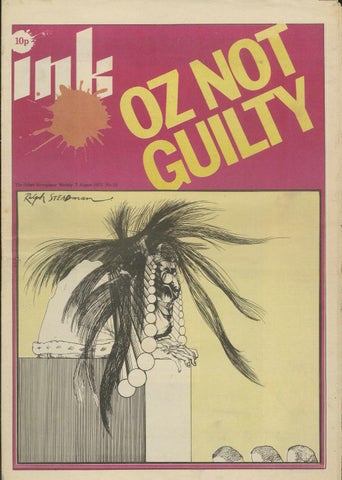
AGAINST all the evidence, the OZ three—Richard Neville, Felix Dennis and Jim Anderson—have been found guilty on three charges of publishing an obscene article for gain and one charge of sending an indecent or obscene article through the post. The fact that they escaped the major conspiracy charge is a miracle and a triumph (see the article on the significance of this verdict on page three).
Design
David Wills Claudine Meissner Judy Groves
.. I l l t § l
Inkweek
Paul Bream m rm m
Pictures
Keith Bailey Rick Kemp Contributing Editors
Films Derek Hill Dave Curtis Performance Michael Kustow A rt Eddie Wolfram Communications Brian Winston Books Sonny Mehta Music Charlie Gillett
j,' ; %
'
AGAINST all the traditions and theories of British judicial procedure, Judge Argyle gave what must be one of the most blatantly prejudiced summings up in recent times. The jury, faced with Argyle’s sneering and dismissive treatment of the defence case, had no alternative but to find the three guilty on the lesser charges.
*\
> 4 t|
Is <§i"r -
>
l i i,l i1i l ,i l l l i l
AGAINST the obvious integrity and intelligence of the three defendants, the judge remanded them in custody indefinite ly for medical and psychiatric reports. Richard Neville called this ‘bureaucratic nonsense’; he was right. AGAINST normal procedure, the three were sent to Wandsworth Prison, one of the harshest in Britain, where they have been subjected to the humiliation of having their hair shorn — before sentence is even known.
Michael Zwerin John Gerassi Sean Gervasi Tom Heritage Jo Durden-Smith Advertising
AGAINST all common sense, the government has allowed these unequivocal acts of political repression to happen and — to use legal jargon — to be seen to happen.
Harvey Matusow Chris Rowley Patrick Hawkey Sandi Sparrow
WHAT DOES ALL THIS MEAN?
Classified & Subscriptions Paul Bream
litt
i&
IT MEANS that this country, living out its economic and military serfdom to the USA, has not learned anything from America’s social experience of the 60s. Instead of trying to avoid an appalling polarization of generations and lifestyles it has chosen to encourage this situation here.
Subscriptions
Charlotte Veysey Office Manager
IT MEANS the final erosion of any common ground that there might have been between the two sides. Richard, Felix and Jim tried to fight their battle in the heart of the establishment’s territory and in their very own language. Day after day of real experience, honesty — yes, and humour too. They tried to explain what OZ, and the culture that produced it, was about. No one listened.
Cassandra Wedd Absent Friends
Richard Neville Felix Dennis © IN K Publishers Limited
19 Great Newport Street London WC2 Telephone 836 8395
IT MEANS that this trial, consecrated to the Victorian concept of ‘protecting the innocence of children’, has done more to radicalize and alienate (sexually and politically) the children of this country than a million OZs and Little Red School Books.
Printed by Daeha Publications Ltd 4 -5 Station Approach Kensington Oxford Distributed b y Moore Harness Limited
IT MEANS that this trial has also radicalized and alienated many adults, who, like their children, will never be able to feel the same again about the possibilities for social justice in Britain.
11a Lever Street London EC1 Telephone 226-0689 Photo Syndication
Camera Press Ltd Coram Street London WC1 837-9393
IT MEANS that the government will not realize that its blunt weapons work so well that they make ten new enemies for every one clubbed down. There will be more and more OZ trials. There will be more and more violence. IT MEANS that three people known to everybody who has worked and played with them as honest, kind and generous have been treated cruelly and with contempt by people to whom ‘honesty’, ‘kindness’ and ‘generosity’ can be little more than words in the Oxford dictionary . . . like, for example, ‘obscenity’ and ‘depravity’ and ‘corruption’. IT MEANS that the wrong people have been jailed. f 1" 1 -
•
while. We are tempo; ing our weekly publication until the end of September. In the meantime, we shall appear when ever and in whatever form may most effectively respond to the situation created by the OZ trial and its aftermath. INK has -no intention of disappearing. Until our situation becomes clearer, we’ll be working to make ourselves stronger. If any body has ideas to contribute on how to do that, they know where to find us. This situation arises out of some dangerous implications of
and at personal request. Secondly, Richard, Felix and Jim represent the total editorial and administrative strength of OZ Publications Ink Ltd. For the past two months both INK and OZ have had to function without them. Following the verdict, we don’t know when, or in Richard’s case if, they will ever be able to come back. In addition to the loss of are also disastrous
complications
M H I verdict ichard Nev: Felix Dennis are two of the directors and shareholders of INK Publishers Ltd. Richard is editor, Felix the advertising director. At the time of writing, we have no way of knowing what Judge Argyle will do when he passes sentence. His conduct and attitude throughout the trial strongly suggest that he will deal as harshly as possible with Richard, Felix and Jim Anderson. Also, as Luff made haste to point out at the end of the trial, Argyle’s armoury includes the possibility of deportation for Richard, who faces
S i
mm
(editorial) (design); with a c by Richard 1 and Felix Dennis jail earlier this > month’s issue is air in conjunction with staff.
. i *v
Page 3 7 August 197T
NEWS
OZ:the hidden victory The verdict of the OZ jury was a bitter blow to the would-be Thought Police of Scotland Yard. The unanimous acquittal of all defendants on the drastic charge of ‘Conspiracy to Corrupt Public Morals’ has been all but forgotten in the tumult and shouting about the barbarity of Judge Argyle’s prison remand. There’s hardly a publisher in the business who cannot look back with pride on an obscenity convic tion at some time in his past: there are only four men this century who have been successfully prosecuted for conspiracy to cor rupt the morals of young persons. Three of them are the ex-editors of International Times, whose littlepublicized conviction last December gave the police a devastating legal weapon to crush the underground press. The OZ defence concentrated on destroy ing the ‘dirty squad’s’ new toy, and its success could be read on the fallen faces of their court team (Luff, Lumley and Kent) as they heard the jury’s unanimous ‘not guilty’. The particular crime originated in 1657, after Lord Sidley had relieved himself from a Covent Garden balcony upon a crowd in the street below. To their conster nation, the Star Chamber Judges summoned to punish him could find no law on the statute books against pissing in the streets below. So they invented the novel doctrine that there exists an inherent power in British judges to punish whatever may, in their own opinion, be contrary to public morals — even if it is not contrary to any law passed by Parliament. There were sporadic invocations of this Divine Right of Judges in the eighteenth and nineteenth centuries, usually to convict abductors of girls above the age of consent. By the mid-twentieth century, the offence was assumed to be obsolete. But in 1961 it was dredged up to convict one Shaw, publisher of the lucrative ‘Lady’s Directory’, a trade journal for London prostitutes, listing their names, addresses, and telephone numbers. The ‘legislative power’ thus given to the law courts came in for heavy criticism as the very antithesis of democracy. Lord Reid, the most eminent member of the House of Lords, argued that the offence no longer existed. It worried progressive lawyers so much that earlier this year Sir Lesley Scarman, Chairman of the Law Reform Commission — the body responsible for keeping British laws up to date — recommended the abolition of the entire crime. A few days after his announcement, OZ solicitors tele phoned the secretary of the Law Reform Commission to inform him that the police were still using the charge. The secretary was amazed. ‘I wish I could help you’ he said. But in the end, Richard Neville had to help himself. Because Scot land Yard had discovered one great advantage of the conspiracy charge — it put on trial a defendant’s ideas and intentions. These are irrelevant in an obscenity prosecu tion, where the effect of the article is all that matters. But in a con spiracy trial, the whole lifestyle of the accused can be put before the jury: he can be convicted for what he is and for what he believes, and not just for what people might do after reading something he once published. The first casualty was IT. Charged with conspiracy alone, on the basis of some homosexual
advertisements, the then Editors cut their hair, argued meekly that the ads had no effect anyway, were convicted and successfully silenced by two-year suspended sentences and huge fines — all with very little publicity. The Vice squad were jubilant. Like children with a new toy, they immediately added a conspiracy charge to the OZ indictment. This addition had three major consequences. First it turned the proceedings into a political trial: time and again the prosecution probed the beliefs and lifestyles of the defendants and their witnesses, pillorying their ideas and their ‘dangerous doctrines’ rather than the schoolkid ideas. Secondly, and consequently, the trial lasted much longer than the usual obscenity prosecution. Some asinine attempts have been made in the Tory Press to lay its length and expense at the defence doorstep: in fact, OZ called only 19 witnesses, compared with 32 for Last E xit to Brooklyn (a trial which lasted a fortnight) and 36 for Lady Chatterly’s Lover (which lasted six days). The final and most significant consequence of the addition of the conspiracy charge was the uncom promising way it was answered. The two key witnesses were both called by Richard Neville: they were Ronald Dworkin, Oxford Professor of Jurisprudence and Richard Wollheim, Grote Professor of Mind and Logic at University College, London. Not only did they swear that OZ did not corrupt public morals — they argued that its publication was a vindication of the con temporary moral climate of tolerance. Then, to the absolute fury of the Judge, they went further than any witness has ever gone in a trial of this nature: they asserted that the prosecution itself was a corruption of that very public morality it was claiming to 'protect. In his final speech, Richard Neville told the jury that the law was archaic and irresponsible. He condemned it on two grounds: — ‘In the first place, it is retro spective — it brands an action criminal after it has been done and so offends against our standards of fairness. ‘The other objection is that the very offence of “corrupting public morals” rests on the assumption that there is one all-embracing moral code to which all classes of the community subscribe, and that this is so weak, so unstable, that a single publication may bring it into jeopardy. We live in a society, as our witnesses“have told you, where vre regard it as moral to tolerate different opinions. This is our great advantage over totalitarian countries, which ram one political ideology down everyone’s throats. It is the prosecution which corrupts public morality by seek ing to rob us of our freedom of speech.’ It is very rare — and very dangerous — for a defendant to argue that lie should not be convicted because the law itself is immoral. By their refusal to con vict, after a summing up by Judge Argyle which virtually instructed them to do so, the jury have struck a vital blow against the most repressive single law in the land. No amount of psychiatric reports, prison remands, savage fines or brutal sentences, can detract from the very real victory won by the OZ defence at the Old Bailey last week.
What the papers saw Apart from Argyle, probably the most remarkable thing about the OZ trial was the way Fleet Street reacted (or in some cases didn’t react) to it. Paradoxically, those papers which obviously supported the prosecution gave the case most prominence, while those which might have disagreed were re markably backward in saying so. As a result, the whole thing ended up in a hopelessly one-sided tangle of prejudice. From the start, the Telegraph had more to say, in a more bla tantly establishment manner, than anyone else. Early in the trial, a reader phoned the paper, com plaining that it was defeating its own purposes by detailing fairly explicitly most of the contents of OZ 28. ‘Why don’t you ignore it, instead of giving it so much publicity?’ he wanted to know. The Telegraph’s answer was a gem of double-standardry. ‘If we don’t alert people to all this filth and pornography, then they won’t know what they’re up against.’ And next day, they continued faithfully to detail still more of Rupert’s athletic skills, in a style which would have done the original OZ issue proud. The day of the verdict, the Telegraph really went to town. A p art. from several columns de voted to the verdict itself, it also carried a piece titled ‘Bare busts, beads, and a boost for circulation.’ The piece included the following statement from an unnamed senior policeman: ‘There has to be constant police interest in all these publications because of the volume of public complaint and the implications of the magazines. We suspect that extreme leftwing activists are behind the campaign.’ That, more than anything else, gave the Telegraph away. Despite Argyle’s protests to the contrary, the Telegraph obviously saw the case as a political trial, and there are no prizes for guessing which side it was on. We have printed its leader of the same day elsewhere in this issue, but perhaps it too does bear some further examination. There is
a strong case for arguing that the leader was libellous and grossly contemptuous of court. But even that is not the main issue. The fact is that the Telegraph sees OZ and the rest of the alternative society as a major threat to its own well being, and is using the full weight of its bigotry to try to crush us. The Daily Express was as pre dictably bad as it always is. Its contribution was a centre-page story on the day of the verdict titled ‘Wailing wall of weirdies’, a headline which is understood to have pleased its management no end. No surprise there. Far more interesting, and rele vant, were the respective attitudes of the Guardian and the Times. Both papers are staffed by re porters who like to believe that they’re not only liberals but com mitted liberals. During the trial each gave a fair amount of space to both sides of the case, and after the verdict the Guardian, in par ticular, seemed to be a trifle outraged. Nicholas de Jongh got away with several comments in his report of the verdict, but then, suddenly, the Guardian seemed to lose interest. Despite considerable pressure from some staff members, it steadfastly refused to run an editorial. The Times was even more reticent. It reported the verdict, and then clammed up. There was no editorial, hardly a word about any of the post-trial developments. The world listened, but all the Times could manage was a deafen ing silence. Rumour has it that it might find its voice again after sentence. In a sense, the real surprises came from the Beaverbrookcontrolled Evening Standard. The day after the verdict, it took up the cause of trying to get the three defendants out of jail, with a front-page lead in the early edition, and an editorial that ran all through the day. The next afternoon, the case was still on the front page (although cynics could well make the point that nothing much else was happening that day). The verdict came at an almost perfect time for the Sundays.
There was plenty of time for them to get their ‘experts’ together, and to do some solid thinking about what the whole thing really meant. So a lot of people looked forward to last Sunday. A lot of people, as it happened, were very disappointed. The Sunday Times virtually pretended that the case hadn’t happened, and the Observer buried its one and only analysis of OZ somewhere between the Paris fashions and the Entertainment guide. Not that it was worth reading anyway. The Sunday Telegraph, not un expectedly, carried its daily sister’s banner still further onward with an article by some idiot called Derek Roberts-Morgan, who had this to say of Argyle: ‘Every unbiased person who has heard him at work during this trial must acknowledge that he has bent over backwards to ensure that every possible point of any relevance to the defence has been put fairly and fully to the jury . . . The OZ trio can be sure pf one thing. Their fate will be decided in the best traditions of British justice.’ Derek RobertsMorgan must have quite a sense of humour. Of the other, only the Mirror emerged with any sort of editorial stand. On Monday of this week, it berated the decision to cut the defendants’ hair, at the same time being incredibly careful not to support anything else about them. The Sun iweighed in during the trial with a double-page spread about ‘The Underground’, which most of its readers no doubt took to be a report on the new line to Pimlico. They would be excused for not being any the wiser had they read the article. Rumour has it that there is also a paper called the Daily Mail, but as no one has ever been seen reading it, its attitudes aren’t par ticularly important. As a final point, perhaps it isn’t insignificant that only one daily paper saw the verdict in its true light — a defeat for the establish ment’s plan to destroy the under ground. The paper headlined the not guilty verdict on the con spiracy charge. The paper was the Morning Star.
NEWS
Page 4 7 August 1971
Judgefor the prosecution Ladies and gentlemen o f the jury, we give you Judge Michael Victor Argyle — the man whose word you heeded in preference to the learned and detailed analyses o f eighteen expert witnesses. We hope you are ashamed. He was born in 1915 and bred at Westminster School, Trinity College Cambridge and the 7th Hussars. He lost Belper to George Brown in the 1950 general election and Loughborough to John Cronin in 1955. (Had 4,263 Lough borough citizens felt differently that day, at least three people might not be in jail today.) At 36 he married Ann Norah Newton and swiftly spawned three daughters.
He took silk in 1961 and landed a job as Recorder of Northampton the following year. But it was not until 1965, when he was promoted to Recorder of Birmingham, that he really began to hit the headlines. To quote the Observer; ‘during the five years he was in Birming ham, Argyle became known as the “reporters’ judge”. He wasn’t averse to telling the newspapers in advance when a controversial
comment was coming, or ensuring that the Press Box was full before speaking. One of his pronounce ments was that “a settlement of Gypsies and tinkers is importing a ready-made criminal community ’.’ In 1966 he launched a cam paign to ‘clean up Birmingham’, more in the style of military dictator than a junior QC. For starters he took on the telephone box vandals — and those un fortunate enough to appear before
ALL YOU NEED IS LUFF
him got jail sentences ranging from 18 months to two and a half years. Next he declared war on bur glars and housebreakers. He threatened them with sentences of the ‘greatest severity’, even life imprisonment where appropriate. ‘If you come boys, we are all waiting for you’ he announced judiciously. ‘In appropriate cases, this court will steel itself to pass life sentences for burglary and sentences of up to 14 years for housebreaking. No criminal who is arrested should in future expect to have the chance to return home for a very long time.’ Appetite unslaked, Argyle turned his attention to Birming ham’s drug problem. He sentenced a former Jamaican policeman to five years’ imprisonment and a £750 fine for possession of cannabis — even after the man had pleaded guilty. Giving sentence, Argyle proclaimed: ‘We have seen in this court over and over again kids — one cannot describe them as anything but children — from good homes and with good work records, suddenly literally change their preferences in every way, finishing up as what can only be described as human wreckage.’ But his bigotry does not end there. A more enlightened barrister told us of a conversation he had with Argyle the day after publica tion of the Wolfenden Report: Argyle: ‘It is disgraceful. It pro poses to give legal immunity to consenting male homosexuals.’ Barrister: ‘What’s wrong with that?’ Argyle (eyeing him suspicious ly): ‘Well, it’s an insult to women.’ Barrister: ‘Well it may never happen — there will be a free vote in the House Of Commons.’ Argyle: ‘At least we’ll know then who all the queens are in Pariliament’ Argyle’s hobbies are scouting, chess and boxing. He is a poet, too. Inspired by the Cannock Chase child murders, he penned this appalling little verse: A Lament for the Lost Child
Detective Inspector Frederick Luff is a man with a mission. He has taken it upon himself to lead the armies of Convention and Vested Interest in a crusade against the alternative society. He not only believes that there is an ‘Underground’, he believes that it consists of a tightly knit group of politically motivated freaks. He is convinced that Release, Bit, IT, Frendz, Agitprop, OZ and probably INK as well, are all part of a well-organized con spiracy to overthrow the established order. (If only they were.) He believes that they have no right to ‘attack society’. And it worries him that none of these long-haired perverts seem to do a decent day’s work. At the beginning of the OZ trial he told Richard Neville that the difference between their attitudes was that he, Luff, belived in God and he was doing what he did ‘for the sake of his children’. It was Luff who initiated the prosecution of IT. And the Running Man Press for the publication of Paul Ableman’s The
Mouth and Oral Sex. And Frank Critchlow of the Mangrove Restaurant. And OZ of course. It was Luff who raided Richard Neville’s flat with an obscenity warrant, shortly after the OZ raids, then brought charges for posses sion of cannabis. It was Luff who devoted himself body and soul to the prosecution of OZ 28, providing crown counsel Leary with as much dirt as he could muster on all the defendants and defence witnesses. He shot out of the courtroom each .time a new witness was presented, to scour the bookshops and Scot land Yard files for everything written by or about them that might be used to incriminate them. Luff is a man of quaint oldfashioned habits. When his children cross the paternal will, they are given a formal caning. His zeal has led him to exceed his duty on occasions. Frank Critchlow’s friends remember him from 1969, when Critchlow was in court on a robbery charge, brought by the (then) Inspector Luff of Notting Hill Police Station. Luff’s key witness, ‘Bo-bo’ Roberts told
the court that he had come to the trial against his will. He had already told the police that the man who robbed him .was not Frank Critchlow but another man, whom he had identified. On his second visit to Notting Hill Police Station, said Roberts, Inspector Luff had plied him with whisky and cigars so that he eventually got drunk and signed a statement. Luff had told him that he wanted to ‘get’ Critchlow and needed his cooperation. The case was dismis sed. Several complaints have been lodged with Scotland Yard con cerning Luff’s drunkenness on duty. He was removed from the Obscene Publications Squad shortly after the OZ raids. His overreaching enthusiasm seems to have alarmed his superiors. He told several people that he would have to leave the country if he didn’t ‘win’ the OZ trial, because defeat would cause an intolerable loss of face. Well he didn’t ‘win’ the con spiracy charge . . . but it seems almost too much to hope for.
I f that death by murder came and Satan’s power triumphant be. Counting not the sin and shame and his victim’s agony. Could a mother bear that sight, a father drink that bitter cup, And still believe all will come right when God makes his jewels up. ‘Jewels up*?. . . In 1970 he became a judge. Argyle first loomed into the lives of the OZ defendants on 14 June, 1971. He heard their applica tion for an adjournment to allow them time to find a barrister after Tom Williams had unexpectedly returned their brief. He refused the application. The defendants made a further application two days later when a second barrister let them down, As they entered the Old Bailey, Judge Argyle called to a policeman ‘Take those men into custody — they seem to be carrying briefcases.’ So they were searched and Jim Anderson’s nose drops were con fiscated. The judge interrupted their application and said ‘I will not be judging this case when it
comes up, therefore I can make this remark. There is evidence before me that this case is not being taken in due seriousness.’ He refused an adjournment, leaving the defendants with four days to the trial and no QC. Fortunately, John Mortimer turned up. Unfortunately so did Judge Argyle. From the beginning he made his prejudices clear. Each time he intervened (which he did frequently) he attempted to score a point for the prosecution. When Caroline Coon was giving evidence, he asked whether she agreed that Middle Eastern countries had more experience in dealing with cannabis than the west. She said yes. He then told the court that five Middle Eastern countries imposed the death penalty for ‘pushing’ cannabis. When Dr Lionel Hayward said he thought it was not harmful to experiment with sexual tech niques, Argyle interjected ‘Are you aware of the case of Fatty Arbuckle?’ When Marty Feldman came to the stand, the judge turned in the opposite direction and examined his fingernails. After some time he said to Richard Neville: ‘I don’t suppose it matters, but I cannot hear this witness.’ His most astonishing act of self betrayal came when Richard Neville asked to make an applica tion for the trial of a drugs charge (further fruits of Luff’s en deavours) to be postponed so that it did not come up immediately after the OZ trial. Argyle declared ‘I am most unsympathetic to this application.’ Neville asked him whether he would be judging the drugs case as well. Argyle replied that he did not know, but he thought it would be a good idea if he did, as he now had a close knowledge of the people con cerned. ‘And any other judge would have to approach the trial without knowing the personalities involved.’ With an open mind, per haps? In his summing-up speech, as guidance for the jury, he read out a dictionary definition of ‘ob scenity’ and defined indecency as someone accidentally dropping his shorts in an athletics competition. He held up his copy of OZ to the jury: ‘It’s alright to dissent of course, but what about the methods used here!’ He said he wasn’t asking them to convict on the basis of the cover alone — ‘But look at it!’ He took to calling the defence witnesses ‘so-called’ experts and accused them of ‘whitewashing’ the contents of OZ 28. Many of them, he said, had double stan dards. Referring to Edward de Bono’s testimony that OZ was a window on to the hippy world, he said to the jury ‘Well windows sometimes need cleaning, don’t they?’ After the verdict, he thanked the jury for their patience and congratulated them on their de cision. ‘It is the verdict I myself would have reached.’ The same afternoon, a friend phoned up Mrs Argyle with news of the verdict. ‘I don’t know why he did it’ she said. ‘He’s very kind around the home.
Page 5 7 August 1971
INK
NEWS
Campuswargames underfire Increased opposition to the judgement. Some BSSRS members fear the military research carried out by British universities is planned for development of an American-style the next academic year. The military-academic complex in this stepped-up campaign will be led by country. In the chemical and members of the British Society for biological warfare research fields Social Responsibility in Science, universities have been deeply in who have already been involved in volved in doing basic research for opposition at Cambridge to United the CBW centre at Porton Down in States Air Force work being done Wiltshire. And of the 22 members there by the Cavendish Labora of the Porton Advisory Committee on Chemical Defence seventeen are tory. The USAF grant of £20,000 university professors, such as received by the Cavendish Labora Henry Rydon of Exeter, D. H. tory has been used to finance a Everett of Bristol, and Andrew project by Dr J. E. Field, a Fellow Wilson of Liverpool. The university based members of Magdalen College and a lecturer in natural sciences. His work is of the Porton Committee provide a described officially as an investiga link between the Ministry of tion into ‘fast reactions in solids’ Defence and some of the best involving a study of the properties research facilities in Britain. Thus, of azides, which is a euphemistic Professor Rydon has accepted a way of saying that Dr Field is grant from the Chemical Defence working on explosive detonators. Experimental Establishment to The Cambridge branch of the study ricin, one of the most toxic BSSRS was unable to force the products of mould substances, cancellation of the USAF contact, Professor Everett is known to have but did succeed in arranging for conducted research into the rates the inclusion of a Science and of absorption of gases by porous Society course in the official carbon materials, and Professor physics syllabus. Wilson has completed work on at One of the BSSRS members least one unspecified chemical involved in the Cambridge cam warfare contract in the past two paign was Peter Chapman, now years. lecturing in physics at the Open Their colleagues have also bene University. He said this week that fited. Two other gas warfare he believes it is socially irre contracts went to Bristol, and sponsible to duck political during the past year Liverpool has questions associated with military had at least four defence contracts, research. one of which an official of the ‘After all,’ he said, ‘the USAF, university described to me as and for that matter the Ministry of ‘research on the design of domeDefence, are not philanthropic ended cylinders’, which I took to bodies. If they finance research it be a reference to torpedoes. is because there is going to be In the United States things have something in it for them, some gone much further, with the University of Pennsylvania openly result . . . which will be useful militarily. Research contracts such admitting conducting research for as the Cambridge projects cannot the Pentagon on gas and germ be justified on academic grounds warfare offence techniques and the alone; accepting them is a political Massachusetts Institute of Tech
Peace on the march again About 100 American servicemen, their wives and girlfriends took part in last Sunday’s walk (‘For Chrissake don’t call us a march’) from Speakers Corner to Grosvenor Square in support of exUSAF Captain Culver and in protest at Regulation 35/15 which covers the conduct of US service men on foreign bases. The walk was the second organized by PEACE — People Emerging Against Corrupt Estab lishments. The first, several weeks ago, was purely in opposition to the Vietnam War. It led to the prosecution of Captain Culver and his dishonourable discharge from
the United States Air Force after evidence against him was given by an agent of the Office of Special Investigation, a sort of forces FBI. This time the servicemen wore bush hats and dark glasses, and while they talked freely they refused to give their names. ExSergeant Barry Gilfrey, on the peace walk last Sunday, said that he had given his name during a BBC interview on May 31. By July 11 he had been discharged from the Air Force as undesirable. An anonymous Supplies Sergeant from an East Anglian bomber base told me he had volunteered for the Air Force to
nology helping design the US Navy’s new multi-warhead Poseidon missile. In 1969 MIT topped the list of non-commercial Defence Department contractors with a total of $124 million in grants in just twelve months, but opposition from both students and staff has led to a decline in military contracts following sit-ins at MIT, Stanford and other colleges. In Britain there has been comparatively little student action on the defence research issue. Demonstrations are only known to have taken place at Exeter and York and at Liverpool last year when Professor Wilson’s work was a contributory factor in causing a two-week occupation of university buildings. BSSRS General Secretary David Dickson wants to make both students and scientists more conscious of the implications of their research. ‘What we aim to do,’ he says, ‘is to gather together the available information about what’s going on and then publicize it inside the academic community. We shall pressure people we believe are doing irresponsible research, and I think we shall find that some departments are financially over dependent on military grants. We know of one department whose research one year was one-fifth military financed. ‘Universities will accept Mini stry of Defence work almost without thinking about it, but who heard of a university doing research for a resistance organization or for freedom fighters? Acceptance of military work by a university is a, political decision, and both students and faculty should have a say in this.’
■
'WE CONTROL
SS
* . -%
"THE
WORLD’
The largest offshore oil production in the world today is off Louisiana. But a Standard Oil Company official makes this com parison: ‘. . . the Louisiana area is minute compared with Southeast Asia — about like a postage stamp on an elephant’s rear end.’ Standard Oil and its affiliates, Anthony Hetherington plus Shell and Texaco are cur rently pumping millions of dollars into this ‘elephant’s rear’ in an attempt to develop SE Asia’s rich oil resources. It is likely that US oil companies, if once established offshore, will use the US fleet to protect their position. US oil’s interest in SE Asia is by no means new. Standard Oil has been in Vietnam since the turn of the century. When the US replaced French colonial interests in the 1950s, Standard Vacuum, a wholly owned subsidiary of Standard Oil, became the largest US business in the country. Its general manager, George Case, told a Congressional Committee. ‘My own company . . . has very satisfactory relations with the Vietnamese (Diem) government. We have access to any official that we want to see . . . Our relations with the American government officials in the country are also good, and we can get a fair honest hearing at any time with either government.’ The Standard Oil companies are part of the Rockefeller-Chase Man hattan Bank financial-industrial empire. Several years ago Chase Manhattan opened the first US branch bank in Saigon. Set up to avoid the certainty of being serve the US shadow government drafted to Vietnam in the Army. and the military, it was a fortress He and several other PEACE bank — windowless with shooting workers had been questioned by holes for machine guns. The Rockefeller-Standard Oil OSI agents, who are present on all USAF bases, and warned not to group has been very aggressive in take any further part in political pushing Post World War II expansionist US foreign policy. In activities. ‘Our next activities really de 1946 Leo D. Welch, then Treasurer pend on official reaction to today’, of Standard Oil Company (New he said. ‘But we have 500 Jersey), said the US must seize supporters all over England and it ‘political, social and economic’ is likely that some of us will go up leadership in world affairs: ‘We are the majority stock to Scotland shortly to talk to the US Navy people there. PEACE will holder in this corporation known as the world. Nor is this for a given go on growing.’ term of office. This is a permanent obligation.’
Rockefeller men have been architects of American foreign policy for the past fifteen years. John Foster Dulles was a Standard Oil lawyer and Rockefeller Foun dation Chairman. Dean Rusk was also a chairman of the Rockefeller Foundation, and John McCone, CIA chief under Johnson, was a director of Standard Oil of Cali fornia and major stockholder of that company. Under these men, the funda mental economic aim of US foreign policy became to make the world profitable for American corporate investment. Income received on direct foreign invest ments of United States companies increased more than ten times since the end of World War II. Oil companies receive almost half of the total — they receive twice as much foreign profits as all manu facturing companies combined. Nearly 90 per cent of their foreign profits come from the developing continents. Last year most corporations’ profits declined. But Standard Oil of New Jersey’s increased to a record $1.3 billion after taxes. More than half, $681 million, came from foreign investments. Foreign profits increased more than domestic profits decreased. Jersey’s total profits and foreign investment profits exceeded those of any other industrial corpora tion. Standard Oil of California also made record profits in 1970. Four fifths of its crude oil comes from abroad, mainly Asia. More than half of its profits are foreign. Mobil, a Standard company, increased its profits to a new high, with foreign operations accounting for 49 per cent of profits. The petroleum industry has historically employed the lowest number of blacks of any other basic industry in the United States. In 1968 only 3.9 percent of all major company workers were black, almost all of them in the lowest wage jobs. In the great Texas, Louisiana, Oklahoma crude oil fields, in 1966, only 0.8 per cent of the workers were black. Victor Perlo
NEWS
Page 6 7 August 1971
Why your local taxman confides in total strangers
Malcolm Addison used to work for Tracing Services, an agency notorious for its methods of tracking down debtors. He told us he could find out almost anything about anyone, simply by telephon ing government departments and using the appropriate disguises and jargon. To prove it, he went to Leicester Square and took down the number of the first Rolls Royce he saw. He then telephoned the appropriate vehicle register, told them he was ‘Sergeant Royce from West End Central’ and within minutes had discovered the full name and address of the owner, the date he bought the car, the engine and chassis number, the name of the firm he bought it from and the date it was delivered from the factory. All strictly confidential information. On the basis of that, he was able to discover where the man worked, how much he earned, what tax he paid, his bank balance, his wife’s name, her bank balance and so on,until we ran out of curiosity. The methods he used were illegal. But they are being used every day with a high rate of success by employees of Tracing Services and similar agencies. Addison joined Tracing Services in January 1968 but he was so disgusted by their methods that he left after only ten days. When he approached the Sun, hoping to
expose the racket, he was put in touch with George Edtnistonxbf the Inland Revenue Investigation Department. He gave Edmiston the names of the directors of Tracing Services and told him that the sales manager, Mr de Souza, had for merly worked as an Inland Revenue District Inspector. At Edmiston’s request, he returned to Tracing Services to act as a spy for the Inland Revenue. His evidence contributed to the successful prosecution of the directors, Jeffrey Benson and Michael John Isaacs, who were tried at the Old Bailey and fined £5000 each, with costs. But the conviction had little effect. After the trial, all ten branches of Tracing Services went straight back to work. According to Malcolm Addison, most of the agency’s clients are hire purchase companies. The agency traces debtors or their guarantors but does not undertake to collect the debt. In his day the fee was £3 per search and the success rate was an impressive 72 per cent.
He describes the most common method of tracing debtors — through local tax offices: ‘Say you’re tracing an HP debtor. When he first entered into the agreement, he would have fillled in a guarantee form stating the name and address of his last employer. You phone the appropriate tax office, say you’re from another tax office and quote the firm’s reference number. You ask “Is this taxpayer still live, please” and give his name, “ Robin son, B.H.” You must use the right words — “ Live” means that the taxpayer is still on the files of that office. ‘If the debtor has started work elsewhere, the tax official will be able to give you the reference number of his new firm. You phone the tax office which deals with that firm, assume the disguise of the office you last spoke to, quote the reference number and ask “Who is this reference, please?” ‘They will tell you the name of the debtor’s new employer. Then you can phone the wages depart ment, pose as an official from the local tax office, give them the debtor’s name and ask “What is his P.A.?” And the wages department will oblige with the debtor’s personal address.’ Addison explains: ‘Anyone in tax can talk to anyone in wages. They’ll tell you anything you want to know and get rid of you as soon as possible.’ From the same source, the tracer can discover the debtor’s income and his position in the firm. There are simpler methods, often equally effective: ‘Phone the consumer accounts office of the Gas Board nearest the debtor’s last address. Pose as an official from the corresponding Electricity Board, read out the address and say ‘We had a consumer at this address who left without paying, n.f.a. Does he still consume with you at another?” Try to establish a bit of rapport. If they have a card on your debtor they will know his address, the kind of tenancy he holds, how he pays his bills and how much he is in arrears. If he pays by cheque they will have the address of his bank. They are usuallly quite happy to rattle off the whole card.’ Banks, says Addison, are more difficult to deal with and should be used only as a last resort. For some reason few bank clerks find their way into the tracing business, so less is known about banking jargon. There are two standard methods of approach. ‘If the man you’re tracing is just an average joe, you ring up and say you’re him. Ask them what hap pened to your last statement — and it helps if you sound really angry. They tell you when they sent the last statement and you reply “Well I never received it. Where did it go to?” So they give you the address you’re after. Then you ask “Well what is the account now?” and give some reason why you need it. They almost invariably tell you.’ The tracer, he says, does not always need to know the debtor’s bank balance, but it is normal practice to collect as much information as possible. It all gets filed for future reference. The second method of approach is for the more important, wealthy customers of the bank. ‘Ask to speak to the chief cashier or the assistant manager and always call him “Sir” . The patter usually goes like this: “ I’d like to speak to you con fidentially, Sir. My name is Detective Inspector Brown, Scot land Yard. Just a few questions I’d like to ask you, but before I do I’d like to fix an appointment for two of my officers to come and see you...’’ The appointment is duly made... “Is this phone secure, Sir? It concerns one of your customers...” By this time he’s interested — He’s human after all. And the more important the customer, the more
information he’s likely to give. ‘Ask him to confirm the customer’s address. Then ask what his account is and whether any large sums have been placed in it recently. That always makes them think of spying. ‘Before you hang up confirm the time of the appointment and add “ Of course you can assure me of your discretion in this matter, Sir?...Good day, Sir.” ‘You must sound authoritative and allay all his suspicions. You must know exactly what you are going to say and never falter. If you can do that, the method is almost foolproof.’ Addison is also well versed in Tracing Services’ method of tracing servicemen. A former col league of his, Leslie Vaughan (now head of the Southampton Branch of Tracing Services), once worked for the Ministry of Defence and possessed a copy of the Ministry’s Year Book. This contained a full list of civil servants and details of their departments and salaries — including the senior Medical Officers of all army, navy and airforce bases. With this infor mation the tracer could establish the whereabouts of almost any serviceman. Addison describes a typical telephone conversation: Tracer: (dials Royal Naval Barracks Chatham). Reply: Royal Naval Barracks, Chatham. Tracer: Sick Bay please. Tracer: Good morning. Surgeon-Commander Black, RNB Portsmouth here. Reply: Yes Sir? Tracer: Able Seaman Smith J. P/923440. Suspected TBC (Tuberculosis Contact). Is he still with you? Reply: Hold on a minute, Sir, I’ll check... No Sir he left us on 16th January 1966. He went to Vernon for a refresher course in Shallow Water Diving and from there went to Albion. She sailed from Ports mouth on the 1st of February 1967 and is due to arrive at Malta on February the 20th. Tracer: Thank you very much. Reply: Shall we inform the MO Sir? Tracer: No, I think not at this stage, I don’t want any alarm over this. Reply: Very good, Sir. Tracer: Thank you, goodbye. This tracing method, Addison suggests, would be a useful asset to any foreigner interesting in know ing the position of the British armed forces. A full list of a tracer’s regular sources include Social Security offices, the records offices of Her Majesty’s prisons, local electoral registers, local authority rates departments, GPO telephone accounts offices and hospitals. For each one there is an appropriate disguise and a regular patter. At regular intervals, the govern ment issues warnings to its employees to beware of people like Malcolm Addison. These may be partially effective but they do not deter the real professionals. There are two reasons why. Firstly, if government officials stopped giving information over the telephone, the entire bureaucratic system would disintegrate. Secondly, hire .purchase plays such a crucial part in Britain’s consumer-orientated economy that it is in the best interests of the government to allow debtors to be traced. So the tracers continue to thrive.
Page 7 7 August 1971
OZTRIAL 1882 Two great court battles to extend freedom o f speech where fought in Britain towards the end o f the 19th century. Both trials involved publications. One was a pamphlet advocating b irth control, the other was The Freethinker, an atheists’ weekly. David Burdett investigates the same old motives and the same old methods. The later half o f the 18th century had been full of publications professing and advocating atheism and free thought, but as these only involved a small and articulate section o f the aristocracy they were tolerated by the establishment. But the 19th century saw the beginnings o f a secularist free thinking movement whose ideas on sex, population and society were directed at the ‘toiling Masses’. It was decided that what had been a personal eccentricity was now becoming a dangerous movement that had to be checked. The first prosecution involved the publishers o f a pamphlet advocating family planning. This was ‘The Fruits o f Philo sophy’, by Dr Charles Knowlton, edited by the secularist freethinkers Charles Bradlaugh MP and Annie Besant. The pamphlet had a preface dedicating it to young married couples especially amongst the poor; it pointed out that fo r years philanthopists had been endeavouring to obtain and disseminate knowledge whereby men and women ‘may refrain at w ill from becoming parents w ithout sacrifice to the pleasure instinct’, but no one had been successful until Dr Knowlton h it upon the idea o f destroying the ‘fecundating pro perties o f the sperm by chemical agents’. The first part o f the pamphlet attempted to analyse inconsistencies in theories held by doctors and churchmen regarding the evils o f birth control. It was generally believed that in the beginning Eve contained a number o f homuncules (little men), one w ithin another like a nest o f boxes, all w ithin her ovaries, equal to the number o f births there had ever been or ever would be, not including abortions. The medical extension o f this argument was that the fetus (and w ith it the soul) existed in the female in some part o f the uterine system prior to intercourse.The
PROSECUTED
male seminal fluid merely endowed it with vitality. The main body o f the book discussed methods o f birth control, starting w ith a description o f the most popular Victorian method, withdrawal before discharge. Rubber condoms were associated with men who wished to protect themselves against syphilis, a disease only contracted by wildest debauchee. What was quite new, and the invention o f the doctor, was the douche. A syringe obtainable fromthe apothecary was to be filled with a solution o f wfiite oak bark and red rose leaves o f nutgalls. A fte r' it had been used there was to be a final syringing with fresh water to destroy ‘the fecundating property’ o f what remained lodged in the ridges o f the vagina. Publication aroused an immediate public outcry. Bradlaugh and Besant were arrested and tried in the High Court under Lord Chief Justice Cockburn on 18 June 1877. The trial was a sensation, w ith both defendants pleading their own case against bitter opposition. Sex ethics were the rawest nerve o f Victorian England. A juror wrote on the cover o f his copy o f the ‘ Fruits’ : ‘The author is attempting to conceal his real object — to debauch the mind o f youth. He intends to promote promiscuous intercourse while avoiding the usual consequences.’ During his defence, Bradlaugh insisted that the jury should see the trial not as an attack on the pamphlet but as an attempt to stifle -free speech, but the two defendants were found guilty o f printing, publishing and selling ‘certain indecent, lewd, filth y and obscene libel, to w it a certain indecent, filth , bawdy book tending to incite unnatural and immoral practices bringing people to a state o f lewdness and debauchery.’ Both defendants were fined £200 and Bradlaugh was sentenced to six months in jail. He immediately appealed on the grounds that the passages in the book said to be indecent had. never been set out in fu ll. It was a technical point but it kept him out o f jail, and in February 1878 the Court o f Appeal upheld him. ‘The Fruits o f Philo sophy' was slightly amended and continued to be published. The second case involved a colleague o f Bradlaugh’s in the secular movement — G. W. Foote. With encouragement from Brad laugh he began publishing a weekly periodical, The Freethinker, devoted to ‘a lively style fo r the people’ in a relentless war against superstition in general and the Christian superstition in particular’. Brash and crude, The Freethinker ridiculed, raged, pleaded, and delighted,
for
BLASPHEMY.
THE FREETHINKER. EDITBD BY Gh W. 2FOOTX.
V o l. II.— N o. 45.]
N O V E M B E R 5, 1882.
THE
GOD OF BATTLES.
[P m c i O n Pn n rr.
above all it surprisedBeginning with the third issue o f the magazine, Foote introduced the first o f a series o f cartoons called comic bible sketches. There was a profane jokes column, snippets on church activity called Acid Drops, and a regular feature article called ‘Atheists Pulpit’. When he was prosecuted in 1882, Foote he could hardly claim to be an unsuspecting victim. Ten months after the paper began he wrote in an editorial ‘No prosecution yet!...Our souls in arms and eager fo r the fray but the enemy won’t come out.’ Four months later, on the 16 July 1882, he was able to write ‘we are in fo r it at last.’ A fundamentalist butcher, Henry Varley, had issued a circular to members o f Parliament “ C O MI C
BIBLE”
absolutely free, unless it libel men’s characters or contains incitement to crime, and that all offences against belief and taste shall be left to the great jury, o f public opinion.’ The jury failed to agree and the case was dismissed. Foote returned to jail to complete his year’s sentence on the first charge. During his imprisonment the Freethinker continued to appear w ithout the bible sketches, supervised by contributing editors. Their offices, which became know to the public as ‘the blasphemy Depot’, were constantly raided by plain clothes police, who came in, purchased a copy o f the magazine, and then arrested whoever sold it to them. In the end the staff moved to the top o f the building, S K E T C H E S . — XL.
THE DEVIL AND THE PIGS. citing the obvious blasphemy o f Foote’s paper. In July the editor and the printer were summoned by the Lord Mayor to the Mansion House to answer the charge o f blasphemy. The editor was indicted fo r ‘being wicked, and fo r profanely devising and intending to asperse and v ilify Alm ighty God and to bring the Christan religion into disbelief and contempt.’ The specific charges were contained in the Freethinker drawings, including one that depicted Adam and Eve being kicked out o f Eden — a big fo o t visible, and the sign ‘To LET/EDEN/ Apply Jehovah & Co.’ The indictment covered 16 counts contained in 28 folios and was an attempt to condemn the entire freethought movement. It was obviously going to be a .long procedure, and while the indictment was pending the magazine continued to be published with the banner headline PROSECUTED FOR BLASPHEMY, which it continued to run throughout the trial. The case at Common Law was tried by Catholic Justice North, who went in for a quick kill. The prosecuting council, Sir Harding Giffard, took the line that some o f the pictures were too bad to describe, thus leaving the public to imagine the worst. Foote in the great freethought tradition represented himself and spoke fo r 2'A hours. The first jury failed to agree. North dismissed them and set a new trial fo r the follow ing Monday. He advised the new jury, ‘You may depend upon it, that whatever the view you take, there is not a respectable paper in the country that would have sullied its pages with these passages.’ The jury depended on , the judge’s assurances and w itho ut leaving the court found Foote guilty. He was sentenced to a year’s imprisonment in what was virtually solitary confinement and responded, ‘My Lord, I thank you, it is worthy o f your creed.’ While in prison, Foote was brought back into court to answer additional charges before Lord Coleridge. His defence speech lasted three hours and was described by the judge as ‘very striking and able’. Foote included quotations from every prominent witness against Christianity he could find, particularly Shelley on Christ: The Galilean serpent forth did creep A n d made thy world an indistinguishable heap. He concluded, ‘ I f you are a special jury in this high court o f justice bring in a verdict o f guilty against me, you will inaugurate a new era o f persecution, but if as I hope you return a verdict o f not guilty you w ill check the spirit o f bigotry and fanaticism that is around you, and will proclaim that henceforth the press shall be
and anybody who came in had to write his order down on a piece o f paper which was then hauled up by a string, and the publication requested was then lowered back down in a basket. When Foote came out o f prison he restarted the biblical cartoons but there were no more persecutions. The Blasphemy issue was dead. The secular movement emerged from the trials in a much stronger position. The law regarding blasphemy was slowly changed. It had been an offence to publish ‘matter relating to God, Jesus Christ, the bible, or Book o f Common Prayer, intended to wound the feeling o f mankind or to excite contempt and hatred against the church by law established, or to promote im m orality.’ The standard text, Harris’ Criminal Law (1954), now explains: ‘Attacks on other religions are not blasphemy, nor is the mere denial o f the Christian religion or the propagation o f doctrines hostile to the Christian religion; the gist o f the offence is the use o f ribald language calculated to deprave public morality and endanger the peace.’
POSTSCRIPT Nearly 100 years later, in 1970, the Secular Society published a pamphlet on sex education w ith an excellent introduction by Brigid Brophy. In her conclusion she ^ offers some separate sexual advice to girls: ‘You have the advantage o f being able to masturbate rather more secretly than boys can, because y o u r physiology leaves no traces. Your masturbating is no one’s business but y o u r own, so privacy is appropriate. Make the most o f it. You might fin d i t useful to practise coming quickly, in case yo u take as y o u r lover a boy who hasn’t been fortunate enough to read Maurice Hill, i f y o u r lovers are to be girls, the need to hurry is one m inor nuisance among several others which you w ill luckily avoid, i f you turn o u t bisexual, yo u w ill want to practise both speediness and prolongation, which should make fo r admirably varied masturbatory experience. I too hope yo u w ill enjoy it. You urgently need to be able to think independently and earn y o u r own living. Only then w ill you be free. You w ill be free to take several lovers o f either sex, i f thats how y o u r temperament sways you. You w ill also be able to o pt fo r celibacy i f you prefer it, and celibacy is a luxury uneducated women can’t afford. ’ No case was brought.
INTERVIEW
Inkinterviews Wilcockinterviews Haynes Conducted by Jo Durden-Smith
Jim Haynes and John Wilcock are mirror images o f each other. Not physically. Haynes is taller, thinner, slightly etiolated, Wilcock stockier, punchier, a man. who, if he had stayed in England, might have become an-EI Vino tough. Haynes talks rolling, rich American,Wilcock a fla t m idAtlantic, w ith echoes o f a childhood in Sheffield. Their obverse similarity is to do w ith what they’ve done. Jim Haynes has been in Europe fo r fifteen years, John Wilcock in America for seventeen• Both h o tly claim internationality. Haynes’ career takes in an Edinburgh book shop, the founding o f the Traverse Theatre, its move to London, the original Arts Laboratory, the International Times and current editorship o f Suck; Wilcock’s, the Village Voice, the East Village Other, the Los Angeles Free Press, the five-dollar-a-day travel books, and now, and one hopes fo r ever, editorship o f his one-man peripatetic newspaper, Other Scenes. They are two o f the founding fathers o f the underground press. Both are on the move, Haynes from this offshore island to Paris and Amsterdam, Wilcock to Amsterdam and any place in Europe that has photo-offset. Haynes aims to start a cassette gazette, while continuing w ith Suck and the Wet Dream Festival, Wilcock two papers, Nomad, a travel paper, written by a thousand presscard-carrying travellers everywhere, and a projected English-language daily ' t o rival, from its different perspective, the Herald Tribune. Both need money, and are confident that th ey'll get it. Sooner o r later. They overlapped briefly in London two weeks ago, and / asked them to spend an hour w ith each other and a tape recorder on the ro o f o f INK. They hadn’t seen each other fo r a year. *
*
INK
Page 8 7 August 1971
*
JIM HAYNES: I ’m -not through w ith England, I ’m not through w ith anywhere. Anywhere there’s people and energy, I want to plug into them. I think i t ’s im portant to keep moving and get fresh ideas and con stantly recharge the battery. Also, I’m making a paper, a sex paper called Suck, as you know. And I couldn’t continue to make the paper and live in England. The harass ment o f our advertisement alone, in OZ, shows you. If they’re harassing the advert like that, what would they do to the paper! JOHN WILCOCK: I’m leaving America be cause, in retrospect, accidentally, I realize my job is done. When I went to America, there weren’t any underground papers, there wasn’t an alternative press. I was happily there at the right time, w ith a lot o f incredible people who helped to create an underground press, and spread the word around that there was another way to live. America, more than any other country, polarizes things. You’re either left or right, or red or anti-red, or black or white, or yes or no, or life or death in America. Those are the alternatives. In 'th e seventeen years I’ve been in America, not only have I seen the
and intelligence I respect, has sold out. Germaine Greer came to America, and signed autographs in department stores. She went on all the rigged talk shows, where no true conversation, no true ideas, are ever heard. I can’t blame her fo r it, but I can still point to the fact that she could not do it, if she believed in the things she was supposed to believe in. She’s said: ‘Well, here I have an oppor tunity to write fo r the Sunday Times. Here I have an opportunity to go on television. Life Magazine wants to take me to Washington and pose me in fro n t o f the people, who are demonstrating. I’ll go there fo r six hours and stand up in fro n t and wave my hand and be on the cover o f L ife .’ I like her, but I still think she was misled. I don’t think anyone has to go along with a publisher who says: ‘You have to do this, you have to do that. And that way you’ll be famous and rich and protect our investment.’
number o f things. We could just be full o f shit. JOHN WILCOCK: I’m being told it all the time. I’ve been putting out Other Scenes for four or five years. And I’ve been put down fo r being an egotist, fo r putting out a paper on my own. I ’ve been put down as a male chauvinist egotist, fo r being a man and putting out a paper on my own. I’ve been put down as a male chauvinist egotist and not part o f the black revolution, because I am a white man putting out a paper on my own. But I am fighting fo r all the same things as these people. I think, to come back to what you were saying, people are very hung up on one aspect o f the revolution, and put down all the other people who are fighting what I would call the revolution. And factionalization has done more to retard the liberation movement in America than anything else. Let’s go back to Martin Luther King. This is a very im portant point. I clearly remember the days when five thousand o f us marched down F ifth Avenue, in 1966 or 7, to protest the Vietnam War. Not long after that, Martin Luther King, who was solely identified with the black liberation movement, came in and said ‘The war in Vietnam, an obscene, incredible travesty on history and justice, is very closely related to my personal battle, which is fo r racial freedom.’ And everyone, even the Whitney Norths and the black liberal establishment, put him d o w n ... In retrospect nobody could possibly disagree with him, but at the time he was crucified. It probably led directly to his death and Hoover’s interest in him. Hoover in 1966 only has to hear that someone objects to the Vietnam war, and imme diately he’s part o f the international communist conspiracy. That should have taught everybody a lesson. You cannot separate one phase o f injustice, illiberality and censorship from any other, no matter what people are protesting. They’re all related. Can you conceive o f anybody, no matter what colour he is, no matter what sex he is, no matter what his sexual proclivities are, can you conceive o f anybody who has truly liberated himself and is going to put down somebody else fo r asking fo r freedom in some other area? I t ’s not conveivable. People who are free want others to be free.
JIM HAYNES: You’re opening up a strange chapter here. I just threw in Germaine’s name because I was talking about what is obscene, and because I think Germaine’s passage on raping nature for vanity is beautiful. As far as using straight media goes, this has always been a vexed point. Two points. I Voice and all the papers that followed it think one should take advantage o f any offer create an alternative culture and provide a to transmit information. On the other hand, medium by which this alternative culture there’s the old problem o f taking advantage can disseminate its ideas and its lifestyle, but o f the BBC, an interview, a journalist, and I’ve also seen these papers grow so that mine being misquoted or used. I t ’s dangerous, is unnecessary, not relevant any more. And d iffic u lt territory to enter, this. , my presence is not necessary any more. In any case, I figure I’ve paid my dues. JOHN WILCOCK: I ’m sure she shares the I’ve been seventeen years there, fighting. I’ve ideals which all o f us would agree we have. never had any money. I’ve always put every I’m sure she’s fighting a battle we too are cent I had into my newspaper. Now I want involved in. But I feel one has to be very to go back to trying to live my life. careful. The establishment, if one can use such an old-fashioned word, is very skilled at JIM HAYNES: You should have included in exploiting people who oppose it. your list o f alternatives obscene and not Maybe I can be accused o f the same obscene. I’d like to say one thing about that. thing. I’m sometimes interviewed by the Everybody’s been talking about obscenity straight press. The Sun today started a thing recently. Do you know what to me is on the underground press. I met the guy, obscene? There’s a standard answer of Simon Dowling. Now he approached Frendz course. Violence is obscene. We all know as one o f the underground papers. He told that. But also what is obscene is materialism, me he had a mandate from the Sun to write and this gets back to your polarizations o f about the underground. For the first time in life or death. A Rolls-Royce car is for me a his Fleet Street career he’s been allowed to symbol o f obscenity, far more obscene than write the things he wanted to write, see a couple making love. A couple making love? them the way he did. The Sun didn’t want Obscene? Any combination o f couples, any pornography, but they didn’t want a male, female, anything, making love is not put-down either. Frendz said: ‘ Fuck you, an obscenity, and anyone who says it is is man. We’re not going to talk to you. You JIM HAYNES: In many ways the best crazy. But a Rolls-Royce is an obscene distort everything.’ medium, the first medium we are working in bowing-down to materialism. Frendz - is absolutely right, absolutely is ourselves. People don’t realize this. We are correct. In my particular case, I have come broadcasting stations, transmitting our JOHN WILCOCK: Yes, it says ‘ I not only through Fleet Street, I have been with those attitudes to the world, philosophical,, have a bigger and more powerful cock than people, I know those people. I have had that political, sexual, economic. You name it, you. It is also a cleaner, sleeker, more career and left it behind me, fifteen or we’re broadcasting it, twenty-four hours a expensive and better protected cock. And twenty years ago. I am not able to say to day, seven days a week. We’re never o ff the you don’t touch this, because it ’s guarded, it those people who want to publicize my ideas air. cost me a lo t o f money and i t ’s insured very ‘ Fuck you.’ I am w illing to cooperate. I And i t ’s up to us to transmit our beliefs. heavily. This projection o f my personality realize I shall probably be distorted but I am We can’t abstractly say: ‘When the revolu shows that I am a superior person to you in w illing to sell out to this extent, to get some tio n ’s won, we’re going to be friendly, we’re every possible way.’ o f these ideas in print. going to share, we’re going to do this or that.’ We’ve got to begin now, sharing, living, JIM HAYNES: About two or three weeks smiling, being courteous, being tolerant, JIM HAYNES: That’s exactly what ago, the fro n t page o f the Times showed that helping people, doing it all the time, and Titian that was bought and sold fo r about Germaine would have said. Maybe I ’m too tolerant But then we have to have more increasing the sensitivity level. When you two m illion pounds. Everyone was bowing tolerance. I think the so-called underground hear somebody saying something nasty down in reverence to something which some is often as guilty o f intolerance, slander, about someone else, stop him. When you cat did many hundreds o f years ago. Who misquoting, not getting the facts straight hear somebody being stupid, stop him. cares? He was making the INK o f his time. I’m completely into what I call sub (whatever facts are) as the so-called straight Let’s demystify a rt a little. A ll it is is a papers are. If only more people on both jectivity. And one o f the things about brush and paint. It ’s a medium which no one sides o f the so-called fence, the moving fence France and England (and especially London) uses any more, except as a commodity, to (it’s moving all the time) would just be a is that suddenly there’ll be a movie which sell. And because the nature o f the medium little more tolerant. If people wouldn’t get everybody w ill think is great or w ill put is its scarcity, because there’s only one o f a uptight about people all the time, putting down. There’s no such thing as good and bad thing at a time, therefore the whole struc people down. If people would just stop all any more. I heard someone the other night ture o f supply and demand comes into rumours. Just don’t listen eagerly to gossip putting down that Tyger at the National being. I t ’s by definition scarce, and if some about who’s laying whom or leaving whom Theatre down the road. He called it bullshit. cat wants to get his reputation pumped up a or buying what. Just say: ‘ Look, man, we | t ’s n ot bullshit. He made it, and if people little bit, he becomes an artist, an imitation don’t want to hear any more o f your bad like it, that’s groovy. If people don’t like it, Titian. Everybody comes around and kisses news. Give us some good news.’ that’s groovy too. his as$. I t ’s bullshit. I t ’s gross. The RollsWe have to stop this incredible putdown Everybody is the product o f their en Rbyce is gross. A rt is gross. The diamond phenomenon. Just be tolerant. Everybody’s vironment, their fam ily, the movies they ring is gross. Fur coats are gross. Beauty is saw, the travels they made. And their head, head is subjective, everybody has experi ultim ately gross. I t ’s been made so. their consciousness is such that they can’t enced different things, and when they go to Germaine Greer in The Female Eunuch see themselves as wrong. In their attitudes to a dinner party they experience it differently. makes this beautiful point about the eco OZ, to INK, to Suck, they all think they’re Everybody who goes to see The Mysteries o f logical effect o f worshipping beauty, Miss the Organism is going to get different things right. So, instead o f saying to people: Beauty, the stereotype. I t ’s in her chapter on ‘You’re wrong, you’re crazy, you’re fu ll of from it. They’re all right. If you don’t like stereotypes. \ Raping nature, destroying shit’, we’ve somehow got to step back and something, you’re right. But they’re not pearls, killing tin y furry animals. For what? say to people: ‘Look, I, as well as you, have good and bad. We have to eliminate these I t ’s ridiculous. got to look at this thing again. Let’s step concepts. back from it and look at it again.’ And I JOHN WILCOCK: Yes, buts/re’s involved in really think that’s what’s got to be done. JOHN WILCOCK: I agree with that, one a stereotype. Germaine Greer, whose beauty You and I have very strong feelings about a hundred per cent.
» Page 9 7 August 1971
INK
Peru: mobilization ofthe masses
Second in a series o f articles on Latin America by John Gerassi.
The generals who run Peru’s revolution have no constitutional tradition to bind them down. The result is that they are trans form ing the country as I never thought possible — especially fo r professional m ilitary men. Their agrarian reform, now only tw o years old, is far reaching and effective; already about half o f Peru’s 1,500,000 landless peasant families have been given land in large, governmentsupervised cooperatives. Only the poorest o f the former owners have been paid fo r their expropriations; the rest are given bonds redeemable ‘when the country is totally solvent’ . Standard O il’s holdings have all been nationalized and the new exploration deal w ith the California-based Occidental Petroleum company is ‘a contract, not a concession’ . A new law reforming private urban companies is now fu lly operative; it compels each firm to use 15 per cent o f its gross profits to buy stocks fo r the workers so that w ithin 15 years at the latest all companies in Peru be owned 50-50 between workers and management.
understood by all Peruvians: We, the m ilitary, commit our total strength to this new law. Indeed, Velasco said just that: ‘The revolution can be completed only when it is o f the people and by the people. When that happens, we w ill retire. But until then we w ill allow no one, no force inside or outside our country, to interfere with the mobiliza tion o f the masses. If it means war, then so be it, but let this be clear: the people shall not lose.’ How can it be, I asked, that the very same m ilitary who fought and defeated the guerrillas are now proclaiming the guerrillas’ program? It was General Jorge Fernandez Maldonado, minister o f Energy and Mines, who answered me. Stretched out in a couch, his feet resting on top o f pamphlets ex plaining his recent ‘Mineral Law’ (which proclaimed that no foreign company, in fact no private company, could ever again lay claim to what lies in Peru’s sub-surface), the balding, shirt-sleeved general said: ‘ In 1963, when the Movement o f the Revolutionary Left headed by Luis de la But most significant o f all is the govern Puente and the Army o f National Liberation ment’s new law ‘decreeing’ the mobilization commanded by Hector Bejar launched the o f the masses. ‘A revolution from above guerrilla war, we were all colonels. I was up always fails,’ Peru’s president, General Juan north with a brigade, patrolling the Velasco Alvarado, told me.‘When we realized Ecuadorian border. I could see how poor our that’s what we were doing, we decided to peasants and Indians up there were. But I change it.’ The president himself announced didn’t know very much more than what I the ‘change’ late in June, not in the palace saw, and o f course I did not see the reasons but surrounded by tanks at the headquarters fo r their poverty, the real reasons, nor those o f the Armoured Division, Peru’s most who profited from it. I was a professional powerful unit. The message was clearly soldier, as we all were, proud, honest,
ARREST!
‘Please police me, oh yeah’ , ran the old Beatles’ song, ‘ like I police you.’ Serjeant Sullivan (no, not Pepper), at the end o f a long legal career, wrote in similar vein, ‘The Englishman is brought up as one subject to authority. I f a police officer comes to an Englishman and says, “ Kindly accompany me to the police station; I wish to ask you some questions,” the Saxon meekly goes to the police station and_^ubmits fo r many hours to interrogations But is the Saxon’s traditional meekness starting to wear a little thin? There are signs that distrust and dislike fo r our ‘wonderful’ police are increasing. Juries, fo r instance, are beginning to find fo r defendants in drugs planting cases — something unheard o f a few years ago — and to disbelieve police witin other cases. And obviously, police.
viciousness against various minorities has failed to endear them to those concerned. Sections o f the ruling class are becoming uneasy about the situation, including the judiciary. There were Lord Chief Justice Widgery’s remarks about the police caution, and last week one o f Britain’s most reactionary judges, Lawton, suggested that_ trial by jury should be more limited in” criminal cases — fo r juries, though pre dominantly middleclass, are the one outside chance we have against the police-judiciary alliance. If juries continue to acquit in im portant cases, the days o f trial by jury must be numbered. Police powers are sometimes clearly defined, sometimes left deliberately vague (e.g. the ‘Judges’ Rules’). Powers o f arrest are mostly defined, though the position is often so complicated that you need to be a walking legal textbook to know whether you have been rightly arrested or not. Other problems are that even if the arrest is ‘wrongful’, the police are likely to lie their heads off, or else the court w ill ignore the illegality or gloss over it. The importance o f this is that in legal theory and mythology you have the right to use reasonable force to resist a wrongful arrest. In practice, the exercise of th is ‘right’ is most likely to lead to an additional charge o f assaulting a police officer (some courts send to prison fo r this like a shot) — unless of course you get away! It is usually better to submit quietly if the odds are against you, and try to sue fo r damages for false imprisonment at a later stage. An arrest is effected as soon as the person arrested is made aware that he is under compulsion to go w ith the police officer. There need be no actual physical seizure. The case in question highlights the different attitudes magistrates show in cases they sympathize with, in contrast to their usual callousness; a man had been charged with driving with excess alcohol in his blood, and the arrest is a necessary ingredient o f the offence. The policeman told the driver, ‘ I shall have to ask you to come to the police station fo r further tests’, and the man did so. The magistrates held that this involved no'
patriotic, and not at all interested in politics. Then, as the guerrilla war became serious, General Velasco Alvarado, who was then also a colonel, and Leonidas Rodriguez, now head o f the Armoured Division, and I were sent there. ‘ I was the second in command o f intelligence. The first, my superior, was Leonidas fo r a while, Velasco fo r the rest. Like all m ilitary men in Peru — this is a tradition here — we viewed ourselves as the ultimate arbitrators in the country’s politics, but not because we were political, only because politicians were always corrupt and periodically, when things got too far out of hand, the m ilitary was called upon, or if you prefer, saw itself as called upon, to clean house. ‘ But now, as the war progressed, fo r the first time, but still w ithin that tradition, we were called upon to fight. We fought well, but so did the guerrillas. They were not like politicians. They were w illing to die, and they were not corruptible. So, whenever we captured some o f their material, we were curious enough to w ant to read it. We read it all. And we began to understand that they, too, like us, were genuine Peruvian patriots. They told us that the people were miserable, which we knew, and they told us why. We checked and found that they were right. Still, we had a job to do and we did it. We defeated the guerrillas. We killed de la Puente and we captured and jailed Bejar. But we began to study seriously what could be done about the miserable plight o f our country. ‘Gradually, we consolidated our strength and, as you know, we seized power on 3 October, 1968. First o f all, we had to clean out every last vestige o f corruption and jail the worst offenders no matter who they were. That’s why former President Prado’s son is in jail today as a common criminal. Then we had to do something about the terrible conditions our country was in, totally dependent on foreign companies for the few crumbs that filtered down to the people, and milked dry by our callous oligarchy. With each step we understood the next. So, last January, we understood that
we had reached a state in our revolutionary process that could no longer go forward unless we obtained the help, the active participation, o f the population. We knew that eventually it had to be the people who ruled this country, not a few leaders no matter how dedicated. But then, we re membered that that had been precisely what Hector Bejar had preached. Yet he was in jail. So, we freed him and all the other surviving guerrillas with full honours. And I personally offered my hand to Bejar.’ Not all prisoners accepted the m ilita ry’s hand. Ricardo Gadea o f the MIR and Hugo Bianco, once head o f the peasant union o f Convencion province, did not think that the government was truly revolutionary. They remained aloof, then, at a press conference in Lima a few weeks ago, said that they would return to the mountains to organize again — and their press conference was carried on national television. But Bejar feels differently. ‘ I’m a Marxist,’ he told me, ‘and these generals are not, at least not ideologically. They have understood pragmatically that a revolution cannot be halfway. The question is now: will they go all the way with the people. I think yes. As you know they’re now setting up organizations at the lowest levels, to be run by workers and peasants, w ith radio, news paper, even eventually television facilities. We’re going to have cadre schools run by workers not the m ilitary. The m ilitary is going to give us their trucks, their material, but the mobilization o f the masses is going to be carried out by the masses. If it works, we will have a true people’s democracy here.’ ‘You keep saying “ we.” What are you doing?’ ‘Oh, didn’t you know?’ replied Bejar, his black eyes glittering. ‘When the generals brought us out o f jail, they didn’t offer us only their hand. We were asked to join them, to work in the revolution. Some o f us accepted. Me? Well, I’ve been put in charge o f this mobilization o f the masses.’
arrest, so the driver was acquitted. It is inconceivable that in a case involving a less socially acceptable drug they would take such careful account o f the individual’s, rights. An arrest may be made with or w ithout a warrant. A warrant must be issued by a magistrate or judge, identifying the person against whom it lies. It need not be in the possession o f the policeman at the time of arrest, but he is supposed to show you it as soon as practicable afterwards. The vast majority o f arrests are made w ithout warrant. The general powers o f arrest have now been codified in the 1967 Criminal Law Act, which defines an ‘arrest able’ offence (AO) as one fo r which you can get five years’ imprisonment. The rulings on attempts to comm it such offences are as follows (with apologies fo r the com plications involved): 1 Any person may arrest a person he with reasonable cause suspects to be, or who is, in the course o f committing an AO. 2 A constable may arrest a person who he with reasonable cause suspects to be guilty, o f an AO, if he suspects w ith reasonable cause that an AO has been committed — even if it hasn’t. , 3 A constable may arrest a person who is comm itting or whom he suspects with reasonable cause to be about to commit, an AO. Outside this Act, there is a general power (even a duty!) for anyone to arrest on view o f a ‘breach o f the peace’. But any arrest not covered by the above powers, or some other specific statutory authority, is in theory an illegal act, a ‘trespass to the person’ for which you can sue. It is impossible to set out here the many statutes that provide authority in the case o f specific offences — a useful list can be found in the Home office publication ‘ Powers o f Arrest and Search in Relation to Drug Offences’.
laid down the general principles that apply to arrests w ithout warrant: 1 The policeman must in ordinary circum stances inform the person arrested o f the true ground o f arrest. He is not entitled to keep the reason to himself, or give a false reason. 2 If the citizen is not given this information, the policeman is normally liable fo r false imprisonment. 3 This is not so where the circumstances are such that the citizen must know the general nature o f the alleged offence for which he is detained. Technical or precise language need not be used. _ 5 The information need not be given if the arrested person himself produces the situation which makes it impossible to tell him, e.g. by resisting or running away. The noble lord continued, perhaps tran sported by his own grandiloquence, ‘No one, I think, would approve a situation in which when the person arrested asked for the reason, the policeman replied, “ That has nothing to do with you; come along with me.’” Lord Simon seems to have been blithely unaware o f the long-standing police practice o f hauling people in simply fo r ‘questioning’. In the recent Carr bombing comm ittal, Det. Chief Supt Habershon gave evidence that Ian Purdie was arrested on his instructions for ‘questioning’ (other illegalities in the course o f that investigation include the seizure o f witnesses from another trial). But anyone has the right to refuse to accompany the police to the station to ‘help w ith their inquiries’; they then have to arrest you, which gives the possibility o f getting damages afterwards if they fail to invent a sufficiently credible story. But that is the crux o f the matter; the courts and the police are in league, their attitudes and interests coincide, and only occasionally w ill the court find against the police, if the behaviour o f the police has been so outrageous that to support it would entail a loss o f credibility fo r the legal system. And a legal system only works effectively so long as most o f the people believe it is dealing w ith ‘tru th ’ and ‘justice’.
Apart from making it clear that he is arresting you, the policeman is supposed to give you his reason fo r doing so. The House o f Lords tried to clarify the law in the case o f Christie v Leachinsky, and Lord Simon
Page 10 7 August 1971
The O Z verdict had at least two positive results: the acquittal on the conspiracy charge was a m ajor setback fo r the enemies o f the alternative society; and the conviction on the remain ing four charges polarized opinion and forced people to take sides in the continuing conflict. On these two pages we p rin t the reactions o f various people and organisations whom we felt m ight have something to say.
wall of COl RT SCENES AFTER OZ (MALTY VERDICTS Michael Foot MP: Like, I hope, multitudes o f other people I am shocked by the verdict and I hope there w ill be pressure on all fronts to get the whole situation reversed. Kingsley Amis: No w riter likes censorship but no citizen should face the ‘corruption’ o f children with equanimity. John Peel: It fills me with a sense o f impending doom. This w ill give them the green light to go ahead w ith a lo t more repressive measures. I’ve never fe lt so helpless in my life. I’ve always been a very passive person and this is the first time I’ve fe lt moved to violence — out o f sheer desperation. Manager, Playboy Club: No comment. Kenneth Allsop: What is really strange and disturbing about this case is the fact that the judge saw f it to jail the defendants and postpone sentence. This almost appears to be an act o f ritualistic vengeance. Charles Marowitz (Director, Open Space): The ‘OZ’ conviction explodes the myth o f the permissive society once and fo r all. Anyone who does not believe that the spirit o f repression is rife in England ought to read Judge Argyle’s summing up.
Charles Marowitz: Fucked up.
Arnold Wesker: I think they’re raving mad. It ’s an obvious act o f spite and I don’t see what else we could expect in the kind o f climate created by a nonentity like Heath. Anthony Sampson: Imprisoning them was a barbarous b it o f crude revenge. Cutting their hair o ff reminded me o f an atavistic headmaster’s view o f society. Nick Lloyd (Editor, News o f the World): No comment. David Hopkinson (Editor Birmingham Post): No comment.
Heath-note
W. H. Smith spokesman: We were never approached. It ’s not our place to comment on the trial. We are not judges o f morals. As a company, we have no opinion — it is impertinent fo r a commercial organization to comment on a trial. We have to see the world as it is, not as it ought to be. Most o f us have read OZ. This (Smiths) is a very liberal organization — I dare say that there is a very wide spectrum o f opinion among ten thousand employees. Mervyn Jones (Author): It is a considerable blow at freedom o f speech. In human terms I think it is a horrible verdict
Sir Robert Lusty (Publisher): I ’ve never seen OZ and until I’ve seen it, I wouldn’t want to comment. I don’t think we’re ready to have checks upon society done away with altogether.
Grace Berger (defence witness): Sadly there was no connection between the gay, cheerful magazine and the vindictive, vicious legal process. I’m terribly concerned that the Obscenity Acts are being used to stifle mounting protest among young people.
Paul Barker (Editor, New Society): I disagree w ith the verdict myself. The jury should have found them not guilty. I also disagree w ith the way the defendants have been handled since the verdict was passed.
Lord Longford: Why should I lay myself open fo r you lo t to make fun o f me again? I’m not prepared to comment at this stage.
Ken Tynan:Such a familiar reaction — predictably the wrong verdict reached for the wrong reasons.
Anthony Blond (Publisher): It was a collision o f the generations and the younger one has lost. Obviously I regret it.
John Calder (Publisher): An absolute disaster. I ’m not too surprised, mind you. Brutality doesn’t surprise me. Imprisonment is barbarous.
‘ Is there anything else you’d like to hear explained while we have Mr Melly In court ? '
George Gale (Spectator): Bloody ridiculous.
Cal McCrystal (News Editor, Sunday Times): While I haven’t seen much in OZ to recommend it as interesting reading I regret that the trial took place. The whole affair was like taking a sledge hammer to crack’ three nuts.
"Who is Marty Feldm an?"
David Hockney: I just think i t ’s terrible. I now believe, whereas I never did in the past, that there is an attack on a certain kind o f culture. The vindictiveness o f the judge is just disgusting. Paul Ableman (Author): I can’t say I ’m surprised, given the present state o f the law. I think they got o ff lightly. It just shows the absurdity o f the law. John Cleese: I ’m not a believer that any sort o f material can corrupt people. The whole thing is very pointless. Alan Robertson (Frendz): Frendz w ill do something. The robots are getting out o f hand. Robin Blackburn: Judge Argyle is teaching us a good lesson in how bourgeois demo cracy works — repression in education, communication, sexuality and work is its truth and essence and in no way contrary to its basic organizing principle. That’s why they chose to get OZ fo r the most political and subversive issue it has ever produced. Revolution in the schools hits the ruling class where it hurts, because it threatens the supply o f tame workers, passive consumers and loyal subjects that the system needs. They may be able to imprison or deport Richard and Jim and Felix, but their real enemy is the idea o f liberated schools and they can’t imprison or deport that. Ian King (B it): I personally think the fro n t cover o f OZ 28 was obscene. But I would not defend the right o f the state to prosecute. This is not a criminal offence, though the people at OZ should be persuaded to change their viewpoint. It ’s hypocritical o f our society to prosecute OZ and nothing else. Other magazines are worse than OZ. OZ’s use o f women, particularly black women, is irresponsible and inde fensible. If Richard thinks a black woman with a mouse up her cunt is normal behaviour, I think he needs to see a psychiatrist.
Richard Ingrams (Private Eye): I t ’s fucking silly, isn’t it. What strikes one about these cases is that real pornography is not prosecuted — only literary pornography is attacked. The motives behind OZ are not to publish porn fo r profit. The whole pro ceedings are a total farce, everyone comes into disrepute. I don’t myself see any political pressure behind the prosecution. Charles Ball (Assistant General Secretary o f the NCCL): The conviction o f the editors o f OZ is a further and more dangerous escalation in the current attack on freedom o f expression. There is a calculated attempt being made to suppress opinions and attitudes particularly those o f the young that co nflict with the rigid m orality o f an elderly establishment. For the moment the NCCL can only express its anger at the result o f the case. Our fear is that freedom o f expression is no longer one o f the funda mental liberties that can be guaranteed in Britain.
SUNDAY EX tR A
Well, man, that finishes them as credible leaders oI the alternative society.”
"
Doris Lessing: I t ’s a disgrace. The trial has been used to intimidate young people and pornography is merely an excuse. It ’s quite terrifying that they seem to be using the threat o f psychiatric treatment in exactly the same way as they do in the Soviet Union. Richard Handyside (Publisher o f L ittle Red Schoolbook): I most vehemently disapprove — is it going to be like Russia now, certifying them insane?
Page 11
7 August 1971
Judge seeks m ental report on Oz trio r.'v r.
.4. f . O l C H f j y , O M
d a flrv C n rrrsp o nH en t
7 ONC-HAiRO) supporrrs ot Oz magazine ^ J wept ar the Old Bailey yesterday when a So Mr Neville and his two colleagues have been found g uilty o f publishing a d irty magazine, namely the 28th, "schoolkids ’ issue" o f OZ.
I t is particularly disturbing when these people turn their attention towards young children.
Judge Argyle remanded the three in custody, saying that he wanted "social, medical and m ental” reports about them before pronouncing sentence.
They go o ut to break it and remove the protection.
That, in our view, just about puts the m atter in the rig ht perspective.
establishment has polarized the generations. Donald Trelford (Deputy Editor, The Observer): Prison, talk o f deportation, a five-week Old Bailey trial costing £75,000, the enforced ritual shearing — surely all this is absurdly disproportionate and likely to confirm would-be citizens o f the alternative society in their belief that they are victims o f political persecution. Rufus Harris (Release): I think it is the start o f an intensified campaign against the free press. What happened afterwards betrayed the judge’s attitude. David Steel MP: I think it is very bad that they have been refused bail pending medical reports. Most people in similar circumstances would have been granted bail. Very disturbing. Oliver Caldicott (Publisher): Personally I feel that OZ mishandled their defence but despite this I feel that it is a great blow against the freedom o f the press and a step backwards in the attitudes o f the law.
These people, and others like them, may n ot be p o tty in a technical sense, but their state o f m ind almost certainly requires expert examination. They may, o f course, just be in it fo r the money (and the 27-day trial, in which they have all been legally aided, has resulted in p ub licity which should greatly assist their future money-making capacities), but there must be more to it than that. They seem to belong, in fact, to the great amorphous group existing in non-dictatorship countries which gets a kick out o f pretending to be out to “destroy” society.
Innocence is a great protector.
Most children are unaware o f sadism or homosexuality u n til they are told. Telling them with lu rid details must risk corrupting them. An American directory describes the enemies o f the " underground” as being "ourselves, our parents, or our own elected governments. ” In listing countries with "underground" papers, it does n ot include any East European country, Russia or China. Freedom o f publication democracies must have; but also vigilance and firm action against obscenity-peddlers.
By courtesy o f an anonymous leader-writer in the Daily Telegraph the day after the OZ trial verdict
Jeremy Brooks (Literary Adviser, Royal Shakespeare Company): Judge Argyle has nothing to do with the law, or justice, or morality or obscenity. It was quite simply and nakedly a frightened defence against knowledge which he is too sick to admit into his mind, fo r fear o f the thoughts that might logically follow . One must pity his sickness — but fig h t it tooth and hail. Tony Garnett (Producer): It is a political event, just as the Upper Clyde business is a political event. Another example o f the change o f climate that came with the present Tory government. They are literally putting their kicking boots on. Michael Schofield (Sociologist): Although there were only three people in the dock there were in fact thousands o f young people on trial. They have convicted a whole generation. Roy Wright (Acting Editor, Evening Standard): I’m happy to see them sentenced to jail i f that’s what the judge wants, but I wasn’t too happy with the decision to send them to prison fo r psychiatric reports.
“ S ir ! It’s about the obscene drawings in tbc prison m agazine! ”
COMMUNICATIONS
Dolby B and noise reduction Over the last few months, pre-recorded cassettes and cassette recorders have been appearing in the shops marked w ith a label saying ‘Dolby System’, and we’ve had several inquiries asking what this is and whether it’s compatible w ith ordinary cassette recorders. Basically, all sound systems carry two types o f information: the sound you want — ‘signal’ — and the sound you don’t want — ‘noise’ — and the relationship between the two is referred to technically as signal-tonoise ratio (of s/n ratio) and is measured on a logarithmic scale called decibels or db for short. Because both the signal and the noise are part o f the same electrical signal, it was thought until recently that any way of lowering the noise level would degrade the signal as well by lim iting the frequency response, (or range o f sound frequencies that the system would carry), and by introducing distortion. In July 1968 a patent was published fo r a system invented by Ray M ilton Dolby which overcomes these problems, and was the basis fo r the Dolby A System used in recording studios all round the world. The studios
£
Page 12 7 August 1971
INK
were having problems from the introduction o f 8- and 16-track recorders, because mixing the channels down to two fo r discs introduced an appreciable amount o f noise. The Dolby system works like this. The noise level on a tape recorder is practically constant. If the signal level is high the noise is not noticed, but if the sound being recorded is very quiet, the noise becomes obtrusive. The Dolby system takes the quiet sounds and amplifies them before they are recorded when the noise level is low, so that there is an artificially good signal-to-noise ratio. When the tape is played back these passages are quietened down again, and as the noise is also quietened down the same amount you end up with a better signal-to-noise ratio than you would other wise have. The loud signals are left unchanged. ‘ Dolby A ’ applies this process to four bands o f frequencies covering the whole range that the ear can hear. ‘ Dolby B’ which was developed fo r cassettes and domestic recorders, is applied only to high frequency sounds to reduce ‘tape hiss’. Signal-to-noise ratio on cassette recorders has been very bad so far because o f the d ifficu lty o f recording two or four tracks on 1/8 in. tape at 1.7/8 in. per sec. and the Dolby B System means that a reasonable domestic hi-fi quality can now be obtained. We hope to do a survey o f ‘ Dolbied’ recorders available at a later date. Despite manufacturers’ claims, Dolby casset tes are not compatible with ordinary cassettes, but on recorders with tone controls cutting the treble on playback will largely compensate and cut tape hiss as well.
OLD CHELSEA WINE STORES LIMITED Old Chelsea Wine Store 336 Kings Road Chelsea London SW3 Telephone 01-352 4240 A lso at
56 Lambs Conduit Street Holborn London WCI Telephone 01-405 3106
ZOMBIES ON YOUR BOX Tired Old Movies are what makes Television o f a maximum 12 hours a week, to be bearable fo r many people. But somehow balanced out to an average 10 by the end o f there’s a sneaking suspicion that in 1948 the each quarter; only five hours and 43 minutes w orld’s film industry ju s t couldn’t have o f this can be at peak time. The BBC seems made all those rotten flix. There has to be a to operate a de facto quota system. And this factory somewhere under the icecap is one lim iting factor (another is the fact churning o ut brand new 1948 movies ju s t to that IT V is allowed only six features a week be sold to the T V companies. Jo Durden and not more than two o f them British). Smith looks at the film on the screen and But two things emerge. 1 In order to how i t got there. maximize profits fo r film companies, the The strategy o f packaging film s fo r sale to films we are given are often bad. 2 In order television was inevitably dreamed up by to maximize profits for the television com some marketing Clausewitz in America. The panies, we are given, because they are bad, system is simplicity itself. I f you have too many o f them. millions o f feet o f old film gathering dust in Contracts on television rights are usually Hollywood vaults, and you have a new | for seven years, and sometimes they stipu market fo r it, you have two aims: to clear as late how many times the film can be much o f it and get as much money fo r it as repeated. Usually, however, not, and seven possible. So, w ith the good film s that every years is a long time. Twice is about par for body .wants, you bundle up the bad films the course, but sometimes films are repeated that nobody wants, charge a lower average more often than that. And this is a dividend price than you would fo r the good films on investment paid internally; not ex alone, and clean up. ternally, to the audience, who all too often When Paramount sold o ff its backlist, it have to labour more than once through a offered a package o f something like 700 tired B-feature or a contract-filler. So here we are in 1971. We can expect films. 150 o f these (the Road films, Going My Way, and so on) were good. A t least 200 for the next few months a series o f summer were, by any standards (and I mean in terms features, fillers — fair punishment fo r a disloyal audience which prefers to go out. o f audience yield as much as film buffs’ preferences), bad. Still, in America, this made Only when they come back in from the cold some kind o f sense. 20 hours o f pro will the good ones be given to them again. gramming a day demands bulk bargaining. Standard practice, denied, o f course, hotly. Films with 1966 tradeshows are now on You could even say that by the time he gets four Lates on his show, the man in the offer. How many o f the good ones we will bowling shirt doesn’t care much any more. get remains to be seen. Inevitably, the companies have a lengthy backlist, a glut on But the situation is not the same in their market. It is said that there are enough Britain. There is not the vast proliferation of films in the vaults o f ITV and the BBC to stations and channels nor the same hours o f carry on fo r up to two years. And there programming. A large percentage o f tele must always be a temptation fo r companies vision here is peak time (7.30 to 11 p.m.). to show the good ones early. So i t ’s a Even so, the packaging system has been reasonable supposition to think that there are an awful lo t o f baddies left. Happy transplanted. In 1964 Sam Goldwyn ignored the ban watching. on Sales to television imposed, with the sanction o f blackballing, by the film people themselves. The smell o f newly-minted notes filled the nostrils o f every executive, and the gold rush was on. In the early days here, packages were comparatively large, often 90 EXCITING SEX OFFERS! to 100 films. Now their size has shrunk to an average 25 to 30, with individual films costing between £2,000 and £15,000, and PICTURES — All guaranteed, unretouched, un censored, female nudes. Bundles: A t least 200 each package between £125,000 and £ 200, 000.
Why was Colin Jordan making overtures to the Egyptian m ilitary attache in London 1962? And why in Jordan's British Movement working with the National Front — and seeking co-operation with the Monday Club — in the Midlands to-day? David H olt explains in "The Send Them Back Campaign." Plus: Obi Egbuna: Black Power: Peter Hain: Springboks at Bay Mary Dines: The DHSS and its Pound o f Flesh RACE TODAY is published on the first Friday o f every month. Single copies 20p: Annual subscription o f £2.00. Institute of Race Relations, 36 Jermyn Street, London S.W.1. 01-734 4602
Current include French bottled Muscadet Liebfraumilch
75p 85p
Chateau Courgeaud, French dry white wine
75p
St. Fidelis’ Loire red wine (serve slightly chilled)
75p
And we have other wines even cheaper open at both branches 9.30 till 7.00 Mon to Fri Saturday 9.30 till 5.00
ANDY WARHOL’S PORK THE ROUND HOUSE Chalk Farm Road NW1 01-267 2564 2nd-28th August Previews 30th-31st July Mon-Thurs8pm Fri and Sat 6 and 8.45 pm S p e c ia l d is c o u n t fo r S tu d e n ts W A R N IN G This play has explicit sexual content and offensive' language. If you are likely to be disturbed please do not attend M a tu r e A d u lts O nly!
Twelve films where shown two weeks ago on television in this country. They aren’t identifiable in terms o f any particular package deal. The cards have over the years been shuffled up in the pack. O f the twelve, five were (loosely) English, seven American. And, o f them, only one had any real quality: Robert Rossen’s The Hustler. The argument from quality is o f course a d iffic u lt one. There was, after all, John Boorman’s first feature, Paramount’s remake o f The Vagabond King, Charles Walters’ Torch Song and a Steve McQueen vehicle — all good popular stuff. And there’s no reason why any individual’s notion o f what makes a good film should be foisted on the public. (Of course this is the spurious strength o f the what-people-want arguers. You give an audience a film , it watches it, and then you can say that they obviously wanted it in the first place. Your conscience is clear. You are the humble servant o f the people. And if anyone says it ’s junk, you can accuse him o f elitism. I t ’s the M orton’s fork on which every television critic is toasted.) Still and all, two forces are controlling the quality o f the films we get, and they should not. One is the bulk deal, and the other is the fact that features are cheap programming. The rough cost to the BBC or the independent network o f an hour o f film taking repeats into consideration is some where around £2,500, while a documentary hour usually costs more than £10,000. I TV operates a quota system fo r foreign material
different in each, £1 plus 20p P&P.
BOOKS- ENGLISH SEX TECHNIQ UES covers all forms of oral stimulation and coital positions — with a frank text and real life vivid photographs. Cover price £5.25, special offer £1.50. Money back guarantee. NA TU R E G IR L S (U N R E T O U C H E D )contains almost 100 full pages, full nude photos. Seductive women as they really are, with nothing shielded, obstructed or masked. Cover price £2. Special offer £1. ALSO — Sexual Ecstasy, Oral Sex techniques. Love Swedish Style, Lesbian Spankers; £1 each All books post free. Fast service under plain cover. IM PORTED SW EDISH/AM ERICA N M AG AZINES £3 each. These mags feature mixed sex, copulation, lesbianism etc. Money back guarantee.
SUBDEAN PUBLISHING (DEPT INK), 49, L y n w o o d Close, L o n d o n E 1 8 1 DP
COLLET'S London Bookshop 64-66 Charing Cross Road London WC2 For all progressive publications on: Politics, History, Sociology, Labour Movement, National Liberation, etc. Send for lists. The shop is open: Mon, Tues, Wed - 9.30 till 6.00 Thurs, Fri - 9 . 3 0 till 7.00 Saturday - 9.30 till 6.00
Page 13 7 August 1971
FILMS
Gimme Shelter
SHAKESPEARE'S HOWL Michael Kustow reviews Peter B rook’s King Lear at the Prince Charles The best Shakespeare film s so far are Orson Welles’ Othello and Grigory Kozintsev’s Hamlet. Chimes a t Midnight, Welles’ Falstaff movie, is interesting but needed more money and continuity o f w ork; he patched it together between appearing in other money earning films. Kazan’s Julius Caesar was a sputtering, occasionally b rilliant movie — usually when Brando’s Mark Antony glowered onto screen. The Olivier film s pioneered Shakespeare film in England, though their sturdy style worked better for spectacular chronicles like Henry V or the outrageous cynicism o f Richard I I I than for the flu x and ambiguity o f Hamlet. There have also been some spectacular Shakespeare film flops: Z e ffire lli’s Romeo and Ju lie t and Shrew, Peter Hall’s Midsummer N ig h t’s Dream. ‘That best o f all screenwriters, William Shakespeare’ says the Columbia factsheet, ‘whose Lear story has all the ingredients o f a popular movie — action, suspense, sex, heroism and humor, all the essence o f drama.’ Resisting the temptation to imagine a Perelmanesque producer explaining to countryz-bumpkin Will from Avon that he likes the script but wants to throw it about among some studio fellas who really under stand the medium, I have to agree w ith the Columbia fact-man. Shakespeare is a great screenwriter, and Lear does have all the qualities o f a box-office smash. Has Brook succeeded in making a Lear movie which could be both poetic and commercial? I th ink he has, and that Lear is not only a remarkable addition to Shakespeare on film , but quite simply Brook’s best picture to date. I t ’s shot in black and white, which enables the words to bite deeper, and allows Brook to use darkness as a punctuation and a dramatic element in a way which would be impossible in colour. There’s a scene for example when Kent, banished fo r standing up to Lear’s stupidity, disguises himself in order to remain in the kingdom and keep watch over this impossible old man he loves. Brook splits the Kent’s disguise speech into single phrases, each ending with a zoom into black. The effect is to heighten the actions o f cutting hair, griming face, giving them reverberations beyond realism, vital in a play which relies so much on characters adopting disguises in order to reach undisguised truth. The black and white also contributes to the success o f the storm scene. On stage, Brook directed this with dry concision, cutting through the muzzy bellowing and clumsy sound effects o f tradition. A bare stage, little figures hunched in a corner, and huge rusted thundersheets descending. The translation o f this into film retains the precision but alters the means. Brook edits Scofield’s voice track into stabs o f vocal sound split by lunges o f electronic noise. The visuals likewise stab urgently out o f black, often sharp superimpositions o f several images illuminated in the brief glare o f a lightning flash. The effect is like being on the receiving end o f Muhammad AM going like the clappers. Brook has spoken o f great plays working
Woodstock, D on’t Look Back, Festival and now, hot on the tail o f the Press Show o f Gimme Shelter, the NFT announce a two week festival o f Celluloid Rock fo r next September . . . a long time a-coming maybe, but the rock film has certainly arrived. But Gimme Shelter is, as they say, some thing else. . . the music’s there alright — the stars — the Stones — are seen in a long section shot at the Madison Square Garden and there are appearances by the Jefferson A ir plane and the Raquel Welch o f Pop, Tina Turner, but the directors, the Maysles Brothers, are out fo r a deeper meaning, fo r this is the movie o f the Altam ont Murder.
And right from the start they know that we know this is the movie; every time Mick begins to dance, cut, we’re watching the lawyers hassle over the site o f the festival (explaining why it was a!L so hasty), cut, we’re listening to an Angel on radio justify ing his religious defence o f his bike from the crowd (learning why the Angels got so themselves into us corrosively, simple images uptight), then, cut, we’re watching Mick leaving an ‘acid trace’ on the psyche: two watching the Altam ont footage — looking at tramps waiting under a tree, a woman his own attempts to control the crowd. And between the shafts o f a cart. Lear is infused sure, i t ’s all relevant, but it tells so very with such images, and the film reinvents little. The Maysles are about the greatest them on the screen space. Blinded Gloucester throwing himself o ff what he exponents o f cinema-verite working in the thinks is Dover c liff but in reality is a fla t States today — but damn it, they went to beach: a topshot o f two tiny men in a waste Altam ont to shoot the final footage o f a o f white sand. Lear crying Howl Howl as he Rolling Stones’ Tour movie, and w ith their carries Cordelia’s corpse: lateral dolly-shot cameras tied to the stage and ‘16-track from low down catching this Tolstoyan old recording’ and all, they didn’t exactly intend man stumbling across a stony plain w ith a to remake Anatom y o f a Murder. The limp body in his arms. And most footage they come home w ith just can’t memorably, Lear’s death, a slow-motion explain what happened there. The murder is close-up shot against the light, the body on film OK, but i t ’s just two pin men relaxing into death, having achieved a dancing in a sudden pool o f light, one with a measure o f final wisdom, descending like some sinking Titanic as Edgar speaks the final truth: ‘The oldest hat borne most: we that are young shall never see so much, nor live so long.’ The Times critic said ‘Perhaps it is on some curmudgeonly fairy-god-motherly principle o f compensation that our sharpest theatrical intelligence should seemingly have been cheated o f that undefinable, unmis takable film-m aker’s sixth sense, which has to do with the relations between screen space and tim e.’ On the contrary, I think there are points in this film where Brook achieves a new alchemy o f screen space and time, sound and vision. See it; there’s even one o f those confrontation scenes we love in Westerns, where the two warriors stalk menacingly towards each other along Main Street. Only i t ’s not High Noon and Gary Cooper versus the baddie, but the last reel o f a Shakespeare movie, Edgar versus his SO brother Edmund. I just hope Columbia .promote it properly, and that three-week limited season they’re advertising at the Prince Charles is merely a device to pack in the crowds.
hand extended to the shape o f a gun, the other with his hand extended to the shape o f a knife. Where they came from and why they collided — we just can’t tell. The crowd was angry. Why? And as Mick watches himself threatening the crowd with a walko ff if they don’t quieten down, nobody asks the simple question, would a crowd cheated o f the main attraction been any more likely to ‘be cool’. Stan Brakhage once studied newsreel movies o f mass demonstrations and has written about the way the mental dynamic o f a crowd shows itself in the overall shape they take, and Hans Hass once did a good T V series, using a rooftop time lapse camera to show how people react to a congested environment; but there were no pop sociologists at Altamont, and the Maysles trained their cameras in the wrong direction. All that comes over w ith any clarity is the Stones’ retrospective deadpan — indifference i f you like (though I reckon they probably couldn’t see much at the time, so what’s on film is as distant to them as it is to us) and the largely unanswered question, why? Dave Curtis
New Releases On A Clear Day You Can See For Ever Dominion, Tottenham Court Rd. For Barbara Streisand lovers. A Boy Named Charlie Brown Cinecenta, Panton St. Animated sub-Linus. Flight of the Doves Columbia, Shartesbury Avenue. Juvenile Ron Moody vehicle.
“YOU THOUGHT BULLITT WAS FAST. THIS MAKES IT SEEM LIKE PEDAL CARS.. . the most exciting movie to emerge from Hollywood far this year...
barry n e w h a n T new thro ug h
...the ultimate chase thriller...”
Recommended The Cremator Venus, Kentish Town. King Lear (Brook) Prince Charles, Leicester Sq, last three days. Je T ’aime, Je T ’aime (Resnais). Paris Pullman, Drayton Gardens. 373 5898. Claire's Knee (Rohmer). Curzon, Curzon St. 499 3737. Andromeda Strain (Wise). Odeon, St. Martin's Lane. 836 0691. The Adventure of Prince Achmet (ReinigertlCA, The Mall, Kids programme on Sats & Suns at 3pm. 430 6393. Buster Keaton Academy 1, Oxford St. 437 2981. Bed and Board (Truffaut). Cameo Poly, Upper Regent St. Fox season at N F T. The Trip (Corman). ICA. Sats & Suns only 5, 7, & 9pm. 930 6393. Persona & Hour of the Wolf (Bergman) Paris Pulman, 11pm August 9. Ball of Fire (Hawks) NFT1 6.15, 8.30pm Thurs 5. Don Giovanni (Bene) NFT1 6.15, 8.30pm Fri. 6. Blood Money (1934) & Quick Millions (1931) both by Rowland Brown, N F T 2 Fri. 6, 6pm & Sat 7 3.30, 6, 8.30pra. The Unspected (Curtiz) NFT1 Mon 9, 6.15 & 8.30pm Season of Indian Films at N FT Action (Events — Fred Baker) Mon 9 NCC 7pm Acts of Love (Genet, Schneemann, Dwoskin, limura) Mon 9 NCC 9pm I Am Curious Yellow (Sjoman) Tues 10 NCC 7pm Slow Run (Kardish) Tues 10 NCC 9pm
AMERICA
—Daily Mail
0jf§ v & A CUPID PRODUCTION
. . . . .
_
[[[
COLOUR B) DELUXE PRODUCED BY DUCTED BY SCREENPIAYBY EXECUTIVE PRODUCER NORMAN SPENCER •RICHARD C SARAFIAN ■GUILLERMO CAIN ■MICHAEL PEARSON O rig in a l s o u n d tra c k av a ila b le on L o n d o n H L U 1 0 3 3 4
© M O IISE!?18'-
froa "JgH sURS
BOOKS
iK in irv
Page 14 7 August 1971
Energy= Moorcocktimes Corneliussquared Some novels by Michael Moorcock; reviewed by Helen McNeil
'Certain substances' demystified The Drugtakers: The Social Meaning o f Drug Use, by Jock Young, MacGibbon and Kee, £2.25 Social scientists when they are not com plaining about their lack o f research funds (and all the goodies like expense accounts which go w ith the grant scene) spend much o f their tim e self-indulgently moaning about their moral dilemmas. Especially when working in such controversial areas as race relations, crime and drugs they involve them selves more on those levels than actually doing any research and writing. This is all doubly true fo r the drug scene, where one either finds banalities about the ‘ need fo r more research until we know the answers to these interesting questions’ or equally pathetic engagements in student union debates (or their adult equivalents) about whether or not pot should be legalized. So, all in all, outsiders to the type o f sociology that Jock Young stands fo r might pick up this book with some trepidation (which won’t be allayed by the curious cover). But after the obligatory opening chapter setting out the nature and effects o f different sorts o f drugs, he w ill find little that is predictable. There is no selfindulgence, no empty pleas fo r more re search and no equivocations about the political myths and absurdities surrounding this strange subject. As important, there is an awareness o f some o f the real dilemmas o f the sociologist working in these fields. He finds himself in a double bind imposed by a theory which insists on looking behind how the public or powerful groups define certain conditions as problematic and at the same time taking very seriously these surface definitions in so far as they affect the shape o f the phenomena. Young’s commitment to this double bind (if one can be committed to paradoxes) yields an extraordinarily interest ing and important book, certainly the most sophisticated single account o f drugtaking written in this country. Two major themes are contained in the subtitle o f the book; ‘the social meaning o f drug use’. The one set o f meanings surrounds the initial and continued use o f different drugs by various groups in our society. The argument here is that problems are structured and experienced in different ways; that drugs are a common (and in certain circumstances, encouraged) means o f problem solving; that groups select drugs which have psychotropic properties seem ingly suitable fo r their problems and that the effects o f these drugs are shifted and inter preted in terms o f the culture o f the drug taker. Frpm this theme flows a consideration o f the origins o f drug use in recent years and their relations to such constellation as the youth culture and the hippie world view. The second set o f meanings is that which is attributed to drugtaking by society — or rather, certain powerful and influential
groups w ithin society. The thesis is that it is not psychotropic drugs as such which evoke condemnation, but their use fo r unre servedly hedonistic ends. The battle is not about ‘certain substances’ but about cultures, values and models o f viewing society. The origins o f the reaction to drugs are located in an absolutist model o f society: one which denies the values and personal integrity1 o f certain groups, sees deviance as meaningless and deviants like drug takers as pathological or the victims o f the ‘Machia vellianism o f the few ’ : the eternal evil pushers. This chapter on the absolutist monolith is splendid and Young makes a good job o f expressing the revolution against this monolith in the rhetoric o f those such as Laing. Science has a lo t to answer for. This fairly abstract account o f the symbolic battle is translated into the day-today language o f the mass media and the operation o f the police — particularly in the Notting Hill area between 1967 and 1969. It all concludes with a chapter on social policy: ten ‘rules’ derived from the book such as ‘combat absolutist dogma’, ‘avoid desig nating behaviour as illness’, ‘avoid scape goating’ and ‘restrict legislation’. These rules — eminently sensible as they are — sound a b it like Chairman Young’s Warnings To The Ruling Clique and I can hardly see them being clutched in the (free) palms o f the N otting Hill fuzz. Needless to say, though, Young is not unaware that to advocate such didactic instructions alone is not enough. In the face o f the total bankruptcy o f our two popular ‘solutions’ — tougher legislation or submitting to the propaganda o f pathology — a more radical reconstruction is needed. This was a d iffic u lt book to write. Young’s w holly justified attempt to write on the level o f cultures and values rather than properties and effects has meant that some o f these cultural phenomena (such as the play ethic, the youth culture) can only recieve brief attention. In the case o f the Negro, the four pages on the relationships between the identity and opportunity problems o f the ghetto and patterns o f drug use are just too condensed. The effects, on the one hand, o f organized crime and, on the other, o f the politicization o f the street culture, on hustling and the whole drug scene need at least some consideration. There is also the problem o f style and audience. The sociologist here can lurch perilously between obscure jargon or — like an Englishman abroad talking to foreigners — adopt a w ildly caricatured version o f how he thinks the natives talk. On the whole, Young manages to strike the right balance and if he’s too heavy fo r the heads and too much o f an insider fo r the straights, they’ll each have to m odify their own (and very dear to them) forms o f philistinism. And for those readers who are neither heads nor straights perhaps they’ll have a better idea about what just is happening. Stan Cohen
‘The sun hasn’t moved fo r an — fo r some t-------. M itzi gave up. ‘i t isn’t moving. ’ ‘That’s merely an indication’, Jerry said. ‘A n image, i f you like. .. ’ M itz i’s lips parted, her eyes shone. The cardinal dipped his hands into the slot up to the wrists, the box hummed briefly, the cardinal’s lifeless body crumpled to the floor. 'I t ’s fueled again, ’ said Beesley, bending over the gauge. ‘Good heavens!’ 'It w on’t last long, ’ said Jerry. He turned a knob and gripped a metal bar positioned in the centre. A shock raced through him and he fe lt a little sick, b ut he kicked Beesley in the crutch so that he fell into M itz i’s arms, picked up the box and made fo r the door. They yelled at him as he raced down the stairs, paused in the hall to recover his vibragun and dashed o ut into the grey day. By transforming human matter into energy (E-M2) , Jerry Cornelius’ machine works long enough to awaken his dead sister fo r a little more loving, which results in Jerry getting pregnant. Even though the machine’s energy drain has forced time forward into the terminal entropy o f a new ice age, Cornelius hops into a dog sled and drives o ff across the frozen wastes o f Kensington Gardens towards what little future is left. This is the conclusion o f A Cure fo r Cancer, Michael Moorcock’s recent novel about his post-modern hero, Jerry Cornelius, who transcends the limits o f time and heterosexuality as nonchalantly as Buck Rogers broke through the earth’s gravity in the nappy days o f popular science fiction. Quicksilver Jerry Cornelius is protean in his impulses, but sometimes he is almost too exhausted to put his silken brand-name clothes back on again. Destructive w ithout being sadistic, he/she literally and symbolically cannibalizes all the fictional life around him. As a cross between the comicstrip character he began as and the cult figure he is fast becoming, Cornelius is curiously separable from the rest o f the novels he appears in. He is the hero o f The Nature o f the Catastrophe, a compendium o f Cornelius stories by various hands, and I await the first Jerry Cornelius movie. Like every great pop hero, Cornelius is ‘continued next week’. Long after it is clear that the conclusion o f a given novel is going to be just one more perfunctory thrill to knock us back in our seats, the reader cheers Cornelius on. It ’s worth asking why. Jerry Cornelius is Moorcock’s only credible character. His shadowy soul-mate Miss Brunner, his vicious pill-freak brothers, his tragic sister Catherine, an insane American general (Westmoreland) and the sweets-loving Bishop Beesley (an overweight Beelzebub to Jerry Cornelius’s JC) are all flat Dickensian grotesques who spring up like shooting-gallery figures whenever the plot needs some action. I think the real th rill, though, is that Cornelius isn’t fu lly human either, and the reader knows this no matter how feverishly he follows his exploits. Moorcock tells the reader about Cor nelius’s feelings only in short bursts, which are nevertheless almost always surprising, since one somehow never expects Cornelius to be feeling anything. Just as the three poor cows in Jacqueline Susann’s Valley o f the Dolls were designed as fantasy projections for that book’s secretary readers, so Cornelius is a more sophisticated projection designed to act out the kinky power fantasies o f hip or would-be-hip readers. As a turn-on fo r stylized images the reader already has, he is infinitely attractive. Like
the women-objects o f Western culture whom he parodies with his campy m ini-skirt and knickers, Cornelius seduces the reader by his superstar presence but gives no hint o f an inner self. He is an empty vessel in trendy clothing. In Moorcock's world, as in Poe’s tales and Eureka, resistance only uses up the limited amount o f time and energy man has left. Poe excites pity and terror by a selfconsciously Gothic style (as Mervyn Peake also does in his Gothic revivals) and by making his heroes break under what must then be the un speakable strain o f dissolution. Moorcock sardonically points out the banality of destruction by having Cornelius, his chameleon man, accept entropy as a fa it accompli. Moorcock’s deep sense o f absurdity is expressed by a mocking tone which is rarely aimed at Cornelius himself, but which uses him as a way o f giving an unsentimental perspective. In a brilliant sequence set in ‘ Derry and Toms Famous Roof Gardens’ Moorcock .depicts the starvation o f a herd o f suburban ladies with a cold satiric clarity that shows he may not have to depend on so much on Cornelius to set his tone. Nevertheless, in the deliberate absence o f psychology, Cornelius serves to incorporate the absurd. He is the absurdness which is Moorcock’s considered view o f things. His actions, therefore, should not be conclusive, but he must stay on the scene, and he must keep moving. Nothing may be repeated or regretted, since inaction means not reflection but death. Cornelius must be committed to speeding up time, because in normal time his nerve impulses might not move fast enough. I suspect the whole point about the future is that it shows signs o f being very much like the present, except that improved technology will enable the powerful to express their power in more piquant ways Vibraguns, body and soul transplants, revival, o f the dead, guiltless sexual intercourse with anything that moves, mass suicide migration, conversion o f the body into energy, flexible time — there’s nothing new about these except that they haven’t happened yet. They are so many conceptual Meccano sets. Moor cock’s unique g ift is to embrace these gimmicks fo r what they are, to strew them through his loose plots, and to create an ambivalent hero who is at once the master o f the machine and also a Cartesian ghost trapped inside the machine. The Final Programme (Mayflower Books); A Cure fo r Cancer (Alison & Busby); The Chinese Agent (Alison & Busby); and The Nature o f the Catastrophe (Ed. Moorcock and Langdon Jones).
Books people read The Pentagon Papers (Bantam); Snow White (Barthelme: Panther); The French Lieutenant's Woman (Fowles, Panther); The Onion Eaters (Donleavy, Eyre & Spottiswoode); The Pentagon of Power (Mumford: Seeker & Warburg); Death of the Family (Cooper: Penguin Press); Future Shock (T o ffle r Pan); Conversations With Allende (Debray: New Left Books); The Pump House Gang (Wolfe: Bantam); The Andromeda Strain (Crichton: Corgi); Report on Obscenity and Pornography (Bantam); I Ching (Mentor); Psycho therapy East and West (Watts: Cape); The Pauper's Cookbook (Innes: Penguin); A Rap on Race (Baldwin & Mead: Michael Joseph); Labyrinths (Borges: Penguin); Glastonbury Legends (Treharne, Sphere); The A rt of the Possible (Butler: Hamish Hamilton) Stonehenge Decoded (Hawkins: Souvenir); Hope Against Hope (Mandelstam: Collins) Icompiled from lists provided by Compendium; Better Books; John Sandoe's; Ascroft & Daw; The Students Bookshop, Cambridge; Bookshop 85; Mandarin Books; Georges Bookshop, Bristol, Hudsons Paperback Bookshop, Birmingham; The Paperback Shop, Oxford)
Page 15 7 August 1971
INK
Canwehave political theatre? Michael Kustow presents more exhibits in his investigation o f an undecided case. E xhibit G: Theatre Reviewing The trouble w ith most drama critics is their editors. (There is also the question o f creep ing senility: the average age o f the national drama critics is 53.) Editors here insist on treating theatre reviews as if they were news, so the daily newspaper critics have to rush their copy in as soon as the performance is over, to get the notice in next morning’s paper. This system doesn’t apply in other countries: in France and Germany, next morning’s paper w ill run a short news item stating that the play has opened and des cribing its reception. A considered review follow s w ithin a week. Such proposals have often been put up to the editors o f our national dailies, and are always turned down: everyone’s afraid to take the first step. Yet if a paper runs theatre reviews at all, they might as well give their critic the best conditions fo r writing about plays — especially plays which are so original in form or content that they need time to digest, perhaps a second visit. If this alternative system had been in operation, plays like John W hiting’s Saint’s Day, Pinter’s Birthday Pary, Beckett’s Godot wouldn’t have been masacred by harassed overnight critics rushing to get something into the paper. But many o f the critics themselves accept this hard labour, rhap sodizing about the challenge o f capturing your first impressions against the clock. Like the poet Logue says: ‘they chained my father to the wall and now he loves his chains.’ I t ’s appalling that years o f writing, months o f rehearsal, have to be wrapped up in an hour by men capable o f deeper responses — because by and large our critics are better than they ever have a chance to show, with two or three notable exceptions who would dry up if they had days rather than minutes in which to write. IN K Performance section w ill only review, things speedily when we think they’re good and we know they won’t be on for very long. Otherwise we’ll give ourselves and the various writers who cover performance on these pages the time they need, we’ll return fo r second thoughts where necessary, because the theatre isn’t news, wham bam what’s next, i t ’s a long presence.
For almost an hour Boesman and Lena are alone on this mudflat, then Lena invites another nomad to join them, Outa, the Kaffir. He speaks only some incomprehen sible dialect, what Boesman, in a cruel gesture o f contempt, calls ‘baboon language’. Outa, pathetic in a discarded army greatcoat, becomes the object o f Lena’s frustrated love. She cares for him, shares their precious water w ith him, against Boesman’s wishes. Boesman acts like what he says he is, ‘white map’s rubbish’, insults and beats up the Kaffir, gets drunk on cheap white wijie, raves and shouts and falls asleep in the one-night shelter :he’s b uilt o ut' o f scr^p. ‘When Boesman doesn’t understand some thing he hits i t ’ explains Lena.. The Kaffir dies, he was weak anyway, ‘didn’t have enough in him to dig his own grave.’ Boesman and Lena move on, rubbish-heap wrecks o f a garbage society: ‘The earth will get sick when they push us in.’ I t ’s as simple and as dense as that.. Dense, because o f the language, because o f all the performances, particularly Yvonne Briceland as Lena, squinting up to the sky on the lookout fo r hope but only finding vultures, stomping round the stage like a demented dancer, keening joking, extracting every ounce o f anger and sadness from her text. Zakes Mokae as Boesman rises to jazzy heights in two magnificent speeches, one about white men sending yellow bulldozers to raze shanty-dwellings, the other a Job-like extended cry based on the word ‘cease’. Boesman and Lena is a majestic political play about the wretched o f the earth, com bining the eloquence o f Synge with the fury o f freedom fighters. Its anger attains the dimensions o f art because it can see through the brutal simplicities o f an unjust regime which w ill not endure to the tragic complexities o f our lives which are not so easily transformed. E xhibit I: Politics as Pain
Politics comes down to bodies, and the physical things men do to each other in extremis, the exercise o f power always leads to the infliction o f pain by the powerful on the powerless. In Shakespeare’s Titus Andronicus, recently directed w ith chilling logic by Keith Hack at the Roundhouse, a E xh ibit H: REVIEW powerful man condemns a prisoner with the Athol Fugard’s Boesman and Lena eternal harsh accents of authority. Auschwitz, Sharpeville, Siberia are in these The Theatre Upstairs at the Royal Court has lines. been turned into a rubbish dump, and you Set him breast-deep in earth and famish him ; make your way to your seat ( it’s done in the There let him stand and rave and cry fo r food: round) by walking across the dump, where I f anyone relieves or pities him, the three characters are scavenging. One very For the offence he dies. This is our doom. black man, one light brown man, one light Shakespeare knew about power and its brown woman. The light brown couple are roots in physical fear. In Richard III, the Boesman and Lena, they are Hottentots. The scene where the hunchback king seduces an black one is a Kaffir, Silently, they gather attractive widow across the coffin o f her together bundles o f clothes, bottles, a tin brother whom he has murdered is compared bath, wrap them up w ith string, prepare to move off. For Boesman and Lena are by Jan K o tt to similar events in concen nomads in the nomansland at the bottom o f tration camps. When the universe is bounded by a barbed-wire fence and goon-boxes, the apartheid society, scraping a living by only choice left to the victim is how to collecting empty bottles and selling them, comply with dignity. moving from mudflat to shanty, desperately WS also understood how powerlessness trying to remember where they were before can bring insight denied to the powerful. the place before last. I t ’s a Beckett situation, but fo r real: ‘Put When devastated King Lear meets a faithful your life on your head and walk, sister’ says retainer whose eyes have been torn out under interrogation, he has such a moment Lena , hoisting a bundle on her head, ‘the sky’s my roof, your back is my landscape.’ o f insight, tearing the disguises from The sparseness o f Beckettian language welds authority: with the bluesy twang o f Afrikaans to make A dog’s obeyed in office. Thou rascal beadle, hold the bloody hand! a pungent dramatic idiom, w itty, direct and full o f a poetry o f poverty, like the language Why dost thou lash that whore? Strip thy own back; o f Oscar 'Lewis’s ’ South American poor, the Thou h o tly lusts to use her in that kind children o f Sanchez. But i t ’s very African, reminds me o f the broken eloquence o f For which thou whip ’st her. Robes and furred gowns hide all, Chris Macgregor’s African free jazz group Plate sin w ith gold, The Brotherhood o f Breath, nervous, shorttempered, soaring w ith a rage as great as A n d the strong lance o f justice hurtless breaks; Charlie Parker’s. A rm it in rags, a pygm y ’s straw does pierce it. '
Paul Scofield, in Peter Brook’s new film o f Lear, speaks this directly to camera, out to us. Yet this flash o f bitter vision comes out o f the mouth o f a cracked monarch sitting w ith a blinded old man on a deserted beach at Dover, and it is these surrealist circumstances which give the speech authority, an authority theatre can reach if- it goes deep enough into the consequences o f loss — madness, disorder, the animal cry o f pain. These are the symptoms o f tragedy, and there can be no true political theatre w ithout tragedy. Otherwise it remains agit-prop, useful, but immediately fading. Or it flatters the solidarity o f the righteous, but leaves the vast mass o f the uncommitted untouched and irritated. Political theatre must be more than a sermon to the converted: it should tap the deeper powers o f drama which have an impersonal, irresistible force! E xhibit J: Perception ‘I have always believed that perception is the medium through which states o f being are directly experienced’ says Bridget Riley, quoted in the catalogue o f her Hayward exhibition. Perception is a key factor in the search for a political theatre o f today. To be able to perceive freely is to be able to live freely. Our perception is governed by physiological, and cultural conditioning, we have a restricted ability to perceive freshly. The censors planted in our brains blank out everything we cannot admit into our everday submissive common-sense. This is as true in theatre as it is in life; I’ve always been struck by the inability o f many critics to actually perceive what is happening on the stage. A t the end o f US, the collective theatre essay on Britain, America and Vietnam staged by Peter Brook at the Aldwych in 1966, the whole company sat on stage silently and still. What they were actually doing each night was thinking about that night’s perfor mance, relating what they knew about Vietnam and the way they had performed it that night with the rest o f their experience as people in London, as actors in a profession, as citizens. They sat or lay as comfortable as possible on the stage, the way you sit when you want to think quietly. They were not performing any more, they were people sitting on the stage o f a theatre w ith other people sitting in the auditorium, quietly turning things over. As a spectator, what you could see was a blank canvas, on which you could pro ject anything you liked. The m ajority o f critics only projected one thing: hostility. They spoke o f ‘the accusing stare’ o f the actors, they accused them of being holierthan-thou, o f trying to shame the audience
PERFORMANCE from a position o f moral superiority. None o f these things was actually happening on stage, but you had to be free enough to perceive so. Being unfree, your perception blunted into servitude, you rushed to affix interpretations, the least charitable ones, in a classic manoeuvre o f defensiveness. There’s a scene in Adrian M itchell’s Tyger where an ex-colonial army officer commissions Blake to illustrate A Narrative o f Five years’ Expedition against the Revolted Negroes o f Surinam in Guiana, on the Wild Coast o f South America; from the years 1772 to 1777. I t ’s a prominently placed scene, at the climax o f act one, and the stage is covered w ith w rithing slavebodies and huge projections o f Blake’s pictures o f blacks strung up and tortured. Yet hardly any critic mentioned it. Mitchell calls this ‘tiredness o f imagina tio n ’; I also think i t ’s conditioned percep tion, the brain that can’t let the eye perceive dangerous things. In the theatre, many things can con spire to hold down our freshness o f perception: the incredibly anachronistic buildings whose inner and outer archi tecture structures the mind, the conditions o f overnight reviewing, the entire tenuous sealed-off social rite called ‘a night out at the theatre’. E xh ibit K : Tyger Mauled Meanwhile, back at Rancho Reactionary, the withering crossfire o f vilification from the besieged squads o f the Sunday drama critics continues to rake Adrian M itchell’s Tyger, a play which stakes out the territory fo r a vital political drama o f the seventies. Yet another critic has succumbed, as M ilton Shulman did last week, to dread horror about how much the show must have cost. Frank Marcus (Sunday Tele graph) : ‘What is surprising, indeed incredible, is that the National Theatre should have lavished their huge resources o f money and talent on this deplorable concoction.’ Funny, he vwwr said that about the sumptuous Johann Strauss musical at Drury Lane, a kitsch con coction if there ever was one. Harold Hobson, sharpshooting head master, reprimands the cast: ‘ It would be criminal to encourage them.’ Back to the boot-cupboard under the stairs and five hundred lines imposition, you naughty children. The Observer’s Ronald Bryden snipes at M itchell’s ‘Chelsea liberal attitudes’. His own liberalism doubtless comes from somewhere else than SW3. But i t ’s all namercalling, not criticism: forget these embattled defenders, this self-appointed Blake Brigader, and go and see this revolutionary play.
Fry-up at the Roundhouse: Andy Warhol's Pork gives us a long — too iong? — look at New York's high/low life.
!!!!!!!!!!!!!R O L L IT U P !!!!!!!!!!!!!! in Stars & Stripes, S100 Bill, or Draft Card cigarette papers. Mail order 15p per pack (p.o. preferred). PLEASE include 3p stamp. TO: Joint Enterprises (Dept. 13) 41 Octavia House, Southern Row London W.10 wholesale enquiries welcome 960-1070
wanting it. chasing it.
For advertising in INK Little Boxes contact Sandi Sparrow on 01-836 6114
faking it.
DRIAN G ALLERY 5/7 Porchester PI. W.2 723 9473
taking it.
CLIVE DALY JOHN BELLAMY
FR EE D E LI V E R Y S E R V IC E IN L O N D O N A R E A .
T ill Aug. 14
\SU R F C O R N W A L L A T S K E W JA C K
■Taximoves 0 1 -7 2 2 7 6 6 1 Light Removals
produced by ALBERT S. RUDDY, associate producer 6RAY FREDERICKSON, directed by JOHN ERMAN, screenplay by PETER BART, based on the novel "WHAT CAN YOU DO?" by JAMES LEIGH. Music CHARLES FOX. AN ALBERT S. RUDDY PRODUCTION
C4RLTOM
HAYM ARKET 9 3 0 3711
£011)1BYDELUXE
FROM THURSDAY AUGUST 5
1& 2 Ion vans w ith helpful working drivers
NEAR PICCADILLY CIRCUS
Andre Deutsch c DAVID CAUTE’S BRILLIANT TRILOGY The Confrontation, consisting of
THE OCCUPATION, a novel £2.00 THE ILLUSION, an essay £2.50 THE DEMONSTRATION, a play £1.40 The Confrontation explores ways in which literary structures both govern and are governed by political commitment. The three books form a unity at several levels and describe a central dilemma: the confrontation between the Old Left and the New.
macro foods
whole foods
Surfing village in beautiful surroundings Self catering, chalet accommodation booze, food, shop, swimming pool, surf boards, wet suits Its all here. No! hassle at £7.00 a week each. for the best of simple foods Write or phone Chris Tyler Mail order list — 208 Lancaster Rd. London Skewjack Lands End BRANDS ARCADE "“ Kensington superstore SENNEN 287 STD 073 687 287
20th CENTURY-FOX presents "MAKING IT" x starring KRISTOFFER TABORI, MARLYN MASON, BOB gALABAN and JOYCE VAN PATTEN as BETTY,
by
on foam matresses A N Y S H A P E OR S IZ E C U T LAR G E STOCKS - SEND FOR FR EE LIS T A L S O C O V E R IN G M A T E R I A L S A T L O W P R IC ES 'S Q U A R E D E A L ' M A R T IN S T A R R L IM IT E D , 229 D C H IS W IC K H IG H R O A D , C H IS W IC K W4. 9 9 5 4 6 2 9
Paintings
making r
sit-lay-praysleep o r run
darkroom for hire Also fast professional b + w processing and printing service. Contact Keith or Rik at INK 01-836 8395.
T;
HOUSEWIVES CUT O UT THIS COUPON AND BftlNG IT NOW TO
CERES GRAIN SHOP 269A Portobello Road W 11 where it will entitle you to one 5 lb bag of Pimhill compost grown oatflakes for only32 p. (usual price 32p.) BIG 'O' POSTERS KEEP ON COMING! We need a sy m p a th e tic soul to ru n th e sales side in th e U K as th e rest o f us have o u r heads fu ll w ith p u b lish in g , p ro d u c tio n , and accounts. M ain re q u ire m e n t is an in te re st in the p ro d u c t and an un de rsta n d in g o f its p o te n tia l to g e th e r w ith th e a b ility to manage people. W e 'll give yo u a m o n th to get in to th e jo b and th e n w e 'll e xp e ct to see yo u on yo u r ow n. Fling Peter Ledeboer a t 2 2 8 33 92.
THE MAGIC CARPET MACRO-BIO N ATU R AL FOODS REST.
naspwell c /m m as superb design and artwork
T&R Filmsetters Limited 19 G reat N e w p ort St, London W C .2 telephone: 01-836 8395
Open noon to midnight
136a Westbourne Terrace, W2 01-723 7367 Entrance round the corner in Bishops Bridge Rd
Australia
BARRY RECKORD
DOES FIDEL EAT MORE THAN YOUR FATHER? Conversations in Cuba The Jamaican dramatist examines this ‘Third World’ through the eyes o f the Cubans themselves. 3 -.
£ 2.10
HAKIM JAMAL FROM THE DEAD LEVEL
J f9 #
'iX -1 V - v i
k a jp IC x pvsj,
Malcolm X & Me A unique account o f the life o f Malcom X by one o f his disciples. £2.50
..air fare econom y...airf
9 30 6457
vs dm-;-: “
yy)
Page 17 7 August 1971
MUSIC
NOMAN’SLAND: BETWEEN FOLKAND ROCK Dave Laing reviews some recent British LPs.
The Strawbs From The Witchwood A&M A M L H 64304 Tir Na nOg T ir Na nOg Chrysalis UPS 9153 Tim Hart & Maddy Prior Summer Solstice B&CCAS 1035 Brett Marvin & The Thunderbolts Twelve Inches O f . . . Sonet SNTP 619 Andy Roberts Home Grown B&C CAS 1034 Roy Harper Stormcock Harvest SHVL 789 The Stones, Who, Kinks, Rod Stewart, all began their musical careers in borrowed clothes — in (mainly American) styles taken over wholesale which were at a tangent to the h it parade music o f the time. Later, they made their own individual music by adding new elements to the basic R&B mode, rather than rejecting it completely. That great series o f singles the Stones made in the mid-sixties — ‘Satisfaction’, ‘ 19th Nervous Breakdown’, ‘Get O ff My Cloud’ - did for Chuck Berry’s style what Berry had done for the Chicago R&B o f the fifties: connected it up w ith the feelings and concerns o f the white kids o f the time. What made this possible were the blurred boundaries that have always existed in the US between h it parade styles, blues, and white fo lk and country music. Also each music took into account, in however belated or distorted a manner, changes in the way most people live in the society out o f which the music came. But English fo lk music has always been kept at a distance from the potential influences o f popular music and the society w ithin which that music has been produced. Ever since the collectors o f the late nineteenth century published their work, the music has been protected from contamination by ‘commercialism’ by both the Merrie England mob at Cecil Sharp House and the proletarian purists who insist that the only genuine people’s songs are those that sound like Durham mining ballads o f a hundred years ago. Because o f its embalmed state, young performers schooled in English folk-song necessarily find it d iffic u lt to use it as a basis fo r music aimed at the wider audience for ‘progressive pop’. The most notable successes have been those o f Fairport Convention and the Incredible String Band. The Fairpdrts have most recently been emphasizing instru mental work and have grafted amplification and extended improvisation on to a mainly traditional repertoire. The Incredibles broadened their music by going to oriental | and other folk-music and folklore which j nourished their own song-writing, though J lately the mythology seems to have been getting in the way o f the music. Following these pioneers a number o f ' folk-musicians, sponsored by the more enterprising o f the smaller record companies, have i been moving out towards rock in the last : few years. The Strawbs (formerly the Strawi berry Hill Boys, a fo lk-h illb illy o u tfit) have | the reputation o f being the group most ! involved in marrying fo lk music w ith pro gressive rock, but their latest album From The Witchwood gives little indication o f that. Their answer to the problem of tradition is simples: write new songs but use the traditional themes and language. Most o f the time the results can’t avoid seeming coy and contrived, like the thatched cottages o f a tourist attraction country village: ‘newborn lambs that sweetly played / speckled eggs all newly laid’. Those adverbs, ‘sweetly’ and ‘newly’, give the game away, Even the big setpiece o f the album, Dave Cousin’s ‘The Hangman and the Papist’, a historical incident with a moral in which the two turn out to be brothers and
j
the hangman gulps ‘forgive me God, we hang him in thy name’, seems lame compared to Dylan’s ‘With God On Our Side’, which conveys a similar message with greater economy and power and with immediate relevance to the present day. Few o f the songs are rescued in performance on this album. The few flashes o f interest come from the keyboard playing o f Rick Wakeman, the only member o f the group w ithout a folk-music background. Tir Na nOg are two young Irish singers with soft, pleasant voices and tinkling guitars. This is their first album, and they seem very much at the mercy o f the pro liferation o f styles on the borderlands o f fo lk and rock, sounding on one song like Cat Stevens and on the next like Robin Williamson o f the Incredible String Band. Their songs are unexceptionable but also unpretentious, and if they can find their own voice they could well produce some fine, original music in the future. Right now, on the evidence o f this record, they are still serving their apprenticeship. Tim Hart and Maddy Prior, who have been involved in an uneven electric-folk experiment called Steeleye Span, served their apprenticeship in the folk-clubs in the sixties. Their recent album, Summer Solstice is a distillation o f that experience, and a very approachable ‘straight’ folk record for those, like myself, who find d iffic u lty with that nasal vocal tone that seems as obligatory for traditional singers as the sub-Jagger whine was fo r the myriad R&B groups o f the early sixties. The two songs which show Hart and Prior at their strongest are the two which are (relatively) recent compositions. Tim Hart sings straightforwardly and simply on the Copper Fam ily’s ‘ Dancing A t Whitsun’, letting the excellent song speak fo r itself. I t ’s an elegy fo r a lost rural life and fo r the countrymen killed in war: ‘There’s a fine roll o f honour where the maypole once stood / And the ladies go dancing at Whitsun.’ A restrained use o f strings helps to establish the poignant mood. Maddy Prior, fo r her part, takes a rather hack Ewan MacColl song, ‘Cannily Cannily’, about an engine-driver and his fam ily, and transforms it into something strange and beautiful. Strange, because she employs the full range o f her voice like an instrument, so that at first the didactic words are all but hidden by the pure sound o f her singing. And they gain greater effect by being d iffi cult to discern. Maddy can swoop about in a song as well as any Mitchell or Nyro, and it would be interesting to hear her take on more contemporary material. I hope she does. In most clubs, ‘fo lk ’ means American as well as British music, and the other three records under review represent various ways in which blues and the white folk-song o f Guthrie, jack Elliot, Dylan and Tom Paxton have been given an English accent. The Brett Marvin group, fo r all their Sleepy John Estes and Robert Johnson songs are a British as Spike Milligan and Lonnie Donegan. They sound, on the best o f their boisterous numbers, like a saloon bar version o f a twenties jug-band, though a disc can’t do them full justice, since their stage presence (which leans heavily on the Temperance Seven and Bonzos) is a main part o f their music. On Twelve Inches the slower numbers are the most impressive, particularly Graham Hine’s ‘Southbound Lane’, which transfers the travelling blues theme to a motorway setting. ‘Gig Song’ on Andy Roberts’s album
Tir na nOg
Home Growri has the same theme, but a less conventional form , w ith A ndy’s voice skimming over a sw ift backing dominated by steel guitar. He’s more o f a craftsman than the Bretts, most o f whose virtues stem from the air o f happy amateurism that pervades their work. Andy Roberts is from Liverpool, a guitarist who writes his own songs and was fo r a while a member o f the Liverpool Scene. With a light voice o f the same quality as Paxton and Donovan, he has quietly made for himself what T ir Na nOg lack, a musical personality o f his own. The influences are clear — Jansch’s playing, the song-writing o f all those he and we grew up listening to — but he has.built from them a style to express his own feelings. And they are as unremark able and im portant as your own: separation and loneliness, contentment, the search for stillness. Because he doesn’t go in fo r self dramatization like some o f the superstars
Single file Lonnie Mack. She Even Woke Me Up To Say Goodbye. Elektra 45715 Better known fo r his guitar instrumentals, Lonnie^ was always a fair singer w ith a tendency to sound ‘black’. But now he’s relaxed into the edge-of-country style that is currently commercial, and although the ‘A ’ side, ‘ Lay It Down’ is rather bland, his version o f the Jerry Lee Lewis h it is beautiful. Arranger Norbert Putnam has thrown in a lo t o f strings, but they never overwhelm Lonnie’s attractive voice or delicate electric guitar. Brenton Wood. Gimme L ittle Sign. United Artists 35266 Surely one o f the hippest records to be a big h it here, when it was first issued in 1967. The song has one o f those irresistible choruses that seduce listeners into believing they can sing too, although Brenton hits notes with such precision no amateur could expect to match him. It has a neat dance groove too. Aretha Franklin. A Brand New Me / Spirit In The Dark. A tlantic 2091-127 Aretha’s next American single w ill be ‘Spanish Harlem’, but while we wait fo r that, UK Atlantic have brought out the ‘ B’ side o f her last single as an ‘A ’ side, coupled with an American h it from last year that wasn’t issued here at the time. ‘ Brand New Me’ shows Aretha veering towards the kind o f phrasing that Sarah Vaughan used to do — remember ‘Broken Hearted Melody’? I t ’s a very sophisticated record, w ith not much melody fo r the listener to hang on to, and very likely to get much airplay here. ‘Spirit in the Dark’ is perhaps Aretha’s equivalent to Ray Charles’ ‘What’d I Say’, very closely representing a church atmosphere. The lyric is deliciously ambiguous, and the whole performance very good-humoured.
who share the same themes, Andy will probably be overlooked by the people who write the thick black headlines in music papers. But don’t let that deter you from finding a copy o f his record to listen to. ‘ I never know what kind o f day it ’s been on my battlefield o f ideals’ begins the main song on Roy Harper’s Stormcock album, and th a t’s a fair sample o f the lyrics o f the four items on the record. He piles up long lines, part o f whose tension lies in whether he can control the temptation to be ‘poetic’ rather than illuminating in his choice o f images. The songs are very much in the manner o f Dylan’s ‘ I t ’s A lright Ma’, but Roy Harper as prophet hits the target less often than Dylan did. Compared to the earlier Flat Baroque and Berserk, whose songs were both more personal and pointed, this album is a failure, though a magnificent one, w ith Roy’s high voice echoing eerily against the vibrant guitar chords and occasional burst o f strings. Creedence Clearwater Revival. Sweet Hitch Hiker. United Artists 3261 A year ago this was my favourite group, the only one that could be relied on to bring a great dance beat, interesting lyric, and exciting vocal. It all seems to be there again, but somehow the bits don’t hang together, and Creedence wind up sounding like their imitators, straining fo r effect. The Ebonys. You’re The Reason Why / Sexy Ways. CBS 7384 The Stylistics. Stop, Look Listen (to Your Heart). Avco Embassy 6105 004 When British companies acquire the rights to the product o f an American company, they often contract themselves to issue over here any record that makes the American Top 50. So we get the two releases, which may sell 100 copies, get deleted, and become collectors’ items in two years’ time. Con ceivably, their reputation might by then have reached such a peak that they break into the charts, like ‘ La La Means I Love You’, the Delphonics’ 1968 record that’s currently a hit. Like all the Delphonics’ records, these were made in Philadelphia by the production team o f Gamble, Huff, and Thom Bell, who specialize in ‘perfect’ sounds in which every note is carefully planned and placed. The effect can be precious and effeminate, or a luxurious indulgence. ‘You’re the Reason Why’ has little to recommend it, but the ‘B’ side, ‘Sexy Ways’ indicate that the real character o f the group may be considerably wilder than the ‘A ’ side suggested. Although the song has none o f the wonderfully crude explicitness o f ‘Sexy Ways’ by Hank Ballard and the Midnighters, it does have a good rough sound. The Stylistics sound better, avoiding the ‘fagsoul’ style o f the Delphonics and singing beautifully, if with little distinctiveness. A lovely mood record. Charlie G illett
CLASSIFIEDS Jobs Available EXHIBITION help for Trade Fair required to travel with Sales Manager, mid-August. Phone 493 0035. TOP money - selling ckuff and the same again. Day after day. Details: Andy Bates, 66 Comeragh Road, W4. NEW magazine needs part time models. 01-942 3759, 9-5 Mondays to Fridays. BIG ‘O’ Posters keep on coming! We need a sympathetic soul to run the sales side in the UK, as the rest of us have our heads full with publishing, production and accounts. Main requirement is an interest in the product and an understanding of its potential, together with the ability to manage people. We’ll give you a month to get into the job and then expect to see you on your own. Phone 01-228 3392/3/4. LSE Students Union requires financial secretary - book keeping and administration of funds. Good holidays, 5 day week. Pension optional. Salary scale £800 - £1320 p.a. Apply with details to Mr. Kenvyn, LSE, Houghton Street, London, WC2 A2 AE.
Accomodation PEACEFUL living wanted London (cheap). Phone Chris Lehane 788 5382. ROOM in flat to let for two months from August 25. Couple £6, Single £4 - phone 01-229 5877. WANTED - a girl and a guy (both single) to share rooms in a large mixed flat in Holland Park. Phone 727 9828.
Page 18 7 August 1971
UNFURNISHED flat or room needed urgently by theatre director in Deptford or nearby. Contact Noel Greig, 9, Clifton Road, Brighton. Phone 0273 29561. OFFER to share flat or use room is given to horserider or motorcyclist - S.E. London. Also kit available. BOX 1610. 6th person to share home, North London. Near 7 Sisters tube. Share a big room for only £3.67. No petty restrictions ring lan at 800 4918 late evenings/ weekends.
Alternative PEOPLE interested in London commune please contact Saskia, 36 Anerley Park Road, S.E.20. KIRKDALE School 186, Kirkdale Road, London, SE26. Phone 778 0149. Parent owned - non-authoritarian. 3Vi - 13 years.
Personal GAY SWEDISH magazines only £2 each. From Thorman Sales, 38 Dryden Chambers, 119 Oxford Street, London, W.l R1 PD SCULPTURE: Cosmic Cloud, colour white. Unlimited possibilities - creative/practical - dimensions 10‘ x 6’ x 3’ From: Experimental Space Sculpture, 385 3415 . ANGEL mirriam, wherefore art thou. Paddy Pauline Gerry via Dog Shop. AMATEUR photographer 22, requires models either sex under 25. Reply with photo and full details. BOX 1615.
ULTIMATE Trip - into the Future. Palm Analysis, EVE Mason, phone 794 4720 (3—9pm) GUY, 21, seeks chick for instant marriage with no hang-ups or conditions except substantial gain - phone Chris 727 2872. CONTACTS unlimited: 4 dates for £2. For details phone 437 7121 (24 hrs) or write to 2 GT Marlborough Street, London, W1 SEXUAL TECHNIQUES Happiness Club special feature. Free introductions, parties. Countrywide membership £1. A.R.C.(V), London N22 5AG. NAKED YOUNG MALES superbly photographed in full colour, black and white, sepia, from all angles. Over 70 pages, 11x8, bound with full colour, hard-backed cover, entitled SONS OF THE ZODIAC. Price £5 including postage. Send for free brochure showing 7 sample pictures to: L. A. Publications, 15 Clifton Gardens, London, N15. (Limited offer: order now quoting No. 8-41 and this superb book will by yours for only £4.50 post free, enclosing cheque, cash or P.O.)
‘THE HOMOSEXUAL HAND BOOK’ only 72p ‘Some Boys’ £2.23. Many more gay books. Send stamp for list (free with order) to Paperback Centre (UK), 150 Merton Road, Wimbledon, W19. HOMOSEXUAL men and women who oppose prejudice and discrimination join Campaign for Homosexual Equality. Local groups abound, Sae to CHE, (Dept 41), 28 Kennedy Street, Manchester 2.
Services LIGHT removals 727 1877. BLACK chick needs work urgently from 9.8.71. Anything interesting considered. Can type, model etc. Phone 540 1940.
GUY, 16, needs Saturday job beginning September. Experience of shop work, amateur photographer and writer. Will travel for good wage. Phone 573 2989.
For Sale
Specials
FOR SALE Sita £40., Tabla £20., Knitting Machine and Table £50., - phone 370 3343.
BLOODSPORTS disruption. Details s.a.e., Hunt Saboteurs Association, 74 Babington Road, London, SW16.
MALE nude Magazines. Finest PORNO selection in Europe Free Magazine with first order! Send for Free Brochure today. Lux Publication P.O. Box 10269 Amsterdam Holland.
ALL kids with their backs up to the wall and who want to write/draw for their liberation contact Viv at 01-722 7957.
Wanted ARTIST/designer - needs work. Anything considered (including painting, decorating and carpentry). Phone 373 5784.
UNIVERSITY outcast interested in politics and environmental/ social issues desperately needs a good job. Has secretarial skills, but hates being a secretary. Please contact Dinah Bolton, Flat 3, 73 Talbot Road, London, W2. USEFUL girl needs work (16%) can type and will work hard but needs money. Anything considered anywhere in London. Phone Walton-on-Thames 23526 YOUNG BLOKE seeks position in trendy London boutique. BOX 1600. YOUNG man, able to adapt to Bona propositions needs work of some kind. BOX 1601
GOSSAMER 47'/2p/Doz. Nu-Form Fetherlite 72V2g/Doz. Birds & Bees 16 Broadway Pardee, N.8. AMERICAN Rogers Drums for Sale - Cases, cymbals etc., Bargain at £170 - phone 625 3697. NEW sunset surfboards by Phil Jay at £29.50. Jays Surf Shop, 126-128, East Hill, Wandsworth, London SE18. Phone 01-789 6719. JOSS STICKS, finest jasmine, 12 packets, 70p, Middlemarch supplies, 54 Royal York Crescent, Bristol. DO YOU HATE CENSOR SHIP??? Would you like to choose the type of magazines, films and books that you want to have? Write for our illustrated brochure of all things erotic. Send no money, just clip this advertisement and send it, together with your name and address to: World Wide Sales, NY Carlsberg VEJ 14, Copenhagen, 1760 V, Denmark.
ANGRY BRIGADE badges: 5p plus postage. Ian Purdie and Jake Prescott Degence Group, c/o IT, 11a Berwick Street, W.l. UNIQUE stereo LP of Bhuddist hymns and chants recorded under the supervision of the Dalai Lama in Tibetan monastries of Northern India. Available in the UK only through Lesley at 55, Twyford Avenue, London, W3 or 01-992 1452. Individual or quantity prices. MANTRA, the mystical magazine with the New Age philosophy. First issue now available. 20p by post from Mantra P.O. Box 725, London, W5 4BN.
Travel GIRL wants to join overland trip to India around September. BOX 1699 INDIA! Another couple wanted to share car expenses. Kirby 727 5713. CHEAP RELIABLE WORLDWIDE JET FLIGHTS 229 3549. ECONOMIC FLIGHT - U.S.A., India, Canada, Khatmandu, East & South Africa. 187 Tufness Park Road, London, N7 Ring 607 5639. DAILY CHARTER ECONOMY JET FLIGHTS. Departing to and from the U.S. A., Far East, Australia & Canada from Europe. Phone 01-836 2325/6 between 10am - 6pm, week days. INK CLASSIFHH) will continue when publication of INK resumes.
IN K ,0 Z N0RMAL SERVICE WILL BE RESUMED AS SOON AS POSSIBLE
As announced elsewhere in the paper, INK as a weekly tabloid will not be produced dinring the months of August and September. INK Publications Ltd will still operate from 19 Great Newport Street, WC2. Subscriptions — Letters will go out to all subscribers within the week and subscriptions will continue when INK goes back into production. Classifieds — All money received for ads not printed will be refunded and any correspondence relating to ads or box numbers will be readdressed. For further information ring Paul Bream 836 8397. Advertising — Advertising will carry on as normal collecting ads. for Issue 16 in October. Contact Harvey Matusow 836 6114 or 836 8666.
Photography — Our darkrooms are available at reasonable rates for processing and printing and we also have a fast, professional, b & w processing and printing service. Also available freelance photographers. Contact Keith Bailey 836 5843 or 836 9370. For information on: Editorial matter Ed Victor 836 8395 or 836 5273. Cartoons Pin-ups and Artwork David Wills 836 8395 Company business Andrew Fisher 836 8396. General INK business Pete Steedman 836 7875. News stories, rumours and exposes Kevin Hamilton 836 7331 or 836 6482.
There has been no change in the position of OZ and it will be published in its usual sporadic way in midSeptember. For information on: Editorial — Jonathon Green 229 8447. Artwork and Cartoons — Pearce Marchbank 229 8447. Business and Accounts — Pat Bell 229 7541. Advertising — Chris Rowley 836 6114. Subscriptions Small Ads and Mail Order — Stephen Litster 229 4623. General OZ Publications Ltd. business Andrew Fisher or Pete Steedman at INK, 836 8395.
INK London
Scott’s, 8.30pm (437 4752); also 6, 7 August.
Thursday, 5 August
Friday 6 August
FOLK/ROCK: Tir-Na-Nog, National Head Band and Nicky James - 7.30pm, 50p at the theatre Commonwealth Institute, High Street, Kensington - opposite the Odeon.
FILM: The Seventh Seal (Bergman) - 11.15pm Classic, Hendon (Hendon Central tube) also late night 7 August. (202 7137).
PROM: Schumann’s Overture: Manfred; Berlioz’s Nuits d’ete; Mahler’s Symphony No.9 - with BBC Symphony Orchestra conducted by Pierre Boulez and Janet Baker (mezzo-soprano), 7.30pm, Royal Albert Hall, SW7. GUITAR/LUTE: Julian Bream with Peter Pears (tenor) — programme includes Dowland; Morley; Rossiter; Britten; Berkeley; 7.45pm Queen Elizabeth Hall, 65p, £1.25. FILM: Kes - 4.35pm, 8.55pm Classic, Kilbum High Road (624 6767) until 8 August. FILM: Flesh - 1.40pm, 4.35, 7.30pm at Tatler Cinema Club, Stockwell, Clapham Road, SW9 (274 2513). FILM: La Voie Lactee (Bunuel) —11pm Paris Pullman. JAZZ: The Black Bottom Stompers - 7.30pm 100 Club, 100 Oxford Street, Wl. 01-636 0933. ROCK: Chicken Shack and Gnome Sweet Gnome Kensington Town Hall, Kensington High Street. (Ken. High Street tube). ROCK: Tir-Na-Nog, National Head Band and Nicky James Commonwealth Institute, High Street, Kensington, 5 Op. ROCK: Comus - Hounds Club, Green Man, Plashet Grove, East Ham. FILM: The Collector - 11pm Roundhouse, Chalk Farm (Chalk Farm tube) 267 2564; also 6, 7 August.
CHURCH DEMO: Annual Hiroshima Day Service in support of Hiroshima Day: 7.30pm Evening Low Mass for Peace; 8pm Annual Hiroshima Day Service (prayers, service, benediction) with preacher, Bishop Geoffrey Paget King; in the public chapel of Saint Thomas of Canterbury within Steenoven Mission House, 16 Aberdeen Road, Highbury, London, N5. (Bus 4a, 19 or 236 to Highbury Bam then walk down Highbury Grange. Aberdeen Road is the first right turning: or underground to Highbury & Islington or to Finsbury Park; then 15 minute walk or bus as above: or British Rail to Highbury & Islington; then 15 minute walk or bus as above). LECTURE: Van Gogh’s Yellow Chair - 1pm, Tate Gallery, Millbank. FILM: Bombay Talkie opening premiere in London; directed by James Ivory, India 1970 with Shashi Kapoor, Jennifer Kendal and Zia Mohyeddin; Paris Pullman, Drayton Gardens, SW10. JAZZ/ROCK: Larry Coryell with Jack Bruce —Ronnie
JAZZ: Max Collie’s Rhythm Aces plus The London Swing Quintet - 7.30pm - lam, 100 Club, 100 Oxford Street, Wl. 01-636 0933. PROM: Cavalli’s La Calisto Glyndebourne Gestival Opera with London Philharmonic Orchestra conducted by Raymond Leppard and Janet Baker (mezzo-soprano) in cast of 15; 7.30pm Royal Albert Hall, SW7. ROCK: Gnome Sweet Gnome Marquee, 90 Wardour Street, Wl (437 2375). CHURCH DEMO: Hiroshima Day; Feast of the Trans figuration of Our Blessed Lord 8pm Evening Low Mass in Latin with prayers for peace; in the public chapel of Saint Thomas of Canterbury within Steenoven Mission House, 16 Aberdeen Road, Highbury, London, N5. (bus 4a, 19 or 236 to Highbury Barn then walk down Highbury Grange; Aberdeen Road is the first turning right: or under ground to Highbury & Islington or to Finsbury Park; then 15 minute walk or bus as above: or British Rail to Highbury & Islington; then 15 minute walk or bus as above). FILM: Don Giovanni (Carmelo Bene) - 6.15 & 8.30pm NFT1. FILM: Blood Money/Quick Millions (Rowland Brown) 6pm NFT2.
Saturday 7 August FILM: The Birds (Hitchcock) — 11pm Edmonton Regal FILM: A1 Capone/Dillinger 11pm Peckham Odeon. JAZZ: Terry Lightfoot’s All Star Jazzmen plus The Merrydown Jazz Band - 7.30pm - lam, 100 Club, 100 Oxford Street, London, Wl. 01-636 0933. PROM: Handel’s Overture: Samson; Mozart’s Horn Concerto No.4 in E Flat major, K.495; Brahms’ Symphony No. 2 in D major; Stravinsky’s Eight Instrumental Miniatures; Chopin’s Piano Concerto No.2 in F minor; Tchaikovsky’s Marche Slave - with BBC Symphony Orchestra conducted by Andrew Davis and Vlado Perlemuter (piano) Alan Civil (horn); 7.30pm, Royal Albert Hall, SW7. MEETING: Womens Lib Evening —everyone welcome (chauvinists especially of any sex) 8pm Roebuck Pub, Tottenham Court Road (Warren Street tube) 20p. Organised by London Socialist Woman Group. LECTURE: Futurism Gallery, Millbank.
Tate
FILM: Blood Money/Quick Millions - 3.30, 6 & 8.30pm NFT2.
Sunday 8 August
Wednesday 11 August
FILM: Marx Brothers Go West (1940) - 2.40pm, 4.00pm, 5.45pm, 7.30pm, 9.15pm; for seven days, Classic, Notting Hill Gate 727 5750.
EXHIBITION: Art Spectrum an exhibition of work by over 100 professional artists who live and work in Greater London, 10.30 - 8pm, Alexandra Palace until 30 August. (Wood Green tube)/Finsbury Park and Wood Green BR).
JAZZ: Johnny Bastable’s Chosen Six (Ex-Ken Colyer’s Jazzmen) - 7.30pm, 100 Club, 100 Oxford Street, London, Wl. 01-636 0933. FILM: Sullivans Travels (Sturges) - 6.15, 8.30pm NFT1.
Monday 9 August FILM: Personal and The Hour of the Wolf (Bergman) - 11pm Paris Pullman. JAZZ: The Mike Gibbs Big Band (debut) - 7.30pm, 100 Club, 100 Oxford Street, London, Wl. 01-636 0933. PROM: Beethoven’s Symphony No.2 in D major; Musgrave’s Horn Concerto; Tchaikovsky’s Symphony No.6 in B minor (Pathetique) - with Scottish National Orchestra conducted by Alexander Gibson and Thea Musgrave conductors; 7.30pm Royal Albert Hall, SW7. LECTURE: Relations With White Workers & Racialism of the White Left - with Anand Kumria, Free University For Black Studies, 24 Pembridge Gardens, W2 (01-229 5400). FILM: Action (Events Fred Baker) - 7pm NCC. FILM: Acts Of Love (Genet Schneeman & Co) - 9pm NCC. FILM: The Unsuspected (Curtiz) - 6.15 & 8.30pm NFT1.
Tuesday 10 August KIDS: The Family Jewels - film with Jerry Lewis, 2.30pm, admission 25p (children) 40p (adults) 15p (parties of ten or more) at The Picture Palace, The Childrens Film Theatre, Paris Pullman, Drayton Gardens, SW10 (nearest tube South Kensington and then bus to Fulham Road). Phone 01-373 5898.
Wednesday 18 August
FILM: International Children’s Film Festival - 10.30am & 2pm; 25p, Mermaid Theatre, Black friars, EC4 (01-248 7656); until Saturday 28 August.
EXHIBITION: Indian Dance and Art ‘Prafulla Mohanti - The Dancing Hands’: - 8pm The Place, 17 Duke’s Road, WC1 (01-387 0161) 60p, 8Op, £1.10.
Tuesday, 17 August
Sunday 22 August
THEATRE: West of Suez (John Osborne) - with Ralph Richardson and Jill Bennett; first night of Osborne’s new play. Royal Court Theatre, Sloane Square, SW1 (01-730 2273).
S1TAR: Ravi Shankar - 7pm Royal Albert Hall. Shankar will appear in London following two concerts at Madison Square Garden on 1 August (with George Harrison and Ringo Starr in aid of the Bangla Desh Fund).
JAZZ: Eric Silk’s Southern Jazz Band - 7.30pm, 100 Club, 100 Oxford Street, London, Wl. 01-636 0933. PROM: Holst’s Fugal Concerto; Beethoven’s Violin Concerto in D major; Vaughan Williams’ London Symphony - with BBC Symphony Orchestra conducted by Sir Adrian Boult and Josef Suk (violin); David Butt (flute); Terence MacDonagh (oboe); 7.30pm Royal Albert Hall, SW7. FILM: The Private Life Of Don Juan (Korda) - 6.30 & 8.45pm NFT2.
Thursday 12 August JAZZ: St. Giles School of Languages Discoteque Night 7.30pm - midnight (all members 25p) 100 Club, 100 Oxford Street, London, Wl. 01-636 0933. PROM: Gerhard’s Libra; Bach’s Violin Concerto No.2 in E major; Smalley’s Beat Music (commissioned by BBC, First Performance) - with London Sinfonietta conducted by David Atherton/Luciano Berio and Gilbert Biberian (guitar); Nona Liddell (violin); Intermodula tion; 7pm, Royal Albery Hall, SW7. PROM: Stravinsky’s The Soldier’s Tale (staged perfor mance) - 8.30pm Royal Albert Hall, SW7. PROM: Tippett’s Songs for Dov; Berio’s Laborintus II - with Robert Tear (tenor); London Sinfonietta Chorus; Narrator (to be announced); 10pm, Royal Albert Hall, SW7.
JAZZ: Brewers Droop 7.30pm, 100 Club, 100 Oxford Street, London, Wl. 01-636 0933.
South
PROM: Wagner’s Siegfried, Act I and III - with Scottish National Orchestra conducted by Alexander Gibson and Ticho Parly (tenor) as Siegfried; Francis Egerton (tenor) Mime; David Ward (bass) Wotan; Patricia Purcell (mezzo-soprano) Erda and Helga Demesch (soprano) Brunnhilde; 7.30pm Royal Albert Hall, London SW7.
Plymouth: ROCK: Steeleye Span - Van Dike Club, Plymouth.
Friday 6 August
Saturday 7 August
FILM: Slow Run (Kardish) 9pm NCC.
Poole DEMO: Organised by The Hunt Saboteurs - 10.30am, Lytchet Minster, Near Poole, Dorset. The demo will take place at the scene of the proposed Otter Hunt. It will be well organised and even more effective if plenty of sabo’s turn up on the morning. Tents or camping or overnight accommodation would be advisable for people travelling from London or long distances to Poole (Poole Station BR). Demo will provide a variety of tactics and promises one or two ‘guerrilla’ surprises.
FILM: All The Kings Men (Rossen) - 6.15 & 8.30pm NFT1.
Erith FILM: Gothic Horrors: Dracula Prince Of Darkness (with
ROCK: Open Road, Natural Acoustic Band and B.O.Baker 7.30pm the Theatre, Common wealth Institute, High St. Kensington (opposite the Odeon Ken.). FILM: I Am Curious Yellow (Sjoman) - 7pm NCC.
At the Royal Albert Hall he will be accompanied vocally by sister-in-law Lakshmi Shankar who is making her first London appearance in several years; also Alla Rakha (tabla) and Shreepad Nageshkar. Tickets will be from 35p, 55p, 80p, £1, £1.50, £2 (01-589 8212). FESTIVAL: Free Dwarf Festival - on Barnes Common, London SW13: The Dwarfs write ‘further information on this festival from Dwarf Dept, of Information, 14a Hansard Mews, London W14 (01-603 8718); Dwarf newsheets are available for a stamped addressed envelope.’
Tunbridge Wells FESTIVAL: Harmony Farm Tunbridge Wells Arts Lab presents ‘a modest little open air festival for the nicer type of freak’ beginning mid-day until midnight at Nutley on the Ashdown Forest. Festival includes: Sounds by Amon Din; Brinsley Schwarz; Davey Brown and Aries; Help Yourself; Natural Acoustic Band; Open Road; Pink Fairies; Portsmouth Sinfonia; Radha Krishna Temple; Stackridge; Happenings with Buddhist ceremony; film; Indian Village; Straw House; Swiss Prick; Yoga and of course YOU. . . The Festival organisers have planned that admission should be free but naturally rely on everybody’s help in contri buting to keeping costs to a minimum. The record companies Apple and Liberty have donated albums which will be raffled in one great prize and the raffle tickets will be on sale during Harmony Farm, and these should help to cover most of the costs. In order to locate Harmony Farm people coming by rail should make for Tunbridge Wells (BR) and then take buses 119 or 210 from Tunbridge Wells to Brighton Road (A26). Then follow signs between Uckfield and Crowborough. Finally, Harmony Farm on Ashdown Forest is a beautiful place and so it would be a good thing to respect its beauty if its going to be yours for a short time - i.e. please be litter conscious and mind the neighbours, for then Her Majesty’s Constables will keep away. Unforunately camping is NOT allowed but it will be alright to stay overnight. Further information: TWAL, Ashgarth, Ticehurst, Sussex. Phone: Ticehurst 368. Plymouth FOLK/ROCK: Caravan —Van Dike Club, Plymouth Torquay ROCK: Mott The Hoople and Sutherland Brothers Band Torquay Town Hall.
Monday 9 August
FILM: Repulsion (Polanski) 11pm Paris Pullman.
Coming events in London Monday 16 August
FILM: Cul De Sac (Polanski) 11pm Paris Pullman, also 12 August.
Christopher Lee) and Franken stein Created Woman (with Peter Cushing) - 11pm, Classic, Erith High Street, Erith (38-32020).
Truro ROCK: Good Habit and Marvellous Kid - Truro City Hall (Benefit); tickets from Books and Things, Redruth, Cornwall. Croydon KIDS: Swiss Family Robinson 2.30pm and 7.30pm; 30p, 40p, 5 Op (children half-price) matinee 15p, 20p, 25p; Fairfield Hall, Croydon (01-688 9291).
North Thursday 5 August Rochdale FESTIVAL: Rochdale Alterna tive Festival, presented by Axis includes: The Rhadna Krishna Temple; Lee Harwood; The Gay Liberation Front; Bob Cobbing; Joe Higman;The Huddersfield Poets; Keith Armstrong; The Human Theatre; Pete Shingleton; The Axis Experimental Theatre; Folk singers; poets; plays; films; dancing; groups this is a free Festival and people are coming from all over England. Those appearing are doing so on the basis of ‘expenses’ only charges to make the Festival a success. But money is still needed to help pay their fares and food, films, rent of a hall, and you can help by being a patron and giving a minimum of 50p; or by ‘putting’ people up; by giving food. If you can sing; read poetry; play any instrument etc then please contact Axis or White Panthers at 6a Hunters Lane, Yorkshire Street, Rochdale.
Leeds Leeds DRAMA FESTIVAL: Dramascape - an outdoor creative playscheme for children and young people involving art, drama and construction activities around a central dramatic theme ‘the myth of King Arthur and the Knights of the Roundtable.’ Dramascape will take place for three weeks (Mondays-Fridays) from 2 August - 20 August on derelict land bordered by Strawberry Lane 9.30am - 3.30pm; parents as well as children are welcome on the site. Interplay 65, Hall Lane, Armley, Leeds LS 12 1PQ (634480).
Wednesday 11 August ROCK: Hookfoot - Top Deck Club, Redcar.
Wales Midlands Thursday 5 August Derby ROCK: Gypsy - at Clouds, 72 London Road, Derby (44128).
Thursday 12 August Coverntry ROCK: Hookfoot Club, Coventry.
Circles
Tuesday 10 August Swansea
FESTIVAL: Pavilions in the Park - sounds, sights, poetry, film, music, sculpture, paintings and gestures - Singleton Park Swansea until 7 September.
p r G & n i ’j ' r Q
^ /A O V fB fS
^
cU tw ifaw
s
pq>ni+