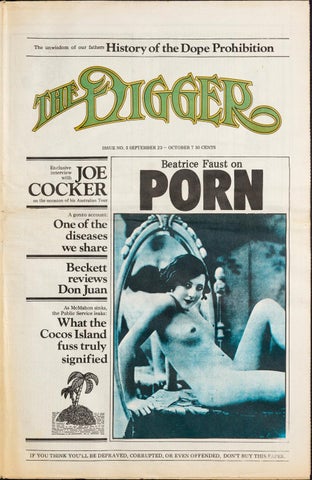
Theunwisdomof ourfathersHistory of the Dope Prohibition
ISSUE NO. 3 SEPTEMBER 2 3 - OCTOBER 7 30 CENTS
JOE COCKER Exclusive interview with
Beatrice Faust on
on the occasion of his Australian Tour
A gonzo account:
One of the diseases we share Beckett reviews Don Juan As McMahon sinks, the Public Service leaks:
What the Cocos Island fuss truly signified
IF YOU THINK YOU’LL BE DEPRAVED, CORRUPTED, OR EVEN OFFENDED, DON’T BUY THIS PAPER,
BLANK PAGE FOR ISSUU VERSION ONLY
Page 1
Sex cram ps on the eastern seaboard
Cocos Island splash sets permanent heads swimming.
Public servants lose control of bladder
For the wowsers, it's not so much the law, as who your mates are . . .
As the Federal government opens at the seams, smart young Liberal ministers are leaving the Prime Minister’s sinking ship, and swimming for a place to stand. This sort of Australian free style is creating even greater ripples within the Public Service, as senior bureaucrats dive in to compete with subordinates in the race to get onside with the Labor party. The gentlemanly game of “leaking” has degenerated into a loud splashing. The biggest free-style event this month saw the Minister for External Territories pushed into the Indian Ocean by an unidentified employee of his department, to emerge smiling on an exotic beach. Andrew Peacock’s handling of the Cocos Island caper was a personal PR triumph. The real story, which was smothered by the publicity about the “ King” and his Malays, was that a serious defence leak had occurred The DLP has been pressing the Liberals to do something about the Russian presence in the Indian Ocean. Plans were top secret until a middle ranking public servant in External Territories Department han ded files over to Labor frontbencher Clyde Cameron. The files showed that Cocos was tb be the base for an elec tronic surveillance system to watch Russian naval movements. Cameron passed the documents on to Richard Farmer, of the Daily Telegraph, and foreign embassies in Canberra have been scrambling to get a more com plete look at the Joint Chiefs of Staff strategic plans. With a little help from the press, Peacock managed to divert attention from a potential defence leak scan dal to the “conscience issues” in volved in the pay and conditions of Malay Labor on Clunies-Ross’ island fiefdom. The DLP is usually satisfied with private assurances that its foreign affairs policy is being followed, so the government was suppressing news of the strategic importance of Cocos. Peacock probably saved a little of the government’s bacon by defusing the potential defence leak scandal, and he scored a lot more favourable media than Chipp can get from a solid month of grandstanding on the drug issue. Within External Territories con siderable heat has been applied. There has been a round of polite interrog ations, checking and counterchecking of document movements, removal of sensitive files to more secure places, searches of desks, temporary isolation of certain officials, and the usual paranoia about ‘phone taps. This Cocos wrangle is just one
Analysis of a stew The incumbent federal govern ment has claimed that the 35-hour week will mean an increase o f up to 18.2% in the labor cost of goods. It has also claimed that the shorter work week will “cost” the country up to $3000 million. While these figures look concrete and precise, they are not true. They are false for at least five reasons that we have been able to determine. •T he headline-capturing figures are not based on a 35-hour week, in the first place. The current average standard working week is 38.4 hours. The highest government figures are calculated from 38.4 minus 5, or a 33.4 hour week. ♦The government calculations have allowed for no “productivity offset.” Productivity offset isn’t some thing you can explain in headlines, but it is well understood by every honest man in the field. Basically, history shows that when hours are reduced, productivity per hour increases. When hours were reduced to 40, in 1948, there was more than a 100% productivity offset. In plain lan guage, the same amount of work was done in the shorter week. Proof of this is contained in Economic Monograph No. 16, of September, 1949. Dr S.P. Stevens’ study covered 71 Victorian firms.
instance of numerous scenes of dec adence in Canberra. What’s happen ing is simple. It’s dawned on the senior men in the public service that Labor is likely to become the next government. A secret Public Service Board report has been pre pared on the likely changes if, in fact, It’s Time. Permanent heads are also preparing their own contin gency plans. In this general atmos phere of suspense, a complicated system of relations with the ALP, which has evolved over 23 years of anti-Labor government, has blown up. For years, the public service has specialized in the controlled leak. But now the leaks are springing in an uncontrolled, competitive, fashion. Many young, ambitious, univer sity-educated public servants have a great contempt for their superiors, who have served as chambermaids to the Liberal-Country coalition for all of living memory. Some of these younger men are heavy enough to have reached the middle echelons of their departments, on merit. And most of them are ALPoriented. They have good connect ions with journalists, and through them, the ALP frontbenchers. Their superiors have used these connections in various ways. Some departments, such as Trade and In dustry, occasionally use this channel to get a question asked in Parliament. The senior men’s hands are clean, and their departmental barrel gets rolled. It’s one advantage, from their point of view, of having an Oppos ition. Recently departed coalition strongman, Black Jack McEwan, whose Country Party controls the Trade and industry portfolio, has done deals with the car manufacturers to get campaign funds. Vexed with the problem of having to give fair exchange, public servants felt justif ied in leaking information to Labor frontbenchers. Their questions em barrassed the very department that had supplied the information. So the Opposition can be used, to de fend the bureaucracy’s notion of proper policy from the exigencies of Real Politics.
A more recent study (1971) suggests a similar productivity offset will accompany the 35-hour week. The Whitmont Company, in Sydney, launched a pilot 36-hour scheme. In their case, the 10% reduction in hours worked was offset by an 11% increase in hourly productivity. Whitmont got more production from less hours. • By ignoring the productivity offset, the government postulates a large drop in overall production. On this assumption, the government proceeds to calculate a dollar post for the production loss in the most expensive way. It assumes the production will be made up by workers continuing to labor the same hours, but at penalty rates. The assumption of a loss in production is probably false. But the assumption that the entire imaginary drop in production will be made up with overtime is disingenuous. After all, this government has created a pool of unemployed labor, in an effort to squelch over-award pay ments. •The costing calculations are based on statistics from employees in the private sector. The results have been extrapolated to cover employees in the public sector, who work a shorter week already. • Last, and probably least, con sidering the devious special pleading we’ve just outlined: the government figures are based on the assumption that the shorter work week will be generally introduced in one year. ACTU president, Robert Hawke, is
* * * This is a season where politics are exceptionally real, and coalition ministers are looking over their shoulders. A policy section within the de partment of National Development has produced a new set of guidelines that look remarkably like Labor’s policy. In the Education and Science portfolio, Malcolm Fraser has ordered a clamp-down on leaks. During the fortnight, someone in side the department of Labor and National Service slipped Clyde Cam eron advance notice of the unem ployment figures, which proved to be the worst since WWII. When Cameron went with them in the house, Phillip Lynch blew what little cool he possesses. The release of the official figures was delayed by a day. Incidentally, Lynch has his depart ment playing tougher than ever with dolé applicants, in an effort to trim the government’s statistical handicap
in this area. The numbers are now well over 30,000. Life-stylers on communes and urban freaks are being particularly affected. * * * Now that Labor seems likely to become government, the senior men have to re-evaluate their connections. Junior ALP sympathizers, formerly the object of suspicion, are being cultivated by their superiors. The senior men, who have for years allowed relatively unimportant in formation to dribble out to Labor through their ALP-oriented subordin ates, now would prefer to carry the bag themselves. One Assistant-Sec retary (a $13,000 p.a. man) has joined a Canberra A.L.P. branch this month. This sort of senior level squaringoff has undercut a lot of the business formerly done by younger public servants and their department’s client journalists at the Hotel Wellington, Friday nights. The junior men nat
urally resent this, and so they try to come up with choicer pieces for their friends. The current rumor is that the Cocos file came from one such junior man in External Territ ories, sweetened with the inform ation from liason with Defence, to Clyde Cameron, who passed it on to Farmer and the Telegraph. Many departments have developed this system of liason — the only not able exceptions being certain sec tions of Defence, and Supply. And in most of the departments, the system is breaking down. Some senior public servants will now face a greater problem if they have to square themselves with a returned Liberal government. Labor has promised to “open government”, with laws like those on the books in overseas countries. Whatever that will mean in practice, the prospect of a Labor win has created a special kind of openess, which might be called “blown govern ment”.
The Dirty Digger on record as saying the shorter week ought to be phased in over five years. ACTU sources which have been trying to do a costing to compete for attention with the government figures have discovered that it is an impossible task. However, ACTU industrial advocate, Rob Jolly, told The Digger, “there’s no doubt that the government figures grossly exaggerate the cost to the com munity.” This much has been tacitly admitted by the Minister for Labor and National Service, Phillip Lynch. Last month Lynch issued a state ment, that said: “I have indicated it’s not possible to make an accurate assessment of costs, except on stated assumptions.” The Digger found it took a great deal of grief and aggravation to get a clear idea of the “stated assump tions” behind the government’s figures. The calculations were! made within several government depart ments, and under the umbrella of the Crimes Act. It’s only normal for the incum bent government to use the public service to produce incredible facts in an election year. However, if anyone had cared enough, the rough outline of the basis of these calculations^ could have been gathered from
public statements, and answers to questions in Parliament. To summarise: The Government has used public servants, who are prevented from protesting by secrecy laws, to produce bodgie figures for election propaganda. The taxpayer has paid for the exercise. Certain sections of the media have retailed the bodgie figures as though they were fact to the taxpayer. The analogy is a carnival, where the customer pays to be rooked.
Nader Raider’s toe jam Ralph Nader’s lightning visit to Australia created some action in high places. Gough Whitlam was intro ductory speaker in Sydney, and John Gorton did the honors in Melbourne. William McMahon thereupon badmouthed Nader, and was echoed in the Fairfax press. Nader himself reckons that party politics is poison for a consumer protection move ment, and stipulated that the key people in his Public Interest Re search Groups had to be “non political”.
Key sponsors of Nader’s Austral ian visit have remained anonymous. One of the organizers, Barry Jones, the new Labor M.L.A. for Melbourne, has moved out of the picturq. Jones says, “ I feel I ought to fade into the background because I have a pol itical track record” . The coordinator of Melbourne’s PIRG is Charles Bagot, a Trinity Grammar schoolmaster. Bagot is a law graduate of Adelaide University, and he does not have a political track record. Perhaps he suffers from following Barry Jones, a wellknown radio personality, and cham pion of liberal causes. Almost any one who came on after Jones would seem obscure, but Bagot has struck some people as so obscure that he’s a “mystery”. Chris Hector put it to Jones that there was no information as to how Bagot got the job. He showed up on the podium with Nader and the other heavies, virtually unknown to the public, but obviously on the rails for a position in the organiz ation. Who invited him on the tour? Jones said: “Mr Bagot has links with a NSW private charitable foun dation, which wishes to remain anony mous, and which helped to under write the visit, and expressed an
Someone sent an ‘R’ certificate record to Norman Banks, Melbourne’s champion of all that’s Right. Banks, the radio 3AW talk-back man, spun it, and decided good Australians like himself shouldn’t like that sort o f thing. He told his listeners he would con tact his friend, Ray Meagher the Victorian Chief Secretary, and see whether records of the same genre could be taken from shops. A couple of days later two mem bers of the Victoria Police Vice Squad raided the offices of Crest Record Co. in Chapel street, St. Kilda with a warrant to search. When the policemen left, they took with them Crest’s entire stock of “ Adults Only” recordings — several hundred discs, according to Crest publicity man Sino Guzzardi. About the same time Meagher told the State he’d had a gutful of ‘pop’ pornography. The grimy wheels of Decency Machine were beginning to turn. Now Crest Records has been served with a summons demanding it, say, before a magistrate in the City Court, why the confiscated stock should not be destroyed, and why further action according to the law should not be taken. The hearing was set for last Friday, ibut Crest’s lawyer, Frank Galbally 1asked for a postponement so he could prepare defence. This was gran ted and the case will now be heard October 2 in the City Court. It will be an interesting test case as this will be the first time a recording has been put before a mag istrate in Australia, according to Crest. The three titles confiscated were Oh Dear, what can the matter be, seven old ladies locked in the lavatory, which was released three years ago, Aboard the good ship Venus, which was released one year ago, and Oh What a Beauty which was released two months ago. Each record has an “Adults Only” marking on it, and a notice advising only persons over 18 years may pur chase. The markings are not State regulation, but put on by the com pany for self-protection. Vice Squad men also visited city stores and took “Adults Only” re cords. They told the record store manager at Myers to be careful what he stocked. He apparently freaked and ^sent stocks of Daddy Cool’s Teenage Heaven and Rolling Stones’ Exile on Main Street back to the rele vant distributors. At WEA, the company which has the Stones, Victorian Manager Tony Hogarth said Myers Melbourne store was the only one to have returned stock. No other Myers store had. Hogarth said he hoped the Vice
interest in giving some continuing support to a PIRG.” Bagot told Hector he’d read Nader’s book, The Chemical Feast, while in law school. “I was impressed by the attention paid there, not just to the law, but also to the policies and the structure of a government agency.” Hector asked Bagot how he be came actively involved in the Nader tour. Bagot said: “When the com mittee was involved in organizing the visit I was invited to participate by some of the people involved.” “Who, precisely?” asked Hector. “I have been asked by the people involved not to name them,” said Bagot. “I’ve no objection to naming them, myself — but since I’ve been asked not to, I won’t.” Bagot pointed out that his role as coordinator has been confirmed at two public meetings. He told Hector: “ As to the complaint that committees were set up without any agreement as to the topics to be studied, or the way they were to be handled — I find that ridiculous. Finding out those things is precisely the reason^ for setting up the com mittees in the first place.” Neil McLean, president-elect of the 160,000-strong Australian Union of Students told The Digger he thought “The mystery surrounding Charles has caused some problems.” Bargot dismissed the rumor that plans for a $3 student contribution scheme had fallen through. “There are difficulties with the administrat ive details, within the universities, but they are not regarded as insur
Squad didn’t take the trouble to drop down to WEA’s Moorabbin warehouse where thousands of records were sitting. So far he said no policemen had appeared on his door. Hogarth said he had heard rumors o f vice squad seizures from city stores (other than the “ Adults Only” range) but no-one had confirmed this. As for the hassle of Exile on Main Street — well it has the word “shit” on the cover. So Digger rang Sergeant King of the Victoria Police Vice Squad for confirmation of a few facts/rumors. “ Vice Squad, we’d like some in formation on vice squad activities around city record bars, please.” “No comment” . “What if we read you a list of records and you can say whether you’ve seized them?” “ No comment.” “ Well try these . . . Exile on Main Street, Son o f Schmilsson, Teenage Heaven, Thick As A Brick?” “ No comment.” * * * In Sydney, NSW Chief Secretary Griffiths has been reticent in dis cussing his predecessor Eric Willis’s new tougher-line obscenity laws. Griffiths may reason that he can leave the distributors to do the job. NSW newsagents’ association, ANCOL, claim credit for sending all news agents a letter suggesting they not sell local sex papers, under threat of prosecution. Whilst distributors, newsagents and legal advisers all admit prosecutions on these papers would be hard to stick, and uneconomical for the government, the scare tactic is work ing. One Paddington agent told The Digger he “sent them all back — all the sex papers — because, even if I won a case, it’d cost me fifty, maybe a hundred bucks. It’s probably ok to sell them, but why take the chance? If it gets easier again, Fll reorder them then.” He said he used to sell from twenty five to fifty of each paper. Allan Wright, distributor of Sexy, Kings Cross Whisper and Searchlight, reports “ maybe fifty or sixty” news agents cancelled after the ANCOL letter. This “on top of the sixty per cent of outlets that wouldn’t handle these papers in the first place.” It leaves about 400-500 sales points in the entire state, out of 1400 agents and sub-agents. While the pom argument pro ceeds in the courts and the Letters to the Editor pages, conservative bus inessmen, bureaucrats and govern ment members have begun a very effective counter-level censorship through intimidation, neatly side stepping the law.
mountable at this stage.” Bargot said he wanted to have a firm, clear plan to put before asking, for the money. “ Any group m a tv might develop into an umbrella or- " ganization must first establish i t s ^ credentials.” Barry Jones summed it up thus; “It’s very hard to gather together people who have the necessary skills and experience, who are not already politically aligned.”
Spotlight on lunch Although I refuse to allow that either are naturally just, a disease is like a poem. Both produce altered feelings, both seem full of symbols which may not be intended by the authors. And, like the poet, the diseased is self-centred, isolated, and under taboo. Both the poet and the diseased are always in danger of being a bore; I shall pass from this formal subjectivity, to the objective reality of these recurring lesions on my cock. The first o f these sores appeared before last Christmas. It first took the form of a tiny blister, or vesicle, located on the right side o f my penis, in the scar-band left ^y infant cir cumcision. It looked like a small pimple, in fact, and I was certain it wasn’t syphilis. One reason for certain was the pain the thing prod uced when I fucked; syphilis is — Continued on Page 10
i
\
\
\
Page 2
The Digger
September 23 — O ctober 7
Wilson, Hanna, Rudd & Arnott Published by High times Pty Ltd, 58 Canterbury Road, Middle Park, 3206. Telephone 69 7446, 69 7447 Published fortnightly throughout Australia. Cover price is recom mended retail maximum. Editors: Bruce Hanford, Phillip Frazer. Administrator: Garrie Hutchinson. A d v ertisin g and Circulation Manager: Terry Cleary Art Director: Ian McCausland Subscriptions Manager: Sue Cassio Reporter: Jenny Brown In Sydney, advertising and editorial inquiries should be directed to Geoff Watson, 8 Norfqlk Street, Paddington, 2021. Telephone 31-5073. Distributors: New South Wales: Allan Rodney Wright (circulation) Pty Ltd, 36-40 Bourke Street, Woolloomooloo, 2021. Telephone 357-2588. Victoria: Nation Review, 113 Rosslyn Street, Melbourne, 3003. Telephone 30-4222. South Australia: Australian Book Company Pty Ltd, 17 Main North Road, Menindie, 5081. Telephone 44-1157. West Australia: P. and H. Redman, PO Box 3, Palmyra, 6157.
Writing To & For The Digger Whilst most material in The Digger is solicited, unsolicited manuscrips will be read. As we accept responsibility for as little as possible, we can only guarantee to try to re turn manuscripts received on this basis if they come with a stamped self-addressed envelope. Rates are negotiated according to the copy, photographs or art work received. Fiction is acceptable, of any length. Like all Digger material, letters may be sub-edited. Signed letters with an address are preferred, but names will be withheld on request. Address Letters to: The Editors, . j The Digger, 58 Canterbury Road, Middle Park 3206.
Subscriptions to The Digger will cost $7.80, but not yet. i We still have a few of our First 100 Subscriptions available, at $5.00 all-inclusive for twelve months (26 issues). As one o f the First 100 Subscribers you receive a Digger Record Voucher entitling you to a free LP record of your choice, from the lists of latest re leases printed each fortnight in The Digger. Subscribe now for one year’s supply of The Digger at this dis counted rate . . . if you miss the First 100, we’ll refund your $5.00 or hold it and wait for that extra $2.80.
I ( I I
I enclose my cheque/postal order/ money order for $5.00 being payment in full for one year’s subscription to The Digger. I understand that only if I am among the First 100 Subscribers is this offer valid — and I understand I will receive a Digger Record Voucher entitling me to claim one album Releases sometime within the next twelve months.
Don’t A callus... | I refer to your letter of 10th August last seeking the permission of this Department to peruse the depositions of the inquest into the death of the late Mr Ferguson. The papers in such circumstances are normally only available to the persons involved in the proceedings and to their legal advisers. In this instance it is considered that suffic ient cause has not been shown as to why the Departmental policy should be relaxed and for this reason it is regretted that approval cannot be given for the depositions being made available.
.| .and we won’t call you
( I
A Poem
Under Secretary o f Justice Department o f the A ttorney General o f Justice Sydney
I Sue Cassio, Subscriptions Manager, The Digger, 58 Canterbury Road, Middle Park, 3206. Dear Sue,
by Jenny Brown Party Machine rebop: Melbourne’s Sebastian’s disco packed the house on Friday 15th — for their second Rudd-instigated “Crumpets Work shop Special” . The Party Machine, (one of Aus tralia’s biggest early creative-rock seeds), reformed, for one night only, to roll out some all-original grooves from the Golden Machine Graveyard. Oh those double-barrelled Hannaford/Wilson vocals, oh those bannable inane lyrics . . . (“We all live on a camel farm . . .”) Michael Rudd was there, bouncing around on bass, just like in the good ol’ days. And Ray Arnott got the (short? long?) straw to be drummer. Supplementing- Murtceps, (who closed the show, exhausted), and the Party Machine — were MacKenzie Theory; with Mr (him again?) Rudd vocalizing a special thirtyminute composition of Rob MacKenzie’s, strung around the “ Lord o f the Rings” story. Theory were as frantically into it as usual, and those worn-out D.C./ Murtceps vibes took a thorough spring-cleaning. Even the audience (although they looked rather mys tified at times) had a ball. Elsewhere: Gary Young is no longer a drummer. He’s fronting with guitar in a new band, with Wayne Duncan, who’s playing steel guitar. The two ex-DC men are teaming with the piano, bass and drums who’ve been backing Johnny O’Keefe’s live gigs, and the sound at first rehearsal was impressively happy C&W. The name of the new group? Young’s toying with “Cunning Stunts” : on 2FU, this is Hammersley Pud’s radio program, and here's “ You've G ot to be 18", by the Cunning S tu n ts....
■
In reply to your letter of the 6th September to the Honorable Speaker, I desire to inform you that the accreditation of members of the
If I miss out on the First 100: Return my money Hold my money and let me know how much extra I owe for a regular sub. (Tick whichever applies)
Make cheques payable to Hightimes Pty. Ltd. crossed not negotiable.
L
American takeover bid Gee, we both really dig your news paper and are wondering if you have a vacancy for some groupies — we’re like the American sort — we promise to do the ironing etc. Hoping to hear from you soon!! Yours sincerely, Anna May Wong and Gale Bonbala Please find photographs enclosed!
Big on trams Could you make Digger smaller I find it very hard to read on the tram when its so big. So far, its not a bad mag. Good luck. Lu Stewart
4. My Name is Asher Lev, Patok 5. The Flesheaters, Ireland
I ■ I I ■ from The Digger lists of Latest I
BOOKS .P’code
J.G. Little Serjean t-a t-A rms, Parliament o f Victoria
Oh Don Nothing But a soft grunt As the cartload o f lust Was tipped, hydraulically speaking, Over the junkyard of my mind And compressed Into rectangular morals. Greg Church East Malvern, Vic.
Max’s troubles I, Max C. Geikie, of One Soudan Street, Coburg, Victoria, citizen of Australia, do hereby make it known that various members of the follow ing organisations, by attempted mur der, criminal negligence, defamation, or other moral deficiencies, have done me grave and probably fatal injury, as outlined in the accompanying his tory. Royal Melbourne Hospital, St. Vincents Hospital, Alfred Hospital, Prince Henrys Hospital, Austin Hos pital, Preston & Northcote Hospital, Royal Park Hospital, Footscray & District Hospital, Mount Royal Hos pital, Queen Victoria Hospital, Fairfield Hospital, Box Hill Hospital, Peter McCallum Clinic, Trade Union Clinic, Personal Emergency Service, Baker Research Institute, W. & E.
sought with regard to probable at tempts by some of those responsible or others to use legal processes against me in order to conceal their infamous acts. R.S.V.P. Yours sincerely, Max C. Geike P.S. Reply may be stolen by Post Office.
Return rant
boume Truth has for years been forced to paint daisies over the tits of nudes and titilate its readers with droll tales of would-be convent rap ists, so the revamped Tele will be ever forced to seek a mealy-mouthed compromise with honest sex — hence the teeny-bopper syndrome. It’s a well known fact that the State governments, and not public opinion, keep a tight reign on what a mass circulation newspaper may or may not publish. Papers such as "* Rolling Stone, Nation-Review, The « Digger itself and various university papers — Lot's Wife for one — are only allowed to circulate, because, in the view of the governments, they do not reach enough people to change opinion — in other words they preach only to the sexually converted and to hell with them. But the Truth of the Tele: there’s a different story. The readers may actually learn something if these papers were allowed to shift sexually. And so the pressure remains. The only difference between the Sydney and Melbourne in sexual approaches is that at least in Sydney the govern ment admits that women have masscirculation tits. Melbourne readers may well grow to maturity in the quaint belief that only the women of the Communist Third World have nipples. Mr Edwards may like to ask Victoria’s Vice Squad one day why they consider nipples to be Commun ist propaganda — the reply should be about as instructive as his letter. A final point: I don’t set myself up as an authority on the Sydney press world; I just write about it, in much the same manner as most journalists in Australia attempt to write about any subject these days.
Mr Edwards (letter, Digger No.2) may write with his arse, I prefer to use my fingers — it’s somewhat easier on the typewriter keyboard. It’s jolly to see the editors of The Digger admit that they hashed the story around to the degree that error was committed. If anyone understands the infamous Fairfax, Clinch job on the Mirror I do. The Fairfaxes and Clinch shoved my father over to be editor of the Sunday Mirror in that darkness before dawn and then aban doned him when the chain was sold to Murdoch. And don’t think that Clinch had an easy time of it getting back to Broadway. The Fairfax mob were prepared to abandon him as well. But that much is pure history. What concerns me is the assertion that Murdoch is about to attempt a London Sun job in Sydney. In the same way that the Melbourne Truth is but a pale imitation of Mur doch’s News o f the World, so a re vamped Tele can only be a pale imitation of the London Sun. God, talkback radio and members of the various vice squads just don’t allow that sort of good clean fun in Australian mass-circulation newspaper Richard Beckett, markets. In the same way that Mel- I Glebe, NSW .
■ | |
Name Address
press is governed by the rules of the Parliamentary Press Gallery. Your request for accreditation has been referred to the Chairman of the Press Gallery Committee and I regret to inform you that, under their rules your publication does not qualify.
I made this epic after watching a televised excerpt of the life of our Minister for Customs and Excise (to whom the object of your doubt ful perusal is lubricously dedicated) and decided it was Digger's while grazing through the last excellent issue of your fine upstanding organ.
Hall Institute, Australian Medical Association, College of General Prac titioners, Australian Red Cross, Vic. Assoc. Of Social Workers, Caimmillar Institute, Citizens Welfare Service, Medical Board of Vic. Hospitals & Charities Commission, State & Fed eral Dept, of Health & Social Ser vices, Vic. Council of Social Ser vices, Vic. Soc. for Crippled Child ren & Adults, Vic. Trade Unions, United Nations, Melbourne Univer sity, Monash Upiversity? State & Federal Parliaments, Vice Regal Authorities, Methodist Church, Cath olic Church, Church of England, Church of Christ, Pensioners Assoc, Public Service Board, Council For Civil Liberties, Public Solicitor, Legal Aid Committee, Monash Legal Service, Law Institute, Bar Council, State & Federal Law & Police Depts, Judicial Authorities. I hereby appeal to honourable members of the above organisations, and all other residents of Australia, to assist me in correcting this grave and disgraceful situation. My four main concerns are: 1. Obtaining proper medical treat ment, so that my life may be saved and my health restored, 2. Obtaining proper compensation for my past and future suffering, loss of earning capacity, and probable early death, 3. Having those responsible for my injuries imprisoned for murder, or otherwise suitabily disciplined. And 4. That the practice of medicine in general shall be greatly improved, so that similar experiences are never repeated. Any reader willing to assist me in the above matters is requested in the first instance please to write to the address given, outlining what assistance is proposed. The protection of readers is also
SYDNEY Third World 1. Steal this Book, Hoffman 2. We are Everywhere, Rubin 3. Children’s Rights (collection) 4. The Master Game, de Ropp 5. Separate Reality, Castaneda Adyar 1. Siddhartha, Hesse 2. Meditation, Mounisadhu 3. Foundations of Tiben Mysticism. Govinda 4. Thought Forms, Besant 5. Tarot of the Beohemians, Papus Clays 1. The Ewings , O’Hara 2. Virginia Wolfe, Bell 3. Homosexual, Altman
Abbeys 1. The Movement, Ormonde 2. The 12th Man, Witington 3. The Americans, David Frost (paperback) 4. Chariots of the Gods (paperback) 5. Macrobiotic Cooking, Abehsera (paperback) Angus & Robertson 1. The Word, Wallace 2. The Osterman Weekend, Ludlum 3. The Movement, Ormonde 4. Indiscretions of a Headmistress 5. The 12th Man, Whittington MELBOURNE Collins Book Depot 1. The Word, Wallace 2. The Ewings, O’Hara 3. Return to the Stars, Von Daniken 4. Wheels, Haley 5. Homosexual-Oppression and Lib eration, Altman Methodist Book Depot p Chariots of the Gods, Von Daniken 2. Captian Book, Machean 3. West of the Centre, Ericksen 4. Paul — Envoy Extraordinaire — Muggeridge 5. 800 Million — The Real China, Terrill
The Paperback 1. Rosshalde, Hesse 2. Relief Without Drugs, Mears 3. The Tomb of Tutankhamen, Carter 4. Children’s Books, Inesco 5. The QB7, Uris
Clockwork Orange Please Sir Fiddler on the Roof They Call Me Trinity Butch Cassidy & The Sundance Kid; - M.A.S.H.
MELBOURNE Readings Godfather 1. A Dialectic of Sex, Firestone Clockwork Orange 2. Person To Person, Rogers 3. One Flew Over the Cuckoos Next, Blushing Charlie Junior Bonner Kesey Fiddler on the Roof 4. Siddartha, Hesse The Last Picture Show 5. Communes USA, Fairfield. Robertson and Mullens 1. Singapore, McKay 2. Catch Me A Colobus, G. Durrell 3. Land Boom Bust, Canon 4. The Movement, Ormond 5. The Crisis of Loyalty, Grant Space Age 1. Citadels of Mystery, De Camp 2. I Will Fear No Evil, Heinlein 3. Teachings of Don Juan, Castaneda 4. The I Ching, Wilhelm’s translation 5. The Egyptian Book of the Dead, Budge taanslation.
FILMS SYDNEY Godfather
RECORDS SYDNEY
2. 3. 4. 5.
The Slider, T. Rex Slade Alive Machine Head Sunbury
Marthas 1. Never A Dull Moment, Rod Stewart 2. Thick As A Brick 3. School’s Out, Alice Cooper 4. Machine Head, Deep Purple 5. Honky Chateau, Elton John MELBOURNE Allans 1. Slade Alive, Slade 2. Live At Sunbury, Aztecs 3. School’s Out, Alice Cooper 4. Harvest, Neil Young 5. Moods, Neil Diamond
David Jones 1. Slade Alive 2. Thick as a Brick 3. Teaser & The Firecat 4. Exile On Main St. 5. Jesus Christ Superstar
Brash s 1. Thick As A Brick, Jethro Tull 2. Slade Alive 3. Live at Sunbury 4. Machine Head, Deep Purple 5. Carney, Leon Russell Archie & Jugheads 1. Living In The Past', Jethro Tull 2. Trilogy, Emerson, Lake & Palmer 3. Inner Mounting Flame, John McLaughlin 4. Slider, T, Rex 5. Flute Cake, Jethro Tull
Nicholsons 1. Thick As A Brick
Record Centre 1. Slade Alive
Palings 1. Slade Alive 2. Thick As A Brick 3. Teaser & The Firecat 4. American Pie 5. Superstar
2. 3. 4. 5.
Live at Sunbury Thick as a Brick Carney Live with the Edmunton Sym phony Orchestra, Procol Harum
Gregory Young, Record Collector 1. Sail Away, Randy Newman 2. Inner Mounting Flame, Maharishu Orchestra 3. R. Certificate Songbook. 4. Never A DuU Moment, Rod Stewart 5. Thick As A Brick Head-Down Imports A. City 1. Flourescent Leech and Eddie, Howard Kaylan and Mark Volman 2. Roots and Branches, The Dillards 3. Cornin’ Thru, Qiicksilver 4. Ruben and the Jets, Mothers of Invention 5. The Snake, Harvey Mandel B. Inner Suburban (unchanged due to no new import shipments arriving) 1. St. Dominic’s Preview, Van Morrison 2. Son of Schmilsson, Nilsson 3. Waka Ja Waka, Hot Rats 4. Just Another Band From LA, Mothers of Invention 5. Together, Julian Beam and John Williams
September 23 — October 7
Exclusive interview with Joe Cocker in London
Cocker to come south
Joe Cocker on stage: famous for his ability to stay on his feet when the world is staggering.
by Vincent McGarry When Harry M. Miller was finally talked into taking Joe Cocker to Australia and New Zealand, he wan ted to find out more about what he’d let himself in for. Some of his sides took him to a screening of Mad Dogs and Englishmen. About ten minutes into it, the story goes, Harry started to moan “What have you done to me?” Cpsmic Kiddies, English roadies, Chris the Foxy Prince of Roll, Snakey Jim Keltner, Leon the Master of Space and Time, Children with the Answers, Rita the Delta Lady, Assorted Sound Freaks, sundry wives lovers, groupies, babes and animals, all pranced about the stage, as the Maddest Dog of All, roaring like the MGM lion with laryngitis, jerked through his act, clutching invisible 10,000 volt wires in each fist. Harry thought he’d left this insanity be hind five years ago. He freaked at the idea of coping with the junkie-
ridden, groupie-gathering rockers -again. Actually, the Cocker Crowd Aus tralia and New Zealand will see is smaller, tighter, and Joe hopes, not quite so mad. “ It’s a nice comfortable outfit — not really a big band, y’know. Guitar, bass, drums, piano, vocals, two horns . . . thirteen. “ Well, if you work with just a few and want a richer sound, the people involved jumps up — you get five more. There’s two drums which cani make a magic addition, Jim Keltner and Jim Carstein, who we’re using this time. Looking forward to being on the road again, y’know?” Cocker is tired, bleary-eyed, sit ting in his PR’s London office after an all-night session picking tracks for his new live album. There’s a hole in the sole of one of his mauve boots. He fills his blue and maroon longsleeved T-shirt the way Jane Russell used to fill sweaters — tight. He be lieves Guinness is gut for you.
Q: What do you think of going to Australia? Looking forward to it? Cocker: I don’t really know much about it. And as far as the reception for rock and roll is concerned, how they take it, it might be like starting all over again. I don’t know. It’ll be like when we went into Europe for the first time. Q: But you went okay in Europe, didn’t you? Cocker: Oh yeah. In Italy and Belgium it was completely new ground for me. But Australia isn’t really that big as far as the record sales are concerned — we get the figures they send back. I think 10,000 is a gold. Q: How much money are you getting for ft? Cocker: No idea. He took a small silver-foil pack from a pocket, rolled a smoke and passed it round the room. Q: One thing I’ve noticed, a jour nalist recently asked you if you were shooting up. You’re not, are you? Cocker: No.
Busted for incitement this time, the cops didn't even gawk at boobs. by Susan McCulloch MELBOURNE: Friday arvo, Bourke and Elizabeth streets and we arrive late thinking we’re early be cause we couldn’t see any action. Incitement is what we’re going into the streets for. It’s a legal word the old incitement, the word men in power use these days when arres ting you for telling young men there’s a choice, that they don’t have to be called up. Confusion is around this Friday afternoon, a vague feeling of tension among the eighty or so o f us on the Post Office steps. Things are hr full swing, with friends trying to get pamphlets into the hands of the be mused shoppers on their way to or from Myer’s. They’re not particularly reluctant to accept our material, but get a bit upset when suddenly a de termined plainclothes Commonwealth cop snatches the paper from them for evidence. Across the road a knot of people watch curiously as if there was a fire . . the scene they see is
Page 3
The Digger
of men and women, young and old, straight and hip being arrested. On the other side of Bourke St. the pamphlet distributors are unmolested, but where I am there’s scuffling, shouting, hair-pulling and a touch of hysteria among the police as one red-haired Fed charges through the crowd to grab a handful of the hair of a coincidentally red-headed de monstrator. The head jerks back as he calls “ What are you arresting me for?” There is no answer. There is hardly one that could be given, for the charge against this youth is to be changed twice before it drops in the fetid atmosphere of the Mel bourne Magistrates’ Court. After three-quarters of an hour I am resigned to being busted. I want to get it over with. Again. I had been on the safe side of the street handing out the advice without molestation. It is important that as many of us as possible be arrested to highlight the absurdity of a so-called law that says you can’t tell people not to kill. There is no real feeling in me at all, just a sense of duty as I cross the road
and hand a single pamphlet to some one I afterwards can’t recall. Ser geant Mullen is the name of the figure looming over me. Question: “Do you intend to hand out. these pamphlets.” Answer: “I don’t know.” Question: “ What is your name?” Answer: “ Am I under arrest?” Question: “What is your address?” Answer: “ Am I under arrest?” Question: “Will you give me your name?” Answer: “Am I under ar rest?” (If you’re bored, skip this). Question: “Well, then, yes you’re under arrest.” Cop on each arm, name and address finally revealed, in we go the charming threesome to the back alley behind the Post Office and it’s picture time. I pull my hat over my eyes but there are two photographers so I can’t really come the Bonnie and Clyde bit. Gentlemanly I am escorted into the back seat of the standard death cell grey Commonwealth cop car with another! arrested lady and heigh! ho! for McKenzie St. Just around the comer D24 and the an cient Magistrates’ Court lurk awaiting their prey. I’m missing my red “ Don’t
It’s no surprise if he’s needed a little help from a friend like cocaine. He came out of the Mad Dogs tour in 1970 with less than $700, then there was the year-long wrangle with his manager, Dee Anthony. Then his comeback at Madison Square Gardens last March was savaged by the critics, and the word was out that Joe Cocker was finished. Cocker admits some damage “ Ever since the Bangladesh concert, Madison has become a sort of little temple — like being in a church,” he says. “But we didn’t go well at the Gar dens. It was my first singing in more than a year, and you have to get things back when you’ve been away. I was staring into the spotlights, tripping over things . . . couldn’t believe it, feeling so weird. It was so strange. “ft was a mistake to lead it there. How many bands play first gig at the Gardens? We should never have gone about it that way. “I felt like a bloody boxer or something, you know, rehearsing till bloody two minutes before I went out there. It’s no wonder there was no energy in it, because we’d re hearsed so tightly to the date, with out really knowing what we were going to do. And the crowd wanted “ Delta Lady”, “ The Letter”, “With a Little Help” — you know, stuff we hadn’t rehearsed. The Stones hired Hell’s Angels to throw over-enthusiastic fans back into the pit if they try to get on stage, but Joe doesn’t mind. “I like lots of people up on stage, if they’ve got a purpose there. I can’t tell people to piss off. I like it if they con tribute something, dance around, be happy, look nice and pretty. In Santa Monica last time, about 2001 people got up on stage, and it was great. Big bunch of rockers.” Another part of the scene he likes is groüpies — “brighten things up” — and recommends the services of The Butter Queen. “ Go see her and get her to do it for you. Wouldn’t believe it.” Though he enjoys it, he some times feels the need to get away from it all. When the touring has to stop, he gets right away from it. He goes to see his folks in Sheffield, in the North of England. That’s where it all began. He started life the son of a civil servant. When he left school, he> sang in local pubs. By day he was a gas fitter— by nights ducking béer bottles from the audience. “ Sheff ield, now there’s your last outpost. The cavalry won’t even go there,” says Joe, looking back on the days. To try to change his luck, he swapped Cocker — an old Yorkshire name — and dubbed himself Vance Arnold, instant fame did not come his way. Back to Joe. But as he worked up through the years, form ing one band,, growing out of it, forming another, more and more people started taking notice of him. One of them was record producer Denny Cordell. He told Festival about Joe and suggested they sign him up. They called him in, heard him, and were happy. Except for one thing. His name. “Couldn’t you change it?” “Why — what for?” asked Joe. Embarrassment and silence. The name stayed Cocker, and Cordell got on with the job of producing a track called “Marjorine” , co-written by Joe and Chris Stainton, his piano player. It went into the U K. charts in March 68. Six months later, he took with a- “ Little Help From My Friends”, made Ringo’s nursery ver sion look sick, and scored a world hit. In April 69 he hit America with Cocker Power for the first time, tour
ing with the Grease Band. Major appearances at the Woodstock, At lanta and Newport festivals rammed him home as the blackest-sounding white singer. .In September, he followed up “ Friends” with “Delta Lady” , written by Leon Russell. The next month, he was back in the States for another tour with the Grease Band. His career burgeoned, until in March, 70, he again found himself in the US. He was in LA, to relax and unwind after months of touring and recording. The day after he got there, his then manager, Dee Anthony, told him he had been signed to go through with a seven-week tour of the States — starting in eight days. And if he didn’t do it, he’d be banned from working in the US. Leon Russell had a band of 10 musicians and 12 sin gers together. A week later and Mad Dogs and Englishmen tour kicked off in Detroit, and ended in San Bernadino, California, after 57 days of hard slog. And left Joe $682 richer and “pis sed o f f ’. He plays down the sugges tion he broke with Leon Russell over an unequal division of spoils. “I didn’t mind when told I had ( to go on the tour. I was feeling good, but at the end of it I was exhausted^ This was 50 people living on each others backs day and night for two months — naturally there were an awful lot of pressures. “We had 50 people staying in a hotel, bills got put in that we had no way o f checking. TV sets would go out the window and wind up char ged to my room service. Towards the end of it there were a whole lot of hassles with management, and I really felt worn out with the thing. “When it was over, there seemed no point in going on — my mind was confused and all I wanted to do was get away from everything and everyone. I just wanted to find some fresh air and be able to think things out clearly.” He climbed into a van and drove up and down Brit ain, his only links with the music world being a radio and a set of drums. He slept in a sleeping bag by the side of the road, under bushes, wherever he wanted. He was sitting in his family’s living room one Saturday night last March when Chris Stainton rang up. Chris had been away in the States trying to form a band, but hadn’t been able to find a good singer. “Will you come over and have a warble?” he asked Joe. That night, one jet and limousine later, Joe was warbling in Connecticut. “I was really happy to do it,” he says. Would he have done it for anyone;Qtfte£ thap ,ChHs? r‘^W«ll * no-one had really mentioned it. N o -' one had asked me. That’s what I like being with now anyway. I’ve been with him for years, and we get on well. “I was just coming back to being in music. If you’ve got a musical mind, well, that’s where I love my thoughts to be. But sometimes with the traumus going on, I got to the stage where I forgot music, almost, through just bad things going on around me, money hassles and all the management stuff.” He didn’t want to record or tour while An thony was still his boss. After Mad Dogs, he discovered he was still contracted to Anthony for another four years. After a court battle, Joe paid him $150,000 to get out. * * * “ Usually when I haven’t been singing for a while, just starting again, I get a slight sore throat, and I lose my voice slightly. But if I take a coupla days off it’ll come right back. But it’s that constant hammering, you know, if you never give it a chance to return. “But it’s all back again. I used to gargle to keep my voice in good condition, medical gargles to clear off
Register” badge, grabbed by the Sergeant. Paula ,i the sole female Common wealth cop in Victoria, is waiting to greet us with a beaming smile and glasses of water. Some of us are allowed to make free phone calls. This stops after about five goes. The waiting begins. We sit in comfy chairs and chat with the friendly guys from the Feds’ “nice squad”. They’re charming and all that but we all know the game. I’d been busted at 4.30 p.m., now it’s about seven and the Feds are in a hurry to hand us over to their state brothers before the police canteen closes at eight. Gotta have dinner. Each arresting cop dribbles his group across the road to where a group of supporters keep watch outside the watchhouse, although it’s getting cold. There are about fifty of us — and a grand old larceny it is lifting official papers from the Feds’ offices. Like instmctions on how to handle the demo. All my bail receipts for other people are ripped from my purse by a constable in the watchouse. He’ll make a great investigator with his powers of deduction. He says, “You’ve been here before.” Every thing else is taken and listed in this scurrying scene, a bit like a railway station really. The cops stand there as a wardress runs her searching
| Rands down my boobs and elsewhere. This time our jumpers aren’t pulled up to let the cops gawk at our boobs, like once before, and she j doesn’t run her hand inside our flies this time either. In we wander past rows of cells, down corridors to a large yard. The men are two or three to a cell, we i females are herded into the open, unroofed space. There’s a little shed I for overnight guests where the blan! kets stink. We stand in a group and talk, although we’ve just about ex hausted conversation by now. So we chant “ Smash the draft” and the disembodied blokes reply. It’s my 23rd birthday so the nicest “ Happy Birthday” I’ve had is sung by the blokes. I jump up and down and call thankyou. What do you do when you’re locked up? You play games, hoppy races, relay races, roundabout races, who could run up the wall fastest without breaking a leg, plot ways of breaking out. And sing every revolut ionary song you can think of. Ten o’clock and very cold. Bailing out starts. You don’t want to feel envious of the names being balled, you try not to, but you are. So you wait. And wait. The numbers dwin dle. From 23 of us there are only, five left when I’m called an hour later. Seven hours have passed. My possess ions are given back to me. The early
Q: They mentioned coke. You’re into that? Cocker: Ahh — yeah, I use it. It’s just one of those things. Helps you through sometimes.
any germs. But I don’t take any special care of it. “I feel rotten when I go onstage and my voice isn’t very good. But rather than cancel, I’d rather go on and try. And on poor nights, -if I realise Tm not in the best condition, I can tell the band, and we can try harder to get it going together, and if need be they can play better to sort of make up for me. “I can always tell how Fll be an hour or so before I go on stage, just how I feel. I have lost my voice in parts, but if you’re on stage any thing can happen — you can lose it in the dressing room, and worry about it, gargle maybe, and then go out and it returns. “I never feel annoyed if I lose it — it’s just the pressure, but it’s never been that bad that I’ve had to pull out.” Another thing that annoys Joe is bootlegging. “I know when it’s going on, you can sort of smell them out there it the audience, under the stage. I’ve picked up a few bootlegs, but I’ve never come across a decent one yet — they’re just ripping you off,and the people who buy them. “They’re usually under the stage. You can tell. So I stamp my feet a lot — walk real heavy.” Not that he gets violent about it, but Joe has little love for most pop writers. “ You can tell when you read articles how well-informed they are — even if they spell names incorrectly, that sort of thing. I don’t get heated about it if someone puts me down violently or strongly though. Very few interviewers have ever laid it out that way. “I buy records to see what other people are doing. I like some people around, but a lot of the stuff going on isn’t music, it’s muzak. Some times the scene gets stagnant.” He hasn’t been writing much since the last packet before the U.S. and Europe tours. “I have nowhere to live yet, and if I did I could get my self together and write some songs. But as it is I’Ve just been driving around England in my van, taking it easy, or else in this mad pursuit for a house. “We’ll be getting into rehearsals in a couple o f days, sitting down to work things out. We’ll strip the act down and build it up with new things. I just like to get new songs
in, because we get bored performing them every time up there on stage. Don’t know how many times Fve sung “The Letter.” Drop that one this time.” Joe’s PR, Max Clifford, s^ys the trouble is that there hasn’t been a new Cocker LP for a while, and people still play the old ones with “ Delta Lady” , “The Letter” , etc., and then want to hear him do them live. A new live LP is in the works, recor ded at U.S. and British gigs. I said that people were saying one reason for the foul-ups when he got back on the road this year was his use of coke. One trade paper in Britian said if he wasn’t careful “one day he’s going to blow his nose off.” “ I don’t know, I don’t knpw, I think the best we can do is . . . we’ve had some dull nights okay, but what can we do? We could cancel, but we don’t want to. If my singing’s not on top form, then Fm sorry about it.” After all his management hassles does he ever feel like a piece of steak, with all these dogs fighting over him? Cocker says he watches the figures more closely, and takes things philosophically. “If it starts happening again, Fll just piss off and lay up in Tanganyika or somewhere. “ All that stuff got at me, but not enough to make me quit. Just enough to piss me off. I wasn’t going to let it get me right down. I didn’t like it, but it’s like anything else that happens to you. “I’ve no idea about whether Fll disappear when I come back from this one now. I don’t know what state of mind Fll be in when I finish, but part of the trouble with the Mad Dogs was that I didn’t take good care of myself. Like eating and sleeping. So I watch that now.” During this tour, he hopes to pro duce a solo LP by Gloria Jones, one of the Sanctified Sisters — the four girl singers with the band. “ She’s really good, has a lot of good songs, plays good piano and sings well. Fd like to do some producing. I play some instruments, and I keep writing songs when I have the time. “Fm more than happy to live day by day” , says Cocker. “ We could book tours up for the next 15 years but it could all fall out. No-one likes to see their lives sewn-up like that. I don’t.”
fill your house
ARCHIE & JUGHEADS RECORDS MAIL ORDER IMPORT RECORDS SERVICE TO ALL STATES WRITE TO BOX 5159AA GPO MELBOURNE 5 MANCHESTER LANE, MELBOURNE PH: 63-5507
leavers were in a hurry to get to the Socialist Left dinner-dance in the Lower Town Hall — no such luck for our friend the JP who has to wait until the iast person is bailed at $10 a time. It’s freezing now in my jeans and skimpy worn leather jacket. Smiles and hugs warm me outside. I find it hard to readjust to warmth and noise. The lovely steak meal in Carlton is eaten with an inner lack of enjoy ment, a numbness that nags at you about those in prison all the time. Friends, like most of the six draft resisters serving their time in prisons across the country. And the women who wrote graffiti on the walls of that stinking shed. What happened to the girl who scrawled, “Put away for two years.”? or “ On parole. Love Pam”? Weeks pass and the reality of the impeding court case diminishes. It’s to be my fifth time on stage in the mouldering Russell St pile that some call the boss’s court, that highceilinged place of so much power in such pathetic hands. Shoplifters and drunks come on first and are dis pensed with. Relief, the Chief Magis trate retires before we’re on to be replaced by a Mag who, amazingly, treats us fairly. None of us expected this, or can remember it happening before. An obstruction charge is dis-
missed. Wonder o f Wonders, the Magistrate says police evidence is inconclusive. Score: one for us, none for them. Unionist Wally Curran cops a $50 fine for a second offence. I have three convictions so expect trouble. Sergeant Mullen puts his black homrims on and recites his piece deadpan. I decide to cross-examine to try to establish why he took my badge and whether it was an instrument of incitement. He denies ever laying his honest government hand on it. Next I ask him what was meant by “ Don’t Register for National Service.” He doesn’t understand. I try again. Then the Magistrate gives him the word to answer. He stumbles. This isn’t in the script. Titters from friends in the two back rows, who are warned to keep quiet. I finish with the Sergeant, then the SM asks me for a statement. Well, yes I tell him my reasons for urging men to oppose the draft. He listens politely, then asks “ Any thing known?” The prosecutor shocks me by saying I have no prior con victions. Without really realising how funny it sounds, I protest loudly, “ You don’t keep very good records do you.” The Magistrate manages to ignore me, smothering a smile and gives me a $20 finé, with $5 costs. I didn’t pay last time, someone else did. Fm not going to pay this time.
Page 4
The Digger
Final word on Cat Stevens
September 23 — O ctober 7 David Porter
others. He’s really looking forward the Stage at matching grand pianos, to getting back into the studio again they did a music-box duet in thirds to cut the album with Gerry. No that was so tight and clean it was wonder with the way he makes his virtually impossible to tell it was piano talk so sweet and funky, or two pianos and not one pianist with the way his Hammond organ howls four hands. when he is rockin’ out. * Getting loose, Steve brought out a Adelaide: Backstage at the Apollo bottle of Southern Comfort and star Stadium is a forklift. Brand new, ted swigging it down like Janis gleaming white polyurithane and Joplin. He got pretty pissed, be shining steel, buttons clearly printed tween numbers soihe teenies were STOP GO UP DOWN FORWARD , shouting out to him. He leaned REVERSE. Jean finds it in perfect over to the mike and growled “Who working order and proceeds to drive are you? What’s your name? Come it all around backstage, saying to up here and fuck me!” people “Want a lift?” and “Fork “ Father and Son”, which Steve you” as he cruises by. wrote for a never-to-be-finished The man behind the curtainscon musical called Revolutia, about the ducting the strings is Del Newman. Communists breaking the Tzarist Del is the Most Laid-Back Man in regime, was stunning. But the applause the World. This dude doesn’t have at the end of the Perth show was any bones in his body. He just so stiff and uninspired that the group glides along like a tumble bug. Alf- didn’t even get a chance to do their ways smiling, even at sound checks, j usual three encores. They just sat a time when tension is heavy and in their caravans with their mouths tempers short, his mellow attitude ! agape in bewilderment. won him the respect of every string Regardless of the audience reac player he used. And that’s quite a tion, if the new numbers they did feat, considering the fact that he had on stage are any indication of the to use different strings in each city. new album, it should be a real break 'J’he hassle of taking a string section through from the previous records. on the road would be immense, so On record most of the balls of “pick-up” strings were used, like Steve’s songs have been smoothed members of the Sydney Symphony over with layers and layers of over Orchestra. Not bad for a pick-up dubbing. His stage performance band. showed the guts in his voice, and Del has done string arrangements the quality of his musicians was an for Steve for a long time, and is a audio treat through their excellent master of taste, keeping it simple 16 track sound system. and melodic. Dignity, man. He has During one of the Adelaide shows also done many other sessions, most Steve tried to explain his dash away recently he arranged and directed from the Adelaide airport. “It’s not the strings on Rick Springfield’s new that I don’t like my fans.” he pro album. “I hated it.” tested. p i just don’t like reporters.” Alan James, the bass player, has He had been feeling sick that day and also been doing session work in a doctor had given him some vitamin Londonc for years, mostly on jazz shots. While telling the audience how records, and has toured the States good the vitamins made him feel he with some of the heavies of jazz. said “I’m a junkie . . . no no, I mean There was a definite communic a vitamin junkie.” The write-up of ations gap between group and man his show in the local paper the next agement. With so many people on day made him out to be a drug the tour it was still impossible for addict. the band members to find out what In Perth Steve tried to explain time the sound checks were or when to the audience his reticence to press conferences started. The big talk to the press. “I turned on the gest balls-up was the number of radio today and all day long its ‘The people on the tour. Six musicians, Cat Stevens Story’, I mean ‘Steve a Tour Manager, two roadies, two said this’ and ‘Steve said that’. Fve sound men, Two promoters, and Eric been made into a caricature. I’m “The Strutter” Barrette, Lighting HUMAN, not a cartoon!” To no Director and Arranger. That’s 14 avail. The hotel where he stayed people. In Sydney there were 22 was beseiged by boppers, well mean rooms booked under the Cat Stevens ing, but alarming in their determin name. Who were they and what ation to jget a peek at him. A group were they all doing? Nobody in of six kids were just stopped from the group could figure it out. Record scaling the hotel wall, fly-like, to company executives, most of them, get a look at him from his balcony. they slithered away in true lizard “We just want to give him a Greek fashion as soon as things got a bit welcome.” salty. &H ’* When Alun and Jack checked into The hardest thing for the group Melbourne’s Southern Cross hotel to understand was the Aussie aud late Sunday night the group came iences. In Melbourne there were wolf out of their rooms cheering “ Hey, whistles and hoots as Steve tried to Big Al!” and “ Howdy, Jack!” Guitars explain that “ Lady D’Arbanville” were produced, bottles of beer, cham and “Wild World” were written about pagne, and brandy were passed a sad love affair. The crowd was so around, and a boisterous party comcrass that at one point Steve told mensed in the hallway. Suddenly a them to shut up, to which more door opened and a middle-aged, beerlaughter, applause and stomping. “ If bellied balding Amerikan in boxing you feel like clapping your hands and shorts stepped out into the hall, singing along . . . DON’T!” The fans crossed his arms, and said belligstill insisted on clapping on “Tues erantly “ Youse guys havin’ a good day’s Dead” , so out of time it was time?” a wonder the band didn’t collapse. “Yeah, just having a party.” they In Perth there was 14,000 people replied jovially, proferring their inside the stadium and nearly a bottles. “Did we wake you up?” hundred at the gate trying to climb sympathetic voices queried. over the fence, but it was so quiet “ NO!” the man sneered, and one would have thought it was a slammed his door. The group Segovia concert. Maybe it was be contritely retired to Jack’s room cause it was so bitterly cold at the and started a fantastic jam. Sud outdoor evening show. Maybe it was denly there was a knock on the because the moon was in Scorpio, door. “ Oh fuck, it’s the hotel manager, always strange times. It ' certainly wasn’t due to a bad show, the group oh no, shhh shhh.” Karl Miller, was in top form. On “ Sittin” , a Tour Manager, opened the door and new song which will appear on the the hotel manager said “ Excuse soon-to-be-released Catch Bull A t me, but is that man bothering you?” Four, Steve and Jean showed how and immediately had the complainer well they work together. Sitting moved to another floor. Being pop back to back on opposite ends of stars has its compensations,.
It’s not your body they’re after, it’s your soul by “Cisco Pike”: “It's not your body Cynthia Dyer-Bennett they're after, it's your soul. ” So you wanna be a rock ‘n ’ roll star It is impossible for Steve to have Well listen now to what I say any privacy. On a group boat trip Just get an electric guitar up the Hhwksbury River outside Gonna take some time Sydney it is warm, sunny, and clear. Gonna learn how to play . . . The boat cuts through a school of And in a week or two some 300 jellyfish undulating through If you make a start the water, seagulls swoop along a They're gonna tear you apart. . . few feet above the mast, sighs of The Byrds relief all around for the seclusion. The vampires were out in full The boat stops at Podunskville, force for the Cat Stevens tour of the tiniest town in the world, no Australia. Every soulsucking reporter, doubt. Onp Fish ‘n’ Chips shop, a photographer, and hustler in the milk bar, a beauty shoppe (not country was out for a piece of Steve, shop), and a bait and tackle sup plies store. From nowhere a little The phone in his room rung constant boy appears and says “ Are you Cat ly. Stevens?” “ Hi Cat, this is Joe Blogs from Festival and I was wondering i f we “Could be, heh heh . . .” smiles Steve. could have a few hours of your As the entourage is eating their time to show you around the local “ Oysters Naturelle” (from a bottle, radio stations for some interviews?” served in a bowl with a spoon) “ Hello, Mr Stevens? This is Sandra and Steve, a vegetarian, manages to Sloth, I’m the publicity agent from swallow a wretched-looking fried egg this hotel here and would you auto graph some photos for my daughters?” sandwich, about eight micro-boppers come flouncing into the show for a “Is this The Cat? My ñame is “ Packa chewie, pleeze.” and stand Mary and I’ve been waiting in the around staring at “ Him” from the lobby for 14 hours and all I want is corner of their group eye. to get a look at you, could you “Cummere, growl, slurp” mutters come down now and walk through Steve under his breath towards a fot me. It would be the biggest foxy fourteen year old honey, but thrill of my life.” And so on into she misses it, giggles, and sashays the night. Adelaide: The plane taxis up to out of the shop. She stops just the airport after a smooth landing, outside the plate glass window the the group peers! out of the plane group is sitting behind, hikes her skirt up another couple of dangerous windows at 400 near-hysterical kids inches, and wiggles away. pressihg their noses up against the glass at the airport waiting room and Admittedly it would be hard to jumping up and down behind strained miss such a flashy group, looking wire fences. The press is waiting with like pop stars in velvets, snake-skin, cámaras, micróphoiies, sound crews, and funny hats. A big black limosine drives by, chauffeur sedately at the and a thousand stupid questions. wheel with his cap and uniform. As Steve leaves the plane and starts across the tarmac reporters lunge Beside him is Jean Rousselle, key towards him, grabbing at his arms, boards, with his coffee ‘n’ cream legs, hair, and clothes. His roadies skin, 16 inch afro, dashiki, and blue father around him to fend off the velvet flocked flares, Steve in back hordes while he is whisked away in with hair to his shoulders, beard, a black Mercedes waiting on the tar black velvet hat with silver concho mac. band and lime green Dr Kildare The rest of the group proceed into shirt, and Alun Davies in a white the airport towards their waiting denim suit, pink shirt, and mauve, limos. An irate fat woman in black l grey, and green 3” heeled snake-skin pedal pushers, beehive hairdo, and shoes. Not the sort o f thing you’d gold lame bedroom slippers stomps see every day. alongside Alun Davies, "guitarist and Since the Cat Stevens Australian back-up vocalist, screaming “My 'tour is the first time the present kid’s been waiting for four hours for band has ever played together on Cat Stevens, she almost got crushed, stage, the sets were a bit tense at and he didn’t even WAVE! When first, but each show got better and Johnny Cash was here HE waved! better. By the time they finish their My kid’s going to go home and tear world tour it will be an incredibly up all her Cat Stevens posters and tight show. The next stop on the smash all his records. She’ll never tour is Japan, then on to the United buy another o f your records. I’m States, where they’ll be doing five going to ruin you! You haven’t heard shows a week until the beginning of the last of this!” November. Then they’re going back Later Steve said “Jesus, if they to England until just after Christmas, wanted a show at the airport why finishing up the tour in Europe, to didn’t they have amps and guitars return to England in March. And there. I’d have been happy to do a concert. I’m not there to sign auto that’s one LONG haul for a party ranging from 14 to 25 people. graphs and get torn to pieces. I mean, But Alun Davies isn’t phased. “I if there’d have been a few kids who love being on the road.’’ he announ wanted to talk to me I’d talk to ces as he pulls out his passport and them, of course. But those kids just gloats over all the places he’s been wanted to grab at me like I wasn’t and is going. As soon as the Cat real or something.” Stevens tour is over he hopes to Sydney: The audience applauded gather up.a band of his own, specific each song as it started, obscuring members unnamed at the present some lovely guitar introductions by time, and do a two month tour of Steve and Alun, listened in rapture while Steve sang, and went berserk the States. Alun has been playing for twelve at the end of each of the three con years now. His mother had a piano certs. During one show a woman came up and kissed Steve’s foot. in the house from his early child hood, but all he ever heard on it Cisco to Jesse, on groupies, in
The real story about the Yallourn dispute
J j j ! |
was Gilbert and Sullivan, “I didn’t know there was anything else.” At seventeen he got a ukelele and started teaching himself some chords. He later bought his first guitar and became a street singer in London at the beginning of the folk-nik era. At that time he met Jon Mark (of the Mark-Almond Band) and they teamed up as a folk act, doing songs like “Where Have All the Flowers Gone?”. The local knickr name was the Kingston Duo. He and Jon got a job aboard an ocean liner doing cabaret in the dining1 room. “We did a sort of musical tour-of-the-world act, ‘Around the World in 80 Days’, ‘I left my Heart in San Francisco’, ‘I Love Paris’, stuff like that. We had to dance with the lady passengers, the fox trot, rhumba, really ridiculous.” Later Alun, Jon, Nicky Hopkins (notable keyboard man for the Stones), and Harvey Burns fotmed an unsuccessful group called Sweet Thursday and cut one album. It can’t be found anymore, all the old pressings are sold and no plans
perienced tradesmen say they never saw so many balls-ups in thfeir life. The unions asked for negotiations for a new site agreement. Thomson & Co. whipped the smaller companies into line, and formed a solid bloc to say: No. use is progress when it involves misery The contractors refused tb meet the and uncertainty for the people who unions; unless the unions agreed to build it? The state government and pre-conditions. One pre-condition was the S.E.C. have provoked a long the deletion of the 35-hour week series of disputes, and held down from the log of claims, which would wages in the area, in an effort to mean breaking ACTU policy. Another force À shift of labor from the Valley. demand was for a “productivity But those who want to go can find guarantee”. This employer demand no price for their houses. amounted to a call on the union to * * * , cooperate with the company in keep Big projects such as Yallourn W ing individual workers in line. The unions couldn’t go back on power station, ate subject not only the ACTU, really. But if an organizer to relevant Arbitration awards, but had tried to sell the productivity to special site agreements. The major contractor at Yallourn deal to a mass meeting of men W is John Thomson & Co. 18 smaller worried about working themselves contractors also have work on the out of jobs, he’d have been torn limb from limb. The unions said: site. That agreement expired last April “ Unconditional negotiations”. The according to the unions. According MTIA said: “ No.” It was on. In June, the workers decided yto to the contractor’s front, the MTIA, put pressure on the contractors, to it remains valid because of a tech nicality about written notice. By see if they could bring the employers’ this time, it appears that Thomson front to the negotiating tabl^. It was a cleverly organized & Co. were in hot water with the S.E.C. about being so far behind tactic, which involved pulling key schedule. Some union sources believe tradesmen off the job for five hours, the government wants to remove their just when their work was needed to contract, and place it with another keep the project on “critical path”. The worker’s called this a “ 35firm. Work has gone slowly on the project, and Thomson & Co. blame hour week”. The media picked it the workers. The workers blame the up, and from ignorance or malice, inefficiency of the contractors: ex- publicized the Yallourn W dispute a
W orkers battle in a bad game by Dave Rubin 'As this is written, nearly a thous and men have been locked out of work in Victoria’s Latrobe Valley. It takes time and patience to under stand why they are locked out, to become a large addition to the more than 30,000 people on the dole in Australia. If you think that the yards of copy printed in the Victorian daily press explain the lockout, you’re wrong. The wrong story goes like this: Industrial trouble has delayed the construction of Yallourn W power station. The project is a year behind schedule. The workers are after a 35hour week, and are making other unreasonable demands, and have re sorted to unlawful stoppages, bans, limitations on overtime, extended lunchtime meetings, and blah blah. Determined to teach these de linquent laborers a lesson, the em ployers have “gotten tough” and sacked the lot of them. The workers won’t be rehired unless they repud iate their union-inspired nonsense, and allow the trouble-makers amongst them to be weeded out. The real story is much more complex.
♦ * * Yallourn is an S.E.C. town. People settled there on the rosy promises of job security. Some have bought homes, many have produced fam ilies, on the basis of those promises. The S.E.C. promises that none of its employees will be retrenched, but Yallourn is to be wiped out by an extension of mining operations, and many local residents are not directly employed by the S.E.C. They’re employed by contractors to the S.E.C. for the construction of power stat ions.,Though the Minister for Works, Balfour, recently announced that a new station will be built, Yallourn W was thought to be one of the last to go up for some time. As new, automated stations go up, the job market in the area con tracts, because 130 men can produce the same power as required 700 men in the older stations being phased out of existence. This trend is wor sened by other developments: Bass Strait gas has closed down the Lurgi gas plants, and the local briquette industry is turning to ash. The unions want a 35-hour week or a four-day shift arrangement, to protect jobs. Perhaps the new power stations represent progress, but what
are known of reviving it since the company it was done for is now defunct. But Alun has just completed a solo album which is due for release immediately called Day do after an old school nick-name. Alun isn’t th§ only one with, plans o f branching out. Gerry Con way, Cat Stevens’ drummer, is plan ning on doing an album with Jean after the world tour is completed. Gerry has a diverse musical back ground, having done everything from cabaret and strip clubs to endless session work. For a while he was in a group called Fairport Convention, which included Australian Trevor Lucas. Their one' album didn’t ex actly break any sales records, and Gerry left. He first played drums for Steve on Tea for The Tillerman and by the time the album was fin ished he’d joined the group. Jean, the 21 year old gentle giant from Mauritius, has been around a lot for his tender years. He’s played with Richie Havens, Tim Hardiny and some of Mayall’s musicians, among
j strike about the 35-hour week. The workers on the site w ere, amazed j when they read about themselves in the paper. Other workers in the | valley were confused abotu the issues ! in the dispute. The unions took the j position that the 35-hour week was j negotiable; the dispute was over j whether there were to be negotiations I not the details of a hypothetical | settlement. | The employers’ front played its I trump. Every worker on site received a dismissal notice. Some of the smaller | contractors were reluctant to go i along, but they were forced by the ! larger firm. The dismissal could be j tendered at the contractors’ offices, ! if the worker was willing to sell out his union, and that worker would be rehired. A large number of workers went to the offices, with their dis missal notices . . . and burned them, like draft cards. After some Arbitration confer ences and a few days off work, the men’s solidarity was apparent, and they were reinstated. The contrac tors undertook to negotiate. Then they showed up with a bosses’ log of claims. .They wanted to penalize the workers for four-hour stoppages called to discuss negotiations, for \ failing to report for work except when a medical ticket was tendered, and so on. Penalties for failure to attend work could be as high as $17 a week, under these claims. “Our union fought against penal provisions for the last 15 years,”
J
said John Halfpenny, secretary fo the Metal Workers Union. “How employ ers could be so stupid as to expect us to accept this is beyond me — unless they want to sabotage the whole project.” The lockout was on again. The contractors insist they’ll only rehire the men on a pick-and-choose basis. The unions oppose this, but will agree to a mass return to work without bans or limitations, if the contractors will negotiate a new site agreement within 14 days. At this writing, the situation is unresolved. * * * The Victorian S.E.C. refuses to say how many jobs will be lost in the Latrobe Valley because of auto mation of power plants. The S.E.C. says it won’t retrench power workers, but it accepts no responsibility for the welfare of the men who work for private contractors to build the new stations. Union sources say the S.E.C. must hope to import labor to Yalloum, house the workers in tents, and piss them off as jobs finsih. That way there’ll be no ghost towns to embarrass Hamer & Co. Thomson & Co. aren’t saying any thing at all, to me. The secretary of the Metal Wor ker’s Union will speak. “We have no doubt,” says John Halfpenny, “that the State Government, under the leadership of Boite, conspired with the S.E.C. and the contractors not to negotiate the new agreement.” The refusal to meet and speak in
Movement in relation to
Stuart’s non-parole from Terry Plane Rupert Max Stuart is news again in Adelaide. Last week This Day Tonight's South Australian segment mentioned The Digger's stories about Stuart, an aboriginal convicted 13 years ago for rape/murder. Stuart’s case invol ved allegations of police purjury, and led to a Royal Commission. The following day, The Advertiser carried a front page story. The News carried a similar story on page 5. Under photos o f Stuart and Sir Roderic Chamberlain, the reports dealt with the parole board’s rejec tion o f the Aboriginal’s application for release from prison, where he.is serving a life sentence. Chamberlain is now chairman of the parole board. In 1959, it was Chamberlain who represented the Crovrii against Stuart’s many appeals. After a lit erally international outcry against Stuart’s death sentence, the govern ment o f Sir Thomas Playford decided against hanging him, and commuted the sentence to life. Members of Adelaide’s legal prof ession agree that Chamberlain’s part in upholding Stuart’s conviction was a factor in his elevation to judge, arid it probably was a factor in his Knighthood. Chamberlain’'believes that a court case is a contest between defence and prosecution. Of the prosecutor’s role, Chamberlain said, “ If he be lieves a man has committed a crime, he fights to have him convicted.” Now the man who has fought a personal courtroom contest against Stuart is chairman of a five member parole board, which has rejected Stuart’s application for freedom. The premier, Don Dunstan, has a different view. He said, “ A pros ecutor was a public officer, whose role it is to put all the facts before the court.” As reported in the last edition of The Digger, Dunstan said he didn’t think Chamberlain should sit on the parole board. Dunstan has since qualified this statement, in State Parliament. He told the chamber that Chamberlain ought to disqualify himself from any further hearings o f Stuart’s, applic ations. When interviewed by TDT, Cham- j berlain said he was not surprised at the premier’s attitude. He also said he did not think he had a conflict o f interest in the case, and believed he could sit impartially on hearing applications from Stuart. Chamberlain said on the program that he would not approve of Stuart’s release yet, but the last word on the matter was with the government. They could release Stuart tomorrow if they wanted, he claimed. The News followed up that effort and questioned Dunstan about it. He replied that the government had no intention of granting Stuart a pardon. He said it was in the government’s power to- do that, but said people should only be released from prison subject to conditions and he did i not think parole by pardon would be the proper course in this case. Previously Dunstan had explained to The Digger that the government did not know of parole applications until after they had been dealt with by the parole board. In the case of Stuart, he said, the government had sought the reasons for rejection.
good faith with the unions is the cause of the dispute. What is there to gain from the dispute? Thomson & Co. and other contractors have $100million worth of equipment standing idle and corroding, and their profess ional staff continues to draw wages while the wprkers are locked out. The workers cannot go back on the job or they will lose not only the site agreement, but the benefit of the Metal Trades award, under the con ditions new set by the contractors. If the workers can be broken, then the contractors may be able to re coup enough to cover for ineffic iency and down-time. But the Vic torian government is in the best position. If Thomson & Co. lose this game of showdown, they’ll probably make way for a more efficient firm. And if they keep it up, a large dramatic industrial dispute will be running through into the Federal elections. The A.L.P. woulckwelcome a tapering down of industrial strife. But it’s also true that the trade union move ment will press for readjustment of wages as long as prices keep soaring, uncontrolled. However, it’s not always true that industrial disputes harm Labor. The by-election at the state seat of Mosman, NSW, was fought at the height of the oil dispute, and Sir Robert Askin chose to fight it on “industrial law and order”. He fell flat on his arse: there was a 9% swing away from the Liberals.
Page 5
The Digger
Septem ber 23 — O ctober 7
by Beatrice Faust
Pom is a magic word. It is used to describe material with the power to “deprave pr corrupt”. These materials are said to offend against “community standards”. Do depictions of sexual activity actually change people’s behaviour? In a society such as ours, which has suffered a long spell of “maximum titillation and mini mum information about sex’!, where most people are quite ig norant of each other’s normal sexual behaviour, is there any real consensus about sexual matters? These are hard questions. They have become especially relevant in the past month, as conservative politicians in NSW and Victoria have made pom a political issue. It seems that in politics, magic counts for more than meaning: if anything, the hard questions have become more difficult. This article looks at the wide range of material that “offends” ip our society, and considers the causes of offence. It argues that there’s little evidence that exposure to material depicting sexual acts actually changes people’s behaviour. And it argues that, in our society, there can be no “community standard” about sexuality, for we have not yet] become a community which can accept or discuss sexuality : the status quo in Australia is that of a number of social groups with varying ignorances, prejudices, ideals and norms relating to sex, sealed from each other by reticence and an official embargo on communication. Beatrice Faust, who wrote this article, is current president of the Victorian Abortion Law Reform Association, and a founding mem ber of the Women’s Electoral Lobby.
The first time I opened a packet of pomy photographs, I hurst into tears. “This has nothingto do with me nothing nothing I don’t do that”. Of course, I did do that, and had been doing it for yelars but I’d never been asked to pose for p. camera: If I had, I’d probably look just as grotesque as the trollop in the picture. She was sitting, in a man’s lap so as to expose as much of herself as possible, and as little of him. -i I later learned that in locally produced pom, the women are usually professionals, the men do it for kicks. She wore a limp crinoline that was popularised in the late ‘fifties to go under medium length full skirts that were called “baller inas”. Nothing was less sylphlike than that moll. Her hair and her bra were dirty and the hair was hardly kept back by a heap of bobby pins, the bra hardly held togethef with a safety pin — or was it the other way round? On her thigh I could make out a tattoo, high up, but not so high that you wouldn’t see it in a bathing suit. In other photos you could get in clo se enough to it to make out the usual strip of ribbon with words on it, but none of them were close en ough. I never did find out what was written on that womah’s leg, al though I noticed lots of tattoos on characters in pornographic public ations and movies. It’s hard to say whether the tattoo thing was a symptom of something more serious than belonging to a depressed group. Tattooing irMhe West began as an aristocratic tradition but it has been so downwardly mobile that it can’t go down any further. Perhaps it meant that the people in the pic tures didn’t quite know who they were and writing things on them selves was a way of trying something out, and being punished for it at the
same time. Just as being photo graphed was a form of self-expression that could easily boomerang in a country as small as Australia. -* * * Pomographically, Australia is small. I’ve found photos from the same sets as far away from each other as Sydney and Perth,’ or Cock atoo Island and Hobart. The local industry has been in existence for a long time, but it has never flour ished, and with1affluence, too many people find it easier to copy shots than to get out and take their own. This means that the original set breaks up quite quickly in the copy ing, as man after man picks and copies the shots with the strongest appeal. I’m fairly sure that sooner or later, every man with a camera and a steady girl friend tries to bring them together. If any guy suggests it to you, sister, and promises it will be just something between the two of you, think twice. If he enjoys taking the shots, and looking at them, the odds are long that he will enjoy showing them too. I’ve seen many photo graphs of women who were obviously deeply in love with the men who, took them — at the time. Time passes, and so do friend ships, but the snaps keep on circul ating. , 1 You can tell quite easily by their relaxed and natural expressions, which girls are going it for love and not money. Most people observe less sex than they actually practice, so when a girl or man is asked 'to mime the various stages of coitus, they are often way off in their approach. The naive approach is to smile and look happy, but real sex isn’t like that. The sexual climax is an athletic test, one of the few left these days, and people are prone to writhe, moan and literally go spastic. Their hands apd feet twitch, they blush and sweat, and are so carried away that they do not hear loud noises or notice pain. Until the
climax is past. The worst actresses simper and smile; the cleverer ones have to strike a balance between honest imitation and downright ug liness. This is where the woman in my first packet missed out, I think, she was trying for the big 0 and not quite getting the feel of it. In the past five or six years of pom watch ing, I have seen only< one female professional who had the glassy-eyed stare of full sexual arousal, and I’m reasonably sure that was ap accident. The best actresses Come up with the same sort of teasing devotion that Playboy exploits so well. They don’t get all contorted and sweaty, they play it cool. But at the same time, they manage to affect an interest in the man that implies they take him seriously. Seriously enough to groom him like a pet, and pander to his every wish. It’s hard to say which sex exploits which in these situations. * * * Now, why was I interested in looking ah porn? Simply because — well, nothing is simple, but I’ll try. Firstly, I’d never seen any before. I’m not a person to knock back new experiences, and I am a person who likes to make up my own mind. It would be a new experience and probably an interesting one. Sec ondly, I believe that freedom in itself is a positive good, and that before anyone takes awa^ any of my free doms, they’ve got to give me a good reason, or a good bargain. There are certain social rules that we all accept most of the time — like driving on the conventional side of the road — because it’s clear to us that this has practical value. There are other rules that are not acceptable to everyone and which we all disobey sometimes, like not double parking, not having premarital sex, not taking our neigh bour down for a dollar, and so on. Unfortunately, some of the most controversial of these rules get em bodied in laws because some group or other feels strongly enough about
the matter to push it through a legis lature. Then the law exists in a society which has not contracted to obey it, although they would like to be law-abiding citizens. Such law s, are disobeyed, and people find a way round them: in the time of prohibition, a thriving criminal trade grew up around the manufacture and distribution of al cohol. In our own time, we may see a similar trade grow up around the manufacture and distribution of drugs in Australia — unless our leg islators learn the lesson of prohibition that an unenforceable law causes more harm to the community than the original harm it set out to pre vent; and it does not even prevent that harm. Our abortion laws do not prevent abortion, they simply decide who can get abortion, and the way it is to hanpen, how much it will cost and who, if anyone, will get punished. (Usually it’s the girl, the sentence used to be death, but due to medical progress, it is now often life, and life-long sterility). * * * What reasons do people have for wanting tb prevent the circulation of pornography? If someone wants to take away one of my freedoms, he has to ex plain what good it will do to him, me or Society, the freedom to com municate, which is now so much more important than just freedom of the press. There are more people, who have to be informed. They should have the best possible access to all sorts of information, or demo cracy cannot function: this used to be the reason why the first thing to happen under democratic government was setting up universal literacy as an ideal. If everyone can read, he can take his duties as a citizen seriously. The most common one is to pro tect youth. This in itself is interesting. Why youth? Why not old age, which might be more vulnerable? We’ve all heard of dirty old men haven’t — Continued on Page 6
What offends? King Henry - V ffl’s armour, on display in the Tower o f London, features a prominent codpiece. When the codpiece inspired a pop song, during George I V s reign, it was repioved.
If a lot o f people are turned on by a fetish, then its depic tion will arouse pom ophilia/ pomophobia,. Here's a common fetish: The Bound Man. The photo appeared in an American beefcake magazine, designed to appeal to homosexual sadomaso chism. Feel anything?
Fetish is, originally, a word meaning “sacred o b j e c t i n our culture, it's come to mean sex ually charged objects. Fetishism can be acceptable in our cul ture. This Antonello (15th. Cen.) of S t Sebastian is part o f the tradition o f sado-maso chism in Christian art.
In our society, different classes and groups have different taboos. Even in High Culture, these taboos change. 19th Century High Cult allowed nude painting o f historical figures, but not contemporaries. This Manet ( ‘Dejeuner Sur L'herbe') shocked in 1863. (Centre photo) However, a similar object, assembled by students in the Latrobe Valley Arts Centre, caused a recent furore in Vic toria. “Knit Where You Shit” was dismantled after local coun cillors raised a fuss about i t Were they trained under a preSpock regimen?
(left)
Taboos may stem from intehsei early experiences R em in ders o f toilet-training distress many people. Marcel Duchamp's urinal caused a furore in Paris in 1917. Duchamp has now been declared Official Genius, and is exem pt from irrational critics.
Dada is poorly understood by older Victorians. This sculp ture, by Melbourne p o tter Ray Hearn, was removed from exhib ition in Geelong. “Although it is essentially both abstract and sat iric, " says Faust, “it was suffic iently realistic to arouse penishate. "
The Digger
Page 6
GTBEbLO patch theafre sept. T O .
The upper classes call their sex art “erotica”. They can be quite offended when lower class cops react to “erotica” as though it were “p o m ”. This is one o f Picasso’s many engravings o f lovers. It was displayed in a touring exhibition without any complaints.
— Continued-from Page 5. we? Well, maybe the argument goes, if they haven’t been corrupted by their age, they never will be, or they’ve already demonstrated that they can take a little and survive. You could argue that if they get corrupted, they^ll get it worse than if they had had it young, like mumps, and the results will be disastrous}. However, the people who oppose pornography are not often concerned to make a point. Usually, they are trying to convince themselves, and because their case is not very con vincing, or perhaps because the .temp tation is so strong, th^y have to work very hard. I was a witness- in an obscenity trial once. The prosecutor was very eloquent in his summing up: he used lurid expressions like “ baptism of fire” . But the interesting thing was not his rhetoric, but his cardio vascular system. As his voice rose, so did his^ blood-pressure. Waves of colour swept up the back of his neck, receeded a little until they finally reached the hairline (shortback-and-sides really was short in those days) and I had a large area to study. This / was before Masters and Johnson studied sex in their labor atory. Looking back, I’m sure that with X-ray vision, you would have seen the full sex flush that M&J photographed repeatedly on couples copulating, or masturbating. The man was putting a great deal of identifiably sexual energy into a speech about obscenity and its results. It is common enough to accuse the censorious of getting a secret thrill out of their activities. Even that somewhat ladylike writer and psychologist, Ron Conway, admits that there are such things as dirtyminded mums, and speaks harshly of middle-class matrons in their prur ience. Since Masters and Johnson, we have something better than intuition to work on. We have actual proven facts about the response of the hu man brganism to sexual stimulation* and its outcome. Applying these facts to the censorship debate, we can literally see how people divert sexual energy into hounding out those things in society which threaten their em otional equilibrium. The pomophobe and the pomophile are close relatives, both interested in smutty sex, and probably frustrated in their real-life sex scenes, both products of a repressive morality, but one expresses it by looking for porn »with a cheerful leer, and the other goes out of his way to see pom in order to avoid it, and having seen it, realises how close he is to the nitty-gritty and takes immediate defensive action. Lyndon B. Johnson will never be one o f my heroes, but even he has something to recommend him. He funded a Senate Committee to study pornography in the United States. The Committee produced a thousand page report which Nixon tried to silence before it was published, be cause it said that pornography did not corrupt, and suggested a loosening — not a tightening o f the laws. Notice
This poster, advertising Shakespeare, led to a court casd in Perth. Less sensual than Picassio ’s work, it violates several lower class taboos — nudity, pubic hair, black men on w h ite'women — and it was displayed to a cross section of the public.
that Nixon had no arguments against ' the .report - 4- one suspects that he | had only the haziest idea of what was i in it when he wrote a note to the i Nation denouncing the Report and ; the Committee and reaffirming trad- j itional values of hearth and home, j He had no arguments. He only had j Ij In 1969, Brisbane found Beardsley obscene. The faith in the things he had been taught. J Women respond to touch, men to suggestion: a II drawing showed pubic hair, a lesbian caress, and simple explanation for women who are left cold by Faith has its, place, but so has wis- j an ugly older woman. Olden, wom en’s envy of pom . A ntipathy increases with age. Thfs ad was dom, and patience, and Nixon showed J $ the sexuality o f younger women is a common withdrawn after complaints from middle-aged Mel precious little of these. If the report j source of pom fusses; this envy is found in chimps bourne women. had been a wrong, there were plenty j as well as humans. of academics around who would have j pointed out its defects. But Nixon i had to try prior-censorship, because Middle-class media people can be quite ignorant o f working-class people who live by faith alone, often sex taboos. The National Safety Council had this slip p u t in blue-collar have to take drastic steps to prevent pay packets. Workers’ wives complained. Besides class differences, male that faith being challenged. and female attitudes towards sex pix vary. The United States has a bill of rights and this has been a valuable j safe-guard for democracy; since it \ pond psychologically to anything drummed out of them early on. promises freedom of expression. | that rouses;a memory of, sex past, Many Women’s Liberationists have Nixon’s opposition created an inter- j or the anticipation of sex to come, been unable to make the sexual esting backlash, because much as he j women react to being touched. For transition and to achieve their own has tried to have the law enforced, : males, these memories might be goals as mothers or lovers, and some I the Courts have gradually opened the J roused by a smell, a tune, a familiar times they fail in both parts. doors on pornography and achieved f walk, and no physical contact was If this happens, and if it is ac a real reform without legislation. necessary to make men fully roused companied by great bitterness, then A tiny detail of the many in the j quite quickly. Only a third of wo enlightened women do become purit Report clinches the suspicion that men responded in this way, although ans. This diverts a certain amount of pornophobia is a closely related a few women reacted ,more quickly sexual energy into the development phenomenon to pornophilia: in than any o f the men — that is, there of an ideology which is excellent !I one test, the subjects were hooked were bigger differences among the in principle, except that it can be I up to a rpachine which measures skin women than the men. Kinsey carried to the extremes where wo j electricity: the Galvanic Skin Res hypothesised that all the sexual dis men feel that men are not people. ponse (G.S.R.) The subjects who tinctions in our culture have been Rather, they should develop their reported that they were not aroused based on this fact, and the fact that sexuality, and learn to saty “no” by the porn and found it repugnant, to be roused, women need to be charmingly, because they don’t want had the same G.S.R. as those who touched. If you can persuade wo to, not because they may get preg frankly admitted that the porn exmen not to let themselves be touched, nant or get V.D. They can then This Kayser’s brief ad was withdrawn from Women?s Weekly,¡following complaints from middle-aged cited them. They all had the same or not to be touched in those areas learn to say “yes” gracefully when wqmen. How does it compare with the wrinklies ad? physiological reaction, but some which are particularly sensitive to they do want to. Or they can learn reacted differently to it, and described sexual stimulation, then you can to say “how about it?” when they it in different words. This is because keep them virtuous fairly easily. feel like fucking. Some people in our community j Looking at the relation of pom gent pornophobes are also shifting, to those ones have been conditioned to From this arose the myth that * * * believe that society is based on, to behaviour doesn’t produce any higher ground, to more metaphysical a very restricted view of sex, I imag moSt women are frigid, passive, less To corruption then. As early as and ^held together by, certain prin ine, and any sexual stimulation out interested in sex than men, naturally 1950, Sheldon and Eleanour Glueck | such interesting generalizations. If arguments. ciples derived from religion. It doesn’t The legal manifestation of this side the prescribed limits frightens moral, naturally hostile to porno two experts on juvenile delinquency | you see in the paper that someone’s matter so much what people actually i been lumbered for owning porn, it metaphysical argument is the “ com them. If they were not strongly graphy etc. etc. yuk. produced a comprehensive run down do —.it ’s better not to talk about moved, they would not have to Kinsey also noticed that the more on 100 factors contributing to de ! only points to two things: Odds are munity standards” test. N othing that — for what really matters is j he’s male, and he’s aged between could be more intangible. Because react so strongly. educated women were, the more sex linquency. Pornography was not on what people think they ought to do. we live in a community where the ually responsive they became, and the the list. It would not have been nine and ninety. * * * * * * , So . . . what certain groups in tactics of some groups prevent the more sympathetic to psychological any surprise to the Gluecks when the Well, having asserted my right to Pornography does not corrupt. open expression of sexuality, in deed, in the community think other stimulation. That is, woman’s “nat Senate Cdmmission said that in fact, I There is a very strong, very up-tight be horrified, what eventuated? I saw word, or print, we are not a com people ought to think is my porn, and I had my cry and the ure” is not unchangeable. She learns delinquents saw less pornography j sexual component in the ’ crusading munity with any consensus about the community standard”. Never much of her “nature” , and she can than other children, because they I zeal of the pornophobes. What do incident knocked a dent in my friendship with the man who brought learn different things. Which is not saw less of everything than other i these facts suggest about censorship? sex. I’ll come back to this, »but mind the confusion inherent in that there are observable differences in assumption, on to the next con it to me, because he was as roused surprising, because humans have the children. What about adults then? Lord Diplock, a British peer, put it as I was disgusted, even though in least sex drive of any mammals, Paul Gebhard- who is now captain- j pithily, as Peers will: “What cen- ideas about sex in Australia, which clusion quickly: “ community stan correlate to gross social factors such dards” are the foundation and glue and are able to unlearn sex drives coach of Kinsey’s old team, prod real life he has never resorted to j sorship is all about is stopping people prostitutes and even though he in a way that would be impossible uced a magnificent tome, recording j from reading or seeing what we as income, education, age, and so of the social order, and they must forth. The picture would become be respected or else* society will thought the pictures were ugly too. to animajs with a less highly devel every sex offence possible under ¡ don’t want to read or see ourselves American law except those commit j . .*. And hard-core pornography is ridiculously complicated if we took collapse. Again later, I recalled Kinsey’s major oped braih. Society reinforced passivity in ted by females. There are very few ipto account other differences, such If you can accept this argument discovery about the different sexual women to preserve the mother-child laws inhibiting females, because they ! . . . simply a description of that as the distinct reachings of churches to this point, what follows is quite psychologies of males and females. j reading matter, or dramatic matter Using a wide sample of men and relationship in almost all known have been culturally inhibited so j which we don’t want to see ourselves!’ like the Methodists, the Anglicans, logical. The line continues to assert groups But this enforced passivity has effectively. Sex Offenders considers j In other words, people want to cen- the Catholics, and the wide range of that pornography is spreading, and as women, he found a difference with had a tragic' cost, in that women have shattering implications. It did not hit pornography in a section all of its | sor things which make them uncom- sub-cultural and individual concepts it spreads, so do other social evils. (Which other evils varies from time the headlines, possibly because the in fact been castrated and deprived own, and gives the old porn a clean | fortable. Pornophobes want to pres- about sex. to time: it may be monolithic com of sexual fulfillment. In the law, at the moment, a implications were rather subtle. (I bill of health. Among the diverse Some have found motherhood ful situations contributing to sex of ! erve their peace of mind at the ex- magistrate is supposed to decide what munism; it can be the Labor Party. would guess that if Kinsey had pub 1 pense of my liberty and yours. “community standards” are at this Usually the evil amounts to some lished his Sexual Behaviour in the filling. Any woman who has exper fences, pornography only features as * %* thing like kids answering back,, and ienced both would probably prefer point in time, without the benefit an accessory. Most men in the United Human Female even ten years later, a general lack of respect for authority to have it both ways. Women them | The message of science (from of “experts”. It’s just as well: no States have seen some pornography these implications would have been picked up very smartly by some selves can make the choice, to be a (enough to become bored with it — “professors and odd bods”, as they’re one truly expert in thé relevant dis as if respect for authority were a Women’s Liberationist: as it was, mother, lover, or both. They should anything mass-produced is either called in Victoria) is getting through. ciplines of knowledge would want to good in itself. The Nuremberg trials show that society can turn around The line that porn “depraves and be the judge. the Report did a lot of good for resist all efforts of the pomophobes monotonous or expensive). Relatively and punish you for respecting authOf course, the “community stan corrupts” is growing increasingly dis homosexuals, because everyohe noted to enlist their support for “mother few men commit sex offences. Fac the incidence of homosexuality hood” , if that is just a political tors like greater religiousity and less reputable. There’s no unanimity yet dards” business cannot work from a oirty against the dictates of your which proved Freud’s belief that the slogan for the continued repression er education appear to correlate — some people with reasonable qual scientific basis. The pomophobes own conscience, as many Nazis did.) All right. I suggest that society as with father-daughter incest, and pro ifications still back the old line. But who invoke it, like Nixon, do not purely masculine and purely fem of sexuality in women. we know it would collapse overnight want to be confused with facts; their their opinions are balanced by con Unfortunately, even many enlight longed education coupled with sex inine were rare, and that most people ened women do not accept their own education at puberty seem to conr trary opinions, and the weight of argument does not derive from know if we could eliminate pronography are a bit ambidexterous.) overnight. I suggest that pornophobia evidence has shifted. The more dili- ledge, but from faith. Kinsey found that while men res sexuality very readily, after having it tribute to homosexuality.
Page 7
September 23 — October 7
First the roneo, then the photocopier: the most widespread, acceptable sort of folk porn in the western world is Office Pom. Its classic is Spanish Fly in the'Watercooler. Office Pom is hardly ever the subject of a complaint. Prosecutions are rare. It is frequently shown in mixed company, and is sometimes used by naive males as a come-on.
■ Hi
mW
have you got yours?
The nudity taboo is as much a class conflict as anything. Expensive publications are allowed more nipple and hair than cheaper ones, be cause lower class readers are more reactive. This scene was cut from The Naked Bunyip, because feathers were used to simulate pubic hair. w m
Mf
I
Don’t get caught w ithouta current radio-TV licence Apply at any Post O ffice Australian Post O ffice
Adults worry about kids acquiring sexual knowledge, so it may well be that what's inoffensive in a pale photostat is offensive in a child’s copy. Here’s a piece o f office pom , and a drawing from.a child who’s seep one o f the innumerable copies. The child has emphasized the genitalia and the eyes with red coloring, and added masculine pubic hair to the coyote.
The subjective nature o f “offensiveness” is clearly shown by the same complaint reaction elicited by this PMG ad, which was also withdrawn. Ambiguous material is as likely to be offensive as that with explicit sexual content, because the complaihers are projecting.
According to Masters & Johnson, sex during pregnancy is banned by many doctors without adequate medical justification, causing serious marital problems. In our society, at the moment, suppressing titillation is a higher priority than giving information; when Sen. Scott-banned this film in 1969, he showed how well he shared a widespread ignornace about sex during pregnancy.
Despite the fig-leaves, this 1504 Durer engraving distressed - women in Melbourne, when used on a bottle label. This medieval woodcut seems innocuous, but when used in an ad in the Age, the switch was jammed. People took the staff between the troubadour’s thighs as an erect penis.
Australians official sexual moral ity is not related in any clear way to the actual sex life of Australians. Neither is that official morality re lated to other official moralities. Here ’s a still from a, German perfor mance of Oh Calcutta;you won’t see that stuff here. Women' fighting turns a lot of people on. I t ’s a common porn motif, which absolves men o f guilt for sadistic impulses towards wo men. The m otif draws crowds to sporting events, and can be suffic iently offensive to get Roller Game banned from TV.
Here’s a still from T o ft’s Sexual Techniques (Brolga Books, 1971), which m et the standard o f acceptability for education purposes. It also meets the classic criteria o f pom : i t ’s impersonal, mechanistic, and ugly.
and pornophilia are both products of / • repressiveness, and that that repressiveness is so closely connected with ,c our values, our various “ standards” , '') that we could not remove the love/ »’ hate or porn from our community without producing a vastly different society. Possibly it would be a better '* society than we now know. * 4: * To those who fear sex, any un' necessary reference to sex is dis* turbing. The most unnecessary form : of sex is recreational coitus without r the possibility of pregnancy. Some ‘ sex drive is necessary to most people, ' but you can cut back a lot of sex ! drive without destroying yourself, or influencing the future of the 1: species. Necessary''Sex, then, is under taken either because life would be un1 bearable without it, or in order to procreate. The first reason is the more - important of the two. Now to cut 1■* your sex life back to a bare minimuni, you need either a very low . i libido, or an alternative outlet. Some $ people can sublimate their sex drive *i into doing good works or producing »3 great works of art. However, many. civilisations have been both charitable tX and creative without sexual repressI > ivness. But a civilisation which bases a most o f its institutions on sexual repressiveness will find that the de gree of uncontrolled violence rises, ': and preoccupation with sex replaces i occupation with it. Violence is another stqry, but being censoriously preoccupied with
sex involves a never-ending battle to avoid it, and a greater awareness of it, and a tendency to see sex in quite neutral places, like the man who accused the psychiatrist of sex mania because he would identify filth in ink blots. The pornophobes, having little experience with hard-core stuff, waste a lot of sexenergy suppressing bras siere advertisements and four-letter words. Some of them even try to ban ink-blots. When they cry that community standards must be res pected, they really mean, “don’t tempt me” . * * * ■ . . They can’t have it both ways: if community standards are such that people want and will accept a cer tain amount of pornography, then it becomes a question of numbers. How many people want pornography? There are probably a few who need it, but in normal circumstances, the artificially inflated black market produced by American puritanism would find its own level. This is al ready happening in Scandinavia. For a while there was a pornoganza. Then the market started to fall off, and two things happened. Some pornufacturers diversified and turned on ever more risque variations on the theme of heterosexual human coitus, and reputable photographers have begun to produce erotic fine art. Picasso said that at least once in their lives, all great artists try
J
to see what their individual styles can bring to the sex act. This is a luxury which reputable photograph ers could not afford while porno graphy was illegal, because they need ed a modicum of respectability to earn a living. So pornography was left to clan destine amateurs who had a good idea of what the market wants, a good idea of how to keep out of jail, a gift for exposing bodies, and no talent at all for exposing film. The con sequence of lifting the sex ban is clear: sex may become more beautrful. * * * This will not mean much to people who are so dominated by their fear of sex that they cannot appreciate great art, or even bad art, if its subject is sexual or vaguely sexual. To the pure, «11 things are dirty and the people who talk most about pornography have seen least, or they would not confuse P.M.G. advertisements with publications that offend against community standards. Hard-core pornography is nothing but mass-produced, vulgar erotica. It is recognisably different from creative art, literature and photography, or advertising, or anything else. The problem is not in defining pronography, although the censorship de bate has been carried out like this for a long time. The problem comes from attempting to define commun ity standards, when there are none. People’s attitudes are dictated
more by their education and social background than by the community as such. Each sub-group in the com munity has its own values, which are more important than their religious denomination. You can predict that a blue-collar worker will recoil from a swearing woman, or take a loose tongue as a sign of an available twat. You can predict that most white collar workers will tolerate more nudity, and give their children more ready access to sex education than most blue-collar workers. You can predict that many n ew ly affluent couples will be more censor ious than people whose parents and grandparents were also white-collar. You cannot predict community standards. This would mean making a choice between one of the many standards that exist side by side within one community. There is no more reason for taking the view of the most cen sorious, than thvere is for using The Digger as a yardstick. The most that any individual can ask is that he is not obliged to buy pornography, even if he is permitted to. I think, given the climate of Australian times, that we should even see that life is not made too unbearable for the p o rn o phobes by legislating against the dis play or unsolicited posting of pom. If it is thrust under their noses, they may crack under the straih like the old lady in Clochemerle.
H |____ familiar dirty pictures: canes and bottles in the vulva, whips across the buttocks, group gropes, lesbians and dildos. The snapshots are collected, the reels o f badly processed 8mm movies are wheeled out for the footie club stag nights.
And . . . the new pom , which is something else again. The old familiar kinks have been amplified and distorted by some dope fiends’ crazed imaginations, and projected into cartoon formats, with the same appeal to mass politics as the old upper-class erotica made to Art. Mr Natural may be a bit o f a preacher, but he’s ou t front, boys and girls.
Page 8
September 23 — O ctober 7
The Digger
¿iïïïïiSfïlCOKE FOR THE 20’s POT FOR THE 6 0 ’s AChange “There seems to have been an important change in perception o f drug abuse about the beginning of the 20th Century. Before, addiction was regarded as a bizarre personal aberration like, say, eating broken glass. Now it was seen more as a yielding to temptation, all too under standable because o f human weakness, and a pursuit o f forbidden pleasures. Traditional attitudes to alcohol were transferred to other drugs. Hence forth, addiction was regarded with a mixture o f pity, envy and fear." - A.K.J. y In our previous issue, A.K. Jor dan’s article showed that drugs are a fine old Australian fact of life. In the Colony of Victoria, opiates, cocaine, hemp, chloral hydrate and other drugs, which are now considered grave social evils, were freely and legally available. The history showed that no epid emic of addiction resulted from the free availability of these drugs. Per sonal and cultural factors effectively controlled their abuse. Some people did develop “drug problems” , but^ they were treated in the same way as people with a drinking problem, under the Inebriates Act. Because many opium smokers were Chinese, some of the 19th century agitation against drugs had a Christian-chauvinist, or racist, char acter. However, Parliament was prag matic enough to avoid acting under those sorts of pressure, at least on the drug issue. So drug legislation began to devel op from a purely practical consid eration: the prevention o f poisonings. In this way, Australia has tended to follow England, instead of the more hysterical American line on drugs. In 1857, there was a fuss about “hocussing” on the Victorian goldfields. “ Hocussing” was a practice of putting dope in sly grog, to make a weak drop more effective. The main opponents of the practice said opium was often used, but ap parently the most common hocus
Dalby’s Carminative etc. These medic ines contained high doses of opiate, and caused frequent deaths. Bored housewives sometimes OD’d, and babies, who have a variable but Very low tolerance for opiate, were fre quently poisoned. It appears that the most frequent cause of a fatal OD was a mother’s desire to shut up the kids. However, the Colony’s chemists conducted a strong campaign against the Poisons Act, and the President of the Legislative Council told parlia ment: . . . it is an un-English thing to place restrictions upon a trade more than are necessary. . . The Poisons Bill lapsed, and was not passed for another 19 years, in 1876. It went through Parliament in tandem with the Pharmacy Act, which protected the professional per quisites of chemists; this may be an example of a deal between pressure groups. So dope was freely available to Europeans, even for the purpose of poisoning other Europeans, during that period. At the same time, Cus tom Acts were imposed to tax the sale of opium for smoking by Chinese Through to 1890s, we see that a number of racist Victorian MPs tried to make political time by link ing the Chinese, opium, and “moral pestilence”. The Governments of the day treated them with ignore, or as ratbags. One MP asked the house if the moral crusaders thought “a man could be made either a saint or a devil by Act of Parliament” ; another observed that The Thistle Law of 1856 had not prevented thistles from infesting the lawns of Parliament. Another MP argued: . . less wrong to the community results from consumption of opium than alcohol.” Agricultural interests objected, bewas nicotine, and then metho, bella donna, and hemp. The hocussing fuss extended to a public discussion about patent med icines, such as Godfrey’s Cordial, Dover’s Powder, brands òf laudanum, cause there were well-established opium farms in Victoria. (The cul tivation of narcotic plants was legal until 1956!)
The prohibition of drugs is mostly a 20th Century phenomenon. It yvas associated with other changes in the scene in the State of Victoria. After the 1890s Depression, Melbourne be came a city of wowsers. The more enlightened politicians left the Colon ial parliament, and went into Federal politics. For a good time after the turn of the century, the new State of Victoria was ruled virtually by a one-party system, under the Reform Governments. The important forces behind the Reform leagues were the wowsers, and city-based business. Business wanted an end to “creeping social ism” -T? which meant firing Catholic govèrnment employees. The wowsers wanted an end to sin. Backed by the popular press, the Reformists won 87% of the vote in 1902. In retro spect, the Reformists were a disas ter. They cut police wages" and pen sions, sowing the seeds of the Police Stride, and other economies made the. Victorian civil service the worst in Australia- for two generations to corpe. The Reformists were the first of a long series of Victorian state governments with scant regard for common law rights, or the principles of personal liberty. It was a good climate for banning. During this period, we see the be ginnings of anti-dope laws, and at tempts to prohibit grog as well. Early closing, which began in 1916, lasted 50 years. We shall see the prohibitionist arguments were lame. We have the advantage of hindsight. The repress ion of grog gave a start to organized gangs in Melbourne’s inner suburbs. The repression of other drugs usually was based on an argument that a problem was happening elsewhere — in America, or Europe — and would soon happen here. So laws were enacted, and most of the population did not become dope fiends. Were the laws thus proven effective? It may be the laws were un necessary, or worse. They certainly didn’t decrease thé use of dope very much. In some cases, they created a profitable area for criminals to work. And in many cases, the law and the politics of its enforcement has served to publicize certain drugs, and make their use seem glamorous.
crease, but he was worried about morphine and cocaine. A Chinaman sounded the old tocsin about opium smoking European girls. The star witness was the Queens land Protector of Aborigines, Dr In 1897, Queensland passed an Walter Roth. He was angry with his anti-opium law. It was the first Aus governments public service, which tralian Colony to do so. The law had been allowing whites to put an was intended to protect aboriginals opium chain on aboriginals, con who were being exploited by pro trary to the spirit of the law. Roth’s remarks got wide play in. perty-owners. The property-owners were paying black labor in opium the press. Late in 1905, the Common which must have had the side effect wealth banned the import of opium. of causing the aboriginals to turn Almost immediately, an importer ap up regularly for work. Soon after the pealed against the law on constitut legislature passed the law, the Queens ional grounds. The High Court up land Collector of Customs issued 200 held the law. However, the law faced permits to various people, to ,allow other challenges through the courts, them to continue to wholesale or and in the Western Australian Parlia retail opium. Terry Carney says: “A ment. Early in 1908, the Chief of Cus clearer example of disparity between the written law and administrative toms made a highly critical report practice would be difficult to find.” on opium prohibition. He said* “as it is very Incidentally, the Komis didn’t was anticipated . . . smoke or shoot opium. They liked very doubtful if such prohibition to dissolve opium ash in water and has lessened to any great extent the amount [of opium] which is brought drink it. In 1901, New Zealand passed an into Australia.” According to the Opium Prohibition Act. The act was Customs boss, the greatest effect of racist. The civil liberties of Euro the legislation had been to drive the peans suspected of smoking dope were price of an opium habit up so high protected, but Chinese could be raid that an organized, efficient smug ed without a warrant. The act only gling system had developed. (The covered smoking opium, and when price of opium-smoking had soared Victoria copied the legislation in to 2/6- a hit.) 1905, the Chinese were given pro The High Court made a ruling later tection against unwarranted raids. in 1908, which meant that a person Chinese merchants in Little Bourke who was not connected with smug and Swanston Streets petitioned for gling in opium couldn’t be held a year’s grace in the enforcement of guilty, under the Commonwealth law, the ¡law. Parliament allowed them of being in possession of an /illegal three months^ presumably to dispose import. The Commonwealth offic ials tried to get State governments of stocks. The government spokesman, Mac- to cover his loophole. WA wouldn’t key, boasted about Victoria’s new play. In 1909, a Perth inquiry produced bill. He said it would improve on the NZ legislation, and give “other States interesting testimony: An expert a lead.” Mackey said the act would swore that cannabis use was non suppress “not merely . . . the vice of existent,’ and said the use of mor opium smoking but . . . the vice of phine wasn’t increasing. He did think opium eating and injecting.” It’s cocaine and chloral habits were of probably unfair to knock the draught concern. Another witness said the ed of this Act. After all they did give laws were being developed against the rights of Englishmen to Chinese. “ Asiatics” . However, when the bill was enacted, The State’s principal medical of it contained no clauses to suppress ficer, Dr James Hope, told the in quiry that there was more need for anything but opium smoking. In the same year, 1905, the new a special law on alcohol than there Commonwealth Government held a was for one on opium. Dr Hope said prohibition of all tariff inquiry. A drug firm spokes man said he didn’t think opium narcotics ought not be attempted. He said: “I think it is generally smoking and eating were on the in
Prohibition
accepted that there is a greater in dulgence in narcotics today than there used to be, chiefly because people are leading more strenuous lives and pos sibly they have to sustain greater nervous depression . . .” The doctor said prohibition would mean an uncontrolled traffic with higher prices to the customers. Insp. Robert Connell, from the CID, and Insp. Hugh Smith, of Cus toms, said there was no social harm in opium. They rejected suggestions that it caused disorders, harm to the users, prostitution, insanity or cor ruption amongst the-young. Insp. Connell said the police would have to put on a special force to deal with the opium law. Otherwise, “we cannot put opium smoking down any more than we can prevent a man drinking whisky.” The Western Aus tralian Select Committee said pro hibition was the wrong thing to at tempt. The Commonwealth had to amend its own act, to tighten up the loop hole about possession. It did so in 1910. By that time the whole world was beginning to be affected by Calvinist America’s paranoia about daemon dope. Teddy (Rough Rider) Roosevelt got a 13-nation Opium Commission convened in Shanghai in 1909. In 1912, the first inter national convention bn narcotics was signed at The Hague. Australia signed in 1913. Although the convention was not implemented until 1920, in Australia the signing had an immediate effect. By 1914, the regulations pertaining to opium were tightened and derivatives of opium, such as morphine and heroine [sic] became prohibited imports, as did cocaine. The same gazetting banned many of the patent medicines which had provided a popular zonk for generations. Though no action was taken on pot, it was discussed at The Hague . . .
Meanwhile Ernest Jones, boss of the Victorian psychiatric services, was the star of the State’s drug problem. Under 1904 legislation, he was Inspector of Inebriate Institutions. There were
two such institutions: Lara, for men; and Brightside, for women. Lara opened in 1907, and treated drunks and dope fiends who were either admitted voluntarily or under court order. Patients stayed an average of three months, and their treatment was based on the current British prac tice. It consisted of tonics and drugs through to “inhibit craving for al cohol” , injections of strychnine and atrophine, hot air baths and light outdoor work. Hypnosis was used experimentally. Patients were given a total abstinence briefing at release, and after-care was more, thorough than in any program before or since. Ninety-nine point five percent of Lara’s patients were alcoholics. In the first 21 years of the program only 94 patients with problems in volving other drugs were seen. Of the 94 patients who abused drugs other than alcohol, 47 were morphine ad dicts, and a further 15 morphine ad dicts also used cocaine. There were a few among these patients who’d used cannabis. The law at that time did not make much distinction between dopefiends and drunks. Jones himself noted the smorgasboard tendencies of his patients. In 1913, he pointed out that people who became addicted to one drug frequently had the ability to get addicted to another. Jones said: “It will be seen how frequently excessive drinking and drug taking are combined; also how frequently the one habit is replaced by the other . . . Cocainismseems to have more degrading and ultimately a more serious effect than either morphinism, opium smoking or alcohol ism . . . The taking of hypnotics, such as sulphonal and veronal, is becoming more common!, but apparently it is necessary to resort to institutional treatment in few cases. Still it cannot be too strongly emphasised how dan gerous is the ‘tabloid’ habit.” Ernest Jones and other Melbourne doctors thought drug-dependence was largely a matter o f “ mental im pression.” So patients; were taken off their junk very rapidly; Jones men tions reductions of morphine dosage from 20 grains daily to half a grain almost immediately, with complete withdrawal in a fortnight. Jones men tions: “ The psychic effect of a hypo dermic syringe containing a full dose
September 23 — October 7
Page 9
The Digger
Local production, usually on a criptjon to drugs o f demonic power eral arrests have been made in. care loosened the definition of narcotic In 1920 the police varied this matter of common repute that the small scale for personal use, or for either to liberate or to enslave. Both fully planned raids recently. Furtive drugs in the Poisons Act. Marijuana method by using an addict, Frederick soldiers used to take cocaine?”, he informal distribution, has begun. are equally fascinated by the idea was included in the same bag as pedlars, selling their wares in any Morton, who, under whatever in said, “ Yes; they nearly all took it There Is some smuggling, of varying that under the influence of a drug place from dark lanes to taxi-cabs, opium and cocaine. In 1934, the ducement, accompanied them to sev to make them a bit game for going one becomes a different person, degrees of professionalism. As pot Commonwealth Customs legislation eral chemist’s shops, possibly those into the trenches.” After the war, and the more sinister ring-leaders, whether a monster of depravity or becomes more popular, the use of importing cocaine through what are was fixed up to make marijuana a which had supplied him with cocaine Johnson “used to keep the sniffing a communicant with ultimate reality. amphetamines seems to decrease. prohibited import, again in the same on other occasions. At each, the habit on, and when he sniffed he probably the best-organised trading It seems to me that the beginning This may be due to change in con channels in the world, have been bag as “hard drugs” . police sent him in with marked went almost' mad.” of Wisdom is to recognise that drugs sumer preference, or the more string Following America’s lead, a series money and charged the chemists who A second associate testified that checked by the vigilance of the ent control of amphetamines and the are mere substances, which have no of international agreements about were credulous enough to believe his Johnson was a regular user, and that police . . .. potential for good or evil beyond that impracticality of home manufacture, “Tired working girls . . . and res drugs were signed by Australia, ty stories of having lost his prescrip he “was always a bit erratic after implicit in the purposes o f those w ho or growth of cannabis use among ing this country’s policy on drug pectable clerks . . . are tempted to taking the powder^” tion, and so on. use them. Drugs cause no social The government comrtiuted John take a ‘sn jff/ . . . Sydney has prohibition ever tighter to policies groups disinclined to speed. It may Tlie stooge, Morton, said that problem: the problems are those of be all these factors are of some that were creating extraordinary drug’ the reputation for being the dope one of the chemists prosecuted with son’s death sentence to life. people’s interaction with each other, weight. There were crims whose cocaine clearing-house of the British Empire problems in America. Anslinger, his help had filled one prescription with or without drugs, and of the At present, there can be few Vic America’s crusading nark, was proud for cocaine a hundred times over. habit was less lethal than that of . . . Some professional people, whose torians between say, 18 and 30, who motives they bring into their dealings Evidently the prosecutions of 1919 the returned soldier’s evening freak- work imposes great nervous strain, of the way his obsessions had shaped have neither used cannabis, nor had with each other. If, for example, we the world’s official attitudes towards and 1920 had the effect of making out. They used it to steady their take cocaine to keep them in good are worried about drug abuse among personal contact with users, although / chemists more careful about dispen hands for big jobs. Rumor still has spirits. More serious is the menace dope. prostitutes, it might be better to do the legal sanctions are as drastic as sing cocaine, but they did not sup it that coke is a great steadier for to the young women who take something about prostitution than for illegal use of heroin. Experience the big occasion, whether it’s punch “snow” to keep them bright at par press abuse. with LSD and LSD-users is less about drugs. Meanwhile, Ernest Jones, Victoria’s ing a hole in a Chubb safe, or fronting ties. A woman agent of the traffic I think that, as mentioned at the common. Experience with heroin or works her way into a social circle psychiatric star on the drug scene was for Mad Dogs and Englishmen when beginning of this paper, the record opiates, or users thereof, is quite and, when the guests at a party be still complaining that “the evil of you’ve got laryngitis. shows fairly clearly that restrictions rare. Some illegally imported heroin drpg-taking is definitely on the in In 1925, Louis Lazarus was busted come weary, finds some who will have been imposed consistently not is used by Chinese, for whom it has crease, being fostered by the [doctor’s with 16 packets of snow in his poss listen to her suggestion that they in response to the existing problem replaced opium. It is an easier habit procedures in prescribing] and meth ession, and sentenced to three months try “snow” just for fun. So a new in this country but in anticipation to hide, because of the apparatus and Things appeared to change, things ods followed by some pharmacists gaol. An appeal court set Lazarus set of victims may be won for of problems thought to exist else smell involved with the smoking appeared to stay the same. The Vic in dispensing them.” free, because the Crown had not cocaine . . ., where. If the problems never devel torian program for inebriates, foun habit. “ One of the craziest and most He referred to the failure to limit shown cocaine to actually be “deletoped, it might be said that the con Barbituates aren’t commonly used unfruitful holdups ever reported in ded by Ernest Jones, faded out in the number of times a prescription ious” , as required in the Act. trols were effective. Equally, it might in the youth “drug scene” ; their the 1930s. For a long time, very little Play it again, Sam: The Chief sec Melbourne was committed a few could be repeated. , be said that they were unnecessary. consumers seem to be older, more help was available for people with Judging by the cases that came retary brought in a new law, to years ago by two men who had The effectiveness of legal sanctions respectable, and mainly female . . . habits. The Crown Law Department to court in the next few years, other strengthen “the hands of the police” been taking cocaine.” is generally overestimated. The reason the sort of people who used to use advised that the old Inebriates Act and less reputable people kept up against the “development of the drug that most o f us are not morphia chlorodyne. Public concern is fre of technically invalid, and the Vic evil in this State. supplies. There was talk of “ dealers”, maniacs, cocaine fiends or suchlike quently expressed about barbituates torian Mental Health Authority (it “This country has fortunately been “runners” and “carriers” of cocaine. is not that we can’t get drugs, or are was then called Mental Hygiene) took being overprescribed, and about In 1923 it was reported that prostit fairly free of the drug traffic, which afraid of the penalties, but because on the work in 1956. In 1969, a law bromureides, the descendents of is prevalent in Europe and America, utes were being picked up dazed and we don’t need them. The sanctions was passed to allow magistrates to bromides, which are available without but the frequency [of] successful stupefied in the parks and slum we respond to most are those we have send alcoholics and addicts for treat prescription. Probably the incidence raids . . . and the amount of opium streets. incorporated in our personal system ment, instead of gaol. The law was of use and of apparent dependence and other drugs indicate that, despite The figure of Mr. Big, mastermind of values and those to which we are particularly offensive to civil liberty, is higher «for these types of drugs In 1926, the New South Wales of the drug conspiracy, who was to these efforts, the curse is finding a exposed in daily interaction with but seems to have had little effect than for any other class of drugs police established a special drug haunt the drug scene from that time foothold in Australia . . .” books. To take another.case: people we’ve mentioned. Alan Jordan re onwards, was first suspected to be used to send small children out to marks on the abuse of barbituates lurking in the shadows. The police and bromureides among Victoria’s work; we have laws against child know the identity of a large importer alcoholic homeless men, in several labor; we don’t send our children who was smuggling cocaine from out to work. At this stage the excases with fatal results. London. They knew of a shop that isterfce of the laws is only one Attempts to prevent the leakage sold packets of cocaine but they reason, and a minor reason, for the of drugs from legitimate channels didn’t have enough evidence to sus change in behavior. The main reasons have not been completely successful. tain a prosecution. have to do with economic changes Breakings of chemists shops have The official report of the police and cultural changes in the way tended to become more frequent. to the Chief Commissioner told a less that children are perceived and valued. It is thought that in some instances, dramatic story: The reasons for the difference be stolen morphine has been supplied “The cocaine habit was first in tween Australia’s drug problem and to non-addicted users, as a substitute troduced into Melbourne about twoAmerica’s are not legal but cultural, for amphetamines now more difficult and-a-half years ago in the slum areas ethnic and economic. I think it very to obtain. Victoria has had several of the city. As far as can be ascer recent deaths from overdoses of med likely that if we were to return to tained, there are about a dozen the situation of three or four gener ical analgesics, such as morphine and women in the slums addicted to the ations ago, o f minimal legal controls pethedine. Some police fear that at habit. Reliable information has been our drug problem would be little tempts to make chemists’ premises received that about four chemists different and no worse than at pres more secure will just lead to armed and two dentists in Melbourne and hold-ups. In any event, some leakage ent. suburbs are in the habit of selling Probably, animistic beliefs about seems inevitable. Recently, a film cocaine to women of an undesirable drugs and excessive reliance on legal crew making a TV show on drugs character. controls have aggravated the problem. got a chemist to display some pills, “ A man who has recently re such as “purple hearts” , which are The record reveals evidence of un turned from England, where he served desired and unforseen consequences abused locally. They filmed the seg a long sentence for having cocaine of.:repressive control. Legal prohib ment, and covertly ate part of the in his possession, has been: selling ition o f opium ’smoking did as displayed drugs. the drug through ‘barriers’ in Mel was predicted optimistically, put an bourne .4 .W e have no knowledge end to opium smoking. Even if we of any drug victims outside the slum This short history has been pre assume, and there is no evidence for area. The police have the matter well pared from papers by Alan Jordan, the assumption, that it has become in hand.” and Terry Carney. Jordan was form The policy report placed the beg less prevalent, any such gain is to on the situation in practice: we are erly a research fellow in,sociology The law made it illegal to sell or squad. At the time, the NSW govern inning of the cocaine habit about be weighed against the consequences at Latrobe University; Carney is a much less certain of our ability ment said that drug traffic wasn’t opiates or cocaine, 1921. As we have seen, this is false: possess of forcing addicts into concealment to “treat” alcoholism or drug ad member o f the Monash law faculty. spreading; they just wanted to “clean one was a medical the police did not know their history. unless and beyond the reach of informal diction than we were in the heyday The Digger has abridged, interfolded, up the slums”. NSW had experienced Policemen’s analysis of social trends person. Pushers, especially those who controls and r^apdy help, of stimul gang wars over the cocaine traffic. of Ernest Jones. We are much less and in some instances, added material, ating organised smuggling, and of supplied prostitutes, continued to are often misleading. certain that such personal problems and this journal* * must accept primary Coke “runners” who peddled at The large importers, if they exis get busted. Occasionally they had affixing a criminal stigma to other gambling schools were attacked by are “disease” , now that regarding responsibility for faults in scholar wise law-abiding people. We have also ted, proved impossible to catch, and their charges overturned on appeal; the “razor gang” , and roHed for their these kinds of behaviour as “disease” ship. the police contented themselves with in other cases they were fined. One caused them to turn eventually to a has become the conventional wis Though they've g o t much different drug which some consider more dan money. When the runners armed prosecution of users ^and petty ped coke merchant busted while dealing dom. In any event, there has been lines about doing dope, the editors lars, dusting off the old “deleterious at the comer of Exhibition and Vic pistols, there were casualties. gerous than opium. More recently, little money budgeted for facilities. would like to leave the last word to The Victoria police didn’t estab drug” provisions because no more toria Streets, complained, “some of the absurd over-reaction to use of Since WWII, appeal courts have Jordan. lish a drug squad until 195& these women shelved me.” He was specific statute was applicable. LSD and cannabis has placed large been less willing to give drug users Which state has had the most Early in 1923 they raided a house fined twenty-five pounds. In some numbers of ordinary people at risk trouble with drugs? This isn’t as the benefit of technical defects' in in Carlton occupied by a “showman” cases, eoke pedlars were actually of conviction and imprisonment, has Let us return to the original ques silly a question as it seems at first the law. believed to have been supplying pros gaoled. Old drugs have been replaced by tion of whether patterns of drug given drug use a glamorous aura glance. A special bureau has to pro Sloppy prosecutions and the use titutes, found a quantity of cocaine, which it does not deserve, and has pro new ones, playing the same roles in abuse have changed in the recent mote the issue it gets money to solve. and charged him with vagrancy. When of agents ptovocateaurs gave the vided new opportunities for profess By drawing attention to the prob familiar dramas. Though prostitutes past and, if so, how they have ional smugglers and thieves. The games Bessie Shields, 27, was charged with police a bad image, and after a while changed. Firstly, it seems unlikely and criminals were still obtaining lem, it tends to create “imitative possession of a quantity of cocaine they became more scrupulous about of paranoid users and paranoid police crime”. It tends to turn experimen supplies of cocaine, from chemists as that more people are exposed to the men have culminated in the idiocy which apparently she had bought dope busts. However, there was an various drugs mentioned in this paper late as 1947, the use of coke has ters into criminals. And if there are at a house in Exhibition Street, her embarrassing case in 1930, when of the Commonwealth Narcotics groups within society who are cyn been largely superseded by ampheta than were exposed in earlier gener Bureau importing great amounts of lawyer, Sonenberg, challenged the some suburban police charged a man ations. Remember the readily mines. Speed was introduced as diet ical about the issue, there also will applicability of the^term, “deleterious with selling coke to prostitutes, and LSD and claiming dramatically that pills in the early 1930s, and follow availability and liberal use of laudan be policemen who are cynical. drug.” The police Magistrate regret he protested from the dock that he its hauls show that, but for its ef um. Secondly, it remains to be de When the big American East Coast ing reports from London that young ted the absence of an exact defin was employed by the CIB as an under forts, thousands upon thousands cover agent. After an adjournment, the heroin operation was blown in 1966, women had grown “neurotic and in monstrated that actual addiction with ition, but convicted. would blow their minds. (In my consequences or concomitants as it was recealed that a number of ex- trospective” in the course of becom An alleged “runner” a laborer living prosecution was dropped. opinion the Victorian drug squad NSW cops were involved in the tran ing fashionably thin, amphetamines terrible as in the addiction of Chinese has set an admirable example of Melbourne’s Mr Big may have in Fitzroy was jailed for a month on to opium, described by Young in were placed on the poisons list. been a Brunswick marine goods deal shipment of narcotics from Sydney a similar charge. Barbituates replaced laudanum in 1868, has increased or is increasing. keeping its cool. Limited inform via Mexico. As we go to press, the Prostitutes were not the only users er named George Wollpert. In 1933, The bulk of those who exhibit ation from the other side of the newspaper accounts of accidental and cocaine was found under his floor first rumblings of a new scandal of cocaine. any such degree of dilapidation are fence indicates that in some measure involving Sydney police and narcotics suicidal overdoses. A “medical student” of South boards, and in 1935, he was dis it even possesses the confidence still, as for many years past, medical In the early ‘fifties, the new Vic are heard. . African origin was convicted covered in a truck with flat tyres. users which is a great toria drug squad was engaged with and paramedical personnel and un of * * * of obtaining cocaine on forged pres The truck had flat tyres because achievement.) the use. of speed among the crim set. happy, socially marginal people. criptions. He said he had become police had been shooting at it. While If I am wrong, and the advocates Marijuana prohibition is a great Supplies were got by breakings, al Whatever the need for concealment, addicted in the course of medical the police had been shooting, the o f hársher sanctions are right in example of how the law, and am.- though prescriptions were rather cases of extreme abuse do come to treatment while on military service, truck had been going full tilt, and thinking that serious abuse is in bitious police, can create crime. The easily obtained. light at withdrawal symptoms fol and was released by the court on certain parcels, containing 500 creasing, they might still state their 1925 international drug convention By the mid-fifties, long-distance lowing admission for other things. condition that he abstained from ounces of opium, had flown from reasons for assuming that, whereas agreed to further controls of “nar truck-drivers, following an .inter The only statements, known to me, drugs. A few months later he was it. cotic” drugs, though pot wasn’t sing national trend, were using ampheta by staff members of large general by their own account increased con The truck had pulled out of Vic convicted of identical offences in trol has been associated in the past led out. The Australian Federal gov mines to keep themselves awake. hospitals indicate little change, and Adelaide. He said he “had suffered toria Dock, after receiving a load with increased abuse, further formal ernment responded in 1926 by adding The occurrence of hallucinations — certainly no oncoming wave of ad from his habit and had lost position, via dinghey from a ship called control will result in decreased abuse. morphine and cocaine salts to the stories were told of drivers careering diction. Finally, there is no solid Despite the forebodings of many friends and social standing; he wished Taiping. Taiping traded regularly be The evils of drug use, however list of drugs in their regular statistics. off the road to avoid non-existant evidence of increased incidence or years, opium smoking remained prac i to be sent to a Home, as his will tween China and Australia. Even after heavy and prolonged, are less easy flocks of sheep — and eventual onset severity of adverse consequences of However, in America a smart cop tically confined to the small Chinese power was too weak to break the Wollpert was busted, the Taiping to show than the evils of ham-fisted lesser degrees of dependence. of profound exhaustion constituted named Harry Anslinger was making a continued in the trade, and the next community. The drug abused most habit.” control. As one example: the person We do have the apparently new dangers for users and public alike. big career for himself as the foremost notoriously by European-Australians The court sent him for trial. year three more local connections who uses drugs may or may not phenomenon of use of cannabis by Students used amphetamines for opponent of “The Devil’s Weed” . . . It was said also that use of co of that channel were arrested. in the years after the 1914-1918 harm himself or others, probably not, much the same reason as truckies. many young people, and of the al pot, grass, hemp, bhang, cannabis, Shortly after the Wollpert bust, caine was coming to be associated was cocaine. leged use of other drugs in “ com but we certainly do harm to him They seem to have scored from haschish, gage, ganja, or whatever with actual crime. In 1925 the Vic the Alfred Hospital was broken into In these years the drug problem when we send him to jail. The tale friendly doctors, and speed was as munes” and the like. If these really you want to call it. Anslinger has torian Chief Secretary, commenting and cocaine was stolen. The Police took on the cops-and-robbers aspect of international conspiracy, system are innovation and if they represent sociated with personal and social been quoted as saying that he’s it has had ever since. It seems that at on recent thefts of cocaine from took the credit: they said local snowatic seduction of the young and re maladjustment. Adjustment was very anything more than passing fashions, never tried the drug that made him first the main suppliers were chem drug warehouses, said: “ I regard the eaters previous sources of supply had morseless- destruction of all we hold I do not know what they signify. important during those years. Other famous, because he was afraid that, ists and the main users were “a illegal use of cocaine as an extreme been cut off. Also there was the usual dear is more exciting but less relevant people became dependent through I am reasonably sure there is no under pot’s influence, he might kill certain class of women”{prostitutes) danger to the community. Many of rash of thefts from doctors’ cars. to sensible public policy than the cause for alarm. Most use is cautious medical treatment in good faith. By someone. Anslinger promoted inter Arrests for illegal possession and our worst criminals are cocaine who used cocaine “as a substitute for truth about people who come to grief the late 1950s, amphetamines were and experimental, and most of the national agreements that placed the use of cocaine were made sporadic fiends.” opium.” while using drugs; people who feel drugs used are not very dangerous. the vogue among pop musicians, and use of pot in the same category as ally until the 1939-45 war, when ap He may have been referring to Police used unsporting but effec themselves to be nothing and want It should be remembered that al subsequently, among their fans. that of heroin and cocaine. But most parently the supplies were cut off. the case of Charles Sydney Johnson, tive methods to obtain evidence, and to be something. For the rest, the cohol is immeasurably more destruc The widespread use of speed and importantly, he gave wide publicity there was a wave of prosecutions. In who cut the throat of his de facto A newspaper article which appeared many people who will come to no pot among non-criminal young people tive, used chronically to excess, than to a drug that hadn’t been used very at the beginning of the war tells the wife, in front of her daughter. The 1919 a policeman dressed in military great harm if left to make their any of the drugs discussed in this from the early 1960s appears to be widely in so-called Christian coun uniform presented himself at two little girl fled the house, and ran into usual story of successful suppression own choices, we shall do them and unprecedented. Perhaps the preced paper, and that vise of marihuana tries. chemists’ shops in turn, gave himself a police station. There was no ap while painting a colorful and probably ourselves a great service if we decline in particular, even prolonged heavy ent is the use of cocaine by bright This was the era of booze pro exaggerated picture of the extent of out to be a returned soldier suff parent reason for the deed. to play the part of policeman and young things during the 1920s and use, has no clearly demonstrable hibition in America, when breaking ering from painful war wounds, At Johnson’s trial, counsel argued the problem: judge, and let them learn to exercise ill-effect. 1930s. Amphetamines were never as the law became a normal way of life. “The drug traffic in Melbourne is bought cocaine without prescription he was temporarily insane because of responsibly the freedom they claim. I think that harm is done, both popular as cannabis became; apprec And the Jazz generation picked up on being relentlessly suppressed by the war-related cocaine addiction. An or entry in the book and prosecuted by the opponents and the occasional iable amounts of pot were first en pot. the chemists, each of whom was fined old army mate of Johnson’s was Police Department’s vice squad, advocates of drug use, by their ascountered by police in 1964. In 1927, the Victorian parliament called as a witness. Asked, “Was it a which was reorganised this year. Sevtwenty Pounds.
of aqua distillata is a remedy o f the very highest importance.” Jones pressed the government for more controls, o f a “tracing” type, on non-alcohol drugs. He did not cooperate with journalists, and most press reports of him were taken from the official documents he produced. He did, on occasions, say that the “drug evil” was increasing. Others disagreed. According to The Argus, (12/04/1912): “The drug evil is not increasing. During the last year the Pharmacy Board . . . made inquiries . . .” Such stories reflected the in terest of the drug industry to avoid increased restrictions on their bus iness. However, in 1913, the Minister for Health announced a tightening of the law. It was reported: “ The Minister of Health . . . recog nises that the evil can only be effec tively met by educating the public in the nature and effects o f such drugs as morphine, cocaine and veronal; but he is firmly of the opinion that it should be made as difficult as pos sible to purchase these drugs.” Jones didn’t believe that educ ation would stop drug abuse. He ar gued this case: “The frequency with which oc cupation plays a predominant part in the creation of the habit-doctors, chemists, dentists and nurses forming 44 per cent of the total number of cases admitted for the drug habit. It is truly a case of ‘how oft the sight of means to do ill-deed makes ill deeds done’; and if, as we find in these lists, no less than five of these patients are medical practitioners who, know ing full well the danger they are in curring, have allowed themselves to drift into this dreadful habit to such an extent thfct they have to seek for treatment, how much more imper atively necessary is it for the law to t protect and prevent the rest of the community from becoming victims to a habit they cannot estimate or understand?” Jones may have been right. His tory appears to show that talking about daemon drugs seems to create a market for them. But during Jones’ agitation, a common theme in to day’s drug scares popped up. This was the argument that, while Aus tralia wasn’t y e t affected, other countries were more blighted, and a quick passage of anti-dope legislation would prevent undesirable social change. Said the establishment Argus: “ Whilst the [Pharmacy] Board did not believe that the morphia and cocaine habit had assumed very large dimensions in Victoria, the exper ience of other countries” had caused thSm to decide that restriction was necessary “ in the interests of the pub lic and the poor unfortunates who were victims of the habit.” Laws were passed. Such drugs as cocaine, heroin, morphine, and var ious hypnotics were available only on prescription from 1913. From 1914, Victoria has had drug prohibition by regulation. It is no longer necessary for Parliament to ban, say a new drug: the bureaucracy can make the abuse of that drug a criminal act. The results were disappointing. Almost immediately, Victoria had the modern spectacle of public service doctors slating private practitioners for over-prescribing. Police periodic ally raided Chinese opium-smoke shops in the centre of Melbourne. Neither the restrictions on med ical drugs nor the prohibition of opium-smoking had any obvious ef fect on the incidence of drug-depen dence. Perhaps things would have been worse if this action had not been taken, but on the other hand it seems possible that it only drove addicts and suppliers into concealment and gen erated a complex of new problems. Certainly, events disproved the confident prediction of 1905, that “once we effectually prevent men from gratifying the habit they have acquired, that habit will, in a com paratively short time, disappear, and the men who have the habit o f opium using will be the first to thank Parlia ment for putting temptation out of their way” , and that the legislation would “effectually prevent.”
Cocaine
Lately
Coparanoia
Page 10
The Digger „ brothel creepers. But he must have realised that Grease was somewhere else. The plot and the spoken words are beyond belief and comprehension. Sweet young bobby soxer Cinderella (Sandy for short) comes to Rydell High for her first semester and meets up with the step sisters. Right up to the last scene Sandy is maintaining an unruptured hymen beneath her flouncing skirts. But then one o f the wickedest sisters shows she’s not so wicked after all and gives Sandy a bit of the old homespun about where the action really is. So instead of turning into a pumpkin (no kidding, there’s a fairy godfather in this) she turns into a princess in stretch pedal pushers and falsies, just in time for the finale. You just know she’s going to make out all right. Denise Drysdale appears ip a flounce o f sateen and boobs, and is very funny a lot of the time. Natalie Mosco dances like a dream, says her lines from ,the bad script, and smiles like her heart is breaking. It’s the old story of all musicals —
A review of Grease by Richard Peters
s 'ir * * # .
Richard B eckett on Don Juan's reality
Western drunkards may stop here. In other words, don’t bother to start, because magic mushrooms, Jimson weed and peyote or Mescalito are not for you. This, of course, is where it all gets difficult, because I am a western drunk and I look upon the god of the peyote with about as much reverence as I reserve for my local fishmonger, Aboriginal bonepointers and New Guinea betel chewers. Saul, an old boozer cum fornicator, may have had the finger pointed at him on the road to Tarsus, but I remain unconvinced. I also take solace in my own par ticular bible, the Devil's Dictionary, written by one Ambrose Bierce who vanished in the wilds of Mexico early this century fighting for some banned Indian revolution. Bierce, himself a western boozer and supporter of the vague Christian status quo, remarked that “toping nations are in the fore front of civilisation and power. When pitted against the hard-drinking Christians the abstemious Mohamedans go down like grass before the scythe. In India one hundred thous and beef-eating and brandy-and-soda guzzling Britons hold in subjection two hundred and fifty million vege tarian abstainers of the same Ayran race. With what easy grace the whisky-loving American pushed the temperate Spaniard out of his posses sions. From the time when the beserkers ravaged all the costs of western Europe and lay. drunk in every conquered port it has been the same way: everywhere the nations Paul Roadknight the group numbers are usually great, that drink too much are observed when attacked, but in the words of but the solos are worse than Richard to fight rather well and not too the American Dream: righteously.” Behmer was in West Side Story. Are you making any money, On the big premiere night Dick In essence what Bierce is saying honey? Williams was standing on the footpath is that boozers are winners. The That’s all I want to know. with the ABCTV’s camera trained mushroom men aren’t. So we have on him, trying to sum up the magic Carlos Castaneda doing the interview In case you’ve now totally lost o f it all before the show started. ing bit with the great and powerful the thread of this, it’s supposed to (Remember good old Dick of Hit Don Juan, the Yaqui diablero. Cas- be a review by an Australian inno Scene’ — he once complained that tenada, the so-called pupil, has made cent of the Alternative Society’s Doug Parkinson heeded regular the money, taken the fame (western hero of the mpment, Carlos Castan baths?) Dick looked clean, wearing fame that is) and paid his expenses. eda and his two books, which have the dinner jacket and hairstyle he Poor old Don Juan is still tottering made a mint — The Teachings o f was given in the fifties and has never around the chaparral, waiting for Don Juan: A Yaqui way o f Know given back. He was still there after lifts from the white man and hoping ledge and A Separate Retility: Fur ther Conversations with Don Juan. the show had finished, probably still lfor handouts. He may be able to fly, trying to find the right word for turn into an eagle or a coyote or The first title is in Penguin and get a helping hand from another world costs a trifle, $1.00; the second is the show. How about ‘flop’?
GREASE — Metro, Melbourne TV lights, hot rods courtesy of ‘Spades Rod and Custom Club’, piped music courtesy o f W.A.C.C.S., St. Louis, a few trendies desperately trying to grease their blow waved bouffants into oily similarities to fifties don’t care hair . . . opening night of Grease in Melbourne. It wasn’t quite the rock-em-dead dancingest show in town that Harry M. promised it might be. Instead it was greasy kid’s stuff, with a free pack of Vaseline’s greasiest to help your hair think it was a duck’s arse. The designer choked up with it all and hung photo blowups o f James Dean and other people’s heroes that probably mean something if you’re aobobby soxer with Bobby Sherman on your drawers. The piped Amer* ican/radio spread through the foyers like leprosy, preparing you for the living death of Grease on stage. The cast tried hard. Gee Whiz did they try. They said “shit” and “ fuck” as if they meant it, and they probably did. They even tried out some American accents which should have been cut with a knife during rehearsals. The star of the show was undoubtedly Ross Coleman — ex-choreographer o f ‘Bandstand’. He didn’t appear on stage but his dance steps did and they were great. Ex cept that every now and then when the chorus line didn’t have enough to do they’d launch into bumps and grinds of gear and groins« or would perform separate halves o f a soixanteneuf too far apart to be any ringerlickin’ good. Apart from that all the big singing and dancing numbers were brilliant. To save the show it might be worthwhile to turn the Metro into an old time ballroom and have the cast give lessons. After Hair and Superstar the prod uction has all the flair o f a High School Drama Group, but Fm not sure that even Jimmy Sharman could have saved it. The American director has said he was part o f the whole fifties bit. Greasy oily hair and jeans, beautifully groomed customised coupes, necking in back seats and mooching around in ripple-soled
,
The D irty Digger — Continued from Page 1 supposed to be painless, but this ves icle put me right o ff sex. It popped, and suppurated for a while. I went down to the Sydney VD Clinic, in Macquarie St., near Circular Quay Sydney’s VD clinic is more con genial than the one in Melbourne., You get a number, and sit on a wood en bench in the corridor. The walls are decorated with old travel posters. Generally, the other patients are young, many are migrants, and every body keeps to themselves. After an interval, you are invited into the doctor’s office. The doctor who ex amined me was a young woman, with a professional humour. The intern, a small man with a thin moa and the demeanour of a British W/O, took the blood sample. “ You are a dab hand with the needle sir,” I said. “ If I could not do it profic iently by now, I would not ‘ave a ‘ope,”, he replied., I was asked for a urine sample, but could not comply. I’d just taken a piss before walking in. This is poor VD Clinic etiquette, and I was told not to urinate for several hours be fore coming in for my second visit. After another interval, I was in vited by number to attend another room, where I was to remove my pants and get on a table. I laid there for a while. A round-faced, middle-aged aide came in, pulling on rubber gloves, smiling, reaching for a scalpel. “ I’ll bet you wonder what Fm about to do,” he said. “ I am curious, yes.” “Well, I reckon we’ll cut o ff the first six inches, and see if you get better.” “If you remove the first six inches, sir, I shall be left with a deficiency.” “ Well, should we go for nine? You’d have a small hole then, and you could have some fun with your mates.” “This is not my style,” I told him. “ Oh . . . well, I thought not. Now what’s the matter?” He didn’t reckon it was syphilis, either. “ Usually a syphilis chancre is concave, y’know? This looks like a little boil, or something.” The smear was negative. A few weeks later, I filled up the sample bottle and two beakers, having clen ched my teeth from before break fast. The urine, second smear, and Wassermann came up negative. No syphil is, no gonorrhaea: I was afflic ted by some disease o f little or no interest to the Health Dept. My fare well present was a bottle o f sulpha
tablets, and advice to try a salt water bath. I advised those most concerned. One had developed a nervous dis charge. Everybody seemed relieved, and less friendly. I made a new friend. The sores recurred occasionally. I went to her doctor. He said it was herpes, prescribed a cortisone cream, and went to Europe. The sores re curred. She got sore, too. We went together to another doctor, who pres cribed some more cortisone cream, for me, and arranged for her to have a swab. We were both given a course o f flagyl. The doctor speculated that her trike infection might be exacer bating my herpes. The second doctor suggested I dunk my cock in salt water after “ intercourse” ; it developed into a little routine, which baffled, then amused the girl-friend’s coutenants. The sores continued to recur. The sores seldom affected the glans, they always seemed to appear on the right side of the circumcision scar. I supposed one reason fpr this was that the right side is the side that usually rests against my underpants. A severe episode might involve up to twenty vesicles., some only slightly smaller than a matchhead. The disease altered my behaviour. None of the doctors had suggested I should abstain from sex. But I didn’t seek new partners. I seemed like a choice between freezing people, or Truth-in-packaging: “ Uhm, look, be fore we go any further, I’d like to ex plain, I’ve got these pimple-like excrudescences on my cock from time to time, none at the moment, how ever, b u t. after we ball, uhm, I’ve got this kink of getting out of bed immediately and going down the hall, and, like scrounging some salt, and a teacup, and some warm water, and soaking my cock, because it seems to prevent the sores recurring. Now, Fm led to believe my condition isn’t terribly contagious . . . it’s a latent viral infection, you know, and you’re probably naturally resistant, y’know?” Even a woman who could come at this couldn’t resist the temptation to use it as a delicious insult, if she felt the need for one. And . . . I suppose that most women have been dry-poked by eager men, and aren’t too empathetic when a man says, hey, whoa, I don’t feel like making it today on account o f it’s going to hurt a little. So I developed little numbers to work on friendly people. * * *
September 23 — O ctober 7
I changed cities several months ago. The sores recurred, although Fd been abstemious about sex. They recurred after I’d lost a lot of sleep. This time the glans was involved. Fd had eight months of this non sense. From conversation, it was obvious that my condition is fairly common. At least two other guys in the room where I work have had it, and when I decided to do a story about it, I asked quite a few people if they knew anything about it. One fellow said, “Fve had it for five years!” He’d spent several hundred dol lars on various treatments, moft of which seemed bizarre to me. He was currently taking a round of Sabin oral polio vaccine, attempting to de velop an immunity to the herpes virus. He said he’d developed a 60day cycle of outbreaks, and said “it’s put me off sex.” * * * I had a rap with my GP. He said it was herpes for sure. There’d been a recent article in Time about laser treatment, and he knew a good dermatologist who was acquainted with the current literature. The GP saw about six cases of herpes a year. He reckoned it was probably becoming more common, and speculated that an increase in oral-genital contact might have some thing to do with it. (I had a small cold sore on my lip, at the time.) . Herpes was still much less com mon in his practice than other genital ills. The most common now is thrush, because of the anovulant pill. Thrush is almost always a lady’s disease. It causes swelling and a white, crum bly discharge. “Before the pill, in ten years prac- i tice I saw two or three cases,” said the GP. “It was very rare, and we regarded it as a diabetes symptom. “I see , as maiiy as two or three cases a day now.” It’s treated with specific antibiotics. Males seldom get it, especially because women with a good case of it are disinclined to fuck, but uncircumcised males can get some inflammation under their foreskin. Trike infections are also common. The male is generally symptomless, but women develop a discharge. Trike is cured about 99% of the time. If the woman has an exclusive partner, a ; simultaneous course of Flagyl pre vents reinfection from the male. (I was talking to a lady last week, who reckons there’s a market for an antiseptic lubricant for anal inter course, to prevent trike infections. Trike is found normally in about half of women’s vaginas, but it is a very common, natural part o f the intestinal flora.) The GP saw a case of gono a month. Syphillis is quite rare in Australia. Much more common than gono is NSU. NSU is a mystery * disease. It often appears in middle-
aged businessmen who’ve been messing around, and who get guilty consciences. No virus has been cul tured, but it is often treated with things like Tetracycline. Treatment is “empirical” , which means that the pill that works is the right one. * * * “Herpes progenitales recurrens,” said the skin specialist. “It’s more common among those who engage in . . . extramarital intercourse.” “That’d be right,” I said. The specialist explained his treat ment. My vesicles were authored by a common virus, which is present in most people’s skins, called herpes. The virus is usually latent, dormant. However, under certain circumstan ces it would use the normal cells’ DNA to produce more viruses, split the cell walls, and an infection would flare up. Herpes is the same virus that causes cold sores about the mouth. Anything that lowered the body’s resistance could trigger the viral outbreak. Cold, or ultra-violet bouncing o ff the water on a fishing trip, could' cause the facial sores. However, heat was a good trigger.! Usually the skin is cooler than the rest o f the body. When it got hot, herpes could flare up. “We saw it commonly associated with malarial attacks,” he told me. Fucking was also a fine way to trigger the viruses. There was “all the turgidity of the blood in the penis” , and the warmth of the vagina. The problem with viruses is that they’re hard to destroy. They’re a little like the walking dead — you can’t kill them, because they’re not alive. Unlike bacteria, which are just single cells, similar to the cells or ganized in your body, the virus is simply a big protein molecule that can take ovfer a real cells’ DNA, and cause it to produce more viruses. So ordinary antibiotics can’t reach the virus. The body can produce antibodies that inhibit the virus, if it can “learn” a response. This usually means that the white cells come in contact with damaged virus, and produce a cus tomized gamma globulin to deal with them. That’s what a vaccine (like Salk’s oral) is: an injection of dam aged virus, for the body defences to practice on. What the specialist proposed to me, was, that we set up an on-site vaccine lab. I already had a good culture of viruses on my cock. So he would damage them, and see if I could produce an immune response. I dropped my pants and sat in a chair. He gave me a piece of lead, to shield my testicles. “What are the odds of a mutant bastard?” I inquired. “Slight, I should think.” He moved an X-ray cone, on a steel arm, dowh onto the meat. Then he went behind his shield, and
put out by Simon and Schuster and costs $3.50. Alternatives know the story well. But in case there’s anyone out there who doesn’t, it goes like this: In 1960 Castaneda met Don Juan in Mexico, more or less\ by accident. Being interested in Aldous Huxley’s old bag of peyote he pursued the aged Indian, who was of the Yaqui tribe from Mexico, caught the old fellow’s eye and was eventually dragged into being a trainee diablero. Half way through the course Cas taneda opted out. He felt that the experiences and his inability to cope with the new found form of non western reality were seriously be
zapped me with 200 rads of lowpower X-ray. He prescribed me two cures. One was an anti-metabolite, which pre vents the virus from “feeding”. The other was flavine, an orange dye. The dye is supposed to photosensit ize the flesh, and I was to paint my cock with it and hold it in a strong light for 15 minutes. “ An ordinary lightbulb will do,” he said. “ Hold it as close as you can without burning yourself.” I was supposed to do this twice within 48 hours. Like the X-rays, the plot was to damage the virus. Fve got some friends who have a spotlight, so I put it on them for the use of it. Everybody seemed quite curious, so I was given a chair by the fireplace. I put the dye in a shot glass, which was about the right size to dunk in, and turned on the spot light. As this is written, it seems that the antimetabolite has slowed down the healing part of the cycle. Because of my life-style, it hasn’t been applied as regularly (every 2 hours) as pre scribed. It’s too soon to say whether it’s even helped, let alone cured me. But all me faithful droogs out there with -juicy' dicks, know you’re not alone, and there may yet be a time for you in the spotlight The gonzo's name is withheld, in an attem pt to preserve those few friendships he still retains. Corres pondence on these matters is now open.
Promises, Promises In the last edition of The Digger, Bruce JIanford promised an “aftermath” story , to explain the mean ingfulness of that 22,000 word story about flying to Sydney and back with Doc Wainer. “There must be a lesson,” Han ford wrote, “there must be.” He still thinks there is, but he has been unable to give us anything co herent, let alone interesting, to print. So we have spared you, in this edition at least. In our first edition, we promised, inter alia, the hatching of the Lizard King. We broke one of these precious eggs, during a staff Rules footie match, and another egg has begun to reek of SO2 , which is a bale sign even considering the mooftey metab olism of this weird lizard species. However, the third, largest egg is still intact, colourless and odorless, as we take turns sitting on it, we’re beginning to notice vibes of an an xious scratching within the leathery shell. Courage, Camille, though no one wants to be the one sitting on
ginning to affect his logical powers of western reasoning. So he retired to write his first book about it all. He explains it thus. “I had begun to lose the certainty, that all o f us have, that the reality o f everyday life is something we can take for granted.” The break came in 1965 and it was not until 1968 that Castaneda felt that he was able to cope with his aged Indian friend and set out, once again, on becoming a “ man of knowledge”. I can’t be bothered to argue the pros and cons of the mind expan ders here, apart-from saying that those who are on them are not much danrned help in getting anything done in the western sense of the word. However, what is important about both books is that they lead the reader to some understanding of the logic of cultures other than our own, known o n e ., Other races tend to move to the beat of different drummers and it’s about time , that we started to appreciate this fact. Most of the problems o f the third, world, would not have, occurred, in fact, if the supremacist boozers had understood from the outset that there are other ways, other paths, other voices. One of western man’s constant problems is that he is totally unable to understand both conscious and sub-conscious currents that operate on the minds of other peoples. He comes and criticises without any attempt to understand* the under lying rhythm of life amid that alien com. God knows, Castanada didn’t fly, otherwise he would have collected the prize offered by some London newspaper (ip the realm of $20,000) for the first man who made the sustained leap under his own power. He has managed to convey that realities other than our own have dignity, and more importantly, he’s showed us inside a deep oral learning traditions. All that remains to be said now is that one is left with the queasy feeling that both books smack of the put up. Castaneda may well be guilty of the rather nasty trick of the rabbit in the hat, it’s all done with mirrors, now you see it, now you don’t. To be brief and to the point, both books stink of literary fakery: You Alternatives have been had and the bastard’s laughing all the way to the bank.
the egg when the shell-horn bursts through, if must be done,
Digger sorry about dada The front page of the last Digger was sub-edited with a scalpel, 24 hours late, amidst the death rattles of a clagging IBM typesetting system, and to the vocal accompaniment of 17 outraged printers who had missed not only a meal break but an office party with free grog. As an exercise in Fatigue Dada, it was unprecedented in the annals of the genre. In shortening Terry Plane’s dis patch from Adelaide, transitional sentences were created from bits and pieces of other stories. Plane offers this annotation: “I must dissociate myself from a paragraph of the second installment on the case of Rupert Max Stuart, in the second issue of your paper. The paragraph outlined Rohan Rivett** s part in the campaign for an acquittal or retrial for Stuart. The paragraph is not as originally written, and in fact has been changed to such an extent it has become false. “ Sir Roderic Chamberlain had little to do with Rivett’s prosecution, which was for libel as well as sedition. Your inserted information also in timates rather strongly that Rivett lost his job because of his part in the Stuart campaign. This is wrong. Rivett was removed from his position as editor of the Adelaide News almost 12 months aftel the case, and then only oyer a financial disagreement with Rupert Murdoch. Rivett was, by the way, an appointee of Sir Keith Murdoch and young Rupert and Rivett never really hit it off. “Senior Adelaide journalists do not, as you have inserted, regard Rivett’s dismissal as “an object les son in the dangers of taking sides on political issues”. They do, however, still hold a strong respect for Rivett as a man who was prepared to take a side editorially, and not simply chum out a reel of mealy-mouthed waffle as we see in so many o f today’s editorials.”
Will Jones come along? According to six old ladies, the Housing Commission of Victoria is now evicting elderly couples from two-bedroom flats, where some of them have lived for 16 years. The age of people involved ranges from 60 to 80 years. They have received 14-day notices to quit, and have been offered a choice o f accommod
LATEST A U STR A LIA N ALBUM RELEASES Tiptoe Past The Dragon, Marlin Greene (Elektra) Troqt Mask Replica, Captain Beefheart (Straight) Saint Dominic’s Preview, Van Morrison (Warner) Fillmore: The Last Days, nearly everyone (Warner) Cabbage Alley, The Meters, (Reprise) Waka/Hawaka Hot Rats, Frank Zappa (Bizarre) Foghat, Foghat, (Bearsville) Discover America, Vandyke Parks, (Warner) Ace, Bob Weir (Warner) Trilogy, Emerson, Lake & Palmer (Atlantic) Mississippi Gambler, Herbie Mann, (Atlantic) Dinnertime, Alex Taylor (Capricorn) Maxayn, Maxayn (Capricorn) Drinking Mans Friend, Eric Quincy Tate (Capricorn) Soloman’s Seal, Pentahgle (Capri corn) Bump City, Tower o f Power (Warner) Full Circle, Doors (Elektra) Just Another Band From LA, Mothers of Invention (Bizarre) Superoldies, Various, (Capitol) Sunbury, Various (HMV) Kershbrook Cottage, Hamilton County Bluegrass Band (Columbia) Portrait of Glen Campbell, Glen Campbell (Capitol) Down at Rachel’s Place, Mike D’Abo (Festival) Tom Fogerty, Tom Fogerty (Fan tasy) The Pleasures of the Harbor, Phil Ochs, (Festival) The Sensational etc. Osmonds, Os monds (MGM) Grease, Original Broadway Cast (MGM) Writer of Songs, Harvey Andrew (Cube) Demons &' Wizards, Uriah Heep, (Bronze) Never A Dull Moment, Rod Stewart (Mercury) History of Eric Clapton, Eric Clap ton (Polydor) Conway Twitty’s Greatest Hits, (Metro) Jazz Giants, Coltrane, Mingus, MJQ, Monk, Parker, Flateaf (Prestige) Double Cocker Power, Joe Cocker (A&M)
ation in single-bedroom flats in highrise; Now that their families bave^; grown up, the couples don’t need || all that extra space. All right, so you helped populate Australia ... . . but what have you done for us lately?
Dread anomie Mike Cahill heard that the La Trobe uni academic board bad ap pointed a special combiittee to look at an extraordinarily high drop-out rate form the new campus. Cahill, a former Rabelais editor, dropped out himself in 1970. He wept back to Bundoora and put the rumoy on Ralph Gallagher, an administrator. ' Gallagher said, “no, I can’t see that La Trobe’s drop-out rate is going to be proportionally higher this year, and no, I don’t think alarm at drop-out figures was the immediate reason for appointing the committee.” The administration story is that the drop-out rate is “ normal” .—(I about three-quarters o f one percent. The administration people wouldn’t tell Cahill how many stud ents were currently enrolled. Undaun ted, he fronted the returning officer for the SRC elections, David Entwhistle, who said during the recent poll there were 3936 students on the rolls. Entwhistle said, “Fve heard that the drop-out rate is fairly high, but Fm not sure o f the exact figures.” Cahill found a student with access to the university registrar’s s office. The student didn’t want to be named, but claimed that almost 700 students have dropped out so far this year. This is more than three-quarters of one percent. It is just under 18%. La Trobe has had its troubles. The administration used court in junctions to gaol radical' leftists this year, and a Chancellor and a coun cillor resigned following their release from Pentridge. The doctrinaire left, led by the Worker-Student Alliance, created a doctrinaire rightist reaction. Many o f the students in the middle were alienated from both poles, and from the administration and faculty. The scene for many students became “life-style” leftism . . . and a drift away from the conflict-ridden campus. Dread anomie As evident: Accor ding to Cahill, the campus health officer wouldn’t release the figures for suicides and reported attempts at suicides. The doctor said the rate is low, but the students say it is high. Cahill noticed a “morass of selfpity, and sometimes, even more ex traordinarily, reasonless self-congrat ulation.”
(
September 23 — O ctober 7
READERS’ RECORD REVIEWS The Diggef believes that records, recent releases or otherwise, are more than adequately reviewed elsewhere. Adding this to the cur rent multiplicity of musical styles, tastes and directions, we perceive a case for printing idiosyncratic appreciations. Readers are thus encouraged to submit copy on records with which they may have a particularly strong relationship (positive, negative, musicological, historical, or what ever).; When presenting a review, elect one record from the Latest Releases listing on page ten.. If the material is printed, The Digger will forward the chosen record. Address copy to: Records, The Digger, 58 Can terbury Road, Middle Park, 3206.
Loving and hating Cohen by Robert McConville Being in the last year of school it’s understandable that I hate quasi poets and get rather angry with the middle-class artistic thinking which has been shoved down my throat for the last 6 years. Anyway its nat urally understandable that I was very suspicious of Songs o f Love & Hate, by Leonard Cohen. It was recom mended to me by an acquaintance who’s such a screwed-up guy that it made me even more prejudiced. After reading his poetry and listening to his agonised bullshit I was ready to burn anything he recommended without second thoughts. However I did listen to the album, and I bought it. Cohen still reminds me of America’s college intellectuals who write love poems to the girl next door, but this is only an effect of two awful songs “ Love Calls You By the Name” and “Joan of Arc” that destroy the other ones, so if you want to hear a good album 'you^ have to sandpaper those two tracks from the record. * The rest of the album is intelligent and clever poetry. The music, as usual with Cohen, is absolute ratshit. I listened to the album one after
Paiïe 11
The Digger noon a week ago just before I went to a party. I was in a thoughtful mood after listening to Cohen and! got this mood increased and increased as I got progressively more pissed, I got to thinking about how the Lib erals had really fucked this country and as a protest I refused to go home; and abused everyone I came across. Needless to say I’ve only got half of my front teeth now. Such is the com-., mitment Cohen gives.
Basic, unique N eil Young by Michael Secomb Neil Young has done some slow stuff and some fast stuff. But on, his Harvest album he gets the two styles together. I mean it takes character to put the London Sym phony Orchestra in a potpourri with the likes of Linda Ronstadt and James Taylor, not to men! ion the other three quarters of CSN&Y. So here I am, listening to this baliedoacapic piece of self analysis and trying to ignore all the scratches acquired over three months of con stant playing. These willowy CBSstyle records seem to be prime targets for all sorts of scratching, warping or just the plain old wobbles — gotta weigh that arm down! Young uses the two symphony tracks and one live guitar piece to separate the songs that really matter. These all feature a basic repeated bass, drums and varied steel and slide guitar and some piano to produce a really effective bouncing semi-swayer (you don’t rock to Harvest you sway) that is unified in sound without becoming repetitive. Neil Young’s voice is brittle, but though it lacks gutsiness it is con trolled. These songs are like Dylan’s in that you can’t imagine anyone else but Young bringing them to life. His lyrics are basic. I always feel he could have said so much more. Some of the lines are classics of simplicity and purity: “ Every junkie’s like a setting sun”, and; “To give a love you got to live a love.” Those who heard “ Heart of Gold” should be glad to know that the majority of the tracks are in that mould. Most of them would have made good singles but paradoxically the album doesn’t sound at all com mercial.
A t the movies, fantasy becomes reality becomes...
lust like on the tele. ♦ by Colin Talbot Like all the Big Nouns that the old folks lied to us about — Sex, Drugs, Economics etc. — Democracy strikes a lot of us as funny. We sit around roaring at “Monday Confer ence” and “TDT” , and we giggle through The Rise and Rise o f Michael Rimmer, The Selling o f a President, and even The Manchurian Candidate. The Manchurian Candidate is probably the least funny and not because o f the paranoid plot, but because for us the real humor in politics comes from all the little dyings in smokey rooms, the dead grey cells gleaming behind the eyes of Our Leaders, and to get our yuks we want realism. Without any of this in mind, I found a reluctant, neurotic intensivecare male nurse for a companion, and we went down to a preview of The Candidate, starring Robert Redford, latest thing from this bag. On screen Redford is not one
for talking. This we all know. A tight-lipped, laconic Mr Cool, like lots of people think they ought to be, and handsome for the icing. A tall, pretty,; latter-day Paul Newman doing his cowboy things in Tell Them Willie Boy is Here and Butch Cassidy and the Sundance Kid. So here he is in The Candidate. A Democrat. A peace-loving liberal. The young lawyer fighting in his own small way for the good things Ralph Nader champions. As this non laconic stereotype lib. he is picked as the Democratic Party’s nominee to run for the Senate in California. He is sceptical but decides to run if he can tell it like it is, as it is said. His name is Bill McKay, his slogan is “McKay the Better Way” and McKay’s opponent is a long-entren ched conservative, Crocker Jarman (Don Porter). McKay begins the uphill slog, getting out on the street, speaking to The People. He talks to blacks, to freaks on the beach, to old folks, to poor
Zimmer’s Essay
The first installment of a short novel about life in the goals of New South Wales, during the 1960s. by Robert Adamson & Bruce Hanford
folks, and meanwhile the Party Machine shapes his image, letting the people know Billy Boy is here. McKay’s father is a retired Governor and junior has that clean-cut look of truth. As the MC at the Demo crats’ turn says, “he shoots from the hip, and he’s hip when he shoots”. In fact McKay has that Kennedy look. The Party helicopts McKay to disaster areas to give speeches so he can show lots of concern. Meanwhile his ideals are being toned down as his campaign aides force him in search of the Ultimate Speech. Finally Crocker Jarman ac cepts the McKay challenge for a TV debate. Its the perfect “Monday Conference” setting with the two politicos giving their set answers to whatever questions happen to come along. McKay’s liberalism and straight-shooting rattle the conser vative, who runs off at the mouth and loses the debate. The young lawyer’s popularity increases this while and the polls show the election will be close. He even scores a political groupie. Then comes the election. The final line in this political cameo is the downer which shows that the joke of democracy is indeed a sour one. The Candidate is Hollywood’s answer to the Political Party Mach ines’ answer to Hollywood . . . it comes down home because the char acters are not stretched to fit the plot: they are borrowed from the street and the White House. Even “The Hube” and McGovern appear in the movie. The original screenplay was writ ten by Jeremy Lamer who was a campaigner and speechwriter for Eugene McCarthy. The film was dir ected by Michael Ritchie who was media advisor to Senator John Tunney, and the associate producer was Nelson Rising who ran Tunney’s campaign. The ad. spots for McKay’s campaign on TV were done by Medion, a San Francisco firm assoc iated with political campaigns. And real TV and print journalists appeared in the movie. The unity of style and content in this movie bypass the slapstick but you can still see the funniness . . . and Karen Carlson, who plays the candidate’s beautiful wife. Roadshow’s keen for The Candid ate to coincide with our very own federal campaign, and will open the movie at the Swanston in Melbourne on Oct. 5, and The Classic in Mosman, on Oct. 12.
Wendy Bacon & Milena Danjanovic at Blacktown Boy’s High More diseases we share Phillip Frazer on the big O. Jenny Brown reconnoitres the Australian Army.
BIGGESTROCKAIR-LIFT 10ARSÏ1IAUA...EVER!
39 HOM E • 6 TONS Of EQUPMBd! HARRYRI. HUlURPRCStMTS
Gil Mathews with Buster. Or Sonny.
Recording Thor pie’s guts “Live A t Sunbury ” Billy Thorpe and the Aztecs by Jenny Brown Billy Thorpe is a high-energy freak. You can feel him walk in the front door when you’re sitting in the back yard. Onstage he has an almost vis ible, sizzling aereole, some kind of power. Thorpe probably records live to try and catch that power raw, but I don’t think they’ve built the mach inery yet to handle it. Crowd mikes at Sunbury took a dead fifth of the audible audience reaction (which shook your sense of the plausible). The being there, sur rounded by collossal sound clouds and mass euphoria, is vital to seeing the Aztecs for what they are — a social volcano and a musical allosaurus of the Australian 70’s. So, despite very competent mix ing and production, “ Live At Sun bury” is still not the Aztecs. But if you have any weakness for rollingboulder rock at all, you should dig this double-set/ m & S* M Best tracks, for me, are the Morgan/Thorpe originals “Mama” , and “Time To Live” and Billy’s own “Most People I Know Think That I’m Crazy”, which carry some of the loveliest melody lines around. There’s a lot of people waiting for an all-original studio album from the Aztecs — yeah, I’m one of them. Billy’s virtuosity at playing lead guitar has started many arguments, but if you can’t get it on with his solos, listen to those dirty rhythm riffs, those crying melody lines, he put out in “Mama”. His voice is, as always, a technic ally faultless blast. (N.B.: You can hear Mr. Johnny Famham [yes!] pick up Billy’s trademark vocal-style on his new single, called — one guess —
The continuing story of Fear & Loathing •by Hunter S.Thompson »art by Ralph Steadman party by that jew-baiting, strike-bust ing, radical bastard George McGovern, “the Goldwater of the Left.” Meanwhile, Barry Goldwater him self is riding high again in the GOP. The party is back in step with him now, and by the time the ’76 convention rolls around, Spiro Agnew is likely to find himself hooted off the podium—like Rockefeller in ’64—as a useless back sliding liberal. That convention will want to nominate one of their own, and whoever emerges to carry the party col ors will almost certainly be doomed from the start and mocked by all the Humphrey/ Meany Democrats—who will have gone back home, by then—as “The ; McGovern of the Right.”
No. 118 on sale now at most newsagents 60c.
EXTRA CONCERT!! (
DEFINITELY-NO EXTENSION POSSIBLE!
BY D E M A N D FRI. OCT. 20th-8 PM HIJRR Y\ BOOK N O W !!
• WRITE: “JOE COCKER BOOKINGS”, BOX 68B, G.P.O. MELBOURNE, 3000. MAKE CHEQUE OR MONEY ORDER FOR $6.20 (INCLUDES BOOKING FEE) PAYABLE TO “ HA R R Y M. M IL L E R A T T R A C T IO N S ”. PLE A S E E N C L O S E S T A M P E D , SE LFADDRESSED ENVELOPE.
★
FREE LIST ENTIRELY SUSPENDED!!
FESTIVAL HALL *ln Association with 3XY
“ Rock Me Baby” .) Bruce Howard’s moody electric piano emerges on “ Live At Sun bury” where it too often remains buried in the live Aztec sound; Paul Wheeler takes no time out to over play, but concentrates on punching out solid bass through the often cardiac-arrest-inducing pace. And Gil (affectionately [?] “ Rathead”) Mathews shoots holes in the rock storm, with chunky drumming that makes the sound jump, where other wise it might bloat. The Aztecs are endearingly dis organized (possibly because of the state their heads are in) at normallycrucial points. Viz. the extraordinary Howard/Mathews vocal backing the plateau!,; section of “Jump Back” — which range from a balanced, duet “jumback baby jumback” to a Math ews solo warble, to a Howard solo growl, to complete silence — with so semblance of order whatsoever. Even better, is Billy’s introduction to “ Be Bop A Lula” which proves he either has total mental control, or else . . i well. “ And now a song that Mr Gene Vincent "writ and made foamus ,M. 4 fpatisfe). . . writ and made foamus . . . (remaining quite serious; no signs of paranoia) . . . wrote, and made famous.” This classicly untogether intro provided many rare moments of comic relief down at T.C.S. studios, where the Aztecs, their manager, Michael Browning, and sound engin eer, John French, sat out the early mornings; mixing and remixing the many hours of Aztec tapes from Sunbury’s three days. A finishing note: The tent you can make out of Ian McCausland’s cover is real mighty. If you’re really out of it, try crawling inside. Bet ween Buster and Sonny (Billy’s two boxer dogs) is a good place to sit, and if you take a stick in, they’ll love you.
Yevtushenko in New York by Garrie Hutchinson
Jesus, why do I write things like that? I must be getting sick, or maybe just ti red of writing about these greasy Rotar ían bastards. I think it’s time to move on to something else. But first I guess I should finish off that story about how Nixon sold his party down the river: It was basically a straight-aeross trade: Agnew for McGovern. By wel coming all the right-wingers and yahoos back into The front ranks of the party— then watching silently as “liberals” fought vainly for a fair share of the dele gate seats in ’76—Nixon aimed the party as far towards the Right as he could, while charting his own course straight down the center and opening wide his arms to all those poor homeless Demo crats who got driven out of their own
»
Listening to a performance by a great poet can only be compared with what happens in the presence of a great blues singer. Both types of per formances use simple, old forms to make public statements about them selves and their world in a passionate and moving way. Of all the poets, perhaps the Russians are the best, because their whole career is generally geared to public performance, and not to the page. And that is the main reason why they, and not other equally good poets, have become the superstars of poetry. This commit ment to performance has forced them into a position where they have to be clear, and readily under stood. CBS have released a record of Yevtushenko’s readings at the Felt Forum in New York, and Project Artaud in San Francisco in January this year. On this album it is clear that Yevtushenko and his fellow humans, Barry Boys, Richard Wilbur, Larry Ferlinghetti and Allen Gins berg are those kinds of people: very human, outraged, warm, angry, af fectionate sensual songmen chanting important words in an intensely spiritual context. Whether the poems are in English or Russian the sense, the tone hits you simultaneously between the eyes and in the guts. For none of these poets, in their own work, or on the occasion of participating in a brother poet’s work stint in giving themselves over. And, usually, the audience is unstinting as well. At the beginning, Yevtushen
ko says that “ Reading poetry is a common work of the people on the stage and in the hall. So work your ass.” But not only spiritual, also powerful calls to political action against political murder in Vietnam, and Russia, and the U.S. In a way he makes it easy for us. His poetry is rhetorical in the best sense, full of clear images and state ments. On the sleeve, James Dickey says: “What makes him so valuable to us is his extraordinary sensitivity to the moment and his determin ation to, well, tell it like it is. He transmutes almost every experience into poetry, in an instantaneous and instinctive process. The vital force behind all his writing is his power to apply imagination to every aspect of life, to be horrified, to be delighted, to be bored — in short, to be fully human.” His reading might, to the person who is used to the toneless, cuckolded style of most poets, sound a bit operatic. It has been said that Rus sians have three tones of voice — a passionate whisper; a strangled con versational tone and a manic shout — but that is not really fair. They use a poet’s voice to call humans to the defence of language and humanity. And from Ginsberg’s performance of one poem, a call to sexuality as well. This is a fine record, and a good way of recalling the amazing per formances of Ginsberg, Ferlinghetti and Yevtushenko’s comrade Vosnezensky in March here in Australia. Buy the record and get some royal ties back to the starving poets. Ail power to the persons.
this #?
V IS ?
i=ffi i=grrrT.-—^
M H Uf - ____
Published by Hightimes Pty Ltd, 58 Canterbury Road, Middle Park, 3206. Printed by Peelprint, Queensberry and Peel Streets, Melbourne,