Registered for posting as a Publication — Category B
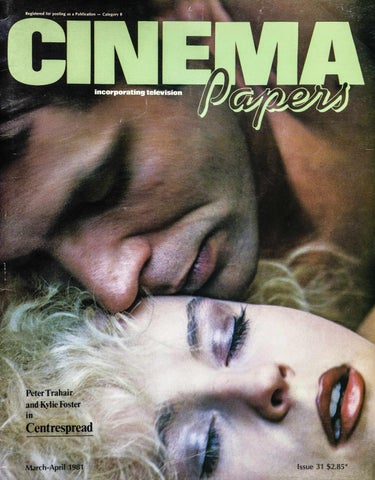
Peter Trahair and Kylie Foster in ,
.•
-
Centrespread
M arch-A priH 981
Issue 31 $2.85
S k
i l
fi
|
C
* i . M 1 iI
1 ì1
“My prime interest is in producing quality short run television series that hopefully have good sales potential *
raise the sort of budgets we now need to film in this country. To achieve this we have to have quality. The sort of quality one can only have with an image recorded on film. With the power of television, we have a vast audience at our finger tips, an audience to whom I feel an enormous responsibility. Film provides the quality that lives up to that responsibility. Not only in areas of lighting and locations, but at the post production and the assembling of sound track stages. I would like to think that when my name comes up on a programme like ‘A Town Like Alice’ people will believe that they should watch it because it will be a quality programme. Eastman color film is the first step to realising that quality.”
Henry Crawford Producer.
K odak M otion Picture Film KODAK (Australasia) PTY. LTD. K7/9938/KSB
SAMCINE SALES i Giffnock Ave, North Ryde, N SW 2113. Ph: (02) 888 2766. Telex: AA25188.
25 Lothian St, North Melbourne, Vic. 3051. Ph: (03) 329 5155. Telex: AA35861.
AATON C A M E R A S IN U SE French Television
63
BBC
35
Swedish T V
13
Belgian T V
15
German T V
2
Australian T V
?
THE AATON HAS NOW BEEN ACCEPTED IN EUROPE AS THE MOST VERSATILE PRODUCTION/DOCUMENTARY CAMERA AVAILABLE. WE NOW HAVE STOCKS OF THIS FINE CAMERA FOR IMMEDIATE DELIVERY IN AUSTRALIA .
Australian Film and Television School
Tasmmmian Film Corporation □ □ □ □
Film and Video Producers 16/35 Production facilities Broadcast quality video Still Photographers and
audio visuals □ Studio and equipment hire
MEDIA TRAINING IN
ACTION We offer Australia:
SHORT COURSES, VIDEO TAPES, FILMS and ROOKS, on all areas of production. Course Guides and Catalogues Free from:
1-3 BOWEN ROAD, MOONAH, TASMANIA 7009, PHONE: 30 8033 TELEGRAMS: TASFILM, HOBART
Australian Film and Television School Open Program PO Box 126 NORTH RYDE 2113 ph (02) 887 1666
GEVAERT
Agfa-Gevaert have just released a new color negative camera film, available in 16mm and 35mm, that will positively enhance the creation of any masterpiece. New Gevacolor 682 negative camera film. This film passes even the toughest of tests with flying colours (if you’ll forgive the pun), reproducing skin tones to perfection,
And it doesn't just offer a wide latitude that compensates for even the most severe exposure variations, but delivers such a fine grain that every frame can be appreciated as a work of art in itself. B etter still, this new film can be processed without any of the problems created by climatic conditions. And it's compatible with the process employed by most major
Australian laboratories. So in summary, all we can say is that if you’ve got the creative know-how, and the will, we’ve got the way. New Gevacolor Type 682. A G F A - G E V A E R T L IM I T E D
Head Office, P.O. Box 48, Nunawading, VIC. 3131. Melbourne 8788000, Sydney 8881444, Brisbane 3916833, Adelaide 425703, Perth 3615399.
For group viewing of a television picture, whether it be a few people in a room, or a theatre-size audience of as many as 3000, the IMI-3000 color video projector is the logical choice for a professional quality visual medium. The IMI-3000 produces clear, bright pictures ranging in size from 6' x 8' on up to 15' x 20'. It is now in wide use in the U.S. and abroad in a large variety of applications including: Classroom and lecture hall presentations of scientific, A FEATyRES • Automatic turn-on sequencing. • Automatic overload protection. • Eliminates inconsistencies of m ultiple m onitor view ing. • Front or rear-screen projection either w ith mirrors or direct (w ith optional sw eep reversal sw itch es). • Multi signal reception, i.e., TV broadcast, live camera, satellite, any video tape size or video disc. • N o hook or loss of sync from V2", 3A", 1" or 2” video tape inputs. • Remote control operation.
VAA/
I.M.I VIDEO PROJECTORS
technical, medical and many other subjects; Big-screen displays in government installa tions; Flight simulators; Computer programming display (eliminates need for multi small screen display); Training sessions in schools and the military services; Corporate boardroom activities and employee relations .programs as well as customer attracting big-picture entertain ment in bars, restaurants and discos, along with major sporting events such as boxing
and soccer matches via closed circuit TV in theatres. It also uses existing matte white, lenticular, glass beaded screens or it will project onto any flat surface, without the limited viewing angle associated with other projectors that need special high reflective screens; thus the IMI offers the advantage of full flexibility in the seating pattern.
as • C om plies w ith HEW X-ray radiation rules 21 CFR part 78. ® One-year warranty on electronics; CRTs carry 90-day manufacturer's warranty. • High speed sw eep protection to elim inate CRT bum . • Individual failure indicators. • Solid state electronics. • Low cost maintenance and CRT replacement. • No projector operator required. • Stable no-drift operation.
• Remote control includes 18” receiver monitor. • Built-in tilt adjustment to 10°. • Picture sizes 8, 10, 12, 14, 16, 18, 20 foot w ide. • U ses optics, tubes, and pow er of the Magna Image III. • 160° view in g angle.
•
IDEAL FOR STANDARD VIDEO, COMPUTER GRAPHICS, OR CHARACTER DISPLAY.
DM Michelmore & Associates PtyLtd P.O. Box 399 South Yarra, Vic. 3141 Telex: AA33626 Ans. back SLIDE P h o n e : 26 5635
Announcing
[ ยก l'iiiF m iiiin ti NEGATIVE MATCHING
A Marilyn and Ron Delaney Service
SEIlFETfimflTBE ... brings space age technology to motion picture negative matching and represents a new approach for features, series, telemovies, specials, shorts, documentaries and commercials.
SEm ruTfim fiโ ข , . . engages the latest computer science to facilitate the conforming of original camera negative with your edited work print to enable high speed hard copy print out on the teletypewriter console ready to commence matching.
snmnjTFimFTnE . . . enhances your production with the fastest, most professional and economical service available today - exclusive to Australia's leading negative matching service.
SEmPETfimfrnE ... complements recent industry developments in computer assisted film editing systems with interlocking videotape facilities and announces electronic editing data conversion to allow negative matching to proceed without a cutting guide.
SEmPETfimFlTBE ... starts with an amazing hand held data entry terminal on the matching bench and finishes as the world's most advanced negative matching service, thanks to our newly installed DATA GENERAL computer system and our portable micro-processor terminals.
[ยกirillliTFTHfHijh NEGATIVE MATCHING NEGATIVE CUTTING SERVICES PTY. LIMITED 200 P a c ific H ig h w a y, C row s N est, NSW, 2065 T e le p h o n e (0 2 ) 9 22 3 60 7
Whatever activity you’re engaged in at present, make sure you are planning far enough ahead to meet the dates shown on this page. For further information on closing dates for Commission meetings, festivals or marketing arenas contact the Marketing Division of the Australian Film Commission. Rea Francis Publicity Promotions Director The Australian Film Commission 8 West Street, North Sydney. NSW. 2060 Australia. Telex: 25157 .... Telephone: (0 2 )9 2 2 6855
Save 1 year (6 issues) $ 1 5 .7 0 2 years (1 2 issues) $ 3 0 .0 0 3 years (1 8 issues) $ 4 2 .3 0 Please enter a subscription for 6 issues □ Please start
$1.20 on single issue purchase price $3.60 on single issue purchase price $9.00 on single issue purchase price 1 2 issues C 3
18 issues CD
CD renew CD my subscription with the next issue.
Delivered to your door post free
Subscriber’s n a m e ......................... Address .............................................................................. Postcode .
Gift Subscriptions If you wish to make a subscription to Cinema Papersa gift, cross the box below and we w ill send a card on your behalf with the first issue. G ift subscription, from (name of sender) Enclosed is a cheque/m oney order for $ ....................................... made out to Cinema Papers Pty Ltd. 644 Victoria St, North M elbourne, Victoria, 3051, Australia.
Office use only
The above offer applies to Australia only. For overseas rates, see below This offer expires on April 1, 1981
NP
BOUND VOLUMES
OK
ORDER FORM
EZIBINDERS
ORDER VOLUME 6 NOW
1
BOUND VOLUMES $30.00 (including post) per volume.
(numbers 21-24)
Volumes 3 (9-12), 4 (13-16) and 5 (17-20) are still available.
Please send me d copies of Volume 3 copies of Volume 4
Handsomely bound in black with gold embossed lettering. Each Volume contains 400 lavishly illustrated pages of • Exclusive interviews with producers, directors, actors and technicians. • Valuable historical material on Australian film production. • Film and bcxik reviews. • Production surveys and reports from the sets of local and international production.
CH copies of Volume 5 □
EZIBINDERS Please send m e D copies o f Cinema Papers Eztbinder at S I 5 per binder. Total amount enclosed SAusi. N A M E ..............................................
Box-office reports and guides to film producers and investors.
ADDRESS. Cinema Papers is pleased to announce that an
E/ibinder is now available in black with gold embossed lettering to accommodate your unbound copies. Individual numbers cun be added to the binder indepe ndentlv. or detached If desired. This new b in d e r w ill accommodate 12 copies.
S T R IC T L Y L IM IT E D E D IT IO N S I'l 1 \N L NO I K: Volume I (numbers I -4) and Volume 2 (numbers 5-8) ARE NOW l ’\A V A IL A B L E .
Overseas Rates
copies of Volume 6
\J _
.....................................Postcode . . For overseas rates, see below. Cinema Papers Ptv. Ltd.. 644 Victoria Street. North Melbourne, Victoria. Australia 305 I Please allow up to tour weeks tor processing
______
(All remittances in Australian dollars only) S u b scrip tio n s
Bound V olu m es
Back Issues
6 Issues
12 issues
18 issues
(each)
(to the price of each copy, add the following)
$ 2 0 .5 0 (Surface)
$ 3 9 .6 0 (Surface)
$ 5 6 .7 0 (Surface)
$ 3 3 .3 0 (Surface)
S 1 9 .0 0 (Sudace)
(Su'face:
$ 3 2 .5 0 (Air)
$ 6 5 .0 0 (Air)
$ 9 2 .7 0 (Air)
$ 3 6 .5 0 (Air)
$1 9.9 0 (Air)
$ 2 .8 0 (A n
$ 2 0 .5 0 (Surface)
$ 3 9 .6 0 (Surface)
$ 5 6 .7 0 (Surface)
$ 3 3 .3 0 (Surface)
$ 1 9 .0 0 (Surface)
<Su ' face*
$ 3 6 .7 0 (Air)
$ 7 2 .0 0 (Air)
$ 1 0 5 .3 0 (Air)
S3 7.1 0 (Air)
$ 2 0 .9 5 (Airi
3. Hong Kong India Japan Philippines China
$ 2 0 .5 0 (Surface)
$ 3 9 .6 0 (Surface)
$ 5 6 .7 0 (Surface)
$ 3 3 .3 0 (Surface)
S 1 9 .0 0 (Surface)
(Su-face:
$ 4 0 .9 0 (Air)
$ 8 0 .4 0 (Air)
$1 1 7.90 (Air)
$ 4 0 .0 0 (Air)
S 2 2 .0 0 (Air)
S4 20 lAri
4. North America Middle East Canada
$ 2 0 .5 0 (Surface)
$ 3 9 .6 0 (Surface)
$ 5 6 .7 0 (Surface)
S 3 3 .3 0 (Surface)
$ 1 9 .0 0 (Surface)
SO.80
$ 4 5 .1 0 (Air)
$ 8 8 .8 0 (Air)
$1 3 0 .5 0 (Air)
$ 4 3 .2 0 (Air)
$ 2 3 .9 5 (Air)
S 4.90 (Ar*
$ 2 0 .5 0 (Surface)
$ 3 9 .6 0 (Surface)
$ 5 6 .7 0 (Surface)
$ 3 3 .3 0 (Surface)
$ 1 9 .0 0 (Surface)
(Su'facet
$ 4 7 .2 0 (Air)
$ 9 3 .0 0 (Air)
$ 1 3 6 .8 0 (Air)
$ 4 5 .0 0 (Air)
$ 2 5 00 (Air)
Zone 1. New Zealand Niugini
2. Malaysia Singapore Fiji
5. Britain Europe Africa Sth America
(each)
NOTE: A “ Surface Air Lift" (air speeded) service is available to Britain. Germany, Greece. Italy and North America. Subscriptions 6 issues Volumes (each) — $35.20. Ezibinders (each) — $20.75. Back Issues - add $1.10 per copy
E zib in d ers
S28 20. 12 issues -
SO 80
SO.8 0 S3 50
SO 80
$ 0 .8 0 S 5.25
S54 96
'b iss ues - $ 7 9 /4
Bound
Cinema Papers is pleased to announce the publication o f
A n indispensable reference book for anyone working in, or dealing w ith, the A ustralian film industry
For the first time, a comprehensive guide to every major aspect of the Australian film industry. In this first major work on the Australian film industry’s dramatic rebirth, 12 leading film writers combine to provide a lively and entertaining critique. Illustrated with 26$ stills, including 5$ in full color, this book is an invaluable record for all those interested in the New Australian Cinema.
208 pps, 28cm x 20.5cm ( 1 1" x 8") The chapters: The Past (Andrew Pike), Social Realism (Keith Connolly), Comedy (Geoff Mayer), Horror and Suspense (Brian McFarlane), Action and Adventure (Susan Dermody), Fantasy (Adrian Martin), Historical Films (Tom Ryan), Personal Relationships and Sexuality (Meaghan Morris), Loneliness and Alienation (Rod Bishop and Fiona Mackie), Children's Films (Virginia Duigan), Avant-garde (Sam Rohdie).
Contents include ★
National listings of Producers, Directors, Production Companies, Organizations, Distributors and Exhibitors, Media, Festivals and Awards ★ Details on Film Investment, Tax, Trade Incentives, Copyright and Censorship ★ Profiles on two outstanding new directors — Gillian Armstrong and George Miller ★ A detailed round-up of recent developments in the Australian film industry. 320 pages, illustrated throughout, 250mm x 176mm. Solidly bound with a laminated cover in full color.
Now reduced to $19.50 Published by Cinema Papers Pty Ltd in association with The New South Wales Film Corporation
Order Form Please send me ........ copies of the Motion Picture Yearbook: 1980 @ Aust.S19.50. Outside Australia: Aust.Sas (surface mail); Aust.S30 (airmail). Please send me ........ copies of The New Australian Cinema @ Aust.S14.95. Outside Australia: Aust.S20 (surface mail); Aust.S25 (airmail). Name ......................................................................................................................... Address Code Enclosed: Aust.S Please make cheques/money orders out to Cinema Papers Pty Ltd, 644 Victoria St, North Melbourne, Vic., Australia. 3051. Iel: (03) 329 5983 Note. Bank drafts only for overseas orders. Please allow up to 4 weeks for processing.
^ T ilm & p o
80
Seminar Papers In November the Film and Television Production Association of Australia and the New South Wales Film Corporation brought together 15 international experts to discuss film financing, marketing, and distribution of Australian films in the 1980s with producers involved in the film and television industry. The symposium was a resounding success. Tape recordings made of the proceedings have been transcribed and edited by Cinema Papers, and will soon be published as the Film Expo ’8 0 Sem inar Papers.
Copies can be ordered now for $25 each. Contributors Arthur Abeles Chairman, Film arketeers Ltd (U S.)
Barbara D. Boyle
Contents Theatrical Production The Package: Two Perspectives Perspective l: As Seen by the Buyer (i)
P artial versus com plete packaging, or starting from scratch with an idea. (ii) Evaluating for different markets, different costs (budgeting). Speakers: Barry Spikings: Mike Medavoy
Executive Vice-President, and C hief Operating Officer. New W orld P ictures (U S.)
Ashley Boone W orldw ide M arketing and Distribution Head Ladd Company (U S.)
Mark Damon
Perspective II: As Seen by the Seller
President, Producers Sales O rganization (U S.)
The role of the agent in packaging. Speaker: Harry Ufland
Michael Fuchs S enior Vice-President, Programming, Home Box O ffice (U S.)
Samuel W. Gelfman Independent P roducer (U S.)
Klaus Hellwig President, Janus Film Und Fernsehen (Germany)
Lois Luger V ice-President, Television Sales, Avco Embassy P ictures Corporation (U S.)
Professor Aw. Massimo FerraraSantamaria Lawyer (Italy)
Mike Medavoy
Theatrical Production Business and Legal Aspects (I)
Sources of materials (published, original screenplays, etc.). Forms of acquisition agreem ents an d/or w riter's agreements. ' (iii) Talent agreem ents ("pay or play" defer ments. "going rates” , approvals) (iv) Insurance. (v) Guild and union requirem ents (foreign and dom estic production). (vi) S u b s id ia ry rig h ts P u b lis h in g m u sic, merchandising, etc Speaker: Eric W eissmann (ii)
Executive V ice-President. Orion Pictures (U.S.)
Simon O. Olswang
Harry Ufland President. The Ufland Agency (U.S.)
Financing of Theatrical Films Independent Studios Rise of independent financing Tax motivated and otherwise. Completion financing Speaker Sam Gelfman
Presale of Rights
P roducer/D istributor Relationship
Chairman and Chief Executive. EMI Film and Theatre Corporation (Britain)
Control, approvals, overhead, over-budget provi sions. total or partial financing Negative pick-up. Speaker: Rudy Petersdorf
Separating rights by media Pay television, free television (network syndication) Speaker. Michael Fuchs
Eric Weissmann
Barry Spikings
Financing of Theatrical Films Major Studios
Distribution in the United States
Partner, Kaplan. Livingston. Goodwin. Berkowitz and Selvin
Rudy Petersdorf President and Chief Operating Officer. A ustralian Films O ffice Inc. (U.S.)
Television Production and Distribution Production for network or syndication Deficit financing Tape versus film Licensing "o ff-n e t w ork" United States and foreign. Commercial versus public broadcasting Speaker: Lois Luger
(i)
Mapping the distribution sales campaign When and where to open How to allocate advertising budgets Number of theatres 70mm and stereo. Reissues. A n cilla ry markets — hold back for pay and free television. (ii) Exhibition terms. Advances and guaran tees: split of box-office (90-1 0 with "floor" "house-nut", etc ): blind bidding; policing Speaker Ashley Boone
Solicitor, Brecker and Company (Britain)
Distribution Outside the United States Distribution terms. Relationship and terms with sub-distributors and exhibitors. Recoupment of e xp e n s e s C ro s s -c o lla te ra liz in g te rrito rie s Dubbing. Censorship Speakers: Arthur Abels: Klaus Hellwig (Northern European perspective): Massimo Ferrara (Italian and European perspective)
Terms: D ifferences where distributor financed p ro d u c tio n How d is trib u to r e x p e n s e s are recouped. D istributor fees. Advertising com m it ment, if any. Outside sales representative Speaker Barbara Boyle
Please send .......copies of the Film Expo ’80 Seminar Papers For orders placed within Australia, Aust.$25 each. Outside Australia. Aust.$30 each Name ....................................................................................................
Presale by Territory Advantages and problem s Interim and com ple tion financing Term of distribution rights. Speaker Mark Damon
Multi-National and Other Co-Productions A vailability of subsidies Treaties Tax incentives Government investments Speaker Simon Olswang
Enclosed: Aust S Please make cheques money orders out to Cinema Papers Pty Ltd 644 Victoria St. North Melbourne. Vic. Australia 3051 Tel (03) 329 5963
Company ............................................................................................. Address Code
Note Bank drafts only for overseas orders Please allow up to 6 weeks for processing
BACK ISSUES SALE Take advantage o f our special offer and catch up on your missing issues. M u ltiple copies less than half-price!
Number 1 January 1974
Number 2 April 1974
Number 3 July 1974
Number 5 March-April 1975
Number 9 June-July 1976
David W illia m so n . Ray Harryhausen. Peter Weir. Gillian Arm strong. Ken G. Hall Tariff Board Report. Antony I. Ginnane. The Cars That Ate Paris
Violence in the Cinema Alvin Purple. Frank Moorhouse. S andy H arbutt. F ilm U n d e r A lle n d e . Nicholas Roeg. Between Wars
John P a p a d o p o lo u s . Willis O’Brien. The McDonagh Sisters. Richard B re n n a n . Luis B u ñuel. The True Story ot Eskimo Nell
J e n n in g s Lang. B yron Haskin Surf Films. Brian Probyn Sunday Too Far Away Charles Chauvel. Index: Volume 1
M ilo s F o rm a n . M ik lo s Jancso Luchino Visconti. Robyn Spry. Oz. Mad Dog Morgan. Joan Long. Index: Volume 2
Number 10 September-October 1976 Nagisa Oshim a. Philllppe Mora. Gay Cinema. John Heyer. Krzysztof Zanussi. M a rc o F e rre ri. M a rco Bellocchio.
Number 11 January 1977 Emile de Antonio. A us tralian Film Censorship. Sam A rk o ff. R om an P o la n s k i The Picture Show Man Don’s Party Storm Boy
a **•* Number 12 April 1977
Number 13 July 1977
Number 14 October 1977
Number 15 January 1978
Number 16 April-June 1978
Kenneth Loach. Tom Haydon. Bert Deling. Piero Tosi John Scott. John Dankworth. The Getting ot W is d o m J o u rn e y Among Women
Louise Malle. Paul Cox. John Power. Peter Sykes. Bernardo Bertolucci. F.J. Holden In Search of Anna Index: Volume 3
Phil Noyce. Eric Rohmer. John Huston. Blue Fire Lady S u m m e r f ie ld Chinese Cinema.
Tom C ow an, F ra n c o is Truffaut. Delphine Seyrig. The Irishman The Chant of Jimmie Blacksmith Sri Lankan Cinema. The Last Wave
Patrick Swedish Cinema. J o h n D u ig a n . S te v e n Spielberg. Dawn! Mouth to Mouth Film Period icals.
--- '-um
Number 17 August-September 1978
Number 18 October-November 1978
Bill Bain. Isabelle Hup pert. Polish Cinema. The Night the Prowler. Pierre Rissient Newsfront. Film Study Resources. Index: Volume 4
John Lamond. Dimboola. In d ia n C in e m a . S o n ia B o r g . A la in T a n n e r . Cathy’s Child The Last Tasmanian
Number 23 September-October 1979
Number 24 December 1979 January 1980
Number 25 February-March 1980
A u s tr a lia n T e le v is io n . Last of the Knucklemen W o m e n F ilm m a k e r s . J a p a n e s e C in e m a . My B rillia n t C a re er Tim Thirst Tim Burstall.
Brian Trenchard Smith. Palm Beach. B ra z ilia n Cinema Jerzy Toeplitz. C o m m u n ity T e le v is io n . A rthur Hiller.
BN BM
Number 19 January-February 1979 A n t o n y I. G in n a n e . Jerem y Thomas Blue Fin A n d re w S a rr is . A s ia n C in e m a . S p o n s o re d Documentaries.
Number 20 March-April 1979
Number 21 May-June 1979
Number 22 July-August 1979
Ken C a m e ro n . French Cinem a. Jim S harm an. My Brilliant Career. Film S tu d y R e s o u rc e s . The Night the Prowler
Mad Max Vietnam on Film. Grendel, Grendel, G re n d e l D a v id H e m mings The Odd Angry Shot Box-O ffice Grosses. Snapshot
Bruce Petty. Albie Thoms. Newsfront Film S tu d y R e s o u r c e s . K o s ta s Money Movers. The Aus tra lia n Film and T e le vision School. Index: Volume 5
Chain Reaction David P u ttn a m . C e n s o r s h ip Stir Everett de Roche. Touch and Go. Film and Politics
C Jj L L ^ U )
Number 26 April-May 1980
Number 27 June-July 1980
The Films of Peter Weir. Charles Joffe Harlequin. Nationalism In Australian Cinema The Little Con vict Index: Volume 6
The New Zealand Film In d u s try . The Z Men Peter Y eldham . Maybe This Time. Donald Richie. G r e n d e l, G r e n d e l, Grendel
To order your copies place a cross in the box next to your missing issues, ana fill out the form below. If you would like multiple copies of any one issue, indicate the number you require in the appropriate box.
□□□□ □ □ □ □ □ □ □ □ □ □ □□ □ □ □ □ □ □ □ □ □ 1
2
3
5
9
10
11
12
13
14
15
19
20
21
22
23
24
25
26
27
28
29
16
17
18
Number 28 August-September 1980
Number 29 October-November 1980
The Film s of Bruce Beresford. Stir. M elbourne and Sydney Film Festivals. Breaker Morant Stacy K each Roadgam es
Bob Ellis. Actors Equity D e b a te U r i W in d t C ru is in g The Last Outlaw Philippine C in ema The Club
N a m e .. . No. of copies ordered
at $
each. Address
Total am ount enclosed $ (Note num bers 4, 6, 7, and 8 are out of print)
................................................. ...................................................... Please make your cheque or money order payable to: Cinema Papers Pty Ltd
P o s tc o d e .........................
644 Victoria St, North Melbourne. Victoria. 3051, Australia
Articles & interviews Bryan Brown: Interview Barbara Alysen Looking In on Dressed to Kill Tom Ryan Bob Sanders: Interview Peter Beilby David Bradbury Barbara Alysen Terror Lostralis and Buckeye and Pinto Adrian Martin, Paul Sweet The New Generation John Fox Greg Lynch: Interview Scott Murray The 2nd Australian Film Conference Brian McFarlane, AdrianMartin
14 20 26 30 32 34 36 40
Features Bryan Brown Interview: 14
The Quarter Letters Film Censorship Listing Mannheim Film Festival Production Survey Box-office Grosses New Products and Processes Fred Harden
8 10 42 43 59 77
Looking In On Dressed to Kill: 20
78
Television News Henry Crawford: Interview Peter Beilby, Scott Murray Production Survey The Film and Television Interface The Last Outlaw Jill Kitson
45 46 50 53 56
Reviews Terror Lostralis Examined: 32
Superman II Neil Sinyard Fatty Finn Geoff Mayer Nijinsky Brian McFarlane Gary’s Story Adrian Martin Now and Then Adrian Martin Windows Scott Murray
65 66 67
Bob Sanders Interview: 26
-
68 69 71
Books Cinema: A Critical Dictionary—The Major Film-Makers Tom Ryan The Harder They Come Rod Bishop The Year in Films 1978 James Manning
72 73 75
New Zealand The Last Outlaw Reviewed: 56
News Production Survey Television and the New Zealand Film Industry Erica Short Andrew Brown: Interview Mike Nicolaidi
81 82 84 86
Fatty Finn Reviewed: 66
IIM l HBIIffll W niliBiliMM Managing Editor: Scott Murray. Associate Editor: Peter Beilby. Contributing Editors: Tom Ryan, Ian Baillieu, Brian McFarlane, Fred Harden. Editorial Assistant: Maurice Perera. Proof-reading: Arthur Salton. Design and Layout: Keith Robertson, Meredith Parslow, Andrew Pecze. Business Consultant: Robert Le Tet. Office Administration: Nimity James. Secretary: Lisa Matthews. Correspondents: David Teitelbaum (Los Angeles), Mike Nicolaidi (Wellington), Erica Short (Auckland).
Advertising: NSW, Qld, ACT: Sue Adler (02) 31 1221: Vic., SA, WA, Tas.: Peggy Nichols (03) 830 1097 or (03) 329 5983. Printing: Eastern Suburbs Newspapers, 140 Joynton Ave., Waterloo, 201 7. Telephone: (02) 662 8888. Typesetting: B-P Typesetting, 7-1 7 Geddes St, Mulgrave, 31 70. Telephone: (03) 561 2111. Distributors: NSW, Vic., Qld., WA, SA: Consolidated Press Pty Ltd, 168 Castlereagh S t Sydney, 2000. Telephone: (02) 2 0666. ACT, Tas.: Cinema Papers Pty Ltd.
*Recommended price only.
Cinema Papers is produced with financial assistance from the Australian Film Commission. Articles represent the views of their authors and not necessarily those of the editors. While every care is taken with manuscripts and materials supplied for this magazine, neither the Editors nor the Publishers accept any liability for loss or damage which may arise. This magazine may not be reproduced in whole or in part without the permission of the copyright owner. Cinema Papers is published every two months by Cinema Papers Pty Ltd, Head Office, 644 Victoria St, North Melbourne, Victoria, Australia, 3051. Telephone: (03) 329 5983. ® Copyright Cinema Papers Pty Ltd, No. 31, March-April, 1981.
Front cover: Kylie Foster and Peter Trahair in Tony Paterson’s Centrespread See interview with Greg Lynch (pp. 36-39, 91).
Cinema Papers, March-April — 7
T H E ‘‘W E N E E D T H E M O N E Y” D E P A R TM E N T
At the annual general meeting of the Sydney Filmmakers Co-operative late last year, members voted for several changes of policy. One of these is a startling reversal of philosophy, but, surprisingly, has attracted little com ment. Scott Murray reports: Covering the AGM in Filmnews (Vol. 10, No. 8), Susan Lambert, Megan McMurchy, Nick Herd and Carolyn Strachan wrote: “A strong argument was put to the meeting that, given the limited nature of the Co-op's resources, a more effective relationship between ex hibition and distribution needed to be established . . . The meeting, therefore, resolved that, ‘If the film makers wish their films to be eligible for major exhibition by the Co-op, then they must lodge the film for exclusive non-theatrical distribution, except that the filmmakers are not excluded from arranging non theatrical screenings themselves and except that a monthly meeting of members and staff may allow non theatrical rentals on a non-exclusive basis’.” In effect, the Co-op will only exhibit films it distributes. As there are only two major distributors of short films in Australia (the Co-op and the Austra lian Film Institute), the decision at the annual general meeting has set up a no-win situation for filmmakers. The choices basically are: 1. Going with the Co-op. This means a Sydney Co-op cinema release, a solid NSW distribution and little action in other states (the Co-op having no other cinemas and little effective distribution); 2. Going it alone throughout Aus tralia; or 3. Going with the AFI’s Vincent Library and an AFI release. This means solid distribution in Vic toria, but little elsewhere, with a possible release in Melbourne (at the Longford), Sydney (Opera House) and Hobart (State). One filmmaker recently faced with this dilemma is David Bradbury. Either he gave the Co-op Public Enemy No. One and went for a basically Sydney exhibition and distribution, or a Mel bourne distribution and Melbourne/ Sydney exhibition (with the AFI). Neither, obviously, is ideal, because what you gain in one territory you lose in another. Given the difficulties facing independent filmmakers, it is an in vidious choice. The AFI in particular is upset by the AGM resolution as it was made without consultation with the AFI. The Co-op has long had an agreement with the AFI whereby each organization consults the other before undertaking radical changes in distribution or exhibition. John Foster, the AFI’s executive director, raised his concern over this lack of consultation at a poorlyattended AFI public meeting in Sydney, but those members of the Co-op present felt circumstances were so pressing that the Co-op had no choice but to act. All these considerations aside, however, a more fundamental issue is at stake: namely, the adoption by a body of a practice it has vocally at tacked for manyyears. That practice, of course, is “vertical integration” . In this case, it means the linking of exhibition and distribution on an exclusive basis. “ V e rtic a l in te g r a tio n ’ ’ of the American exhibitors/distributors’ in terests has been the most attacked practice in the Australian film industry for decades. Many see it as the prin cipal reason for Australia’s lack of a feature film industry in the 1950s and 1960s. In fact, most industry people saw Australia’s only hope for develop ing a local industry lay in the breaking down of this vertical integration. Many,
including the Australian Labor Party and Actors Equity, still believe this. Vertical integration came under severe attack during the 1972 Tariff Board Inquiry into the film and tele vision industry. Various submissions demanded the divorcing of distribution and e x h ib itio n in A u s tra lia , Dr Coombs suggesting that the then Prime Minister, Gough Whitlam, read the riot act to the major exhibitor/ distributors. Attacks continued during the 1970s, several film historians seeing parallels between the incursion of the American majors in the 1930s and 1940s, and the subsequent decline in production, with the problems of getting an industry going in the 1970s. “ Not all commentators have remained consistent on the issue, though. In 1973, Antony I. Ginnane was the most vocal critic of vertical integration. In 1979, he had reversed his stance and said it was wonderful. Despite Ginnane’s reversal, no one could have predicted the Sydney Co op’s abrupt turnabout. The Co-op has always seen itself as a radical organiza tion supporting those disadvantaged by the “system” . It has taken a highly “ moral” line on many issues, and has spared the distributor/exhibitor in terests little. To adopt a tactic of the “system” comes, therefore, as a sur prise. One should also remember that several forms of “vertical integration” are not allowed in the U.S., where legal action was taken under the Sherman anti-trust laws. This led to a partial divorcement of exhibition, distribution and production interests, in a famous case involving Paramount. Calls for similar action, including those by many Co-op members, have gone unheeded in Australia. So, what is the reason for the turn about? When challenged at the AFI public meeting in Sydney, one Co-op member admitted to the possibility of a philosophical contradiction, but added, “We need the money.” “ That” , came the obvious reply, “ is what Paramount no doubt said.”
CINECON A Science-fiction and Fantasy Film Convention will be held on April 22, 1981, in M e lb o u rn e . It is being organized by the Fantasy Film Society of Australia. Those interested in further details should contact Merv Binns, 305-307 Swanston St, Melbourne 3000.
U.S. C R ITIC S A C K N O W LE D G E A U S TR A LIA N FILMS For the first time, Australian films were featured prominently in the an nual U.S. critics’ “ Top Tens” . Charles Champlin of The Los Angeles Times selected Breaker Morant and My Brilliant Career, as did Rex Reed of The New York Evening News. The critics for Time and The New York Times listed neither, but the high circulation People chose My Brilliant Career, which also made Jeffrey Lyons’ list. Lyons is a radio and television critic in New York.
NEW 16mm DISTRIBUTOR
Twentieth Century-Fox Film Cor poration (Australia) Pty Ltd recently an nounced the formation of a national 16mm film division which became ef fective from January 5, 1981. This new division will be known as Amalgamated (16mm) film distributors and will distribute on 16mm through out Australia product from Twentieth Century-Fox, Columbia, United Artists, Metro Goldwyn Mayer, Hoyts Distribu tion, Regent Trading Enterprises, Greg
Lynch Film Distributors, Filmways and many others. The management structure of the new division will be David Chard as general manager, Barry Cooper, national sales manager, and Colin Sandridge as company secretary. As sisting Chard and Cooper will be Ken Jackson and Brian Duffy. The head office of Amalgamated (16mm) film distributors will be located on the 6th level of the Hoyts Entertain ment Centre, 505 George St, Sydney, with branch offices in other states.
FILM CONFERENCE
A conference on History and Film is to be held at the Australian National University, Canberra, from November 23 to 27, 1981. The conference will p ro vid e an o p p o rtu n ity fo r film educators and researchers, historians and history teachers, producers and writers of historical television and films to get to g e th e r to c o n s id e r the theoretical and practical implications of their work. In part, it will reflect an increasing in terest by film scholars in the processes of the recording and/or transmission of history by the means of film.
AFI ELECTIONS In accordance with the articles of as sociation of the Australian Film In stitute, three positions have been made vacant on the board of directors. The three retiring directors, who are eligible for re-appointment, are John Flaus, Scott Murray and David Roe. The remaining four directors (Senator David Hamer, Pat Gordon, Ian McRae and Albie Thoms) retire in a year’s time. This pattern of three vacant positions one year, four the next, is continuous. Nominations for the 1981 board closed on February 20, and the an nouncement of those elected will be made at the annual general meeting on March 28, at the Longford Cinema, Melbourne.
ALL-TIME CHAMPS In its January 14, 1981, edition, Variety lists those films with a com bined U.S. and Canadian film rental of more than $4 million. The 10 highest earners are: 1. Star Wars $175,685,000 2 . Jaws $133,435,000 3. The Empire Strikes Back $ 120,000,000 4. Grease $96,300,000 5. The Exorcist $88,500,000 6 . The Godfather $86,275,000 7. Superman $82,500,000 8 . The Sound of Music $79,748,000 9. The Sting $78,963,000 10 . Close Encounters of the Third Kind $77,000,000 Steven Spielberg has two films in the Top Ten (Jaws and Close En counters), but George Lucas has Star Wars, which he directed, and Empire, which he co-produced. Lucas also has American Graffiti at No. 18. Only one film in this list was released in 1980, the 10 highest rental earners being: 1 . The Empire
Strikes Back $120,000,000 2 . Kramer vs Kramer $60,528,000 3. The Jerk $43,000,000 4. Airplane (Flying High in Australia) $38,000,000 5. Smokey and the Bandit II $37,600,000 6 . Coal Miner’s Daughter $36,000,000 7. Private Benjamin $33,500,000 8 . Blues Brothers $31,000,000
THE QUARTER 9. The Electric Horseman $30,917,000 10. The Shining $30,200,000 Another film of interest is The Blue Lagoon, co-produced by Australian Richard Franklin, which is at No. 11 w ith $28,456,000. But the m ost dramatic feature is the fact The Empire Strikes Back earned almost double the rental of Kramer vs Kramer, the No. 2 film. This reflects a relatively poor year. The only Australian films to make the 1980 list were Mad Max at No. 82 with $3,500,000, only $148,760 behind Woody Allen’s Stardust Memories, and My Brilliant Career, which appears at No. 122 with $1,281,987. Films of particular interest are 1941 which, despite a critical drubbing, e a rn e d a d o m e s tic r e n ta l of $23,400,000, Ordinary People, Robert Redford’s debut as a director, with $13 million and Paul Schroeder’s master piece, American Gigolo, with $11.5 million. Caligula, which struck production and censorship problems, has earned a respectable $4,800,000 from a very limited release. Major financial disappointments in clude Stardust Memories, Alan Rudolf's Roadie ($2,480,646), Sam Fuller’s The Big Red One ($2,328,675) and Tom Horn ($4,300,000), which fared poorly for a Steve McQueen vehicle. Xanadu, for one, didn’t set the world alight with $10 million, nor did The Island with $9.6 million.
the Library Association of Australia. She is a Commonwealth Literary Fellowship winner and the author of the book The Winter Sparrows. Senator Durack said Eve Clifford, who had been a member of the Board since 1972, had also been reappointed. Another appointment is still to be made to the Board and applications for this position are being considered.
GETTING INTO THE ACT Australia’s isn’t the only film industry where sections of the community are taking union action to gain conces sions. Last year, the U.S. was hit by a 14-week actors’ strike, and a less publicized one by musicians. Now, there are rumors that writers and d irectors are considering sim ilar action. In the past, agreements between the Writers Guild of America and the As sociation of Motion Picture Producers have been ro u tin e ly processed. Disputes have been minor and the relationship stable. The increased profits in home video and paytelevision, however, have set the writers after what they see as a fairer share of the take. The studios, which have had a fairly lean decade, reacted by claiming video/pay television rights were only now allowing them to hold their own. The writers were unimpressed. Another point of disagreement was
Britain. Again the central issue is a percentage of ancillary market ex ploitation, such as video cassettes. What has brought about such poss ible action is the expiry, on March 9, of the pay agreement between the British Film Producers Association, Actors Equity and the Musicians’ Union. Talks are being held, but most commentators see a new agreement, without industrial action, as highly unlikely.
NATIONAL GUILD CONFERENCE IN MELBOURNE The first national conference of the Australian Writers Guild is to be held in Melbourne next year. Commencing on the evening of June 22, it will proceed throughout that week, culminating in the 1981 Awgies Award Dinner on June 26. The principal purpose of the con ference w ill be the debate and proclamation of a new AWG constitu tion. Within this will be considered the rules of the organization, Its national and state structures, its status as a union or professional organization and specific policy issues.
COST VS YIELD Another interesting feature of the January 14 Variety is an analysis of Cost vs U.S. Yield for blg-budget films. Examples include the infamous $44 million Cleopatra, which earned $26 million in the U.S. domestic market. Recent examples are:
Lauren Hutton and Richard Gere in Paul Schrader’s American Gigolo, which was a moderate commer cial success in the U.S.
FILM CENSORSHIP APPOINTMENTS The Attorney-General, Senator Peter Durack, recently announced the ap pointment of a new Deputy Chief Cen sor and two new members of the Film Censorship Board. The new Deputy Chief Censor is Ken Barton, a member of the Film Censorship Board since 1971. Barton replaces Joan Pilone, who resigned as Deputy Chief Censor near the completion of her term late last year. The two new members of the Film Censorship Board are Sue Pickering and Mary Rose Liverani. Pickering, 28, is a former regional inspector of the Censorship section of the Attorney-General’s Department in Melbourne, and an associate of the Library Association of Australia. She has been engaged in censorship work for six years In Melbourne, including three years as Deputy Film Censor. Liverani, 41, of Wollongong, is a librarian who is also a freelance writer and reviewer. Liverani holds a Bachelor of Arts degree and is an Associate of
over the refusal of WGA (West) to negotiate with one employer bargain ing unit, preferring to enter into separate negotiations. The AMPTP and several studios then lodged action against the WGAW with the National Labor Relations Board, charging the WGAW has failed to bargain in good faith. This led to a stalemate in talks be tween the WGAW and the AMPTP; the talks have only just resumed. The latest development was a call by the WGA for a February 3 meeting to ask members for authorization to strike. Also requested was an increase in guild dues. So, until the studios and the writers agree on whether w riters should receive a cut- of the gross on paytelevision, strike action looks likely. And the directors, who have pre viously had cordial relations with management, are looking to see if they should join the fray: if they do, the U.S. again faces a product shortage. For outside film industries like Australia’s, this could prove a bonus. According to a Screen International report (January 17-24, 1981), strikes by actors and musicians look likely in
lian film and television community. The Association is open to teachers or students of media study and produc tion, at all levels of education; writers and critics; filmmakers and makers of television programs; filmgoers or tele vision viewers — in fact, anyone who is interested in offering or receiving ideas. A major conference is planned for 1982 in Melbourne, and In the interim several, workshops and seminars will take place. Those who wish to offer suggestions concerning the structure and content of these activities should send them to: Rob Jordan, Treasurer, ASSA, C/Royal Melbourne Institute of Tech nology, T24 Latrobe St, Melbourne, Victoria, 3000. Membership is $2 for students and $10 for everyone else.
PACT GOES PUBLIC
Pact Productions Pty Ltd was incor porated in New South Wales two years ago. Its principal activity has been in vestment in film and television produc tion, and the development of film and television material. During Its short existence, Pact has been in v o lv e d w ith fe a tu re s , representing a total of more than $10 million of Australian filmmaking. It was the first Independent film investment company to surface after years of governm ent m oney having been pumped Into the industry. Now, in February 1981, a new com pany, Filmco Ltd, will be floated and will absorb Pact Productions and its pro jects. Fourteen million shares at par will Cost
Yield
King Kong Sorcerer Close Encounters of the Third Kind Apocalypse Now 1941 Blues Brothers The Empire Strikes Back
$24,000,000 $22,000,000 $21,000,000 $31,000,000 $27,000,000 $31,000,000 $22,000,000
The yield figures are not as up-todate as in the “ all-time champs” list, Apocalypse Now now having earned $37 million. So, Francis Coppola’s ex pensive experiment made a profit after all, confounding all but Coppola’s closest supporters. One lesson of the analysis is that bigbudgets don’t guarantee success. Lord Grade’s $36 million Raise the Titanic, for example, sank with a dismal $6.8 million. But the worst returns are for the $10 million Red Tent, which secured only $900,000, and Dino De Laurentiis’ production of Waterloo. Costing $25 million, it earned an insignificant $1.4 million.
be issued, to find a working capital of $7 million, to provide the purchase price for the acquisition of Pact Productions Pty Ltd by Filmco Ltd and qualify the new company for listing on member exchanges of the Australian Associated Stock Exchange. Shares have been underwritten by Jackson, Graham Moore and Partners, member of the Sydney Stock Exchange. The directors of Filmco will be Peter Fox, Robert Sanders, Richard Toltz and John Fitzpatrick. Robert Sanders and John Fitzpatrick will also be chief ex ecutive officers. Robert Sanders (interviewed on pp 26-29) has had a long career In radio and television journalism. For the past two years, he has been running Pact Productions. John Fitzpatrick, a former partner in F re e h ill H o llin g d a le and Page, solicitors, has, for the past five years, been the head of legal and business af fairs at the South Australian Film Cor poration. The SAFC has agreed to act as a consultant to the new company. With local budgets increasing, the directors of Filmco believe that Aus tralian producers are going to have need of a specialist film pre-sales dis counter; none exists in Australia at present. It is proposed that the com pany service this area which it regards as having great potential for expansion. The directors believe there is also considerable scope for the establish m ent and o p e ra tio n of a sales agency/marketing organization to han dle the worldwide exploitation of Australian and selected overseas films and television product. The proposed activities of Filmco are: • providing loans to assist in financing productions;
NEWHART DIFFUSION Following her resignation from the Adelaide International Film Festival, along with five other board members, after the banning of Sweet Sweetback’s Baadasss Song, former artistic dire cto r Claudine T horidnet has formed a film distribution agency, Newhart Diffusion. Newhart will specialize in highquality films, and will start with JeanLuc Godard’s Sauve que peut la vie (Slow Motion/Every Man for Himself).
AUSTRALIAN SCREEN STUDIES ASSOCIATION The newly-formed Australian Screen Studies Association is a body whose concern it is to provide a focal point for the stimulation of an Australian media culture. Its ambition is to draw together members who are active in the Austra-
$36,900,000 $5,900,000 $82,700,000 $30,000,000 $23,400,000 $30,000,000 $120,000,000
Concluded on p. 95
" : .v : m .
.
.
m
IÜ 1
V.'V i #n
Îïii Sr
m ■ ;'
Cinema Papers, March-April — 9
HARD KNOCKS
film has won more major awards than any low-budget feature in the past 10 years; and, on a cost-to-return basis, is now enjoying commercial success. It is doubtful that any project re jected by the Creative Development Branch has achieved the same level of commercial and critical success. In fact, it is doubtful that any project sup ported by the Branch has achieved the same standard. Under the circum stances, and considering the Branch’s brief to encourage low-budget film making, one would have hoped Shaw and Crombie, if not prepared to admit to their obvious mistake, would be magnanimous enough to spare a few compliments. Instead, McLennan and Friedrich are treated to the same paternalism and s c h o o lm a s te r ly h o m ilie s th a t obstructed the production of Hard Knocks from the beginning. Rod Bishop
Dear Sir, In my interview with Don McLennan and Peter Friedrich (Cinema Papers, No. 30, pp 412-416, 505, 507), the filmmakers detailed the lengthy and difficult process they faced in the production of Hard Knocks. They made remarks about many people, among them Lachie Shaw (d ire c to r, C reative D evelopm ent Branch) and Don Crombie (assessor). They also commented on the Creative Development Branch’s refusal to fund Hard Knocks beyond “double-head” . As managing editor of Cinema Papers, Scott Murray sought replies from Lachie Shaw and Don Crombie to accompany the interview. Their com ments provided more evidence of the problems encountered. Shaw supports the assessors and their decision to refuse funding. He will not accept Hard Knocks as a success ful dramatic feature. His thinly-veiled suggestion that Cinema Papers should have c e n s o re d M cL e n n a n and Friedrich is not worthy of comment. Crombie stands by his decision to refuse funding, believing Hard Knocks to be a “flawed” film. He accuses Don McLennan of lacking in “ professional morality” and seems affronted that he should ask for finance to complete the film, calling his expectation “the divine right to continuing support” . Shaw and Crombie set very high standards of professionalism — in the “ morality” of applicants’ behavior and the cinematic standard of their work. One hopes they may provide the example themselves, but the standard they ask for seems a trifle extreme. I haven’t noticed Crombie refusing any “ continuing support” for his own career (divine or not), and thought it common knowledge that government funds have consistently supported “ a chosen few” — filmmakers who, in some cases, have not made a film in years, yet have been continually supported by developm ent and p re-production finances. As a director himself, one might ex pect Crombie to understand another director applying for finance to com plete his feature, especially consider ing the funds requested by McLennan may not pay for the hotel accommoda tion on a Crombie film. Most of the industry would disagree with the Shaw/Cr,ombie opinion that Hard Knocks is a “flawed” or “failed” film. It would be very difficult to find anyone who thinks the film should not have been c o m p le te d . But th is, however, was the decision of the Creative Development Branch. Hard Knocks was eventually completed with money from the private sector; the in itial Creative Development Branch finance was recouped ($33,000); the The Editor reserves the right to cor rect for style, abbreviate and invite comment on all letters selected for publication in Cinema Papers.
Dear Sir, I read with interest Rod Bishop’s interview with Don McLennan, particu larly the section dealing with an anony mous assessor on Don’s project, King Island. I was one of the assessors, the others being Henry Crawford and Don Crombie. Now that Don McLennan has ex plained that he gave Eddie Moses a fair chance to realize his purported 40minute film [Hard Knocks] was actually a 90-minute film, so I presume he gave us a fair chance to realize his 100m inute project, King Island, was ridiculously under-budgeted at $35,000 — even given his power to charm John Waters into working for $140 a week. Don remembers the interview better than I do. My diary refers to the project as slow-paced and naive, with an ab surdly low budget, plus the fact that he became very red-faced and screamed at his putative producer doing the inter view to shut up. I am surprised Don Crombie con fused Don McLennan with Rod Bishop. Although I cannot assert he did not, they had interviews, one after the other, and it seems unlikely to me. I certainly was the assessor who kept hammering about the low budget, but I do not remember slipping outside and offering to get Don the money if i could produce the film for him. At the time, February 1977, I was involved with Love Letters from Teralba Road, Long Weekend and Newsfront, and Don C rom bie was im m ersed in The Irishman. Perhaps it was Henry — you never can tell with these quiet ones. P.S.: I also enjoyed the story about the crew being tricked into finishing the film, believing there was sufficient funds to pay them, especially the part about how they all got paid later. As far as making low-budget films go, we all could take a few lessons from Don. Richard Brennan
MORE ADO ABOUT ELLIS
Dear Sir, May I take the opportunity to correct a number of inaccuracies quoted by Bob Ellis regarding Maybe This Time (Cinema Papers, No. 29, pp 314-319, 386). I would like to correct them because, if they remain unchanged, they will become fact, simply because they are in print. 1. As producer of the film, I was not imposed upon the writers by the New South Wales Film Corpora tion. Anne Brooksbank, with whom I had worked before, and whose work I admire very much, telephoned me and asked me to consider producing the film. Pre viously, I had been asked by Bob Ellis to edit the film. 2. It was at my suggestion that Judy Morris was offered the lead role.
Roadshow later agreed to the proposed casting. 3. The change of line from “ Luna Park” to “ Sydney Harbour" was not changed on the day. The original line was used in filming and Ellis had plenty of time during editing to propose a new line, and was requested to do so. The line was changed in a post-sync ses sion, at my suggestion, when Ellis failed to deliver. Fran’s reply line is: “ I know. I’ve been up from the country for some time” , which does make some difference to the meaning of the new line. 4. At no time did the New South Wales Film Corporation instruct us to remove all reference to Whitlam. However, I as producer did agree with them that we remove the physical presence of Whitlam. Further reference to Whitlam was removed in editing with director Chris McGill’s con sent. Whitlam obviously agreed with us, as he refused Ellis’ re quest to appear in the film. Incidentally, I was intrigued by the photograph of a triptych Bob, posed by the exit sign. Are you suggesting that he is on the way out? Surely not. Upon reflection, I imagine that the simple ex planation is he came in the wrong way. Brian Kavanagh Dear Sir, Much as I enjoyed reading the inter view with Bob Ellis, I was puzzled by one point that he made. Bob claims to have sent me the script of Maybe This Time, and that I “ hated it” . This is simply not true. I have never read Maybe This Time in any form, and, given that I have never dis liked anything that Bob has written, I am puzzled by his statement. David Stevens
RIGHTING REVIEWS
Dear Sir, The Blue Lagoon is described in Scott Murray’s review as “ openly explicit” . The example given is that when “ Emmeline (Brooke Shields) experiences her first period, the pool in which she is bathing turns a dark red.” No, please! That’s not explicit. It’s surrealist, it’s a horror film stunt, it’s Carrie all over again — it’s not explicit. The amount of blood lost during an entire menstrual period is around three ounces — three tablespoons, barely enough to perceptibly tint a bucket of water. And yet “when Emmeline sees the pool water darken, she calls out in terror for Richard.” In the whole “fan tasy paradise” the only part of human sensuality/sexuality presented with extreme bloodiness and shock is men struation. Unclean, unclean! Women are lepers once a month, and so on. Male fear of the bloody woman isn’t new. It should be recognized for what it is, not falsely and flatteringly called “ explicit” . Julie-Ann Ellis.
LETTERS Scott Murray replies: I suspect Ms Ellis has confused “ re a lis tic ” for “ e x p lic it” ( = “ o u t spoken” , OED). The Blue Lagoon is not a realistic film (one of its charms), but in many ways it is explicit. I listed several examples; Ellis selected only one. The point of the pool scene is to convey that girls have periods (in a general audience film that is "out spoken” ), and that Emmeline feels the experience to be private — once her fear has receded. But director Randal K leiser un d e rm in e s E m m e lin e ’s response with the clear implication that menstruation is natural and shouldn’t be hidden. (He makes the same point, incidentally, about masturbation.) As for Ellis’ exclamation of “ Unclean, unclean!” , it says nothing about The Blue Lagoon. Dear Sir, Nowhere surely could one read pre tentions separated from justifying fact by a wider gap than in Ken Mogg’s film review of The Shining (Cinema Papers, No. 30, pp 478, 479). A vapid text of hoary divagations into potted Junglan psychology. It is just possible that Mogg has a friend; if so perhaps this friend could lend Mogg a copy of Adler for Begin ners, to equip him for his next foray Into fatuity in the guise of a film review. Though to be fair, one must admit he did show great style in his use of parentheses. Anne Kersey Dear Sir, Australian sound recordists often receive an unfair proportion of the credit for the quality of a film’s sound. In Jim McCullogh’s review of The Earthling, he refers to Don Connolly’s crisp sound recording as one of the admirable contributions by a local technician. This crisp sound recording was in fact the subtle sound editing of Bob Cogger who quite literally trans formed that element of the film. To be fair to the sound recording fraternity, they often work under dif ficult conditions, at locations where recording usable sound is almost impossible, due to background inter ference, and where in a lot of instances they are not given enough time or con sideration by other members of the crew to do their job properly. This is where the sound editor comes into the picture. He may, If the film has been shot under noisy conditions, have to re-record or post-sync much of the dialogue, replace background at mospheres and sound effects, and manufacture many others in the studio for greater control when mixing. He can, and generally does, transform the sound of the film, bringing it alive and adding depth and dimension. Sound editors are rather like arrangers: they orally score the film in all its complexity and then pass it over to the sound mixer who very skilfully blends it all together. As is the case with many locallymade features, the bulk of the credit for the quality of the sound should go to the sound editor and not the sound recordist. The Earthling is one such film. Most of the dialogue was postsynced, much of the flora and fauna footage was shot mute, and Peter C ollinson talked Ricky Schroder through a majority of his scenes on the film further complicating matters. Nick Beauman, Spectrum Films
ELLIS VS CROFTS Dear Sir, Stephen Crofts’ article on Breaker Morant (Cinema Papers, No. 30, pp 420, 421) leads me to believe that he is either a fool or, in tardy imitation of myself, a young publicist on the way up to such earthly glory as remains in Mur
doch's lesser kingdom. Either way, his carefully chosen arguments merit not only our contempt but of whatever fleeting Melbourne mistress he seeks thus to palliate back into his lonely bed of pain. She will see through him, I’m sure. I am sure we all do. His complaint, for instance, that Breaker Morant, a film about an army court martial conducted by males on males, represses women because no women appear in it, except as the fleeting midnight fantasies of men on trial for their very lives, was not made by him, as I recall, or by anyone else in the similar cases of King and Country and Paths of Glory. There were no women in King and Country; and in Paths of Glory only one, a pretty German girl who sang, through tears, a song poignant enough to bring to tears the young French fantasizing soldiers en route to their certain slaughter on the western front. As in Breaker Morant, women played a minimal part in these previous films about unjust court martials and execu tions conducted within an all-male army In time of war. Are these films sexist as well? If not, why not? And if so, why did he not include them in the out raged condemnation he accorded Breaker Morant? Is he suffering perhaps from colonial cringe? Does he believe it Is all right if the English or the Americans do something — they have poetic licence to do it — but If the Australians do it, there should be a Royal Commission into their infernal audacity? I think there can be no other explanation for this ob vious omission from his article. If there is, I would like to know what it is. I have not yet heard sexism as a charge levelled against Twelve Angry Men, Stir, 2001, Dr Strangelove, Clockwork Orange or Battleship Potemkin. Perhaps Stephen Crofts will now level it, in the letters page. If not, I cannot help but wonder why he will not. Can he be a hypocrite, as well as a fool? No, I think he is a fool. Evidence for this belief is gained by a study of his lacerating assertion that the Boers are "marginalized” , and therefore “ repressed” , because they do not appear as major characters in the film, in spite of their similarity, as pea sant farmers smarting under British colonialism, to the Australians they are fighting. Would he also say that in such war films as Paths of Glory, King and Country, Dunkirk, The Dam Busters, Reach for the Sky, The Battle of Bri tain, Alexander Nevsky, Destiny of a Man, Ballad of a Soldier and A Walk in the Sun the Germans are repressed because they do not appear as major characters, and that in All Quiet on the Western Front the English and the French are repressed because they do not appear in it as major characters? If so, why did he not condemn, under the blanket category “ repression” , all war films that see a battle only from one point of view? Is there a reason for his assertions? Does he believe that foreigners can do It and Australians can’t? If so, why does he believe this? Is he a hypocrite as well as a fool? Is he a closet cultural colonialist as well as a fool? Or is he only a fool? Well, at any rate, he certainly raises a number of questions. Is The Women sexist because no men appear in it? It must be. Is Bambi anti-human because no humans appear in It? It has to be. Is White Christmas bigoted because no Muslims appear in it? What a total fool he is. Crofts quotes me at length, probably because I used the word "manliness” in my review. I used it because it ac curately expresses one of the many Australian qualities — qualities very much of the chosen era — that Edward Woodward, Jack Thompson and Bryan Brown so movingly enacted. "Macho” would have been, in that context, totally inaccurate, so I did not use it. If I had, by contrast, used in a review of, say. My Brilliant Career the word
“ womanliness” in relation to Judy Davis’ performance, I would not have been picked up on it at all, because Stephen Crofts is a shadow sexist, and a cultural colonialist, and a repressor of language and humanist understanding through and through. C rofts says as well th a t it is hypocritical of me to say the English, the Greeks, the Italians and the Chinese have a right to be in Aus tralian films because they are a part of our history, whereas Americans do not have that right because (except for two years in World War 2) they are not a part of our history. I meant by that: If there were whole suburbs of Sydney and M e lb o u r n e in h a b ite d by Americans, as there are by Greeks and Turks and so on, or whole regions oc cupied by Americans, as there are by Germans and the descendants of Scots, there would be every reason to make films about them. As it stands, with the exception of the American soldiers in Sydney and Brisbane in World War 2, and the Viet nam dogfaces on leave in Kings Cross in the late 1960s, there is no reason to make films about them. This is why American actors with American ac cents In Australian films annoy Aus tralian audiences, in much the same way as, say, Turkish actors with thick Turkish accents playing Tennessee Williams in American films would an noy American audiences. The simplest reason why American actors should not be used in Aus tralian films is Australian audiences don’t go to them, and if they don’t go to films you are making with American ac tors in them, and American audiences do, you are not making Australian films, but American films, and the Australian Government funding bodies, which by d e fin itio n re p re s e n t A u s tra lia n audiences, should cut you off without a cent. Much of Crofts’ article seems to me like a loud complaint that Shake speare’s Hamlet does not adequately explore the diplomatic tensions be tween Denmark and Poland in the early 11th Century; the totai failure of Shake speare’s. King Lear to recreate Druidic ritual; the total failure of Superman II to expose the penal system of the planet Krypton for what it really was; or the failure of Scrooge McDuck comics to expound the Marxist point of view. His complaint that Breaker Morant does not deal with women, or Boers, or cultural repression in colonial Aus tralia, or the best way of preventing the next My Lai (if he knows how to do this, perhaps he should share his wisdom, and quickly) is to miss the point of the film. This, unless I am mistaken, is how
certain human beings from two related cultures reacted in a certain trying situation: how the English, to prevent war with Germany, decided to kill a few Australians to palliate the Kaiser, and how the Australian soldiers and their Australian lawyer behaved in that situa tion — with panic, despair, aggression, cunning and finally grace. That the film does not explore as well the place of the horse in the South African war is perhaps a pity, as is the omission of a long soliloquy on the miraculous change wrought in modern warfare by the invention of the machine gun, or indeed the price of fish, without which England, a maritime nation, could not have financed its dreaded colonial adventures. Perhaps the best way to show what a fool Crofts is would be to dramatize what he thinks Breaker Morant should be. Let us take up the story at the point where Sharp (Chris Haywood) has stood down from the dock. HANDCOCK: Just you and me, mate. SHARP: Ah, git stuffed. (Exit.) JUDGE: The prisoner will control himself, or be restrained. (Enter Rumpole.) RUMPOLE: My lord, I crave the court’s indulgence. I call to the witness box a sim ple Boer. I propose to show th e c o u rt the similarities between the two colonial nations Aus tralia and South Africa. (Sensation.) HANDCOCK: Who is this fucker? He’ll go. He’ll bloody go. (The simple Boer takes the stand, chewing a straw.) JUDGE: What is the purpose of this testimony, Mr Rum pole? RUMPOLE: To show, m’lud, that Aus tralians in South Africa are killing . . . a mirror of themselves. THOMAS: (Dropping files) I protest, your Honor. This has no bearing on the case. Indeed, it is sym pto matic of the prosecu tion’s repeated desire to twist the facts. JUDGE: I myself fail to see what bearing it has, Mr Arsehole, on a question of ul timate responsibility for an admitted killing . of civilians in time of war. RUMPOLE: Rumpole, m’lud. The point is to establish the effect that colonialism has on any people. MORANT: Well surely it depends on the people, Mr Rumpole.
1
—
■ j H H K B p ft
{I p | ■M J1 1Jfjj
Cinema Papers, March-Aprii — 11
“It contains just about everything about the Australian film industry one could ever wish to know. ’’ National Times
“Everything one could possibly want to know about the Australian film industry seems to be contained in the Australian Motion Picture Yearbook 1980. . . a reference book no one seeking information about the film industry Down Under can afford to be without. ”
‘A must fo r anyone interested in the localfilm industry. ” Australian Playboy
Screen International
AUSTRALIAN
MOTION PICTURE YEARBOOK Cinema Papers is pleased to announce that the 1981/82 edition of the Australian Motion Picture Yearbook is now in preparation. The enlarged, updated 1981/82 edition will contain many new features, including: • Comprehensive listings of feature film scriptwriters, directors of photography, composers, designers, editors and sound recordists • Monographs on the work of director Bruce Beresford, producer Matt Carroll and scriptwriter David Williamson • A round-up of films in production in 1981 • Listings of Actors and Technicians Agencies • An expanded list of services and facilities • A listing of Australian capital city cinemas and drive-ins • A special feature on technology and the film industry
Specifications
Contents
Schedule
Size Extent Printing
PART 1: 1980
March 13: Copy deadline for ads to be
B5 (240 x 180mm) 400 pp Cover 260gsm 2/sided art board, laminated one side, printed 4-color throughout. Text 242 pp 1-color, 150 pp on colored stock, 8 pp 4color. Design Extensive illustrated editorial text in mono, 2 and 4-color. Directory chapters colorcoded. D etailed section identification on tops and sides of pages. Print Run 10,000 Price $19.50
Chapter 1 Chapter 2 Chapter 3
Australian Film Industry Round-up „ Feature Films Profiles
Bruce B< Matt Ca David V
PART 2
M ay 14 June 7: Ju ly 1:
advertisements. Preview copies. Mail order copies available. On sale news-stands and bookstores.
Contacts
------------Chapter 4 : p A p -T -7
x A il £ _
Chapter 5
Distribution
C h ap terll: F i l m and T e l e v i s i o n Awards Chapter 12: Film Festivals Chapter 13: Legislation
Including Incentives Chapter 14: Chapter 15:
made up by Cinema Papers. March 27: Deadline for camera-ready
Tax, Copyright, Export and Censorship. Statistics Feature Film Checklist:
1970-80
LETTERS RUMPOLÉ:
What a shallow response from an acknowledged poet. HANDCOCK: This fucker’s really gonna go. (Attempts to climb out of the dock but is restrained.) MORANT: I don’t think it is. It leads Lieutenant Handcock to violence, wom anizing, and bad la n g u a g e , whereas it leads me to . . . violence, womaniz ing and poetry. (Pause in thought.) RUMPOLE: Ah, you’re beginning to see my point then. Mr Rumpole, we are try JUDGE: ing to prevent a war with Germany. RUMPOLE: I on the other hand, your Honor, am trying to pre vent the next My Lai. (Pause.) JUDGE: I didn’t fully understand the reference, Mr Rum pole. RUMPOLE: As well you might not. Your Honor, what leads men to such atrocities? (His tone grows co n fidential.) is it merely orders from higher up? Is it army cooking? Is it lack of women? Is it the kind of women colonialism produces: repressed, resentful, sexually unwill ing, hard faced, and p ro n e to p u m p k in scones? Is it belief in God? For surely, your Honor, killing someone is' not so serious when you believe his soul goes to heaven immediately, Is it? JUDGE: This is . . . deep stuff, Mr Rumpole. RUMPOLE: Your Honor, I have long yearned, ah you cannot b e lie v e how I have yearned, to uplift the con versational quality of military court martials. I mean one can scarce get in a quote from even Kipling, let alone discuss important issues like sex ism as it is practised in Coonabarabran. HANDCOCK: (remembering) Bloody lovely town, that. Got me end in twice in one night. (Thomas rises.) THOMAS: My lo r d , I fin d th e prosecution’s arguments totally fallacious. In the first place Boers and Australians are not very alike at all. Boers, my lord, are deeply religious D utch C a lv in is t te e totallers believing in pre destination. Australians are in the main practising agnostics, and drink like fish. Boers are largely willing freesettlers, Aus tralians either form er p ris o n e rs and th e ir children refugees from English oppression or, like my client, remittance men with rhyming dic tionaries. But the variety of c h a ra c te r in any colony makes it almost impossible to generalize . .. (Fades.) RUMPOLE: (voice over) Her gentle limbs did she undress, And lay down in her loveliness, Oh she was black, a perfect poke And I thought fuck that . . . for a joke. (His eyes mist over.) Ah yes, the dear dead days .. . flower of Malaya I cannot say . . . I protest, your Honor. The THOMAS: prosecution is singing during my summing up.
RUMPOLE:
JUDGE:
RUMPOLE:
MORANT:
JUDGE: ALL: THOMAS: JUDGE:
It has long been my am bition, your Honor, to in troduce a little music into co u rt proceedings, to alleviate the tension of men in peril of their lives. Y ou se e m to h a ve revolutionary ideas, Mr Rumpole, on the ultimate purpose of military court martials. Well, if you can’t say what you think, what’s the pur pose of anything? If a man with music in his heart cannot let that music burst forth . . . (sings) My Bonnie lies over the ocean -My Bonnie lies over the sea My Bonnie lies over the ocean . . . (moved, joins in) Oh bring back my Bonnie to me. (sing) Bring back, oh bring back, bring back my Bonnie to me, to me. I protest, your Honor. The purpose of this trial is to ascertain certain facts . . . Oh what a bore you are, Mr Thomas. Who needs facts, when we’ve got opinions, and the singing voice of Breaker Morant. Eat, drink and be merry, Mr Thomas, for tomor row you die. Bob Ellis
Letter to Bob Stephen Crofts replies: Since Bob Ellis appears to be unable to address my central arguments logically, if at all, I will reiterate them, in abbreviated form: 1. Breaker Morant exploits the con ventions of realist film: its con tin u o u s e d itin g c o n s tru c ts a coherent filmic space (we always know where we are spatially relative to the action); it invites us to engage in the cause-effect sequence of a closed narrative structure; and it seeks to id e n tify us w ith its characters, in these ways it “ authen ticates” as “ real” the world which it fabricates, while concealing the processes by which it does so. It thus reduces the possibility of our thinking of alternative representa tions of women, war, imperialism, or the rights of prisoners, or indeed of Ellis’ chosen values of manliness and mateship, or, more importantly, of what these issues may mean to us now. 2. In conjunction with the film’s struc ture of sympathies, these conven tions call upon us to identify with the film’s represented attitudes (among others) of cultural cringe and sex ism. 3. The film’s morality structure and identification of its spectator with some uncritical agents of British im perialism short-changes us on any description of that system, let alone any analysis of it. While allowing us the luxury of a laugh at the Poms, the film effectively endorses British imperialism, which figures as not more than risible Realpolitik in which a few wild colonial boys get the chop. 4. This failure to analyse or even describe imperialism is curious in a country which is itself post-colonial. It argues a reluctance to conduct any of that crucial cultural analysis of how we, as Australians, have come to be where we are now. Breaker Morant’s popularity here suggests pleasure in the laughter mentioned above, but relief that the criticism implied in that laughter is not followed through to its logical conclusion. 5. Films, whether we like it or not, whether we call them art or enter tainment, fiction or documentary, af fect our ways of understanding the
world. The narrative, characteriza tion and structure of sympathies of Breaker Morant vindicate the likes of Lt William Calley. Like a child with a new toy gun, Ellis seems to shoot off at whatever he can see. He at least hits arguments 4 and 5, if only around the edges. But he com pletely misses 1, 2 and 3. Not only does this failure prevent him from under standing how 1, 2 and 3 underpin 4 and 5, but also from understanding the as sumptions underpinning his own asser tions. I will do his objections the courtesy of logical refutation: 1. Ellis travesties argument 5. Firstly, I am not complaining that “ Hamlet does not adequately explore the diplomatic tensions between Den mark and Poland in the early 11th Century” , etc. Nor am I trying to rewrite great literary classics — Ellis’ choice of two plays by our culture’s most hallowed artist is at best dis ingenuous — but I am arguing that all art is political in the sense that it either opposes or endorses its ex isting social order. Secondly, I never wrote about any film , artistic product, piece of legislation or even Ronald Reagan having the power to stop the next My Lai. I wrote, more modestly, about generating under standing of how it might be stopped. Many films represent the killing of civilians in such a way as to dis courage thought about the forces which bring about such situations. Breaker Morant is a film of this type. Ellis claims to share my concern about My Lai. I believe that such a concern is reason for attacking Breaker Morant. 2. Ellis at least broaches argument 4. But his Demography Rules assertion about who is legitimately Australian naively assumes that we all have an equal chance to create our own culture. This sounds like an apologia for multi-cultural television. Ellis, it appears, refuses to consider my point about the cultural continuity between British colonialism and American cultural imperialism (in this respect Australia is closer to Canada than it is to South Africa, but given the lacunae of our cultural h is to r y , any c o m p a ris o n of Australians with Boers, even one such as Ellis offers, is of some value). And by merely bleating about the nasty Yanks and making pious remonstrations about what our film funding bodies should be doing, Ellis is rather burying his head in cultural quicksand. Breaker Morant, similarly, makes it the more difficult to begin to analyse how American cultural imperialism af fects us now. Ellis cobbles together three further objections, which are of the order of straw-clutching: 3. Ellis asks why I omit any reference to war films other than Breaker Morant being sexist. Perhaps he would care to read the second sentence of the third paragraph of my article. And if he hasn’t encountered sexism as a charge levelled at 2001, Clockwork Orange or Battleship Potemkin — to cu ll but th re e film s from his catalogue — perhaps he should read and listen more widely. 4. “Why did he not condemn under the blanket category ‘repression’ all war films that see battle from one point of view?” Sim ply, I was con centrating on one film, not writing a book. 5. “ If I had used . . . in a review of . . . My Brilliant Career the word ‘womanliness’ in relation to Judy Davis’ performance, l would not have been picked up on it at all.” You bet? It’s not a matter of the swappability of genders but of the differential constitution of gender stereotypes. Most grossly in his rewrite of Breaker Morant, Ellis ex ploits the most exploitative of such stereotypes. The root cause of Ellis’ difficulties is his monolithic notion of the individual. This informs both the conceptual and rhetorical dimensions of his letter.
First, for the sake of getting it out of the way, there is his rhetoric. Quite apart from the cheap laughs, the nonsequiturs and the trivializations, Ellis apparently needs to resort to the Grub Street tactic of a d hom inem remarks in some attempt to camouflage his grave lack of substantive argument. I look forward to first meeting the man whose calum ny, rid ic u le and inn u en d o suggest he knows me so well. His opening proclamation that my “argu ments merit . . . contem pt” neatly epitomizes the ease with which he trades rationality for emotional reac tion. And the Melbourne mistress he uses, rhetorically, to shore up this claim is his own deeply-sexist fiction. Individualism is the conceptual stumbling block which seems to pre vent Ellis from grasping most of my arguments. He appears incapable of thinking beyond the individualist terms of conventional forms of characteriza tion in film : ch a ra c te rs as p sy chologically realistic, making sense for the s p e cta to r and thus o ffe rin g themselves as objects for our iden tification. If anyone deals with any is sues in such a film it is not us, but the characters, and then in accordance with their deploym ent w ithin the narrative structure. Any issues are a mere adjunct to the character. The world is represented as if individuals (the characters) control it, but this representation so places us as spec tators that we can make no contribution to it. From outside the fictional world, we just watch the characters do their thing. The conventions at work here block any sustained analysis of issues. They replace a conceptual logic with the paired logics of narrative develop ment and the psychological realism of characters. A critical approach to is sues is supplanted by emotional reac tion: either we like character X or we don’t; either we agree with what he/she does or we don’t. But although we are sometimes in circumstances similar to some of Hamlet’s, we are not him. It is of no use to us to fantasize for two hours that we are Hamlet — or Morant, Handcock or Thomas. Such iden tification flattens out the historical and cultural differences between us and these fictions. It gives us no critical dis tance on them: either we identify (and follow slavishly into the thought realms of Lt William Calley) or we don’t identify (in which case we probably just say that the film is a failure for us). Heads I win, tails you lose: character retains its primacy; there’s literally no way round it. Ellis takes these conventions as ax iomatic, as witness his rewrite of Breaker Morant, which he quaintly presumes to represent what I "think . . . Breaker Morant should be” . Films can, and should, do more than simply offer us human fictions with which to identify. They can actually encourage construc tive thought about how we lead our lives in our given society. This is far more useful than the profoundly anti human prescription that the answer to leading the good life is being a good bloke, which is Ellis’ way of reading Breaker Morant, whether in his review or in his rewrite. If he is genuinely in terested in seeing the kind of film I have in mind, he might consider Numero Deux or Song Of The Shirt. This prom pts some concluding remarks about the widespread kind of criticism which Ellis exemplifies. The similarity of values which emerge, in both Breaker Morant and Ellis’ com ments about it, gives some clue as to why he might like the film. If criticism is to be any more than a rationalization/projection of the critic’s own views, it must make its assumptions and criteria available for public discussion. We are otherwise left with no guarantee of social responsibility beyond the fact that someone has the contract for the job. lt is of major importance to demystify the critic’s practice of in dividualist taste-broking — and often phrase-making as well — to analyse what it really peddles. it Stephen Crofts
Cinema Papers, March-April — 13
«Safe*-.
~
Director Stephen Wallace cast Bryan Brown in his first film role as the inarticulate husband in Love Letters from Teralba Road. With characteristic understatement, Wallace advised Brown that, on past experience, he could expect a few other roles to follow the film's release. Those ‘few offers" have made Brown Aus tralia's most prolific film actor, with appear ances in Breaker Morant, Stir, The Odd Angry Shot, Cathy's Child, Money Movers, Third Person Plural, Palm Beach, Newsfront and Weekend o f Shadows, to name some. Brown's background is now almost as well known as his name, partly because it is distinc tive and partly because he promotes it. He grew up in Panama, a working-class area in Sydney's western suburbs. After school, he turned down a university scholarship and went into the insurance business, where an office revue introduced him to amateur theatre. Unlike so many o f his colleagues, Brown didn't go to the National Institute o f the Dramatic Arts. Instead, he joined Sydney's Genesian Theatre, before travelling to Britain to try his luck there. Brown's first British theatre jobs were back stage, but persistence landed him a play with a repertory company and finally a year's contract with the National Theatre Company. Brown then returned to Australia where he staged revues in pubs, and appeared on stage at the Nimrod and the Black Theatre. It was at this latter venue that Wallace saw him while casting Love Letters. Since then, Bryan has worked almost exclusively in films. Rare excep tions have included a part in a play, ‘Back yard'', at the Nimrod. Barbara Alysen interviewed Brown just as he was starting work on yet another film, John Duigan's The Winter o f our Dreams. Brown begins by explaining how he became involved in A Town Like Alice. Cinema Papers, March-April — 15
BRYAN BROWN
The year before last, I heard that two mini-series were about to be made: The Last Outlaw and A Town Like Alice. I hadn’t done any television before, except for a part in Against the Wind, but I felt both were good stories. I knew the people behind them, having worked with Henry Crawford [Alice] and Ian Jones [Outlaw] on Against the Wind. I knew they weren’t merely playing a game and had certain stories to tell. They had energy and integrity; I trusted them. They weren’t trying to fuck me around. But, having decided I wanted to be in one of the series, I still didn’t know how I would achieve this. Then Henry Crawford rang me. .Luckily, he had me in mind all the time; this made things pretty easy. The fact that Henry was doing Alice also swayed me into taking the role, because he doesn’t want to fail. He is a chancy guy and good for something good. He is an intelligent bloke and has a good idea of what the public would like. At the same time, he isn’t inter ested in making something bland. He wants to make strong and enter taining stories. Did you pursue a part in “The Last Outlaw”? No. in fact, I was pleased that John Jarratt got the role because we are very close mates. I also didn’t have anything to feel jealous about because I had A Town Like Alice. Have you seen the original film of “A Town Like Alice” [1956, with Peter Finch and Virginia Mc Kenna]? I had seen it ages ago and then, about three months before Henry rang me, it was on television again. I thought it was a good film but not anything wonderful; I think the book is terrific. The film only went half way and stopped when Jean and Joe met again. That’s crazy because there is a fantastic other side to the book, which is the time spent in the outback. I felt it was an opportunity to play the definitive Australian.
The only expectation they will have is an idea of what the story is about. But you can explore things a lot further in six hours than you can in one-and-a-half. There is a lot more about the women and their trek, and greater time spent on Jean coming across to meet me. There is also a lot more on me in England looking for her.
What kind of preparation did you do for the role? Did you talk to people Joe Harmon is a role that has al who were around at the time? ready been played, and by someone very well known. Did that worry No. you? Do you ever do that? No, not at all. Sometimes, but often it can be How do you feel about Peter Finch’s totally useless. What I have to portrayal? come to terms with is the psyche of the person, not necessarily what it I think it is a shame he didn’t get is like to be at a particular place. the opportunity to do the whole Oh Jesus, it’s hard to talk about book. But Peter Finch and Bryan preparation. I know I do prepare, Brown are very different people, but it’s hard to explain what I do. I and I would think so are our Joe just start to let the story overtake Harmons. me. I tend to take on attitudes in the character. But then, I don’t Will people who have seen the origi know if, saying that, I am not bull nal version bring certain expecta shitting, either. All I do is I devote tions to your portrayal? myself to the thing. I see the pro 16 — Cinema Papers, March-April
ducer all the time. I talk to the director. I want to know how it’s going, who is doing this and that. I immerse myself in the project. I let all that soak through. Then I read the script and try to get an understanding of the person: why he would be in a place, what he is attempting in life, where his responsibility lies. I take time trying to understand his psyche so that by the time filming starts I have a personality I can then play. You have done very little television work. Why is that? Before I got into films, I had auditioned for a few television shows and not been used. And when the films started happening I found the scripts were more stimulating than those I’d seen on television. I am not stimulated by The Young Doctors. I am sure a lot of people enjoy watching it, and I suppose I can watch it for a week. It’s a bit trivial, but it can be enter taining sometimes, if you have nothing else to do. I am not moti vated to work on it, but, if I didn’t have another job, I could be. I have been approached to do lots
of television since I became known through films, but it doesn’t par ticularly interest me. How much rides on the success or failure of “A Town Like Alice”? When “Water Under the Bridge” failed to find an audience, people were casting doubts on the future of mini-series . . . People have been saying “the industry rides on this film” about every film made in the past five years. Right now, the industry is the healthiest it has been, but three or four months ago everyone was saying it was fucked; over and buried. I wasn’t one of those people, by the way. So, I don’t think a lot rides on A Town Like Alice. But if it is very successful, as I think it will be, that will mean lots more mini-series. Apart from a good time, is there anything you hope people will get from the series? Yes, the characters have a lot to say. They aren’t whingers, and if they get into a situation which doesn’t resolve itself the way they
BRYAN BROWN
No, though there are some I wouldn’t mind doing again.
A Town Like Alice made it excit now. I understand the language and ing getting up in the morning to the society is the closest to the one I start work — and that was for the know; the people seem to have the Why? whole 16 weeks. same problems. I don’t think I’d do a film if I Among modern-day directors, I I am not saying. I liked them all didn’t like or respect the director, like Martin Scorsese, though Fran I liked Rogers in The Odd Angry no matter what the film was. I cis Coppola interests me more than Shot. I liked the guy in Cathy’s couldn’t go through six or seven anyone. Michael Cimino is an Child, not that he was particularly weeks of being around someone I absolute arse-hole and The Deer pertinent to the story. I liked Hand- thought was an arse-hole. Hunter is probably the biggest load cock in Breaker Morant a lot, and I of shit I have seen. I don’t like know the public does as well. I Who is the actor you most admire? Woody Allen; never have. think he comes closest to defining the Australian we know today. I I am a great fan of A1 Pacino’s. Would you like to move in direc liked him for that. He has immense integrity in the tions other than acting? playing of his characters, and he Who is the director with whom you seems a pretty fine man as well. I The great thing about the Aus have most enjoyed working? like Robert De Niro very much, tralian film industry is that it is new and John Travolta. I have also liked at least to a lot of us. I have seen That’s a pretty loaded question. a lot of Harvey Keitel’s stuff, — people new things, and I ask If I answered that, a lot of direc Dustin Hoffman at times, Paul myself, doing “Why can’t I do that?” I do tors might be sensitive because they Newman, Clint Eastwood, Burt have stories to tell, and that means weren’t mentioned. But it is fairly Reynolds — all those cats. If you I’d like to produce and direct. obvious that I enjoy working with go back a bit, Marlon Brando is the Stephen Wallace. We have done best actor I think I’ve seen. And write? three films together, and I admire and respect him a great deal. I What about actresses? No, I am not a writer. I can tell would work again with Steve at the drop of a hat. That’s harder. I am not a great when something goes all right, but I I also work very well with Bruce fan of too many American ac am not a writer. I prefer to inter Beresford. Bruce is a very aware tresses but I like a lot of Aus pret other people’s stuff. director, in that his first priority is tralian actresses, such as Wendy his actors, and that’s great. He Hughes, Angela Punch-McGregor You already have one project float moves towards his actors. He de and Helen Morse. I have not seen ing with Gerry Bostock . . . cides where an actor needs to be ap Judy Davis on film, but I thought proached with a bit of flippancy, she was terrific in Water Under the The project with Gerry is the first and where that person might need Bridge. concrete movement I have made to be treated seriously. You get a Among the Americans I like, into another area. We worked to lot of give from Bruce. there is Tuesday Weld, who is ter gether on a screenplay from Gerry’s I have worked with a number of rific, and Jane Fonda sometimes. I play, Here Comes the Nigger, directors twice, so it is obvious that am not a fan of Diane Keaton’s at which I want to shoot. I haven’t I quite liked them. Don Crombie all. yet had the opportunity to shoot it, and Tom Jeffrey, for example, have and I am still working out how I given me plenty of room to come to What about your taste in films? want to do it. a character and they have always Stephen Wallace, Albie Thoms given me anything I wanted. I I like American films, and that and myself have a subject that would also work with Albie Thoms covers quite a lot. I was brought up interests us, and we have thought again, and David Stevens, who on on them and I like going to them that maybe there is a film there. Left: Bryan Brown as Joe Harmon in David Stevens’ television drama, A Town Like Alice.
would like, they don’t complain. They accept responsibility for having found themselves in a situa tion, and just set about fixing it in the most positive way. They’re game and I like that. Has there been any role that you really wanted but didn’t get? No. Of the roles you have played, what are your favorites? I have lots of favorites. Love Letters from Teralba Road is an incredible favorite of mine, but that’s understandable — it was my first film. It is a very good film and it brought me to the notice of a lot of people. I also enjoyed the character I played in Third Person Plural, for James Ricketson. I found that a real buzz, and it is close to being a favorite role. Are there any that you haven’t liked? Cinema Papers, March-April — 17
BRYAN BROWN
But that’s about as far as we have got.
I don’t know. I think I’ve read it somewhere. [Laughs.]
Have you a timetable for complet ing the film with Bostock?
How much of a draw is the name “Bryan Brown” on the marquee?
No, but as soon as I finish the film with John Duigan, I’d like to get started on it. However, I have just heard that the Creative De velopment Branch of the Aus tralian Film Commission hasn’t any money at the moment. This makes it a bit difficult.
I wouldn’t have a clue. But I do know that a lot of kids from the suburbs really like me. I have been in a situation where a guy in a taxi has fought to pick me up, and he said, “Look, I live at Riverwood; you came from Panania. I just want to say I feel really good knowing you came from the same area. So, What sort of budget are you look just keep saying the things you ing at? say.” We then went home and talked for ages. I want to make it as cheaply and I’ve had guys and young kids in roughly as I can. Richard Brennan the street come up and say they like has told me it would cost $100,000 me. So, I would think they go and to make, so I’d like to try and make see me in film. it for about $40,000. Is that partly because it is well What are the best and worst things known that you didn’t come through you have seen written about you? the NIDA system? The worst thing was in The Women’s Weekly. It quoted me as saying that there was an “incred ible chemistry” between Helen Morse and myself in A Town Like Alice. That is something I would never dare to say. If there is any thing that works on screen, and I hope there is, then let other people say it. The Women’s Weekly doing that really gave me a pain in the arse, and I don’t think I will ever do any thing for it again. They made me feel like a big head, and I really felt shithouse about that. The best thing that’s been said about me was that I was “like able” .
Who wrote that?
They probably do know that, because I have said it in interviews. Also, there are certain things I say which they agree with. The fact that I like playing Australians makes a lot of young Australian kids feel good. Do you think your desire to become an actor was out of character for someone of your background? When I was 21 and going into acting, I did feel a little inade quate. I didn’t understand what theatre, or acting, or any of those things were about. All I knew was that doing it gave me quite a buzz. But the academic side, the theor izing, left me a little bit bewil dered. I was suddenly involved in
something I’d never talked about. People were talking about certain playwrights and about attitudes to characters. I am still totally intuitive in what I do, but now I know what it’s based on. I now understand what looking into the theory of some thing is all about. It doesn’t take me over, though. I am not a great fan of theory; I am a fan of prac tice. That’s all that really counts. You have appeared in more Aus tralian films than almost anyone else. Have you encountered much professional jealousy? I have had a load of silly people say things like, “God, if I see your face again . . . ” I really don’t care about atti tudes within the industry; I care about the audience. As I have said, until Australians start going to every local film you can’t be over exposed, even if you appear in a lot of them. And when people do start going to every Australian film, and they sell very well, the producers will be able to pay us well and we won’t have to do lots of films. One year, I did five films and I forgot that all of them would be shown together at the Australian Film Awards. It showed up some professional jealousy, as a couple of actors made some stupid remarks. They were just plain, bloody stupid to make them. Has Australia developed a star sys tem to the point where the go-ahead of a production can hinge on having a name actor? I think this is happening. There are a few actors that distributors
Joe and Jean (Helen Morse) are reunited in A Town Like Alice.
would like to see in the films. It does not mean that we drag people into the cinema, but that we have been connected with successful pro jects, films to which people have re sponded. On a smaller scale, it is like what happens in the U.S. Is that a good thing? I don’t know. I find it quite a good thing in getting jobs. [Laughs.] How far do you involve yourself in film industry politics? Name an issue. Say, the present feud between Actors’ Equity and some producers?
Director Bruce Beresford (right) with Bryan Brown (centre) during the filming o f Breaker Morant.
18 — Cinema Papers, March-April
There isn’t a feud; it is just media-manufactured. What hap pened was obviously a backlash against Tony Ginnane, which a lot of producers had to wear. Tony Ginnane was after four im ported actors, I think, and Equity thought they had better come to some policy about bringing in actors. That policy has since been rescinded and is back to what it always was: each film will be
BRYAN BROWN
Those people are ready to see any product coming from Australia. In fact, I wish to Christ I had a film under each arm, because I know I could have sold a film there. I don’t know who is selling our films in New York, but they are cer tainly not showing them to the right people, and they are certainly not showing them all around. I’d like to see us grab a really top, sharp, insurance, aeroplane, or similar, salesman, and send him over there with our films. Let an Australian salesman sell Australian films. Do you think an Australian film faces an uphill battle in getting an audience, as compared to foreign films? We get more publicity for our films than do other films. But are they getting an audience? I think you would find we prob ably get as much of an audience as other films do, except for the block busters like Superman and Star Wars. There are loads of American, Italian or French films I go to where there are only three or four people in the cinema. The point is that an Australian audience, no matter how large, cannot support a film. Australian audiences can’t support an industry on their own. So, we will always have to keep an eye on the foreign market . . . looked at individually, on its merits. Actors’ Equity will rightly fight to have as many Australian actors in films, at the expense of overseas artists, as it can. The producers, if they want someone desperately, will fight tooth and nail to get him in. I think that’s about the best way it can be. How do you feel about the importa tion of overseas actors? There are some people who are completely op posed to it . . . I am not completely against it at all. But I don’t like it when some one plays an Australian in an American film and does it badly. It would be much better for one of us to be playing the part. Similarly, if there is a Yank, an Englishman or whatever in an Australian film, bring them in and let them do it. I suppose some people would say, “Why can’t we play English men?” But I have no interest in playing Englishmen, or Yanks. What about the argument that im ported actors will want more money than their Australian counterparts? It’s a very difficult question; it isn’t clear-cut. A lot of films can get assured distribution if they have a certain actor, and I can imagine
that producers want to get their Actors’ Equity. The media have films distributed in the U.S. But told absolute lies. The media even with all this talk around, you haven’t even bothered to find out look at the films being made this the facts. The media, given the year and there aren’t a lot of over chance, will union bash. We all know that. seas artists going to be in them. These are films being made on millions of dollars. We are getting Some people feel the introduction of chancier and what’s happening? — the tax concessions for films will our producers and directors are still lead to over-production. Does this asking for Australians to be in their worry you? films. That’s what history will tell us, Also, I think there are a lot of jealous people talking; jealous won’t it? We have spent five or six actors thinking maybe they won’t years getting to this stage. People get the jobs. But the facts never have been saying, “Jesus, I need some money.” All of a sudden the pointed to us losing jobs. Uri Windt is a good, tough nego money is here. At the same time, tiator for us. With Breaker Morant, the rest of the world is all ears. I have been away for three I think Matt Carroll tried to get three imports in. I know he defin months and I am absolutely aston itely wanted two. In the end, he got ished at how the rest of the world is one: Edward Woodward. And that looking at Australia and Aus film is probably our most success tralian films. I was sitting in Sardi’s in New ful. When we were ready to start York with Judith Crist, one of the shooting, Matt was satisfied with top New York film critics, Bruce whom he’d got; Uri was satisfied Williamson, the critic for Playboy, with what he had won; and we and several distributors. They were ended up with a good film. That’s all singing, “ Tap, tap on my part of the whole system: each side window” , from The Picture Show has a job to do and each has to fight Man. They all knew the film. One distributor was saying, “ I hard for it. nearly got that film.” And why is Do you think the media have shown that? Because Joan Long had got Equity to be a lot less flexible than it out there and shown it to all of them. It was different from any really is? thing they’d seen, and a lot of them The media have totally rubbished talk very highly of it.
Yes, if you are making things on a lot of money, and if you want to get your money back. If you don’t have to get your money back, you don’t have to worry about the audi ence. But there are not too many benevolent institutions around say ing, “ Look, here’s $4 million, have a game.” Jack Thompson has already lent his name to a number of causes. He has backed the Wandjina Aboriginal land rights appeal, and has nar rated a film about Terrania Creek [“Give Trees a Chance”]. Would you put your name to a cause in that way? Yes. Any in particular? I don’t know. I vote Labor. [Laughs.] Actually, I do have a sort of beef — and I talk about it when I am on television or being interviewed — and that is I don’t go along with the idea that you are only a success if you are famous or have made mil lions of dollars. I was a success the moment I was born. I am in awe of nobody. A kid growing up doesn’t have to respect someone because of their name; he can respect people because they deserve it. That’s the only thing he should go on. That’s the message I’d like to put my name to. * Cinema Papers, March-April — 19
mmm
Liz (Nancy Allen), the hooker-heroine o f Dressed To Kill, “dressed to kill" as she attempts to uncover the identity o f Dr Elliott’s mysterious patient.
20 — Cinema Papers, March-April
BRIAN DE PALMA
“The best horror films, like the bestfairy-tales, manage to be reactionary, anarchistic and revolutionary all at the same time. „ . . Stephen K ing1
with; then its energy would be better directed elsewhere. In a recent Cinema Papers, Adrian Martin and ccasionally, published responses to I attempted to initiate discussion of the muchfilms directed by Brian De Palma, maligned Cruising in terms which would deny and to recent horror films in neither its specificity as a film nor its identity as g e n e ra l, d isp lay m ore th an a cultural artefact4. The two aspects, of course, righteous indignation2. But not very are indistinguishable, though for the purposes of often. Most articles about horror discussion films, or they need to be isolated to focus at reviews of particular examples of the genre3, tention firstly upon that which is represented take the form of expressions of dismay directed and secondly upon the system of representation at what is seen as a malicious sexism in the films itself. My concern here is to continue this project and at the ways in which they exploit their audi in relation to Dressed To Kill, a very different ences’ everyday fears about death, mutilation film from Cruising, though one which shares its and violation. loose classification as a horror film. However, beneath the rhetoric, one rarely finds anything beyond an impression of the film, an impression often cast in enviably glittering prose, but seldom producing any understanding of the films themselves, or of their cultural func tion. Its inevitable product is a vagueness, which induces reader frustration because of its lack of attention to detail and reflects authorial con fusion because of its capriciousness. Its approach to the objects of its scorn usually aspires to a defence of the downtrodden (women within a patriarchal order, or anyone whose sex ual behaviour transgresses the model provided by the monogamous, heterosexual norm), a proper concern for criticism which is to be socially responsible. But when its treatment of the films them selves is analytically incompetent, when its argu ment displays an ignorance of the ways in which its targets are working as film s, then any aspira tion it has to give specific films or groups of films a cultural place is doomed to failure of a kind that can only be counter-productive to the chosen cause. If it is constantly avoiding funda mental questions about the films it is dealing
Tom Ryan
O
Director Brian De Palma. 1. Stephen King, “ Why We Crave Horror Movies” , Playboy (U.S. edition), January 1981, p. 246. 2. Readers might find of particular interest four articles by Robin Wood: “ Return of the Repressed” in Film Com ment, July-August 1978; “ Gods and Monsters” in Film Comment, September-October 1978; “The American Family Comedy: from Meet Me In St Louis to The Texas Chainsaw Massacre” in Wide Angle, Vol. 3, No. 2 (1979); and “ Neglected Nightmares” in Film Com ment, March-April 1980. In addition, Raymond Bellour’s consideration of Psycho, “ Psychosis, Neurosis, Perversion” in Camera Obscura, No. 3/4, offers a provocative psychoanalytic reading of the sexual ideology imbedded in that film’s formal structure, while Adrian Martin’s brief sketch of Friday the 13th in Buff, No. 1, is encouraging evidence that Australian critical response to horror films is not entirely the product of antipodean hysteria. 3. A very loosely structured collection which can include everything from films about Dracula and other species of “ living dead” to those about psychopaths on the ram page in the streets of New York or Los Angeles or in the comfortable suburbia of small-town America.
initial misreading of the way in which it is work ing begins here. For example, Colin Bennett’s review of Dres sed To Kill6 attacks what he sees as the way in which Kate Miller (Angie Dickinson) is punished for her sexual misdemeanours: “ . . . the Angie Dickinson character, being a libidinous soul, must suffer for her sins. And so we come to the first piece of butchery: a cut throat job with a razor in a lift, which lingers forever on the sight of the blood-boltered [sic] woman pleading vainly for help.” The attitude expressed here does seem to run with the mainstream of thought about the film, finding echoes in Keith Connolly’s comments in The Herald1 and in Liz Gill’s in The Sun*. The latter locates Dressed To Kill in relation to films like The Shining and When A Stranger Calls, observing, after an unnamed American “critic” , that “ ‘the underlying message of these films is that today’s liberated woman should and will be punished’ ” , and asserting that “it is a sad and sinister comment on a society that, while out raged about the Ripper’s reign of terror, still considers the violation of women suitable material for a good night’s entertainment” . While it can be safely argued that the narra tives of these films do produce analogies with the intrusion of horror into the everyday world, and do thematically reflect the labyrinths of danger that can be seen to constitute modern life, the charge that they are conveying a repressive ideology in their particular representations needs to be treated with considerable suspicion9. Certainly the terms in which the preceding objections to Dressed To Kill have been expres sed ought to be challenged. Firstly, the notion of Kate Miller as a repre sentation of “today’s liberated woman” is well wide of the mark. A more accurate description would see her as one imprisoned within the most conservative cultural expectations of women; sexually frustrated as a wife, yet feeling obliged to feign pleasure, she is shown seeking respite in
ew commentaries on Dressed To Kill 6 . Colin Bennett, “ An Unhealthy Variation on Hitch have paid any attention to its formal cock” , The Age (Melbourne). arrangements5, with the result that ef 7. Keith Connolly, “ When the Movies Turned Really forts to ascribe social meanings to it Nasty” . The Herald (Melbourne), January 1, 1981, p. 13. have been pursued blindfolded. Most 8. Liz have correctly noted that De Palma’s style hasGill, “ Are Horror Films Out To Punish Women?” , The Sun (Melbourne), December 2, 1980, p. 41 been influenced by particular films directed by (originally published in the London Daily Express). Alfred Hitchcock, though the view that De 9. A broader question — that the system of representation in traditional narrative cinema itself belongs to a repres Palma is simply imitating his predecessor needs sive patriarchal order — deserves separate consideration further discussion. More important, however, and is beyond the immediate scope of this article. are the terms in which characters and their func However, i refer readers to two articles on this subject: tions in the film are described, and much of the “ Alternation, Segmentation, Hypnosis: Interview with
F
4. Cinema Papers, No. 29, pp. 322-324, 392. 5. The most stimulating exception to this is Pauline Kael’s piece on the film in The New Yorker, August 4, 1980.
Raymond Bellour” by Janet Bergstrom in Camera Ob scura. No. 3/4, pp. 71-103, and “ Misrecognition and Identity” by Mary Ann Doane in Cine-Tracts, No. 11, pp. 25-32. '
Cinema Papers, March-April — 21
BRIAN DE PALMA
a fantasy of violation, and then advice from her male psychiatrist, before rendering herself an object to be desired (in the art gallery sequence) and discovering a momentary escape through anonymous afternoon sex. Hers is a condition a long way from liberation, lacking the sense of identity and direction which would seem central to any discovery of self. Similarly, the female protagonists of The Shining and When A Stranger Calls, who are threatened by, but manage to escape, the violence of a husband and a stranger respec tively, are as trapped by traditional notions of what it is to be a woman as their mortal enemies are by the madness that has taken hold of them. Secondly, the view that Kate Miller is being somehow punished for seeking fulfilment of her sexual desire is one quite arbitrarily imposed on the film. Certainly, her murder does immediate ly- follow her “brief encounter” in the film’s narrative chronology, but to isolate these two events from the film and to simply assert a causal connection between them is absurdly reductive. What initially seems at stake here is the atti tude which the viewer is being invited to take on the events and characters on the screen. And in its presentation of the events leading up to the murder, this structural operation is designed to produce a sympathy for Kate’s plight. There is nothing in the film which invites us to judge Kate’s actions as anything but reasonable. The suggestion is more that what happens to Kate is, in fact, unreasonable, essentially unfair. If there is culpability, then it is more appro priately placed in the realm of the three men she has encountered in the film up to this point: the husband (Fred Weber) preoccupied with his sex ual appetite; the handsome stranger (Ken Baker) who fails to inform Kate of his VD; the psy chiatrist (Michael Caine) whose madness (we learn retrospectively) is a perverse product of his sexual desire as he becomes Bobbi in dark glas ses and raincoat. In this context, Kate is clearly located as a vic tim of the male, specifically of male sexuality, a point which identifies the source of her entrap ment as well as of her murder. There is no more justification for seeing the film’s perspective as unsympathetic to Kate’s condition of dissatis faction than there is for seeing that of another film directed by De Palma, Carrie, as un sympathetic to its victim of the elaborate, vin dictive plot of her high school peers. However, there is a particular issue here which is much broader than these examples might seem to suggest. It would appear that any horror film which portrays women as victims of male violence immediately becomes guilty of sexism, of exploiting its representations of women either to assert male dominance or to reap commercial rewards. Such a view is absurd for it ignores the basic question which I have raised here, and that is the attitude the film in vites the viewer to take to the particular acts of violence: Endorsement? Outrage?
22 — Cinema Papers, March-April
certainty of sexual identity is undermined within a social order that refuses such a possibility, once complacency becomes aware of the danger which lies beyond its protective shield.
owever, to limit analysis of Dressed To Kill to comment about its manipulation of audience sym pathies and its overt thematics is to ignore another crucial, though con nected, issue: that of the shot-by-shot relati ship between film and viewer, discussion of which is essential if there is to be any real appre ciation of the way in which this film is working. Here the point is the play with “point-of-view” in Dressed To Kill, the way in which the film is constantly subverting its viewers’ understanding of what they are seeing and producing a reflec tion upon its own narrative strategies (and, im plicitly, upon all narrative work) at the same time. The film’s opening images, accompanied by Pino Donaggio’s lush romantic score (in a musical passage which is to recur throughout the film"), echo a soft-porn style, encouraging the viewer to become voyeur by fixing the camera’s gaze upon woman as spectacle. The first shot is a slow, smooth track forward across a bedroom towards an open door through which little can be seen apart from steam, ap parently emanating from a shower. The camera’s angle of movement through the door deliberately withholds from sight until the last possible moment the presence of a naked Kate Miller in the shower. The effect on the viewer (at least, on this viewer) is not unlike that comically referred to in Jean-Luc Godard’s Les Carabiniers (1963), in the sequence where Michel Ange (Albert Juross) visits a cinema. There, he moves from place to place, to try to see that which is out of frame on the screen in the titillating shots of the naked girl in the bathroom. The camera tracks forward into the bathroom and a lingering close-up of Kate’s gaze at her husband, who is shaving with a straight razor at a mirror. Her gaze clearly suggests an active sex ual desire and functions to produce the woman as a figure of male fantasy, desirable and desir ing. _ A cut shifts us to Kate’s point-of-view of her husband, who seemingly remains unaware of her presence. The next cut returns us to our previous perspective of Kate who turns her full attention to her own body and to her pleasure as she cares ses it. The camera position is then transferred from outside the shower, looking in through the clear shower screen, to a series of close-ups in side the shower recess of hands stroking breasts and genitals12.
H Liz in an image whose details assert the film ’s system o f “binary numbers": the white phone is a contact with her source o f income, the black phone with her investment adviser. Dressed To Kill.
There is, it seems necessary to say, a differ ence between those two responses, and the points I have made so far in relation to Dressed To Kill are equally applicable to other recent horror films, such as Hallowe’en, When A Stranger Calls, The Shining and The Texas Chainsaw Massacre. In none of these films is the viewer in vited to endorse the violence inflicted on victims. The ways in which protests have been mounted against the films would seem to denote a per versity10 that has nothing to do with the films and whose main characteristic is its blindness to the facts of the targets of its campaign. The interlocking network of patterns which binds together characters and sequences in Dres sed To Kill produces a perspective on relation ships and incidents which draws upon fears we may have about our own sexuality and that of others. But in no way does it offer a simplistic moral order that damns women for their desire, or depicts their sexual exchanges with others in terms which deny their individuality. If one has to draw an abstract of the film on the basis of its elements of horror, then that sketch would need to deal primarily with the ways in which sex itself is shown to be fraught with danger. Along with Cruising, Dressed To Kill pivots on an awareness of the dark side of sexuality, evoking the monster which is set loose once the 10. See, for example, the “Dressed To Kill Protested” page in Jump Cut, No. 23, p. 32, which, when it actually men tions the film (rather than promotional campaigns for it or approving journalistic comment about it), is full of wilful misrepresentations. It makes mention, for ex ample, in block capitals, of “ scene after scene of women raped, killed or nearly killed” , a description which is patently dishonest and likely to win support only from those who have not seen the film.
11. And which, as Adrian Martin pointed out to me, echoes Nino Rota’s score for Juliet of the Spirits. 12. These shots have drawn much media attention, primari ly reporting to us in mocking tones the sensational news that Angie Dickinson was given a 23 year-old stand-in
BRIAN DE PALMA
The perspective of the audience on the object of its gaze is unhindered, its voyeuristic pleasure engaged as the images seem to be celebrating its control over this female body from the fixed position of its “look” . This is partially quali fied, however, by a broader context: an ac cumulated knowledge of the working strategies of De Palma in which lyricism is merely a device for producing a false sense of security (for ex ample, the opening sequence of Carrie, in which the shower fantasia is disturbed by the intrusion of Carrie’s menstrual blood). And beyond this, there is the way in which Hitchcock, and Psycho in particular, constantly hovers around his work and thus makes any shower sequence potenti ally threatening. The disturbance appears as a male figure looms behind Kate, before grasping at her breasts and crotch, and rendering her power less. Her cries for assistance from her husband, only a few yards away, curiously seem to fall on deaf ears, as a cut to him from a position inside the shower recess shows him continuing his shav ing without distraction. The steam from the shower almost obliterates our sight of him as Kate’s scream takes over the soundtrack (pre figuring her later scream, apparently at the mo ment of orgasm, in the sequence with the stranger in the taxi). The lack of response by the husband is initially disorienting, placing this ins tant of terror into the realm of nightmare as the film’s carefully-constructed spatial logic is shattered. A subsequent cut to an overhead shot of Kate’s pretence of pleasure at her husband’s sex ual spasms, an early morning radio show sub stituting for the earlier romantic music (and, in cidentally, introducing the idea of transexuality into the film with the mention of a “ Lady Stevie”), further disorients with its introduction of a harsh, everyday quality which produces a sharp contrast with the scenes that have pre ceded it. The two points of disturbance here subvert the viewer’s initially secure perspective on the ac tion, first by breaking into the realistic mise-enscene and then by indicating that the entire bath room sequence was Kate’s masturbatory fan tasy, and that the detached camera position, while appearing to simply provide an un hindered perspective on woman as object, was, in fact, offering a representation of the point-ofview of the apparent object of its gaze. The function of this disturbance, then, can be seen to be twofold, alerting us to the fact that this film is going to play with the processes by which we see, or, more precisely, by which we read images on the screen, and introducing the film’s formal arrangement around the idea of the voyeur. for them. However, the function of the substitution here, as Pauline Kael has noted, needs to be seen within the context of the sequence as Kate’s fantasy about herself. There it becomes clear that “she has been given the dream body an ageing woman might have in her fan tasies” (Kael, op. cit., p. 68).
hroughout Dressed To Kill, characters The romantic music, established as a signifier are constantly watching or spying on of her desire in the opening sequence, replaces each other. Nowhere is this better il the echoing sounds of the gallery (reversing the lustrated than in the sequence at the contrast established on the soundtrack at the Metropolitan Art Museum. As Kate beginning of the film). And a remarkable se sits on a bench in front of two portraits, quence whose of 40 or more shots covers their courting figures seem to be looking down on her, she game, the camera in constant motion as the im observes the activities going on around her: the ages alternate between shots of Kate’s move ritual of the teenage couple with their arms ments and shots from her point-of-view. Her around each other, the attempted pick-up, the pursuit becomes flight as the stranger taps her man passing and looking at the teenagers, the on the shoulder, apparently attempting to return Asian parents in pursuit of their wandering to her the glove she does not yet know she has lost. Then his disappearance makes her the pur child. Suddenly, the handsome stranger is sitting suer once more, desperate to make herself the beside her, her sexual fantasy come alive. But to prey. fulfil her desire, she must first know that she is Outside the museum, the camera cranes in on desired and, in an appropriate setting, a painting her as she tosses away her remaining glove, of a naked couple behind her, she produces an believing the game to have been lost. But then a image of herself (“dressed to kill”) for the look of recognition from her belies this, and the stranger to capture. camera begins a panning movement controlled
T
The Shower Sequence: 1. 2. 3. 4. 5. 6. 7. 8. 9. 10. 11.
The camera’s forward tracking movement into the bathroom. The track continued; the razor; K ate’s look o f desire. K ate’s point-of-view o f her husband. Desire. Desire denied and turned towards self. Caressing and cleansing. Caressing and cleansing. Pleasure under threat. Interruption. Assault. “Mise-en-scene interrupted as K ate’s screams go unheard and the audience’s position o f security and clear sight is shattered. 12. Fantasy and desire have passed into submission. The everyday is restored.
Cinema Papers, March-April — 23
BRIAN DE PALMA
by the line of her look. Half-way through its movement to the hand holding her other glove from the window of a cab, it passes in close-up across Dr Elliott, “dressed to kill” as Bobbi and watching as she moves to the cab before (in a subsequent shot) moving across behind her to pick up her abandoned glove. Virtually every character who appears in the film contributes to this sense of everybody watching everybody else: Kate’s son, Peter (Keith Gordon), uses a tape recorder, a camera, and his eyes and ears to penetrate the mysteries of the world around him; the cab driver adjusts his mirror to get a better view of Kate and the stranger in their back-seat embraces; the little girl in the lift that Kate will never leave alive continues to stare at Kate despite her mother’s rebuke; the black cop in the subway train watches Liz (Nancy Allen), Peter’s ally in the discovery of his mother’s killer, in a camera movement which echoes the one outside the museum as it moves from the cop’s look to Liz’s reaction, passing across Bobbi who is watching from behind the door in the next compartment; and, near the end of the film, a woman in a restaurant eavesdrops on Liz’s description to Peter of the mechanics of a sex-change opera tion, the dismay on her face registering her dis approval of what she is listening to at the same time as her desire to know keeps her listening. An analogy with the viewer of the horror film is suggested by this last example, and extended during the subsequent sequence, Liz’s night mare, which brings the film towards its resolu tion. One particular camera movement assumes a point-of-view which locates the viewer among an audience of asylum inmates who watch cheer ing as Dr Elliott/Bobbi strangles and then begins to change clothes with a nurse who has been tending to him. The camera position here, and its voyeuristic connotations, also echoes the earlier shot of Kate and her husband in coition. And rhyming with the fantasy sequence that opens the film, this nightmare sequence also plays with the viewer’s relationship to the per ceived spectacle. Even its outrageous repre sentation of the asylum conditions, its spatial disruptions and its stylistic difference from the rest of the film fail to disturb the viewer’s commitment to the “point-of-view” teasingly of fered. Only with the film’s final shot, which shows Liz waking from the nightmare into Peter’s comforting arms (a shot which is virtual ly identical to the last shot of Carrie where Sue (Amy Irving) wakes from her nightmare into the comforting arms of her mother), is the viewer jolted into an awareness of the deception that has been practised. Order is tenuously restored, yet disturbances have been constructed which challenge the pro cesses by which we customarily read narrative images and produce an underlying chaos in the relationship between viewer and spectacle. This self-consciousness does not prevent the film scaring the hell out of its audiences and thus fulfilling the conventional contract of the horror
24 — Cinema Papers, March-April
film. In fact, it extends that by producing dis turbances at a deeper level, by refusing to allow the viewer a stable, fixed position from which to see the unfolding of its fiction.
De Palma’s films produce stories, but they are also reflections on the ways in which stories are constructed and seen. His films are littered with surface references to cinema history — primari ly to Hitchcock (Psycho in Sisters and Dressed e Palma’s work to date indicates a To Kill; Vertigo, Rebecca, Mamie and Dial M growing preoccupation with the For Murder in Obsession; Mamie in Carrie; relationship between viewer and North By Northwest in The Fury) but also film, constantly stretching its beyond (sharing Paul Schrader’s addiction to narrative unity to breaking point, The Searchers in Obsession; and playing with leaving the viewer floundering amid betrayed ex Secret Beyond the Door in the same film). But to pectations. Dressed To Kill is his boldest work in reduce his films to a simple accumulation of this direction, and it moves beyond that break borrowed film experiences is to miss the point: ing point in a single frame. As Kate arrives for the way in which these references have a double her appointment with Dr Elliott, the wide screen edge. They produce a sense of the past, and a image has him to left of frame, speaking on the love for it, but they also work as distractions, telephone, as Kate enters to the right and contributing to the kind of detachment from another patient passes her on the way out. That their present contexts which is necessary if one is patient is Bobbi, who, we learn later in the film, to grasp the strain of self-parody, which is at the is Dr Elliott’s other self. heart of the way in which they use their images In the terms of narrative coherence, such an and their stories to play with the narrative form image is “impossible” , and while Dressed To they seem to occupy. Kill on the one hand does assume the form of a narrative order at the same time as it is being con narrative, on another it is bent upon assaulting structed. As Richard T. Jameson points out (“ Kubrick’s that13.
D
13. A comparison here with The Shining is fruitful, for in it Kubrick persistently seems to be working against a
Shining” , Film Comment, July-August 1980), The Shin ing strategically subverts both narrative space and logic on its way to a betrayal of filmic fiction far more dis turbing than any threat to character it may contain.
Liz and Peter, whose investigation o f the murder o f Kate is under the watchful eye o f the police, whose detective work largely occurs off-screen. Dressed To Kill.
The exhilarating circular tracking movement which celebrates the reunion of father and daughter in the air terminal sequence at the end of Obsession provides an audience with an appropriately moving resolution to the prob lems built through the course of its narrative. Yet against this, one needs to set the opening of the film which draws attention to the fairy-tale nature of such an ending and the wish-fulfilment that it implies. After the credits, the first shot is of an audi ence in a darkened room watching a screen on which appears the words, “And they lived happi ly ever after.” So, while the film asserts itself as a straightforward narrative with a happy ending, it also draws attention to itself as just that. The opening of Sisters, a film which an
ticipates Dressed To Kill in its formal and thematic play around voyeurism, works to mark the viewer as viewer, to underline the way in which the process of viewing is controlled by ex pectations about the way in which an image will immediately construct a “ point-of-view” for the viewer. A young black male watches, apparently un noticed by the object of his look, as a blind girl begins to undress in a changing room. As she un buttons her blouse, the camera frustrates the salacious viewer’s desire to see more and zooms into a close-up of the face of the voyeur. Sudden ly a key-hole is superimposed on this image, the frame size is reduced, and we are watching a mock-up variation of television’s Candid Camera, here entitled Peeping Toms, “New
York's newest and grooviest game” and presented for the entertainment “of those of you peeking in at home” . Clearly then, the disturbances in the films of Brian De Palma go much further than the simple undercutting of lyricism for the ends of the horror film, and are pitched in the tones of parody at the conglomerations of images that are known as narratives. Films such as Sisters, Carrie and Dressed To Kill are not proclaiming themselves as innocent purveyors of horror, and, for those who want to see, they offer an insight into the deception that is practised in the name of fiction. They do not damn that deception; they simply invite us to recognize it for what it is. ★
Cinema Papers, March-April — 25
Is
Bob Sanders, 0/ Pact Productions, talks to Peter Beilby about private investment in the film industry, detailing the roles o f Pact and the up-coming investment company, Filmco. After my days in television, I tried writing The Novel. I also becam e involved in m ining companies, and the vineyard business, with Len Evans, in the Hunter Valley [The Rothbury Estate]. Then, about five years ago, it seemed that the time was right to establish a proper financial basis for investment in a spread of films — say, three or four. I went around “the city” in Sydney, among stock brokers I knew from mining days, trying to sell them on the idea. There was some interest, but, after three months of fairly constant talking, I still couldn’t get it off the ground. Basically I was saying, “ Put a financial package together, spread your risk, and make sure there is a selling agency and a foreign input. That way, you might see some money back. In the mean time, there is bound to be some tax benefits in the losses.” The average reaction of any serious banker, stockbroker or merchant banker was that the film industry was full of madmen. They wanted to know why they should go into such a high-risk situation, especially if they were going to deal with people who wouldn’t know what the hell they were talking about. I must say, that attitude hasn’t changed all that much. Were your proposals tax-oriented? No, and I think the reason they
didn’t get off the ground was that they weren’t tax-oriented enough. I knew the people involved from speculative mining situations and, being aware of their attitude towards high risk and high return, I tried to tap that. Then, Peter Fox joined the board of The Rothbury Estate. Peter’s a tax specialist, and one day I discussed the film situation with him. He immediately saw several opportunities from a tax point of view. On that basis, we formed Pact Productions, in November 1978. Adelaide Holdings owned 65 per cent, and my company, Enton Investments, the other 35 per cent.
Was “Thirst” 100 per cent financed by Pact? No. It was financed by the New South Wales Film Corporation, some of Tony’s private money and ours. Did Pact have a plan about the amount of finance it would contribute to a project? We felt we had to spread our money around and go into a number of ventures. In our first year we had about $1 million. But, because of the non-recourse loan element, we invested something like $3 million.
What was Pact’s first project? The first project made was Thirst, with Tony Ginnane. Our approach was to go with people who looked as though they had a serious track record, and would be able to produce the films. That led us to Tony Ginnane and the South A ustralian Film C orporation. There were other people around, of course, but as it turned out our timing was right, in that Tony and the SAFC were developing some good properties. So you approached Ginnane . . . Yes. I can remember Tony’s look of mild astonishment to this day. He didn’t know what to make of me.
What sort of tax benefits were you offering? About the same as the law allowed in mining, which was roughly three-to-one. Anything over that, we felt was improper and difficult to justify. But three-to-one was competitive, which it had to be if tax money was to be attracted from o th er a re a s, like oil exploration.
films are beginning to look good in the foreign market. They didn’t do terribly well here, although when Blue Fin was run as a double with Storm Boy along the Queensland coast it began to look quite healthy. At this stage, did you have any guidelines or philosophy toward investment? The general philosophy was not to tie ourselves down to any form or style of film, because we could be wrong. We went for a spread, in the hope that, say, two out of eight might succeed, and cover the cost of the other six. I think that proved to be right. It is pretty much the same today. We are looking for comedies, lowbudget films, big-budget films and so on. We have also done documen taries. Another of Pact’s philosophies is to not only finance films, but get them made. This is important with the new tax law, where you have to be sure that the film is going to be made, and is marketable, because it will be assessed on that.
What followed “Thirst”?
Is that a comment about Australian producers and performance?
We went to the SAFC and became involved in Blue Fin and Money Movers. They were complex investments. In the end, we owned the Australian rights, but not the foreign. This is a shame as both
I think we make an error in calling all people who describe themselves as producers as “pro ducers” . Some of them are line producers, and marvellous at that but lousy in putting a deal together. Cinema Papers, March-April — 27
BOB SANDERS
Carl Shultz’s Blue Fin, a SAFC film with Pact investment.
Others are great at putting a deal together — and there are not many of these — but not necessarily good line producers, or don’t want to be. What do you think are the qualities which made a good deal-making producer?
Bruce Beresford’s Money Movers: Pact retains the Australian, but not foreign, rights
committee system. And, as far as I am concerned, the assessor system is a committee system. It is hopeless. So you have to go on your own judgment, and that of some good friends — people who are qualified by education and interest and who will perhaps be working on the film.
I think Ginnane represents them very well. He is energetic, pursues Did you ever seek assistance from every point, has a legal back professional readers? ground and can argue with lawyers. He is now experienced domestic No. We are in the business of ally and in foreign markets. He backing our own judgment. also wins arguments, which is great if you are on his side. Your approach is probably closer to a showbusiness, entrepreneurial What was Pact’s involvement in approach, than the processes of those early productions, apart from government bodies . . . financial? Yes. But the government assess Nothing much above the normal ment system is necessary for them investor situation. We were just too because they use public money. busy negotiating the deals, and They have to be able to justify the handling the number of people who risk situations they put money into. came to us with projects. This But for private money to go helped make us a bit more selective: through that system would be a we began to say, “ No.” farce. We wouldn’t be in the business if we didn’t know what Did you ever initiate projects? spread of films we wanted to make. Yes, and we are developing two or three at present — paying writers, putting up options and so on. We don’t want to be rushed into p ro p e rtie s because of tim e problems; this is one way of making sure a property is developed sufficiently before production.
What is your attitude to the way the Government is involved in financing films? Well, the A ustralian Film Commission is going the right way by putting up good seed money. I am not suggesting that their assessment system is good, but to have moved into project develop ment is tremendous. The SAFC was quite progressive in establishing an early presence at Cannes. Is that when you were starting to move into the inter national marketplace? No, we went independently to Cannes and to Hollywood. But it was good that the SAFC was there, for while we were quite indepen dent of each other, we were going in the same direction.
Have there been many properties which you felt would be commer cially viable, but which were knocked back by government cor porations?
Yes. Double Deal is a perfect example. We got all sorts of cooing noises from the Victorian Film How did you assess projects in those Corporation about their investing early days? into it; lots of “ Yes, yes” in the corridors. But when it came to the Carlie Deans helped a lot in the crunch, producer Brian Kavanagh sifting and assessment of scripts. got a two-line letter, which said, Many just had to be put away, but “ Dear Mr Kavanagh, at the last those which looked interesting we meeting we decided not to invest in assessed together. Peter Fox also your film. Yours sincerely.” read them, as did his wife Jenny, and sometimes Dick Toltz, the Is that a typical response from lawyer. But if a producer we government? respected brought us a script we liked, that was it. I don’t know. But I’ve never seen anything more brutal. It is not as How do you feel about the assessor though Brian Kavanagh had just system? come off the street. He is wellknown and well-respected in the My experience in the ABC gave film industry in Victoria. And to be me a deep revulsion of the treated like a window cleaner, 28 — Cinema Papers, March-April
shows a typical bureaucratic callousness.
When you were at festivals like Cannes, did you also seek inter national finance, or distributor’s advances? We were against the advances system. We would rather have the money come in cold and clean, and anything the Film earned go straight back to the investors, rather than see sales revenue mopped into the production. However, we were keen to get other investors in with us. That is why we looked for co-productions, and we had several close shaves. You are getting into pretty deep water with these fellows, and they know what they are doing. But each country, according to its state of development, is trying to achieve different things and this makes co p ro d u ctio n a very com plex business. Are there any co-productions in the pipeline? Saddlesore and Blue could be happening with Hemdale, and the Americans are interested in The Bones of Peking Man. When arranging international sales, has it been your strategy to do the Australian deal first, and then move into the international arena, or vice versa?
Chantal Contouri as Kate Davis in Rod Hardy’s Thirst, the first film Pact became involved in.
Whichever way is appropriate for the film. In some cases, we are going vice-versa. We will try to make the films work in te r nationally and then bring them back to Australia. Most people seem to feel a film should open in Australia first . . .
BOB SANDERS
‘‘I f [Yankee Zephyr] makes it [in the U.S. market], it will be a breakthrough on a magnificent scale. ” Left: David Hemmings’ Race to the Yankee Zephyr, which was filmed in New Zealand.
I belong to both camps. If the industry is at risk, it is because there is too much money chasing too few good properties. And, if people are proposing that they should get the money to develop properties which are rotten, and then to turn around and blame the financiers, then that’s ridiculous.
so, I can see a real return; Money Movers, the same. Harlequin is looking great, and only this week Tony told me he was sending a cheque which would mean a total return on our investment. So we are in the black with that. As for Breaker Morant, we have just got our money back. Before How have the Pact films fared Christmas it had grossed roughly $3.4 million. financially? Yankee Zephyr is a b it Thirst hasn’t done well, though it contentious, as we made it in New is ticking along. We will see some Z ealan d because of E quity problems. But it is the first of our money back, but not all. Because of the deal we did on opportunity to make the real break Blue Fin, for only Australian rights, through in the U.S. We keep I don’t know how we will go until hearing about how marvellous it is we get to video disc and cable tele that some of our films are doing vision. Then, in eight years time or well in the U.S. — and it is marvellous — but they are doing well in 10, or at best 30, theatres. The number of theatres in the U.S. is 38,000 and films like Star Wars are in 32,000, at some time or another. Now, why should we settle for less? We speak the same language, have the same cultural cringes and strengths as the Americans, and we should surely go for the big one. Zephyr offers that opportunity. If it makes it, it will be a breakthrough on a magnificent scale.
How do you see the attitude of the government bodies?
What is it about this film that makes you confident?
I don’t want to get involved in a verbal war with Joe Skrzynski, but he publicly accused Pact of not being good for the film industry because “this year films, the next year coal or cattle” , or whatever he said. But I resigned from two public com pany m ining b o ard s to concentrate on the film company. We are serious about films, so it makes me feel pretty cranky when a bloke comes in and makes such a broad statement. I can show the he
It is a big-budget, escapist chasethriller, with a cast which we think is timed superbly for the U.S. market. It is also well made.
I don’t understand why. If you can get good distribution overseas, do it. Then, if it works, bring it back to Australia, because by that time it would have good press. There seems always to be a paranoia among certain sections of the film industry which shows itself with the pending introduction of new tax legislation, or the increasing interest by the business community in film making. Joan Long, for one, has said, that finance men “are the kind who could kill our industry . . . it would be like investors in BHP trying to run a mine . . . if they, the financiers, muscle in on the creative side, we’ve had it.”1
1. Financial Review, January 9, 1981, p. 23.
of it by the way I worded those resignations. What other projects has Pact been involved in? Working backwards, there is Double Deal, which we are shooting at the moment, and Yankee Zephyr — we still have to do 2nd unit shooting on that. Survivor is finished and looks to have real potential. We are also in the SAFC’s Sara Dane, which is about to go into production.
There was Breaker Morant, which is doing well, and Harlequin, which is doing marvellously — in fact, it is getting rave reviews in Paris and doing better there than any other Australian film. And in the U.S. it was sold for the same up-front guarantee as Breaker Morant.
Do you think any of our films have suffered from lack of expertise by the local distributors here, or by the way distribution and exhibition is structured? Angela Punch McGregor and Louis Jourdan in Double Deal.
I don’t think that counts. If there Concluded on p. 100 Cinema Papers, March-April — 29
David Bradbury (right) and editor Stewart Young, who collaborated on Frontline and Public Enemy Number One.
Barbara Alysen One of the people filmmaker David Bradbury interviewed while making the film that even tually became Frontline is Tony Ferguson. A former senior journalist with the ABC, Ferguson is now an ALP staffer in Canberra. He remembers the encounter clearly: Bradbury rang him at the CAE in Bathurst, where Ferguson was lecturing, wanting to have “a yarn about Vietnam” and film an interview. Ferguson says: “ He bobbed up with a knapsack, a borrowed camera, which he didn’t seem to know how to use properly, and about 400 feet of film.” In the course of the interview, Ferguson recalls steering the young filmmaker towards the eventual subject of his film: Neil Davis, a combat cameraman working in Asia. A few more encounters like the one with Tony Ferguson convinced Bradbury to narrow the scope of the project. It had started as a study of journalists who covered the Vietnam conflict, and was backed by a $4500 grant from the Aust ralian War Memorial. “ But everyone I spoke 30 — Cinema Papers, March-April
to” , Bradbury says, “directed me to Neil Davis.” Tasmanian-born Davis spent 11 years covering the Vietnam war, mostly for the British-based news syndicate, Viznews. He was a cameraman-reporter, shooting and voicing his own footage, and had pulled off a string of journalistic coups during the war, including being the only allied cameraman to film the fall of Saigon. By 1978, Davis was in Thailand and Brad bury was in Australia. Bradbury had no film making experience and no formal tuition in film production. But he talked the Creative Develop ment Branch of the Australian Film Commis sion into advancing him the maximum amount available from its fund, hired a cameraman and flew to Thailand for yet another interview. Completed last year, Frontline collected the blue ribbon award for the best documentary at the New York Film Festival, plus the John Grierson award for new and outstanding talent in documentary film and the Greater Union Award for Documentary Films at the Sydney Film Festival. The film sold widely to foreign television net
works and managed to create something of a stir by not selling at home, a scandal that even rated a front-page splash in Sydney’s Daily Telegraph — a paper not noted for its interest in issues artistic. Now Bradbury is pushing his second film: Public Enemy Number One, an hour-long docu mentary about infamous Australian journalist, Wilfred Burchett. Says Bradbury: “Twelve months ago, I was overseas selling Frontline. I was at a bit of a loose end, having finished the film, and worried that I would be left twiddling my thumbs when it was sold. I decided to look up Burchett in Paris and, since I had paid the airfares over there anyway, it made economic sense to start filming him.”. Burchett, now close to 70, lives in exile in Paris with his Hungarian-born wife and three children. He can’t return to Australia because, in 1972, he unsuccessfully sued former DLP Senator Jack Kane over a report in the right wing publication Focus. The suit claimed that a description of Burchett as a “traitor” was defamatory, but the case and costs went against Burchett because the material in question was held to be a fair report of things said in Parlia-
Top: Wilfred Burchett (right) and the late Ho Chi Minh. Public Enemy Number One. Left: Frontline, Bradbury’s first film. Right: Burchett and the Vietnamese defence minister, General Giap. Public Enemy Number One.
ment, under privilege. So now Burchett stays out of Australia, unwilling and unable to meet the $75,000 legal bill the case generated. Burchett’s exclusion in the 1950s and ’60s is perhaps better known. Also, from 1955 to 1972, the Government refused to issue him a passport after his first one had been stolen. Because he reported the Korean and Vietnam wars, in which Australia was involved, from the “enemy” side, Burchett was and is seen by many as a traitor. But Bradbury concedes that Wil fred Burchett was something of a hero to him, and a continuation of his fascination with journalists who cover war zones. He says a film about him was a logical progression from Front line. Says Bradbury: ................. “ It figures that if someone could bring the wrath of the Government and the establish ment down on them to the point of having their passport denied by successive govern ments for 17 years, they had to have an inter esting story to tell.” Bradbury suggested the idea of a film cover ing Burchett’s life and work to Burchett in Paris. As it happened, both men were due to go to New
York within a few weeks, so Bradbury picked up a freelance cameraman on a deferred wage and did some more filming there. From New York Bradbury returned to Paris. Bradbury recalls that, “ I got money sent over from Australia to buy film stock, because Kodak in the U.S. is obviously the cheapest place to buy it. I lugged it on my back over to Paris and got a final-year camera student from the Dutch Film Academy and a sound recordist from the same place, again on deferred wages. We lived in Burchett’s house, sleeping on the floor, and in youth hostels.” After two weeks of filming, it was back to New York to take advantage of the cheap processing there, and then to Australia where he set about arranging the funds to shoot the film. Bradbury approached the Project Develop ment Branch of the AFC where he was knocked back on the grounds that he didn’t have any advance sales for the project. By contrast, the Creative Development Branch, which had put money into Frontline (and has since received it back), invested $27,000.
The South Australian Film Corporation suggested that politics and investment didn’t always mix, and the commercial television stations, which had presumably always believed that, also found no reason to invest in the pro ject. A private investor, Robert Crouch, responded to press advertisements and advanced $10,000 and the remainder of the $115,000 budget came from Bradbury’s family and friends. Curiously, in view of its subject, no trade union invested in the film. With finance arranged, Bradbury and camera man Peter Levy took off for Bangkok. Says Bradbury: “ We waited in this seedy hotel for word to come through from Burchett that our visas were okay, and then we went straight to Ho Chi Minh City.” The crew spent six weeks in Vietnam, another 10 days in Kampuchea and a short time in Japan — all scenes of some of Burchett’s most famous work. It was in Kampuchea that Bradbury got his first taste of the danger under which his two films’ subjects had worked. The film team, including Bradbury, Peter Levy, soundman Jim Gerrand (who has made several documentaries in Indochina), Burchett and a Vietnamese driver were fired at while making their way by bus to a Vietnamese outpost. “ My first reaction” , says Bradbury, “was near hysteria and indignation that someone should dare to try and kill us, in particular me.” Concluded on p. 99 Cinema Papers, March-April — 31
(Francis
Crombie !,d Shephe
ry Adat te rr o r
Phil Pinder’s Buckeye and Pinto and David nier film, Buckeye and Pinto is the less success Shepherd’s Terror Lostralis seem to have ful. Its parody of Western generic mannerisms is emerged from nowhere — that is, from nowhere furious, but occasionally pointless. Lurking in the film scene. Their rich texture of character, somewhere is the rather simplistic notion that comedy and style seems to emanate from a the popularity of the Western is indicative of the vigorous theatrical context (e.g., theatre evils of U.S. cultural imperialism, and reduces restaurants) that, seemingly by the force of ac all political argument to an assertive level of cumulated energy, has managed to shove its way “ us” and “them” . on to the screen. However, when the film is not imposing an The two films come complete with a virtual interpretation upon the Western, but working “ mythology” that feeds into them: the image from within it, the gags and the intentions are and exploits of the performing group The Whit spot-on. The narrative code of the two cowboy tle Family. This is the first exciting aspect of buddies dissolves in the face of homosexual these films: they come across as part of some desire once the heroine is dead; an Aboriginal thing bigger, a creative momentum infinitely stands in for the savage Indian. more interesting than anything the film industry can spark within its own confines. The films have been gestured towards in many places, and usually glowingly. Nonetheless, I think the surprise at their appearance has been accompanied by a kind of critical blockage. What does one say about these films once one has declared they are very funny? The commentaries pick up on the easiest, simplest response: let’s all slum with these masterpieces of kitsch, revel in B-grade glories, indulge in some guilty pleasures with this cheap and nasty stuff. The films, so this line goes, make a virtue out of low-budget economic neces sity; they deliberately make themselves so bad as to be good. I think the concept behind the films is a great deal more intelligent and productive than simply that. When they are shown within a package context, they are preceded by selected newsreels and an early Eric Porter animation. This in ef fect constitutes a history of Australian filmic “ badness” , where sloppy technique is accom panied by an equally sticky set of social and ideological values. It is precisely that conjunction — the associa tion of a technique with a “ message” — that Buckeye and Terror are concerned with. They consciously place themselves inside this cultural history to criticise and dislodge it. In fact, for all of the Australian cinema’s “historical” films in Top: Buckeye (Mitchell Faircloth) gets flattened by an terms of subject matter, these are two of the very Indian extra. Phil Pinder’s Buckeye and Pinto. Above: Capt. few that have a historical insight into the K irk Rogers (Mitchell FairclothJ and the journalist, Laura medium itself. Lee (Tracy Harvey). Terror Lostralis. Although generally considered to be the fun -----------------------------___________ _______________ 32 — Cinema Papers, March-April
“A rare and precious adventure” is how Adrian Martin describes the combined program o f Buckeye and Pinto and Terror Lostralis. There is not a dead second in Buckeye and Pinto, or a wasted inch of screen space. Graphics, intertitles, songs (“guns of pride/one by one they shot and then they died”) — the range of the film’s expressive materials is ad mirable, even when the humor is scattershot. While Andy Warhol’s Lonesome Cowboys might seem the predominant influence on the film, given the slightly delirious edge to the acting and the critics’ eagerness to see it as a camped-up Western, a comparison with Pier Paolo Pasolini’s Uccellacd e uccellini (Hawks and Sparrows), which it resembles in many respects, better locates its flavor and its ambi tions. Buckeye and Terror are constituted entirely from stereotypes on all levels, from character to sound effects. This is again in line with the general aim of the films — to find those ele ments of culture where a certain ideological con tent has congealed — and thus where it is more obvious and able to be attacked. Although the films have been accused (by Pat Longmore in Buff, No. 2) of “ making women, especially feminists, the butt of some of the attempts at humor” , I think rather it is the stereotypes which construct women (and men) in a certain way which are the true object of the films’ comedy. And these stereotypes are collected and reproduced with deadly accuracy. Terror Lostralis plays it much cooler than Buckeye: it is at once more coherent, more logical, more acceptable by conventional stan dards. This is the beauty of the film: it mimics the dominant system too well, and in the process exposes its ideological messages. When the “ militant feminist” Diane (Wendy Allen) is pos sessed by the spirit of the ancient tribe of Oodnagalabies, takes off her glasses and lets down her hair, the voice of patriarchal narrative is heard loud and clear: “ You really are beautiful Terror, like Buckeye, is certainly not a didac tic leftist sermon, and it allows itself enough room not to be taken like that. But at whichever level the films are read, their value arises from their total familiarity with generic models and cultural types, and their eagerness to play with these set forms. Within Australian short films, that is a rare and precious adventure.
Below, Paul Sweet makes a gallant effort o f talking to the directors, Phil Pinder and David Shepherd, about their films. Phil: The substance of Buckeye and Pinto is that of familiar West ern hero and the grand perception he has of himself. We tried to evoke the static, photographic quality of early Westerns, like Hopalong Cas sidy. This, combined with the docu mentary-style climax, created a photo revue, stage, film parody with a 19th Century, cowboy camera feel. Superimposing the cliches of Hollywood onto Australia made obvious the relationship we have with the American cultural empire. Within this concept, the relation ships Australians have towards each other were satirized so that when the audience laughs, it is act ually deeply analyzing the dial ectics. David: We approached Terror Lostralis from a different direc tion. The basis of the film was to explore the distinctive identities familiar to the B-grade, adventure, survival, jungle genre. We took the righteous, arrogant, self-appointed, Hollywood hero and exposed him as a myth by using the submissive but deeply sceptical Australian sus picion of leaders. The characters are entangled in a labyrinth of ideals, prejudices, idiosyncrasies and stupidity. It’s a Hopeless Situa tion comedy. Phil: We made a bubbly comedy; I ran around the edges of the action pushing the humor down the camera lens. We gave each indivi dual access to the film structure and script. Each actor wrote their own relationship with the lead actors, Mitchell Faircloth and Simon Thorpe, within the directed con ception of their roles. It’s a film about men and their problems. We made significant major discoveries about men’s problems during the shoot.
David: In Terror, we create a microcosm of the whole world. After the plane crash, the survivors trek though jungle, rain forests, mountains and just about every where else. They shave and argue, but never really do anything about their dilemma. The power, lust and greed of the B-epic is what keeps
and Pinto (Sì,
'Wor'h Salen them going. This is the true meaning of art: CONFLICT. Phil: You have just spouted three conflicting ideas in one sentence. David: No. The real conflict is in the attempt to combine two-dimen sional images with a ridiculous plot and come out with a believable epic.
Phil: You mean an epic of unbelievability. Could you tell us about some of the locations used in “Terror Los tralis”? David: We searched all over Vic toria trying to find scenery that looked like Hollywood sets to get the 3-dimensional, backdrop feel. There is the Melbourne Shrine of Remembrance, which looks some thing straight out of Intolerance, and the old clay quarry at Bacchus Marsh that we used for the crash site. It was real, papier-mache, rock formation stuff and like stumbling onto an old Jungle Jim set. Jungle Jim was a great source of inspira tion. Phil: But he never made a Western! I tried to capture the mind-boggling monotony of the Australian content — I mean con tinent — and found it only a few kilometres out of Melbourne. Who was responsible for the songs and the music in “Buckeye and Pinto”? Phil: We had the musical talents of Peaches La Creme from the Busby Berkleys, plus The Whittle Family. We had the most drama tically simplistic musical theme one could write — “Guns of Pride” . I wrote it. David: Yes, it is very simple. What about the score for “Terror”? David: Tim Isaacson, the pro ducer, introduced Mitchell and I to this maniac, John White, locked away in a room full of tapes and
The witch-doctor (Boris Branwhite, left) urges on Ungawa (Tony Jeffries) in his fight with Marzipan (Jack Charles). Terror Lostralis.
Concluded on p. 97 Cinema Papers, March-April — 33
' k
T
1
i
? . j
As part o f the 1981 Festival o f Sydney, a season o f new Australian films was shown under the title: “Australian Cinema, The New Generation’. John Fox visited the screenings and reviews some o f the highlights.1 Much has appeared already in print about Against the Grain. The director, Tim Burns, speaks about the making of the film in Cinema Papers (No. 28) and in Cantrills Filmnotes (No. 33/34). Charles Merewether discusses adequately its political/cultural content and context in Film news (January 1981). This leaves me free to write about what impressed me most in this exciting and challenging work — its exploration of imagery. It creates images of an unusual intensity and it considers how images are made and used. Tim Burns is able to invest the most ordinary and “natural” things with an implied violence. The slicing of a tomato seems like a sadistic assault upon skin and flesh. The eating of a plum or a cake seems like an act of destruction. This is perfectly in keeping with the quotation from Jean Genet’s In Defence o f the Red Army Fraction, which opens and activates the film: “ Violence and life are more-or-less synony mous. The grain of wheat which germinates and breaks through the frozen soil, the beak of the chick which cracks the egg-shell, the fertilization of the female, and the birth of the young can all be accused of being violent. Yet no one would put on trial the child, the woman, the chick, the bud, or the grain of wheat.” Images of wheat recur. It is referred to several times in radio reports on agriculture in West Germany and is illustrated by shots of wheatfields, silos and streams of grain in Western Australia, where Ray Unit, the would-be terrorist (played by Michael Callaghan), goes to visit his family. There, in a remarkable sequence, his mother (played by Joy Burns, the filmmaker’s mother) makes bread. She mixes flour, compressed yeast, honey and water in what she describes as “a revolutionary way of making bread. It takes only a short time and anybody can do it.” In the context of the making of a terrorist, that descrip tion is apt and resonant (and not without humor). Grains of wheat connect (in no formal way, 1. Other films shown, but reviewed elsewhere in Cinema Papers, include Frontline, Public Enemy Number One, Terror Lostralis and Buckeye and Pinto. Give Trees a Chance and No Such Place will be covered in a future is sue.
34 — Cinema Papers, March-April
but rather as in the associations of dream) with crystals of sugar. In another sequence, which shows the same fascination with processes, Ray is making his first bomb. He places it in a bed of sugar and his hands work the sugar in much the same way as his mother mixes the flour. The food of life enfolds the instrument of violence. (In its close-up attention to details, by the way, and in its build of suspense, the sequence has the flair of a mainstream Pakula, though I am not sure that Tim Burns would welcome the com parison.) Crystals . . . sand . . . grain . . . growth . . . bud . . . flowers: the bomb is placed among flowers at the Cenotaph on Anzac Day, and its smoke curls around pink and white carnations, Smoke becomes a motif: the smoke from stricken planes, the smoke from Vietnamese bombing raids, and the smoke from Ray’s dyna mite experiments at Hutt River, even the smoke from a cigarette, cloud the frame with an image of death. (After one smoke-filled passage Ray is seen beside a hoarding: “Come to life with The Mirror.") This line of imagery climaxes with the smoke billowing from an exploding nuclear plant during terrorist attacks on industry.
A street fire in Tim Burns ’Against the Grain.
The protagonist is as image-conscious as the filmmaker. Ray is unsure of his terrorist image. After some mirror-gazing and wondering if what he sees is what he wants to see, he tries out several images for size and impact. He adopts a stocking and an animal mask over his head. Elsewhere, while the soundtrack talks about le Brigate rosse and their instructions to “shoot at the knees, not to kill but to cripple” , Ray, ever suggestible, dons moustache and dark glasses and an unlikely “ Italian” hat and behold — il terroristal He poses in earrings and lipstick, holding newspaper headlines in such a way as to read “ Dream of Terror” , in a take-your-own photo-booth and assesses his photo image. It is fitting and inevitable that the film should concern itself with photographed images. It has a great deal to say about photography in one way or another, and it is highly suggestive when it is being oblique. Its central passage about photography is less satisfying because it is overt. It is presented largely as a somewhat stilted debate with a woman photographer (played by Sandy Edwards) called Paula Oid (Polaroid?), who rather belts one about the ear with Susan Sontag and leads into some not irrelevant but heavy-handed sex role reversal. Nevertheless, the sequence does lodge power fully the image of a camera as a gun, and thus the ideas that to photograph people is to fire at them, and that photography is an act of violence because it shows people as they have never seen themselves. This is important because it reflects upon the act of making a film and refers to Ray’s own ironic situation: he is being constantly moni tored by hidden cameras and his image potential is being assessed by an unspecified Establish ment team which will fashion him into a terror ist image suitable for its repressive purposes. Ray is unaware of this, so is unable to see a further irony that is accessible to the audience: he houses his second bomb in a video cassette. The search for self-images and the re-fashion ing of them by others is part of the fibre of Against the Grain. The filmmaker is question ing his images and his image of himself, and how both will be perceived and re-fashioned by an audience. His film is a portrait of the artist as a young filmmaker, as much as it is a portrait of the artist as a young terrorist. Each of them is committed to acts of violence against the world
w as he sees it. Ray Unit assembles his components to make a bomb. Tim Burns mixes his images to make a film. Both are explosive. Evictions was directed by Richard Lowenstein when he was a final-year student at the Swinburne film school. It won the Erwin Rado Award for Best Australian Short Fiction at the 1980 Melbourne Film Festival. The film moves effortlessly through stills, interviews and dramatized reconstructions to express the experiences of the unemployed and homeless in Port Melbourne during the Depres sion. These people squatted in derelict houses until the police arrived, sometimes in the early hours of the morning, to boot out the families, dump their possessions in a back lane, and pull down the houses. It is a grim subject, grasped and realized with force, and also with considerable beauty. There are moments, in fact, when the images are almost too attractive for their own good, when framing and lighting in the manner of Ken Loach in Days of Hope and a painterly response to deserted rooms and desolate people remind us that nothing can be as picturesque as poverty. But generally the film serves its own best interests well, especially in such strong sequences as the long track through the dispos sessed men sleeping in a train, the well-conceived use of levels, as silent men hide on a corrugated iron roof above the police who wait below, and a strikingly-staged demolition, this time carried
The unemployed and homeless in Richard Lowenstein’s
Evictions.
out by squatters in an outburst of rage and frustration and revenge. Evictions is a deeply-felt and firmly-con trolled work, technically assured and richly textured.
Brian McKenzie’s Raccolta d’inverno (Winter’s Harvest) is a documentary about the slaughter and processing of a pig into sausages and meat for the winter. With a steady gaze and a matter-of-fact manner, it observes several Italian families carrying on this Calabrian “ November 11, 1975. Whitlam out — Fraser practice in Dandenong, Victoria. in. Where were you?” , asks the blurb for Exits, The pig-killing sequence is recorded calmly, made by Paul Davies, Pat Laughren and Caro even discreetly. Ermanno Olmi’s treatment of a line Howard. It is a question that most of us can similar scene in L’albero degli zoccoli (The Tree answer, and with precise recollection of what we of Wooden Clogs) was different. There, one were doing and how we coped, or didn’t, at the could not but be involved in the Brueghelian time. busy-ness and the flurry and excitement. There, Apart from November 22, 1963, it is hard to one was aware of the importance of the occasion think of a day with comparable shock-waves, for survival. And there, the activity was colored with anything like the same degree of personal with sensuous and theatrical sound effects, like and political consciousness. On Remembrance the pouring rain, the hissing steam, the dripping Day, 1975, some froze, some fought and some blood and the cries and audible relish of the fled. The possibilities of the subject for film are families. But, here, one is kept at a little limitless. distance, the camera is at eye-level, and the Exits chooses to look at the effect of the observation is fairly cool. Whitlam sacking on five people: a down-and-out To point the contrast is not to disfavor writer, a derelict war veteran, a cinema Winter’s Harvest, but rather to indicate its usherette, a cinema manager and a cinema characteristic stance of quiet appreciation and ticket-seller. On that day, against a docu interest. It notes, but does not seize upon, the mentary background of television and radio Italian male sexism which puts the women very reports, and demonstration footage, they firmly in their place in the kitchen. wander in and out of the cinema and the pub, It includes some of the jokes and play which drifting and defeated, worried about the future punctuate the serious yet not solemn work of and wondering what went wrong. Or, at least, sawing, slicing and separating, but does not seek the writer wonders, and asks, “Why isn’t there to individualize the men or to make them par blood in the streets?” ticularly winning or engaging. The others seem unaware that life has become Concluded on p. 99 politics and politics life. They whinge about their own narrow and selfish concerns. Their behaviour might be more or less representative of what people do when the carpet is pulled so suddenly from underfoot, but their dialogue, although credibly incoherent, rarely strikes a spark of genuine evocation. It is a pity that they emerge as the five least interesting people in the country. It could be argued that the technical crudities of the film — its aimless camerawork, fractured sound, ragged formlessness and lifeboat editing — are a kind of metaphor for the dislocation and sense of futility induced by the event. It is possible to read the film in this way, but only up to a point. Beyond that, such a reading becomes a rationalization of a low budget. At any rate, why try to tie it all together at the end, as if there has been some unifying undertow of anger, by repeating the shot of Fraser that shows that one may smile and say “You’ll get used to the change.”? This comes across as too easy, petulant and desperate. It seems that one must still wait for a film Paul Davies as George in Exits. experience that is illuminating about where we were when the lights went out. Cinema Papers, March-April — 35
GREG LYNCH v:.'
A lot of people see me as a lone independent who has set himself up to tackle the major film distributors and exhibitors. But I don’t see my self that way. I represent the middle ground between the independent or grassroots film producer and the major distributors. I saw a few years ago that a lot of films which should have got a release weren’t getting one because the majors weren’t geared to handle them. It takes so many dollars for a major to launch a film, and some films just don’t generate that sort of money. Consequently, an Austra lian film that costs $110,000, unless it is ultra-exploitation, isn’t going to get a berth. I decided to move into this area because I can pick up these films and play them p ro fitab ly in cinemas like the Silver Screen, which have much lower house costs. You see, if you have a large house expense figure like $9000, you need films that will gross in excess of that, week after week. And some films just don’t have that potential.
doesn’t win the special effects award this year, I will be very surprised. It shows what you can do with little money, a bit of imagination and the right people. A few years ago people were saying that there was a need for a fund for films budgeted up to $200,000. Now people are saying up to $400,000. What do you see as the upper limit?
Once you left United Artists to work on your own, what were the films you picked up? The first was Mouth to Mouth, which I was very glad to get. I think
Tracy Mann and John Arnold in Don McLennan’s Hard Knocks, which is being handled by Greg Lynch Film Distributors.
It depends on what you are making. While you can make an acceptable film for $120,000, you can also make a film on the same subject for $500,000 or $600,000 — or even more. Hard Knocks is an example of a film that was made cheaply, yet looks pretty good on the screen. Blood Money is an example of what you can do with nothing. Actually, I think Centrespread is going to be the leading example of good quality, low-budget film making. It is the first full-length feature in this country to be shot on S u p e r 16m m , and it h as tremendous production values. Doing a lot with little money is what Australian Film Productions is all about. It employs the same principles as Roger Corman, A m erican In tern atio n al and Hammer Films, and is the brain-
The M id d le G rou n d Greg Lynch, independentfilm distributor, talks to Scott Murray. it is a great film and, by handling it, I e s ta b lis h e d a very good relationship with the Victorian Film Corporation. I have now been given other films, like Kostas, the award-winning Do Not Pass Go and Solo. Then, of course, I have picked up Hard Knocks and Inside Looking Out, as well as some obscure product that needed a distributor, but never got one. As an independent film dis tributor, I had the problem of being approached only after a film had been made and titled. Take, for example, David Hannay’s Solo: a good product but a lousy title. The same is true of Kostas: good film, but a very hard title to sell to the public. So you have to come up with new campaigns, and we have, for example, done much better with Kostas after changing the original campaign used in Melbourne. Ideally, a producer should come to the distributor before prod uction and say, “ Look I have this great script, will you be my distri butor and work with me right through production?” This would make an enormous difference, as Hard Knocks proves. I saw it at
double-head, when it was called Sam, and thought it was terrific. We then put a rock ’n’ roll sound track on it, called it Hard Knocks and had a product that was marketable. It is now in its eighth week in Melbourne and it is booked right through to the end of February. There is no sign of it coming off, and it will outgross Mouth to Mouth. So, the point is to get in early.
Opposite top and bottom: Greg Lynch (centre) at the party announcing production of Centre-
1. See interview with Don McLennan and Peter Friedrich, Cinema Papers, No. 30, pp 412-416, 505, 507.
spread.
As you know, there was some di s put e with the Creat i ve Development Branch over the length of “ Hard Knoc ks ’’. 1 How marketable would “Hard Knocks” have been if the CDB had insisted on it remaining 50 minutes? Well, you would have had a 16mm, 50-minute featurette, and that is really only suited to tele vision. Who in the hell is going to blow up a 50-minute short feature, unless it is absolutely outstanding? There is no way you could justify the cost. I believe that the AFC should have supported Don [McLennan] a little better than it did. Don had a good product and, though I believe
he did break the rules, the AFC is responsible for the taxpayer’s money it is using. I don’t believe it should say, “Oh, Don you are a naughty boy, we are not going to give you any more. Go put it in the garage.” I believe the AFC people should have asked themselves, “ Has it any potential and should we invest more?” Obviously, the film did have potential because, damn it all, it won the Jury Prize and the Best Actress Award at the Australian Film Awards. The area of low-budget features is much discussed. If a film, because of its style and content, is only likely to recover money in Australia — films like “Hard Knocks” and “Mouth to Mouth” — what sort of budget do you think is realistic? Do you mean, what can I market it for? Yes . . . That’s a better way of putting it. I think a film can be brought in and blown-up to 35mm for $125,000 to $150,000. I know it can, because we have just made a film in that category called Centrespread. It is a very glossy product and if it
child of Wayne Groom, who is in South Australia. Why did you move into production? It was a logical progression. I had become very irritated by the amount of money being thrown down the drain on projects that were obviously indulgent. A lot of films were made without any sound economic judgm ent, probably because the producer or the director thought he had a good script. That’s not a good enough reason. You must make films for a market. Centrespread, for example, has created tremendous interest over seas. EuroLondon will handle the film there and have already started the campaign. The film will be presented at Cannes and at the Los Angeles Film Festival. It has a ready-made market. But the only films that are sure of “ready-made” markets are genre films. Should the Australian film industry only be making genre films? As I see it, one h as a responsibility to the investors to produce something that is viable. If Cinema Papers, March-April — 37
GREG LYNCH
you are going to do your thing, then do it with your own money. But provided a producer hasn’t misrepresented his intentions to the investors, don’t his responsibilities end once the investors are committed? If the investors are aware of, and have an equal interest in, what is happening, then by all means. But how many investors are there around who want to invest in a self indulgent wank? Once the tax changes come in, will more people be prepared to in vest in non-genre films? Well, you are going to find a lot m ore s e lf - in d u lg e n t film s. Personally, I am in the business of making films that make money; I am not in the business of writing off money. That is the most negative aspect of our business and if some one is only making a film to write off money, then he doesn’t belong in the industry. But the most successful Australian film to be released locally, “Picnic at Hanging Rock’’, is not a genre film, while most of the attempts at the genre filmmaking haven’t been very successful locally . . . That’s true. Some people maintain that is a good argument for not trying to make genre films in Australia . . . If you make a film totally for the A ustralian m arket, the odds against getting your money back are very g re a t. How many Australian films have returned the production costs in Australia? The Getting of Wisdom is still in the red. Sure you can look up the Los Angeles figures for the film and see it has taken $150,000 or something at the box-office. But what they are not saying is that it costs $100,000 to launch a film in that territory. Now amortize your subsidy against the film hire, and you have another red entry film. The Picture Show Man is another film that is still in the red. There was no way they could have got their money back in this country. The Last Wave is yet another example. Even though it did quite well here, there is no way it could return its money to its investors in this country.
“Hard Knocks is an example o f a film that was made cheaply, yet looks pretty good on the screen. Blood Money is an example o f what you can do with nothing. ing Rock” and “My Brilliant Career”, have been seen widely overseas, and critically well re ceived. And, I think it was the Minister for Home Affairs, Mr Ellicott, who said that the release of “Hanging Rock” in London did more good for Australia than 10 years of Australia House . . .
has been the importation of art films from overseas. What changes have you seen since becoming involved?
I think the art film market is bigger now than ever. It has also become very competitive. One can think back to the early days in the 1950s when the Savoy was the only specialized cinema in Melbourne. But you are talking about films Then came the Dendy Middle that are great. My Brilliant Career Brighton, and afterwards the is a film that just had to work Valhalla with its repertory concept. overseas, and Hanging Rock is an Now, of course, there is a string of international film. little Valhallas around the place, all trying to emulate that policy. Neither of them are genre films . . . Today, the m arket for art product is maybe 30 times bigger You mean they weren’t made for than it was in the 1950s. The amount of product I am bringing in the world market? in 1981 has increased considerably Yes . . . on what I imported in 1980. But I could dispute that. I believe Although there are certainly a lot Hanging Rock would work any more outlets, one feels that, say, a where in the world. When I saw Federico Fellini film wouldn’t do as Hanging Rock I thought it was an well today as it would have 10 years absolute natural. The film spoke an ago. There doesn’t seem to be quite international language: the girls, the same art film consciousness . . . the rock — it was just beautiful stuff. It is an interesting point. Perhaps one reason is that art product is now releasing straight into the Importation suburbs, with the Fellinis going straig h t to, say, the Rivoli Part of your distribution activities C am berw ell. As well, some
d irecto rs either increase in popularity or decline. Fellini might now be on a decline, like Walerian Borowczyk. But overall, I think the market is very good. What have been your major successes? The Secret Policeman’s Ball, which is taking a fortune. It is smashing records in Double Bay and has been on in Melbourne for 12 weeks. Even in Brisbane it is working. The acceptance of the film has been enormous. People want Monty Python; they want John Cleese. Mouth to Mouth was very successful, though the most successful Australian film I have handled is Hard Knocks. But that was a film I was involved in from the double head, and is, therefore, very close to me. It also had a damn sight better chance of working because we were involved in the promotional side. I have a company called Silver Screen Advertising, which I formed for this purpose. It is headed by Glen Wilson, who is one of the best advertising men in the business. He is unspoiled, enthusiastic, has a completely different approach and understands Australian product
How then do you react to people who say the amount of money that the Government invests in films is insignificant and can be written off for its cultural and ambassadorial benefits? The cultural advantages of a product that hardly anybody is going to see? D oesn’t quite compute. Except films like “Picnic at Hang 38 — Cinema Papers, March-April
Two shots from a body-painting sequence in Tony Paterson’s up-market sexfilm, Centrespread. It is thefirst film of Australian Film Productions, and was shot on Super 16mm. ’
GREG LYNCH
“Centrespread isa return to this quality-type sex film; it is film. It is a film that is erotic, but one that any guy will be happy to take his gal to. and the way it should be promoted. Yes. The Silver Screen Cinema is Silver Screen handled the a profitable venture because it has campaign for Hard Knocks, which I been supported by people who like believe was one of the best good films. Most of the product run Australian campaigns for many there is either the best from the years. And the fact is we have a continent, or good Australian smash-hit. We went right to the product. market and hit it between the eyes. When I took over the Academy On Boxing Day, I put Stir on Valhalla Complex it was in a fail with Hard Knocks. Stir, I believe, situation. They didn’t have enough didn’t get the opportunities it art product to program two should have. This was not through cinemas successfully. I realized that anybody’s fault, other than it was in if I was to carry on that policy, I cinemas that were too expensive. would also get behind the 8 ball. So, That gets back to the old argument I split the cinemas and I turned one that films on that type of budget into a sex exploitation house, and should go into certain houses, with the other one into the Silver Screen certain house nuts. For argument’s Cinema. I then leased the sex sake, if a house expense is $9000, cinema to a company called G. J. and the potential of the film is only Marketing, who call it the Cinema $9000 a week, then the film is not 69. They have been operating it going to stay in that house. It has to quite profitably since. move to a less-expensive house, and if that circuit doesn’t have that type Have you plans for other cinemas? of house, like Hoyts, then what do We definitely need an art house you do? So, it is no one’s fault, other than in Sydney with a much lower perhaps the producer’s. He should expense nut than the ones that have looked at it a little more already exist. It would also have to closely as to which were the best be in a good location. So, I am houses and which was the best looking at Sydney. distributor. The other type of product you handle is sex films. It seems sex Is this lack of good houses why you films aren’t very successful today, which I presume is why the have opened one yourself?
that market back again. But it has to be an art house or quality not a raincoat cinema. Centrespread is a return to this quality-type sex film; it is not a raincoat film. It is a film that is erotic, but one that any guy will be happy to take his gal to.
Melbourne sex cinemas also run burlesque shows . . .
Where will you release “Centrespread”?
You w ill alw ay s have a percentage in the community who wants to see a sex film, for reasons only known to themselves. Usually they are single men, and they find the cinema some sort of outlet. Actually, I see the burlesque and film houses gradually disappearing. It w ill com e to a n a tu ra l conclusion, because you can get too much of a good thing. Two or three cinem as in M elb o u rn e will probably close and the rest will concentrate on films.
I believe — and negotiations are going on at the moment — that it will be released through a major circuit. The campaign is being h a n d le d by S ilv e r S c re e n A d v e r tis i n g , w h ic h , w ith Penthouse, launched a national quest to find the Centrespread queen.
Do you think the couple’s market for sex films has declined? Classier sex films of the “Emmanuelle”-type don’t seem as popular now . . . Yes. The problem has been the burlesque and raincoat houses, and the stigma that has been built through the type of advertising in the newspapers. Your normal couple is not about to go to such a cinema, though it might like to. This has done a lot of damage to the Emmanuelle-type market. But, and this was made very clear with Behind Convent Walls, if you get an erotic film by a top director, like Borowczyk, then you can get
Will there be a further tie-in with ‘Penthouse’ at the time of the release? Yes. In the April edition there will be the cover, the centrespread, and 10 more pages on the film. As well, SAS 10 in Adelaide have made a television special on the filming of Centrespread. It is an hour long and will be released about two weeks before the theatrical release. The film will premiere in South Australia. There has also been considerable publ i ci t y about suppos ed disagreements with Actors Equity over members of the cast. What is the situation regarding Equity? I believe all the actors and actresses on the set of Centrespread were Equity members — or, if they weren’t, they are now. I was on the set only a week or so before it finished production, and there was a little union guy running around signing up people. So, I am not aware of any problems. Why did you decide to go with a first-time director in Tony Paterson?
John Cleese and Peter Cook in The Secret Policeman’s Ball, which is being distributed by GLFD.
I have known Tony Paterson for quite a while, and to me he is the best editor in the business. In fact, most of the films that come into this country that are cut, re structured or edited to suit the local market are done by Tony. He is absolutely brilliant. So, while we took a punt on Tony, I believed he could do the job. It is hard to explain, because in our business you get gut feelings about people. One of the reasons why you buy a film is a gut reaction; a feeling for the market. That is why I bought Secret Police man’s Ball; why I bought Charles and Lucy. Charles and Lucy, on the September 16 Variety chart, is the fourth biggest-grossing film in the U.S. It is a cult film for the middleaged, but when I bought it in February no one had heard of it. Concluded on p. 91 Cinema Papers, March-April — 39
The Second Australian Film Conference ---------------------------------• or
A long way from Lana Turner The overwhelmingly theoretical emphasis at the 2nd Australian Film Conference (Perth, November 23-28) produced a week of hard slog for those who have spent their formative years in darkened cinemas, emerging only to read criticism of other films. In the 16 time-tabled sessions, one could count the films referred to on the fingers of a mutilated hand. This comment is not intended to be merely churlish. For anyone interested in film, it is gratifying to see the growth of a substantial body of screen theory. It may even be reasonable that such theory appears to have little connection with actual films. It may also be reasonable that film theorists be so fiercely uncompromising in their diction as to preclude easy access to their formulations. Nevertheless, I cannot but feel that many of the intelligent accounts given of ways of perceiv ing and “ reading” film would be more per suasive to the groundlings if they could be anchored more firmly in the texts which, presumably, are the starting point for their exponents’ enthusiasms and theories, and the illumination of which is surely their end product. For those like me whose chief reading has not been in screen theory, then the Conference was a demanding experience and I am grateful to have been so extended and to have identified areas for further investigation. For the cognoscente, the recurring debate was that between the “renewed humanism” posited by Professor Marc Gervais (of Concordia University, Montreal) and the theoretical approaches he parodically ab breviated as SSMP (Semiotics/Structuralism, Marxism and Psychoanalysis). Though temperamentally attracted to Profes sor Gervais’ point of view, it seemed to me he was offering an attitude rather than a theory. His “ humanism” in the end seemed too loosely formulated to be persuasive, a fact of which he was no doubt aware in his rueful suggestion that it “ means too many things” . In his view, the humanistic attitude, because it encompasses such breadth of human learning, alone is capable of cutting down to size those other models of learning which claim sole validity. Without, I imagine, converting for a moment any of the SSM or Ps, he claimed for the humanistic attitude an “integrative thrust” as its distinguishing characteristic. Stuart Hall, from the Open University, wasn’t able to be present, nor was Stephen Heath of Jesus College, Cambridge, and the Conference organizers capably adjusted their program to cover these last-minute lacunae. The British visitors who did turn up — Ed Buscombe, of the British Film Institute, and Manuel Alvarado, of London University — made a splendid contribu tion to the success of the Conference, in their 40 — Cinema Papers, March-April
Nigel Busset
Brian McFarlane
formal papers and in the continuing informal discussions in and out of the conference room. Both, too, had in their papers the Wordsworth ian advantage of speaking “such language as men do use” . (This is not mere simplism on my part but grateful relief.) Ed Buscombe, in examining the movement towards a national cinema in Britain (or, by ex tension, Australia), identified the twin urges of an indigenous film industry as those to imitate Hollywood and to tear itself from Hollywood. The Hollywood cinema has exercised so great a domination that it has come to seem the cinema, not just another national cinema. His account of the ill-fated succession of attempts by the British film industry to beat the Americans at their own game — Korda, Rank, the mid-Atlantic exer cises of the 1960s and ’70s, Lord Grade — was sharp and lively. However, in his quest for a viable “opposi tional” cinema (a term he later claimed to be inadequate), Buscombe might perhaps have con sidered the British cinema of the second half of the ’40s. The work of David Lean, Anthony As quith, Michael Powell/Emeric Pressburger and Carol Reed surely deserved a mention, along with the ‘‘'petit bourgeois” (E.B.) successes of Ealing Studios. Certainly within Britain and, in a smaller way, in Australia, these filmmakers provided an at least respectable alternative to
the Hollywood product, and more or less on its own terms — not to speak of the highly success ful, wholly idiotic tosh presided over by the smirking Gainsborough lady. (Come back Margaret Lockwood! All is forgiven.) These latter films (The Man in Grey, The Wicked Lady), ludicrous as they were, were im mensely profitable and inescapably British in their genteel versions of nostril-flaring passion. More significantly, the post-Room at the Top realist films of Welfare Britain — Tony Richardson, John Schlesinger and Karol Reisz — seemed notable omissions from Buscombe’s quick trip through British attempts at a national cinema, and at their best these films were in terested in more than social problems. They were also concerned with what Buscombe called the fantasy and desires at the heart of national life. Claiming that how something is created can only be answered superficially by empirical methods, Manuel Alvarado argued that theoretical engagement with the question of origination is required. His paper, entitled “ Authorship, Origination and Production” , claimed that traditional criticism doesn’t at tempt to explain the process of creation, but merely celebrates its mystery. Further, a Leavisite approach to literature has led to a theorization of reading, not of composition.
THE SECOND AUSTRALIAN FILM CONFERENCE
challenging discussion of the role of criticism and theory in relation to the political documen tary; Lee Wright’s paper on “ Screen Theory and Film Editing” was a workmanlike account of points of view between the extremes of, say, V. I. Pudovkin’s editing-as-foundation-of-filmart and Claude Chabrol’s films-can’t-beretrieved-by-editing; and Dugald Williamson’s paper on “Psychoanalysis and Representation” organized its very demanding material as far as possible in the interests of clarity. A very important outcome of the Conference was the setting up of the Australian Screen Studies Association, which will assume respon sibility for the convening of a National Conference within two years, at which time the A SSA ’s constitution will be confirmed. Organization of the latter is to be undertaken by an interim Steering Committee, located in the U.S. and convened by Rick Thompson of La Trobe University. There will be a joining fee of $10 and a student fee of $2. Given the obviously rapid growth of screen studies as a discipline in Australian tertiary in stitutions, such an association has a very valuable role to play. At the very least, it will provide a regular opportunity for those engaged in the teaching of screen studies to meet with colleagues in their academic area and, as well, a platform for continuing debate. The quality of the papers, though predictably uneven, was high indeed, but the organizers of the third Conference might give more attention to offering a sharper focus, a stronger sense of inner coherence. This could perhaps be provided by using a number of key films as a rallying point for discussion, or by advertising in advance a particular critical or theoretical emphasis for the Conference. Would it also be possible to in vite a filmmaker whose work is of widespread in terest and who is articulate about it to boot? None of these suggestions is intended to detract from the achievement of Brian Shoesmith and his colleagues at Nedlands CAE: this was a conference of wide-ranging importance, and the work of the organizers was felt not only in the quality of the participants they had at tracted, but in the friendly spirit that prevailed throughout the week. Even in the more arcane reaches of the week’s scholarly discourse, when one seemed light years from Culver City, this spirit persisted.
Theory .____ W eary Adrian Martin The importance of the 2nd Australian Film Conference is in its exposure of the differences and conflicts within critical and educational practice at the present time. Make no mistake, the divisions are deep. And, as much as the friendly transactions of the week tended to ob scure the fact, I think a certain congealing, a cer tain blockage in the discussion, has taken place. Rather than attempt to outline papers in dividually, it would perhaps be productive to offer one (necessarily subjective) account of the positions represented at the Conference and the relations between them. Unlike Brian McFarlane, I went to the Conference with a Firm commitment to the development of theoretical knowledge within the sphere of Film analysis. “Theory” , after all, despite its awesome connotations for most people of abstraction and esoterica, is basically a matter of spelling out one’s assumptions and point-of-view: “ I’m saying this about a Film because . . .” No matter what one speaks, there will always be an underlying theory, framework or logic. Theoretical discussion per se need not be such a daunting task as most Film buffs believe it to be. But something has gone wrong with film theory — or rather film theories — as they stand at present. The power struggle that is going on over who will claim the right to set the agenda for film studies has almost nothing to do with film. It has a great deal to do with a particular political line. The “new” criticism, which has Finally moved into a position of prominence within a number of tertiary institutions, involving to various degrees the concepts elaborated within semiotics, struc turalism and feminism, is, above all, a Concluded on p. 101
Nigel Busset
In film, analysis of the final product cannot provide adequate answers to questions of process, and notions of individual authorship, an analogy borrowed from literature, preclude the possibility of corporate creative activity. Auteurist theory in the end obscures discussion of creativity and origination. Alvarado’s posi tion was persuasively argued and was given a specific, concrete context in his account of his and Buscombe’s study of the making of the television serial, Hazell. In the first of two papers entitled “ Fiction/ Film/Femininity” , Lesley Stern, on behalf of the Melbourne Collective (based at La Trobe University), sought to distinguish between fic tion and narrative, claiming that concentration on the latter had undermined interest in the con cept of the former. Her paper argued that content-oriented criticism has reality as its point of reference, that the status of fiction gets lost in sociology and social realism, and that what is at stake is the idea of the text as environment. At least I think this is what was being argued, but the density of Stern’s presentation was more suited to written rather than oral delivery. This first paper was designed to lead into a screening of Vincente Minnelli’s Madame Bovary, which was then used in the second paper to trace the relations between fiction, femininity and film. This very intelligent account, rooted in the detail of the film’s procedures, defined the site of Emma Bovary’s dreams as “the private theatre of the hysteric” and examined the fram ing of the fiction of Emma Bovary with another story: that is, the trial of its author Gustave Flaubert. This framing device enables the film to juggle the idea of fiction’s capacity to corrupt a young girl with that of young girls as being ripe for fic tion, leaving ambiguous the answer to the film’s question of whether fiction is being denounced or defended. The use of an actual text as a basis for a theoretical discussion distinguished this presen tation from most of those at the Conference and perhaps points to an organizational procedure for future conferences. I have no idea whether such a move would be welcomed; I suspect there are plenty who do not believe that theory need have any truck with specific texts. My sugges tion is a personal cri de coeur. The other presentations which used media texts — Bruce Horsefield’s “The Four Corners" Program on Colleges of Advanced Education: A Case Study in the Ideology of Television Documentary” and Tom O’Regan’s “The Last Tasmanian on Monday Conference” — were successful accounts of how the media may deal with non-fictional material. Horsefield, who was involved in the prepara tion of the Four Corners program, confirmed one’s belief that television reporting is more in terested in exciting “visuals” than pertinent in formation, while drawing a distinction between false reporting and selectivity. O’Regan queried the validity of the apparent claims made by a program like Monday Conference to be dealing fairly with both sides in a debate. There is no space here to give detailed ac counts of all the remaining papers, and, in any case, because of parallel sessions, I wasn’t able to attend them all. Professor Brian Henderson (of Concordia University, Montreal) gave a brief survey of the history of avant-garde filmmaking and its relationship to classical theories of film which have always resisted the avant-garde. He asked the question, “What is the object of film theory?” , claiming that its object has always been the commercial narrative film. (One might not have guessed that from the Conference.) Noel King, in discussing Union Maids and Harlan County USA, offered a fluent and
Ed Buscombe, o f the British Film Institute, and Conference organizer Brian Shoesmith.
Cinema Papers, March-April — 41
FILM CENSORSHIP LISTINGS B O C TO B E R 1980
Films examined in terms of the Customs (Cinematograph Films) Regulations and States’ film censorship legislation are listed below. An explanatory key to reasons for classifying non-“ G” films appears hereunder: Frequency
Registered Without Eliminations
Infrequent
For General Exhibition (G) Big Leap Forward: Million Films, Hong Kong, 2566.6m, Joe Siu Int’l Film Co. Do re me: Bang Bang, Hong Kong, 2509.92m, Joe Siu Int’l Film Co. Ein kaefer of extratour (16mm): Action Films, W. G er many, 1072m, Germany Embassy Emls ta mpatrakia: Not shown, Greece, 2400m, Lyra Films Fantastic Animation: Not shown, U.S., 2541m, Rock Film Dist. Festival The Imperious Princess: Not shown, Hong Kong, 2860.64m, Eupo Films No Nukes: Schlossberg and G old berg, U.S., 2816.69m, Warner Bros (Aust.) O jciec kroiowej (16m m ): Zespol Filmowy Kadr, Poland, 987.30m, Polish Consulate General
Not Recommended for Children (NRC) Ask My Love From God: Hung Hing Films Co., Hong Kong, 2432.88m, Hong Australia, O (adult concept) Hangar 18: Sun Classic Pictures Inc., U.S., 2566.56m, Avco Embassy Pictures, V (i-l-j) How to Beat the High Cost of Living: Zeitman/Kaufman, U.S., 2807.17m, Roadshow Dist., L (i-l-i) O (sex ual allusions) Love with Tears: Fong Kwang Film Co., Hong Kong, 2561m, Comfort Film Enterprises, O (em otional stress) M agnificent 72 (16m m ): Ta Hisng, Hong Kong, 1228.64m, Chinese Cultural Centre, V (i-m -j) Masada: Universal, U.S., 3569.66m, Cinema Int’l Corp., (i-l-i) O kostos stein eok: Greka Films, Greece, 2002.39m, Lyra Films, O (adult theme) Running Scared: P. Glickler, U.S., 2649.36m, Road show Dist., V (l-l-l) The Secret Policeman’s Ball: Graef and Schwalm, Britain, 2566.56m, G.L. Film Enterprises, L (i-m -j) Smokey and the Bandit Ride Again: Universal, U.S., 2700.23m, Cinema Int'l Corp., V (i-m -g) L (f-l-g) Superman II: A. Salkind, U.S., 3395.3m, Warner Bros (Aust.), V (i-m -j) The True and False Wife: Hai Hua Cinema Co., Hong Kong. 2705.14m, Hong Australia, O (sexual allusion) The Wailing Grave: Hong Wei Film Co., Taiwan, 2432.88m, Martin Louey, V (i-l-j) Where Has Love Gone: O Lin Hung Yi Prod., Hong Kong, 2406.15m, Hong Australia, V (i-l-j) Yao Bang.(Changing Witch): Hung Wei (TW) Film Co., Taiwan, 2221.83m, Martin Louey, V (f-l-i)
For Mature Audiences (M) The Avenging Boxing: Hong Kong Alpha Motion Picture Co., Hong Kong, 2566.56m, Joe Siu Int’l Film Co., V (f-m -j) Blood Money (16mm): Lunar Productions, Australia, 691.11m, Greg Lynch Film Dist.. V (i-m -j) L (i-m -j) Bruce the King of Kung Fu: Lonis Film Co., Hong Kong/Malaya, 2432.88m, Louis Film Co.. V (t-m -g) The Buddhist Fist: Peace Film Prod., Hong Kong, 2398.37m, Joe Siu Int’l Film Co., V (t-m -g) A Change of Seasons: M. Ransohoff, U.S., 2788.80m, Roadshow Dist., O (adult concepts) A City of Vengeance (16mm) (a): Hsin Ya Film Co., Hong Kong, 1154m, Chinese Cultural Centre. V (1-m-g) Diary of a Passion (videotape): Dunamis Cinemato graphies. Italy, 69 mins, 14th Mandolin, S (i-l-j) Dirty Gang (videotape): Gianfranco Couyou-Mdjian, Italy, 85 mins, 14th Mandolin, V (f-l-g) Divine Madness: The Ladd Co., U.S., 3207.29m, Warner Bros (Aust.), O (sexual innuendo) Dragon and Tiger Kids: Yuk Long Movies (HK), Hong Kong, 2459.62m, Joe Siu Int’l Film Co., V (f-m -g) A Force of One: American Cinema Prod., U.S., 2482.03m, Roadshow Dist., V (i-m -j) Freedom Road: Zev Braun Prod., U.S., 2705.14m, Peter Collins Motors, V (f-m -j) From Hell to Victory: Les Films Princesse/New Film Prod., France/ltaly, 2780.44m, Warner Bros (Aust.), V (f-m -j) The Hollywood Knights: Columbia. U.S., 2432.88m, Fox-Columbia Film Dist.. S (i-m -g) L (i-m -g) Joy to the World: Not shown, Hong Kong, 2413.84m, Comfort Film Enterprises, S (i-l-g) Kaa el madina (16mm): Haiman Film, Egypt, 1097m. Paul Nachef, S (f-l-i) The Leg Fighters: Elegant Films Co., Hong Kong, 2482.03m, Lilond, V (i-m -j) L’inquilina bel piano di sopra (videotape): M. Bolanaise, Italy, 94 mins, 14th Mandolin, O (adult themes) Lo Stallone (videotape), PEG, Italy, 82 mins, 14th Man dolin, S (i-m -j) McVicar: Polytel, Britain, 2807.17m, GUO Film Dist., L (f-m -j) Natural Enemies: J. Quill, U.S., 2733.02m, GL Film Enterprises, S (i-l-i) O asimvivastos: Greca Films, Greece, 2800m, Lyra Films. O (m a rita l discord) O (adult theme) The Octagon (b): American Cinema Prods, U.S., 2844.58m, Roadshow Dist. Operation Sex In Orient: V. Foynnistakis, Greece, 2400m, Lyra Films, V (i-m -j) Porwanie “Savol” (16mm): Film Wspolnej, Poland. 998.27m, Polish Consulate General, V (i-m -j) P rivate B enjam in: M e y e rs -S h y le r-M ille r, U.S., 3011.9m, Warner Bros (Aust.), S (i-m -j) ............ Racquet: Cal-Am Prod., U.S., 2342.59m, GUO Film Dist.. S (i-m -j) L (f-m -g) Renaldo and Clara (reduced version) (c): LSF Prods, U.S., 3021.05m. Pan American Productions, L .(i-m -j) The Shining (continental version) (d): Warner Bros. Britain/U.S.. 3208.2m, Warner Bros (Aust.), V (i-m -j) O (suspense) The Spiral (16mm): Film Polski, Poland, 943.42m, Polish Consulate General. O (adult concept)
42 — Cinema Papers, March-April
S (Sex) ............................. V (Violence)....................... L (Language) .................... O (Other) ..........................
Frequent
/ i i /
f f f f
Super Power: EternafFilm Co., Hong Kong, 2744.21m, Joe Siu Int'l Film Co., V (f-m -g) The Survivor: Tuesday Film, Australia, 2705.14m, GUO Film Dist., V (i-m -j) Used Cars: Columbia, U.S., 3067.68m, Fox-Columbia Film Dist., L (f-m -j) The Victim: Graffon Film (HK), Hong Kong, 2509.92m, Joe Siu Int’l Film Co., V (f-m -j) White Haired Devil Lady: Not shown, Hong Kong, 2646.76m, Golden Reel Films, V (f-m -j) (a) Previously registered in 35mm as Duel in Gamb ling Den (August 1980 list) (b) See also under Films Board of Review (c) Reduced by importer’s cuts from 6470.02m (May 1979 list) ' (d) Reduced by producer's cuts from 3876.57m (July 1980 list) '
m m m m
For General Exhibition (G) Broistos (16m m ): Not shown, Greece, 987.30m , Castellorizian Club Eternal Love: Cheng Kwok Tung, Hong Kong, 2439.02m, Joe Siu Int'l Film Co. The Extraordinary Adventures of Mouse and His Child: Sanrio Films, U.S., 2192.27m, House of Dare Ftohyia eros stes combines (16mm): Not shown, Greece, 1097m, Castellorizian Club Happy Day (16mm): Not shown, Egypt, 1283.49m, Fares Radio and TV N utcracker Fantasy: Sanrio Films, Jap an/U .S ., 2286.82m, The House of Dare Somewhere in Time: Rastar/Deutsch, U.S., 2780.44m, Cinema Int’l Corp. The Story of a Small Town: Chen Ru Ling, Hong Kong, 2468.70m, Golden Reel Films
Not Recommended for Children (NRC) Bahos (16m m ): Not shown, G reece, 1061.09m. Castellorizian Club, O (adult concepts) Ben sana meeburum: Not shown, Turkey, 2000m, K. Kavurma, V (i-l-j) Charles et Lucie: C. Makovski, France, 2677.25m, G.L. Film Enterprises, O (adult concepts) Coast to Coast: Tlsch/Avnet, U.S., 2513.09m, Cinema Int’l Corp., L (i-l-j) V (i-m -g) Exits (16mm): Davies/Laughren/Howard, Australia, 515.59m. Sydney Filmmakers Co-operative, L (i-m -g) The 5th Musketeer: T. Richmond, Britain/Austria, 3307.30m, Roadshow Dist., V (f-l-i) O (nudity) From Saigon to Dien Bhien Phu: L. Trach Hung, Hong Kong/Vietnam, 2406.15m. Hong Australia Corp., V (i-l-i) The Idolmaker: United Artists, U.S., 3235.01m, United Artists (A'sia), L (i-l-j) I’ll Never Cry (16mm): Not shown, Egypt, 1371.25m, R. Nachef, O (em otional pitch) Kobieta i kobieta (Woman and Woman) (16mm): Film Polski, Poland, 1118m, Polish Consulate General, O (adult themes) Lady of the Castle (16mm): Not shown, Egypt, 930m, P. Nachef, O (adult themes) Lam Ah Chun Blunders Again: Smart Film Prod., Hong Kong, 2513.09m, Joe Siu Int’l Film Co., V (i-l-j) L (i-l-g) Letter to God (16mm): Sout El Fan, Egypt, 1280.16m, Fares Radio and TV, O (adult themes) Love Story of Chi Kan Tower: Lung Nian Film Co., Hong Kong, 2509.20m, Joe Siu Int’l Film Co., V (i-l-j) L
Films Registered with Eliminations For Restricted Exhibition (R) Dynamite: J and L Amero, U.S., 1478.06m, 14th Mandolin, S (f-m -g) Deletions: 6.2 metres (14 secs) Reason for Deletions: S (i-h-g) Hotter Than Heil (16mm) (a): A. Mamar, U.S., 548.64m, Mutual Film Dist., S (f-m -g) Deletions: 8.1 metres (44 secs) Reason for Deletions: V (i-h-g) Melita: Othellos Films. Cyprus, 2400m, Lyra Films, S (f-m -g) Deletions: 37.8 metres (1 min. 23 secs) Reason for Deletions: S (i-h-g) Motel Hell: Camp Hill Co.. U.S., 2700.23m, United Artists (A’sia), V (f-m -g) O (horror) Deletions: 6.2 metres (14 secs) Reason for Deletions: V (i-h-g) Teenage Jailbait (b): Film Makers Co., U.S., 1722.5m, 14th Mandolin, S (f-l-g) V (i-h-g) Deletions: 208.8 metres (7 mins 37 secs) Reason for Deletions: V (i-h-g) (a) Previously shown in-a longer version as The Devil Made Me Do It (March 1980 list) (b) Shorter 16mm version previously shown on May 1980 list
(i-i-g)
One T ric k Pony: Tannen and H ausm an, U.S., 2760.91m, Warner Bros (Aust.), L (i-m -j) O (nudity) The Pioneers: CMPC, China, 2807.17m, Golden Reel Films, V (i-l-j) O (sexual allusion) The Prayers of one Rosary (16mm): Not shown, Poland. 1184.76m , Polish Consulate General, O (em otional pitch) Quaa el mazloumean (16mm): Not shown, Egypt, 1338.34m, Fares Radio and TV, V (i-l-i) The Spooky Bunch: HI Pitch Co., Hong Kong, 2539.82m, Joe Siu Int’l Film Co.. V (i-l-j) Stardust Memories: R. Greenhut, U.S., 2352.68m, United Artists (A'sia), O (sexual innuendo) The Story of Her Mother: Fong Ming Motion Pictures, Hong Kong. 2286.82m, Comfort Films Enterprises, O (adult theme) The Story of Lam Ah Chun: Not shown, Hong Kong, 2565.70m, Joe Siu Int’l Film Co.. V (i-l-g)
For Mature Audiences (M )
Films Refused Registration
Films Board of Review
Medium
I I I I
Registered Without Eliminations
For Restricted Exhibition (R)
The Octagon (a): American Cinema Prods, U.S., 2844.58m, Roadshow Dist. Decision Reviewed: "R" registration by the Film Censorship Board Decision of the Board: Register “M" The Great Rock and Roil Sw indle (b): Matrix Best/Kendon Films, 2816.69m, Roadshow Dist. Decision Reviewed: "R” registration by the Film Cen sorship Board Decision of the Board: Uphold the decision of the Film Censorship Board (a) Previously shown on September 1980 list (b) Previously shown on September 1980 list
Low
NOVEMBER 1980
Dressed to Kill: G. Litto, U.S., 2844.58m, Roadshow Dist., S (i-m -j) V (i-h-j) Electric Blue 003 (videotape): Scripglow/Electrlc Publications, Britain, 59 mins, Electric Blue (A'sia), S (f-m -g) II terno a letto (videotape): Nlcefilm, Italy, 86 mins, 14th Mandolin, S (f-m -g) He Knows You’re Alone: G. Manasse, U.S., 2539.82m, Cinema Int'l Corp., V (i-m -g) O (suspense) The Hero (a): Hai Hua Film Co., Hong Kong, 2587.2m, Hong Australia, V (f-m -g) N ig h tm a re s : M o v ity m e M e lb o u rn e , A u s tra lia , 2258.93m, Roadshow Dist., S (i-m -g) V (f-m -g) Pacific Banana: J. Lamond, Australia, 2258.93m, Roadshow Dist., S (i-m -g) Rude Boy (reduced version) (b): Buzzy Enterprises, Britain, 3374.45m, GUO Film Dist., S (i-m -j) V (i-m -j) L (f-m -j) Snuff Bottle Connection: Fortuna Film Co., Hong Kong, 2537.81m, Comfort Film Enterprises, V (f-m -g) Terror Train: Austral Bellevue Pathe/Sandy Howard, Canada. 2649.4m, Fox-Columbia Film Dist., V (f-m -j) Three Immoral Women: Films du Jeudi, France, 3101.26m, Roadshow Dist., S (f-m -j) (a) Previously classified “M ” with cuts in a re constructed version measuring 2368.29m (June 1972 list) (b) Reduced by importer’s cuts from 3653.33m (May 1980 list) Special Condition: That the film will be exhibited only at the 1980 Sydney/M elbo urne/B risbane/In dian Ocean and/or Adelaide Film Festivals and then ex ported. Prostitute: Kestrel Productions, Britain, 2639.4m, In dian Ocean Film Festival
Desire* Within Young Girls: H. Lime, U.S., 2228.70m, A Z Associated Film Dist., S (i-h-g) Sensual Encounters of Every Kind (reconstructed version) (a): H. Lime, U.S., 1944.7m, Filmways A'sian Dist., S (i-h-g) (a) Previously shown on April 1980 list
Explicitness/lntensity
‘
Bad Black and Beautiful: B. Davis, U.S., 2432.88m, Es quire Films, S (i-m -g) V (i-m -g) Blood Beach: Empress Productions, U.S., 2482.03m, Roadshow Dist., O (suspense) By Hook or by Crook: Fotocine Film Prod., Hong Kong, 2566.56m, Golden Reel Films, V (f-m -g) The Dogs of War: L. De Waay, Britain, 3262.90m, United Artists (A'sia), V (i-m -g) ■ The Enigm atic Case: Ding Leung, Hong Kong, 2432.88m, Golden Reel Films, V (1-m-g) Linus: Swedish Film Institute, Sweden, 2646.76m, Aust. Council of Film Societies, O (adult theme) V (i-m -j) The Lovable Couples: Goldig Films, Hong Kong, 2342.59m, Comfort Films Enterprises, O (adult con cepts) Mad Woman For Eighteen Years: Ho Mei-Jing, Hong Kong. 2596m, M. Louey. O (adult concepts) One Step Ahead: H.K. Fon Ming, Hong Kong, 2620.03m. Comfort Films Enterprises, V (i-m -g) Operation Arsenal (16mm): Film Polski, Poland, 1042.15m, Polish Consulate General. V (i-m -j) O rd in ary People: W ildw ood Enterprises, U.S., 3374.45m, Cinema Int'l Corp., L (i-m -j) Prom Night: Simcom, U.S./Canada, 2537.80m, Filmways A'sia Dist., V (i-m -j) O ( h orror)
Purpose
High
Justified
Gratuitous
h h h h
/ j j j
g g g g
Quale le cupue (Death Steps in the Dark) (video cassette): Salavia Film, Italy, 97 mins, 14th Mandolin S (i-m -j) V (i-m -j) Real Kung Fu of Shaolin Part 1: Hai Hua Film Ex change, Hong Kong, 2542m, Lilond, V (f-m -g) Schwestem, Oder die balance des gluecks: WDR, W. Germany, 2593.58m, Arcllght, O (adult concepts) The Stunt Man: R. Rust, U.S., 3569.66m, Roadshow Dist., L (f-m -j) Times Square: Stigwood/Brackman, U.S., 3011.90m, GUO Film Dist., L (I-m -j) Yagzi: Not shown, Turkey, 2000m, K. Kavurma, V (i-m -j)
For Restricted Exhibition (R) Beneath the Valley of the Ultravixens: RM Films, U.S., 2621.47m, Regent Trading Enterprises, S (f-m -g) Blazing Flowers (videotape): G. Zoppulla, Italy, 93 mins, 14th Mandolin, V (i-h-g) Dirt-Bike Bangers (16mm): Not shown, U.S., 647.23m, 14th Mandolin, S (f-m -g) Education of the Baroness: La Persane Prod., France, 2219m, Blake Films, S (f-m -g) Every Man l o r Himself: Sara Films, France, 2426.26m, Newhart Diffusion, S (f-h -j) O (sexual concepts) Night of the Warlock (16mm): Satanic Films, U.S., 592.70m, Esquire Films. S (i-m -g) Seven: A. Sidarls, U.S., 2760.91m, Roadshow Dist., S (i-m -g) V (f-m -g) Taxi Girls (2nd reconstructed version) (a): J. Jaacovi, U.S., 1701.17m, Mutual Film Distributors, S (f-m -g) Upl (reconstructed version) (b): R. Meyer, U.S., 2119.49m, Regent Trading Enterprises, S (f-m -g) V (i-m -g) " Without Warning: G. Clark, U.S., 2482.03m, Pacific Telecasters, O (horror) (a) Previously shown on September 1980 list. (b) Previously shown on February 1977 list.
Films Registered with Eliminations For Restricted Exhibition (R) Em anuelle and Joanna: I'Anaconda Film, Italy, 2646.80m, 14th Mandolin, S (f-m -g) Deletions: 37.3m (1 min. 21 secs) Reason for Deletions: S (i-h-g) Massage Girls: J. Chen, Thailand, 1924.90m, Comfort Films Enterprises, S (t-m -g) V (i-m -g) Deletions: 74.90m (2 mins 44 secs) Reason for Deletions: O (anim al cruelty)
Films Refused Registration
>
Pornography in Hollywood (reconstructed version) (a): S. Cody, U.S., 1543.60m, 14th Mandolin, S (i-h-g) (a) Previously shown on September 1980 list.
DECEMBER 1980
Registered Without Eliminations For General Exhibition (G) The Adventures of Pinocchio: G. Cenci, Italy, 2633m, Filmways (A’sian) Dist. Amore pensami: Star Films, Italy, 2600m, Cinema Moderno The Blind Love: CMPC, Taiwan, 2650m, Golden Reel Films Done gelin: M. Bozkus, Turkey, 2000m, K. Kavurma Five Golden Flowers: Not shown, China, 2859m, Golden Reel Films Khubsoorat: N. Sippy, India, 3466m, SKD Film Dist. Koroithaki the Spinithos (16mm): Not shown, Greece, 987.30m, Castellorizian Club La violetera: Estudios Lineal, Spain, 3352m, Spanish Films Pajaro logo (16mm): Argentina Sono Film, Argentina, 987m. Spanish Films Rock Show: MPL, Britain, 2780.40m, Rock Film Distributors S o uth ern C rossin g (16m m ): RB Productions, Australia, 1031.18m, AFC and Richard Bradley Prods Thio kothonia sto naftilo (16mm): Not shown, Greece, 987.30m, Castellorizian Club Viva la vlda (16mm): Not shown, Argentina, 987.30m, Spanish Films
Not Recommended for Children (NRC) Ankur (The Seedling): Bijlani/Variava, India, 3590m, Brighton Film Dist., O (adult concepts) Clbil: H Peyda, Turkey, 2000m, K. Kavurma, O (adult theme) Close Encounters of the Third Kind — The Special Edition (a): J and M Phillips, U.S., 3611m, Fox Colum bia Film Dist., V (i-l-j) The Formula. S. Shagan, U.S., 3151.34m, Cinema Int'l Corp., V (i-m -j)
Concluded on p. 95
1980 MANNHEIM FILM FESTIVAL Geoffrey Gardner
The 1980 Mannheim Film Festival opened with a curious coflection of films by, and/or, about women; one wonders how far the sentiment of doing so out weighed a rational analysis of their content. A tribute film to Larissa Shepitko, the Soviet director of Th e Ascent, was reverently uninformative but did offer a chance to see those few metres of Majorta shot before her death. A long and boring interview film, Lotte Eisner in Germany, came next and, unfortunately but laughably, the film contained a refer ence to the “treasures” of the Paris Cinematheque, many of which have since, through benign but dreadful neglect, gone up in smoke. Finally, there was the Polish Bez Milosci (Without Love), directed by Bar bara Sass, which, against all fashion in today’s cinema, chooses as its heroine a photo journalist grubbing her way to the top by skilful use of her sexual charm and nasty frame of mind. Directed with computerized efficiency, the film is almost the distaff side of Feliks Falk’s (more witty) T o p Dog. Without Love features a sustained central performance by Dorota Stalinska, full of high-strung nerviness and quick-moving mannerisms. The problem is that this film may mean one thing to Poles (or East European socialists in general), but in the West it has quite another meaning. The idea that living “without love” is anti-social and counter-productive is supplanted by a generalized notion of women clawing their way up in a man’s world, and an implicit view that she shouldn’t be there wreaking all this damage on other people’s (mostly men’s) lives. W ith ou t L o ve is quite the best example for some time of the cultural sea-change that takes place for so many films. It won the prize at Gdansk, the festival of Polish films, for the best feature, but the reception abroad is likely to be chilly. The opening, therefore, set the Festi val off in a very special direction, and there is something to be said for this to be pursued as rigorously as possible. There was nothing fashionable screened at Mannheim, though its roll-call of big names whose work has first been seen here is prodigious. And it takes itself very seriously with late-night discussions, chaired by Ulrich Gregor of the Berlin Arsenal, often going till 2 a.m., and each filmmaker, whether of shorts or features, being given equal time.
ing, picaresque tale set in the 1920s about a group of young intellectuals who take a revolutionary circus-cum-street theatre on the road, with predictably little response, has all the gloss of an expen sive period reconstruction, stunning photography and a lovely score. I am not complaining of these virtues, though its narrative does just plod along, even if looking at it is easy, even restful, compared to a punkish film like Jim Jar musch’s Permanent Vacation. This latter film also tends to plod through its cata logue of freaks (though its joke about “Somewhere Over the Rainbow” was the best of the Festival), and is rough around the edges with its background sound track of “white” noise. But it is still quite engrossing, particularly for its central character who starkly personifies the breakdown of a liberal society where education, ambition and security — the accepted goals/ideals — have, for one generation at least, been abandoned and replaced by nothing. The Raft of Medusa, for all its side long looks at pre-revolutionary society, is still safely set in the past, which is another country. The general East European theory breaks down with Pavlo Arcianow’s She Would Not Leave Her Lover from the Soviet Union, a turgid “romance” about divorce that must surely have been intended primarily for a domestic weepie market. Much more interesting was Laslo Vitezy’s Pekeido (Peacetime), a film in that style which only the Hungarians are pursuing, wherein a person whose situa tion contains some elements of drama is put into a film and a drama constructed about him, using elements of his life. This ethnographic/dramatic approach is sometimes quite dubious, and one is never quite sure where fact ends and fiction begins. Nevertheless, this example is certainly a lot better than others.
Peacetime concerns a party chair man in a small village wheeling and dealing for the advancement of his village, and the opposition he meets to his bulldozing approach to development from the hierarchy of the party. Acted and directed with gusto (the man’s reckless driving around the rough roads of the countryside is a perfect visual metaphor for his work methods), the film is never less than involving, and often pokes some wry fun at the hide bound upper levels of the party.
American Independents As a national group, the Americans stood out for quantity and quality. Four features and about 10 short films were entered; all made on low budgets. The features ranged from Permanent Vaca tion to a black documentary-drama, Dreamland, (Nancy Baker), which vividly, if a little sentimentally, conveyed what it is like to be a struggling (but good) black singer in New Orleans. Directed with energy and magnifi cently sound-recorded, the film was rather cruelly dealt with in Mannheim, being screened at 11 p.m. on the final night, after the announcement of the prizes, when just about everyone had headed for the bar. Issam Makdissy’s Liar’s Dice was the only American feature which worked with an original script and actors, and its minor-key drama of an old man’s desires was effective without advancing to any deeper stage of expression. Its virtues were economy and the good sense not to play out its drama too resolutely. Made for less than $40,000 and impeccably played, it was a model of low-budget filmmaking.
Three women filmmakers contributed very effective short films and, if there was one pattern from the West to echo Eastern Europe’s efficient house style, it was in this area. All were different in intent, but had the same, smooth sur faces in conveying quite overt messages. Lee Grant’s T h e Willmar 8, about a bank strike in a conservative small town, is one of those films which reduces its audience to angry indignation as it meticulously details its case history of discrimination against female employees and their impotence before the law. The law, or, more precisely, the Ameri can grand jury system, also gets a good going over in Mary Lampson’s Until She Speaks. This is a drama formed from a composite selection of cases where indi viduals were imprisoned for their refusal to testify against others before grand juries. It makes its point against what the film terms the abuse into which the system has fallen, though if there is any thing positive to be said about that system, the film keeps it secret. Sally Hecke’s adaptation of a classic (feminist) American short story A Jury of H er Peers, in which a murder is com mitted and two women make their judg ment as to a third woman’s guilt, was most interesting. There is a strong sub text in the film concentrating on the sub merged feelings about men, and the woman’s role in a frontier society, and this is ably conveyed by the actors, and in the direction which manages, against all odds, to time every entrance and glance perfectly. The other notable American entries were two documentaries which both employed the now-familiar mix of inter view and archive material, but here used on interesting subjects. Joel Sucher and Steven Fischler’s The Free Voice of Labor has loads of information on that small group of Jewish anarchists who migrated to the U.S. early in the 20th Century, and who have maintained their political stance to the present, even as they and their families prospered into the middle class. Josh Waletzky’s Image Before My Eyes also had European Jewry as its subject in a long film about Jewish society in pre-war Poland, it was distin guished by the fascinating material Waletzky found among the home movies made by American Jews re-visiting the country, and the selections from Jewish films made in Poland before World War II.
The Surprise
East Europe in a situation like this, the Eastern European films tend to stand out for various reasons, the most prominent being their evident professionalism. The smooth, socialist system takes over to present polished, finished works on 35mm in which experienced actors give life to scripts, and probably help in hiding deficiencies. Thus the Yugoslavian Splav meduze (The Raft of Medusa), a charm
At every festival, there is always one film which comes from nowhere to grab the attention of the audience and make it all worthwhile. In Mannheim, it was an extraordinary film from Switzerland co produced by German television: II valore della donna e il suo silenzio ( A Woman’s Greatest Value is Her Silence), directed
by Gertrud Pinkus. The film opens on a shot of a tape-
Concluded on p. 95 Cinema Papers, March-April — 43
CHANNEL SEVEN
A Tow n Like Alice’ is y e t a n o th e r e x a m p le o f th e s u p p o r t an d e n c o u ra g e m e n t C h an n el S ev en has given to A ustralian ta le n t. ' W ith o u t o u r help, A ustralian a u d ien c es m ight h a v e b e e n r o b b e d o f ‘H o m icid e’ an d C o p Shop.' ‘C ash a n d C o.’ an d T a n d a r r a ’ m ight h a v e b itte n th e d u st. ‘Skyw ays’ m ight n e v e r h a v e ta k e n off. A gainst th e W in d ’ m ight h a v e b e e n h isto ry A n d T h e Last O u tla w ’ m ight h av e b e e n held up fo re v e r.
volved, and make their feelings known to the Tribunal. “ Cable television should satisfy public demands for high quality and complementary programming, and ensure benefits to independent Aus tralian production companies.” Copies of the FTPAA’s discussion outline are available from the associa tion at Suite 306, 26 College St, Sydney.
198 0 in Retrospect In 1980 viewers were offered, for the most part, the standard diet of soapoperas, sit-co m s and cops-androbbers, with the ABC’s clear lead In terms of quality being as predictable as its bottom rung in the ratings. Notable events of the year included: • Multi-cultural television. Launched in October by former Broadcasting Tribunal* chairman Bruce Gyngell, Channel 0/28 has set new standards for quality programming, with a broad range of ethnic-based viewing. • The Channel 10 take-over. The Broadcasting Tribunal ruled that the change in ownership of the Melbourne channel, arising from the take-over of Ansett Transport Industries by Rupert Murdoch’s News Ltd, contravened the Broadcasting Act. News Ltd was denied a licence and their appeal is now before the Administrative Review Board. • Sale of the Century. The new game-show quickly achieved ratings dominance with record figures in most capital cities. The producers do not ex pect the same high figures this year. • Water Under the Bridge. The Ten Network’s most ambitious project, while receiving critical accolades, failed to create viewer interest. The series was cruelly dubbed “ Money Down the Drain” . • Arcade. Ten tried to repeat the success of earlier soap-opera Number 96, spending a reported $1 million on sets alone. The series was scrapped after less than two months on air. The soap-opera, however, is alive and living In Wentworth Detention Centre, Pacific International Airport, Western General Hospital, Riverside, etc. Cop Shop, Skyways, The Young Doctors, The Restless Years and Prisoner continued to be the staples of local series pro gramming and productions. • The Last Outlaw and The Time less Land. These big-budget mini series, from the Seven Network and ABC respectively, explored aspects of Australian history with artistic if not ratings success. • The Ted Hamilton/John Singleton/Peter Couchman Shows. The Ten Network tried hard to find a successful “ chat show” format, but all attempts failed. This led to the signing of British interviewer Michael Parkinson, who this year will produce a series of shows for Ten. • The Olympic Games. In the face of world boycotts and sponsor w ith drawal, the Seven Network went ahead with its coverage of the Games — and reportedly lost millions of dollars.
Ron Casey at Moscow. Reportedly the coverage lost millions.
• The Logies. Mike Walsh and Paula Duncan took out the Gold Logies early in the year. • Overseas sales. The Don Lane Show was sold to cable television operators in New York, and Ten’s Prisoner also scored U.S. distribution, prompting the production of Punish ment, a series set in an all-male prison. • Comedy. Paul Hogan continued in his established vein of parody and caricature, while the Ten Network im ported writers and actors for its version of the British series Are You Being Served?. Kingswood Country and the ABC’s Trial by Marriage did poorly, and Norman Gunston flew around the country making Gunston’s Australia, to be shown on the Seven Network later this year. • Variety. Nine’s Don Lane Show survived several ratings squalls and this year David Price of Haydn-Price Productions takes over as executive producer. Daytime variety continued to be dominated by The Mike Walsh Show. Most spectacular event was The Royal Charity Concert, directed for Nine by Peter Faiman at the Sydney Opera House. Farnham and Byrne on the ABC also rated well.
Game Shows Channels Seven and Ten are moving into the game-show field again, no doubt inspired by the success of Nine’s Sale of the Century. Seven has picked up the Perthproduced $50,000 Letterbox, hosted by former Willesee comedian Paul Makin. However, the series will not compete directly with Sale of the Century; it goes to air at 5 p.m. each weekday. . Channel Ten has responded with a re v a m p e d v e rs io n of C e le b rity Squares, titled Personality Squares. Jimmy Hannan is the host.
-
Changes to Broadcasting Act The chairman of the Australian Broadcasting Tribunal, David Jones, has foreshadowed changes to the Broadcasting and Television Act which would introduce a new range of penalties for broadcasters and tele casters who contravene the Act. In an interview in the Melbourne Age, Mr Jones said, “ Our present penalties are extreme. This affects our credibility with the public. People can see there has been a transgression of standards and that the Tribunal has done nothing about it, simply because our penalties are too severe for that breach. “ The ABT has now asked the Ad ministrative Review Council to con sider the introduction of a range of penalties, such as public reprimand and some form of financial penalty, although direct fines could pose problems because the Tribunal has no judicial powers.” M eanwhile, the Governm ent is reviewing sections of the Act relating to ownership and control provisions. This follows recent cases of stock exchange transactions which have affected the ownership and control of television and radio stations.
FTPAA Examines Cable The Film and Television Production Association of Australia, which repre sents major independent film and tele vision producers, has prepared a set of discussion guidelines for the forth coming inquiry into cable television. Individuals or organizations wishing to participate in the Broadcasting Tribunal’s Inquiry have until March 16 to lodge submissions. The FTPAA believes that the public should be involved in the development and planning of a national policy for cable and pay television. The as sociation’s director, James Mitchell, said, “The issues of pay and cable tele vision are subtle and complex, and relate directly to national broadcast ing concerns. We believe the public should appreciate the factors in-
Skyways. Killed because of poor ratings.
Skyways Grounded The Seven Network has announced that, because of poor ratings in Sydney, Skyways will cease production in April. The show has been maintaining its figures in Melbourne and elsewhere, but efforts to lift the Sydney figures — including the filming of episodes there failed to make any significant dif ference. Skyways will continue to be seen un til November. Crawfords have already commenced production of Squad, a new series for Seven to be made in Sydney.
Holt Tele-feature Two major television networks are believed to be bidding for rights to a tele-feature by Sydney filmmaker Terry Bourke based on the disappearance in 1968 of Prime Minister Harold Holt. Holt disappeared while swimming at Cheviot Beach near Portsea in Victoria. The two-hour thriller, The Janus Conspiracy, is being financed by the Australian Film Commission, Fontana Films and private backers. Filming is expected to begin soon in Sydney and Washington, though casting is not yet completed. The plot involves the U.S. selling-out Australia to the Russians and Chinese in exchange for Middle East oil fields.
RS Productions RS Productions, makers of the suc cessful comedy series The Naked Vicar Show and Kingswood Country, have packaged Daily at Dawn for the Seven Network. Written by Gary Reilly and Tony Sattler, the com edy series premiered on Seven on February 5. Daily at Dawn is set in the offices of The S un n e w s p a p e r and w as researched at the Sydney Sun offices. It
Concluded on p. 102 Cinema Papers, March-April — 45
CRAWFORD
Top Australian television producer Henry Crawford talks to Peter and Scott Murray about making a mini-series o f Nevil Shute’s novel, “A Town Like Alice”. I had been working for Craw ford Productions for many years, during which time I produced a lot of material for them. I finally left when I saw the company going in a direction which didn’t interest me. That direction has since been con firmed with Crawfords moving into serials and bulk programming material; now, it is almost exclu sively serials. I, on the other hand, wanted to get into shorter-run, reasonably high-budget programs that I felt had a chance of breaking into the overseas market. And our philo sophy when budgeting À Town Like Alice was to try and raise as much money as possible to put produc tion value on screen and, hope fully, crack those overseas markets in a significant way. This would then prove it was possible to do quality programs in this country. Why did you think that potential was there? Pure optimism, though we were certainly charged by the reaction to Against the Wind, which I was producing while trying to get the rights to film Alice. Against the Wind was something of a turnaround in local television. It was a reasonably high-budget program on a serious subject, and it got enormous ratings. Suddenly, television stations were prepared to listen to the concept of doing more expensive and better quality work. The Seven Network have been extremely supportive in recent years, and I suppose I had a fairly ready market for Alice. But I did approach all three networks with presentations. I got no reply from 0-10 and, after a three-month 46 — Cinema Papers, March-April
wait, I got a “no” from Nine. I suppose I went to the others as a matter of course, but I felt all along that Seven would become involved. Since you had worked with Seven before, do you think the other networks felt you had a special relationship with Seven? Maybe they didn’t take your presentation seriously .. . I don’t know. Certainly, I now have a relationship with the fellows at Seven, and I think that is probably damaging to my prospects of trying to sell a series with one of the other networks. Perhaps I have cut myself out of the rest of the marketplace. Why did you decide on “Alice” after “Against the Wind”? David Stevens, my partner in the project, told me at dinner one night that he had always wanted to film A Town Like Alice. After reading the novel, I wrote to the literary agents of the late Nevil Shute. After some negotiation, we found the rights to make a television series were available, and we picked them up. A feature film had been made of the property in 1956, starring Virginia McKenna and Peter Finch, but I didn’t look at it until we had settled the treatment. We then applied for money from the Australian Film Commission to develop a treatment, but were told we couldn’t have any money unless we had a commitment from a net work. But, of course, we couldn’t get a commitment until we had a treatment. So David Stevens and I financed the early stages ourselves.
HENRY CRAWFORD
ffw—•—
Joe (Bryan Brown) and Jean (Helen Morse) sit on the car sideboard in the main street at Willstown. A Town Like Alice.
Originally, we were thinking of 13 episodes. I guess this is because Against the Wind was 13 episodes, and it seemed to be the most marketable concept. Also, the more episodes you do, the cheaper the per-hour budget becomes. But we soon found 13 episodes was stretching the story too much, so we reduced it to 10. But, in doing so, the production budget rose to about $150,000 an hour. This was double Against the Wind, and a horrendous figure to contemplate, at that time. I then went overseas and spent two months in England trying to raise money. We had interest from a number of quarters, as well as from the U.S., but they wanted to cast Americans in the lead roles and we weren’t prepared to do that. W hen I a rriv e d b ack in Australia, I had a call from Gunnar Rugheimer, who is in charge of international acquisitions for the BBC. He had heard we were doing Alice and expressed interest. When I explained that I’d had a bad reaction from the head of serials at the BBC, he said, “Oh, that’s a different department to us. We are interested.” This opened up a whole new ball game, as the prospect of a sale to the BBC would encourage a lot of the local funding people to come to the party. But Gunnar then said, “Of course, we are only interested in six hours.” This freaked me as it forced the budget up to $225,000 an hour. Anyway, the BBC decided to become involved on a pre-purchase basis, and invest a reasonable amount of money up-front. But we then had some difficulties over creative control, and a week before production we found ourselves
Gurtzo (Yuki Shimoda) carries one o f the women's children during part o f the long trek. A Town Like Alice.
$100,000 short. Added to this, the government bodies would not release their funds until we had the total budget guaranteed. Seven had funded all our pre-production without equivocation and, at this stage, we were in it to the extent of $200,000. We were faced with cancelling the production, with all that money going down the drain: we had bought advance-purchase airfare tickets to Malaysia three months before and, as we were taking 50 people there, it was an expensive exercise. David and I had already deferred most of our fees and, at the death knell, my wife and her father came in with private finance, which allowed us to go ahead with production. Now, having completed pro duction, we are finalizing agree ments which will ensure we cover our costs. I don’t think we are going to get into a profit situation, but, then again, neither David nor I did it for profit. We wanted to do some thing good. If we had merely wanted to make a profit, we could have made the thing out at Warrandyte and pretended the jungle was there. But I don’t think that would have helped us get into the overseas markets. Has there been much interest overseas? Yes, it has been terrific; that is why we are going to cover our costs. You see, a local network contributes less than half the budget, so one has to find the rest from other sources. We raised that through the AFC, the Victorian Film Corporation and the private investors.
Can you say how much Seven paid for an episode? No, I probably can’t. For that investment, Seven is entitled to a set number of screenings . . . Yes, plus a share of overseas profits. It is a good deal . . . If you go into profit, and I don’t think we are going to see much, if any. The main exercise was to get all the investors’ money back, and we will do that.
hour; after all, Seven paid that for Against the Wind.” Now, the same people will run around saying, “We think that $225,000 is pretty reasonable.” There will be other advantages, as w ell. Alice got such a tremendous reaction in the U.S. that I now have two or three companies interested in participa ting in an up-front situation in future series. This is better than a kick in the head in the long-term.
Mini-series Do you see a future for the mini series on Australian television?
What are the major overseas sales? We are completing an agreement with Masterpiece Theatre, which is a nationwide showcase in the U.S. It usually shows the best of British programs, like Edward and Mrs Simpson. It buys 39 new hours a year, and we have managed to snaffle six of them. The BBC has picked it up, of course, for British territory. Paramount has bought us out for international rights. It is not a profit-sharing situation but a sell out. It was the only way of guaranteeing that everyone got their money back. Alice has been a bit of a test case for the future of the industry. From now on it is not going to be unreasonable for a producer to propose a budget of $225,000 an hour, as someone has already done it and broke even. After Against the Wind, everyone was running around saying, “ L et’s do a historical series for $75,000 an
That’s difficult. The biggest problem in this country is finding the properties; a m ini-series demands a very special property, and I am not sure we have many left. In fact, I can’t think of any, and that’s one of the reasons I am not doing another mini-series at the moment. Do they need to be based on existing stories? Not necessarily, though they are easier to sell if they are. Alice was a bit of an eye-opener for me, because it is the first program I have sold based on a known book. I only had to mention the title and people responded favorably. If you go in with some obscure title, the situation may well be different. How do you regard the other two recent mini-series? I think they had their problems. Cinema Papers, March-April — 47
HENRY CRAWFORD
Joe clambers under the car which has broken down in a swollen creek. A Town Like Alice.
Is that all? I was asked to produce Water Under the Bridge and one reason I turned it down was that I felt the property didn’t have a core. You can’t sell it as a historical saga, an action adventure or a sex story. It has no tangible hook. 1 didn’t find the characters terribly likeable and it was a Sydney book with an incredible a tm o s p h e re b ein g sh o t in Melbourne. That didn’t make sense to me. What about “The Last Outlaw”? I think there were a couple of problems with The Last Outlaw. The central character tended to be very regressive, which is a common Australian fault, of course. Things were happening around Ned, rather than him doing them. And because we didn’t see him being an activist, his speeches, like his rave during the bank robbery, did not sit well with me. Another problem was that Ian opted for the historical rather than emotional, where he had a choice. I also felt that the story would have been much stronger for a tele vision audience if it had been told through the eyes of the women. This is based on the fact that women dictate what television is watched at nights, and there was really nothing for women in 'the program. I couldn’t imagine, for instance, my mother wanting to watch it after the first night, with its historically-accurate 20-round fist fight conclusion. But if Ned Kelly had been fighting for the honor of his mother, who was there, and we were seeing it through her eyes, I 48 — Cinema Papers, March-April
think it might have hooked my moth«"- into watching the second night, "hat would not have been historic Jy accurate, however. I also produced the early episodes of The Sullivans, which Ian created, and we were very care ful about seeing the series through the eyes of Grace, so that she became a focus; someone with whom all the moms at home could identify. Was that also the case with “Against the Wind”? Yes. In anything I were to do for television, I would almost certainly feel on safer ground with a strong female character or orientation, and preferably a love story. Basically, Against the Wind was a love story.
Alice: The Story Presumably that is what also attracted you to “A Town Like Alice” . . . Yes. It is a great love story and Shute is a marvellous story-teller. The novel has a lot of interesting twists in it, and I found it still pleasant reading 20 years or so after its publication. It stands up well, though obviously we had to modify some of the aspects of the relationship between Jean and Joe, bringing it up to 1980. We trod a difficult path, though, as there was a danger of losing the period feel if we took the sexual aspects too far. From memory, I don’t think they actually had it off in the book.
Joe and Jean, during the flooding season, look fo r poddy stealers. A Town Like Alice.
They don’t, Jean asks Joe if he would mind if they waited until after the marriage . . . Right. We thought it was im portant that they should actually make it together. The audience was going to be living with them, waiting for them to get together. I think they would want them to do it. The most significant change to the novel has been increasing Noel’s romantic involvement. Why did you do that? We felt it would give the series an added dimension if it were a trium virate, rather than two handed, relationship. The feature film basically only dealt with the Malaya half of the story, and Noel, the solicitor, occupied only one scene at the head. He had no romantic involvement and was there only to convey that Jean had been left some money. We felt that developing Noel’s role would give the second half of the story added impetus and emotional drive by giving Jean a choice. It also, we felt, made more sense of the run-around Noel gave Joe in London. I think Shute was probably hinting at all those things, but never really developed them. Maybe the morality of the period restricted him. You also changed Noel from a widower to a bachelor, and made him born “20 years too late” for Jean instead of “40” . . . We wanted to make him a viable alternative and, had he been 90 at the end, he wouldn’t have been one.
Also, Gordon Jackson played Noel as a much more virile person than we had scripted. We had him slightly older and more senile, but Gordon brought a sort of virility to the character. I remember Bryan Brown watching one of Gordon’s scenes and saying, “ Boy, I’m going to have to work here; I have competition.” Why did you choose two script writers? As the series is basically about an Englishwoman, we thought it important to have an English woman writer involved [Rosemary Anne Sisson], But we also felt such a person would be at a disadvantage with the A u stralian outback elements. So Tom Hegarty, who had done the treatment for us, came in to share the workload. We sent Tom to England, and he and Rosemary worked together for about a month. We had script conferences over there, and worked out details of each hour pro gram. Tom then came back to do three episodes while Rosemary did hers. But Rosemary was fitting us between some bigger commit ments she had with an American series, and in the end she could only do two of her three [episodes 1 and 4]. As it turned out, I was very happy with the collaboration, because I don’t think there is a perceptible jump in the writing styles. Tom read Rosem ary’s scripts, and Rosemary Tom’s, so they virtually edited each other, apart from what I did with them. Did you ever consider casting a British actress in the role of Jean?
HENRY CRAWFORD
Yes, and we talked to a number of people. T don’t know why we overlooked Helen Morse; we certainly knew she was interested. For some reason we didn’t think she was right, and Hilary Linstead [casting consultant] talked us into giving her a screen test. I suppose my attitude was colored because I didn’t like Helen very much in Caddie. But once she did a test for us, I knew there wasn’t any other possibility. We couldn’t have found a better actress anywhere.
found tempting. For instance, we didn’t make much of Mrs Collard’s death, even though she’s the first to die. The only death we really exploit is that of the first child, where we have the funeral scene in the rubber plantation. As in the novel, you show very little of the Japanese brutality that actually occurred. The Japanese come across as a far less barbaric occupying force than history seems to record them . . .
The only time it arguably causes a problem is when Joe is no longer interested in Jean because she has become a rich Englishwoman. Because she doesn’t convince me she is English, having money doesn’t seem to be a big problem . . .
Firstly, we tried to be very faithful to the novel. Secondly, we were conscious of attitudes in 1980 and of the need to deliver a balanced point of view. I am sure the Japanese weren’t all bad, and we tried to show that. I hope the audience will feel for Gunzo, the old soldier who dies. We wanted to show’ the Japanese as people and not as 1942 cardboard cut-out nasties'. At the same time, I don’t think we backed away from the violence when we felt it was essential. But we tried not to exploit it. We could have made a big action adventure, but the story was always a love story, of two men in love with the same woman. To digress into the barbarity of the period might have appeared a diversion.
But Joe is a typical male chauvinist of that period and Jean’s having money would be un acceptable to him.
Except that an audience might not have the same gut reaction to their predicament as if the punches had not been pulled .. .
An interesting aspect of the series is its portrayal of an Australian male who rebels against authority in Malaya, but in Australia just toes the line. He unquestioningly accepts the rules, like keeping women out of the hotel bar, and even poddy stealing has its rules . . .
Well, there is a strange dicho tomy, in that in some ways it was a walk through paradise. You are dealing with a place which is extremely beautiful visually, and we were always scared of making it seem too beautiful, simply by photographing it accurately. In fact, the women were left very much to their own resources. The Japanese didn’t want to know about them. The Japanese had other preoccupations, like supply ing th e ir own so ld iers and advancing, and they didn’t want to know about this group of women. So, the group was left to wander from one part of Malaya to another. And that’s factual. The other thing we tried to show was that here was a group of Englishwomen and children who were normally waited on, who normally enjoyed quite a different standard of living. Suddenly, they are assuming the role of the natives. We felt that that was, for those characters, almost horror enough by itself.
Do you think the Australian audience will see her as an English woman? Well, Helen is English, of course, a long time ago. I think it is a splendid characterization and I never doubt it. But you have seen the series as a viewer, and your reaction may be different. The BBC certainly hasn’t been concerned about her, and accent was an area they were always twitchy about.
You are certainly on to some thing that was deliberately in tended. When he is having an argument with Jean in Malaya over his stealing, he says, “ You’ve got to take what you can get when you are a prisoner.” And one could argue that being a larrikin, and doing the things he does do, helps him survive. There is also a lot of comedy in those episodes . . . I think a lot of humor comes out of difficult circumstances, like war time. We worked to this end with The Sullivans. And with Alice, David and I felt there was a great danger, with all the death and horror, that it could become too gloomy. That is also why Rose mary disposed of many of the nasty elements and deaths in a trek montage, rather than having a death at every commercial break, which some people would have Left: Noel saysfarewell to Jean as she departs fo r Australia in search o f Joe. A Town Like
Alice.
Another criticism that could be levelled at the series is the use of dialogue to carry basic, if not obvious, information. One example is when a husband turns to his wife at a tennis match, on hearing of the approaching Japanese forces, and says, “Thank heavens our children Concluded on p. 93 Cinema Papers, March-April — 49
The Australians
FEA TU R ES
ROUND THE BEND Prod, company
................. Tasmanian Film Corporation Dist. company .......................Nine Network Producer ..................................Damien Parer Director ............................ Anne Whitehead Scriptwriter ...................... Anne Whitehead Photography .................... Russell Galloway Sound recordist .......... John Schiefelbein Editor .......................................... Kerry Regan Art director ............................. John Bowling Composer ........................................ Ian Clyne 1st asst director .........................Gerry Letts 2nd asst director .............. Daphne Crooks 3rd asst director ......................Gaye Arnold Continuity ....................................... Jo Weeks Focus puller .................. John Jasiukowicz Camera assistant ........ Gerald Thompson Key grip .................................Gary Clements Make-up ..................................... Zena Bacon Wardrobe .................................... Kath Grace Props ................................................. Kay Aity Asst editor ...........................Megan Purcell Still photography .............. Jacqui Gardner Laboratory .....................................Colorfilm Length ................................................. 60 mins Gauge ................................................16 mm Progress .............................Post production Cast: Shane Porteous, Olivia Brown, Joy Hruby, Pamela Archer, Pat Harrison, Penny Downie, John Farndale, Monroe Reimers, Noreen le Mottee, Shane Gow. Synopsis: A schoolteacher in his mid-30s, an intelligent yet complex man, slips 'round the bend’ into a void of insanity, as those who could help him, fail to reach out to him or meet his needs.
S E R IE S
THE AUSTRALIANS Dist. company .................... Seven Network Directors .....................................Curtis Levy, David Salter, Kerry O'Brian, Bill Bennett Series producer ...................... David Salter Exec, p ro d u c e r...........................Peter Luck Assoc, p ro d u c e r.................. Doug Paterson Sup. e d it o r .............................Mike Chirgwin E d ito r .......................................Denise Hunter Dubbing editor ........................ Les Fiddess
50 — Cinema Papers, March-April
Asst editors ........................... Claire O’Brian, Mark Foster Prod, manager .................. Cathy Flannery Prod, accountant .............. George Spitzer Prod, s e c re ta ry ...................... Lindeli Arnott Camera .....................................Tony Wilson, Paul Tait, Richard Michalak, Chris Hill Sound .........................................Bob Clayton, Rob Statder Camera assistants .................Peter Morton, Tony Galley, Wolfgang Knochell Shooting stock......................... Eastmancolor Gauge ......................................................16mm Laboratory ............................................... Atlab Length .................. 30 and 60 min episodes Progress .........................................Production Synopsis: A contemporary made-for-television documentary series covering the personalities, places and events that help give Australia its unique character. Filmed on location and presented by Peter Luck.
BELLAMY Prod, company ....... Grundy Organization Dist. company ......... Channel 10, Sydney Producer ......................................Don Battye Director .................................... Gary Conway Scriptwriter ............................... Ron McLean Based on the original idea by ............................................. Ron McLean Dir. of photography .................. Kevin Lind Sound recordist ......................... Ross Linton Editor ....................................Tim Wellburn Prod, designer ................... Owen Patterson Prod, supervisor .....................Michael Lake Prod, co-ordinator ...........................Jan Lee Prod, manager .............................. David Lee Unit manager ............................ Dale Arthur Prod, accountant .................... Roy Leeman 1st asst director .............Ross Hamilton 2nd asst director .............Grahame Murray 3rd asst director .................. Stephen Otton Continuity ....................................... Linda Ray Lighting cameraman ................ Kevin Lind Focus puller ....................... Jeremy Robins Clapper/loader .........................Tracy Kubler Key grip ................................ Paul Thompson Gaffer ........................................... Paul Moyes Electrician ...................................Peter Moyes Boom operator ......................... Dean Gawen Art director .........................Owen Patterson Asst art director ......................Peta Lawson Make-up ................................. Michelle Lowe Wardrobe ...................................Edie Kurzer Ward, assistant ..................... Rosalea Hood Props ..................................... Nick McCallum Sound editor .............................Dean Gawen Mixer ......................................... Les McKenzie Stunts co-ordinator ..................Max Aspin Opticals ...........................Colorfilm/VIdeolab Publicity ........................... Felicity Goscombe Catering ......................................... Ray Fowler Mixed at ..........................................Videolab Laboratories ........................... Colorfilm and Videolab
.. Roger McAlpIne, Senior cameramen Photography ............................. Ernest Clark John Tuttle Sound recordist .................... Lloyd Carrick ...... Steve Zoriclc Key grip................ Editor ...........................................Philip Read ..........Joe Mlsztal Gaffer................... Prod, designer ............................... Les Binns ... Harry Harrison, Boom operators ... Composer .....................................Brian May Ernie Everett Exec, producers ................ . Ian Jones, Gunnars Jurgens Costume designer . Bronwyn Binns . .Jurgen Zielinski Assoc, producer ........................ Tom Binns Make-up .............. . .Jurgen Zielinski Hairdresser........... Unit manager .................. ............P.J. Jones ........Betty Jacks Wardrobe ............. Prod, secretary ...........................Trlsh Foley ........Carl Miller, Props................... Prod, accountant .......................... Philip Corr Neil Wilson Accounts assistant........ Lesleigh Simmonds Music performed by George Dreyfus and 1st asst directors ..........................Mark Piper, the West Aust. Symphony Murray Newey Orchestra 2nd asst director .............. Philip Hearnshaw Mixer ............................... Johnny Parker 3rd asst director................... Louise Johnson Narrator..........................John Higginson Continuity......................................... Julie Bates Still photography...........Richard Durham, Casting consultants........ Mitch Consultancy Murray Case Focus puller............................ Harry Glynatsis Caat: Rowena Wallace (Diana Von Flugel), Key g r ip ......................................................DavidCassar Tony Bonner (Russell Lockwood), Larry Asst grip .....................................................JamieLeckie Held (Wolfie Von Flugel), Sigrid Thornton 2nd unit photography ................ Harold Hoch (Anthea Langton), Susannah Fowle Gaffer ..........................................Stewart Sorby (Cynthia Langton), Jackie Woodburne Electrician .................................... Craig Bryant (Josie Von Flugel), Val Lehman (Mrs MonBoom o pe ra tor......................Bruce Lamshed taubyn), Lewis FitzGerald (Capt. John Asst art directo r..........................Peter Kendall Wyckham), Frank Thrlng (Arthur Langton), Costume designer ...................... Jane Hyland Ilona Rodgers (Miss Marcia Rockingham). M ake-up.....................................Kirsten Veysey Synopsis: A light-hearted look at Mel Hairdresser .......................... Fiona Campbell bourne society In the year leading up to Ward, assistant............................................. PatMurphy World War I. Standby props .............................Robert Steel Special effects.............................Geoff Murphy Construction supervisor .................. Ian Dolg OZ-81 Asst e d ito r.................................................... KenSallows Neg. matching............................................Atlab Prod, company .................. Jacobsen-Wolfe Productions Sound editors .................... Terry Rodman, P ro d u c e r.......................................Digby Wolfe Glenn Martin Scriptw riters................................................ RayTaylor, Editing assistant .................... Robert Grant Mixer .....................................David Harrison Bill Harding Dialogue coach ................ Frank Gallacher Photography...................Frank Hammond, Master of horse .........................John Baird Bob Hawkins, Publicity .........................................Channel 7 Ross Linton, Catering ...............................Catering Capers David Glasser Laboratory .............................................. Atlab Supervising editor ................. Tim Wellburn Length ......................................... 4 x 90 mins E d ito r......................... Stewart Armstrong Gauge .................................................16 mm Exec, producers ....................... Digby Wolfe, Shooting stock ........................ Eastmancolor Kevin Jacobsen Progress ......................................... In release Assoc, p ro d u c e r.......................Faith Martin First released ................ October 21, 1980 Prod, manager ............................ Will Davies (Seven Network) Unit managers . Rosanne Andrews-Baxter, Cast: John Jarratt (Ned Kelly), Elain Cusick Dixie Betts Lab. liaison .......................Peter Bowlay (Mrs Kelly), Steve Bisley (Joe Byrne), John Prod, accountant ..................Dorothy Baker Gauge ......................... 16mm/videotape Ley (Dan Kelly), Lewis FitzGerald (Tom Script e d ito r ............................................. Moya Wood Shooting stock ................. Eastmancolor Lloyd), Peter Hehir (Aaron Sherritt), Ric Camera assistant ........................ Colin Dean Cast: John Stanton (Bellamy), Tim Elston Herbert (Steve Hart), Debra Lawrance Research d ire c to r.................. Denis O'Brien (Mitchell), Sally Conabere (Jane), Tex (Maggie Kelly), Sigrid Thornton (Kate Kelly), R e search er.................................................. BeeReynolds Morton (Daley), John Krummel (George), Tim Eliott (Steele). Art d irecto r................................................ John Northcott John Hamblin (Johnson), Adam Garnett Synopsis: The story of Australia’s most W ardrobe ..................................... Fiona White (Ginger), Brian Young (Clem). famous outlaw, Ned Kelly. Neg. m atch in g .........................Ron Delaney, Synopsis: A police action series centred Marilyn Delaney around the activities of Detective Steve Editing assistant .................. Vicki Ambrose Bellamy, filmed primarily in the inner city Studios........................................... Channel 10 areas of Sydney. OUTBREAK OF LOVE Lab orartories........ Colorfilm and Videolab Lab. liaisons.................................Bill Gooley, Prod, c o m p a n y .......... ABC Drama 1 Unit, Peter Bowlay Melbourne Length .......................................13 x 60 mins BILLABONG P roducer/director.............. Oscar Whitbread Gauge ..................................................... 16mm Scriptw riter.......................... Howard Griffiths Shooting sto ck...................... Eastmanacolor Prod, company .................... Michael Edgley Based on the novel Progress ...........................................In release International b y .............................................Martin Boyd First re le a s e d ...............Mid-February, 1981 P ro d u c e r................................................. SimonWincer Sound recordists ...................Ian Battersby, Cast: Ray Taylor, Robyn Nevln, Col Joye, S criptw riter.................... Eleanor Witcombe Neville Kelly, Joan Evatt. Anna Jamison, Ross Bray, Based on the novel David Redcliffe Steve Jodrell, Cathy Davey. b y ................................. Mary Grant Bruce Videotape e d ito r ..........Marianne Prodmore Synopsis: A humorous look at eccentric E d ito r ............................... Graham Foreman Prod, designers..................... Paul Cleveland, and non-conformist Australians, compered Art directo r.................................. Tracy Watt Gunnars Jurjans, by well-known personalities. Exec, p ro d u c e r.................... Michael Edgley Rob Walters Length ...........................................8 x 60 mins Tech, producer .............................Noel Quirk Gauge ...................................................... 16mm Lighting supervisor........ Peter Simondson Shooting stock..........................Eastmancolor PU NISHM ENT Prod, manager ...................... Frank Brown Progress ................................. Pre-production Prod, secretary .....................Barbara Hewitt Prod, company .The Grundy Organization Scheduled release .................................. 1982 Prod, assistant............ Jo Anne McLennan Synopsis: A family-oriented drama series 1st asst director ...................James Oastler, Dist. company ............ Channel 10, Sydney P ro d u cer....................................... Bruce Best based on the Billabong books by Mary Glenda Byrne D ire c to r..................................... Julian Pringle Grant Bruce. 2nd asst director............James Lipscombe, Based on the original Peter Trofimous idea by ...................................Peg Watson Continuity ...................... Jo Anne McLennan Sound recordist ................. Lloyd Coleman Script assistant .......... Jo Anne McLennan CORAL ISLAND Editor.................................. Frayne Dyke Casting......................................................... ToniWaddington Prod, designer..................... Darrell Lass Prod, company . . . ABC-TV Aust.-Thames TV (London) P ro d u cer.................................... Geoff Daniel Scriptw riter.................. James Andrew-Hall Length .......................................10 x 30 mins Progress ............................... Pre-production (shooting May, 1981) Synopsis: Based on R. M. Ballantyne’s novel of the same name. DECADE Prod, company ....................... Film Australia Dist. c o m p a n y ........................................... FilmAustralia P ro d u c e r...............................Suzanne Baker Scriptw riter...........................Alma de Groen Assoc, p ro d u c e r........................ Alex Ezard Length ........................................... 3 x 60 mins Gauge ...................................................... 16mm Progress ................................. Pre-production Scheduled release .................................... 1982 Synopsis: Afamily saga set amid the social changes of the 1970s.
THE LAST OUTLAW Prod, company
. . . . Pegasus Productions for the Seven Network Producer .......................Roger Le Mesurier Directors ............................. George Miller, Kevin Dobson Scriptwriters ...................... Bronwyn Binns, Ian Jones
Punlahmwtt
DOCUMENTARIES
problems of stress in our society, and an examination of some of the alternatives available to help you cope with it.
NEW LAND — NEW LIFE THE AUSTRALIAN SURFING PHENOMENON
Prod, company ...................Tasmanian Film Corporation Dist. company .....................Tasmanian Film Prod, company .............. Albie Thoms Corporation Productions, in association with P ro d u c e r...................................Damien Parer ZDF, West Germany Director .....................................Pino Amenta P rod ucer/d irector.................................... AlbieThoms Scriptw riters...................Christine Schofield, Scriptwriter .................................. Albie Thoms Andrew Butler Photography............................... Oscar Sheri Sound recordist ............ John Schiefelbein Sound recordist ...................... Ric Creaser E d ito r ........................................... Kerry Regan E d ito r ......................................................LindsayFrazer C o m p o ser..........................................Ian Clyne Still photography...........................Jon Lewis Unit m a n a g e r......................Daphne Crooks Laboratory .........................................Colorfilm Lighting cameram an . . . .Russell Galloway Lab. lia is o n .................. Richard Piorkowski Asst lighting Length ................................................. 47 mins cameraman .................. John Jasiukowicz Gauge .......................................................16mm Key g r ip ...................................Gary Clements Shooting sto ck.......................... Eastmancolor Asst, e d ito r .............................Megan Purcell Progress ......................................... In release Mixer ..................................... Peter McKinley First re le a s e d .......................February, 1981 N a rra to r..........................................Barrie Muir Synopsis: A report on the Australian surfing Sponsor lia is o n ........................................ KarleUnderwood phenomenon and the role of surf movies in L e n g th ..................................................25 mins promoting the sport and reflecting the sub Gauge ......................................................16mm culture. Synopsis: A short documentary film which looks at the economic, political, social and cultural contribution of migrants to the DO NOT PASS GO development of Tasmania. Prod, com panies.................... Victorian Film Corporation and Phil de Montignie and Associates 24 HOURS AT LE MANS Dist. company .Victorian Film Corporation Prod, company ............ Phil de Montignie Director .............................Phil de Montignie and Associates S c riptw riter.............................Russell Porter Dist. company .....................Canning Crane Photography...........................David Haskins Productions Sound recordist ...........................Ian Wilson Producer/director ........ Phil de Montignie Editor.......................................................... DavidPulbrook Scriptwriter .....................Phil de Montignie C o m p o s e r........................... Michael Drennan Photography .................. David Haskins Exec, producer .....................Kent Chadwick Sdund recordist .........................Ian Wilson Special adviser ...................... Doris Liffman Editor ..................................... David Pulbrook Length ................................................. 48 mins Producer's assistant . . . . Francois Bureau Gauge ................... ..................... .......... ,16mm 2nd unit photography . . . Michael Harris, Shooting sto ck ........................ Eastmancolor Paul Boocock Progress .............................. Awaiting release 2nd unit sound recordist ..G ordon Swire Synopsis: Adocumentary which looks at Asst editor ............................ Ann Beresford the lives of two young people in conflict with Neg. matching ........................ Film Negative the law. An examination of some of the Cutting Services problems faced by young offenders and the No. of shots ................................................350 A Tow n Like Alice support systems available to them. Pro Sound editor .......................David Pulbrook duced for the Department of Community Mixer ...................................... David Harrison Welfare Services. Narrator ...................................... Rod Mullinar Opticals ................................................Cinevex Prod, sup erviso r................................. MichaelLake Gauge ................................................... 16 mm Focus p u lle r.............................Nixon Binney Mixed at . . . . . Film Soundtrack Australia Prod, co-ordinator ................Carol Williams Shooting stock .......................................... Fuji Clapper/loader ...........................Kim Anning Laboratory ..........................................Cinevex Prod, manager ..........................Ted Jobblns Progress ............................. Post-production Key g r ip ............................................. Ray Brown ETHNIC CO N TR IB U TIO N Length ................................................47 mins Prod, s e c re ta ry ...................... Carol Williams Cast: Michael McGlinchey (Mike), Miles Asst g r i p .................................. Stewart Green Gauge ..................................................16 mm Prod, company ..................Tasmanian Film Buchanan (M ile s ), S im one Buchanan 1st asst director .............. Eddie Prylansky G a ffe r................................... Brian Bansgrove Shooting stock ........................ Eastmancolor Corporation (Simone), Samantha Ashby (Samantha), Continuity ................................... Anthea Dean Boom operator ................. Andrew Duncan Progress ............................. Awaiting release Dist. company ....................Tasmanian Film Toby Churchill-Brown (Toby), Helen Haskas Key g r ip ........................................... Bob Short Asst art directors .................. Clark Munro, Synopsis: A documentary on the 1980 Le Corporation (Helena), Mark Spain (Beaver), Marianne G a ffe r............................................Derek Jones Salty Campbell Mans. Producer ................................. Damien Parer Howard (Marianne), Kelly Dingwall (Spider), Boom operator .......................Andy Duncan Costume design .......................Ron Williams Director ................................... Pino Amenta Warwick Poulsen (Wombat). Make-up ..................................... Lloyd James M ake-up .................................Rochelle Ford Scriptwriters .................Christine Schofield, Synopsis: A group of country children W ardrobe ................................... Ruth Munro H airdresser.............................................. CherylWilliams Andrew Butler decide to help save an old man from being P r o p s ...........................................................Doug Kelly W HISKY FATEH Standby p ro p s ...............................Barry Hall Sound recordist .......... J»hn Schiefetbein evicted from his gold-fossicking property, Props b u y e r .............................Martin O'Neill Carpenter ................................Alan Fleming Prod, company Cornford Blackett-Smith Editor ......................................... Kerry Regan and turn a ghost town Into a weekend holi Publicity........................... Felicity Goscombe Construction m a n a g e r........ Brian Hocking Productions day camp for city children. C a terin g ....................................................... VickiRoss Asst editor ..............................Vicki Ambrose Composer .......................................Ian Clyne Dist. company ...........................M.C. Stuart Unit manager .....................Daphne Crooks S tudios........................................... Channel 10 Neg. m a tch in g ..........................Robyn Young and Associates Length ....................................... 26 x 60 mins Color g rad in g ..................................Tina Hutch Camera operator .......... Russell Galloway Producers .................John Blackett-Smith, Camera assistant ........ John Jasiukowicz Gauge ............................................ Video Tape Sound editors .........................Dean Gawen, SC HO OL’S OUT Jeremy Cornford Progress ............................... Pre-production Peter Burgess Key grip .................................. Gary Clements Directors ...................John Blackett-Smith, Prod, company .......................... Wise Street Scheduled release .................January, 1981 Editing assistant .................Shirley Kennard Length ............................................... 25 mins Jeremy Cornford Productions G au g e................................................................ 16mm Cast: Barry Crocker, Mike Preston, Anne Mixers .............................Julian Ellingworth, Scriptwriter ....................... Jeremy Cornford Dist. company ...................................... ATN-7 Haddey, Michael Smith, Kris McQuade, Phil Heywood Progress .............................Post-production Photography .............................David Olney, Producers ....................................Susan Wild, Robin Stewart. Synopsis: A short film which looks at the Still photography....................David Parker, John Blackett-Smith Lindsay Hewson economic, political and social contribution by Synopsis: A study of the lives of inmates Steve Brack Sound recordist .....................John Rowley Director ..................................... Ben Cardillo and warders at a large country prison. migrants, to the development and enrich Tutor ................................................Azhar Nik Editor .................................Guye Henderson Presenter .........................................Tim Burns ment of Tasmania. Location Unit manager .............................C. Steward Length ..................................... 26 x 60 mins n u rs e s ........ Odelia Anthony (Malaysia), Prod, secretary .........................J. Richards Gauge ............................................. Videotape Liz Riley (Australia) SECRET VALLEY Prod, accountant ........ Sherlock and Co. Progress ................................Pre-production Malaysian liaison.......... Ali Abdul Rahman IN TE RNATIONAL YEAR OF Special fx photography ............... Photonics Synopsis: A series of educational programs Title d e s ig n e r............ Optical and Graphics DISABLED PERSONS Special effects .........................Robert Conn for Higher School Certificate students, Malaysian dialogue coach ........ Azhar Nik Prod, company ....... Grundy Organization (Photonics) covering the year 12 curricula in the ma Malaysian rep resentation.......... Producers Prod, company ........................Film Australia Dist. company ......... Grundy Organization Neg. matching ...........................Rikky Main jor subjects. The series includes special Film Services (Kuala Lumpur) Dist. company ......................... Film Australia Producer .................................. Roger Mirams No. of shots ........ 168 program s d evoted to increasing the Best boy ..................................... Paul Gantner P ro d u c e r...............................Elisabeth Knight Director ....................................Howard Ruble Sound editor ...................Guye Henderson student's awareness of the educational R u nners........................................Peta Lawson, Director ............ ! ................ James Ricketson Scriptwriter .............................. Terry Bourke Mixer .................................. David Harrison system. Alison Pickup Scriptw riter......................... James Ricketson Photography ............................ Paul Onorato Narrator ..................................... John Waters Unit publicist ............................... Wendy Day Assoc p ro d u c e r................ Rosemary Gow Sound recordist .............................. Phil Judd Animation ........................................ Photonics C a terin g ................................... Keith Heygate Length ................................................. 60 mins Editors ............................................ Alan Lake, Title designer ..........John Blackett-Smith A TOWN LIKE ALICE Production fa c ilitie s ..........................Filmside Gauge ......................................................16mm Ron Williams Mixed at .................Crawford Productions Post-production Progress ...............................Pre-production Art director ........................... David Copping Laboratory ............ ^ ........................Cinevex facilities..........................................Spectrum Scheduled release ................ June 1, 1981 Prod, supervisor .....................Michael Lake Prod, company ................Alice Productions Lab. liaison ............ 7 ................. Peter Lalor Laboratory ................................................ Atlab Prod, manager ................... Michael Midlam Dist. company .......................Seven Network Length ................................................50 mins Lab. liaiso n .................................Greg Dogerty Prod, secretary ................. Cathy Flannery P ro d u c e r............................... Henry Crawford Gauge ..................................................16 mm B u d g e t..............................................$1,250,000 Prod, accountant .................... Roy Leeman D ire c to r...................................................... DavidStevens Shooting stock ........................ Eastmancolor Length ........................................... 6 x 50 mins 1st unit directors ........................M ark Piper, Scriptw riters.......... Rosemary Anne Sison, Progress ..........................................in release IT W ASN’T MEANT TO BE EASY Gauge ................................................... 16 mm Kate Westbury Tom Hegarty Synopsis: This television documentary on Shooting sto ck..........................Eastmancolor 2nd unit directors ...................... Paul Jones, Prod, company .........................Wise Street Based on the novel the operations and activities of the PLO in Progress ................................Post-production Terry Bourke Productions b y ............................................................. NevilShute Lebanon (their headquarters) as well as in Scheduled release ...................................1981 1st unit continuity ...........Barbara Burleigh Dist. company .................Seven Network Photography.......................................... RussellBoyd Israel. An historically and factually accurate Cast: Helen Morse (Jean Paget), Bryan Producers ......................... Lindsay Hewson, 2nd unit continuity ..................Anthea Dean Sound recordist .................Lloyd Coleman documentary featuring an in-depth inter Brown (Joe Harman), Gordon Jackson Casting .......................................Kerry Spence Susan Wild Editor ......................... ..........Tim Wellburn view with PLO, chairman Yasser Arafat and (Noel Strachan), Yuki Shimoda (Sergeant Director ..................................... Ben Cardillo Focus puller ............ Steve Dobson Art d ire c to r........................... Larry Eastwood senior PLO officials, with actual war Mifune), Dorothy Alison (Mrs Frith), Anna Scriptwriter ............................... Robin Heeps 2nd unit photography . . . Frank Hammond C o m p o s e r............................. Bruce Smeaton footage. Volska (Sally), Pat Evison (Mrs Collard), Gaffer ........................................ Derek Jones Based on the original Prod, manager ............................ Lynn Galey Richard Narita (Captain Sugano), Hatsuo Boom operator ........................Rick Creaser idea by .......... Wise Street Productions Unit transport m an ag er.......... John Chase Uda (Captain Yonlata), Cecily Poison Make-up ............................... Pat Hutchence Photography .....................Frank Hammond Prod, secretary .........................Fiona Gosse For com plete details of the following (Eileen Holland). W ardrobe ..................................... Carol Berry Sound recordist ...........................Phil Judd Business manager ................ Penelope Carl documentaries see Issue 30: Synopsis: A World W ar 2 romance. Props ...................................... Annie Browing Editor ......................................... Jas Shennan Prod, assistant.........................................JennyMiles Props buyer ........................... Annie Browing Laboratory ...............................................Atlab 1st asst director .....................Mark Turnball Harry Butler’s Tasmania ★ Standby props .............................Ken James Budget .................................................. $45,256 2nd asst directo r.......... .... . Chris Maudson Runner ..................................... Kevin Scanlon 3rd asst d ire c to r.........................Kim Anning For complete details of the following series Length .............................................. 60 mins Catering ..........................................Ray Fowler Gauge ................................................. 16 mm Continuity .............................. Joanna Weeks see Issue 30: Mixed at ..................... United Sound Progress ........................................ Production Extras casting ...............Mitch Consultancy Laboratory .............................................. Atlab Water Under the Bridge Synopsis: An entertaining look at the Casting consultants ............ M & L Casting
Cinema Papers, March-April — 5l
SALES • RENTALS • SER VICE - LIGHTINGFILM • TELEVISION • STAGE
John B. Masson & Associates Pty. Ltd. 78-80 STANLEY STREET, COLLINGWOOD VICTORIA, 3066. AUSTRALIA
Telephone: (03) 41 4245 After hours: (03) 850 2020
MEDIA SPECIALISTS FILM & TELEVISION FREELANCE BOOKING AND ANSWERING SERVICE
-■eCOMPREHENSIVE TYPING SERVICE AND BINDING
PHOTOCOPYING
(03)6999677 2 4 HOURS A DAY 7 DAYS A W EEK ___________________________________________ J
Top movies from every corner of the globe will be shown on Channel 0 /2 8 in Sydney and Melbourne. In the coming months watch for these outstanding films that will be seen only on Channel 0/28. T itle L'Innocente The Lost Honour o f Katharma Blum Idlers of the Fertile Valley Paradise Place Knife in the Head Elephant God A Village Performance o f Hamlet Blanche Jonah, W ho Will Be 25 in the Year 2,000 Raise Ravens
C o u n try Italy Germany Greece Sweden Germany India Yugoslavia France
D ire c to r Luchino Visconti Volker Schlondorff & Margarethe von Trotta Nikos Panayotopoulos Gunnel Lindblom _ Reinhard Hauff Shyam Senegal Kristo Papic Walerian Borowczyk
Switzerland Spain
Alain Tanner Carlos Saura
CHANNEL 0 AND CHANNEL28 MULTICULTURAL TELEVISION
A n international star’s Australian debut KEM the sophisticated German editing system has proved itself as a vital tool in Hollywood film pro duction. KEM now introduces versatility and economy to the Australian film industry. FILMWEST, the sole import agents in Australia and Asia can supply a full range of KEM tables, and provide interchangeable modules for S8, 16mm S16 and 35mm picture and sound editing as you need them. The KEM RS8-16 8-plate twin pic editing table is available to pro ducers for a free demonstration and trial. KEM & FILMWEST, the state of the art. For inform ation and ap p oin tm en ts con tact: FILMWEST Equipm ent Pty Ltd 7 Bowm an S treet Sou th Perth W estern A ustralia 6151 P hone 367 7677. C able ‘F ilm w est’ Perth T elex AA 94150 FILMWA
FILMWEST P te Ltd Su ite 185, R affles H otel 1-3 B each Road Singapore 0718 P hone 336 1509, 332 8041 C able ‘R aflotel’ T elex RS 21586 R affles.
£ z
The Film a n d T e l e v i s i o n Interface A technical series prepared by Kodak* in association with Cinema Papers
P art 2: M aking Television Pictures from Films and Südes Telecine is the equipment used to reproduce motion picture films and slides for television use and is essential equipment in virtually every broadcasting station. From the earliest days of commercial television, broadcasters have been putting film programs directly to air using telecines in what is termed the ‘on-line’ mode of operation. The invention of videotape recording made possible the pre recording of programs that previously had to be put to air live. Films and slides needed in the assembly or post-production of these pre recorded programs are transferred to videotape with ‘production’ telecine facilities. In contrast with the widespread use of automatic signal level control for on-line telecines, production telecines are normally controlled manually, with an operator making the adjustments needed to compensate for variations in density and color. With the continuing trend towards totally automated television station operation, the need to transfer complete television film programs to videotape before broadcasting is increasing. This has been made possible by the relative ease with which videotape machines can be programmed for automatic running. Transfers are sometimes made by broadcasters during idle time, or by production companies as the final step in program assembly. A number of film laboratories have also acquired facilities for transferring films to videotape, and some production companies are expanding their facilities to permit ‘custom transferring’ of their clients films to tape.
erent and both employ different setup and operating techniques.
Flying S p o t Scanners The flying spot scanner was developed in Britain, whereas in Australia a standard television frame rate of 25 frames per second (fps) has been adopted. By filming at 25 fps, or by slightly speeding up the film from 24 fps to 25 fps in the transport mechanism of the scanner, the two systems can be locked together so that each film frame makes one complete television picture frame. With this method, a continuous motion film transport can be used that will advance the film in synchronism with the scanning beam, rather than the intermittent or ‘pull down’ movement normally found in a film projector.
Generating Video Signals from Film with a Flying S p o t Scanner Fig. 1. The Rank Cintel Mark I I I flying spot scanner.
Picture Reproducing D evices To obtain television pictures from films and slides, the optical images must be converted into video signals which in turn must be distributed electronically to television monitors and record ers. Telecines are used to make this optical/elect ronic transfer. Two different transfer methods are in use in this country, but they are basically similar, in that a scanning beam is used to separate the optical images into a series of horizontal lines. One method employs flying spot scanner technology (See Fig. 1.), while the other uses camera-type telecines. (See Fig. 2.) Film images in a flying spot scanner are scanned directly by a moving light beam produced by a cathode ray tube and focused on the film in the projector gate. In a camera-type telecine the entire film image is * Compiled by the Motion Pictures Division of Kodak Australasia (Pty Ltd).
Fig. 2. This flying spot scanner uses camera-type telecines.
projected onto pick-up tubes in a television camera and the resulting optical images are then scanned by an electron beam, as in a live television camera. As the scanning beam sweeps across the optical image from side to side, a tiny electrical current is generated that varies in relation to the brightness of the area scanned. After being amplified and processed this electrical output becomes the television video signal and is then either transmitted directly or stored on videotape for later use. Both methods of reproducing film and slides can give excellent television pictures, but their optical/electronic characteristics are quite diff
The light source in a flying spot scanner is a special type of cathode-ray tube with a flat face and a brightly-illuminated raster. (See the Film and Television Interface Part One, Cinema Papers no. 30). A tiny moving spot of light is produced as an electron beam sweeps across the phosphor layer on the inner surface of the tube face. This spot of light is focused sharply on the film plane in the gate and makes one complete frame scan in 1/25 of a second. The television fields for each frame are separated on the cathode-ray tube face, and therefore if correct registration between the fields is to be obtained the distance between the scans must be within half a line or better. (See Fig. 3.) When operating on 625 lines, a gap occurs between the two field scans when the film is running, therefore there is a bar in the centre of the tube which has less electron bombardment than the areas adjacent to it. The cathode-ray tube phosphor does not burn, but the glass face plate becomes discolored. To remedy this defect a fourth photo-multiplier cell is used to measure the tube brightness. The cell output is not connected to the cathode-ray tube in a negative feedback loop to give constant brightness; rather, the signal is used to control the gain of separate red, green and blue shading correctors. This is because the tube discoloration is light sensitive. The light loss in the blue channel is greater than the red and, therefore, the negative feedback to the tube would correct only one channel. As the film image in the gate is being scanned the film continuously modifies the transmitted light in color and brightness. The transmitted light is separated into red, green and blue components by means of dichroic mirrors and is then directed Cinema Papers, March-April — 53
THE FILM AND TELEVISION INTERFACE
permanently floor-mounted around an optical multiplexer. Remote control of the projector and multiplexer mirrors from the control room permits almost instantaneous selection of any of the projectors, making it possible to cut back and forth from projector to projector in a continuous run.
Fig. 3. The C R T face o f the Rank Cintel showing the scanned area.
by means of other mirrors into an array of four photomultiplier tubes. Signals generated in the photomultiplier tubes vary in amplitude in relation to the brightness and color of the light directed into the tubes. These signals are then amplified and processed in a manner similar to that employed with normal television cameras. (See Fig. 4.) A significant advantage of the flying spot scanner is that color separation takes place after the film image has been scanned; consequently there is no problem with color registration in television pictures. Further advantages of current flying spot scanners are that the format can be changed from 8mm to 16mm to 35mm to slide by simply exchanging the gate assembly; that color analysis occurs in ‘real time’, that is, there is no storage of the video signal; and that the device has the ability to handle very high contrast ratios (up to 500:1). The higher contrast ratio is the principal reason for the superiority of film images to videooriginated images. RED PHOTOMULTIPLIER
BLUE PHOTOMULTIPLIER
Fig. 4. Schematic diagram o f a Rank Cintel Mark III.
Photo-conductive or Camera-type Telecine During the early days of television, the method adopted for reproducing film was to project the films into a television camera. This led to the development of the camera-type telecine for this specific purpose. The most popular type of tube for telecine use is the vidicon tube. A television camera fitted with three vidicon tubes (for red, green and blue images) can be used to generate video signals from color films and slides, the optical images being projected directly into the camera with a suitably modified conventional film projector. An advantage of the camera-type telecine in Australia is that several film and slide projectors can be optically multiplexed into a single telecine camera. This provides a production tool of great utility for integrating film and slides into television programs. (See Fig. 5.) A typical telecine chain consists of two film projectors, a dual drum slide projector and a color television camera, all 54 — Cinema Papers. Mareh-April
by line, over the raster to trace successive fields. A vidicon tube of the type generally used in telecine cameras is quite small, consisting of a glass cylinder about 25mm in diameter and 152mm long although some of the newer tubes are smaller. The front end of the tube has a flat, polished faceplate with a transparent electricallyconductive coating (the signal electrode) on its inner surface. The photo-conductive layer is deposited directly on the signal electrode and has the property of decreasing in resistivity when exposed to light. At the base of the tube is an electron gun that supplies a narrow beam of electrons. The beam is brought to sharp focus at the photo-conductive layer by external focusing coils surrounding the tube. When the optical image from a film or slide projector is formed on the faceplate of the tube, an electrical charge pattern builds up in the photo-conductive layer. As the electron beam sweeps back and forth over this layer, a video signal is developed that varies in amplitude in direct relation to the brightness in the different parts of the image.
Three-tube Telecine Camera Film and Slide Projectors Film projectors for telecine service must be sturdily constructed to withstand continuous operation over long periods. The film images must be held precisely in a fixed position in the gate relative to the scanned area on the television camera tubes. The distance between the film in the projector gate and the field lens of the television camera of a multiplexed telecine is usually quite long, often more than a metre. On the other hand, the scanned area in a typical vidicon tube is only about 12mm wide and it is for this reason that the optical images from 16mm film frames must be positioned so accurately on the face plates of the three tubes in a color camera. Image alignment (registration) for the three tube faces must be carefully maintained for optimum picture quality. Films can be projected directly into the telecine camera with a single projector in what is termed the ‘uniplexed mode’, but it is much more common for on-line broadcasters to use two film projectors and at least one slide projector in a multiplexed telecine slide chain. This arrange ment permits switching from one projector to another by activating the multiplexer mirrors and directing the desired projector light beam into the telecine camera. As an added convenience some telecine projectors are stopped automatically by a cueing device such as a patch of metal foil attached to the edge of the film. The slide projector for telecine use is a dual channel optical system with a single light source. The slides are mounted in slots around the periphery of two vertically-oriented rotatable drums. An important feature of the telecine slide projector is its capacity to change slides without an intervening dark period. This is effected in the system described above by alternating between slides in the right and left hand drums. A remote control slide change mechanism that automatic ally advances the slides in the proper sequence is usually included.
Generating Video Signals From Film With a Camer-type Telecine Scanning in a television system is controlled by electrical pulses from a synchronizing generator. These pulses cause the electron beam in the camera and picture tubes to trace the horizontal lines in synchronism. At the same time the electron beams are being driven downwards, line
In a color telecine camera fitted with three vidicon tubes and appropriate beam splitters, mirrors and filters, three separate signals are generated that represent the amounts of red, green and blue light in the optical images projected into the camera. (See Fig. 6.) These signals must be amplified to standard television levels and then processed to provide composite video suitable for broadcasting or recording on videotape.
FRONT SURFACE MIRRORS
TRIMMING FILTERS
FRONT SURFACE MIRRORS
POSITIVE LENSES
TRIMMING FIUERS
RED VIDICON TUBE
POSITIVE LENSES
GREEN VIDICON TUBE
BLUE VIDICON TUBE
Fig. 6. Schematic diagram o f the optical system o f a typical photo- conductive type telecine.
Color Separation in Telecine Whichever method of film reproduction is employed — flying spot scanner or camera-type telecine — color filters (or a combination of color filters and dichroic mirrors) in the optical systems separate the light transmitted by the film into red, green and blue components. These components are then used to generate three separate video signals that represent the red, green and blue elements in the color film images. The filters used to separate the light transmitted by the film images into its three-color components are selected to produce the most favorable color television pictures from typical films supplied to the television broadcasters by the film industry. The filters used in a telecine are important, but television pictures obtained from’film depend on many other factors as well; the dyes used to produce the color images, the characteristics of light sources and light-sensing devices in the telecine and the types of phosphors used in picture monitors and receivers to reproduce the color pictures. A factor of overriding importance is flesh-tone reproduction. Much work has been done to attain standardized reproducing con ditions that would enable the most favorable color separation filters to be selected, but so far no agreement has been reached. One major consideration in these investigations
WÊËÊS^ ?. . is the objective in reproducing color films in the television system. Two different objectives have been proposed: to match television pictures with directly projected pictures from film as seen in a standard television film preview room; or to match color pictures from film with pictures from live television cameras. Color pictures comparable in appearance with good quality film as seen in direct projection are desired for programs produced entirely on film, while broadcasters who want to use film inserts in live television programs would like to be able to match the pictures from the different sources as closely as possible to minimize noticeable differences in transitions. Various types of electronic masking and matrixing have been proposed — and sometimes employed — with the intention of altering the appearance of television pictures from film to meet either of the above objectives. It is now generally accepted that almost any telecine that is properly maintained, set up and operated can be made to reproduce acceptable television pictures from good quality color films. But it is unlikely that the resultant television pictures would precisely meet either of the objectives mentioned above. With the increasing interest in transferring films to videotape for the production of television programs, there are greater demands to modify picture appearance to match the film pictures with live television camera pictures, or with the directly projected pictures as seen in the preview room. Along with these objectives of the television stations, the program production companies, to save time and extra expense, want to make more use of original camera color films — either reversal or negative — for the transfers. Such transfers could be called videoprints, and a likely objective for the production companies would be to produce videoprints which give color television pictures that are comparable with the film prints made in a color-film printing system.
Telecine W aveform M onitor The video signals at the output of either a flying spot scanner or a camera-type telecine, vary in amplitude with the brightness of the various film image areas. As the scanning beam traces out its pattern of horizontal lines, the video signal levels rise and fall to produce a continuously varying waveform — near zero in dark image areas and up to maximum amplitude in highlight areas. The composite video signal must not exceed one volt in the television broadcast system. To monitor the video signals, a special form of oscilloscope, known as a waveform monitor, is used. (See Fig. 7.) An engraved graticule placed over the face of the tube is divided, in the PAL system, into 100
Fig. 7. A telecine waveform monitor.
THE FILM AND TELEVISION INTERFACE
units. The portion from zero to 30 units is reserved for the synchronizing pulses while the video signals are displayed in the range from 30 to 100 units. When a telecine is first turned on, the video signals may be quite low or very high, depending on the light illuminating the film and the settings of the electronic controls on the equipment. Normally, in setting up a telecine, a test signal is generated and the controls are then adjusted to give standard signal levels on the waveform monitor. With a photo-conductive type of telecine, that is the camera-type telecine, a test slide such as the Kodak Cross Step Gray Scale Test Slide is used to facilitate set-up. With the test slide placed in the field lens position of the camera-type telecine, the camera controls can be set to give a crossed staircase display on the waveform monitor. The waveform display gives the standard minimum and maximum (peak white and black) signal levels in the television system. (See Fig. 8.) An entirely different technique for generating the waveforms has to be employed with the flying spot scanner. A calibrating signal that can be generated internally can be used for this purpose, or a staircase waveform can be generated from a specially-made test film or slide placed in the gate. Once the telecine has been set up, the signal levels appearing on the waveform monitor will vary, depending upon the maximum and minimum densities of the films and slides being reproduced. The levels of the signals can be raised or lowered in relation to the waveform monitor scale by adjusting the electronic controls in the telecine or by changing the projector light levels (in camera-type telecines) with a continuously variable neutral density disc that can be rotated in the light beam. If the three separate outputs of the color film telecine can be displayed side by side on the waveform monitor, the differences in the levels from the red, green, and blue channels can be readily seen. Even if the three channels cannot be observed at the same time on the wave form monitor, but are viewed separately, it is
possible to pick up differences in levels from one channel to another. Thus, a waveform display with low levels from the red channel and normal levels in the green and blue channels would correspond to a color television picture lacking red or unbalanced in the blue-green direction.
Television Picture M onitor In addition to the waveform monitor that displays the video-signal levels generated from films and slides, a picture monitor is used to evaluate the television pictures that are being obtained. This is particularly important in the operation of color telecines where signal level adjustments needed to modify picture color balance can only be made by observing the color displays on a properly-adjusted television picture monitor. The setting up of the color picture monitor must be carried out with great care to provide the essential picture color reference. Instruments are available for adjusting the color temperature of the monitor and its brightness. SMPTE Recom mended Practice RP37-1969 specifies that the white reference for color television studio monitors shall be illuminant D6500, A staircase display pattern produced by a calibrating signal or neutral test object, such as the Kodak Cross Step Gray Scale Test Slide enables the picture monitor controls to be set to give a neutral display. Uniform signal levels from the three color channels in the reproducer, as seen on the waveform monitor, should give a neutral staircase display on the picture monitor. Once these conditions have been established, it is relatively easy to compensate for any variations in color balance in films or slides, or to modify the color balance and overall appearance of the color television pictures in any desired direction. Part three of The Film and Television Interface, entitled Techniques of Telecine Video Operation, will describe how to compensate for some of the variabilities that exist at the interface. ★ Cinema Papers, March-Aprii — 55
moral revulsion attaches to his shooting of Sergeant Kennedy. In the 8000-word letter Ned later wrote to Timed to coincide with the centenary of Ned justify his actions, he claimed to have shot Kelly’s death, The Last Outlaw was the Seven Lonigan in self-defence — and his version of Network’s most ambitious and expensive home- Lonigan’s death was confirmed by the only produced drama series for 1980. Ian Jones and police survivor, Constable McIntyre, in his first Bronwyn Binns, the partnership responsible for account of the shooting. But Ned also admitted the successful 1979 series Against the Wind, that, with his brother Dan, he chased Kennedy again doubled as scriptwriters and executive into the bush, shot him once, and shot him producers. Viewers could embark on The Last again, in the chest, when the policeman turned to Outlaw in confident anticipation of good-quality surrender. “ I did not know” , Ned wrote, “ that historical drama. he had dropped his revolver.” From the moment the titles (the work of The shooting of Kennedy was shown in The A1 Et Al) began it was clear one was in for Last Outlaw as Ned described it. What was not sophisticated and intelligent entertainment. But made clear was just how relentlessly Ned and could the series succeed on the two levels its Dan pursued Kennedy. On the screen, the chase producers laid claim to — as the most accurate seemed to cover only a very short distance, so portrayal of the Kelly story to date, and as com that, even though Kennedy was unarmed, Ned’s pelling drama over four two-hour episodes? shooting came across as an instinctive act of self In the event, The Last Outlaw largely suc defence in the heat of battle. But what really ceeded on both counts, and the quality that gave happened — on Ned’s own admission — was the series its strength was its much-vaunted that the two armed men hunted the policeman historical accuracy. When that wavered, so did through dense undergrowth for a kilometre and the dramatic strength of the production. But so then shot him twice, the second time as he was detailed was the evidence on which the script was trying to surrender. What followed was equally constructed, that not only Ned Kelly (John appalling: Ned stole Kennedy’s watch from his Jarratt) but also most of the other characters blood-soaked body. commanded our sympathy — even Constable To give them their due, Jones and Binns did Fitzpatrick (Adrian Wright) and Aaron Sherritt show this. But the theft was shown in the kindest (Peter Hehir), who, in a less-intelligent produc possible light as arising from Ned’s need to tion, might have been played as villains. know the time. He removes the watch, wipes The nearer the production took us to the real Kennedy’s blood from its face, and solemnly an Ned Kelly and his contemporaries, the nearer nounces the time. one came to understanding Ned’s elevation, in The scriptwriters’ courage failed them when his own lifetime, into Australia’s most potent they came to the gang’s looting of the other folk-hero. policemen’s bodies. Joe Byrne pulled a ring from Certainly there were moments in The Last the hand of the dead Constable Scanlon and put Outlaw when Ned seemed destined for crucifix it on his own hand, but of this gruesome act the ion rather than hanging; but it was also evident audience saw nothing, even though Byrne died that the Christlike role was fashioned for him, wearing the ring at Glenrowan. not only by the script, but by the people Kelly One sympathizes with the scriptwriters’ himself lived among and by the circumstances of dilemma, for it is true that, but for Stringybark his life. Creek, Ned Kelly embodied the popular At the same time, there is weighty evidence archetype of the underdog hero. At Euroa, that Kelly was a cold-blooded murderer, Jerilderie and Glenrowan, he conducted himself, something which the script of The Last Outlaw according to eyewitnesses, with great charm, played down disquietingly, especially in its treat courtesy and a natural authority. Among the ment of the massacre at Stringybark Creek. In selectors of north-east Victoria he was a Robin moral and dramatic terms, Ned’s actions there Hood hero who took from the rich, by robbing were the equivalent of Macbeth’s murder of their banks, to give to the poor, who risked their Duncan — the point of no return in his life. But lives to assist the outlaws. while Ned was hanged for his killing of Con All this was shown convincingly and stirringly stable Lonigan at Stringybark Creek, more in The Last Outlaw, with a good-humoredness
Jill Kitson
56 — Cinema Papers, March-Aprii
that avoided slapstick, even if it did not always avoid sentiment. Thus, the Kelly story was placed tellingly in its historical context as one symptom of the friction between wealthy Anglo Saxon squatters and impoverished Irish selec tors — a friction that was traced to the land laws of the time. Police harassment of small selectors was shown to arise from more complex reasons than mere bullying vindictiveness. We saw how further inducements were the financial rewards the squatters offered for prosecutions for stock thefts. In this way the natural alignment of police and squatters as the rural representatives of the Establishment was made clear. Depth was lent to the series, too, by the significance given to the role of family and clan loyalties among the Irish selectors. Ned’s driv ing force throughout, the script suggested, was his intense devotion to his mother and his deter mination to obtain her release from prison following the catastrophic Fitzpatrick incident. Given, then, that the Jones-Binns script stres sed the noble aspects of Ned Kelly’s nature and turned aside from any evidence of baser motives, the Ned that emerged through John Jarratt’s performance was impressive. The story opens with Ned, aged 14, briefly ap prenticed to the old lag bushranger Harry Power (Gerard Kennedy). Here the six-foot 28-year-old Jarratt, though looking callow and gauche without the beard of the older Ned, was miscast. Had Ned’s youthfulness been better established in these early scenes, they might have carried more significance. Instead they were played as sentimental comedy, with the focus on Ken nedy’s Harry Power, full of bluff and blarney, backed by a whimsical musical score. Jarratt handled the adolescent’s maturing into the adult Ned admirably, helped by a script that dealt effectively with some of the key events in Ned’s early manhood: his brutal beating-up by the 16-stone Senior Constable Hall (Stephen
Top and above: John Jarratt as Ned Kelly in The Last Outlaw, the Seven Network’s biggest drama series o f 1980.
TH E LAST OUTLAW
MB :
; -■?■'
Äfe-
Millichamp); the three years’ hard labor, which included a spell at Pentridge and his learning of the stonemason’s trade; the grudge fight with “ Wild” Wright (David Bradshaw) that slogged through 20 rounds before Kelly’s “ killer in stinct” swept him to victory; the fracas with police trying to handcuff him before Mangennis, JP (Alex Porteous), stepped in. These impressive fight scenes were crucial in establishing Ned’s strength and authority: here was a man described in real life by a tough comrade, Aaron Sherritt, as “ superhuman . . . invulnerable” . What the script did not ask Jarratt to project — and this was its major flaw •— was the out lawed Ned’s growing sense of desperation and unreality in the long months spent on the run in the bush after the ghastly events of Stringybark Creek. Ned’s 8000-word Jerilderie letter, his letter to Donald Cameron, MLA, the speeches he made to the hostages at Euroa, Jerilderie and Glenrowan about police persecution, the plans he began to nurse for an armed uprising that would establish a republic in north-east Victoria, and the final madness — the attempt to derail the police train and to take on the police in home-made armor, as rockets signalled to sup porters armed by the gang — all bear out what Ned himself was to say after his capture: “ If my lips teach the public that men are made mad by bad treatment, and if the police are taught that they may exasperate to madness men they persecute and ill-treat, my life will not be entirely thrown away.” In Jarratt’s Kelly there was no sign of a man exasperated to madness. Instead, he portrayed Ned as a man of great patience, self-restraint and single-minded purpose. In The Last Outlaw, the one object of Ned’s crimes, from the Fitz patrick incident through to Glenrowan. was his mother’s release from gaol. In singling out Ellen Kelly as the key to Ned, the script had to show his mother as worthy of Ned’s noble and self-sacrificing devotion. The result was that, as played by the splendid Elaine Cusick, Ellen was the personification of in domitable motherhood, a veritable Mother Courage of the back blocks. Yet, would a mother so fiercely defensive of her brood have despatched a 14-year-old, who had taken his dead father’s place working the selection, to risk life and liberty with an old lag like Kennedy’s Harry Power? Surely this scene, used here to get laughs and to establish a warm, mother-centred family scene, was played differently in real life. To re in fo rc e th e c lo se -k n it fam ily background, the interior of the Kelly homestead was made to resemble the Little House on the Prairie. Willow-pattern china stood on the polished dresser and on the warmly-varnished kitchen table; pictures hung neatly on the wall; and in the flickering light of the open fire, the clean, well-mannered, loving family ate their Irish stew, listened to Ned reading Lorna Doone, and withstood the blows of a cruel world. Except for a brush with possums in the roof, no dust, mud, dung, flies or smoke in truded on this sampler scene. Yet in such an archetypal bush homestead, whatever the efforts made to keep it clea'n, the reality of heat, dust and flies would have prevailed in summer; of mud, cold and draughts, in winter. In a light wind, dust and smoke would have swept through the house as they did through the homestead in the opening scenes of My Brilliant Career. With no rainwater tank, the Kellys would have had to fetch water each day; the kitchen table would not have been varnished, but scrubbed daily with sandsoap, and used as draining board, chopping board, pastry board, and ironing board — as well as for dining. This criticism aside, the authenticity of the sets and locations in The Last Outlaw was im pressive and moving, calling up an intense affec
tion for the Australianness of our bush and the architecture of Australia’s bush pioneers. Added to this was the pleasure of watching good stockmen practising bush skills: riding after cat tle, wielding an axe, handling a rifle or shotgun. These were no Marlboro men, but tall, lean, laconic bushmen with a larrikin flashness, like those celebrated by Henry Lawson and Banjo Paterson.
James Whitty, David Clendinning as Judge Barry, Antony Hawkins as Superintendent Hare, Tim Elliott as Sergeant Steele, all strutted and expostulated like Gilbert and Sullivan characters with over-plummy accents. Fortunately, with the exception of Gerard Kennedy, the actors playing Irishmen (with ex cellent accents) avoided the “lovable rogue” syn drome, while John Stone as the Scottish
Joe Byrne (Steve Bisley), Kate Kelly (Sigrid Thornton) and Aaron Sherritt (Peter Hehir). The Last Outlaw.
They also bore a striking resemblance to the historical characters they were playing. Steve Bisley as Joe Byrne, Lewis FitzGerald as Tom Lloyd, David Bradshaw as “ Wild” Wright, Peter Hehir as Aaron Sherritt, all looked and behaved like the complex, vulnerable men they are on record as being. Equally impressive was Debra Lawrence in the role of Maggie Kelly, the sister who mothered the children after Mrs Kelly was sent to gaol with baby Alice. Sigrid Thornton, too, was vivacious and appealing as Kate Kelly. Less successful was the part of Cath Lloyd, played by Celia de Burgh. Introduced late in the story to provide Ned with a romantic past for which there seems to have been little evidence, she had little to do but gaze yearningly at Jarratt in a couple of chaste love scenes. Here sentiment again seems to have clouded the scriptwriters’ perception of the character of Kelly. It is unlikely that the outlawed Ned, whose actions hint at a state of increasingly manic desperation, should have simultaneously conducted an almost reverential courtship of a girl of 15. Coupled with this tendency to sentiment was an equally romantic pro-Irish, anti-English bias that brought pompous, artificial performances from the actors playing Englishmen. Paul Clarkson as Captain Standish, John Nash as
Superintendent Nicolson, Norman Kaye as Superintendent Sadleir, and Frank Gallacher as Detective Ward gave humane, intelligent perfor mances. Brian May’s musical score, though free of a cloying major theme such as marred the ABC’s The Timeless Land, was often too nudgingly ob vious — like the score of an old John Ford Western — with a rollicking Irish theme for the robberies, a lyrical theme for the Ned-Cath romance, and even a bar of “ Rockabye Baby” when Mrs Byrne spotted the sleeping policemen. Even so, The Last Outlaw — capably handled by directors Kevin Dobson and George Miller and art director Leslie Binns — largely fulfilled the aims of the scriptwriters, portraying a Ned who, like the original, was larger than life; who, even if lacking the passionate complexity of the real Ned, nevertheless convincingly fleshed out the myth that Ned Kelly became long before he became history. The people Ned held hostage at Jerilderie were said to have cheered the gang for their horsemanship and their cheek as they made off with the bank’s money; the selectors of north east Victoria were prepared to support him in a popular uprising at Glenrowan; and 32,000 people put their signatures to a petition to stop his execution. By the end of The Last Outlaw, I understood why. it Cinema Papers, March-April — 57
Clarh Film
Services FO R: Air conditioned make-up wardrobe trucks. Air conditioned individual artist’s facilities. A ll your transport management needs. R IN G S Y D N E Y (02) 997 2368 (Ralph and Sue Qark) (02) 981 IÓ22 (Agent)
O U R . B A & i-
f v P - A A @ M O f J T H i ,
u !i'v €
gegA) Mocess/fite, ìjJopjC'PPjajva^ ft£'fi£colU)iri§'l O P T lC A u y T(ZM sF£PA lA & '/ f'JB & 'M A TclA irtG , /W i> P fijA Tirt& (T U a
s
A LO S& 7 /Mg; è M T H é ’s A
&I& èAfày, AtO Doir^(s<l/vELC.
\JlCIofi-IMiflLiW Lfcbo&\To(ll€S> (oi)X i% 0 (f6 ( PfuY) /<. ot/^/wippiAAAMC.
GOODBYE PARADISE
PRODUCERS, DIRECTORS AND PRODUCTION COMPANIES To ensure the accuracy of your entry, please contact the editor ot this column and ask for copies of our Pro duction Survey blank, on which the details of your production can be entered. All details must be typed in upper and lower case. The cast entry should be no more than the 10 main actors/actresses — their names and character names. The length of the synopsis should not exceed 50 words. Entries made separately should be typed, in upper and lower case, following the style used in Cinema Papers. Completed forms should be sent to:
Prod, company ..G re at Scott Productions P ro d u c e r......................................Jane Scott D ire c to r.................................... Carl Schultz S crip tw rite r.....................................Bob Ellis Based on the original idea b y ........... Denny Lawrence Prod, manager .......................Jill Nicholas Laboratory ..................................... Colorfilm Length ............................................ 110 mins Gauge .................................................. 35mm Shooting s to c k ........................Eastmancolor Synopsis: A comedy/thriller.
KANGAROO P ro d u c e r......................................David Roe Director .................................... Tim Burstall S crip tw rite r................................ Evan Jones Synopsis: Based on the novel by D. H. Lawrence.
TH E MAN FROM SNOW Y RIVER
Continuity .................................... Linda Ray Casting..................... r .. Mitch Consultancy Camera operator ......... Danny Batterham Focus p u lle r........................ Andre Fleuren Clapper/loader ................... Andrew Lesnle Key g r ip ...........................Graham Litchfield Asst grip .............................. Richard Walsh G a ffe r.................................................. Warren Mearns Boom operator ....................... Geoff Wilson Art d ire c to r.......................Lindsay Hewson Asst art director ...............Robyn Coombs Costume designer ........Judith Dorsman Make-up ...................................... Jill Porter H airdresser............................................ Willie Kenrick Ward, a s s is ta n t...................Katrina Brown Props b u y e r........................ Neville Duguid Asst editor ...........................Vicki Ambrose Best boy .............................. Alleyn Mearns R un n e r.................................. Janene Knight C atering................................ John Falthfull Laboratory ..................................... Colorfilm Lab. lia is o n ................................................ BillGooley Length .......................................... 100 mins. Gauge .................................................. 35mm Shooting s to c k ........................Eastmancolor Progress ........................................In release C a s t : E liz a b e th A le x a n d e r , J o h n Hargreaves, Reg Lye. Synopsis: A tale not just of corruption, but of courage, d e te rm in a tio n and s e lf realization. A film about a woman who at tempts something that an ordinary in dividual would never think herself capable of achieving — a woman who sets an example to the rest of us in taking on authority.
Prod, com panies............... Michael Edgley International and Cambridge Film Productions P ro d u c e r...............................Geoff Burrowes Production Survey, D ire c to r.............................................. GeorgeMiller S criptw rite rs.....................Fred Cul Cullen, Cinema Papers Pty Ltd, John Dixon The Killing of Angel Street 644 Victoria St, Based on the North Melbourne, Vic., 3051 poem b y ...........................Banjo Paterson Telephone: (03) 329 5983 Photography............................ Don McAlpine Sound recordist .....................Gary Wilkins For complete details of the following films P ro d u c e rs ..............................................BrianKavanagh, E d ito r........................................ Adrian Carr PARTNERS Lynn Barker see Issue 30: Prod, d esig n er..........................................LesBinns D ire c to r..................................................BrianKavanagh A Burning Man Dist. company ......................................GUO Exec, producers ................Michael Edgley, S c rip tw rite r............................................ BrianKavanagh Dragline P ro d u c e rs.............................. Tom Burstall, Simon Wincer Based on the Heatwave Tim Burstall Prod, su p e rviso r.............................. MichaelLake original idea b y .................................BrianKavanagh Tim e for Dreaming D ire c to r................................................... Tom Burstall Prod, co-ordinator .................... Trish Foley P hotography...........................................RossBerryman The Year of Living Dangerously P hotography.............................................DanBurstall Prod, secretary ..............................Jan Stott Sound recordist .....................John Phillips Sound recordist .......................Phil Stirling Financial co n tro lle r..................................Jim Cranfield E d ito r........................................................ TimLewis E d ito r................. Edward McQueen-Mason Casting consultants . . . Mitch Consultancy C om p o se r...........................Bruce Smeaton P R E-P R O D U C TIO N Art d ire c to r............................ Herbert Pinter Camera operator ......................Peter Moss Exec, producer .......................... John Daly C om p o se r.............................. Peter Sullivan Focus p u lle r................................ David Burr Assoc, p ro d u c e r..................................Carlie Deans PRODUCTION Assoc, p ro d u c e r...................Christine Suli Costume designer .................... Terry Ryan Prod, su p e rv is o r................................... John Chase Prod, co-ordinator ................. Helen Liston Horse trainer ..................... Denzil Cameron Prod. TH E BEST OF FRIENDS Prod, secretary .......................Helen Liston Wrangler .................................... John Baird co-ordinator . . . Carolynne Cunningham Prod, accountant .......................Patti Scott P u b licity....... Michael Edgley International Prod, company .......................The Friendly Prod, accountant .................... Lynn Barker 1st Asst d ir e c to r................... James Parker Unit publicist ....................... Suzie Howie Film Company Prod, assistant..........................................LynDevine DOCTORS & NURSES 2nd Asst director ................... Stuart Beatty S tudios................................................. Starch Factory 1st Asst d ire c to r................Ross Hamilton P ro d u c e r...................................Tom Jeffrey 3rd Asst d ire c to rs ........... Marcus Skipper, Gauge ................................................. 35mm Prod, company ............................ Universal 2nd Asst director ........................Bill Baster Director ........................ Michael Robertson Duncan Macarthur Shooting s to c k .......................Eastmancolor Entertainment Corporation 2nd unit d ire c to r.................................. BrianKavanagh S c rip tw rite r......................................... Donald McDonald Continuity ...............................Carmen Hugo Synopsis: An epic action adventure story P ro du ce r/d irector.............. Maurice Murphy Continuity ............................. Shirley Ballard Based on the original Clapper/loader .......................Phillip Cross based on Banjo Paterson's classic poem, S criptw rite rs...................Morris Gleitzman, idea by ........................Donald McDonald Producer's assistant......... Helen Kavanagh Camera assistant ......... Peter Van Santen “The Man From Snowy River” . Doug Edwards, Lighting cameraman ....... Ross Berryman Photography..........................David Gribble Key g r ip ................................................. DavidCassar Robyn Moase, Focus p u lle r .............................................. IanJones Sound recordist ........................ Tim Lloyd Asst grip ............................... Peter Kershaw Tony Sheldon Clapper/loader ............................Phil Cross E d ito r........................................................ RonWilliams G a ffe r......................................................BrianAdams Based on the RELATIVES Prod, manager ................... Su Armstrong Special fx .........................Conrad Rothman Boom operator ......................... Ray Phillips original idea b y .............. Maurice Murphy G a ffe r......................................Lindsay Foote Prod, accountant ......... Howard Wheatley Make-up ............................... Lois Hohenfels Prod, company ...................... Archer Films P hotography.............................. John Seale 1st Asst d ire c to r..................................Eddie Pryunski Boom operator ......................... Ray Phillips Hairdresser..................................... Ndumsky Salon P ro d u ce r................................. Henri Safran Sound recordist .......................Tim Lloyd 2nd Asst director ................. Colin Fletcher Art d ire c to r................................................ JillEdeh Wardrobe ................................. Jane Hyland D ire c to r............................Anthony Bowman E d ito r........................................Greg Ropert 3rd Asst d ire c to r..................... Tony Winley Asst art director ........................ Phil Eagles Props b u y e r.......................Patrick Reardon S crip tw rite r...................... Anthony Bowman C om p o se r................................Mike Harvey Continuity ...........................Adrienne Read Make-up ........................... Deryck De Niese Standby p ro p s ....................................... JohnPowditch Based on the Prod, s e c re ta ry ........... Harriet Ayre-Smith C asting........................................Dee Neville H airdresser........................................... PietraRobins Set d e c o ra to r.. Nicholas Van Roosendael original idea b y ......... Anthony Bowman Prod, accountant ...............Richard Harper Focus p u lle r ............... Peter Menzies Jun. Wardrobe ..................................Anna Jakab Still photography.......................Suzy Wood Prod, manager ..................... Basil Appleby Management Props b u y e r............................................NickHepworth Clapper/loader .............. Geoffrey Wharton Best boy . . . ..........................................GaryPlurikett C asting.......................... Mitch Consultancy 1st Asst d ire c to r....... Charles Rotherham G a ffe r......................................................MilesMoulson Standby p ro p s .........................................KenHazelwood Length ............................................. 90 mins C atering....... Mobile Movie Meal Machine 2nd Asst director ..................... Pam Brown Special e ffe c ts ................. Conrad Rothman E lectricia n .................................Gordon Nutt Length ........................................... 100 mins Gauge ................................................. 35mm Continuity ......................... Caroline Stanton Boom operator ................... Jack Friedman C onstruction...................Geoff Richardson, Gauge ............................................... 35 mm Synopsis: It’s a comedy . . . it’s a drama . . . Focus p u lle r ......................................RichardMerryman Art d ire c to r...............................John Carroll Ian Doig it's a family reunion. Shooting s to c k ........................Eastmancolor Clapper/loader ............. Geoffrey Wharton Costume designer ....................Carol Berry Asst editor ................................Ken Sallows Cast: Mike Preston (Ray), Gary Day (Terry), Key g r ip ...........................Graham Litchfield Make-up ..................................... Liz Mitchie Still photography................................... SuzyWood Wendy Hughes (Barbara), Dianne Cilento G a ffe r....................................... Reg Garside Standby p ro p s ...................... Anni Browning Best boy ................................. Gary Scholes (Margot), Michael Pate (Giesman), Vanessa E lectrician............................................... SamBienstock STARSTRUCK Laboratory ......................................Colorfilm R unner...................................... Stuart Wood Leigh (Dianne), Warwick Comber (Brian Boom operator ................... Jack Friedman P ublicity.................................................Carlie Deans Lab. liaison .................................Bill Gooley Ingersoll), Rod Mullinar (Overland), Claire Prod, company ....... Palm Beach Pictures Art d ire c to r......................................Bob Hill Length ..............................................95 mins Unit publicist ......................... Peter Murphy Binney (Jacki Nesbitt), Sigrid Thornton Dist. company ............... Hoyts Distribution Costume designer ...........Judith Dorsman Laboratory ..................................... Colorfilm Gauge .................................................. 35mm (Caroline). Producers,............................................. David Elfick, Make-up .................................. Viv Mepham Shooting s to c k ........................Eastmancolor Lab. lia is o n ................................................ BillGooley Synopsis: A contemporary film. Richard Brennan H airdresser........................................... GayleEdmonds Cast: Angela Punch McGregor (Melanie), B u d g e t.........................................................$1million Director ............................ Gillian Armstrong Wardrobe ...................Robyn Schuurmans Shooting s to c k ........................Eastmancolor Graeme Blundell (Tom). S crip tw rite r.......................................StephenMacLean Props b u y e r........................................ SandyWlngrove Synopsis: Melanie and Tom have been the Cast: Angela Punch McGregor (Christina PUBERTY BLUES Based on the Standby p ro p s .....................Richard Walsh best of friends since pre-school. Thirty Stirling), Louis Jourdan (Peter Stirling), original Idea b y ..........Stephen MacLean Asst editor ........................ Micky O’Sullivan Diane Craig (June Stevens), Warwick years later they become lovers. Will they Prod, company . . . . Limelight Productions B u d g e t..................................................... $1.2million Musical director ......................Mike Harvey Comber (young man), Bruce Spence (Doug ever live happily ever after? Dist. company ............................ Roadshow Length ......................................... 90 minutes Mixer ...................................... Peter Fenton Mitchell), Peter Cummins (Detective Mills), P ro d u c e rs ...............................................JoanLong, Gauge ................................................. 35mm Still photography................................. MikeGiddens Patty Crocker (Christina’s m other),' Kerry Margaret Kelly FORTRESS Synopsis: A rock musical comedy about a Dialogue coach ........................ Dina Mann Walker (Sibyl Anderson), Danee Lindsay Director ............................ Bruce Beresford young barmaid who wants to do something Tech, a d v is o r............................Nerida Trick ( ju n io r s e c re ta ry ), June Jago (M rs Prod, company ......... Associated R and R S c rip tw rite r.......................... Margaret Kelly R un n e r.............................David Oxenbould Films else. Coolidge). Based on the P ub licity.....................................................LynThorburn Director .............................. Bruce Beresford Synopsis: A psychological thriller, its plot is novel by ......................... Kathy Lette and Catering ........................ Cecil B De Meals Based on the novel by . . . . Gabrielle Lord a mystery of manipulation and double Gabrielle Carey SQUIZZY On Wheels dealing centering around elegant, beautiful Exec, producer ........................ Hilary Heath P hotography...........................Don McAlpine Mixed at .................................United Sound Christina Stirling, her urbane, successful Synopsis: A country school teacher and her Sound recordist ....................Garry Wilkins Prod, company . . . . Simpson Le Mesurier Laboratory ..................................... Colorfilm m a n -o f-th e -w o rld husband, Peter, a pupils are kidnapped. After recovering from E d ito r....................................... Bill Anderson Films Lab. lia is o n ................................................ BillGooley the initial shock, they set about organizing daunting, sensuous young man and Peter’s Prod, d esig n er......................David Copping P ro d u ce r.......................Roger Le Mesurier Length ............................................. 90 mins. efficient, devoted secretary. their escape. The plan leads to revenge Prod, manager ................. Greg Ricketson Director ................................ Kevin Dobson Gauge .................................................. 35mm against those who have violated the es Location m anager........................ Phil Rich S crip tw rite r......................... Roger Simpson Shooting s to c k........................Eastmancolor tablished pattern of their lives. Prod, secretary .........................Helen Watts Exec, producer ................. Roger Simpson Progress ...................................... Production Prod, accountant .....................Penny Carl THE KILLING OF ANGEL STREET Length ........................................... 115 mins Scheduled re le a s e ........... Christmas, 1981 Prod, assistant..................... Renate Wilson Gauge ................................................. 35mm FREEDOM! Cast: Bert Newton (Mr Cody), Pamela Prod, c o m p a n y ........... Forest Home Films 1st Asst d ir e c to r................. Mark Egerton Synopsis: A film based on the life of the Stephenson (Ms Wave), Graeme Blundell Dist. company ......................................GUO Prod, companies . . . South Australian Film 2nd Asst director ...................... Sue Parker notorious Melbourne gangster of the 1920s, (Mr X), Andrew McFarlane (Milligan), June P ro d u c e r...........................................Anthony Buckley Corporation and Endeavour 3rd Asst d ire c to r............... Marshall Crosby ‘Squizzy’ Taylor. Salter (Mrs Cliquot), Drew Forsythe (Katz), Director .............................. Donald Crombie Communications Corporation Continuity ..................................Moya Iceton Richard Meikle (President), Miguel Lopez S criptw rite rs.........................Michael Craig, P ro d u c e r.................................. Matt Carroll Producer's assistant........Cynthia Blanche (Dr Juan Peron), Mary Anne Davidson Cecil Holmes, D ire c to r..................................... Scott Hicks Casting...................................................Alison Barrett WE OF THE NEVER NEVER (Isobel Gold), Terry Bader (Mr Gleeson). Evan Jones S c rip tw rite r.............................. John Emery Focus p u lle r.............................. David Burr Synopsis: The loves, the lives, the dreams P hotography........................... Peter James Prod, company ...................Adams Packer Script e d ito r......................................Graham Koetsveld Clapper/loader .........................Derry Field Film Productions and the fears of the incredibly young doc Sound recordist ...................John Phillips Key grip ........................... Merv McLaughlin Based on the tors and nurses. But, In this adaptation of E d ito r....................................Tim Wellburn P ro d u ce r............................ John B. Murray original idea b y ................... John Emery Asst grip ..................................Peter Maiden the oft-told story, the doctors and nurses Prod, d esig n er.................... David Copping Director ......................................Igor Auzlns Exec, producer ................. ._...Jim George G a ffe r...................................... Robbie Young are played by children, the patients by Prod, manager ........... Jacqueline Ireland S crip tw rite r............................ Gary Hansen Assoc, p ro d u c e r.....................Moya Iceton Boom operator ................. Mark Wasiutak adults. Unit m a n a g e r.......................... Richard Cole Prod, manager ................... Fran Harrsma Musical director ................. Phil Matthews Art d ire c to r..........................David Copping Location M anager................... Richard Cole Synopsis: A story of the hardship faced by S tu d ios...................................................South Australian Costume designer ........... Sue Armstrong DOUBLE DEAL Prod, secretary ........................ Dixie Betts newly-married Jeannie Gunn which recalls Film Corporation Make-up .................................... Judy Lovell the courage, vitality and humor of early cat Prod, company ................ Rychemond Film Prod, accountant ............... Digby Duncan Length ..............................................95 mins H airdresser.............................., .Judy Lovell tlemen and the culture of Aboriginal Productions 1st Asst d ir e c to r.............................. Andrew Williams Gauge ................................................. 35mm Wardrobe .............................Sue Armstrong 2nd Asst director ................. Peter Jacobs stockm en in the harsh but b ea u tifu l Dist. company ............................ (overseas) Ward, assistants .................... Cathy James, Shooting s to c k .......................Eastmancolor Northern Territory environment. Hemdale Leisure Corp. 3rd Asst d ire c to r................... Simon Dibbs Narelle Brown Synopsis: A road movie.
F E A TU R E S
Cinema Papers, March-April — 59
>
Hairdressers............................. Liz Michie, Producer ............................Wayne Groom Gauge .............................................. 35mm Props b u y e r.......................... Wendy Sugar Shooting stock .....................Eastmancolor Sash Lamey Director ..............................Tony Paterson Standby p ro p s .................. Derrick Chetwyn Cast: Stacy Keach (Quid), Jamie-Lee Curtis Wardrobe co -ord in ator........... Terry Ryan Scriptwriters ...................... Michael Ralph, Art dept assistant.............Dennis Manson POST-PRODUCTION (Hitch), Marion Edward (Frita), Grant Page Robert Fogden Ward, assistants......................Phil Eagles, Asst editor ........................Jeanine Chialvo David Rowe, Based on the (S m ith /J o n e s ), B ill S tacey (C a p ta in Mixer ............................................ Phil Judd C a re fu l), T h a d de u s S m ith (A b b o tt), Graham Purcell original ideas by ........... Michael Ralph, Still photography.................... Brian Morris Stephen M illicha m p (C ostello), Colin Props b u y e r............................Harry Zettel Robert Fogden, Best boy ............................... Colin Williams DEADLINE Wayne Groom Vancao (Fred Frugal), John Murphy (Benny Standby p ro p s ..................................... ClarkMunroe, R unner..................................................MardiKennedy Brian Hocking Photography ................ Geoffrey Simpson Balls), Robert Thompson (Sneezy Rider). Publicity . . . .Roadshow and the Producers (Previously titled Shadow Effects) Synopsis: Pat Quid, on a line-haul from Special effects ..................... Mont Fieguth, Sound recordist .................. James Currie C atering................................. John Faithfull Prod, company .................Hanna Barbara ChrTs Murray Editor ................................. Tony Paterson Melbourne to Perth, finds out that one of his Mixed at ...............................................Atlab (Live Action) fellow travellers is a mass murderer. Set decorators....... Nick Van Roosendael, Composer ............................... John Sharp Laboratory ........................................... Atlab Dist. company ..........................Worldvision Jenny Miles Prod, manager ........................ Jenny Day Gauge .................................................35mm P ro du ce r.................................................. HalMcElroy Scenic a r tis t.................... William Malcolm Prod, secretary ...............Penny Harbison Shooting sto ck ....................... Eastmancolor For complete details of the following films D ire c to r..............................Arch Nicholson Construction Prod, accountant ....... Price Waterhouse see Issue 30: Cast: Nell Schofield (Debbie), Jadranka Scriptw riter.........................................WalterDavis m a na g e r...................... Peter Templeton and Co. Capelja (Sue), Geoff Rhoe (Garry), Tony The Survivor Photography.........................................DavidGrlbble Set construction ................Rodney Callow, Prod, assistant .......................Anne Walton Hughes (Danny). Sound recordist ..........................Tim Lloyd Michael Chorney, 1st Asst director ...............Chris Williams Synopsis: Based on the novel by Kathy E d ito r.....................................David Huggett Anthony Lennon, Casting ............................. Arnold Bartlett, Lette and Gabrielle Carey. Prod, designer...................Larry Eastwood Charles Camillerl Dream Merchants C om poser................................... Brian May Asst editor ........................ Jeanine Chialvo Camera assistant ................Martin Turner Prod, supe rviso r................. Peter Appleton IN RELEASE Sound editor ............................... Greg Bell Key grip ..................._.............. John Brock Prod, secretary ...............Jaana Ropponen Editing assistant .................. Karen Foster Asst grip ............................... Roland Sims Prod, accountant ............. Elaine Crowther SAVE THE LADY Mixer .....................................Peter Fenton Gaffer ............................. Graeme Shelton Prod, assistant............................ Rod Allen Stunts co-ordinator ...............Dennis Hunt Boom operator ................... Toivo Lember Prod, company ................. Tasmanian Film 1st Asst d ire c to r....... Charles Rotherham Still photography....................Jim Townley Art directors ....................... Michael Ralph, Corporation 2nd Asst director .................. John Warran Tech, a d vise r........................................... BillGammage Robert Fogden, FATTY FINN Dist. co m p a n y....... Young Australia Films 3rd Asst d ire cto r............David Trethewey W ra n gle r.................................Heath Harris Keith Bradford P ro du ce r................................... Barry Pierce Continuity ........................Caroline Stanton Prod, company ...................Children’s Film Best boy .................................Paul Gantner Costume designer ..............Mark Holliday D ire c to r............................................... LeonThau Producer's assistant. . . .Fiona McConaghy Corporation Runner.................................... Tony Winley Make-up ......................... Trish McAuliffe S criptw riters.......................................YoramGross, Casting.................... Alison Barrett Casting P ro du ce r...............................................BrianRosen Unit publicist ............................Wendy Day Hairdresser .................. Clip Joint Salons, John Palmer Focus p u lle r............... Peter Menzies Jun. D ire c to r............................................ Maurice Murphy C atering.................................................KeithHeygate, Adelaide Photography...........................................GertKirchner Clapper/loader .........................Stuart Quin S criptw riters....................................Bob Ellis Cecil B. de Meals on Wheels Choreography ...................... John Nobbs Sound recordist ........... John Schiefelbein Key g rip .........................Grahame Litchfield Chris McGill Mixed at ................................ United Sound Asst editor ........................Jenny Paterson E d ito r............................. Mike Woolveridge G a ffer.................................................... MilesMoulson Based on the original Idea Laboratory .................................... Colorfilm Music performed by ......... Lisa Edwards Art d ire cto r............................................JohnBowling Boom operator ...................Jack Friedman b y .................................................Bob Ellis Lab. lia ison ...............................................BillGooley Still photography .............Grant Matthews C om poser...........................Peter McKinley Asst art director .................David Bowden Photography..........................................John Seale B u d ge t....................................................$2.6million Title designer ..................Russell Morrison Exec, producer ........................John Honey Make-up .................................Sally Gordon Sound recordist ..........................Tim Lloyd Length ..........................................105 mins Publicity .................................... Terry Clark Prod, manager ................... Damian Brown Wardrobe ........................Camilla Rountree E d ito r...................................................... BobGibson Gauge .................................................35mm Catering ............................. Meals on Reels Prod, secretary ........................Pat Caspers Ward, assistan t..............................CatrionaBrown Prod, designer.................................... LissaCoote Mixed at .................. R & G Film Services Shooting stock....................... Eastmancolor 1st Asst d ire c to r...................................Jack Zalkalns Props b u y e r.........................................LindaBates C om posers...................................... Graham Bond, Laboratory .........................................Atlab Cast: Mel Gibson (Frank), Mark Lee 2nd Asst director ...................Ian Berwick Standby p ro p s .................................... KaranMonkhouse Rory O’Donohue (Archy), Bill Hunter (Barton), Robert Grubb Lab. liaison ............................Jim Parsons 3rd Asst d ire cto r.....................Gaye Arnold Special e ffe cts...................................... AlanMaxwell Exec, producer ....................... John Sexton (Billy), David Argue (Snowy), Tim McKenzie Length ........................................... 86 mins. Continuity ..........................Daphne Crooks Carpenter ....................................Bob Paton Prod, manager .................... Su Armstrong (Barney), Harold Hopkins (McCann), Bill Gauge ___Super 16 (blow up to 35 mm) Focus p u lle r.................. John Jasiukowicz Set construction .................. Brian Hocking Unit M anager........................................GregRicketson Kerr (Uncle), Ron Graham (Wallace Hamil Shooting stock ..........................Kodak RL Clapper/loader ...........................Jan Dallas Asst editor .................. Frans Vandenburg Prod, s e c re ta ry ......................Keri McGarry Scheduled release ................ March, 1981 ton), Robin Galwey (Mary). Key g rip ...............................Gary Clements Sound editor ....................... Andrew Stuart Prod, accountant .................Vivian Falloon Synopsis: A film which follows the experi Cast:: Paul Trahair, Kylie Foster, Ivor Louis, Boom operator ..................... David Creagh Editing assistant ............. Ashley Grenville 1st asst director ................... Mark Egerton ences of two youths who are inflicted with Jack Neate, Mark Watson, Edson Annan, Make-up ..........................Felicity Newman Mixer ............................Julian Ellingsworth 2nd asst d ire cto r................................. SteveAndrews Paula Carter, Sarah Collins, Carman Mc the spirit of Gallipoli. Make-up assistants ....... Margaret Pierce, Stunts co-ordinator ...................Max Aspin 3rd asst d ire c to r.............................MarshallCrosby Call, John Nobbs. Patty Ageridis S tunts...................................................... BobHicks, Continuity ......................... Caroline Stanton For complete details of the following films Synopsis: The story of a photographer’s Asst editor ........................... Megan Purcell Dale Aspin C asting................................................. AlisonBarrett struggle in the glamorous world of nude see Issue 30: Mixer ................................. Peter McKinley Still photography....................................BobMoorehead Lighting cameraman ................John Seale modelling. Length ..............................................90 mins Mechanic.............................................. DavidThomas Camera operator ......................John Seale Billabong House Cast: Wallas Eaton (Trotter), John Ewart Best boy .................................. Gordon Nutt Focus p u lle r................................David Burr Hoodwink (Uncle Harry), Bill Kerr (MacDuff), Desmond Publicity................................................... TheBrooks Clapper/loader ........... Richard Merryman ROADGAMES Tester (Captain),John Cobley (Menial), White Organisation Key g r ip ................................................. RossErickson John Unicomb (Minister), Barry Rugless Catering................................................. John Faithfull 2nd unit photography ........... Tony Wilson Prod, company .......................Quest Films (Col), Frankie Davidson (Blue), Miranda Studios....................................................APA G a ffer......................................................MickMorris Dist. company ...........................GUO and Cartledge (Jo), Kim Clifford (Gina). Mixed at ...............................................Atlab Boom operator ...................Jack Friedman Avco Embassy AWAITING RELEASE Synopsis: A comedy about an old ferry, an Laboratory ..................................... Cinelab Art d ire c to r........................................... LissaCoote (U.S. and World) old grouch and the youthful enthusiasm of a Lab. lia ison ..........................................CalvinGardner Asst art director ............. Sally Campbell Producer/director ......... Richard Franklin group of children. Will the Transport Com B u d ge t............................................ $750,000 Costume designer ..........Norma Moriceau Co-producer ........................... Barbi Taylor mission ever be the same or can the kids Length ............................................ 94 mins. Make-up ............................. Cheryl Williams Scriptwriter ................... Everett de Roche throw a spanner in the works? Scheduled release ............................... 1981 Hairdresser......................................... CherylWilliams THE BATTLE OF BROKEN HILL Based on the short story Cast: Barry Newman (Barney Duncan), Bill Wardrobe ................................Sue Bowden by ...............................Richard Franklin, Kerr (William Ashby), Trish Noble (Gillian Prod, company ................ Sagittarius Film Props b u y e r...................... Owen Patterson Everett de Roche Boles), Alwyn Kurts (Jack), Bruce Spence and Television Productions Photography ..................... Vincent Monton Standby p ro p s ...................George Zammit (Towie), John Ewart (Sam), Willie Fennell Producer/director ......... Robin Levinson Choreography ............................Dina Mann Sound recordist ....................... Paul Clark THE WINTER OF OUR DREAMS (Alf), Vincent Ball (Prime Minister), Sir Eric Scriptwriter .................... Robin Levinson Editor ...............Edward McQueen Set decorator..........................................NedMcCann Mason Pearce (Kramer), Noel Trevarthen (Kim Photography ..........................Ray Bartram Scenic a rtis t............................................. BillMalcolm Prod, designer ...................... Jon Dowding Prod, company . . . Vega Film Productions ball). Sound recordist . . . Soundtrack Australia C a rp e n te r..............................................HansTheile Dist. company .................... Greater Union Composer ................................. Brian May Synopsis: A Journalist uncovers a nuclear Editor ................................. David Plummer Set construction ....................... Kim Hilder, Organization Exec, producer ........... Bernard Schwartz extortion threat against Sydney. Cynical Assoc, producer ......................... Max Slee Phil Worth P ro du ce r..............................Richard Mason Prod, manager ................ Greg Ricketson politicians quietly pay up, convinced that Prod, secretary .............. Maxine Levinson Asst editor ........................... Andrew Jones D ire c to r....................................John Duigan Location manager .................. Helen Liston will foil it — but they are wrong. 1st Asst director .................... Jerry Eider Neg. m a tch in g ............................... Colorfilm S criptw riter.............................. John Duigan Transport manager ......... Tim McMahon 2nd Asst director ..............Steve Newman Prod, secretary ...................... Helen Watts No. of shots ............................................ 800 Based on the Continuity ................................ Eila Harris Musical directors ................Graham Bond, original idea b y ...................... John Duigan Prod, accountant .................... Lea Collins Casting ...............................Sagittarius Film Rory O’Donohue GALLIPOLI Photography............................. Tom Cowan Director's assistant .................. Sue Parker and Television Productions Music performed by ......... Graham Bond, Sound recordist .................. Lloyd Carrick Prod, company ......... Associated R and R 1st asst director ................... Tom Burstall Casting consultant .............Roma Salsby Rory O’Donohue Films E d ito r................................... Henry Dangar 2nd asst director ................. James Parker Focus puller ...................... Ian McDermat Sound editor .......................... Bob Gibson P ro du ce r............................. Patricia Lovell 3rd asst directors ..............Warwick Ross, Prod, designer .................... Lee Whitmore Clapper/loader ........... Paul Worthington Stunts co-ordinator .................. Max Aspin D ire c to r................................................ PeterWeir BiJIy Baxter Prod, supe rviso r..................Julia Overton Key grip .................................... John Brock S tu n ts.......................................... Max Aspin Prod, co-ordinator ...................Susi Parker S criptw riter.................... David Williamson 2nd unit photography ........... Peter Smith Continuity ........................... Annie McLeod Still photography...................................MikeGiddens Prod, manager ........... .........Julia Overton Based on the original idea Visual co-ordinator .................Bill Hansard Boom operator .................. Phil Kennihan O p tic a ls.......................................... Colorfilm b y ......................................................PeterWeir Camera operator ................... Louis Irving Prod, secretary ........................ Susi Parker Make-up ................................... Eila Harris, Focus puller ........................ David Brostofr Dialogue coach ........................ Dina Mann Photography..........................Russell Boyd Prod, accountant ................ Roger Wylie Natasha Mallen W ra n g le r................................... Dale Aspin Sound recordist .................. Don Connolly Clapper/loader ......................... Phil Cross 1st Asst d ire c to r.............Andrew Williams Wardrobe .............................Mike Caspers Key grip ............................Graham Mardell R unner..............................Marshall Crosby E d ito r.....................................Bill Anderson 2nd Asst director ............... Belinda Mason Set decorator ....................... Gary Thomas Catering — Cecil B. De Meals on Wheels Design consultant....................Wendy Weir Asst grips ............................Greg Wallace, Continuity .....................................Jo Weeks Asst editor ......................... Simon Bennett Studios........................................... Spectrum " KarelAkkerman Exec, producer .................Francis O’Brien Casting.................................................. MitchMathews Musical director ...........Verdon Williams Laboratory .....................................Colorfilm Gaffer ....................................Tony Holtham Prod, manager .................... Su Armstrong Lighting cameraman .............Tom Cowan Music performed by .. .Chamber Players Boom operator ........... Raymond Phillips Lab. lia ison ............................................... BillGooley Camera operator .................Nixon Binney Unit m anagers...............Philip Hearnshaw, of S.A. B u d g e t....................................... $350,000.00 Phillip Hurst, Focus p u lle r...................... Kim Batterham Sound editor .............................Bob Allen Art director ............................Jon Dowding Length ............................................ 90 mins. Tim Sanders Clapper/loader ........................ Paul Elliott Make-up ............................Lois Hohenfels Stunts .......................................Dennis Hunt Gauge .............................................. 35 mm Prod, secretary .. Carolynne Cunningham Key grip .......................................Ray Brown Introduced by ....................... Michael Pate Wardrobe .................... Aphrodite Kondos Shooting s to c k....................... Eastmancolor G a ffe r.................................................WarrenMearns Prod, accountant ................ Treisha Ghent Props ........................................Harry Zettel Still photography ................. John Brock, Progress ..................................... Production Boom operator ...............Chris Goldsmith Assistant prod. Standby props .................. Nick Hepworth Chris Bain Cast: Ben Oxenbould (Fatty Finn), Bert a ccountant.................Howard Wheatley Art d ire c to r..........................Lee Whitmore Titles ..................................... Peter Maxwell Special effects . . . . . . . . . Reece Robinson Newton (Mr Finn), Noni Hazlehurst (Mrs Prod, assistants...................................... RonStigwood, Asst art director .................... Edie Kurzer Stand in ................................. Heath Harris Animation Studios Finn), Gerard Kennedy (Tiger Murphy), Sue Parker Make-up .......................................Jill Porter Laboratory ................................... Colorfilm Carpenter ........................Ken Hazelwood Greg Kelly (Bruiser Murphy), Lorraine Bayly 1st asst director ................... Mark Egerton Hairdresser............................................... JillPorter Set construction .................. John Morgan Length ........................................50 mins. (Maggie McGrath), Henri Szeps (Mr Zilch), 2nd asst d ire cto r................................. SteveAndrews Standby p ro p s ..................................... EdieKurzer Gauge ............................................ 16 mm Sound supervisor ...........Andrew London Frank Wilson (Lord Mayor), Peter Carroll 3rd asst d ire c to rs ............Marshall Crosby, Standby props asst ............. Sabina Wynn Truck driver ..........................Heath Harris Shooting stock ......................Eastmancolor ( T e a c h e r ) , R o s s H ig g in s ( R a d io Robert Pendlebury Location research.............................JaneneKnight co-ordinator ................ Grant Page Cast: David Robertson, Harold Berrett, Stunts Announcer). ' Continuity .................................Moya Iceton Nurse ..........................Sister Janne Dunn Asst editor ................................. David Rae Maurice Howie, Russel Manyon, Steve Synopsis: Times were rough, clothes were Producer's assistant.......................... DannyCollins Still photography .................. Suzie Wood, Neg. m a tch in g ............................... Colorfilm Verrall. Fiona Guthrie, Lyn Semmler, Anne hand me downs, fun was what you made Casting................................................AllisonBarrett Jim Townley Still photography........... Robert McFarlane Cole, Julia Hill-Whittle, Margaret Atkinson yourself; guts, cunning and itching powder Casting consultants ...........Allison Barrett R unner............................................Gabrielle Mason Dog handler ..........................Heath Harris Synopsis: A dramatised re-enactment of Mechanics ..............................Steve Wells, triumphed over Chinese burns, nugget on Casting C atering................................................ JemsCatering the true events which occurred at Broken Robert Rlgon your bum and the tough son of the local (Frank Manley) Lighting cameraman ........... Russell Boyd Hill, New South Wales, when two Turkish S.P. bookie. Camera operator ......................John Seale Best boys ..........................Colin Williams, Mixed at ............................................... Atlab sympathisers mounted the only attack of Daryl Binnings Focus p u lle r..............................David Burr Laboratory .....................................Colorfilm World War 1 fought on Australian soil. The Clapper/loader ........... Richard Merryman Lab. lia iso n ..................................Bill Gooley film questions: was it a murderous attack by Runners ............................David Retallick, Key g rip ................................ Ross Erickson Jim Richards Length ............................................ 90 mins suicidal fanatics, or a desperate stand by Asst g r ip s ............................ Robin Morgan. Publicity ..............................Glen Crawford Gauge ......................................•-........ 35mm devoted patriots? HARD KNOCKS Robert Verkerk Catering ................................. Helen Wright Shooting sto ck ....................... Eastmancolor Producers............................Hilton Bonner, G a ffer............................... Brian Bansgrove Catering runners.................. Kim Doohan, Cast: Judy Davis, Bryan Brown, Cathy Don McLennan Electrician............................... Colin Chase Duncan Campbell Downes, Mark Luhrman, Peter Mochrie, CENTRESPREAD Director.............................. Don McLennan Boom operator ........................ Joe Splnelli Studios ............................... Starch Factory Mervyn Drake, Zoe Lake, Kim Deacon, Scriptwriters ..................... Don McLennan, Art d ire c to r..........................Herbert Pinter Laboratory ................................. Colorfilm Prod, company .................Australian Film Mercia Deane-Johns, Marion Johns. Hilton Bonner Asst art director ................. Anni Browning Productions Lab. liaison ................................ Bill Gooley Synopsis: A contemporary love story Photography ...................... Peter Friedrich Budget ...................................... $1.7 million Art dept, assistant ............. Annie Bleakley triggered by the coming together of two Dist. company ........................Greg Lynch Sound recordist....................Lloyd Carrick Make-up .................................... Judy Lovell Film Distributors Length .........................................110 mins people from very different worlds.
60 — Cinema Papers, March-April
Editor .................................. Peter Friedrich Prod, m anager.........................................RodMcNicol 1st asst director ......................Rod McNicol C o n tin u ity .............................................. Julie Cutler Camera operator ............. Peter Friedrich Focus puller .............................Philip Cross C lapper/loader..................................... GinnyBrooke Key g r ip ................................................... RodMcLennan G a ffe r.......................................... Gerry Lock Boom o p e ra to r.................................... Chris Goldsmith Hairdresser ............................ Carol Devine W a rd ro b e ................................................Julie Cutler, Penelope Hester Props .......................................... Anne Moir S tills ......................................................Maxine Rosewall Laboratory ..............................................VFL Length ..............................................90 mins G auge................................................. 16 mm Shooting s to c k ......................Eastmancolor Cast: Tracy Mann (Sam), John Arnold (Wally), Bill Hunter (Brady), Max Cullen (Newman), Tony Barry (Barry), Hilton Bon ner (Frank), Jack Allen (Father), Penelope Stewart (Raelene), Kirsty Grant (Debbie), Liz Stevenson (Joan). Synopsis: A young girl, with a background of urban poverty and juvenile crime, at tempts to become a fashion model. The hypocrisy and double standards of society are juxtaposed against the confusion and frustration she feels as she struggles to become part of a community that has no place for her. Surrounded by people who offer plenty of advice, but little under standing and help, she soon realizes that she will be lucky to escape her past.
C asting........................................... Peter Tait, Lesley King Lighting cameraman ..............Chris Brown Camera operator ................... Chris Brown Boom operator ............................ Paul Wise Wardrobe ...................................Lesley King P ro p s ........................................... Lesley King No. of shots ............................................. 200 Music performed by .....................Ragwort, Thistel and Other Noxious Weeds B u d g e t.................................................. $3000 Length ............................................. 20 mins Gauge ............................................. Super 8 Shooting s to c k ......................... Kodachrome Progress ............................. Post-production Scheduled release ......................July, 1981 Cast: Geoff Phillips (Mate), Frank Panozzo (Jacka). Synopsis: Two hitchhikers (Jacka and Mate), on their way to Adelaide, stop over at a farmhouse. Their strong bonds of mateship are broken when Jacka decides to stay and Mate is forced to move on.
GREETINGS FROM W OLLONGONG
TH E H O M EC O M IN G Prod, c o m p a n y ............Swinburne Institute of Technology, Film Department P ro d u c e rs.....................Matthew Lovering, Tony McDonald Director ............................Matthew Lovering S c rip tw rite r.......................................Matthew Lovering Based on the short story b y .............................................HenryLawson Sound recordist .................Michael Bladen E d ito r ................................................Matthew Lovering Art d ire c to r........................................Andrew Wiseman Exec, producer .................. Brian Robinson Prod, manager .................. Tony McDonald Camera operator ................. Adrian Brady Camera assistant ............... Lucy McLaren Key g r ip .............................................Ian Lang Asst grip .............................. Adam Lovering 2nd unit c a m e ra .............Matthew Lovering G a ffe r................................................ Ian Lang No. of shots .......................................... 124 Dog h a n d le r..................................... DouglasGardiner Still photography...............................Andrew Wiseman Laboratory ...............................................VFL Length ............................................. 12 mins Gauge .................................................. 16mm Shooting s to c k ........................Eastmancolor Progress ........................................In release First re leased..................... December, 1980, State Film Centre (Melbourne) Cast: Marnie Randall (Mary), Tim (the dog). Synopsis: A wry reflection on marriage and the macabre in the Lawson tradition.
Prod, company ........... Steel City Pictures Dist. company ............. Steel City Pictures P ro d u c e r............................... Nina Saunders D ire c to r............................... Mary Callaghan S criptw rite r..........................Mary Callaghan Desire Based on the original idea by .......................... Mary Callaghan P hotography.............................. Louis Irving KELLYFILM Sound recordist ...............John Whitteron C o m p o se r........................... Cameron Allen Prod, company ........... Swinburne Institute For complete details of the following films Still photography...................Joel Peterson CHRYSALIS Assoc, producers ........... Mary Callaghan, of Technology see Issue 30: C aterin g .................................................. Sally Darnley Michael Callaghan P ro d u c e r......................................John Bird Prod, c o m p a n y ......... Owl Motion Pictures Mixed at .............................. Dubbs and Co. The Club Prod, manager ...................Nina Saunders Director ................................ Stephen Radic P ro du ce r/d irector.................................. Kate Kelly Laboratory ..................................... Colorfilm Stir Prod, assistants.................................. Maree Faulkner, S c rip tw rite r..........................Stephen Radic Based on the original B u d g e t............................................... $23,364 Gary Robinson, Based on the original idea by ........................... Andrew Rowan, Length ...............................................30 mins Terry Quinn idea by ............................ Stephen Radic Kate Kelly Gauge .................................................. 16mm 1st asst director ....... Stephanie Richards P hotography........................ Mike Weinrich Photography.......................Andrew Rowan Progress ........................... Post Production Continuity .................... Stephanie Richards Sound recordist ............... Richard Dobson Sound recordist .......................Ron Halpin Scheduled release ......................May, 1981 Clapper/loader .................. Maree Faulkner E d ito r................................... Stephen Radic E d ito r.......................................................KateKelly Cast: Vera Plevnick, John Ley. Art d ire c to rs .................Michael Callaghan, Prod, s u p e rv is o r.............. Brian Robinson Prod, manager ................ Isobel Murdoch Synopsis: A short film about a conser Marie McMahon Key g r ip ..............................Hugh MacLaren Special fx photography . . . Andrew Rowan vationist working to preserve the Franklin P ro p s ................................ Marie McMahon Special fx photography . . . .Stephen Radic Laboratory .................Group Color (W.A.) River in Tasmania, he comes to Sydney and C atering............................. Louise Samuels Neg. m a tc h in g .................... Warrick Driscoll Lab. lia is o n ................................................BillCollins meets a woman whose life is totally different Laboratory ................................... Colourfilm No. of shots ............................................. 216 Length ............................................. 12 Mins. from his. The contrast in the location THE ACTRESS AND THE FE M IN IST Length ............................................. 30 mins Mixer ....................................David Harrison Gauge ........................................Super 8mm s h o o tin g in S yd n ey and s o u th -w e s t Gauge .................................................. 16mm Animation ............................ Stephen Radic (for transfer to 3 A video) P ro d u c e r..........................................Kay Self Tasmania heightens the conflict in their Shooting s to c k ........................Eastmancolor Mixed at ................. Crawford Productions S c rip tw rite r......................................Kay Self Shooting s to c k .................. Kodachrome 40 developing relationship. Progress ...................................... Production Laboratory ...............................................VFL Progress ...................................... In release Based on the original idea b y .. . . Kay Self B u d g e t.................................................. $3000 First released ..................... February, 1981 Scheduled release ...................June, 1981 B u d g e t............................................. $13,440 Cast: Tina Waller (Deb), Gina (Lorraine Length ............................................. 17 mins Cast: Kate Kelly (The Chrysalis), David Length ..............................................20 mins BEN NEVIS Gauge .................................................. 16mm Cummings (The Husband), Emily Kelly (The Palamara), Steve (Kevin Budgen), Hickey Gauge .............................................. 16mm P ro du ce r/d irector.............................Rolland Pike (David Horridge). Shooting s to c k ........................Eastmancolor Mother), Lynn Magee (Art Critic). Progress .................................... Production S crip tw rite r........................................ RollandPikeSynopsis: A young couple fin d th e ir Synopsis: A look at youth unemployment Progress ...................................... Production Scheduled release ...................June, 1981 Photography...................................... RollandPikemarriage crumbling as the wife realizes her within the context of an industriallyCast: Peter O’Shea (Gilmore), Howard Synopsis: 'The. short film explores the im dominated community. The experiences of Sound recordist ........................... Ray Palin Stanley (bank manager), Jude Hewitson full potential in her career as a painter. pact of feminism on the actress and the E d ito r..................................................RollandPike four unemployed youths — Deb, Gina, (Pamela), John Pinder (car-dealer). film m aker, as well as the connection Prod, assistant.................James MacMillan Steve and Hickey. Synopsis: The story of a bank clerk who between the actresses' performances and Key g r ip ................................................. Philip Robertson believes himself to be Ned Kelly. Told as a their inner values. DESIRE Art d ire c to r........................................ RollandPike musical, with two minutes of live-action Still photography............. Philip Robertson derived animation. Prod, company ......... Ansata Productions Title d e sig n e r................... Richard Durance BEFORE THE FLOOD P ro d u c e r.......................... Mark Stow Smith Length .................................................7 mins Director ......................................Alan Ingram Prod, company ........... Crosscurrent Films Gauge ........................................Super 8mm S c rip tw rite r.......................Mark Stow Smith Dist. c o m p a n y .............. Crosscurrent Films (for transfer to video) P hotography.............................. Louis Irving P ro du ce r/d irector...............................JamesBradley Shooting s to c k ........................Eastmancolor E d ito r....................................Michael Balson S c rip tw rite r.......................................... JamesBradley Progress ..................................... In Release C om p o se r................................ Rrats Bander Based on the original idea byJames Bradley Cast: Rosemary Kabel, Karen Sutton, Tim Sound engineer..........................Chris Neal Photography...................................... Andrew Lesnie Littlejohn, Loise Kabel, Loise Cameron, Laboratory ....................................Colorfilm Sound recordist .................. Paul Schneller Peter Laughton. Length ............................................. 30 mins E d ito r......................................................GeoffBennet Synopsis: A woman, living alone during the Gauge ................................................. 16mm Depression, becomes seriously ill . . . and Prod, manager ...................Susan Lambert Progress ............................Awaiting release Prod, assistant.........................................JoelPeterson no one knows. Cast: Michael Hannon, Michael Lore, Continuity .................................... Linda Rey Marcus Saville, Simon Reptile, Jandy Rain Casting consultants ......... Mitch Mathews bow, Natalia Bate, MarKHembrow, Michael Focus p u lle r .............................................KimBatterham A C H R O N IC LE OF CHANGE: Matou, Teresa Green, Rrats Bander. C lapper/loader ..................Robyn Peterson LILYDALE Synopsis: An allegory on sex and jealousy. Camera assistant ................Kim Batterham Make-up .............................. Brita Kingsbury Prod, company ..................AVRB Film Unit H airdresser................... Mitch-a-Go-Go-Go Dist. company ....................AVRB Film Unit EXPLORATION Asst, e d ito r.............................Jo Horsburgh Producer/director Barbara Boyd Anderson S criptw rite r....... Barbara Boyd-Anderson, Neg. m a tc h in g .............................. Colorfilm P ro d u c e r................. Belinda Alexandrovics Maree Teychenne, Sound editor .......................... Geoff Bennet D ire c to r..................................... Rolland Pike Mixer .................................... Dubbs and Co. Research...............Barbara Boyd Anderson Based on the original History consultant....... Warren O. Thomas idea by ............... Belinda Alexandrovics Sound recordist ................. David Hughes P hotography............................ David Giles, E d ito r.....................Barbara Boyd.-Anderson Rolland Pike Exec, producer ................... Ross Campbell E d ito r.........................................Rolland Pike Prod, manager ............. Maree Teychenne Length ............................................... 7 mins C asting...................Barbara Boyd-Anderson Gauge ...................................... Super 8mm Lighting cameraman ....... Kevin Anderson (for transfer to video) Camera assistant .............. Rob McCubbin Shooting s to c k ...................... Eastmancolor Art d ire c to r........... Barbara Boyd-Anderson Progress ......................................In release P ro p s .............................. Maree Teychenne Cast: Belinda Alexandrovics (the dancer). Sound editor ...................... David Hughes Synopsis: An interpretation of human Still photography.....................Sandy Ross development shown through sculpture and Laboratory ............................................ Atlab dance: Infancy — Vulnerability; Childhood Length ............................................... 30 min — Insecurity; Adolescence — Uncertainty. Gauge .................................................. 16mm Shooting s to c k ........................Eastmancolor Progress ....................................Production FLYING Scheduled release ....................July, 1981 Cast: Thomas Mitchell (Tom). Louise Jonas Prod, company .......................... Peter Tait (Louise). Rob McCubbin (Robert), Bruce Film Productions E n g lish (B ru c e ). M aree Teych e nn e Dist. company ............................ Peter Tait (C e c ilia ), P e rry Lane (P e rry ), Ross Film Productions Campbell (Ross). Eugenie Teychenne P ro du ce r/d irector...................... Peter Tait (Eugenie). Alyce Platt (Alyce). Louise S c rip tw rite r..................................Peter Tait Merriweather (Louise). Based on the original idea by .. Peter Tait Synopsis: A short film which charts the Photography ................................ Peter Tait birth, growth and development of a typical Sound" recordist ........................ Paul Wise country town, Lilydale, from its lusty begin-^ E d ito r........................................... Peter Tait nings to its contemporary status as part of C om p o se r........................ Angela Lenehan the urban sprawl. Prod, secretary ........................Lesley King 1st asst director ............... Robyn Dowling Continuity ................................ Linda Sloan Radium Ben Nevis
SH O R TS
Cinema-Papers, March-April — 6i
Mixed at ..............................................SAFC MAKING IT Laboratory .....................................Colorfilm Prod, company .. Geoff Beak Productions B u d g e t.............................................. $25,000 in association with the Length ............................................ 38 mins Macau Light Company Gauge .............................................. 16 mm D ire c to r..................................................JaneOehr Shooting stock ......................Eastmancolor S criptw riter...........................................GeoffBeak Progress ............................ Post-production Assoc, p ro d u c e r......... ...M icha e l Jacobs Scheduled release .............January, 1981 Art director ......... Macau Light Company Cast: Don Barker (Jack), John Dick (Mike), Length ..............................................52 mins Tom Burlinson (John), Les Dayman (Con Qauge ................................................. 16mm stable). Progress .............................. Pre-production Synopsis: With the advent of an opal strike, Scheduled re le a se ............................... 1981 three opal miners must each decide what degree of revenge is required to settle old differences between them. THE PLANT Prod, company ...................Australian Film Commission P ro du ce r................................ Shaun Brown D ire c to r.................................. Shaun Brown S criptw rite r.............................Shaun Brown Based on the original idea by .............................. Shaun Brown Photography . .Shaun Brown, Nigel Morley Script a ssistan t.................. Ron Saunders Tech, advisers............... David Woodgate, Peter Surguy Laboratory ........... Film Laboratories (SA) B u d g e t................................................. $1836 Length ..............................................30 mins Gauge ..................................... Super 8mm Shooting sto ck.......................... Ektachrome Progress ............................ Post-production Scheduled release ........... February, 1981 Cast: Mark Shears (Steve), Nigel Morley ( S to n y ), Sue H o rn e (S u e ), K e rry B lrchenough (Angela), Shaun Brown (Roger), Kenneth Abbott (the guitarist), Tony Nichols (keyboard player). Synopsis: Two maintenance men, Steve and Stony discover a man-eating plant w hile w orking inside a drain tunnel. Unknown to them the plant “ hides” in their car and is taken back to Steve's house. A night of terror follows.
2nd unit photography
ANIMATION MIGRANTS IN AUSTRALIA
Prod, company ....................................AFC Producer/director ........... Debbie Glasser Scriptwriter ...................... Debbie Glasser Based on the original idea by ................................. Debbie Glasser Editor ............................... Debbie Glasser Lighting cameraman -----Kim Humphries Camera operator ........... Kim Humphries ROLL CALL Sound editor ...................... Palm Studios Mixer ...................................Palm Studios Prod, company . . . Emmaline Productions Animation .......................... Alan Stowman Dist. company ........... Sydney Filmmakers' Opticals .........................................Colorfilm Co-op. Title designer .................... Alan Stowman P ro du ce r........................................... SandraAlexander Studios .............ABC Graphic Department D ire c to r................................. Gillian Leahy Mixed at ............................. Palm Studios Scriptw riters......................................SandraAlexander, Laboratory ................................... Colorfilm Gillian Leahy Budget ................................................$5500 Sound recordist ...................Jennifer Neill Length ............................................ 3 mins E d ito r................................... Sutresh Ayyar Gauge ........................................... -..35mm Camera operators ...........John Whitteron, Progress .............................Pre-production Gillian Leahy, Scheduled release ..A pril, 1981, Sydney, -Renee Romeril any cinema interested Camera assistant ..................Chris Noone Synopsis: This film seeks to awaken the Neg. matching ..C hris Rowell Productions curiosity and thoughts of the many Austra Title designer...................... Jenny Coopes lians who still think of the European migrant Mixed at .............................................United as a “wog” . Laboratory .....................................Colorfilm B u d ge t.............................................. $15,000 For complete details of the following films Length ............................................ 23 mins see Issue 30: Gauge ................................................. 16mm Shooting sto ck....................... Eastmancolor The Black Planet Scheduled release ........... February, 1981 Synopsis: Innovations in non-sexist educa The Disc of Magala tion are observed in two high schools.
STUBBIES SURF CLASSIC PETER STUYVESANT AUSTRALIAN WAVE SKI CHAMPIONSHIP
___(contest night) Kim Batterham, Steve Newman, Jeff Bruer Additional so u n d ............. Daniel J. Brooks Asst, e d ito rs ..................... Jo Horsburgh, Kathy Maloney Neg. m atching............................... Colorfilm Mixer ..................................... Bruce Emory Still photography............. Malcolm Holmes O p tic a ls.......................................... Colorfilm Title designer.................... Michael Murray Laboratory .....................................Colorfilm Lab. lia ison .................Richard Piorkowski B u d g e t............................... '........... $40,000 Length ............................................ 45 mins Gauge ................................................. 16mm Shooting sto c k....................... Eastmancolor First released.....................February 1981, Walker St Cinema (Sydney) Cast: Arnold Schwarzenegger, Tom Platz, Frank Zane. Synopsis: A documentary examining the motivations and psychology of winners and losers, through the vehicle of an inter national bodybuilding contest.
DEADLINE FIRST EDITION Prod, company ........... Western Australian Audio-Visual Education P roducer..............................Howard Worth S criptw riter..............................Tony Gilbert Photography............................ David Budd Sound recordist .................... David Nolan Length ............................................ 25 mins Gauge ................................................16mm Shooting s to c k ....................... Eastmancolor Progress .............................. Pre-production Synopsis: A documentary on the produc tion of The West Australian, looking at the journalistic and printing aspects of a news paper.
Dist. com pany___Filmwest and Filmwest Producer................................Jon R. Noble Director........................................... Ian Barry Photography.......................... Jon R. Noble Sound recordist ............... John S. O’Brien Editor........................................, . .Ian Barry Assoc, producer............... John S. O'Brien Prod, manager ...................... Robert Kitts Prod, secretary....... Meenache S. Kumar 1st asst, director........................Chris Allen 2nd asst, director......................... Don Hunt 3rd asst, director Murugesu Retnasjngam Camera assistant . .Sarip bin Modh. Tahir Key grip.................... Ragu Ramachandran 2nd unit photography......... Alex McPhee Gaffer...............Modh. All Bin Syed Sultan Asst, editor..............................Pearl Ernest Neg. matching.................... Maureen Keast No. of shots ............................................ 504 Hosted b y ............................... Noel Ferrier Laboratory ........................................... Atlab Length ..............................................48 mins Gauge ................................................. 16mm Cast: Chris Allen, Robert Kitts, Joan Jensen, AdamBowen, John S. O’Brien, John Edwards, Mariana Tan. Synopsis: The history of a great old Singapore Hotel, and how this wonderful edifice Inspired the works of Somerset Maugham, Joseph Conrad, and Rudyard Kipling.
THE RIVER OF LIFE
Prod, company . . . Filmwest and Filmwest P ro du ce r................................Jon R. Noble S criptw riters.......................... Peter Hutton, Lyn Smith Photography........................... Jon R. Noble Sound recordist ..............John S. O’Brien E d ito rs ................................ Allan Harkness, Jon R. Noble FREMANTLE FISHING Com posers.................. Errol Krishnasamy, M. Joseph, Prod, company ........... Western Australian M.S. Maniam, Audio-Visual Education Zia-ul Hassan P roducer/director.......................Ted Barker Assoc, p ro d u c e rs............................... FrankZuppar, S criptw riter................................Tony Gilbert John S. O’Brien Photography......................... Brian Williams Location dire ctio n ................................ EddyAlflrevich Sound recordists ................... David Nolan, Prod, assistants....... Meenache S. Jumar, Terry Edwards Rohana Hassan E d ito r..........................................Alan Kemp Lighting cameraman ........... Jon R. Noble Continuity .............................Carolyn Crabb Camera Length ..............................................20 mins assistant . . . Sarip bin Mohamad Tahir Gauge ................................................ 16mm Asst, e d ito rs ..........................................PearlEarnest, Shooting s to c k ......................Eastmancolor Ragu Ramachandran, Progress ................................... Production Budi Naidu, Ramakrishnafi Scheduled release ...............August, 1981 Neg. m atch in g .................. Maureen Keast Synopsis: A documentary "Rock Lobster No. of s h o ts ............................................ 590 Fisherman of WA” portraying the activities Music performed by ..E rrol Krishnasamy, of a fisherman working from Fremantle. M. Joseph, M.S. Maniam, Zla-ul Hassan GOLD MINES OF VICTORIA N arra to r....................................... Tim Elliot Mixed at ............................Dubbs and Co. Prod, company .................... Video Images Laboratory ........................................... Atlab Dist. company ...................... Video Images Length ............................................ 43 mins P ro du ce r...................... Zelda Rosenbaum Gauge ................................................. 16 mm D ire c to r.................................... .Ivan Gaal Progress ..................................... in release S criptw riters.................Zelda Rosenbaum, Synopsis: A documentary which takes a Ivan Gaal close look at the history, the sights and Photography...........................Leigh Tilson sounds of Sri Lanka and its people. Sound recordist .................. Tim Isaacson Produced for the Mahaweli Development E d ito r.......................................................RobScott Board of Sri Lanka. Music performed by __ Franciscus Henri Sound editor ............................... Rob Scott N arrator............................ Charles Tlngwell WHERE THE FISH ARE FRIENDLY B u d ge t.............................................. $20,000 Length ..............................................20 mins Prod, company ..................................... BBC Gauge ................................................. 16mm P ro du ce r.................................John Sparks Shooting s to c k ....................... Eastmancolor Director ........................................Walt Deas Progress ....................................Production S criptw riter.............................John Sparks Synopsis: A promotional documentary for a Photography..................................Walt Deas gold-mining consortium. It looks at the Sound recordists . Alec Brown, David Old history of gold-mining in Victoria and the Exec, producer ...........................Peter Bale renaissance of the industry In this state. 2nd unit photography ............... Jean Deas Length ..............................................28 mins Gauge ................................................. 16mm THE KINGDOM OF NEK CHAND Shooting s to c k ....................... Eastmancolor Release date ........................ January, 1981 P ro du ce r..............................................BryanGracey Synopsis: A wildlife documentary with an D ire c to rs....................... Paul Cox, Ulli Beler underwater look at the marine life at Heron Synopsis: Adocumentary shot in India about the Indian artist Nek Chand who has Island on the Great Barrier Beef. created an amazing “ Rock Garden".
Prod, co m p a n y -----The Paddington North Film Company Producer/director ......... George Muskens S criptw riter......................George Muskens Prod, company .................. Michael Ritchie Photography......................... John Haddy, Productions George Greenough, FEATURES Dist. co m p a n y ............................. Intertropic John Ware, Steve O'Farrell, P roducers............................... Phillip Avalon, Trevor Hohn, Henry Pierce Michael Ritchie E d ito r............................... Olga Richardson D ire c to r................................ Michael Ritchie Sound recordist .......................Keith Fowle S criptw rite r...........................Michael Ritchie Prod, manager .................. Phillip Warner BOOTS AN’ ALL Based on the original Prod, assistant..................................... RonaLewis idea by ............................Michael Ritchie Key g rip .....................................David Whan Prod, company ........... Bower Bird Films and Phillip Avalon G a ffer.......................... Graham Rutherford Producer/director ........................Pat Flske Photography.............................Photomotion Length ............................................ 30 mins Scriptwriter ...................................Pat Fiske Sound recordist .............. Phil Sheppard Gauge .............................................. 16mm Photography ....................... Martha Ansara E d ito r..................................................... John Ware Synopsis: A study of the preparation by Sound recordist ........... Lawrie Fitzgerald Exec, producers .............Peter Stuyvesant competitors for the Stubbies Surf Classic. Editor .......................................Jim Stevens Organization and Michael Ritchie Prod, assistant ................... Sam Bienstock Prod, se creta ry................ Joanne Mitchell Camera assistant ............. Sam Bienstock Camera operators ...................John Ware, Neg. matching .....................Jackie Gelling UNDERMINING AUSTRALIA Phil Sheppard Budget ............................................ $30,519 Still photography...................... Tony Nolan Length ............................................ 60 mins Producer/director....... Michael Nicholson Studios...................................... Photomotion Gauge ............................................... 16mm S criptw rite r.................. Michael Nicholson B u d g e t.............................................. $25,000 Based on the original Progress ...........................Post-production Length ..............................................30 mins idea by ...................... Michael Nicholson Synopsis: An historical documentary about Gauge ................................................. 16mm Photography............................John Ruane the New South Wales Builders Laborers' Shooting sto ck ....................... Eastmancolor Federation covering the 1950s to the pre Sound recordist .................... Chris Oliver Progress ..................................... Production sent. E d ito r.......................................Chris Oliver Scheduled release ......... December, 1981 Camera operator ...................John Ruane Synopsis: A coverage of the Australian For complete details of the following docu Focus p u lle r...................Andrew De Groot mentaries see Issue 30: National Surf-wave Ski Championships. Art d ire cto r..................... Michael Nicholson Costume designer . . . .Barbara Cizsewska Australians at Talk N arrator............................. Richard Coomb Hal Alexander Remembers Animation ...................... Michael Nicholson Portrait of Ivan McMeekin RADIUM Mixed at ..................................... Harrisound Prod, com panies..........Swinburne Institute Laboratory .......................................Cinevex of Technology and B u d g e t.............................................. $10,000 Australian Film Commission Length ............................................ 15 mins P ro du ce r........................ Andrew Wiseman Gauge ................................................. 16mm SHORTS D ire c to r...........................................Ian Lang Shooting sto ck.......................... Ektachrome S criptw rite r........... ........................ Ian Lang Progress ..................................... In release Photography.................................Geoff Hall First released ......................January, 1981 Sound recordist ........... Matthew Lovering Cast: Jonathon Hardy (plays 7 parts), E d ito r.............................................. Ian Lang Timothy Robertson (plays 7 parts), Tom Prod, assistant........................Rolland Pike C onsidine (N uclear m utant), Barbara BULLOCKING DAYS Continuity ............................... Anne Turner Cizsewska (Robot wife), John Jacobs Prod, company ........... Western Australian Camera assistant ..............Alan Woodruffs (Sheep, soldier). Audio-Visual Education Art d ire c to r.......................................... KathyArmstrong Synopsis: Australia's mining prowess is WOMEN CLIM BING MOUNTAINS P roducer.............................................. DavidBudd LOUSY LITTLE SIXPENCE Length ..............................................23 mins watched over a period of 1200 years, D ire c to r..................................................AlanKemp Gauge ................................................ 16mm through a medium of dramatic film, pixilaProd, company ........... Swinburne Institute S criptw riter........................Glenda Hambly Prod, company . . . . Sixpence productions Cast: Robin Cuming, Amanda Ma, Steve tion and animation montaged and painted. of Technology Photography.........................................DavidBudd Millichamp, Alan Hopgood, Lloyd CunDist. co m p a n y....... Sixpence Productions P roducer/director....................... Lois Ellis Sound recordist ......................David Nolan P roducers.............................................. AlecMorgan, nington. For complete details of the following films S criptw riter............................... Joan Scott E d ito r......................................................AlanKemp see Issue 30: Synopsis: A fatally contaminated scientist Heather Goodall Based on the original idea by . . . Lois Ellis Sound editor .................... Ross Hutchens D ire c to r.................................................. AlecMorgan ascends to death. Photography...................... Kevin Anderson N arrator............................................. Charlie Tozer S criptw riters.......................................... AlecMorgan, E d ito rs...............Ross Campbell, Lois Ellis And the Leopard Looked Like Me! Length ............................................... 20mins Heather Goodall Prod, designer............................John Ellis Birdsville Gauge ................................................. 16mm Photography...............Alessandro Cavadini C om poser......................................... RichardZatorski REVENGE Coping with Deafness Shooting s to c k....................... Eastmancolor Sound recordist ........... Carolyn Strachen Continuity ................................. Joan Scott Progress ................................... Production The Devil in Me C om poser........................Ralph Schneider Prod, company .........................Fame Films Camera assistant ...............Solrun Pulvers Scheduled release .................. April, 1981 Prod, accountant ............... Janice Duncan Special fx photography.......... Ray Strong HSC Producer/director ...Raymond K. Bartram Synopsis: A documentary on the timber in Musical director ............. Ralph Schneider S criptw riter...............Raymond K, Bartram The Jogger G a ffer...................................................... RickDobson dustry of Western Australia comparing Laboratory . . . '............................. Colorfilm Based on the original E lectrician............................................. CraigTennant Mister Jamesway is Safe modern techniques with those of the 1930s. Lab. lia ison ...........................................KerryJenkins Idea by .................Raymond K. Bartram Costume designer . . . . Rosemary Simons New Cities of Macarthur B u d ge t.............................................. $45,000 Photography....................................... ErnestClark Wardrobe ............................... Rose Chong Next Time Acid Length ............................................ 55 mins Sound recordist .....................Peter Barker Special e ffe c ts .................... John Endacott Gauge ................................................. 16mm Choreography .................... Margaret Barr Waterloo E d ito r....................................................... TimSullivan THE COMEBACK Shooting sto ck....................... Eastmancolor Prod, su pe rviso r...............Gerard S. Elder Neg. m a tch in g .................... Richard Carroll Prod, company ......... ASPAC Productions Progress ............................ Pre-production Prod, se cre ta ry.................Debra Meredith Music performed by . . . Richard Zatorski Dist. company ...........ASPAC Productions Scheduled release ......... November, 1981 Continuity ............................... Betje Witters Mixer ...................................................... v Fl P roducer/director.................................... KitLaughlin Synopsis: A documentary that examines Script e d ito r.......................................... John Emery Script adviser............................... Julie Vint the effects of the Aboriginals Protection Act Still photography.................Rick Dobson, Lighting cameraman .............. Ernest Clark Michael Wennrick Photography..................................... Andrew Lesnie (1909) (New South Wales), on the Aborigi Camera assistant ........... Robert Campbell O p tic a ls............................... Kevin Williams Sound recordist .................. Bruce Emory nal communities in New South Wales. Boom operator ..................... Michael Clark Title designer................................. Bill Owen E d ito r.................................................... Geoff Bennett Set decorator.............................................G.Thomas Tech, a d v is e r........................Gordon Evans Exec, producer ...................... Paul Graham Sound editor ........................... Tim Sullivan NO ROOM AT RAFFLES Best boy ...................................Trenn Sayer Lighting cameraman ......... Andrew Lesnie Mixer ...................................... James Currie Camera operator ............... Andrew Lesnie Prod, company . . . Fllmwest and Filmwest Studios......... Rusden Theatre, Melbourne O p tic a ls.........................................Colorfilm Mixed at ................................................ VFL
62 — Cinema Papers, March-April
DOCUM ENTARIES
Laboratory ............................................... VFL Lab. lia is o n .....................................Lois Ellis B u d g e t................................................... $4200 Length ............................................ 15 mins Gauge ........z.........................................16mm Shooting s to c k ........................ Eastmancolor Progress ...........................Awaiting release. C a st: C h ris tin a C ullen, Lin Kan, Jim MacLaine. Synopsis: An analogous journey made by two women to celebrate the life and work of Margaret Barr, teacher and artist, using the s c u lp tu re of H enry M o o re ’s “ Seated Woman’’ as an abstracted environment.
W OM EN W HO D E C ID E D Director ................................ Rosanna Licari E d ito r .................................. Phillipa Harvey Camera operator ......... Julie Cunningham Progress .............................. Pre-production. Synopsis: Video documentary dealing with feminists who made a conscious decision to have a child. For com plete details of the follow ing documentaries see Issue 30:
Coal is Coal Flamingo Park Learning Fast The Queen Victoria Building Step by Step Underdog Untitled W agerup Weekend You Have to Start Somewhere
A U S TR A L IA N FILM COM M ISSION C R E A T IV E D E V E L O P M E N T BRANCH Projects approved at the AFC meeting in December, 1980.
Script Development Cynithia Connop and Peter Nelson — $3500. Anthony Wheeler — $2350. Oliver Robb — $4700. Mark Stow Smith — $3700. Bernard Eddy and Russel Porter — $4150. Richard Lowenstein — $2500. Shane Brennan — $4600. Chris Batson and John Trigg — $1600. Henry Salter — $1400. Ian Harris and Jack David — $500.
Production Margot Lethlean — $1200. Toby Zoates — $12,000. George Gittoes — $5912. Claire Smith — $6856. Suzanne Staal — $4034. Gil Serine — $6921. Arthur Papastergiou — $2078. Roland Sims — $1037. Kim and Genni Batterham — $11,074. Ivan Durrant — $16,049.
Post-production Erika Addiss — $1433. Susan Cambell — $2681. Robert Bull — $'3130. Lisa Roberts — $2691.
Investments John Weiley and Bert Deling, Dead Easy —
$200,000.
Grundy Organization, Runaway Island — $101,208. James and Greg Ricketson, Caring — $22,500. Rivka Hartman and Jilly Coote, A Most At tractive Man — $50,176. Meg Stewart, Last Tango in Paradise — $43,793. Andrew Pike, Gavan Daws, Hank Nelson, Impression of New Guinea — $25,592. Kendal Flanagan, Soren Jenson, Jenny Sharp, W hat are M ates For — $22,799. Elizabeth Rapsey, The Peeping Tree — $13,390.
Com pletion Guarantee Loan Grundy Organization, Runaway Island — $36,150.
P R O JE C T D EV ELO P M E N T BRANCH Projects approved at the AFC meeting on November 24, 1980.
S c/ip t and Production Development Investment Edgecliff Films (Michael Thornhill), treat ment funding for a cinema feature titled Greed — $10,000. John Sandord, script development for 1st draft funding of a cinema feature titled The Sea-C hang e of Melvin Brown — $5000. Jill Kavalek, script development for 1st draft funding of a cinema feature titled Bashful Bushranger — $5800. Program Developm ent (Bill Bemister), treatment funding for a television documen tary — $7500.
Forrest Redlich, script development for 1st draft funding of a cinema feature titled Odyssey — $10,000. Pift, script development of a cinema feature titled Penalty Kick — $4750. __ . Edgecliff Films (Michael Thornhill), script development for 2nd stage funding of a cinema feature titled Vanished — $81,125.
Project Branch Package Develop ment Investments Wilgar Productions (Mike Williams and Frank Gardiner), package investment for Satori/Python package — $26,220.
Project Branch Production Invest ments (Conditional Approval) A n d ro m e d a P r o d u c t io n s (T o m Broadbridge), Cassandra — $417,737. Richard Mason and John Duigan, The W inter of our Dreams — $152,000.
Project Branch Loans Universal Entertainment Corp. (Maurice Murphy), The incredibly Young Doctors; Bridging Loan — $125,000; Additional overage facilities — $10,401. Richard Mason and John Duigan, The W inter of our Dreams, Limited overage facilities — $52,800.
Scheduled release .............................. 1988 Synopsis: The story of the people building Australia’s new Parliament House, including Mr Romaldo Glurgloa and Mr Richard Thorpe.
Assoc, producer ............. Rosemary Gow Length .....................................6 x 10 mins Gauge ................................................. 16mm Progress ............................. Pre-production Scheduled release ............... June 1, 1981 Synopsis: Six short films designed for use in high schools and in the community.
. . . AND SPARE THE C H ILD
Prod, company ......................Film Australia Dist. company ........................Film Australia P ro d u c e r..............................Malcolm Otton Director ...........................Antonio Colacino S criptw rite rs................... Dr Sara Williams, BUYING BLUES Dr Penny Jools P hotography........... Mick Von Bornemann ¡Prod, company .....................Film Australia Sound recordist ................. David Glasser LESLEY ¡Dist. company .......................Film Australia E d ito r............................................. Ian Adkins ¡P roducer...........................Elisabeth Knight Prod, company .....................Film Australia Assoc, p ro d u c e r..................................... RonHannam D ire c to r..........................................Keith Gow Dist. company .......................Film Australia Unit m a na g e r..................... Daro Gunzberg ¡S criptw riter.................................... Keith Gow P ro d u c e r...........................Elisabeth Knight Camera assistant ........Wolfgang Knochell ¡Photography.............................. John Seale Director .........................................Keith Gow Length ................................................11 mins ¡Sound recordist .................... Don Connolly S c rip tw rite r.............................................Keith GowGauge ..................................................16mm E d ito r...................................Wayne le Clos Photography.............................. John Seale Shooting s to c k ....................... Eastmancolor ;Assoc. p ro d u c e r............... Rosemary Gow Sound recordist .................... Don Connolly Progress ........................................ In release Unit m a na g e r..................... Colleen Clarke E d ito r...................................Wayne le Clos First re le a s e .......................February, 1981 Camera assistant ........Richard Merryman Assoc p ro d u c e r................. Rosemary Gow Synopsis: The second episode in the Length ............................................... 12 mins Unit m a na g e r......................Colleen Clarke “ Parenting” series, this film is intended to Gauge ................................................. 16mm Camera assistant ........Richard Merryman assist parents and all who are involved in Shooting s to c k .......................Eastmancolor Length ............................................... 13 mins the care and management of children. Progress .................................... In release Gauge ................................................. 16mm First re le a se d ...............................November,1980 Shooting s to c k .......................Eastmancolor Synopsis: An episode of “ The Law’’ series, Progress .................................... In release this film is an insight to the Consumer First re leased...............................November,1980 STRESS AND TH E C H ILD Claims Tribunal. A young girl takes a Synopsis: An episode from “ The Law” Prod, c o m p a n y ....................... Film Australia clothing retailer to the tribunal, claiming series, which explores the duties of parents Dist. company ....................... Film Australia that her newly-purchased jeans were falsely to protect their children from danger. It ex P ro d u c e r.............................. Malcolm Otton represented. amines the rights of magistrates and judges D ire c to r..............................Antonio Colacino to control the behaviour of children, for S criptw rite rs................. Dr Sarah Williams, what is seen to be the child’s benefit. DECADE Dr Penny Jools
Photography ......... Mick Von Barnemann Sound recordist .......................Bruce Nihill E d ito r......................................... Ian Adkins THE NEW GREAT M ASQUERADER Assoc, p ro d u c e r.....................Ron Hannam Prod, company ..................... Film Australia Unit m a na g e r.....................Daro Gunzburg DRAWING TH E LINE for ADRAC Camera assistant ........Wolfgang Knochell A C C ID E N T Dist. company ....................... Film Australia Length ..............................................10 mins Prod, company .................... Film Australia P ro d u c e r...........................Peter Thompson Gauge ................................................. 16mm Prod, company ......................Film Australia Dist. company ...................... Film Australia D ire c to r.................................................... Sue Cornwell Shooting s to c k ....................... Eastmancolor Dist. company ....................... Film Australia P ro d u c e r.............................. Malcolm Otton Photography............................ Kerry Brown Scheduled release ................... April, 1981 Producer ............................ Elisabeth Knight D ire c to r......................................Ian Walker Sound recordist .........................Leo Pollini Synopsis: The third episode in the “ Paren Director .........................................Keith Gow S crip tw rite rs.............................. Ian Walker, E d ito r.................................... Rod Adamson ting” series, this film looks at some of the S crip tw rite r.............................................KeithGow Patrick Cook Assoc, p ro d u c e r..................................... RonHannam circumstances that can create aggressive Photography.............................. John SeaJe Photography................................ Ross King Unit m a na g e r.................................... ColleenClarke responses and other problems in the grow Sound recordist ................. : Don Connolly Sound recordist .........................Tim Lloyd Length ..............................................15 mins ing child. E d ito r....................................Wayne ie Clos E d ito r.................................... Henry Dangar Gauge .................................................. 16mm Assoc, producer ............... Rosemary Gow Assoc, producer .................. Ron Hannam Shooting s to c k ........................Eastmancolor Unit m a na g e r...................... Colleen Clarke Length ............................................. 20 mins Progress ............................. Post-production A TASTE OF W INE Camefa assistant ........Richard Merryman Gauge ................................................. 35mm Scheduled release ................. March, 1981 Length ............................................... 15 mins Shooting s to c k ....................... Eastmancolor Prod, company ......................Film Australia Synopsis: A short film to encourage the in Gauge ................................................. 16mm Progress ...................................... In release for the Australian Wine Board volvem ent of doctors in a world wide Shooting s to c k ....................... Eastmancolor First re le a se d ..................... February, 1981 monitoring program on drug reactions. Dist. company ........................Film Australia Progress .....................................In release Synopsis: A light-hearted look at Australia Commissioned by the Adverse Drug Reac P ro d u c e r...........................Peter Thompson First re le a se d .....................November, 1980 and Australians through the eyes of our tions Advisory Committee. D ire c to r.....................Paul Woolston-Smith Synopsis: One of six in The Law series, this political cartoonists. S c rip tw rite r...............Paul Woolston-Smith film tells the story of a serious accident Photography......................................... Bruce Hillyard which brings a tragic end to the dreams and Assoc, producer .....................Ron Hannam NEW PARLIAMENT HOUSE ambitions of a young migrant worker. The Length ..............................................20 mins THE EXPR ESSIO N IST EYE — film looks at the rights of workers and the SEVEN MELBOURNE PAINTERS IN Prod, company ..................... Film Australia Gauge ................................................. 35mm responsibility of management in industrial Shooting s to c k .......................Eastmancolor for The New Parliament THE 19408 accidents. Progress ............................. Pre-production House Construction Authority Dist. company ....................... Film Australia Scheduled release .....................July, 1981 Prod, company ..................... Film Australia P ro d u c e r.......................... Peter Thompson Synopsis: A song of praise for Australian for the Australian AGEING wine and the people who make it. Intended National Gallery Assoc, p ro d u c e r.....................................RonHannam Prod, company .................... Film Australia Length ............................................. 20 mins for local and overseas use. Dist. company ....................... Film Australia Dist. company ...................... Film Australia Gauge .................................................. 35mm P ro d u c e r...............................Malcolm Otton P ro d u c e r............................ Suzanne Baker D ire c to r.........................................David Muir Shooting s to c k ........................Eastmancolor S crip tw rite r.........................John Patterson Progress .......................... periodic shooting S c rip tw rite r................................... David Muir W EEDY PLOT Assoc, producer .......................Alex Ezard over eight years P hotography................................. David Muir Prod, company .................... Film Australia Length .................................... 1 8 x 10 mins Sound recordist ......................George Hart Scheduled release ................................ 1988 Dist. company .......................Film Australia Gauge ................................................. 16mm Synopsis: A spectacular look at the growth E d ito r............................................. Edith Muir Shooting s to c k ....................... Eastmancolor P ro d u c e r.......................... Elisabeth Knight of the new building on Capital Hill in Assoc, p ro d u c e r..................... Ron Hannam D ire c to r..........................................Keith Gow Progress ............................ Pre-production Unit m a na g e r......................... Christine Spry Canberra, S c rip tw rite r.................................... Keith Gow Scheduled release ........................."... 1982 Camera assistant . . . . . . . . . . .James Ward Photography...............................John Seale Synopsis: With earlier retirement and a Narrators .............................Sidney Nolan, larger ageing population, the community Sound recordist .................... Don Connolly ” Arthur Boyd and others RINGING TRUE needs to make an adjustm ent to the E d ito r...................................Wayne le Clos Synopsis: Episode 19 in “ The Australian political power and social impact of its older Assoc, producer ............... Rosemary Gow Eye” series, this film takes a look at_World Prod, company .................... Film Australia Unit m a na g e r......................Colleen Clarke citizens. This short series takes a look at War II, a period of the AOs decade when for Telecom aspects of ageing-retirement, planning for Camera assistant ....... Richard Merryman the impact of the European Expressionist Dist. company ...................... Film Australia Length ................................................. 8 mins leisure, bereavement, a good death and m o v e m e n t cam e upon the is o la te d Producer — , ................. Peter Thompson lifestyles. Gauge ................................................. 16mm Melbourne art scene and sparked off an ex Director .................................. Karl McPhee Shooting s to c k .......................Eastmancolor plosive new period in Australian painting. S c rip tw rite r............................ Karl McPhee Progress .................................... In release P hotography........................... Kerry Brown A PPR E N TIC E S HIP First re leased.....................November, 1980 Sound recordist ...................Howard Spry Synopsis: An episode of “ The Law” series, TH E GOOD OIL Prod, company ......................Film Australia E d ito r..................................Richard Hindley this film is a light-hearted account of a con Dist. company ....................... Film Australia Assoc, producer ...................Ron Hannam flict between an employer and his domestic P ro d u ce r............................ Elisabeth Knight Prod, company .....................Film Australia Unit m a na g e r............... Corrie Soeterboek gardener about job conditions. Dist. company .......................Film Australia D ire c to r................. David Haythornthwaite Camera assistant ....... Wolfgang Knochell P ro d u c e r...........................Elisabeth Knight S crip tw rite r........... David Haythornthwaite Length ............................................. 25 mins Director .........................................Keith Gow Photography.........................Andrew Fraser Gauge ..................................................16mm W ORKING AGREEM ENT Keith Gow Sound recordist ....................... Bruce Nihill S c rip tw rite r.............. Progress ......................................In release P hotography.............................. John Seale E d ito r......................................Nick Torrens First re leased.....................February, 1981 Prod, company ......................Film Australia Sound recordist .................... Don Connolly Assoc, p ro d u c e r............... Rosemary Gow Synopsis: A dram atized film , taking a Dist. company ........................Film Australia E d ito r................................... Wayne Ie Clos Unit m a na g e r................... Pamela Williams lighthearted look at 100 years of the P ro d u c e r.............................Elisabeth Knight telephone in Australia. Camera assistant ............... Paul Fitzgerald Assoc, p ro d u c e r............... Rosemary Gow Director ........................................Keith Gow Length ........................................2 x 1 5 mins Unit m a na g e r......................Colleen Clarke S c rip tw rite r.................................. Keith Gow Length ............................................... 14 mins Gauge .................................................. 16mm Photography.............................. John Seale Shooting s to c k ........................Eastmancolor Gauge ................................................. 16mm Sound recordist .................... Don Connolly SO YO U ’RE GETTING A DIVORCE Progress ............................. Post-production Shooting Stock ..................... Eastmancolor E d ito r ...................................Wayne le Clos Scheduled release .................. March, 1981 Progress .................................... In release Assoc, p ro d u c e r............... Rosemary Gow Prod, company .....................Film Australia Synopsis: A discussion starter for school First re le a se d .................... November, 1980 Dist. company .......................Film Australia Unit m a na g e r..................... Colleen Clarke Synopsis: An episode of “The Law” series, leavers about the apprenticeship system. P ro d u c e r............................ Suzanne Baker Camera assistant ........Richard Merryman One of these films is designed exclusively this is a funny, but true to life story about a Director ............................Stephen Wallace Length ..............................................21 mins group of residents and their conflict with a for girls, while the other involves both Gauge ..................................................16mm S c rip tw rite r...................... John Patterson nearby factory management, regarding the sexes. Shooting s to c k ...................... Eastmancolor residents' indignation over sleepless nights P hotography.............................Kerry Brown Progress ...................................... In release and spoiled washing. This film, opens up Assoc, p ro d u c e r.......................Alex Ezard First re leased................... November, 1980 discussions for serious questions about our Unit m a na g e r...............................Gerry Letts THE BUILDERS Length ............................................... 30 mins Synopsis: An episode of “ The Law" series, changing environment. Prod, company ..................... Film Australia Gauge .................................................. 16mm this is an information film about the process for the New Parliament Shooting Stock ......................Eastmancolor of forming an industrial award. House Construction Authority Progress ............................ Pre-production Dist. company ....................... Film Australia IN TER N A TIO N A L YEAR OF Scheduled release .....................June, 1981 P ro d u c e r...........................Peter Thompson Synopsis: A dramatized, humorous and in DISABLED PERSONS Assoc, p ro d u c e r..................... Ron Hannam ventive film that sets out to demystify Prod, company ......................Film Australia divorce procedures. Length ..............................................50 mins Dist. company ....................... Film Australia Gauge ................................................. 16mm P ro d u c e r.............................Elisabeth Knight Shooting s to c k ....................... Eastmancolor D ire c to r............................ James Ricketson Progress .......................... periodic shooting S c rip tw rite r...................... James Ricketson over eight years
FILM A U S TR A L IA
For complete details see Television Series in this issue.
Concluded on p. 103
Cinema Papers, March-April — 63
TRAVIS KEYES Available for: Stage, film, TV or V/O. Portfolio/synopsis available on enquiry
Modelling Agent:
c in e m a tic s e rv ic e s PRESENTS
Associated Models (03) 63 1740. The Australian Casting Services (03) 63 1261 or 63 6453. % 24 hours: (03) 391 2683
16mm double band.
R ent o r buy the quiet revolution
or convert your Hokushin SC-10. Contact Barry Brown on (02) 4382086. J Decibel International. 50 Atchison Street, St. Leonards NSW2065.
AVAILABLE NOW FOR RENTALS AND SALES
REW ARD! $ 5 0 0 .0 0 directed/ produced by Mike Edols, Negative— 13 x 2000 35mm cans (originally 16mm) — lost in transit from Focal Communications, 50 Clarence S treet to C olorfilm , M issenden R oad, Camperdown, NSW, 2050. Contact Philip Howe (02) 387 5492.
When the Snake Bites the Sun,
cinematic services pty ltd 8 Clarendon Street, ARTARMON NSW 2064 Phone: (02) 439 6144
HOKUSHIN
Superman II Neil Sinyard Superman II is visually and thematically a much darker film than its predecessor, concerned less with demonstrating magic in the air than with emphasizing impotence and treachery on the ground. Much of the difference can probably be attributed to the intervention in Part Two of director Richard Lester, who displaces the original’s world of innocent pastoral with a world of plastic brutalism and represents the U.S. as a despoiled Eden. Visitors from another planet are greeted by a snake, and Superman’s (Christopher Reeve) progress through the film is to be a prolonged trial of temptation, in which his supernatural powers are to be imperilled by the urgency of his earthbound emotions. The sombre coloring of the film should caution against a temptation to approach it as a straightforward return, by the director, to the simplified world of his early films. Superman II does have something of the two-dimen sional characterization of early Lester, as well as the delight in visual pyro technics with which he first made his name. The comic-strip format also evokes a film like Help! in which Paul McCartney even had a Superman com ic on his music stand. But Superman II also has the qualities one associates with mature Lester, most notably in his ironic treat ment of the hero. Like d’Artagnan in The Four Musketeers and Major Dapes in Cuba, this Superman has to be put through a punishing process whereby he must learn the limitations of his power; and like other Lester superheroes, such as the Beatles, Robin Hood, Butch and Sundance, even Flashman, he has to learn that fame can force him into a role which prevents him from leading a normal life. This is the main emotional theme of
Clark Kent (Christopher Reeve) and Lois Lane (Margot Kidder) at Niagara Falls. Richard Lester’s Superman II. Superman II, where the hero’s relationship with Lois Lane (Margot Kidder) is compromised by her early discovery of his dual identity as Superman and Clark Kent. Lois’ response to the dilemma is given great weight, as, like a number of Lester heroines, she finds herself having to choose between two men and between the rival claims of worldly ambition and idealistic love. One of the nice things about the film is the way it confirms Lester’s increas ing sympathy with his female characters. Margot Kidder’s lively dark-haired career-girl in Superman II is a close relation of Brooke Adams’ Alexandra in Cuba, two women who wish to remain in charge of their own destinies and whose clear-headed professionalism makes them less prone to romantic whims than their menfolk. They are tough and resourceful in a
man’s world, but their nerve plays havoc with their nerves, as is evident in the contradiction between Lois’ health fanaticism about orange juice and the congested state of her ashtray. In the meantime the hero (again deft ly played by Christopher Reeve) is be ing compelled to compete with himself — between the superhero the heroine wants and the ordinary fellow that is all she can have. In this, the Lester character whom Superman most resembles is Petulia’s husband, David (Richard Chamberlain), in Petulia. “Don’t say that . . . I’ll never be able to compete with myself’, he says to his wife during one of her more fulsome tributes. He is the pure-white vision of the beautiful American superhero, slowly frustrated and emasculated by this steady drip of adulation and expec tation, which makes demands upon him he knows he cannot fulfil and induces
In the streets of Metropolis, Superman (Christopher Reeve) deals with the power-hungry General Zod (Terence Stamp). Superman II.
Cinema Papers, March-April — 65
SUPERM AN II
an impotence that, in his case, leads to violence. The problems of sustaining that kind of super-image — the crisis of self confidence it can engender — not only connect the characters of David and Superman, but relate outwards to the unflattering image that both Films pro ject of the U.S. Lester offered Petulia as a picture of the U.S. in a state of in cipient crisis, as the 1967 “summer of love” began to collapse, aggression overwhelmed compassion in a society of alienating sexuality and liberation, and Vietnam became an ever more in sistent presence on the American con science. Superman II is a picture of the U.S. in a state of near paralysis, brought about by declining moral leadership. The country is in the hands of a timid man with a ludicrous toupee that fails to disguise his age and devitalization, particularly as played by E. G. Marshall at his most earnestly ineffec tual. The lid is taken off the White House (literally) when a trio of invaders bursts through the roof, and their leader Zod (Terence Stamp) rapidly has the weak President kneeling at his feet. These invaders are the three rebels who have been expelled from Krypton in Part One, with the same powers as the hero but who represent the Nietzschean side of the Superman potential. (An imaginative stroke by arranger Ken Thorne at the beginning inverts one of John Williams’ musical motifs and turns it into a direct quote from Richard Strauss’ “Also Sprach Zara thustra”.) Significantly, they have been released from their bondage by Superman, who, in saving Lois from some terrorists in Paris, has dis patched a bomb into the atmosphere that has exploded the rebels free from their confines. There are enough modern political parallels for this allegory of American global interference, noble in intention but which actually unleashes an alarm ing situation that culminates in American surrender. It would not spoil anyone’s surprise to say that, in the ensuing battle between Superman and Zod’s unholy trio, Superman emerges the victor. However, he only wins by taking the fight to his own domain. On earth, the confrontation between the super powers results only in a duplication of each other’s destructive effectiveness, resulting in stalemate — perhaps a comment on the nuclear politics of modern superpowers. Indeed, Superman II reveals that there is no place in our society for supermen. The Nietzschean ones oc cupy their time nonchalantly punctur ing human aspirations (think of Zod and co’s rapid dismantling of the com bined American-Russian space in itiative, encapsulating in one scene the comic thrust of Lester’s earlier satire on the space race, The Mouse on the Moon). The pure ones, when not trying to avoid emotional entanglement, are reduced to rescuing humans from the consequences of their own folly — like the foolish child who plays by Niagara Falls, or like Lois Lane absurdly clambering up the Eiffel Tower in her zeal for an exclusive story. Lester’s characteristic scepticism about heroes and heroism is at work here. There are no supermen, he believes, and it is a mark of a society’s immaturity in trusting to this notion of a magical figure as a solution to its man-made problems. So Superman’s 66 — Cinema Papers, March-April
FATTY FINN
The three Kryptonian villains: Non (Jack O’Halloran), Zod and Ursa (Sarah Douglas). Superman II.
status as deity is undermined; and the godlessness of our universe is emphasized by a sustained verbal and visual assault of impudent blasphemy, of which Zod’s walking on the water is probably the most striking example. Equally, our world is in such a mess that we do not deserve supermen. Lester is at pains to point out that Zod in the U.S. is in the process of destroy ing something that might not actually be worth preserving. It is striking that the rebels rarely initiate violence, mere ly turning earthly aggression against itself with redoubled force, exposing (in their demolition of the militia) the ab surdity of modern weaponry and (in their repulsing of the angry crowd) the self-destructiveness of vigilantism. Superman and Zod have to come to terms with a particularly unpleasant vi sion of redneck America that Lester, through them, clearly enjoys an nihilating. The true climax of the film is Superman’s cutting down to size of “ Mr Wonderful’.’ in Don’s Diner, satisfyingly avenging the town bully’s earlier beating of Clark Kent, who has discovered the hard way that ordinary mortality is often both humiliating and painful. Whether Superman II will prove as popular worldwide as the first version remains to be seen. Although its narrative line is somewhat fragmented, it builds to a more satisfying denoue ment than the original, which could never quite recapture the visionary quality of its opening half-hour. Also, in Superman II, the hero’s adversaries seem genuinely purposeful and threatening, invested with power and variety by Terence Stamp, Sarah Douglas and Jack O’Halloran. In Superman, Gene Hackman’s Lex Luthor seemed a little too self consciously joky to be convincing as a master villain. But in Superman II, he is much more satisfyingly integrated into the dramatic structure, becoming a cynical observer of the collision between Superman and Zod, preparing to exploit whatever he can salvage from the debris. He becomes a typical Lester opportunist who profits from a society in disarray and chooses his own time to cut and run. Such Lester'inflections make Superman II more idiosyncratic and in teresting than the admirable original. It might prove less immediately appealing but it is, appropriately, incomparably more mature.
In Superman II, the hero loses his in nocence, becoming himself embroiled in a catalogue of human and political folly. His emotional vulnerability and his carelessness with a bomb temporari ly conspire to bring to its knees the country whose values and ideals he more than anyone is supposed to em body. If the fantasy of this version is more subdued, the intelligence is more probing. Superman’s ingenuous desire to travel any distance and bear any burden for “justice, truth and the American way” gathers post-Kennedy accretions of self-doubt and disillusion ment. Lester’s witty iconoclasm might take something away from the character’s mythical potency, but it transforms Superman II from period escapism into a brilliant political satire of modern America. Superm an II: D irected by: R ichard Lester. Producer: Pierre Spengler. Executive producer: Ilya Salkind. Screenplay: M ario Puzo, David Newm an, Leslie Newm an. Creative consultant: Tom Mankiewicz. Directors of photography: Geoffrey Unsw orth, Robert Paynter.^Editor: John Victor-Smith. Music: Ken Thorne, from original music composed by John Williams. A rt director: M aurice Fowler. Production designers: John Barry, Peter M urton. Sound mixer: Roy Charm an. C ast: C h risto p h e r Reeve (S uperm an), G ene H ackm an (Luthor), Ned Beatty (Otis), M argot Kidder (Lois), Jackie C ooper (Perry), Terence S tam p (Z od), S arah D ouglas (U rsa ), Jac k O ’H a llo ra n (N o n ), V a lerie P e rrin e (E ve). P r o d u c t i o n c o m p a n y : I n t e r n a t i o n F ilm Production. Distributor: Roadshow. 35mm. 127 min. U .S. 1980.
Fatty Finn Geoff Mayer If there is such a thing as a unique Australian sense of humor, then Maurice Murphy’s Fatty Finn would appear to present the dominant characteristics, for the film is crude, irreverent, direct and egalitarian in its determination to prick any sign of pretentiousness and pomposity. Fatty Finn is also a refreshing change from those sweet children and sugar-coated parents that populate Eight is Enough, Hello Larry and the vast quantity of film and television produced for the family audience. It is marvellous to watch Hubert “Fatty” Finn (Ben Oxenbould) defeat his arch rival “Bruiser” Murphy (Greg Kelly) by spiking his frog with grass
hoppers dipped in sherry, thus ensuring that Finn’s Trumper would win the frog-jumping contest. Equally, there are Fatty’s prayers which include a plea for a prevailing wind to help his off spinner in the backyard cricket match. The film largely consists of a series of episodes within the framework of Fatty^s desire to raise 17/5d to buy a crystal set and listen to Don Bradman “spiflicate the Poms” in the First Test in England. Within this simple premise, scriptwriters Bob Ellis and Chris McGill have devised a series of events in which the humor is largely ironic and, at times, has a slight degree of cruelty. For example, at Fatty’s Fair the fortune-telling booth is run by “Head lights” (one of Fatty’s gang who wears glasses), who delights in predicting doom for his customers. For instance, he tells a distressed girl that her family will be evicted, that she’ll be forced to eat dog meat and live in a tin humpy while her doll will be repossessed. One of the film’s real charms is Ben Oxenbould’s portrayal of Fatty Finn; he manages to bring out the aggressive, street-wise quality of the central character who is ruthless in his deter mination to raise the money for the crystal set. His schemes range from selling day-old newspapers outside the pub to thrashing the young snob, Snootle, while charging him five shillings for a boxing lesson. Finn’s “enterprise” eventually leads to the alienation of the rest of his gang who go on strike for a larger share of the fund-raising activities. Negotiations break down when Headlights, the shop steward for FEU (Finn Employees Union), calls Fatty a “capitalist pig”. Consistent with the simple up-anddown narrative pattern of the film, slygrog proprietor and call-girl madame, Maggie McGrath (Lorraine Bayly, complete with a silver gun in her gar ter), appears to come to Fatty’s rescue when she generously pays for a package delivered by him. But when his dog savages the local butcher’s meat delivery, Fatty is forced to donate 15 shillings to the police widows’ fund. Fatty then turns to earning money by following a horse and cart, and collecting the fresh horse manure. However, Fatty is again defeated when he catches his wastrel father (Bert New ton) robbing his money box to buy his wife a mangle (washing wringer) for Mother’s Day. After Fatty is berated for not deliver ing a box of Milk Tray chocolates as his present, he complains that, “If it was raining gravy, there’d be a hole in my fork.” Nevertheless, Fatty refuses to give in and schemes and manipulates through all these obstacles, finally managing to hear Bradman “flay the Poms”. Other than such superficial references to contemporaries, such as Bradman and Jack Lang, and a rather glossy interpretation of the decor of the period (the posters look brand new), the filmmakers have largely eschewed any sense of verisimilitude in favor of at tempting to capture the flavor of Syd Nicholl’s original comic strip and its companion piece, Ginger Meggs. This is readily illustrated by the character’s stylized dress, particularly the children. Rather than emphasize the despair and suffering of the worst depression of this century, which would only have upset the refreshingly op timistic tone of this Australian film, the film utilizes aspects of 1930s lifestyle as comic props. Thus Tony LlewellynJones, as the local “night” man, is
FATTY FINN
NIJINSKY
tie tune (“Stand up and fight for the jbattle of liberty”), Fatty signals the beginning of the operation with a breathless “synchronize your watches”, which is followed by the astonished cry of one of his gang members, “But we ain’t got any watches.” Fatty Finn: D irected by: M au rice M urphy. Producer: Brian Rosen. Executive producer: John Sexton. Screenplay: Bob Ellis, C hris M cGill. D irector o f photography: John Seale. Editor: R obert Gibson. Music: G raham e Bond, R ory Donoghue. A rt director: Lissa C oote. Sound reco rd ist: Tim Lloyd. C ast: Ben O xenbould (Fatty), Bert Newton (M r Finn), Noni H azlehurst (M rs Finn), G erard Kennedy (Tiger), Greg Kelly (Bruiser), Lorraine Bayly (M aggie), H enri Szeps (M r Zilch), T ony Llewellyn-Jones (D unnym an). Production com pany: Childrens Film C orporation. D istributor: H oyts. 35mm. 90 min. A ustralia. 1980.
Nijinsky Brian McFarlane
The Finnfamily: mother (Noni Hazlehurst), Fatty (Ben Oxenbould) and dad (Bert Newton). Maurice Murphy’s Fatty Finn. utilized for a couple of slap-stick scenes involving his toilet pans flowing over people, and villains falling into the pans, head first. Fatty Finn certainly has its rough edges, particularly with some of the acting, and not all the comic episodes work as well as they should, notably the one involving a policeman and a lamp post. Also, Gerard Kennedy, Lorraine Bayly and especially Bert Newton are
presumably only there for box-office value, given their small amount of screen time. However, this is relatively unim portant, for the real charm of the film is in its rather malicious sense of humor and its episodic tongue-in-cheek narrative which includes a pact, signed in blood, by the seven gang members to retaliate against Bruiser Murphy’s ac tivities. Accompanied by a rousing bat-
Fatty shows impressive style on the dance floor. Fatty Finn.
It may not be fair to hold a film’s advertising against it (though I am not sure that it is totally unfair to consider this aspect of the packaging), but Herbert Ross’ relentlessly simpleminded treatment of the life and times of Nijinsky invites it. “ Genius. Madman. Animal. God.” the posters promise, and the film’s notions of psy chology depend on just those sorts of facile dichotomy. The film subscribes absolutely to the aphoristic tosh given to Diaghilev (Alan Bates) when he refuses Romola Nijinsky’s (Leslie Browne) plea to take her husband back: “You mean he’s suffering from some form of mental breakdown — tragic, of course — but perhaps inevitable. The other side of genius.” Ross then dissolves from an extreme close-up of Diaghilev’s eyes to those of Nijinsky (George de la Pena), strait-jacketed in a cell. The film begins and ends with this image to ensure the audience not missing the point. Similarly, the animal/god polarity is heavily underscored by the way in which Nijinsky’s near-rape of Romola to the noisily banal accompaniment of Stravinsky in evitably recalls the supposedly god-like achievements of the artist. Not that the film ever really gives the
artist’s achievements much chance to make themselves felt. Whatever the schmaltzy deficiencies of Ross’ previous excursion into the ballet world, The Turning Point, there was real pleasure in the dance sequences themselves. In Nijinsky, this compensa tion is minimized by incessant close-ups of the dancers’ faces (when, presum ably, if they are to come at the audience in sections, it is their legs that matter) and, worse, close-ups of boring faces in wings and boxes. No sooner has Ni jinsky done (or nearly done) his famous leap through the window in “Le Spectre de la Rose” than the film cuts to Romola’s rapt (= blank) gaze. This frustration is characteristic throughout. Romola, having pursued Nijinsky to Monte Carlo, gets larger and larger close-ups as she watches “Scheherazade”, while the ballet itself gets lost in a lot of smarty-pants camerawork. It is as though Ross simply doesn’t trust his audience to be interested in what made Nijinsky famous, and his appalling lack of narrative sense ensures that “Jeux” is reduced to a series of snippety flash forwards while Nijinsky outlines his idea of the ballet to Baron Dmitri de Gunzberg, “ Le Sacre du Printemps” (usually mispronounced) similarly pas ses for almost nothing, while Ross firm ly centres his attention and camera on the outraged audience and Diaghilev’s shouting for it to listen. To be fair, George de la Pena as Ni jinsky manages to be riveting when it matters most: that is, in his perfor mance of “ L’Apres-Midi d’un Faune”. For once, the camera acknowledges why he is in the film and makes credible the succes de scandale that ensues. De la Pena is no great actor, and is not helped by Hugh Wheeler’s screenplay, but from time to time he suggests the vulnerability and confusion of Nijinsky, even if the four demanding roles adver tised elude him. There is, unfortunately, nothing whatever to be said for Leslie Browne’s Romola. Chosen presumably because of her Balanchine Ballet fame, she is then given a non-dancing role, an index of the film’s stupidity. Her great talent (seen in The Turning Point) is from the knees down, so naturally this film focuses on her unrevealing face. Her Romola has no passion, no vitality,
Stravinsky (Ronald Pickup) plays the piano as Nijinsky (George de la Pena) practises his dancing. Herbert Ross’Nijinsky.
Cinema Papers, March-April — 67
NIJINSKY
GARY’S STORY
Alan Bates as Diaghilev in Nijinsky. nothing to support the film’s narrative claims for her, and she is cruelly ex posed by the unrelenting close-ups that suggest only chronic cerebral inertia. Ross’ casting of her seems inexplicable: the role needs an actress for sense and credibility, not a dancer in repose. Perhaps Ross assumed that Browne’s knowledge of the ballet world from the inside would rub off on the film. If so, he was wrong. He was less wrong in the case of Anton Dolin’s sharp sketch of Maestro Cecchetti, who does suggest something of the discipline and obses siveness a great ballet master needs. In general, though, the ballet world is simplistically conceived as a succession of opulent interiors in which someone is always storming out after delivering a bitchy one-liner. The film neither takes a romantically-extravagant view of the world it presents, nor does it affect to be presenting the audience with what used to be called “ documentary realism” about the glamor and grind of it all. It is simply vacuous, and not all Douglas Slocombe’s lovingly-lit theatres and dressing rooms, steamers and stations, doing full justice to John Blezard’s production design, can com pensate for the lack of any real sense of how a kind of life works on those who live it. Ross (an ex-choreographer) and his producer-wife Nora Kaye (a former ballerina) may be supposed to know the ballet world, but if so they have not managed to imbue this film with that knowledge. Part of the trouble lies in a screen play which has no notion of narrative and no ear for the way people — even terribly sophisticated impresarios — speak. The script’s idea of narrative, wholly embraced by Ross, is simply to move its puppets from one cultural centre to another — Budapest, Greece, Monte Carlo, Paris (1912), London, Italy (1913), etc. — and from train or boat to theatre and hotel, until every new lush exactness of art direction becomes an irritant in itself. And in not one of these episodes does Ross build to any sort of tension. The “Cherbourg 1913” scene is a typical example. Nijinsky explains to Dmitri that Diaghilev is not accom panying them because he is afraid of the sea-(a no-doubt-true bit of trivia which the film mentions often as though it meant something). On board the 68 — Cinema Papers, March-April
as a witty old queen (“half-Admiral of Likewise, the temporal logic of the the Fleet, half-maiden aunt”, as he con film is based on purely narrative jumps templates his face in the mirror). In and connections, not a sense of real fact, unlike most of the film, the time passing. homosexual aspects are handled with Sally (Katrina Foster) warns Gary credible casualness and in the early that if he dates her he will be bored; cut scenes between Diaghilev and Nijinsky to the two of them on a park bench with are especially well done — lightly, him yawning. Later, Sally’s extended amusingly, and subsumed into their unwanted stay in Gary’s bachelor pad is total relationship. conveyed brilliantly in a series of shots In the end, though, such incidental of Gary waking up with a violent jolt on moments of truth and wit are lost in the the couch as she turns on the blender meandering stodge which this every morning. expensive-looking Film mistakes for One quickly ventures that the prin quality — possibly even for art. It is a cipal influence on Gary’s Story was film without style and, therefore, Woody Allen’s Annie Hall. But Gary’s without any meaning. Story takes even bigger risks than its progenitor by making the characters immediately less “ human” , less Nijinsky: Directed by: H erbert Ross. Producers: lovable. Behaviourally they are nasty, N o ra Kaye, Stanley O ’Toole. Executive producer: H arry Saltzm an. A ssociate producer: H ow ard boring, exploitative; narratively they Jeffrey. Screenplay: Hugh W heeler. D irector of are puppets, functions, stereotypes. photography: Douglas Slocombe. Editor: W illiam The “other woman” in the film’s R eynolds. M usic adap tio n : Jo h n L anchbery. triangle is played with perfect com Production designer: John Blezard. C ostum e design: Alan B arrett. C ast: Alan Bates (Diaghilev), plementary symmetry as the knowing, G eorge de la Pena (N ijinsky), Leslie Browne sensual femme fatale (“I don’t mind (R om ola), Alan Bade! (Gunzberg), C arla Fracci you staring as long as it leads to some (T a m a r a ) . P r o d u c tio n c o m p a n y : H e ra Productions. D istributor: G U O . 35mm. 125 min. thing”), and naturally Kate Fitzpatrick U .S. 1980. is on hand to materialize her — an in teresting “star system” mentality which enhances the wit and intelligence of the fi Im. ■ Gary’s Story Gary’s Story is daring also, in that it is a comedy which occasionally Adrian Martin threatens to become something else — Sally’s suicide attempt, for example, is played almost straight. But, having What is refreshing in Richard made-this leap, it compounds the Michalak’s Gary’s Story is that the generic transgressions by immediately emphasis is firmly on the “story” and dissolving the drama and returning to a not “Gary”. The film does not centre play with narrative forms. on an individual character, as most When Gary rewrites the ending of Australian narratives do, disguising its “his” story and resurrects Sally, this activity as film and language, wanting time with a new police boyfriend, he us to believe in, identify with and wonders, “I’m not sure the first ending analyse this imaginary person. wasn't better.” Gary is only a pretext For the story This, generally, is the film’s method, that is not his but wholly taken in tentatively establishing a flow and charge by the film and its inventive coherence, and then breaking it by creative process: a story interrupted, shifting to another register of film shifted, constantly played out anew. language, another set of conventions. Relating the plot of Gary’s Story Dialogue becomes into-camera would be doing it an injustice by imply monologue; the lighting changes and ing that it refers to a scheme of real Sally quotes (with the appropriate ac time and actual places. But when Gary cent) Gone With the Wind; pieces of the (John Howard) moves to Sydney to story are lost in ellipses or shoved into find erotic fulfilment, it is not real off-screen space, where they can only be Sydney but travelogue Sydney — an ex heard. pository montage complete with Tom Without wishing to overrate Gary’s my Leonetti singing “My City of Story, it needs to be said that it acquires Sydney”. a positively “progressive” aura in com-
steamer, amid the usual boringly opulent mise-en-scene, Nijinsky and Romola meet again: “M. Diaghilev, I understand, is not with us” , says Romola and her influence is about to begin. This petulant schoolgirl is, one gathers, about to pit herself against Diaghilev for the body and soul of Ni jinsky. The scene registers this crucial moment in dialogue like, “ I know one thing — I’ll never let him hurt you.” A telegram arrives from Diaghilev dis pensing with Nijinsky as dancer and choreographer. Nijinsky weeps and bangs his head on the door and wrecks the cabin in a frenzy — but there is no suggestion of inner-ness, just athletics, involved in his display. Then, to remind the audience of the genius/madman juxtaposition, there is a shot of Ni jinsky cowering in the corner, before Romola enters with, “Everything is for the best; he’s always been a monster.” There is a great deal of loud Stravinsky on the soundtrack as he Takes Her (the kind of language in which the film thinks) on the floor. Crashing climax. Cut to “ Buenos Aires 1913” and the marriage. I defer to no one in my detestation of Ken Russell’s disgusting farragos on the lives of the musical great, but for a wild moment the predictable banalities of Ross’ treatment of Nijinsky’s career made me think almost with longing for their nasty, vulgar liveliness. For this film is devoid of life, and crashing chords only emphasize the flatness of its conceptions. Most of Nijinsky is so tedious — and I’d rather spend an afternoon in trac tion than watch it again — that it is dif ficult to do justice to its minor merits. Alan Bates as Diaghilev mostly sur faces above the morass of cliches he is given to say, and suggests an ap propriate dedication to his entre preneurial function. However, not even he can do anything with dialogue like, “If I listened to my heart this time it might be in danger of breaking”, or with the predictable zoom in on his pain as he receives the news of Nijinsky’s marriage. Bates does succeed in creating the naturalness of Diaghilev’s homosex uality without recourse to obvious sign posting, and contrasts effectively with John Howardas Gary, after being rudely awokenfrom sleep. Richard Michalak’s Gary’s Story. Alan Badel’s Baron, amusingly played
NOW AND THEN
GARY’S STORY
parison with the majority of film R osen b erg . D irecto rs o f p h o to g ra p h y : B rian Probyn, Joe Pickering. Editor: Ray A rgali. A rt school-type productions, which rarely directors: John G ilberg, D onna Fahey. Sound: get past a zero degree level of dreary Paul Schneller, R. A rnold. Cast: John H ow ard (G ary), K atrina Foster (Sally), K ate Fitzpatrick plot-and-character conventions. Production company: A ustralian Film Gary’s Story doesn’t pretend to be (Secretary). and Television School. D istributor: A FT S. 16mm. about anything other than its own ex 24 min. A ustralia. 1980. istence as film, its game of trying on a multiplicity of modes and forms. Hence it deserves the accolade that Serge Daney in Cahiers du cinema bestowed Now and Then on Annie Hall some years ago: “Here is a filmmaker working on Adrian Martin what, in the cinema, is important to us today: that every image implies a Mark Turnbull’s Now and Then is a point-of-view, that every point-ofview divides, that every division is poor film, not only in itself but in its representation of the failure of a cer productive.” tain kind of cinematic ambition in the Gary’s Story: Directed by: R ichard M ichalak. area of the short filmmaking in Aus tralia. The problem essentially is that P ro d u ce r: R o lf de H eer. S creen p lay : M arc
the hearts of a great many people work ing in short films are somewhere else — they want to be making features, and usually very respectable, professional, noble features. This kind of film men tality is supported and enshrined by criticism which says: “We expect our filmmakers to show us to ourselves, to enlighten us about the nature of our lives, to articulate something of what it means to be liv ing in Australia in the second half of the 20th Century.” (Jack Clancy, Buff, No. 1.) So, if as a filmmaker I have my eyes set towards the future, and I am stuck here and now with a 20-minute film assignment, what do I make? A film which is virtually a trailer for The real one I want to do, a Reader's Digest
condensation of a story which needs 90 minutes to spin itself out effectively? A strangely-compressed, claustrophobic film which pathetically pleads: don’t look at me, just listen to what I am say ing, swallow my oh-so-sincere all Australian theme? It gives me nightmares to imagine hundreds of aspiring filmmakers, whether independents or film school students, wanting feverishly to make a film called Now and Then. For that title says it all: the history of Australia, the young and the old generations, life as it is and life as it was. Assuming that such a film should be made (without proscribing or stan dardizing it as the above quotation does), one thing is clear: the short film is not the place to do it. Now and Then has learnt none of the lessons of Gary’s Story. It is cripplingly dependent upon a realistic logic; one is meant to accept these people, places and times as believable and worthy of an emotional response. But the^film merely ends referring to everything, noting characters and incidents down in a fleeting fashion, for the theme is para mount, and it has to be squashed into the available time. Now and Then has to assume con stantly that the audience is willing to fill in exposition (Who are these people? How did they get to where they are?) and development (the deepening rela tions between characters). It is a very bad and unworkable assumption. Perhaps only a very specialized form of narrative is possible within the short film — the anecdote, which depends less on emotional response than on an appreciation of the film’s logic and cleverness. The Girl Who Met Simone de Beauvoir in Paris is a good con ventional example, and Gary’s Story treats the anecdotal form in a more experimental, though still commercial way. But the critical cards are stacked against the anecdotal film almost as much as they are against the true avant garde cinema, for a “clever” film, a cerebral film which knowingly takes abroad stereotypes and quotations, is deemed lacking somehow — in commitment, depth, sincerity, and that burning nationalistic desire to “show us to ourselves”. Now and Then happens to be a poor film because of its own blinkered per spective on its subject matter. It is a film “about” unemployment which thinks it is enough to show the main character sleeping in mornings and drudging off to the CES to convey the significance and experience of being out of work. It is a film — like far too many of its kind — which reduces the art of direction to an even, bland, television-style functionalism tricked up with a few showy camera move ments, and which fills its soundtrack with “appropriate” muzak filler (Is this how “style” is taught in film schools?). But even if the film were better on these counts, it would still be a blame less victim: a victim of the all-pervasive Impossible Dream which instils in film makers the drive to make a certain kind of commercial narrative feature wherever they are, even if their situa tion (like the short film) is totally inap propriate to it; a victim of a film culture which sets about determining and regulating the sorts of filmmaking it is thought possible to practise; a victim which has grown into the world hearing that voice which begins: “We expect our filmmakers . . .” Now and Then: D irected by: M ark Turnbull. Producer:
M ark
Turnbull.
Screenplay:
M ark
Cinema Papers, March-April — 69
ACADEMY AWARD - WINNER
IN T E R N A T IO N A L
F
I
L
B est B o y Best FeatureDocumentary J L n o w s h o w in g W Jr MM
M
j&f
fll
G U ID E !ES3AOX =FORDTST.PA U i DDINGTJON3i34n453 M Coming soon other states. 1
If you buy only one book on the cinema each year, then plum p fo r the latest edition o f INTERNATIONAL FILM GUIDE, w ith its unique blend o f reference and readability, trade news and bright, succinct w riting about the latest releases around the world.
9
8
1
from
W a tc h fo r r e le a s e BEST BOY (G) UMBRELLAS OF CHERBOURG (G) DAVID (G) Sharmlll Films 27 Stonnington Place, TOORAK 3142 AUSTRALIA Phone: (03) 20 5329. Cable: Sharfilms Director: Natalie Miller
PADRE PADRONE, ALLEGRO NON TROPPO, THE TREE OF WOODEN CLOGS, HESTER STREET, I CAN JUMP PUDDLEb, SCORPIO RISING, Buñuel Classics etc.
Taxi H o u se
to
A r t H o u se !
£4.95/$9.95. 544 pages. IS B N 0-498-02530-6. Available through good bookshops, branches of W .H . Smith & Son, or in case of d ifficulty direct from the publishers (please add 75p/$1.60 towards postage)
Fatter than ever before, the 1981 issue contains reports from 53 c o u n trie s , profiles o f five "D irectors o f the Year” , among them Nicolas Roeg, Peter Yates, and Ermanno Olmi, and a record 300 illu s tra tio n s .
The
iT O
MLCMARTIN PLACE
T a n tiv y P re ss
PLUS all the regular sections, revised and updated, covering Film Festivals, Film Schools, Anim ation, Educational Films, and the w hole field o f Film Ft Video Collecting!
Ltd 136-148 TOOLEY STREET
Be sure to buy the 1981 edition o f w hat American Cinematographer calls " the essential comprehensive survey".
L O N D O N SEl 2TT TELEPH O N E: O I
-407 7566
A new line up of first release Australian and imported films for connoisseurs, at Sydney’s luxury independent cinema.
Commencing April 2
“BREATHTAKINGLY BEAUTIFUL A N D OFTEN VERY FUNNY. ‘Every Man For Himself’ recalls the manner and the mind of the man who made ‘Breathless’, Vlvre Sa Vie’, ‘Pierrot le Fou', 'AJphaville'and ’Masculine-Feminine’, Godard remains one of the most original, most restless and most exuberant talents on the international film scene.” — Vincent Canby, New York Times
MELBOURNE FILM FESTIVAL
FRANCIS FORD COPPOLA PRESENTS
A FILM COMPOSED BY
JE A N p U C
Short Film Competition Australian filmmakers are invited to take part in the International Short Film Competition to be held in conjunction with the Festival which takes place between 5-20 June, 1981.
Prize-money* of $11,000 will be awarded
E V E R Y M A N F O R H IM S E L F ISABELLE HUPPERT JA C Q U E S D U T R O N C • NATHALIE BAYE a n a t io n a l release
A
\]J
Entry deadline — 13 March, 1981.
Entry forms and further information from P.O. Box 357, Carlton South, Victoria 3053. Tel: (03) 347 4828.
b y c l a u d in e t h o r id n e t
NEWHART DIFFUSION
175 Pulteney Street, Adelaide. South Australia. Telephone 223 3155.
* Prize-money generously provided by the Victorian Ministry for the Arts; Peter Stuyvesant Cultural Foundation and Victorian Film Corporation.
NOW AND THEN
WINDOWS
T u r n b u ll. D ir e c to r o f p h o to g ra p h y : B ria n Bansgrove. Editor: T rev o r H aw kins. A rt director: C hris M audson. Sound: Kevin K earney. C ast: lan G ilm our (G arry), M argo Lee, Tony Barry, Lisa Peers. Production com pany: Ph an to m Films. D istributor: Ph an to m Films. 16mm. 48 min. A ustralia. 1980.
Windows Scott Murray Gordon Willis’ Windows, from a screenplay by Barry Siegel, is about two women coping with personal dif ficulties — one by seeking to re-arrange exterior “reality”, the other by gradual ly assuming the strength to face it. Andrea (Elizabeth Ashley) has long desired Emily (Talia Shire) but has been unable to achieve the intimacy of friendship, let alone sexual contact. Her life is ruled by her fantasies, which she tries desperately to realize. Deciding, for example, that Emily will not submit to her advances because of heterosexual desires, Andrea sets about subverting them. Hiring a New York cabbie, she arranges for Emily to be sexually as saulted in her apartment at night. Already weakened by a recent separa tion from her husband (emotional assault?), Andrea hopes to break Emily’s need for men completely. Andrea is even quickly on the scene the next morning to make sure Emily is not placated by the understanding police. When Inspector Bob Luffrano (Joseph Cortese) asks some emotion ally-demanding but gently-phrased questions, Andrea keeps interrupting with, “You’re making her nervous.
More pointed, however, is Andrea’s remark that the police will never find the offender, the clear implication being that this man is indistinguishable from other men. The guilt, Andrea wants Emily to believe, must be assumed by all men. But Emily’s reaction does not run ac cording to Andrea’s plan: instead of seeking solace, Emily moves to a new apartment. Faced by her lack of control over events, Andrea finds power in voyeurism, a last recourse of a rejected person not wishing to let go. In the eerie calm of a riverside loft, Andrea stands fixated by her telescope, staring across the river at Emily’s windows, and the life behind them. . Andrea does subsequently try to in terrupt and re-order events — the phone call to Emily and her abuse of Bob; placing Emily’s cat in the freezer — but her actions are erratic and despairing. Tortured by her inability to remove and supplant Emily’s loved ones, Andrea hovers on the edge of madness. The final confrontation occurs when Andrea tricks Emily into visiting the loft. Inside and trapped, Emily’s reac tion changes from comfort to terror, first by finding the telescope focused on her apartment and then by discovering a knife under the mattress of a carefully-prepared bed. Andrea appears threateningly, replaying a tape recording of the first assault; the whole violation is to begin again. This time, however, there is no go-between in Andrea’s plan; she has replaced the cabbie in a last attempt to fulfil her fan tasy. But Emily gradually becomes aware
Director Gordon Willis on locationfor Windows. (Unfortunately, no stills from the film were brought into Australia by United Artists.)
of Andrea’s schizophrenic dislocation (signalled by the in-and-out synchrony of Andrea’s voice and the one on the tape), and quietly assumes control. She knocks the knife away, but only after Andrea has moved it from threatening Emily’s throat towards her own. The act is symbolic, for the inevitable course of Andrea’s actions is not the control of another but the destruction of self. Importantly, Willis ends this demanding scene (brilliantly carried by Ashley) with Emily’s taking control. The final sound is of the knife crashing to the floor, and the image dissolves to outside, and a re-united Bob and Emily. The expected arrival of the police — ex pected because one has seen Bob battle (successfully) against time to discover Andrea’s address — does not occur. Emily has handled the situation her self, and that is the positive result one has been hoping for. Unlike Andrea, Emily has been prepared to face her problems, acknowledging they cannot be merely rearranged into a preferred pattern. In many ways, Emily’s struggle can also be viewed as that of a tentative woman trying to accept the love of another (Bob), and to give love in return. Two scenes stand out. One is when Emily attempts to smuggle her cat into the new flat, where no animals are permitted. Hoping to sneak in un noticed, she is surprised, and disturbed, to find Bob waiting for her. By now, Emily has found herself responding to Bob’s advances but still feels threatened by them. The time has come to commit herself, either way, and she knows it. But her feelings are as hidden as the cat in her shopping bag (and Bob, of course, is aware of both). Bottled up, she stands in the middle of a near-deserted room, casting furtive glances at the cat, its head appearing tentatively over the rim of the bag. She wishes desperately to let herself go, just as her stammer suggests a voice fighting to break through. As a scene, it is a beautiful encap sulation of how a minor thing (fear of revealing the “illegal” cat to policeman Bob) can acquire power and halt a natural development. Shire’s perfor mance is particularly good, conveying Emily’s hope that Bob won’t notice the cat, and also her annoyance that she has let its presence hinder her efforts to express herself emotionally. The second scene is when Bob is at Emily’s for dinner. Having presumably managed to contain her apprehension during the meal, she is now fearful that Bob will try to stay on and make a pass. Inventing an excuse to cut short the evening, Emily returns from the kitchen and dramatically demonstrates the emptiness of her coffee container. But neither Bob nor the audience is con vinced (though, surprisingly, Willis is less sure and needlessly explains the “absence” of coffee in the film’s closing scene). If Andrea’s loss of balance is the motivating force in the film, the way Willis details it is perhaps a little pat. Having Andrea write poetry, though consistent with her character, adds nothing to our understanding of her. Everyone relies on interior dialogue with oneself, and a poet does not neces sarily have a heightened or obsessive need for it. But it is almost a film cliche that they do. Presumably, Willis wanted to reinforce Andrea’s artistic temperament (a writer being one who puts characters into pre-determined patterns) but the explicit art direction of Andrea’s environment (by Mel
Bourne) is sufficient. Of course, personal style is as much a metaphor as a window: through the construction of a style one is not only viewed but one comes to view. The film constructs Andrea’s psychology through the way she wishes to be viewed. Her wardrobe, car and houses present an image she wants people to accept. And when it fails to convince, it is changed. The plushness of the Brooklyn Heights home is replaced by the stark, empty loft, which approx imates the bleakness of Emily’s new flat (and the felationship between the two). But while Andrea might think she is altering her style, of course she cannot, it being a reflection of herself. The style Andrea has employed to entice others ends in trapping herself. Willis’ use of style as metaphor is also seen in the richly Manhattan feel of the film. There is an obsession with how the city looks, its uniqueness and the way it dwarfs those who inhabit it. Long takes and dissolves show people looking in and out of apartment win dows, enmeshed in the city. Windows has an emotional density seen only in the best thrillers; it is much more than a genre exercise. In fact, apart from the first assault (as horrify ing as any I have seen). Willis rejects con ventional suspense and visual horror. Sam Marx (Michael Gorrin) is killed off screen and in the murder of Dr Marin (Michael Lipton) Willis deliberately es chews shock. As well, Willis minimizes the poten tial suspense by indicating at the start that Andrea is responsible for the assault. Firstly, he dissolves from the cabbie’s knife pricking Emily’s neck to Andrea jogging the next morning. Then, as if to convince the sceptical, he has Emily’s cat snarl appropriately when Andrea visits a day or so later. Taking away the mystery, one views Andrea’s disintegration more sym pathetically. Even at her most threaten ing, Andrea invokes our pity. This is one reason why the attacks on the film by several critics, claiming the film persecutes lesbians, are misjudged. (They also ignore the pointed similari ties between Emily and Andrea, linking their personal traumas and contrasting their destinies.) Windows, ultimately, deserves analysis at length, and though there are flaws that need pinpointing as well, its total effectiveness outweighs these. Willis, one of the world’s finest cinematographers (Klute, Comes A Horseman, Interiors), shows surprising mastery of technique, in this his first feature. His handling of actors is ex cellent, as is his controlled use of mood — perhaps the film’s most striking ele ment. Resulting from a sensitive use of images and an eerie soundtrack (which employs a restrained Ennio Morricone score), it helps mark Windows as one of the finer films of 1980. Certainly, it deserves better than merely being the second half of a drive-in double-bill.★ The author would like to thank Tom Ryan for his kind advice regarding this review.
Windows: D irected by: G ordon Willis. Producer: M ichael Lobell. Screenplay: Barry Siegel. D irector of photography: G ordon W illis. Editor: Barry M alkin. M usic: Ennio M orricone. Production designer: Mel Bourne. A rt director: R ichard Fuhrm an. Sound: C hristopher N ew m an. Cast: T a lia S h ire (E m ily), Jo se p h C o r te s e . (B ob), Elizabeth Ashley (A ndrea), Kay M edford (Ida), M ichael G orrin (Sam ), Russell H orton (Steven), M ichael Lipton (D r M arin). Production com pany: U nited A rtists. D istributor: U nited A rtists. 35mm. 96 min. U .S. 1980.
Cinema Papers, March-April — 71
Cinema: A Critical Dictionary — The Major Film-Makers Edited by Richard Roud Seeker and Warburg London, 1980. $75
Ltd,
Tom Ryan Cinema: A Critical Dictionary — The Major Film-Makers, published in two volumes, is an important collection of essays by many notable critics and theorists about films and Filmmakers occupying key positions in a contem porary view of the cinema. It is also a random collection, its editorial position lacking any coherent system of funda mental appreciation of the difference between contributions, which range from biographical notes to historical surveys to critical explorations of style and theme, to theoretical discourses which used their space to illustrate par ticular points about film as a formal system. As editor, Richard Roud spent more than a decade putting together 1100 pages of commentary by more than 40 writers in Europe and the U.S. Though they are undated, some of the entries were completed the best part of that decade ago, some a little more recently, by contributors as diverse as Gary Carey and Jean-Andre Fieschi. A large number of these entries are frustrating ly brief, others are inexplicably ex tended, and, inevitably, there are the omissions. In his introductory offering, Roud attempts to provide a rationale for the book — and fails. The book cannot be a “dictionary” because it is deliberately incomplete and because it lacks an overall coherence. It would have worked much better with a less am bitious goal, such as providing a collec tion of new or previously untranslated material representing different critical methods and constructive debate about particular films and filmmakers. In a way, it does achieve this, at least in part, though its design tends to con ceal the fact. With entries arranged alphabetically and around the notion ol authorship, the book takes on the false appearance of a neatly-arranged order. This would seem to be the editor’s responsibility, so, before turning to the writing” which constitutes the book’s “critical” dimension, an examination of the nature of Roud’s editorial posi tion is essential, for it is against that that I wish to read the book. Roud’s comments throughout reveal a concern with appearances, a deter mination to show that he is in touch with what is fashionable. His dilettant ism is not without intelligence, as a number of insights in his own essays in dicates, but it is overtly hostile to any advance in film scholarship. Roud goes so far as to attempt to make a system out of his lack of one: “I tend to be wary of the new kinds of film criticism which have arisen over the past decade and which are Marxist/materialist, structuralist, semiological and psychoanalytical in orientation.” (p. 3.) Then, with a remarkable naivety, he plunges into a celebration of “per sonal” taste: “One likes something or one does not. If one responds, then — and only then — can one bring into play the arsenal of critical methods, but that first decision remains intuitive.” (P-l) 72 — Cinema Papers, March-April
Roud constructs a paean to his own innocent enthusiasms — “Taste cannot be taught: semiology can” (p. 3) — spending the entire book terrorizing readers with his own tastes, in the form of notes tagged on to all of the essays, an occupation which he euphemistically describes as “supplementary comment . . . to update the articles whenever necessary” and to indicate “the ex istence of different views” (p. 19). His editorializing in this role is nothing less than outrageous and I feel a particular sympathy for those contributors who now find their fully-argued viewpoints glibly contradicted or commended with an infuriating superiority by their editor. For example, in the midst of Robin Wood’s useful introduction to the “ ‘humanism’ ” of the films of Leo McCarey, Roud arrogantly tags a dis missive caption on to a randomlychosen still: “Charles Boyer and Irene Dunne in Love Affair (1939): far superior, to my mind, to the remake, An Affair To Remember. Kitsch? Maybe, but on this level, who cares?” (p. 653.) Fieschi’s materialist reading of “a Tati-film or a Hulot-system”, across 2000 or so words, produces a Roudian retort which reveals nothing as much as his limited awareness of what Fieschi is talking about: “I wish I could fully share Fieschi’s views on Tati, but the disagreeable and to me totally unfunny Hulot seems to get in the way.” (p. 1005.) On the other hand, when he chooses to support an author’s viewpoint, and even to add his own drachma-worth, I suspect the author might be happier without it. A case in point is his probing thesis about Ozu criticism: “As (Donald) Richie indicates, there is a difference of opinion as to the value of Ozu’s middle-period works as against his later films. My feeling is that the reason the French so prize the middle-period films is simply that they discovered him so late; and not wishing merely to echo received Anglo-Saxon opinion, they con sciously or unconsciously opted for a very different critical approach. Per sonally, I’m with Richie.” (p. 752.) At other times, it seems as if Roud has not grasped the implications of an entry for his sort of writing, as when he offers “supplementary comment” to Fieschi’s article on Luis Buñuel, precisely reproducing the “bare out line” method of talking about Bunuel’s films which Fieschi sends to the scrapheap as follows: “. . . the instinct to simplify and reduce, the unequivocal interpreta tions cunningly slipped in under the guise of descriptive objectivity, reveal more about the summariser than about the invariably multiple levels of the sequence of events he has razed to the ground.” (p. 168.) The point is not so much that Roud has a difference of opinion here from Fieschi, it is more that he seems oblivious to the fact that the way he thinks about film is under attack. The utterly closed nature of Roud’s repeated intrusions is the product of his inability to see the ways in which his taste has been learned. It is a result of an extraordinary hybrid of in dividualism, anti-intellectualism, ideal ism and pluralism, a blindness to which creates tne sort of cultural monstrosity that Roud represents in this book. There is nothing innocent about the way he constantly skims surfaces, refuses complexities and fails to see the possibility that criticism might serve ends other than those of evaluation. His
goal seems to be the elevation of “the artist” at the expense of any other ap proach to the cinema: “. . . in spite of the influence of the studios, the producers, the techni cians, the writers and the actors, it seems clear to me that the director must, by and large, be considered the filmmaker. Even if this is unaccep table, I think it makes sense to act as if it were so. As a tool for under standing cinema, the hypothesis that the director is the most important figure has proved itself the most useful one.” (p. 14.) As a rationale for the book, this might have been taken as evidence that any serious reader could invest $75 more wisely. How can assuming, or pretending, that the director is “the filmmaker” be seen as “a tool for un derstanding cinema”? Why not start by examining the films? Surprisingly, however, despite the in adequacies of its stated editorial posi tion, the book is an invaluable reference work. Its most positive aspect is the way in which various critical positions are set side by side, implicitly inviting the reader to draw comparisons and to measure the differences in the sorts of assumptions which inform the various methodologies. In this context, the most illuminating essays are probably those on the films of Fritz Lang by Noel Burch and Robin Wood. Both are major critics and both are sensitive to the film process, though from quite dif ferent perspectives. Burch’s concern1 is the formal in ventiveness of many of Lang’s German films, his capacity to innovate during a time when film was in its formative years. Wood, while dealing with some formal features of Lang’s American films, is more interested in the thematics and the moral sensibility which he draws from them. The two ap proaches are most pertinent to contem porary film criticism, representing key strands of it, and together their essays provide the best treatment that is available (in English, at least) on Lang’s work. In addition to their studies of Lang, Burch and Wood have made further il luminating contributions to the book. Burch’s essay on Akira Kurosawa, for example, supplies a unique approach to the formal patterns in that director’s work, thus usurping the dominant critical approach to Japanese cinema which pursues “Japanese culture and traditional arts through an idealistic, impres sionistic grille, inherited from nineteenth century liberal human ism, which certainly cannot afford . . . so much as a glimpse of the in bred concern with abstract form, regarded as a primary cultural value on every level of (Japanese) social ac tivity . . .” (p. 571). Setting aside the humanist aspects of Kurosawa’s work, Burch relates it to “the Japanese need to be aware of ar tistic process'" through analyses of the presence in it of matching and mis matching, systematically organized thoughout particular sequences, of the 1. It should be noted here that some liberties have been taken with the original version of B urch’s essay: his conclusion eliminated and his insistent use of “ we” , representing his work in co-operation with others, replaced by “ I” . 1 am in debted to A drian M artin and his meticulous translations of much impor tant French film scholarship for this in formation. Burch’s complete essay can be found in L a R e v u e d ’E s th é tiq u e 's 1973 special issue on the cinema.
BOOKS
way in which shot changes are laid bare by an insistent use of “hard-edge wipes”, and of the use of symmetries to assemble an “anti-illusionist weight”. Donald Richie’s essays on Kenji Mizoguchi and Yasujiro Ozu are con crete examples of the approaches Burch is challenging here. In them, he at tempts to assimilate the films of the two directors into a realist tradition, in correctly drawing on Andre Bazin’s no tion of “camera realism” to show, that Mizoguchi’s use of the long take is designed to “heighten the probability and hence the truth of (the) scene” (p. 702). He also notes that Ozu’s con tinuity “errors” don’t matter because the audience doesn’t notice them. The virtue of setting Burch’s work against this kind of writing is that it provides a working model of the ways in which one can produce readings of films without forcing them into ready
made categories, or superimposing one culture’s predispositions on another, or ignoring or pretending away those for mal elements which do not fit comfor tably with an unproblematic rendering of them in terms of their narrative tran sparency. Wood’s other essays reveal the strengths and weaknesses of his critical method. Given scope to write at length and an enthusiasm for his subject, Wood’s work is constantly stimulating and illuminating. His pieces on Roberto Rossellini and John Ford, for example, constantly direct one back to the films in question with an excitement born of the passion and insight that has made Wood one of the most refreshing of critics. There is a sense in his writing of a personal quest, a search for under standing that binds together the films he writes or talks about and his in dividual commitment to the process of living. This autobiographical strain denies his criticism the appearance of detachment which is characteristic of Burch’s analyses, but his commentaries are a long way from the indulgences of casual impressionism which plague so much writing about the cinema. When he discusses the details of individual films, his meticulous attention to detail and intellectual rigor make his con tributions to contemporary film study irreplaceable. Having said this, however, it needs to be added that there is an aspect of his
writing that I find particularly disturb ing. It appears here mainly in his short pieces, particularly those dealing with filmmakers whose work fails to win his approval. The condescending tone of his comments on John Huston provide one example, though, the point is probably better made by reference to his scathing hostility to the work of Stanley Kubrick, in which he can see only “childish facetiousness” and “a contempt for humanity” . By tackling Kubrick’s films in the most limiting moral-humanist fashion, he constructs a case against them for not fulfilling the demands that such a concern makes of them: “Kubrick’s interest in his characters stops too far short of really sym pathetic or imaginative involvement for profundity to be possible.” (p. 562) ' ‘
Is profundity possible only through the creation of and sympathy for character? Cannot formal design also produce complexities and tensions that bear upon “humanity”? And, most im portant of all, why is it necessary for a work to somehow reveal a concern for humanity before it can be taken seriously? While Wood’s criticism, as I have suggested, does gain much of its strength and energy from the human ism at its heart, it also carries with it a problem which surfaces most obviously only when it finds itself dealing with works which simply cannot be il luminated within the traditional expec tations of humanism. Beyond juxtaposing the formulations of Wood and Burch, it is worth drawing attention to the contributions other in dividual writers have made to the book. French critic Jean-Andre Fieschi of fers what are, in my view, the most varied and creative studies it contains. His brief and largely undeveloped psy choanalytic reading of “the dimension of subjective fantasy conflict”, as it emerges through the formal system of The Birds, points to a direction which continuing research on the films of Alfred Hitchcock could productively take. His proposition, essentially, is that it is the sensory impact of Hitchcock’s films rather than, though not excluding, their “narrative sup port” which imbues them with their “additional charge”.
In an extended piece on F. W. Mur nau’s “voyages into the imaginary”, Fieschi looks primarily at the way in which “a constant equilibrium is main tained between stylization and trans parency, abstraction and incarnation”, exploring the stylistic diversification that remains hidden beneath most of the thematic forays into Murnau’s work. His examination of it con centrates on its shifting narrative posi tions, its cellular conception of the shot, its “poetic” montage, and its produc tion of “a literally impossible space” within individual shots and through the interplay of shots. Fieschi’s essay on Mack Sennett is one of the most useful treatments of the fundamentals of slapstick I have come across, extending it evocatively to the way in which “the strategy of the gags . . . is linked to the (unconscious) strategy of wish-fulfilment”. Further on comedy, he locates the work of Jacques Tati in the tradition of Harry Langdon and Stan Laurel, but shifts attention from the means by which laughter is engineered to the way in which the work “dissects”, breaking through “the show of everyday life” and comedy itself to produce “strangeness”, in terms of its stretching of gags beyond the point of amusement and its play with cinematic surfaces. The point is equally applicable to the films of Jerry Lewis, and to those he made with Frank Tashlin, though there is no entry for either in the book. Fieschi’s allusive discourse on Jean Marie Straub is a fascinating attempt to grasp the challenging reinvention of cinema sought in the Straub-Huillet films, though Roud seems to have found the allusiveness so elusive that he has placed a more conventional outline (and one which is, thus, a misrepresen tation) of the films ahead of Fieschi’s piece which he patronizingly notes “is likely to make sense only to those who know the films”. The book has numerous other highpoints: Claude Ollier on the semiotics of light and the “subversion of stereotypes” in the films of Josef von Sternberg; Edgardo Cozarinsky challenging the thematic readings of Joseph Losey’s films by turning instead to his Brechtian-inspired narrative practice and analysing his use of ritualized elements (games, ballads, “object correlatives”), mise-en-scene and point-of-view to highlight the fun damental intellectual impulse in his work; Vlada Petrie’s analyses of the visual aspects of D. W. Griffith’s short features, presenting a strong argument for seeing his work in terms of its “lyrical imagination” rather than solely in the context of the epic narrative; Penelope Houston delightfully catching the flavor of Preston Sturges’ comedies in a single aside: “(Only in a Sturges film could one find a family named Kockenlocker gravely debating whether someone else could possibly be called Ratsky-Watsky.)” (p. 992). And, in addition to its editorial style, there are several other lowpoints, of which I shall only make reference to the worst: Gary Carey’s silly essay on “ Vincente Minnelli and the 1940s Musical”, which has nothing of interest to say (something it demonstrates inter minably) and which represents a style of writing about film which deserves no less than extermination. Its viewpoint is full of unsubstan tiated assertions, most of which are the consequence of a wilful ignorance. It is quite unbelievable that an essay dealing even in part with films directed by Min nelli can entirely neglect those aspects
of his work (for example, the meticulous construction of mise-enscene) which have won detailed atten tion in so many discussions about his films. Carey is, of course, fully entitled to disagree with those opinions, but he writes as if they did not exist. And there is so much of interest that could be said about the Hollywood musical that it becomes a rare feat for Carey to say nothing of even the slightest substance. However, commentaries of this kind are the exception rather than the rule in the book. And though the conception that is imbedded in its arrangement severely inhibits its unity as a text, the intelligence and originality of many of its entries, and the way in which it of fers readers an opportunity to explore the differing methodologies of its con tributors (and, thus, of a major portion of contemporary writing about film), make it an invaluable reference work for students of the cinema.
The Harder They Come Michael Thelwell Grove Press, New York, 1980.
Rod Bishop Michael Thelwell, a Jamaican writer and teacher of Third World literature, has provided the final contribution to the phenomenon of The Harder They Come. Perry Henzell’s film from 1972 became the cult film of the decade and, although rough and blemished, it is one of the richest cultural contributions yet made to Third World Cinema. The film’s success was paralleled by the soundtrack album, a careful selection of raw, nervous, energetic material, which became one of the most popular reggae albums to sell outside Jamaica. Thelwell will not accept the label of “novelization” for his work: “The recent practice of ‘noveliza tion’, by which is apparently meant the adding of chunks of narrative and description to a film’s dialogue, does not, to my mind, result in a novel . . . I have added much historical and political detail which was beyond the scope of the film . . . '[and] for reasons of irony and sharpness com pressed some sixty years of social history and cultural change . . . into one generation.” The success of this approach can be found in the book’s intricate structure, especially the grafting of Ivan O. Martin (brilliantly played by Jimmy Cliff in the film) onto the legendary “Rhygin”, a real-life ghetto gunman who rose to fame during the 1940s in the shanty town of Trenchtown, near Kingston, Jamaica. The result is a rough but successful mixture of “rude boy” and folk hero, providing the central character with a depth and his tory not possible in the film. The first third of the book traces Ivan’s country childhood in the poor, but idyllic, Blue Bay farming com munity, set high in the hills above Jamaica’s coastline. His adolescence is moulded by an animist lov^of the land, and by his grandmother, Miss Mando, a Christian fundamentalist with a pene trating tribal belief in “obeah” — dead spirits who come to haunt and kill the living. This provides Thelwell with one of the carefully calculated parallels he de velops in the book. The dark forces of the obeah are summoned by Jamaican farmers in “groundations” , rumCinema Papers, March-April — 73
New, antiquarian and technical cinema books; video cassettes; original cast and soundtrack albums; posters; personality photographs; cards. Open seven days a week: Mon-Fri 10.30am Sun 12 — 5pm.
Filmnews is a monthly journal of independent cinema with particular emphasis on film in Australia, Filmnews aims to take an interpretative and critical position on matters that affect filmmakers, film users, audiences, and the film industry in general. Recent issues of Filmnews have featured interviews with Alan Francovich, David Roe, the Dirt Cheap filmmakers, Peter Brook, David Puttnam, and J utta Bruckner, articles on the state of the Australian film industry, cinema in Vietnam, the formation of the Directors’Association, censorship, and community television, as well as reviews of Dirt Cheap, Stir, prison films from the inside, and the Sydney, American, Asian, Hong Kong and Berlin Festivals.. . Subscriptions are $10.00 for individuals, $15.00 for overseas and institutions. Overseas subscribers should send payment in Australian dollars. Subscriptions sent by surface mail. Send form to Filmnews Subscriptions, P.O. Box 217 Kings Cross N.S.W. Australia, 2011. Name.....................................................................................................
6pm; Sat 9am — 5pm,
Shop 4, 4 Avoca Street, South Yarra 3141. Phone: (0 3 ) 267 454 1 .
CINEMA BOOKS 8
PAGE AGE BOOKS P T Y L TD
We have a very comprehensive range of publications on the cinema — everything from biographies, scripts and popular pictorials, to critical, historical and educational texts. We have a selection of old movie posters currently available. Lists of new titles are available regularly. WE ARE OPEN 7 DAYS A WEEK.
Address,
305-307 Swanston Street, Melbourne, Victoria 3000 Phone: (03) 6631777
Code
THE PAPER OF THE ENTERTAINMENT INDUSTRY W
■■a
lilll '
»III
edited by Peter Noble
ESSENTIAL READING FOR ALL FILM ENTHUSIASTS Europe’s leading film industry paper keeping you informed with
Reviews Reports from Film Festivals News of Films in Production Technical Developments A va ila b le w eekly
a n te d ,&
P o s itio
Wo are writing a QUALITY sci-fi/ad veilture/war/ car chase film and being perfectionists and award winners both (producer + director) wish to leave no stone unturned in our search for anything and anyone useful and. FAlNTASTIC (e g.: props, wardrobe, etc: consultants and/or suppliers of weapons, warfare, cars, heavy vehicles, computer graphics. ELECTRONICS, servo motors, locations, etc: acting talent: human, animator other: etc. etc. . ~~ * If you think you have anything to contribute, or if you know of anyone who has. please send fullest info (longhand QtCjrto Producer.PO Box 333,Bondi Beach, - NSW 2026.Enclose sase if you want anything returned.
New Sound Tracks 4 2
nd STREET
The sensation of Broadway. Original cast recording. Special air freight copies from USA — $9.99 plus $1.20 post/packing.
Available Soon: Andy Warhol’s Interview magazine (Airmail copies). Standing Orders accepted. Mail orders welcome; add $1.20 post/packing
Send for free specimen copy to: Christine Fairbairn, Screen International, Film House, 1 4 2 Wardour Street, London W.1.
— READINGS RECORDS & BO O KS----132d Toorak Road, SOUTH YARRA. Telephone (03) 267 1885 We are open 7 days a week
BOOKS
soaked singing seances in which spirits possess the living, causing them to “talk in tongues”. Ivan is attracted to the power and mystery of the obeah, and Thelwell skilfully transposes this primal force to the Pentecostal Baptist Church where Ivan lives during his first six years in Kingston. This religion, forced on Jamaicans by a Christian world, is rejected by Ivan for its colonialist overtones. The “talk ing in tongues” and tribal rhythms of the music makes Ivan yearn for ska music and “this new thing called reg gae”. It takes only one contact with Rastafarianism, the “righteous” black consciousness religion favored by young Jamaicans, to give Ivan a natural alternative to the staid, WASP, Christian foundations of the Pente costal Church. Thelwell’s simple juxtaposition of the three religions — obeah, Pentecostal and Rastafari — is drawn even more strongly in Ivan’s musical progression. The “roots” music and tribal drums of groundations were spiced with songs and stories which idolized black resistance — heroes with guns, aveng ing wrongs done to them. Simple dilemmas of moral justice, which Ivan saw only as black vs white, and which made him uncomprehending of the sub
tle arguments which persuaded all around to accept what he saw as the “wrong” choice. Although Ivan finds relief in the tribal music of the groundations, it cannot match the ska music he first hears on a tiny transistor high in the Jamaican hills. The voice of Numero Uno, Jamaica’s celebrated disc jockey, is too persuasive: “This is the cool fool with the live jive with a ma mojo workin’ and the music perkin’, coming at you this bright sunshiney day from Kingston, Jay Aye.” The ska music is punctuated with Fats Domino, Big Joe Turner and Billy Doggett, commercial music which coupled with his groundation roots will eventually give Ivan “possessed spirit” to write and record his only reggae single, “The Harder They Come”. When Ivan first reaches Kingston this dream is years away, and the heroes he discovered at the tribal groundations will soon be transplanted by American B-grade cinema, a far more compelling weapon of popular culture, adored by the rude boys of Trenchtown. When his grandmother dies, Ivan is released from “family” and quickly leaves for Kingston. After weeks of
near starvation and poverty, he finds ious cycle and without becoming a work at the Pentecostal Church and devout proselytizer of the Rasta faith, begins regularly attending B-grade Ivan’s sympathies are with this highlyfilms in the company of similar rude developed doctrine of black conscious boys, with names like Bogart, Bungo ness, a direct descendant of the Jerry, Peter Lorre, Midnight Cowboy, “groundations” from his past. It helps Fudgehead and Stagecoach. A steady strengthen his fantasy of the oppressed diet of Westerns and gangster films is Rhygin lying within him. to follow and of the two genres, Ivan In Elsa, Pentecostalism is more prefers the clean-cut morality and deeply ingrained and, although she has heroics of the Western. Bad Man’s renounced the Church, Ivan is more Territory, The Streets of Laredo, Gun comforted by her new role as surrogate fight at O.K. Corral and Blackboard mother to Pedro’s five year-old son. Jungle are all seminal experiences for Ivan leaves for his first visit home — to him: his country roots, looking for the sim “But it was wrong to call these plicity, the groundation, the self-suffi pictures. No these weren’t pictures; ciency and mystical love of the land he the movie was a flowing reality, knew from his youth. But his memories are all that is left. unfolding like time visible before one’s eyes. With the parting of the The Blue Bay beach below the tower curtains, a wall had collapsed and ing mountains has been transformed Ivan was looking into a different into “Sunset Cove Condominiums: world where pale people of giant Open Only to Whites”; his grand dimensions walked, talked and mother’s house has disappeared; his fought . . . the audience laughed, land is unrecognizable; no tribal com cried and conversed with the charac munity exists; and white hippies have ters, shouted warnings and abuse, moved into the last house and posted a had been known to duck away and new sign: “Now, what dat coulda even run from cars crashing toward mean?” he wondered. “ Woodstock, them . . . the identification, however South?” The effect is traumatic. The visit willing a suspension of disbelief, was also spontaneous and damn near shows Ivan that, “he, too, was the victim of false history. The past had total.” deserted him and the future . . .?” Ivan had sought self-improvement in an independent Jamaica. The past he valued so deeply was disappearing before a hierarchically-organized eco nomic system where white tourists, hippies and half-castes like Hilton are still exploiting the black. Shattered, he returns to Kingston where the ganja business is frozen. No one can trade. No one can survive. Ivan learns of huge ganja profits lost by the syndicate to “bosses” in the U.S. Profits made by rude boys like him from Trenchtown. He refuses to pay for police “protection” and breaks the un written code between trader and cop. When the police come after him, Ivan draws his twin Colt 45s and kills his first cop. He is instantly trans formed into Rhygin, an avenging angel straight from the film screen, come to life in the streets of Kingston. During a night of blood rush and ecstasy, Ivan puts this transformation beyond doubt when lured into a trap by the seductress Delores. He turns the ambush into a triumph and leaps from These experiences help fuel Ivan’s Delores’ bed to kill three more police: “Naked and gleaming like a new own world of fantasy, a world he will born baby, his turgid penis standing become increasingly dependent upon at out woman-slick and reeking of carn times of acute pain and embarrass ality, a pistol in either hand, Rhygin ment. In this world, Ivan is a mythical “star bwai” called Rhygin, a famous stepped out of the door and truly into and sophisticated reggae singer, dressed legend.” in cowboy gear with Colt 45s in his Rhygin is a folk hero all over hands. Jamaica, feared in the wealthy suburbs For six years, Ivan works at the of Red Hills and Skyline Drive, and Pentecostal Church. At night, he trans adored in the slums of Ankee Walk, forms into a rude boy and struts in the Lizard City, Trenchtown and Concrete sound system dance halls to ska and Jungle: reggae. Finally, given the chance to “ Rhygin whose reggae did so dread record for the monolithic Hilton dat Babylon had was to kill it. Company, he reluctantly submits to the Rhygin de rudie . . . Rhygin carry lightning inna him fist . . . Rhygin utter exploitation of the record con tract. The single is released with a badder dan cancer, worse dan a heart “don’t push” message to the DJs of attack . . .” Kingston and Ivan learns, for the first In the end, Elsa quite inextricably time, that national independence has becomes the second woman to betray not brought economic independence. him and Rhygin stands on the Lime The record industry is still run by Cay sandbar (where the real Rhygin stood in the 1940s), and faces the dis “whitey” rule. Stung by his powerlessness, Ivan organized shock troops of the police turns to the ganja trade for employ force. With guns in either hand, Rhygin ment. Having enticed Elsa, his girl dies, the image of John Wayne in The friend, away from the Pentecostal Sands of Iwo Jima before his eyes and Church, Ivan moves in with Pedro, a the predictions of rude boys every Rasta widower and ganja dealer. Pedro where ringing in his ears: “You think is the final confirmation of Ivan’s relig hero can dead — till de las’ reel?”
From the moment Ivan transforms into Rhygin he becomes a Kamikaze figure, someone headed for certain death but determined to take with him all the elements of a popular culture he loved. Rhygin takes these fantasies to the point of self-destruction and the dangerous ego bolstering he gets from cowboy clothes, Colt 45s and dreams of revenge, may place him in a lineage of crazed American gunmen that stretches from Billy the Kid to Mark Chapman. Thelwell has taken the Henzell/ Rhone story and built from it a substantial novel that is wider in scope and more informative of Jamaican his tory than the film could ever hope to be. But its major achievement may be that it ultimately consolidates Rhygin’s position among the pantheon of 20th Century folk heroes.
The Year in Films 1978 Compiled by Scott Marks and Rose Bernard Walker Street Cinema, Sydney.
$2
'
James Manning This invaluable little booklet records every feature commercially released in Sydney in 1978. The films are listed in alphabetical order, along with running times, and director and cast credits. Then follows a (very) short synopsis with a critical comment. The most interesting information in the work comes next: the film’s release date, how long it ran and where it was screened. The film’s format (35mm, I6mm) is also listed, together with its distributor. The compilers have logged films released in major city theatres as well as those released only at drive-ins (where Scott Marks worked as a pro jectionist in 1978). They acknowledge that the only planned omissions were films that were released at the Film makers Co-operative, the National Film Theatre and the sex circuit. Also included with the listings is some of the promotional artwork used to advertise films. This material is often very good, and it is pleasing to see it ap pear in something other than a news paper. It would seem now that a car (or a friend with a car) is an important part of a film buffs life, if only because many films are only getting a release at a drive-in, like George Romero’s Martin. Some flops that only ran for one week include The Duellists (Ridley Scott’s first feature before Alien) and Straighttime (which featured Dustin Hoffman and a strong supporting cast of Gary Busey, Harry Dean Stanton and Theresa Russell). Also on the one-week list are such classics as Northviile Cemetery Mas sacre and Killer of Castle Blood, about which the authors commented: “The entire film looks like it was shot by candle-power.” ★ Editor’s note: It is regretted that the review of Andrew Pike and Ross Cooper’s Australian Film 1900-1977 did not arrive in time for publication in this issue. It will be included in the next, as will Brian Sheedy’s article on books on Australian cinema, including a review of David Stratton’s The Last New Wave, and Merv Binns’ “Recent Releases”. Cinema Papers, March-April — 75
m
C ine F ilm L aboratory P ty. L imited 14 WHITING ST., ARTARMON, 2064, TELEPHONE: (02) 439 4122 (02) 43 2957
SERVICES PROVIDED NIQHT
F
I
L
M
W
.. . a splice above the rest.
0
We create features, documentaries, commercials, industrial films and shorts.
We back this up with a complete post production service.
We can also supply any production unit with equipment, facilities and crew.
7247/FU JI/AG FA PROCESS & WORK PRINT 7240/50 PROCESS ONLY.
In fact, we’ve got production in the can.
DAY
We are the Australian agents for:
Full 16mm service:7247/FUJI/G EVA PROCESS & WORK PRINT. 7240/50 PROCESS & WORK PRINT. B/W NEG. POS & OPTICAL SOUND NEGS. WET GATE (AT NO CHARGE), ANSWER PRINTING ON E/COLOR & EKTACHROME. WET GATE (AT NO CHARGE), CRI, 1/NEG, 1/POS, INTERDUPE. BULK RELEASE PRINTING. REDUCTION FROM 35mm PICTURE & SOUND. B/W RELEASE PRINT. NEG MATCHING. PRINTS FROM PRINTS.
K E M editing tables — interchangeable for 16mm, Super 8 and 35mm.
S A T C H L E R full range of tripods and heads. We are Singapore agents for FILMW EST Pty Ltd,
7 Bowman Street, South Perth, Western Australia 6151. Phone: 367 7677. Cables: “ Filmwest" Perth Telex: AA94150 FILMWA
C ine F ilm L aboratory NIGHT RECEPTION IN IURRY LANE
FILM W EST Pty Ltd,
Suite 185, Raffles Hotel, 1-3 Beach Road, Singapore 0718. Phone: 336 1 509,332 8041 Cables: “ Raflotel" Telex: RS 36389 FLMWST.
ACM E TITLES
For enquiries contact one of our experienced directors: Jack Gardiner
A A T O N 16mm, Super 8 an
OPTICALS
— Quality
Control/Sales. George Foster —
Administration. John West —
Laboratory/Technical. Cal Gardiner —
Production/Customer Liaison.
r
day >
r e c e p t io n '
14 WHITING . STREET )
V
GRAPHICS ANIMATION QUALITY
>
SERVICE 1 4 -1 6 Whiting St., Artarmon, N.S.W. 2064 438 2993
B
O
X
-
gni </>’ t D" C
TITLE
«•* o
O
F
F
I
C
E
C
R
O
S
S Y D .2
MLB.
A D L.
P TH
BRI.
(16V7/6)
(16V4/2)
(16V7/5)
(13)
(8/8*)
Breaker Morant
RS
328,409
229,787
286,042
60,368
137,651
(11)
(12)
RS
(11)
(4)
(3)
T h e C lub
101,008
102,167
26,239
88,496
8467
(5*)
(5*)
(3*)
Fatty Finn
HTS
81,862
42,197
20,375
T h e Chain Reaction
(2)
(4)
(5/2)
(4)
HTS
18,306
41,400
29,009
23,115
Stir
HTS
(6)
(3)
(3/1)
(4)
(3)
68,189
N/A
14,529
17,351
10,366
(3)
Hard Knocks
(13*)
OTH
N/A
N/A
My Brilliant C areer
GUO
E
S
PERIOD 31.8.80 to 4.10.80
PERIOD 5.10.80 to 21.1.81 .
S
Total $
Rank
1,042,257
1
326,377
2
171,754
3
111,830
4
SYD .
MLB.
PTH
A D L.
BRI.
(5*/5*/5*)
(5 */5 * )
(3*/3*)
(5*)
(3)
232,656
171,909
109,254
54,483
48,399
Total $
Rank
616,701
1
39,473
3
97,975
2
12,795
4
(2*)
39,473
If
,
(3*)
27,320
(5*)
N/A
5
N/A
6
12,555
7
5473
8
4103
9
(4)
12,255
97,975
!
(2)
Mad Max
M anganinnie
5473
4103
Australian Total Foreign Total0
E d i t o r ' s n o t e : Due to the absence of som e figures for the week ending O ctober 11, 1980, and the num ber of "N /A " entries, not all the totals could be calculated. They are hence left blank.
Grand Total
8789
G) 4006
342,702
215,388
109.254
54,483
48,399
770,226
1,631,314 1,545,950
759,001
471,090
470,926
4,878,281
1,974,016 1,761.338
868,255
525,573
519,325
5,648,507
(2)
(2)
GUO
* Figures exclude N /A figures.
• Box-office grosses of individual films have been supplied to Cinema Papers by the Australian Film Commission, o This figure represents the total box-office gross of all foreign films shown during the period In the area specified. ' Continuing Into next period NB: Figures In parenthesis above the grosses represent weeks in release. If more than one figure appears, the film has been released In more than one cinema during the period.
(1) Australian theatrical distributor only. RS — Roadshow; GUO — Greater Union Organization Film Distributors; HTS — Hoyts Theatres; FOX — 20th Century Fox; UA — United Artists; CIC — Cinema International Corporation; FW — Filmways Australasian Distributors; 7K — 7 Keys Film Distributors; COL — Columbia Pictures; REG — Regent Film Distributors; CCG — Cinema Centre Group; AFC — Australian Film Commission; SAFC — South Australian Film Corporation; MCA — Music Corporation of America; S — Sharmill Films; OTH — Other. (2) Figures are drawn from capital city and Inner suburban first release hardtops only. (3) Split figures Indicate a multiple cinema release.
BOX-OFFICE GROSSES
Cinema Papers, M arch-Apri l
1
RS
Fred Harden *
Video Projection The reviews in this column are based on the opinions o f working professionals in the relevant areas. They are subjective assessments rather than reports of laboratory tests, although there may also be comments from experts. The details and prices are those applying at the time o f going to press. Product information and correspondence should be addressed to: The Editor, N ew Products and Processes. There is a definite advantage in the use of the domestic video projector in class rooms, meetings, displays and public places, as it makes the television image available to a larger audience for a lower cost than that of purchasing multiple television monitors. However, the use of video projectors to enlarge an already lowresolution television image creates certain problems. I have used, or seen demon strated, most of the projectors now available in Australia; yet each time I have hired video projectors for client presenta tion I have been disappointed in thequality on the larger screen of images I had thought were excellent on a standard monitor. The units designed primarily for the home market follow the basic design style of the first three-tube set introduced to the American market by Advent in 1972. Three high-gain monochrome picture tubes projecting the red, blue and green signals through separate lenses are registered on a curved reflecting screen. The units are either one-piece, using a mirror (e.g., Sony, National), or use a separate console projecting forward. The cun/ed screen means that the optimum viewing angle is limited, with brightness falling off drama tically when viewed from the side. These units are best. viewed in dim lighting, although faster lenses and brighter tubes are continually being introduced by manufacturers. Another application of interest is that of machines designed for theatre or concert projection. The cost advantage of a videotape copy of a feature film over a 35mm print is considerable, and this advantage is heightened by the ease of installing a single video projector which can also control house lights, curtains, and interval music by responding to coded pulses on the tape. Last year, EMI in Britain installed video projectors in four cinemas, claiming for them 80 to 90 percent of the picture quality of a new 35mm print. In its review of this innovation* the magazine New Scientist quotes a report prepared by the British cinema technicians’ union (ACTT), which described this claim as “totally untrue” and stated that screen brightness failed to meet even the lowest recommendation for 16mm projectors. At a later demonstration by EMI, the review continues, pictures from a new Sony projector, ceilingmounted in front of the screen, were no
better than those from an ageing Advent 1000A rear-projector. The ACTT concludes from this that picture quality in this context is limited more by the videotape player than by the projector. There is a limit to the resolution of the television system. The PAL standard involves 625 lines of picture information, and when this is spread across a large screen those lines become visible. Although systems of a thousand lines or more have been proposed, their incompatibility with existing equipment means that this is a long-term solution only. To contain all the potential picture information in a broadcast-quality image of 625 lines, a band width of 5MHz is required. This is available from one-inch and two-inch reel-to-reel videotape machines, but to cut costs and handling the EMI cinemas use the three-quarter -inch U-matic cassette system. Although of
higher picture quality than VHS or Betamax home VTRs the bandwidth is still only around 3.5 MHz wide. The major disadvantage of this is the reduced bandwidth available for the color signal. By comparison, on the same size screen a 16mm film offers about twice the resolu tion detail of a U-matic, and 35mm twice that again. To upgrade the EMI cinemas to broadcast quality machines would intro duce problems of tape handling, manual threading as against automatic operation, and higher cost. The suggestion offered in the New Scientist article was program generation from a central video station which feeds broadcast-quality video signals down Post Office lines, or even tually through satellite links, to a network of video cinemas. Each cinema need then be equipped only with an unattended projection system. As the writer points out, however, the combination of strong union objections and the prohibitive cost of central signal distribution leaves cinema chains with a clear choice: either to install low-definition video equipment, or to retain traditional projection methods. The best large-screen video projection available today is undoubtedly the Eido phor system described below in How Video Projectors Work; but for a colorcapable unit the quoted price is more than $200,000. The next choice, in the price range of $55,000 to $65,000, are the GE machines. Channel Seven in Melbourne has two of these available for hire and there is one at TCN9 in Sydney. The GE system uses a sealed “ light-valve”, des cribed below, but instead of a three-part system requiring alignment as in the Eidophor, it uses a clever arrangement of lenses and diffraction gratings to produce a single sealed unit. This eliminates convergence and registration problems. The machine is thus simpler to set up, but replacement of the tube is expensive at about $14,000.
' New Scientist, August 28, 1980.
*Fred Harden is afilm and television producer fo r the advertising agency John Clemenger Pty. Ltd. Melbourne.
78 — Cinema Papers, March-April
The ne w IM I 3000 M S Video P ro je cto r. _______________ _________________ ________________ ___________________________ _____ _
The IM I 3000 M S D.M. Michelmore and Associates Pty Ltd recently introduced the IMI 3000 multi-standard video projector to Australia with a demonstration at Open Channel in Melbourne. The projector is made by Image Magnification Inc., In the U.S., and consists of a three-tube projector with a modified Sony monitor that is an integral part of the system. The monitor controls the standard corrections of color, bright ness and contrast and acts as off-airtuner. Separate at the demonstration but now mounted in each projector was a device built by Melbourne electronics expert Joe Talia. This unit provides additional correction and detail enhancement while creating the capacity to correct for the primarily red color-shift occurring in Umatic material. This Australian develop ment work has been done by the distributor, who is planning further custom design work on an improved monitor-controller. The demonstration took place in low lighting with the 12-foot-wide screen at the darker end of the studio. The initial presentation was of images from a live camera source. The projected material was from a wide range of sources, 16mm and 35mm film transfers, off-air, one-inch and two-inch tape dubs and a lot of Umatic material. The narrow bandwidth of the U-matic material limited the quality but probably gave a closer indication of how the machine would be used. One of the most obvious limitations of video projection became apparent with the filmoriginated images. Video can adequately carry a 50:1 contrast range, while a film print will easily handle a ratio of 200:1. The projected image reduces that 50:1 ratio even further, although this did not appear as noticeable with the material that had been controlled and lit for tape.
NEW PRODUCTS AND PROCESSES
The IMi does have considerable control of color saturation and adequate control of contrast. The image I saw demonstrated had adequate brightness on the flat, mattewhite screen. A brighter imagewould have resulted from a beaded or lenticular screen, although with a reduction in the viewing angle. The IMI handled well a wide range of program sources within the limits of its system. The unit fills the gap in quality between machines designed for the domestic market and the expensive GE model, and with its price tag of $24,800 it is sure to attract a share of the market. An additional feature is that, at $600, replace ment tubes are cheaper than those for the GE. The tubes have a rated life of 10,000 hours. There is also a model designed for projection of computer graphics, the IMI 3000 CG. It is compatible with Ramtec, Tectronix 4027 and IBM 3279 sources and is priced at $26,800.
H o w Video P rojectors W ork
S c h e ld t
RedUreen of blue phosphor coated
screen
Eledfbn Electron Quo I beam
Screen
<=0
/N ' ~ U peda
roj ecffor)
ConrechUe lens
The three-tube Schmidt system focuses the beam from each electron gun onto a phosphor screen to form a high-intensity image.This is reflected by a concave mirror through a correcting lens and onto the screen.
Technical Specifications Mechanical Dimensions: P ro je c to r head W 46" D -30" H -16". C o ntrol U nit W -26" D18" H 19". W eight: P ro je c to r Head — 230lb. C o n tro l un it — 78lb. Electrical Power Requirements: 240 VAC 50Hz. Power Consum ption: 350 Watts. Video Input: (RGB available on special order). IV P-P PAL COLOR NTSC. SECAM. Scan Rates Horizontal: CCIR. Vertical: 50Hz. Resolution: Individual Channel: 530 Lines Centre: 400 Lines Corner. Registered RGB: 500 Lines Centre, 350 Lines Corner. C ircuitry: Integrated and discrete solid state circuits on 8 G-10 plug in boards. Enhancer: Detail enhancer built in. T ilt Correction: Optical focus and electrical keystone correction to +20°. Cross Hatch Generator: Built in for proper electrical set up. Remote Operation: Projector heads and control can be separated to 100’ for remote operation. Picture Size: 6' x 8' to 15’ * 20’. Picture Aspect Ratio: 3 x 4 . Ratio of Throw Distance: 2 * screen width. Available from D.M. M ichelm ore and Asso ciates Pty Ltd, P.O. Box 399, South Yarra, Vic., 3141. Telex: AA33626 Ans. Bac SLIDE. Ph: (03) 26 5635
There are a number of systems that consist of a large plastic or liquid-filled lens in front of a standard monitor that is run at maximum brightness. This system also enlarges the dots on the shadow mask tube. Even allowing for size and viewing conditions, quality is poor.
Screen
The Eidophor or “ light-valve” principle overcomes the problem of the limitations of brightness with an artificial image through which light can be projected. Light from a high-powered xenon lamp is reflected through a grid of mirror bars which serve as a mechanical equivalent of the electronic line-structure of a television image. An electron beam is aimed at a spherical mirror coated with a film of oil. The oil deforms in response to the electron beams and allows the scanned spot to reflect through the grid to form a bright spot on the screen. Three “ light-valves” of red, blue and green are registered to produce the color picture. The GE system uses gratings and the different refractive wavelengths of the colored light to combine the three “valves” into one.
The refractive system uses three high brightness monochrome tubes that combine red, blue and green to form a color image. This system depends on the use of fast lenses to match the brightness of the Schmidt system.
See Also: P o p u la r S c ie n c e , May, 1979. This article mentions the Aquabeam system: three tubes using dichroic m irrors m ounted in a liquid w ith the same refractive index as glass, channel the com bined color image through one lens. This unit is yet to com e on the market.
D istributors and M od els N o w A vailable
The N a tio n a l TC-4500A.
A W A -T h o rn ’s M o d e l 125.
Sony have two models available through retail outlets, the KP-5010 PS and KP-7210 ’ PS with 50-inch and 72-inch screens respectively. The Sony system is a three tube refractive system with the red and blue images combined using a dichroic mirror, so that only two projection lenses are required. A tuner is needed for off-air viewing and is available as an optional accessory. Sony quote a projected con trast ratio of “ more than 30:1 (in a darkened room).” Details from Sony (Australia) Pty Ltd. National. The TC-6200A, a 60-inchscreen model, is being superseded by the TC-4500A, a 115cm (45-inch) rear-screen machine. There is a 20-watt two-way fourspeaker sound system. The screen is specified as a “ Fresnel/Lenticular” screen which raises the brightness but provides a viewing angle as narrow as that of the curved front-projection screens. Picture resolution is quoted at 420 lines with an off-air signal. There is also a multi function remote control. Details from GEC Automation and Control in NSW, Vic. Qld, SA and WA. AWA-Thom. Their model 125' has a diagonal screen size of 125 cm (about 50 inches). It is a three-tube three-lens system with a built in off-air tuner. Details
Concluded on p. 102 Cinema Papers, March-April — 79
New Zealand National Film Unit
WE HAVE EVERYTHING YOU’D EVER NEED IF YOU WANT: * Low cost production and superb quality. * Fresh faces, clean air, lush locations offering the world’s most beautiful backdrops * Up to the minute facilities — all under one roof FO R IN F O R M A T IO N A N D P R IC E S Contact: Douglas Eckhoff, Manager, National Film Unit, P.O. Box 46-002, Park Avenue, Lower Hutt, NEW ZEALAND. Telex: NZ3491 Telephone: Wellington 672-059
Contact us now for information on: * L A B O R A TO R Y S E R V IC E S :
From instant rushes to release prints at competitive rates both in 35mm and 16mm. * SOUND:
Superb sound recording and mixing facilities and the experts to go with them. We have 3 sound theatres — a dubbing theatre with a 12-track Neve Mixing Console, Music Stage large enough to record a full symphony orchestra, and special effects recording theatre. Our music library and music scoring facilities can also be made available.
* SOUND S TAG E:
Ours is unparalleled in the Southern Hemisphere. Its size is 58’ x 86’ x 22’ (to the lighting grid). Set design and construction, storage and all normal facilities offered. * E D ITIN G :
Furnished and equipped editing rooms and edge numbering service available. * E Q U IP M E N T:
The latest in camera and editing equipment for hire for location work. * D ES IG N A N D R O S TR U M C A M E R A :
Available for graphics, animation and special effects. * S T O C K S H O T LIBR AR Y:
Comprehensive collection of scenic, archival and other material available. * O F F IC E S P A C E :
Two or three offices can be made available for your use.
Film Facilities Ltd. Complete Camera and Lighting Rental Equipment Services A rriflex35 BL, A rriflex'!6 SR, SuperSpeed Lenses, H.M .I. Lighting, Cranes, Dollies etc. P.O. BOX 6698, WELLINGTON, NEW ZEALAND. TELEPHONE: 844-191. TELEX: INTCOM NZ31255 ATTENTION FILFAX.
Y ;. vV.
Soythern Pictures of London in association with the NZFC. Post production will be completed in London, with the New Zealand National Film Unit handling the rushes.
Pictures Nears Completion
Compiled by Erica Short
Thriller Rolls in Auckland Endeavour Productions of New Zeal and and FGH Film Consortium of Australia recently announced the begin ning of shooting of the thriller Shadowland. A horror story set in the American Midwest, Shadowland is the second international joint venture produced by Endeavour and FGH, following on the success of their Race to the Yankee Zephyr. The producers have assembled a cast which includes Academy Award winner Louise Fletcher (One Flew Over the Cuckoo’s Nest) and the criticallyacclaimed actor Michael Murphy (An Unmarried Woman, Manhattan). American actors Dan Shor, Scott Brady, Mark McClure (Superman) and Dey Young also feature, together with British actress Fiona Lewis, Australian actor Arthur Dignam and New Zealand actress Beryl Te Wiata. First time director Michael Laughlin, who also co-wrote the original screen play with Bill Condon, has previously produced Joanna for Twentieth CenturyFox, Chandler for MGM and Two Lane Blacktop for Universal. Shadowland is being shot entirely on location in Auckland in Panavision and Eastmancolor. The cameraman is Louis Horvath. The film has been financed on a multi million dollar budget by Hemdale Leisure Corporation of Los Angeles and the Auckland-based merchant banking group Fay, Richwhite. Shadowland has already been pre-sold to most of South East Asia and Latin America, and in March the producers will be taking a 20minute promotional reel to Los Angeles for further pre-sales. Shadowland will release in the U.S. in July and in Australia-New Zealand later in the year.
Scarecrow Under Way Australian actress Tracy Mann has been cast in the role of Prudence Poindexter in the Sam Pillsbury/Rob Whitehouse film The Scarecrow, now in production. Mann, who won the 1980 Australian Best Film Actress Award for her role in Hard Knocks, is teamed up with newcomers Jonathan Smith, 14, of Auckland as brother Ned and Daniel McLaren, 13, of Wellington as Ned’s chum Les Wilson. The scarecrow of the title is villain Hubert Salter, played by New Zealander Peter Varley. Sam Pillsbury describes his film as being about "quite simple things — good and-evil, appearances and reality, youth and age. The scarecrow personifies evil stalking purity and innocence in the form of Prudence. It is also a black comedy because it is told from the point of view of a very witty and perceptive 14-year-
Tracy Mann, award-winning star of Hard Knocks, to star in Scarecrow.
tm m
old, Ned, Prudence’s brother, who looks at the adult world and sees it for what it is.” The film brings together in production for the first time the New Zealand Film Unit, Television New Zealand and the New Zealand Film Commission as well as private finance. Art director is Australian Neil Angwin, best known for his work on My Brilliant Career. Director of photography is New Zealander Jim Bartle who has worked with Sam Pillsbury on several short films. Based on the book by the late Ronald Hugh Morrieson, the screenplay was completed by Sam Pillsbury from drafts by Michael Heath. Morrieson was an author whose books have attracted much interest as material for feature films. A documentary on his life is also being made in which the writer is played by Bruno Lawrence.
Pictures, produced by John O’Shea and directed by Michael Black, is in its final post-production stages and will have its first international screenings at Cannes later this year. In the film, two brothers, 19th Century pioneers, find themselves in conflict over the l^aori situation. Extensive use is made of the New Zealand landscape as a backdrop to the story. The screenplay was written by Robert Lord and John O’Shea and was based on an idea by Michael Black.
National Film Unit Recently-appointed general manager D oug E c k h o ff has been busy, reorganizing the laboratory facility at the Film Unit. Recognizing a lack of expertise in some areas, he appointed two overseas specialists. The Color. Grading Department is now under the supervision of Austrian John Koenigstorfer and a further appointment is being negotiated for another person (from Germany) to join him. Phil Bills from Hollywood, where he has an optics business, has joined the O ptics Department. They were chosen, Eckhoff said, because “there is not the expertise in New Zealand at the present time.” Also new to the Unit is Fred Cochram ex-Deputy Head of General and Special Programs for Television New Zealand who took up his appointment as Executive Producer just before Christmas. With private work starting to flow back in, including the processing of three feature films, prospects are good for the Unit in 1981.
Code of Practice Roger Donaldson
Smash Palace Production of Smash Palace, Roger Donaldson’s latest feature, began in December. Smash Palace is the story of Al Shaw (Bruno Lawrence), the breakdown of his marriage and his love for his child. Al’s wife Jacqui is played by Australian Anna Jamison and their daughter by nineyear-old Greer Robson. Centred around a wrecker’s yard and Al’s obsession with the car he is rebuilding, the film features motor racing filmed on location at actual events, with racing driver Steve Millen doubling for Bruno Lawrence. Director Roger Donaldson also wrote the screenplay with Peter Hansard and Bruno Lawrence. An A ardvark Film s/N Z F C c o production, Smash Palace will have its first screenings at the Cannes Film Festival in May.
Australian Lead for Bad Blood Jack Thompson, the Australian actor who won the Best Supporting Actor award at last year’s Cannes Film Festival for his part in Breaker Morant, has been cast in the lead role of Stanley Graham in Bad Blood (formerly The Shooting), the story of a South Island farmer who murdered six policemen in the 1940s. Produced by Andrew Brown, Bad Blood is directed by Englishman Mike Newell, whose film The Awakening, starring Charlton Heston, enjoyed an 800cinema release throughout the U.S. late last year. Filming began in January on the rugged west coast at Hokitika where a replica of the town where Graham lived was built. Grahams wife is played by Australian actress Carol Burns, with the remaining 50 speaking parts going to New Zealand actors. Bad Blood is being produced by
.
Recent moves in Auckland to unionize the film industry resulted in the adoption by the Auckland Branch of the New Zealand Motion Picture Academy of a Code c5f Practice. Intended only as a guide to the terms and conditions prevailing in the New Zealand industry, the code should help towards setting a fair minimum standard in wages and conditions, without creating the kind of formal union situation which at this stage could severely hamper the industry. " While the code is not “ an inflexible set of rules” , the Academy recommends its adoption by producers and production companies as the basis of their negotia tions with film crews and technicians and as an aid to planning realistic budgets. Academy members have also been discussing the need to lobby for altera tions to broadcasting legislation that would guarantee a larger percentage of New Zealand product on television. The approach favored would be along the lines of the Australian ‘quota’ system. With this in mind, the Auckland branch of the Academy recognized the need to reactivate its branches in Wellington and Christchurch. A further suggestion was that Academy membership be made a prerequisite for inclusion in the next edition of the Freelance Directory.
Children’s Films Gibson Films of Wellington are now completing three more short films in their series about children. The new titles are Children of Brunei and Children of Hong Kong, both directed by Yvonne Mackay, and Children of Java, directed by Murray Reece. All three films were shot on location by Alun Bollinger, director of photography on the features Beyond Reasonable Doubt and Goodbye Pork Pie. All the films will be shown at MIP-TV this year. Gibson Films are also making The Monster’s Christmas, a family entertain ment film which will be 'aunched at
Concluded on p. 101 Cinema Papers, March-April — 81
FEATURES PRE-PRODUCTION
For complete details of the following film see Issue 30:
The Last Lost Horse
McLaren (Les Wilson), Jonathan Smith (Ned), Jonathan Hardy (Charlie Dabney), Denise O'Connor (Angela), Philip Holder (Constable Ramsbottora). Synopsis: A crazed murderer arrives in a small town where a young adolescent boy and his teenage sister are facing the chal lenges of growing up. The m urderer chooses the girl as his next victim — only her brother can save her. Synopsis: A psychotic killer arrives in a small town and chooses a teenage girl as his next victim. Only the girl's brother can save her.
THE SHOOTING
Prod, company ........... Southern Pictures, London P ro du ce r..............................Andrew Brown D ire c to r................................... Mike Newell IN PRODUCTION Photography..........................................GaryHansen E d ito r.................................................... PeterHollywood Prod, designer......................................... KaiHawkins Exec, producers .................... Mark Shlvas, At Burgess Prod, supervisor............. Brian D. Burgess DEAD KIDS Location manager.......................Sue May Prod, co m p a n y ...............................ShadowLand Prod, secretary ........... Rosslyn Abernethy Productions/Bannon Glen Prod, accountant .............. Ron Swinburne for South Street Films Asst accountant.....................................KateHighfield P ro du ce rs.................... Antony I. Ginnane, Accounts secretary............. Margaret Weir John Barnett Prod, assistant.....................Narelle Barsby Director ........................... Michael Laughlin 1st asst director ................Stuart Freeman S criptw riters.................... William Condon, 2nd asst d ire cto r..................................AndyArmstrong Michael Laughlin 3rd asst d ire c to r...................... Chris Short Continuity ................................... Linda Rae Photography......................Louis Horvath Sound recordist .........................Paul Clark Camera operator .................. Gary Hansen Camera focus ...................Mike Hardcastle E d ito r............................Petra Von Oellfen Clapper/loader .................... Richard Bluck Prod, designer............................... SusannaMoore Key g rip .................................................PeterMardell Exec, producers ........................ John Daly, William Fayman Asst grip ............................. Kenny Williams Special fx supervisor............. Chris Murray Assoc, producer .............. William Condon Prod, manager ............... David Anderson Special fx assistant ......... Jonathan David Supervising gaffer ................ Mick Morris Prod, se cre ta ry................. Lynette Gordon G a ffer........................................ Pav Govlnd T y p is t..................................Adrienne Clark Electrician............................................. AndyReid Prod, accountant ........................Dean Hill Genny o p e ra to r...................................... NeilCampbell Prod, assistants.............................MargaretHilliard, Cathy Anderson Boom operator .....................Lee Tamahori 1st asst director ..................Murray Newey Art d ire c to r............................................. RonHighfield Asst art director .................... Rob Pearson 2nd asst d irector.................................. MarkJaffee Art department 3rd asst d ire c to r............... Chloe Amateau research ......... , ..................Leslie Gilda Continuity ............................Jackie Sullivan Costume designer ......... Joan Grimmond Producer’s a s s t..................Sylvia Van Wyk Make-up .................... Lesley van der Walt Camera operator ................ Ronald Vidor Make-up assistant ....................Liane Farry Focus p u lle r........................David Brostoff Clapper/loader ........................Ben Seresin Special fx make-up consultant........................................... BobMcCarron Key g r ip ..................................................TrouBayliss Wardrobe .......................Annabel Blackett Hairdresser ............................. Barry Ahern Asst grips ........................Michael Claridge, P ro p s ................................. Len Nightingale Mike Caldwell Wardrobe ............................Christine West Standby p ro p s .................. Stephen Penny Ward, a ssistan t................ Michael Kane G a ffers...................................................... IanDewhurst, Asst editor .................. Patrick Monaghan P ro p s ................................................ RichardFrancis Ian Philp, Catering............................... Robin McGhie Murray Gray Props assistants ................. Leeroy Moody, Length .......................................... 100 mins Chris Rae Boom operator ..................... Darryl Davis Standby p ro p s ...........................................AlFordGauge ................................................35mm Art d ire c to r........................................RussellCollins Shooting sto ck...................... Eastmancolor Construction manager........... Trevor Major Costume designer .......... Bruce Finlayson Scheduled release ................. Cannes Film Set security ...............................Dave Irvine Make-up ...........................Annie Pospischil Festival, 1981 Asst editor ...............Chris Douglas-Morris Special effects make-up .. .Craig Reardon Cast: Bruno Lawrence (Al), Anna Jemlson Numbering se rvice ................ Mr Chopper H airdresser.......................................... AnniePospischil (Jacqui), Greer Robson (Geòrgie), Keith Mixer ............................................ Bob Allen Wardrobe ............................Julia Mansford Aberdeln (Ray), Des Kelly (Tiny). Still photography.................... Ken George N u rs e ......................................................ToniOkkerse Synopsis: A man, separated from his wife, W ra n gle r............................................... John Collie Props b u y e r............................... Lynda Dye kidnaps their son and has to face the conse Best boy ................................... Tom Wilton Standby p ro p s ........................Jon Barraud quences. R unner............................... Glenn Tamahori Art department a s s t......... Martin Edmond Wellington lia is o n ................ Janet Mclver G u n s......................................................KevinChisnall Set construction ................. Richard Moore Cast: Jack Thompson (Stanley Graham), Carol Burns (Dorothy Graham), Dennis Lil Stiii photography..................... Bill Hayward Best boy ................................ Gary Plunkett (Ted Best), Marshall Napier (Trev Bond), John Bach (Bert Cropp), Allan Jervis (Ralph R un n e r.................................................. PeterHoward POST-PR ODUCTION Frederick), Cliff Wood (Henry Growcott), Talent d riv e r..........................................JohnFordham Ken Blackburn (Tommo Robson), Phillip Make-up van d riv e r ......... Martin Edmond Holder (Maxi Coulson), John Banas (Macko C atering................................................ Chris Pearson Hager). Mixed at ............................... United Sound Synousis: Set in a South Island farming Laboratory ................................... Colorfifm community In the 1940s. Three policemen Lab. lia iso n ............................... Bill Gooley are shot dead and in the massive manhunt Length ............................................ 96 mins PICTURES that follows three more men die before the Gauge ___35mm Anamorphic Panavision killer is captured. Shooting s to ck......................Eastmancotor Scheduled release .................. June, 1981 Prod, company .................... Pacific Films Cast: Michael Murphy (John Brady), Louise Producer ............................... John O'Shea Fletcher (Barbara Moorehead), Dan Shor Director ............................... Michael Black SMASH PALACE (Peter Brady), Fiona Lewis (Gwen Parkin Scriptwriters ...........................Robert Lord, son), Arthur Dignam (Dr. LeSange), Dey John O’Shea D ire c to r..........................Roger Donaldson Young (Caroline), Scott Brady (Detective Based on the original idea S criptw riters.................. Roger Donaldson, Shea), Charles Lane (Donovan), Marc Mc by .....................................Michael Black Peter Hansard, Clure (Oliver Myerhoff), Beryl Te Wata (Mrs. Photography ........................ Rory O'Shea Bruno Lawrence Haskell). Sound recordist ............... Graeme Morris Based on the short story Synopsis: Strange events bring fear to a Editor ..........................................John Kiley b y ............................... Roger Donaldson small town In the American Midwest. Assistant to producer ....... Craig Walters Photography.................................... GraemeCowley Prod, manager .......... Dorthe Scheffman Sound recordist ................. Mike Westgate Studio manager .................Eric Anderson E d ito r..................................................... MikeHorton SCARECROW Prod, secretary ......... Barbara Jorgensen Art d ire c to r........................................ RestonGriffiths 1st asst director . Steve Locker-Lampson C om poser............................Sharon O'NeiH Prod, company ........................Oasis Films 2nd asst director ....... Jonothan Cullinane Assoc, p ro d u c e r........................Larry Parr P ro d u ce r................................................. RobWhltehouse Continuity .......................... Jacqui Sullivan Prod, manager ..................... Melvine Clark D ire c to r................................ Sam Pillsbury Camera operator . . . .Michael Hardcastle Prod, accountant ............................Melville S criptw rite r.......................... Michael Heath Focus puller ........ ............... Richard Bluck Bridgman and Co. Based on the novel Clapper/loader ...................John Spurdle Prod, assistants...............Angela Zivkovic, b y .................... Ronald Hugh Morrieson Key grips ............................... Trou Bayliss, Veronica Lawrence Photography........................... James Bartle Bob Curtice, 1st asst director . .Steve Locker Lampson Sound recordist .................Don Reynolds Chris Short 2nd asst d ire cto r................................ SusanPointon E d ito r............................................Ian John Gaffer ........................................ Pav Govind Continuity ............................... Helen Brown Prod, manager ..............Grahame McLean Boom operator ........................ Eric Briggs Camera operator .........................John Day Casting.................................................M & L Casting Art director ......................... Russell Collins Camera operator ......................Paul Leach Key g r ip ..................................................TrouBayliss Make-up .................... Lesley Vanderwait, G a ffe r.......................................................DonJowsey Focus p u lle r................................Peter Day Jean Palmer Laboratory ..................... National Film Unit Key g rip s ...............................................BrianKassler, Hairdresser ..........................John Rilstone Length ...........................................120 mins John Spurdle Wardrobe ..............................Gwen Kaiser G a ffe r............................... Stuart Dryburgh Gauge ................................................ 35mm Ward, assistants .................Joan McGilp, E lectrician............................................. DaveBrown Cast: John Carradine (Salter), Tracy Mann Ann Coombes, (Prudence), Anne Flannery (Ma Poin Boom operator ...................... Stewart Main Louise Blackburn, Make-up ..............................Bryony Hurden dexter), Des Kelly (Pa Poindexter), Daniel
82 — Cinema Papers, March-April
Smash Palace
Kathy Jorgensen, Bernard Kaiser Props ................................ Trevor Haysum, Chris Poulger Transport ..............................Ross Reader Set construction .................Dave Armour, Ian Miles Asst editor .................... Adrienne Rogers Sound editor .................. Geoff Shepherd Mixer .................................. Brian Shennan Still photography ................... Trevor Ulyatt Tech, advisors ...................... Mark Cribb. Hardwicke Knight Best boy ..................................... Ian Miles Laboratory ................... National Film Unit Lab. liaison ........................Christine Tyson Gauge .............................................. 35mm Shooting stock .................... Eastmancolor Cast: Kevin Wilson (Alfred Burton), Peter Vere-Jones (Walter Burton), Helen Moulder (Lydia Burton), Elizabeth Coulter (Helen Burton), Terence Bayler (John Rochefort), Matiu M areikura (N gatal), Ron Lynn (President), John Callen (Casey), Ken B lackburn (O fficia l), Suzanne Furner (Charlotte). Synopsis: Two brothers, Alfred and Walter Burton, their wives and their Maori and European friends come to terms, in their different ways, with colonial New Zealand society and its prejudices.
RACE TO THE YANKEE ZEPHYR Prod, c o m p a n y ............................FGH Film Consortium/Zephyr Films for City Films Dist. company ................ Hemdale Leisure Corporation P roducers.................... Antony I. Ginnane, David Hemmings, John Barnett D ire c to r........................... David Hemmings S criptw riter...................... Everett de Roche Based on the original idea b y ............................... Everett de Roche Photography....................Vincent Monton Sound recordist ...............Graeme Morris E d ito r.........................................John Lalng Prod, designer.................... Bernard Hides C om poser................................... Brian May Exec, producers .............. William Fayman, John Daly, Michael Fay Prod, supervisor . . ............. Brian W. Cook Unit m anager...........................Tim Sanders Unit n u rs e ............................... Toni Okkerse Prod, se c re ta ry...................... Jenny Barty Secretary................................. Diane Stuart Prod, accountant ........................Dean Hill Prod, assistants................Barbara Williams, Mark Jaffee
1st asst director .................. Murray Newey 2nd asst dire cto r.................................. Chris Kenny 3rd asst d ire c to r...................... Chris Short Continuity ............................Jackie Sullivan Producer's assistants . . . . Sylvie Van Wyk, Jane Gilbert Camera operator .............Freddie Cooper Focus p u lle r..........................Peter Rogers Clapper/loader ..........................Peter Day Key g r ip ......................................Andy Grant Asst g r ip s .......................................... AlistairBarry, Brian Cassler G affers......... ' .......................... Pav Govind, Don Cowsey Genny o p e ra to r...................................... NeilCampbell Boom operator .....................Lee Tamahori Art d ire c to r.................. Virginia Bieneman Costume designer . . . . Aphrodite Kondos Make-up ........................ Leslie Vanderwait Asst make-up ..................... Patricia Cohen Hairdresser......................................... CherylWilliams Wardrobe ..................................Pat Murphy Standby wardrobe ............. Julie Mansford Ward, a ssistan t........................................ LizJowsey Props b u y e r.............................. ChristopherPaulger Standby p ro p s ................................... TrevorHaysom, Jon Barraud Special e ffe c ts ..................................... KevinChrisnell, Geoff Jamieson Carpenters ........................... Graeme Sang, Edward Mulholland Construction m a n a g e r................... Robin Outterside Salvage engineer ......... Grahame Watkins Asst editor ........................... Carmen Galan Neg. m a tc h in g .................. Margaret Cardin Editing assistants .............. Christian Burch Stunts co-ordinator ............... Dennis Hunt S tunts..................................... Dennis Hunt, Glen Boswell, Fiona McConchie Still photography...................Roy Emerson Best boy ...................................Ben Seresin P ublicity.................... Carlie Deans Pty Ltd Unit publicist ............................. Alan Brady C atering...............................................LouiseDoyle, Chris Pearson Mixed at ...............................’.United Sound Laboratory ................................... Colorfilm Lab. lia ison ............................................... BillGooley Length ...........................................100 mins Gauge .. . ,35mm Anamorphic Panavision Shooting s to c k ....................... Eastmancolor Scheduled re le a s e ......... Christmas, 1981 Cast: Ken Wahl (Barney), Lesley Ann Warren (Sally), Donald Pleasence (Gibbie), George Peppard (Theo Brown), Bruno Lawrence (Barker) Synopsis: A DC-3 airliner, the Yankee Zephyr, crashes in New Zealand in 1944. The wreckage is discovered 35 years later and rival groups compete to salvage the $50 million cargo.
IN RELEASE
BEYOND REASONABLE DOUBT Prod, company ............. BRD Productions Dist. company . . . Endeavour Productions Producer .................................John Barnett Director ..................................... John Laing Scriptwriter ............................. David Yaitop Based on the book,
Shooting sto c k ........................ Eastmancolor C ast: K elly Johnson (G e rry ), C laire Oberman (Shirl), Tony Barry (John), Shirley Gruar (Sue), Maggie Maxwell (Sue’s sister), Bruno Lawrence (Mulvaney), Ian Watkin (father in car), Marshall Napier (patrol car driver), Bill Julliff (wrecker yard man), John Bach (Snout). Synopsis: A comedy chase film in which Gerry, John and Shirl attempt to drive from one end- of New Zealand to the other In a fraudulently rented Mini, pursued at every turn by the law.
Beyond Reasonable Doubt?,
by .........................................David Yallop Photography .........................Atun Bollinger Sound recordist ..................Don Reynolds Editor .................................. Michael Horton Exec, producer .....................John Barnett Prod, supervisor ......... Grahame McLean EYE OF TH E OCTOPUS Prod, secretaries ........... Midge Meidrops, (Previously titled Ribino) Jane Gilbert Prod, accountant .......................Dean Hill Prod, company ...................... James Siers Prod, assistant ................... Trisha Downie Productions 1st asst director .................Murray Newey Dist. company .......................New Zealand 2nd asst director ....... Jonothan Cullinane Film Commission Continuity ...........................Jacqul Sullivan Producer/director .................. James Siers Camera operator .....................Paul Leach Scriptwriter ..............................James Siers Focus puller ................................ John Day Photography — Steve Locker-Lampson, Clapper/loader .......................... Ian Turtill Ian Paul Key grips ..............................Jeff Jamieson, Sound recordist ..............Hammond Peek Vic Yarker, Editor ............................................. Ian John Trou Bayliss Exec, producer ......................... Judy Siers Gaffer ........................................ Don Jowsey Laboratory ...................National Film Unit Electrician ............................... Simon Wyatt Budget ............................................. $66,000 Boom operator ....................Lee Tamahori Length .............................................50 mins Art director................................................KaiHawkins Gauge ................................................ 16mm Make-up .......................Lesley Vanderwalt Shooting stock ...................... Eastmancolor Make-up asst ................. Sarah Anderson Progress .................................. Production Wardrobe .............................. Julie d’Lacey Synopsis: An adventure story about a New Ward, assistant ........................ Sian Jones Zealand boy who spends a summer holiday Props .....................................Chris Paulger on the tiny atoll of Ribino in the Republic of Standby props ...................Trevor Haysom Kiribati. Set decorators ................. Steve Sorensen, John Fisher KIN G I’S STORY Set construction ..................... Tony Austin Asst editor ................. Christine Lancaster Prod, company ........Morrow Productions Mixer .....................................Don Reynolds in association with Still photography ................ Philip Peacock Television New Zealand Catering ...................................Louise Doyle Producer/director .................Mike Walker Catering asst .......................Robin Murphy Photography .......................... Chris Crowe Laboratory ...................National Film Unit Sound recordist ................. Gavin Wiisher (Processing) Editor ..................................... Paul Sutorius Length ......................................... 120 mins Composers .............................. Terry Gray, Gauge ............................................... 35mm Peter Blake Shooting stock ........... . — Eastmancolor Prod, manager .....................Ruth Franks Cast: David Hemmings (Bruce Hutton), 1st asst director .......................Gary Ryan John Hargreaves (Arthur Allan Thomas), 2nd asst director ...................Gavin Wood Diana Rowan (Vivien Thomas), Ian Watkin Continuity ........................ Fiona Buchanan (Kevin Ryan), Tony Barry (John Hughes), Camera operator ........... Paul Thompson Grant Tilly (David Morris), Martyn Sander Focus puller ............................ Greg Arnott son (Len Dernier), Terence Cooper (Paul Clapper/loader ................. Gerard Smythe Temm). Key grips ........................ Bob McPherson, Synopsis: A search for two bodies and a Ian Miles murderer, subsequent trials, a conviction Electricians ............................ Kevin Beale, and an eventual pardon. A contemporary George Cox story of a fight against a judicial system. Make-up ................................Jean Palmer Wardrobe ........................ Margaret Dustin Props ................................Len Nightingale GOODBYE PORK PIE Asst editor ................................John Hyde Editing assistants ...................Ken Saville, Prod, company ....... Pork Pie Productions John McNicoias Dist. company ......... Pork Pie Productions Still photography ............. Colin Donoghue Prod ucers.......................... Nigel Hutchinson, Runner ............................ Brian Wickstead Geoff Murphy Catering .........................Martinos of Levin D ire c to r..................................... Geoff Murphy Laboratory ................... National Film Unit Scriptwriters ..........................Geoff Murphy, Length ........................................... 50 mins Ian Mune Gauge ................................................ 16mm Based on the original idea Shooting stock ...................... Eastmancolor b y ............................................ Geoff Murphy Progress ........................... Post-production P h o to g rap h y............................Alun Bolllngfer Cast: Mitchell Manuel (Kingi), Gina-Marie Sound recordist...................... Don Reynolds A lla n (S h a ro n ), M a rty n S a n d e rs o n E d ito r ....................................... Michael Horton (Teacher), Te Whatanui Skipworth (Father), C o m p o ser....................................................John Charles Moira Walker (Mother), Adele Chapman Prod, m a n a g e r......................... Pat Murphy (Jillian), Prue Langbein (Social worker), Jim Prod, secretary ........... Veronica Lawrence McFarlane (Principal), Roger Page (Drunk). Assistant prod. Synopsis: Based on the real-life experi secretary ...............................Shirley Dunn ences of teenage Maori boys. Kingi’s Prod, assistants...................... Kerry Robins, troubled homelife, his shoplifting and other Jeff Williams petty crimes, have led to his arrest for 1st asst d ir e c to r .....................Sam Plllsbury burglary. Alone in a police cell, he reflects C o n tin u ity........................ Dorthe Sheffmann on the underlying causes of his problems. C am era operator ............... Graem e Cowley
SHORTS
Focus puller ............. .......................John Day C lap p er/lo ad er...................................... Murray Milne LET’S LEARN TO SW IM Cam era assistant ..........Mike Hardcastle Prod, company .......................Gordon Ell, Key g r ip .....................................................AlisterBarry Bush Films for the 2hd unit photography.................Peter Reid New Zealand Department of G a ffe r ...................................... Stuart Dryburgh Education Additional lighting ..................... Simon Wlat, Dist. company ........................ Bush Press Don Jowsey Communications Boom o pe ra tor............................................. Lee Tamahori Producer/director .................... Gordon Ell Art directors ...............................Kai Hawkins, Scriptwriters ....................... Ian Mackenzie, Robin Outterslde Gordon Ell M ake-up ................................. Chris Reynolds Photography ..............................Don Scott W a rd ro b e .................................................. Robin Murphy Editor ........................................... Bill Aland Asst e d ito r ................................................ Cindy Bowles Producer’s assistant ......... Richard Smith Musical d irector.........................................John Charles Graphic artist .................Lincoln Wakefield Sound e d ito r.............................Jay Berryman Neg. matching . . . Pacific Negative Match M ix e r...............................................................Don Reynolds No. of shots ......................................... 148 Stunt d r iv e r ............................................... Peter Zlvkivoc Mixer ....................................... Tony Small S tu n ts .......................................... Timothy Lee Animation ............. Paint Pot Film Studios Best boy ..............................Matthew Murphy Mixed at ..............................PWA Studios C a tering............................ Barbara Plllsbury, Laboratory .................... National Film Unit Robin McGhle Length .........................................30 mins Mixed at ........................ Associated Sounds Length ................................................ 16mm L a b o ra to ry ....................................... Colorfilm Shooting stock ...................... Eastmancolor Lab. liaison .....................................Bill Gooley Progress ..................................... In release Colour g ra d in g ...............Arthur Cambridge First released ...................... January 1980 Length .............................................. 109 mins. (National Film Library) G a u g e ......................................................35 mm
Syriopsis: A training film for teachers, showing swimming techniques for begin ners and methods of class management in a variety of pool types.
SHORT SERIES
THE M ONSTERS’ CH R ISTM A S .....................Gibson Film Productions Dist. company ...................... Gibson Film Productions Producer ................................Dave Gibson Director ............................Yvonne Mackay Scriptwriter .......................... Burton Silver Based on the original idea by ..................................... Burton Silver Exec, producer .................Dave Compton Assoc, producers .............Ross Jennings, Doug Eckhoff Gauge ...............................................16mm Shooting stock .................... Eastmancolor Scheduled release .............. MIP-TV, 1981 Synopsis: A children’s fantasy drama telling the story of a young girl's journey to help mute monsters get their voices back from the wicked witch.
THE GREATEST RUN ON EARTH
Prod, company
QUEEN STREET Prod, company ........................ Apex Films Dist. company .......................New Zealand Film Commission Producer ................................Stewart Main Director ................................Martin Blythe Scriptwriters ......................... Martin Btythe, Shona Hearn, Stewart Main Based on the original idea by ..................................... Martin Blythe Photography ..........................Leon Narbey Sound recordist ............... Graham Morris Editor ......................................Stewart Main Prod, manager ......... Dorthe Scheffmann Prod, secretary .................Roberta Blythe Prod, assistant .....................Shona Hearn 1st asst director . . . . Stephanie Richards 2nd asst director ................ Jane Campion Continuity ...........................Jackie Sullivan Lighting cameraman ........... Leon Narbey Camera operator .................Leon Narbey Clapper/loader ...................... Ron Bennett Camera assistant ....................... Ian Turtill Key grip ......................................... Ian Miles Gaffer ...............................Stuart Dryburgh Electrician .......................... Richard Evans Boom operator ...................... Eric Briggs Neg. matching .....................................Atlab Music performed by ......... Citizen Band, Justin Time Sound editor ........................ Stewart Main Stunts co-ordinator ............ Timothy Lee Stil! photography ........... Murray Cammick Runner ................................ Barry Forrester Catering .............................. Trevor Haysum Mixed at ........... Television New Zealand Laboratory .......................................... Atlab Budget ............................................. $35,000 Length .............................................34 mins Gauge ................................................ 16mm Shooting stock ...................... Eastmancolor Progress ........................ Awaiting release Scheduled release ........... February 1981, Television New Zealand Cast: Kelly Johnson (Scott), Sarah Pierse (Kathy), Duncan Smith (David), Timothy Lee (Knuckle). Synopsis: The Saturday night car scene in Auckland’s Queen Street, featuring hot rods, traffic police and tow trucks.
A WORLD OF WADERS Prod, companies .....................Gordon Ell, Bush Films in association with Television New Zealand Dist. company ........................ Bush Press Communications Producers ................................. Gordon Ell, Geoff Moon Scriptwriter ................................ Gordon Ell Photography ............................ Geoff Moon Sound recordist ....................... Gordon Ell Editor ..................................Bill Henderson Exec, producer .........................Gordon Eli 2nd unit director ....................... Gordon Ell Producer’s assistant .......................Ruth Ell 2nd unit photography ........... Gordon Eli, Rex Wilmshurst Graphic artist ...............Lincoln Wakefield Neg. matching ............. National Film Unit No. of shots .............................................110 Narrator ................................. John Morton Mixed at ............... PWA Studios and the Auckland Studios of Television New Zealand Laboratory .....................National Film Unit Budget ............................................. $30,000 Length ........................................... 30 mins Gauge ................................................ 16mm Shooting stock ...................... Eastmancolor and Kodakchrome Progress ..................................... In release First released ............................ April, 1980 (Museum Theatre, Auckland) Synopsis: Wading birds from Asia and North America visit the tidal harbors of New Zealand in annual migrations of 12,000 km cr more. For complete details of the following films see Issue 30: Nutcase The Other New Zealand
First released ........................ June 9, 1980 (Television Two) Synopsis: A documentary film about the wildlife of Auckland.
JOCKO Producer ............................ Mark DeFriest Directors ...................... Roger Donaldson, John Whitwell, Tony Wilson Scriptwriters ...................... Julian Dickon, Bob Leaman Length .....................................6 x 25 mins Synopsis: Jocko, a wandering stockman, and his aging comical offsider, China, en counter intriguing people and strange situa tions.
SEA URCHINS Producer ..............................John Whitwell Director .............................. Mark DeFriest Scriptwriter .......................... Julian Dickon Length .....................................4 x 25 mins Synopsis: A children’s program about three Maori brothers aged eight, 12 and 15, who spend a magical summer on the Hauraki Gulf in their 14-foot gaff-rigged sailboat, and their encounter with smugglers.
DOCUMENTARIES FEATURES
KESKIDEE-AROHA Prod, company ...............Scratch Pictures Dist. company ...................... New Zealand Film Commission Producer/director . . . . Martyn Sanderson Scriptwriters .......................... Merata Mita, Martyn Sanderson Research ................................ Merata Mita Photography ....................... Kevin Hayward Sound recordist ................ Mike Westgate Editors ................................. Annie Collins, Simon Reece Assoc, producer ................... Merata Mita Prod, co-ordinator ...............Merata Mita Prod, manager .................... Nevan Rowe Laboratory ...................................... Vidcom Gauge ................................................ 16mm Shooting stock ...................... Eastmancolor Progress ........................ Awaiting release Cast: Keskidee Theatre, local groups. Synopsis: A visiting London-based black theatre troupe, Keskidee, performs plays with the theme of black consciousness and pride at rural Maori settlements, gang headquarters, urban youth clubs and com munity centres, and prisons throughout New Zealand. They are welcomed with traditional Maori ceremonies and dances, and their visit provokes discussion of major social issues. For complete details of the following docu mentary see Issue 30: The Bridge
SHORTS
Prod, company
......... Sam Plllsbury Film Productions in association with TVNZ Dist. c o m p a n y ............... New Zealand Film Commission Producer/director ................Sam Pillsbury Photography ...................... John Phillpotts Sound recordist ..................Bernie Wright Editor .....................................Jamie Selkirk Composers ........................ Andrew Hagen, Morton Wilson, Murray Grindley Exec, producer ............. Rob Whitehouse Assoc, producer ................... Doc Williams Prod, assistant .......................... Kay Darby Research ............................. Gillian Chaplin Additional research ................Beth Butler, Barbara Pillsbury Additional photography . . . Lynton Diggle, Warrick Attewell, Brian Latham, Mike O’Connor, Dave Caldwell, Malcolm Ferguson, Jim Bartle, Leon Narbey, Andy MacAlpine, Ian Paul, Peter Thompson Boom operator ............. Don Matthewson Additional sound recording .....................Graeme Morris, Mike Westgate, Dianne Twiss, Jan Simm, Leighton Clapham, Raymond Moore Mixed at .......................... TVNZ Auckland Laboratory .......................................... Atlab Budget ............................................. $80,000 Length ........................................... 50 mins Gauge ................................................ 16mm Shooting s to c k ........................Eastmancolor Progress ..................................... in release Synopsis: Once a year 50,000 enthusiasts in the city of Auckland join in a celebration of running. The film looks at running, what it means to people and how it affects their lives.
IN JOY (Previously titled Woman Overboard) Prod, company ............. Beth Productions Dist. company ...................... New Zealand Film Commission Producer/director ........... Stephanie Beth Photography ........................... Leon Narbey Sound recordist ......... Michael Westgate Editor .........................................Dell King Composer .............................. Jan Preston Prod, manager .....................Nevan Rowe Prod, assistant ...............Johanna Kenkell Camera assistant .................... Lynda Dye Gaffer ................................ Stuart Dryburgh Boom operator .....................Dianne Twiss Still photography ............................. Zusters Catering ........................... Penny Holmes, Sandi Hall Laboratory ...................................... Vidcom Budget ............................................. $33,000 Length ........................................... 50 mins Gauge ................................................ 16mm Shooting stock ...................... Eastmancolor Progress ......................................In release S y n o p s is : A d o c u m e n ta ry on th e personality and work of a young woman who shares her life and emotions with the participants in her classes in improvisation and fantasy.
TREKKING W ITH THE GODS C ITY OF BIRDS Prod, company
...................... Gordon Eli, Bush Films with assistance from the Broadcasting Corporation of New Zealand Dist. company ..........................Bush Press Communications Sales agents .................. National Film Unit Producer/director ..................... Gordon Ell Scriptwriter ................................ Gordon Ell Photography .............................. Gordon Ell Sound recordists ....................Bush Films, New Zealand Wildlife Service Library Editor ............................................Bill Aland Producer's assistant .......................Ruth Ell Additional scenes ................... Geoff Moon Neg. matching .............. National Film Unit No. of shots ......................................... 110 Sound editor ...............................Bill Aland Mixers ..........................Leighton Clapham, Andrew Ennever Narrator ............................ Bernard Kearns Mixed at ........... Television New Zealand, Auckland Laboratory ....................National Film Unit Length ........................................... 30 mins Gauge ................................................ 16mm Shooting stock ...................... Eastmancolor Progress ..................................... In release
Prod, c o m p a n y ....... Jessopp Productions Producer ........................... Robert Jessopp Scriptwriter ....................... Ollwynn Macray Based on the original idea b y .................................................... RobertJessopp Photography .......................... Bob Jessopp Sound recordist ...................Chris Bawley Editor ......................................Bob Jessopp Music performed by ___Phillis Andrews Mixer .............................. Dale Farnsworth Narrator ................................Elenor Wragg Laboratory .................Vidcom Laboratory Budget .........................................NZ$12,000 Length ........................................... 27 mins Gauge ................................................ 16mm Shooting stock .....................Eastmancolor Progress ...................................... in release First released .......................January 1981 (Sydney) Synopsis: A documentary which follows the experience of a group of Australians and New Zealanders on a trekking holiday in the Himalayas. For complete details of the following docu mentaries see Issue 30: Aslan Series Fight the Good Fight From Where the Spirit Calls Psychotherapy Seamen Untitled if
Cinema Papers, March-April — 83
Television began in New Zealand in 1960 as a single channel, under the control of the publiclyowned New Zealand Broadcasting Corporation (NZBC). The precedent for state-run television had been set in the 1930 s when the first Labor Government nationalized radio in 1936. With the advent of television, it seemed natural that the new medium should be operated by the same system. The small but active local film industry held high hopes that the arrival of television would mean an increase in production opportunities, but this did not immediately materialize. Hampered by a lack of experienced staff, television resorted to the mass importation of low-cost overseas program material bought cheaply, to fill its transmission hours. Some call was made upon filmmakers to provide program material for news items and documentaries. In addition, television also ushered in the television commercial, which as a production source and a means of continuity between the making of trade, training and documentary films, greatly interested the small number of local production houses. Through the ’60s a relationship developed between television and the film industry. There were problems, partly due to the immaturity of the medium itself and its difficulties in extending the program mix, but in areas where it wanted programs — particularly documentaries — a positive foundation was being laid. In 1970, program supply contracts were negotiated between the NZBC and proven production houses. One such production house made between 25 and 30 programs for television in the period 1970-75, not an extravagant number but at least respectable in view of the NZBC’s established preference for buying overseas. It could be said that by this time a relationship between filmmaking and television, while not formalized in policy, nevertheless existed. It was a promising situation which suggested that over a period the industry as a whole could develop in a distinctive way, with its tw'o parts meshing to provide the continuity needed to sustain feature film production. By 1970, New Zealanders were beginning to take a longer look at their own society perhaps because they had become more aware of the outside world through television; and suddenly, having an identity of their own began to matter. The role that television could play in developing that identity was acknowledged at ‘Arts Con ference ‘70’. Of the hundreds of resolutions passed at that conference, two under Section J — Broadcasting and Films have a particular significance and irony in the light of subsequent events; Resolution 110. “That this Conference recommends that the NZBC be granted a second channel (non commercial) at the same time as, if not before, any private licence is granted.” Resolution 111. “That this Conference agrees that the establishment of indigenous program pro duction for New Zealand television and an export film industry will be a critical factor 84 — Cinema Papers, March-April
prospects of integrated development for the New Zealand film industry would be seriously eroded.
Lean Years 1975-78
E ric a S h o r t
in the development of NZ culture over the next decade, and urges that such develop ments should receive priority from Govern ment. the NZ Broadcasting Authority and the NZBC.” These resolutions were referred for comment and action to the appropriate agencies, namely the Minister of Broadcasting, the NZBC and the Broadcasting Authority.
The Second Channel Gaps between resolutions and reality are usually wide, but none could have been wider than that revealed by the emergence of New Zealand’s second television channel. Initially the Broadcasting Authority, under a National Government in 1972, granted the second channel warrant to private interests, the Indep endent Television Corporation (ITC). The second channel was to be private and commercial. Following the election of a Labor Government later that year, the ITC warrant was revoked and it reverted to the NZBC. In addition to the introduction of a second public commercial channel, the Labor Govern ment passed legislation to restructure the NZBC. Restructuring consisted of establishing three separate and independent corporations (two for television, the other for radio) an administrative arm, Central Services, and a Broadcasting Council. The guiding principles as stated in the Adams Committee Report of 1973 were “decent ralization, independence and the introduction of competitive enterprise within publicly-owned broadcasting services”. New Zealand television was to try to resolve the paradox and the conflicting interests of being a public television service and a commercial enterprise by having its two channels compete with each other There was neither precedent nor necessity for this unitary control of all channels. The second channel warrant could have remained in private hands. In the name of freedom for the television medium, the government of the day succeeded only in enlarging a monopoly with total control over program production, selection and ex hibition. Where there had been some involvement of the independent filmmaker under the old service, this would change under the new and the
The advent of two-channel color television meant disaster for the New Zealand filmmaker. The enormous cost of establishing and operating the new system ensured that any funds which had been available under the old were now exhausted. Equipped with the latest color equipment and electronic facilities (the huge Avalon complex near Wellington came into commission in March 1975), the two television corporations set about establishing themselves as the sole source of “indigenous program production for New Zealand television.” Those small production houses which had provided a nucleus for the film industry now found themselves against the wall; in the absence of the supply contracts they could not continue and the outside industry fragmented. The only other source of income for the independents, the production of commercials, was also without a firm base. A ban on overseas commercials had been talked about but no action taken and it was unlikely that television could support this cause — being a commercial enterprise it had responsibilities to its advertisers. To date, no ban has been imposed. Some of those in the film industry who stayed in New Zealand and managed to find the means turned to making feature films. Three features were made in 1977, Wild Man (Geoff Murphy), Sleeping Dogs (Roger Donaldson) and Solo (Tony Williams). To its credit television did invest production money in Sleeping Dogs, in return for television rights, and the film has since been shown. As a gamble for the film industry, the making of these features paid off. They provided the final impetus, after years of negotiation, for the establishment of the New Zealand Film Com mission which opened in November 1978. The NZFC and the second channel shared their genesis in Arts Conference 70, but in the intervening years the original intention — to develop broadcasting and film along integrated lines for the benefit of New Zealanders — had become badly distorted.
Television's Instability Some of television’s present difficulties in its relationship with independent filmmakers stem from internal instability following a series of political decisions made by the National Govern ment in its last two terms and aimed at solvingthe industry’s financial problems. Within two years of the single corporations being established they were re-formed, in 1977, into one corporation under the control of the NZBC. The channels maintained individual identities and were still competitive, but their administrative functions were centralized. The structure was altered again, in February 1980, and renamed Television New Zealand. This
NEW ZEALAND TELEVISION
new body had two divisions, the Network Service based in Wellington and the Production Service in Auckland. The two channels lost their previous ‘individuality’ and complementary programming was introduced. Justification given for the changes was economic: it cost too much to have two operations running side by side. But while the changes facilitated administration and accounting pro cedures, it has been at the cost of television production. In 1979, television total expenditure rose by nine per cent. At the same time the amount spent on production fell by 15 per cent, yet revenue showed a 27 per cent rise. The ratio of production to revenue is decreasing and the trend is likely to continue as economic pressures mount with inflation, the need to re-equip and to main tain plant, and the rising cost of production.
Under The Mountain is a special effects children’s drama, now in production. Out of Wellington there is the long-playing series Close to Home. Based on quick turnover studio production and not intended as quality drama, its main contribution for television and the industry has been as a training ground for actors, writers and crews.
Short-term employment contracts
Ian Mune (left) and Sam Neill in Sleeping Dogs, one o f the three New Zealand films made in 1977, one of the “lean years”.
Present Relationship While the relationship between television and the independent film industry has improved in the past two years, there is still much ground to be covered. Ross Jennings, head of drama for TVNZ, recognizes the difficulties and offers a possible solution. “One of the big problems at the moment is that we are all so confused. Some people come in and get knocked back on an idea and they are bitter about that, someone else comes through with a similar idea and they get into a joint venture. That causes confusion and upset, so I think the best way to go is to call everyone in and see if we can adopt some sort of philosophy so that we all know where we stand.” He is speaking for drama production, but the same comments could be applied to all program areas. TVNZ’s contribution to the fiscal health of the film industry has been largely dictated by the size of its production budgets and the attitudes of the individuals who administer them. It should be acknowledged, however, that television has trained crews and employed talent, and an increasing number working freelance in the industry have come through the ranks of television. In addition, television has made a number of more specific contributions to the development of the film industry:
Co-production Left: Ross Jennings, head o f drama at TVNZ. Right: Rod Cornelius, co-ordinator o f the Committee o f Independent Production fund.
TVNZ will put both resource and cash into a co production if budgets permit, but very few substantial productions have emerged from this area, and certainly no series. Product made by an independent on a co-production basis is assured exhibition. To date, most co-productions have been of the documentary type.
Contracting out crew Production staff are able to take leave of absence, where television schedules permit, to do outside work, particularly feature production. The Corporation has been quite generous in its approval of leave applications but, inevitably, in house productions take precedence over those outside. With the concentration of production over this New Zealand summer, resources have been stretched to a maximum, and this is one area that would benefit from better co-ordination and planning between both industries.
Future Prospects
Don Selwyn in the Auckland Drama Unit’s 14-part film series, M ortimer’s Patch.
Drama production The Auckland Drama Unit has been respon sible for the development of a nucleus of trained crews, some of whom are now making their contribution to feature productions. Originally under the guidance of producer John McCrae, the Unit made several series which sold well overseas, and some smaller scale productions. More recently, with producer Tom Finlayson, it has made a 14-part series, Mortimer’s Patch, and three productions are planned for 1981. The first,
Feature investment Television has put money into features such as Sleeping Dogs (1977) and Middle Age Spread (1979). Since the establishment of the NZFC however, it has tended to avoid co-productions until recently when TVNZ, the National Film Unit, the NZFC and some private investors came in together on The Scarecrow (Sam Pillsbury), now in production.
The CIP Fund Introduced in 1978, the Committee for Indepen dent Production fund is intended to help finance independent filmmakers who want to make television programs. While most of the budget goes into film, there is also an amount available for video productions. The budget is decided by BCNZ in the light of its other program commitments and may vary from year to year. Last year about $300,000 was made available. Twenty six one-off film projects received assistance with amounts ranging from $5000 to $50,000. In most cases the fund does not cover production costs and independent producers find the balance from other sources. Equity is left with the producer and exhibition is guaranteed.
Where openings have been available, indepen dent directors have been contracted in to work on programs such as CJose to Home, documentaries and drama productions. Though the opportunities are limited they are regarded by both parties as a positive way of developing a relationship between the two sectors as well as providing some employment.
Producer John Barnett: one o f the few New Zealand producers to interest television in feature film investment, with Middle Age Spread.
The New Zealand film industry still has some distance to go in developing a sound, profes sionally-based industry. The high level of feature production at present, is not an indication of the health of the industry as a whole. Its fragile foundation is the slow development of an interface between television and the independent sector and the present television system tends to inhibit this development, despite the good intentions of those within television towards the independent industry. There is also a risk that as economic pressures mount on television it will be forced to find more of its production finance from sources tradition ally available to the independent filmmaker. Because of the present monopoly on exhibition it can readily attract private investors. The unknown factor in the development of the New Zealand film industry is the possible advent of privately-owned commercial television. Two proposals will be presented later this year in applications to the Broadcasting Tribunal, which is empowered to issue warrants. The Alternative Television Network’s proposal Concluded on p. 97 Cinema Papers. March-April — 85
i I
Television How difficult was it to establish yourself in television in Britain? I consider myself very lucky to have been around at the right time. I began at the BBC as a script editor and just happened to be working on the most popular shows. For example, I was given th e rig h ts to th e S o m e rs e t Maugham short stories. I took them to the BBC and said I thought we should do the ones set in the Far East, which are marvellous stories. That must have been 10 years ago. From there, I went to com mercial television and within a few months was producing a series I had begun as a script editor. What were the high and low points of your television career? The low points were the First three months of producing. It was like being thrown in the deep end. It was exhausting but, suddenly, it began to work for me; I found how to manipulate the system. The other low points were cutting my teeth on the bread-and-butter stuff — the mass entertainment Opposite: Carol Burns and Jack Thompson as Dorothy and Stanley Graham. M ike Newell's Bad Blood.
Award-winning television producer and New Zealand expatriate Andrew Brown (Rock Follies and Edward and Mrs Simpson) has returned home as producerscriptwriter of his first feature, Bad Blood. Now shooting on location in a remote valley on the West Coast of the South Island, the film is based on events that took place in 1941 when a farmer, Stanley Graham, committed six brutal murders and triggered the most extensive manhunt in New Zealand’s history. The film stars Australian actors Jack Thompson and Carol Burns in the lead roles of Graham and his wife Dorothy, and will be released internationally by the British-based production company, Southern Pictures. There is a large supporting cast of New Zealand actors and a mixed New ZealandAustralian-British crew. The director is E n g l i s h m a n Mike Newell (The Awakening). Andrew Brown recently spoke to Cinema Papers Wellington correspondent Mike Nicolaidi about how Bad Blood was put together and his career to date.
material you churn out quickly. But you can buy yourself freedom that way and get to make the shows you want to do, like Rock Follies. Was that made for Thames? Yes. Howard Schuman wasn’t a known writer then, and a woman with a lot of vision, V erity Lam bert, had taken over the company. She was looking for new and interesting ideas, and gave us a chance to make it. Before that I made a series called Jenny, about Lady Randolph Churchill. It was lovely to have the o p p o rtu n ity of w orking for someone like Lee Remick, and doing one of those nice costume dramas. This was before they became a cliche. And then came “Edward and Mrs Simpson” . . . That was about a fascinating constitutional issue, and not just a costume drama. Was it a difficult production to initiate? Yes, especially since we were dealing with the establishment and very recent events. It was an extremely delicate subject. That won many awards for you . . . Yes, as did Rock Follies. It won Cinema Papers, March-April — 87
■ -
•
■- , *-
m
*
i w
productions
ltd
THE ONLY FILM PRODUCTION HOUSE BASED IN NEW ZEALAND’S SCENIC SOUTH ISLAND FULL PR O D U C TIO N FAC ILITIES Film crew available. 35mm ARRI. 16mm Eclair N.P.R. 16mm AATON equipped with videcon tube. 6-plate Steinbeck.
%"J. V.C. camera & recorders. Lights. Dollies. 4-W.D. vehicle. Studio and office in Christchurch and Auckland . . . ideal bases for shooting throughout New Zealand.
Also sole NZ agents for AATON 16mm cameras.
Film lighting problems in New Zealand? G e ls F i l m L i g h t i n g L t d
Owner/Operator productions * limited
209 Salisbury St, Christchurch P.O. Box 2280, Telephone 62-047. Cable ORFIPRO. Auckland Office 35 George St, New Market Telephone 778-543
P a v G o v in d
(Licensed electrician)
J /
Operator experience includes: Features, documentaries, and commercials in Australia, New Zealand and Pacific Islands.
Fully equipped truck includes * 2 x 2.5 H .M .I. * 4 x 6 lights * 4 redheads
Sound Producers for New Zealand's best known independent documentaries, feature films, and commercials.
* 4 blondes * 2 x 2.5 softlights * 2 inkies
Complete facilities available include: 16mm/35mm mixing, transfers and double head screenings. Location recordists and location equipment available for hire.
* 4kW H.M .I. * 4X iK p u p s * and all accessories
Credits include: " Beyond Reasonable Doubt" - “ Goodbye Pork Pie” - "Sons For The Return Home" - "Rodeo" - "Middle Age Spread" - " Skin Deep” and BASF Commercial.
Contact Don Reynolds for complete price list.
REMEMBER it pays to mix with the right people y ls s o c ia k f S X
o u n J s b
i m
i k
£
P.O.BOX 27371, UPPER WILLIS ST.. „ WELLINGTON STUDIO: WORLD TRADE CENTER, G^UZNEE STREET TELEPHONE 848-984 Pvte 720-112
For 24 hour service Phone: 726-639 Wellington, New Zealand Private: 873-395
ANDREW BROWN
4
Director o f Bad Blood, Mike Newell.
all the major awards, like the best and most original series at the World Television Society Awards. It won five or six in all, and a lot of craft awards for design and style. Edward, of course, did exactly the same thing, winning an Emmy as best short series — “limited series” I think they call them in the U.S. After this success in television, why did you move into cinema? Everyone in Britain, if they are honest about it, eventually wants to work in film — even if it is film for television. People want to get out of the television studios and away from that kind of system. Film is the next step.
Bad Blood How did you become interested in the Graham murders? Primarily because I am from New Zealand and, as a child, I spent my summers on the West Coast. I knew of the story and, when I was out there in 1975, I heard about it again. I started to do some investigation and found that Howard Willis was writing a book about it. I got in touch with Howard, and he told me I could have the rights if and when he fin ished the book. That took some years. I was very lucky as I didn’t have to hawk the idea around much. I was working for one of the regional television companies in Britain — Southern Television — and one day I just happened to tell the story to the controller, Jeremy Wallington. He said, “ Make it as a film for us.” It was as easy as that. And Mark Shivas, another television producer,
Dennis Lill plays Constable Best, one o f the Grahams’ victims. Bad Blood.
also liked the story. So, we came to How did you go about setting up the New Zealand in 1979 to find out if project? it were feasible. It was. Well, Howard Willis felt I was the right person to make the film How important is it for you, as an and we talked at great length on expatriate New Zealander, to be tapes, which we sent each other. I making a film back here? also talked about the story to one or two producers in Britain; suddenly, one became very inter It is not important at all. I don’t ested and gave me the go-ahead. subscribe to roots. I grew up in this country, and it was great, but I left Have there been difficulties in because I didn’t want to live here casting and crewing? anymore. It is nice to come back, but there is no umbilical feeling. It The two great difficulties were is coincidence more than anything that we had a cast of something like else. 54 speaking parts — that’s a hell of a lot — and we needed actors with a What aspects of the Graham story kind of rural look. Fortunately in New Zealand you don’t get the kind particularly interest you? of mid-Pacific look you get in Australia. The people were really B asically, the relatio n sh ip good material. What we did find, however, was between Stanley and Dorothy Graham, and how it set off a hor that if we lost someone, there wasn’t always a back-up. You rific chain of events. I was also intrigued by the couldn’t make a list of three or four setting, of course. The story had a people to choose from, which is a great unity of place and time and a luxury you have in Britain. Here, sense of inevitability. It all came you are lucky to find one person from real life and you didn’t have to who is right for the part. In the end, elaborate. You knew it was a trag we were changing the parts to suit the actors. edy from the word go.
What about crewing? The crew is Australasian, with some British people. Our policy was to find people in New Zealand first. Then, if we couldn’t find them, go overseas to Australia or Britain. What is the background of the director, Mike Newell? It’s similar to mine. He came through television in Britain, doing a lot of single television films for series like Country Matters and Childhood. We also worked together years ago on a series called The Guardians. I have always liked his work, particularly a marvellous little film called Ready When You are Mr McGill, from a Jack Rosenthal script. I knew Mike was good with children and with actors, and I knew he had the sort of discipline that television imposes on you. What features has he made? The most recent was The Awakening. Before that, he made The Man in the Iron Mask. What is the budget on this film? We are doing it for about 800,000 pounds, which is about NZ$1,600,000. Where will post-production be undertaken? In Britain. When will it be distributed?
Carol Bums: Bad Blood is the first feature in which she has had a leading role.
Cannes
award-winning Thompson.
actor Jack
I can’t answer that because it is out of my hands and in the distrib utor’s. But we are aiming to break the international market with this. Concluded on p. 97 Cinema Papers, March-Aprii — 89
UPSTAIRS: WILLIS STREET VILLAGE CENTRE, P.O. BOX 12082, WELLINGTON TELEPHONES: 724-915, 722-335; AFTER HOURS: 792-818
SPECIALISTS IN DOCUMENTARIES, TRADE FILMS, PRODUCTION AND POST-PRODUCTION,
We supply talent for films, television commercials etc
105 Federal Street, Auckland 1. Phone: 794 779
We have children, animals and good locations all available on our files. Contact us for the best results. Rosemary Kerr Anna Fowler
Needs a Sydney advertising representative A well-paid, part-time position. Experience in the film industry an advantage Apply in writing to: The Managing Editor, Cinema Papers Pty Ltd, 644 Victoria St, North Melbourne, Vic., 3051
GREG LYNCH
G reg Lynch
Continued from p. 39 My decision was simply a gut feeling. I believed it was one of those films that could get up and go — a “sleeper” . And it has gone like wildfire. When you mention the cutting of films, presumably this is to meet censorship requirements? Yes. And believe me, you just can’t hack a film around without destroying it. It has to be cut properly; it has to be reconstructed. This is where Tony comes in. We get the film from the censor for 10 days, look at it, discuss it and then restructure it. The cuts then go back to the censors, with a re-edited schedule.
^ m t tiâÊÊÊÊÊÊi
i
.m
Do you show films to the censors before making cuts? No. I believe it is better to restructure a film beforehand to save the censors the trouble of sending it back for us to do it. It is better to go through once without any problems than have to go back two or three times. Economically, it is much cheaper. What changes have you noticed in what the censors will accept? The censor has certainly got tougher of late. During the Labor Government’s term, censorship became very liberal. But there has been a gradual tightening up over the past few years, to a point where, unless a film has artistic credi bility, the censor is going to be very hard on it. Sex scenes for the sake of sex scenes are no longer acceptable. Why do you think things have toughened? All we are told is that censorship is representative of society’s morals at a particular time. Now, that either means A ustralians are becoming very moral, or the Government has tightened up for political reasons only known to itself. How do you find working with the c e n s o r s in maki ng t hes e d e t e r m i n a t i o n s of publ i c acceptability? I get 100 per cent co-operation from them. Do you find they are consistent? No. If they were, I would win every time. But I might make a decision one week on what I think is acceptable, and the following week it may not be acceptable. They are not consistent and it seems to depend on who on the Censorship Board is sitting at the time.
Paul Trahair (the photographer) and Kylie Foster (the model) in Centrespread.
Distributing Shorts As general sales manager for United Artists, I had picked up a package of short films funded by the Experimental Film Fund: Ivan Gaal’s Soft Soap, Michael Pattinson’s The Importance of Keeping Perfectly Still, Ian Barry’s Waiting for Lucas and so on. They were all good films and UA paid for the blow-ups, which cost about $30,000. The shorts were then released with important films, like Rocky and F.I.S.T. How did the audience react to these shorts? They loved them. The films were entertaining, and this meant that people didn’t have to come late, or sit in the foyer eating lollies, to miss the supports. Is there any way the AFC could help get more short films released in Australia? The problem is the enormous cost of the blow-ups. On Ivan Gaal’s Soft Soap, for example, which was 44 minutes but I had reduced with Ivan’s consent to 30 minutes, the blow-up cost $5000. Consequently, a short has to be
exceptional before a major distri butor will spend that sort of money. So, this is one area where the AFC could help. Is UA’s interest in shorts shared by the other distributors? Well, I don’t know that UA has done anything since I left. You see, once you have paid that sort of money for a blow-up, it is almost impossible to get your money back — unless you allocate them with a really big release, like a James Bond film. The problem there, however, is th a t the producer of the feature might feel money was being diverted and decide to supply the featurettes himself. That way, he can keep the money in the same can. The deal I usually did, once the money had been amortized, was give a percentage to the short film producer. He received 20 or 25 per cent, which was the first time such a deal had been done. What percentage of a program is allocated to the shorts? Every company has a different formula. You might get five per cent going to the short on the first week, and then two per cent after that.
Future Plans What are the other films you have planned for production? We are about to produce a television docum entary called Scream For Your Life, made by Golden Lion Film Enterprises, which is a company of mine, in association with Hotham Film Productions. It is about primal therapy and regression. We hope to use some of the cast from Centrespread. Another film project is called The Ecstasy Seekers. You seem to have been busy thinking up titles . . . Actually, this is a very good script. It was written by Brian Jones, and a lot of people have expressed interest. GLFE will produce it. I have been asked to distribute quite a number of Australian films over the next 12 months — which I can’t discuss at the moment. There are also a few other films we plan to produce. One I can mention is Molloch, written by Michael Ralph and Robert Fodgen. If you are making a number of films, you naturally make the 100 per cent guaranteed ones first. Then, when you have a few success ful films under your belt, you can indulge yourself and make one for personal reasons. ★ Cinema Papers. March-April — 91
REPTILE/MEMORIES
642 Station Street, North Carlton 3054 Tel.: (03) 387 7432
WESTERN AUSTRALIAN FILM INDUSTRY DIRECTORY SAVE A LOAD O N EXCESS FREIGHT CHARGES, BY HIRING THE “ HEAVIES” IN THE WEST.
AUDIOVISION • LIGHTING TRUCK. Fully equipped
with lights for most location assignments. Includes basic grip gear, 2 way radio, loud hailer, camera platform, etc. • TRIPODS Hl-hats, mounts, etc. • ARRIFLEX 35 mm & 16 mm BL and Nagra etc. available for SELECTIVE HIRE.
E A S T M A N C O LO R EKTACHRO M E B LA C K & W H IT E 35m m -1 6 m m - SU PER 8 S O U N D TR A N S FE R S
• BUMPED GENERATORS.
31 & 70 kVA & battery Packs. •LIGHTING HIRE.
Mini-brutes, H.M.I’s, Red Heads, Blondes, 5 K's to Inkys, etc, etc. • W.A. DISTRIBUTOR “TUSCAN”.
Reels, cans, cores, etc. •CREWS arranged.
fo r fu rth e r in fo rm a tio n c o n ta c t DARYL B IN N IN G a .c .s . 15 DENNY WAY, ALFRED C O VE W.A. 6154 Ph 09 3 3 0 50 7 0 .
LOBE SOUND Com ing west to shoot film or video? Be it studio or on location, we offer complete audio facilities backed by 10 years experience in the industry. For excellent tracks and guaranteed service contact: Randal Eve Ph: (09) 274 4958
A frame from the R AC 's Marine Insurance T.V. commercial pro duced by Herring B&C for Ogilvy & Mather. The shooting script call ed for some dramatic shots of a boat narrowly missing the camera and smashing into a reef. It had to be filmed right first up. There was no room for error, that's why they chose...
7 BENNETT ST., PERTH. (09) 325 5233 UNITED AUSTRALASIAN FILMS WESTERN AUSTRALIA’S GRIP SPECIALISTS • E le m a c k D olly w ith Tracks • J ib A rm • L im p e t M o u n t • T rip o d s a n d S p re a d e rs • P la tfo rm D o llie s • L o c a tio n Truck • H a n d -H e ld C o m m u n ic a tio n System • G rip s a n d R unners P h o n e K a re l A k k e rm a n (09) 34 2 2 6 7 4 7 W in te rto n W ay, G irr a w h e e n . 6 0 6 4 Perth W.A.
v.)Perry Sandow Television Lighting y Director Film Gaffer
DENIS R O BIN SO N 17/37 PRESTON POINT ROAD, EAST FREMANTLE, W.A. 6158. (09) 3393759
P e r r y Film¿Television lighting
„
42 Denis S treet Subiaco,6008 W A . Phone (09)3817065 A /H rs.(09)405 1340.
HENRY CRAWFORD
H en ry C ra w fo rd
$20,000, which we couldn’t afford.
Continued from p, 49
How long did you spend in Malaya?
are safe away in England.” I can’t We were there for five weeks. We imagine someone telling his wife shot on an island called Lankawie, where their children were, because which is just north of Penang. It she would know already. Another was ext remel y di ffi cul t for example is when a letter comes communication; we were like the addressed to Mrs Paget. Someone boat people getting there. There reads out the label: “Mrs Paget — was a plane going in and out, but Oh Jean, he thinks you are we couldn’t take our equipment on married.” Both examples suggest it and had to use a boat. I you feel there is a level at which remember going with Larry East television should be pitched, and wood, the art director, down to the that it is somewhat lower than jetty one day to unload the equip cinema . . . ment. Some of the locals were
Yes. We hired local drivers and a couple of liaison people. We also dealt with a film company in Kuala Lumpur [Profilm] to help with the local government authorities. I think it would be impossible without going through a local organization. Did all film stock come back to Australia for processing? Yes. Sometimes it came via speedboat, taxi truck and two aeroplanes. Clearing rushes was quite a headache. At one stage, we were having
Well, we were certainly planting information and, if it stands out like that, then I would suggest it is fairly awkward planting. At the same time, you have to be careful with television, because you don’t have a captive audience. You don’t have the luxury of your audience closeted in a dark theatre for 90 minutes watching your entertainment. You are coping with all the other distractions of a house hold: cooking in the kitchen, people walking in and out, and so on. I have fallen into the trap of shorthanding things too much, and I am now very conscious of it. I suspect that 95 per cent of television programs are watched in less than ideal circumstances. So, one should write differently for television . . .
Well, we had no executive or associate producer. The pro duction manager was Lynn Gailey and she was very efficient. But it was a massive exercise logistically and I c o n c e n t r a t e d on the generalities of how we would do things. Lynn then concentrated on the detail. My background is as a creative producer, and I like to be heavily involved in the creative process — that is, without being in the director’s way. That must have put a lot of strain on you. Did you have any assistance on the financial side? No. I couldn’t afford anyone. Do you involve yourself closely in the contractural side, or do you work through a solicitor?
Director David Stevens (left) and director o f photography Russell Boyd on location in Malaysia.
Yes. You have to compromise a particularly unhelpful because they little, and sometimes state the had heard about Francis Coppola filming not far away, and thought obvious. ours was also a rich film company. They weren’t prepared to do any thing unless they got $100. So, the two of us had to do it ourselves with Did you ever consider shooting all of no crane. Transport on the island was in “Alice” in Australia? rickety old trucks which broke Yes. We went to N orthern down a lot. But the advantage of Que e ns l a nd and looked for going to such an isolated place was locations, but we couldn’t find what that it was reasonably untouched, we needed. And, basically, we and we didn’t have to do much in thought it wasn’t worth doing if we terms of art direction. The original houses were there, and people still couldn’t do it properly. I think the Malayan material wore the wrap-around costumes. lends an atmosphere which hasn’t Apart from a continual sound been opened up, or seen, in problem with motor bikes, it was pretty luxurious, in terms of art Australian films. direction. Certainly, we got Where did you shoot the Scottish material there that we couldn’t scenes? It looks like New Zealand possibly have got on mainland Malaysia. They have had a tre mendous modernization program It is. There are three^shots: one at there, and there aren’t many old Queenstown, in Tony Ginnane villages to be seen. There were also problems in territory, and the other two at Dunedin. They are about 300 km getting into the country. It took 11 apart. We couldn’t find a house months of negotiation, with about that looked Scottish in Queens eight different departments, all of town, which was the mountain and which had a say in what went on. It was a bureaucratic nightmare and lake area we wanted. Our ideal was to have a fairy something I wouldn’t do again in a land of snow to balance that heat of hurry. The Malaysian Tourist Malaya. But, unfortunately, there Development Corporation was an wasn’t any snow around Queens exception and was very helpful. town at the time. We were going to do the shots in Scotland, but the quote for 30 seconds was about Did you take all the film crew over?
On Location
associate producer and the pro duction manager?
problems with a light leak, which we thought might have to do with radioactivity. So we were trying to communicate that information from up there, but the telex machine in the hotel was broken most of the time, and there was only one phone into the hotel. The logistics were very difficult. Your involvement in the production seems to have been very hands-on. How does the division of labor fall between yourself, the executive or
Joe and Noel (Gordon Jackson): the ‘‘com petition". A Town L ike Alice.
I concentrate on most of that myself, again for financial reasons. Obviously, I have a lawyer to whom I show things, but most agreements I draft myself. Of course, since Alice has been finished I have also been heavily involved in its marketing, fronting up with the p r o g r a m and negotiating the contracts. So it has been a very heavy involvement, in a business and a creative sense. It has taken three years, and that is a lot for six hours. One disadvantage of such close involvement is that you wouldn’t have much time for evolving other projects . . . None at all. So now I am faced with a big leg time for the next project. Do you regret that? No, because I find it difficult to concentrate on more than one project, particularly if I am giving it my full attention. The one dis advantage on Alice was that in Malaysia I worked as a crew person as well: catering, and all sorts of things. I was going out with the crew in the morning and back at night, and in-between trying to fulfil my producer responsibilities. This doubling-up helped us through the shoot, but I certainly suffered from a lack of objectivity about the Malaya material. Of course, I have never worked in a crew situation in Australia, and can look at ma t e r i a l quite objectively. But when you are ^vitally concerned with all the location hassles, you are just grateful that it was shot; not how well it was done. And I think it is useful for a director to have a person with an objective view with Concluded on p. 95 Cinema Papers, March-April — 93
SOUND STUDIO FOR HIRE Suitable for Film, Video and Stills at: FILM SETS 88 Warrigal Road, Oakleigh, M ELBO U R N E 3166 Studio 75’ x 46’ with 145to lighting grid. Large three sided paintable fixed eye. Good access to studio for cars and trucks. Design and set construction service available.
(H È f
Dressing rooms, wardrobe, and make-up facilities.
ç
V/
STUDIO BOOKINGS, PHONE: Alex Simpson,
a
(03) 568 0058, (03) 568 2948
«
Rose Chong & Bryce Renzow: Des Design, construction and hire of quality costum es for film , television and com m ercials. 1*
218-220 Gertrude St, Fitzroy 3065. Phone: (03) 419 6723
AH (03) 2$ 3858
INFA SET SERVICES PROFESSIONAL AND EXCLUSIVE DISTRIBUTORS OF
the
Perf-Fix SYSTEM IS THE PROFESSIONAL WAY OF REPAIRING AND PROTECTING:*NEGATIVE PRINTS *WORK PRINTS for
16/35 and 70mm
BROCHURES ARE AVAILABLE ON THIS SYSTEM Phone t o d a y f o r fu rth e r in form ation
NOTE : Beware o f cheap im itation s
AGENTS FOR: *JVC CINEMA EQUIPMENT - 35mm P r o j e c t o r s *LPB-MP30 P o r t a b l e P r o j e c t o r s *EPRAD CINEMA EQUIPMENT - STARSCOPE(Dolby) Sound - XENON Lamps * N IS S I N O P T I C A L - f o r a l l l e n s r e q u i rement s EXCLUSIVE AGENTS FOR
KALART FULL RANGE OF AUDIO/VISUAL EQUIPMENT ^PREVIEW ROOMS AVAILABLE ^COMPLETE CINEMA INSTALLATIONS
SERVICES
□CCF
81 RACECOURSE ROAD, NORTH MELBOURNE,3051 PHONE ( 0 3 ) 3281131/1257 TELEX 36509
CENSORSHIP LISTINGS/HENRY CRAWFORD
T h e Q u a rte r
Continued from p. 9 •
discounting pre-sales and distribu tion contracts to assist in the cash flowing of productions; • providing on a fee basis specialized advice and assistance to producers in the areas of project packaging and fund-raising and productions; • the development of film and tele vision properties and their produc tion; and • investment in film and television productions. For more information, contact Carjie D eans or M aggie M c P h illip s on (02) 241 2019.
SATORI Satori Productions, a New Yorkbased company specializing in the dis tribution of pay television programs, has announced that six features are
M annheim Film F estival
Continued from p. 43 recorder as a woman filmmaker is doing research for a film about migrant women in Germany. The woman she is interview ing refuses to be photographed, but is prepared to tell her story. After some description, one is led into a narrative about this woman’s life in Southern Italy: her elopement, preg
Film Censorship Listings
Continued from p. 42 Goose Boxer: Super Win Films, Hong Kong, 2731m, Golden Reel Films V (f-l-g) Hopscotch: Avco Embassy, U.S., 2807.17m, Fllmways (A'sian) Dist., L (i-m-j) Kagemusha: Toho Kurosawa Prods, Japan, 4322.64m, Fox Columbia Film Dist., V (i-l-j) La pergola de las floras (16mm): Argentina Sono, Argentina, 1042.15m, Spanish Films, O (adult concept) The Marigolds: Not shown, Hong Kong, 2862.80m, Joe Siu Int'l Film Co., O (adult themes) Poniro thiloiko katergara gineka (Tricky Women): K. Karatzopoulos, Greece, 2700m, Lyra Films, O (adult concepts) The Red Phoenix: CMPC, Hong Kong, 2618m, Golden Reel Films, V (f-l-g) Seems Like Old Times: Ray Stark, U.S., 2753.70m, Fox Columbia Film Dist., L (i-l-j) Societa’s responsabilità ’molto limitata’: Ve Li Film, Italy, 2640m, Cinema Moderno, V (i-l-j) The Swissmakers: T and Gx Film, Switzerland, 2887.38m, Brighton Film Dists, O (adult concepts)
H en ry C ra w fo rd
Continued from p. 93 whom he knows he can discuss ideas. What Is it like working in the outback of Australia? The outback turned out to be a nightmare because we needed hot, dry, dusty conditions, but the drought broke when we got to Broken Hill and it rained every second day for four weeks. The art director even had to find dry dust out of buildings to do the dust storm sequence outside the hotel. Were you shooting out of season? No. All the local weather pundits had given us the wrong advice,
THE Q U ARTER/1980 MANNHEIM FILM FESTIVAL
under development. These include two sequels to Dot and the Kangaroo — Dot and Santa Claus and Dot and The Easter Bunny. Yoram Gross will co produce. Other projects include six featurelength episodes of a television series based on Ross Dimsey’s Final Cut. The R-rated episodes will be programmed monthly and use American stars. Satori is also involved with Michael Pate’s Tim, w hich it is opening theatrically in the U.S. during Easter.
his successor. Foster intends to con tinue in the film industry. Richard Watts has been appointed project officer and wjll take over Sue Murray’s task of administering the Aus tralian Film Awards. Watts was formerly special presentations co-ordinator and prom otions officer for Southdown Press, helping organize the Logie Awards, King of Pop Awards and the TV Week Rock Music Awards.
PERSONNEL
John Foster, executive director of the AFI, has resigned and will vacate his position after the annual general meeting on March 28. His replacement is Peter Crayford of South Australia. Foster originally joined the AFI as business manager. When David Roe resigned to join the New South Wales Film Corporation, Foster was chosen as
Rob Pendlebury has been selected to take over from Murray Brown as the AFC’s M elbourne representative. (Brown is now at the AFC in Sydney). At the party announcing Pendlebury’s ap pointment, John Daniel, the AFC’s Director of Project Developments, said that the new general manager,’ Joseph Skryznski, was keen to upgrade the im portance of the Melbourne office, and suggested top AFC staff would be fre quent visito rs. As the M elbourne production slate for 1981 is about the same as Sydney, this move is welcome. Pendlebury previously worked at the
nancy, fear of being abandoned, mar riage, Catholicism and the family she raises. It is a document of extraordinary power and force, and it is also highly skilled and innovative film m a kin g . Pinkus’ task is not merely to illustrate the woman’s words: there is a continuing tension between sound and image, and often a further tension in the sound of the narration and the dialogue accompany ing the image. The image, of course, is also used to illustrate the woman’s situation, no better than in the long sequence of the woman
going to work in a factory and leaving home with two of her children before dawn to start at 7 a.m. Notable also in the final stages of the film is the virtual disappearance from it of her husband, by now fully integrated into a new society, and confident in its lan guage and manners. He, of course, still retains the old world virtues (and thus refuses to let his pregnancy-prone wife take the pill). A Woman’s Greatest Value is a moving and emotional film. It is even more so by being closely analytic and
detailed. The ovation it received was thoroughly deserved and, hopefully, it will find a much wider audience, outside as well as within Europe. The Grand Prix went to Peacetime (Hungary), and the prize for best “ long documentary” to A Woman’s Greatest Value. The prize for most original film went to Permanent Vacation. The only Australian film on view was Witches and Faggots, Dykes and Poofters, made by a Sydney collective and produced by Digby Duncan. 4t
Tribute: Michaels and Drabinsky, U.S., 3368.61m, Fox Columbia Film Dist., O (adult concepts) (a) Version measuring 3680m previously shown on December 1977 list.
(a) Registered subject to the special condition that the following be clearly displayed at the end of the film: ‘‘No animal was harmed in the making of this film which was rated acceptable by the American Humane Association.”
Films Registered With Eliminations
u
s
a
a
f
M
M
i i
Australian Film Institute
For Mature Audiences (M ) Any Which Way You Can (a): Warner Bros, U.S., 3127.99m, Warner Bros (Aust.), V (1-m-g) Bizarre Graffiti: R. Vanderbes, U.S., 1031.86m, GL Film Enterprises, V (1-m-g) Death of a Snowman: M. Wored, Britain, 2406.15m, European Film Dist., V (f-m-j) The Eight Peerless Treasures: Yan Shen Film, Hong Kong, 2593.29m, Joe Siu Int’l Film Co., V (1-m-g) The Holocaust: Hua Hein, Hong Kong/lndonesia, 2566.56m, Lilond, V (i-l-j) Kardesim: Not shown, Turkey, 2000m, K. Kavurma, O (adult themes) Love Under a Rosy Sky: Superstar Motion Picture Co., Hong Kong, 2780.44m, Joe Siu Int’l Film Co., V (i-m-g) Master with Crack Fingers: Soon Lee Films Co., Hong Kong, 2514.60m, Eupo Film Co., V (f-m-g) Max Havelaar: F. Rademakers, Netherlands, 4618m, indonport, V (f-m-j) The Missing Link: SND-Pils Films, France, 2431m, Filmways (A’sian) Dist., L (i-m-j) O (sexual innuendo) The Toothless Tigers: Bejen Films, Hong Kong, 2673.50m, Golden Reel Films, V (f-m-g) Z-Men: J. McCallum, Australia, 2621.47m, Roadshow Dist., V (f-m-j)
saying there was no way it was going to rain. We were prepared for all these sorts of problems in Malaysia, but not in Broken Hill. Why did you shoot in central Australia, rather than up north? We did extensive surveys of Que e ns l a nd as the ori gi nal Willstown is supposed to be Normantown. But it was difficult to find the locations we wanted. Also, we felt it would be too costly getting the equipment and crew there. We chose Broken Hill because we could find something nearby that we could dress for the town, and because it was about equal distance from Melbourne, Adelaide and Sydney. We ended up bringing actors from all three cities and it was a pretty reasonable drive out there. If you go to Queensland, you
Australian Film Commission
For Restricted Exhibition (R) The Cheaters: Scorpio, Italy, 2459.52m, The House of Dare, V (f-m-g) Contamination: Alex Cinematografica, Italy/W. Ger many, 2566.56m, Hoyts Distribution, V (i-m-g) O (horror) Do it Again, Sam (videotape): Video Yesteryear, U.S., 54 mins, Hollywood House Video, S (f-m-g) Hot Lunch: Billy Thornberg, U.S., 1810m, 14th Man dolin, S (f-m-g) The Long Good Friday: Black Lion, Britain, 3101.26m, Hoyts Distribution, V (i-h-j) Love from Paris (16mm): Not shown, U.S., 605.80m, Esquire Films, S (f-m-g) Penelope’s Education (16mm): Not shown, U.S., 592.40m, Esquire Films, S (f-m-g) Sexual Ecstasy: LF Productions, Britain/Greece, 2398.37m, European Film Dist., S (f-m-g) Sunny-Boy and Sugar-Baby: Lisa/G eiselgasteig/ Divina, W. Germany, 2398.37m, Filmways (A’asia) Dist., S (f-m-g) This is America Part II: R. Vanderbes, U.S., 1784.83m, GL Film Enterprises, S (f-m-g)
have a much more expensive and difficult exercise ahead of you.
The Future Do you intend to keep working in the television area? No. I think it is about time I became a legitimate filmmaker and made a feature. Why do you say that? Isn’t television “legitimate”? Well, there is an attitude in the industry that it is a poor cousin, and it is impossible to do anything meaningful or creative. I disagree with that attitude, of course. Also, it is probably time I did something different. I have now done more than 200 hours of mostly film
South Australian Centre.
Media
Resource
Damien Parer After a two-year term at the Tasma nian Film Corporation, producing films and videotapes, Damien Parer has left to work as a freelance film and televi sion producer. At the TFC, Parer financed and produced Harry Butler’s Tasmania and Slippery Slide, among others.
As the present dating of Cinema Papers means a December - January issue, thereby making annual compila tions awkward, a change of dating has been introduced. This issue is March April, and not February - March as ex pected. February will not; therefore, ap pear on any issue in 1981. Bound volumes will now be compiled by year, and indexed accordingly. it
For Restricted Exhibition (R) Bacchanale: J and L Amero, U.S., 1729.06m, 14th Mandolin, S (1-m-g) Deletions: 3.7m (8 secs) Reason for Deletions: S (i-h-g) The Professionals (16mm): Not shown, U.S., 559m, 14th Mandolin, S (f-m-g) Deletions: 12.4m (27 secs) Reason for Deletions: S (i-h-g) Strange Girl in Love (a): GD Films, Greece, 2245.74m, Dynasty Films, S (f-m-g) Deletions: 8.2m (18 secs) Reason for Deletions: S (i-h-g) (a) Previously shown on March 1974 list.
Films Refused Registration Cry of a Prostitute: M. Righi, Spain/ltaly, 2246.50m, The House of Dare, V (i-h-g) The Dirty Mind of Young Sally (videotape) (a): Buckalew, U.S., 105 mins, Luhaze, S (i-h-g) The Exterminator: M. Buntzman, U.S., 2787.40m, Warner Bros (Aust.), V (i-h-g) Faces of Death: R. Scott, U.S./Japan, 2956.10m, Roadshow Dist., V (f-h-g) Zombi Holocaust: Not shown, Italy, 2429.20m, Hoyts Distribution, V (f-h-g) (a) Previously shown on July 1979 list. it
television and, at the moment, I don’t see anything which is going to advance me in the television area, short of giving me a budget of $500,000 an episode. At the same time, I think most feature films made in this country are really tele-features in their conceptualization and result. The scripts and the properties some how aren’t special enough to prompt people to get off their arses and pay their $4 at a cinema. You have to give them something special, something they can’t get on television. And how Australian do you think it has to be? I don’t think it matters what it is, as long as they feel that it will be exciting. My own preference is that it is Australian. ★ Cinema Papers, March-April — 95
SOUND STAGE STUDIO 356 FOR HIRE
Cinevex Film
Suitable for video — stills — film clips or rehearsals for orchestras. * * * * * * * * * *
Laboratories, Melbourne.
5 3 'x 3 5 '— 1 2 'to 1 4 'ceiling height Fixed lighting grid with power points in ceiling Fixed cyclorama (gyprock) Acoustically treated Air conditioned * Hot and cold water in studio Make-up room with hair washing basin and hot and cold water Kitchen, cafe-bar, fridge, stove and toilets Loading dock access to studio Drive-in ground level to studio floor Ample parking for trucks, semi-trailers and O.B. vans
Second sound stage egg: Roller door access suitable for truck commercials ready in February.
For bookings and information, please phone Sydney 799 3424, 798 6782, 798 5647. Telex - AA 27732.
If you are going to produce a 35mm feature, a 16mm or 35mm documentary or a commercial originating on film, come and speak to us here at 15-17 Gordon St., Elsternwick, or phone (03) 528 6188.
CASH-MORE ENTERPRISES INCORPORATED 356 Liverpool Road, Ashfield, NSW 2131
MELBOURNE: AT LAST!! You can now find a quick and reliable service for all your . . .
ANIMATION ANIMATION ANIMATION
QUEST
N
CAMERA
'
• SOUND
M É l-i i
FILMS • SCRIPT
• EDITING
t
M
mm m\^
W\
UIv.
1 Chandos Street, St. Leonards, NSW 2065. Telephone: (02) 439 4000
. . . needs. GATHERCOLE FILM PRODUCTIONS 35 Albert Road, South Melbourne 3205 (using the production facilities of C.P.L.)
Phone: (03) 267 6766
35mm & 16mm Negative C utting
CHRIS ROWELL PRODUCTIONS 139 Renshurst Street, \W illo ^
NEW ZEALAND TELEVISION/ANDREW BROWN
TERROR LOSTRALIS and BUCKEYE AND PINTO
T e rro r Lostralis and B u ckeye and P in to
Phil: We did that in Buckeye and Pinto. David: That wasn’t soft focus; Continued from p. 33 that was out of focus. records. When he started raving Phil: Well it gave it more of a about stealing the soundtracks to mystical aura. The visionary is the The African Queen and King Kong only true realist. Cinema is the art and using them throughout, we in which man recognizes himself in knew we had our man. the most direct way; the mirror in front of which we must have the Both films were nominated for Aust courage to discover our souls. ralian Film Awards. What hap What are the problems confronting pened at the ceremony? the aspiring young comedy film Phil: Kodak laid on chauffeur- maker in Australia today? driven cars to get us to The Breaker David: Phil Pinder. Morant Awards. Phil: The aspiring comedy film David: I hadn’t seen Breaker maker in Australia today is con Morant until then. I liked it very fronted by serious-minded people much and t h o u g h t G r a h a m who have lots of theories about Kennedy was great. They should comedy. They believe that any have given him Best Supporting body who wants to do comedy must Actor, or at least the Longford be some Woody Allen-type genius Award. I had a good time though; and lay all their theories on that they laid on Great Western. person. This discourages a lot of Phil: I thought you didn’t like new potential, but it can, I suppose, Westerns. work in reverse. Many artists prove David: They even re-enacted the themselves at art school in spite of Edinburgh Military Tattoo on the school. stage. All very patriotic — if you David: True art derives from happen to be English. original experience and, as a result, Phil: You are English. is endowed with a universal aspect David: I am an expatriate. that gives it long life. It is that con Phil: So was Breaker Morant flict thing again: to make manifest and they shot him. the contradictions within the audi ence’s mind, to forge accurate dial “Buckeye and Pinto” was also nom ectical concepts from the dynamic inated for a Creative Cinemato clash of opposing forces. graphy Award. Who shot it? Phil: No, that’s not it at all. Everything is interrelated. Accord Phil: Gaetano Nino Martinetti ing to Marx and Engels, the dial did all the technical stuff, but he ectic system is the only conscious never told me he hadn’t shot a film reproduction of the external events before. of the world, and the projection of David: He was just warming up the dialectical system of things to for Terror. We used soft focus and the brain. smoke filters in some scenes to David: You are just quoting. heighten the pathos and symbol Phil: I am not. ism — allegorical compositions like David: You are. You have it the native village, the romantic written on your hand. heroine, all draped in a super Could you tell me about some of the natural aura. T elevisio n and th e N e w Zealand Film In d u stry
Continued from p. 85 is based on the assumption that one of TVNZ’s commercial services should be relinquished when present warrants expire in 1982. ATN will “create a totally new service with its own program philosophy, studios and people”. In an address to the Television Producers and Directors Association in Wellington late last year, ATN outlined its policy towards program production, particularly in relation to the A n d re w B row n
Continued from p. 89 Who will be distributing it for you? I don’t know. I am sure some one does, but I have been so out of touch with the London office over the past six or eight weeks that I can’t really answer. What co-operation are you getting from the local industry in New Zealand?
actors in “Terror Lostralis”? David: Mitchell Faircloth played the part of Captain Kirk. Half the time I used the Pudovkin method with him; the rest of the time I had to deliberately flatten his perform ance to the point of Alanladdness. With the others it was easy: I simply used the Pavlov method, rewarding them with food at the end of the day. Phil was the most logical choice to play the part of the chief of the Oodnagalabies. I have never used him before, so I knew that he’d fluff every line. He was typecast so as to make the chief even more stupid, hammy and unbelievable. Phil: I was not unbelievable! David, you shared the editing credit on “Terror Lostralis” with Emile Priebe. Did his concept of the cut coincide with your idea of the film’s feel? Phil: It’s a fact that montage is the means which has brought the cinema to such a powerful, effec tive strength. This has become the indisputable axiom on which the worldwide culture of cinema has been built. Buckeye and Pinto was total montage. David: Montage? That wasn’t montage; that was bad cuts. Phil: Bad cuts? That was the hard-edged, radical obscurity of Jean-Luc Godard. David: Godard said, “The fact of being on time when the rest of the world is behind gives the impres sion of being ahead.” When was your film ahead of its time? Phil: We predicted John Wayne’s death. David: What’s so meaningful about that? Phil: Don’t tell me I can’t make films about sex and drugs! David: Ah. another rip-off. Lina
independent filmmaker. “We have no intention of becoming involved in the production of documen taries, features and drama. All of these will be purchased from independent filmmakers. This is not to say we will abdicate control over what is produced. On the contrary, we will lay down very precise disciplines. We will decide what ATN wants, what we will be willing to pay for it, and then sit down and talk to the people we believe are capable of producing it.” The other private channel bid comes from the Wilson and Horton group of companies which intends establishing a third channel, initially
developing New Zealand film in dustry?
What about the New Zealand Film Commission?
I am not experienced enough to answer. But I must say that with Goodbye Pork Pie the industry has broken the parochial barrier. That is a film that would work anywhere.
What directions do you see for the
Actually, it was Benito Mussolini who said that . . . Phil: You keep out of this. David: Who cares? What we are discussing here is the validity of Flat-top and Pinhead and Terror Lostralis. The fact is, Terror is a bigger, better film. It has adven ture, intrigue, suspense, front projection, flashbacks, human interaction and real passion. Phil: Well, Buckeye and Pinto is more experimental, radical, fun nier and has more social comment. David: More “social comment”? We reversed the whole Tarzan myth by using white natives and Jack Charles as our black hero. Phil: Well, we had Gary Foley as our token Aboriginal. He even had Malcolm Fraser flying up to Noonkanbah in an attempt to stop the blacks going to the United Nations of The World. David: Well, we have Capital ism versus Communism with a radical, revolutionary feminist with an M 16. Phil: Yeah? Well, we have a poofter with a derringer! David: Yeah? Well Terror Lost ralis is more relevant. The world is a DC-3 heading for disaster. Phil: Ah, you are just starting to believe your bullshit! David: Terror Lostralis is in color! Phil: Buckeye and Pinto is in black and white! David: We used real gunpowder! Phil: We used erections for guns!
based in Auckland and then extending through out New Zealand. At the time of writing, no policy statement regarding participation by independent filmmakers was available. It is understood, however, that the film industry has been approached for comment. With the fate of these applications still to be Jecided, the role of private television in the New Zealand film industry remains a matter for speculation. But whichever application succeeds the existing monopoly will be broken and television will be brought into the market place.
We are using people from the industry, which is co-operating like mad. We are getting a lot of help.
The NZFC has been very good. It has put Southern in contact with potential investors — I think a quarter of the budget is coming from within New Zealand. They are also helping in other areas.
W ertm uller said that — you pinched it off the Valhalla calendar. I have my own philosophy about film.'Here is something original you can write on your hand. “ Cinema is the most powerful weapon.” Phil: Original? That’s a quote from Hitler, how twisted is that?
Where do you expect to base yourself in future? I will go where the work is. I have had opportunities in New York and Los Angeles, and I
thought very seriously about taking those jobs. But I decided they were not for me. I am not one for climb ing corporate ladders. I will stay with one-off projects, and take my chances. Do you have any projects in mind? Nothing specific. I would like to feel that I can, when this film is fin ished, take a few months off and get some ideas together. I don’t want to rush into something, which is what television always does. ★ Cinema Papers, March-April — 97
CLIFFORD HAYES EDITOR Film and V id eotap e
They’re all reading
jo in t Winner of 1979 AFI Best Editing Award (Mad Max).
F i l m y ie w s
TV Series include: Homicide, Cash & Co., The Sullivans, Young Ramsay, Skyways.
Phone: (03) 592 3695 Mail to: 50 Warleigh Grove, North Brighton, Victoria 3186
FILMVIEWS is essential reading for any
one who selects, handles, or shows films regularly, especially 16mm. FILMVIEWS is a film quarterly.
18-19 Horne Street Elsternwick Vic 3158 P.O. Box 238
FILMVIEWS is produced by the Federa tion of Victorian Film Societies. It con tains information on new films, film availability, film reviews, film library news, short film information and many special articles.
Phone: (03) 528 1904
Super-8 for Audio Visual Cassettes
Annual Subscription ONLY $14 (posted) write to Mr. I. Davidson, 19 Warnes Rd., MITCHAM VIC 3132 or phone (03) 874 5270
FILM N O TIES A N IN D E P E N D E N T A U S T R A L IA N M A G A Z IN E
ISSUE ONE:
ISSUE TWO:
ISSUE THREE & FOUR:
SEPTEMBER 1979 - Film archives and libraries, Kostas, 79 Melbourne Film Festival, Movies on TV, Book and Film Reviews. $1.50 DECEMBER 1 9 7 9 -A pocalypse Now, More Film archives, Adelaide Festival, A lie n ,S ta r Trek, Nicholas Ray P artone, Film and Book reviews. $1.50
y
D irect from 1 6m m E astm an co lo r to S u p e r-8 p restrip ed E astm an co lo r on p olyester base. • • •
Black and White Processing Ektachrome Processing ‘A’ and ‘B’ Roll Printing, Answer Prints and Release Prlnts
•
Super 8 Duplicating — Super 8 Blow Ups to 1 6mm e 6 Plate Flat Bed Editing Table available For Hire
TO ADVERTISE IN
S IN Ring Peggy Nicholls: Melbourne 830 1097 or 329 5983 Sue Adler: Sydney 31 1221
OCTOBER 1980 - 68 page final double issue. Hate mail, Ten best lists fo r 1979 and the 70s from James Monaco, Tom Milne and others, M ickey Mouse Club, Nic Ray Part 2 (with bibliography), 1980 M el bourne Festival, media Section, Film and Book Reviews. $3.00
Also Available THE YEAR IN FILMS (1 9 7 8 ) -$ 2 .0 0 A review of ever film released in Sydney in 1978. All prices include postage. Trade enquiries welcom e. All correspondence to: FILM NOTES c/- GAUMONT BOOK CO. 123 Little C ollins Street, M elbourne. 300 0 Victoria. Phone: 63 2623
offer a fast and thoroughly professional neg cutting service to the film and TV industries. W e have a fully equipped cutting room that can handle both 16mm and 35mm productions and is air-conditioned throughout. W e also have a prompt pick-up and delivery service. W e promise total professional care for your film 24 hours a day.
Give ADAM BAHOUDIÀN a call on (03) 568 2147 anytime and know that your film is in the right hands.
FILM NEG CUTTING SERVICES Features, documentaries, commercials, industrial and short films.
650 Warrigal Road, Chadstone Victoria 3148.
THE NEW GENERATION
DAVID BRADBURY
T h e N e w G en eration
Continued from p. 35 They are not permitted to steal scenes from the process or from the general situation. When the families gather for the Sunday night banquet, there is a genuine air of festivity and celebration. They eat well and dance, and God’s in His Heaven. There was no doubt a temptation to editorial ize about the quality of this kind of life, about the superior values of the lost culture over the one found (which is quietly signalled by means of the beer bottles, the cars, the cream-brick veneer walls and the packaged pasta), but it is held in check. Winter’s Harvest gives a sympathetic hearing to the message: “This process isn’t done any more and it is not allowed to kill the pig as we did in Italy. Now it’s up to you to explain this in your film.” The explanation is made by inserting a sequence in an abattoir which shows how quick, clean, efficient, mechanized and impersonal are its methods. The contrast is strong, but again the editorial comment is reserved. Similarly, a contrast is made between a man at home hanging strings of pork sausages from a rack and a machine-operator at work in a plastic-moulded pipe factory. Comment could have been heavy; instead, it is the more telling because it is swift and brief, and free from much sign-posting in the words of interviewees. 1 do not mean to convey that the film is distin guished mainly by negative virtues, although its restraint, avoidance of easy attitudes and refusal to indulge in runaway bias and sentimental regret are admirable. It has real and positive virtues. The effectiveness of the two contrastinserts, both shot outside the main action, owes something to their careful positioning and is evidence of the sound sense of construction and subtle organization throughout. It knows what it is doing and does it well. (The editing, to David Bradbury
Continued from p. 31 The gunmen might have been bandits or Khmer Rouge forces out to get Burchett, who is sympathetic to their Vietnamese enemies. But the shots hit the driver, who stayed at the wheel with blood pouring down his face and soaking his shirt. Says Bradbury: “ If he hadn’t kept driving we would certainly be dead. He was a tough bastard. If any illu stration is needed as to why they won the war, he is it.” Like Frontline, Public Enemy Number One is a skilful combination of location interviews and archival footage. In the first film, Bradbury was able to match film of Davis talking about his torical events and incidents he had filmed with the footage itself, culled from network libraries. The research for Frontline also gave him pointers on where he would find material with which to illustrate Burchett’s life. He scoured the U.S. National Archives in Washington D.C., and the U.S. Department of Defence archives in Pennsylvania for Korean and Vietnam war foot age, plus material showing the devastation of Hiroshima and its victims. (Burchett was the first Western journalist to see Hiroshima after the bombing.) At the Vietnamese archives in Hanoi, Brad bury picked up footage of Burchett with Ho Chi Minh and the Vietnamese liberation forces during the war. At the ABC in Sydney, he found news film of Burchett being savaged by the press when he stormed back into Australia in 1970. Cinesound provided footage of Australia during
Slaughtering the pig in Brian McKenzie’s W inter’s Harvest.
mention one of many technical skills, is very fine.) Winter’s Harvest is a sensitive response to a way of life that will inevitably pass, and to a group of people who have adjusted well to new ways and who can still enjoy some pleasures of the old. Above all, its tone is accurately judged and sustained. It won the Rouben Mamoulian Award for Best Australian Short Film at the 1980 Sydney Film Festival. Behind Closed Doors was made as a dis cussion-starter, hence its brevity, but its sureness of touch and its instinct for film make it a more impressive work than perhaps its makers intended. Sarah Gibson and Susan Lambert demonstrate an intelligent use of form. The vision is confined to camera movements within a bedroom. This is developed in three stages, or in three variations on a visual theme. the Depression years, when Burchett was a young man. The result is a superbly-crafted film, one which Burchett apparently regards as a fair account of his life and work. Inevitably, it is also simplistic in parts and this has drawn fire from some well-informed associates of Burchett. They point out that he is now respected in senior government circles in the U.S.; that he was involved in achieving closer ties between the U.S. and China; that he writes for several reputable publications; and that he has firm con victions about the reasons for the present con flict in Indochina. These issues are either neglected or glossed over in the film. In response to these criticisms, Bradbury counters that technical and time constraints nec essitated certain compromises. But, in general, he is happy with the finished product: “ I want my films to be seen by mass audi ences, and to do that I have to remember that they don’t want to be given a political or ideo logical line. You have to be as reasonable and objective as you can, and entertain people at the same time.” Entertainment is not the only thing he has in mind. Bradbury claims to see filmmaking as, “ an important way of informing people and giving them an idea of how I see society. Given the conservative nature of Australian television, it is very hard to get your message across any other way.” Before trying his hand at filmmaking, Brad bury was a journalist with ABC radio where he worked for a year after graduating in political
Firstly, we see the bedroom as spic-and-span and classless, with a hint of Home Beautiful Bride’s Dream, and the camera pans smoothly over its immaculate features. Secondly, we see the same room awry, upset, violated by struggle: the camera lurches and lunges and the color is dark and blue. Thirdly, the room and the camera movements seem to be as they were at first but not quite — although the order of the room is restored, the movements and the angles imbue ordinary things like drawers and knobs with menace. No people appear in the room and no action takes place in it. The people and the action are on the soundtrack, in voice-over accounts of domestic violence from women who have been bruised, burned and bashed. (“ If your husband’s a doctor or a lawyer, nobody believes you.”) The non-literal fusion of sound and vision forces attention away from particular cases of women as victims and towards the general issue of domestic violence. It intensifies the symbolic value of the bedroom and invites investigation into its many hidden messages. The de-personal ization of the women demands active and increasingly horrified listening to what they are saying. For these reasons, the film should achieve what its feminist filmmakers want: that it act as an effective discussion-starter. They make a dis tinction between the requirements of a dis cussion-starter and those of a film. On the evidence of their work, I would not care to push their distinction far beyond matters of distribution and target audiences. Their film is a film. The form they have selected is not original, but they have exploited it with the confidence and imagination that indicates an intuitive film sense. And their decision to make the duration a mere six-and-a-half minutes (little time, big impact) might well show that they know what too many filmmakers do not — they know when less is more, and they know when to stop. ★
science and history from the Australian National University. Like many, he became dis illusioned with the ABC. After leaving the ABC, he picked up a Rotary scholarship to study broadcast journalism at West Virginia Univer sity in the U.S. During his time away, he found himself influ enced by a former foreign correspondent and also a cameraman who had amassed a string of adventure stories from his assignments in the world’s trouble spots. Bradbury salted the stories away as the germ of an idea for a film about foreign correspondents. Back in Australia, he found he couldn’t get a job and returned to the U.S. He hitched from San Francisco to Los Angeles, selling opals to finance the trip and spent six weeks trying to break into the California film scene. When that also failed, he returned to Australia, applied for funds from the Australian War Memorial and started making Frontline. Bradbury had earlier applied for a place at the Film and Television School, where he failed to reach the interview stage. But what he lacked in method he made up for in tenacity. His advice to others who want to make films is “persistence and never take no for an answer” . At 29, he still doesn’t fit the popular image (indeed, any popular image) of the successful director. He looks like an undergraduate and says he doesn’t really regard himself as a director but as a filmmaker . . . “ someone who has the ability to come up with an idea and pursue it stubbornly, doggedly, to the end. My real test — to become a director — is still there.” Cinema Papers, March-April — 99
BOB SANDERS
especially if you happen to believe in it yourself.
Bob Sanders
Continued from p. 29
Will Filmco occasionally function like a studio, or will it contract out to production companies?
is a dollar to be made, they, like any good businessman, try to make the dollar.
It is early days. But we will initi ate projects and we will also look at ones brought to us.
“Harlequin” is a film that didn’t do well locally, but appears to be doing very well in other territories. Is that to do with differing marketplaces, or a comment on Australian distribution/exhibition? . I am not in a position to judge. Perhaps it is an example of pre judices in the minds of critics, which could then reflect at the box office, to some minor degree. Certainly distributors might get a bit nervous and say, “Hell, we better not outlay another $500,000 on that film. It’s not doing great business, anyway.” Subsequently, of course, it could go on to good reviews and great box-office in other countries. But I don’t blame the distributors for that, necessarily. Do you think the film industry is moving towards the point where it will start to be profitable? Without the tax benefits that are being offered by the Government, the industry would fall to its knees very quickly. We need a four-to-one return on the domestic market for the investors to see their money back. And most films in Australia are costing around $1 million, which means they must gross $4 million. Now Breaker Morant, which is the breakaway success, has not quite managed yet to do that. So, not many films are going to break even in Australia. On top of that, we are going to be f aci ng e x t r e me l y exci t i ng competition from video disc, cable television and satellite situations. Unless we can reach the inter national marketplace, which is huge, we are in trouble. And while there is no formula for doing it, there are clear indications. One is to use names with which the American distributors and tele vision buyers are familiar. But if Actors Equity continues to peddle its illogical, paranoic attitude towards foreign stars, then the moment the tax thing runs out, they could create their own demise — a heavy word demise. I do understand that Equity has to ensure a degree of protection for Australian actors, but I would like to think that that could come about through co-operation between producers and actors. On Double Deal, we have Angela Punch McGregor billed above-thetitle here, and equal billing over seas with Louis Jourdan. And Angela, by acting with Michael Caine in The Island and now with Louis Jourdan, could easily reach the point of international repute. 100 — Cinema Papers, March-April
Will you ever finance 100 per cent? Sometimes. Pact doesn’t finance films 100 per cent, but Filmco could. Do you have plans for future projects? And, if we can do this with eight or Is Peter Fox also involved? 10 Australian actors, we won’t need foreigners. Yes, h e’s chai rman. John So, if only Equity could Fitzpatrick is coming in as an understand that this is a teething executive director — I am also an problem — one which we will be executive director. And Dick Toltz going through for the next three or joins our board. four years — we could be creating the future of the industry for them. Will Filmco have a bigger staff than Pact? Would you use a foreign director? As a public company, it has to be If top Australian directors aren’t structured properly — not that Pact available, then absolutely. If you wasn’t; we just kept ourselves to a are putting up $1 million or $2 minimum. As a private company, million, you have every right to you can make decisions without protect that investment, and to look having to refer them. for the best. As a private enterprise company, I think we would be Have you had an opportunity to considered very naughty if we knew gauge interest from prospective that there was a better way of doing shareholders? something and didn’t do it. Yes, and it has been tremendous. How then do you regard that In fact, we might be going to raise attitude of the Australian Feature $7 million, from 14 million shares, Film Directors Association which instead of the planned $5 million. attacked Claude Watham directing We originally thought of $10 “Hoodwink”? million, but the stock exchange, qui t e p r o p e r l y , f r owns on companies which raise money from My point is the same as for the public and then do not involve actors. We now have four or five it in the endeavor to which the Australian directors of good repute money is meant to be used, but puts in the U.S. who can get co it on the money market. We productions going — people like weren’t sure that we could do more Fred Schepisi, Bruce Beresford, than $5 million worth of business in Brian Trenchard Smith and Peter the period we had. We now think Weir. That’s the proof of the we can do $7 million. argument about actors. So, I don’t think the directors association has a Once Pact is transferred to Filmco, leg to stand on. will all the projects automatically continue?
Filmco Why did you decide to set up a public company, Filmco, and absorb Pact? The main reason was confusion on government policy. We didn’t know what was happening, and there was every story in the world coming out of Canberra about what the possibilities were going to be. One sure way of being around to continue in the industry seemed to be by creating a public company and by raising money to invest in films; it was as simple as that.
No. The policy is that John Fitzpatrick and I have to agree on what’s going to be made. Should we not agree, and I feel strongly that I want to make a project or he feels strongly about another, then Filmco can raise the money outside itself. It will charge 15 per cent for doing that, and earn some points in the film. Should that not happen, each will still be free to put the film to an independent production company and see that it is made. This is necessary, because by the time you get a film nearly ready, you have almost a moral obligation to the producer. It is awfully misleading to get it up to that point and then just drop him cold —
We are close to 10. They are: 1. Freedom, which we are doing with the SAFC on a budget of $1 million. It is a road-movie which deals with the relationship of two young working people who realize that their dream is to afford a turbo Porsche. 2. Burning Man, the Jim and Hal McElroy project. 3. Something Wicked This Way Come, which is a David Hannay and Terry O’Connor project. I have been involved with that for two years, and like most scripts it is still being worked on — all to the good. 4. Turkey Shoot, which we are doing in Queensland for $3.2 million. Tony Ginnane will produce and Brian Trenchard Smith direct. 5. The Last Big Bet, which is a Frank Hardy suspense comedy on horse racing. Carlie or I could produce that. Phil Noyce says he wants to direct, but he hasn’t seen the script yet. 6. Mueller, which is based on a soon-to-be-published novel of mine. It is an international intrigue story, set, very naturally, in the oil fields, and the Barossa Valley. 7. Saddlesore and Blue, which is the outback comedy, written by Tim Purcell, an Englishman who worked for ATN for four years. Hemdale want to be in it as a joint production. 8. Double Exposure, which Paul Harmon wrote — he is Bill Harmon’s son. Basil Appleby is going to produce. Basil was head of the production program of the Film School. 9. For the Term of His Natural Life, which was the first project Pact ever looked at. 10. Stallion of the Sea, which John Fairfax wrote. We already have this great footage where he put himself in a perspex torpedo and was towed behind some fishing cruisers off Cairns to film the black marlin underwater. We are thinking of making it a feature, because there is the story of a cultural clash between a little islander boy and a rich Australian, and their different a ttitu d es towards the fish. If we don’t do th a t, we will m ake it as a documentary for about $80,000. If it were a feature, it would take $1 million to do it properly. ★
NEW ZEALAND NEWS
THE SECOND AUSTRALIAN FILM CONFERENCE
N e w Z e alan d N e w s
Continued from p. 81 Cannes for screening as a Christmas special. Wellington producer-director Jim Siers is completing a spectacular 50-minute adventure documentary, The Eye of the Octopus, featuring his 13-year-old son Conrad. The film tells the story of a boy’s visit to a remote Pacific atoll where an islander persuades him to prove himself, in a series of tests. It has been announced that the Committee for the International Year of the Child is to channel funds for children’s films through the New Zealand Film Commission. The amount is thought to be $70,000.
Goodbye Tony Tony Williams, one of New Zealand’s
leading directors, who has put a great deal of personal effort into the establishment of the local film industry, left in January to live in Australia. Increasing work in Australia plus the fact that he could not find a manager for his New Zealand Company, Tony W illiam s Productions, forced his decision. Initially he will be based in Melbourne but intends to move to Sydney later. W hile lo o k in g fo rw a rd to the opportunity to direct another feature and the chance to diversify away from commercials production he admitted that in going “I’m leaving with a feeling of great disappointment, because I do like New Zealand.”
History of New Zealand Film Film archivist Clive Sowry, director John Reid (Middle Age Spread) and journalist Mike Nicolaidi (Cinema Papers
Film C o n feren ce
Continued from p. 41 materialist discourse, a “ highly-advanced” ver sion of Marxism as developed by such theorists as Louis Althusser, Ernesto Laclau, Barry Hindess and Paul Hirst. A materialist can out-manoeuvre anyone. The strategy goes like this: say, for instance, I pre sent a case arguing that the remake of The Blue Lagoon is a film that works out a theme of innocence into experience, nature against cul ture. I refer to lighting, composition, the arrangement of the sequences, the shifts in view point between characters and filmmaker. I determine, in other words, what the film can reasonably be said to be “ about” , within its own terms — an objective analysis. Then the materialist goes to work, dismissing my reading as an outmoded, blind discourse, sticking labels like “aesthetics” and “thematics” (two of today’s dirty words) on me. Everything I have pointed to in the film is ideologically loaded and determined. The question becomes: why does our culture, now, produce The Blue Lagoon? What actual social relations does it enter into? Such an analysis would have the stamp of materialist “truth” on it; all the rest is false consciousness. (This is the tone of Stephen Crofts’ article on Breaker Morant in Cinema Papers, No. 30, pp 420, 421.) When this kind of discussion turns into an either/or proposition — a “new” reading sup planting an “ old” one — the situation is grave. There can be several valid approaches to a film and several sound methodologies of analysis — methodologies that are rigorous and verifiable in relation to the concrete details of the film-work, and thus materialist in a very specific and politically neutral sense. But methodology has been confused with philosophy, for humanists and Marxists alike. Marc Gervais would do much better outlining his entirely admirable approach to close film analysis rather than posturing on behalf of some bizarre Christian liberalism. And, conversely, Dugald Williamson might consider spending some of his time with good old-fashioned “ film appreciation” rather than touting a theory which is oblivious to the majority of works produced within cinema history. I certainly do not wish to hear these two ex emplary theorists saying the same thing, having reached some idealistic synthesis of approach. But I do think it would be useful if they under stood one another, and recognized where their concerns do overlap. New criticism hasn’t yet realized that it could learn a good deal from previous forms of criticism, without therefore becoming ideo
W e llin g to n C o rre s p o n d e n t), are collaborating on a history of New Zealand film to be published by Hodder and Stoughton. This will be a comprehensive and authoritative account of the industry from the first film made in the country in 1899 to the present. A third of the book will be devoted to the last decade and the beginnings of the modern feature film industry in New Zealand. Fully illustrated, the book will not only appeal to those with a professional interest in film, but also to the casual filmgoer. It will also be the first book on the subject — until now the only coverage of film in New Zealand has been a special supplement in the June/July 1980 issue of Cinema Papers.
NZ Films in London The New Zealand Film Commission, in conjunction with the British Film
logically complicit with them. It is indeed a curious experience listening to several papers that work through a convoluted theoretical path to tackle problems that were settled ages ago. Williamson, for example, labored long and hard to arrive at the insight that a screen character’s “look” (i.e., his vision) is not real, but only a sign within the filmic system. This was stunningly obvious to most of us. Similarly, Laleen Jayamanne’s paper on modes of filmic acting, although it was in other respects one of the most impressive sessions at the Conference, was partly a polemic against “ naturalistic” acting, blind to the fact that this mode of acting scarcely exists in the cinema, cer tainly not in the classical Hollywood film. I also found it strange that Tom O’Regan could offer his videotape on The Last Tas manian on Monday Conference as an analysis of a television-text when all it deals with is the words that the various participants involved in the program spoke. No self-respecting mise-enscene critic of old would ever have stopped an analysis at just the dialogue level. Right now, I am committing one of the gravest sins of old criticism in the eyes of the new guard: empiricism. In other words, I am positing real objects — particular films, cinema history — and asking that a theory be adequate to them. A rather sensible demand, in my opinion, and one championed at the Conference by Brian Henderson. But present-day theory (in its most extreme form) denies even the possibility of this. Any dis course, any statement, so the argument goes, builds its object from scratch, serves a particular ideological purpose and makes a particular in tervention. So, there are no real objects; only the direction and effects of my utterances. Not only is this theory short on logic, but it allows its practitioners to get away with a lot when they attempt analyses of particular films. Madame Bovary need not be respected in all its complexity or read on all its levels, since it doesn’t exist in the first place. So the feminist reading of the film carried out by the Mel bourne Collective ends up completely misrecognizing it by reducing it to a handful of concepts: femininity, hysteria, fetishism, voyeurism. These concepts, like the abovementioned theory of discourse, are largely received doctrines, hegemonic and contra diction-proof. Psychoanalysis, it would appear, was con ceived solely by Freud and then tidied up by Lacan; political theory runs from Marx to Althusser. Raymond Durgnat’s recent remark needs to be heeded by many people: “The tragic flaw of cinesemiology is not its preoccupation with theory but its shallow ness, its weakness, in thinking critically about the first (and unfortunately the most rigid)
Institute, has been organizing a New Zealand film season to be held at the National Film Theatre in London. The season is likely to run for 10 days and it is hoped that films from every decade of New Z e a la n d ’s film development will be presented. The emphasis however will be on the resurgence of film production in the 1970s. Short films and TV films will be screened along with features. The season is timed to occur immediately after MIP—TV and before the Cannes Film Festival.
Festivals The first New Zealand Films Festival took place in C h ris tc h u rc h last December. Features produced between 1939 and 1980 were assembled to make up a season of 20 New Zealand films. A further festival is planned for Wellington in the early months of 1981.
theory that the winds of fashion blew their way. Cinesemiologists disregarded the most substantial and effective theories film culture had.” Current theory did make a positive showing on several occasions. Certainly, its use of the tool of semiotics was far more productive than was the case with the curious contingent from Murdoch University (Bob Hodge and Peter Jef fery) who are well on the way to transforming semiotics into an academic nightmare, a linguistics-based analytic abyss with results in definitely postponed. And Noel King’s paper on documentary was fine enough to make one imagine that a materialist theory, when it is sup ported by detailed and perceptive analysis of particular films, is a viable and justifiable pro ject. But, if I have diagnosed the split between old and new camps correctly, I see little immediate hope for a fruitful exchange. Empiricist critics cannot afford to cry “ mama!” and run back into Lana Turner’s arms; they have to fight theory with theory, and establish a plurality and a relativity of approaches to film. We should all be able to accept now that theory is in everything. But not everything is in current theory, and that is the problem we must begin to face. ★
Cinema Papers, March-April — 101
TELEVISION NEWS
NEW PRODUCTS AND PROCESSES
N e w Products and Processes
Continued from p. 79 are available from AWA-Thorn Consumer Products, 348 Victoria Rd, Rydalmere, NSW, 2116. Ph: (02) 638 9022; and 123 Bamfield Rd, West Heidelberg, Vic., 3081 Ph: (03) 459 1688. A PI distribute the GE PJ 5000 and the higher light-output PJ 5050. They are both 625 line models. Details available from Air Programs International, 60 Bathurst St, Sydney, NSW, 2000. Ph: (02) 264 1498. There are two other manufacturers whose machines are still available from some hire companies: Advent, formerly distributed by AAV in Melbourne, and the C V -3 distributed in Europe by Speywood Communications. Specification sheets from the different manufacturers vary. Some give details of image resolution measured in the centre and at the edges, and others do not. The same applies to the quoted highlight brightness. This makes it very difficult to compare different models, but as there are wide differences in quality Involved, sideby-side comparison is the best approach.
Recent Releases Robert Bosch (Australia) have announced the release of the Bosch Fernseh Telecine (FDL-60). The film scanner employs a completely new technique, using solid state CCDs that scan one line at a time, together with digital frame storage. Because the image is digital, slow- or quick-motion effects and still-frames are possible simply by modifying the write-in and read-out program. The CCS system means that there is no tube to burn-in or lag, and no flicker from a double field. The picture quality is first class. The FDL-60 can handle positive and negative 16 and 35mm films with normal audio tracks. The first FDL-60 has been bought by DDQ-10, Toowoomba. For details, contact the telecine division of Robert Bosch (Australia), on (03) 544 0655 and (02) 660 1133.
Television News
Continued from p. 45 was and has and
recorded before a live audience directed by Kevin Burston, who worked on K ing sw o od C ou ntry T h e N a k e d V ic a r Show.
Final Cut Series Martin W illiam s P roductions, a Brisbane-based production company, has signed a contract to make a series of six films for American pay-television. In a deal reported to be worth $3 million, the films, to be shot on location in Queensland, will be made over an 18-month period for Sartori Produc tions Inc., a New York distributor of cable- and pay-television programs. They will emphasize sex and violence, as censorship for pay-television is not as stringent as for commercial tele vision. Jennifer Cluff, who played the lead in the Martin Williams film Final C ut, will take the lead female role in the series of films. A young American actor is ex pected to take the male lead. O z ’81 In February, the Ten Network premiered Oz ’81, a new variety show produced by Digby Woolfe. Woolfe returned to Australia late last year after 14 years in Hollywood. He was a leading A ustralian television per sonality in the early 1960s with his variety series R evue. The new 13-episode show for Ten is based on an American program called R eal P eop le. Satirical writer Ray Taylor has returned from the U.S. to work on the series, in which a team of four per sonalities combine to present comedy,
102 — Cinema Papers, March-April
The Rank Premier Film Cleaning and Treatment Machine.
Robert Bosch’s Fernseh Telecine.
Decibel International’s Hokushin double system projector.
Rank Electronics have announced the release of the Premier Film Cleaning and Treatment Machine, with a focused ultrasonic system. This new machine moves film by way of a new servo-drive system at 200ft (61 metres) per minute. The transport handles 35 or 16mm (8mm on request) and can operate on cleanonly or a cleaning/treatment combination. The system achieves extremely high standards of cleanliness as the full cleaning energy of the ultrasonic probe is focused on the film, giving maximum cleaning effect at the film surface. Other features include removable filters for cleaning solution; automatic solution feed; triple-spray cleaning; automatic temperature control of cleaning liquid; hot-and cold-air drying; and safety cut-out in case of film breakage. Further information is available from: Aub Seward, Sydney (02) 449 5666. Paul Brooker. Melbourne (02) 541 8444: David Power, Brisbane (07) 44 2841 or 44 0241; John Sullivan. Adelaide (08) 294 6555 or 295 0211: Pat Cahill. Perth (09) 328 3933.
Sydney-based Decibel International have announced the release of a 16mm double-band film projector. Based on the highly-successful Hokushin SC.10 series, the SC.10M projector embodies several unique features. It is the only auto loading double-band projector in the world, and employs the "circloading” system. This system calls for no trim ming of the film and provides an uncluttered film path to allow for easy manual threading and unthreading. To further facilitate threading, external start-marks are fitted to both sides of the p ro je c to r, p e rm ittin g the projectionist to lace up without reference to the frame in the film gate. Thus no disturbance of the gate-lens system is necessary and continuity of focus settings is retained. The magnetic film transport is easily decoupled for quick synching. This is accomplished through a positive m echanical cou pling w hich also eliminates loss of sync while running. The projector is designed specifically as a 'rushes' machine, with great care being taken in the sprocket design. A large 16-tooth sprocket with high profile teeth and a positive-keeper system allows for trouble-free running of damaged film in both directions. Single-tape spliced film is acceptable for both image and track. The SC.10M offers the following features as standard: Comopt, Commag and Sepmag reproduction, with both centre and edge tracks switchable; inbuilt 15-watt amplifier with tone controls; circloading; automatic loop restorer and freeze-frame. Options include: Sync and telecine versions. 600-ohm line out, separate speaker, remote control, zoom and anamorphic lenses, TTL ou tput fo r synch ronizin g external digital transports. Prices start at $3500 and further details are available from Barry Brown on (02) 84 7199.
interviews and filmed segments on un usual subjects. Woolfe has several other television and film projects planned.
New Film Showcase On Sunday nights on Channel 0/28 David Stratton, director of the Sydney Film Festival for the past 16 years, Introduces a series of quality foreign films, each in its original language with English subtitles. Among the films already scheduled are D ersu uzala, S p irit of th e B eeh ive and P e trija ’s W reath .
Filmsync introduces to Australia an entirely new edge-numbering service in 16mm and 35/17'/2mm. Using the recently-developed Acm ade International Codemaster machines, Filmsync can provide a clean, legible code number every foot of synchronized rushes, in either opaque white figures or, for multi-camera shoots, in colored figures. The effectiveness of the Codemaster print is achieved by using a heated numbering block and hot-press printing foils, the code being transferred at 120 feet per minute to acetate or polyester in a dry instant print which shows good resistance to wear and tear. Reels of up to 2000 ft can be loaded onto the machines w ithout any special preparation. Code configurations conform to standard international practice. The 16mm code consists of two hand-set letters followed by four automatic numerals, while the 35/17y2mm code consists of three hand-set numerals and one hand-set letter followed by four automatic numerals. Cost starts at 2 cents a foot. For further in fo rm a tio n c o n ta c t O liv e r S tree ton at Filmsync, 388 Clarendon St. South Melbourne, Victoria. 3205. Ph: (03) 690 4273. At the Photokina Trade Fair last year (see . Cinema Papers no. 30) I was surprised at the size and com plexity of the audiovisual equipment sections. The AV market in Europe is obviously more developed than it is in Australia. One system displayed its sophistication by controlling a bank of carousel projectors to produce a lipsync talking head from rapid+y dissolving slides. In Melbourne recently I attended the launch of a new video presentation system called Interscreen. A m ic ro -p ro c e s s o r c o n tro ls s y n c h ro n iz a tio n of vid e o ta p e m achines through a specially designed switcher to a 12screen display. The system was developed and patented by I loura Visual Services in Melbourne and is believed to be a world first. A second unit is being planned for Sydney and for mobile use at exhibitions, conferences, etc. For details contact Ray Hughes, lloura Visual Services Ph: (03) 267 4611. if
Parkinson Back The Ten Network has paid $7 million to sign Michael Parkinson to a threeyear contract. The figure covers the cost of production and a personal fee of more than $2 million for the British interviewer. Parkinson will produce 26 programs a year for the network, in a format closely following that of his successful BBC and ABC shows. He will also com pere the Logie Awards, which for the first time will be presented in Sydney.
I Can Jump Puddles Filming of the final episodes of the new ABC series I C an Ju m p P ud dles began late In January. The nine-part series, based on the autobiography of crippled writer Alan Marshall, stars Adam Garnett and Lewis FitzGerald. Filming is taking place at the ABC's Melbourne studios and on location. The series is being directed by Kevin Dobson, Keith Wilkes and Douglas Sharp. The producer is John G aud.'*
Filmsync’s new legible code-numbering system.
PRODUCTION SURVEY
Production S urvey Continued from p. 63 NEW S O U TH W ALES FILM C O R PO R ATIO N
NSW M IN IN G INDUSTRY S criptw rite r............................ Ric Blakeney Exec, producer ................... Richard Davis Length ............................................. 15 mins Gauge ............................................... 16 mm Progress ............................ Pre-production Synopsis: A short film which seeks to establish community awareness and under standing of how the mining industry con tributes to the material and financial prosperity of New South Wales. Sponsored by the Department of Mineral Resources.
ANTI SM OKING PROGRAMME
SAFETY IN PILLARS
Exec, producer ................... Richard Davis B u d g e t............................................... $32,500 Length ........................................3 x 5 mins Gauge ............................................... 16 mm Progress ...................................... Production Synopsis: Three short films, intended for high school students, to be used as discus sion starters. Each examines different aspects of teenage smoking. Sponsored by the Health Commission of New South Wales.
S criptw rite r.......................... Richard Jarvis Exec, producer ................... Richard Davis Length ............................................. 10 mins Gauge ...............................................35 mm Progress ............................ Post-production Synopsis: A presentation film on safety in pillars to accompany a booklet produced by the Department of Mineral Resources, which is intended for distribution in New South Wales coal mines. Sponsored by the Department of Mineral Sources.
CAPTIVES OF CARE S c rip tw rite r.........................Chris Peakcock Exec, producer ................... Richard Davis Gauge ............................................... 16 mm Length ............................................. 48 mins Progress ............................ Pre-production Synopsis: A dramatized docum entary depicting the life and experiences of a handicapped person. Sponsored by the Department of Youth and Community Ser vices.
DEPARTM ENT OF IN D U STR IA L DEVELO PM ENT AND D ECEN TR A LIZA TIO N TRADE PROMOTION FILM S criptw rite r............................ Gary Deacon Exec, producer ................... Richard Davis Length ............................................. 15 mins Gauge ............................................... 16 mm Progress ............................ Pre-production Synopsis: This film will identify New South Wales as Australia’s principal economic unit. It will show New South Wales as being ideally situated geographically, the vast resources the State has to offer, life style advantages, the commercial and in dustrial infrastructure and political stability. Sponsored by the Department of Industrial Development and Decentralization.
FISH IN FARM DAMS Prod, company ...J o h n Gray Productions Director ........................................ John Gray S criptw rite r....................................John Gray Photography........................ Bill Grimmond E d ito r............................................... Les Line Exec, producer ................... Richard Davis Laboratory ..................................... Colorfilm B u d g e t............................................... $16,000 Length ...............................................15 mins Gauge ............................................... 16 mm Shooting s to c k ........................Eastmancolor Progress ............................. Post-production Synopsis: A film showing different aspects of the research and management of the cultivation of native fish, the practical ap plication of the research of farmers, and benefits to them and the amateur angling public. Sponsored by the State Fisheries of New South Wales.
NO SIM PLE SOLUTIONS Prod, company ............................... Filmeast P ro d u c e r............................ Bernard Vance D ire c to r................................Lyn Tunbridge S criptw rite r.......................... Lyn Tunbridge P hotography.......................... Steve Mason E d ito r....................................Lyn Tunbridge Exec, producer ................... Richard Davis Prod, manager ......................Julie Vance B u d g e t...............................................$20,000 Length ............................................. 10 mins Gauge ............................................... 16 mm Shooting s to ck........................Eastmancolor Progress ............................. Post-production Synopsis: A short film designed to educate the community about the roles and activities of the State Pollution Control Commission. The film also explains the nature of pollution and encourages personal and community involvement in its control. Spon sored by the State Pollution Control Com mission.
NSW AUSTRALIA IN V ES TM E NT BRIEF S crip tw rite r........................Christopher Jay Exec, producer ................ Richard Davis Length .......................20 mins and 10 mins Gauge .....................35 mm and videotape B u d g e t............................................. $13,000 Progress ............................ Pre-production Synopsis: A sh o rt film p resentation designed to highlight the State’s investment potential, stressing location, economy, resources and lifestyle. Sponsored by the Department of Industrial Development and Decentralization.
T A S M A N IA N FILM C O R P O R A TIO N
V IC T O R IA N FILM C O R P O R A TIO N
DELICATE BALANCE
AWARD SC HEM E
Prod, company ................. Tasmanian Film Corporation Dist. company ................... Tasmanian Film Corporation P ro d u c e r................................... Barry Pierce Director ............................Russell Galloway S criptw rite r............................... Maria Honey Photography.................... Russell Galloway Sound recordist ...................David Creagh E d ito r......................................... Kerry Regan Camera assistant ......... John Jasiukowicz Length .............................................. 20 mins Gauge .................................................35mm Progress ....................................Production Synopsis: A documentary on life in the wild.
Prod, company .................... Victorian Film Corporation S criptw rite r............................John Sullivan Exec, producer .................Kent Chadwick Length .............................................17 mins Gauge .................................................16mm Scheduled release .................. April, 1981 Synopsis: The Duke of Edinburgh Award Scheme. Made for the Department of Youth, Sport and Recreation.
FOOTROT
ALCOHOLISM Prod, company .................... Victorian Film Corporation Exec, producer .................Kent Chadwick Length .............................................. 20 mins Gauge ..................................................16mm Progress ............................ Pre-production Synopsis: A film about early detection of alcohol abuse. Produced for the Health Commission.
PUFFED OUT Prod, company .................. Dennis Tupicoff Animation Dist. company ...................... Victorian Film Corporation S criptw rite r......................... Dennis Tupicoff Exec, producer ................... Kent Chadwick Laboratory .............................................. VFL Length ...............................................6 mins Gauge .................................................. 16mm Shooting s to c k ........................Eastmancolor Progress ......................................In release Synopsis: An animated film, for early teenagers, about the immediate short-term effects of smoking as a deterrent to early addiction. Made for the Department of Youth, Sport and Recreation and the Anti Cancer Council of Victoria.
STREET KIDS Prod, company ..................... Victorian Film Corporation Dist. company ....................... Victorian Film Corporation. S criptw riters.......................... Adrian Tame, Kent Chadwick Exec, producer .................Kent Chadwick Length .............................................. 48 mins Gauge .................................................16mm Shooting s to c k .......................Eastmancolor Progress ............................ Pre-production. Scheduled release ...................June, 1981 Synopsis: A feature documentary on the urban streetlife of homeless children.
Prod, company .................Tasmanian Film Corporation SATURDAY NIGHT AGAIN Dist. company ...................Tasmanian Film Corporation Prod, company . . . . Laughing Kookaburra P ro du ce r.................................Damien Parer Productions Director ...................................Daphne Paris CRIME DETECTION P ro d u ce r............................................... PhilipNoyce S criptw rite r.......................... Andrew Butler Director ........................................ Jan Sharp Prod, company ..................... Victorian Film E d ito r.............................. Mike Woolveridge S criptw rite rs.............................................JanSharp, Corporation Unit m a nager........................................ NigelSaunders Philip Noyce Exec, producer ................. Kent Chadwick Camera operator ........... Russell Galloway Photography................................Peter Levy Length .............................................. 25 mins Camera assistant ..........John Jasiukowicz Sound recordist ....................... Mark Lewis Mixer ....................................Peter McKinley Gauge ..................................................16mm THE U NSUSPECTING CONSUM ER E d ito r............................................. Ted Otten Progress ............................ Pre-production Sponsor lia is o n ............... David McConnell Exec, producer ................... Richard Davis Prod, company ..................... Victorian Film Length ................................................ 9 mins Synopsis: A training film on techniques of Laboratory ..................................... Colorfilm Corporation crime detection for the Victoria Police. Gauge ................................................ 16mm B u d g e t...............................................$26,000 Dist. company .......................Victorian Film Progress .......................... Awaiting release Length ...............................................8 mins Corporation. Synopsis: A docum entary which sum Gauge ...............................................16 mm Director ........................ ...........Peter Green marizes the conditions under which footrot DRAMA Shooting s to ck........................Eastmancolor S criptw rite r..............................Peter Green exists in sheep and the treatment for it. Progress .............................Post-production Exec., producer ................. Kent Chadwick P ro d u c e d fo r th e D e p a r tm e n t of Prod, company ....................Victorian Film Synopsis: A short film which examines the Length ...............................................10 mins Corporation Agriculture. idea that everyone has a personal respon Gauge ..................................................16mm Exec, producer .................Kent Chadwick sibility to prevent drink driving. Sponsored Shooting stock ...................... Eastmancolor Length .............................................20 mins by the Department of Motor Transport and Progress .................................... Production Gauge ................................................ 16mm LETTING GO intended for use in high schools. Synopsis: An animated film on the pitfalls of Progress ............................ Pre-production the marketplace. Made for the Department Synopsis: A film on the teaching of drama Dist. company ..................Tasmanian Film of Consumer Affairs. Corporation techniques. Produced for the Education Department. SEWERAGE — THE HEALTH P ro d u ce r.......................... Anne Whitehead S criptw rite r........................ John Patterson PROTECTOR Length .............................................25 mins THROUGH THE EYES OF A CHILD S criptw rite r.......................... Ted Hutchison Progress ............................ Pre-production FORGOTTEN WATERS Exec, producer ................... Richard Davis Prod, company ...U klyo Film Productions Synopsis: A dramatized documentary ex Length .............................................15 mins and Victorian Film Corporation ploring a situation of comm unication Prod, company .................The Film House Gauge ...............................................16 mm Dist. company ......................Victorian Film breakdown between parents and adoles Dist. company .................... Victorian Film Progress ............................ Pre-production Corporation cents in a typical Australian family. Corporation Synopsis: A short film illustrating how es Director ................................Don McLennan Director ..............................Gordon Glenn sential a modern sewerage service is to S criptw rite r............................................TerryMcMahon S criptw rite r.......................... Russell Porter major cities. Sponsored by the Metro Photography..........................................PeterFriedrich Photography............................... Ellery Ryan OUT IN THE COLD politan Water, Sewerage and Drainage Sound recordist .................. Lloyd Carrick Sound recordist ......................... Ian Wilson Board. E d ito r.....................................................PeterFriedrich E d ito r................................ Graeme Preston Dist. company .................. Tasmanian Film Exec, producer .................. Kent Chadwick Exec, producer ............... Kent Chadwick Corporation Prod, su p e rviso r.................. Sonny Naidu Camera assistant ...................James Grant P ro d u ce r.......................... Anne Whitehead Camera assistant ...................... Phil Cross Neg. m a tch in g ................................Victorian Neg Director ................................Robyn Cooney TAFE INFO RM ATION A /V SERIES Length ................................................24mins Cutting Services Length .............................................25 mins Prod, com panies........................ Myad and Gauge ..................................................16mm Sound mixer ...................... David Harrison Progress ................................... Production Gadonya Productions Shooting s to c k ....................... Eastmancolor Synopsis: A documentary which takes a Laboratory .............................................. VFL P ro du ce rs............................ Adrian Payne, Progress ................................... Production look at three students leaving school, their Length ................................................20mins John McNally Synopsis: A look at the world of languages expectations and fears and those of their Gauge ..................................................16mm Directors ..............................Adrian Payne, and their significance in new migrant com Shooting s to c k ........................Eastmancolor parents and teachers. John McNally munities as seen through the eyes of Progress ......................................Production Photography........................ Mike Giddons, children. Made for the Department of Im Scheduled release ........... February, 1981 John McNally migration and Ethnic Affairs. Synopsis: A documentary on the native POSTSCRIPT ABC OF UNIONS Exec, producer ................... Richard Davis fishing resources of Victoria's rivers and the B u d g e t.............................................$16,650 need to conserve them. Produced for the Prod, company ................. Tasmanian Film Length ....................................... 9 x 6 mins Ministry for Conservation (Fisheries and Corporation W ESTERNPORT C A TC H M EN T Gauge ...............................................35 mm Dist. company ................... Tasmanian Film Wildlife Division). AREA Synopsis: The first nine episodes from a 25Corporation part series, which deals with various P ro d u c e r..................................Barry Pierce Prod, com panies............................Victorian Film courses offered by TAFE in New South D ire c to r...........................Bob Haezelwood Corporation and the ABC KEW COTTAGES Wales. Sound recordist ...................... Joe Fellows Dist. company ....................... Victorian Film Prod, company ..................... Victorian Film Camera operators ....... Russell Galloway, Corporation Corporation Chris Morgan D ire c to r................................................Harris Smart Dist. company .......................Victorian Film S criptw rite r.......................................... HarrisSmart Sound ....................................... Tom Giblin, THE THIR STY SEASON Corporation Ian Sherry, Exec, producer ................. Kent Chadwick Prod, company . . . . Laughing Kookaburra John Jasiukowicz S criptw rite r........................Wendy Jackson Length ..................................... 3 x 30 mins Productions Exec, producer ................ Kent Chadwick Grip ..................................... Gary Clements Gauge ..................................................16mm P ro d u ce r..................................Philip Noyce Length ...............................................17 mins Floor M anager.......................... Ian Berwick Shooting s to c k ........................Eastmancolor D ire c to r....................................... Jan Sharp Gauge ................................................ 16mm Video te c h n ic ia n ........... Peter Richardson Progress ......................................Production S criptw rite rs....... Jan Sharp, Philip Noyce Length .............................................. 20 mins Shooting s to c k ...................... Eastmancolor Synopsis: A series of three documentaries Photography............................ Tony Wilson Progress ....................................Production Gauge ...........................................Videotape on the effects of industrialisation on a new Sound ..................................David Glasser Scheduled release ...................April, 1981 Progress .............................Post-production community. Co-produced by the Victorian E d ito r......................................... John Scott Synopsis: A documentary about therapy Synopsis: A v id e o ta p e d d is c u s s io n Film Corporation and the Australian Broad Exec, producer ................... Richard Davis between 12 students and Des Hanlon of the care for handicapped children, set in Kew casting Commission for the Department of Laboratory ..................................... Colorfilm Trade Union Training Authority. The discus Cottages Children's Centre, Melbourne. the Premier. B u d g e t...............................................$26,000 Made for the Health Commission. sion about the role of trade unions follows Length ............................................... 8 mins on from the film "The ABC of Trade Gauge ............................................... 16 mm Unions". W INNING Shooting sto c k ........................Eastmancolor MELBOURNE — C ITY OF THE Progress .............................Post-production Prod, com panies...................Kestrel Films SOUTH Synopsis: A short film which examines the and Victorian Film Corporation THE UNION QUESTION effects of the media on teenage drinking. Dist. company ......................Victorian Film Prod, company ..................... Victorian Film Sponsored by the Department of Motor Prod, company ................. Tasmanian Film Corporation Corporation Transport and intended for use in high Corporation Dist. company .......................Victorian Film D ire c to r.................................................DavidMorgan schools. Dist. company ................... Tasmanian Film Corporation S criptw rite rs......................................... DavidMorgan, Corporation Exec, producer ................. Kent Chadwick Kent Chadwick P ro du ce r................................. Barry Pierce Length .............................................. 20 mins Photography...........................Alex McPhee Reporter ................................Roger Lupton Gauge ..................................................35mm Sound recordist .................. John Rowley S criptw rite r..............................Barry Pierce Shooting s to c k ........................Eastmancolor E d ito r................................... David Morgan Sound recordists ......... Tim Hohenboken, Progress ............................ Pre-production Exec, producer .................Kent Chadwick Ian Sherry Scheduled release ................................1981 Camera assistant .................Roger Bayley Camera operators ............ Gert Kirchner, Synopsis: A prom otional docum entary Neg. m a tch in g ................................ WarwickDriscoll Russell Galloway about Melbourne for international release. Mixer .................................... David Harrison Mixer ..................................Peter McKinley Made for the Melbourne Tourist Authority Laboratory .............................................. VFL Length .............................................. 12 mins and the Victorian Government Tourist Length ............................................. 24 mins Gauge .................................................16mm Authority. Gauge .................................................. 16mm Progress ............................ Post-production Shooting s to c k ........................Eastmancolor Synopsis: Three young workers pose dif Progress ..................................... In release ferent answers to the question of Trade First released............................. September,1980. Unionism and how it should be part of Synopsis: Set against a background of new society and our daily lives. care available for the mentally handicap ped, the documentary traces a week in the lives of two young people — their history and aspirations. Produced for the Health Commission. ★
Cinema Papers, March-April — 103
Now
inPreparation
Cinema Papers 5th Special Issue for the
Cannes Film Festival (May 14-27) A 150-page issue on Australian films and filmmakers to be distributed free of charge to distributors, producers, buyers and press
and, for the first time, a Special Issue for the
MIP -TV Television Festival (April 24-30)
also held at Cannes
Advertising in these special issues has been classified as “eligible expenditure� under the Export Development Grants Scheme, and qualifies for a 70 per cent rebate from the Department of Overseas T rade.
Enquiries Editorial: Peter Beilby (03) 329 5983 Advertising: NSW, Qld, ACT: Sue Adler (02) 31 1221 Vic., Tas., SA, WA: Peggy Nichols (03) 830 1097 or 329 5983
^ F \ new fflr B fith o efin itive A n s w e rs to professional needs Introducing the new Fujicolor Negative Film, crowning long years«^i of development by meeting today’s needs with tomorrow’s technology • Living, natural skin tones and greens. • Ultrafine-grain high-definition images. • A reliable performer under difficult conditions. Data: Fujicolor Negative Film 35mm type 8517,16 mm type 8527 jt I L \
• Tungsten Type 3200K • Exposure Index Tungsten Lamps 100 (ASA equiv.) Daylight 64 (ASA equiv.) (with Fuji Light Balancing Filter LBA-12 or Kodak Daylight 1 Filter No. 85) • Perforation Types 35mm N-4.740mm (BH-1866) 16mm 1R-7.605mm (1R-2994 • Packaging 35mm 200ft (61m), ^
R
P
[
16mm 1
122n
m HANIMEX
400
Industrial Division NAM E: .......................................................................................
Old Pittwater Rd., Brookvale, N.S.W. 2100. Ph: 938-0240. 282 Normanby Rd., Port Melbourne, VIC, 3207. Ph: 64-1111. 49 Angas Street, Adelaide, S.A. 5000. Ph: 212-3601. 22 Northwood St., Leederville, W.A., 6007. Ph: 381-4622. 169 Campbell Street, Hobart, TAS, 7000. Ph: 34-4296.
ADDRESS............................................................................................................................. .........................................................................Postcode: .............................. Telephone: Please send me more information on !_
Fujicolor Negative Film
(Apologies to George Gershwin)
. i v •
For decades of television, creative minds have been hampered bywhatwasthoughttobe the realities of production. At last it is the time for opening the m ind, for uninhibited creative thought. Custom Video Australia’s Quantel DPE 5001 digital effects computer has set you free, In fact it almost blatantly challenges the creative mind to go beyond its imagination. A computer which produces zooms, tumbles, multi-screen action, reframes images and almost limitless effects even the written word cannot explain.
So if you want to make others believe you will probably finish with us.
CUSTOM V ID E O AUSTRALIA Television Centre, Epping, N.S.W. Australia 2121. Telephone: (02)858 7545 Telex: AA 20250
For when it’s impossible •••
CVA/96B/AKSA