Registered for posting as a Publication — Category B.
porating television P
S
P
i ^
â– .
WÈm
66
Film ensures the highest quality “Eastman Motion Picture Films have been around for a long long time and work with a its my belief that they are the pinnacle minimum ofof achievement problems* in cinematographic technology. My job, and that of my team, is to make sure we back up that achievement with the best technical service and support possible. Its in that capacity that Im constantly involved with laboratories, television stations and film producers. The regional Technical Sales Representatives, like myself, are the men on the spot in each major Australian city. We are in turn backed-up by the Motion Picture Technical Service Staff and a large annual research and development investment, world-wide. This ensures that film producers and laboratories are capable of turning out the highest quality work. So when you buy Eastman Motion Picture film you not only get a product with a proven history, but you get the latest technical developments and the best of technical support. And its all just a phone call away.� Russ Chapm an Sales and Engineering M anager M otion Picture D ivision
Kodak Motion Picture Film KODAK (Australasia) PTY. LTD.
K7/9928 KSB
We support and offer financial assistance for script development, production and film related projects for: FILMS ABOUT WOMEN: Portraying women as individuals in their own -right, not just conventional film stereotypes. Films evoking understanding and identification with the female character and her situation.
FILMS FOR WOMEN: Focusing on themes and issues of particular interest to women. Films helpful in overcoming discrimination, disadvantage or distress inflicted upon women.
FILMS BY WOMEN: Films in which women have the opportunity to work and gain wider experience in key roles such as production, directing, camera operation, sound recording and editing.
V
For further information contact your Project Officer, Vicki Molloy. Phone (02) 922-6855.
Womens Film Fund.
AFC028
Film Expo Eighty will give Australian film-makers an unparalleled opportunity to get a better idea of how to penetrate overseas markets.
Fifteen top-level international experts are being brought to Australia to discuss financing, marketing and exporting with producers and others involved in our motion picture and television industry.
Among the overseas participants will be: Norbert Auerbach Senior Vice-President, International Sales, United Artists Mike Medavoy Executive Vice-President, Orion Pictures (formerly Vice-President, Worldwide Production United Artists) Austin O. Furst, Jnr. President, Time-Life Films (formerly President, Home Box Office) Barbara D. Boyle Executive Vice-President and Chief Operating Officer, New World Pictures Eric Weissman Partner, Kaplan, Livingston, Goodwin, Berkowitz and Selvin, a US law firm specialising in entertainment law (formerly Vice-President, Business Affairs, Warner Bros Pictures) Mark Damon President, Producers Sales Organisation Arthur Canton and John Blowitz Partners, Blowitz & Canton, a Los Angeles based public relations firm. (Mr. Canton is formerly Senior Vice-President, Advertising and Publicity, Billy Jack Productions. Mr. Blowitz is formerly Worldwide Director, Publicity and Promotion, Columbia Pictures.)
Film Expo Eighty will take the form of a five-day symposium to be held attheSebel Town House, Sydney, from Monday 10 November to Friday 14 November. It is jointly sponsored by the Feature Film Division of the Film and Television Production Association of Australia and the New South Wales Film Corporation. The format of the symposium will be: Monday 10 November: Morning—registration; Lunch (with Australian guest speaker); Afternoon—keynote address by Samuel W. Gelfman, President Australian Films Office Inc., Los Angeles, followed by panel discussion and questions. Tuesday 11 November through to Friday 14 November: Morning—two keynote addresses by visiting experts, followed by panel discussions and questions; Lunch (with Australian guest speakers); Afternoon—working sessions for members of the Feature Film Division of F&TPAA. Registration for the symposium isopen to all persons directly involved in the film and television production industry.
Registration fees coverall facilities and amenities, including copies of speakers’ addresses, background documents and lunches. The fees are: For members of F&TPAA $125.00 For students of appropriate tertiary courses $125.00 For all other persons $250.00 Closing date for registration is Friday 26 September. Applicants should fill in the registration form below and send it to the Feature Film Division, Film and Television Production Association of Australia, 28 Richards Avenue, Surry Hills, NSW 2010. '
Return to: Film & Television Production Association of Australia,
Name______ Organisation or Company
Please send payment by cheque or money order along with this registration card. Address____ Please check payment amount you are enclosing. □ $125 (F&TPAA member) State______ □ $125 (student of appropriate tertiary course) Phone_____ □ $250 (other persons)
Postcode
M aggie Cardin,Colorfilms feature neg cutter, is now officially a legend in her own lifetime. reduction print and a challenge Visatone m Ebley Street, where Mr. Lee Robinson very kindly gave me a room, and then when that folded, I took a room at Automatic Film Laboratories It all started at Kays from 1960 until 1972. Then I Laboratory m London. I went amalgamated with Colorfilm, there through a friend, and I fell and I’ve been here eight in in love with the technical side. charge of the feature negyears, cutting I must have had an aptitude because in a short time I was in department. Could you explain the charge of the entire negative department. From there, I went importance of and the process of neg cutting? to British Movietone, a lot of Oh yes indeed. The other studios and eventually importance of neg cutting is into my own room in Wardour that the client’ s money is in that Street. I did everything. Editing, tin of negative. Every dollar he neg cutting, focus pulling, spends on the film is m that tin. promotion. The only thing I And if that’ s ruined, he’s done didn’t do was grading. I only the lot. Now the most important began to specialise in neg thing in neg cutting is cutting when I came to cleanliness. We all, of course Australia. wear white gloves for cutting. What was the Australian People have long nails, sweaty industry like in the fifties? hands. Jewellery is taboo, except Very small. And they for a wedding ring and a wrist weren’t going to have a pommy watch. bastard - I like the term now, What’s the process when though they call me an Aussie a client brings a feature into pom these days - tell them Colorfilm? what to do. And a woman The negative is taken to the to boot! lab for processing, and rushes are taken from the neg. Then the So what did you do when you first came out here? negative is sent to us, and we Nothing. I didn’t come as a start breaking it down according migrant, I came on a holiday. to the camera sheets into separate takes and file it What persuaded you carefully by date, edge number, to stay? take number and finally film A film called Back of can number. So then if you Beyond made at Supreme want, say, take 5 from scene 630 Sound. I worked with Merv shot on May 5th, 1980,1 can lay Murphy and Gwen Oatley on my hands on it immediately. the film while they were in Pitt Then, we wait until the work Street. I moved with them to print comes in, and we make Paddington when their new up the negative from edge studio was ready where I numbers, the beginning and stayed for about 2 years. the end for every scene. Then television started, and Mr. Duckmanton asked me to What are some of the more common mistakes made join the ABC, as I was one of by film makers in sending the few people in Australia their film to you? with television experience. Sometimes they forget to check back with the neg as to Doing what? whether they have enough trims News reels. That’s all we to do opticals. You know ever did when I first started. yourself, you look at it again, and And teaching. Teaching public servants about film. They knew you think, oooh I really should have an optical. But you forget nothing, we had to start from scratch. I was there from 1956 to to look at your trims, and just mark it an optical. This is 1959, until I was persuaded by some very nice people to go out happening to me quite on my own, which I did. First at frequently. Then I have to advise
Maggie, the first place to start, because I know you’ve had a long and interesting career, is to ask where it all started?
them what to do, or even suggest changing the optical mark, keeping it in sync.
What can you do if you want an optical and you have no trim?
This happened to me a while ago. I looked at the negative, and it stopped at the camera stop. Literally not one frame to extend, let alone 25. So what do you do? One of three things. Change your mind, and make it a straight cut. Or you can freeze frame. Or you can step print to cover the optical. You shouldn’t. It’s not right, it’s only a cover-up. You should make sure you have the trims in the first place. Your files must now contain the negatives of most of the features made in Australia over the last ten years. What precautions do you take to look after them?
Well, quite frequently, people from the insurance company come around to see me and the vault. They go away happy. Nobody, but nobody, except me and my staff are allowed in the vault. I have to take complete responsibility, which I gladly do. I treat each client as an individual, and his negative is as important to me as a million dollar show. Do you have any favourites among the current crop of Australian films?
I make it my business not to have any favourites. There are certain people I admire tremendously, in fact there are quite a few. I do think we learn from every film we do. I know I do. Every new film that comes in, I tremble, as if I’m on stage again for my first night. Is there one film you’ve worked on where the problems were particularly interesting?
Oh yes, “Mad Max”.
That’s what Arthur Cambridge said.
“Mad Max” had over 3,000 scenes with a lot of quick cuts. It was a problem, the negative was 35mm Panavision and the workprint was a 16mm
because it had never been done before in Australia or America. But really and truly, I like it a bit difficult.
I know you said you weren’t going to name drop, but there must be some people you’ve worked with you remember with fondness or admiration?
Oh yes! Jack Hilliard, the Grieson family, David Lean, Alfred Hitchcock. I worked with J. Arthur Rank when he first came into the business making religious films. He was a flour man, dear, not a hippy, bread. Then there was Michael Powell, Joe Rock, Hal Wallace, Irving Usher. I’ve been around. I’ve done a lot. What are you working on at the moment?
“Fatty Finn” “Falcon Island” then we’ve got “Survivor” and “Roadgames” And I’ve just finished “Touch & Go” which in my opinion was a very good film. You mentioned something about the archives?
Oh yes, dear, a very nice young man interviewed me for the Film Pioneers Oral History Project. I didn’t want to do it, but he insisted, and finally we did it one weekend. They’ve picked 35 Australian film people, pioneers they said. And the interviews end up in the archives in Canberra. So now I’m really an Aussie Pom, aren’t I? Officially. At this stage we really should say something nice about Colorfilm.
Oh, we must. I’d say simply that it’s the best laboratory in Australia. Because of the people, like Arthur Cambridge, and I said so for the archives. And because they give great care to everybody. And they care for the film. In every way, they’re critical, they care for the rush jobs. They care for films.
Golorfilm Leo Burnett 4.2341 L
mfm* & M
0
fcAvivc*-
Leo Burnett 4.2341 R
AUSTRALIAN FILM IN S TITU TE
1980 AUSTRALIAN FILM AWARDS
9 AUSTRALIAN FILM AWARDS Keep Wednesday 17th September free for the live telecast on ABC-TV. All awards will carry cash prizes including, for the first time, all non-feature film awards courtesy of KODAK (Australasia) PTY. LTD.
An activity of the Australian Film Institute.
Articles and Interviews Bad Timing
Jan Dawson
226
Bob Godfrey: interview
Tom Ryan
230
Diane Kurys: Interview
Scott Murray
253
Tim Burns: Interview
Noel Purdon
266
Features The Quarter Melbourne Film Festival
224
Keith Connolly, Tom Ryan, Freda Freiberg, Scott Murray
M elbourne Festival Surveyed: 232
Forum Cannes Film Festival
232 247
Jan Dawson Film Censorship Listings International Production Round-up
Terry Bourke
248 252
Tim Burns Interviewed: 266
264 271 293
Production Survey Box-office Grosses
Production Report Roadgames: Stacy Keach Richard Franklin
238 242
New Zealand News John O ’Shea: Interview
257
Mike Nicolaidi
258 262
Production Survey
Maybe This Time Reviewed: 280
Australian Directors Monograph Series
Bob Godfrey Interviewed: 230
The Films of Bruce Beresford
Keith Connolly
Insert
Film Reviews Stir
Brian McFarlane
279
Maybe This Time
Rod Bishop and Fiona Mackie
280
Dirt Cheap
Susan Dermody
281
Breaker Morant
Jack Clancy
283
Book Reviews Die blechtrommel als film (The Tin Drum as Film)
Geoff Gardner
Roadgames P roduction Report: 237
Mervyn R. Binns
Managing Editor: S cott Murray. New Zealand Editor: Peter Beilby. Editorial Board: Peter Beilby, Scott Murray. Contributing Editors: Antony I. Ginnane, Tom Ryan, Basil Gilbert, Ian Baillieu. Design and Layout: Keith Robertson, A ndrew Pecze. Business Consultant: Robert Le Tet. Office Administration: Nim ity James. Secretary: Lisa Matthews. London Correspondent: Jan Dawson. Los Angeles Correspondent: David Teitelbaum. Advertising: Sue A dler, Sydney (02) 31 1221; Peggy Nicholls, M elbourne (03)830 1097 or (03)329 5983. Printing: Progress Press Pty Ltd, 2 Keys Rd, M oorabbin, 3189. Telephone: (0 3)95 9600. Typesetting: A ffairs C om puter Typesetting, 7-17 Geddes St, Mulgrave, 3170. Telephone: (03) 561 2111. Distributors: NSW, Vic., Old., WA, SA — C onsolidated Press Pty Ltd, 168 Castlereagh St, Sydney, 2000. Telephone: (02) 2 0666. ACT, Tas. — Cinem a Papers Pty Ltd. Britain — M otion P icture Bookshop, National Film Theatre, South Bank, London, SE1, 8XT. ‘ Recom mended price only.
285
Recent Releases
285
Bruce Beresford M onograph: Insert
Articles represent the views of their authors and not necessarily those of the editors. W hile every care is taken with manuscripts and materials supplied for this magazine, neither the Editors nor the Publishers accept any liability for loss or damage which may arise. This magazine may not be reproduced in whole or in part w ithout the perm ission of the copyright owner. Cinema Papers is published by Cinema Papers Pty Ltd, Head Office, 644 Victoria St, North M elbourne, Victoria, Australia, 3051. Telephone: (03) 329 5983. © C opyright Cinema Papers Pty Ltd, No. 28, A ugust-S eptem ber, 1980.
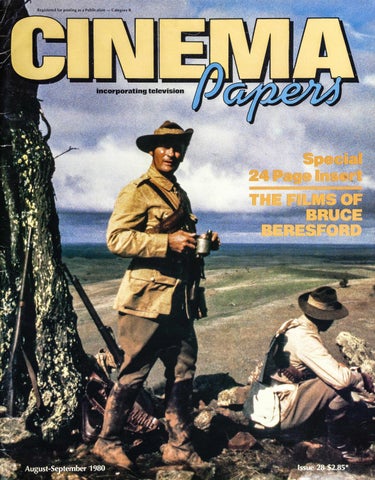
Front cover: scene from Bruce Beresford's Breaker Morant.
Cinema Papers, August-September — 223
S K R ZYN SK I A P P O IN TED As proposed by Mr Ellicott, M inister for Home Affairs, on May 2, a general manager has been appointed to the A ustralian Film C om m ission. He is Joseph Skrzynski, who will take up his position in August. Skrzynski gained a B.Ec. (Hons) from the University of Sydney in 1969, and entered the business w orld as an assistant to the group com pany secretary at W ood Hall Ltd. Joining Finance Facilities Pty Ltd in 1970, he rose to group general manager (finance) where he was responsible for cash-flow and expen diture forecasts, budgets for capital expen diture, loan applications, investm ent returns, etc. In 1977, he joined Pittsburgh National Seldon and Co Ltd as m anager of corporate services division and became a financial ad visor to the New South Wales Film C orp ora tion. as well as a consultant to various film producers. S krzynski’s art interests have included a 10-year stint as foundation dire ctor and honorary secretary of the Sydney Dance Company, and as a board m em ber of the A boriginal Arts and Crafts Pty Ltd. Since, joining in 1976, com pany sales have nearly quadrupled. in announcing S krzynski’s appointm ent, the chairm an of the AFC, Ken Watts, said, "M r Skrzynski is the first appointm ent to this new position. He is well known and respected by the film production industry, and has acted as consultant to a num ber of Australian film producers. “In the first five years of the AFC activities, the industry has changed considerably. There is now a more solid base of ex perience, and Australian film s are well received at home and have achieved wide critical acclaim overseas. They have also attracted large audiences overseas. The AFC is now reorganizing its resources to meet the new challenges of a changing in dustry. and has decided to appoint a general manager to plan and manage its operations. The general manager will work direct to the AFC.”
Jack Thompson, as M ajor Thomas in Bruce B eresford's Breaker M orant, won the award fo r Best S u p p o rtin g A cto r at the 1980 Cannes Film Festival.
CAN NES AW ARDS From an Australian point of view, the big news at Cannes regarding awards was the one given to Jack Thom pson for Best S up porting Actor. Few com m entators doubted Thom pson's right to an award, but it was sur prising he was given the supporting award and not Best Actor: Thom pson has the biggest-speaking part in B reaker Morant. Michel Piccoli was named Best A ctor for his perform ance in M arco B ellochio’s Salto nel vuoto; this caused further com m ent as Piccoli was dubbed into Italian. (Despite that — and few of P iccoli’s detractors seemed to have seen the film — Piccoli does give an excellent perform ance.) Other award winners were: Palme d'Or: A ll That Jazz (Bob Fosse) and Kagemusha (Akira Kurosawa) Special Jury Prize: Mon oncle d ’A m erique (Alain Resnais) Jury Prize: C onstans (Krzysztof Zanussi) Best Actress: Anouk Aimee in S alto nel vuoto Best Screenplay: Ettore Scola for La terraza Best S upporting Actress: Carla G ravira for La terraza and M ilena Dravic for Poseban tretm an C am era D’Or (Best First Film): H istoire d ’A drien (Jean-Piere Denis) Technical Prize: Gerald C alderon fo r Le risque de vivre
Palm d'O r (short): Seaside W oman (Oscar Grillo) J u ry P rize (s h o rt): K ry c h le (Z d e n e k Smetana) and The P erform er (Norma Bailey) The Christian Ecumenical Jury awarded a special prize to A ndrei Tarkovsky’s Stalker, and its annual prize to Krzysztof Zanussi’s Constans.
AN E Q U ITA B L E SURVIVAL? The m ajor topic in the film industry is un questionably the use of foreign actors in Australian films. Already an issue of concern when the Actors Feature Film Award was passed last year, the debate reached the heated stage when producer Antony I. G in nane was barred by Actors Equity from em ploying some foreign actors on The S ur vivor (see Cinema Papers, No. 27, p. 88). The next challenge came with Equity’s reversal of a decision over the em ploym ent of A m erican leads for Richard Franklin’s Roadgames. This was an interesting case as the M elbourne branch of Equity had already given perm ission for the em ploym ent of Stacy Keach and Jam ie Lee Curtis, but the Sydney branch overruled the decision. As Franklin says on p. 245 of this issue. Roadgames became “ a ping-pong ball in a game of politics between M elbourne and Sydney, which nearly resulted in the film closing dow n” . O n e r e s u lt o f T h e S u r v iv o r a n d Roadgames challenges has been the fo r m ulation by Equity of a new policy on im ported artists. First printed in Equity , July 1980. it is reproduced below: Proposed A ctors’ Equity Film P olicy — Im p orte d A rtists 1. W here a film is wholly or partly funded by a governm ent statutory body, no im ported artist shall be allowed except in exceptional circum stances. 2. W here a film is privately funded, Equity will approve the im portation of artists subject to the following: (a) The a rtis t is of in te rn a tio n a lly recognized m erit and ability. The criteria of judgm ent in particular but not exclusively shall be an artist’s track record as reflected in ap pearances in at least five leading ro le s , an d g o o d p r o fe s s io n a l standing and record of work over a period of at least five years — ex cept in the case of juveniles; (b) an equal num ber of Australian ar tists will receive co-billing; (c) prom otional material incorporates A u s tra lia n s in a d v e rtis in g and prom otional events; (d) the im ported artist does no work other than the film for which he/she is contracted; (e) the production com pany enters into an a g re e m e n t w ith th e u n io n reiating to the above conditions and term s of e n gage m en t (in clu d in g rates of pay); and ( f ) where a film is produced under the term of the award, an absolute lim it of two im ported artists be placed on any one film in all but the most ex ceptional circum stances. Equity official Uri W indt, in justifying this policy, says “ it is evident that a ‘crisis’ is upon us and the very survival of the industry is in the balance” . W indt lists two sym ptom s: the lack of return to the producer "caused not in the least by an unfair share of the box office"; and the so-called attempts by some producers to “ internationalize” the industry. Firstly, the return from the box-office is som etim es lower than in the U.S. but this is, according to some producers, due to low and slow takings in the first place. For example, if a house expense figure fo r a cinem a is $10,000. and the box-office takings for the week are only $14,000 (not bad for an Australian film ), the producer gets a share of the difference: i.e., of $4000. in the U.S.. a film wouid hope to have a h igh er average w eekly take, giving the producer a split of a bigger pie. W indt sees the situation though as one of U.S. im perialist conspiracy: “ We all know about the overseas m onopoly on exhibitio n /d is trib u tio n .” A pparently not, because of the three m ajor exhibitors, Village and the Greater Union Organization are at least 50 per cent A ustralian-ow ned. W indt's second point, on “ international ization” , is the m ore contem porary issue. As he says, “ There is a fundam ental difference be tween supporting an A ustralian film in dustry internationally, which we would su p p o rt w holeheartedly, and sup port for the m aking of what are essentially foreign film s in A ustralia . . . Our concern was not m erely that these film s were being made, but that they were using scarce public funds in these productions. The worry is, of course, that no public funds would be
available to produce genuinely indigenous film [s] (such as My B rillia n t Career, Stir, etc.).” The p o in t a b o u t s c a rc ity is c le a rly debatable: several state corporation ex ecutives say there is a surplus of funds; the problem seems to be few w orthw hile scripts. Also, a use of public funds fo r “ in te r national” film s does not necessarily mean, as W indt suggests, the taking away of funds fro m in d ig e n o u s film s. It cou ld be, fo r example, that an “ international” film does so well com m ercially that the public fund is not only re-stocked but added to. As to “ genuinely indigenous” film s, W indt is himself confused. He cites as one exam ple My B rillia n t Career, but the male lead, Sam Neill, is a foreigner. Under Equity’s new policy, Neill would presum ably not have been allowed into A ustralia to make the film. A vital corollary of Equity's stand is the question of w hether Australian actors should be allowed to appear in foreign film s. At p re s e n t, a c to rs can go to H o lly w o o d whenever they like in search of stardom . Judy Davis, fo r exam ple, who gained inter national recognition in My B rillia n t Career, has made at least two trips to the U.S. trying out for roles. One was opposite Liv Ullman in Anthony Harvey’s R ichard’s Things (script by Frederic Raphael) and the other, a role o p posite Burt Reynolds. In both cases Davis turned down the roles, but next tim e the de ci sion could be different. It is then not hard to im agine Davis fu lfilling her career full-tim e overseas. Thus, the highly-protected atm osphere that ensured her and other Australian actors lead roles in film s such as My B rillia n t Career could go unrepaid. After all, why justify all these restrictions on the grounds it improves our stock of actors if they can dis appear at will? Surely, restraints have to work both ways. W indt concludes his argum ent by saying, “ It has become obvious that unless some concentrated effort is made, public funds, created to establish a viable Australian in dustry, will be diverted into subsidizing teie-fiim s for the U.S., and at the same tim e have virtually all lead roles portrayed by imported artists. The council of Equity felt this to be an intolerable situation.” W hat W indt doesn’t choose to answer is why Equity has taken upon itself the task of determ ining the use of public funds. The irony, of course, is that once Equity's policy has been accepted the public funds W indt expresses such concern over will, in effect, no longer be public. Im portantly, not all m em bers of Equity support the new policy. Jack Thom pson is one who has vocally opposed it, pointing to som e benefits he feels can be gained by a selective use of overseas actors. John Meillon is another to make public his op posi tion. W hether the less isolationalist views of Meiilon and Thom pson win, or those of W indt. remains to be seen. Discussions with producer bodies are regularly being an nounced. and it is hoped some balance will be brought to bear on this vital issue.
NEW COM M ISSIONER A ctor Charles ‘B ud’ Tingwell has been ap pointed a part-tim e com m issioner to the Australian Film C om m ission for a three-year term. Tingwell, whose career includes many film s in Britain (M urde r She Said, Dracula — P rince of Darkness), has appeared in several re ce n t A u stra lia n film s. These includ e, Breaker M orant, S um m erfield and Money Movers.
R&R R & R Films Pty Ltd, founded by Robert Stigwood and Rupert M urdoch, has ap pointed Ben Gannon as general manager. Gannon. 27, graduated from the National Institute of Dram atic Art, Sydney, in the early 1970s, and w orked as the researcher on Jim Sharm an’s S hirley Thom pson Versus the Aliens. Travelling to London in 1973, he joined the International Famous Agency as an agent. Three years later, Gannon form ed his own agency, Ben Gannon Associates. Managing d ire cto r of R & R is Martin Cooper, who has a television background. He has also w orked as a lawyer for M urdoch. International president is Francis O’Brien, form erly of Param ount. (For a fuller profile, refer to Raymond Stanley's article in Screen International, May 31-June 7.) The first film to be announced by R & R is Peter W eir’s G a llip o li. Produced by Pat Lovell, from a David W illiam son script and with a budget of $2.5 m illion, the film is ex pected to sta rt sh o o tin g on a 12-w eek schedule in S eptem ber. The Year of Living Dangerously, which W eir was planning to do, has been put back.
Subscribe
and beat the price rise (single issues now $ 2 .85 )
Save 1 year (6 issues) $15.70 2 years (12 issues) $30.00 3 years (18 issues) $42.30 -Please enter a subscription for 6 issues Please start
d
renew
d
20c per copy 30c per copy 50c per copy
n
d
12 issues
EH
18 issues
my subscription with the next issue.
Delivered to your door p o s t free
S ubscriber’s name Address ..................................................................................
P o stco d e .............
Gift Subscriptions If you wish to make a subscription to Cinema Papersa gift, cross the box below and we will send a card on your behalf with the first issue. LJ
Gift subscription, from (name of sender) ...............................
Enclosed is a cheque/money order for $ .....................................
made out to Cinema Papers Pty Ltd, 644 Victoria St North Melbourne, Victoria, 3051, Australia. The above offer applies to Australia only. For overseas rates, see below. This offer expires on December 1, 1980.
ORDER FORM
BOUND VOLUM ES ORDER VOLUME 6 NOW
BOUND VOLUMES
(numbers 21-24) Volumes 3 (9-12), 4 (13-16) and 5 (17-20) are still available.
V
$30.00 (including post) per volume. Please send me D □ □ □
Handsomely bound in black with gold embossed lettering. Each Volume contains 400 lavishly illustrated pages of • Exclusive interviews with producers, directors, actors and technicians. • Valuable historical material on Australian film production. • Film and book reviews. • Production surveys and reports from the sets of local and international production. • Box-office reports and guides to film producers and investors. S TR IC TL Y L IM IT E D E D IT IO N S PLEASE NOTE: Volume l (numbers l-4) and Volume 2 (numbers 5-8) ARE NOW UNAVAILABLE. ✓
Overseas Rates
copies of Volume 3 copies of Volume 4 copies of Volume 5 copies of Volume 6
EZIBINDERS
Please send me □ copies of Cinema Papers' Ezibinder at $15 per binder. Total amount enclosed SAust. NAME....................................... ADDRESS.
Cinema Papers
is pleased to announce that an Ezibinder is now available in black with gold embossed lettering to accommodate your unbound copies. Individual numbers can be added to the binder independently, or detached if desired. This
Postcode For overseas rates, see below.
Cinema Papers Pty. Ltd., 644 Victoria Street, North Melbourne, Victoria, Australia 3051 Please allow up to four weeks for processing.
(A ll re m itta n ce s in A u stralian d o lla rs only)
Subscriptions 6 issues
12 issues
18 issues
$20.50 (Surface)
$39.60 (Surface)
$56.70 (Surface)
$32.50 (Air)
$65.00 (Air)
$20.50 (Surface)
Bound Volumes
Back Issues
Ezibinders (each)
(to the price of each copy, add the following)
$33.30 (Surface)
$19.00 (Surface)
$0.80 (Surface)
$92.70 (Air)
$36.50 (Air)
$19.90 (Air)
$2.80 (Air)
$39.60 (Surface)
$58.70 (Surface)
$33.30 (Surface)
$19.00 (Surface)
$0.80 (Surface)
$38.70 (Air)
$72.00 (Air)
$105.30 (Air)
$37.10 (Air)
$20.95 (Air)
$3.50 (Air)
3. Hong Kong India Japan Philippines China
$20.50 (Surface)
$39.60 (Surface)
$56.70 (Surface)
$33.30 (Surface)
$19.00 (Surface)
$0.80 (Surface)
$40.90 (Air)
$80.40 (Air)
$117.90 (Air)
$40.00 (Air)
$22.00 (Air)
$4.20 (Air)
4. North America Middle East Canada
$20.50 (Surface)
$39.60 (Su rface)
$56.70 (Surface)
$33.30 (Surface)
$19.00 (Surface)
$0.80 (Surface)
$45.10 (Air)
$88.80 (Air)
$130.50 (Air)
$43.20 (Air)
$23.95 (Air)
$4.90 (Air)
$20.50 (Surface)
$39.60 (Surface)
$56.70 (Surface)
$33.30 (Surface)
$19.00 (Surface)
$0.80 (Surface)
$47.20 (Air)
$93.00 (Air)
$136.80 (Air)
$45.00 (Air)
$25.00 (Air)
$5.25 (Air)
Zone 1. New Zealand Niugini
2. Malaysia Singapore Fiji
5. Britain Europe Africa Sth America
(each)
NOTE: A "Surface Air Lift" (air speeded) service is available to Britain, Germany, Greece, Italy and North America. Subscriptions: 6 issues — $28.20; 12 issues — $54.96; 18 issues — $79.74. Bound Volumes (each) — $35.20 Ezibinders (each) — $20.75. Back Issues — add $1.10 per copy.
Cinema Papers is pleased to announce the publication of J
T ~2 ÜÜJ,
ill.!/ in
•ir x
iv<:
jA
<a vv ■l-.<* !»«<**V- - '
<sewr
v4^
5
^
^g|gygp^ In this first major work on the Australian film industry’s dramatic rebirth, 12 leading film writers combine to provide a lively and entertaining critique, llustrated with 265 stills, including 55 in full color, this book is an invaluable record for all those interested in the New Australian Cinema.
Order Form
( 1 1 " x 8 ")
The chapters: The Past (Andrew Pike), Social Realism (Keith Connolly), Comedy (Geoff Mayer), Horror and Suspense (Brian McFarlane), Action and Adventure (Susan Dermody), Fantasy (Adrian Martin), Historical Films (Tom Ryan), Personal Relationships and Sexuality (Meaghan Morris), Loneliness and Alienation (Rod Bishop and Fiona Mackie), Children’s Films (Virginia Duigan), Avant garde (Sam Rohdie). P ostage rates (per co p y) fo r orders placed o u tsid e A u stra lia ($Aust.)
I wish to order □ copies of The New Australian Cinema at SAust.14.95 a copy. Post free within Australia. Elsewhere, add postage charges listed. Name . . Address .................................................. P o stco d e ............................ Enclosed: $
208 pps, 28cm x 20.5cm
Please make your cheque or money order payable to: Cinema Papers Pty Ltd, 644 Victoria St North Melbourne, 3051, Australia
Zone 1 (New Zealand, Niugini) Surface S2.00 Air $5.30
Zone 4 (Nth. America, Middle East) Surface S2.00 Air $11.10
Zone 2 (Malaysia, Singapore, Fiji, Indonesia, etc.) Surface S2.00 Air $6.50
Zone 5 (Britain, Europe, Africa, South America) Surface $ 2.00 Air $11.30
Zone 3 (Hong Kong, India, Japan, Philippines, China, etc.) Surface $2.00 Air $7.70
Surface airlift to the U.K., German Federal Republic, Greece, Italy & U.S. - $5,50
THE QUARTER M AN EFIELD R ETU R N S
ACOSA was form ed in 1975 during a media conference in Brisbane. A ccording to a spokesm an, ACOSA is not just a lobby group for journalism students, it is also con cerned with broader areas of com m unica tions and com m unication policy. As a result, the organizers are hoping that people from the industry — unions and em ployers — will attend or be represented at the conference, as well as students and academ ics from a wide range of courses. Topics which will be covered at this year's conference include News Management, New C om m unication Technology, Public Rela tions in the ’80s, Photo Journalism , Media Bias and D iscrim ination, A ustralia and the Third W orld, and A lternative Journalism . A “ Media Fair” will be a feature of the con ference and will be aimed at providing a practical side to the conference. There will be a photo exhibition as well as theatrettes to show film s. Colleges, organizations and advertisers are invited to set up stalls and displays. Attendance at the conference is welcom ed from all groups and individuals. Further in form ation or inquiries may be made at M itchell College, Bathurst, NSW, 2795, or telephone Colin Sindall (063) 31 1022. In quiries related to the first issue of the National Magazine should be addressed to the Royal M elbourne Institute of Technology.
Film producer Tom M anefield, who was sacked by Film A ustralia on A pril 11, has won an appeal against his dism issal. Considered by many to be the best of Film Australia's producers, M anefield’s re-appointm ent has been w idely applauded. The dismissal came about when Manefield refused to reply to criticism in the right-w ing News Weekly on a series of docum entaries he had produced on the Soviet Union. Defending his action, Manefield claimed that News Weekly’s rem arks constituted fair com ment and called for no reply. M anefield’s dismissal soon became a parliam entary issue when the O pposition spokeswom an on the media, Senator Ryan, asked Mr Elllcott, M inister fo r Home Affairs, to investigate the affair. Senator Ryan said: “ The loss of Mr M anefield’s talent and ex perience will be a great blow to Film Australia and to Australian audiences." Manefield then lodged an appeal with the Federal Public Service Disciplinary Appeals Board which ruled that his dismissal "did not follow the principles of natural justice” . (The vote was split, with chairm an K. S. Edmonds and Greg W ethery upholding the appeal, and Brian Gittings, secretary of the AFC, dissen ting.) A p a rt fro m re in s ta tin g M a nefield, the board also ordered the A ustralian Film C om mission, parent body of Film Australia, to pay M anefield's salary for the 13 weeks he was unem ployed, and $100 costs.
L E TTE R S
CENSORSH IP NEWS In the A pril-M ay period, two film s were refused registration: Sensual Encounters of Every Tim e and A ll A bou t G loria Leonard, both for gratuitous sex. An unusually high num ber of film s ac cepted cuts to gain registration. Dagga ta’ pinzell! and Run fo r the Roses took 11 and 18 second cuts to gain “G” ratings, while with C rim in ally Insane, Dracula Sucks, The Last Judgem ent, Sex W orld, 6-9 Daily Double, Terror, Train S tation Pickups, The Mountain of the C annibal God, Teenage Jailbait, Tram p W omen and Zom bie Flesh Eaters the average cut was 33.62m or 1 min 13 secs. The biggest cut was the massive 9 mins 40 secs from Teenage Jailba it. This repre sents 21.96 per cent of the original running length. Pleasing decisions were the “ M" rating for Paul S chrader’s A m erican Gigolo, a film which could have gained an “ R” for language (the censor wisely ruled it to be justified), and the passing uncut of Friday the 13th, con sidered by some to be as violent as any film shown In Australia, and The Tin Drum. At the same time, the “ R” rating for Vengeance is Mine is harsh and effectively takes the film out of the school market where its showing would have been worthwhile, on social and cultural levels. A film like Vengeance is M ine also raises the need fo r an “ R" certificate linked to age. One could easily argue that Vengeance is un suitable for 13 or 14 year-olds, but 16 and 17 year-olds are surely adult enough for it. Us ing the New Zealand system, it couid be rated “ R16” . Hopefully, the Chief Censor, Lady Duckmanton, will consider introducing this system.
Scene from
John
Honey’s M anganinnie. Honey has been appointed the new director of the Tasmanian Film C orporation.
TFC C H A N G E John Honey has been chosen to succeed Malcolm Smith as dire ctor of the Tasmanian Film C orporation. Honey’s two-year a p point ment starts on Septem ber 5. After a short career as a high school teacher, Honey joined the ABC as an an n o u n c e r, c u rre n t a ffa irs re p o rte r and producer-director. From 1972 to ’74 he worked for the Tasmanian A dult Education Board, then rejoined the ABC and became a senior producer. There, he was executive producer of The C olonials. In 1978, Honey joined the TFC as a con tract producer. One of his projects was M anganinnie, which he directed. Smith, who was the TFC’s first director, will move to Sydney where he has a com pany which specializes in sponsored film s, media com m unications and counselling. Smith also intends entreprenuering television series and feature films.
PO R T M ELBOURNE S TU D IO S The new studio com plex developed by Port M elbourne Studios Pty Ltd opened in June. The buildings date to 1895 and are made from bricks used as ships ballast. Known locally as the “ starch factory” , several of the buildings have been m odernized as part of a long-term refurbishing plan. The main studio, with only m inor additions to be made (such as a lighting grid), is already being used for the production of R oadgam es. P ro d u c e r-d ire c to r R ichard Franklin said, “ The studio is excellent, it has a big stage and is good from a sound point of view. It is certainly the first decent stage we have had in M elbourne.” The site will be developed to include two additional, sm aller studios, offices, m ake-up and artist facilities, prop storage and building areas and re s id e n tia l ap a rtm e n ts. This should ensure the studios a pivotal role in the M elbourne film -industry.
S T U D E N T AW ARDS
Scene from Shohei Imamura’s Vengeance is Mine, which has been rated “ R”.
Coinciding with producer Allan Carr’s visit to Australia to promote the opening of EMI’s Can’t Stop the M usic, was the announce ment of two awards to students of the Australian Film and Television School. Annie Cocksedge, a sound trainee, and Nigel Ab bott, a trainee in production management, will be attached for at least three weeks on an Allan Carr production, or a film to be nominated by EMI. Their fares, accom modation and expenses will be met by EMI and Carr.
ASIAN FILM F E S TIV A L Aw ards have been announced for the 26th Asian Film Festival, held in Indonesia from June 28 to July 3. They are: Best Film: Port A rthu r (Toshio Masuda) Best Actor: Katsuo Nakam ura (B uddhist from China) Best Comedy: Toruson’s S pring Dream Best Screenplay: The Pioneers Best C inem atography: Chain Reaction (Russell Boyd) Best Music: H arlequin (Brian May) Best A rt Director: B uddhist From China Best Sound Recording: Harlequin Best Editing: Kid w ith a Tattoo Best Docum entary: Bound for A lice Other prizes awarded to Australian films were a M itra for “ the most convincing acting” to Jack Thom pson in Bound for Alice; John D arling’s Lem pad of Bali, for “ the most out standing planning of a docum entary” ; Mind Made, fo r "outstanding artistic photography of a docum entary” ; and W ild life Rangers, for “ best docum entary on the preservation of w ildlife” . The Asian Film Festival seems to have an award fo r every conceivable theme. Ian Barry’s Chain Reaction won a Mitra for “ the most relevant theme of nuclear risk” and Geoff Steven’s Skin Deep a Mitra for “ out standing presentation of a small town com m unity” . The most am using, however, are probably the two Mitras awarded Griha P ravesh fo r “ o u tstand ing d ia lo gue on profound thoughts” and “ outstanding story about m arriage".
GUO AW ARDS The 1980 Greater Union Awards were recently announced at the Sydney Film Festival. They are: Fiction: Tread S oftly (Di Drew) Docum entary: Frontline (David Bradbury) General: D rink the Moon (M ark Foster) The judges, all Sydney-based, were Tom Cowan, Barbara Grum m els, John Hannahan (Docum entary); Linda Blagg. Sonia Hof mann, Jam es Ricketson (General); John Daniel, Pom Oliver, David W illiam son (Fic tion). The Rouben Mam oulian Award, judged by invited guests, w ent to Brian M cKenzie’s W inter’s Harvest.
1980 AC O SA C O N FER EN C E The fifth annual national conference of the Australian Communication Students' As sociation is to be held at the Mitchell College of Advanced Education, Bathurst, from Oc tober 10-12.
Dear Sir, We are students at the Australian Film and Television School engaged in producing a videotape docum entary on the history and future of Luna Park. As part of the program we are keen to contact anyone who may have material related to the Park. We are par ticularly interested in home movie footage and still photographs of Luna Park from any period. We are not concerned with the technical quality of this footage. We would be grateful if those interested could contact us at the AFTS on (02) 887 1666, or at the ad dress below. Yours sincerely, Karl Zwicky John Luscombe P.O. Box 126. North Ryde, 2113. Dear Sir, I would like to com m ent on the odd state ment made by Igor Auzins in his interview in Cinema Papers (No. 26, pp. 122-127). In ta lk ing about casting he said: “ It is more credible to age a character of a m iddle or medium age than a young person. I do n’t think Liddy Clark looked convincing as whatever she was supposed to be in Ride on Stranger. She was too young.” This is an extrem ely unfair com m ent on a very fine perform ance, and also quite in correct. The story began in 1932, when the character played by Liddy was 16. The four episodes ended with the outbreak of war in 1939. at which tim e she was 23 years old. I do n’t think Igor watched very carefully. Most people who did thought she was superb. Yours sincerely, Peter Yeldham.
O B ITU A R Y On May 14, Sir Norman Rydge, first presi dent of the Greater Union Organization, died. Rydge jo in e d the com pany in 1937, retiring as chairm an of the board in Decem ber 1979. He has been replaced by his son Alan, form erly a director of GUO.
A D D EN D A AND COR RIG ENDA In the article on G odfrey Cass and W. J. Lincoln in the previous issue of Cinema Papers (No. 27, pp 170-175, 214), several in accuracies occurred in the stills and cap tions. As the author. Mary Bateman, was overseas at the tim e of going to press, and consequently couid not check the proofs, these errors occurred w ithout her know ledge. The p h o to g r a p h s fro m T h e L if e ’ s Romance of Adam Lindsay G ordon are of Hugh McRae and Adele Inman (p. 171) and Hugh McRae (p. 174), and not as printed. Cass was not in this film. The photograph from Lincoln’s The Bells (p. 171) is not of Cass. The photographs labelled E dith Cavell (pp 173, 174) are, in the author’s opinion, from The M artyrdom of Nurse C avell with Vera Pearce, and not from the earlier Lincoln ver sion. The photograph of The C risis (p. 172) does not show Cass, as stated. The Editor regrets these inaccuracies. ★
Cinema Papers, August-September — 225
^lililí!
■ laiililsiiiiM iW ilB M
ÿSS&i
In the following article, Jan Dawson discusses Nicolas Roeg’s Bad Timing. In the course of her examination, she also replies to several points raised by John Pym in his article, “Ungratified Desire” , published in the spring 1980 edition of Sight and Sound. “If we don’t meet, there’s always the pos sibility it could have been perfect.” With these words — wry, cautious, evasive and lightly patronizing — Dr Alex Linden (Art Garfunkel) discreetly deflects the sexual advances of the seemingly predatory Milena (Theresa Russell). Like all relationships, this one contains the seeds of its ending in its first conversational exchanges — although, at this point, neither we nor the participants have been primed to recognize it. The joke behind Alex’s cocktail-party repartee is in deadly earnest: the perfection to which he immodestly aspires is a condition which cannot survive direct confrontation with any reality beyond his own mirror: a condition to which, from his own Olympian moral heights, he nonetheless avidly, pedantically and destruc tively attempts to educate his un-premeditating mistress. That his sexual relationship with the lady is, in his view, quite perfect, merely adds to his didactic zeal. Slipping unconsciously into the doctor/ patient relationship, Alex proceeds to preach as if he had no unconscious, no dark recesses of the soul or libido which could not be rationalized in a tidy syllogism. He is greedy, and thinks himself generous: he is possessive, and thinks himself disinterested: he is irrational, and believes himself logical. In contradiction of the basic tenets of his profession (and his own lectures to his students at the University of Vienna), he denies, in his own case, the gap between dream and reality, self and other. The ultimate narcissist (and it is a tribute to Garfunkel’s selfless performance that he allows the character’s bad faith to grow before our eyes unsoftened by any conniving charm). Alex attempts to reduce the whole world to his own subjectivity. He fails, the more spec tacularly since the object of his devouring pas sion — vibrantly alive in Theresa Russell's startling performance — is incapable of bending her existence, or her spontaneity, to his theoretical rule. Like Swann (and there are other Proustian dimensions, too), Alex interprets each departure from his intractable dream of perfection as an act of treason, and begins collecting evidence for the moral prosecution. He cannot, subjectively, accept that Milena’s existence must remain ob jectively separate from his own. The camera shows him constantly cut off from her — by walls of glass, window-panes, other people — casting sidelong glances of disapproval. And since Alex considers Milena a traitor, he behaves like a spy — the possible profession of her Czech husband, Stefan (Denholm Elliot); a voyeur: or a police detective (Harvey Keitel’s Inspector Alex Linden (Art Garfunkel) prepares to ‘possess’ the unconscious Milena (Theresa Russell). Nicolas Roeg’s Bad
Timing.
Cinema Papers, August-September — 227
BAD TIMING
and can further ignore altogether Alex’s willingness to put his professional skills in the service of some security organization closely resembling the CIA. Also, while Pym observes that Alex finds his double in the equally single minded Inspector Netusil, he fails to see that Roeg is offering a more general equation between the conditions of spy, detective and possessive lover. What each of the three has in common is in fact a need to simplify other existences, to objec tify the animate amorphousness of other lives and to render them classifiable. If the detective chooses to understand every aspect of his suspect, even to identify with him, it is with a view, in the end, to reducing him to a single, culpable act.
Director Nicolas Roeg with lead actress Theresa Russell.
Netusil, with whom Alex achieves a so-alarming symbiosis). The brilliance of Roeg’s direction lies in the way he equates these three conditions: his characters’ psyches refract one another in much the same way that the many mirrors on the screen turn all the film’s images to abstract variations on a theme. As Alex tells his students, in the lecture he himself has failed to take to heart, “We are constantly in isolation, watching and spying on everyone around. We are all spies”. And, as Roeg here reveals, in our efforts to obtain a definitive reading of the subjects of our scrutiny, we are all arguable necrophiliacs. Linden’s rape of the unconscious Milena is, as John Pym points out, “a definitive act of rejec tion”, but Roeg goes further to spell out the demonstrative connection between this act of re jection and the socially sanctioned physical acts of acceptance in which his unusually erotic film abounds. Of course, the identification of love and death is hardly a novelty in western romance, but where Roeg breaks new ground (and old taboos) is in taking, literally, the staple equation of romantic passion to reveal the necrophiliac lurking beneath the socially accep table form of the possessive lover. Although, representing a definitive act of rejection, Alex’s studied violation of his mistress’ insensate body also represents the supreme consummation of his passion, revealing his previous intimations of gratified desire as mere pallid rehearsals. While Pym, in his article, astutely notes that many objects in the film become adjuncts to Milena’s emotionally explosive (or just fragile?) state, he fails to observe the converse: the reduc tion of Milena to a tractable object through Alex’s psychological, as well as physical, onslaughts. Thus Pym can list among the “perverse degradations” to which Alex is sub jected by Milena the fact that she at one point ‘orders’ him to rape her, but ignores the fact that he responds to what is essentially a contemp tuous challenge and that his act of animal brutality leaves her at least as degraded as himself. 228 — Cinema Papers, August-September
Above: Milena, the object of Alex’s devouring passion, who is incapable of bending her existence, or her spontaneity, to his theoretical rule. Bad Timing. Above right: The unwilling . possessed and the would-be possessor. Bad Timing. Right: Alex “ is greedy and thinks himself generous; he is possessive and thinks himself disinterested; he is irrational and believes himself logical.” Bad Timing.
While Roeg’s cross-cutting between various acts of love and Milena’s tracheotomy appears, in the earlier part of the film, to be of an unusual crudeness, in retrospect it acquires an extraor dinary, clue-pointing subtleness. It is not there simply to signal to the* audience that even the most joyful of couplings is destined to end in tears, but also to alert us to the particular character of this particular misalliance. The fact that Milena survives does not reduce her ravish ment to mere academic interest, as Pym suggests. It is, through the film’s images, made equally explicit that, after Alex has finished with her, it will require a further act of violation of the flesh to enable Milena to breathe again. In arriving at his reading of Bad Timing, Pym has also ignored most of the specifics of the central couple’s non-coital activities, even though the film’s jumbled labyrinth paves the way for a number of tidy symbioses. Thus Pym can make light of Alex’s profession and see him merely as dressing up for the role rather than as engaged, outside of office hours, in a systematic violation of the basic tenets of his own calling;
BAD TIMING
The same is true of the intelligence services, seeking elaborate psychological profiles of suspects and potential recruits, not to savour their complexity but solely to be able, finally, to pin their colors to a particular political mast. Similarly, the possessive lover, rummaging through his mistress’ bookshelves, drawers or snapshots in search of clues which will objectify his suspicions of her own autonomous complex ity. “Et tout cecipour une femme qui n’etait pas mon genre”'.' Proust’s Swann was traumatized to discover the object of his own fixation walk ing, in a hat he did not know she had, in a part of the town he didn’t know she frequented; Roeg’s Alex Linden, also tormented by his love for a woman not fundamentally his type, is no less traumatized to discover evidence (from snap shots to a marriage licence to a glimpse of her drinking with a stranger) that Milena has a past as well as a continuing present which he cannot share, control or totally exorcise. With every fresh indication of her independent ex istence, his torment, his injured sense of separateness increases. If acts of coition provide a brief, respiratory illusion of one-ness (and even here, mirrors can function to separate the lovers from themselves), the painful reality of permanent separateness is elsewhere underlined through Roeg’s use of glass — windows, walls and mirrors — to interpose an objective (and objective correlative) barrier 1. “ And all this for a woman who isn’t my type.”
“ Roeg breaks new ground . . . to reveal the necrophiliac lurking beneath the socially acceptable form of the possessive lover.” Bad Timing.
“ Glass, to the traumatized voyeur/spy/detective, is a further source of torment since it provides an unobstructed vision of the problem without affording any glimpse of a solution.”
between his characters. Glass, to the trauma tized voyeur/spy/detective. is a further source of torment, since it provides an unobstructed vision of the problem without affording any glimpse of a solution. _ What makes Alex’s traumatic obsession quite so invidious, however, is not his voyeurism (which Roeg suggests is a universal of the human condition), but rather the first violation of which he is guilty: that of his professional ethic. For it is the role of the psychoanalyst, in opposition to the elaborate social system upheld by policemen and surveillance technicians which reduces
people to classifiable objects, to sustain and foster an individual’s sense of his own in dividuality, of his (or her) inviolable existence as subject; to respect that hoary division between ‘self and ‘otherness’ which is the mainstay of first-year philosophy classes. Alex, as a teacher, is assertively aware of this. Where Alex most singularly fails to practise what he preaches, however, is in seeking not only to deny the isolation endemic to his (human) condition, but also in seeking to remould reality to fit his own demented ideal of the perfect relationship. Where the material with which the good analyst works is a submerged reality, Alex, in his love affaire, works with a submerged illu sion. It is this which marks him most strongly as a traitor to his trade, guilty of a more heinous and total betrayal than any of which, in the narrow political definition, Stefan may or may not be responsible. What Roeg dramatizes in Bad Timing, is the conflict between love as an acceptance of the other (person) and love as a Svengalian desire to change it. The first is traditionally the province of good Freudians and complaisant spouses, the second belongs to the group which Freud himself classified as narcissists. Alex, from the moment he meets the vibrantly ‘other’ Milena, betrays his fundamental narcissism, and, from their first coupling, seeks in the oldest and most patroniz ing of male supremacist traditions to re-shape everything about her except her desirable linea ments. However abrasive or irksome Milena’s extroverted ebullience initially appears, Roeg’s film is in fact a homage to the woman’s power of resistance. Distressed by Alex’s moralizing sermons,.Milena is either unable or unwilling to change herself to suit his pedantic requirements.2 While he attempts, through his attempts to ‘re educate’ her. to rationalize his own sexuality. Milena merely accepts hers. Ironically, though, and certainly not to his own advantage, Alex’s act of ravishment does finally succeed in changing Milena: in the final shot of her face, her eyes suggest that it is not only her throat which will bear a lasting scar. Ironically, too, Alex has also changed. Cheated, by the bad timing of Stefan’s arrival, of his se cond cathartic act (the confession to which the hell-fire moralist Netusil has been leading him), he is forced to continue with the knowledge that there is no professional immunity, and that, like the least of his patients, he too has an uncon scious which is a jungle of destructive desires. For all its teasing images and Freudian nuances (literal, since the film is placed, im peratively, in Vienna). Roeg’s Bad Timing seems, to me at least, to be primarily the work of a moralist: one, incidentally, of a gloomily Jansenist persuasion. ★
Bad Timing.
2. Alex: “ You’ll never change.” Milena: “ If you weren’t who you are, I wouldn’t have to.”
Cinema Papers, August-September — 229
It is distressing that, on the international film market, little attention is paid to the work of filmmakers in the area of the short film. The needs of producers, distribution companies and exhibition chains might well be seen to have produced a conspiracy against short films, apart from those that demand little return for the appearance on cinema screens. These exceptions tend to be barely disguised advertisements on behalf of industrial corpora tions or tourism about which the best that can be said is that they are sometimes skilfully made. The result is that, outside the Festival circuit, audiences have minimal access to the efforts of many independent, creative talents. Animators in particular have suffered here, not because their work would not have a broadbased appeal, but because the economics of the market have produced a structure in which they can find no place, and survive. Unless they graduate to feature films, filmmakers like Walerian Borowczyk, Jan Lenica, Bruno Boz zetto, George Dunning and Bob Godfrey languish in obscurity. To its credit, the Melbourne Film Festival, ac cording to a policy initiated by Erwin Rado and to be continued by its new director, Geoff Gardner, is committed to the short film. This year a special guest at the Festival was Bob Godfrey; he participated in a discussion at the Sunday afternoon session, which also offered a partial retrospective of his work. Godfrey is a survivor, and his work, spanning the 27 years since his first short, Watch the Birdie (1953), has won considerable critical attention. A 30-minute ‘musical’, Great, received an Academy Award and Kama Sutra Rides Again achieve'd notoriety as Australia’s first ‘R’ certificate cartoon. Yet, to my knowledge, there has been no critical exploration of these or any other of his films. This is especially surprising since his humor constantly revolves around what he has most concisely described as “the sexual punchup” and seems specifically designed to confront his audience, whoever they might be. Intermittently, his attention turns elsewhere, as in Great which deals with the engineer Brunei and provides a broad perspective on Victorian England, but, in any overview of his work, the battle of the sexes must emerge as his major pre 230 — Cinema Papers, August-September
occupation. Certainly, from Polygamus Polonius (1959) through to Dream Doll (1979), he pursues his belief that “there are no limits with animation” into the representation of a world ruled by male sexual fantasies. These are repeatedly the projection of a little, middle-aged man who wears a moustache and a bowler hat, and. outside the context of animation and without the characteristic British surrealist humor, they would be considered pornographic. The objects of the fantasies are two types of women: the buxom creature, who offers the promise of infinite mysterious pleasures, and the battle-axe, whose sole function is seen as the entrapment of the male into marriage. In Polygamus Polonius, the battle-axe wins: the nightmarish final sequence shows her multi plying until she fills the screen and the little man finds he cannot escape the matrimonial prison. In Masks, the first part of Two Off the Cuff, the trap again closes on the hero, this time as he mis takes the trendy exterior of the 1960s woman for a freedom from sexual restraint, with the in evitable results. Godfrey’s “sexual trilogy”, Henry 9 ’til 5, Kama Sutra Rides Again and Dear Margery Boobs, marks a significant development in his treatment of sexuality and male fantasy. In Henry 9 ’til 5 the title character is a regular office gentleman who spends his day at work in dreams of erotic adventures, returning home to the seductively-toned invitation from his wife, but declining it because he is too tired. In Kama Sutra Rides Again, a married couple seek ways of expanding their routines. The running time of the film records with a surreal inventiveness their sexual games which seem to signify night mare rather than satisfaction. Dear Margery Boobs pursues the efforts of the male to over come his fears of sexual inadequacy, which he measures in anatomical terms. The trilogy makes explicit what had been hovering around the edges of the earlier Films. The dominant mode of all the films is ironic, but the later ones are more concerned to deal with the fears that lie beneath the fantasies, with the result that their comedy becomes much darker. Henry has lost the capacity to engage in sexual contact, preferring the safety of his dream world. The marital romp in Kama Sutra Rides Again is a parody of sexual liberation: as the
husband plummets down the banister towards his wife waiting in appropriate pose at the bot tom. the comedy goes ‘over the top’ and, while it can be seen to deal with the sexual urges that are concealed by conventional exteriors, it does so with a disturbing excess. Similarly, Dear Margery Boobs represents an extremity of endeavour as its anxiety-ridden hero seeks to render himself more adequate for the sexual task. In this broad context, Dream Doll, which opened the Festival this year, becomes par ticularly black. The male has become a pathetic, lonely figure seeking solace in the company of an inflatable blow-up doll. Co-directed by Zlatko Grgic. and produced in co-operation with v Zagreb. Dream Doll develops into an adult ver sion of Albert Lamorisse’s The Red Balloon. The gently mocking moral which ends Godfrey’s earlier Alf, Bill and Fred — “It is easier to sell happiness than buy it, because most people are sillier than you are” — is here trans formed into a pervading pathos as the film’s portrait of sexual loneliness leads towards an irrevocable despair that is scarcely concealed by the humor. Born of the air that Fills it, the doll, along with its companions all around city (it is, indeed, a marketable commodity), has a tenuous exist ence, becoming life-like only through the efforts of those who pour their energy into its creation and who are doomed to constant frus tration because of its elusive nature. Its inclina tion is to Fioat away and it is all too easily destroyed. The ending, consistent with that of The Red Balloon, where Pascal is carried into the hea-vens by the army of balloons, Finds the little man likewise launched by the company of dream dolls. One reading could identify this as an escapist resolution, the product of a “happy ending” machine like the one parodied in Godfrey’s The Rise and Fall of Emily Sprod. And certainly the little man has been freed from the pressures of the world he has departed, and from the brutality of the pack rapists who have ‘killed’ his original doll in the destructive fulfil ment of their desires, but he is also forever lost in his fantasy.
BOB GODFREY
You have been described by the press as “an Australian-born animator working in England”. What took you from Australia to Britain? My mother had agoraphobia and West Maitland in 1921 must have been pretty wide open. So, she per suaded my father to return to London. My parents are British and, though I happened to be born in Australia, I am British. This “Aus tralian-born Bob” only spent six months here. I am 99% per cent Pom. Your films are full of what you have described as “sexual punch-ups”, and you seem to deal mainly with male fears and fantasies. Is this something you consciously set out to do? I suppose they are male anxiety films, just as Thalma Goldman makes female anxiety films. You get this in animation, because it is such a personal thing. My films are basically the equivalent of the English seaside postcards which are full of enor mously fat women, little men and risque situations. After I had done Kama Sutra Rides Again, I was ap proached by the Rank organiza tion to make films as “conference warmers”, to liven up the salesmen before the heavy stuff is laid on them. The subject didn’t have to be sexual, but it helped. The fellas are there without their wives, and they are having the equivalent of a busi ness stag party, if you like. They are not going to be turned on by a film about a snail or a mushroom; they want to laugh. And I make them laugh with jokes about sex. At the same time, you seem to be subverting that type of film by fore grounding anxieties and making them ridiculous . . . Yes. The idea behind doing Henry 9 ’til 5, in 1969, was to make a semi-pornographic cartoon that went as far as we could go. And it got past John Trevelyan, who was a very good censor. Looking back on it now, it’s positively staid, but at the same time we thought we were being madly daring. Anyway, we got laughs from that and realized that we had hit a rich seam. Sex can either be wonder fully funny or tragic, and nobody else seemed to be making really comic films about sex. So, in we plunged and made one after the other. I think I have really worked the seam out now, and the film I am doing at the moment, Bio-Woman, will possibly be the last on that theme. I’d like to do Hamlet with robots now — anything but my silly little man. The above interview was originally broad cast as part of 3RRR-FM ’s coverage of the 1980 Melbourne Film Festival.
But there seems to be a desire to confront audiences with the absurdity of their behaviour . . . Yes. We are doing one now where a guy opens his raincoat, and we find he is a eunuch. He then says, “ Ha, ha, but I am a cartoon, you know”, and pulls out of his pocket a phallus on the end of a string, like a yo-yo. Because it’s on the end of a string we are going to get away with it, but if it was where it should be, we wouldn’t. So we push it all the time. A lot of censorship is stupid. Cutting seven or eight seconds out of The Tin Drum in London was just crazy. There was no reason for cutting that film. You have worked closely with Stan Hayward, whom you have described as “a storyboard artist” . . .
Yes. Stan Icarus in Kama Sutra — Icarus because he flies too near the sun and nearly kills himself — is actually drawn to look like Stan. Stan has funny eyes that look like a goldfish’s. Is your humor influenced by anyone in particular? That little man with a moustache, while not necessarily like Chaplin, immediately becomes a sort of pathetic figure . . . I think of myself as a comedian first, and an artist second. I have studied C haplin and most comedians with any sense study him too. He was a genius, and his kind of humor infiltrates all comedy: the funny walk, the ges tures, and so on. I often think about what Chap lin would have done with Dream Doll. I am sure he would have got
more comedy mileage out of it. In “Dream Doll”, one gets the feel ing that Zagreb played a part, because it’s very black, like much of their work . . . It was a very strange production and took two-and-a-half years. There was a lot of bad news all the way through it — like technical problem s betw een the two organizations — and that may have influenced the darkness of it. Zelimir Matko also died early on in the production, which was a great loss to Zagreb. I have always wanted to work with Zlatko Grgic, who is a verygood friend and co-director on the film, but I found it moving in a different direction from the one I had wanted to follow. In the end I saw how beautiful it was beginning to look, because it looks like no London I have ever seen. As you see in Instant Sex. I am into urban squalor. I hate certain aspects of London, and I show it in my work: all the garbage and muck, and graffiti on walls. But Zlatko was in love with London, and saw it as an incred ible, romantic city. So, I had to let him go. Because Zlatko is Croatian, the film also took on a kind of Croatian doom — a sort of comedy noir, if you like. I didn’t mind that. The film was a hell of a lot of work, with their beautiful trace-line and the beautiful backgrounds. It was so difficult making all those dolls float through the air. But I like it, because of all the films I have made — and it is only 50 per cent mine — it is the one that holds together. Some of my films are very patchy, but this one really flows. I am very proud of it. Was it consciously drawn from “The Red Balloon”? Yes. A lot of people think we copied The Red Balloon, but we were actually sending it up. We put the film in the ATinecy Festival, but the French didn’t like it at all. We were satirizing one of their great classics. Are there any particular sources, either from art or comics, that have influenced your visual style? Robert Crumb, I think. You see a lot of Crumb creeping into Great. In fact, I got so hung-up on Crumb I had to take hold of myself and say, “Forget Crumb and think about German Expressionism, or something.” I was admiring that man’s work so much it was really beginning to take over my work. I am getting away from that in fluence now and for the film I am doing at the moment I have gone back to The Cabinet of Dr Cali gari. I love the German Expres sionists. Those boys really had something. Concluded on p. 300 Cinema Papers, August-September — 231
1980 MELBOURNE FILM FESTIVAL Vintage or ordinaire, film festivals tend to narrow in memory down to one oustanding film. For me, Melbourne 1980 undoubtedly will become the (belated) year of Andrei Tarkovsky’s Zerkalo (Mirror). This m uch-discussed Soviet film turned out to be a darkly-glowing, poetic invocation of the filmmaker’s childhood, intensely personal, yet reflecting many of the major events of the time. Without doubt a difficult film to fathom (but not to look at), Mirror received a predictably icy official Soviet reaction in 1974. One can, in ail truth, appreciate the misgivings of those who dubbed the film “ inacces sible” and relegated it to a “ C” category, for limited exhibition. But before joining the chorus about totalitarian censorship, one might also, in this case, reflect upon the prospects of a film like Mirror being so liberally funded, let alone distributed (however sparingly), in the West. Yet Mirror is inded a dissident film, not so much for its content — which, in spite of some “ uncomfortable” political allu sions, overflows with love of country — as its form. And the label “ elitist” applied critically in Moscow five years ago could no doubt be used just as pejoratively by many of those who walked out of the Palais Theatre. However, while accepting the term “ elitist” , Tarkovsky has said that the film would not be a mystery to any Soviet viewer. For instance, an incident in which the narrator’s mother rushes through the publishing house in search of an im agined misprint refers to a notorious case of the 1930s when a whole news paper staff went to the Gulag because of a simple misprint which turned Stalin (“ Man of Steel”) to Sralin (“ Man of Shit” ). If “ inaccessible” means refusal by the filmmaker to take the audience on a * The 1980 S ydney Film Festival, w hich finished too late for coverage In this issue, will be analyzed in full in the next.
Andrei T arkovsky’s Mirror,
“a
guided tour of his intentions, then Mirror is indeed guilty. The sequence and sense of its many nostalgic episodes are marshalled to the beat of a distant, in terior drummer whose rhythms may be apparent after several viewings, but cer tainly not one. But there is a pattern, however, and it undoubtedly has much to do with the fact that Tarkovsky, born in 1932, is a child of the Stalin era. The film riffles the pages of memory, moving backward and forward in time, recalling apparently unrelated personal incidents between 1935 and' 1945, as well as major public events from the Spanish civil war to Hiroshima (seen in newsreel clips). The director says the film is about his childhood, his family and how the world seemed to him as a child. Remembered incidents are recreated, some in color for vivid recollection, others in soft monochrome for dreams or more fan ciful memories — all edited as intricately as a Nicolas Roeg film. Tarkovsky is id e n tifiab le as the narrator, Alexei, who is never seen as an adult on screen (the voice is that of wellknown actor Inokenti Smuktonovsky) though we do see him at the ages of five and 12. The same young actor (Ignat Daniltsev) plays both Alexei and Alexei’s son Ignat, and the same actress (M a rg a rita T ere kh o va ) is A le x e i’s deserted mother (hair up) and divorced wife (hair down). Here, Tarkovsky seems to be taking the simplistic, quasi Freudian tack that men want to marry their mothers and resemble their fathers. (Bernardo Bertolucci’s La Luna says much the same thing in far less discreet terms, of which more later.) Reinforcing this inference is the direc tor's father, poet Arseny Tarkovsky, who reads his poems to illuminative images: “ I lost my way in a gloomy forest,” in tones Tarkovsky sen., and the camera moves out of the sunlight into a dark birch wood.
darkly-glow ing, poetic invocation of the film m a ker’s child h o o d ” .
232 — Cinema Papers, August-September
Georgi Daniela’s Autumn Marathon, a satire on a Leningrad romeo.
Luminously photographed by Georgy Rerberg, Mirror is full of stunning im ages: rain lashes the fields as it did in Solaris, wind tramples the meadows like an unseen hand, a barn burns with un earthly glow, a lamp topples as the family flees a sudden storm, a ring of condensation left by a fantastic visitor’s teacup disappears eerily. This last shot concludes a scene which is as close as Tarkovsky comes to offer ing a theme. The child Ignat, left alone in his father’s flat, is suddenly confronted by an old woman who bids him read from a volume of Pushkin. It is a letter the poet wrote in 1837 and, after referring to the paradox of Russia as part of Western Christendom, yet eternally remote from it, he adds: “There is something signifi cant in the Russian condition, some thing that will astound the future historian.” Anti-Soviet? Hardly! What, then, is Tarkovsky’s purpose? Obviously the film is autobiographical, the deceptively casual compilation of events in his childhood and maturity ad ding up to what could be termed an autobiography of the spirit. Then there is the symbolic prologue (actually a clip from a Soviet television documentary) showing a youth being cured of his stam mer by a hypno-therapist. He looks into the camera and says fluently, “ Now I can speak clearly.” Tarkovsky has said that, for him, meaning is like the springs of a sofa: if they stick out, you can’t sit on it. I can say only that, first up, I found Tarkovsky’s sofa sedatively luxurious. What I need now is a chance to stretch my percep tions upon it. The other Soviet films in the Festival pale beside M irro r. Liana Eliava’s Cinema, a Georgian tribute to a pioneer filmmaker, is a mite too charming for its own good. It looks back through rosefiltered lenses at a young man who returns from Paris, afire with the poten tial of his new Lumiere camera, about the
time another young Georgian of lesshappy memory was also spreading the word of what he had learned in the West . . . about Marxism. The cinematographer runs into most of the obstacles usually encountered by protagonists of we’ve-got-a-great-ideahere films, the difference being that, before his mission is completed, this one takes off into the wide blue yonder in a balloon and is never seen again. He leaves behind some great footage, however, which enshrines, among other things, the dignity of labor. Whether or not this is founded in historical fact, Camera is a refreshing in genuous film for what is essentially a rather solemn genre. Equally pleasing is the crafty imitation by director Eliava and photographer D. Schiogiadze of early film techniques. Facile but “safe” satire is something Soviet director Georgi Daniela has down absolutely pat. Osermy Marafon (Autumn Marathon), his portrait of a middle-aged Romeo on the run around Leningrad a? he tries to keep everyone — including wife and young mistress — happy, has an appealing, if superficial, humanity, perhaps more revealing than is intended. In its appalling (and presumably unwit ting) sexism, the film puts a finger on what we have been assured “ is no longer a question” in Soviet society. The eagerto-please translator, a fundamentallydecent chap, performs this balancing act for two negative, whining, emotionallydependent ninnies. Further, he is rewarded with base ingratitude when he helps a third woman, a colleague who not only is his intellectual inferior, but also fat and frumpish (i.e., unfeminine). Before passing from the subject of Soviet entries, however, some mention must be made of one of the most mis treated films in cinema history: Sergei Eisenstein’s Que Viva Mexico!. Some of us who scurried from the Palais to the
1980 MELBOURNE FILM FESTIVAL imparts a wider significance to this sim ple narrative situation of two people desperately needing to be able to trust each other, but whose life experiences make it so difficult. It is a finelystructured, delicate little film. Muted shots of grey, empty streets and brooding open spaces evoke the un reality of an interregnum in which the old order is withering, and the new is heralded by the Red Army’s guns. The other Hungarian film, Pal Gabor’s Angi Vera, also delves into a sensitive period of the nation's past — the Stalinist decade after World War 2. Its most im mediate appeal is in the cool candour of Gabor’s depiction of a process of in doctrination. There is, however, another element that should not be lost sight of — that this story of a young woman being groomed as a party functionary wryly recognizes the attraction the Stalin aura of popular communism held for the young and idealistic, as well as the cynical and careerist. Vera, an under-educated nursing aide, is spotted as cadre material when she speaks up against the establishment at her hospital. Whisked to a training school for ugently-needed functionaries, she, along with a motley lot of young hopefuls and old Bosheviks (these include sur vivors of the brief 1919 Bela Kun Soviet), undergoes the stylized charade of dialec tical criticism and self-criticism. Her choice of a party career and her public rejection of an idealistic tutor (a young intellectual, already a party veteran, who is clearly headed for Rakosi’s correction camps) probably retains a good deal of pertinence to to d a y’s more liberal Hungary.
The hide-aways who become lovers. Istvan Szabo's Confidence.
National on the Festival’s last afternoon entertained the hope that we were about to see something close to Eisensteln’s original intention. Alas, the treatment by Eisenstein’s colleague, Grigori Alex androv, merely rearranges most of the footage we know from such cut-ups as the ‘W estern’ Sol Lesser made of Thunder over Mexico, and the more ac ceptable Time in the Sun travelogue by Marie Seton. Alexandrov, now 77, worked with Eisensteln and photographer Eduard Tlsse in Mexico in 1930-32 upon a pro ject, backed financially by Upton Sinclair, which had yielded 285,000 ft of film and wasn’t finished when the American author pulled the rug from under them. A lexandrov has put together for Mosfilm a film that he says is on the lines Eisenstein intended to follow. A pretty large claim, given that the running time of this compilation is less than 1/20th of the known footage and, of course, can’t in clude the material Eisenstein planned but was never able to shoot. But that’s not the chief objection. What matters more is the treatment of the material included. For starters, there is an excruciating James A. Fitzpatrick-like voice-over commentary, in English, full of platitudinous banality, mispronuncia tion and inaccuracy. This is matched by a fatuous soundtrack of mariachi and paso doble (bullfight) music. However, what this version does make clear is just how far Eisenstein’s plans were from the didacticism of Potemkin and O c to b e r, as T is s e ’s ly ric a l photography serves to emphasize. It’s patent just how much Eisenstein the ar tist was influenced by meetings with the great triumvirate of Mexican art: Rivera, Siquieros and Orozco. What might have been is further outlined by Alexandrov’s recollection of Eisenstein’s schema. For all the regrets it arouses, this re constituted material is nevertheless visu
ally exciting as it leads us from jungled Tehuantepec to Mayan rites to the elegant savagery of the bullring to the Viva Zapata! stuff. And any new insight into one of the cinema’s great original minds is valuable. As usual, other Soviet bloc countries provided some of the Festival’s most in teresting, and, in their context, most courageous films. Hungary’s Istvan Szabo was present to talk about his work at a small-scale retrospective and to introduce Bizalom (Confidence). Happily, the film is one of his best, a departure from the sym bolic historicism of Budapest mesek (Budapest Tales) and Tuzolto utca 25 (25 Fireman’s Street), although it too occurs in the recent past. Confidence is an austere, moving study of human interdependence, set in the final months before Soviet forces pushed the Nazis from Budapest in 1944. Two fugitives from the Germans, and the virulent local breed of fascists, pose as man and wife while boarding with a political working-class couple in the sub urbs (one of Szabo’s beloved trams clangs past their bedroom window every so often). The man, presumably, is a communist (though this is never stated), the woman the non-committed wife of a leftist doctor also on the run. Circumstances almost inevitably lead to the couple becoming lovers. At once they are torn by ambivalent emotions: guilt (compounded by the fact that both parties are in tenuous contact with their respective spouses) and a psychological compulsion to justify the temporary af faire by mentally elevating it to the status of a grand passion. Then the circum stances change again: the woman is reunited with her husband as the other man searches for her amid the chaos of Soviet-occupied Budapest. Szabo, who also wrote the screenplay,
Still on the East European cinema, it was gratifying to a long-time admirer to find Andrzej Wajda again in the re invigorated form of last year’s Czlowiek z marmaru (Man of Marble), his wry ac count of how present-day Poland sweeps the Stalinist past under the carpet. Bez znieczulenia (Rough Treatment Without Anaesthetic) is about a leading Polish journalist who suddenly finds himself on the skids. How this happens is depicted with ironic inexorability, but Wajda plays it cute as to why. The bottom drops too suddenly out of the world of the journalist, Jerzy Michalowski (played by th a t e x c e lle n t a cto r Z b ig n ie w Zapasiewicz), for it to be fortuitous. Jerzy returns from an overseas as signment to find that his wife has unexp e c te d iy le ft h im . T h e n , he is d o w n g ra d e d p ro fe s s io n a lly , his academic classes are cancelled, friends and colleagues let him down. Yet the
manipulators, if they exist, are never identified. The wife is clearly fond of her husband, her attachment to a young careerist boyfriend is lukewarm, but she shies from all gestures of reconcilation. In the divorce hearing — which seems a deliberate travesty of every known legal principle — the wife is distressed by, but fails to impede, her counsel’s cynical blackening of Jerzy. Rough Treatment has the same brisk tone as Man of M a rb le , Edward K lo sin ski’s cam era again pursuing characters in and out of rooms and of fices, down corridors, along Warsaw streets, then zooming into their conver sations. The style is cryptically matter-offact, eschewing the visual symbolism and rich compositions of Wajda’s literary adaptations, like Z iem ia obiecana (Land of Promise). There are suggestions that Rough Treatment has an autobiographical ele ment, reflecting the hard time given Wajda for Man of Marble. Then again, the obviously critical tone of Rough Treatment may be read in another, more oblique, way — as an attack upon the venality of those underm ining the regim e’s best ideals. Wajda is no celluloid Solzhenitsyn, but time and again he has shown himself to be an in cisive expositor of P oland’s social realities. Krzysztof Kieslowski is now clearly a name to be reckoned with in Polish cinema. His dryly satirical A m ator (Camera Buff), a fairly open parable on the forms censorship takes in a society like Poland’s, has a distinctive tone reminiscent of the lamented Czech New Wave. The sadly comic story of a guile less young factory purchasing-officer, deputed by his boss to make a film of the plant’s anniversary celebrations and becoming hooked on filmmaking, is also thick with allegorical imputation. The fledgling documentarist (a brilliant character performance by Jerzy Stuhr) originally bought the 8mm camera to film his new baby. He had been the perfect ‘family man’ and his wife is dismayed by this outside enthusiasm. (She, too, is a backward stereotype, on a par with the wife and mistress of Autumn Marathon. In fact, similar criticism of the principal female characters may be made of near ly all the East European films cited. It would appear that the strictly relative equality of the human animal is yet another Orwellian characteristic per sisting in the communist bloc.) Despite his wife’s protests, the Polish filmmaker presses on, forms a camera club, wins prizes for his documentary and is commissioned to make a film for
Cinema Papers, August-September — 233
1980 MELBOURNE FILM FESTIVAL
Krzysztof Zanussi (bottom left) at the film club In Krzysztof Kieslow ski’s Camera Buff.
national television. Then the bomb drops. His wife leaves him, but art now so dominates his life that, distressed though he is, the camera buff finger-frames her departing figure, like Je a n -P ie rre Leaud in Last Tango in Paris. Worse, there is hell to pay when, against the boss’ orders, he goes ahead with a documentary about a dwarf at the factory (an exemplary employee, in cidentally, but featuring such an “ un typical" worker Is held to be offensive). His section chief is dismissed because of it and after the boss has explained some embarrassing wheels-within-wheels, the filmmaker voluntarily destroys another documentary. The implications of this last act arouse particularly intriguing questions of social responsibility in a film from a director trained in socialist realism. And while the hero's clashes with the management are perfectly apposite in themselves, they also may be read as referring to broader questions of censorship and manipula tion of the arts. This Implication is rein forced when Krzysztof Zanussi, as himself, is invited to the film club to lead a discussion on Camouflage. Stuhr plays off Zanussi beautifully, the eager acolyte importuning the sardonic high priest. As with Rough Treatment, there is a further suggestion paralleling the lessthan-submerged polemic. Camera Buff might be taken as an argument for in volvement, however difficult, in the is sues confronting Poland and the limita tions facing those who seek to do something about them. There wasn't much social comment in fiction features from the West in this y e a r’s F e s tiv a l, th e o u ts ta n d in g e xce p tio n being Rolf Lyssy’s Die schweizermacher (The Swissmakers). His film could have been sub-titled “ Bread and Milk Chocolate” , such were the similarities with Franco Brusati’s Italian black com edy about Swiss attitudes to foreigners — and the differ ences of the two films in taste and texture. Lyssy is the more positive, and he displays a rare and precious facility: his earnestly didactic statement on a serious social topic is all the more effective for being explored in terms of comic satire. A stinging assault upon bourgeois sm u g n e ss, The S w i s s m a k e r s sardonically depicts the prying ways of special police officers whose job is to check the suitability of applicants for S w iss n a tio n a lity . One can o n ly conjecture upon the validity of Lyssy's criticisms of Swiss ethos, but it is note worthy that his attitudes aren’t dissimilar from Alain Tanner’s. What is apparent is the waspish delight Lyssy takes in indicating the establishment’s pompous overreaction to challenge and non conformity (something, of course, that the Swiss don’t have on their own).
234 — Cinema Papers, August-September
The establishment credo is enunciated by a senior official who has been sniffing out unacceptable would-be citizens for 20 years: “ Everything is covered by some law, from not smoking to having a hair c u t.” This o bsessive c o n fo rm ism naturally enough produces its reaction: the senior man’s new offsider rebels, leaving the country with a girl they are investigating. But if this sceptic cops out, Lyssy doesn't leave th o u g h t-p o lice mentality wholly triumphant at home, either. Running like a leitmotiv through the episodic narrative is the enthusiasm of one of the applicants (an Italian of mildly leftist persuasions) for Switzer land's national hero, William Tell. Where there are tyrants, he tells the natural ization tribunal, there will always be a William Tell. West Germany contributed to the 1980 Festival two important screen versions of works by major writers, each uneven as literary adaptation, but fascinating (if not wholly successful) as film. Volker Schlondorff's Oscar-winning adaptation of Gunter Grass' Die blech trommel (The Tin Drum), a fantastic novel about a between-wars German child who declines to grow up, is an inventive, thoughtful and, above all, sincere attempt at a near-impossible task. Bound by a contractual obligation to bring the film in under 140 minutes, Schlondorff understandably settles for little more than half the novel’s bizarre narrative, while entering wholeheartedly into its phantasmargoria. One of those European directors whose work the Melbourne Festival has made thoroughly familiar, Schlondorff is hardly ever tendentious or didactic, the notable exception being Die verione ehre der Katharina Blum (The Lost Honor of Katherina Blum). But a signifi cant theme of contemporary signifi cance, regardless of whether or not the film is set in the present-day, always emerges. Even amid such a complex labyrinth as The Tin Drum, Schlondorff asserts a definable case against the infantile irresponsibility of Germany between the wars. Also set in between-wars Germany is Rainer Werner Fassbinder’s Englishlanguage rendering of the Vladimir Nabokov doppelganger crime novel Despair, from a screenplay by leading British playwright Tom Stoppard. In places, the film is visually and sensually hypnotic, in others downright mystify ing. Stoppard’s script politicizes and adds flashes of his brand of wit to the s a rd o n ic N abokov s to ry a b o u t a Humbert-like Russian emigre. The dis ordered mind of chocolate m anu fa c tu re r H erm ann (D irk B ogarde) conceives an absurd plot to fake death by murdering a substitute, then making off with the insurance money.
Fassbinder and Stoppard go along with the notion of Hermann being under the grotesque delusion that the intended victim is his double. Where they depart from Nabokov is in depicting Hermann not so much as an oddly-endearing schizoid, but a pitiable victim of the times. (The year is 1930 and throughout the film Brownshirts become steadily more numerous and threatening.) The suggestion is that the man’s breakdown, which has its origins in his experiences on both sides of his native Russia’s civil war, is accelerated by the degeneration and impending disaster of Weimar Germany. Fassbinder is at his allusive best in the opening reels, as Michael Ballhaus’ camera explores Hermann's exquisitely art deco apartment, and prowls around his sensuously meaty wife (Andrea Ferreol) and the lilac-uniformed factory staff. Subsequent heady leaps and surreal bounds into obsession and paranoia are a wonder to behold, although there are passages of quite unnecessary opacity. But Fassbinder goes a lot further to doing Nabokov justice than either Stanley Kubrick’s Lolita or Jerzy Skolomowski’s King, Queen, Knave. Like Mirror, Bernardo Bertolucci’s La luna also raises Freudian questions of mother-son and father-son relation ships, though in more sexually-explicit terms. La luna, another Festival entry now in commercial release, is a ripe piece of pop psychology made all the more facile by its operatic overtones, atmospheric as well as textual. The relationship between an American prima donna appearing in Italy (Jill Clayburgh) and her 15 year-old son (Matthew Barry) is, in Bertolucci’s words, “The real statement of the film” .1 Bertolucci also said in this same inter view that “the father is a mother-fucker like the son” and uses this to illustrate his claim that La luna combines Marxist as well as Freudian themes, “ M arxist - because it's about the decline and fall of Western civilization [It is?] and, on the other hand, Freudian because it deals with the influence of the father.” While such themes undoubtedly exist in the film, they drift rather limply in a cauldron of Verdiesque hyperbole (Verdi strains, it should be added, also occur In Bertolucci’s more political films, notably 1900 and The Spider’s Stragegy). Every thing the mother sings is Verdi, her actions and reactions are what one would expect of V ioletta, and she protests the boy’s indifference to being shown the composer’s villa with the cry: “These are my roots.” 1.
Cinéaste, W inter 1979-80.
The film ’s climax, which comes during a rehearsal of The Masked Ball at the Caracalla baths, Rome, could scarcely have been topped for melodramatic grandiloquence by Francesco Maria Piava, Verdi’s favorite librettist. Among the augmented quota of Asian films in the Festival were exploratory pieces by the two Indian directors best known in the West: Satyajit Ray and Shyam Benegal. Not having seen Sonar kella (The Golden Fortress), I was unprepared for a detective thriller from Ray, although in his gracefully artistic hands Joi baba felunath (Elephant God) is something more. His Sherlock Holmes-like hero Feiuda (Sumitra Chatterjee) and young assistant Tapesh (Sidd Hartha Chatter jee), a cross between Dr Watson and Sexton Blake’s Tinker, are holidaying in the holy city of Varanasi when they agree to investigate the theft of a jewelencrusted idol. Beginning like a spoof of the super-detective yarn, the film gradually takes on darker tones. But it ends with the case neatly wrapped up amid the regulation surprise twist. Ray has always shown a little of Fran cois Truffaut’s penchant for variations of direction. Certainly Elephant God is a c o n s id e ra b le d is ta n c e fro m the immediate social concerns of such recent films as Jana-aranya (The Middle Man). But Ray does have fun at the expense of c o n te m p o ra ry Indian phenomena in a bogus Sadhu (holy man) and his literate countrymen's love of whodunits. A ccom panying the detective on holiday is a popular writer of the genre (Santosh Dutta) who is the catspaw of a brilliant sequence in which the evil Mr Big (Uptal Dutta) uses an arthritic knifethrower in a bid to scare the detective off the case. The film’s gentle mockery of the author and his public is the human istically empathic Ray of old. There was much sniggering among the audience over the re stra in e d m e lodram a of the fin a l scene in Senegal's Junoon (A Flight of Pigeons). Yet, stagey as it is, this is a natural culmination of the director’s valiant attempt to blend the traditions of popular Indian cinema and Western romantic drama. Actually, the scene is quite under stated. In the Hollywood tradition, in which it has some roots, Louis B. Mayer could hardly have permitted a grand, but hopeless, passion to climax only in word less, burning glances. Indian cinematic custom, however, permits nothing more, and therein lies the extreme difficulty of Benegal’s self-imposed task. Based on a story of the same name —
Scene from Rainer Werner Fassbinder’s film adaptation, with a script by Tom Stoppard, of Vladimir Nabokov’s Despair. Dirk Bogarde (centre) and Andrea Ferreol (right). Despair.
1980 MELBOURNE FILM FESTIVAL depths of the image, the snow falling around him as he accepts the place he occupies in the world. Formally, the film is restrained as its frames repeat the image of man isolated from all, apart from those who briefly enter his life. The subdued color tones convey the absence of passion, but not of pain. Sexuality can provide a brief respite, but its end brings a sense of betrayal and an even greater isolation. The friendly gesture, such as the man presenting dole money, is a passing one. Commitment to people or causes is doomed to ultimate defeat. Structured by such a perspective, Did Somebody Laugh? replaces passionate c o m m itm e n t w ith dead w is d o m : relationships become irrelevant; revolu tion becomes irrelevant. One can admire the meticulous construction of this film while damning its sensibility. Observing the absurdity of human existence, it denies the p o ssib ility of hope. Its ideology is one of acceptance, though it conceals that beneath its pretence of in sight into the way things are.
which author Ruskin Bond wrote from his own diary of the Indian Mutiny of 1857 — and shot on the actual locations in north ern India, A Flight of Pigeons at times looks like a 1930s MGM costume epic; at others, it moves towards Indian formula romance. Produced by and featuring Bombay superstar Shashi Kapoor, it begins with shots of a messianic fakir urging the sepoys of a small town to join the revolt sweeping the country (the holy man’s incantations provide an intriguing,back ground to the opening titles), in the subsequent uprising, the small English community is bloodily slaughtered in the Anglican church. The sole survivors are an Anglo-Indian girl, her mother (played by Kapoor’s wife, Jennifer Kendal, a member of the Shakespeare Wallah family) and grandm other. They are sheltered by a Pathan aristocrat, Javed Khan (Kapoor), who is smitten to distrac tion — nobly and from afar, of course — by the girl. How he fiddles with this amour fou while India burns is the sub stance of the story. Only when all is lost does he join the cause, proving that he is nothing, if not idealistic. Episodes in Javed’s household, where the presence of the European women is resented (although all three are partly, or wholly, Indian), contain particularly deft intimations of inner tensions, in the manner of Ray. When the fugitives are sheltered by Javed’s aunt (Shusma Seth), an outdoor picnic scene evokes, not only the Ray of Charulata but Renoir’s Une partie de campagne. There are also several convincingly chaotic battle scenes (obviously staged with limited means) during which one expects to see Errol Flynn leading the next cavalry charge, as well as some well-held suspense and nudges of aren’tthese-Westerners-odd wit aimed at the home audience. For our part, those whose knowledge of the Indian Mutiny is limited to schoolroom tales of the Black Hole of Calcutta should find A Flight of Pigeons enlightening.
Keith Connolly
In 1968, Stefan Jarl made Dom kallar oss mods (They C all Us M isfits), describing it as “ a semi-documentary” in w h ic h tw o S to c k h o lm te e n a g e rs reconstruct their experiences. It dealt with their dreams of the future and with the social environment which produced and denied those dreams. Jarl's new film, Ett anstandigt liv (A Respectable Life), is the second part of his proposed trilogy. The central character is one of the teenagers, Kenta, now 29, and the film’s loose structure is bound together by his dismay and frustration as he watches his friends die — victims of heroin, alcohol and their inability to make productive use of their disenchantment. The contrast between the relative openness of his world and the closed prison of that of his old friends is drawn clearly, and somewhat heavily, by the film. The world of the heroin addict is a night world: of subway stations, tene m ent s ta irc a s e s , to ile ts , g u tte rs , emergency wards and cemeteries. It is a place of fluorescent paraphernalia which lights the streets in which prostitutes seek money for narcotics to ease the pain. It is, in the terms of the film ’s perspective, “ enemy territory” , owned by the wealthy and controlled by the power attached to that wealth. It is a place where ugliness is seen, but not under stood, a notion implicit in the prostitute’s confusion at the beating she receives fro m a c lie n t she th o u g h t “ had everything” , a company director who had refused her attempt to control the terms of their contract. Yet, despite the depressing plight that afflicts the lost children of Stockholm, the film’s style strives for a detachment, committed to the belief stated in the clos ing titles: “The victory will consist of see ing everything at a distance clearly.” The political implications of the film’s drama of pain are never made explicit, but they are constantly felt. The image of Kenta's axe hurled through the glass window of a fashion shop suggests a confrontation with the enemy, but it speaks more clear ly of his frustrations than it does of his comprehension of the issues at stake. The narrative of Henning Carlsen’s
Hor, van der ikke en, som lo? (Did Somebody Laugh?) is set in 1935 in Copenhagen, whose inhabitants strive to adjust to the hardship of the Depression, scarcely aware of the international explo sions about to intrude upon them. Radio broadcasts intermittently draw attention to Abyssinia, China, Hitler and the threat of the Nazis, but day-to-day existence is far too pressing for news from else where to carry much weight. Early in the film, the cental character (Jesper Christensen), faced with un employment, is told that people are like animals, able to adapt themselves to the most trying conditions, to live in the gut ter if necessary. This process becomes a central thread through the film, which is full of people seeking ways of coming to terms with their dismal fates: the girl, Elizabeth (Kristen Olesen), who picks up men for warmth and then casts them off; the workers who attempt to find a way of stretching their jobs to include their com rades and for whom questions of revolu tion are irrelevant; the grave-digger who could die tomorrow, or in six months, from a lung disease, and who is able to live with this knowledge. The film’s perspective on all of this seems to lie in its representation of the central character’s dreams about entrap ment, pointing beyond particular social conditions to the cosmic irrelevance of man. In one dream he finds himself trapped in the nether region between national borders, denied entry into one country or return into the other because there is no stamp on his passport (of exit or for entry) — it is as if he doesn’t exist. His last dream sees him confront God who, as a pin-striped businessman, chooses to cast him to hell to be “ melted down” and who laughs as he renders his judgm ent. The laughter wakes the dreamer whose subsequent question gives the film its title and underlines, in a bleak comic moment, the absurdity of human existence, of man strutting the stage of the earth, subject to the whim of the gods. The closing shot lingers upon the character’s resigned retreat into the dark
Directed by Georgi Daniela, An Autumn Marathon introduces itself as “ a sad comedy” and then, with humor and a delicate touch, follows the self-imposed misadventures of a Leningrad translator (Oleg Basilashvili) who seems to spend his time avoiding having to make deci sions. Unable, or unwilling, to choose between his wife and his mistress, he tries to balance his time and energy between them, with the inevitable conse quences. His daily life has a planned chronology whose order is largely controlled by his wrist watch alarm, and a recurring comic motif in the film is the one which sees him constantly on the run, from one appoint ment to the next. Indeed, his schedule Is a marathon of constant activity, as if by being forever on the move he will avoid having to reflect for too long on the moral implications of his life. The pattern here has much in common with the haste of m o v e m e n t an d s p e e c h w h i c h characterizes Francois Truffaut’s Antoine Doinel in L’Amour en fuite (Love on the Run). An Autumn Marathon is in the tradi tion of the best comedy, its ‘innocent’ hero placed in a context which calls into question the nature of his innocence. He is likeable and well-meaning, concerned not to cause pain to anyone, but he is also a moral coward. And though the film has some wonderfully funny moments — especially the sequence with the driver whose van strikes the befuddled and preoccupied hero a glancing blow on the head and who, in a series of accelerating absurdities, accuses his now mortal enemy of deliberately head-butting his vehicle, demanding appropriate com pensation — but the comedy is more pervasive than that. Its humanist tone gently calls to order a mankind that pur sues its days without any purpose except that pursuit. Der landvogt von greifensee (Squire’s Loves), directed by Wilfried Bolliger, is a comedy of manners set in the 18th Cen tury. A picaresque series of flashbacks of the amorous encounters of Salomon Landolt (Christian Quadflieg) is framed by the events of a weekend at his country estate to which he has invited the five women in his life, ostensibly because their knowledge of him has collectively placed them in the best position to select him a wife. While such a plot outline m ight suggest a sex romp, Squire’s Loves is, instead, a tale of the ways in which love is frustrated by circumstances which are the product of a social milieu rather than chance. Class tensions, felt attachments to do with family bonds, money and art combine to isolate Squire Landolt, though his response is more one of bemused resignation than despair.
Cinema Papers, August-September — 235
1980 MELBOURNE FILM FESTIVAL
The final scene of Pal G abor’s A ngi Vera, where Vera (Veronika Papp), left, accom panied by Anna (Erzsi Pasztor), is “ transported by luxurious car through a snow-covered landscape to her future".
His progress through the years seems to provide him with little awareness of the factors which have conspired to engineer his fate. Occasionally he contravenes the rules and manners of dress and address, and his artistic talents create work that is beyond the bounds of what is seen to be tasteful, but these intermittent challenges to what is deemed acceptable are never followed through and their implications are lost on him. Bolliger’s elegant camera movements and the warm, subdued color tonings of the images (the cinematographer is Ar mando Nannuzzi) suggest a romantic recall of a past grace and Innocence. But this is counterpointed by the verbal com mentary which performs Its obvious function as a linking device, while also ensuring that we remain emotionally endistanced from the charming Landolt’s unrequited adventures. Each of the film’s sequences is struc tured rigorously around a movement from close-up into a wider shot, from a centring of attention upon a key in dividual in the narrative to a broadening of perspective, locating that Individual in a wider context. The result is a film whose formal complexities subvert any attempt to produce a simple reading of its reflections upon a world based on social repression and the denial of love. It Is a richly ironic, sad, funny film, very much in the fashion of Stanley Kubrick’s Barry Lyndon. Angi Vera, directed by Pal Gabor, pivots on the tension between individuals and p o litic a l system s. Its ce n tra l character is 18 years-old Vera Angi (played by an angelic featured Veronika Papp), her growth towards adulthood coinciding with the emergence of a new Hungary, which, in 1948, was striving to recover from the aftermath of World War 2.
Impressed by her courage in the way she speaks up against the intolerable conditions in the Budapest hospital where she is an assistant nurse, and where her mother died three years before, a victim of those conditions, Communist Party officials recruit her to a training school for potential future leaders. There, she and her comrades form a balance of the old and the new, as they receive an education in the direction the future society ought to take, and as she finds herself torn between her emotional generosity, the rigid demands made by the school on the proper at titudes, and her needs as an individual. These are focused mainly through her relationships with three characters to whom she Is drawn for reasons that have
236 — Cinema Papers, August-September
nothing to do with national politics and who produce for her a complex, inter secting network from which she even tually and painfully withdraws into the security of a commitment to her career as a Party activist. The first two of these characters are women participants in the training program. Anna (Erzsi Pasztor), the elder, has been introduced into the world of doctrinaire ideas the hard way. Her man ner isolates her from her comrades but not from Vera’s sympathy or admiration. In a sense, she provides a model for the future direction Vera’s life is to take. The other woman is Maria (Eva Szabo), full of life and energy, committed to the training but also to speaking her mind even when it means earning the disapproval of her educators, who are portrayed as more concerned with proprieties than humanity. The third character with whom Vera comes into close contact is her gentle in structor, Istvan (Tamas Dunai), with whom she initiates an affaire In his wife’s absence. With him she discovers herself as a sexual being, locating the ex perience of sexuality that had found her an outsider in the conversations in the women's dormitory. In the scenes which they share before, during and after their night of love-making, there is an intensity of human need largely absent from the cold formality of the instruction at the school, which culminates in the self deception of the self-criticism sessions. In the last of those sessions, Vera’s renunciation of her relationship with Istvan echoes that of her attack upon the hospital authorities in the first sequence of the film. But whereas the latter had been born of a commitment to her human impulses (her resentment of the conditions that had led to the death of her mother and that were continuing to cause human suffering), the former is, in effect, a rejection of those impulses. It is a sequence whose anguish is concealed by Vera’s calm refusal of Istvan’s open declaration of love for her, but Is brought to the surface in the film ’s closing mo ments. As Vera Is transported by luxurious car through a snow-covered landscape towards her future, she sees Maria struggling on her bicycle, her head down as she strains to make her way against the bracing winds. Vera’s desperate at tempts to catch her friend’s attention are in vain. Maria’s striving with her ex istence as an individual continues; Vera has repressed that existence and has allowed the means of control of her movement to pass out of her hands. The sense of waste is immense.
The Secret has a female director, Ann Hui, a female scriptwriter, Joyce Chan, and a female central character, Lin Ching Ming (Sylvia Chang), who investigates a gruesome double murder which is not quite what it appears to be. What is most Interesting about the film is the way in which the narrative con struction reduces details to do with the character to be a bare minimum and seems to engage in a creative play with the remaining elements. The resultant schemata is a series of clues and flashbacks moving towards a recon struction of the events leading up to the murders, but in such a way that they can only make sense retrospectively. It is as if the narrative machinery has been laid bare, a method of working which is reminiscent of many of the films of Fritz Lang with their recurrent reliance upon the images of machines locking into their repetitive patterns and serving as an in ternal commentary, as it were, on the processes by which their narratives have been set in motion towards their in evitable resolution. And, like Lang, Hui spends an inordinate amount of time on the ways in which gathered information (the details to do with the mutilated corpses, the means by which the police find a solution to their investigation) can lead to a number of conclusions, de pendent upon the way it is read. On the other hand, The Secret, ex amined thematically, produces an echo of Claude Chabrol’s ‘‘bourgeois melo dramas” in which the surface order of a community is disturbed when the sexual passions it conceals explode. The key to the unravelling of the mystery is a sexuai triangle which, decency in sists, is outside the normal patterns of behaviour, shunning any awareness of it in much the same way as the old woman and her imbecilic son, who live near the place where the bodies are found, are forced outside the regular flow of life of that community. Inevitably, and con veniently, they become prime suspects for those who refuse to concede that the disturbance could possibly have come from within. The narrative resolution produces a distant echo of Chabrol’s first film, Le beau serge, as new life is seen to emerge from the womb of the past with the literal birth of a child. However, in both con
texts, the note of optimism rings false, and one is left disappointed that the sophisticated construction of The Secret has not led somewhere more interest ing. Directed by Yoichi Higashi and written by Shuji Terayama and Higashi, Third (A Boy Called Third Base) deals with the symptoms of alienation in contemporary Japan via the personal ‘history’ of its title charact er, born Seno (Toshi yuki Nagashima), who has been found guilty of homicide and imprisoned in a reform atory. The film moves freely between the pre sent and the past, but while the use of flashbacks might conventionally be ex pected to serve an explanatory function, here they simply recount. To attempt to ‘explain’ character is a presumption and, like Shohei Imamura’s Fukushu suruwa ware ni ari (Vengeance is Mine), A Boy Called Third Base is about the impos sibility of ever achieving such a goal. A labyrinth of flashbacks constructs a series of events connected with Seno’s home life, his experiences as an adoles cent and his desire to escape the place of his birth. To acquire the money neces sary for that, he and a male friend become pimps for their two girlfriends, who see their bodies as their most lucrative commodities. The most extended of the flashbacks deals with their sexual discoveries and with the procuring of clients, one of whom becomes Seno's victim when he takes too long and is found to be engag ing in more than the simple act of copula tion for which the girl has been prepared. While the killing is unpremeditated, its motivations seem as much the result of Seno’s own sexual fears as of his desire to protect the girl, who is unharmed and uncomplaining. In the film’s present tense, the scenes of life w ithin the reform atory are ritualized, almost to the point of abstrac tion. The prisoners’ individual identities merge as they share the same dress and patterns of behaviour — as they eat and exercise and, most remarkably, as they masturbate communally, albeit privately, to a common sexual fantasy. In the refor matory sequences the images repeatedly
Continued on p. 286
The m urdered girl is examined in the morgue. Ann Hui’s The Secret, w hich echoes Claude C habrol’s "bourgeois m elodram as” .
■ a tQ iiid lS ta c v K e a c h l ¡sa i
eccentric truck driver on the tough Nullarbor rout! he realizes there is m psychopathic killer sharing I territory, raping and murder young “ladies of the road”. Suspected by the poli! aided only by Hitch (j| Curtis) , a runaway hei is caught in a race aga to catch the murderer being m gsarrested himsell B uidgel dgeted at $ 1 .7 5 m il
‘Roadgcimes'' is A u s tr
expensive production! The Avco Embassy Ci| Corporation advanced! against rentals in all th territories outside Aus where the Greater Uni O rganisation has distil
rights. This makes “Rcfl the first Australian featurl have all world territories , guaranteed before going i production. Avco Embass| which has no equity in the’ also controls some televis rights, but not those in the The remaining $1, 2 S y ^ invested by the Aust Commission, The ViJ Corporation, The W A ustralian Film Coil
mSBm mmÛmmmmÊÊM
mÊÉÊÊËÊÈÊÊÉÊm
W& ¡Si '
?/** t 0
'Ê S Ê B m «M i
m m Sm m
STACY KEACH LEADING ACTOR I
If one were to define your persona it would be of a ‘laid-back’ character who has a capacity for sudden violence. He is not a lover, and he is very detached, but there is a soft side that comes through occasionally. How does that correlate with your perspective? I think it is a pretty fair as sessment, though I would hope one day it would also include a satirical or sardonic view of life. I haven’t been allowed to express this sense of absurdity so far. I suspect that in my case it is going to be the latter part of my career which will allow me to do more things. And, more often than not, I am going to have to create that material. This isn’t the case with theatre, of course, because there I have had a much greater opportunity to explore a different range of characters. A lot of actors are victims of what they look like. We have all encountered the paradoxical situation of people like Vincent Price, George Raft and Edward G. Robinson playing awful creatures on screen, but being wonderfully warm people in life. In your stage performance in ‘Hughie’ you also conveyed a strong sense of threat. It was a disturbing edge . . . Perhaps I had been influenced by something Elia Kazan told me. I was doing Falstaff in Central Park when he invited me to his house to discuss a film his then wife, Barbara Loden, was hoping to direct. While I was there he said, “The greatest thing about Brando’s success was the sense of violence behind his eyes that were not yet house-broken. You possess a similar quality to Brando in this respect.” I have never forgotten that and have tried to subjugate that quality in a lot of my work. There is a film that is coming out called Twinkle Twinkle Killer Kane, which was written, directed and produced by William Peter Blatty. In it I played a character that, for me, is the assimilation of all the roles I have played in films. He is loony, good and really violent. It’s a kind of schizophrenic quality, I think. Actually, one of the reasons I find Quid in Roadgames such an attractive character is that he has a lighter side to his nature than most characters I have played. I usually have to play very serious roles, or intensely caricatured comic ones,
Few American stage actors have received the praise accorded Stacy Reach. New York theatre critic Clive Barnes, for one, said, “He is a tremendous actor. He should be nominated as a national treasure.” Reach, whose stage work includes ‘Indians’, ‘Long Day’s Journey into Night’, ‘Hamlet’, ‘Deathtrap’, and ‘Hughie’, has also made a successful transition to cinema. His film per formances include those in “Fat City”, “Brewster McCloud”, “Jesus of Nazareth” and “The Long Riders”. While in Australia to play the role of Quid in “Roadgames”, Reach spoke to Peter Beilby, Scott Murray and Tom Ryan.
Stacy Keach as Quid. Roadgames.
like in Sargeant Stedenko, Brewster McLeod, and Judge Roy Bean. Producers seem to distrust my ability to play roles of the David Niven/Cary Grant comedy-ofmanners type. Do you think film producers and directors cast according to type, whereas theatre directors are more flexible and open?
Exactly. This is a reality I desperately tried to challenge as a young actor, because, by definition, an actor isn’t any one type of character. I have therefore tried to develop an ability to deal with all kinds of material. What is your film background? My father was the dialogue
writer for Maria Montez and, in the 1950s, when I was growing up in California, he produced and directed “ Tales of the Texas Rangers” for radio. Later, he sold it to television. So, I grew up in film. When I was in high school, some friends and myself formed a small company. We all had fathers in the business, so we managed to get short ends of 16mm film and make half-hour films to entertain the high school kids. Roger Corman saw one we had made and took us to see a terrible war film his brother had made, called Blood and Steel. It had only cost S40.000 and was about two guys, one white and one black, who go into the jungles of Korea and have a racial conflict. Finally, one guy saves the other’s life, and they ride on. Roger then asked us to reset it in Africa, which we did after much effort. But when we gave him the script he said it didn't follow the Aristotelian principles. Well, I had no idea who Aristotle was, so I went to college instead. My partner chose television, and became a very successful director of the Tom Scheider Show. Given your background, why did you move into theatre, rather than cinema? I guess it goes back to my father not wanting me to become an actor. He knew the film business very well, and felt it would be safer if I was something else, like a lawyer. Yet it was he who helped instil, in me a love of acting. When I did high school'plays, he would always work with me and show me how. He was a very talented man. So, I was torn between wanting to act and having a strong determination not to rely on my father in getting started. Most of my energy actually resulted from his being adamant about me not going into the business. I knew' I had to go it alone so I got a scholarship and went up to the Oregon Shakespeare festival. One of the things that got me into classical theatre was my contact with William Oliver, who is head of the drama department at the University of California, Berkeley, where I went to school. He had been an actor in New York for a short time, and had enormous talent. He was a tremendous teacher and sort of took me under his wing. I still remember him saying, “ Do as much classical theatre as you can, because you Cinema Papers, August-September — 239
can’t go wrong by it.” Later, when I played Indians in New York, I did an interview with Patricia Bosworth for The New York Times. It was the first big profile on my career, and the caption read: “ I want to be America’s best classical actor.” Well, I mean, I just went under the table and it took me 10 years to get out from under it. It was very difficult for me to deal with it, and I think that, in some ways, it caused me to make certain choices, like doing, a television series [Caribe], Perhaps I should have kept to Oliver’s advice. Another thing you said in the ‘New York Times’ article was that you were “an Englishman born in America”. Did that have to do with your desire to become part of the classical theatre? Yes. After Berkeley, I received a scholarship to go to the Yale Drama School. By then I had already done two summers at the Oregon Shakespeare festival, and a lot of plays at Berkeley. These were mostly classical closet plays, like Ben Jonson’s Bartholomew Fair, M o lie re ’s Don J u a n , The Changeling by Middleton and Rowley, Sean O’Casey’s Purple Dust, Touch of the Poet and Brecht’s Galileo. These were plays a lot of other schools didn’t dare do; they were doing things like 240 — Cinema Papers, August-September
Quid comforts Frita Frugal (Marion Edward), who is on the run from the unions. Roadgames.
Oklahoma! and Stop the World I Want to Get Off. So, I was lucky to have the chance to explore a dimension of literature that was unique, at least on the West Coast. Anyway, when I went to Yale I found myself a little more experienced than most of my peers. I was singled out by the teacher to sit back, and soon I found myself not going to classes. So I formed an acting class with a friend and we held our own classes three days a week during the lunch hour. One day, a director at Yale suggested I apply for a Fulbright scholarship to go to England for the year where I could extend my awareness without having to rely on my father and family. I got the grant and went to the London Academy of Music and Dramatic Art. How do you rate the value of putting actors through drama school? I don’t think it’s important one way or another, but if you have the choice, take it. I don’t think there has been a case where a drama school has destroyed a talent, though obviously we never know. I believe, by necessity, that talent will out. I have seen it happen over and over again, though with some people it takes a little longer.
Was it an easy transition from theatre to cinema? No, it was painful. The first time I saw myself on screen, I just wanted to run away and hide. Everything I saw had nothing to do with what I thought I was doing; it was all too exaggerated. There are a lot of times where one can see the stage actor go a bit over the top on film. But, in a way, it’s okay: it depends on the role you are playing. I think Christopher Plummer is one actor who has managed the transition. He had difficulty initially, but he has become a credible and fine film actor. Do you find it easier to work with film directors who have had theatre experience? Franco Zeffirelli is probably the only one I have worked with and he loves bigness of emotion, so I don’t have to worry about exaggerating. It is very comforting. Which film director has given you the most creative freedom? John Huston, probably. Once he has read through a scene with the actors he leaves us to figure the staging while he goes off for a
coffee with his cameraman. When he comes back, he watches us do the scens and then makes alterations or offers suggestions. Huston lets things come from the actor first, which is the way I like to direct. One advantage of having a director who has been an actor is that there is an intuitive trust, a bond. I don’t think an actor fully trusts a director who hasn’t had some acting experience, irrespective of how good he was. Actors are often critical of directors for being careless of their feelings on set. Is that something you have experienced? Definitely. And not getting a response goes against that particular part of an actor which is his seeking of attention. The best directors I have worked with respond every time. They take a personal interest in your process. Actors don’t respond badly to being told they are not good; all they want to know is how to make it bet ter. But when you get nothing, or “Okay, that’s a print, let’s move on”, or a gratuitous “Very good, very good”, you cut yourself off from the sensibilities of the direc tor. You begin to work within yourself and with the other actors, and you develop relationships with the cameraman, or the operator. 1 don’t think that is a very happy
STACY KEACF
situation, but it happens on nearly every film. How often have you had a good response? Not often, and again I come back to people like Zeffirelli and Huston. I think Walter Hill is a good director, but he is still developing his ability to deal with behaviour. He has a very specific m oral code th at has been continually expressed in his films, and that does not allow for any vulnerability or lightness. However, when we shot the scene in The Long Riders which comes after the Northfield raid, Walter did it a couple of ways. And to me that is a sign of an intelligent director. Richard Franklin has developed this quality during Roadgames. At the beginning he had very specific ideas about the film and was reluctant to experiment with other styles. But he has come a long way, and today, for example, we were discussing whether the character should articulate his thoughts by talking out loud. Quid has a dog with him, so this gives him the licence to soliloquize, but my feeling is that it is an intrusion; it creates a kind of feeling in the audience of being accosted. So, I talked of the possibility of having an interior voice, whereby you hear the character’s thoughts and you see him, but he is not saying anything. Richard was very resistant initially, but he has seen the virtues of such an alternative and we are shooting the material both ways. I feel very good about this because it gives Richard the flexibility during editing to use either style. When you have finished shoot ing, the best thing a director can have is a number of choices. TIf you are stuck with only one thing, you can be in trouble. But God knows, it is easy to talk about such things.
When you are on the set and you with the character. Otherwise, you have to catch up a day to get that don’t care. extra shot, it can be tough. Shooting out of sequence on a suspense film would presumably be How difficult is it shooting out of difficult than on a normal film. sequence, particularly for a more Do you ever feel the need to refer to theatrical actor? your performance on screen? It is a difficult convention to It’s not really necessary because learn, but once mastered it has its the reality of film is moment to values. Even in theatre, once you moment. After you have made a have the flow of a play, you go decision about degree — and I am through it and work on things in assuming that you can get to where isolation. you are in the ball park — then it I don’t think shooting out of becomes a moment to moment sequence is the enormous problem thing. people think it is. A more difficult In End of the Road, which was problem is coming to terms with my second film, I played a cata the realization that there is no way tonic called Jacob Horne. Now, I an actor can have a higher priority constructed the character such that in the director’s mind than the every moment of his behaviour was cameraman. That takes time to a clue. I provided all these clues for learn. myself, and the audience, as a way What is most important is under of understanding the progression of standing the progression of a piece. the character. But when I saw the On Roadgames, for example, it’s film, and the way it had been cut, I fairly easy, because it is very was absolutely decimated. relaxed at the beginning. Then Everything I had been trying to there is an event to which the accomplish was destroyed. Yet audience is privy but Quid is not. many people who saw the film told Thus, the tension builds. If you are me that what they loved was that shooting something near the end of they knew exactly where the char the film, you know that Quid has to acter was. exhibit a sense of desperation. If you are shooting three-quarters of Since a performance can easily be the way through, he’s still desper destroyed in the cutting room, does ate, but with some distance to go. one have to view making a film as an We were shooting a scene today act of faith? and Richard kept saying; “He’s too aggressive.” My feeling is that Yes. It is certainly difficult Quid is probably a little more knowing that you are in the hands aggressive than Everett and of a man with whom you may Richard visualized. But I think it is disagree totally. You know how he through aggressive behaviour that is going to cut a scene and even you really get a chance to see when you disagree with him you vulnerability. It’s a mistake to say still have to go ahead and do it. confusion, or an inability to deal with things, creates vulnerability. Is it also an act of faith accepting a Quid is doing everything he can to project? get some place and it’s the not being able to get there that shows The reasons vary. It could be a you what it costs. But you have to good role or a good script; some know what it costs to empathize times it is a matter of needing the
money. After Caribe, which I did solely for the money, I realized I couldn’t ever go into another pro ject without feeling there were some redeeming values, in terms of the character or the people involved. How confident do you have to be of a director to proceed? It is much more important to be confident of yourself; to know that you can withstand the worst director in the world. And the only way you can do that is to work with a few of the worst. And I have. It must be increasingly risky, therefore, for you to accept projects by largely untried directors. “Road games” must have presented that challenge . . . I accepted Roadgames for three things: the role, which I think is wonderful; the script, which is very good; and Australia. Had you seen any of Franklin’s work before you accepted? No. but I had heard from people in the U.S. that Patrick was very well directed. When I finally saw the film, I was very impressed. Richard has a good sense of building suspense and characters. But Roadgames is more an actionoriented film, and it is a new challenge for him. So, I am grateful that Grant Page is working on it, because he is super. Like Francis Coppola, Richard has surrounded himself with really good people, and that is the key to the success of many people in this business. Film is a collaborative art, and you must have the best people around you. Equally, you have to be open to their ideas and not close yourself off from them, as so many directors do because they feel threatened. Ego often has a lot to do with it. Continued on p. 294
Cinema Papers, August-September — 241
É p P
RICHARD FRANKLIN DIRECTOR / PRODUCER Your admiration for Alfred Hitch “Roadgames” is Richard Franklin’s fourth feature, follow cock is well known, so how ing “The True Story of Eskimo Nell”, “Fantasm”, and important is his influence on your “Patrick”. Franklin also co-produced the recently-released work? “The Blue Lagoon”, directed by Randall Kleiser. My first film, The True Story of Eskimo Nell, and, dare I say, my second film, Fantasm, were comedies. They were done in an improvized sort of fashion, trying to create magical happenings on the set which I would then capture on film. Both films worked only to a limited extent and I decided to re examine my approach to directing. I decided I hadn’t succeeded particularly in doing films off the top of my head, and resolved to do what I had seen work for Hitch cock. I chose to make a thriller and, in doing Patrick, I found that the thriller form was incredibly in tricate and satisfying. And the thing that I found most satisfying, because of my interest in film tech nique, was that it is an expression ist medium. One can do things in a thriller with more flourish and less naturalism than in a comedy, social documentary or character piece. You are dealing with highly extreme states of real life, like murder and death, and there is a great deal of freedom to indulge one’s imagination. Not many people have seen these things in reality, so they see murder on the screen relative to the conventions of cinema, rather than reality. it only came to me recently, watching Helter Skelter on tele vision and reading about the Thornbury killing, that I am deal ing with a serious subject here. To me, it has always been the same as The Three Little Pigs: evil is personified by the big bad wolf for children and the psychopathic madman for adults. It is just simple story-telling in a fantasy-express ionist mode. As for Hitchcock, I consider him the supreme film technician. That’s not to say I am not excited by Orson Welles’ use of angles, Sergei Eisenstein’s editing, Friedrich Murnau’s use of camera or Max Ophuls’ use of cranes. But, to me, Hitchcock was the director who could bring all those technical things together and turn them into an emotional experience which was never diminished, but only height ened, by one being aware of what he was doing technically. A lot of people resent the un reality of Hitchcock’s work, but that unreality is much more exciting to me than reality, either in or out of quotes.
Aged 31, Franklin trained at the film school at the Uni versity of Southern California, where he was a contemporary of George Lucas, John Milius and John Carpenter. Returning to Australia, Franklin joined Crawford Productions, directing episodes of “Homicide”. Having been tutored at USC by John Ford, and being an avid devotee of Alfred Hitchcock, Franklin is one of those Aus tralian directors to choose filmmaking out of the sheer love of it. He is interviewed by Scott Murray and Tom Ryan.
Director Richard Franklin with lead actor Stacy Reach.
Those who see Hitchcock as a moralist often talk about the way he implicates his audience with char acters who are morally ambiguous. One can see that potential in the screenplay of “Roadgames”, but not in your other films. Is that an aspect which interests you? I see Hitchcock’s vision as one of an insecure man looking at a terrifying universe. Perhaps my love of his films, even as a 12-yearold when I first saw Psycho, came from a similar insecurity. He was a small, fat Cockney, and I was a small weedy Australian kid with glasses. The Newsweek obituary on Hitchcock summed up his ap
proach rather well. It talked about how he could project his own emotional fears and inadequacies in such a way that everyone could identify with them. Subjectivity is the key to this. It’s a question of using the film technique and the structure of the script to make the audience identify with your central character. In Patrick, it was perhaps slightly different, but Patrick could never have worked had he not been seen through the eyes of Kathy Jacquard (Susan Penhaligon). We had to learn about him through her. In Roadgames, as in Patrick, the audience initially knows slightly more than the central character, in that it sees the event which pre
cipitates the rest of the story, namely the opening murder. It is perhaps a little cowardly on my part to show this, because Hitch cock didn’t show Raymond Burr murder his wife in Rear Window, a film which had a considerable influence on Roadgames, and you never quite knew what was going on. But I feel I have to deliver that little bit more to audiences. I also suspect audiences have become a little jaded by television and expect a teaser, even when they go to the cinema. They want to know they are getting their money’s worth instantly. Bernard Herrmann said to Brian de Palma when he was scoring Sisters that he would have to write a very strong piece of opening music because nothing happens in the first half hour. De Palma said, “ Yes, but nothing happens in Psycho for the first 40 minutes.’’ Herrmann replied, “Yes, but that’s a Hitchcock film.” Something had happened in those 45 other Hitchcock films which made the audience know they were going to get their money’s worth. They don’t trust me yet, so I have to give them something in the beginning. The interesting thing about thrillers, as opposed to mysteries, is the way information is presented. One finds oneself constantly having to work out what the audience knows at any given moment. Then it is a matter of keeping the central character just slightly behind the audience — enough so that the audience says “Come on. come on” , but not so far that the audience gets frustrated with him. And the best way to keep him at that point is to move him back and forth. So, every now and then, he makes a jump, or a new piece of exposition will be introduced, which will surprise the audience. One is constantly playing catand-mouse games with the audi ence, and you must have a very clear notion of where the audience’s head is at any particular moment. To me, that is much more inter esting than so-called personal film making — making one’s own state ment, which the audience can like or lump. At the same time, one can find in your films recurring elements, such as a central figure who is a dreamer. Is this deliberate? All my life I have felt as if I’ve watched life rather than par ticipated in it. So, in a way, it’s Cinema Papers. August-September — 243
RICHARD FRANKLIN
autobiographical. But don’t you think H itch co ck ’s central characters are also dreamers? Yes, but they are more morally ambiguous than yours. You always let your dreamers win, whereas Hitchcock’s characters, while win ning in one sense, in another sense waste away . . . Maybe his vision of life became a little sour in his later films. There are the sad, sad characters like Scotty Ferguson in Vertigo and, I suppose, Roger O. Thornhill in North by Northwest. I am §till young and idealistic I guess, and though my major inspiration is the later films of Hitchcock, like Rear Window, Vertigo and North by Northwest, I suppose my Films are more along the lines of earlier ones, like Young and Innocent or The 39 Steps. It’s difficult for me to talk about recurring themes, though it is inter esting to hear you Find unconscious links between Eskimo Nell and Patrick. To me, they are at opposite ends of the spectrum. I made Eskimo Nell as an attempt to be all Australian, and to some extent explain aspects of the Australian sexual ethos as I saw it. That went all the way from the de-dakings I remember at a public boys’ school, through to the con temptuous way ockers speak of women in bars, to the homosexual overtones of mateship. Patrick was an attempt at a genre film of inter national quality which made no particular reference to Australia. Roadgames, meanwhile, is an odyssey in the way Eskimo Nell was, and it has many elements of Australiana, unlike Patrick. Connected with the idea of a dreamer is the repeated presence of voyeurism in your films. For many filmmakers this is a way of talking about the process the audience is going through. Hitchcock’s “Rear Window”, for example, is about a voyeur, but it implicates the audi ence as well. Is this an aspect of “Roadgames”? Yes. We decided to shoot Road games in Panavision because it is the shape of the truck windscreens. I was very conscious that what we had was an image of a man on the inside looking out. The voyeuristic thing has to do with subjective involvem ent with a central character. You have to see things through his eyes. Of course, if he gets very close to people you inevit ably go into two-shots, which are no longer subjective. There is a lot of discussion in the industry about the sort of films which we should be making. Given that Hitchcock’s films are often seen merely as technically-accom plished suspense films, how do you value your own films? When one considers that Hitch 244 — Cinema Papers, August-September
cock never won an Academy Award, and it was only in later years that he was seriously analysed in an off-beat way, by people like Robin Wood, I suppose I can’t ask that my films be taken seriously. But I don’t ask that; I just ask that people enjoy them. I like sharing a paranoid fantasy experience with an audience in the same way as I enjoy telling my daughter bed-time stories. As for the people who are keen for us to make great Australian films, I really can’t answer for them. I can only do what I feel. There are things about the Aus tralian character which I am keen to extoll, but what interests me most is an image of a man in the universe. If what we want to assert by making Films here, as Phillip Adams suggests in the introduction to The New Australian Cinema, is our accent, or that we drive on the left-hand side of the road, then I don’t think the rest of the world will be interested. I sometimes think that what people here want to assert is our past ties with Britain and Europe, as opposed to our present and future ties with the U.S. I am neither pro-American nor pro British. I have lived in the U.S. and Australia and have spent sometime in Europe, and I see people everywhere as being pretty much alike emotionally. So, when people say they want
Australian stories promoted, what they really want championed is the trivialities that are unique to Aus tralia, because the fundamental things are fundamental everywhere That’s absolutely true. Take the example from Roadgames of the road house at Yellowdine. It’s based on the one real roadhouse that’s still standing in the Nullarbor after they put the new highway through. It is very old-fashioned — the sort of thing David Williamson would write a play about, or Phillip Adams an article, and say was our cultural heritage. But what you really have out in the Nullarbor is a number of bland Mobil, Esso and Shell brick-veneer roadhouses sell ing Coca-Cola. We reconstructed the interior of that roadhouse with its murals of Aboriginal massacres and other things uniquely Australian. And in the middle we put a Playboy pinball machine with Hugh Hefner and Jimmy Connors’ wife painted on it. And between the Aboriginal carnage on the wall and the Playboy slot machine, we placed an Australian jackaroo. I even cast someone behind the bar who should have been saying, “Welcome to the Yabba”, because he looks like Chips Rafferty. Now, that jackeroo was asserted throughout the 1930s as our Australian hero, the character who was uniquely Australian. I believe,
however, his contem porary counterpart owes a great deal more to John Wayne than he does to Slim Dusty. Doing what David Williamson does, which is to assert the purely local and colloquial elements of our character and forsake the broad picture, which is that next to the pub there is a Colonel Sanders’ or a McDonalds’, is to promote an incorrect cultural impression of Australia. I live in a street which has, on one corner, a grocer’s shop — and I don’t mean a supermarket. You can go in there and buy a bag of broken biscuits, and out the back there is a wood yard where you can get Mallee roots. On the other corner is a Colonel Sanders’, but when I give people directions to my house I refuse to tell them to turn left at Colonel Sanders’, because I believe Americans make very bad fast food. But I do believe they make very good films, and anyone who says they don’t is kidding themselves. To indiscriminately shitcan American cultural imperialism is to ignore the fact that they own most of our theatres and to ignore the cultural reality of this country. That is not really in disagreement with Phillip Adams’ argument about cars being on the left-hand side of the road. What you have talked about is Australian culture in the Films in terms of details of decor.
RICHARD FRANKLIN
Yes. They had right of final script approval, but they so liked the first draft that they didn’t inter fere. They also had the right to approve the casting of the lead actor. Had I been able to give them Errol Flynn as Pat Quid, I have no doubt they would have accepted an Australian, but that wasn’t poss ible. They never specified that the lead actor had to be an American; they just said he had to be of inter-
Everett de Roche and I, after talking to a lot of truck drivers, felt they were a race apart, and to make an audience identify with one of them we had to make him atypical. So, in the opening scene, he tells us that he doesn’t take uppers, which makes him hallucinate more than any other truck driver. Why did you select Jamie Lee Curtis, who is relatively unknown apart from her work with John
concern about us bringing in two overseas leads, but because the Melbourne executive approved the im portation and the Sydney executive disapproved it. We found ourselves as the ping-pong ball in a game of politics between Mel bourne and Sydney, and it nearly resulted in the film closing down. So it had nothing to do with whether your choices were of “international standing”?
national standing, as opposed to standard. There is no doubt that our actors are of international standard; it’s just that they don’t yet have the standing. Avco also has the right to change the final cut of the film, but I have the right to release whatever cut I want in Australasia. So, regardless of what they do for the rest of the world, my version will exist. I suppose I can’t complain, as no American director I know of has final cut. Do they have any rights in terms of dubbing? No. So it will go out as shot here? I can’t say that yet. But I’ll be a party to any decision that is made to do otherwise. I don’t believe there will be any problems. The screenplay of “Roadgames” reads as if it were written with Stacy Reach in mind. Was he the first choice? No, but when I looked into it further he became the obvious one. He has the rugged looks of a truck driver, while his considerable legiti mate theatre background gives him Did Avco Embassy make any the credibility to carry off the demands, in terms of scripting or poetry Quid quotes early in the casting, when agreeing to invest in film. This is an attem pt to legitimize the character. “Roadgames”?
Carpenter, for the role of Hitch? It is difficult to be relatively known at the age of 21, and Hitch is an ingenue part. There aren’t really any ingenues here who are experi enced and established. Of course, we could have used an overgrown and overblown child star like Jodie Foster or Brooke Shields, but we felt Brooke, who is still only 14, was too young to be a potential partner for Quid, the way Lauren Bacall was for Humphrey Bogart in To Have and to Have Not. Jamie, I felt, was in the middle ground between being a child star and a romantic heroine. She has also done four features, which no girl of that age has done here, and one of them, Halloween, is the most successful non-studio film ever made. It was also nice, after Hitchcock died, to be able to write to Mrs Hitchcock [Alma Reville] and say that we were making a film called Roadgames, in which Janet Leigh’s daughter was playing a hitch-hiker nicknamed Hitch. We asked whether she would accept this as a tribute to Mr Hitchcock, and she wrote back and said she would. All in all, it’s been ideal. What was Equity’s reaction to your wanting to bring in two American leads? We had a great deal of trouble with Equity, not because there was
No, though I feel Equity’s way of defining distinction and merit is ridiculously subjective. They are now attempting to define someone of “standing” as a person who has made five features. To me, it is a ridiculous and destructive position to take. They might as well use Fantales wrappers as a criterion. The producers are the people who are initiating production, and who take the risks, along with the distributors who have to sell the film, and they should make the decisions about who is of inter national standing, not a union executive which may have the best intentions but may not necessarily be the best informed. What annoys me is that the Government has initiated an Aus tralian certification process and the union is trying to go against it. Equity seems to me to know more about television than cinema, because it doesn’t seem particu larly difficult to get approval for rather second-rate television names, whereas you can put up top cinema or Broadway names and they ask, “Who’s that?” Some observers feel the rise of unionism in Britain in the 1960s was a major factor in the decline of British cinema. Do you see similar dangers with unionism in the Australian film industry? Unquestionably. It has even reached the level of a bloody
But there is also a narrative . . . I see our Australian landscape, geographically and culturally, as a backdrop for stories and ideas which should have universal relevance, I think it’s insular to imagine that we concern ourselves with things that the rest of the world doesn’t. And, if we do, then we have no right to want the rest of the world to look at what we do. I can see an argument for a film
industry which caters just to Australians, though it is a less compelling one than for a French film industry that caters to French men. After all, we do speak the same language as the British, the Americans and the Canadians, and we share a lot for that reason. We have used the Nullarbor Plain in Roadgames in a way which I feel is universal. Frita Frugal, who is on the run from the unions, stops at the Great Australian Bight, which is the longest stretch of un broken cliff in the world. Frita says, “My God, it’s like being at the end of the world.” Now, that may be seen as a putdown of Australia, but I believe that most Australians see the Nullarbor Plain as a frontier area, and the alienation which we derive from the setting, is perceived in the same way by Australians as by people overseas. It is a very powerful and universal image, and I don’t believe that it’s selling Australia out. It is the people who haven’t spent time overseas who get some sort of distorted image that by showing our culture the way it really is we are somehow selling out. If that’s the .case, then Australia sold out when it didn’t win at the Eureka Stockade.
Cinema Papers, August-September — 245
RICHARD FRANKLIN
obsession with me at the moment. Take, for instance, the phen omenon of tea-breaks in this country. We are making a film in mid-winter in Melbourne, where there are only eight hours of day light. One hour of that goes on lunch, so that leaves us with a seven-hour shooting day — and then you have to take tea-breaks out of that. Sure, the union coffee break is only 10 minutes in the morning and
10 in the afternoon, but it generally adds up to 20 minutes at a time, which cuts your working day to something like six and a bit hours of sunlight. To me that is idiotic. I have tried to institute the American system, whereby we have coffee-making facilities on the set at all times so that people can have as much coffee as they want while they are working. And there is a lot of slack time while one is waiting for lighting and so on. The spectre of the unions is really bothersome. All it will take is for the union to start demanding that we use teamsters and it will be as expensive to make films here as it is in the U.S. In his interview in ‘Cinema Papers’, Everett de Roche said that if one gave him $1000 he would write a $1000 script, and if you gave him $10,000 he would write a $10,000 script. Is the script of “Roadgames” as good as time and finances will allow? Roadgames is Everett’s best work and he was paid a higher fee for it than he has had before. We spent a lot of time on it, and he came to Fiji when I was working on Blue Lagoon and worked in a hotel on the mainland while I was on the island. I would go into town twice a week and go through what he had done. We also did some work at the studio at Burbank. Time is really the main thing, 246 — Cinema Papers, August-September
though if one gets paid low fees, one has to do a lot of work and that runs the risk of spreading one’s talent a little thin. Everett had been on holiday in the U.S. for three months before beginning Roadgames, so his creative batteries were fully charged. Everett is a very inspirational writer and the first draft of Roadgames was written in eight days. He is very strong on ideas, while I am quite strong on discipline and
structure, so we tend to work well together. At the moment, I am looking for a way in which to stage the final fight between the two characters. I have come up with lots of ways, but I don’t feel that any of them is inspiring. So I have asked Everett to write me an expansion of the fight, with every punch described. That’s not to say that I will use it exactly as he writes it, but there may be some little thing he sees that will bring the whole sequence to life for me. One criticism levelled at “Patrick” is that De Roche has the tendency towards being too explicit. One thinks, in particular, of the extended scene of the typewriter at the end The Oscar Wilde quote — “Each man kills the thing he loves” — was my idea. I had always puzzled over what motivated Patrick, and the only thing I could think of was that quote by Wilde. And when I spoke to one of our psychological advisers on Patrick he said it was a very good link. Oscar Wilde and Patrick had a great deal in common psychologically. There was probably a lot of expositional dialogue in the film because at the time Everett and I were fascinated with the occult. We even had some Kirlian photo graphy in one of the drafts of the screenplay. So, perhaps there was
too much explanatory dialogue, and that could be a failing of Patrick. I hope it’s not a failing of Roadgames, which starts with a lot of very florid dialogue and almost ends as a silent movie. Everett gives one too much of everything and you don’t always know what to use. You start editing down and you end up with words and single lines of dialogue that were once scenes. That is maybe how this problem, as you see it, comes about. But that only has to do with Everett’s extraordinarily fertile imagination and his writing speed. There have been suggestions that you had disagreements with your producer on “Patrick”. If true, did this affect the film? Tony Ginnane and I had a very good working relationship. I enjoy working for him because he is an executive producer and spends most of his time doing what I find hardest: the packaging and raising of money. He doesn’t interfere during the creative phases and I find that makes him a rather ideal producer to work with. What was your reaction to “Pat rick” being dubbed into ‘American’ for the U.S. market? I was unhappy because I had gone to great lengths to neutralize Concluded on p. 299
FORUM Peter Hay I must respond to Ken Mogg's article on film and politics in Cinema Papers No. 26, p. 101. I do so not as a cinema profes sional with an amateur’s interest in politics, but as one whose vocation is politics (now academically, but as a prac titioner erst — to be able to claim thus seems essential to one’s bona tides nowadays), with a non-professional, offsuit interest in cinema. The film and politics course which I teach is within the framework of a politics major: my pur pose is to see how cinema can shed light on the phenomenon politics, rather than how p o litic s sh e d s lig h t on the phenomenon cinema. It strikes me that I have my perspective aright, and that it is Mogg and his trans pacific mentor who have it back to front: by which I mean to signal my firm in te n tio n to a rg u e a g a in s t th e notion of an autonomous sphere of human activity called “ art” , and certainly against the notion that such activity is in any way superior to, or "above” , a human pursuit as mundane but as fundamental as politics. I should also make it clear that my dif ferences with Mogg are not to be seen as a defence of the original position argued in Cinema Papers on this subject by Adrian Martin (No. 25, pp.26-29). I know it is customary to conjoin a radical p o litica l com m itm ent to a radical aesthetic commitment, and that persons as esteemed as Fernando Solinas and Jean-Luc Godard have urged this posi tion upon us. I am even willing to con cede that there may be a case for this in societies where folk traditions are con ducive to non-linear forms. But on the premise that a genuine cultural revolu tion must be mass rather than elite based, and given the easily verifiable fact that the larger part of the Australian people is not sufficiently versed in art theory to know that it really should be patronizing the art house circuit for a cinematic diet of radical non-narrative film, I cannot accept the position in an Australian context. The simple fact is that most people switch off when confronted with non narrative cinema, which is why they attend surburban drive-ins and film supermarkets in the central business districts, and not the Valhalla, the Uni versal, or whatever are their Sydney equivalents. Perhaps the narrative cinema which most people attend is mostly junk, and perhaps there are limitations in the narrative form. But until such time as popularly acceptable cinem atic technique changes, any radical cinema which takes itself serious ly must work within forms understood and accepted by ordinary people. Thus I have a major objection to the “ radical-critique-via-anti-narrative-form” position as argued by Martin. It is poor praxis and leads to the self-indulgence, fake artiness and obscurantism of the cafe revolutionary. Even where pieces of authentic radical cinema do result, the problem remains that they are doomed to become the cultural property of radical-chic lefties (I have read Andrew Sarris, too). Moreover, I am far from con vinced by the argument that narrative form contains an in-built ideological bias. C e rta in ly fo rm is in te g ra l to the m anipulation of p o litica l values in cinema, but the partisan end of that process is at the discretion of the film’s makers. In any case, to maintain that form is politically more important than explicit Peter Hay is a senior lecturer in the Faculty of General Studies at the W arrnam bool Institute of Advanced Education.
and implicit values in the film ’s content seems to me pooh-pretension. To con fuse cinematic radicalism with the sub stance of political radicalism is to claim far, far too much for art. In 1980, we can see beyond many of the (then) unex amined articles of faith of the 1960s — the medium is emphatically not the mes sage. It still provides the mere framework within which the message can be subtly nudged and insinuated along, and while narrative may be artistically conser vative, like all forms in abstract, it is politically neutral. So, I must disagree with Martin when he writes that “the very act of telling a story, of constructing a narrative, is politically significant, quite regardless of the content of the particular story” . For Martin to claim that “ ‘eccentric’ (not mainstream) films . . . mercilessly return to batter the foundations of the type of cinema that criticise” is to manifest the symptoms of a bad case of art-fetishism, of technical cultism. It is also quite silly — at least insofar as it is held to be political ly significant. Only when such cinema becomes the artistic bread and butter of the people en mass will it be able to politically impact — in the service of either reaction or revolution. And by then, of course, such cinematic forms will no lo n g er be “ ‘e c c e n tric ’ (n o n mainstream)” . Intelligibility is not to be e q u a te d w ith “ re a s s u ra n c e ” or “ pacification” (M artin’s terms), and thence accommodation to the status quo. It is the light through the otherwise uncomprehended alienation which the individual must acknowledge, grasp and recognize before becoming capable of credible social action. (But at least I share a similar political commitment with Martin.) It is interesting that Mogg and Martin should have each identified Nagisa Oshima as the embodiment of their respective politico-aesthetic standpoints. I am frankly puzzled, for Oshima’s work seems to me to have a strongly anti political theme, invoking as it does an ex plicitly anti-social reclusiveness which is deliberately set against the made world of social strife. Given Martin’s politics, approval of the Oshima message seems most in congruous; but not so Mogg. Echoing Sarris — his entire article is little more than a thinly-buttered slice of the essen tial Sarris — Mogg also acclaims “the music of individual voices” . Here Mogg is simply identifying with the cult in dividualism of the Romantic artist, so ex pertly summarized, critiqued, and placed in perspective by Steven Lukes (In dividualism, p. 66). One can almost see Mogg nodding his agreem ent with Schlegel: “ It is just his individualism that is the primary and eternal element in man. To make a cult of the formation and developm ent of this in d ivid u ality would be a kind of divine egotism.” Would that it were so simple, but it is not. The individual is not alltranscending. In his exploration of the relationship between the individual and politics, Mogg makes the pedantic point that not all individual acts have political significance, for “ How, for example, are sleeping and dreaming political ex periences?” Well, let Mogg have his point — it is a non sequitur in any case. The important point, as even Sarris reluctantly con cedes (Politics and Cinema, p.6), is that “ all films are ultimately political either as statements or as evasions.” Against this fact — that implicitly or explicitly each act of cultural creation is ultimately either a reinforcement or attack on the status quo (for want of a better term) — to speak af firmatively of “the music of individual
voices” becomes politically meaningless (as well as tautological: art, almost by definition, must consist of statements that are uniquely individual: but this is not inconsistent with artistic social com mitment; the relationship between the two is not one of juxtaposition). It is meaningless as a political statement simply because it ignores (or obscures) the fundamental “for-or-agin” nature of all film, no matter how individual the creating voice. I am no vulgar Marxist, and certainly I have no wish to argue the hard deter minist relation between “ base” (relation ships of production) and “ su p e r structure” (which includes cultural out put). It is increasingly recognized that there is, at least, a dialectic relationship of sorts between Marx’s “ base” and his “ superstructure” , and that the former does not totally determine the latter. As Lucien Goldman has noted: “ More than ever before, cultural action is condemned to sterility if it parts company with economic, social and political action. But it is also truer than ever before that social, economic, or political action cannot end up outside or ahead of the struggle for con sciousness and its activation . . .” (Cultural Creation in Modern Society, P-50).
Nevertheless, I must contend that relationships of production have a much greater influence on a society’s art than vice versa, especially in such a highly capitalized art form as cinema. Thus cinema will inevitably be used to create and reinforce the myths by which a society establishes and maintains the legitimacy which must be accorded it by its victims if it is to survive. The only alter native is to deliberately choose opposi tion to this process. To hide behind notions of artistic autonomy — in Mogg's phrase, the belief that "the individual can transcend politics” — is to opt for what is in preference to a vision of what might be. (I am pleased at least that Mogg has recanted on Luchino Visconti: to claim that any artist can transcend politics is, I have argued, delusory, but to attribute this position to an avowed Marxist is in excusable.) Radicals can take heart from the realization that the minority whose in terests are served by existing social relationships cannot totally control the output of creative people. Mogg ques tions the impact of the cinema, and. again quoting Sarris, he reminds us of Jean Renoir's rueful observation that La Grande illusion was made in 1936 as a statement against, war; in 1939 Europe went to war. But this is only an example of a truism beyond argument — that no one film can have such an impact on the collective sensibility. It is the diet, not the meal, that is important, and at present the diet of most cinemagoers serves to further the creation and reinforcement of conservative myths. It is all very well for Antony I. Ginnane to justify his cultural ‘sell-out’ with the argument (as reported in The Age): “ I see a film rather like a roller-coaster where people get on, they go up and down, scream a bit, feel a bit funny in the tummy, smile, jump up and down, and walk out feeling either happy, or a bit shaken, but certain that they’ve' been entertained.” Unhappily, cinema is considerably more than fairy-floss escapism, and those who doubt should take themselves off to see W olfgang Bauer’s play Shakespeare and the Sadist, which recently played in Melbourne. Bauer provides a dismal picture of bored youth unable to distinguish between fantasy
Concluded on p. 291 Cinema Papers, August-September — 247
CANNES’
Nicole Garcia and Roger Pierre in Alain Resnais'
Mon oncle d’Amerique (Special Jury Prize).
Return ©f the Past Masters Jars Dawson reports on the 1980 Cannes Film Festival The most regrettable aspect of this year’s Cannes Film Festival was the fact that the unseasonal rains and fitful electricity strikes (neither of them within the jurisdiction of Festival director Gilles Jacob) too often served in situ to dampen critical enthusiasm and to cloud the quite dazzling brilliance of the C om petition's better entries. This brilliance, recollected at a tranquil remove from local meteorological condi tions, ought not, in turn, blind the euphoric filmgoer to the generally im perilled state of international cinema. Cannes 1980 was a festival of daunting contradictions. The handful of master pieces which provided the faithful with a triumphant affirmation of the cinema’s power to survive and withstand the dramaturgical tug of television were all th e w o rk of v e te ra n d ir e c to r s . Unanimously, these reflected on the near
248 — Cinema Papers. August-September
impossibility for the idealistic human spirit to survive and withstand, uncor rupted, the internecine laws of history or the social marketplace. M ediated th ro u g h a v a rie ty of a e sth e tic s tra te g ie s and p o litic o intellectual assumptions, the processes of decay, atrophy and moral attrition provided the Festival with its dominant theme. Not only was the message through which the medium demon strated its own resilience anything but cheerful, but behind the laments, angry or elegiac, over what man has made of man, other less cataclysmic declines and mortalities — immediate indices of the health and shape of the film industry rather than of the human soul — could also be discerned. First, the general eclipsing of women, whether as protagonists or directors, from the showbusiness spotlight; for the
moral arena in which most of this year’s screen battles were fought was definitely located in a man’s world. Second, the overall failure of the Festival’s American films to move beyond nostalgia and nar cissism; their failure either to innovate or to provide fresh insights into the society which yielded them. Third, the absence of any sense of a new generation of film makers ready to take over the baton in the creative relay race. But first the good news. A couple of the directors who re-invigorated the French cinema some 20 years ago are doing it again, even if one of them, JeanLuc Godard, is now sailing under a Swiss flag. The Competition’s most exciting films, both formally and intellectually, were directed by Godard and Alain Resnais; and an additional excitement, if any were needed, lay in the unexpected revelation of the myriad affinities be tween their two works. Two decades ago, when each set out with an uncompromising consistency upon his separate, idiosyncratic path, it appeared that they had little more in common than the journalistic umbrella, nouvelle vague. Now, even while con solidating their differences, they appear to have arrived at adjacent windows on a remarkably similar world — one of unsatisfactorily finite choices and compulsory compromises, in which in dividual destinies, with whatever poig nant subjectivity they are experienced,
are demonstrably governed by laws cruelly unsubm issive to individual aspirations or needs. In Mon oncle d’Amerique (My Uncle From America), the laws are those of behavioural science. Following a super lative screenplay by Jean Gruauit, Resnais once more uses memory and association to provide his subject and his structure. This time, however, the work ings of the brain are present, not just at one remove, as they most obviously were in Hiroshima mpn amour, but as the il lustrated subject of a documentary strand which links the film’s three frag mented and overlapping fictions. The starting point for the screenplay lies in the work of Henri Laborit, a dis tin g u is h e d re s e a rc h p r o fe s s o r specialized in biological structures and, in particular, In organic reactions to aggression. Following a pre-credits shot of a pulsating red heart against a black background, and a collage of images and voices which will only, in the final se quence, be identifiable as individual places (shots) from the vast jigsaw puzzle which is the total film, Resnais begins with a documentary section on the survival needs and mechanisms of different species. For these early ‘scientific’ sequences, demonstrating the basic mechanisms (of consumption, gratification, flight or fight, and inhibition), the images of plant and animal life are of a pellucid beauty and harmony. As the lecturer informs us, it is human beings who complicate the sim ple structural picture; and while nature’s primary laws are exposed with an un threatening and ordered logic, the p ortraits of three fictional human characters whose lives.will illustrate and sometimes challenge these laws are, from the start, built up in a chaoticseeming and fragmentary way, with in serted film clips of the film stars with which each of them identifies in moments of crisis ensuring a witty distanciation. Resnais has declared that he thought it would be fun to reverse the conventional technique of developing a theory through characters. Instead, therefore, he starts out by developing his characters through a theory. Working from the conviction that a living being is largely the sum of its memories and past experiences, he rapidly intercuts decisive moments (at first, tantalizingly brief) from the lives of his three principals (each from a different generation, social class and geo graphical region) until he arrives at the year 1977 which, as a coda set two years later will reveal, is for each of them a year of determining choice about love, career and domicile. Apart from generating some playful confusions, the initial effect of this parallel development is to set the viewer sc u rry in g a fte r g e n e ra liz a tio n s : a tendency further encouraged by the in sertion of brief lectures by Laborit and by footage of his white mice learning from painful experience in laboratory experi ments. It is, however, the fact that people prove less tractable than mice to the les sons of experience, more richly differen tiated, emotionally more demanding and appealing, which gives Resnais’ work its fascination and ultimate ambivalence. Containing within them more material than the average three feature films, its n a rra tiv e stra n d s develop in two movements; the first (up to 1977) of op timistic growth, nurtured by opposition; the second of resignation to the limits im posed by past experiences. However, the warm and witty precision with which R esnais obse rve s his c h a ra c te rs ’ behaviour under stress, their vibrant in dividuality and the tenacity with which
1980 CANNES FILM FESTIVAL they cling to their unfounded dream of autonomous control, all combine to suggest that the conflict between free aspiration and biological determinism is not without a compensatory beauty. For the trio of characters in Godard’s welcome return to big screen production, the determining laws are those of the marketplace and the pressures of the ubiquitous bad faith (= mauvaise foi) it generates. Apart from the one-word titles introducing each of the film ’s four sec tions, Sauve qui peut la vie (Slow Motion) avoids all explicit generaliza tions existing in a uniquely and resolutely present tense. Its style is as deceptively simple as Renais’ is ornate; yet through relatively long sequences, with only the occasional stop-motion footage as dis t a n c in g punctuation, it achieves its own breathless rhythm. If hardly the commercial narrative the advance publicity and all-star cast had promised, Sauve qui peut la vie is also no return to zero. It integrates Godard’s obsessive explorations of the nature and relationships of words, sounds arid im ages into his old formula of confronting vague (or, in this case, merely complex) ideas with clear images, whose lighting and setting of figures against darkened backgrounds he has compared to Manet. Through brief sketches showing each of them in action, he successively pre sents characters who are their situation, just as their situation is the sum of the contradictory economic, social and psychological pressures upon them. As much as Resnais’ white mice, each is scurrying around a no-exit cage which Godard delineates without recourse to metaphor. Introduced under the label “the im aginary” , Denise Rimbaud (Nathalie Baye) is shown walking out on boy friend Paul Godard (Jacques Dutronc), and city television job, fleeing to the countryside where — the use of stopmotion images suggests — she will find only alternative problems waiting to be
solved. Paul — under the rubric “fear” — attempts to counter the loneliness which is the logical outcome of his past relationships by convincing his ex-wife and daughter of an emotional tie which has long been severed. He spends a night with a prostitute, Isabelle Riviere (Isabelle Huppert), and it is in her section (“commerce” ) that the nature of social re la tio n s h ip s is m o st m a te ria lly demonstrated. Issuing instructions like a harassed Olympic coach, a businessman stagemanages a four-person orgy whose ‘obsecenity’ is all on the soundtrack: its effect is to demonstrate not only the pathos of attempting to give form to fan ta s y , but a lso th a t fa n ta s y and companionship have their economic price; that the only realizable dreams, however grotesque, are those which money can buy. In contrast to the whore's tranquil ac ceptance of the way all relationships, in cluding that between subjective and ob jective, are governed by commercial laws of supply-and-demand, the quest of the middle-class intellectuals to achieve some privileged exemption is shown to be doomed. Krzysztof Zanussi, more than a b ehaviouralist or an econom ist, is primarily a moralist, repeatedly con cerned with the high price of maintaining an absolute standard of virtue or integrity in the social context of opportunistically shifting standards. In Constans (its title a reference to the mathematical constant for which the hero is seeking a moral equivalent), Witold (Tadeusz Bradecki) is a personable young idealist, eager to please and determined to rise in society on his own merits. His father was a famous mountaineer, killed on an ex pedition to the Himalayas; and from the start of the film, when Witold’s first para chute drop during military service fills the screen with a breathtaking, free-falling ballet, Zanussi uses images of crisp blue skies and glistening mountain peaks to
Kagemusha (centre), the peasant who doubles as the w arlord Shingen, in A kira Kurosawa’s Kagemusha (joint Palme d ’Or).
evoke the purity of his character’s aspira tions. Down to earth, however, the contours are less sharp. The good job the boy thought he’d earned for himself proves merely the result of nepotistic connec tions; he is unable, without bribes, to get proper hospital care for his dying mother; his colleagues don't merely ostracize him for refusing to join them in fiddling expenses, they frame him on a smuggling charge which loses him his Himalayan trip as well as his job. Not only in charting the rising anguish and physical deterioration of an in dividual wrecked by his inability to com promise, but also in observing with a certain reluctant comprehension the fundamental lack of malice of most of the survivors around him, Zanussi achieves a richly-nuanced study of those social mechanisms which evidently transcend
Witold’s father, frozen on a Himalayan mountain. Krzysztof Zanussi’s Constans.
the ideological boundaries. Although his film is unusually outspoken in suggesting the ubiquity of petty corruption within a socialist state, its application is utterly in ternational. Zanussi’s own training was as a physicist and a philosopher: in Constans, he balances the two disciplines, mourn ing the general laws he observes while celebrating as a transcendental value the moral fixity which will prove his hero’s nemesis. Zanussi's limpid masterpiece is a work of perfect and deceptively modest proportions. Perhaps it is churlish, then, to complain, that the only other major work in Cannes was ultimately less than the sum of its vast and perfect parts. Ip Kagemusha (Shadow Warrior), 70 yearold Akira Kurosawa has created a magnificent, vigorous epic of feuding warlords in 16th Century Japan: its battle scenes are spectacular, its compositions exquisite, its use of color unprecedented, its ultimately tragic theme developed with warmth and wit. The overall movement of the film is Shakespearean: the dissolution of a vital link in the great chain of being, the yielding to chaos of a precarious stage of order. And this tragic progression gains in density from being developed primari ly th ro u g h a com ic ch a ra c te r — Kagemusha (Tatsuya Nakadi), the petty thief recruited by the foresighted warlord, Shingen, to deputise for him and preserve for three years the secret of his death. The lord dies and the thief grows, at first awkwardly, into his noble role, ac quiring the courage he is at first obliged to simulate, and the love of his putative grandson. By the time his cover is blown and Shingen’s bastard son has assumed control to lead his 25,000-man army to certain massacre, the thief has so totally identified with the unflinching heroism embodied in his role that he uselessly sacrifices himself in a demented charge on the enemy's guns. In hallucinatory, apocalyptic images, the advance of history is shown as one of Ineluctable destruction. One’s reserva tions about the three-hour film derive only from a certain slackness in its central sections devoted to the details of court intrigue. In his broad movements and gory pageantry it is faultless. After the big four, the rest of the films in the Competition seem rather pale
Cinema Papers, August-September — 249
1980 CANNES FILM FESTIVAL shadows. Returning, after Death Watch, to Lyons and an intim ate theme, Bertrand Tavernier’s Une semaine de vacances (A Week’s Holiday) observes L a u r e n c e ( N a th a lie B a y e ), a schoolteacher, over a week of sick-leave and incipient breakdown: in the course of which she visits her family, observes her neighbours, makes a new acquaintance and mulls over the nature and meaning of education. Although the scenes of her with her students are drawn with remarkable accuracy, the film as a whole is washed over with rather too much elegance and winsome Gallic charm to convince us that any raw nerve ends are being exposed. Its determination to re main in a minor key makes it all too pret tily polite to be deeply affecting. An equally minor but profoundly more affecting work from France was Maurice P ialat’s Loulou, about a catalytic character played by Gerard Depardieu. Loulou is a creature of infinite sexual energy and little disposition for anything else, a petty criminal (when the need arises) incapable of planning or worry ing. He is the tender hulk for whom Nelly (Huppert, again) leaves her meticulous bourgeois husband to be drawn into a non-literate street culture of cheap cafes and dirty hotel rooms. Side by side with Nelly’s heady libera tion from a cautious, ordered world of predictable tomorrows, Pialat charts with a laconic affection and wit her frustra tions in loving a man with whom she has nothing in common, beautifully register ing the tension between'her conditioned bourgeois anxieties and the engulfing joy she experiences with this creature who is capable simply of being. When she gets pregnant, Loulou delights in the prospect of fatherhood, but continues to postpone finding work. Nelly’s unilateral decision to have an abortion offends his macho pride and his conviction that life is to be taken natural ly, as it comes. Yet the film ’s final shots
Gerard Depardieu, as the petty crim inal Lolou, and Isabelle Huppert, as his girlfriend, In Maurice Pialat’s Lolou.
show the unlikely couple tenderly recon ciled, back in the joyful irresponsibility of an absolutely uncertain future. Isabelle Huppert’s third Competition appearance, in Marta Meszaros’ Les
heritieres (The Inheritors) — the only entry directed by a woman — proved a less felicitous occasion. Though not without thematic connections with the director’s earlier works (motherhood, adoption, the interdependency of women from dissimilar backgrounds, the impor tance of children in defining women’s identities), the intimate, inconsequential details in which Meszaros excels have
Isabelle Huppert (right) in Marta Meszaros’ Les heritiers.
250 — Cinema Papers, August-September
here been submerged beneath the sumptuous baroquism resulting from an inflated budget (Gaumont co-produced) applied to a credibility-straining story, artificially inflated to political significance and set in a predominantly aristrocratic milieu. The action spans the years 1936-44, with Huppert playing a shop-girl per suaded by a barren socialite (Lili Moroni) to conceive for her — via her husband (Jan Nowicki) — the child she herself cannot have. Initially submerging her identity in her friend’s (shades of Per sona re-made by Claude Lelouch), the girl rediscovers her own love of life and a reciprocal love for the friend’s husband, with whom she elopes to conceive a love child all their own. The shifts w ithin the tria n g u la r relationship — between identification, tenderness and hostile recoil — are not without interest, but are dwarfed by the vindictive use which the abandoned wife makes of the girl’s Jewishness. The tran sition from intimate soap opera to tearjerking political melodrama, linked by the same dram atically forced note, proves a doubly distasteful one. Political melodrama is also perhaps the kindest label one could append to Bernhard Sinkel’s Kalt gestellt, whose wooden scripting and unimaginative direction contrive to turn to pulp fiction the very real and disquieting phenomena of Berufsverbot and extensive security agencies in the Germ an Federal Republic. _ In showing a schoolteacher (Helmut Griem) hounded to his death after refus ing to spy on his students, Sinkel and his co-scenarist Alf Brustellin seem deter mined to surround the character with all the cliches of what is in danger of fast becoming a radical-chic genre. The hero comes inevitably equipped with a broken marriage to a militantly-engaged wife; he also proves attractive to a naive foreign g irl (Angela M olina) who, besides providing the film with a mandatory bedroom scene, also provides the basis,
1980 CANNES FILM FESTIVAL in her capacity as a photographer, for a clumsy suspense scene derivative of Blow Up. Sinkel seems undecided whether to make a thoughtful expose based on researched fact or a lurid thriller. At any rate, his mise-en-scene suggests that somewhere along the way he picked up the idea that the making of a film noir In volves keeping the screen shrouded In perpetual darkness — literalness further illustrated in the sequence where the hero takes his girlfriend into a deserted, snow-covered lonely space to show Berlin’s “ political climate” and the mean ing of the film ’s title. A similar kind of literal over-kill, com bined with the predictable dramaturgy and c ro s s -c u ttin g of a te le v is io n courtroom drama, also marred the effec tiveness of Bruce Beresford’s Breaker Morant. Based on the 1901 court martial of three Australian soldiers charged with executing a group of suspected Boer guerillas, the film sets out, with all the subtlety of a battering-ram, to illustrate the hypocrisy of imperialist moral lines and the callous use which political powers make of even the bravest of their soldiers — be it as cannon-fodder or political scapegoats. Of course, Britain’s exploitation of its colonial armies — indeed, of its colonies — is a sore which rightly still rankles in Australia. But Beresford’s moral indig nation might work to more effect if he, somewhere in his case for the prosecu tion, put the case for the equally ex ploited and massacred Boers. Without this dimension, his indictment of Lord Kitchener could equally be read as a justification for the activities of a Lt William Calley in Vietnam. The question of responsibility, which Stanley Kubrick raised with such devastating complexity in his 1958 court-martial film, Paths of Glory, is simplified into a tub-thumping, anti-British tirade. For the 1st U.S. Infantry Division in Sam Fuller’s long-awaited The Big Red One, the morality of war is even more simplified: “We don't murder, we kill” , explains the veteran sergeant (Lee Mar vin) to his squad of raw recruits. And though the film’s closing moment^ try to inject some subtlety into this distinction, with the sergeant — having just learned of the armistice — trying maniacally to
Dennis Hopper and Linda Manz, as father and daughter, in Hopper’s Out of the Blue. revive the German he has just knifed, Fuller’s film proves a generally one dimensional hymn, ostensibly to survival as the only valid human goal, but in effect to the kind of violent action which separates the men from the boys and, arbitrarily, the survivors from the rest. Beneath its surface notion of war as claustrophobic hell, there tugs the nostalgic notion of war as adventure and as glorious travelogue, with Israeli loca tions deputising for North Africa, Tunisia, Sicily, France, Belgium, Germany and Czechoslovakia. For all its vigorous fighting sequences, it remains regret tably an old-man’s film, its very structure
Lee Marvin as the Sergeant in Sam Fuller’s long-awaited The Big Red On*.
a relic of the days when the U.S. was con fident of its own moral rectitude.
dium of double entendres — is of an un usual wit.
Walter Hill’s The Long Riders is a dif ferent order of disappointment, an ambl ing attempt to investigate just what it was that made Missouri’s most celebrated outlaws, the Jesse James-Cole Younger g a n g , in to p o p u la r fo lk h e ro e s. Systematically underplaying their violent, illegal exploits, Hill sets out to locate his characters against their backwoods background, more impoverished than e v e r a fte r th e c o lla p s e of th e Confederacy at the end of the Civil War. Undoubtedly, part of the gang’s pop ular appeal lay in its almost incestuous m ake-up (an a sse rtio n of fa m ily togetherness at a time of national division), but Hill’s much-publicised no tion of casting sets of real brothers (from the Carradine, Keach, Quaid and Guest families) frequently generates no more than a sense that the actors are sharing a private joke which the audience is miss ing. The film, prettily photographed by Rich Waite, so effectively avoids Western cliches that it has ail the dramatic excite ment of a long, slow square-dance.
The most disquieting, innovative and b lis te rin g ly c o n te m p o ra ry of the American films in Competition was un doubtedly Dennis Hopper’s Out of the Blue, a nightmare trip into punk nihilism with a strong undertow of Freudian trauma turned to Gothic horror. Cindy “CeBe” Barnes, played by the remarkable Linda Manz, is the futureless child of a promiscuous waitress and a jailbird father (Hopper). For a while, the dream of family togetherness gives the child’s surly, manic energy a direction. Then the reality of life with father brings home to h.er that the loving family she and her parents have fantasized are in fact locked together only by resentment and hate. She efficiently destroys what she can no longer believe in; and the film’s final bloodbath is more absolute than any Gr,eek tragedy in leaving behind no chorus to provide a moral perspective or pass the word along. Hopper vividly captures the idiom and images of the lower depths of hick-town life; if only his portrayal (as director and actor) of the rampaging destructiveness of the macho American bum were free of a certain narcissistic sentimentality. Like his heroine, he may, after all, love the thing he hates.
In Being There, an adaptation from Jerzy Kosinski’s novel about a mentally and sexually-retarded gardener, who is taken up in Washington as an eccentric tycoon and political sage, Hal Ashby returns to the theme he normally works best: that of the outsider enjoying a brief romp on the inside. Peter Sellers offers one of his most, meticulous characterizations as the retard who can only absorb life via a television screen. The very thoroughness with which his character is developed makes the film rather heavy on exposi tion, and the laughs — which come plen tifully enough in the film’s second half — are all a little facile, at the expense of media-conscious politicos deluded, by their tendency to rely on appearances, into seeing the emperor’s suit of clothes. That said, Kosinski’s script — a compen
It is through the relationship of a daughter to her family that Mrinal Sen, in Ekdin pratidin ( . . . And Quiet Rolls the Day), also portrays a segment of Indian society: the impoverished middle classes, clinging to traditional attitudes in defiance of changing social structures and economic strictures. In this case, however, it is the daughter’s absence (she falls to return home from work one evening) which creates the drama and suspense. For while her relatives, crowded together in the large groundfloor room of what was once an elegant re s id e n c e , have a c c o m m o d a te d
Concluded on p. 291 Cinema Papers, August-September — 251
FILM CENSORSHIP LISTINGS Films exam ined in terms of the Customs (Cinematograph Films) Regulations and States’ film censorship legislation are listed below. An explanatory key to reasons for classifying non-“ G” film s appears hereunder:
Explicitness/lntensity
Frequency
S V L O
APRIL 1 9 8 0 FOR GENERAL EXHIBITION “G” FILMS REGISTERED WITHOUT ELIMINATIONS
Infrequent
Frequent
i i i i
f f f f
(Sex) .................................... (V io le n c e )............................ (L angu age ).......................... (Other) ................................
Low
Purpose
Medium
High
Justified
Gratuitous
m m m m
h h h h
j j j j
g g g g
I I I I
Title
Producer
Country
Submitted Length (m) Applicant
Don Giovanni EJ Meson Del Gitano (16mm) Fantarines Glenti Figoura (1 6mm) Lassie Come Home (16mm) (a) Manganinnie Meaad Ma Sousou 0 Diabo Era Outro (1 6mm) Smurfs and the Magic Flute Vagabond Skiers (1 6mm)
Gaumont/Camera One/Janus S. Gonzalez Not shown Not shown Metro-Goldwyn-Mayer Tasmanian Film Corp. Not shown C. Estivo Television Brussels D. Barrymore
Italy/France Spain Greece Greece US Australia Egypt Portugal Belgium US
4824.62 976.33 2459.62 1800.00 964.00 2482.03 919.00 1435.70 2565.70 987.30
Hoyts Distribution P/L Spanish Films Lyra Films Castellorizian Club Twentieth Century-Fox Films Tasmanian Film Corporation Fares Radio & TV Spanish Films Filmways A'sian DisL P/L R. Vise
Alison’s Birthday (16mm) The Baltimore Bullet Bertolucci Shoots ‘1900’ (16mm) Dirty Kung Fu The Extras Heeralal Pannalaal Le Cavaleur Love In the Port Mr Boo
Aust Film Commission/Fontana Film Fair Inc. Daria Cinematografica Lau Bros Bana Bang A. Roy Ariane/Mondex M. Bakrian R. Chow
Australia US Italy Hong Kong Hong Kong India France Israel Hong Kong
1064.09 2780.44 724.02 2432.88 2314.70 4170:27 2770.43 2432.88 2578.42
Filmways A'sian DisL P/L Filmways A'sian DisL P/L National Library of Australia JS & WC Int’l Film Co. Eupo Films SKD Film Dist. P/L Consolidated Exhibitors Kochavim Attractions United Artists (A'sia) P/L
North Sea Hijack Perceval Le Gallois Rainbow in My Heart Rust Never Sleeps Signs of Life (1 6mm) Tristan and Isolt Tzak 0 Kabbaapie Yesterday's Hero Zulu Dawn
Cinema Seven Gaumont Golden Han/est L. Johnson W. Herzog Clar Prod. D. Dadanis 0. Lerman Samarkand
Britain France Hong Kong US W. Germany Ireland Greece Britain Britain
2673.50 3742.90 2370.48 2956.13 976.00 3422.08 2994.32 2566.56 2705.14
Cinema Int’l Corp. P/L Valhalla Films JS & WC Int'l Film Co. Rock Film Dist. Le Clezio Films Pacific Telecasters Lyra Films Hoyts Distribution P/L Roadshow DisL P/L
American Gigolo The Black Marble The Chain Reaction Cheech & Chong Perform (videotape)
Paramount F. Capra jun. Palm Beach Pictures G. Ferber
US US Australia US
31 79.20 2967.58 2509.90 41 mins
Cinema Int’l Corp. P/L Filmways A’sian DisL P/L Hoyts Distribution P/L Video Classics
Flshke Goes To War Fist and Guts Foxes Kung Fu Master Nijinsky
Fishke Ltd Lau Bros Film Co. D. Puttnam/G. Ayre First Films Paramount/Hera
Israel Hong Kong US Hong Kong Britain
2331.55 2605.85 2825.29 2565.70 3404.34
Kochavim Attractions JS & WC Int’l Film Co. United Artists A’sia P/L Mandarin Cinema Cinema Int'l Corp. P/L
Saturn 3 A Small Circle of Friends
S. Donen T. Zinnemann
Britaln US
2352.68 3072.16
Hoyts Distribution P/L United Artists A'sia P/L
L (f-m-j), 0 (prostitution) V (i-m-j) V (f-m-j) L (f-m-g), 0 (drug references) S (i-m-j), V (i-m-j), L (i-m-j) V (f-l-g) V (i-m-j), L (f-m-j) V (i-m-g) O (emotional and sexual stress) V (i-rm-g) S (i-m-j). V (i-m-j), L (i-m-j)
Butcher Wing The Eighteen Jade Arhats Fox Bat Last Hurrah for Chivalry Pro Ball Cheerleaders
Not shown Y. Nan-shan Bang Bang Golden Harvest
Hong Hong Hong Hong
2509.92 2513.09 2649.36 2660.71
Mandarin Cinema JS & WC Int’l Film Co. Eupo Film Co. JS & WC Int’l Film Co.
V V V V
Liberty Film Prod.
US US US
1561.73 427.33 592.38
Greg Lynch Film DisL P/L Esquire Films 14th Mandolin P/L
S (f-m-g) S (i-m-g) S (f-m-g)
Reason for Decision
(a) Previously registered in 1943.
NOT RECOMMENDED FOR CHILDREN “NRC” FILMS REGISTERED WITHOUT ELIMINATIONS
FOR MATURE AUDIENCES “M” FILMS REGISTERED WITHOUT ELIMINATIONS
FOR RESTRICTED EXHIBITION “R” FILMS REGISTERED WITHOUT ELIMINATIONS
(Reconstructed version) (a)
The Sex Life of the Primal Man (1 6mm) Not shown Not shown Ski Party (1 6mm)
Kong Kong Kong Kong
0 (occultism) L (i-l-j), V (i-l-j) L (i-m-j) V (f-l-j) V (i-l-j), L (i-m) V (f-l-j) 0 (marital discord) V (i-l-j), 0 (adult theme) V (i-l-gj, O (sexual innuendo) V (i-l-j) V (i-l-j) 0 (adult theme) 0 (drug references) 0 (emotional distress) S (i-l-j), V (i-l-j) 0 (adult theme) L (i-m-j) V (f-l-j)
(f-m-g) (f-m-g) (i-h-g) (f-m-g)
(a) Previously shown on November 1979 List Special Condition: For showing not more than twice at 1980 Sydney/Melbourne/Brisbane/Perth and/or Adelaide Film Festivals and then exported. Angi Vera Mafilm/Hungarofilm Hungary 2617.00 Melbourne Rim Festival Best Boy Only Child Motion Pictures US 3000.00 Melbourne Film Festival Between Men (1 6mm) Ohio River Films US 662.00 Melbourne Film Festival A Boy Called Third Base (Third) Art Theatre Guild Japan 2807.00 Melbourne Film Festival Camera Buff (Amator) Film Polski Poland 3064.00 Melbourne Rim Festival The Contender (1 6mm) Shannon Prods US 647.00 Melbourne Film Festival Death Row (16mm) Documentary Research Inc. US 658,00 Melbourne Film Festival Direct Action (1 6mm) Filmsspace Prod. US 650.00 Melbourne Film Festival 14 Americans: Directions of the 1970s Blackwood Prods Inc. US 955.00 Melbourne Rim Festival Hot Summer Shadows Film Studio Barrandov Czechoslovakia
FILMS REGISTERED WITH ELIMINATIONS
Melbourne Film Festival Melbourne Film Festival Melbourne Film Festival Melbourne Rim Festival
F. Farrugia
The Maiden and the Beast Tapdancin’ (1 6mm) Town Bloody Hall (16mm) Vengeance is Mine We Are the Guinea Pigs (16mm) The Winched Affair
Blackwood Prods Pennebaker, Inc. Shochlku Parallel Films Israel TV Authority/KN Prods
US 2970.00 Czechoslovakia 2264.00 US 796.00 US 1070.00 Japan 3679.00 US 1090.00 Israel 3630.00
For General Exhibition “ G” Daqqa Ta’ Pinzell! (16mm) (a)
F. Farrugia
Malta
Kodak Films Inc.
US
2513.09
Filmways A'sian DisL P/L
F. Millard
US
1701.17
Astral Distributing
V (f-m-g)
D. Marshak
US
2398.37
Roadshow DisL P/L
S (f-m-g)
Shaw Bros
Hong Kong
2673.50
JS & WC Int’l Film Co.
Deletions: 5 metres (11 secs) Reason for deletions: V (i-l-g) Run for the Roses (b) Deletions: 8.3 metres (18 secs) Reason for deletions: L (i-l-g), V (i-i-g) For Restricted Exhibition “ R” Criminally Insane
Deletions: 20.7 metres (45 secs) Reason for deletions: V (i-h-g) Dracula Sucks
Deletions: 46 metres (1 min. 41 secs) Reason for deletions: S (i-h-g) The Last Judgement
Deletions: 8.8 metres (1 9 secs) Reason for deletions: V (i-h-g)
252 — Cinema Papers, August-September
2835.00 649.00 650.00
G. Stoney & Associates Frank Films Last of the Blue Devils Film Company Film Studio Barrandov
How the Myth Was Made (1 6mm) La La, Making It in L.A. (1 6mm) The Last of the Blue Devils
US US
976.33
Melbourne Melbourne Melbourne Melbourne Melbourne Melbourne
Rim Film Rim Film Rim Film
Festival Festival Festival Festival Festival Festival
V (f-m-g)
Continued on p. 292
mm
My story is simple. I was an actress for eight years, during which time I studied with Jean Louis Barrault and his theatre group. I made a small name for myself and worked often', but after three or four years I got bored. I had always felt that acting was my vocation, so I became frustrated. I felt like an instrument and not a creative person. I was sick of waiting for the telephone to ring; I wanted to be the one who decided things. This was impossible as an actress, so I decided to write. I began by translating American plays into French: Hotel Baltimore and Serenading Louis by Landford Wilson, and Knock Knock by Jules Feiffer. I loved doing this, so I decided to try and write a novel about my adolescence. After I had written 30 pages, I showed it to a friend who suggested I write a script from it. This took two months; it was as though everything was gathered somewhere in my head and was now being let out. Once the script was- finished I went to see various producers. Either they didn’t read it or didn’t like it, so I was continually sent to someone else. Finally, I asked for a grant from the Government. I didn’t get any money, so I changed the title, rewrote 10 pages and sent it back; this time I got it.
“Diablo Menthe” (“Peppermint Soda”) is the story of 13 year-old Anne who experiences high school, a broken home and the nagging annoyance of her elder sister enjoying privileges she is denied. The first film of actress Diane Kurys, “Diablo Menthe” was a great critical and financial success in France and the U.S. Kurys was preparing her second Film, “Molotov Cocktail”, when she spoke to Scott Murray in Cannes.
Top: Director Diane Kurys (right) with Eleonore Klarwein who plays Anne. Above: Anne and a fellow student at school in Diablo Menthe, Kurys’ “revenge”.
That grant made up a third of the Finance, so I went to Gaumont, the biggest distribution company in France, thinking I would start at the top and work my way down. There I met a man who loved the script. He asked me whether I knew anything about films but I said, “No, I am an actress.” “But you do know something about the camera, don’t you?” Again I said, “No.” “Have you ever taken pictures?” “No,” I answered. “But you want to make a film?” “Yes,” I replied, “because I wrote this and I think I am the only one who can do it. It’s me, somewhere.” Then, for some reason I have never been able to un derstand — perhaps it was the way I opened the door — he said Gau mont would invest in the film if I found a producer. I went to 12 or so producers, but no one wanted to do the film. Final ly, by chance, I remembered a guy I had met two years ago. I had helped him for only 10 minutes in my life — by introducing him to a painter friend of mine — and when I heard he was into production I called him. He offered to read the script and the next day he called me and said his associate, Serge Laski, had some money. I then met the two of them. Serge Laski was amazed — he thought I was only 20 years old. He Cinema Papers, August-September — 253
DIANE KURYS
was not a producer and didn’t know and that included Federico Fellini anything about films, so he asked on Casanova — didn’t know how questions like, “Can you carry the to handle an actor. They didn’t camera by yourself? You are so realize that an actor is basically a small.” But finally I convinced him frightened child. What an actor and we did the deal with Gaumont. needs most is love and reassur I also opened a company, with ance. You see this very clearly when the guy I live with, to co-produce looking at rushes. After you hear the film. I didn’t put up the money, the director say “Cut”, you see the but put in my work and my script to eye of the actor turn to the director, get a percentage in case the film to you. It is very quick, but you worked. And, as you know, Diablo should never ignore that search for Menthe was very, very successful. reassurance. But directors always do. They just turn to the camera How did you feel approaching your man and ask, “How was it?” So, my pre-occupation was to first film as a director? . give everyone love and security, and I wasn't scared, except for the they loved me for that. This was day before shooting. Before that, I very important because I didn’t was completely unconscious. I am want to be the chief, or have the scared about my second film, power. I just wanted people to help Molotov Cocktail, but with Diablo and care for each other, to be happy. Most of the actors were Menthe I had nothing to lose. little girls. 13 or 14 years-old, so Your direction is very assured, tech they needed this attention, this nically. Did you pick up this know tenderness, even more. ledge while working as an actress or How did you feel, though, about was it instinctual? tackling technical decisions without I think it was mainly instinctual. any experience? The way I wrote the script, for in stance, was very instinctive. I didn’t That was one of my first fears, so think about how to cut, how to start I called Philippe Rousselot, my or how to finish, and I realized that director of photography, two if I directed like 1 had written, it months before we started shooting, to work on the script with me. He would work. There are a lot of very brief was very nice and he helped me a scenes; it’s not a real story, just lot. Often he told me: “Listen, you don’t have to be small memories scared. I am the one who is What did you bring to the film as an scared, because I have to make sure I understand what you want. actress? Don’t worry with technique; My experience with directors: I worry with what is inside your hated them. I had suffered a lot as mind.” an actress, seeing directors scream I learnt slowly, but the day be at people, not even taking the time fore the shooting started I called to go up to them and ask quietly, Philippe and said, “I am scared to death; maybe to-morrow I won’t “Can you do it like this?” Every director I worked with — come.” He pleaded with me and
254 — Cinema Papers, August-September
said: “If you are doing this film for any reason other than pleasure, stop now. Do this film to be happy.” Suddenly something opened in my mind, and I realized I wasn’t scared any longer. The day I came on the set for the first time was very funny, because we were shooting at my old high school. I was still living in the same area, so I walked to the school, as I had as a little girl. I passed the same shops, walked through the same cemetery and when I arrived at the schoolyard there were 300 girls waiting for me, dressed like I used to be dressed. I was not scared because this was my small revenge: now I could show how I had suf fered. I went into the yard and Philippe called me over and said, “Look, this is the camera.” “Oh my God,” I said, “I will never know how to use it.” So, Philippe put me through a one-and-a-half-hour course, showing me the different lenses and this and that. Then we started. I had prepared the first two days very thoroughly. The first day was great, but on the second day the chief grip came and asked me where I wanted the camera put, and what lens I would be using. Every body was quiet, listening. I replied, “Well, you can put the camera here, and I think we’ll use the 50mm lens.” Everybody looked surprised, because it was right. From then on I knew that I understood and that they trusted me. It wasn’t a game: I didn’t pre tend to know. I had only learnt a little, but I wanted everything to be simple. I didn’t want to try things with the camera; I just wanted to tell my story. I always came back to the same questions: “Why did I write this scene like that? What did 1 see when I wrote this scene?” This must have worked, because on the day the film was released, I received the French Film Critics’ Award, which is like the Oscar. By 2 p.m. that same day we also knew the film would do very well, so it was like a fairytale for me. In the first week, 70,000 people saw the film in Paris. In the second week, 140,000 went. At one point, it was the most successful film after Star Wars; it was amazing. What was your next step? I decided to help my boyfriend who wanted to do a film. It was very hard for him to be the boy friend of an actress who had had a big hit with her first film, and we had a terrible time. So I tried to help him with his film, Le coup de Sirocco. It is a comedy about the people who were kicked out of Algeria after independence and who returned to France. Gaumont asked me for a lot of things, like cross-collateralization of my last film with him and the rights for Diablo Menthe in the U.S., but I signed. And, after many difficulties, the film was made.
A teacher (left) enters class to find a student misbehaving. Diablo Menthe.
Within four weeks of its release in Paris it was No.l at the box-office. You mentioned earlier that “Diablo Menthe” was your “revenge”, yet it is also a very gentle and sad film . . . I agree, but I don’t mean “revenge” in the sense of fighting against, or being angry at, some thing. What I wanted to show was how it wasn’t easy being a 13 yearold with an older sister; a girl with a father who is always absent and to whom she. cannot relate. I wanted to show that it was not a happy time. I didn’t want to attack my mother, father or sister. But my ‘sister, when she saw the film, apologised. For taking the jumper . . . Yes, and for other things. She hadn’t realized she’d made me suffer so much. My mother cried when she saw the film. She hadn’t realized that she didn’t know how to speak to us or handle us properly. But she was a warm and tender woman, and she loved us. It may be different today, but to raise two girls, by yourself, when
DIANE KURYS
you are still young and poor was not very easy. Still, in the film she does some terrible things: for in stance, when she asks Frederique, the elder sister, to tear up the let ters she has received. My mother doesn’t remember doing that, but she did. What about your father? My parents had been divorced for 20 years and, though they lived in Paris, they had never met again. So, I took my father to the film on a different day. We were an hour early, so we wandered over to the high school which was nearby. He stopped by an Italian restaurant and asked me: “Do you remember one day after school, I came and took you to this restaurant?” He then recounted the whole scene. Fifty minutes later we were in the cinema and there was the scene on the screen. I looked at him and cried. It was just too much; we were in real life. It is obvious the film is very close to what happened to you . . . Yes. It is a mixture of my memories, other memories and stories I have been told. Did you model the younger girl, Anne, on yourself?
Yes, she is me completely. All the events I could remember, from 12 to 15, I gathered for her character. Frederique is my older sister, and myself, sometimes. For instance, I acted in a play in the high school, but my sister had a boyfriend, and she went camping with him.I also invented things. The story of Muriel’s father was invented be cause it never happened to me, and I think it never happened to my sister. But I saw it as important, and it happened a lot — not always a kiss, but a feeling of something in credible and possible with someone old and new. You can dream of it for a week and it’s over, but a story like that — your best friend’s father — is very important in one’s life. I was going to mention that scene as I think it is perhaps the least suc cessful in the film . . . I am happy you say that, be cause I don’t like it. It’s not what I say, but the way I say it. I wanted to show how suddenly something happens and yet nothing happens; not even a feeling, just a small impression on your skin. I am disappointed with what I did. We were running late, and I was very shy with the guy who did the part. I don’t know why, but he
was the only actor I couldn’t direct. During the editing, I cut the scene, but the producer felt it was important, so it stayed. One issue you raise in “Diablo Menthe” is the official censure of political dialogue in schools. Has this situation changed since May ’ 68? It has changed, but only a little. The school I describe is part of the period from World War 2 to 1968, when very little changed. But the things around us were very political: there was the Algerian war and then Vietnam. What I wanted to show was how, when you are 15 years old. you start to take sides. You start to see who you are and start choosing things. I wanted to show how your best friend can become your enemy because she’s not on your side, which is stupid. When you are 15 and you take a side your friend doesn’t agree with, you hate her forever. In the high schools in Paris at this time — and I am not speaking about the other parts of France — we were very political and, gen erally, radical. In a way, I wanted to show that when we were 15 we were preparing for what happened in ’68. I was 20 in ’68, and a student.
We’d all had a very strict education and now we were saying that we wanted to destroy this education. We were starting to think and read books like those by Marx. “Now we are 20,” we thought, “we are go ing to change all this mess.” But we didn’t change anything. I still think ’68 was an important movement; but it wasn’t political, it was cultural. It was in the mind, in the language, in relationships, in a lot of things, but not in politics. After ’68, people thought dif ferently. Do you think children today would leave after Pascale’s speech on Charonne as they did in the film? No, I think I would stay. And she would not be alone in saying what she does. At the same time, many kids after ’68 have not been in volved in politics. They don’t care about anything. What is happening to 15 year-old boys and girls is pathetic and sad. They don’t struggle for anything: they just wait, living without purpose. That is a generalization and per haps I shouldn’t say it, but the girls and boys I met during filming had no idea of what they wanted. They felt no purpose, just empty. Their future is very bleak and they know they will have to struggle when they stop being students. But they are not ready for that and are very soft. Molotov Cocktail is not about May '68, but it is set during that period. 1 remember ’68 as largely a game. We were little children w'ho could break anything, paint on walls and scream in the streets — things we had never been allowed to do before, it was a game — danger ous, but not so dangerous because nobody was killed. It was not like in South America where people go into the streets and fight for their lives. The police had guns in '68. but they never used them and we knew they wouldn't. So. it was not a real war: it was a game of war. That is where it was funny. One criticism that has been levelled against “Diablo Menthe” is that some of the characters are a little caricatured. I think, for example, of the janitor who looks more like a character out of French cinema than a real person . . . I didn’t want to caricature the characters, and I don’t think I have. You have not been raised in a French high school, and to you such characters must seem a little strange and overdone; but they are real. I have received letters from women who were in similar high schools who have said, “Oh, I re member such a teacher, but she was much worse than you described.” Take the art teacher, for instance. She would actually throw her scissors at the class. I couldn’t show that, but she did it. We had some crazy characters. Concluded on p. 292 Cinema Papers, August-September — 255
Film Facilities Ltd. Complete Camera and Lighting Rental Equipment Services Arriflex 35 BL, Arriflex 16 SR, Super Speed Lenses, H.M.I. Lighting Cranes, Dollies etc.
P.O. BOX 6698, WELLINGTON, NEW ZEALAND. TELEPHONE: 844-191. TELEX: IN TC O M NZ31255 ATTENTION FILFAX.
BALER P716mm movie projectors Professional. Precise. And easy to operate.
You need a professional quality 16mm projector. More. You need a projector that’s easy for anyone in the company to operate. In short, foolproof. You need the Bauer P7 Universal. Simple to operate. Professional quality for the part-time or full-time operator. Easy to set up, connect, thread, and project. And completely portable. Of course, the price is right. And the choice is yours: P7S, for silent projection. P7L, for silent and optical sound. P7TS, for silent, optical and magnetic sound film projection and replay and still projection. P7MS, —as P7TS plus recording on magnetic track. Portable speakers available as optional extras. Bauer. See it and you buy it. For further information, free leaflet or demonstration, contact Telecine Division
ROBERT BOSCH (AUST.) PTY. LTD. Sydney: Melbourne:
Cnr. Centre and McNaughton Roads, Clayton. Telephone: 544 0655 Village Theatre Supplies Pty. Ltd., Belgium Ave, Richmond. Tel: 428 2777
69 Edward Street, Pyrmont. Telephone: 660 1133 Filmwest Pty. Ltd., W.A., 7 Bowman St, South Perth. Tel: 367 7677
MSA 8468/R
New Film for Pioneer Veteran New Zealand producer John O’Shea, who was responsible for his country's only three features com pleted between 1950 and 1970, is now in the final post-production stages of a new feature entitled Pictures. O’Shea and expatriate New Zealand playwright Robert Lord, who lives in New York, wrote the script. It was directed by Michael Black, who first developed the original idea. Pictures, which was filmed in authentic settings, is the story of conflict between two brothers who were pioneer photo graphers in the 19th Century. One of the supporting roles is taken by T erence B ayler, who s ta rre d in O’Shea’s first film Broken Barrier in 1952. O’Shea is interviewed on p. 258.
Success at Cannes The New Zealand Film Commission’s first year in the market-place at the Cannes Film Festival was a rewarding one. Geoff Murphy’s Goodbye Pork Pie (yet to be released in ,New Zealand) sold to 20 countries, with a major sale to Germany and German-speaking territories. The Cannes success is certain to m a k e G o o d b y e P o rk P ie New Zealand’s highest-grossing and most widely-seen feature.
Directors Travel New Zealand directors have been doing their share of travelling: Paul Maunder attended the Karlovy Vary Festival in Czechoslovakia, where Sons for the Return Home was invited to compete in the main competition, and John Reid flew to the Sydney Film F e stiva l, w here he re ce ive d an enthusiastic welcome for his comedy Middle Age Spread which, as a result, seems set for Australian theatrical release. Later in the year, Vincent Ward plans to go to San Francisco, where the city’s film festival will present the North American premiere of In Spring One Plants Alone.
Newsfront Premiere Squeeze Completed Auckland producer-director Richard Turner completed his first feature Squeeze after considerable financial stresses. His film failed to find support from the NZFC and, at an early stage of the p ro d u c tio n , a m a jo r b a cke r withdrew. Squeeze, which tells a story set in the gay community of central Auckland, had its first release in Kerridge Odeon suburban cinemas in Auckland in June. Turner has since reported interest from Filmex in Los Angeles, and from the ICA in L ondon, w here a B ritish premiere has been set.
New Children’s Film Released Roger Donaldson, whose feature Sleeping Dogs helped to revive the New Zealand film industry in the mid'70s, has a new film called Nutcase in release. A fast-moving 50-minute story fo r c h ild re n ’s a u d ie n ce s, it was produced by John Barnett before he started work on his major feature Beyond Reasonable Doubt. Nutcase opened in Auckland during the May school holidays.
Richard Turner, director of Squeeze.
Phil Noyce was invited to Wellington for the New Zealand premiere of Newsfront, which has so far been ignored by the country’s two main exhibition chains. As a result of a sell out premiere at the Wellington Film Festival, Newsfront seems likely to get New Zealand distribution, with two potential distributors expressing in terest.
Cinemas to be De-licensed The New Zealand Government’s decision to de-license cinemas next year was strongly opposed by the country’s independent theatre-owners, most of whom are based in small towns. Of the two major chains, one came out against the plan and the other kept silent, its silence seemingly indicating assent to the proposal. The New Zealand distribution companies were delighted by the plan, which could help to get a wider range of titles into New Zealand release. Up till now, anyone wanting to open a new cinema has had to apply to a licensing authority, empowered to hear objections from any existing enterprise which might feel threatened by the new arrival. In the past, objections have often been heard from the two major chains against the hopeful indepen dents.
Murder Films Planned
S choolgirl W endy Wason in Lincoln County
Incident.
Spoof Film a Success at MIP-TV A 45-minute film, which took five years to complete, was a big seller for New Zealand at the MIP-TV television festival held in Cannes, in April. The film, Lincoln County Incident, a satire on westerns, was produced and directed by Tony Brittenden, a Christ church school teacher. It is five years since it was shot and many of the all child cast are now adults. But its fastmoving comic pace helped it achieve sales to a number of European tele vision networks.
The NZFC has given script develop ment finance to two projects dealing with major New Zealand crimes. Con fidence is the working title of a feature being developed about a famous con fidence man of the '50s, and Burgess the Murderer will deal with a gang who were active in the South Island in the middle of last century. Production plans are also well ad vanced for a feature entitled The Graham Murders, to be shot on the West Coast, which is being developed by expatriate New Zealander Andrew Brown working from London. He is best known for his television series Edward and Mrs Simpson and Rock Follies. The Graham Murders deals with the 1940s siege in which a number of policemen were killed.
Personnel A loss of New Zealand’s state-run television networks has been a gain for the rapidly-growing independent film industry. Television One’s marketing head, David Compton, has joined David Gibson Productions, a Welling ton production house which has been successfully specialising in films for children. A number of its short films have sold widely in North America.
Editor Mike Horton, w inner of the 1980 Twentieth Century-Fox film fellowship.
Scholarship Winner Film editor Mike Horton has been awarded this year’s Twentieth CenturyFox film fellowship. Horton has cut most of New Zealand’s features, in cluding Beyond Reasonable Doubt, G oodbye P ork Pie, M id d le Age Spread, Nutcase and Hunchin Down the Track. Horton will spend three months at Fox’s Hollywood studios observing post-production techniques. The first Fox film fellowship was awarded last year to Tim White, who is now planning the production of a feature film with leading director Tony Williams and writer Michael Heath.
Cinema Papers, August-September — 257
“Pictures” marks your return to feature film production. Why has it taken so long? Lack of opportunity. There has not been enough money available in New Zealand to make features on a regular basis, and it has been necessary to find ways of organizing funding. While there have been several films made here in recent years — like Roger Donaldson's Sleeping Dogs and Tony William’s Solo — which have received a certain amount of investment from the private sector, the returns have been so slow that it’s very hard to get finance from private sources alone. Do you think the private sector in New Zealand is becoming more interested in investing in feature films? There haven’t really been the returns yet for private investors to be over-confident, but the appear ance of the New Zealand Film Commission has been an important factor in giving investors greater hope. The existence of the NZFC is a guarantee that projects will be properly set up and administered. 258 — Cinema Papers. August-September
Pioneer filmmaker John O’Shea has been a major figure in the recent development of the New Zealand feature film industry. With Roger Mirams, O’Shea founded Pacific Films, in Wellington, in 1948. Four years later they released their first feature film, “Broken Barrier”. O’Shea went on to make two more features during the 1960s — “Runaway” (1964), and “Don’t Let it Get You” (1966). “Pictures”, which is due for release next year, marks his return to feature films as a producer. O’Shea says the film, which traces aspects of the life and times of two early New Zealand photographers, Alfred and Walter Burton, tries to uncover some of the paths taken in the collision between European and Maori cultures. “Pictures” is directed by Michael Black, and is his first feature since graduating from the London International Film School. O’Shea describes Black as a bit like Australian film maker Sandy Harbutt: “Very determined, persistent, confident of his own worth, stubborn, obsessed . . . the sort of qualities that are needed by feature filmmakers in this part of the world”. O’Shea, who is a member of the New Zealand Film Commission, recently spoke to C in em a P apers' Welling ton correspondent Mike Nicolaidi about the making of “Pictures”.
that producers will act responsibly, and that there will be a certain degree of expertise applied to each project, especially in a Financial way. This is both good and bad, because I have always thought that feature films should be the individual expression of a wish to communicate. Purely commercial filmmaking is more appropriate in other forms, such* as television, documentaries, sponsored films, and television commercials. A Filmmaker like Fred Schepisi is a good example. He made tele vision commercials until they came out of his ears — and apparently with a fair degree of economic success — but then he decided to make The Devil’s Playground, which was a Film he wanted to make. A more unlikely subject for a feature Film investment would be hard to Find. Teenage boys in a seminary is not the subject that most people would think was likely to win either audiences or acclaim, yet that’s what it did. Does New Zealand have the same sort of conditions for the develop ment of a feature film industry that have emerged in Australia?
JOHN O’SHEA
We are starting to get the rudimentary aspects. The NZFC has a small annual funding, enabling it to put up a certain amount of money — not more than 50 per cent of a film’s budget — and it is also giving confidence to merchant banks and other invest ment groups to participate in this activity. I don’t think any of them do it with the hope of making a fortune. There will always be the chance that one film will be very successful, but I think backers have a feeling of social responsibility, of cultural interest in the country, that impels them, almost against their better judgment, to get involved in film financing. Whether it’s the same as it is in Australia, I don’t know. I under stand that, increasingly, the film commissions in Australia are, between them, putting up much bigger portions of the budgets than is happening here, where we are still getting a large percentage of specu lative investment. .„ How different is the situation now to that period in the mid-1960s when you made “Runaway” and “Don’t Let it Get You”? First, and most importantly, there is now a government policy on the making of feature films. The Minister who introduced the NZFC Allan Highet, said in his first state ment that we must start to look for our own heroes. In other words, the establishment of the Commission was a response to a cultural need. We cannot continue having cultural genocide perpetrated on our country. The Europeans and the Maoris here are tying to evolve a new attitude, trying to find the essence of being a New Zealander. This theme was prominent in your first feature, “Broken Barrier”, made in 1952 . . . It’s the most important subject as far as New Zealanders are concerned. Broken Barrier actually began as a documentary on Maoris. My associate, Roger Mirams — who was a cameraman and director — asked me to collaborate on making a documentary film. But at that time Fwas very disillusioned with documentaries. The creative interpretation of reality that Grier son spoke of had long since been corrupted by the necessity for docu mentaries to reflect the system in which they were involved. Even Leni Riefenstahl and Robert Flaherty were really only creatively interpreting reality according to the system under which they operated. Drama will also reflect the system in which one operates, but it can be done with more attention to individual emotions — people’s feelings, rather than ideas. I suggested to Roger that we put our meagre savings together and make a feature film. We didn’t have much equipment, but with a lot of support from friends in Australia
— the old-timers who are myth ologized in Newsfront, like Frank Coffey, Sid Wood, Frank Killian, Harry Guiness, Billy Maloney and Merv Murphy — it became poss ible. We were complete new chums, but in those days it was possible to work that way. Today it’s much harder for the
young chaps. Take a young film maker like Vincent Ward: as a student he went to extraordinary lengths, and made great personal sacrifices, to get a couple of films made. He has had to find thou sands and thousands of dollars — much more than we had to find in those days.
What kind of returns did you get from “Broken Barrier”, “Run away” and “Don’t Let it Get You”? Broken Barrier hardly cost any thing, so we actually made a profit on it. It was highly successful in the cinemas'here and screened all over the world, although we did have problems getting our money back from certain territories. The other two films were made 15 years later and were much more sophisticated, much more tech nologically developed films. They didn’t have the Grandma Moses quality of Broken Barrier, which was very primitive. Because of that, they cost a lot more, and although they did quite well at the box-office in New Zealand, the returns only covered one-third of our negative cost. So we had to pay all the debts ourselves, which took another 10 years. In “Pictures” you have returned to the European-Maori-New Zealand theme. Why do you think “Pic tures” will succeed where the others failed? I believe it has a better chance of succeeding than the others. It’s similar to the situation in Australia five years ago: people were aware that feature films were being made, but they were waiting for one that would surprise them. It arrived with Picnic at Hanging Rock, a period piece adorned with beautiful photo graphy. What is “Pictures” about? The story revolves around two brothers, Alfred and Walter Burton, and, in a sense, their rivalry. Walter is idealistic, but chained to a job he gets very bored with, while Alfred makes a great success of the job that he is tied to. Alfred is more pragmatic and gets to do the things that, on the surface, are more interesting. He is a photo grapher and goes on excursions into the countryside, whereas Walter has to remain in the studio and take portraits. Alfred Burton was the one who took the photographs that caused so much official displeasure at the time. When is it set? We are using historic person ages and historic events, but it’s a purely fictitious construction. The historic personages are Alfred and Walter Burton, a surveyor called John Rochefort, and a Maori called Ngatai, and the film deals with the relationships between them. But the theme is one of pragmatism. The film faces the facts of the colonial world, in which the squalid condi tions of Maoris, living on the Wanganui River — which was being surveyed for the main rail way — are set against the com parative opulence of Dunedin, then the commercial capital of New Zealand. Cinema Papers, August-September — 259
JOHN O’SHEA
During the gold rush . . . After the gold rush. Dunedin was a very wealthy place. A bit like Melbourne I suppose — imposing stone buildings, elegant homes, and a level of Victorian luxury. Pictures tries to uncover some paths that were taken in New Zealand, and find where the seeds of anger were planted along the way — the pragmatic European intent to drive the country forward, ignoring Maori hesitancy about progress. It looks at the past with an almost contemporary conscious ness, with a keener awareness of sexism, racism and incipient political repression than was evident at the time. Maybe we will get slammed for that — history is a bit of a sacred cow. But there is also a sense of good spirits, the enthus iasm, the ‘ripping yarns' element that surrounded the Victorian drive forward. Where did the idea for the film originate? It came from the director, Michael Black. He thought the story of the Burton brothers' lives was a great subject for a feature film, and asked me if I'd produce it. At that stage he just had a general idea based on readings of their diaries and. of course, the beautiful photographs they took of New Zealand. How did the script develop? Michael and I developed a treat ment, and then a first draft screen play was written by Robert Lord — ■ a New Zealand playwright living in New York — in close consultation with Michael. What was your reaction to the first draft? I didn't think it was satisfactory. It wasn’t the basis for the film we really wanted to make, and required a lot of re-thinking, which
we did with Robert. He came to New Zealand to discuss the screen play. and we decided to re-shape, and re-structure it. I then joined Robert as a co-writer and we worked together very harmon iously. Michael was very persistent in getting the film made. He has good judgment and taste, and was deter mined to direct it. He said, quite rightly, that it was a great oppor
A Victorian picnic in Pictures
260 — Cinema Papers, August-September
tunity to do it in New Zealand at this time. I agreed, because it's the sort of subject that gives us a film that excites and interests people, and entertains them. too. It's actually quite a funny film, because we didn't cast it in the way people might expect. We tried to avoid the type-casting that often happens. For instance. I was quite keen to get Terence Bayler to play Rochefort, the surveyor, because he
has a nice touch with comedy and is able to bring a number of changes to one character. Lots of years working on the Rocky Horror Show and with the Monty Python people have helped him hone his capacity to turn a serious character into an amusing one. Bayler was in “Broken Barrier” wasn’t he? Yes. He’s a New Zealander, but it wasn’t for sentimental reasons that I got him out to play this. I’d seen him on the stage in London over the years and was always very impressed with his performances. He was in Roman Polanski’s Macbeth, and a number of other films, as well as a hell of a lot of television. Who are playing the other parts in the film? There are five other principal actors: Kevin Wilson and Peter Ve re-Jones play the Burton brothers; Matiu Mareikura plays Ngatai: and Elizabeth Coulter and Helen Moulder play the two wives. They are all New Zealand actors, although Elizabeth Coulter and Terence have been working over seas. How long did it take to get “Pictures” off the ground? Almost three years. We tried to fund it in all sorts of different ways, because even with the NZFC in existence we still had to find a lot of money from other sources. Initially it seemed impossible, because on the surface it isn't a rip-roaring box-office film. It isn’t tits and bums, fast car action, or horror. It doesn't fit easily into a genre classification, which is usually the first question people ask. Is it a big-budget film? It is by New Zealand standards; by Australian standards, it would be a small budget. But its produc tion values give it the look of a SI
Actor Kevin Wilson who plays the eminent Victorian photographer Alfred Burton Pictures.
m s® *
:;: , ^ - ’ " 3 v '
i' - A
vv''^V .: v.-’A ^ ,■;•><;.;';-^V
mrnmmmmi ffii
V
> tear-
f$ ,
In this second of an occasional series of monographs on Australian directors, Keith Connolly explores the themes and preoccupations in
The films of
'--'-■V.
•'
''■ ; ' v , . ,
r
■
«:;;; si -
* ''V
. V
1
"
Pt , vS- 11f;r |p-v< l| i* l. ^ :
& : ■-. , J :-'v
; r?r:m : ^ - :' >k>;:'
'4’vr -‘ ' i
. .V
•
Australian Directors
2
The Films of Bruce Beresford
In any modern film culture, Bruce Beresford’s record of seven commercial features in eight years would be a considerable body of work. For an Australian director, it is little short of prodigious. This prolific creative period in the 1970s (it also includes two feature-length tele vision documentaries) was the culmination of an extensive grounding. When he directed his first feature, The Adventures of Barry M cKenzie, in 1972, Beresford, then 32, already was an experienced filmmaker, having been responsible, in varying capacities, for almost 100 shorts, some of con siderable artistic and technical attainment. In fact, Beresford may be regarded as a personifi cation of the Australian film revival. When it began, he was one of those more than ready to apply the expertise and erudition acquired in amateur productions, film societies, newsreel and television apprenticeships, advertising work, governmental agencies and overseas experience. (In Beresford’s case, the interna tional factor was considerable.) The Australian film world didn’t exactly fall at his feet, however, in spite of the commercial success of The Adventures and the increasing grasp shown in Barry M cKenzie Holds H is Own (1974), as well as two television features, Poor Fella Me (1973) and Wreck of the Batavia (1974). It wasn’t until he won the 1977 Australian Film Award’s Best Director Award for his version of the David Williamson play D o n ’s P arty that Beresford received the recognition he deserved as-a highly proficient craftsman. .. This acknowledgment w^s affirmed by the reception accorded The Getting of Wisdom (1977), Beresford’s adaptation of the Henry Handel Richardson novel which retained the period flavor and philosophical thrust, while remaining pertinent to present-day audiences. Then followed the less-accomplished M oney M overs (1978), a crime thriller that didn’t quite come off, and his best film to date, Breaker M orant, the true story of the trial and execution of Australian officers during the Boer War. This is not to suggest that Beresford entered the Australian feature filmmaking arena fully armed with the powers he subsequently dis played. There is evidence enough in the early features of ample skills and insights, but just as clearly he hasn’t fully mastered these capacities Opposite: Bruce Beresford (left) instructs Edward Wood ward (Harry “Breaker” Morant) during location filming on Breaker Morant.
(as will be pointed out later). Whatever their deficiencies, however, the fe e l of Beresford’s films is nearly always right — from the crude vigor of the two Barry McKenzie comedies to the cold outrage of Breaker Morant. Born in 1940, Beresford spent his boyhood in West Sydney, an environment he found quite stultifying. His escape hatch, he told me in an interview in 19761, was the local Saturday film matinee, from which grew a consuming passion to make films. He began with home 8mm and 16mm films and, after graduating from Sydney University with a major in philo sophy, worked for Cinesound and the ABC as a film trainee, wrote film criticism and made advertising commercials. In 1963, he co directed with Albie Thoms It Droppeth as the Gentle Rain, from a ballet scenario by Jacques Prevert, which was banned under the antedilu vian censorship laws of the day by the Chief Secretaries of New South Wales and Victoria. Going overseas in 1964, Beresford spent two years at the Nigerian Film Unit. One of his credits from that period is direction of the impressive 16mm short King Size Woman (1966), about Nigerian market women and their colorful “ mammy wagons” . From 1966, Beresford was for five years film officer of the British Film Institute production board, where he produced 76 shorts, directing, editing and photographing a number himself. Discussing the role of the production board in 19712, Beresford gave some indication of the scope of this work when he noted that he read up to 700 submitted scripts a year. He also made a comment not without significance in assessing his own subsequent filmmaking: “ I hate 80 per cent of underground films, I am indifferent to about 18 per cent, but I think two per cent are brilliant. It is with these two per cent that the underground movement is proving invaluable in bringing a new wave of vitality to a staggering com mercial cinema.”3 Among the notable credits from his years with the BFI are the direction of documentaries about artists Barbara Hepworth and Roy Lich tenstein, and his (better known in Australia) production of Rene M agritte, directed by David Sylvester. Returning to Australia to direct The Adven tures of Barry M cKenzie, scripted by Barry 1. Parts of this interview are quoted in an article, “The Wisdom of Getting a Name”, by Keith Connolly in The H era ld , Melbourne, November 11, 1976. 2. F ilm s a n d F ilm ing , May, 1971. 3. Ibid. 3
Australian Directors
Humphries from his satirical comic strip, Beresford achieved a big box-office success and an almost universal critical drubbing. Yet, for all its ribald toughness, The Adventures should have alerted the proliferating Austra lian commercial film establishment that here was the kind of accomplished, commerciallyacute journeyman filmmaker it most needed. And Beresford has confirmed that fact with each succeeding Australian film. His technical command has grown apace with development of a mature style that, if not as distinctive as the p o litiq u e des a u ters demands, marks him as a craftsman of the first order. Beresford is, primarily, an effective story teller. But while he is never polemical or propa gandist, there are in his films discernible thematic strains, something less than didactic but a lot more than fortuitous. All his Austra lian-made features comment in some degree upon Australian life, institutions and outlook. For all their crudities, The Adventures and Barry M cK enzie H olds H is Own quite devastatingly pinpoint aspects of all three. So, in an infinitely more sophisticated manner, does Don’s Party, while remaining in the field of social comedy. In fact, Beresford says he saw Don’s Party as a “ straight” version of the McKenzie films, “ taking its base from the same sort of observation ... What Humphries enor mously exaggerates and makes a joke of, Williamson does as drama — still funny, but also a very accurate observation of a way of life.”4 Even M oney M overs, though a facile render ing of a crime-caper plot, abounds in cameos reflecting particular, though not necessarily unique, quasi-nihilistic Australian attitudes. The G etting of W isdom and Breaker Morant, period pieces both, disturb the roots of certain other natural characteristics that go back to Australia’s colonial past. These hang overs and hang-ups, glimpsed in gestation in The Getting of Wisdom and Breaker Morant, are evident in most of the other films. For instance, Barry McKenzie, the eternal Austra lian innocent abroad, embodies — in wildest hyperbole — the am bivalent em otions, amounting to a love-hate fixation, about “ The Mother Country” common to most Austra lians born before post-war migration greatly diminished the Anglo-Saxon preponderance in our national make-up. Writing in the centenary 4. Op cit, 4
T he H era ld
interview, 1976.
Bruce Beresford (left), Robbie Waterhouse and Richard Brennan in the 1961 production of Tis P ity S h e ’s a W hore.
issue of The B u lle tin 5 recently, historian Manning Clark noted that for the first half century of nationhood, Australians “ as a one time colonial people had drifted slowly, and not by their own efforts, into the status of a pro vince in the English-speaking world” . Manning Clark describes a once commonlyheld view of Australia, which went back to Wentworth, as: “just an outpost of British civilization in the South Seas. Her political institutions were British and her culture was British. After the Commonwealth was proclaimed ... the official symbols of Australian life remained British ... In the schools, the children learned the names of the English monarchs almost from the beginning of time ... they learned the geography of the United Kingdom. They knew more about the rivers of Europe than the rivers of Australia.” Manning Clark also quotes Henry Lawson’s charge that: “ Australian history was not given a place in the school curriculum, not because it was 5. “Shaking off the Philistines” , 29, 1980.
T he B ulletin ,
January
The Films of Bruce Beresford
dull, or raised no great issues ... but because the governing class of the time wanted to instil a loyal spirit into the minds of the rising generation: they wanted to culti vate in the minds of the children an attach ment to a mother country which they had never seen.” The baffled emotions of Barry McKenzie’s outbursts at the Poms are a hodge-podge of this legacy and a subsequent hazily-formed nationalism that, at its ocker level, manifests itself in vainglorious challenge. Barry’s Aunt Edna, played in the films by her creator, Barry Humphries, represents that broad sector of older, chiefly (but not solely) middle-class Australia that has never really adjusted to the culture shock of World War 2 and its cata clysmic aftermath. Their cozy daydream of living in an antipodean English country has never really dispelled. Whatever lip-service they may pay to the reality of Australia’s place in an Asian region, their Australia is still riding at anchor somewhere off Land’s End. This is the basis of Edna’s obsession with the British Royal Family, her relentless imitation of English social traditions, her sense of being “ at Home” in England. The “ Mother knows best” syndrome per meates The Getting of Wisdom. The pupils of a boarding school for young ladies in latecolonial Melbourne are equipped for life’s journey with a cultural baggage that has a peculiarly British stamp about its bourgeois pretensions, humbug Christianity, class and sexist bias. The protagonist, Laura (alter-ego of the authoress), a superior intelligence and rebellious sceptic, clashes with almost every one, but most severely with the school’s English principals and the traditions they uphold. , As in Breaker Morant, almost all the nasties are British. Their motives may not always be unscrupulous, but, in Bazza’s terminology, Pommy bastardry is clearly a fact — all the more vexing to the victims, therefore, that they spring from the same loins. In this connection, it is noteworthy that the sole character to emerge rosily in Breaker M orant is Major Thomas (Jack Thompson), the accused Australians’ defending counsel (the officers are seen to be partly culpable, if grievously wronged). Though clearly a product of the British-shaped Australian educational and legal system, Thomas also represents something else. A country lawyer, officer of a regiment of superb horsemen, he hails from that Bush milieu (Morant, too, belonged to it
after his arrival from Britain as a young man) which, in the latter part of the 19th Century, was irreverently challenging the established British culture of the cities. This Bush ethos was the wellspring of early Australian national ism, which becomes an element, though not the principal one, of the Morant case. In spite of their strictures upon individuals, Beresford’s films in general take a tolerant, though never uncritical, view of mankind. Leaving aside for the moment the broad cari cature of the earlier films, one draws an overall impression of fundamentally decent human beings warped and/or misled by social circum stance. In Don’s Party, the central male characters are disgruntled failures painfully aware of unfulfilled promise, wasted oppor tunity and blighted personal relationships. The women, in turn, are often the victims of male inadequacy. Beresford avers that he saw the people of Don’s Party sympathetically: “They’re a boo2y lot, but there’s nothing really wrong with these people. I didn’t want to lose any of the hardness [in Williamson’s script], yet I wanted to show the way they live and that they are neither horrible nor awful.”6 Apart from Laura, nearly everyone in The Getting of Wisdom is a mediocrity, some deficient in intellect, others bereft of humanity, still others self-centred boors. The handful of minor characters shown in any posi tive light are those who, like Laura’s embattled mother, put others before self. M oney Movers exhibits the most jaundiced view. Everyone is on the make, the wise guys take ruthless advantage of the foolish and fallible: loyalty, decency and humanity are dis counted. The males are, in varying degrees, sexist in outlook and behaviour, the females parasitical sex objects. In contrast, no one in Breaker Morant is really evil, although a number behave in that manner, either in pursuit of what they see as their duty or from mixed motives of ambition and self-preserva tion. Another observation Beresford made in 1976 illuminates his approach: “ I hate films in which people are treated cruelly — I don’t mean in the physical sense, but when they’re emotionally dead.” He cited Roger Vadim as a director “ consistently cruel and horrible towards his characters” . Beresford can scarcely be accused of espous ing feminism. Yet there is a feminist strain in 6.
The H erald,
1976.
5
Australian Directors
Don’s Party and, to a lesser extent, The Getting of Wisdom. It is perhaps more evident in the former because Don’s Party is so con
temporary and caustic, emerging in scenes where the braggart males are put down by their more intelligent, sceptical spouses. Beresford felt that the last reel, in particular, struck “ a huge blow for women’s lib” (his own, rather patronizing words). Williamson’s screenplay, which sticks closely to his stage play, infers that the principal female characters regret having unnecessarily subordinated their lives to the needs and demands of men. When, in the poignant closing scene, Don sits alone amid the debris of the party, one is mindful that his rejection stems not only from the shambles of the night’s events, but also from the fiery, and deserved, come-uppance dealt him by his wife not long before. Other women at the party are variously neurotic, daffily trendy and selfdeludedly “ liberated” (a girl student’s concept of sexual freedom in the end serves only to confirm her status as sexual object). In The Getting of Wisdom, the chief purpose of the school is to turn middle-class girls into marriageable (i.e., properly genteel and subservient) ladies. The female staff are a pathetic lot, abjectly reinforcing or conforming to elitist authority or escaping into romantic dreamland. Laura’s revolt against this milieu is primarily a matter of her own superior spirit — but also an affirmation of herself as a complete human being, regardless of gender. This is certainly a great improvement on the sexism, however satirical, of the Barry McKenzie films, including Humphries’ panto dame Edna, sneering lesbian caricatures
The ‘liberated’ Susan (Clare Binney) finds herself treated as a sex object. Don’s Party. 6
(which, it must be conceded, are no more extreme than the portrayals of male ockerism) and hopelessly sex-hungry clinging vines. These and other themes will now be ex plored further in the following evaluations of each of Beresford’s features.
The Adventures of Barry McKenzie (1972)
Though its intent is every bit as satirical as the celebrated comic-strip created by Hum phries for the London journal Private Eye , the film is often so determinedly farcical that the best of the satire lies buried. Barry McKenzie (known to his mates as Bazza and played in the film with engagingly verisimilar vacuity by Barry Crocker) is a lantern-jawed Childe Harolde in a squatter’s hat. Accompanied by his Aunt Edna (Humphries), he makes the obligatory trip to the Old Country, where he is rubbished by the Customs, ripped off by taxi drivers, seduced by glamor girls, exploited by trendy folk-singers, m ishandled by the National Health, harassed by police and finally appears, with riotous consequences, on the BBC. These episodic misadventures run a hyper bolic gamut of the received Earl’s Court wisdom: Poms, who habitually attempt to ex ploit and patronize Australians, are themselves sexually depraved and repressed, as well as being gullible and fallible. v Beresford sets out to be outrageous (an important factor in the film’s box-office success, scored in the rosy dawn of Australia’s newly-enlightened censorship regulations) and takes a positive delight in juvenile scatology
The naive Bazza (Barry Crocker) arrives in London, watched over by his Aunt Edna (Barry Humphries). The Adventures of Barry McKenzie.
The Films of Bruce Beresford
Dennis Price as the flagellation happy Mr Gort. The Adventures of Barry McKenzie. -
t
and debauch. Sight gags (gaffes might be more apt) include such flights of inspiration as the hero chundering on the head of a psychiatrist who is examining him, or one in which Bazza’s mates form a bucket-brigade of urine-filled beer cans. Yet there are times when Beresford’s essen tial craftsmanship is apparent amid this riot of vulgarity, as in the effective balancing of Hum phries’ most extravagant creations, Bazza and Edna. The film Edna, the emergent honeyed horror of the Humphries stage show, is the distaff of the ocker coin, as sexist in her W o m e n ’s W eekly genteelism as is Bazza in his male-bonded extraversión. They share a reciprocal clarity, the grains of truth uncom fortably apparent within the monstrous carica tures. The pacing of this film is a mite perverse. At times it clatters on rumbustiously through
.
sequences from which every possible laugh has been squeezed (for example, a Keystone gag in which a trench-coated detective, played by Dick Bentley, is repeatedly squashed behind suddenly-opened doors). The Adventures is so determinedly gauche, so doggedly flagrant that, looking at it again after eight years, I find my reaction still some where between awe and disbelief. A lot of Aus tralian filmgoers had no such misgiving.
Poor Fella Me (1973) and The Wreck of the Batavia (1974)
Between the Barry McKenzie films, Beres ford directed, for the Grundy Organization, two feature-length television documentaries. They were unorthodox hybrids, combining
7
Australian Directors
conventional documentary techniques with dramatic re-enactment. Poor Fella M e, a wide-ranging survey scripted by Beresford about the last of Aus tralia’s Aboriginals under white rule, is, at its best, a scarifying document, with some telling footage backed by trenchantly didactic com mentary. The dramatic reconstruction of his torical events, beginning with the paternalistic use Governor Phillip made of native “ chief’ Benelong, are less successful (the best of these acted sequences being an anticipation of Fred Schepisi in telling the story of Jimmie Governor, alias Blacksmith). But the effect of such startling evidence, from 19th Century genocide to callous 20th Century neglect, is weakened by superficial treatment. Also on the debit side are several historical inaccuracies and lax generalities, plus a tendentious pie-inthe-sky optimism about the conclusion. The Wreck of the Batavia, written and pro duced by Ted Morrisby, suffers from a concept too ambitious for the obviously cut-price budget. To begin with, the idea of likening Jeronimus Corneliusz, the religious fanatic who became the murderous dictator of a ship
load of castaways on the West Australian coast in 1629, and Charles Manson, the demonic American cult leader responsible for ghastly massacres in Hollywood in 1969, was a good one — but should have remained just that. Divided as they are by three centuries, vastly different cultures and circumstances, the two may be linked, at best tenuously, by the vaguest of associations. At the time, however, the Manson trial was fresh in the public mind and this, no doubt, made the connection more tempting. Corneliusz was a minor official of the Dutch East India Company who achieved an incred ible hold over several hundred survivors of the wreck of the company’s flagship, the Batavia, on the then-uncharted West Australian coast. By the time a rescue ship reached them, Corneliusz’s followers had slaughtered scores of fellow passengers and subjected the others to a frightful reign of terror. Beresford and his inexperienced actors depict these bizarre events, as well as the trial and execution of Corneliusz and his accomplices, on the original site — the barren islands of the Houtman Abrolhos. The action sequences, rudimentary
Jeronimus Corneliusz (John O’Connell), centre, and his followers in The Wreck of the Batavia. 8
The Films of Bruce Beresford
Corneliusz and his followers are hanged in The Wreck of the Batavia.
in themselves, are effectively interspersed with shots of the area, close-ups of relevant documents and footage of recent archaeo logical finds to make up a reasonably compre hensive whole — certainly one strong enough to do without the Manson gimmick.
Barry McKenzie Holds His Own (1974)
Unlike most sequels, Barry M cK enzie Holds H is Own is a marked improvement in
almost every way. Containing the expected quota of chundering, tube-tossing, ocker boorishness and leery double entendres , it easily tops The Adventures visually, in content and even, at an admittedly jejune level, thematic ally. Humphries gives a taste of the more acid satire to come with one of his prime latter-day lampoons, a “ Forward” extolling Australian culture by the clottish “ Senator Douglas Marston” . Here is the 1970s development of the cultural cringe, making us shrink with embarrassment at the Babbitry of our public figures. Then Beresford returns to where The Adventures left off, as we see Bazza and Aunt Edna (Crocker and Humphries again) on a plane bound for Paris. A quick round-up of national stereotypes, from a lecherous French
pilot to a team of can-popping Australian tourists, soon establishes that we are still in Bazza country. During their brief Paris sojourn it is pretty much the mixture as before, though the satire is certainly sharper and better articulated. The thrusts at the arts-funding policies of the Whitlam government in particular strike a caustic, if somewhat ungrateful, note. Bazza boasts to an expatriate Leftist (Dick Bentley): “ Back in Australia, we’ve got culcher up to our arseholes now, mate!” These insights notwith standing, he’s still at the bottom the old Bazza, vomiting from the Eiffel Tower as the Fosters cans foam like Roman candles and Edna con fides that Paris is “ as cosmopolitan as Sydney” . Beresford then sends Bazza baying over new ground in a farcical, loosely-constructed chase yarn. Edna is kidnapped by agents of a Transyl vanian vampire in people’s democratic cloth ing, one Count Plasma (Donald Pleasence), because they think she’s the Queen in mufti (her tiara fools them). Bazza and his twin brother, the Rev. Kevin McKenzie (Crocker), a trendy cleric who happens to be in Paris to lecture on “ Christ and the Orgasm” , lead a rescue party of can-wielding ockers and sympa thetic Australian diplomats, including the Ambassador (Ed Deveraux), resplendent in National Dress of shorts and long socks. There are indications along the way that, in this film, Beresford began to feel surer of him self. One is the relaxed pleasure he takes in parodying film genres — Dracula, Kung-fu, British War Heroic, among others. (Hum phries’ script is in the same spirit. Introduced to a French prostitute, Bazza is advised:
The Rev. Kevin McKenzie (Barry Crocker) who has come to Paris to lecture on “Christ and the Orgasm”. Barry McKenzie Holds His Own. 9
Australian Directors
“ You’ll have to butter her up a bit, it takes two to tango!’’) Another pointer may be seen in the director’s greater concern for suiting the film’s visual style to its satiric thrust. Not always successfully, but some sequences, such as one in which Bazza and entourage move through an Australia House foyer full of happy barbecue parties, reveal a homogeneity lacking in the television-revue skittishness of much of The Adventures.
Side by Side (1975)
This film, which Beresford returned briefly to England to direct, is, by almost any reckon ing, a disaster. Had they seen it after the Barry McKenzie films, those Australians who under valued Beresford would have been confirmed in their prejudice. Fortunately for his reputa tion, the film wasn’t fully released in Australia. Side by Side is staggeringly crass. Its pastiche of pop-show film clips, vaguely linked by infan tile comedy routines and a (literal) running gag about Barry Humphries runny nose, make Bazza, by comparison, seem a monument of sophistication. Beresford is credited, if that’s the word, with three others for the script, but, whatever his contribution to the piffling storyline, he seems to have lost interest in the whole enterprise long before shooting was completed. In many sequences, the camera seems bolted to the floor, then freed to moments of frenetic, and inconsequential, activity during musical num bers. The apology for a narrative is about two nightclubs in the London borough of “ Sludgely” , one seedy establishment being
The opposing nightclub owners: Max Nugget (Terry Thomas) and Gary (Billy Boyle). Side by Side. io
Max’s nephew Rodney (Barry Humphries) in his odd, little car. Side by Side.
The Films of Bruce Beresford
Don’s Party (1977)
Beresford’s fourth feature, shot in Sydney in 1976, is an adaptation of an early David Williamson stage success (the screenplay is also by Williamson). All the action occurs on the day of the federal election in October 1969, when John Gorton’s Liberal-Country Party government survived a strong challenge by the ALP under E. G. Whitlam. Many Labor supporters like Don Henderson (John Hargreaves) gave a party that night in anticipation of the first federal Labor victory for 23 years. The nine guests who gather at secondary teacher Don’s trendy suburban home (the stage play is set in Melbourne) are old cronies, plus wives or girlfriends, and a few newer acquaintances. While the setting is polit ically-oriented, the film’s concerns are a con siderable remove from politics. It is, in effect, a long night’s journey into self-examination for the partygoers. While the television rattles out the election count, the outcome becomes increasingly unimportant to them — and, by implication, to that part of the electorate they typify. The film is even more distanced from the political significance of the occasion than was the play. This is as much a matter of emphasis on Beresford’s part than any fundamental restructuring in Williamson’s screenplay, a deeper concentration of the play’s already dominant concern — to explore, comically and satirically, the natures of these representative characters. Williamson acidly contrasts the men’s intel lectual, egoistic pretensions with their true selves. Don and his push belong to the wave of Edna Everage (Barry Humphries) and escort in Barry McKenzie Holds His Own.
conducted by a former variety performer (Terry-Thomas) and his piano-playing nephew (Humphries); the other, run by two energetic rockers (Billy Boyle and Dave Mount), is a sound-lounge devoted to pop rock. Under a court order to reduce their number by one, the nightclubs finally get together after the film audience has endured an interminable parade of statically-photographed musical acts of no particular merit, unfunny comedy skits and a mesmerically repetitive all-in brawl by way of finale. Little purpose is served by con tinuing this execration, beyond expressing the hope that it remains in a very deep vault.
The cast of characters of Don’s Party, adapted from the David Williamson play. n
Australian Directors
graduates who, in the 1950s, marched full of challenge from the universities into the arms of the consumer society ... and were consumed by it. They are represented by Don, an English teacher (and aspiring writer) who has just admitted to himself that he is never going to write the Great Australian Novel; Mai (Ray Barrett), a failed academic turned management consultant; the brash Cooley (Harold Hop kins), lawyer and self-obsessed stud; and the pathetic Mack (Graham Kennedy), photo grapher of his wife’s adulteries. All the people at the party undergo a turn under the microscope, Don and Mai the most searchingly. They are shown to have steadily abandoned ideals and ambitions since the heady university days when Mai was Don’s mentor. Now they cling together in what Mai’s unhappy wife Jenny (Pat Bishop) resignedly describes to her opposite number Kath (Jeanie Drynan) as their mutual admiration society. This male bond tightens as the evening passes, the two men mumbling drunken reassurances and grandly offering each other their wives. The respective spouses pour scorn
on the men and the airy sexism of this “ per missive” gesture until, startlingly, marital solidarity is momentarily restored in a blazing row between the four over a financial debt owed by one couple to the other. This sequence affords a striking illustration of Beresford’s increasing technical command. The swift, passionate involvement of the two women, in what begins as a desultory exchange of quasi-affectionate reproof, takes on un expected dramatic resonance. Of all the mat ters brought to the surface, this is one that really stirs them. As the discussion veers abruptly from half-hearted renunciation of material concerns to the nitty-gritty of petit bourgeois existence — money, possessions and their conspicuous consum ption — Williamson is in his element. And Beresford clearly shares this understanding. Both demon strate a knowledge of, if something less than sympathy for, these emptied Australians who are regarded as victims, rather than villains, of their habitat. Beresford artfully holds back on this explo sion of feeling. The tone, at first little different
Evan (Kit Taylor) reacts to finding Cooley (Harold Hopkins) in the act with Susan. Don’s Party. 12
from the relaxed indulgence of other episodes, hardens abruptly and effectively into crackling animus. Dissection of the party’s microcosmic guestlist is rounded out by a number of sub-plots, which contribute a little to the social investiga tion and quite a bit to the film’s boisterous tex ture. There are thwarted seductions, the women taking a share of the initiative, some sexy horseplay, a fist-fight and two scatological monologues that hark back to The Adventures of Barry M cKenzie (both, however, are in the original play). Both also involve Mack, who arrives announcing with heavy off-handedness that he has left his wife. His artificial bravado quickly dissolves, however, into tacit acknow ledgment that she has left him and Mack later defends her from Cooley’s criticism, informing the thunderstruck lawyer that he has pictures of them in bed. Mack is also the unsatisfactory catalyst of a mild revolt by middle-class subur banite Jody (Veronica Lang) against her stufffy accountant husband Simon (Graeme Blun dell). The film continually draws a distinction be tween the unquestioning conservatism of the pipe-sucking Simon and the equally vapid par lor-Leftism of the other guests. Typical of these is Cooley, whose professed political commitment is blithely superficial. Beresford nails him early in the piece with a deft juxta position: as Don stoutly defends his friend’s political concern, Cooley, in his hotel room, is seen preferring a pop show to a television news bulletin on the election. Such visual com ments are telling enough, but Beresford can seldom be accused of subtlety. In another visual comment of similar stamp, the camera steals a sidelong glance at a print of Brueghel’s “ The Wedding” as guests chomp pizza on the Hendersons’ patio. , Beresford is adroit, however, at shifting emphasis within the limited space of the sub urban villa where Don’s Party was shot. It is symptomatic of middle-class. Australia in the 1970s (and the glimmerings of a more en lightened outlook among some males of the species) that, while all the women in the film are seen in an accessory or exploitative light, they are also the strongest personalities. Don’s wife Kath is the voice of present real ism. On the one hand she scathingly pierces the self-delusions of Don and his ilk, while on the other she echoes the inner conflicts of many Australian women of her class and age-group. Striving for personal identity, they are ham strung by self-doubts inculcated from infancy.
The Films of Bruce Beresford
Don (John Hargreaves) and Kath (Jeanie Drynan) accept a present from Jody (Veronica Lang). Don’s Party.
The ambivalence of Kath’s reaction when libidinous, “ liberated” student Susan (Clare Binney) seeks permission for a quick fling with Don is dramatically convincing and thoughtprovoking. Spokeswoman for a slightly older group of women is Jenny (the role won Pat Bishop the 1977 Australian Film Award’s Best Actress Award). Approaching middle age with wearied despondency, she ruefully contemplates the emptiness of her life, doubting the value of resuming her education, rejecting the feasi bility of ego-boosting sexual adventure. Jenny is an unnerving symbol of suburban neurosis (that classic contemporary cliche which is no less real for being overstated and miscon strued). The dimly-lit scene in which she over whelms Don with her woes is a touching, sensitive, if defeatist, statement of the feminine condition for many in modern, mid dle-class, urban Australia.
The Getting of Wisdom (1977)
After Don’s Party came a film as removed from Beresford’s first features as Brett Whitely is from Larry Pickering. The Getting of Wisdom is another leap forward, indicating a simultaneous flowering of expressive means and a curbing of excessive ways. It is based fairly closely on the 1910 autobio graphical novel in which Australia’s greatest authoress, Henry Handel [Ethel Florence] Richardson, looks back in a certain amount of anger upon her schooldays at Melbourne’s Presbyterian Ladies’ College. Eleanor Wit13
Australian Directors
combe’s screenplay is a better-realized version, in spirit and storyline, of the original novel than the one she is credited with writing for Gillian Armstrong’s film of the Miles Franklin novel, M y B rilliant Career. Beresford’s film treatment, too, is organic ally faithful to Richardson’s narrative and theme. Most importantly, he takes into account the Nietzschean concepts that permeate the novel. When she wrote The G etting o f W isdom , the author was greatly influenced by the ideas of Friedrich Nietzsche, and particularly by his notion of the free spirit transcending estab lished norms of good and evil. As A. D. Hope points out,7 a number of the novel’s chapters have, as epigraphs, quotations from Nietz sche’s Thus S poke Z arathustra , B eyond G ood a n d E v il and elsewhere. These chapter headings, comments Hope, indicate the stages of the protagonist’s development “ toward the wisdom of the free spirit which the great artist knows” . It is a mark of the care and respect Beresford adopts towards this text that the philosophical essence is gently maintained, yet never obtrudes. The same cannot be claimed for the Beresford-Witcombe handling of the narrative, although the departures are largely matters of dramatic emphasis — as, for instance, the transformation of heroine Laura (Susannah Fowle) into a musical, as well as a literary, prodigy. However, this can be justified, dramatically as well as historically. It provides a suitable climax to the film and conforms to the autobiographical facts (the young Ethel Richardson did study music at Leipzig, as will Laura). Laura’s musical prowess also adds flavor to the plot when she incurs disapproval for a florid performance of Thalberg’s varia tions on “ Home Sweet Home” , and in a final, subtle defiance of authority on graduation day, in substituting for the Beethoven she was sup posed to play a Schubert impromptu with romantic personal associations. Less legitimate is the treatment of an episode concerning a student expelled for theft. The character of the girl “ Chinky” (Alix Long man), the nature of her misdemeanor, the extent of her social incompatibility and the depth of her relationship with Laura are all enlarged upon. The expulsion scene is escalated histrionically to furnish the head master (Barry Humphries, playing it dead 7. 14
N a tive C om p a n io n s ,
1974.
Angus and Robertson, Sydney,
The histrionic headmaster (Barry Humphries) expels Chinky for stealing. The Getting of Wisdom.
straight) with a captive audience for his* thunderously sanctimonious outburst about personal honesty. Later, when Laura risks everything by cheating in the final exam, she hoodwinks the headmaster — and he is subsequently delighted by her examination success, which he sees as reflecting creditably on the school and, therefore, himself. This is not the only Beresford film to point to double standards in Australian society, but none does it more effectively. There are other comparably deft touches. In the headmaster’s denunciation of the hapless “ Chinky” , tightening visuals combine with rising sound volume to induce empathy for the girl’s plight. Again the sequence where Laura sneaks out to refresh her memory during the history paper takes on a note of suspense that, while not altogether in tune with the rest of the film, is thoroughly appropriate to the risk she is running. (This pivotal incident also has a Nietzschean comment — in Laura’s outsmart ing of the headmaster, a superior intelligence subverts the rules of mediocrity.)
The Films of Bruce Beresford
Laura (Susannah Fowle), right, and fellow students. The Getting of Wisdom.
Beresford’s surer handling of the actors in this film is another reflection of his expanding confidence. He guided the inexperienced Susannah Fowle, given the key role after a well-publicized “ talent hunt” , to a portrayal that conveys the im perfectly-controlled impatience of a personality torn between a desire to be accepted by the mediocrities who determine her daily existence and a growing awareness of the gulf dividing them. She is most convincing in just those scenes in which Beresford attains closest identification with Richardson’s philosophical thrust, showing the girl’s conflict with herself and with the restric tive milieu. Significantly, too, the only really serious mis-step is a romantic fancy added by Beres ford and Witcombe which enlarges Laura’s crush on an older student to a full-blown, but delicately suggested, lesbian involvement. What becomes for Laura a passionate obses sion is of far less importance to Evelyn (Hilary Ryan), a mature, wealthy young woman marking time at the school before going on to
European finishing school. Beresford handles the affaire with the greatest delicacy, but the sexual connotation is discordant — which is not to suggest that such an attachment be tween pupils at a girls’ boarding school is at all unlikely. The trouble is that it subverts an otherwise steadfast concern for the tone and theme of the novel as well as the mood of the time it portrays. Had she been writing today, Henry Handel Richardson (who, by all accounts, was no stranger to such matters) quite possibly would have been more explicit about this relationship and other aspects of Laura’s emotional life. But it was unthinkable in 1910, particularly for a woman writer (even one using a male pen-name). Other milestones along Laura’s difficult way are highlighted with at least as much effect, and greater legitimacy, by sequences in which she is either buffeted by Victorian notions of respectability or suborned by the era’s petty caste system. A particularly telling one shows the newlyarrived Laura succumbing to the desire to cut a 15
Australian Directors
dash at the headmaster’s stuffy “ at home” . The disapproving reaction to her flashy and (a canny touch) less-than-technically-perfect piano performance impresses a vital lesson: the cardinal sin in this environment is to be “ different” in anything but greater wealth or exalted family. Another painful stage in her progress towards a knowledge of a kind not advertised in the school’s prospectus gives rise to several of the most imaginative compositions in the film. Laura learns a lot more about human nature, and not a little about herself, when she again succumbs to a natural urge: the need for peer group approval (she has suffered for being not only brighter, but much poorer, than her middle-class contemporaries). To attract and hold their attention, she invents a romantic affaire with the nearby church’s new curate (John Waters). Inevitably, the fiction is exposed (the clergyman in turn being exposed as a self-centred boor) and the same students who had encouraged Laura’s flights of fancy now send her to Coventry. The sequential escalation of this episode, with its nimble shots of the girls trailing Laura around the school grounds demanding fresh crumbs of titillation, followed by an ellipticallyrestrained denunciation, is arguably the most effective simple narrative passage in any Aus tralian film to this time.
Money Movers (1978)
This film did not do well at the box-office and aroused a very mixed critical response. Its commercial failure was somewhat surprising. A
Eric Jackson (Terry Donovan), the brains behind the robbery. Money Movers. 16
factually-based crime thriller featuring a number of popular television series actors, it appeared to have most of the ingredients for popular success. Even more surprising, though, was Beresford’s choice of such a sub ject in the first place, almost as if, having estab lished once and for all that he was more than a director of crude comedies, he also felt a need to demonstrate his versatility. M oney Movers is a racy cops’n’robbers film, scripted by Beresford from a novel by Devon Minchin and based on the author’s experiences as head of a Melbourne security company. Such widely-known origins demand verismo settings, which the film has, but against them Beresford presents a stylized crime-caper story, densely constructed, intricately plotted and coldly detached — until the last reel. Then he jumps the very rails he has so painstakingly laid. In a frenetically-edited, sub-Peckinpah welter of gouting blood and torn flesh, a final shoot-out not only punctures the steadily fo mented tensions, it transports the film to the wilder shores of barbarity. Admittedly, Beres ford has forewarned us with a prologue of similar, though less sustained visceral offensiveness. But as a climax to an intricate and, in the main, constrained narrative build up, the gun-battle is thunderously incongruous — not so much because it occurs, but in its absurd over-statement. It could be, of course, that Beresford* intended either parody (which, after what has gone before, would be exceedingly poorly judged) or homage. The latter seems even less likely (“ I don’t consciously imitate anyone’s
Eric is at the mercy of the infamous Toecutters gang, headed by businessman Jack Henderson (Charles Tingwell). Money Movers.
The Films of Bruce Beresford
style” , he said in 1976). Whatever the reasons, and there are, need it be said, production con siderations at which a commentator may only guess, Beresford’s intentions in other direc tions are somewhat clearer. Cops’n’robbers is a genre beloved of Austra lian television, and in this film Beresford would seem to set out to prove that anything the box can do, the cinema can do, bigger and better. It is also typical of Australian television that its pet genre should be so slavishly U.S.-oriented in spirit and application. M oney Movers, how ever, imparts a distinctive Australian flavor to what, for all the factual origins of the plot, is essentially an American-style crime-film. For the first time in one of his fiction features, Beresford was solely responsible for the screenplay and, in spite of several disgressions beside that lamentable gun battle, M oney Movers does have a general narrative con sistency. At the story’s core is a plan to steal $20 million from the payrolls handled by a security firm on behalf of its clients. (Minchin’s novel flows from his recent memories, not all of them happy, of the fate of the company he founded, M etropolitan Security Services, which sold out after a gang, disguised as police, robbed the firm’s countinghouse.) In the film, an “ inside” job is devised by a security supervisor, Eric Jackson (Terry Donovan),-who involves several colleagues in the operation, including his brother Brian (Bryan Brown) Around this Big Job revolve several sub plots, such as the gate-crashing entry into the act by a bunch of professional criminals — also drawn from real life — known as the Toe-
cutters, from their persuasive methods of enlisting the co-operation of prospective partners. Their leader is a prissily respectable businessman, Jack Henderson (Charles Tingwell), a characterization presumably intended to indicate that crime can be a business, and vice versa. There is no sign of the television cop-show’s folk-hero: the tough, incorruptible officer with a heart of gold. The closest the film gets to him — and it is not very close — is in the person of a company security guard, Dick Martin (Ed Devereaux). A former policeman dismissed on a corruption charge (yet presumably acceptable to the private organization), he is determined to vindicate himself. But he is finally outwitted by the quick-witted police detective, Sammy Rose (Alan Cassell), who “ set him up” originally. Rose is symbolic of those facile apparatchiki who thrive in all cultures in that murky zone between the legally permissible and the illegally possible. He has a foot in both camps and usually wins, whatever the out come. Also watching the security men is an insurance-company spy, Leo Bassett (Tony Bonner), who typifies the film’s attitude — the “ straighter” they are, the less effective. A far more competent watchdog, the company’s chief of security (Hu Pryce), is a homosexual. In spite of its jarring finale, Money Movers is an acceptable, if less than immaculate, variant on the traditional cops’n’robbers conception. Beresford succeeds in sustaining interest in the central plot even while distracting us with sub plots, a little wit, some feeble social comment and frequent displays of violence. Why it doesn’t quite gel boils down to the fact that the film’s technicolor noirism is a sight too knowing.
Breaker Morant (1980)
Crime can be business: the immaculately dressed Jack Henderson. Money Movers.
This is easily Beresford’s best film to date, scarcely up to some of the more extravagant praise lavished at Cannes, but a major achieve ment nonetheless, a milestone for director and industry alike. No other Australian film has more convincingly established the mood, as well as the look, of a historical period — not even Phil Noyce’s Newsfront, Fred Schepisi’s The Chant of Jim m ie Blacksm ith or Philippe Mora’s Mad Dog Morgan. Moreover, in tapping the vein of an 80 yearold scandal, Beresford bites into a twinging contemporary nerve. His Morant is seen as a man with a riding-boot in two eras: the sunlit self-righteousness of 19th Century colonialism 17
Australian Directors
An unsuccessful attack on a Boer farm leads to the death of Morant’s closest friend, Captain Hunt. Breaker Morant.
and the darkening disillusion of its 20th Century dismemberment. “ Breaker” Morant was an erudite English-expatriate Australian, famous in his lifetime for feats of horseman ship and a minor poet of The Bulletin school. He was an officer of a Boer War counter insurgency outfit with a largely Australian complement called the Bushveldt Carbineers. Its job was to eliminate, with extreme prejudice if necessary, surviving Boer guerrilla bands. In the BVC of 1901 may be dis tinguished an ugly phenomenon that pullulated throughout this century, spawning the Black and Tans and their unlovely colleagues of many other colors, as well as the Lieutenant Calleys of modern times. Beresford, naturally-enough, doesn’t project any of this, though he does make plain that, while Morant and others did indeed kill Boer prisoners, as charged, they believed they were doing so under top-level instructions. 18
In a mood of controlled, but deeply-felt out rage, Beresford asserts that the court-martial, conviction and execution of Lieutenants Harry Morant (Edward Woodward) and Peter Handcock (Bryan Brown) was a cynical miscarriage of justice. Beresford — he also wrote the script in collaboration with Jonathon Hardy and David Stevens — takes the line that the trial, virtually forgotten for decades, but revived and re examined by several writers in recent times, was at best a set-up, at worst a frame-up. The film contends that Morant and Handcock died before the firing squad (a third officer, Lieu tenant George Witton, played by Lewis Fitz Gerald, was gaoled) because the British commander, Lord Kitchener (Alan Cassell), sought to assure the Boers (after subjecting them to a taste of total war) of the good inten tions of their subjugators (some 60 years later, another military command in another part of
The Films of Bruce Beresford
Morant (right) discovers a Boer wearing Captain Hunt’s military jacket and calls for his execution. Breaker Morant.
the world would call it “ winning hearts and minds” ). Subdued in the set battles (not without much effort and humiliation on the part of the British), the Boers in 1902 were still a damn nuisance because of their wide-ranging guer rilla tactics. Draconian measures were called for — and applied. Civilians, including women and children, were herded into concentration camps (the British actually used the term) and captured irregulars summarily dealt with — although they were only marginally less “ regu lar” than such groups had been at any stage of the war. Here, too, Beresford scarcely needs to stress the modern parallels; they are dis tressingly obvious. Another comparison also occurs — a flatter ing, artistic one. Breaker Morant clearly has much in common with Paths of Glory, Stanley Kubrick’s great anti-militarist drama about three French soldiers executed in World War 1
“ pour encourager les autres” . Not only are the situations similar — in each film scapegoats are made of soldiers who honestly did their duty — but some of the principal characters match. Jack Thompson’s defending counsel Major Thomas is brother-in-arms to Kirk Douglas’ enraged Colonel Dax, while Vincent Ball’s slippery Colonel Ian Hamilton (Kitchener’s aide who, 14 years later, was to have the Anzacs in his command at Gallipoli) is not un like that bland careerist General Boulanger, played, appropriately, in Paths of Glory by Adolphe Menjou. However, while such identifications are patent enough, thematic similarities should not be pressed too far. Kubrick’s film is blazingly anti-war, Beresford’s a sight cooler. His concern, the degradation of war, is summed up in Major Thomas’ cry: “ The tragedy is ... that these horrors are committed by normal men in abnormal conditions.” 19
Australian Directors
The thrust of Breaker Morant may also be held to be anti-British, in that the villains are all British regular officers, aided by a couple of servile NCOs. Handcock laconically voices this strain: “ If you’re mug enough to join a Pommy regiment, you can take what’s coming to you!” But Breaker Morant is not so much anti British as anti-imperialist — and the British were the arch-imperialists at this point in history. It is also the most relaxed of Beresford’s films, another mark of the artist thoroughly in command of his material. This shows up in several ways, such as his handling of a few hum orous touches that point to the Kafkaesque situation of the accused. The best of these comes after the Australians are incred ibly released from their cells to help fight off a Boer raid. Handcock quips: “ Well that broke the monotony!” While the film’s implications are under stated, attention to detail is quite rigorous. There are, to be sure, simplisms in the opening scenes and titles, plus a few anachronisms of dialogue (defensible in the cause of acquainting
modern audiences with a largely forgotten colonial war) and some equally arguable chronological telescoping. By the time the court-martial begins, enough of the Boer hinterland has been pacified to warrant a placatory gesture — hence this show trial, designed to bring in a quick and exem plary verdict. Already we have heard Kitchener say: “ If these men have to be sacrificed to help convince the Boers .. . it’s a small price to pay!” He also tells prosecutor Major Bolton (Rod Mullinar) that the killing by the BVC of a German missionary named Hesse has gravely harmed Anglo-German relations (though he surely doesn’t need to remind the major, a prominent London barrister in civil life, that the Kaiser is a grandson of the recently-dead Queen Victoria). “ The Germans lack our altruism” , Bolton drily remarks. The prosecu tion has been given ample time to prepare its case from evidence amassed in a preliminary inquiry. The defence has 24 hours. Although presented as a wronged party, Morant isn’t glamorized. Flaws of personality and temperament are evident; hints emerge of
Lieutenants Morant, centre, Handcock (Brvan Brown), second from right, and Witton (Lewis Fitz-Gerald), right, are led to court, accompanied by Major Thomas (Jack Thompson), second from left. Breaker Morant. 20
The Films of Bruce Beresford
a reckless youth. Other traits, such as physical courage, hot-headedness and a rather selective sensitivity to human suffering, are not exactly inappropriate in an officer of a punitive military force. This world-weary adventurer is at once protagonist and victim. A drop-out from middle-class English society — for which he now, in middle-age, regretfully yearns — Morant is ruefully aware of being a pawn in the cynical game the British are playing in South Africa. After he angrily nominates Matthew 10:36 as his epitaph, Beresford craftily intensi fies the quotation’s impact upon a modern - audience unused to Biblical reference by holding back its enunciation until the padre finally declaims, “ And a man’s foes shall be those of his own household.” Morant realizes that he isn’t blameless, and doesn’t cavil about his deeds in the field. All three men acknowledge that prisoners were executed, some in cold blood. Curiously, the film also has Handcock admit (to Witton, not to the court) that he was responsible for the death of the missionary, although researchers like F. M. Cutlack8contend that this charge was never proved. Beresford implies a tacit under standing between Morant and Handcock that the German had to be prevented from spread ing word about the BVC holding a group of Boer prisoners. In the other cases, however, the Australians were — or thought they were — acting under the orders, transmitted through the BVC’s Captain Simon Hunt (Terence Donovan), of the British high command.. Defence counsel Major Thomas repeatedly brings this out in the trial scenes, finally forcing Kitchener to make a proxy denial, through his aide, that the instructions were ever issued. How the defending officer struggles to master his brief, then puts up an increasingly dogged fight, refuting prosecution evidence, discrediting witnesses, citing precedents, is the core of the narrative, based on Kenneth Ross’ stage play, B reaker M orant. The delineation of Thomas’ progress, from fumbling uncertainty to committed assurance, though a mite too facile, is the most positive example of character development in any Beresford film (enriched here, of course, by a consummate performance from Jack Thompson). Plucked at short notice from a fighting unit, the New South Wales 8. Breaker Morant, Ure Smith, Sydney, 1962. Right: Morant, momentarily released from his cell, fights off a Boer attack. Breaker Morant. 21
Australian Directors
The execution of Lieutenants Morant and Witton. Breaker Morant. v
Mounted Rifles (which, he indignantly tells the court, has been engaged in population-control measures no less arbitrary than those carried out by the BVC), Thomas confides to the accused that most of his legal experience has been as a country-town solicitor, not at the bar. Courtroom drama, even when the audience is aware of the outcome, makes surefire popular cinema. Beresford exploits its attrac tions to the full, juxtaposing the tersely-edited court scenes and flashbacks, several of them repeated, that qualify the evidence. Interwoven into the deceptively-mannered procedures of the courtroom are other illuminative asides, including the amazing, but factual, episode already referred to of the three men being released to fight off a Boer attack, then returned to their cells as if nothing had happened. Other backgrounding digressions to the nearby town of Pietermaritzburg, indicate
22
that there is as much conflict in the all-butdefeated Boer Camp as among the occupying British — a collaborator is assassinated, a group of women civilians dining with the British com mander are embarrassed when a young Boer sings “ Sarie Marais” (more aural irony arises from a British military band’s rendition of such patriotic airs as “ Soldiers of the Queen” pro viding a musical background to the implacable courtroom drama). This contributes to the mounting sense of doom, culminating in what is quite possibly the most moving shot Beresford may ever compose: Morant and Handcock, marching sturdily side by side to face the firing squad, silently, and uncharacteristically, link hands. There is a touch of sentimentality about this scene that runs counter to the film’s generally severe tone, but its effect is positively elegaic.
The Films of Bruce Beresford Filmography
Shorts Beresford’s credits as director include: 1960 The Hunters. 16mm, black and white, 6 mins. The callous slaughter of kangeroos in the Australian outback. 1962 The Devil to Pay. 16mm, black and white, 30 mins (?). Cast: John Bell. 1963 Clement Meadmore. Film on the sculptor, Clement Meadmore. 1963 It Droppeth as the Gentle Rain. 16mm, black and white, 6 mins. Co-directed with Albie Thoms. Cast: Lyn Munro, Cam Perry, Terence McMullen, Ger maine Greer. 1965 Film For Guitar. 16mm, black and white, 3 mins. An athletics meeting is accompanied by guitarist Okoli Obaze. 1965 Traditional Dance. 16mm, black and white, 3 mins. A rarely filmed masquerade is accompanied by the music of the Nigerian pop group, Sonny and the Postmen. 1965 Eastern Nigerian Newsreel No. 30. 16mm, black and white. 1966 King Size Woman. 16mm, color, 7 mins. A des cription of the Nigerian lorries which take market women from town to town. 1968 Extravaganza. 16mm, color, 15 mins. Beresford also photographer and editor. Highlights of the 1968 Tramway Museum Society and Old Motor Magazine Grand Transport Extravaganza at Crich, Derbyshire. . l 1968 Lichtenstein in London. 16mm, color, 20 mins. Beresford also photographer and editor. A film record of a Lichtenstein retrospective exhibition at the Tate Gallery, London. 1968 Barbara Hepworth at the Tate. 16mm, color, 12 mins. Beresford also photographer. Film record of the retrospective exhibition of the sculpture of Dame Barbara Hepworth at the Tate Gallery, London. 1968 Martin Agrippa. (?). 1970 Cinema of Raymond Fark. 16mm, color, 9 mins. Beresford also photographer, editor and co-script writer. An illuminating insight into the work of the unfortunately neglected American master of the ‘B’ film, Raymond Fark, whose films include Mau Mau Strike at Dawn, Return of the Swamp Virgins and I Was a Transvestite for the CIA. 1970 Arts of Village India. 16mm, color, 26 mins. Beresford also photographer. A film on Indian village art. 1971 View from the Satellite. Television documentary. (? ).
1973 Poor Fella Me. Production company: Grundy Organization. Director: Bruce Beresford. Script writer: Bruce Beresford. Photography: Gale Tater sall. Editor: William Anderson. Executive pro ducer: Edwin Morrisby. Gauge: 16mm. Shooting stock: Eastmancolor. First released: 1973. Cast: Gavin Hamilton, Kevin Hyde, Kevin Manser, Garry Willers, Graham Corry, Billie Bradley, Alison Hyde, Lenore Prout. 1974 Wreck of the Batavia. Production company: Grundy Organization. Director: Bruce Beresford. Scriptwriter: Edwin Morrisby. Photography: Gale Tatersall. Sound: Tony Hide. Executive producer: Edwin Morrisby. Production manager: Jane Scott. Gauge: 16mm. Shooting stock: Eastmancolor. Length: 52 mins. First released: 1974. Cast: John O’Connell (Corneliusz), Nancy Hutchinson (Lucretia). 1974 Barry McKenzie Holds His Own Promotional
Film. 1975 Barry Humphries Stage Show Film. Production company: Eric Porter Productions. 197(?) Million Dollar Baby. Television pilot. (?).
Features 1972
The Adventures of Barry McKenzie. Production com pany: Lorigford Productions. Producer: Phillip Adams.
Director: Bruce Beresford. Scriptwriters: Barry Hum phries, Bruce Beresford. Based on the comic strip by Barry Humphries. Photography: Don McAlpine. Sound: Tony Hide. Editor: John Scott. Production designer: John Stoddart. Songs by: Peter Best, Barry Humphries, Barry Crocker. Production manager: Richard Brennan. Assist ant editor: William Anderson. Length: 114 mins. Gauge: 35mm. Shooting stock: Eastmancolor. First released: 1972. Cast: Barry Crocker (Barry McKenzie), Barry Humphries (Aunt Edna/Hoot/Meyer de Lamphrey), Peter Cook (Dominic), Spike Milligan (Landlord), Dick Bentley (Detective), Dennis Price (Mr Gort), Julie Covington (Blanche), Avice Landon (Mrs Gort), Joan Bakewell (Herself), Paul Bertram (Curley), Maria O’Brien (Caroline Thighs), Wilfred Grove (Customs Officer). 1974
Barry McKenzie Holds His Own. Production company:
Reg Grundy Productions. Producer: Bruce Beresford. Director: Bruce Beresford. Scriptwriter: Barry Hum phries, in collaboration with Bruce Beresford. Photo graphy: Don McAlpine. Sound: Les Bone. Supervising editor: John Scott. Editor: William Anderson. Production designer: John Stoddart. Composer: Peter Best. Associate producer: Jane Scott. Production managers: Drummond Challis, Jean-Pierre Avice, Marie-Claude Sourd. Assist ant directors: Neil Vine-Miller, David Barrow, Dick Perrin. Art director: Alan Cassie. Special effects: Cliff Robertson, Nobby Clark, John Evans. Musical staging: Eleanor Fazan. Fights arranger: Alf Joint. Titles: Sandy Field. Sound re-recordist: Peter Fenton. Length: 98 mins. Gauge: 35mm Pana vision. Shooting stock: Eastmancolor. First released: 1974. Cast: Barry Crocker (Barry McKenzie/Kevin McKenzie), Barry Humphries (Edna Everage/ Sen. Douglas Manton/Dr Meyer de Lamphrey/Bucktoothed Englishman), Donald Pleasence (Erich, Count Plasma), Dick Bentley (Colonel “The Frog” Lucas), Ed 23
Australian Directors Devereaux (Sir Alec Ferguson), Tommy Trinder (Arthur McKenzie), Frank Windsor (Policeman), Deryck Guyler (Policeman), Arthur English (Cockney spiv), Roy Kinnear (Bishop of Paris), John le Mesurier (English emigrant), Little Nell (Nerida Brealey).
Strachey), Kerry Armstrong (Kate Horner), Celia de Burgh (M.P.), Kim Deacon (Lilith Gordon), Alix Long man (“ Chinky” ), Hilary Ryan (Evelyn), Jo-Anne Moore (Tilly), Amanda Ring (Cupid). 1979
Drummond Challis. Scriptwriters: Garry Chambers, Ron Inkpen, Peter James, Bruce Beresford. Photography: Harvey Harrison. Sound recordist: Rene Borisewitz. Editor: Ray Lovejoy. Music: Hello, Mac and Katie Kisson, Bob Kerr’s Whoopee Band, Desmond Dekker and the Israelites. Executive producer: Laurence Myers. Associate producer: Ron Inkpen. Production manager: Gus Angus. Assistant directors: Roger Inman, Paddy Carpenter. Art director: Terry Gough. Musical directors: John Shakespear, Derek Warne. Choreography: Dougie Squires. Fight arranger: Alf Joint. Length: 84 mins. Gauge: 35mm. Shooting stock: Fujicolor. First released: 1975. Cast: Barry Humphries (Rodney), Terry-Thomas (Max Nuggent), Stephanie de Sykes (Julia), Billy Boyle (Gary), Dave Mount (Flip), Frank Thornton (Inspector Crumb), Jennifer Guy (Violet), Sheila Codings (Bessie), Geoffrey Sumner (Magistrate).
Money Movers. Production company: South Australian Film Corporation. Producer: Matt Carroll. Director: Bruce Beresford. Scriptwriter: Bruce Beresford. Based on the book by Devon Minchin. Photography: Don McAl pine. Sound recordist: Don Connolly. Editor: William Anderson. Art director: David Copping. Production manager: Pat Clayton. Production secretary: Barbara Ring. Assistant director: Mark Egerton. Continuity: Moya Iceton. Special fx photography: Ian Jamieson. Cos tumes: Anna Senior. Make-up: Jose Perez. Stunts co ordinator: Alf Joint. Titles: Optical & Graphic. Length: 90 mins. Gauge: 35mm. Shooting stock: Eastmancolor. First released: 1979. Cast: Terence Donovan (Eric Jackson), Ed Devereaux (Dick Martin), Tony Bonner (Leo Bassett), Charles Tingwell (Jack Henderson), Bryan Brown (Brian Jackson), Alan Cassell (Sammy Rose), Lucky Grills (Robert Conway), Frank Wilson (Lionel Darcy), Jeanie Drynan (Mrs Jackson), Terry Camilleri (Dino), Candy Raymond (Mindel Seagers).
1976
1980
1975
Side by Side. Production company: GTO. Producer:
Don’s Party, Production company: Double Head Produc tions. Producer: Phillip Adams. Director: Bruce Beres ford. Scriptwriter: David Williamson. Based on the play by David Williamson. Photography: Don McAlpine. Sound recordist: Desmond Bone. Editor: William Ander son. Music: “ In the Midst” by Leos Janacek. Pianist: John Grayling. Associate producer: David Barrow. Production secretary: Bronwyn Brostoff. Assistant direc tors: Mike Martorana, Toivo Lember. Costumes: Anna Senior. Make-up: Judy Lovell. Choreography: Rhoisin Harrison. Sound re-recordist: Peter Fenton. Sound editor: Lyn Tunbridge. Titles: Fran Burke. Length: 90 mins. Gauge: 35mm. Shooting stock: Eastmancolor. First released: 1976. Cast: Ray Barrett (Mai), Clare Binney (Susan), Pat Bishop (Jenny), Graeme Blundell (Simon), Jeanie Drynan (Kath), John Hargreaves (Don), Harold Hopkins (Cooley), Veronica Lang (Jody), Candy Ray mond (Kerry), Graham Kennedy (Mack), Kit Taylor (Evan), John Grey Gorton (Himself). 1977
The Getting of Wisdom. Production company: Southern Cross Film Productions. Producer: Phillip Adams. Director: Bruce Beresford. Scriptwriter: Eleanor Witcombe. Based on the novel by Henry Handel [Ethel Florence] Richardson. Photography: Don McAlpine. Sound recordists: Desmond Bone, Gary Wilkins. Editor: William Anderson. Production designer: John Stoddart. Music: “ Variations of ‘Home Sweet Home’ ” by Sigismund Thalberg, “ Impromptu in G Flat Major” by Franz Schubert, segments from “ Sonata No. 21 in G Flat Major” by Ludwig van Beethoven, segment of “ Partita No. 2” by Johann Sebastian Bach, third movement of “ Symphony in E” by Arthur Sullivan. Production co ordinator: Julie Hocking. Production manager: Russel Karel. Production assistant: Moya Iceton. Assistant direc tors: Michael Lake, Toivo Lember, John Hipwell. Art director: Richard Kent. Costumes: Anna Senior. Make up: Viv Mepham. Titles: Fran Burke. Sound re-recordist: Peter Fenton. Length: 101 mins. Gauge: 35mm. Shooting stock: Eastmancolor. First released: 1977. Cast: Susannah Fowle (Laure Tweedle Rambotham), Sheila Helpman (Mrs Gurley), Patricia Kennedy (Miss Chapman), John Waters (Rev. Robert Shepherd), Barry Humphries (Rev. 24
Breaker Morant. Production company: South Australian Film Corporation. Producer: Matt Carroll. Director: Bruce Beresford. Scriptwriters: Bruce Beresford, Jona thon Hardy, David Stevens. Based on the play by Kenneth Ross. Photography: Don McAlpine. Sound recordist: Gary Wilkins. Editor: William Anderson. Art director: David Copping. Production manager: Pamela Vanneck. Production secretary: Barbara Ring. Assistant director: Mark Egerton. Continuity: Moya Iceton. Pro ducer’s assistant: Moya Iceton. Costumes: Anna Senior. Make-up: Judy Lovell. Hairdresser: Catherine Lamey. Set construction: Herb Pinter. Musical arranger: Phil Cunneen. Music performed by Tanunda Brass Band.v Stunts: Heath Harris, Peter Richards. Length: 106 mins. Gauge: 35mm. Shooting stock: Eastmancolor. First released: 1980. Cast: Edward Woodward (Harry “ Breaker” Morant), Jack Thompson (Maj. Thomas), Bryan Brown. (Lt Peter Handcock), John Waters (Lt Alfred Taylor), Charles Tingwell (Lt Col. Denny), Terry Donovan (Lt Simon Hunt), Alan Cassell (Lord Kit chener), Ray Meagher (Sgt Maj. Drummond), Lewis Fitz-Gerald (Lt Witton), Rod Mullinar (Maj. Charles Bolton). The Editor thanks the following for their kind assist ance in the production of this monograph: Richard Brennan, the British Film Institute Information Centre, Matt Carroll (SAFC), Barry Everard (Barry Everard Films), Alan Finney (Roadshow), Stan Fitzallen (Aus tralasian Film Hire), Bill Gavin, the Grundy Organiza tion, the George Lugg Library, Kevin Morrison (Austra lian Film Institute), Kate McLaughlin (National Film Library) and Albie Thoms. Editor: Scott Murray Designer: Keith Robertson Sub-editor: Maurice Perera Text and filmography © Copyright Cinema Papers Pty Ltd. A Cinema Papers publication.
JOHN O’SHEA
million to $1.5 million film. Its actual budget doesn’t include how you get gravel put over streets and telegraph poles shifted, and all that sort of stuff. A great number of things were not accounted for in the cash budget.
all films, of finding the right way to sell it. But I think we have identi fied the market and will present the film as a quality production. It will have things in it that will surprise audiences. Since they won’t quite know vvhat to expect, we plan to maintain an element of curiosity Will it appeal to audiences outside and mystery about it. New Zealand?
I think it will sell overseas, but let’s be very realistic about this. The Australian cinema, for ex ample, basically just sells Aus tralia. From what I can gather, financially, it’s not returning a great deal from overseas. Similarly, there is no way Pictures is going to be a huge box-office success out side New Zealand. But there is every possibility the film may, if it is handled with the adroitness and aplomb it needs, find a consider able market overseas, because it is absolutely singular. __ There is nobody else who could make a film like it. It’s a film about New Zealand that people will want to see, provided we angle our advertising and our introduction to it in the right way. Pictures is about a sexist, racist, politically-suppressive Victorian colonial world, unconsciously pro gressing forward without a thought of what was happening to the country of the people. It’s a common enough story, not unusual even, but it’s unique to us. It is an indigenous theme for New Zealand. Its similarities to American films about the Indians and Australian films of the early Aboriginals are, of course, evident, but Pictures is about something that can only happen here, because the people themselves are of a different kind. The Polynesians are not thefsame as the Aboriginals or the Ameri can Indians. They are their vown people and they have their own standards and values. This is what the film’s theme and appeal is all about. It’s not a film for which you can see the marketing answers easily or quickly, but I am convinced they are there, and it’s a matter, as with
How do you think it will fit in with the feature films that have been produced in New Zealand recently? Pictures will be a singularly
different offering. It will be coming after a series of films on contem porary social issues — if you like to call them that — of a different type: Beyond Reasonable Doubt is a study of a miscarriage of justice; Goodbye Pork Pie is a fun film about car chases designed to appeal to young audiences; Sons for the Return Home is a heavy socio logical drama about immigrants in New Zealand. v
Where did the shooting for “Pic tures” take place?
First we went to a location at Pipiriki up the Wanganui River in the North Island, and from there across to National Park. We had to shoot three days in sleet and rain to fulfil the script requirements. For tunately we had beautiful weather for the first two weeks on the river itself, and then it turned suitably bleak for a few days before we went to Dunedin in the South Island. From there we went to Central Otago and over to Queenstown. At what stage is the film now?
We have started editing, but won’t release it until next year. We want to spend a reasonable time on post-production. We don’t have huge crews here, so we have to put in the time with a few people rather than a shorter time with a number of people. John Kylie is editing. He’s been working with Pacific Films for five or six years. Again, he’s a new talent, new to feature films, but so is everyone. ★
New Zealand National Film Unit
We specialise in 35MM SHORT FILMS FOR THEATRICAL RELEASE All lengths from 9 minutes to 30 minutes and
FOR TELEVISION RELEASE DOCUMENTARIES NATURAL HISTORY PROGRAMMES SPORTS SPECTACULARS INTERMISSION MATERIAL ANIMATED CHILDREN’S • LEGENDS DRAMA & COMEDY DRAMA
National Film Unit, Marketing O fficer — Diana Winn, P.O. Box 46-002, Lower Hutt, New Zealand. Telex: N Z3491. Cables: Film Unit. Telephone: 672 059.
Cinema Papers. August-September — 261
Prod, secretaries .......... Midge Meldrops, Director ........................... Bruce Morrison LIN C O LN COUNTY IN C ID E N T Jane Gilbert Scriptwriter ...................... Bruce Morrison Prod, accountant .................... Dean Hill Photography ..................... Kevin Hayward Prod, company . . . . Lincoln High School, Prod, assistant ...................Trisha Downie IN R ELEA S E Sound recordist ........... Mike Westgate Christchurch 1st asst director ............... Murray Newey Editor ........................... Michael Hacking Producer/director .......... Tony Brittenden 2nd asst director .......Jonothan Cullinane Composer ..........................Annie Whittle Scriptwriter ..................... Tony Brittenden Continuity ........................ Jacqui Sullivan Camera assistant ..............Barry Harbert Photography ~ ................................... Rob Brittenden Camera operator ................. Paul Leach THE SQUEEZE Musical director ................. Keith Hunter Editor ..............................Tony Brittenden P R E-P R O D U C TIO N Focus puller .............................John Day Laboratory ................. Colorfilm Composer ................... Dorothy Buchanan Clapper/loader ........................Ian Turtill Length ....................................... 25 mins Prod, company ...................Trilogic Film Tech, producer ................Rob Brittenden Key grips ..........................Jeff Jamieson, Gauge ............................................ 16mm Productions Prod, secretary .................... Janet Miles Vic Yarker, Shooting stock .................... Eastmancolor Dist. company .................... Trilogic Film Prod, assistant .............Rosemary Barnett Trou Bayliss Progress .................................. In release Productions THE LOST TRIBE Clapper/loader ... . Fluff the Wonder Cat Gaffer ................................... Don Jowsey First released .......... MIP-TV, April, 1980 Producer/director ............Richard Turner Key grip ........................... David Foulkes Electrician ............................ Simon Wyatt Cast: Rosanna Tahana. Scriptwriter ...................... Richard Turner Costume designer . . . . Rosemary Barnett Boom operator ..................Lee Tamahori Prod, company .................. Green Island Synopsis: A short film about a nine-year-old Script consultants ............David Stevens, Props ........................... Bridget Blunden Film Productions Art director........................................... KaiHawkins girl and her mystic attraction for the sea. David Herkt Special effects ................... David Foulkes Make-up ..................... Lesley Vanderwalt Producers ........................... Harry Wong, Filmed in a remote coastal community in Sound recordist ..............Craig McLeod Set construction ................. Kelvin Smith Garry Hansen Make-up asst ................. Sarah Anderson the far north of New Zealand. Editor ................................ Jamie Selkirk Musical director .......Dorothy Buchanan Wardrobe ............................ Julie d'Lacey Scriptwriter ......................... Harry Wong Composers ........................Andy Hagen, Sound engineer/ Ward, assistant .................... Sian Jones Gauge ...........................................35mm Morton Young, Recording supervisor . .Rob Brittenden Props ................................. Chris Paulger Synopsis: A solitary time traveller — a man Toy Love, Narrator ................................ Steven Trail YIORGOS Standby props ................. Trevor Haysom from the future — Is cruising through space The Marching Girls, Still photography ...................David Scott when he intercepts a message from another Set decorators ............... Steve Sorensen, The Features, Title designer ..............EOS Productions John Fisher Prod, company .. Clonezone Productions dimension stating that a time corridor has Mark Hornibrooke Catering ...................... Natalie Brittenden Dist. company ... Clonezone Productions opened up and that a malevolent entity has Set construction ................... Tony Austin Asst directors.................................. RogertMonk, Mixed at ................... Associated Sounds Asst editor ................Christine Lancaster slipped through. New Zealand Film Services Bernard McBride Length ....................................... 48 mins Producer/director ............. Barry Thomas Mixer ................................. Don Reynolds Continuity ........................David Franklin Gauge ...........................................16mm Still photography ...............Philip Peacock Scriptwriter ..........................Julie Grenfell Lighting cameraman ...............Ian Paul Progress ...................................In release Photography .......................... Chris Ghent Catering ............................... Louise Doyle Camera assistant ................... Peter Day First released .......... May 1980, Academy Sound recordist ........ ..........Ken Sparks Catering asst ................... Robin Murphy Key grip ................................ Trou Bayliss Christchurch Editor ..................................... Rob Ritchie Laboratory .................. National Film Unit • Gaffer ......................... David Mulholland Cast: Shane Simms (Samson Peabody P O S T-P R O D U C TIO N (Processing) Composer ......................... Barry Thomas Boom operator ............Malcolm Cromie Jones). Cornelia Schaap (bargirl), students Length ..................................... 120 mins Musical director ............... Barry Thomas Make-up ...............................Esme Smart and staff of Lincoln High School. Gauge ...........................................35mm Laboratory ................. National Film Unit Music performed by . , ............Toy Love, Synopsis: A satirical western in which the Shooting stock ...................Eastmancolor Length ....................................... 22 mins The Marching Girls, hero finds an old map and qoes in search of Scheduled release ..September 18. 1980 Gauge ...........................................16mm PICTURES The Features, treasure. He is confronted by some villains, Cast: David Hemmings (Bruce Hutton), Shooting stock ................... Eastmancolor Mark Hornibrooke it takes a miner's ghost plus the entire John Hargreaves (Arthur Allan Thomas), Progress ...................................in release Runner ......................... Gregor Nicholas and Prod, company ...................Pacific Films mounted cavalry to help him out of his Diana Rowan (Vivien Thomas), Ian Watkin First released ..................25 March, 1980 Laboratory ........................Vidcom, Atlab predicament. Producer ............................. John O'Shea (Kevin Ryan), Tony Barry (John Hughes), Auckland, Berkeley Length .........................................80 mins Director ............................. Michael Black Gr-nt Tilly (David Morris), Martyn Sander C a s t: A nton ious Karantze, M erlol Gauge .......................................... 16mm Scriptwriters ......................... Robert Lord, son (Len Dernier), Terence Cooper (Paul Buckingham, Joy Ng, Ian Forsythe, Neil Shooting stock ...................Eastmancolor John O'Shea, NUTCASE Sutherland. Temm). First released .......... May 1980, Auckland Michael Black Synopsis: A Greek boy begins first day Synopsis: A search for two bodies and a Photography ........................Rory O'Shea Cast: Robert Shannon (Grant), Paul Eady Prod, company ...Endeavour Productions at school. Unable to speak his English or murderer, subsequent trials, a conviction Sound recordist.................Graeme Morris (Paul). Peter Heperi (Riki), David Herkt Dist. company __ Endeavour Productions communicate with his classmates, he has a ana an eventual pardon. A contemporary Editor .......................................John Kiley (John). Donna Akersten (Joy), Faye Flegg, Producer............................................ JohnBarnett story of a fight against a judicial system. disturbing time until the barriers of Don Farr. Martyn Sanderson. Dinah Director ........................ Roger Donaldson Assoc, producer ............... Craig Walters language and culture are broken down. Russell. Bruce Weston. Prod, manager ........ Dorthe Scheffmann Scriptwriters ....................Keith Aberdein, Studio manager ............... Eric Anderson Synopsis: Torn between his female fiancee Ian Mune and his young male lover. Grant, an Based on the original idea Prod, secretary ........ Barbara Jorgensen GOODBYE PORK PIE Auckland businessman, reaches the 1st asst director . Steve Locker-Lampson by..................................Keith Aberdein, Prod, company ......Pork Pie Productions moment of decision. His story is told against Ian Mune 2nd asst director .......Joriothan Cullinane Dist. company ........Pork Pie Productions a background of midcity Auckland night Sound recordist................. Graeme Mor-ris Continuity ............... :. . . .Jacqui Sullivan Producers..................... Nigel Hutchinson, life. Camera operator ....M ichael Hardcastle Editor ................................ Michael Horton Geoff Murphy Focus puller ...................... Richard Bluck Prod, manager............................... WarrenSellers Director ............................... Geoff Murphy Clapper/loader .................John Spurdle Prod, secretary ...........Priscilla Edbrooke Scriptwriters ..................... Geoff Murphy, Prod, accountant .......................Dean Hill Key grips ............... / . .......... Trou Bayllss, Ian Mune COTTON ON 1st asst director ................... Michael Firth • Bob Curtice, on the original idea Chris Short Based Continuity........................................ JackieSullivan Prod, company ............Paint Pot Studios by.................................... Geoff Murphy Gaffer ....................................Pav Govind Lighting cameraman........Graeme Cowley Dist. company .............. Paint Pot Studios Boom operator .................... Eric Briggs Photography .......................Alun Bollinger Camera operator ......................... Ian Paul Producer/director............................. DavidWaters Art director ....................... Russell Collins Sound recordist................... Don Reynolds Clapper/loader................................... Gary Helm Scriptwriter.........................John Gundry Editor ............................... Michael Horton Make-up ...................Lesley Vanderwalt, Camera assistant ............... John Mahaffie Photography.......... ............David Waters, Charles BLACK HEARTED BARNEY Jean Palmer Composer...........................................John Key grip............................Stuart Dryburgh . Janey Dunn, Prod, manager.......................Pat Murphy BLACKFOOT Hairdresser .................... John Rillstone Gaffer..................................Alun Bollinger _ Lindsay Whipp Wardrobe ...........................Gwen 'Kaiser Prod, secretary .........Veronica Lawrence Boom operator..........................Eric Biggs E ditor................................................ DavidWaters Assistant prod. Prod, company .....................Gibson Film Art director ............................Kai Hawkins Composers . ...................... Andrew Hagen. Ward, assistants ............... Joan McGilp. secretary ...........................Shirley Dunn Productions Make-up ......................Lesley Vanderwalt Ann Coombes. Morton Wilson Prod, assistants.................................KerryRobins. •Dist. company ...................... Gibson Film Wardrobe ............................ Melvine Clark Character design ................. Mike Trebert Louise Blackburn. Jeff Williams Productions Props ...................................Louise Doyle . Kathy Jorgensen. Layout .................................. Mike Trebert 1st asst director .................Sam Pillsbury Producer ..............................Dave Gibson Special effects.................................. GeoffMurphy Bernard Kaiser Continuity.................... Dorthe Sheffmann Timing ....................................Sam Harvey Director ...........................Yvonne Mackay Asst e d itor........................... Roger Hytoh Props ............................. Trevor Haysum. Animators ................................ Joe Wylie, Camera operator .............Graeme Cowley Ftohesia Hamilton-Metcalfe Focus puller ...............................John Day Scriptwriter ........................Jack Lazenby Still photography.............................. AlbertMcCabe Warwick Gilbert Adaptation ................................Ian Mune Runner.............................Rosslyn Dawson Transport ........................... Ross Reader In-betweening ...................... Janey Dunn Clapper/loader............................... MurrayMilne Photography ......................... Peter James Catering.............................Melanie Bisley Set construction ............... Dave Armour. Painting ............ t .............Shiree Reihana, Camera assistant .......... Mike Hardcastle Music recording .......................John Neil Length ......................................... 50 mins. Ian Miles Lianne Hughes, Key g rip ........................................... AlisterBarry Editor .................................. Simon Reece Progress ..........................Post-production Asst editor ...................Adrienne Rogers Sharon Johnson, 2nd unit photography............... PeterReid Prod desiqners............Janet Williamson, Still photography ................ Trevor Ulyatt Scheduled release..............................May,1980 Marie Hughes Gaffer...............................................StuartDryburgh Dean Cato Cast: Aaron Donaldson (Crunch), Melissa Tech, advisors .................... Mark Cribb, Backgrounds ........................ Mike Trebert Wiat, Composer ................................Jack Body Donaldson (Nikki), Peter Shand (Jamie), ' Hardwicke- Knight Additional lighting ................. Simon Music performed by ..... Andrew Hagen, Don Jowsey Prod manager ..............Alison Langden Best boy .................................. Ian Miles Nevan Rowe (Evil Eva), Ian Watkin (God Morton Wilson Boom operator....................Lee Tamahori Prod, assistants ............. Richard Lander. Laboratory .................National Film Unit zilla), John Gadsby (Cobblestone), Michael Laboratory ............................... Vid-Com Art directors ......................... Kai Hawkins, Aiastair Murray Wilson (McLooney). Lab. liaison .....................Christine Tyson Length.................................. 1 3 x 6 mins. Robin Outterside Gauge ............................................35mm Make-up ............................Chris Reynolds Continuity. ...................... Fiona Buchanan Synopsis: New Zealand’s biggest city is Gauge ............................................. 35mm Camera assistant ...................Peter Read threatened by a gang of international Shooting stock .................... Eastmancolor Wardrobe Shooting stock......................Eastmancolor ........................... Robin Murphy Key grip .............................. Brian Kassler villains, who hold the inhabitants to ransom Cast: Kevin Wilson (Alfred Burton), Peter Asst e d ito r.......................... Cindy Bowles Progress ...................................Production Electricians ...........................Kevin Beale, from a hideout on a submarine, and from a Synopsis:An entertaining educational Vere-Jones (Walter Burton), Helen Moulder Musical director.................. John Charles Terry Bryan secret laboratory. The villains manage to series for children. (Lyia Burton), Elizabeth Coulter (Helen Sound editor.......................Jay Berryman Make-up ........................ Patricia Cohen, keep one step ahead of the police, but three Burton). Terence Bayier (John Rochefort), Mixer................................... Don Reynolds Louise Gray children ride to the rescue, with the help of Matiu Mareikura (Ngatai), Ron Lynn Stunt d riv e r.........................Peter Zivkivoc (President), John Callen (Casey). Ken Stunts.....................................Timothy Lee Wardrobe ...................... Joan Grimmond some amazing electronic gadgets and Props ............................. Gaye Bergquist. Blackburn (Official). Suzanne Furner (Char Best boy ......................... Matthew Murphy several hundred helpers. Robert Fowles, lotte). Catering....................... Barbara Pillsbury, Simon Sinclair. Synopsis: Two brothers Alfred and Walter „ RIBONO Robin McGhie Rex Perkin Burton, their wives arid their Maori and Mixed at ..................... Associated Sounds Puppet maker ............Hillary Bertinshaw European friends come to terms, in their Laboratory Prod, company ......................James Siers ...................................Colorfilm Model maker .................... Bob Maysmor different ways, with colonial New Zealand Productions Lab. liaison .............................. Bill Gooley Special effects .................... Tony Rabbit, Society and its prejudices. Dist. company ..................... New Zealand Colour grading............Arthur Cambridge STORYBOOK INTERNATIONAL Johnny Morris Film Commission Length ...................................... 109 mins. Music performed by .............. Jack Body Producer/director................... James Siers Prod, company , Hemisphere Productions Gauae...............................................35 mm in association with Mixer ...................John Van der Reyden Scriptwriter ............................James Siers Progress ......................... Post-production Mixed at ..................Associated Sounds Harlech Television Photography .................•........Pierre Lods, Cast: Kelly Johnson (Gerry), Claire N.Z. prod, company...............Gibson Film Laboratories ..............National Film Unit, Lynton Diggle A W A ITIN G R ELEA S E Oberman (Shirl), Tony Barry (John). Shirley Productions Colorfilm Sound recordist............... Stephen Upston Gruar (Sue), Maggie Maxwell (Sue's sister), Producer.......................... Barry Levinson Length x.................................... 12 mins Editor ...................................... Chris King Bruno Lawrence (Mulvaney), Ian Watkin Director .....................Sebastian Robinson Gauge ...........................................16mm Exec, producer ................. Timothy White (father in car), Marshall Napier (patrol car Assoc, producer .................. Dave Gibson Shooting stock .................Eastmancolor Laboratory................... National Film Unit driver), Bill Julliff (wrecker yard man), John Prod, manager ..........................Sue May Progress .................................. In release Budget......................................... $66,000 BEYOND REASONABLE DOUBT Bach (Snout). First released .......... MIP-TV, April. 1980 Length ......................................... 50 mins. Prod, assistant......................... Chris Short Synopsis: A comedy chase film in which Cast: Ian Watkin. Annie Whittle. Lucy Gauge.............................i ...................... 16mmAsst, director....................... Mike Roberts Prod, company ............BRD Productions Gerry, John and Shirl attempt to drive from Lighting cameraman .......... Brian Morgan McGrath. Allan Wray. Shooting stock....................Eastmancolor Dist. company . . . Endeavour Productions one end of New Zealand to the other in a Synopsis Black-hearted Barney Blackfoot Progress ...................................Production Camera operator .......... Robin Higginson Producer ..............................John Barnett fraudulently rented Mini, pursued at every marries Billy's and Lucy's mother under Synopsis: Anadventure story about a Focus pu lle r.................... Maurice Arnold Director .................................John Laing turn by the Law. false pretences. After the marriage, his evil young New Zealand boy who spends a sum Key g rip .................................Arty Thomas Scriptwriter ..........................David Yallop nature Is revealed, and together with his mer vacation on the tiny atoll of Ribono in Electricians...................... Keith Hayward, Based on the book. Pav Govind friend the wardrobe, who walks around the the Republic of Kiribati. Beyond Reasonable Doubt?. Wardrobe ................................ Keith Cook small cottage eating crockery, he breaks up by .................................... David Yallop Props ..................................... Keith Cook the happy home. But all ends happily. Photography .....................Alun Bollinger THE SEA C H ILD Set construction ................Rob Outterside Sound recordist .............. Don Reynolds Maori consultant...................... Napi Waka Editor ............................. Michael Horton Prod company .......... Anson Associates Tattooist.......... ......................... Napi Waka Exec, producer ................... John Barnett Dist. company ............Anson Associates Asst, tattooist............... Jerry Rautangata Prod, supervisor .........Grahame McLean Producers .........................Annie Whittle, Length................................... 4 x 25 mins. Bruce Morrison Cast: Rawiri Paratene. Marnie Morgan.
FEATURES
ANIMATION
SHORTS
TELEVISION
262 — Cinema Papers, August-September
Jerry Rautangata. Maria Mitai-Ngatai, David Noda. S y n o p s is : Three Maori fairytale episodes and a Samoan fairytale: part of a 24program series.
DOCUMENTARIES FEA TU R ES
THE BRIDGE Producer/director .......... Gerd Pohlmann Scriptwriters ................. Gerd Pohlmann, Merata Mita Photography ....................... Leon Narbey Gauge ............................................... 16 mm Shooting stock .................. Eastmancolor Progress ............................... Production Synopsis: When carpenters and labourers stopped work on the Mangere Bridge construction project in Auckland in May 1978, they were not to know that they would become enmeshed in the longest running industrial dispute in New Zealand history, A study in the effect of a crisis situation on workers’ lives.
SH O R TS
C H ILDREN OF SAM OA Prod, company ...................Gibson Film Productions Dist. company ...................... Gibson Film Productions Producer ..............................Dave Gibson Director ..........................John Anderson Photography ........................... Peter Read Sound recordist .......... Malcolm Cromie Editor .................................Simon Reece Prod, manager .......... Grahame McLean Camera assistant ............... Jeff Williams Mixer .................................Don Reynolds Still photography ............... Barry Durrant Laboratory ................. National Film Unit Length ......................................... 12 mins Gauge ...........................................16mm Shooting stock ................... Eastmancolor Progress ...................................In release -First released .......... MIP-TV, April. 1980 Synopsis: llasa and Mose live in the small village of Matautu in the Pacific islands of Western Samoa. The film shows their life style and that of their family, in sequences depicting school, games, fishing, coconut gathering and many other activities.
KES K ID E E-AR O H A
DAY 507
Prod, company ...............Scratch Pictures Dist. company ................. Scratch Pictures Producer/director . . . . Martyn Sanderson Scriptwriters .......................... Merata Mita, Martyn Sanderson Research ................................ Merata Mita Photography ....................... Kevin Hayward Sound recordist ................ Mike Westgate Editors ..................................Annie Collins, Simon Reece Assoc, producer ...................Merata Mita Prod, co-ordinator ............... Merata Mita Prod, manager .....................Nevan Rowe Laboratory ....... Vidcom Gauge .................................................16mm Shooting stock ...................... Eastmancolor Progress .......................... Awaiting release Cast: Keskidee Theatre, local groups. Synopsis: A visiting London-based black theatre troupe, Keskidee, performs plays with a theme of black consciousness and pride at rural Maori settlements, gang headquarters, urban youth clubs and community centres, and prisons through out New Zealand. They are welcomed with traditional Maori ceremony and dances, jazz and poetry, and their visit provokes discussion of urgent social issues.
A Mita Narbey Pohlmann production. Length ....................................... 26 mins Gauge ...........................................16mm Progress .................................. In release First released .......June. 1980, Auckland S y n o p s is : A documentary account of the action by police and troops against Maori activists occupying Bastion Point, in Auckland, which had become a symbol of Maori resistance to loss of their land. A compliation incorporating independent film, television footage, photographs, and radio tapes. '
N A M B A S S A FE S TIVAL Prod, company .................Nambassa Trust and Dale Films Dist. company ...................Nambassa Trust Producer ....................................Peter Terry Director .................................... Philip Howe Photography ...................... Kevin Hayward, John Earnshaw, Chris Strewe Sound recordists ........... Mike Westgate, Graham Morris Editor ........................................ Philip Howe Composer ........................... Schtung Music Exec, producer ............... Nambassa Trust Assoc, producer ............ Dale Films Prod, manager ................Debbie Hatherly Lighting cameraman . . . . John Earnshaw Camera operators ......... ....... Alan Lobke, Andy Roelants Special fx photography ......... Philip Howe Gaffer ............................ Trou Bayliss Choreography ............. Mary Jane O'Reilly Neg. matching ................Negative Cutting Services Mixer ................................... Brian Shennan Opticals .......................... Colorfilm, Sydney Title designer ....................... Neil Wernham Catering ................................ Mrs Earnshaw Mixed at .......................National Film Unit, Wellington Laboratory .................... Colorfilm, Sydney Lab. liaison .........................David Schubert Budget ..............................................$55,000 Length ..........................................100 mins Gauge .......................... 16mm Shooting stock ...................... Eastmancolor Progress ...................................... In release First released . . . . Auckland Film Festival, July, 1980 C a s t: S p lit Enz, S c h tu n g , L im b s , Cockroach,' Sam Fords Vrandah Band, Steve Tulloch, Swami Satchidananda, Acorns Puppets. Synopsis: A film record of the Nambassa Festival — a festival held to celebrate music.
Exec, producer ............Rob Whitehouse Assoc, producer .............. Doc Williams Prod, assistant ........................ Kay Darby Research ..........................Gillian Chaplin Additional research ..............Beth Butler, Barbara Pillsbury Additional photography ... Lynton Diggle, Warrick Attewell, Brian Latham, Mike O'Connor, Dave Caldwell, Malcolm Ferguson, Jim Bartle, Leon Narbey, Andy MacAlpine, Ian Paul, Peter Thompson Boom operator ............. Don Mathewson Additional sound recording .................. Graeme Morris, Mike Westgate, . Dianne Twiss. Jan Simm, Leighton Clapham, Raymond Moore Mixed at ........................TVNZ Auckland Laboratory ..................................... .Atlab Budget ......................................... $80,000 Length ......................................... 50 mins Gauge ............................................ 16mm Shooting stock .................... Eastmancolor Progress ......................... Post-production Synopsis: Once a year 50,000 converts in the city of Auckland join in a celebration of running. The film looks at running, what it means to people and how it changes their lives. H U N C H IN ’ DOWN THE TRACK
Prod, company .....................Gibson Film Productions Dist. company ...................... Gibson Film Productions Producer ............................. Dave Gibson Director ................................. Geoff Dixon Photography ........................Bob Hughes, Gary Hansen, Allan Guildford Sound recordists ...........Don Reynolds, Graeme Morris Editor ............................. Michael Horton Prod, manager .......Roimata Macgregor Prod, assistants ....................Eleanor Toft, Chris Short, FIGHT THE GOOD FIGHT Mitch Matthews Prod, company .................... Reel Images Producer’s assistant ... Grahame McLean Dist. company ..................... Reel Images Additional photography .......Geoff Dixon, Producer ...................................... John Keir Graeme Cowley, Director ................................. John McKay John Day Scriptwriter ................................. John Keir Camera assistant ................. Mike Fuller Photography .................. Donald Duncan Key grip ...............................Brian Kassler Sound recordists ................. Ken Saville, Gaffer ..................................... Pav Govind ' TonyKeeslng Asst editor ......................... Roger Huyton Editor .................................... John McKay Music performed by .......................Mojo, Narrator ........................................ John Keir Groove Meyers, Opticals ....................... Colorfilm, Sydney Dave Fraser, Title designer ............... Gaylene Preston Dale Wrightson Mixed at ...................... National Film Unit Sound editors ...................... Kit Rollings Laboratory .................. National Film Unit Tracklaying assistants .............Kerry Coe, Budget ............................................. $16,000 Mike Stephenson Length .......................................... 50 mins. Mixer ...............................Brian Shennan Gauge ................................... ‘.......... 16 mm Still photography ................ Barry Durrant Shooting stock .................. Eastmancolor Opticals ......................................Colorfilm Progress ......................... Post-production Laboratory ................. National Film Unit Scheduled release ...................... May 30, Length ......................................... 48 mins 1980 (TV NZ) Gauge ............................................ 16mm S ynopsis: The m o d e rn p r o h ib itio n Shooting stock .................... Eastmancolor m ovem ent in New Zealand staged a Progress ...................................In release temperance revival during 1979. The film First released .......... MIP-TV, April, 1980 documents their progress as they re Cowboys: Harley May, T. J. Walters, Mel introduce temperance rallies, "the Pledge” , Coleman. Larry Robinson, Bob Armitage, and campaign for tougher liquor laws. Nigel Westlake, Steve Hodge, Greg Morris. Synopsis: Two Australian cowboys join two FROM WHERE THE SPIRIT C A LLS New Zealanders on the rodeo circuit, (TE OH AKI O TE PO) driving from one event to the next in an old Dodge. By the time they reach the final they Prod, company .................. Pacific Films have been joined by four leading American Dist. company .................... Pacific Films and Canadian riders. Producer .............................. John O’Shea Director ......................•............. John Reid Scriptwriter ............................... John Reid Photography ............. Michael Hardcastle Sound recordist ............... Graham Morris Editor ........................................... Deli King Mixer .....................................Steve Upston Mixed at .............................. Pacific Films Laboratory .................. National Film Unit Length ........................................... 43 mins. Gauge ............................................. 16 mm Shooting stock .................... Eastmancolor Progress ....................... Awaiting release Synopsis: A d o cu m e n ta ry about the restoration of two historic Maori meeting houses, revealing outstanding decoration of the 1870s, and depicting the importance of meeting houses in contemporary Maori culture.
THE GREATEST RUN ON EARTH Prod, company
......... Sam Pillsbury Film Productions, in association with TVNZ Dist. company ........... Sam Pillsbury Film Productions Producer/director .............Sam Pillsbury Photography ...................... John Phillpotts Sound recordist ..................Bernie Wright Editor ..................................... Jamie Selkirk Composers ........................ Andrew Hagen, Morton Wilson, Murray Grindley
IN SPRING ONE PLANTS ALONE Prod, company ............... Vincent Ward Productions Dist. company ................. Vincent Ward Productions and New Zealand Film Services Producer/director ............ Vincent Ward Scriptwriter ..................... Vincent Ward Photography .................. Alun Bollinger, Leon Narbey Sound recordist ...................Steve Upston Editor ..................... Christine Lancaster Composer ................................ Jack Body Mixers ............................. Don Reynolds, Brian Shennan Still photography .............. Miles Hargest Mixed at ................. Associated Sounds, National Film Unit Laboratories ............ National Film Unit, Colorfilm Length ...................................... 42 mins. Gauge ......................................... 16 mm Shooting stock ................. Eastmancolor Progress ................................ In release First released ............... 21 March, 1980, Auckland, Berkeley S y n o p s is : A documentary portrayal, filmed over 18 months, of the delicate and often strained relationship between an 82-yearold Maori woman and her handicapped 40year-old son, living in a remote rural district.
Prod, manager ............... Craig McLeod Camera assistant ... .Michael Hardcastle Asst editor ............................. Pru Burch Prod, company Phoenix Communications Mixer ...............................Craig McLeod and the Broadcasting Corporation Narrator ...................... Peter Vere-Jones of New Zealand Mixed at .....................Cinematic Sounds Dist. company . Phoenix Communications Laboratory ....................................... Atlab Producer/director .................... John Reid Length ........................................48 mins Scriptwriter ...............................John Reid Gauge .............................................16mm Shooting stock .................... Eastmancolor Photography ............ Michael Hardcastle, Alun Bollinger Progress .................................. In release First released .......... MIP-TV. April, 1980 Sound recordist ................ Lee Tamahori NZTV, July, 1980 Editor ................................Michael Horton Synopsis: A documentary study of con Composer ...................Stephen McCurdy temporary Thailand through the lives of four Exec, producer ............Richard Thomas families — an old fisherman and swallowProd, co-ordinator .......... Lynne Newport nester. who has to give up his dangerous Asst editor .............................. Ina Cutten work; a young woman, who renounces her Mixer ................................. Don Reynolds Narrator ............................. JaneEvans role as a nun and tries to find a new life in village society; a young man preparing for a Laboratory . . ............................. Colorfilm village boxing match; and a temple restorer. Length ......................................... 28 mins Gauge ............................................ 16mm Shooting stock .................... Eastmancolor TWO RIVERS MEET Progress ....................... Inrelease First released .......... MIP-TV, April, 1980 Prod, company .................. Trilogic Film TVNZ, June. 1980 Productions Synopsis: A documentary portrait of the Dist. company .................... Trilogic Film real and imaginary worlds of Jane Evans, a Productions boldy expressive artist who, since the age of Producer/director ........... Richard Turner 19. has been stricken by rheumatoid Scriptwriter ..................... Rowley Habib arthritis. Based on the original idea by .................................. Rowley Habib, Richard Turner PSYCHOTHERAPY Photography .................. Bayly Watson, Alister Barry Sound recordists ........... Craig McLeod, Prod, company ...................Vortex Films Malcolm Cromie Dist. company .................... Vortex Films Editor ............................. Richard Turner Producer ............................. Chris Ghent Narrator ............................ Rowley Habib Directors ............................. Chris Ghent, Alister Barry, Mixed at .................. Associated Sounds Laboratory ................ National Film Unit Margie Barr-Brown Length ...................................... 30 mins. Script consultant .......Margie Barr-Brown Photography ........................ Chris Ghent Gauge ......................................... 16 mm Shooting stock ................. Eastmancolor Sound recordist ................. Alister Barry Progress ................................ In release Laboratory ................. National Film Unit Gauge ............................................ 16mm First released ............... Wellington Film Shooting stock .................... Eastmancolor Festival, July 1978 Rowley Habib, Progress ......................... Post-production C a s t : HoneTuwhare, Katarina Maitaira. Introduced by: Ken Mellor, S y n o p s is : A documentary celebration of Synopsis: A documentary on the subject of parenting and re-parenting, and the use of Maori poetry as an expression of the this treatment for schizophrenia and political, social and cultural struggle of the patients with other serious personality Maori people. problems. JANE: THE PLACE AND PAIN TIN G S OF JAN E EVANS
S AD D LE B A C K Prod, company ............... Sprocket Films Dist. company ................. Sprocket Films Producers .......................Bruce Morrison, Keith Hunter Directors .........................Bruce Morrison, Keith Hunter Scriptwriters ................... Bruce Morrison, Keith Hunter Photography ...................... Robert Brown Sound recordist ..........Geoff Shepherd Editor .................................... Philip Howe Composer ...................... Keith Ballantyne Asst editor ...................... Colleen Hodge Mixer ............................. John Carpenter Narrator .........................Terence Cooper Mixed at ..........................Television One Laboratory .................. National Film Unit Length ....................................... 40 mins Gauge ...........................................16mm Shooting stock ................... Eastmancolor Progress .................................. In release First released .......... MIP-TV, April, 1980 Synopsis: A documentary account of an expedition to the remote Muttonbird islands, to investigate the success of a rescue operation aimed at saving one of the world's most rare and ancient birds. SEAMEN Prod, company .............. Vanguard Films Dist. company ............... Vanguard Films Producers ........................... Rod Prosser, Alister Barry, Russell Campbell Directors ............................. Rod Prosser, Alister Barry, Russell Campbell Scriptwriters ...................... Rod Prosser, Alister Barry, Russell Campbell Photography .......................Alister Barry Sound recordist ......... Russell Campbell Editor ..................................Rod Prosser Prod, manager .................... Rod Prosser Laboratory ................. National Film Unit Budget ..........................................$15,500 Gauge ......................................... 16 mm Shooting stock ................. Eastmancolor Progress ....................... Post-production Synopsis: A documentary depicting the work of seamen and the history of the New Zealand Seamen’s Union.
THE VALLEY OF THE SACRED FIRE Prod, company .................... Nimrod Film Productions Dist. company ...................... Nimrod Film Productions Producer/director .......................Ian John Photography ......................... Keith Hawke Editor ..........................................Ian John Composer ............................. Dave Calder Camera assistant .........Warrick Attewell Mixer ............................. Craig McLeod Narrator ...................... Peter Vere-Jones Mixed at ..................... Cinematic Sounds Laboratory .................................... Atlab Length ......................................... 25 mins Gauge ........................................... 16mm Shooting stock ................... Eastmancolor Progress ...................................In release First released .................... MIP-TV, 1979 Synopsis: A documentary on temple restoration in the Katmandu Valley of Nepal, a country that has more shrines than temples. W OMAN OVERBOARD Prod, company ............Beth Productions Dist. company ............. Beth Productions Producer/director .......... Stephanie Beth Photography ........................ Leon Narbey Sound recordist ......... Michael Westgate Editor ........................................Dell King Composer ............................Jan Preston Prod, manager ................... Nevan Rowe Prod, assistant ..............Johanna Kenkell Camera assistant ................... Lynda Dye Gaffer .......................... Stuart Dryburgh Boom operator ................. Dianne Twiss Still photography ...........................Zusters Catering ............................Penny Holmes, Sandi Hall Laboratory ................................. Vid-Com Budget ..........................................$33,000 Length ...................................... 50 mins Gauge .............................................16mm Shooting stock .................... Eastmancolor Progress ......................... Post-production S ynopsis: A do cum en tary on the personality and work of a young woman, who shares her laughter and joy with participants of her classes in improvisation and fantasy. Her life is art and her heart is open to all who respond to this risk. ★
T H A ILA N D Prod, company ...................Nimrod Films Dist. company .................... Nimrod Films Producers .................................. Ian John, Craig McLeod Director ......................................Ian John Scriptwriter......................Chris Anderson Photography ........................Keith Hawke Sound recordist ..............Craig McLeod Editor ........................................Dell King
Cinema Papers, August-September — 263
Compiled by Terry Bourke
productions (but no directors named) for Green Ice and Little Lord Fauntleroy; Jeremy Summers (directed episodes of Riptide in Australia) has teamed up with director John Carpenter (Halloween, The Fog) and actress Adrienne Barbeau (Mrs Carpenter) to develop a Britain-located thriller, Hell Hath No Fury.
United States Nearing the half-year mark, of the 44 films being, produced, 10 are being directed by first-time directors. With an increased tem po in p ro d u ctio n — another 35 films have been given start dates between June and November — the U.S. is giving plenty of new talent a chance in the big-time. First-tim e directors include Oliver Stone (who wrote Midnight Express) on The Hand; actor Alan Alda, Four Seasons; Harold Ramis, Caddy Shack; Taylor Hackford, The Idolmaker; Josef Bogdanovitch, Box-Office; Bob Brooks, Tattoo; Edward Bianchi, The Fan (for Robert Stigwood’s RSO Films); Michael Man, Thief; Richard Benner, Happy Birthday, Gemini; and Bruce Malmuth, Hawks (replacing Gary Nelson). Some more familiar names now at work: Mel Brooks, History of the World, Part One; Hal Needham, Cannonball; Daniel Petrie, Fort Apache, the Bronx; Martin Ritt, Back Roads (CBS Films’ first theatrical feature); Ronald Neame, Hop scotch; Sidney Lumet, Prince of the City; Michael Crichton, Looker (switching from Twentieth Century-Fox to Para mount). Brian G. Hutton directs Frank Sinatra and Sir John Gielgud in The First Deadly Sin; Tommy Chong, Cheech and Chong Go to Hollywood; Brooks Wachtel, Star fox; Lou Adler, All Washed Up; Maura Smith, Who Stole My Wheels?; Jeff Werner, Die Laughing. Joseph Losey, after 29 years (and 25 films) in Europe, is back in the U.S. to direct Silence, but says pre-production will take until November. Death Hunt is the new name for the Charles BronsonLee Marvin action-drama Arctic Ram page, and there Is also a change in direc tor: Peter Hunt replaces Bob Aldrich. Jim m y M uram aki directs B attle Beyond the Stars for Roger Corman’s New World Pictures and Orion. Corman had offered the job to M elbourne’s Richard Franklin when the film was first mooted; Franklin Is busy producingdirecting Roadgames for Avco Embassy. Fred Zinnemann is off to Europe to shoot Five Days in Summer for the Ladd Company; Brian de Palma, Dressed To Kill; Penthouse Pet of the Year, Perth's Cheryl Rixon, has the main female role in Robert Zemeckis' Used Cars; Richard H e ffro n , A R um our of W ar; Wim Wenders, Hammett (for Francis Cop pola); Jan Polinski, Chappaquiddick. Barry Brown has cancelled his U.S.Soviet venture Sky Dreaming because of the Olympic boycott. Actor Jason Miller (The Exorcist) will direct the screen ver sion of his Pulitzer Prize play The Cham pionship Season; Arthur Hiller, when he finishes The Thorn Birds, will direct Yellow Mama; Ken Annakin, Crash of 79; Charles Jarrott, Condorman; Lewis Jackson, Santa; Ted Post, Night Kill; Claudie Weill, Perfect Circle. Sidney Poitier is back directing on Stir Crazy, to be followed by Prison Rodeo (Columbia); Michael Schultz, Carbon Copy; Nessa Hyams, Earthly Posses sions; Steven Stern, The Devil and Max Devlin; Peter Bogdanovitch, They All Laughed; Paul Wendkos, High Times; Stephen Verona, Sugarfoot Rag; Richard
264 — Cinema Papers, August-September
Canada
Marquand, Eye of the Needle. Columbia Pictures’ production chief John Veitch has announced a minimum of 20 films for 1980-81, naming as definite titles: Martin Ritt’s No Small Af fair and producer Stanley Jaffe’s Father Sky. Untitled projects Include a science fiction drama being developed by Steven Spielberg (Close Encounters, 1941), but Spielberg will only produce; a city drama from Floyd (Hollywood Knights) Mutrux; and a comedy-drama from Canadian director Ivan Reitman (Meatballs). Filmways Pictures (formerly American International Pictures) has announced a five-film, $50 million package: Ridley Scott’s The Androids; Arthur Penn’s Four Friends; Brian de Palma’s Thriller; Sydney Pollack’s Streets of New York; and the RSO film The Fan ($9 million budget, with Filmways putting up $7 million). Peter Yates (B reaking Away) Is directing The Janitor Doesn’t Dance (formerly titled The Janitor); David Lowell Rich, Chu Chu and the Philly Flash; Brad Swarnoff, Stranger than Weird; Bob Kjellan Paper Key; David Paulsen, Murder by Mail; Jeremy Paul Kagan, The Chosen; Charles B. Griffith, Dr Jekyl and Mr Hyde; Ben Donnelly, Last Rites; Eduardo Darlno, Guri; David Lamelas, Playtown. Kevin Connor directs Motel Hell; Bill Melendez, Bon Voyage, Charlie Brown (and Don’t Come Back), an animated feature; Art Linson, Where the Buffalo Roam; cinematographer Gordon Willis (The Godfather) directs Windows; Rob Lieberm an, F ig h tin g Back; W illiam Fraker, The Legend of the Lone Ranger; Buddy van Horn, Any Which Way You Can (starring Clint Eastwood); Jack Sell, The P s y c h o t r o n i c Ma n ; J o e l Schumacher, The Incredible Shrinking Woman.
pher Miles, Priest of Love; Lindsay Anderson, The Old Crowd (for the Swedish Film Institute); Terry Marcel, The Hawk Slayer. New Zealanders Sam Niell and Lisa Harrow have the leads in Graham Baker's Final Conflict (third of the Omen films): Peter Hyams (Capricorn One) is directing Sean Connery In Outland; Meryl Streep stars in Karel Relsz’s The French Lieutenant’s Woman (previously a Fred Zinnemann project); Gabrielle Beaumont, Godsend. New Zealander James Laurenson (star of the Australian television series Boney) is in Roy Ward Baker’s The Monster Club, with Vincent Price and Donald Pleasance; Terry Gilliam directs Time Bandits; Lindsay Shonteff, Combat Zone; James Kenelm C lark, Dead Silence. Hugh Hudson (top commercials direc tor) debuts with Chariots of Fire for producer David Puttnam (Midnight Ex press, Agatha); Milos Forman (Hair) will be at Shepperton Studios for 10 weeks before moving Ragtime to New York for major locations; Anthony Harvey directs Richard’s Things. Producers Jack Wiener and Norman Rosemont have announced two major
Britain wm m After a sluggish first few months, production is quickly picking up in Bri tain and all studios are busy at the half year mark. Norman Jewison is producing Dogs of War, with John Irvin directing; Christo
BRUCE DERN MAUDADAMS "T tm X X T
;to * "induca
**»¥*»>■>,W t SSJttJil fVÄXSÄ XÏSPrtf.Sr.VTKt ttfte-KO PitsV-ï OwlKjiySOSBOfXA
Several major co-productions have failed to materialize in the first five months of this year as lawyers and taxa tion officials discuss contentious aspects of tax-shelter films in Canada. Generally, there is still a slowdown on last year’s bustling traffic of filmmakers, and it seems highly unlikely last year’s overall total of 49 features will be reached this year. Phillip Borsos, who made the 1980 Oscar-nominated short Nails, Is directing the $3 million The Grey Fox in British Columbia; Ralph Thomas Moonstalkers; George Mihalka, Pinball Summer; J. C. Lord, The Fright. Illness to director Harry Gulkin caused a suspension of shooting on Chadwick. Then, when Gulkin was set to resume, backers cancelled the film. Les Rose directs Gas and Toronto-based NeilsenFerns company has signed Rene Bonnier to direct the first of three mini-series The Tin Flute. This will be followed by Pelagie la charrette, Wilderness Man and a tele feature The Wars. Theatrical distribution of special versions of The Tin Flute and Wilderness Man are planned.
France Sixteen of the planned 18 films for the first half of this year went before the cameras and, with 12 new projects plan ned for the coming four months, film ac tivity in France is at an encouraging level. Francois Truffaut is shooting Le der nier Metro; Roger Andrieux, The Little Sirens; Dominique Gault, War Games; Denis Annar, Asphalte. Emmanuel Bonn directs the reggae musical Jam Down; Herve la Marre, Checkpoint Dien Bien Phu; Rene Clement, Solomon (based on
INTERNATIONAL PRODUCTION ROUND-UP Emile Ajar’s novel); Claude Zidi, Inspec tor la Bavure. Francois Reichenbach completed Houston Police, USA and went on to . ¿Japan insolite; actress Christine Pascalle (Felicity) on to her second film as direc tor, Carte blanche; Jacques Doillon, Le regard bleu; Jacques Demy, The Birth of the Day. David Hamilton (piilitis) is in the south of France for Sweet Cousins, and animator Robert Lapoujade is making The Memories of Don Quixote with marionettes.
before the fall of Saigon. Eddie Romero’s Manila in the Claws of Darkness, a warbased thriller, is getting major release through 158 independent screens in the U.S. This represents the widest exposure of a Filipino film in the U.S. The soundtrack Is dubbed into English.
Hong Kong
Italy Fifteen films are under way in Italy, reflecting the general cutdown in overall p ro d u c tio n and fa ilu re of Ita lia n producers to secure many planned co productions with international partners. Three co-ventures are MGM’s Sunday Lovers, being directed by Eduardo Molinaro; Asao Kumada, Garden of Eden; and Priest of Love, with British director Christopher Miles shooting in Italy, Britain and Mexico. Biggest „budgets are being sjaent on Damiano Damiani’s The Woman; Sergio Corbucci’s The Two Happiest Days of My Life; Umberto Lenzi’s Nightmare City; and Mauro Bolognini’s The Real Camille. Enzo Barboni (E. B. C lucher on Western screens) directs Ciao Enemy; Sandro Bolchi, My Boiling Spirits; Melchiade Colette, Macabro; Gianni Siragusa, Vultures Over the City; Alberto de M artino, The Puma Man; Paul Williams, Miss Right. Enzo Castellan has a team of 12 special effects men on Day of the Cobra; Aldo Lado is In Milan for The Disobedi ence; and Anthony Dawson has John Saxon starring in Savage Apocalypse. Lucio Fulci is back in Rome after four weeks location in Atlantic City for The Fear; Spanish producer Serge Piante plans to set up production offices in Rome later this year and co-produce three Westerns with Giuseppe Maroni. Actor Raf Vallone plans to produce a film version of the best-selling novel Twilight Farewell.
Germany Germany is the hardest-hit of all Euro pean film communities in an overall 1980 cutback in production, and while seven low-budget erotic films have been shot in the first five months only nine legitimate features have gone before the cameras. Latest films involve two internationallyknown directors in Rainer Werner Fass binder, who is remaking The Blue Angel; and Menaham Golan, The Apple.
A kira Kurosawa (centre) directing
Japan Biggest events in the econom ytroubled Japanese film world during May-June have been the completion of A kira Kurosawa's film Kagemusha (Shadow Warrior), and the cancellation of two planned Japanese-Russian features, The Volley-baliers and Sea of Love. Kurosawa’s 29th feature is being given “ special editing’’ attention by Francis Coppola and George Lucas for its international release by Twentieth Century-Fox. The two co-productions with the Soviet Union were abandoned in Japan’s alliance with the U.S. following the Soviet invasion of Afghanistan. Ian Holmes, chief executive of the Grundy Organization In Australia, con firmed that plans for an AustralianJapanese co-production, Awaken Not the Serpent, were under way with the giant Toho-Tower conglomerate. Roger Mlrams is the Australian producer, with Japan’s Masao Asano (Tokyo Eiga) the co-producer. George M iller’s Mad Max was a runaway success in Japan with its re dubbed American soundtrack. In its first 12 weeks, Mad Max grossed $1.4 million, taking the No.3 box-office position, behind M oonraker and Tim e S lip (Japanese drama), and beating Escape from Alcatraz, Airport 80 — Concorde and 12 other imports. Nagisa Oshima (In the Realms of the Senses; Empire of Passion) has an nounced his biggest project to date — a $7 million production of The Seed and the F low er, based on the s e m i autobiographical novel of British author Laurence van der Post. Likened to The Bridge on the River Kwai, the story tells of British POWs in a Japanese war camp. Oshima says he will sign leading British
Kagemusha.
and American actors for the lead roles. Katsu Shintaro (Zatoichi, The Blind Swordsman) plans to Investigate further the feasibility of an Australian-Japanese production on the mass breakout of Japanese POWs in Cowra, Australia, in 1943.
Th e Philippines Screening of Lino Broca’s Jaguar in Competition at the Cannes Festival was the big news in the Philippines, where local production is steady, but cinemas are dw indling. Jaguar reflects the meagre life of some Manila city slumdwellers and has been banned from local screenings. But efforts by director John Boorman and actor Sean Connery resulted in Gilles Jacob selecting the film for Cannes. High-level diplomatic and political manoeuvres saw the Philippines Censor Board allow the film out of the country only for the Cannes event. Several cinema chains are easing out non-profitabie metropolitan and provin cial theatres, and at least seven have been shuttered by stricter fire safety regulations. Filipino producers are worried that the closures affect their Tagalog-language domestic films, not the American imports. The troubles don’t end there. The president of The Philippine Motion Pic ture Producers’ Association, Marichu Vera Perez Maceda, said the 20 per cent Increase in costs by Kodak Philippines had created many problems. She cited 1978 production of 203 features, down to 151 last year, and likely to hover around the 120 mark this year. Jay Benson has completed location shooting of the CBC tele-feature, The Children of An Lac, starring Shirley Jones and Ina Balin, depicting the evacuation of orphan children shortly CfAO ENEMY..feo tàeckxatior- of war ogatos? sadnes CIAO BÆVfY.,. ís o of toughs GAO MY.. feo pienseoí the UonAItoe
TONYMUSAMI!
Japanese cinem a com plex where
Mad Max (see poster) is on release.
The U.S. Equity Court has ordered producer Raymond Chow to pay director Robert Aldrich $45,000 “ extra” for his work on Death Hunt (formerly Arctic Rampage). Aldrich was replaced by Peter Hunt when Aldrich and Chow allegedly disagreed over a claim that the film would cost $17 million. Hong Kong-based Chow and his Golden Harvest company plan seven more films, costing $90 million over the next 12 months.
India India hasn't been taking much notice of the mounting problems of the film In dustry In many countries throughout the world, and seems to know no bounds with its exhibition expansion, despite a slight fall in domestic production. During last year, 744 new cinemas were built, bringing the total number of screens to 10,295. In the Tamil Nadu area of the south, nearly 400 cinemas were built. Of the Indian cinemas, 6232 are the conventional hard-top buildings, 3963 are mobile units travelling from village to village, and 100 are military in stallations. Total box-office in India during last year was almost $675 million. Of this, $337 million was taken away in state and central government taxes, the remainder was shared by the production, distribu tion and exhibition wings of the industry. Though the 1979 tally of 714 features was up on India’s total of 687 in the previous year, box-office figures only in creased 10 per cent. The importation of raw stock and associated materials for film by individual studios and producers has been suspended by the Government during the past two years. But the 45 per cent increase in laboratory and raw stock costs earlier this year, in the wake of the silver market boom, has brought a call for the lifting of the import restrictions by the Government.
Mexico Mexico had a sizeable drop in domestic production in the first five months of this year, with only 14 features made, compared with 19 in the previous year. Many films are expected to start shooting in July and August, but it is doubtful if last year’s aggregate of 85 films will be matched by the year’s end. The Department of Information and Statistics says cinema admissions were down from 228 million in 1978 to 222 million last year. Figures in previous years are: 257 million In 1975; 265 million in 1976; and 236 m illion in 1977. However, slight increases In admittance prices helped boost the 1978 box-office total to $179 million, compared with last year’s $135 million, despite a higher volume of ticket sales in 1978. (Top ticket price In Mexico for first-run films is 90c.) Main “foreign” films came from the U.S. (154 titles), Italy (79), Britain (23), Spain (18), France (16) and 13 from Asia (Hong Kong, Japan, Philippines). Mexico’s best-known International director, Rene Cardona (Survive, Tin torera, The Guyana Story), has just com pleted The Hostages, and is about to start The Treasure of the Amazons.
Cinema Papers, August-September — 265
“Against the Grain” is concerned with politics, film and communications in the service of the capitalist State. It seeks to expose attempts by the State and corporate apparatus to provoke activists of the left into acts of individual terror. The film explores the imagination of the militant bourgeois artist (terrorist) and the political needs of contemporary capitalism. The background is the worldwide development of nuclear power. The main character, Ray Unit, flees Sydney for his home town of Perth. He has exploded a smoke bomb at the Cenotaph War Memorial, only moments before the Anzac Day march is due to begin. Ray Unit’s political position is that of trained individualist artist who seeks to advance the practical implications of his work. His movement towards mass or collective political activity is never fully realized. Throughout the film a computer observes his actions. In the following interview, Tim Burns talks to Noel Purdon about “Against the Grain”, and independent filmmaking and distribution in Australia. 266 — Cinema Papers, August-September
TIM BURNS
In what sense is “Against the Grain” a political film? * It defines a context of a person rpoving through a set of actions within Australia, the format being the igniting of a bomb at the War Memorial on Anzac Day. What is seen is not only symbolic of art action, but also political in its implications. Also, there is the viewing of these actions, and construction of them, by the State to define a political act and what is a left adventurist. So, in fact, you are presenting a criticism of his individual action . . . Partly criticism, partly support, in that it supports the actions from a point of view of saying that action is the violence of life. It’s about its own contradictions, I suppose. The main political aspirations of the film are for action; to attack the structure within the context in which you work. The film is about an artist looking at the possibility of direct action by telling people how he views the world. The political position of the person in the film, and the film itself, are similar, in that they are both highly individualistic. The film doesn’t or can’t give what I see as the next stage, which is to say the alterna tive. I wish it did. The development of an auton omous socialist society, operating on rules dictated in the last instance by western capitalist urban society, is difficult to see. But it is not difficult to see there is a war going on and that the people are losing. Like Jean-Luc Godard, you make up a political text by using quotes from other texts . . . The definition of symbolic action, or action by metaphorical example, is what I want from this film. The basic text makes the distinction between the violence of life and'the brutality or repression of life forces. The film says, “Channel that violence into politi cal action for the overthrow of the post-industrial, capitalist system.” Your quote from Jean Genet seems to have a lot to do with the question of individual violence versus institu tional brutality' . . . That quote comes from the Genet article “Defence of the RAF or The Terrorist as a Sex Object”. __ i----------------------------- -----------------------The above interview was originally broadcast on 5M M M , Adelaide. The author thanks Kim Lewis, Michael Zerman and Frank Maloney for important contributions. 1. “ Violence and life are more or less synonymous. The grain of wheat which germinates and breaks through the frozen soil, the beak of the chick which cracks the egg-shell, the fertilization’ of the female, and the birth of young can all be accused of being violent. Yet no one would put on trial the child, the woman, the chick, the bud, or the grain of wheat.”
Top: the bomb. Above: Ray Unit (Michael Callaghan), an individual, leftist terrorist. Below one of Unit’s explosions. Against the Grain.
It defines Genet’s support of individual and small collective group action that attacks the state, or subversively attacks the struc ture of society in which they operate. Obviously within the West German and Italian situations, these things are much more pro nounced than they are with the Anzac bombing. What are the contradictions? That the person is an individual at all times, which is one of the difficulties with the film. He exists within a certain class structure that immediately provides an inability to deal with a class structure outside his own. This makes him a perfect person for a leftist individual action, rather than a group action on a mass basis.
During the film, one sees explosives being assembled and detonated. How useful are explosives? I don’t know. I learnt to use explosives in the mines, and they have become a real fascination for me. The decision to give a series of demonstrations is, for me, a political aim of the film. This indi cation of how things are done could be taken much further — and next time it will be. To what degree is the form of your film an attack on mainstream cinema, or even “experimental” cinema? The form of the original film is based on particular political (politics of observation via a
camera), budget and production logistics. Choosing to make a fictionalized documentary under the guise of an “experimental” film was a formal restraint that was chosen because of the requirements of using: (i) non actors. That in itself is a formal condition that shows in the film as reality in the people’s position. That doesn’t come when you feel the acting relationship in acted films; (ii) illustration of the text. The people in the film are shown relating the text, as in pick ing up a book and reading it; and (iii) theatre of fact. Illustrating factual or documentary rela tionships as an illustration of the theory. Once the film was under way, formal relationships became secondary to the content, except by the limitations of budgets and the opportunities to attack existing ways of seeing things in film. One example is the car sequence with Ray and his mother talking about what he has been doing in Sydney. The car is shot from another car running alongside at reasonable speed. The camera resists panning, even to keep the car in shot. No dramatic film would use that technique. For me, the car moving through and out of shot and back again, with the close personal dialogue and tension in the performers driving a car alongside another on a freeway, all add to make a “can’t come to terms with” situation. These are random formalities for me that chop and change through the film, unlike someone like Albie Thoms who formalizes and conceptualizes his shots. In Palm Beach, for example, I think he defined those things beforehand and stuck to them. All the shots have similar formalizations. Mine are the reverse; they chop and change. I am interested in what the shot tells you, with less reference to what has been shot and what will be shot next. How, then, do you get any narrative strength? Disjointedness rather than a flow; lateral rather than linear. When you leave a film, there should be an expanding relationship to the questions raised. The narrative that puts all its analysis into the plot, tying up all the aspects of the information, doesn’t influence people in a creative or continuing way. A lateral way of working that doesn’t rely on narrative has a more lasting relationship or feeling from the audience. More is required. It seems better to keep the audience thinking. It’s one reason I support experi mental films, because when I go to watch a film my mind constructs things. They may have to do with Cinema Papers, August-September — 267
TIM BURNS
things not related to the film, so when I come out I have a program of action in my mind. In Against the Grain. I wanted to take strong aspects of reflective or more sub liminal relationships and at the same time keep people’s linear attention with a narrative relation ship. * How did you come to construct that other kind of narrative? About half way through the film, we ran out of money. I went to the Australian Film Commission and asked for more money to shoot context shots. The assessor knocked me back, so I started collecting the context off television and from other material. It gave me the chance to work later on with a very low ratio (1:2), except that I continued to identify the television and develop the film around it. I went back to the next AFC assess ment with all the intercuts on the television and ran one and then the other. How did the Film come about? In November 1978. I spent a month or so reading books I was interested in, while showing Carn age in Sydney. At the end of that month I wrote the script. Various people had become involved, by virtue of Carnage, and some were interested in working further. Lyn Gailey was managing pro duction at that stage. She came in on the basis that she liked Carnage, and would like to produce the next Fdm. She had done a lot of produc tion management for Richard Brennan. But we disagreed terribly, and she resigned after the first six months. Were the differences political or personal? I guess it was about a different way of making fdms. In one sense, the attack within Carnage was upon fdms, as much as anything else, and I wanted to take this into the 16mm area and make an attack on the fdm itself. Michael Callaghan, who plays Ray Unit, and I came together in the early stages and worked on the script together. The implications w;ere that we would make, within the constructions of the material we had, a subversive film — easier said .than done, obviously. First, we had to get $1000 to shoot a test sequence, which we did in November. Was that from the AFC? No, from George Sutton, who plays Devoc. Next, I took the script to the AFC and asked for money, which I got by mid-December. It all happened within a month and a half, and our shooting time became compressed. We were forced to operate under more extreme 268 — Cinema Papers, August-September
So, how are people going to get to see this film?
Top: a bank of television screens monitors Unit’s movements. Below middle: television footage on a nuclear station near Sydney. Below bottom: scene from a fictional film on the atomic age. Against the Grain.
pressure than we should have done. I didn't budget the film because I didn't know enough about 16mm production to be able to make value judgments. I left that up to the various people in that field. There were very separate working rela tionships. Did you receive a distribution budget from the AFC? No, but I am about to put in an application. The South Australian Media Resource Centre are doing the first distribution in Adelaide at the Trak, and we are doing a sub mission for overseas festivals. I think distribution in Australia will happen by virtue of distribution elsewhere. It’s a pity to say it, but distribution in Australia is abysmal.
The AFC is a State-funded granting body and the ABC is a State-funded television station, but there is no correlation between the two. So there is a separate relation ship between production (AFC/ Film Australia) and distribution (ABC). The State happily says, “Here’s 540,000, go and make a film. We are happy to see you occupying your time, keeping half a dozen people off the street.” In fact, that theory doesn’t hold. They know the distribution isn’t going to take care of the amount of production that has gone into it. Even the funding system has a premise of divide and rule. It is not going to give it to everybody, so the separation and competitiveness is developed around those relation ships.
In Australia, the mainstream fdm circuit is American controlled and the independant circuit could not market the film sufficiently to make much effect. It doesn’t matter what the film budget is, the publicity required to pull a mass audience is the same. W'e won’t have access to that sort of money. It’s disgusting that films that are funded by the AFC do not have any reasonable distribution relationship in Australia with the Australian people. The AFC, Film Australia and ABC have no connection as far as distribution goes. Television distri bution would be ideal, in that the fdm could be made accessible to a wide audience without the massive cost of publicity. This film has the ability to hold an audience, but to get an audience to come and see it will be difficult. The independent circuit here doesn’t have the mass audience that one can get in the alternative cir cuits — colleges, universities — that exist in the U.S. To sell low mark-up video tapes on as close-to-mass-level as poss ible, to teacher groups and in dividuals who can pay off the tape with showings, will be my main aim in Australia. In future, I will direct with a closer relationship to video tape and disc. I reckon once it goes to Europe and the U.S., and does a bit of time there, it will come back to a bigger audience. It is a fdm that will live for a long time. It is the only film I have had anything to do with that people will sit down and talk to me about — and view again. Are you satisfied with it technically? I think so. I had to work to my
limitations and wasn’t satisfied with it the day before I finished. But now I am relatively satisfied.
The editing seems much tighter than in the first version . . .
When it came to editing, we had difficulty in staying close to the way it was shot. When we did a rough edit for the clock bomb mechanism sequence, for example, we left in the Arriflex running down and the exposed white frames. At that time, the shots were really long — about five minutes — but they were intense, more so with the pull away and explosion (white frame). When we cut this down later by twoand-a-half minutes, we lost that intensity. Later on, we decided that the clear frames were what made it work, so we put clear frames in. But that didn’t give the same impact as when Louis pulled the camera out at the end of a shot. The camera suddenly goes free and you realize the tension there was in holding it steady. So, I started looking more for
TIM BURNS
that in the film. If I had used an ing up the nuances of how people than I had done. I would have had Arriflex BL before, I may have deal with themselves. to confront that full on, from either understood that feeling. the computer’s position — “that a We have talked a lot about the film is being made: here is the crew Do you feel happier with Super 8 macro-structure of politics. What fighting” — or a reason for our position for making the film. about sexuality? ■ Andrzej Wajda’s Man of Marble In Carnage and Political Trans The sexual politics of the film is shows an intrepid reporter/filmmission, the attributes that the the area that most concerns me. maker making a film, and goes in Super 8 system brought to the film The major problem of the film is and out of the resulting film. That making (i.e., sound on film, in that it looks at an individual. idea interests me, but I couldn’t get formal shooting relationships, an Having Paula (Sandy Edwards) back to that in this film. I think it ability to relate to your environ come into the situation in which she would have been difficult to do, ment) were exploited to the full. It took me a while to figure those attributes in 16mm. . There is so much variation in the film, with the use of a Bolex camera, and the video, which have aspects that can be made to work for you, rather than against. For example, most people try to avoid such things as roll bars when television is transferred to film, but I tried to accentuate and go with these things.
What about the style and quality of the sound? The soundtrack" was considered carefully in pre-production. The picture was to be square, unmoving — the sort of images that suit a middle-class relationship with Australia; the sound was to attack and provide a context — a world view of the images. A lot of the soundtrack was taken from technically unsatis factory sources, like television cassettes, with a microphone. Again we tried to make this an attribute of the sound, and show it for what it was. Laurie Fitzgerald did a fantastic job throughout that year. Fie taught me how to make a 16mm film.
At present, there is an emphasis on nationalism in Australian cinema, whereas films like yours and those by Albie Thoms, which concentrate on an urban reality of contemporary Australia, aren’t getting any attention. Is this because they are subversive films? Yes. If you walk out with a Pana vision camera and aim it at a paddock in Wagga, you have to come up with something people can stand to watch. That’s the theory of making period films. The Australian film industry has suffered enormously because of the emphasis on an American, rather than European, way of making films. Tree of Wooden Clogs and Padre Padrone, for example, are low-budget European films. They are much more economically made, much closer to their reality and much more intelligent. I see qualities where they combine documentary relationships within the environment. They use the context of the environment without clearing it out and putting in actors. They use the people around the situation. They shoot closer, with more latitude for pick
filmed react. The nature of the film, the ambivalence in trust about what we and the camera were doing to them — i.e., “selecting pieces of them to identify a particular situation” — causes some things to be explored less than they should. The computer’s mention of Ray’s sexual position is a stereotyped view based on a visual relationship that happens in those situations: i.e., “character analysis for the purpose of control”.
So, in what sense did you try to make a more sophisticated inter vention of sexual politics than, say, Albie Thoms did in “Palm Beach”? We did the photographic sequence when we got back "to Sydney to develop more under standing of Paula’s position as a photographer. I shot the beach sequence with a Susan Sontag script, and disjointed and theatri calized that situation as much as possible. I wanted the Sontag argu ments to make the meeting as awk ward as it actually turned out; to work against the usual male/female meetings.
What about the stills of male crotches? One of Paula’s photographs. Against the Grain.
other than to have the computer do it up ftont. Humphrey McQueen criticized this area of the film, saying that the transfer of photographic experience (the photos Paula was taking) to the computer could have been made more explicit. Thinking about it now, it’s much clearer for me. At the time I couldn’t see it and, as far as I know, nobody else could. So Paula re emerges at the Hutt River on the phone and discovers that the film, plus her images, are being used by the newspapers. To identify Ray, she steers him into a situation of manipulating found images. I think this is the way people should look in the future — not going and photographing images so much as re-analysing existing images, changing the way people look at images pumped at them by corporate television and cinema. The issues of Ray’s sexuality raised by the computer have been criticized, in that the computer’s State corporate apparatus makes passing reference to possible homosexuality and cites a file number without the film making I had the feeling that you let Sandy any attempt to define that — in put her material in without your fact, it shies away from clarifying Ray’s sexual politics. really understanding it . . . The film is like that a lot. There The film’s sexual politics stop short are many people involved who of dealing properly with Ray’s or make an extension of what they do. Paula’s sexuality . . . It’s about working as close as possible to the character involved in I agree, except to say that when dealing with picture and sound, the film. I found it difficult to use them shot without dialogue and with fake effectively without bringing the relationships being set up, one has camera crew into the film more to go with the way people being
was/is working for the computer was one of the ways of looking at the film when we shot it. We never resolved the role of the woman in that situation (i.e., the reason for her images being used). At one stage, Paula was seen as a conscious agent of the State. When writing the script, I didn’t know how their (Paula and Ray’s) rela tionship would work out. Michael was more autonomous and not as greatly affected. The film was about Ray primarily, and his role was mapped out. Sandy was in the usual female position of defining herself around the script written for Michael. I think it’s autocratic to ask someone to go into a Film situation where the camera is taking selected pieces from people’s actions and holding them up to view, and say, “Now relate just how you would in real life.” You can’t do that, but that was what was asked of Sandy. In reality, her photographs of the crew working were a clear indict ment of my working relationship with camera, sound and actors, and of the trust between us.
The other issue at that stage was Sandy wanting to identify the frustrations of a woman profes sional photographer in an area where most of the work is about the objectification of women. That resulted in the section with the male “beaver” shots. However, this has been criticized as suggesting Paula is prudish, because of the way she talks about them. The other situation we decided to explore was the role-reversal in advertising, and that sequence was directed by Helen Grace, Victoria Middleton and Sandy. And again, that was pre-empted by Helen saying there is no point putting men in that position, because women are the things bought and sold.
But why don’t Australian male film makers go further in their account of sexuality, instead of letting women do it for them? I agree. If you are defining a heterosexual relationship within a film, then it’s very difficult for a man to do this, because it’s already taken over by the premise that it is a male film. We went backwards and forwards over that material, and over Sandy’s situation, to try to alleviate that in some way. Ultimately, there was no trust in the relationship, so the sexual relationships just didn’t occur. That is an actuality that you can’t script around. Women have tacit approval of themselves to say the things they say.
They have had to seize that . . . Concluded on p. 300 Cinema Papers, August-September — 269
ter of one is expected home for Christmas from overseas. The pensioner is unable to get credit to buy a goose for Christmas dinner. He plans to steal one and in doing so implicates his friend.
ANYWAY . . . WHAT IS AN AUSTRALIAN? (previously Aussies All) Prod, company ...............AVEC Film Unit Dist. company ................................... AVRB Producer/director ...............Barbara Boyd Scriptwriter .......................... Barbara Boyd Sound recordist .................Ian Jenkinson Editors ................................Barbara Boyd, Kevin Anderson Exec, producer .................Ross Campbell Prod, manager ....... Sacha Grocholewski Lighting cameraman . . . . Mike Brayshaw Camera assistant ............. Dennis Nicolic Neg. matching .................The Neg Room Mixed at ................................................ VFL Laboratory ..................................... Cinevex Length ...........................................23 mins Gauge ................................................ 16mm Shooting stock ...................... Eastmancolor Progress ..................................... In release First released .................... June 30, 1980 S y n o p s is : The film examines the com plexities, ambiguities and ironies inherent in the changing identity of the Australian people.
A CHRONICLE OF CHANGE: LILYDALE
Pacific Banana Hairdresser .......................... Jenny Brown Wardrobe ............................... Kate Duffy Ward, assistant ................. Wendy Sugars Props buyer .................. Lindsay Hewson Standby props ............... Derrick Chetwyn Asst standby props .. .Karan Monkhouse Asst editor ........................Duncan Taylor Musical director ................... Jon English Sound editor ...................... Paul Maxwell PACIFIC BANANA Stunts co-ordinator . . . . Peter Armstrong Still photography ................. Chic Stringer Prod, company ................. Pacific Banana Opticals ......................................Colorfilm Producer/director..............John Lamond Best boy .............................Ric McMullen Scriptwriter.........................................AlanHopgood Runner ..................................Nigel Abbott Photography....................................... GaryWapshott Publicity ............................... Carlie Deans Sound recordist ................. John Phillips Catering ...............................Frank Manley E ditor....................................... Ray Daley Mixed at ............................ United Sound Art director..........................Herbert Pinter Laboratory ........ ') ...................Colorfilm Exec, producer ...................... John Chase Lab. liaison ..............................Bill Gooley Assoc, producer................................JohnPruzanski Length .................................. 92 mins 1st asst director ................Michael Hirsch Gauge .............................................35mm Casting..............Valerie Vanost (London), Shooting stock .................... Eastmancolor South Australian Casting (Adelaide) Camera assistant ...............Dennis Nikolic First released ....................June 12, 1980, Forum Cinema, Brisbane Key g rip ............................. Robin Morgan Cast: Wendy Hughes (Eva), Chantal Con Gaffer....................................Ray Thomas Boom operator ................ Bruce Lamshed touri (Fiona), Carmen Duncan (Millicent), Jeannie Drynan (Gina), Jon English (Frank), Asst art director ......... Peter Templeton John Bluthal (Anatole), Brian Blain Make-up .................... Margaret Archman (George), Liddy Clark (Helen), Christine Wardrobe ............................ Dianne Smith, Ruth de la Lande Amor (Sue), Barbara Stephens (Julia). Synopsis: A comedy-thriller about a group Volcanic effects.....................Modelmation Dubbing editor ................. Lindsay Parker of attractive young women who take to crime to financially support a school for Laboratory ....................................Cinevex underprivileged children. A series of mixCast: Graeme Blundell, Robin Stewart, ups causes the women to lose the loot, their Deborah Gray, Alyson Best, Helen Hemmingway, Manuia Taie, Luan Peters, dignity, but not their freedom. Audine Leith, Graeme Duckett, Alan Hopgood. Synopsis: Take one broken-down 1942 DC3 aircraft, two randy airline pilots, two sexy, willing air hostesses, one bosomy tour director, a host of madcap passengers, plus an idyllic French Polynesian setting and you have the ingredients for an hilarious comedy. Michael Howson (Bennett Collingswood), Edmund Pegge (Bruce), Sue Jones (Fay), Adele Lewin (Sue), Briony Behets (Angela), Maureen Edwards (Mother). S y n o p s is : A thriller, set in a theatrical location.
SHORTS
THE ACTRESS AND THE FEMINIST TOUCH AND GO Prod, company ............... Mutiny Pictures Dist. company ................................ GUO Producer ............................... John Pellatt Director ............................. Peter Maxwell Scriptwriter ....................... Peter Yeldham Based on the original idea by ................................. Peter Yeldham Photography ...................... John McLean Sound recordist .................. Brian Morris Editor ................................ Sara Bennett Prod, designer ..................David Copping Composer ..............................Jon English Exec, producers ...............Peter Maxwell, Peter Yeldham Prod, manager ............. Michael McKeag Location manager ................ Tim Sanders Prod, secretary ..................... Susi Parker Prod, accountant ...................Lea Collins 1st asst director ................ Ken Ambrose 2nd asst director ............Ken Richardson Continuity .......... Margaret-Ross Stringer Producer's assistant .......... Vivien Hobbs Lighting cameraman ........ John McLean Camera operator ..... .............Kevin Lind Focus puller ....................... Russell Dority Clapper/loader .........Richard Merryman Key grip ..........................Paul Thompson Asst grip ........................... Wally Wilmott Gaffer ...................! ........ Frank Heffernan Boom operator .............. Andrew Duncan Art director ....................... David Copping Asst art director .......... Lindsay Hewson Make-up ...................................Jill Porter Make-up assistant ........ Brita Kingsbury
Producer ....................................... Kay Self Scriptwriter ................................... Kay Self Based on the original idea by ...............................................Kay Self Budget ............................................. $13,440 Length ........................................... 20 mins Gauge ................................................ 16mm Progress .................................... Production Scheduled release ............. January, 1981 Synopsis: A co m p ila tio n film which explores the impact of feminism on the actress and film m aker. The film also explores the connection between the actresses' performances and their inner values.
AND MOLLIE MAKES THREE Producer ...................Pamela H. Vanneck Director ...............................Mitch Mathews Scriptwriter ......................... Mitch Mathews Based on the original idea by .................................... Mitch Mathews Photography .....................Richard Wallace Sound recordist ................Sonia Hoffman Composer ........................ ....... , Nick Ryan Casting ....................... Mitch Consultancy Musical director ...................... Nick Ryan Music performed by ............... Nick Ryan Progress .............................Pre-production C ast: Ja ck K irw a n (J a c k ), C ha rles McCallum (Bert). Synopsis: A short film about the loneliness of old age. Two male old-age pensioners live alone in a semi-rural town. The daugh-
■ 272 — Cinema Papers, August-September
Prod, company ...............AVEC Film Unit Dist. company ................................... AVRB Producer/director .............. Barbara Boyd Scriptwriters ...................... Barbara Boyd, Maree Teychenne Exec, producer .................Ross Campbell Prod, manager .................. Louise Jonas Lighting cameraman . . . . Kevin Anderson Camera assistant ............. Rob McCubbin Length ...........................................25 mins Gauge ................................................ 16mm Shooting stock ...................... Eastmancolor Progress .............................Pre-production S y n o p s is : A short film which charts the birth, growth and development of a typical country town, Lilydale, from its lusty beginnings to its contemporary status as part of the urban sprawl.
ARRiVIDERCI ROMA Prod, company ......... Swinburne College Producer ........................ Richard Zatorski Director ............................ Geoffrey Wright Scriptwriter ...................... Geoffrey Wright Sound recordists ....... Angus Cummings, Neil Tarode, Jon Elliot Editor ................................ Geoffrey Wright Exec, producer ...............Brian Robinson Assoc, producer ..................Helen Gaynor Continuity ...................... Andrew Wiseman Lighting cameraman ......... Ralph Stasser Clapper/loader ..............Mathew Lovering Key grip .................................... Neil Tarode Underwater p ho to g ra p h y___ Clarke Espie Neg. matching ......................Victorian Neg Cutting Service Mixer ................................. David Harrison Catering ................................... Jenny Avery Mixed at ...............Crawford Productions Laboratory ............................ Master Color Lab. liaison .....................Andrew Johnson Budget ...............................................$3400 Length ...........................................21 mins Gauge ...............................................16mm Shooting stock .........................Kodak Tri-X Progress ......................................In release First released ........... December 12, 1979, State Film Centre (Melbourne) Cast: Robert Forza (Marinelli), Bill Binks (Mr Shack), Claudio Avilla (Vine), John White (Johnno). S y n o p s is : A c o m ic s tu d y of a new Australian taking his first swimming lesson at the Melbourne city baths.
S y n o p s is : A short film on the conservation and restoration of Tom Roberts’ “ Opening of the first parliament of the Common wealth of Australia", now hanging in the High Court.
BREEDS OF HORSES Dist. company
.................. Department of Agriculture, Vic. Director ................................Donald Ewart Scriptwriters ...................Chris Kimberley, Robert Rothols Sound recordist ...............Donald Calder Editor ................................... Donald Ewart Exec, producer .................Robert Rothols Consultant ........................ Chris Kimberley Gauge .............................................. 16mm Shooting stock .................... Eastmancolor Progress ...................................Production Scheduled release .................. Late, 1980 S y n o p s is : A catalogue of the numerous breeds of horses in popular demand in the recreational and showing field.
CUDDLY PIGS Dist. company
...................Department of Agriculture, Vic. Director ............................Reginald Boulter Exec, producer ..................Robert Rothols Camera operator ......... Reginald Boulter Consultant .................Dr Paul Hemsworth Laboratory ............................................ VFL Length ...........................................10 mins Gauge ................................................ 16mm Shooting stock ...................... Eastmancolor Progress ........................... Post-production S y n o p s is : A short film on a new approach in raising pigs.
DESIRE Prod, company ... Dist. company . . . . Producer ............... Director ................. Scriptwriter ........... Photography ......... Editor .................... Composer ............. Assoc, producer .. Prod, assistants ... 1st asst director .. Camera assistants Key grip ................. Electricians ........... Art director ........... Costume designers Make-up ................ Hairdresser ............. Wardrobe ............... Special effects ....... Set decorator ......... Scenic artist ........... Set construction ... Neg. matching ....... Musical director ... Music performed by
Sound editor Opticals ___ Titles ........... Publicity ___ Catering ___ Studios ....... Laboratory
. Ansata Productions . Ansata Productions . . . Mark Stow Smith ...............Alan Ingram . . . Mark Stow Smith ...............Loüis Irving ....... Michael Balson ........... Rrats Bander .................Lou Brown ........... Grant Lockie, Greg Flannery -----Jock McLachlan ......... Steve Dobson, Andrew McLean ......... Morrie Rogers ....... Sam Bienstock, John Whitteron ...............Alan Ingram . . . , .Carmal Streline, Chris Lynk, Theresa Green Leslie Lamont-Fisher ....... William Kenrick ......... Suzie Flannery ___Reece Robinson ....... Peter McGregor ........... David McKay . . . Michael Lehmann ...............Pam Toose .................Chris Neal ........... Alex Ditrich, Steve Hall, Scott Johnson, Cleis Pearce, Jonas Sayewell, Greg Sheehan ....... Michael Balson ....... Roger Cowland .Optical and Graphic ...............Peter Page . . . Mark Stow Smith .................... Airborne, Trafalgar, Palm .....................Colorfilm
Lab. liaison ............................... Bill Gooley Length ...........................................35 mins Gauge ................................................16mm Shooting stock ......................Eastmancolor Progress ........................... Post-production C a s t : Michael Hannon, Michael Lore, Marcus Saville, Simon Reptile, Jandy Rainbow, Natalie Bate, Mark Hembrow, Michael Matou, Theresa Green, Rrats Bander. S y n o p s is : An allegory on sex and jealousy.
DIRTY HARRY Dist. company
................... Department of Agriculture, Vic. Director ............................Reginald Boulter Technical producer ........... Bruce Gundry Location sound .................Donald Calder Editor ............................... Reginald Boulter Exec, producer ..................Robert Rothols Camera operator ..........Reginald Boulter Consultant .......................John Sutherland Laboratory ............................................ VFL Length ...........................................15 mins Gauge ................................................16mm Progress ........................... Post-production S y n o p s is : A short film which shows 'Dirty Harry’ at work on his vegetable farm, with special emphasis on the right and wrong way to apply pesticides.
FREYA Prod, company . Ian Macrae Productions Producer ................................. Andrea Way Director ..................................... Ian Macrae Scriptwriters ..............Maree Teychenne, Ian Macrae Based on the original idea by ..................................... Joanne Lane, Ian Macrae Photography ...................... Keith Wagstaff Sound recordist ................... John Phillips Editor ......................................... Jill Bilcock Composer ....................... Bruce Smeaton Focus puller ........................Robert Murray Gaffer ................................... Ian Dewhurst Wardrobe ..............................Joanne Lane Set decorator ........................ Joanne Lane Asst editor ...............Richard Lowenstein Catering ........................... Jenny Woodwar Fox supervisor .......................Joanne Lane Laboratory ..................................... Cinevex Length ............................................ 40 mins Gauge ................................................16mm Shooting stock ......................Eastmancolor C ast: Tony Bonner (Jam es), Beverly Blankenship (Freya), Barbara Cox (Mrs Guildford), Basil (The Fox).
GENTLEMAN’S HALT Prod, company . . . . University of Sydney Dist. companies ___University of Sydney and Filmmakers Co-op Producer/director ...................... Jim Dale Based on the original idea by ................................... Marr Grounds Photography ........................... Colin Hawke Sound recordist ..................... Paul Turner Editor ...........................................Jim Dale Composer .................................. Kim Jones Neg. matching ........................Chris Rowell Productions Music performed by ...............Kim Jones Opticals .........................................Colorfilm Title designer .......................... Peter Elliot Mixed at ..............................Palm Studios Laboratory ................................... Colorfilm Lab. liaison ...............Richard Piorkowski Gauge ................................................ 16mm
Shooting stock .................... Eastmancolor Progress
evolutionary process: from Darwinian Theory (Prim ordial Mud) to a highlycivilized tea party.
THE BIG PICTURE ................. Media Centre, Canberra CAE ................. Tasmanian Film Corporation Producer/director ........................ Ian Hart Scriptwriters .......................... Allan Byrne, . Tom Dixon Photography .................John Houldsworth Sound recordist ........................ Jim Wise Editor ..............................Helene Jamieson Musical director ___Major Colin Fischer Music performed by ...................Band of Royal Military College, Duntroon Mixer ....................................... John Lesley Narrator ........................ Margaret Throsby Title designer ..............................Ron Jubb Mixed at ..................... Dubbs and Co. Laboratory ..................................Colorfilm Length ..................................... ... . 24 mins Gauge ..................................... >____16mm Shooting stock ..................... Eastmancolor Progress ..................................... In release
........................ Awaiting release
C a st : Robin Ramsay, Mercia Dean-Jones. S y n o p s is : A symbolic depiction of a simple
Prod, company Dist. company
Desire
H A N D LIN G BALED HAY (P art 2) Dist. company
...................Department of Agriculture, Vic. Director ............................ Reginald Boulter Technical producer ........... Bruce Gundry Sound recordist .................Donald Calder Editor ................................Reginald Boulter Exec, producer ..................Robert Rothols Prod, consultant .. Hedley Simpfendorfer Camera operator ......... Reginald Boulter Laboratory ............................................. VFL Length ........................................... 25 mins Gauge .................................................16mm Shooting stock ...................... Eastmancolor Progress .......................... Awaiting release S y n o p s is : The second part in a series of techniques in handling baled hay. The film Illustrates the equipment and its uses.
HORSE BREAKIN G Dist. company
...................Department of Agriculture, Vic. Director ............................ Reginald Boulter Tech, producer ................... Bruce Gundry Sound recordist ............... Donald Calder Editor ................................Reginald Boulter Exec, producer ..................Robert Rothols Camera operator ......... Reginald Boulter Consultants .......................Patrick Francis, Glenormiston College Laboratory .............................................VFL Length ........................................... 25 mins Gauge .................................................16mm Shooting stock ...................... Eastmancolor Progress .......................... Awaiting release S y n o p s is : A short film about how to handle and care for breed horses.
H OW LING AT THE MOON Prod, companies .......Swinburne College of Technology and Australian Film Commission Producer/director ..............Helen Gaynor Scriptwriter ........................ Helen Gaynor Based on the original idea by ....................................Helen Gaynor Photography ................Andrew de Groot Sound recordist ............... Robert Grant Editor ..................................Helen Gaynor Composer ...................... Mark McSherry Prod, co-ordinator ............Helen Gaynor Prod, managers ............... Geoff Wright, Ian Fowler Continuity ............................. Debra Keep Script assistants ............Mark McSherry, Debra Keep Casting ...............................Helen Gaynor Lighting cameraman . . Andrew de Groot Camera operator .......Andrew de Groot Camera assistant .......Matthew Lovering Key grip .............................Ralph Strasser Asst grips ..........................Adrian Brady, Ray Harris Boom operator ................ Ralph Strasser Art director ........................... Debra Keep Make-up .............................. Debra Keep Neg. matching ..............Warwick Driscoll No. of shots ...................................... 120 Musical director ............Mark McSherry Music performed by . . . . Mark McSherry Sound editor .....................Helen Gaynor Title designer .....................Helen Gaynor Mixed at .......Film Soundtrack Australia Laboratories ................. VFL and Cinevex Budget ........................................ $5500 Length ........................................30 mins Gauge ........................................ 16mm Progress ................................... In release First released ............... November, 1979, Longford Cinema, Melbourne Cast: Ralph Kerle (Paul), Ruth Schoenheimer(Sam), Nick Kaslinsky (Lyall), Gretchen Testro (Gretchen). Synopsis: A short film about Paul, a man who descends into paranoid schizophrenia as unhappy elements of his past surface again.
THE JOB INTERVIEW Prod, company ......... Seven Dimensions Dist. company ........... Seven Dimensions Producer ........................................Eve Ash Director .................................Ted Robinson Scriptwriter ............................ John Clarke Based on the original idea by ............................................... Eve Ash Sound recordist ........... Laurie Robinson Editor .................................. Robert Gibson Prod, assistant ........................ Nancy Peck Lighting cameraman .. Dennis Nicholson Camera assistant ........... Martin McGrath Make-up ..................................David Harris Hairdresser .............................. David Harris Special effects ............. Dennis Nicholson Neg. matching .................Warwick Driscoll Stili photography ................ Peter Kaufman. Opticals .........................................Bill Owen Graphics ...................................Chris Grosz Mixed at .......................R.G. Film Service Laboratory ............................................. VFL Budget ..............................................$20,000 Length ........................................... 21 mins Gauge .................................................16mm Shooting stock ......................... Ektachrome
Progress .....................................In release First released ............................ May, 1980 C a st : Graeme Blundell (Job-seeker), Julie McGregor (Fairy job-mother). S y n o p s is : A short film about a job-seeker who becomes frustrated in his attempts to get work. His fairy job-mother encourages him to consider his positive attributes, and to apply them to his interview. The film is supported by a booklet which provides training points for the discussion leader, and hints for the job-seeker.
MAKING IT Prod, company . Geoff Beak Productions Producer .................................Geoff Beak Director ................................... Jane Oehr Scriptwriter ............................. Geoff Beak Assoc, producer ............... Michael Jacob Art director .........Macau Light Company Length ......................................... 52 mins Gauge .............................................16mm Progress ...........................Pre-production Scheduled release ............................1980 Cast: Members of the Macau Light Com pany and associates.
ORKENDI Prod, company ....................Development Education Services ■Dist. company ..................... Development Education Services Producer/director ..................... Ian Harris Scriptwriter ............................... Ian Harris Based on the original idea by ..........................................Ian Harris Photography .................. David W. Smith Sound recordist .......................Kit Bergin Editor ................................... Denise Innes Prod, secretary ..................... Lisa Garrett Neg. matching ..................... Denise Innes Sound editor ....................... Denise Innes Mixer ....................................... Eddy Mills Narrator .................................John Morris Mixed at ................. ABC Studios, Perth Length ......................................... 16 mins Gauge ............................................ 16mm Shooting stock .................... Eastmancolor Progress ...................... Awaiting release Scheduled release ...S eptem ber/, 1980 Synopsis: A short film, shot in Tanzania, about life In an Ujamma village. A film made for primary school children. PLE AS A N T M ILK IN G Dist. company ...................Department of Agriculture, Vic. Director ............................ Donald Rothols Tech, producer .................. Bruce Gundry Sound recordist ................ Donald Ewart Editor ..................................Donald Calder Exec, producer .................Robert Rothols Camera operator ............. Donald Calder Consultant ................................Peter Smith Length ........................................... 20 mins Gauge ...............................................16mm Shooting stock ..................... Eastmancolor Ffrst released ............................ April, 1980 S y n o p s is : A short film featuring five of the award-winning dairies in the 1979-80 Farm World Dairy Design Contest, including a discussion with each of the dairymen con cerned.
PROGRESSIVE BREEDING Dist. company
...................Department of Agriculture, Vic. Director ................................Donald Ewart Scriptwriter ...................... Donald Vickers Exec, producer ..................Robert Rothols Consultant ................................Ken Sargent Length ........................................... 13 mins Gauge ............................................... 16mm Shooting stock .....................Eastmancolor S y n o p s is : A parade of some of Australia’s finest Jersey, Friesian, Angus, Poll Hereford and Murray Grey bulls, wjth vital statistics including classifications and up-to-date figures of the output of milk, fat and protein.
Q U AR AN TIN E Prod, company ..........The Vision Factory Dist. company ........... The Vision Factory Producer ................................ Fran Easton Director .................................. Geoff Easton Scriptwriter .............................Geoff Easton Photography ...........................Geoff Easton Sound recordist ........... Graham Withers Editor ...................................... Geoff Easton Budget ............................................... $1750 Length ............................................... 7 mins Gauge ................. Super 8 for release on 2" videotape Shooting stock .................Kodachrome 40 Release date ............................ July, 1980 S y n o p s is : A short film which traces the establishment and role of the North Head Quarantine Station in Sydney Harbour, from its early days in the colony through to the present.
R E C LAIM E D WATER Dist. company
.....................Department of Agriculture, Vic. Director ................................Donald Calder Editor ....................................Donald Calder Tech, producer ................ Bruce Gundry Exec, producer ................ Robert Rothols Camera operator ...............Donald Calder Gauge ............................................... 16mm Shooting stock .....................Eastmancolor Progress ........................... Post-production Scheduled release .................... Late, 1980 Synopsis: A short film produced in con ju n c tio n w ith the M in is try of Water Resources. The film shows the research behind the use of reclaimed sewage water in an experimental agricultural project.
RED Prod, company ...................Round Table Director ..............................NSB Parsons Scriptwriters ...................... NSB Parsons, Andrew Speers Based on the original idea by .................................Andrew Speers Photography ........................... Ian Kenny Sound recordist .......... Lorrie Fitzgerald Editor ...............................Andrew Speers Composer .......................... Simon Walker Script assistant .................... Oliver Robb Casting consultants . . . . M and L Casting Camera operator ...................Jan Kenny Camera assistant ......................... Darrow Musical director ................Simon Walker Music performed by ........ Simon Walker Budget ............................................ $1100 Length ............... .......................30 mins Gauge ............................................ 16mm Progress ......................... Pre-production Scheduled release ..........February, 1981 Cast: Simon Bourke (Cahn), Kerrie Robin son (Robin). Synopsis: A short film protesting the sensationaiization of violence, and an examina tion of its role and causes in society. A boy and giri take a drive across New South Wales over a long weekend, and find them selves pursued for no apparent reason.
SHO BIZ KIDZ Prod, company .. . Centraxis Multi Media Dist. company . . . . Centraxis Multi Media Producers ..........................D. A. Lincoln, Sandor Attila Papp Director .....................Sandor Attila Papp Scriptwriter ................ Sandor Attila Papp Photography ...................Ramses Ayana, Sandor Attila Papp Sound recordists ............... Peter Hearn, Sandor Attiia Papp Editor ............................. Deborah Lincoln Prod, designers .......Sandor Attila Papp, Ramses Ayana Composers ...........................Peter Hearn, Sandor Attila Papp Prod, assistants ............Rupert Emanuel, Jerry Rush Lighting cameraman .......Ramses Ayana Camera operators .........Ramses Ayana, Sandor Attila Papp Special fx photography ........ Deborah Lincoln, Sandor Attila Papp Gaffer ................................ Billy Maywood Electrician ............John Nathan Edwards Music performed by .......... Peter Hearn, Ramses Ayana, Sandor Attila Papp, Radio Rupert Sound editor .............. Sandor Attila Papp Mixer .........................Sandor Attila Papp Narrator ........................................ T. Ruth Still photography .......... Deborah Lincoln Animation ..................... Deborah Lincoln, Sandor Attila Papp Opticals ......................................Colorfilm Title d e sig n e r............. Sandor Attila Papp Tech, advisor ........................Matt Butler Catering ...................................... Ruperts Studios ............................Stanley Palmers Art director ................ Sandor Attila Papp Costume designer .......Deborah Lincoln Make-up ............Esmeralda Silver-Jones Hairdresser ........ Esmeralda Silver-Jones Special effects .............. Deborah Lincoln, Ramses Ayana, Sandor Attila Papp Musical director .......Sandor Attila Papp Mixed at ................. Front Room Studios Laboratory .................................. Colorfilm Budget .............................................$1000 Length ........................................... 6 mins Gauge ............................................ 16mm Shooting stock ................ B & W Reversal Progress ........................ Awaiting release Scheduled release .................. Late, 1980 Cast: David and Celia (Silhouettes), Deborah Lincoln (Yin), John Natnan Edwards (Yang), Thelma Foetus (Hero), Joanna Driftwood (Romantic interest), D. S. Lawson (Interloper). SIM P S O N ’S HERD Dist. company
...................Department of Agriculture, Vic.
Director ...............................Donald Ewart Sound recordist ............... Donald Calder Editor .................................. Donald Ewart Exec, producer ............... Robert Rothols Consultant .............................. Jack Green Length ....................................... 16 mins Gauge ...........................................16mm Shooting stock ................... Eastmancolor S y n o p s is : A dairy-farmer discussion group inspects a prizewinning herd and after wards talk ‘shop’ with the owner. An insight into the business side of running a suc cessful dairy farm. TO C ATC H A LIVING Prod, company ...............Carmelo Musca Dist. company ....C .M . Film Productions Producer/director .......... Carmelo Musca Scriptwriter ....................... Barrie Pattison Photography ................... Carmelo Musca, Bob Diggins Sound recordist ................. Plercy Porter Editor ................................Barrie Pattison Composer ........................... Bruce Varley Prod, secretary ............... Terri McGlynn Prod, accountant ..............Hans Moonen Key grip ............................. Albert Musca Mixed at ........................... United Sound Laboratory ...............................Colorfilm Length ....................................... 30 mins Progress ................................. In release First released ..........................May. 1980 S y n o p s is : A short film on the history of a Western Australian fishing company and boat builders, from its humble start in Italy 50 years ago, to the extensive company it is now. TO HOOK FISH IN F iji Prod, company ...................Di Net Films Dist. company .................... Di Net Films Producer/director .......... Diana Nettlefold Scriptwriter ..................... Diana Nettlefold Photography ....................Diana Nettlefold Editor ..............................Diana Nettiefold Prod, assistant .....................Andrea Wing Neg. matching ....................................VFL No. of shots .............................. 500 Musical director .................Nicolas Lyon Music performed by .......... Nicoias Lyon Gauge ............................................ 16mm Shooting stock .................... Eastmancolor Progress ................................. Production Cast: Sam Nettlefold, Stuart Nettlefold, Matthew Wing.Nicholas Wing, Miriama Koroi, Saki Koroi, Jimimah Koroi, Serima Koroi, Barry Foster. Synopsis: Two Australian boys are sent to Fiji to stay with an aunt. On a fishing trip alone in a small boat, they become lost and try survival tactics. They are rescued by native children who feed them, then take them back to a very worried aunt. TRIFLES Prod, company .......Australian Zoetrope Producer/director ........ David Hallioay Based on the play by ... .Susan Glaspell Photography ......................... Peter Cooke Sound recordist ...................Me! Radford Editor ................................. Steve Rhodes Prod, designer ................... Rodney Baker Composer ...................... Jenni Flemming Assoc, producer ..................David Moore Continuity .................... Christine Carroll Script assistant ............Christine Carroll Producer's assistant .......Prue Armstrong Casting ................................. David Moore Camera operator ........ Peter Nearhos Focus puller .......................... Jamie Egan Clapper/loader ..............Prue Armstrong Key grip ...................... David MacMurray Asst grip ............................ Steve Rhodes Electrician ...................... David Aberdeen Boom operator .............. Mike Charman Make-up ........................Lyndall Rhodes Hairdresser ...............Beverley Flemming Wardrobe ............................. Kim Cardow Props ....................................Kim Cardow Carpenter ..........................Philip Weaver Music performed by .........Jenni Fleming Still photography ............... Ivan Johnston Dialogue coach ....................David Moore Publicity ...................... AZ Entertainment Catering ...................... AZ Entertainment Studios ............................. Cinemix Films Post-production facilities ...................Normella Pictures Budget ..........................................$20,000 Length ......................................... 40 mins Gauge ............................................ 16mm Shooting stock .................... Eastmancolor Progress ................................. Production Cast: Tui Bow (Mrs Wright), Jean Jarrett (Mrs Hale), Gloria Birdwood-Smith (Mrs Peters), Lawrence Hodge (Mr Henderson, lawyer), Leo Wockner (Sgt Peters), David Jessop (Mr Hale, farmer), Michael Wilson (Harry), Joseph Rush (Mr Wright). S ynopsis: M ystery su rro u n d s the investigation of the murder of the aged John Wright. The investigation leads to an extraordinary revelation.
TWO STORIES BY A B O R IG IN A L STORYTELLER M AUREEN W ATSON Prod, company
................. Videorep and Aboriginaland Productions Dist. company ....................Aboriginaland Productions Producer ....................... Maureen Watson Director ...............................Andrew Vial S criptw riter................................. MaureenWatson Based on the short story by .............................. Maureen Watson Photography ................... Leanne Stevens, Kier McFarlane Sound recordist ................Rod Kearings Editor ....................................Rus Herman Tech, director .......................... Cliff Giles Prod, supervisor ...................Rus Herman Prod, manager ...............Leanne Stevens Floor manager ...................... Rus Herman Mixer ....................Anne Marie Chandler Mixed at ..............Paddington Television Access Centre Length ......................................... 30 mins Gauge ........................ 3/»” U-Matic Color Progress ......................... Post-production Scheduled release .............. August, 1980 Cast: Maureen Watson. Synopsis: Maureen Watson relates and acts two stories about Aboriginals to a group of school children. THE USE OF RAM HARNESSES Dist. company ................... Department of Agriculture. Vic. Director ............................. Donald Calder Sound recordist ............... Donald Ewart Editor ............................... Donald Calder Exec, producer ............... Robert Rothols Camera operator ..............Donald Calder Consultant ............................. John Clarke Gauge ......................................... 16mm Shooting stock ................... Eastmancolor Progress ......................Post-production Scheduled release .................. Late, 1980 Synopsis: A short film demonstrating the use of ram mating harnesses and crayons as an aid to more efficient sheep reproduc tion. WAGERUP W EEKEND Prod, company ............. I.F. Productions Dist. company .......... Sydney Filmmakers Co-op. Producers/directors . Bryan McLellan. David Noakes Scriptwriters ................... Bryan McLellan, David Noakes Script advisor ...................David Rapsey Pnotograpny ...................... David Noakes Sound recordists ........ Bryan McLellan, Diane Shaw Editor ............................. Bryan McLellan Assoc, producer ............Bob Connolly Prod, accountant .................Eric Sankey Prod, assistant ......................Diane Shaw Sound editors ................ Liz Goldfinch, Kerstme Hill-Harrison Animation ...................... Cliff Sanderson Budget ........................................ $34 00C L e n g th ................. ..............46 mins Gauge .............................................16mm Shooting stock ....................... Ektachrome Progress ......................... Post-production Scheduled release ........................ Perth. September. 1980 Synopsis The film covers the historical events that led to the confrontation be tween the oublie, environmentalists, the Government, and Alcoa of Australia, over the expansion of bauxite mining in the Darling Ranges, and the building of a new alumina refinery at Wagerup in Western Australia
A WHALE OF A TALE (ALBANY WHALING) Prod, company ...............Carmelo Musca Dist. company ....C .M . Fiim Productions Producer ....................... Carmelo Musca Director .............................Barrie Pattison Scriptwriter ....................... Barrie Pattison Photography ................... Carmelo Musca. Roger Dowling Sound recordist ...................Piercy Porter Editor ...............................Barry- Pattison Composer ............................ Bruce Varley Proo. secretary ............... Terri McGlynn Asst editor ........................ Sally Bongers Mixed at ........................... United Sound Laboratory .................................Colorfilm Length ....................................... 23 mins Gauge .................................... ... 16mm Shooting stock .................... Eastmancolor Progress ..................................In release First released ..........................May, 1980 Synopsis: A short film that recounts the history of whaling on Australia's West Coast, with rare footage from the early days ot the century to tne last whale to be taken by the Cheynes Beach company. For complete details of tne following films see Issue 27: Age Before Beauty
Cinema Papers. August-September — 273
The Coming Domino The Girl Who Met Simone de Beauvoir in Paris Keeping up with the Joneses Keep Moving Long Ago Hurt Plane Tale See How They Run Spectators Trapped The Waifs
D O C U M E N T A R IE S
Editors .................................Sara Gibson, Susan Lambert Art director ........................... Jan MacKay Prod, manager ..................Sarah Gibson Music performed by ... . Ludo McFerran Still photography .................Helen Grace Laboratory ................................ Colorfiim Lab. liaison .................Richard Placowski Budget ............................................ $9000 Length ......................................... 8 mins Gauge ............................................ 16mm Shooting stock .................... Eastmancolor and Ilford Progress ................................. in release Scheduled release .................July, 1980 Synopsis: A documentary on violence in the home, based on Australian women's experi ence — why it occurs, the form of violence, and why women stay or leave. C E LE S T IA L/B E S T IA L
F E A TU R E S
BOOTS AND A LL Prod, company .......... Bower Bird Films Producer/director ......................Pat Fiske Scriptwriter ................................ Pat Fiske Photography .................... Martha Ansara Sound recordist .......... Lawris Fitzgerald Editor .................................. Jim Stevens Prod, assistant ..................Sam Bienstock Camera assistant ............ Sam Bienstock Neg. matching ...................Jackie Gelling Animation .......................... Lee Whitmore Graphics ............................Lee Whitmore Runner ............................ Carol Kostanich Laboratory ...................... K.G. Colorfiim Budget ......................................... S30.519 Length .........................................60 mins Gauge ....................................... . . 16mm Shooting stock ..................TriX and PlusX Progress ................................. Production Synopsis: An historical documentary about the New South Wales Builders Laborers' Federation, from the late 1950s through to 1975. PETER BROOK AND CITO IN AUSTR ALIA Prod, com pany ......... Macau Light Films in association with the ABC Dist. com pany . . . Macau Light Com pany P roducers .................. Christina Ferguson. Susy Pointon. Stephen O R ouke. Hugh Keays-Burn D irector .................................. M artin Rooke Photography .......................Andrew Lesnie. M ario Andreacchio Sound recordist ..................... Bruce Emery Editor ......................................... RoDin Archer Exec, producer ...................... Brian Adams Assoc, producers .................... M ark Gould. Robert M ellor Prod, co -ordina tors ......... David Bracks. Tim Burns. Roif de Heer. Ros Sultan. Nei! Redfern Prod, assistants ..................... Rupert Burns. John G odden Camera assistant .. . Grant Dodwell Musical director ........................ Nick Lyon Music perform ed by ...................................Toshi Tsuchitori. Blaise Catala. Linda Daniel Editing assistant .............. M argaret Moon Laboratory ................................. Colorfiim Length . . .........................................30 mins Gauge ................................... . . . 16mm
Shooting stock .................... Eastmancolor Cast- M em bers of CITC and people from the Indulkana and Papunya com m unities. S yn o p sis A d o cu m e n ta ry coverage of Brook and the Centre for international Theatre C reations wh.o cam e to Australia to perform four plays at the A delaide festival 1980.
For complete details of the following docu mentaries see Issue 27: My Survival as a . . . “ Deviant” ?! Take the Printout and Run
SHORTS
BEHIND CLOSED DOORS Prod, company .........Red Heart Pictures Dist. company .......... Red Heart Pictures Producer ........................... Sarah Gibson Director ..........................Susan Lambert Scriptwriters .....................Sarah Gibson, Susan Lambert Photography .................... Martha Ansara Sound recordist ...................... Pat Fiske
Prod, com pany . . . Centraxls M ulti Media Dist. com pany . . . . Centraxis Multi M edia P roducers ..........................D eborah Lincoln, Sandor Attila Papp D irectors ............................D eborah Lincoln, Sandor A ttila Papp S crip tw riter ...................................... Sideshow Based on the original idea by ...................................... M artin Raphael. Fifi L'A m our Photography .......................Deborah Lincoln Sound recordist .................. Nigel Brookes Editors ...............................Deborah Lincoln, Sandor Attila Papp Prod, designer ................................Sideshow Prod, supervisor ........ Sandor Attila Papp Prod, co-o rd in a to r ........Deborah Lincoln Prod, m anager ....................... Scott Higson Prod, assistants .......... Dave Venn-Brown, Gary Ching Casting .............................................. Sideshow Lighting cam eram an .S ando r Attila Papp Camera operator ................ R. J. Emanuel Key g rip ............................Dave Venn-Brown Gaffer .............................................Gary Ching Electrician ..................................Scott Higson Art director ......................................Sideshow Costum e designer ................................. Cast M ake-up ....................................................Cast Hairdresser ................................................Cast W ardrobe ..................................................Cast Special effects ................. Deborah Lincoln, Sandor A ttila Papp C horeography ..........................................Cast Asst editor ............................. R. J. Emanuel Neg. m atching ................. Deborah Lincoln. Sandor Attila Papp Musical directors . . . Sandor Attila Papp and Cast M usic perform ed by ................... Sideshow Sound editor ............... Sandor Attila Papp Editing assistant .....................Radio Rupert M ixer ..................................... Radio Rupert Narrators ....................................................Cast Still photography .................... C. Robinson. B. Powell. Helen A.. Sandor Attila Papp Anim ation ................. Deborah Lincoln. -Sandor Attila Papp O pticals ............................................. C olorfiim Title designer ............ Sandor Attila Papp Tech, advisors ..........................M att Butler. Paul Healy Best boy ...............................Michael Rorke Runner ........................................ Gary Ching Publicity ...................Centraxis M ulti Media Catering ........................ Stranded Nightclub Editing studios . Andrew Via! Productions M ixed at ...................... Front Boom Studios Laboratory .......................... K.G. C olorfiim Budget ..................................................... S3000 Length ............................................... 25 mins Gauge ...................................................16mm Snooting stock ........................ Eastm ancolor Progress .............................P ost-production Scheduled release .................... Late. 1980 Cast: Fifi L'A m our (Bride). M artin Raphael (G ro o m ). M ic h a e l M a to u (M a tr o n - o fHonour). Bernadette Ludwig (M other of the Groom). Sideshow Chorus (Bridesm aids), T. Ruth (O ccult celebrant), M r and Mrs Adam s (B ride's parents, Bride's g ra n d parents). Synopsis: A short docum entary on the social event of the decade for the more avant-garde of Sydney's bourgoise-Zee.
COAL IS COAL Prod, company ........................... Galfilms Producer/director ................Gillian Leahy Scriptwriters ...................... Gillian Leahy, Ian Milllss Photography ........................ Ned Lander Sound recordist ...................... Pat Fiske Editor .................................. Jim Stevens Assoc, producer ...................... Ian Milliss Prod, manager ............... John Cruthers Camera assistant .................. Erika Addis Laboratory .................................Colorfiim Budget ......................................... $46.000 Length ...................................... 50 mins Gauge ............................................ 16mm Shooting stock .................... Eastmancolor Progress ......................... Post-production Scheduled release .................Late. 1980 Synopsis. A documentary about the proposed expansion of the coal industry in
274 — Cinema Papers, August-September
the Hunter Valley region of New South Wales. The film will examine the benefits and possible problems the changeover from farming to mining will bring to the area. THE EARTH’S S C IEN TISTS Prod, company ........................Film's 80 Producer ........................... Ronald Frank Director ................................. Ian McLean Scriptwriter ...................... Keith Flanagan Photography .......................... Ian McLean Sound recordist .....................Karen Peel Editor ..............v ...................Ian McLean Exec, producer ..................... Ian McLean Camera assistant ................Paul Sullivan Sound editor ......................... Karen Peel Narrator .................................... Ric Stone Title designer ...........................Anna Lam Tech, advisors ............. George Kenway, Brian Welch Laboratory .............................. Filmlab 7 Lab. liaison ......................... David Dukes Length .......................................30 mins Gauge .......................................... 16mm Shooting stock ...................Eastmancolor Progress ............................... In release First released ........................June. 1980 Synopsis: A short educational docu mentary, looking at the latest in geo physical research techniques used in the areas of oil and gas. mining and ground water control.
S tepping Out
FIRST IMPRESSIONS Prod, company ............Perth Institute of Film and Television Producer .............................. Paul Barron Based on the original idea by ......................................Paul Barron Photography ......................... Tony Wilson Sound recordist .................. Bob Clayton Editor ................................ David Rapsey Prod, co-ordinators .......... Ann Macbeth, Helen Vldovich Asst editor ............. George Karpathakis Wrangler .......... ........... Eric Schawankee Laboratory ............Cine Film Laboratory Lab. liaison .............................G. Gardner Budget ......................................... $38,850 Length .......................................30 mins Gauge ............................................16mm Shooting stock .................... Eastmancolor Cast: Jorg Schmelsser. Synopsis: A short documentary on the artistic process and a portrayal of the stages in creating an etching. The film will record the artist's interpretation of the Pilbara from the moment he first sees the landscape through to the final etchings as they are pulled off the press.
T E L E V IS IO N FEA TU R ES
B ELLAM Y Prod, company . . . . Grundy Organization Dist. company ........ Channel 10, Sydney Producer ................................ Don Battye Director .............................. Gary Conway Scriptwriter ....................Ron McLean Based on the original idea by ....................................Ron McLean Prod, supervisor ................. Michael Lake Prod, secretary ..................... Dale Arthur Gauge .......................................... 16mm Progress ......................... Pre-production Scheduled release .......December, 1980 Synopsis: Afilm based on the life of a Sydney police detective.
WATERLOO P ro d u c e r/d ire c to r ................. Tom Zubryckl Photography ....................... Fabio Cavadinl Sound recordist ............................ Pat Fiske Editor .........................................Jim Stevens C om poser ..............................Dennis Kevans Assoc, producer .................... Jim Stevens Additional photography ..........Louis Irving M usic perform ed by ........ Dennis Kevans Dubbing editor ...................... Rod Hlbberd M ixer .................................... Russ Herm ann Narrator .............................. M argaret Barry Newspaper stills .................... John Storey Research ..................................Tom Zubryckl Length ................................................. 50 mins Gauge .................. ............................ 16mm Scheduled release ........Septem ber, 1980 Synopsis. A c o m p ila tio n d o c u m e n ta ry about people and their rights io housing. The film focuses on the action taken by a group of residents living in an in ner-S ydney w o rk in g -c la s s s u b u rb d e fe n d in g th e ir com m unity against dem olition and largescale re d e v e lo p m e n t by state housing authorities. For com plete details of the following do c u m entaries see Issue 27:
The Beginning Ends Bowling the World The Conservation of Tom Roberts Loy Yang Ocean Outfall Mazda in Melbourne The Movie Version On Time and All Correct Plastiline for Baghdad River of Life Solar Energy for the 80s Self-portrait Blood Red Tucker
ROUND THE BEND Dist. company ............... Tasmanian Film Corporation Producer ........................... Damien Parer Director ........................Anne Whitehead Scriptwriter ................. Anne Whitehead Length ..................................... 50 mins Progress ........................Pre-production Synopsis: A dramatized film following the case history of Tom. a schizophrenic patient in a psychiatric institution. Produced for the Mental Health Commission. SLIPPERY SLIDE Dist. company ............... Tasmanian Film Corporation Producer ........................... Damien Parer Director ..........................Donald Cromble Scriptwriter .................... Donald Cromble Photography ...................... Chris Morgan Sound recordist ........ John Schlefelbeln Editor ..................................Kerry Regan Composer .........................Michael Carlos Unit manager .........................Ian Berwick 1st asst director ............ Steve Connard 2nd asst director ............Daphne Crooks Continuity .............................. Linda Ray Lighting cameraman ........ Chris Morgan Focus puller .................. Russell Galloway Camera assistant .......John Jasiukowicz Key grip ........................... Gary Clements Make-up ........................... Astra Palkovs Wardrobe ........................ Peter Schmidt Ward, assistant ....................Gaye Arnold Props ............................. Nigel Saunders Asst editors .................... Debbie Regan. Michele McCrea Neg. matching ............... Marilyn Delaney, Ron Delaney Mixer ...............................Peter McKinley Still photography ...................... Ray Davy Laboratory .................................... Atlab Length ....................................... 50 mins Gauge ...........................................16mm Progress .................................. In release Cast: Simon Burke, John Waters, Arkie Whiteley. Brian Young, Martin Harris, Gerry Duggan. Jon Blake, Barry Pierce, Noreen le Mottee. Maureen Gay. Synopsis: An examination of the relevant life experience of a boy and his sister who
have gone through the “Welfare” system as neglected children, been given to foster parents, and eventually, through a series of incidents, end up in gaol. Produced for the Department of Social Welfare. STEPPING OUT Prod, company ............. Binnaburra Film Company Dist. company ...............Binnaburra Film Company Producer/director ..............Chris Noonan Photography ........................ Dean Semler Sound recordist .....................Bob Hayes Editor ......................... Richard Mordaunt Composer .............................Keith Jarrett Assoc, producers . . . . Richard Mordaunt, Jane Hanckel Prod, assistant ...................Diana Barbara 1st asst director ................ Jane Hanckel Research ........................... Diana Barbara Camera assistant ..................Tony Gailey 2nd unit photography .Richard Mordaunt 2nd unit sound .........Annie Cocksedge Music performed by .......... Keith Jarrett Mixer ...................................Peter Fenton Title designer ....................... Rel de Haan Studios ................................ Kiwi Film Co. Mixed at ............................ United Sound Laboratory ................................ Colorfiim Lab. liaison ................Richard Plorkowskl Length ....................................... 50 mins Gauge .......................................... 16mm Shooting stock ...................Eastmancolor Progress .........................Post-production Scheduled release ............August. 1980 Synopsis: A film which explores the lives of a unique theatre group of mentally-handi capped people as they prepare for their first public performance at the Sydney Opera House. Each of these people have lived in an institution since early childhood. For complete details of the following tele features see issue 27: Dead Man’s Float Land of the Lotus Eaters
SE R IE S FALCON ISLAN D Prod, company .......Excalibur Nominees Producers ........................... Judith West, Paul Barron Directors ..........................Peter Maxwell, David Rapsey Scriptwriter ....................... Joan Ambrose Based on the original idea by ..................................Joan Ambrose Photography ............................ Kevin Lind Sound recordist ...............Don Connolly Editors .....................................Geoff Hail, Kerstine Hill-Harrison Composer ............................. Greg Shultz Exec, producer ................... Paul Barron Prod, manager .................Betty Barnard Prod, secretary .......................Dixie Betts Prod, accountant .......... Joan Greenwell 1st asst director ............. James Parker 2nd asst director .. .Chris Hoppenbrouers 3rd asst director ............ James Richards Continuity .................................Lyn Hyam Camera operator .......Peter Lettenmaier Focus puller .................... Jeremy Robins Clapper/loaders ................... Robert Bull, Paul Costello Key grip ............ , ............. Karel Akerman
Asst grip ...................................... Phil Rich Shooting stock ........................ Videotape 2nd unit photography Progress .......... '....................... In release (underwater) ................. Hugh Edwards C a st : Tim Burns (Host). Gaffer ..................................Darryl Binning S y n o p s is : An educational series for HSC Boom operator .......................... Phil Croal students featuring guests, such as Thomas Make-up ..........................Linda Sanderson Keneally, Richard Wherrett, Carla Zampatti Wardrobe ........................Linda Sanderson and Alex Buzo. Ward, assistant ......... Sue-Eilen Rawlings For complete details of the following series Props buyer .......................... Dick Bristow see Issue 27: Standby props .......................Dick Bristow All th e G ree n Y ear Sound editor ...................Glenda Hambly C o rn fla k e s for T e a Editing assistants .............Liz Goldfinch, F allin g S t a r s George Karpathakis Stunts co-ordinator ................. Peter West H o m e S w e e t H om e T h e L a s t O utlaw Still photography ............... Stephen Smith P riso n er Dialogue coach ................... Kathy Watters A Tow n L ike A lice Runner ................................ Phil Monaghan Budget ................................ $500,000 Length ................................. 8 x 30 mins Gauge .................................................16mm Shooting stock ...................... Eastmancolor Scheduled release .....................July, 1980 Cast: Francesca Shoesmith (Kate Ellery), Greg Duffy (Paul Ellery), Justin Hollyock (Jock Dixon), Bevan Lee (Vim), Alan Cassell (Brady), Maurie Ogden (Frank Ellery), Michael Loney (Constable Harris), Joan Sydney (Mrs Yates), Merrin Canning (Miss CREATIVE DEVELOPMENT Fitzgerald), Alan Fletcher (Alan). ' BRANCH Synopsis: The final eight episodes of a 13part television drama serial for children. Projects approved at the AFC meetings in , May and June, 1980: These episodes continue with the three children, Kate, Jock and Paul, solving the S c rip t D evelopm ent mystery of strange happenings in the night. Keven Anderson, to write an expanded treatment for Mirages — $500 Ranald Allan, to further develop The Com FATTY AND GEORGE ing — $3500 Arthur Baystring, to expand treatment for Dist. company .................Tasmanian Film The Story Teller — $600 Corporation Geoffrey Beak, for a further draft of Mick — Producer/director ...................John Honey $1000 Scriptwriters ........................... John Honey, Michael Boughen, for a second draft of John Patterson, Harvest Leave — $1200 Louise Sanders Ken Cameron, for a second draft of Fast Photography .......................Gert Kirchner, Talking — $2000 Russell Galloway Peter Cox, for a second draft of After the Sound recordist ......... John Schiefelbein Bucks — $2500 Asst sound recordist .. John Jasiukowicz John Dale, for a script editor to further draft Prod, manager .................Damian Brown At Sixes and Sevens — $500 Prod, assistant ........................ Peter Cass Jinks Dulhunty and Rivka Hartman, to 1st asst director .................. Jack Zalkalns further develop One Ambitious Year — 2nd asst director ....................Gaye Arnold $1000 Continuity .......................... Daphne Crooks Peter Evens, Pat Cranney and Ken Brind Camera assistant ....... Gerald Thompson ley, for a script editor to help develop Key grip .............................. Gary Clements Bruiser — $600 Technical producer Patricia Hunder, to continue research on (video) ....................... Peter Richardson Not Suitable for Adults — $2850 Make-up .........................Felicity Newman, Clair Jager, for further research on Women, Pauline Buckby Their Work, Their Health — $300 Wardrobe .......................Felicity Newman, Stephen Knapm an, to research and Pauline Buckby develop an extended treatment of Without Props .................................... John Bowling, Apparent Motive — $2400 Kath Grace Richard Lowenstein, to continue research Length ................................... 10 x 25 mins on Wonthaggi — $600 Gauge ............................................... Video Jini McElroy and Christine Koziel, for a first Progress *..................................Production draft for Murder Most Fouled Up — $2000 Synopsis: A science fiction fantasy, set in Alex Morgan and Heather Goodall, to present-day Australia, about three children research and script Lousy Little Sixpence and their adventures with a crystal that — $2100 * controls time. -Ojuka O'Connell and Susan Kalfus, to further develop A Time for Dreaming — $500 PU NISH M E N T Michael Pattinson, for a second draft for Moving Out — $2400 Prod, company .......................The Grundy Susan Pointon, for completion of a first Organization draft of The Greening — $3600 Dist. company ......... Channel 10, Sydney Fae Ramsay, to further develop Krayon — Producer .................................... Bruce Best $2000 ‘ Director ................................ Julian Pringle John Smythe, to develop a first draft for Based on the original idea Singled Out — $2000 by ....................................... Peg Watson Sue Woolfe and Joyce Hawkins, for a script Sound recordist ................Lloyd Coleman editor to help develop Jose — $2250 Editor .......................................Frayne Dyke Prod, designer ....................... Darrell Lass P roduction and p o s t-p ro d u ctio n Prod, supervisor ...................Michael Lake Harry Bardwell, Field of Thunder — $37,710 Bruce Barnes, Strangers — $500 Prod, co-ordinator ........... Carol Williams Prod, manager ...................... Ted Jobbins Graham Blackmore, The Gift — $563 . Michael Bladen, Adam and the Ant — Prod, secretary ...................Carol Williams 1st asst director ............. Eddie Prylansky $6290 Continuity ...............................Anthea Dean Michael Bongiovanni and Andrzey Chodiewicz. Australia’s M ulti-Cultural Dream — Key grip ...................................Bob Short $3000 Gaffer ......................................Derek Jones Boom operator ................... Andy Duncan Darren Boyce, A Parracee — $300 Make-up ................................ Lloyd James David Bradbury, Memoirs from Hiroshima Wardrobe ...............................Ruth Munro to Hanoi — $21,940 Props ..........................................Doug Kelly Shaun Brown, The Plant — $1836 Props buyer ........................ Martin O'Neill Lou Brown, My Way — $2000 P u b lic ity ...................... Felicity Goscombe M a ry C a lla g h a n . G r e e tin g s fr o m Catering .......................................Vicki Ross Wollongong — $3000 Studios ......................................Channel 10 Peter Campbell, Raymond, Danielle and Length .................................. 26 x 60 mins Mum Take Tea — $13,229 Gauge ........................................Videotape Jane Campion, The Insider — $1300 Progress ............................Pre-production Richard Chataway and Michael Cusak, The Scheduled release ..............January, 1981 Disc of Magalia — $500 C a s t : Barry Crocker, Mike Preston, Anne Robert Conn, Moon in Aries — $2600 Haddey, Michael Smith, Chris McQuade, Joe Dolce and Chris Lofven, Shaper — Robin Stewart. $2000 S y n o p s is : A study of the lives of inmates Peter Geddes, Terrania — $2830 and warders at a large country prison. Michael Glasheen. Atomic Landscapes — $18,576 Peter Gray and Gary Lane, Freeway S C H O O L’S OUT Fighters and Know Your Friends, Know Your Enemies — $3500 Fenn Hinchcliffe, Reality as Paint — $1500 Prod, company .....................Wise Street Productions Alan Ingram, Desire — $2000 Ian Lang, Free Fall — $7474 Dist. company ................... Amalgamated Television Services Pat Laughren and Carolyn Howard, Exits — $10,528 Producers ............................. Susan Wild, Lindsay Hewson Stephen Macdonald, The New Tribes — $10,887 Director .............................Ben Cardillo Megan McMurchy, Jeni Thornley and Prod, secretary ............... Wendy Hough Margot Oliver Women’s Word: The Image in Studios ............................ ATN Channel 7, Sydney, NSW Australian Film — $4160 Length ............................... 20 x 60 mins Gregory Miller, Out of the Dark — $1000
AU S TR A LIA N FILM COMMISSION
Wayne Morris, M e a th e a d s — $23,670 Michael Nicholson, U nderm in in g A u stralia — $900
Garry Patterson, A u str a lia 1979-80 — $9000 Rolland Pike, Run — $300 Andrew Pike, Hank Nelson and Gavan Daws, T h e ln v a sio n of New G u in ea — $1100 Solrun Pulvers, H ato m a — $500 Phillip Roope, B ird sv ille — $4778 Ron Saunders, S e llin g Out — $4268 Mandy Smith, F irew o rk s — $1500 Peter Smith, Mr J a m e s w a y is S a f e — $9027 Meg Stewart, L a s t T a n g o in P a r a d is e — $2916 Chris Wilcox, E m m a — $1000 Garry Willis, . . . A nd th e L e o p a rd L o o k ed Like M e — $ 1 5 0 0
Craig Wood and Phillip Colville, B ird sv ille — $5087
Tom Zubrycki, W aterloo — $1000
PROJECT DEVELOPMENT BRANCH Projects approved at the AFC meeting in June, 1980: S crip t and P rod uction D evelopm ent Investm ent Don Catchlove, script development for a third draft of F iv e T im e s Dizzy — $39,300 Createk (Dennis White), promotional development for R eu b en ’s O pen H o u se P resen ta tio n — $9468 Intertropic Film Distributors (Phillip Avalon), script development for a revised treatment of T h e B a c k s tr e e t G en eral — $2500 JNP Films, script development for a second draft of P au l an d F r a n c e s c a — $4000 Jonathon King, production investment for network presentation of C o n v ict — $11,000 Ross Matthews, script development for a first draft of T o a d s — $13,000 Mora Productions (Rita Willmington), script development for a first draft of T h e G o ld b lo o m s a r e C o m in g — $6000 Martin Phelan and Donald Phelps, script development for a treatment of X PX-2 — $2000
Photomotion (Grant and Nat Young), script development and research of T h e H istory of S u rfin g — $13,700 Samson Productions (Tom Jeffrey), script development for further development of P ow er W arp — $43,597 Diana Young and Wayne Young, presenta tion development for A laya — $35,000 P roject B ranch Package D evelopm ent Investm ents Palm Beach Pictures, package investment for B e a c h f r o n t / S t a r s t r u c k P a c k a g e —
S y n o p s is : Spike Milligan takes a look at the
Australian fringe theatre scene and finds an array of new talent. THE C A P IT A L Prod, company .................. Film Australia Dist. company ....................Film Australia Producer ........................... Peter Johnson Director ..........................Michael Falloon Scriptwriter ........................... Jim Gilbert Sound recordist ...................... Alan Lake Producer’s assistant .......Rosemary Gow Length ......................................... 20 mins Gauge ............................................ 35mm Shooting stock .................... Eastmancolor Progress ......................... Post-production Scheduled release ................. Mid, 1980 Synopsis: A short film on Canberra — a look at its very real pictorial attributes and its environs. COUNTER TA LK Prod, company ................. Film Australia Dist. company ...................Film Australia Producer ..........................Peter Johnson Director .................................. Stan Dalby Scriptwriter ............................. Stan Dalby Photography ......................... Kerry Brown Sound recordist ............... Rod Simmons Unit manager ........................Grant Harris Producer’s assistant .......Rosemary Gow Camera assistant .......... Peter Viskovich Length ....................................... 30 mins Gauge ............................................ 16mm Progress ...........................Pre-production Scheduled release .......September, 1980 Synopsis: A series of vignettes to help train members of the staff of the Commonwealth Employment Service. DISASTER PLANNING Prod, company .................. Film Australia Dist. company ....................Film Australia Producer/director ............. Peter Johnson Scriptwriter ........................... Tony Horler Photography .......... Frederick Richardson Producer's assistant .......Rosemary Gow Length ......................................... 20 mins Gauge ............................................ 16mm Shooting stock .................... Eastmancolor Progress ................................. Production Scheduled release .......November, 1980 S y n o p s is : A short film warning people of natural disaster problems, and advising of the agencies set up within the community on how to deal with such problems.
$ 4 2 ,5 0 0
P roject B ranch P roduction Investm ents Burstall Nominees, P a rtn e rs — $300,000 Forest Home Films, Not in th e P ub lic In terest — $ 5 0 0 ,0 0 0
Ian Kennon and Associates, T h e G ra h a m e
B o n d S h o w — $18,500
P roject B ranch Loans Pavilion Films. Bridging Loan — $56,000 Other A ssistance Max Apsin, Travel Grant — $4000
FILM A U S TR A LIA AIRFORCE '80 Prod, company .................. Film Australia Dist. company ....................Film Australia Producer ...............................Don Murray Director .....................Michael Robertson Scriptwriter ............... Michael Robertson Producer's assistant ........... Ron Hannam Length ....................................... 15 mins Gauge ............................................ 16mm Shooting stock .................... Eastmancolor Progress ...........................Pre-production Scheduled release .......December, 1980 S y n o p s is : A recruiting film for the RAAF to show potential airmen and women the trades available. A M A ZIN G SCENES Prod, company ... Dist. company ... Producer .............. Director ............... Scriptwriter .......... Photography ......... Sound recordist .. Editor ................... Unit manager ....... Producer’s assistant Camera assistant . Narrator ............... Length ................. Gauge ................. Shooting stock . . . . Progress ..............
.. Film Australia .Australian Film Commission . Malcolm Otton .. .Karl McPhee .. .Karl McPhee . Andrew Fraser .. Howard Spry . .Henry Dangar ---- Gerry Letts .. Ron Hannam .........Jim Ward . Spike Milligan .......... 48 mins ..............16mm .. Eastmancolor Post-production
DRAW ING THE LINE Prod, company .................. Film Australia Dist. company .................Australian Film Commission Producer ..........................Malcolm Otton Director .................................. Ian Walker Scriptwriters ..........................Ian Walker, Patrick Cook Photography ........................... Ross King Sound recordist .................... Tim Lloyd Editor ................................. Henry Dangar Producer's assistant ........... Ron Hannam Narrator ............................... Patrick Cook Length ......................................... 20 mins Gauge ............................................ 35mm Shooting stock .................... Eastmancolor Progress ................................. Production Scheduled release .......December, 1980 S y n o p s is : A light-hearted examination of the way Australian black-and-white artists have reflected in their cartoons, the changing patterns of Australian society. FATHERS Prod, company .................. Film Australia Dist. company ..................Australian Film Commission Producer ..........................Malcolm Otton Director ........................ Antonio Colacino Scriptwriters ............... Antonio Colacino, Dr Graham Russell Photography ......................... Kerry Brown Sound recordist .........Rodney Simmons Editor .......................................Ian Adkins Unit manager .................... Colleen Clarke Producer’s assistant ........... Ron Hannam Narrator .................................. Ann Haddy Length ......................................... 15 mins Gauge ............................................ 16mm Shooting stock .................... Eastmancolor Progress ......................... Post-production Scheduled release .......... October, 1980 S y n o p s is : A study of the increasingly important role of the father in a family. The first of a new series about parents and children. FIRE POWER Prod, company .................. Film Australia Dist. company .................... Film Australia Producer ........................... Peter Johnson Photography ...................Peter Viskovich, Andy Fraser, Kerry Brown Sound recordist ................Rod Simmons
—
«
Editor ...................................Louis Anivitti Producer’s assistant ............ Roy Bissell Camera assistant ............... James Ward Length ....................................... 40 mins Gauge ........................................... 16mm Shooting stock ................... Eastmancolor Progress ........................Post-production Scheduled release ................. Late, 1980 S y n o p s is : A short film for the Army on some of the weapons in use by our Armed Ser vices in the 1980s. G Y M N ASTIC S Prod, company ............................. Cinetel Dist. companies .......... Film Australia and Shell Producer ........................... Peter Johnson Director ............................ Frank Heimans Scriptwriter ........................ David Barrow Photography ...................... Russell Boyd Sound recordist ............... Kevin Kearney Editor ............................... Frank Heimans Producer's assistant .......Rosemary Gow Length ......................................... 20 mins Gauge ............................................ 16mm Shooting stock .................... Eastmancolor Progress ................................. Production Scheduled release ..... September, 1980 S y n o p s is : A shortfilm to promote and publicize the sport of gymnastics. HOCKEY Prod, company
.......The Moving Picture Company Dist. companies .......... Film Australia and Shell Producer ..........................Peter Johnson Director .................................Ivan Hexter Scriptwriter ........................Oliver Howes Photography ........................ Dan Burstall Editor ......................................Tim Lewis Producer’s assistant ....... Rosemary Gow Length ......................................... 20 mins Gauge ............................................ 16mm Shooting stock .................... Eastmancolor Progress ......................... Post-production Scheduled release .......September, 1980 S y n o p s is : A short film promoting and publicizing hockey. IM AGES OF MAN Prod, company .................. Film Australia Dist. company .................... Film Australia Producer ............................... Don Murray Director ............................. David Roberts Scriptwriter ........................ David Roberts Photography ..........................Andy Fraser Sound recordists ...............Howard Spry, George Hart Editor ...................................Nick Torrens Unit manager ........................ Roy Bissell Producer’s assistant ........... Ron Hannam Narrators ............... Prof. Manning Clark, George Chiloupka Length ....................................... 25 mins Gauge ...........................................35mm Shooting stock ................... Eastmancolor Progress ........................ Post-production Scheduled release ............ August, 1980 S y n o p s is : George Chiloupka. a world authority on Aboriginal Rock Art takes the audience on a tour of the escarpment bordering Kakadu National Park. KEEPING UP WITH THE JONESES Prod, company . . Rob Brow Productions Dist. company ..................Film Australia Producer ..........................Peter Johnson Director .................................... Rob Brow Scriptwriter ...............................Noel Field Photography ........................ Peter Sykes Sound recordist ............... Ian Jenkinson Editor ................................ David Hipkins Producer's assistant ....... Rosemary Gow Length ......................................... 26 mins Gauge ........................16mm and 35mm Shooting stock ................... Eastmancolor Progress .................................. in release First released .......................... June, 1980 S y n o p s is : The story of a couple living in the outback whoare doing something to alleviate the loneliness of outback life. THE LAST LINE OF DEFENCE Prod, company ................. Film Australia Dist. company ................... Film Australia Producer ...............................Don Murray Director .................................. Stan Dally Scriptwriter ............................. Stan Dally Photography .......Mick Von Bonnermann Sound recordist ................. George Hart Editor ................................Lynne Williams Producer's assistant .......... Ron Hannam Narrator ............................. Paul Ricketts Length ....................................... 10 mins Gauge ...........................................16mm Shooting stock ................... Eastmancolor Progress .................................. in release First released ..........................July, 1980 S y n o p a ia: A short film which looks at the c o n stru ctio n of an A nim al Health Laboratory in Geelong, Victoria.
■
Cinema Papers, August-September — 275
a division of RAIMK ELECTRONICS PTV LIMITED
for the HIRE or SALE of LIGHTING for ENTERTAINMENT RAIM K P T Y LIMITED
12 Barcoo Street, East Roseville Sydney 2069. Telephone: 406 6176 60 Rosebank Avenue, Clayton South, Vic 3169. Telephone: 541 8502 299 Montague Road, West End, Brisbane 4101. Telephone 44 2851 101-105 Mooringe Avenue, Camden Park SA 5038. Telephone: 294 6555 430 Newcastle Street, Perth 6000. Telephone: 328 3933 120 Parry Street, Newcastle 2300. Telephone: 26 2466
fftM V(e r ^ c e '^ ^ f a
m f c h 'i t k
>
r f''
M A LE G ENERAL E N LIS TM E N T Prod, company .................. Film Australia Dlst. company .................... Film Australia Producer ............................Peter Johnson Director ..............................Bob Walker Scriptwriter .......................... David Stiven Photography ............................. Ross King Sound recordist .................... Bruce Nihill Editor ...................................Mark Walker Unit manager ...................... Grant Harris Producer’s assistant .......Rosemary Gow Camera assistant ............... James Ward Length ......................................... 20 mins Gauge ........................................... 16mm Shooting stock ................... Eastmancolor Progress ........................ Post-production Scheduled release ................. Late, 1980 S y n o p s is : A recruiting film for the Austra lian Army to encourage young men to consider a career in the Armed Forces. THE NEVER NEVER LAND Prod, company ... Kingcroft Productions Dist. company ..................Film Australia Producer .......................... Peter Johnson Directors ............................. Harry Booth, Terry Ohlsson Scriptwriter ............................Harry Booth Sound recordist ..................... Jon Marsh Editor ....................................... Bill Stacey Unit manager ...................... Patricia Blunt Producer's assistant .......Rosemary Gow Length ......................................... 25 mins Gauge ........................ 16mm and 35mm Shooting stock ................... Eastmancolor Progress .................................Production Scheduled release .......November, 1980 S y n o p s is : A montage of Australia and its lifestyle, using the words of Henry Lawson to describe this unique continent. NEW HEBR ID ES IND EPEN D EN C E Prod, company .................. Film Australia Dist. company .................... Film Australia Producer ............................... Don Murray Director ............................ Bob Kingsbury Scriptwriter .......................Bob Kingsbury Photography ...................... Andy Fraser Sound recordist ..............Howard Spray Unit manager ..........................Gerry Letts Producer’s assistant ........... Ron Hannam Length ..........................................50 mins Gauge .............................................16mm Shooting stock .....................Eastmancolor Progress ..................................Production Scheduled release .......December, 1980 S y n o p s is : A film on New Hebrides as it approaches independence. TH E NORTHERN TERRITORY Prod, company .................. Film Australia Dist. company .................... Film Australia Producer ............................Peter Johnson Director ............................... Nick Torrens Scriptwriter ....................... David Roberts Photography ........................ Andy Fraser Sound recordist ............... Howard Spry Editor ...................................Nick Torrens Unit manager ................Michael Atkinson Producer's assistant .......Rosemary Gow Camera assistant ................James Ward Length ........................................20 mins Gauge ............ , ............................. 16mm Shooting stock ................... Eastmancolor Progress ........................ Post-production Scheduled release .......September, 1980 S y n o p s is : A short film promoting the Northern Territory to Australian as well as overseas audiences. RUGBY Prod, company .................Motion Picture Associates Dist. company .................... Film Australia Producer ........................... Peter Johnson Director ...............................David Barrow Scriptwriters .....................Peter Johnson, David Barrow, Michael Robertson Photography .......................... John Leake Editor ................................. Peter Fletcher Unit manager ..................... Peter Fletcher Producer’s assistant .......Rosemary Gow Camera assistant ................ Steve Mason Length ........................................25 mins Gauge ..................... +.....................16mm Shooting stock .....................Eastmancolor Progress ..................................Production Scheduled release .......... October, 1980 S y n o p s i s : A film on rugby union in Australia.
___ SEAWATCH------- ---------Prod, companies ................Kingcroft and Film Australia Dist. company ..................Film Australia Producer ..........................Peter Johnson Directors ............................... Bill Stacey, Terry Ohlsson Scriptwriter ___........................Geoff Pike
Editor ..................................... Bill Stacey Producer's assistant ......Rosemary Gow Mixer ..................................... Jon Marsh Narrator ............................. Paul Ricketts Length ......................................... 20 mins Gauge ........................ 16mm and 35mm Shooting stock ................... Eastmancolor Progress .................................Production Scheduled release ......... October, 1980 S y n o p s is : A short film illustrating why Australia needs a Navy. SPAC E CONTROL Prod, company .................. Film Australia Dist. company ....................Film Australia Producer ............................... Don Murray Director ........................... Michael Falloon Scriptwriter ......................Michael Falloon Producer’s assistant ........... Ron Hannam Length ........................................20 mins Gauge ............................................ 35mm Shooting stock .................... Eastmancolor Progress ...........................Pre-production Scheduled release .......December, 1980 S y n o p s is : A dramatized film illustrating the Airspace Control Systems operated by the Department of Transport. TERRITORY NEWSREEL Prod, company .................. Film Australia Dist. company ....................Film Australia Producer ........................... Peter Johnson Director ............................ Graham Chase Scriptwriter .......................Graham Chase Photography ..................Michael Atkinson Sound recordist ..................... Bob Hayes Producer'sassistant .........Rosemary Gow Camera assistant ................ James Ward Length ......................................... 30 mins Gauge ............................................ 26mm Shooting stock .................... Eastmancolor Progress ...........................Pre-production Release ..........................December, 1980 S y n o p s is : A film for Aboriginals in the Northern Territory illustrating the work and lifestyle of Aboriginals in other parts of the Territory.
NEW SOUTH WALES FILM CORPORATION DRINK DRIVING EDUCATION PROJECT Exec, producer ................. Richard Davis Budget...........................................$38,000 Length ..................................... 3 x 5 mins. Gauge ..............................................16mm Progress .......................... Pre-production S y n o p s is : A short series for high school students, to be used as discussion starters, each examining different aspects of adoles cent drinking and driving. Sponsored by the Department of Motor Transport.
H.Q. PACIFIC - THE SYDNEY OPTION Scriptwriter.................. Anthony Morphett Exec, producer ................. Richard Davis Length ......................................... 20 mins. Gauge ..............................................16mm Shooting stock......................Eastmancolor Progress .......................... Pre-production S y n o p s is : A short film for senior executives of major multi-national organizations and other overseas or interstate investors. The film shows how a fictional multi-national company, based on the U.S. East Coast, finds Its trade expanding in the Pacific Basin.
MACARTHUR PROMOTIONAL FILM Prod, company .......... Michael Robertson Film Productions Producer/director.........Michael Robertson Scriptwriter............................Ian Freeman Photography.................... Frank Hammond E ditor......................................... Alan Lake Exec, producer ................. Richard Davis Unit manager.....................Julie Kennedy Prod, assistant................... John Edwards Laboratory ........................................ Atlab Budget........................................... $47,565 Length ..........................................15 mins. Gauge ..............................................35mm Shooting stock......................Eastmancolor Scheduled release ............... August, 1980 S y n o p s is : A short film for general release, business and industrial interests, designed to be an effective marketing tool for the Macarthur Growth Centre. Sponsored by the Macarthur Development Board.. -----
NO SIMPLE SOLUTIONS Exec, producer ................. Richard Davis Budget........................................... $18,000 Length .......................................... 10 mins. Gauge .............................................. 16mm Progress .......................... Pre-production S y n o p s is : A short film aimed at primary and high school students and the public. It is
designed to educate the community about the roles and activities of the State Pollution Control Commission. Sponsored by the State Pollution Control Commission.
THE CARE WE TAKE
Prod, company ...................... Filmhouse Producer ............................ Geoff Michels Director ................................ Tim Sullivan TAFE TO DAY — B U ILD S Editor ....................................Tim Sullivan TOMORROW Exec, producer .................... Bruce Moir Prod, company . . . . Gadonya Productions Length ........................................15 mins. Producer............................................ JohnMcNally Gauge ...........................................16mm Scriptwriter.........................................JohnMcNally S y n o p s is : An export promotion film for the Photography.......................................... CyLawson Australian Barley Board. Sponsored by the E ditor.................................. Jas Shennan Australian Barley Board. Exec, producer ................. Richard Davis Prod, manager .................. Lynne McNally M u sic................................................. JohnKeatingC H ILD M OLESTING — No. 3 Mixed at ............................. Dubbs & Co. Laboratory ........................................ Atlab Scriptwriter .......................Andi Sebastian Budget...........................................$16,123 Exec, producer .......... Lesley Hammond Length ..........................................10 mins. Length ....................................... 15 mins Gauge ..............................................16mm Gauge ...........................................16mm Shooting stock......................Eastmancolor S y n o p s is : A short film aimed at secondary Progress .......................... Post-production school students, aged 12 to 15 years. The S y n o p s is : A short film for secondary film aims to persuade young people that schools, community groups, and industrial they have a right not to be harmed in any interests, promoting the Corporate image of way, and to encourage them to behave in TAFE in New South Wales. Sponsored by ways that maximize their protection. the Department of Technical and Further Sponsored by the South Australian Police Education. Department. V IC TIM S OF SEXUAL A SS A U LT Prod, company ........................... Iris Films Producer/director............Elizabeth McRae Scriptwriter...................... Elizabeth McRae Photography........................Martha Ansara Sound recordist .................Jo Horsburgh E ditor.......................... Richard Mordaunt Exec, producer ................. Richard Davis Assoc, producer ........ Barbara Chobocky Prod, managers .......Barbara Chobocky, Carol Kostanich Camera assistants ................. Chris Eade, Susan Lambert, Wendy Brady Mixed at ...............................Palm Studios Laboratory ........................................ Atlab Budget...........................................$32,500 Length ..........................................20 mins. Gauge ..............................................16mm Shooting stock......................Eastmancolor First released.............................July. 1980 S y n o p s is : A short film for community workers, police training and health profes sionals. It aims at changing society's unsympathetic and hostile attitudes towards victims of sexual assault and rape, and to modify the shame and guilt suffered by victims. Sponsored by the Women's Co-ordination Unit.
C H ILD /P A R E N T DEVELOPM ENT SERIES Scriptwriter ........................Wendy Taylor Exec, producer .....................Bruce Moir Length ............................... 10 x1 0 mins Gauge ...........................................16mm S y n o p s is : A short series aimed at providing parents with a greater understanding of the process of their children’s development to enrich child/parent interaction within the community. Sponsored by the Kinder garten Union of South Australia. C H ILD R E N ’S LIBRARY PROMOTION Scriptwriter ............Christobel Mattingley Exec, producer .......... Lesley Hammond Length ....................................... 10 mins Gauge ...........................................16mm S y n o p s i s : A short film for children, encouraging them to read more and to use their public library. Sponsored by the Department of Local Government. C O A C HING — DEVELOPM ENT OF SKILLS
SO U TH AU STR ALIAN FILM CORPORATION AIR POLLUTION Scriptwriter ................................ Rob Bath Exec, producer ...................... Bruce Moir Length ......................................... 15 mins Gauge ...........................................16mm S y n o p s is : A short film aimed at convincing the public to be responsible in areas where they contribute to the quality of the air we breathe. Sponsored by the Health Commission. ASSERTIVE S K ILLS TR AIN IN G SERIES Prod, company ...............Chrysalis Films Producer ......................... Terry Jennings Scriptwriters .......................... John Dick, Rob George Exec, producer .................... Bruce Moir Length .................................. 24 x 2 mins Gauge ...........................................16mm S y n o p s is : A series of short films on various behavioural situations for specialist audi ences. Sponsored by the Department of Mental Health. BERRI FRUIT JU IC E Scriptwriter ............................. John Dick Exec, producer .......... Lesley Hammond Length ......................................... 8 mins Gauge ...........................................16mm S y n o p s is : A short film about the Berri Fruit Juice ' Co-operative — its products and operations. Sponsored by the Berri Fruit Juice Co-operative. B U ILD IN G RESTORATION __________ TEC HNOLOGY Scriptwriter ............... Mario Andreacchio Exec, producer .....................Bruce Moir Length ............................... 15 x 25 mins Gauge ........................................... 16mm S y n o p s is : A short series aimed at creating greater public awareness of the need to preserve. Sponsored by AMDEL.
Scriptwriter ...................... Terry Jennings Exec, producer .....................Bruce Moir Length ....................................... 30 mins Gauge ...........................................16mm S y n o p s is : A training film for coaches. Sponsored by the Sport and Recreation Division. C O M M ER C IA L FORESTRY Scriptwriter ................. Michael Ingamells Exec, producer .......... Lesley Hammond Length ....................................... 15 mins Gauge ...........................................16mm S y n o p s is : A short film promoting the Forestry D epartm ent's expertise in commercial forestry, horticulture and the establishment of amenity plantings in climatic regions that relate to departmental experience. Sponsored by the Department of Forests. A CRY FOR HELP Prod, company ........................Newfilms Director ............................Brian McDuffie Scriptwriter ..........................Rob George Exec, producer .................... Bruce Moir Length ....................................... 50 mins Gauge ........................................... 16mm S y n o p s is : A sf\ort film aimed at correcting the misconceptions that people have on psychiatric hospitals. Sponsored by the Department of Mental Health. ED UC ATIO N TEC H NOLOGY Scriptwriter ........................... Bruce Petty Exec, producer .......... Lesley Hammond Length ........................................20 mins Gauge ...........................................16mm S y n o p s i s : An in tro d u c tio n to the appropriate applications of Educational Technology. Sponsored by the Education Department of .South Australia. ENERGY RESOURCES OF SOUTH A U S T R A LIA Prod, company Director ......... Scriptwriter .. . Editor ............ Exec, producer
.. Filmhouse Tim Sullivan ., John Dick Tim Sullivan . Bruce Moir
Camera operator ............... Gus Howard Length ........................................50 mins Gauge ........................................... 16mm S y n o p s is : A short film which graphically portrays the energy resources in South Australia. Sponsored by the Department of Mines and Energy. ENTERPRISE IN STEAM Prod, company .......Bosisto Productions Scriptwriter ...............................John Dick Editor .................................Brian Bosisto Exec, producer ...................... Bruce Moir Camera operator ..............Brian Bosisto Length ......................................... 14 mins Gauge ........................................... 35mm S y n o p s is : A theatrical short illustrating the reconstruction of the historical Pichi Richi Railway. S ponsored by E n terprise Australia. EQUAL O PPORTUNITIES IN SC HO OLS Scriptwriter ..............Prudence Hemming Exec, producer .......... Lesley Hammond Length ........................................15 mins Gauge ........................................... 16mm S y n o p s is : A short film intended to stimulate discussion of the subject in schools and the com munity. It will be about equal op portunities for men and women. Sponsored by the Education Department of South Australia. THE FIRST 90 DAYS Scriptwriter ..........................Rob George Exec, producer .................... Bruce Moir Length ........................................25 mins Gauge ........................................... 16mm S y n o p s is : A short film aimed at creating an understanding of the problems, risks and pressures, experienced by prisoners in their first 90 days of release. H A ND LIN G AND STORAGE OF FISH AT SEA Scriptwriter ..........................Nigel Starck Exec, producer ................... Bruce Moir Length ........................................ 15 mins Gauge ........................................... 16mm S y n o p s is : A short film aimed at convincing fishermen to use better storage facilities at sea. Sponsored by the Department of Fisheries. HORSE CARE SERIES Prod, company ........................ Newfilms Producer/director ............... Justin Milne Scriptwriter ............................. John Dick Photography ............... Geoffrey Simpson Sound recordist ............... James Currie Editor ................................... Andrew Ellis Exec, producer .......... Lesley Hammond Length .................................. 3 x 1 0 mins Gauge ........................................... 16mm S y n o p s is : Three instructional films for "Horse Care" study on learning to jump. Sponsored by the Department of Further Education. HOUSING A LTER N ATIVES Scriptwriter ...................... Ron Saunders Exec, producer .......... . . Bruce Moir Length ........................... . 20 mins Gauge ........................................... 16mm S y n o p s is : A short film aimed at persuading people that there is a satisfactory life to be lived without the free-standing cottage on the half-acre block. Sponsored by the Housing Trust of South Australia. HOW TO RUN AN INSERVICE PROGRAMME Scriptwriter ...................... Terry Jennings Exec, producer .......... Lesley Hammond Length ........................................15 mins Gauge ........................................... 16mm S y n o p s is : A short film aimed at those who engage, or will engage, in organizing in service conferences. Sponsored~~6y the Education Department of South Australia. INJURY IN SPORT Prod, company ........................ Newfilms Producer/director ............... Justin Milne Scriptwriter ...................... Terry Jennings Editor ....................................Andrew Ellis Exec, producer ...................... Bruce Moir Camera operator .................Andrew Ellis Length ........................... ............ 16 mins Gauge ........................................... 16mm S y n o p s is : A short training film to instruct
Continued on p. 300
Cinema Papers, August-September — 277
SH O O TIN G FILM IN PERTH?? SAVE A LOAD ON EXCESS FREIGHT CHARGES, BY HIRING THE “ HEAVIES” IN THE WEST.
AUDIOVISION • LIGHTING TRUCK. Fully equipped with lights for most location assignments. Includes basic grip gear, 2 way radio, loud hailer, cam era platform, etc. •TRIPODS Hi-hats, mounts, etc. • ARRIFLEX 35 mm & 16 mm BL and Nagra etc. available for SELECTIVE HIRE.
• BUMPED GENERATORS. 31 & 70 kVA & battery Packs. • LIGHTING HIRE. Mlnl-brutes, H.M.I’s, Red Heads, Blondes, 5 K's to Inkys, etc, etc. • W.A. DISTRIBUTOR “TUSCAN” . Reels, cans, cores, etc. • CREWS arranged.
for further Inform ation c o n ta c t DARYL BINNING a.c.s. 15 DENNY WAY, ALFRED COVE W.A. 6154 Ph 09 330 5070.
UNITED AUSTRALASIAN FILMS WESTERN AUSTRALIA’S GRIP SPECIALISTS • Elem ack Dolly with Tracks • Jib Arm • Lim pet M ount • Tripods a n d Spreaders • Platform Dollies • Location Truck • Hand-Held C o m m u n ica tio n System • Grips a n d Runners Phone Karel Akkerm an (09) 342 2674 7 W interton Way, G irraw heen. 6064 Perth W.A.
EASTMAN COLOR EKTACHROME BLACK & WHITE 35mm -16m m - SUPER 8 SOUND TRANSFERS
7 BENNETT ST., PERTH. (09) 325 5233
W E TCOAST FILM S 6
Photography by
Fine leather script covers and a large selection o f briefcases.
UNIVERSAL WORKSHOP 13 Victoria St, Fitzroy 306$ 7 pm-12 pm, 7 days per week Phone: 419 3777
251 Lonsdale St, City 9.30 am-5.30 pm 5 days per week Phone: 663 2849
% DISCOUNT TO CINEMA PAPERS READERS.
10
G R IF F ITH U N IV E R S ITY __ School of Humanities_____ The School of Humanities at Griffith University, Brisbane, offers a Bachelor of Arts degree programme in which students may specialize in one or more areas of media studies. Some areas covered in the degree programme include: — the ways in w hich we read and view a w ide variety of texts, such as prose, drama, television and film; — recent w ork on the cinem a as language; — the w ays a society relates to its films, television, books, art, new spapers and drama and vice versa; — nature of the visual image and relationships between images and the world; — case histories of com panies w hich produce “ mass en tertainm ent” ; — cinem a in the third world; — m ethods of reading the content of various media productions; — media sociology.
A media workshop is also available to enable students to use and investigate practical media productions — students produce work for assessment using Super 8 Film, videotape and slide/tapes. The School of Humanities also offers two postgraduate research degrees leading to the award of the degree of Master of Philosophy and Doctor of Philosophy. These degrees can be taken in research areas similar to those outlined above.'
______ Admission________________________________________ In addition to standard admission to Griffith University, which applies to school leavers and applicants with some formal qualifications, a certain number of places Is set aside each year for applicants with no formal educational qualifications, but who can demonstrate that they have the ability to pursue a course of study at tertiary level. This is referred to as special admission. The University also offers deferred admission to school leavers, to enable them to take a year off before commencing University studies.
_______ Accommodation__________________________________ Construction work on the Housing Village to be used for the Commonwealth Games Is nearing completion — 470 non-serviced and 230 serviced rooms, together with dining and recreational facilities will be available by the end of 1980.
P.O. B o x 199, T u o rt Hill, W A 6 0 6 0 . Ph. (0 9 ) 3 6 7 1055
Any enquiries regarding 1981 admission for both undergraduate and postgraduate programmes should be directed to: The School Administrator, School of Humanities, Griffith University, _________________________________________ NATHAN. Q. 4111________
Stir
Brian McFarlane Unlike some of the recent films made in this country, but carefully (and probably mistakenly) aimed at the international market. Stir is firmly Australian in its diction, its sense of place and character and its sympathies. By fixing its eye on a particular place and time, it establishes an importance that goes beyond both. Its director (Stephen Wallace) and writer (Bob Jewson) have understood, without recourse to preachiness, that prison life brutalizes crims as well as screws, that it imposes intolerable ten sions on both, and that these are incap able of resolution. The eruptions into violence, inspired by the riots in Bathurst and Attica, are inevitable and futile: inevitable because there is no other way the prisoners can make their presence felt, and futile because there is no way in which the violence can achieve anything but the further tightening of the controls that gave rise to it. The film is persistently intelligent about the climate of perpetual distrust which exists within and between both sides. If its sympathies are with the crims — they are the underdogs and they exhibit more camaraderie than their keepers — it does not sentiment alize them. They are not just likable chaps inexplicably behind bars; they are dangerous, vicious and stupid, and in carceration intensifies these qualities. But it also throws their moments of humane awareness into a sharper light. These comments could also apply to the screws. Jewson, who knows the prison scene at first hand, and from the wrong side of the bars, might have been expected to load his dice more heavily on the side of the crims. However, though he and Wallace present the screws as similarly dangerous, vicious
and stupid, some of them are allowed redeeming touches of humanity and, in the case of Norton (Max Phipps), an articulate awareness of what it is to be a screw. It is not that the film is bending over backwards to be fair to both sides; rather, it is a matter of laying the blame on a system which is irresistibly corrupting. The exercise of arbitrary control by the screws is seen merely to keep rage and hatred simmering among the inmates, to feed the potential for sadism, and to shore up the fears of those who impose it. In a well-written scene between China Jackson (Bryan Brown), the chief crim, and Norton, the half-way decent (or just weak?) screw, the latter tells Jackson how scared he was when he started. The older screws had told him how crucial it was always to stay on top. In the riots three years ago, briefly and powerfully sketched in the film’s prologue, Norton had seen that “the screws only had control because the crims let them have control.” The film is interested in the nature of that con trol and in how little it takes to disturb its balance. On a level of ideas, then, Stir is considerably more tough-minded than most recent Australian films. In very different circumstances, Wallace showed himself in Love Letters from Teralba Road adept at creating a powerful sense of suppressed tensions. He understands well the precarious sur face hold on a potentially explosive situation, and, when it finally does erupt in the riot and fire which are the climax of Stir, he (along with his editor, Henry Dangar) shows impressive com mand. The violence is strikingly well-filmed. The screen is filled with bodies racing down corridors, inflicting senseless damage, creating a convincing sense of a system bursting apart. At the same time, the film is able to register mo
Redford (Dennis Miller) and China (Bryan Brawn), with fellow prisoners, are trans ported after the riot. Stephen Wallace’s Stir.
ments of individual response (like the Governor’s arrival in his bowls hat or Redford’s reaction to the death of Andrew), maintaining the audience’s interest in people, as distinct from skilfully-executed mayhem. And a sud den shot outside the gaol, of firetrucks and police cars arriving, is a reminder, in the middle of the violence, of howenclosed this world is and how suscepti ble therefore to the violence. The film’s mise en scene often works tellingly on physical and psychological levels. Geoff Burton, one of the remarkable crop of Australian camera men. lights with a fine eye the icy blue chill of corridors and cells, and the hard pale light of gaol walls and exercise yards, to create an appropriately comfortless, geometrically austere set ting. The film’s insistent images ofbars and echoing corridors establish a place inimical to human contact, an apt set ting for the callousing of crims and screws alike. And yet. for all this verisimilitude of ambience, there is curiously little sense of the minutiae of prison life. One has only to compare it with Don Seigel’s re cent chilling exercise in the genre. Escape from Alcatraz, to sense the dif ference. Wallace makes his points — impor tant. legitimate ones — by the force of his commitment, rather than through Seigel's meticulous recreation of the day-to-day routine of the prison. Our understanding of his crims derives from the detailed but unobtrusive observa tion of the ways in which they cope with incarceration and with the idea of es cape. Wallace is clearly much less interested in this aspect of the prison film genre and Stir suffers as a result. Despite an extremely literate script — that is, one which is true to the letter of the endless, Cinema Papers. August-September — 279
MAYBE THIS TIME
casual obscenity that is the conver sational coin of screws and crims — the film lacks the texture of living. This is not just to point to a lacuna in its physical realization but, more impor tantly, to its result in terms of the film’s structure and rhythm. There is simply not enough sense of how and why tension has built to the point where the crims decide on what they know will be a futile delegation to the Governor and, this having failed, to the riot itself. * The film’s overall intentions are clear, but one is aware of a skimping on the details of daily life, of the peculiar abrasiveness of every contact in such a situation, which would have given more substance to the sense of pressures that lead to explosion. As a result, the film falls flat and its rhythm falters on cer tain key occasions. One of Stir’s great strengths is the uniform excellence of its cast. Bryan Brown, the most ubiquitous actor in Australian films, brings a striking authority to the role of Jackson, per suasively suggesting the man whose support others seek and one who in creasingly realizes that he can’t win. Brown can suggest moral superiority without diluting Jackson’s criminally violent aspect — the reason for his be ing where he is. Max Phipp’s Norton provides a sharply effective foil to Jackson, his humane urges viewed as weakness by both sides and fatally aware of his com promised situation. The film’s attitude to prison sexuality is rendered with wit and truthfulness in the relationship between Dennis Miller’s foul-mouthed Redford and Michael Gaw’s Andrew, his latest conquest, a young bank clerk who has helped himself to the funds. If some of the screws give the impression of having spent their formative years in the Gestapo, the crims avoid the effect of actors conscientiously grimacing to signal toughness. Wallace’s skill with actors, with quiet, individualizing moments and with large set-pieces like the riot itself, along with his intelligent interest in the ideas that lead to action, establish him as a significant Australian director. He pursues with integrity a subject that is worth his — and our — attention. Directed by: Stephen Wallace. Producer: Richard Brennan. Screenplay: Bob Jewson. Director of photography: Geoff Burton. Editor: Henry Danger. Music: Cameron Allan. Produc tion designer: Lee Whitmore. Sound recordist: Gary W'ilkins. Cast: Bryan Brown (China), Max
Phipps (Norton). Dennis Miller (Redford), Gary Waddell (Dave). Michael Gaw (Andrew), Phil Motherwell (Alby). Ray Marshall (Chalmers), Ted Robshaw (Partridge). Syd Heylen (Old Bob). Production company: Smiley Films. Distributor: Hoyts. 35mm. 100 min. Australia. 1980.
Maybe This Tim e
Rod Bishop and Fiona Mackie The comedy of manners is a rare and unexpected event in contemporary cinema. This most difficult of comic forms would scare even the most courageous filmmaker, but producer Brian Kavanagh, aided by a vibrant and uneven script by Anne Brooksbank and Bob Ellis, comes as close to real success as anything our industry has managed so far. Judy Morris plays the 29 year-old Fran, whose intrepid search for mean ing in her personal life is undercut by a foreboding malaise of approaching middle age. She meets this prospect with a kind of middle-class welt schmerz: politics and sex at high speed with a thick skin for survival. The leit motif to the film comes through Fran’s letters to her friend Ginney, who is engaged on the “great European ex perience’’. Through these letters, Fran crystallizes her thoughts, dreams and aspirations. Fran works as a research assistant for Paddy (Mike Preston), a History lecturer at a Sydney university. Paddy is leading a tutorial discussion on Churchill’s motivation at Coventry, and ridiculing a female student for believing in happy endings. He similar ly ridicules Fran’s plans of joining Ginney in Europe: “How’s it going, this well-groomed fantasy of yours?” Paddy, of course, can afford this cynicism, cushioned as he is by the relative security of the university. He makes a crack about never “becoming a Kissinger” and bemoans “his lack of historical relevance” . Fran wryly observes this is a common situation for women, only to be told she has “a masculine mind” . She fails to react to this demeaning remark and quite clear ly. despite her common origins and academic interests, is no Germaine Greer.
Stir:
280 — Cinema Papers, August-September
During a visit to her mother’s home in the country, Fran (Judy Morris) meets Alan (Ken Shorter), an old boyfriend. Chris McGill’s Maybe This Time.
Fran and her university boss and part-time lover, Paddy (Mike Preston). Maybe This Time.
Fran’s lover is Stephen (Bill Hunter), a married man and private secretary to a minister in the Federal Labor Government. Their long affaire is con ducted between their respective jobs and his marriage (“You survive, she copes”, quips Fran). Occasionally they find each other stimulating, but Fran, for her part, is obviously bored by the part-time nature of the relationship. Bill Hunter succeeds in his portrayal of the self-obsessed Stephen, and although he has some of the worst lines in the script (“Seventy miles an hour on a skateboard down the corridors of power”), he also has some of the best (“Sex will always help in Canberra . . . unless you are caught in bed with a live man or a dead woman”). Fran and Stephen go to Canberra where the minister (Leonard Teale) of fers her a job. We are given no insight into the backrooms of the Whitlam Government (despite the pervading at mosphere of alcoholic incompetence), and later that night Fran and Stephen are joined in bed by Stephen’s wife Meredith (Jude Kuring), who arrives unexpectedly from Sydney. Returning disillusioned to Sydney, Fran is joined on the plane by the minister who attempts to lighten her mood by quoting from Tolkien. The in congruity of this is only matched by his following non-sequiter: “ I think they are going to reject supply.” In Sydney, the two women meet again and Fran confides her desire “to be back where it’s simple”. Meredith squashes this idealism with a short re joinder: “There’s no such place.” That night, Fran continues her correspond ence to Ginney: “. . . at 40 I’ll get a dog, at 50 I’ll get a parrot. It’s all so short. I feel I’ve been conned.” Fran can’t remember any lasting stability in her life: “ . . . maybe I should have a baby and I wouldn’t care about myself anymore.” Her search for the place where it’s simple takes her home to the south coast. At rituals like her mother’s birth day party and local barbecues she finds no solution to her malaise. Her sister Margo (Michelle Fawdon) also nurses a wish to return to the safety of her family home, but their mother (Jill Perryman) disapproves of Fran’s sexual promiscuity. Fran tries to rekindle her relationship with an old boyfriend, Alan (Ken Shorter), recently returned from a long
period in New Guinea. He wants her to marry him and live on his inherited property where they can teach at the local high school. They try a romantic weekend on the Hawksbury and, in one of the best scenes in the film, Alan is mortified by his inability to sustain an erection, finally rejecting Fran’s offer of fellatio because he wants it “to be real”. Fran continues her search and return's- to her old boarding school where a fossilized headmistress at tempts to re-awaken her interest in writing. Unfortunately the woman’s senility overtakes, and Fran sits patiently through her ramblings about “all the real men” having been killed in the Great War. After a desultory chance meeting with a travelling salesman (Chris Haywood), she returns to an election eve party given by Paddy and his students in Sydney. In a very flat scene, the minister is shown on television “accepting what the public wants” . Paddy jibes that “politics is over. Now we can return to our private lives.” “What a boring prospect”, someone replies and once again this seminal political defeat is treated as mere padding. Fran tries an affaire with Paddy who desires an ‘open’ relationship. However she needs greater security (“Don’t just screw me, make love to me”) and after rejecting renewed advances from both Stephen (“ I’m now with a better class of minister”), and Alan (who tries to romance her over hamburgers at Mc Donald’s), Fran writes to Ginney out lining her plans to join her in Athens: “ I am coming. I am sick of being a face across the table into which men read a thousand boyhood fantasies.” Maybe This Time ends in the same melancholia from which it begins. Fran has tried numerous alternatives and none have succeeded. She oscillates between motivating the action and ac cepting it as it comes. In a film where everyone is given such sympathetic treatment and where the entire plot oc casionally threatens to degenerate Into blandness, Judy Morris shines in the role of Fran, whose search for security and meaning is a search she ultimately conducts on her own terms. The Brooksbank/Ellis script is un questionably the backbone of the film and this series of related episodes in the life of a 29 year-old woman may well be our best reflection of the malaise ex perienced by a generation in the postWhitlam era. Unfortunately, the film is set in late 1975 and by pitting Fran’s search against what Max Harris referred to as “the damage done to our national psyche”, the political events
DIRT CHEAP
depicted in Maybe This Time have an air of unexpected slapstick. Yet the successes are many, and this film joins the moving realism of Stir and the competent courtroom ethic of Breaker Morant as a trilogy of films through which we can begin to explore the drama of living in the 1980s. Maybe This Time: Directed by: Chris M cG ill. Producer: Brian Kavanagh. Screenplay: Anne Brooksbank. Bob Ellis. Director of photography: Russell Boyd, Editor: Wayne le Closs. Production designer: Chris Webster. Sound recordist: Lloyd Carrick. Cast: Judy M orris (Fran), Bill Hunter (Stephen), M ike Preston (Paddy), Jill Perryman (M other), Ken Shorter (Alan), Michelle Fawdon (M argo), Leonard Teale (M inister), Jude Kuring (Meredith), Rod M ullinar (Jack). Chris Haywood (Salesman). Production company: Cherrywood Film Productions. Distributor: Roadshow. 35mm. 100 min. Australia. 1980.
Dirt Cheap
Susan Dermody Dirt Cheap has two main aspects that are only apparently separate concerns: its argument and its form. Its argument could have been made in a "(rather lengthy and untidy) written document, but obviously it would not then be the same kind of tool for possible historic change as the film attempts to be, by virtue of the precise edited form that the filmmakers have clearly labored to find. So, I want to try and specify that form before looking at the argument developed through it, since the struc ture of the film is what most dis tinguishes it from other essays on the subject. Dirt Cheap may well end up with television sales, but it demands the kind of attention one can give it in a cinema. Its structure is serial, not narrative. There is a sense of a spiralling move ment in the film; it frequently recrosses territory it has made familiar, but it af fords slightly greater perspective each time, because of the distance covered in-between. The film tries to engage the viewer intellectually, and then emotionally, which pretty well reverses the normal order of values in narrative documentary. When one considers that the subject of the film is mineral exploitation in Arnhem Land — and especially when the minerals include vast reserves of uranium — it is even more impressive that the filmmakers chose to emphasize analysis rather than rhetoric, a fairly abstract positioning of ideas rather than the homely com forts and emotional pleasures of narrative. Yet, the cumulative and logical effect of the film’s gradual spiralling move ment, across profoundly different geo graphic and socio-economic ‘terrains’ (all within Australia), is to trace a network of interrelationships between these different moments and sites of history, the final meaning of which is emotionally charged. But Dirt Cheap doesn’t particularly invite or permit one to share (and therefore pass through) emotion that it has recorded or captured; whatever feelings of anger or horror have gathered by the end have to be accepted and taken away — and used. The final image of the film is the mute face of Toby Gangali, who has talked a lot in the film; by this stage, however, his face, and the intractable rockface of Mt Brockman behind him, are filled with a meaning and feeling that has historically and legitimately been made silent, by the Ranger Agree
ment of November'3, 1978. There is no real option for the audience, if the final emotional strategy of the film works — and it must, if the argument of the film is accepted — but to accept the feeling that the film refuses to express, and with it to accept some measure of responsibility. It is chiefly in this way, I think, that the film attempts to intervene in history. Ironically, if Dirt Cheap’s kind of ‘abstract’ structure could survive the hazards of television viewing, the much larger possible audience could mean much larger change in the Australian electorate’s present tolerance of government mining policy. But it is a fairly precise tool, with possibly precise effects for such crucial groups as trade unions, as well as for a general audience. And to be so, it relin quishes a number of the strategies of filmmaking that would sustain a televi sion audience — including spectacular values, and narrative progression. Only in a cinema, with a commitment of 88 minutes of concentrated viewing, will an audience accrue the intended effect of the analytic, intransitive structure of the film. The film’s fairly high level of abstrac tion doesn’t have the flimsy feeling of merely clever editing; the historical analysis it attempts has the weight of three year’s work behind it, including nine months of editing. This is apparent not only in the force of the end, but in the diversity of the means. For example, in the first eight minutes or so the film rapidly intercuts scenes of: bauxite mining at Gove; a un ion seminar in which it is argued that government mining policy is causing jobs to be lost in the manufacturing sec tor, and costing, rather than profiting, the Australian economy; a shop steward at the Mistral Fans factory in Victoria describing the high rate of redundancy sackings among her workmates; the signposted site of the planned Jabiru township to house 5000 mine workers serving the Ranger uranium mine; a meeting of Aboriginal landowners at the Narbalek site ex amining the legal description of the proposed operation; and the first of the Film’s separate discussions with two of the individual, traditional landowners, Dolly Jarmalu and Toby Gangali, whose lands are affected by uranium development. Dolly expresses her fear that the water systems downstream from Pan continental Mines, which support the animal life on which her people subsist, will be contaminated by spillage from the radio-active slurry ponds, especially in big rains or cyclonic wind. Toby
works for the Northern Territory Parks and Wildlife Service, but is constantly called away from his job to attend the meetings of the regional land councils (losing a lot of pay because of the dis tances and time involved). He wants the development stopped and says: “Big mob of uranium in my country. Very good country up here for our living; we don’t go anywhere else. I took it over when my father died . . . my grandparents all died up there. That’s why it’s my country. We like the land to stay for the rest of our lives. We’re trying to get the land back.” “Our lives” means all the forseeable generations: to exchange the land as it is for so many hundred thousand dollars is to give away that sense of im mense succession in time. And he in stinctively speaks of “getting the land back” even before it had been officially ‘given’ in any agreement. Gove was the first mining-town toehold (or boot hold) in Arnhem Land; now the whole matter of Arnhem Land is looking like just a delicate technicality in the path of the bulldozers. While there are shots of the land in question that register its undeniable beauty, the camerawork makes no at tempt to aestheticize the landscape. By avoiding spectacular or lyrical imagery of the land, the filmmakers seem scrupulously to be trying to refrain from mythicizing it, interpreting it in ahistoric, transcendental terms. The literally extraordinary meaning of the landscape for its traditional in habitants is, at this precise moment, be ing patronized, even fetishized, by white Australians, exactly as its basis is being destroyed by economic decisions. The camera continually returns to the face of Mt Brockman in Toby Gangali’s country, not seeking to catch it in moments of rare postcard red, but reweaving it into the network of relationships between ideas and actions that the film is tracing. Mt Brockman, or Rainbow Snake Dreaming, is abruptly alongside the Ranger mine, in easy and likely reach of desecration (despite the weak-kneed stance of the Fox Report, recommending a boundary 30m from the rockface). Aboriginal knowledge contains profound warnings of cataclysmic con ' sequences if such places are disturbed. In an incident that has not been publicized, two intrepid whites at the opening ceremony of the Narbalek mine decided to conquer the similarly The signing of the Ranger Agreement at Oenpelli, Northern Territory, November 3, 1978. Dirt Cheap.
forbidden nearby sacred site, Green Ant Dreaming. They were stopped when falling rock killed one of them. The precipitate closeness of tabooed sites to reserves of uranium in Arnhem Land seems to be consistent and, from an anti-nuclear point of view, this in turn suggests that the warnings con tained in Aboriginal knowledge deserve attention. But of course our culture doesn’t speak in such terms, and sees no need to adjust to preliterate forms of in formation. The equation that the film finally derives, in detail and diversity, is that mining policy equals multi-nationals policy, with serious consequences for manufacturing industry (in the case of mining in general) and for all life on earth (in the widest terms in the case of uranium mining). The movement between these two cases is not an in decisive wavering, but is intended as a way of grounding the analysis in the political economy of mining in general, with specific excruciating questions being generated for: the dispossessed traditional landowners in Arnhem Land: the displaced industrial workers in Southern States as the same multi nationals that exploit Australian minerals build nuclear power plants in cheap labor areas like The Philippines, then shift their manufacturing bases away from expensive Australian labor; the health risks for uranium miners (and the risks of near insanity through boredom for their families); the economic future for an Australian economy white-anted by minerals policy; and the nuclear future, for everyone on earth. However, a lot of the points in the film are won, not by equation between the material in a series of different shots but by collisions and contradic tions — for example, by the ironical collision between two separate se quences, one dealing with the way that the fishing by Aboriginal landowners in their own ponds is threatened by radio active contamination, the other dealing with the obsession among European workers at Gove for fishing, the only sport, and the fact that white Fishing rights might have been curtailed by Arnhem Land law, except that all this seems to be easy to get around, if it ever comes up. Dirt Cheap does not offer suggestions for action, although it touches on the role of trade unions in thwarting government uranium policy — and remember that a majority of the rele vant unions are opposed to handling uranium ore from any of the post-Fox Report mining developments. Fifty or so unions helped finance the film, and it is obviously designed to key into union policy-making and encourage even greater solidarity. The other lack that I felt — and I am not sure this is an important criticism for the film — is wit. I am not suggesting that the film should have tried to “look on the bright side” or tried to find comedy in its far from comic subject-matter. It is just that I missed that sudden sharp, almost wicked, sense of recognition of an idea, feeling or co n n ectio n th a t a documentary-maker like Chris Marker might have reached for in the material, or its workability, and which instantly engaged so many faculties at once that it feels like humor, as in the sudden collapse into meanings of a joke. Without it, Dirt Cheap is slightly earnest and blunt. The chief danger of a film like Dirt Cheap is that it will become quickly dated by subsequent events. Its Cinema Papers, August-September — 281
llilEL
2nd Australian H im Conference.
EU SE T
R
9
A
NEW CONCEPT IN
Vò" "
ENTERTAINMENT
t h e " " d is t r ib u t o r ""
DISTRIBUTION RIGHTS AVAILABLE FOR
IOO TITLES
CENSOR APPROVED) R M, NRC,
&
i ^ / M - a nin
p. L
11 Charnwood Grove St. Kilda, 3182 (Vic) Australia Phone (03) 534 5628
21st
¿DELAIDE INTERNNTON4L FILM
FEST A L
S ep te m b e r M h lo 28th, 1980 A c a d e m y C in e m a , C ity C h e ls e a C in e m a
“A WORK OF ART
outside of time and fashion.” — Colin Bennett, The Age
G.
ALL ENQUIRIES TO
1 4 tlt
fo r fu rth e r in fo rm a tio n : S e c r e ta r y , D e p a rtm e n t o f C o m m u n ic a tio n s S tu d ie s , N E D L A N D S C O L L E G E o f A d v a n c e d E d u c a tio n . N e d la n d s W A 6 0 0 9 T e le p h o n e 3 8 6 5 5 5 5
A Natalie Miller/Sharmill Films Presentation
APPROXIMATLY RATED
Air India, Murdoch University, Nedlands College of Advanced Education, Perth Institute of Film and Television, Swan Television (Channel 9, Perth), West Australian Institute of Technology.
24th - 2 8th November 1980.
WEST AUSTRALIA. ( ALL
Manuel Alvarado (London), Ed Buscombe (B.F.I.), Steve Croft (Univ. ofN.S.W.), Stuart Hall (Open University, U.K.), Stephen Heath (Cambridge), Brian Henderson (S.U.N.Y. ■Buffalo), Bob Hodge (Murdoch), Marc Gervaise (Concordia), Peter Jeffery (Murdoch), Bruce Molloy (Q.I.T.), Albert Moran (Griffiths), Mark Nash (Screen), Dugald Williamson (Griffith).
T h e C o n fe re n c e is s u p p o r te d by
N EDLANDS COLLEGE o f Advanced Education Perth, Western Australia.
SOUTH AUSTRALIA, TASMANIA QUEENSLAND 5
P ro p o sed S p e a k e rs
e invite you to visit a time and place when life w as still a sacred matter. When the family of man w as still a family . . .
.
ER/WiNO
¿h'
Sv
THEVS/ TREE OF WOODEN CLOGSA
0 LMlII S me VLl J ./f OW JBPIW E\X
L ALBtKO DLGU ZOCCOLI
Now S h o w in g
vfliHaua T iu m ACftDSmv
3A OXFORD ST. PADDINGTON 33 4453
Lo ngford C in e m a
55 Toorak Rd 267.2700
A ustralia's “ Festival C ity ",A d e la id e , A re n o w n e d c e n tre for th e arrs presents its 21st In te rn a tio n a l Film Festival, An e x c itin g 10 d a ys o f w o rld c in e m a e x p lo rin g n e w tre n d s in all c a te g o rie s o f film,
Artistic D ire cto r C la u d in e T h o rid n e t
MEMBERSHIPS FOR 1980 NOW AVAILABLE
A d e la id e Internation al Film Festival South Australia 95 Le Fevre Tee, Nth A d e la id e Postal Address: G.P.O. Box 354, A d e la id e , South Australia 5 0 0 1 . Telephone: 08/2674127, C ables: Adfest.
BREAKER MORANT
avoidance of the narrating of specific events (and its more abstract, analytic structure instead) is the main way it tries to circumvent this pitfall. The chief exception is the inclusion of events preceding the signing of the Ranger Agreement, and the nature of the event. Tjhe then Minister for Aboriginal Af fairs, Mr Viner, soon after promoted from that portfolio ranked 14 to the one ranked fifth, Employment, found a way to prohibit the film crew (or any film crew) from recording the historic sign ing. He was pleased, though, to have them cover his triumphant departure, after he had taken his unctuous leave and left a pen used in the historic sign ing in the hand of each Land Council member: a Bic to mark the passing of a birthright. What comes through the taperecorded speech of Viner to the Land Council is the way that he succeeded in moving them by appealing to their sense of responsibility to “all Aus tralians” . The irony of this, the implicit lack of any inverse sense of responsi bility, is almost incredible: “ Mr Fox listened to all Australians . . . You could use this as a strong foundation for your people, to look to the future for yourself and your children, and to work for yourself and your future . .. if you can be strong enough in yourselves . . . you’ll contribute to all Australians.” The strength of Dirt Cheap is that, by this stage, it has brought one to a point where each of Viner’s well-larded senti ments fills one with a disgust based on knowledge, not gut-reaction. As the final silent image states, with the delegated meaning of all that comes before it, white Australians are content to sell our dirt so cheaply that we pay to have it carried away, while the price for Toby Gangali is beyond words. Directed by: Marg Clancy, David Hay, Ned Lander. Producers: Marg Clancy, David Hay, Ned Lander. Distributor: Marg Clancy. 16mm. 88 min. Australia. 1980.
D irt Cheap:
Breaker Morant
Jack Clancy There is a scene early in Breaker Morant where Harry Morant (Edward W oodward) rem arks to his co prisoners, Lieutenants Handcock (Bryan Brown) and Witton (Lewis Fitz Gerald), that the whole thing is ironic. When young Witton fails to under stand, Morant spells it out for him: “ Eye-ron-ich!” That in itself is ironic, and points to numerous other ironies in the film. Australian films of the past 10 years have not been noted for any great degree of narrative complexity, or for the choice of subject matter which bears in any significant way on Australian life. Breaker Morant can certainly not be said to break any new ground in the construction of narrative, but its sub ject, with a surface that is nationalistic to the point of jingoism, allows room for some interweaving ironies which make it more rich in suggestion than most recent Australian films. The most immediate of these ironies touches on the choice of subject. It is striking that 10 years of Australian filmmaking has failed to produce any thing much resembling a hero figure. The gallery of defeated males, characterized at best by a sort of stoic resignation, at worst by a despairing laconicism, is a long one, from Foley in
Sunday Too Far Away, to the returned veterans of The Odd Angry Shot and Tarzan in The Last of the Knucklemen. In Harry Morant, we have not somuch a hero as a deliberate attempt to create a hero, on his own and on the film’s part. One side of the irony is that Morant was not an Australian but an Englishman, a man divided between the horsemanship, male camaraderie and hard drinking of the Australian bush, and a yearning for (as his last poem puts it) “the trim petticoat we leave behind in Devon.” Another is that iK was less his life than the leaving of it that made him a legend. The man, described by Russel Ward as “a confidence man, a cheat, a bare faced liar, possibly the greatest male chauvinist pig of all time, a sponger, an exhibitionist, a racist and a sadist”, emerges triumphant for later genera tions because of his undoubted charisma, his feats of action and, above all, his death. As the victim of murky imperialist politics and a stacked court-martial, his finest moments come at the end of his life. Offered spiritual comfort before he is sent for execution, he defines himself as a pagan (a “disbelieving heathen”), and when confronting the firing squad he utters the words which, more than anything else, established his legendary status: “Shoot straight you bastards! Don't make a mess of it.” This film is not concerned to explore these ironies: it is rather carried along, and will carry audiences along, on the delighted recognition of an anti-British, nationalistic, larrikin hero, and his even more larrikin and genuinely Aussie mate. Breaker does admit that he’d got to the stage of needing a couple of bran dies before getting up on a wild horse, just as Lieutenant Handcock reveals that dreams of empire and glory had nothing to do with his decision to enlist, but rather with the economic hardship of having to support a wife and child. And in fact there is something in Lieutenant Handcock which might have qualified him for the role of hero and legend, were it not for his me-too worship of Morant. When “pagan” is defined by Morant, he says firmly, “Then I’m one of those too”, and he defers to Morant constant ly. But his attractive quality, a quality well brought out in Bryan Brown’s splendid performance, is his irreverent sense of humor. After the hectic action defending the prison against a Boer at
tack. he remarks simply, “Well that relieved the monotony.” And when the court expresses shocked disapproval of his alibi — that he had spent the after noon with not one. but two lonely Boer wives — he remarks, “Well, they say a slice off a cut loaf is never missed.” It is as if the heroic qualities Australians look for in its legendary figures are spread among the accused: Morant's fearlessness, his sw'agger, his death: H andcock’s disregard of authority, his loyalty and cheeky self assertiveness: and Witton . . . well perhaps just his youth. Minor ironies abound in the narrative: the three Australian officers being tried by a British court-martial after Federation; the accused being ac quitted on the most serious charge, the shooting of the German missionary (a charge of which two of them were cer tainly guilty), and being convicted, despite a totally convincing defence, on the lesser charge of shooting Boer prisoners. There is also the point that they are good soldiers because they are effective at the kind of dirty work that good 19th century-stvle soldiers are incapable of, and because discipline for its own sake means nothing to them. British officers remark that all Boers, fighting for their homeland, “ lack our altruism ” ; chaplains pray to “Thou who dost ac complish thy will by war as well as peace.” And yet the narrative is straight forward and. if anything, old-fashioned. Relying as it does on the cinematic and theatrical staple — the courtroom drama — it contrives very effectively to build a strong emotional charge and to sustain it throughout. Though the British side of the case is presented, with the argument that executions are necessary to appease the Kaiser and prevent Germany coming into the war. and thus at least saving more lives than by prolonging it. the issue is still seen as pitting honesty, straightforwardness, youth and manly courage against hypocrisy, deceit and opportunist policies. This is a view of the qualities of Australianism as we would like to believe. The film, therefore, w'ill appeal im mensely to Australian audiences, and I would be surprised if there are not The Rev. Hesse (Bruno Knez). a suspected Boer informant, is warned by Lieutenant Morant (Edward Woodward) to stay clear of the prisoners. Bruce Beresford's Breaker
Morant.
further grounds for audience satisfac tion. both in Australia and elsewhere. One of these is the way it illuminates what was a new problem in 1901 and has become familiar to us in the second half of the century: the recognition that wars are dirty, that honor, as conven tionally understood, is a doubtful quality, and the guerrilla tactics must be answered in kind. The result is that there are no utterly pure good guys and that the heroes are inevitably flawed by the very nature of what they are doing. The final irony is th at the Australians, could they have only seen it. had more in common with the Boers than with the British, who frequently refer to the Australians as “colonials” . In joining an imperialist power, the British, against another group of colonials, the Boers, the Australians, for shooting Boers, get themselves shot by the British. All of these ironies are there in the subject and are not labored by the film, which is content to deal directly with the facts of the trial as seen from a point of view sympathetic to the ac cused. It is helped in this way by a visual style that is direct, imaginative and strikingly attractive, and by direc torial touches that are often neatly ef fective. For example, as the accused march towards court on the first day of the trial. Major Thomas (Jack Thompson), lacking time to prepare a case and hurrying to catch up. drops his papers and appears as a blundering incompe tent. The effect of the scene is increased by its association with the Jack T h o m p s o n we have k n o w n in Australian films, and the scene in turn increases the dramatic effectiveness of Thompson’s, and Thomas’, perform ance in court. Bruce Beresford has a directorial record that is unequalled in terms of output, quality and almost unbroken commercial success. His seventh film in nine years shows his best qualities refined, polished and more craftsman like than ever (although he still judges it necessary to introduce each character by close-up). Perhaps the quality that shows out best here is his work with actors. The film is notable for being cast with ex cellent judgment, and for the members of that cast, both individually and as.an ensemble, producing a group of performances of uniformly admirable quality. Edward Woodward (who adds to a performance of total conviction the fortunate quality of bearing striking physical resemblance to Morant), Bryan Brown. Lewis Fitz-Gerald (an excel lent debut as Witton), Rod Mull inar. John Waters, Charles Tingwrell and esp ecially Jack Thompson sustain the emotional charge of the film throughout. Breaker Morant deserves to be pop ular and successful, and will be, whether or not it touches on Australian and contemporary nerve spots as it might. ★ Directed by: Bruce Beresford. Producer: Matt Carroll. 'Screenplay: Bruce Beresford. Jonathon Hardy. David Stevens, from the play by Kenneth Ross. Director of photo graphy: Don M cA lpine. Editor: W illiam Anderson. Musical arranger: Phil Cunneen. Art director: David Copping. Sound recordist: Gary Wilkins. Cast: Edward Woodward (Morant). Jack Thompson (Thomas). Bryan Brown (Handcock). John Waters (Taylor). Charles Tingwel! (Denny). Terry Donovan (Hunt). Alan Cassell (Kitchener). Ray Meagher (Drummond). Lewis Fitz-Gerald (Wilton). Rod Mullinar (Bolton). Production company: South Australian Film Corporation. Distributor: Roadshow. 35mm. 104 min. Australia. 1980. Breaker M orant:
Cinema Papers. August-September — 283
M USIC FOR FILM S Available as usual:
VICTORIAN NEGATIVE CUTTING SERVICE
Judy Garland in “A Star Is Born” $10.99
Coming soon: “The Shining” Soundtrack (new Kubrick) North by Northwest (Hermann — Limited Edition, new digital album) Zulu (John Barry) $14.99 LIMITED COPIES; Suspiria $8.99; Bells are Ringing (SOUNDTRACK) $10.99; All that Jazz $8.99; Hinge and Bracket at Abbey Road $6.99; La Cage Aux Folies (Morricone) $10.99; Zulu Dawn (Bernstein) $10.99; An Almost Perfect Affair (Delevue) $10.99. Mail orders welcome; add $1.20 post/packing
R E A D IN G S R E C O R D S & B O O K S
PTY. LTD. 388 Clarendon St, South Melbourne, Vic. 3205 (03) 690 4273
132d Toorak Road, SOUTH YARRA. Telephone (03) 267 1885 We are open 7 days a week
E D IT IN G M A C H IN E : Prévost 6-plate 16/35 mm. Excellent condition
For inspection phone: (02) 929 5439
STILLS FOP Ffowdps a n i /vusl'hplz prints fo r froni-of^hot/se a n i press k i h from your
MOVIES AlSo AVslOes, iiip m , 6 r t> n i/H s i {d m o v e r a s
etc.
(and all stops in between!)
fit ft, cliff, arfrrork.
or from our
j o m
p v im e E u
[ l%
2,3 UlJlOkl Sr. SthJ-iy Al€XéOOfrjT¿ StjoG. pMo/Je fis ) 690 ib & ò
Cine Service Hi _ compact video _ • FILM TO VIDEO TRANSFERS from Standard 8mm, Super 8mm, 16mm or 35mm to 3,4 U-Matic, VHS, Betamax, Philips VCR o SLIDES TO VIDEO • VIDEO TO VIDEO TRANSFERS • VIDEO DUPLICATING • KiNE RECORDING ® QUALITY FILM DUPLICATING AND REDUCTION PRINTING, ALL GAUGES • THEATRETTE FOR HIRE with full video, 16mm, 35mm or 8mm projection available.
'
FROM FEATURED PLAYER THROUGH TO ‘SPECIAL’ EXTRAS
2 3 5 m oray st. sth. m elbourne 3 2 0 5 p.o. b ox 3 2 8 phone ( 0 3 ) 6 9 9 6 9 9 9
’
SUITE 2 609 S T KILDA ROAD, MELBOURNE (03) 529 1595
SPACE AGE BOOKS THE CINEMA & SCIENCE FICTION BOOKSHOP Popular, biographical and critical books. Magazines on the cinema and TV, plus records and posters. A list of books available will be sent on request.
305/307 Swanston St, Melbourne Vic. 3000 Phone: (03) 663 1777. Open 7 days a week.
Biographies, Memoirs and Experiences in Filmmaking and Filmographies J o a n C ra w fo rd
Bob Thomas Kutura/Tudor Distributors. $4.95 An intimate, unforgettable biography. L a d d — T h e L ife , T h e L e g e n d , T h e L e g a c y o f A la n L a d d Beverly Linet Robson/Hutchinson Group, $20.95 (HC) A biography of the legendary Hollywood actor of the 1940s and 1950s. *"
Critical C a lig a r i’s C h ild re n (T h e F ilm as. T a le o f T e r r o r )
S. S. Prawer Oxford/Oxford University Press, $29 (HC) The aim of this book is to promote a fuller under standing of the rhetoric and iconography of terror in the cinema. T h e N e w A u s tr a lia n C in e m a
Scott Murray (editor) Nelson/Cinema Papers/Thomas Nelson, $14.95 A lively and entertaining critique of the films in Australia, written by 12 of Australia's leading film writers. T h e P le a s u r e D o m e — T h e F ilm a n d E s s a y s o f G rah am G reen e John Russell Taylor Oxford/Oxford University Press, $12.50 New edition of this collection of Graham Greene’s film criticism.
secrets of the special effects, including the various glass shatterings which Die blechtrommel als film worked to such pronounced and bizarre effect in the film. (The Tin Drum as Film) The book itself is by no means cheap Zweitausendeins, 1979, $25 and, without an understanding of German, the reader cannot take full ad Volker Schlondorff, vantage of its text. It suffers too from Gunter Grass* fairly boring art design and some flat reproduction of color stills. However, Geoffrey Gardner for those who admire the film, it is a fascinating document and one which should serve as a model for future such German guilt is the big subject of our work on films and their making. time; it has replaced the Bomb and its apocalypse. The recent Melbourne Film Festival, which opened with The Tin Drum, showed the seven hours of Recent Releases Flans Jurgen Syberberg’s Hitler — A Mervyn Binns Film From Germany and included a couple of other smaller pieces on or This column lists books released in Australia, about the subject, indicates that it has between June and July 1980. which deal with the not been mined out. cinema or related topics. All titles are on sale in -But back to The Tin Drum. From a bookshops. The publishers and the local distributors are 660 plus page novel came a $3 million listed the author in each entry. I f no distribu plus film, and now book and film have tion isbelow indicated, the book is imported (Inip.). The prices listed are for paperbacks, un spawned the biggest film script book recommended otherwise indicated, and are subject to' varia ever. It’s a far cry from L’Avant-Scene less between bookshops and states. du Cinema or the paperback noveliza- tions The list was compiled by Mervyn R. Binns of the tions that will serve as source material Space Age Bookstore. Melbourne. for future historians as this year’s crop Popular and General interest of films get lost, stolen or strayed. T h e B o o k o f th e C in e m a Die blechtrommei als film is surely Don Allen Mitchell Beazley/Hulchinson Group Australia, quite the most comprehensive piece of $23.95 film documentation ever prepared by a A unique(HC)and comprehensive guide to film in the' film’s authors. Although it exists only Century. in a German text (with a supporting ex 20th H o lly w o o d planatory document in English), it is Garson Kanin Panther/Gordon and Gotch, $4.95 still an immense item of interest to Another book by the author of the best those fascinated by Volker Schlondorffs selling T rexcellent a c y a n d H e p b u r n . Reissue. film. (I assume that only those who like particular films actually put up the cash for one-off film scripts, or the cheap -novels based on them.) Nearly every shot is covered by a still, while every line of the script, plus copious description, is included. Not that such effort necessarily effectively covers or recreates the film. For instance, the montage of the disruption of the Nazi rally, with goose-stepping being sub verted by the waltz promoted by Oskar’s drum, is covered by 15 stills, none of which, either individually or in sequence, convey Schlondorffs witty effect. The text does describe the events. Nevertheless, this is a meticulous and elaborate exercise — as was the film — and it goes into a great deal of fascinating detail about production methods and detail, right down to the
Reference A u s tr a lia n M o tio n P ic tu r e Y e a r b o o k 1 9 8 0
Peter Beilby (editor) Cinema Papers/Cinema Papers, $25.00 A comprehensive national guide to every major aspect of the Australian film industry. Filmmaking T h e A n im a tio n B o o k
Kit Laybourne Crown/lntp., $1 1.95 A complete guide to animated filmmaking, from flipbooks to sound cartoons. M a k in g F ilm s Y o u r B u sin ess
Mollie Gregory Schocken/Imp. $8.70 Brings together all the practical information film makers need for an understanding of their field, with such topics as copyright, writing proposals, contracts, insurance, etc. T h e S c r e e n w r i te r ’s H a n d b o o k ( W r itin g f o r th e M o v ie s )
Nash and Oakley Barnes and Noble/Harper and Row, $15.95 (HC) A .scriptwriting guide for beginners. T h e T e le v is io n W r ite r ’s H a n d b o o k
Nash and Oakley Barnes and Noble/Harper and Row, $15,25 (HC) A guide for scriptwriters — from original ideas to finished scripts. Media and Education and Texts
— A G u id e to B r o a d c a s tin g T e c h n iq u e s Llwyn Evans Barrie and Jenkins/Heinnemann, $14.95 (HC) A guide to broadcasting techniques and practices as they have developed up to the present day. R a d io
Photo-novels and Novels The B rea k er
Kit Denton Arkon/Gordon and Gotch. $2.95 B e in g T h e re
Jerzy Kosinski Corgi/Gordon and Gotch, $2.99 H eart B eat
Carolyn Cassady Granada/Gordon and Gotch. $3.50 T h e C o m p l e te A m e r ic a n G r a ffiti
John Minahan Magnum/Gordon and Gotch, $4.50
★
* Translated by Lamella Distributors, 15 Harris St, Paddington, Sydney.
Cinema Papers, August-September — 285
1980 MELBOURNE FILM FESTIVAL backed the right side in the revolution, but I suspect it has done so for the wrong reasons.
Melbourne Film Festival
Continued from p. 236
work towards the abstract, reducing identifiable characters to little more than a flow of shapes and colors. The tension between the individual and a forced community is common to the world outside the reformatory, as well as to the one inside, more simply defined by its boundaries. In both places ritualized patterns of behaviour and belief serve the purpose of providing a camouflage over individual needs and drives. The focus for this is provided by the means used by those charged with the reform of the prisoners, attempting to reconstruct their lives by instilling in them the same traditional values that have been no help-outside. Their efforts, like those of the magistrate in the Juvenile Court who observes that “ Discovery of cause in the service of humanity — that is our role’’, are represented in the film as the offerings of well-meaning but unquestioning individ uals representing hypocritical institu tions which have only devised ways of correcting those patterns of behaviour which diverge from the set rules. Any ex amination of their own inadequacies as producers of guilt and frustration is out side their self-perpetuating structure. Seno, whose cultural inheritance per vades his every moment and frames his every thought, strains to assert his in dependence right through to the film’s closing sequence where he tells his weary friend on the running track to “ run at your own speed” . Yet the course they are following is a circular one, a fitting metaphor for the experience that has constituted Seno’s life. Those drives that keep him going might remain a mystery, but they are a mystery in the control of forces hostile to his individuality. To allow them free rein would produce a state of revolution, a course outside the understanding or ex pectations allowed to Seno. In the words he uses to describe his oft-repeated nightmare, he is “just running, a runner with no home base” . The final irony is that the framework for this has been provided by the language and the legacy of the importation of baseball into Japan. With an explosive score by Miklos Rosza sounding like Bernard Herrmann, and a host of reworked Hitchcock high points, Last Embrace adds Jonathan Demme to that long list of directors who have seen fit to embroider their work with surface details gathered from the films of Alfred Hitchcock. Its complicated narrative echoes Vertigo in its trajectory, but its particular details lack the resonance and the play with perspective that characterizes what has become the most widely-admired film of Hitchcock’s career. Only in its opening sequence does Last Embrace move outside the ordinary, and, in so doing, suggest that Demme might have fruitfully gone beyond the obvious in Hitchcock to draw out a style and structure of some consequence. That sequence begins with a close shot of a violinist before opening it up to follow a near 360° hand-held pan around an outdoor restaurant clientele, ending on the central character, Harry Hannan (Roy Scheider), and his wife, Dorothy, sharing warm intimacies at their table. A man enters and nods what appears to be a warning to Hannan, before two other men appear and open fire. A series of dissolves, rather than cuts, evokes a dre a m -like feeling throughout the sequence which ends with Dorothy’s death after her poignant “ Oh Harry!” moment of realization. Subsequently, the film ’s style is marked by constant disorienting cuts
286 — Cinema Papers, August-September
Seno m urders the custom er “ found to be engaging in more than the sim ple act of copulation” . Yolchi Higashi's A Boy C alled Third Base.
f rom close-up to long-shot which, unfortunately, seem tied to an intention to create a sense of threat (which they do) rather than to keep us at a distance from Hannan, as he tries to extricate himself from the emotional trauma of his wife’s death and to make sense of the continued attempts on his life. There is none of the ambiguity of character here that is so central to any understanding of Vertigo (I pursue the comparison be cause the film continually invites it), and the threat is always an external one. Last Embrace does engage on the level of the thriller, but it does no more than that. Similarly, Richard Lester’s Cuba is negligible as anything other than an adventure romp. Shot in Spain, its setting is Cuba in 1959 as the U.S.backed Battista regime enters its final hours. However, the central characters aren’t the figures in the forefront of the struggle for power. Rather, they are Major Dapes (Sean Connery), a soldier of fortune, and a woman from his past, Alex, now Alexandra (Brooke Adams), who has slept her way to control of a factory and who is prepared to swing with a change of government because of her love for Cuba. The film’s sympathies are clearly with the revolution, the Battista forces being represented as a collection of dunder heads, undisciplined and unpopular militia, and corrupt public service. Pre Castro Cuba is shown as a place scarred by Coca Cola imperialism, its hollow tinsel scarcely concealing the poverty of a people suffering under the economic incompetence and social injustice of their rulers. The revolution is shown as easily victorious as we follow the central characters’ circumstances through it, up to their final separation as the sounds of the new voices in power echo in the distance. However, while the film has gained some ‘political’ attention because of its narrative support for the new Cuba, its method is decidedly that of the school boy yarn, the political trauma serving merely as a convenient background for the action. Stylistically, its opening is impressive, aural and visual rhythms apparently being used to evoke the flavor of a world imperialized and commercial ized. It offers the prospect that Lester has, through his fast cutting and slick soundtrack, in a style similar to that of the television advertisement, underlined the nature of the place that is Cuba in 1959. However, that style, used so effectively in A Hard Day’s Night and Help!, persists indiscriminately in Cuba, and the film falls apart.
Restrospectively it can be seen that the initial impression was in error and no irony is intended. Nothing is at stake beyond the safe passage of the central characters and the resolution of their romance. All else is expendable. That a glance is cast in the direction of feminist politics, allowing Alexandra to place her Cuba commitment ahead of her Dapes commitment, seems more a strategy to tug a little at the heart strings than to pose a viable alternative for cultural stereotypes. Cuba might have
Directed by Kenji Mizoguchi, Chikamatsu monogatari (Tales of Chikamatsu/The Crucified Lovers) is an adap tation of a bunraku play by 17th Century Japanese writer, Chikamatsu Monzaemon. Curiously, it is rarely seen outside the U.S. and the Festival management should be congratulated for using its loose ‘retrospective’ charter to include it in the 1980 program. Set in Kyoto in 1683, it is a story of a forbidden love whose participants are finally crucified. Around them is a Japan ruled by class, wealth and a rigid moral order. Osan (Kyoko Kagawa) is the wife of a scrollmaker who has won his fortune through his contacts with the nobility, and Mohei (Kazuo Hasegawa) is his most skilled artisan. Ironically, they only give expression to their love for each other after they have been forced together by a web of social circumstances, whose connecting thread is a concern with the maintenance of a surface order and, thus, a refusal to believe that appearances could be other than they seem to be. Osan and Mohei are introduced as scrupulously honest: she faithful to her husband, d e sp ite his c la n d e s tin e infidelities, he imposing a strict code of truthfulness upon himself even when it will bring those for whom he cares into jeopardy. The birth of their relationship breaks down the barriers of class and superficial mores, their openness and passion increasing each time we see them until the final consummation of their love in their death. Mizoguchi, largely shunning the long
Osan (Kyoko Kagawa) and Mohei (Kazuo Hasegawa) in Kenji M izoguchi’s “ suprem e celebration of the power of love to render social restrictions irrelevant", Tales of C hikam atsu.
1980 MELBOURNE FILM FESTIVAL take for which he has become so renowned, constructs a fragmented world, both within and between frames. The scrollm aker’s building, which doubles as his business and his home, is divided within the frame into areas wfyose boundaries are sharply delin eated according to their function. The implication is an apparent denial of the way in which commercial and private affairs are bound together under a feudal system built on possession and power. The result is an extraordinary feeling of enclosure and division, a feeling which is extended by the relationship between the frames, where sequences are con structed around single shots. These fragment the continuity of human exchange while disorienting cut aways constantly distance us, interrupt the rhythm of the one-shots, and locate' the exchanges in the wider perspective of the building. Only when the fugitives find hope in their flight is the continuity of exchange preserved in long takes, embracing both characters and giving their relationship an integrity withheld from the rigid order of the social world they have abandoned. A most notable example is the exquisite sequence on the river in which the couple move from the brink of suicide to a mutual declaration of love. Formally and thematically it is a sequence which defines a rebellion against the oppres sive structures which surround it: Osan has asserted herself against the conven tional place allowed to a married woman by the codes of acceptable behaviour, and both characters have broken through the barriers of class which have separated them as mistress and servant. Yet, despite the liberation allowed by their love, behind which lies all the power of Mizoguchi’s stylistics, the lovers are doomed to die, the victims of the world whose rules they have broken. The formal movement of the film celebrates their act of rebellion and the serenity with which they approach their death clearly evokes a transcendence of another order. But it also produces a paradox that points to the conservatism of its creator’s sensibility — that only in death can the lovers be victorious over social oppression. In fact, Mizoguchi and his scriptwriter, Yoshjkata Yoda, have altered the ending of the play, which had allowed a happy resolution. The implication, which finds full expression in the film, is that freedom can only be found irrevocably within^ in a state of spiritual transcendence over worldly limitations. To pursue a happy ending would, for Mizoguchi, have been to miss the point. Along with Sansho daiyu (Sansho the B a ilif f ) , made in the same year, Chikam atsu m onogatari is his supreme celebration of the power of love to render social restrictions irrelevant.
T om R yan
Hans Jurgen Syberberg’s H itler — ein film aus Deutschland (H itler, a Film from Germany) is a forbidding film, defying easy interpretatio n and succinct summary, and densely packed with allusions to German cultural history and world film history. Syberberg refuses to give the audience a conventional docu mentary or fiction film, both of which he claims are incapable of doing justice to his subject. He opts instead for a kind of elegaic essay, a personal discourse. The entire film employs one studio set with a minimum of props and has a small cast of actors, who use a variety of costumes and uniforms, play many roles and speak in many voices, including Syberberg’s. Behind the actors, a back drop is used as a screen on which unidentified slides and blurred extracts from old newsreels are projected. The soundtrack consists of bits of old radio broadcasts and snatches of
marches and popular songs from the Hitler era, plus mood music from the great German Romantic composers. The actors speak many long monologues, some of which are the memoirs of particular historical personages, like Hitler’s valet and private projectionist, both of whom recite litany of the daily rituals in the domestic routine of Adolf Hitler, some expressing the personal reflections of Syberberg, and some being garbled versions of the speeches and writings of Nazi ideologists. What interests Syberberg is not the historical truth, or the political and economic causes of fascism, but the mythology of Nazism, the mystique of fascist ideology and its relation to German cultural history. To him it is not important what the ideologues said as much as what the public perceived of their ideas. He thus blurs the distinction between fact and mythology, between the real and the imaginary. The film is as much a film about film as it is one about Hitler, and is littered with allusions, verbal _and visual, to film history. There are recurrent images of the first film studio, Edison's B la ck Maria, and the Rosebud motif from Citizen Kane, and references to the oppression of film artists in Hollywood and the Soviet Union, as well as in Germany. Syberberg appears to be accusing the film industry everywhere of supporting fascism. The tone of the film Is elegaic, mourning the death of Germany’s great cultural tradition and the victory of the Nazi ethos as it survives in the post-war world. Syberberg simpllstically lumps together the plastic consumer society, Soviet imperialism, Israeli militarism, the culture of kitsch, the dictatorship of the proletariat and the dictatorship of the bourgeoisie as the legacy of Hitler. The grandiose four-part design .of the film, the epic exhaustive treatment of its theme, and the intensity of its brooding melancholy are inspired by that same German Romantic tradition that Syber berg acknowledges as nourishing the roots of fascism. He thus incriminates the German people, and him self, in collective guilt for the Nazi pheno menon. Hitler appears repeatedly in the film as a puppet, spoken for by an actor who presumably represents the German people. Syberberg’s young daughter wanders intermittently through his film, a silent witness to the horrors of the Hitler era, clutching a toy dog with a swastika on its collar. But does she symbolize young Germany (she closes her eyes and covers her ears), the spirit of the cinema (she is crowned in film strips) or the German woman?
Syberberg does not explore the idea that there may have been a connection between the triumph of Nazism and the silencing of women, but the absence of a female voice in his film does suggest a connection. Though fascinating in its density and allusiveness, the film is finally exasper atingly self-indulgent, neither productive of discriminating thought nor socially useful insights.
F re d a F re ib e rg Margarethe von Trotta’s Schwestern Oder die balance des glucks (Sisters or T h e B a la n ce of H a p p in e s s ) is a thoughtful examination of the inter dependent relationship of two sisters. Venturing confidently into an area for so long presided over by Ingmar Bergman, Trotta’s film manages to deal with the ex tremities of a common situation without recourse to exaggeration or pretension.
The mere absence of some form of severe psychosom atic illness (cf Bergman's Autumn Sonata) is itself a vir tue. At the same time, this locating in the ordinary does lead to some pat psy chology and an unfortunate literalness. Maria (Jutta Lampe) is a cool, efficient secretary in an anonymous German firm. Unfussed, but disapproving of laxness in others, she typifies the concept of the modern, independent career woman (“You are your job” , she says ,at one point). Her sister, Anna (Gudrun Gabriel), is a dreamer, drifting through university and life, relying on Maria for financial support and the provision of a secure home. As the film progresses, these easy d e lin e a tio n s b lu r and A n n a ’ s dependence, for one, is seen as having almost been forced on her. Maria, in fact, controls not only her own life, but all that she can around her. If Anna can be seen to be escaping by her suicide, in another sense it is Maria who is hiding the most. Anna’s death, mid-way through the film, is like the close of the first act in a play. What follows — Maria’s at tempted ‘adoption’ of an office girl, Miriam (Jessica Fruh), as her sister — comments to a degree on Anna and Maria’s relationship before the film com mences. But Miriam is the opposite to Anna. Coarse and on the make — sex ually and career-wise (e.g.,her relentless pursuit of the boss’ son) — she contrasts with Anna's reserved sensitivity. Miriam is also aware of Maria’s influence and, when it suits her. breaks away. The film closes with Maria seeing her future as a merging of herself and Anna. Beautifully acted and often finely observant, Sisters succeeds in accurate ly portraying the tensions and struggles of siblings. Where it fails, and noticeably, is in the simplicity of its psychology. This is most noticeable in Trotta's use of decor and wardrobe to reinforce a psy chological state. For example. Miriam first appears in a vaguely hippie blouse, blue jeans and bright red shoes. This contrasts with the sombreness of Maria’s and Anna’s clothes. But, as Miriam comes in creasingly under Maria’s influence, her
Anna (Gudrun Gabriel) and her protective, possessing sister Maria (Jutta Lampe). Margarethe von Trotta’s Sisters or The Balance of Happiness.
Cinema Papers, August-September — 287
1980 MELBOURNE FILM FESTIVAL clothes tone down. The red shoes are replaced by brown ones and, at the crucial moment when she finds Anna’s diary and equates their similar fates, the dress she wears is pale beige. Of course, the moment she tells Maria she is leaving she is back in her original clothes. Such referencing to costume is an im portant element of much good cinema, but here, simplified and unneccessarily paralleled with changes in decor (Miriam paints one hall wall red, for example), the effect is too neat. One wishes for a jarring note to reassure us these are real peo ple, not ciphers in an over-prepared psy chology tutorial. This feeling adds to the already cold, detached tone of the film. Trotta’s other failing — and she is responsible for the script — is her in sistence on parallelism. While this is a technique most appropriate to a story of sisters and doubles, like all devices it needs to be used with restraint. Here, ex cess reigns: e.g., separate shots of Miriam and Anna dreaming in class; the blind woman and her sister playing a similar power game as played by Maria and Anna; Maria telling Anna and Miriam she is not a workhorse. But most uncalled for is the immediate pre-figuring of Anna’s suicide by Maria’s reminiscence, at their mother’s, of how Anna once cut herself with glass to gain her sister’s straying attention. Not only does it suggest Anna’s death before it occurs (the inappropriate music over Maria’s entrance into the flat doesn’t help either), it also cheapens her act by in viting the audience to ponder such silly questions as. “ Is Anna again trying to gain Maria’s attention?’’ (At the moment of death. Maria is in bed, for the first time, with a young man.) Life isn’t, nor should it be. portrayed that simply. Trotta also invests her dream se quence — the only possibility for spon taneity in her film — with the same wilful determinism. Sisters opens with a track ing shot into a forest, while a voice-over tells a story of two frightened sisters wandering together through some for bidding woods. Visually mirroring Maria and Anna’s journey through life, the same image recurs after Anna’s death, but this time the movement stops, as if frozen in time. Predictably, the camera resumes its track forward in the last shot of the film, Maria writing for the first time in Anna’s diary and acknowledging their linked souls. Still, for all its obvious flaws, Sisters is a film of importance, tackling with great openness and honesty the important story of two symbiotic souls fighting to survive each other’s cloying influence. Anne Clair Poirier’s M ourir a tue-tete (A Scream from Silence) is the story of two women, a director and an editor, making a dramatized film on rape. Stop ping the editing machine intermittently, they discuss what they, and the audience, have just seen. Largely dialec tical, their debate presumes questions and attempts to answer them. For example, after the scene where Suzanne, the victim, commits suicide, the editor complains that it is too negative and that not all raped women commit suicide. The director agrees, but says that the scene, while not ideal, is the best she can think of. Prodded by a woefully obvious lead-in (“What hap pened to the girl whose case you have based this on? Was Francoise her name?”), the director then sighs and mutters, “She died.” Such, it seems, is the logic of cinema. In many ways these verbal in terchanges show up what is most wrong with the film: namely, unjustified ex trapolation from the particular to the general. (This curious, and largely modern, phenomenon is also seen in much of the debate on C ru is in g .) Another example comes when the editor remarks that the one man who has seen the rape sequence found it erotic. Sud
288 — Cinema Papers, August-Septe'mber
desires. Poirier’s bigoted view is all too clear.?' . Je a n -P ie rre G o rin ’s P o to a n d is a delightful record of the Thomas twins, Gracie and Giny, who created a mild sensation in the American press when they were found talking in their own language. By the time Gorin becomes involved in their story, though, the girls are already succumbing to pres sure to talk in, and respond to, English. Gorin, therefore, sees his task of deter mining what they are saying to be a race against time. For most of the film, however, Gorin puzzles more over how they came to say what they do, rather than what they say. And by concentrating on the girls’ mixed cultural parentage (German grand mother and mother; American father), as well as the family’s social background, the film becomes as intensely political as any he made with Jean-Luc Godard. But none of those earlier films have the wit, charm or, indeed, personal engagement of this. During the excited chase in the library, for example, director Gorin unexpectedly reveals his exasperation when the girls fail to keep within camera range. Much of our, and Gorin’s, delight comes from the winning natures of Gracie and Giny, who, in the midst of a strained economic situation, remain unrufflably happy. Their private world may eventually become so intruded upon that it ceases to be the prominent one in their lives, but until that time comes, the vic tory of Gracie and Giny in opposing social conformity is awesome. C abengo
denly, there is talk of “all men” finding it so. There are also the obvious errors of fact. We are assured that “only women can be raped” and that “ only women can understand the terror of rape.” Firstly, there are the many reported cases of men having been raped by women, par ticularly in the U.S. where statistics are religiously kept. Secondly, there is the rape of men by men. The biggest fear experienced by men sentenced to gaol is anal rape, far ex ceeding any sense of separation or the subsequent collapse to their careers. Of course, Poirier can select and ignore what she chooses, but she should reveal when she is dealing with a stacked deck. More disturbing, however, is Poirier’s use of documentary footage to link rape with other cases of female exploitation.
Thus, Suzanne’s violation is paralleled with a clitoridectomy in Africa, and the suggestion that Suzanne should cut her hair (to get rid of the knots) is connected with shaving the heads of women collaborators after World War 2. But these associations, separated by chasms of differing social and historical forces, are aberrantly foolish. Poirier obviously cares more for effect than veracity. . Where Poirier does appear to play fair is in the portrayal of Suzanne’s boy friend, Philippe. In comparison with the heartless police officer, the faceless and stern judge, and the maniacal rapist (raping, we are led to believe, because of a rejection in his youth!), Philippe is the sole caring, humane male. But as soon as he gets into bed he turns into a sexual beast, bent on a gratification gained at the expense of his partner’s
The Festival director sums up: Can a “ philosophy” ever be satisfactorily enunciated for an all-purpose, all round festival of the type to which Melbourne aspires? Can it ever be anything like all things to all persons? At the moment, in reply, I just add a few random thoughts. 1. Being director is possibly a bit like being coach of all 12 football clubs. That is, by the time the premiership comes around, the supporters of the 11 losers don't want you. 2. The biggest bind is the decision faced by you (and your program committee) about whether to show a film if it’s not up to scratch, not as good as a direc tor’s previous work, etc. Do you show it and then let everyone tell you it’s not good enough? 3. The Melbourne Festival, which is a soundly-based organization renowned for its administrative expertise, is aware that community perceptions of it are changing and that audiences are becoming warier of buying a ticket to an ‘event’. The Festival needs to use its expertise to determine a satisfactory, satisfying and viable role for itself, in some ways it has made Its own cross because enough of its successes have gone on to a wider public, making people believe that they need only to wait for critical acclaim to guide them “later on” . They overlook the positively high number of films still offered ex clusively, and the fact that “ later on” may mean several years and crummy prints and crook projection in dingy theatres. 4. The Festival will remain the only possible venue to see a cross-section of: a. What’s best in new international cinema; b. what directors with established reputations are doing (not necessarily the same but a high overlap expected); c. the off-beat, the impenetrable, the unusual, the childish, the sexist, the pretentious, the interesting (choose your own adjective); and d. most important of all, the genuinely original and/or shocking. Whatever the mix each year, it is highly unlikely to be to the satisfaction of every member of the audience. 5. The Festival remains one of the few venues where people can meet film makers, critics, reviewers, academics and enthusiasts and talk about their films or films in general. If there is one thing needing immediate development and a hefty shove, it is in this aspect. 6. My personal favorites were La luna, Rough Treatment, Vengeance is Mine, Sisters, La La, Making it in L.A. and Travel Log. Special honorable mentions to Kenji Mizoguchi’s Tales o f Chikam atsu and Hans Jurgen Syberberg’s H itler — a Film from Germany and gold stars to Richard Lester’s Cuba and Tsui Hark’s The Butterfly Murders, about both of which I have been unmerci fully whipped, but for which I remain unrepentant. Geoffrey Gardner
Jan Dawson has already excellently reviewed Francois Truffaut’s L’Homme quit aim ait les femmes (The Man Who Loved Women) in these pages2. I can
only agree that this remarkable film is evidence of Truffaut at his peak. Truffaut’s other film at the Festival, Love on the Run, picks up many of the same themes, but is torn between pursu ing them and rounding off the Antoine Doinel cycle. Doinel is the Truffaut character whose obsessions most prevent growth as a person, particularly in a sexual rela tionship. As portrayed in Love on the Run, he is crippled by an inability to be honest with himself, and, therefore, with anyone else. His cheating, charming at a younger age, is now insufferable. Both Truffaut films are weighed upon by an extreme sadness. The charm that distracted one deliberately in Baisers voles (Stolen Kisses) is absent, though Truffaut continues to create such positive characters as Genevieve (Brigitte Fossey), in The Man Who Loved Women, who find meaning and happiness in a celebration of the existence of man and women. We are all, indeed, extraordinary beings because we do have a capacity to love. Shohei imamura’s Vengeance is Mine, for me the highlight of the Festival, is so richly dense and abundant in nuance that it deserves a longer and more detailed review than can be given in the space here, or after only one viewing. Imamura’s film, in examining one man’s path of senseless crime, discovers that, in the director’s words, “ it is impossible to attribute his crime to anyone else, or to society as a whole.” Compared to Kenji Mizoguchi’s Tales of Chikamatsu, a film avowedly condemning a situation, but one which Mizoguchi ultimately accepts (by seeing victory only in death), Vengeance is Mine is truly revolutionary. Compared to the majority of films that see societal pressure as the catch-all evil to explain man’s failings, Imamura’s film is also courageously independent At times erotic, at others brutal, Vengeance is Mine charts the wander ings of a hollow man. And, like his 2. Cinema Papers, No. 15, p. 206-8.
1980 MELBOURNE FILM FESTIVAI cremated remains, which his parents at tempt to disperse to the winds but find frozen in space, the issues this film raises cannot be easily tossed away. There is no text-book psychology or political theory to Explain away his acts. Inside man, im'amura sights the unspeakable. Another excellent Japanese film was Kaneto Shindo’s Kosatu (Strangulation), a powerful, controlled melodrama about the events leading to a boy being murdered by his father. The film opens with Yasuzo staggering through the house, hopelessly drunk. Ex aggerated and mannered, the scene is, to many westerners, unintentionally fun ny. But when repeated near the end, the sequence has a totally different, almost subdued, feel. It is not that everything now fits into place — like Imamura, Shindo avoids easy solutions — but that Shindo has so effectively made us a part of this Japanese drama that everything seems right. The only suggestion of a way out of this family nightmare comes when Yasuzo visits a girl he once tried to rape. Hiding in the mountains after having murdered the step-father who sexually abused her, she welcomes him with a warmth that immediately transcends their past difficulties. Their many, quick moments of lovemaking, often' on a sprawled coat in a snow-covered field, are strangely beautiful. Without sen timentalizing their brief relationship, Shindo conveys the often pressing need for physical contact, particularly when time allows no other, slower form of com munication. When the girl is later found to have committed suicide in preference to arrest, Yasuzo retreats to a world created around his incessant playing of the song he heard on arriving in the mountains. Up till then an unlikeable and sallow youth, Yasuzo is increasingly ap preciated as a pitifully, and lost, soul. King Hu’s Kung shan ling yu (Raining in the M ountain), while invoking themes of his earlier film s, such as the magnificent Touch of Zen, is too content to brush them away unexplored to merit much attention. The concept of Nirvana, for example, which is a major theme of that earlier film, is only briefly sketched and ultimately irrelevant. Occasionally verging on the silly, though briskly entertaining in such se quences as the high-fiying forest battle, Raining in the M ountain is a minor film from a sometimes major filmmaker. Tsui Harks The B utterfly Murders, coming to the Festival with a con siderable critical reaction, is also disap pointingly thin. Basically a one idea film (Are there really killer butterflies?), Hark fails to keep his audience fully engaged, thereby allowing them ample time to solve the easily decipherable plot. Despite its overall sketchiness — and much could have been made of Fong’s roie as a chronicler of history — the film has some exhilarating moments. Many of the fight sequences, for example, are as good as one finds in this genre, and the film is always imaginatively shot. After Scrim , Jacob Bijl’s T iro is a plea sant surprise. This assured story of a youth on the outer fringe of family and social life is, in the main, effectively done. The ambiguity of the relationship with his sister is deftly handled, and only the con cluding scene (the sister opening the door which sets off a rifle trained on her brother) borders on the melodramatic. Most successful are the scenes describing the youth’s affinity with nature. He is not a stereotyped, sensitive loner disturbed by cruelty to animal life, but is shown, in the film’s opening and best sequence, at his happiest during a duck hunt. His affinity comes from oneness, not from a desire to protect.
W ithout reason, w ithout com prehension, violence overpow ers kindness and beauty in Shohei Im am ura’s Vengeance is Mine.
Barbara Chobocky’s Pins and Needles is an often moving account of the dif ficulties Genni Batterham, who is suffer ing from multiple sclerosis, has in coping with her disease, and her life. The struc ture of the film revolves around an ex tended interview between Genni and ABC reporter Caroline Jones. Intercut is other interview material — with her hus band Kim, and her parents — and footage of Genni at home or undergoing therapy. Surprisingly, perhaps, Genni finds her situation most stressful in the way it af fects her relationship with Kim. And in showing that a need for love can be more im portant than such a handicap, Chobocky takes the ‘disadvantaged’ out of a class of their own. in doing so, she counters effectively the all-too-easy temptation to view people like Genni as different. That is why the sequence, where Genni and others protest the lack of provision for handicapped people at a
new railway station, is so striking. Clear ly, it is the non-disadvantaged who segregate. If one were to criticize the film, it would be over Chobocky's succumbing to that dreaded habit of filming people crying. Often it is inevitable, because a person breaks down during filming. Equally fre quently, though, the filmmaker actively promotes such a response for the sake of ‘good’ footage. In the case of Pins and Needles, there is no reason to doubt Chobocky’s motives, other than she closes her film with Genni’s most emotional collapse. To pick up that section of film — that section of a person’s life — and test it out in various places is like playing with blocks. The desire to create a powerful climax is understandable, but it can also be dis turbing. Ken Cameron’s Chase that Dream, a dramatized reconstruction of one
couple’s difficulty in finding a dream home, is disappointing. Though well acted, and directed with a good eye for characterization, the film is a pedestrian catalogue of mistakes people can, and do, make. Some are surprising — such as paying $81 a week for a caravan and site in a caravan park — but in total they fail to lead to a gained perspective. What is interesting, however, are Cameron’s suggestions that personal shortcomings — ignorance, weakness, whatever — are as important as social pressures in explaining the couple’s failure to meet their expectations. Kiernan Hickey had two short films in the Festivai: Exposure and A Child’s Voice. Both star the superb Irish actor T. P. McKenna, and both suggest the ex istence of a talented, albeit small, film community in Ireland. Exposure tells of three surveyors from Dublin who are sent on work to the barren West Coast. Boarded up in a small, isolated hotel, they meet Caroline (Catherin Schell), a European still photographer. In the cocoon-like world of the hotel bar at night, the four become friends. When the youngest and only un attached member of the surveying party succeeds in courting Caroline, the others erupt in a spasm of destructive jealousy. The scene where they burst drunk into Caroline's room, expecting to surprise the lovers, but in finding no one destory the place, is terrifyingly convincing. The loneliness and isolation has quickly strip ped away the protective veneer built up in the far-off world of Dublin. A Child’s Voice is the story of a radio announcer whose macabre stories thrill late night radio listeners; one story, though, begins to take over this an nouncer’s life. The irony in the film is a little forced, but the effect is often chilling — par ticularly through a clever choice of the boy’s (actually a girl’s) voice. If a little slight, it is still an entertaining film, one greatly aided by McKenna’s magical presence.
Concluded on p. 302 Cinema Papers. August-September — 289
CANTRILLS Australian Film and Television School
HANDBOOK A com prehensive annual guide to A FTS • F u lltim e Program d ip lo m a courses in film and television d ire c tio n , p ro d u c tio n , ed itin g, camera and sound. • F u lltim e screenw riting course. • Open Program tra in in g in film , television and audio-visual p ro d u c tio n , management, law, finance, m a rketing fo r the film and television in d u s try , business, governm ent, education and the c o m m u n ity . • N ational Graduate D iplom a in Media. • L ib ra ry , technical facilities and resources. • Research, surveys, technical, tra in in g film s and video tapes.
media
and
tra in in g pu blication s
• A FT S A c t, organization and s ta ff, graduates, students. 213 x 137 mm
I
A ustralian F ilm & Television B ox 126 PO N O R TH R Y D E NSW 2113
School
I enclose S ............. for 1980 H andbooks at $2.50 each including postage. Name . Address.
.Postcode
F IL M N O T E S
A REVIEW OF INDEPENDENT, ALTERNATIVE, PERSONAL, AVANT-GARDE FILM AND VIDEO WITH AN AUSTRALIAN/PAN-PACIFIC EMPHASIS. TEN Y E A R S O F C O N T IN U O U S P U B L IC A T IO N
DOUBLE ISSUE 33/34 AVAILABLE NOW
Issue 33/34 includes: Interview with Tim Burns about his new film ‘Against the Grain’; Solrun Hoaas on her film ‘Effacement’; Andrew Pike: ‘Early Australian Films — A Lost Cinema’; Arthur and Corinne Caritrill on their four years experimentation with 3-colour and 2-colour separation in film; a tribute to the late Len Lye by Jas. El. Duke; ‘Toulouse’ — a film script by Roger Pulvers; Dirk de Bruyn on his 2-screen ‘Loop Film’. Also, Phil Dadson reports on the Third South Pacific Festival of the Arts in Port Moresby and Louis Hock writes about his open-air triptych cine-mural ‘Southern California’. Plus special reports on the Melbourne Film Festival and the effects of silver speculation on independent filmmaking, book reviews and other contributions. , Lavishly illustrated. Subscription rates (Australia) —Individuals: $7.00 per annum or $13.50 for 2 year sub. Libraries and Institutions: $8.50 p.a. or $16.00 for 2 years. (Back issues: $9.00 per annual set.) Single copies of Issue 33/34 cost $4.00 posted. (Write for details of overseas subscription rates.) Send subscriptions to: CANTRILLS FILMNOTES, , Box 1295L, GPO, Melbourne, Vic. 3001.
Music in Australia? Hm m ni... Music in Australia is showing good form these days and Film Australia has some real winners for you to see and hear.
You’d have to be mad to like opera
Chorus and Principals on stage please
T he staging of Delibes ' Lakm e' from planning, costumes, set designs, rehearsals to opening night performance with Joan Sutherland and m usical director Richard Bonynge. 61 min. Colour.
Images for string quartet
A film for young people taking the grand out of grand opera and starring Isobel Buchanan and mem bers of the Australian Opera on tour. 23min. Colour
An insight into the lives and w'ork of the mem bers of a string quartet in Australia. The string quartet is led by Carl Pini and performs the music of Debussy. 20min. Colour.
Richard M eale, Australian composer, talks about and performs a section of 'Incredible Floridas'. a work inspired by the poetry of Rimbaud. This award winning film was directed by Peter W eir o f' Picnic at H anging Rock'fam e. lOmin. Colour
T he Balinese Gam elan Orchestra comprises 30 musicians playing a rich and unique variety of exotic instruments. The sounds produced have inspired western composers such as Benjamin Britten. T his film very simply takes you through the orchestra and lets you hear the instrum ents by themselves and in groups. lOmin. Colour.
Incredible Floridas
The Fifth Facade
A stunning film from the producer and director of'C ad die', covering the construction of the Sydney O pera House Artists appearing include Birgit Nilsson, Charles M ackerras, Edward Downes, the Sydney Symphony O rchestra and the Australian Opera. Music by W agner and Prokofiev. 40min. Colour.
A Balinese gong orchestra
Concerto for orchestra
To a background of Bartok’s music, this film takes an intim ate look at the work of the Sydney Symphony O rchestra under its one-tim e M usical Director, the late Dean Dixon. 27min. Black & white.
Something to think about from Film Australia.
Film Australia, P.O. Box 46 Lindfield. N.S.W ., 2070. Australian Film Commission, C anberra House, 10-16 M altravers St.. Strand. London W C2R3EH. U.S.A. & Canada. M rjim Henry, City National Bank Building, 4229 Sunset Boulevarde, Los Angeles, California.
FORUM
1980 CANNES FILM FESTIVAL doomed to popular failure. Apocalypse Now and Norma Rae may be politically
Forum
Continued from p. 24 7 arpd reality, and taking their lessons in life from cinema. Even as reductio ad absur dum , it is a picture of greater validity than that painted by Ginnane. In the war of ideas, cinema is in the fro n tlin e , rather than amo/ig the reserves, simply because it is a popular art form. It is, of course, fanciful to hope for a conversion of all filmmakers to a radical social commitment, particularly given the reliance of same on state funding (in this context the official veto on plans to film Australia’s most subver sive piece of literature, The Unknown In dustrial Prisoner , provides a spectacular reminder of the limitations on hopes for a cinema at once radical and popular). There wili always be popular films like Mad Max, with its frighteningly explicit espousal of police-state fascism in the interests of order. But, where films of social criticism have been made (in ac ceptable narrative form), there is no evidence to suggest that they are
Cannes Film Festival
Continued from p. 251
.
them selves to her role as fam ily breadwinner, they are appalled by the notion that she may have broken free of their traditional moral restraints, scarcely less appalled at the notion that an ac cidental death may have robbed them of their financial support. Sen beautifully registers this con fusion of emotions: the conflicting tugs of self-interest and parental anxiety, bound together by an inability to accept changed social realities. Yet, although he captures well a general sense of decom position and of an older generation cling ing in their decline to a misplaced dignity, his film remains, for me, less ef fective than his previous work, relying more on its scripted dialogue and (melo)dramatic observation than on his usual wealth of ethnographic observa tion. The bourgeois family — as the^embodiment of stifling authoritarianism and source of repressive pressures leading to insanity — is also the subject to which Marco Bellochio returns for Salto nel vuoto (Leap into the Void). It is virtually a claustrophobic chamber-piece, and one
murky in their specifics (as critics have alleged), but there can be no doubting the powerful critical thrust of each, and the willingness of audiences to respond to these radical interpretations. Only mainstream cinema is of real political importance then, and let us not, like Mogg, discount this importance. Perhaps it must inevitably be that much mainstream cinema should serve as propaganda for the dominant classes, but the evidence suggests that politically radical filmmakers who are willing to be cinematically conservative can gain entree to mass audiences. And, if enough do so, this will be of inestimable value, not only as a neutralizing antidote to the dominant message, but also, in a more positive sense, to enable a larger number of Australians to assimilate the terms of alternative social analysis. The need then is to convert cinema into a realm of cultural dialectic between con flicting social visions. To return to the trendy individualism of Mogg and Sarris for one final point (let us have no more talk of the trendy left: it is of its two characters will prove incapable of admitting the implications of the light and open spaces which beckon from beyond the sanctity of the home. Michel Piccoli plays a judge — tight lipped, fastidious, a slave to his unvary ing routines — living with his sister (Anouk Aimee) in a spotless apartment protected by an unusual arsenal of burglar alarms and security devices. The sister is a menopausal beauty, officially of a nervous disposition, her life given over to vain attempts to please her brother, who in turn sees his mission as protecting her from the hazard of a hereditary madness. This resentful hatred which masquerades as protective love is beautifully choreographed, with the judge’s every word of ostensible en couragement effectively adding to his sister’s nervous insecurity. It is this study of an impeccably civilized cruelty which is the film’s strong suit. Unfortunately, the emotional am bivalence of family feeling is exteriorized from the start, by the judge’s introducing his sister to an actor (Michel Plácido) who had driven his previous mistress to suicide. That she should blossom under his contact, and the judge go mad from losing his dependent slave, provides the film with a fitting moral, but one whose execution fails to live up to its intention.
aggressive libertarian individualism which is trendy these days): Mogg is keen to champion the virtues of Barry Lyndon on the ground that there is “no gap” between its “ politics and its aesthetics’’. “ Beauty and truth, aesthetics and meaning” , he writes, “act as power ful signifiers of each other.” Here he again echoes Sarris who, noting that “there has been relatively little conflict between my politics and aesthetics” , writes that “ my aesthetics have been my politics all along” (Politics and Cinema, p.6). No reader of Sarris’ book can doubt that this is so: for Sarris the aesthetic always takes precedence over the political — indeed, his book would have been more appropriately titled Anti politics and Cinema. Mogg echoes this standpoint: each embraces a politics of super-individualism, as the political reflex of their primary artistic enchant ment with “the music of individual voices” . Now, this crusading individualism is completely antithetical to totalitarian brutality, and it would be ludicrous to ac cuse Mogg or Sarris of fascism, even given the degree of debasement which
that once precise term has suffered. Nevertheless, we should bear in mind that only one major strand of modern social philosphy has firmly subordinated politics to aesthetics, and that is the German irrationalist school of Neitzsche and Schopenhaur which leads straight to Adolf Hitler. It Is difficult to over-estimate the danger in locating one’s politics within one's aesthetics: the subjectivity and in tuitive nature of aesthetics is simply not translatable into sane politics, for which logic, reason and predictability are es sential requisites. Mogg may well be able to harness his cult of aesthetics to a politics of harmless individualism; others will not be able to halt at that particular post. Beware then of he who would proclaim the integration of “ beauty and truth, aesthetics and meaning” . Most of us would not find a politics in which “the music of individual voices” is enshrined above such mun dane principles as reason, logic, fairness and justice to be a particularly tuneful music. ★
The mid-life crisis of the bourgeois in tellectual provides Ettore Scola, in La terrazza (The Terrace), with the basis for a kind of pessimistic comedy in five acts. Its script is packed with joking film references, and its characters are all prominent in the media and liberal politics, lamenting over their lost creativity and the fact that the society they have helped to shape is not much to their liking. The film’s excessive length (166 mins) undermines the initial impact of its com bination of broad farce with sharp social critique. Its caricatures are grounded in recognizable reality: the blocked writer, the journalist attempting to win back his liberated wife through recourse to oldworld sexual chivalry, the gentle televi sion executive being squeezed aside by younger, tougher men; but they are con stantly reduced to puppets by Scola’s formal device of returning the action, after each of his sketches, to the same dinner party on a socialite’s Roman terrace. What does distinguish the film though, even more than its all-star cast, is the constructive dignity Scoia allows his female characters, the sense he conveys that the hope for society may lie in their, more competent, hands.
A nouk A im ee (B est A ctress) and M ichel Piccolo (Best A ctor) in M arco B ellochio’s Salto ne! vuoto.
Evidently, this is not a hope shared by Federico Fellini, whose circus of sexual
fantasies retreats to a further stage of in fantile regression in La citta delle donne (The City of Women), in whose night mare terrain Marcello Mastroianni. cast inevitably as an ageing stud, is set upon by grotesquely-caricatured castrating feminists (most of them decked out like Playboy cartoons). Finally, a note on a developing screen trend: that of combining the format of the musical entertainment with the develop ment of a rather more solemn theme. Not o nl y was t h e r e Bob Fosse choreographing a terminal heart-attack in All That Jazz, but also Canada’s Gilles Carle using a travelling musical group, headed by Carole Laure and Lewis Furey, to sketch out some loose theme of ecological destruction (Fantasies): and, more effectively, Carlos Diegues, in ByeBye Brazil, using the wanderings of a small travelling circus to create a vast and visually memorable mosaic of his country’s contrasts, conditions and un resolved contradictions. ★ © Copyright Jan Dawson, 1980. A follow-up report, on the films outside Competition, will appear in the next issue.
Cinema Papers, August-September — 291
DIANE KURYS Diane Kurys
Continued from p. 255
How has the success of “Diablo Menthe” been reflected in your ability to set up your next film?
When a film is so successful you become famous, even if you have only made one film. This is amaz ing, because I don’t consider myself a director yet. Maybe I will be when I have made two more films. For the moment, I am just a very lucky person who made a film which became a success. But I certainly don’t think I am one of the important directors of the world. Still, success helps a lot. When I went to Hollywood to show the film at Filmex, five studios asked me whether I wanted to make a film in the U.S. Finally, I got an offer from Columbia and I was stuck there for five months writing a script. But when the contract ar rived I left; I escaped. I would have been crazy to sign, because they had every right they wanted: they could fire me, they could re-do it, and so on. It was a normal con tract for the U.S., but when I was at the top in France, it was stupid to start again. So, I went back to France to do my film. Now, if my next film is a disaster. I can maybe do another two films. But three disastrous films and you can go away and do something else. Why was “Diablo IVIenthe” so suc cessful in France?
My analysis of its success is that it worked on the collective memory. Everybody, even grown men, could relate to something in the film. Everybody had a mother, a father, a sister, a brother in high school. You can recognize something of your own experience. Also, the film gathers a lot of things, some of which you don’t know. For example, if you are a 50 year-old man, there is a story of a girl having her first period. Also, what do girls in a schoolyard think about boys? What do they say about them? And so on. The film worked for children because it was part of their life. It is still difficult to be a 13 year-old girl: you are not a woman, but you are not a girl anymore. It is a very short period — two years, maybe — and it is very difficult to pass through because you feel you haven’t been born yet. You want to and you can not, and you are not happy. I think another reason people liked the film was because they felt I didn't cheat. 1just wanted it to be simple and authentic. The first thing I thought of when doing the film was, “Okay, you don’t know anything about films, so be honest. Just do what you think you should do, and don’t pretend.” I think it worked because I didn’t lie. ★ 292 — Cinema Papers, August-September
CENSORSHIP LISTINGS Censorship Listings
Continued from p. 252 Title
Producer
Country
Submitted Length (m) Applicant
S e x W orld (reconstructed version) (c)
Essex Pictures
US
2299.21
Regent Trading Enterprises P/L S (f-m-g)
B. Mansy
US
1589.62
14th Mandolin P/L
S (f-m-g)
Crystal Film Prods
Britain
2314.70
Penda Investments
V (f-m-g)
W. Von Schiber
W. Germany
2593.29
Filmways A’asian Dist P/L
S (f-m-g)
Deletions: 14.5 metres (23 secs) Reason for deletions: S (i-h-g) 6 - 9 D aily D o u b le
Deletions: 1 0 metres (22 secs) Reason for deletions: S (i-h-g) T e rro r
Deletions: 8.9 metres (19 secs) Reason for deletions: V (i-h-g)
Reason for Decision
Train S ta tio n P ic k u p s
(reconstructed version) (d) Deletions: 26 metres (57 secs) Reason for deletions: S (i-h-g)
(a) Deletions made at importer's request to obtain lower classification; previously shown on September 1979 List. (b) . Deletions made at importer’s request to obtain lower classification. (c) Previously shown on June, 1978 List. (d) Previously shown on December, 1979 List.
FILMS REFUSED REGISTRATION S e n s u a l E n c o u n te rs o f Every Kind
H. Lime
US
21 12.40
S (i-h-g)
Filmways A'asian D ist P/L
FILMS BOARD OF REVIEW NIL MAY 1 9 8 0 FOR GENERAL EXHIBITION “G” FILMS REGISTERED WITHOUT ELIMINATIONS Title
Producer
Country
Submitted Length (m) Applicant
A c r o s s th e G re a t D ivide (1 6mm) D e a d m a n ’ s F lo a t (16mm) T h e L o s t K ite L o v e A c r o s s th e B rid g e M ad W e d n e sd a y ! (a) P riy a ta m a R oller M ania S p irit o f th e Wild To Vari P ep o n i
Mavericks Inc. Andromeda Prods Southern Film Corp. C.Fei RKO Not shown W. Webb Sun Classic Prod. Not shown
US Australia Hong Kong Hong Kong US India US US Greece
1064.09 800.81 3517.00 2370.48 21 19.49 3470.00 2454.00 2638.00 2413.84
(a) Previously registered in 1951.
B luff (1 6mm) C a n 't S t o p th e M u sic D uel o f th e S e v e n T ig e r s T h e E m p ire S t r i k e s B a c k F ish H aw k M urder M o st Foul My B o d y g u a rd N ev er S a y G o o d b y e (1 6mm) N ew W ave (1 6mm) The T e m p est T o u ch an d Go T rish u l V a litsa T ou P a p a V io le tta ’s U n cle (16mm) W alking in th e S e ttin g Su n W itch es, F a g g o t s , D y k e s a n d P o o fte r s (1 6mm)
Reason for Decision
Everard Films Ltd Andromeda Prods SLECC JS & WC Int’l Film Co. Filmways A'sian Dist. P/L Lyra Films P/L Golden Lion Film Dist. Sun Classic Prods. Lyra Films P/L
NOT RECOMMENDED FOR CHILDREN “NRC” FILMS REGISTERED WITHOUT ELIMINATIONS C. Gori Carr/Morali/Belolo Goldig Films G. Kurtz National Film Board of Canada R. Chow Melvin Simon Prods Not shown Sholer/Otton Films G. Ford Mutiny Pictures P/L G. Rae Greca Lefakis Films Not shown L. Hu
Italy US Hong Kong US Canada Hong Kong US Egypt Australia Britain Australia India Greece Greece Taiwan
D. Duncan
Australia
1195.78 351 1.04 2746.95 3346.46 2593.58 2249.26 2605.85 1294.46 1064.00 2578.42 2550.99 3840.20 2386.41 1800.00 2583.00 493.65
NS Prods P/L GUO Film Dist. P/L JS & WC Int’l Film Co. Fox Columbia Film Dist P/L Sydney Film Festival JS & WC Int'l Film Co Roadshow Dist. P/L Paul Nachef Sholer/Otton Films Hoyts Dist P/L GUO Film Dist. P/L SKD Film Dist. Lyra Films P/L Castellorizian Club Winnie Yau
V (i-l-g), 0 (nudity) 0 (sexual allusions) V (f-l-j) V (f-l-j) V (i-l-j) V (i-l-j) V (i-l-j) 0 (adult theme) L (i-l-j), 0 (nudity) O (nudity) V (i-l-j) V (i-l), 0 (adult concept) S (i-l-j) 0 (adult theme) L (i-l), 0 (adult theme)
Sydney Filmmakers Co-op.
L (i-m-j)
NOT RECOMMENDED FOR CHILDREN “NRC” FILMS REGISTERED WITHOUT ELIMINATIONS S p e c ia l C o n d itio n : That this film's "Not Recommended for Children" classification shall apply only for the purposes of exhibition of the film at the "Week of Chinese
Films" season during the period commencing on the 5th day of May 1980 and expiring on the 31 st day of May 1980 (both dates inclusive). D arting S w a llo w s Central Documentary 1755.52 Film Studio China Australian Film Commission Early S p rin g Beijing Film Studio China 2468.70 Australian Film Commission Girl D iv ers Changchin Film Studio China 2737.00 Australian Film Commission T h e Lin F am ily S h o p Peking Film Studio 2447.00 Australian Film Commission China Li S ig u a n e Peking Film Studio China 3237.00 Australian Film Commission N ew Y e a r ’s S a c r if ic e Peking Film Studio China 2757.00 Australian Film Commission August First Film Studio S e r fs China 2594.00 Australian Film Commission Shanghai Film Studio Tw o A c tr e s se s China 3182.00 Australian Film Commission
FOR MATURE AUDIENCES “M” FILMS REGISTERED WITHOUT ELIMINATIONS B ro n c o Billy T h e C h a n g e lin g
Malpaso Michaels/Drabinsky
US Canada
3127.02 2900.35
Warner Bros (Australia) P/L Hoyts Dist P/L
C ra n e C ra z y Im p o s te rs D eath S h ip
Fong Ming Motion Pictures Shaw Bros D. Gibson/H. Greenberg
2370.48 2816.69
Eupo Film Co. JS & WC Int'l Film Co.
Ena G e la s t o A p o g e v m a The Fog F o llo w th e S t a r
Grecca Film D. Hill Golden Harvest
Hong Kong Hong Kong Canada/ Britain Greece US Hong Kong
V (I-m-j), S (i-l-j) V (i-m-j), O (psychic phenomena) V (f-m-g) V (f-l-j), S (i-l-j)
2441.27 2400.00 2432.88 2483.03
Roadshow D ist P/L Lyra Films P/L Filmways A'sian Dist P/L JS & WC Int’l Film Co.
V V V V
T h e G o n g S h o w M ovie Invin cible S h ao lin M arch o r D ie M a rv ello u s S tu n ts o f K u ng Fu O n e W ay Only T h e O u tsid e r The S e c re t S o m e th in g 1 Am A fraid Of (16mm) S w a r a g N a rak T a r g e t V id eo : W est C o a s t N ew W ave 1 9 7 7 -7 9 (videotape)
Chuck Barris Prod. Shaw Bros Richards/Bruckheimer Goldig Films Int’l Film Industry Co. Cinematic Arts B.V. Prod. Unique Film Co. Not shown Vijaya Prods
US Hong Kong US Hong Kong Hong Kong Ireiand/US Hong Kong Egypt India
2454.14 2816.69 2928.24 2482.03 2926.26 3486.00 2426.26 1549.00 4498.52
Cinema Int’l Corp. P/L JS & WC Int’l Film Co. Roadshow D ist P/L JS & WC Int’l Film Co. Golden Reel Films P/L Cinema Int’l Corp. P/L Golden Reel Films P/L Paul Nachef SKD Film Dist
(i-m-g) (f-m-j) (f-m-j) (f-m-g), 0 (scatalogical humour) L (f-m) ~ V (f-m-g) V (i-m-j) V (f-m-g) V (f-m-g) V (f-m-j), S (i-l-j) V (i-m-j) S (i-l-j), V (i-l-j) 0 (adult theme)
J. Rees
US
60 mins
Ian Webster
L (i-m-g)
FOR REGISTERED EXHIBITION “R” FILMS REGISTERED WITHOUT ELIMINATIONS B a stard i Si N a sc e C a ro g n e S i D iven ta . . . D ie B lech tro tn m e l (The Tin Drum)
Da Costa Carayan Argos/Gadron/Bioskop
Italy W. Germany
2690.00 3876.43
A. M. Alessi Film & Video SVC Roadshow D ist P/L
F o r W hom to b e M u rdered F rid a y th e 1 3 th
Safety Walk Motion Picture Co. S. Cunningham
Hong Kong US
2406.1 5 2550.99
Golden Reel Films P/L Warner Bros (Australia) P/L
V (f-m-j), S (i-m-j) V (i-m-j), S (i-m-j), O (sexual concepts) V (f-m-g) V (f-h-j)
Concluded on p. 296
BOX-OFFICE GROSSES M y B r illia n t C a r e e r B rea k er M oran t H a r le q u in
D istrib u to r
TITLE
SYD.2
M LB.
PTH
ADL
GUO
(8) 83,021
(11*) 83,791
(3/6) 39,014
(7) 37,526
RS GUO
(1) 4820
(1) 3994
(9) 65,194
M ad M ax
B R I.
Rank
SYD.
(5/1) 31,768
275,120
1
(7*) 81,473
(7*) 144,366
144,366
2
(3) 19,445
93,453
3
(2*) 27,579
17,646
4
(3) 17,646
GUO RS
(3) N /A
(11) N /A
PERIOD 2.3.80 to 19.4.80
Total $
i T ouch and G o
r
PERIOD 20./1.80 to 5.7.80
PTH
ADL.
B R I.
Total $
Rank
(7*) 73,187
(7*) 44,247
(7*) 74,886
(7*) 78,458
352,251
1
(3*) 19,697
(4*) 65,808
113,084
2
3395
3
' M LB.
(1) 3395
—
-
87,841
4 9 ,4 1 4
5 3 0 ,5 8 5
Foreign Total0
3 ,9 1 3 ,1 9 9 3 ,2 5 2 ,4 6 0 1 ,6 9 5 ,4 4 5 1 ,0 7 1 ,3 9 4
8 7 4 ,8 6 0
Grand Total
4 ,0 0 1 ,0 4 0 3 ,3 4 0 ,2 4 5 1 ,7 9 9 ,6 5 3 1 ,272,731
9 2 4 ,2 7 4
8 7 ,7 8 5
104 ,2 08
* Figures exclude N/A figures. • Box-office grosses of individual films have been, supplied to C in e m a P a p e r s by the Australian Film Commission, o This figure represents the total box-office gross of all foreign films shown during the period in the area specified, " Continuing into next period NB: Figures in parenthesis above the grosses represent weeks in release. If more than one figure appears, the film has been released In more than one cinema during the period.
1 09 ,0 52
9 6 ,2 7 9
1 10 ,0 55
7 4,8 8 6
7 8 ,4 5 8
4 6 8 ,7 3 0
1 0 ,8 0 7 ,3 5 8
2 ,2 3 0 ,8 8 1 1,9 84 ,1 71
9 4 1 ,0 3 2
6 3 2 ,0 4 7
5 7 3 ,2 7 8
6 ,3 6 1 ,4 0 9
1 1 ,3 3 7 ,9 4 3
2 ,3 3 9 ,9 3 3 2 ,0 8 0 ,4 5 0 1 ,0 5 1 ,0 8 7
7 0 6 ,9 3 3
6 5 1 ,7 3 6 * 6 ,8 3 0 ,1 3 9
(1) Australian theatrical distributor only. RS — Roadshow; GUO — Greater Union Organization Film Distributors; HTS — Floyts Theatres; FOX — 20th Century Fox; UA — United Artists; CIC — Cinema International Corporation; FW — Filmways Australasian Distributors; 7K — 7 Keys Film Distributors; COL — Columbia Pictures; REG — Regent Film Distributors; CCG — Cinema Centre Group; AFC — Australian Film Commission; SAFC — South Australian Film Corporation; MCA — Music Corporation of America; S — Sharmill Films; OTH — Other. 12) Figures are drawn from capital city and inner suburban first release hardtops only. (3) Split figures indicate a multiple cinema release.
BOX-OFFICE GROSSES
Cinema Papers, August-September
2 0 1 ,3 3 7
Australian Total
STACY REACH
When Mike Nichols did Who’s Afraid of Virginia Woolf, he wisely
Stacy Keach
Continued from p. 241
took it out of the house; he let the film breathe.
Why is Quid such a good role?
For four years in the 1970s you stopped doing theatre. Was it staleness, or did you want to con centrate on cinema?
It is a combination of toughness, romantic indulgence and vul nerability. There is a range in his character. 1 would have liked to have used different sections of poetry than those in the script, but ultimately it’s not that important. After all, it isn’t an in-depth study of a truckie. Quid is just a character who is involved in an actionadventure.
> I’d had a bad experience with Hamlet, which I had already played twice, the second very successfully. My sensibilities had matured, in terms of my interpretation of the role, and I felt I was ready to do it, but I found that there was no way you could do Hamlet without a great director or a tremendous cast. Every actor is Hamlet; the trick is to get an incredible cast around you.
Have you changed Quid’s character much in your collaboration with Richard?
No. I have added embellish ments, but what can a truck driver do besides say the things that are written, and play the harmonica? I didn’t want to smoke a cigarette or a cigar, but as I like to use my hands. 1 decided to eat celery, carrots, asparagus and things like that. Have you been conscious of James Stewart’s character in “Rear Win dow’* in your preparation? Very much, but not in an imitative way; mainly in terms of that flustered quality Jimmy Stewart has. I have taken that out and applied it to Quid's character, it is an exasperation and confusion and anger, but one that can be har nessed into a direct line of action. How do you feel about the tensions in Actors Equity over employment of foreign stars?
Apart from being an actor, you are also a director. How did you get the opportunity to direct?
encounter difficulties with foreign with the speech, or the quality of distributors, particularly in the speech, of anybody around me. U.S. . . . Granted I had been trained in an
Well, Richard told me that he recently sat in a screening room in the U.S. to watch Patrick and all these American voices came out of the mouths of the people on screen. He just couldn’t believe it. and I was shocked too when I heard about it. Filmmakers must learn to protect themselves, particularly if they make a distribution deal up front on the world market. And one of the things they must demand is that the actors’ voices must not be changed. The Screen Actors Guild in the U.S. has clauses to protect the actor, and there is no way my voice, for example, can be dubbed in an English-speaking country.
I am pleased to learn that Equity’s decision is to encourage international relations, but not at the expense of Australian actors. I think that’s right. I believe strongly in the international exchange: being able to share one another’s talents, and expressions. This is critical, particularly in the English-speaking world. Perhaps there should be a council that transcends all local bodies that could regulate this exchange. That may be a naive and idealist concept, because of the various tax struc tures and government policies, but I think it would be worthwhile. The doors should stay open, so long as the people coming through those doors don’t hurt the local industry. And I don’t think that has hap pened in the Australian film industry, which is doing very well right now. I want to come here and direct a film, with all Australian actors. I certainly don’t have any desire to bring in lots of actors. I think Australian actors are wonderful. I am also convinced this regional accent thing people carry on about reflects a lack of faith in actors.
That may be true, but I do know that when television first came out in the U.S. there were a lot of people in the South who couldn’t understand all these people from Brooklyn. You have to educate your audience, and if there is a problem you have to face it. Maybe actors will have to learn to control their regional accents. When I played in Luther, I was the only American in it, and I used a kind of mid-Atlantic accent. It worked, and there was no conflict
But a lot of Australian films do
1. See
‘.94
— Cinema Papers, August-September
I was asked to play Napoleon in was a Masterpiece Theatre-type season. I told them I would love to, but that I was really interested in directing. So they asked me if I would direct for them, and rattled off a few possibilities. One was Arthur Miller’s Incident at Vichy, which I had played in summer stock. After I directed that and another show for them, I made a 20-minute experimental film. It was shot in the abandoned Kilby Prison in Montgomery, Alabama, where I had done The Travelling Execu tioner. We found letters and note books there, and we also talked to some of the guys who had been inmates there. Called The Repeater, it’s about a guy who loves it in prison, but who one day begins to realize that it’s not so good there. He tries to escape and can’t and he goes back and destroys the prison. It is basically a dramatized documen tary with surreal overtones.
The Man of Destiny for PBS, which
But the Australian accent is much more difficult for foreigners to understand. Take, for instance, the New York critics’ reaction to “Sun day Too Far Away” . . .’
Cinema Papers .
No. 20, p. 267.
English drama school, but still it was something I knew how to do. When I did Conduct Unbecom ing, I played an Englishman, and a lot of people thought I was English. I also did a film called The Squeeze, where I played a South London detective. I didn’t do it very well, and you could tell that it wasn’t something organic, but they still didn't re-dub my voice. “Luther” was one of the American Film Theatre series. How do you feel about the concept of putting theatre on film?
I am only for it if there is more flexibility exhibited in interpreting the play in terms of the medium of cinema. It was similar to the prob lem I mentioned of Quid soliloqui zing in the cab. A character soliloquizing in a play somehow just doesn’t work. The whole nature of the film is that it allows you to go from a space into a wider space, or series of spaces, whereas theatre is a confined space. At one point on Luther we were planning to go to Wittenburg and shoot some ex teriors, because to just shoot a play doesn’t work. It’s like mixing oil and water. It was great to have an expres sion of Luther on film, because it’s a beautiful piece of work and a beautiful piece of writing, but it could have been done a lot better. My feeling is that you have to adapt more; you have to adapt one medium to another.
You are co-producer on “The Long Riders” as well as co-scriptwriter. When did your involvement in features become more than just acting?
From the beginning really, be cause I have always liked to work with writers. But in terms of getting credit, it would be about eight years. The Long Riders, though, is the first project I produced with my brother. Producing is something I would much prefer to leave to somebody else. But we had originated the package and got the brothers together, so we wanted to ensure the thing was kept on the right tracks. We then hired Walter Hill as director and Tim Zinne mann as line producer. What attracted you to the story?
Concluded on p. 296
A v a ila b l e f o r t h e f ir s t t i m e in A u s t r a lia .
35mm& 16mm Negative Cutting
CHRISROWELLPRODUCTIONS 139 Penshurst Street,
\Willouÿ^
A Fisher to c a tio n /s tu d io boom is unloaded and set up in 10 m inutes. It gives you versatility, speed, and q uality of sound production impossible to match w ith a Fishpole. F e a tu re /s e rie s rate negotiable. Experienced operators available M ole -R ich a rd so n Boom also available
ESP
J E N N Y T A Y L O R ’S
E n te rta in m e n t S e rv ic e s & P ro m o tio n s
CLIFFORD HAYES
SCRIPT TYPING SERVICE SCRIPTS RELEASE SCRIPTS TREATMENTS LETTERS
[03] 429.5122
FILM E D IT O R
SHOOTING SCRIPTS PRODUCER’S PACKAGES OUTLINES GRANT APPLICATIONS
Features (Mad Max). TV Series (Young Ramsey The Sullivans - Cash & Co.)
Any draft of the script will be typed in either American, British or Australian layout on an IBM golf ball typewriter. A complete script printing — by Gestetner or by photocopy — and binding service. A photocopying service. An answering service for short or long periods. A tape transcription service (from regular cassettes only). A complete temporary pre-production secretarial ser vice. '
P H O N E (0 3 ) 5 9 2 3 6 9 5
TOP QUALITY IMMEDIATE SERVICE TO SATISFY
Mail to 50 Warleigh Grove, North Brighton, Victoria 3186
8 SIR JOHN YOUNG ORES., WOOLLOOMOOLOO 2011
Phone: (02) 358 3362 or A.H. (02) 32 9417
« to
Z E IS S West Germany
s
W IIC V .
telecin e equipment E A R L Z E IS S P T Y . L T D .
S y d n e y (H e a d O ffice):
114 Pyrmont Bridge Road Camperdown, N.S.W. 2050 Telephone 516 1333 (4 lines) Telex 27465 Telegrams ' Zeissoptic" Sydney
M elb o urn e:
B risb a n e :
A d e la id e :
Perth:
New Z ea la n d :
396 Neerim Road Carnegie 3163 Telephone 568 3355 Telex 34461
269 Stanley Street South Brisbane, Qld. 4101 Telephone 44 7696 Telex 41602
21 King William Road Unley. S.A. 5061 Telephone 272 1100 Telex 82989
31 Malcolm Street Perth, W.A 6000 Telephone 321 8559 Telex 92921
4 Frankmore Avenue Johnsonvilie. Wellington 4. N.Z Telephone 78 4751 Telex 31487
CENSORSHIP LISTINGS
STACY REACH Stacy Keach
Continued from p. 294 The original idea was to start in 1910 with Frank James working in a theatre in Saint Louis, doing a show called “The Life and Times of the James Younger Gang”. But nobody cares about the gang any more, and there are very few people in the theatre. One evening. Frank gets a telegram saying that Cole is coming out of prison, where he has written his version of the story, and that he wants Frank to endorse it. A little later, some character shows up and buys all the books. We then discover it is Jesse, and that he and Frank had made a deal with history, whereby they had paid the Ford brothers $25,000 a year for the rest of their lives to keep their mouths shut. Jesse hadn't died, but just gone off to live in obscurity. But now the Ford brothers want more money — they are not happy about being touted as the dirty little cowards who shot Mr Howard — so they have to be got rid of. Finally, Cole and Jesse and Frank pull a last caper and ride off into the sunset. That’s basically the original story, but, ironically, it didn’t show up in the film. That idea calls to mind the Figure of the chronicler which recurs in Westerns . . . We have him in our story too. but he never infiltrates the gang; he is always on the outside. A man named Edw'ards actually did get involved with Jesse James, and it was he who began the dime novel syndrome. He was the myth-maker. I guess it is the same thing today with journalism and television. Did the previous Hollywood films on the subject influence the visual sense of your film? No. But Walter and I didn’t see those films together, so I am not sure about him. There are similarities between Phil Kaufman’s The Great Northfield Minnesota Raid and The Long Riders, but that is because they both attempted to be historically accurate. Is historical accuracy something that concerns you? It’s a frame of reference that allows you to speculate and hypothesize. But if a film works, it doesn’t matter if it’s historically accurate. It should reflect some essence of the truth, though. I really believe in the Karma, the energy of some thing. For example, there was a great body of material shot for The Long Riders which details what happens after the Northfield raid when Jesse forms a new gang with the Ford brothers and Ed Miller. In an effort to get that into the film, Walter tried to put it before the 296 — Cinema Papers, August-September
Censorship Listings
Continued from p. 292 Title
Producer
Country
Submitted Length (m) Applicant
Reason for Decision
The Gold Connection Rude Boy The Silent Scream Sweet Zizi
Goldig Films Gladiole Films Ltd J & K Wheat Les Films De La Rose/ D & R Films Shochiku
Hong Kong Britain US
2788.80 3653.33 2370.48
JS & WC Int i Film Co. GUO Film DisL P/L Roadshow D ist P/L
V (f-h-j) V (i-m-j), L (f-m-j), S (i-m-j) V (f-m-g), S (i-m-g)
France Japan
2426.26 3503.89
Blake Films P/L Ronin Films
S (f-m-g) V (f-m-j), S (i-m-j)
Vengeance is Mine
Special Condition: That the film be shown only to its members by the National Film Theatre of Australia in its 1980 “ Chantal Akerman: Feminist Cinema” season. Jeanne Dielman, 23 Quai Du Commerce — 1080 Bruxelles NFTA Paradise Films Belgium 6172.00 Je Tu II Elle Paradise Films Belgium 2470.00 NFTA News From Home (16mm) Paradise Films Belgium 990.00 NFTA Special Condition: That the film will be exhibited only at the 1980 Sydney/Melbourne/Brisbane/Perth and/or Adelaide Film Festivals and then exported. The Butterfly Murders Seasonal Film Corp. Hong Kong 2897.00 Melbourne Film Festival C hrist Stopped at Eboli F, Cristaldi Italy 4142.00 Sydney Film Festival Despair Bavaria Atelier W. Germany 3377.00 Melbourne Film Festival Did Somebody Laugh? Danish Film Institute Denmark 2700.00 Melbourne Film Festival The Elephant God R. Bansai 3320.00 Sydney Film Festival India Fight For Freedom A. Afolayan 2743.00 Nigeria Sydney Film Festival A Flight of Pigeons (Junoon) Fiim-Valas 3946.00 Melbourne Film Festival India Handicapped Love (16mm) M. Graf Switzerland 1403.00 Melbourne Rim Festival The Herd Guney Film Turkey 3500.00 Sydney Film Festival Hitler — A Film from Germany TMS Film-Gesellschaft W. Germany 12122.00 Melbourne Film Festival Manoeuvre (16mm) Frederick Wiseman 1262.00 US Sydney Film Festival Middle Age Spread (1 6mm) J. Barnett New Zealand 1124.00 Sydney Film Festival On Company Business (16mm) Dratch/Francovlch US 2152.00 Sydney Film Festival 1+1=3 P. Genee W. Germany 2330.00 Sydney Film Festival Qeros: The Shape of Survival (1 6mm) J. Cohen US 689.00 Melbourne Film Festival Radio On K. Griffiths Britain 2770.00 Sydney Film Festival S. Jarl A Respectable Life Sweden 2800.00 Sydney Film Festival Rough Treatment Rim Polskl Melbourne Film Festival Poland 3130.00 The Secret Unique Films Ltd Hong Kong 2455.00 Melbourne Film Festival M. Bernat Sentimental Journey France 2606.00 Sydney Film Festival Shall We Dance First Denmark 2550.00 Kosmorama Film Sydney Film Festival Simplicio F. Rubartelli Venezuela 2970.00 Melbourne Film Festival Sisters or the Balance of Happiness Bioskop Film W. Germany 2611.00 Melbourne Film Festival The Song of the Shirt (1 6mm) Film & History Project Britain 1500.00 Melbourne Film Festival Arbor Films Stanley Spencer (16mm) Britain 651.00 Melbourne Film Festival Steadfast in Fire Defa E. Germany 2061.00 Melbourne Film Festival El Instituto Cubano Del Arte 3577.00 The Survivors Cuba Melbourne Film Festival Tales of Chikamatsu Dael Japan 2787.00 Melbourne Film Festival Tall Shadows in the Wind B. Farmanara Iran 3018.00 Sydney Film Festival Tiro MGS Film Netherlands 3020.00 Melbourne Film Festival Walkin’ on a Cloud (16mm) Midnight Sun Prods US 650.00 Melbourne Film Festival M & K Fitzgerald 2880.00 Wise Blood US Sydney Film Festival S. Bird/D. Shaffer The Wobblies (16mm) 1064.00 US Sydney Film Festival
FILMS REGISTERED WITH ELIMINATIONS For Restricted Exhibition “ R” The Mountain of the Cannibal God (reconstructed version) (a) Deletions: 82.5 metres (3 mins) Reason for deletions: 0 (animal cruelty) Teenage Jailbait (16mm) Deletions: 106 metres (9 mins 40 secs) Reason for deletions: V (i-h-g) Tramp Women Deletions: 44,1 metres (1 min. 36 secs) Reason for deletions: S (i-h-g), V (i-h-g) Zombie Flesh-eaters (reconstructed version) (b) Deletions: 2.3 metres (5 secs) Reason for deletions: V (i-h-g)
Dania Film/Media Distribuzione
Italy
2677.25
House of Dare
V (f-m-g)
The Filmmakers Co.
US
482.68
Esquire Films
S (f-l-g), V (i-h-g)
J. Louls/G. Daniels
US
1673.18
SHS Box Office Gold
S (f-m-g), V (f-m-g)
Variety Films
Italy/US
2342.60
Pacific Telecasters (Ausi) P/L
V (f-m-g)
14th Mandolin P/L
S (f-h-g)
(a) Previously shown on April, 1979 List. (b) Previously shown on February, 1980 List
FILMS REFUSED REGISTRATION All About Gloria Leonard
H. Howard
US
1981.70
FILMS BOARD OF REVIEW NIL Note. Title of film shown as The Great Santini (October, 1979 List) has been altered to The Gift of Fury. Title of film shown as Pro Ball Cheerleaders (April, 1980 List) has been altered to Pro Ball Hookers.
Northfield raid. Well, it just didn’t work. It was bucking Karma. I am fascinated with the whole aspect of historical accuracy. I really believe that history only knows what it’s told. History is strictly a matter of interpretation. After all. we are making history all the time. One of the things that is always worth re-examining is the tension between historical fact, based on various accounts, and legend. There have been signs over the past years that Westerns may have run their course. Do you agree? No, I think they are on their way back. And as a producer of The Long Riders, I am very pleased that many people are saying we are responsible for bringing it back — though I don’t think it is necessarily true. We have been working for nine years to get this off the ground, and during a time when everybody said, “Forget it man, nobody cares
about Westerns.” The great interest, of course, is whether this new enthusiasm can be sustained. We have Heaven’s Gate and The Lone Ranger still to come, so we’ll see what happens. But I suspect the genre never went away. As far as I am concerned, Star Wars is nothing more than a space Western. How do you feel about the amount of violence in your film? I don’t disagree at all with the way W alter has pitched the violence, but I am not sure the balance between it and the charac ter detail is quite right. There is a sequel planned. Will you continue in a production role? Yes. It will be very much the same as with The Long Riders, though it will be another year or so before we get started. We have come this far, but I feel I still
, "
haven’t cracked it. You seem to have a close working relationship with your brother . . . Yes. We did The Wright Brothers together, and it was out of that we decided to do something else. I directed him in Six Characters in Search of an Author and he has helped me as a director on various things. So, yes, we do have a very symbiotic relationship in those terms. On The Long Riders, my brother played his first major role, Jesse James, which is a pretty big responsibility in itself. So, I was watching him all the time, and anything Walter wouldn’t tell him, I would. Were you involved on the cutting of the film? No, that is the domain of the director. And when I direct a film, that’s the way it’s going to be. ★
An indispensable reference book for anyone working in, or dealing with, the Australian film industry MOTION PICTURE YEARBOOK I980 r AUSTRALIAN
v*.
Edited by Peter Beilby
For the first time, a comprehensive guide to every major aspect of the Australian film industry. Contents include ★ National listings of Producers, Directors, Production Companies, Organizations, Distributors and Exhibitors, Media, Festivals and Awards ★ Details on Film Investment, Tax, Trade Incentives, Copyright and Censorship ★ Profiles on two outstanding new directors — Gillian Armstrong and George Miller ★ A detailed round-up of recent developments in the Australian film industry. pages, illustrated throughout, mm x mm. Solidly bound with a laminated cover in full color. 320
250
176
P u b lis h e d b y C in e m a P a p e r s P ty L td in a s s o c ia tio n w ith T h e N e w S o u th W a le s F ilm C o r p o r a tio n
Please send me □ copies of the Australian Motion Picture Yearbook: 1980 @ Aust.$25 per copy. Post free within Australia. For orders placed outside Australia, add the relevant postage rates. Name............................................................................................................ Address ...................................................................................................... ............................... Code.................. Country.....................................
^ (post free within Australia)
Add the relevant charges to your order. New Zealand, Papua New Guinea. Surface: Aust.S3.30 Surface Air lift: N/A Airmail: Aust.S5.70
Zone 1
U.S.A., Israel. Surface: Aust. S3.30 Surface Air Lift: Aust.S5.50 Airmail: Aust.Si 1.10
Zone 2
Zone 5
Malaysia, Singapore, Fiji, Indonesia, etc. Surface: Aust.S3.30 Surface Air Lift: N/A Airmail: Aust.S7.10 Zone 3
Amount enclosed: A u st.S......................................................................................................
Make cheques and money orders payable to: Cinema Papers, 644 Victoria St, North Melbourne, Victoria 3051 Australia.
India, Japan. Surface: Aust. S3.30 Surface Air Lift: N/A Airmail: Aust.S8.50
Zone 4
Britain, Europe. Surface: Aust.S3.30 Surface Air Lift: Aust.S5.50 Airmail: Aust.S12.50 Allow up to three weeks for processing.
BACK ISSUES SALE Take advan tage o f our special offer a n d catch up on y o u r m issing issues. M u ltip le copies less th an half-price!
N um ber 1 January 1974
N um ber 2 A p ril 1974
N um ber 3 July 1974
N um ber 5 M a rc h -A p ril 1975
N um ber 9 June-July 1976
David W illiamson. Ray Harryhausen. Peter Weir. Gillian Armstrong. Ken G. Hall. Tariff Board Report. Antony I. Ginnane. T h e
Jo h n P a p a d o p o lo u s Willis O'Brien. The McDonagh Sisters. Richard Brennan. Luis Buñuel.
Jennlngs Lang. Byron Haskin. Surf Films. Brian Probyn. S u n d a y T o o F ar Awey. Charles Chauvel.
M ilos Form an. M iklos Jancso. Luchino Visconti. Robyn Spry. Oz. M ad D og M o rgan . Joan Long.
C a r s T h at A te P a ris
Violence in the Cinema. Alvin P urple. Frank Moorhouse. Sandy Harbutt. Film U n d e r A lle n d e . Nicholas Roeg. B e tw ee n Wars.
Th e T ru e S to ry of E sk im o Nell
In d e x : V o lu m e 1
In d e x : V o lu m e 2
N um ber 12 A p ril 1977
N um ber 13 July 1977
N um ber 14 O ctober 1977
N um ber 15 January 1978
N um ber 16 A p rlf-Ju n e 1978
Kenneth Loach. Tom Haydon. Bert Deling. Piero Tosi. John Scott. John Dankworth. T h e G ettin g
Louise Malle. Paul Cox. John Power. Peter Sykes Bernardo Bertolucci. F .J.
Phil Noyce. Eric Rohmer. John Huston. B lu e F ire
Tom Cowan, Francois Truffaut. Delphine Seyrig.
L ady.
H o ld e n In S e a r c h Anna. In d e x: V o lu m e 3
Chinese Cinema.
The Irish m an . T h e C h a n t of Jim m ie B la c k sm ith . Sri Lankan Cinema. T h e L a s t W ave.
P atrick . Swedish Cinema. John D uig a n. S teven Spielberg. D aw n! M outh to Mouth. Film Period icals.
of W is d o m . J o u r n e y A m o n g W om en.
of
S u m m e r fle ld .
N um b er 10 S e p te m b e r-O cto b e r 1976 Nagisa Oshima. Phillippe Mora. Gay Cinema. John Heyer. Krzysztof Zanussi. M arco F e rre ri. M arco Bellocchio.
N um b er 11 January 1977 Emile de Antonio. Aus tralian Film Censorship. S am A r k o f f . R om a n P olanski. T h e P ic t u r e S h o w M an. D on’s Party. S to rm Boy.
N um ber 17 A u g u st-S e p te m b e r 1978
N um b er 18 O cto b e r-N o ve m b e r 1978
Bill Bain. Isabelle Hup pert. Polish Cinema. T h e N ight th e P row ler. Pierre Rissient. N ew sfro n t. Film Study Resources.
John Lamond. D im b o o la. Indian C inem a. Sonia B o rg . A la in T a n n e r . C a th y ’s C h ild. T h e L a st T a s m a n ia n .
In d e x : V o lu m e 4
N um ber 19 Jan uary-February 1979 A n to n y I. G in n a n e . Jeremy Thomas. B lu e Fin. A n d re w S a rris . A sian C in e m a . S p o n s o re d Documentaries.
N um ber 20 M a rc h -A p ril 1979
N um ber 21 M ay-June 1979
N um ber 22 July-A u g u st 1979
Ken Cam eron. French Cinema. Jim Sharman. My B rilliant C a r e e r Film Study Resources. T h e
M ax. Vietnam on G ren d el, G ren d el, G r e n d e l . D avid Hem mings. Th e O dd A ngry S h o t. Box-Office Grosses S n a p s h o t.
Bruce Petty. Albie Thoms. Film Study R e s o u rc e s . K o s t a s . M oney M o v ers. The Aus tra lia n Film and Tele vision School,
N ight th e P row ler
M ad
Film.
N e w s fr o n t.
in d e x : V o lu m e 5
N um ber 23 S epte m be r-O cto ber 1979
N um ber 24 D ecem ber 1979 January 1980
A u s tra lia n
Trenchard Smith. B razilian Cinema. Jerzy Toeplitz. C om m u n ity Television . Arthur Hiller.
T e le v is io n .
L a s t of th e K n u ck lem en
W o m e n F ilm m a k e r s Japanese C inem a. My B r illia n t C a r e e r . T im T h irst. Tim Burstall.
Brian
P a lm
B each .
N um ber 25 F e b ru a ry-M a rch *H)80 C h a in
David C e n s o rs h ip .
R e a c tio n .
P u ttn a m .
Stir. Everett de Roche. T o u ch a n d G o. Film and
Politics.
Order Form 1 3 5 7 N um ber 26 A p ril-M a y 1980
N um ber 27 Jun e-July 1980
The Films of Peter Weir. Charles Joffe. H arlequ in. Nationalism in Australian Cinema. T h e L ittle C o n
The New Zealand Film In d u stry. T h e Z M en . Peter Yeldham. M a y b e T h is Tim e. Donald Richie.
vict. In d e x: V o lu m e 6
G re n d e l, G ren d el.
or or or or
2 copies $4 each 4 copies $3 each (save $1 per copy) 6 copies $2 each (save $2 per copy) more copies $1.80 each (save $2.20 per copy)
To order your cop ie s place a cross in the box next to your m issing issues, and fill ou t the form below. If you w ould like m ultiple cop ie s of any one issue, indica te the num ber you require in the ap prop riate box.
□ □ □ □ □ □ □ □ □ □ □ □ □ □ □ □ □ □ □ □ □ □ □ 1 2
3
5
9
10 1 1 1 2 13 14 1 5 16 1 7 18 1 9 20 21 22 23 24 25 26 27
No. of cop ie s ordered ................. at $ ............................... each.
G re n d e l,
Total am ount enclo sed $ ................. N am e............................................................................................................................ A d d re s s .................................................. .............................................................................................................. P o s tc o d e ......................... (Note, numbers 4, 6, 7, and 8 are out of print) Please make your cheque or money order payable to: Cinema Papers Pty Ltd 644 Victoria St, North Melbourne, Victoria, 3051, Australia
ACME TITLES OPTICALS GRAPHICS ANIMATION QUALITY SERVICE 1 4 -1 6 W hiting St., Artarmon, N.S.W . 2 0 6 4 438 2993
TO A D V E R T IS E IN 16mm or 35mm Academy aperture, shot on Forox pin registered, animation camera.
Two day service if required.
Ring Peggy Nicholls: Melbourne 830 1097 or 329 5983 Sue Adler: Sydney 31 1221
C ontact Bryan Gracey for a com petitive quote.
V ID E O R E P T V
CPL Services 462 Chapel St, South Yarra 3141 el: 240 8408,240 8409
D R A M A
G RO UP
SCRIPTS WANTED BY VIDEOREP Videorep is a Television Drama Group. If you have a script you would like to see produced please contact us. We also have openings for actors/actresses and people who would like to train as Studio Crew. Scriptwriting and Acting Workshops also available. Contact VIDEOREP, c/o Supreme Films, 11-15
Young St., Paddington 2 0 2 1 . Phone: 356
1820
Did someone say CELLAR FILM PRODUCTIONS If you’d like sculpturedporcelain nails or lovely long lashes, p h on e (03) 99 1213
or just call into Beaumaris Electrolysis Salon 3B Keys Street, Beaumaris 3193
Cinevex Film Laboratories, Melbourne.
Media Inform ation ^Australia Y ou w o u ld n ’t b e lie v e th e am ou nt of inform ation in each issu e! For in stan ce:
O
OO 0 0 0 0 o o o o o p ooo0o0 o0 o0 o0o0o 0o 0o 0 * O 000 0 0 0 0 0 0 0 .
(=■— -
—'
MIA 15 (Feb) had 79 pages on multicultural media in Australia; MIA 16 (May) had 60 book reviews and an annotated listing (many in detail) of 32 Australian media research resources and 24 foreign publications on media plus 430 Media Briefs*; MIA 17 (Aug - out now) has nine articles on the Australian advertising industry. *Media B riefs, edited by Sandra Hall, appears in each issue of MIA. The Briefs are short references to media related matters culled from press, periodicals, newsletters, etc. They are classified by subject, (i.e. film, TV, publishing, women) and are referenced to the original source. A goldmine for info freaks!
S u b scrib e N ow
O nly $16 p.a. (4 issu e s)
Send cheque or postal order to MIA PO Box 305 North Ryde NSW 2113
N a m e ...............................................................................................................
Address ......................................................................Postcode . Published by th e A ustralian Film and T elevision S ch ool
Australian Film and Television School ATTENTION! FILM AND TELEVISION INDUSTRY PROFESSIONALS. *
*
*
Did you know that the School’s Open Program not only runs film and television production courses, lighting workshops, script and narration writing courses, but we also offer a management series for those engaged in film and television production in small to medium sized companies? Did you know that we not only run computer editing courses at the School in Sydney, but we hold lighting and direction workshops in television stations outside the metropolitan centres and media techniques courses in go v e rn m e n t d e p a r t m e n t s through out Australia? Our schedule for the rest of 1980 is now ready, so if you would like a copy or more information about the wide range of Open Program activities, please complete »the coupon and mail it to:
If you are going to produce a 35mm feature, a 16mm or 35mm documentary or a commercial originating on film, come and speak to us here at
O pen Program A ustralian Film and T elevision S ch ool PO B ox 126 NORTH RYDE NSW 2113
Gordon St., Elstornwick, or phone (03) 528 6188.
A d d r e s s .....................................................
15-17
O
N a m e .........................................................
............................................ Post Code My particular interest(s) i s / a r e .........
\
RICHARD FRANKLIN Richard Franklin
Continued from p. 246 the accents in the first place. And I say “neutralize” as opposed to “neuter”. We had an almost all expatriate British cast and I made a point of having everyone speak the Queen’s English, which I believe is the most universal form of English. Unfortunately, our U.S. distri butor, who was a small distributor and probably wouldn’t have known anyway, believed that British films did not hold a great deal of interest for the American public; he felt the film should be done in an American accent. However, it is not the dubbing as much as the re-culling that I find hurts the film. Was it shortened or re-structured?
Both. But the things that one would expect to have been short ened, like Kathy’s relationships with her husband and Dr Wright, were not. In fact, one of the long scenes with Robert Helpmann, where he talked about euthanasia, was extended. They asked for our off-cuts and included them. Where they cut the film was in the ending, and, to me, that destroyed the film. The whole notion of Patrick slipping away was incredibly delicately balanced, and the shock of him leaping out of the bed came as a result of it being carefully set up. They also turned the husband trapped in the lift into a major plot point. It was already stretching things a bit to believe that someone could be trapped in a lift for two days, but by de-emphasizing what Patrick was doing they turned the husband into a sort of super hero, which was just idiotic. Do you want to continue working in the thrilier genre?
Before becoming interested in Hitchcock’s work — and I must say here that I am as much inspired by, and probably more in awe of, John Ford’s filmmaking — my great love was Sherlock Holmes. So I have always been interested in the crime thriller area, though Holmes was more into the cerebral mystery than the suspense thriller. 1 read a book1recently about the crime thriller genre that went all the way through from Conan Doyle to Dashiell Hammett. It made the point that 40 per cent of all books published in the world are in this genre. Perhaps they meant all fiction, but they said “all books”. Now I don’t know how one would prove or disprove that, but certainly if one looks at television one sees people are fascinated by crime thrillers. They are the modern morality play and I find them utterly fascinating. The more thrillers I do, the more I.
The M ystery Story,, t d.
Penguin, 1978.
by John Ball,
I want to do them. I would not like to cut myself off from making other types of films and I am very keen to do a musical, for example. I am also a great fan of comedy, particularly Lubitsch’s films. I would love to make a high style, sophisticated comedy along the lines of his films. One of the most important elements in your films is music. How did you come to work with composer Brian May?
I was not particularly excited by what I had heard in Australian film scores at the time we did Eskimo Nell, and from my film school experience 1 was aware that most American composers began as arrangers. Max Steiner, for ex ample, was an arranger on various Fred Astaire-Ginger Rogers films before he scored King Kong, and Korngold's first job was arranging Mendelssohn music for A Mid summer Night’s Dream. Hugo Friedhofer was also an arranger. I saw film composition as being primarily the ability to convey moods via the colors of an orchestra, not necessarily through melody which is one of the least important elements in film music. So I was looking for the most exciting arranger that I could find, and, as a listener to the ABC, I had heard various radio programs with Brian May’s orchestra. Finally, I heard an arrangement Brian did of the music from Hair for the Melbourne Symphony Orchestra, which made all sorts of tongue-in-cheek references to Holst, Stravinsky and other com posers. It’s an extraordinary piece and probably the best film music I’ve heard. I thought that anybody with that arranging talent had to be worth approaching. Brian did a superlative job with the score of Eskimo Nell, and though it lacks the unity Brian has since found in his film writing, it is different. Brian is heavily into atonal scoring now, which is very well suited to films, but sometimes I miss the melodic character of
Eskimo Nell. The “ Eskimo Nell” score was probably the first local music track to be actually scored: the music paused for sound effects rather than being pulled down in the mix . . .
That came about because a friend of mine from USC, Andrew London, who was the editor of Eskimo Nell and who is working as the sound editor on Roadgames, had been a music editor at Uni versal. When he came out here he brought a lot of scoring equipment with him: digital metranomes, sheets for marking up click tracks, calculators and things like that. Eskimo Nell was not done to a picture, but just a click track. It was only when we finally saw it all laid up together that we found this extraordinary system worked. Pat-
Near collision on the highway. Roadgames.
rick was the first Australian score
to be recorded to picture. We have all learnt a lot about it since, and Brian has spent quite a bit of time in the U.S., studying with people like Elmer Bernstein, Jerry Gold smith and John Barry. I think Brian is extraordinarily wellequipped now to write scores of international standard. The Patrick LP sold very well in the U.S.
On the set, you give the appearance of being very calm and confident. Is that a stance you adopt deliber ately?
Yes. I don’t like histrionics on the set and I work from a chair as much as I can because it relaxes me. I try to put myself in the perspective of someone who has just paid $4 and is waiting to see whether he has wasted his money. So, instead of standing there by the camera leaping about saying, “Give it to me; give it to me, baby!”, as I have seen directors depicted as doing, I try to be as calm as possible. This is the way I have observed American directors work. Hitchcock’s set, for example, was like a library: it was so orderly and quiet. Hitch always referred to people who enjoy making noise on locations as “All the action on the set and none on the screen”. When you are trying to squeeze life through a tiny aperture on to a piece of celluloid, you have to focus your attention totally on that process, and distractions on the set just destroy that. You are one Australian director who storyboards his films. How im portant are they?
Very important. I used to work off a script, which I broke down like a continuity mark-up, but I didn’t find it particularly satis factory, especially when someone asked me which way I wanted a door to open on the set. I then turned to blocking diagrams, but found them not particularly satis factory either, because I ended up with very complex drawings with lines and numbers everywhere. So I tried the approach I had seen
Hitchcock use, which is to story board scenes. I have pages printed at the same time as the script, and on my next film I am going to print a story board on the back of the pages of the script and circulate them to everybody. People have a great laugh about my storyboards and draw moustaches on them. But the really frustrating thing about my storyboards is that it is only after we have done a shot that people say, “Oh, that’s just like what you drew. I couldn’t see until we did it.” On those sequences of Roadgames that rely heavily on atmos pheric lighting, I have had my art director John Dowding draw up storyboards with me. I don’t story board dialogue sequences unless they have complex blocking. I think dialogue is a thing of the theatre, and 1 try to encumber actors with blocking as little as possible, so as to allow them to do what they are good at, which is acting. I also remember something John Ford said to me: “You have to try and see their eyes.” I try to get my camera as close to the axis of the scene as I can, so that you can see the people’s eyes. The trouble with most live television and videotape is that the use of multi-cam means you can never get close to this axis in close-up because there is another camera in the way. Half the time a close-up on television is a profile. At what point do you start talking to your cinematographer about the way you are going to shoot a sequence?
We discuss the overall feel in advance, then, in the case of simple sequences like dialogue scenes, I will even rely on the cinema tographer to suggest improve ments on my shots on the set. As for more complex scenes, like the closing ailey-way chase in Roadgames, Vince Monton and I would have already spent six or eight hours in discussion. And he is now going through my storyboards with the gaffer in advance of doing the sequence. So, a lot of time and thought goes into the planning, as I believe it’s only very occasionally that good things happen by accident. You also save yourself a lot of trouble. Take the scene at the weigh bridge, where Alan Hopgood plays a one-armed attendant named Lester who holds the plot up by trying to be helpful. Next to the weigh bridge there had to be a service station, but, because we could not find one, the art department was all ready to build one. I then pulled out my story board and said, “But we only ever see one wall of the service station.” So all we did was build that one wall, and it looks absolutely convincing. I get a kick out of that, because it's creating your own reality. That to me is more satisfying than just filming what’s already there. ★ Cinema Papers. August-September — 299
TIM BURNS/BOB GODFREY
PRODUCTION SURVEY
Tim Bums
Continued from p. 269 Yes, but within their own struc ture they support each other com pletely. Within male situations of filmmaking they basically are ambivalent about it. There is a lack of trust and it is very difficult to go into a sexual relationship like that.
comfortable within relationships in the film. The first hint one gets is when it goes into the photography and suddenly there is this full-on thing, where she is talking about the Playboy magazine.
Ray is coming from a situation where he has just planted a bomb on the Anzac memorial, and he is in the car with his mother and says, ‘Ah, I am afraid I did.” If that hadn’t happened in the film, there would be no way you could have We have been talking a lot about the ever got behind him. You see him contradictions involved in the film as being distant from situations. and also about the relationships it This is the only time he talks.
shows. You have a wish to be It’s the same problem for gay men affectionate, to show your mother trying to make films . . . making bread, yet there is this dangerous maniac with a bomb. Men are at a point where they How do you see those two things are trying to say, “Men are like being pushed together. this.” Last Chance for a Slow Dance and Mick Clark’s Shift, both The script provided for much
do that.
Only by negatives . . .
Yes. There is no positive con struction on a male character that can make an optimistic, transcen dent relationship. I couldn’t cope with it in our situation. Sandy was terribly aware of the camera and, as a photographer, that is an indict ment of what photography is about; it is also what her character in the film is about. She was always un Bob Godfrey
Continued from p. 231
Before Crumb there were all kinds of influences. I seem to have a different style for each film. In Britain, there appears to be a flow between people like The Goons, you, Monty Python, and Peter Cooke and Dudley Moore. There is a strand of British humor that seems to share something surreal and anarchic . . .
Yes. It used to be called “The Goons” , and now it’s called “Monty Python” . But I think Emily Sprod was 10 years ahead of Terry Gilliam of Python. Terry is a fantastic animator, but I think I Production Survey
Continued from p. 277
coaches and potential coaches about the nature of typical injuries suffered by people who play sport. Sponsored by the Sports and Recreation Division.
more tension within those relation ships. I wanted, for some reason I can’t define, to bring the family into the film, to justify my exist ence to them in some way. You go home and you have a film; other wise, I live outside their experi ence. I never see them. They don’t know what I do, almost. It’s like coming back and trying to justify your existence. I think that is part of it, but it’s also making a criticism of the requirement to do that.
Scriptwriter ................................. Newfilms Editor ..................................... Andrew Ellis Exec, producer ........................ Bruce Moir Camera operator ......... Geoffrey Simpson Length .............................................10 mins Gauge .................................................. VTR S y n o p s is : A short film illustrating the development of a new estate. Sponsored by the North Haven Trust.
Producer ............................Brian Hannant Scriptwriter ........................Brian Hannant Exec, producer ...................... Bruce Moir Prod, assistant ......................... Jenny Day Camera operator ........... David Foreman Length ..................................... 11 x 5 mins Gauge .............................................. 16mm S y n o p s is : A series of short films illustrating the activities of children in Asia. Sponsored by the Australian Development Assistance Bureau.
Scriptwriter ........................ Ron Saunders Exec, producer ...................... Bruce Moir Length .......................................... 25 mins Gauge .............................................. 16mm S y n o p s is : A short film illustrating the processes of running the Parks Community Centre. Sponsored by the Department of Community Development.
MEAT A U STR ALIA
Scriptwriter ........................ Terry Jennings Exec, producer ...................... Bruce Moir Length ..............................8 mins. 15 mins Gauge .............................................. 16mm S y n o p s is : A two-part feature for trainee coaches: Organization of Coaching and Why Play Sport?
Producer/director .................Justin Milne
PSYCHOLOGY OF SPORT
THE ROLE OF THE COACH Prod, company ....... Bosisto Productions Director .................................... John Dick Scriptwriter ........................ Terry Jennings Exec, producer ...................... Bruce Moir Camera operator ...............Brian Bosisto
300 — Cinema Papers, August-September
1977 1978 1978 1979 1980
Carnage. 100 mins Let’s Just Go to the Movies. 15 mins (Part of Political Transmissions) Another Razor Turn. 90 mins Against the Brain. 90 mins Against the Grain. 80 mins
The Editor thanks Corinne and Arthur Cantrill for the loan of the photographs, which were prepared for, and will appear in, Cantrills’ Filmnotes , No. 33/34, together wdth an interview with Tim Burns.
against conformity, or dignity. It is You have said that there are no a putting down of pomposity. limitations with animation . . . Absolutely — and that’s what is Have you ever wanted to work out scarey about it. I agree with side the area of animation? Antoinette Starkiewicz when she says that animation is the purest In the 1950s and ’60s I aspired to form of film because it gives you be a comedy actor, and did one or the opportunity to play God. You two black and white live-action have all the sounds and colors in the films. I used to work as a bit player world and you can create anything with Barry Humphries and do and go anywhere you like in the things with the Pythons and The cosmos. Goons. I got involved with the It is more satisfying than being a Beatles and worked on Yellow Sub straight actor, because you can marine and the Beatles’ television actually become a snail, or a worm, series. But I began to realize anima or a snake. You can get into those But in Britain there is also a very tion was my footing and saw acting parts — even a butterfly, if you staid exterior. How does the “mad as a kind of therapy — a day off like. So, it’s very satisfying. ★ ness” relate to that? from animation. Animation is a slow, tortuous process, whereas I think it’s a reaction, a kick live-action is a short, sharp agony.
PARKS COM M UN ITY CENTRE
NORTH HAVEN
A weakness of the film is that it doesn’t define all those groups outside of it. On the other hand, it makes the separation between the character and his actions, and the family, greater. The frustrations of people who are unable to control or take part in discussions that affect their lives is, at the moment, for me, a major issue. I am fighting a charge of assaulting police in Adelaide, so the next film I make will be about the
anticipated him. It is surrealism, I suppose. Spike Milligan of The Goons is a notorious surrealist — his is an Irish-surrealist humor. We are all influenced by The Goons, and I suppose now by the Pythons. It is an interaction thing. But it’s nothing new, and has being going on for ages. This British surrealism or Goonery is all part of the School of British Madness. In Hamlet, when the Danes send Hamlet to England they say he is mad, but that it won’t show over there because they are all mad.
THE KIDS NEXT DOOR
Prod, company ....... Sosisto Productions Scriptwriter ...................... Andrew Prowse Exec, producer ...................... Bruce Moir Length ...........................................14 mins Gauge .............................................. 16mm S y n o p s is : A trade/export promotion film on the Australian meat industry. Sponsored by the A u s tra lia n M eat and L ive sto ck Corporation.
Maybe in future films, another way of showing that someone wasn’t acting merely individually, but as part of a collective, would be to show that person in very different relationships, for example political collectives . . .
way the police operate and control and the manipulation devices they use. Hopefully, it will also indicate ways of dealing with those situations. I have to be able to go beyond that to discuss possibilities within everyone’s reach. The films that I have made all have auto biographical relationships that make them strong in the individual sense but weak in that they only discuss my context. My work has given me the ability to attack my problems — those of a privileged, middle-class artist in a rich, under-populated Western country. I would like to go beyond that. ★ Filmography
Length Gauge
.......................................... 14 mins .............................................. 16mm
S y n o p s is : A short training film to be used as
a discussion starter in the development of new and practising coaches. Sponsored by the Sport and Recreation Division.
SANTOS Prod, company . . . . Pepper Audiovisuals Producer/director .................Max Pepper Scriptwriter ........................Terry Jennings Sound recordist .................. Pod Pascoe Editor ..................................... Max Pepper Exec, producer ........... Lesley Hammond Camera operator .................Paul Dallwitz Length ...........................................15 mins Gauge .............................................. 16mm S y n o p s is : A short film aimed at informing the public of the vital contribution SANTOS makes to the supply of energy and liquid hydrocarbons in Australia. Sponsored by SANTOS.
SO C IAL DEVELOPMENT SERIES Prod, company ....... Bosisto Productions Producer ............................... Brian Bosisto Director ..................................... John Dick Scriptwriter ............. Christobel Mattingley Sound recordist .................. Rod Pascoe Editor .................................Andrew Prowse Exec, producer ........... Lesley Hammond Camera operator .................Brian Bosisto Animation ............................Viktor Bohdan Length ..................................... 12 x 5 mins Gauge .............................................. 16mm S y n o p sis: A series of short films, aimed at five to seven year-olds, to use as dis
cu ssio n s ta rte rs in the c la s s ro o m . Sponsored by the Education Department of South Australia.
SPEC IAL EDUCATION THROUGH MUSIC Prod. company ....... Bosisto Productions Producer ............................. Brian Bosisto Director .....................................John Dick Scriptwriter ........................Brian Hannant Sound recordist .................James Currie Exec, producer ........... Lesley Hammond Camera operator ...............Brian Bosisto S y n o p sis: A short film on "Music Therapy". Sponsored by the Education Department of South Australia.
STATE OPERA COMPANY PROFILE Scriptwriter ...............Prudence Hemming Exec, producer ........... Lesley Hammond Length .......................................... 20 mins Gauge .............................................. 16mm S y n o p s i s : A short film showing the preparation, behind the scenes, of an opera and the functions of all the people who contribute to the staging of a performance. Sponsored by the State Theatre Company of South Australia.
TEENAGE DRINK DRIVING Prod, company ....... Pepper Audiovisual Scriptwriter ...................... Richard Tipping Exec producer ...................... Bruce Moir Length .......................................... 10 mins
Gauge
.............................................. 16mm
S y n o p s is : A short film aimed at schools and
community groups, intended to educate 13 16 year-olds by showing the dangers of mixing alcohol and driving. Sponsored by the Department of Transport and the Road Safety Council.
VALUES IN ART Prod, company ............ S-M Productions Producer/director .............Ron Saunders Scriptwriter ..............................Winnie Pelz Sound recordist .................James Currie Exec, producer ........... Lesley Hammond Camera operator ................Gus Howard Length ...........................................15 mins Gauge .............................................. 16mm S y n o p s is : A short film aimed at showing teachers and parents why art education is important. Sponsored by the Education Department of South Australia.
WISE LAND USE FOR THE FUTURE Scriptwriter ........................Harry Bardwell Exec, producer ...................... Bruce Moir Length .......................................... 20 mins Gauge .............................................. 16mm S y n o p s is : A short film aimed at persuading rural communities, farmers, councils and local conservation groups to participate in co-operative erosion avoidance schemes. Sponsored by the Department of Agri culture.
Concluded on p. 302
CERTAINLY I Cellar Film Productions Pty. Ltd. 230 Coventry St, South Melbourne 3205 690 3744 Documentaries Promotional films Commercials
G en era tin g S E T S for hire
Specially silenced in double insulated sound proof canopies. Fully mobile, mounted to go anywhere on 4 wheel drive trucks. Built especially for film and television. Ranging from 35 KVA to 100 KVA. A lso sales and service
M.A. Macfarlane & Co.
109 Carinish Road, Clayton 3168 (03) 544 9167, 544 1031 AH (03) 569 9094
SO U N D S T U D IO
FOR H IR E
Suitable for Film> Video and Stills at: F IL M S E TS
Warrigal Road, Oakleigh, MELBOURNE 88
3166
o ffe r a fast and tho ro u g h ly professional neg c u ttin g service to the film and TV industries. W e have a fu lly equipped c u ttin g room tha t can handle both 1 6mm and 35m m productions and is a ir-cond itio ne d throu gh ou t. W e also have a p ro m p t pick-up and delivery service. W e prom ise total professional care fo r your film 24 hours a day.
Give ADAM BAHOUDIAN a call on (03) 568 2147 anytime and know that your film is in the right hands. F IL M N E G C U T T I N G S E R V IC E S Features, documentaries, commercials, industrial and short films. 650 Warrigal Road, Chadstone Victoria 3148.
cinematic services ...
THE P R O F E S S IO N A L S
ARE YOU AWARE. that Cinematics offer a greater range of film services and facilities than any other film equipment house in Australia? New and used equipment, equipment repairs, custom made equipment, production offices and facilities, 16mm and 35mm double head theatre, PLUS: TECHNICAL & PRODUCTION CONSULTANCY
Studio 75’ x 46’ with 14’ to lighting grid. Large three sided paintable fixed eye. Good access to studio for cars and trucks.
C inem atic Services is owned and managed by two professional cinem atographers, OSCAR SCHERL and KEITH LAMBERT. T h eir com bined experience spans forty years and ranges through Feature films, D ocum entaries, Educational films, C om m ercials — you name it. This experience, and the con tacts it has provided, is available to you through C inem atics’ C onsultancy Service. If you have a problem in any phase of production from inception to view ing of rushes, call us and talk it over.
COMPUTERISED INFORMATION RETRIEVAL
Design and set construction service available. Dressing rooms, wardrobe, and make-up facilities.
Over 1 80 libraries in North Am erica and Europe now index articles, books, and reports in com puter readable form. W hen you need com prehensive research on alm ost any sub je ct from A ardvarks to Zym otics, C inem atics can get it for you FAST via satellite link, at surprising ly low cost.
C o n ta c t the p ro fe s s io n a ls at:
STUDIO BO OKIN GS, PHONE: Alex Simpson,
cinematic services pty limited
(03) 568 0058,
8 CLARENDON STREET, ARTARMON 2064
(03) 568 2948
(02) 439 6144
AH (03) 25 3858
Telex AA20149 att. ST 102
Equipment Sales — Rentals — Services
—
Facilities
PRODUCTION SURVEY
1980 MELBOURNE FILM FESTIVAL though effectively, lit, this silly tale is further burdened by uncomfortable acting from Kate Fitzpatrick and Ralph Cotterill. Hammer Films, for all its faults, produced a series of commerciallyorientated films which put this pretension to shame. In John Fowles’ short story, The Enigma,3 a member of parliament inex
The men set off to the fishing grounds while the vengeful fish wait, unseen. Jasko Marusic’s Fisheye.
Melbourne Film Festival
Continued from p. 289
This is not the place to evaluate the Theatre Directors Course originated by Gil Brearley and seen through to com pletion by Tony Buckley: not all the films are finished, and of those shown I saw only four. Of these, Richard Wherrett’s The Gir! Who Met Simone de Beauvior in Paris is easily the most interesting. Cleverly adapted from a Frank Moorehouse short story, the film is an incisive look at one man (Tony Lewellyn Jones) who isn’t coping with the new position of some women in society. Unfailingly witty, and confidently acted, this lighthearted film is as good a piece of short filmmaking, though admit tedl y tradi ti onal in narrative, as has recently appeared. George Whaley's Dancing is a fairly mundane look at some of the social and
Production Survey
Continued from p. 300
ethnic pressures encountered by a Greek-parented youth in urban Australia. Scripted by Angelo Loukakis, Dancing does toss several fresh ideas into this already well-trodden area, but these, like the hints of a clique-like nationalism (“ My father was Greek, I’m Greek and so are you’’, the boy’s father angrily shouts), are not pursued meaningfully. Kerry Dwyer’s The Wedding, which takes a witless idea and stretches it beyond endurance, does at least exhibit a finely-tuned sense of comic control. While not to my taste — I found the goonery unfunny and, at times, infantile — one can never doubt that what ends up on screen was intended. Dwyer’s direction is always assured, if a iittle un adventurous, and she determinedly makes this style of comedy her own. Rex Crawthorn’s By Night is a dis astrously misjudged tale of vampire-like ghosts who stalk the night world of Sydney and its surrounds. Theatrically,
TÄS m m i A N FILM C O R P O R A TIO N
WOMEN AND SUICIDE
CONSTRUCTION SITE SAFETY
Scriptwriter ........................ Andi Sebastian Exec, producer ........... Lesley Hammond Length ...........................................50 mins Gauge .............................................. 16mm S y n o p s is : A short film aimed at the public, including women who have tried, or will contemplate suicide, and the people who treat ‘suicidal- women. Sponsored by the Women’s Adviser of the Premier's Depart ment.
Dist. co m p an y ......................T a sm a n ia n Film C orporation P r o d u c e r .........................................B arry P ierce Director ...................................... Don A nderson S c rip tw rite r................................ Don A n derso n Length ...................................................... 15 m ins. G a u g e ...........................................................16mm P r o g r e ss .................................. P re-p roduction S y n o p sis: A sh ort film aim ed at ch an gin g the attitu d es of w o rk ers on m ajo r building site s in re g a rd to site safety. P ro d u ce d for the D ep artm en t of L ab o u r and Industry.
WOMEN AND THE WORKFORCE Scriptwriter .............. Christobel Mattingley Exec, producer ........... Lesley Hammond Length ...........................................20 mins Gauge ................................................16mm S y n o p sis: A short film which looks at present and future roles of women in the workforce, including implications of the Sex Discrimination Act. Sponsored by the Department of Further Education.
WOMEN ARTISTS OF AUSTRALIA Prod, company .................Chrysalis Films Producer ............................Terry Jennings Director ................................... Scott Hicks Scriptwriter .............. Christobel Mattingley Sound recordist ..........................Stringers Editor ............................... Andrew Prowse Exec, producer ........... Lesley Hammond Camera operator ........... David Foreman Length ..................................... 3 x 18 mins Gauge .............................................. 16mm S y n o p s is : A film on some of the women artists in Australia. Sponsored by the Art Gallery of South Australia.
plicably disappears on his way home. Without Fowles revealing how, the reader slowly discerns that this character has taken leave of his author and walked out of the story. Much the same mystery and tension is evoked in Donald Winkler’s marvellous short film, Travel Log. Using photographs of highways and hotel bedrooms, Winkler tells the story of a husband and wife’s journey across country. No people ever appear, only a voice reading the woman’s diary entries charting their progress towards separa tion. This break-up is further reinforced by a pervading sense of violence, the bed linen of succeeding hotels become in creasingly tangled. The diary extracts ultimately return to where they started, the circle having closed on no one, capturing only the sen sation of having visited places where someone, some time, may have been. Equally di st ur bi ng was Jasko Marusic’s Fisheye. This eerie tale of fish, who take revenge on a small fishing village, uses grotesque imagery and brilliant animation techniques to evoke an overpowering sense of menace. 3. The Ebony Tower, Jonathon Cape, 1974.
Surprisingly, Travel Log and Fisheye were denied major awards, the Golden Boomerang going to Caroline Leaf and Veronica Soul’s Interview. This indulgent self-examination uses a variety of techniqes to bring home illuminations of quite unintentional hilarity, the gem being: “When I am asleep my mind goes to lunch. I wonder what it eats?” Winner of the Erwin Rado Award was Richard Lowenstein’s Evictions, a semidramatized documentary about the un employed of the 1930 Depression squatting in derelict houses. Beautifully conceived visually (particularly the se quences of the men lying on the cor rugated roofs), and flawed only in its un comfortable inclusion of interviews with Noel Coynihan and Tom Hills, Evictions is a marvellously effective film. ★
Caroline Leaf and Veronica S oul’s Interview which won the Golden Boomerang.
P r o g r e ss ............................................. In r e le a s e S y n o p sis: A sh o rt film which e x a m in e s the conflict b etw een the d e m a n d for m inerals and the d e sir e to p re se rv e the en viron ment. P ro d u ce d for the M ines D epartm en t.
SEEN BUT NOT HEARD Dist. co m p an y .......................T a sm a n ia n Film C orp oration P r o d u c e r ................................Anne W hitehead S c rip tw rite r..............................Jo h n P atterso n Length ...................................................... 25 m ins. P r o g r e ss .................................. P re-p roduction S y n o p s is : A d ra m a tiz e d d o c u m e n ta ry which e x p lo re s the p ro b le m s of the ‘g e n e r a tion ga p ' through o n e fam ily’s relation sh ip s. P ro d u ce d for the Family Planning A sso ciatio n .
YOU FOR UNION
P r o d u c e r /d ir e c t o r ......................... Barry P ierce S c r ip tw r it e r s......................... Jo h n P atterso n , Dist. co m p an y ...................... T a sm a n ia n Film Barry P ierce C orp oration S o u n d re co rd ist .................. P eter McKinley P r o d u c e r ..................................... D am ien P arer E d i t o r ...................................................Kerry R egan Director ...................................... Don A n derso n P rod, a s s i s t a n t s .............................P eter C a s s , P h o to g ra p h y ......................... R u ssell G allow ay Ian Berw ick Unit m a n a g e r ................................Sh erry J a m e s S o u n d re co rd ist ............................Paul C lark e E d i t o r ................................................................Kerry R eg C ana m e ra o p e ra to r .................... C h ris M organ C o m p o s e r ..............................................Ian Clyne C a m e ra a ss is ta n t ............................ J a n D allas Unit m a n a g e r .........................D ap h n e C ro o k s B o o m o p e ra to r ............................... Tom Giblin C a m e ra a ss is ta n t ........... Jo h n Jasiu k o w icz M ake-u p ................................ M arg aret P ierce A ssista n t e d i t o r .........................D eb b ie R eg an Length ...................................................... 20 m ins. Length .....................................................48 m ins. G a u g e ...........................................................16m m G a u g e ...........................................................16m m P ro g re ss .................................. P o st-p ro du ctio n P ro g re ss ............................................. In re le a s e C a st: D am ian M cS h an e, Anne M arie Ezzy, S y n o p s is : Harry Butler ta k e s a journey T ara M orice. B ru ce C ornelius, M aria Honey, through T a s m a n ia 's u niq ue p a rk s and open Nicky Larkins. a r e a s highlighting the e a s e of getting aw ay S y n o p s is : A sh o rt film ab o u t a g ro u p of high from it all. P ro d u ce d for the D ep artm en t of sc h o o l stu d e n ts who re act a g a in st their Tourism . h arsh m u sic m a ste r and form an a n a lo g o u s story abo u t why th ere a re tra d e u nions. P ro MINING AND OUR ENVIRONMENT d u ced for the D ep artm en t of Industrial R elations. Dist. co m p an y ...................... T a sm a n ia n Film
HARRY BUTLER’S TASMANIA
C orp oration P r o d u c e r ...................................... D am ien P arer D ir e c t o r .......................................................D am ian Brown S c rip tw rite r.......................Christine S ch o field S o u n d re co rd ist .................. Tim H oenboken E d i t o r ............................................................. D en ise Hunter Prod, a s s i s t a n t .............................................. G ay e Arnold Unit m a n a g e r .................................. Ian Berwick C a m e ra o p e ra to r ..............R u ssell G allow ay C a m e ra a ss is ta n t ..............Harry G lyn atsis FORGOTTEN WATERS Length .......................................................15 m ins. Prod, company .................The Film House G a u g e ........................................................... 16m m
302 — Cinema Papers, August-September
Two policemen prevent entry to a derelict house, while the squatter’s boots can be seen dangling near the roof. Richard Lowenstein’s Evictions.
V IC TO R IA N FILM C O R P O R A TIO N
D irector ........................................... G ordon Glen S c rip tw rite r................................R u sse ll Porter P h o to g r a p h y .................................... Ellery Ryan S o u n d re co rd ist ............................Ian Wilson E d i t o r .........................................G ra e m e P resto n Exec, p ro d u cer ...................... Kent Chadw ick Length ...................................................... 24 m ins. G a u g e ............................................................ 16m m S h o otin g s t o c k .............................E astm a n co lo r P r o g r e ss ..............................................P roduction S c h e d u le d re le a s e ..............Febru ary, 1981 S y n o p sis: A d o cu m en tary a b o u t the native fishing r e so u r c e s of V ictoria’s rivers and the need to c o n se rv e them . P ro d u ce d for the Ministry of C o n serv ation (F ish e rie s and Wildlife Division).
I’M A FILM
S c o t t M u rra y
a s p e c t s of d ra in ag e. P ro d u ce d for the D ep artm en t of E du catio n (TAFE Division).
SMOKE Prod, co m p an y ......................D ennis Tupicoff Anim ation D ir e c t o r .........................................................D ennis Tupicoff Exec, p ro d u cer ...................... Kent Chadw ick Length .........................................................8 m ins. G a u g e ...........................................................16m m Sh o otin g s t o c k ...........................E a stm a n co lo r P r o g r e ss ..................................Awaiting r e le a s e S c h e d u le d re le a s e .................. A u gust, 1980 S y n o p s is : An a n im ated film a b o u t the im m ed iate sh ort-term effe c ts of sm o k in g a s a deterren t to early addictio n . P ro d u ce d for th e D e p a r t m e n t o f Y o u th , S p o r t a n d R ecreatio n , an d aim ed at the te e n a g e c o n su m e r.
Prod, co m p an y ..................................... Al et Al D ir e c t o r ....................................................Alex Stitt S c rip tw rite r.............................................Alex Stitt W ESTERNPORT C ATC H M E N T C o m p o s e r ......................................................B ru ce S m e a to n P rod, c o m p a n ie s ......................Victorian Film Exec, p ro d u cer ....................... Kent Chadw ick C o rp oratio n an d ABC. Length ......................................................... 8 m ins. D ir e c t o r .......................................... H arris S m a rt P ro g re ss ..............................................P roduction S c rip tw rite r....................................H arris S m a rt S c h e d u le d r e le a s e ......... S e p te m b e r, 1980 Exec, p ro d u ce r .................... Kent C h adw ick S y n o p s is : An a n im ated prom otional film for Length ............................................. 3 x 30 m ins. the S ta te Film Centre. G a u g e .............................................................16m m Sh o otin g s t o c k .............................E a stm a n co lo r P r o g r e ss .............................................. P roduction IMPACT S c h e d u le d re le a s e ........... D ece m b er, 1980 S criptw riter........................ Terry McMahon S y n o p s is : A d o cu m en ta ry se r ie s on the effe c ts of industrialization on the W estern Exec, producer .................Kent Chadwick port a re a . C o -p ro d u c e d by the Victorian Length ............................................ 24 mins. Film C o rp oratio n an d the A BC for the Gauge ................................................ 16mm D ep artm en t of the Prem ier. Progress ............................ Pre-production
Scheduled release ......... November, 1980 S y n o p sis: A documentary on the impact and contribution migrant communities have made to the life of Victoria — an historical and contemporary perspective. Produced for the Department of Immigration and Ethnic Affairs.
LAYING IT ON THE LINE Prod, company ............................. R and R Film Productions Director ..................................... Ron Brown E d ito r.........................................Ron Brown Exec, producer ............... Kent Chadwick Length ............................................ 20 mins. Gauge ................................................ 16mm Shooting s to c k ...................... Eastmancolor Progress .......................... Awaiting release Scheduled release ...............August, 1980 S y n o p s is : A practical instructional film on
W INNING Prod, co m p an y .........................K estrel Film s D ir e c t o r ......................................... David M organ S c rip tw rite r......................................... Nina S y m e P h o to g ra p h y ................................... Alex M cP h ee S o u n d re co rd ist ..........................Jo h n Rowley E d i t o r ..............................................David M organ Exec, p ro d u cer .................... Kent C h adw ick Length ....................................................... 24 m ins. G a u g e .............................................................16m m P r o g r e ss ................................... P o st-p ro d u ctio n S c h e d u le d r e l e a s e ......... S e p te m b e r, 1980 S y n o p s is : S e t a g a in st a b ack g ro u n d of new c a r e a v a ila b le fo r th e m e n tally h a n d i c a p p e d , the d o cu m en ta ry tra c e s a w eek in the lives of two youn g intellectually h an d i c a p p e d p e o p le — their history an d a s p ir a tio n s. P r o d u c e d fo r th e H ealth C o m m issio n .
if
An international star’s Australian debut KEM the sophisticated German editing system has proved itself as a vital tool in Hollywood film pro duction. KEM now introduces versatility and economy to the Australian film industry. FILMWEST, the sole import agents in Australia and Asia can supply a full range of KEM tables, and provide interchangeable modules for S8, 16mm S16 and 35mm picture and sound editing as you need them. The KEM RS8-16 8-plate twin pic editing table is available to pro ducers for a free demonstration and trial. KEM & FILMWEST, the state of the art. For inform ation and appointm ents contact: FILMWEST Equipment Pty Ltd FILMWEST Pte Ltd 7 Bowman S treet Suite 185, Raffles H otel South Perth 1-3 Beach Road W estern Australia 6151 Singapore 0718 Phone 367 7677. Phone 336 1509, 332 8041 C able ‘Film w est’ Perth C able ‘R aflotel’ T elex AA 94150 FILMWA T elex RS 21586 Raffles.
TITLES
16mm or 35mm Hi-Con or Colour Artwork preparation and shooting 48-HOUR SERVICE (mostly) Very competitive prices (seriously!) Recent clients include: The Filmhouse Cornford Blackett-Smith C.S.I.R.O. Film & Video Unit Video Vision S.E.C. Film Unit ’ Dept, of Agriculture Film Unit
A.A.V. Australia Dept, of Education Film Unit S.M.S. Audio Visual Stage Three & Associates R & R Film Productions
Our Special Visual Effects facilities include Animation Camera and Rostrum, Artwork Design and preparation, Model Design and building, Model and Matte Photography, and Product Shot Photography. We also design and build Sets and Props, and Miniatures (ask anybody!) To exploit us quickly, before the price goes up, phone
SPECIAL
VISUAL
EFFECTS
ROBERT CONN 11 Waterloo Crescent, St. Kilda, 3182 (03) 534 7620
Special Introductory Offer for EASTMANCOLOR — process and workprint combined. $20 per 100 ft — in processes ECN2 and ECP2. Less 10% for 30 days. • • •
B la c k an d W hite P ro c e s s in g E k ta ch ro m e P ro c e s s in g ‘A ’ a n d ‘B ’ Roll P rin tin g , A n s w e r P rin ts and R elease P rin ts
* S u p e r 8 D u p lic a tin g — S upe r 8 B lo w U ps to 1 6m m • 6 P la te F la t B ed E d itin g T a b le a v a ila b le For H ire
T
a F
s m ilm
a C
n
ia
n
o
r p
o
r a
tio
n
□ □ □ □
Film and Video Producers 16/35 Production facilities Broadcast quality video Still Photographers and audio visuals □ Studio and equipment hire S A M
V e iS O
H
film service
Australia pty. ltd. CAMERA SOUND LIGHTING
SYDNEY Head office:
27 Sirius Road, Lane Cove, Sydney, NSW 2066 Australia Telephone: (02) 428 5300 Telex: AA25188
1-3 BOWEN ROAD, MOONAH, TASMANIA 7009, PHONE: 30 8033 TELEGRAMS: TASFILM, HOBART
Move talent, crew and equipment in one package.
M ELBO U R N E Interstate office: 25 Lothian Street, North Melbourne, Victoria 3051 Australia Telephone: (03) 329 5155 Telex: AA35861
LONDON PARIS JOHANNESBURG SYDNEY MELBOURNE ZURICH
- Pi *ACNO A« f V» 0I »S AI TOt ON Corporation of California Ltd.
Charter a DC-3 Our DC-3’s can carry 28 passengers, 3000 kg (1300 cu.ft.) or a combination of these. We have recently moved Norman Gunston.
PHONE US NOW FOR A FREE QUOTE.
TRAVMAR AVIATION SYDNEY (02) 231 1766. MAITLAND (049) 33 5263
V,______________ __________________ _______________
V
WK.new filrii with aefinitive
»answers to professional needs Introducing the new Fujicolor Negative Film, crowning long years^M«_MMK of development by meeting today’s needs with tomorrow’s technology, • Living, natural skin tones and greens. • Ultrafine-grain high-definition images. • A reliable performer under difficult conditions.
1 V
|W
Data: Fujicolor Negative Film 35mm type 8517,16 mm type 8527 • Tungsten Type 3200K • Exposure Index | Tungsten Lamps 100 (ASA equiv.) Daylight 64 (ASA equiv.) (with Fuji Light Balancing \ Filter LBA-12 or Kodak Daylight H* Filter No. 85) • Perforation Types 35mm N-4.740mm (BH-1866) ' 16mm 1R-7.605mm (1R-2994) and 2R-7.605mm (2R-2994) • Packaging 35mm 200ft (61m), Type 35P2 core 400ft (122m), Type 35P2 core 1000ft (305m), Type 35P2 core 16mm 100ft (30.5m), Camera spool for daylight loading (B winding for single perforation film) 200ft (61m), Camera spool for daylight loading (B winding for single perforation film) 400ft (122m), Type 16P2 core (B winding for single perforation film)
..a4
1
__1 ■ | ,w -
■
|
4|
| .. i f
11
122i»/400
H
HANIMEX
In d u s tria l D ivision N A M E : ......................................................................................................................................................................................
O l d P i t t w a t e r R d . , B r o o k v a l e , N .S . W . 2 1 0 0 . P h : 9 3 8 - 0 2 4 0 . 2 8 2 N o r m a n b y R d ., P o r t M e lb o u r n e , V I C , 3 2 0 7 . P h : 6 4 - 1 1 1 1 . 4 9 A n g a s S t r e e t , A d e la id e , S .A . 5 0 0 0 . P h : 2 1 2 - 3 6 0 1 . 2 2 N o r t h w o o d S t . , L e e d e r v i l l e , W .A ., 6 0 0 7 . P h : 3 8 1 - 4 6 2 2 . 1 6 9 C a m p b e ll S t r e e t , H o b a r t, T A S , 7 0 0 0 . P h : 3 4 - 4 2 9 6 .
A D D R ESS-
......................................................................................................P o s t c o d e : ..........................................T e l e p h o n e : P le a se se n d m e m o r e in f o r m a t io n o n
Q
F u jic o .lo r N e g a t iv e F ilm
HOW’S THIS FOR A QUICK TURN AROUND?
OR W E CAN TUMBLE, SQUEEZE, SPIN, Z O O M IN & OUT, REFRAME, FREEZE YOUR FILM IM A G E ... DIRECTLY O NTO OUR VIDEO TAPE! Perhaps you may call it your creative edge, we call it our D. PE. — Digital Production Effects. The very latest in video technology. Perhaps you want your picture to tumble, spin, squeeze, stretch or even slow down or some special creative effect, even possibly achieve that zoom or tight shot you wished you had filmed when you were out on location. So now between your image and our image our D. P E. is your creative edge.