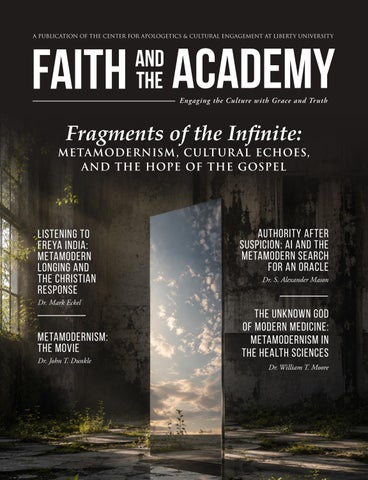
Fragments of the Infinite:
METAMODERNISM, CULT UR AL ECHOES, AND THE HOPE OF THE GOSPEL
LISTENING TO FREYA INDIA: METAMODERN LONGING AND THE CHRISTIAN RESPONSE Dr. Mark Eckel
METAMODERNISM: THE MOVIE Dr. John T. Dunkle
AUTHORITY AFTER SUSPICION: AI AND THE METAMODERN SEARCH FOR AN ORACLE Dr. S. Alexander Mason
THE UNKNOWN GOD OF MODERN MEDICINE: METAMODERNISM IN THE HEALTH SCIENCES Dr. William T. Moore
Fall 2026 Joshua Rice, Creative Director Heidi Schieber, Marketing Director Seth Bingham, Marketing Manager Jayden Hashimoto, Project Coordinator Deanna Sattler, Senior Designer Dave Parker, Senior Writer
FACEBOOK/LibertyUACE | X-TWITTER@LibertyUACE | envelope ACE@liberty.edu | location-arrow Liberty.edu/ACE “Fragments of the Infinite: Metamodernism, Cultural Echoes, and the Hope of the Gospel,” Faith and the Academy: Engaging Culture with Grace and Truth 10, no. 1 (2026-27): A publication of Liberty University Center for Apologetics & Cultural Engagement.
FA I T H A N D T H E A C A D E M Y: E N G A G I N G T H E C U LT U R E W I T H G R A C E A N D T R U T H
8
29
45
63
Metamodernism, Music, and the Recovery of Hope and Sincerity
Listening to Freya India: Metamodern Longing and the Christian Response
uthority After A Suspicion: AI and the Metamodern Search for an Oracle
BOOK REVIEW
Mindy Damon
Mark Eckel
S. Alexander Mason
i
6ii
Contents
1 Fragments of the Infinite: Hope in the Metamodern Moment
33 Metamodernism: The Movie John T. Dunkle, Ph.D., Liberty University
Kevin Richard, Ph.D., Liberty University
8 Metamodernism, Music, and the Recovery of Hope and Sincerity Mindy Damon, Ed.D., Liberty University
15 Student Engagement During a Vibe Shift Christopher Misiano, Ph.D., Liberty University
20 M etamodernists Welcome: How Christian Transcendence Fulfills the Metamodernist Ethos
38 What’s Old Is New Again: Christian Managers in a Metamodern World Roger B. Bingham, D.Mgt., Liberty University
45 A uthority After Suspicion: AI and the Metamodern Search for an Oracle S. Alexander Mason, Ph.D., Liberty University
52 T he Unknown God of Modern Medicine: Metamodernism in the Health Sciences William T. Moore, Ph.D., Liberty University
Brian Scalise, Ph.D., Liberty University Alumni
25 Preserving America’s Christian Heritage in the Metamodern Moment
57 M odernism, the Cauchy Traction of God, and the Return of Transcendence Mark Horstemeyer, Ph.D., Liberty University
Joseph Super, Ph.D., Liberty University
29 Listening to Freya India: Metamodern Longing and the Christian Response Mark Eckel, Ph.D., Liberty University
BOOK REVIEW 63 Magnifica Humanitas Joseph Dennis, Liberty University
TENTH ANNUAL
NEXT GEN APOLOGETICS CONFERENCE Co-sponsored by the Center for Youth Ministries
Equipping the Church to Engage the World
FALL 2027
Visit LIBERT Y.EDU/ACE for more details.
1
Editorial
Kevin Richard, Ph.D. Associate Professor of Theology and Apologetics Executive Director: Center for Apologetics & Cultural Engagement John W. Rawlings School of Divinity, Liberty University
Fragments of the Infinite: Hope in the Metamodern Moment Understanding the Cultural Moment A healthy apologetic methodology begins with seeking to understand the context in which one is giving a defense for the hope residing within. This is consistent with Peter’s instruction that Christians be prepared to give a defense yet do so with gentleness and respect.1 This exercise of understanding is vital for at least two reasons. First, it demonstrates a posture of love toward the person and culture being engaged. Second, genuine understanding creates the possibility for more fruitful dialog. When the Apostle Paul is invited to speak on the resurrection at Mars Hill in Athens to the intelligentsia of his day, we know that he had already been a student of Greek culture and its cultural products. He already had a robust understanding of their worldview and its assumptions. This is most clearly demonstrated in his speech where, in Acts 17:28, he quotes from Epimenides and Aratus and their respective statements on the Divine as the ground of being and humans his offspring. Having made a logical and spiritual connection to their religious beliefs, he then shifts his attention to Jesus and the resurrection as the unique act of God in creation. Paul was engaging the “cultural moment” of his day. If we are to take a similar approach and seek to engage culture similarly, what would that look like in the 21st century? Paul’s context and ours, in many ways, stand worlds apart. One difference of particular note is that in his context, the supernatural was largely assumed, but in ours, that is not the case. Where we find ourselves living in a particular context is often called a “cultural moment.” So, what is our cultural moment? To answer that question, it is helpful to tell something of the story of how we got here.
The Death of God and the Weight of Freedom Our story begins with a parable but not a biblical one. In his book The Gay Science, Friedrich Nietzsche
writes the “Parable of the Madman.” At the time of its publication, the parable served as both a warning and cause for optimism as he, Nietzsche, both diagnosed and warned European society of the infamous “death of God.” His parable tells of a madman who enters the marketplace in the morning carrying a lantern and crying out that he is looking for God. Those gathered there laugh at him. They no longer believe in God. But the madman understands something his hearers do not. The death of God is not merely the rejection of one belief among many. It is the removal of the transcendent horizon by which the West had understood reality, morality, and humanity itself. Nietzsche describes the consequences with striking imagery. It is as though the earth has been unchained from its sun, the horizon wiped away, and humanity left “straying through an infinite nothing.”2 Yet perhaps the most important part of Nietzsche’s parable comes after his announcement. The madman looks upon those who have mocked him and realizes, “I have come too early … my time is not yet.”3 Nietzsche understood that the cultural implications of the death of God would take time to be realized. Christian belief could be rejected while Christian assumptions about human dignity, morality, meaning, and purpose continued for a time. The deed had been done, but its consequences had not yet been fully realized. The 20th century would make those consequences increasingly difficult to ignore, however. Two World Wars did not end the modernist project in a single moment, but they severely wounded confidence in inevitable human progress. The trenches, mechanized slaughter, the Holocaust, and the atomic bomb revealed that reason, science, and technological advancement could be turned toward extraordinary destruction. In this postwar setting, the warnings and realizations Nietzsche raised became increasingly existential. It should be noted that warnings shouldn’t be read in the sense that Nietzsche wanted to avoid the “death of God.” No, his warning could be simply paraphrased, “continue on this path, but realize where it leads and what it takes to get there.”
2
3
FA I T H A N D T H E A C A D E M Y: E N G A G I N G T H E C U LT U R E W I T H G R A C E A N D T R U T H
If the madman’s audience of the late 19th century did not yet understand the implications of their own actions, the post-WW2 existentialists of the mid-20th century certainly did and began to fully embrace a thoroughly secularized worldview. It is here, at this moment, we might point to the loss of modernism and the shift to or rise of postmodernism. In 1945, Jean-Paul Sartre gave a lecture, later published as Existentialism Is a Humanism, which captured this shift. Two of Sartre’s claims are especially significant. First, “existence precedes essence.”4 If there is no God who creates humanity according to a nature and purpose, then there is no given human essence to receive. We simply exist and only afterward define ourselves. This represents a monumental shift. Human identity is no longer fundamentally discovered; it is constructed. Meaning is not received; it is made. But such freedom bears enormous weight. Sartre therefore makes his second infamous claim: man is “condemned to be free.”5 A human being is born into this world with no say in the matter. They are thrust into a reality entirely free of anything. This
freedom was meant to be liberation, a shrugging off the burden of religion, or in Nietzsche’s words, the lion saying, “I will” to the dragon called “Thou shalt.”6 Yet, if there is no transcendent source of meaning, no given human nature, and no final telos toward which human life is ordered, then the individual bears the responsibility of creating a life and meaning for himself. Freedom becomes not simply a gift but a burden. The very thing that was sought to be overthrown with the death of God has become a heavy yoke unto itself. Albert Camus places this burden into perhaps its starkest form. Camus begins his book The Myth of Sisyphus with the compelling statement, “There is but one truly serious philosophical problem, and that is suicide.”7 Camus is not advocating suicide. Rather, he is identifying what he believes to be philosophy’s most fundamental question: whether life is worth living. If humanity longs for meaning while inhabiting a universe that remains silent to that longing, then the question of whether to continue living logically precedes our other philosophical questions. Nietzsche removed the horizon, Sartre placed the burden of meaning upon the self, and Camus asked whether such a life could finally be born.
4
From Irony to Longing The postmodern turn that followed inherited this suspicion of transcendent accounts and added suspicion toward the grand narratives by which modernity had promised progress. Postmodernism taught the West to notice perspective, language, power, and social location. These were not all false insights, and James K.A. Smith is helpful in cautioning Christians against treating postmodernism as though it has nothing to teach us.8 Yet deconstruction is more effective at taking things apart than telling us what is worth building in their place. The irony of such a thing is that there is no “worth” out there toward which to ultimately point. One can hear something of this cultural mood in Nirvana’s 1991 “Smells Like Teen Spirit.” The song is not a philosophical treatise, but cultural products often tell us something about the people who make and receive them. Not only that, when released, it became an anthem for Gen X and the lived experiences of that generation.9 Its mixture of alienation, contradiction, apathy, and the shrugging demand, “Here we are now, entertain us,” and “I found it hard, it’s hard to find, Oh well, whatever, never mind,” can be heard as emblematic of a generation expressing disillusionment through irony.10 Something, however, appears to be shifting. In 2010, Timotheus Vermeulen and Robin van den Akker described an emerging sensibility first observed in the cultural product developing in the early 2000s. Movies, music, and art were all beginning to shift in some way that would indicate a noticeable change which Vermeulen and van den Akker characterized by an “oscillation between a typically modern commitment and a markedly postmodern detachment.”11 They called it metamodernism. The metamodern person has inherited postmodern skepticism but appears increasingly dissatisfied with postmodern cynicism. There is a renewed willingness to speak of sincerity, hope, beauty, reconstruction, and even transcendence. Brendan Graham Dempsey has further traced this movement noting there is a renewed coherence, purpose, and meaning on the other side of postmodern relativism.12 A current pop culture song, like Nirvana’s, again provides an interesting signpost on metamodernism. Artists Shaboozey and Stephen Wilson Jr.’s 2025 song “Took a Walk,” written for the movie The Long Walk, begins without embarrassment with biblical imagery,
invoking the land “where Adam stepped foot for the first time and realized he was man.”13 The contrast with the ironic disaffection of “Teen Spirit” should not bear too much weight, but it is at least suggestive. One cultural product speaks through fragmentation and apathy; another reaches toward biblical imagery, friendship, endurance, and hope. Yet, while Shaboozey and Wilson’s “Took a Walk” invokes some measure of transcendence in the biblical story it references, the artists later in the song remind the listener that “the key to life is enjoying the journey when you don’t know the end.”14 These biblical stories might help us get by, but ultimately, we don’t know how it all ends — the oscillation on full display.
Fragments of the Infinite It is here that metamodernism both gets something right and, at the same time, does not go far enough. Vermeulen and van den Akker describe the metamodernist as moving toward a purpose “as if ” one exists, and even as seeking forever for a truth it never expects to find.15 This is a hopeful improvement upon abandoning the search altogether as the postmodernists were wont to do. But does the oscillation have to remain perpetually horizontal? Must the quest remain naively informed? Must we move endlessly between sincerity and irony, hope and melancholy, belief and doubt? Or could the oscillation begin to spiral upward? The wise King Solomon described the pursuits of life “under the sun” as “vanity.”16 The phrase is instructive. A life lived only under the sun, on the horizontal plane of immanence, eventually encounters the limits of what the finite can provide. Walker Percy understood this modern predicament when he suggested that following the “death of God,” modern humanity may be “estranged from being” and “sick unto death with the loss of it.”17 Yet Percy also saw reason for hope. The person who has survived the theories and consumption of the age may become, “like St. Antony, a wayfarer in the desert,” once again “open to signs.”18 This is why the present cultural moment should not be viewed by Christians merely as another threat to be defeated. The renewed longing for transcendence represents an apologetic opportunity. Carl Trueman argues that what has occurred in modernity is more than disenchantment: “The death of God in modernity has led to the desecration of man.”19 If that diagnosis is correct, the answer cannot simply be to make the world feel enchanted again. If humanity remains perpetually estranged from the ground of Being, it cannot, on its
5
own power and might reclaim that which was lost. When “[God],” according to Nietzsche, “bled to death under our knives,” that which was holiest and mightiest was lost.20 In light of this, humanity has become desecrated, and what it needs again according to Trueman is “consecration.”21 Human beings must be understood once again as creatures made in the image of God, possessing a given nature, dignity, and telos. David Bentley Hart’s The Beauty of the Infinite presses the Christian answer further. Against postmodern accounts that reduce overarching claims to contests of power and violence, Hart presents Christian truth as grounded in the beauty and peace of the infinite Triune God.22 This provides an important theological backdrop for the title of this issue, “Fragments of the Infinite,” and served as inspiration for the play on words. The metamodern person who has accepted the “death of God” yet still longs for transcendence is now left with fragments, glimpses of beauty, meaning, love, hope, and sacredness without confidence that there is an Infinite to which they belong. But what if God has not died? What if these fragments are not merely human constructions projected onto an indifferent universe? What if the longing itself corresponds to reality? Christianity proclaims that behind these fragments is not an empty horizon but the infinite, personal, Triune God Who is the ground of all being and the telos of human longing. The Christian claim is not simply that transcendence exists, but that the transcendent God has made Himself known in Jesus Christ. The task before Christians in this cultural moment is therefore not merely to win arguments about transcendence. It is to understand those who have become open to signs and for us to faithfully point beyond the signs themselves to the One toward Whom they point. The articles in this issue of Faith and the Academy seek to engage this cultural moment with that posture. Metamodernism is not the Christian answer, but it may represent a renewed willingness to ask questions the Christian story has always claimed to answer. Furthermore, our hope is that along with a willingness to ask is a willingness to see how in every discipline of life, God is there as the transcendent ground. After a long season of deconstruction, irony, and suspicion, perhaps our culture is learning to hope again. If so, Christians should be prepared to give a reason for the hope within us and show the beauty of the infinite God to a culture fragmented, disenchanted, and desecrated, yet ironically hopeful.
6
1 Peter 3:15
1
Friedrich Nietzsche, The Gay Science: With a Prelude in German Rhymes and an Appendix of Songs, trans. Josefine Nauckhoff, ed. Bernard Williams (Cambridge: Cambridge University Press, 2001), §125, 119–20. 2
Nietzsche, The Gay Science, §125, 119–20.
3
Jean-Paul Sartre, Existentialism Is a Humanism, trans. Carol Macomber (New Haven: Yale University Press, 2007), 22. 4
Ibid., 29.
5
Friedrich Nietzsche, Thus Spoke Zarathustra, in The Portable Nietzsche, trans. and ed. Walter Kaufmann (New York: Viking Press, 1954), 138–39. 6
Albert Camus, The Myth of Sisyphus and Other Essays, trans. Justin O’Brien (New York: Vintage International, 1991), 3. 7
See James K.A. Smith, Who’s Afraid of Postmodernism? Taking Derrida, Lyotard, and Foucault to Church (Grand Rapids: Baker Academic, 2006). Smith’s stated project is precisely to reconsider what Christians might learn from Derrida, Lyotard, and Foucault rather than treating their thought as straightforwardly incompatible with Christianity. 8
Ryan Moore, Sells Like Teen Spirit: Music, Youth Culture, and Social Crisis (New York: New York University Press, 2009), 114–15. 9
Nirvana, “Smells Like Teen Spirit,” track 1 on Nevermind (DGC Records, 1991). Cobain himself connected the song with generational apathy while simultaneously complicating its supposedly revolutionary message. 10
Timotheus Vermeulen and Robin van den Akker, “Notes on Metamodernism,” Journal of Aesthetics & Culture 2, no. 1 (2010): 2. https://doi.org/10.3402/jac.v2i0.5677 11
Brendan Graham Dempsey, Metamodernism: Or, the Cultural Logic of Cultural Logics (Baxter, MN: ARC Press, 2023). 12
Shaboozey and Stephen Wilson Jr., “Took a Walk (from The Long Walk)” (American Dogwood/EMPIRE, 2025). 13
Ibid.
14
Vermeulen and van den Akker, “Notes on Metamodernism,” 5. Their formulation is especially useful here because they describe metamodernism as proceeding toward a telos “as if ” it exists and as continuing to search despite anticipating failure. 15
Ecclesiastes 1:2; 12:8
16
Walker Percy, “The Coming Crisis in Psychiatry,” in Signposts in a Strange Land, ed. Patrick H. Samway (New York: Farrar, Straus and Giroux, 1991), 262. 17
Walker Percy, “Why Are You a Catholic?,” in Signposts in a Strange Land, ed. Patrick H. Samway (New York: Farrar, Straus and Giroux, 1991), 314. 18
Carl R. Trueman, The Desecration of Man: How the Rejection of God Degrades Our Humanity (New York: Sentinel, 2026), 12, 21. Trueman distinguishes his account of desecration from a merely Weberian narrative of disenchantment and connects humanity’s moral identity to givenness, limits, obligations, and telos. 19
Nietzsche, The Gay Science, 119.
20
Trueman, Desecration, 209.
21
David Bentley Hart, The Beauty of the Infinite: The Aesthetics of Christian Truth (Grand Rapids: William B. Eerdmans, 2003), 1–34. Hart’s introductory argument explicitly positions Christian beauty and peace against the ontology of violence he diagnoses in modern and postmodern thought. 22
7
Faculty Contribution
8 Mindy Damon, Ed.D. Professor of Voice and Commercial Music School of Music, Liberty University
METAMODERNISM, MUSIC, AND THE RECOVERY OF HOPE AND SINCERITY The late twentieth and early twenty-first centuries have witnessed a profound reconfiguration of cultural and intellectual life. This shift is reflected in song lyrics that announce the recovery of imminent hope on the horizon. Modernism is characterized by rationality and progress, whereas postmodernism reveals the instability and contingency of such assumptions, exposing the degree to which they were culturally and historically conditioned.1 The rise of postmodernism — marked by skepticism toward universal truth and the deconstruction of belief — has fundamentally reshaped how meaning, authority, and identity are constructed and understood.2 The postmodern critiques modernism and vice versa; but to what end? It has yielded a diminished capacity to sustain and can now be viewed as an overplayed hand. The pushback of postmodernism cynicism on the naïve certainty of modernism has created a space that is fragmented and detached yet yields a promising tension in terms of a renewed hope for good things and meaning while maintaining awareness of reality. This tension is found in music in that while lyrics may hint toward a specific direction, there are moments and measures of ambiguity. Postmodernism has produced individuals highly capable of critique yet often unable to construct meaningful alternatives. As Fredric Jameson observes, this condition is marked by a “waning of affect,”3 in which emotional depth is flattened, and experience is reduced to surface-level engagement. Individuals can recognize contradictions and dismantle structures of meaning, yet they frequently lack the imaginative resources to envision what might replace them. The result is not merely intellectual fragmentation but a disorientation and a low-trust society. Religion and culture fellow at the Archbridge Institute Paul Anleitner cites an example of this disconnection in the low attendance in movie theatres in favor of watching a streaming service at home. There seems to be a desire to be isolated with the familiar instead of watching a movie with stranger.4
Charles Taylor’s concept of the “immanent frame” provides a particularly compelling account of this condition. Contemporary individuals increasingly find themselves living “within a natural (rather than a supernatural) order,”5 in which transcendence is no longer assumed but becomes merely one option among many. This produces what Taylor calls “cross-pressures,” a lived tension between belief and doubt, faith and skepticism, longing and disbelief. Such tension is not easily resolved; rather, it defines the modern condition of belief. The trend of deconstruction of faith is present in higher education, even on Christian campuses, as the next generation grapples with low trust in institutions, government, and core belief systems.6 Further, it is argued by Manglos-Weber, Hurtado, and Wang that “the spirituality of deconstruction may, therefore, function to both challenge and regenerate institutionalized contexts of religion in an overall setting of institutional decline.”7 Noticing a crisis of belief as a trend, scholars have begun to identify the emerging paradigm of metamodernism, although there seems to be agreement that its definition and borders are still being explored. Rather than rejecting postmodern critique, metamodernism seeks to move through it, retaining its insights while reopening the possibility of meaning, sincerity, and hope. Timotheus Vermeulen and Robin van den Akker describe this posture as an “oscillation between a modern enthusiasm and a postmodern irony.”8 This oscillatory condition is not merely theoretical; it is deeply experiential, and it finds one of its most compelling expressions in contemporary music. Music is a strong medium for metamodernism even more so than philosophical writing because music can hold ambiguity — through harmony, texture, and form — without collapsing it. Since metamodernism is about maintaining oscillation rather than resolving it, music becomes a uniquely effective medium.
9
Postmodernism in Music: The Waning of Meaning Postmodernism is defined by Jean-François Lyotard as “incredulity toward metanarratives,” signaling a rejection of universal truth claims in favor of localized and contingent perspectives.9 Scientific progress narratives, religious authority, and political ideologies alike were subjected to critique, leaving individuals to navigate meaning without overarching frameworks. Jean Baudrillard extended this diagnosis by arguing that contemporary society operates within a system of simulation, where representations no longer refer to reality but instead replace it.10 In this environment, meaning becomes detached from referential grounding, producing a sense of unreality and instability that permeates cultural experience. What once pointed beyond itself now circulates endlessly. These theoretical developments find vivid expression in music. Radiohead’s “Kid A” represents fragmentation through its dissonant textures, digital affect, and abstract structure. In “Everything in Its Right Place,” repetition initially suggests order but ultimately destabilizes it, mirroring the postmodern suspicion that apparent coherence may conceal deeper disorder. Similarly, Beck’s “Loser” embodies a posture of ironic detachment, transforming identity into something performative and unstable. The repeated refrain resists sincerity, replacing it with layered irony. Such works resonate deeply because they reflect genuine cultural experience. Yet their limitations are equally clear. They articulate fragmentation with precision but offer little constructive vision. Meaning is deconstructed without being rebuilt. In educational contexts, this dynamic becomes particularly evident. Students frequently demonstrate advanced critical thinking skills, especially in deconstructing texts, systems, and ideologies. Yet many struggle to articulate what they do believe or why it matters. The result is a cultural posture of awareness without direction — clarity about what is broken, but uncertainty about how to move forward. Ecclesiastes captures a similar existential pattern: “Of making many books there is no end, and much study wearies the body” (Ecclesiastes 12:12, ESV), suggesting the limits of critique when disconnected from wisdom and purpose.
Metamodernism in Music: Oscillation and the Return of Hope Metamodernism emerges as a response to this impasse. Rather than resolving the tension between modern certainty and postmodern skepticism, it embraces oscillation as its defining characteristic. Vermeulen and van den Akker describe this movement as one that “oscillates between and beyond” these paradigms,11 sustaining both critique and hope simultaneously. Poison’s 1990 rock ballad “Something to Believe In” creates a pivotal moment between late-postmodern and metamodern tendencies. The song embodies both late-postmodern disillusionment and emerging metamodern sensibilities. The verses reflect a distinctly postmodern posture, marked by skepticism toward cultural institutions — especially religion — and a deep uncertainty regarding the existence of anything truly trustworthy. In this way, the lyrics echo the postmodern suspicion of belief systems and the fragmentation of meaning, raising the question of whether truth or stability ever genuinely existed. Yet the song does not remain confined within postmodern critique. In the chorus, it transitions toward a metamodern orientation, moving beyond irony into a sincere and earnest longing for meaning. The repeated plea, “Give me something to believe in,” functions as a genuine cry rather than a rhetorical device, signaling a renewed openness to hope even in the absence of certainty. This oscillation between disillusionment and desire reflects a broader cultural shift in which individuals, though shaped by postmodern skepticism, continue to yearn for truth, transcendence, and belief. From a theological perspective, this longing resonates with the enduring human search for meaning described in Scripture. God has “set eternity in the human heart” (Ecclesiastes 3:11), suggesting that even in seasons of doubt and fragmentation, the impulse toward belief and transcendence persists. In this sense, the song serves not only as a cultural artifact of its time but also as an expression of a universal human condition — one that ultimately points beyond itself to the deeper fulfillment of that longing. While “Something to Believe In” emerges from a postmodern context of disillusionment and skepticism, it resists remaining there, instead articulating a sincere longing for meaning — making it a bridge between postmodern fragmentation and a renewed search for hope.
10
A key feature of this shift is the reconfiguration of doubt. In postmodernism, doubt often leads to disengagement or paralysis. In metamodernism, however, doubt becomes productive — an integral component of belief rather than its negation. Luke Turner characterizes this posture as “pragmatic idealism,”12 a willingness to pursue meaning despite uncertainty. This approach resonates deeply with the biblical articulation of faith: “Now faith is the assurance of things hoped for, the conviction of things not seen” (Hebrews 11:1, ESV). Faith does not deny uncertainty but situates hope within it. This shift reflects a broader cultural fatigue with cynicism. While critique remains essential, it cannot sustain meaning on its own. Individuals increasingly seek coherence, purpose, and transcendence, even as they remain aware of complexity. Metamodernism allows for this pursuit without requiring naïve certainty. It affirms the legitimacy of longing for Jesus as the only satisfaction for the soul — what Augustine famously described as the restless human condition: “our heart is restless until it rests in you.”13 For Christian apologetics, this represents a crucial opportunity. The contemporary audience is not defined purely by resistance to belief but by tension — an openness shaped by doubt, longing, and imagination. Engagement must therefore move beyond purely rational argumentation to include aesthetic, narrative, and experiential dimensions of truth. Music provides a powerful medium through which such engagement can occur.
Metamodernism in Music: The Recovery of Sincerity Music provides one of the clearest expressions of the metamodern sensibility. Nicholas Bannan and Alan R. Harvey note that musical behavior is “inextricably linked to human social behavior and associated collective expression,” emphasizing its deep connection to cultural life and shared human experience.14 Scholars in sociomusicology likewise argue that music “reflects societal values” and communicates complex social meanings embedded within cultural contexts.15 In contrast to postmodern irony, many contemporary artists embrace sincerity and vulnerability while maintaining awareness of ambiguity and limitation. This dynamic results in a musical language marked by emotional depth, layered meaning, and oscillation between despair and hope.
11
Bon Iver’s “Holocene” offers a compelling example. The lyric “I was not magnificent” reflects a recognition of human limitation and finitude. Yet this admission does not lead to nihilism. Instead, it reframes meaning within relational context. The expansive sonic landscape suggests transcendence, even as the text acknowledges smallness. This mirrors Psalm 8:4 — “What is man that You are mindful of him?”— where humility becomes the pathway to wonder rather than despair. A musical moment that demonstrates oscillation is where the instrumentation subtly expands after the early verses. The shift isn’t dramatic, but the addition of texture and space changes how the vocal feels — it moves from isolated to something more connected to a larger sonic environment. That moment embodies oscillation between intimacy and transcendence. Arcade Fire’s “Wake Up” similarly navigates the tension between fragmentation and hope. The song begins with introspection but gradually builds into a communal chorus, suggesting a movement from isolation to shared meaning. This progression embodies the biblical call toward communal renewal: “Let us consider how to stir up one another to love and good works” (Hebrews 10:24, ESV). The music itself enacts this movement, drawing listeners from interior reflection into collective expression.
Coldplay’s “Fix You” further illustrates this metamodern dynamic. The phrase “lights will guide you home” expresses hope without denying suffering. The gradual crescendo — from quiet lament to anthemic release — mirrors the psalmic pattern of lament and restoration. The structure recalls Psalm 30:5: “Weeping may tarry for the night, but joy comes with the morning.” The music does not eliminate pain; it situates it within a larger narrative of redemption. The structure is crucial because it mirrors a lamentto-restoration arc. The song begins with minimal instrumentation and a subdued vocal, which creates a sense of vulnerability and loss. As the song progresses, there’s a gradual layering — organ, guitar, drums — leading to a powerful climax. That structural crescendo embodies movement from brokenness toward renewal. So, the theology isn’t just in the lyric “lights will guide you home” but in the form itself, which enacts restoration. Billie Eilish’s work introduces an additional layer of complexity to this cultural landscape, juxtaposing vulnerability with detachment and intimacy with distance. This oscillation reflects the lived reality of many individuals who move between authenticity and guardedness, inviting listeners to inhabit tension rather than resolve it prematurely. In one of her most widely
12
recognized songs, she poses a question that captures the essence of the human journey: “What Was I Made For?” The question is neither resolved nor framed with accusation; rather, it is offered quietly, without resistance to authority or institutional critique. The ballad’s restrained tone suggests a notable peace within uncertainty — a willingness to remain in the unknown. Yet the question itself signals hope, implying that an answer may exist and inviting deeper reflection. Scripture speaks directly into this space of suspended longing. The biblical witness affirms that human identity and purpose are neither accidental nor undefined but rooted in divine intention: “For You created my inmost being; You knit me together in my mother’s womb” (Psalm 139:13), and “we are God’s handiwork, created in Christ Jesus to do good works” (Ephesians 2:10). Likewise, the ultimate telos of humanity is relational and Christ-centered, as believers are “predestined to be conformed to the image of His Son” (Romans 8:29). In this light, the question “What was I made for?” is not dismissed but fulfilled — its tension acknowledged yet directed toward a coherent and hope-filled answer grounded in creation, purpose, and transformation in Christ. It is within this intersection of cultural longing and theological clarity that music holds transformative potential. When embraced within educational contexts and the broader artistic community, music can serve as a conduit for articulating truth while cultivating a posture of peace toward unresolved questions. In doing so, it affirms its role not only as a reflection of cultural tension but also as a formative force in shaping meaning, belief, and hope.
Music as a Vehicle for Hope
Kellie Brown emphasizes music’s role in fostering wellbeing and social connection,17 while Jeremy Begbie argues that music reflects patterns inherent within creation itself — tension, resolution, dissonance, and harmony.18 These patterns are not merely aesthetic but theological. They echo the structure of creation, fall, and redemption — a world marked by brokenness yet oriented toward restoration. Scripture consistently affirms music’s capacity to mediate hope. The psalmist declares, “He put a new song in my mouth, a song of praise to our God” (Psalm 40:3, ESV). The “new song” represents transformation — not the denial of prior struggle but its redemption. Similarly, Colossians 3:16 calls believers to “sing psalms and hymns and spiritual songs,” suggesting that music plays a formative role in shaping communal identity and theological understanding. In a metamodern context, this capacity is especially significant. Music allows individuals to experience hope even when they cannot fully articulate it. It creates a space in which tension can be sustained without collapse, where lament and expectation coexist. This reflects Paul’s description of the Christian life as one lived in groaning and hope simultaneously (Romans 8:22–25). For apologetics, this suggests a broader mode of engagement. Music can function as a bridge between doubt and belief, opening pathways that purely propositional arguments may not reach. It invites individuals into an encounter with meaning rather than merely an explanation of it. In this sense, music participates in what Hans Urs von Balthasar describes as the “theological aesthetics” of revelation — the disclosure of truth through beauty.19
From a cognitive perspective, David Huron’s research helps explain why such music resonates so deeply. He argues that “the anticipation of events is one of the principal sources of emotional experience in music.”16 The interplay between expectation and fulfillment creates meaning through tension and release. This musical dynamic parallels the oscillatory nature of metamodernism. Meaning is not static but emerges in the movement between poles.
Theological Reflection: A New Song and Living Hope
Music communicates meaning not only cognitively but experientially. It engages listeners across emotional, intellectual, and communal dimensions simultaneously, often shaping perception before articulation is possible. This makes music uniquely suited to a cultural moment characterized by tension and ambiguity.
The motif of the “new song” (Psalm 40:3; Revelation 5:9) symbolizes transformation — a renewed orientation toward reality rooted in encounter with God. This parallels metamodernism’s emphasis on
The patterns observed within metamodernism resonate deeply with biblical theology. Scripture consistently presents hope not as denial of reality but as trust grounded in God’s character. Romans 15:13 identifies God as “the God of hope,” emphasizing that hope is relational rather than abstract.
13
lived posture rather than abstract certainty. Just as metamodernism embraces oscillation, Christian faith acknowledges the ongoing tension between the already and the not yet of redemption. Alister McGrath reinforces this connection by arguing that “doubt is not the opposite of faith, but an element of faith.”20 Faith does not eliminate uncertainty; it integrates it within trust. This aligns closely with the oscillatory nature of metamodern thought, in which belief and doubt coexist dynamically. Music, in this light, becomes a theological witness. It enables individuals to experience tension and hope simultaneously, reflecting the lived reality of faith. The Christian life is not one of unbroken certainty but of faithful movement through uncertainty toward trust. As 2 Corinthians 5:7 declares, “For we walk by faith, not by sight.” Moreover, the incarnation itself embodies a metamodern logic of both/and. Christ is fully divine and fully human, holding together paradox without collapse. Music, with its capacity to sustain multiple emotional registers simultaneously, mirrors this incarnational reality in aesthetic form. While music and biblical faith can be linked, this comparison breaks down in that metamodernism doesn’t provide a grounded source of hope — it simply reopens the possibility of hope. Biblical faith, however, grounds hope in the character of God. So, while both involve holding tension, Christianity ultimately moves toward confidence in a revealed truth, whereas metamodernism may remain indefinitely open-ended.
Implications for Christian Higher Education and Apologetics The rise of metamodernism carries significant implications for Christian education. Students must be equipped not only to critique culture but to engage it constructively and imaginatively. This requires an integration of analysis and creativity — what might be described as a formation of both mind and imagination. Music offers a powerful medium for such integration. It allows students to explore meaning conceptually and experientially, engaging both intellect and emotion. This aligns with the biblical understanding of wisdom as holistic, involving not merely knowledge but lived understanding as described in Proverbs 2:2–6:
Making your ear attentive to wisdom and inclining your heart to understanding; yes, if you call out for insight and raise your voice for understanding, if you seek it like silver and search for it as for hidden treasures, then you will understand the fear of the Lord and find the knowledge of God. For the Lord gives wisdom; from His mouth come knowledge and understanding. Rather than resisting cultural tension, educators can employ it as a space for formation. The oscillation characteristic of metamodernism provides an opportunity for faith and inquiry to intersect meaningfully. Students can be encouraged to dwell within questions while anchoring themselves in the hope of the Gospel. In practical terms, this might involve analyzing contemporary music through both theological and cultural lenses, inviting students to discern how artistic expression reflects deeper metaphysical and spiritual realities. Such engagement fosters not only critical thinking but imaginative participation in the recovery of meaning.
Conclusion Metamodernism provides a compelling framework for understanding contemporary culture. By embracing tension rather than resolving it prematurely, it allows for a renewed pursuit of meaning, sincerity, and hope. It does not discard the insights of postmodern critique but moves beyond them, reopening the possibility of belief without denying complexity. Music plays a central role in this shift, offering a medium through which oscillation can be experienced rather than merely theorized. Through its capacity to sustain tension while pointing toward resolution, music becomes a powerful vehicle for engaging the deepest dimensions of human experience. It embodies what words alone often cannot — an encounter with hope that is both honest and transformative. For Christian scholars and educators, this moment represents a significant opportunity. By engaging culture with sincerity, creativity, and theological depth, they participate in the recovery of hope within an increasingly fragmented world. In doing so, they echo the biblical call to “sing a new song” (Psalm 96:1), bearing witness to a hope that endures even amid uncertainty.
14
Luke Turner, “The Metamodernist Manifesto,” 2011.
12 1
Fredric Jameson, Postmodernism (Durham, NC: Duke University Press, 1991), 10.
13
Jean-François Lyotard, The Postmodern Condition (Minneapolis: University of Minnesota Press, 1984), xxiv.
14
2
3
Fredric Jameson, Postmodernism, 14.
Paul Anleitner, https://www.archbridgeinstitute.org/author/ pau242nlewfl/. 4
Charles Taylor, A Secular Age (Cambridge, MA: Harvard University Press, 2007), 539. 5
Nicolette Manglos-Weber, Claudia Alvarez Hurtado, and David C. Wang, “The Spirituality of Deconstruction in United States Theological Schools,” Religions 15, no. 2 (2024): 188, https://doi.org/10.3390/ rel15020188. 6
7
Ibid, 188.
Timotheus Vermeulen and Robin van den Akker, “Notes on Metamodernism,” Journal of Aesthetics & Culture 2 (2010): 5. 8
9
Lyotard, The Postmodern Condition, xxiv.
Jean Baudrillard, Simulacra and Simulation (Ann Arbor: University of Michigan Press, 1994), 1. 10
11
Vermeulen and van den Akker, 6.
Augustine, Confessions, trans. Henry Chadwick (Oxford: Oxford University Press, 1991), I.1. Nicholas Bannan and Alan R. Harvey, “Music as a Social Instrument: A Brief Historical and Conceptual Perspective,” Frontiers in Cognition (2025). Joseph Dewey, “Sociomusicology,” EBSCO Research Starters (2021).
15
David Huron, Sweet Anticipation (Cambridge, MA: MIT Press, 2006), 16. 16
Kellie D. Brown, Music and Well Being (New York: Routledge, 2019), 22. 17
Jeremy S. Begbie, Theology, Music and Time (Cambridge: Cambridge University Press, 2000), 56. 18
Hans Urs von Balthasar, The Glory of the Lord, vol. 1 (San Francisco: Ignatius Press, 1982), 19. 19
Alister E. McGrath, Doubting (Downers Grove, IL: InterVarsity Press, 2006), 34. 20
15
Faculty Contribution
Christopher Misiano, Ph.D. Vice President of Campus Recreation & Logistics Liberty University
Student Engagement During a Vibe Shift This year, college and university campuses across the country teem with young people born in the middle to late aughts (2000–09). They grew up with war, recession, and political polarization as part of their day-to-day lives. Many were handed an iPhone or iPad as small children. They witnessed scandals in Hollywood as well as the church. From a young age, they navigated social media fragmentation and social media performance culture. A global pandemic interrupted their childhood. Raised by Gen X parents and boomer grandparents, they reflected on how the promises of modernism gave way to the cynicism of postmodernism. Some watched as their millennial older brothers and sisters deconstructed their faith, with some abandoning the faith of their parents altogether, while others reconstruct it anew. Against this backdrop, young people come of age seeking answers to timeless questions about who they are, how they relate to others, how to define “the good life,” and how to understand ultimate meaning. Engaging these students requires insight into the philosophies and worldviews that drive their thinking, priorities, and interests. In recent years, scholars have found terminology to help describe this cultural moment. While the impact and influence of postmodernism remain, a new term began to emerge: metamodernism. Vermeulen and van den Akker help define it by pointing out how metamodernism “oscillates between a modern enthusiasm and a postmodern irony.”1 This oscillation, or in-betweenness, provides the context for engaging with those who absorbed metamodernism as their cultural milieu (probably without even being able to articulate it). For those seeking to understand the metamodern mindset, an appreciation of the fact that it both reacts against postmodernism but also springs forth from it can help provide a loose framework. This framework looks paradoxical because the metamodernist swings between seemingly contradictory impulses. In his Metamodernist Manifesto, Luke Turner embraced “the mercurial condition between and beyond irony and sincerity, naivety and knowingness, relativism and truth, optimism and doubt.”2 Both comfortable yet uncomfortable with this oscillation, the modern student might present the skepticism of postmodernism,
yet quickly and sincerely convey an attraction to, and longing for, transcendence. How can this moment be met with truth and grace? For Christians working in higher education, we must meet this cultural moment with humility, kindness, and confidence. We have an opportunity to answer questions of meaning and transcendence with the truth of the Gospel as expressed in the person of Jesus Christ. While metamodernism (or the effects of it) might be discussed and debated in the classroom, co-curricular spaces also provide an environment for exploring these themes alongside students. To better understand what student engagement looks like, first look at the art students are consuming, celebrating, and discussing. To do that, look up — it’s a bird, it’s a plane, it’s … Superman. That’s right, the Man of Steel flew back into movie theaters in the summer of 2025 with his classic red cape and a cute dog (Krypto). This version of Superman embodied the classic traits of heroism. Gone were the bleak themes and conflicted tones of Zack Snyder’s previous iterations of the Hero of Metropolis. In fact, when Lois Lane describes herself as someone who naturally questions everything and everyone, she contrasts herself with Superman, who “trust[s] everyone and think[s] everyone [he] ever met is, like ... beautiful.” Superman replies, “Maybe that’s the real punk rock.”3 Instead of a dark, moody, and morally conflicted antihero, the audience sees a return to some of the classic hero motifs. Cultural theologian Paul Anleitner traces the rise, triumph, death, and return of Superman to show that society now finds itself on the other side of the postmodern anti-story.4 This vision cannot work with our cultural archetypes, and it cannot ultimately work for those seeking religious truth either. Anleitner writes, “The engine of cynicism and deconstruction will turn inward on the community and cause it to implode.”5 By recognizing this vibe shift, Christian educators may guide conversations around the arts toward truth and ultimate hope. Superman has company in the sky lately as other movies embrace the metamodern trend. From Project Hail Mary (2026) to Top Gun: Maverick (2022), echoes
16
17
of metamodernism show up in these films with their sincerity and optimism. Brett McCracken describes Project Hail Mary as “a disarmingly earnest movie, unembarrassed by emotional catharsis.”6 While the backdrop and setting include an apocalyptic scenario common in many postmodern films, the main character (Grace) swings between funny, earnest, and serious but does not become cynical. A few years earlier, Top Gun: Maverick thrilled moviegoers through a return to classic big-screen heroism.7 Several other prominent examples, including Spider-Man: Into the Spider-Verse (2018) and The Lego Movie (2014), previously began this trajectory of using both irony and sincerity to weave coherent tales of hope.8 The pendulum swing between the idealism of modernism and the cynicism of postmodernism shows up on the small screen as well. As “prestige” television transitioned from cable and premium channels to streaming services, the vibe shift toward metamodernism became evident in many stories and characters still popular today. The American adaptation of The Office leans heavily on irony, but it pushes through the irony to find connection with and between characters. Viewers found themselves invested in the romance of Jim and Pam and genuinely empathetic with Michael’s longing to start a family (despite his cringeworthy behavior). This stands in contrast to the quintessentially postmodern “show about nothing,” Seinfeld, where the creators actively avoided moral lessons or happy endings.9 If “You Are What You Love,” as philosophy professor James K.A. Smith argued in his 2016 book, then it is worth considering how the affections of a student are formed by clicking “continue watching” for the fifth (or tenth) time while bingewatching Parks and Recreation over the course of a weekend.10 Arriving around the same time as streaming television services, music streaming providers piped in a wave of artists emblematic of the metamodernist mindset. Sometimes this showed up clearly, such as country musician Sturgill Simpson’s 2014 album, Metamodern Sounds in Country Music.11 At other times it appeared more subtly, like in the honest wrestling with faith and doubt in the hip-hop rhymes of Kendrick Lamar. Many other artists across various genres sing, write, and perform songs that grapple with issues of meaning in a way that values sincerity while being self-aware enough to recognize (and use) irony. In addition to mainstream examples, Christian musicians worked through themes of faith, doubt, deconstruction, and politics. Hiphop artist Lecrae publicly worked through issues of
deconstruction and doubt on his aptly titled album Reconstruction (2025).12 Similarly, bands like Kings Kaleidoscope openly and emotionally discuss church hurt but still point to Jesus as their ultimate hope. Singer-songwriter Chris Renzema sings honestly about mental health struggles, saying, “Cause God, I know a day’s coming when You’ll make all things new, but till then, I’ll just try to be honest with You.”13 Regardless of what genre they prefer, Christian students probably encountered metamodernism at some point as they added songs or albums to their Spotify library. Whether they know it or not, expressions of metamodernism impact and affect students based on their proximity to the culture around them. As the metamodern (or was he merely post-postmodern?) pioneer David Foster Wallace pointed out, fish have trouble recognizing water since it is all they know.14 What does this all mean for the faithful Christian professor or administrator looking to engage students? Their calling does not involve becoming a movie reviewer, avid concertgoer, or pop-culture critic. However, these examples from television, films, and music help diagnose and illuminate the condition of many students. These students will not arrive with T-shirts or bumper stickers declaring themselves adherents to metamodernism, but they still inhabit a world influenced by it. The oscillating questions and longings framed by metamodernism point toward the transcendent, thus presenting an opportunity to offer stable answers grounded in Christian hope. These answers can be presented within the context of generous hospitality. A student should feel welcome to discuss cultural artifacts in a space where their ideas are heard and not dismissed out of hand. Being hospitable implies a spirit of openness, giving students space to articulate why a show, a movie, or an artist resonates with them (or makes them uncomfortable). This does not mean that a professor or a staff member should not push back, but first, they could ask questions and engage in dialogue as they point to the truth. Being generous involves providing space and time to help foster these conversations. A campus that wishes to do this intentionally will make spaces available for events and conversations to occur in both academic and non-academic settings. The options are endless, as office hours, campus events, lectures, and other forums provide environments for discussion. While the classroom is one place, the dorm room, the residence hall, the sports field, and other campus spaces should be seen as venues for engaging with students. In these places, students are open to watching a movie,
18
discussing a concert, or joining a book club. Generous hospitality stands in contrast to a dismissive stance that downplays the impact of culture or merely attempts to give quick or trite answers (such as looking for a Christ figure in every film or imposing Christian allegory where it does not exist). With generous hospitality as the backdrop, student engagement requires understanding students as whole persons. Yes, their intellectual development must occur, but not at the expense of the other elements vital to the college experience, such as social relationships and their moral imagination. Some campuses might err more toward being “concerned with information rather than formation,” which “reduces Christianity to a denuded intellectual framework.” The result is that “such an intellectualized rendition of the faith doesn’t touch our core passions.”15 Christian higher education can point students to the good, the true, and the beautiful by allowing — and even welcoming — questions and then encouraging them to move toward answers. It is a disservice to leave them bouncing from framework to framework as they search for meaning. An opportunity exists to meet them in this, walk alongside them, and give space for questions, but also to help their journey arrive at a destination.
Timotheus Vermeulen and Robin van den Akker, “Notes on Metamodernism,” Journal of Aesthetics & Culture 2, no. 1 (2010): 6, https://doi.org/10.3402/jac.v2i0.5677. 1
Luke Turner, “The Metamodernist Manifesto” (2011), http://www. metamodernism.org/. 2
James Gunn, dir., Superman (Warner Bros. Pictures, 2025).
3
Paul Anleitner, Based on a True Story: Vibe Shifts, the End of Deconstruction, and the Reboot of Meaning (Nashville: Thomas Nelson, 2026), 59. 4
Anleitner, Based on a True Story, 60.
5
Brett McCracken, “‘Project Hail Mary’ Offers the Good, Clean, Fun Moviegoers Have Missed,” The Gospel Coalition, March 16, 2026, https://www.thegospelcoalition.org/article/project-hail-mary-christianmovie-review/. 6
Joseph Kosinski, dir., Top Gun: Maverick (Paramount Pictures, 2022).
7
Bob Persichetti, Peter Ramsey, and Rodney Rothman, dirs., Spider-Man: Into the Spider-Verse (Sony Pictures Releasing, 2018); Phil Lord and Christopher Miller, dirs., The Lego Movie (Warner Bros. Pictures, 2014). 8
Greg Daniels, creator, The Office (NBC, 2005–2013); Larry David and Jerry Seinfeld, creators, Seinfeld (NBC, 1989–98). 9
James K.A. Smith, You Are What You Love: The Spiritual Power of Habit (Grand Rapids: Brazos Press, 2016), 1–3. 10
Sturgill Simpson, Metamodern Sounds in Country Music (High Top Mountain Records, 2014). 11
Lecrae, Reconstruction (Reach Records, 2025).
12
Chris Renzema, “God & Prozac,” On Manna, Pt. 1 (Centricity Music, 2023). 13
The destination remains the same this year as it has in previous years. Regardless of any current cultural or philosophical trends, the destination continues to be the work and person of Jesus Christ. The hope of the Gospel remains the same. Yes, a longing exists within metamodernism, and that longing deserves an answer. When questioned if she believes in God, a main character in Project Hail Mary replies, “It beats the alternative.”16 This type of quintessentially metamodern response could be heard on any campus this year. It contains sincerity, a need for transcendence, and slight skepticism (and it is a bit cheeky). Instead of scoffing at it or providing a quick rebuttal involving Occam’s razor, a Christian educator has an opportunity for a meaningful interaction that clearly and strongly presents the hope of the Gospel. They should avoid being satisfied that metamodernism can lead to sincerity instead of the cynicism of postmodernism. Instead, they should enter the conversation ready to point to ultimate hope and ultimate answers. The ultimate answer is found in response to a poignant question leveled at all of humanity. It was posed long ago to a ragtag group of men by their teacher, and one was able to answer boldly and correctly. The question demands an answer of everyone, even today: “But who do you say that I am?” (Matthew 16:15, ESV)
David Foster Wallace, This Is Water: Some Thoughts, Delivered on a Significant Occasion, about Living a Compassionate Life (New York: Little, Brown, 2009), 3–8. 14
James K.A. Smith, Desiring the Kingdom: Worship, Worldview, and Cultural Formation, Cultural Liturgies 1 (Grand Rapids, MI: Baker Academic, 2009), 219. 15
Phil Lord and Christopher Miller, dirs., Project Hail Mary (Amazon MGM Studios, 2026). 16
Guest Contribution
20 Brian Scalise, Ph.D. Liberty University Alum
Metamodernists Welcome: How Christian Transcendence Fulfills the Metamodernist Ethos God’s infinite nature is outlined in the many Scriptures declaring His eternality. From that, we can infer eternality implies infinity. That He is infinite also informs why the Gospel is not just hopeful but Hope itself. The variety of intellectual seasons that have passed in recent centuries must ultimately face the critique of bifurcating subjectivity and objectivity issued by the doctrine of the Trinity. Modernism, postmodernism, and now metamodernism all dance around the Trinity as a rival no one knows how to finally handle or fully deny. This fact is more because of the difficulty of the doctrine than scholars’ inability to criticize. The doctrine — and the ontological reality it represents — is uncontainable, its contours are always elastic, implying if not inviting endless engagement. Needless to say, if they criticize, the Trinity is not a contender easily subdued. The crux of the Trinity’s indefeasibility resides in how serious He is considered. When He is taken seriously, that God is eternal becomes a basic maxim. If He is eternal, then He is not containable — as the Church Fathers said often, “God is not circumscribable.” Scholars can criticize Him, but He evades as much as He challenges. They are left wondering how Someone Who can’t ultimately be pinned down can at last be defeated. The mixture of the Trinity being infinite, that it took some of the brightest philosophical minds five centuries to articulate it, and that it cannot be digested through standard logic, leaves scholars with an Idea whose resistance to criticism has as much to do with Its own logical cohesion as Its pure evasion ability. It is rather humorous that if Christian Trinitarianism is true, this divine durability is what might be expected. The reference to the Trinity not being understood through standard logic deserves a brief word. This claim does not conjure the specter of absurdity. In Christian Trinitarianism, the Trinity is the foundation of all things, far broader than reducing Him to logical judgement. In apologetics’ language, the Trinity must be considered as a cumulative case precisely because He is the explanation of the cumulative states of affairs of this reality. This means that logic plays into
understanding Him but cannot reduce His viability to logical limitations. All logical formulations involve sequence, but if God is eternal, whence is sequence? Again, this does not mean that logic and sequence have no role in understanding God, but they take no position of priority or stand-alone judge. Their value is precisely in a coherent framework beyond themselves, especially if the Trinity is the primordial “logic” of all things. Modernism’s failure, or at least its main epistemological current, was in the caricature of the human-world relationship and that interaction. This ties in with its failed binary: the objective versus subjective bifurcation that frustrates so much cogent thinking. This epistemic binary is what set up and guided modernism and postmodernism and currently guides metamodernism: it is this flawed structure that frames most of the West’s epistemology, and this structure is what empowers and makes these intellectual movements possible.1 What does “intellectual movement” intimate in this context? The binary is a stark intellectual preference, but it is not the only option. This means that generations of thinkers have been hemmedin by an epistemic framing that is one intelligent option among others. Thus, referring to modernism, postmodernism, and metamodernism as intellectual movements in no way implies anti-intellectualism toward or in other alternatives. If we dared a more hostile tone for a moment, the binary could be claimed to be cartoonish. How can a brute fact (objective), for instance, not also be an observed fact (subjective)? Nevertheless, hostilities do not respect the great outputs these movements have produced, but such respect does not prevent thinkers from questioning the entire binary framework. Many phenomenologists — and their predecessors — have struck this drum more than once, so I take no credit in the observation.2 Phenomenology can be paired with an infinite partner, the Trinity, and what we find is a properly basic belief that Someone predates the binary’s caricature.
21
The subscription Metamodernism offers is a swinging pendulum.3 In this vacillation, humans are allowed the grace of touching the transcendent only to be forced to put their feet back on the ground, being told that their naivete must be tempered. It is a hard sell to convince people that evolved animals somehow became more heavenly focused than earthy focused. The evangelism needed to get someone to buy this is sizable. The better question is, “Why the intuition to desire the transcendent at all?” or better still, “Why is the desire of the transcendence a call to keep our feet firmly planted?”4 It is that old Platonic, misleading idea that posits the raising above the material realm; the Gospel teaches us that we need go nowhere to find it: “Now what I am commanding you today is not too difficult for you or beyond your reach. It is not up in heaven, so that you have to ask, “Who will ascend into heaven to get it and proclaim it to us so we may obey it?” Nor is it beyond the sea, so that you have to ask, “Who will cross the sea to get it and proclaim it to us so we may obey it?” No, the word is very near you; it is in your mouth and in your heart so you may obey it (Deuteronomy 30:11–14, Paul cites this in Romans 10:6–8).” The lesson — that resources are near to us rather than out there somewhere — is one centered on the lack of creative resources. With these preliminary comments made, I will spend the rest of my time explaining the “pendulum effect” of metamodernism and using the infinite Trinity for my Resource. They are the Resource that tells the story better than what metamodernism can give, and it has the coherency to do it better as well. In this sense, this is a brief abductive effort to quickly speak to metamodernism’s salient points but in terms of the Church’s other theological resources. My aim is to show how the Gospel and its hero, the Trinity, are better than the precarious situation metamodernism expects people to live in. Even still, metamodernism has much to offer the Christian discipline of discipleship, and we will return to that as a final order of business. The binary of death and life fits with metamodernism, a living and attending to life and knowing we will swing into death at some point.5 Metamodernism lets people enjoy this life, but when minds start to drift toward heaven, it directs them to stay focused on the here and now. She preaches her gospel, “Enjoy life, drink deeply, but when you fantasize of its ongoing nature, you must return with me to the dirt.” The promise of the Gospel, the Christian infinite, does
not let us avoid death but happily makes it part of the saints’ preservation. The Christian’s feet stay planted, and it is through death that life carries on, which is the point of the Cross.6 Death is a boundary, but the infinite can have no boundaries, or otherwise the infinite would no longer be infinite, and eternality would no longer be eternal. Soteriology is really a doctrine of preservation. Metamodernism’s instinct is right; we desire something more, and it is right again when it tells us not to avoid the tempering of death. It simply needs the compelling Gospel of the Trinity, which invades and overcomes every boundary. The Trinity goes through it; He has no need to evade or avoid the confrontation, but They do it on their terms, not using violence but — to the applause of metamodernsim — ironically using violence in a Lamb getting slaughtered for the life of all. Pure irony, the stuff of legends, and the metamodernists are on their feet for such a compelling act in this play. Postmodernism taught Christians that the deferral of meaning is not something that is only negative.7 In fact, because the Trinity is infinite, the deferral of meaning is the active life and joy of creatures who change day to day. Deferral, of course, can be understood as supplementation. Metamodernism tempers those forming objective hopes, allowing humans to enjoy the thought of being known and knowing others while sitting them down when they are having too much relationship fun: “Don’t get carried away!” The Christian Infinite tells a better story. The Infinite Trinity tells us that the story is never over, and the knowing and being known is, for us, always partial, incremental, and ongoing. Thus, heaven is presented as heaven forever. It may not be immediately obvious, but only with the promise of ongoing supplementation and growth in intimacy is the problem of evil avoided in futureheavenly-eternality. The postmodernists, without the tutelage of the Trinity, thought that the deferral of meaning could only be the failure to connect. The inverse is the Trinity’s story: the partial, even fragmented connection, is the locus of the next step in an ongoing claiming “this next step” on the way to the next step. There is no football player who maxes out his reps but does not hit his final goal and then belittles, denies, or casts disdain on the progressive attainment of goods he does reach. The notion that humans are locked into their subjective prisons — a postulation by postmodern advocates — is inane, and such a thought is only possible within the subjective versus objective binary.8 All relationality is partial,
22
growing, and supplementary in nature. Even consider a baby: why do parents wonder who or how he/she will be/become? This kid is literally part of them, yet somehow relationality requires them to supplement, grow, and adapt to this growing part of them. Jesus grew in wisdom according to Luke 2, did the Scripture not say? What stands out from metamodernism is its attempt to resist being metanarrative-ifed. This is profoundly postmodernist in character.9 The obvious question is, “How does a contingent, narrative bound, demographically-crafted, personal-history-oriented person avoid organizing metamodernism’s talking points into a metanarrative? There is no meaning without context, correct? Even the postmodernists were humble enough to admit that its story of “the narrative of the endless deferral of the signifier and signified” was itself a deconstructive, chaos-directed Broadway show.10 Even if they tried to deny it, scholarly consensus would not let anyone get away believing they are above the fray — how would someone get that privileged viewpoint anyway? The counter story the Trinity tells is that the Son enters the fray, makes His case as a historically formed person, with all the demographic entailments, and happily involves His metanarrative through the fray. Thus, the Gospel is far more real and grounded in reality than anyone under the illusion that they could somehow avoid being part of a metanarrative. The point is that metanarratives, even of the agnostic or deconstructive kind, are still organizing principles that form a story. In traditional thought, they either belong to the chaos or stability origin story; chaos is certainly a metanarrative, and the best authors and myth makers in history know it (the Greek Pantheon, God of War video games, and Warhammer 40,000 franchise to name a few). Agnosticism belongs to the chaos metanarrative, so that saves no one from metanarratives — the austere, indifferent spectator supposedly watching from outside and immune to the influence of the world is a myth.11 The goal is to determine who has the best story — and by story here I imply nothing indicating “not true” — whose words speak to our intuition most significantly. If postmodernism taught anything, it was that no one gets to claim privileged position; everyone must present, battle, and compare worldviews one to another. The Trinity and the Gospel welcome all contenders: there has been no holy book more scrutinized than the Bible. In my opinion, there is no better notion than the Trinity to make sense of our human experience.
23
Metamodernism’s foundational premise is that “there must be more,” which is a cry for transcendence.12 They are right about this. If the desire for transcendence is something they admit, then I ask them to consider the options: Islam, Christianity, Hinduism, Buddhism, and more. Their admission is a call to action. If, on the other hand, they want to tell us to live in the tension that there might be more, and we are right to desire it, but we need to pull ourselves back once we feel like committing, then a measure of nihilism lives on in them, born from postmodernist sensibilities. Life is a commitment, some imposed, some selected. If they are commitment averted, why are they? To what end does evading commitment lead? What does this say of their worldview? I labored to give the metamodernists credibility when it made sense; in turn, I likewise ask them to revisit the “objective versus subjective framework” since it is only one option among others. If metamodernism holds “make no commitment” as constitutive to its identity, serious questions should be asked about where such an identity leads. It most certainly is part of a metanarrative, and outcomes will flow from it. The notion that “we can be sure of nothing” grew from inside of modernists’ constructions of certainty, but those constructions were built from within the objective versus subjective binary. If the binary is a preference and metamodernists need not live in that binary, what freedoms might they enjoy in commitments they could make? As an alternative, the outline of the Trinity’s metanarrative, its promise, and how it isn’t just hopeful, but Hope itself is a story worth telling and a commitment worthy of investigation. In turning toward the close of this brief essay, metamodernism’s pendulum effect is a helpful discipleship mechanism for Christianity. The old adage, “Don’t be so heavenly minded that you are of no earthy good,” points out the Platonic spell Christians have been under for far too long. Christianity is the religion of the servants and slaves, as early Christian history testified. Christ Himself came to serve, not be served. The Father is always working, holding all things together, one unending service to the nations and worlds. Thus, the critique metamodernism offers, “Pay attention to the here and now,” is one that Christians can happily employ. Christians are, of course, to be heavenly minded, but it is how that plays out in the world that determines how we understand that direction. Jesus illustrated in His life that gritty, tangible, down-to-earth service was central to Who He is. The only thing eternal on the
planet, according to Scripture, is humans. Therefore, invest deeply in the here and now, in the eternal agents around you, “make for yourselves friends to welcome you into your eternal home,” study Scripture so that it leads to deeper human connections, and find transcendence “not out there somewhere” but in our midst. God is in and through all things, after all.13 Christians can therefore use the metamodernist instinct for transcendence to serve enhanced discipleship. Notably, heaven comes to earth in the final assessment of all things.14 That metamodernists’ instincts tell them to desire transcendence does not need to be followed with a “but pull yourself back.” The Christian vivification of metamodernism’s instinct takes the desire for the transcendence and rightly (nonspatially) locates it in the tangible people in our sphere of influence. The Word is near us, in our mouth and in our heart. Eternality is not about the imagination of some non-material realm, some locale of ideas, as Plato would see it. Eternality is about relationality;15 every time we find our feet drifting off the ground, the pendulum swings back toward day-to-day life, in all the human grittiness of it. For the Christian, every step toward transcendence materially occurs in attention to the immanent. This is neither word-garbage nor incoherent absurdity. It is the message of the Gospel, what Christ illustrated, and an enhancement in hope. To our metamodernists, the instinct is right, and it is to be enjoyed. The refocusing back into the here and now is right too. The Christian Gospel requires the same. The objective versus subjective binary is one of many; it need not be a prison or epistemic reality. It is a preference. Freeing the mind from such epistemic prisons will give brand new horizons. Every peering into a distance horizon is a call to transcendence, but, as Christ showed, the horizon speaks about there being more, but how we imbibed that transcendence is only through the here and now. The Christian Gospel does not require an either/or framing. To focus here is to focus on the heaven out there. It is one and the same motion,16 and this is something metamodernism’s pendulum can be enhanced by: hope, and not hope out there, but hope here, hope now, and hope in the gritty day to day.
24
Jacques Derrida, “Différance,” in Margins of Philosophy, trans. Alan Bass (Chicago: University of Chicago Press, 1982), 3–27, on meaning as never fully present but continually deferred along the chain of signifiers. 7
The claim that modernism, postmodernism, and metamodernism share a common epistemic scaffolding draws on a substantial secondary literature tracing the objective/subjective binary to its scholastic and early modern origins. See Martin Heidegger, Nietzsche, vol. 4, Nihilism, trans. Frank A. Capuzzi, ed. David Farrell Krell (San Francisco: Harper and Row, 1982), on the inversion of subiectum and obiectum; Louis Dupré, Passage to Modernity: An Essay in the Hermeneutics of Nature and Culture (New Haven: Yale University Press, 1993); Michael Allen Gillespie, The Theological Origins of Modernity (Chicago: University of Chicago Press, 2008); and Jean-Luc Marion, On Descartes’ Metaphysical Prism: The Constitution and the Limits of Onto-theo-logy in Cartesian Thought, trans. Jeffrey L. Kosky (Chicago: University of Chicago Press, 1999). From the vantage of Radical Orthodoxy, see John Milbank, Theology, and Social Theory: Beyond Secular Reason, 2nd ed. (Malden, MA: Blackwell, 2006); and for the moral-philosophical genealogy of the “punctual self ” the binary presupposes, Charles Taylor, Sources of the Self: The Making of the Modern Identity (Cambridge, MA: Harvard University Press, 1989), pt. 2. Heidegger’s history-of-being narrative, Milbank’s theological polemic, and Taylor’s moral philosophy represent distinct and at points rival camps, yet each independently locates the binary’s origin in a contingent historical development rather than a discovery about the structure of reality. 1
The phenomenological tradition after Husserl converges from different starting points but arrives much at the same conclusion: the isolated, spectator-subject of the objective/subjective binary is a construction rather than a starting datum. See Edmund Husserl, Cartesian Meditations: An Introduction to Phenomenology, trans. Dorion Cairns (The Hague: Martinus Nijhoff, 1960), Fifth Meditation, on objectivity as an intersubjective accomplishment; Maurice MerleauPonty, Phenomenology of Perception, trans. Donald A. Landes (London: Routledge, 2012), pt. 2, chap. 4; and Emmanuel Levinas, Totality and Infinity: An Essay on Exteriority, trans. Alphonso Lingis (Pittsburgh: Duquesne University Press, 1969), sec. 3. Alongside these canonical figures stand voices the movement itself marginalized: Adolf Reinach, “The Apriori Foundations of the Civil Law,” trans. John F. Crosby, Aletheia 3 (1983): 1–142, sec. 3, whose theory of the social act went largely unread before his death at Flanders in 1917; Gerda Walther, “Zur Ontologie der sozialen Gemeinschaften,” Jahrbuch für Philosophie und phänomenologische Forschung 6 (1923): 1–158, still untranslated and arguably the most developed phenomenology of community the movement produced; and Karl Löwith, Das Individuum in der Rolle des Mitmenschen (Munich: Drei Masken Verlag, 1928), reprinted in Sämtliche Schriften, vol. 1 (Stuttgart: J. B. Metzler, 1981), 9–197, a critique of Heideggerian Mitsein written from within the movement itself. For the sociological operationalization of the same insight, see Alfred Schutz, The Phenomenology of the Social World, trans. George Walsh and Frederick Lehnert (Evanston, IL: Northwestern University Press, 1967), chap. 4, on the we-relation. That thinkers this disparate in reputation and starting assumption converge on a common rejection of the binary suggests the binary is an inherited and contestable frame rather than a brute fact. 2
Timotheus Vermeulen and Robin van den Akker, “Notes on Metamodernism,” Journal of Aesthetics & Culture 2 (2010), https:// doi.org/10.3402/jac.v2i0.5677, describing the discourse as “oscillating between a modern enthusiasm and a postmodern irony.” 3
The glaring point is that every notion and articulation of a spiritual or religious ascension is at odds with the biblical narrative of God in Christ Jesus’ advent, the divine in man, and that ongoing kenotic union we find in the hypostatic union. It dignifies humanity where humanity is because God is the One who put humanity where it presently stands in the first place. 4
Robin van den Akker, Alison Gibbons, and Timotheus Vermeulen, eds., Metamodernism: Historicity, Affect, and Depth after Postmodernism (London: Rowman & Littlefield International, 2017), on the oscillation as a sustained sensibility of engaged, “informed naivety” rather than pure irony. 5
The way Scripture uses the term ‘death’ is equivocal, which complicates understanding it in this or that context outside of Scripture. 6
Fredric Jameson, Postmodernism, or, The Cultural Logic of Late Capitalism (Durham, NC: Duke University Press, 1991), on the postmodern account of the decentered, fragmented subject. 8
Jean-François Lyotard, The Postmodern Condition: A Report on Knowledge, trans. Geoff Bennington and Brian Massumi (Minneapolis: University of Minnesota Press, 1984), xxiv, defining the postmodern as “incredulity toward metanarratives.” 9
Linda Hutcheon, A Poetics of Postmodernism: History, Theory, Fiction (New York: Routledge, 1988), on postmodern art and theory as selfconsciously aware of its own narrative and constructed status. 10
Fredric Jameson, Postmodernism, or, The Cultural Logic of Late Capitalism (Durham, NC: Duke University Press, 1991), arguing that postmodernism functions as a totalizing cultural logic even as it disclaims grand narratives. 11
Timotheus Vermeulen and Robin van den Akker, “Notes on Metamodernism,” Journal of Aesthetics & Culture 2 (2010), https:// doi.org/10.3402/jac.v2i0.5677. Robin van den Akker, Alison Gibbons, and Timotheus Vermeulen, eds., Metamodernism: Historicity, Affect, and Depth after Postmodernism (London: Rowman & Littlefield International, 2017), on metamodernism’s renewed, tempered reach toward transcendence and grand narrative. 12
Catherine Mowry LaCugna, God for Us: The Trinity and Christian Life (San Francisco: Harper San Francisco, 1991), arguing that the immanent and economic Trinity cannot be theologically divided — God’s transcendent life is known and enacted precisely in the “economy,” i.e., within history and relationship, not apart from it. 13
N. T. Wright, Surprised by Hope: Rethinking Heaven, the Resurrection, and the Mission of the Church (New York: HarperOne, 2008), critiquing the Platonic influence on Christian eschatology and arguing that the biblical hope is heaven coming to earth in new creation, not souls escaping to a separate realm. 14
John D. Zizioulas, Being as Communion: Studies in Personhood and the Church (Crestwood, NY: St Vladimir’s Seminary Press, 1985), grounding personhood and being itself in relational communion rather than in a substance or spatial category. 15
Catherine Mowry LaCugna, God for Us: The Trinity and Christian Life (San Francisco: Harper San Francisco, 1991), arguing that the immanent and economic Trinity cannot be theologically divided — God’s transcendent life is known and enacted precisely in the “economy,” i.e., within history and relationship, not apart from it. N. T. Wright, Surprised by Hope: Rethinking Heaven, the Resurrection, and the Mission of the Church (New York: HarperOne, 2008), critiquing the Platonic influence on Christian eschatology and arguing that the biblical hope is heaven coming to earth in new creation, not souls escaping to a separate realm. 16
25
Faculty Contribution
Joseph Super, Ph.D. Associate Professor of History College of Arts and Sciences, Liberty University
PRESERVING AMERICA’S CHRISTIAN HERITAGE IN THE METAMODERN MOMENT In John 18:37 (NASB95), Jesus tells Pilate that “for this I have come into the world, to testify to the truth. Everyone who is of the truth hears my voice.” In the following verse, Pilate simply responds, “What is truth?” The exact nuance and intention of this inquiry is not clear. Was the governor sincere? Was he frustrated? Was he mocking?1 By the end of their second exchange, Pilate seemed far less sure. He redoubled his efforts to release Jesus after the Lord pointed out both the extent of Pilate’s authority and his responsibility for the proceedings (John 19:11-12). Of course, he ultimately rejected The Truth who was standing right in front of him. These passages illustrate that contemporary debates, questions, and struggles about truth are nothing new. Pilate probably had at least some awareness of the views of Greek, Roman, and Eastern philosophies circulating in antiquity. The advent of Christianity did not completely eradicate these, even throughout the Christian West. But Christianity offered something fundamentally different — truth claims based on Truth itself. In Patterns in History: A Christian Perspective on Historical Thought, British historian David Bebbington describes a declension model of historiography in the modern West. Beginning with the Enlightenment, subsequent schools of historical (and theological/ philosophical) thought began to drift from the central tenets of the Christian view that had anchored Western civilization for over a millennium. Christians did not always completely agree on the interpretation of these core concepts, but they all agreed on what they were — a knowable God is involved in a knowable history that has a knowable purpose.2 The Christian view was not lost, but as in first-century Judea, it now had rivals. Despite a heavy Christian influence, the Enlightenment elevated progress and downgraded Providence. Over the 18th and 19th centuries, historicism, idealism, and romanticism emerged and diverged from core Enlightenment
thought in critical ways. Romanticism sought to restore some sense of the divine; idealism rejected empiricism; historicism eventually elevated the nation above the individual as the primary focus of historical inquiry. They all claimed truth was knowable, even as their methods and principles undermined that concept and warped its meaning.3 There was a growing uncertainty about truth, even as certainty about humanity intensified. But the core component of the modern understanding of history remained, even as interpretations of it proliferated. Marxism arose within this context, with a completely materialistic view of the world, of history, and of humanity. History had some goal, or end, but it was determined and created by man in his quest for survival.4 There was no God, and truth was whatever man needed it to be. By the time World War I ended the long 19th century, large and influential segments of the Western world had imbibed the secularized elixirs of the Enlightenment. Doubt set in. Perhaps progress was not inevitable; perhaps man could not perfect himself. World War II did nothing to ameliorate this crisis; it only deepened it. The practical realities of Marxism applied in the Soviet Union, China, and Cuba revealed how that system’s understanding of truth was genuinely incompatible (philosophically, not necessarily geopolitically) with the Western view that had prevailed, albeit with modification, for centuries. The foundations of modernism had eroded. Enter postmodernism. Like the methods, approaches, and schools before it, postmodernism coalesced gradually, drawing on developments in various disciplines earlier in the 20th century. Postmodern histories emerged in the late 1960s and quickly swept through academia. They rejected grand narratives or any notion of progress in history. Not only was there no objectivity, but there could also be no certainty about the past. Postmodern historians heavily emphasized textual analysis but questioned or even rejected the idea that anything could be known
26
about who produced them.5 As postmodern historian Keith Jenkins observed, “claims to be producing ‘true’ knowledge of the past look utterly problematic …”6 “Truth,” and nearly everything else, was just a constructed means of power foisted upon the oppressed. Postmodernism offered true liberation, even if no one knew exactly to or for what. Both supporters and critics alike believe the postmodern “moment” is over and has been for some time.7 To many sympathetic to its basic precepts, this does not mean postmodernism failed, per se. After all, if there is no purpose in history, in what sense can anything be a failure, or a success? Like modernism before it, many of postmodernism’s assumptions and methods remain influential. But the systematized schema no longer functions effectively. So, now there is a metamodernism. Postmodernism drove division, reduction, and atomization. But the end of the Cold War, the rise of global capitalism, the early War on Terror, among other developments in the late 20th and early 21st centuries, highlighted how insufficient the postmodern mindset was for dealing with those realities. Maybe some direction was needed after all. Metamodernism, though, can still be difficult to concisely define or succinctly summarize. Robin van den Akker and Timotheus Vermeulen present a broader, sweeping description rather than a definition. This is because they see the term itself as descriptive of the larger cultural mood, attitude, or moment rather than a discrete school of thought. Metamodernism, then, is “a structure of feeling” that has “become the dominant cultural logic of Western capitalist societies” since the turn of the 21st century.8 The pair go on to break down the word around the Greek prefix meta, meaning with/among, between, and after. Metamodernism is the cultural period after postmodernism that oscillates between the extremes of postmodern and premodern/modern, attempting to find a balance that satisfies the doubt of the former while justifying the certainty of the latter and yet still exists with or among those older modes of thought. Metamodernism will identify, utilize, and accept what it sees as the positive contributions of the past (and present), even as it recognizes the overall bankruptcy of the 21st century. Postmodernism, by contrast, scorned, mocked, and rejected all that came before and provided little sense of what was supposed to be or where humanity was supposed to end up. A. Severan is more precise. “At the core of it [metamodernism], I shall argue, lies the fraught desire
27
to re-engage transcendence, or something like it, after the failure of postmodern culture to offer a sustainable means of identity construction,” he writes.10 In their introduction to the inaugural volume of the journal Metamodern Theory and Praxis, Jason Ananda Josephson Storm and Brandon Graham Dempsey give a more direct assessment of both the failure of postmodernism and the hope of metamodernism. “We aim toward Revolutionary Happiness and multispecies flourishing,” they declare. “Hitherto, critical theorists have only tried to destroy the world; now we must rebuild it.”11 Their explanation of the emergence of and need for metamodernism is quintessential — the critical theories of postmodernism are not redemptive; they are endlessly negative and nonsensical; on the other hand, that which has been deconstructed must be reconstructed to achieve the genuinely emancipatory results preached, but never realized, by postmodernists.12 The key to all of this is, interestingly, truth. Taken to extremes, postmodern theory destroyed truth. By contrast, metamodernism has a more nuanced perspective, and one ubiquitous in 21st-century America. Truth is only local, not universal. Hence, the constant appeal to “my truth,” even in the supposedly most professional or academic settings. Something can be true for one or a few but not necessarily for another or for all. Following from this, grand narratives may be possible but may not be necessary, either ontologically or epistemologically.13 Going one step further, history may or may not have a deeper meaning. It probably does not have a purpose, but metamodernism asserts it must search for and work toward that goal anyway. As Storm and Dempsey admit, or maybe lament, “Metamodernism moves for the sake of moving, attempts in spite of its inevitable failure; it seeks forever for a truth it never expects to find.”14 If postmodernism was atheistic about truth, metamodernism is more agnostic. At its best, it is hopeful yet doubtful. For scholars and students looking for “fresh” interpretations, this dichotomy may have some use. What real insights it’s produced over the last 25 years is perhaps the true uncertainty. Postmodernism tried to warn an America victorious in war and unparalleled in peace that history did not “end” with the Cold War. It also sought to uncover the histories of those whom history had seemed to forget.15 But even the metamodernists recognize the lack of foundation, which ironically was championed by postmodern historians as fundamental to efforts to dismantle artificially constructed power structures.16
But what does metamodernism have to offer? What are its foundations? A survey of the literature reveals the same type of jargon-laden and heavily presuppositional studies produced by postmodernism.17 To be sure, there is nothing inherently wrong with presuppositions, but that is why truth is important. Metamodernism wants to tap into the innate human desire of the transcendent. Severan goes so far as to accept the use of the term “God” to reflect that reality, although only conceptually, not ontologically. Metamodernists can create “God” but must not become fixated upon him or her or it or whoever.18 Apparently, this “God” must not be more powerful than its creators and cannot, or at least should not, demand too much of them. It serves their appetite for something more, but it cannot become all they really want or need. And that gets to the heart of the issue. Metamodernists seem no more meta or modern than the Athenians who worshipped an unknown God along with the many others they propped up (Acts 17:23). Perhaps “cyclo-modernism” is more accurate, from the Greek “cyclos,” meaning circle, ring, or any circular object or movement. It is also associated with the idea of a cycle. Following Bebbington’s declension model, such a cycle may be the present state of affairs. Can a society decline beyond a complete rejection of truth and meaning? Repurposing, repackaging, and recombining scraps from the past may be the best man can do now. The declension is circling back on itself. Truly, there is nothing new under the sun (Ecclesiastes 1:9). Because of that, it quickly risks running into similar problems as its predecessors. It aspires to new heights and brighter horizons (i.e., progress), but has no tangible means to reach them. It accepts some limited truths, but rejects or is at best doubtful about any kind of universal, objective truth. It is difficult to see how it will stop the cycle of disillusionment. Like Paul on Mars Hill, this situation is opportune for the Christian, particularly the Christian historian. The current American Semi-quincentennial celebration provides an appropriate subject matter. The nation is divided, even more deeply than in 1976. Historian Francis Cogliano notes that while the country was divided in the mid-1970s (Watergate, Vietnam, etc.), people from across the ideological spectrum laid claim to the nation’s origins. Fifty years later, however, half the country feels little enthusiasm for or care about the Founding, and the national celebrations seem to pale in comparison to those of the Bicentennial.19
28
Secular scholars have finally warmed to the significance of religion in early American life but still won’t admit to the full extent of Christianity’s influence. Katherine Carte, no metamodernist, posits that the relative paucity of religious language in founding documents shows the founders were more afraid religion would divide rather than unite. It was not until the second generation that religion became a source of unity, and given the Civil War, not a very strong one at that.20 But such an approach misses not only the deeply embedded Christian beliefs throughout the newly independent states but also ironically grounds the ultimate focus of the matter on exactly where the founders did not want it to be — the central government. Yes, the American Revolution produced a new nation, but its government was never supposed to be its salvation. It was not the ultimate end. Furthermore, colonial charters and then state constitutions were explicit about their Christian foundations and principles.21 The true foundation was never an abstraction. It was the truth of God, and because of that, the Revolution had a purpose beyond simply answering the questions of “home rule” and “who shall rule at home.”22 This Christian understanding of the founding provides the historian with the relevant facts to engage what seems to be at the core of metamodern ambivalence — the struggle to balance the clearly sinful nature of man with a desire for the transcendent. The founders understood this very well. Their suspicion of centralized power was a driving force behind the Declaration of Independence, the Constitution, and the Bill of Rights. But metamodernism is correct in pointing out that just negation, just deconstruction, is never enough. But a foundation of wishful thinking and belief in a conceptual “god” is also never enough. The truths of the Declaration are self-evident precisely because there is a true God who made them so, and while rejecting or refusing that foundation does not turn truths into falsehoods, it limits their effectiveness and hinders America’s purpose. If metamodernists truly desire “Revolutionary happiness,” they would do well to acknowledge the God who gives the right to life, liberty, and the pursuit of happiness.
John F. Walvoord and Roy B. Zuck, The Bible Knowledge Commentary: New Testament (Colorado Springs, CO: Chariot Victor Publishing, 1983), 339, 340. 1
David Bebbington, Patterns in History: A Christian Perspective on Historical Thought (Waco, TX: Baylor University Press, 2018), 60-62. 2
Ibid., 99-13.
3
Ibid., 115, 116.
4
Bebbington, 139-141.
5
Keith Jenkins, The Postmodern History Reader (New York: Routledge, 1997), 6. 6
Linda Hutcheon, The Politics of Postmodernism (New York: Taylor and Francis, 2002), 166, 181, 182; Jerry Summers. “Teaching History, the Gospel, and the Postmodern Self,” in History and the Christian Historian, ed. Ronald Wells (Grand Rapids: Eerdmans, 1998), 205. 7
Robin van den Akker and Timotheus Vermeulen, “Periodising the 2000s, or, the Emergence of Metamoderism,” in Metamodernism: Historicity, Affect, and Depth After Postmodernism, ed. Robin van den Akker, Allison Gibbons, and Timotheus Vermuelen (New York: Rowan & Littlefield, 2017), 4. 8
Ibid., 8-12.
9
A Severan, Metamodernism and the Return of Transcendence. (Windsor, Ontario: Palimpsest Press, 2021), 14. 10
Jason Ananda Josephson Storm and Brandon Graham Dempsey, “Introducing Metamodern Theory and Praxis,” Metamodern Theory and Praxis, Vol. 1, Is. 1, (2024): 1. 11
Ibid., 2-4.
12
Anita Pipere and Kristine Martinsone. “Metamodernism and the Social Sciences: Scoping the Future,” Social Sciences, 11(10), (2022): 9-11. 13
Timotheus Vermeulen and Robin van den Akker, “Notes on Metamodernism,” in Journal of Aesthetics and Culture, Vol. 2, (2010): 5. 14
“Periodising the 2000s, or, the Emergence of Metamoderism,” 1-4. See also G. Marcille Frederick, “Doing Justice in History: Using Narrative Frames Responsibly,” and Edwin J. Van Kley, “Christianity, History, and Multi-Culturalism,” in History and the Christian Historian, ed. Ronald A. Wells (Grand Rapids: Eerdmans, 1998), 220-46. 15
Jenkins, 6, 20, 21.
16
See Pipere and Martinsone, 3-15 and Oliver, E., “A Short Overview of the Modern Eras of Historiography in church history: Modernity, postmodernity, and metamodernism,” Acta Theologica 45(2), (2025): 280-84. 17
Severan, 75-77.
18
Francis Cogliano, ed. The American Revolution at 250: Twenty-Four Historians Reflect on the Founding (Charlottesville, VA: UVA Press, 2026), 3, 4. 19
Katherine Carte, “The Presence and Absence of Religion in National Unity,” in The American Revolution at 250: Twenty-Four Historians Reflect on the Founding, ed. Francis Cogliano (Charlottesville, VA: UVA Press, 2026), 167-71. 20
Roger Schultz, “Historical Revisionism: Why all the Fuss?” Faith For All of Life. (March/April 2007). https://chalcedon.edu/resources/articles/ historical-revisionism-why-all-the-fuss. 21
T. H. Breen, Kathleen Duval, Leslie M. Harris, Michael D. Hattem, and Serena Zabin. “The Revolution at 250: A Conversation.” Journal of the Early Republic 44, no. 4 (Winter, 2024): 513. See also the Declaration of Independence. 22
29
Faculty Contribution
Mark Eckel, Ph.D. Vice Provost for Biblical Integration Liberty University
LISTENING TO FREYA INDIA: METAMODERN LONGING AND THE CHRISTIAN RESPONSE It was the fall semester of 2022. I was teaching an introductory class at Indiana University Indianapolis designed for incoming freshmen to acclimate themselves to college life. The session had just ended. Students filed out, save one. A young coed stood at the back of the room, waiting until the last classmate had exited. A serious look upon her face, I paused for the inquiry to come. “Sir,” she began, “I feel like you are the kind of professor to whom I can ask this question.” I smiled in anticipation. “Sir, I want to know from you, what is the purpose of life?” The question is not new. It is perennial. Ever since Genesis 3, humans have sought fulfillment apart from the satisfaction only the Personal, Eternal, Triune Creator can provide. Edenic wholeness was destroyed for the covetousness to be God. Prior to the Flood was the desire to satisfy every corrupt human craving. The Tower of Babel displayed that human attempts at self-sufficient success are nothing without a unified humanity. Human endeavors to discover purpose through self-worship, self-satisfaction, and selfachievement are futile propositions since the inception of “the eyes of both were opened.” The ripples of emptiness continue across the waters of time. Rousseau’s belief in human perfectibility relieved humanity of responsibility by placing sin outside the person. Darwin’s followers spawned a dog-eat-dog, red in tooth and claw world where the strong survive and the weak don’t. Nietzsche’s superman was the attempt to place power in authoritarian rulers as some kind of salvation but only created enslavement. How we arrived here, a quarter of the 21st century gone, sees humanity breaking with traditional authorities via modernism, deconstructing universal truths through postmodernism and now, vainly attempting stability in metamodernism. Swinging on a pendulum between the dual needs of external permanence (Transcendence) and internal earnestness (meaning), metamodernism fails to find
a balance. Reticence to commit to an outside source of truth but still wanting the fulfillment of human purpose has not delivered. The problem is that when you are unsure of believing Someone outside yourself, all you have left is yourself. Enter Freya India. Her Gen Z voice continues to echo ancient human desires for what has been lost: the God of meaning. I have been following Freya India since 2024. I read her Substack “GIRLS” on a regular basis. I began doing presentations for the Liberty faculty which included quotes from India during my opening semester, Fall 2024. I have regularly referenced her in my weekly newsletters. Freya India is the poster child of metamodernism. Readers are immediately attracted to her honesty, transparency, openness, and search for what is missing. India wrote about the deity of self in her Substack, “Our New Religion Isn’t Enough,” My worry with this new faith is that it wrenches aspects of religion from the inconvenient parts; the parts we need most. Where is God, in all this? Who is God? Some say therapy culture has no God. I think, more accurately, it’s us. What’s missing then, from this new religion [of the self ], is moral guidance. What’s also missing from this new religion is a sense of stability, of being part of something bigger, something more enduring. When everything is transient, you might as well live for yourself. We mocked religion only to mimic it.1 India says attempts to find sustenance in the universe, a materialistic replacement for God, are empty. Instead, she yearns for what is “real and lasting” in “a rapidly changing world.” There is a need for “rootedness.” India’s search continued a year later in a 2025 post titled “Nobody has a Personality Anymore,” This is part of a deeper instinct in modern life, I think, to explain everything psychologically,
30
scientifically, evolutionarily. Everything about us is caused, categorized, and can be corrected. We talk in theories, frameworks, systems, structures, drives, motivations, and mechanisms. But in exchange for explanation, we lost mystery, romance, and lately, I think, ourselves ... It hurts to see this heartbreaking awareness we have inflicted on a generation, whose only understanding of the world is this militant searching, this reaching around for reasons. We can’t ever explain everything. At some point, we must stop analyzing and accept the unknowable. All we can ever really achieve is faith.2 Recognizing the need for someone to trust, something to believe in, Freya clearly displays the earnest but empty human attempts to fill the void of “explanation” with “searching.” India’s October 2025 essay, “We Are the Slop,” is full of honesty, transparency, and straightforward wisdom. About the incessant need of social media prominence she says, “It feels less like liberation and more like resignation. Nobody can be trusted; nothing ever lasts.” She continues: [Life] seems worthless, pointless unless it is posted. Why look good without getting a selfie; why go out without uploading an Instagram story? Why commit? Why have children? Why do anything that cannot be exchanged on the market? We are products, and so if we cannot sell, what is the point? We were raised on recognition, a generation sustained by likes and attention and advertising ourselves, and without it we are nothing. Someday this generation, these influencers, will discover with dread what every celebrity and contestant and cast member has realized before them. That after offering everything up, every inch of their lives, every finite moment on this earth, it does not matter how much they stage, how much they rehearse, how much they trade, how long they leave the cameras rolling. We will always wonder, eventually, what else is on?3 A few months later Freya followed up with this title, “The Generation Raised to Doubt Love:”
31
“No one talks about how your childhood affects your relationships. Fear of abandonment and overthinking about people leaving you all the time sucks,” says the caption of a TikTok with 3.4 million views, in which a girl films herself crying. I watch another: “I don’t have parents, I have a mom and dad who don’t love each other, it hurts,” says the text on screen as a young woman sobs. “I will never know what it will be like to have parents that love each other and it gives me so much pain and jealousy. Why, why, Mom and Dad, can’t you just love each other?” It’s 2025, and I’m scrolling through the hashtags #divorce and #divorcedparents, where girls describe the pain of living without their mother or father, of feeling split in two, of never having seen what a healthy relationship looks like. One thing I notice, again and again, is how often they say that nobody talks about this, nobody understands. 4 The need to “understand” must have a starting point. Meaning — what India is looking for — must have an origin in Transcendence. Furthering her concern over parental disconnection, India writes in “I’m Not a Soldier in the Battle of the Sexes,” Maybe religion was a stabilizing force in society; maybe it’s good to grow up with both your parents in the same home; maybe limitless access to online porn affects our ability to love one another. I find that progressives often don’t want to acknowledge these possibilities at all, to face that families have broken down, to admit that the online world is doing anything good for relationships.5 To my shock and, as it turns out, Freya’s as well, First Things had her write an essay. The essay was directed toward those on the social Right. She has good reason to say “conservatives have forgotten feeling.” Freya proposes that the conservative intellectual approach doesn’t work with hurting people. She cites sermons, speeches, and conferences as “an overreliance on logic,” “abstract arguments,” and “academic jargon.” India acknowledges that she is on the “outside.” But sometimes being outside is a better place to see what’s inside. Some believers flip the script of the logic-argumentsjargon issue by trying to make the Christian message easy. Freya India does not want easy either! India is interested in Christianity but skeptical all the same.7
32
No wonder! She writes, Maybe in the future many of us will say we found Jesus through a YouTube Short, that God was recommended by our algorithm. But I doubt it. I think if Christians want to reach my generation, really reach us, they have to promise something totally separate from that, something otherworldly, something that doesn’t abide by market logic, something different, divine. Something, for one, that isn’t cheapened or commodified. And I hope some find the conviction to say that their faith is too complicated, too sacred, to turn into TikToks. Why is it that an unbeliever has to tell believers the truth?! Apps are not time spent with people. “Market logic” is not the answer. “How to talk human to human” seems very much like a Christian concept. Perhaps after hearing from Freya India, Christians might want to reconsider how apologetics is taught and practiced. Reflect on the following ideas: 1. Believers need to understand the cultural moment in which they live, listening to those outside the Faith. 2. Christians need to practice cultural hermeneutics: how to interpret cultural contexts and then use effective communication. Geography, ethnicity, time, and person all matter. 3. Jesus’ incarnational example, coming to earth in flesh, should encourage the Church to be present with people. 4. Answering questions people aren’t asking is a surefire way to empty a room; learn multiple cultural languages using them only after listening. 5. Practice Francis Schaeffer’s 55-5 rule: when having a conversation, listen for 55 minutes, ask questions for 5. 6. Re-read Ecclesiastes as an apologetics text. Look for major issues such as work or money or suffering or justice or age asking, “How are these issues being addressed in my day with my friends?” 7. Care deeply for the questions being asked, care deeply for the individual asking the questions. 8. Instruction of Scripture should be connected to current cultural commentators. 9. Doctrine and theology should be taught with people, places, time, and society in mind. 10. Transcendence should always be tied to meaning.
environment, or love are woven with passion. It does not matter to the individual that their views may be inconsistent, illogical, unhistorical, or even irrational; what matters is that the person feels their dogma. Everyone has doctrine that is often influenced by circumstance, experience, hurt, acceptance, emotion, or the care of another. The doctrine of transcendence, the truth that God is separate and distinctive from humanity, provides the only basis for the doctrine of meaning, purpose, and reason. Metamodernism fails to answer both the need for an outside source of truth and a purpose for being human apart from a HebraicChristian perspective. Freya India consistently explains that what Christians believe is what unbelievers are looking for. The young woman in my class in the fall of 2022 was anxious for my answer to her query. Teaching in a public university is quite different from teaching in a Christian institute of higher education. I began my response as I had in other such opportunities at I.U. “Before I answer your question, I want you to know that I am a Christian and my answer will come from the Bible. Would you still like to hear my answer?” Her serious gaze had not diminished when she replied, “Oh, yes. Others have spoken to me about you and your beliefs. I would very much like to hear your thoughts.” And so I began, “God’s Word to humanity tells us that He created people for the purpose of fellowship with Himself. But because of our bent toward doing wrong, Jesus came to earth to die on the cross for our sin, to save us from ourselves.” I paused. “Would you like to hear more?” For the first time, she smiled. “Yes! Please, tell me more!”
Freya India, “Our New Religion Isn’t Enough,” GIRLS, June 4, 2024, https://www.freyaindia.co.uk/p/our-new-religion-isnt-enough. 1
Freya India, “Nobody Has a Personality Anymore,” GIRLS, June 26, 2025, https://www.freyaindia.co.uk/p/nobody-has-a-personalityanymore. 2
Freya India, “We Are the Slop,” The Free Press, October 27, 2025, https://www.thefp.com/p/we-are-the-slop-social-media-influencer. 3
Freya India, “The Generation Raised to Give Up on Love,” The Free Press, February 27, 2026, https://www.thefp.com/p/the-generationraised-to-doubt-love. 4
Freya India, “I’m Not a Soldier in the Battle of the Sexes,” The Free Press, May 1, 2026, https://www.thefp.com/p/im-not-a-soldier-in-the-battle-of. 5
Freya India, “The Right Has Forgotten Feeling,” First Things, April 11, 2025, https://firstthings.com/the-right-has-forgotten-feeling/. 6
Freya India, “When Faith Is Just an App,” The Free Press, June 12, 2026, https://www.thefp.com/p/when-faith-is-just-an-app. 7
Working on and teaching for a public university taught me that how people feel is directly tied to what people believe. Views of identity, sexuality, justice,
33
Faculty Contribution
John T. Dunkle, Ph.D. Assistant Professor of Strategic & Personal Communication School of Communication, Liberty University
METAMODERNISM: THE MOVIE New Media, New Opportunities As metamodernism continues to rise, so does the number of its representative artifacts, especially in entertainment media, such as film and television.1 These productions, characterized by the hallmark oscillation between modern hopefulness and postmodern skepticism, foster a unique cultural moment with new challenges and opportunities for effective engagement.2 An exploration of metamodern entertainment media through an ecological perspective and Søren Kierkegaard’s concept of double reflection reveals that a simple trip to the movies could lead to powerful evangelistic and apologetic encounters.
Oscillation in Entertainment Media In the context of the world of the first century, a key component to understanding metamodernism as a new and unique phenomenon is its oscillating perspective. This is often characterized as a pendulum, though a spiral may be more accurate. As Vermeulen
and van den Akker argue, “Each time the metamodern enthusiasm swings toward fanaticism, gravity pulls it back toward irony; the moment its irony sways toward apathy, gravity pulls it back toward enthusiasm. Both the metamodern epistemology (as if ) and its ontology (between) should thus be conceived of as a ‘bothneither’ dynamic.”3 And yet, metamodernism is not altogether pessimistic. Despite a skeptical baseline, metamodernism also features a certain inescapable hopefulness. To be fair, the metamodern version of hopefulness can be expressed more as, “there’s probably no hope, but I will proceed as if there is.” But considering the nihilistic tendencies of postmodernism, the very notion of possibility is comparatively positive. Other characteristics of metamodernism have formed as an outright rejection of postmodernism. Cynicism is a core component of postmodernism, and it appears some in society find that attitude unsustainable. Severan contends this leads to a sense of “unfulfilling shallowness and existential disorientation” coupled with a desire for some sense of transcendence.4
34
This progression is, of course, similar to the way postmodernism formed as a rejection of modernism, but it would be a mistake to say that this longing for transcendence is akin to a return to modernism. Rather, this desire is something new and less concrete than modernity’s offering. It is not so much a quest for transcendence as it is a longing for it.5 As will be discussed, it is in this longing that Christianity may have a unique opportunity to engage. Metamodern storytelling in entertainment media embraces the opportunities created by oscillation. According to Severan, “There is a revival of the mythic; sublimity, narrative, depth, meaning, and reorientation are once again being sought out and can be seen within metamodern artforms.”6 To be fair, storytelling has been championed as an effective way of communicating the Christian message in postmodern contexts for some time. James K. A. Smith advocates for bold, embodied narration, for instance.7 It would seem, however, the main differences are thematic in nature. For example, one theme that has “returned” as a possibility in metamodernism is the idea of “utopia.”8 Although the metamodern conceptualization of utopia is quite different from its modernist predecessor, it still represents a significant shift. Even amid a prevailing skepticism of a utopian reality, the metamodern approach leaves room for a utopian possibility. A gap in the literature exists here regarding specific ways these phenomena are impacting consumers of metamodern entertainment media. Even less is known about how these media may or may not be impacting considerations of faith. However, there are strong theoretical possibilities worthy of exploration at both macro and micro levels that explain the potential for enhanced cultural engagement.
Metamodern Ecology If metamodernism has become “the dominant cultural logic” of the day, as van den Akker and Vermeulen suggest, then entertainment media would be the most likely source of its rise to power.9 The media ecology perspective would suggest that society’s metamodern shift is dictated by an era’s dominant entertainment medium. In Neil Postman’s time, this was television. He stated of the 1980s, “To put it plainly, television is the command center of the new epistemology.”10 But the metamodern shift seems to elude a purely technologically determined trajectory as it shares most of the same dominant media as late postmodernity. Neal Gabler clarifies it is more likely the entertainment aspect of “entertainment media”
influences perceptions and expectations of reality. He claims, “It is not any -ism but entertainment that is arguably the most pervasive, powerful, and ineluctable force of our time — a force so overwhelming that it has finally metastasized into life.” 11 Gabler’s work reveals that society has a tendency to allow entertainment to shape expectations of social reality to such a degree that people adopt scripts from entertainment media to guide their expectations of everyday life experiences as lived performances.12 This has significant implications for the macro-level societal effects of metamodern entertainment with the potential to influence the attitudes, perceptions, and expectations of entire generations. If postmodernism provides life scripts where pessimism and meaninglessness win, metamodernism gives life scripts according to which hopefulness and meaning should be sought. If Gabler’s theory is correct, consumers of metamodern entertainment may well be empowered with a desire to seek transcendence and truth despite their skepticism.
Double Reflection At the micro, individual level, Kierkegaard’s concept of double reflection offers significant potential for the Christian message to engage consumers of metamodern entertainment with renewed vitality. He writes, “There are two ways of reflection. For objective reflection, truth becomes an object, and the point is to disregard the knowing subject (the individual). By contrast, in subjective reflection truth becomes personal appropriation, a life, inwardness, and the point is to immerse oneself in this subjectivity.”13 Kierkegaard’s use of “objectivity” and “subjectivity” here is sometimes misunderstood as a kind of prophecy regarding postmodernity’s rejection of modernity. More accurately, his concern was engaging intellectual yet spiritually dry Christendom in his context. And this was no slight against intellectualism — it was a challenge to live a life of faith rather than simply proclaim one.14 Double reflection focuses on the idea that one can experience truth on both an intellectual (the objective) and a personal, spiritual (subjective) level. In a context where individuals already understand a baseline of objective truth, the issue becomes whether they relate to that truth properly, similar to the difference between “hearers” and “doers” in James 1:22. As a communication strategy, this becomes a process of telling directly and objectively to engage the mind, and then retelling indirectly and subjectively to engage the affections.15
35
Most recent work regarding indirect communication assumes a postmodern context wherein audiences have already been exposed objectively to the truth but have skeptically pushed back against those ideas.16 Communicating subjectively involves creativity and imagination to present old ideas in a fresh, new way, giving individuals a significant amount of space and time to consider ideas without the pressure of direct persuasion.17 Perhaps no medium is so well equipped to tell such powerfully engaging stories as film. In Benson Fraser’s research on indirect communication, he encountered multiple subjects who reported conversions to Christianity after encountering transcendent or existential themes in secular, postmodern films like Amadeus. He reports, “These individuals explained that in the quiet and dark of a theater, they were confronted with moral and spiritual questions that disturbed them and provoked them into asking serious questions about the meaning of their own lives and reasons for living. They went to the theater expecting nothing more than to be entertained. They certainly did not imagine the movie would have such a profound impact on their lives.”18 The persuasive mechanisms at work in these examples are subjectivity and rhetorical distance. It is worth noting that these encounters were not initiated through unwanted interpersonal contact; rather, they occurred interpersonally under each person’s volition. Fraser explains they are not immediately confronted with the Gospel in these moments, but upon engaging the imagination and becoming enthralled by the story, they are invited to consider their own lives and situations in light of the ideas portrayed on screen.19 A postmodern context usually assumes two things. First, the individual must have a baseline of
information about the Christian message to arrive at Christian conclusions. Second, postmodernism’s general skepticism about truth claims makes crosscutting dialogue less palatable. As such, the indirect mechanism that created reflective opportunities in postmodern films may be less reliable in metamodern films. However, unlike postmodern audiences, metamodern audiences may be far more receptive to Kierkegaard’s first mode of reflection, objectivity, perhaps even for the first time, with a different posture that is more motivated to find answers to difficult or existential questions. If Gabler’s work is to be taken seriously, it is reasonable to assume each audience would enter such a conversation with a different set of expectations corresponding to the entertainment structures of either postmodernism or metamodernism. Postmodern rhetorical ecology is marked by prevailing cynicism bordering on defeatism. Metamodernism’s ecology is more hopeful — even if it is still not altogether optimistic. In other words, the postmodern script reads, “you are right to be skeptical; there is no meaning worth pursuing,” but the metamodern script reads, “you are right to be skeptical; but there may still be meaning worth pursuing.” For one wrestling with the impact of a metamodern film, experiencing longing for the transcendent, the expectation is not one of futility but possibility. Moreover, the inconsistency and conflicting notions of oscillation undoubtedly lead to a great deal of uncertainty, and high levels of uncertainty lead to active information-seeking behavior.20 Simply put, people who find themselves seeking answers after encountering metamodern entertainment media may be far more open to this type of dialogue.
36
Engaging the Longing Metamodern entertainment media provide unique opportunities for Christians to engage the culture. At a societal level, Christians can engage in both subjective and objective ways. Christian storytellers can create art that speaks to the cultural moment with more than just fleeting optimism. Others can engage in the ongoing societal discourse around these artifacts, affirming their hopefulness and providing the true source of hope. At a personal level, Christians may find themselves with opportunities to close the rhetorical distance and provide objective reflection for those seeking, giving voice to their longing and connecting their search to the Christian metanarrative, in which the Gospel is the good and better script. At both levels, staying abreast of key metamodern themes and artifacts can equip Christians to engage the culture in fresh, powerful ways. A simple trip to the movies could lead to a life-changing conversation.
Vermeulen, Timotheus, and Robin van den Akker. 2015. “Utopia, Sort of: A Case Study in Metamodernism.” Studia Neophilologica 87 (sup1): 55–67. doi:10.1080/00393274.2014.981964. 8
Robin van den Akker and Timotheus Vermeulen, “Periodizing the 2000s, or, The Emergence of Metamodernism,” in Metamodernism: Historicity, Affect, and Depth After Postmodernism, ed. Robin van den Akker, Alison Gibbons, and Timotheus Vermeulen (London: Rowman & Littlefield, 2017), 3. 9
Postman, Neil, and Andrew Postman. Amusing Ourselves to Death. Penguin Publishing Group, 2005. 78. 10
Neal Gabler, Life the Movie: How Entertainment Conquered Reality (New York, NY: Random House, 2000), 9. 11
Ibid., 143-244.
12
Søren Kierkegaard, “Two Ways of Reflection,” in Provocations: Spiritual Writings of Kierkegaard, ed. Charles E. Moore (Walden, NY: Plough Publishing House, 2014), 56. 13
Søren Kierkegaard, Fear and Trembling, trans. Sylvia Walsh, intro. C. Stephen Evans, Cambridge Texts in the History of Philosophy (Cambridge: Cambridge University Press, 2006), 5. 14
Benson P. Fraser, Hide and Seek: The Sacred Art of Indirect Communication, Veritas 36 (Eugene, OR: Cascade Books, 2020), 128–30. 15
Ibid., 22-26.
16
Ibid., 41.
17
Greg Dember and Linda Ceriello. “Metamodernism Catalog.” What Is Metamodern? Accessed Aug. 1, 2026. https://whatismetamodern.com/ metamodernism-catalog/. 1
Vermeulen, Timotheus, and Robin van den Akker. “Notes on Metamodernism.” Journal of Aesthetics & Culture. 2, no. 1 (Jan. 2010). doi:10.3402/jac.v2i0.5677. 2
3
Ibid.
Severan, A. Metamodernism and the Return of Transcendence. Edited and translated by Brendan Graham Dempsey. Palimpsest Press, 2021. 72-5. 4
5
Ibid.
6
Ibid., 75.
James K. A. Smith, Who’s Afraid of Postmodernism: Taking Derrida, Lyotard, and Foucault to Church (Grand Rapids, MI: Baker Academic, 2006), 70-79. 7
Ibid., 115.
18
Ibid.
19
Charles R. Berger and Richard J. Calabrese, “Some Explorations in Initial Interaction and Beyond: Toward a Developmental Theory of Interpersonal Communication,” Human Communication Research 1, no. 2 (1975): 175. Berger and Calabrese’s theoretical framework is set within an interpersonal, relationship building context; however, this idea is proposed as a general, intrapersonal axiom. 20
37
SEND US YO UR
STUDENTS Let the
Center for Apologetics & Cultural Engagement help equip your students to address today’s most challenging social and cultural issues with humility and wisdom through its
Student Fellowship program.
Students from all academic disciplines can participate. Applications are available at Liberty.edu/ACE.
Faculty Contribution
38 Roger B. Bingham, D.Mgt. Associate Professor School of Business, Liberty University
WHAT’S OLD IS NEW AGAIN: CHRISTIAN MANAGERS IN A METAMODERN WORLD The emergence of metamodernism represents a significant shift in how individuals understand truth, leadership, and organizational life. Combining modernism’s emphasis on logic, science, and objective progress and postmodernism’s focus on relativism and skepticism, metamodernism embraces the dynamic oscillation between seemingly opposing perspectives. This paper explores the implications of metamodern thought for contemporary management and leadership. It argues that effective managers must balance competing demands such as stability and change, data-driven decision making and humancentered leadership, confidence and humility, and accountability and grace. Several practical tools are examined including paradox mapping, artificial intelligence (AI) augmentation, employee engagement practices, one-on-one meetings, leadership reflection journals, and self-awareness assessments. These approaches equip leaders to navigate complexity while fostering collaboration, psychological safety, and organizational effectiveness. The paper further demonstrates that many principles associated with metamodern leadership are rooted in established management theories including the human relations movement, situational leadership, participative management, and servant leadership. Additionally, attention is given to the role of Christian leadership principles emphasizing servant leadership, hope, grace, accountability, and human dignity as means of addressing the needs of metamodern employees. Ultimately, successful leadership in the metamodern era requires integrating timeless managerial wisdom with technological innovation and adaptive practices to lead individuals and organizations toward resilience, purpose, and long-term success.
An Evaluation of Eras As humans, we measure time in increments as small as a fraction of a second and as large as eras. We do this to put time into terms that are both individually meaningful and understandable by others. A common timeline of human existence includes the Prehistoric Era ([Creation]–600 B.C.E.), the Classical Era (600
B.C.E.–476 C.E.), the Middle Ages (476 C.E.–1450 C.E.), the Early Modern Era (1450 C.E.–1750 C.E.), and the Modern Era (1750 C.E.–present).1 As stated by McGee, the Modern Era can be further subdivided into four categories. Pre-modernism is reflected through a strong belief in God, most often the Christian God, tradition, collectivism, and societal hierarchy.2 Modernism exhibits a transition to science, logic, reason, and individualism. Postmodernism reveals a shift toward relativism, subjective truth, and deconstruction of long-standing beliefs. Metamodernism seeks to blend modernism and postmodernism, moving beyond the perceived faults of both while holding to their better elements.3
Defining Metamodernism Turner describes metamodernism as a firm desire for change, moving beyond the cataclysmic intonations of post-modernism while not giving up on postmodern irony and cynicism. Followers of this view engage “with the resurgence of sincerity, hope, romanticism, affect, and the potential for grand narratives and universal truths, whilst not forfeiting all that we’ve learnt from postmodernism.”4 Our current world is one of complex paradoxes — technologically intertwined while socially lonely, globalization challenged by tribalism, more choices and less satisfaction.5 There are voices claiming the impending doom of our world due to climate change, war, and famine while others see these as opportunities for societal improvement. However, metamodernism is not simply seeking stable middle ground on one of these continuums. It seeks answers within and across multiple such measures and is willing to oscillate like a pendulum to seek and refine solutions.6
Managing in the Metamodern Age How then should a manager strive to lead well in this type of environment, where variation and
39
fluctuation prevail? Oscillation, a core concept of metamodernism, is the key.7 A good manager knows how to move smoothly between confidence and humility, being data-driven and human centered, embracing uncertainty without becoming indecisive. A great manager also knows how to help their team move in a similar fashion without the team feeling as though they are dealing with the management “flavor of the day.” Metamodern managers know how to lead effectively (doing the right things) and efficiently (doing things right) in an environment where quick “swings of the pendulum” must be addressed.
Management Tools One tool to help managers lead effectively and efficiently is a paradox map. Paradox mapping embraces complexity, shifts mindsets, and provides actionable outcomes.8 A paradox implies contradiction, and contradiction generally requires a choice between two or more seemingly unique options. Paradox mapping helps managers manage competing priorities rather than being forced to support one option while demonizing the other. The goal is to reduce the possibility of excluding a workable combination of options. Johnson states, “Polarities are interdependent pairs that need each other over time.”9 An example of this would be a business designed for both stability and change. A business that stays true to only a stability or change approach is unlikely to be successful long term. Another useful tool for management decision making is Artificial Intelligence (AI) augmentation. While each decision a manager makes is unique based on the people, internal and external environments, and finances involved, possible answers can be found in large language models (LLMs) that power artificial intelligence. Checking multiple LLMs gives a manager a better understanding of possibilities. This process, unlikely to provide an exact answer, can generate alternatives, identify risks, and surface blind spots to the benefit of the manager and their team.10 Though metamodern employees are extremely comfortable with technology use, engaging employees at a personal level in collaborative activities is critical. It is significantly easier for a manager to make decisions on their own. However, continually doing so can marginalize employees. Employees who are ignored slip into indifference.11 Employee engagement has multiple benefits that include the offering of diverse perspectives, more transparency in the decisionmaking process, and opportunity for both the manager and employees to explain their reasoning.12
Regular, well-structured one-on-one meetings are supportive of metamodern employees and their desires. In these meetings, managers check in with each employee.13 This personalized approach to sharing and gaining information between the manager and the employee provides a unique level of connection and psychological safety not offered in other organizational settings.14 These meetings allow the sharing of personal information, experiences, and desires, ultimately building stronger working relationships. They help employees feel more confident in approaching their supervisor with delicate or sensitive information and career aspirations. They are also a great method to help employees prepare for change.
Manager Skill Enhancement While these management approaches are useful, an ill-equipped leader will find it difficult to generate support from their employees. There are multiple approaches to enhancing one’s skills that help bridge the gap between modernism (science, logic, reason, and individualism) and post-modernism (relativism, subjective truth, and deconstruction of long-standing beliefs).15 Given the challenging nature of today’s business environment, metamodern leadership requires comfort with recalling the past and preparing for the future.16 One approach to strengthening management skills in this demanding environment is using a leadership reflection journal. Murre and Dros replicated studies done by Ebbinghaus in the 1880s that demonstrated about 50% of information taken in is lost within the first 24 hours.17 Capturing information in a journal creates opportunities to place the information in longterm memory as it is reviewed and reprocessed. Useful information to be captured should reflect content that will assist the manager in looking more deeply into their behavior in each situation and learning from those observations. Documenting what happened as quickly as reasonable will help the manager be more accurate in the past details of the situation. To most accurately record information, there are many questions that need to be addressed. What assumptions am I making/did I make? What issue(s) am I trying to resolve? Is this truly the issue to be addressed or is my bias affecting my perception of the situation? What other perspectives should be evaluated to help me become better prepared? These questions will help the manager be in the best future position.
40
41
Manager self-awareness is also key to better performance.18 While it is useful to document a given situation as seen by the manager, it will help round out the scenario if that person can capture input from others. This external input is a means of helping reduce bias and ambiguity. It is useful for a manager to know where their natural response tendency is, especially if they see this tendency differently than others.
form consisted of stone tools.21 The computer age, presumed to have started in approximately 1946 with the Electronic Numerical Integrator and Computer (ENIAC), has added greatly to the ability to collect and parse data.22 As technology has advanced, effective managers have adapted the current version to assist with their decisions.
Looking Back to Look Forward
Regardless of the presumed or demonstrated efficacy of a given technology, metamodern employees expect technology alone will not be used for decision-making. Managers must also include a human element.23 Again, this is not a new concept. The human relations movement began in the 1920s as an opposing force to people being viewed as just another resource, a management mindset coming out of the Industrial Revolution.24 Mayo & Roethlisberger conducted research at the Western Electric’s Hawthorne plant that demonstrated workers changed their behavior due to being noticed and feeling valued rather than adjustments made to the internal building environment.25
Managers would be wise to consider past management theories in forming their approach to metamodern employees. While AI augmentation is a relatively new approach to managerial decision-making, the use of technology is not. Technology in its original
Employee engagement is also a well-documented approach to relevant leadership. Hersey and Blanchard first published their Situational Leadership Model in 1969.26 The key situational factor in how a manager should engage is follower maturity.27 The theory
An assessment tool can be invaluable in helping a manager find where they naturally tend to be on empathy, self-regulation, relationship management, conflict resolution, and other behaviors.19 Metamodern employees are looking for managers who can oscillate their leadership style between modern (performance and expertise) and postmodern (authenticity and inclusion) values.20 Employees want a manager who can address the complexity of today’s business environment while considering the needs of the humans that work for them.
42
suggests that managers will make judgments about their level of involvement based on the standing of employee job and psychological maturity. This fits the metamodern employee expectation that managers will treat employees differently (oscillating) based on the individual and the situation.28 Furthermore, participative management takes employee engagement to the next level. Evans and House developed and expanded the Path-Goal Theory in the 1970s.29 Path-Goal Theory demonstrates the impact of a manager’s behavior on subordinate motivation. The theory holds that managers will decide how to act based on characteristics of the followers and environmental factors. Four pertinent leadership approaches may be used: directive, supportive, participative, and achievement-oriented. This design allows infinite management flexibility and fulfills the needs of metamodern employees to see that their supervisor can balance authority with empathy. Empathy, the understanding of the feelings of others, is inextricably connected to self-awareness, which has been understood throughout the millennia. Self-awareness is reaching an understanding of the difference between your true self and your best self. Significant positive results can come to organizations when leaders effectively use self-awareness.30 These positives include enhanced communication skills, greater confidence, and an improved ability to navigate complex managerial scenarios.31 A lack of manager self-awareness can harm the manager’s career development and the company’s bottom line (Kawamoto, 2022). The Korn/Ferry Institute reported in 2013 that, “The percentage of employees who had blind spots was 20% higher in poorly performing companies than in financially strong companies” (para. 11). As an example, a manager who feels the need to be the smartest person in the room may create an environment where their team members choose not to contribute ideas or voice their opinion due to the fear of being mercilessly critiqued or having their ideas immediately rejected (Kawamoto, 2022). As stated in Romans 12:3, “For by the grace given to me I say to everyone among you not to think of himself more highly than he ought to think, but to think with sober judgment, each according to the measure of faith that God has assigned.”32
Best Fulfilling Metamodern Needs How then can Christian managers further fulfill the needs of metamodern employees? Servant Leadership,
a model proposed by Robert Greenleaf in 1977, mandates that a leader should be a servant first, addressing the highest priority needs of each team member.33 The proof is in measuring the standing of the manager’s team. Are team members growing as people? “Do they, while being served, become healthier, wiser, freer, more autonomous, more likely themselves to become servants?”34 This approach is in keeping with the metamodern employee’s desire for pragmatic idealism - aspiration and action demonstrated by their leader.35 This model would be useful in opening the door to conversations about the leadership style of Jesus as He “rose from supper. He laid aside his outer garments, and taking a towel, tied it around his waist. 5 Then he poured water into a basin and began to wash the disciples’ feet and to wipe them with the towel that was wrapped around him.” Christian managers are in a unique place to simultaneously demonstrate grace (unmerited favor) and accountability. An organization that is all grace with no accountability cannot survive due to a lack of personal ownership that slows or destroys execution.36 An organization that is all accountability with no grace leaves no room for mistakes and creates an environment of fear. The Christian faith orchestrates an exceptional balance between grace and accountability, allowing for imperfection but asking that believers strive toward becoming more perfected. This is evidenced in Paul’s instruction in Timothy 4:2 when he says, “preach the word; be ready in season and out of season; reprove, rebuke, and exhort, with complete patience and teaching.” Metamodern employees find it much easier to discuss their imperfections, especially around the topic of mental health. While this vulnerability can be helpful in diving more deeply into these challenges with employees, “The dark side of this shift, however, is the sense of paralysis that often accompanies it.”37 The Bible, dating back approximately 2,800 years in written form, speaks words of hope through the recognition that we cannot fix ourselves. God speaks to His desire for our best through verses such as Jeremiah 29:11, “For I know the plans I have for you, declares the Lord, plans for welfare and not for evil, to give you a future and a hope,” and Isaiah 40:31 “but they who wait for the Lord shall renew their strength; they shall mount up with wings like eagles; they shall run and not be weary; they shall walk and not faint.”
43
In a metamodern world marked by constant change, uncertainty, and competing priorities, successful managers must learn to balance seemingly opposing forces rather than choose one side over another. The ability to oscillate between logic and empathy, stability and change, performance and flexibility enables leaders to navigate complexity with both effectiveness and efficiency. Tools such as paradox mapping, AI augmentation, employee engagement practices, reflective journaling, and self-awareness assessments provide practical ways to cultivate this adaptive leadership approach. While these methods may seem innovative, many are rooted in enduring management principles that have demonstrated value across generations. Effective leadership in the metamodern era is therefore not about abandoning the past but about thoughtfully applying timeless wisdom to contemporary challenges. For Christian managers in particular, servant leadership, grace, accountability, and hope offer a powerful framework for meeting the needs of today’s employees while fostering organizational success. Ultimately, what appears new in metamodern management is often a rediscovery of proven truths, skillfully adapted to a rapidly changing world. By embracing both innovation and timeless principles, managers can lead organizations and people toward a more purposeful, resilient, and hopeful future.
G. Manning and K. Curtis, The Art of Leadership (7th ed.), Columbus, OH: McGraw Hill, 2022. 11
R. N. Lussier and C. F. Achua, Leadership: Theory, application, skill development (3rd ed.), Mason, OH: Thomson South-Western, 2007. 12
A. Green, One-on-One With Manager, ADP. https://www.adp.com/ resources/articles-and-insights/articles/o/one-on-one-with-manager.aspx 13
Forbes, 20 reasons why employees and leaders make time for one-on-one meetings, 2024. https://www.forbes.com/councils/forbeshumanresources council/2024/12/04/20-reasons-why-employees-and-leaders-must-maketime-for-one-on-one-meetings/ 14
McGee, Modernism: Pre – post – meta. Faith & Self Defense.
15
Turner, Metamodernist Manifesto, 2011.
16
J. M. Murre and J. Dros, “Replication and Analysis of Ebbinghaus’ Forgetting Curve,” PLOS ONE, Vol. 10, Issue 7, 2015. https://doi. org/10.1371/journal.pone.0120644 17
Fisher College of Business. (n.d.). “On leader self-awareness. The Ohio State University,” 2019. https://files.fisher.osu.edu/leadreadtoday/ public/inline/2019/02/Lead-Read-Today_Leader-Self-Awareness-andLeadership-Effectiveness.pdf 18
M. Jaiyeola, “Types of employee assessment tools and their practical value,” LinkedIn, 2025. https://www.linkedin.com/pulse/types-employeeassessment-tools-practical-value-dr-mehifu-dj5bc/ 19
Turner, Metamodernism: A brief introduction. Notes on Metamodernism.
20
E. Gregersen, “History of Technology Timeline,” Encyclopedia Britannica. https://www.britannica.com/technology/history-oftechnology/Technology-in-the-ancient-world 21
B. L. Stuart, “Debugging the ENIAC [scanning our past],” Proceedings of the IEEE, Vol. 106, Issue 12, pp. 2331-2345, 2018. 22
Turner, Metamodernist Manifesto.
23
B. Keene, “Human relations movement,” Ebsco, 2020. https://www. ebsco.com/research-starters/psychology/human-relations-movement 24
T. S. Bateman and R. Konopaske, M: Management, (Columbus, OH: McGraw Hill), 2024. 25
Slight adjustment made to Gunner’s beginning timeline. J. Gunner, Historical Eras: List of Major Time Periods in History. https://www. yourdictionary.com/articles/historical-eras-list 1
M. McGee, Modernism: Pre – post – meta. Faith & Self Defense. (2025) https://faithandselfdefense.com/2025/02/19/pre-post-meta/ 2
C. T. Burks and D. R. Slagle, “Metamodern public administration: Contending with traditionalism, modernism, and postmodernism,” Administrative Theory & Praxis, 47(4), 2025. https://www.tandfonline. com/doi/full/10.1080/10841806.2025.2565095#abstract 3
L. Turner, “Metamodernism: A brief introduction. Notes on Metamodernism,” para. 3, (2015). Metamodernism: A Brief Introduction - Notes on Metamodernism 4
Zentara. “Top ten everyday paradoxes: The hidden contradictions shaping your life.” Zentara – Pop Culture Intel, (2025). https://zentara. blog/2025/04/14/top-ten-everyday-paradoxes-the-hidden-contradictionsshaping-your-life/ 5
Turner, “Metamodernism,” (2015); L, Turner, “Metamodernist manifesto,” (2011). https://www.metamodernism.org/ 6
Center for Leadership Studies, The History of the Situational Leadership Framework, 2023. https://situational.com/blog/the-history-of-thesituational-leadership-framework/ 26
Bateman and Konopaske, M: Management.
27
Turner, Metamodernist Manifesto.
28
L. Boone, “Path-goal Theory,” 2020. https://www.ebsco.com/researchstarters/social-sciencesand-humanities/path-goal-theory 29
D. Kawamoto, “Why Self-awareness Is the Next Crucial Management Skill — And How to Get It.” Built In, 2022. https://builtin.com/articles/ self-awareness-skill 30
J. Harley, “Developing Self-awareness for Effective Nurse Leadership,” Nursing Management, Vol 31, Issue 5, 2024. 31
All references are ESV, emphasis added.
32
R. K. Greenleaf. Servant leadership: A Journey Into the Nature of Legitimate Power and Greatness. Mahwah, NJ: Paulist Press, 1991. 33
Ibid., 13.
34
L, Turner, “Metamodernist manifesto,” (2011).
35
8
D. Ulrich and W. Brockbank, “Leaders as paradox navigators,” The RBL Group, 2019. https://www.rbl.net/insights/articles/leaders-as-paradoxnavigators
36
B. A. Johnson, “Polarity thinking as a resource from the OD field for systems change makers,” Organization Developmental Journal, Vol, 41, Issue 4, 2023, 51. https://www.proquest.com/scholarly-journals/polaritythinking-as-resource-od-field-systems/docview/2887653376/se-2
37
7
9
B. Sternfels, D. Pacthod, K. Strovink, and W. Howard, The art of 21stcentury leadership: From succession planning to building a leadership factory, McKinsey & Company, 2024. https://www.mckinsey.com/capabilities/ strategy-and-corporate-finance/our-insights/the-art-of-21st-centuryleadership-from-succession-planning-to-building-a-leadership-factory 10
Turner, Metamodernism: A Brief Introduction. Notes on Metamodernism.
Sisiwe Business Consultants. “Why accountability fails in a growing business,” LinkedIn, 2026. https://www.linkedin.com/pulse/whyaccountability-fails-growing-businesses-pk4nf B. Vincent, “Goodbye Postmodernism, Hello Metamodernism,” Christianity Today, (2024). https://www.christianitytoday.com/2024/05/ what-is-metamodernism-postmodernism-dead-next-gen-z-alpha/
44
CENTER for APOLOGETICS & CULTURAL ENGAGEMENT
Every Square Inch “DEVELOPING A THEOLOGY OF GENDER” 11TH ANNUAL CONFERENCE ON THEOLOGY AND CULTURE Co-sponsored by Liberty University Student Activities
FEB. 5-6, 2027
Fellipe do Vale, Ph.D.
Plenary Session 7 p.m. — The Champion Center
LEARN MORE AT LIBERTY.EDU/ACE.
45
Faculty Contribution
S. Alexander Mason, Ph.D. Associate Dean of Residential Programs and Associate Professor College of Arts & Sciences, Liberty University
AUTHORITY AFTER SUSPICION: AI AND THE METAMODERN SEARCH FOR AN ORACLE One of the great laments of evangelical apologetics is that postmodernism taught much of the modern West to regard inherited authority with suspicion. Moral claims were no longer allowed to remain objective; postmodernism held that they could always be traced back to power, social position, or some ulterior bid for control and were therefore illegitimate. The idea that one might speak truthfully (or with legitimate authority) about the good was rejected. Unsurprisingly, that ideology was so corrosive that it eventually escaped the corrupt institutions wherein it was practiced and infected the broader culture over the last several decades. And yet throughout this deconstruction of meaning and authority, ordinary life didn’t require any less morality. People still had to decide whom to trust, whether a promise binds, what counts as betrayal, when anger is justified, or how much responsibility they bear when two goods collide. A culture may try to jettison its inherited moral framework, but the demand for judgment never really goes away.
The Metamodern Search for Authority Nowadays, although postmodern habits have not disappeared, there is obvious cultural fatigue with endless destabilization. In response, metamodernism is commonly framed as a movement beyond postmodernism’s default of suspicion and detachment.1 It tries to seek meaning, sincerity, and even transcendence while retaining postmodernism’s reflexive suspicions about truth and authority. Metamodernists want coherence again; they just don’t want it when it’s attached to churches, scripture, traditions, offices, or people who expect obedience. A metamodernist may long for moral seriousness, for instance, yet still bristle when someone claims the standing to define what that seriousness requires. This tension is difficult to sustain. Rather than resolve it, some have begun (often unwittingly) to cast artificial intelligence in the role of oracle: a source of judgment seemingly unburdened by tradition, office, personality, or creed.
46
After all, to the metamodernists, human authorities are inconveniently human. A pastor has a theology, a professor has a school of thought, a parent has a history, a judge has an office, and a friend (or enemy) has biases that are usually visible enough to be questioned. Their interests, loyalties, and social locations are available for scrutiny, and postmodern habits have taught people to regard those particularities as reasons for discounting the authority of what they say. Their strengths and weaknesses all come bundled together. But AI presents itself to us quite differently. Ask a question and the answer appears almost instantly, without a face and without the biographical clutter that accompanies human counsel. Even a middling answer can sound composed and detached. It’s not actually detached, of course, but it can feel that way to the person on the other side of the screen. That’s precisely where AI begins to look like an oracle.
The Algorithmic Oracle Use of the word “oracle” here should be understood in the functional sense. It is not to say that users consciously regard a chatbot as sacred, much less that they have developed a new formal religion around it (although that is probably inevitable). The point is more mundane. An oracle is something one consults when ordinary judgment seems insufficient and when the answer received is granted unusual weight. Consulting an oracle is pretty simple: ask a question, receive an answer, return the next time uncertainty becomes uncomfortable. But at some point, the AI system is no longer just giving information. Once people begin consulting it about the metaphysical, rote machine retrieval has given way to moral judgment. The judgment comes from somewhere, obviously, but its human provenance is pushed far enough into the background that the answer can seem neutral. Besides, people tend to ask these questions when they’re already confused, anxious, angry, ashamed, or simply tired of thinking about the matter.2 A fluent answer from AI can therefore begin shaping the judgment before the user has asked the all-important question: why should this answer have any authority over my life and conscience? AI’s fluency does a surprising amount of work to distract from that question. Even when it’s wrong, AI usually speaks in complete sentences, with a calm tone and enough verbal competence to sound as though the matter has been weighed carefully. Human beings aren’t always good at separating verbal confidence from actual competence, especially when the answer
concerns a subject on which they already feel uncertain. A weak ethical argument can thus arrive dressed like a strong one. Style begins to carry moral weight that properly belongs to reason, judgment, and ultimately to an authority that has some legitimate claim upon the hearer. Additionally, AI’s impersonality compounds the effect. Metamodernists know how to discount a pastor, professor, parent, or friend because what each one brings to the conversation can be seen. With AI, the assumptions are still there, but they’re harder to locate. Training data, system design, safety rules, institutional choices, and the preferences of countless human coders are folded into the exchange without appearing in the room, so to speak. Technical mediation has moved much of that human judgment upstream, where the user can no longer inspect it directly. What seems like neutrality is just distance. The perspective is still there, but the user certainly has a harder time seeing where it came from.4 Then there is AI’s omni-availability. One can ask the same question ten times, at two in the morning, without exhausting anyone’s patience. Embarrassing questions can be raised without watching another person’s face change. Perhaps there is some usefulness in that, especially for preliminary thinking, but that convenience acquires a strange moral texture insofar as it becomes a place to seek interpretation and relief without the reciprocal burden of being known by another person. Furthermore, AI’s interpretive function may be more consequential than its informational one. These systems are routinely used to retrieve and organize facts, but they’re also increasingly used to name motives, sort conflicts into categories, suggest diagnostic language, and take confused stories and make them sound coherent. That act of naming already carries moral consequences because users act according to what they think has happened. If the machine tells a user that a quarrel is manipulation, that a spouse is “toxic,” or that a feeling is evidence of trauma, the vocabulary itself starts doing work in the mind and heart of the user before any explicit recommendation follows. When this process is repeated often enough, the system becomes an interpreter of the user's life. The oracle function of AI becomes clear to see when its answers sound like verdicts. A decision is easier to make once it seems to have been ratified by something outside the immediate conflict. And it’s
47
here that postmodern suspicion has an ironic afterlife. Postmodernity taught its adherents to look behind confident human speech for power, self-interest, identity, and institutional advantage. AI benefits from that training because the human beings behind the machine are mostly absent from the encounter. AI’s technological form creates distance between the judgment and its makers, and distance can be easily mistaken for disinterestedness. A user can therefore defer to the machine long before he has consciously decided that it deserves the authority he’s giving it.5 Once that deference begins to shape moral judgment, the problem reaches beyond epistemology into the deeper question of where human beings place their trust.
From Suspicion to Idolatry Evangelical apologists shouldn’t flatter postmodernism by pretending that its characteristic suspicion performed any kind of necessary cleansing work for Christianity. The Christian tradition already had a category for corrupt authorities: sin. It also had categories for truth, falsehood, hypocrisy, abuse, repentance, and judgment. Postmodern suspicion didn’t give Christianity those tools. More often, it made the very idea of rightful authority difficult to profess without being met with condescension and derision. That helps explain the present irony. A culture that spent decades treating transcendent moral claims with suspicion now finds itself looking for judgments that feel transcendent, provided they arrive through a sufficiently technical interface. But that irony is not merely epistemological. From a Christian perspective, it is also theological, because the issue eventually becomes not only whether AI can offer sound judgment, but what kind of trust a person is willing to place in it. The biblical category of idolatry is useful because it names the spiritual disorder on display here. An idol is a finite thing assigned to bear a weight that properly belongs solely to God.6 AI is obviously a human artifact, derivative from beginning to end, yet a user can still grant its answers a kind of finality. When AI’s answers start to carry final weight in questions of guilt, obligation, or moral permission, users are granting the system an authority far beyond its proper scope. That habitual outsourcing of authority can also subtly reshape how users experience their own moral agency and responsibility. Conscience becomes something to submit for resolution rather than something to
form, exercise, and answer for before God. A tidy explanation placed between conscience and action may make a choice feel less obviously one’s own. “The system said” is not a moral defense, but it can certainly become a psychological buffer.7 Regardless, the person who acts is still responsible for the act, no matter how sophisticated the machine’s reasoning sounds.
The Limits of Algorithmic Moral Authority The question of normativity is where the oracle analogy begins to strain. AI can compare moral traditions, summarize ethical arguments, model patterns of judgment, and produce language that sounds very much like practical wisdom. But none of that gives it the standing to command the will. It can tell me that a certain tradition regards an action as obligatory; it can even construct the argument with great skill. What it cannot generate out of mere statistical patterns is the authority by which the obligation becomes binding upon me. That gap is important because once an AI answer is treated as binding, something more than computation has entered the exchange. Patterns in language have become an “ought.” A technical output has acquired moral force, even though the system itself can’t explain why that force should finally claim the person who receives it. The appearance of neutrality can obscure the fact that a metaphysical judgment has already been made. The problem becomes broader when authority is considered alongside accountability. Moral authorities can themselves be judged. For instance, a pastor may answer for ungodly counsel; a teacher may be blamed for false instruction; a ruler may be condemned for an unjust command. But unlike any of these human authorities, AI cannot repent, bear guilt, or stand before God for the counsel it gives. There are, of course, human beings and institutions around the system who do bear responsibility, but they are usually far removed from the actual moment of consultation. The user receives speech that sounds personal and accountable from something that cannot answer morally for having spoken. This asymmetry can change the user over time. One bad answer can be corrected, but a repeated practice is harder to fix because it slowly teaches a person where to turn when judgment becomes difficult. If moral uncertainty is routinely outsourced for
48
49
rapid resolution, patience and prudence don’t get much exercise. A person may become very good at prompting a system and less practiced at carrying the burden of judgment with other people. Even correct answers can participate in bad formation if the habit of seeking them trains the user away from responsible moral agency.9 Evangelical apologists should care about that because sanctification isn’t simply the accumulation of correct propositions.10 Christians learn to judge through Scripture, worship, prayer, repentance, suffering, friendship, pastoral correction, and the ordinary obligations that expose whether belief has become character. Wisdom takes time. It also costs more than the API tokens consumed to generate an answer. An instant answer may help at the margins, and I see no reason to deny that usefulness, but convenience ceases to be spiritually neutral once it begins displacing the practices through which true discernment is formed.
Evangelical Apologetics in a Metamodern AI Age For apologetics, then, the point isn’t merely to warn people that AI sometimes gives bad ethical advice. That’s true, of course, but it’s a comparatively shallow observation. The far more significant question is why a culture so suspicious of authority is suddenly willing to grant moral weight to a machine. The exhaustion of postmodern suspicion has produced a renewed desire for coherence, but not necessarily a renewed willingness to submit to truth. A neutral oracle would solve that problem nicely, if such a thing existed. It does not. Thankfully, Christianity begins elsewhere. Moral authority is grounded in the personal God who created human beings and whose claim upon them is prior to their consent. Divine speech is therefore not one perspective competing alongside others in a crowded public square. It is the Creator addressing creatures who already inhabit His moral order. This also gives Christianity a way to speak about authority without reducing it to domination. The God who commands is also the God who covenants, judges, redeems, disciplines, and saves. His authority is legitimate because of who He is.11 The concept of wisdom draws this contrast into sharper relief. In the Christian tradition, practical wisdom belongs to a person whose knowledge of the good has become joined to character and action.12 It is
50
learned across time, often painfully, and it is exercised coram Deo. AI can produce counsel-like sentences and sometimes bring neglected considerations into view. That can sometimes be useful. Still, a generated answer has no life behind it, no habits of virtue, no memory of costly obedience, no love of the neighbor, and no character that has been tested by actually having to do the good it recommends.
authority capable of bearing the moral weight placed upon it. The oracle sought in the machine is, in the end, a displaced longing for the perfect judgment of God. Timotheus Vermeulen and Robin van den Akker, “Notes on Metamodernism,” Journal of Aesthetics & Culture 2, no. 1 (2010): 2, https://doi.org/10.3402/jac.v2i0.5677. 1
Blanca Rodríguez-López and Jon Rueda, “Artificial Moral Experts: Asking for Ethical Advice to Artificial Intelligent Assistants,” AI and Ethics 3 (2023): 1374–75, https://doi.org/10.1007/s43681-022-00246-5. 2
The distinction between the appearance of wisdom and the genuine possession of it helps explain AI’s appeal in the present moment. To be sure, AI didn’t create this spiritual condition, but it does make it much easier to see. People formed by decades of suspicion toward inherited authorities still want answers strong enough to settle difficult questions. Large language models meet that desire unusually well because linguistic competence resembles wisdom from a distance, while the technical interface hides much of the human contingency beneath it. The age-old question therefore returns in a new form: who has the right to tell a human being how to live? Building a persuasive technology like AI doesn’t make that question go away. In the end, this is a matter of worship because trust finally settles somewhere. A person who grants AI final authority in moments of moral uncertainty is giving a finite system a role it cannot ontologically bear. Predictive competence will never create transcendence, and usefulness will never equate to a right to command conscience. Christianity directs the desire for trustworthy judgment toward Christ, not because He appears neutral, but precisely because He is not. He is Lord, the source and end of the moral order, and His judgments proceed from perfect holiness, justice, and goodness. Christ commands human beings toward the good for which they were created, and His own character gives that command its moral intelligibility and authority.
Lennart Meincke, Gideon Nave, and Christian Terwiesch, “Advice Quality and Source Disclosure Shape Trust in AI-Generated Ethical Advice,” Scientific Reports 16 (2026): article 11868, 2, https://doi. org/10.1038/s41598-026-44258-1. 3
Tarleton Gillespie, “The Relevance of Algorithms,” in Media Technologies: Essays on Communication, Materiality, and Society, ed. Tarleton Gillespie, Pablo J. Boczkowski, and Kirsten A. Foot (Cambridge, MA: MIT Press, 2014), 168-69, https://doi.org/10.7551/ mitpress/9780262525374.003.0009. 4
Sebastian Krügel, Andreas Ostermaier, and Matthias Uhl, “ChatGPT’s Inconsistent Moral Advice Influences Users’ Judgment,” Scientific Reports 13 (2023): article 4569, 3, https://doi.org/10.1038/s41598-023-313410; Ethan Landes, Kathryn B. Francis, and Jim A. C. Everett, “People Defer to AI Moral Advice, but Not Blindly,” Cognition 272 (2026): article 106504, 12, https://doi.org/10.1016/j.cognition.2026.106504. 5
Richard Lints, Identity and Idolatry: The Image of God and Its Inversion (Downers Grove, IL: IVP Academic, 2015), 80, 93. 6
Nils Köbis, Jean-François Bonnefon, and Iyad Rahwan, “Bad Machines Corrupt Good Morals,” Nature Human Behaviour 5 (2021): 681, https:// doi.org/10.1038/s41562-021-01128-2. 7
Mihaela Constantinescu, Constantin Vică, Radu Uszkai, and Cristina Voinea, “Blame It on the AI? On the Moral Responsibility of Artificial Moral Advisors,” Philosophy & Technology 35, no. 2 (2022): article 35, 2, https://doi.org/10.1007/s13347-022-00529-z. 8
Shannon Vallor, Technology and the Virtues: A Philosophical Guide to a Future Worth Wanting (New York: Oxford University Press, 2016), 75. 9
Gifford A. Grobien, “Virtue, Community, and Instruction for Ethical Formation,” in Christian Character Formation: Lutheran Studies of the Law, Anthropology, Worship, and Virtue (Oxford: Oxford University Press, 2019), xi-xii, https://doi.org/10.1093/oso/9780198746195.003.0009. 10
Robert Merrihew Adams, Finite and Infinite Goods: A Framework for Ethics (New York: Oxford University Press, 1999), 252-53; Nicholas Wolterstorff, Divine Discourse: Philosophical Reflections on the Claim that God Speaks (Cambridge: Cambridge University Press, 1995), 95. 11
Thomas Aquinas, Summa Theologiae I-II, q. 58, a. 5; respondeo; II-II, q. 47, a. 2, respondeo. 12
That lordship extends to the person who asks the question, including the person asking it through a machine. Christian moral judgment therefore remains answerable to the living Christ, who knows the creature, names good and evil, forgives sin, and forms His people through the Spirit in the life of the Church. AI can serve within that order. It can compare arguments, retrieve information, expose a neglected consideration, or clarify the question being asked. But it cannot occupy the place where conscience informed by transcendent revelation finally answers. The metamodern search for an oracle ultimately reveals a deeper hunger for trustworthy judgment by an
51
CENTER for APOLOGETICS & CULTURAL ENGAGEMENT
Our purpose is to encourage a biblical understanding of Israel’s role within God’s redemptive purposes and to promote thoughtful reflection on the relationship between the Church, the Jewish people, and the nations.
LEARN MORE AT LIBERTY.EDU/DIVINITY/CENTER-FOR-ISRAEL.
Faculty Contribution
52 William T. Moore, Ph.D. Associate Professor of Biology School of Behavioral Sciences, Liberty University
THE UNKNOWN GOD OF MODERN MEDICINE: METAMODERNISM IN THE HEALTH SCIENCES As the wisest man to ever live once put it, “… there is nothing new under the sun” (Ecclesiastes 1:9). Generation after generation, altars are built to an unknown god. In Athens, Paul found a city that was crowded with idols. Among those idols was an inscription that admitted the limits of pagan certainty: “To the unknown god” (Acts 17:23). Interestingly, Paul did not scorn that altar, but used it. He stood in the Areopagus and declared to the philosophers of Athens that the God they were groping for in the dark had, in fact, revealed Himself in the created order, conscience, and now in the risen Christ. Nearly 2,000 years later, the health sciences field is building a new altar to another unknown god, and the field doesn’t know its identity any more than the philosophers of Athens in the days of Paul. The cultural mood of today is no longer the confident modernism of the Enlightenment physician who trusted reason and the microscope to solve every human ailment. Nor is it the corrosive postmodernism of the 1990s academy, which taught a subsequent generation of clinicians and public health officials to regard “health” itself as a social construct with no fixed meaning. It is something far stranger: a restless oscillation between sincerity and irony, between hope and suspicion, between “trust the science” and “do your own research.” This is metamodernism in a nutshell and this essay argues that Paul’s sermon on Mars Hill gives those who rightly hold that Scripture is the final authority over every cultural mood, the tools to diagnose metamodernism’s confusions in medicine and to point past the “unknown god” to the God Who is. The term “metamodernism” was coined by Timotheus Vermeulen and Robin van den Akker to describe a structure of feeling that succeeded Postmodern irony.13 Whereas postmodernism deconstructed grand narratives and mocked sincerity as naïve, metamodernism swings back and forth between a longing for truth, meaning, and progress (modernism) and awareness that all such longing is provisional and constructed (postmodernism). A metamodernist
can be sincere and ironic simultaneously, desiring to believe in something, yet distrusting every institution that asks her to believe it. As a result, she practices what might be called informed hope; a hope held loosely — hedged … oscillating. Perhaps few fields have seen this oscillation more vibrantly than the health sciences over the past decade. Consider the whiplash of the COVID-19 era. Public health guidance changed rapidly and was, at different moments, presented with modernist sincerity (i.e., “follow the science,” as though science yields a single univocal verdict) and postmodern relativism (guidance justified as much by social consensus and messaging strategy as by data). The public absorbed both streams of information simultaneously and responded exactly as metamodern theory would expect; that is, with a sincere hunger for expert guidance coupled with an ironic suspicion of the experts giving the guidance. The same oscillation shows up in what is referred to as “integrative” and “functional” medicine,14 which tries to hold together the modernist apparatus of lab panels and biomarkers with a frankly spiritual vocabulary of wholeness, meaning, and the healing journey.15 It appears in wellness culture with the strange combination of hard data (sleep scores, glucose monitors, wearables, etc.) with Eastern mysticism and pop spirituality.16 It appears in bioethics committees that speak with modernist confidence about patient autonomy while admitting, in the same breath, that autonomy itself is culturally contingent with no transcendent grounding. There is an altar in the health sciences. Certainty is desired yet elusive. Meaning is desired, but there is an apparent inability to find the source of that meaning.17 The name that belongs on the altar is unknown. Paul at the Areopagus gives us a practical application of a kind of presuppositional apologetics, the central claim of which is that there is no such thing as neutral ground. Every human being, every institution, and every field of inquiry (including the health sciences), reasons from ultimate commitments, from presuppositions about God, man, and the world,
53
whether those commitments are acknowledged or not. Unbelieving thought is never self-sufficient but survives only by borrowing such ideas as meaning, purpose, dignity, and the value of the human person from the Christian worldview that it officially rejects. A secular scientist can measure a body, but nothing in materialist metaphysics can tell him that the body possesses dignity that is worth measuring. A public health bureaucrat can calculate mortality rates, but nothing in naturalism can explain why death is a tragedy rather than a mere natural biochemical event. The scientist and the bureaucrat alike continue to speak as though bodies matter and death is an enemy because they cannot live as consistent materialists. They live off Christian inheritance while simultaneously rejecting the inheritance on which they stand. This is the diagnosis that metamodernism needs but cannot give itself. The oscillation between sincerity and irony that Vermeulen and van den Akker describe is not a stable third way between modernism and postmodernism. Rather, it is the visible manifestation of a worldview that is trying to hold on to meaning after it has banished the only foundation of meaning. The health sciences must affirm that healing, wholeness, and the dignity of the patient are real and worth pursuing sincerely.18 At the same time, a naturalistic, materialistic account of the human being as an accident of unguided processes lends no ground on which that sincerity can stand. The result is oscillation — reaching for wholeness language that is on loan from the biblical doctrine of the person as an embodied soul, made in the image of God. In the same motion, an ironic disclaimer is reached for: No such image or soul actually exists. It’s Athens all over again: many altars, much religious feeling, and no coherent account of the God being worshiped. Paul’s approach at the Areopagus supplies a pattern for how the church should respond, and it is worth walking through carefully, because Paul’s method was neither capitulation to Athenian philosophy nor contemptuous withdrawal from it. First, Paul observed the culture honestly. He walked the city, took note of its idols, and let his spirit be provoked (Acts 17:16). He did not pretend that Athenian religiosity was harmless, but neither did he refuse to look at it. Apply this to the health sciences; Christians, including pastors and laypeople in the church who may be tempted to either ignore secular medicine altogether or to accept its presuppositions uncritically, must understand what integrative medicine, wellness, culture, and public health institutions are claiming. They must understand
why those claims have such purchase on modern people. A dismissive “the world is foolish” may be true enough, but that is not an apologetic by itself because it has not yet engaged the actual argument. Second, Paul found the point of contact without granting the point of departure. He referenced the altar “to the unknown god” and even quoted Greek poets (favorably so — Acts 17:28), but he did this in order to redirect the Athenians’ own testimony toward the true God, not to affirm that Greek religion was basically fine. This should also be our method. Where do metamodern health sciences unwittingly testify to biblical truth? We insist that the body matters, that healing is more than mere mechanism, and that meaning cannot be reduced to chemistry.19 We must press that testimony toward its only coherent source. The wellness industry’s hunger for “wholeness” is a distorted echo of the doctrine that man is a unified body and soul that was created for communion with God. It is not merely a machine to be optimized. So, we must not reject the hunger but rather show that only the biblical doctrine of man can satisfy that hunger. Finally, Paul refused to stop at general revelation. He moved from “what you worship as unknown” straight to the doctrine of Creation (Acts 17:24), providence (17:25-26), the nearness of God to every person (17:27-28), and finally to the command to repent in light of the resurrection and coming judgement of Christ (17:30-31). This is the point at which any faithful engagement with metamodern medicine must also arrive. It is not enough to diagnose the oscillation in the health sciences as evidence of borrowing from another worldview. But we must go beyond that, pressing toward Christ, the resurrection, and the coming judgement, because health itself, considered biblically, is never an end in itself. The body is to be stewarded for the glory of God and is destined for resurrection, not merely for optimization in this present age (1 Cor. 6:19-20; 15:42-44). Metamodern medicine that treats the body as an ownerless project to be sincerely yet ironically managed has substituted therapeutic self-improvement for the Gospel’s actual hope, which is bodily resurrection secured by the historical bodily resurrection of Jesus Christ. So, what does this mean from a practical standpoint? It means that the church can and must engage debates over integrative medicine, mental health frameworks, and public health authority without either fideistic
54
55
suspicion of every medical advance or naïve deference to expert consensus. On the basis that there is no neutral ground, I implore the reader to beware of treating “the science” as a religiously neutral oracle that stands above Scripture, and to equally beware of retreating into an anti-intellectual rejection of legitimate medical knowledge, as though God’s common grace were absent from the laboratory — it is not. Paul did not reject Greek learning wholesale, but plundered it, using the philosopher’s own words against their idolatry. In the same way, Israel plundered the Egyptians on their way out of bondage (Exodus 12:36). Likewise, Christians can affirm real advances in the health sciences while refusing the metamodern package that asks them to treat “wellness” as a substitute salvation and the therapeutic self as a substitute soul. Metamodernism did not invent a novel problem for the health sciences; it made an old problem harder to ignore. Every system of medicine built on anything less than the God Who created the body, sustains it by His providence, and will one day raise it imperishable, is doomed to oscillate between borrowed hope and honest despair, because it has no stable foundation for either. Paul stood among the altars of Athens and did not shy away from naming the unknown god by His true Name. The church today, standing among the altars of wellness culture, functional medicine, and shifting public health orthodoxy, has the same task and the same message — that is that the God Who made the world, Who gives life and breath to all that live, has fixed a day on which He will judge the world in righteousness by the Man He has appointed, and has given assurance of this to all by raising Him from the dead. That resurrection, not the next therapeutic breakthrough, is the only cure that metamodern medicine is unknowingly searching for.
56
Timotheus Vermeulen and Robin van den Akker, “Notes on Metamodernism,” Journal of Aesthetics & Culture, Vol. 2, Issue 1, pp. 5677, 2010 13
Pediatric Integrative Medicine Fellowship Program, Stanford Medicine. n.d., “About Integrative Medicine.” Accessed August 27, 2026. https:// med.stanford.edu/pimfellowship/about%20integrative%20medicine. html. 14
Marc Braman, Gowri Anandarajah, Olusegun Apata, Columbus Batiste, Deborah L. Bernal, Vaisnava Cavalcante and Wayne Dysinger, “Meaning, Purpose, and Spirituality in the Clinical Practice of Lifestyle Medicine.” American Journal of Lifestyle Medicine 20 (1 Suppl): 24S–38S, 2026. https://doi.org/10.1177/15598276261419395; Mei Bai and Mark Lazenby, “A Systematic Review of Associations between Spiritual Well-Being and Quality of Life at the Scale and Factor Levels in Studies among Patients with Cancer,” Journal of Palliative Medicine, Vol.18 Issue 3: 286–98, 2015. https://doi.org/10.1089/jpm.2014.0189; Gabriella da Costa Cunha, Karla Santos da Costa Rosa, Emanuelly Varea Maria Wiegert, and Livia Costa de Oliveira, “Clinical Relevance and Prognostic Value of Inflammatory Biomarkers: A Prospective Study in Terminal Cancer Patients Receiving Palliative Care,” Journal of Pain and Symptom Management, Vol. 62, Issue (5): pp. 978–86, 2021. https://doi. org/10.1016/j.jpainsymman.2021.04.009. 15
Antti, Lindfors, “Between Self-Tracking and Alternative Medicine: Biomimetic Imaginary in Contemporary Biohacking,” Body & Society, Vol. 30, Issue (1): pp. 83–110, 2024. https://doi. org/10.1177/1357034X231218413. 16
Michael F. Steger, Patricia Frazier, Shigehiro Oishi, and Matthew Kaler, “The Meaning in Life Questionnaire: Assessing the Presence of and Search for Meaning in Life,” Journal of Counseling Psychology, Vol. 53, Issue (1): pp. 80–93, 2006. https://doi.org/10.1037/0022-0167.53.1.80. 17
Patricia, Frantz, Francisca Rego and Stela Barbas, “Reclaiming Human Dignity: A Critical Review of Contemporary Theories in Light of Ontological Foundations.” Medicine, Health Care, and Philosophy, Vol. 28, Issue 4: pp. 791–97, 2025. 18
Helene Langevin, “Building the Methodological Infrastructure for Whole Person Research.” NCCIH, September 17, 2021. Accessed August 27, 2026. https://www.nccih.nih.gov/about/offices/od/director/ past-messages/building-the-methodological-infrastructure-for-wholeperson-research; Emma Hayward, “Swimming Upstream: Practicing Whole-Person Medicine in a Reductionist Medical Culture.” The British Journal of General Practice, Vol. 69 (682), pp. 242, 2019. https://doi. org/10.3399/bjgp19X702437. 19
57
Faculty Contribution
Mark Horstemeyer, Ph.D. Distinguished Faculty School of Engineering, Liberty University
METAMODERNISM, THE CAUCHY TRACTION OF GOD, AND THE RETURN OF TRANSCENDENCE This paper examines how continuum mechanics, particularly Cauchy’s law and its mathematical correspondence with Einstein’s general theory of relativity, offers a pedagogically useful analogy for understanding metamodern culture’s unresolved oscillation between sincerity and irony as a search for an external, transcendent ground of meaning.20 This matters because metamodern audiences, skeptical of dogmatic certainty yet hungry for something more solid than perpetual irony, need an intellectually honest bridge between rigorous physical reasoning and the theological claim that Christianity, rather than competing as another oscillating pole, offers the sustaining ground beneath the oscillation itself.21 Building on Horstemeyer and Tenev’s demonstration that general relativity maps mathematically onto continuum solid mechanics, this paper proposes that the traction force acting on the outer boundary of the cosmos, treated as a continuum body, offers a suggestive, non-demonstrative analogy for the active, present hand of God, distinct from a deistic first cause exhausted at some primordial initial moment. A single physical illustration, that no bounded structure supplies its own external support, offers a simple and teachable way to convey the intuition behind the need for a transcendent, sustaining Creator, while candidly acknowledging the philosophical and theological limits of extending physical formalism to metaphysical.22 Finally, it is argued herein that Christianity offers metamodern culture not one more oscillating pole but a way of understanding the ground of transcendence itself.
Introduction: A Culture Caught Between Poles Contemporary Western culture has moved through a recognizable arc: modernism’s confident search for grand, unifying meaning gave way to postmodernism’s ironic dismantling of every metanarrative, and now a new sensibility called metamodernism has emerged that oscillates between the two.23 Metamodernism is not a return to naive certainty, nor is it comfortable
with postmodern nihilism. It is, in the words of its founding theorists, a “structure of feeling” that swings “like a pendulum ... between hope and melancholy, between naivete and knowingness, empathy and apathy, unity and plurality.”24 Vermeulen has described this motion using Plato’s term metaxy, the in-between space where humans are suspended between the world of the gods and the world of mortals, never fully belonging to either.25 This oscillation is not incidental. It is diagnostic. It reveals a culture that intuitively senses it needs something beyond both dogmatic certainty and corrosive doubt, yet lacks a stable place to land. As an engineer trained in continuum mechanics, thermodynamics, and multiscale modeling, I read this cultural oscillation the way I would read a mechanical system exhibiting sustained vibration without damping: it signals an unresolved boundary condition. A structure that oscillates indefinitely between poles, without a stabilizing external force acting upon it, is a structure whose boundary-value problem has not yet been properly closed. Metamodernism’s endless swinging between sincerity and irony is the cultural equivalent of a system searching for its traction, its fixed point of reference outside itself. This paper argues that Christianity offers exactly that: not another pole for the pendulum to swing toward, but the transcendent boundary condition that gives the oscillation its meaning and its rest.
Metamodernism as an Unresolved Boundary Condition In continuum mechanics, a body cannot be understood by its internal dynamics alone. A rod compressed at one end and stretched at the other develops an internal stress field, but that field is entirely dependent upon the traction forces applied at its boundaries.26 Remove the boundary conditions and the differential equations describing the body’s behavior become indeterminate; infinitely many stress states become mathematically possible, and none of
58
them can be called the true solution. This is precisely the epistemic condition that postmodernism embraced and that metamodernism now finds itself unable to fully escape. When van den Akker and Vermeulen describe metamodernism’s “informed naivety” and “pragmatic idealism” as attempts to reach “some sort of transcendent position, as if such a thing were within our grasp,” they are describing a system attempting to self-generate a boundary condition from within its own internal degrees of freedom.27 Mechanically speaking, this cannot work. An internal stress field cannot manufacture its own external traction; the boundary condition must, by definition, come from outside the body. Brett McKracken and other cultural observers have noted that metamodern sincerity, however earnest, remains tethered to postmodern skepticism about final truths, so that its “hope” is always qualified, always in scare quotes, always ready to collapse back into irony.28 This is oscillation without resolution, motion without a fixed point, a boundary-value problem with the boundary erased. The cultural hunger for meaning, community, and transcendence that metamodern art and thought express so vividly is real, but the movement’s internal logic denies itself the very external anchor that could still the oscillation.
The Physics of an External Cause: Cauchy’s Law and the Hand of God My own recent work with Tenez Tenev applies exactly this insight to the universe as a whole.29 Cauchy’s law states that the traction vector acting on any surface within or bounding a continuum body is related to the internal stress tensor by tj = σij ni (1) where ni is the outward unit normal and σij is the stress tensor.30 This equation tells us something profound: the traction force, tj, that operates on the outside of a body is not derivable from within the body’s own internal state. It must be supplied externally as a boundary condition before the differential equations governing the body’s mass, momentum, and energy can be closed into a solvable boundary-value problem.31 Because Tenev and Horstemeyer32 demonstrated a mathematical correspondence between Einstein’s general theory of relativity and the equations of continuum solid mechanics, the stress-energy tensor Tuv in the field equation
59
60
Tuv = [c4/(8πG)](Ruv− ½ Rguv )33 (2) plays the same structural role as the stress tensor σij in Hooke’s Law: σ = Yε34 (3) If the universe itself is treated as a continuum body, then a full boundary-value problem for the cosmos requires a traction force acting on its outer boundary, just as any finite element model of a physical structure requires applied loads at its edges to be solvable.35 The mathematics does not permit the universe to generate its own boundary condition from inside; something must act upon it from outside space-timematter. Crucially, because this is a boundary-value problem and not merely an initial-value problem, that “something” is not a force that acted only at the Big Bang and then withdrew, as deism supposes, but a force that continues to act now, at every instant, sustaining the internal stress state of the cosmos.36 Numerous biblical texts describe exactly this ongoing, active hand: “In your hands are strength and power to exalt and give strength to all” (1 Chronicles 29:12, KJV); “My own hand laid the foundations of the earth, and my right hand spread out the heavens” (Isaiah 48:13); “We are the clay, you are the potter; we are all the work of your hand” (Isaiah 64:8).
From Cauchy’s Traction to Cultural Transcendence: A Simple Way to Convey the Need for God The clearest and most teachable way to convey the need for God using these equations is a single physical analogy: no continuum body, however large, can generate its own boundary condition. A guitar string vibrates within predictable bounds only because its ends are fixed to something outside the string itself. A bridge stands under load only because its supports transmit reaction forces from the ground beneath it, a boundary condition external to the bridge’s own material. The universe, described as a continuum body governed by conservation of mass, momentum, and energy plus the constitutive relation of Hooke’s law mapped onto general relativity, is no different in kind. Equation (3), tj = σijni, plus Equation (4), the Einstein field equation, together constitute a boundary-value problem whose traction term, tj, must originate from outside the fourdimensional space-time-matter system entirely.37 One does not need advanced tensor calculus to grasp the intuition: internal equations alone, however elegant, cannot supply the external condition that makes them
solvable. Something outside must reach in. This is a rigorous, quantitative echo of the very intuition that metamodernism senses qualitatively when it reaches, and fails, to manufacture transcendence from within its own oscillating categories. This traction analogy converts an abstract cosmological argument into something a student or a skeptic can visualize: a hand squeezing clay, and the clay’s every internal fiber responding instantly to the pressure.38 The mathematics of the boundary-value problem does not prove which person of the Godhead is applying the traction, and my co-author and I candidly treat that identification as a biblically informed assertion rather than a deduction from the equations themselves.39 But the core physical point stands on its own: a bounded, contingent, four-dimensional cosmos cannot supply its own boundary condition, and physics, not merely philosophy, points outside itself for the answer.
Why Metamodernism’s Oscillation Points Beyond Itself Returning to culture, the parallel becomes striking. Metamodernism’s oscillation between sincerity and irony, between hope and melancholy, is a description of a system’s internal dynamics; it is a report on the interior stress state of a culture.40 But an internal stress state, whether in a material or in a civilization’s collective mood, is always the effect of forces applied at a boundary. The postmodern collapse of metanarratives removed the external anchor that once gave Western meaning-making its stability, and metamodernism, sensing the resulting drift, tries to re-establish transcendence by an “as if ” gesture, acting as though ultimate meaning exists even while officially unsure.41 This is a culture trying, admirably, to reintroduce a boundary condition using only tools available inside the body. It cannot succeed any more than a finite element model can be solved without specifying loads or displacements at its edges. Christianity does not offer one more oscillating pole, competing for allegiance alongside sincerity or irony, hope or doubt. It offers the external traction itself, a Creator who exists outside the space-timematter continuum yet actively presses upon it now, sustaining, ordering, and giving coherent meaning to what happens inside.42This is the good news implicit in the mathematics: the universe’s very structure as a boundary-value problem testifies that transcendence is not an unreachable ideal to gesture toward “as if ” it existed, but an active, present reality pressing in from
61
beyond. Psalm 8:3 captures this directly: “When I consider Your heavens, the work of Your fingers, the moon and the stars, which You have ordained” (NKJV). The Christian answer to metamodern longing is not synthesis of the poles but submission to the traction, the hand that alone can still the oscillation and give the internal stress field of a searching culture its rest.
intellectual honesty, exactly the “informed naivety” that Vermeulen and van den Akker describe as the movement’s signature posture.45 A physics-based, mathematically grounded case for God’s present, active hand meets that audience where it already lives: suspicious of naive certainty, but hungry for something more solid than endless irony.
Creationeering: Engineering Meaning as Christian Stewardship
The task, then, is not to defeat metamodernism with modernist bluntness or postmodernist cynicism, but to show, patiently and rigorously, that the very oscillation metamodern thinkers describe is evidence of an unresolved boundary condition, and that Christianity supplies precisely the external, ongoing, personal traction the cosmos and the human heart require.
This is where I think engineers, scientists, and entrepreneurs have a distinctive vocation in this cultural moment, what I call creationeering, the fusion of engineering rigor, entrepreneurial creativity, and biblical stewardship.43 Just as finite element analysis, now a five-billion-dollar industry projected to reach twelve billion dollars by 2031, took decades of theoretical and computational maturation before Turner et al. and Clough made boundary-value problems tractable for real engineering structures, so too does the Church’s cultural apologetic mature slowly, requiring patient translation of ancient truth into idioms a new generation can grasp.44 Metamodern audiences respond to earnestness held together with
Conclusion Metamodernism correctly diagnoses a culture caught between the ruins of modernist certainty and the exhaustion of postmodern irony, oscillating in search of a transcendence it cannot manufacture from within. Continuum mechanics offers a strikingly literal illustration of why that search must fail on its own terms: any bounded body, whether a steel beam or the
62
cosmos itself, requires an externally applied traction force to close its governing equations into a solvable boundary-value problem. Applying this principle to Einstein’s general theory of relativity, my colleague and I have argued that the universe’s own mathematical structure points to a traction force acting on it now, not merely at some primordial initial moment, a force the Scriptures describe repeatedly as the active hand of God (Isaiah 40:12, KJV). Christianity, then, does not offer metamodern culture another pole to oscillate toward. It offers the resolution itself, an eternal, present, personal Being who presses upon the boundary of all that exists and gives the internal stress field of a searching world its true and lasting rest.
T. Vermeulen and R. van den Akker, “Notes on Metamodernism,” Journal of Aesthetics & Culture 2, no. 1 (2010); M. F. Horstemeyer and T. Tenev, “Physics Evidence for God’s Current Existence and Activity Using Einstein’s General Theory of Relativity,” Creation Research Society Quarterly 60 (2024): 258–66. 20
Brett McCracken, “Understanding the Metamodern Mood,” 2024, The Gospel Coalition, https://www.thegospelcoalition.org/article/ understanding-metamodern-mood/. 21
Adolf Grünbaum, “A New Critique of Theological Interpretations of Physical Cosmology,” The British Journal for the Philosophy of Science 51, no. 1 (2000): 1–43; Victor J. Stenger, “A Scenario for a Natural Origin of Our Universe Using a Mathematical Model Based on Established Physics and Cosmology,” Philo 9, no. 2: 93–102; Elliott Sober, The Design Argument. Cambridge Elements in the Philosophy of Religion (Cambridge: Cambridge University Press, 2019). 22
23
Vermeulen and van den Akker, “Notes on Metamodernism.”
24
Ibid.
T. Vermeulen, “Metamodernism: A Brief Introduction,” Notes on Metamodernism, Jan. 12, 2015, Notes on Metamodernism, https:// www.metamodernism.com/2015/01/12/metamodernism-a-briefintroduction/. 25
A. L. Cauchy, “De la pression ou tension dans un corps solide” [“On Pressure or Tension in a Solid Body”], in Exercices de mathématiques, 42 (Paris: Gallica, Bibliothèque nationale de France, 1827). 26
27
Vermeulen and van den Akker, “Notes on Metamodernism.”
28
McCracken, “Metamodern Mood.”
29
Horstemeyer and Tenev, Physics Evidence, 258–66.
30
Cauchy, “De la pression.”
O. Axelsson and V. A. Barker, Finite Element Solution of Boundary Value Problems: Theory and Computation (Philadelphia: Society for Industrial and Applied Mathematics, 2001). 31
T. G. Tenev and M. F. Horstemeyer, “Mechanics of Spacetime — A Solid Mechanics Perspective on the Theory of General Relativity,” International Journal of Modern Physics D 27, no. 8 (2018): 1850083; T. G. Tenev and M. F. Horstemeyer, “Recovering the Principle of Relativity from the Cosmic Fabric Model of Space,” Reports in Advances of Physical Sciences 2, no. 4 (2018): 1850011; T. G. Tenev and M. F. Horstemeyer, “The Spacetime Metric of a Spherically Symmetric Deformation of Space Derived from the Cosmic Fabric Model of Gravity,” International Journal of Modern Physics D 28, no. 8 (2019): 1950096. 32
Albert Einstein, “The General Theory of Relativity,” Annalen der Physik 49 (1916): 769–822. 33
Robert Hooke, Lectures de Potentia Restitutiva, or of Spring Explaining the Power of Springing Bodies (London: John Martyn, 1678). 34
Horstemeyer and Tenev, “Physics Evidence,” 258–266.
35
Ibid.
36
Tenev and Horstemeyer, Mechanics of Spacetime.
37
Horstemeyer and Tenev, Physics Evidence, 258–66.
38
Ibid.
39
Vermeulen and van den Akker, Notes on Metamodernism.
40
Vermeulen, Metamodernism; McCracken, Metamodern Mood, 2024.
41
Horstemeyer and Tenev, Physics Evidence, 258–66.
42
M. F. Horstemeyer et al., “Creationeering™: An Integrated EngineeringBusiness Paradigm,” Creation Research Society Quarterly 58, no. 4 (2022). 43
M. J. Turner et al., “Stiffness and Deflection Analysis of Complex Structures,” Journal of the Aeronautical Sciences 23, no. 9 (1956): 805–823; R. W. Clough, “2nd ASCE Conference on Electronic Computation,” paper presented at the 2nd ASCE Conference on Electronic Computation, 1960; Research Nester, “Global Finite Element Analysis Software Market Size, Forecast, and Trend Highlights over 2022–31,” 2022, https://www.researchnester.com/reports/finite-elementanalysis-software-market/4188. 44
Vermeulen and van den Akker, Notes on Metamodernism.
45
Vermeulen and van den Akker, Notes on Metamodernism.
46
Cauchy, “De la pression”; Axelsson and Barker, Finite Element.
47
Horstemeyer and Tenev, Physics Evidence, 258–66.
48
63
Review Joseph A. Dennis Student Fellow Center for Apologetics & Cultural Engagement, Liberty University Leo XIV. 2026. Magnifica Humanitas: On Safeguarding the Human Person in the Time of Artificial Intelligence. Vatican. https://www.vatican.va/content/leo-xiv/en/encyclicals/documents/20260515-magnifica-humanitas.html. “Once, men turned their thinking over to the machines in the hope that this would set them free. But that only permitted other men with machines to enslave them” (Herbert, Dune, 1990, 17). With artificial intelligence (AI) on the rise, media depictions abound warning of a desolate and perhaps violent future brought about by AI. While many on the business and political fronts champion the endless possibilities AI brings, many citizens wish that it never existed. Amidst a culture torn between these opposite poles, Pope Leo XIV’s encyclical letter Magnifica Humanitas charts an appropriate middle ground on AI, highlighting many areas of life where it should be used with great care and advocating for those who are most vulnerable against the predations of those who exploit it to gain power. Summary Pope Leo XIV avoids reducing the appropriate response to AI technologies as a simple “yes” or “no.” He begins his encyclical by likening the current global situation to a biblical allusion: construct the Tower of Babel or rebuild Jerusalem. As technology continues its seemingly endless march forward, humans could respond by seeking power, exclusion, and domination, or they could respond with love, inclusion, and social justice. Using the example of Nehemiah, he proposes a constructive use of these technologies to build a world that fosters the common good of all. Leo XIV largely draws from Roman Catholic social doctrine to formulate his arguments. Social doctrine “offers itself as a foundation for collective discernment, helping to recognize and promote whatever serves the dignity of persons” (Leo XIV 2026, para. 24). For Leo XIV, significant points of social doctrine that are relevant for conversations surrounding AI include human dignity, the common good, the ultimate purpose of goods in service of humanity, subsidiarity, solidarity, and social justice. Having established Roman Catholic social doctrine as a foundation, Leo XIV discusses some overarching concerns as AI becomes an increasingly common aspect of life. AI should never be equated with the type of intelligence possessed by humans; its output “lack[s] the affective, relational, and spiritual perspective through which human beings grow in wisdom” (Leo XIV 2026, para. 99). When people do not keep their use of it in check, AI technology stifles artistic and intellectual creativity while producing the illusion of human relationships. Moreover, AI gives people in power the capacity to influence, control, and marginalize people from having a say in how AI will affect the world. From design to use, AI should not be tied exclusively to the moral vision of its makers; rather, it should develop from a shared vision for the common good and inclusion of all. In opposition to a transhumanist perspective, humans should be seen as something to be valued as imagebearers of God rather than something to be perfected by technology. Only by God’s grace through Jesus Christ is a person’s humanity perfected. In light of these concerns, Leo XIV goes on to discuss the implications of AI usage for education, the labor market, the economy, and social justice. Human dignity is of utmost concern, as algorithmic systems that treat people more like data points than human beings could be used to implement decisions in schools, businesses, and government halls. On an international scale, Leo XIV encourages the cultivation of a civilization of love rather than a culture of power. AI can be used to increase military might in a world that normalizes “the idea that violence is inevitable and needs only to be optimized” (Leo XIV 2026, para. 198). Instead of racing to build more powerful military complexes with AI, governments should maintain an attitude of negotiation and diplomacy, utilizing the technology to that end. Indeed, there is difficulty in addressing social issues revolving around AI. Yet just as Mary bore witness to the radical entry of God into her life in the Magnificat, Christians must bear witness to Christ as the ultimate example of communion and love in the face of power and dehumanization.
64
Analysis Pope Leo XIV does not set out to condemn AI wholly, nor does he encourage a posture of fear of the unknown. For better or for worse, humanity is going to use new technology to build up the world, but the instrumental nature of AI dictates that people should ensure that it is being used morally to build a world dedicated to serving the common good and helping the marginalized. Humans can seek Babel and strive toward the heavens, doomed to be scattered, or they can fortify Jerusalem and offer safety and prosperity to those within her walls. Because Pope Leo XIV draws from social doctrine to establish his vision for the future of AI, he cuts through the ambiguity that characterizes contemporary conversations about the topic. As mentioned previously, modern media is flooded with depictions of post-apocalyptic futures where AI has subjugated humanity, and these images reign with an iron fist over today’s social imaginary. Leo XIV articulates a more balanced perspective about those areas of life that are currently or may be most affected by AI in the future. Nevertheless, while the pope’s insights are undoubtedly helpful on a local scale, his proposals are difficult to envision in a world of increasing globalization. This difficulty unfolds during his conversation about military uses of AI, wherein Leo XIV encourages “disarming” AI by “freeing it from the mentality of ‘armed’ competition” in military, economic, and philosophical contexts (Leo XIV 2026, para. 110). While it may be relatively easy to disarm AI in one’s personal life, disarming it on an international scale is not so simple. For example, what do world leaders who care about the pope’s wisdom do about their rivals who do not? Leo XIV advocates for a “shift from the ‘culture of power’ to a genuine ‘culture of negotiation’” (Leo XIV 2026, para. 219), but all parties involved must be open to such a culture if it is to become the standard. Conclusion As science, technology, and global dynamics progress and change, the Church is no stranger to evaluating the current moment in light of God’s revelation. Since the days of King David, the people of God have sought to understand the times and know what ought to be done (1 Chronicles 12:32, NRSVUE). Pope Leo XIV casts a vision for how humanity engages with AI that is not marked by fear, apprehension, or anxiety. He encourages Christians to use the tools given by God to bring about common good for all, incorporate the marginalized, and promote a just peace that lasts. Above all, the rapid growth of AI should remind the Church of her role in protecting human dignity and embracing the comfort of God with us. Joseph A. Dennis is a student fellow of the Center for Apologetics & Cultural Engagement. He is pursuing a Master of Divinity at Liberty University Theological Seminary, and he hopes to continue his education at the doctoral level. His current research interests include Christian ethics, trinitarian theology, and the cultural dimensions of enemy-love.
65
66
Center for Apologetics & Cultural Engagement Senior Fellows and Editors Kevin Richard, Executive Editor, Ph.D. Mark Allen, Ph.D. Alex Averin, Ph.D. John Dunkle, Ph.D. Lisa Gazan, Ph.D. Gary Habermas, Ph.D. Mark Horstemeyer, Ph.D. Gary Isaacs, Ph.D. Alexander Mason, Ph.D. Linda Mintle, Ph.D. Chris Misiano, Ph.D. Stephen Müller, Ph.D. Jason Ross, Ph.D. Troy Temple, Ph.D. Michelle Worley, Ed.D.
67
“He has made everything appropriate in its time. He has also put eternity in their hearts, but no one can discover the work God has done from beginning to end.” Ecclesiastes 3:11 “As a deer longs for flowing streams, so I long for you, God. I thirst for God, the living God. When can I come and appear before God?” Psalm 42:1-2
Coming Fall 2027 Vol. 11, no 1 Faith and the Academy: Engaging Culture with Grace and Truth “Formed by Worship: Catechism, Liturgy, and the Formation of Christian Life”