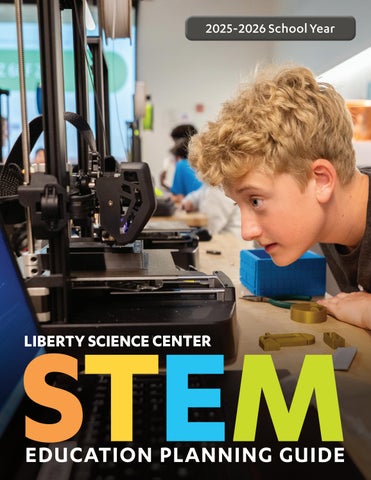
2025-2026 School Year
STEM EDUCATION PLANNING GUIDE
WELCOME TO THE LIBERTY SCIENCE CENTER STEM EDUCATION PLANNING GUIDE
Dear Educators and Partners, Liberty Science Center is thrilled to welcome you back for another exciting year of inspiring the next generation of scientists and innovators. We remain steadfast in our efforts to empower all learners to be curious and creative thinkers who confidently pursue an understanding of science and technology. We are ready to engage your students and educators in our innovative, interactive, and immersive STEM experiences for the 2025-2026 school year. As a leader in informal STEM education, Liberty Science Center offers a diverse range of dynamic programs that leverage unique resources. Our renowned Live From Surgery program, breathtaking Jennifer Chalsty Planetarium, illustrious Weston Family Lab for Earth and Space Exploration, and imaginative MakerLab are unparalleled examples of what LSC has to offer and what sets us apart. LSC recognizes that the need for STEM education has never been more pronounced. Our standards-based student programming leverages our educators’ expertise, enthusiasm, and creativity to model best practices in STEM education. Our student-focused teacher programs build teacher capacity to support student sense-making through phenomenon-driven instruction and scientific discourse. We are uniquely positioned to partner with educators and district leaders to meet evolving needs and shifting priorities, helping to ensure that every learner has access to quality STEM education. This year, we are delighted to introduce new high school programs and tech-based professional learning designed to provide advanced STEM learning experiences for students and educators. These programs aim to prepare high school students for successful careers in science and technology, and equip educators with the tools and skills to confidently and effectively integrate technology into their classrooms. This 2025-2026 STEM Education Planning Guide showcases a portfolio of offerings that champion inquiry and authentic learning. Our programs are designed to encourage collaboration among students while fostering connections to their own lives and communities. Liberty Science Center looks forward to continuing to do what we do best: excite learners of all ages about the power, promise, and pure fun of science and technology! We invite you to explore our STEM Education Planning Guide and consider how we can partner with you to enhance your students’ education and educators’ expertise with our dynamic programs. Have a phenomenal school year! Warm regards,
Ivory Williams Vice President, STEM Education, Liberty Science Center Liberty Science Center acknowledges the generous support of The Paul and Phyllis Fireman Charitable Foundation, Izzo Family Foundation, Bruce and Rhonda Levy, Michael and Sukey Novogratz, Laura Overdeck, Jameson Schriber / Goldman Sachs Gives, John H. and Regina K. Scully, Gregory Tusar, and Josh Weston. LSC is also grateful to the following donors for their support of STEM Education. LEAD SUPPORTERS:
ADDITIONAL SUPPORTERS:
LIBERTY SCIENCE CENTER’S INSTITUTIONAL PARTNERS Liberty Science Center is grateful to the following institutional partners for their generous support. We offer a variety of benefits and opportunities to organizations who share our vision. Please contact us at corporate@lsc.org or 201.253.1473 to learn more.
$100,000 and up
$15,000 - $24,999
ADP Amneal Pharmaceuticals Bank of America BASF Corporation Bristol Myers Squibb CCA / Plaza Construction EY The Hearst Foundations Johnson & Johnson JP Morgan Chase & Co. Kenvue National Aeronautics and Space Administration (NASA) New Jersey Innovation Institute Nokia Bell Labs Public Service Electric and Gas (PSE&G) PwC Verizon Anonymous
Akin Alpine Residential AmeriHealth Aramark Sports & Entertainment BD BlueGate Partners Boston Consulting Group ChangeX Eastern Millwork Gilead Sciences Hyde and Watson Foundation Kirkland & Ellis LLP KLA Foundation Morgan Stanley National Science Foundation (NSF) New Jersey Division of Travel & Tourism The John & Margaret Post Foundation SILVERMAN Union City Board of Education
$50,000 - $99,999
$10,000 - $14,999
Dalio Foundation Esposito Construction Lord, Abbett & Co. LLC PepsiCo, Inc. ServiceNow Anonymous
A&O Shearman American Express Foundation BNY Mellon BNP Paribas G&S Investors & Brookfield Properties Goldman Sachs Gives Jersey City Arts and Culture Trust Fund Jersey City Department of Health and Human Services The KRE Group The Labcorp Charitable Foundation NASA / New Jersey Space Grant Consortium Novartis The NRP Group Penguin An EMCOR Company Carolyn Jane Scott Charitable Trust
$35,000 - $49,999 David R. Clare and Margaret C. Clare Foundation Verisk
$25,000 - $34,999 Glenn W. Bailey Foundation The Bennack-Polan Foundation Connell Foley LLP Day Pitney LLP HLW Architecture, LLC NJM Insurance Group Panepinto & Related Companies Provident Bank Royal Caribbean Sims Metal SJP Properties World Wide Technology
$5,000 - $9,999 PKF O’Connor Davies, LLP RWJBarnabas Health Shepherd Insurance
List current as of Sept. 9, 2025
LIBERTY SCIENCE CENTER’S LUMINARY SOCIETY Liberty Science Center is grateful to the following individuals for their generous support. To help us keep world-class science learning accessible to all, visit lsc.org/luminary or contact us at individualgiving@lsc.org or 201.253.1327.
$100,000 and above David Barry The Paul & Phyllis Fireman Charitable Foundation Frank J. Guarini Foundation Richard M. Hodosh, MD Izzo Family Foundation Bruce and Rhonda Levy Michael and Sukey Novogratz Laura Overdeck Jameson Schriber / Goldman Sachs Gives John H. and Regina K. Scully Gregory Tusar Josh Weston and Family
$50,000-$99,999 The Carlin Family Foundation The Graham Family Dr. Talia Mota and David B. Heller Kate and Steve Howe Chirag and Priti Patel Jennifer Yettke and Alex Haro Ning Yuan and Li Xu
$25,000-$49,999 Denis Bovin Sheri and Ted Bronstein Ken and Elina Burke Jeanette Calandra and Russell Burke Alma DeMetropolis Susan Keating and Norman A. Worthington III
$10,000-$24,999 Christopher and Sinead Bennett Jamie Dimon Michele Holcomb The Kannan Family Kim and Jonathan Kushner Marc and Karin Pavese Richard and Kayla Pechter Sharon Stamm and Jerome Zeldis Anonymous donor-advised fund at the Chicago Community Foundation
$5,000-$9,999 Dennis and Denise Bone Cindy and Perin Class Peter and Sharon Cocoziello Judy and Stewart Colton Todd and Victoria Edmonds
Dr. Fabio Frisoli Ken Goldstein Dr. George Karnoutsos and Ms. Raquel Lewan The Honorable Thomas H. Kean The Kyei Family Eileen and Leslie Quick The Reba Family Carlos and Eileen Rodriguez Peggy and Gary Shilling Anthony Skiadas and Celeste Campos Carolyn and Bob Slaski Simon and Caroline Tillett Grant Wentworth Anonymous
$2,500-$4,999 John E. Abele Sumeet and Donna Chabria Marilyn and Edward Colangelo Memorial Fund Sunita and Knut Holzer Reena and Shawn Joshi Rachana Kumar and Sandeep Gogga Lesser Family Tracie and Brandon McCall In Memory of Lucille Rathyen Dr. and Mrs. William A. Tansey III Anonymous
$1,000-$2,499 Guy Abrahamson Cathleen Ahearn In memory of Eli Bender Dr. Waseem Bhatti In Loving Memory of Alice Boreico Ann and Stan Borowiec Bridgewood Fieldwater Foundation Isabelle and Philip Dabbagh Paul and Elizabeth Goody Anuj & Falguni Gupta Patrick and Valerie Lally Dr. Jessica Marinoff and Mr. Jim Charatan Mike and Gloria Masri and Family Jeffrey S. Morrison Popat Family Mark Shapiro Sinkiewicz Family Tim Tracy Anonymous (2) List current as of Sept. 9, 2025
TABLE OF CONTENTS All of LSC’s education programs are aligned with NJSLS - Science. Look for specific standards alignment information below each program offering in this guide.
OVERVIEW Field Trips & Experiences 08 Let’s Explore Together! 11 Climate Change Programs 13 Planetarium Programs 14 Science On a Sphere Programs 16 Live From Surgery 19 Laboratory Workshops 20 MakerLab Workshops 23 Tech & Design Studio Workshops 23 Stage Shows 24 Young Learner Series 26 Out-of-School Programs 29 Professional Development 30
STUDENT PROGRAMS BY GRADE Grades Pre-K - 2
Grades 6 - 8
Life Science 33 Physical Science 34 Earth and Space Science 36 Engineering Design 37
Life Science 45 Physical Science 47 Earth and Space Science 48 Engineering Design 51
Grades 3 - 5
Grades 9 - 12
Life Science 39 Physical Science 39 Earth and Space Science 41 Engineering Design 42
Life Science 53 Physical Science 55 Earth and Space Science 57 Engineering Design 58
TEACHER PROGRAMS Professional Development 60 6
LSC.ORG • 201.2 53.1337 • partnerships@lsc.org
7
FIELD TRIPS & EXPERIENCES Liberty Science Center is a prime destination for learners of all ages and abilities. We’re ready to welcome schools and groups to explore our exhibition halls, live animal collection of more than 110 species, giant aquariums, and so much more! Be sure to take in an amazing show at the nation’s biggest planetarium. We would love to help you plan your next LSC visit.
8
Bees to Bots
Our Hudson Home
Watch a colony of live honey bees from just inches away as they go about their daily work. See bees collecting nectar and making honey. Can you spot the queen? Then explore our multimedia exhibition to discover innovative ways that scientists are studying bees.
Meet the creatures that live in the Hudson River in an enormous aquarium. (Note: This gallery will be partially closed during its renovation.)
Brain Games What does it take to solve puzzles? Practice your critical thinking skills and challenge yourself! Discover coding by teaching a robot to navigate a maze, piece together magnet shapes to create the five Platonic Solids, explore patterns using big colorful blocks, and more.
Dino Dig Adventure Enter this 1,750-square-foot fossil site modeled after a real paleontological dig. Explore three fossil pits and dig for bones from seven different dinosaur species buried in more than 60 tons of sand. Uncover replica fossils of bones, eggs—even dinosaur poop!
Energy Quest Explore renewable energy—solar, geothermal, and wind—and discover the power in ocean waves, dams, and other traditional energy sources.
The Great Train Set This detailed model railroad captures the wonder of the Lackawanna Railroad in the 1950s, when trains chugged from Hoboken through small-town New Jersey to coal country in eastern Pennsylvania. See up to five trains at a time zooming along 425 feet of track. All aboard!
Infinity Climber Explore this two-story climbing structure suspended 35 feet above the Center’s atrium. Can you make it to the top?
Science On a Sphere This six-foot spherical visualization globe—developed by the National Oceanic and Atmospheric Administration (NOAA)—can show hundreds of high-resolution global images and animations of the Earth, sun, moon, and planets, bringing Earth and space science vividly to life.
Touch Tunnel The Touch Tunnel is an 80-foot, crawl-through, pitchblack tunnel. Exploring an unknown environment in the dark makes you realize how much we rely on sight to move through the world.
Wild About Animals Observe live mammals, insects, reptiles, amphibians, birds, and fish in natural settings. Don’t miss the critically endangered cotton-top tamarins, the colony of industrious leaf-cutter ants, or the amazing community of naked mole rats!
Wonder Why Experiment with air in motion, scramble up our fossilstudded rock climbing wall, and more.
FEATURED EXHIBITIONS We host exciting new exhibitions each year that connect to topics in science and technology, and incorporate pop culture and entertainment. This school year, exhibitions include SUE: The T. rex Experience, and Daniel Tiger’s Neighborhood: A Grr-ific Exhibit.
Jennifer Chalsty Planetarium Master the universe in America’s biggest planetarium! Explore the constellations in the night sky, the planets of our solar system, or the latest discoveries from NASA’s James Webb Space Telescope, all under our 89-foot dome.
Microbes Rule! Step inside a giant microscope lens and discover these microscopic organisms in a whole new way. Through stunning art and groundbreaking technology, explore how the overwhelming majority of microbes are beneficial to us and essential to our survival.
LSC.ORG • 201.2 53.1337 • partnerships@lsc.org
9
All field trips and experiences must be booked in advance. Call 201.253.1337.
10
LET’S EXPLORE TOGETHER! The Science Center is a premier provider of STEM experiences for students, educators, and families. Our education programs can enhance your science instruction with engaging activities online, at LSC, or at your school. We also offer highly interactive professional development programs for individual educators or groups. Start planning your fun and engaging science-learning adventure with Liberty Science Center.
At LSC Explore life science, physical science, engineering, and more with our talented team of STEM educators in the laboratory classrooms of the Center for Learning and Teaching. Our standards-aligned, highly interactive workshops are available for students from Pre-K through high school.
Online Can’t bring your group to LSC? Many of our programs can be transmitted into your classroom using distance learning technology on platforms such as Zoom or Google Meet. No permission slips required!
TECHNICAL REQUIREMENTS: • • •
Internet connection; wired connection recommended Computer or other device(s) with the following: webcam, microphone, speakers, display We’ll send you a link via email once your booking date has been confirmed.
At Your School Our knowledgeable and enthusiastic team of educators is eager to bring dynamic, standards-aligned STEM experiences directly to you. We can provide engaging stage shows, laboratory workshops, out-of-school programs, and more.
LSC.ORG • 201.2 53.1337 • partnerships@lsc.org
11
12
Available Online
CLIMATE CHANGE PROGRAMS In June 2020, New Jersey became the first state to fully integrate climate education into its K-12 learning standards. The New Jersey Student Learning Standards require climate change education across seven areas: 21st Century Life and Careers, Comprehensive Health and Physical Education, Science, Social Studies, Technology, Visual and Performing Arts, and World Languages. The goal is to prepare students to understand how and why climate change happens and its impact on our local and global communities, and to act in informed and sustainable ways. We are ready to support educators with programs for grades Pre-K through high school, which can take place at LSC, online, and at your school. Our Science On a Sphere (SOS) programs employ the ultimate data visualization tool—a six-foot illuminated globe display. Using the only publicly accessible SOS in New Jersey, these programs present a unique opportunity to see evidence of climate change in NOAA and NASA data sets vividly come to life. Other program types include laboratory workshops, young learner series, and teacher professional development. Let us know how you are incorporating climate change learning in the classroom, and we can help you succeed! LSC.ORG • 201.2 53.1337 • partnerships@lsc.org
13
PLANETARIUM PROGRAMS Our Jennifer Chalsty Planetarium is the biggest planetarium in the Western Hemisphere and the fifth largest in the world. It is uniquely designed to display Earth and Space Systems phenomena in a way that’s just not possible in the classroom. View astronomical objects and celestial phenomena from the surface of Earth and then travel into space to truly understand these concepts by flying up to, around, and through the objects. We can also speed up time in our presentations, allowing you to make an entire year of space systems observations during one program— seasons, moon phases, seasonal constellations, and more. Our 27-meter (89-foot) dome, coupled with an all-dome video and astronomical object database, provides an immersive environment in which to explore the Earth and Space Systems Performance Expectations of the NJSLS - Science.
Available Online
14
HOW IT WORKS ONLINE Using the same advanced software as in our planetarium, we bring astronomy and aerospace content to the classroom and your students’ home screens. These programs are presented ‘live’ by an LSC Planetarium Educator and allow lots of time for students to ask questions to the presenter.
Check your grade band section for planetarium programs that are aligned with your grade-specific NJSLS Science requirements.
LSC.ORG • 201.2 53.1337 • partnerships@lsc.org
15
SCIENCE ON A SPHERE PROGRAMS The visually stunning Weston Family Lab for Earth and Space Exploration allows students to explore Earth and its systems using authentic data on the only publicly available NOAA Science On a Sphere in New Jersey. The SOS, a six-foot spherical visualization globe, can show hundreds of high-resolution global images and animations of the Earth, sun, moon, and planets, bringing Earth and space science vividly to life. Our Science On a Sphere programs are presented live by LSC’s educators, allowing for plenty of interaction between the students and presenters, and visually stunning, data-rich content. See earthquakes, hurricane tracks, sea surface temperatures, plate tectonics, weather patterns, and more!
HOW IT WORKS ONLINE Through a remote connection from LSC, we bring our home planet and other objects in our solar system to life in vivid, high-quality resolution with satellite views, animations, and real-time data sets from NASA and NOAA.
Available Online 16
LSC.ORG • 201.2 53.1337 • partnerships@lsc.org
17
All programs must be booked in advance. Call 201.253.1337 or email partnerships@lsc.org.
18
LIVE FROM SURGERY Live From Surgery brings the world of healthcare to the next generation of surgeons and biotechnology experts. Experience the dynamics of surgery, problem solving, and teamwork in an actual operating room. Connect to hospitals through videoconferencing to interact with the medical team during a surgical procedure, and observe some of the same tools used by the medical team. We partner with the most prestigious hospitals across the region for this unforgettable experience.
MEET THE SURGEON Our Live From Surgery program also features Meet the Surgeon sessions. Speak to the professionals face to face as you explore recorded cases, understand each medical problem, examine the course of action, and review the outcomes. These sessions create an intimate environment where surgeons can focus their attention on the students while narrating and showing a video of the surgical procedures.
LIVE FROM SURGERY PLUS Our Live From Surgery Plus program takes lab work to the next level by enhancing your experience with a 45-75-minute laboratory workshop that brings medical and biological science to life. Choose to add a session on biotechnology techniques to prepare your students for careers in the health sciences. Contact us to discuss the options.
SURGICAL INSIGHTS VIDEO SERIES These sessions feature recordings of our most popular Live From Surgery procedures on videotape. Choose Cardiac Surgery, Robotic Surgery, or Neurosurgery when you view a previously recorded procedure conducted at one of our partner hospitals. Our Live From Surgery educators will enhance the experience with relevant background and details, and will answer questions for your group.
Available Online
LSC.ORG • 201.2 53.1337 • partnerships@lsc.org
19
LABORATORY WORKSHOPS Available Online Our Laboratory Workshops reinforce learning through highly interactive explorations that promote scientific thinking and reasoning and often spark a lifelong interest in STEM. Programs are available for grades Pre-K - 12, and can accommodate up to 25 students. Workshops range in length from 30 minutes to 75 minutes, depending on the grade band and subject matter. These engaging and inspiring labs can occur online, at Liberty Science Center, or at your school.
SHOWTIME! Add some hands-on science flair to your school science fair or special event! Our staff can lead an interactive session that complements your theme. Programs can be configured to meet your needs and to support curriculum standards and multiple learning styles. To book any program, please call our reservation line at 201.253.1337. All programs must be booked in advance. 20
LSC.ORG • 201.2 53.1337 • partnerships@lsc.org
21
22
TECH SKILLS ARE IN DEMAND According to the Bureau of Labor Statistics, employment in both computer and information technology and engineering occupations is projected to grow much faster than the average for all occupations from 2024 to 2034. On average, the annual projected openings are about 317,700 for computer and information technology, and 186,500 for engineering — far more than in other STEM categories. Liberty Science Center programs provide an exciting introduction to technology, helping your students develop essential 21st-century skills and build confidence through engaging hands-on experiences. These programs align with the New Jersey Student Learning Standards for Science and Mathematics, as well as the International Society for Technology in Education (ISTE) Standards, reinforcing new concepts and supporting curriculum goals. Choose a single session for an engaging introduction to technology, or a series of programs for a more in-depth sense-making experience.
MAKERLAB WORKSHOPS
These workshops must be booked in advance. Please call our reservation line at 201.253.1337.
Our MakerLab embraces the maker culture, fostering the innate creativity, curiosity, and inventive spirit in every student. Engage with emerging technologies through programs such as 3D Design, 3D Printing, and Vector Design. With a 1-to-1 student-to-3D-printer ratio and a professional-grade laser cutter, our workshops empower students to create freely.
TECH & DESIGN STUDIO WORKSHOPS Students in grades 3 - 12 can develop high-demand technology skills through our Tech & Design Studio workshops. Our programs offer enriching opportunities in areas such as coding, robotics, biotechnology, artificial intelligence, and virtual reality. These dynamic workshops integrate computational and design thinking to identify innovative student-generated solutions and bring unique projects to life. LSC.ORG • 201.2 53.1337 • partnerships@lsc.org
23
STAGE
Wow your school community with a live science spectacular!
SHOWS Let us present our highly entertaining and science-rich assemblies at Liberty Science Center or at your school. These programs are appropriate for Grades K - 8. Each show is 45-60 minutes of science and fun and most can accommodate up to 300 participants at LSC or your school.
24
LSC.ORG • 201.2 53.1337 • partnerships@lsc.org 2 5
YOUNG LEARNERS LSC is here to help your young learners discover their love for the world of Science, Technology, Engineering, and Math (STEM) and nurture their STEM identity. We have a variety of new program series for Grades Pre-K - 2 that can support learning recovery and acceleration. These project-based learning experiences align with the New Jersey model curriculum to ensure we have programming around common themes focused on by schools throughout the state.
SOME HIGHLIGHTS FROM OUR YOUNG LEARNER SERIES BIODIVERSITY BIG IDEAS Explore the rich array of life on Earth, from the colorful creatures of the tropical rainforest to the desert’s amazingly adapted plants and animals. Through modeling, observation of various media sources, and hands-on investigation, develop an understanding of what plants need to grow, the interdependent relationship among plants and animals, and the structures and behaviors that help living things survive.
HABITAT HOP Grab your passport; it’s time for an adventure! Immerse yourself in the brilliant biodiversity of Earth as you visit different habitats and explore the unique plants and animals that make them home.
THE SCIENCE OF LIGHT AND SOUND How do light and sound work in the world around us? From observing how shadows work to how instruments create sound, build mastery on such topics as transparent, translucent, opaque, and vibrating materials in this hands-on series that is bound to get you moving and grooving.
Each series includes five 45-minute interactive, science-based programs that build on one another.
See the Grades Pre-K - 2 section (page 32) for the full list of young learner offerings. 26
Contact an LSC representative for assistance planning a unique and unforgettable young learner series for your school: 201.253.1337.
WEEK OF THE YOUNG CHILD April 6 - 10, 2026 LSC’s STEM Education department celebrates the nationally observed Week of the Young Child every year. Learners from Pre-K to Grade 2 and their educators are invited to join us for special programming matched to each day’s theme. Let’s make music, build complex structures, create art, explore new foods, and much more—together! Call 201.253.1310 or email partnerships@lsc.org to reserve admission for your group.
LSC.ORG • 201.2 53.1337 • partnerships@lsc.org 2 7
Contact an LSC representative for assistance planning a unique and unforgettable science program for your school, club, or troop: 201-253.1337.
28
OUT-OF-SCHOOL PROGRAMS LSC brings science learning to you! Take part in interactive, science-based programs online or at your location. These 45-60 minute programs provide project-based learning experiences and develop critical thinking, collaboration, innovation, and problemsolving skills over one or multiple sessions. Select a range of topics or build on the same topic over several weeks.
Length: Single week or multi-week series
SOME POPULAR TOPICS NEW ENGINEERING DESIGN CHALLENGES Grades 2 - 5 At LSC | At Your School Identify, investigate, and build to tackle an array of engineering challenges. Using the engineering design process, students will design and compare possible solutions as they explore their own creativity.
NEW SERIES ADVENTURES IN SPACE Grades 3 - 8 Online Five Sessions; Each 45 Minutes Encounter the wonders of the universe through hands-on activities, virtual telescopes, and the same software we use in our planetarium at LSC. Take pictures of distant space objects, observe the current night sky, sail through the solar system, and travel all the way to the edge of the universe!
FORENSIC SCIENCE Grades 3 - 12 Online | At Your School Crack a case using the same techniques real forensic scientists use, such as checking for fingerprints, comparing fibers, DNA analysis, shoeprint analysis, chromatography, and more.
ROBOTICS, TECHNOLOGY & CODING SERIES Grades 4 - 8 At LSC | At Your School Construct, code, and create with technology! In this series, students use different educational platforms to build creativity as they grow their understanding of robotics, engineering, or coding.
NEW VOYAGE INTO OCEANOGRAPHY Grades 3 - 8 At Your School Explore the depth of oceanic science from the comfort of your classroom! This interdisciplinary series takes students through the breadth of fields related to oceanography, from biology and ecology to seawater chemistry, marine engineering, and more.
Available Online
LSC.ORG • 201.2 53.1337 • partnerships@lsc.org 2 9
TEACHER PROFESSIONAL DEVELOPMENT Liberty Science Center partners with schools and districts to offer highly interactive professional development programs to build teachers’ capacity around planning and implementing engaging and effective standards-based science instruction. Our programs can be delivered online and in person.
Available Online
30
LSC.ORG • 201.2 53.1337 • partnerships@lsc.org
31
Programs by Grade
GRADES PRE-K - 2 According to the National Research Council, young learners begin school with a rich knowledge of the natural world, the ability to reason, an understanding of the principles of cause and effect, foundations for modeling, ability to consider ideas and beliefs, and an eagerness to participate in learning. LSC’s programs for early learners promote making observations, asking questions, and constructing explanations as they directly relate to NJSLS - Science. Our programs also support New Jersey’s Approaches to Learning standards, which promote building core skills known as EPPIC: engagement, planning and problem solving, and initiative and creativity. 3 2 GRADES PRE-K - 2 PROGRAMS
LIFE SCIENCE SERIES Biodiversity Big Ideas Five Sessions; Each 45 Minutes Young Learner Series At LSC | At Your School Explore the rich array of life on Earth, from the colorful creatures of the tropical rainforest to the desert’s amazingly adapted plants and animals. Through modeling, observation of various media sources, and hands-on investigation, develop an understanding of what plants need to grow, the interdependent relationship among plants and animals, and the structures and behaviors that help living things survive. Alignment to NJSLS - Science 2-LS2-1 Plan and conduct an investigation to determine if plants need sunlight and water to grow. 2-LS2-2 Develop a simple model that mimics the function of an animal in dispersing seeds or pollinating plants. 2-LS4-1 Make observations of plants and animals to compare the diversity of life in different habitats.
SERIES Habitat Hop Five Sessions; Each 45 Minutes Young Learner Series Online | At LSC | At Your School Grab your passport; it’s time for an adventure! Immerse yourself in the brilliant biodiversity of Earth as you visit different habitats and explore the unique plants and animals that make them home. Alignment to NJSLS - Science 2-LS4-1 Make observations of plants and animals to compare the diversity of life in different habitats. Connections to NJSLS - English Language Arts W.2.8 Recall information from experiences or gather information from provided sources to answer a question. Approaches to Learning Initiative and Creativity
SERIES Mickey’s Animal Adventure Five Sessions; Each 45 Minutes Young Learner Series Online | At LSC | At Your School Meet Mickey, a friendly, pattern-loving pup, who loves animals and exploring them together with friends like you! In this series, join Mickey to learn more about a diverse group of living things across
multiple visits. From insects and arachnids to reptiles and more, learn the basic needs of living things while enjoying the suite of live animal ambassadors that make Liberty Science Center their home.
As the seasons change, flowers begin to bloom again. But how do they get the water they need to grow? Explore how plants use specialized parts to take in water and send it throughout their structure.
Alignment to NJSLS - Science K-LS1-1 Use observations to describe patterns of what plants and animals (including humans) need to survive. Approaches to Learning Displaying Curiosity, Communication of New Ideas
Alignment to NJSLS - Science 1-LS1-1 Use materials to design a solution to a human problem by mimicking how plants and/or animals use their external parts to help them survive, grow, and meet their needs. Approaches to Learning Displaying Curiosity, Persistence, Following Multi-Step Plans
Backyard Safari 45 Minutes Laboratory Workshop Online | At LSC | At Your School Have you ever wanted to go on a safari? Well, let us introduce Mickey. He’s a small but mighty puppy who loves other animals and especially loves noticing patterns! With his love of patterns and making observations, Mickey will serve as the perfect guide for a backyard safari featuring our LSC animals. Alignment to NJSLS - Science K-LS1-1 Use observations to describe patterns of what plants and animals (including humans) need to survive. Connections to NJSLS - English Language Arts RI.K.1 With prompting and support, ask and answer questions about key details in a text. RI.K.4 With prompting and support, ask and answer questions about unknown words in a text. Approaches to Learning Displaying Curiosity, Communication of New Ideas
NEW Eco Explorers 30 Minutes Stage Show At LSC | At Your School In this live eco-adventure, we explore the wonders of biodiversity! Take an imaginary journey to the rainforest, where we’ll use props and storytelling to discover a variety of plants and animals, each with its own diet and role in the ecosystem. A curious guide leads the way, with plenty of opportunities for audience participation. Please note there are no live animals in this program. Alignment to NJSLS - Science 2-LS4-1 Make observations of plants and animals to compare the diversity of life in different habitats.
Flower Power 30-45 Minutes Laboratory Workshop Online | At LSC | At Your School
Maple Seed Models 30-45 Minutes Laboratory Workshop Online | At LSC | At Your School Create your own maple seed model out of paper and explore how the maple seed has a special way of getting the space it needs to grow and survive. Alignment to NJSLS - Science K-LS1-1 Use observations to describe patterns of what plants and animals (including humans) need to survive. Approaches to Learning Displaying Curiosity, Persistence, Making & Following Multi-Step Plans
Pollinators: Honey Bees 30-45 Minutes Laboratory Workshop Online | At LSC | At Your School Have you thanked a bee today? Pollinators provide an essential service to the ecosystem. At least a third of the world’s crops depend on pollination from insects and other animals. Honey bees produce and store honey, but they also help to make other favorite foods. Design a pollination device that works just as hard as a busy bee. Alignment to NJSLS - Science 2-LS2-2 Develop a simple model that mimics the function of an animal in dispersing seeds or pollinating plants. K-2-ETS1-2 Develop a simple sketch, drawing, or physical model to illustrate how the shape of an object helps it function as needed to solve a given problem. Connections to NJSLS - English Language Arts SL.2.5 Create audio recordings of stories or poems; add drawings or other visual displays to stories or recounts of experiences when appropriate to clarify ideas, thoughts, and feelings.
LSC.ORG • 201.2 53.1337 • partnerships@lsc.org
33
Secret to Survival 45 Minutes Laboratory Workshop Online | At LSC | At Your School Animals and plants have internal and external parts that help them grow, survive, and meet their needs. Learn how humans can mimic these special adaptations to help inspire solutions to everyday problems. Alignment to NJSLS - Science 1-LS1-1 Use materials to design a solution to a human problem by mimicking how plants and/or animals use their external parts to help them survive, grow, and meet their needs. Connections to NJSLS - English Language Arts W.1.7 Participate in shared research and writing projects (e.g., explore a number of “how-to” books on a given topic and use them to write a sequence of instructions).
PHYSICAL SCIENCE SERIES The Science of Light and Sound Five Sessions; Each 45 Minutes Young Learner Series At LSC | At Your School How do light and sound work in the world around us? From observing how shadows work to how instruments create sound, build mastery on such topics as transparent, translucent, opaque, and vibrating matierals in this hands-on series that is bound to get you moving and grooving. Alignment to NJSLS - Science 1-PS4-1 Plan and conduct investigations to provide evidence that vibrating materials can make sound and that sound can make materials vibrate. 1-PS4-3: Plan and conduct investigations to determine the effect of placing objects made with different materials in the path of a beam of light. Approaches to Learning Displaying Curiosity, Persistence, Following Multi-Step Plans
Calling All Chemists 30-45 Minutes Laboratory Workshop At LSC | At Your School We’re calling all chemists as we dive deep into the science behind the matter around us. Join us as we explore observable properties, observe changes to matter when it’s heated, and even make our own ice cream to enjoy!
3 4 GRADES PRE-K - 2 PROGRAMS
Alignment to NJSLS - Science 2-PS1-1 Plan and conduct an investigation to describe and classify different kinds of materials by their observable properties. 2-PS1-4 Consruct an argument with evidence that some changes caused by heating or cooling can be reversed and some cannot. Approaches to Learning Displaying Curiosity, Persistence, Following Multi-Step Plans
Chemistry of Bubbles 30-45 Minutes Laboratory Workshop At LSC | At Your School There is nothing more fun than playing with bubbles on a nice day. In this lesson, we are going to learn about the states of matter by creating bubble solutions. We will create a traditional bubble solution, as well as a dry ice bubble solution, to compare how different kinds of materials can create different results in experiments. Alignment to NJSLS - Science 2-PS1-1 Plan and conduct an investigation to describe and classify different kinds of materials by their observable properties. Approaches to Learning Displaying Curiosity, Collaboration, Communication of New Ideas
Flow Motion 30-45 Minutes Laboratory Workshop Online | At LSC | At Your School From puddles to clouds and rain to snow, water is changing its form around us all the time. Help us conduct different experiments to see evaporation, condensation, and precipitation right before our eyes. Alignment to NJSLS - Science K-PS3-1 Make observations to determine the effect of sunlight on Earth’s surface. Approaches to Learning Displaying Curiosity, Communicationof New Ideas
Light It Up! 30-45 Minutes Laboratory Workshop At LSC | At Your School Plan and conduct investigations using flashlights and lightboxes to make sense of what it means for objects to be transparent, opaque, translucent, or reflective. Alignment to NJSLS - Science 1-PS4-3 Plan and conduct an investigation to
determine the effect of placing objects made with different materials in the path of a beam of light. Connections to NJSLS - English Language Arts W.1.8 With guidance and support from adults, recall information from experiences or gather information from provided sources to answer a question. SL.1.1 Participate in collaborative conversations with diverse partners about grade 1 topics and texts with peers and adults in small and larger groups. Approaches to Learning Displaying Curiosity, Collaboration, Communication of New Ideas
Matter in Motion 45 Minutes Laboratory Workshop At LSC | At Your School Matter can be solid, liquid, or gas. But matter can also change. Observe phenomena involving some of the ways matter can change. Work collaboratively to construct evidence-based arguments on whether or not changes to matter can be reversed. Alignment to NJSLS - Science 2-PS1-4 Construct an argument with evidence that some changes caused by heating or cooling can be reversed and some cannot. Connections to NJSLS - English Language Arts W.2.1 Write opinion pieces in which they introduce the topic or book they are writing about, state an opinion, supply reasons that support the opinion, use linking words (e.g., because, and, also) to connect opinion and reasons, and provide a concluding statement or section. Approaches to Learning Displaying Curiosity, Collaboration, Communication of New Ideas
Science Circus Jr. 30-45 Minutes Stage Show At LSC | At Your School Let’s think big together and investigate the effects of forces as you’ve never seen them before! Be shocked and amazed by the pushes and pulls involving electricity, gasp in awe at the air all around us as we demonstrate the science behind attraction and repulsion, and explore how forces affect objects. Alignment to NJSLS - Science K-PS2-1: Plan and conduct an investigation to compare the effects of different strengths or different directions of pushes and pulls on the motion of an object. 2-PS1-1: Plan and conduct an investigation to describe and classify different kinds of materials by their observable properties.
Super Strong Shapes 30-45 Minutes Laboratory Workshop Online | At LSC | At Your School Which shapes are not only strong but… super strong? In a hands-on program that blends science and architecture, build and test your favorite three-dimensional shapes and explore how an object’s shape relates to its properties and uses. Alignment to NJSLS - Science 2-PS1-2 Analyze data obtained from testing different materials to determine which materials have the properties that are best suited for an intended purpose. Connections to NJSLS - English Language Arts W.2.8 Recall information from experiences or gather information from provided sources to answer a question. Connections to NJSLS - Mathematics MP.2 Reason abstractly and quantitatively. MP.4 Model with mathematics. MP.5 Use appropriate tools strategically. Approaches to Learning Persistence, Collaboration, Problem-Solving, Following Multi-Step Plans
What’s the Matter? 30-45 Minutes Laboratory Workshop Online | At LSC | At Your School Explore the world of chemistry with investigations that show how to classify materials by their observable properties. Learn to describe what happens when matter is cooled using liquid nitrogen. Alignment to NJSLS - Science 2-PS1-1 Plan and conduct an investigation to describe and classify different kinds of materials by their observable properties. Connections to NJSLS - English Language Arts W.2.1 Write opinion pieces in which they introduce the topic or book they are writing about, state an opinion, supply reasons that support the opinion, use linking words (e.g., because, and, also) to connect opinion and reasons, and provide a concluding statement or section. W.2.8 Recall information from experiences or gather information from provided sources to answer a question. Approaches to Learning Displaying Curiosity, Collaboration, Communication of New Ideas
LSC.ORG • 201.2 53.1337 • partnerships@lsc.org
35
EARTH AND SPACE SCIENCE SERIES Our Big Blue Marble Five Sessions; Each 45 Minutes Young Learner Series At LSC | At Your School Planet Earth is extraordinary! Explore the diverse landforms and bodies of water that make up our planet’s surface. Identify where water can be found, differentiate between types of landforms as you hunt for treasure, and create a model of your own island. Alignment to NJSLS - Science 2-ESS2-2 Develop a model to represent the shapes and kinds of land and bodies of water in an area. 2-ESS2-3 Obtain information to identify where water is found on earth and that it can be solid or liquid.
SERIES Weather, Weather, Everywhere Five Sessions; Each 45 Minutes Young Learner Series At Your School What makes up the weather we see outside every day? Through a variety of handson programs, learn the components of weather and explore tools meteorologists use to describe, record, and notice patterns over time. Alignment to NJSLS - Science K-ESS2-1 Use and share observations of local weather conditions to describe patterns over time.
Leo the Landform Llama 45 Minutes Laboratory Workshop Online Join Leo the Landform Llama on a treasurehunting adventure! Journey across different landforms, observing the characteristics of each. Along the way, use these characteristics to differentiate the various high and low landforms and answer questions to collect clues and find hidden treasure. Alignment to NJSLS - Science 2-ESS2-2 Develop a model to represent the shapes and kinds of land and bodies of water in an area. Connections to NJSLS - English Language Arts SL.2.1 Participate in collaborative conversations with diverse partners about grade 2 topics and texts with peers and adults in small and larger groups. Approaches to Learning Engagement
3 6 GRADES PRE-K - 2 PROGRAMS
One World, One Sky
Sun, Moon, and Stars
30-45 Minutes Planetarium Program At LSC Join Big Bird and Elmo as they explore shapes in the sky and even go on a trip to the moon! Note: Offered at 1:35 pm only.
30-45 Minutes Planetarium Program Online Join a tour of the sky for our youngest astronomers! Explore the sun, moon, and stars and discover their patterns, including sunrise and sunset locations, moon phases, and how constellation visibility varies with Earth’s position from season to season.
Alignment to NJSLS - Science 1-ESS1-1 Use observations of the sun, moon, and stars to describe patterns that can be predicted. Connections to NJSLS - English Language Arts W.1.8 With guidance and support from adults, recall information from experiences or gather information from provided sources to answer a question
Rain, Rain, Go Away! 30 Minutes Science On a Sphere Program Online | At LSC Explore causes of our weather using Science On a Sphere. See how Earth’s weather changes from place to place and season to season. Alignment to NJSLS - Science K-ESS2-1 Use and share observations of local weather conditions to describe patterns over time. 2-ESS2-3 Obtain information to identify where water is found on Earth and that it can be solid or liquid. Connection to NJSLS - Mathematics MP.2 Reason abstractly and quantitatively. MP.4 Model with mathematics.
Reduce, Reuse, Recycle 30-45 Minutes Laboratory Workshop At LSC | At Your School Have you ever wondered where garbage ends up after we throw it out? The answer is not as simple as it may seem. The fate of the trash we create depends on the materials we use, the choices we make, and the actions we take. In this lesson, explore how decisions we make every day can have global consequences. Join us on the 3 R’s Adventure and help keep our planet happy and healthy.
Alignment to NJSLS - Science 1-ESS1-1 Use observations of the sun, moon, and stars to describe patterns that can be predicted. 1-ESS1-2 Make observations at different times of year to relate the amount of daylight to the time of year. 1-PS4-2. Make observations to construct an evidence-based account that objects can be seen only when illuminated. Connections to NJSLS - English Language Arts W.1.8 With guidance and support from adults, recall information from experiences or gather information from provided sources to answer a question.
NEW Whatever the Weather 30-45 Minutes Stage Show At LSC | At Your School Join us on an adventure that takes us through a year of seasons. Students will participate in an interactive show that explores the different kinds of weather experienced locally throughout the year and what we can do to prepare for it. Alignment to NJSLS - Science K-ESS2-1 Use and share observations of local weather conditions to describe patterns over time. Approaches to Learning Engagement, Displaying Curiosity, Problem-Solving
ENGINEERING DESIGN Nothing but Net! 30-45 Minutes Laboratory Workshop Online | At LSC | At Your School Shoot “baskets” like a pro! Design and engineer a catapult to push and pull your way toward this goal. Then, analyze, compare, and test a friend’s design. There is always more than one possible solution to a problem. Alignment to NJSLS - Science K-2-ETS1-3 Analyze data from tests of two objects designed to solve the same problem to compare the strengths and weaknesses of how each performs. Connections to NJSLS - English Language Arts W.2.8 Recall information from experiences or gather information from provided sources to answer a question. Connections to NJSLS - Mathematics MP.2 Reason abstractly and quantitatively. MP.4 Model with mathematics. MP.5 Use appropriate tools strategically. Approaches to Learning Persistence, Evaluating and Modifying Plans, Problem-Solving
Ready, Set, Robotics! 45 Minutes Laboratory Workshop At LSC | At Your School Aspiring computer scientists, get ready for a hands-on introduction to the world of robotics. Observe how a small set of pieces can be disassembled and made into a variety of new robots in this physical science meets engineering program. Alignment to NJSLS - Science 2-PS1-3 Make observations to construct an evidence-based account of how an object made of a small set of pieces can be disassembled and made into a new object.
Alignment to NJSLS - Science K-ESS3-3 Communicate solutions that will reduce the impact of humans on the land, water, air, and/or other living things in the local environment. Approaches to Learning Persistence, Collaboration, Problem-Solving, Following Multi-Step Plans
LSC.ORG • 201.2 53.1337 • partnerships@lsc.org
37
GRADES 3 - 5 According to the National Research Council, students in grades 3 - 5 engage in a wide variety of scientific practices, including: posing questions, making predictions, designing and conducting investigations, representing and interpreting data, designing models, and making arguments that support conclusions. They can now engage in more complicated forms of measuring and graphical representations. LSC’s programs for grades 3 - 5 introduce simple models that help explain observable scientific phenomena as they directly relate to the NJSLS - Science. 3 8 GRADES 3-5 PROGRAMS
LIFE SCIENCE Adaptation Exploration 45 Minutes Laboratory Workshop Online | At LSC | At Your School My, what big eyes and teeth you have! Are they better for hunting and catching prey? Discover what all animals need to survive and thrive in their various habitats in addition to the unique tools and behaviors they have developed along the way! Alignment to NJSLS - Science 3-LS4-3 Construct an argument with evidence that in a particular habitat, some organisms can survive well, some survive less well, and some cannot survive at all.
NEW Animal Ambassadors 40 Minutes Stage Show At LSC | At Your School Meet some of Liberty Science Center’s amazing live animals in this exciting showand-tell experience. Discover how different animals are specially adapted to survive in their unique environments. With up-close encounters and expert educators, this program brings science to life for up to 60 curious learners. Alignment to NJSLS - Science 3-LS4-3: Construct an argument with evidence that in a particular habitat some organisms can survive well, some survive less well, and some cannot survive at all.
Ecosystem Investigation: Prints, Poop, and Pellets 45 Minutes Laboratory Workshop At LSC | At Your School Why is it that when we go outside, we rarely see our furry or feathered neighbors? It’s like they’ve vanished! But wait–look at those prints across the path, follow the scent of that scat, and pick apart that pellet. Investigate the clues that animals leave behind in order to discover more about their ecosystems! Alignment to NJSLS - Science 4-LS1-1: Construct an argument that plants and animals have internal and external structures that function to support survival, growth, behavior, and reproduction. Connections to NJSLS - English Language Arts
RI.5.7 Draw on information from multiple print or digital sources, demonstrating the ability to locate an answer to a question quickly or to solve a problem efficiently (5-LS2-1).
Ecosystems: You Are What You Eat 45 Minutes Laboratory Workshop At LSC | At Your School Air...water...earth...sunlight. Fight for resources and survival in the fast-paced life of a plant. Compete as members of an ecosystem to learn how energy flows through and is eventually recycled back into the environment. Alignment to NJSLS - Science 5-LS2-1 Develop a model to describe the movement of matter among plants, animals, decomposers, and the environment.
Fossils: The Way Things Were 45 Minutes Laboratory Workshop Online | At LSC | At Your School Throughout Earth’s long history, the planet’s landscapes and the species living in them have changed dramatically. Fossils from key points in time demonstrate the interconnectedness of life and its changing environments. Alignment to NJSLS - Science 3-LS4-1 Analyze and interpret data from fossils to provide evidence of the organisms and the environments in which they lived long ago. Connections to NJSLS - English Language Arts RI.3.3 Describe the relationship between a series of historical events, scientific ideas or concepts, or steps in technical procedures in a text, using language that pertains to time, sequence, and cause/effect. W.3.2 Write informative/explanatory texts to examine a topic and convey ideas and information clearly.
PHYSICAL SCIENCE All About Mars 30-45 Minutes Planetarium Program Online Take off on a virtual trip to Mars! Let’s explore the Red Planet as NASA sees it. Alignment to NJSLS - Science 3-PS2-2 Make observations and/or measurements of an object’s motion to provide evidence that a pattern can be used to predict future motion.
4-ESS1-1 Identify evidence from patterns in rock formations and fossils in rock layers to support an explanation for changes in a landscape over time. 5-PS1-3 Make observations and measurements to identify materials based on their properties. Connections to NJSLS - English Language Arts W.3.7 Conduct short research projects that build knowledge about a topic. W.4.7 Conduct short research projects that build knowledge through investigation of different aspects of a topic. (4-ESS1-1) Connections to NJSLS - Mathematics MP.2 Reason abstractly and quantitatively.
Black Holes 30-45 Minutes Planetarium Program Online Explore the nature of black holes, which are among the most mysterious objects in the universe. How do we know they exist? Where do they come from? What would it be like to get close to a black hole? Alignment to NJSLS - Science 3-PS2-1 Plan and conduct an investigation to provide evidence of the effects of balanced and unbalanced forces on the motion of an object. 4-PS3-1 Use evidence to construct an explanation relating the speed of an object to the energy of that object. 5-PS1-1 Develop a model to describe that matter is made of particles too small to be seen. Connections to NJSLS - English Language Arts W.3.7 Conduct short research projects that build knowledge about a topic. W.4.2 Write informative/explanatory texts to examine a topic and convey ideas and information clearly. Connections to NJSLS - Mathematics MP.2 Reason abstractly and quantitatively.
Chemistry with Candy 45 Minutes Laboratory Workshop At LSC | At Your School In this hands-on chemistry workshop, we’ll explore what happens to sugar when it’s heated, mixed, melted, and more. Using popular sweet treats as our test subjects, we’ll dive into the surprising ways sugar behaves and learn what that tells us about the world of matter. Come curious, leave sticky (and a little smarter)! Alignment to NJSLS - Science 5-PS1-3 Make observations and measurements to identify materials based on their properties.
LSC.ORG • 201.2 53.1337 • partnerships@lsc.org 3 9
Do the Wave!
Science Circus
45 Minutes Laboratory Workshop At LSC | At Your School Let’s make some waves using hands-on models to explore wavelength, frequency, and amplitude. Then break into teams and take a closer look at various stations designed to engage and build connections!
45 Minutes Stage Show At LSC | At Your School It’s our most popular show! Explore matter in our three-ring circus, learning about positives and negatives of static electricity, the immense pressure of air, investigate the subzero temperatures of liquid nitrogen.
Alignment to NJSLS - Science 4-PS4-1 Develop a model of waves to describe patterns in terms of amplitude and wavelength and that waves can cause objects to move. NJSLSA.SL2 Integrate and evaluate information presented in diverse media and formats, including visually, quantitatively, and orally.
Electricity and Magnetism 45 minutes Laboratory Workshop At LSC | At Your School Starting with the phenomenon of magnetism, conduct several handson experiments surrounding invisible forces. Be shocked and amazed while exploring static electricity! Finally, make connections between these two forces. Alignment to NJSLS - Science 3-PS2-3 Ask questions to determine cause and effect relationships of electric or magnetic interactions between two objects not in contact with each other. 5-PS1-1 Develop a model to describe that matter is made of particles too small to be seen.
Properties of Polymers: Making Chains 45 Minutes Laboratory Workshop At LSC | At Your School Explore, discover, and get messy! Create a slimy polymer to take home and explore how substances can transform when combined. This fascinating deep dive into chemistry is sure to inspire budding scientists! Alignment to NJSLS - Science 5-PS1-4 Conduct an investigation to determine whether the mixing of two or more substances results in new substances. 5-PS1-3 Make observations and measurements to identify materials based on their properties. Alignment to NJSLS - English Language Arts RI.5.4 Determine the meaning of general academic and domain-specific words and phrases in a text relevant to a grade 5 topic or subject area.
4 0 GRADES 3-5 PROGRAMS
Alignment to NJSLS - Science 3-PS2-3 Ask questions to determine cause and effect relationships of electric or magnetic interactions between two objects not in contact with each other. 5-PS1-1 Develop a model to describe that matter is made of particles too small to be seen. Connections to NJSLS - English Language Arts SL.3.3 Ask and answer questions about information from a speaker, offering appropriate elaboration and detail.
Sportacular: Little League 45 Minutes Stage Show At LSC | At Your School Welcome to the thrilling world of physics, where we uncover the powerful forces that shape the motion of athletes and sports equipment. This high-energy program explores the fascinating effects of gravity, the transfer of energy, and the distribution of forces that make every move in sports possible. Through interactive demonstrations with real sports equipment and enthusiastic volunteers, you’ll witness firsthand how these forces work together to drive the speed, agility, and power behind every play. Alignment to NJSLS - Science 3-PS2-1. Plan and conduct an investigation to provide evidence of the effects of balanced and unbalanced forces on the motion of an object. 4-PS3-3. Ask questions and predict outcomes about the changes in energy that occur when objects collide. 5-PS2-1. Support an argument that the gravitational force exerted by Earth on objects is directed down.
NEW To Roll or Not to Roll 45 Minutes Laboratory Workshop At LSC | At Your School Get ready to test your physics skills! In this hands-on activity, students send
marbles rolling down ramps to crash, collide, and reveal the science behind force and motion. With each test, they make predictions, spot patterns, and explore the exciting world of collisions through handson discovery. Alignment to NJSLS - Science 3-PS2-2 Make observations and/or measurements of an object’s motion to provide evidence that a pattern can be used to predict future motion. Connections to NJSLS - Mathematics 4.OA.C Generate and analyze patterns.
Wonders from the Webb Telescope and Beyond 30-45 Minutes Planetarium Program Online | At LSC Explore the biggest space and astronomy stories of the year. See magnificent images captured by the James Webb Space Telescope and learn about the insight they offer and questions they spark. Explore other breaking new stories in astronomy and space, such as upcoming eclipses of the sun and moon. Alignment to NJSLS - Science 3-PS2-1 Plan and conduct an investigation to provide evidence of the effects of balanced and unbalanced forces on the motion of an object. 4-PS3-1 Use evidence to construct an explanation relating the speed of an object to the energy of that object. 5-PS1-1 Develop a model to describe that matter is made of particles too small to be seen. Connections to NJSLS - English Language Arts W.3.7 Conduct short research projects that build knowledge about a topic. W.4.2 Write informative/explanatory texts to examine a topic and convey ideas and information clearly. Connections to NJSLS - Mathematics MP.2 Reason abstractly and quantitatively.
Wonders of the Night Sky 30-45 Minutes Planetarium Program Online Use the current night sky to explore Earth and Space Science concepts. Topics relate to objects visible in the sky on the date of your program, including seasonal constellations and planets, exciting deep-sky objects, and breaking astronomical news. Offered at 10:50 am on school year weekdays.
Alignment to NJSLS - Science 3-PS2-2 Make observations and/or measurements of an object’s motion to provide evidence that a pattern can be used to predict future motion. 4-PS4-2 Develop a model to describe that light reflecting from objects and entering the eye allows objects to be seen. 5-ESS1-1 Support an argument that differences in the apparent brightness of the sun compared to other stars is due to their relative distances from Earth. Connections to NJSLS - English Language Arts W.3.7 Conduct short research projects that build knowledge about a topic. W.5.1 Write opinion pieces on topics or texts, supporting a point of view with reasons and information.
Connections to NJSLS - Mathematics MP.2 Reason abstractly and quantitatively. MP.4 Model with mathematics.
EARTH AND SPACE SCIENCE Are We There Yet? 30-45 Minutes Planetarium Program Online Explore observations of the sun, planets, and stars to discover that objects in the universe are located at large distances from Earth and exhibit predictable cyclic patterns. See how large objects can appear very small when they are located far from Earth. Discover that the sun is a star that appears larger and brighter than other stars because it is close. Alignment to NJSLS - Science 5-ESS1-1 Support an argument that differences in the apparent brightness of the sun compared to other stars is due to their relative distances from Earth. Connections to NJSLS - English Language Arts RI.5.7 Draw on information from multiple print or digital sources, demonstrating the ability to locate an answer to a question quickly or to solve a problem efficiently. Connections to NJSLS - Mathematics MP.2 Reason abstractly and quantitatively.
Climate Change 30 Minutes Science On a Sphere Program Online | At LSC
Explore the causes and impacts of climate change using Science On a Sphere, the digital globe developed by NOAA to bring Earth’s processes vividly alive. Collaborate to brainstorm creative solutions to address the vital issue of climate change. Alignment to NJSLS - Science 3-ESS2-1 Represent data in tables and graphical displays to describe typical weather conditions expected during a particular season. 3-ESS2-2 Obtain and combine information to describe climates in different regions of the world. Connections to NJSLS - English Language Arts W.3.8 Recall information from experiences or gather information from print and digital sources; take brief notes on sources and sort evidence into provided categories. Connections to NJSLS - Mathematics MP.2 Reason abstractly and quantitatively.
Cycles of the Seasons 30-45 Minutes Planetarium Program Online Observe the repeating pattern of the seasons and learn how Earth’s tilt and orbit around the sun combine to change the length of day and night over the course of a year. See how Earth’s motion around the sun changes the stars visible from season to season. Alignment to NJSLS - Science 5-ESS1-2 Represent data in graphical displays to reveal patterns of daily changes in length and direction of shadows, day and night, and the seasonal appearance of some stars in the night sky. Connections to NJSLS - Mathematics MP.2 Reason abstractly and quantitatively.
Filter the Future 45 Minutes Laboratory Workshop At LSC | At Your School Water is one of the most important resources on the planet. Despite its value, it often ends up polluted by use and misuse. In this lesson, we test water for impurities and engineer filters that help to purify it. Alignment to NJSLS - Science 4-ESS3-2 Generate and compare multiple solutions to reduce the impacts of natural Earth processes on humans. 3-5-ETS1-3 Plan and carry out fair tests in which variables are controlled and failure points are considered to identify aspects of a model or prototype that can be improved. 5-ESS2-2 Describe and graph the amounts of
salt water and fresh water in various reservoirs to provide evidence about the distribution of water on Earth. Alignment to NJSLS - English Language Arts RI.4.7 Interpret information presented visually, orally, or quantitatively (e.g., in charts, graphs, diagrams, time lines, animations, or interactive elements on Web pages) and explain how the information contributes to an understanding of the text in which it appears.
Introduction to Spheres 30 Minutes Science On a Sphere Program Online | At LSC Science On a Sphere brings the nature of Earth Systems Science vividly to life. Explore the geosphere, hydrosphere, atmosphere, and biosphere and how these spheres interact with one another. Alignment to NJSLS - Science 4-ESS2-2 Analyze and interpret data from maps to describe patterns of Earth’s features. 5-ESS2-1 Develop a model using an example to describe ways the geosphere, biosphere, hydrosphere, and/or atmosphere interact. Connections to NJSLS - English Language Arts RI.5.7 Draw on information from multiple print or digital sources, demonstrating the ability to locate an answer to a question quickly or to solve a problem efficiently. Connections to NJSLS - Mathematics MP.2 Reason abstractly and quantitatively.
Journey to the Planets 30 - 35 Minutes Planetarium Program Online | At LSC Explore the planets of our solar system, from their appearance in the current night sky to NASA’s exploration of these fascinating and dynamic worlds. Offered at LSC at 12:40 pm on school weekdays. Alignment to NJSLS - Science 3-PS-2: Make observations and/or measurements on an object’s motion to provide evidence that a pattern can be used to predict future motion. 4-PS4-2 Develop a model to describe that light reflecting from objects and entering the eye allows objects to be seen. Connections to NJSLS - English Language Arts W.3.7 Conduct short research projects that build knowledge about a topic. Connections to NJSLS - Mathematics MP.2 Reason abstractly and quantitatively.
LSC.ORG • 201.2 53.1337 • partnerships@lsc.org
41
Natural Disasters: Fight the Flood 45 Minutes Laboratory Workshop At LSC | At Your School About 40% of the world’s population lives in close proximity to a coastline. As the climate continues to change, more people are exposed to the dangers of storm surges and flooding. Learn to model infrastructure that is resilent to the threats we face from these new norms. Alignment to NJSLS - Science 4-ESS3-2 Generate and compare multiple solutions to reduce the impacts of natural Earth processes on humans. Connections to NJSLS - Mathematics MP.2 Reason abstractly and quantitatively.
NEW Space Trip 30 Minutes Planetarium Program Online | At LSC Take a tour of the known universe in 30 minutes! Travel to our neighboring planets first, then to breathtaking sites in our own galaxy; then to galaxies beyond. Along the way, ride roller coasters on places like Mars and Saturn’s moon Titan! Offered at 11:45 am on school weekdays. Alignment to NJSLS - Science 3-PS-2 Make observations and/or measurements on an object’s motion to provide evidence that a pattern can be used to predict future motion. Connection to NJSLS - English Language Arts W.3.7 Conduct short research projects that build knowledge about a topic. W.4.7 Conduct short research projects that build knowledge through investigation of different aspects of a topic. Connections to NJSLS - Mathematics MP.2 Reason abstractly and quantitatively.
Weather vs. Climate 30 Minutes Science On a Sphere Program Online | At LSC Watch Earth data sets come alive on Science On a Sphere. Explore climate changes over time and how the shortterm weather changes are different from the long-term changes of climate. Alignment to NJSLS - Science 3-ESS2-1 Represent data in tables and graphical displays to describe typical weather conditions expected during a particular season.
4 2 GRADES 3-5 PROGRAMS
3-ESS2-2 Obtain and combine information to describe climates in different regions of the world. Connections to NJSLS - English Language Arts W.3.8 Recall information from experiences or gather information from print and digital sources; take brief notes on sources and sort evidence into provided categories. Connections to NJSLS - Mathematics MP.2 Reason abstractly and quantitatively.
ENGINEERING DESIGN Arduino: Morse Code 45 Minutes Tech & Design Studio Workshop Online | At LSC Use TinkerCad Circuits to design and program a virtual light to transmit a message in Morse code. Learn the fundamentals of programming, basics of electronic circuits, and explore an older but well used form of communication. Alignment to NJSLS - Science 3-5-ETS1-2 Generate and compare multiple possible solutions to a problem based on how well each is likely to meet the criteria and constraints of the problem. 4-PS3-4 Apply scientific ideas to design, test, and refine a device that converts energy from one form to another. Connections to NJSLS - English Language Arts W.4.8 Recall relevant information from experiences or gather relevant information from print and digital sources; take notes and categorize information, and provide a list of sources. Connections to NJSLS - Mathematics 4.OA.A.3 Solve multistep word problems posed with whole numbers and having wholenumber answers using the four operations, including problems in which remainders must be interpreted. Represent these problems using equations with a letter standing for the unknown quantity. Assess the reasonableness of answers using mental computation and estimation strategies including rounding. Alignment to NJSLS - Computer Science & Design Thinking 8.1.5.AP.6 Develop programs using an iterative process, implement the program design, and test the program to ensure it works as intended.
Bubble-tastic Engineering 45 Minutes MakerLab Workshop Online | At LSC Unleash your bubble-tential and get ready to
blow away the competition! In this program you will design a custom bubble-blowing device. Dive into the chemistry of these iridescent spheres, then mix and stir your way to the ideal bubble solution. Alignment to NJSLS - Science 5-PS1-4 Conduct investigations to determine whether the mixing of two or more substances results in new substances. 3-5-ETS1-2 Generate and compare multiple possible solutions to a problem based on how well each is likely to meet the criteria and constraints of the problem. Connection to NJSLS - English Language Arts W.5.7 Conduct short research projects that use several sources to build knowledge through investigation. Connection to NJSLS - Mathematics MP.5 Use appropriate tools strategically.
Getting Started with AI 45-Minute Tech & Design Studio Workshop Online | At LSC How do machines know what they know? In this introduction to artificial intelligence, examine the concept of intelligence through interactive activities like intelligent paper and an invisible maze game. Gain a deeper understanding that intelligence goes beyond simple storage of knowledge. Alignment to NJSLS - Science 3-5-ETS1-2 Generate and compare multiple possible solutions to a problem based on how well each is likely to meet the criteria and constraints of the problem. Connections to NJSLS - English Language Arts RI.5.9 Integrate information from several texts on the same topic in order to write or speak about the subject knowledgeably. Connections to NJSLS – Mathematics MP.5 Use appropriate tools strategically. NJSLS - Computer Science and Design Thinking 8.2.5.ITH.2 Evaluate how well a new tool has met its intended purpose and identify any shortcomings it might have.
Green Engineering 45 Minutes Laboratory Workshop Online | At LSC | At Your School Why is it so much hotter in a city than in the country in the summertime? Can we use plants to cool down? Learn about the urban heat island effect as you complete an engineering design challenge to create your very own model green roof!
Alignment to NJSLS - Science 3-5-ETS1-1 Define a simple design problem reflecting a need or a want that includes specified criteria for success and constraints on materials, time, or cost 3-5-ETS1-3 Plan and carry out fair tests in which variables are controlled and failure points are considered to identify aspects of a model or prototype that can be improved. Connections to NJSLS - English Language Arts W.4.7 Conduct short research projects that build knowledge through investigation of different aspects of a topic.
Intro to Game Design 45-60 Minutes Tech & Design Studio Workshop Online | At LSC Design custom characters, animations, and behaviors for video games. Use the platform Scratch to build a foundation for computational thinking, an essential skill in today’s tech-driven world. Alignment to NJSLS - Science 3-5-ETS1-3 Plan and carry out fair tests in which variables are controlled and failure points are considered to identify aspects of a model or prototype that can be improved. Alignment to NJSLS - Computer Science and Design Thinking 8.1.5.AP.3 Create programs that include sequences, events, loops, and conditionals. 8.1.5.AP.6 Develop programs using an iterative process, implement the program design, and test the program to ensure it works as intended. Connections to NJSLS - Mathematics MP.2 Reason abstractly and quantitatively. MP.4 Model with mathematics.
Simple Machines: Catapult 45 Minutes Laboratory Workshop At LSC | At Your School Discover how simple machines are used to make work easier. Learn the various types of simple machines and how they can be combined to build a complex machine like a catapult. Alignment to NJSLS - Science 3-5 ETS1-1 Define a simple design problem reflecting a need or a want that includes specified criteria for success and constraints on materials, time, or cost. Connections to NJSLS - Mathematics MP.5 Use appropriate tools strategically.
LSC.ORG • 201.2 53.1337 • partnerships@lsc.org 4 3
GRADES 6 - 8 According to the National Research Council, students from grades 6 - 8 transition to more abstract and detailed models and explanations of scientific phenomena. They learn to ask questions based on phenomena, determine relationships within models, and use mathematical representations and graphical displays of data to support scientific reasoning. LSC’s programs for grades 6 - 8 have students working more closely with authentic data sets to create models of the scientific phenomena being observed. 4 4 GRADES 6-8 PROGRAMS
LIFE SCIENCE BRAAAAINS! You and the Zombie 45 Minutes Laboratory Workshop Online | At LSC | At Your School Join the Zombie Response Team as research scientists to help determine how a mutated strain of a zombie virus is altering zombie behavior. Gain a better understanding of how the brain works as you identify and construct scientific explanations for observed differences in behavior and capabilities of zombies and humans. Alignment to NJSLS - Science MS-LS1-3 Use argument supported by evidence for how the body is a system of interacting subsystems composed of groups of cells. Connections to NJSLS - English Language Arts RST.6-8.1 Cite specific textual evidence to support analysis of science and technical texts. WHST.6-8.2 Write informative/explanatory texts to examine a topic and convey ideas, concepts, and information through the selection, organization, and analysis of relevant content. WHST.6-8.9 Draw evidence from informational texts to support analysis, reflection, and research.
Cow Eye Dissection 45 Minutes Laboratory Workshop Online | At LSC | At Your School Follow light on its journey through the eye. Observe (online) or perform (at LSC or at your school) cow eye dissections and gain a deeper understanding of the structure and function of the human eye. Alignment to NJSLS - Science MS-LS1-3 3 Use argument supported by evidence for how the body is a system of interacting subsystems composed of groups of cells. MS-LS4-2 Apply scientific ideas to construct an explanation for the anatomical similarities and differences among modern organisms and between modern and fossil organisms to infer evolutionary relationships. Connections to NJSLS - English Language Arts SL.8.1 Engage effectively in a range of collaborative discussions (one-on-one, in groups, teacher-led) with diverse partners on grade 6 topics, texts, and issues, building on others’ ideas and expressing their own clearly.
Evolution: How Whales Lost Their Legs 45 Minutes Laboratory Workshop At LSC | At Your School Despite apperances, whales have a lot more in common with us than with fish! Whales’ ancestors were tiny, four-legged, hoofed mammals. By studying the fossil record, we can learn about how the ancestors of whales transitioned to the life aquatic. Alignment to NJSLS - Science MS-LS4-2 Construct an argument supported by empirical evidence that changes to physical or biological components of an ecosystem affect populations.
Alignment to NJSLS - Science MS-LS1-3 Use argument supported by evidence for how the body is a system of interacting subsystems composed of groups of cells. MS-LS1-5 Construct a scientific explanation based on evidence for how environmental and genetic factors influence the growth of organisms. Connections to NJSLS - English Language Arts WHST.6-8.1 Write arguments focused on discipline-specific content. WHST.6-8.2 Write informative/explanatory texts to examine a topic and convey ideas, concepts, and information through the selection, organization, and analysis of relevant content.
Live From Neurosurgery
2.5 Hours Live From Surgery At LSC Watch bypass or valve replacement surgery performed at Morristown Medical Center and interact with the surgical team. The program focuses on surgical procedure, risk factors for coronary artery disease, and careers in medicine.
3 Hours Live From Surgery Online | At LSC Watch as delicate neurosurgery is performed to extract tumors from the brain or pituitary glands, repair spinal column damage, implant brain pacemakers to provide deep electrical stimulation to Parkinson’s patients, or deflate dangerously ballooning aneurysms. Some operations even include removing the top of the skull, fully exposing part of the brain.
Alignment to NJSLS - Science MS-LS1-3 Use argument supported by evidence for how the body is a system of interacting subsystems composed of groups of cells MS-LS1-5 Construct a scientific explanation based on evidence for how environmental and genetic factors influence the growth of organisms. Connections to NJSLS - English Language Arts WHST.6-8.1 Write arguments focused on discipline-specific content. WHST.6-8.2 Write informative/explanatory texts to examine a topic and convey ideas, concepts, and information through the selection, organization, and analysis of relevant content.
Alignment to NJSLS - Science MS-PS1-3 Gather and make sense of information to describe that synthetic materials come from natural resources and impact society. MS-LS1-5 Construct a scientific explanation based on evidence for how environmental and genetic factors influence the growth of organisms Connections to NJSLS - English Language Arts WHST.6-8.1 Write arguments focused on discipline-specific content. WHST.6-8.2 Write informative/explanatory texts, including the narration of historical events, scientific procedures/ experiments, or technical processes.
Live From Kidney Transplant
Live From Robotic Surgery
2.5 Hours Live From Surgery Online | At LSC Witness the gift of life shared between two people as the surgical team removes a donor kidney, prepares it for transplantation, takes it to an adjacent operating room, and sews it into a recipient. Experience a profound sense of wonder and elation when the donated kidney is attached to the patient’s blood supply and begins to function.
2.5 Hours Live From Surgery Online | At LSC Learn about the engineering and design of high-end medical equipment, like the Da Vinci Robotic Surgical System, and its application in partially removing a tumor from a kidney or related urological procedure. See a live surgery and speak to the surgical team as they operate using a robot.
Live From Cardiac Surgery
LSC.ORG • 201.2 53.1337 • partnerships@lsc.org 4 5
Alignment to NJSLS - Science MS-LS1-3 Use argument supported by evidence for how the body is a system of interacting subsystems composed of groups of cells. MS-LS1-5 Construct a scientific explanation based on evidence for how environmental and genetic factors influence the growth of organisms. Connections to NJSLS - English Language Arts WHST.6-8.1 Write arguments focused on discipline-specific content. WHST.6-8.2 Write informative/explanatory texts to examine a topic and convey ideas, concepts, and information through the selection, organization, and analysis of relevant content.
Meet the Surgeon: Heart Transplant 2.5 Hours Live From Surgery: Meet the Surgeon Online | At LSC Join Margarita T. Camacho, MD, as she discusses one of her prerecorded heart transplant surgeries. Learn about risk factors for heart disease, mechanical hearts and assistive devices, and new cardiac transplant technologies and procedures. Gain a better understanding of the organ donation process and analyze data from past research on mechanical devices. Alignment to NJSLS - Science MS-LS1-3 Use arguments supported by evidence for how the body is a system of interacting subsystems composed of groups of cells. MS-LS1-5 Construct a scientific explanation based on evidence for how environmental and genetic factors influence the growth of organisms. Connections to NJSLS - English Language Arts WHST.6-8.1 Write arguments focused on discipline-specific content. WHST.6-8.2 Write informative/explanatory texts to examine a topic and convey ideas, concepts, and information through the selection, organization, and analysis of relevant content.
Meet the Surgeon: Pediatric Orthopedics 2.5 Hours Live From Surgery: Meet the Surgeon Online | At LSC Join Dr. Samara Friedman as she discusses one of her prerecorded surgeries: the treatment of bone fractures, surgery of the knee, or pinning of the arm. Hear Dr. Friedman speak about her career path and other kinds of careers in medicine. Alignment to NJSLS - Science MS-LS1-3 Use arguments supported by evidence for how the body is a system of interacting subsystems composed of groups of cells.
4 6 GRADES 6-8 PROGRAMS
MS-LS1-5 Construct a scientific explanation based on evidence for how environmental and genetic factors influence the growth of organisms. Connections to NJSLS - English Language Arts WHST.6-8.1 Write arguments focused on discipline-specific content. WHST.6-8.2 Write informative/explanatory texts to examine a topic and convey ideas, concepts, and information through the selection, organization, and analysis of relevant content.
Mystery at the Hotel Philadelphia 60-75 Minutes Laboratory Workshop Online | At LSC Conduct an investigation, collect and analyze evidence to identify a pathogen, and solve a deadly mystery based on a real-world disease outbreak. Alignment to NJSLS - Science MS-LS1-5 Construct a scientific explanation based on evidence for how environmental and genetic factors influence the growth of organisms. Connections to NJSLS - English Language Arts RST.6-8.1 Cite specific textual evidence to support analysis of science and technical texts, attending to the precise details of explanations or descriptions. WHST.6-8.9 Draw evidence from informational texts to support analysis, reflection, and research. Connections to NJSLS - Mathematics 6.SP.A.2 Understand that a set of data collected to answer a statistical question has a distribution which can be described by its center, spread, and overall shape. 6.SP.B.5 Summarize numerical data sets in relation to their context.
NEW Stream Sleuths: Tracking
Pollution with Macroinvertebrates
45 Minutes Laboratory Workshop At LSC | At Your School Become a stream scientist as you sample, identify, and count biologically accurate resin-printed macroinvertebrates. Each tiny creature holds clues about water quality! Through data collection and analysis, assess the health of the “stream” and learn how human activity and pollutants impact our watersheds. Alignment to NJSLS - Science MS-LS2-4 Construct an argument supported by empirical evidence that changes to physical or biological components of an ecosystem affect populations. Connections to NJSLS - Mathematics 7.SP.A. Use random sampling to draw inferences about a population.
Surgical Insights Video Series 45 Minutes Live From Surgery Online | At LSC These sessions feature our most popular procedures on videotape. Choose Cardiac Surgery, Robotic Surgery, or Neurosurgery when you view a previously recorded procedure conducted at one of our partner hospitals. Our Live From Surgery educators will enhance the experience with relevant background and details, and will answer questions. Alignment to NJSLS - Science MS-LS1-5 Construct a scientific explanation based on evidence for how environmental and genetic factors influence the growth of organisms. MS-LS1-3 Use argument supported by evidence for how the body is a system of interacting subsystems composed of groups of cells. Connections to NJSLS - English Language Arts RST.6-8.2 Determine the central ideas or conclusions of a text; provide an accurate summary of the text distinct from prior knowledge or opinions. Connections to NJSLS - Mathematics 6.SP.B.4 Display numerical data in plots on a number line, including dot plots, histograms, and box plots.
VR Learning Lab: Looking Inside Cells 45 Minutes Laboratory Workshop At LSC Designed for middle school students, this station-based program dives into the world of cells and blood. Learn about cell structure using Verizon’s Looking in Cells VR app. Explore the components of blood and its function and importance in the body. Alignment to NJSLS - Science MS-LS1-2 Develop and use a model to describe the function of a cell as a whole and ways parts of cells contribute to the function. Connections to NJSLS - English Language Arts SL.8.5 6.RP.A.1 - Understand the concept of a ratio and use ratio language to describe a ratio relationship between two quantities.
PHYSICAL SCIENCE All About Reactions 45 Minutes Laboratory Workshop At LSC | At Your School Conduct an inquiry-based set of experiments using chemical reactions to analyze and interpret data on the properties of unknown substances. Alignment to NJSLS - Science MS-PS1-2 Analyze and interpret data on the properties of substances before and after the substances interact to determine if a chemical reaction has occurred.
NEW Balls and Tracks 45 Minutes Laboratory Workshop At LSC | At Your School How far a projectile travels is dependent on several variables, including launch angle and height. However, projectiles will always follow fundamental principles of physics, such as Conservation of Energy. Through theoretical discussion and experimentation, students will be able to relate the adjustment of these variables to the resulting changes in the marble’s trajectory. Teams will record data, extract trends, and make conclusions. Requires a fully accessible entrance and a designated space for the duration of the program. Alignment to NJSLS - Science 3-PS2-2 Make observations and/or measurements of an object’s motion to provide evidence that a pattern can be used to predict future motion. 4-PS3-1 Use evidence to construct an explanation relating the speed of an object to the energy of that object. Connections to NJSLS - Mathematics 4-5.MD.A Convert like measurement units within a given measurement system. 3-5.MD.B Represent and interpret data
Car Crashes: Impact 45 Minutes Laboratory Workshop At LSC | At Your School SCREEEECH! Crash! How are engineers making cars safer? Investigate Newton’s Laws of Motion and understand the physics behind some of the most commonly used vehicle safety features using Vernier equipment and toy cars.
Alignment to NJSLS - Science MS-PS2-1 Apply Newton’s Third Law to design a solution to a problem involving the motion of two colliding objects. Connections to NJSLS - Mathematics CCSS.MATH.CONTENT.8.SP.A.1 Construct and interpret scatter plots for bivariate measurement data to investigate patterns of association between two quantities. Describe patterns such as clustering, outliers, positive or negative association, linear association, and nonlinear association.
materials to the test and uncover the hidden clues that reveal real chemical reactions. From dramatic transformations to surprising scents, get ready for a science experience that’s anything but ordinary! This show has a capacity of 60 students.
Energy: Use It and Lose It
Sportacular
45 Minutes Laboratory Workshop At LSC | At Your School Energy comes in many forms. We use it and lose it every day. Use models and experiments in station-based investigations to track energy flow in a series of transformations that produce interesting actions and losses. Alignment to NJSLS - Science MS-PS3-5 Construct, use, and present arguments to support the claim that when the kinetic energy of an object changes, energy is transferred to or from the object.
Forensic Science: Gotham Detective 60 Minutes Laboratory Workshop Online | At LSC Conduct an investigation and analyze evidence to build a case against one of the city’s notorious criminal masterminds before it’s too late. Alignment to NJSLS - Science MS-PS1-2 Analyze and interpret data on the properties of substances before and after the substances interact to determine if a chemical reaction has occurred. Connections to NJSLS - English Language Arts RST.6-8.1 Cite specific textual evidence to support analysis of science and technical texts, attending to the precise details of explanations or descriptions.
NEW Reactions in Action 45 Minutes Stage Show At LSC | At Your School What if you could watch substances fizz, flame, or change color right before your eyes—like having a front-row seat to the science of change? In this exciting live chemistry show, we’ll put mystery
Alignment to NJSLS - Science MS-PS1-2 Analyze and interpret data on the properties of substances before and after the substances interact to determine if a chemical reaction has occurred.
45 Minutes Stage Show At LSC | At Your School Dive headfirst into the exhilarating world of physics as we unveil the astounding secrets behind the mesmerizing motion of athletes and equipment. This highenergy assembly program brings the laws of physics to life, showcasing the mindboggling influence of gravity, the explosive power of Newton’s Laws of Motion, and the incredible distribution of force that powers your favorite sports. Get ready for a heartpounding experience where these concepts come to life through real sports equipment and a handful of eager volunteers. Alignment to NJSLS - Science MS-PS2-2. Plan an investigation to provide evidence that the change in an object’s motion depends on the sum of the forces on the object and the mass of the object.
NEW Space Trip 30 Minutes Planetarium Program Online | At LSC Take a tour of the known universe in 30 minutes! Travel to our neighboring planets first, then to breathtaking sights in our own galaxy; then to galaxies beyond. Along the way, ride roller coasters on places like Mars and Saturn’s moon Titan! Offered at 11:45 am daily on school year weekdays. Alignment to NJSLS - Science MS-PS2-4 Construct and present arguments using evidence to support the claim that gravitational interactions are attractive and depend on the masses of interacting objects. Connections to NJSLS - English Language Arts WHST.6-8.1 Write arguments focused ondiscipline-specific content. Connections to NJSLS - Mathematics MP.2 Reason abstractly and quantitatively.
LSC.ORG • 201.2 53.1337 • partnerships@lsc.org 4 7
Straw Rockets 45 Minutes Laboratory Workshop At LSC | At Your School Engage in a hands-on exploration of kinematics and Newton’s laws of motion by launching straw rockets. Adjust the mass to see how it affects the distance traveled, gather data, and use the collected information to make informed predictions about projectile motion. Alignment to NJSLS - Science MS-PS2-2 Plan an investigation to provide evidence that the change in an object’s motion depends on the sum of the forces on the object and the mass of the object. Connections to NJSLS - Mathematics 6.EE.C.9 Represent and analyze quantitative relationships between dependent and independent variables
EARTH AND SPACE SCIENCE All About Mars 30-45 Minutes Planetarium Program Online Explore the Red Planet, from an orange dot in the sky to the striking world we’ve seen through the eyes of our orbiters, landers, and rovers. Alignment to NJSLS - Science MS-ESS1-3 Analyze and interpret data to determine scale properties of objects in the solar system. MS-PS2-4 Construct and present arguments using evidence to support the claim that gravitational interactions are attractive and depend on the masses of interacting objects. Connections to NJSLS - English Language Arts WHST.6-8.1 Write arguments focused on discipline-specific content. Connections to NJSLS - Mathematics MP.2 Reason abstractly and quantitatively.
Black Holes 30-45 Minutes Planetarium Program Online Explore the nature of black holes, which are among the most mysterious objects in the universe. How do we know they exist? Where do they come from? What would it be like to get close to a black hole?
4 8 GRADES 6-8 PROGRAMS
Alignment to NJSLS - Science MS-ESS1-2 Develop and use a model to describe the role of gravity in the motions within galaxies and the solar system.
Alignment to NJSLS - Science MS-ESS1-1 Develop and use a model of the Earth-sunmoon system to describe the cyclic patterns of lunar phases, eclipses of the sun and moon, and seasons.
Climate Change
Journey to the Planets
30 Minutes Science On a Sphere Program Online | At LSC Explore the causes and impacts of climate change using Science On a Sphere, the digital globe developed by NOAA to bring Earth’s processes vividly alive. Collaborate to brainstorm creative solutions to address the vital issue of climate change.
30 Minutes Planetarium Program Online | At LSC Explore the planets of our solar system, from their appearance in the current night sky to NASA’s exploration of these fascinating and dynamic worlds. Offered at LSC at 12:40 pm on school weekdays.
Alignment to NJSLS - Science 5-ESS2-1 Represent data in tables and graphical displays to describe typical weather conditions expected during a particular season. MS-ESS2-5. Collect data to provide evidence for how the motions and complex interactions of air masses results in changes in weather conditions. Connections to NJSLS - English Language Arts RI.5.7 Draw on information from multiple print or digital sources, demonstrating the ability to locate an answer to a question quickly or to solve a problem efficiently. Connections to NJSLS - Mathematics MP.2 Reason abstractly and quantitatively.
Cycles of the Seasons 30-45 Minutes Planetarium Program Online Observe the repeating pattern of the seasons and learn how Earth’s tilt and orbit around the sun combine to change the length of day and night over the course of a year. See how Earth’s motion around the sun changes the stars visible from season to season. Alignment to NJSLS - Science MS-ESS1-1 Develop and use a model of the Earth-sun-moon system to describe the cyclic patterns of lunar phases, eclipses of the sun and moon, and seasons.
Phases and Eclipses 30-45 Minutes Planetarium Program Online Observe the changes in the moon’s phases as a month goes by and develop a conceptual model of their cyclic patterns, as well as of eclipses of the sun and moon. Explore these astronomical phenomena as seen from both Earth and outer space.
Alignment to NJSLS - Science MS-PS2-4 Construct and present arguments using evidence to support the claim that gravitational interactions are attractive and depend on the masses of interacting objects. Connections to NJSLS - English Language Arts WHST.6-8.1 Write arguments focused on discipline-specific content. Connections to NJSLS - Mathematics MP.2 Reason abstractly and quantitatively.
Rocks Rock! Earth’s History Through the Rock Cycle 45 Minutes Laboratory Workshop Online | At LSC | At Your School Learn about how the shifting of the Earth has changed the shape of our planet over time, and left clues about its long history through the formation of rocks. They rock! Alignment to NJSLS - Science MS-ESS2-1 Develop a model to describe the cycling of Earth’s materials and the flow of energy that drives this process.
NEW Sour Seas: Chemistry of Ocean Acidification
45 Minutes Laboratory Workshop At LSC | At Your School Climate change affects the entire world. Learn how it affects the biggest part of the planet—the ocean. Through experimentation, learn about how increasing carbon dioxide in our atmosphere over the decades has affected the oceans’ acidity and wildlife through a series of chemical reactions. Alignment to NJSLS - Science MS-ESS3-5: Ask questions to clarify evidence of the factors that have caused the rise in global temperatures over the past century.
LSC.ORG • 201.2 53.1337 • partnerships@lsc.org 4 9
VR Learning Lab: Space and Black Holes 45 Minutes MakerLab Workshop At LSC Experience Verizon’s Visceral Science Learning Lab app with VR and study space as an immersive environment. Explore stars like never before to create supernovae, black holes, and more. This station-based program directs small groups of explorers to rotate between tables to engage in VR, AR, computer sims and physical learning models. Alignment to NJSLS - Science MS-ESS1-2 Develop and use a model to describe the role of gravity in the motions within galaxies and the solar system. Connections to NJSLS - English Language Arts SL.8.5 Integrate multimedia and visual displays into presentations to clarify information, strengthen claims and evidence, and add interest. Connections to NJSLS - Mathematics 6.RP.A.1 Understand the concept of a ratio and use ratio language to describe a ratio relationship between two quantities.
Wonders of the Night Sky 30-45 Minutes Planetarium Program Online Use the current night sky to explore Earth and Space Science concepts. Topics relate to objects visible in the sky on the date of your program and include seasonal constellations and planets, exciting deep-sky objects, and breaking astronomical news. Alignment to NJSLS - Science MS-ESS1-3 Analyze and interpret data to determine scale properties of objects in the solar system. Connections to NJSLS - Mathematics MP.2 Reason abstractly and quantitatively. 6.RP.A.1 Understand the concept of a ratio and use ratio language to describe a ratio relationship between two quantities.
Wonders from the Webb Telescope and Beyond 30-45 Minutes Planetarium Program Online Explore the biggest space and astronomy stories of the year. See magnificent images captured by the James Webb Space Telescope and learn about the insight they offer and questions they spark. Explore other breaking new stories in astronomy
5 0 GRADES 6-8 PROGRAMS
and space, such as upcoming eclipses of the sun and moon. Alignment to NJSLS - Science MS-ESS1-3 Analyze and interpret data to determine scale properties of objects in the solar system. Connections to NJSLS - English Language Arts WHST.6-8.2 Write informative/explanatory texts to examine a topic and convey ideas, concepts, and information through the selection, organization, and analysis of relevant content. Connections to NJSLS - Mathematics MP.2 Reason abstractly and quantitatively.
ENGINEERING DESIGN Code a 3D Printed Blinking Eye 45 Minutes Tech & Design Studio Workshop At LSC Combine coding and 3D printing technology with this exciting program. Construct a pre-printed 3D eye and program the printed eye to blink realistically using the iterative process and the C++ coding language. Alignment to NJSLS - Science MS-ETS1-1 Define the criteria and constraints of a design problem with sufficient precision to ensure a successful solution, taking into account relevant scientific principles and potential impacts on people and the natural environment that may limit possible solutions. Connections to NJSLS - Mathematics MP.2 Reason abstractly and quantitatively. NJSLS - Computer Science and Design Thinking 8.1.8.AP.6: Refine a solution that meets users’ needs by incorporating feedback from team members and users.
Coding Sphero: Golf 45 Minutes Tech & Design Studio Workshop At LSC Tee off into an adventure in the world of golf with Sphero, where precision meets strategy. Code and master the perfect roll, angles, and more. Alignment to NJSLS - Science MS-ETS1-4 Develop a model to generate data for iterative testing and modification of a proposed object, tool, or process such that an optimal design can be achieved. Connections to NJSLS - English Language Arts SL.8.5 Integrate multimedia and visual displays
into presentations to clarify information, strengthen claims and evidence, and add interest. Connections to NJSLS - Mathematics MP.2 Reason abstractly and quantitatively. NJSLS - Computer Science and Design Thinking 8.1.8.AP.3 Design and iteratively develop programs that combine control structures, including nested loops and compound conditionals.
Project 2: Design a Medical Container or Eating Device for Parkinson’s Patients Enhance their independence, minimize spills, and ensure a comfortable dining experience. Project 3: Create a Bubble Blowing Apparatus: Create an apparatus designed to help children during a medical visit. Alignment to NJSLS - Science
Coding Sphero: Navigation 45 Minutes Tech & Design Studio Workshop At LSC Congratulations! You have been hired by a cutting-edge company developing obstacle detection using the Sphero Bolt robot. In this program, your students will read and modify code in JavaScript to enhance their Spheros’ movement and understand the job of software engineering. Alignment to NJSLS - Science MS-ETS1-2 Evaluate competing design solutions using a systematic process to determine how well they meet the criteria and constraints of the problem. Connections to NJSLS - English Language Arts RST.6-8.9 Compare and contrast the information gained from experiments, simulations, video, or multimedia sources with that gained from reading a text on the same topic. Connections to NJSLS - Mathematics 7.EE.3 Solve multi-step real-life and mathematical problems posed with positive and negative rational numbers in any form (whole numbers, fractions, and decimals), using tools strategically. Apply properties of operations to calculate with numbers in any form; convert between forms as appropriate; and assess the reasonableness of answers using mental computation and estimation strategies. Alignment to NJSLS - Computer Science and Design Thinking 8.1.8.AP.4 Decompose problems and subproblems into parts to facilitate the design, implementation, and review of programs.
Design Thinking with Tinkercad 60-75 Minutes MakerLab Workshop Online | At LSC Engage in the online digital creation of 3D models. Choose from three intriguing projects, each packed with excitement and innovation, and all achievable within a 45-minute timeframe. Project 1: Craft a Better Spoon for Toddlers Design a toddler-friendly utensil that makes mealtime enjoyable, safe, and engaging.
MS-ETS1-4 Develop a model to generate data for iterative testing and modification of a proposed object, tool, or process such that an optimal design can be achieved. Alignment to NJSLS - Computer Science and Design Thinking 8.2.8.ED.1 Evaluate the function, value, and aesthetics of a technological product or system, from the perspective of the user and the producer. 8.1.8.ED.3 Develop a proposal for a solution to a real-world problem that includes a model (e.g., physical prototype, graphical/technical sketch). Connections to NJSLS - Mathematics MP.2 Reason abstractly and quantitatively.
Intro to Game Design 45-60 Minutes Tech & Design Studio Workshop Online | At LSC Design custom characters, animations, and behaviors for video games. Use the platform Scratch to build a foundation for computational thinking, an essential skill in today’s tech-driven world. Alignment to NJSLS - Science MS-ETS1-2 Evaluate competing design solutions using a systematic process to determine how well they meet the criteria and constraints of the problem. Alignment to NJSLS - Computer Science and Design Thinking 8.2.8.ED.1 Evaluate the function, value, and aesthetics of a technological product or system, from the perspective of the user and the producer. 8.2.8.ED.4 Investigate a malfunctioning system, identify its impact, and explain the step-bystep process used to troubleshoot, evaluate, and test options to repair the product in a collaborative team. Connections to NJSLS - Mathematics MP.2 Reason abstractly and quantitatively. 7.EE.3 Solve multi-step real-life and mathematical problems posed with positive and negative rational numbers in any form (whole numbers, fractions, and decimals), using tools strategically. Apply properties of operations to calculate with numbers in any form; convert between forms as appropriate; and assess the reasonableness of answers using mental computation and estimation strategies.
LSC.ORG • 201.2 53.1337 • partnerships@lsc.org
51
GRADES 9 - 12 While gaining proficiency with the New Jersey Student Learning Standards for Science, students at the high school level are expected to explore major global issues at the interface of science, technology, society, and the environment; to engage in analytical and strategic thinking that prior training and increased maturity make possible. As at prior levels, these capabilities can be thought of in three stages: defining the problem, developing possible solutions, and improving designs. LSC’s programs for high school students allow them to successfully explore these stages. 5 2 GRADES 9-12 PROGRAMS
LIFE SCIENCE Animal Behavior
virus. Work in teams to load samples, run electrophoresis, and analyze results to determine patients’ diagnoses.
60-75 Minutes Laboratory Workshop At LSC The great debate of nature vs. nurture has confounded scientists for centuries. By observing animals, we are able to recognize behaviors we find in ourselves. Were these traits taught or are they instinctual? Learn the intricacies of these actions while visiting our Wild About Animals exhibit and you just may learn something about yourself as well!
Alignment to NJSLS - Science HS-LS3-2 Make and defend a claim based on evidence that inheritable genetic variations may result from (1) new genetic combinations through meiosis, (2) viable errors occurring during replication, and/or (3) mutations caused by environmental factors. Connections to NJSLS - English Language Arts RST.9-10.3 Follow precisely a complex multistep procedure when carrying out experiments, taking measurements, or performing technical tasks, attending to special cases or exceptions defined in the text.
Alignment to NJSLS - Science HS-LS2-8 Evaluate the evidence for the role of group behavior on individual and species changes to survive and reproduce.
Forensic Science: Gotham Detective
Bacteria Detective 45 Minutes Bio Techniques Online | At LSC Step into the role of medical microbiologists to investigate a hospital-acquired infection outbreak. Learn the gram staining technique to identify an unknown bacterial sample, classify different types of bacteria, and understand their significance. Using microscopes, students will examine their stained slides to determine the type of bacteria present. Alignment to NJSLS - Science HS.LS1-2 Develop and use a model to illustrate the hierarchical organization of interacting systems that provide specific functions within multicellular organisms. Connections to NJSLS - English Language Arts SL.11-12.5 Make strategic use of digital media (e.g., textual, graphical, audio, visual, and interactive elements) in presentations to enhance understanding of findings, reasoning, and evidence and to add interest.
Beat the Next Pandemic 60 Minutes Bio Techniques At LSC Role-play as healthcare providers to diagnose patients with flu-like symptoms using gel electrophoresis. Acting as lab technicians and medical professionals, discern whether patients are suffering from seasonal flu or a new, dangerous
Alignment to NJSLS - Science HS-PS1-3 Plan and conduct an investigation to gather evidence to compare the structure of substances at the bulk scale to infer the strength of electrical forces between particles. Connections to NJSLS - English Language Arts RST.9-10.7 Translate quantitative or technical information expressed in words in a text into visual form (e.g., a table or chart) and translate information expressed visually or mathematically (e.g., in an equation) into words. Connections to NJSLS - Mathematics HSN-Q.A.3 Choose a level of accuracy appropriate to limitations on measurement when reporting quantities. 21st Century Life and Career Skills 9.3.HL‐DIA.5 Select, demonstrate and interpret diagnostic procedures.
Live From Cardiac Surgery
60-75 Minutes Laboratory Workshop Online | At LSC Conduct an investigation and analyze evidence to build a case against one of the city’s notorious criminal masterminds before it’s too late. Help reconstruct the crime to determine what could have happened to the victim based on the evidence you’ve gathered. Alignment to NJSLS - Science HS-LS1-3 Plan and conduct an investigation to provide evidence that feedback mechanisms maintain homeostasis. Connections to NJSLS - English Language Arts WHST.9-12.7 Conduct short as well as more sustained research projects to answer a question (including a self-generated question) or solve a problem; narrow or broaden the inquiry when appropriate; synthesize multiple sources on the subject, demonstrating understanding of the subject under investigation.
Gel Electrophoresis 101 45 Minutes Bio Techniques At LSC Step into the shoes of NASA microbiologists as you analyze simulated bacterial DNA from the International Space Station. Use gel electrophoresis to detect potential pathogens before the arrival of a new crew of astronauts. Learn how to load samples, run the test, and interpret results. Based on authentic space biotechnology, this lab offers an exciting introduction to DNA analysis and gel electrophoresis.
2.5 Hours Live From Surgery At LSC Watch bypass or valve replacement surgery performed at Morristown Medical Center. The program focuses on surgical procedure, risk factors for coronary artery disease, and careers in medicine. Alignment to NJSLS - Science HS-LS1-2 Develop and use a model to illustrate the hierarchical organization of interacting systems that provide specific functions within multicellular organisms. HS-LS1-3 Plan and conduct an investigation to provide evidence that feedback mechanisms maintain homeostasis. Connections to NJSLS - English Language Arts WHST.9-12.7 Conduct short as well as more sustained research projects to answer a question (including a self-generated question) or solve a problem; narrow or broaden the inquiry when appropriate; synthesize multiple sources on the subject, demonstrating understanding of the subject under investigation.
Live From Kidney Transplant 2.5 Hours Live From Surgery Online | At LSC Witness the gift of life shared between two people as a surgical team removes a donor kidney, prepares it for transplantation, takes it to an adjacent operating room, and sews it into a recipient. Experience a profound sense of wonder and elation when the donated kidney is attached to the patient’s blood supply and begins to function.
LSC.ORG • 201.2 53.1337 • partnerships@lsc.org
53
Alignment to NJSLS - Science HS-LS1-2 Develop and use a model to illustrate the hierarchical organization of interacting systems that provide specific functions within multicellular organisms. HS-LS1-3 Plan and conduct an investigation to provide evidence that feedback mechanisms maintain homeostasis. Connections to NJSLS - English Language Arts WHST.9-12.7 Conduct short as well as more sustained research projects to answer a question (including a self-generated question) or solve a problem; narrow or broaden the inquiry when appropriate; synthesize multiple sources on the subject, demonstrating understanding of the subject under investigation.
Alignment to NJSLS - Science HS-LS1-2 Develop and use a model to illustrate the hierarchical organization of interacting systems that provide specific functions within multicellular organisms. HS-LS1-3 Plan and conduct an investigation to provide evidence that feedback mechanisms maintain homeostasis. Connections to NJSLS - English Language Arts WHST.9-12.7 Conduct short as well as more sustained research projects to answer a question (including a self-generated question) or solve a problem; narrow or broaden the inquiry when appropriate; synthesize multiple sources on the subject, demonstrating understanding of the subject under investigation.
Live From Neurosurgery
NEW Live From Surgery
3 Hours Live From Surgery Online | At LSC Watch as delicate neurosurgery is performed to extract tumors from the brain or pituitary glands, repair spinal column damage, implant brain pacemakers to provide deep electrical stimulation to Parkinson’s patients, or deflate dangerously ballooning aneurysms. Some operations even include removing the top of the skull, fully exposing part of the brain. Alignment to NJSLS - Science HS-LS1-2 Develop and use a model to illustrate the hierarchical organization of interacting systems that provide specific functions within multicellular organisms. HS-LS1-3 Plan and conduct an investigation to provide evidence that feedback mechanisms maintain homeostasis. Connections to NJSLS - English Language Arts WHST.9-12.7 Conduct short as well as more sustained research projects to answer a question (including a self-generated question) or solve a problem; narrow or broaden the inquiry when appropriate; synthesize multiple sources on the subject, demonstrating understanding of the subject under investigation.
Live From Robotic Surgery 2.5 Hours Live From Surgery Online | At LSC Learn about the engineering and design of high-end medical equipment, such as the Da Vinci Robotic Surgical System, and its application in partially removing a tumor from a kidney or related urological procedure. See a live surgery and speak to the surgical team members as they operate using a robot.
5 4 GRADES 9-12 PROGRAMS
Plus: Exploring Diabetes and Semaglutide Science with ELISA
60 Minutes Live From Surgery Plus At LSC In this lab simulation, students will explore how semaglutide, a cutting-edge medication, helps regulate blood sugar and reduce appetite in individuals with type 2 diabetes. Through a hands-on ELISA (enzyme-linked immunosorbent assay) simulation, students will investigate simulated patient samples to determine how effectively the treatment is working. Along the way, they’ll learn about hormone signaling, diagnostic testing, and the science behind one of the most talkedabout advances in metabolic health. Alignment to NJSLS - Science HS-LS1-2 Develop and use a model to illustrate the hierarchical organization of interacting systems that provide specific functions within multicellular organisms. HS-ETS1-3 – Evaluate a solution to a complex real-world problem based on prioritized criteria and trade-offs.
NEW Live From Surgery Plus: Using Biotechnology to Stop Outbreaks
60 Minutes Live From Surgery Plus At LSC Take on the role of public health scientists investigating a potential outbreak traced through wastewater. Using gel electrophoresis, analyze DNA samples to identify bacterial pathogens and determine the source of contamination. This simulation uses real-world data
and biotechnology tools to explore how wastewater surveillance can detect emerging diseases and protect community health. Alignment to NJSLS - Science HS-LS1-1 Construct an explanation based on evidence for how the structure of DNA determines the structure of proteins which carry out the essential functions of life through systems of specialized cells. HS-ETS1-1 Analyze a major global challenge to specify qualitative and quantitative criteria and constraints for solutions that account for societal needs and wants.
Meet the Surgeon: Heart Transplant 2.5 Hours Live From Surgery: Meet the Surgeon Online | At LSC Join Margarita T. Camacho, MD, as she discusses one of her prerecorded heart transplant surgeries. Learn about risk factors for heart disease, mechanical hearts and assistive devices, and new cardiac transplant technologies and procedures. Gain a better understanding of the organ donation process and analyze data from past research on mechanical devices. Alignment to NJSLS - Science HS-LS1-2 Develop and use a model to illustrate the hierarchical organization of interacting systems that provide specific functions within multicellular organisms. HS-LS1-3 Plan and conduct an investigation to provide evidence that feedback mechanisms maintain homeostasis. Connections to NJSLS - English Language Arts WHST.6-8.1 Write arguments focused on discipline-specific content. WHST.6-8.2 Write informative/explanatory texts to examine a topic and convey ideas, concepts, and information through the selection, organization, and analysis of relevant content.
Meet the Surgeon: Pediatric Orthopedics 2.5 Hours Live From Surgery: Meet the Surgeon Online | At LSC Join Dr. Samara Friedman as she discusses prerecorded surgeries: the treatment of bone fractures, surgery of the knee, or pinning of the arm. Hear Dr. Friedman speak about her career path and other kinds of careers in medicine.
Alignment to NJSLS - Science HS-LS1-2 Develop and use a model to illustrate the hierarchical organization of interacting systems that provide specific functions within multicellular organisms. HS-LS1-3 Plan and conduct an investigation to provide evidence that feedback mechanisms maintain homeostasis. Connections to NJSLS - English Language Arts WHST.9-12.7 Conduct short as well as more sustained research projects to answer a question (including a self-generated question) or solve a problem; narrow or broaden the inquiry when appropriate; synthesize multiple sources on the subject, demonstrating understanding of the subject under investigation.
Micropipetting 101 45 Minutes Bio Techniques At LSC Foster confidence while learning essential laboratory skills with our Micropipetting 101 program! This 45-minute, hands-on workshop teaches accurate and precise micropipetting, vital for advanced scientific protocols. Design your own microliter masterpieces and practice loading an electrophoresis gel in a mock gel loading procedure. Reserve a spot and inspire the next generation of scientists! Alignment to NJSLS - Science HS-ETS1-2 Design a solution to a complex realworld problem by breaking it down into smaller, more manageable problems that can be solved through engineering. Connections to NJSLS - English Language Arts RST.11-12.8 Evaluate the hypotheses, data, analysis, and conclusions in a science or technical text, verifying the data when possible and corroborating or challenging conclusions with other sources of information. Connections to NJSLS - Mathematics MP.4 Model with mathematics 21st Century Life and Career Skills 9.3.HL‐BRD.2 Apply the fundamentals of biochemistry, cell biology, genetics, mathematical concepts, microbiology, molecular biology, organic chemistry and statistics to conduct effective biotechnology research and development of products.
NEW Mind the Gap: Brain Size in Human Evolution
60 Minutes Laboratory Workshop At LSC | At Your School
The human brain is arguably our most important feature. It allows us to reason, plan for the future, feel complex emotions, and to sense and shape the world around us like no other species on this planet. But was it this way throughout our evolutionary history? Learn how the brain has grown through millions of years of evolution while examining 3D models of skulls from millions of years ago to today. Alignment to NJSLS - Science HS-LS4-1: Communicate scientific information that common ancestry and biological evolution are supported by multiple lines of empirical evidence. Connections to NJSLS - Mathematics HSG-GMD.A.3: Use volume formulas for cylinders, pyramids, cones, and spheres to solve problems.
Mystery at the Hotel Philadelphia 60-75 Minutes Laboratory Workshop Online | At LSC Conduct an investigation, collect and analyze evidence to identify a pathogen, and solve a deadly mystery based on a real-world disease outbreak. Alignment to NJSLS - Science HS-LS1-3 Plan and conduct an investigation to provide evidence that feedback mechanisms maintain homeostasis. Connections to NJSLS - English Language Arts WHST.9-12.7 Conduct short as well as more sustained research projects to answer a question (including a self-generated question) or solve a problem; narrow or broaden the inquiry when appropriate; synthesize multiple sources on the subject, demonstrating understanding of the subject under investigation.
Treating Cystic Fibrosis with CRISPR/Cas9 60 Minutes Bio Techniques At LSC An introduction to the groundbreaking technology of CRISPR/Cas9, pioneered by Jennifer Doudna and Emmanuelle Charpentier. Acting as genetic engineers, use guide RNAs (gRNAs) to target a specific genetic mutation found in a patient suffering from cystic fibrosis. Use agarose gel electrophoresis to analyze pre-prepared DNA samples post-CRISPR treatment. This hands-on lab offers a
fascinating introduction to gene editing and its potential to correct genetic disorders. Perfect for high school students, this session combines cutting-edge science with real-world applications. Alignment to NJSLS - Science HS-LS3-1 Ask questions to clarify relationships about the role of DNA and chromosomes in coding the instructions for characteristic traits passed from parents to offspring. Connections to NJSLS - English Language Arts RST.11-12.9 Synthesize information from a range of sources (e.g., texts, experiments, simulations) into a coherent understanding of a process, phenomenon, or concept, resolving conflicting information when possible. Connections to NJSLS - Mathematics HSF-IF.C.7 Graph functions expressed symbolically and show key features of the graph, by hand in simple cases and using technology for more complicated cases. 21st Century Life and Career Skills 9.3.HL‐BRD.3 Demonstrate basic knowledge of recombinant DNA, genetic engineering, bioprocessing, monoclonal antibody production, nanotechnology, bioinformatics, genomics, proteomics and transcriptomics to conduct biotechnology research and development.
PHYSICAL SCIENCE NEW Nuclear Detective: Curse of the Walking Ghost
60 Minutes MakerLab Workshop At LSC Conduct an investigation, build a particle detector, and uncover the truth behind deadly events and urban legends based on a real-world nuclear meltdown. Alignment to NJSLS - Science HS-PS1-8: Develop models to illustrate the changes in the composition of the nucleus of the atom and the energy released during the processes of fission, fusion, and radioactive decay. Connections to NJSLS - Mathematics HSN-Q.A.1: Use units as a way to understand problems and to guide the solution of multi-step problems; choose and interpret units consistently in formulas; choose and interpret the scale and the origin in graphs and data displays. HSN-Q.A.2: Define appropriate quantities for the purpose of descriptive modeling HSN-Q.A.3: Choose a level of accuracy appropriate to limitations on measurement when reporting quantities.
LSC.ORG • 201.2 53.1337 • partnerships@lsc.org
55
5 6 GRADES 9-12 PROGRAMS
EARTH AND SPACE SCIENCE All About Stars 30-45 Minutes Planetarium Program Online Develop a conceptual model of the formation of the universe and the life cycle of a star. Use evidence from stellar light spectra, the motion of distant galaxies, the composition of matter in the universe, nuclear fusion, and the production of elements in stars to develop this model. Alignment to NJSLS - Science HS-ESS1-1 Develop a model based on evidence to illustrate the life span of the sun and the role of nuclear fusion in the sun’s core to release energy that eventually reaches Earth in the form of radiation. HS-ESS1-2 Construct an explanation of the Big Bang theory based on astronomical evidence of light spectra, motion of distant galaxies, and composition of matter in the universe. HS-ESS1-3 Communicate scientific ideas about the way stars, over their life cycle, produce elements. Connections to NJSLS - English Language Arts SL.11-12.4 Present information, findings and supporting evidence clearly, concisely, and logically. The content, organization, development, and style are appropriate to task, purpose, and audience. Connections to NJSLS - Mathematics MP.2 Reason abstractly and quantitatively. HSN-Q.A.2 Define appropriate quantities for the purpose of descriptive modeling.
Black Holes 30-45 Minutes Planetarium Program Online Explore the nature of black holes, which are among the most mysterious objects in the universe. How do we know they exist? Where do they come from? What would it be like to get close to a black hole? Alignment to NJSLS - Science HS-ESS1-3 Communicate scientific ideas about the way stars, over their life cycle, produce elements. Connections to NJSLS – Mathematics MP.2 Reason abstractly and quantitatively.
Climate Change 30 Minutes Science On a Sphere Program Online | At LSC Explore the causes and impacts of climate change using Science On a Sphere, the digital globe developed by NOAA to bring Earth’s processes vividly alive. Collaborate to brainstorm creative solutions to address the vital issue of climate change. Alignment to NJSLS - Science HS-ESS2-4. Use a model to describe how variations in the flow of energy into and out of Earth’s systems result in changes in climate. Connections to NJSLS - Mathematics MP.2 Reason abstractly and quantitatively.
Journey to the Planets 35 Minutes Planetarium Program Online | At LSC Explore the planets of our solar system, from their appearance in the curent night sky to NASA’s exploration of these fascinating and dynamic worlds. Offered on site at 12:40 pm on school weekdays. Alignment to NJSLS - Science HS-ESS1-1 Develop a model based on evidence to illustrate the life span of the sun and the role of nuclear fusion in the sun’s core to release energy that eventually reaches Earth in the form of radiation. HS-ESS1-3 Communicate scientific ideas about the way stars, over their life cycle, produce elements. Connections to NJSLS - English Language Arts SL.11-12.4 Present information, findings and supporting evidence clearly, concisely, and logically. The content, organization, development, and style are appropriate to task, purpose, and audience. Connections to NJSLS - Mathematics MP.2 Reason abstractly and quantitatively. HSN-Q.A.2 Define appropriate quantities for the purpose of descriptive modeling.
Earth’s internal and surface processes operate at different spatial and temporal scales to form continental and ocean-floor features. Connections to NJSLS - English Language Arts SL.11-12.5 Make strategic use of digital media (e.g., textual, graphical, audio, visual, and interactive elements) in presentations to enhance understanding of findings, reasoning, and evidence and to add interest. Connections to NJSLS - Mathematics MP.2 Reason abstractly and quantitatively. HSN-Q.A.2 Define appropriate quantities for the purpose of descriptive modeling.
Wonders of the Night Sky 30-45 Minutes Planetarium Program Online Use the current night sky to explore Earth and Space Science concepts. Topics relate to objects visible in the sky on the date of your program and include seasonal constellations and planets, exciting deep-sky objects, and breaking astronomical news. Alignment to NJSLS - Science HS-ESS1-1 Develop a model based on evidence to illustrate the life span of the sun and the role of nuclear fusion in the sun’s core to release energy that eventually reaches Earth in the form of radiation. HS-ESS1-3 Communicate scientific ideas about the way stars, over their life cycle, produce elements. Connections to NJSLS - English Language Arts SL.11-12.4 Present information, findings and supporting evidence clearly, concisely, and logically. The content, organization, development, and style are appropriate to task, purpose, and audience. Connections to NJSLS - Mathematics MP.2 Reason abstractly and quantitatively. HSN-Q.A.2 Define appropriate quantities for the purpose of descriptive modeling.
Violent Planet 30-45 Minutes Science On a Sphere Program Online | At LSC Explore the often violent forces that have shaped our planet, from currently active volcanoes and earthquakes to Earth’s distant past, using Science On a Sphere. Alignment to NJSLS - Science HS-ESS2-1 Develop a model to illustrate how
LSC.ORG • 201.2 53.1337 • partnerships@lsc.org
57
ENGINEERING DESIGN Coding Sphero: Golf 45 Minutes Tech & Design Studio Workshop At LSC Get ready to tee off into a golf adventure in the world of “Golf with Sphero,” where precision meets strategy. Code and master the perfect roll, angles, and more. Alignment to NJSLS - Science MS-ETS1-4 Develop a model to generate data for iterative testing and modification of a proposed object, tool, or process such that an optimal design can be achieved. Connections to NJSLS - English Language Arts SL.8.5 - Integrate multimedia and visual displays into presentations to clarify information, strengthen claims and evidence, and add interest. Connections to NJSLS - Mathematics MP.2 Reason abstractly and quantitatively. NJSLS - Computer Science and Design Thinking 8.1.8.AP.3 Design and iteratively develop programs that combine control structures, including nested loops and compound conditionals. 8.1.12.CS.4 Develop guidelines that convey systematic troubleshooting strategies that others can use to identify and fix errors.
Coding Sphero: Navigation 45 Minutes Tech & Design Studio Workshop At LSC Congratulations! You have been hired by a cutting-edge company developing obstacle detection using the Sphero Bolt robot. Read and modify code in JavaScript to enhance the Spheros’ movement and understand the job of software engineering. Alignment to NJSLS - Science HS-ETS1-2 Design a solution to a complex realworld problem by breaking it down into smaller, more manageable problems that can be solved through engineering. Connections to NJSLS - Mathematics MP.4 Model with mathematics. NJSLS - Computer Science and Design Thinking 8.1.12.AP.5 Decompose problems into smaller components through systematic analysis, using constructs such as procedures, modules, and/ or objects.
5 8 GRADES 9-12 PROGRAMS
Coming in Hot! Thermodynamics 60 Minutes MakerLab Workshop At LSC Master the laws of thermodynamics through hands-on design work! In this program, you have been hired by GrubClub to craft a new low-cost delivery box that can handle scorching heat and blistering cold at the same time. Learn about calorimetry and insulation as you build a prototype to face this challenge. Alignment to NJSLS - Science HS-PS3-4 Plan and conduct an investigation to provide evidence that the transfer of thermal energy when two components of different temperature are combined within a closed system results in a more uniform energy distribution among the components in the system (second law of thermodynamics). Connections to NJSLS – Mathematics MP.4 Model with mathematics.
Intro to Onshape 45 Minutes MakerLab Workshop Online | At LSC Encounter the art of 3D design with Onshape, a cloud-based CAD platform. This intuitive parametric modeling tool is perfect for acquiring future-ready skills in modern engineering and design. Alignment to NJSLS - Science HS-ETS1-4 Use a computer simulation to model the impact of proposed solutions to a complex real-world problem with numerous criteria and constraints on interactions within and between systems relevant to the problem. Connections to NJSLS - English Language Arts RST.11-12.7 Integrate and evaluate multiple sources of information presented in diverse formats and media (e.g., quantitative data, video, multimedia) in order to address a question or solve a problem. Connections to NJSLS - Mathematics MP.4 Model with mathematics. Alignment to NJSLS - Computer Science and Design Thinking 8.2.12.ED.4 Design a product or system that addresses a global problem and document decisions made based on research, constraints, trade-offs, and aesthetic and ethical considerations and share this information with an appropriate audience. 21st Century Life and Career Skills 9.3.12.AR‐VIS.3 Analyze and create two-and threedimensional visual art forms using various media.
Laser Cutting and Vector Drawing with Onshape 45 Minutes MakerLab Workshop Online | At LSC Learn the basics of vector drawing and laser cutting. Using Onshape, learn how to create and manipulate simple shapes, combine them into complex designs, and prepare your own creations for laser cutting. This hands-on class will also include a live demonstration of laser cutting so you can see your digital designs transformed into physical objects. Alignment to NJSLS - Science HS-ETS1-4 Use a computer simulation to model the impact of proposed solutions to a complex real-world problem with numerous criteria and constraints on interactions within and between systems relevant to the problem. HS-PS4-5 Communicate technical information about how some technological devices use the principles of wave behavior and wave interactions with matter to transmit and capture information and energy. Alignment to NJSLS - Computer Science and Design Thinking 8.2.12.ED.4 Design a product or system that addresses a global problem and document decisions made based on research, constraints, trade-offs, and aesthetic and ethical considerations and share this information with an appropriate audience. Connections to NJSLS - Mathematics MP.4 Model with mathematics. 21st Century Life and Career Skills 9.3.12.AR‐VIS.3 Analyze and create two and three‐dimensional visual art forms using various media.
LSC.ORG • 201.2 53.1337 • partnerships@lsc.org 5 9
TEACHER PROFESSIONAL DEVELOPMENT WORKSHOPS Teachers continue to face new challenges as the NJSLS-S continue to be implemented. With an increased emphasis on evidence-based learning, exploration of science phenomena, and scientific discourse, educators need professional development experiences that reflect these tenets of learning. Liberty Science Center partners with schools and districts to offer highly interactive professional development programs that build teachers’ capacity around planning and implementing engaging and effective standards-based science instruction. Our programs can be delivered in person and online. Teachers can also experience job-embedded professional development when they observe and learn from LSC STEM educators as they deliver programming in real-time with real students. To learn more, contact partnerships@lsc.org or 201.253.1337. Programs range from 60-90 minutes to full-day.
CLIMATE CHANGE PROFESSIONAL DEVELOPMENT Climate Change: Classroom Connections Experience interdisciplinary activities that address the science of climate change and highlight connections across content areas. Explore the climate change resources offered by the NJ Department of Education and brainstorm ways to leverage them in your Grade K - 8 classroom.
Investigating Climate Change & Human Impact on Ecosystems Engage in critical Science and Engineering Practices (e.g., Developing and Using Models, Asking Questions) while building content knowledge to support teaching climate change and human impact on ecosystems. Explore the resources offered by the NJ Department of Education for Grades 6 - 12 as part of its Climate Change Initiative.
60
STEM Learning for Early Childhood This workshop engages Pre-K - kindergarten educators in science activities that will spark curiosity and wonder in young learners. Early childhood teachers will engage in physical science, earth science, and engineering activities designed to develop science skills and understanding in young learners.
LSC.ORG • 201.2 53.1337 • partnerships@lsc.org
61
DEEP DIVE INTO THE NGSS WORKSHOPS These workshops offer K - 12 teachers comprehensive training in unpacking the Next Generation Science Standards, also known as the New Jersey Student Learning Standards for Science and New York State Science Learning Standards. Participants experience and reflect upon the standards-based shifts for classroom instruction.
Integrating the NGSS with Common Core ELA and Math Standards Explore learning synergies between the NGSS (NJSJS-S), the Common Core ELA (NJSLS-ELA), and Common Core Math Standards (NJSLS-Math) for Grades K - 8. Engage in student-centered investigations, which illustrate Using Mathematics and Computational Thinking; Engaging in Argument from Evidence; and Obtaining, Evaluating, and Communicating Information. Gain mastery in modifying existing science lessons to emphasize connections between these disciplines.
NGSS Overview: Teaching Science in Three Dimensions This workshop introduces the Next Generation Science Standards, highlighting key shifts in content and practices that the new standards bring to classrooms. Educators will become familiar with teaching through the three dimensions of NGSS: Disciplinary Core Ideas, Science and Engineering Practices, and Crosscutting Concepts. Participate in hands-on activities that illustrate how the standards support inquiry. Discuss and revise activities to effectively support the standards and meet performance expectations.
Phenomena-Based Classrooms Explore NGSS (NJSLS-S) phenomena designed to motivate students to figure out why something happens to build three-dimensional understanding. We will explore phenomena rooted in compelling real-world situations, including hands-on investigations and local exploration.
Science and Engineering Practices: Asking Questions and Planning Investigations This workshop focuses on two Science and Engineering Practices: Asking Questions and Planning and Carrying Out Investigations. Engage in different questioning protocols and participate in investigations that highlight the synergy of these two practices. Reflect on the inquiry-based science investigations to modify existing science lessons.
Science and Engineering Practices: Analyzing and Interpreting Data Investigate ideas through the Science Practice of Analyzing and Interpreting Data and the Crosscutting Concept of Patterns. Engage in hands-on activities and carry out investigations that highlight the importance of qualitative and quantitative data in science learning. Reflect on these investigations to plan modifications of current science lessons.
Science and Engineering Practices: Evidence-Based Explanations and Argumentation Focus on two high-leverage Science Practices: Constructing Explanations and Engaging in Argument from Evidence. Conduct investigations that require collecting data and other evidence to form the foundation for constructing explanations and engaging in evidence-based science argumentation. Based on this learning, modify existing science lessons to be better aligned to the NGSS (NJSLS-S).
62
INQUIRY-BASED LEARNING WORKSHOPS These workshops have a particular emphasis on educators participating in inquiry-based lessons and activities. Teachers will experience the effectiveness of inquiry as the basis of student learning while learning strategies that will increase inquiry activities in their classrooms. OpenSciEd Science Curriculum Introduction (Grades K-5) Explore the educational rationale and learning strategies that are the foundation of OpenSciEd, an NGSS-based science curriculum for grades K-5. Educators will experience sample phenomena, reflect on the importance of teacher and student roles, and gain a better understanding of three-dimensional learning and student sense-making.
OpenSciEd Science Curriculum Introduction and Overview Discover the educational rationale and learning strategies that are the foundation of OpenSciEd, an NGSS-based science curriculum for Grades 6 - 12 that now serves as the NJDOE’s Model Science Curriculum for Middle School and High School. Experience sample phenomena, reflect on the importance of teacher and student roles, and gain a better understanding of three-dimensional learning and student sense-making at the core of OpenSciEd.
OpenSciEd Science Curriculum Launch (Multi-Day Series*) Engage in a multi-day professional learning series that focuses on the pedagogy and practices needed to successfully launch the OpenSciEd curriculum in grades 6 - 12. Gain a comprehensive understanding of OpenSciEd’s instructional model. Participate in anchoring phenomena activities, science sense-making, and discourse centered on scientific investigation. Reflect on the learning and instructional shifts necessary for student-centered science learning and teaching. *Not offered online.
TECHNOLOGY & ENGINEERING WORKSHOPS These workshops will engage educators in lessons that encourage learners to build their problem-solving skills in technology and engineering. Teachers will learn effective strategies for increasing their students’ technological literacy and engaging more deeply in the NGSS (NJSJS-S) Engineering Practices. Design Thinking: 3D Printing This new program is designed for educators at any 3D printing skill level. Whether you are brand new to 3D printing or already have experience, you’ll gain the confidence and strategies needed to successfully integrate 3D printing into your lessons. Through hands-on design challenges, you’ll explore how 3D printing can be used to connect science investigations, engineering, and design thinking in the classroom. Along the way, you’ll discover how these approaches foster creativity, communication, and problem-solving while supporting national standards and 21stcentury skills. This school year we are offering the program three times: November 7, February 20, and March 20.
Engineering is Elementary Overview Engineering is Elementary is a research-based elementary engineering curriculum that has proven engaging and effective in involving Grade K - 5 students in STEM units that focus on Engineering Practices. During this workshop, you will explore a sample curriculum unit designed to build proficiency in the NGSS-based Engineering Practices. LSC.ORG • 201.2 53.1337 • partnerships@lsc.org 6 3
LIBERTY SCIENCE CENTER IS CERTIFIED SENSORY INCLUSIVE Through a partnership with KultureCity, LSC’s team is trained to welcome guests on the autism spectrum and with other sensory differences. Contact us for pre-visit materials, including a Social Story and Sensory Map, and to learn more about our readiness to accommodate guests with special sensory needs.
GENERAL INFORMATION CONTACT US 201.253.1337 or partnerships@LSC.org Weekdays 9:00 am – 5:00 pm
VISIT THE SCIENCE CENTER TRANSPORTATION AND DIRECTIONS Easily accessible by bus, car, light rail, and ferry. See LSC.org/visit.
PARKING Convenient, on-site parking is available. Cars are $7, buses $10.
HEALTH AND SAFETY We care about your safety and comfort. We have an experienced safety and security staff, a building-wide Code Adam protocol for lost children, and a basic first-aid room. LSC is ADA compliant and located just one mile from a top-ranked hospital. Be sure to review our health and safety protocols and rules before you visit: lsc.org/health.
ACCESSIBILITY Liberty Science Center is accessible to all guests. You may request wheelchairs at the Welcome Desk. Assistive listening devices for deaf and hard-of-hearing guests are available for the theaters and several other public areas.