Why Casual Workers Keep Getting Rejected for Car Loans in Australia (And
How to Fix It)

If you work a casual role in Australia, you already know the drill Your bank account might look completely healthy, your bills are paid on time, and you can easily afford a weekly car payment. Yet, the moment you hit "submit" on a traditional car loan application, you are hit with an instant, automated rejection
It feels personal, but it isn’t Roughly one in five Australians are casually employed spanning essential industries like hospitality, retail, healthcare, and the gig economy Despite making up a huge chunk of the workforce, casual employees are constantly left out in the cold by traditional finance companies
If you are tired of getting turned away, understanding exactly why the big banks say no is the first step to changing your outcome Here is a look behind the scenes at why traditional lenders reject casual income, and how alternative finance structures are stepping up to fix the problem
The Core Reason Behind the Algorithmic Rejections
When you apply for a car loan through a traditional bank or a large credit union, your application isn't reviewed by a human being at least not initially It is processed by a rigid algorithmic
scoring system designed for a 1990s workplace model: a steady, salaried 9-to-5 job with fixed pay cycles.
Casual income throws a wrench into these systems for three distinct reasons:
1. The Fear of Fluctuation
Traditional algorithms assess risk by looking backward to predict the future If your payslip shows $950 one week and $600 the next due to roster changes or public holidays, a standard bank algorithm struggles to calculate your true borrowing power They see variance as instability, even if your monthly or yearly average is more than enough to cover a vehicle
2. The Absence of Post-Employment Safety Nets
Major financial institutions factor in sick leave and annual leave as risk buffers Because casual award rates include a loading to compensate for the lack of these benefits, banks view your income as highly vulnerable Their automated logic assumes that if you catch the flu or take a week off, your capacity to pay your debts instantly drops to zero
3. The "Hard Inquiry" Trap
Because casual workers are unsure of where they stand, they often apply to multiple lenders in a short timeframe hoping for a bite. Traditional lenders view this as credit distress. Every hard inquiry leaves a mark on your credit report, lowering your score and triggering further automated rejections before a real person ever looks at your financial situation
The Reality of How Income Capacity is Actually Calculated
Here is what the big banks won't tell you: a casual job doesn't mean you can't afford a car It just means you need a financial assessment process that looks at your actual living money, not just a tick-box on an employment contract
Instead of focusing on arbitrary employment titles, progressive alternative lenders look at your real-time cash flow They analyze your digital bank statements over a 90-day window to evaluate how you manage your money
They look at what is coming in versus what is going out. If you show steady, responsible spending habits, avoid account reversals, and have a clear surplus every single week, your actual borrowing capacity is proven.
If you need a reliable vehicle to get to shifts but keep running into a wall with traditional finance, you don't have to wait around until you land a full-time contract. You can actively make your profile highly attractive to modern, flexible lenders by adjusting a few key areas of your approach.
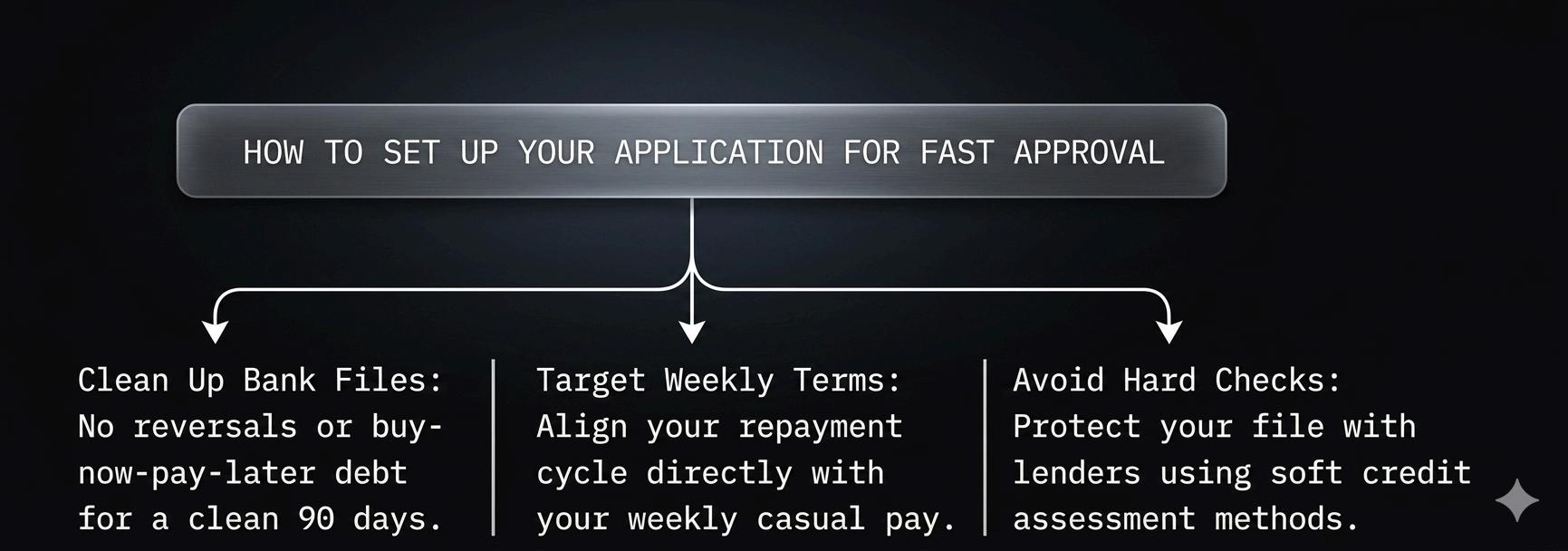
Clean Up Your Bank Statement Footprint
Because modern lenders lean heavily on your recent transaction history rather than strict employment history, your bank statements are your ultimate resume. For 60 to 90 days before applying, ensure your account remains completely clear of account overdrawn fees or payment reversals. Additionally, try to scale back on excessive "buy now, pay later" transactions, as automated systems treat multiple open micro-loans as a red flag against your weekly disposable income
Align Repayments With Your Pay Schedule
Matching your financial obligations to the exact rhythm of your life makes budgeting effortless If your casual shifts are processed and paid weekly, look for alternative finance models that offer weekly payment options. Setting up a weekly direct debit ensures that your car payment aligns with your cash injection, eliminating the stress of trying to hold onto a large chunk of money for a massive monthly bill.
Look Beyond Rigid Credit Inquiries
If your credit history is thin or less than perfect because of past hiccups, do not despair. Traditional lenders rely entirely on a score, but niche automotive finance platforms frequently offer loan options with no credit check required for initial verification By utilising alternative criteria like verifying continuous industry tenure or consistent cash reserves these platforms
focus entirely on your current ability to manage the asset, paving the way for fast approval without hurting your credit profile.