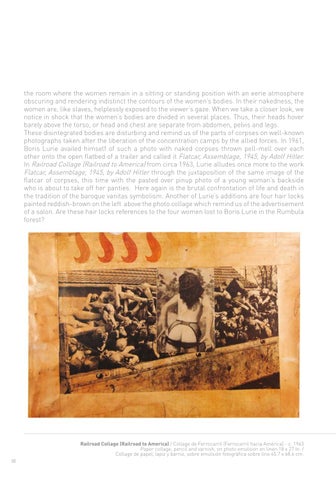
the room where the women remain in a sitting or standing position with an eerie atmosphere obscuring and rendering indistinct the contours of the women’s bodies. In their nakedness, the women are, like slaves, helplessly exposed to the viewer’s gaze. When we take a closer look, we notice in shock that the women’s bodies are divided in several places. Thus, their heads hover barely above the torso, or head and chest are separate from abdomen, pelvis and legs. These disintegrated bodies are disturbing and remind us of the parts of corpses on well-known photographs taken after the liberation of the concentration camps by the allied forces. In 1961, Boris Lurie availed himself of such a photo with naked corpses thrown pell-mell over each other onto the open flatbed of a trailer and called it Flatcar, Assemblage, 1945, by Adolf Hitler. In Railroad Collage (Railroad to America) from circa 1963, Lurie alludes once more to the work Flatcar, Assemblage, 1945, by Adolf Hitler through the juxtaposition of the same image of the flatcar of corpses, this time with the pasted over pinup photo of a young woman’s backside who is about to take off her panties. Here again is the brutal confrontation of life and death in the tradition of the baroque vanitas symbolism. Another of Lurie’s additions are four hair locks painted reddish-brown on the left above the photo collage which remind us of the advertisement of a salon. Are these hair locks references to the four women lost to Boris Lurie in the Rumbula forest?
Railroad Collage (Railroad to America) / Collage de Ferrocarril (Ferrocarril hacia América) - c. 1963 Paper collage, pencil and varnish, on photo emulsion on linen 18 x 27 In. / Collage de papel, lapiz y barniz, sobre emulsión fotográfica sobre lino 45.7 x 68.6 cm. 88