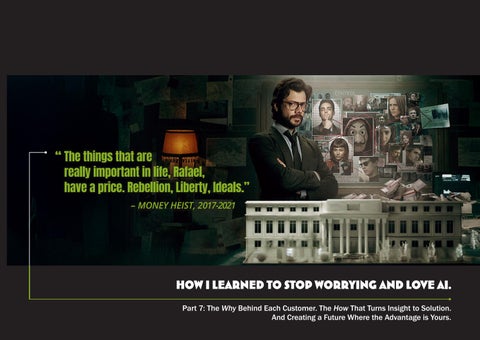
“ The things that are
really important in life, Rafael, have a price. Rebellion, Liberty, Ideals.” – MONEY HEIST, 2017-2021
How I learned to stop worrying and love AI. Part 7: The Why Behind Each Customer. The How That Turns Insight to Solution. And Creating a Future Where the Advantage is Yours.
Marketers (and other masterminds) tend to get lost in the details. The what and the how: features and specs, tactics and tweaks. But as the Professor’s every move so brilliantly demonstrates,
true genius, the kind that walks out with the big bucks, ... is all about getting to the why. Faster.
F
or more than fifty years, Positioning has been the strategist’s sharpest tool. Since Ries and Trout’s 1972 book gave it a name, marketers have used it to define “what” a brand is about; using category, attribute, benefit, and repetition to carve out and own a space in the customer’s mind. Positioning turned tech specs into creative platforms. Transformed soap into skincare. And elevated commodities into brands.
But competition never rests. “Faster” differentiates until everyone’s fast. “Smoother” until smoothness is expected. Each cycle demands a new lever, so features evolved to benefits, and claims refocused on meaning. And then, with the digital revolution, came the biggest leap forward yet: Personalization. Pioneered by David Edelman, BCG and McKinsey thought leader, Harvard professor, and my former CMO at Aetna, it transformed the breadcrumbs people leave online into individual journey maps, showing not just where a customer was on the internet, but where they were in their decision process. It was the kind of elegant, system-level rethink you’d expect from a professor (real or fictional). And just as Money Heist’s Professor reimagined the rules so his team could walk away with millions, Edelman and his peers’ reframing reshaped marketing and unlocked billions for those wise enough to follow. 2
Now AI is reshaping both sides of the marketing equation again.
WANT TO GO DEEPER? This article was inspired by the Netflix Series Money Heist, origin
O
n the product side, as we discussed in Article 6, LLMs are categorizing brands before humans even engage. And because they’re doing this based on training across the public internet, where so much brand data is short, flat write-ups like catalog copy or warehouse descriptors, even the sharpest positionings risk being flattened into commodity descriptions. Fortunately, on the customer side, something even more exciting is happening. These same models are, for the first time, reading and understanding human language at scale. And in their training, they’re being exposed to everything from academic papers to parenting forums, Reddit debates to TikTok threads, the raw material of desire and intent. The result is that they’re not just learning words, they’re detecting and weighing the patterns of motivation woven through them. And those patterns are surfacing insights and suggesting opportunities marketers have never seen before. The result is far richer customer insight. Not just that Gen Xers are buying more formal work clothes, but that dressing up, even for a video call, makes
them feel more professional. Not just that Gen Z travelers are choosing hostels, but that they’re doing so less to save money than to avoid loneliness. These aren’t just patterns. They’re glimpses into what people are really solving for. Such is the promise of a new discipline I’m calling Solutioning. It takes the what of Positioning, the when and where of Personalization, and adds the missing lever: the why. The result is a practice that combines in-house reality with AI breadth to reach decision-ready strategy faster and turn it into platforms and briefs that codify what the brand may need to become to win. Of course, just as it is in a perfect heist, the genius is about more than insight. It’s about a plan. Just as the Professor’s crew defined reality, developed workarounds, and executed with intent, Solutioning gives teams a repeatable way to reach decision-ready strategy faster: validate insights, widen the brand’s frame of reference, and produce platforms and briefs teams can actually execute, with the confidence of big agencies. All while moving at a speed outside agencies can’t match.
nally created by Álex Pina and released 2017-2021. The series, starring Alvaro Morte, Úrsula Corberó, Pedro Alonso, can be found at IMDb: https://www.imdb.com/title/tt6468322/
3
“Every rebellion starts with someone daring to defy the rules.” Personalization changed the game. Solutioning could do it again. All great marketers share one skill: making the most of the data at hand.
T
oday, that means personalization, the art of turning digital footprints into finely tuned messaging. Every search, scroll, click, and purchase becomes a breadcrumb, feeding into platforms like Adobe, Salesforce, and Meta. Personalization stitches those trails into journey maps, predicting behavior and sharpening each message with algorithmic precision. The results are extraordinary. What you did, what you liked, what people like you liked. All of them feed behavioral prediction models. And those models power messaging that drives clicks and sells products. Personalization gives marketers the incredible power of knowing exactly where each of their customers is on their personal journey. That knowledge makes every communication more relevant and more effective. Personalization makes marketers masters of the “where.” And therein lies the rub. Because even the sharpest behavioral data has limits. You clicked on baby bottles. So maybe you’re a parent. Maybe you’re a godparent. Maybe you’re panicking. The system doesn’t know. It only sees what you did. Not why.
A
nd that gap between action and intent is where the next layer of advantage lies. Solutioning takes the same data-driven mindset that made personalization so effective and aims it at a different signal: human language. Not just keywords or metadata, but the full messy record of how people describe what they want, what they fear, what they regret, and what they hope will change. LLMs matter here because they can read that language at scale, and because they’ve been trained on an enormous range of it. They arrive with a wide-angle view of patterns no single team could ever collect, from reviews and forums to support tickets, surveys, and everyday conversation. Used well, they don’t replace judgment. They widen the lens, surface plausible explanations, and help teams generate and pressure-test solution directions. Then the team layers in what only it has: lived brand knowledge, practical constraints, and taste. The value is in the combination. Neither side can do it alone.
4
That makes solutioning for the emerging era what personalization is for the present one: a step-change in how we understand and serve customers. Positioning helps define the what. Personalization helps master the where. Solutioning gets us closer to the why, and turns it into a roadmap for the solutions a brand can credibly stand for and consistently deliver. When we can see all three, we don’t just sell more of what
people already want. We uncover needs they haven’t voiced yet, and we build clearer platforms faster, without needing a big agency or a huge budget.
“The plan’s designed to survive any setbacks, including my death.” A system that produces results today. A discipline that delivers more tomorrow.
I
n Money Heist, the Professor built a plan to do the impossible: give his team access to what had been out of reach. And his example inspired me to do something similar: give smaller, often under-resourced creative and marketing teams access to the kind of strategic insight usually locked away in the ivory towers of the agency elite. The result is The Learn to Love AI (LTLAI) Solutioning System, a process that combines my decades of experience leading creative and strategy for world-class agencies and in-house teams with my hands-on knowledge of AI, to deliver a strategic operating system that will help teams in any industry produce clearer insights faster, stronger strategic platforms, and more powerful creative starting points. Like the Professor’s plan, the system is strategic and tactical. But where his was a one-time masterpiece, mine’s built for repeat use. It elevates both the team using it and the work they produce. It’s less about replacing people than multiplying their contribution, adding speed to analysis, structure to collaboration, and clarity that prevents wasted rounds. The result is work that earns internal respect and external attention. What’s more, the more your team uses it, the stronger they’ll get at spotting connections, developing insights, and shaping the kinds of ideas that result in more powerful platforms and briefs and give internal creative teams the foundation needed for more standout work. The process is simple: three phases, each with a clear goal, a method, and an output that delivers real value quickly. Run the Pilot and you’ll walk out with a concrete decision package. Complete the installation and your team will have a repeatable way to build platforms and briefs for the moments that matter most. To deliver results faster with the system, we should talk. Together we can tailor an in-person workshop to your workflows, ensure brand, legal, and voice alignment, and elevate your team’s confidence, capability, and creative impact with AI.
Explore the Solutioning System & Pilot Program
• Inside the Solutioning System • The Pilot Program • Sample Worksheets and strategic tools
• Examples of the kinds of outputs the Solutioning System and Pilot Program can be expected to produce.
Visit our companion page to explore the Solutioning System and Pilot Program today. www.learntoloveai.com/solutioningintro
5
How the Pilot Works
The Pilot is a guided decision package: it locks motivation truths, surfaces strategic openings, and ends in an executive readout that makes your next move obvious. Format: A short sequence of facilitated sessions built around a real business challenge. We bring the prompts, worksheets, and we guide your team through them in real time. Your Team: We recommend a cross-functional team of 3–6 people, mixing strategy, creative, and product knowledge, led by a facilitator who will capture key decisions Tools: All materials are provided as part of the Pilot. See the companion page for a closer look at the system and sample outputs. Learn more at www.learntoloveai.com/solutioningintro
“Hey, don’t treat me like you f***ing know me. I don’t even know myself.”
The best way to end in a conversion is to start with understanding. PHASE ONE - FIX YOUR INSIGHT
G
THE GOAL
reat communications meet customers where they are and escort them past whatever objections they have. And decades of research show there’s no better way to start that shift than with a point of agreement, a nodcausing comment, a truth that signals we understand who we’re talking to. It catches attention, builds trust, and results in conversations that become conversions. So whether we’re creating a content series, launching a product, or repositioning a brand, our first job is to identify the strongest customer truths already available, and then to make them explicit, shared, and usable. That way, while we’ve yet to hit gold, at least we’re no longer digging at random.
N
THE PRINCIPLE
ow, Phase One isn’t designed to magically guarantee a breakthrough insight. Those don’t show up on demand. But it is designed to reliably deliver something almost as valuable and nearly as rare: a shared starting point, a common vocabulary, and an earned foundation of customer truths to build on. We get there because of what the LLM brings to Phase One. It helps us take implicit beliefs and make them explicit. It forces us to stress-test our assumptions. And, critically, it lets us baseline our thinking against what tends to be true in the category before we crown our own “truths” as canon. That baseline keeps us honest about what’s present, what’s absent, and what we’re at risk of overlooking. In short, this phase grounds. Phase Two expands. And Phase Three sharpens. THE EXERCISE
6
1. Start Where the Why Begins – Customer experiences are full of times where people act, choose, compare, and seek reassurance. But in every category, a few situations do the real work. So we start by naming the recurring moments where the why lives and brands win or lose. And describe it in language we can picture.
2. Validate the Zone – Before we go further, we pressure-test that first field of play. The goal is simple: make sure we’re aiming at real tension, not internal folklore, and sharpen the Zone enough that the next step starts in the right place. 3. Move to Moments That Matter – Now that we’ve established where outcomes get decided, we layer in customers, introducing them to our category’s key situations and those situations to our customers’ particular pressures, expectations, and constraints. The result is a set of movie moments that capture the essence of our customers’ experience and let us start seeing underlying patterns. 4. Recognize What Reoccurs – In this step we look deeper at our scenes, not to focus on individual detail but to surface the commonalities they share. The goal is to move from separate moments to one shared map of behavior, and by doing so, begin revealing the structures that drive choices inside these key situations. 5. Look for the Hidden Human Truths – This is where Phase One comes into focus. We take the scenes we’ve captured, the patterns we’ve surfaced, and the behaviors we’ve mapped, and shape them into a short set of Finishable Truths: clear statements we believe are valid, feel are powerful, and can defend when someone pushes back. 6. Pressure-Test the Truths – Before Phase Two begins, we review the truth set one more time, strengthening what is soft and making sure what we carry forward is clear enough to build on and strong enough to survive scrutiny.
“In this world, everything’s governed by balance. There’s what you stand to gain and what you stand to lose.”
Because the real key to winning is deciding where you’re going to play. PHASE TWO - FIND A NEW ANGLE
P
THE GOAL
hase Two is where we widen the lens, combining our participants’ natural immersion in their brand with LLMs’ unmatched and far-reaching understanding of categories, markets, and people writ large. The result is a more informed perspective than internal teams can usually reach on their own, one that can see over the horizon, spot openings, and recast brand features in ways that weren’t available before. This phase is where Solutioning really comes into its own. THE PRINCIPLE The magic of this phase is getting the ask and the answer, the want and the offer, to align, often in a place an internal team would never reach on its own. That’s where LLMs change the game. They’ve been trained on millions of human moments, questions, complaints, comments, kvetching, and so they bring a broader customer perspective than any one team could. On top of that, they also know the latest thinking and realities in markets, categories, and trends. And when we combine that exposure with our teams’ lived knowledge of the brand, we can fashion truly powerful brand strategy platforms. 7
THE EXERCISE 1. Take a Walk on the Wild Side – Phase One sharpened our customer insights. Now we go further, changing the lens on brand realities: what the brand is made of, where it fits, what its benefits are, and even how the category could be defined. In essence, we’re breaking the gravitational pull of habit and freeing internal teams to see their brand in a new frame. 2. The Pilot Plateau – Taking Stock – Before we start pairing truths with perspectives, we pause to see what is surfacing, what feels most promising, and where the terrain is opening up. It’s a short strategic stock-take that helps the team choose with more intention. 3. Pair Truth with Perspective – Next we hold up our Phase One truths and look for alignment: the ask and the answer, the want and the offer. Certain roles make a truth sharper and more actionable, and certain pairings turn recognition into a direction we can build from. 4. Choose Your Strategic Leverage – Finally, we take the best pairings and pressure-test them against reality, because now’s no time to write checks we can’t cash. We ask three hard questions: is it true, ownable for this brand, and provable in a way customers will believe? 5. Confirm the Strategic Leverage – Before Phase Three begins, we pressure-test the finalists one more time and make sure what survives is not just exciting, but sturdy enough to carry into platform work.
“The most important moments are the ones that make you realize there’s no turning back.” Give your team the freedom of a tight strategy. Or three. PHASE THREE - FRAME YOUR FUTURE
P
THE GOAL
hase One gave us truths we can stand behind. Phase Two gave us angles worth betting on. Now we turn that strategic power into something we can use: three platforms clear enough to steer creative work, sturdy enough to survive scrutiny, and compelling enough to drive a team forward. This is where the system becomes portable. THE PRINCIPLE A strategy platform is a direction with a spine. It holds a human truth in one hand, a credible brand solution in the other, and gives everyone a place to stand as we decide what to say, make, and prove, because a single word can make an idea feel inevitable or like marketing. This is where LLMs help in a specific way: they let us explore a range of expressions quickly, test how they land, and spot when our language starts drifting into category cliché. All while we stay in the driver’s seat. We choose what’s true, ownable, and worth building our future on. THE EXERCISE
8
1. Draft Your Solutioning Statements – We take our strongest leverage directions and translate them into multiple statements that are truly different, not just differently worded.
The aim isn’t clever phrasing. We’re exploring how the same underlying truth can become different strategic bets, each with its own tone, emphasis, and creative implications. 2. Stress-test Statement Language – Next we take the best candidates and put them under pressure, listening for what sounds fresh and real versus done or forced. We test for clarity, distinctiveness, and the kind of phrasing an organization can actually stand behind. 3. Confirm Platform Competitiveness – Before we lock the language, we test the strongest directions against category norms, adjacent claims, and the kinds of statements competitors could plausibly make. The goal is to keep what is ownable, resonant, and strong enough to hold. 4. Craft Your Solutioning Platforms – Finally we choose three directions and turn each into a usable tool: a clear statement, the proof behind it, and the implications of what we should make, say, and show. By the end, we have three platforms clear enough to guide the work and strong enough to inspire it. And then... well, we can celebrate. Not because the work is done, but because we’ve built something rare: three future-facing directions that give your creative team the foundation they need to create the best work of their careers.
“It didn’t all work out. We’re not all here. But we did accomplish something.”
Because every experiment that moves us forward brings the future closer.
W
e’ve come a long way. From tossing darts to seeing patterns. From endless rounds to decisions that stick. From siloed expertise to elevating the lived intelligence of the people who actually carry the brand. From boilerplate strategy to the kind of fresh thinking that only shows up when we iterate and collaborate. From truth through solution, what we’ve built is more than a tool. It’s a partnership between human and machine, intuition and evidence. The next step in the journey from positioning, to personalization, to Solutioning. From what a brand has been, to what it could become when we stop describing the world and start reshaping it. In a single process we’ve freed strategists to look deeper, creatives to start sharper, and organizations to move faster with more confidence, while staying grounded in real customer reality. And every so often, we get the best kind of moment: when human judgment meets AI reach, and something that began as a hunch clicks into a current. Of course, not every attempt lands. It never will. The point is the reps. Listening harder, testing cleaner, getting better at spotting what holds. Next, we’ll see it in the real world. In Article 8, we’ll put Solutioning to work inside a real company with a real problem, and follow the process as it surfaces truths, shapes solutions, and produces platforms strong enough to guide creative work and drive results. You’ll see what happens when theory becomes practice. And it’s only the beginning.
9
This series wouldn’t exist without the insight, patience, and moral support of two people. My beautiful wife, Cecile Engrand - the best event marketing CD I know - who was showing the world what was possible with AI long before the rest of us caught on, and whose strategic sensibility still grounds everything I do. And my lifelong friend, Thomas Bolton - Princeton-trained, fractional CPO, and AI whisperer - who’s been my teacher, tech advisor, and intellectual sparring partner from day one. And the only person I know building his own AlphaGo model… for fun. Without their very human connection (and the help of my favorite LLM), none of this would’ve come together. Contact
Article Series Hub
LiamSherborn@gmail.com (508) 733-1821
Don’t be a stranger. Let’s connect: linkedin.com/in/liamashannon
The full Series plus extras are at: www.LearntoLoveAI.com