Rishworth, West Yorkshire, United Kingdom HX6 4QA. Tel: +44 (0)1422 822 217 Fax: +44 (0)1422 820 911 E-mail: admissions@rishworth-school.co.uk Website: www.rishworth-school.co.uk
EDQ
0161 303 9482 Designed and printed by
View our virtual tour
Rishworth School: a company limited by guarantee Registered in England: Company Number 05855479 Registered Office: Oldham Road, Rishworth, West Yorks HX6 4QA Registered Charity Number: 1115562
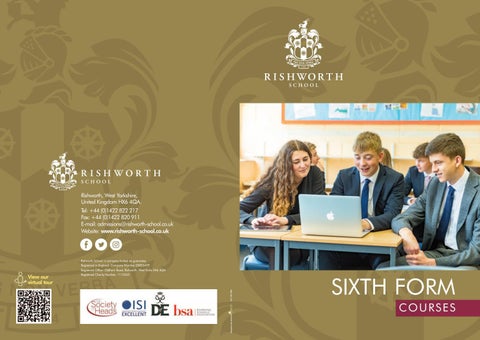
SIXTH FORM COURSES
SIXTH FORM COURSES
Contents
Page Title
Page Number
Introduction
2
A Level Choices: Art & Design Biology Business Chemistry Computer Science Creative and Performing Arts (CAPA) Level 3 Diploma Design and Technology Economics English Language English Literature Food Science and Nutrition: Level 3 Diploma Geography History Mathematics & Further Mathematics Modern Languages Music Physical Education BTEC Foundation Diploma in Sport BTEC National Extended Diploma in Sport Physics Psychology BTEC Travel and Tourism
3 4 5 6 7 8 9 10 11 12 13 14 15 16 17 18 19 20 21 22 23 24 25
Complementary Courses English For Academic Purposes EPQ (Extended Project Qualification) Enhanced Curriculum
26 27 28 29
Introduction At Rishworth, every student's individual talents are nurtured. The potential doctor, artist, lawyer, professional athlete or entrepreneur - each is well catered for and each is equally valued.
Our wide curriculum - with over 21 subjects to choose from, enables students to select a programme which reflects their personal strengths and passions and take that important next step on their journey towards their future career goals.
Our sixth form has small class sizes (8 on average) combined with top class teaching - we were graded 'excellent' for both student achievement and personal development in the last ISI inspection, this means that the quality of the teaching and the level of support our students receive is second to none. In fact, in our sixth form, students receive 6 hours of tuition per subject per week (most colleges and sixth forms only offer 4.5); this equates to 90 additional hours over a two-year course. This summers (2020) A-level results were outstanding. • 100% pass rate • 76% of grades were A*/B Therefore, it is of no surprise that Rishworth students have been awarded places at many of the UK's top universities. Destinations of this year's leavers include: UCL, Kings College London, Leeds, Bristol and Durham. Life in our sixth form is different from the rest of our school, students have more freedom and have access to a host of new opportunities and experiences. Academically, students are encouraged to work and study in a more independent manner, but it's also a time when expert support, guidance and advice are needed perhaps more than ever by both students and parents. Ultimately, our sixth form programme is designed to bridge the gap between school and university. We have a vibrant sixth form community of around 100 students, who are a combination of day pupils, full boarders and weekly boarders. If you are progressing internally, you will benefit from teaching and pastoral staff who know you so well and are wholly invested in your success. If you are new to Rishworth, this commitment starts from the second you accept a place and we look forward to supporting you in achieving your aspirations. For all its academic success, Rishworth School is far from being an exam factory. It is important to appreciate that the school's student centred approach and wider focus on service, leadership and the building of character which helps Rishworthians become well-rounded, productive and successful contributors to a modern society.
The contents of this Handbook are as accurate as they can be at the time of publication but may be subject to change as the needs of the School vary. Parents are advised to check with the School the accuracy of any detail which is of particular importance to them or to their child.
2
SIXTH FORM COURSES
A Level Choices
Art & Design
Mode of assessment The non-exam assessment is set and marked by the department and moderated by AQA during a visit to the School. Visits normally take place in June.
Introduction The study of art and design is an invaluable way of deepening students' perception of themselves and the world in which they live. It provides a path to visual literacy and the language of art and design. It nurtures the creative skills, imagination and industry needed to enable students to produce their own work in a visual form. Grade 5 in GCSE Art is preferred as a minimum entry requirement. It is a two year course.
Component 2: Externally set assignment This is an assignment set by AQA which will be provided to students on 1 February, or as soon as possible after that date. The examination paper will consist of a choice of eight questions to be used as starting points. Students are required to select one. Following a period of preparatory work students must produce a finished outcome, or series of outcomes, in 15 hours of supervised time. Once the supervised time begins students may refer to their preparatory work but must not amend or add to it.
Course content Examination Board: AQA The department follows the AQA Art, Craft and Design specification. This is a broad-based two year course exploring practical and critical/contextual work through a range of 2D and/or 3D processes and media associated with two or more of the following titles: Fine Art, Graphic Communication, Textile Design, Three-Dimensional Design and Photography.
Component 2 carries 96 marks and contributes to 40% of the A Level.
The course consists of two components which may be subject to change by AQA.
The course content as set out above may be subject to change by AQA.
Mode of assessment The externally set assignment is set and marked by the department and moderated by AQA during a visit to the School. Visits normally take place in June.
Component 1: Personal investigation This is a practical investigation supported by written material of between 1000 and 3000 words. Students are required to conduct a practical investigation into an idea, issue, concept or theme supported by written material. The focus of the investigation must be identified independently by the student and must lead to a finished outcome or a series of finished outcomes. Component 1 carries 96 marks and contributes to 60% of the A Level.
4
SIXTH FORM COURSES
Biology
Questions • 76 marks: a mixture of short and long answer questions • 15 marks: extended response questions
Introduction Biology is the study of living things. However, it also involves the study of how the environment affects living things and vice versa as well as the application of biological concepts to the world around us. The subject requires inquisitiveness about life and, preferably, a grade 6 in GCSE Science.
Paper 2 What's assessed • Any content from topics 5–8, including relevant practical skills Mode of assessment • Written exam: 2 hours • 91 marks • 35% of A Level
Examination Board: AQA Course content 1. Biological molecules 2. Cells 3. Organisms exchange substances with their environment 4. Genetic information, variation and relationships between organisms 5. Energy transfers in and between organisms 6. Organisms respond to changes in their internal and external environments 7. Genetics, populations, evolution and ecosystems 8. The control of gene expression
Questions • 76 marks: a mixture of short and long answer questions • 15 marks: comprehension question Paper 3 What's assessed • Any content from topics 1–8, including relevant practical skills Mode of assessment • Written exam: 2 hours • 78 marks • 30% of A Level
Practical work There are twelve practical activities that are part of the specification and must be done by all students. The students will be assessed to achieve an overall pass or fail in this component.
Questions • 38 marks: structured questions, including practical techniques • 15 marks: critical analysis of given experimental data • 25 marks: one essay from a choice of two titles
Written Assessment Assessment is by examination and all papers must be taken at the end of the two year course.
N.B. In Year 13 the class attends a Field Course at the Cranedale Field Studies Centre near Malton.
Paper 1 What's assessed • Any content from topics 1–4, including relevant practical skills
Business
7. Analysing the strategic position of the business SWOT analysis, income statements, balance sheets, ratio analysis, SLEPT influences, the competitive environment, investment appraisal.
Introduction Business is an interesting, relevant, useful, multi-disciplinary "here and now" subject which provides a useful insight into the varied world of business. The exam specification enables students to engage with, explore and understand business behaviour and to develop a critical understanding of what business is and does. Students must have an interest in the news and current affairs, the confidence to approach the many numerical concepts, the ability to interpret and understand case study material, the ability to write thorough, coherent and evaluative extended responses and a willingness to engage and participate fully.
8. Choosing strategic direction - markets, Ansoff's matrix, how to compete. 9. Strategic methods: how to pursue strategies change in scale, types of growth, economies & diseconomies, innovation, internationalisation, digital technology. 10. Managing strategic change - managing change, managing organisational culture, managing strategic implementation, network analysis, why strategies fail. (The first six sections will be covered in the Lower Sixth with the 4 remaining sections covered in the Upper Sixth).
Course content Examination Board: AQA
The A Level course is organised into ten sections:
Mode of Assessment
1. What is business? - objectives, profit, types of business organisation, external influences on costs and demand.
A Level course The A Level course is assessed by three 2 hour examination papers at the end of Year 13:
2. Managers, leadership and decision making leadership styles, scientific decision making, decision trees, the importance of stakeholders.
Paper 1: Multiple choice, short answer and two essays Paper 2: Three data response questions Paper 3: Case study with six questions
3. Decision making to improve marketing performance - marketing objectives, market research, market segmentation, price elasticity, the marketing mix.
Testing Quantitative Skills:
4. Decision making to improve operational performance - quality, inventory & suppliers.
The A Level assesses quantitative skills such as ratios, averages, fractions, percentages and the calculation of profit and loss.
5. Decision making to improve financial performance - cash flow, budgeting, break-even analysis, sources of finance.
Mode of assessment • Written exam: 2 hours • 91 marks • 35% of A Level
6. Decision making to improve human resource performance - interpreting HR data, organisational design, motivation, improving employer-employee relations.
5
6
SIXTH FORM COURSES
systems. Inorganic chemistry This includes the study of periodicity, Group 2 the alkaline earth metals and Group 7 (17) the halogens.
Chemistry Introduction Chemistry is fundamentally an experimental subject and this course provides numerous opportunities to use practical experiences to link theory to reality, and equip students with the essential practical skills they need. In this course, stress is laid on chemistry in modern life, its central role in the sciences and its economic, environmental and sociological importance. The full A Level, which combines well with physics and biology at A Level, lays the foundation for further study in a wide range of subjects. Chemistry is a good choice for students considering careers in the health and clinical professions, including medicine, veterinary science, nursing, dentistry and forensic science. Studying chemistry will also prepare students for industry careers, such as those within the pharmaceutical or petrochemical sectors.
Organic chemistry This includes an introduction to organic chemistry, alkenes, halogenoalkanes, alkenes, optical isomerism, alcohols, aldehydes and ketones, carboxylic acids and derivatives, and organic analysis,
Year 2 Course content Physical chemistry This includes the study of thermodynamics, rate equations, equilibrium constant Kp for homogenous systems, electrode potentials and electrochemical cells. Inorganic chemistry This includes the study of properties of Period 3 elements and their oxides, transition metals and reactions of ions in aqueous solution.
To make progress in this subject, students need to be enthusiastic about science and preferably to have gained at least grade 6 at GCSE in Chemistry or the chemistry component of Science and Additional Science at GCSE. Overall, at least 20% of the marks in assessments for chemistry will require the use of mathematical skills. These skills will be applied in the context of chemistry and will be at least the standard of higher tier GCSE Mathematics.
Organic chemistry This includes the study of, aromatic chemistry, amines, polymers, amino acids, proteins and DNA, organic synthesis, NMR spectroscopy and chromatography. Examination Board: AQA Mode of Assessment: The course is assessed by written examination using short and long answer, and multiple choice questions. Practical activities are carried out across the two-year A Level and students will be asked to apply the knowledge and understanding they learn from these practicals in their written exams. Assessments will be in June at the end of Year 13 for the second year of A Level.
Year 1 Physical chemistry This includes the study of atomic structure, amount of substance, bonding, energetics, kinetics, chemical equilibria, Le Chatelier's principle and equilibrium constant (Kc) for homogeneous
7
It covers: • The characteristics of contemporary processors, input, output and storage devices • Types of software and the different methodologies used to develop software • Data exchange between different systems • Data types, data structures and algorithms • Legal, moral, cultural and ethical issues.
Computer Science Introduction “At its heart lies the notion of computational thinking: a mode of thought that goes well beyond software and hardware, and that provides a framework within which to reason about systems and problems.”
Component 02: Algorithms and programming This builds on component 01 to include computational thinking and problem-solving. It covers: • What is meant by computational thinking (thinking abstractly, thinking ahead, thinking procedurally etc.) • Problem solving and programming – how computers and programs can be used to solve problems • Algorithms and how they can be used to describe and solve problems.
Computer Science is relevant to a modern and changing world, in which algorithms are controlling many aspects of our everyday lives. Computer Science is a practical subject where students can apply the academic principles learned in the classroom to real world systems. It is an intensely creative subject that combines invention and excitement, and can look at the natural world through a digital prism.
Component 03: Programming project Students are expected to apply the principles of computational thinking to a practical coding programming project. They will analyse, design, develop, test, evaluate and document a program written in a suitable programming language. The project is designed to be independently chosen by the student and provides them with the flexibility to investigate projects within the diverse field of computer science. We support a wide and diverse range of languages.
This A Level values computational thinking, helping learners to develop the skills to solve problems, design systems and understand the power and limits of human and machine intelligence. Students will develop an ability to analyse, critically evaluate and make decisions. The project approach is a vital component of ‘post-school’ life and is of particular relevance to Further Education, Higher Education and the workplace. Each student is able to tailor their project to fit their individual needs, choices and aspirations.
Examination Board: OCR Mode of assessment Paper 1: Computer Systems Written examination (2 hours 30 minutes) - 40% of total A Level marks. Paper 2: Algorithms and programming Written examination (2 hours 30 minutes) - 40% of total A Level marks. Paper 3: Programming project Non-exam assessment - 25% of total A Level marks.
Course content Component 01: Computer systems Students are introduced to the internal workings of the (CPU), data exchange, software development, data types and legal and ethical issues. The resulting knowledge and understanding will underpin their work in component 03.
8
SIXTH FORM COURSES
Creative and Performing Arts (CAPA) Level 3 Diploma
Dance Pathway Two core units and a choice of five optional units: Core Unit - Performance Preparation Core Unit - Planning a Career in the Performing Arts Industry Optional Unit - Safe Dance Practice Optional Unit - Ballroom Optional Unit - Choreography Optional Unit - Collaborative Cross Arts Performance Optional Unit - Dance Fitness Optional Unit - Dance in Health Optional Unit - Dance in the Community Optional Unit - Dance Technique and Performance 1 Optional Unit - Dance Technique and Performance 2 Optional Unit - Ensemble Dance Performance Optional Unit - Global Dance Styles Optional Unit - International Dance Touring Optional Unit - Leading Dance Optional Unit - Repertory Dance Performance Optional Unit - Rhythm and Tap Optional Unit - Social Dance through the ages Optional Unit - Dance Audition Preparation Optional Unit - Dance on Camera Optional Unit - Jazz Dance for Musical Theatre Optional Unit - Creating a Dance Company
An exciting, vocational course for students who have a passion for dance or drama. Examination Board: Rock School Limited (RSL) Course content The qualification will be delivered over two years and is made up of seven units – two core units and five optional units out of a vast choice. Students can follow one of two pathways; Acting or Dance, with the course aim being to prepare students for the performing arts industry. Acting Pathway Two core units and a choice of five optional units: Core Unit - Performance Preparation Core Unit - Planning a Career in the Performing Arts Industry Optional Unit - Acting for the Camera Optional Unit - Acting Workshop Optional Unit - Ancient Greek and Roman Theatre Optional Unit - Approaches to Acting Optional Unit - Audition Techniques Optional Unit - Comedy Drama in Performance Optional Unit - Contemporary Theatre Optional Unit - Drama in the Community Optional Unit - Elizabethan Theatre Optional Unit - Physical Theatre Optional Unit - Theatre in Education Optional Unit - Theatre Spaces and Audiences Optional Unit - Voice over Acting Optional Unit - Working with Masks Optional Unit - Devising Optional Unit - Improvisation Optional Unit - Movement for Actors Optional Unit - Stage Combat Optional Unit - Theatre Genres Optional Unit - Vocal Techniques Optional Unit - Creating a Theatre Company
Mode of assessment A combination of formative and summative assessments which includes performances and gathering evidence such as presentations, images, recordings and written assignments, all of which are conducted internally. Awards are from Distinction* to Pass and are recognised in UCAS points and for university applications equivalent to A Levels. UCAS Points Comparison Chart: CAPA Distinction* worth 84 UCAS Points Grade A* at A Level worth 56 UCAS Points CAPA Distinction worth 72 UCAS Points Grade A at A Level worth 48 UCAS Points CAPA Merit worth 48 UCAS Points Grade B at A Level worth 40 UCAS Points CAPA Pass worth 24 UCAS Points Grade C at A Level worth 32 UCAS Points Grade D at A Level worth 24 UCAS Points 9
Design and Technology
• develop the capacity to think creatively, innovatively and critically through focused research and the exploration of design opportunities arising from the needs, wants and values of users and clients
Introduction This A level offers a unique opportunity in the curriculum for learners to identify and solve real problems by designing and making products or systems. Design and technology is an inspiring, rigorous and practical subject. This specification encourages learners to use creativity and imagination when applying the design processes to develop and modify designs, and to design and make prototypes that solve real world problems, considering their own and others’ needs, wants, aspirations and values. The specification enables learners to identify market needs and opportunities for new products, initiate and develop design solutions, and make and test prototypes. Learners should acquire subject knowledge in design and technology, including how a product can be developed through the stages of prototyping, realisation and commercial manufacture. Learners should take every opportunity to integrate and apply their understanding and knowledge from other subject areas studied during key stage 4, with a particular focus on science and mathematics, and those subjects they are studying alongside A level design and technology.
• develop knowledge and experience of real world contexts for design and technological activity • develop an in-depth knowledge and understanding of materials, components and processes associated with the creation of products that can be tested and evaluated in use • be able to make informed design decisions through an in-depth understanding of the management and development of taking a design through to a prototype/product • be able to create and analyse a design concept and use a range of skills and knowledge from other subject areas, including mathematics and science, to inform decisions in design and the application or development of technology • be able to work safely and skilfully to produce high-quality prototypes/products • have a critical understanding of the wider influences on design and technology, including cultural, economic, environmental, historical and social factors • develop the ability to draw on and apply a range of skills and knowledge from other subject areas, including the use of mathematics and science for analysis and informing decisions in design
Course content This specification enables learners to work creatively when designing and making and apply technical and practical expertise, in order to:
Mode of assessment The subject content for GCE A level Design and Technology will be assessed in the written examination (50%) and through a non-exam assessment (NEA) (50%). The NEA is a design and make project taking approximately 80 hours and focusses on Design and Technology in the 21st Century.
• be open to taking design risks, showing innovation and enterprise whilst considering their role as responsible designers and citizens • develop intellectual curiosity about the design and manufacture of products and systems, and their impact on daily life and the wider world • work collaboratively to develop and refine their ideas, responding to feedback from users, peers and expert practitioners
There is one written examination of 3 hours with 100 marks. This will take place in the summer of Year 13.
• gain an insight into the creative, engineering and/or manufacturing industries
Examination Board: EDUQAS
10
SIXTH FORM COURSES
Economics
Theme 4 A global perspective 4.1 International economics 4.2 Poverty and inequality 4.3 Emerging and developing economies 4.4 The financial sector 4.5 Role of the state in the macro-economy
Introduction Economics is a subject dealing with the issues of today. It aims to develop an understanding of the national, international and global economy.
Mode of assessment All students take internal examinations at the end of Year 12 to assess progress and then again in mock examinations in Year 13. These courses are externally assessed by examination only. At the end of Year 13 students will take three examinations for the full A Level qualification. Examinations:
As well as studying the theories that underlie the subject, students will develop an economist's 'tool-kit' of skills that enable them to research and analyse economic problems. A wide variety of economic issues will be studied ranging from scarcity and how much workers get paid; road congestion and environmental pollution; to globalization and the rise and fall of countries like Greece and the BRICS.
Paper 1 - Markets and business behaviour Questions drawn from Theme 1 and Theme 3 100 marks, 2 hours; 35% of qualification Section A: multiple-choice and short-answer questions Section B: one data response question Section C; one extended open response question [choice of one from two)
Course content A Level Economics (9ECO) Four themes, all examined at the end of Year 13 for a stand-alone qualification. Theme 1 Introduction to markets and market failure 1.1 Nature of economics 1.2 How markets work 1.3 Market failure 1.4 Government intervention
Paper 2 - The national and global economy Questions drawn from Theme 2 and Theme 4 100 marks, 2 hours; 35% of qualification Section A: multiple-choice and short-answer questions Section B: one data response question Section C: one extended open response question [choice of one from two)
Theme 2 The UK economy – performance and policies 2.1 Measures of economic performance 2.2 Aggregate demand 2.3 Aggregate supply 2.4 National income 2.5 Economic growth 2.6 Macroeconomic objectives and policy
Paper 3 - Microeconomics and macroeconomics Questions drawn from all themes 100 marks, 2 hours; 30% of qualification Two data response questions broken down into a number of parts, each including one extended open response question (choice of one from two for extended open response questions)
Theme 3 Business behaviour and the labour market 3.1 Business growth 3.2 Business objectives 3.3 Revenues, costs and profit 3.4 Market structures 3.5 Labour market 3.6 Government intervention
English
Examination Board: AQA Mode of assessment This is a two year A Level course, with 20% non-examined assessment and 80% examination at the end of the course.
Introduction The English department offers two separate, though complementary, courses at A Level: English Language and English Literature. The former encourages students to develop their understanding of the issues surrounding spoken and written language in use, and to use linguistic methods to investigate and analyse language taken from literary, media and everyday sources. The latter encourages students to develop their interests in literature from various times and genres, and also to develop their understanding, awareness and personal responses to texts.
English Language Course content This paper covers textual variations, textual representations and children's language development (0-11 years). • written examination: 2 hours 30 minutes • 40% of A Level Paper 2: Language Diversity and Change In this unit, language discourses and writing skills are assessed. • written examination: 2 hour 30 minutes • 40% of A Level Non-exam assessment: Language in Action Language investigation and original writing are assessed. • word count: 3500 words • 20% of A Level • assessed by teachers • moderated by the examination board
Examination Board: Edexcel
11
12
SIXTH FORM COURSES
English Literature
Food Science and Nutrition: Level 3 Diploma
Course content Paper 1: Love through the Ages Three texts are studied: one poetry and one prose text, of which one must be written pre-1900 and one must be a Shakespeare play. • written examination: 3 hours • 40% of A Level
3. Experimenting to Solve Food Production OR Current Issues in Food Science and Nutrition Studying one of the two optional units allows students the opportunity to study subjects of particular interest or relevance to them, building on previous learning and experiences.
Introduction
Examination Board: Eduqas formerly WJEC
An exciting course which will allow students to learn about the relationship between the human body and food, as well as developing practical skills linked to experimental work and the cooking and preparation of food.
Paper 2: Texts in Shared Contexts A choice of two options is available: World War 1 and its Aftermath or Modern Times: Literature from 1945 to the Present Day. Three texts are studied: one prose, one poetry, and one drama, of which one must be written post-2000. The examination will include an unseen extract. • written examination: 2 hour 30 minutes • 40% of A Level
Mode of assessment: The Eduqas Level 3 Diploma in Food Science and Nutrition is assessed through a combination of a written exam and external assignment set and marked by Eduqas and two centre marked assignments. Students will be involved in weekly practical sessions and will build on the skills and knowledge developed at GCSE level. Awards are from Distinction* to Pass and are recognised in UCAS points and for university applications equivalent to A Levels.
Course content The qualification will be delivered over two years and is made up of three units: 1. Meeting the Nutritional Needs of Specific Groups This involves a practical food showcase and an externally marked written examination. The students will demonstrate an understanding of the science of nutrition and nutritional needs in a range of different contexts. Students will experience on-going practical sessions to gain a wide variety of high level skills to produce quality food items to meet the needs of individuals.
Non-exam assessment: Independent Critical Study: Texts across time Students will undertake a critical study of two texts, at least one of which must be written pre-1900, producing one extended essay and a bibliography. • word count: 2500 words • 20% of A Level • assessed by teachers • moderated by the examination board
2. Ensuring Food is Safe to Eat This is externally marked and involves written research in the context of a given food hygiene task. This unit allows students to develop their understanding of the science of food safety and hygiene; essential knowledge for anyone involved in food production in the home or wishing to work in the food industry. Practical sessions will support the gaining of theoretical knowledge and ensure learning is a tactile experience.
Mode of assessment This is a two year A Level course, with 20% non-examined assessment and 80% examination at the end of the course. Examination Board: AQA
13
14
SIXTH FORM COURSES
Geography
Component 2: Human Geography
Introduction Geography has always been one of the most popular choices at both A Level and university. Having undergone some significant changes the course has introduced some new topics and offers students more choice, whilst encouraging the acquisition of a broad range of skills along with lifelong learning. The study of geography provides the opportunity to look at contemporary and topical issues which can be related to the world in which we live. It emphasises the changes that are taking place at a range of differing scales and helps us develop an understanding of the relationships between people and their environment. Included in our A Level course is a three-day residential fieldtrip to the Cranedale Field Study Centre near Malton in North Yorkshire. Examination Board: AQA
What's assessed Section A: Global systems and global governance Section B: Changing places Section C: Contemporary urban environments or Population and the environment or Resource Security How it's assessed • Written exam: 2 hours 30 minutes • 120 marks • 40% of A Level Questions • Section A: answer all questions (36 marks) • Section B: answer all questions (36 marks) • Section C: answer either question 3 or question 4 or question 5 (48 marks) • Question types: multiple-choice, short answer, levels of response, extended prose Component 3: Geography Fieldwork Investigation
Course content
What's assessed Students complete an individual investigation which must include data collected in the field. The individual investigation must be based on a question or issue defined and developed by the student relating to any part of the specification content.
A Level (Linear course) 2 years Component 1: Physical Geography What's assessed Section A: Water and carbon cycles Section B: Hot desert systems and landscapes or Coastal systems and landscapes or Glacial systems and landscapes Section C: either hazards or ecosystems under stress
How it's assessed • 3000 – 4000 words • 60 marks • 20% of A Level • marked by teachers and moderated by AQA
How it's assessed • Written exam: 2 hours 30 minutes • 120 marks • 40% of A Level Questions • Section A: answer all questions (36 marks) • Section B: answer either question 2 or question 3 or question 4 (36 marks) • Section C: answer either question 5 or question 6 (48 marks) • Question types: multiple-choice, short answer, levels of response and extended prose
15
History
Unit Three: Historical Themes. Popular Culture and the Witchcraze of the 16th and 17th Centuries. Examination 2hrs 30 mins; 40% of A Level. This theme focuses on the rise and decline in witchcraft during the 16th and 17th centuries and how far it emerged out of the popular culture of the time. It will examine the reasons for the increase and subsequent decline in persecutions, the nature of the Witchcraze, the reactions of the authorities and its impact on society. The examination of the Witchcraze will cover a variety of countries and regions in order establish patterns and make comparisons. There are also three Depth Studies to be looked at which include 'The Witchcraze in Southern Germany c. 1590-1630'; 'Hopkins and the witch hunt of 1645-1647'; and 'The Salem witch trials'.
Introduction History is about the study of the past and the understanding of the present. Students develop the skills of investigation, explanation, analysis, interpretation, evaluation and judgement as well as an understanding of the society in which we live. A GCSE pass in History is good preparation, but is not essential. The course will focus on the key ideas and events of the 16th, 17th, 18th, 19th and 20th centuries and will include units on the history of early modern Europe, Britain and the USA. Course content
Unit Four (20% of A Level) is a coursework investigation task of 3000-4000 words on a question of the student's own choice. This provides students with an opportunity to research individually on a historical issue that interests them and is an excellent preparation for the kind of research work students will be expected to undertake at university.
Unit One: British History Study and Enquiry. Britain 1930-1997 Examination: 1 x 1hr 3Omins; 25% of A Level. This unit allows students to develop their understanding of key issues in Britain today by seeing how the Great Powers of World War II developed into our modern society. This is the history that your parents and grandparents lived through, and you were born into. This unit looks at the changing fortunes of the main political parties, evaluates the significance of figures such as Winston Churchill and Margaret Thatcher and looks at key issues such as the power of the trade unions and Britain's relationship with Europe.
Examination Board: OCR Mode of Assessment: The A Level examination papers contain a mixture of source-based, structured and essay questions. There will be examination papers on Units 1, 2 and 3 in Year 13 that carry 80% of the final A Level grade. The coursework task will be internally assessed and externally moderated in May of Year 13 and will count for the final 20% of the A Level marks.
Unit Two: Non-British History Enquiry. The American Revolution 1740-1796 Examination: 1 x 1hr 30mins; 15% of A Level. This unit looks at the causes of the American War of Independence which led to the creation of the USA as an independent country. The role of key figures such as George Washington and Thomas Jefferson are considered. This unit also examines the principles underlying key documents such as the Declaration of Independence, the US Constitution and the Bill of Rights, which even today form the basis of the American government system. 16
SIXTH FORM COURSES
Mathematics & Further Mathematics
Further Mathematics: Students study three areas of Mathematics of which one must be Pure and two Applied, choosing from Mechanics, Statistics and Discrete Mathematics.
Introduction Students are assessed through three papers, each 2 hours long. Two papers are entirely Pure Mathematics, and the third is Applied Mathematics.
The aim of these courses is to enable students to develop their understanding of mathematical processes in a positive way, fostering confidence and enjoyment in the application of mathematics. Students will develop the skills to enable real world situations, such as understanding and using technology, computers and calculators, to be represented as mathematical models. Mathematics is then an effective means of communication and essential and relevant to many other fields of study, to the world of work and to society in general. The basic requirement for starting this course would normally be at least a grade 5 at GCSE (with all the material in the Higher Tier covered).
Pure Mathematics: To begin with, the basic techniques of algebra, co-ordinate geometry, trigonometry and calculus are developed and refined. The properties of further functions are explored and topics such as series, numerical methods, complex numbers and differential equations are studied. Mechanics: Mathematical modelling is important to these modules. Topics include the dynamics of a particle moving in one and two dimensions, statics, work and energy and motion of the rigid body. Linear differential equations are used to solve some of the models created.
Course content Mathematics: The A Level course consists of a variety of topics from Pure Mathematics, Mechanics and Statistics.
Statistics: These modules include data collection and consequent interpretation with the discrete and continuous random variables and probability distributions being developed. Sampling, estimation, hypothesis testing, linear correlation and goodness of fit are some of the other topics covered. Modelling is an effective way of introducing many of the topics in the statistics components.
Students are assessed at the end of the two- year course through three papers, each 2 hours long. The first is entirely Pure Mathematics, the second a mixture of Pure and Mechanics, and the third a mixture of Pure and Statistics. The AS-Level course has a limited variety of Pure Mathematics, Mechanics and Statistics which may be available to students if required. The assessment is two papers, each 1 hour 30 minutes long. The first is a mixture of Pure and Mechanics, the second Pure and Statistics.
Discrete Mathematics: These modules include work on algorithms, networks, linear programming and critical path analysis.
Modern Languages: French/Spanish
Spanish is based around 4 main themes: Theme 1: Aspectos del a sociedad hispánica (los valores tradicionales y modernos, el ciberespacio, la igualdad de los sexos) Theme 2: La cultura artística en el mundo hispánico (la influencia de los ídolos, la identidad regional en España, el patrimonio cultural) Theme 3: Aspectos multiculturales en la sociedad hispánica (la inmigración, el racismo, la convivencia) Theme 4: El impacto de la política en el mundo hispánico (los jóvenes de hoy, las monarquías y dictaduras, los movimientos populares)
Whether you want to develop the knowledge and skills you have acquired at GCSE level for more advanced application or make practical use of your French/Spanish for work or leisure, following a Modern Languages course will: • enable you to gain a useful insight into another culture • help you reflect on various aspects of contemporary society • enhance your employment prospects • facilitate foreign travel • improve your linguistic performance and communications skills, including oral fluency and conversation skills.
In addition, students will study and write essays in Paper 2 on either two prescribed texts or one prescribed text and a film. Mode of assessment Assessment is by terminal exam (100%) and takes the same format in both languages: •Paper 1: Listening, reading and translation (Edexcel: 2 hours, AQA: 2 hours-30 minutes)
This course is designed to be extremely flexible and enable each student to make the most of their personal strengths and interests.
•Paper 2: Written response to works (books/film) and translation (Edexcel: 2 hours 40 minutes, AQA: 2 hours)
Examination Board: Edexcel for French and AQA for Spanish.
•Paper 3: Oral (approximately 25 minutes, including discussions of the above themes, individual presentation of a chosen topic and questions based on that presentation)
Course content French is based around 4 main themes: Theme 1: Les changements dans la société française (family, education and work) Theme 2: La culture politique et artistique dans les pays francophones (music, media, festivals and traditions) Theme 3: L‘immigration et la société multiculturelle française (positive impact, challenges of integration and the extreme right) Theme 4: L’occupation à la résistance (occupied France, the Vichy regime and the resistance) In addition, students will study and write essays in Paper 2 on either two prescribed texts or one prescribed text and a film.
Examination Board: AQA
17
18
SIXTH FORM COURSES
Music Introduction This course allows for the development of individual interests and aptitudes and is particularly suited to students who are competent performers. The practical options provide challenging and rewarding opportunities to develop talent in music involving, among other things, live performances. Students are encouraged to compose in a variety of styles, to practise critical listening and to acquire skills of study and research. It is hoped, above all, that students who take this course will develop a lifelong interest in music both as listeners and musicmakers. Course content
Year 1
Component 3: Composition Externally assessed by AQA 1. Composition 1: composing to a brief 2. Composition 2: free composition Combined composition time must last between four and a half and six minutes.
Year 2 Component 1: Appraising music Written examination (2 hours 30 minutes), externally assessed by AQA There are seven areas of study: 1. Western classical tradition 1650-1910 (compulsory) 2. Pop music 3. Music for media 4. Music for theatre 5. Jazz 6. Contemporary traditional music 7. Art music since 1910
Physical Education
Mode of Assessment 2 hour written exam Examination: 35% of A Level mark
Introduction Practical performance in physical activity and sport Students are assessed as a performer or coach in the full sided version of one activity. They must also analyse and evaluate performance either verbally or written.
The Physical Education department is a thriving and successful department that not only excels in a wide range of sports but also enjoys a high level of academic success in GCSE and A Level courses. The department is dedicated to the highest possible achievement of all its students, whatever their level of ability. By stimulating students' interest in the wider issues of sport, students are given the opportunity to enhance their practical performance and develop their theoretical understanding of sports science. As well as this, the department continuously strives to ensure that personal qualities such as confidence, concentration, co-operation and initiative are also developed.
Mode of assessment Internal with external moderation Examination: 30% A Level mark Examination Board: AQA Mode of assessment The course is based on a linear assessment. Students will study three units in Year 12. This will be followed by a further three units in Year 13 to complete the full A Level with assessment in June. Students will work on the practical component over both years with assessment taking place in April of Year 13.
Course content
Component 1: Appraising music Written examination (2 hours), externally assessed by AQA There are seven areas of study: 1. Western classical tradition 1650-1910 (compulsory) 2. Pop music 3. Music for media 4. Music for theatre 5. Jazz 6. Contemporary traditional music 7. Art music since 1910 Mode of assessment Section A - listening: two compulsory questions from a selection of seven Section B – analysis: two questions, students answer one Section C – contextual understanding: one essay question from a choice of six
Mode of assessment Section A – listening: three compulsory questions from a selection of seven Section B – analysis: three questions, students to answer two Section C – contextual understanding: one essay question from a choice of six (30 marks) Component 2: Performance Externally assessed by AQA 1. Solo and/or ensemble performing as an instrumentalist or singer and/or music production via technology. 2. Performance must last between ten and twelve minutes. Component 3: Composition Externally assessed by AQA 1. Composition 1: composing to a brief 2. Composition 2: free composition Combined composition time must last between four and a half and six minutes
Component 2: Performance Externally assessed by AQA 1. Solo and/or ensemble performing as an instrumentalist or singer and/or music production (via technology) 2. Performance must last between six and eight minutes. 19
A Level Physical Education Paper 1 : Factors affecting participation in physical activity and sport Paper one is subdivided into three sections. Students will study applied anatomy and physiology, skill acquisition and sport in society. Mode of Assessment 2 hour written exam Examination: 35% A Level mark Paper 2: Factors affecting optimal performance in physical activity and sport This paper looks at exercise physiology and biomechanics, sports psychology. The final section examines both sport and society and technology in sport.
20
SIXTH FORM COURSES
In addition to this students are required to take a further three modules from a prescribed options list.
BTEC Foundation Diploma in Sport
The course is taken over two years. There are two external assessments in the form of two written exams. Over the two-year course, students are assessed internally on coursework produced at the end of each topic area. Students are awarded a level of qualification: pass, merit or distinction based on the quality of work produced.
Course content The BTEC Diploma uses a combination of internal assessment on core modules and written exams. The diploma is the equivalent of two A Levels and students take a total of ten units, seven of which are mandatory and outlined below. Mandatory Units: 1. Anatomy and physiology 2. Fitness training and programming for health, sport and well-being 3. Sports leadership 4. Coaching for performance 5. Professional development in the sports industry 6. Sports Psychology 7. Sports performance analysis
Learners will also choose six optional units that have been designed to support progression to the range of sector-related courses in higher education, and to link with relevant occupational areas.
BTEC National Extended Diploma in Sport
Mode of assessment 67% on internal assessment after each topic area Examination: 33% on written exams
Who is this qualification for? The Pearson BTEC Level 3 National Extended Diploma in Sport is intended to be an Applied General qualification for post-16 learners wanting to continue their education through applied learning, and who aim to progress to higher education and ultimately to employment, possibly in the sports sector. The qualification is equivalent in size to three A Levels and has been designed as a full two-year programme.
Learners who have completed this qualification in two years may progress to further learning at Level 3.
What does this qualification cover?
• BA (Hons) in Sports Development and Management • BSc (Hons) in Sports Management • BSc (Hons) Sports Business Management • BSc (Hons) Sport and Leisure Management • BSc (Hons) Sports Science (Outdoor Activities) • BSc (Hons) in Exercise, Health and Fitness • BSc (Hons) in Sport and Exercise Psychology.
The qualification carries UCAS points and is recognised by higher education providers as meeting, or contributing to, admission requirements for many relevant courses. Learners can progress to higher education on full degree single or combined courses, for example:
The content of this qualification has been developed in consultation with academics to ensure that it supports progression to higher education. Employers and professional bodies have also been involved and consulted to confirm that the content is appropriate and consistent with current practice for learners who may choose to enter employment directly in the sport sector. The qualification provides the knowledge, understanding and skills that allow learners to gain experience of the sport sector that will prepare them for further study or training.
Mode of assessment 67% on internal assessment after each topic area Examination: 33% on written exams There are three types of assessment on the course: 1. Assignments set and marked in-house after each unit and verified externally by sampling 2. Tasks which are set by Edexcel. In these, the students are presented with a scenario based on fitness training and they then have 6-8 hours allocated to research and prepare notes for a final assessment, in which they will produce a plan to supplement the written exam on this topic 3. Written exam on anatomy and physiology. This is an hour and half paper which contains a mix of short and long answer questions
Learners will study mandatory units: • Unit 1: Anatomy and Physiology • Unit 2: Fitness Training and Programming for Health, Sport and Well-being • Unit 3: Professional Development in the Sports Industry • Unit 4: Sports Leadership • Unit 5: Fitness Testing • Unit 7: Practical Sports Performance • Unit 8: Coaching for Performance • Unit 9: Research Methods in Sport • Unit 19: Development and Provision of Sport and Physical Activity • Unit 22: Investigating Business in the Sport and Active Leisure Industry 21
22
SIXTH FORM COURSES
Physics
Mode of assessment A-level qualification To gain the A Level qualification, students will need to take a total of three papers.
Introduction The aim of the course is to give students an insight into how physics works in the modern world through following the AQA Physics A syllabus. By the incorporation of material from the leading edge of physics, and encouraging an appraisal of how we currently view the universe, students will find this subject stimulating and thought provoking.
Paper 1: Written exam worth 34% of A Level covers Topics 1-5 and ‘Periodic motion’, from Topic 6. The questions will be both written and multiple choice questions. Paper 2: Written exam worth 34% of A Level covers Topics 6-8. The questions will be both written and multiple choice questions. Paper 3: Written exam worth 32% of A Level. The paper will include questions on practical skills, data analysis and astrophysics.
Course content
Year 1 Topics covered 1. 2. 3. 4. 5.
Measurements and their errors Particles and radiation Waves Mechanics and energy Electricity
Year 2
Psychology
Paper Three: Issues and Options in Psychology • Issues and Debates in Psychology • Relationships • Schizophrenia • Aggression
Introduction Psychology is one of the most popular choices at A Level and university. Psychology is a diverse subject that can be thought of as the scientific study of animal (human and non-human) behaviour and cognitions. The first year is gives students a broad knowledge and understanding of the principles of psychological study. Some of the most interesting topics include the study of how the human memory functions and the impact of early child development on adult personality. The second year covers more complex disorders like schizophrenia and students are encouraged to enter into debates around a variety of topics, e.g. whether a criminal is genetically programmed to commit crime or whether they are a product of their environment. This course provides endless opportunities to apply knowledge to everyday life and exciting field trips to enhance these applications are offered.
Mode of assessment 3 examinations including multiple choice, short answer and extended answer questions. Each paper is 2 hours long, out of 96 marks and weighted equally in terms of final grades. Examination Board: AQA
Course content
Year 1 Paper One: Introductory Topics in Psychology • Social Influence • Memory • Attachment • Psychopathology
Year 2 Topics covered 6. Further mechanics and thermal physics 7. Fields 8. Nuclear physics 9. Astrophysics
Paper Two: Psychology in Context • Approaches in Psychology • Biopsychology • Research Methods
Examination Board: AQA
23
24
SIXTH FORM COURSES
Unit 3 Principles of Marketing in Travel and Tourism – Students will explore how to develop a successful marketing plan for use by travel and tourism organisations to attract and engage with customers using research data.
Introduction The fourth unit will cover the following content area.
The Humanities department has introduced this highly regarded vocational qualification which gives students a broad introduction to the travel and tourism industry, with an emphasis on core knowledge and fundamental skills that are transferable across other related sectors. This qualification is designed to support learners who are interested in learning about the travel and tourism industry alongside other fields of study, with a view to progressing to a wide range of higher education courses, not necessarily in travel and tourism-related subjects. The qualification is designed to be taken as part of a programme of study alongside other BTEC Nationals or A Levels. The qualification is intended to carry UCAS points and is recognised by HE providers and employers
Unit 9 Visitor attractions – Students will develop analytical skills as they investigate the nature and role of both built and natural visitor attractions, their commercial success, appeal, response to diverse visitor needs and the importance of delivering a memorable visitor experience.
Mode of assessment Qualification: BTEC Level 3 National Extended Certificate in Travel and Tourism Equivalent to 1 A Level. 4 units of which 3 are Mandatory and 2 are External. Mandatory Content (83%). External Assessment (58%) Examination Board: Edexcel/Pearson
Course content This qualification includes three mandatory units covering the following content areas. Unit 1 The World of Travel and Tourism – the travel and tourism industry in the UK is growing and is of major importance to the economy. Students will develop the skills needed to examine, interpret and analyse a variety of statistics that measure the importance of tourism to the UK. Unit 2 Global Destinations – Students will investigate and analyse information regarding the features and appeal of global destinations, travel planning, and the factors and trends affecting the changing popularity of global destinations.
25
Complementary Courses
BTEC Travel and Tourism
English for Academic Purposes (EAP) (provided for those whose assessment indicates might benefit from EAP tuition)
Extended Project Qualification (EPQ) Enhanced Curriculum
26
SIXTH FORM COURSES
English for Academic Purposes
Learners are required, with appropriate supervision, to: • choose an area of interest • draft a title and aims of the project for formal approval by the coordinator • plan, research and carry out the project • deliver a presentation to a specified audience • provide evidence of all stages of project development and production for assessment.
EPQ (Extended Project Qualification)
Introduction Introduction
IELTS is the world's leading English Language test for higher education, accepted by over 10,000 organisations worldwide. The students at Rishworth prepare for the academic version and are tested across four skills: reading, writing, speaking and listening. It has a 9-band scale. The department runs three separate courses.
The EPQ provides an opportunity for students to extend their abilities beyond the A Level syllabus, stand out and prepare for university or their future career. It is awarded UCAS points on the basis of being equivalent to half of a full A Level.
Examination Board: AQA (Specification A) Mode of assessment The evidence for assessment will comprise the following: • the completed Production Log and Assessment Record including the Project Proposal Form, Presentation Record and Candidate Record Form • The project product including a written report and any other evidence, as appropriate, depending on the topic or subject area chosen
The EPQ is taken as a stand-alone qualification which allows students to embark on largely self-directed projects. By taking responsibility for the choice and design of an individual project (or an individual role in a group project) students:
Intermediate course content IELTS Intermediate (IELTS 4.5 to 5.5) follows a 12 hour course per fortnight Advanced course content IELTS Intermediate (IELTS 6.0 to 6.5) follows a 4 hour course per fortnight
• become more critical, reflective and independent learners • develop and apply decision-making and problem-solving skills • increase their planning, research, analysis, synthesis, evaluation and presentation skills • learn to apply new technologies confidently • demonstrate creativity, initiative and enterprise.
Both courses concentrates on the following: • improving your language skills • improving your test skills • understanding the features and format of the exam • learning strategies to improve your score
Course content (candidates can be entered in November / May)
• the language and skills needed to perform with confidence
The Extended Project will usually develop and extend from one or more of the learner's study areas and/or from an area of personal interest or activity outside their main programme of study. It will be based on a topic chosen by the learner(s) and agreed as appropriate by the coordinator. Delivery of the EPQ will involve some teaching of the necessary skills, supervision and assessment of the learner's progress. It will involve extended autonomous work by the learner and require a total of 120 guided learning hours.
• developing writing strategies by comparing model answers • practising the 4 sub-test papers. Students commencing A Levels with an IELTS 7.0 or above have the opportunity to join one hour of Extension & Enrichment each week to concentrate on improving their test skills and learning strategies to improve their score.
27
28
SIXTH FORM COURSES
Notes:
Enhanced Curriculum Introduction This course, taken mainly in Year 12, will encourage students to: • develop a critical awareness of a variety of issues • think logically about problems, approaching these from a variety of angles • acquire, develop and apply skills essential to survival in a rapidly changing world • respect other human beings, no matter what their sex, nationality, religion or beliefs. A balance of theoretical and practical sessions will be followed, covering topics as diverse as: health, driving, law, the world in which we live, critical thinking, further education, UCAS applications, caring for life, research and presentation skills Mode of assessment There will be no formal assessment for this course.
29