
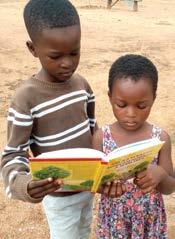
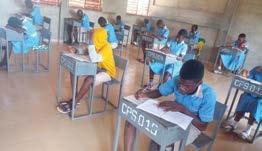
Young students read LHF’s Kusaal translation of A Child’s Garden of Bible Stories, used to teach religion classes at Concordia Prep.

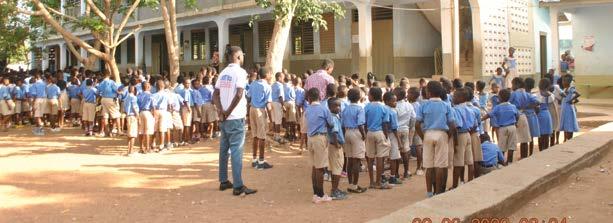
In September 2012, a dream came true for Rev. Dr. Nicholas Salifu, a Lutheran pastor in Ghana, when he opened a Lutheran day school in his home city of Bawku.
What a difference the next 10 years made! After beginning classes with only one grade of 13 students, today Concordia Preparatory School boasts over 1,100 students in preschool through 9th grade.
Most interestingly, about half of those students are Muslim - Muslim children who learn the Ten Commandments and their meanings, the Lord’s Prayer, the Apostles’ Creed, and even the Augsburg Confession!
“Muslims bring their children to the school because of the academic work, but in school all the children read and learn the Word of God,” said Rev. Salifu. “In the public schools, the government requires a subject called Religious and Moral Education. So they study Islam, local religions and Christianity. In our school, we have Religion as a simple subject, where they’re learning the Faith taught in the Catechism.”
Luther’s Small Catechism (translated by LHF into the Kusaal language) isn’t the only book the students at Concordia Preparatory School study. While the children already know the Ten Commandments, the Lord’s Prayer and the Apostles’ Creed by the time they graduate preschool, the students spend time in catechism workbooks and A Child’s Garden of Bible Stories as they get older.
Amazingly, the junior high students read and have lively discussions on the Augsburg Confession, a feat unmatched by most American Lutheran school programs.
Ghana cont. on page 2
PAGES 2-3: Practical advice on how to share the Gospel with immigrants

PAGE 4:
What’s the 4th largest population in the world?
For many people, it can be very difficult starting a conversation about their faith in God, never mind sharing the Gospel with a stranger! But when that stranger doesn’t even speak the same language, it might seem impossible.
After more than 20 years in the ministry, both as a parish pastor and as a missionary to Papua New Guinea, Rev. Jeffrey Horn has advice for anyone presented with the opportunity to share the Good News with immigrants and international exchange students in their communities. It’s not impossible, he assures!
START MISSION WORK WITH PRAYER.
Though it might seem obvious, few Christians remember to ask God to guide their interactions with the unchurched.
“As a pastor, I try to start mission work with prayer,” said Rev. Horn, pastor of Gloria Dei Lutheran Church in Escondido, California. “I think it’s a healthy place to start. I pray that God would open doors to connect with people, so that somebody who is in the dark would come to the light, and that that could happen here, at my church. Regularly in our congregational prayers, we’ll say something like, ‘Lord, please
bless those who have wandered from You and draw them back. Bless those who don’t know You, and let them know this to be a place where they can see Your light.’” As God has answered these prayers, the connections that have been made at Gloria Dei have been “amazing and surprising.”
NON-CHRISTIAN CAN READ.
“The Lutheran Heritage Foundation helps with this!” Rev. Horn said. “So say somebody comes in and English is their second language. We can falteringly talk together. But if I can get a catechism for them from LHF in their own language, I can make sure they’re understanding what I’m trying to teach. They can ask questions and share comments that show we’re connecting. LHF helps with this so much!”
Rev. Horn experienced this first-hand when he recently catechized a man and his wife, who is Korean. “As they were preparing to join our church, I was able to get a Korean Small Catechism from LHF and share that with Hee Sun,” he recalled. “The catechism really helped, because for example, when we were talking about one of the Commandments, I could ask, ‘This is what it says
“They love it!” exclaimed Rev. Salifu. “We use a simple vocabulary so that the students can read it themselves. We ask, ‘Who is God?’ Then, we discuss, ‘You say God, but see that the Muslims think they know who God is.’ When they read God’s Word, they see God directly and they learn to think for themselves. They have a lot of questions!”
While a few of the school’s Muslim families have converted
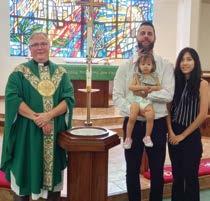
A joyful day at Gloria Dei Lutheran Church in Escondido, CA when Rev. Jeffrey Horn confirmed Rowan and Hee Sun Turner.
in English. How does that read in Korean?’ Then Hee Sun would read it in Korean, translate it back into English for me, and I could track that she was understanding things. The day they joined the church was a joyful day, and that catechism helped a lot!”
Other LHF resources can also prove useful, including children’s Bible storybooks. Rev. Horn is now in the process of teaching the faith to a young international student from Iran, named Farah (not her real name). Although Farah is a very bright and intelligent woman, LHF’s Farsi translation of A Child’s Gar-
to Christianity, most children don’t have the freedom in their families to publicly announce their faith in Jesus Christ.
“For now, they have to respect their parents. But these children, the way they talk among themselves, you can see that they have some faith in Christ in them,” said Rev. Salifu. “They have spent time in Christian prayer. They pray in Jesus’ name, and so the Holy Spirit is at work in these young ones. I know


den of Bible Stories has provided an overview of the Lutheran faith for Farah.
“This is a person who’s working on a graduate degree, but she’s had no interaction with the world of the Bible,” Rev. Horn shared. “So the Child’s
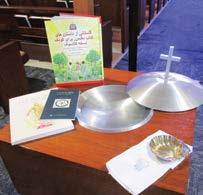
Garden was great because it gave her easy stepping stones to understanding. All the stories were there in the Farsi language to start making a connection between Adam and Eve and Christ, from Abraham to Jesus. This children’s book helped put things together in a Christological focus.”
In those pages, Farah began to see that Jesus Christ could be her Savior, too.
“Farah was raised Muslim, but the Quran is in Arabic, and she doesn’t know Arabic,” Rev. Horn explained. “So two things stood out to her: (1) This was the first time in her life that she heard of a God who loves her. And (2) she could also for the first time comprehend God’s Word because she could read it in her own language, understanding what God’s message really is. Her baptism is scheduled for this Sunday!”
When developing relationships with people from other countries, “it’s important to just be a friend and walk alongside them,” advised Rev. Horn. “It’s also important to be sensitive to differences regarding interactions between men and women, or relationships between the young and old, or regarding position and respect, shame, things like that.”
For example, when beginning conversations with Farah, Rev. Horn immediately began to pick up on the fact that she was uncomfortable being alone with him, a situation that’s not socially acceptable in Muslim culture. That’s when Rev. Horn’s wife, Lora, stepped in to help.
“Each of the times that we gath-
that Jesus is my God, and that He changes lives!”
cont. from page 1
When asked what dreams he has for the next 10 years at Concordia Preparatory School, Rev. Salifu smiled. “By then, these children who began their studies at the school will be off to university,” he reflected. “I would like to see some of them becoming pastors and Christian teachers - and that they would come back and teach more Concordia students!”
ered, Lora was there,” Rev. Horn said. “She was another voice to help bridge the culture gap, another voice to say, ‘Here’s how I see this.’ It helped Farah to feel at ease and able to engage in discussion in a very positive way, and I don’t think any of it would have been possible without Lora being there.”
”We have to keep in mind that we can have relationships with people from other cultures,” Rev. Horn emphasized. “There are probably other people who would be far better at teaching the faith to someone from Korea, but God placed Hee Sun on my doorstep. And so I take confidence that He will give me the tools and abilities I need to share His Word.
“But the key is that you don’t have to be afraid of doing it,” he concluded. “Using resources from LHF, there’s a lot you can do to teach and evangelize without fear. Don’t be afraid to try; do what you can, because God opened that door for a reason. That’s why I treasure LHF, because LHF made all this possible.”
To see what Lutheran books LHF has in your neighbor’s heart language, go to www.LHFmissions.org/Publications.
Take a moment and guess which population is the fourth largest in the world. Indonesia? Maybe the USA?
Well, these guesses would be close, yet incorrect. In a manner of speaking, the fourth largest country in the world is the migrant population worldwide, estimated now to be 280 million!
Now, before we get into a debate as to whether unlimited immigration is proper or not, one thing we can agree upon as Christians: we should never reject the opportunity to share the Gospel of Jesus Christ with people around the world. Jesus Himself implores us to preach the Gospel while it is still day before the night comes when no man can work. This is our calling as believers in our Lord and Savior, Jesus Christ, and everyone who calls upon the name of the Lord will be saved! (Romans 10:13).
We often focus upon the large numbers of migrants coming to the United States, Canada and Europe, but people around the world are voting with their feet, leaving oppressive countries to come to lands that might afford them more opportunity.
I have seen the opportunities that have come to the Lutheran Heritage Foundation from our church partners around the world, seeking resources to share the Faith with migrants but
not knowing their particular language.
LHF has received requests from Latvians for Chinese materials, from Finns about Ukrainians, from Germans about Persians, from Australians about Nuer speakers [South Sudan], and that is not counting what we are receiving in requests from congregations in the United States and Canada!
I began to recognize this vast movement of peoples when in 2013 I witnessed 16 baptisms at Berlin’s Holy Trinity Lutheran church, pastored by Rev. Dr. Gottfried Martens. He had just begun working with Persians (Iranians) a couple of years earlier. Since then, more than 1,000 Persian and Afghan seekers have come to his church and other congregations of the Independent Lutheran Church of Germany (an LCMS partner church).
Through your mission gifts, LHF has provided them with Luther’s Small Catechism and children’s Bibles in the Farsi language. For Afghans who
speak Dari, LHF has printed a Small Catechism and Prayer Book, answering questions that Muslims often have about Christianity (e.g., the nature of the Trinity).
Given the current war with Russia, Europe is also beset with refugees from Ukraine. LHF has been able to bring books of comfort to those who are facing some of life’s most difficult obstacles, recently printing the Gospel tract “Jesus Never Fails” in Ukrainian and in Russian. As these booklets are included in food relief packages, the recipients are reminded that while life’s circumstances, friends and health will ultimately fail, God’s love for us in Christ Jesus will never fail!
This is a message that resonates with migrants around the world, whatever their ethnicity. They have a God who loves them and gave His only begotten Son to die for them so that they might have everlasting life.

“The Vietnamese church in my neighborhood sells egg rolls as a fundraiser. I wanted to give a children’s Bible as a gift to one of the ladies who just had a baby. She speaks very little English and, like all of us, I presume she needs to hear the Gospel. While there, I showed another of the women LHF’s Vietnamese Child’s Garden of Bible Stories, and she looked like she would like to have the book. She told me as best she could that there are two children at her house. I gave her the book, and she acted like I’d given her a bag of gold (which in a sense I did). THANK YOU for making this available!” - Margaret V., Iowa

“The