
Lutheran Heritage Foundation:

Lutheran Heritage Foundation:

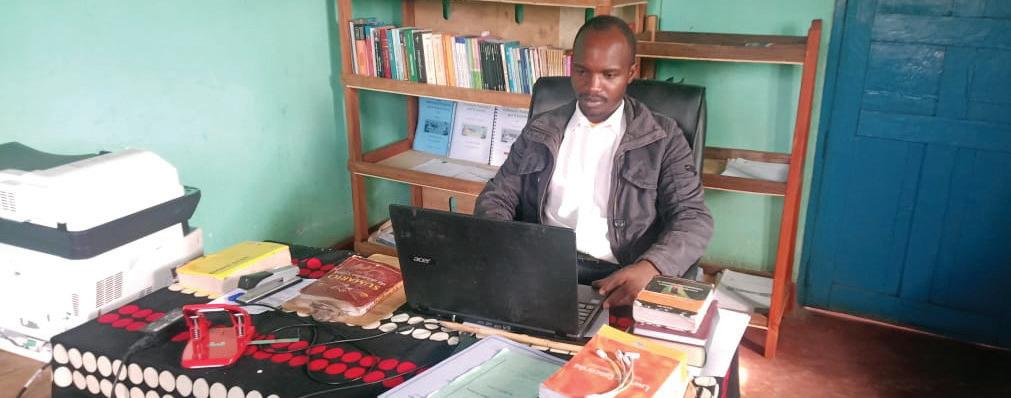
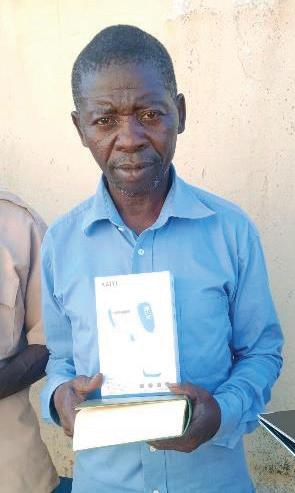
Rev. Abel Sifa (pictured above), LHF translator and a pastor in the Christian Lutheran Church of Concord in Mozambique (ICCM), reports that LHF’s Small Catechism in the Chisena language is making a big impact in his part of Africa:
“We thank God for the Lutheran Heritage Foundation for being our visionary and tireless partner, chosen by God to help us here in Africa. Most of our members are receiving and using Martin Luther’s Small Catechism in the Chisena language and other materials already translated, thanks to the work of LHF. Such materials are making it easier for them to understand better the Word of God and to build them up in the Christian faith.
“The ICCM currently has more than 120 congregations, made up of approximately 44,000 members,” he


PAGES 2-3:
Georgia: Sowing the seeds of faith on hard ground
continued. “Lutheran members who go looking for work opportunities elsewhere immediately witness their faith and organize Bible studies and prayer groups. Several independent church leaders are seeking support from the ICCM because they see it as a church that preaches the Gospel according to the truth of the Holy Bible. There is a great need for more pastors who are well prepared to establish these new Christians in the truth of salvation by grace through faith in Jesus.”
Solid Lutheran education, such as that delivered in the catechism, make a difference. Rev. Sifa writes:
MR. MARIO DULI
Mr. Mario Duli (pictured at right) is the first leader who received the Gospel of Salvation by grace through faith Mozambique


in Christ Jesus in Morrumbala district, Zambezia province, in late 2017. He was a Pentecostal pastor leading 12 churches. When he met with the future pastor of our church, Brother Marcelino Massanga, they talked a lot about the doctrine of salvation. After understanding well that man is saved by grace and not by works, for Jesus has already paid all for man’s salvation, Mr. Duli took this message to the churches he was leading, and
cont. on page 2
cont. from page 1
all agreed to follow the confessional Lutheran doctrine. Thus, he, along with his family and all the Pentecostal churches he led, became confessional Lutherans. According to recent statistics, they now count 21 churches. Mr. Duli is leading and expanding the message of Christ in that district according to God’s will. He still needs much confessional theological training, as do the other leaders who lead services in different Lutheran communities in that district.
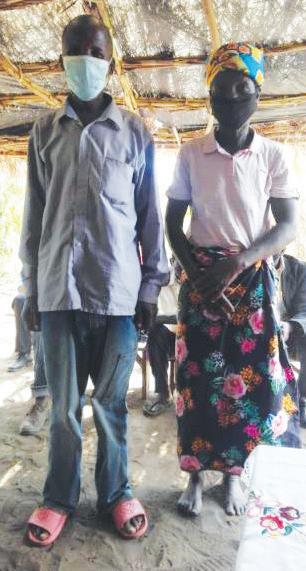
MR. ARAUJO LIMPO JOSÉ
Mr. Araujo Limpo José decided to become a member of our church, after two years without worshipping in the Roman Catholic Church for doctrinal reasons.
He had the opportunity to hear the Lutheran church doctrine through Mr. Marcelino, who is a lay leader of our community. They used to be comrades in the Mozambican army during the civil war. When he heard the Gospel of salvation by grace through faith in Christ Jesus, without the intermediation of saints and images, he became very interested and soon decided to join ICCM, together with his family and the community of his village.
This community is located within the small village of Lamego. At the moment the new church has 289 members! Most of them are elderly people and children. The biggest challenge is the provision of spiritual nourishment to the new members according to the Lutheran confessional doctrine.
In partnership with Orphan Grain Train, LHF is organizing a container shipment to the Evangelical Lutheran Church in South Sudan/Sudan.
Good-condition donations of theological books (Bibles and hymnals are not needed at this time), vestments, choir robes, hospital equipment, small roto tillers, a small tractor with plow, paraments and church furnishings are particularly desired for people who are primarily subsistence farmers. The container will ship in the fall.
Ship donations to: Orphan Grain Train - Michigan Chapter, 216 Main Street, Sebewaing, MI 48759.
When you travel to the country of Georgia (not the state here in the U.S.!), one of the first images you see upon leaving the capital Tbilisi is a small, ancient monastery perched high atop a hill at the confluences of the Aragvi and Mtkvari rivers. Having been built in 605 A.D., the Jvari Monastery (Monastery of the Cross) is a testament to the almost 1800-year-old history of Christianity in Georgia. One need not seek far to discover references to the earliest days of Christianity since St. Matthias, the replacement disciple for Judas, is claimed to be buried in a village not far from the border with Turkey.
And yet, other religions vie for the hearts of the Georgian people. “Many years ago, I took (LHF executive director) Matthew Heise to an ancient place of Georgia called Armazi, which is located close from the capital city of Tbilisi,” recalled LHF translator Ruslan Tsintsadze, who goes by the name Bato. “We climbed for about 2 miles along a narrow path that went to the top of the high mountain. The climb took several hours until we arrived at an ancient Zoroastrian altar.

- Their major beliefs can be found its principal holy text, the Avesta - Their highest god and creator, Ahura Mazdā, is engaged in a primeval battle against Angra Mainyu, the Destructive Spirit
“Before Christ, Georgia was under the control of Persian empire, and Persian missionaries arrived to train Georgia’s Zoroastrian priests,” Bato continued. “In those days it was very common to sacrifice humans to the heavenly powers, and complete darkness was ruling whole country. Each region had their own gods, and even some families have family-protecting gods. Boldly we can say that it was like India here in Georgia, with people were worshiping everything and everyone.”
A er Ahura Mazdā’s eventual the followers of Angra Mainyu su er before all of humanity experiences eternal bliss - www.Britannica.com

As the centuries passed, Christian missionaries brought the Good News of Jesus Christ to the people of Georgia.
“Between Georgia and Israel is just around 1,000 miles,” Bato said. “History tells us that in the first century in Georgia, there came three different apostles of Christ who preached the Gospel to Georgian tribes. So in west Georgia to the coast of the Black Sea, there organized some small church groups. In this way, Christianity started in Georgia from the
very first days of Christendom.”
“Georgia’s Christian past is never far away from the minds of the people due to the vast number of historic cathedrals and monasteries scattered throughout the country,” added Rev. Heise. “It was no wonder that the military victory of Soviet communism in 1921 began a devastating 70-year battle for atheism in the land.”
As in other Soviet Union countries, the imposed atheism took a toll on Christian families in Georgia.
“But when those 70 years of trial were over, Georgia was open again to the Christian witness. I was able to go there in 2002 when Concordia Seminary professor, Dr. Robert Kolb, led a few seminars throughout the country,” Rev. Heise remembered. “One thing we discovered is that when communism fell, people were open to reading the Bible and learning more about their faith. The state-supported Orthodox Church, while including many kinds of priests with different opinions, does not always teach extensively from the Bible but calls Georgians to their ‘ethnic’ faith.”
Zoroastrianism? found in Avesta creator, Mainyu, victory, Mainyu will experiwww.Britannica.com

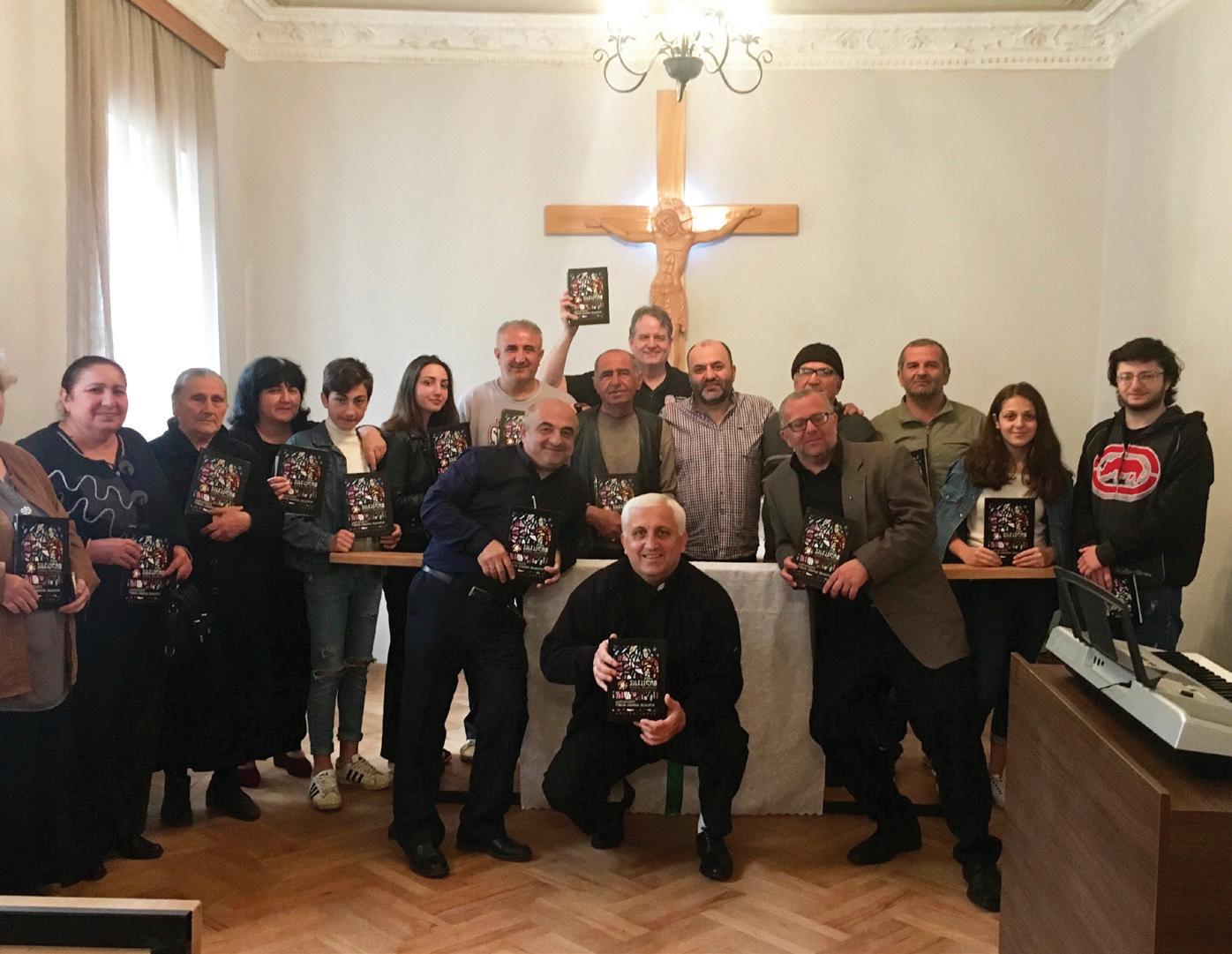


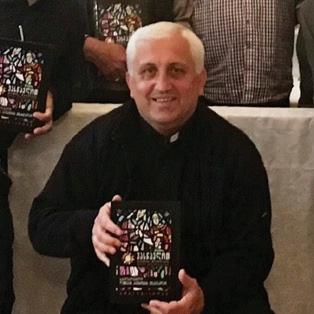
Our Lutheran brothers and sisters in Georgia! Taken at Kutaisi Lutheran Church during his 2019 travels, Rev. Dr. Matthew Heise (back row center, holding up book) distributed another Kolb-authored LHF translation, Teaching God’s Children His Teaching. Bato is pictured in front of Rev. Heise, to the right in this photo.
This “ethnic” faith is a concept very familiar to Bato.
Because Georgia neighbors the country of Turkey, where the Orthodox Church is very strong, “I think this is the main stronghold of the mind of the typical Georgian man,” he said.
“Many centuries of Orthodox beliefs fashioned the mentality of Georgian people, and for them, Orthodoxy became national identity. [Therefore], everything which is not associated with this kind of faith is heresy and sect. More than 80% of Georgian population is Orthodox and perhaps they do not resist Protestant churches, but their heart is closed to any other religion because the national tradition.”
Thankfully, given its 200-year history in the country, Lutherans can rightfully state that they are not a cult but an established church that was also consumed by communism, with its pastors being executed in the 1930s, explained Rev. Heise. Today, there are very few Georgian Lutherans, only about 10 congregations.
To introduce new believers to the Savior, LHF has been working along with The LCMS’ Office of International Mission since 2014. Orthodox priests and Evangelicals have been impressed by the biblical, theological rigor of Lutheranism as they read LHF translations.
Now more than ever, sound biblical teaching is needed. This year Bato translated Dr. Kolb’s book Martin Luther: As He Lived and Breathed, so that Georgians could gain a better understanding of the man who defied the Roman Catholic Church of his day by proclaiming that believers are justified before God by grace alone, through faith alone, for the sake of Jesus Christ alone!
“Dr. Kolb’s powerful literary work is very informative and gives a lot of insights about the background of the Lutheran faith,” said Bato. “We desperately need such books which clarify what is real saving Christian faith and what is Protestant belief in reality.
“Our friends, you don’t know how grateful we are to you at the Lutheran Heritage Foundation, that you are making available thes kinds of books to Georgian readers,” Bato concluded. “Blessings from the Republic of Georgia. Amen!”
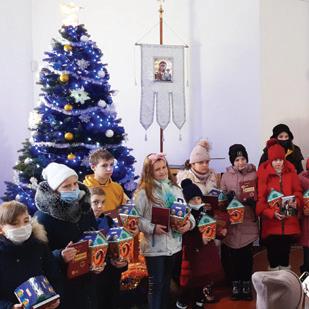
This Christmas season in Ukraine, your donations to the LHF mission made it possible for the Ukrainian Lutheran Church to present a most precious gift to refugee children: Luther’s Small Catechism, written in the Ukrainian language.
The refugees have arrived in Kyiv from the Donetsk Oblast (region) that was occupied by Russians after they occupied Crimea. “Some of their parents were abused in different ways (e.g. severely beaten) by Russians and their cronies; some lived in the areas where Russians would launch missiles or simply shoot from artillery and all kinds of guns, destroying their homes and killing their relatives,” explained Rev. Slavik Horpynchuk, bishop of the ULC. “So these people, they took their children and fled to the free Ukrainian territories, including Kyiv. Some of them live in shelters, and some still do not have jobs, so we periodically provide them with food, clothes and so on.
“We invite them to study and sing Christmas carols
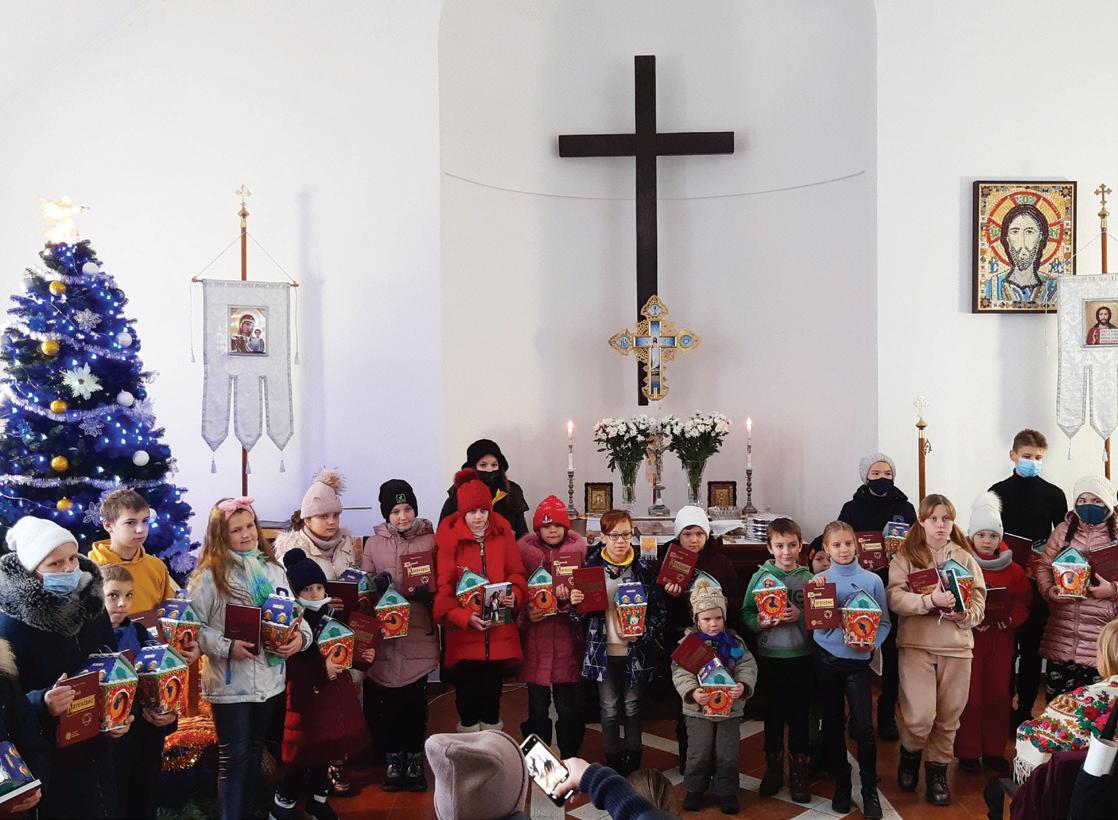
together. We plan to start Sunday School with them. They know too much trouble in their life. They will know love of Christ.”
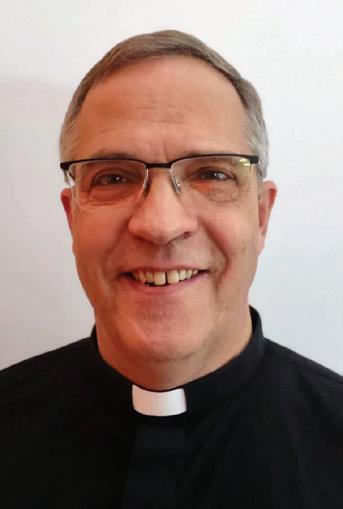
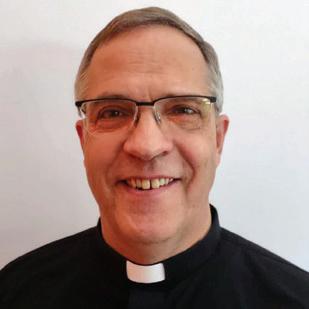
The Rev. Mark Moss has accepted a call to serve at LHF as mission engagement associate and has been serving the mission since late November 2021.
Rev. Moss brings a wealth of experience to the LHF staff, including a rich education in translation principles and three years’ Bible translation supervision in Sierra Leone; several assignments as an LCMS theological educator in Nigeria and Ghana; and 20 years’ experience as a military chaplain in the U.S. Chaplain
Corps, where he traveled the world and interacted with people and cultures from Bahrain to Japan, Iraq to Alaska.
“During my years as a military chaplain, I saw the common need everywhere for a Savior,” Rev. Moss said. “We have this picture, particularly of Islamic countries, where we think Christianity cannot make inroads. That simply isn’t true! The Lord has interesting ways of opening doors to these countries, where people are thirsty for the Gospel.”
At LHF, Rev. Moss will be responsible for developing strong connections with churches and individual members so that they may play a part in the LHF mission and make the best possible use
of LHF resources in their communities. Additionally, his expertise in principles of translation will benefit LHF translators and project managers around the world.
Prior to joining LHF, Rev. Moss received his Master of Divinity from Concordia Theological Seminary. Most recently, he’s served as pastor at Mount Calvary Lutheran Church in Richfield, Minnesota. Rev. Moss also served on the LHF Board of Directors.
Rev. Moss will be based out of Minnesota, but he will be available as a guest preacher and Bible study leader at LCMS congregations nationwide. To schedule him as a mission speaker, contact LHF at info@LHFmissions.org, or call the office at (800)554-0723.
51474 Romeo Plank Rd. ■ Macomb, MI 48042 ■ 1-800-554-0723 ■ info@LHFmissions.org ■ www.LHFmissions.org
“The Word at Work” is the official publication of the Lutheran Heritage Foundation. Permission is hereby granted to excerpt from this publication for not-for-profit purposes. The Lutheran Heritage Foundation is a Recognized Service Organization of The Lutheran Church-Missouri Synod. LHF translates, publishes, distributes and introduces confessional Lutheran materials throughout the world so that people can be brought to Christ. LHF is not subsidized by the LCMS or any other church body. It is entirely supported by individual donations and grants.
(“Word at Work” staff: Rev. Dr. Matthew Heise, executive editor; Jennifer Bagnall, managing editor and graphic design; Anna Bagnall, staff writer)