23 minute read
Chapter 24

FROM THE TIME THEY MET, Billy persistently pleaded with David to join him for a real round of golf. David employed every imaginable excuse to avoid the match. They only had a few hours to practice after school and they needed to make the most of the time, he’d say, or that the course would be too crowded, or that he couldn’t play in the cold. When the Broward County schools let out in June, David couldn’t put Billy off any longer. Summer afternoons were hot, the courses were deserted and they had more time on their hands than any sixteen or 67-year-old could fill. He had no choice but to play.
On the morning of the appointed day, David descended to the condominium basement, where he’d stored his clubs on the day he’d moved in nine years earlier, and where they’d remained, untouched, ever since. He found them under a pile of empty boxes, a 400-watt hair dryer and a microwave oven with a dial knob, all of which had been stored because David lacked a compelling reason to throw them away. The clubs had been retained under more or less the same reasoning. As David tossed aside the ancient cartons to liberate the tools of his former trade, he thought how unusual it must be for an abandoned item to be reclaimed. Metaphorically, the basement resembled Florida: a place from which the banished never returned.
A spider had made a home in his irons. David wiped them clean. Touching the clubs loosed a flood of memories, and when David slung the bag over his shoulder he couldn’t help but think about his last round with Rabbit at the Southern Open. The morning after his affair, David confessed everything to Rabbit at the Waffle House. His caddie listened to the entire story without saying a word. That afternoon, he carried David’s bag en route to a final round 67 that would have been good enough to win almost any other Sunday, but seemed puny compared Bobby Rancourt’s 63. Rancourt never looked back that day, or that season—when he went on to win two majors—or ever. After the round, Rabbit took his check for $13,500 (six percent of David’s second-place earnings), tore it up, tossed it at David’s feet and left David standing by himself in the parking lot. David respected Rabbit all the more for doing so.
David went on playing. He had no choice after that—not that he’d ever had any meaningful choice, but even the illusion of freedom disappeared. His golf became an “asset,” as the judge termed it, and he obliged David to exploit its full value. So he played in every tournament that would have him: first on the PGA Tour, then the developmental circuit after he lost his card, and finally the senior tour, where he slid further down the money list each year. Ultimately, he qualified only for the remotest tournaments, in the suburbs of Boise and Binghamton, until finally his children finished college and relieved him of the obligation of playing golf once and for all.
Sitting in the dark basement, David recalled the loneliness of those years—traveling alone from one unfamiliar city to another, beating his ball around for a few hours and holing up at a cheap motel. The terms of his divorce decree permitted him no luxury. In the evening, he’d sit in a tub for hours and soak his aching back, with nothing to keep him company but regrets.
He saw Rabbit once after that, at a developmental tour stop outside of Evansville, Indiana. Rabbit had hooked up with a young player on his way up. David, of course, was on his way down. Both Rabbit’s man and David played well that week and were paired together for the final round. The night before, David didn’t sleep. Instead, he spent it wondering whether it would be awkward seeing his old friend. When the morning arrived, Rabbit acted like a pro, but he didn’t need words to get his message through. While Rabbit’s man won and ascended to the tour, David hacked his way around the course and slid further into golf oblivion.
David spent the first birthday without his family alone at a Denny’s in Orlando. He spent the following Christmas alone at Olive Garden, making for the single most depressing evening of his life. He hoped to receive a peace offering, but one occasion after another passed without word. He heard nothing when Scott graduated from the Berklee College of Music, even though he’d financed his son’s education with countless hours of coiling and uncoiling. He again heard nothing when Amy graduated from Emory several years later. David played his final tournament round that day at a senior event in Lutz, Florida, where he shot 76, good for 69th place and $830. He drove home, toasted his daughter’s success with a beer and celebrated his retirement by exiling his clubs to the basement, where they’d remained since.
David shook himself out of it. These memories deserved to remain in the basement with the ancient dehumidifiers. He put some elbow into his clubs, made them gleam and carried them up to the apartment, where he found Millie in the kitchen making sandwiches.
“I thought you and Billy might like something to eat for your rounds today,” she said.
David kissed her on the cheek.
“What did I do to deserve that?”
“You were just being yourself.”
“What’s gotten into you?”
David smiled and said, “I’m seeing things a bit differently than I used to.”
“I keep thinking I’m going to pinch myself, wake up and find the real David has returned.”
“I like to think this is the real me.”
Millie kissed him on the cheek and returned to the sandwiches.
“So when was the last time you played?”
“Nine years ago.”
“That’s a long while.”
“A lifetime.”
“Are you looking forward to it?”
“Yes and no.”
“You’re worried about how you’ll play?”
“Nope, I’m not worried about that.”
“What then?”
“Fran and Pauline asked me to give Billy my honest assessment about his talent. I’ve been putting it off, but I don’t think it’ll keep past today. Summer’s here. We have to start making plans. At the very least, Billy is going to ask me and I’m going to have to give him an answer.”
“But you told me you thought he has the talent to be a professional.”
“He does.”
They heard a loud knock on the kitchen windowpane. It was Billy, clubs slung over his shoulder, grinning from ear to ear. Millie opened the door.
“Hi, Mrs. Friedlander.” Then, catching sight of David, he added, “Ready for an old-fashioned butt kicking, Mr. Howard?”
“Billy, I’m surprised you’d use language like that,” Millie said.
“It’s all right,” David said. “Let him chirp now while he still has his self-respect.” To Billy, he added, “Bring it on, punk.”
Millie held open the door.
“Take it easy on Mr. Howard, Billy. He’s an old man.”
“I will, Mrs. Friedlander. I’m going to give him three strokes a side, seeing as he hasn’t played since they stopped stuffing golf balls with feathers.”
“I’ll be cold in the ground before I’ll take strokes from you, kid.”
Millie handed David and Billy a brown paper bag each.
“I thought you might get hungry, so I packed you these lunches. Make sure you have the right ones. The one with the shortbread cookies is yours, Billy. Cookies give Mr. Howard terrible gas.”
Billy smiled at David.
“Right, Mrs. Friedlander.”
“Now have fun boys,” she said.
“We will, Mrs. Friedlander.”
David turned and smiled. “We will, Mrs. Friedlander.”
After Millie fell out of earshot, Billy said, “Does golf give you gas too, Mr. Howard? I’d hate for you to be uncomfortable on the course.”
“Get it all out now, kid. In a few hours you’ll be crying crocodile tears.”
*** In single file, they walked across the parking lot, clubs in tow, golf shoes clanking against the sidewalk. The noise reminded David of sounds of the game that he’d once liked—quiet locker room chatter, the lacing of shoes, the way players fell into a steady cadence as they marched down a fairway. Golf had a rhythm, which good players could feel and great players, like Snead, channeled directly. Billy walked just right.
They warmed up on the range. David felt the rhythm again, the steady pace of practice, one ball after another, one club then the next. He felt sore at first. His body hadn’t expected to be inconvenienced with this torqueing nonsense again in this lifetime, but the summer heat lubricated his ancient joints. By the time he reached his driver, he felt limber and strong. He nodded to Billy. They checked in with the starter and walked to the first tee.
The prospect of playing golf again made David nostalgic. As he stood on the tee box, he recalled the first time he played with his father, when he was ten years old. They’d hit balls together before and putted on the practice green but had never played a real round, until one summer evening his father said at dinner, “Be ready at five thirty tomorrow morning.” David hardly slept that night. In the morning, he practically bounced to the first tee. He always remembered what his father said as they waited to tee off: “This is an examination. A round of golf tests the quality of your practice. You may be able to sneak by for a hole or two, but you cannot fool the game over the course of a round. Your strengths and weaknesses will be exposed. The feedback you get identifies what needs to be improved and dictates future practice.”
An examination. With Mal, there was no joy—not then, or ever.
“So what do you say, Mr. Howard?”
“Sorry?” David hadn’t realized Billy was speaking.
“I said how ’bout we play a match? A dollar a side and two more for the match.”
“You sure you can afford that?” David asked. “That’s four dollars you’re going to lose. You won’t be able to take your squeeze out for root beers this weekend.”
“You sure you can afford that, Mr. Howard? I know Social Security doesn’t go as far as it used to. And, just so you know, no one’s said
‘squeeze’ in fifty years.”
David smiled. He liked that Billy had remembered every bet he’d taught him. “All right, two dollars each way—fifty cents a side and a dollar for the match. Any presses?”
“No presses.”
David extended his hand. “Bet.”
Billy shook then gestured toward the tee.
“Your honor.”
“Age before beauty, right?”
“I wasn’t going to say it.”
The Plantation Course started off easy, with a short, straight par-five on which even some hackers could reach in two. Billy routinely got home with a short iron. Wayward drives might cost the kid at other points in the round, but David knew he needed to make a birdie here. He pulled out his driver, swung it gently a few times, letting the weight of the club guide his arms. The heat had worked its full magic. He felt lithe and energized. David placed a tee in the ground and went through his preshot routine.
“You can have a mulligan if you want, Mr. Howard. That driver’s older than I am.”
“Don’t need a mulligan,” David said, and launched his ball. It took off down the right side, turned ever so slightly to the left, and came to rest in the center of the fairway—the unmistakable handiwork of a professional.
“My name’s David,” he said, smiling. “Mr. Howard was my father.”
Billy put his tee in the ground and blistered one down the middle.
“Game on, Billy.”
“Game on, David.”
They each birdied the first hole and the one after that. David swung
freely and his putting stroke flowed. At the third, he poured in a thirty-footer to halve the hole.
“Not bad for an old man.”
David smiled.
Even more than usual, the conversation flowed. As they chased their drives down the fourth fairway, Billy said, “Can I ask you a question?”
David dreaded that it would be The Question. This would have been natural since Billy was the only person David knew who hadn’t asked it of him. In fact, it was the only question he hadn’t asked.
“Shoot,” David said.
“If you could play a round of golf with any three people, who would it be?”
David had been asked the dream foursome question before, as every pro had, by magazine writers, talk show hosts and amateur partners. Years ago, he’d always given the same answer: Arnold Palmer, Jack Nicklaus and his father. This answer satisfied everyone except for David.
“Are we talking pure fantasy here? Can I pick anyone I want, regardless of circumstances?”
“Anyone at all.”
They paused together at David’s ball, which had split the fairway. David pulled out a six-iron and said, “Before I answer, how about you answer one for me? Tell me, at some level, deep down, aren’t you angry? At your father, your mother, someone—that your parents aren’t around and that you’re living here in this condo community for senior citizens?”
“I don’t know,” Billy said. “I feel bad sometimes and I guess I’ve been mad once in a while, but what’s the point? It won’t change anything. I just try to deal with reality. You know, what’s in front of me.”
David nodded. It was the answer he expected. It wasn’t the answer David would have offered himself or even one he fully understood, but
he’d come to expect the extraordinary from Billy.
David said, “My dream foursome would be my son, my daughter— and you.”
He could see the words warmed Billy, who asked, “If it’s not too nosy, how come you stopped speaking with your kids?”
“Because of choices I made.” He corrected himself. “Because of choices we all made. And since when have you ever cared about nosy?”
“Do you blame yourself?”
“I used to.”
“When’d you stop?”
“Just now.”
David hit his approach into a deep sand trap guarding the right side of the green.
“Nice shot,” Billy said. “Right on the beach.”
David smiled. Showing the kid Caddyshack might have been the best thing he’d ever done. He sheathed his six-iron and ambled down the fairway. The golf, the summer heat and Billy’s companionship induced a reverie. When David found his ball plugged in the face of the bunker, his thoughts drifted to a similar shot that he’d hit years earlier, under his father’s eye, shortly before Mal died.
*** After that initial round, David and Mal played once a year. These annual examinations continued past the point when they had anything to talk about, even after the char on Mal’s lungs restricted him to riding in a cart and watching David play. As a young professional, David looked forward to those rounds—not for the opportunity to spend time with his father, but instead for the chance to impress him. He imagined hitting a great shot and his father praising him for his dedication and apologizing for
how hard he’d been on him as a child. Of course, that day never came.
When they met for the last time, nine months before Mal succumbed to lung cancer, David was in the midst of his best year on tour, having already won twice. He arrived on a hot summer day, shortly before the start of the U.S. Open, brimming with confidence. From his cart, Mal watched David scorch West Latrobe. He played the front nine in seven-under par, equaling the course record. At the tenth, his approach shot plugged in a greenside bunker; only a small fraction of the ball peeked out above the sand. Most pros would have been happy to hit it anywhere on the green, but David executed a shot that he’d learned from Chi Chi Rodriguez. He shut the face of a pitching wedge, hit straight down on the ball, and damned if the thing didn’t pop straight up and land three feet from the hole. David grinned at his father, waiting for adulation. Most pros could hit this shot one hundred times and not hit one as well as David just had. Instead, his father hoisted himself out of the cart, staggered to the side of the bunker, and threw a pair of balls in overhand so that they plugged even farther down than the one he’d already hit. With his hand, Mal gestured that David should have a go at these two.
David looked at his father in disbelief that after all this time, and his success at golf’s highest level, he should still have to prove himself. But Mal didn’t relent. He sat in his cart and waited impassively. David felt old feelings resurface. Tension seized his body. He began to strangle the club in his hands; he’d show the old man once and for all. He swung at the first ball, hit its belly, and skulled it over the green. David looked at Mal, whose expression did not change, further infuriating David. He tightened his grip, lashed at the second ball, and barely moved it an inch.
“Maybe soon you’ll be able to hit that shot more than one time in three,” Mal said. “You should consider relaxing your grip pressure.”
David considered killing him then and there. He’d thought of it many
times before, even as a child. Back then, his father had been a strong man with thick, meaty hands. Now he couldn’t walk down the street without towing an oxygen tank. He sat in the golf cart, defenseless, his hands hanging limply at his side, shaking. It would have taken nothing to end his life with a five-iron.
David squeezed the golf club even tighter than when he had skulled the bunker shots and met his father’s eyes. He could feel his father read his mind and, like a super-villain, repel the murderous urge swelling inside David. Father and son’s wills met in the air. As Mal turned his steely blue eyes to David’s right hand, David felt his grip on the club loosen. Mal returned his eyes to David. “You don’t have the nerve,” he said without words. “You’re a failure even at this.” Then the old man drove off to the green.
*** “Good luck getting out of that one.”
“What’s that?” David hadn’t realized Billy was talking.
“I said, ‘good luck getting out of that one.’”
“Piss on luck.” David. He made a mental note to show the kid Dead Solid Perfect. Then he shut the face of his wedge, relaxed his grip and hit it to three feet.
“Golf shot,” Billy said.
They holed their respective par putts and hit their drives at the next hole down the middle. As they walked down the cutout that led to the fifth fairway, Billy asked, “Did you always want to be a golfer?”
“No. I never wanted to be a golfer.”
“What did you want to be?”
“A writer.”
“Why didn’t you become one?”
David looked at Billy. “Ten years ago, I never would have admitted that I even wanted to be a writer. A few months ago, I thought I didn’t become one because my father was an angry, abusive asshole who tried to control my life, but I’d never have said this aloud out of fear that my father might hear and punish me from beyond the grave. Today, I’d say it’s because I never accepted responsibility for my own life.”
“I don’t know what you mean.”
“I think you do,” David said, “I think you understand very well.”
David hit his approach shot tight and watched as Billy hit his own shot inside of that. They each birdied the hole and the eighth, and made the turn all square, each having shot six under par.
Billy had absorbed many of David’s lessons. He hit a high fade on command at the seventh and a low snapping draw when needed at the twelfth. He held his head steadier, as they’d practiced at the range, and he maintained a flatter plane on his downswing, which produced more consistent, penetrating shots. Seeing Billy’s improvement gratified David.
Billy routinely drove it fifty yards or more past David, but David overcame Billy’s advantage by managing his game better. David played holes backwards in his mind, driving the ball to the side of the fairway that would leave the easiest approach in to the green. He managed the risk of bad shots, making sure always to leave his ball under the hole. Most importantly, David made sure never to leave it on the short side of the green, so that he always preserved the possibility of getting up and down for par. Billy didn’t think quite so far ahead. An ordinary golfer could get by without thinking strategically for a hole or two. An exceptional golfer like Billy could get by longer. But David knew that bad decisions always caught up with you in the long run. The game was relentless.
Inevitably, Billy paid for his mental errors. On the tenth hole, he hit his pitching wedge within ten feet of the pin, but above the hole. Though
he only missed his birdie putt by a hair, he had a fifteen-footer coming back and made a bogey when anything higher than par should have been out of the question. On the twelfth hole, Billy came within thirty yards of reaching the 600-yard par-five with his second shot, but he left himself an almost impossible pitch over a deep bunker without any green to work with. Without hesitation, Billy pulled out his wedge and attempted the flop shot that David had taught him a few weeks earlier. David also had taught Billy that the flopper left little margin for error and should only be used in extraordinary circumstances, but this part of the lesson hadn’t been absorbed. Billy took a long, flowing swing. Though he hit it almost perfectly, it came up slightly short, landed on the front face of the bunker. Billy took two to get out and made double bogey when even par should have been a disappointment.
What most disturbed David—or, more accurately what David could least relate to—was that Billy seemed unbothered by his errors. He accepted bogeys with good cheer and seemed to enjoy even his mistakes. He came to the eighteenth hole tied with David when by rights he should have had a two- or three-hole lead. David watched with dismay as Billy, with the honor, took the driver from his bag and aimed over the edge of David’s condominium. An airplane could safely land in the eighteenth fairway; even a mediocre drive would have left Billy an easy approach shot, a likely birdie and, at worst, a split of the match. But he insisted on trying the one-in-a-million shot over the roof, which if hit hard enough and with just enough left-to-right movement might catch the edge of the green and leave an eagle putt, but would more likely, as proved by abundant evidence, find water or break a window. To make matters worse, they had the wind against them, as David noticed from observing the treetops.
Billy paid no heed to any of this, wherein lied the problem. To be a professional, David would have to teach Billy to be ever conscious of
his environment and the consequences of his actions. The swing could be taught, the short game and putting refined, but the philosophy was another matter. Billy would need to learn a different way of looking at the world. He’d need to be constantly mindful of costs and benefits. This could take years, and there’d be no guarantee of eradicating the bad habit that he’d formed over a lifetime. Billy could be good continuing to play in the manner he did, but not a professional.
Billy hit it on the screws—his best shot of the day, and he’d hit many fine ones. As the drive took off, it looked like it might clear the condos. It seemed to have enough power and height, but just as it looked safe, the ball caught the top of a chimney pipe, ricocheted left and landed in the water behind David’s back door.
“Dang it,” Billy said, frowning. He understood that he’d at best make a five now. David would hit an iron down the middle of the fairway, make a par and steal the four dollars Billy might otherwise have spent on root beer floats. In a moment, though, Billy’s smile reappeared and he said, “I thought I made it that time. Great day, though. Great match.”
David put his hand on his three-iron, began his pre-shot routine, but he couldn’t shake a question from his head. He backed off the shot, turned to Billy, and asked, “Why’d you try that shot? You’ve never made it before, and you didn’t need to try it today.”
“Because it’s fun,” Billy said without hesitation. “And besides, it’s only golf.”
David listened and, finally, he heard. He put back the three-iron, extracted the driver from its giant strawberry head cover and said, “I think I’ll have a go at it.”
He waggled once, twice, and sent the ball into the gathering dusk, soaring.
AUTHOR
Evan Mandery is a graduate of Harvard College and Harvard Law School. He is the author of six books including three novels. Both A Wild Justice (about a pair of seminal Supreme Court cases on the death penalty) and his novel, Q, were New York Times editors’ picks. Earlier this year, he won an Emmy and Peabody Award for his TV series, Artificial.
PUBLISHER
Classics of Golf, an exclusive collection of the world’s best reading golf books, was created by the legendary Hebert Warren Wind for those who cherish the history and the game. The collection includes titles by Bobby Jones, Jack Nicklaus, Bernard Darwen, and many other of the most revered names in golf. In addition to the Library, Classics of Golf publishes select new books. Classics of Golf is proud to publish The Professional.
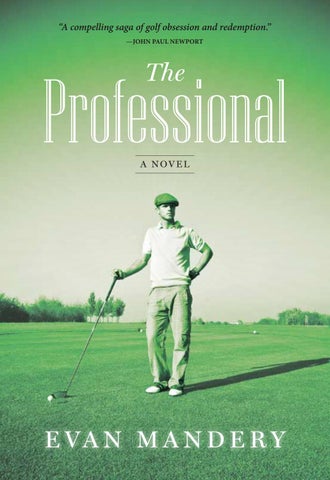
“In The Professional, Evan Mandery brings to life a veteran Tour pro with both prodigious talent and a prodigious work ethic. What he lacks is a purpose in life. The novel is a compelling saga of golf obsession and, ultimately, of redemption through golf. Mandery knows the game inside and out, especially all that goes on inside a golfer’s head.” —JOHN PAUL NEWPORT, author of The Fine Green Line
“The Professional is a terrific tale of redemption with a great cast of characters. Not only does Mandery capture the life of journeyman tour pro to a tee, but his non-linear storytelling technique keeps the reader riveted.” —TOM CUNNEFF, National Golf Writer “Engrossing...an intense assessment of how this game can upset a life or provide it with satisfaction and meaning... Mandery offers a conclusion equal to ‘hitting it pure.’” —LES SCHUPAK, Met Golfer
ABOUT THE PROFESSIONAL
A golf novel for all time, The Professional tells the life story of pro golfer David Michael Howard over three transformative weeks at different points his life.
As a 16-year-old, David is told by his West Latrobe High School English teacher that he is a gifted writer, and should attend a summer workshop, but David’s controlling, abusive father demands that he spend the summer preparing for the Pennsylvania State Open, forcing David to decide whether to live his father’s dream or his own.
Later, as a forty-something journeyman pro, David experiences a mid-life crisis during the final round of a tournament, causing him to question the meaning of golf and how he has spent his life. Long-brewing feelings of failure surface, and David is tempted towards a potentially catastrophic affair with a beautiful Alabama housewife.
Finally, as an old man, golf presents David with an opportunity for redemption in the form of Billy Conway, an immensely talented but raw young player, who turns to David for help and offers him a path to redemption.
The Professional’s life intersects with the greats of the game—Nicklaus, Watson and Palmer (in whose shadow David is raised) and the novel asks the questions that everyone who loves golf has asked. What are the conditions that produce virtuosity? Does a single-minded devotion to a skill preclude the possibility of a happy life?
Told with humor, charm, and a devotion to the history of the game, The Professional is truly a golf novel for the ages.
NEED ISBN BAR CODE
50 GEDNEY STREET • NYACK, NEW YORK 10960 For a listing of recent publications visit www.classicsofgolf.com