PALM BEACH
YACHT CLUB
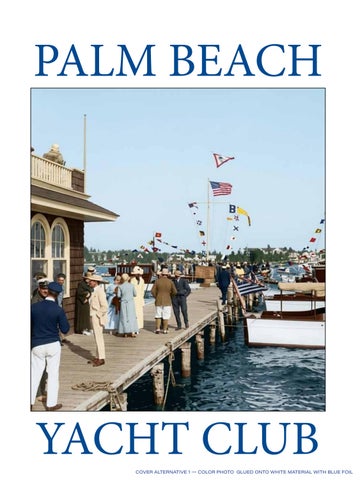
COVER ALTERNATIVE 1 — COLOR PHOTO GLUED ONTO WHITE MATERIAL WITH BLUE FOIL
B
PALM BEACH
YACHT CLUB
COVER ALTERNATIVE 2 — COLOR PHOTO GLUED ONTO WHITE MATERIAL WITH BLUE FOIL
PA L M B E A C H YA C H T C L U B
PALM BEACH YACHT CLUB
E
COVER ALTERNATIVE 3 — COLOR LOGO STAMPED ONTO BLUE MATERIAL
PA L M B E A C H YA C H T C L U B
F
G
COVER ALTERNATIVE 4 — COLOR LOGO STAMPED ONTO BLUE MATERIAL
P A L M
Y A C H T
C L U B
PA L M B E A C H YA C H T C L U B
H
B E A C H
C H A P T E R
N A M E
I
COVER ALTERNATIVE 5 — GOLD FOIL LOGO STAMPED ONTO BLUE MATERIAL
PA L M B E A C H YA C H T C L U B
COVER ALTERNATIVE 6 — COLOR LOGO STAMPED ON WHITE MATERIAL
XII
XIII
NOTE: THIS IS THE FRONT ENDPAPER
SEARCH FOR ALTERNATIVE PHOTO
XIV
P ALM B EACH Y ACHT C LUB 1890
PUBLISHING & MEDIA GROUP
II
III
P A L M
IV
B E A C H
Y A C H T
C L U B
C H A P T E R
N A M E
V
TABLE o f CONTENTS INTRODUCTION
Gerry Arsenault, President — 0 0 Harris Levitt, General Manager — 0 0
CHAPTER ONE
CHAPTER THREE
CHAPTER FIVE
Stewards of the Club
Regatta Racing
Story Times
Harry S. Hamilton Sr. Roger Houston Dean
Sidney Maddock E. R. Bradley Florenz Ziegfeld Jr. Horace Dodge Jr. Roosevelt Seaplane Base
Alfred Hoppock Wagg II William J. von Behren
—00—
—00—
CHAPTER TWO
The Pioneer Era
—00—
—00—
—00—
E. M. Brelsford Elisha Newton “Cap” Dimick Charles John Clarke Henry Morrison Flagler George Lainhart George W. Potter
CHAPTER FOUR
Changing Course —00—
D. H. Conkling Gar Wood Paris Singer Edsel Ford
—00—
CHAPTER SIX
Racing Revival —00—
A. S. Andersen John Wanamaker Jr. Count Max de Pulaski Keith R. Chinn John M. L. Rutherfurd
CHAPTER SEVEN
The USO Years
CHAPTER ELEVEN
PUBLISHED BY
—00—
Palm Beach Yacht Club 800 North Flagler Drive West Palm Beach, Florida 33401 (561) 655-8711
—00—
Thomas Keller
CHAPTER EIGHT
C H A P T E R T W E LV E
Racing Ends
Rapid Growth
Bert Winters Einar Andersen Riley McClain
Jimmy Buffett
—00—
—00—
Curt Gowdy F. Lee Bailey Bob Montgomery
CHAPTER NINE
John Rybovich Jr.
Modernization
Bill Brooks
—00—
Elaine Ragon
L. Thomas Keating
Copyright © 2026 Palm Beach Yacht Club
Written by Craig Dolch Historic Research by Elaine Ragon
Printed in the United States of America First Printing, 2026 All rights reserved ISBN: XXXXXXXXXXX This book or any portion thereof may not be reproduced or used in any manner whatsoever without the express written permission of the publisher.
CHAPTER THIRTEEN
CHAPTER TEN
America’s Cup
The Centennial and Beyond —00—
Commodore’s Room Fern House Rooney Family Jack Taylor
—00—
Harold Stirling “Mike” Vanderbilt William I. Koch, Beauties on the Water
APPENDICES — 00
ACKNOWLEDGMENTS — 0 0
BIBLIOGRAPHY
— 00
PRODUCED BY
Legendary Publishing & Media Group Legendarypmg.com 561-309-0229 Managing Partner: William Caler President and Creative Director: Larry Hasak Editor: Debbie Falcone
P A L M
VIII
B E A C H
Y A C H T
C L U B
C H A P T E R
N A M E
IX
P A L M
X
B E A C H
Y A C H T
C L U B
I N T R O D U C T I O N
I
anchored in history
T IS MY DISTINCT PLEASURE to present every member of the Palm Beach Yacht
Club with a copy of this captivating chronicle of our club’s rich history dating back to its founding in 1890.
This history is more than just a recording of facts. It is a guide to a better future
by learning and appreciating how far we’ve come. It helps us learn from the past and understand how the world has changed. We are proud of our 135-years of history at the
NEED GERRY PHOTO
Palm Beach Yacht Club.
Our story began on December 26, 1890, when our Founders officially filed Articles
of Incorporation with the state of Florida. This speaks to our hard-fought longevity.
Notably, the Palm Beach Yacht Club predates the town of Palm Beach (incorporated in April 1911), the city of West Palm Beach (November 1894), and even the city of Miami
( July 1896). This remarkable tenure speaks not just to endurance, but to the resilience and unbroken spirit of our members who have weathered more than a century of challenges.
The very early history included in this book is intended to honor those who came before us for their grit and
determination. It seems like every time the club rebuilt the marina after a disastrous hurricane, it would get destroyed by another one—along with any recorded historical records, photos, sketches, and ledgers.
During these times, with our docks in shambles, there was no incoming revenue from docking yachts. Loyal mem-
bers dipped into their own pockets for cash to contribute to the rebuilding efforts and to pay the monthly mortgage.
Our members have appeared on the cover of Time magazine and starred in movies; they have won four America’s
Cup races, have been some of the world’s top industrialists and inventors, and have served as key politicians locally and regionally.
For more than sixty years, we entertained the community with our Washington’s Birthday Regatta. At one time,
the Palm Beach Yacht Club was considered the best in the world for its international high-speed races. We proudly offered our headquarters for a USO Club during World War II. Our early members played key roles in the establishment of the Intracoastal Waterway and its Palm Beach County bridges, the Palm Beach Inlet, and the Port of Palm Beach while always making the protection of public waters and boating safety a priority.
We are far more than fine dining with a gorgeous view. Our members have helped shape the civic landscape of
both West Palm Beach and Palm Beach—fabulous places to live.
We are proud to present the first-ever historical book on the Palm Beach Yacht Club. I’d like to thank writer Craig
Dolch, publisher Larry Hasak, editor Debbie Falcone, and former General Manager Elaine Ragon for their hard work in creating this book. We invite you to explore our story and celebrate our legacy. Enjoy.
GERRY ARSENAULT PA L M B E A C H YA C H T C L U B P R E S I D E N T
XI
XII
XIII
C H A P T E R
N A M E
I N T R O D U C T I O N
setting the course
I
N 2016, I HEARD OF an upcoming opportunity at the Palm Beach Yacht
Club for a new general manager. I had a deep-rooted background in hospitali-
ty with sixteen years as director of operations with Hard Rock Cafes and Chart
House Restaurants, followed by nineteen years at Boca West Golf and Country Club,
a sprawling property with four 18-hole courses and six restaurants. When I learned that
Elaine Ragon was planning to step back after twenty-eight years as general manager, I was immediately drawn to the challenge of leading such a historic venue. Upon arriving, I found a top-tier yacht club with a well-earned reputation for outstanding cuisine and a phenomenal team of seasoned maître d’s and waitstaff.
A new executive chef had joined the team just a few months earlier, and I saw an
exciting opportunity—not only to work alongside this talented crew, but to support and help inspire the new chef as he settled into his role. Together, we created inventive menus and curated a lineup of unique member events, from wine tastings and dock parties to themed dinners and cruises. It felt like a “dream job” then—and nine years later, it still does. XV
We are incredibly fortunate to have an outstanding staff who are the true face of the Palm Beach Yacht Club.
They are the ones who bring it to life—greeting members by name, remembering their food and beverage preferences, and consistently delivering warm, personalized service that defines the member experience. Our guiding
philosophy is simple—to always find a way to say “yes” and to never say “no.” These are our members—they make everything possible. When we treat them with genuine care and respect, they respond with loyalty and enthusiasm. It’s a relationship built on mutual appreciation and trust. In simple terms, we are doing things the right way.
We do not rest on tradition alone; we’re also committed to progress. We will never become complacent, but rather
we are constantly seeking ways to enhance every aspect of the club’s ambiance—improving service and elevating experiences. In short, making a better club. Because at the end of the day, it’s all about the people who consider this their home away from home.
Today, the future of the Palm Beach Yacht Club has never looked brighter. The membership roster is full,
our waiting list continues to grow, and very few members are choosing to let their membership lapse. Coordinating the steady stream of requests is no small task, but our membership department handles it with skill and pro-
fessionalism. There’s no better compliment than to hear a member say, “This is my favorite place!” We can debate what’s “the best,” but someone’s favorite is deeply personal, and that means we have succeeded in our mission.
HARRIS LEVITT PA L M B E A C H YA C H T C L U B G E N E R A L M A N A G E R
XV
MEMBERS CROWD ONTO THE SPECTATORS' STAGE TO WATCH THE EXCITING WEEKLY SAILBOAT RACES, C. 1913. THE EARLIEST DAYS OF COMPETITIVE RACING AT THE PALM BEACH YACHT CLUB BEGAN IN THE MID-1890s WITH RELATIVELY SMALL SAILBOATS.
XVI
XVII
P R O L O G U E
Waterfront Legends
T
HE VIEW FROM the Palm Beach Yacht Club dining room is breathtaking, especially during late
afternoon. Well-dressed members gaze out at the bluish-green aqua pura injected by the golden hues of a setting sun.
It’s like you’ve stepped into a live painting—overlooking boats docked in forty-five slips with the
Intracoastal Waterway in the foreground and the majesty of Palm Beach in the background—as members dine on lobster, filet mignon, and other delicacies in the second-floor clubhouse that sits high above the water.
“It’s so cool to be in a building that effectively is in the Intracoastal. You really feel like you’re on the
water,” said longtime member Pat Rooney Jr. “The food is really good, and it’s such a unique atmosphere. You
have this sense you’re in a New York restaurant with the added sense that you’re on a body of water in Florida.” The view inside the Palm Beach Yacht Club’s dining room isn’t bad, either. This is no ordinary club.
XVIII
Two U.S. presidents, Bill Clinton and Donald Trump, have visited PBYC. So have Florida Governors
Lawton Chiles, Charlie Crist, and Ron DeSantis, as well as many prominent national politicians. Famed
industrialist Henry Flagler, who practically invented modern Florida, became an honorary member of the Palm Beach Yacht Club in 1905.
Three members of the Palm Beach Yacht Club have adorned the prestigious cover of TIME magazine
(Florenz Ziegfeld Jr., Harold “Mike” Sterling Vanderbilt, and E. R. Bradley). Actor Clark Gable dined at the Yacht Club with his wife, Lady Sylvia Ashley. Actor Sylvester Stallone became a member. Hall of Fame announcer and outdoorsman Curt Gowdy was a constant presence.
F. Lee Bailey—one of the U.S.’s most well-known criminal defense attorneys—kept his boat at the
dock, and along with local legal legend Bob Montgomery often held “court” at lunch, each presiding at their usual tables.
The Yacht Club has attracted some of the U.S.’s top names in sports. Current member Pat Rooney’s
grandfather, Art Sr., owned the Pittsburgh Steelers from the team’s inception in 1933 until his death in 1988. Locally, the Rooney’s operated the Palm Beach Kennel Club, among other tracks. Baseball Hall of Famer Joe DiMaggio was pictured on the docks proudly showing the sailfish he caught in 1948. NASCAR
legend Jeff Gordon, a marina visitor, navigated at a much slower speed when he docked his boat in a slip. Basketball legend John Havlicek particularly loved the club’s prime, dry-aged New York strip steaks.
OPPOSITE: DUMMY CAPTION TO COME
C H A P T E R
N A M E
SEARCH FOR ALTERNATIVE PHOTO
XIX
P A L M
XX
B E A C H
Y A C H T
C L U B
I N T R O D U C T I O N
New Orleans Saints founding owner John W. Mecom Jr. was a member and kept his
unique Garlington yacht here. After Mecom sold the team in 1985, the new Saints owners— Tom and Gayle Benson—also became members of the Club.
Over the years, PBYC’s membership has included renowned inventors, movie produc-
ers, and enough CEOs to fill a Forbes 400 list.
The list of famous people who visited the Palm Beach Yacht Club includes one of its
most notable former employees—award-winning chef Thomas Keller. He began his culinary career as a seventeen-year-old during the early
1970s working for his mother, Yacht Club General Manager Elizabeth
“Betty” Keller. Tommy started out washing dishes after school before eventually being named chef in 1973.
Virtually every top political and business leader of the Palm
Beaches has passed through the Palm Beach Yacht Club doors. One
of the Founders of the club, Elisha “Cap” Dimick, became the first
mayor of Palm Beach. The first two mayors of West Palm Beach were members, and almost thirty other members later held the mayoral
position. Early club members also held positions in the Florida State Legislature.
Can you imagine the number of important business deals
that have been consummated in the dining room? A watefront
table overlooking the marina is where member Greg Norman held meetings with Saudi Arabian officials in the early 2020s that led to the formation of LIV Golf. Beloved singerJimmy Buffett docked his yacht Continental Divide in 1993 at the marina near
the historic Rybovich #1 Hull, which, later that year, carried the remains of the legendary John Rybovich Jr. out for a sea burial. In 2000, Buffett signed a contract in the club’s Admiral’s Room
XXI COL. EDWARD R. BRADLEY ON THE COVER OF TIME, MAY 7, 1934 The Kentucky horseman, whose Idle Hour Farm had by then produced four Kentucky Derby winners, was equally well known in Palm Beach, where he was a member of the Palm Beach Yacht Club. His Bradley’s Beach Club, opened in 1898, drew the wealthy winter visitors who made the resort fashionable, and his investments and philanthropy helped shape the town for nearly half a century. On his death in 1946, the Beach Club property was left to the town and became Bradley Park.
to partner with Krispy Kreme doughnut franchises in Palm Beach County. He brought his 42-foot custom Rybovich express walkabout boat Last Mango, a newly
designed “Margaritavich,” to the PBYC marina in 2003. While a Rybovich yacht has always been renowned for its beautiful wooden boats, the Margaritavich was a collaboration between
Buffett and the esteemed yacht maker Rybovich, built with a fiberglass/foam composite and featuring an exceptional new laid-back “Buffett Option” design.
Some have asked, “Who are the most important movers and shakers in our commu-
nity who have been members of the Palm Beach Yacht Club?” The better answer might be, “Who among the most important has not been a member?”
OPPOSITE: CLARK GABLE WITH WIFE SYLVIA ASHLEYAT THE PALM BEACH YACHT CLUB, CIRCA 1951
P A L M TEA TIME AT THE COCOANUT GROVE HOUSE, SITE OF THE FIRST PALM BEACH YACHT CLUB DOCK, C. 1894
XXII
B E A C H
Y A C H T
C L U B
C H A P T E R
N A M E
XXIII
XXIV
XXV
SPECTATORS WATCHING THE RACES FROM THE PBYC DOCK, C. 1897
C H A P T E R
O N E
STEWARDS OF THE CLUB
XXVI
WITHOUT A CLUBHOUSE IN 1897, PBYC MEMBERS WOULD PICNIC ON SHORE AT OUR FIRST DOCK.
XXVII
P A L M
XXVIII
T
B E A C H
Y A C H T
C L U B
HE PALM BEACH YACHT CLUB has a storied past dating back to its first articles
of incorporation in 1890. The club’s original location was on the Intracoastal Waterway in Palm Beach, near what is now Pendleton Lane, where it remained until 1895.
By 1897, photographs depict women enjoying picnics by the docks in West Palm Beach
at the site where the club stands today. At the time, the location was known as the corner of Sixth Avenue and Lake Drive, now 8th Street and Flagler Drive, respectively.
After moving from Palm Beach, the club entered a two-decade period without formal
property ownership. In the early 1900s, driven by the rise of competitive racing, local yachtsmen and businessmen formed the Palm Beach Yachting Association, a non-profit group that collaborated with PBYC members to support sporting events.
Historical Society archives show the club’s presence on both sides of 8th Street and
Flagler Drive, beginning during the land boom of the 1920s.
On May 20, 1922, the U.S. War Department issued a permit to “The Palm Beach Yacht
Club” to construct a pier and clubhouse under provisions of the Rivers and Harbors Act of 1899.
The club’s first recorded property transaction occurred on February 27, 1924, when
E. M. Brelsford (Palm Beach Yacht Club’s first commodore in 1890), his wife Laura, and J. H. Brelsford sold Lots 19 and 20 in Block 8 of Brelsford Park to Southern Developers. The listed address was 807 N. Flagler Drive.
Subsequent transactions followed quickly: On December 10, 1924, Southern Developers
sold the property to Southern Developers Mortgage Investment Co., and less than a month ABOVE: A PHOTO INDICATES THE LOCATION OF THE PALM BEACH YACHT CLUB, 1982 OPPOSITE: REGULAR GET-TOGETHERS TO SHARE NEWS & POSSIBLY GOSSIP WERE A VERY IMPORTANT PART OF PIONEER LIFE IN THE EARLY 1890S.
S T E W A R D S
O F
T H E
C L U B
1
PHOTO REPLACED PHOTO PER ELAINES EMAIL
P A L M
B E A C H
Y A C H T
2
CAPTION
C L U B
S T E W A R D S
O F
T H E
C L U B
later, on January 1, 1925, it sold to the Palm Beach Yacht Club, marking the club’s first direct ownership.
Things seemed settled for a time, until August 23, 1927, when Commodore D. H.
Conkling and wife Katherine sold the lots to Post Holding Corporation, owned by the
publisher of The Palm Beach Post, after damage from the 1926 hurricane when the club’s pier was washed away.
The following summer, on July 25, 1928, Southern Developers, Inc. sold Lots 21 and 22
in Block 9 on the east side of Flagler Drive to Yacht Club Holding Company, further expanding
the club’s holdings. Yet just a few months later, the devastating Okeechobee Hurricane of 1928
destroyed the club and its docks. (This may explain a duplicate transaction that was recorded on June 21, 1930, when Southern Developers again sold Lots 21 and 22 to the same company.)
On November 9, 1933, the Yacht Club Holding Company sold the property to the
District of West Palm Beach with a “Walkway Right-of-Way” included.
Four years later, on September 9, 1937, future Commodore Einar Andersen wrote that
attorney and club member Bert Winters created the legal framework for a reorganized Palm
HARRY S. HAMILTON SR. HARRY S. HAMILTON SR. was a visionary real-
estate entrepreneur in Palm Beach County. After marrying media executive Lee Colee in 1973, they devel-
oped millions of square feet of retail and office space across Florida. In West Palm Beach, the Hamiltons’
signature projects included the distinctive Northbridge Center—nicknamed the “Darth Vader Build-
ing”—and the revitalization of the Palm Beach Yacht Club, restoring its stature as a premier nautical and social hub.
Beyond bricks and mortar, Harry champi-
oned mixed-use developments that fostered com-
munity cohesion and economic growth. Predeceas-
ing Lee by mere months in 2016, he left behind a lasting imprint on both the county’s skyline and civic life.
3
P A L M
B E A C H
Y A C H T
C L U B
Beach Yachting Association, which acquired the PBYC properties after settling all outstanding claims. The City of West Palm Beach then sold the land back to the Association.
In 1939, the state of Florida granted the club permission to occupy and improve land in
Lake Worth adjacent to its pier. A new clubhouse was constructed at 8th Street and the west side of Flagler Drive with support from the Jaycees and Chamber of Commerce.
During World War II, from 1942–1947, the clubhouse was generously offered as a USO
Club, serving American troops stationed in the area.
In 1951, needing funds, the Palm Beach Yachting Association sold the clubhouse building
to Rosarian Academy for $75,000. The Yacht Club leased back some of the space for the next
five years, so they could continue to have their meetings and dinner dances when the school schedule allowed. In 1960, a brand-new clubhouse was completed—and is still in use today.
In 1977, the Palm Beach Yachting Association Corporation sold a 50 percent interest to
Flagler Marina, Inc. headed by Art Hilbreath and brothers John E. and Marty Murphy Sr. (The club still enjoys the memberships of both Marty Murphy Jr., Marty Jr.’s uncle John, and
his adult children, and his mother, Betty Harris-Modell, who is the great granddaughter of
Commodore A. E. Andersen and granddaughter of Commodore Einar Anderson, Jr.) Later on, Flagler Marina, Inc. purchased the remaining 50 percent of the club. 4
A period of intense real estate activity began in 1979: On April 10, 1979, Flagler Marina,
Inc. was sold to Antonio Arruza and Mario D. Mendoza. Then, in September 1979, Melvin
Weeks became a majority shareholder and commenced a complete renovation of the club’s dining room and kitchen.
On March 31, 1983, Flagler Marina Associates transferred the property to Palm Beach
Yacht Club Associates, a partnership of Harry and Lee Hamilton, William R. Boose, Daniel Bakst, Antonio Arruza, and the Fanjul Family. After partnership changes during the mid- to late- 1980s, the Hamiltons acquired full ownership in 1987, later welcoming prominent auto dealer Roger Dean as a full partner in late 1989.
After years of multiple ownership changes—and periods when the property had no
formal owner but rather a casual association of members— the Yacht Club ultimately came under the stewardship of individuals with the vision and expertise to shape it into the popular club it is today.
The Hamiltons and Roger Dean thoughtfully structured their ownership in the Palm
Beach Yacht Club to continue through their estates. Today, the trustees of their respective trusts actively manage the club, ensuring its legacy endures.
Those trustees are currently working in collaboration with the Florida Department
of Environmental Protection to enhance the property and move forward with plans for a
new, modern clubhouse ensuring the Palm Beach Yacht Club continues its distinguished tradition well into the future.
ROGER HOUSTON DEAN ROGER DEAN began his career after World War II as a naval officer and opened his first Ford dealership in 1947.
Renowned for his commitment to “creating customers for life,” he swiftly became one of America’s first “mega-deal-
ers.” In 1960 he expanded into Palm Beach County, establishing successful Chevrolet franchises that became local landmarks. His dedication to service and community earned him naming rights in 1998 for Roger Dean Chevrolet Stadium in Jupiter, home to MLB spring training and two minor-league teams. Dean passed away in 1999. MORE COPY TO COME
5
ROGER DEAN, PATTY DEAN-MILLER, AND PARK MILLER
BEFORE FLAGLER DRIVE, THIS LAND WAS PART OF WINDELLA PINEAPPLE FARMS, C. 1893. BLIGHT ENDED THE PINEAPPLE INDUSTRY IN THE EARLY 1990S. THE WATERFRONT PARCEL IS NOW HOME TO THE PALM BEACH YACHT CLUB.
6
REPLACE PHOTO PER ELAINES EMAIL?
C H A P T E R
N A M E
C H A P T E R
T W O
THE PIONEER ERA
7
P A L M
8
B E A C H
Y A C H T
C L U B
T H E
P I O N E E R
E R A
W
HEN THE PALM BEACH YACHT CLUB was incorporated on Decem-
ber 26, 1890, things were less opulent than they are today. The area, known
then as Lake Worth Country, was a rugged piece of land where pioneers faced
primitive conditions.
Early PBYC members faced many challenges while trying to
survive in the untamed swampy Florida wilderness that included bears, alligators, and disease-carrying mosquitos. Malaria and yellow fever were serious threats to those early settlers until efforts to
drain the swamps and improve sanitation began in the late nineteenth century.
Interactions with the region’s indigenous peoples were also
part of early life in the area, reflecting a long and complex history
that predated European American settlement. Three armed con-
flicts—known as the Seminole Wars—had taken place between Florida’s early settlers and the native Seminole people that predated the
American Civil War, with the last one taking place from 1855–1858.
COL. WILLIAM J. WORTH
Lake Worth Lagoon, along with the city of Lake Worth Beach and the iconic Worth
Avenue in Palm Beach, were named after U.S. Army Colonel William J. Worth, who led troops during the second Seminole War.
OPPOSITE: PIONEER PICNIC, CIRCA 1880
9
P A L M
10
RESORT GUESTS ANCHORED IN FRONT OF THE PALM BEACH YACHT CLUB , 1895
B E A C H
Y A C H T
C L U B
“Tensions between the Native Americans and the early Florida pioneers didn’t end
when the war stopped in 1858,” said Harvey Oyer III, a fifth-generation Floridian and PBYC member. His great-great-grandfather, Captain Hannibal Dillingham Pierce, was among the first non-Native Americans to settle in South Florida in 1872.
“The Seminole Indian Wars never officially ended. There was no treaty; they just let it
go,” said Oyer, a West Palm Beach lawyer, historian,
and author. “My family came after the third war,
and the Indians were not happy to have us here. We
expected to be killed at any time. Fortunately, the two sides realized we needed each other to exist, and there was no more conflict.”
There were many other hazards for the early
members to face. Traveling from one place to anARTICLES OF INCORPORATION NOTICE, THE DAILY NEWS PENSACOLA—, THURSDAY JANUARY 1. 1891
other was not an easy task. Those pioneers didn’t
climb aboard boats for pleasure or to win races—they did so out of necessity.
“Boating then was an even more essential part of life in the area than it is today,” said
Debi Murray, chief curator for the Historical Society of Palm Beach County. “That’s how they got around. Because this region was, quite literally, a jungle.”
Not much was known about Lake Worth by travelers from the Midwest, Northeast,
and mid-Atlantic states. The region was so isolated and inaccessible, few outsiders had ever heard of it. It would take days—and sometimes weeks during bad storms—for people from
T H E
P I O N E E R
E R A
the north to reach South Florida. Life here was rooted in survival. Imagine living in South
Florida today without air conditioning, with mosquitoes as dense as the humidity, with hurricanes, bears, or alligators that could arrive at your doorstep without warning.
Still, these hardships didn’t stop the early settlers from traveling to South Florida. Some
were drawn here by the promise of land ownership and economic opportunity; others sought a warmer, healthier climate because of health issues. Not everyone heeded the call of Horace Greeley’s “Go West, young man.”
The first official mention of the Palm Beach Yacht Club came as the final transaction in
“Florida’s Report of the Secretary of State” for the years 1889 and 1890. It read: “Articles of Incorporation of the Palm Beach Yacht Club, filed Dec. 26, 1890.”
A week later, in the January 1, 1891, edition of the Pensacola News, a story appeared
with this information: “Articles of incorporation of the Palm Beach Yacht Club have been filed with the secretary of state. They will establish a
clubhouse in Palm Beach, Dade County. The object of the club is to promote social intercourse among its
members. The officers for the first year are as follows: Commodore, E. M. Brelsford; vice commodore, Geo W. Potter; secretary, C. V. Barton; treasurer, E. H.
Dimick; trustees, F. N. Dimick, J. H. Brelsford and
11
G.W. Lainhart.”
Later in life, founding Commodore E. M. Brels-
ford recalled that discussions were held about forming
a yacht club in either 1886 or 1887 despite the sparse local community.
Once the Palm Beach club was officially regis-
tered with the State of Florida, the next step was to find a home. That task was taken care of by Brelsford,
who donated a two-story, wooden structure on the is-
land side of the Intracoastal, just north of Elisha Dimick’s Cocoanut Grove House, which he had built in 1880.
One of the early club activities, mentioned by the Juno-based Tropical Sun in 1891, was
the first regular meeting of the season in their new clubhouse: “The members all expressed
much pleasure at being able to enjoy their cozy clubhouse at last. They are certainly to be congratulated upon the possession of such elegant quarters.
“After the regular business of the evening was over, the billiard and pool tables were
kept busy until quite late. Some of the boys play good billiards … The fine reading room
upstairs will be opened very soon and will be well supplied with the leading newspapers and
NEWS CLIPPING FROM THE TROPICAL SUN, THURSDAY, DECEMBER 17, 1891
P A L M
B E A C H
Y A C H T
C L U B
12
MRS. ULYSSES S. GRANT IN A HORSE DRAWN CARRIAGE WITH COMMODORE CHARLES J. CLARKE ON LAKE TRAIL IN PALM BEACH, 1894
periodicals of the state and country.”
Entertainment quickly became a part of club life. Eventually, a piano was added to the
clubhouse, a notable luxury at the time.
Charles John “C. J.” Clarke, who operated a fleet of large paddle-wheeled river steam-
boats in Pennsylvania, replaced Brelsford as the Yacht Club’s commodore in 1892. Clarke had recently moved to Palm Beach and bought the Cocoanut Grove House from Dimick,
as well as the land that included the Yacht Club’s new clubhouse. Clarke eventually sold the
home—which also functioned as a part-time hotel—to Henry Flagler, but he retained the clubhouse.
Another club activity in 1893 made the Indian River Advocate’s social column on
December 15: “Thanksgiving was celebrated on Lake Worth by a first-class banquet at Mr. McDonald’s Palm Beach, and a dance at the Palm Beach Yacht Club house [sic].”
It didn’t take long before Yacht Club members were linked with high society. In 1894,
a photograph was taken of Mrs. Ulysses S. Grant—widow of the eighteenth president of the United States who had died in 1885—riding in a horse-drawn carriage on Lake Trail in Palm
T H E
P I O N E E R
E R A
Beach alongside Commodore Clarke.
The Yacht Club’s commitment to civic philanthropy soon followed. In 1895, Commo-
dore Clarke donated the clubhouse to the city of West Palm Beach for a public library to be called “The Reading Room,” establishing West Palm Beach’s first library. Local residents
hoped this would prevent others from wasting their time “drinking in nearby saloons on Banyon Street.”
Flagler, who had arrived in the area in 1892 and later became an honorary member of
the Yacht Club in 1905, donated one hundred dollars to cover the expense for a barge to float the building from Palm Beach to City Park on the west side of the lakefront.
The move left the Yacht Club temporarily without a clubhouse, so meetings, dinner
dances, and other events were held at various local civic buildings, while a small dock re-
mained for boating and outdoor picnics. In 1897, the first PBYC dock on Lake Avenue
(changed to Flagler Drive in 1917) in West Palm Beach was photographed, but it took a lot longer than expected to replace the clubhouse with the imminent war in Europe.
By 1922, the economic outlook had changed dramatically. A land boom was underway
and an influx of wealthy businessmen and yachtsmen from up and down the East Coast
brought new energy to the area. Sensing renewed interest in the club, over fifty new members joined, sparking a fresh wave of enthusiasm. With that momentum, the Palm Beach Yacht Club officially filed to reorganize.
13
A NEWSPAPER CLIPPING FROM THE INDIAN RIVER ADVOCATE DATED FRIDAY, DECEMBER 15, 1893
E.M. BRELSFORD IT WAS FITTING that Edmund Munger Brelsford—known as E. M.—became the first commodore of the Palm
Beach Yacht Club, serving from 1890–1892. He was, after all, a man of many firsts in Palm Beach and played a key role in launching the neighboring community of West Palm Beach.
Brelsford built the island’s first general store. He opened the first post office in Palm Beach and fulfilled the
role of its first postmaster. He helped dig the area’s first man-made inlet, established the first stagecoach line, and partnered with friends and colleagues to open the first bank in Palm Beach, The Dade County State Bank, on May 1, 1893. E. M. and his family first brought music to the community, and, most notably, he opened the first hotel in Palm Beach.
Brelsford didn’t know he would become such a
trailblazer. In the spring of 1880, E. M. and his brother, John Hale “Doc” Brelsford, left Ohio for a hunting and fishing trip to the area now known as Palm Beach. E. M., then twenty-seven, quickly realized he wanted to make this wil-
derness—with the ocean to the east 14
and a large lake to the west—his permanent home.
Charles W. Pierce, one of Palm
Beach’s first pioneers, wrote about a chance meeting with the Brelsford brothers.
“One day in early 1890 while I was working in
pineapple fields, two men waded ashore and came up to
The Brelsford family is credited with bringing the first music to Lake Worth. E. M. played his
violin, Doc the cello, and Minna the piano. The trio was so popular, it inspired
others in the area to learn how to play
instruments so they could join in on the fun.
A year after their arrival, the
Brelsford brothers partnered with
Captain U. D. Hendrickson to open
the second general store in Lake Worth.
The Brelsfords operated the store while
Hendrickson sailed their 61-foot schooner, Bes-
sie B, to purchase goods for resale.
The Brelsford’s store became a place for locals
the field to have a look at the plants. They were investi-
to meet. It also became a post office in 1887 after the
As it turned out, E. M. had indeed found his new
ment to establish one. Their first application was re-
gating the lake with the view of making it their home.”
home. The Brelsford Brothers purchased land in Palm
Beach from Frank Dimick just south of today’s Royal Poinciana Way. While Doc stayed in Florida, E. M. returned to Ohio to convince his widowed mother, Dorinda, and sister, Minna, to join them in South Florida.
brothers had the foresight to apply to the U.S. governjected because the name “Palm City” already existed in North Florida. The second one—Palm Beach—was accepted, and E. M. became Palm Beach’s first postmaster on October 1, 1887.
In 1889, E. M. married Laura Bell of Ohio. A year
He returned to Palm Beach in the fall of 1880 with
later, he became the first commodore of the Palm Beach
Dimick’s property, which was split into three sections,
the former Dimick property, became Palm Beach Yacht
his mother, sister, and his violin. They moved onto one each for E. M., Doc, and Minna. E. M. also constructed a building on Dimick’s property.
Yacht Club, and the building he constructed in 1880, on Club’s first clubhouse.
Brelsford also was the first to utilize his home as a
T H E
P I O N E E R
E R A
15 E. M. BRELSFORD STANDS IN FRONT OF HIS DADE COUNTY BANK, THE AREA’S FIRST FINANCIAL INSTITUTION.
part-time hotel. In 1890, he built an additional struc-
himself and Laura at 1 South Lake Trail. Completed in
House in Palm Beach.
Banyans. Palm Beach Yacht Club member Jeannette
ture on the property just north of Cocoanut Grove
In 1893, as a land boom began, E. M. and his
brother sold their four hundred feet of lakefront prop-
erty to Henry Flagler for $60,000. Flagler, the Standard Oil baron, developer, and railroad tycoon, was extending his Florida East Coast Railway southward as he
had plans to build Palm Beach’s first luxury resort, the Royal Poinciana Hotel.
When Flagler began construction in the spring
early 1903, the beautiful estate became known as The Sizemore, a grandniece of E. M. and widow of John Brelsford Dunkle, shared some of the family history.
In laying out the grounds of The Banyans, Brels-
ford planted three ceiba trees—also referred to as
kapoks—for each of his three daughters: Frederika,
Marjorie, and Mildred. One was planted at Whitehall, on property he had sold to Henry Flagler, while
the other two were set between Whitehall and the
of 1893, E. M. had the foresight to cofound the
Royal Poinciana Chapel. The choice of the ceiba was no
his brother and other investors. E. M. helped launch
tree, the ceiba is admired for its massive, buttressed
area’s first bank, Dade County State Bank, alongside several others, earning a reputation as one of south Florida’s earliest financiers.
In 1901, E. M. started building his dream home for
accident. Known throughout the tropics as a sacred
trunk and high, spreading canopy that seems to reach for the heavens.
Today, more than a century later, all three trees
15
16
ABOVE: BRELSFORD’S HOME, THE BANYANS BELOW: A GARDEN PARTY AT THE BRELSFORD HOUSE FOR WASHINGTON’S BIRTHDAY, C. 1910
remain healthy and thriving. With life spans that can
Places in May 1974, it was sadly demolished in 1975.
uments not only to Brelsford’s daughters but also to
After having lived on the island for nearly sixty years,
reach three hundred years or more, they are living monPalm Beach’s earliest days.
E. M. also served as a Palm Beach town councilman.
he was celebrated as “the oldest pioneer and continuous
Much like the gener-
resident of Palm Beach.” His
al store, The Banyans soon
influence extended to West
became the center for many
Palm Beach, where a stretch
seasonal social events such as
of land near the Palm Beach
George Washington’s birthday
Yacht Club is still known as
celebrations. The Brelsfords
Brelsford Park.
and their heirs lived at the
E. M. Brelsford died in
estate for forty years until it was sold to Palm Beach Yacht
1937 after a six-month illness,
Club member Bert Winters in 1943 and ultimately
leaving behind a legacy entwined in the early develop-
home was added to the National Register of Historic
Palm Beach Yacht Club we know today.
to the Royal Poinciana Chapel in 1967. Though the
ment of the Palm Beaches and more specifically, the
17
OPPOSITE: THE BANYANS HISTORICAL MARKER (TOP); THE LAKE TRAIL LEADING ALONG BRELSFORD COVE TO BRELSFORD POINT (BOTTOM) FOLLOWING PAGES: GROVE HOUSE
18
LARRYS ASSISTANT SHOOTING NEW PHOTO
ELISHA NEWTON “CAP” DIMICK
ELISHA NEWTON DIMICK was known to everyone as “Cap,” a nickname many assumed came from a life spent
on the water. It actually dated back to his childhood, when his mother affectionately called him that because he always wore a white cap.
His family was living in Illinois when his father, Moore Dimick, was diagnosed with tuberculosis. Doctors
recommended a warmer climate, so Dimick and his family, along with their close friends the Geer family moved to Florida. (Close family friends indeed: Three siblings from each family eventually married one another.) Dimick was twenty-seven years old when he arrived in the Lake Worth region in 1876. In 1880, Dimick bought thirty-nine acres on what
is presently the island of Palm Beach for just one dollar per acre, according to land records. Dimick ultimately
owned 136 acres of land in Palm Beach, although much
into swaying coconut palms, they played a huge role in the naming of his hotel and became the symbol of the town of Palm Beach.
In 1893, Dimick joined forces with the Brelsford
of the land was a swamp with dense jungle stretching
brothers again to cofound the region’s first bank, the
Cap Dimick was determined to make a living
nancing Henry Flagler’s ambitious hotel project and
from the lake to the ocean.
growing fruit and vegetables, mostly sweet potatoes,
pumpkins, and pineapples. Then came a stroke of
Dade County State Bank—an essential measure in fipaying its huge labor force.
Eventually, the popular Dimick turned to poli-
good fortune. In 1878, a vessel named Providencia ran
tics. In 1890, he successfully campaigned for a Florida
from Trinidad. Locals could buy them for $2.50 per
(which included the Palm Beach district) for two years.
aground with a full load of twenty thousand coconuts hundred. Dimick planted thousands of them on his
property in neat symmetrical rows. When they grew
House of Representatives seat to serve Dade County
Dimick had more time to serve as a politician after
the family sold the Cocoanut Grove House to Charles
ABOVE: THE PROVIDENCIA RAN AGROUND IN 1878 CARRYING TWENTY THOUSAND COCONUTS, HELPING SHAPE PALM BEACH’S SIGNATURE LANDSCAPE. OPPOSITE: THE STATUE OF ELISHA DIMICK GREETS THOSE ENTERING PALM BEACH VIA THE ROYAL PARK BRIDGE; SCULPTED BY BURT W. JOHNSON, IT WAS DEDICATED IN 1921.
19
EARLY PIONEERS CROWD THE TINY ROWBOATS P A L M B AT THE FIRST DOCK OF THE PALM BEACH YACHT CLUB, BUILT ON THE OLD GROUNDS OF THE COCOANUT GROVE HOUSE. C. 1891.
20
E A C H
Y A C H T
C L U B
21
P A L M
B E A C H
C L U B
J. Clarke, a millionaire from Pittsburgh, for $49,000
in 1918. Less than a year later, Dimick died of cancer at
hotel after it was purportedly started by a construction
A statue honoring him was built in West Palm
in late 1892. Just a year later, a fire burned down the 22 22
Y A C H T
worker staying at the hotel who was smoking in bed in his room.
the age of sixty-nine.
Beach in 1921 and then moved to Palm Beach in
1947. Today it stands along Royal Palm Way, welcoming visitors to
In 1896, Dimick was elected
Palm Beach, the town he helped
to the Florida Senate, representing
shape.
both Brevard and Dade Counties,
While many regard Henry Flag-
and went on to serve four terms, but his focus always was on Palm Beach.
ler as the founder of Palm Beach, a
Dimick would be elected as Palm
the true founder was Cap Dimick.
It
seemed
inevitable
strong argument can be made that
that
“There’s no question the father
Beach’s first mayor in 1911. One of his original tasks was to improve ac-
of the town of Palm Beach was Cap
to build the first vehicular bridge
spent seven years as chairman of the
Dimick,” said Harvey Oyer III, who
cess to the island, so he led the effort
across Lake Worth Lagoon connecting Palm Beach to
Historical Society of Palm Beach County. “He built the
Dimick served as mayor of Palm Beach for seven
first town, he built the bridge, he founded the bank, he
West Palm Beach.
years and was succeeded by his son-in-law, T. T. Reese,
first boarding house that became a hotel, he plotted the became the mayor.
ABOVE: ELISHA "CAP" AND ELLA DIMICK WITH THEIR DAUGHTER BELLE DIMICK REESE, HER HUSBAND T.T. REESE, & HIS MOTHER. INSET: ELISHA NEWTON "CAP" DIMICK IN 1897
T H E
P I O N E E R
E R A
PBYC MEMBERS WARD G. FOSTER, CENTER, JOINS E.D. ANTHONY (BOTH IN RETAIL SALES)AND FELLOW WEST PALM BEACH BOOSTERS IN A 1920s PROMOTIONAL PHOTO CELEBRATING THE TROPICAL BEAUTY OF PALM BEACH COUNTY.
23
23
E.N. DIMICK AT HIS NEWLY BUILT HOME, ONE OF FOUR CONSTRUCTED IN ROYAL PARK.
CHARLES JOHN CLARKE CHARLES JOHN CLARKE didn’t come to Lake Worth in 1885 looking to move here. The fifty-two-year-old
resident of Pittsburgh, Pennsylvania, was on a hunting and fishing expedition with his friend Thomas Carnegie, brother of steel magnate Andrew Carnegie. Clarke owned and operated a very successful fleet of large paddle-wheeled river steamboats in Pennsylvania.
Boating wasn’t just the primary mode of transportation and income for Clarke. He enjoyed racing boats and
wanted to find a southern location where he could enjoy being on the water during the winter months. When he
and his wife, Louisa, returned to the area in late 1891, they were aboard his yacht/steamer, Alma, named after his granddaughter.
“My grandfather anchored the yacht in the lake a
short distance from where the Henry Flagler Museum
stands now,” Clarke’s grandson John told Judge James R. Knott in an interview for a story that appeared in The Palm Beach Post’s “Sunday Brown
natural that Clarke would become the second commodore of the Palm Beach Yacht Club, serving four oneyear terms during the span of 1892–1896.
Palm Beach residents referred to him simply as “Commodore Clarke,” even after his official role ended. He
Wrapper” on August 8, 1982. 24
became one of the most well-
“They went ashore and found
known figures on the island
Cap Dimick’s lakefront Cocoanut
with his trademark jaunty hat
Grove House, which stood on the
and umbrella.
spot now occupied by No. 8 South
Clarke and his wife hosted
Lake Trail.”
The Clarkes had such a mar-
such notables from Pittsburgh as
nut Grove House that winter,
and Mr. and Mrs. Henry Phipps.
Mr. and Mrs. Andrew Carnegie
velous time staying in the Cocoa-
It would be Palm Beach’s first
they returned the following sea-
taste of high society of rich ce-
son and made an offer to Dimick
lebrities coming to the area—but
to buy the hotel and sixty acres of
not its last.
land that stretched from the lake to the ocean. The price: $7,000. Clarke was often seen
COMMODORE CHARLES CLARKE
When Henry Flagler ar-
rived in Palm Beach and
aboard his luxury yacht Alma. A true yachtsman, he also
started building the opulent Royal Poinciana Ho-
in a boathouse on the estate with a lake-to-land tram-
accommodate his top workers. Alas, the arrangement
owned sailboats and at least one steamer, which he kept way to lift boats in and out of the water.
With his love and knowledge of boating, it seemed
tel, Clarke leased him the Cocoanut Grove House to was short-lived—the hotel soon burned down when a construction foreman was smoking in bed.
OPPOSITE: COMMODORE CHARLES JOHN CLARKE (3RD FROM LEFT). HOTEL GUESTS AND STAFF JOIN HIM ON THE SHORELINE NEAR THE COCOANUT GROVE HOTEL BATHHOUSE TO VIEW THE MAMMOTH HAMMERHEAD SHARK CAUGHT JUST OFFSHORE, 1893.
T H E
P I O N E E R
E R A
25 25
CAPTION
T H E
C O A C H I N G
C L U B
26
ABOVE: THE MAIL BOAT AT JUPITER WITH MR. & MRS. THOMAS CARNEGIE AND PBYC COMMODORE CHARLES J. CLARKE, 1885 OPPOSITE, ABOVE: PRIMAVERA MANSION; INSET: THE ALMA; BELOW: THE ORIGINAL CLUBHOUSE TURNED READING ROOM
26
In 1899, Clarke donated the Yacht Club’s original
tributed used furniture and books, hoping to lure the
club’s Reading Room for use as West Palm Beach’s new
Beach hotels out of the bars along Banyan Street, then
clubhouse and its small collection of books from the
lakefront library. Flagler paid $100 to float the structure across the lake to its new location.
As Palm Beach Post journalist and historian Eliot
Kleinberg wrote in 2019, “Concerned citizens con-
rowdy construction workers building Flagler’s Palm also known as ‘Whiskey Street.’ ”
Clarke died later that year in Palm Beach. Today’s
Clarke Avenue is named in his honor.
27 27
28
HENRY MORRISON FLAGLER
WHITEHALL IS A 75-ROOM, 100,000-SQUARE-FOOT GILDED AGE MANSION IN PALM BEACH WAS COMPLETED IN 1902. HENRY FLAGLER HAD IT BUILT AS A WEDDING GIFT FOR HIS THIRD WIFE, MARY LILY KENAN— THE ESTATE SERVED AS THEIR WINTER RESIDENCE AND IS NOW THE FLAGLER MUSEUM.
HENRY MORRISON FLAGLER was the Pied Piper of his era. Wherever he went, people—and their money—
followed closely behind. He became an honorary member of the Yacht Club in 1905.
Flagler first came to the Lake Worth area in 1892 while scouting a route to extend his Florida East Coast Railway.
He envisioned eventually bringing wealthy visitors to stay at his planned luxury resort destination in Palm Beach. News
of the wealthy Standard Oil industrialist’s arrival spurred others to buy land here, believing the prices would rise due to his presence.
Sure enough, when Flagler returned a year later
Flagler purchased Eclipse, his first yacht, around
to build the first of his two hotels, the Royal Poinciana
1883. Flagler’s second yacht, the schooner Columbia,
era in Palm Beach. One of his first major projects was
famous in 1871 when it successfully defended the
Hotel, it kicked off a land boom that ushered in a new
the construction of a railroad trestle bridge, just south
of where the Palm Beach Yacht Club sits today This bridge allowed his private railcar—and later, passenger
was purchased in 1884. Columbia had become world America’s Cup, alongside Sappho, for the New York Yacht Club.
In 1890, Flagler commissioned his grandest yacht,
trains filled with hotel guests—to cross the Intracoastal
Alicia, named after his wife Alice. It would be, by far,
by boat.
der steam engine—and cost $113,000 (approximately
was fascinated with yacht racing. A member of the
are no known photos of Flagler aboard his yachts, he
Waterway, eliminating the need for visitors to arrive solely Like most industry titans of his era, Henry Flagler
prestigious New York Yacht Club, he owned both sailing and steam yachts and frequently attended regattas, though he never raced himself.
his largest yacht—180 feet in length with a three-cylin-
$4 million dollars in today’s money). Though there
did commission a painting of the Columbia by noted maritime artist William G. Yorke.
Like Columbia, the Alicia was involved in an Amer-
29
P A L M
B E A C H
Y A C H T
C L U B
30
THE ROYAL POINCIANA HOTEL AND DOCK
ica’s Cup race—not as a competitor but as a patrol and
Flagler did his part to help the community, as
committee boat. Flagler and the Alicia served as a cap-
well. Not only did he extend his railroad service to the
Cup race.
schools, and churches, and he provided much-needed
tain and official patrol vessel during the 1895 America’s After Flagler became a permanent resident of
Palm Beach, he was offered honorary membership to the Palm Beach Yacht Club in 1905, during his tenure as president of the Palm Beach Power Squadron.
area, he helped donated the money to build a hospital, infrastructure. He financed dredging of the Intracoast-
al Waterway to allow larger boats to pass through and launched a steamer service to the Bahamas and Cuba.
Flagler learned that being one of the wealthiest
In 1894 Flagler realized he would need to build an
men on this planet didn’t assure him personal happi-
hospitality industry, so he invested $45,000 to buy the
was diagnosed with mental illness, and his third was
adjacent town to help support his vision of building a
land across the Intracoastal Waterway and founded West Palm Beach. He established it as a working-class
city to house the laborers and staff who were either building or operating his resorts in Palm Beach.
ness. His first wife died from tuberculous, his second less than half his age when they married.
In March 1913, Flagler fell down a flight of
marble stairs at Whitehall. He never recovered and died in Palm Beach on May 20 at age eighty-three.
31
THE PALM BEACH INN, LATER RENAMED THE BREAKERS HOTEL
P A L M
32
B E A C H
Y A C H T
C L U B
GEORGE LAINHART THE NAMES “LAINHART & POTTER” have been around Palm Beach County for more than a century. In 1893,
George Lainhart and George Potter started a lumber company that would become the oldest business in the county.
Three years earlier, Lainhart and Potter had lent their names to another fledgling venture—serving as officers
of the newly formed Palm Beach Yacht Club. The club had filed Articles of Incorporation with the State of Florida in December 1890 to “establish a clubhouse in Palm Beach, Dade County.” The officers for the first year were: E. M. Brels-
a key role in supplying the construction materials for
V. Barton, secretary; E. H. Dimick, treasurer; and F.
ing and restoration of the Palm Beach Yacht Club docks
ford, commodore; George Potter, vice commodore; C.
N. Dimick, J. H. Brelsford and George Lainhart were
named as trustees. It started a long history of civic in-
numerous buildings in the area, including the rebuildand clubhouse after damaging storms.
The two were such good partners that when Potter
volvement for Lainhart, who was elected to the county
sold his share of the company in 1921 because of declin-
Both Lainhart and Potter were integral to the
unchanged out of respect. Lainhart & Potter would
commission in 1898 and served for sixteen years.
Palm Beach Yacht Club’s early success, serving on nearly every committee.
In 1893, Colonel E. R. Bradley advised Lainhart to
open a building materials business to supply Flagler and others. With the help of a loan from Bradley, Lainhart
& Potter Building Materials was born. The firm played
ing health, Lainhart chose to keep the company’s name become West Palm Beach’s oldest business (118 years) before it was sold in 201.
George Lainhart died in 1930 at the age of eighty-
four. At the time of his death, he was still president of the company he had founded.
OPPOSITE: GEORGE LAINHART HELPED CONSTRUCT PALM BEACH’S FIRST MANSION, SEAGULL COTTAGE (ABOVE), ORIGINALLY BUILT FOR ROBERT R. McCORMICK. THE HOME WAS LATER SOLD TO HENRY M. FLAGLER.
33
LAINHART AND POTTER BUILDING SUPPLIES CO., CIRCA 1930
34
LAINHART IS IN THIS PHOTO, NOT SURE WHICH ONE IS HIM
35
PAGE UNDER CONTRUCTION
36
GEORGE W. POTTER
GEORGE W. POTTER
and his brother Richard didn’t leave their
Cincinnati home in 1873 for Florida because they were looking for paradise. Rather, they were simply trying to improve George’s health.
George suffered from asthma, and his older brother Richard, a
doctor, believed that warm weather would be the best medicine for
his twenty-two-year-old sibling. George had developed his artistic skills while attending private schools as a child and later worked for The Cincinnati Enquirer as a cartoonist.
The Potter brothers initially relocated to Biscayne Bay, then
moved in 1881 to Palm Beach where George bought a sixteen-acre piece of land and built their home Figulus (Latin for “place of the potter”). The Potter brothers were the first in Palm Beach to build their homes facing the ocean instead of the lake.
In 1893—three years after he was named vice commodore of
the fledgling Palm Beach Yacht Club—George sold his Palm Beach
home and moved across Lake Worth to build a home for his wife, Ella Dimick, niece of Cap Dimick.
George Potter quickly became a mover and shaker in West Palm
Beach. He and George Lainhart started the first lumber company,
Lainhart & Potter. He formed the first real estate firm, Porter & Potter, partnering with Captain O. S. Porter. With his architectural talent, Potter was hired by Henry Flagler to survey the new city of OPPOSITE: GEORGE POTTER WITH THE ALLIGATOR KNOWN AS THE "OLD GRANDFATHER".
37
38
GEORGE W. POTTER’S OIL PAINTING DEPICTS HIS ORIGINAL LOG CABIN, FIGULUS. HIS SKETCHES AND PAINTINGS ARE AMONG THE FINEST SURVIVING DEPICTIONS OF PALM BEACH PIONEER LIFE IN THE 1870S AND 1880S IN PALM BEACH COUNTY.
West Palm Beach, laying out most of its downtown
ented artist whose sketches gave unique glimpses into
He served the community in a notable way. In
ings and sketches adorned advertisements for many of
areas.
1894, George was appointed as an alderman on the first West Palm Beach City Commission and later 38
served as the city’s mayor from 1909–1910. He was president of the aptly named Pioneer Bank.
Potter is perhaps best remembered as being a tal-
everyday life in early Palm Beach. His detailed draw-
the Lake Worth area’s early businesses as well as in local newspapers and magazines.
Potter died in July 1924, but his legacy endures.
In West Palm Beach, Potter Road is named after him, and Ellamar Road is named for both his wife, Ella,
39 39
C H A P T E R
T H R E E
REGATTA RACING
42
43
SPECTATORS VIEW SAILING REGATTAS FROM THE SHORELINE AT THE ORIGINAL PALM BEACH YACHT CLUB, CIRCA MID-1890S
P A L M
Y
B E A C H
Y A C H T
C L U B
ACHT CLUBS HAVE BEEN AROUND since the eighteenth century, first
44
appearing in the European countries of Ireland, Sweden, and Russia. The first yacht
club in North America was the Royal Nova Scotia Yacht Squadron in Halifax, Canada,
which was established in 1837.
ABOVE: CAPTION WILL GO HERE OPPOSITE: GATHERING AT THE DOCK FOR A REGATTA, 1926
The oldest yacht club in the United States is the Detroit Boat Club (1839), which
opened five years before the New York Yacht Club. These clubs exuded prestige, with most of the members being rich or famous, or both.
When the Palm Beach Yacht Club was established on December 26, 1890, it became
one of the first yacht clubs in Florida—and the oldest established business in the area still operating today. The only clubs older are St. Augustine (1873), Florida Yacht Club in Jacksonville (1876), and Biscayne Bay Yacht Club (1887).
And it wasn’t long before PBYC started doing what yacht clubs do: hold racing regattas. Regattas have been around even longer than yacht clubs, starting in the fourteenth
century in Venice, Italy, where men raced their gondolas through the city’s canals.
But Regattas weren’t just about who had the fastest boat and the most-skilled crew—
they were also a way get influential people who had the means to invest in racing yachts involved in the yacht clubs to help promote both the sport and the clubs in the community.
The Palm Beach Yacht Club’s location on the Intracoastal Waterway was ideal, offer-
ing convenient access to both the Atlantic Ocean and inland waterways. Once the PBYC members decided to stage a regatta, they chose February 22—George Washington’s birthday.
45
46
47
A PHOTO CPATION WILL GO HERE
48
THE CLUB'S ANNUAL WASHINGTON’S BIRTHDAY REGATTA, WHICH INITIALLY FEATURED SAILING COMPETITIONS, STARTED INCORPORATING MOTORBOAT RACES AS POWERBOATS BECAME THE FEATURED EVENTS DUE TO THEIR SPEED, SLEEK DESIGN, AND ROARING ENGINES
R E G A T T A
R A C I N G
Thus, it was known as Washington’s Birthday Regatta and remained so for many years.
Palm Beach’s first Regatta, a sailing competition, was held in 1894, according to a story
in The Tropical Sun. The racing started from the steam yacht Alma, owned by then-Com-
modore Charles John Clarke and featured sloops, catboats, and “sharpies”—a flat-bottom sailboat suitable for shallow waters.
The entry fee was five dollars, unless the boat was owned by a club member. First prize
was twenty-five dollars, second place earned fifteen dollars, and third received ten dollars. A minimum of five boats was required for the race to be held.
In the catboat division, boats 18 feet and over competed for the coveted
1894 championship flag. Cat boats smaller than 18 feet raced for a “valuable medal.” This level of competition was just a taste of what was to come.
By 1898, the Regatta had grown in popularity. Commodore Clarke—
who, like most past commodores, retained his title after his term was
over—won the main race aboard Canvasback in a Regatta that had been de-
layed until March due to high winds. His steam yacht Alma was there, but
not as an entry; the yacht was provided for spectators to view the action on the course. George Potter was the timekeeper and G. W. Lainhart the treasurer.
By 1905, the annual Washington’s Birthday Regatta had increased in stature. Henry
Flagler donated a trophy to the winner of the Four-Mile Handicap for speedboats. Nearly
one thousand spectators lined the shores of Lake Worth—including elite New York socialites and racing enthusiasts who had attended the recent car race in Daytona Beach.
This wasn’t just a race; it was a show. Fireworks were set off from the shore as the pa-
rade of illuminated motorboats, sailboats, and rowboats glided by, while the music of a halfdozen orchestras and brass bands added to the excitement.
Then the weather turned. A huge, sudden storm rolled across the lake, putting a quick
end to the festivities. Such was life with an outdoor sport. Not even Palm Beach could afford to build a dome over the Intracoastal.
By now, powerboats began to steal the spotlight. Their speed, sleek design, and roaring
engines appealed to both drivers and fans. They became the featured races each year, especially as racers successfully broke world records on the waters of West Palm Beach.
Staging regattas was not without risk—they were, after all, taking place on the water. In
1907, there was a near-fatal accident when two boats, Bruiser and Katherine, collided. Mrs.
James J. Clarke, daughter-in-law of Commodore C. J. Clarke, was aboard one of the boats. The force of the collision threw Mrs. Clarke over the machinery and her skirt caught in the shaft as the boat began to sink.
Her husband, James, acting quickly, used a knife to cut the skirt, and handed her over
to an adjacent boat where her father was on board. Miraculously, Mrs. Clarke was uninjured.
49
SIDNEY MADDOCK SIDNEY MADDOCK was the quintessential Palm Beach Yacht Club member: wealthy, accomplished and deeply
passionate about boating.
Maddock first came to Palm Beach in 1890 as a teenager with his parents, Henry and Jeani Elizabeth Maddock.
A year later, the family returned with something unique and remarkable—a prefabricated home shipped by barge from New York to Palm Beach.
Today there is a historical marker dubbed “Duck’s
Ponce further remarked, “It was a poetic twist in Palm
standing house” in Palm Beach where the Maddocks
Along with his considerable speculative lake and
Nest” on North Lake Trail that recognizes “the oldest
lived. But the home wasn’t the only prized possession the Maddocks brought to Palm Beach.
Sidney soon started transporting his catboat, The
Siren, from New York to Palm Beach every winter so he
oceanfront properties, Maddock also built the Olympic
and Dixie movie theaters, as well as several Clematis Street commercial buildings in West Palm Beach.
But his main priority was still the Palm Beach
could compete in the recently organized Yacht Club’s
Hotel. It offered guests vaudeville entertainment,
Maddock won the open regatta for the Palm Beach
fishing excursions. Alas, on March 18, 1925, embers
Washington’s Birthday Regatta.
Yacht Club in 1901 and placed second in the Lake Worth
Handicap later that year, according to a story in the Brooklyn Eagle. He went on to win the open regatta in 50
Beach history.”
1902 and an open regatta off Pelican Island Yacht Club
concerts, card games, casino gambling, and deep-sea from the nearby burning Breakers hotel landed on the
roof of the Palm Beach Hotel, and Maddock’s dream possession was burned to the ground.
Undeterred, Maddock rebuilt—bigger and bolder.
in 1903.
On the site where his previous hotel had burned down,
originally partnered in a pineapple plantation, but his
room, Spanish-style hotel, later renamed The Alba.
Maddock also was a successful businessman. He
fortunes grew even greater when his father bought a
piece of land with a small building on the eastern shore
of Lake Worth where the Biltmore is currently situated, adjacent to Henry Flagler’s Royal Poinciana Hotel.
he constructed Palm Beach Royal, a twelve-story, 540“Palm Beach has been good to me, and now I have
an opportunity to be good to Palm Beach,” Maddock said of his decision to rebuild.
The new hotel opened with great fanfare, but the
Sidney enlarged the building, and in 1902 he
brisk business was short-lived. After a series of mis-
which prospered for more than two decades while
wreaked havoc in Palm Beach, the stock-market crash
opened the three hundred-room Palm Beach Hotel,
being advertised as “Next to the World’s Largest Hotel.” Palm Beach Hotel had its own significant historical
claim, with a touch of irony.
“During Theodore Roosevelt’s visit to Palm
Beach, he stayed at the Maddock hotel, considering the
fortunes—the 1928 Lake Okeechobee Hurricane that
of 1929, and the end of South Florida’s land boom,
Maddock could no longer afford to run the hotel
and returned to New York. He died in 1936 at age sixty-five.
Today, as Palm Beach Yacht Club members enjoy
president’s trust-busting campaigns that curtailed the
a meal in the clubhouse, they can view due east toward
Beach’s unofficial historian. Flagler, of course, was a
The Biltmore, the building retains much of its original
Standard Oil monopoly,” said the late Jim Ponce, Palm founder of Standard Oil, one of the prime companies President Roosevelt was trying to put an end to. Jim
the original Alba hotel. Now a condominium named
architectural charm, thanks to developers who preserved its distinctive look.
51
ABOVE: SIDNEY MADDOCK (LEFT) AND HENRY PADDOCK (RIGHT) IN FRONT OF DUCK’S NEST, THE HOME HE BUILT ON PALM BEACH, C. 1897. BELOW: DUCK’S NEST IS A HISTORIC LANDMARK ON THE ISLAND.
NOTE : THIS INFO CONTRADICTS COPY ON PRECEDING PAGES it opened as the Alba, but the later names were the Ambassador and then the Palm Beach Biltmore— found no support for “Palm Beach Royal.” The Historical Society of Palm Beach County also identifies two other corrections: Maurice Heckscher built the replacement hotel, not Maddock, and it opened in February 1926 with 550 rooms, not 540. Maddock left Palm Beach after his hotel burned. Palm Beach County History Online
52
53
SYDNEY MADDOCK’S PALM BEACH HOTEL (BACKGROUND) BURNED DOWN IN 1925 AND MAURICE HECKSCHER BUILT THE ALBA (INSET), THAT OPENED IN FEBRUARY 1926. IT LATER BECAME THE AMBASSADOR AND, SUBSEQUENTLY, THE PALM BEACH BILTMORE.
54
E.R. BRADLEY
BEGINNING IN 1898, THE GUESTS OF THE ROYAL POINCIANA HOTEL AND THE BREAKERS WERE WITHIN WALKING DISTANCE OF A MAJOR NEW ATTRACTION—BRADLEY’S BEACH CLUB, A GAMBLING CASINO AND RESTAURANT.
MOST PIONEERS WHO came to Lake Worth in the late-1800s went by their initials before eventually adopting
their full name. Not so for Edward R. Bradley.
He was known as E. R. Bradley when he arrived in the area in 1898, and he’s still known by that name to this
day. Almost eighty years after his death, his namesake bar and restaurant E. R. Bradley’s Saloon is still thriving on
Flagler Drive. Owned by the Coniglio family, the restaurant has kept his memory alive with a unique collection of
E. R. Bradley photos and personal relics.
His close friends called him “The Colonel,” an hon-
Born in Johnstown, Pennsylvania, in 1859, Bradley
orary title bestowed on him by the Kentucky governor
was working in a steel mill and as a rancher by the time he
thoroughbred horse owner.
friends with Wyatt Earp.
in recognition of Bradley’s tremendous success as a In Palm Beach, Bradley was associated with a
became a teenager. During the Wild West era, he became He soon became a successful gambler and started
different type of gambling operation—he operated a
a bookmaking business that served horse racing bettors
gambling legal during that time? Of course not. But
In 1910, he purchased a farm in Lexington, Ken-
private casino from his Beach Club on the island. Was thanks to Bradley’s powerful political and legal connec-
tions, he was always tipped off before a raid could shut him down.
at tracks in Arkansas, Tennessee, Missouri, and Illinois.
tucky—the epicenter of American horse racing—a four-
hundred acre property called Idle Hour Stock Farm.
He soon built one of the premier breeding opera-
55
ABOVE: RACING THOROUGHBREDS KENTUCKY DERBY—BY 1934, COLONEL E. R. BRADLEY HAD BECOME A TOWERING FIGURE IN AMERICAN RACING, HIS HORSES CAPTURING MORE THAN 1,000 WINS—AMONG THEM FOUR KENTUCKY DERBIES, THREE PREAKNESS STAKES, AND TWO BELMONT STAKES. OPPOSITE: ACROSS THE COUNTRY’S MOST CELEBRATED TRACKS, E. R. BRADLEY’S COLORS WERE A FAMILIAR SIGHT IN THE WINNER’S CIRCLE.
56
tions in the U.S. All of his horses had one thing in
charitable causes, including local hospitals, educational
after the Bradley name. That “B” became synonymous
a key benefactor in Palm Beach’s early development.
common: Their names each began with the letter “B” with winning.
institutions, and community causes. He was considered When Bradley’s wife, Agnes, died in 1926, his
Bradley’s horses captured nine Triple Crown
generosity impacted the Palm Beach Yacht Club in
Behave Yourself (1921), Bubbling Over (1926), Burgoo
three-quarter acres to St. Ann’s Parish with the re-
races, including four Kentucky Derby victories—
King (1932), and Brokers Tip (1933). This remarkable success brought him national acclaim and earned him the cover of TIME magazine on May 7, 1934.
Bradley also had an affinity for another type of
an unexpected manner. He bequeathed seven-and-
quest it would become a school for girls. The school was named St. Ann-On-the-Lake in honor of his wife. It was renamed Rosarian Academy in 1939.
E. R. Brandley died on August 15, 1946, at the age
racing—powerboats. In 1923, he donated the E. R.
of eighty-six at his Idle Hour Stock Farm in Lexington,
Club to be awarded to the winner of the Washington’s
down.
Bradley Challenge Cup to the Palm Beach Yacht Birthday Regatta held on the Intracoastal Waterway.
one year after The Beach Club was closed and torn
In 1951, the Palm Beach Yacht Club sold its
A driver would earn permanent ownership of
clubhouse on the west side of Flagler Drive to the
accomplished by Palm Beach resident Mrs. W. J.
the funds to build a new clubhouse across the street—
the Cup if they won the race three times, a feat first Connors aboard her Miss Budweiser.
In addition to his business successes, Bradley was
equally known for his generosity. He funded numerous
Rosarian Academy for $75,000. The sale provided the Yacht Club’s current home, located directly on the Intracoastal Waterway.
Bradley was honored posthumously as one of its
57
FLORENZ ZIEGFELD JR. IT ONLY SEEMED NATURAL that Florenz Ziegfeld Jr. would become a member of the Palm Beach Yacht Club.
After all, he was one of the most iconic figures in American theater and the producer of the musical Show Boat, which addressed race and realism for the first time in a Broadway show. Ziegfeld was known for his series of lavish theatri-
and their catch escaped, although its body bore four
cles featured beautiful chorus girls, aptly known as the
lances. Somehow word got out about the encounter,
cal revues, the Ziegfeld Follies. These glittering spectaZiegfeld Girls, who would parade up and down elaborate staircases in dazzling costumes. Ziegfeld became
a cultural force and earned a place in the American Theater Hall of Fame. He appeared on the cover of Time magazine on May 14,
harpoons, eight rifle bullets, and fifteen wounds from and the exciting battle was witnessed by pilots and
passengers flying in airplanes overhead who had heard about the offshore fight.
In late 1922, Ziegfeld nabbed the second-largest
sailfish ever caught by a Palm Beach fisherman—measuring
1928.
eight feet long and weighing
It was no surprise when
seventy-three pounds. (The
Ziegfeld bought a place in
record catch was set in 1919
Palm Beach, joined the Palm
by Mrs. Leonard D. Ahl at
Beach Yacht Club in 1922,
eight feet, two inches, and
and named his sleek 29-knot
seventy-six pounds.) Ziegfeld
fishing boat The Sally after the 58
was so taken with the sport
hit musical comedy he first
that he hired a captain and
produced in 1920 that ran for
boat to use for the upcoming
570 performances.
tourist season.
Ziegfeld was just at
As he aged, Ziegfeld
home in the calm surroundings of the sea as he was in the
started spending more time
a Broadway theater. In fact,
with health issues he experi-
in Palm Beach to help deal
bright lights and madness of
enced. “There is no sweeter
deep-sea fishing became his greatest passion later in life.
music than the rustling of the
A dramatic fishing story in the Tampa Times on
palms,” Ziegfeld said during one of his trips to Palm
boat that included Ziegfeld and best friend, J. Leonard
Ziegfeld was a showman to the end. On his death-
March 9, 1921, detailed how a 170-horsepower motor-
Beach.
Repogle, engaged in an eight-hour epic fight to land a
bed in 1932, he reportedly became delirious and began
Palm Beach coastline. The enormous fish towed three
number of one of his productions seen only in his mind.
two-ton giant ray—also known as a devilfish—off the
boats forty miles from Palm Beach before cables broke
shouting stage directions, apparently for the closing His last words were, “Looks good! Looks good!”
OPPOSITE: AS DEBONAIR AS HE WAS ON BROADWAY, FLORENZ EDWARD ZIEGFELD JR. CHERISHED HIS QUIET SEASONS IN PALM BEACH. A PROUD MEMBER OF THE PALM BEACH YACHT CLUB, HE SPENT HIS DAYS ON THE WATER, FISHING WITH NEAR‑DAILY DEVOTION.
HORACE E. DODGE JR.
IT WOULD HAVE BEEN EASY for Horace E. Dodge Jr. to follow his father and uncle into the car business.
Dodge, after all, was the second-largest car manufacturer in the U.S. in 1915.
But Horace preferred a different mode of transportation—boating. He loved to race powerboats and felt more
at home on the water than on land. When his father and uncle died in 1920—his uncle from influenza and his father eleven months later as a result of cirrhosis of the liver—Horace chose not to take over the family business. Instead, he pursued a career that incorporated his love of boat racing. Three years later, with a $2 million investment
Dodge joined his rival Wood in spending more
from his mother, Anna Thomson Dodge—who encour-
than $1 million on his speedboat racing hobby. In
Horace E. Dodge Boat Works in Detroit, Michigan. By
won many racing trophies, including one that was
aged her son to start his own venture—Horace founded
1924, the company quickly gained recognition for pro-
Dodge’s mind, the investment was justified. He
presented to him by President Harry S. Truman.
ducing high-quality boats and introduced its first Dodge
After Wood retired, Dodge became one of the sport’s
Boating became a thriving industry in the 1920s
Delphine boats in the 1933 Gold Cup on the Detroit
Watercar.
and business was booming for the Horace E. Dodge Boat Works. Dodge joined the Palm Beach Yacht Club
in 1929, which provided him with the opportunity to
chase his passion for high-speed racing. He won many hydroplane races in Palm Beach’s Washington’s Birthday
leading drivers and advocates. He entered four of his
River, prompting some to call the race as the year of
the “Dodge Navy.” In his later years, Dodge remained active in the boating community, although his Detroit auto business ventures had largely faded.
Known as the life of the party, Dodge was a central
Regatta and in Detroit, where his primary challeng-
figure on the Palm Beach Yacht Club social scene. He
named after his sister Delphine.
Palm Beach, and was married five times.
er was legend Gar Wood. Most of Dodge’s boats were
was known for his extravagant lifestyle, particularly in
ABOVE: MRS. HORACE E. DODGE JR., ELEGANTLY DRESSED AND DRIVING HER HUSBAND’S FIRST “WATERCAR“ ALONG THE PALM BEACH WATERFRONT—A STRIKING MOMENT FROM THE EARLY ERA OF DODGE’S MARINE INNOVATION. OPPOSITE: HORACE DODGE JR., SON OF AUTO MAGNATE HORACE DODGE SR., ESTABLISHED DODGE BOAT WORKS IN 1923, PRODUCING RECORD‑SETTING RACING BOATS THAT EXCELLED IN PALM BEACH YACHT CLUB REGATTAS THROUGHOUT THE 1920s AND ’30s, BEFORE THE DEPRESSION ENDED THE MILLIONAIRE’S SPORT.
61
62
ROOSEVELT SEAPLANE BASE BOATS WEREN'T THE ONLY TYPES of transportation that could be found around the Palm Beach Yacht
Club in the 1910s. Seaplane bases started appearing—including one adjacent to PBYC—because there were no land-based airports in Palm Beach County. 62
During World War I, Roosevelt Seaplane Base
Beach and was an important aviation hub in West Palm
activities in the region on the east side of Flagler Drive,
The Roosevelt Seaplane Base was one of four bases
operated as a military facility, supporting aviation
Beach during World War I.
across from where the Rosarian Academy now is situat-
in the area, the others being in Palm Beach, Lake Worth,
Henry Flagler had built so tourists could reach Palm
war, and convenient to keep afterward.
ed. This base was not far from the railroad trestle bridge
and Lantana. They were important to have during the
John “Douglas” McCurdy, a Canadian aviation
the various daily flights that left from the base. It de-
a seaplane to Palm Beach for demonstration flights. In
scarves and wore swim gear beneath their clothes. “… in
engineer, started the trend in 1911 when he brought February of that year, McCurdy made history by send-
ing the world’s first plane-to-land wireless message as he flew over the island of Palm Beach, after which
he landed at the Roosevelt Seaplane Base. Members
scribed passengers who were dressed in jackets and
less than a minute, they were 700 feet in the air above the island at a rate of 35 to 90 miles an hour … often beaching the craft in front of large crowds at The Breakers.”
After the war, the Roosevelt Seaplane Base tran-
enjoyed viewing the landings from the PBYC dock,
sitioned into a civilian airport, hosting flying lessons,
In 1914, Palm Beach Life magazine added an avia-
lots of ways to reach the Palm Beach Yacht Club … by
just a hundred feet or so from the landing area.
tion section to its sport pages, which gave details about
sightseeing tours, and passenger flights. Yes, there were planes, trains, and automobiles.
63
LOOK FOR ANOTHER PHOTO NOTE TO ADD PHOTO OF TRAIN TRACKS TO SEAPLANE FROM PBYC DOCK THESE TWO PHOTOS OF THE SEAPLANE LANDING IS ACTUALLY ON THE PALM BEACH SIDE OF THE WATERWAY. WE NEED TO FOCUS ON THE ROOSEVELT SEAPLANE BASE WHICH WAS LOCATED ADJACENT TO THE YACHT CLUB ON OUR DOCK’S SOUTH SIDE.
64
65
THI IS DUMMY COPY FOR A CAPTION AND THIS DUMY COPY FOR A CAPTION
C H A P T E R
F O U R
CHANGING COURSE
P A L M
B E A C H
Y A C H T
C L U B
P
ALM BEACH IN THE EARLY 1900'S was quickly becoming a hub for high
society, winter tourism, and elite recreation. Powerboat racing was a cutting-edge,
glamorous sport at the time. The American Powerboat Association (APBA), founded
in 1903, was the national governing body for this new sport, setting rules, sanctioning races and maintaining competition standards.
The popular Washington’s Birthday Regatta had found a home on the community’s so-
cial calendar, but finding a permanent clubhouse for the Palm Beach Yacht Club took longer than expected. A lot longer.
A year after the first Regatta in 1904, a business meeting was held at the office of Dr.
K. M. Liddy, and a permanent racing organization was formed, the Palm Beach Yachting Association. Captain George W. Andrews was elected commodore and George E. Andrews
was named vice commodore. Both Henry Flagler and Frederic Sterry, general manager of the Royal Poinciana Hotel, were offered honorary memberships.
While the Palm Beach Yacht Club was attracting some of the most powerful men in the
area to join, it still struggled to gain stature as one of the community’s preeminent organizations. Six years later, it was time for a major change. 68
In 1911, The Palm Beach Post reported “the Palm Beach Yacht Club, having recently
taken over the organization of the Lake Worth Yacht Club, was granted a charter by the state of Florida as a non-profit corporation.”
Becoming a non-profit corporation didn’t have an immediate impact on the Palm
Beach Yacht Club. It continued to hold regattas and member activities while the club sought
to build its membership—and find a permanent home. World War I and the subsequent sluggish economy were keeping any sort of progress in check. A forty-by-eighteen-foot houseboat was used as a clubhouse beginning in 1920. The push was on for new members,
and the Yacht Club continued to help protect and secure the Intracoastal Waterway. In 1922,
for instance, Palm Beach Mayor T. T. Reese sent a letter to the Chamber of Commerce to ask
the Yacht Club to replace missing channel markers, which had vanished in the previous year. Yacht Club officials quickly obliged.
A major change occurred in 1922 when Palm Beach Yacht Club members voted to “re-
organize.” At the meeting, it was suggested that annual dues would be twenty-five dollars and lifetime memberships would be eliminated.
Part of the plan for the club was to acquire property for not only a clubhouse, but for
a new dock to be built on the Intracoastal, which, as a public waterway, required approval from the secretary of war. That authorization came on May 20, 1922:
“I have to inform you that, upon the recommendation of the Chief of Engineers, and
under the provisions of Section 10 of the Act of Congress approved March 3, 1899, entitled: OPPOSITE: CLEMATIS STREET C. 1920
69
P A L M
B E A C H
Y A C H T
C L U B
‘An act making appropriations for the construction, repair and preservation of certain public works on rivers and harbors, and for other purposes, you are hereby authorized by the Secretary of War to:
“Construct a pier and clubhouse in Lake Worth on West Shore at West Palm Beach,
Florida, at the foot of Sixth Avenue.” The authorization was signed by Spencer Cosby, Colonel, Corps of Engineers, Division Engineer.
It was the best news Palm Beach Yacht Club members could have received. Finally, they
could build a permanent home.
It took less than three months to construct the dock, which involved the sinking of 360
70
C H A N G I N G
C O U R S E
feet of piling with the deck built afterward. The quick completion of the project enabled Palm Beach Yacht Club officials to promote a fall regatta in August.
At the last regular meeting of 1923, club officials authorized the purchase of a lot at the
southeast corner of Sixth Avenue (now 8th Street) and Flagler Drive for the club’s proposed new home. The parcel included 102 feet of waterfront on Flagler and 170 feet on Sixth Av-
enue of upland with riparian rights (rights enjoyed by property owners for submerged land that borders their contiguous navigable waters).
The purchase price was $30,000, with the first payment of $5,000 donated by the seller,
Southern Developers, Inc. The second payment of $5,000 was due in four months, with the
71
P A L M
CLUBHOUSE AND PART OF DOCK DURING CONSTRUCTION, JUNE 1923
72
B E A C H
Y A C H T
C L U B
balance covered by a mortgage bond. The purchase was recommended by a site committee
that included Captains George N. Hatch, W. W. Tibbetts, B. D. Cole, D. H. Conkling, and A. L. Noble. News of the purchase helped the club attract fifty new members.
The new clubhouse would be adjacent to the property Colonel E. R. Bradley bequeathed
to the city in 1922 after the death of his wife, Agnes. In 1926, St-Ann-on-the-Lake opened on the land Bradley had donated. (In 1939, the school was renamed Rosarian Academy.)
Club members were anxious to make competitive sailing return as one of the most
popular sporting events in the community. The boats for the first regatta with a dock were
supplied by club members, and they soon started racing every Thursday. By the next year, boats from other clubs joined the competition. Commodore Wagg became the captain to beat as he dominated the early races aboard his Gadfly.
The Palm Beach Yacht Club, with an eye to the future, also started a junior member-
ship program in 1923 that included twelve youngsters. They were guided by Captain W. A. Weihe.
Momentum for the Yacht Club continued to build. A week after the clubhouse was
completed, a boat named Weona D was entered in a race. Weona D was chartered by Franklin D. Roosevelt, former assistant secretary of the Navy who a decade later would become the thirty-second president of the United States.
A Palm Beach Post article from early 1923 reported: “The Palm Beach Yacht Club build-
ing has recently been furnished with wicker easy chairs, reading tables, comfortable couches and rugs, and the club’s flagstaff is being set in place and properly equipped with the Yacht
C H A N G I N G
C O U R S E
73
THIS IS A CAPTION FOR THE WAR DEPARTMENT LETTER
D.H. CONKLING DONALD HERBERT “D. H.” CONKLING served as commodore of the Palm Beach Yacht Club three times
between 1926 and 1938, but he was better known for his day job. Conkling was the founder of The Palm Beach Post,
the flagship newspaper of the greater West Palm Beach area since its first issue debuted on January 5, 1916. He was also the paper’s publisher and editor.
A graduate of the University of Tennessee, Conkling began his career in the
print business in Denton, Texas, before moving to Titusville, Florida, in 1899 and relocating a decade later to West Palm Beach. In 1912, Conkling started a weekly called The Palm Beach County from his small print shop on Narcissus Avenue before
starting the daily Palm Beach Post four years later with partner Joe Earman. Con-
kling soon bought out Earman as business was booming. Conkling claimed to be
worth $1.5 million in 1925, just a year before he served his first term as commodore of the Palm Beach Yacht Club.
Conkling used his position to enhance the Yacht Club’s exposure, publishing
The Starting Gun—a de facto newsletter for the club, which was periodically inserted
in the Post during the 1920s. He used the Palm Beach Yacht Club to host national conventions for fellow publishers of other newspapers. 74
In 1921, Conkling led members of the Palm Beach Yacht Club on their second cruise to Key West. Conkling was a
well-known figure in Key West, having stopped there numerous times on trips to and from Cuba.
Conkling’s leadership went beyond the Palm Beach Yacht Club. After PBYC was accepted into membership of
the Florida Power Boat Association in 1927, Conkling served on the FPBA’s board. But his fortunes shifted when West Palm Beach’s land boom collapsed. Conkling was forced to borrow $250,000 from E. R. Bradley, who already
owned the city’s afternoon paper, to keep his morning newspaper afloat. Bradley later bought out Conkling before eventually selling both newspapers.
Conkling served as commodore twice more, in 1936 and 1938. He had become one of the leaders of the Yacht
Club, in no small part due to his yacht, Marchioness, which served as the club’s flagship and a frequent competitor in the regattas.
Conkling had previously suffered another setback on September 19, 1928, when the Marchioness made na-
tional headlines after it was blown aground near his estate in Palm Beach during the storm surge from the Great Okeechobee Hurricane. Conkling eventually got his boat repaired and back on the water and won several races during the Yacht Club’s Washington’s Birthday Regatta.
Conkling spent his last nineteen years in a wheelchair due to chronic health issues. He died at the age of ninety-one
in 1971, but his legacy as a champion of Palm Beach yachting and the Yacht Club in particular endured long after his death.
75
75
C H A N G I N G
C O U R S E
Club’s pennant by day and a strong light by night.”
Looking to further expand the racing in 1923, club leaders extended invita-
tions to several Northern yacht clubs to join the regattas. Two of them, the Rhode Is-
land Yacht Club and the Poughkeepsie Yacht Club, responded that they would be e xcited to attend.
With regatta racing becoming so successful, the Palm Beach Yacht Club had to deal
with a public relations issue: The notion that boaters had to be millionaires to use the Palm Beach Port, an idea no doubt reinforced by the opulence of Palm Beach.
The Yacht Club released this statement: “There is a longstanding impression in the
North that Palm Beach waters are for millionaires only. We wish to correct it. The waters are for the use of anyone who owns a boat.”
The Yacht Club gained a huge publicity boost in late 1923 when The Palm Beach Post
started printing an insert called “The Starting Gun” that would appear in the newspaper periodically during
the tourist season. A full page was devoted to the Yacht Club’s latest news and updates. Captain D. H. Conk-
ling—publisher and editor of The Palm Beach Post—was responsible for the arrangement.
Commodore Wagg thanked Conkling for his work
in getting the inaugural “Starting Gun” published and
77 APPLICATION TO ENTER 1923 REGATTA
predicted better times were ahead for the Yacht Club.
“The Starting Gun will continue to be a success
only if every member of the Yacht Club will do his individual bit,” Wagg said. “The Palm
Beach Yacht Club can be the leading yacht club on the South Atlantic Seaboard if you say so. It is strictly up to you.”
Other publicity helped boost the club’s reputation. “During the last three years, the
Palm Beach Yacht Club has erected a clubhouse that is one of the finest in the South,” read a
story in The Rudder, a sailing publication. “It has revived the Washington’s Birthday Regat-
ta, which is now deemed a yachting event of considerable importance.” More importantly, membership had increased to more than four hundred.
Yacht Club officials took the Regatta to yet another level when a special committee
composed of Herbert Margerum and Frederic Barlow went to New York and enlisted the
aid of several nationally known racing men to bring to Palm Beach a number of the famous 151-class hydroplanes.
The spectacle went beyond the racing. The Venetian Night parade made for a scene
long to be remembered. Gorgeous with colored lighting effects, the boats paraded slowly up
and down the lake, gliding between shorelines illuminated by red flares and bright, colorful
EDSEL FORD EDSEL FORD MADE HIS FORTUNE in the family’s automotive business, but he also enjoyed another mode
of transportation—boats.
The only son of car magnate Henry Ford, Edsel was as comfortable on the water as he was on land. His love of
powerboating led him to join the Palm Beach Yacht Club in 1922, remaining a member until 1938. Less than two years after he joining the Yacht Club,
Ford won a major race in Miami aboard his boat Nine Ninety-Nine, named as a tribute to his father’s 999 race car. Among the
boats he bested was one owned by another big name in the automo78
tive business, rival and fellow mem-
ber of Palm Beach Yacht Club— Horace E. Dodge Jr. who raced his Musketeer.
Regatta Committee numerous times.
Spending his winters in Palm Beach allowed him
to utilize his boats throughout the
year. In early 1931, Ford’s two new boats—a 125-foot houseboat, On-
ika, and a 40-foot fishing boat— were delivered to Palm Beach. As one can imagine, they were top-ofthe-line.
The houseboat was equipped
Ford was kept busy serving as
with a pair of 275-horsepower Coo-
pany for a quarter century (1918–
could cruise at 14 mph. The craft
president of the Ford Motor Com1943) until his unexpected death.
Among his notable achievements were introducing hy-
draulic brakes, as well as founding the Mercury division of the company.
per-Bessemer diesel engines that
was seaworthy enough to be used
along the coast or through the Florida Keys. The 40-foot fishing boat was a stunning, all-mahogany craft.
Edsel died at forty-nine due to stomach cancer.
Ford was a philanthropist who supported the arts
His family continued to make an impact locally after his
As a member of the Palm Beach Yacht Club, he contrib-
Detroit Lions from 1964 until his death in 2014 and co-
and financed Admiral Richard Byrd’s polar expedition.
uted his time by serving on the Washington’s Birthday
death. His youngest son, William Clay Ford, owned the founded Jupiter Hills Club in 1969.
79
79
ABOVE: THE ONIKA CENTER: THE 1958 EDSEL RANGER COUPE AND CONVERTIBLE BELOW: HENRY FORD AND EDSELF FORD IN A MODEL T CIRCA 1928
80
lights on the hotels and buildings.
The annual Drivers’ Dinner and presentation of trophies at the clubhouse brought to-
gether one of the largest assemblages of racing men ever assembled in the South.
“All of these men—and they were mostly all men—primarily hailing from Detroit, New
York, Pennsylvania, and Ohio had a common interest in boating,” Elaine Ragon, Palm Beach
Yacht Club’s general manager from 1990–2016, said of the club’s early members. “They were affluent business owners who were able to get away in the winter and started the new obsession with boating and, especially, high-speed racing.”
E. R. Bradley, the wealthy local businessman who knew a thing or two about racing (he
owned four Kentucky Derby champions), showed his support when he provided the Bradley Gold Challenge Cup to the winner of the annual Washington’s Birthday Regatta.
That trophy was won three times by Palm Beach resident Mrs. W. J. Connors aboard
her powerboat Miss Okeechobee. Because she won the event three times, she was allowed to keep the trophy, which she donated to the Flagler Museum for its collection.
Yacht racing became extremely popular later in the 1920s. While the participants were
mostly wealthy, the sport appealed to a wide array of fans, drawing crowds of spectators.
“Everyone followed yacht racing,” said Tracy Kamerer, former Flagler Museum chief
curator who organized an exhibit called “Capturing the Cup: Yacht Racing during the Gild-
ed Age” in 2013. “It was the first international sport that Americans could witness and easily follow on our shores.”
Palm Beach Yacht Club members supported important maritime initiatives such as
deep-water dredging to accommodate larger boats, widening the inlet, and helping create the Port of Palm Beach. The first port commissioner, A. S. Andersen, was a former Yacht
Club commodore. Palm Beach Yacht Club members engaged in lobbying efforts in Wash-
ington, D.C., in the early 1900s to advocate for improvements to the Palm Beach Inlet—also referred to as the Lake Worth Inlet, which connects Lake Worth Lagoon to the Atlantic Ocean.
During that time, access between the lake and the ocean was unreliable and often prob-
82
ABOVE: PALM BEACH SEMINOLE SUN DANCE FESTIVAL BELOW: MADE BY ENGLISH SILVERSMITH WILLIAM FRISBEE IN 1803, THIS SILVER CUP WAS PRESENTED BY COLONEL E.R. BRADLEY FOR USE AS A TROPHY BY THE PALM BEACH YACHT CLUB FOR POWERBOAT RACING ON LAKE WORTH DURING THE 1920s
lematic for larger vessels. The inlet was naturally shallow and prone to silting, which hin-
dered commercial and recreational boating. Local citizens and organizations like the Palm Beach Yacht Club recognized the importance of a reliable, navigable waterway for economic development and maritime activity.
Historical accounts and local records suggest that prominent members of the club—
many of whom were influential community leaders and businesspeople—joined with other
civic groups to push for federal support and funding. Their lobbying efforts were instrumental in getting the U.S. Army Corps of Engineers involved in surveying and eventually
improving the inlet, which led to dredging and stabilization projects in the early twentieth century.
The Yacht Club began hosting Inlet Commission meetings, because
members understood the importance of protecting public waters.
By now, the Regatta had gained national attention. Gar Wood, owner of
the fastest speed boat in the U.S., volunteered to serve as a judge at the Wash-
ington’s Birthday Regatta.
Even non-boating clubs in the area wanted to be associated with the event. In
1924, directors of the Palm Beach Seminole Sun Dance voted unanimously for their festival
to partner with the Yacht Club. While exciting hydroplane racing was held during the day, Sun Dance officials took over the nighttime activities and festival.
C H A N G I N G
C O U R S E
The popular nighttime fireworks show was still a part of the event, but it was now
accompanied by street dancing on Clematis Avenue between the park and Poinciana Ave-
nue. The second evening was given over to the phantasmagoria with masked and costumed dancers. This provided another opportunity for the Regatta to become part of the fabric of the community.
The Regatta had become a national event. Prior to the 1925 races, an Associated Press
story called it, “the first water event of national importance of the year and will bring together world championship races, and boats of various designs and classes.”
The Miami News echoed those comments with a headline that read: “World records ex-
pected to be smashed when fast watercraft meet in Bay.” The story said there would be keen
interest in the boat Margaret III, a speedster owned by a partnership of several Palm Beach Yacht Club members.
They were all vying for the Royal Poinciana Trophy given to the winner for the 151-class
hydroplanes. The races were held “under the auspices of the Mississippi Valley Power Boat Association and the American Power Boat Association.”
Thanks to its mild winters and wealthy seasonal residents, Palm Beach was an ideal
location for winter powerboat races when northern waterways were frozen. Just like the hydroplanes, the fortunes of the Palm Beach Yacht Club were finally taking off.
PALM BEACH SEMINOLE SUN DANCE FESTIVAL PARK
83
GAR WOOD THERE WERE MANY THINGS that stood out about motorboat speed racer Gar Wood, starting with his name.
You could say it almost as fast as his boats sped across the water.
Born in Mapletown, Iowa, on December 4, 1880, his parents named their son Garfield Arthur in honor of the
newly elected U.S. president, James Garfield, and his vice president, Chester Arthur. The family soon relocated to Minnesota where his father operated the ferry boat Manitoba on Lake Osakis. There was another fer-
ry boat on the lake, ultimately
hydraulic truck hoist, which
boat was faster. With young Gar
after he risked his life savings
leading to a race to decide which
as part of the crew, the two ferry boats held a match race that
would change his future. Man-
itoba jumped to an early lead, but lost steam when the paddle-wheeler ran out of fuel. His 84
That idea was to build a
father yelled to Gar to break up
the boat’s wooden furniture for
kindling to place in the furnace, so they dismantled the chairs
and tables. Manitoba regained
the lead and won in a remark-
proved to be an instant success of two hundred dollars. The
business became an overnight
success. Wood opened his own plant in Detroit in 1914 and became one of the nation’s largest
manufacturers of truck equip-
ment. His hydraulic lift system revolutionized the unloading of coal and other heavy materials,
improving efficiency in hundreds of industrial operations.
The business provided the
ably close finish.
capital for Wood to start build-
ning that race,” Wood said years
bought several aircraft engines
“I still feel the thrill of win-
later. “The engines driving those
ing his own racing boats. He with the idea of converting
paddle wheels fascinated me. I resolved right then that
them to marine use, even though “experts” said an air-
He already had the drive and the skills; he just
The diminutive Wood, just five-foot-six and 130
someday I was going to build race boats of my own.”
craft engine would “pound a boat to pieces.”
didn’t have the money needed to finance his dream.
pounds, smiled at his naysayers with his ferocious
ing as an auto mechanic in his late twenties when he
since he was a teenager. In 1919, he won his first major
That would soon happen, though. Wood was workwatched a truck driver struggling to hand crank his truck bed to dump a load of coal.
“I could see he needed power to do the job prop-
erly,” Wood said, “so I got an idea.”
appetite for speed. He had been proving them wrong
race, the Gold Cup, with his Miss Detroit III that ran off a 12-cylinder Curtiss engine.
Gar Wood’s inventions had a significant impact on
technology, particularly in the fields of transportation
85
GAR WOOD INVENTS THE HYDROLIC LIFT
and industrial machinery. He was a pioneer in motor-
boat racing and is credited with advancing the design
of high-speed boats, which influenced modern marine engineering.
Still, few gave Wood a chance in 1920 when he chal-
lenged the English for the Harmsworth Trophy, powerboating’s top prize. He was forty years old at that time, and the British had held the international trophy since 1912.
Wood showed up at the race with two boats: Miss
Detroit IV, for heavy seas, and Miss America I, which was
designed for calm seas. On race day, the water at Osborne Bay, England, was like glass, and Wood drove his
Miss America I to victory by more than a mile, with a speed of 61.51 mph.
85
ABOVE: WOOD'S MISS AMERICA IX BELOW: FLORIDA C. 1927, GAR WOOD, INTERNATIONAL SPEED BOAT KING, AT THE HELM OF HIS NEWLY BUILT AND CHRISTENED CRAFT, THE MAMIE O III.
The win began a decade of dominance for Wood as
ning numerous races during the 1920s. One of his
the next eight years. He was the first to surpass 100 mph
boats traveling from Miami to Palm Beach for the races
he went on to win the Harmsworth Trophy in seven of on the water, and he kept setting speed records, topping out at a world-record 124.91 mph.
“No man has contributed as much to the devel-
few setbacks occurred in 1925 when one of his speed
crashed in the East Coast inland waterways near Boynton Beach.
Wood became a Palm Beach Yacht Club mem-
opment of watercraft,” said England’s Kaye Don, a
ber and continued to serve as a judge of the Regatta
Helmsworth. “Gar Wood made every mile of his speed
continued to race his father’s boats.
frequent rival who lost several times to Woods in the count in the advancement of an industry.”
Wood wasn’t just a racer; he had a brilliant mind.
At one point, he held more U.S. patents than any other living American.
In 1923, the Palm Beach Yacht Club invited Wood
to serve as chairman of the Judge’s Committee for its
annual Washington’s Birthday Regatta. Gar became a
fixture at the Palm Beach Yacht Club’s Regatta, win-
throughout the 1930s and 1940s, while his son Gar. Jr. In the 1950s, Wood purchased Fisher Island near
Miami, the last of a series of millionaires to occupy it
as a one-family private island retreat. He sold it to a development group in 1963. Gar Wood died in Miami in 1971 at the age of ninety. He is remembered as a
man who was a self-made phenomenon—defying all speed norms in the racing world of the mid-twentieth century.
P A L M
B E A C H
Y A C H T
C L U B
PARIS SINGER
EVEN AMONG A CELEBRITY-FILLED membership at Palm Beach Yacht Club, Paris Singer’s name stood out.
He was the twenty-second of twenty-four children of inventor Isaac Singer of Singer sewing machine fame. He was named Paris after the city where he was born and inherited a fortune from the company when his father died. Singer, who was a member of PBYC in the 1920s,
nue, they got to work on building the new complex on
came even more famous locally for several reasons:
before the project was completed, the pair refocused
was among the early residents of Palm Beach who beSinger Island was named in his honor after he decided 88
to build the most luxurious hotel in the world (the Blue
the site of an old alligator farm. When the war ended their efforts and created the Everglades Club.
Singer was “the cause of my existence for the next 10
Heron) there; he was the developer and president of
years,” Mizner recalled in his memoir. “He was the fin-
was the one responsible for bringing both legendary ar-
40. But he was also a strange, silent man, who was hard to
the prestigious Everglades Club in Palm Beach; and he chitect Addison Mizner and golf course designer Seth Raynor to Palm Beach.
est-looking man I ever saw; When he was 50, he looked talk to unless you got him on his own subjects.”
Singer was so busy with his business endeavors,
In 1917, Singer had purchased a small villa in the
he could not spend much time at the Palm Beach
enue. The following year, he heard that his New York
height of the winter season as well as the prestigious
south end of Palm Beach on what is now Peruvian Avfriend, Addison Mizner, was unwell and invited the man to recuperate at his home. Singer himself had lung issues,
Yacht Club, but he enjoyed its annual Regatta at the International Races.
Singer and Mizner’s next project was the Blue
while Mizner was suffering from a leg injury and pneu-
Heron Hotel on Singer Island, which was to be built as
Mizner’s first South Florida project was to reno-
island was so difficult to reach. The hotel was never fin-
monia at the time. The two soon became inseparable.
vate Singer’s home, creating a “Chinese Villa” complete
with a pagoda-style roof. Singer’s next task for Mizner was to create a convalescent home for soldiers injured in
World War I, as he had done with properties he owned in Europe. After buying up land in Palm Beach between the Atlantic Ocean and Lake Worth along Worth Ave-
part of a new resort. It was an audacious plan because the ished due to the Florida land boom collapse in the late1920s. It was known as “Singer’s Folly” until it was torn down in 1940.
He spent his final years with his second wife,
Joan Bates, in France. He died in 1932 in London at sixty-four.
ABOVE: THE EVERGLADES CLUB OPPOSITE: PARIS SINGER AND FAMED DANCER ISADORA DUNCAN
89
90
C H A P T E R
F I V E
STORMY TIMES
91
P A L M
A
B E A C H
Y A C H T
C L U B
FTER MORE THAN A QUARTER CENTURY of growth in popularity for
the Palm Beach Yacht Club, dark clouds started to form in the mid-to-late-1920s— both figuratively and literally.
The first bad sign came in 1926 when three West Palm Beach-based banks failed, signifying
economic unrest. That in turn hastened the end of West Palm Beach’s land boom. In 1929, West Palm Beach’s total property value of $89 million collapsed to $41.6 million within a year.
The capricious weather also played a significant role in the dark times. One of the few
downsides of living near the Atlantic Ocean is Mother Nature’s unforgiving and unstable forces. Namely, hurricanes. They were a constant threat during the summer and fall months in coastal areas, especially in South Florida.
There were two major hurricanes that struck the area between 1926 and 1928 that left
the area reeling. The first one, on July 26, 1926, caused damage estimated at $150,000 at the Palm Beach Yacht Club, according to the Miami Herald. Thankfully, no lives were known to be lost, but the damage to the boats docked at the Yacht Club was severe.
“Many boats tied up at the pier of the club were beaten to pieces,” reported the newspaper,
“and the pier of the club also was completely washed away.”
A striking photo of the yacht Marchioness—owned by then-Commodore D. H. Conk-
92
ling, publisher of The Palm Beach Post and considered the flagship of the Yacht Club—lying on its side with a barge resting on top of it, made headlines in newspapers throughout the U.S. and around the world.
It was a huge setback for the Palm Beach Yacht Club, but it was temporary. A month
later, plans for rebuilding the PBYC’s dock were submitted by Commodore Conkling to members at a special meeting.
Members were asked to pay a seventy-five dollar assessment. According to club offi-
cials, $20,000 was needed immediately to replace the dock, repair other storm damage, and meet other pressing obligations.
The day following the meeting, West Palm Beach commissioners unanimously
endorsed a project to provide city aid to renovate the PBYC dock damaged by the storm.
Financial assistance was granted on the grounds that the club’s annual Regatta was a great
advertising medium for the city, attracting national and international attention, and that it could not be staged without the restoration of the dock. Commodore Conklin also emphasized the importance of yachting facilities to help attract tourists.
Palm Beach Yacht Club officials were able to replace the pier by December 1, which was
welcome news for Northern boat owners eager to make advance arrangements to secure a slip for their boats for the winter season.
CAPTION
S T O R M Y
T I M E S
93
P A L M
B E A C H
Y A C H T
C L U B
ALFRED HOPPOCK WAGG II ALFRED HOPPOCK WAGG II was a prominent political and civic figure in early twentieth-century Florida,
notably serving as a state senator representing the 35th District from 1927–1929. He was known for his involvement in shaping legislation that supported infrastructure development and economic expansion, which were key concerns of Florida’s government during that time.
Wagg was also known as the “silver-tongued ora-
also was known to many as “Alfred the Great,” a nick-
tor of the Palm Beach Yacht Club,” and for good rea-
name he embraced with good humor, but most of his
always finding a positive. He even audaciously predicted
In 1926, it only seemed natural that Wagg would
son. The man could talk himself out of any situation,
friends called him “Sonny.”
the 1929 stock market crash would be good for local
build a grandiose building for his headquarters—the
It was the sort of bold claim one might expect
bol of his resounding success. But like many fortunes of
real estate.
from a man who opened real estate offices from Vero Beach to Miami. It only seemed nat-
Wagg Building in downtown West Palm Beach—a symthe era, he ultimately lost it after the stock market’s
crash. Wagg also served as president of the American National Bank of West
ural he would later serve five years as a
Palm Beach.
Florida state senator, where being
Wagg
loquacious seemed to be a job 94
with
Beach
more than talk; he could
1920s, and it wasn’t long
Yacht Club in the early
But Wagg could do
before he took on a leader-
sell. Throughout a stretch
ship role. He served as the
from the late-1910s into the
club’s commodore for five
early 1920s, Wagg’s name
years, a term from 1923–1925
was attached to hundreds of
and a second from 1934–1935.
subdivisions in Palm Beach notably
Palm
involved
requirement.
County—most
the
became
One of his passions was
the
the Washington’s Birthday Re-
West Palm Beach neighborhood
gatta. Commodore Wagg was always
known as College Park.
He lived in his Spanish-style house
on Brazilian Avenue in Palm Beach. “Those were
on hand to make sure everything ran
“smoother than the water on a calm day.” He also
the pioneer days in Florida real estate,” Wagg said. “I
competed in the races and collected his share of Gold
the place and gave away candy and other souvenirs to
Wagg’s love of the water almost cost him and his
was a licensed auctioneer, and we had auctions right on
Cups over the years with his boats such as Gadfly.
the crowds.”
family their lives. In 1925, while sailing on his 70-foot
his ambitions perfectly: “We Sell the Earth.” Others
was an explosion, and the family had to flee the vessel in
His Wagg Corporation had a slogan that typified
agreed. The Palm Beach Post wrote in 1926, “Alfred H. Wagg has the Midas touch that turns Earth to gold.” He
yacht, Clare, off Chesapeake Bay near Virginia, there the middle of the night. A nearby tug heard the distress signal and rescued Wagg and his family.
OPPOSITE: THE WAGG BUILDING
95
T H E
MARCHIONESS YACHT
96
AFTER 1926 HURRICANE
C O A C H I N G
C L U B
But the 1926 storm was just a taste of what was to come two years later when a much
larger hurricane—called the Lake Okeechobee Hurricane—made landfall near West Palm
Beach early on September 16, 1928, with sustained winds of 150 mph and reported storm surges of ten feet with twenty-foot waves. The hurricane caused more than 2,500 deaths—
most of them in the Belle Glade area where the storm caused massive flash flooding from Lake Okeechobee—and widespread destruction from Boca Raton to Jupiter (more than 1,700 homes were destroyed in West Palm Beach and eleven people died in the city).
The Palm Beach Yacht Club was battered by the hurricane. Large yachts crashed into
each other and into the dock itself, destroying it completely and severely damaging both the boathouse on the east side of Flagler Drive and the larger main clubhouse on the west side.
Because of the extensive damage to the clubhouse, the basement was used as headquarters for members for a time, but the building eventually had to be demolished.
The hurricane caused more than $100 million in damage to South Florida, including
$75 million in Palm Beach County. The devastation wrought by the hurricane accelerated the collapse of Florida’s land boom and proved to be an early slide into the Great Depression in the state.
In the 1920s, the problem with protecting the public from hurricanes was two-fold:
The U.S. lacked the technology to accurately identify and predict the paths of these major
storms—mostly relying on reports from boats in the area—and it was difficult to communicate the important warnings to poorer areas.
S T O R M Y
T I M E S
PAGE UNDER CONTRUCTION
97
P A L M
98
B E A C H
Y A C H T
C L U B
There was no infrastructure in place such as FEMA (the Federal Emergency Management
Agency) to help residents and coordinate recovery efforts. Relief was slow in coming, and it
didn’t help South Floridians that Tampa’s mayor, Perry G. Wall, told Northern newspapers the 1928 hurricane was greatly exaggerated. While that may have been true for Tampa, it was not
for Palm Beach County. Those comments made it more difficult to get desperately needed aid. The Palm Beach Yacht Club certainly needed assistance. Not only was the clubhouse in
tatters, but members also had to take care of their own lives and properties before they could concentrate on the Yacht Club’s recovery.
Fortunately, six months before the Okeechobee hurricane hit in 1928, PBYC officials
made the prudent move of becoming incorporated. By incorporating, the Yacht Club became a separate legal entity, which meant individual members and officers were shielded from personal liability for debts or damages incurred by the club. Further, they would now be able
to file insurance claims, receive disaster relief, and manage rebuilding efforts without legal confusion over ownership.
Now officially known as Palm Beach Yacht Club Inc., the club had become a not-
for-profit under the laws of the state. Concurrently, A. S. Andersen, chair of the county school board, was named commodore, replacing Lynn S. Nichols. Commodore Andersen
and the PBYC members still faced a difficult task of recovering from the one-two punch of hurricanes and the stormy financial times.
How long would this recovery take? Amazingly, not long.
WILLIAM J. VON BEHREN WILLIAM J. VON BEHREN was an integral member of the Palm Beach Yacht Club, serving as commodore twice.
He was known for his civic involvement, business acumen, and deep ties to the local yachting community. He was
first elected commodore in 1930, during the Great Depression, and again in 1943, during World War II. For thirty years, von Behren served as an official in the Washington’s Birthday Regatta, and he was the official timekeeper
for many of them. He was instrumental in organizing the regattas and social events that elevated the club’s global prestige. Von Behren’s enthusiasm for sailing was matched by his commitment to local development. He supported waterfront conservation efforts and was a strong advocate for responsible harbor management. During World War II, Von Behren lent his mar-
itime expertise to coastal defense initiatives, helping
service to youth.
In 1916, as scoutmaster, he memorably organized
organize civilian boat patrols and aiding in the logis-
and led a 170-mile round-trip hike to the northeast cor-
dedication were recognized by both local officials and
swamps guided by a compass where the scouts killed sev-
tical planning of local naval resources. His efforts and the naval auxiliary services.
At the 1945 Regatta in the mid-
dle of World War II, von Behren oversaw the races using a loudspeaker to explain racing tactics to novice
ner of Lake Okeechobee, a two-week trek through the
enteen rattlesnakes and captured an alligator. When the scouts returned to West Palm Beach, they were greeted by the mayor, a brass band, and cheering residents.
In 1913, von Behren authored
spectators. He announced during this
the original constitution of the West
once the war ended, the annual event
merce. He had been in the hard-
thirty-fifth edition of the Regatta that would revive motorboat racing and add sailing divisions.
Von Behren did much more
than serve the Palm Beach Yacht
Club. His contributions to the club
included not only administrative
Palm Beach Chamber of Com-
ware business when he lived in Indiana until he went into the real
estate business. He served two years as the president of the Palm Beach County Real Estate Board.
Von Behren also organized the
leadership but also mentoring younger members,
first American Red Cross Life Saving Corps in 1915
A story in the 1935 Palm Beach Post said, “Perhaps no
He also was a past president and honorary member of
fostering a culture of seamanship and camaraderie. resident of West Palm Beach has exerted a greater influence on the youth of this community than has W. J. von Behren.”
Upon arriving in West Palm Beach, he organized
the first Boy Scout troop in Palm Beach County. He was the first local scout in the county to earn the Silver
Beaver Award, the highest honor for local scout work in
and served as chairman of the Life Saving Committee.
the YMCA, eventually working with the organization for more than seventy years.
When von Behren died in 1960 at the age of
eighty-nine, the flag at Palm Beach Yacht Club was
flown at half-mast to honor his many decades of leadership and service.
99
C H A P T E R
F I V E
RACING REVIVAL
100
101
P A L M
T
B E A C H
Y A C H T
C L U B
HE SPIRIT AND CAMARADERIE of the Palm Beach Yacht Club was soon
exhibited when, somehow, the membership found renewed energy to overcome the
challenges of the previous year’s Lake Okeechobee Hurricane—as well as the ongoing land bust—to stage the 1929 Regatta as planned. Commodore Alfred H. Wagg lauded the PBYC membership for its hard work in restoring competitive racing to Lake Worth. By
now, the annual event had become one of the premier fixtures in the state’s racing calendar.
During a pre-race meeting, Mount Dora Commodore Frank Fowler declared, “When I
first arrived in West Palm Beach, I aimed for the Yacht Club. I couldn’t find it. It seemed that the hurricane had moved it. But the spirit of the Palm Beach Yacht Club rose above the fury
of the elements.” Rudder magazine Editor William F. Crosby, also at the meeting, declared it “a privilege to associate with such noted sportsmen.”
The Regatta had become such a popular event that PBYC racing official A. S. Andersen,
in cooperation with West Palm Beach administrators, devised a novel plan to tow a barge lined with benches to a point north of the Yacht Club to provide a floating grandstand for spectators.
The 1929 Regatta was a roaring success, highlighted by the first ocean yacht race in
which American, Bahamian, and Cuban government officials were involved. The race, planned by the Palm Beach Yacht Club, the Royal Sailing Club of Nassau, and the Havana 102
Yacht Club, was held in three heats, starting in Palm Beach. To signify how prominent Palm Beach Yacht Club’s regattas had become, The New York Times ran stories on the event.
The first race of the 1929 Regatta, a twelve-mile ocean sailing contest, was won by past
PBYC Commodore D. H. Conkling aboard his boat Marchioness with Conkling receiving the Sir Thomas Lipton trophy for his efforts. Dick Lyons earned permanent possession of the Royal Poinciana Cup with his victory in the 151-class hydroplane aboard Miss California.
Palm Beach Yacht Club’s Regatta continued to hold great significance within the
boating community as well as in Palm Beach. In early 1930, The New York Times wrote
another positive story about how the winter “season” on the tiny island continued to
be extended into the spring because of all “the important events,” such as the Regatta. The story mentioned how Crosby, editor of the Rudder, had donated a “handsome trophy
for an ocean cruiser race: a ship’s clock with thermometer and barometer attached.”
Crosby, who reported from the Regatta, wrote: “The Palm Beach
Yacht Club, handicapped seriously since the hurricane of two years ago,
staged a great comeback and at the dinner given after the close of the regatta,
great enthusiasm was evident on the part of both members and visitors. The 1931 regatta, according to present indications, will even eclipse the fine races held this year.”
Palm Beach Yacht Club members did not have to wait until 1931 for another
ANDERS S. ANDERSEN ANDERS S. ANDERSEN took to the sea at an early age. In 1904, the fourteen-year-old Denmark native made his
first voyage on a sailing vessel to Greenland. He spent three years as a sailor traveling to the Arctics, the North Sea, and the Baltic Sea gaining a hard-earned education in seamanship. It was not an easy life, as Andersen soon discovered.
dredges, but his background in the industry proved to
time near Pensacola, Florida; the second went down
he assist the Palm Beach Yacht Club in their quest to
Twice on his voyages, the ships were wrecked—the first near Key West.
“He decided that’s where God wanted him, in
Florida,” said Betty Harris-Modell, Andersen’s great granddaughter. “He started work-
be a valuable asset to the community. Not only did
protect the Intracoastal Waterway with deep-water dredging to accommodate new, larger ships, he also
assisted in laying out channel markers for safer boat-
ing. He was the first commissioner and drove business development at
ing at Trumbo Dredging Compa-
the Port of Palm Beach.
ny when he was seventeen.”
Commodore Andersen showed
Andersen moved to the Palm
Beaches in 1910, which proved to
his business acuity after the Great
the Palm Beach Yacht Club and
economy. He accepted appointment
Depression, transforming the area’s
be a particularly good thing for
104
as West Palm Beach’s city man-
boaters throughout South Flori-
ager during that dark time, from
da. He learned the dredging busi-
1930–1940, and was instrumental in
ness through Howard Trumbo,
guiding the city in recovering from a
spending time in Cuba working
crippling bond deficit.
on a large dredging project for the
Betty Harris-Modell spoke of
Spanish-American Iron Company.
Andersen eventually brought
her great grandfather’s talent for
his expertise to Palm Beach, supervising the fills at Floral
financial management. He had designed a plan to pro-
situated. More importantly, he oversaw the first rock cut
the depression was over, everybody who had script was
Park and Royal Park, where the Everglades Club is now
through Palm Beach—the ridge of coral limestone that
forms the backbone of the island. The project took two years (1922–1924) and $25,000 of his own money. It played a crucial role in shaping the town’s development
by allowing more efficient vehicular transportation and
vide locals with script because no one had cash. “When
made good on the money,” Harris-Modell said. “It was so successful in Palm Beach County, he was asked by many cities to show them how governmentally [sic] to do it.”
Andersen also played a key role in the development
expansion to the north end of Palm Beach.
and expansion of the Port of Palm Beach while also
Beach Yacht Club in 1928, just before the Lake
He was instrumental in expanding the port’s water-rail
Andersen was elected commodore of the Palm
Okeechobee Hurricane hit the area. He was forced to
close his business when the hurricane destroyed his
serving as a Palm Beach County school commissioner.
terminal so oil companies could bring in larger shipments, thus lowering gasoline costs for residents.
Due to his background in dredging, Andersen un-
tires blew out and their car was struck by a tanker trailer
He knew a strong port would aid the area’s tourism while
To this day, heirs of A. E. Andersen have main-
derstood the value of protecting the public waterways.
on U.S. 1 south of Stuart.
also protecting the environment and enhancing boating
tained active memberships with PBYC, includ-
members who realized the important role yachtsmen can
great-great-grandson Marty Murphy Jr. Marty Jr.’s
activity. He was one of many Palm Beach Yacht Club play in the community and hosted Inlet Zoning meetings at the Yacht Club.
He advised the city on things such as bridge height
and how often the bridges should be open. Andersen
served on the Palm Beach Yacht Club’s sailing division for many years. In his later years, he became a real estate
ing great-granddaughter Betty Harris-Modell and father, Martin Sr., and his uncle John owned Murphy Construction Company and eventually owned and rehabilitated the Palm Beach Yacht Club in the late 1970s.
Most of the Murphy brothers’ children are members today.
In recognition of A. E. Anderson’s service to the
appraiser.
community, city officials named the athletic field at
killed in a car crash on June 23, 1953, after one of their
ter him.
Unfortunately, Andersen and his wife Selma were
Palm Beach Central High School “Andersen Field” af-
105
LEFT TO RIGHT: W.J. VON BEHREN, ANDERS S. ANDERSEN, D. H. CONKLING (FOUNDER OF THE PALM BEACH POST), LYNN S. NICHOLS, A. J. V. WILSON (A VISITING COMMODORE), UNKNOWN, AND LORE ALFORD JR.
JOHN WANAMAKER JR. JOHN WANAMAKER JR. enjoyed the finer things in life at an early age. And he knew how to use his sweet
connections.
Wanamaker was born in Paris in 1890, the son of Rodman Wanamaker and grandson of John Wanamaker, who
made the family wealthy after opening one of the first major department stores in the United States. Rodman is well known for donating the elaborate trophy given to the winner of golf ’s PGA Championship every year. John Jr. used those resources to join a long list of
al of Merit for outstanding service to motor boating
racing and fishing. He became a member of Palm Beach
This is how much Wanamaker enjoyed being on
sports and yacht clubs, because he enjoyed speedboat Yacht Club, along with his brother Rodman Jr. and nephew Rodman III.
Wanamaker was known for his
adventurous spirit, and his influ-
ence on the sport fishing community was significant. While he is more
widely recognized for his contribu-
the water: In 1929, he purchased his third boat from
speedboat king Gar Wood, a 33-footer capable of going 55 mph. Wanamaker used his boat
to commute from the yacht he lived on in the summer to his office in the city.
Wanamaker was just as adept
tions to aviation, Native American
with a rod in his hand as he was a
store, his passion for fishing helped
photos would attest. A photo of
advocacy, and a successful retail 106
during 1933.
elevate the sport’s prestige, particu-
larly his involvement with the Palm Beach Yacht Club.
John preferred to be called
Captain Wanamaker after serving
steering wheel, as two newspaper Wanamaker and fellow Palm Beach
Yacht Club member Florenz Ziegfeld Jr. appeared in the February 28,
1921, edition of The Standard Union with both men posing in front of
with the 78th Division during World War I. While sta-
five sailfish and two amberjacks. The photo was cap-
tation and communications for President Woodrow
Another photo, which appeared in The Palm Beach
tioned in France, Wanamaker had charge of transpor-
tioned: “The Fishing’s Good Down Palm Beach Way.”
Wilson during his visit there.
Post on September 20, 1930, showed Wanamaker stand-
boom for speedboat racing enthusiasts when, a decade
fishing boat for forty miles before two harpoons and
Those international experiences proved to be a
later, he promoted international racing at Palm Beach Yacht Club after driving his Gold Cup racer Louisa to a
ing in front of a four-ton finback whale that towed his forty bullets subdued it.
Tragically, Wanamaker died November 29, 1934,
runner-up finish over a twenty-five-mile course in Ita-
ten days after a cerebral hemorrhage at the age of just
1931 and was awarded the Regatta Circuit Riders Med-
of the American Power Boat Association.
ly. He was knighted to the French Legion of Honor in
forty-four. Months earlier, he had been named treasurer
R A C I N G
R E V I V A L
reason to celebrate. That’s because one of their own, Harold
Sterling “Mike” Vanderbilt, who had joined PBYC in 1929,
reached the pinnacle of racing when he successfully defend-
ed the America’s Cup in 1930 aboard his J-class yacht Enterprise. Racing for the New York Yacht Club, where he also had been a longtime member, Vanderbilt beat hard-luck
captain Sir Thomas Lipton’s Shamrock V 4–0 in Newport, Rhode Island, winning the first of three America’s Cup titles during the 1930s. This victory earned Vanderbilt a Time magazine cover on September 15, 1930.
Palm Beach Yacht Club’s 1931 Regatta, as Crosby pre-
dicted, proved to be historic, marking the first held under the auspices of the recently formed Florida East Coast Yacht Association.
A year later, Commodore Lynn S. Nichols, who also
was vicgg president of the American Power Boat Association,
announced the Yacht Club would proceed with plans for the International Motorboat races as part of the Regatta—further elevating the club’s increasing status.
More history was made in 1934 when the Palm Beach Yacht Club was chosen to host
the American leg of the inaugural International Regatta, the Yacht Club’s first foray into international racing. It was a monumental event within the yacht racing industry to hold
international races other than the America’s Cup. The notion that Palm Beach Yacht Club
would host one of these unprecedented events spoke to its prominence. The elite competition was made possible by the partnership of the Palm Beach Yacht Club with Colonel Henry L. Doherty and the Florida Year-Round Clubs.
Entries in the races included representation from England, Canada, France, Italy, Spain,
Sweden, and Hungary in addition, of course, to the United States. To level the field with the faster 12-liter foreign craft, the slower Gold Cup boats were refitted with superchargers, and speeds reached 80 mph over the three-mile course. Publishing magnate William Randolph Hearst donated the winner’s elaborate trophy.
Among the noted international racers were Edward Treglown and C. J. Turner of
England, Count Carlo Casalini of Italy, Olaf Olgenberg of Sweden, Jean du Puy of France,
Don Jose Luis de Galdiz and Don Miguel Barella of Spain, and Francis Lukavecz of Hungary. The International Regatta was about more than just the racing of boats. Pre-race parties
were held at the elegant Everglades Club in Palm Beach, and race drivers were received at a tea
party in their honor. In addition, many West Palm Beach residents held private house parties
P A L M
B E A C H
Y A C H T
C L U B
to celebrate the occasion, lending a festive air to the town.
On race day, under blue skies and calm waters, more than 15,000 spectators lined the
Intracoastal course during the race, many of them waving flags for their respective countries.
The event was covered by The New York Times and many other well-respected newspapers in the Northeast. Horace
Tennes,
a
twenty-one-year-old
Northwestern
student
from
Chicago, drove his Class V to a world title in the early race for his first of two victories that day to lead the Americans to the overall title. Tennes was
presented the William Randolph Hearst Trophy. Antonio Becchi of Italy
piloted his Lia V in the 12-litre finals to the runner-up spot and earned the Vincent Bendix Trophy.
The inaugural International Regatta was a resounding triumph. Not
only did it highlight boat racing at the highest level, it reinforced Palm Beach Yacht Club’s standing in the international boating community.
Six years later, in 1940, the highly anticipated Washington’s Birthday
Regatta held special significance, as the Golden Jubilee would commemorate HORRACE TENNES (OPPOSITE) WON
108
THE 1934 FLORIDA INTERNATIONAL RACES IN PALM BEACH, RECEIVING THE TROPHY DONATED BY WILLIAM RANDOLPH HEARST (ABOVE).
the Yacht Club’s fiftieth anniversary. Under the leadership of Commodore
Keith Chinn, who had previously served as racing chairman, the Regatta fea-
tured several innovations to improve the event. The course was moved from
Bethesda Park to the El Cid section of West Palm Beach. The second change was the introduction of a public-speaker system to inform fans
of the progress of the races and the upcoming schedule. Commodore Chinn remained a busy man as he took on
the role of the announcer.
Heavy winds and rough water made it more diffi-
cult for the racers to reach top speeds, but the action in the
choppy waters made it even more enjoyable for the specta-
tors. The speedy 225s passed so close to the western shore that
spray from the boats often splashed the judge’s stand and almost
reached the spectators along the sea wall. Both the fans and Yacht
Club officials agreed it was the best Regatta ever held here.
But dark clouds soon started appearing again, figuratively. The
Regatta was cancelled in 1941 due to the United States’ entry into World War
II. A year later, the Yacht Club was converted to a USO facility to serve military personnel during the conflict. The USO remained at the Yacht Club’s headquarters until 1947, putting the annual Regatta on hold.
R A C I N G
R E V I V A L
109
SPECTATORS FOLLOW THE 1938 REGATTA.
NOTE: ALSO HAVE THE VERSION ELAINE EMAILED WHICH ONE SHOULD BE USED?
COUNT MAXIMILIAN DE PULASKI COUNT MAXIMILIAN DE PULASKI was among the first international celebrities to grace the membership
of Palm Beach Yacht Club. It did not hurt his reputation that he was the great grandson of General Casimir Pulaski,
a Polish nobleman who fought as a brigadier general in the American Revolutionary War. Casimir Pulaski was
known as the “Father of the American Cavalry” for developing the Continental Army’s cavalry forces. He is remembered for his bravery and leadership in battles alongside future U.S. President George Washington, ultimately dying during the Battle of Savannah in 1779.
Beyond his ancestor’s heroics, there was also Max’s title. Who doesn’t admire a Count, especially in Palm Beach? The Count played a key role at Palm Beach Yacht
Club. As a key member of Palm Beach’s social scene,
Motor Yacht Club of the Cote d’A zur of Cannes, he pro-
Washington’s Birthday Ball. And he once donated a tro-
Club in 1934 when, as general secretary/treasurer of the vided PBYC with wonderful world exposure by involving the club in international racing during the Washing-
he often was the center of attention at galas such as the phy for an all-women’s race.
The Count returned to prominence after World
ton’s Birthday Regatta. The Count became involved in
War II ended, hoping to revive European racing. To
sentative for the Regatta Committee.
PBYC leaders, visited West Palm Beach Mayor James
PBYC’s racing when he was named international repreThe Count played a variety of roles for the Yacht
112
that end, de Pulaski, accompanied by several other M. Owen’s office in 1947 to offer official greetings from the Motor Yacht Club of Côte d’A zur.
A story in The Palm Beach Post read: “The Count
changed role from participant in the Palm Beach social scene to that of international goodwill ambassador. He
presented Mayor Owens with official greetings along with his credentials and an honorary membership to his Motor Yacht Club on the French Riviera, that was
signed by Prince Rene de Bourbon, honorary president and a well-known Palm Beach visitor.
“The Count received assurances of Palm Beach’s
establishment of an ‘entente cordiale’ between the re-
sorts of the Riviera and Florida. The mayor showed
special interest in the fact the headquarters of the club in France is known as Port Palm Beach.
“The Count was accompanied by PBYC Commo-
dore Bernie Bensel, and former Commodores Keith R. ALWAYS LOOKING FOR SOMETHING NEW AND EXCITING, THE COUNT MAXIMILIEN DE PULASKI (RIGHT) INVITES CYPRESS GARDENS’ WATERSKI LEGEND DICK POPE, JR. TO JOIN HIM IN PRESENTING BAREFOOT WATER-SKIING TO NEW EUROPEAN FANS ON THE CÔTE D’AZURE, CIRCA 1952.
Chinn, Lynn S. Nichols and W. J. von Behren.”
Sure enough, another chapter of international rac-
ing was held at Palm Beach Yacht Club in 1974. The Count evenraced in one of the regatta races.
KEITH R. CHINN KEITH R. CHINN had the honor of presiding over one of Palm Beach Yacht Club’s landmark events—the Golden
Jubilee Celebration of the Washington’s Birthday Regatta in 1940.
Chinn joined the Yacht Club in the early 1930s and made such a quick impact that he was elected commodore
in 1939 after serving as racing chairman. This provided him with the opportunity to oversee a Regatta that not only included attracting most of the top speedboat pilots, but it also included the rare presence of officials from the American Power Boat Association.
Chinn praised the list of entrants as “one of the
finest” in the history of the Regatta, and correctly pre-
dicted records would be smashed if weather conditions remained favorable.
Soon, Palm Beach Yacht Club members were not
the only ones who admired Chinn’s leadership skills.
In 1942, Chinn was named city manager of West Palm Beach by Mayor E. Tinsley Halter. The mayor raved
about Chinn’s reputation in the community, which is why the city manager’s job was created.
Chinn played a key role in helping the city over-
113
come the 1947 hurricane that came on the heels of the end of World War II—a one-two punch that would decimate most communities. He spent ten years as West
Palm Beach’s city manager before serving that role for Riviera Beach.
Chinn wasted little time becoming a key resi-
dent when he moved to West Palm Beach from Iowa in 1925. He started as a plant supervisor of the West
Palm Beach Water Co. before becoming a major player in various civic affairs.
Club, Chinn was involved with the Junior Chamber
World War II, entering as a first lieutenant and becom-
American Water Works Association, and the Florida
Chinn also served four years in the Army during
ing a lieutenant colonel overseas. During his service with the Army Engineers, he helped prepare plans for construction of the post-war installations for the 13th
of Commerce, the Kiwanis Club, the Boy Scouts, the Engineering Society. He was the original editor of the West Palm Beach Jaycees paper Chinn Music.
Chinn also was one of the original charter mem-
Air Force while also overseeing a budget of several hun-
bers of the tribe that sponsored the Seminole Indian
reau in Washington. He retired as a colonel.
Club and the Seminole Indian Sun Dance join forces for
dred million dollars for presentation to the Budget BuIn addition to being the commodore for the Yacht
Sun Dance. He used that connection to help the Yacht the Golden Jubilee Winter Carnival.
114
JOHN M. L. RUTHERFURD JOHN M. L. RUTHERFURD loved to live life in the fast lane, whether it was on land or on water. He was equally
adept behind the wheel of a speed boat or race car, but he gained his greatest fame on the water. The Palm Beach
Yacht Club member spent most of the 1930s racing up and down the Florida coast in his trim white racer, Imp, usu-
ally with his wife Maud—who was an equally skilled racer—riding by his side. The prominent Palm Beach residents were more at home in a boat with the wind buffeting their faces than at social events and parties.
“Jack” Rutherfurd, a New York native, started his racing career inside a car. His first major title was the South-
ern Amateur Championship in 1909 when he raced to victory in a low-horsepower Stearns automobile, then won
again in 1911 with a rip-roaring 400+ cubic inch 4-cylinder National in Atlanta Speedway events and at Old Orchard Beach events of 1911 and 1912. He remained in the sport for almost a half century, winning top honors during NASCAR speed week in 1954.
Rutherfurd’s greatest desire was speed on the wa-
ter. He started his hydroplane career in the high-powered stock runabout classes, competing in every possible
event from Massachusetts to Florida. Rutherfurd spent
his summers racing up North and then would head to
115
his winter home in Palm Beach where his relentless pursuit of velocity continued his need for speed.
He won the President’s Gold Cup Race at Annap-
olis in 1934, receiving the trophy from President Frank-
lin Roosevelt at the White House. In 1936, he earned
JOHN AND MAUDE RUTHERFORD RACE ON THE INTRACOASTAL, FEBRUARY 1933
the Regatta Circuit Riders Club award as the year’s top
driver. Perhaps his greatest highlight was setting a world speed record—twice—in his Gold Cup boat, Juno. In spring 1938 at Miami Beach, he beat his own world record with runs of 88.670 and 89.776 mph. He also set several world records in auto racing.
In addition to the Imp, Rutherfurd also raced Becky and Why Not? to their share of silverware. He piloted Why
Not? to victory in PBYC’s Washington’s Birthday Regatta in 1933, earning him the second leg of the Jack Dempsey Trophy in addition to winning numerous other Regatta races.
He retired the Wanamaker Trophy in boat racing by capturing it three times. Rutherfurd was known for his
gracious personality as much as for his racing skills and sportsmanship.
He died in West Palm Beach in 1971 at age eighty-three and is buried at Arlington National Cemetery.
P A L M
B E A C H
Y A C H T
C H A P T E R
C L U B
S I X
THE USO YEARS
116
117
P A L M
W
B E A C H
Y A C H T
C L U B
ORLD WAR II HAD BEEN raging overseas for two years when the
United States entered the conflict following Japan’s Pearl Harbor attack on
South Florida.
December 7, 1941. It was not long before the dangers of war appeared in Not only did Americans cast aside their daily pleasures while sending their
loved ones off to war, South Florida’s location on the edge of the East Coast made it especially vulnerable to enemy attack. During a four-month stretch in early 1942, German submarines sank twenty-four ships off the Florida coastline, including sixteen between Cape Canaveral and Boca Raton. Owners of area businesses and homes were told to dim their lights
to a minimum, so the German U-boats could not silhouette U.S. tankers offshore. It was a scary time—South Floridians went to sleep each night worrying there might be an attack.
This marked a significant shift in the club’s operations as it temporarily set aside its nau-
tical pursuits to support the war effort. Instead of the Palm Beach Yacht Club planning for
regattas and other club activities, it was time for its members to worry about national defense and taking care of American military personnel.
One of the Yacht Club’s most-celebrated members, Harold Stirling “Mike” Vanderbilt—
who had won the America’s Cup three times in the 1930s—played a key role in helping save 118
lives. Vanderbilt, the great grandson of shipping and railroad tycoon Cornelius Vanderbilt, lived on the ocean in Manalapan and saw trouble on the Atlantic Ocean.
“About 4 o’clock one morning in 1942, a call came in from Harold Vanderbilt,” tele-
phone switchboard operator Florence B. Schnopp said in Pioneer in Paradise, a book produced by The Palm Beach Post. “He said, ‘Operator, there’s a ship on fire.’ Mr. Vanderbilt
rallied his friends in Palm Beach, and they brought urns of hot coffee and blankets for the crew, who had to swim through burning oil to get to shore at Boynton Inlet.”
Obviously, the Palm Beach Yacht Club had greatly reduced its operations due to the
war and dwindling finances. A year after the much-celebrated Golden Jubilee’s Washington’s
Birthday Regatta, the club canceled its signature event in 1941 due to lack of funds (though the smaller Power Regatta held its event). Soon, the Yacht Club would do its part to help the war cause.
On October 10, 1942, club Director Cleve Carey announced the Palm Beach Yacht
Club would offer its headquarters on Flagler Drive to use as a USO Club for the duration of the war. The United Services Organization (USO) was formed as a project of a half-dozen
national organizations to serve military personnel, their families, and defense workers. It provided social welfare and recreational activities such as dances, radio broadcasts, art ex-
hibits, theater, counseling, and childcare. Yacht Club members were among the many local OPPOSITE:
119
P A L M
B E A C H
Y A C H T
C L U B
residents who volunteered to assist in the USO operations and provided a welcoming space for service members.
West Palm Beach’s local USO club was transferred from its original quarters in the base-
ment of the nearby St. Ann’s School—it had been open since May 1941—to a much larger space at the Yacht Club. Everything changed—instead of the bar serving alcoholic drinks,
soft drinks and ice cream were dispensed. Club hours remained unchanged (9:30 a.m. to 11:00 p.m.), and the entertainment apparatus—pool ta-
bles, a ping-pong table, and the piano—remained in place, as well as the showers. The Yacht Club continued to hold some of its regular meetings and small events, but on a much smaller scale so as not to disrupt the USO.
The formal opening of the USO took place at 2:30
p.m. on Sunday, December 20, 1942, with Chamber of Commerce Secretary E. F. Stumpf serving as master of
ceremonies. Reverend Father P. J. Kelleher gave the in-
vocation, setting a solemn tone. This was followed by speeches from chaplains and military leaders emphasizing the importance of the USO’s mission during the war.
Tea was served after the formal dedication, and the
120
attendees were invited to inspect the repurposed facilities
offered to provide comfort and recreational activities for the use of military personnel. Later in the evening, a buffet supper was held for the service members.
It was announced the this USO branch would operate under the direction of Alfred P.
Ceglia. Ceglia worked closely with local organizations and volunteers to foster a welcom-
ing and supportive environment for service members. Helping him was Mrs. Margaret M. Keller, who also played a pivotal role in the club’s operations. Under her guidance, the Yacht
Club’s first floor was used for Sunday night suppers and refreshments. Dances and games were held in the spacious ballroom, and the trophy rooms were transformed into writing and reading rooms.
The Yacht Club became a “home away from home” for military personnel, providing
OPPOSITE:
them with space to find enjoyment during a dismal time in our country. Several hundred junior hostesses, known as USO Aides, volunteered time for Sunday dinners, dances, and parties. Many wedding receptions involving servicemen and women were held there as well.
Among the many benefits offered were assisting in finding lodging for service men’s
families, tutoring or caring for children, and even simple comforts like providing a book or a razor. In turn, the military personnel wanted to give back, and they staged a three-act mu-
sical comedy written and produced by Corporal Jack Lutz, USAAF. It was dedicated to the
121
122
OPPOSITE:
West Palm Beach residents to show appreciation for their warm hospitality.
Responding to requests from the military personnel, members of the Junior Division
of the Palm Beach Yacht Club, driven by a sense of patriotism and community spirit, volunteered to operate their own boats, and invited the men and women in the armed forces to join them as passengers. These outings offered them a chance to relax and reflect, adding a sense of normalcy amidst the chaos of war.
On February 4, 1944, the USO Club at Palm Beach Yacht Club celebrated its third
anniversary with a three-day gala, complete with a towering birthday cake adorned with three candles.
While the end of World War II on September 2, 1945, brought an end to many of the
USO clubs around the U.S., Palm Beach Yacht Club’s unit remained active and celebrated the group’s fourth anniversary in 1946 with a dinner party honoring its senior volunteer workers.
Mrs. Jerome P. Casey, director of the USO Club’s local unit, announced it would re-
main in operation and had no plans to close. Mrs. Casey noted that 1.68 million military personnel had received services throughout the war and affirmed the local USO would remain
open as long as “any considerable number of men are in service.” John J. Cimpi, the USO’s local director, said more than 400,000 service men and women visited the PBYC-USO club during the previous three years.
The Palm Beach Yacht Club outpost of the USO officially ceased operation in January
1947, marking the happy end of a difficult era. The facility was returned to its original pur-
123
P A L M
B E A C H
Y A C H T
C L U B
124 "OFFICERS OF THE LADIES AUXILIARY OF THE PALM BEACH YACHT CLUB INCLUDE (L TO R) O.W. POTTER, TREASURER; MRS. A. WINFIELD CHAPIN, VICE-CHAIRMAN; AND MRS. WILLIAM R. LAKE, CHAIRMAN."
FROM PB POST ON JUNE 22, 1947
pose as the Palm Beach Yacht Club’s headquarters. After five years of doing its part for the war, members could once again gather for leisure and life on the water.
Like the rest of the world, the war had taken its toll on the Palm Beach Yacht Club.
Membership had dwindled to one of its lowest levels, reflecting the challenges of the post-
war period. But there was a sign of recovery. In June 1947, the Ladies Auxiliary of the Palm Beach Yacht Club was reestablished, signaling an important step toward revitalization. The
Auxiliary’s officers were the wives of some of the club’s most high-profile members: Mrs.
William R. Lake was chairwoman, Mrs. A Winfield Chapin was vice chair, Mrs. O. W. Potter was treasurer, Mrs. W. J. von Behren was secretary, and Mrs. Thomas Keating was corre-
sponding secretary. Their efforts symbolized a renewed commitment to restoring the club’s vibrancy. They led efforts to refurbish the clubhouse with new furnishings and revived tra-
ditions including dinner dances with fresh floral arrangements and a revived social calendar. Yet the Yacht Club still had a long way to go to return to its pre-War popularity. “After
World War II, the Club never really got going much,” Commodore Einar Anderson wrote. “The annual memberships meetings were held, but membership was down and inactive.
The debt incurred for rebuilding the Club House had built up during the war years and there were not enough members to sustain the debt load.” More changes were around the corner.
T H E
U S O
Y E A R S
125 125
126
C H A P T E R
S E V E N
RACING ENDS
127
ROTYAL PARK BRIDGE
P A L M
128
B E A C H
Y A C H T
C L U B
R A C I N G
W
E N D S
ITH WORLD WAR II OVER, the Palm Beach Yacht Club finally had its
home back, but not for long. Mother Nature made sure of that.
On September 17, 1947, a Category-4 hurricane struck South Florida
unexpectedly coming ashore at Fort Lauderdale after it was originally predicted to make landfall much further north. After crossing through the Bahamas, it took a more western route and hit South Florida with maximum winds of 155 mph.
Thanks to improved advance warning systems and stricter building codes implement-
ed after the catastrophic 1928 Okeechobee Hurricane—which claimed over three thousand
lives—Florida was able to limit the death toll to seventeen. However, severe flooding from
heavy rainfall and high tides still caused widespread damage. Palm Beach Yacht Club lost its dockmaster’s house and flooring during the storm, The Palm Beach Post reported. The dock and boat service on Flagler Drive was completely piled up during the storm as well, according to the Post article.
To indicate how strong the winds were, the tower of the neigh-
boring radio station WJNO—built to withstand 125 mph winds—was
toppled during the storm with only about one-third of the tower left standing.
The storm dropped more than ten inches of rain on South Flori-
da, worsening existing flood conditions. While West Palm Beach was
north of the strongest winds, winds at Morrison Field were clocked at more than 100 mph before the instruments broke.
The Yacht Club was forced to rebuild yet again after another hur-
ricane. That this happened after allowing its headquarters to be used
as a USO during the war—when mortgage payments were not paid— exacerbated an already difficult financial situation.
It did not take long, however, for the docks to be repaired as ev-
idenced by a photograph of baseball Hall of Famer Joe DiMaggio pictured on the Yacht Club dock on January 18, 1948. The Yankee Clipper was shown posing next to a 7-foot, 8-inch sailfish he caught in just
JOE DIMAGGIO CAPTION HERE
twelve minutes on his first trip to the Gulf Stream. The impressive catch took place aboard Captain Harry Crawford’s boat.
A year later, another celebrity was photographed on the dock—actor Clark Gable, seat-
ed next to English actress Lady Sylvia Ashley. They married that year but divorced in 1951.
More changes were on the horizon for the Yacht Club. In 1948, club officials decided
to postpone Washington’s Birthday weekend races (scheduled for February 22–24) to April. WJNO TOWER AFTER 1947 HURRICANE
130 PB
131
P A L M
B E A C H
Y A C H T
C L U B
BERT WINTERS ONE INDICATION that a person has lived a useful
Royal Poinsettia Hotel.
certainly the case for attorney Bert Winters, a longtime
and was president when the Yacht Club made the bold
After Winters died in 1963, the sixteen-acre Bert
ian Academy in 1953 to stabilize the club’s finances. His
life is if a public park is named after them. That was member of the Palm Beach Yacht Club. Winters Park was created in Juno
Winters was commodore of the Yacht Club in 1954
decision to sell its clubhouse to the neighboring Rosarsignature is recorded on the deed authorizing the sale.
Beach in his honor. It was a nod to
Winters also was president of
his environmental efforts: “long and persistent work in making the Intra-
the Kiwanis Club—many Yacht Club
obituary in The Palm Beach Post.
interesting that the man he replaced in
members also were Kiwanians—and it’s
coastal Waterway a reality,” read his
that position was his fishing friend, J. P.
The Indiana native moved to
Cresswell. He was one of the deans of
West Palm Beach in 1920. He became
the Palm Beach County Bar, and was a
a member of the Palm Beach Yacht
director of the First National Bank in
Club two years later, which was no surprise given his affinity for water.
After arriving in South Florida, Winters quickly
became an accomplished angler. He caught a 40-pound 132
Palm Beach, National Airlines, and the
First National Bank in Lake Worth.
Winters died in 1964 at age eighty-two after a pro-
snook near the inlet, a battle that lasted more than a half
longed illness, but his name lives on in the park that
ters was fishing alongside J. P. Cresswell, manager of the
he helped shape.
hour, according to a story in The Palm Beach Post. Win-
bears his name, and in the waterways and institutions
R A C I N G
E N D S
The move was made because the water conditions were supposed to be calmer in April instead
HURRICANE OF 1949
of the rough conditions that had plagued previous February races.
The races were held under the sanction of the Florida Sailing Association and man-
aged by the Junior Sailing Club of the Palm Beach Yacht Club. The powerboat racing was sanctioned by the Florida Yacht Racing Association, the Florida Waterway Congress, and were approved by the America Power Boat Association so that any records broken would be officially recognized.
Just as the Palm Beach Yacht Club was gaining traction, Mother Nature had other
ideas. Again.
In 1949, yet another powerful hurricane known as the Delray Beach hurricane struck
the West Palm Beach area. This one came on shore August 26, with the Lake Worth Inlet receiving sustained wind speeds of 127 mph. Palm Beach County was one of the worst impacted areas, with sixty-five homes destroyed and over 13,000 others damaged.
The Palm Beach Yacht Club’s docks were “destroyed,” Commodore Einar Andersen Sr.
reported. Four-time Commodore W. J. von Behren was put in charge of replacing the docks,
and he hired his son-in-law, Riley McClain, to be dockmaster. McClain and his wife were given the use of the houseboat Pom Pom in which to reside.
In order to get the dock repaired, according to Andersen, McClain was advanced $6,000
for the necessary work. He salary was $125 a month, paid from the dockage proceeds.
133
P A L M
134
B E A C H
Y A C H T
C L U B
R A C I N G
E N D S
With the Yacht Club underwater in debt, its meager member-
ship of eighty-five soon made a seismic decision: On October 9, 1951, the Yacht Club property and building was sold to the Domin-
ican Order of Sisters for $75,000 to help Rosarian Academy increase
its number of classrooms. Commodore Lee O’Neal said a five-year deal was worked out where the Yacht Club would be allowed to use
the property for meetings and for three days every year to hold the Regatta “or until such time as ‘building’ restrictions are removed and
a new clubhouse can be built on two lots north of the present Yacht Club dock.”
“Now all the Association had was a dock, a little money in the bank and the charter for
the PBYC, which now had a handful of members,” Andersen wrote.
What was left of the membership went into overdrive. There were numerous open
houses, dinners, and parties throughout the year at the Yacht Club to entice more members. In 1952, Yacht Club officials made another alteration with the Regatta, limiting it to
inboard racing. Three years later, the program was expanded once again, reinstating both sailing and motorboat racing.
Post-Times sports columnist Bob Balfe wrote about the difficulties the Palm Beach
Yacht Club faced staging a major event such as the Regatta without a true home.
“Very few folks can be involved in the high-powered competition of in-boards, and
some are not skilled in the art of skippering a boat before the wind, but everyone loves
watching the boats skim above the water, however powered,” Balfe wrote. “The regatta has
been big here for half a century, but members now handicapped by a lack of a clubhouse, haven’t had as well-knitted an organization.”
As a result, PBYC racing officials continued to tinker with the Regatta dates to make
the event more popular. In 1956, the Regatta was moved up a month (to mid-January) and renamed the PBYC’s Mid-Winter Regatta. Commodore Robert Holt Mayo said the change was to tie in with other regattas and get more top racing drivers here.
“In recent years, through the underwriting and cooperative efforts of the Miami and
Ft. Lauderdale areas, those communities have followed our lead and developed outstanding regattas in their own right,” Commodore Mayo said. “In an effort to bring these events
closer together, the PBYC has moved the dates forward to Jan. 22, when practically all of the outstanding speed boats will be in Florida.
“We are sure that all understand the expanding benefits to this area in such an event,
which brings visitors and affords thrilling entertainment for our people. The advertising value is tremendous, putting the Palm Beaches in national and world datelines with a real impact, publicity which money cannot buy.”
"COMMODORE EINAR ANDERSEN (LEFT) HANDS OVER THE GAVEL TO DON WILSON (RIGHT), FAMED SPEEDBOAT DRIVER, WHO IS THE NEW COMMODORE OF THE PALM BEACH YACHT CLUB. COMM. THOMAS KEATING (CENTER), WHO FORMERLY HELD THE SAME OFFICE, WILL BE CHAIRMAN OF THE ANNUAL WASHINGTON'S BIRTHDAY REGATTA FOR INBOARDS TO BE RACED SUNDAY AFTERNOON ON LAKE MANGONIA" CAPTION FROM PB POST ON FEB. 8, 1963
135
P A L M
B E A C H
Y A C H T
C L U B
But changes do not happen seamlessly. The West Palm Prop and Sail Club were now
sponsoring the event that was started by PBYC almost thirty years ago. When racing shifted
for the first time to January, rough water on the second day caused three spills because of the high winds. Former local resident G. W. Fugate won the Class 135 with Ginny II reaching the impressive speed of 57.952 mph.
After the Regatta was marred for several years by high winds and poor racing conditions,
Palm Beach Yacht Club officials had another issue—growing safety concerns. Spectator boats not participating in the races were creating hazardous situations because of their presence.
Prior to the 1959 races, Commodore Einar Andersen appealed to local boaters to avoid
creating a wake during the Regatta for inboard power boats. To further insure safety, the
Coast Guard dispatched fifteen patrol boats to safeguard the race. Local boaters were allowed but only at reduced speeds.
EINAR R. ANDERSEN SR. 136
EINAR R. ANDERSEN SR. was destined not only to become a member of the Palm Beach Yacht Club, but to be
one of its leaders. After all, his father, Captain Anders S. Andersen was a commodore of the Yacht Club in 1938 and a city official.
Einar hand-wrote a five-page letter entitled, “A History of My Association with the PBYC and the PBY As-
sociation,” in which he said, “My introduction to the PBYC was at a very early age, occupied most of my time, and provided a great deal of recreation and enjoyment because of my interest in sailing.” Andersen spoke of his father’s early seafaring ways
and the fact that he ultimately settled in Florida after
one of his boats was shipwrecked here. When Einar was eight, his father gave him one of the lifeboats from the
Yacht Club, in 1960 and 1962, during difficult times.
The U.S. had entered a recession in 1958 and encountered another recession in late 1960.
Membership at the Palm Beach Yacht Club proved
steam tug Ada—a vessel that had been originally used to
challenging to maintain, as many faced financial hard-
first boat, and it marked the beginning of his own jour-
day Regatta struggled to retain its appeal—heavy boat
cut the inlet to make it more navigable. This was Einar’s ney on the water.
Einar Andersen joined the Yacht Club himself
in the early 1950s and quickly took on major roles. In 1956, he served as general chairman of the Washington’s
ships. Even the club’s once-popular Washington’s Birthtraffic on race days had made racing on the Intracoastal
increasingly dangerous. It was hard to recruit and retain members during these difficult times.
Andersen was a huge advocate of the Regatta,
Birthday Regatta Committee, then as chairman of the
but he realized that times were changing and knew
He twice served as commodore of the Palm Beach
Palm Beach Yacht Club officials who decided in 1961
Racing Committee.
it was best to change with them. He was among the
R A C I N G
E N D S
A year later, there was a near-tragedy that provided spectators with an unexpected
thrill. G. W. Fugate intercepted and stopped a runaway boat after its captain, Ardson Boga-
rth of Vineland, New York, was thrown from his vessel, which then veered out of control.
It was headed for an anchored cruiser loaded with spectators. The heroic action by Fugate averted what could have been a multi-casualty disaster.
Despite repeated pleas from Palm Beach Yacht Club, the Regatta continued to be
marred by heavy boat traffic running through the course and causing disruptive wakes, which undermined the races and jeopardized safety.
In 1961, Palm Beach Yacht Club officials were forced to make a major change: Move
the Regatta from Lake Worth to nearby Lake Mangonia for the first time in the event’s fifty-
four-year history because of the traffic and turbulent water issues on Lake Worth. At 540
acres, it was the fourth-largest lake in Palm Beach County and provided significantly better
promoted to first lieutenant in field artillery. During World War II, he served more than a year in the Euro-
pean theatre as commander of an artillery battalion. He often spoke of how proud he was that he brought back every man but one that went over with him.
In addition to being a loyal Palm Beach Yacht Club
member, Andersen also had joined American Legion Post 12, VFW Post 2007 and Voiture 290 of Forty & Eight, an honor society for military veterans. The group’s
name comes from the French boxcars (or voitures), used to transport soldiers to war. The boxcars were marked
40/8 to indicate they could carry either 40 men or eight to move the regatta from the Intracoastal Waterway to
Lake Mangonia as a result of the Intracoastal becom-
ing too difficult to stage the races because spectator
horses. Not surprisingly, Andersen became one of Forty & Eight’s leaders—the chef de gare—the society’s equivalent of a station manager.
Tragedy struck the Andersen family when Einar’s
boats would get in the way. Andersen believed the move
parents lost their lives in a devastating car accident in
competition.
a parish education building at First United Lutheran
would lead to more world records being set during the Andersen was a tall, slender man who showed lead-
ership and service from an early age. While attending
the University of Florida in the ROTC program, he was
1953. Einar and his siblings later donated money to build Church in their father’s honor.
Einar died in West Palm Beach in 1992 at the age
of seventy-seven.
137
RILEY McCLAIN P A L M
B E A C H
Y A C H T
C L U B
FOR THIRTY YEARS, Riley McClain was the face of Palm Beach Yacht Club. He was the first person yachtsmen
would see when docking their boats at the marina while he served as dockmaster from 1931–1961. He was hard to
miss: McClain was a large, blue-eyed, silver-haired Scotch-Irishman, and you wanted to know “Captain Riley,” because he attended to your every need when your boat was on his dock. Overseeing the dock wasn’t his only duty after he
joined the Palm Beach Yacht Club in 1927. He served as chair of the Patrol
harbormaster simultaneously was no easy task. “It’s a
seven days a week, twenty-four-hour job,” said McClain, who lived on his
Pom Pom houseboat with
Committee at the annual
his wife, Marie, and three
Regattas during the years
daughters before they
1927–1939. As younger,
eventually bought a home
local men were called to
in West Palm Beach.
active duty in WWII,
He was known for
McClain was appointed acting harbormaster of
his valiant efforts in keep-
Later he was invited to be
and regularly implored
ing the waterway clean
the Port of Palm Beach.
people to stop throwing
on the Yacht Club’s Exec-
trash
utive Committee and was
from
their boats. He mentored
elected commodore in 1945 during World War 138
overboard
teenagers by partnering
II. Deemed too old to join the fight, Captain Riley tire-
with PBYC members Henry Delburn and W. J. von Bu-
greatly to the effort.
and older. This undertaking ultimately led to the forma-
lessly campaigned to sell War Bonds and contributed
Being the Yacht Club’s dockmaster and the Port’s
ren to form the Sea Scouts open to boys fifteen years tion of the PBYC Junior Yacht Club, which held their
racing conditions for high-speed racing. Commodore Einar Andersen pointed out the move should be beneficial for racing, because the boats could safely reach higher speeds with a smoother course.
But the future of the Regatta remained choppy. The series of hurricanes that had struck
the Palm Beach Yacht Club during the previous fifteen years—including another one in 1958—had taken a heavy toll on the docks and had hurt efforts to increase membership.
Plus, the advent of reasonably priced boats that traveled faster had more appeal to potential enthusiasts, shifting interest away from traditional regattas.
In 1961, Commodore Tom Keating, who a decade earlier had served as West Palm Beach
mayor, made a request to the city for three hundred dollars of promotional funds to defray
expenses for the Regatta. The Yacht Club received the money justified by the promise that “this event will produce publicity on sports pages throughout the nation.”
A year later, the Regatta ran into its final roadblock: The Florida State Health Depart-
ment ruled it would no longer allow powerboat racing on Lake Mangonia because of a pub-
own racing regattas.
before serving in World War I as an ordnance sergeant.
Mother Nature sent hurricanes in his direction. “In
garage in West Palm Beach before he eventually found
McClain’s job became much more difficult when
1947, the hurricane took away the dock and the dock house,” McClain said. “It was rebuilt in 1948, then
in 1949, another storm took the new dock and made shambles of our dock house.”
After his return, McClain opened an automobile repair
the means to own a Chevrolet dealership. Business was
good in the mid-1920s as the Palm Beach area was experiencing unprecedented growth.
Then the Great Depression hit, and his dealership
McClain also was a strong voice for the Palm
was no longer viable so he was forced to sell his business
the Intracoastal Waterway as well. He was a strong ad-
could have sold my agency for a quarter million dollars.
Beach Yacht Club because he cared about all boats on vocate of maintaining an adequate municipal yacht ba-
sin on the lake, knowing it was costing the city valuable
“two years after the boom went bust,” McClain said. “I I didn’t. When it was all over, all I had was my boat.”
He used the Pom Pom for a charter operation as
tourism income when larger boats would pass by and
boating went from being his hobby to his avocation.
them at other marinas.
to step in and take the full-time job of managing the
keep heading south to find more amenities available to McClain succeeded in convincing city officials to
raise the bridges to a sufficient height that would allow
more clearance for larger boat traffic and would result
Fortunately, Riley McCain was available and ready
Flagler Drive Docks. His business loss proved to be a huge gain for the Palm Beach Yacht Club.
McClain, who also was the first commander of
in fewer openings of the drawbridges. Automobile
Legion Post 12, retired from his dockmaster job at age
openings while stuck in traffic.
work, and I want to have a little fun before it’s too late.”
drivers and yachtsmen alike were thrilled to endure less
Spending three decades as dockmaster wasn’t Mc-
Clain’s original career plan. He arrived in West Palm Beach in 1912 from Indiana and worked as a mechanic
sixty-nine, saying, “I’ve enjoyed it all, but it’s been hard Sadly, about a year later, he died of a heart attack
at seventy-one, just a week after he and his wife, Marie, had celebrated their forty-fifth wedding anniversary.
lic health concerns, effectively bringing an end to the event.
The front-page headline of the December 30, 1962, Miami Herald said it all: “Lake Plan
Nixed By Health Department.” The subhead read: “Water Supply is Cited.”
“We can’t afford to jeopardize our water supply,” a city official said. “It could hurt the
city badly if people lost faith in the safety of our water. In view of the recommendation of the
State Board of Health, I would see no alternative but for the commission to deny the request of the Palm Beach Yacht Club to use Lake Mangonia.”
Despite this setback, at the end of 1963, Keating made one last plea to receive approval
from the State Board of Health to allow racing on Lake Mangonia. It was denied.
“If it can’t be held on the lake, I’m afraid it’s the end of the Washington’s Birthday Re-
gatta for the simple reason that boats are so fast they can no longer run on Lake Worth,” Keating lamented. “World records could have been established there.”
The Regattas that had captivated Palm Beach residents for over half a century came to
an abrupt and unceremonious end.
139
C H A P T E R
E I G H T
MODERNIZATION
140
PHOTO OF THE FLAGLER MEMORIAL BRIDGE AND THE PALM BEACH YACHT CLUB DOCKS. THE WPB CITY DOCKS ARE IN THE BACKGROUND. C. 1960.
141
142
M O D E R N I Z A T I O N
T
HE 1960S USHERED IN a decade of change for the Palm Beach Yacht Club.
Some changes were welcomed, while others were met with resistance. Nevertheless, change was inevitable.
While the long-running Washington’s Birthday Regatta faced mounting challenges
that ultimately led to its decline, the club’s prospects were looking much brighter on land.
The new clubhouse was constructed alongside the dock at a cost of $60,000—an amount that reflected the building costs of the times—and was finally completed in early 1960, much to the delight of the leadership and members.
One of the more popular spaces in the new clubhouse was the Crow’s Nest Lounge,
where two decades before the classic TV show Cheers, all the bartenders knew your name
and your drink of choice. Far more than just a bar, the Crow’s Nest was an integral part of the allure of the new clubhouse, a gathering place for members to socialize with each other.
“It represents a revival of an organization which had been prominent for 60 years and
may enjoy the return of glittering days,” read a story in The Palm Beach Post, capturing the
optimism of this new chapter in the club’s history. “The docks were retained, and they found no better place to go, so they built the clubhouse above the docks. It marks a new day for one of the oldest of all local sports groups.”
Lessons from the past helped dictate the construction of the club’s new home. The club-
house, built in modern Florida design by Beymer and Son of Palm Beach, was constructed on pilings constructed of hurricane-resistant concrete and reinforced steel. They would, in other words, help the building survive most hurricanes.
“I hope we have all the old members back with their wives,” Commodore Robert W.
Milburn said during the April 28 open house and buffet supper held to celebrate the “once
143
P A L M
B E A C H
Y A C H T
C L U B
world-famous Yacht Club’s re-activation,” according to the Post. “The Palm Beach Yacht Club was once known throughout the world and is one of the oldest Yacht Clubs in the
world. We want to re-establish it, and I think we’ve made a wonderful start, but we shall need the enthusiasm of everyone.”
Einar Andersen, the club’s vice commodore, who would soon be elected commodore,
delivered the best news of the night. “The club has no debt!” he announced, and outlined an ambitious vision for the club’s future.
“We have made some definite plans to make our organization much more active now
that we have a fine new club building,” Andersen continued. “And we plan a number of activities for our expanded membership.”
Longtime Post-Times sports editor Bob Balfe, always a supporter of the Palm Beach
Yacht Club, both praised and challenged the PBYC members for their new clubhouse and the greater responsibilities that go along with being involved with one of Florida’s most important resources—the water.
It was Old Home Week with a rippling rhythm the other evening when the new Palm Beach Yacht Club celebrated its reactivation in the brand-new clubhouse, above the Yacht Club docks at Flagler Drive and Eighth Street. 144
Yachting enthusiasts who recalled the golden days on Lake Worth returned for a refreshing reunion with other “old salts” and the general opinion was solid that the nucleus is there for a rejuvenated club to take up where the old one left off a few years ago. The clubhouse itself—all paid for, by the way—is the key to what future activities the club will have. Sale of the former clubhouse left the group without much cohesion, and there was a period of a few years when the club just barely existed in a little more than name, although the annual Washington’s Birthday Regatta was continued. Now the club promises to pick up where the mushrooming boating activity points, as one of the central organizations with a yachting flavor. By now the area is big enough and bursting at the scenes with enough boats of varying descriptions to support a number of thriving boat clubs, and the original Yacht Club can be a leading light. We have growing problems on our waterways, and a concerted interest by all the groups can best solve them. An area so richly endowed with water resources should be constantly on guard to protect and improve them. Balfe was correct. Palm Beach Yacht Club officials had already shown their commit-
M O D E R N I Z A T I O N
ment to protecting the waterways for everyone—and would remain steadfast in that pledge.
By this time, the Yacht Club was finally catching a tailwind. The clubhouse continued
to attract new members, which made the place increasingly popular even as it was losing pieces of its historic past.
In 1961, two-time Commodore Riley McClain retired after spending the last thirty
years as PBYC’s dockmaster. The job was passed on to Bob Reid, ensuring continuity in the club’s maritime leadership.
Sadly, McClain passed away just a year later following a heart attack, closing the chap-
ter on a remarkable legacy. His leadership extended beyond the club—during the war, he
served as active harbormaster of the Port of Palm Beach, stepping up while younger men were called away to fight.
And on April 21, 1962, the Miami Herald reported the closure of West Palm Beach’s
Memorial Library—a building with a storied past. Once the Yacht Club’s original clubhouse
in Palm Beach, it had been moved across the lake thanks to Henry Flagler’s monetary donation. Now, after decades of service in its new role, the library officially closed.
In late 1963, the Yacht Club lost something closer to home when the original club-
145
TOP: PBYC CLUBHOUSE MOVED FROM PALM BEACH TO WEST PALM BEACH - NEW LIBRARY "FREE READING ROOM" BOTTOM:
P A L M
B E A C H
Y A C H T
C L U B
house building being used by the Rosarian
Academy was dismantled on December 19
and moved to a location in nearby Palm
Beach Gardens. Rosarian needed the space because it was building a five hundred-seat auditorium and fine arts building.
In the summer of 1964, the Yacht Club
unfortunately experienced another familiar
legacy of its past: a hurricane. On Thursday morning, August 27, Hurricane Cleo hit
West Palm Beach and damaged the Yacht Club’s docks. One of the finger piers sagged
into the water and the metal post that car-
ried the pier’s electrical wiring leaned at a sharp angle to the side.
Fortunately, the storm struck at low tide, which wasn’t the case during the severe 1928
hurricane. After another storm, Isabell, struck the area in October 1964, the West Palm
Beach City Commission approved the application of M. L. Spencer to repair the dock facil146
ities that were damaged during the season’s two hurricanes.
A year later, the Palm Beach Yacht Club narrowly avoided a direct hit from Hurricane
Betsy. However, a photograph in the Guam City News of the Troutville, a 47-foot sailing
schooner belonging to James Smith of Melbourne, Florida, was shown partially submerged just outside the Yacht Club, a victim of the powerful winds.
Boater Bob Menke, who along with wife Mary got caught in Hurricane Betsy when
they were sailing their 28-foot Lone Ranger, took a detour to Grand Cay to avoid Betsy’s
wrath. He said they didn’t see much damage in Grand Cay or the Bahamas—until they reached the U.S.
“The most damage we saw was in West Palm Beach,” Bob Menke told the St. Petersburg
Times. “The dock at the Palm Beach Yacht Club was practically demolished.”
In 1971, Palm Beach Yacht Club officials received good news when the West Palm
Beach Planning Board approved a request for the PBYC property to be rezoned to allow them to make much-needed improvements.
The property was previously zoned for office use that prevented the work from being
done. The zoning was changed to “marina park” to conform with the present land use. A club spokesman said the improvement work would not require any filling of Lake Worth.
L. THOMAS KEATING BORN IN MIAMI, L. Thomas Keating moved to West Palm Beach as a young man in 1928. He worked hard and
became successful in his new home, and over time, played a significant role in the city’s civic and maritime community. Keating—who went by Thomas—embodied the profile of most Palm Beach Yacht Club members. Not only was he a dedicated leader within the Yacht Club, twice serving as commodore (1950 and 1961), he also was very involved with the local political scene.
Keating was appointed as a city commissioner in
commodore, the club and the community were dealing
signed during a court battle over their terms of office.
the key members who helped the new $60,000 club-
late 1948 to replace one of two commissioners who reAfter winning an election to remain a commissioner in 1949, he was appointed mayor for the 1950–1951 term and continued to serve as mayor until 1953.
with the after-effects of a recession. Keating was among
house get completed in 1960, seven years after the old clubhouse had been sold to the Rosarian Academy.
Keating played a pivotal role in the annual Wash-
Keating was credited with bringing a more busi-
ington’s Birthday Regatta, often serving as chairman of
dured several controversies before he was appointed.
1960s, he was an influential member of the Waterfront
ness-like approach to the commission, which had enWhen he became mayor, he asked commissioners to
discuss their ideas rather than trying to achieve their goals on their own.
“He was a real gentleman. He was well-liked by
everybody,” said Lake Lytal, a member of the Palm
the Racing Committee, starting in 1955. During the
Committee, an advisory body of the City Commission,
where he advocated for key waterfront initiatives. His
involvement positioned him as a key figure in the city’s nautical heritage.
When he became mayor, while balancing his many
Beach County Commission for twenty-six years and
roles in local government, Keating was manager of the
Keating provided leadership to the Yacht Club
where he continued to work until shortly before his
longtime member of the Yacht Club.
during difficult times. Both times when he became
Hopkins Marine Hardware Co. in West Palm Beach, death at age eighty from cancer in 1986.
147
148
C H A P T E R
N I N E
AMERICA'S CUP
149
150
T
HE AMERICA'S CUP has not been around forever. It just seems that way for sail-
ing’s premier competition. Started in 1851, the America’s Cup is the oldest international competition still operating in any sport.
The first race was held on August 22, 1851, around the Isle of Wight off Southampton
and Portsmouth in England. It was a fleet race between the New York Yacht Club’s America
and fifteen yachts of the Royal Yacht Squadron. With Queen Victoria and the future Edward
VII among the spectators, the race was won by America. Thus, the name of the competition. The winner received an ornate sterling silver bottomless ewer crafted in 1848 by Garrard
& Co. that had been donated for the 1851 race. The cup is affectionately known as the Auld Mug.
Six years later, the surviving members of the America syndicate donated the cup to the
New York Yacht Club via the Deed of Gift of the America’s Cup filed with the New York Su-
preme Court. The deed provided the rules by which the America’s Cup would be conducted. The deed states the cup “is donated upon the condition that it shall be preserved as a
perpetual challenge Cup for friendly competition between foreign countries,” and outlines
how a foreign yacht club can make a challenge to the holder of the cup and what happens if they do not agree on how the match should be conducted. It further states that the cup is
to remain the property of the club that has most recently won it and not the property of the owner or owners of any vessel winning a match.
The trophy was held by the New York Yacht Club for 132 years—the longest winning
streak (in terms of time) in any sport—with the NYYC successfully defending the trophy twenty-four consecutive times. That streak was snapped by Australia II in 1983.
How difficult is it to win the America’s Cup? Only thirty-three men have won the right
to inscribe the name of their winning yacht on the cup. More men have been president of the United States.
Amazingly, two of the thirty-three cup champions were members of the Palm Beach
Yacht Club: Harold Stirling “Mike” Vanderbilt and William I. Koch. Even more impres-
sive, Vanderbilt won three times in the 1930s—on three different boats, showcasing his prowess in yacht racing. Koch won in 1992 using his chemical engineering skills to pull off one of the greatest upsets in sports history.
OPPOSITE:
151
HAROLD STIRLING “MIKE” VANDERBILT THE GREAT GRANDSON of the shipping and railroad tycoon Cornelius Vanderbilt, Mike was born to great
wealth and privilege. His father was at one time the richest man in America. As a child, Mike sailed the world on yachts owned by his father, William Vanderbilt, introducing the young Vanderbilt to sailing. His passion for the sport was shared by family
ed beyond racing to shaping the rules and practices of
ing Warburton III, founded the American Sail Training
racing rules laid a foundation that remains influential in
members—his nephew, PBYC member Barclay Hard-
Association. Once Mike be-
yacht racing itself. His collaborative work on revising the sport to this day.
Vanderbilt proved his
came an adult and joined his
family’s main business, the
sailing abilities in 1930 when
he had the means to pursue
Cup with his J-class yacht
he defended the America’s
New York Central Railroad, his main hobby. Vanderbilt
won
Enterprise at the age of forty-six. That achievement
six
landed him on the cover of
King’s Cups and five Astor
the September 15, 1930, issue
Cups at regattas between 152 152
of Time magazine.
1922–1938, while also serv-
Four years later, Vander-
ing as commodore of the
New York Yacht Club from
bilt faced a difficult challeng-
He had significant ties
aviation pioneer and indus-
er from the United Kingdom,
1922–1924.
trialist Thomas Sopwith.
to Palm Beach, Florida, as he
maintained a vacation home
Vanderbilt’s Rainbow lost the
he bought in 1925 that he named El Solano (Spanish for
first two races to Sopwith’s Endeavor, but won the next
Addison Mizner a decade earlier. (El Solano was sold to
In 1937, Vanderbilt won again in Ranger, the last of
a hot, oppressive wind) that was designed by architect John Lennon and Yoko Ono in 1980.)
Palm Beach, renowned for its elegant lifestyle and
maritime culture, was a fitting location for someone of
four races to successfully defend the cup.
the J-class yachts to defend the cup, to complete his unique trifecta. He compiled a 14-2 record in the America’s Cup.
Throughout these years, Vanderbilt was put-
Vanderbilt’s stature in the world of yachting. His influ-
ting down stronger roots in Palm Beach County. In
history certainly left its mark on the broader yachting
the branch of Lake Worth separating Hypoluxo from
ence as an innovator and competitor in America’s Cup circles.
The legacy of early races and the contributions of
figures like Vanderbilt continue to inspire the sport’s evolution. Additionally, Vanderbilt’s legacy extend-
1930, Vanderbilt built a home, Eastover, situated on
Manalapan’s seaside barrier island. A year later, he incorporated Hypoluxo Island and a section of barrier
island south of Lantana’s East Ocean Avenue into the Town of Manalapan.
153
ABOVE: EL SOLANO OPPOSITE: 1930 TIME MAGAZINE COVER FOLLOWING SPREAD: VANDERBILT'S J-CLASS ENTERPRIS
Vanderbilt envisioned Manalapan as a low-density
troduced innovations that transformed the game, in-
entrepreneurs like himself. But he just didn’t live there;
system. His scoring table and bidding system remain
community that would serve as a winter retreat for rich he was heavily involved with its governing.
In addition to incorporating the town, Vanderbilt
served on the council for thirty-two years and served as mayor from 1952–1966. He was known as mayor emer-
cluding the concept of vulnerability, and a new scoring
foundational to the game today. Beyond his innova-
tions, Vanderbilt was an avid player and even authored books on the subject.
But it is for his sailing prowess that Vanderbilt is
itus when he died in 1970 at eighty-five in Newport,
best remembered. He was inducted into the America’s
Vanderbilt was also known as the “father of con-
ry), the National Sailing Hall of Fame in 2011, and the
Rhode Island.
tract bridge,” another of his hobbies. In 1925, he in-
Cup Hall of Fame in 1993 (a year after Bill Koch’s victoRhode Island Hall of Fame in 2014.
153
154
155
WILLIAM I. KOCH PALM BEACH YACHT CLUB member William Ingraham Koch joined the club in 1997 after he relocated his
business and winter home to the area. An ardent optimist, Koch has always loved proving people wrong. He has made a wonderful life for himself and his family by doing so. While growing up in Wichita, Kan-
his crew was taking the dying Lawrence
er be smart enough to attend a respect-
up the ship!” which became the motto of
below, his final words were “Don’t give
sas, people often told him he would nev-
the U.S. Navy.
ed university. He responded by earning
“I would look at that painting, and
three degrees from the Massachusetts Institute of Technology, using his knowl-
thought that was pretty neat,” Koch said.
ally earn billions of dollars.
to be a sailor. It was in my blood.”
“That’s when I started thinking I wanted
edge of chemical engineering to eventuWhen Koch became interested in racing boats,
critics said he was wasting his time as well as his mon-
he was fifteen and worked on a tramp steamer sailing
a chemist and his inner drive to become a world-class
derful stories about being on the water,” Bill said. Fred
ey. So, what did he do? He again used his expertise as
156
Koch’s father, Fred, had run away from home when
yachtsman. He won world championships on the maxi circuit before he stunned the world with his improbable victory in the 1992 America’s Cup aboard America . 3
Koch said he initially was not enamored with the
America’s Cup; he preferred the friendlier environment of the maxi circuit. But when people scoffed at his de-
cision to enter the America’s Cup, that fueled his competitive fire.
“I’m a contrarian. I like to prove a point, and I get
great satisfaction out of accomplishing what other peo-
around the world. “He would tell me all these wonalso played a key role in his son’s sailing future when he sent Bill to Culver Military Academy in Indiana. Culver
officials were unsure if Bill could handle the rigors of their academics, so they allowed him to attend summer
school, and he would be reevaluated at the end of the term. As fate would have it, the school was situated on a big lake.
“I took up sailing at Culver and loved it,” said Koch,
where he also displayed his strong academic abilities.
His passion for boating grew when he attended
ple say you can’t do,” Koch said in a 2017 article written
MIT. He would go to nearby Newport, Rhode Island,
was a nutty chemist from Kansas, a buffoon.”
the water. But his days of becoming a captain were put
by Georgie Ainslie for Boat International. “They said I During his formative years in Wichita, there was
a painting at home that caught his eye. It was of a naval battle in the War of 1812. One of the captains, James
Lawrence, who commanded the USS Chesapeake, was related to Koch’s mother. Captain Lawrence lost the battle to Philip Broke—“the Michael Jordan of captains,” Koch said—aboard the HMS Shannon, and as
with his fraternity, taking his girlfriend on a cruise on
on hold. “I couldn’t pursue sailing; I had to work my butt off at MIT,” said Koch, who received his bachelor’s,
master’s, and doctorate degrees there. “Finally, when I got enough money, I went out and bought a big boat.”
After working for Koch Industries, the oil refin-
ing business started by his father, Bill founded the Ox-
bow Group in the early 1980s. Oxbow, a term used to
indicate a bend in the river, allowed Koch to focus on
It was one of the greatest moments in a life filled
building and operating alternative energy power plants
with incredible moments. The 100-to-1 longshot,
It made him very wealthy.
against all odds. His unique strategy had paid off.
while buying, transporting and selling petroleum coke.
Koch used some of that money to start racing his
maxi yacht Matador in the mid- to late- 1980s. He also set up a research program at MIT to bring science into the equation.
the man many mocked for his Kansas roots, had won
“The America’s Cup is not just a sailboat race,”
Koch said. “It is a race of management, technology, teamwork, money and, incidentally … sailing.”
Koch moved his home and family to Palm Beach
“I got tired of coming in second,” Koch said. “I
and Oxbow Group’s business headquarters to West Palm
my doctorate degree in fluid dynamics/flow, so we
1997, he soon became a familiar face in the dining room.
started looking into what I could do differently. I got would take boats and put them into tanks to see what
Beach. When he joined the Palm Beach Yacht Club in “I joined Palm Beach Yacht Club because I’m a
made them fast and what made them slow. That was a
sailor,” Koch said. “It’s a great place. I miss being on the
Koch used the research to build Matador2, which
Among his most impressive acquisitions is a metic-
science. Sailing is an art.”
water, the camaraderie, and the competition.”
he captained to win the Maxi World Championship in
ulously crafted scale model of every yacht that competed
Cup in 1992, even though he would have to face noted
He also has an exact sterling silver replica of the Ameri-
1990 and 1991. On a roll, he took aim at the America’s
yachtsman Dennis Connor, the formidable four-time champion, just to reach the finals.
in the America’s Cup finals, including his own America3.
ca’s Cup trophy displayed at his home.
Koch founded the Oxbridge Academy in West
Few gave Koch any chance. Las Vegas oddsmakers
Palm Beach in 2011—its name a fusion of England’s Ox-
ists mocked his dream. “I received tremendous abuse
intellectual curiosity, leadership, and innovation. One
listed him as a 100-to-1 longshot. Many sailing journalin the press for thinking I
ford and Cambridge universities—focused on fostering of his first initiatives was
could sail against the great
to establish both a sailing
Dennis Connor and his
team and a sailing class at
ilk,” said Koch, who was
Oxbridge, integrating the
representing the San Di-
sport into the school’s ex-
ego Yacht Club. “All I cared
tracurricular offerings.
about was doing it my way.
“We’re very proud of
And to win, of course.”
Not only did Koch
the school,” Koch said. “Fif-
ty percent of our graduates
beat Connor, but his crew, with veteran helmsman
have gone on to top universities.”
racing world when they overpowered Italy’s Il Moro di
gave up his love for boating. He remains today that
Cup, which had been established in 1851, was at the
dinner at the club, overlooking the magnificent yachts
Buddy Melges helping Koch at the wheel, shocked the Venezia 4–1 in the finals. This was when the America’s height of its global popularity.
Just like Koch did in the late-1950s. He never
same familiar face, enjoying an occasional lunch or docked below.
157
P A L M
B E A C H
Y A C H T
C L U B
NOTE FOR LAYOUT: INCLUDE PHOTOS OF THE SALLY (IN ZIEGFELD SIDEBAR, CHAPTER 2), HUSSAR (E. F. HUTTON), IMP (JOHN RUTHERFURD) AND MULTIPLE DELPHINES (HORACE DODGE SIDEBAR, CHAPTER 2. WE CAN USE THAT INFO FOR CUTLINES. WE JUST NEED TO FIND PHOTOS
A M E R I C A ' S
C U P
BEAUTIES ON THE WATER
PAGES UNDER CONSTRUCTIONS
P A L M
B E A C H
ALICIA HENRY FLAGLER'S Alicia was at the 1895 America’s
Cup race, but not how one might assume. The boat was
captained by Flagler and was an official patrol vessel for the competition.
Alicia was bought by the United States government
when the country hastily declared war against Spain in
1898. Without much of a navy, Congress authorized the purchase of more than one hundred private yachts and
corporate ships, including Alicia. The Navy renamed it
the USS Hornet, immediately sending the ship into battle where it quickly developed a reputation as a capable ship.
Unfortunately, once the government purchases private
yachts to go to war, they typically remain in military service or are disposed of afterwards. In 1910, the former Alicia was sold to a broker in New Orleans. It was purchased
by Sam Zemurray, a Russian immigrant in collaboration
with exiled Honduran President Manuel Bonilla. They 160
used it to transport arms and mercenaries to Honduras with the goal of overthrowing the new government and
restore Bonilla to power. The operation was successful,
and Bonilla was reinstated as president in charge. Thus,
the yacht had transitioned from a luxury yacht to a U.S. warship, to a vessel involved in geopolitical maneuvering.
Y A C H T
C L U B
161
HONEY FITZ IN 1993, Honey Fitz—the presidential yacht once favored by part-time Palm Beach resident President John F. Ken-
nedy—docked at Palm Beach Yacht Club for private cruises.
The boat was returning to the Palm Beach County waters where it became famous. Built in 1931, the vintage
mahogany-lined yacht has a colorful past. The 92-foot yacht has born six different names and served five presidents. 162
Originally commissioned by Sewell Avery, chair-
until 1945 patrolled the North Atlantic coast searching
It featured twin 500-horsepower engines capable of
President Truman renamed the yacht Lenore II
man of Montgomery Ward department store chain.
for enemy submarines.
generating speeds of 25 mph. He used it to cruise Lake
and used it as a tender for the USS Williamsburg. When
it Lenore after his wife.
Barbara Ann after one of his granddaughters and used
Michigan—it was the fastest boat on the lake—naming The government seized the boat in 1942 for war
purposes after a disagreement between Avery and Presi-
dent Roosevelt. After replacing the engines, Lenore was
outfitted with machine guns and depth charges, and
Eisenhower became president, he changed the name to the yacht sparingly as a getaway.
The yacht became famous under President Ken-
nedy, whose family enjoyed being on the water (First Lady Jacqueline Kennedy oversaw the refurbishment of
ADD PHOTO OF HONEYFITZ AT THE DOCK AT PBYC
the vessel). JFK named it Honey Fitz after the nickname
a three-hour afternoon cruise or a four-hour evening
and enjoyed cruising from the Potomac to Cape Cod in
The private-cruises idea never took off, so Hon-
for his maternal grandfather John Francis Fitzgerald
cruise. The venture didn’t last long, however.
summer and in Palm Beach in the winter.
ey Fitz eventually sailed to bluer waters, and in 1998,
and continued to use the yacht during his administra-
launched a major renovation. He spent approximately
President Lyndon Johnson kept the Honey Fitz
tion, mainly for dinner and cocktail parties. President
Nixon renamed it Patricia, after his wife, but seldom used it, and in 1970 ordered the boat be sold to private
Houston oilman William Kallop acquired it and $1 million for work done in Alabama and an additional
$1.6 million for a complete overhaul in Fort Lauderdale.
In 2020, a partnership including Lessing’s Hospi-
investors. More than a quarter century later, investors
tality Group purchased the Honey Fitz and spent three
the Palm Beach Yacht Club for a short time.
newly refurbished vessel made its debut at the Palm
renamed the vessel Honey Fitz, and it occupied a slip at Under co-owner Joseph Keating Jr., the yacht’s
after deck was enclosed and guests could charter it for
years restoring the yacht to its former grandeur. The
Beach International Boat Show in 2023 and is once again available for private charters.
163
B U T T E R F L Y Mc Q U E E N WHEN BUTTERFLY McQUEEN was built by Danish designer Herward A.H. Oehlmann in 1990, she was
described as the “World’s Most Advanced Sailing Yacht” with design features never seen before on a sailing vessel.
Oehlmann created the Butterfly McQueen to be a yacht for a true adventurer: one-touch controls at the helm
for those looking for secluded sailing. Everything from sail handling and engine controls to weighing anchors were controlled by state-of-the-art, touch-sensitive screens.
On an ocean voyage from Antigua to Fort Lauder-
provided a maximum speed of 12 knots and a cruising
down of its electronic systems and was forced to aban-
Each winter, Palm Beach Yacht Club members
dale in 1992, Butterfly McQueen experienced a break-
don their ocean course. They entered the Palm Beach
having dinner enjoyed the view of holiday decorations
er waters of the Intracoastal Waterway but ran aground
hoisted up the 120-foot mast every December, and long
Inlet, anticipating completion of their voyage in the safabout a quarter mile north of the Flagler Bridge with
her captain and five crew members on board and the boat laying on its side. The next day, two tow boats and
a tug were engaged to right the ship. Ropes were tied
aboard the yacht. A tall fir tree lit with white lights was
strings of white lights crisscrossed in a star pattern that could be seen by many Palm Beach residents, travelers
on the Flagler Bridge, and passing cars on Flagler Drive.
The private owner became impatient with the
to the top of each of the masts to pull the boat upright
time and costs to repair the intricate electronics system
Yacht Club dock, and it’s face dock was the perfect fit
agreed to purchase Butterfly McQueen, and they read-
at high tide. They were just yards from the Palm Beach 164
speed of 10 knots, and a fuel capacity of 5,550 gallons.
to accommodate the 130-foot length. The tug gently nudged Butterfly McQueen into the slip.
The Bermuda owners contacted the Yacht Club
to see if the yacht could remain there temporarily until
repair crews could be engaged to make the electronics repairs. The short period of time they expected to be docked at Palm Beach Yacht Club turned into a stay
and listed the boat for sale in 1995. A buyer in Australia
ied her as best they could for a long trip. Unfortunately,
the ship had been neglected for so long, problems arose,
and she was abandoned on the Australian coast. One of her current owners, recognizing her value, rescued the
yacht from where she lay forsaken on a stretch of Gold Coast mud.
A monumental refit and repair effort restored her
of six years. Local yachtsmen and Yacht Club mem-
to her original glory. Renamed Southern Cloud, she was
luxurious accommodations for twelve guests in six
graceful lines. Southern Cloud is now a well-managed
bers were invited to view Butterfly McQueen with her cherry-paneled staterooms and cabins for a seven-per-
son crew, twin 400 horsepower V-8 diesel engines that
thoroughly modernized and polished back to reveal her
charter yacht out of her home berth in Sydney, Australia.
PAGES UNDER CONSTRUCTION
165
166
FLORENZ ZIEGFELD JR.’S SALLY IN LATE 1922, Florenz Ziegfeld Jr., brought his new 29-knot fishing yacht named Sally— aptly named after his hit
Broadway musical of the same name—to the Palm Beach Yacht Club docks. On his first fishing trip in January 1923, Ziegfeld, along with fellow PBYC member J. Leonard Replogle, landed two large sailfish. As reported in The Palm Beach Post at the time, “ ‘Ziggie’ is out in the Sally enjoying his favorite sport of deep sea fishing almost daily.”
In March 1923, the newspaper noted, “Mr. Ziegfeld continues to go out sail-fishing every day but reports that
these ‘capricious fish’ are not running as large or as frequently as they were during his first venture out. But, he says
that this uncertainty makes the sport more delightful and he still has hopes ofcatching the season’s record in sailfish.” Later that same month, on March 28, the Post reported that Florenz, his wife, actress Billie Burke, and their young daughter, Patricia, had left the day before in the Sally on a fishing trip to the Keys.
In February of 1925 it was reported that in the PBYC annual racing regatta, Ziegfeld’s Sally finished second in
the thirty-five-mile ocean cruiser race. The last mention of the Sally was in 1933—still going strong as Ziegfeld took
first place in the Palm Beach Yacht Club Regatta with a record speed in its semi-speed boat class with a time of thirty-seven minutes and twenty-one seconds.
167
E.F. HUTTON’S
HUSSAR
Hussar was built in Kiel, Germany, in 1931. Hutton’s
second wife, General Foods heiress Marjorie Merriweather Post, was in charge of the interior design of the four-master windjammer. It took nearly two years
for her to complete this task—she drew an outline of 168
Hussar’s interior to scale on the floor of a warehouse
in Brooklyn, and she filled the space with French an-
tiques and old-world German-style sideboards for the seven luxury cabins. At the time, it was the world’s largest private sailing yacht.
PAGES UNDER CONSTRUCTION 170
JOHN RUTHERFURD’S IMP
171
171
In the 1933 at the Washington’s Birthday Regatta, John “Jack” Rutherfurd and his wife, Maude,
had many boats in the race, including his Imp, a ‘free-for-all runabout,’ which clocked in at 49.5 mph.
H O RA C E D O D G E J R . ’S
DELPHINES
THE FIRST Delphine, a 258-foot vessel, was built in 1920 by Horace
Dodge Sr., and launched in April 1921. She had an owner’s stateroom with
en-suite bath, along with nine guest staterooms, making it the largest yacht, 172
in tonnage, ever built in the United States at 1,342 tons. Tiffany & Co. was commissioned to assist with the interior design of the yacht. Delphine had
three lounges, a music room, a card room, and a smoking room above the dining room. A crew of fifty-five served the twenty onboard guests.
With a quadruple steam expansion engine designed by Dodge se-
nior, the Delphine could reach speeds of 15 knots. The U.S. Navy appropriated the yacht and rechristened her the U.S.S. Dauntless.
Horace Jr. had a fleet of race boats, all named Delphine—at one point
five of his Delphine boats were entered in one race.
PAGES UNDER CONSTRUCTION
B E A U T I E S
O N
T H E
W A T E R
PAGES UNDER CONSTRUCTION
173
JIMMY BUFFETT’S LAST MANGO THE PALM BEACH Yacht Club was pleased to welcome Jimmy Buffett as a member in 2003, partly because of his
friendship and business collaboration with member John Rybovich Jr. Buffett had three passions in life: boating, fishing, and music. They each were an integral part of connecting with his “island escapism” lifestyle. Buffett sold more than twenty million albums,
most of them centered around life on or near the water. Among his greatest hits—Son of a Son of a Sailor, Boat Drinks, The Captain and the Kid, Trying to Reason with
paid as much attention to the details of his boats as he did to his songs. Every line had to be just right.”
Buffett’s love of the water was no accident. He was
Hurricane Season, A Pirate Looks at Forty, and Havana
born on Christmas Day in Pascagoula, Mississippi—
named the Coral Reefer Band, left plenty of room for
bile, Alabama. His grandfather, James Delaney Buffett,
Daydreamin’—were truly iconic. His group, fittingly interpretation.
“When Jimmy wasn’t on stage, he was on the water
or headed full speed to the water,” said Buffett’s long-
174
time fishing partner, noted author Carl Hiassen. “He
known as the “Singing River” city—and raised in Mowas a steamship captain from Newfoundland, Canada, and his father was a marine engineer and sailor.
At the age of thirteen and with a boy’s thirst for
adventure and a life at sea, Buffett’s grandfather jumped out of a second-story window in the family home above
the harbor in Nova Scotia, eventually finding work as a
cabin boy on a sailing ship. He shared stories of his time at sea with his grandson when he would periodically return after months away, a legacy Buffett immortalized in the song The Captain and the Kid.
As a kid, Jimmy would go on vacation with his
family on Mobile Bay or to the beach, where they would rent motorboats. As a teenager, he was captivated by leisure boating.
“Someday, I’m going to have one of those boats,”
Buffett said.
He soon had those options as his singing career
started to make waves. The first house he bought for
himself and his wife Jane was on the water. So was the first home he purchased for his parents.
Buffett didn’t just sing about boating life; he lived
it. He purchased his first significant boat in 1976, the
175
Euphoria, a 33-foot Cheoy Lee Ketch. A year later, he
upgraded to Euphoria II, a 48-foot Cheoy Lee Clipper Ketch. Among the popular songs he wrote on this boat was Cheeseburger in Paradise.
Buffett continued to buy boats as frequently as he
made mega-hit records. In 1979, he purchased a 26-foot
Alverian sloop he called Sweet Jane, after his wife. There was a seventeen-year gap before he added another boat
to his fleet, a 62-foot Nordhavn, followed by a 90-foot Cheoy Lee Explorer, and a 124-foot Defiant.
Having spent most of his life near the water, it was
no surprise Buffett purchased a $4.4 million home in Palm Beach in 1994.
Buffett became friends with fellow Palm Beach
Yacht Club member John Rybovich Jr. In 2003, Buffett teamed up with Rybovich Marine to design and pur-
chase the Last Mango, a 42-foot Express Walkaround to kick off the Margaritavich line, playing off his hit Mar-
garitaville. To the delight of many Yacht Club members,
he would dock the Last Mango at the marina.
PBYC member and Rybovich Marine owner John
Bronstein said about Buffett: “Jimmy was a worldwide legend. He will forever be linked to the boating lifestyle, and he always knew that. It was genuine.
“One day while in his plane flying over the Keys,
he looked down at the hundreds of boats below and
said to me, ‘See all those boats down there? Ninety percent of them have my music on their boat right now!’ Who else in the entire musical planet can say that?”
Jimmy Buffett died on September 1, 2023, at sev-
enty-six after privately battling Merkel cell carcinoma,
a rare and aggressive form of skin cancer, for four years.
Though the legendary man is gone, his music lives on— as popular and vibrant as ever—forever tied to the islands and oceans he loved so deeply.
F . L E E FB. ALIELEE Y SILEY’S B’A NCGEG R A C E A M A Z IA NM G AGZRIA FRANCIS LEE BAILEY JR. —better known as F. Lee Bailey—is considered by many to be one of the greatest
criminal defense lawyers of the twentieth century. His career was enhanced by defending the famous and infamous,
including the high-profile cases of Albert DeSalvo, AKA the “Boston Strangler;” heiress Patty Hearst; Captain Ernest Medina of the My Lai Massacre; and as part of O. J. Simpson’s “Dream Team.” In 1982, Bailey became a member of the Palm
representing Dr. Sam Sheppard in his appeal after Shep-
Beach Yacht Club where he could enjoy lunch while
pard was convicted of killing his wife in 1954. (This
yacht Amazing Grace, named in honor of his eighty-
Bailey’s appeal was based on a successful claim of im-
overlooking one of his most-prized possessions—his year-old mother, a former teacher and nursery school director. He spent significant
case was the inspiration for the movie The Fugitive.) proper conduct of the judge in the trial, and Sheppard was consequently released. That de-
cision was later overturned, leading
time aboard Amazing Grace,
Bailey to argue the case in front of
according to then-dockmaster
the U.S. Supreme Court. Bailey won
Steve Cox, using it both for rec-
the case and Sheppard was retried in
reation and entertaining. Bailey
the fall of 1966 at which time he was
was known for hosting guests 176
found not guilty of the murder. The
aboard the yacht and enjoyed
publicity from this trial, along with
the prestige of yachting as part
the impression Bailey had made as a
of his larger-than-life persona.
He was well known in Palm
Beach and often mingled with prominent members of the Yacht Club in both legal and business circles.
Bailey, who grew up near Boston, Massachusetts,
enjoyed quite a career for someone who dropped out of
gifted defense attorney and master of
self-promotion led to several television appearances including some on fellow Palm Beach Yacht Club member Mike Douglas’s show.
Bailey was a skilled pilot and traveled the coun-
Harvard in 1952 to join the U.S. Navy to fly jets. He
try in his Bailey Bullet, a highly modified Piper Twin
was stationed at Cherry Point air base in North Car-
almost every aerodynamic, appearance, comfort, and
transferred to the Marine Corp as a pilot, and when he
olina, his interests turned to the law. He began volunteering for the legal staff at the base, eventually being
named chief legal officer. After the Marines, he returned to Harvard briefly and was accepted to Boston Univer-
Comanche. The one-of-a-kind plane was fitted with
avionics upgrade available at the time. He retained a lifelong love of flying and later founded his own helicopter company.
Bailey spent most of his career practicing law in
sity’s law school based on his experience working as the
Massachusetts but relocated to Palm Beach in the early
plete four-year undergraduate degree. He graduated in
the candle at both ends, now I just burn it at one end,”
legal officer at Cherry Point, rather than having a com1960 at the top of his class.
In 1963, Bailey made headlines when he began
1980s where he took on calmer waters. “I used to burn Bailey once said of his lifestyle.
Bailey spent so much time at the Palm Beach Yacht
B E A U T I E S
O N
T H E
W A T E R
177
Club, he had a special reserved dining table. A photo-
Over the years, Bailey gave more than 2,800 lec-
graph of Bailey flanked by attorneys Don Beverly and
tures on various topics in law, investigation, and avia-
Yacht Club appeared in the Palm Beach Daily News on
groups, and community organizations. He is well re-
David Bludworth having dinner at the Palm Beach July 29, 1984.
His love of yachts was evident when in 1989 he
commissioned the 74-foot Spellbound built to his exact specifications for $1.9 million. He used Spellbound for
personal trips as well as leasing it to others. Unfortunately, he claimed that the boat expenses were a busi-
ness expense, but the Internal Revenue Service did not agree, and he was forced to sell Spellbound.
tion to colleges, universities, conventions, professional
membered at the Yacht Club for his swaggering style. In the history of criminal defense and trial lawyers, there are only a few, a small few, who become household
names, known to all, lawyers and laypersons alike. F. Lee Bailey was one of those lawyers.
Bailey died in 2021 at eighty-seven.
177
178
C H A P T E R
T E N
THOMAS KELLER
PAGES UNDER CONSTRUCTION 179
P A L M
B E A C H
Y A C H T
C L U B
P
ALM BEACH YACHT CLUB'S membership has been filled with famous celeb-
rities and ultra-successful business and political leaders. And one of its own employees became a world-renowned chef.
Thomas Keller was born in Oceanside, California, on October 14, 1955, the youngest
of five boys born to Edward Keller—a Marine Corps officer stationed at Camp Pendleton—
and his wife, Betty. When he was seven years old, his parents separated and his mother relo-
cated to the Palm Beach area with Thomas and his two older brothers (the eldest brothers were already grown and out of the house by that point; a younger sister would follow after
his mother remarried). His great aunts and grandmother helped Betty raise the boys while
she found work managing a few restaurants in Palm Beach. Around 1970, she was hired to manage the Palm Beach Yacht Club.
Thomas attended Lake Worth High School where he played basketball and baseball,
but mostly he just played. Betty wanted more structure for her son, and when he was fifteen, she had him work after school at the club. He was known as a “pearl diver”—old-school jargon for a dishwasher.
When Thomas graduated high school in May 1973, he began to work full time at the
Yacht Club. One day in the kitchen in 1974 when Thomas was working a shift, his mother 180
nodded towards the Yacht Club’s chef and told her, “Watch him. Watch what he does.”
Betty suspected the chef was about to quit, and she wanted her son to be prepared for
the opportunity to take on that role. He was not. The day the chef gave his notice, Thomas
reached out to an unemployed buddy. “I asked him if he wanted a job, and he said, ‘Yeah,’ ”
T H O M A S
K E L L E R
181
OPPOSITE:
P A L M
182
B E A C H
Y A C H T
C L U B
T H O M A S
K E L L E R
Keller recalled. “So, we went out and partied that night. We both had a job. We were going to be chefs.
“Going from being a seventeen-year-old dishwasher to a chef, that pretty much defines
what kind of restaurant it was. It was one of those ’70s places: club sandwiches, hamburgers, and eggs Benedict by day… and roast prime rib and surf and turf by night. It was the real white-shoe crowd.
“We did everything, starting with cleaning the restaurant. We cleaned the bathrooms,
the dining room, the kitchen, everything. Then we’d get ready for lunch.”
Fortunately for Thomas, he had a working net beneath him—his brother Joseph, who
was eighteen months his senior, was a chef at La Petite Marmite in Palm Beach, so Joseph could walk him through the basics of making a sauce or broiling a lobster tail.
Thomas learned that repetition was the groundstroke of becoming a quality chef. One
of his first tasks was to make hollandaise sauce for eggs Benedict. Thomas was so excited about his first success, he ran out and told Captain John, the dock manager, the great news.
“I was twenty years old,” Thomas said. “I had never made a hollandaise before. Now, I
was making it every day. It was the high point of every morning, trying to get the hollandaise perfect.”
That year Betty gave Thomas his first cookbook, Mary and Vincent Price’s A Treasury of
Great Recipes. She inscribed it with the message, “To my beautiful son, God bless you always.” “Her influence was extraordinary,” Keller says of his mom, who died in 1982. “The work
ethic, the organization, the cleanliness … all those things I’ve held with me as core values.”
After almost four years at Palm Beach Yacht Club, and soon after beginning his training
with French chef Roland Henin, Keller decided that this was what he wanted to do with his life. “He said we cook because we want to nurture people,” Keller said of Henin. “That was very compelling. That was the day I decided to become a chef.”
Keller’s first foray into owning his own restaurant was in 1978. He had formed a friend-
ship with the Yacht Club Maître d’ Douglas Dugan, and they opened a new restaurant—the
Cobbley Nob in Mangonia Park—near the old Jai-Alai fronton. They thought the two thousand-plus sports attendees would be knocking down the doors of the restaurant every night. They had very little money and needed to make the restaurant successful, but that was not meant to be.
“[What] we were doing, at the time, fine dining—and now I think it would be casual fine
dining—they wanted hot dogs and hamburgers. They didn’t want steak Diane and pommes boulangère.” After about a year, they closed the doors.
Keller spent time in France where he honed his cooking skills at the highest level. He
opened a restaurant in New York with mixed results. He returned to his roots— California— in Napa Valley in 1994 buying a restaurant called The French Laundry that had originally
OPPOSITE:
P A L M
B E A C H
Y A C H T
C L U B
opened in 1978 in a building that was once a French-style steam laundry (prior to that, it had also been a saloon and a brothel). Under Keller’s guidance, The French Laundry won multiple awards from the James Beard Foundation, including Best California Chef in 1996
and Best Chef in America in 1997. He is the only American chef to have been awarded threestar Michelin ratings for two restaurants (The French Laundry and Per Se in New York) and the first American male chef to be designated a Chevalier of the French Legion of Honor.
Keller returned to Palm Beach Yacht Club in 2011 to celebrate the club’s centennial
anniversary. He was polished and professional, wearing a dark suit and a blue opalescent tie.
“I get a little bit emotional,” Keller told the staff and invited club members in the club-
house. “The fundamental act of washing dishes taught me to be a chef. I learned my trade through repetition.”
“He set a pace for this club. He’d wash the floors, flip burgers, then wash dishes,” said
former Yacht Club General Manager Elaine Ragon. “During his time here, Thomas elevated
the level of quality and created the foundation for the fine-dining parameters we work so hard to achieve today.”
Part of becoming a chef is knowing not every meal will ignite everyone’s taste buds.
Nobody has ever been perfect in the kitchen. “You aren’t cooking if you don’t make mistakes,” Keller has often said.
There was a memorable moment for former Yacht Club Executive Chef Bill Somers
184
during the centennial celebration when he got to cook lunch for the acclaimed chef. Somers
offered a pan-seared filet of fresh yellowtail snapper with jumbo lump crab, jasmine rice, and
haricots verts. “I don’t know what could top today,” said Somers. “[Thomas Keller] walked through the kitchen, then tapped my arm and said, ‘Looking good.’ How do you top that?”
Keller’s restaurants span the East and West Coasts—New York, Florida, California, and
even Las Vegas. The full roster currently includes The French Laundry in Yountville, Cali-
fornia, and Per Se in New York City, both of which are three-Michelin-starred gems known for their refined French cuisine; The Surf Club Restaurant, a one-Michelin-star restaurant
in Surfside, Florida; other Yountville outposts Bouchon Bistro, Bouchon Bakery, Ad Hoc,
and the Asian-inspired RO Restaurant & Lounge; Bouchon Las Vegas and Bouchon Bakery Las Vegas located in The Venetian hotel; and Bouchon Coral Gables, opened in Coral GaOPPOSITE:
bles, Florida, in 2023.
Each of these establishments reflects Keller’s dedication to culinary excellence and his
ability to create memorable dining experiences.
“I wonder if I love the communal act of eating so much because throughout my child-
hood with four older brothers and my mom in the restaurant business, I spent a lot of time
fending for myself, eating alone—and I recognized how eating together made all the difference,” Keller said. “The best meals are the ones you eat with the people you care about.”
T H O M A S
K E L L E R
185
P A L M
B E A C H
C H A P T E R
Y A C H T
C L U B
E L E V E N
RAPID GROWTH
186
A
C E N T U R Y
A N D
A
H A L F
187
P A L M
D
B E A C H
Y A C H T
C L U B
AVID McINTOSH REMEMBERS seeing the Palm Beach Yacht Club from
an early age. Not from being the son of members, but because he grew up less than
two blocks away, at 251 9th Street. He would spend much of his youth fishing
from the seawall on the North Bridge looking down at the club.
“I had little knowledge of the Palm Beach Yacht Club,” said McIntosh, currently the
club member with the greatest longevity, “but I always admired those boats.”
After attending the University of Florida where he played football and earned two
degrees (accounting and an MBA), McIntosh returned to West Palm Beach to work as a CPA and got to know the Yacht Club more intimately.
At the time, one of his clients, Anthony “Tony” Arruza, was becoming an investor in
the Palm Beach Yacht Club, which was trying to reclaim its past glory as one of the community’s social epicenters. “Tony told me of the long and proud history of PBYC,” McIntosh recalled. Arruza’s words spoke louder than what McIntosh saw—Palm Beach Yacht Club was not a prize at the time, and acclaimed chef Thomas Keller had left four years ago.
The dining facility, known as the “Crow’s Nest,” had no air conditioning, instead re-
lying on screened windows to provide air flow. There was paneling below the screens and
above the terrazzo floors. The clientele also wasn’t fancy—mostly crews on the boats docked 188
at the club, with a menu that featured cheeseburgers and BLTs.
“The vision of Tony and his partners,” McIntosh said, “was that the dining facility
should undergo a huge structural makeover and become a respected dining destination.”
The Yacht Club’s plan was to focus less on boating and racing and more on exquisite
dining and clubhouse services.
Construction started in early 1980 and lasted almost a year. McIntosh was among a host
of new members to sign up. The official opening of the new dining room came on January
25, 1981, the night of Super Bowl XV when the Oakland Raiders defeated the Philadelphia Eagles, 27–0.
McIntosh said the new dining facility helped attract celebrity members. McIntosh, who
would become CEO of Gunster Yoakley, one of the area’s top law firms, became a fixture during the lunch scene at the Yacht Club.
“I would regularly sit at then-table No. 9,” McIntosh said. “Curt Gowdy would sit at his
table, No. 10, and F. Lee Bailey would sit at table No. 11. I’d see them three to four times a week.”
McIntosh would bring his own celebrities, including the quarterback he backed up
while playing for the Gators—then-University of Florida Head Coach Steve Spurrier who
would sometimes be joined by former NFL running back Harmon Wages and his then-girlfriend Deborah Norville.
McIntosh would often come to the club with his wife, Leslie, who was an assistant state OPPOSITE:
EUROPEAN RYDER CUP TEAM DINNER THE PALM BEACH Yacht Club was the scene of a memorable moment for the European Ryder Cup team, in town
to play the U.S. in the 1983 Ryder Cup Matches at nearby PGA National. “We had been invited to the Palm Beach Yacht Club for dinner, a short drive from the team hotel,” said European team member Sam Torrance. “I saw [U.S. member] Fuzzy Zoeller giving directions, so I told our driver to ‘follow that car.’ “Fifteen minutes later, we arrived at a magnificent
Nicklaus poured Torrance and Westwood a drink
property to see Calvin Peete [another U.S. team mem-
and pointed out the window the direction of the Yacht
of it. [European teammate] Ian Woosnam and I got to
Europeans had mistakenly gate-crashed an American
ber] emerge from the car in front. We thought nothing the door before the Americans.”
Who answered the door? U.S. Team Captain Jack
Club further south on the Intracoastal Waterway. The team dinner.
The Europeans still made it to their dinner at
Nicklaus at his palatial home in Lost Tree Club with
PBYC that night and enjoyed the food and festivities.
Torrance asked. “No, this is my home,” the Golden Bear
lost to the U.S., 14 ½-13 ½ at PGA National, the closest
a bemused look on his face. “Is this the Yacht Club?” said, smiling. “Come on inside.”
Still, it was that kind of week for the Europeans, who Ryder Cup since a tie in 1969.
189
P A L M
B E A C H
Y A C H T
C L U B
attorney, and their daughter Madison. The family made it a ritual to celebrate Madison’s birthday at the club, starting with her second birthday and continuing until she went off to college.
With Phillips Point developer Murray Goodman’s assistance, McIntosh founded the
Sam Budnyk Scholar-Athlete of the Year Award presented annually to honor outstanding student athletes—along with a $20,000 scholarship—to the winner. The first presentation
was held at the Palm Beach Yacht Club. Budnyk was the longtime head football coach and
athletic director at Cardinal Newman High School and made significant contributions to high school sports and education throughout northern Palm Beach County.
Bailey wasn’t the only barrister to be a member at the Palm Beach Yacht Club. Bob
Montgomery, one of the most visible and successful attorneys in West Palm Beach, was a constant presence.
“There would always be a half-dozen or more trial lawyers in here, as well as the oc-
casional judge,” said Jose Rodriguez, who joined PBYC in 1982, worked for Montgomery, and is now a retired judge. “In the legal community, this was a fun place. You knew you were
going to run into guys in the business and enjoy some camaraderie. We had common things to talk about with the cases. 190
“In the ’80s and ’90s, this was where you stopped after work. More so on Thursdays and
Fridays. This was an important part of the legal community.”
For Rodriguez, one of his favorite memories during those two decades was being on
the water in the Yacht Club’s annual fishing tournaments. He would bring his boat and his buddies to try and catch the biggest fish. “It was one of the weeks we looked toward to the most,” Rodriguez said.
The Yacht Club members who took part in the fishing competition knew they would all
feel like winners when the fresh fish was brought back to the Yacht Club, filleted, and given to the chefs to work their magic with a variety of unique preparations. Nobody left hungry.
West Palm Beach was transforming from a sleepy, laid-back downtown to a burgeoning
metropolis during the 1980s. Palm Beach County went through a tremendous growth spurt
during that decade. The music festival SunFest began in 1983, just blocks from the Palm Beach Yacht Club. There was rapid growth and astonishing prosperity, such as a new airport,
hospitals, and bridges being built locally. As the saying goes, a rising tide raises all ships—or, in this case, Yacht Clubs.
In the mid-1980s, the Palm Beach Yacht Club was revamped and became more of a
meeting and dining place for business executives. Soon, the place became so busy it was difficult to get a table or a seat at the bar.
The ever-expanding downtown led to more private clubs opening to take advantage
of the business opportunities. In 1986, The Palm Beach Post wrote a story about two new
C H A P T E R
N A M E
private clubs coming on the scene: at the Northbridge Center on Flagler Drive and Harvey
OPPOSITE:
Building on Datura.
“There’s a tremendous growth taking place in the downtown West Palm Beach area.
There’s been 1.5 million to 1.8 million square feet of office construction in the last three years,” said Bill Boose, one of the Yacht Club’s owners at the time who also was involved in
the Northbridge Club. “The concept developed from a number of inquiries from area business executives who like the programs we have presented at Palm Beach Yacht Club.”
“I bring clients and friends here because it’s quiet. The waiters are as attentive or inatten-
tive as you wish them to be,” Gerald Parker, a Palm Beach business consultant, told the Post.
Palm Beach once again became a national destination—like the way it was in the early
years of the Palm Beach Yacht Club.
A decade later, José Rodriguez, Esquire, remembered walking on the dock when he saw
a familiar-looking gentleman smoking a cigarette. “You look like John Boehner,” Rodriguez
said, referring to the former speaker of the U.S. House of Representatives. “That’s because I am John Boehner,” Boehner said. “It didn’t even surprise me at all,” Rodriguez replied.
Many of the new condominiums in downtown West Palm Beach that were being built
in the 1980s and 1990s used their proximity to the Palm Beach Yacht Club as one of their
selling points. Trump Plaza of the Palm Beaches continually ran ads that advertised, “The celebrated Palm Beach Yacht Club is nearby.”
And things would only get better as the Yacht Club approached its centennial year.
191
P A L M
B E A C H
Y A C H T
C L U B
PHOTO: THERE IS A PHOTO OF CURT GOWDY (AND GERRY) AT PBYC IN PB DAILY NEWS ON MAY 29, 1994. 192
THERE’S A BETTER PHOTO OF THAT NIGHT IN THE PB POST ON WED, JUN 29, 1994 · PAGE 54
CURT GOWDY CURT GOWDY MOVED to Palm Beach in 1988, because he had a piece of ownership in two local radio stations,
WEAT and WEAT-FM. He enjoyed living close to the Gulf Stream, because he was an avid bone fisherman who kept his boat at the Palm Beach Yacht Club docks.
He was just at home on the water as he was behind the microphone. Gowdy, who joined the Palm Beach Yacht Club
with his wife, Jerre, in 2001, was a prolific and versatile Hall of Fame sportscaster, known during a career that spanned over four decades for his folksy, down-home
fixture in the club’s dining room, usually sitting at their favorite reserved table positioned to the back of the room.
“My dad and mom loved the club, loved to come
delivery. “The Cowboy at the Mike” as he was known
out and eat dinner early,” said daughter Cheryl. “It was
twelve Rose Bowls, nine Super Bowls—including the
to join them. My mother loved the pasta, and Dad en-
called a remarkable sixteen World Series telecasts,
first one, in 1967—sixteen MLB All-Star Games, twenty-four NCAA Final Fours, and eight Olympic Games.
always a special occasion when my brothers and I came joyed the steaks and the crab cocktails.”
In 1994, Gowdy pulled double duty at Palm Beach
Gowdy began his broadcasting career at Major
Yacht Club as the guest of honor and stand-in auc-
alongside Mel Allen. Two years later, he was named
idential rehabilitation center for men in recovery. The
League Baseball in 1949 with the New York Yankees lead announcer for the rival Boston Red Sox, where he
called Ted Williams’s last at bat for the team in 1960. He
remained calling Red Sox games for fifteen years, after
which he signed with NBC to be the network’s primary baseball broadcaster. His career also included roles with ABC and CBS.
tioneer for a charity brunch for the Fern House, a rescharity brunch has been an annual event sponsored by the Yacht Club for more than thirty years. Many well-
known sports stars have hosted the event, contributing hundreds of thousands of dollars to Fern House’s important work.
Gowdy’s legacy is preserved with a state park in
As host of the Emmy Award-winning television
Wyoming named in his honor. Curt Gowdy State Park,
mark Stetson, Gowdy was often seen casting a dry fly on
Cheyenne and his college town of Laramie, reflects the
series, The American Sportsman, and wearing his trade-
pristine waters throughout North America. He gained his love for the outdoors while growing up in Wyoming
situated halfway between his high school hometown of natural beauty he cherished.
“It has two beautiful lakes, hiking trails, camping,
and never lost it. He was inducted into the Interna-
boating, fishing, and beauty,” said Gowdy at the open-
2003, one of an astounding twenty Hall of Fames where
greater honor can a man receive?”
tional Game Fish Association Fishing Hall of Fame in Gowdy has been enshrined.
“The American Sportsman series was some of the
best times of my life,” Gowdy said.
Gowdy and Jerre joined the Yacht Club after he
retired and moved to Palm Beach. The Gowdys were a
ing of the park in 1972. “It has everything I love. What Curt Gowdy died in 2006 in his winter home in
North Palm Beach after an extended battle with leukemia. He was eighty-six.
193
BOB MONTGOMERY BOB MOREL MONTGOMERY wasn’t the only attorney to become a regular at Palm Beach Yacht Club, but he cer-
tainly stood out the most, just as he did in a court room.
When Montgomery became a member of the Palm Beach Yacht Club in 1981, he had already established a
reputation as one of the most visible, successful attorneys in South Florida. It was in his DNA. His father, Morel Montgom-
from representing plaintiffs to defending victims after
ney whose clients included Al Capone’s associates in the
seriously injured in an accident. He believed he was
ery, was a flamboyant Alabama criminal defense attor-
Southeast. The Montgomery family lived in a mansion
that was often visited by governors and senators. Bob
he won a case for a construction company against a girl fighting for the wrong side.
Montgomery may best be remembered as the State
grew up with maids and chauffeurs, living a privileged
of Florida’s lead lawyer that forced the tobacco indus-
silver spoon in my mouth—it was gold,” Bob Montgom-
for smoking-related diseases. He then gained almost
life. “My father used to tell me I didn’t grow up with a ery said.
try to pay $11.3 billion to recover Medicaid expenses
as much attention for suing the state, accusing it of cheating him
The elder Montgomery also
out of his fee of more than $200
taught his son another lesson
million. In typical Montgomery
that proved to be valuable in life: 194
fashion, by then a resident of
“If you want to change things
Palm Beach, he arrived at court
in this world, keep your name
with his two-toned Rolls-Royce.
in the newspaper; be the news
He was awarded $206 million. It
good or bad.”
was one of sixty-five cases where
Morel Montgomery wanted
he secured a settlement of $1 mil-
his son to become a doctor, for-
bidding him from taking pre-law
classes when he attended the University of Alabama.
lion or more.
But he also took cases where be believed people
Bob would not follow his father’s career path. Bob set
had been wronged, including Kimberly Bergalis, a
Army after graduating from college, allowing him to
He won that case.
his own course, however, serving two years in the U.S. pay his own way through law school at the University
Florida woman who contracted AIDS from her dentist. Montgomery also represented Theresa LePore,
of Florida on the GI Bill. His father didn’t speak to him
the supervisor of elections for Palm Beach County
Montgomery joined a law firm in Jacksonville in
ty’s so-called butterfly ballot that played a key part in
for three years.
1958, representing insurance companies, and quick-
ly made a name for himself by challenging the city’s Sunday closing laws. He spent a decade there before moving to West Palm Beach in 1968.
He decided to make a major career change in 1972
when she was being sued for the design of the counGeorge W. Bush’s controversial 2000 election victory. (When LePore showed up at the Palm Beach Yacht
Club during the controversy, members gave her a standing ovation.)
Montgomery became a fixture at the Palm Beach
Yacht Club, always seated at his usual table No. 41. He
because they served on charity boards together.
guests on a whim without the need to call ahead. He
else knew he was in there, too. He was the king of the
engaged in weighty discussions that helped make key
around him.”
valued the privacy it offered and the flexibility to invite
typically shared lunches with members of his law firm decisions in ongoing legal cases.
“… You knew he was [at PBYC], and everybody
court in there. He could quietly attract a lot of buzz Guilty as charged, Montgomery said. “I live quite
He often paid tribute to the waiters. “They have a
an exciting life,” he says. “I don’t search for the limelight.
in and out,” Montgomery said. “From the time I leave
Montgomery built a lasting legacy as a generous
table for us all the time, and they know we need to get
It sorta finds me.”
my office to the time I get back, it takes no more than
philanthropist. He chaired the Palm Beach Opera for
Another reason Montgomery so enjoyed dining at
thropic force behind the Armory Art Center, a non-
an hour.”
the Yacht Club was to avoid being around smoke. He had quit smoking in 1986 when he was taken by ambu-
lance to a hospital in the early morning and his doctor told him, “You smoke, you die.”
Montgomery didn’t make a grand entrance when
he visited the Palm Beach Yacht Club. He didn’t have to;
more than two decades, and was the primary philanprofit West Palm Beach training program for visual
artists. He also was a key financial figure in creating the Kravis Center, the $98 million arts center that changed
the face of downtown West Palm Beach when it opened in 1992.
All told, Montgomery gave away more than $100
his presence spoke for itself.
million to local charities.
person. That’s what I liked about him,” recalled Pat
Minnesota, at age seventy-eight due to complications
“Bob was not a demonstrative, ‘Hey, I’m here’
Rooney Jr., who would often dine with Montgomery
He died in 2008 at the Mayo Clinic in Rochester,
from cancer.
195
JOHN RYBOVICH JR. WHENEVER JOHN RYBOVICH JR. showed up for lunch at the Palm Beach Yacht Club, there were two legends
on the property: his prized 36-foot boat Legend, sitting sleekly and quietly in a prime slip—and himself.
It was fitting that Rybovich joined the Palm Beach Yacht Club in 1983, because of his lifelong connection to
the water. He adored his prize fishing boat Legend, which he knew would be kept safe and well cared for at the Yacht Club’s dock.
The Rybovich family’s legacy of building boats
first date—on his 24-foot boat, naturally. Kay had nev-
wealthy yachtsmen in South Florida—began when the
and a sailfish that day. She was initially irked when John
specifically crafted for fishing—most notably for sport became popular in the
1930s and 1940s. Learning from their father John Sr., John
Jr. and his brothers, Tommy and Emil, dominated the burgeon-
ing industry, prompting John Jr. to once comment, “I’m certain that every major piece of sports
fishing equipment in use today 196
er been fishing before but caught several large kingfish
returned the sailfish to the wa-
ter, but that’s when she came to fully understand John’s penchant for conservationist values. They married in 1941 and
shared an extraordinary life together until John’s passing in 1993.
Next to his family, the boat
was originated at or perfected
Legend was John’s most prized
Palm Beach.”
1949 for Chicago gangster Tony
by Rybovich and Sons in West
Hyperbole? Perhaps, but
undeniably, John Jr. was a pioneer. He designed, perfected,
and introduced such standbys as the fighting chair, the flying
possession. Originally built in Accardo—a notorious hitman for Al Capone—and named
Clari-Jo the polished, mahogany cabin set against white Awlgip
made her look elegant on the
bridge, gin poles, and aluminum outriggers. Fewer than
water. In an article Soundings Online reported, “… after
remains legendary. John was an avid fisherman who be-
times before finally being restored and preserved by
one hundred Rybovich boats were built, but the name came close friends with Ernest Hemmingway and Ted Williams, kindred spirits who shared his passion for the sport.
“To build a Rybovich is to put all the pieces togeth-
er,” John Jr. said. “No one has ever built a boat propor-
Accardo’s ownership, Legend changed hands multiple Michael Rybovitch & Sons Boatworks.” At the time of
John’s death, the boat was owned by Yacht Club member John Mecom Jr. and his partner Jay McDonough and was docked at the PBYC Marina.
A week after his death, and at John’s final request,
tionally as well as we did.”
his brother Emil guided Legend out of its Yacht Club slip
blonde, blue-eyed” young lady, Kay Jordahn, at a Palm
power plant—returning John to the waters where he
Before John Jr. became successful, he met a “pretty
Beach Yacht Club dance. John invited her out on their
and took her to a site east of the Singer Island Beach had spent countless hours and caught so many fish.
C H A P T E R
N A M E
197
John’s remains were enclosed in a 200-pound con-
crete block that was lowered onto one of Palm Beach County’s artificial reef systems, ensuring he would forever remain a permanent part of the ocean’s ecosystem.
In 2016, Kay passed away, leaving behind a lega-
cy of her own. She was inducted into the Hall of Fame
for both the International Fishing Women’s Association and the International Game Fish Association. Every
year, to honor her memory, the IFWA awards the Kay
Rybovich Trophy to the member who weighs and/or releases the most diverse variety of fish. She, too, was a proud member of the Palm Beach Yacht Club.
Larry Mullins, the former co-owner of Mullins
Lumber Company in Riviera Beach, spent over nine
years searching for the Legend. He purchased it after discovering it in disrepair in California.
PAGES UNDER CONSTRUCTION
ELAINE RAGON JUST LIKE THE WATER that invariably laps up on the Palm Beach Yacht Club docks, there are ebbs and flows
with the business of running a high-end yacht club. And most of the factors are out of anyone’s control.
After the boom times of the early and mid-1980s, some of the winds had been taken out of the Palm Beach Yacht
Club’s proverbial sails by the time Elaine Ragon was hired at the club in May of 1990. The U.S. would officially enter
another recession in July of that year. Amid the challenging economic period, Ragon was hired by co-owners Harry
Hamilton and Roger Dean as the club’s accounting manager with a clear mandate to modernize both the accounting practices and the standards of hospitality.
Ragon knew her job would be more challenging
there were just five boats in the marina since most boats
pointe Country Club, but she wasn’t expecting to see
boat owners who remained, cruising and fishing in the
after leaving her clubhouse manager position at East-
things so sluggish when she arrived at PBYC. “When I first joined the staff, there was very little activity and en-
Bahamas was their first priority.
“I knew we had to find a way to bounce back from
ergy,” Ragon said. “On my second Friday here, I walked
these recessions stronger and ahead of everyone else,”
bles reserved for four, a table of two, and a table of six,
missing.”
upstairs to the dining room, and there were just two taand that was it. Things needed to change.” 198
travelled to the Northeast for the summer. Of those
she said. “That wasn’t happening … something was
Ragon knew what it was: “The members needed
Ragon wasn’t the only one who felt that way.
more amenities included with their membership than
Arsenault and co-owner Harry Hamilton promoted
She felt the solution would be to enhance the ben-
Two months later, PBYC President and CFO Gerry
just dining.”
Ragon to general manager. Ragon’s previous duties
efits of membership and Ragon set out to provide them.
restaurant Doherty’s in Palm Beach—where she intro-
become aware of a very popular reciprocal clubs pro-
included working as an accountant at the legendary duced computers to modernize the outdated account-
ing practices and installed a point-of-sale system for more reliable reporting. This experience came in handy
while working to computerize the Yacht Club’s archaic bookkeeping procedures.
At least Ragon knew what she was getting into.
She had been a Palm Beach Yacht Club member in 1979,
during its post-Chef Thomas Keller success. That’s when the maître d’s first wore tuxedos, as did some of
the members. “I remember the food was wonderful and the service exceptional,” Ragon said.
She doesn’t remember, however, so many emp-
ty seats during prime time in the club’s dining room. Something needed to be done, and fast. In May of 1990
During her time at Eastpointe Country Club, she had
gram that Eastpointe participated in with other top
local private clubs. This had worked exceptionally well during summer months when courses were intermit-
tently shut down for maintenance. She thought that a similar arrangement would work well at Palm Beach
Yacht Club. PBYC members would have more options
to play golf other than on their personal home course,
and the Yacht Club would have more dining business to ensure the staff remained busy during the slower sum-
mer months. And keeping Palm Beach Yacht Club’s veteran staff together throughout the year was part of the place’s secret sauce.
Naturally, Palm Beach Yacht Club’s first recipro-
cal arrangement was with Eastpointe. The second one
PAGES UNDER CONSTRUCTION
was more prestigious—the nearby Ocean Course at The
implementing events both on and off site. She designed
was expanded to include Breakers West. Ragon slowly
the 1997–1998 recession when the mood of the coun-
Breakers in Palm Beach. With that success the amenity
continued to add more reciprocal memberships, providing PBYC members with more than twenty exceptional local golf clubs to enjoy.
She was just getting started, and her vision spread
and created the Commodore’s Room in the middle of try was glum. She started the tradition of exquisite wine dinners hosted by the winemaker or vintner and multiple-themed dock parties.
“She implemented member trips where we would
to way beyond the local area. In 1995, Ragon lined
take members to a show at the Kravis Center, visits to
spected Yacht Club de Monaco in Monte Carlo after
then return here for lunch or dinner. Most importantly,
up a European reciprocal club agreement with the reshe and her husband visited there. An arrangement was then made with the Royal Yacht
local museums, and other places of interest. They would all the members loved and respected her, along with the
staff. We have appreciated her many years of dedicated service.”
Clubs throughout Asia—begin-
Ragon’s longevity working
ning with the Royal Hong Kong Y.C. She organized a variety of
alongside Arsenault shows their
ing rendezvous in the Bahamas,
the best opportunities she had
rapport. She also said one of
member trips from casual boat-
during her early days at PBYC
sailing the Mediterranean with a
was the opportunity to work
stop for dinner at the Yacht Club
with Arsenault and Hamilton.
de Monaco, or faraway places
“Harry advised me to show
such as South Africa and Antarctica. Locally, she obtained group
empathy and reward the hard
the option to visit venues such as
dishwashers, those cleaning the
work of our staff, especially the
season tickets so members had
floors, our hard-working cooks,
the Kravis Center for shows and
and dining room waiters. He
concerts with transportation,
urged me to especially care for
preceded by dinner at the Yacht
them, because they are the heart
Club.
Ragon worked hand-in-
of this operation,” Ragon said.
hand with Gerry Arsenault for more than thirty-five
“His generous nature assured that staff members were
accountant and the Palm Beach Yacht Clubs’s CFO and
ships were granted to their children, and help is always
years. Arsenault was the Hamiltons’ personal business then became its president in 1986.
“Since 1990 when Elaine became general manag-
paid while recovering from surgeries, college scholaroffered to buy a home, a car, etc.”
“This is such a joyful place,” she said. “I feel I have
er, she has raised the member experience by improving
had the best job in America! I have met so many inter-
ism, and attention to detail,” Arsenault noted. “She con-
interaction with members from so many different back-
the overall level of food quality, service, professionaltinually strived to add value to member experiences by
esting people, and I continue to learn and grow from grounds.”
199
200
What does she like best about her job? Got a few
helped organize the Yacht Club’s Centennial Anniversa-
“There’s always something different happening
ed visit by Thomas Keller along with numerous parties.
days to listen?
at this club” she said. “Members entertain a variety of
ry in 2011. The celebration included a highly anticipatWhen Ragon decided to downsize her responsibil-
well-known people. Most Florida governors have visit-
ities in 2016, Harris Levitt was brought on to take over
Norman; Donald Trump was here with Marla and
and secretary of the Yacht Club’s corporation.
ed; President Bill Clinton was here as a guest of Greg their infant, Tiffany, before becoming president. Mem-
her role as general manager. She is now vice president
If there is a question that needs to be answered, it’s
ber Bill Koch displayed both his extensive America’s
very often posed to Ragon. She can’t walk through the
collection ‘Recapturing the West: The Collection of
treat her like a dear friend.
Cup exhibit and later his unequalled Western artifacts William I. Koch’ at the Society for the Four Arts. The
dining room without being stopped by members who She no longer works the demanding schedule, but
Yacht Club arranged morning transportation to the two
she has spent the last two years making sure this histor-
always something new, someone of interest to meet,
her watch. And she gladly has put her heart and soul
exhibits, followed by lunch at the Yacht Club. There is and a constant drive to outdo prior events with fresh, engaging activities.”
She certainly knows the place as well as anyone,
with the possible exception of Jerry Arsenault. Ragon
ical book on the Palm Beach Yacht Club is finished on into Palm Beach Yacht Club for over thirty-five years.
The members—and staff—will be forever thankful
for her dedication and professionalism.
BILL BROOKS BILL BROOKS STARTED his career as a Catholic priest, blessing his congregants. Eventually he shifted careers,
and everyone was blessed by his presence—especially when he became a member at the Palm Beach Yacht Club.
The Boston native served as a priest from 1960–1971, moving to West Palm Beach in 1969 to become a teacher
and counselor at Cardinal Newman High School. Brooks said he left the order—and Cardinal Newman—due to the
church’s failure to denounce the Vietnam War. He started working at a community crisis line, known today as 2-1-1, and became the executive director in the early 1970s, showing his deep empathy for those less fortunate. “His administrative abilities and mostly his com-
employees. He was literally the extension of your family.”
some of his strengths, said Sister Mary Frances, a nun
Club member—highly successful but always thinking
passion towards people—his caring for people,” were
who also worked at the crisis line. “He was an original thinker. He thought out of the box.”
Brooks was the quintessential Palm Beach Yacht
about others.
His biggest impact might have
Brooks married Muffy Fin-
been within the local area. One day
Three years later, Brooks joined
hungry people here in our commu-
nigan, a former nun, in 1972.
WPTV-Channel 5 as the public
service director—a perfect title
for someone who spent most
he articulated “We have a lot of nity, not just in impoverished places around the world.”
In 1984, Brooks launched
of his life providing service to
the “Bill Brooks Food for Families
TV station WPTV was situ-
of families from going hungry over
the public. At the time, local ated a short walk south of the Palm Beach Yacht Club. Brooks
Drive” that helped keep thousands three decades and still continues today. That was just one of the
soon joined PBYC and often made that quick trip
many roles he played to help others.
his clients or with fellow members. His gregarious
and he helped merge Palm Beach County’s two Unit-
It took Bill Brooks just six years to rise from the
supporter of the Susan G. Komen Race for the Cure.
to the Yacht Club’s dining room to enjoy lunch with personality fit perfectly with the Yacht Club crowd.
public service director to general manager. He oversaw the area’s top-rated station in the market for the next
two decades. He could easily be compared to the char-
He was former chairman of the Urban League,
ed Ways. WPTV, under his leadership, was an early After Hurricane Andrew struck South Florida in 1992, Brooks held a telethon to raise money for the victims.
Even after he retired in 1998, he continued to serve,
acter Lou Grant in Mary Tyler Moore—tough, but loved.
sitting on the Palm Beach Town Council from 2000–
Kelly Dunn, who was hired by Brooks. “He not only knew
legiance to Boston sports teams, his ever-present smile,
“He knew everybody,” said former WPTV anchor
everybody in the newsroom, he knew your full name, your dog’s name, your spouse’s name. He was just one of
those people who really took the time to get to know his
2008. His friends remember him for his unabashed aland his upbeat personality.
Even when he was diagnosed with cancer, Brooks
remained positive. After one of his chemotherapy ses-
sions, he said, “They tell me I can have a Scotch again.”
Many Palm Beach Yacht Club members would love to raise their glass to Bill Brooks for his presence, generosity, and
enduring legacy. He passed away in 2010 at age seventy-six after a two-year battle with lymphoma. His contributions to the
201
P A L M
C H A P T E R
B E A C H
Y A C H T
C L U B
T H I R T E E N
THE CENTENNIAL AND BEYOND
T
HE PALM BEACH Yacht Club had plenty of reasons to celebrate in 2011.
One hundred, to be exact—or so everyone thought. That is the number of years the Yacht Club had been in existence, and it was time to throw a party.
A week of festivities had been planned, kick-started by the return of famous chef
Thomas Keller, who got his start in the restaurant business by working at the Palm Beach Yacht Club in the mid-1970s (his mother Betty was the general manager).
202
203
P A L M
B E A C H
Y A C H T
C L U B
Palm Beach Yacht Club also had come a long way since its
meager beginnings situated on the east side of Lake Worth. Once a modest marina, the Yacht Club rose to be one of the top dining
establishments in an area filled with them, while also entertaining
the community for more than sixty years with its annual Washington’s Birthday Regatta.
But there were many setbacks that had to be overcome: Al-
most a dozen hurricanes that constantly bombarded the clubhouse and leveled the docks—taking with them just about all of the club’s historical records; the Great Depression; a pair of World Wars
(prompting the Yacht Club to convert its headquarters to a USO Club from 1942–1947); and the ending of the annual regattas in 1963.
Yet there were plenty of things to celebrate as well, and cele-
brate they did. There were numerous parties with towering cakes,
each to serve one hundred guests. Every Yacht Club member received a bottle of champagne 204
with the club’s emblem and two crystal champagne glasses etched with the PBYC logo.
Who cares if the timing was a little off ? Volumes of data indicated that the Yacht Club
was founded in 1911, so the centennial celebratory month began in April 2011. As it turns out, the centennial should have been celebrated in 1990. The Yacht Club was officially
founded on December 26, 1890, when officials approved Articles of Incorporation filed with the Department of State in Tallahassee, Florida.
“We should have held the centennial in 1990, but it was not until we started the research
for this book that I discovered the club was actually founded in 1890 and was rechartered
in 1911. The problem is we had so many hurricanes destroy the early club buildings, most of our photos and records were lost over time,” former General Manager Elaine Ragon said. But nobody minds a bash, even if it’s a little late. If anything, the date of the founding’s
error showed how much longer Palm Beach Yacht Club has been one of the centerpieces of yachting and social activity in the Palm Beaches.
The Palm Beach Yacht Club had more reason to celebrate in 2016 with the arrival of
Harris J. Levitt as general manager. A veteran hospitality executive, Levitt had spent nineteen years as director of food and beverage at Boca West Country Club, a sprawling private club with four golf courses. Prior to that, he was director of operations for Hard Rock Cafe
in Hollywood, Florida for over a decade. He was hired to succeed Ragon, who was looking to downsize her role.
Timing was on his side. Shortly before Levitt’s arrival, Robert Lalli had accepted the
T H E
C E N T E N N I A L
A N D
B E Y O N D
PAGES UNDER CONSTRUCTION
205
COMMODORE’S ROOM NOT EVERYTHING MAGICAL at the Palm Beach Yacht Club happens in the second-floor dining room. The Com-
modore’s Room, situated on the first floor, has become another delightful gathering place in its own right. Even the name evokes tradition—the Commodore was the de facto president of the Yacht Club until the mid-1980s.
The room was created in 2008, but the space had originally been used for over a decade by Bertram Yachts and
other affiliated brokers who sold boats on the dock. When their lease ended in 1995, they did not renew as boat sales had become very sluggish. Then-General Manager Elaine Ragon saw potential. “We had a recession going on,” Ragon said. “I went
to [co-owner] Harry Hamilton and said, ‘We need to
the most popular areas at the Palm Beach Yacht Club.
benefits of membership.’ We also needed space to cre-
accommodates up to thirty-two people and can be used
look like we’re doing something here to enhance the
ate more private events for the members. Even though
it was going to be risky to make this kind of investment in a recession, Harry agreed.”
Ragon had another reason to create the Com-
206
The Commodore’s Room has proven to be one of
It is utilized almost every day, sometimes twice a day. It
for a variety of events such as wine and champagne vintner dinners, holiday wine tastings, family celebrations, private meetings, classes, and special holiday events.
When longtime PBYC member David McIntosh
modore’s Room, and it was not just to increase event
created the Sam Budnyk Scholar-Athlete of the Year
the members, the way it was when she was clubhouse
man’s assistance), some of the ceremonies were held
space. She wanted to promote social interaction among manager at Eastpointe Country Club. “The idea was to have events for members to get to know each other,”
she said. “At a private golf club—which was my back-
ground—the same 350 members lived together, golfed together, had cocktail hours at the same time, and ate
their meals together. They knew each other well and
Award (with Phillips Point developer Murray Goodin the Commodore’s Room. The winning high school senior received a $20,000 scholarship and a lasting
memory. Additionally, the McIntosh’s daughter, Mad-
ison Marie McIntosh, performed in the room at many well-received Opera Dinners over the years.
To promote Ragon’s social theme, the Commodore’s
enjoyed socializing with each other. Members did not
Room is used for the members to experience a vast array
their meal, and left.
allows more members to enjoy the club’s celebrations.
have that experience here. They came in, sat down, had “I felt by offering interesting events, it would in-
spire some of the camaraderie of old, when everybody knew each other in the early years and held fabulous af-
fairs during the regattas.” So, Ragon decided to expand
the room to spill outside onto the dock, again providing
more space for members to enjoy. She extended the awning further east, installed clear side curtains, tables and chairs, and a small kitchen.
of events. On major holidays, the additional seating
Usually, two to three days prior to major holidays, the events coordinator presents a floral centerpiece-making class, followed by a luncheon. Other fun events like
pumpkin painting and wine glass painting are held, and everyone loves an occasional Bingo or Casino Night. Executive Chef Robert Lalli hosts cooking demonstra-
tions and presents specialty dinners to accommodate the overflow from the upstairs dining room.
C H A P T E R
N A M E
207
P A L M
B E A C H
Y A C H T
C L U B
position of executive chef, after two years at nearby Turtle Creek Club in Tequesta.
“It was clear from the start that Chef was highly talented,” says Levitt. “He had room
for growth, and he was eager to get started.”
Levitt quickly put his philosophy of offering members more variety into action, en-
couraging Lalli to reinvent the brunch, lunch and dinner menus.
Levitt, an avid golfer, also expanded the reciprocal clubs summer membership program
by adding to the roster of top area private golf clubs, While Ragon had started the program in the ’90s to offer more benefits for the membership, under Levitt the number of reciprocal clubs is now almost forty.
Another bonus of the reciprocal clubs goes straight to the Yacht Club’s valued employ-
ees. By keeping the club busier during the summer months, PBYC officials believe their ability to keep their best employees—cooks, waiters, and bartenders—busy throughout the year is one of the reasons for their success.
Levitt knows this. A business cannot continue to operate today as it did yesterday.
Change is necessary. With emphasis on the club’s private dinners in the Commodore’s
Room and other events, the club’s special events staff has years of experience planning elegant private parties, since the room first opened in 2008. 208
Whether it is a wine dinner in the Commodore’s Room or a lively dockside gathering,
guests are treated to stunning décor, elegant floral arrangements, and beautifully printed menus and place cards—every detail thoughtfully curated by the team to make members feel
truly special. From “Diamonds and Denim” luncheons to opulent Opus One wine dinners,
the Commodore’s Room has become a space where imagination meets tradition—and where members know they will always find both camaraderie and celebration.
From its roots in the nineteenth century to its forward-thinking leadership today, Palm
Beach Yacht Club continues to blend tradition with innovation—always charting a course for the future.
ELABORATE AND YUPDATE OPHOTOS OF STAFF, ELAINE HAS PRIVED SOME NNBETTER PHOTOS MAKE THE STAFF A SPREAD
T H E
C E N T E N N I A L
A N D
B E Y O N D
209
P A L M
B E A C H
Y A C H T
C L U B
SCENES AND EVENTS FROM THE CLUB
210
C H A P T E R
N A M E
SCENES AND EVENTS FROM THE CLUB
211
P A L M
B E A C H
Y A C H T
SCENES AND EVENTS FROM THE CLUB 212
C L U B
C H A P T E R
N A M E
SCENES AND EVENTS FROM THE CLUB
213
WOUNDED VETERANS OF SOUTH FLORIDA BEGINNING IN 2012, the Palm Beach Yacht Club hosted an annual fundraiser
luncheon featuring guest speaker—and fellow member—U.S. Army Lt. General (Ret.) Robert D. Chelberg. At the time, the national Wounded Warrior Project was already making an impact across the country, but its broad scope meant
it could not fully address the immediate needs of veterans and their families in South Florida’s local communities.
Recognizing this gap, General Chelberg established a new organization
dedicated to helping combat veterans closer to home. The result was Wounded
Warriors of South Florida—later renamed the Wounded Veterans Relief Fund— created to provide direct and timely support to those in need.
Palm Beach Yacht Club members rallied behind the cause with remarkable
generosity. Over the years, their contributions have raised thousands of dollars to fund one-time urgent assistance
grants and zero-interest loans, helping veterans cover rent, utilities, and other essential expenses. The organization
also developed specialized programs, including much-needed dental care for veterans who often struggled to access it.
What began as a luncheon with a local hero quickly grew into a meaningful partnership, allowing PBYC mem-
214
bers to make a lasting difference in the lives of those who served. In recognition of his tireless leadership on behalf of Florida’s veterans, General Chelberg was inducted into the Florida Veterans Hall of Fame in 2022.
Note: photo of Lt General Chelberg in F:\\BOOK: Photos for Book Also, photo of Harry, Gerry & Elaine in front of helicopter.
FERN HOUSE
MOST PALM BEACH Yacht Club members are fortunate to have had great success in their lifetimes, and they never
hesitate to help those who are less fortunate. Among the club’s signature charitable partnerships is Fern House, a notfor-profit residential recovery program based in West Palm Beach that serves more than 250 men annually with recov-
ery-based solutions for substance-use disorder.
The club’s connection to Fern House began in the late 1980s with then-Yacht Club CFO and CPA Gerry Arse-
nault, who had joined the organization’s Board of Directors when the fledgling program was struggling to stay afloat.
Facing financial challenges and disorganized records, the Fern House needed urgent support. Arsenault stepped in, helping to stabilize their books and advocating for new fundraising initiatives.
One of his ideas was to enlist the Yacht Club itself. He proposed an annual fundraiser to owners Harry Ham-
ilton and Roger Dean, who enthusiastically embraced the concept. Thus, the Annual Fern House Sports Brunch at the Palm Beach Yacht Club was born.
Fern House Executive Director Chuck Cordle—himself a proud alumnus of the program—estimates
that the Yacht Club annual event has raised more than $3 million over the past thirty-four years and has
served over six thousand men since its founding. The 2026 Spring Sports Brunch will mark a remarkable thirty-five-year tradition of generosity and community spirit. From its humble beginnings to its current stature
as a marquee philanthropic event, the brunch has drawn an inspiring mix of judges, lawyers, educators, and devoted county residents—all champions of Fern House’s life-changing work. Their continued support has helped thousands of men reclaim their futures.
“Without the generous annual participation by Palm Beach Yacht Club, I’m not sure we would even still be
around,” Cordle said. “Our main facility would be a lot smaller, and I doubt our secondary facility would even exist.”
JACK C. TAYLOR IN MID-APRIL 2014, two young men stood on the Yacht Club dock, looking
perplexed. Former General Manager Elaine Ragon approached and asked if she
could help. They explained that they were students at Palm Beach Atlantic Uni-
versity. Their economics professor had challenged the class to invite a billionaire to speak. Extra credit would go to whoever succeeded.
Ragon turned to the most recent Forbes list and spotted a familiar name:
Jack C. Taylor, who regularly lunched at the Yacht Club. An email invitation was quickly sent—and promptly accepted. Taylor agreed to visit the students the day
before leaving for his summer home in St. Louis. Timing was everything, and the two students, Alan Voiron and Austin Rapp, were fortunate that it worked out.
Palm Beach Yacht Club’s membership has been filled with enterprising entrepreneurs, but few have matched the
impact of Jack C. Taylor.
For starters, Taylor founded Enterprise Rent-A-Car Company, but that only was one part of his remarkable
accomplishments. Taylor was a fighter pilot for the Navy during World War II, flying the Grumman F6F Hellcat from
the decks of the USS Essex and, later, , the USS Enterprise, for which he named his company. The F6F Hellcat became
the workhorse of the Pacific Theater, credited with destroying over 5,000 Japanese aircraft—more aerial victories than any other Allied naval aircraft of the war. Jack earned two Distinguished Flying Crosses and the Navy Air Medal during his duty.
After the war, he returned to his hometown of St. Louis and became a sales manager at a Lindburg Cadillac deal-
ership. In 1957, he started a car leasing business at the dealership in partnership with his employer, which required that
he take a 50 percent pay cut and put up $25,000 for a 25 percent stake in the business. Accommodating people whose cars were in the shop, Executive Leasing Company began with just seven automobiles.
A decade later, Taylor expanded beyond St. Louis and re-named the company Enterprise - after the USS Enter-
prise he had flown from during the War. Unlike his competitors, Taylor concentrated on the hometown market instead of airports. By 1989, the fleet had grown to 50,000 vehicles and he changed the name of the company to Enterprise Rent-A-Car. The company surpassed $2 billion in revenues in 1995.
When asked by the P. B. Atlantic students to give them advice how he amassed such a fortune, Jack explained to
the class “By focusing on customer service.” His famous motto was “Take care of your customers and employees first, and profits will follow.” He certainly knew how to take care of others, donating more than $250 million to charitable causes in St. Louis and Missouri.
Twelve years later we discovered that Alan and Austin are both successful entrepreneurs with their own business-
es. Jack Taylor would be proud.
“We want St. Louis to remain a first-class city with first-class cultural institutions,” Taylor said. “Much of our giving is based
on our personal feelings. If we feel positive about an institution or organization, particularly if we have a personal connection, then we consider giving more seriously.”
217
P A L M
218
B E A C H
Y A C H T
C L U B
C H A P T E R
N A M E
219
P A L M
220
B E A C H
Y A C H T
C L U B
THE ROONEY FAMILY FROM THE START, The Palm Beach Yacht Club attracted top community and business leaders as members. That
has not changed over the last 135 years.
Among the noteworthy families to join the Yacht Club are the Rooneys. Patriarch Arthur Rooney Sr. bought the
Pittsburgh Steelers in 1933 and transformed them into a Super Bowl dynasty. The Rooney family became prominent locally when Art bought the Palm Beach Kennel Club in West Palm Beach in 1970. Not long afterward, four of his five sons moved to Palm Beach County. While son Dan remained in Pittsburgh to help his father run the Steelers, the rest of the family became pillars of the community, along with their children. And that meant a membership at the Palm Beach
Beach Gardens], and the Yacht Club was always our
of the Palm Beach Kennel Club from his father, Pat Sr.,
Small, intimate. The waiters were wonderful. I liked the
Yacht Club. Pat Rooney Jr., who took over operations will never forget how excited he was to visit the Yacht Club for the first time when he was a teenager. “It was
such a special place that I always had heard my parents
gathering spot. The surroundings were just beautiful. idea of male waiters and tablecloth and napkins. Everyone there was as cordial as could be.”
Art Rooney Jr., who now runs the Steelers, echoed
talk about,” Rooney said. “It didn’t disappoint. Every-
those thoughts. “The Palm Beach Yacht Club is one of
was the food.
ter if you’re talking Palm Beach or New York, that was
body was so dressed up, and the view was amazing. So “You realized you didn’t have to go to Palm Beach
to get a great dinner. It was something West Palm Beach
the best restaurants anywhere,” he said. “It doesn’t matmy favorite restaurant to go to.”
The Kennel Club was named Business of the Year
had that was unique and upscale. You were going to
in 2013 by the Chamber of Commerce of the Palm
restaurant.
Palm Beach County’s social and charitable scene.
have a memorable time because of the uniqueness of the “A place like the Yacht Club, the food has to be
Beaches. And the Rooneys were heavily involved in “The Rooneys should unequivocally be con-
good for it to sustain it that long. There’s a zillion other
sidered the first family of Palm Beach County,” said
Pat Jr.’s father loved the Yacht Club because of the
just because of their sports and political ties, but be-
places in Palm Beach where the food is really good.”
food. His mother, Sandy, enjoyed the atmosphere and
the opportunity for the family to get together for birth-
days and other celebrations. The Commodore’s Room
sports business expert Rick Horrow of Jupiter. “Not
cause they are interwoven into every aspect of the community fabric.”
Pat Sr. ran the Kennel Club for thirty years until he
was their first choice for a celebratory party after anoth-
passed the duties on to Pat Jr. Two of Art Sr.’s grandsons,
as U.S. Representative from Florida’s 16th Congressio-
also opened and operated a chain of very popular Irish
er family member, Tom Rooney, won his first election nal District.
“It was a really nice thing to do,” Sandy Rooney
said of visiting the Yacht Club. “Most of my husband’s
brothers lived in Palm Beach [her family lived in Palm
Pat Jr. and Tom, were successful politicians. The family sports-themed restaurants, Rooney’s Pubs.
But when it was time for a major family celebra-
tion, they knew where they wanted to go—the Palm Beach Yacht Club.
221
A P P E N D I C E
a timeline of the palm beach yacht club — 18 9 0 —
Articles of Incorporation of the Palm Beach Yacht Club are filed and approved by the Florida Secretary of State.
The officers for the first year are E. M. Brelsford, Commodore; George Potter, Vice Commodore;
Secretary; C. V. Barton; Treasurer E. H. Dimick; and Trustees F. N. Dimick, J. H. Brelsford and George Lainhart.
The inaugural meeting of members is held in 222
PBYC’s new clubhouse in Palm Beach. E. M. Brelsford serves as the first Commodore.
Edmund Munger (E.M.) Brelsford, continues to serve as PBYC’s first Commodore. — 18 9 2 —
Charles John Clarke purchases the Cocoanut Grove House and replaces Brelsford as Commodore.
PBYC member Henry Morrison Flagler arrives in Palm Beach.
The Town of West Palm Beach is incorporated (becoming a city in 1903).
The first sailing regatta is held by the Palm Beach Yacht Club. It will be known as the Washington’s Birthday Regatta for decades to come.
Commodore Clarke donates the original PBYC
clubhouse to the city of West Palm Beach for its first library.
The city of Miami is incorporated. Early photographs show the Palm Beach Yacht
Club’s first dock on the west side of the waterway, providing members with a social gathering place and a gateway to the growing sport of sailboat racing.
— 18 9 9 —
The PBYC’s former Clubhouse becomes the first permanent library in West Palm Beach. — 19 0 5 —
Pioneer Surveyor and Founding Member (in
Henry Flagler, now a permanent Palm Beach
Palm Beach to provide housing for Flagler’s con-
donates a trophy for the newly formed Four-Mile
1890), George Potter lays out the city of West struction crews and hotel employees.
resident, is awarded an honorary membership. He Handicap Race for speedboats.
— 19 0 5 —
More than 1,000 spectators – some of them prom-
Palm Beach Yacht Club members vote to “reorga-
Washington’s Birthday Regatta with illuminated
dues are set at $25, and lifetime memberships are
inent members of New York society – attend the
boats, fireworks and orchestras for festive evening activities.
With seaplanes soaring in popularity, a dedicated base is established just yards South of the Yacht Club Dock (then named the 8th Street Dock).
Palm Beach Yacht Club merges with Lake Worth
Yacht Club. Later they file a re-charter request and combine clubs, continuing as Palm Beach Yacht Club.
— 19 1 7 —
City of WPB changes the name of Lake Avenue to Flagler Drive.
— 19 2 0 —
A 40’ x 18’ houseboat is used as the PBYC clubhouse.
— 19 2 2 —
PBYC is issued a permit by the War Department, to “construct a pier and clubhouse.” It is the best
news Palm Beach Yacht Club members received. Finally, they could build a permanent home.
nize.” At the meeting, it is suggested that annual eliminated.
The mayor of West Palm Beach asks the Yacht
Club members to replace missing channel markers.
Due to the explosive land boom and the positive economic outlook, 50 new members join the Yacht Club.
223
PBYC’s boathouse and dock are refurbished to more “modern” standards of the day. — 19 2 3 —
Club officials authorize the purchase of a lot at
the southeast corner of Sixth Avenue (now 8th
Street) and Flagler Drive for the club’s proposed new home.
The Palm Beach Yacht Club building has been
furnished with wicker easy chairs, reading tables,
comfortable couches and rugs, and the club’s flagstaff is being set in place and properly equipped
with the Yacht Club’s pennant by day and a strong light by night.
P A L M
B E A C H
Y A C H T
C L U B
— 19 2 3 —
With his passion for powerboat racing, E. R.
September –The Okeechobee hurricane strikes,
for the Regatta.
clubhouse are destroyed.
Bradley donates the E. R. Bradley Challenge Cup
and once again Palm Beach Yacht Club’s dock and
— 19 2 4 —
Southern Developers (the Brelsfords) purchase
Palm Beach Yacht Club is able to stage the Wash-
new clubhouse for the Yacht Club.
hurricane from just six months prior.
the property at 807 North Flagler Drive to build a
The PBYC Regatta becomes a national event, with coverage by the Associated Press.
A hurricane strikes West Palm Beach causing 224
— 19 2 9 —
more than $150,000 in damages to the Palm
Beach Yacht Club. Members are asked to pay a
ington’s Birthday Regatta despite the devastating
The Yacht Club co-sponsors the country’s first
ocean yacht race in which American, Bahamian and Cuban racing teams would compete.
Harold Sterling “Mike” Vanderbilt becomes
the first Palm Beach Yacht Club member to win
ADD $75. assessment to raise $20,000 for a new pier.PHOTOS the prestigious America’s Cup with his yacht — 19 2 6 —
E. R. Bradley bequeaths 7¾ acres next to the
Enterprise – the first of three victories in the decade.
PBYC Clubhouse on the west side of Flagler Drive
The Washington’s Birthday Regatta is historic for
school for girls. (Later named Rosarian Academy).
new Florida East Coast Yacht Association.
to St. Ann’s Parish with the request it become a
— 19 2 8 —
March — The Palm Beach Yacht Club is re-
incorporated as a not for-profit with the state of Florida.
July — Southern Developers transfer title of prop-
erty to Yacht Club Holding Co. with Alfred Wagg as President. A. E. Andersen is elected Commodore.
being the first one held under the auspices of the
Member E. R. Bradley wins his Ninth Triple Crown … the most in horse-racing history. — 19 3 4 —
Palm Beach Yacht Club is chosen to host the
American leg of the inaugural International Regatta that includes teams from the Motor Yacht Club
of De La Cote D’A zur of Cannes, France and the Havana Yacht Club.
T I M E L I N E
Yacht Club Member Harold “Mike” Vanderbilt
— 19 4 3 —
successfully defends the America’s Cup in his
Mid-war, Commodore William J. von Behren is
of the era’s top yachtsmen.
defense initiatives, helping organize civilian boat
yacht Rainbow, reinforcing his reputation as one
Vanderbilt wins again as he captures a third win in
his J-class yacht Ranger. This amazing accomplishment makes him the sailing legend of that decade … cementing his sailing legacy.
asked to lend his maritime expertise to coastal
patrols and aiding in the logistical planning of local naval resources.
— 19 4 7 —
With World War II over, the USO Club returns
the building to the Palm Beach Yacht Club once
— 19 3 8 —
A new clubhouse is opened just in time for the
again.
Washington’s Birthday Regatta. Yacht Club mem-
Another powerful hurricane strikes the West Palm
Hurricane.
Yacht Club’s docks and dockhouse are destroyed
bers had been without a clubhouse since the 1928
— 19 4 0 —
ADD PHOTOS once again.
The highly anticipated Washington’s Birthday
Regatta held special significance, as the Golden
Jubilee commemorates the Yacht Club’s 50th anniversary – 1890-1940.
— 19 4 1 —
The Regatta is cancelled due to the United States’ entry into World War II.
— 19 4 2 —
Palm Beach Yacht Club officials formally offer the use of their Clubhouse to the USO Club for the duration of World War II.
Beach area with wind gusts up to 130-mph. The
— 19 4 8 —
PBYC docks and dockhouse are re-built. — 19 4 9 —
Another storm takes away the docks and makes shambles of the dockhouse.
Docks are re-built and PBYC member Count
Max de Pulaski brings back International racing. Contestants are the Palm Beach Yacht Club, the
Havana Yacht Club, and the Motor Yacht Club de la Cote D’A zur of Cannes.
225
P A L M
B E A C H
Y A C H T
C L U B
— 19 5 1 —
Palm Beach Yacht Club sells its clubhouse and
property on 8th Street and Flagler Drive to Rosarian Academy, but leases back use of the space for 5 years.
For the first time, the U. S. Coast Guard sends 15 patrol boats to the Regatta to safeguard the race, due to heavy spectator boat traffic. — 19 6 0 —
The new clubhouse, as we know it today, is
opened on the upper level of the Club. It is named the “Crow’s Nest”.
226
— 19 6 3 —
Eighth and Flagler Corporation takes ownership of the marina.
— 19 7 4 —
Flagler Marina, Inc. is formed. Teenager Thomas Keller begins working in the
PBYC kitchen — the start of a Hall of Fame culinary career.
— 19 7 8 —
John Murphy and his brother, Marty Murphy
Sr., make and rebuild the old wooden dock into a strong concrete pier.
At the first membership meeting in the new club- PHOTOS ADD house, Commodore Einar Andersen announces
— 19 8 0 —
“The Club has no debt!”
A major clubhouse renovation gets underway, at-
PBYC officials move the Washington’s Birthday
West Palm Beach.
Regatta races from Lake Worth to nearby Lake Mangonia due to heavy boating traffic on lake
tracting new corporate members from downtown
— 19 8 1 —
Worth.
The grand re-opening of the modernized dining
The WPB Memorial Library (the former PBYC
equipped with air conditioning. The new décor
clubhouse donated in 1895) officially closes for a move to new modernized quarters.
Washington’s Birthday Regatta is canceled when the Florida State Health Department bans power-boat racing on Lake Mangonia.
room, formerly known as the Crow’s Nest, is now and upgraded dining sparks renewed interest of many well-known Palm Beachers. — 19 8 3 —
The Clubhouse and Marina are sold to the
partnership of Harry and Lee Hamilton, William R. Boose, Daniel Bakst, Antonio Arruza and the Fanjul family.
T I M E L I N E
— 19 8 7 —
Partnership changes occur with the Arruza and
Fanjul family exiting.
— 19 8 9 —
Roger Dean joins the Hamiltons as a 50% owner.
—2011—
For weeks, Palm Beach Yacht Club celebrates the
100-year anniversary of its 1911 re-charter with a return visit by Chef Thomas Keller. Palm Beach
Post food writer Liz Balmaseda creates a full-page column devoted to the event.
William Koch becomes only the second Palm
Beach Yacht Club member to win the America’s
Cup, stunning the sailing world with what many called the sport’s biggest upset — at the helm of the America3.
Presidential yacht Honey Fitz docks at PBYC. Yacht Club du Monaco becomes a “sister club” ADD PHOTOS
with the Palm Beach Yacht Club, the first of many international reciprocals.
— 19 9 8 —
The Yacht Club undergoes significant enhance-
ments with the addition of an elevator and the construction of the Commodore’s Room, designed specifically for hosting special events. —2000—
The first of many cruises to come, the members’ travel club embarks on their inaugural cruise
aboard the Wind Surf, an iconic 5-masted, luxury
sailing ship. A stop in Monaco allows PBYC members to have a special lunch at our “sister-club”, the Yacht Club du Monaco.
227
A P P E N D I X
commodores
228
1890-1891.....................................................E. M. Brelsford
1945............................................................... Riley McClain
1892-1895............................................ Charles John Clarke
1946........................................................... G. Bernie Bensel
1896-1904............................................................ No Record
1947.......................................................... Henry J. Delburn
1905....................................................... George E. Andrews
1948...................................................................Ed Bowman
1906-1907............................................................. No Record
1949...................................................................Richard Ray
1908-1909............................................................W.E. Liddy
1950.............................................................Jack Rutherfurd
1910........................................................Panic of 1910–1911
1951..................................................................... Lee O’Neal
1911....................... J. Chris Gallagher, Panic of 1910-1911
1952.........................................................L Thomas Keating
1912...............................................J. Christopher Gallagher
1953................................................ Frederick G. Seelmann
1913-1914................................................... R. G. Newbegin
1954.......................................................... Henry J. Delburn
1915-1916........................................... Commodore Bergen
1955........................................................................ Phil Reid
1917..................................................Edward F. Luchenbach
1956.........................................................Robert Holt Mayo
1918...............................................J. Christopher Gallagher
1957................................................................. Bert Winyers
1919....................................................................Richard Ray
1958-1959............................................. Robert W. Milburn
1920...............................................................Robert Mcgriff
1960.............................................................Einar Andersen
1921.........................................................Charles B Mitchell
1961............................................................ Thomas Keating
1922.......................................................... M. D. Carmichael
1962.............................................................Einar Andersen
1923...............................................................Alfred H Wagg
1963-1964......................................................... Don Wilson
1924.......................................................... M. D. Carmichael
1965-1966............................................... Maynard L. Isabel
1925-1927.................................................... D. H. Conkling
1966......................................................... Maynard L. Isabel
1929.............. A.J.V. Wilson, Great Depression, 1929-1933
1971....................................................................James Hurd
1930..............Robert Oliver, Great Depression, 1929-1933
1972-1973.............................................................No Record
1931........... Bruce Kitchell, Great Depression, 1929-1933
1974................................................................Fred C. White
1932.......... W.f. Reinhardt, Great Depression, 1929-1933
1975-1983.............................................................No Record
1933............... Lore Alford, Great Depression, 1929-1933
1984.......................................................................Dan Jones
1934............................................................. Lynn S. Nichols
1985................................................................... Donn Colee
1935..............................................................D. H. Conkling
1986.......................................................................No Record
1936.........................................................................B. F. Paty
1987..................................................................Bert Winters
1937................................................... John M L Rutherford
1989.......................................................................No Record
1938.............................................................. A. S. Andersen
1990-1997......................................................... Donn Colee
1939.............................................................. Louis S. Clarke
1998-2008...................................................... Lee Hamilton
1940..............................................................Keith R. Chinn
Clarify:.................................................... W.J. vonBEHREN
1941.............................................................. W.F. Reinhardt
Clarify.........................................................A.I.V. WILSON
1942-1944..................................................W.J. Von Behren
A P P E N D I X
acknowledgments
ELAINE TO WRITE?
229
ABOUT THE AUTHOR
HV
HW
NOTE: THIS IS THE BACK ENDPAPER
HX