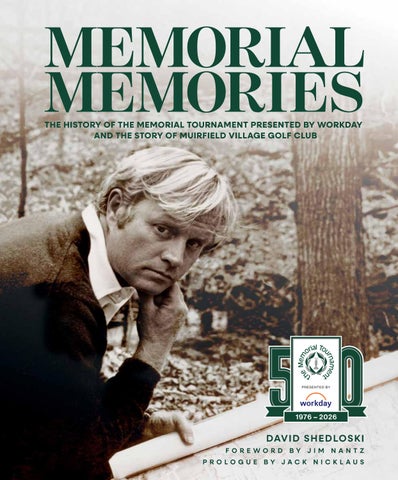
MEMORIAL MEMORIES THE HISTORY OF THE MEMORIAL TOURNAMENT PRESENTED BY WORKDAY AND THE STORY OF MUIRFIELD VILLAGE GOLF CLUB
DAV I D S H E D LO S K I FOREWORD BY JIM NANTZ PROLOGUE BY JACK NICKLAUS
Tractors transport patrons from parking areas to the golf course during the first Memorial Tournament.
MEMORIAL MEMORIES THE HISTORY OF THE MEMORIAL TOURNAMENT PRESENTED BY WORKDAY AND THE STORY OF MUIRFIELD VILLAGE GOLF CLUB
DAV I D S H E D LO S K I FOREWORD BY JIM NANTZ
PROLOGUE BY JACK NICKLAUS
LEGENDARY PUBLISHING & MEDIA GROUP
Following pages: Patrons crowd around Jack and caddie Jack II (far left) during one of the early years of the Memorial Tournament.
PREAMBLE INTRODUCTION by Aneel Bhusri
— xi —
FOREWORD by Jim Nantz
— xv —
PROLOGUE by Jack Nicklaus
— xix —
THE BEGINNING 1966–1975 Chapter One
IT STARTS WITH A DREAM — 2 — A SYMBOL OF E XCELLENCE
— 5 — C h a p t e r Tw o
BREAKING NEW GROUND
THE CAPTAINS CLUB & THE MEMORIAL TOURNAMENT HONOREES CAPTAINS CLUB — 42 —
A HUGE LOSS FOR NICKL AUS
— 154 — Chapter Nine
— 50 —
THE 1986 U.S. JUNIOR AMATEUR
THE MEMORIAL HONOREES
— 54 —
— 166 — C h a p t e r Te n
B A R B A R A’ S TO U C H S H I N E S T H R O U G H
THE 1987 RYDER CUP
— 82 —
— 169 —
THE BARBARA NICKL AUS CUP
— 85 —
THE FIRST DECADE 1976–1985
Chapter Eleven
THE 1992 U.S. AMATEUR CHAMPIONSHIP — 187 — JACK ’S TROPHY LOAN
— 189 — M A D E - F O R - T V AT M U I R F I E L D
Chapter Three
THE MEMORIAL MAKES ITS DEBUT 1976 — 91 — A SYMBOL OF E XCELLENCE
— 105 — Chapter Six
ONE HALE OF A BEGINNING — 107 — J A C K S TAY S T H E C O U R S E
— 116 — Chapter Seven
JACK MASTERS THE MEMORIAL — 127 — THE KING’S THUMBS-UP
— 129 —
viii
A “ZINGER” FOR STEWART
A JONES FOR HISTORY
Chapter Five
— 29 —
Chapter Eight
Chapter Four
— 13 —
1974
1986–1995
— 142 —
1972–1973
FINALLY, THE UNVEILING
THE SECOND DECADE
— 190 —
THE THIRD DECADE
THE FIFTH DECADE
1996–2005
2016–2025
LEADING THE WAY C h a p t e r Tw e n t y
C h a p t e r Tw e l v e
WATSON GETS A BEAR HUG — 195 — U N M AT C H E D AT M U I R F I E L D
— 196 — A QUIET HANDOFF AT M U I R F I E L D V I L L A G E
— 199 —
Chapter Seventeen
SCHEFFLER JOINS EXCLUSIVE COMPANY — 263 —
Chapter Thirteen
TIGER MAKES HIS MARK — 211 — Chapter Four teen
T H E T O U R N A M E N T S TA F F
— 347 — — 274 — A “ S I G N AT U R E ” S TA M P
— 279 —
LEGACY MEMBERS
— 350 — C h a p t e r Tw e n t y - o n e
“THE FINEST FORCE IN GOLF”
THE GOLF COURSE & CLUBHOUSE
— 352 —
EPILOGUE THE IMPACT OF THE MEMORIAL
THE 1998 SOLHEIM CUP — 219 —
— 344 —
T H E 2 0 2 0 W O R K D AY C H A R I T Y C L A S S I C
JACK HAS A FINAL GO
— 208 —
THE STANDARD BEARERS
Chapter Eighteen
— 358 —
STAYING THE COURSE — 285 —
THE FOURTH DECADE 2006–2015 Chapter Fifteen
PERRY MAKES IT A HAT TRICK — 228 — Chapter Sixteen
THE 2013 PRESIDENTS CUP — 245 —
Chapter Nineteen
THE CLUBHOUSE & GROUNDS — 325 —
APPENDICES CAPTAINS OF MUIRFIELD VILLAGE GOLF CLUB — 368 —
THE MEMORIAL GOLF JOURNALISM AWARD RECIPIENTS — 369 —
MEMORIAL TOURNAMENT RECORDS — 370 —
ACKNOWLEDGMENTS — 375 —
ix
FOREWORD
MY LIFE’S WORK
N
OT LONG BEFORE the 2000 playing of the Memorial Tournament—the year I was a reluctant but very appreciative Honoree—I was asked a question by a reporter that I have never forgotten. We had been talking about the special relationship I shared with my father, Louis Charles
“Charlie” Nicklaus, who passed away far too young in February of 1970 from pancreatic cancer. He was just fifty-six years old. As our conversation was ending, the reporter asked, “Jack, what event—golf or otherwise—would you most have liked your father to witness?” Without much thought, I said, “Today. Because that would mean that I would have had my father for the last thirty years of my life … and he wouldn’t have missed a thing.” If asked that question today, I would answer it exactly the same way. I would have loved for my father to have been part of my life these past fifty-six years. He could have seen me bursting with pride over the “little” family Barbara and I have been blessed to create—our five children, twenty-four grandchildren, and by year’s end,
Above: The Nicklaus family at Muirfield Village in the late 1970s: Steve, Barbara, Michael, Nan, Jack, Gary, and Jack II. Opposite: Charlie Nicklaus holds his firstborn son, Jack.
xix
THE BEGINNING 1 9 6 6 – 1 9 75
CHAPTER ONE
IT STARTS WITH A DREAM “The whole difference between construction and creation is exactly this: That a thing constructed can only be loved after it is constructed; but a thing created is loved before it exists.” — Charles Dickens
A
NYONE WHO EMBARKS on an enterprise that, fundamentally, puts the proverbial cart before the horse is almost certainly doomed to failure. Jack William Nicklaus happens to be an exception. And exceptionally so. When his idol, Bobby Jones, revealed in 1931—not even a year removed from his Grand Slam conquest—that he
was planning to create a golf club in Augusta, Georgia, Jones explained that his ambition was “to build a golf course that may probably be recognized as one of the great golf courses of the world” with “a representative group of members from throughout the world.” Holes he designed with architect Alister MacKenzie were meant to loosely replicate some of the famous holes Jones had played throughout his career. It wasn’t until late 1933, more than a year after he opened Augusta National Golf Club, that Jones and cofounder Clifford Roberts decided to host an invitational tournament. That event, the Masters (originally called the Augusta National Invitation Tournament), was the inspiration
Muirfield Village, a course that Nicklaus once said, “reflects what has happened in my life; what golf means to me.”
behind Nicklaus’s desire to hold a tournament of simi-
Jones could not have said it any better.
lar high quality in his hometown of Columbus, Ohio. “We
Jack made one thing clear before a single edition of the
started with the idea of a tournament for the people of Columbus who had supported me,” Nicklaus
Memorial Tournament had been conducted. The two entities, the Memorial Tournament and Muirfield Village, were existentially inter-
explained. “I’ve always loved the Masters. I’ve always
twined at conception, dual enterprises that
loved what it meant to golf,” he went on. “And
were two sides of a single coin more valu-
I’ve always loved Jones’s position in the game,
able to him than any amount of money—
his doing something for the game.”
a sentiment he would express time and again
Not that a golf course for this erstwhile “Masters of the North” was an afterthought. But the fact is that
and prove with significant investment of his personal treasure. No other distinguished place on
Muirfield Village Golf Club would not exist without Nicklaus’s
earth, not even Augusta National or the Old Course at
burning desire to host a golf tournament. And the Memorial
St. Andrews, was made in such fashion. Longtime Colum-
Tournament could not exist, nor be the resounding success
bus Dispatch sports editor and Nicklaus confidant Paul
it has become, without the masterpiece that is the course at
Hornung described the enterprise as “a two-part dream.”
Opposite: Jack Nicklaus named Muirfield Village Golf Club in tribute to Muirfield and the Honourable Company of Edinburgh Golfers in Scotland. His Open Championship triumph there in 1966 is reflected in the club’s logo by the silhouette of the Claret Jug (above).
2
CHAPTER TWO
BREAKING NEW GROUND
T
“
1972–1973
O THE BEST OF MY KNOWLEDGE, there has never been a golf course like Muirfield built in the United States,”
the Golden Bear said on May 27, 1974, citing the quality of the layout that would provide a proper test for both tournament golfers and members while being noted for its accommodations for spectators. “Perhaps
our greatest innovation is the course’s viewability. No course has ever been built specifically for tournament golf before, although there will be others after this. It’s something I’ve thought about for a long time.” While there might have been an ounce or two of pride in
particular piece of property he initially purchased in 1966,
this declaration, the inescapable truth is that what Nicklaus
one he referred to in his book, Nicklaus by Design as “an
said that day when he officially opened Muirfield Village
exquisite site for a golf course.”
Golf Club was 100 percent factually accurate. But he should
“It’s a pretty site. When I saw it, I liked the way it flowed
have broadened his horizons on the assessment—there
through the valleys, and I knew I wanted to create a gallery
was not another golf course like it in the world. Muirfield
golf course. The valleys were wide enough to accommodate
Village was built for tournament golf, even as it opened as
that goal,” Jack said.
an elite private club open to men and women and people of
He makes it sound easy, and it probably was in his mind.
all races and backgrounds. Nicklaus was dedicated to the
But he had to transfer his ideas into the dirt, which required
notion of a place that was inclusive—and that extended to
that he be on hand as much as possible during the construc-
the community when he started the Memorial Tournament
tion process. But consider the timing. When construction
in 1976. It needed to be a great test of golf and a great place
began on July 28, he was thirty-two years old and deep into
to watch it.
one of the greatest seasons of his career.
Nicklaus admits that he was still a novice as a course de-
Nicklaus won a career-high seven times that season, in-
signer when the shovels broke ground on Muirfield Village
cluding the first two majors of the year, and he had come
in 1972, but he had played golf all over the world, seen many
within a stroke of adding the third leg of the Grand Slam at
of the game’s greatest layouts, and had won eleven profes-
the Open Championship at Muirfield (of all places), where
sional majors, along the way becoming the first man to win
Lee Trevino beat him by a stroke thanks to a fluke chip-in
the career Grand Slam twice over. As golf ’s dominant play-
at the seventy-first hole. Though there were schematics to
er, he appreciated shot values and understood the strategic
which Dye and land planner Desmond Muirhead had con-
characteristics of championship courses better than any-
tributed to the conceptualization of Muirfield Village—Dye,
one. And he certainly knew what he wanted to do with the
in the first crack at a routing in 1966, and Muirhead in ’71—
Opposite: Jack spent many days on site during the construction of Muirfield Village, while simultaneously having two of his most successful years on the PGA Tour in 1972 and 1973.
13
CHAPTER THREE
FINALLY, THE UNVEILING 1974
A
FTER EIGHT YEARS OF PLANNING and financial stress, the delays in implementation, the weather challenges
during construction, after being told that his dreams were likely no match for cold, hard reality—after all of that— Jack Nicklaus finally was able to show the world a golf course unlike any other in history. Under a bright blue sky on
Memorial Day in 1974, Nicklaus officially opened Muirfield Village Golf Club, introducing his vision for showcasing the game through a course infused with strategic intelligence, breathtaking originality, and dramatic presentation. “It’s been really exciting for me to start with an idea and emerge eight years later with it totally intact,” he said on May
concept was worthy of replication. The course architect of the Stadium Course? Pete Dye.
27 just before the dedication ceremony, adding his aforemen-
Validation was just one of the themes for the day.
tioned prediction about other course architects copying his
Solemnity and excitement were measurable emotions per-
amphitheater concept.
meating the proceedings.
Close friends often referred to Nicklaus as “Carnac,”
A prayer invocation by the Rev. William Smith preced-
the Johnny Carson character who was an all-knowing psy-
ed the ribbon cutting by Nicklaus, Weiskopf, and Nicklaus’s
chic. When it came to his prediction about Muirfield Village
business partner, Putnam Pierman. Author Tom Callahan,
representing a template for future courses, he was spot on.
working for the Cincinnati Enquirer, sensed that the occa-
Eight years after he and fellow Ohio State product Tom
sion was far from a formality. “There was a moment during
Weiskopf ceremoniously cut the ribbon on May 27, 1974,
the prayer when Jack’s father Charlie was mentioned, and
the PGA Tour opened the Stadium Course at TPC Sawgrass,
Jack lifted his head a bit and looked up to the sky,” Callahan
validating Nicklaus’s assumption that his “amphitheater”
said. “You had a sense that Jack was giving something back to
Opposite: Tom Weiskopf (left) and Jack’s business partner Putnam Pierman assist Jack in cutting the ceremonial ribbon at Muirfield Village Golf Club on May 27, 1974, to officially open the golf course.
29
MEMORIAL MEMORIES
Jack officially opens Muirfield Village Golf Club with this tee shot, splitting the fairway, naturally.
Columbus, but he also was fulfilling a promise to his dad.” Jack not only peered up at the sky, but he turned his gaze to his mother, Helen, and sister, Marilyn, seated nearby. “We didn’t talk about it a lot, but my dad knew what Muirfield Village meant to me,” said Nicklaus. “He knew what I was trying to do.”
made contact at all. “It went dead right over people’s heads. We never found it. I was just glad the first tee shot didn’t kill someone,” Nicklaus said, chuckling. Jack split the fairway with his first drive followed by a pull-hook from Weiskopf that nearly found the creek. But
Jack granted Pierman the honor of a ceremonial tee shot.
Nicklaus had set the tone for quite an exhibition. “He was so
The Columbus native wasn’t a golfer, but he was instrumen-
good that day, it was beyond impressive,” said Jim Gerring,
tal in pushing the project to the finish line. Clad in a beige
who served as the club’s first head pro until 1997.
suit, Pierman slapped a drive that might still be buried some-
30
where beneath one of the villas. The surprise was that he
Club members, local public servants, members of the
F I N A L LY, T H E U N V E I L I N G
media, and business dignitaries, plus Nicklaus family and
OSU pal had played it far more than he had—Weiskopf, the
friends were supposed to be the only audience for the eigh-
reigning British Open champion, countered with a 73. (In the
teen-hole exhibition. But somehow friends of friends, golf
1983 Memorial, he would break Jack’s mark with a 65 in the
enthusiasts, and curiosity seekers found their way onto the
final round.)
220-acre property, swelling attendance to around 1,200.
“They were big rivals, Jack and Tom, but I figured that Tom
Among the onlookers was one of the most important figures
wanted to play well but not show up Jack that day,” Callahan
in Nicklaus’s life, his longtime instructor, Jack Grout, whom
said. “But it wasn’t going to matter. Jack was sensational. He
Jack brought back to Columbus as pro emeritus.
was serious. And I know he was proud of having that record.”
“It was a crazy scene, with people everywhere,” Gerring
“Obviously, it was a big day for me. It was very special,”
said. “You had Jack, of course, and Weiskopf was one of the
said Nicklaus, who received several congratulatory telegrams
top players at the time, two Ohio State guys. There were no
in the following days. One of them read, “Amigo, hope you
gallery ropes. I announced the scores after each hole, but I
built water hazards 270 yards out, too long for me, just right
don’t know if many people were paying attention. There was
for you.” So wrote Lee Trevino.
a lot of excitement.”
Muirfield Village Golf Club was officially open for
With an eagle and four birdies, including a thirty-
business.
footer on the home hole, the Golden Bear posted a bogey-free 6-under 66 that stood as the course record for nearly a decade. All these years later, Nicklaus shrugged off the performance. “Sixty-six was more of an occurrence for me back then than it is now,” Nicklaus kidded. “No, I wasn’t nervous. What did I have to be nervous about? I was excited to finally have the golf course done. I can tell you that I was pretty nervous before the first Memorial Tournament.” When he was finished, Nicklaus sought out Ed Etchells. “Should we start over? No one should shoot 66 here,” Nicklaus said before breaking into a grin. Then he informed Etchells that “some changes” were necessary. Weiskopf was in on the sarcasm, too, announcing, “I’m a member here … and I don’t want anybody coming in here and shooting 66.” He paused. “Unless he’s a great golfer.” (When he christened Augusta National on August 26, 1932, Bobby Jones shot 72. Coincidentally, he then instructed that several architectural modifications be made.) Despite spending considerable time at Muirfield Village even before it officially opened—Nicklaus joked that his Jack discusses maintenance of the golf course with Ed Etchells, the first course superintendent.
31
THE CAPTAINS CLUB & THE MEMORIAL TOURNAMENT HONOREES
CHAPTER FOUR
CAPTAINS CLUB
T
HE CONCEPT FOR THE MEMORIAL TOURNAMENT, to honor important figures in the game of golf, could only work,
Jack Nicklaus surmised, if he were not involved in the process of selecting each year’s Honoree. That explains why in addition to his announcement that he intended to host a PGA Tour tournament at Muirfield Village Golf Club, Nicklaus
revealed that he was forming a committee of sorts that he referred to as the Captains Club. Nicklaus remembers clearly how discussions with Joe Dey, his longtime friend and mentor and the first commissioner of the PGA Tour, had generated not only the idea for the theme of the tournament but how it should be executed. Dey had been invited to take a look at the progress Nicklaus had been making on the design of the course, and as they tramped through the muddy landscape, plans became much clearer. “We got to talking about a tournament
most important role is deciding in whose
that would honor the players of the past and
honor the tournament will be played each
the people in golf who have contributed to
year.
the game. And, obviously, that’s the direc-
“We have done a lot of unique things
tion we went in making the Memorial Tour-
at the Memorial Tournament over the
nament different,” Nicklaus recalled. “But as
years,” Nicklaus said, “but between Joe
we talked further, I told him, ‘That’s hard
Dey and me, the Captains Club probably
for me to have that over my head as far as
was one of our best ideas. Everybody that
making certain decisions,’ and that it would
has contributed and given their time—I
be better if we got together a group of, at
can’t even begin to recount all of the spe-
the time, I called them ‘golfing statesmen,’ to make those decisions and take it totally out of my hands. And that’s exactly what we decided to do.” Thus was born the Captains Club, an
Joe Dey was the executive director of the USGA before becoming the first commissioner of the PGA Tour. He was instrumental in the formation of the Captains Club.
inspired piece of the puzzle in building a
cial people who have been members of the Captains Club.” Nicklaus had made mention of the Captains Club when he announced his tournament plans on November 13, 1974, but there were few specifics provided
one-of-a-kind event. Since the inception of the Memorial
about the idea. He was able to finalize the charter member-
Tournament, the Captains Club has advised on the consti-
ship on December 1, just before boarding a plane to Japan
tution and conduct of the Memorial Tournament, while also
for the Dunlop Phoenix tournament, noting that he was
providing counsel to the tournament founder and host. Its
taking a page from the Royal & Ancient Golf Club of St. An-
Opposite: Captains Club members President Gerald Ford and Bob Hope finish their round at the 1976 Memorial Tournament Pro-Am.
42
A J O N E S F O R H I S TO R Y H OW J AC K C O N C E I V E D O F T H E M E M O R I A L T H E M E
T
HE CONCEPT for the Memorial Tournament was an
him an appreciation for the history of the game that he car-
epiphany that came to the mind of Jack Nicklaus slowly
ried forward and cultivated with a growing collection of
and then all at once.
golf books, including first editions and other rare works.
Nicklaus wanted a tournament, he said, that would be
Not only that, but Nicklaus did not hesitate to admit that
“different and unique. I didn’t want just another event. …
he drew inspiration from Jones and other great players who
We started thinking about a purpose for the tournament
preceded him.
that would be accepted all over the world as sound and
Eventually, it occurred to Nicklaus that a tournament
worthwhile—something beyond the fact that I was person-
at Muirfield Village Golf Club that paid tribute each year
ally involved.”
to golfing greats and to other significant figures who had
While growing up, Nicklaus had heard constantly about the exploits of Bob Jones from his father Charlie and mem-
contributed to the game would add a meaningful element to an event he planned to host.
bers of Scioto Country Club, who had been in attendance
“As we searched for ideas, I kept coming back to a fact that
when Jones won the 1926 U.S. Open at Scioto. That gave
I’d recognized a long time previously,” he told Paul Hornung,
Above and opposite: Bob Jones accepts the U.S. Open trophy from USGA President William C. Fownes at Scioto Country Club in Upper Arlington, Ohio, 1926.
50
MEMORIAL MEMORIES
1995
1996
1997
J. H. Taylor
Billy Casper
Gary Player
J. H. Taylor, born March 19, 1871, in Northam,
A San Diego native, Billy Casper, born June 24,
One of six men to capture the career Grand Slam,
Devon, England, emerged from humble begin-
1931, was one of the most underrated greats in
Gary Player became one of golf ’s global ambas-
nings to become a five-time Open Champion and
golf history. A master of putting and course man-
sadors. Known for his fitness, discipline, and a
a pillar of the “Great Triumvirate.” His advocacy
agement, he won fifty-one PGA Tour events and
relentless travel schedule, Player, born November
for professional golfers helped organize early pro-
three major championships—two U.S. Open titles
1, 1935, in Johannesburg, South Africa, won nine
fessional competition. Beyond his playing career,
and the 1970 Masters. His quiet demeanor kept
major championships and completed the career
Taylor contributed to course design and admin-
him out of the spotlight in the era of the Big Three
Grand Slam with his victory in the 1965 U.S.
istration, advancing the status and structure of
of Arnold Palmer, Gary Player, and Jack Nicklaus,
Open. Player won more than 150 tournaments
professional golf across Britain.
but his skills were unquestioned. He is the all-
worldwide. His course design work, philanthropy,
time points leader for the U.S. Ryder Cup team.
and international influence helped grow golf across continents.
1998
1999
2000
Peter Thomson
Ben Hogan
Jack Nicklaus
Peter Thomson, born August 23, 1929, in
Ben Hogan was a driven perfectionist who be-
Jack Nicklaus is regarded as golf ’s greatest cham-
Melbourne, Australia, was one of the most
came one of the greatest ball strikers in history.
pion with his record eighteen professional major
accomplished international golfers of the twen-
Born August 13, 1912, in Stephenville, Texas,
championships and seventy-three PGA Tour titles,
tieth century. A five-time Open Champion,
Hogan won the 1950 U.S. Open at Merion fifteen
the third-highest total in history. Nicklaus holds
he dominated links golf with strategic clarity,
months after surviving a near-fatal car accident.
or shares the record for most wins in the Masters
masterful shotmaking, and calm precision.
He played sparingly in the years after the acci-
(six), PGA Championship (five), and U.S. Open
Thomson also excelled as a writer, administrator,
dent, but he still won six of his nine major titles.
(four). Born January 21, 1940, in Columbus, Ohio,
and global ambassador for the sport. His leader-
Hogan collected sixty-two PGA Tour wins in all
the “Golden Bear,” who has more than one hun-
ship and competitive brilliance elevated Austra-
and was the second man to complete the career
dred worldwide victories, became a prolific course
lian golf and influenced players worldwide.
Grand Slam with his victory at Carnoustie in his
architect with more than four hundred designs to
only appearance in the Open Championship in
his credit, but his influence has extended to almost
1953, the year he won all three majors he entered.
every facet of the sport.
Opposite: Named Sportsman of the Year by “Sports Illustrated” in its December 25, 1978, issue, Jack (wearing his Muirfield Village blazer) was photographed surrounded by his major trophies following a season highlighted by his third victory in The Open Championship on the Old Course at St. Andrews.
66
67
THE FIRST DECADE 1 9 76 – 1 9 8 5
CHAPTER FIVE
THE MEMORIAL MAKES ITS DEBUT “
I
1976 DON’T THINK ANY TOURNAMENT, when you’re starting out, expects to get it 100-percent right,” Jack Nicklaus said
in the days leading up to the inaugural Memorial Tournament. “I want 100 percent. I want the golf course to be 100 percent. I want the tournament to be 100 percent. But in the first year, you know it’s not going to be 100 percent.
“But I think we’re going to be pretty good,” the tournament founder and host added. “I’ve had ten years to think about this.
Plus, you know what a perfectionist I am.” Indeed, as tournament week approached, Nicklaus sim-
had played just twice since tying for third at the Masters and
ply wasn’t leaving anything to chance. A perfect illustration
had barely picked up a club in the last two weeks. He was
of that fact was witnessed in the new clubhouse at Muirfield
more intent on Muirfield Village showing well than he was
Village Golf Club. Staff members watched with be-
on playing well. In fact, though Nicklaus was motivat-
musement as Nicklaus, kneeling in front of a
ed to compete as tenaciously as if he were playing
bookcase, was arranging books by author
in a major—he always approached the Memo-
on cabinet shelves. Why would he be doing
rial as he would a major championship—he
this himself? Like he said, perfectionist.
confided to friends that he thought the tour-
Beginning exactly two years to
nament would be better off if he didn’t win
the day that he opened his dream
the first one.
course, Nicklaus’s dream invitational
“I have mixed emotions about winning
tournament was set to get underway
my own tournament the first year,” he said.
on May 27, 1976. The field was elite,
“I want to win. I always want to win every
the purse was substantial at $200,000, and week-
time I tee it up. But this time, in this tourna-
long tournament badges—priced at forty dollars—had been
ment, it may look better if someone else won. If I do win, I’ll
sold out since February. All that was needed was cooperation
be delighted. But I also want everybody else to play well, and
from the weather. He would get that, too.
I want us to wind up with a good champion.”
The course—the perfectly manicured 7,072-yard stage— was set. Only doubts about his game lingered. Nicklaus
His victory would come if the tournament was well received by the players and the public.
Opposite: Jack speaks to the press during the inaugural Memorial Tournament.
91
CHAPTER SIX
ONE HALE OF A BEGINNING 1983 & 1985
T
WO VICTORIES IN THE FIRST NINE YEARS by Jack Nicklaus was, naturally, the most notable and unabashedly satisfying
set of results in the opening decade of the Memorial Tournament. But the most outstanding player (outside of the tournament founder and host) in the developmental years was a player with skills eerily similar to the Golden Bear, which
probably explains the success of Hale Irwin. Sure, Tom Watson was the most consistent player in the
irons into the greens, and my iron game always has been a
early years, finishing seventeenth or better in his first eight
strength in my game. You have to have shot-making ability
starts after missing the inaugural event due to injury. And
to play this course.”
Watson’s victory in 1979 was the product of arguably the greatest exhibition of scoring in tournament history with his second-round 69 in frigid and frightful conditions. But Irwin’s excellence off the tee and the overall management of his game—which he parlayed into three U.S. Open titles, in 1974, ’79, and ’90—made him a formidable figure at Muirfield Village Golf Club. Denied a victory in the inaugural tournament, Irwin went on to equal Nicklaus’s success in the opening decade with two wins, in 1983 and ’85, wrapped around the second win by Nicklaus in 1984.
Irwin won with identical 281 aggreTHE FIRST DECADE OF THE MEMORIAL TOURNAMENT
gate totals, and while he became the first
1976.............Roger Maltbie
faction factor was greater for a different
1977..............Jack Nicklaus 1978 ................ Jim Simons 1979............... Tom Watson 1980 .......... David Graham 1981............... Keith Fergus 1982 ........ Raymond Floyd 1983 ................. Hale Irwin 1984..............Jack Nicklaus 1985 ................. Hale Irwin
“Those victories are as meaningful as
player to break par in all four rounds on the way to his 1983 triumph, the satisreason: getting over the dispiriting loss in the inaugural edition. Irwin wondered if he would ever get a chance to assuage the disappointment of his playoff setback to Roger Maltbie, when a freak bounce off a gallery stake on the third extra hole enabled Maltbie to stay alive in the playoff that he eventually won. “Everyone has a story [about a tough loss]. Everyone has their chances, and
they come, because of the quality of the golf course and the
they can’t always work out, and you have to deal with that,”
fact that Jack Nicklaus is the host of the tournament,” Irwin
Irwin said. “You take it and move on and hope you get another
said recently while sitting in the Muirfield Village clubhouse.
opportunity. … That was kind of destiny, and it wasn’t destiny
“I think I had success here because of the precision involved
working in my favor.
in getting around the golf course. You have to hit precise
“Roger got the break and made the most of it. That’s golf for
Opposite: Hale Irwin with the Memorial Tournament trophy, 1983
107
CHAPTER SEVEN
JACK MASTERS THE MEMORIAL
F
1977 & 1984
OR FIFTY YEARS, Jack Nicklaus has been a thoroughly gracious host of the Memorial Tournament—except on two occa-
sions. And he can be forgiven for that. Even more, it is perfectly understandable that he should opt to deviate from that responsibility. No one was going to begrudge him that time or two when he substituted his traditional handshake with the
winner for getting his hands on the trophy himself. Of the nearly 150 wins, large and small, in his storied
Distractions appeared to get the best of the most focused
career, nothing can compare to the triumphs in 1977 and
mind in golf history, as his first-round scores reveal. Only
1984 at Muirfield Village Golf Club. Yes, the majors were his
four times did the host open with a round in the 60s. Only
gold standard, and he collected more of them than anyone
once did he ever hold the lead after eighteen holes, which he
in history—eighteen of the professional variety and twenty
shared with Gary Player to start his title defense in 1978.
counting his two U.S. Amateur titles. He won seventy-three
“The Memorial was probably the most difficult for me to
times overall on the PGA Tour. Only twice was he supremely
win,” Nicklaus said. “All the things that I was doing with the
invested on an emotional scale, giving heart and soul where
golf tournament in those early years … I did everything but
all other victories were from mind and body.
pick up trash. And I did a lot of that, too. [Eldest son] Jackie
Winning the Memorial truly meant winning at its hard-
was my caddie, and his pockets were full of cigarette butts
est. Especially in the early years, with so many responsibilities
and bits of paper. He was so weighed down by the time we got
on his shoulders, so much pressure, so many expectations, so
in. That’s what was going on in my head.”
many details, so much of simply wanting the Memorial to
But the heart knows what the heart wants. Jack admitted
be a grand gift to the game and to the people of his boyhood
that he was relieved to not win the first Memorial, given how
home of Columbus. The guy had broad shoulders, but even
that might have been received by his peers. (He had won the
Atlas had to wonder how Jack was going to hold up as a com-
inaugural Kings Island Open in 1973 by six shots at his epon-
petitor when that was merely one task on his to-do list.
ymous Jack Nicklaus Golf Center in Mason, Ohio.) In 1977,
The Golden Bear once estimated that he was giving per-
with finishes of eleventh or better in his previous six PGA
haps two shots to the field for at least the first decade. He said
Tour starts, including two victories, he was ready to master
it as a matter of pure calculation. Actually, that was likely the
the Memorial and the course he created.
case throughout his thirty-year playing career in the event.
But he still had to go do it.
Opposite: Jack on the way to his to his first Memorial Tournament win in 1977.
127
THE SECOND DECADE 1986–1995
CHAPTER EIGHT
A “ZINGER” FOR STEWART 1993
B
“
ASICALLY, I HIT THE BUNKER SHOT OF MY LIFE.” Basically, Paul Azinger hit one of the most memorable shots in
the history of the Memorial Tournament—and easily the most spectacular executed on the seventy-second hole to result in victory.
In a nutshell, that’s the summation of Azinger’s winning stroke in the 1993 Memorial Tournament. He pulled off the nearly impossible shot with a mix of imagination and ingrained technical wizardry, holing out from a greenside bunker for a birdie that enabled him to overtake his good friend Payne Stewart and etch his name in tournament history in a way unique to the event. While Greg Norman won twice in the tournament’s
with a buddy of mine, and we were just having fun and hitting
second decade, and fellow major champions past and
bunker shots over by the driving range. We were there until
future—Hal Sutton, Curtis Strange, Bob Tway, and Tom
dark three nights in a row. We were staying at a villa behind
Lehman—added to the tournament honor roll, Azinger’s lightning-strike triumph on June 6, 1993, is emblazoned indelibly in our memory banks thanks to a shot that was so stunning that it left the man who struck it on his knees in the sand in relief and disbelief. Was it luck? Well, yes and no. Azinger was just trying to get the ball close to the pin, which was cut on the left side of the green, leaving him little room. But when he climbed down into the bunker, he felt a glimmer of hope. Not necessarily because he had an excellent short game—though he
the driving range, and we would grab our THE SECOND DECADE OF THE MEMORIAL TOURNAMENT 1986 .................. Hal Sutton 1987 ................Don Pooley 1988 ........... Curtis Strange 1989 ...................Bob Tway 1990 ............Greg Norman 1991.............. Kenny Perry 1992 ..........David Edwards 1993 ..............Paul Azinger 1994 .............Tom Lehman 1995 ............Greg Norman
had proven he did—but because he’d practiced that particular shot hundreds of times that week. “The great thing about my shot was there was no shortcut
sand wedges and just hit shot after shot after shot. Together we probably hit a thousand of them. Then I get down in that bunker on Sunday, and I was actually pretty calm.” Azinger, who broke 70 in all four rounds thanks to what he called, “one of those rare ball-striking weeks that you only get a few times,” began the final day three strokes behind Stewart, who led at 202 after a thirdround 67. As the two friends made their way to the home hole, Azinger had climbed within a shot. Both found the fairway, though Stewart’s ball ended up in the slightest of divots. Hitting his approach first from 195
yards, Azinger tugged his 5-iron, and found the bunker. “And I thought at the time, ‘Well, that’s it.’ ”
to success,” he recalled years later. “You can’t hope for it or
Stewart, however, caught his 7-iron from 172 yards slight-
wish for it. It just so happened that I was in those bunkers
ly fat, and his ball buried in the front bunker. The two-time
Paul Azinger’s bunker shot on 18 to win the 1993 Memorial Tournament is one of the most iconic shots in golf history.
142
CHAPTER TEN
THE 1987 RYDER CUP Monumental at Muirfield Village
T
HE RYDER CUP truly came of age at Muirfield Village Golf Club. The event marked the twenty-seventh edition of the
biennial competition, but it was only the fifth in which the heretofore dominant United States had squared off against a team fortified by players from Continental Europe. The U.S. led the series 21-4-1, including a 3-1 advantage against
the European contingent. But the lone setback was a big one, a decisive 16½ to 11½ thrashing in England in 1985 to hand the Americans their first loss in twenty-eight years. European captain Tony Jacklin called it “a dream finish” after his squad took a 9-7 lead into singles matches and won six of the first eight to pull away. Two years before at PGA National Resort in Palm Beach
That’s because America enjoyed no run-of-the-mill
Gardens, Florida, the U.S. team, captained by Jack Nicklaus,
home-course advantage. At the time, European players were
escaped with a 14½ to 13½ decision to improve its home re-
only allowed to play sparingly in PGA Tour events and lacked
cord to 13-0 dating to the first match in 1927. Far from
experience on Muirfield Village compared to their
dejected, the Europeans departed Florida
American counterparts. And the U.S.
with a sense that they were gaining on the
team once again was led by the creator
Americans, and they proved that at The
of Muirfield Village. Although Muirfield
Belfry with their resounding win in ’85.
Village had been selected to host the ’87
An ebullient Jacklin, caught up in
Ryder Cup four years earlier, Nicklaus’s
the moment, declared, “We made histo-
selection for a second term as captain
ry.” But looking back on it, the two-time
wasn’t announced until November 13,
major winner knows he’d gotten ahead of
1985—though it was baked into the cake.
himself. “It was a terrific win. We hadn’t
PGA of America President Mark Kizziar
won in so long,” Jacklin said in a recent
expressed hope even before Jack cap-
interview, “but we all knew that if we were
tained the ’83 team that he would take
to truly prove that we were on equal foot-
the lead again on his home course. “We
ing, we had to win in America. We were full of confidence,
even altered our rules to allow that to happen,” Kizziar said.
and confidence is probably the most powerful thing in sports.
With Nicklaus in charge, the U.S. team was a slight favor-
“However,” he then added, “the challenge we faced was massive.”
ite when the matches began on September 25. Very slight.
Opposite: European captain Tony Jacklin and U.S. captain Jack Nicklaus with the Ryder Cup trophy. Jacklin would be named a Memorial Honoree in 2008.
169
THE SECOND DECADE
✷ ✷ ✷ ✷ ✷ ✷
“The Ryder Cup had never turned a profit, so we went to the
MUIRFIELD VILLAGE wasn’t yet nine years old when the PGA
PGA of America and said, ‘Let us run it,’ ” Nicklaus recalled.
of America tapped it for the Ryder Cup on January 19, 1983,
“It was the first time the Ryder Cup ever made money. From
and the club had hosted the Memorial Tournament just
a financial standpoint, that really turned the Ryder Cup
seven times. But it had proven to be the best-run event on
around.”
the PGA Tour in a very short time. Of course, the Nicklausdesigned course also had proven to be perennially
event. Or the most consequential.
puzzling to the game’s top professionals. Kizziar had
Prior to the 1977 matches, with the U.S. record vs. Great
proclaimed that “there’s no greater challenge for the
Britain & Ireland standing at a gaudy 17-3-1, Nicklaus
world’s greatest players.”
approached Lord John Derby of the British PGA and
Welcoming the Ryder Cup to his prized layout, one that
suggested that the Ryder Cup should widen its umbrella
hosted an annual Tour event, fit in neatly with Nicklaus’s
and include players from continental Europe to buttress
vision. “I have always considered Muirfield Village Golf
the GB&I & roster and improve the competitive level of
Club a showcase for my love and respect for the game of golf,
the matches.
as well as a representation of my passion for competition and
“I simply told Lord Derby, ‘John, you know for every-
tournament golf,” Nicklaus said at the time he opened the
one on the American team it’s a great honor to play in the
course in 1974.
matches. But frankly, when the matches start, there isn’t
“Bringing the Ryder Cup to Muirfield Village,” said Dan
much competition. And I don’t think that’s right,’ ” Nicklaus
Sullivan, the Memorial Tournament executive director who
recounted. “ ‘You’ve got a European Tour that, really, you’re
served as a marketing intern for the tournament in 1987,
part of, and I think if you included the European players
“is a perfect example of what Jack wanted to do from the
and made it Europe versus the United States, you’d have
beginning—not only host a professional event in his home-
some really great matches.’ ”
town but use the golf course as a place to celebrate the inter-
At this time, Nick Faldo had only one victory in
national game. We all have been fortunate to contribute to
Europe, Seve Ballesteros and Bernhard Langer had yet to
Jack’s vision and mission. I only hope we, and those in the
win, and José María Olazábal was eleven years old. Along
future, can carry the vision forward.”
with Sandy Lyle and Ian Woosnam, this would be the core
Given Europe’s success two years earlier, the ’87 matches
of future European teams.
were expected to be the biggest in its history. All three days
After the United States Team registered another victo-
of the matches were a sellout. ABC Sports planned to air five
ry, 12½ to 7½, at Royal Lytham and St. Annes in England,
hours of live coverage on the weekend—the most extensive
Nicklaus sent a formal letter to officials from each side that
coverage on American television. In addition to a large U.S.
included this passage: “If the Ryder Cup wanted to continue
media contingent, more than one hundred journalists from
to enjoy its prestige, it is vital to widen the selection proce-
Europe were credentialed, including writers from France,
dure by bringing non-British players to the Great Britain
Italy, and The Netherlands, despite there being no players
and Ireland team.”
from those countries on the European team. Fortunately, the management team that also ran the Memorial Tournament was in charge of this Ryder Cup.
170
That wasn’t the first time Nicklaus changed the arc of the
Which is exactly what happened. Nicklaus was responsible for sprinkling the magic water that made the wilting Ryder Cup blossom.
THE 1987 RYDER CUP
Top: The European team lands at Port Columbus International Airport aboard the Concorde. Above left: European captain Tony Jacklin addresses the U.S. delegation and press. Above right: U.S. team captain Jack Nicklaus is interviewed by a local television station. Following pages: The Ohio State University Marching Band performed at the 1987 Ryder Cup Opening Ceremony.
171
THE THIRD DECADE 1996–2005
C H A P T E R T W E LV E
WATSON GETS A BEAR HUG
A
1996 BOUT THE ONLY COMMON DENOMINATOR between Tom Watson’s first victory in the Memorial Tournament in
1979 and his second seventeen years later was that both required that he break out a rain suit. In 1979, Watson was at the top of the game and in the midst of a six-year surge in which he won thirty-two of
his thirty-nine PGA Tour victories, including six of his eight major titles. In 1996, when he gritted out a two-stroke victory over David Duval, he hadn’t won in almost nine years and 141 starts. In the former, he led for the final three rounds after his astounding second-round 69 in some of the worst weather in tournament history. In the latter, he wasn’t a factor until a third-round 66 allowed him to get his nose out front. In ’79, Watson led by four after fifty-four holes and cruised to victory by three with a 3-under 285 total. The older and wiser Watson of ’96 had to hold off a collection of new young stars—including Duval, Ernie Els, and Davis Love III—with a white-knuckle final round that resulted in a winning score eleven shots better at 14-under 274. The trophy was different, too, as Founder and Host Jack
explained that their friendship blossomed because of their
Nicklaus had the winner’s prize redesigned after the 1995
respect for each other and the way Nicklaus handled the
tournament. “Boy, that is pretty,” Watson said, marveling at
several tough defeats he suffered at the hands of Watson, in-
the new Waterford crystal trophy fashioned in the shape of the Muirfield Village Golf Club crest. “Now I have one of each.” Finally, and perhaps most memorably, while Nicklaus offered his usual heartfelt handshake after the first win, the Golden
cluding the 1977 Masters and Open ChamTHE THIRD DECADE OF THE MEMORIAL TOURNAMENT
pionship and the 1982 U.S. Open. Nicklaus
1996............... Tom Watson
to see a player win, especially after Watson’s
1997................. Vijay Singh 1998 ............. Fred Couples
would later say that he’d never been happier long drought. “As I said out on the green, to me this
Bear wrapped Watson in an emotional hug
1999 ..............Tiger Woods
is the most thrilling win from my stand-
the second time around.“He gave me a Bear
2000...............Tiger Woods
point in ten years since I won the Masters,”
hug,” said Watson, whose relationship with
2001 ..............Tiger Woods
Nicklaus said. “I couldn’t have been happier
Nicklaus had grown from respectful rivals
2002....................Jim Furyk
for somebody else. Tom has played so well
to close friends. “To have a friend come out
2003............... Kenny Perry
the last three or four years. There is no one
there and share in your victory, at that mo-
2004 .................... Ernie Els
who has hit the ball better over that time. He
ment of your victory, I will never forget that.”
2005 ................Bart Bryant
just hadn’t won.”
Watson long has said that when he
“Every player out here was pulling for
started on Tour, he was determined to beat the best, which
him,” said two-time Masters champion Ben Crenshaw, who
meant beating Nicklaus. “He was the only player in the
also hugged the winner after he signed his card. “He has their
game you wanted to measure yourself against.” But he
respect.”
Opposite: Jack congratulates good friend Tom Watson on his 1996 Memorial Tournament win.
195
1996–2005
2002 Winner: Jim Furyk Honorees: Bobby Locke, Kathy Whitworth WITH A CLOSING 7-under 65, the lowest score by a winner, Jim
Furyk was the man who finally stopped Tiger Woods’s winning streak and emerged from a crowded leaderboard—one in which Furyk and six others owned at least a share of the lead. Furyk, who aced the fourth hole on Saturday with a 5-iron from 192 yards to aid a third-round 68, began the day five off the pace set by 1989 winner Bob Tway at 12-under 204. But he was able to leapfrog over nine players with a 14-under 274 total. John Cook and David Peoples were second at 276. Woods salvaged a tie for twenty-second place at 281 thanks to a final-round 66. The key stretch for Furyk, thirty-two years old at the time, came at the final two holes of the outward nine, which he birdied, followed by three birdies and an eagle on the
2003
back that were the product of a sharp short game. To wit:
Winner: Kenny Perry
the Pennsylvania native chipped in from twenty-five feet for
Honorees: Julius Boros, William C. Campbell
birdie at the par-3 12th, and then holed out from a greenside
A WINDY AND CHILLY weekend made scoring quite difficult,
bunker at the par-5 15th for his eagle.
but Kenny Perry found a way to persevere to join the ranks
“It was a pretty special round of golf and a win that
of players with multiple Memorial wins when his even-par
meant a lot to me,” Furyk recalled. “This event, because
72 on the final day delivered a two-stroke victory over Lee
Tabitha [Furyk’s wife] grew up in Columbus … you’re going
Janzen. Perry won for the second time in as many weeks after
to get me all teary-eyed. Jack’s one of my heroes. I always
his victory at Colonial the week prior.
said that winning this event was so cool. Tabitha was, like,
Perry was six strokes ahead with six holes to play but
eight months pregnant with Caleigh, our oldest, so it was
then bogeyed five times—after only three bogeys up to that
already an emotional time. So there I am, we were about to
point. Nevertheless, he led for the last forty-five holes and
have our first baby, Jack Nicklaus is handing me a trophy.
finished at 13-under 275.
He said a lot of nice things on the 18th green, and I was just overwhelmed.”
“I am mentally and physically exhausted,” said Perry, who collected $900,000, his biggest payday of his career. “I’ve never
Players wore black ribbons on Sunday to honor Sam
been under this much strain for two weeks. I had a lot going
Snead, the 1984 Memorial Honoree, who died on May 23,
through my head, and I think I just got tired.” (For more on
the first day of the tournament.
Kenny Perry’s Memorial Tournament wins, see Chapter Fifteen.) Opposite: Jim Furyk, winner 2002
Above: Kenny Perry, winner 2003
205
CHAPTER THIRTEEN
TIGER MAKES HIS MARK 1999, 2000 & 2001
M
“
Y GAME IS NOT GOOD ENOUGH FOR A COURSE LIKE THIS.” That was a mature assessment from a young
Tiger Woods in 1992 when the two-time U.S. Junior Amateur champion competed in the 92nd U.S. Amateur Championship at Muirfield Village Golf Club. Fresh off an unprecedented defense of his Junior Am title August
1 at Wollaston Golf Club in Milton, Massachusetts, the sixteen-year-old Woods arrived in Dublin, Ohio, as the youngest player in the field yet one of the players to watch when the U.S. Amateur began on Tuesday, August 25. Woods opened the thirty-six-hole qualifying round for
to dominate golf in general and certain tournaments in par-
match play with a 6-over 78 after going 7-over par on his
ticular—one of which was the Memorial Tournament. He
final seven holes, though he rallied to advance to the
wasn’t just good enough to succeed at Muirfield
sixty-four-man match-play portion of the
Village; he was better than anyone
championship with a 6-under 66 at The
who had ever played in the prestigious
Country Club at Muirfield. Then he was
invitational event. The fifteen-time
knocked out in the second round, falling
major champion claimed five of his
to future PGA Tour winner Tim Herron,
eighty-two PGA Tour titles at the Me-
6 and 4. Woods was thus compelled to
morial, including a record three in a
level that harsh assessment of his game,
row from 1999–2001. Despite an inju-
even as the likes of Jack Nicklaus and
ry-plagued career, he always showed up
Greg Norman were at the time offering
in some kind of decent form—or found
rave reviews of the youngster’s swing.
his form—never missing a cut in eigh-
“My game’s not fine-tuned enough,”
teen appearances and finishing in the top
Woods added after the setback, which
ten in half of those starts Only Scottie
newspapers classified as an “upset.”
Scheffler’s 70.40 career scoring average at
Such were the expectations on the Cal-
Muirfield Village is better than Woods’s
ifornia phenom who earlier in the year made his first start
70.44 average, though it’s important to point out Scheffler’s
on the PGA Tour at the Nissan Los Angeles Open at Riviera
sample size is just twenty rounds compared to Woods’s
Country Club in Pacific Palisades, California.
seventy-two.
It’s a gross understatement to say that Woods fine-tuned
“Over the course of my career, I’ve played Jack-designed
his game exceptionally in succeeding years to where he came
golf courses well, and I think that we kind of see the game
Opposite: Tiger Woods watches his chip shot find the cup for par at the 14th hole after flubbing his previous attempt.
211
THE FOURTH DECADE 2006–2015
CHAPTER FIFTEEN
PERRY MAKES IT A HAT TRICK
A
2008 MID A SLEW OF FRESH NEW WINNERS who hail from outside the United States, a familiar face grabbed yet another
Memorial Tournament title to make himself feel just a little more at home in central Ohio. Sure, Tiger Woods won twice more in the tournament’s fourth decade, giving him five victories overall. But emerging as the most successful
player at Muirfield Village Golf Club—aside from Woods—was the unassuming but unassailable talent Kenny Perry, who in 2008 rung up his third Memorial title. “Magic always happens for me here,” said Perry, who has had plenty of highlights to prove it.
an exemption via his victory in the 2017 U.S. Senior Open at Salem Country Club in Massachusetts.
In 1991, he fired a then course-record 63 in the second
Perry’s 2008 triumph was the perfect bookend to his 2003
round and went on to beat imperious Hale Irwin in a play-
win, with finishes of T-6, T-24, and T-3 in between. Only
off for his first PGA Tour title. In 2003, he added his name
twice in that span did he shoot over par, and that included
to the short list of multiple winners. Perry fired another 63 to finish the 2007 edition tied for third. In twenty-six appearances, the Kentucky native finished thirteen times in the top twenty-five. His career tournament earnings exceed $3.2 million. So, yes, he has enjoyed his many visits to Muirfield Village. “I love this place,” he said in the immediate aftermath of his ’08 triumph. “This is by far the best place for me. If I retire, I need to build a house right on this golf course.” “We can work on that,” tournament Founder and Host Jack Nicklaus replied,
his final win when he shot 74 during a windy THE FOURTH DECADE OF THE MEMORIAL TOURNAMENT
third round but remained in contention,
2006.......... Carl Pettersson 2007 ................... K. J. Choi 2008.............. Kenny Perry 2009.............. Tiger Woods 2010 .................Justin Rose 2011 .............Steve Stricker 2012 ..............Tiger Woods 2013 .............. Matt Kuchar 2014.... Hideki Matsuyama 2015...... David Lingmerth
Winds calmed slightly in the final round,
drawing laughs.
three strokes behind Mathew Goggin, who was vying to register a wire-to-wire victory. but they remained tricky. Perry’s local knowledge was a benefit as he produced a closing 69 that he called one of the best rounds of his career—in what was his sixth straight week of competition. “I’m playing great golf,” he said, driven by trying to make the U.S. Ryder Cup team that year that was scheduled to be contested at the Nicklaus-designed Valhalla Golf Club in his native Kentucky.
Perry loved it so much that he initially opted to play his
“To come here and play perfect golf on Sunday and
final PGA Tour event in the 2015 Memorial, though he came
come from the back of the pack and win the tournament …
back one more time, in 2018, as a warmup to the U.S. Open
I always wanted to win one that way,” he continued. “Not be
at Shinnecock Hills in Southampton, New York, after earning
in the lead group, kind of put the round in, post the number,
Opposite: Kenny Perry won his third Memorial Tournament in 2008.
228
THE FOURTH DECADE
2011
“It wasn’t just the last two holes. It was all week,” Woods said of his ball-striking that featured impeccable driving
Winner: Steve Stricker | Honoree: Nancy Lopez
in which he hit forty-nine of fifty-six fairways and was a
STEVE STRICKER had never posted a round lower than 69
perfect fourteen of fourteen on Sunday. “I felt comfortable
in eleven previous Memorial starts or finished better than
hitting it left-to-right, right-to-left. Didn’t have a problem
7-under par over seventy-two holes, but a combined score
taking the ball up in the air or bringing it down. That’s what
of 61 on consecutive nine holes over two days fueled a one-
I was looking for. That’s what I was able to do at home in my
stroke victory over fast-closing Matt Kuchar and Brandt
practice sessions, and now it’s just a matter of carrying it out
Jobe in what was the first year for Nationwide Insurance as
here onto a tournament venue and doing it.” (For more on
presenting sponsor.
Tiger Woods’s Memorial Tournament wins, see Chapter 13.)
Stricker, forty-four, aced his next-to-last hole, the par-3 eighth, to complete an inward 30 and 67 to take a three-shot lead after thirty-six holes at 9-under 135. The ace, with a
2010
5-iron from 188 yards, was the second of his career. He then
Winner: Justin Rose | Honoree: Seve Ballesteros
eagled the par-4 second and par-5 fifth holes on Saturday for
ANOTHER YEAR OF FIRSTS as Justin Rose shot a bogey-free 66,
a front-nine 31 that ballooned his lead to six shots before
the best round of the day, and finished at 18-under 270 to
settling for a 69 and 204 total.
secure his maiden victory on the PGA Tour and become the
In the final round, interrupted by a weather delay of
first British golfer to triumph at Muirfield Village. “I was off
two hours and thirty-four minutes, Stricker shot 30 on the
and running after that,” Rose recalled recently. “Bigger things
front nine and then persevered with a few key par saves,
for me came after I won the Memorial.”
including putts of fifteen and seven feet at Nos. 16 and 17,
After six runner-up finishes and nine more in third place,
respectively. His 68 yielded a 16-under 272 total for his
Rose, twenty-nine, broke through to win by three strokes over
tenth career title, and he improved to 5-0 when holding the
Rickie Fowler, who appeared on his way to a wire-to-wire
fifty-four-hole lead. Kuchar and Jobe each fired 65, which
victory before stumbling in with a 73 to foil his bid to become
looked good for the newspapers and helped the bank
the youngest Memorial winner. Fowler, twenty-one, began the
accounts but just wasn’t quite enough.
final round with a three-shot lead at 16-under 200 over Tim Petrovic and Ricky Barnes, while Rose stood four back.
“It was a little bit of a struggle since we came in from the rain delay,” said Stricker who received a handshake and a
Rose won in his 162nd Tour start and followed on the heels
hug from Nicklaus. “At that point, I was trying not to make
of Tiger Woods in erasing a four-shot deficit in the final round.
a mistake. You don’t want to blow the lead like I had yesterday
“To win here at the Memorial, at Jack’s tournament,
and today. You don’t want to give it away. I hung tough, made
I couldn’t think of a better place to win my first tourna-
a couple of crucial putts when I had to.”
ment,” Rose said in the immediate aftermath. “I have always been described as a young gun and this and that, but I’m now getting to the point where I’m certainly not that young anymore. I tried hard not to distinguish between winning in Europe and winning in America. I think winning is winning.” Opposite: Steve Stricker, 2011 winner
236
2006–2015
2012 Winner: Tiger Woods | Honoree: Tom Watson EVERY PERFORMER DESERVES AN ENCORE. Woods’s came in
the 2012 Memorial. All the better that it came with a slice of history. Woods executed one more remarkable hole out, produced another finishing kick, and overcame another fourstroke deficit to register his fifth Memorial victory and seventy-third win of his PGA Tour career. That tied him for second on the all-time list with Founder and Host Jack Nicklaus. Talk about serendipity. “If I would have won it somewhere else, it would have just been, ‘I tied Jack,’ ” said Woods, who went on to tie Sam Snead’s record of eighty-two Tour victories in 2019 and record 108 wins worldwide as of 2025. “To do it here, and [for him to be] next to me right now, that means something to us as players.” With winds gusting up to 30 mph, Muirfield Village was a devilish challenge for the final round. Spencer Levin set the pace through fifty-four holes at 208 after a 69, one of only three players to break 70 on Saturday on an equally windy day. Levin fell back at the start of the back nine on Sunday, but Woods still had to chase down Rory Sabbatini, who led by a stroke with three holes to play.
“That chip, it kind of reminds me a little bit of Augusta on 16 [in the 2005 Masters]. Obviously, it’s a little bigger moment
That’s when Woods pulled off another miracle shot after
there being at Augusta and it being the Masters,” said Woods’s
his 8-iron carried through the green at the par-3 16th hole.
playing partner Rickie Fowler. “But he was in a similar position
His lie was awful, and he faced the danger of hitting into the
here, and he hit a perfect shot, and it was a perfect time to do it.”
water beyond the hole if he caught it wrong. But he didn’t.
“It was more magic than memory,” Woods said of what he
Woods made an aggressive cut, popped it onto the green, and watched it travel the remainder of the fifty feet to the right edge and into the cup. Fist pumps ensued. “I don’t think, under the circumstances, I’ve ever seen a better shot,” Nicklaus said.
called, “one of the hardest shots I’ve pulled off.” When he capped his closing 67, tied for the low round of the day, with a nine-foot birdie putt at 18, Woods was in the house at 9-under 279. Sabbatini (72) and Andres Romero (67) finished two shots back.
Above and opposite: During the final round of the 2012 Memorial Tournament, Tiger Woods produced a full-swing flop shot from thick rough behind the par-3 16th green that dropped for birdie, effectively sealing his victory.
239
CHAPTER SIXTEEN
THE 2013 PRESIDENTS CUP Medinah Remembered, Muirfield Answered
B
The U.S. team looked to continue its winning streak when the Presidents Cup came to Muirfield Village Golf Club in 2013.
RANDT SNEDEKER REMEMBERS HOW IMPORTANT the 2013 Presidents Cup felt to the U.S. team. Granted, the
Americans were in the midst of a satisfying run in the biennial competition against the International team, one composed of players from all corners of the globe except Europe. They had won the last four and had suffered only one
defeat, in 1998 in Australia, in the entire series while the two sides had settled for a historic tie in 2003 in South Africa. Yet the 2013 matches carried notable gravity. “A win wasn’t going to make everything right, but we
the Americans, 14½ to 13½. Snedeker was a rookie on that
definitely needed a win,” said Snedeker, who was making his
team, too, and even more than a decade later he remembered
first Presidents Cup appearance in 2013. “We didn’t want to
the searing disappointment of that day.
lose again. We were pretty determined.”
He wasn’t alone. Steve Stricker played a more limited
Lose again?
schedule in 2013, and he then decided that making the
Speaking in late 2025, barely a year before he was to serve
Presidents Cup team was paramount. “The Ryder Cup left
as the U.S. captain for the 2026 Presidents Cup at Medinah
a sour taste in all our mouths,” he said. “Just the way that
Country Club, near Chicago, Snedeker sounded like he didn’t
played out, none of us were happy about it. Making this
quite have his facts right. The U.S. in 2013 hadn’t lost a Presi-
team [in 2013] became a major goal. It’s part of the process
dents Cup in fifteen years, and as he was preparing to lead the
of moving on from Medinah.”
American team in the sixteenth edition, that gap had grown
Tiger Woods, who twice captured the PGA Champion-
to twenty-eight years. But Snedeker wasn’t confused. Not in
ship at Medinah’s No. 3 Course but went winless in the 2012
the least.
Ryder Cup, had commented in 2024 that he still wasn’t over
He was talking about the 2012 Ryder Cup, which came to
America’s Medinah meltdown. “[Medinah] was obviously
be known as the “Miracle at Medinah.” The miracle belonged
very good to me,” said Woods, “but it’s a shame about that
to Europe, which trailed 10-6 going into the final day of
team event.”
Sunday singles before engineering a remarkable rally to stun
Nine Americans who played at Medinah were on the
245
THE FIFTH DECADE 2016–2025
CHAPTER SEVENTEEN
SCHEFFLER JOINS EXCLUSIVE COMPANY 2024 & 2025
A
S SCOTTIE SCHEFFLER HAS CONTINUED to progress through the prime years of his career in impressive fashion, he
often has found himself being compared to Tiger Woods. It’s been inescapable, considering how thoroughly Scheffler has reigned atop the Official World Golf Ranking reminiscent of the player who won fifteen majors and eighty-two
PGA Tour titles. By the end of the 2025 PGA Tour season, Scheffler had won at least six tournaments in consecutive years, the first player to do that since Woods, and he had captured four majors and three-fourths of the career Grand Slam. Scheffler’s performance metrics in 2025—such as scoring average (68.131) and strokes gained-total (a stroke better than second-place Tommy Fleetwood)—were every bit as impressive as those Woods compiled in his prime. About the only critic of these comparisons was Scottie Scheffler.
another distinction—as the second player in history to win the tournament in back-to-back years.
“In the simplest terms, I think it’s silly to be compared to Tiger Woods,” Scheffler said. “I think Tiger is a guy that stands alone in the game, and I think he always will. Tiger inspired a whole generation of golfers. You’ve grown
A 2-under 70 was sufficient for Scheffler to record a
THE FIFTH DECADE OF THE MEMORIAL TOURNAMENT
four-stroke victory over Ben Griffin for his third win of the season in his previous four starts. After a tie for twenty-second place in his tournament debut in 2020, the twenty-
best version of myself. I don’t think about
2016 ........ William McGirt 2017.............. Jason Dufner 2018.Bryson DeChambeau 2019.......... Patrick Cantlay 2020 ...................Jon Rahm 2021.......... Patrick Cantlay 2022 ............Billy Horschel 2023..........Viktor Hovland 2024......... Scottie Scheffler
legacy. I don’t think about the past. I try to
2025......... Scottie Scheffler
68-70 for a 10-under 278 aggregate total to
up watching that guy do what he did week in, week out, it was pretty amazing to see. “I think he completely transcended the game of golf, and I think when it comes to me, I don’t even like comparisons to other players. I’m doing the best I can to be the
get the most out of myself each week.” Like it or not, inescapable happened again in the fiftieth edition of the Memorial Tournament when Scheffler exhibited a very good version of himself and joined Woods in achieving
eight-year-old Texan proceeded to finish 3-3-1-1 the next four years—which means four players have beaten him in that stretch. The two victories came with the Memorial designated as a signature event and with a $4 million payday for each. Scheffler submitted rounds of 70-70convert a fifty-four-hole outright lead to a
victory for the ninth straight time and notch his sixteenth career PGA Tour title. How he established that lead largely determined the
Opposite: Scottie Scheffler celebrates after closing out his 2024 Memorial victory. Following pages: Scheffler escapes the sand from a greenside bunker on the 14th hole on his way to victory in 2025.
263
THE GOLF COURSE & CLUBHOUSE
1 PAR 4 / 490 YARDS THE MEMORIAL TOURNAMENT AVERAGE SCORE AND DIFFICULTY 1976–2025 4.128 / 8TH
11 PAR 5 / 588 YARDS THE MEMORIAL TOURNAMENT AVERAGE SCORE AND DIFFICULTY 1976–2025 4.898 / 15TH
18 PAR 4 / 480 YARDS THE MEMORIAL TOURNAMENT AVERAGE SCORE AND DIFFICULTY 1976–2025 4.247 / 1ST
CHAPTER NINETEEN
THE CLUBHOUSE & GROUNDS
“I’ve poured most of my life into what’s happened here with the club, the tournament and the golf course. It’s been a fairly emotional thing for me. I can’t think of anything else that I’ve been more involved in more completely other than my family and my playing golf than Muirfield Village and the Memorial Tournament.” — JAC K N IC K L AU S
PUBLISHED BY
THE MEMORIAL TOURNAMENT PRESENTED BY WORKDAY THEMEMORIALTOURNAMENT.COM 5770 Memorial Drive, Dublin, Ohio 43017 • (614) 889-6700 Executive Director: Dan Sullivan the Memorial Tournament Editor: Heather Ditty the Memorial Tournament Contributing Editor: Scott Tolley Copyright © 2026 the Memorial Tournament presented by Workday • All rights reserved. ISBN: 979-8-234-08160-5 No part of this publication may be reproduced, stored in a retrieval system, or transmitted in any form or by any means, electronic, mechanical, photocopying, recording, or otherwise, without prior consent of the Memorial Tournament.
WRITTEN BY
DAVID SHEDLOSKI MUIRFIELD VILLAGE PHOTOGRAPHY BY
GARY KELLNER GARYKELLNERIMAGING.COM
PRODUCED BY
LEGENDARY PUBLISHING & MEDIA GROUP LEGENDARYPMG.COM Managing Partner: William Caler Creative and Production Director: Larry Hasak Editor: Debbie Falcone Senior Art Director: Matthew Ellis Prepress Specialst: Benjamin Matuszak Business Manager: Melody Manolakis The Memorial Tournament presented by Workday would like to acknowledge the following individuals and organizations for the use of photography and illustration used in this book: Endpapers: Oil painting of the 18th Hole at Muirfield Village Golf Club by Graeme Baxter Alamy • AP Images • Marke batkee • David Cannon • The Columbus Dispatch • Columbus Library Getty Images • Jennie Good • Glenn Harrington • Jack Nicklaus Museum • Brian Morgan the Memorial Tournament Archive • Muirfield Village Golf Club • Nicklaus Children’s Hospital PGA TOUR Images • Ron Ramsey • Anthony Ravielli • USGA
PRINTED IN CANADA BY FRIESENS CORPORATION