RON KINGSWOOD
IN A SILENT WAY
He Knows 2025, oil on canvas, 48” x 62”
RON KINGSWOOD IN A SILENT WAY
1613 Paseo de Peralta | Santa Fe, New Mexico 87501 | tel 505.988.3250 | lewallengalleries.com | contact@lewallengalleries.com
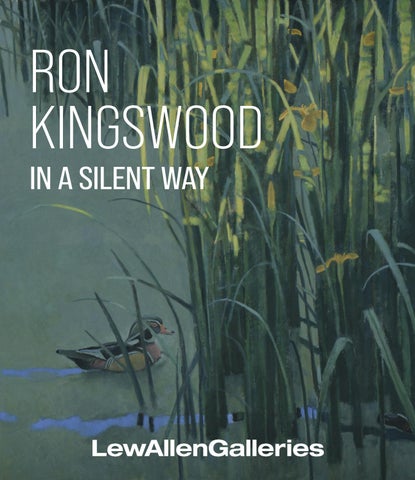
Cover: Passing Through (detail), 2026, oil on canvas, 421⁄2” x 82”
RON KINGSWOOD IN A SILENT WAY Ron Kingswood occupies a rare position in contemporary painting. Few artists have brought such meticulous and sustained empirical knowledge of animal life into so searching an engagement with modernism, and fewer still have made the two seem so mutually informing. His highly celebrated midcareer shift toward a more minimalist relationship between larger fields of color and smaller animal and landscape forms placed together provocatively has created a vastly more sophisticated and engaging genre of wildlife painting. They serve subtly to reorient the relationships between the sublime beauty of untouched environments and the risks encroachment has posed to them from settlement and development. In their redefinition of these relationships, Kingswood’s paintings attain an order of importance that perhaps rivals even their remarkable aesthetic appeal, and it is their subtle suggestion of ecological peril that one might recognize as equally embracing and ultimately as most imperative. In his art, exactness is resolute across wildlife anatomy and seasonal migratory habitats, yet it shares authority with an acute sensitivity to scale of habitat and the wavering line between emptiness and expansiveness. Ecology is marked in its presence here as a question of relations, the more-than-human world repeatedly exceeding the outlines of the fauna within it. A hawk keeps watch against a pearlescent sky; egrets nearly fold into cloud; snow all but envelops the creatures it surrounds. In these newest paintings, Kingswood grants naturalism a measure of the sublime, rendering animal life with complete particularity while its surrounding world assumes an ever-expanding pictorial presence, recasting customary hierarchies between figure and surrounding ground. The artist studied ecology and ornithology at the University of Western Ontario, then spent many years building a successful career as a painter of wildlife. By the mid-2000s, however, he had begun measuring his own practice against the formal economies of modernism, particularly the focused geometric abbreviated reductions of Paul Klee and Piet Mondrian, asking, “What are these artists doing
that I am not getting in my bird paintings?” His inquiry increasingly concerned how a painting coheres, investigating how far representation might recede before an image’s underlying structure comes to the fore. In 2006, he stopped painting animals altogether, working abstractly for eight years, sometimes beginning with little more than “a line or a thought.” Reed beds contracted into bands of graphite and oil stick, while other landscapes distilled into shifting densities of mark and tone, untethered from an assertive object at center. By the time animals migrated back into his work in 2012, the artist said he was looking at representation “totally differently.” Modernism was not his only route to such economy. Kingswood has also connected structural clarity to what he admires in traditional Japanese nature painting: a “disarrangement” in which apparently displaced elements are coordinated by an unseen architecture. In the spare ink-and-paper works of Maruyama Ōkyo and Nagasawa Rosetsu, forms dispersed across expanses of open ground attain precise, harmonious relation through spacing, interval, and asymmetrical balance, offering particularly apt precedents. He notes how the tradition corresponds to “the way I love to look at nature.” This influence of abstraction becomes a tool for conveying structures less conspicuous to the act of looking though powerfully enhancing to it. Throughout Kingswood’s new work, that sensibility meets his command of Western modernist practice, bringing more latent pictorial structures into contact with the defined pressures of the painted surface. The relation between observed form and compositional structure becomes unusually explicit in Hawk in Pines. At far right, a hawk perches on a pine limb that extends edge-to-edge. Above the branch, needles—close cousins, materially, to the painter’s brush—splay and attenuate. The branch first registers as an enormously forceful diagonal, carrying the eye toward the raptor. By then, the vacant portion of the canvas has changed in apparent salience and scale. It belongs simultaneously to the hawk’s habitat and, key here, to the optical structure of the picture, a distilled flatness that can nevertheless suggest the sense of immense distance. This duality signals a larger transition too in Continued on page 9
Morning Glory 2026, oil on canvas, 44” x 80”
Quiet Morning 2026, oil on canvas, 62” x 49”
the perspective now presented by Kingswood’s compositions, that wildlife painting must necessarily also privilege the ecological recognition of habitat’s importance. Consideration of habitat takes many forms in Kingswood’s paintings. Instability of size and outline can offer a practical advantage for an animal. The American painter and naturalist Abbott Handerson Thayer, writing at the turn of the twentieth century, was among the first to theorize camouflage through the optical language of painting. He recognized that countershading could weaken apparent volume and that surrounding pattern might fracture a contour making it less conspicuous. His studies of wood ducks reveal a curious convergence between natural selection and the painterly dissolution of form. Camouflage becomes a survivalist abstraction. Thayer’s interest in the optics of a body losing definition against its surroundings expands in Kingswood’s Winter’s Vail to encompass nearly the whole image. A bird sits within snow-laden branches as whites, grays, and winter greens drift through one another, approaching at moments the vaporous, otherworldly suspension of Dan Christensen’s spray paintings; its outline remains provisional within the frosted, scintillant atmosphere. In He Knows, the fox asserts itself more immediately. The snow-heavy thicket beside it takes longer to resolve into stems and depth, individual strokes retaining their insistence as paint. Kingswood once characterized his abstract practice as an effort to “tease the edges of what feels like the visible.” A related ecological account emerged from the theoretical biology of Jakob von Uexküll, the early twentieth-century Baltic German biologist who developed the concept of the Umwelt: the perceptual environment particular to an organism, shaped by its sensory capacities and possibilities for action. The same surroundings therefore constitute different experiential realities for different species. In Early Morning Wood Ducks, a pair sits high on a mossed limb. The behavior is commonplace for the species, yet it runs against the narrower pictorial repertoire through which ducks are habitually imagined not as branch sitters. The painter’s familiarity with animal behavior keeps producing such small estrangements; his close observation yields perfectly natural arrangements that pictorial convention has tended to exclude and provoking new focus on the habitat as well as the animal. Kingswood’s use of traditional landscape painting’s convention of linear perspective to make a scene cohere is only partially present and that is part of his work’s brilliance.
The Surveyor is particularly sly in its distribution of viewpoint in this regard. A fox descends a snowy embankment crossed by fencing, rowed plantings, and boundary posts—the ordinary delineations of property softening at right as snow subsumes their lines. The weather enacts its own cartography, rendering these whitewashed, cadastral marks newly provisional; the fox traces the ground according to its own needs, its path an abstract line and fugitive measure alongside the frosted parallels. Pawprint and fence post receive the tender austerity of an Alfred Sisley snowscape, each gauging the ground according to a different logic, their juxtaposition setting imposed boundary against embodied passage—an allegory of the coexistence of representation’s measured imperatives and abstraction’s gestural freedoms. In Reminiscent of Musical Notes, the measure changes key. A chord of trumpeter swans glides across a warm gray sky at loose intervals. They recall the geese of the Eight Views of Xiaoxiang, a Song-dynasty landscape cycle whose atmospheric subjects reverberated through centuries of East Asian painting and musically inflected poetry, sometimes reducing distant birds to single notes of ink. In Quiet Morning, two turkeys perch in the upper reaches of a spruce against a pale rose sky of ukiyo-e delicacy and the atmosphere recalls it master artist, Hiroshige’s, graded dawns and dusks, or even the dusky chromatic veils of Whistler’s Nocturnes. The branch beneath the turkeys belongs to another genealogy altogether, sweeping across the picture with the modernist lucidity of a Franz Kline black and white brushstroke. Kingswood completes the arrangement with two unexpectedly weighty occupants, bespeaking the heft of natural fact and art-historical memory alike. Kingswood has called the forests around his Ontario home, altered by natural events and commercial harvesting, “the ruins,” returning to them repeatedly and with great care as subject matter. Nevertheless, the works themselves are not especially mournful. They sustain naturalism’s faith in close attention, reflecting the ideal that acute observation can continue to disclose the presence of beauty, even in landscapes bearing the fact of alteration. The Anthropocene, that disputed geological term for an epoch in which human activity registers at planetary scale, has altered the conditions of such faith. His work approaches
history painting, with the pristine receding into memory even as the living world before him remains insistently present and available to wonder. Of course the beauty of his work, the yawning fields of color now interposing with the fauna and flora, now beg the question: for how long can the pristine be preserved? Passing Through venerates a living order that can only ever be partially contained within a human frame. A wood duck occupies the reedy margin between water and vegetation; a second bird is only partly enclosed by the edge of the canvas, the scene continuing through and beyond the painting. The American environmental anthropologist Anna Tsing has theorized an “art of noticing” suited to damaged landscapes, calling attention to the shifting assemblages and divergent rhythms through which multispecies life develops without resolving into a fixed, knowable order. Kingwood’s naturalism reflects the complexity of Tsing’s proposition. His studied knowledge of species remains exact, while habitat is rendered by way of artful disclosures on his canvases, informed by its obstructions and occlusions. His years dedicated to abstraction accord those interruptions, urgency and descriptive valence, loosening naturalism from the specimen-centered habits of customary wildlife painting. If recent ecology supplies increasingly subtle accounts of identified relational worlds, he conveys a comparable sensitivity without fanfare, a soft footstep in the land. His own summation is characteristically spare: “One can paint it truthfully without replicating it.” And Kingswood paints these elegant, intimate glimpses of nature and the remarkable life within it with an abiding sense of beauty. There is quiet nobility and dignity in the works that helps the viewer relate to them as real, and with a penetrating empathy. It is his level of unconventional artistic innovation–his incomparable use of minimal expanses of color in relations to the animal life he reveres, use of reserved hues, and distinctive brushwork–that makes his paintings exciting, full of silent energy, and provides a nearly Zen-like quality. They suggest an extraordinary experience of place and a deeper meditative connection with environment and species that inhabit it that make these works remarkable.
Winter’s Veil 2026, oil on canvas, 26, 1⁄2” x 32”
Symphony in Blue 2026, oil on canvas, 86” x 103”
Hawk in Pines 2025, oil on canvas, 40 x 75 in
Reminiscent of Musical Notes 2026, oil on canvas, 71” x 76”
The Surveyor 2026, oil on canvas, 50” x 40”
Passing Through 2026, oil on canvas, 42 1⁄2” x 82”
Early Morning Wood Ducks 2025, oil on canvas, 51” x 44”
Black-Crowned Night Heron 2015, oil on canvas, 48” x 50”
Duck Hunting 2021, oil on canvas, 72” x 54”
Ushering in the Evening 2021, oil on canvas, 50” x 57 3⁄4“
Summoning the Twelve 2022, oil on canvas, 60” x 120”
The Narrows 2015, oil on canvas, 84” x 100”
Arctic Fox 2014, oil on canvas, 45.25” x 60”
The Clearing 2003, oil on canvas, 55.75” x 63”
The Plowed Field 2001, oil on canvas, 35” x 35”
1613 Paseo de Peralta | Santa Fe, New Mexico 87501 | tel 505.988.3250 | lewallengalleries.com | contact@lewallengalleries.com
©2026 LewAllen Contemporary, LLC Art: ©Ron Kingswood