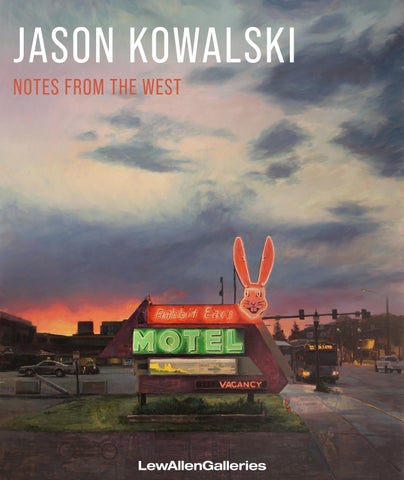
JASON KOWALSKI NOTES FROM THE WEST
American Idyll 2026, oil & mixed media on panel, 84 x 56 in
2
JASON KOWALSKI NOTES FROM THE WEST
September 18 - November 7, 2026 Railyard Arts District | 1613 Paseo de Peralta | Santa Fe, New Mexico 87501 | tel 505.988.3250 www.lewallengalleries.com | contact@lewallengalleries.com Cover:Neon Icon, 2026, oil & mixed media on panel, 54 x 36 in
JASON KOWALSKI NOTES FROM THE WEST
Experiencing the landscape of the old American West requires a specific kind of physical dedication that, to be done correctly, asks much more than passive observation either from pages of glossy tour books or even rolled down car windows. One must stop, get out of the car, and look up-close at the remnants of lived lives that still lurk in the form of memories of old buildings that once were the proud places of work and habitation of people whose lives they harbored. Here neon-announced roadside motels once gave eager travelers respite from the rigors of a long day’s drive on Route 66 and so many other roads now less traveled. Here old gas stations echo what were surrogates for supermarkets and even meeting halls once upon a time. These past places are emblems of the real American West of days long gone-by when America was great because it really was. And to really know what it was like then is not easy now, but these edifices, once great in their way and now dilapidated in their forms, are like cultural archeology for those interested to know. They are remains of what would now be called “infrastructure” – the old gas stations – then referred to as “filling stations” or felicitously, even if sadly antiquated, as “service stations” - and cafes – often going by the loftier name of “diners”, of which there were more than 6,000 alongside America’s country roads and highways by the mid-1950’s. All these places, - and even the rusty tractors and pickup trucks that helped to do the work of providing food to the nation – remain with their own stories of American greatness, if only one takes the time and makes the effort to really look closely and learn about them. 4
Sun-sational!
5
2026, oil & mixed media on panel, 84 x 56 in
That’s exactly what Jason Kowalski does and then masterfully reflects in his paintings – the products of long days of roaming the back roads of this part of a great nation, of getting up close to buildings once proudly the places of business for folks working hard to earn their own small piece of the American Dream. Now only vestiges of those places remain, but one senses in Kowalski’s works that the Dream is still alive and one can feel it still in the places he paints. Trained in drawing and painting at the Laguna College of Art and Design, Kowalski works from his studio in Monument, Colorado, embarking on frequent road trips across the high desert and mountain highways of Colorado, New Mexico, Utah, and the broader West to source his subjects. Guided by the conviction that preservation does not equal restoration, Kowalski approaches his subjects—the abandoned filling station pump, the weathered motel neon, the roadside cafe, or the sun-bleached truck resting at the edge of a lot— depicted by him as they exist in the present moment. They are not romantic relics restored to an idealized past, nor are they sentimental stories told only from a nostalgic point of view. Instead, Kowalski captures these structures as a cumulative compounding of time. To experience these places as a traveler or visitor is to recognize that one encounters them in their current state: marked by faded surface, dented metal, rusted seams, and flaking paint. These physical patinas are structural archives attesting that these places existed in a moment that was once their heyday, while simultaneously surviving the passage of time even if only as monuments of sorts to the American Dream they helped to create. They stand as landmarks of American travel, celebrating the roadside spaces where drivers briefly pause and recognize a shared history before moving on. 6
In architectural theory, philosopher Michel Foucault provided a crucial name for these specialized environments: heterotopias. Distinct from utopias (imagined, perfect places that do not exist), heterotopias are real, physical coordinates that act as “other spaces”—transient, functional enclosures existing outside ordinary domestic or institutional routines. Traveling through the West, the roadside is quintessential heterotopic ground. A motel, a gas station, a rest stop, or a roadside diner is defined to the user entirely by temporary occupancy; it is an intensely real site where lives briefly intersect without anyone settling permanently or putting down roots. Because these places exist for fleeting, transient purposes rather than long-term habitation, they become accidental archives of collective travel culture—holding decades of quiet, overlapping human memory that Kowalski masterfully reveals on canvas. Kowalski’s paintings present themselves as clean, authoritative, and structurally grounded compositions. Yet, directly beneath the brushed surface of oil paint lies a complex, physical archive: paper ephemera— vintage map fragments, receipts, handwritten notes, ledger entries, and postcards—embedded into the substrate of the canvas. These materials mirror the unseen archive of the road trip itself. Sitting in a vehicle parked outside a roadside motel or gas station, one looks at the building facade while surrounded by a hidden geography of paper: the maps, receipts stuffed into the glove box, while knowing of the paper invoices filed beneath the counter inside, or the old postcards tucked away in a drawer. On a subconscious level, the viewer senses that these buried artifacts serve as an indexical record of life—proof that these specific places recorded in his works have been touched, used, and inhabited across decades by a collective, accumulated 7
continued on page 10
Corner Greetings 2026, oil & mixed media on panel, 80 x 42 in
8
Cosmic Traveler
9
2026, oil & mixed media on panel, 60 x 44 in
human presence of which the viewer is now a part. By the use of these materials, sometimes themselves of similar vintage with those places or referencing them, Kowalski makes more explicit the heterotropic nature of them. In Kowalski’s studio methodology, these collage elements act as direct partners to the brushstroke—used intentionally to establish value, edge, and texture before oil paint is ever applied. The paint veil partially conceals and partially reveals this material history. Viewing the canvas becomes an act of slow discovery as the eye begins to decode the surface: a line of typed text peers through a plane of rendered pavement, or a ghosted silhouette and snippet of cartography emerge from beneath a scumbled shadow. One views this stratigraphic layer made explicitly clear in Kowalski’s monumental canvas American Idyll. Beneath the painted surface depicting a stretch of foreground asphalt, fragments of vintage print advertising—including a headline boasting a “First Look at Ford’s Styling”—peer through the oil glazes. Further up the structure, embedded directly into the sign’s secondary panel, a collaged advertisement for a “Rambler American” merges seamlessly with the painted steel. These buried artifacts are inherently aspirational—midcentury promises of mobility, luxury, and technological progress. By placing these optimistic commercial relics beneath layers of weathered oil paint, Kowalski establishes a poignant dialogue between the original ideal of the American highway and the quiet, near-obsolescent physical reality of the site today. These collaged fragments do not distract from the composition; they act to anchor it, proving that the asphalt and architecture are themselves physical archives of American transit.
10
Coffee’s On
11
2026, oil & mixed media on panel, 60 x 60 in
Kowalski’s deliberate choice to omit the use of figures in his work also adds to the heterotropic sense in which the roadside relics depicted in his work project a sense of specialness, of places whose past set them apart from the ordinary built world of contemporary America. In American Idyll, for instance, the absence of figures and contemporary traffic along the empty street allows the viewer to focus entirely on the looming architecture, the quiet asphalt, and the vast Western sky. By removing the figure, the focus shifts entirely to the mid-century architecture, the vehicle, and the surrounding terrain. Kowalski renders his grand, cinematic, yet fundamentally quotidian scenes with a remarkable sense of timelessness. Unburdened by contemporary cars or period-specific clutter, a Kowalski subject exists at any point between its initial mid-century construction and the present day. The scene feels simultaneously contemporary and timeless. As these roadside locations age past their former commercial utility, their status undergoes a fundamental transformation. The human eye is conditioned to filter out inactive infrastructure—gliding past obsolete pylons, faded lettering, and quiet lots as non-functional background noise. Kowalski interrupts this habit, keying the eye back into what could be overlooked. Stripped of immediate utility, these structures present a distinct material morphology—where flaking enamel, oxidized steel, and sun-bleached wood form a physical record of environmental exposure and human passage. Yet, these very characteristics, in the manner of his painterly depiction, provide ample reason for the viewer to look more closely and see a beauty in the aging, in their previous simple grandeur, and contemplate the history, the memory, and the importance that coincide so that these places not be forgotten, that their specialness be known, and appreciated. -Daniel Zeese 12
Westbound Dreams
13
2026, oil & mixed media on panel, 46 x 46 in
14
Memory Lane
15
2026, oil & mixed media on panel, 38 x 60 in
Wash Bay 2026, oil & mixed media on panel, 72 x 48 in
16
Rural Reverie
17
2026, oil & mixed media on panel, 60 x 48 in
18
Easy Going
19
2026, oil & mixed media on panel, 30 x 60 in
High Country Hello 2026, oil & mixed media on panel, 44 x 66 in
20
Panhandle Slim
21
2026, oil & mixed media on panel, 48 x 36 in
Live Music
23
2026, oil & mixed media on panel, 30 x 60 in
24
Westbound Wagon
25
2026, oil & mixed media on panel, 25 x 40 in
Roadside Sentinel 2026, oil & mixed media on panel, 36 x 48 in
26
Long Haul
27
2026, oil & mixed media on panel, 30 x 40 in
Railyard Arts District | 1613 Paseo de Peralta | Santa Fe, New Mexico 87501 | tel 505.988.3250 www.lewallengalleries.com | contact@lewallengalleries.com 28 ©2026 LewAllen Contemporary, LLC ©2026 Jason Kowalski