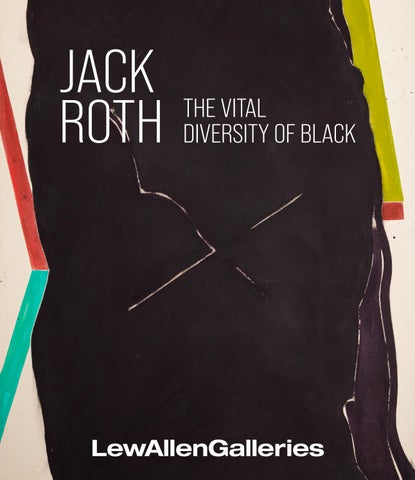
JACK THE VITAL ROTH DIVERSITY OF BLACK
Untitled (Diptych) 1978, acrylic on paper, 30 x 44 in
JACK ROTH
THE VITAL DIVERSITY OF BLACK
1613 Paseo de Peralta | Santa Fe, New Mexico 87501 | tel 505.988.3250 | lewallengalleries.com | contact@lewallengalleries.com
Cover: Cornering #22 , 1978, acrylic on canvas, 55 x 42 in
JACK ROTH THE VITAL DIVERSITY OF BLACK Few painters of his generation brought such richly disparate intellectual resources to the practice of abstraction as Jack Roth (1927–2004): the color fluency and gestural inheritance of the New York School, and a highly educated mathematician’s analytical discipline. He created an extraordinary body of art that capably reflected a variety of influences and in the process left the world major paintings of significant aesthetic importance. Roth was born in Brockway, Pennsylvania, in 1927. When he entered the post-war American art scene in the late 1940s, studying under Mark Rothko, Richard Diebenkorn and Clyfford Still at the California School of Fine Arts in San Francisco, Abstract Expressionist painting was largely defined by primal gesture and existential dribble and spill. Roth, however, brought a distinct intellectual perspective to the unprimed canvas informed by his unusual background in chemistry and mathematics. To Roth, painting was not merely an emotional release, but a rigorous, ongoing search for structural truth. Over the course of his too short career, he formed a resolute commitment through his work to find deeper connections between mathematical principles and art. Roth once remarked, “I am looking for a mathematical explanation of art... The art of painting is a search for reality, a search for understanding.” At twenty-seven, he appeared in the Guggenheim Museum’s landmark exhibition Younger American Painters (1954). Degrees in chemistry and fine arts preceded his doctorate in mathematics from Duke University in 1962. He taught the subject for decades at the university level and published two books on calculus. Knoedler began representing his paintings in 1978;
Cornering #11 1979, acrylic on canvas, 70 x 80 in
he would earn a Guggenheim Fellowship for painting the following year. Where his contemporaries viewed the canvas as an arena, Roth approached it as a coordinate structural system. Across his career, his work navigated a delicate balance between expansive, light-absorbing fields of color and sharp, vector-like linear interventions. At the center of this dialogue sits a sustained investigation of black at its most monumental and material diversity. His deployment of black—a chromatic and conceptual tool he used not to depict emotional states of gloom or darkness, but to construct geometric aspects of space – establishes optical baselines, and anchors the viewer’s perception of light. His use of black synthesizes the material history of modern pigment with the logic of a mathematical proof. By stripping black of its historical burden as a narrative shadow or visual suggestion of darkness and death, Roth restored it as a foundational element of visual architecture. In his hands, black is neither a void nor a dead end; it is an active, structural coordinate—a pure spectrum edge against which light, color, and space achieve their fullest clarity. Of Roth’s formative influences, Still offers the closest pictorial precedent for his mature treatment of black. “Black was never a color of death or terror for me,” Still declared. “I think of it as warm—and generative.” As amply illustrated in this exhibition, in Roth’s mature work, the shade, so often enlisted in modernism’s declarations of pictorial purity, acquired an improbably varied expressive life in his own works as well. Numerous examples abound in this exhibition. In Cornering #11 (1979), fine pale lines traverse a vast acreage of the color, intersecting and veering off as if into infinity. At far right, an upright cobalt plane is separated from the black’s notched contours by a strip of white canvas; two delicate, grass-green strokes sprout along this boundary. Nearby, a brusque scumble of blue shoulders three short, parallel marks of coral red.
Along the lower margin, black pools above scattered white exposures and additional wisps of green. Across its prodigious breadth, even the smallest pictorial incidents reward prolonged, absorbed attention and provide ample example of Roth’s effective use of black monochrome to reveal the material intricacies of chromatic distinctions however relatively small or faint they may be by comparison to the monumentality of the black field. In this regard, the works are in league with those of various contemporaries such as Robert Ryman, Ad Reinhardt and Frank Stella. Theirs were divergent propositions, each extricating pictorial complexity from terms of extreme chromatic restraint. By the late 1970s, when Roth began his monumental black canvases, this history was substantial, though he would prove their implications far from exhausted. While his forebears were oft united by severity, his expanses of darkness accommodate enormous inventiveness, brilliant colors, highly particular silhouettes, and an extraordinary diversity of marks, through contact with painting’s possibilities for gestural invention. Roth’s undated Untitled #33105 exemplifies several of the artist’s classic fissured silhouettes also included in this exhibition. This work consists of two substantial black wedges divided by an irregular white seam, one edged in blue, with a broad green stroke hovering above. The exposed ground varies in width between the adjoining masses, each black passage acquiring subtly different contouring and tonal character, evincing a richness and variety seldom encountered elsewhere. At several points, the white contracts to a thin incision, elsewhere widening into a distinct gap between these forms. The work is a spectacular example of Roth, the mathematician, demonstrating his prowess for creating highly particular monochromatic silhouettes, while bringing to bear an extraordinary diversity of subtle chromatic marks, unraveling the enormous unexpected possibilities for monochrome through contact with painting’s Continued on page 10
Humpty Dumpty 1961, oil on linen, 51.5 x 39.75 in
Untitled #33105 N.d., acrylic on canvas, 55 x 38 in
equally vast chromatic possibilities and unforeseeable gestural invention. Early works illustrate Roth’s evolving dynamic of integrating black as an anchoring field to enliven this potential of color in his hands. In Humpty Dumpty (1961), paint converges in a tumult of gray, rust, turquoise, and violet, crossed by black strokes and extensive drips. Neither Basic Nor Black (1966) concentrates into an expansive, sinuous black form, with brilliant yellow caught between its extensions. Across the subsequent decade, Roth increasingly enlarged his dark masses while concentrating the incidents of color along their edges and within narrow intervals of exposed ground. Details formerly dispersed among overlapping gestures came to occupy comparatively isolated positions, bringing their spacing and orientation into sharper legibility. “I am looking for a mathematical explanation of art,” Roth explained. His vocation lends particular interest to differential equations, which describe quantities in relation to their rates of change, with particular solutions dependent upon specified initial or boundary conditions—an analogy suggestive of Roth’s mature paintings, wherein the disposition of one element alters the character of another. Black, repeatedly enlisted by modernism to assert pictorial finality, acquires in Roth instead a notably relational character, an authority contingent on willful irregularities at the margins, the artful deviations of the hand. In New Synthesis #27 (1981), a narrow yellow band alters the apparent weight of a charcoal expanse many times its size. Against broad cobalt areas and an intruding red-orange plane, the dark form acquires an almost architectural depth, even as circular brushwork remains visible across its surface. The yellow occupies comparatively little space, yet its saturated edge makes the vast central shape appear to rest upon it. Similarly with Thesis IV, Ibid #5, and New Synthesis #2833, rather than using
color to engender emotional response, Roth uses broad bands of black to assert the geometry of the canvas. The black serves as the principal anchor and geometric frame for the “variables” of his colored poured pigments, bringing mathematical order and formal structure to what would otherwise be fluid, chaotic pools of liquid paint. Thesis IV (1981) wedges an intense blue passage between larger, more subdued forms; Ibid #5 (1982) revisits a related configuration with altered proportions and a pale line wandering through its darkest section. In each work, Roth’s calculated use of black as a dark baseline forces adjacent colors, exposed unprimed canvas, and white passages to read as significantly brighter and more luminous than they would in isolation. The black does not deaden the painting; it acts as an optical amplifier, allowing raw color fields to vibrate with heightened intensity without causing the composition to dissolve into chaotic space. Roth’s treatment of line is another distinguishing characteristic of his work that emanated from his mathematical background and understanding of line as a useful geometric device to indicate divisions and boundaries. Rather than allow forms within his works to merge entirely into each other or into background colors, Roth used thin geometrically precise lines to designate divides between the forms, and further animate and energize the painting. In Rope Dancer #16 (1980), two diagonal lines slice through the central triangular black form as though strikes of lightening electrifying the balance of the painting. They appear to energize the two adjoining gold and blue forms and ignite the three slender strokes of red and green at the far right. In La Ligne Tremblante #13 (1980), Roth’s graphic language suggests a topographic dimension: an elongated V descends into a dark cleft, its tremulous lineation evoking the precipitous walls of a canyon, its sense of immense spatial recession achieved with near-ascetic
Continued on page 15
Neither Basic Nor Black 1966, acrylic on canvas, 68 x 68 in
Thesis III 1981, acrylic on canvas, 90 x 55 in
Untitled #32335 n.d., acrylic on canvas, 14 x 14 in
restraint but emitting an enormous sense of power. It is astonishing what the artist is able to do with the emblazoned line on black space. Roth’s Zen Studies of 1986 return to the gestural immediacy of his early abstract expressionist work, though the swarming maculation of Humpty Dumpty has given way to broad, individually legible strokes. His longstanding engagement with Zen Buddhism lends the series its title; the uneven deposits of pigment, dry edges, and intervals of unpainted paper reward a correspondingly meditative attention. In Zen Study A-II2, the dark masses nearly close upon one another, leaving a sole and narrow meander of white. It widens briefly, contracts once more, and submerges beneath the surrounding acrylic in a final fade to black. Throughout this prodigious body of work, the cumulative effect might best be described as a sense of profound inventiveness utilizing the color black as the central element of Roth’s engagement with color theory, geometry, and space. It also reveals that Roth was an artist of enormous protean capacity, never content to settle with any single way of making a work of art and brilliantly able to extract from this one color an extensive range of vitality and diversity. It also demonstrates how his scientific and mathematical capacities brought to bear with great technical effect in the use of this color for structural, optical and mathematical balance, did so while also allowing these effects to achieve equal success in providing aesthetic pleasure as works of beautiful art.
New Synthesis #2833 1981, acrylic on canvas, 46 x 25 in
New Synthesis #27 1981, acrylic on canvas, 92 x 65.75 in
Thesis IV 1981, acrylic on canvas, 66 x 66 in
Ibid #5 1982, acrylic on canvas, 66 x 66 in
Rope Dancer #16 1980, acrylic on canvas, 32 x 67 in
La Ligne Tremblante #13 1980, acrylic on canvas, 40 x 54 in
Zen Study A-II-2 1986, acrylic on paper, 40 x 32 in
Untitled #29129 1978, acrylic on canvas, 18 x 14 in
Untitled #7706 1978, acrylic on canvas, 42 x 32 in
New Synthesis #55 1981, acrylic on canvas, 48 x 70 in
Untitled 1978, acrylic on canvas, 55 x 42 in
Cornering #22 1978, acrylic on canvas, 55 x 42 in
Untitled #13298 1978, acrylic on paper, 30 x 22 in
Untitled #13297 1978, acrylic on paper, 30 x 22 in
Synthesis XXVII #32260 1981, acrylic on canvas, 36 x 10 in
Zen Study I 1986, acrylic on paper, 40 x 32 in
Untitled 1978, acrylic on canvas, 16 x 12 in
Untitled 1982, acrylic on paper, 44 x 30.5 in
Untitled N.d., acrylic on canvas, 50 x 40 in
Untitled #46040 N.d., acrylic on canvas, 36 x 30 in
Zen Study 5 1986, acrylic on paper, 40 x 32 in
Untitled 1978, acrylic on paper, 30 x 22 in
Swy (diptych) 1979, acrylic on canvas, 18 x 28 in
JACK ROTH Jack Roth’s (1927 - 2004) art evolved alongside the vanguard of postwar American art through Color Field abstraction and beyond. Roth began his career in art as one of the youngest artists, just 27 years of age, whose work was selected for the landmark Younger American Painters exhibition at the Solomon R. Guggenheim Museum, which in 1954 helped to introduce Abstract Expressionism to the American public. This exhibition, which traveled to major art museums across the United States, included many leading artists of the day, including Jackson Pollock, Willem de Kooning, and Robert Motherwell, many of whom were decades his elder. Roth’s early works involved densely brushed canvases featuring a highly expressive quality of gesture. With a sense of graphic immediacy and arrangements of fresh, even color, Roth’s later work often incorporated broad shapes of stained matte pigment on unprimed canvas. They often employed an unusual use of line and negative space, sometimes evoking the flat, ‘cutout’ shapes of Matisse’s late paintings. In 1963, Art in America named Roth as the “New Talent” graphic artist upon the recommendation of Museum of Modern Art curators Dorothy Miller and William Lieberman. In 1978, the legendary gallery Knoedler & Co. began their representation of Roth’s work, placing him in a prestigious company of artists such as Helen Frankenthaler, Alexander Calder, Adolph Gottlieb, Robert Motherwell, and Franz Kline. Roth was awarded a Guggenheim Fellowship for painting the following year. In addition to his career in art, Roth was also a longtime professor of mathematics at universities in Kentucky, Florida, and New Jersey, and published two books on calculus. Of his unique career, Roth said, “I am looking for a mathematical explanation of art…. The art of painting is a search for reality; a search for understanding.” Born in Brockway, Pennsylvania in 1927, Jack Roth served in the Army and Air Force before moving to San Francisco in 1949, where he studied at the California School of Fine Arts under Mark Rothko, Clyfford Still, Richard Diebenkorn, Elmer Bischoff, and David Park. He reenrolled at Pennsylvania State University in 1951 and earned his Bachelor’s Degree in Chemistry, an achievement later followed by a Master of Fine Arts from the State University of Iowa in 1952 and a PhD in mathematics from Duke University in 1962. Roth’s works are held in the collections of museums across the United States, including the Museum of Modern Art, New York City, NY; the National Gallery of Art, Washington, DC; and the North Carolina Museum of Art, among others.
CV Selected Solo Exhibitions 2021 Works from the Estate, LewAllen Galleries, Santa Fe, NM 2012 Jack Roth, 1927—2004: Color Equations, Peyton Wright Gallery, Santa Fe, NM Jack is Back, (Vallarino & McCormick) McCormick Gallery, Chicago, IL 2011 Line Color Equation, Spanierman Modern, New York, NY When I Grow Up I Want to Be Just Like Jasper Johns, Jack Roth: Drawings from the 1960s, (Vallarino & McCormick) McCormick Gallery, Chicago, IL 1997 Collonades Gallery, Montclair, NJ 1986 Jack Roth Ramapo College Art Gallery, Mahwah, NJ Jack Roth—Recent Work, Ochi Gallery, Boise, ID 1985 Jack Roth Paintings, Princeton Gallery of Art, Princeton, NJ Jack Roth, Wyckoff Gallery, Wyckoff, NJ 1983 Jack Roth Paintings, Knoedler & Co., New York, NY Jack Roth, Acrylics on Paper, Ochi Gallery, Boise, ID Jack Roth, Milhouse-Bundy Museum, Waitsfield, VT Jack Roth, Acrylics on Paper, New Jersey State Museum, Trenton, NJ 1982-83 Jack Roth: Drawings and Watercolors, Ramapo College Art Gallery, Mahwah, NJ (traveled to Hiram College, Hiram, OH; Sweet Briar College, Sweet Briar, VA; Junior College of Albany, Albany, NY; Montclair State University, Montclair, NJ; New Jersey state Museum, Trenton, NJ) 1982 Jack Roth, Drawings, Ramapo College Art Gallery, Mahwah, NJ Jack Roth, Rosenberg Fine Arts, Ltd., Toronto, Canada Jack Roth: Recent Paintings, Montclair Art Museum, Montclair, NJ Jack Roth, Gallery 99, Bay Harbor Islands, FL (also 1983) 1981 Jack Roth, Paintings, Knoedler & Co., New York, NY 1980 Jack Roth: Recent Paintings, Knoedler & Co., New York, NY Jack Roth: Ramapo Paintings, Clocktower, New York, NY Gallery 99 Presents the Paintings of Jack Roth, Gallery 99, Bay Harbor Island, FL 1978 Ramapo Series I, Ramapo College Art Gallery, Mahwah, NJ 1967 University of Florida, Jacksonville, FL 1965 Jack Roth—Goodies, Kornman Gallery, Tampa, FL 1964 Jack Roth: To Interpret Reality, University of South Florida, Tampa, FL Boxes, Collages, Constructions, Florida Presbyterian Colege, St. Petersburg, FL Kornman Gallery, Tampa, FL Jack Roth, Washington Square Galleries, LaGuardia Place, New York, NY Hastings College, Hastings, NE 1963 Jack Roth, Drawings, Grand Central Moderns, New York, NY
1962 1958 1952 1949
Jack Roth, Cinema I and II, New York, NY University of Kentucky Art Gallery, Lexington, KY Jack Roth, Drawings, Chapel Hill Art Gallery, Chapel Hill, NC Jack Roth, Paintings, Duke University, Durham, NC Jack Roth, Gallery 5, Iowa City, IA (also 1953) Jack Roth Paintings, Hansa Gallery, New York, NY Jack Roth, Contemporary Gallery, Sausalito, CA (also 1950)
Selected Group Exhibitions 2001 Abstract Expressionism: Expanding the Canon, Gary Snyder Fine Art, New York, NY 1995 Still Working: New Jersey Artists Over 65, The Gallery at Bristol-Meyers Squibb, Princeton, NJ 1984 New Jersey Curator’s Choice, Robeson Center Gallery, Rutgers University 1982 1982 Summer Group Show, Knoedler & Co., New York, NY Fall Show, Rosenberg Fine Arts, Ltd., Toronto, Canada Two Person Show, Gallery of Fine Art, Princeton, NJ 1980 Knoedler & Co., New York, NY 1963 60 Modern Drawings: New Acquisitions, Museum of Modern Art, New York, NY Graphics 63, University of Kentucky, Lexington, KY (traveling exhibition circulated by the Smithsonian Institution) Jack Roth and Rachel Roth, Paintings and Drawings, University of Kentucky, Lexington, KY 1958 15th Southeastern Annual, Atlanta, GA 1st Hunter Gallery Annual, Chattanooga, TN Knoxville Art Center National Exhibition, Knoxville, TN South Coast Art Show, Sarasota, FL (traveled to High Museum, Atlanta, GA; North Carolina Museum of Art, Raleigh, NC; Mint Museum, Charlotte, NC; Birmingham Museum, Birmingham, AL) Some Younger Names in American Painting, Worcester Art Museum, Worcester, MA 1955-56 Younger American Painters (traveling exhibition organized by the Solomon R. Guggenheim Museum, New York), Portland Art Museum (Oregon); Henry Gallery, University of Washington, Seattle; San Francisco Museum of Fine Art; Los Angeles County Museum of Art; University of Arkansas, Fayetteville; Isaac Delgado Museumof art; Indiana University, Bloomington, IN 1954 Younger American Painters, Solomon R. Guggenheim Museum, New York, NY Dallas Young Collectors Show, Dallas Museum of Fine Arts, Dallas, TX 1953 5th Annual Iowa Artists Exhibition, Des Moines Art Center, Des Moines, IA Exhibition Momentum Midcontinental, Chicago, IL 1952 Exhibition Momentum Midcontinental, Chicago, IL
Selected Public Collections Art Museum of South Texas, Corpus Christi, TX Boise Art Museum, Boise, ID National Gallery of Art, Washington, DC Museum of Modern Art, New York, NY North Carolina, Museum of Art, Raleigh, NC Duke University, Durham, NC University of Kentucky, Lexington, KY
1613 Paseo de Peralta | Santa Fe, New Mexico 87501 | tel 505.988.3250 | lewallengalleries.com | contact@lewallengalleries.com
©2026 LewAllen Contemporary, LLC Art: © Estate of Jack Roth