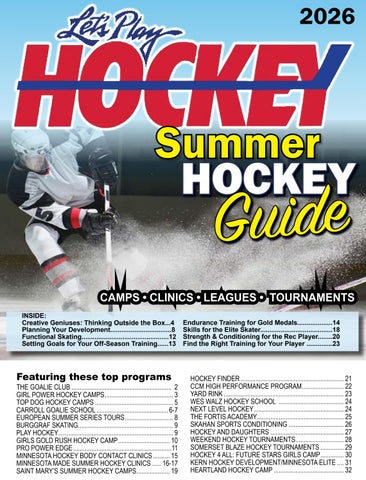
2026
Summer HOCKEY
Guide
CAMPS • CLINICS • LEAGUES • TOURNAMENTS INSIDE: Creative Geniuses: Thinking Outside the Box...4 Planning Your Development.................................8 Functional Skating...............................................12 Setting Goals for Your Off-Season Training......13
Featuring these top programs
THE GOALIE CLUB............................................................. 2 GIRL POWER HOCKEY CAMPS.......................................... 3 TOP DOG HOCKEY CAMPS................................................ 5 CARROLL GOALIE SCHOOL............................................ 6-7 EUROPEAN SUMMER SERIES TOURS.............................. 8 BURGGRAF SKATING.......................................................... 9 PLAY HOCKEY...................................................................... 9 GIRLS GOLD RUSH HOCKEY CAMP................................ 10 PRO POWER EDGE............................................................11 MINNESOTA HOCKEY BODY CONTACT CLINICS........... 15 MINNESOTA MADE SUMMER HOCKEY CLINICS....... 16-17 SAINT MARY’S SUMMER HOCKEY CAMPS..................... 19
Endurance Training for Gold Medals...................14 Skills for the Elite Skater.......................................18 Strength & Conditioning for the Rec Player........20 Find the Right Training for Your Player ..............23
HOCKEY FINDER............................................................... 21 CCM HIGH PERFORMANCE PROGRAM.......................... 22 YARD RINK......................................................................... 23 WES WALZ HOCKEY SCHOOL ........................................ 24 NEXT LEVEL HOCKEY....................................................... 24 THE FORTIS ACADEMY..................................................... 25 SKAHAN SPORTS CONDITIONING.................................. 26 HOCKEY AND DAUGHTERS............................................. 27 WEEKEND HOCKEY TOURNAMENTS.............................. 28 SOMERSET BLAZE HOCKEY TOURNAMENTS............... 29 HOCKEY 4 ALL: FUTURE STARS GIRLS CAMP............... 30 KERN HOCKEY DEVELOPMENT/MINNESOTA ELITE..... 31 HEARTLAND HOCKEY CAMP........................................... 32
SUMMER CAMPS
2026
Goalie training for any level of experience!
BOARDING CAMPS
DAY CAMPS
Stay at the beautiful campus of Shattuck St. Mary’s for a week-long exclusive Private Lesson Camp! Goalies are pushed to their best as they concentrate on sound fundamentals and game situation drills. 1:1 and 2:1 ratios accepted.
High-energy, fun, and educational day camps with low ratios.
FARIBAULT, MN {Shattuck St. Mary’s} June 14-19: All TGC Programs + Shooters June 21-26: All TGC Programs + Shooters August 3-7: All TGC Programs + Shooters
FARIBAULT, MN {Shattuck St. Mary’s} June 14-19: All TGC Programs + Shooters June 21-26: All TGC Programs + Shooters
MANKATO, MN {All Seasons Arena} July 6-10: All TGC Programs + Shooters
EAGAN, MN {Eagan Civic Center} July 27-31: All TGC Programs + Shooters
EXCLUSIVE TGC PROGRAMS FUNDAMENTAL {1-3 yrs experience}
To build a strong goaltending foundation, you need to start with the fundamentals. Newer goalies will learn: • effective positioning • making correct movements in the crease • save techniques
SITUATIONAL {4+ yrs experience}
Build from a strong foundation and apply the fundamentals to game situations. Intermediate goalies will: • learn goaltender theories, styles, and techniques • apply this knowledge to game scenarios
VERGE
Goaltenders who have mastered fundamental and situational programs and have the necessary enthusiasm for training are on the verge of greatness! Emerging goalies will: • increase speed and performance • improve technical execution • work on mental control
PRODIGY
Midget, high school, and junior level players who are ready for the next step need advanced preparation. Advanced goalies will: • engage in high-intensity game situation drills • work on speed, agility, and reaction time • practice with top-notch shooters
REGISTER NOW
DON’T WAIT! Camps fill every year!
THEGOALIECLUB.COM ABOUT TGC Des Christopher grew up playing youth and junior hockey in Calgary, AB. He founded The Goalie Club in 2002 and has been the goaltending choice for the 8 teams at Shattuck St. Mary’s Prep School (Faribault, MN) for the last 20 years. Together, they’ve captured 31 USA Hockey Nationals Championships. With 35 years of coaching experience, Coach Des has brought out the best in players from mites to pros. • College player: Minnesota State University, Mankato (Team MVP & Senior Male Athlete of the Year Award) • Professional player: Germany and United States • Coaching: Minnesota State Mankato, Shattuck St. Mary’s, MSHSL, and youth hockey
ALL PROGRAMS
INCLUDE
ice time, video analysis, dryland training, classroom discussion, workbooks, journals, and evaluations. 2 Summer Hockey Guide 2026
Find out what elite goaltenders and parents are saying about TGC at thegoalieclub.com Let’s Play Hockey
@thegoalieclub www.letsplayhockey.com
Celebrating 10 Years!
JUNE 7-12, 2026
JULY 19-24, 2026
BREEZY POINT, MN
NORTHFIELD, MN
Girls 8-12 years
Girls 12-16 years
REGISTRATION OPENS JANUARY 15, 2026!
www.girlpowerhockey.com www.letsplayhockey.com
Let’s Play Hockey
Summer Hockey Guide 2026 3
Creative Geniuses:
Summer hockey is an opportunity to think outside the box by JACK BLATHERWICK Let’s Play Hockey Columnist
Unlike college and professional football, offensive creativity in hockey comes mainly from players, and each year it is increasingly “coached” out of the game. Avoiding mistakes has become the highest priority, even at the youth level where the need to win eliminates creative trial-and-error. Not only do coaches insist on simplistic, structured hockey (chip it out, dump it in, keep it simple), but our educational system joins them to discourage “childish” creativity. Consider how foolish we are as a nation to fall for the current dogma that memorization of facts actually constitutes an education. Those who memorize best and repeat like robots on standardized tests are called “A-students.” We forget that rebels like Albert Einstein were the ones who actually changed history, and Wayne Gretz- in mind when your PeeWee forwards try ky did 10 things a shift the coach never something unheard of, and turn it over at thought of. the offensive blue line, or a fourth grade No wonder Washington politicians math student asks, “Why should I learn have no new answers for old problems? long division if I will never use it again No one has the courage, or educational after fourth grade?” Maybe they’re right background, to think outside the box. and the system is wrong. Actually, that looks a lot like hockey, We coaches are entrusted with the 2019, while at the development of same time football ambitious youngcoaches are comsters with lofty We forget that rebels ing up with offensdreams. But we es that are more limit those dreams like Albert Einstein creative than ever. by removing the were the ones who Walter Isaacelement of trial son, who wrote the and error. How actually changed biography “Albert can another young Einstein, His Life Gretzky develop history, and Wayne and Universe,” unbridled creativGretzky did 10 things decries any educaity in our hightional system that ly-structured youth a shift the coach stifles non-conforprograms? There mity: “Of all the are too many tronever thought of. disservice we do phies – too much our students, perhype from parents haps the most criti– too much prescal is demanding that they fit.” Keep that sure to avoid mistakes. No doubt, cre-
ativity can still blossom in a pond hockey scrimmage, where 10-year-olds learn new moves from older brothers, where the only stakes are bragging rights at the dinner table, and mistakes mean nothing. Coaches and teachers are more likely to develop genius talent by acknowledging that Wayne Gretzky’s brilliance was that he did things the coach never drew up on the board, or that Einstein frustrated teachers with his distaste for conformity. It was because he thought outside the box that Einstein changed the direction of physics with revolutionary insights into the equivalence of mass and energy and his Theory of Relativity. Einstein believed, “Imagination is more important than knowledge,” a thought that should be stenciled on every drill book and lesson plan. For coaches, it means that constant reminders about mistakes might prevent a turnover today while discouraging a creative playmaker tomorrow. The impact players in hockey have always been those who learned the game by creative experimentation, and mistakes are part of the process.
Follow Let’s Play Hockey on Facebook and X at www.facebook.com/letsplayhockey and @LetsPlay_Hockey 4 Summer Hockey Guide 2026
Let’s Play Hockey
www.letsplayhockey.com
www.letsplayhockey.com
Let’s Play Hockey
Summer Hockey Guide 2026 5
Carroll Goalie School helps goalies build confidence and elevate their game Weekend clinics set for Minnesota and Iowa
The Carroll Goalie School (CGS) is celebrating its 31st year of helping boys and girls elevate their game to new level through their popular evening and weekend clinics in Minnesota and Iowa. Founded by Edina, Minn., native Steve Carroll, CGS has built a strong reputation for developing fundamentally sound, confident goaltenders in a positive and high-energy learning environment. “Goalies who train with us work hard, improve their skills, and have fun,” said Carroll, a long-time goalie development leader who coaches goalies at the youth, high school, and college levels. “I’m extremely proud of the reputation we’ve earned for developing quality, fundamentally sound goaltenders.” CGS gives goalies the proper training and attention they need to maximize development in a challenging, positive and fun learning environment. The CGS coaching staff brings extensive playing and coaching experience to the ice, teaching goalies what it takes to succeed in today’s game. “Our coaches love goaltending and do a great job teaching the skills that matter most,” Carroll said. “They break things down, demonstrate properly, and help goalies leave feeling confident in
“The structure was great and coaches were very efficient with the time. Our daughter felt this camp really helped in her development as a young goalie. She loved every minute!” – Jenn Bernacki Solon, Iowa 6 Summer Hockey Guide 2026
their overall play.” Clinics are scheduled in June through September at six Minnesota locations: • Eagan Civic Arena (Eagan) • Richfield Ice Arena • Sports Arena East (Sauk Rapids) • STMA Arena (St. Michael–Albertville) • Super Rink (Blaine) • TRIA Rink (St. Paul), practice home of the Minnesota Wild and Minnesota Frost CGS will also host two weekend clinics in July at the RecPlex in West Des Moines, Iowa. Four program options are available for goalies ages 6–14: Intro to Goaltending, Intermediate Skills, Advanced Skills, and Tryout Tune-Up. Goalie parents consistently praise CGS for its organization, coaching quality, and positive impact on goalie development. “We have been to quite a few of Steve’s camps and will be coming back for quite a few more,” said Kevin Rowe from Blaine, Minn. “Always a Let’s Play Hockey
great camp and many locations to pick from when schedules get busy. Our son enjoys the camp, and the coaches are engaging and have fun with the goalies while making them work at improving their skills. I highly recommend this goalie camp.” “This was our first goalie-specific camp, and it was a great one,” said Jenn Bernacki of Solon, Iowa. “The structure was great and coaches were very efficient with the time. Our daughter felt this camp really helped in her development as a young goalie. She loved every minute!” Jared Bulinski of Sauk Rapids, Minn., added, “My son had a great experience with CGS. He enjoyed the challenges and learning that took place at the clinic. On the last day, he asked if we could sign up again next year. That is all the proof I need. We can’t wait to work with CGS again.”
Carroll Goalie School continued on page 7
www.letsplayhockey.com
Carroll Goalie School continued from page 6
an 31 s nu t al
About Coach Steve Carroll Coach Steve Carroll brings more than 35 years of goaltending coaching experience to the ice. He was the goalie coach for the 2023 NCAA Division III National Champion Gustavus Adolphus College women’s team. Steve is a USA Hockey Level 4 certified coach and recently became a USA Hockey Bronze Level goalie coach, continuing his commitment to lifelong learning and goalie development. As a goalie, he was NCAA Division II National Champion at Minnesota State, a two-time All-American, and Hobey Baker Award finalist. He’s been inducted into the Minnesota State University, Mankato and Edina High School athletic halls of fame. Reserve a spot in a CGS clinic for your goalie at www.carrollgs.com
“My son had a great experience with CGS. He enjoyed the challenges and learning that took place at the clinic. On the last day, he asked if we could sign up again next year. We can’t wait to work with CGS again.” – Jared Bulinski, Sauk Rapids, Minn.
2026
CARROLL GOALIE SCHOOL Great games start here
CLINICS IN MINNESOTA & IOWA Minnesota: Eagan, Richfield, Sauk Rapids, St. Michael-Albertville, Super Rink (Blaine), TRIA Rink (St. Paul). Iowa: RecPlex (West Des Moines)
CGS clinics help goalies • Elevate game to new levels • Improve individual skills • Boost self-confidence CGS clinics feature • Challenging, positive, fun learning environment • Expert coaching staff • Evening and weekend ice times • Four programs - Advanced Skills, Intermediate Skills, Intro to Goaltending, Tryout Tune-up • Clinics for goalies ages 6-14 Sponsored by Brian’s Custom Sports
www.letsplayhockey.com
CGS clinics led by Steve Carroll • Award-winning goalie development leader • Two-time NCAA National Champion • Hall of Fame Inductee – Edina High School, Minnesota State • Goalie coach at youth, high school and college levels
Book early for best selection!
@carrollgs
www.carrollgs.com
@carrrollgoalieschool
Let’s Play Hockey
Summer Hockey Guide 2026 7
facebook.com/carrollgs
Planning your development by ANDY NESS
Let’s Play Hockey Columnist
Development is such a buzz word lately, probably the biggest buzz word in hockey. What does development really mean? Is it games, is it drills, is it off-ice? In this article my goal is to get you to think and understand this concept a little more. Hopefully I can help you guide your skater into making the best decisions that will help take their game to the next level. One of the biggest questions that I get is, “Should my son or daughter play more games or work on their skills more during the off-season?” First, I would like to start with skaters at the highest level to talk about development. As NHL players plan out their off-season they take a lot of things into account. They will first come up with a plan. For example, they will come up with a regimented strength or off-ice training program that will take into account everything. Their programs will be planned out with what to do day by day. The planning is the key, this is what keeps athletes accountable, and aids in development. Consistency is key here. There is a difference between training and working out. If I just show up to Lifetime and throw a few weights around, I am going to be disappointed by the results. Another part of their plan is their on-ice plan. What are they going to do for skating or skill work? How often and what does the duration look like? Do they want to work on skating, shooting, or general puck work? What should the focus be? These are some questions every player should ask themselves as they put together a plan.
8 Summer Hockey Guide 2026
So, let’s use a specific example of former Wild player Marco Rossi and the improvements (development) he made to his game over the off-season. It was a plan that involved both skating and off-ice strength training. They both went hand in hand. When players tell me they want to get faster, it’s a combination of building more power and explosiveness in the weight room as well as refining technique on the ice. But that really just scratches the surface, and it goes much deeper than that. If you use the example
Let’s Play Hockey
www.letsplayhockey.com
of Marco, he is such a gifted playmaker and distributor of the puck. He has excellent vision and can create plays. That ONLY happens if he can absorb hits and bumps and is able stay on his feet to be able to make those plays at the highest level. To do this, adding lower body strength and weight was a necessity. He also needed to increase his speed through zones, and playing center being an efficient skater was a must. So, we were able to really hone in on the technique of a skating stride. Being able to have more power to push with was such an added benefit. Combining strength and technique allowed him to be the best player he can be at the highest level. Once a plan is in place now comes the actual execution. This means the skater needs to carry out the plan and continue to practice whatever it is he or she is working on. We always make skaters practice in between lessons on their own or with a small group. This is the only way to repeat, repeat, repeat. As this happens, then skaters will notice improvement. Skating is progressive so you need to keep building skills with quality repetition. Finally, the biggest question: game or practice? When pro or college players come to see us they want skating or individual skill work. They do not want to do cross ice or scrimmage. Not that that is bad by any means but really they can get scrimmaging or cross ice anywhere. They want to learn, get more comfortable with their skating, and just flat out get better. So should kids do more games or practices? There are pluses and minuses to both. One example I would use is let’s say a player gets five shots off in a game. Do you think the player has really improved his/her shot by taking five shots? No, the best shooters take rep after rep or different types of shots from different angles all over the ice. This is something that needs to be done in a different type of setting. If you get a chance to watch a college or pro practice you will notice the skaters will come out before or after
The biggest advice I can give for someone’s off-season is to have a plan of attack. If you need work on your skating, you need to skate. If you need to work on your shooting, you need to shoot. Younger players that want more games, there is no shortage of tournaments to jump in on. Remember, a goal without a plan is just a wish. - Andy Ness to try to work on these things. The biggest advice I can give for someone’s off-season is to have a plan of attack. If you need work on your skating, you need to skate. If you need to work on your shooting, you need to shoot. Younger players that want more games, there is no shortage of tournaments to jump in on. Remember, a goal without a plan is just a wish. Good Luck. Andy Ness is the head skating and skill coach for the Minnesota Wild. He is also the skating and skills consultant for the Minnesota Frost. He has also been an assistant skating instructor for the New Jersey Devils, the University of Minnesota men’s and women’s hockey teams and the U.S. Women’s Olympic Hockey Team.
Experience developing more youth through NHL players since 1968
burggrafskating.com THE ISOTM CLINIC Total On & Off Ice Integrated Training Specific to Hockey August 2nd-August 7th
Moorhead Minnesota
Snall Number Big Results “Making Great Strides in Hockey”
Visit our booth at the Let’s Play Hockey Expo!
1 888 I SK8 BYU www.letsplayhockey.com
Let’s Play Hockey
Summer Hockey Guide 2026 9
10 Summer Hockey Guide 2026
Let’s Play Hockey
www.letsplayhockey.com
www.letsplayhockey.com
Let’s Play Hockey
Summer Hockey Guide 2026 11
Functional Skating by ANDY NESS
Let’s Play Hockey Columnist
As the off-season is now upon us it is time to train. When we look at skating, there are many different avenues we can look at. For this article I would like to share with you what direction I like to go when skating and training during the summer and why. With so many options it is important to understand and establish what is most important and disregard all the rest. First, when I say there are many avenues to go down, I would like to explain what I mean. When you are training in the summer you can scrimmage, do small area games, do game drills, or work on your skating or skills specifically. Is this helping your individual development? Remember, drills and skills are different. Just doing a drill for the sake of doing a drill serves no purpose. When we look at skating specifically, we can look at over-speed, technique skating, or conditioning. In the “video post” world we live in, skating has somehow turned into a lot of shock and awe drills. I have seen kids jump over tires, spin around in the air, do forward to backward flips on one foot, all really for the sake of a “wow” factor. Is this the best use of our ice time? Here is the problem: with the limited amount of time that we get to spend with skaters in the summer, we want to make sure their skating skills are “functional”. What I mean by that is the skating skills they are actually going to use in a game. Get back to the nuts and bolts. When skating with pros (and even youth skaters) time is precious and important. Some kids I will only see five or six times in the
summer. When I have to cover edges, balance, power turns, crossovers, backwards, transitions, starts, and stride this doesn’t leave any room for “filler” drills. There are fundamental skating skills that need to be worked on. The only way to get improvement is through quality repetition through actual focused practice habits. Some of the jumps and things aren’t bad, they just aren’t something in which an entire lesson should be focused around. I think it’s great that kids try different skating and stickhandling maneuvers. My point is, again, work on the skills that you will make you a better player in a game. It does you no good if you can do the “Michigan move” but can’t catch a backhand pass. I remember when I joined the Wild the basic theme was to execute the fundamental skills of the game with repetition. We want guys to be able to pull pucks off the wall cleanly, we want them to catch passes no matter where the pass is (blade, stick, or
in the air), and we want them to be able to skate efficiently. Making a consistent first breakout pass is more valuable than being able shoot the puck between your legs. Establish what is important and disregard everything else. Off-season training is really quite simple. If you need work on your skating, skate. If you need work on your shooting, shoot. If you need to get stronger, get in the weight room. When we try to do a million other things, we end up spinning our tires in the sand and nothing gets better. Ice time is too valuable, so make the most of it. Andy Ness is the head skating and skill coach for the Minnesota Wild. He is also the skating and skills consultant for the Minnesota Frost. He has also been an assistant skating instructor for the New Jersey Devils, the University of Minnesota men’s and women’s hockey teams and the U.S. Women’s Olympic Hockey Team.
2026 CAMP REGISTRATION
NOW OPEN!
Locations include Richfield Ice Arena, Charles M. Schulz Highland Arena and St. Croix Rec Center
For more information and to register, visit
www.proedgepower.com
12 Summer Hockey Guide 2026
Let’s Play Hockey
www.letsplayhockey.com
Setting Goals for Your Training in the Off-Season
by JOSH LEVINE
Let’s Play Hockey Contributor
As everyone’s hockey seasons come to a close, the bitterness of ending a season eventually switches to a renewed focus on the possibilities for the next one. Players often ask and receive feedback from their coaches with recommendations for off-season training – get stronger, work on your puck handling skills, or improve your speed. But for most, the off-season will come and go without a clear direction or plan. Instead, it will pass like a blur. A player’s intent to improve his or her shot will be just that, an intention. To make the most of your offseason, it is imperative to set goals. When I meet with athletes to discuss their off-season training and to go over their goal setting, they often set themselves up for failure. Their goals sound similar: “shoot pucks” or “stickhandle every day”. The problem with these goals is that they are too vague, often immeasurable, and very frequently unrealistic. Are you really going to stickhandle every single day this off-season? Even while you go up to the Cabin over the 4th of July? I doubt it. If you say you’re going to shoot pucks, how many are you going to shoot and over what time period? Below is a step by step process we at Fortis use with our athletes to set goals for the off-season. First, identify what athletic attributes and/or sport specific skills you would like to improve. www.letsplayhockey.com
Athletic attributes could be speed, strength, balance, mobility, etc. Skills could be puck handling, shooting, or tactical awareness. Athletic attributes could be speed, strength, balance, mobility, etc. Skills could be puck handling, shooting, or tactical awareness. For each area you want to improve, determine what type of training you need to do. To improve stickhandling, you’ll want to get a good stickhandling routine. To improve speed, you’ll need to consider space and training options. Do you have a good hill right by your house? Add in hill sprints. If you have a good training outfit you work with, ask them to put together a program for you. Figure out what opportunities you have before setting your action-plan. Have most of your goals be six to eight weeks in duration. The off-season is long. For high school athletes it is roughly 8 months. It’s hard and probably not the most efficient training methodology to shoot pucks every day for that long of a period. By setting up multiple shooting goals that span your off-season, you will be more likely to complete a big goal. Your training will be more effective as well because you’ll have periods of intense focus and engagement followed by Let’s Play Hockey
necessary rest intervals. As an example, perhaps you shoot three thousand pucks in three six-week periods. One in the spring (March-mid April), another in the summer (June-mid July), and in the fall before tryouts (October-mid November). Each six-week goal can be refined further too. Over one period you might focus on just getting your shot harder. You simply worry about shot speed. The next period could be accuracy and quick release. The third might be honing in on your slap shot or snap shot almost exclusively. Finally, make sure each goal is SMART. That is, specific, measurable, attainable, realistic, and time-bound. Too often, athletes will tell us they want to get faster and they’ll do that by working hard at practice. That’s not a measurable goal. It’s also impossible to quantitatively determine whether you’ve succeeded or not. Focus on specific and measurable goals that have realistic time lines. Setting goals is not easy. The offseason is full of distractions. Sitting down for an hour today will make your off-season so much more efficient and effective. Summer Hockey Guide 2026 13
Endurance Training for Gold Medals and Youth Development: Always Fast! The unbreakable law of neuro-science: you become what you repeat most often.
by JACK BLATHERWICK Let’s Play Hockey Columnist
Young players – you should know that your future depends on many qualities, but speed and speed-endurance are essential. Do not miss the lesson by the three M’s: MacKinnon, McDavid, and Makar. Two USA Teams trained purposely for speed of execution for months prior to their Gold-medal Olympic wins: the 1980 men and 2018 women. There was no slow conditioning – none – and both teams competed for the entire game at the fast pace that was their objective. Consider how absurd it sounds to plan for this objective in the traditional, recommended way: do a lot of slow conditioning in order to maintain speed throughout the game. Academic-Greek words (aerobic, anaerobic) have served only to hide the truth. Stated simply, without academic language: the real purpose of endurance conditioning is to maintain, for an entire game, the fastest pace possible while executing all skills. The neurological fact that cannot be ignored when you train is this: repetitions form habits in your Central Nervous System (CNS is the brain plus the spinal cord) whether you intend for that to happen or not. If you repeat slow movement – such as jogging or skating while fatigued – you might call it constructive effort, but inefficient, slow habits are being imprinted in your CNS memory bank. To develop speed-endurance, the two Gold-Medal Teams first asked this question: Knowing that we want to practice skills at an uncomfortably-fast pace, does this also improve stamina? Short answer: YES. Using modern technologies, Dr. George A. Brooks and others have shown that High Intensity Interval Training (HIIT) increases aerobic-CV fitness, while training for 14 Summer Hockey Guide 2026
Stated simply, without academic language: the real purpose of endurance conditioning is to maintain, for an entire game, the fastest pace possible while executing all skills. explosive qualities required to even think about a gold medal: speed, skill and strength. The 1980 ‘Miracle on Ice’ was really no miracle at all. It was the result of five months of gut-wrenching, high speed, two-hour practices. We called it OverSpeed. There was never a slow drill – or the wrath of Coach Brooks was unleashed, resulting in the dreaded ‘Herbies’ – stops-and-starts, skating the lines – highlighted in the movie. The 2018 women had the same goal every workout – on and off the ice for two years. Coaches Robb Stauber, Brett Strot, and Paul Mara kept the pedal to the floor, knowing the CanaLet’s Play Hockey
dian women were strong, fast, skillful and ferocious competitors – a combination that wasn’t defeated until late in the third period and overtime. Did either of these USA teams dominate? Of course not. That was never considered a possibility in the planning. But in both cases, OverSpeed preparation (uncomfortably fast) made the two U.S. Gold Medalists comfortable with the elevated pace of play against the top opponents in the world, every shift of every game. OverSpeed is essential for any player or any team that wants to compete faster at a later date. www.letsplayhockey.com
www.letsplayhockey.com
Let’s Play Hockey
Summer Hockey Guide 2026 15
2026
MINNESOTA M SUMMER HOC
training & development - 3v3 h
constant never-endin
year round opportu 16 Summer Hockey Guide 2026
Let’s Play Hockey
www.letsplayhockey.com
MADE HOCKEY CKEY CLINICS
BOYS & GIRLS FROM ROOKIES TO HIGH SCHOOL
hockey - tournaments - winter leagues - spring/summer AAA
ng improvement on the road to your goals!
unities - minnesotamadehockey.com www.letsplayhockey.com
Let’s Play Hockey
Summer Hockey Guide 2026 17
Skills for the Elite Skater
by ANDY NESS
Let’s Play Hockey Columnist
Sometimes throughout my articles I like to go into detail on some of the most common basic skating skills a player will use. For this article, I would like to dive in a little deeper into some skills that are extremely important at the higher levels. These are skills that I will do with pros as well as the college level skaters. Some of them have to do with skating, some of them are functional game used puck skills. Let’s get after it... One of the first skills in which I would like to discuss has many different layers to it. I will basically call it board play. Next NHL game you watch, focus on how often the puck is either on the boards or yellow dasher. Whether it’s a forecheck or in the D zone, plays will usually start with guys pulling the puck off the wall, continuing to cycle, turning away from pressure, and then followed by usually a “quick strike” to the slot or soft spot in the offensive zone. Pucks are wrapped, ringed, bounced, and passed of the boards all the time. It is the skater’s job to have the skill to be able to pull the puck off the dasher and control it to be able to make a play. Sounds easy enough but it is a very, very difficult skill. Consider this, you are playing wing in the defensive zone and the puck gets rung around the boards. While this is going on you usually have an opposing D stepping down on you so your time to pull and control the puck is very limited. What makes this skill so hard is the fact that the puck has a ton of spin on it. The goal is to try to corral the puck as quickly as possible in order to make a play. We will work on this a ton throughout the summer. The more reps the skater gets executing this skill the easier it becomes. Guys at the highest level tend to make this skill look easy but it is an extremely difficult skill. Branching off from that skill we will work a lot on turning away from pressure. Being able to control the puck while executing a hard escape or a slide-stop turn is one of the only ways to create some space. The skating skill 18 Summer Hockey Guide 2026
is the first and most important thing to learn. Once a skater is able to execute this specific turn both directions then you can add a puck. From there, we will turn it into a game-like drill. The skater should focus on keeping his/her head up while turning tightly to the boards. Matt Barzal is one of the best at this. If you can, please watch his highlights and watch how much separation he creates when he is able to turn to allude defenders. The ability to turn tight as opposed to turning like a cruise ship is a must for the elite player. Finally, I would like to discuss the offensive zone blue line work for a defenseman. This is one of the areas that D men can be most vital as well as just being more of an asset. Actually, this is probably the biggest area a defenseman can contribute to offense. Whether it’s getting a shot on net or just making a simple pass to the forwards a good D man will find a way to make a play in the offensive zone. The first key is footwork. Every defenseman should work on “walking the blue line” or being able to move with the puck across the blue while keeping his/her head up and shoulders square. That is one of the biggest keys is that you have to be able to see what is in front of you. A defenseman should also Let’s Play Hockey
have the mobility to be able to move laterally to find a shooting lane (watch Cale Makar). With that in mind, defenseman should continually work on “holding” the blue line whether it’s off the dasher or bouncing off of the glass. I always tell the younger defenseman that no one cares if the puck is bouncing or rolling funny. Just find a way to hold the puck in the zone. Nothing kills a forecheck like having a puck exit the zone. Everyone has to go out, tag up, and then find a way to apply pressure again. I have given you just a few examples of skills that we will work on at the higher levels. Sometimes in my small groups I will just pick a couple of skills and really try to hammer home the skill and create muscle memory. Like anything else, if you work on these skills, you will have the ability to execute them when they come up in a game. Good Luck! Andy Ness is the head skating and skill coach for the Minnesota Wild. he is also the skating and skills consultant for the Minnesota Frost. He has also been an assistant skating instructor for the New Jersey Devils, the University of Minnesota men’s and women’s hockey teams and the U.S. Women’s Olympic Hockey Team. www.letsplayhockey.com
SAINT MARY’S SUMMER
HOCKEY CAMPS HOCKEY CAMPS SAINT MARY’S SUMMER
Shooting Stickhandling Conditioning Games Food & Fun
Shooting Games Food & Fun We are offering a 4-day Stickhandling 3 night Overnight Conditioning THIS IS AN ALL INCLUSIVE CAMP THAT INCLUDES: 3 nights in Saint Mary’s dorm facilities CampWetoare Squirts, PeeWees, and a offering a 4-day 3Bantams, night Overnight THIS IS AN ALL INCLUSIVE CAMP THAT INCLUDES: Meals in thedorm Saint Mary’s cafeteria 3 nights provided campCamp just for U10/U12PeeWees, and U14/U16 girlsand forathe in Saint Mary’s facilities to Squirts, Bantams, Saintprovided Mary’s athletic training during Meals in the Saint Mary’sstaff cafeteria campofjust for U10/U12 girls for to the low cost $535. We will and limitU14/U16 participation on ice sessions Saint Mary’s athletic training staff during low cost $535. and We will limit participation to 60 skaters (4 ofteams) 4 goalies (1 goalie per ice sessions on Shooting and stickhandling sessions 60 skaters (4 teams) and 4 goalies (1 goalie per Shooting sessions team) per level. 2 small and areastickhandling game sessions
team) per level.
22small area game sessions on ice skill sessions 2 on ice skill sessions 4 games 4 games Use of Saint Mary’s pool and recreation facility Use of Saint Mary’s pool and recreation facility Workouts with Saint Mary’s strength and Workouts with Saint Mary’s strength and conditioning staff conditioning staff Professional Professional coaching coaching staffstaff Saint men’s andand women’s hockey SaintMary’s Mary’s men’s women’s hockey players as counselors players as counselors
SQUIRT OVERNIGHT DATES . . . . . . . . . . . . . . July 23-26 SQUIRT OVERNIGHT DATES . . . . . . . . . . . . . . July 23-26 PEEWEE OVERNIGHT DATES . . . .. ........... .. .. .. .. ... July PEEWEE OVERNIGHT DATES . July16-19 16-19 BANTAM OVERNIGHT DATES . . . .. .. .. ........... .. .. .June BANTAM OVERNIGHT DATES . June25-28 25-28 GIRLSGIRLS U10/U12 OVERNIGHT DATES . . . July U10/U12 OVERNIGHT DATES . . July3030--Aug Aug 2 U14/U16 OVERNIGHT DATES . July23-26 23-26 GIRLSGIRLS U14/U16 OVERNIGHT DATES . . . . . . . . July
Our goal isoffer to offer a greatcamp campexperience, experience, while keeping it affordable for all. Our goal is to a great while keeping it affordable for all. Ryan Egan, Head Coach, Saint Mary’s Men’s Hockey
Ryan Egan, Head Coach, Saint Mary’s Men’s Hockey
Camps held at Saint Mary’s University Winona Campus Each camp limited to the first 60 skaters and 4 goalies. Don’t miss registerMary’s today! University Winona Campus Camps heldoutat—Saint
Each camp limited to the first 60 skaters and 4 goalies. : CAMPS.SMUMN.EDU FOR MORE INFODon’t AND missTO outREGISTER — register today! www.letsplayhockey.com 5895_SMU Hockey camp Ad_8.5x11.indd 1
:
Let’s Play Hockey
Summer Hockey Guide 2026 19 12/10/25 12:25 PM
Strength and Conditioning for the recreational player by SEAN SKAHAN
Let’s Play Hockey Columnist
Hockey is a game that is played throughout the world by people of all ages and skill levels. It is common for local ice rinks to have adult aged recreation leagues (some would refer to as beer leagues) in place. There are enough people who enjoy the game that there are different divisions comprised with many teams at these rinks. Over the last few years, I have been asked by other adult hockey league players: “How can I get in shape for hockey?” or, “Can you give me a program?”. Usually I will give a general answer that may include instructions to add strength training and possibly change their diets. What I want to share is a few simple things that can help people enjoy the game for as long as they can. The ability to play hockey for its enjoyment and being painfree is what has inspired me to write this piece. I understand that some people may skate for about an hour per week. However, I also see many folks who participate in multiple leagues and pick-up games on a weekly basis. Also, I have come across several people who have sustained injuries both from acute and overuse nature. The reality is that hockey is a fast paced game with frequent changes of direction. Hips, backs, and knees can become sore and injured while playing. Personally, I realize that as I get older, I need to be fit to play hockey instead of using hockey as a way to get fit. I use Abacus before I step on the ice for about 15 minutes on my arms, legs and back just to stretch the muscles and feel better so that once I am on the ice, I have no fear of sudden cramps or catch in my muscles during the game. Foam Rolling First, I think it is important to invest in a foam roller. These are now considered to be must-haves for all of the players that I work with. I recommend a half foam roll because it can be used both at home and at the rink because it fits in a hockey bag. Foam rolling is recommended to be done for a few minutes prior to stretching and warming up. Players that I work with love the foam roll because they can address their muscle trigger points which are those little knots of tenderness that you may feel in different muscles. The more that you use it, the more you will know 20 Summer Hockey Guide 2026
where to use it on your body – especially when crunched for time. Foam rolling is recommended for the quads, hip rotators, IT bands, glutes, hamstrings, pecs, lats, and any other muscle groups that you would need to address. Stretching Static stretching should be done more often for the older hockey player. Not only should you stretch while at the rink, but you should stretch while at home as well. You must think about all of the work that the muscles like the hip flexors, quads, and hip adductors do during the course of a hockey game. The more games that you play, the more time you should spend stretching. With the fact that many recreation level hockey players have jobs that require them to sit for long periods of time, stretching is even more important. Stretches for the Hip Flexors, Rectus Fomoris’ (Quads), Adductors, and Hip Rotators can all be addressed during a short period of time. Warm up From a practical perspective, a proper warm up for recreational hockey is hard to accomplish. It is common for people to roll out of bed and head to the rink, or go to the rink immediately after work. Although I understand that it can be difficult to get to the rink, there should be a semi-conscious effort to get to the rink a little earlier for a proper warm up. Here is an example of a dynamic warm up that can be done for 5 minutes and can be either done in place or over 10-15 yard space. If you have only a few minutes to warm up before you go on the ice, at minimum I would recommend the dynamic warm up. Skip the foam rolling and static stretching, but don’t skip the dynamic warm up. – Knee Hug – Heel to Butt with Reach – 1-Leg SLDL – Hip Rotator – Reverse Lunge – High Knee Run – Heel Ups – High Skip – Backwards Run When you look at the time spent for foam rolling, stretching, and warming up, we are talking about maybe 15 minutes total. Doing this prior to taking the ice will go a long way in preventing injuries. Let’s Play Hockey
Strength Training Strength training for hockey can be an easy process. It can help reduce the chance for injury while also increasing performance. How many players do you know who would like to stay healthy and get faster on the ice? While it may seem confusing due to a large number of exercise possibilities, it can be broken down to a really simple, yet effective method. A few good exercises might be all that you need for a good strength training program. Sure, high level athletes might want to add some plyometrics, sprints, and some Olympic lifts, but I think this is where we may draw the line. The goal is to be a healthier and fitter hockey player that plays for fun. Strength training can be done simply and have outstanding results. Here is an example of a 2-day strength training schedule: Day 1 – Split Squat (Progress from body weight only to holding dumbbells) – Pull Up – Ball Roll Out – Push Up – Back Extension Day 2 – 1-Leg Rear Foot Elevated Split Squat (Progress from body weight only to holding dumbbells) – 1-Arm DB Row – Plank – 1-Leg DB Straight Leg Deadlift – DB Incline Bench Press These strength training sessions could be done twice per week. I would recommend 2-3 days between sessions. The most important aspect of strength training is having proper technique in all exercises. If you don’t know how to do an exercise properly, please get with someone who knows what they are doing. Start light and do the exercises correctly. Then as you get stronger, add some more weight and continue to progress. Keep it simple. Videos for the exercises listed above can be found at my youtube site- www. youtube.com/SeanSkahan Sean is the owner of Skahan Sports Conditioning with locations in Ham Lake and Woodbury. He is the former Strength and Conditioning Coach of the Minnesota Wild and the Anaheim Ducks where he helped them win the Stanley Cup. To contact Sean, please go to www.SkahanSports.com
www.letsplayhockey.com
www.letsplayhockey.com
Let’s Play Hockey
Summer Hockey Guide 2026 21
22 Summer Hockey Guide 2026
Let’s Play Hockey
www.letsplayhockey.com
Find the Right Training for Your Player
by JOSH LEVINE
Let’s Play Hockey Contributor
With so many options, picking the right summer training program for your athlete isn’t easy. The first step is identifying what your athlete needs from a hockey skills perspective and athleticism standpoint. Do they need to work on their skating and edge work? Do they lack knee bend when they skate and so need to focus on building the strength and mobility required to skate properly? Equally important is understanding your player’s temperament and personality. Are they intrinsically motivated? Or do they perform better when surrounded by peers that push them? Do they need to train in smaller group settings or do bigger camps work better for them? There are plenty of questions every parent should be asking themselves to help determine the best possible training camps for their skaters this summer. But for this article, let’s focus on understanding how best to pick a camp based on hockey specific skills and athleticism.
Skating and edge work should be a major focus for all youth and high school hockey players. I’ve never seen a peewee skater and thought, “no need for him to work on his skating in the off-season.” Skating is the foundation and the calculated approach even professional hockey players take on it in their offseason training is a good model for our youth skaters to follow. Learn how to place greater pressure on your edges, improve your stride recovery, extend your pushes, etc. In addition to form corrections, players need time devoted to overspeed. Sprinting at top speeds on the ice with sufficient rest is something many players don’t do during the season because of the many other requirements coaches need to tackle.
doing relay races, or playing freeze tag. For peewees, they are in the golden window of skill development. The more they can stickhandle and work on their stick skills, the better. Once athletes hit bantams and through high school, the major focus should be on building speed, acceleration, and explosive power.
Dryland training that builds overall athleticism is crucial to long-term development. Dryland training with mites and squirts MUST be fun or there is an increased risk of burnout. There are plenty of fun games that work on developing athleticism – whether playing other sports like soccer,
Finally, your player should have FUN! Let’s not forget this one. Passion is the #1 ingredient for success. Players should have fun at camps and summer training. Find camps that help instill a joy and love for hockey. I guarantee that investment will compound for your athlete for the rest of their lives!
Pick camps that focus on skills and have good work to rest ratios. Off-season practices should be entirely devoted to skill and work to rest ratios should be no greater than 1:3. If a player skates in a drill that takes seven seconds to complete, they shouldn’t be sitting in a long line for a minute and a half before they go again. This is an easy metric for any parent to note, regardless of their hockey knowledge.
STURDY WALLS FOR REAL HOCKEY PLAY FAST SETUP & TAKEDOWN CUSTOMIZABLE RETENTION NETS INCLUDED
TRANSFORM YOUR OPEN SPACE INTO A STREET HOCKEY RINK
WWW.YARDRINK.COM/STREET | 888-622-RINK www.letsplayhockey.com
Let’s Play Hockey
Summer Hockey Guide 2026 23
Blaine Eagan St. Louis Park S I St. Louis Park S II Woodbury
NSC SUPER RINK JUNE 8 - AUGUST 21
MITE/8U, SQUIRT/10U, PEE WEE/12U
24 Summer Hockey Guide 2026
Let’s Play Hockey
www.letsplayhockey.com
SPORT PERFORMANCE TRAINING LEADERSHIP SPORTS NUTRITION LOCATIONS IN EDEN PRAIRIE (CHAMPIONS HALL) AND RICHFIELD (RICHFIELD ICE ARENA) www.letsplayhockey.com
Let’s Play Hockey
Summer Hockey Guide 2026 25
Proper stretching techniques by SEAN SKAHAN
Let’s Play Hockey Contributor
I’m frequently asked when players should stretch and what types of stretching they should do. The answer I usually give to both of those questions is, “It depends.” It depends on a number of factors: Is it for before practice? After games? At home? All of these questions need to be addressed before giving advice on proper stretching protocols. Stretching is very important to any
›
hockey player. Over time, if you aren’t stretching frequently, overuse injuries, such as muscle strains and pulls, can occur because your muscles are too tight. In hockey, the muscles that have a greater chance of being injured include the adductors, hip flexors and lower back. That’s because hockey players skate with their knees, hips and spine bent. When they’re not on the ice, they’re usually sitting on the bench while they wait for their next shift or they’re sitting in their locker room stalls during intermissions. The movements performed in hockey, combined with prolonged sitting, can
UNLOCK YOUR ATHLETIC POTENTIAL Minnesota’s Premier Hockey Strength and Conditioning
OFF-SEASON PROGRAM June 2026 through August 2026
❖ Increase Your Strength ❖ Increase Your Speed ❖ Increase Your Power ❖ Improve Your Conditioning ❖ Increase Your Lean Body Mass ❖ Decrease The Chance of Injury
Locations in Woodbury and Ham Lake 651-236-7857 • Sean@SkahanSports.com
www.SkahanSports.com
26 Summer Hockey Guide 2026
Let’s Play Hockey
‹
contribute to the shortening of the muscles in your body. To prevent this from happening, some simple daily stretching techniques need to be implemented into your off-ice program. Dynamic Stretching: This is done before practices and games, and it’s characterized by simply executing different types of movements. We really refer to it as our “Dynamic Warm-up.” During this time, the athlete is actively stretching and warming up the muscles used in that particular movement. We might do a specific exercise, such as a body-weight squat, for 8-10 reps. Active Isolated Stretching: Founded and endorsed by massage therapist Aaron Mattes, this type of stretch we do within our strength-training workouts and with individuals who may need extra attention on certain muscle groups. When we’re in a strength-training sessions, we’ll always stretch the opposite muscle group of the one we’re strength training between sets. For example, if we’re working our upper-back muscles in an exercise such as a chin-up, we’d active isolate stretch our chest muscles between sets. Here, we hold the stretch for six seconds, relax, and repeat. We do three repetitions. Static Stretching: This is usually what people refer to when they think of traditional stretching. Here, we hold our stretches for a period of 20-30 seconds. Again, we’ll stretch our groins and hip flexors, as well as other muscle groups that can traditionally become tight in hockey players such as the IT bands, quads, hamstrings and chest. Static stretching is done primarily after practices and games, because when you stretch after activity, it’ll help bring the muscles back to a lengthened state after being used in the game or practice. What I’ve learned about stretching is that it shouldn’t be too easy; it should be almost uncomfortable, but not painful. Most people will stretch within their comfort zone and work muscles that don’t need to be stretched, while the ones that do are often neglected. No matter what method you use or when you use it, stretching can be very beneficial for the overall performance and well being of a hockey player. Sean is the owner of Skahan Sports Conditioning in Ham Lake and Woodbury. He is the former Strength and Conditioning Coach of the Minnesota Wild and the Anaheim Ducks where helped them win the Stanley Cup. To contact Sean, please go to www.SkahanSports.com www.letsplayhockey.com
Y FOR D A E R T GE
CAMP 1: JULY 6 –10, 2026 CAMP 2: JULY 10–14, 2026
For parents and girls 5–17 years old
GUSTAVUS ADOLPHUS COLLEGE ST. PETER, MINNESOTA $1,100/person
HOCKEY & DAUGHTERS IS MORE THAN A HOCKEY CAMP. It’s the best place for moms, dads, and their daughters to hit the ice together and enjoy the ultimate hockey experience. Featuring Troy G. Ward and his team of professional instructors, you’ll make a lifetime of family memories while sharpening your skills at the game you love.
Tighten your skates and family ties—visit hockeyanddaughters.com or call 651.373.7882 to enroll. www.letsplayhockey.com
Let’s Play Hockey
Summer Hockey Guide 2026 27
N O S A E S E H T H S I FIN
H T I W G N O R ST
G N I SPR
Y E K C O H
E L L I V H S A N IN & UTICA
Secure your team’s place at a premier youth tournament
TODAY!
28 Summer Hockey Guide 2026
Let’s Play Hockey
www.letsplayhockey.com
REGISTER NOW
April 10-12, 2026
Aug. 14-16, 2026
rinks inin thethe Minnesota/Wisconsin River Valley 8 8Rinks Minnesota/Wisconsin •Boys and Girls Divisions• $1600/Team • Multi-Team Discounts River Valley BLAZE TRYOUTS • Boys & Girls divisions 2017/18 March 2 Somerset Ice Arena 7:05-8:20 2016 March 3 Somerset Ice Arena 7:05-8:20 • $1600/team 2015 March 4 Somerset Ice Arena 5:15-6:15 • Multi discounts 2014 March 9 team Somerset Ice Arena 6:15-7:30 2013
?
March 9
Somerset Ice Arena
7:40-8:55
Contact Dan Gilkerson 715-222-2448 dgilkerson@somersethockey.com
www.blazehockey.net www.letsplayhockey.com
Let’s Play Hockey
Summer Hockey Guide 2026 29
FUTURE STARS GIRL’S CAMP AUG 28-30, 2026 LAKEVILLE, MN Girl’s youth hockey individual skills development camp Ages 7-17 (Two Groups) 100% Female Lead Camp PWHL Players as Coaches 7.5 Hours of Training
SIGN UP NOW
mn.hockey4all.com 30 Summer Hockey Guide 2026
Let’s Play Hockey
www.letsplayhockey.com
www.letsplayhockey.com
Let’s Play Hockey
Summer Hockey Guide 2026 31
INSPIRING HOCKEY PLAYERS WORLDWIDE FOR OVER 40 YEARS
SUMMER 2026 CAMPS Mite Squirt Peewee Bantam
HighSchool Goalie Girls Adult
UP TO 6 HOURS OF ICE TIME DAILY
POWERED BY