2026 Budget
Lethbridge County
Presented to Lethbridge County Council December 4, 2025



Lethbridge County
Presented to Lethbridge County Council December 4, 2025
Focused on long-term sustainability through strategic reinvestment and modernized systems. This budget reflects a balanced approach: managing ongoing operational pressures while investing in the infrastructure, technology, and people needed to support growth and deliver high-quality service.
• Proposed 3% tax increase after growth, supporting core service levels and long-term financial stability.
• Strategic use of reserves to normalize large cyclical expenditures while planning for future sustainability.
• Careful management of competing cost pressures, including rising service demands and lingering inflationary and tariff impacts.
• Continued efficiencies through optimized workflows, digital processes, and modernized systems (e.g., ERP transition, digital forms, long-term asset management planning tools).
• Strengthened organizational capacity through improved training, cross-functional integration, and system stabilization.
• Significant capital reinvestment in roads, bridges, water, wastewater, stormwater, and hamlets, aligned with long-term asset management.
• Supporting the needs of a growing and industrially active County while maintaining service quality.
• Advancing development and economic growth initiatives to position the County for future opportunities.

• This budget builds on strong internal progress and positions the County to operate more effectively, engage residents digitally, and support heavy-intensity operations.
• Implemented budgeting software, enabling monthly budgeting, real-time visibility, and stronger financial decision-making.
• Advanced digital service delivery, implementing automated forms for service requests and payments. (ongoing)
• Initiated Phase 2 of Asset Management (CMMR) with 2025 foundational asset management work setting the stage for 2026 multi-year project implementation.
• Completed Eastern Industrial Transmission Pipeline, significantly expanding agri-food production in the region.
• Expanded cost-effective road renewal through cement stabilization projects.
• Increased base stabilized mile productivity by ~45%.
• Modernized Public Operations staffing model, introducing rotational backfilling to ensure service continuity and operational resilience ultimately improving grading efficiency and productivity.
• Secured long-term fire service agreements with Picture Butte, Nobleford and Coalhurst, strengthening stability and rural emergency response capacity.
• Launched a renewed public engagement strategy, including outreach channels that expanded our reach and visibility.
• Led the Regional Emergency Management Partnership implementation, coordinating five municipalities in a major joint initiative for regional preparedness.
• Collaborated with regional partners to improve critical stormwater infrastructure across the region (e.g. Malloy Drain, Horsefly Spillway, etc.)
• Completed the POS system conversion for bulk water stations.
• ERP System Planning & Implementation
Initiate review process to establish future needs necessary to modernize internal workflows, financial processes, and service delivery through a new enterprise system.
• Asset Management Phase 2 – Maintenance Manager
Multi-year rollout to strengthen long-term planning, lifecycle budgeting, and operational efficiency.
• Public Operations: Gravel Crushing Program
Executing planned crushing activities to meet operational demand and maintain core infrastructure.
• Assessment Services Transition
Shifting tax assessment to a third-party provider to enhance service capacity, manage workload, and support long-term sustainability.
• Council Strategic Planning
Renewing Council’s priorities and long-range direction to guide budgeting, capital planning, and service levels.
• Growth & Engagement Initiatives
Advancing regional collaboration, engagement, improving resident access to services, and supporting economic growth in key areas across the County.


* Includes Local Improvement Taxes, Road Agreements, misc revenues
Grants
Sales of Goods &Services
Service Agreements
Services to Other Departments
Local Improvement Taxes & Requisitions
Fines and Penalties
Return on Investments
Debentures &Other Revenue
Transfers from Reserves
Proceeds on Disposal of Retired Equipment
- by object code
* Operating Projects are One Time Expenses in addition to regular operations. ** Includes Regional Waste Requisitions, Grants to other Organizations, etc.
Capital Expenditures
Salaries, Wages &Benefits
Services by Other Departments
Materials, Supplies &Operating Costs
Operating Projects
Contracted &General Services
EmergencyService Agreements
Debenture Principal &Interest Costs
Regional Waste Requisition Expense
Grants to Other Organizations
Transfer to Reserves
The budget, if approved as proposed, will require a 3% increase in taxation – after growth.
General taxation represents the largest percentage of Lethbridge County’s total income each year. These funds are utilized not only for current operations, but also to ensure sufficient reserve funding as allocated for future growth and replacement costs. This does not include requisitions for Public and Separate School Boards, designated industrial properties, or the Green Acres Foundation. In 2025, Lethbridge County collected $7,150,694 on behalf of the Alberta School Foundation Fund, $26,968 in provincial Designated Industrial Property Tax, and an additional $370,581 on behalf of Green Acres Foundation. While each of these items are levied alongside municipal taxes each May, revenue collected must be remitted to the appropriate body. It is expected these contributions will remain approximately consistent in each of the following four years.
General Municipal Revenues include taxes, investment income, and any other revenues that are deemed collectable by county bylaws and policies. Revenues which are a direct result of a specific function such as utilities are recorded in the corresponding department budget. Property taxes are calculated by multiplying the annual property assessment value by the municipal tax rate. Rate payers may still see an increase/decrease in their annual levy depending on assessment related changes or fluctuations in provincial requisitions. Graphs on the next page display the total source of Lethbridge County taxation revenue by assessment class in 2025.
2026 Budgeted Transactions
2026 Starting Balance IN OUT 37,359,366 5,858,321 (8,291,836) 34,925,852 Budgeted 2026 Ending
* The reserve estimates are for information only and are based on budget. They do not account for any resolutions, final project costs, or any yearend surplus/deficit transfers. They also do not include revenues from the Municipal Reserve fund balance.
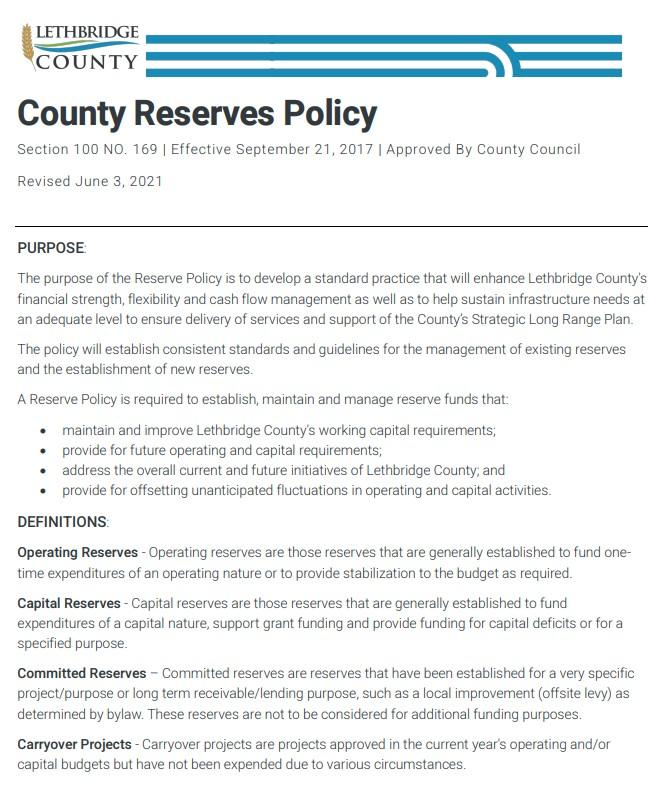
Provincial Debt Limit: Established under the MGA and related regulations, this limit caps the total amount a municipality can borrow to ensure long-term fiscal stability.
Debt Limit (AlbertaRegulation)
Debt Service Limit: This measures the County's ability to meet annual repayment obligations (principal and interest). Lethbridge County continues to maintain a healthy buffer below this threshold, demonstrating strong repayment capacity.
Service Limit
The Council section captures the direct costs of Council operations and the committees that support governance and decision-making. Council provides strategic direction, sets organizational priorities, approves policies, allocates resources through the annual budget, and oversees the overall governance of Lethbridge County.
Lethbridge County is divided into seven electoral divisions, each represented by an elected Councillor who resides in their division. The County’s population is 10,120 (2021 Census), with the next census scheduled for 2026.
Council selects a Reeve (Chief Elected Official) and Deputy Reeve at the annual organizational meeting and appoints members to required boards and committees.
In addition to governance, Council also administers grant support and discretionary initiatives from their budget, enabling responsive community funding and strategic investment in local priorities.
EXPENDITURES
• $7K increase tied to benefit changes.
• Allowance for grants / donations adjusted to align with historical resolutions.
• 2% Escalation
• Increased cost for council election cycle activities (strategic planning & orientation).
• Lower due to redistribution of allocation for internally provided IT services.
• Balanced contributions to reserves for cyclical activities related to four-year election cycle.
• 3% Escalation
• Cyclical scope for activities related to four-year election cycle funded by reserves.
• 3% Escalation
The CAO’s Office serves as Council’s primary link to administration and provides strategic leadership across the organization. This department includes CAO Services, Legislative Services, Strategic Initiatives, and Administrative Support, all working together to align Council’s direction with operational execution.
The CAO is responsible for coordinating Council agendas, providing recommendations on matters requiring Council direction, guiding strategic planning, and ensuring the implementation of corporate priorities such as service delivery, assessment, and service standards.
In addition to governance support, Legislative Services manages Council’s legislative processes, bylaw and policy administration, and compliance with provincial legislation.
Strategic Initiatives leads major cross-functional and interdepartmental projects, including asset management advancement, budgeting system implementation, organizational workflow improvements, and long-term planning initiatives. This work ensures the County continues to modernize systems, strengthen collaboration across departments, and deliver on Council’s strategic priorities.
2026 vs 2025
• Canada Summer Student Jobs Grant Program
• 2% Escalation and Cost of Living Adjustment
• Internal employee transfer between departments
• Redistribution of allocation for internally provided IT services.
• Management Contingency
2027 vs 2026
• 3% Escalation
• Management Contingency
2028 vs 2027
• 3% Escalation
• Management Contingency
People & Culture supports the organization by attracting, developing, and retaining qualified staff who deliver essential local services. This function includes recruitment and onboarding, administering employee benefits and compensation, supporting labour relations, ensuring compliance with provincial employment legislation, coordinating training and professional development, and fostering a safe, respectful workplace. Additionally, this human resource function guides managers on performance management, workplace policies, and organizational planning, helping the municipality maintain an effective workforce that can meet community needs efficiently and responsibly.
Health & Safety oversees the corporate safety management system which is dedicated to ensuring a safe and healthy workplace environment. This minimizes both the frequency and severity of workplace incidents. Safety personnel work with staff at all levels to ensure the county’s safety directives and safe work behaviors meet the organization’s expectations and comply with Alberta occupational health and safety legislative requirements.
Key Variance Drivers:
2026 vs 2025
• 2% Escalation and cost of living adjustment
• Personnel Adjustments
• Partially due to internal reallocation of personnel between departments
• Redistribution of allocation for internally provided IT services.
2027 vs 2026
• 3% Escalation
2028 vs 2027
• 3% Escalation
In a rural municipal context like Lethbridge County, Operational Projects refers to projects carried out by departments as part of their annual operational work, rather than long-term capital construction or major infrastructure investments. These projects often support service delivery, maintenance, regulatory compliance, or internal process improvements.
Common characteristics include:
• Funded from the operating budget, not the capital budget
• Short- to medium-term initiatives (often completed within the year)
• Focused on improving or maintaining municipal services
• Non-tangible outcomes (policies, studies, plans, software, equipment replacement, safety initiatives, program development)
This budget proposes council approve $41K for the following Operational Projects in 2026:
• $25K to continue Records Management Scanning Program (digitizing historical records)
• $16K for implementation of a Corporate Safety Management Software (CSMS).
Public Works is the County’s largest department and is responsible for managing, maintaining, and upgrading the core infrastructure that residents, businesses, and industry rely on every day. The team delivers essential services across a vast geographic area, supporting nearly 2,500 km of roads and an extensive network of above-ground and underground assets.
Public Works crews grade, gravel, plow, patch, reconstruct, sign, and service the infrastructure that keeps the County moving. Their work includes:
• Summer and winter road maintenance (grading, plowing, sanding, dust control, patching, crack sealing, minor rehabilitation).
• Management of drainage systems, culverts, and water flow to protect roads and private property.
• Fleet maintenance and equipment servicing to keep the County’s machinery operational yearround.
• Road signage and traffic control installation/maintenance to ensure safety throughout the network.
With the County’s size and its heavy agricultural and agri-food activity, gravel road maintenance is one of the most significant and ongoing operational challenges. Public Works’ efforts directly influence safety, mobility, economic activity, and quality of life across all rural communities.
-
2026 vs 2025
• 2% Escalation and cost of living adjustment
• Internal transfer between departments
• Gravel Crushing (3-year crush cycle)
• Redistribution of allocation for internally provided IT services.
• Transfers to reserves
• Expansion of Residential Dust Control Program to offer a Fall Application.
2027 vs 2026
• 3% Escalation
2028 vs 2027
• 3% Escalation
In a rural municipal context like Lethbridge County, Operational Projects refers to projects carried out by departments as part of their annual operational work, rather than long-term capital construction or major infrastructure investments. These projects often support service delivery, maintenance, regulatory compliance, or internal process improvements.
Common characteristics include:
• Funded from the operating budget, not the capital budget
• Short- to medium-term initiatives (often completed within the year)
• Focused on improving or maintaining municipal services
• Non-tangible outcomes (policies, studies, plans, software, equipment replacement, safety initiatives, program development)
This budget proposes council approve $304K for the following Operational Projects in 2026:
• $120K - Deep Base Stabilized Road Treatment (entails 2 miles per year for 5 years)
• $60K – Installation of Livestock Fencing (Fence & Gate) on Pothole Creek Road (as per Bylaw 903 (1989), etc.)
• $42K - Enhance traffic count program (includes purchasing six (6) Armadillos @ $7K each)
• $35K - Lafarge Road one-way traffic system to Hudson Pit off TWP RD 9-5
• $30K - Hard surface consultant, create plan, assess current state, increase capacity (use of zipper)
• $12K – Installation of Fence for Shaughnessy Pump Station
• $5K – Stand-up a temporary seasonal Grader Camp for Division 1
The fleet services department provides servicing and repairs to small engines, light duty fleet trucks, and heavy-duty fleet trucks along with various equipment. Small engine assets include weed trimmers, chainsaws, water pumps, fire equipment, and other miscellaneous equipment. Light duty fleet trucks are classified as mid‐size to full‐size trucks with the purpose to transport operators and laborers to and from job sites. Heavy duty fleet trucks and equipment trucks range in size from 3-6 tons, equipment for hauling and transporting materials, and construction equipment. During the spring, summer, and fall season, the primary purpose of heavy-duty fleet trucks is to transport aggregates from resource pits and stockpiles to road surfaces. In winter, these same trucks are equipped with plows, salt/sand, and sanding equipment. Total fleet services costs are allocated to various departments via “Equipment Rental” to better represent individual department costs.
Fleet services provides preventative maintenance and repairs to small engines and equipment, light and heavy-duty trucks, and heavy equipment and attachments. Servicing and repairs may be contracted out when service capacity is not available, or the expertise of the manufacturer is required.
Fleet services is responsible for maintaining all commercial vehicle files, conducting commercial vehicle inspections (CVIP’s) including administering warranties and recalls. Preventative maintenance of all fleet and equipment is key in keeping the fleet operational and maintaining low repair costs.
Key Variance Drivers:
2026 vs 2025
• Carbon Levy increasing each year until 2030
• 2% Escalation and cost of living adjustment
• Operational Project: Favourable variance of ($125K) for completion of Fuel Master Upgrade in 2025.
• Budget adjustments based on coding.
2027 vs 2026
• 3% Escalation
• Carbon Levy increasing each year until 2030
2028 vs 2027
• 3% Escalation
• Carbon Levy increasing each year until 2030
Water Distribution: The Water Distribution program is responsible for operating, maintaining, and servicing Lethbridge County’s geographically expansive regional water system. This includes routine system monitoring, regulatory testing, line repairs, valve and hydrant maintenance, and ensuring consistent service to residents, businesses, and agricultural operations.
In recent years, the County has made significant investments in strengthening this regional network to support the growing agri-food processing sector and the producers that rely on it. Continued operational attention—alongside planned capital maintenance and replacement—is critical to ensuring the long-term sustainability and performance of the system.
Wastewater Management: Lethbridge County manages the essential systems that keep our hamlets and business parks healthy, safe, and functioning. Our team oversees the day-to-day operation of an extensive sanitary sewer network, including collection mains, lift stations, and multiple lagoon treatment systems.
These lagoons use natural and engineered processes to safely treat wastewater before it returns to the environment, ensuring compliance, public health, and environmental protection. This work supports residents, businesses, and agri-food operations across the County and represents a critical service that often goes unseen but underpins quality of life in our communities.
Solid Waste Management: Lethbridge County’s Operations department oversees the County’s waste management programs, including access to multiple regional transfer sites for household waste disposal and contracted curbside collection in designated residential areas.
The Lethbridge Regional Waste Management Services Commission (LRWMSC) manages the planning and operation of the broader regional waste system and operates as a separate entity with its own audited financial statements.
EXPENDITURES - by object code
2026 vs 2025
• 2% Escalation and cost of living adjustment
• Increased water purchases from the City with the expansion of regional agrifood processing
2027 vs 2026
• 3% Escalation
2028 vs 2027
• 3% Escalation
In a rural municipal context like Lethbridge County, Operational Projects refers to projects carried out by departments as part of their annual operational work, rather than long-term capital construction or major infrastructure investments. These projects often support service delivery, maintenance, regulatory compliance, or internal process improvements.
Common characteristics include:
• Funded from the operating budget, not the capital budget
• Short- to medium-term initiatives (often completed within the year)
• Focused on improving or maintaining municipal services
• Non-tangible outcomes (policies, studies, plans, software, equipment replacement, safety initiatives, program development)
This budget proposes council approve $150K for the following Operational Projects in 2026:
• $75K for Iron Springs Water Reservoir Parging
• $75K Broxburn Raw Water Management Nanobubbles
Provided Lethbridge County Agriculture Service Board (ASB) activities are a balance between legislated responsibility and levels of service defined by Council as representatives of the public. The province requires annual reporting on ASB activities to demonstrate that the County’s commitments are met for both the Legislative and Resource Management Grant funding streams.
Our regular activities include:
• Park maintenance and enhancement
• Weed control
• Pest inspection and monitoring
• Soil conservation measures and education
• Roadside mowing
• Riparian management
• Nutrient management
Increase Decrease Total
2026 vs 2025
• Redistribution of personnel
• Chemical increased scope
• 2% Escalation and cost of living adjustment
2027 vs 2026
• 3% Escalation
2028 vs 2027
• 3% Escalation
In a rural municipal context like Lethbridge County, Operational Projects refers to projects carried out by departments as part of their annual operational work, rather than long-term capital construction or major infrastructure investments. These projects often support service delivery, maintenance, regulatory compliance, or internal process improvements.
Common characteristics include:
• Funded from the operating budget, not the capital budget
• Short- to medium-term initiatives (often completed within the year)
• Focused on improving or maintaining municipal services
• Non-tangible outcomes (policies, studies, plans, software, equipment replacement, safety initiatives, program development)
This budget proposes council approve $50K for the following Operational Projects in 2026:
• $40K for contracting services to remove trees near power lines
• $10K Manure Bypass Crossing
Provided
Infrastructure Services oversees the planning, delivery, and long-term asset management of the County’s physical infrastructure. This includes leading capital project management to ensure roads, bridges, and all other infrastructure are replaced and upgraded responsibly and efficiently. This management doesn’t stop at the County border. There are several regional projects that the County is actively participating in and/or managing such as Malloy, SRSDC, Regional Water Efficiency Studies, and other regional initiatives.
The department provides technical services such as asset management, GIS, and operational support to guide evidence-based decision-making and support day-to-day operations. In addition, the department manages and supports planning and development functions, ensuring growth is well-coordinated, compliant with regulations, and aligned with the County’s long-term vision. The County's potable water treatment and distribution agreements and license oversight is managed by the department which is critical in ensuring the long-term sustainability and strategic growth of the County.
Core Activities:
• Capital Project Management – Regional and Local
• Engineering Studies – Regional and Local
• Water Treatment and Distribution Agreement Management
• Asset Management
• Geographical Information System (GIS)
• Operational Planning & Support
• Development & Engineering Oversight
• Potable Water Sustainability (License management and acquisition)
• Lethbridge Regional Water Services Commission Management
• Operational Project Planning Collaboration
• Procurement
• Crossing Agreement Management
• Gravel Pit Management
• Transfer from PW to support AM/Survey/Field support position
• Reserve Fund Transfer for Land has been moved to Public Works going forward.
• Operational Projects:
• $200K Area Structure Plan
• $181K PSD Maintenance Manager Implementation (2026 portion)
• $100K Facility Feasibility Study
• 2% Escalation and cost of living adjustment
• Higher due to redistribution of allocation for internally provided IT services.
• Department Contingency
2027
• Annualized AM/Survey/Field position
• Favourable variance of ($381K) for Operating Projects completed previous year.
• 3% Escalation
2028
• 3% Escalation
In a rural municipal context like Lethbridge County, Operational Projects refers to projects carried out by departments as part of their annual operational work, rather than long-term capital construction or major infrastructure investments. These projects often support service delivery, maintenance, regulatory compliance, or internal process improvements.
Common characteristics include:
• Funded from the operating budget, not the capital budget
• Short- to medium-term initiatives (often completed within the year)
• Focused on improving or maintaining municipal services
• Non-tangible outcomes (policies, studies, plans, software, equipment replacement, safety initiatives, program development)
This budget includes previously council approved the grant funded use of $250K over two years (2025 & 2026) for the following Operational Project(s):
• $70K (2025) and $180K (2027) for implementation of a new Computerized Maintenance Management System (CMMS)
This budget proposes council approve $300K for the following Operational Projects in 2026:
• $200K for the Area Structure Plan (ASP).
• $100K for Facility Feasibility Study
Planning & Development guides how Lethbridge County grows, shaping land use, supporting development, and ensuring that new projects strengthen our communities and economy. The department balances high volumes of applications with long-range planning to make sure growth is safe, efficient, and aligned with Council’s vision and provincial legislation.
Planning & Development manages day-to-day development activity while planning for the County’s long-term future. The team:
• Reviews, updates, and maintains the County’s statutory plans and land use strategies, ensuring they reflect evolving community needs.
• Leads detailed reviews and recommendations for Area Structure Plans, rezoning, and subdivision applications, supporting responsible and well-coordinated growth.
• Intakes, reviews, and issues development permits, handling a steady and complex volume of applications from residents, businesses, and industry.
• Administers supporting programs such as development agreements, compliance reviews, encroachments, and County land dispositions.
• Coordinates land-use matters with residents, internal departments, regional partners, and external agencies to ensure development is practical, strategic, and collaborative.
This department plays a critical role in both processing today’s development pressures and planning tomorrow’s opportunities, ensuring Lethbridge County remains well positioned for sustainable, fiscally responsible growth.
2026
• Reserve contributions adjusted to reflect future IDP, land use strategy and hamlet study planning requirements
• ORRSC services contract increases
• 2% Escalation and cost of living adjustment
• Redistribution of allocation for internally provided IT services.
2027
• 3% Escalation
• IDP, land use strategy and hamlet study initiative contributions
2028
• 3% Escalation
• Municipal Development Plan
The Finance & Administration office is responsible for overall long-term financial sustainability of the County. It is our mission to provide the appropriate controls and measures needed to manage the County’s resources and to deliver accurate financial information for Council and administration that can assist in financial planning decisions. The Finance and Administrative staff are accountable to assist all departments in achieving their service goals and objectives through the responsible stewardship of corporate finance resources in accordance with the bylaws, resolutions, and strategic goals of Council.
• Budgeting, accounting, audit, and financial reporting (including cash management, long-term debt, accounts payable & receivable processing)
• Payroll processing as well as annual reporting to various government bodies
• Managing an insurance program that sustains the municipality’s ability to deliver services to the community and limits overall risk
• Grant management and annual expenditure reporting to funding agencies
• Administration of grants to various community services groups including libraries, recreation & community facilities and Family & Community Support Services (FCSS)
EXPENDITURES
Year-Over-Year Budget Variances
2026 vs 2025
• Personnel changes and redistribution of resources
• Insurance and audit cost increases
• 2% Escalation and cost of living adjustment.
• Internal transfer between departments for consistency.
• Redistribution of allocation for internally provided IT services.
2027 vs 2026
• 3% Escalation
2028 vs 2027
• 3% Escalation
The IT department is a vital part of County operations, delivering responsive support and innovative solutions while upholding the highest standards of cyber security. As the first line of defense in protecting the County’s financial information, all systems handling sensitive data are maintained to be secure, reliable, and compliant with industry best practices.
• Establishes clear directives, processes, and technology standards to ensure IT systems are effectively managed, aligned with County needs, and compliant with all regulatory requirements.
Operations
• Deliver technical support, user education and training, cyber security protection
• Represents the daily functions of the IT Department.
• Maintains network performance and uptime.
• Manages devices to ensure secure and reliable access.
• Manage software services enabling productivity across teams
• Conducts regular security testing and risk assessments.
Hardware
• Installations, configurations, and maintenance
2026 vs 2025
• 2% Escalation and cost of living adjustment
• Redistribution of allocation for internally provided IT services (software centralized and charged out to departments).
(10) 1,625
B u d g e t 2 0 2 5
P e r s o n n e l A d j u s t m e n t s
T r a n s f e r s b t D e p a r t m e n t s
S o f t w a r eS c o p e I n c r e a s e
S o f t w a r eS c o p e D e c r e a s e O p e r a t i o n a l P r o j e c t s I T A l l o c a t i o n I T L i f e c y c l e G e n e r a lS c o p e I n c r e a s e B u d g e t 2 0 2 6 G e n e r a lE s c a l a t i o n S o f t w a r eS c o p e I n c r e a s e S o f t w a r eS c o p e D e c r e a s e S o f t w a r e
• Software inflationary increases and system changes (Questica, Government Frameworks, PSD Asset Maintenance)
• Operational Project: Financial System implementation 20262027 (ERP)
2027 vs 2026
• 3% Escalation
• Operational Project: Financial System implementation 20262027
2028 vs 2027
• 3% Escalation
• Decrease mainly due to completion of Operational Project: Financial System implementation in 2027.
In a rural municipal context like Lethbridge County, Operational Projects refers to projects carried out by departments as part of their annual operational work, rather than long-term capital construction or major infrastructure investments. These projects often support service delivery, maintenance, regulatory compliance, or internal process improvements.
Common characteristics include:
• Funded from the operating budget, not the capital budget
• Short- to medium-term initiatives (often completed within the year)
• Focused on improving or maintaining municipal services
• Non-tangible outcomes (policies, studies, plans, software, equipment replacement, safety initiatives, program development)
This budget proposes council approve $750K over two years (2026 & 2027) for the following Operational Project(s):
• $250K (2026) and $500K (2027) for implementation of both a new Enterprise Resource Planning (ERP) and Human Resource Information System (HRIS).
Provided Assessment Services determines property values for residential, farmland, and commercial properties. The county coordinates receiving values from the province for linear properties. Property values are determined on an annual basis, and each property is reviewed on a rotation basis. Assessment services is responsible to prepare, communicate, and defend equitable assessments within Lethbridge County.
• Uses market value, regulated rates, or agricultural use value depending on provincial legislation.
• Tracks changes such as new construction, renovations, demolitions, or changes in land use.
• Follows Alberta assessment standards (Municipal Government Act and Matters Relating to Assessment and Taxation Regulation).
• Works with council to apply mill rates (tax rates) to assessed property values.
• Calculates and issues annual property tax notices.
• Ensures collected taxes are distributed to fund municipal operations, requisitions (like education taxes), and other mandated levies.
• Manages the appeals process if a property owner disputes an assessment, including preparing evidence for an Assessment Review Board.
• Maintains accurate property records, tax rolls, and assessment rolls.
EXPENDITURES
Key Variance Drivers: 2026 vs 2025
• 2% Escalation
• Internal transfer between departments - DIP
• One time allowance
• Outsourcing Strategy –Implementation Year 1 Contracted Services
• Outsourcing Strategy –Implementation Year 1 Internal Cost Reductions 2027 vs 2026
• 3% Escalation
• Outsourcing Strategy –Implementation Year 2 Internal Cost Reductions 2028 vs 2027
• 3% Escalation
Provided Lethbridge County’s Emergency Services department delivers a broad range of critical public safety programs that protect residents, businesses, and infrastructure across the County.
Fire & Emergency Response – Contractual oversight of four partner fire departments providing 24/7 response to fires, motor-vehicle incidents, rescues, hazardous materials, and medical co-response.
Regional Emergency Management – Administration of a major regional partnership, maintaining and exercising an all-hazards emergency plan and coordinating response with neighbouring municipalities under Alberta’s Incident Command System.
Community Peace Officer Program – Proactive patrols, bylaw and provincial statute enforcement, public education, and on-scene support to emergency responders to protect safety and County infrastructure.
Policing (Provincial Requisition) – Mandatory cost-sharing set by the Province through the rural policing model; a significant budget component determined entirely outside municipal control.
This department manages complex, high-intensity work that ensures community safety, regional coordination, and emergency readiness across Lethbridge County.
2026 vs 2025
• Provincial policing contract increase is $376K per year (~57% increase)
• Update Fire Service Agreement
• 2% Escalation and cost of living adjustment
• Internal transfer between departments for consistency.
• Redistribution of allocation for internally provided IT services.
2027 vs 2026
• 3% Escalation
2028 vs 2027
• 3% Escalation
Provided
The Growth & Engagement department leads Lethbridge County’s efforts to strengthen the regional economy, support local businesses, and position the County for long-term, sustainable prosperity. The department focuses on investment attraction, business retention and expansion, stakeholder engagement, intergovernmental relations, and strategic partnerships that advance economic opportunities across the region.
A key responsibility of the department is aligning economic development, infrastructure planning, and land-use strategy to create a clear, coordinated pathway for responsible growth. This work ensures the County is proactive—rather than reactive in responding to shifting industry needs, global economic pressures, and technological change.
The program also includes the Communications & Marketing department, guiding the County’s brand, public engagement, issues management, and outreach efforts. This supports transparency, clarity, and a strong public presence while promoting the County’s strengths to residents, businesses, and potential investors.
By integrating economic development, communications, and strategic relationship-building, the Growth & Engagement program plays a central role in keeping Lethbridge County competitive, resilient, and well-positioned for the next decade and beyond.
2026 vs 2025
• $30K for continued consolidation of advertising budget in Communications & Marketing Department
• 2% Escalation
• Discontinued Alberta Advantage Immigration Program (AAIP)
• Higher due to redistribution of allocation for internally provided IT services.
• Growth & Engagement InitiativePersonnel, Contingency/Allowance (e.g. NRED Grant, joint development, etc.)
2027 vs 2026
• 3% Escalation
• Timing of Operational Projects
2028 vs 2027
• 3% Escalation
• Operational Projects:
• New Website

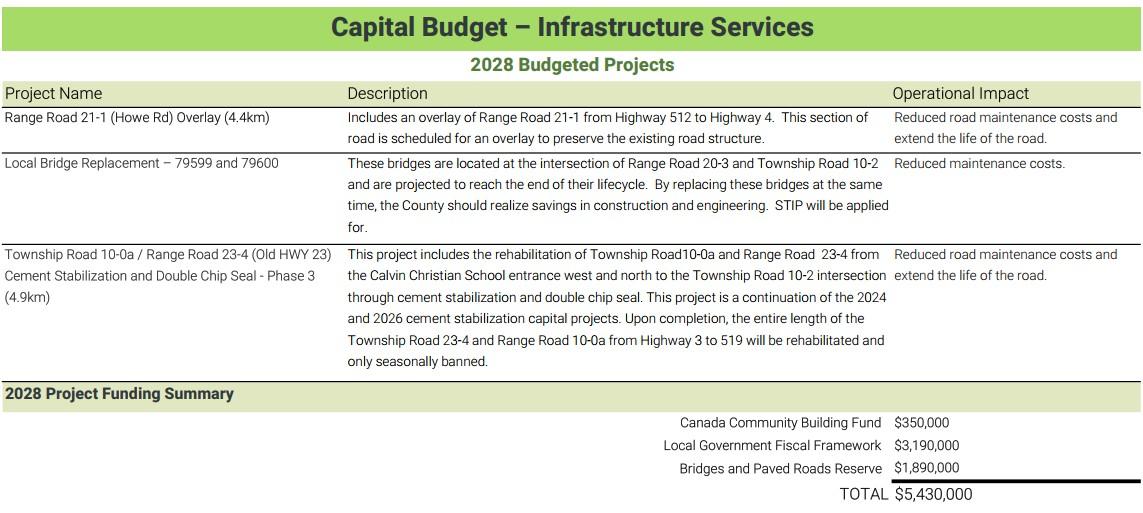
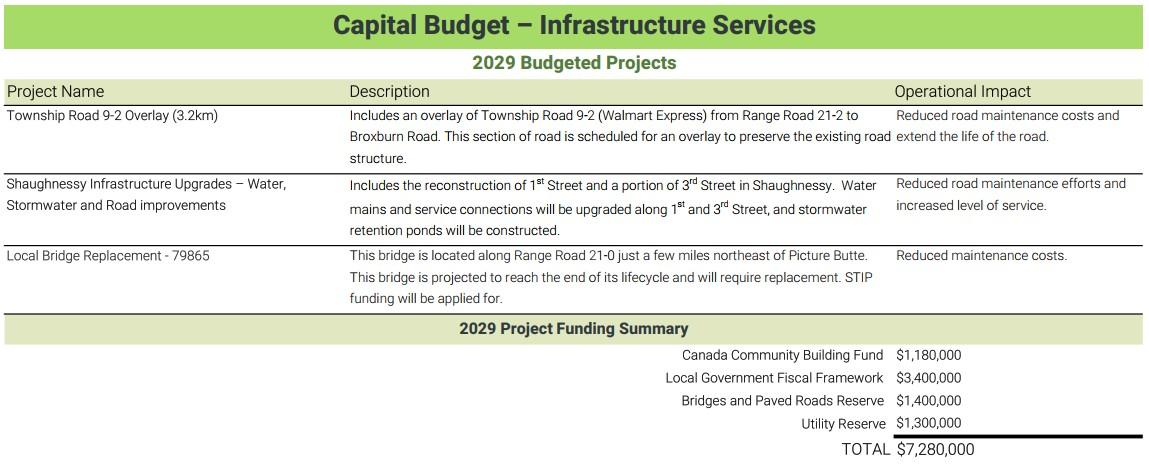
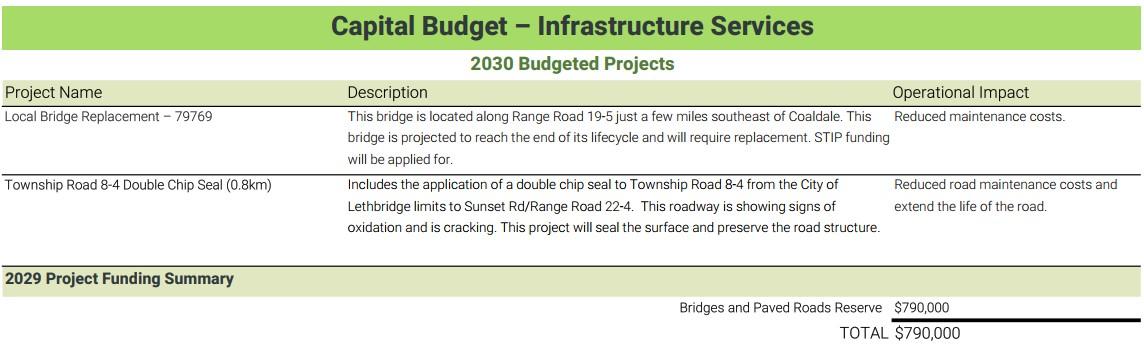
Construct and Improve infrastructure to provide the highest level of service possible within the constraints of the budget for continued services delivery.
Determine capital purchases and projects based on condition, risk and need to ensure proper identification and timing of projects.
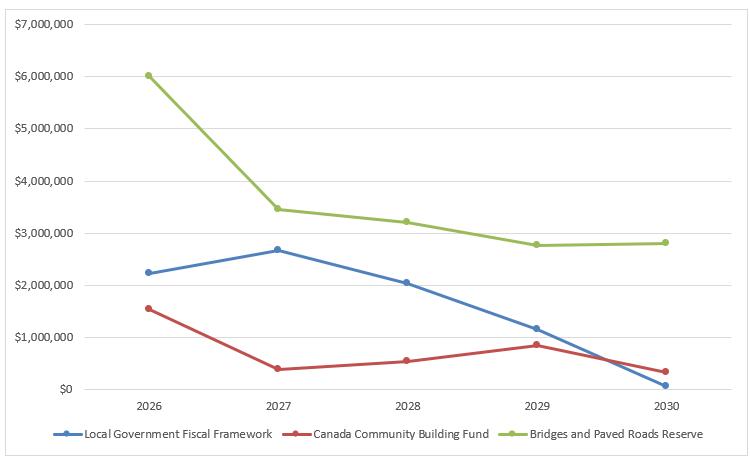
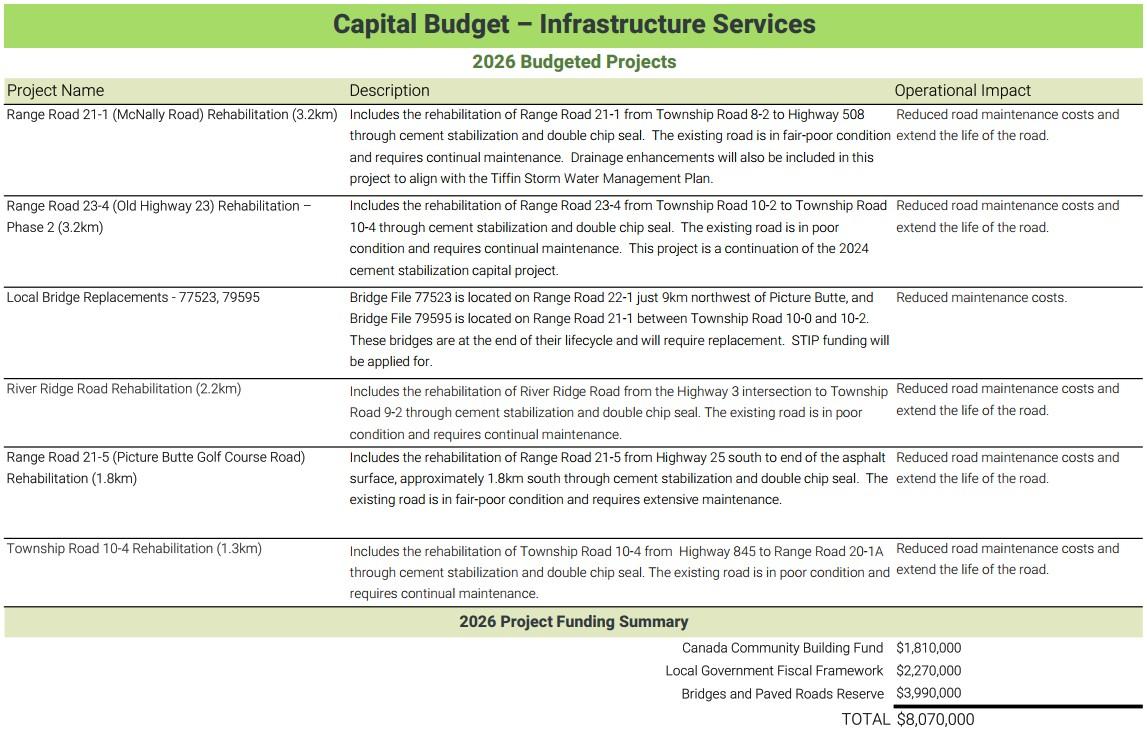
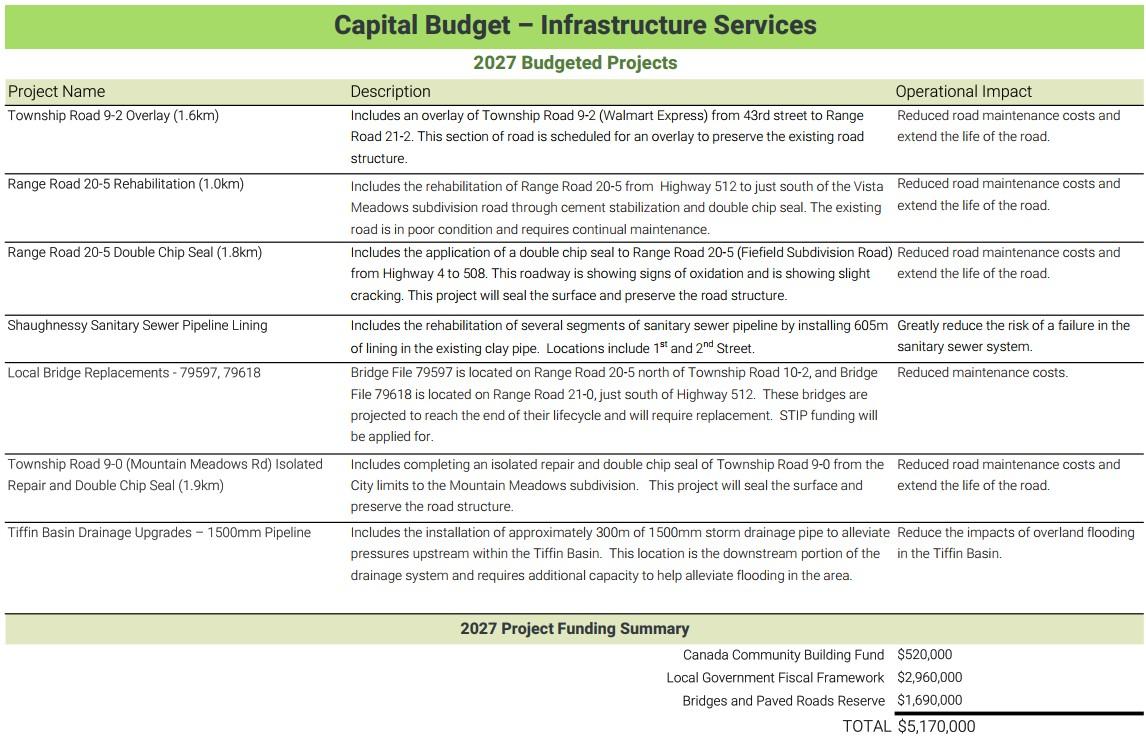
Present a 5 Year Capital Budget with funding options that are sustainable and meets the County’s requirements and Councils Strategic Plan.
Primary Funding Sources:
Primary funding sources are a fairly consistent and a reliable source of revenue to offset capital expenditures. Competitive funding sources are guaranteed and should not be relied upon as a funding source.
Purpose: To fund the Calcium Base Stabilization program specific to the Market Access Network
Budget: Revenues
o Business Tax
o Cap Levy
o Farmland Levy
Expenses
o Haul road debt payments
o Bridge & paved roads projects and/or transfer of balance to designated reserve
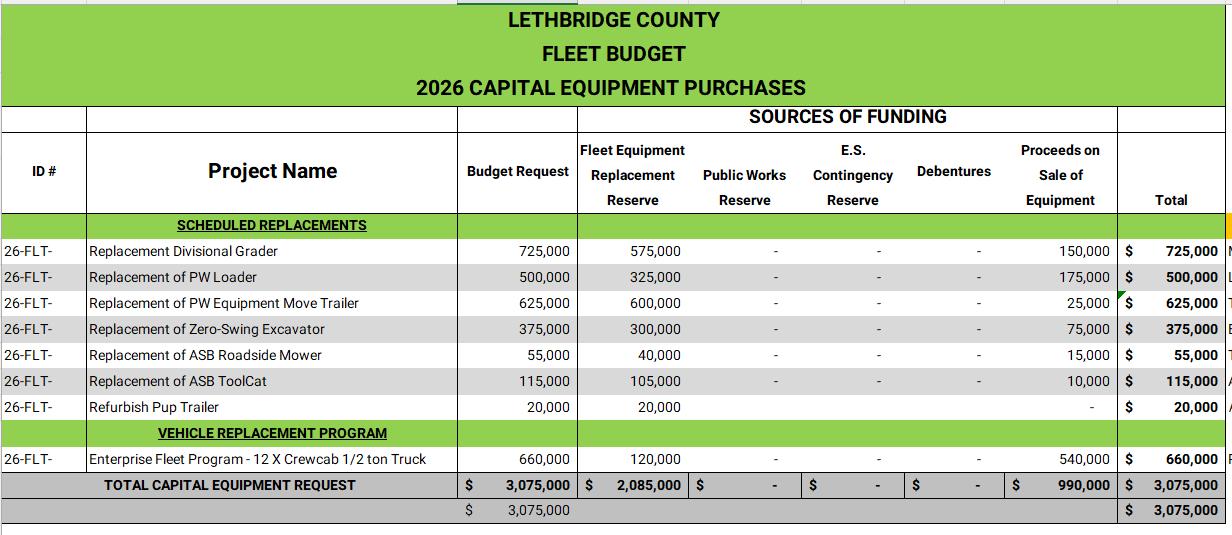
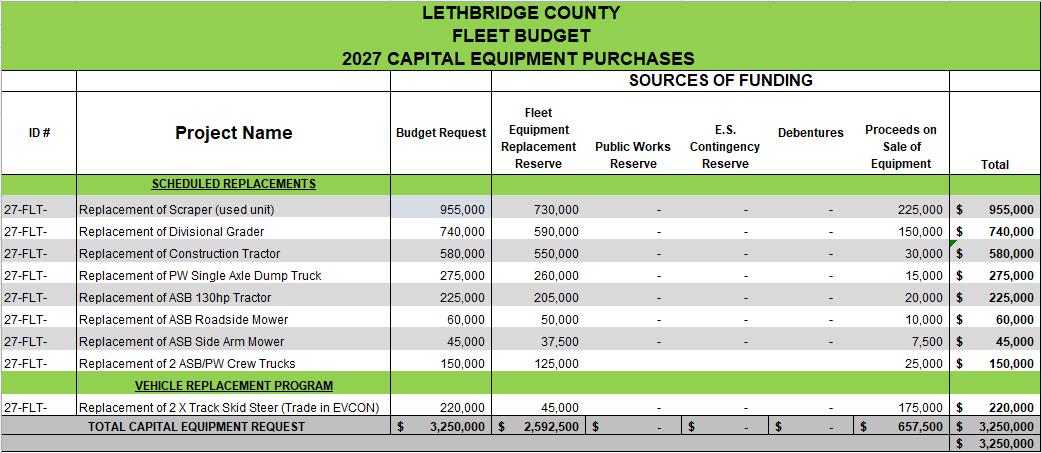
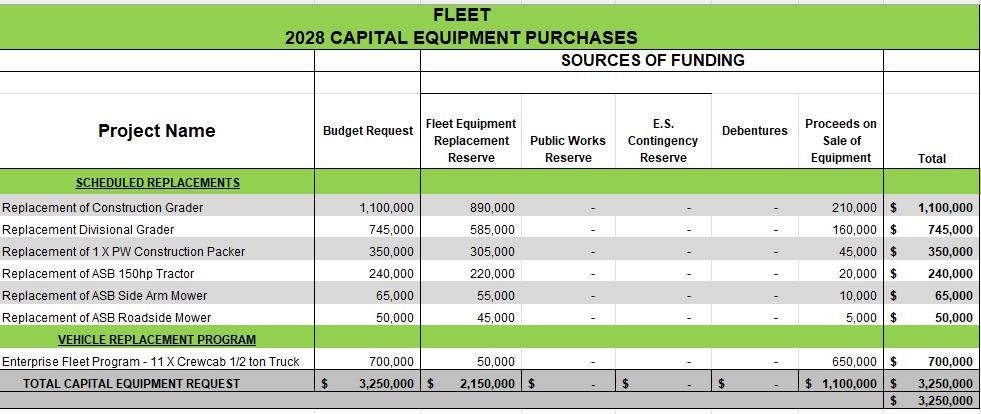
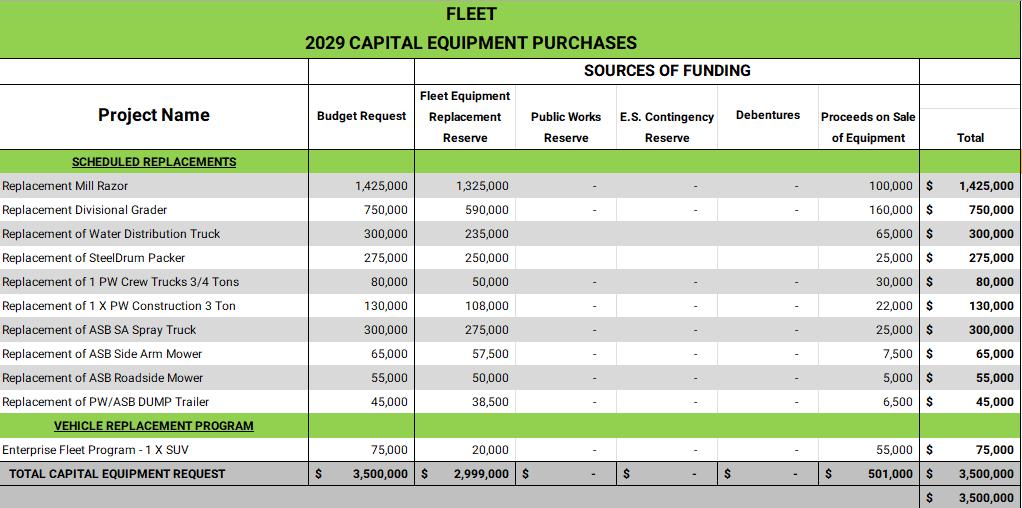
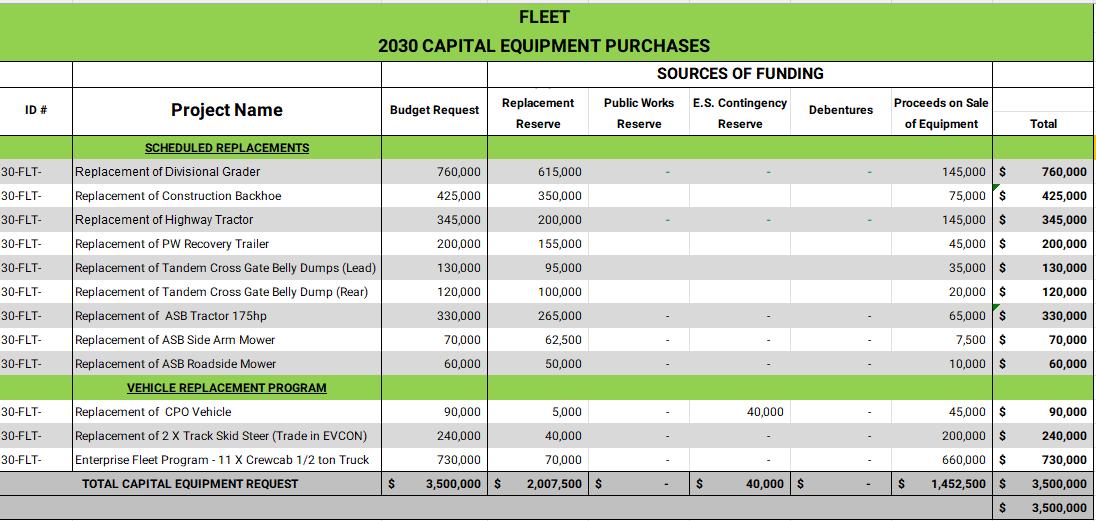
Fleet Capital Projects (Previously Approved October 1, 2025)
• Per MGA 671
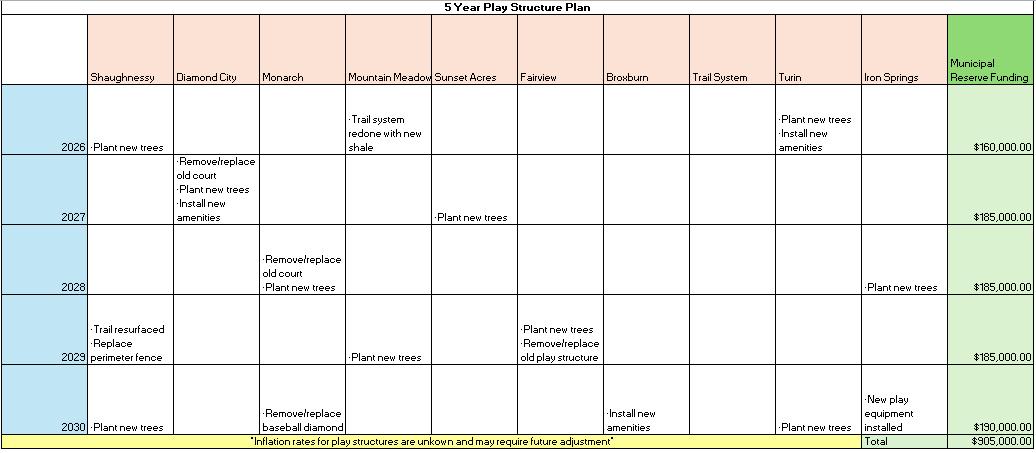
• A “municipal reserve” is land set aside (or money in lieu) by a municipality, when approving subdivision, for public use — typically parks, recreation, school‐board use, or to create buffers between land uses.
• Allowed uses:
o a publicly owned park;
o a publicly owned/operated recreation area;
o school board purposes;
o to separate areas of land that are used for different purposes.
• Municipal Reserve Funds must only be used for municipal projects on public lands or publicly owned/operated facilities or for the purchase of public lands.
EXPENDITURES
EXPENDITURES