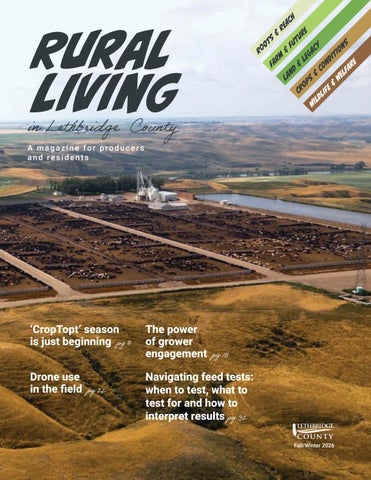
Rural Living
in Lethbridge County A magazine for producers and residents
‘CropTopt’ season is just beginning pg 8
The power of grower engagement pg 18
Drone use in the field pg 22
Navigating feed tests: when to test, what to test for and how to interpret results pg 32 Fall/Winter 2026
Rural Living in Lethbridge County Vol. 2 | Issue 1 | Fall/Winter 2026
Rural Living in Lethbridge County is a bi-annual magazine, written for and by County producers and residents, in association with the Rural Living & Ag Extension of Lethbridge County. Previously known as the Rural Living & Ag Extension Newsletter, Rural Living in Lethbridge County is the evolution of the longstanding periodical. You’ll continue to enjoy local agricultural stories and innovations, alongside a fresh new style and some innovations of our own. All grounded in the rich and rooted agricultural community of Lethbridge County. Readers who would like to receive an e-version of the magazine, comment on a story, change their address or remove their name from our mailing list should email the County at mwells@lethcounty.ca.
Lethbridge County Where roots run deep and the future is bright. Publisher: Lethbridge County Editors: Matthew Wells & Mattie Watson Art director/designer: Kelsey Janzen Photographers: various Cover image: James Hay (Hay Visuals) Writers: Isaac Aboagye, Mary Bishop, Doug Burke, Belinda Crowson, Lorne Fitch, Scott Gillespie, Theresa Hardiker, Davin Johnson, Deann Madsen, V.G. Nealis, Cassidy Read, Phil Rose, Gary Secrist, Avery Taylor, Ryan Uytdewilligen, Eric Van Essen, Jody Wacowich, Ashley Wagenaar, Mattie Watson, Matthew Wells, John Wilmshurst, Tom Wolf, Heath Wright, Agricultural Service Boards, Beef Cattle Research Council, Calgary Stampede, Cows and Fish, Lethbridge Polytechnic, Lethbridge Regional Waste Management Services Commission, ULethbridge
From the editor As harvest season comes to an end and winter approaches, it’s time to reset and recharge from all the hard work that went into the farm this year. Heading into the new year, it’s also an opportunity to reflect, learn, and look for ways to improve your farm operation. Advancements in agriculture happen every day. Whether through changes in regulations, promising new research, or technological advancements, it can be hard to keep track of it all. The Rural Living in Lethbridge County magazine certainly can’t capture everything, but we work hard to provide the most relevant topics and information that can have an impact on folks throughout Lethbridge County. Whether it’s drone use in agriculture by Tom Wolf, OHS legislation and farm responsibilities by Jody Wacowich, or learning about the history of agriculture in Lethbridge County by Belinda Crowson, there is certainly something here for everyone. When you’re sitting at your kitchen table, drinking a warm cup of coffee in the comfort of your home as the snow begins to fall outside, take some time to give the magazine a read. You never know what you might find. Perhaps you’ll learn something new, discover a resource you didn’t know about, or simply enjoy taking a few moments to catch up on what’s happening in your community. Have a fantastic winter, and Merry Christmas and Happy New Year to you and your families!
LETHBRIDGE COUNTY Rural Living & Ag Extension
Matthew Wells Rural Extension Specialist Lethbridge County
2
Rural Living & Ag Extension | Fall/Winter 2026
Roots & Reach • •
Visit your local transfer station for easy waste disposal. Page 10
Farm family spotlight: Gschaids Page 16
• • • • •
Growing What’s Next Conference Nov 24-25 Page 19
Lethbridge Northern’s Father of Irrigation Page 4 Local spotlight: The Next Big Pigs Page 5 Bronze birch borer Page 6 ‘CropTopt’ season is just beginning Page 8 Transfer stations, insurance and staying connected Page 10 Project updates & events from the County Page 12 The next generation Page 13
Farm & Future • • • • • • • • • •
ASB update Page 14 Did you know? DED Page 14 Duties of Agricultural Service Boards Page 15 Funding opportunities Page 15 Barons Ag Society Page 17 The power of grower engagement: PGA Page 18 Cleanfarms, grower conference and backing up your files Page 19 Wheels of Opportunity: driving Ag careers forward Page 20 AgSafe: Beyond the minimum Page 21 Drone use in the field Page 22
Land & Legacy •
Who me? Part of the watershed? Don’t flush yet! Page 28
• • •
A small act of soil conservation Page 24 Soil zones Page 24 ACA: Grassland awareness Page 26 Maintaining our road network for the future Page 27
Crops & Conditions •
Plant tissue analysis: turning samples into better decisions Page 30
Wildlife & welfare • •
Congratulations to the wordsearch winners from the Spring/Summer 2026 issue!
Navigating feed tests Page 32 The importance of disease reporting Page 34
Ready for the next puzzle? Head to page 35 to complete this issue’s wordsearch.
3
George Pearson, Lethbridge Northern’s Father of Irrigation Belinda Crowson George “Old Man’ Pearson was born in Ontario and moved west in 1885. He spent some time in western Canada in the 1880s and 1890s and then lived in Washington State and Idaho from 1895 to 1908. In 1908, he homesteaded in the area between Iron Springs and Picture Butte. He soon realized he had settled in a very dry area and that the only way it was going to prosper was through irrigation. On behalf of the Iron Springs U.F.A., Pearson presented a petition to the Hon. Frank Oliver, Minister of the Interior, when Oliver was visiting Lethbridge with Prime Minister Laurier in 1910. Pearson suggested to Oliver that fields be irrigated by water lifted out of the Oldman River in the Picture Butte. Oliver accepted the petition. When back in Ottawa, he wrote Pearson acknowledging receipt of the petition and informing Pearson that the federal government had never created any irrigation system, leaving that to private enterprise. Further, the letter continued, Oliver noted that Pearson’s idea of lifting the water would not be feasible from a commercial enterprise standpoint.
1921, Sod turning for the LNID with George Pearson holding the reigns.
Pearson didn’t let the negative response deter him. In his response to Oliver, he informed the minister that he would not be sidetracked by the statement ‘that the government has never undertaken irrigation canals,’ but had left that enterprise to individual efforts, and questioned why the government would leave so important a task to private effort? Pearson further insisted that Oliver bring this matter before the House and send out an engineer to look over the land and discover whether the proposal was practicable. Despite Pearson’s work, things didn’t move ahead with Laurier’s government. Pearson did, though, have more luck in getting other locals behind the need for irrigation. One of the people Pearson inspired was Mr. Marnoch of the Lethbridge Board of Trade. Pearson’s passion, combined with Marnoch’s quiet, methodical work and persistence helped to move the issue forward. Pearson and Marnoch, along with Lethbridge Mayor Hardie and the mayors of Calgary and Medicine Hat, visited Ottawa in 1915 to promote the need for irrigation. They presented to Prime Minister Borden and his government, who had replaced Laurier a few years earlier. The mayors all expressed that the proposal would relieve the unemployment and distress in the area and was greatly needed. After the politicians were done, Pearson, dressed in the same overalls and shirt he wore on his farm and carrying a homemade cane, started to speak. He spoke for an hour, informing the government that not only would irrigating the area open a rich, agricultural country, but it would provide work for desperate settlers.
1921, George Pearson with walking stick.
4
The government assured them they would do everything to get the scheme moved
Rural Living & Ag Extension | Fall/Winter 2026
forward. Soon the area was extensively surveyed. Pearson’s original idea of lifting water was found to be too expensive and impracticable. Instead, it was decided to take water from the Oldman River near Fort Macleod and move it into the area using canals with reservoirs for storage. The Lethbridge Northern Irrigation District (LNID) was formed in 1919 and in 1921, the sod was turned and the first furrow plowed. At the LNID sod turning in 1921, at Sauder’s camp on Albion Ridge, Pearson’s role and persistence were recognized. He was given the honour of holding the reins for the plow, while Lieutenant Governor Robert G. Brett was requested to hold the plow. Watching and attending the event, was Superintendent R.W. Pennefather of the RCMP (seen in uniform in the photograph), with Premier Charles Stewart standing to his immediate left. It took years for the irrigation district to be built, years where farmers struggled through drought and difficult years. Finally, in 1923 water flowed through the ditches and canals of the LNID. Water has continued to flow through the LNID since then and the farmers of the area owe a lot to Pearson, as well as Marnoch and others who believed in Pearson’s dream. So, what happened to Pearson in the end? After building excitement around irrigation and advocating for it for years, he eventually sold his land in the Picture Butte area and moved to California. What would he think if he saw the area today?
Submitted by Belinda Crowson Lethbridge Historical Society Photos courtesy of Galt Archives.
Local spotlight: meet The Next Big Pigs by Ryan Uytdewilligen Ryan Uytdewilligen Who’d have thought a handful of Lethbridge County pigs would inspire a children’s book? But that’s exactly what happened—taking shape through an idea that rattled around my brain since I was a kid. Growing up northwest of Coaldale, I lent a hand to my family’s hog operation from time to time—helping move them to different barns, even though I wasn’t that much bigger than the livestock I was chasing. When I was nine, I joined the Coaldale 4-H Swine Club; a club my grandfather helped start in the 1970s and one my own father led once I took a liking to it and became a long-term member. The thing was…I was no ordinary farm kid. Instead of driving tractors and feeding animals, I was off I my own world coming up with story ideas. For a long while, I wanted to be an actor. When I was off one day to see my 4-H pigs, my mom teased me, knowing full well I’d rather be on a stage. She said, “Who are you going to perform for? An audience of pigs?”
act instead of farm. And since anything can happen in a kid’s book, the boy learns that not only can his pigs talk, they’re in an acting troupe. So, he does the next logical thing he can think of—and that is to bust them out of the barn and go to New York City to make it big on Broadway. It’s now my latest book, published by Heritage House Press this past Spring. It’s called The Next Big Pigs. Aimed at young readers six to eight, it’s all about following your dreams and making friends along the way. Writing an early reader chapter book seemed like a logical step after my first picture book, This is Not My Story, was published in 2023. But the inspiration for its theme comes straight from growing up right here in the County. 4-H. The family farm. None of it would have made it to the page without that inspiration, though sadly, my pigs never once uttered a word to me. In fact, most of my books seem to start with something I saw growing up just east of Broxburn Road. My first novel was about a teenager driving a tractor. My last non-fiction book was a true account of a court battle over a family farm called Love, Land, and Lawyers. I’ve even done a whole history book detailing the city of Lethbridge. While I no longer live in Lethbridge County, it no doubt served as an inspiration. It was a great place to grow up that provided a lot of memories. I visit often! And evidently, as I visit old friends and family members, I keep my eyes peeled for stories to be told.
“Maybe they want to perform too?” I thought as they routinely nibbled my gum boots. She was right. I usually was acting out some one man show whenever I had the chance. The pigs must have wondered what was with all the jumping around and speaking in funny voices. Twenty years later, the idea of performing pigs was too enticing to ignore. I thought it would be fun (and personal) to write a kids book about a farm boy who wants to
Submitted by Ryan Uytdewilligen You can find The Next Big Pigs wherever you buy your books.
Roots & reach roots & reach
5
Winding tunnel on the wood surface of birch caused by the feeding of a bronze birch borer larva.
Bronze birch borer
V.G. Nealis
General information and importance
However, recent widespread periods of birch decline, perhaps linked to stress events such as drought, age-related senescence, and spring thaw-freeze events, have been associated with more frequent outbreaks of bronze birch borer. Climate change could exacerbate these conditions, increasing the severity of outbreaks, especially in the southern range of birch.
Bronze birch borer and its relatives are members of the insect family known as metallic wood-boring or jewel beetles. Bronze birch borer is native to North America and a specialist feeder on all native and introduced birch (Betula) species in Canada. Larvae feed in tunnels beneath the bark, interrupting the translocation of nutrients and water. Bronze birch borer generally attacks older and stressed trees, resulting in low population densities in natural forests where there are few susceptible trees.
Recent widespread periods of birch decline, perhaps linked to stress events such as drought, age-related senescence, and spring thaw-freeze events, have been associated with more frequent outbreaks. 6
Distribution and hosts Although commonly found on white birch (Betula papyrifera), all native birches throughout temperate and boreal North America can be attacked, particularly if they are weakened by old age, drought, or other environmental stresses. Introduced birch species, such as European white birch (B. pendula), appear highly susceptible in comparison. These species have been planted as ornamentals in cities throughout North America, resulting in an increase in the historic range of bronze birch borer to western and southern North America. These novel habitats for the introduced birches may increase their stress and therefore make them more susceptible to bronze birch borer attack.
Rural Living & Ag Extension | Fall/Winter 2026
Tree parts affected Adult bronze birch borers feed briefly on leaves, mostly in the upper canopy, causing little visible damage. Larvae excavate feeding galleries under the bark within the phloem and xylem of branches and the main stem of the tree, disrupting the translocation of water and nutrients.
Symptoms and signs Adults are slender, olive to copper bronze beetles, ranging from 6 to 12 millimetres in length. They may be confused with several related, similar-looking beetles. Adults are seldom observed, as they are most active in the upper canopy of host trees. Sap flow may be seen on the trunk near where larvae enter, usually on the unshaded side of the tree. The meandering galleries excavated by the feeding larvae under the bark create criss-crossing welts visible on the outer bark of large branches and the main stem. Larvae are legless and slender, except for an enlarged segment behind the head, hence the common name for the related group, flat-headed borers. The larvae have two brown pincer-like structures at the tip of the abdomen. Pupal cells can be found under the bark of the tree. Adults exit from D-shaped holes
that may have coarse sawdust deposited nearby. Discolouration and premature drop of foliage from attacked trees begins in the upper crown, followed by dieback of branches.
Life cycle There is one generation per year in southern portions of the range. Two years are required to complete development in cooler regions or in vigorous trees. Adults emerge during a 6-week period from May to July and feed on foliage before reaching reproductive maturity. They are strong fliers but tend not to disperse if susceptible trees are nearby, causing local and intense infestations. Eggs are laid singly or in clusters in bark crevices, often where smaller branches meet the main stem. Newly hatched larvae bore through the bark into the phloem where larvae complete four or five stages. Pupal cells are constructed just under the bark, although pupation does not occur without a period of chilling. This enables more synchronized early-summer emergence of adults. Following pupation, adults emerge through D-shaped exit holes.
Damage Damage to foliage by feeding adults is negligible. Tunnels bored by larvae as they feed beneath the bark impede the translocation of water and nutrients in the tree. Eventually, branches are girdled by these tunnels causing dieback. This begins in the upper canopy and continues until the entire tree is affected. Tree death may take several years, depending on local density of borers and tree vigour (i.e., trees weakened by other factors).
Prevention and management Bronze birch borer is a native species of forested ecosystems throughout North America where birch is present. The insect is considered a secondary pest because it targets old and weakened trees. Impacts in urban landscapes can be more severe where growing conditions are often suboptimal and where birch trees may be under stress. Planting susceptible introduced birch species should be avoided. Maintaining moist, cool soil conditions by mulching and watering is advised. Vigorous trees may be attacked but can produce callus tissue around the feeding gallery, killing the insect and mitigating damage. Pruning dead branches and removing heavily infested trees reduces local populations of bronze birch borer. Infested material should be chipped, burned, or exposed to full sunlight to kill larvae. In natural woodlands, susceptibility can be reduced by managing for diverse age classes and avoiding the practice of leaving isolated birch during harvest. Following harvest, these residual trees often become weakened or damaged by wind and are susceptible to attack by bronze birch borer. Natural enemies play a small role in reducing bronze birch borer populations. Insecticides have been used against this insect but require multiple drenching or systematic injections. Bronze birch borer attacks European species of birch in North America. This observation identified the risk of accidental introduction of the insect into Europe and prompted the European Union to declare bronze birch borer a quarantine pest. The import of birch wood products, including wood packing, require the removal of bark and outer sapwood or treatment with ionizing irradiation under supervision of a national plant protection organization.
•
•
•
•
activity and population level (either to the host, property, or the environment); an understanding of the pest’s life cycle, its various life stages, and the various natural or abiotic agents that affect population levels; how many individual host specimens are affected (an individual tree, small groups of trees, plantations, forests); the value of the host(s) versus the costs of pest management approaches; and consideration of the various silvicultural, mechanical, chemical, biological, and natural control approaches available and their various advantages and disadvantages.
Decisions about pest management strategies require information about each of these factors for informed decisionmaking. These various factors should then be weighed carefully in terms of costs and benefits before action is taken against any particular pest. Pesticides registered for use against bronze birch borer under specific situations may change from year to year. Therefore, please search Health Canada’s Pesticide Product Information Database for currently registered pesticides and product information for use against this insect. The application of any registered product should be based on population size and applied only when necessary and against the approved life stage. It is also recommended to consult a local tree care professional. Pesticides may be toxic to humans, animals, birds, fish, and other beneficial insects. Apply registered products only as necessary and follow all directions and precautions noted on the manufacturer’s label. In some jurisdictions and situations, only a licensed professional can apply pesticides. Consulting relevant local authorities to determine local regulations that are in place is recommended.
Pest management strategies for a particular pest vary depending on several factors. These include: •
• Bronze birch borer adult.
the population level of the pest (i.e., how numerous the pest is on the affected host[s]); the expected damage or other negative consequences of the pest’s
Sourced from: Nealis, V.G. 2024. Bronze birch borer. In J.P. Brandt, B.I. Daigle, J.-L. St-Germain, A.C. Skinner, B.C. Callan, and V.G. Nealis, editors. Trees, insects, mites, and diseases of Canada’s forests. Natural Resources Canada, Canadian Forest Service, Headquarters. Ottawa, Ontario.
Roots & reach roots & reach
7
Summer might be over, but “CropTopt” season is just beginning Lethbridge Polytechnic Crop rotation is not as simple as it seems. Dozens of environmental and economic factors need to be considered when deciding when and where to plant which crops. And, importantly for irrigation farming, producers have to plan for all precipitation and water allocation scenarios, which can vary drastically from year to year and have a significant impact on crop yield and quality. “Seed goes in the ground, contracts are signed, and rotation decisions are made before anyone knows how much water will be available that year,” said Dr. Selin Karatepe, an econometrician at Lethbridge Polytechnic. “Under those circumstances, a profitable plan and a safe plan are rarely the same plan.” As Canadian agriculture becomes increasingly data-driven, researchers like Dr. Karatepe are asking—is there any way to use data analytics to demystify crop rotation? A year after starting work on their Alberta Innovates-funded project, Investigating Farm and Field Profitability Under Limited Irrigation Water Availability, the project team believes they have an answer. Their research has resulted in the creation of CropTopt, a statistical modelling program that predicts how crops will respond to
Lethbridge Polytechnic researchers work to develop and validate new agricultural technologies.
different weather and water scenarios over time. By analyzing over 25 years of regional environmental and economic data, CropTopt can help farmers gauge the risk and opportunity of each crop rotation plan. It also accounts for how commodity prices move over time and how these might interact uncertainty in growing conditions, helping farmers make more accurate cost and return calculations. “It shows a range of risk and profitability outcomes resulting from choices regarding which crops to grow and how much to irrigate them, under very wet to very dry season scenarios,” said Dr. Willemijn Appels, a soil physicist and hydrologist who chairs Lethbridge Polytechnic’s Mueller Irrigation Research Group and who helped identify the issues CropTopt aims to solve. “It doesn’t tell the farmer what to do, but it helps them explore different outcomes and make informed irrigation and rotation decisions.” While the model is still early in development, Dr. Karatepe is excited about its possibilities. Besides irrigation and dryland farmers, Karatepe says the tool
can also be useful for irrigation district managers, provincial water and agriculture policymakers, and crop insurance analysts. CropTopt has performed well in a lab setting, and the team says it’s ready for the next stage: applied validation. Dr. Karatepe is searching for farmers in the region who would be willing to take CropTopt out for a test drive. “We’re looking for Southern Alberta producers who’d like to talk with us, see the tool run on their own fields, or fill in our grower survey,” said Dr. Karatepe. The Grower Survey asks respondents about their cropping and irrigation practices to let the team test results against real farm practice. The survey is open to any irrigation, mixed-irrigation, or dryland farmers in Southern Alberta, and can be accessed until March 2027. As this summer’s crops come off the field, many of the decision-making for next season has already begun. Risk will always be part of farming in Southern Alberta, but technologies like CropTopt are giving producers the information they need to help them navigate it with confidence.
If you are a producer in Southern Alberta and interested in supporting the project, consider taking the Grower Survey or contacting the researchers to trial CropTopt on your farm: selin.karatepe_yurdal@lethpolytech.ca. The Mueller Irrigation Research Group is grateful for the support of Alberta Innovates, Results Driven Agriculture Research and Lethbridge Polytechnic. Dr. Selin Karatepe and Dr. Michael Kehoe use CropTopt to generate crop rotation outcomes.
8
Rural Living & Ag Extension | Fall/Winter 2026
Submitted by Lethbridge Polytechnic
ULethbridge introduces new Bachelor of Engineering ULethbridge
ULethbridge Engineering studies will be hosted in the Science Commons building.
Identifying a critical need in the region, the University of Lethbridge announced a novel approach to engineering education in Alberta with the introduction of a new Bachelor of Engineering (Integrated Engineering).
Jayas, himself an engineer, says smaller urban and rural communities are unique in their needs and could benefit from the training of multifaceted engineers who have a wide breadth of engineering knowledge.
Approved to begin its first intake of students in Fall 2027, the Integrated Engineering specialization offers a multidisciplinary approach to engineering education, combining core principles from agri-food, chemical, mechanical, electrical, civil and software engineering. Students develop broad technical competence alongside strong design, communication and project management skills through hands-on labs and team-based projects.
“Our program will train versatile engineers able to excel in multidisciplinary positions and complement the engineering programs offered by the University of Alberta and the University of Calgary,” says Jayas, noting that the university will maintain its current pre-engineering transfer program relationship with UAlberta.
“Southern Alberta communities have told us for years about the dire need for engineers in rural and small urban centres, and this program is uniquely designed to meet that market need,” says ULethbridge President and Vice-Chancellor Dr. Digvir Jayas. “The curriculum emphasizes flexibility, innovation and real-world problem solving, preparing graduates for diverse careers in emerging industries or entrepreneurial ventures, and is specifically reflective of the critical thinking, liberal education hallmarks that define ULethbridge.” Statistics show the rising demand for engineers in Alberta, where currently only the University of Alberta and the University of Calgary prepare students for work in this field. Job data from 2020 to 2025 indicates that an average of 3,500 engineering positions were posted each year, while on average, less than 1,700 new engineering graduates came out of UAlberta and UCalgary combined. In addition, 28.5 per cent of unique job postings for engineering positions were from outside the major urban areas of Edmonton and Calgary.
He adds that a key aspect of the ULethbridge program is its focus on workintegrated learning (WIL) as well as cooperative education and applied learning opportunities. “Opportunities to combine real-world work experience with academic studies enrich a student’s academic, intellectual, personal and professional development,” says Jayas. “Our program will work to create a partnership between students, the University and the employer, bridging academic theory with professional development and practical application.” Funded through the recently announced Government of Alberta Targeted Enrolment Expansion, engineering seats were identified as a critical addition for the region to meet workforce demands. Students will spend a semester gaining hands-on experience at Lethbridge Polytechnic – a partnership that affords a unique collaborative degree experience that will meet Canadian Engineering Accreditation Board (CEAB) requirements. Supported by local industry partners who have long lobbied for engineering training in southern Alberta, the realization of a
new program at ULethbridge is welcome news. “Southern Alberta’s engineering industry is one of many voices supporting this program as we see the demand for these types of engineers every day,” says Mark Bellamy, P. Eng., FEC., FGC. (Hon.), APEGA Life Member. “Southern Alberta has unique economic strengths and needs, and graduates of this program will be equipped with a versatile skill set which will support economic growth and innovation in our region as well as in smaller urban and rural areas throughout Alberta.” Gerald Veldman, president of MPE a Division of Englobe, says engineers are sorely needed throughout the region. “We were one of the many voices that supported the creation of this program because we see the demand for engineers every day. Southern Alberta is a unique setting with unique needs, and graduates with a versatile, broad-based skill set will make a real impact in smaller urban and rural communities,” he says. “It also gives students from those communities a way to pursue engineering without having to leave for a major urban market. It is exciting to see this happening here.” Learn more: Go.uleth.ca/ieng
Submitted by ULethbridge
roots & reach
9
What you can bring
More convenient access to transfer stations now here
Accepted at all transfer stations • • • • • • • • • •
All transfer stations in the Lethbridge Regional Waste Management Services Commission (LRWMSC) are now open 9 a.m. to 5 p.m. all year, on their designated days. Alberta no longer changes its clocks, so the previous summer and winter hours have been replaced with one simple schedule all year. That also means longer hours over the winter, an added convenience for users.
• •
Household garbage Wood and branches Scrap metal Paint TIres Hazardous household materials Electronics Large appliances (freon fees apply) Yard waste Oil and antifreeze jugs/filters (empty) Recycling Twine, bagged
Iron Springs only
If you live in Lethbridge County, Picture Butte or Nobleford, you’re part of the LRWMSC, so you can use any transfer station for free. Residents from other communities are welcome too; fees apply, so check with the attendant when you arrive. You can dispose of a wide variety of garbage and materials at these sites, and they also include recycling bins.
•
• • •
Our transfer stations are here to make it easy to get rid of waste the right way. Dumping garbage in ditches, coulees or on public or private land is illegal, and so is burning anything other than yard waste. Fines apply. Burning prohibited debris may also result in enforcement from Alberta Environment and Protected Areas.
• •
Empty grain bags and silage plastic, rolled first. A manual baler is available on site. Loads of wood larger than a halfton load, and large pieces Large loads of rubble Concrete, stones, construction debris and building demolition waste Fence wire Clean fill
All items must be sorted to the appropriate sections, and subject to staff approval.
Transfer station
Days open
Hours
Location
Coaldale
Tuesday, Wednesday, Saturday
9 a.m. to 5 p.m.
SW 23-9-20-W4 (half mile north of Coaldale on HWY 845 and quarter mile east)
Iron Springs
Thursday, Friday, Saturday
9 a.m. to 5 p.m.
SW 27-11-20-W4 (1.5 miles east of Iron Springs on TWP 11-4)
Nobleford
Thursday, Friday, Saturday
9 a.m. to 5 p.m.
SE 10-11-23-W4 (quarter mile north of Nobleford on RR 23-3)
Picture Butte
Tuesday, Wednesday, Saturday
9 a.m. to 5 p.m.
NW 27-10-21-W4 (1 mile south of Picture Butte on HWY 843 next to Coyote Flats Pioneer Village)
Closed on statutory holidays.
Not sure if a transfer station can take your item(s)? Call DBS Environmental at 403.328.4833.
10
Submitted by Lethbridge Regional Waste Management Services Commission
Rural Living & Ag Extension | Fall/Winter 2026
Does your insurance cover a fire department call? If a fire truck comes to your property, you may receive a bill for that response. Your insurance may not cover all of it. First, the most important part: in an emergency, always call 911. Don’t hesitate because of cost. Your safety and your neighbours’ safety come first.
How fire service is paid for Lethbridge County contracts the Coaldale, Coalhurst, Nobleford and Picture Butte fire departments to provide fire service. Your property taxes cover the cost of having that service ready: stations, trucks, equipment and training. When a fire department responds to a call, the cost of that response is billed separately. This approach is common across rural Alberta.
Who receives the bill So what does this mean for you? If you have an emergency that requires a fire department response, you will be billed for that service. The cost depends on how many fire trucks are sent and how long they stay. This can range from a few hundred dollars for a smaller response but could add up to tens of thousands of dollars for a large fire (such as a haystack or grass fire).
Fire damage and fire department charges aren’t the same thing Your policy likely covers damage caused by a fire. Fire department charges are a separate part of your coverage, and many policies set a maximum for them. That maximum varies from policy to policy, and for a larger farm or acreage, it may not be enough to cover a big response.
What to ask your insurance provider It’s best to contact your insurance provider and have a conversation on your coverage to determine if what you have is adequate.
• • •
Does my policy include fire department charges? What’s the limit? Should I keep it or change it?
Questions? For questions about fire response billing, contact Lethbridge County at 403.328.5525 or [EMAIL TBC]. For questions about your coverage, talk to your insurance provider or broker. Submitted by Heath Wright Director, Emergency Services Lethbridge County
See a doctor from home with RocketDoctor The County partnered with Rocket Doctor in February 2026 to make health care easier to reach for rural families. Visits are covered by Alberta Health, so there are no user fees. You can connect from home or anywhere else that works for you. Rocket Doctor physicians can help with: • Primary care consultations • Ongoing health conditions • Prescription renewals • Mental health support • Lab, imaging and diagnostic test requisitions • Specialist referrals • Sick notes for short-term illnesses
Update to prescribed burn planned for west of Monarch Due to unforeseen circumstances, the prescribed burn planned for May on County-owned property west of Monarch, featured in our Spring magazine, was cancelled. We thank everyone involved in the planning and will continue exploring opportunities for wildfire mitigation trials in the County.
County news your way Staying connected with you matters to us. We strive to provide you with timely, accurate and relevant information that is accessible and available on a variety of channels. (See column to the right.)
A change to the Sunny South News Starting in 2027, the County will no longer provide Sunny South News subscriptions for residents and landowners, and we are ending most of our regular advertisements in the paper. This decision was made after a review of the communications channels we use, costs and changing media preferences. We will still send our news to the Sunny South News, and its editors will decide what to run.
It’s a practical option if you don’t have a family doctor just want to skip the drive for a routine concern.
If you would like to keep getting the paper after Thursday, December 31, 2026, contact the Sunny South News to purchase your own subscription.
To get started, visit https://rocketdoctor. ca/lethbridge-county/
Tell us what you think of our channels
In an emergency, call 911 or go to your nearest emergency department. Scan the QR code to learn more about RocketDoctor or book an appointment.
We are continually evaluating our communication channels to ensure we are reaching you. Which channels do you use most? Is there anything you’d like to see more of, or something we’re missing? Email communications@lethcounty.ca.
Stay connected and up-to-date.
Website: lethcounty.ca (news, bylaws, policies, general information) County Insider (choose from: bi-weekly news, road closures, job notifications, fire status, special news) Facebook: @lethcounty (news, opportunities, program details and timelines) Instagram: @lethcounty (news, opportunities, program details and timelines) YouTube channel: @lethcounty_official (business features, Council meetings, rural living and agriculture, County Conversations podcast, safety and emergency preparedness) LinkedIn: Lethbridge County (news, partnerships, opportunities)
Stay connected and up-to-date.
Phone: 403.328.5525 (talk to real humans who work for the County) Our office: 100, 905 4 Ave S, Lethbridge (bring your questions, peruse print materials) Subject-specific printed handouts (find these at events, sometimes in your mail, or in our office) Rural Living in Lethbridge County magazine (printed and digital, you’ll find news, feature stories, agriculture/ producer information) Out in the community (billboard signs on major roadways, community bulletin boards, etc.) In the news (we send news to local TV, radio, and print media)
Submitted by Communications & Marketing Lethbridge County
Roots & reach roots & reach
11
Upcoming events
Mountain Meadows trail enhancement At the tail end of fall, staff completed improvements to the trail system in our Mountain Meadows subdivision. The pathway was in need of upgrades due to erosion over the years that caused excess muddiness after rain and snowfall. Rather than the typical red shale, grey limestone was used to resurface about two miles of the trail, providing an updated surface for the community to enjoy.
January 25, February 1 and February 8
2027 Nutrient Management Webinar series
Join these free sessions and earn CCA credits while learning about optimizing production, new technologies and nutrient management. March 17, 2027
County crews will begin tree cutting along County roadways this November. This helps ensure that sightlines remain clear for motorists. For everyone’s safety, please be courteous, slow down and give us plenty of space to work. We thank you for your cooperation!
Pest control, water quality management and invasive weed species are just a few of the topics we’ll cover. Join us for this informative field day and discover practical strategies you can use in your operation. *Most events require registration for preparation purposes. Scan the QR code to learn more and sign up for these learning opportunities. Or, call 403.732.5333.
9 a.m. to 3 p.m. | Excite Lethbridge Free + lunch included
Tell us what you think about the Rural Living in Lethbridge County magazine
Come and learn about succession planning and why having a plan in place is important for the future of your farm operation.
With this being the third edition of the Rural Living in Lethbridge County magazine, we want to hear from you!
Growing Opportunities Workshop: Succession planning
April 14, 2027
Shelterbelts and Resilient Landscapes Workshop 9 a.m. to 2 p.m. | Location TBD Free + lunch included Come and learn from some of the best arborists in Southern Alberta. Learn how to properly prune and plant trees, with handson demonstrations to help you put these techniques into practice.
12
Innovations in the Field 10 a.m. to 2 p.m. | Location TBD
Hosted on Zoom | Recorded for YouTube
Roadside tree cutting starts in November
June 9, 2027
Rural Living & Ag Extension | Fall/Winter 2026
Take a few moments to complete this short survey and share what you think of the magazine, including what you enjoy and what you would like to see in future editions. As a thank you for your time, you’ll have a chance to win one of three copies of The Next Big Pigs, written by local author Ryan Uytdewilligen. We appreciate your feedback!
Scan the QR code to complete the feedback survey.
The next generation: raising specialty sheep Avery Taylor People often ask why I chose sheep. I have always loved animals and wanted to build a homestead of my own. As a first generation, I didn’t grow up with an abundance of farming knowledge to draw from, just determination to one day have my own homestead with livestock. Everything I’ve learned has come from research, asking questions, mentors, and gaining experience. When I began researching, I found that sheep were the best fit for my goals with the resources I had available. Raising any livestock requires hard work and dedication. I felt that sheep would be more manageable than cattle for someone starting. Sheep require less heavy-duty equipment, are easier for one person to handle because of their size and have a generally calm temperament. Choosing sheep allowed me to take my first steps without requiring a larger operation. One of the greatest gifts this journey has given me isn’t just the sheep, it’s the people. I’ve learned that agriculture is built on relationships. Shaking hands, asking questions, listening to experienced producers from all different livestock backgrounds. Building genuine relationships can take you farther than ever imagined. I would be remiss not to acknowledge the person who has made a huge difference in my journey, Tony Fiedler. In the beginning he took me seriously as a young lady determined to make something of myself in this industry. His advice, encouragement, and willingness to share his knowledge, experiences, land, and resources have helped me navigate challenges and celebrate successes along the way. Having people who believe in your dream can make all the difference, and I
will always be grateful for his mentorship and unwavering support. My specialty sheep share their home with a few miniature donkeys, two goats, and the occasional llama, creating a unique environment where all of my animals are raised with care. Watching them interact is one of my favorite parts of each day and a reminder of why I chose this lifestyle. One of the stars of my flock is Kieth UrbRAM. Kieth is a pure Blacknose Valais ram and one of my most eye-catching sheep. He has quite a striking appearance and puppy personality; he never fails to capture attention. He is a perfect example of why I fell in love with specialty sheep. The Blacknose Valais breed is known for its unique markings, beautiful fleeces, distinctive horns, and incredible genetics. They offer something different from traditional commercial sheep and help preserve rare and fascinating bloodlines while serving a growing niche market. My long-term vision is to continue expanding my flock by adding new specialty breeds and improving the genetics of the animals I raise. I hope to bring more diversity to the specialty sheep market while helping others discover just how remarkable these breeds truly are. There are long days, unexpected challenges, and plenty of lessons along the way, but there is also an incredible sense of pride in building something from the ground up. I feel very lucky to spend my days doing what I love. This journey has taught me that success isn’t measured only by the size of a flock or the number of acres you own. It’s measured by the passion you bring to your animals, the people you surround yourself with, and the determination to keep moving forward even when the road isn’t easy. I’m just getting started, and I can’t wait to see where this journey and my sheep take me next.
Submitted by Avery Taylor and Mattie Watson
farm & future roots & reach
13
Still waiting on our trees Eric Van Essen A message from the Agricultural Service Board (ASB) When we started our place near Monarch, it was a dryland parcel with a house sitting out in the open. The west wind hit it straight on, and every chinook seemed to leave the yard full of drifts. We put in a shelterbelt early on. Poplar, willow, spruce, caragana and lilac. That was five years ago, and we’re only just starting to see a difference. Some of the drifts are smaller, and there are a couple of spots in the yard now where you can get out of the wind. It isn’t much yet, but it’s something.
Did you know? Gary Secrist The Lethbridge County Agriculture Services department is responsible for administering provincial legislation that includes the Agricultural Pest Act. This enabling legislation provides the County with the legal authority to manage native and introduced pests. The related Pest and Nuisance Control Regulation lists the species that are a concern across Alberta. One declared pest making headlines is Dutch Elm Disease (DED). The City of Edmonton found numerous trees infected with DED this past summer, all of which were removed. In 2020, a couple of elm trees were found in the City of Lethbridge that were also removed. For the past
14
Not everything went to plan. Some of the trees we bought weren’t grown for this area, and we’re still dealing with that. This fall those ones kept growing well after the locally sourced trees had shut down for winter, and it made me pay a lot more attention to where trees come from.
the County holds a shelterbelt workshop where you can hear about disease and pests, long-term maintenance, and see demonstrations on planning, pruning and planting. This past spring it was free, lunch was included, and attendees even went home with some bare root trees.
The other thing I’ve been thinking about is how long these trees will actually last. Some of what we planted, especially the faster growing species, doesn’t have a very long lifespan. We waited five years to get this far, and I’d hate to see it all start dying off at once down the road. So we’re starting to think about how we’ll replace trees over time, which is probably something we should have thought about when we first planted.
You don’t need to be planning anything to go. If you’ve got trees on your place, or a row that doesn’t look quite right, it’s a good chance to hear from people who look at this stuff all the time.
I’m not an expert on any of this. I’m just someone who planted trees and has had a few surprises along the way. The people who do know are our Agriculture Services staff. Each spring, usually in April,
Watch for registration details for the April 14, 2027 workshop on County social media, call 403.732.5333 or visit the County website, under “Workshops and Learning Opportunities”.
Submitted by Eric Van Essen Councillor, Division 6 & Agricultural Service Board Chair Lethbridge County
several years, Lethbridge County has contracted services for a Dutch Elm survey, which rotates around the county to identify the disease. So far, no positive trees have been identified. We will continue with a yearly survey as the disease has become prevalent in the province. County residents can also help out with the following preventative measures: •
Abide by the elm pruning ban from April 1 to September 30. Do not store elm firewood. Keep your elm trees healthy with proper watering and preventative pruning of dead material between October 1 and March 31. Report suspect trees to the Lethbridge County Agriculture Services department (403.328.5525).
• •
•
Scan the QR code for more on DED.
Rural Living & Ag Extension | Fall/Winter 2026
Winnipeg street before (top) and after (bottom) Dutch Elm Disease.
Submitted by Gary Secrist Manager, Utilities & Agriculture Services Lethbridge County
Photo credit: Mike Allen, former City of Winnipeg forester
Duties of Agricultural Service Boards (ASBs)
•
Agricultural Service Boards (ASBs) work under the authority of the Agricultural Service Board Act. Section 2 of the Act assigns duties to ASBs.
The ASB Act works in conjunction with the Agricultural Pests Act, Soil Conservation Act, Weed Control Act and Animal Health Act to allow ASBs to fulfill their assigned duties under the ASB Act.
Agricultural Service Board Act Section 2: Agricultural service board duties: •
•
• •
to act as an advisory body and to assist the council and the Minister, in matters of mutual concern, to advise on and to help organize and direct weed and pest control and soil and water conservation programs, to assist in the control of animal disease under the Animal Health Act, to promote, enhance and protect viable and sustainable agriculture with a view to improving the economic
viability of the agricultural producer, and to promote and develop agricultural policies to meet the needs of the municipality.
Agricultural fieldmen are appointed under the Agricultural Pests Act, Soil Conservation Act and Weed Control Act as inspectors to allow them to fulfill their duty of protecting and managing the agricultural resources for their municipality. The Agriculture Service Board is the elected/appointed local advisory body that provides direction on agricultural matters in the municipality, while the Agriculture Service Department is the municipal staff that carries out the Board’s programs, services, and decisions.
Scan the QR code for more on ASBs.
Sourced from Agricultural Service Boards (agriculturalserviceboards.com)
Funding opportunities for Alberta producers
Emerging Opportunities
For: Processors, organizations
Growing Greenhouses
For: Greenhouse growers, vertical farms
Sustainable Canadian Agricultural Partnership
On-Farm Efficiency
The Sustainable Canadian Agricultural Partnership (Sustainable CAP) supports the country’s continued innovation, growth and prosperity. This 5 year (20232028), $3.5 billion investment by federal, provincial and territorial governments strengthens competitiveness, innovation and resiliency of the agriculture, agri-food and agri-based products sector.
For: Producers, farmers, ranchers
Alberta producers, farmers, ranchers, processors and organizations can apply for these cost-shared grant programs.
Scan the QR code for more on Sustainable CAP.
For: Producers, farmers, ranchers
On-Farm Value-Added
Resiliency and Public Trust For: Organizations
Resilient Agricultural Landscape For: Producers, farmers, ranchers
Value-Added
For: Processors
Veterinary Student Recruitment and Retention Pilot For: Veterinary clinics
Water Program
For: Producers, farners, ranchers
Additional funding opportunities Results Driven Agriculture Research (RDAR)
Accelerating Agricultural Innovations 2.0
For: Organizations, producers Agriculture Financial Services Corporation (AFSC)
Business Risk Management Programs For: Producers, farmers, ranchers
Sourced from Sustainable Canadian Agricultural Partnership (www.alberta.ca/sustainable-cap)
farm & future
15
Farm family spotlight: Gschaid family Bar 7F Ranch cows, feeding pigs, raising chickens, Calgary Stampede BMO Farm Family Awards In 1924, George Gschaid left Bavaria, Germany, bound for the wide-open prairies of southern Alberta. Like many immigrants of his time, George arrived with little more than determination and a willingness to work hard. Settling near Lethbridge, he joined his uncle Frank Neidermier, working on the family farm and soon purchased land of his own nearby—planting the roots of what would become a fivegeneration ranching legacy enriched with deep respect for the land and cattle. The Gschaid family is the 2026 BMO Farm Family from Lethbridge County. George’s vision extended beyond the land. He sent word back to Germany for Anna Geirl to join him in Canada, along with his young son, Louie. Shortly after their arrival, George and Anna were married in December 1926. Together, they raised five children—Louie, Elsie, Doreen, Bob, and Ron—in a small one-room home in Lethbridge County. Life was simple but full. In 1943, the family moved across the road into a two-room shack, and by 1948, they built the house that still stands on the home quarter today, a lasting symbol of their hard work.
growing sugar beets, haying with a scythe and using a horse-drawn wagon. George passed away at age 67, leaving the farming operations in the capable hands of his sons Ron and Bob. Bob eventually purchased his own place and pursued a career off the farm, returning to help whenever he could and still does to this day. Ron remained on the homestead and continued to farm and raise cattle; he also worked as a brand inspector off the ranch. During this time, Ron married Angie and together they had a son Rod and a daughter Jen, who sadly passed away in 2023. Ron and Rod had a very special bond, one that was rooted in the ranching way of life. At a young age, Rod began taking on daily chores. “When I got off the school bus at 12 years old, I would get started on the chores,” recalls Rod. “I would try to do anything to help my dad
The early years of the farm involved lots of hard work, which consisted of milking
16
Rural Living & Ag Extension | Fall/Winter 2026
Photo credit: (L) Calgary Stampede, (R, bottom) Gschaid family
– as it was just the two of us then, and he worked late. It was from this early age that my dad instilled in me a deep love and respect for horses and cattle.” Later, they both found their partners through their agricultural connections – Ron married Kathy in 2004, and Rod married Bobbie Geo in 2011. Rod and Bobbie Geo now have three sons they are raising on the original homestead – Rylan, Rustin and Rigdon. Sadly, Ron passed away in March 2025. “He left behind a powerful legacy – one defined by cattle, community and family – now carried forward by my sons and I,” reflects Rod. “It is really special to have three generations of family, including extended family and in-laws, still working together.” Over the years that father and son worked together on the ranch, it has evolved into a predominantly cattle-focused operation – doubling the number of cattle they had
from previous generations. “I don’t mind grain farming, but I don’t like sitting in a tractor,” chuckles Rod when explaining the evolution. Today, Bar 7F Ranch consists of over 120 head of Hereford-Angus Cross cattle, replacement heifers and grassland. Rod and Bobbie Geo privately sell their home-raised beef and are proud to be part of the Verified Beef Plus Program. They have a strong belief in caring for their cattle with the best and most natural practices possible. They also value the continuity of multi-generations of cattle breeding – using the old genetics and carefully selecting the bulls to produce the nice head, smooth shoulders and thick wide back end in their off-spring. “I have cows that go all the way back to my original heifer from when I was 8 years old,” shares Rod. In addition, they value the practices of a traditional ranch life and continue to pass this on to their sons. The Gschaids have extensive history volunteering with a variety of community programs. Ron was very involved with the Lethbridge-Coaldale 4-H Club and served on the Lethbridge Exhibition Board & Rodeo Committee. Rod was proud to volunteer alongside his father at the Lethbridge Professional Rodeo for more than 20 years. Today, Rod finds himself busy helping with the school, extracurricular programs and activities that his boys are involved in, including helping coach his son’s hockey team. Rod is currently serving his fifth year on the board of directors for MLA Grant Hunter. The BMO Farm Family Award is bittersweet for the Gschaid family and Bar 7F Ranch. While they wish Ron could be here to celebrate and receive this award alongside them, they’re also very optimistic about what’s ahead and the potential of their legacy to continue for generations to come.
Submitted by Calgary Stampede BMO Farm Family Awards
Barons & District Agricultural Society: bringing our community together Mary Bishop Agriculture and community go hand in hand in Barons, and the Barons & District Agricultural Society helps celebrate both. Through local events, educational displays and fundraising activities, the Society brings neighbours together while recognizing the importance of agriculture to our rural way of life. The Barons & District Agricultural Society took over responsibility for maintaining, refurbishing and managing the Community Hall from the Barons Community Club over 35 years ago. The hall is owned by the Village of Barons. It is open three days a week for anyone interested in walking and socializing over coffee, and also hosts meetings, markets, craft classes, and public and private functions. Barons Ag Day began in 2017, inspired by the launch of Canada’s Agriculture Day to recognize and celebrate Canadian farmers, food producers and agri-food workers. The event offers an opportunity to meet local producers, learn about farming and enjoy a visit over a “Farm to Fork” meal featuring local produce. Held almost every year since its launch, Barons Ag Day has featured displays about agriculture, local farms and food production, along with panel discussions and guest speakers. Contributions from producers, agricultural businesses, organizations and volunteers help make it an enjoyable learning experience for all ages.
The Society also takes part in Barons Family Fun Day in July. A farmers’ market, children’s activities and the Society’s roast beef supper at the Community Hall provide opportunities for residents, families and visitors to gather. The Mistletoe Market in November brings together local vendors, giving people an opportunity to shop locally for Christmas and support craftspeople from Barons and surrounding communities. Fundraising helps make these community events possible. The Turkey Bingo in November is a major fundraiser, supported by businesses, local donors, volunteers and everyone who comes out to play. Barons School and Noble Central School (NCS) graduating classes have held bake sales at the bingo to raise funds. NCS has also helped with the concession and cleanup. Cash bingo on the second and fourth Wednesday evenings of each month from September to April also brings people together at the Community Hall. The Society has also made financial contributions to activities in neighbouring communities, including annual corn maze trips for NCS Juniors, curling rocks and handles for Nobleford Curling Club and support for the Carmangay Curling Club Juniors. The Barons & District Agricultural Society extends a sincere thank-you to its volunteers, producers, businesses, supporters and members. Your continued involvement helps keep local traditions alive and makes Barons a welcoming place to call home.
Submitted by Mary Bishop Barons & District Agricultural Society
farm & future
17
Growing together: the power of grower engagement at PGA Ashley Wagenaar Every successful industry runs on far more than what happens in the field. Behind every bag of potatoes on a grocery shelf is a web of quiet, often unseen work: policy conversations, market development, research funding decisions, and public outreach, much of it carried out by growers who volunteer their time alongside PGA staff. At the Potato Growers of Alberta, many growers sit on committees and working groups that shape the industry from behind the scenes, and two of them, the Public Awareness Committee and the Grower Research Committee, though not the only two, offer a good look at just how much of that unseen work goes into keeping an industry strong. The Public Awareness Committee is one of PGA’s newer initiatives, formed by growers who saw a need to take charge of how the public sees the potato industry. Working alongside PGA staff, the committee has helped design highway signage that puts Alberta potatoes in front of thousands of drivers, and its members volunteer at public events like Aggie Days in Lethbridge. Several have opened their own farms to classroom visits and tours, giving people a firsthand look at how potatoes
What ties it all together is a level of grower engagement that any industry would be lucky to have. These are people running their own farms and businesses, [...] who still choose to give their time to strengthen the industry around them. 18
are grown here, and the committee supports smaller community touchpoints, like potato giveaways, that build goodwill between growers and the public. It’s also developing education packages that any grower can use when hosting a tour or talking with the public about agriculture, turning one committee’s efforts into a resource for the whole industry. The Grower Research Committee tackles a different piece of the puzzle: making sure Alberta’s potato research dollars are spent where they’ll do the most good. Its members care deeply about the industry’s investment in local and regional research, and speak candidly about the real challenges on their farms, the kind of on-the-ground insight that only comes from people actually growing the crop. From that insight, the committee develops research priorities and reviews every project submission that comes to PGA, helping shape investment across processing, fresh, and seed potatoes. Members also keep an eye on research in other regions, watching for findings that could benefit growers here. As a small industry, PGA can’t fund everything, so this committee plays a critical role in weighing what will make the biggest difference locally. These two committees are just a glimpse of the work happening quietly across the organization. Committees like these rarely make headlines, and much of what they do, drafting a research priority list, proofreading an education package, showing up to staff a booth, isn’t the kind of thing that gets celebrated. But it’s exactly that behind-the-scenes effort,
Rural Living & Ag Extension | Fall/Winter 2026
multiplied across every committee, working group, and volunteer role at PGA, that keeps the industry moving forward. What ties it all together is a level of grower engagement that any industry would be lucky to have. These are people running their own farms and businesses, often during the busiest seasons of the year, who still choose to give their time to strengthen the industry around them. That kind of investment doesn’t happen by accident, and it reflects a genuine belief among Alberta’s potato growers that a stronger, better-understood, betterresearched industry benefits everyone in it. An industry succeeds when its members see themselves as stakeholders, not just producers, and the Public Awareness Committee and Grower Research Committee are just two proofs, among many, that this kind of investment is alive and well in Alberta’s potato industry. We love our Alberta Potato Growers!
Submitted by Ashley Wagenaar Ag Relations Director Potato Growers of Alberta
Recycling opportunities continue for County producers Davin Johnson
Please note that bale netting is not accepted as it is currently un-recyclable. Stay tuned for the third edition of the Great Twine Round-Up contest, which returns this November. Participants have a chance to win cash prizes while supporting agricultural recycling in Alberta. Contest details and entry information will be available on the Great Twine Round-Up webpage.
Lethbridge County producers continue to have access to free recycling programs for agricultural plastics through the ‘Alberta Ag-Plastic. Recycle It!’ pilot program.
Visit the County transfer stations webpage for locations and operating hours. (https:// lethcounty.ca/p/transfer-stations)
Nov 24-25: Growing What’s Next Conference Lethbridge & District Agricultural Society The Lethbridge & District Agricultural Society is in a unique position to bring producers, industry, and community partners together around the same table. Together with SouthGrow, we are bringing you the first annual Southern Alberta Agricultural Producers Conference: Growing What’s Next! This event will be held at Excite Lethbridge on November 24 + 25 and will allow for experts and innovators to initiate practical conversations about the challenges, opportunities and changes shaping agriculture today. Attendees can expect informative sessions, meaningful
Doug Burke Farm records are more than paperwork. Financial documents, crop and livestock records, equipment information, contracts, photos, and other important files can be difficult—or impossible—to replace if they are lost. Just like keeping spare parts on hand before harvest, having a backup of your important digital records can save a lot of trouble when something goes wrong.
Plastic baler twine can be recycled yearround at any of the Lethbridge Regional Waste Management Services Commission transfer stations (Coaldale, Iron Springs, Nobleford, Picture Butte). Twine must be bagged; these bags are available at the transfer stations. Grain bags are also accepted at the Iron Springs transfer station. They must be tightly rolled and secured.
Back it up before you need it
Scan the QR code to learn more about Cleanfarms.
Submitted by Davin Johnson Director, Western Region Cleanfarms
networking, and takeaways they can apply to their own operations. The conference will feature keynote speaker Rob Saik, a respected voice in agriculture, ag-tech, and food production. Rob will share his perspective on the future of the industry and how producers can prepare, adapt, and take advantage of what comes next. Your ticket includes access to both days of the conference, all scheduled sessions, and ample networking opportunities—see you there!
Computers and phones can fail, get damaged, be lost or stolen, or become infected by malicious software. If your only copy is stored on that device, your records could disappear with it. A good rule is to keep important information in more than one place. Consider keeping a backup on an external drive and another secure copy somewhere away from your home or farm, such as a trusted cloud storage service. Remember to disconnect external backup drives when they are not being used. Most importantly, check your backups occasionally to make sure your files are actually there and can be opened. Think of backups like farm insurance—you hope you never need them, but you’ll be glad they’re there when you do.
Scan the QR code for more conference details.
Submitted by Cassidy Read Events and Communications Coordinator Lethbridge & District Agricultural Society
Submitted by Doug Burke Manager, Information Technology Lethbridge County
farm & future Farm & Future
19
Wheels of Opportunity: driving Ag careers forward Theresa Hardiker In rural South Alberta, opportunity often depends on mobility. For many young people, underrepresented individuals, and jobseekers, the ability to drive isn’t just a skill, it’s a lifeline to employment, independence, and stability. Yet access to professional driver training has long been limited in rural communities. Courses are far away, schedules are inflexible, and costs can be prohibitive. Safety Buzz Campus saw these barriers clearly and decided to drive an opportunity forward. The Wheels of Opportunity (WOO) initiative is Safety Buzz Campus’s answer to a long-standing rural challenge. More than a training program, WOO is a community driven movement designed to empower residents with the skills, confidence, and certifications needed to step into Alberta’s agriculture workforce safely and successfully. The program is proudly supported by the Government of Alberta, whose investment is helping remove barriers and expand access to essential driver training across the region. And now, WOO is preparing for a major expansion into Lethbridge and the surrounding region, bringing opportunity even closer to more rural learners. Southern Alberta’s industries such as agriculture, construction, and
transportation rely heavily on skilled drivers. But many rural residents struggle to access the training required to enter these fields. Safety Buzz Campus listened to employers, families, and community leaders and built WOO to deliver affordable, accessible, locally delivered driver training. WOO focuses on removing barriers. Flexible scheduling supports working participants with a clear pathway to obtain Class 3 Driving Certification along with essential safety training. With financial support through the Government of Alberta eligible learners overcome cost challenges. Our supportive instructors facilitate students in an environment where confidence grows alongside skill. At the heart of WOO is hands-on driver training that prepares learners for real world work. The curriculum blends technical instruction with safety culture, covering vehicle inspections, rural road hazards, defensive driving, load securement, and regulatory compliance. Students practice backing, turning, and maneuvering in realistic scenarios, guided by instructors who understand the demands of rural industries. As a bonus, you can climb into our state‑of‑the‑art simulator and take on real‑life driving challenges. The impact of WOO extends far beyond individual learners. Rural employers now benefit from a growing pool of trained, safety‑focused drivers, and industries that once struggled to find qualified workers finally have access to reliable local talent. Communities gain a stronger safety culture, increased employment, and greater economic stability as more resident’s step into meaningful careers.
graduates to meaningful job opportunities, creating a bridge between rural residents and employers. Our vision is clear: a future where rural residents have equal access to training, employment, and opportunity and where safety remains at the core of every step. Are you ready to roll? Contact The Wheels of Opportunity grant program at woo@ safetybuzzcampus.ca today! In rural Alberta, opportunity doesn’t always arrive on its own. Sometimes, it needs a vehicle, and a road map and Wheels of Opportunity is putting it in motion.
Our goal isn’t simply to help participants pass a test, it is to develop confident, capable drivers who are ready to contribute to Alberta’s workforce with a clear pathway to a new career, a renewed sense of purpose, and a fresh start. Safety Buzz Campus has built partnerships with agricultural producers, municipalities, and regional organizations to ensure training aligns with workforce needs. These relationships help connect
20
Rural Living & Ag Extension | Fall/Winter 2026
Submitted by Theresa Hardiker Project Coordinator, Wheels of Opportunity Safety Buzz Campus
Beyond the minimum
Jody Wacowich
OHS laws and a farm’s responsibilities for the safety of others.
These responsibilities include taking reasonable steps to ensure:
In April 2026, The Western Producer reported the story of a Saskatchewan couple embroiled in a legal battle with an aerial pesticide applicator. In 2025, the couple were in the yard on their acreage property when a contracted spray plane flew overhead while applying pesticides to surrounding cropland. A similar incident had occurred in 2024, and in both cases, pesticide drift reportedly damaged the family’s garden.
•
After the 2024 incident, the acreage owners spoke with the local farmer, and the aerial applicator compensated the family for the damage. Following the second flyover in 2025, the situation escalated. “We are never advised when application is to take place or what is being applied,” the husband told The Western Producer. “In both of these incidents, me and my wife were in the yard…fully exposing us to the chemicals being applied.” Under occupational health and safety (OHS) legislation, farms have a responsibility to help ensure work is carried out safely—not only for workers and contractors, but also in a way that minimizes risk to others who may be affected by their operations, including neighbours. While this case is proceeding through civil court and appears to focus on the aerial applicator, situations like this can fall under OHS legislation and involve the shared responsibility for health and safety of both the farm and the contractor. Farms often hire contractors to complete work they don’t have the time, equipment or expertise to do themselves, whether it’s a mechanic to repair equipment, a veterinarian to treat livestock or an aerial applicator to spray crops. Contractors bring specialized skills but hiring them does not remove all safety responsibility from the farm. When a farm brings a contractor onto the work site, it still has important OHS responsibilities related to that work.
• •
The contractor is informed of any hazards related to the farm and its operations. The work can be performed safely, with appropriate controls in place. The contractor understands their own safety responsibilities and has systems in place to follow applicable requirements, such as OHS legislation, transportation of dangerous goods regulations and licensing requirements.
It is important to remember that a farm can hold more than one legal role at the same time (e.g., owner, contracting employer and supervisor, in this case) and each role comes with its own responsibilities. Hiring a contractor does not remove a farm’s health and safety responsibilities. In fact, if the farm directs the work, controls the work site or provides supervision to any degree, it can take on additional legal duties. Farms are considered work sites under OHS law, meaning responsibilities extend beyond employees to include contractors, service providers, visitors and others who could be affected by the work. Only one party can control a work site at a time, but if this is unclear or not properly assigned, responsibility may fall back to the farm. Managing contractors, communicating hazards and demonstrating due diligence are key to meeting legal obligations and protecting everyone on the work site. For more comprehensive information on contractor management, keep an eye out for AgSafe Alberta’s Managing Contractors on Alberta Farms: A Practical Guide. This resource is in the final stages of development and will provide farms and ranches with a better understanding of contractor-related situations and the risks involved. It will also help them identify what to look for when hiring a contractor and how to take practical steps to support due diligence and safer work practices.
Spray plane over a farm field.
If you need additional support, AgSafe Alberta is always here to help. You can contact us with any questions you may have or schedule an advisor visit for personalized assistance. To get started, send us an email at info@agsafeab.ca or visit agsafeab.ca.
Scan the QR code to learn more about AgSafe Alberta.
Submitted by Jody Wacowich Executive Director, AgSafe Alberta
farm & future
21
Drone use in the field Tom Wolf It’s been a busy year in the spray drone space. In 2025, the Canadian Agricultural Drone Association (CADA) was formed to provide a unified voice for all parties interested in drone use. On June 10, 2026, the Pesticide Regulatory Directorate (PRD, formerly PMRA), announced a change in its spray drone policy. In a “Letter of No Objection”, addressed to CADA, it stated that any pesticide that is currently approved for aerial application will also be approved for application by spray drone. Note that the PRD calls spray drones “Remotely Piloted Aerial Systems” (RPAS). This was followed by a Science Policy Note (SPN2026-02) published by PRD on June 30, 2026, where additional details were released.
Summary of PRD Rules for RPAS Operation in Canada 1.
2.
22
There must be a separation of duties of mixer/loaders and pilots. In other words, two people will be required to spray by RPAS, someone who pilots but does not touch pesticide, and another who takes care of the mixing and filling. Battery swapping roles are not identified. Drones can only be operated within Visual Line of Sight (VLOS). A Visual Observer must assist the pilot if they are unable to maintain VLOS.
3.
4. 5.
6.
7. 8.
All label product rates, water volumes, droplet size requirements, and buffer zones, as well as PPE required, must be followed. Buffer zones for rotary-winged aircraft are to be used for RPAS There will be no new label language required. No specific RPAS instructions on flying parameters, calibration requirements, etc. Registrants wishing to opt out of an RPAS label would need to file for an exemption with PMRA, and those labels would be revised to state “DO NOT apply by Remotely Piloted Aircraft Systems (RPAS)” Registrants may opt to create RPAS specific labels for their products. There are no federal RPAS-specific training or certification requirements. Those would be at the discretion of the provinces.
These announcements have resulted in a wide range of responses. Spray drone retailers were of course receptive. For years now, they’ve been happy to sell spray drones but have had to speak carefully about the legality of using these drones to spray pesticides. Anyone using these drones to spray pesticides would have been breaking federal law before June 10, 2026.
Provincial Laws Canadian provinces have the right to further restrict pesticide application from the minimum standards imposed by the PRD. None have yet decided if and how
Rural Living & Ag Extension | Fall/Winter 2026
to wield that power. It is up to provinces to certify applicators, yet only Alberta has a spray drone manual and a certificate program.
Transport Canada Most people are aware that all drone operators, whether farmers or commercial operators, need to be licensed by Transport Canada to operate a drone. The licensing depends on the weight of the drone. Most modern spray drones all weigh more than 25 kg and therefore require an advanced certificate. The drone must also be registered with Transport Canada and display the registration number on its exterior. There remains the issue of a “Special Flight Operations Certificate” (SFOC). This is a form that must be submitted for approval to Transport Canada for special operations. The SFOC was waived for drones under 150 kg in 2025. But a fully loaded DJI T100, the most sold drone on the prairies in 2026, weighs 170 kg fully loaded. The Ceres C150 can weigh up to 280 kg. These drones require an SFOC to be used at that weight.
Operator Exposure RPAS do get wet with spray during operation, and they do need to be manually moved and configured prior to and after a spray operation. Existing label required PPE should be sufficient protection.
But there are still serious problems. Filling a drone is old-school. The tank lid is unscrewed. A hose is inserted. Pesticide mixture is pumped into the tank until it is full, at which time the hose is shut off. The tanks are not translucent, so their liquid level can’t be seen. They don’t have sight tubes. Commonly, the foam and possibly bulk liquid overflows. Your grandpa will remember filling a sprayer like that.
Droplet Size and Drift On the drift side, there are some concerns. Drift studies with older style drones (using hydraulic nozzles, not rotary atomizers) showed that RPAS drift is greater than ground spray drift, but less than crewed aircraft and similar to orchard airblast applications. ASABE spray quality, used on labels to specify droplet sizes, are not known for drone rotary atomizers. Although a droplet size is reported by the drone controller, it does not match the spray qualities for which the PRD drift risk assessments were done. An applicator, believing the controller, would unwittingly apply a more drift-prone spray, violating the label and possibly placing off-target areas at risk.
Efficacy The most important aspect is efficacy, something PRD calls “Value”. PRD is one of the few of the world’s regulatory agencies requiring registrants to submit efficacy data for their products. They do this to implement their policy of always registering the lowest effective dose. This requirement has been essentially waived for drones, deferring to existing data for crewed aircraft that are already on file with PRD. This is a problem. Deposition from RPAS can be very non-uniform. It is significantly less uniform than that of crewed aircraft. RPAS deposit Coefficient of Variation (CV) values are frequently so high that they would be unacceptable by current industry standards. Experts are alarmed. Farmers are seeing striping. It’s hard to gloss
that over and should be addressed with experimental trials.
Calibration Measurement of swath widths is strongly recommended by specialists. Researchers have documented inconsistent swath widths from RPAS, even when weather conditions are good and application parameters have been optimized. Swath widths within a single pass of an RPAS may vary by 50%. Widths can change with flying height, flying speed, droplet size, payload weight, and flying direction relative to wind. Further, swath width is reduced in taller canopies, and when flying with the wind direction (compared to against it). Unfortunately, there is no way to avoid either over- or under-application on portions of an RPAS-applied field. Although this can result in either product waste or sub-optimal efficacy, it is offset by the additional utility and low cost of this application method.
Summary Drone sprays offer a new opportunity for pesticide applications where traditional methods aren’t available. Those opportunities are offset by a complex and incomplete legal environment and technical challenges pertaining to swath width and uniformity, as well as drift potential. Reports from early adopters are mostly positive, with surprisingly good efficacy in many cases. Proceeding carefully, and paying attention to environmental and personal safety, will be important as drones grow in size and adoption continues.
Maintaining our road network for the future There are over 2,000 kilometres of roads in Lethbridge County, and each one plays a critical role in moving people, products, livestock and crops. Our region can thrive because of these extensive networks that allow farms, agri-food processors and other businesses to access local, national and international markets. Because of this, our roads see an incredible amount of use. To ensure they remain safe and reliable well into the future, we regularly monitor roads to identify maintenance priorities. These are the roads that got some extra TLC in 2026: Gravel road rehabilitation: • RR 22-4 (TWP RD 9-4 to TWP RD 10-2) • RR 22-3 (TWP RD 9-4 to TWP RD 10-0) • TWP RD 10-2 (RR 23-4 to RR 23-0) • TWP RD 10-0 (RR 23-1 to RR 22-3) • RR 22-5 (TWP RD 10-0 to TWP RD 10-2) • RR 22-1 (HWY 519 to TWP RD 10-4) • Portion of River Ridge Road at RR 22-4 We focus on one area per year to minimize costs for moving equipment and teams. Road rehabilitation with cement stabilization: • RR 21-1 (McNally) between TWP RD 8-2 and HWY 508 (3.2 km) • RR 23-4 (Old HWY 23) between HWY 519 and TWP RD 10-4 (3.2 km) • River Ridge Road between HWY 3 entrance/exit and TWP RD 9-2 (2.2 km) • RR 21-5 (Picture Butte Golf Course road), south of HWY 25 (1.8 km) • TWP 10-4 between Highway 845 & RR 20-1 (1.3 km) Thanks to our crews and contractors for their hard work on these roads so we can keep everyone moving. Find out more by visiting our website: lethcounty.ca.
Submitted by Tom Wolf, Ph.D. P.Ag. Agrimetrix Research & Training
Submitted by Lethbridge County
farm & future Farm & Future
23
A small act in soil conservation Soil is the foundation for growing food and creating healthy, productive environments. It is a precious resource that, once lost, is not easily replenished, if at all. On average, it can take nature between 100 to 1,000 years to produce one inch of topsoil. The importance of protecting this resource became evident back in the 1930s, when severe wind erosion caused significant amounts of topsoil to blow away. This led to the establishment of the Control of Soil Drifting Act in 1935. Today, this legislation is known as the Soil Conservation Act. As enabling legislation, the Soil Conservation Act provides municipalities with the authority to address soil conservation. Under Section 3, it states: “Every landholder shall, in respect of the landholder’s land, take appropriate measures to prevent soil loss or deterioration from taking place, or if soil loss or deterioration is taking place, to stop the loss or deterioration from continuing.” As our weather and growing conditions continue to change, it is important that we remain mindful of our soil management practices and continually strive to find effective ways to protect this valuable resource. Maintaining healthy soils is not only important for continuing to produce the crops and food we rely on today, but also for ensuring that productive land remains available for generations to come.
Scan the QR code for a video on practices used to prevent or stop soil erosion.
Scan the QR code for more on the Soil Conservation Act.
Submitted byLethbridge County
24
L: Saline landscape. R: Solonetic wavy crop growth portrait.
Brown, black and grey: what colour tells us Scott Gillespie Prairie soil zones are best understood as a continuum shaped by long-term water balance and season length. How much plant material grows, how fast it decomposes, and whether water moves deep down and through the soil determines what kind of soil develops. Soil colour is simply one of the visible outcomes of that process.
Brown soils: moisture-limited systems Brown soils are formed under dry conditions where evapotranspiration (soil water evaporation + plant water transpiration) often exceeds precipitation. Brown soils dominate much of southeast corner of Alberta, including the eastern edge of Lethbridge County. Prairie grasses can root deep—often reported as 10’ or more—but consider that they will only root that deep when there is moisture there. Ten feet of soil can hold fifteen inches of water. That is more than our typical yearly supply. From a management perspective, Brown soils are fundamentally water limited. Fertility, biology, and structure all matter, but none of them override moisture constraints. Practices that conserve water—maintaining residue cover,
Rural Living & Ag Extension | Fall/Winter 2026
minimizing unnecessary disturbance, and matching inputs to realistic yield potential—tend to have the greatest impact. Brown soils also cycle nutrients quickly when moisture allows. That rapid cycling can be an advantage in good years, but it also means that organic matter is difficult to build and maintain. This is partly why irrigated land does not just turn black. While you have taken away the moisture constraint the heat is still there and the cycle ramps up.
Dark Brown soils: a transitional balance Dark Brown soils represent a transition to soils that get more precipitation and, just as importantly, a slightly shorter season with slightly more moderate temperatures. These factors combine to allow them to retain more organic matter, thus, their darker brown colour. The majority of Lethbridge County is covered in this soil zone. This band of soil goes north through Vulcan & Wheatland Counties before veering to the east and over to the Saskatchewan border. These soils still experience periods of moisture stress, but the balance between organic inputs and decomposition
improves. Nutrient cycling remains active, and soil structure is often more stable than in Brown soils. Management flexibility increases, but moisture efficiency is still central to success.
Black soils: where cycling peaks Black soils form where moisture is more reliable, the season is shorter, and temperatures are cooler. Plant growth is vigorous, residue inputs are high, and decomposition slows just enough for organic matter to accumulate. These soils run along the foothills of the Rockies, through Calgary and Edmonton, and again over to the Saskatchewan border. These soils are often described as the most productive on the Prairies, and for good reason. A thick, dark surface layer supports good soil aggregation and high water holding capacity. The sheer quantity of organic matter allows decomposition to remain active enough to keep nutrients cycling. From a soil health perspective, Black soils represent a sweet spot. Carbon inputs and carbon breakdown are reasonably well balanced. Management still matters— timing, traffic, fertility, and disease pressure all play important roles—but the soil itself provides a strong foundation.
Grey soils: when leaching overtakes cycling As soils transition from a prairie grass dominated landscape to a forest dominated landscape something happens that rarely happens on our soils in Lethbridge County: precipitation is often greater than evapotranspiration. This means that water can percolate deep into the soil profile. In Grey soils, organic matter may still accumulate at the surface, but water movement becomes strong enough to wash colour-forming materials out of the upper mineral soil. Clay, organic matter coatings, iron and aluminum compounds are moved downward and deposited deeper in the profile. Decomposition continues, but more slowly. Nutrient cycling becomes less efficient, and season length increasingly limits crop
choices and management timing. These soils are not unproductive, but they require different expectations and strategies than soils further south.
Peat soils: when cycling largely stops At the extreme end of the moisture gradient are peat soils. Peat soils form where soils remain saturated for extended periods of time. Oxygen is limited, microbial activity slows dramatically, and plant material accumulates faster than it decomposes. Over time, organic matter builds to levels far beyond what we see in mineral soils. Despite their dark colour and high organic matter content, peat soils are often some of the most challenging to manage. Nutrients can be tied up, trafficability is poor, and field operation timing becomes critical. Once drained, peat soils can subside and lose carbon rapidly, creating new management challenges. Peat soils illustrate a key principle: organic matter accumulation alone does not guarantee soil health. Without active cycling, organic matter does not provide the same benefits we associate with productive mineral soils.
Special soils sprinkled throughout the landscape Soil science would be simple if climate alone drove soil formation. The way soils were deposited and shaped by the landscape matter as much as the climate. Salts and sodium can dominate how soils behave, often creating patchy or inconsistent production. These soils transcend the Brown-Black-Grey gradient and can be found in pockets throughout the province, including Lethbridge County. Saline soils contain excess soluble salts in the soil water. These soils can limit crop growth by making it harder for plants to take up water, but soil structure generally remains intact because sodium does not dominate. With enough water movement, salts can be leached out of the root zone. This is often achieved over time with perennials and salt-tolerant plants, though tile drainage can also be used where conditions allow.
Sodic soils are dominated by sodium on the soil exchange sites rather than in the soil water. Sodium disperses soil particles, breaking down structure and reducing water infiltration. These soils are often tight, slow to drain and difficult for roots to penetrate. Remediation requires replacing sodium with calcium—often using gypsum—but this is only effective if sufficient quantities of the amendment can be incorporated and if there is enough water movement to leach the displaced sodium out of the root zone. Saline-sodic soils have both high salts in the soil water and high sodium on the exchange sites. The presence of salts can help maintain structure, so if salts are leached without concurrently dealing with the sodium the soil can behave more like a sodic soil. Care must be taken if remediation is attempted because solving one problem could make another problem worse. Solonetzic soils are a specific type of sodic soil common on the Prairies. They are characterized by a dense, hard subsoil layer high in sodium that restricts water movement and root growth. The surface layer may appear normal, but the underlying layer limits rooting depth, leading to stress in both dry conditions (due to limited access to water) and wet conditions (due to poor drainage). They are difficult to remediate and are often best managed with perennial systems.
Concluding thoughts Soils reflect long-term climate and landscape position far more than any single management decision. Recognizing how climate and geology shaped your soil is the first step toward realistic expectations and better decisions. In the end, success comes from matching management to the soil you have.
Submitted by Scott Gillespie, M.Sc. P.Ag CCA Plants Dig Soil Consulting Ltd.
farm & future land & legacy
25
Silver Sage Conservation Site: This 2,371 acre site includes a mix of native prairie uplands, riparian areas and ephemeral wetlands.
Grassland awareness Phil Rose and John Wilmshurst American author Willa Cather once wrote, “Anyone can love the mountains, but it takes a soul to love the prairie.” It’s true. Grasslands are too often underappreciated for their beauty and environmental, economic, and cultural value. Native grasslands are uniquely adapted to extreme conditions like drought and fire, as well as regular disturbances like grazing. The key to this resilience is not any single plant or animal, but rather the diversity of prairie life. Together, the many grasses and forbs enable important functions like livestock forage, carbon sequestration, and water regulation. Diversity means habitat for hundreds of plants and animals, many of which only live on the prairies. The Grasslands Natural Region is also home to 75 percent of Alberta’s species at risk—animals such as burrowing owls, greater sage-grouse, and chestnut-collared longspurs. The diversity of plants in native grasslands contributes significantly to carbon sequestration. The amount of carbon stored in grasslands rivals that stored in forests, but below ground in the deep
26
root systems of native grasses and forbs. The roots of some species can extend as deep as 15 feet and, unlike forests, protect the carbon from being released into the atmosphere during fires. Native grasslands in Canada are primarily used for raising beef. Ranching in North America is perhaps one of the few industries that can have lasting positive impacts on the environment and protect species diversity on grasslands. This is because a rancher’s most valuable resource, grass, also provides wildlife habitat, stores carbon, and maintains water and soil function. Alberta Conservation Association (ACA) projects, like MULTISAR (Multiple Species at Risk), help protect prairie wildlife while working with the ranching community to ensure their operations remain profitable and sustainable. If ranching and conservation are a perfect combination, and Canada once had over 54 million acres of grassland, it’s strange that Canada only contributes approximately two percent of the world’s total beef production. The reason is complicated but largely dictated by economics. It’s often cheaper to produce beef in ways that do not offer similar environmental benefits. It can be more economical to convert or alter grasslands to other land uses—such as crop production and energy development. Conversion of temperate grasslands has made them one of the most threatened
Rural Living & Ag Extension | Fall/Winter 2026
(yet least protected) biomes in the world—even more at risk than rainforests. According to the World Wildlife Fund’s 2024 Plowprint Report, approximately 1.9 million acres of grasslands were converted to crops across the Great Plains in Canada and the United States in 2022. While below the 10-year average of 2.6 million acres annually, an alarming amount of grassland continues to be lost each year. In Canada, less than one percent of tallgrass prairie, 18 percent of short-grass prairie, and 24 percent of the mixed-grass prairie remains. Alberta appears to be faring slightly better than other provinces. According to the Native Prairie Inventory conducted by the Prairie Conservation Forum, 46 percent of Alberta’s historic grasslands still have native vegetation. The proportion varies based on the natural subregion and ranges from 58 percent of native prairie in the Dry Mixedgrass and 32 percent in the Foothills Fescue subregions. The persistence of Alberta’s
Diversity means habitat for hundreds of plants and animals, many of which only live on the prairies. The Grasslands Natural Region is also home to 75% of Alberta’s species at risk.
grasslands has been aided by the fact that most are unsuitable for crop production or are Crown land that cannot be converted. Nevertheless, landowners who deliberately choose to maintain grasslands on their property deserve much of the credit for conserving this dwindling resource. We also lose wildlife when we lose native grasslands. The 2024 State of Canada’s Birds report, birdscanada.org/introducingthe-state-of-canadas-birds, produced by Birds Canada and Environment and Climate Change Canada (ECCC) shows that grassland birds are in crisis. Canada is losing grassland birds at a much faster rate than any other group of birds—a whopping 67 percent decline since 1970. The situation is far worse for birds that depend on native grassland; they have declined by an unimaginable 90 percent. To raise awareness about the precarious state of grasslands and how Indigenous and ranching communities who live on these lands contribute to culture, economy, and the environment, the United Nations General Assembly has declared 2026 the International Year of Rangelands and Pastoralists. The momentum is growing, and this initiative is now supported by over 102 countries and 365 organizations. Albertans have always taken great pride in our prairie cultural heritage. First Nations worked and lived on this land for time immemorial, maintaining a deep and holistic relationship with the prairies. Bison (Iinii, the Blackfoot term) were the central pillar to connecting to the land— culturally, materially, and spiritually. The ranching traditions that followed are also much celebrated by Albertans, evoking the rugged individualism and connection to nature. Today, over 80 percent of Canadians live in cities. Together with the loss of natural grasslands, many people no longer have a connection with the original prairies. Prairie-based producers and conservationists have often heard, “what’s all the fuss about saving grasslands? The prairies are covered in the stuff.” We have thought for some time that Canadians really don’t know what a native grassland is. The Canadian Wildlife Federation, in partnership with ECCC and the Weston Family Foundation, surveyed Canadians
to find out what they really know, or don’t know, about grasslands. With the support of Abacus Data, 2,500 Canadians from coast to coast to coast were asked basic questions to see if they knew that a native grassland was different than say, a wheat field or a grassy urban park. Only one in four Canadians believe they know exactly what the term “grasslands” means. Fewer understand terms like “native” or “natural” grasslands. Fewer yet understand that native grasslands are critically endangered, needing restoration, conservation, and protection. If you believe that large-scale grassland conservation is urgently needed, you need to know this will be impossible to achieve without public support. Support can only grow from awareness, and this survey has shown that we have work to do. But it has also provided a roadmap to achieving this goal. Most importantly, we learned that Canadians genuinely care about grasslands. To improve awareness, the Canadian Wildlife Federation has formed a coalition of organizations, including ACA, to build a campaign to improve grassland awareness. Stay tuned for more in 2025 as we continue to build toward the 2026 International Year of Rangelands and Pastoralists.*
Do you have an Environmental Farm Plan (EFP)? The Environmental Farm Plan (EFP) is a useful tool to use in the succession planning process. The guided nature of the program can help a young person starting in a farm business to familiarize themselves with the operations. Farms are complicated businesses with many facets, however by working on an EFP, a new entrant to the farm can learn many nuances about how the farm works while having a defined role in the operation. Likewise, for a farmer passing the farm on to the next generation, it can be a great tool to impart their years of experience and knowledge. The guided nature of this planning can help you capture all of the important information that helps the farm run smoothly. Matthew Wells is the local technician who supports farmers in implementing the EFP in Lethbridge County. If you have any questions, please feel free to contact him at mwells@lethcounty.ca or 403.634.0147.
To learn more about rangelands and the communities connected to them in North America and around the world, visit the 2026 International Year of Rangelands and Pastoralists website at iyrp.info/
Written by Phil Rose, Alberta Conservation Association and John Wilmshurst, Canadian Wildlife Federation Sourced from Alberta Conservation Association
*The original article appeared in the Spring/Summer 2025 edition of Conservation Magazine and is published here with permission.
farm & future land & legacy
27
Who me? Part of a watershed? Don’t flush yet! Lorne Fitch I’ve got the handle in my hand, ready to flush. My eye catches an announcement in the paper I was reading, in the quiet room of the house. It’s for a watershed meeting to be held here in town. As the noise of the toilet flushing echoes, I think, “who me, part of a watershed?” As I wash my hands I muse, “I live in town, I don’t live on a lake or next to a river.” Brushing my teeth I say to myself, “I don’t fish and I don’t raise cattle that drink out of the river.” The coffee noisily percolates and I wait impatiently for that first cup. Fortified with a jolt of caffeine I remark, “I don’t know what all the fuss is about. Water is water; it comes out of the tap.” That reminds me to mix up some orange juice. I use the bottled water, pour it into the juice concentrate, mix, and thirstily drink a glass. The water holds the sweetness of Florida sunshine in suspension. The last drops drain out of the glass and my answer is, “No, I don’t know why I would be interested in a watershed meeting.” Satisfied with my decision I head off to work. It’s a lovely morning and I linger beside the car savoring the sunshine. Bird song puts my ears on alert and a flash of yellow captures my eye. I think, “That’s a funny looking sparrow.” I glance over and see my neighbour sitting on her porch peering through binoculars. She’s a bit odd; there have been words over her yard. It has become a wild and untidy place with what looks like weedy plants springing up everywhere. She replanted her lawn to some native stuff and she never waters or fertilizes it. This morning though, the differences over yard care seem to have disappeared and she is visibly excited. She shouts to me that the bird is a yellow warbler, the first of the year. “It’s just flown up from South America, almost 9,000 km to get here.” “Nine thousand kilometers!” I think to myself, “how does a tiny bird manage that feat?” Despite the differences I have with my neighbour, this intrigues me and I have to ask: how this is possible.
28
Illustration courtesy of Cows and Fish
“Even though these birds only weigh the equivalent of two twenty-five cent pieces, they manage that migration by stopping in the rich, treed areas along rivers and streams and around lakes and wetlands. They fuel up on insects and then make the next leap.” I’m amazed; these wooded areas must be the bird equivalent of 7-11s. The morning passes at work. My ears perk up at a news report on the radio of a boil water order in some other community. “Boil water, I wonder what that’s about?” says one of my coworkers. “It’s not about childbirth, corn, or canning”, says another. “There’s either too much mud in the water and it can’t be cleaned, or some bug has got into the water and only boiling it will kill it.” The thought of boiling water and mud reminds me it’s coffee time and I head down to the corner café. The usual crowd is there, dissecting the events of the day. I sit next to the fellow that runs the water treatment plant. When there’s a lull in the conversation I ask him about this boil water order. He replies that there are more and more of these to meet drinking water standards. One of the curmudgeons in the group snaps, “So what if the river is muddy and is covered by green scum, can’t they filter and treat the water with something? Anyway, don’t we get our water from a well?” The treatment plant
Rural Living & Ag Extension | Fall/Winter 2026
operator smiles at the opening he’s been given. “Yes, we get our water from a well but most communities in Alberta get all of their water from surface sources like lakes or rivers. Even though we have a well, you have to think about where that water comes from; it comes from the surface and slowly trickles down. That water comes from a huge area and even though a lot of stuff gets filtered out, there’s an increase in some chemicals.” “What kind of chemicals?” snorts the curmudgeon. “Well, things like pesticides, herbicides and nitrates that come from fertilizer or animal manure. Even stuff like the weed and feed you put on your lawn can sneak into the ground water. All of these things, including mud, are hard to remove and can be very expensive, especially for a small town like ours with a limited tax base. Our best, and cheapest, option is protection of the water at its source. That’s why many towns are starting to work with the rural counties on watershed protection; it’s where our water comes from.” “But” he said, “there’s another side to this. We treat our wastewater and put it into the river. There are at least three communities downstream of us that take water right out of the river.” The curmudgeon snorts again and sarcastically retorts, “Should we flush twice for them?” That ended the coffee break!
The phone rings at work; it’s a rancher north of town with a side of beef I ordered from him. We agree to meet at my place for lunch. Over sandwiches I tell him about my morning of water, watersheds, and birds. He listens intently, with a wrinkle on his brow. He starts to talk. “After 40 some odd years of ranching I thought I knew it all. I’m embarrassed to say there are some things I should have known more about. Back in the 70’s I went to a bunch of seminars where they told me I had to be more profitable and efficient.” He spit the words “profitable” and “efficient” out. “So I fired up the cat and bulldozed all the willows and poplars off my bottomlands by the big river. And they were right, for a few years I could graze more cattle and it was more profitable. Then the first flood came along. Without the willows and the trees to glue the riverbanks together the river just ate them up. I tried to slow down that erosion. I even got the government to help. We dumped rock, concrete slabs and even old car bodies. Nothing worked; the river ate those up too. I figure I’ve flushed more than five acres of my best pasture down the river. I wish I had those willows back. If I had it to do again I wouldn’t touch that brush next to the river.” The beef is safely stored in the freezer and I decide to walk back to work. Around the corner one of my neighbours, a retired farmer, is trimming his hedge. He’s a quiet, thoughtful man and I share some of the day’s events with him. “As I get older I see more,” he mused. “I grew up fishing,
Illustration courtesy of Cows and Fish
I suspect it kept me out of a lot of trouble,” he said, with a mischievous twinkle in his eye. “This river used to have walleye in it and I once caught a 12-pound pike. It’s hard to find a fish anymore and that worries me.” “But if you want fish, can’t you buy fish sticks?” I say, prodding him a bit. “Can’t stand them!” he replies, “fish in the river tell me the place I live is healthy; that’s why I’m worried.” He’s quiet for a moment, thinking about something else. “Fishing and being next to the river helped me see my place in the world. It’s about making connections, something that eating fish sticks will never do for you. I want my grandchildren to be able to fish, to make those same connections I was able to make. How can they if we’ve used up all their chances?” I almost miss the building where I work; I’m so lost in thought. Waiting for me is a county councillor and I apologize for being distracted by this watershed stuff. She waves off my apology. “Sometimes our thinking is pretty narrow” she recounts, “we are only interested in our own backyards. I used to think, so what if someone drains a mosquito-infested slough 50 km from my back door. How is this going to affect me?” She goes on to say, “the problem is that our backyards are hitched to everyone else’s in the watershed. We’ve got a situation where the folks in the headwaters want more drainage, to get rid of those sloughs that hold all the snowmelt.
“Fishing and being next to the river helped me see my place in the world. It’s about making connections, something that eating fish sticks will never do for you. I want my grandchildren to be able to fish, to make those same connections I was able to make. How can they if we’ve used up all their chances?”
“Sometimes our thinking is pretty narrow...we are only interested in our own backyards...the problem is that our backyards are hitched to everyone else’s in the watershed.” The people in the middle, especially here in town, have more flooding and bigger floods because the water all runs off too quickly with the sloughs gone. Then, the people at the bottom end of the river complain there’s no water left for most of the year.” I think to myself that I’m glad to be on higher ground but I do remember the ban on lawn watering during the drought a couple of summers ago. “It’s like we’re all living in different areas with different ideas about what we want, but we are all part of the same watershed. We’ve got to figure this out together,” she says. After supper I take a short drive to clear my head. I cross what I thought was a drainage ditch and it strikes me, “no, this is the river!” There’s no sign on the bridge and I’ll bet many of my neighbours don’t realize this is their river. No wonder it doesn’t get any respect! We’ve ignored our river, turned it into one of the back alleys instead of a front street we could be proud of. It’s been quite a day. At the last flush of the evening I think, “me, I’m part of a watershed!” I’m going to go to that watershed meeting, meet my neighbours and get educated about where I live.
Article provided by Cows and Fish (The Riparian Management Society)
For more information on watersheds contact Cows and Fish at 403.381.5538 or visit their website at cowsandfish.org
farm & future land & legacy
29
planning and assess nutrient removal from crop and forage systems.
Plant tissue analysis: turning samples into better decisions
Sample collection plan Even the most accurate laboratory analysis can produce inaccurate results if the sample is contaminated, collected from the wrong plant part, or not representative of the sampled area.
Isaac Aboagye and Deann Madsen “With all the rain Southern Alberta has received this growing season, many crops and forages appear lush and productive. However, heavy rainfall can sometimes move nutrients beyond the root zone or create conditions that reduce nutrient uptake. What if those seemingly healthy fields still fail to reach their yield potential?” Plant tissue analysis gives producers a clearer picture of crop nutrient status during the growing season, whether for routine monitoring or diagnosing nutrientrelated issues that field scouting alone may not reveal.
“A soil test estimates what nutrients may be available to the crop. A tissue test shows which nutrients have made it into the plant. Together, they provide a more complete picture for nutrient management decisions.” Plant tissue analysis is a relatively small investment that helps ensure crop nutrition is supporting yield goals and maximizing the return on fertilizer inputs. It can help identify nutrient deficiencies, excesses or imbalances that may affect growth and yield. However, tissue test results are most valuable when interpreted alongside soil tests and field observations. On their own, tissue tests cannot always distinguish between nutrient deficiencies caused by low soil nutrient availability and those resulting from factors that limit nutrient uptake. Combining tissue and soil test results with field observations provides a more complete understanding of crop or forage nutrient status and supports more informed nutrient management decisions. For example, three representative samples collected from an irrigated 160-acre corn
30
Figure 1. Collecting unfurled leaves from a corn plant at filling stage for laboratory analysis.
field mid-season (Figure 1) might cost approximately $140, including shipping. If the results, together with field observations and other information, show nitrogen levels are adequate, a producer may choose not to increase future nitrogen fertilizer rates. At $30 per acre, avoiding an unnecessary nitrogen application could save approximately $4,800. So, for every $1 spent on tissue testing, a producer could avoid about $34 in fertilizer costs while providing valuable information for future nutrient management planning.
What is plant tissue sampling? Plant tissue sampling involves collecting representative plant material from a field to determine nutrient concentrations within a crop or forage. While laboratory testing remains the gold standard, newer leafscanning tools can deliver results within minutes. However, their accuracy depends on proper calibration, and results still require agronomic interpretation, making them best used as a screening tool rather than a replacement for laboratory testing. Once analyzed, tissue test results must be interpreted in the context of the crop or forage, plant part sampled, and the growth stage at sampling. Laboratory results are compared with region-specific nutrient sufficiency ranges. These ranges indicate whether nutrient concentrations are deficient, sufficient, or excessive.
Beyond nutrient sufficiency testing, whole-plant sampling can also be used to estimate biomass production, nutrient content, and nutrient removal through harvest. Combining dry matter measurements with laboratory analysis can help support nutrient management
Rural Living & Ag Extension | Fall/Winter 2026
“Even the best laboratory analysis cannot compensate for poor sampling.” A sample collection plan reduces sampling bias and helps ensure test results accurately reflect field conditions. Consider the sampling objective, crop or forage species, growth stage, field size, topography, soil type, and management history. Before collecting samples, clearly define your objective. Routine monitoring of a fertility program, diagnosing issues, and estimating biomass, nutrient content or forage quality each require different sampling approaches. Selecting a sampling method that aligns with the objective helps ensure the results are appropriate for their intended use.
Figure 2. A 0.5 m x 0.5 m quadrat used for forage sampling.
Gather clean sampling equipment Use equipment free from soil, dust, fertilizer, manure, detergents and other contaminants. At a minimum, have clean cutting tools (e.g., shears), a clean collection container, paper sample bags or laboratory-supplied bags, a marker and a means of recording field notes. Additional equipment, such as a quadrat (e.g., 0.5 m² or 0.25 m² frame) when estimating plant
biomass or nutrient uptake per unit area (see Figure 2) and location markers or a GPS device, may be needed for repeated measurements.
inaccurate interpretations.
Key take-home messages
Prepare and ship the composite sample
•
Divide the field into management zones
Within each management zone:
•
Divide the field into areas with relatively uniform conditions. Geographic information system (GIS) mapping, aerial imagery, yield maps and field observations can help identify management zones. Sample areas separately when they differ in soil characteristics, topography, management history, crop or forage species, plant vigour, or yield history. Walk through each management zone and collect several subsamples throughout the area at regular or random intervals. A W-shaped or zigzag pattern (Figure 3) helps distribute collection points across the sampling area.
FIgure 3. A mapped pasture field with zigzag pattern for tissue samplling.
Collect plant samples and field observations Because nutrient concentrations change as plants develop, collect the recommended plant part at the appropriate growth stage. Depending on the crop or forage species, the required material may include whole young plants, the most recent mature leaf, upper leaves, a specific leaf associated with a particular growth stage or the upper portion of a forage plant. Record crop stage and any visual field observations, such as poor growth, discoloration, pest damage or moisture stress, to help interpret laboratory results. Always follow laboratory sampling instructions, as collecting the wrong plant tissue or sampling at the wrong growth stage can lead to misleading results and
•
• • •
combine all collected material in a clean container, remove soil, dead plants, and other foreign material, and mix thoroughly select enough material to meet laboratory requirements place the sample in a labelled paper bag, or laboratory-supplied bag keep samples cool and submit promptly with completed laboratory forms
Proper handling helps preserve sample integrity and improve the reliability of laboratory results.
Collect a corresponding soil sample Plant tissue analysis provides valuable information about a plant’s nutrient status, but is most effective when combined with soil testing. Soil sampling can help determine whether nutrient-related issues are associated with soil nutrient availability or other soil conditions. Depending on the objective, soil samples may be collected at the same time as tissue samples or after the growing season to support future nutrient management decisions.
•
•
•
Start with a clear sampling objective, as the purpose should determine the sampling approach. Follow crop- or forage-specific sampling instructions and collect the recommended plant part at the appropriate growth stage. Collect enough subsamples from representative areas to accurately represent field conditions. Tissue testing can help improve nutrient use efficiency, optimize fertilizer investments and avoid unnecessary input costs. Combine tissue testing with soil testing and field observations to support informed nutrient management decisions.
References Aasen, A., & Bjorge, M. (2009). Alberta forage manual (2nd ed.). Alberta Agriculture and Rural Development. Despain, D. W., Ogden, P. R., & Smith, E. L. (1991). Plant frequency sampling for monitoring rangelands. In G. B. Ruyle (Ed.), Some methods for monitoring rangelands and other natural area vegetation (Extension Report No. 9043, pp. 7–25). University of Arizona, College of Agriculture, Cooperative Extension. Down to Earth Labs, Lethbridge. Tissue sample guide matrix.
Collect a soil sample from the same management zone as the plant sample, particularly when diagnosing a suspected nutrient deficiency or investigating abnormal plant growth.
Heidari, R., Khanmohammadi, R., & Samavati, F. F. (2026). The Evolution of Data-Driven Management Zone Delineation: A Systematic Review. Sensors, 26(10), 3249.
Keep soil and plant samples separate to avoid cross-contamination, which can affect lab results and lead to inaccurate interpretations.
Hicks, K. A. (2023). Plant tissue analysis guide. North Carolina Department of Agriculture & Consumer Services, Agronomic Division.
Comparing soil and tissue test results can provide a more complete picture of nutrient availability, uptake, and potential limitations affecting crop or forage performance. Whether diagnosing nutrient issues or evaluating fertilizer programs, plant tissue analysis is one tool in the box that can help turn field samples into better nutrient management decisions.
Alberta Agriculture and Food. (2008). Nutrient management planning guide for Alberta. Government of Alberta.
Submitted by Isaac Aboagye, Sustainable Agriculture Resource Specialist, and Deanne Madsen, Nutrient Management Specialist Natural Resources Management Branch Agriculture and Irrigation Government of Alberta
farm & future crops & conditions
31
Navigating feed tests: when to test, what to test for and how to interpret results Beef Cattle Research Council Feed represents one of the largest input costs in beef production. Without an accurate understanding of its nutritional value, both feed planning and ration formulation becomes largely speculative, increasing the risk of under- or oversupplying key nutrients. Laboratory feed analysis provides a precise assessment of nutrient availability, allowing producers to optimize feed utilization and improve overall efficiency. While most producers are familiar with basic feed components such as dry matter, crude protein and starch, interpreting laboratory results can be more complex. Modern feed analyses go beyond basic nutrient measurements, offering additional insight on digestibility and nutrient components. These advanced metrics provide a more complete understanding of how nutrients will perform within the animal, supporting more informed feeding decisions. Two common methods of analyzing feed samples are wet chemistry and near infrared spectroscopy (NIR). Wet chemistry uses heat and chemicals to measure nutrients, while NIR estimates values from light reflectance calibrated against wet chemistry data.
When should you test feed? Timing matters as much as the test itself. • Sample each lot of feed separately (e.g., single field of hay, load of grain, harvest date). • Test as close to feeding as possible or when management decisions are being made. • Allow time for lab results (minimum two weeks) before feeding decisions are finalized.
32
Forage sampling best practices table
•
For silage, wait at least four weeks after ensiling before sampling to ensure fermentation is complete.
Bottom line: test every year and anytime feed conditions have changed.
What should you test cattle feed for? Key nutrient categories include fibre, protein, energy and minerals. What you test for will depend on the type of feed, the management decisions you need to make and how much you are willing to spend. For example, if you are feeding dry hay or greenfeed, you might want to consider testing for dry matter, crude protein, acid detergent fibre, neutral detergent fibre, energy, calcium, phosphorus, potassium and magnesium. If the forage is ensiled, including an additional test for pH can be beneficial to evaluate fermentation quality. Laboratory feed analysis provides a precise assessment of nutrient availability, allowing producers to optimize feed utilization and improve overall efficiency. Forage that is baled or ensiled when it is too wet can undergo heating and become brown to black in colour with a sweet, tobacco-like smell. This means that some
Rural Living & Ag Extension | Fall/Winter 2026
of the protein in the forage will become unavailable to the animal. If heat damage is suspected, analysis of acid detergent insoluble nitrogen or protein (ADIN or ADIP) should be requested. Heating can also produce nitrites, which are highly toxic. Some by-product feeds (such as distillers’ grains) or annual forages (such as canola or mustard) may have high levels of sulphates. Testing for sulfur is recommended when these feeds make up a significant portion of the diet, as excessive intake can cause polioencephalomalacia in cattle. Depending on the feed source and growing conditions, additional analyses for nitrates and mycotoxins may also be warranted.
Laboratory feed analysis provides a precise assessment of nutrient availability, allowing producers to optimize feed utilization and improve overall efficiency.
Watch Fibre Levels
Feed testing quick guide
Understand Dry Matter
(24 lb)—and does not provide sufficient nutrients to the cow.
Dry matter (DM) is the foundation for interpreting all other nutrients as it represents the portion of feed that contains nutrients. It is often easier to think in terms of “as fed” when evaluating beef cattle rations, as these values are needed when building a total mixed ration (TMR) or loading a feed mixer. However, nutrients such as protein, energy, vitamins and minerals are in the DM portion. And knowing that these nutrients drive performance, converting to DM is key in ensuring cows are meeting nutrient needs. If we break this down, beef cows typically consume about 2.0% to 2.5% of their body weight in DM per day of good-quality forage. For example, a 1,200 lb cow needs 24 lb of DM daily (1,200 x 0.02), which equals roughly 27 lb of hay at 88% DM (24 / 0.8814). A good example of why this conversion matters is silage. Appropriately harvested cereal silage is typically 35% DM and 65% moisture. This means that in each pound of silage, there is only 0.35 lb of DM—the rest is water. When only considering as fed values, feeding 30 lb of silage may seem like plenty of feed for a 1,200 lb cow, but it is only providing 10.5 lb of DM—well below the requirement for dry matter intake
Dry matter vs as-fed graphic
Fibre measurements, including acid detergent fibre (ADF) and neutral detergent fibre (NDF), play a major role in forage digestibility and feed intake. As forages mature, fibre levels increase, which reduces digestibility and limits how much cattle can consume. NDF is particularly useful in predicting intake, as high levels physically fill the rumen and slow feed passage rates. Poor-quality forages, such as straw or slough hay, will be consumed at low levels, around 1.25 to 1.5 per cent of body weight on a DM basis. In contrast, high-quality alfalfa or alfalfa grass hay will approach 2.5% of body weight. As a general recommendation, the maximum NDF dry matter content of the daily ration should be from 1.2% to 1.5% of the cow’s body weight. The higher quality the forage, the closer to 1.5% can be consumed. In the case of lowquality forages, it is essential to provide supplemental feed to ensure optimal nutrition.
Check Protein Crude protein is a critical value, particularly for maintaining rumen function. Low protein (below seven to eight percent on a DM basis) can limit digestion and intake, especially in mature cows. Protein is required for maintenance, growth, lactation and reproduction. It is a component of muscles, the nervous system and connective tissue. Protein requirements depend on cattle age, growth rate, pregnancy and lactation status. Young, growing cattle, as well as those in late pregnancy or lactation, have increased protein requirements.
Beef cow production cycle graphic
wildlife & welfare
33
The importance of disease reporting The importance of protecting livestock health has been recognized for decades. In 1946, the Livestock Disease Act was established. In 2009, the Animal Health Act was enacted, accompanied by three regulations: the Traceability Livestock Identification Regulation, the Traceability Premises Identification Regulation, and the Reportable and Notifiable Disease Regulation. Under the Animal Health Act, Section 9 outlines the Duty to Report. It states: “An owner of an animal or authorized person who knows or ought to know that a reportable/notifiable disease is, or may be, present in an animal must report it to the chief provincial veterinarian in accordance with the regulations.”
MIneral requirements, scaled
Don’t Ignore Minerals
Putting Results to Work
Although minerals are required in relatively small amounts for optimum beef cattle health, a deficiency can cause significant reductions in growth, immune function and reproduction. Regional variations in the trace mineral content of forages and soils create high risk areas where trace mineral deficiencies are more likely to occur. It is important to include mineral analysis of forages as part of regular feed testing.
Feed testing takes the guesswork out of cattle nutrition. By understanding a few key numbers you can make smarter feeding decisions, help to control feed costs and maintain herd performance.
When rations contain grass hay, alfalfa or a mixture of the two, calcium and phosphorus usually need to be supplemented in a 1:1 ratio (one part calcium to one part phosphorus). When feeding cereal forage rations, such as oat or barley greenfeed, a 2:1 or even 3:1 mineral mixture may be required to provide a balanced mineral mixture. Be sure to consult with a nutritionist to ensure proper supplementation.
34
Turning feed analyses into feeding decisions often requires considering cattle class, stage of productions, feed intake, environmental conditions and more. The BCRC offers additional resources and tools to help you put feed test results to work. When in doubt, consult a beef cattle nutritionist to develop a balanced feeding program that meets your production goals.
This legislation plays an important role in protecting livestock production in Alberta and across Canada. Recent concerns such as avian influenza, commonly known as bird flu, and the re-emergence of screwworm in the U.S. this summer demonstrate why disease surveillance and reporting remain so important. A 2023 Serecon report found that beef feeding in Lethbridge County contributed $2.7 billion to the economy. Across Canada, the cattle and beef sector contributes an average of $41.1 billion to Canada’s GDP annually. These numbers highlight the significant role that livestock production plays in our local and national economy. Being aware of potential disease threats and understanding our responsibilities can help protect individual operations and the broader livestock industry. If a reportable or notifiable disease is, or may be, present in an animal, be aware and notify the appropriate authorities. Scan the QR code for more on the Animal Health Act.
Reprinted from the Beef Cattle Reasearch Council www.BeefResearch.ca. Originally published Thursday, July 2, 2026.
Rural Living & Ag Extension | Fall/Winter 2026
Submitted by Lethbridge County
County wordsearch: Pig edition R
N
A
D M L
I
R
B
O
D
R
B
X W A
L
A
G M
I
R
Q
S
N
P
O
V
X
A
H O
G
A
P
Q
S
U
T
T
R W L
I
P
O
D
H
G
B
P
Y M T W E
L
R
P
H
L
F
T
E
R
V
O
T
U
X W O
E
N
B
P
E
H
L
O
T
R
A
B
O
I
N
K
E
K
B
A
J
T
E
R
A
O
B
X
O
Y
R
P W L
P
I
F
V
E
X W
O M
I
A
N
K
P
I
F W Y
L
I
H
I
T
A
E
T
L
L
O
S
T
Y
H
J
X
S
D
E
S
I
L
E
B
Q
L
G
Y W H
T
I
E
Y
Y
S
R
J
I
H
E
R
N
G
A
E
S
L
K
T
L
T
H O
S
U
N
E
N
S W E
I
Q
C
L
B
O
D
R
P
A
B
O
E M C
I
N
E
L
L
N
C
R
B
P
H
E
F
E
C
O N
A W E
P
A
O
L M E
T
U
I
W E
Q
Y
R
X
E
S
U
A
P
S
D
O
I
H
I
N
K
F
C
T
A M F
O
S
L
D
E
T
A
C
G
N H
T
U
S
P
S
D
R
I
D
O
L
A
L
E
K
X
E
S
T
H
G
Q
X
Y
Y
O
T
I
G
H
S
C
A
A
K
R
E
N
I
V
A
N
A
P
E
B
T W O
H
G
I
L
F
E T
Q
T
R
H
T
S
L
O H O
P
E
R
N
N
E
B
E
F
E
E
R
Z
S
I
S
A
Y
K
T
Y
D
A
E
N
G
I
W X
T
L
P W D
E
C M X
F
U
I
N
I
C
D
A
K
B
A
R
Q W A M L
Y
U
V
R M A
F
O N
I
E
N
C
D
E W
I
H
G
I
P
M W D
N
F
E
T
E
A
S
F
B
A
L
I
T
E
N
L
D
E
S
A
O
R
U
E
O
X
T
E
R
P
A
T
R
R
A
F M
I
C
O H
U
T
D
C
I
L
E
L
B
C
H W O
O
D
S
K
A M H
E
P
R
O
V
R
E
O
E
A
R
E
R
S
R
T
I
W H
B
I
P
E
X
D
B
I
M O
P
Y
N
T
R
E
R
F
E
BACONMAKER BERKSHIRE BOAR BROADWAY DUROC FARROW HOG HOOF
N
Y
I
LITTER OINK PIG PIGLET PORK SNOUT SOW WALLOW
T
O
S
C
N
L
A
N
R
S
D
A
T
X
I
N
S
G
Z
R
U
I
Z
Y
L
P
Z
Y
E
H
S
E
D
C
I
R
A
T
Can you find all the hidden words? Send a picture of your completed wordsearch to mwells@lethcounty.ca or text to 403.634.0147 by February 2 to be entered for a chance to win 1 of 3 copies of The Next Big Pigs, written by Ryan Utdyewilligen. Good luck!
Submitted by Matthew Wells Rural Extension Specialist, Agriculture Services Lethbridge County
wordsearch
35
Art by: Isabella Leafloor, age 9 Medium: pencil crayon
“I’m very happy you chose my art! One thing I like about it is the colours and detail. I hope you enjoyed that as well. I chose to draw this scene because I brainstormed something that reminds me of fall. I can almost picture it in real life. I just want to say thank you very much for choosing my art.”
Children and youth under the age of 18 are invited to submit artwork to be featured on the back cover of the Spring/Summer issue of Rural Living in Lethbridge County. Art should be around the theme of: wildlife and agriculture. Submit digital artwork (scan/photo or image file) to mwells@lethcounty.ca by January 31, 2027.
This magazine is brought to you by: 100, 905 4 Avenue South Lethbridge, AB, T1J 4E4 403.328.5525 mailbox@lethcounty.ca
Scan the QR code to check out the Deep Roots, Bright Future video series.
lethcounty.ca