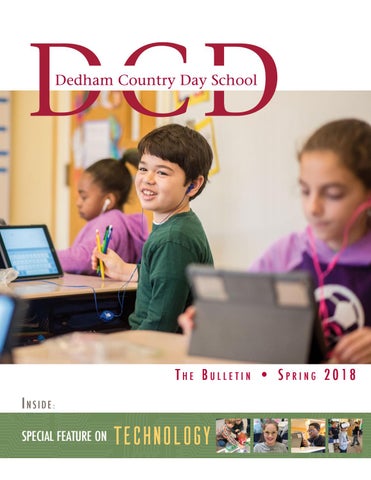
Dedham Country Day School
The Bulletin • Spring 2018 Inside: SPECIAL FEATURE ON
Mission Statement
Dedham Country Day School •Provides to each child a unique educational balance of challenging academics, arts, and athletics; •Embraces an inclusive, interdependent community of students, teachers, and parents that fosters trust and encourages children to take risks; •Creates independent, resilient, lifelong learners through engaging, developmentally-based teaching designed to meet varied learning styles; •Inspires students to become caring, ethical members of the larger world by emphasizing thoughtful citizenship and respect for self and others.
Diversity Statement
At DCD, we define diversity as an umbrella term that includes race, gender, age, ethnicity, culture, nationality, sexual orientation, social and economic class, physical and learning differences, and religion, as well as other characteristics that contribute to each individual’s full identity. We strive to provide a multicultural education, which celebrates the diversity of our community and the larger world. At DCD, respect permeates all aspects of school life. We want children to learn to understand and value multiple perspectives, identify and reject stereotypes and prejudices, and work for equity and justice. Dedham Country Day is strongly committed to ensuring a sense of community in which every member is safe, valued, and treated with dignity. We believe that a broad range of experiences and viewpoints enhances learning and enriches life.
Admissions Inquiries should be submitted to Emilie Liebhoff, Director of Admissions and Assistant Head of School Dedham Country Day School 90 Sandy Valley Road Dedham, MA 02026 Tel: 781.329.0850 • Fax: 781.329.0551 Web: www.dedhamcountryday.org
In This Issue Head of School
Allison D. Webster
SPECIAL FEATURE ON TECHNOLOGY
Director of Admissions and Assistant Head of School
THE ROLE OF CREATIVITY AND INNOVATION IN LEARNING . . . . . . . . 2
Emilie Liebhoff
Director of Advancement Charles S. Rudnick
Director of Communications
NEW TEAM MOVES TECHNOLOGY FORWARD. . . . . . . . . . . . . . . . . . . . . .4 EDTECH 101. . . . . . . . . . . . . . . . . . . . . . . . . . . . . . . . . . . . . . . . . . . . . . . . . . . . 6
Leslie Bowen
NEW TOOLS FOR THE CREATIVE SPIRIT. . . . . . . . . . . . . . . . . . . . . . . . . . 7
Bulletin Editor
BLIPPAR BRINGS STORIES TO LIFE . . . . . . . . . . . . . . . . . . . . . . . . . . . . . . 8
Class Notes
A MAKER MINDSET TRANSCENDS SPACE . . . . . . . . . . . . . . . . . . . . . . . 10
Leslie Bowen Kate Nichols
Design Consultants
SOFTWARE BLENDS CLASSROOM AND ONLINE LEARNING . . . . . . . 12
Michele Page, Design Communication Creosote Affects
SHARING BOOKS WITH IMOVIE . . . . . . . . . . . . . . . . . . . . . . . . . . . . . . . . . 13
Layout and Production
MINECRAFT AND THE MIDDLE AGES?. . . . . . . . . . . . . . . . . . . . . . . . . . . 14
Photography
LEARNING IS A WAY OF LIFE: BOLSTERING DIGITAL CITIZENSHIP AND COMPUTATIONAL THINKING AMONG FACULTY AND STAFF. . . 16
Leslie Bowen
Leslie Bowen Kristie Gillooly Dean ʼ02 John Leith Kate Reardon Hilary Rochelle Sue Shirley
CONTENT, CONTROL, AND THE CLOUD . . . . . . . . . . . . . . . . . . . . . . . . . . 18
On Campus
20
Grandparents’ and Special Friends’ Day DCD Connects: Building a Balanced, Connected, Whole Community DCD Teams Up with Cradles to Crayons
20 22 23
Sports Round Up
24
Leslie Bowen Kate Reardon
Fall 2017 Winter 2018
24 26
Manuscript Editor
Student News
28
Students Receive Recognition in the Arts: 2018 SISAL Awards Announced Arts Gallery Week Showcases Work by Middle School Students Trust the Process: Students Find the Right Fit in Next Schools Academic Challenges: Two Champions Emerge, One for the Fourth Time, and One for the First!
28 29 30 31
Alumni Association
32
Printing
Recycled Paper Printing, Inc.
Special Feature on Technology Co-Editors
Kathryn Sargent
Design
Jason Fairchild, Truesdale Group QR codes are included in the special feature section on technology in this issue of the Bulletin, like the one on the left. To read the QR codes, download any QR reader from your mobile app store (App Store, Google Play, Windows Marketplace, etc.). Search for QR code readers, choose one that’s right for you, and download it to your phone, open it, and take a picture of the little square. It will bring you to a online presentation related to the article.
Alumni Profile: Elizabeth Woelfel Harvey ’92: 2018 Alumni Award Recipient Alumni Return to DCD: Alumni Reception Honoring Elizabeth Woelfel Harvey ’92 Alumni Spotted at the Fair Alumni Profile: Nick Papps ’95
Class Notes
Front Cover Photograph by Kristie Gillooly Dean ’02; Inside Front Cover Photograph by Kate Reardon
32 34 35 36
38
TECHNOLOGY THE ROLE OF CREATIVITY AND INNOVATION IN LEARNING By Allison D. Webster
O
n a recent morning, a student overheard—and misheard—me thanking a teacher for bringing a coffee to my office. The child turned with a huge grin and excitedly asked, “You brought Ms. Webster a puppy?” What a wonderful question, since it revealed the mind of the child and a world where an adult might swing by another’s office to drop off a surprise puppy to start the day. That world of wonder, curiosity, and imagination is the natural state of children as they enter school, and one of our jobs as a school is to make sure children leave school with that wonder, curiosity, and imagination intact. Toward this end, many schools have focused in recent years on innovation, knowing that the demands of our current time and the future require a spirit of creativity, ongoing learning, experimentation, resilience, “what if…” thinking, and innovation. At the same time, for centuries schools have been one of the main vehicles for redirecting children’s divergent thinking, instilling in them the norms and expectations of society, and teaching a bank of foundational skills. My sister-in-law tells a story about one of her young piano students who showed up, excited to play, and promptly turned her hands palms up so she could play each key with her knuckles and the top side of her hand. The child’s method was innovative but also unlikely to serve her well as she endeavors to master the piano. So how do we reconcile the need for a culture of innovation and creativity with a context in which we must teach children which side of the hand is used to play a piano, how “long A” will sound when placed in a word, the sum of 3 and 13, and the norms of polite interaction? Of course, these two tasks—fueling innovation and teaching some standardized basics—need not be at odds with each other, but in many schools, there is a tension between the two. One of DCD’s strengths is our capacity to integrate these perspectives and needs. We don’t have to make a choice between being a school that respects tradition and instills strong basic skills on one hand, and being a
2
First graders practice spelling their names by programming our Beebots to navigate the alphabet mat. school that promotes innovation and playful creativity on the other. These two approaches complement each other, and the interplay adds vigor to both approaches. One cannot be innovative without strong basic building blocks. Picasso understood what is essential in a line drawing of a human form because of his ability to draw a human with photographic accuracy. A strong academic skill set can be developed in ways that promote innovation, creativity, and play, rather than mindless adherence to rules or tradition. Some of the tension occurs when the structures of school do not support the natural process of learning. George Couros, author of The Innovator’s Mindset, describes the difference between how schools have traditionally functioned and how learning typically occurs. He writes, “School promotes starting by looking for answers, and learning promotes starting with questions; school is about consuming, and learning is about creating; school is about finding information on something prescribed for you, and learning is about exploring your passions and interests; school often isolates, and learning is often social; school is standardized and learning is
technology
personal; school teaches us to obtain information from certain people and learning promotes that everyone is a teacher, and everyone is a learner; school promotes surface-level thinking and learning is about deep exploration.” Of course, these contrasts make assumptions about school, and in the case of DCD these assumptions do not hold. DCD, with its “learning is a way of life” philosophy, has structured school to align with the traits of learning. Whether a child is choosing an art elective for an in-depth exploration of their own questions, or getting to select a book for a project with classmates, our program works in many ways to ensure that school is structured to go with the natural grain of learning. This approach, along with our culture of ongoing learning, leaves DCD well poised to flourish as a flexible and innovative environment. On a recent Friday afternoon, 10 different members of DCD’s faculty and staff shared innovations from their area of the school. They may have changed the way we are lighting the campus, experimented with a new way to teach children about Medieval village life, or participated in the “Skype a Scientist” project that connects classrooms with scientists around the world (see sidebar). In each case, DCD’s teachers and staff engaged in a process of looking at a current practice, considering how it may be improved, and then experimenting with alternatives. The depth of thought in our faculty, the connectivity in this group, and the culture that supports experimentation enable faculty to engage in these types of projects and innovations with ease. Was every innovation a success? Of course not, but each was successful in focusing yet again on the question of what students need and how we can best meet those needs. Technology fuels our ability to be innovative, and so does a new garden space, publication of new work of literature, or a new partnership between disciplines. Innovation occurs because of mindset, and also because of new tools. In the pages ahead you’ll read about many of the ways that students are benefiting from our culture of innovation, especially innovations that utilize technology. At the heart of all of these projects are time-honored aspects of our strong school: teaching that fuels curiosity; relationships between adults and children; and an unwavering focus on the needs of students. Technology gives us new ways for students to demonstrate what they know, connect with the outside world, personalize learning, and practice their skills, and the pages ahead will show you some of these opportunities in action. At opening faculty meetings this year, I shared an Antoine de SaintExupéry quote: “If you want to build a ship, don’t drum up the men to gather wood, divide the work, and give orders. Instead, teach them to yearn for the vast and endless sea.” When we introduce children to the exciting world of innovation around them, encourage them to create and imagine, and support their ability to innovate by developing a strong skill set, we teach them to yearn for a beautiful sea we cannot yet imagine and exciting voyages to places we have not yet seen.
Expanding the Classroom
On a winter morning, without leaving their own classroom and lab space, DCD’s fifth graders had an opportunity to experience a real-life laboratory during a Skype visit with microbiologist Jesse Colangelo-Lillies from the University of Colorado. The students, who had been learning about various habitats in Sue Shirley’s science class, received some real-life context through a new program called “Skype a Scientist,” which matches scientists to classrooms around the world and allows teachers to pick a scientist to match their curriculum. Jesse described his research of underwater habitats in the very cold waters of the Arctic. He also gave students a live tour of his lab at the University of Colorado and talked to them about how he became a scientist.
Skype a scientist Nurturing Creativity
Creativity expert Sir Ken Robinson challenges the way we’re educating our children. He champions a radical rethink of our school systems, to cultivate creativity and acknowledge multiple types of intelligence. In this Ted talk, he makes an entertaining and profoundly moving case for creating an education system that nurtures (rather than undermines) creativity. Click on the QR code to view the talk.
Ted Talk by Ken Robinson, Do Schools Kill Creativity? 3
TECHNOLOGY NEW TEAM MOVES TECHNOLOGY FORWARD by Leslie Bowen
Joi Simpson, Help Desk and Technology Support; Kate Reardon, Director of Academic Technology; and Ali Fernandes, Chief Information Officer
D
CD has a new Tech Team. Ali Fernandes, previously the school’s network administrator, is now Chief Information Officer working alongside a new full-time Director of Academic Technology, Kate Reardon, who joined the team in September, and Joi Simpson, who has worked part time in Help Desk and Technology Support since December. Even with three staff members on board, it’s still challenging to meet the needs of both students and faculty to stay abreast of the latest technological changes and make the best use of the resources on campus. Still, as Kate notes, having Joi on board to deal with day-to-day technological needs has freed her and Ali up to focus on their respective responsibilities, Kate on the academic side and Ali with database
4
and equipment issues. One of the biggest changes came at the beginning of the school year with the switch over to Google for all communication needs, a change that required Kate to offer professional development hours for faculty to become familiar with all the functionality now available to them through Google apps. Now her mission is working with teachers to integrate technology into classroom lessons. In doing so, she is furthering a systemic shift toward mobile devices that began in 2002 when the laptop program was introduced in middle school. “We have been paring down the number of labs over the years,” notes Ali. “The biggest changes have been with mobile devices and going to a
one-to-one model, so that every child has his or her own device.” Asked whether this change has enhanced teaching, he says, “We increased the number of devices but not the knowledge about them. It wasn’t until Kate joined us that it started to change. Until then, we just had more sharp pencils, so to speak.” “We’re about three to four years away from everyone being on a mobile device,” he says, envisioning that kids will eventually be doing everything on a Chromebook or iPad. To reach this point, he says, we will need to increase the number of devices for kindergarten and first and second grades, where students are still sharing devices. He says the department has become more deliberate and intentional about what it does. “It used to be that whoever made the most noise got what they wanted—there was no plan in place. We relied on teachers to tell us what they needed,” something he says has changed over the last year with the addition of Kate’s role. While Kate agrees that’s there’s definitely room to grow to reach a higher tier of technology use, when she started, she was surprised to find that teachers were already highly motivated to explore technology and were already using it in their classrooms. “I was happy to find that, rather than just consuming content on the web, classrooms were making media, creating content digitally, for example, with Wordpress blogs or
technology
iMovie.” What is needed, she says, is a “shared vocabulary,” something she’s been working on so that discussions about the future direction of technology at DCD can involve everyone. One thing the Tech Team would like to see changed is the use of the Adams Lab, the one remaining computer lab on campus. Moving away from the desktop model to the use of mobile devices will allow for more flexibility in how the space is used so that students can be more creative and innovative. Using resources they already had, the team has already made a huge change to the space, which was previously somewhat sterile. Now when students enter the lab, they immediately start to create, putting things together, using the virtual reality glasses, or making plastic eyeglasses with the 3D Doodler pens. “We looked at what we could do at low or no cost to make a change,” Ali says, “everything is very intentional. The lab used to be empty during recess, now we can’t keep people out. They’re having fun, and that’s a big change,” he says. “It used to be that few students wanted to come in, and now it’s full of color and life.” Their experiment to create a more vibrant learning space was intended as a kind of “Proof of Concept,” so that eventually funds could be secured to make a bigger difference in the space. “What we are seeing already is that kids line up to use the two working 3D printers,” says Kate, “and we’re moving toward having more activities in here eventually. Instead of the desktops, students could bring in their laptop or iPad and use the space more creatively.” She talks about making the Adams Lab an innovation space, giving the
example of the 3D Doodler pens, which sat in a box for years and are now out for kids to use. “They make a mess, but that’s okay; it’s an innovative mess.” Makerspace? STEAM? STEM? You have to be careful with those terms, Ali says, distinguishing between what’s a trend or fad and what’s permanent. “There is making happening here,” affirms Kate, “between the 3D printers, the desktops, even just coloring on the wall, using the 3D pens, or building with Legos, but it’s not the only use of the space.” According to Kate, that’s why they didn’t change the name of the lab. “We kept that tradition of the lab as the technology center of the school,” she says, noting “the work that we’re doing around innovation is an extension of that tradition.” As to what the lab may eventually be called—an Innovation Lab or Design Lab— its name will reflect a new direction for technology at DCD. As Kate asks, “Why would we call the lab a makerspace when ‘making’ is happening everywhere with mobile devices. You can do makerspace activities right in the classroom, and then it’s integrated into the curriculum, not a special thing that students are pulled out for.” “I like to think the whole school is a big makerspace. There are a lot of ways for us to facilitate that through technology, either in this space or in the classrooms,” she says. With the change in Ali’s role, technology now also has a voice at the table at the school’s weekly admin meetings, as he joins the head of school and department and division heads in the planning stages of any undertaking. “Our use of technology has increased so much that there is hardly anything that goes on at the school that doesn’t involve some aspect of it,” and being
Fifth graders use 3D pens in the Adams Lab during recess. involved in discussions from the beginning, he says, prevents a lot of problems later on. In addition to all the cultural changes taking place, plenty of outdated equipment has been replaced, based on the recommendations of an outside consultant. “When we built the new lower school, we bought interactive projectors that were dependent on the computer. These new ones in the middle school are completely interactive— all you have to do is just go up to it, turn it on, and touch it.” The rapid pace of technological change will no doubt mean constant upgrading of tools and systems, a challenge that DCD’s new Tech Team seems ready to meet. 5
TECHNOLOGY EDTECH 101 WHAT IS EDUCATIONAL TECHNOLOGY? Technology is one of several topics that fall under the umbrella of “STEAM,” which stands for Science, Technology, Engineering, (Liberal) Arts, and Mathematics. I like this visual because it shows how the elements of this acronym work together to create integrated learning experiences:
In the classroom, the subject areas are the focus, and technology enhances learning in a variety of ways. We use devices such as laptops, iPads, and projectors; we practice digital citizenship skills when we create content; we develop computational thinking skills by integrating coding and programming into activities. Across the curriculum, technology fosters creativity and innovation as it supports both teaching and learning. WHY DO WE TEACH WITH EDUCATION TECHNOLOGY AT DCD? When we think about the skills that students will need to be successful in the 21st century, we understand that technology will continue to play an important role in our work and personal lives. We teach digital literacy skills and digital citizenship skills to support our students as they learn to express themselves creatively, think critically, collaborate, and communicate effectively. 6
by Kate Reardon
At DCD, we follow two “Golden Rules of Technology”: 1) Technology devices are learning tools. When viewed through a lens of learning, technology and digital devices become valuable tools supporting our mission to be lifelong learners. 2) Online = Offline. Our mission also calls for us to be “caring, ethical members of the larger world.” Online = Offline reminds us that our digital selves should reflect the empathic and creative people that we are in the halls and classrooms of DCD. HOW DO WE TEACH WITH EDUCATION TECHNOLOGY AT DCD? We strive to integrate technology into the classroom thoughtfully, understanding that learning experiences are powerful both with and without digital tools. The SAMR model provides a useful framework for
integrating technology in education and illustrates how not every lesson needs to be saturated with technology to be successful. At the “substitution” phase, the lesson (or canoe) would be weighed down by too much use of technology. In contrast, at the “redefinition” phase, technology can transform the entire learning experience (or submarine)
Watch Tech@DCD’s EdTech 101 video
when thoughtfully and appropriately integrated. WHAT KINDS OF EDUCATION TECHNOLOGY DO WE USE AT DCD? DCD is using a wide range of technology tools, and developing digital skills, across all grade levels. Two distinct threads of education technology work together: digital citizenship and computational thinking. Viewed through the digital citizenship lens, education technology ensures that students are developing the skills they need to contribute and curate meaningful and thoughtful digital experiences. Computational thinking requires student to identify problems, recognize patterns, and work towards solutions. Lessons on digital literacy, coding, and programming help students to develop these skills and apply them in practical ways. As teachers, we are constantly assessing and innovating our learning experiences, physical learning spaces, and digital resources. This ongoing process of refinement ensures classroom experiences that help our children grown into curious, caring, and empowered lifelong learners.
technology
NEW TOOLS FOR THE CREATIVE SPIRIT by Duane Claussen
I
think of technology as the means by which something gets done, the tools a maker uses. These tools the “How” naturally change over time but, I believe, the “Why” behind the making remains much the same. How makers produce and how they present their work change with the technology of the day, and there is often a fear that technology may replace traditional methods. This seems to be a particular concern when it comes to creating music. It is certainly important to honor and practice traditional methods, but it can also be useful to embrace new technologies. If we keep in mind the underlying “Whys” that these “Hows” serve, we can leverage current technology to enhance and promote traditional skill building. Much can be learned from practicing traditional techniques and using traditional tools. Incorporating new technologies in ways that support, rather than replace, can present new entry points through which students discover traditional methods and tools. By incorporating appropriate modern technology, we can build traditional skills like diligent practice, understanding the language and theoretical underpinnings of music, understanding musical form and structure, and performance/presentation. For example, to support the traditional skill of learning an
Middle school arts and band teacher Duane Claussen, far left, works with students to create soundtracks in the Adams Lab. instrument, we have been using a web-based, interactive, software system called SmartMusic. This site contains numerous method books, exercises, practice tools and full ensemble music, accommodating virtually any single line instrument (it can’t yet recognize multiple notes from a piano). It records the students playing and compares the student’s accuracy to the written music and issues a percentage grade, giving it a video game quality. This dispassionate assessment, along with the ability to listen to and repeat the recordings/ assessments, encourages practice for some students. In the end, it’s not about the technology but about the practice, as it has always been. Every skilled musician needs to understand the underlying structure or theory of music, and creating music using those theoretical elements is great way to understand how all music functions. To encourage experimentation in the traditional notational approach to music composition, we have begun using another online software package called Noteflight. This tool enables students to create notation for an instrument or combination of instruments, listen to the composition, and print and share their work with classmates. This process (think musical word processor) gives students both a visual and aural representation of their musical and
compositional experimentation. We use GarageBand to encourage experimentation with musical form and structure without the use of traditional notation, and to enhance recording/ performance skills. Using GarageBand, students learn basic digital recording techniques, enabling them to record traditional or non-traditional audio tracks. GarageBand is used in DCD’s Sound Sculpture, Keyboards & Computers, and Soundtracks classes. The newest tool in our approach is the Arduino platform, which introduces interactive presentation into DCD’s performance/presentation options. This technological platform goes well beyond music, but provides an opportunity for students to present their musical recordings through an interactive medium. Ultimately, technology serves as a tool for the creative spirit, the ‘How” that supports the “Why.” It is that creative spirit that fuels the “maker tradition” that DCD prides itself on. Modern technology can be used to support, enhance and help to maintain traditional maker methods. I firmly believe it is worth searching for new ways in which current technology can enable the creative process and encourage the maker culture that thrives at DCD.
Listen to the soundtracks 7
TECHNOLOGY BLIPPAR BRINGS STORIES TO LIFE As part of our study of communities, first graders interviewed eight members of the DCD community and learned about their roles and how what they do benefits the school. After the series of interviews, they worked in collaborative groups to create portraits of each person. Each group presented interesting information about our visitors in a video, which was then “attached” to the artwork using the Blippar app. Now, when you scan the art with Blippar, you can watch the student videos to learn about that person! We wanted this project to accomplish a few things. The main goal was for first graders to get to know members of the DCD community who are not necessarily classroom teachers, but who are important to the school community. We wanted the project to involve art, collaboration, and the sharing of information with the rest of the DCD community. Originally, we were thinking it might involve a class book, but when talking with Ms. Reardon, we decided to add this layer of technology to accomplish the same thing (and more)! Students were able to experiment with augmented reality and then connect this concept with our project. We learned a different approach to sharing information with others and also really enjoyed creating an interactive bulletin board for our project! —Kitt Wilson, First Grade Teacher
8
Top: interviewing a community member. Middle left and right: making a portrait of an interview subject. Bottom: using the Blippar app to watch the videos in augmented reality.
technology
9
TECHNOLOGY A MAKER MINDSET TRANSCENDS SPACE
Second graders try out the virtual reality goggles in the Adams Lab.
A
n emerging trend in independent schools is the building of specialized “makerspaces.” A makerspace is a place where people can come together to create, build, collaborate, design, test, question, problem solve and investigate. At DCD, we are lucky to have makerspaces all over our campus. If one thinks about the type of learning and exploration that takes place in a makerspace, it becomes clear that it doesn’t have to be limited to one specific room or place. In fact, a “maker mindset” has guided teaching and learning at DCD for 115 years! Back in the fall, I watched Pre-K students carry logs and push small boulders to build benches and “homes” in the yard outside of Huntington House. They were collaborating and sharing ideas, negotiating who would 10
do what, testing out their creations, and then refining their designs. A casual observer might have just seen little children outside for an afternoon of play, but if you looked closely, you could see the creative thinking that was taking place even in the minds of these four- and five-year-olds. During the winter, I was walking past the art studio on the first floor and was drawn in by the activity and laughter. The bank of potter’s wheels was whirring as middle school students worked on forming their creations in clay. One minute a perfectly formed pot emerged on the
First graders build functioning winged insects with WeDo Lego Mindstorm robotics.
by Hilary Rochelle wheel, and the next minute the side had collapsed in. The clay-covered student didn’t flinch. She stopped the wheel, sought an opinion as to what may have gone wrong from a fellow classmate on the next wheel over, and began again with her hunk of clay. Again, to the casual observer, this was a classroom full of students making clay pots. But, as I surveyed the room, I witnessed many instances of students planning, creating, and collaborating. A rite of passage for every DCD student is Mrs. Gow’s Complex Machine project during Mini-term in eighth grade. Armed with knowledge of simple machines from their fall physics unit, pulleys, wood planks, balls, glue guns and whatever else they can get their hands on, students design and build a complex machine. It must employ at least three simple machines and complete a task consistently on successive trials. While this is an individual project, it is anything but a solitary assignment. If you were to walk into one of the middle school science labs during this double class period, it may look like mere adolescent fun
technology
An eighth grader works on his complex machine in the science lab.
and games. On the surface, there is laughter and silliness, but so much more is going on. Students must rely on their own creative thinking to conceive the initial idea and plan, but then the design-thinking process kicks in. The lab benches and floors become spaces for collaborating, testing, assisting one another, and problem solving. The hallway outside of Mrs. Hultgren and Mrs. Mayard’s third grade classrooms at times doubles as a makerspace as well. Third graders had just learned about how people during Colonial times had to think creatively to devise tools to solve problems or accomplish their work in easier or more efficient ways. Students were asked to think like a Colonial tradesman and come up with their own tools to solve a particular problem or complete a task. The assignment included documenting the problem they were trying to solve and the type of tool they endeavored to create. Armed with a cache of recycled materials, tape, glue, scissors, rubber bands, and rulers, students set to work on creating their devices. Sprawled out on the floor, they shared ideas, built, designed, and tested a variety of different tools, and they were so excited to share their creations.
The Adams Lab has been outfitted with tools and materials to encourage tinkering and creating during formal class times and recess periods. During breaks you will find students working with 3D Doodler pens or experiencing virtual reality with the aid of VR goggles. First graders are using this space to dive into a Lego Robotics unit in their science class. After studying insects and bugs with Mrs. Pereira, both inside the lab and outside around campus, and they embarked on a project to build robotic bugs with functioning wings. Working with partners, they learned to share ideas and design, build, and test their creations. While having a maker hub like the Adams Lab is an important component of building our maker culture, no school can build a thriving program by confining this type of learning to one room. The type of learning that occurs in a makerspace isn’t confined to one place at DCD. The deliberateness of the curriculum encourages creative thinking and innovation in learning. Whether it happens in the woodshop, on the floor in the hallway, on the bench
in a science lab, on a potter’s wheel in the art studio, or even outside in the Pine Grove, the school has always encouraged, through hands-on, active learning—the maker mindset.
Above: A fifth grader wears the glasses she designed with 3D pens in the Adams Lab. Below: Middle school students work at the potter’s wheel in the art studio.
11
TECHNOLOGY SOFTWARE BLENDS CLASSROOM AND ONLINE LEARNING by Beth Conners, Ph.D.
T
echnology is constantly improving. Every day, new programs appear that can enhance a child’s educational experience. Over the past two years, we have adopted a number of new software tools at DCD, all to further students’ learning. Some of them are even fun. Gathering objective data on student progress is an essential part of any teacher’s job. The online assessment tool i-Ready does just that. Lower School students and selected students in Middle School take i-Ready reading assessments in the fall and again throughout the year to monitor progress. Teachers can then target instruction, based on visible strengths and weaknesses, to shore up weaknesses before they become larger. I-Ready measures vocabulary knowledge and reading comprehension in both fiction and non-fiction, along with foundational reading skills for younger children (www.curriculumassociates.com). This spring, we are piloting the online reading program Lexia in grades 1-3. Lexia constantly assesses students and creates individualized reading programs that can be done independently online. While Lexia could never take the place of teacher instruction, it can offer a student the opportunity to practice in carefully targeted reading areas. It also provides the classroom teacher and school administrator with detailed information on student and class progress and creates supplemental paper and pencil lessons to support
12
growth (www.lexialearning.com). Middle School parents may be familiar with Membean, an online vocabulary program many middle school students are using. Membean provides a multi-modal learning experience in which students are assessed and placed at a particular stage, and then learn words through auditory and visual activities. It not only individualizes vocabulary learning, but it also reinforces it—and all through a fun format! (www.membean.com). Some students in the Lower and Middle Schools have also been experimenting with Blippar. This augmented reality app adds a whole new dimension to student projects. Students can create a poster, for example, and, using Blippar, embed a video clip or link to an online video. While the poster looks like a regular poster, once it is scanned, it “comes to life” on your screen! The result blends classroom and online learning. This is a just a sample of the technology in daily use at DCD. Ask your child about their favorite program!
Hear the word “pandemonium” spoken and defined
technology
SHARING BOOKS WITH IMOVIE by Marjorie Farquharson
W
hen I think about the use of technology in my work with students, foremost in my mind is the need to articulate clearly my educational goals before I integrate technology into the curriculum. Using technology isn’t a goal. It’s a vehicle for me to reach my goals to help our students grow and explore. As I struggled to explain my philosophy, I went back to George Couros’s blog. While I knew about Couros and his work previously, this year, DCD’s Faculty Technology Working Group, of which I’m a part, read his book, The Innovator’s Mindset. While his writing didn’t form my beliefs about educational practice and technology, it confirmed and clarified my own philosophy. This blog post from August 2017 : Technology allows us to do things that we couldn’t do without it. It is just that we should be asking, “What would best serve our students?”, not “How do I work this device into my classroom setting?” Using technology in your classroom does not make you innovative; what your students do, create, and learn, because of the work that happens in our schools and classrooms, will always be the measure…[by]...which we should determine if we are truly moving forward to successfully serve our students. https://goo.gl/hGL2tA An emphasis on creativity has guided my work as well. Throughout my years at DCD, I’ve experimented
with various ways for students to share a favorite book with their classmates. These practices ranged from sitting in a special chair while describing a new book to creating folders that give opinions and include professional reviews. In recent years, fifth graders have used iMovie with their iPads to create book trailers. At the beginning of the project, we discuss the purpose of a movie trailer that they might view at a theater. We discuss the goal of interesting one’s audience without giving away too much of the plot. Students choose the titles for their project and begin the planning phase. They must follow specific guidelines when creating the project: hey need to include a picture of the book, the author, and music; integrate images; cite their sources; and meet a minimum time requirement. Through the project, I integrate a minilesson on copyright. The students don’t use the movie trailer template available in iMovie. They have more freedom to be creative by developing their own style. After they have shown me written plans for the dialogue and images they plan to include, the experimentation begins. Every year, the students come to the project with more prior knowledge about how to use iMovie than students had in the past. Each year, improvements in the application enable our movie makers to integrate various new skills. A few years ago, some students were the first to integrate their own videos into the trailers. This
Stills from Addie Mims’ book trailer for The Penderwicks year, there was great excitement when students used a green screen to produce images. The ideas always come from the students. It’s gratifying when they approach me and ask, “Is it okay if I use…” That’s when I know the unit is successful. It’s not about the end product; it’s about experimenting and creating and imagining. The first step in becoming innovative is the thinking, not the tech. In fact, the tech doesn’t necessarily mean you are innovative at all; it just means you are using technology. https://goo.gl/QX1Mfj
Read the Blog Posts 13
TECHNOLOGY MINECRAFT AND THE MIDDLE AGES?
A fourth grader builds her Medieval castle in Minecraft, using the blueprints she made as a guide.
M
inecraft and the Middle Ages? “Of course, there’s a relationship!” a DCD fourth grader would say. The curriculum in fourth grade involves the study of medieval times, and this theme gives depth and color to assignments in math, writing, and research. For one project, students are charged with securing land from the king and queen by writing a letter explaining their plans and strategy for their fiefs and castles. Once the land is granted, students must design their castles, creating blueprints with realistic measurements. In previous years, these blueprints were two-dimensional. This year,
14
working with our new head of academic technology, Kate Reardon, students used the education version of the video game Minecraft to bring the Medieval kingdom to life. In this digital world, the specific coordinates
by Hilary Rochelle for the land to be granted were provided to each student, who in turn was responsible for the design and architecture of his or her own castle. Still, there was much collaboration, as students had to be mindful of the space they were using to avoid encroaching on their neighbor’s land. Working from their blueprints, students had to translate the 2D measurements they had developed on paper to a realistic 3D rendition in Minecraft. This project involved design thinking, math, and research. What qualities does a castle from the Middle Ages have? What are important rooms to have? What are realistic sizes for rooms and spaces? How do inhabitants move from room to room…via doors or hallways? How does the 2D design created using a ruler and graph paper translate to scaling up in a 3D model? Students also had to reconcile their desire to build in cool features available in the Minecraft program with what they knew about the Middle Ages. “It was really fun to make my plan come to life,” explained Audrey. “While I was drawing it with pencil and graph paper, it was helpful to visualize
A screenshot of the exterior of a Minecraft medieval castle.
technology
The courtyard inside a Minecraft Medieval castle. how it would be in Minecraft and really think it out.” This is exactly the goal, explains Kate Reardon. DCD is using the SAMR technology model to determine the use of different tools in the curriculum. Is the tool a substitution for completing the same task or is it being used to augment the learning, modify the curriculum, or to completely redesign the experience? In this case, the fourth grade teachers and Kate opted for a redesign, concluding that in using Minecraft, the students would gain a better understanding of scale, dimension, size, and space orientation. Students’ familiarity with the Minecraft game reduced what might otherwise have been a steep learning
curve, and the class was able to dive into the project and be productive right away. “Minecraft is a very powerful educational tool,” Kate explains. “There is so much depth to the tool that goes beyond 3D design. We are excited to use some of the more robust features for teaching cause and effect in both science and STEM learning in future curriculums. The fact that kids are using it at home and then realizing it can be used in the educational sphere boosts student engagement through the roof!”
Watch the Project Videos
Dan Balk and Wendy Soutsos took a new approach to the study of Africa this spring in their sixth grade world studies class by incorporating Minecraft into the study of the region. After writing an essay on where they would like to visit or live based on a particular area’s physical geography, students began work in Minecraft to represent that landscape, using the biomes available in the program. Working together in small groups, they created houses, schools, mines, factories, farms, and fishing villages, using only locally available materials.
A fourth grader works on his project in Minecraft.
Watch the Project Video 15
TECHNOLOGY LEARNING IS A WAY OF LIFE:
BOLSTERING DIGITAL CITIZENSHIP AND COMPUTATIONAL THINKING AMONG FACULTY AND STAFF by Kate Reardon
D
CD’s commitment to lifelong learning extends to supporting and funding professional development for faculty and staff throughout the school year. Several of this year’s programs have focused on why and how we use technology around the school. From coding and programming, to digital citizenship, the DCD community has explored the many aspects of the digital world that our students use each day.
We spent three Friday afternoons discussing technology and innovation in learning. October is Digital Citizenship month, and faculty and staff spent one afternoon learning how we might build digital citizenship here at DCD. Based on those discussions, we have piloted digital portfolios, which provide students with digital platforms for publishing their thinking and learning in meaningful and responsible ways. In November, faculty and staff enjoyed a beautiful afternoon outside in the courtyard exploring technology tools that help develop coding and programming skills. After that Tech Playground, we exchanged ideas on how we can use these tools and foster computational thinking skills in our work with students. One teacher reflected: “It was great to learn how to use the apps that most of my students already know how to use!” In April, faculty and staff spent an 16
afternoon sharing ways they have innovated in their curriculum, systems, and methods this year to better achieve our goals and support the mission of our school. From building a miniature community for BeeBot robots in Grade 1 to the installation of new lighting schoolwide, thoughtful innovation is practiced throughout our school. Along with the launch of the Head’s Innovation Fund, this PD afternoon provided inspiration for innovative thinking across the DCD community. Student choice is a key component in effective professional development, where teachers become the students. With this in mind, the Technology Department hosts Mini-PD sessions during lunch periods, each one focusing on a tech app or tool chosen by the faculty. For example, many faculty are curious about the SeeSaw app, which is growing in popularity. First grade teacher Kitt Wilson, recently named an Ambassador for the SeeSaw digital portfolio app, led Mini-PD sessions that demonstrated how the app fosters student reflection in the classroom. We have been fortunate to have experts in technology fields come to DCD and lead professional development. In the fall, Dr. Jill Walsh, Boston University Professor and Social Media & Wellness Expert, visited campus as part of our DCD
Connects initiative. Her presentation, “A Digital Coming of Age: Childhood & Adolescence in the Social Media Era,” provided concrete examples and advice for faculty, staff, and parents who are engaged in conversations with students about social media. In January, Barbara Bratzel, Educator in Residence at the Tufts University School Center for Engineering Education and Outreach, ran a workshop for faculty on LEGO MINDSTORMS Robotics in the Elementary Classroom. Teachers spent the afternoon building and programming robots that could compete in races, respond to sensors, and integrate into any subject area. Much of these professional development opportunities are the results of work by DCD’s Technology Working Group. Over the course of the year, the group has explored ways in which the DCD community can innovate throughout the learning experience. We read Innovator’s Mindset by George Couros, which examines how an innovation culture, is fostered and developed. We then attended conferences and events across Massachusetts to engage with the education community beyond DCD’s campus. As leaders in the field, DCD teachers have presented at conferences this year, sharing their expertise with the larger education community. Most recently, Michelle
technology
TECHNOLOGY WORKING GROUP The Technology Working Group serves as a sounding board for Ali and Kate, provides leadership for educating students in digital citizenship, and works to articulate our school philosophy including developing technology use statement.
Teachers explore our many educational technology tools: clockwise from top left, Beebots, virtual reality googles, WeDO Lego Mindstorm robotics, and Dash n’ Dot robots.
Tarkulich and Kelly Kennedy presented the fourth grade’s work reconstructing Medieval castles at the Medfield 2018 Digital Day of Learning. Afterward, Head of School Allison Webster reflected: “I was so happy that teachers at the conference—more than 500 from Massachusetts schools—could learn from our DCD teachers. I am so proud of them for experimenting with new curriculum and sharing it, since our classrooms provide a model for education at its best.”
There were many opportunities for our teachers, staff, and parents to engage in learning around digital literacy and citizenship. With DCD’s students and community always in our minds, our participation in these presentations and conversations ensures that the learning experiences we provide are always improving. Certainly, the myriad professional development opportunities demonstrates DCD’s commitment to the whole child and lifelong learning.
Marge Farquharson
Ali Fernandes
Carla Haith
Bo Harrington
Christine Holden
Kelly Kennedy
Laura Martinez
Maura McCarthy
Kate Reardon
Jane Rothwell
Sue Shirley
Wendy Soutsos
Michelle Tarkulich
17
TECHNOLOGY CONTENT, CONTROL, AND THE CLOUD by Rob Thacher
Middle school teacher Rob Thacher, left, works with a student.
I
teach grade 7 history, according to our school’s staffing documentation, but I prefer to consider myself a teacher of social studies to middle school “tweeners”—caught in the difficult interstitial moment of growth between 6th grade freshness and 8th grade responsibilities. To me, “social studies” aptly conveys the multiple threads that the subject demands in its teaching. It is my job not only to provide historical data—events, outcomes, causes, dates—but also to add layers to students’ geographic understanding of the world; to cultivate their familiarity with our civic institutions and fundamental economic principles; and to empower thoughtful reflection on the nature and reliability of information itself. This last topic has become more and more weighty in recent years, even leaving aside our tumultuous past year or so of politically inspired navel-gazing. When I started teaching at DCD in the fall of 2005, I was committed to making media literacy a fundamental area of study in my middle school classes, weaving units on how to read newspapers and critically evaluate news broadcasts into the grade 7 curriculum, and incorporating lessons on advertising into the 8th grade fall term examination of “the power of language.” While some of those topics remain in
18
the curriculum, in the ensuing years a more fundamental approach to information literacy has become a cornerstone of grade 7 social studies at DCD, largely spurred by society’s growing reliance on cloud-based information storage and sharing platforms. Put succinctly, it is a well-understood trope of the moment that information is the world’s most powerful asset. The gathering and subsequent control of data and content have been a paramount aim of the world’s most powerful tech companies, and for the most part the end result has been a vast improvement in efficiencies throughout our world and our lives. In the education environment, for example, the tools provided by Google have enabled collaborative and generative work that is leaps and bounds beyond what would have been imaginable a generation ago. As I have said to at least 20 different parent groups on DCD’s Back-to-School nights over the years, the baseline challenge of history below the graduate level is no longer finding information; it is evaluating the provenance, the relevance, and the merit of the vast pool of information already at our fingertips. With these gains, however, has come a new challenge. Or, to be more precise, an ancient challenge has returned to our doorstep and demands that forward-thinking educators meet it thoughtfully and deliberately. Our students are being raised in an environment where information is stored and accessed via technology that is controlled by others. In grade 5, for example, students might use Google Docs to produce a report on some aspect of ancient Egypt, gaining familiarity and expertise with an important social/educational/ professional platform in doing so along with valuable instruction on digital citizenship. But as full of marvel as Google’s tools are for the education environment, the fact remains that no longer is that work in the “hands” of your child, or your child’s teacher; that work now resides in the “cloud” or, rather, on a server farm owned and maintained by an outside entity. Our ability to access and retrieve our own content rests with a corporation and relies on a complex set of networks maintained by powerful outside interests. The current political tempest over net neutrality, regardless of one’s personal viewpoint on that issue, should remind us all
technology
DCD IS BLOGGING ON...
that access may appear “free,” but if we have little or no say as individuals in how that access is maintained, that it cannot accurately be described that way. This is not a particularly diabolic state of affairs, but it is one that must be continually recognized and named by teachers, parents, and youth peers. Children should be raised to understand that information is a product, an asset, and that anything created belongs, at first flowering, to its creator. It is within our rights to share our creations, to transfer ownership of or access to those creations, but we should do so only with informed consent and with an educated awareness of where those creations reside. As a teacher of social studies, I consider exploring this topic an essential part of my job. I also happen to adore having conversations with grade 7 students not only about the relative benefits of primary vs. secondary sources, but also asking “where did that text message just go? I mean, really…where is it, and where has it been?” We can write each other messages in the sand on the beach with only our minds and our fingers (or toes), and own them, share them, destroy them as we wish. We can also interpolate technology into the equation when it benefits us. But we should always be aware of what that means and that we are choosing to do so with a full understanding of where our content lives, and what is required for us to get to it.
Wondering what books occupy prime real estate on our head of school Allison Webster’s nightstand and how these might fuel her thinking about education and well-being in children? Do you want to know what’s happening on the tech scene at DCD? Are you interested in getting to know DCD middle school faculty members and accessing some of their thoughts on an array of topics relevant to middle school students? (See Rob Thacher’s article about the Cloud on facing page) Are you looking for some great reading recommendations for children in Pre-K to grade 8? DCD now has several blogs that provide online access to many useful insights from the valuable thought-leaders we have right here at DCD! The following is a description of each of these blogs and where to find them on the DCD website. An Open Book: Reflections from the Head, by Allison D. Webster If you know Allison, you know she is a voracious reader, and so thoughtful about making connections among the books she reads, no matter the genre, grabbing a message, an insight, or an idea to relate back to her role as an educator and parent. In her blog posts, Allison picks two books that have resonated with her and shares her take on the books’ messages to give parents and teachers some new ideas to think about and perhaps some new books to add to their own nightstands. Navigate to the head of school welcome page under the “About DCD” tab and you will see the link to Allison’s blog. https://goo.gl/uAFFpt Tech Bytes: What’s Happening with Tech@DCD? Kate Reardon, DCD’s Director of Academic Technology, opens up a window into how technology is being used in our classrooms from Pre-K to grade 8. In addition, she shares articles and resources that parents and teachers will find helpful in navigating the use of new tools and innovative teaching pedagogies in elementary school education. Navigate to the technology page under the Programs tab and click on the TechBytes button. https://goo.gl/fBLkky Idea Log: DCD Middle School Faculty Blog Each month DCD’s middle school faculty members take turns writing a blog post about something they feel passionate about or feel is noteworthy in the education of adolescents. Reading these blogs, parents get an opportunity to experience DCD’s middle school teachers without having to invade their child’s space in the classroom, to see how they think and how they may approach working with their students. Navigate to the Academics page under the Program’s tab, click on the middle school button to find the Idea Log at the bottom of the page. https://goo.gl/N6TVdu Read On! Spanning genres and grades, Mrs. Farquharson provides her musings about books for children and young adults in this monthly blog. She will often highlight one particular book, providing a review, brief summary, and often identifies a target audience. This is a wonderful resource for parents of all kinds of readers! Navigate to the Library page under the Program’s tab and click on the link for the Read On! Blog. https://goo.gl/y6yw6Z 19
On Campus
Grandparents’ and Special Friends’ Day
O
n Friday, April 6, DCD’s halls and classrooms were bursting at the seams as we welcomed nearly 400 very special guests to campus! Grandparents and special friends had an opportunity to shadow their favorite young students through a typical morning of learning and engagement.
Gerard Indelicato, Clara Walmsley, Graydon Indelicato, Rick Wilkof, and Paula Indelicato
20
Jonell Johnson and Nyla Johnson
Joyce Bacardi and Christiane Fallon-Bacardi
Ronda Feappied and Nehemiah Sanon
Gunner Peterson and Marge Peterson
On Campus
Molly Epker and Linda Keith
Annette and Anthony Angeli with Sebastian Angeli
Hannah Peters and Bernie Peters
Hytho Pantazelos and Peter Pantazelos
Mei Hu and Robby Hargrove
Sydney Strominger with Michael Bovarnick
Kate Burns and Joanne Burns 21
On Campus
Reaching Out to the World Beyond DCD
DCD Connects: Building a Balanced, Connected, Whole Community
D
CD Connects is a focused initiative bringing speakers, films, and discussions to the community to support our collective goal of ensuring that children grow balanced, connected, and whole –Dedham Country Day’s core values in educating children. This initiative was developed with the goal of exploring and sharing new ideas and tools with parents, teachers, and administrators for navigating our complex world and building resilience in children. This inaugural year brought some wonderful speakers to campus and opened up some very important conversations about well-being and balance for elementary school aged children. Under the pillar of Connection, Dr. Jill Walsh, a Boston University professor and social media and wellness expert, kicked-off the year on November 16, by sharing her research and ideas for handling the challenges we and our children face as they grow up in this digital and social media-crazed age. Those who packed the Lowell Center came away with new perspectives and strategies to help our children navigate this new era. Under the pillar of Balance, Dr. Larry Cohen, psychologist and author of Playful Parenting and The Opposite of Worry: The Playful 22
Parenting Approach to Childhood Anxieties and Fears, came to campus on January 17. Dr. Cohen shared some new techniques with teachers and parents for managing behavior, handling anxiety, and building confidence in young children. Finally, on April 24, to close out the series, under the pillar of Wholeness, Emily Esfahani Smith, journalist and author of The Power of Meaning: Finding Fulfillment in a World Obsessed with Happiness, spoke about how to help our children and ourselves pave the way to a meaningful life, particularly in our very fast-paced and complex world. We were so thankful to have such distinguished speakers kick-off the
inaugural year of the DCD Connects initiative, and we are looking forward to welcoming another set of experts to campus to share their ideas and tools with DCD and our broader community next year. Dr. Lynn Lyons, a well-known psychologist and expert in anxiety in children, will be on campus on November 8 to begin the 201819 year of DCD Connects. DCD faculty and staff had a workshop with Lynn earlier this year, and we all agree that her session coming up this fall is not to be missed! Mark your calendars and stay tuned for the rest of our line-up, which will be announced in September. —Hilary Rochelle
On Campus
DCD Teams Up with Cradles to Crayons
O
n Saturday, March 3, DCD hosted a special day of service to benefit children in the greater Boston area served by the Cradles to Crayons organization (C2C). C2C’s mission is to provide children from birth through age 12, living in homeless or low-income situations, with the essential items they need to thrive at home, at school, and at play. Reflecting DCD’s longtime commitment to community service involving all ages, families arrived together to take part in the school’s first “Family Volunteer Day” to benefit C2C. Joining DCD staff and alumni, they formed a group of nearly a hundred volunteers in all who spent the morning sorting, inspecting, and organizing all the gently used clothes, shoes, books, and toys that were collected during the school’s month-long drive in February. All the goods were then transferred back to the Cradles to Crayons facility where everything was prepared and packaged for distribution to the children. Carrying big purple sacks full of donations, volunteers brought all the items from the storage container to the Rand Gym distributing everything among the different sorting stations set up around the room. Each student, parent, and staff member was assigned to work
at a specific station. Armed with toothbrushes, spray bottles, and paper towels, volunteers cleaned the soles of shoes, wiped down toys, and inspected clothing and books to make sure every item was in good condition. One of the most challenging jobs was to make sure that the toys donated had all the requisite pieces. With the help of students, Head of School Allison Webster took on the challenge of dismantling and organizing several Lego sets and counting puzzle pieces. She commented, “We know children – even at a very young age – are able to make a difference in the world and want to contribute to something larger than themselves. Seeing the commitment of our students and families and the tangible support we were able to provide to children and families in need, demonstrates in practice a central value of our school community of being caring, ethical members of the larger world.” Keeping a running tally of bags, the final count at the end of the event was the following:
721 children served Clothing: 54 bags Shoes: 6 bags Book: 2 large rolling bins Toys: 11 bags Nursery Items: 9 bags —Leslie Bowen 23
SportsRoundup
Fall 2017 Varsity Field Hockey This season, more than any other, was a blend of both varsity and JV teams throughout the fall, working together to run practices in both mixed and team-specific groups. What was really fun were the three games against Milton, Shady Hill, and Charles River in which we came together as one team, in what we called an “ALL Play” game. Two of my three season highlights come from the losses. The first was against a very talented 8/9 Fay team, a game we lost 0 to 6. What made me so proud was that at the end of the game the Fay coach came over to say how gritty and hard working the DCD team was! The other proud moment was against Newton Country Day. We were down 2–0 at the half and scored two goals in the second half on corner plays, a real strength of this team! We ended up losing in the last 15 seconds on a beautiful goal by our opponent. Individual and team improvement happened week by week and culminated in two great wins in the last week of the season versus Thayer and Dana Hall. —Deb White
JV Field Hockey The 2017 JV field hockey season was filled with fun, learning, and many victories. With 12 sixth graders on the team, our girls were often stretched thin, playing with one or no subs at all. The team performed well throughout the season. We had a competitive match against Derby, which resulted in our only tie of the season. That game ended on an offensive corner, which meant we had one final shot at goal. Unfortunately, we couldn’t make that happen, but we certainly gained some mental toughness as a result. I know the girls are disappointed that we lost our final game against Milton, our only loss of the season. Considering
the size and age range of the team, they should all be proud of themselves for their effort and carry that passion into next field field hockey season. Congratulations on a successful season! —Megan Rothwell Saia ’97
Flag Football DCD’s flag football team had a fantastic inaugural season. The team won its first game against Tenacre (27–20) and built on this success as the season progressed. In practice, the boys worked very hard on improving their speed, strength, and agility, and on all of the skills necessary for playing offense, defense, and special teams. I was very pleased with the energy and enthusiasm that the boys brought to practice every day. It resulted in a great deal of fun and a lot of individual and team improvement. The team finished with a final record of 3-7. I eagerly await working with the team and picking up where we left off next fall. —Dan Balk
Girls’ Soccer The 2017 girls’ soccer roster included 16 sixth, seventh, and eighth grade girls. The girls worked hard on their skills and communication on the field. The season got off to a rough start, losing the first three games to tough competitors, but that did not bring the girls down. The next few games were relatively easy wins — but what the girls took away from those wins was their ability to learn and play all different positions and be versatile players. This group of girls can go and play any position that is asked of them! One highlight of the season was beating Thayer — they were undefeated the entire season, and DCD was the only team to beat them. It was a very rewarding season. —Elaine Gage
Boys’ Soccer The boys’ soccer team complied a solid 5-5-1 record, earning impressive wins over Charles River, Chestnut Hill, Milton, Tenacre, and Rivers. Although the team consisted of a large group of boys, they practiced and competed as a cohesive unit. This spirited group supported each other throughout the season, and worked hard until the final whistle. As captains, Kerr Sjostrom, Vijay Sherring, and Oliver Riordan set an excellent example for their teammates. For his leadership on and off the field, Kerr Sjostrom was awarded the Coach’s Award. For his three-year commitment to the team and his persistence, Oliver Riordan was awarded the Most Improved Player Award.—Kevin Coakley
Cross Country This fall, the cross country team had another strong season of racing. Finishing the season right around .500, the team did a great job of building on our success from last year. This year’s cross country team had three sixth graders, five seventh graders, and five eighth graders. Some of the highlights of the season include our nearperfect victory over Charles River and racing in the Larz Anderson Invitational against more than 200 runners from other schools. This year’s Coach’s Award winners, Jack Connors and Abby Rochelle, were tremendous leaders and supporters of their teammates and the program. Our most improved runner for the season was Corey Predella, who in his second year of cross country found his way to the front of our pack toward the end of the season. Overall, it was a wonderful fall and we look forward to another great season of running in the fall of 2018. —Bo Harrington
Team Records
Varsity Field Hockey 6-4 Coaches: Deb White, Michelle Salfity Captains: Molly Epker, Caroline Sullivan, Audrey Volpe JV Field Hockey 6-1-1 Coaches: Megan Rothwell Saia ’97, Michelle Salfity Captains: by game Flag Football 3-7 Coach: Dan Balk Captains: Riggs Catlin, Hugh Geraghty 24
Boys’ Soccer 5-6-1 Coaches: Kevin Coakley, Charles Rudnick Captains: Kerr Sjostrom, Oliver Riordan, Vijay Sherring Girls’ Soccer 4-5-1 Coach: Elaine Gage Captains: Julia Capone, Mary Connors, Jayne Feeney Cross Country 6 races Coach: Bo Harrington
Awards
Coach’s Award
Most Improved Player Award
Varsity Field Hockey JV Field Hockey Flag Football Boys’ Soccer Girls’ Soccer Cross Country
Grace Freyermuth Hannah Pavlos Ollie Farber Oliver Riordan Nytayah Bugg Corey Predella
Photographs by John Leith
Molly Epker Tessa Torres-Hoffman Hugh Geraghty Kerr Sjostrom Mary Connors Jack Connors Abby Rochelle
25
SportsRoundup
Winter 2018 Boys’ Varsity Basketball The varsity basketball team had a fantastic season finishing with a final record of 6–4. In practice, the boys worked very hard on skills, strategies, and teamwork. In games, the team played aggressive defense and a fast-paced style on offense, which featured a lot of outside shooting. It was an extremely well-balanced team with Kerr, Jeff, and Charlie providing great rebounding, defense, and interior scoring. Luke, Jonathan, and Bryan did an excellent job pressuring ball handlers on defense and running the floor on offense looking to get open shots and drive the ball to the basket. Eli provided an unwavering presence as the team’s primary ball handler, and he created many of the team’s offensive opportunities. Co-hosting a round-robin tournament with Charles River School for the varsity boys’ and girls’ teams was a huge highlight of the season. Winning the final three games of the season (with two going right down to the wire) demonstrated the overall improvement, focus, and toughness of the team. —Dan Balk
Boys’ JV Basketball
Our team had great success this year and a lot of it had to do with their mindset and how they practiced. Although there were two separate teams in our basketball program this year, we had the luxury of practicing as a whole program. Being able to practice with older and, in some cases, more experienced players really prepared us for game time. Each day our players competed and wanted to get better with no complaints. Our sixth grade varsity team went 6–1, while mostly playing older kids throughout the season. The first six games of the season our team only trailed once in a game, 2-0 against Thayer. Just twice our team gave up less than five points in the first half and in one of those games, gave up only one point in the first half. In our game against Chestnut Hill, every one of our players scored, which is an awesome accomplishment. Overall the sixth grade varsity had a great season, and each player improved tremendously. —Michael Tempesta
Girls’ Varsity Basketball The girls’ varsity basketball team had a very good 2017–2018 season. The team was made up of 11 eighth grade girls, and for three of them, it was their first time playing organized basketball. Although it wasn’t a “winning” season in terms 26
of wins and losses, it was a “winning” season in the way of improvement (basketball IQ and skills), game play, and camaraderie. One of the many highlights of the season came during our first win against Charles River. The team was behind the entire game, but in the last minute, the girls were able to tie up the score and with great defense, a basket, and a foul shot, won the game 19-16. Another highlight was a roundrobin tournament the team participated in with three other schools. DCD’s team had 2 wins and 1 loss in that competition. The girls were very proud of what they accomplished and truly played as a team. It was a very fulfilling and satisfying season for the coach in that everyone worked hard, improved, had fun, and were there for each other. —Elaine Gage
Girls’ JV Basketball The 2018 JV girls’ basketball season was one for the record books. They were a coach’s dream — talented, self motivated, and successful. We ended the season undefeated, and the girls had to hold themselves back most games to not completely blow out the competition. Their selfrestraint displayed the best sportsmanship I’ve witnessed in my coaching career. In just about every game, the girls were only able to go all out for the first 10 minutes before going into “10” or “pineapple”— code for “passing to everyone before shooting” and “shooting with their nondominant hand.” In spite of this, they held their heads high and gave enthusiastic cheers at the end of each game for every opponent. —Megan Rothwell Saia ’97
Girls’ 6th Grade Basketball The 2018 sixth grade girls’ basketball team had a season full of firsts. From first games to first baskets and first wins, this team of tenacious sixth graders worked hard learning the skills and teamwork necessary for a successful season. With many of the girls playing organized basketball for the first time, focus was placed on fundamentals, culminating in the tense back and forth game against Derby. With multiple lead changes throughout the game, DCD found themselves behind in the last minutes of the game. With a combination of stalwart defense and a patient offense, the girls battled back, scoring a last-minute basket to win the game 10–8. —Andrew Shirley ’05
Hockey The 2017–2018 hockey season was marked by continued improvement. Comprised of 20 players of varying skill levels, this co-ed squad worked together to support each member of the team in many different ways. With a record of 3–5, a highlight included a picturesque outdoor game on a sunny winter afternoon against Park School where more veteran players guided the team to victory by selflessly passing and creating scoring opportunities for newer players; another highlight was the grit shown in a 5–3 win over Carroll School in the second half of the season after having lost to them 5–2 earlier in the season. The team was led by captains from each grade level: Jack McNealy (8), Carly Ward (7), and Vincent Jaeger (6). Congratulations to Carly Ward who received the Coaches’ Award and Max Nye who was named Most Improved Player. —Bob Santry, Wendy Soutsos
Squash The 2017–2018 DCD squash team, consisting of 27 players, was the largest team in program history. Led by captains Cameron O’Rourke, Oliver Riordan, and Audrey Volpe, along with eighth graders Chris Ahn, Gio Clark-Bascom, Jayne Feeney, Eli Gow, Nick Rodriguez, Corey Predella, Vijay Sherring, Nick Strymish and Adam Tabba, this team had plenty of leadership and positive spirit. Highlights of the season include victories over Nobles and Nashoba Brooks as well as the close and exciting Squashbusters match. Each player worked hard during practice with intra-squad challenge matches always being hotly contested when trying to move up the team ladder. Many students were in contention for season-end awards. —Rick Edie, Bo Harrington, Mark Jackson
SportsRoundup
Awards
Coach’s Award
Most Improved Player Award
Boys’ Varsity Basketball Eli Leder Boys’ JV Basketball Riggs Catlin Girls’ Varsity Basketball Aimée Coleman Girls’ JV Basketball Mari Rounds Girls’ 6th Grade Basketball Abby Rochelle Hockey Carly Ward Squash Audrey Volpe
Charlie Cao Ben Clay Maeve Haggerty Natalie Rudnick Elena Ferrara Max Nye James Ko Elizabeth Nicholson Gio Clark-Bascom
Team Records Boys’ Varsity Basketball 5-2 Coach: Dan Balk Captains: Jeffrey Delva, Eli Leder Boys’ JV Basketball 6-1 Coach: Michael Tempesta Captains: Riggs Catlin, Will Curran Girls’ Varsity Basketball 2-5 Coach: Elaine Gage Captains: Halden Dyer, Sophie Hiatt Girls’ JV Basketball 9-0 Coach: Megan Rothwell Saia ’97 Captains: by game Girls’ 6th Grade Basketball 2-5 Coach: Andrew Shirley ’05 Captains: by game Hockey 3-5 Coaches: Bob Santry, Wendy Soutsos Captains: Vincent Jaeger, Jack McNealy, Carly Ward Squash 2-6 Coaches: Rick Edie, Bo Harrington, Mark Jackson Captains: Cameron O’Rourke, Oliver Riordan, Audrey Volpe Photograph facing page by Sue Shirley Photographs this page by John Leith 27
Student News Students Receive Recognition in the Arts
D Lizzie Cochran, 2nd Place Printmaking, “Cotuit Bay”
2018 SISAL Awards Announced
DCD received 12 awards from the Small Independent School Art League (SISAL) annual juried show. All 39 pieces submitted by DCD were on display at Brimmer and May School, the host of this year’s exhibit, during the week of April 23-27, 2018. Eighteen area independent schools entered work to the contest. SISAL was founded in 1992 so that students in small independent schools could have a venue for the exhibition and critiquing of their work. SISAL started with a coalition of five member schools and now includes more than thirty.
Digital Art
Owen Connors, 2nd Place, “Blue Brothers” Jack McNealy, Honorable Mention, “DES-ORT”
Metalsmithing
Molly Epker, 1st Place, “Triskeleton Pendant” Kerr Sjostrom, 2nd Place, “Kinetic Sculpture” Nicholas Strymish, 3rd Place, “Tennis” Sophie Hiatt, Honorable Mention Painting, “In the Clouds”
Painting
Hannah Pavlos, 3rd Place, “Fancy Lady” Sophie Hiatt, Honorable Mention, “In the Clouds”
Photography
Jack McNealy, 2nd Place, “Swing”
Printmaking
Lizzie Cochran, 2nd Place, “Cotuit Bay”
Woodworking
Jack McNealy, 2nd Place Photography, “Swing” 28
Owen Connors, 1st Place, “Braced Shaker Bench” Sam Rayev, 2nd Place, “Hand Carved Bowl in Walnut” Abby Rochelle, 3rd Place, “Hand Carved Spoon in Pear”
Student News
Arts Gallery Week Showcases Work by Middle School Students Photographs by Kristie Gillooly Dean ’02
W
hether working in watercolor, wood, metal, or any of the many other media available through our more than 40 arts electives, our young middle school artists find myriad ways to express themselves through the visual arts. Arts Gallery Week, an annual event, began with a reception on Thursday, April 5, which included presentations by selected students. The exhibit concluded on Friday, April 13, when many of the works on display where submitted to SISAL (Small Independent School Arts League) for their annual competition (see facing page).
Left to right, Stephen Cochran ’80 and Katie Keally Cochran ’82, Mark Epker, and John and Larisa Connors
Left to right, middle school teachers Duane Claussen and Ruth Gow with Bryan Mann, Max Nye, and Steve Nye
Left to right, Chris Ferrara and daughter Elena examine a Shaker box with woodworking teacher Gerry Clifford
Students Mary Connors, left, and Molly Epker
Abby Rochelle with grandmother Jo Rochelle
Mosaics on display
Gio Clark-Bascom and mother Trelane Clark
29
Student News
Trust the Process:
Students Find the Right Fit in Next Schools
W
hen the middle school years are on the horizon, the idea of high school and college becomes more real for many parents. DCD’s pre-k-to-grade 8 model means that children will inevitably move on, which makes every parent wonder, where will my child go next? Fortunately, DCD provides an infrastructure for both parents and children to help answer most questions. Will my child have a better chance of getting into the school we want him or her to go to if we apply in fifth, sixth, or seventh grade? Will he or she miss the opportunity to participate in athletics at the varsity level if we don’t get them on the high school coach’s radar in the earlier grades? Do we need to provide a broader social life for our child? Is there enough challenge to keep my child academically engaged during the middle school years? The answer to these questions may be different for each child and family, but one thing we know for sure is the process at DCD works well for students who stay through eighth grade. Those families who allow their child to complete the journey through eighth grade enable their children to reap the many tangible and intangible benefits of a pre-k-to-grade 8 school. Ultimately, children will find themselves committed to a secondary 30
school that best fits their academic and social needs as well as their interests and passions. The journey through DCD’s middle school, where students have the opportunity to try new things, discover their passions, practice mastery in a safe and judgment-free space, and hone their leadership skills, helps students as well as their teachers, advisors, and parents identify the secondary schools that are truly the best fit. As eighth graders, there are more secondary school options for them to consider than what may be available to them in the earlier grades. Each year at this time, after all the intensity and rigor of the eighth grade year—Smooth Talk, SSAT prep, practice interviews, introspective writing exercises, school visits, and the many meetings and conversations with DCD’s secondary school program team—we find ourselves bursting with pride at what our students have accomplished and who they have become through the process. We are also excited to find out where they will be headed on the next stop of their educational journey! The list of secondary school acceptances, given to the right, solidifies our confidence in what we do at DCD and how we do it, and whether students begin in pre-k or join us in sixth grade, we help them find the best fit in their next school. —Hilary Rochelle
Class of 2018 Secondary School Choices Chris Ahn
Philips Academy Andover
Nytayah Bugg
The Woodard School
Julia Capone
Westwood High School
Gio Clark-Bascom
Concord Academy
Aimée Coleman
Dana Hall School
Mary Connors
Noble and Greenough
Jeff Delva
Noble and Greenough
Halden Dyer
Dana Hall School
Molly Epker
Noble and Greenough
Jayne Feeney
Milton Academy
Eli Gow
Belmont High School
Maeve Haggerty
Miss Porter’s School
Sophie Hiatt
Rivers School
Nyla Johnson
Ethel Walker School
Jack McNealy
Buckingham Browne & Nichols
Gunner Peterson
Milton Academy
Corey Pradella
Beaver Country Day School
Abigail Riordan
Middlesex School
Oliver Riordan
Philips Exeter Academy
Nicolas Rodriguez
Noble and Greenough
Vijay Sherring
Westwood High
Nick Strymish
Newton North High School
Caroline Sullivan
Dexter Southfield
Adam Tabba
Xaverian Brothers High School
Audrey Volpe
Milton Academy
Student News
Academic Challenges: Two Champions Emerge, One for the Fourth Time, and One for the First!
Matthew Volfson, left, winner of DCD’s Geography Bee and Massachusetts State Bee Contestant
T
en students competed in DCD’s annual Geography Bee, sponsored by National Geographic, on January 25. Middle school head Nate Buffum presided over the contest in which two representatives each from grades 4 through 8 vied for the coveted spot of school-wide geography whiz kid. This year’s Bee featured both repeat and new competitors. Questions required knowledge of both domestic and international maps, bodies of water, and important landmarks throughout the world. After several rounds of questions, sixth grader Jay Caponigro, competing for the first time, and seventh grader Matthew Volfson, a three-time winner of the Bee
competing for the fourth time, emerged as the two finalists to for the final challenge round. After some very difficult questions, Matthew protected his title by answering more of the challenge questions correctly. Matthew has won the contest at DCD all four years that he has been eligible to compete, and in this year’s Bee, he didn’t make any mistakes, answering all of his questions correctly. Once again, he went on to the statewide competition in April after taking a written qualifiying test. The state-level Bee is the second level of the National Geographic Bee competition, in which 100 of the top-scoring students in each of the 50 states is invited to compete. Congratulations, Matthew!
Geography Bee Participants Grade 4
Matthew Kimball, Warren Strominger
Grade 5
Neil Burmeister, Brooks Sjostrom
Grade 6
Jay Caponigro, Hannah Pavlos
Grade 7
Martha Arends, Matthew Volfson
Grade 8
Jack McNealy, Gunner Peterson
Spelling Bee: Nate Felix
Photo by Hilary Rochelle
Photo by Hilary Rochelle
National Geographic Bee: Matthew Volfson
Middle school English teacher Rick Edie congratulates third grader Nate Felix, who won this year’s spelling bee
W
ords taken from the animal kingdom dominated DCD’s annual spelling bee on March 1. Twelve students representing grades 3 through 8, finalists from spelling tests conducted in each classroom earlier in the week, went many rounds in this year’s challenging competition. The tense final round came down to third grader Nate Felix and fifth grader Brooks Sjostrom. Spelling the word “rogue” correctly, Nate walked away with the victory, a first for a third grader! Congratulations to all of the participants in the Bee this year: Nate Felix and Jocelyn Riordan (3); Andrea Maalouf and Madeline Jaeger (4): Neil Burmeister and Brooks Sjostrom (5); Emma McNealy and Jason Sima (6) Luke Hotra and Eli Leder (7); and Maeve Haggerty amd Molly Epker (8). 31
Alumni Association
Alumni Profile: Elizabeth Woelfel Harvey ’92 2018 Alumni Award Recipient
32
Photo by Kristie Gillooly Dean ’02
W
hen Elizabeth Woelfel Harvey ’92 looks back on her years at DCD, she remembers playing field hockey under Coach Deb White as one of the highlights of her time as a student here. Her love of sports led her to continue playing at Nobles, where she was a three-sport varsity athlete all four years, and to go on to play at Holy Cross, where she was lacrosse captain for two years. She remembers her life growing up as ideal, a happy family life, going to great schools, surrounded by good friends, one that she’d hoped to duplicate for her own children, Caroline, 13, and JB, 10. That vision would soon be challenged. In 2009, Beth received the devastating news that her 17-monthold son JB had Duchenne Muscular Dystrophy (DMD), a progressive muscle disease that afflicts one in 3,500 boys and is the leading genetic cause of death among children. The prognosis wasn’t good. There was no cure, very little research, and almost no support for the families and children suffering with the effects of the disease. While stunned and initially depressed by the diagnosis, she quickly went about encouraging family members and friends to contribute to the few organizations funding research in to a cure. Eventually taking matters in to her own hands, and to ensure funds went to research not overhead, she founded her own organization, JB’s Keys.
Left to right, Alumni Association President Erin Keith Epker ’86, 2018 Alumni Award recipient Elizabeth Woelfel Harvey ’92, Head of School Allison Webster, and Director of Alumni Affairs Kate Nichols
“I started off encouraging family members to fundraise for another organization, but I just felt that I wanted to be completely true with our donors and I wanted to be able to tell my family and friends that every dollar they were giving us was making a difference.” JB’s Keys identified three areas of need: awareness, support for quality care and treatment, and research, and began raising funds as an all-volunteer, not-for-profit foundation. Until about a year ago, when she “reluctantly” began to take a salary, she relied solely on “good friends, who are passionate about helping JB and others like him,” to help her raise funds. So far, JB’s Keys has raised a nearly $2.5 million.
Recently, her foundation has shifted its focus somewhat from research to providing a better quality of life for young men living with Duchenne’s. “When we first started, she says, “JB was so little I had no idea about what this disease meant, but now that he’s older, I see the toll it’s been taking on him.” Reflecting on the changes over the years since JB was diagnosed, she says, “there was one company working on Duchenne’s research and no FDA-approved drugs. Now there are almost 20 companies involved in research with Biotech starting to invest more in research into rare diseases.” “We don’t have millions of dollars to make a dent in making the next big cure happen. We’re filling a gap
AlumniAssociation
to make sure these kids are healthy and happy enough to benefit from the research that’s going on.” To fill that gap, the organization is supporting a number of different initiatives, including an adaptive sports scholarship that provides weekends away at Loon Mountain. “We try to make it a whole family affair, two nights in a hotel where family members can ski or sail or rest,” she says. “This winter we had 20 young men enjoy two full days of skiing on Saturday and Sunday.” The organization also supports a sailing weekend on the Cape. Partnering with another organization, they are starting a family assistance fund to help families with the financial burden of Duchenne’s to cover expenses outside of what insurance covers, for example, a ramp for the house or an accessible van. “We’ve been flying to a clinic in Cincinnati the past few years, which is not covered,” she explains. Citing the rigors of putting kids through clinical
trials, she says, “It’s nice to give them a treat at the end of the day to say thanks for what you’re doing.” After many years of flying to Cincinnati, Beth is excited to be supporting the opening of a new Duchenne’s clinic at UMass Medical, headed by a doctor recruited from Cincinnati. Hopefully, that will make it easier on JB, who goes every month for a full-day infusion, has regular physical therapy, and a one-on-one aide to support him in school, in addition to undergoing clinical trials when he can. As he’s gotten older, she says, “We’ve had to become a little more realistic, recognizing it’s hard to have Duchenne’s.” Other than that, he’s just like any other kid, she says, and like his mother, he loves sports. “He likes to ski because he likes to go fast! He loves watching or participating in any type of adaptive sports.” JB has been a member of the Boston College football team through Team Impact, an organization that
matches kids with illnesses with players from college teams, some of whom have visited his elementary school in Dover. “He’s got a great sense of humor and a ton of friends.” Her own happy childhood and upbringing have been the motivating factors in helping JB enjoy a normal childhood. “I really did have a great upbringing with my family and a great education at DCD and then at Nobles, with good friends, and I just felt that I wanted that so much for my kids, and just because he has this disease, I wanted to fix as much as I could, to make it as good a childhood as I had.” While her competitive nature and tenacity honed through participating in sports over the years has helped her in the fight against Duchenne’s, she says, “You have to admit that you can’t fix everything and you can’t always win.” Still, she’s trying as hard as she can to make a difference, not only in her son’s life, but in the lives of all the other boys and young men afflicted with Duchenne’s. — Interview by Leslie Bowen and Kate Nichols, article written by Leslie Bowen
Alumni Council PRESIDENT Erin Keith Epker ’86 COUNCIL MEMBERS Nicole Mayard Allen ’00 Torie Allen ’01 Jeff Barker ’69 Jen Cabot Breslin ’87 Katie Keally Cochran ’82 Liza Connelly ’81 Lizzie Crocker ’00
Nick Crocker ’96 Kristie Gillooly Dean ’02 Odile Weissenborn Gordon ’84 Zander Grant ’70 Melanie Guerra ’86 Elizabeth Pyle Handler ’79 Louisa Harrison ’04 Elizabeth Woelfel Harvey ’92 Whitney Hunter-Thomson ’98 Jason Indelicato ’94 Nick Jackson ’87 Alex Nessa ’02
Cate Tynan O’Dwyer ’90 Lindsey Marich Owen ’97 Nick Papps ’95 Steven Perry ’85 Lee Mumford Peterson ’86 Colby Hunter-Thomson Previte ’91 Ted Russell ’53 (Emeritus) Jamie Stoddard ’97 Elizabeth Ward ’77 Jen Bigelow Williams ’86 Linda Mixter Woodard ’58
33
Alumni Association
Alumni Return to DCD
Alumni Reception Honoring Elizabeth Woelfel Harvey ’92
Alumni Association President Erin Keith Epker ’86, left, with Head of School Allison Webster
Elizabeth Woelfel Harvey ’92 accepting the DCD 2018 Alumni Award
Katie Cochran Delaney ’92, left, and Emily Oates Torres ’93
Susie Jackson, left, and Meghan Crowley Thompson ’99
Deb Accetta Pedersen ’93, in pink sweater, greets Emily Tynan McDaniel ’93
Deb White and Beth Woelfel Harvey ’92
Left to right, alumni came back to DCD to celebrate Elizabeth Woelfel Harvey ’92: Sam Glidden ’88, Emily Tynan McDaniel ’93, Spencer Christie ’93, Steve Woelfel ’97, Beth Woelfel Harvey ’92, Hilary Watts Wieczorek ’93, Katie Cochran Delaney ’92, Deb Accetta Pedersen ’93, Meghan Crowley-Thompson ’94, Kristin Kara ’91, and Emily Oates Torres ’93 34
Photographs by Kristie Gillooly Dean ’02
AlumniAssociation
The Alumni Association presented Elizabeth Woelfel Harvey ’92 with DCD’s 2018 Alumni Award for her work with JB’s Keys, an organization she founded to help raise awareness and find a cure for Duchenne Muscular Dystrophy, a disease that has affected her son JB, now 10, since he was 17 months old.
Alumni Spotted at the Fair Alumni enjoyed a VIP lunch at the Alumni Tent at the Fair.
Left to right, Sue Shirley, Spencer Christie ’93 and Colleen Christie
Left to right, Stephanie Abrego Diez ’17, Kenzie Kelly ’17, Kai Dixon ’16, Charlie Volpe ’16, Alfie Rudnick ’16, Morgan Kendall ’17, Alex Burmeister ’17, and Abby Holding ’17
Left to right, Jen Bigelow Williams ’86 with parents Sandy and Ned Bigelow
Jim Lehan ’57, left, and Scott Winter ’67
Hilary Watts Wieczorek ’93 and Deb White
Left to right, Jane Rothwell, Alyssa Rothwell Sinclair, Megan Rothwell Saia ’97, and Monica Woelfel Stevenson ’86
Crosby Lawrence Piché ’99 and family with science teacher Sue Shirley
Kathryn Cloonan ’17, Lexie Ravech 17, and Eleni Kolovos ’17 35
Alumni Association
Alumni Profile: Nick Papps ʼ95
Nick Papps ’95 on location in Clarkston, Georgia, filming a story about a youth empowerment group for the Bahaí National Center.
N
ick Papps ’95 did it all—coordinating among locations, shooting video, engineering audio, color grading, and editing in his latest venture: “An American Story: Race, Amity, and the Other Tradition,” a documentary made for the National Center for Race Amity at Wheelock College and recently shown on PBS. Nick had just gotten final approval for showing from PBS when we talked with him, and he was excited and passionate about the project that he has worked on and off on for the past three years. “These are stories we don’t see talked about in public or read about in history books,” he said of the one-hour documentary,
36
which traces stories of cross-racial cooperation, collaboration, and friendship promoting the cause of equity and civil rights. Frederick Douglass and Daniel O’Connell, Harriet Tubman and Thomas Garrett, Eleanor Roosevelt and Mary McLeod Bethune, Martin Luther King Jr. and Abraham Heschel, and Cesar Chavez, Dolores Huerta, and Fred Ross are some of the stories told in the film. Nick sees his own relationship to the subject matter of the project as being suggestive of what an ordinary viewer’s might be. “I came to the subject matter with little knowledge. I didn’t have a passion for it, but slowly, as I learned these stories, I became more passionate.”
Nick’s passion for the project grew even greater as he visited locations and read notes and scripts: “Going to Harriet Tubman’s house, visiting it in three feet of snow; going to Cesar Chavez’ office, to the place where he fasted, had an incredible impact on me. It’s not the same sense as seeing through an image or photo. It brings the experience to a new level.” Such dedicated reporting and involvement in history is nothing new to the Papps family. Nick’s grandfather, Edward McGrath, a Captain in the U.S. Navy during the war, rubbed shoulders with John F. Kennedy and Martin Luther King Jr. as part of his work as a reporter for The Boston Globe. Nick laughs as he recalls a photo he recently found of two men posing together at a Boston Braves’ spring training session: the men — one, a reporter for the Boston Post, the other a reporter for the Boston Record — would end up being his great-grandfathers when years later the son of one, Edward McGrath, and the daughter of the other met and married. Times change and now often require different kinds of skills and tools for reporting. After graduating from DCD, Dedham High, and Colorado State, Nick started out in music, playing, working with bands, learning mixing, audio, and eventually branching out and buying his first
AlumniAssociation
cheap camera to shoot musical performances. As he began to do more and more videotaping, he saw the need to acquire new skills grow exponentially. For him, that meant going to Babson for an MBA in Entrepreneurial Leadership, which he just completed this spring. It was a decision in which DCD would play a part. At the time, Nick had just finished his application to BU Film School and was procrastinating over the Babson application. Then, three days before the application was due, he ended up interviewing Caroline Daniels, a former DCD parent, for a video he was making for the marketing office at DCD. It turned out Caroline was a senior lecturer at Babson, and she encouraged him to get the application in, and even wrote a letter of recommendation in support. A week later he had his interview, and a week after that, he was in classes. Of Babson, he says, “The structure of the school helped me in my work. It was entrepreneurial in spirit. We studied how to begin things, how to look for improvements, how to communicate among a wide mix of people. It was important in my video work, coordinating and directing the work of multiple editors and working with multiple styles.” For Nick, a career as a filmmaker seems like a dream come true, finding “that perfect balance
Clockwise starting from the top left,: Filming at the University of New Hampshire for FLIR Systems; filming Dr. Caroline Daniels, for DCD; filming Professor Michael Penn at Franklin and Marshall College for “An American Story”; and filming Dr. Cornel West for the documentary “The Other Tradition.”
between sitting behind computer and getting out into the world to meet people and shoot video.” He attributes a good part of his ability to realize that dream to his time at DCD. “It was there we learned patience in trying to understand things. We learned that if we didn’t understand something immediately, we shouldn’t get frustrated or just dismiss it and move on. We learned to listen longer to hear the story and to hear where people are coming from, otherwise we miss opportunities to learn.” Nick still enjoys having fresh opportunities to learn, working together with people collaborating on projects ranging from commercials for Samsung to
promotional films for organizations such as Mass Eye and Ear to documentaries like “An American Story.” As for that, he says “We are hoping to expand our one-hour documentary into thirteen halfhour segments. There are so many stories out there and, seeing the passive view so many have, seeing the divisiveness, the ease at which people allow divisions to happen, it is important to show where things do work and make a contribution to the discussion.”
— Interview by Leslie Bowen and Kate Nichols, article written by Kevin Bowen 37
Class Notes
Staying in Touch
1950s Elizabeth Valsam Hunter ’57 writes, “Enjoying my life and spent an overnight with Jenny Hamlin Russell ’57, an old classmate, in the fall. My daughter Dee, another DCD graduate, will be married this coming September.” Jim Lehan ’57 visited the Alumni Tent at the DCD Fair and toured the DCD campus for the first time since graduating. Jim is living in Norfolk with his family and enjoying being recently retired.
1990s Kristen Hunter-Thompson ’95 writes, “We are keeping busy running after Linden (5) and Ansel (2.5), while we explore all the outdoors has to offer in New Jersey.”
Crosby Lawrence Piché ’99 had the chance to visit with science teacher Sue Shirley in the Alumni Tent at the DCD Fair, where she introduced her baby son Owen John Piché, who was born during a blizzard on January 5, 2018, and weighed 7 lbs. 4 oz.
David Delaney ’96, a biologist, conservationist, and consultant, recently began work as a Program Specialist for the Hawaii Coral Reef Initiative of the Hawaii Department of Aquatic Resources. Kimberly Maloomian ’97 continues to work as lead dietitian at the Bariatric Center of the Miriam Hospital in Providence, Rhode Island, as well as showing her four horses.
Gregory Maloomian ’99 married Alexandra Robbins of California in September 2016 at Balboa Park in San Diego. They recently moved with their two dogs to Simi Valley where he took a job as CFO for a major fitness corporation.
Ned Bigelow ’98 welcomed his fourth child, Jack Hathaway Bigelow, with wife Christie on April 19, 2018. He joins siblings Liv, Teddy, and Hannah. Sam Jackson ’99 and his wife, Micki, enjoy a Santa Monica beach day with their son, George, who was born on June 25, 2017. 38
Sam Jackson ’99 and his wife, Micki, welcomed a son, George, born June 25, 2017.
Jack Hathaway Bigelow, the son of Ned Bigelow ’98 and his wife Christie, was born on April 19, 2018.
ClassNotes
Class of 2014 Senior Projects Bring Young Alumni Back to DCD
H
olden Corcoran, Isaac Feinberg, Mira Mashali, and Jacquie Nagode, all members of the class of 2014, will be heading off to colleges next fall. Before taking that next big step in their lives, they each decided to return to DCD to complete their senior projects. Coming from three different schools, they have their early education at DCD in common, something that has affected each of them and led them to return. Holden, who is finishing up his senior year at Nobles, decided to build a custom chess set for his senior project, and has been working for the first time with a lathe in the woodshop under the tutelage of woodworking teacher Gerry Clifford. Holden is headed to Georgetown in the fall, something he’s had in mind for a while as he recalls the contents of the letter he wrote to his high school self at the end of eighth grade at DCD. Having always seen himself as a “STEM guy,” he’s taking a poetry class this spring. He’s also editor-in- chief of The Nobleman school newspaper. As to what he might focus on in college, he says, “Maybe politics or government. I’m not worried, I’m going to see where it takes me.” Isaac has been working in third grade with Mrs. Mayard, who he says was his favorite teacher at DCD. He still uses the Star Wars monopoly game he won at the third grade auction after bidding with “micro money.” For his senior project at Thayer, he was asked to pick a place in the community that he wanted
to help benefit. “It’s nice to be back in the classroom,” he says, “helping with the kids, doing some of the teachers’ busy work so they can focus more on the kids.” He’s headed to Quinnipiac in the fall and is considering an education path with psychology. Mira, who started at Thayer and then transferred to Dover-Sherborn her sophomore year, is helping in Mrs. Maloney’s classroom. Her ultimate ambition is to work in pediatric critical care at Children’s Hospital. For now, she’s headed to Boston University, where she’ll be majoring in psychology on the pre-med track, possibly with a minor in neuroscience. She’s hoping one day to also go abroad to work with Doctors Without Borders and to eventually visit the Middle East and her parents’ homeland of Egypt. She says she admires the way Mrs. Maloney makes learning accessible to everyone with kid-friendly lessons. “What I’ve learned is that every kid learns in a different way,” she says, “and Mrs. Maloney individualizes lessons so that everyone can learn. They love math class because they play with ‘monster money,’ and they’re excited about writing when it’s to their pen pals.” Jacquie Nagode will be joining the group in late May to early June, when she’ll be working with Tom Nash in Extended Day. She’s headed to Quinnipiac in the fall with Isaac. We look forward to seeing her back on campus and hearing about her plans for the future. —Leslie Bowen
Top to bottom, Holden Corcoran; Isaac Feinberg with Lynne Mayard; and Mira Mashali with Mrs. Maloney. All three did their senior projects this May at DCD.
39
Class Notes
Deaths Sally Boyd, wife of former faculty member David Boyd (19651969), passed away on January 10, 2018. John Emery, father of John Emery Jr. ’83 and a past trustee, passed away on February 1, 2018.
Left to right, Mary Leder, Ashley Linell, Beth Howard, Denise Beaudoin, Lisa Falkson, Linda Cabot, Mary Jane Devins, Maureen Cofelice, Audrey Nichols, Becky King, Carol Grant, Kathy Parent, Marie Nagode, and Judi King
Parents of DCD Alumni Gather for a Good Cause On February 2, Kathy Parent, with daughter Jenny ’11, and Mary Jane Devins, with daughters Sarah Jane ’08 and Mollie ’12, hosted a Valentine’s Day Care Package luncheon for The Wily Network. Founded by Judi King, the mother of Samantha ’05, Julie ’08, and Erica ’12, the Wily Network is a rapidly growing nonprofit that provides social, emotional, and financial support to students who are navigating their college careers independently without the support of family. (For more information, visit thewilynetwork.org.) A number of DCD parents of alumni were among the volunteers at the event, who donated items to create beautiful gift bags of sweet treats, baked goods, toiletries, and gift cards for 15 Wily Scholars at Northeastern University and Middlebury College. The 14 DCD parents of alumni, pictured above, including two with current DCD students, represented 14 class years (appropriately, for Valentine’s Day), from 2006 to 2019, and 37 students (not counting parent and alumnus Zander Grant ’70).
Faculty News
DCD’s Director of Academic Technology Kate Reardon published an article, “Road Tested: Three Ways to Engage Students in Any Lesson,” in the May 2018 issue of ASCD magazine, Education Update.
40
Other Community News
Joan Wallace-Benjamin, the mother of Adam Benjamin ’02 and Kellen Benjamin ’98, retired in January after serving for 15 years as president and CEO of the Home for Little Wanderers, where she devoted her career to guiding young people to live better lives.
Barbara Gates, mother of Paul H. Gates Jr. ’65 and Jonathan D. Gates ’69 and grandmother of Matthew Gates ’08 and Jillian Gates ’11, passed away on November 15, 2017. She was predeceased by her husband, Paul H. Gates. Chris Grant ’41, father of Chris Jr. ’66, Nick ’68, and Zander ’70 and grandfather of Audrey ’06 and Lily ’08, passed away on December 29, 2017. He was predeceased by his wife Gilly Grant, a former DCD faculty member and trustee, and his brother Pat Grant ’35. Jim Lionberger, father of Peggy Lionberger ’82, passed away on December 30, 2017. John Meyer, father of Katie Meyer-Cushing ’92, passed away on December 6, 2017. He was preceded in death by his wife, Betsy Meyer. Charles Sarkis, father of Nancy Sarkis Corcoran ’79, and grandfather of Holden Corcoran ’14, passed away on March 11, 2018.
C
Non-Profit Org. U.S. Postage PAID Holliston, MA Permit No. 72
Dedham Country Day School 90 Sandy Valley Road Dedham, MA 02026-5898 Change Service Requested
DCD 2019 ALUMNI AWARD CALL FOR NOMINATIONS! Go to our Web site to fill out a nomination form: www.dedhamcountryday.org/alumni/award Started in 2012 by DCD’s Alumni Association, the Alumni Award is presented annually to a Dedham Country Day School alumnus/a whose significant accomplishments or extraordinary service to others in his or her chosen field, as a professional or volunteer, exemplify the school’s mission.
COME BACK TO DCD If you are interested in coming back to DCD to share your experiences, or if you’d like to find out more about our Alumni Authors’ Project, please contact Kate Nichols, Director of Annual Fund and Alumni Affairs, knichols@dcds.net, ext. 2562.