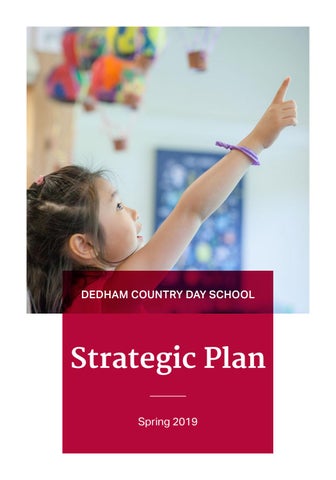
DEDHAM COUNTRY DAY SCHOOL
Strategic Plan March 2019
DEDHAM COUNTRY DAY SCHOOL
Strategic Plan Spring 2019
Dear DCD Community, We are delighted to share our strategic plan with all of you and are especially energized by the way the pieces of this plan work together to fuel the longterm well-being of DCD’s children and adolescents. While creating our plan, we asked ourselves, should this plan be designed as a roadmap or a compass? A roadmap lays out the exact routes we will take towards our destinations, whereas a compass point orients us towards a location, knowing we’ll need to navigate uncertain territories as we move towards our goals. Of course, we’ll need both, and you’ll see this belief reflected in the pages ahead. Some of our work will progress linearly with clear steps and objectives, and other pieces will evolve similar to a design process, as we learn along the way. The process of creating this plan gave us clarity about what is essential at DCD and led us to affirm our strong convictions about the best way to pursue these values. The idea is forward-looking and rooted in what children, adolescents, and the school will need in the future. At the same time, it moves us with the grain of our school’s long-standing reverence for childhood and adolescence as developmental stages to embrace as the foundation for a thriving life. Like everything else in DCD’s nearly 120-year history, the success of this plan — both its creation and its implementation — comes down to the commitment, thoughtfulness, curiosity, and synergy that exist among DCD’s community. We are grateful to the many voices that shaped the development of this plan. Our earnest hope is that you see your words and thoughts reflected in these pages and share our energy for bringing this plan to fruition in the years ahead. With appreciation and enthusiasm,
Allison D. Webster Head of School
Susanne Joyce Co-President, Board of Trustees
George Pantazelos Chair, Strategic Planning Committee
John Connors Co-President, Board of Trustees 2
DCD’s strategic plan for creating the best possible environment to foster long-term well-being in children and adolescents
Introduction Dedham Country Day School recently undertook an extensive strategic planning process to evaluate the current educational landscape regarding children’s and adolescents’ academic and emotional needs, to examine its own core competencies in meeting these needs, and to set a course for the next five years. The purpose of this document is to describe the process in which we engaged, to share our findings and our future direction, and to outline immediate next steps.
3
The Strategic Planning Process at DCD Affirm Vision ›› Where do we want to go?
Mission ›› What do we do now?
Core Values ›› Beliefs and behaviors
Plan Strategic Plan & Objectives ›› Research / gather info ›› Analyze findings ›› Formulate strategy ›› Communicate strategy
WE ARE HERE
Implement Key Initiatives ›› Develop tactics ›› Establish timeline ›› Implement ›› Evaluate & adjust
4
DCD’s strategic planning process began with an affirmation of our mission and values. After taking a deep look at who we are as an institution and determining the aspects of our program and facility that we’d like to grow, the Strategic Planning Committee moved into a year-long phase of research, analysis, strategy formulation and planning to frame our vision for DCD and its students in the years ahead.
Our Starting Point As an institution, we are fortunate to be building upon a strong foundation with robust enrollment, a growing endowment, and vibrant program, developed from nearly 120 years of extraordinary leadership, teaching, family commitment, and students. This recent strategic planning process was informed by internal and external survey data, community conversations and focus groups, research on the competitive and educational landscape, and a full analysis of our vision and mission, and was guided by three “non-negotiables� long held by DCD: Our school must be passionately child-centric.
We must provide children and adolescents the academic foundation they need for the future.
We must build inclusive environments that provide children and adolescents the skills to build strong relationships and develop their emotional capacities.
5
What Do Children and Adolescents Need to Thrive?
This is the perennial question we ask as parents and educators and the primary focus of our strategic planning group. The answer shifts as our current environment evolves, and will certainly shift given the vastly different environment in which our children will live as adults. Our Strategic Plan offers answers.
6
Rigor Redefined We believe rigor should focus not only on academic excellence, but should also place the long-term well-being of children and adolescents at the center of everything we do. For many schools, rigor is defined as an education focused primarily on content mastery. At DCD, we believe this definition of rigor is incomplete. We have always believed that students require a much broader set of skills and capabilities to thrive, both at DCD and in the years that follow. Our child-centric program instills in students the capabilities they need to succeed in secondary school and the world beyond DCD. We have built on our three core pillars of Academics, Arts, and Athletics to create a program that not only challenges students academically, but also fosters their ability to manage relationships, think innovatively, and fuel their own health, all while finding meaning in their learning. This is a new view of rigor, but it is not new to DCD. It’s who we are. It’s rigor redefined.
7
Whole School— Whole Child The iconic DCD triangle, more accurately described as an RE T architectural truss, provides LA EN M TI H ON an ideal way to visualize IS L SH P IN N M IP OV O H the interconnectivity S C LT AT C A A IO E H of the five key N MEANING components outlined in our Strategic Plan. Because of the way its pieces fit together, a truss can support and manage a heavy load. Just as an architectural truss relies on its unique structure to support the weight of the individual parts to create a strong synergistic whole, so too will the elements of DCD’s Strategic Plan. The result will be a childcentric program that supports both academic vigor and overall well-being.
The five elements represented in the DCD truss are designed to build in children and adolescents the varied and flexible skill sets to enhance their overall well-being, thereby giving them the tools they will need to succeed at DCD and beyond.
8
The Key Components to Fueling Well-Being in Children and Adolescents Priorities and Plans for Implementation
Accomplishment
Relationships
Ensure we continue to attract, hire and retain the best faculty and staff possible – the key lever to student accomplishment and success Evaluate the way in which our schedule supports or limits our program, and adjust it to ensure we use time in a way that maximizes the strength of our program and enhances the experience of students Assess our social-emotional learning curriculum and continue to strengthen the advisory program for adolescents Refine and formalize our program-review systems in order to keep our program informed by state and national standards, shaped by current educational research, and designed to meet the needs of our current student population Form a committee to develop a shared and articulated vision of core outcomes for our students
Innovation Fund Created for Faculty to Explore Ideas, Interests
Innovation
Develop our equity and inclusion programming to enhance the skills of both children and adults in understanding the role of identity in relationships; build our collective capacity to work against bias and prejudice; and strengthen our capacity to connect across differences Conduct a diversity and inclusion program review, including classroom and assembly programs, to strengthen our ability to build an inclusive school Evaluate our hiring protocols and recruitment systems to build a more diverse faculty and staff, given that both children and adults benefit from being part of a diverse community
Health
Create a lower school STEAM and outdoor learning space to better support this aspect of our program for children to further develop a problem-solving and risk-taking mindset Form partnerships with local universities and nonprofits to capitalize on the outstanding greater Boston-area resources available to us to bring real-life examples of innovation to our campus Continue to develop our technology infrastructure and integration, given that technology is one of the key ways we can connect students to the world outside DCD; allow them to demonstrate knowledge in a variety of ways; and introduce them to innovations rapidly reshaping our world
Continue our SEED (Seeking Educational Equity and Diversity) groups for faculty/staff and launch a group for current parents
Form a task force to formalize and articulate the manner in which our program fosters leadership skills, given that these skills are embedded throughout our program and are a key strength of a DCD education
Form a task force to develop a Diversity, Equity and Inclusion role or propose ideas for a team to support this critical work
Complete improvements to the woodshop, DCD’s original makerspace, to increase teaching space, and improve storage and lighting
First Round of Innovation Grants Awarded Summer 2018
Established Alumni Engagement Committee
Implemented Yoga and Mindfulness Curriculum
Fall 2018
Fall 2018
Spring 2018
Outdoor Paths Created to Link Buildings and Provide Campus Cohesion
Meaning
Form a task force to evaluate the nutrition and dining experience at DCD and take steps to maximize our ability to provide meals that are healthful, fresh, community building, and in line with current nutrition recommendations
Refresh and redesign the Lowell Center to provide our community with a space where we can regularly connect students to each other, to our broader community and to the world, as well as a hallmark arena that communicates the value of community in our school
Design spaces at the center of the DCD main building and around the campus to better facilitate students’ connection to the outdoors, given we believe spaces filled with natural light and students’ connection to the natural world fuels their curiosity and improves their physical and emotional health
Continue to build and shape our Service Program as one way for students to practice thinking about the needs of others and their capacity to act to shape and improve the world
Continue to develop curriculum related to well-being, given we believe explicit instruction related to well-being can have a positive impact on students’ mindsets and capacities
Launched SEED Group for Faculty and Staff
Developed New Ways to Engage Grandparents
Spring Fundraiser Held to Support Innovation Fund
Fall 2018
Winter 2018
March 2019
Fall 2018
Create greater synergy with the Horizons Program so the DCD community and the Horizons community can connect with and learn from each other Increase alumni and grandparent engagement so students benefit from the extended network of the DCD community
Hired Nationally-Known Schedule Expert to Begin Work with Faculty to Evaluate Academic Schedule and How Time Shapes Learning at DCD
Hosted Visiting Team for Math Program Review
Second Round of Innovation Grants to be Awarded Summer 2019
Spring 2019
Spring 2019
Formed Middle School Affinity and Social Justice Groups Fall 2017
Service Learning Co-Coordinators Attended Conference and Training Summer 2018
Sent Two Faculty Members to SEED Training Summer 2018
Adams Lab Renovated Fall 2018
Workout and Yoga Classes Offered to Faculty, Staff and Current Families
Kitchen Staff Met with Nutritionists at Children’s Hospital
Held Two Collaborative Meetings of Horizons and DCD Boards
Hired Architectural Design Firm to Build New Community Gathering Space
Fall 2018
Fall 2018
October 2018
Fall 2018
9
10
Faculty and Staff Met with Architects to Design Spaces February 2019
Hired Expert Practioners in Diversity, Equity and Inclusion to Provide Ongoing Professional Development for Faculty and Staff
Send Parents to SEED Facilitator Training in Anticipation of SEED Group Launch for Families
Winter/Spring 2019
Summer 2019
11
The Key Components to Fueling Well-Being in Children and Adolescents Priorities and Plans for Implementation
To help children and adolescents thrive and succeed at DCD and beyond, an education must include the following components:
Accomplishment
Spark and sustain accomplishment in a broad range of subjects
Relationships
Next Steps
Maintaining a Sustainable Financial Model An education focused on long-term well-being must rest on the foundation of a sustainable financial model for the school’s long-term vitality and financial health
• Continue work to contain costs and increase energy efficiency • Diversify revenue stream via endowment fundraising and other revenue generation, including Extended Day Program programming and summer camp • Work to sustain robust enrollment of each class • Continue focus on increasing affordability • Hire capital campaign director and consultant to complete feasibility study
Turning Our Vision into Reality
Help children form and navigate relationships over time and across a wide range of differences
The result of these efforts will be a program, a facility, and a community that work together to fuel the long-term wellbeing of everyone in DCD’s community
Innovation
This bold vision for DCD’s future will build on our strong history and traditions, RE T LA EN and reinforce our position as a M TI O SH I NS L P IN leader in preparing students for HI N M PS OV O C TH L A C long-term success. Like the TI A A E O H N DCD truss, its success MEANING will depend on the many diverse groups of our community coming together as a single, interconnected and supportive whole. As we finalize detailed plans and timelines for the priorities outlined above, you will learn more about how you can be part of turning this vision into reality.
Develop in children and in ourselves an innovative mindset
Health
Teach children how to fuel their physical and mental health, and practice the habits that will build this foundation
Meaning
Help children find meaning through their learning and in the world at large to form an understanding that they belong to something larger than themselves
14
Strategic Planning Committee
Board of Trustees Officers
• George Pantazelos, Chair • John Connors (Co-President, Board of Trustees) • Susanne Joyce (Co-President, Board of Trustees) • Karen Bacardi, Board of Trustees • Kristen Cloonan, Board of Trustees • Rick Edie, Faculty Representative to the Board of Trustees • Mark Epker, Board of Trustees • Ilyse Greenberg, Board of Trustees • Sheila Hiatt, Board of Trustees • Emilie Liebhoff, Assistant Head of School and Director of Admissions • Skip McKee, Board of Trustees • Charles Rudnick, Director of Advancement • Bob Santry, Chief Financial Officer • Allison Webster, Head of School
• Co-Presidents, John Connors and Susanne Joyce • Treasurer, Christine Freyermuth • Clerk, Lee (Mumford) Peterson ’86
Trustees
• Karen Bacardi • Jeffrey Barnes, ’66 • Edward Bigelow III • Curt Burmeister • Chris Cheever ’94 • Kristen Cloonan • Mark Epker • Ilyse Greenberg • Sheila Hiatt • Keith McCown • Skip McKee • Kathleen Odomirok-Hoffman • Mervan Osborne • George Pantazelos • Patricia Profeta • Aidan Riordan • Rick Edie, Faculty Representative • Erin (Keith) Epker ’86, Alumni Council President • Sharisse Cail Perry, PA President
15
DEDHAM COUNTRY DAY SCHOOL • PRE-K TO GRADE 8 90 Sandy Valley Road Dedham • www.dedhamcountryday.org