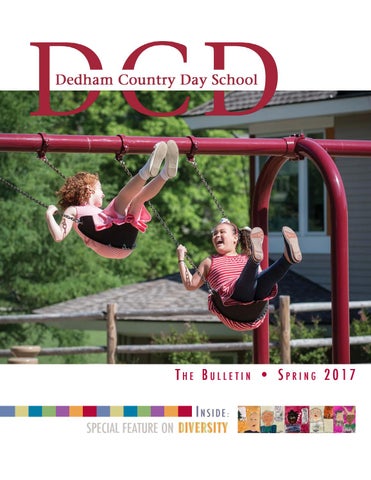
The Bulletin • Spring 2017 Inside: SPECIAL FEATURE ON Diversity
Mission Statement
Dedham Country Day School •Provides to each child a unique educational balance of challenging academics, arts, and athletics; •Embraces an inclusive, interdependent community of students, teachers, and parents that fosters trust and encourages children to take risks; •Creates independent, resilient, lifelong learners through engaging, developmentally-based teaching designed to meet varied learning styles; •Inspires students to become caring, ethical members of the larger world by emphasizing thoughtful citizenship and respect for self and others.
Diversity Statement
At DCD, we define diversity as an umbrella term that includes race, gender, age, ethnicity, culture, nationality, sexual orientation, social and economic class, physical and learning differences, and religion, as well as other characteristics that contribute to each individual’s full identity. We strive to provide a multicultural education, which celebrates the diversity of our community and the larger world. At DCD, respect permeates all aspects of school life. We want children to learn to understand and value multiple perspectives, identify and reject stereotypes and prejudices, and work for equity and justice. Dedham Country Day is strongly committed to ensuring a sense of community in which every member is safe, valued, and treated with dignity. We believe that a broad range of experiences and viewpoints enhances learning and enriches life.
Admissions Inquiries should be submitted to Emilie Liebhoff, Director of Admissions and Assistant Head of School Dedham Country Day School 90 Sandy Valley Road Dedham, MA 02026 Tel: 781.329.0850 • Fax: 781.329.0551 Web: www.dedhamcountryday.org
In This Issue SPECIAL FEATURE ON Diversity FOSTERING AN INCLUSIVE COMMUNITY: Building on DCD’s Diversity
and Strengths . . . . . . . . . . . . . . . . . . . . . . . . . . . . . . . . . . . . . . . . . . . . . . . . . 2
DEVELOPING OUR UNDERSTANDING OF UNCONSCIOUS BIAS:
A Presentation by Mahzarin Banaji of Harvard University. . . . . . . . . . . . . . . . . . . . 5
USING MY DIFFERENCE TO MAKE A DIFFERENCE: Eighth Grader
Keesha Theodore Reflects on the AISNE Conference for Students of Color. . . . . . . . . 8 Head of School
MOVING EXPERIENCES: This Year’s People of Color Conference in Atlanta
Allison D. Webster
Inspires DCD Faculty. . . . . . . . . . . . . . . . . . . . . . . . . . . . . . . . . . . . . . . . . . . . . 9
Director of Admissions and Assistant Head of School
BRINGING THE MISSION TO LIFE: Horizons at DCD Reaches New Milestone and
Director of Advancement
LYNNE MAYARD: The Power of Affinity Groups for Supporting Our
Emilie Liebhoff
Charles S. Rudnick
Director of Communications Leslie Bowen
Bulletin Editor
Welcomes Back Executive Director Meredith Laban. . . . . . . . . . . . . . . . . . . . . . . 12 Diverse Community. . . . . . . . . . . . . . . . . . . . . . . . . . . . . . . . . . . . . . . . . . . . . 14
ALUMNI PROFILE: Monique Tello ’86, Recipient of the 2017 DCD Alumni Award,
Combines Medicine and Writing to Reach Underserved Populations. . . . . . . . . . . . 16
Leslie Bowen
Class Notes
Miriam Stulin
On Campus
18
Michele Page, Design Communication Creosote Affects
Visiting Speakers Share Expertise Grandparents’ and Special Friends’ Day
18 22
Layout and Production
Student News
24
Students Receive Recognition in the Arts Carnegie Hall Beckons: Students Head to Winners’ Recitals in New York City Academic Highlights It’s a Match: DCD’s Eighth Graders Find the Right Fit in Secondary Schools
24 26 28 30
Sports Round Up
32
Fall 2016 Winter 2017
32 34
Alumni Association
36
Editor
Alumni Return to DCD Alumni Speakers Series Alumni Association News
Manuscript Editor
Class Notes
40
Design Consultants
Leslie Bowen
Photography
Leslie Bowen Kristie Gillooly Dean ʼ02 John Leith Hilary Rochelle Charles Rudnick Miriam Stulin
Printing
Recycled Paper Printing, Inc.
Special Feature on Diversity Leslie Bowen Kathryn Sargent
Writers
Kevin Bowen Leslie Bowen Allison D. Webster
Design
Jason Fairchild, Truesdale Group Front and Inside Front Cover Photographs by Kristie Gillooly Dean ʼ02
36 38 39
Diversity FOSTERING AN INCLUSIVE COMMUNITY:
Building on DCD’s Diversity and Strengths
By Allison D. Webster
W
hat are some of the ways DCD fosters a thriving and diverse community? This edition of our Bulletin offers a window into some of our efforts to build and sustain an inclusive community, and a glimpse at how we prepare students for the wonderfully diverse world in which we live. Much has been done in recent years to build on DCD’s strengths: our rich curriculum has evolved to include more diverse voices and perspectives, robust anti-bias curricula, and greater opportunities for students to understand affinity and identity; stronger recruitment efforts have brought increased diversity to our vibrant student body; our diversity committee continues to elevate topics of multiculturalism and inclusion through full-school events and communication; our board continues its strong fiscal planning, enabling DCD to use financial aid to build an economically diverse community; our talented faculty members continue to learn about topics of diversity and inclusion, expanding their capacity to meet the needs of all students. Over the course of DCD’s history, our diversity and inclusion work has evolved to meet the needs of the times, and that work is ongoing. I recently heard Sir Ken Robinson speak, and he described two important obligations schools must meet, both of which are essential to our work
2
preparing students for our diverse world. The first obligation is to teach children about the world that existed before they were born and that will exist for generations beyond their lifespan—topics such as gravity, photosynthesis, history, great works of literature, natural wonders, and works of art, to name a few. Our other obligation is help students make sense of the world that exists only because they are alive, the world inside children’s heads and hearts as they come to understand their own thoughts and feelings.
Our work preparing students for the diverse world in which they live involves education in both of these realms. Children need to understand the historic and cultural significance of aspects of identity, and how cultural systems may influence individual beliefs and relationships; this is the world that exists with or without them. Children also need opportunities to explore and consider the many aspects of their own identity, and their thoughts and feelings about each aspect; this is the world that exists only because they are alive, the world of their own making.
Diversity
Enid Lee writes in Beyond Heroes and Holidays: A Practical Guide to Anti-Racist, Multicultural Education and Staff Development, “Schools should promote cross-cultural dialogue and respect. But just as importantly, schools should be a place where students can analyze the forces which maintain injustice and develop the knowledge, hope and strategies needed to create a more just society for us all.” The world that exists without our children and the world that exists only because of them are both important as we educate children and give them the skills and capacities they need to form strong relationships across all kinds of differences and similarities. While our stated mission supports our diversity and inclusion work with students, DCD’s Diversity Statement, written and approved by DCD’s board, adds more specificity about our goals as a school. Some of the statement speaks to helping children understand the history and context in which their current lives are set; some of it speaks to helping children embrace and understand their own identity: We strive to provide a multicultural education, which celebrates the diversity of our community and the larger world. At DCD, respect permeates all aspects of school life. We want children to learn to understand and value multiple perspectives, identify and reject stereotypes and prejudices, and work for equity and justice. Dedham Country Day is strongly committed to ensuring a sense of community in which every member is safe, valued, and treated with dignity. We believe that a broad range of experiences and viewpoints enhances learning and enriches life.
“Children need to understand the historic and cultural significance of aspects of identity, and how cultural systems may influence individual beliefs and relationships.” As part of this statement, diversity is defined as “an umbrella term that includes race, gender, age, ethnicity, culture, nationality, sexual orientation, social and economic class, physical and learning differences, and religion, as well as other characteristics that contribute to each individual’s full identity.” Over DCD’s history, our diversity and inclusion work has shifted to meet the needs of the times and of current students. For example, in recent years, DCD’s faculty has come to understand more about gender identity through trainings and their work with children who are gender non-conforming or transgender. In the current climate of political division within our country, DCD’s work modeling our values of thoughtful citizenship and respect for others is as critical as ever. The goal of ensuring every member of our community is safe, valued, and treated with dignity is an important one, since a child’s emotional safety is the foundation for learning. One way we build this safety and trust is by ensuring that children can share all the parts of their identity that are important to them. As they age, different aspects of their identity will rise and fall as central to their emotional lives, but all aspects of who they are must be welcome and accepted for children to truly feel a
sense of place at DCD. The poem The Doctor of Starlight, written by former U.S. Poet Laureate Philip Levine, beautifully demonstrates how critical it is that we can share all the important aspects of our identities. In the poem, a man goes to a surgeon to have a blue star, a metaphor for part of his identity, removed. The surgeon cuts into his skin and removes it, and asks him at the end of the poem, “Do you know what you have under it?” The answer comes: “Another perfect star.” When we come together as a community, either in a large group as at our recent commUNITY evening with Mazharin Banaji, or in small moments when we as individuals share the ups and downs of our days, we build the culture of honesty and connection that permits us to live our mission, and we make sure that the “blue stars” that are important to each child and adult— whether religion, gender, race, ethnicity, or sexual orientation—can be seen and celebrated, rather than hidden. Our culture of care and connection is strong, and it helps us build a diverse and inclusive community; recent research at the school supports this claim. DCD is a Caring School, part of a nationwide research program run by Harvard’s Making Caring Common Project, which includes regular surveys of students and teachers. The 3
Diversity project explores the gap between what adults profess as values and how children (grades 6-8) absorb those messages. Most parents in the national study say their primary message is to teach children about caring for others. Children conclude something different from these messages, with most reporting that their parent’s top priority is achievement. Of course there does not need to be a choice between achievement and caring, but the interesting part of this finding is the gap between the values adults espouse and the values children believe are in place. As James Baldwin said, “Children have never been very good at listening to their elders, but they have never failed to imitate them.” As the national survey confirms, children see behaviors that lead them to doubt what adults are telling them. According to the Making Caring Common Project, only 20 percent of the youth in the national survey say that their parents are more concerned about them caring for others than about achievement or happiness. At DCD, 55 percent of our middle school students believe that the adults at DCD most value caring for others, even above achievement. The Caring Schools data affirm our strong DCD culture of care, and also reveal that there is more work to do to build the inclusive, safe, and values-driven culture we want to cultivate. Our culture of care is meaningful not only because it extends to groups, but also because it extends to individuals. People feel they belong at DCD, not solely because a group that is meaningful to them belongs, but also because they know that they are personally valued as an individual. This idea brings us back to the world that exists only because a child is in it, and 4
that they know with their head and heart that their unique combination of identity, preferences, humor, and tastes is uniquely valued at DCD. One of the most striking things about DCD is how personally children are known, and how celebrated and valued each of our 257 children is by both adults and peers. Whenever we discuss the important work of diversity and inclusion of groups at DCD, we must consider the sense of place and belonging that each individual within our community feels over time. Through our curriculum and community, concentric circles of understanding are built over a child’s years at DCD. The students come to understand themselves, their identity, and the larger context in which the many aspects of their identity will shape and be shaped by the larger world. In the words of Enid Lee, we strive to develop in children the “knowledge, hope and strategies needed to create a more just society for us all.” Throughout this journey, students’ sense of belonging comes from knowing they are valued for the many aspects of who
they are and what they bring to the school. Each child is filled with Philip Levine’s perfect blue stars, unique aspects of their identity that cannot and should not be removed. DCD is a better school because of our diversity, and we are grateful for the multi-faceted backgrounds and identities our students, families, and our faculty and staff bring to DCD each day. As a 114-year-old school, we can imagine there is a DCD that will exist beyond our current generation of students and families, and there is the DCD that exists now only because we are in it. Our school will be shaped by how we all engage with each other during this generation of the school to further build a diverse and inclusive environment. Our strategic efforts to continue our current momentum and capitalize upon our strengths, whether related to recruitment, program, or finance, will ensure the school continues to be relevant and childcentered in the years ahead, and that DCD continues to be a place where all of our “blue stars” can shine.
Diversity
DEEPENING OUR UNDERSTANDING OF UNCONSCIOUS BIAS A Presentation by Mahzarin Banaji of Harvard University TO SPARK CONVERSATION, ENJOY CONNECTION, AND BUILD AWARENESS, DCD’S DIVERSITY COMMITTEE—MADE UP OF FACULTY, TRUSTEES, AND PARENTS (SEE SIDEBAR)— SPONSORS AN ANNUAL DINNER WHERE THE ENTIRE ADULT COMMUNITY COMES TOGETHER TO SPEAK OPENLY ABOUT DIVERSITY. THIS YEAR’S EVENT EXPLORED THE TOPIC OF UNCONSCIOUS BIAS. Before this year’s CommUNITY dinner in February, signs leading to the entrance of the school—Sweet-Sour, Peanut Butter-Jelly, Read-Write, RainShine—prompted parents to wonder just what these word combinations had in common. As examples of words and thoughts we associate automatically, they provided a metaphor for how our brains interpret information and cause biases without our conscious awareness. Harvard University psychology professor and author Mahzarin Banaji used the occasion to address how the workings of our brains cause stereotyping and discrimination. Dr. Banaji told the audience, “It’s important to understand what’s going on in our heads,” specifically, the biological workings of our brains that
contribute to what she terms, “implicit bias.” In Blindspot: Hidden Biases of Good People, she explains how our hidden biases about race, gender, age, ethnicity and many other cultural attitudes stand in the way of being fairer and more humane to those around us who are different. In an effort to make these hidden biases more visible, she and co-author Anthony Greenwald developed the Implicit Association Test, which more than 30 million people have taken on their website. Designed to examine these unconscious biases at work, the test data reveal the extent to which our
Diversity Committee Members Curt Burmeister, co-chair David Coleman, co-chair Sarnia Etienne-Dupie Rick Edie Ali Fernandes Carla Haith Margaret Kelly Lynne Mayard Steven Perry Lee Peterson Karen Salfity Stephen Tshuka Allison Webster
Left to right, Diversity Committee co-chairs David Coleman and Curt Burmeister, Head of School Allison Webster, and Dr. Mahzarin Banaji 5
Diversity “WeR1”
by David Coleman and Kabir Sen Majority, minority, superiority ignoring “we”, That’s how it starts like a war to be one, Different parts of the same world community, Separated, segregated, complicated, like we’re unrelated ‘Til we’re jaded and rated in stats and charts, Hated, degraded, but hey kid the human heart Is underrated, so great. Be smart and recognize That the lies they disguise as the truth just stigmatize. Now my eye’s on the prize, I’m wise and see the truth Time to spread it all over the world and get the youth Motivated, activated to love, integrated When we make it everyone is elated and celebrated. We create it – the future, the power’s in our hands Do you want to live apart, or be a part of the plan It’s all about you for me and me for you. What you gonna do? One thing I know is true is we’re one.
Download the song 6
perceptions and judgements of people who are different than us may lead us to underestimate their character and potential. “We are changing toward neutrality,” she said. To show how things are changing, she brought up the example of Harvard College, which at one time accepted 402 of 405 applicants from Groton to a homogenous class. “Now every underrepresented group in the country sits in Harvard College in the numbers they exist in the country,” she said. “We have kids from 50 states. Fifty percent of Harvard College is on deep financial aid. It’s our life blood. We believe that it’s the only way we can be a great university.” This, she said, is why it’s so important to overcome our biases. She shared the example of Microsoft founder Bill Gates, who in 1981 presented Encyclopedia Britannica with a software proposal and was rejected because of his long hair. While it seems obvious to us in retrospect, the CEO couldn’t accept the deal back then because of a stereotype. “I fear that people are walking in to my office everyday with great ideas that I am missing because of packaging,” she said, mentioning the challenge of listening to a young
female student with a valley girl accent that didn’t quite match her own stereotypical idea of genius. Everything is going to change including the notion of education, she said, asking parents, “Imagine a room like this in 40 years. What are they going to think of us? We will look embarrassing in 40 years,” she said. “It’s our job to do better. We have a big fat frontal cortex; we can be different if we choose to be. We are going to be held to a different standard by future generations. We need to be changing the minds of our children so they can do their best.” To make her point she showed a film of people passing basketballs to each other and asked the audience to count the number of passes. After viewing the film, she asked if they saw something strange. Indeed, a woman with an umbrella had walked across the screen, but only one person noticed. As she explained, “you all saw it, but something happened in your brain; the CEO of your brain said that it cannot happen. You saw it, but rejected the data. The facts contradicted your reasoning.” “Hundreds of these biases show that if data do not fit with the way we expect the world to be that our
Diversity
Left to right, third grade teacher Lynne Mayard and lower school head Carla Haith talk to Dr. Banaji after her presentation; Ali Fernandes, front, and trustee Mark Epker listen to Dr. Banaji’s remarks. Photographs by Hilary Rochelle
expectations will win over the hard facts staring us in the face,” she said. The power of expectation can also affect how well children do in school. Dr. Banaji cited a study of four children who were picked at random as the top students in their class and who, a year later, were doing better than all the other students, to demonstrate what she termed “expectancy effects.” “Bare your minds to yourselves,” she said. “When you think of people different from you, you use a different part of the brain. Self-based neurons create an invisible moral boundary around us. We believe we are using our values, but we are using our gut. The pre-frontal cortex is not being used; the sub-cortical amygdala, controlling fear and flight, is in charge.” “It’s as if we have two minds,” she said, “there’s not one brain, but multiple actors that make decisions in multiple situations. We have to recognize how this lack of consistency translates into the classroom, into society. It’s so important to know this is happening,” she said, “so that when you’re in a position like a judge deciding custody, for example, you’re deciding fairly.” For-profit organizations are the ones doing something about it, because they
have to look at the bottom line. As the Bill Gates example demonstrates, companies can lose out if they don’t recognize talent because of biases or stereotypes. “Think about our responsibilities,” she said. “Ask yourself who sees you as somebody they would like to be like. Make a list of the people who are younger, junior, and if they look like versions of yourself. I would never have gotten a Ph.D. if I looked for people who were like me to be mentors.” One of her findings is that the more educated you are, the less overtly biased you are, but that education does not have an effect on implicit bias. So, although we’re changing toward neutrality, we’re not changing on race, and that the numbers on race are actually worse. Study after study of data collected in the real world show these biases. Citing a study of five thousand job applicants, she said, “An African American man has the same likelihood of being called back for an interview as a white man who was a felon.” “Little things put you on a path,” she said, asking us to be mindful of our decisions. “Science can tell you what’s going on, but we need to make the changes in society.”
Diversity Statement At DCD, we define diversity as an umbrella term that includes race, gender, age, ethnicity, culture, nationality, sexual orientation, social and economic class, physical and learning differences, and religion, as well as other characteristics that contribute to each individual’s full identity. We strive to provide a multicultural education, which celebrates the diversity of our community and the larger world. At DCD, respect permeates all aspects of school life. We want children to learn to understand and value multiple perspectives, identify and reject stereotypes and prejudices, and work for equity and justice. Dedham Country Day is strongly committed to ensuring a sense of community in which every member is safe, valued, and treated with dignity. We believe that a broad range of experiences and viewpoints enhances learning and enriches life. 7
Diversity USING MY DIFFERENCE TO MAKE A DIFFERENCE: Eighth Grader Keesha Theodore Reflects on the AISNE Conference for Students of Color
T
he Association of Independent Schools of New England (AISNE) held its annual conference for middle school (and fifth grade) students of color at Boston College High School on Saturday, February 4. The conference provides rich opportunities for discussion and learning and also creates an affinity experience for students. Keesha Theodore, an eighth grader, was one of six DCD students to attend the conference (also attending were Cameron Yao, James Ko, Jason Sima, Gio Clark-Bascom, and Jeff Delva). Unlike the emotional response of teachers who attended the NAIS People of Color Conference (POCC), Keesha said, “Intellectually it piqued my interest. I learned a lot and it was all very interesting.” The theme of this year’s conference was, “Using my difference to make a difference.” There were workshops on a range of topics and speakers in the morning and afternoon. The speakers at the beginning and at the end focused on the conference theme, including State Senator Linda Dorcena Forry, who was the closing speaker. A native Bostonian and firstgeneration Haitian-American, she was the first woman and person of color to represent the 1st Suffolk District,
8
which includes Dorchester, Hyde Park, Mattapan, and South Boston, and has dedicated her life to public service. “She talked about how she grew up, what she did in her community, and how she had some difficulties later in life and that she just pushed through those and continued to do her job well,” said Keesha. “All the speakers talked about what they had been through and how they used their experiences to make an impact. They told us a little about themselves, their childhoods, and what they struggled with and explained how you can use your childhood experiences and what you’re going through to do good in the world.” It was a great message for Keesha, who says, “helping people in general is my calling in life.” She attended a workshop on Race and Criminal Justice for the second time this year. “It was different from the year before, where they told us facts, the statistics, for example, that a black person would go to jail more often than a white person.” “But this year, we looked at an old case from 1974 about breaking and entering. We read about what happened in the case, the police report, and we read what the woman said who was the only witness. She gave descriptions of the person and then we were shown
Keesha Theodore works on a community service project for the Charles River ARC. photos to try and understand how she could have sent the wrong person to jail.” “No one matched the description perfectly. It was dark at night, she was panicked and scared, there were lots of variables. But the case showed us how people perceive other people differently.” The man and the woman who wrongly accused that person now work together in The Innocence Project, which helps clear people who are innocent and get them out of jail. It was inspiring to Keesha, who says she wants to go into the field. “I want to be a lawyer, not sure what kind of lawyer, either criminal justice or immigration. I like reading, defending, and I just want to help people in general.”
Diversity
MOVING EXPERIENCES:
This year’s People of Color Conference in Atlanta Inspires DCD Faculty
D
CD sent members everyone else’s. We can’t talk of the faculty and about diversity and inclusion staff to the 29th and then exclude certain annual NAIS People of people. It’s a contradiction.” Color Conference (POCC) in Thinking back to their Atlanta, Georgia, December school visit, Lynne agreed, 8-10, 2016: Office Manager “No matter what you did at Fiona Edwards, Network that school, everyone had a Administrator Ali Fernandes, monthly meeting with the Lower School Head Carla Head of School to talk about Haith, and Third Grade how they were contributing.” teacher Lynne Mayard. All were impressed by the The conference theme of school’s immersive learning Advancing Civil and Human approach, teaching by having Rights: Fulfilling the Dream students get involved, doing Together resonated with all everything hands on instead of them. The experience was of lecture style. Ali Fernandes different for each of them, said, “I was blown away by but all came away citing the the kids. The students were so importance of many of the impressive in how they took same central themes. responsibility for their work For Fiona Edwards, it was and could talk about it.” her first year attending the For Carla Haith, the DCD staff clockwise from the upper left: Fiona Edwards, Ali Fernandes, Lynne conference. The others all had Mayard and Carla Haith. opening ceremony, which been to the annual conference featured a 15-year-old white “Implementing a culture like that in previous years, but even for them, spoken-word artist who talked about makes everyone feel that they’re part it was the first time attending a what’s going on in the world now, from of something. Even his administrative conference that included an opportunity the Black Lives Matter movement to assistant really felt part of the to visit a local school, the Children’s immigration, was the most inspirational community.” School-Atlanta. part of the program. The artist went That sense of encouraging The school’s diversity and leadership on to be featured on The Ellen Show involvement among administrative struck the attendees as remarkable. and other venues, talking about the staff made Fiona think she wished “They were a very diverse school. The things that are important to students the conference itself included leader was just phenomenal,” said and working to convey a message of more workshops for non-academic Lynne Mayard, a veteran of seven caring and inspiration. That his content support staff. “They need to think conferences. at the conference came from an Indian cohesively and inclusively when Fiona echoed her sentiments: “It woman, an immigrant, was especially planning these types of conferences,” was not only his leadership style, but significant for Carla. “He said she she said. “Otherwise, you’re giving the fact that he was a very transparent, should be delivering this content but non-academic people the idea that their systematic-minded person,” she said. that we wouldn’t be able to hear it contribution is just not as valuable as 9
Diversity the same way. He felt it was his job to share that message.” Carla said her one wish was that “you could package that up to let us adults know what we should be doing and saying.” The closing ceremony was also a point of inspiration for Carla, who was attending the conference for the 13th time since 2004. When hearing that the ceremony featured Dr. King’s only living sibling, Christine King Farris; the legendary baseball player Hank Aaron; and Congressman John Lewis, a pioneer of the civil rights movement, one could only envy the group. “It was inspiring to hear Hank Aaron talk to students about the obstacles they’re going to face and how they have to keep pressing on and not let anybody stop them,” Carla said. “When you have this dream, you have to get up and go after it, no matter how tough it is, you have to get out there and do it.”
Children’s art display at the Children’s School-Atlanta 10
“I liked when someone asked John Lewis a question about getting arrested 45 times,” Fiona added, “and he told students ‘it’s okay to get arrested as long as the results lead to something greater than yourself.’ It was really Interesting and eye opening, because I would imagine that would be something worth fighting for, getting arrested for equity and freedom for everyone.” For Lynne, Lewis’s work and continued engagement as an actor in history-making struck a chord. “It was funny after the conference to see him on the news, to imagine that even at his age, he was still standing up for his beliefs. It’s significant when you think of all the students there hearing his message.” Over the years the conference has inspired and revitalized many in a variety of ways. “For me, it was just great to be in the midst of so
many different types of people,” said Fiona. “It was not just people of color, there were lots of white people there supporting the initiatives of the POCC. It was great to see the unity. It made me realize we’re not unique in our efforts here at DCD, that there are a lot of schools and people working towards the same thing. It was eye opening, almost life changing for me.” “Every time I go, it revitalizes me in a different way,” Lynne added. “It’s hard to describe. Imagine if you’re not a person of color and you go somewhere where you’re the only white person you see. For us, because we’re so used to experiencing the mainstream culture, to see so many shades of people in a room is unique. In New England, in particular, there are very few places you can go to experience that feeling.” The conference gave all pause for
Diversity
Left: video projection of Hank Aaron and Christine King Farris. Right: Carla Haith speaking at a workshop she led, “So you’re an administrator, now what?”
reflection on how things had changed over the years. Lynne remembered back to her first conference in 2000 when there weren’t many people of color in independent schools, or at DCD for that matter. Ali, too, attending the conference for only the second time, was amazed at how big the conference had grown in terms of the sheer number of people in attendance and the different tracks you could follow. “There was so much professional development to take advantage of there and it wasn’t just about the color of our skin,” he commented. The importance of having people of color on the faculties of independent schools can’t be overstated. Studies have shown that having more people of color teaching in a school can dramatically benefit children of color. In fact, a study published in March of this year found a greater likelihood of graduation and potential college attendance among low-income black students who encountered at least one black teacher between grades 3 and 5 and cited an overall decrease in dropout rates of 29 percent and a staggering decrease of 39 percent among boys.1 Lynne also noted the importance of women of color moving into the 1
administrative ranks and taking on more important and powerful roles. “It was heartening to see the change over time,” she said. “When I first went with Sonia Valentine years ago, she was one of just a few people of color in leadership positions in independent schools and the only Head of School who was a person of color.” During the conference, a Heads of Color parade on the stage reiterated just how much things have changed in independent schools. Carla, who headed a panel, So you’re an administrator, now what?, said, “Just to watch that number as it has grown over the years to now when there might be 30 or so Heads of Color is inspiring.” The conference has been a jumpingoff point for many new projects over the years. Lynne recalled how her dream of starting an affinity group for children of color at DCD was nurtured through attending the conferences. “I knew in my heart before 2010 when we started the Culture Club what I wanted to do. But because of the conferences, I went to enough workshops to give me the foundation to start the Culture Club.” The school is exploring whether something similar to the Culture Club
could be offered in middle school, which already has a number of systems in place for students to explore issues around diversity and identity and to take on leadership roles in those areas. Reflecting on the high school students at the POCC attending the 23rd annual Student Diversity Leadership Conference (SDLC), she said, “They’re phenomenal. The SDLC is not just kids of color, there’s a much broader range.” “I came away with a renewed sense of the importance of fostering a strong sense of identity in our young people,” Fiona added. “If students have a good sense of self, culture is malleable. We need to be teaching our young people about that strong sense of self, to be proud of who they are and not let society change that. We need to hold on to the strongest part of our core and use those parts of our identity to make the necessary changes in the world.” As she notes, “Creating a diverse culture, or a culture of equity and inclusion, is not the easiest thing to do.” What they have learned and brought home to our own DCD community from the NAIS conferences over the years has benefitted, enriched, and educated every one of us, and given us all a good start toward a better future.
The Long-Run Impacts of Same-Race Teachers, a working paper by Seth Gershenson, Cassandra M. D. Hart, Constance A. Lindsay, Nicholas W. Papageorge (IZA Institute of Labor Economics: March 2017) . 11
Diversity BRINGING THE MISSION TO LIFE: Horizons at DCD Reaches New Milestone and Welcomes Back Executive Director Meredith Laban
Below: Tasha Harris, a teacher at Horizons for nine years, reads to the Pre-K class. Right, top and bottom: A rising second grader learns about the life cycle of a leaf; Horizons friends enjoy a moment at recess.
T
his spring marks Meredith Labanʼs return to the DCD campus as Executive Director of the Horizons summer program. Students, faculty, and staff all report happily anticipating the return of a leader who launched and led in its early years the program that has grown from a modest start of 16 students in 2009 to an expected summer of 2017 enrollment of 150. Having returned this past March, Meredith is well positioned to resume leading Horizons in a milestone year, as the program’s founding class completes eighth grade and is poised to enter high school. Horizons is a six-week academic enrichment program offered to low-income stduents from Boston and Dedham to combat what’s known as “summer slide.” Students focus on improving math and literacy skills while receiving swimming instruction and enjoying a variety of cultural enrichment activities. An affiliate of a nationally recognized program, Horizons at DCD is one of 51 sites. During Meredithʼs hiatus from the DCD program, she oversaw operations of other sites in the network at the Horizons National office. “My job at the National office was satisfying,” she shares, “but I’ve been missing the old interactions.” Meredith says she’s most excited about working again with the students,
12
staff, faculty, and families of the program, many whom she’s become close to over the years. The tightknit bonds formed are reflected in the program’s remarkable 95 percent retention rate. With so many students and families returning yearly as the program has grown, these same bonds are also deeply rooted in the DCD community. The close community is something that Meredith takes pride in, making her
return almost seamless. She sees DCD as a home that shares the principles and commitments of the Horizons mission. “There is a real overlap in vision and a natural connection,” she says. She cites the common goals of stressing “hands-on” work, support for development of both academic and life skills, and an appreciation of cultural, ethnic, and racial diversity. In many ways, she says, DCD’s motto, “Learning Is a Way of Life,”
Diversity
encapsulates Horizons’ core values. This summer, Horizons will serve 150 students coming from Dedham, Roslindale, Hyde Park, Dorchester, Roxbury, and Mattapan. As always, the program has more applicants than it can accommodate. Openings for new students—particularly in the higher grades—are scarce due to the policy of giving siblings admission priority and because of the high retention rate. Meredith cites the increasing demand for Horizons as added confirmation that the program works. Horizons students consistently demonstrate improvement in reading and math skills. She also points to the diversity of staff and faculty working at Horizons, where 30 percent of the students are African American, 30 percent are Latino, and 30 percent are white. Thirtyfive percent of faculty members are African American, as are 25 percent of staff. These figures and the program’s success echo the findings of recent studies showing increased retention and improved skills in math and English among African American students who have studied with an African American teacher between third and fifth grades.2 Beyond the advantages of having diversity in both Horizons students
REQUIRED READING: K-2 Here are just a few of the books DCD students are reading as part of the K-2 curriculum:
and staff, Meredith believes the DCD community benefits from having this perspective on campus and in DCD families. Current and former DCD parents, many of whom are on the Horizons Board, have been tremendously generous supporters of the program, donating funds and time. DCD teachers have taught at Horizons, and DCD students and alumni have worked and volunteered at the program. Horizons even has a student who now attends DCD, bringing this wonderful relationship full circle. Meredith continues to work to find ways to meet increased demand and is currently researching opportunities to open new programs at other independent schools in the area, some extending to serve high-school-age students. Meanwhile, she strives to make improvements to the current program at DCD. She says the DCD program rates well among the more than 50 Horizons programs nationally, and though very happy with that, she’s dedicated to seeing the program continue to improve and grow. 2
See note 1, page 11. 13
Diversity LYNNE MAYARD:
The Power of Affinity Groups for Supporting Our Diverse Community
B
ack in the third grade in Mount Vernon, New York, Lynne Mayard began to notice that things were a bit different in schools on the north side of town than they were on the south. School buildings on the north side were brighter and better maintained; they had more resources, smaller class sizes, nicer playgrounds, gyms, and more extracurricular activities. It puzzled her, for the two sides of town were not all that different economically; it was their racial composition that separated them. That year Lynne’s parents, using the precedent of Brown vs. the Board of Education, would join other parents in filing a lawsuit against the town. One immediate result of the lawsuit was that Lynne found herself being bused to a school on the north side. She was one of only about 20 children being bused to a number of different schools,
14
as families had to pay for the buses on their own until the final decision of the court came down. As Lynne recalls, the experience was one that would change her forever, one that would teach her firsthand the value of advocacy and fighting for equal rights and opportunity, and teach as well the complicated challenges students and educators would face as efforts to reflect the diversity of the American people in the nation’s classrooms would move forward. Lynne brings that knowledge and experience to her work at DCD every day. As was the case in Mount Vernon, she found herself breaking new ground at DCD, arriving at the school in 1996 as one of the school’s first African American faculty members (Janine Saint-Louis and the third-grade teacher Lynne replaced were the only African American faculty members at the time)
as the school began efforts to create a more diverse faculty and student body. Even as she took her new position she was aware that there had been debate about the school’s new direction, that there were some who, for various reasons, wanted DCD to remain a homogeneous community, comprised of families having similar cultural and economic backgrounds. Lynne attributes her and the school’s successful transition largely to the leadership of Sonia Valentine, then head of school, and the great show of support by faculty, parents, alums, and students. “Sonia Valentine was a female and a person of color, head of school, that meant a lot to me. Growing up, with the exception of a cousin who taught kindergarten and my own third-grade teacher, I’d never had even a teacher who was a person of color.” These were the only persons of color
Diversity
she would encounter throughout her education. To help support the transition to a more diverse student body, in 2011 Lynne founded the Culture Club as a forum for students and for DCD to develop greater understanding and appreciation of the rich mix of cultures and backgrounds that make up the school community. “The students came up with the name of the club themselves. There were a number of names thrown out, even
several by me, but the student almost unanimously voted for this one.” She agrees that the Culture Club title reflects the diversity of its AfricanAmerican, Asian, Haitian, Jamaican, Latino, Indian, Middle Eastern, and Caucasian members. Lynne believes that one of the great strengths of the club is that it is not grade-specific, which means students can find in the club older mentors and friends and draw on the experiences of those who have come before them. An early group undertaking, The Faces project, was designed “to show it takes all of us to build a community, and show as well that you can’t determine what’s going to come out of a person by just looking at them.” While in the early days, she depended mostly on word of mouth to build awareness of the club and on attending conferences for developing new ideas, she can now visit websites for ideas and resources. She continues to attend conferences to share thoughts with peers about affinity groups centered around adoption and other topics as well as race. She recently attended the People of Color conference in Atlanta, where she attended a workshop on the concept of “home” and how we can all be united across race and ethnicities. Recent times and events have underlined the great chasms of understanding that still, in many areas, divide our society. Thanks to Lynne’s work, the Culture Club, and the commitment of the DCD community, DCD students are able to step forward into the world with knowledge and understanding of these issues, equipped with ways to frame and discuss them, and make their own contributions to forging a better world for all.
REQUIRED READING: 3-5 Here are just a few of the books DCD students are reading as part of the 3-5 curriculum:
15
Diversity ALUMNI PROFILE:
Monique Tello ’86, Recipient of the 2017 DCD Alumni Award, Combines Medicine and Writing to Reach Underserved Populations
M
onique Tello ’86, a doctor and medical blogger, combines her dedication to practicing medicine with a lifelong love of writing. She always had a “compulsion” to write, she says. She began keeping a diary, joining writing clubs, and entering contests from a very young age, but never imagined she’d become a doctor. Her father was an “old-fashioned” doctor, who saw patients in their home in a solo practice. Despite his example, she never thought of medicine as a career for herself. The trajectory of her life changed when as a student in the Dedham school system, she saw how budget cuts forced the closure of three schools and the consolidation of classrooms in others. “The school system was experiencing massive cuts, classes were being consolidated, and I ended up in a 5th grade class with 45 students. There was no library in the school. It was a terrible situation.” Her next-door neighbor was Lee Mumford Peterson ’86, so her parents looked into sending her to DCD. “My parents transferred me to DCD, and it was a completely different world.” “I was one of the lucky ones whose parents could afford a private education. It was an amazing education. The academics were just far and away fantastic compared with anything I had experienced before, and I actually did
16
okay, considering what a big leap it was. The teachers at DCD definitely helped with the transition. I didn’t fall behind or get lost academically.” “I never would have been able to get into Newton Country Day School, which is the high school I went to, if I hadn’t gone to DCD. I wouldn’t have gotten into Brown either. Academically, DCD was rigorous, but there were really excellent teachers and really charismatic folks teaching there. Mr. Jackson was one of my favorites.” It was at Brown University that Monique became interested in medicine. “The idea got into my head that I could do it. Before that point, I thought I couldn’t do it, because I was a girl, but with a great education, lots of role models, before I knew it, I was signing up for pre-med.” When it came time to apply to medical school, her dean wouldn’t write her a letter of recommendation, saying her grades weren’t good enough. “I was devastated, I cried, but I thought, ‘I am going to show him,’ and I did.” After graduating from Brown, she went to night school at the University of Pennsylvania taking pre-med classes. She worked during the day and took classes at night, enough to get her GPA up to apply. “It took a year, it was the hardest thing I’ve ever done, harder than med school. Again I was very lucky because my parents footed the bill for the courses, and I paid the rent. My job
Below: Head of School Allison Webster, Monique Tello ʼ86, and Alumni Association President Erin Keith Epker ʼ86 Right: Monique, left, with former neighbor and friend Lee Mumford Peterson ʼ86
was to ace the courses.” Her efforts paid off because at the end of the year, the dean wrote her the letter of recommendation that she needed to get into med school. “I did it, got in, and I’ve been very happy.” After med school and four years of residency, she had developed a strong interest in international health and infectious diseases, but she was still uncertain which she wanted to pursue. She took a research fellowship at Johns Hopkins in Baltimore, hoping it would help her to make that decision. “Baltimore is a tough town, similar to a lot of developing countries,” she said. She worked in a women’s HIV clinic, treating a population of sex workers with a much higher incidence of irregular pap smears and STDs than the average population. “I did counseling that involved lots of tough conversations.” There she became
Diversity
involved in HIV research. She credits Richard Selzer and Sherwin Nuland, both well known in the doctor-writer world (both published books that are must-reads for pre-med students) for mentoring her during her residency at Yale and for encouraging her to combine her medical training with a love of writing. “When I was in residency at Yale—a brutal time when you can barely sleep or eat—Richard Selzer would host gatherings once a month to talk about writing, and I would do whatever I could to make sure I made it there. Sherwin Nuland, who wrote How We Die, and I were on on a mission trip together to Sri Lanka after the 2004 tsunami and spent lots of time on the long plane trip discussing writing.”
Over the years, she continued to make contacts in the writing world, attending writing conferences, knowing she would eventually do something in the field, and observed the publishing world opening up. “Today, you can blog. People used to have to really work to get published, but now you can get a WordPress account and blog, tweeting it out, building a little audience, and that’s what I’ve been doing over time.” She writes now for the Harvard Health publications blog, in addition
to being a primary care provider at Women’s Health Associates, a practice of women for women at Mass General and a clinical instructor at Harvard Medical School. “They need doctor-writers who can write about research in a way that people can understand. It’s like translating. I know research, I know how to translate it, and I know how to write. It keeps me in the research world, so I can keep up with research and my name is out there.” Her family life remains rich and rewarding. Monique is married to sports announcer Bob Socci and is the mother of two children, a son, Gio, short for Giordano, and a daughter, Maria Gracela. One of her recent blog posts focused on what’s been happening in Washington, in particular, discussing a photograph of a room full of men making major decisions about women’s health without a single woman present. “To me that really struck a chord. I started thinking about my daughter’s future. I hope she’s a leader one day. I took her to the women’s march. She was my little buddy. With our signs and pink hats, we were a feminist duo. I think about her future a lot.” Monique’s father is from Guatemala. She speaks Spanish and is very close to family there. “The kids hear a lot of Spanish. I try to get down there at least once a year. I’ve taken my daughter there three times.” In her days at DCD, when the student body wasn’t as diverse as it is today, she didn’t always find it easy. She laughs about it now. She says it was just one of many experiences in life that made her more determined, and partly where she got the attitude, “well, I’ll show you,” and indeed, she has done just that.
REQUIRED READING: 6-8 Here are just a few of the books DCD students are reading as part of the 6-8 curriculum:
17
On Campus
Visiting Speakers Share Expertise
Game Creator Andrew Innes
W
hen creativity and curiosity collide, the end result can be something really cool! That’s just one of the many takeaways for students from a special Monday middle school assembly on January 30, when Andrew Innes, creator of the successful card game Anomia, spoke about his journey into the world of game design. The term “Anomia” is defined as the inability to name objects or to recognize the written or spoken names of objects. For those familiar with the game, this is a common occurrence and one that makes for lively and animated fun. The game has been hugely successful, having sold 400,000 copies in 17 countries and been translated into 10 different languages. Tracking its development, Innes told students that he was 12 when he came up with the idea for the game but it wasn’t until his forties that his vision became reality. And, it wasn’t a straight line from idea to finished product, he noted. From musician to small business employee, to working in publishing, to becoming an app designer and now game creator, he described how he gathered experiences, communities, and skills along the way that helped him become who he is today. He told students, “You learn from all the different experiences you have in life, and they don’t have to all be going in the same direction or in a straight line for you to achieve fulfillment, 18
happiness, and success,” certainly a valuable lesson for all. Middle school students also got a lesson from Innes in the creative process. He talked about how he took his original game idea, created a prototype, tested it with communities of game players, observed their reactions, refined the design with more prototyping, tested it again, and ultimately came up with a finished product for manufacturing. He stressed the importance of listening, watching, and learning during the testing phase. “You have to learn to be silent,” he explained. “You also have to be willing to seek out help from others to fill in the gaps where you may be deficient.” For him, that help came in the way of graphic design skills and funding.
Innes sought some help from a friend in drawing the cards and borrowed money from family to produce his first 2,500 units, a loan he said he promptly repaid. With the success of the game, Innes has identified ways to expand and branch out into new subject areas while still maintaining the original structure and rules. When asked why he thinks it’s been so successful, he said, “It’s easy to play; you don’t need to spend a lot of time reading rules; people can be silly and smart at the same time; it’s boisterous, chaotic, and makes you laugh.” In the digital world of today, it’s refreshing to have a game where batteries and screens are not required, one of many good lessons for DCD middle schoolers! —Hilary Rochelle
On Campus
Math Whiz Ken Fan
M
ath educator Ken Fan visited DCD on March 7 to share his love of math with eighth graders. Ken received his undergraduate degree in mathematics from Harvard and then went on to earn his Ph.D. in the subject from MIT. In 2007, he created a non-profit organization at MIT for women and girls called Girls’ Angle, whose mission is “To foster and nurture girls’ interest in mathematics and empower them to be able to tackle any field no matter the level of mathematical sophistication.” Ken brought locked puzzle boxes to the session at DCD that contained a prize for the group if they could successfully solve a series of math problems that would reveal the combination. Students spent two and
Dr. Rebekah Mannix a half hours trying to solve the puzzle, breaking into two groups — the girls in one room and the boys in another — for the challenging process of solving a multitude of math examples encompassing many different areas of math (including some difficult highschool-level questions.) Each group worked on a different puzzle box. Besides using their mathematical knowledge and skills, each group needed to organize the task, work together, determine what direction they needed go in, check each other’s work, determine each member’s strengths in order to work as efficiently as possible, and maintain a focus on the task for over two hours—no small feat! Both groups were successful in opening their puzzle boxes at the very end of the session. —Brenda Leith
D
r. Rebekah Mannix, an emergency medicine physician at Boston Children’s Hospital and Co-Director of the Boston Children’s Hospital Brain Injury Center, spoke to parents on November 3 about emerging new concussion science and research about the potential long-term outcomes for children who are injured playing sports. With so many children today engaged in sports and other hightouch activities, concussions and brain injuries have become a major concern for both parents and coaches. In her talk, “Understanding Concussion Science and Traumatic Brain Injury,” Dr. Mannix discussed the current research and took questions from the audience. The presentation was sponsored by DCD’s Parent Association and was open to the public.
—Leslie Bowen 19
On Campus
Visiting Speakers Share Expertise
Fantasy Book Author Brandon Mull
D
edham Country Day School was lucky to be one of Brandon Mull’s final stops on his national book tour promoting his new series Dragon Watch. During an assembly on May 2, students in grades 4 through 8 sat mesmerized listening to Brandon discuss his life as an author of several wildly successful fantasy novel series for children and adults. What started out as a daydream as a child, and then became a hobby and passion as an adult, is now a full-time job for the author. His talk focused on imagination and creativity. Taking volunteers from the audience, he played the “Imagination Game.” Setting the context that we were about to enter a new world, he asked three students to use their
20
imaginations to answer a series of questions about this new land. “What does the gateway to enter this new world look like?” “What is the ground made of?” “What grows on the trees?” “What does this new world smell like?” Details bring a story to life, he explained, and perhaps in different ways for different people. Brandon loves to see what people do with his stories. Like when different illustrators bring his characters to life in a drawing. “Three different artists can read the exact same words but will render three very different pictures! It’s so much fun to see,” he said with excitement. He explained to the children how creativity makes the world a more interesting place. Without it, we’d all be bored, he said. Buildings would be uninteresting, we wouldn’t have important discoveries, there would be no music to listen to, no stories to read, no movies to watch! “Creative ideas always turn into something,” he said as he encouraged the children to keep doodling, performing, writing, taking pictures, playing, daydreaming, and yes, even building in Minecraft! Brandon said he loves his life as an author and shared his four secrets to becoming a best-selling author.
1. Make sure you have lots of experiences! Real life inspires you, and being a good observer means you will always have lots of details in your head, and details are what make a story come to life! 2. Exercise your imagination and create. This is where ideas come from! 3. Read a lot and pay attention to how different people write their stories. This will give you inspiration. J.R.R.Tolkein, J.K. Rowling, and C.S. Lewis gave him great inspiration. 4. Write and share your own stories with someone you trust. Getting feedback and corrections is the best way to improve! And don’t be afraid to write and re-write. After Brandon’s Q&A time with the students, the room was abuzz with talk about what books children had read or which series they were going to try. And of course, there was a race to be the first one in line to have their books signed by this very inspiring, bestselling, fantasy-book author! To learn more about Brandon Mull and his series Dragon Watch, Five Kingdoms, Beyonders, Fablehaven and The Candy Shop Wars visit www. brandonmull.com. —Hilary Rochelle
On Campus
Dr. Lawrence Herman
D
r. Lawrence Herman spoke to middle school students this past April about his volunteer work around the world and the importance of volunteerism for all ages. Dr. Herman and his wife Dr. Sara Runnels are parents here at DCD. Their daughter, Carly, is a pre-kindergartner. Together they have an oral surgery practice with offices in Wellesley, Dedham, and Walpole. Volunteerism and assisting the needy in developing countries is a major focus of all the doctors in the practice. Dr. Herman was one of the co-founders in 1986 of the national organization Health Volunteers Overseas out of Washington, D.C.
He has also served as a director of volunteer programs for the group “Healing the Children.” Both of these groups provide free care for patients with cleft lip, cleft palate, and craniofacial deformities. The doctors participate in these programs on a regular basis and usually spend from four to six weeks each year in countries throughout Asian and Latin America. Quoting Mahatma Gandhi, “Be the change you want to see in the world,” he encouraged students to become lifetime volunteers. “The power of your degree belongs to the community that allowed you to obtain it,” he told students.
—Leslie Bowen
Screenagers: Growing Up in the Digital Age
O
n January 18, DCD hosted a screening of an important documentary, Screenagers: Growing Up in the Digital Age. Parents have become increasingly worried about the amount of time children spend on their digital devices and the impact this increased screen time may be having on their child’s development. Delaney Ruston, an award-winning documentary filmmaker as well as a physician, takes a look at the topic in the film, using personal accounts as well as insights from authors, psychologists, and scientists. A moderated discussion followed the film screening with audience members sharing experiences and solutions to some of the issues raised in the film. —Leslie Bowen 21
On Campus
Grandparents’ and Special Friends’ Day
O
n Friday, April 7, DCD’s halls and classrooms were bursting at the seams as we welcomed more than 300 very special guests to campus! Grandparents and special friends had an opportunity to shadow their favorite young students through a typical morning of learning and engagement.
The Pre-K class and their grandparents enjoy a game of Giant Jenga
22
Gio Clark- Bascom ʼ08 and special friend Mr. Evan Moss
Laela Volmar ʼ23 and grandmother Ms. Jocelyn Volmar
Sophie Hiatt ʼ18 and grandfather Mr. Arnold Hiatt
Eli Gow ʼ18 and grandmother Mrs. Edith Boyden
On Campus
Caden Schnitman ʼ24 and grandfather Dr. Paul Schnitman
Henry Thacher ʼ21 with his grandfather and former Head of School Mr. Nicholas Thacher
Gabby Rayev ʼ17 with grandfather Mr. Gennady Rayev
Rose Quinn ʼ20 and grandmother Ms. Jean Holland
Audrey Volpe ʼ18 with grandmother Mrs. Barbara Volpe
Eloise Cheever ʼ24 and grandmother Ms. Dede Booth
Graydon Indelicado ʼ25 and grandparents Paula and Gerard Indelicato
Hatcher Keith ʼ25 with Grandparents Mrs. Charlotte Hatcher and Mr. David Hatcher
Photographs by Hilary Rochelle 23
Student News Students Receive Recognition in the Arts 2017 SISAL Participants Painting
Julia Capone Matthew O’Rourke Emily Shih Ellie Todd
Hand-Built Ceramics Grace Freyermuth Morgan Kendall Elizabeth Nicholson Abigail Riordan
Woodworking Stephanie Abrego Diez Molly Epker Keesha Theodore Kenzie Kelly Sergei Tourian Kerr Sjostrom Brody Upton Nick Strymish Drawing
Mixed Media
Maeve Haggerty Sophie Hiatt Abby Holding Claire Holding
Printmaking
Kenzie Kelly Morgan Kendall Emily Shih Alex Burmeister
Wheel-Thrown Ceramics Mary Connors Claire Holding Taylor McCourt Gabby Rayev
24
Metalsmithing
D
2017 SISAL Awards Announced
CD is a member of the Small Independent School Art League (SISAL), which holds a juried show each spring. This year, DCD entered 36 student pieces and received recognition for nine. The categories included printmaking, woodworking, ceramics, metalsmithing, photography, painting, drawing, and mixed media. DCD swept the metalsmithing category with four awards! The reception and award ceremony took place at the Carroll School in Lincoln on Sunday, May 7.
Alex Burmiester Kerr Sjostrom Nick Strymish Caroline Sullivan
Woodworking
Digital Photography
Alex Burmeister Nick Strymish Caroline Sullivan Kerr Sjostrom
Lilly Arends Nytayah Bugg Stephanie Abrego Diez Eleni Kolovos
Kenzie Kelly Nick Strymish
Metalsmithing
Third Place Honorable Mention First Place Second Place Third Place Honorable Mention
Wheel-thrown Ceramics Claire Holding Taylor McCourt
Mixed Media
Sophie Hiatt
Third Place Honorable Mention Third Place
Student News
Nina Falkson Wins Prestigious Scholastic Art Award
S
eventh grader Nina Falkson has been recognized by the prestigious national Scholastic Art and Writing Awards program. After winning a Gold Key award in this year’s regional competition sponsored by the Boston Globe, Nina moved on to the national competition sponsored by the Alliance for Young Artists & Writers in New York, where she received a Silver Medal in sculpture for her Shaker box. Nina made her Shaker box in a woodworking class at DCD taught by Gerry Clifford. “Nina’s woodworking experience and skills have been carefully honed and developed over the years in the DCD woodshop,” he said. “Her Shaker-style oval box reflects the work of someone who not only possesses an established skill base, but also the sensitivity to hand craft something so beautiful.” Nina was among four thousand honorees from around Massachusetts in this year’s regional Globe competition, now in its 67th year. Out of 15,000 pieces submitted in the visual arts, six hundred were awarded Gold Keys. A record-breaking 330,000 works of art and writing were submitted to regional contests across the country, with just about 2,600 ultimately receiving recognition at the national level. Divided into 29 categories, the submissions were judged by professionals in both fields for the chance to receive Gold Key, Silver Key, or honorable mention awards. Gold Key winners like Nina moved on to the national competition. The Scholastic Art and Writing Awards is the nation’s longest-running and most prestigious recognition program for creative teens in grades 7–12. The awards have helped foster the creativity and talent of millions of students across the United States.
Nina Falkson, top, received a Silver Medal in Sculpture for her Shaker box, pictured above, from the Scholastic Art and Writing Awards national competition sponsored by the Alliance for Young Artists and Writers in New York.
Nina now joins the ranks of such noted artists as Andy Warhol, Truman Capote, Richard Avedon, Philip Pearlstein, and Sylvia Plath, and more recently, Stephen King, Richard Linklater, Zac Posen, and Lena Dunham, who also received Scholastic Art & Writing Awards as teens. —Leslie Bowen
Facing page, from left, mosaic by Sophie Hiatt, Third Place, Mixed Media; metal pin by Kerr Sjostrom, Honorable Mention, Metalsmithing; and set of chalices by Claire Holding, Third Place, Wheel-thrown Ceramics. 25
Student News Carnegie Hall Beckons:
E
Isabella Joseph Performs Classical Guitar Solo
ighth grader Isabella Joseph experienced what it’s like to play at Carnegie Hall this past February. Performing solo, Bella played a classical piece for guitar, Etude, Opus 60, No. 7 composed by Matteo Carcassi, at the Crescendo International Competition Winner’s Recital at Carnegie Hall on February 19. The recital is part of a series of concerts for the winners of First and Second Place Honors at the regional level. Competing in the International Competition for the state of Massachusetts back in November of 2016, Bella received First Place Honors for her performance, opening up the opportunity to play along with other regional winners at the iconic New York City venue. Bella has been playing guitar for six years and enjoys playing all kinds of musical genres. When not performing classical etudes, Bella can be heard playing lead guitar in “87,” a local rock band that is part of the Merry Melody Music Academy. As a member of a rock band, she doesn’t get to play classical guitar that much and had to practice before she auditioned in November. “I had to practice about an hour every day for about six months. It was a lot of work,” she said. Performing solo made it even more challenging. “It was way harder because in the rock band, I’m only a little part among all the members playing. For this, I had to make the sound hold together as a whole without anyone else chiming in.” Though she says performing at Carnegie Hall was “a little scary,” she said the audition made her even more nervous because she had never done it before. “Carnegie was the easier part of it,” she said. “After the audition, I was like, ‘yeah, I got this.’” Describing how she prepares for a performance, she said, “I just hum the song in my head and tap my foot to the tempo so I hear it before I play it, because I have to listen to it and hear it to play it right. I can’t just start
26
playing. So I just take a deep breath, listen to the song in my head, and start playing.” She says she learned a lot from the experience. “It pushed me out of my comfort zone and taught me a lot of new things.”
—Leslie Bowen (Based on interview with the Dedham Transcript)
Listen to Bella playing
Student News
DCD Students Head to Winners’ Recitals in New York City Kathryn Cloonan Wins Vocal Accolades
S
inging at Carnegie Hall was not something she expected to happen as Kathryn Cloonan, an eighth grader, made her way to audition for the Little Mozarts Music Competition. However, her performance that day in Sharon, Massachusetts, earned her a First Place award and an invitation to sing in the Winners’ Recital at Carnegie Hall in New York City on June 10. She will be performing among the highest scoring national and international musicians. Judges for the competition use a scoring sheet to evaluate the musicians based on their level and instrument. Vocalists are typically evaluated on their phrasing, tone quality, character and overall presentation of the piece. First and Second Place award recipients are invited to perform in the Winners’ Recital. “I never expected anything to come out of it because I didn’t think that I had a chance of winning. As a result, I was very relaxed at the audition,” Kathryn said. Nicole Ferretti, Kathryn’s private voice teacher, encouraged her to try auditioning for the competition and that push clearly paid off. Kathryn performed “I Enjoy Being A Girl” from Flower Drum Song, a song she had been working on with Ms. Ferretti for
several weeks leading up to the competition. “It was hard to tell how well I did in my audition because the judge was very hard to read and so I was very surprised to hear that I had won First Place.” After weeks of waiting for the results, she was excited to hear the big news. “It was a great shock,” she said, “I’m excited. I went to hear my friend Bella perform at Carnegie Hall (see article facing page), so I’ve seen the stage. It’s not too big, not too small, just the perfect size.” Kathryn has been studying Kathryn Cloonan performing at DCD’s Middle School voice privately for six years. She has Visual and Performing Arts Assembly on May 23 been in local productions with Bay Colony Performing Arts Academy been accepted to the select choral and The Charles River Creative Arts group, The Chamber Singers. Program. Prior to attending DCD, “Kathryn’s immense dedication Kathryn attended Redlands School to her craft is a testament to her in Sydney, Australia, where she love for singing. I am incredibly studied musical theater, dance, and proud of her and can’t wait to see voice. her light up the stage at Carnegie Despite her previous experiences, Hall!” said Ms. Ferretti. performing at Carnegie Hall will —Leslie Bowen be a highlight for Kathryn and her family. “I’ve done a ton of musicals and choir and chorus concerts, but Listen to Kathryn’s performance nothing like this. I am still in shock in the Bay Colony Performing that I will be singing at Carnegie Arts Academy production of The Hall.” Lion King at the Norwood Theater on May 19 Kathryn plans to continue singing when she moves on to Nobles next year. She has already auditioned and 27
Student News
Academic Highlights
Photo by Hilary Rochelle Matthew Volfson, winner of DCD’s Geography Bee and Massachusetts State Bee Contestant
Where in the world is…? That was the thought that kept rattling though the heads of the ten contestants who competed in DCD’s annual Geography Bee, sponsored by National Geographic. Two representatives each from grades 4 through 8 vied for the coveted spot of school-wide geography whiz kid. This year’s Bee featured an even mix of repeat and new competitors. Students were challenged with questions that required knowledge of domestic and international maps, bodies of water, and important landmarks throughout the world. After several rounds of questions, which eliminated all but two students, seventh grader Jack McNealy and sixth grader Matthew Volfson (winner from the last two
years) were the finalists competing against each other in the challenge round of the competition. After some very difficult questions, Matthew protected his title and emerged the victor by answering more of the final geographic challenges correctly. Matthew will once again join other winners of Geography Bees from schools across the country in taking a written test to qualify for the statewide competition. Winning participants at the state level then compete at the national level for a chance to win a National Geographic trip and a $50,000 scholarship. Congratulations, Matthew, and all of the participants. Keep studying those maps and reading the newspaper!
Bee Participants Grade 4
Addie Mims, Brooks Sjostrom Grade 5
Owen Lynch, Hannah Pavlos Grade 6
Luke Hotra, Matthew Volfson Grade 7
Halden Dyer, Jack McNealy Grade 8
Gabby Rayev, Keesha Theodore —Hilary Rochelle
28
Photo by Charles Rudnick
Spelling Bee
National Geographic Bee
2017 Spelling Bee winner Luke Hotra with Middle School English teacher Rick Edie
O
nce again, sixth grader Luke Hotra beat out his competitors by spelling the most words correctly in DCD’s annual Spelling Bee held on May 3. Ten contestants, two representatives each from grades 4 through 8, displayed their spelling abilities in front of the entire school. Students took a classroom spelling test to qualify for the contest Luke, who also won last year’s Bee as a fifth grader, outdueled fourth grader Brooks Sjostrom to claim the 2017 contest. The contest winner was determined on the third championship-round word, “deprivation.” Other participating students were fourth grader Nathaniel Cazeau, fifth graders Zobia Imam and Emma McNealy, sixth grader Owen Connors, seventh graders Oliver Riordan and Molly Epker, and eighth graders Isabella Joseph and Stephanie Abrego Diez. —Rick Edie
Student News
Photos by Miriam Stulin
National Latin Exam
Left to right, back row, Matthew O’Rourke, Morgan Kendall, Claire Holding, Kathryn Cloonan, Lexie Ravech, Mckenzie Kelly, and Amanda Shih; front row, Alex Burmeister, Abby Holding, Isabella Joseph, Aleesa Borghi, and Keesha Theodore.
National Spanish Examinations
Left to right, back row, Jackson Abreu, Noah McFarlane, Owen Nagode, Charlie Sinnott, Gabby Rayev, Stephanie Abrego Diez, and Eleni Kolovos; middle row, Eli Gow, Jack McNealy, Maeve Haggerty, Julia Capone, and Nick Strymish; front row, Chris Ahn, Molly Epker, Audrey Volpe, and Jayne Feeney. Not pictured; Alex Hiatt and Gunner Peterson.
T
he National Latin Exam is a 40-question test given to Latin students that covers general knowledge of Latin grammar and vocabulary, mythology, Roman culture, derivatives, and translation abilities.
Latin I Exam (Grade 8) Summa Cum Laude (Gold Medal) Charlie Sinnott
Maxima Cum Laude (Silver Medal) Alex Hiatt Jackson Abreu Noah McFarlane Stephanie Abrego Diez Magna Cum Laude Owen Nagode Gabby Rayev Cum Laude Eleni Kolovos
Introduction to Latin (Grade 7) Certificate of Outstanding Achievement Eli Gow Nick Strymish Jack McNealy Sophie Hiatt
Certificate of Achievement Jayne Feeney Audrey Volpe Molly Epker Chris Ahn Maeve Haggerty Gunner Peterson (unofficial)
T
he National Spanish Examinations are online, standardized assessment tools for students in grades 6 through 12 that are given voluntarily by more than four thousand teachers throughout the United States. The test is designed to measure achievement and proficiency of students who are studying Spanish as a second language and to promote further study of the language. The following eighth graders were recognized for their performance at the national level in Spanish. premio de oro (Gold) Claire Holding
Amanda Shih premio de plata (Silver) Kathryn Cloonan Morgan Kendall Matthew O’Rourke
Mención Honorífica Aleesa Borghi Abby Holding Isabella Joseph Lexie Ravech
premio de bronce (Bronze) Alex Burmeister Mckenzie Kelly Keesha Theodore
29
Student News
It’s a Match!
DCD’s Eighth Graders Find the Right Fit in Secondary Schools
S
pring is the season of decisions for school applicants, and for the Class of 2017, there have been a lot of them: 134 acceptances out of the 197 secondary school applications submitted by DCD’s 8th graders — a truly impressive accomplishment! Creating options appropriate for each student is one of the primary goals of DCD’s secondary school counseling process, which begins in seventh grade with individual meetings between parents and one of the school’s two secondary school advisors, Elisa Sidoli and Rick Edie. Ms. Sidoli and Mr. Edie prepare a list of potential target schools for each family to consider,
30
starting a dialogue and partnership that will carry through the application process. In the fall of eighth grade, the students take part in the Smooth Talk program, a unique class specifically designed to help students prepare for their secondary school applications by practicing essay writing, public speaking, mock interviews, and more. The school also provides both parents and students support with the standardized test process, school visits, and recommendations. When it comes time to make a choice, DCD’s advisors are available to help navigate the many questions
around this important decision. “Should I be a day student at Milton or Nobles?” “Should I board at Middlesex or Deerfield?” “Would I be happiest at a single-sex school like Belmont Hill or Dana Hall?” “Do I want to reconnect with my town and attend public school?” “What are the relative strengths of the athletics and arts programs?” Like their predecessors, this year’s eighth graders had many terrific options to consider. We congratulate them and offer our best wishes for their success and happiness in this next phase of their education journey. Don’t forget to come back and visit your old friends at DCD! —Charles Rudnick
Student News
Where They’re Going Stephanie Abrego Diez Jackson Abreu Lilly Arends Aleesa Borghi Alex Burmeister Kathryn Cloonan Michael Giordano Alex Hiatt Emma Hoffman Abby Holding Claire Holding Isabella Joseph Kenzie Kelly Morgan Kendall Eleni Kolovos Taylor McCourt Noah McFarlane Owen Nagode Thomas O’Connell Matthew O’Rourke Lexie Ravech Gabby Rayev Amanda Shih Emily Shih Charlie Sinnott Keesha Theodore Sergei Tourian
Milton Academy Kent School Thayer Academy New Hampton School Noble and Greenough School Noble and Greenough School Xaverian Brothers High School The Rivers School Thayer Academy Noble and Greenough School Groton School The Rivers School Needham High School Noble and Greenough School Noble and Greenough School Bishop Feehan School Oxbridge Academy, Florida The Rivers School Xaverian Brothers High School Milton Academy The Rivers School Noble and Greenough School Concord Academy Concord Academy Deerfield Academy Buckingham Browne & Nichols Brimmer and May School
Twenty-seven students submitted 197 applications to 57 different schools and received 134 acceptances from 42.
Photographs by Miriam Stulin
This page and facing page: After the secondary school search was finally over, students celebrated by coming to school dressed in the gear and colors of their new schools. 31
SportsRoundup
Fall 2016 Varsity Field Hockey This season the JV and varsity teams felt more like a whole group than other years—we sometimes practiced together in mixed groups, grade groups, or team-specific groups. The varsity team consisted of six seventh graders who each played with the JV team at least three times to fill out their numbers: Sophie Hiatt, Caroline Sullivan, Nina Falkson, Audrey Volpe, Molly Epker, and Ellie Todd. Sixth graders Megan Fuqua and Carly Ward played with varsity for half of the games. We scored 38 goals in 11 games and had only three goals scored against us! This year’s team was a playful and kind group, selfmotivated, hard working, committed to learning and using new skills (pull back, jab, block tackles, and corner strategies), and enthusiastic (always ready for practice). They were a very inclusive group that meshed well together both on and off the field. Thank you to our Captains Kenzie Kelly and Alex Burmeister for their leadership in fostering this atmosphere. —Deb White
filled with many victories, including overcoming the challenge of having to play on “red,” or to stop scoring when there is a five- goal lead. They even played man-down in multiple games as well. Sportsmanship was very important to this team. We wore “DCD” over our hearts on our uniform and strove to represent our school on the field in the best way we could. I am so proud of them for that. —Megan Rothwell Saia ’97
Boys’ Varsity Soccer Through determination and teamwork, this year’s boys’ varsity soccer team compiled one of the best records in recent years. They encouraged and supported each other throughout the season. They faced some impressive squads with grit and poise. As captains, Charlie Sinnott and Matthew O’Rourke set an excellent example for their teammates and for their leadership on and off the field were awarded the Coach’s Award. For his persistence, Gabby Rayev was awarded the Most Improved Player Award. —Kevin Coakley
JV Field Hockey
Girls’ Soccer
It was a joy to coach this motivated and competitive group of young ladies. A team deep with talent, their goal at the beginning of the season was to have an undefeated, unscored-upon season. My goal for them was to make like the Patriots and “do their job” and to always try their hardest. We ended the season with 10 wins and one loss, the one loss being to Milton, a team that typically plays our varsity team. The season was
Girls’ soccer had quite a fun and enjoyable season this fall. Twenty-one sixth, seventh and eighth grade girls made up this year’s roster. The girls approached practices and games looking to improve their individual skills as well as develop more as a team, all while having fun. As a team, we focused on seeing the entire field, passing with a purpose, and communication on the field. A highlight of the season was the Derby game, when we were down at half time 4-0. The
girls fought back and ended up losing 4-3. They were extremely proud of themselves. The girls worked very well with each other and supported one another both on and off the field. —Elaine Gage, Michelle Salfity
Boys’ JV Soccer The JV boys soccer team was made up of eleven sixth graders and seven seventh graders. The boys brought a positive spirit to practice every day and were always eager to play and to work on their skills. The team rallied around a variety of unique team cheers led by the rotating captains. Though the team’s final record was 2 wins, 9 losses, the players were resilient and worked hard in all of their games. The team was a pleasure to coach, and I look forward to working with the boys in other sports later this year.—Dan Balk
Cross Country The DCD cross country team had a strong and successful return this fall with many incredible performances from our runners. Our team was a great mix of young runners including Thomas O’Connell, Corey Predella, Gunner Peterson, David Ayles, Jack Connors, Christiane FallonBacardi, Ella Lantigua, and Eli Leder. Jack Connors (Coach’s Award winner) went nearly undefeated on the season and earned a third-place finish at the Larz Anderson Invitational. Over the course of the fall, our runners developed a passion for running and are off to a great start to their cross country careers.—Bo Harrington
Team Records
Varsity Field Hockey 7-2-2 Coaches: Deb White Captains: Alex Burmeister, Kenzie Kelly JV Field Hockey 9-1 Coach: Megan Rothwell Saia ʼ97, Captains: by game
32 32
Boys’ Varsity Soccer 5-4-2 Coach: Kevin Coakley Captains: Matthew O’Rourke, Charlie Sinnott
Boys’ JV Soccer 2-9 Coach: Dan Balk Captains: by game Girls’ Soccer 3-6-3 Coach: Elaine Gage, Michelle Salfity Captains: Abby Holding, Isabella Joseph, Emily Shih Cross Country 9 races Coach: Bo Harrington
Awards
Coach’s Award
Most Improved Player Award
Varsity Field Hockey JV Field Hockey Boys’ Varsity Soccer Boys’ JV Soccer Girls’ Soccer Cross Country
Stephanie Abrego Diez
Alex Burmeister Kenzie Kelly Carly Ward Megan Fuqua Charlie Sinnott Matthew O’Rourke Gio Clark-Bascom Claire Holding Jack Connors
Photographs by John Leith
Hannah Peters Gabby Rayev Matthew Volfson Eleni Kolovos Eli Leder 33 33
SportsRoundup
Winter 2017 Boys’ Varsity Basketball The boys’ varsity basketball team had an awesome winter. In practice, the team worked hard, typically joining up with the JV team for drills and scrimmages. This allowed the boys to work and compete with a wide variety of teammates. Led by captains Jeff Delva, Owen Nagode, and a fantastic group of eighth graders, the team was very successful in games, finishing the season with a record of 6 wins, 1 loss. Highlights from the season included an overtime win against Fenn and a two-point victory against the British International School of Boston to finish the season. It was my pleasure to coach this team, and I look forward to coaching the sixth and seventh graders in basketball next winter. —Dan Balk
Boys’ JV Basketball The JV boys’ basketball team had a very successful season this year. During practice the main goal was to learn and improve the fundamentals of the game and the strategy that goes with it. Most practices consisted of the JV and varsity teams practicing together. This allowed everyone in the program to get familiar playing with each other. There were games where JV players played with the varsity and vice versa, so this was essential to the success of our program. The JV team was mostly made up of all sixth graders and led by team captain Luke Hotra. Everyone on the team contributed to us having a very strong season with a record of 7 wins, 1 loss. Highlights included big wins against Thayer and Chestnut Hill in which all of the players on the team scored. There was also a huge comeback win against Carroll and a big twopoint win against Rivers to finish the season. I had a great experience coaching the JV team this year, and I am looking forward to coaching these players in the future. —Michael Tempesta
Girls’ Varsity Basketball The girls’ varsity basketball team had a wonderful season, earning 6 wins and 1 loss and outscoring their opponents 189-96. The one loss was the first game of the season. We were scheduled to have a rematch with that Derby team, but it was snowed out. We all wish we could have played to show our improvement and to try and win. One highlight from the season was that every player was able to score at least three baskets. Another highlight was the Belmont Day game, which the girls won 40–15 — their highest scoring game of the season. But that was not the best part — the 34
highlight was the way the girls played, breaking down the other teams’ press with amazing passes and fantastic team play. This was the game that everyone who was there was able to score. This season was a very satisfying and fulfilling season in that everyone worked hard, improved, and had fun. —Elaine Gage
Girls’ JV Basketball The JV girls’ basketball team had an outstanding season, finishing the year with a record of 6 wins, 1 loss. The team had five returning players and four new additions. I was proud of their hard work, determination, and spirit. Each girl contributed to the team in her own way, but all participated by scoring at least three baskets over the course of the season, and in one game, every member of the team scored. While most games were competitive, one stood out this season as a highlight. The team from Montrose featured a squad of talented players from grades seven through nine, and despite the fact that our team was much younger, they managed to hold them scoreless for the first seven minutes of play. Although the result of the game was a loss, our team excelled at defense and gave a very respectable performance. The girls are poised to make significant contributions to the varsity program next year. —Nate Buffum
Girls’ 6th Grade Basketball The 6th grade girls’ basketball season was one filled with victory, defeat, and a lot of fun. Our record of 1 win, 5 losses, 1 tie, does not show the depth of talent on the court. The highlight of the season was our game against Derby. It was the first game of the season and we arrived at Derby a little apprehensive and nervous. The girls played great, but lost by only three baskets. When we played them again a few weeks later, we dominated the court and won by 10 points. The coach of Derby was so impressed, she wanted to know what our secret recipe for breakfast was that morning. Each player brought her own element to the team. Whether it was Elizabeth or Hannah’s brick wall defense, Ella, Julia and Cat’s hunger for the ball, Natalie’s shooting, Lizzie’s court vision, or Parker’s ballhandling skills, they all contributed greatly to the little victories daily on the court. The girls worked hard to meet my expectations, except when it came to appropriate winter-weather attire! —Megan Rothwell Saia ’97
Squash This season, the squash team consisted of 19 players. The team was captained by two eighth graders, Abby Holding and Matthew O’Rourke. The team won three of the six matches it played this season, winning twice against Dana Hall and once against Nashoba Brooks. Team members had varied levels of experience, from beginners to the sport to bronze, silver, and gold tournament competitors. Nicholas Strymish won the Most Improved Player Award, and Matthew and Abby received Coaches’ Awards. —Rick Edie, Bo Harrington
Hockey The hockey team was a spirited and hard working group. The twenty-eight-member team played in nine gender-specific games and six co-ed games, finishing with an overall program record of 7 wins, 7 losses, and 1 tie. Highlights of the season included close victories over Newton Country Day, Fenn, Fay, and Southfield as well as a fantastic come-frombehind tie against Carroll School. Practice time was spent working on skating, stick handling, passing, and shooting with periodic scrimmages sprinkled in here and there. Captains Alex Hiatt, Emma Hoffman, Kenzie Kelly, and Charlie Sinnott along with fellow eighth graders Isabella Joseph, Gabby Rayev, Amanda Shih, and Emily Shih led the group by working hard in practice and demonstrating excellent sportsmanship throughout the season. Congratulations to award winners Molly Epker, Nina Falkson, Alex Hiatt, Emma Hoffman and Max Nye. —Mark Jackson
SportsRoundup
Awards
Coach’s Award
Most Improved Player Award
Boys’ Varsity Basketball David Ayles Owen Nagode Boys’ JV Basketball Luke Hotra Nick Beakey Girls’ Varsity Basketball Morgan Kendall Lilly Arends Girls’ JV Basketball Mari Rounds Nytayah Bugg Girls’ 6th Grade Basketball Catherine Ross Ella Miller Squash Abby Holding Nick Strymish Matthew O’Rourke Hockey Alex Hiatt Molly Epker Emma Hoffman Nina Falkson Max Nye
Team Records Boys’ Varsity Basketball 6-1 Coach: Dan Balk Captains: Owen Nagode, Jeffrey Delva Boys’ JV Basketball 7-1 Coaches: Michael Tempesta Captain: Luke Hotra, Jeffrey Delva Girls’ Varsity Basketball 6-1 Coach: Elaine Gage Captains: Aleesa Borghi, Morgan Kendall Girls’ JV Basketball 6-1 Coach: Nate Buffum Captains: Julia Capone, Abigail Riordan Girls’ 6th Grade Basketball 1-5-1 Coach: Megan Rothwell Saia ʼ97 Captains: by game Squash 3-3 Coaches: Rick Edie, Bo Harrington Captains: Abby Holding, Matthew O’Rourke Hockey 7-7-1 Coaches: Mark Jackson, Emilie Liebhoff, Bob Santry, Wendy Soutsos Captains: Alex Hiatt, Emma Hoffman, Kenzie Kelly, Charlie Sinnott
Photographs by John Leith 35 35
Alumni Association
Alumni Return to DCD
Alumni Reception Honoring Monique Tello ʼ86—May 5
Head of School Allison Webster gives remarks
Erin Keith Epker ʼ86 presents Monique Tello ʼ86 with the 2017 DCD Alumni Award while husband Bob Socci looks on
Nick Jackson ʼ87, 2015 Alumni Award recipient, and this year’s recipient, Monique Tello ʼ86
Alumni Association President Erin Keith Epker ʼ86 welcomes everyone
Allison Webster, Monique Tello ʼ86, and Erin Keith Epker ʼ86 Katie Delaney ʼ92 and Deb White
Katie Keally Cochran ʼ82, Monique, and Tim Jackson ʼ58
Left to right, Sue Shirley, Jen Bigelow Williams ʼ86, Erin Keith Epker ʼ86, Tim Jackson ʼ58, Lee Mumford Peterson ʼ86, and Melanie Guerra ʼ86 with Monique Tello ʼ86 36
Erin Keith Epker ʼ86, center, talks with Elizabeth Pyle Handler ʼ79 and husband Steven Handler
Photographs by Hilary Rochelle
AlumniAssociation
Fair Alumni Luncheon—May 6
Alex Keally ʼ90 and his family with Kindergarten teacher and Primary School Head Mary Ellen Maloney
Left to right, clockwise, Anna Glass, Julia Landry, Connor Smith, Sophia Perry and Kai Dixon, all class of 2016
Arlo Gow ʼ15, Charlie Volpe ʼ16 , Connor Smith ʼ16, and Sophia Perry ʼ16
Thanksgiving Alumni Breakfast—November 23
Middle school English teacher Rick Edie talks with alumni
Olivia Sinnott, Alyssa Landry, Clare Quinn, and Molly Connors, all class of 2015
Julia Cochran ʼ14 talks to Athletics Director Mark Jackson, center, and Arts Director Kevin Coakley
Alumni Council PRESIDENT Erin Keith Epker ’86 VICE PRESIDENT Liza Connelly ’81 COUNCIL MEMBERS Nicole Mayard Allen ’00 Torie Allen ’01 Jeff Barker ’69 Jen Cabot Breslin ’87 Katie Keally Cochran ’82
Lizzie Crocker ’00 Nick Crocker ’96 Kristie Gillooly Dean ’02 Odile Weissenborn Gordon ’84 Zander Grant ’70 Melanie Guerra ’86 Elizabeth Pyle Handler ’79 Louisa Harrison ’04 Beth Woelfel Harvey ’92 Whitney Hunter-Thomson ’98 Jason Indelicato ’94 Alex Nessa ’02 Kate Tynan O’Dwyer ’90
Lindsey Marich Owen ’97 Nick Papps ’95 Steven Perry ’85 Lee Mumford Peterson ’86 Colby Hunter-Thomson Previte ’91 Ted Russell ’53 (Emeritus) Jamie Stoddard ’97 Elizabeth Ward ’77 Jen Bigelow Williams ’86 Linda Mixter Woodard ’58
37
Alumni Association DCD 2016 Alumni Award Recipient Ralph Wales ʼ70
Left to right, Erin Keith Epker ʼ86, President of the Alumni Association, Ralph Wales ʼ70, and Head of School Allison Webster
R
alph Wales ’70, the Head of the Gordon School in Providence, Rhode Island, visited DCD on October 13 to speak to students during assembly. Ralph, the recipient of DCD’s 2016 Alumni Award, shared stories of his days at DCD, showing the audience one of his report cards and some writing and a drawing published in the Jackdaw’s Nest, the precursor to the school’s current literary journal Dream, Create, Discover. Ralph speaking at morning assembly and showing the audience an old report card.
38
Alumni Speakers Series
Rochelle Brothers Jazz Things Up at Morning Assembly
Left to right, Sam Rochelle ʼ12, Adam Rochelle ʼ09, and their former music teacher Duane Claussen had a chance to catch up after the assembly.
I
t was only the second day back at school after the winter break, but it didn’t take DCD students and teachers long to get their groove back on! As part of DCD’s Alumni Speakers Series, Adam Rochelle ’09 and Sam Rochelle ’12 returned home to their old familiar stage to play some tunes for the DCD community at an all-school assembly. Playing a selection of songs, they gave our current students a glimpse of what can happen when one pursues a strong passion, puts in a lot of practice time, and collaborates with peers. Students learned that the genre of jazz has a structure, but its improvisational roots allow for a lot of fun and creativity. Both brothers were very involved in music during their time at DCD and continued pursuing their passion for music throughout high school and college. Sam, who just finished his freshman year at Brown University, and Adam, who graduated this spring from Wesleyan University, play together in the Centre Street Jazz Trio. Listen to their performance
Alumni Association
Alumni Association News New Alumni Affairs Director Joins Advancement Team
K
ate Nichols joined the Advancement Office this past January as our new Director of the Annual Giving and Alumni Affairs. She fills the position left open by the departure of Ashley Linell last July. She is
primarily responsible for managing the Annual Fund and our alumni relations program, in coordination with the Alumni Association, as well as supporting the range of Advancement activities. Kate brings ten-plus years of experience in marketing, communications, brand development, and event planning in the private sector. A graduate of Union College, she grew up in an independent school family, attending kindergarten through
grade 8 at the The WardlawHartridge School in Edison, New Jersey, where her mother has been a history teacher for many years. Kate, her husband Vince, and two-year-old daughter Lily recently relocated to the Boston area from Connecticut. Please join us in welcoming Kate to our community! She is located in the Advancement office on the third floor of the Middle School, and can be reached at knichols@dcds.net or 781-3290850, ext. 2562.
Alumni Association Pilots Class Rep Program with 2017 Grads
T
he DCD Alumni Association is launching a new initiative to help young graduates stay connected to the school and each other through “class representatives.� These alums will serve as an informal liaison to their classmates and share information about school events and developments, as well as pass along news about their fellow alumni! We are piloting the program with two representatives of the Class of 2017, Kathryn Cloonan and Gabby Rayev, pictured at right, and hope to expand the program in the future!
39
Class Notes 1950s Liz Hunter ’57 writes, “Seems off that I graduated from DCD 60 years ago. How time flies! Had a wonderful trip to Turkey in April and was glad to be there before things got complicated.”
Jenny Hamlin Russell ’57 writes, “Teaching still, but this year for ESL adults at Berkshire Community College. How lucky I have been to be taught by the best in the most welcoming, imaginative school of its day! I hope only to pass along the delightful discovery conveyed by our teachers of the 1940s and 1950s. Both of our own kids flourish. One grandchild, Oona, is just about ready to read, and my husband is still teaching the building of skin-on-frame canoes and kayaks. We have need now, more than ever before in our lives, for the humanities and LIGHT!”
1980s Sarah Kurker ’88 stays active with her 11-year-old Emily and 9-year-old Evan. She enjoys volunteering at their school. She teaches spin and boot camp classes. She is a full-time instructor at ASN school of social work online and facilitates a young adult oncology support group and is working on research, social work, and oncology patents.
1990s Kadar Arradondo Hamilton ’90 welcomed the birth of Jaemon Wayne Hamilton on March 9, 2017.
40
Staying in Touch Dr. Temple Grandin ’59, a scientist, author, and worldrenowned autism expert, has been named to the National Women’s Hall of Fame, the nation’s oldest membership organization dedicated to honoring and celebrating the achievements of distinguished American women. Grandin, an author of six books who has a Ph.D. in animal studies, was diagnosed with autism when she was two years old and is one of only 10 women to receive the prestigious honor this year. Previous hall of fame inductees include Oprah, Sally Ride, Maya Angelou, Hillary Clinton, Rosa Parks and Eleanor Roosevelt. “We are pleased to add 10 American women to the ranks of inductees whose leadership and achievements have changed the course of American history,” said Betty M. Bayer, the Hall’s co-president and professor of women’s studies at Hobart and William Smith Colleges. A professor of animal sciences for the past 20 years, Grandin has made enormous contributions to the livestock industry. Her autism allows her to think in pictures, and that ability has made her a visionary in her field. Her insights into animal behavior have shaped innovative approaches to livestock handling, including developing more humane slaughter methods. “Honoring Dr. Temple Grandin in this esteemed group of women not only speaks to the power of her research and advocacy, but also her impact as a role model for young women everywhere,” said Tony Frank, president of Colorado State University, where Grandin teaches. Grandin’s research, teaching and international consultation on autism, animal behavior and handling as well as advancing quality standards and assurance in the meat and livestock industries were highlighted in the announcement. The new inductees will be celebrated at the Hall’s biennial induction ceremony in September. In 2010 Grandin was honored in Time magazine’s “100 Most Influential People in the World,” and in 2016 she was inducted into the American Academy of Arts and Sciences.
ClassNotes
Colby A. H. Previte ’91 writes, “Greg, the kids, and I moved in November to a house that we designed. It was a three-plus-year project, and we are loving our new space. Our daughter Ainsley is adoring kindergarten, reading up a storm, and attempting to channel Olivia (the children’s-book pig who is precocious) and ‘wear us out’! Our son Carter is in fourth grade and loves reading dragon books, greek mythology, graphic novels, and STEM. I am back at it as a student this year doing a Scholars and Leaders program through my national organization of OB/ GYN educators. It is both overwhelming and 100 percent exhilarating. I continue to lead the OB/GYN third-year medical school clerkship at the University of Rochester, which always keeps me busy with new challenges and successes.
Mike McBrine ’91 is currently an Assistant Professor of Medicine at Tufts Medical School and is the assistant director of the Pulmonary/Critical Care Fellowship Program at Tufts. Tommy Vietor ’94, former spokesperson for the U.S. National Security Council and for President Obama from 2011 to 2013, is a founding partner at Fenway Strategies, a strategic communications, speechwriting, and media strategy firm in San Francisco. He also a co-founded Crooked Media with two fellow former aides to President Obama and is a co-host of the political podcast, Pod Save America.
Kristen Hunter-Thompson ’95 writes, “After a three-month residence in Oslo, Norway, we are back in New Jersey. Linden is four and Ansel is one and a half.”
Kate Imbach ’95 writes, “I started work on an MFA in writing from NYU this week. It’s my second master’s degree and it’s both exciting and terrifying.”
Emily Hagan Pastor ’96 and her husband Jay welcomed their son, Tyler Sampson Pastor, on January 26, 2017. He weighed 7 lbs. 2 oz. and was 20 inches long.
2001 Brian Menna ’01 and his wife Elin Isabel Menna, born on January 29, 2017, to Brian Menna ’01 and wife Charlotte
Charlotte welcomed a baby girl, Elin Isabel Menna, on January 29, 2017.
Tyler Sampson Pastor, born on January 26, 2017, to Emily Hagan Pastor ’96 and husband Jay
2007 Lily Bowen ’07 received an MFA in Creative Writing from the New School in New York City this past May.
Michael Menna ’07 is pursuing a Ph.D. in English at Stanford University.
Traylor “T” White received a master’s degree in education this spring from Lesley University and will be heading to San Francisco, California, in the fall to teach fourth grade at San Francisco Day School.
2009 Alexandra Perry ’09 graduated cum laude from St. Lawrence University in May. She was awarded the Kirk Douglas Award for outstanding achievement in the theatric arts.
41
Class Notes
Camille Fougere ’13, a student at Noble and Greenough School, played the role of Donkey, one of the leads, in the Nobles spring musical Shrek.
Chase Holding ’13, a student at St. George’s School, was named an ISL All-Star in boys’ squash.
2014 Isabella Collins ’14, a student at
Left to right, Molly King, Sara Falkson, Abby King, Arianna Sougarides, Marianna Tsoumbanos, and Julia Cochran at a Thayer vs. Nobles game in fall 2016
2010 Josephine Linell ’10 was named to the dean’s list at Bucknell University during the fall semester of the 2016-17 academic year.
Eric Menna ’10 is an undergraduate at Georgetown’s Walsh School of Foreign Services and will be graduating in the spring of 2018.
team, was honored as the New England Small College Athletic Conference Player of the Week after setting a single-game scoring record for his team.
2013 Teddy Beaudoin ’13, a student at Milton Academy, was named an ISL All-Star for cross country for the fall 2016 season.
Buckingham Browne & Nichols School, and Sara Falkson ’14, a student at Noble and Greenough School, were named ISL All-Stars for field hockey last fall.
Teresa Huckaby ’14, who plays soccer for Beaver Country Day School, was named the co-MVP of the EIL last fall with a tally of 18 goals and 13 assists for her team. A three-time league all-star with 47 career goals and 26 assists, Tess also suits up for the FC Stars.
2015 Katie Shaughnessy ’15, a student at The Rivers School, was named a NEPSAC All-Star for girls’ hockey.
Brian Mosca ’10 writes, “I am in the Air Force serving overseas in Misawa, Japan. I have been here since June 2015 and will be here until December 2018. I play hockey for a team here with the locals and do a ton of snowboarding.” Tufts University junior and baseball star Nick Falkson ’10 was voted player of the year by the league’s coaches.
2011 Peter (PJ) Kelleher ’11, a member of the Connecticut College men’s lacrosse
42
The Cabot girls, Georgia, left, who plays for The Rivers School, and Mimi, who plays for Nobles, faced off against each other in lacrosse this past spring.
ClassNotes
The Women’s March: Making Our Diverse Voices Heard Saturday, January 21, 2017
“A DCD education inspired finding voice and compassion for many of us. Here is a picture of me, Sarah Ross-Bailly ʼ82 with my daughter Genevieve Bailly and our dearest friend Colesie Tharp- marching on January 21st in Portland, Oregon.”
Micah Lubens ʼ02: “I live down in DC. This is a photo of my girlfriend and I at the Women’s March on Washington.”
Monique Tello ʼ86 and her daughter Maria Gracela went together to the Women’s March. “With our signs and pink hats, we were a feminist duo. I think about her future a lot.”
Art teacher Lisa Houck, left, attended the Women’s March in Boston and gave a presentation at assembly with fellow faculty member Deb White (not pictured).
Molly White ’11, a sophomore at Georgetown, marched in Washington with her mom, Admissions assistant and coach Deb White. 43
Class Notes
Faculty Notes
Deaths
Marjorie Deluse, grandmother of Lilly Arends ’17 and Martha Arends ’19, passed away on March 23, 2017. Hildegarde Baird, mother of Gordon Baird ’82 and Christina Baird Minnis ’79 passed away on December 21, 2016.
Daphne Corcoran ’52, the sister of Edward (Spider) Anderson ’56 and John (Winkie) Anderson ’58 passed away on February 11, 2017. Lower School Head Carla Haith (above, right) represented DCD at the Carney Sandoe Diversity Forum in Philadelphia, Pennsylvania, January 28-29, 2017, where she met noted author and political activist Dr. Cornel West. Middle School art teacher Lisa Houck co-curated an exhibit of white line woodcuts at the Art Complex Museum in Duxbury. Painted Shapes: Contemporary White Line Woodcuts runs through August 13. Former faculty member Bill Young (1963–1965) writes, “I am in my 45th year of teaching history at Eastern Washington University. I still remember fondly my stint of teaching.”
Corrections to the Fall 2016 Bulletin Annual Report Under Leadership Giving, Dan & Jan O’Connell should have been listed in the Founder’s Circle category ($5,000–$9,999). Under Parents of Alumni, Betsy Games should have been listed as a donor with 5-9 years’ consecutive giving. We apologize for these errors. 44
Nancy Estabrook, wife of predeceased Reed “Brookie” Estabrook and mother of Reed Estabrook ’56 passed away in the spring of 2017.
Bill Oates, husband of past trustee Elizabeth (Muffy) Oates and father of
Lily Oates Rosegard ’85, Kate Oates Sweeny ’88, and Emily Oates Torres ’93 passed away February 14, 2017. Kathleen Sevigny, wife of Arnold Sacks and mother of Erin Sacks ’05, passed away on May 7, 2017.
Patricia (Pat) Shea, who worked in the DCD kitchen from 1988 to 1995 passed away on December 7, 2016.
Ken Shruhan, a member of the maintenance department at DCD for 20 years (from 1978 to 1998) passed away on December 26, 2016.
Patrick Grant ’35, father of Cindy Grant ’65 and Rosamond Grant Benjamin (Ben) Stone ’66, Witherbee ’68 and brother of Chris the son of Sara C. Foster and the late Grant ’41, passed away on March 13, David B. Stone, brother of Peter ’67, Jonathan ’70, Andrew (Drew), 2017. He was predeceased by his wife ’75 and the late David ’64, passed Rosamond Pierce Grant ’36. Kay Hubbell ’32 passed away on April 22, 2017. She was predeceased by her brothers Hank ’35 and Tom ’39. Dorothy Jackson, mother of Athletics Director Mark Jackson and grandmother of Waverly Jackson ’11 and Kyia Jackson ’15 passed away on April 27, 2017. Joy Spanos, mother of Pre-K teacher Lexi Jackson and grandmother of Waverly Jackson ’11 and Kyia Jackson ’15 died on May 2, 2017. Dora Mann, mother of William Theodore Mann ’53 and Robert Frost Mann ’56 passed away on December 19, 2016.
away from a brain tumor on May 4, 2017. Janie Talbot, wife of Peter Talbot and mother of Meri Talbot ’85, Cindy Talbot ’87, and Eliza Talbot Cutrell ’97, passed away on March 12, 2017. Robert Witbeck, father of Ruth
Witbeck Somerville ’70, Amey Witbeck Witherbee ’68, Parsons Witbeck Clark ’74, and Martha Witbeck Chamberlain ’77 passed away on January 16, 2017.
Strength in Numbers
Be Part of the Equation
$300 =
$1,500 =
$2,500 =
carving tools for woodshop
a storyteller at assembly
a down payment on a new bus
100
%
G O A L F O R PA R E N T PA R T I C I PAT I O N I N T H E A N N U A L F U N D
Give Online Today DedhamCountryDay.org/AnnualFund All gifts are tax deductible.
Non-Profit Org. U.S. Postage PAID Holliston, MA Permit No. 72
Dedham Country Day School 90 Sandy Valley Road Dedham, MA 02026-5898 Change Service Requested
COMING UP IN 2017-18 AUGUST 15, 2017
5:00 p.m.
AUGUST 23, 2017
5:00 p.m.
Class of 2013 Alumni Reunion BBQ
2018 ALUMNI AWARD Call for Nominations
Class of 2017 Alumni Reunion BBQ
Please go to our Web site to fill out a nomination form: www.dedhamcountryday.org/alumni/award
NOVEMBER 22, 2017 9:00 a.m. Annual Thanksgiving Assembly 10:00 a.m. Alumni Breakfast—All Years Welcome 2:00 p.m. Alumni Basketball/Volleyball
ALUMNI WEEKEND: MAY 4-5, 2018 Friday, May 4
6:00 p.m.
Alumni Association Reception and Presentation of 2018 Alumni Award
Reunion-year Activities TBA
Classes of 1968, 1973, 1978, 1983, 1988, 1993, 1998, 2003, 2008
Saturday, May 5
10:00 a.m. – 3:00 p.m. 12:00 – 2:00 p.m. JUNE 1, 2018 10:00 a.m.–3:00 p.m. 12:00 p.m.
67th Annual DCD Fair Alumni Luncheon DCD Olympics Young Alumni Welcome for Lunch with Faculty
Started in 2012 by DCD’s Alumni Association, the Alumni Award is presented annually to a Dedham Country Day School alumnus/a whose significant accomplishments or extraordinary service to others in his or her chosen field, as a professional or volunteer, exemplify the school’s mission.
COME BACK TO DCD! If you are interested in coming back to DCD to share your experiences, or if you’d like to find out more about our Alumni Authors’ Project, please contact Kate Nichols, Director of Annual Fund and Alumni Affairs, knichols@dcds.net, ext. 2562.