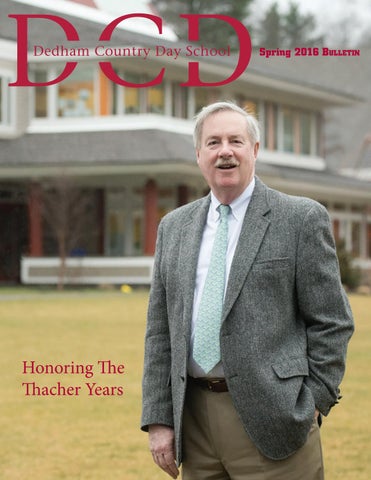
Spring 2016 Bulletin
Honoring The Thacher Years
Thank you, Nick and Sally, for twelve great years.
Head of School
Mission Statement
Director of Admissions and Assistant Head of School
• Provides to each child a unique educational balance of challenging academics, arts, and athletics;
Director of Development and Marketing
• Embraces an inclusive, interdependent community of students, teachers, and parents that fosters trust and encourages children to take risks;
Nicholas S. Thacher
Emilie Liebhoff
Charles S. Rudnick
Director of Communications Leslie Bowen
Bulletin Editor Leslie Bowen
Manuscript Editor Kathryn Sargent
Writers
Ned Bigelow Kevin Bowen Leslie Bowen Nate Buffum Danise Cavallaro Beth Conners, Ph.D. Hilary Rochelle
Class Notes
Danise Cavallaro
Design Consultants
Michele Page, Design Communication Creosote Affects Jason Fairchild, Truesdale Group
Layout and Production Leslie Bowen
Photography
Leslie Bowen Danise Cavallaro Kristie Gillooly Dean ‘02 John Leith Hilary Rochelle Sue Shirley
Printing
Recycled Paper Printing, Inc.
Dedham Country Day School
• Creates independent, resilient, lifelong learners through engaging, developmentally-based teaching designed to meet varied learning styles; • Inspires students to become caring, ethical members of the larger world by emphasizing thoughtful citizenship and respect for self and others.
Statement of Non-Discrimination
Dedham Country Day School admits qualified students of any race, religion, or ethnic origin to all rights, privileges, programs, and activities generally accorded and made available to students at the school. The school does not discriminate on the basis of race, religion, sexual orientation, ethnic origin, disability that can be reasonably accommodated by the school, or family composition in the administration of its educational policies, admissions policies, financial aid program, athletic program, or any other school policy or program. Admissions inquiries should be submitted to: Director of Admissions Dedham Country Day School 90 Sandy Valley Road, Dedham, MA 02026-5898 Tel: 781.329.0850, ext. 2503 Fax: 781.329.0551 Web site: www.dedhamcountryday.org
In This Issue Head’s Report
2
Goodness and Mercy by Nick Thacher
The Thacher Years
6
Honoring the Thacher Years Interview with Nick Thacher Donor Profile: Linda Cabot Gift Establishes Scholarship for Horizons Student to Attend DCD
Thrive. The Campaign for DCD.
12
Thrive: Together we have transformed DCD
On Campus
14
Honoring Departing Faculty Tim Jackson ‘58 honored for 43 years of service Jenny Chamberlin retires Introducing New Faculty and Staff Bob Santry returns to DCD as CFO Interview with Carla Haith, DCD’s New Lower School Head The Changing Face of Independent Schools by Beth Conners, Ph.D. Grandparents’ and Special Friends’ Day
Student News
22
Middle School Students Receive Recognition in the Arts 2016 SISAL Awards Announced Gallery Week Celebrates the Visual Arts Artwork on Display in Lowell Center Academic Highlights National Geographic Bee Spelling Bee Film “Most Likely to Succeed” Touts Benefits of Project-based Learning
Sports Roundup
26
Fall 2015 Winter 2016
Alumni Association
30
Alumni Profile: Ralph Wales, 2016 Alumni Award Recipient Alumni News: March 4 Alumni Reception February Challenge: We Won! 2016–17 Alumni Calendar Alumni Speakers Series
Class Notes
36
Front and inside cover photographs by Kristie Gillooly Dean ’02
Head’s Report
S
ince this is my final opportunity to address our DCD community, a tempting and almost infinite variety of topics asks to be explored. What is the future for sound education? Can DCD’s intriguing blend of progressive and traditional elements, its expensive commitment to “the three As,” and its unwavering faith in child-centered learning and a developmental program survive the increasing challenges of social precocity and seductive technology? What does that tricky word “diversity” really mean? How can we meaningfully address innovation while retaining a sense of tradition and community? And what about preparing children for “the real world”? Where is the real world, anyway—here at the corner of Sandy Valley and Highland, or “out there” where fundamental humane principles seem to be
“We forget, I think, where we came from, just as we easily forget the ideals and the premises on which the country was founded. Other than the Native Americans, we all arrived as immigrants.” eroding in a country that for so long has been the most promising social experiment on the planet? How can our relatively tight-knit little community best navigate change? Impending change is not the only thing that’s swirling in the air on our campus. I wish I could tell you otherwise, but the ugly rhetoric of the current presidential campaign has slithered into DCD’s halcyon corridors. From time to time we overhear our freshfaced children parroting ingenuous versions of the venomous political bromides that drip from the lips of the candidates. Exhibit A is immigration—the obvious and
2
fundamental cornerstone of America that has historically also brought out the ugliest aspect of our nation. (Take a gander at the samples of late-nineteenth-century journalism on display at Ellis Island if you don’t believe me. Chaperoning fourth-grade tours of the island, I was always careful to skip that particular exhibit.) It has been disheartening, to say the least, to overhear DCD students, heedless of the feelings of their Muslim classmates, roundly condemn the possibility of Syrian immigration. So forget the list of questions I limned in my opening paragraph. As our school embraces new leadership and recommits to the ongoing daily effort of sustaining our ambitious DCD mission and helping children along the challenging, complex road of learning and growth, I’d like to leave you with a reflection on the immigrant experience. In preparation for their annual World Congress, our DCD third graders learn that the trip to a new life in our homeland can be challenging. They also learn that America can be a hard land, but its salvation lies in its generosity. The recent film Brooklyn captured our collective national imagination with the same message that immigrants have always understood: it’s a hard land of promise, a hard land of plenty, a hard land of mercy. Though I hope our own school community will continue to reflect those qualities—promise, plenty, and above all mercy—I have to acknowledge that the more-fortunate among us (and I include myself in that cohort) are well-insulated from the truth that America is and always has been a hard land. A notoriously generous land, to be sure, as American philanthropy surpasses that of every other culture and nation. And for many, yes, ours remains a “land of opportunity.” But America has also been a land of almost unimaginably repulsive bigotry and intolerance, of stupendous and increasing
Photo by Leslie Bowen
Goodness and Mercy by Nick Thacher
3
Head’s Report economic inequality, of educational inadequacies (though studies have shown communities consistently give their own schools at least a B- while decrying the failure of our national school system), and inconsequential leadership, at home and abroad. Emma Lazarus had it only half-right: “the wretched refuse of your teeming shore” is a phrase easily applied to our own citizenry. As our political candidates of every stripe never tire of reminding us, the richest country in the world, a nation of immigrants, still allows millions of children to go to bed hungry each night. We forget, I think, where we came from, just as we easily forget the ideals and the premises on which the country was founded. Other than the Native Americans, we all arrived as immigrants. (For the record, most of my forebears arrived in New England centuries ago, several of them on the Mayflower. Confessing this, I have also to confess my appreciation of Isabella Stewart Gardner’s tart response to the offer of membership in the General Society of Mayflower Descendants: “My ancestors didn’t come on the Mayflower; they sent the servants first.”) It was a hard land then; as the reedy voices of our second graders report at each DCD Thanksgiving Assembly, the conditions that greeted the meager handful of Plymouth immigrants who survived were truly appalling. Things weren’t much easier for subsequent generations, so many of whom made their way through Ellis Island and, later, Angel Island in the West. I learned this truth vicariously: I grew up playing with immigrant children whose father, Lee Quong, had recently emigrated from China and survived the torments of Angel Island. He never talked about those experiences. Neither did his wife, who cut my spiky hair and spoke almost no English. “Haircut? Haircut?” she would say whenever I appeared at their kitchen door. A generation later I watched their daughter, my
4
childhood playmate, ascend to the stage of the American Academy of Motion Picture Arts and Sciences, wearing a glittering borrowed gown and thousands of dollars of Harry Winston diamonds, to accept the Oscar she had won. Living the American dream: a beautiful girl who had grown up into a beautiful and accomplished woman. I could barely distinguish her on the television screen through the unexpected tears that came as I tried to grasp the path she and her family had trod. That’s Quong’s daughter, I said to myself, aloud, over and over. A single generation. Immigration actually can work. It was a moment of verity, a moment of personal epiphany. Ah, “mercy,” as my grandmother used to exclaim at such moments—a lovely, old-fashioned exclamation, like “Hark!” Confronting his own death (“Death is real, and dark, and huge.”), the finest wordsmith of my generation, John Updike, spoke of mercy in “Fine Point,” in the very last lines he wrote: The tongue reposes in papyrus pleas, saying, Surely—magnificent, that “surely”— goodness and mercy shall follow me all the days of my life, my life, forever. Nothing, they say, is forever, but some things feel likely to abide. Our school, 113 years young, has the fragile promise of permanence. DCD is truly blessed with expansive facilities, remarkably committed teachers and staff, deeply involved parents, supportive graduates, and—well—good fortune. Good fortune, the American Dream, an appreciation of what William Saroyan called “the human comedy.” But it’s not Saroyan’s or Updike’s lines with which I want to conclude. The last word belongs to Pulitzer Prize-winning poet laureate Philip Levine, who passed away a year ago, silencing a uniquely American voice. We badly need his voice in these contentious, difficult times when we worry about the state of the union, the state of our globe, and above all the state of the children in our charge.
Honoring the Thacher Years
The ship that took my mother to Ellis Island Eighty-three years ago was named “The Mercy.” She remembers trying to eat a banana without first peeling it and seeing her first orange in the hands of a young Scot, a seaman who gave her a bite and wiped her mouth for her with a red bandana and taught her the word, “orange,” saying it patiently over and over. A long autumn voyage, the days darkening with the black waters calming as night came on, then nothing as far as her eyes could see and space without limit rushing off to the corners of creation. She prayed in Russian and Yiddish to find her family in New York, prayers unheard or misunderstood or perhaps ignored by all the powers that swept the waves of darkness before she woke, that kept “The Mercy” afloat while smallpox raged among the passengers and crew until the dead were buried at sea with strange prayers in a tongue she could not fathom. “The Mercy,” I read on the yellowing pages of a book I located in a windowless room of the library on 42nd Street, sat thirty-one days offshore in quarantine before the passengers disembarked. There a story ends. Other ships arrived, “Tancred” out of Glasgow, “The Neptune” registered as Danish, “Umberto IV,” the list goes on for pages, November gives way to winter, the sea pounds this alien shore. Italian miners from Piemonte dig under towns in western Pennsylvania only to rediscover the same nightmare they left at home. A nine-year-old girl travels all night by train with one suitcase and an orange. She learns that mercy is something you can eat again and again while the juice spills over your chin, you can wipe it away with the back of your hands and you can never get enough. And there a story ends. Magnificent, that “enough.”
5
Honoring the Thacher Years An interview with Nick Thacher
W
hen Nick Thacher looks back to his early days at DCD, his nearly twelve-year tenure as Head of School was something he could never have imagined. But then he knew in the back of his mind that his mission wasn’t over.
“The year before, I had been contacted in retirement to do an interim year at Marin Country Day. If it hadn’t been that school, I wouldn’t have agreed to do it. We have so many friends and family in the Bay Area that I thought it would be fun for a year. I spent the summer getting ready for the school year to begin in fall, much like Allison will do when she arrives this summer at DCD.” At the start of school, after opening ceremonies had concluded, Nick had what he describes as a kind of “epiphany.” “The windows were open—it was summer-like weather in California—and the kids came out for recess. I heard their voices. I realized how much I had missed that sound, that level of connection. I realized I wasn’t done yet with schools.” He says that interim experience made it possible for him to accept what he supposed would be a similar experience as Interim Head of DCD. His arrival on campus in late 2004 came at a critical and important moment in DCD’s history, when the DCD community was faced with Head of School Sonia Valentine’s sudden and fast-moving illness. Nick remembers meeting with the board and members of the administration some time in December, although he didn’t officially start until January. Worried about starting in the middle of the year, something he had never before experienced, he came in over break to spend a few days sorting things out before school resumed. He 6
was surprised to find a father waiting in the Emmons Lobby, anxious to speak with him about an issue involving his lower school son. “I wondered at first if this was a result of the trauma surrounding Sonia’s departure. Everyone was worried about her health then, concerned even for her survival. My arrival, I then realized, would be baptism by fire, and my role as Head would mean acting as a strong pillar to allay everyone’s anxieties, but more than that, it meant facilitating the grieving and the serious concerns Sonia’s leaving had raised. In that sense, I thought that whatever I did would have been embraced. I definitely thought it was going to be an interim experience. I had been at a school for a very long time (New Canaan Country School) and never thought I would be going to another school, or that anything would measure up to my time there.” Nick’s time as interim head of DCD would lead him to reconsider making his role more permanent, especially as he became part of the DCD community and witnessed both the challenges and charms of working in a small school setting. “The thing that convinced me to stay was not so much the size of the school, or what we call ‘the magic of small schools,’ because I’ve seen a lot of small schools that don’t have it; they’re not bad, but they don’t capitalize on it as we do here. At DCD, the K–8 buddy expe-
rience is substantive, not superficial, for kids on both ends of the age spectrum.” “It just grew on me more and more,” he explains. “I didn’t think much about the possibility of staying as they got the search started for a new Head. But AISNE [Association of Independent Schools in New England] was doing an evaluation the same year, and that gave me an excuse to ask any question I wanted of faculty and staff without it seeming threatening. People were talking about getting started with strategic planning.” Nick remembers that at some point over the summer, the thought of staying occurred. His wife Sally was happy and settled in her pastorship in Dublin, New Hampshire, so the decision to stay had to make sense to her as well. “DCD grows on you. There are a lot of people here who care about kids— you hope that’s true about schools, but it isn’t always. To say it’s a family here is a cliché. But it is, really, a family, complete with all the frictions, struggles, and joys of families and people working together for a long time.” Nick sees the same sense of family and community that first won him over to DCD as a critical ingredient in DCD’s growth. Again, as he says, it is a growth that must come naturally, organically, but not without struggle. “It’s a nice community to be a part of. I’ve said this over the years, that the level of respect parents have for the teachers is unusual. In independent
Honoring the Thacher Years
schools, teachers can come under a lot of scrutiny and be subject to undue criticism. Unlike other schools, though, here there is a higher degree of people being invested, because it’s a real stretch for many of our families to be able to afford the tuition.” Issues of affordability have become more and more pronounced for families trying to send their children to independent schools, and particularly so for the middle class, which Nick says has been “frozen in place, eroding.” For that reason, increasing financial aid has been a priority during his tenure, especially during the years following the “Great Recession,” when many more families than usual needed assistance, a challenge compounded by fewer families applying for admission. “That’s why I’m delighted we’ve made such progress in the endowment,” he says. “Schools must raise a lot of money in order to provide even a small amount of financial aid. The economics of it is all about people, paying teachers a living wage.” Nick is happy to be, as he says “leaving the campground a little better than when he got there,” but he remains conscious of the challenges ahead. “It’s important to find ways to help the school fulfill its mission. Part of our mission is to have a relatively diverse group of kids learning from each other. Parents still worry that independent schools isolate children from the real world. What we need to do is to teach our students a deeper commitment to the commonweal.” Helping the school be true to its mission has been paramount in Nick’s approach. Upon arriving, he immersed himself in reading old issues of the Bulletin. Like a true scholar and teacher, he pored over all the materials gathered for the school’s Centennial celebrations. “You read these articles and you see how the mission of the school has
evolved, and you see that your own aspirations for the school are exactly the same as in 1903. I started teaching in the 1960s, reading authors whom I realize were saying the very same things Everett Ladd was saying decades earlier about how children learn. There were years of heavy lifting, especially during the Depression when the school was truly watching its pennies and couldn’t even afford to send out a catalog.” “Lean times” may come again, Nick acknowledges, but the sustaining
understood statement of our mission.” Nick had the final result framed and installed in every classroom and office. Establishing this set of “core beliefs of who are we, what is DCD,” has been crucial and led him to involve faculty in an afternoon of brainstorming those beliefs. “There are schools that do so many of the same things. But our school has deliberately chosen as its very ambitious mission, not just to get our students highly placed into Milton or other
Three generations of the Thacher family, left to right, in back, Sally, Nick, Alice, and Rob Thacher; in front, Erica Fletcher and Henry Thacher
message of reading through the school’s history was that, through good times and bad, the school’s commitment to its mission remained the same. “That’s what made it easy when we got together to re-write our mission statement. It was a lively group that quickly narrowed down the important things we wanted to say. In the end, Caroline Swan and Jim Durham co-authored what very quickly coalesced into a clear and well-
top schools, but to think and work with them in all areas of their development. The whole child is what we see, and the degree to which the school is committed to addressing the needs of that whole child incredibly consistently through its athletics program, its arts program—freeing the middle of the morning up for subjects usually taught in the afternoon—makes it clear what we think is a frill and what isn’t.” As 7
Photo by Jim Healey
he wrote in the Summer 2012 issue of the Bulletin, “Together, we’re educating for life, hoping we’re helping to create resilient, autonomous learners who will grow up to be healthy, happy thirtyyear-olds.” Many would say that consistency of message through change has been a hallmark of Nick’s tenure. The leap from the old schoolmarm’s one-room schoolhouse of a hundred years ago to the present has been an astronomical one, and changes within the last twenty years in technology and many other areas have presented new possibilities and new challenges. To meet these demands, Nick has made training and professional development for faculty a priority over the years. “We know more now than ever. There are all kinds of minds, different ways of thinking about teaching. Kids now
are wired in a very different way. So the question becomes, Do we know who we are, what the latest iteration is, what the breadth of learning services available might be? We now speak of executive functioning, neuro-psych evaluations, some suggesting as early as kindergarten.” Nick is happy with what he has done at DCD, and the list of accomplishments is long. Building the endowment from $2 million to $8 million, increasing financial aid to 25 percent of the student population, honing and staying true to the mission, constructing a new building to accommodate two classrooms per grade—these are just a few of his more notable achievements. The establishment of the Horizons at DCD summer enrichment program is surely high among them. Although he says he left the decision about bringing the program to campus up to the board, as
Hale House renovated 2006 AISNE Ten-Year Evaluation
THE THACHER YEARS 8
THR
Strategic Plan published
February: Opening of new Middle School
2005
a longtime supporter and board member of Horizons since 1979, he is certainly pleased with their choice. Now serving 135 low-income children from Dedham and Boston, the program, he says, is a “magnificent example of a private school modeling public purpose,” a topic about which he wrote in an article published in EdWeek in 2012. As he says, “there’s nothing I would have done differently.” Indeed, despite having many limitations on time and budget, Nick leaves behind a rich legacy. Still, last October, at a gathering of past trustees, Nick shared a list of things he wished he’d been able to do. “You run a school, you can’t do everything; we can’t afford it or don’t have the time; you have to choose which hills you’ll die on,” he says. His legacy, then, might include a sort of “to do” list for those of us who will miss his leadership to work on in the days ahead. He would have liked to have changed the half day from Friday to Wednesday, move the Fair to a later, and hopefully warmer, day in May (despite the admonitions of Julie Hagan), install a climbing wall in the gym, build a new performing arts center that retains a small school feel, open a nature center
Fall: Alumni Council formed, Alumni Association established
First faculty training in gender and sexual identity with Dr. Jennifer Bryan
2007
2008
2009
March: All Kinds of Minds faculty training
July: Horizons at DCD summer enrichment program for low-income children established
Honoring the Thacher Years
Photos by Kristie Gillooly Dean ’02
with trails for exploring, publish an issue of the Bulletin devoted to the Ladd years, and the list goes on. “I really wish we’d gotten the land across the street with its beautiful pristine vernal pool,” he laments. “We have a beautiful campus with untapped resources around us, including wetlands and the pine grove,” he says, citing an outfit in Vermont that designs trails for schools. A new performing arts space had been high on his list but was deferred to raising funds for endowment. Preliminary designs by Joslin-Epstein architects, he says, would have created “a viable performing arts space that retains the feel of what we now have, incorporating ingenious slopes, little intersecting ways that would break up the space to make it seem intimate.” “If I had another ten years, I’d be working on these things,” he says wistfully. But at seventy-one, Nick feels it’s time. We’ll see. He turned down an interim headship at another school in California for next year, so maybe he’s right. What we do know is the mission he carried forward during his years at DCD will continue, and we are more than a little better off for it.
May 22, 2016, Reception in Honor of Nick and Sally Thacher Above Left: Trustee and Thrive Campaign Chair John Connors announces the naming of the Nicholas S. Thacher Lower School with a prototype of a plaque for the building. Above Right: Erica Fletcher, Rob Thacher, and Sally Thacher Left: Nick and Sally Thacher Below: Nick addresses the crowd gathered under the tent.
October: Opening of new Lower School building
December: Thrive Campaign concludes, raises $13.6 million
November: Thrive Campaign Kickoff
New parking area and pool house constructed
Endowment reaches $8 million
Hahn House purchased
2011
2012
2015
2016
RIVE
Perfectly Joined marketing campaign unveiled at Annual Meeting
2013 May: First Alumni Award granted to Temple Grandin ‘59
2014 October: Mary Ellen Maloney Playground dedicated
Admissions yield reaches pre-recession levels
9
Donor Profile: Linda Cabot
Gift Establishes Scholarship for Horizons Student to Attend DCD
W
ith her work at Horizons, Linda Cabot has come full circle in her lifelong dedication to educating children at risk, from tutoring city kids in math at age 16 to becoming a founding board member of Horizons at Dedham Country Day, a summer program offered since
“Through their DCD education, not only did my girls become critical thinkers, but they also became creative thinkers.” 2009 on the school’s campus. It was a serendipitous meeting with Horizons board chair Gita Iyer in the produce aisle of Roche Brothers that led Linda to get involved in the beginning stages of the program. “It’s been so exciting for me to
be there from the start, from hiring our first director, that first summer when we started with just one class. Now we have classes from Pre-K to seventh grade and are starting a high school program. It’s a hard-working, dedicated board, and I love all aspects of my involvement, being on the expansion committee, governance, development, the high school task force. To see the program blossom and take shape makes me feel proud to be a part of it.” The Horizons program targets the achievement gap, and in particular, a phenomenon known as summer slide, in which children from low-income families lose academic ground over the summer break. “Horizons helps these kids with math, reading and science skills, which builds academic confidence and proficiency for the upcoming school year,” Linda
Linda Cabot, right, and daughters Noelle Anderson ‘10, center, and Gigi Anderson ‘08, left, interview a subject for an educational documentary on the oceans. 10
explains. “That’s a really important piece of it—otherwise kids can fall further and further behind, which often leads to high school drop out.” Also important for Linda is the closing of the opportunity gap through Horizons’ array of enrichment activities such as field trips and music lessons. “They’re swimming, paddle boarding, playing tennis, taking violin lessons, creating art, traveling around the Boston area seeing theatrical shows and going to visit local farms,” she says. “They have a really fun summer while also learning. It creates this incredible dynamic where kids come back year after year, they have friendships and mentors, and truly they love being here! It’s a vibrant, fun community.” Linda had an insider’s look behind the scenes when daughter Noelle Anderson ’10 spent the summer as a photographer-volunteer for the program. “It was great to see the program through her eyes. She would come home thrilled about her day, tell me stories and show me pictures and videos of the students—about how happy the kids were, how excited they were to pass the deep-end test, how proud they were of their work, how they liked coming back year after year, being with their friends and seeing some of the same teachers. As a board member it was wonderful to hear all these stories, confirming
H o n o r i n g t h e HTehaadc ’hs e rR eYpeoar rt s
Left to right, Noelle Anderson ‘10, Ed Anderson, Linda Cabot, and Gigi Anderson ‘08
what a great program it is.” Because of outgoing Head of School Nick Thacher’s leadership in bringing the Horizons program to DCD, Linda and her husband Ed Anderson have decided to make a gift to create a scholarship in his honor, covering tuition for a Horizons student to attend DCD’s middle school for two years. “As a past DCD parent and now being on the Horizons board, it’s wonderful to be a part of both great institutions. You know there are certain kids in the Horizons program who would just thrive at DCD, and I’m proud that DCD wants to include and support children of diverse backgrounds. It makes for a much more robust learning community that reflects the world we live in today. It’s a win-win partnership.” Linda’s commitment to education extends to the organization she
founded to raise awareness about the need for ocean conservation, From the Bow Seat. Because of her belief that the process of making art results in deeper learning and greater engagement, Bow Seat’s Ocean Awareness Programs emphasize creative, hands-on activities. A contest for middle and high school students in art, poetry, prose, and film offers scholarships to students from around the world. During a family sailing excursion, Linda involved daughters Noelle and Gigi Anderson ’08 in research, filming and interviewing for an educational documentary on some of the environmental issues affecting the Gulf of Maine, hoping to inspire a younger generation to ocean stewardship. It’s this same approach to learning that she admires so much in DCD. “We chose DCD because of its tremendous arts program, which is
unique in the area. Through their DCD education, not only did my girls become critical thinkers, but they also became creative thinkers,” she says. Comparing DCD and the Bow Seat, she says, “This notion of learning by doing, learning by making, is something they share. Learning becomes longer lasting when you’re not just memorizing something that can be forgotten. Creating, building something on your own or with others creates lasting learning and a skill set that is powerful.” With the Nick Thacher Scholarship, Linda is furthering the mission of both DCD and Horizons and continuing a commitment forged during her teens. “I believe so much in the power of quality education for all,” she says. “It truly is the great equalizer.” —Leslie Bowen 11
T O G E T H ER W E H AVE T RANSFORMED DCD $1 3 . 6 M I L L I O N—O U R M O S T SUCCESSFUL FUNDRAISING E F F O RT E V E R Approximately one thousand donors contributed to the Thrive Campaign, exceeding our goals and positioning us to move forward for continued strength. Together we raised $13,602,427 and built: • A new Lower School that supports an environment of high expectations, individualized learning, and expanded social opportunities. • A stronger endowment to support the operating budget, minimize tuition increases, and provide funds for important future initiatives. • Continued Annual Fund success to support the current operating budget and immediate needs.
“The extraordinary generosity of the DCD community has transformed the campus and set a path that will help us continue our standards of excellence for generations to come.” —John Connors, Thrive Campaign Chair
We extend our deepest thanks to all who gave so generously to DCD. Through your generosity, our students are now learning and thriving in our new Lower School building, and we have strengthened our endowment to preserve the standards of excellence and creativity that have been DCD’s hallmarks for more than a century.
12 12
Your support has enabled future generations to thrive.
THRIVE The Campaign for DCD
THANK YOU TO OUR CHALLENGE DONORS The Hunter Challenge raised $1.2 million to grow DCD’s endowment in all areas. The Endowment Challenge raised $800,000 to support DCD’s exceptional teachers. Endowment funds help DCD attract and retain the best teachers, gain the flexibility to support key educational initiatives, and provide sufficient financial aid for talented students, regardless of their families’ ability to pay. Original watercolor of new Lower School building by DCD art teacher Lisa Houck
HONORING O U R C A M PA I G N LEADERSHIP Chair John Connors Honorary Chair Susie Hunter Vice Chair Skip McKee Steering Committee Mark Alperin John Connors Sheila Hiatt Tim Mann Skip McKee
Core Committee Mark Alperin Karen Bacardi Nevin Chitkara John Connors Erin Keith Epker ’86 Bryan Haggerty Debbie Haggerty Andy Hatem Matt Hiatt Sheila Hiatt David Hoffman Suzanne Ibbeken Susanne Joyce Mike Kendall Tim Mann Keith McCown Skip McKee
Stuart Nagode Meg Reynolds Barbie Shaughnessy Chris Sullivan Grandparents Mel and Patty Alperin Joyce Bacardi Jack and Eileen Connors Arnold Hiatt Parents of Alumni Ed Anderson Rob Aranow and Pat Profeta Ruthie Barker
Rob and Molly Cramer Prescott Crocker ’54 and Joan Crocker Lisa Dutile Russell Holmes and Rose Reagan Holmes Keith McCown Muffy Oates Kathy Parent Chris Perry Margot Pyle
Learn more at www.DedhamCountryDay.org.
13
13
On Campus Tim Jackson ‘58 honored for 43 years of service to DCD
Photo by Leslie Bowen
I
Ned Bigelow, a trustee and former DCD parent, pictured above, spoke at the retirement celebration for Tim Jackson ’58 following the conclusion of the Holiday Assembly on December 18, which was dedicated to Tim. Ned’s remarks were given before an audience of current and former parents, students, faculty, and trustees gathered to honor Tim’s 43 years of service to DCD.
Photo by Kristie Gillooly Dean ‘02
Jenny Chamberlin retires
14
am honored to be asked to speak at this important event. I promise to keep my remarks very brief about someone I’ve known through our families as we’ve come into the world and grown up and through our careers in education. This is a span of over 40 years. I think if Tim had had his way, he’d have snuck out the back door some time ago—sorry, Tim. Normally when asked to speak, I wander to the humorous. But this case calls for something a bit more serious. During my career in education, especially the last 20 years, I’ve come to believe that there are three very special words that not only apply to successful educators, but are also important qualities in a life. Tim has them all, and more. Number one is commitment. Tim has committed himself to DCD for (including his years as a student and those as an employee)
I
met Jenny Chamberlin when I interviewed for a job at Dedham Country Day School during the spring of 1997. Jenny was my father’s first cousin, but up to that point I had not really spoken to her at any length. She confesses that she only knew me as “the little kid on the beach” from summers in Little Compton. I did not understand then what a tremendous impact Jenny would have on me and on those around her. Jenny married Bill Chamberlin, a teacher at the Noble and Greenough school, and her first foray into education was with the Lexington school system, where she taught for eight years. After taking a break for the births of her two children, Sam ’94 and Sarah ’92, she realized she wanted to remain in schools. Jenny met with the Head of DCD, Jim Bower, in 1982 and was
Photo by Leslie Bowen
Photos by Kristie Gillooly Dean ‘02
Honoring Departing Faculty
Tim is honored at the Holiday Assembly, left to right, with son Nick Jackson ‘87 and Head of School Nick Thacher, and at the reception with his wife Susie Jackson.
for nearly three-quarters of his life. He’s been a student, a teacher, business manager, coach, plant manager, advisor, snow plow driver—a Jack of All Trades and master of many. Number two is contribution. No one in the room needs any explanation on this one. Tim is and, as far as I know, always has been a giver. Always to others before himself. No one would argue this. Whether it’s school or family, Tim is always willing to contribute. Need something? Call Tim, and he’s there without asking why. He’s a rare beast. Number three is ownership. Those
who know me know that this may well be my favorite of the three. Taking ownership of one’s actions and practicing honesty are rare qualities in a person today. For an employee to truly feel and take ownership of their employment, their DCD, is something special. To do this for more than half your life is almost unheard of. Tim is part of a vanishing breed. I call them “lifers,” those who literally dedicate themselves to something for a lifetime. We see less and less of that today, in any field. A dear friend of ours said, when he retired, “I don’t know how I had the
time to work.” My guess is that once you get over what has been a routine for so long, and you get more into your family, your sailing, your (as I’m told) furniture building, your shooting, Tobey’s Island, and so on, you’ll feel the same way. I know I do! Lastly I’d just like to say, there are a lot of people here who are very proud of you, Tim—proud of what you’ve accomplished, proud of your commitment, contribution and ownership. I’d like to add to that, that I am proud to call you my friend.
hired as an admissions assistant. Over time as she gave tours and talked with parents about the school, she naturally grew to love DCD, so much so that she enrolled both of her children. When an opening arose in the middle school, Jenny became a seventh grade homeroom and sixth and seventh grade history teacher. Her educational background was in American history, and she jumped at the chance to teach Greek and Roman history. The curriculum soon changed, sending the Greeks and Romans to the lower school, and Jenny helped introduce the geography course into the middle school. While she had a fondness for history, her true passion
emerged soon after the retirement of both Latin teachers, Gilly Grant and Pat Tynan. Jenny found teaching Latin to be exciting, challenging, and very rewarding, and over the years she has played an integral role in the development of the middle school language program. She flirted briefly with administration, filling in as interim Head of Middle School for a year, but in the last two decades has been the face of the Latin department. Her students routinely earned high scores on the National Latin Exam and entered secondary school exceptionally well prepared. By coming to DCD, Jenny has had many opportunities to try new
experiences. She has coached both field hockey and squash, been a yearbook and student council advisor, and helped develop curriculum. She relishes her close relationships with colleagues throughout the school. Her next adventures include spending more time locally with family and being a grandparent in Boise, Idaho. She also looks forward to extended time with Bill in Isle au Haut, Maine. Jenny has meant a great deal to so many at DCD. I am proud to call her my colleague, my friend, and my cousin—and I am thankful to have been a part of her life here at DCD for the past two decades.
—Ned Bigelow
—Nate Buffum 15
On Campus
B
ob Santry is DCD’s new Chief Financial Officer, replacing Tim Jackson, who retired in December after 43 years at DCD (see story on page 14). No stranger to DCD, Bob started out as a middle school math teacher here in 2002 and taught for a few years before going back to school to complete his MBA at Babson. Now a father of three, Julia (9), Jack (7), and Rose (3), Bob lives in Newton with his wife Molly, Manager of Charitable Programs at New Balance. He arrived at DCD during a time of transition as Nick Thacher is preparing to retire and Allison Webster is getting ready to take the reins of the school this summer. “If I had never been here before, it might have been a little daunting,” he says. “It’s wonderful to be back at DCD. It’s a really great community. I’m struck by how many people are still here. Seeing so many familiar faces has been heartwarming.” Now, in addition to his teaching background, he’s developed a strong set of business and investment skills. After completing his degree at Babson in 2006, he went to work for Goldman Sachs, where he gathered and managed assets during a particularly challenging time in the history of the financial world. “I always had an interest in investing, learning about risk and the various types of risk that are out there. That time period taught me there were so many other risks beyond just the volatility of markets,
16
risks like liquidity, lack of transparency, and even fraud. The experience definitely colors my view as an investor.” While he thinks he may eventually work more closely with the school’s investment committee, his focus thus far has been on the operational budget for next year, determining financial aid for new applicants, reviewing the school’s relationships with outside vendors, and examining the physical plant’s immediate and long-term needs. “We’re about to do a complete physical needs assessment in which we’re Bob Santry, wife Molly, and children, left to right, Julia, Jack, and Rose, going to look at every single enjoyed this year’s DCD Fair together. building and every system I’ve done everything at least one within each building to time,” he says, “so I’m feeling more determine one, three- to five-, and open to taking on something new.” five- to ten-year needs and the Following in Tim Jackson’s associated costs so we can budget footsteps in more ways than one, for things that we know are going to as math teacher, hockey coach, and come up.” CFO, all roles Tim filled during Of his new position he says, “It’s a his tenure, Bob says he feels “very job that makes me feel good because privileged” as well as appreciative of I’m using my financial skills, which all the help he received from Tim to I enjoy, but it’s also a diverse job. get started in his new role. Every month there seems to be a new “I haven’t been too concerned with challenge.” the transition that’s coming up. I He says he is going to add another think we have a lot of momentum. challenge by taking on the jobs of Due in large part to Nick Thacher’s coaching hockey and lacrosse, which experience and leadership, Allison is he did during his time here as a math coming in at a time when the school teacher. In fact, he had a chance is in a really strong position. We’re to coach this winter during Mark ready to go!” Jackson’s absence. “I’ve just gotten to the point where
—Leslie Bowen
Photo by Danise Cavallaro
Bob Santry Returns to DCD in New Role as CFO
Welcoming New Faculty
Interview with Carla Haith, DCD’s New Lower School Head
H
ow unusual it was to be asked to interview, after 12 years as Lower School Head, my successor Carla Haith for this article. But the more I thought about it, the more it made sense. After recently attending An Evening of CommUNITY, sponsored by DCD’s Diversity Committee and to which all of the school’s families, faculty and staff were invited, the idea of “discussing ways of building a stronger family at DCD” was on my mind. I decided to gear my questions for Carla toward subjects that would help the community get to know her, not just as an administrator who has goals and dreams for the Lower School, but as a member of the larger community. —Sue Shirley
Q. How are you doing with learning the many names in this community?
Q. What one object do you have on your desk not directly related to your job at DCD that has the most meaning to you?
A. When I was teaching at the Chestnut Hill School, I had the opportunity to take an educational and spiritual trip to South Africa. During my visit I was required to teach four lessons to young children, provide all necessary materials such as crayons and books, and then donate those items to the classroom. This was before the days of airlines requiring you to pay for additional bags! While on this journey I bought a real ostrich egg that features a painting of Africa on one side and native animals on the other. This now sits on my desk at DCD and serves not only as a reminder of my time there, but also as a wonderful conversation starter with my new community, especially the children who stop to admire it. Q. If you were to receive a travel grant from DCD, where would you go, and what would you want to share with the community?
A. Hawaii is on my bucket list. While I am not an outdoors person, I have heard that our 49th state is warm, sunny and
Photo by Sue Shirley
A. It is a lot. I am at the halfway point in several ways. After time spent observing in classrooms and attending meetings, eating lunch with the children and doing recess duty, I know my colleagues and most of the Lower Schoolers. Making up the conference schedule and looking at children’s profiles in the database, pursuing my work on the Diversity Committee, communicating with families about their children, and standing on the sidewalk during carpool have helped me to sort out the parents. I have more ground to cover.
beautiful. The idea of touring the islands to observe the flora and fauna, volcanoes, and beaches sounds quite pleasant. I imagine that there would be plenty of material to share with students. Q. What’s new in the Lower School that you are excited about?
A. I am currently researching methods for scheduling parent conferences electronically. Also, collaborating with my colleagues on the preparation for and writing of DCD’s selfstudy for our ten-year evaluation for accreditation is giving me the history of the school, with which I am not yet very familiar. Q. What future plans do you have for the Lower School?
A. My future plans are to continue to work with the administrative team to create a diverse community through admissions outreach as well as teacher recruitment and hiring. I’d like DCD to reflect Dedham, Boston, and the greater world beyond.
17
On Campus
CampusNews
P
ublic or private—is there really a difference? Who goes to independent schools, and why? How have the schools’ communities and curricula changed in recent years? These are just a few of the questions that parents face when they seek out the best educational programs for their children. Charter schools, Common Core, high-stakes testing—unfamiliar options and buzz words can increase the confusion. And just about every
many parents now are seeking out a different education for their child than what the public schools offer. As public school programs for gifted students were cut in the 1980s and 1990s, parents sought a school environment where their children could be challenged, engaged, and encouraged to reach their potential. The small class size of an independent school became a bonus—offering assurance that the child would not fall through the cracks. While arts funding was “Today’s independent school student is a unique blend being cut in public of old and new, having been immersed in the traditional schools, arts programs were flourishing in combination of academics, arts, and athletics, but independent schools, creating another factor tempered with a healthy dose of their own individuality that set them apart. as both a learner and a person.” Beautiful facilities and a “culture of niceness” private school parent has had at least were notable draws. one friend or family member respond In the early 2000s, when the federal with disbelief, “You are paying WHAT No Child Left Behind Act became to send him there??” What draws the focus of national education policy, parents to independent schools, and a huge amount of attention went to what keeps them here? those students who were falling behind. In decades past, New England’s Once again, students seeking a greater independent schools were generally challenge were left to find it on their preparing privileged children for own, either through outside programs college. They were predominantly or by attending private school. During white, their students generally lived this time, independent schools began nearby, and through them, one was striving to become more inclusive prepared with a Classical education. and more representative of the world Even 30 years ago, most of these at large. Children who were growing schools remained small, not very up in a diverse, global society needed diverse, and rather elite; since then, schools that reflected that environment. however, much has changed. Where At the same time, new editions of once students went to a school because the Diagnostic and Statistical Manual, their entire family had gone there, which published its third edition 18
by Beth Conners, Ph.D. (DSM III) in the early 80s and the DSM IV in the mid-90s, changed how clinicians diagnosed such disorders as attention deficit (ADD & ADHD), reading disabilities, and processing skills (executive functioning) and how educators addressed them in the classroom. Educators were now talking about executive function skills (and weaknesses in them), focusing on them, and striving to develop them in their students. All of these factors combined to bring about changes not only in how independent schools approached education, but also in what types of families they began to attract. By offering cutting-edge technology, seeking diversity in their students and faculty, and launching initiatives that would make them strong local partners and thoughtful members of the global community, they began to appeal to a larger, more diverse set of families. Despite these changing priorities, the schools sought to stay true to their original mission and core values: Educating the whole child. Celebrating strengths. Focusing on the family. Creating a community. As public schools have increased in size, many in the Boston area have built beautiful new buildings, added updated honors courses, and worked to reach their top students in new ways. But few can match the flexibility of independent schools where teachers have license to create their own curriculum and teach to their own strengths as well as to those of their students. Independent schools
Photo by Kristie Gillooly Dean ‘02
The Changing Face of Independent Schools
W e l c o m i n g N eC wa m pF uas cN eu wl st y
can modify offerings to accommodate the needs of students with different learning styles. Small-group learning, where the teaching can be tailored to the individual students, remains a hallmark of independent schools. “One size fits all” is not the norm, as teachers differentiate through groupings, delivery, and how students engage with the curriculum. The integration of the arts and athletics, which has been standard at independent schools since their beginnings, remains today, with schools like DCD offering numerous creative arts classes in a variety of mediums and the opportunity for all students, whether athletically inclined or not, to participate in sports. Students can excel in many different areas, which helps to build confidence
and self-esteem in those who are less academically talented. Students are free to grow to their potential, whatever it may be, and the teacher’s job is to get them there. While there is some in-school standardized testing, the means for providing benchmarks and evaluating the curriculum, it can hardly be termed “high stakes”; the learning in independent schools is less about mastering a “Common Core” and more about becoming a “lifelong learner.” Today’s independent school student is a unique blend of old and new, having been immersed in the traditional combination of academics, arts, and athletics, but tempered with a healthy dose of their own individuality as both a learner and a person. They emerge as active, independent learners who
are well-rounded and have a strong personal identity. While these students have much in common with their counterparts of yesteryear, they will undoubtedly make a distinctive mark on the future. Beth Conners is DCD’s new Learning Coordinator. List of Works Used Facts About Private Schools.(2013). www.capenet.org/facts.html From ’88 to the New Milennium: The Rise and Decline of Gifted and talented Programs. (May, 2014). http://commons.trincoll.edu/ edreform/2014/05/ How Diverse Are Private Schools?(April, 2015) www. privateschoolreview.com/blog Private School Statistics.(2012). www.statisticsbrain.com/private-schoolstatistics/ Private Versus Public. www.greatschools.org/gk Retrieved Feb., 2015.
19
On Campus
Grandparents’ and Special Friends’ Day
O
n Friday, April 11, DCD’s halls and classrooms were bursting at the seams as we welcomed more than 300 very special guests to campus! Grandparents and special friends had an opportunity to shadow their favorite young students through a typical morning of learning and engagement. Whether partaking in a Latin lesson, solving a math problem, tuning into music during jazz band practice, or witnessing some excellent craftsmanship in the woodshop, our visitors seemed to really enjoy the day, and the entire school community was buzzing with excitement.
20
Connor Keohane and Barbara Eckel
Maggie McKee and Brian Summers
Bryan Mann and Kathy Mann
Alfie Rudnick and Mitchell Rudnick
Olivia Peters and Hilde Peters
On Campus
Matthew Kimball and Christopher Village
Jack Connors and Gavin Joyce
Noah McFarlane, Phyllis McFarlane, Michael Giordano
Jean Predella and Corey Predella
Lucy Stinson and Lindy Tshuka
Mumtazul Imam and Zobia Imam
Alyssa McGuirl and Matthew Huber
Jillian Sullivan and Kathy Keddie Photographs by Danise Cavallaro 21
Student News Middle School Students Receive Recognition in the Arts 2016 SISAL Awards Announced
T Toucan, white line woodcut by Alex Burmeister
Ceramic bowl by Chris Capone
here was exciting news this winter for nine DCD middle school students who received awards at the annual Small Independent School Art League (SISAL) show hosted by the Bancroft School. A reception and award ceremony took place on Sunday, March 6. Kevin Coakley, director of DCD’s arts program, said, “I think the results speak volumes about the impressive work being done in the studios of DCD. We entered 34 pieces and received nine awards.” DCD earned two first place awards by eighth graders Chris Capone in ceramics and Charlie Volpe in woodworking. All of the award winners are listed below by category. Mixed Media Anna Glass, honorable mention Printmaking Alex Burmeister, second place Kenzie Kelly, third place Digital Art Oliver Riordan, honorable mention Fiber Mary Connors, honorable mention Ceramics Chris Capone, first place
Photographs by Leslie Bowen
Woodworking Charlie Volpe, first place Nick Strymish, third place Photography Molly King, third place Rustic bench by Charlie Volpe 22
—Leslie Bowen
Student News Mosaic by Anna Glass
Gallery Week Celebrates the Visual Arts Middle school teacher Rick Edie chats with Dave Ibbeken, grandfather of Alex Burmeister, a seventh grader, and Neil Burmeister, a third grader.
Artwork on Display in Lowell Center
T
—Hilary Rochelle
Seventh grader Matthew O’Rourke and his mother Julie O’Rourke look at some art together.
Left to right, parent Erin Keith Epker ‘86, art teacher Lisa Houck, Ellen Volpe and her son Charlie Volpe, an eighth grader, look at one of the displays.
Photos by Kevin Coakley
ransforming into an art gallery for one week in April, DCD’s Lowell Center recently housed the school’s biggest collection of middle school art to date, displaying more than 350 pieces created by students taking classes from the broad range of art electives offered at DCD. From work in metal, mosaic, wood, ceramics and fabric to watercolors, prints, and digital photographs and art, the exhibit was a tribute to students’ passion and creativity. The display included a number of pieces submitted to the annual Small Independent School Art League (SISAL), including nine that received awards. Though a beautiful piece of art is clearly the tangible result of the time a student spends in DCD’s art studios or in our famed woodshop, the lessons learned during the process are the most valuable. Working on a project from inception to completion involves creative thinking, problem solving, risk taking, and design refinement. And quite often, students will discover an interest or passion they never knew they had. Despite a deluge of rain on the evening of the opening reception, the gallery was packed with students and family members exploring and appreciating all the art that had been created over the course of the year. A number of selected students had the opportunity to share their creative experiences with the audience during the speaking portion of the evening.
Eighth grader Audrey Linell stands in front of the display of her work with grandparents Judy Savitt and Richard Linell.
23
Student News
Academic Highlights Spelling Bee Photo by Hilary Rochelle
Photo by Hilary Rochelle
National Geographic Geography Bee
Luke Hotra, this year’s Spelling Bee winner, with Head of School Nick Thacher
Matthew Volfson, winner of DCD’s Geography Bee and Massachusetts State Bee Contestant
A
fter winning DCD’s Geography Bee for the second year in a row, fifth grader Matthew Volfson went on to qualify for the 2016 Massachusetts National Geographic State Bee, the second level of the National Geographic Bee competition, which is now in its 28th year. School Bees are held in schools throughout the state to determine each school champion. School champions, like Matthew, then take an online qualifying test. The National Geographic Society invites up to 100 of the top-scoring students in each of the 50 states, District of Columbia, Department of Defense Dependents Schools and U.S. territories to compete in their State Bees. Matthew competed in the Massachusetts State Bee held on April 1. 24
Although he didn’t win the State Bee this year, Matthew has three more chances to compete. Eligible State Bee competitors must be in grades four through eight, and must have participated in and won the competition at the school level that involved at least six students. This year, ten DCD students competed for the coveted spot of school-wide geography wiz kid on January 21, which Matthew won by answering all of the questions correctly. Only one champion from each state and territory advances to the national competition at the National Geographic Society headquarters in Washington, D.C. The national champion receives a $50,000 college scholarship, a lifetime membership in the National Geographic Society, and the chance to travel. —Leslie Bowen
T
his year’s Spelling Bee on February 26 was a notable one. Ten contestants, two representatives each from grades 4 through 8, displayed their spelling prowess in front of the entire school. The contestants earned their spots in the competition after scoring highest on a spelling test administered in each class. Mr. Thacher, known for his love of words, presided over his final DCD Bee before he retires in June. Fourth grader Zobia Imam and fifth grader Luke Hotra were the final two contestants left standing after many rounds. Luke won the final challenge round with his correct spelling of “loathe.” Two-time former champion Charlie Volpe, who has made it to the finals every year for four straight years, was the last out before the final round this year. Participants also included Maggie McKee, Eli Leder, Oliver Riordan, Parker Collins, Jackson Abreu, Charlie Sinnott, and Angela Giordano. —Hilary Rochelle
Student News
Film “Most Likely to Succeed” Touts Benefits of Project-based Learning
O
Photo by Kristie Gillooly Dean ‘02
n a cold January evening, Director of the Independent at DCD for a long time. DCD offers Dedham Country Day Curriculum Group. After witnessing a an appropriate mix of project-based School’s Lowell Center was student’s journey through High Tech learning, child-driven inquiry, and packed with 180 parents, educators, and High, there was much to talk about teacher-directed learning that gives administrators who came to view the and contemplate, particularly with children abundant opportunities to critically acclaimed documentary Most audience members hailing from both learn how to collaborate, to think Likely to Succeed by Greg Whiteley. the independent and public school creatively and critically, and to take The film examines our current communities. It was clear from the risks. These can be found in many education model, its foundation on an discussion that the dialogue on how places and at many points throughout industrial economy, and its the DCD experience— “...many of the pedagogical practices examined in the on stage during a drama inadequacies for preparing our children for future production or a musical film have been employed here at DCD for a long time.” jobs in a technology- and performance, in the innovation-driven world. woodshop crafting a The film asserts that the traditional we approach education for children to medieval shield or a wooden Shaker pedagogical practices employed in our succeed in our technological world and box, or in the lab constructing a schools today, focused on assessment the twenty-first century will continue to complex machine or collaborating on and test taking, leave our children be ongoing and deep. the design of a solar-powered house ill-equipped to succeed in work While to some the education model during middle school mini-term. environments that require creative presented in the film may seem to DCD’s balanced approach offers thinking and collaboration. represent a dramatic and innovative children the benefit of different modes In the film, viewers have the shift in educating children, many of of learning and exploration mixed with opportunity to see an alternative model the pedagogical practices examined a healthy dose of needed traditional skill by following ninth-grade students in the film have been employed here development. —Hilary Rochelle through a project-based curriculum at High Tech High in San Diego, California. Instead of standing in front of a room delivering content to be absorbed by their students, teachers are mentors and learning facilitators and have the flexibility to teach to their passions and the interests of their charges. Following the film showing, the audience engaged in a lively and thought-provoking discussion with moderators Nick Thacher, Head of School, and Peter Gow, Executive
25
SportsRoundup
Fall 2015 Varsity Field Hockey This year’s varsity field hockey team earned an impressive undefeated record of 10-0. Not a single team scored on them in their 10 regular season games or in tournament competition— a perfect season. I would like to acknowledge our sixth grade goalies Nina and Ellie for sharing the goalie position for both JV and varsity this season. In 10 games, the team scored 47 goals, and every person on the team contributed. Molly’s and Rachel’s leadership as captains propelled the team, and their energy and enthusiasm were never ending. The other eighth graders— Charlotte, Charlotte, Kelsey, and Audrey—had equally high expectations for their legacy! The nine seventh graders on the team were a talented and athletic group who were eager to learn and had a keen competitive spirit. —Deb White
and varsity teams, and if the ball ever did reach them, they wouldn’t let it past. All these factors contributed to their undefeated season! —Megan Rothwell Saia ’97
Boys’ Varsity Soccer This fall, boys’ varsity soccer was a close-knit team. They encouraged and supported each other throughout the season. They faced some impressive squads with determination and poise. Regardless of the score line, they worked hard to the final whistle. They possessed a quality that is difficult to coach: resiliency. As captains, Calvin Cochran and Matt Capone set an excellent example for their teammates. Matt Capone and Michael Giordano were awarded the Coach’s and Most Improved Player Award, respectively. —Kevin Coakley
JV Field Hockey
Girls’ Varsity Soccer
It was an exciting and successful JV field hockey season. With such small numbers, practices were run as a whole field hockey unit. With great leadership from the seventh and eighth grade veterans, the sixth grade girls learned and improved so much. At the beginning of the season, sixth graders struggled with staying in their position, supporting the players around them, blocking up free hits, and learning when it was appropriate to use their reverse stick. About halfway through the season, the girls were able to spread out, make beautiful give-and-go passes, form walls around every free hit, support each other, and get on post to tap the ball into the net. Nina and Ellie played goalie for both the JV
Girls’ varsity soccer had a very rewarding season this year—both with their record and the ability of the team to play and work together. Fifteen sixth, seventh, and eighth graders made up the roster. The season got off to a rocky start with three straight losses, but then the team posted four straight wins. The season ended with a record of four wins, four losses, and three ties. The girls worked extremely hard to become a good team, but it was the game against Carroll that highlighted and validated their great teamwork. This game forced them to look up, pass, and communicate with each other. Once they saw how well they could play, it made working and playing with each other all the better. The girls took care of each other on and
off the field and bonded really well. It was a very gratifying season. —Elaine Gage
Boys’ JV Soccer This fall, the JV boys’ soccer team had a fun and productive season on the soccer field. Despite playing to a 1-9 record, the boys did a great job of keeping the season positive and fun. Our win over Thayer on the tail end of a four-game stretch was a testament to the hard work that our group brought to the field. Our 16 sixth and seventh graders learned and practiced at different positions throughout the season to gain a knowledge and understanding of the game of soccer. Our seventh graders—Noah McFarlane, Thomas O’Connell, Gabby Rayev, and Sergei Tourian—demonstrated strong leadership in their time with the team and our sixth graders were energetic and quick learners of the game. —Bo Harrington
Girls’ JV Soccer The girls’ JV soccer team had a great finish to the season. The girls worked hard every day to improve their skills. They displayed wonderful sportsmanship against our opponents and kept their spirits high even after a loss. With a small team, the girls were willing to try new positions and step up to support one another both on and off the field. The girls learned to play as a team and make great connections on the field. Their communication improved with each practice and game, and it was exciting to see them come together during the final games of the season. —Lindsay Bababekov
Team Records
26 26
Varsity Field Hockey 10-0 Coaches: Deb White, Michelle Salfity Captains: Molly King, Rachel Mann
Boys’ JV Soccer 1-9 Coach: Bo Harrington Captains: by game
JV Field Hockey 9-0-1 Coach: Megan Rothwell Saia ‘97, Michelle Salfity Captains: by game
Girls’ Varsity Soccer 4-4-3 Coach: Elaine Gage Captains: Hannah Curran, Julia Landry
Boys’ Varsity Soccer 3-7 Coach: Kevin Coakley Captains: Matt Capone, Calvin Cochran
Girls’ JV Soccer 3-5 Coach: Lindsay Bababekov Captains: Isabella Joseph, Amanda Shih
Awards
Coach’s Award
Most Improved Player Award
Varsity Field Hockey JV Field Hockey Boys’ Varsity Soccer Boys’ JV Soccer Girls’ Varsity Soccer Girls’ JV Soccer
Charlotte Jordan Kathryn Cloonan Michael Giordano Jeffrey Delva Lauren van Veen Abigail Riordan
Charlotte Epker Callie Joyce Matt Capone Thomas O’Connell Julia Landry Isabella Joseph
Photographs by John Leith
27 27
SportsRoundup
Winter 2016 Boys’ Varsity Basketball
Girls’ Varsity Basketball
The varsity boys’ basketball team had a fantastic season. The team was extremely enthusiastic and hard working and enjoyed the challenge of playing a particularly competitive schedule of interscholastic games. Though the team’s final record was 0–8, the boys prepared for and competed in games with unwavering effort and positivity. One highlight of the season was our second game against Charles River — to whom we lost by 26 points earlier in the season — which we only lost 29-24. In that game, each player made a significant contribution by playing excellent defense, which allowed us to lead on the scoreboard for the majority of the game and to nearly pull out the victory. Overall, it was an extremely rewarding season, and I congratulate the boys for their hard work and many accomplishments. —Dan Balk
The girls’ varsity basketball team had a terrific season. They earned five wins and three losses. The three losses came against very talented and strong teams. The girls worked extremely hard to improve their skills, learn their jobs, and become a solid, cohesive, and great team. That is what good basketball is all about. A couple of highlights from the season were that every player was able to score at least two baskets and our exciting game against Ursuline, where we won by one basket with six seconds left in the game. It was a very satisfying and fulfilling season for the coaches in that everyone worked hard, improved, had fun, and were there for each other. —Elaine Gage
Boys’ JV Basketball The JV boys’ basketball team improved greatly from the start of the season to the end. Each player made great improvements to their individual skills, which was the main goal going into the season. The team also improved its team play. The boys always played hard both as individuals and as a unit. The team stepped up to the challenge of playing many teams with bigger and older kids. The team finished 0-8 but the improvement was clear. It was my pleasure to coach the team this winter, and I salute them for their hard work and improvement! —Brian Wilbanks
Girls’ JV Basketball The JV girls’ basketball team had a wonderful season this winter. This was perhaps one of my most aggressive teams, and they showed it from the start as we rocketed out to two wins playing dominant defense. We may have been a bit premature in our belief that we’d run the table by winning all of our games, because we lost our next three to very strong, and tall, opponents. The girls, always optimistic and enthusiastic, did not dwell too long on this setback and won the next two games, before playing to a tie in our final match up with a formidable Thayer squad. It was a balanced effort this season by the entire team as every player made at least one basket. I was very proud of their team play, and I look forward to their efforts next year—whether as returning players or helping out with the varsity program. —Nate Buffum
28
Squash The 2016 squash team enjoyed a good season. The team of 20 players, led by captains Mia Canning, Calvin Cochran, and Charlie Volpe, ranged from complete beginners to players with tournament experience; all had fun and worked hard learning the intricacies of the sport. The team’s final record was 3-5, with the wins coming over Dana Hall, Squashbusters, and Nashoba Brooks. Every player was involved in several close matches. Eli Gow and Keesha Theodore received the Most Improved Player awards, and Mia Canning received the Coach’s Award. Congratulations on a fine year, and thank you to everyone on the team! —Rick Edie
Hockey The hockey team had a successful season this winter. The twenty-seven member coed team took part in eleven interscholastic games finishing with a record of 4 wins, 4 losses, and 3 ties. Some highlights of the season were the close games with Fay School, exciting victories over Shady Hill and Newton Country Day School, and two ties versus the Carroll School. Each player worked hard to improve in practice with the results of that effort being demonstrated during game play. Captains Kai Dixon, Alex Hiatt, Charlotte Jordan, and Molly King along with eighth graders Charlotte Epker, Grace Kosowsky, Audrey Linell, and Kelsey Lynch, did an excellent job of leading the team during practice and games. The team was a cohesive and coachable group with a collective positive spirit. Congratulations to Coach’s Award winners Alex Hiatt and Molly King and Most Improved Player Grace Kosowsky. —Mark Jackson
SportsRoundup
Awards
Coach’s Award
Most Improved Player Award
Boys’ Varsity Basketball Boys’ JV Basketball Girls’ Varsity Basketball Girls’ JV Basketball Squash Hockey
Matt Capone Jeff Delva Taylor McCourt Eleni Kolovos Eli Gow and Keesha Theodore Grace Kosowsky
Ryan Bogar Parker Collins Rachel Mann Lilly Arends Mia Canning Molly King Alex Hiatt
Team Records Boys’ Varsity Basketball 0-8 Coach: Dan Balk Captains: Chris Capone, Matt Capone Boys’ JV Basketball 0-8 Coaches: Brian Wilbanks Captain: by game Girls’ Varsity Basketball 5-3 Coach: Elaine Gage Captains: Angela Giordano, Rachel Mann Girls’ JV Basketball 4-3-1 Coach: Nate Buffum Captains: Isabella Joseph, Lexie Ravech Squash 3-5 Coaches: Rick Edie, Bo Harrington Captains: Mia Canning, Calvin Cochran, Charlie Volpe Hockey 4-4-3 Coaches: Mark Jackson, Becky King, Megan Rothwell Saia ‘97 Captains: Kai Dixon, Alex Hiatt, Charlotte Jordan, Molly King
Photographs by John Leith
29 29
Alumni Association
Alumni Profile: Ralph Wales ‘70 2016 Alumni Award Recipient
30
Photo by Kristie Dean Gillooly ‘02
R
alph Wales’s recent visit to DCD was a homecoming of sorts, but perhaps more importantly for those lucky enough to be present, it offered a chance to hear the Head of the Gordon School’s thoughts and reflections on the challenges facing independent schools as they come to educate new generations to the shifting landscape of society. Speaking to an audience of alumni and parents of alumni gathered for the 2016 alumni reception on March 4, Wales was personal, direct, and refreshing in his candor. He recalled the days when independent schools were historically “filled by the children of wealthy white families who came from positions of privilege.” Shifts in wealth and in society have changed this dynamic over the years, he argued, and now independent schools have the challenge of preparing their students for very different worlds and challenges. “So I’m here today to talk to you about diversity, and to talk about diversity in ways that you might not have thought of before. The diversity I’m going to talk about is not about representation, but a way of thinking and acting.” Wales insisted the issue is one that can’t be broached too soon. “In 2016, race is the issue most written about in the national papers. We live in a segregated society. In my own city of Providence, I have only to walk a few blocks to find myself in a neighborhood that is predominantly Cape Verdean and
DCD Head of School Nick Thacher, left, and Ralph Wales ‘70, Head of the Gordon School, were honored at the Alumni Association reception on March 4, 2016.
black. Why is this? This is a question any child might ask. It is a difficult question, but believe me, a question that, if we don’t talk about in the classroom, will be taken up in our increasingly diverse school playgrounds.” For Wales, educators face a vital challenge in finding ways to lead this conversation. “If we don’t talk about it, our middle schoolers will. They know our hypocrisy. They learn very quickly when and where certain things can and cannot be talked about. As educators we should never teach them not to talk or not to ask questions about things. Our challenge is to find ways to dig into these questions. True diversity is not just diversity ‘and’ academics, true diversity is ‘in’ academics. For instance, you might frame an entire American history class by this question of segregated
neighborhoods. Even right here, say in the neighborhoods of Dedham, I believe we must begin engaging our children about the subject.” Wales noted the anxiety these kinds of questions and issues can create but suggested, “Difficult questions are critical to opening up ways of critical inquiry. Again, diversity is not a simple question of representation ‘and’ academics, but discovering diversity ‘in’ academics.” Wales cited his own experience at DCD as a place where he began to learn the lessons of equity, justice, and social change. He remembered how Mr. Patriarca, his shop teacher, had the boys playing baseball every day, but kept a running score so there were never “winners or losers” and everybody wanted and felt able to play regardless
“It is particularly important now that we provide all children with schoolhouses that expand a child’s capacity for relationship building across race, culture, class, gender, religion.” of their ability. He shared how his art teacher, Mrs. Colt, felt his emerging interest in social issues and handed him a copy of Jerry Rubin’s Do It with an introduction by Eldridge Cleaver, the formerly imprisoned Black Panther. “She was always gently challenging the status quo,” he said, noting that he has come to believe that “subversion done diplomatically is a good thing in education.” And he recalled how Mr. Pierce, “who had a beard and smelled of pipe tobacco,” taught him through a study of the moon that it was only through careful observation that something can be fully understood. He noted how this capacity to see beyond the surface is an essential part of what a student needs to thrive in a culturally complex world. “Mr. Pierce’s expectation made his class quite demanding, but in the end I truly held what I had learned as my own.” Wales mesmerized the crowd, recalling by name each and every teacher he had at DCD with vividness and fondness. Mr. Dick, Ms. Rottenbush, Mrs. Cole, Mrs. Dietsch, Mr. Patriarca… these names, he shared, came up in his
memory with ease. He pointed out that, looking back to his schooling at Nobles and later at Harvard, his memories were far less vivid. “Elementary school is about learning relationships and, in so doing, broadening a child’s comfort and familiarity with the range of people and personalities that exist in the world. It is particularly important now that we provide all children with schoolhouses that expand a child’s capacity for relationship building across race, culture, class, gender, religion.” It was this belief that propelled him on in his career first as a teacher at Shady Hill and later as Head of the Gordon School, where he has worked to create a school environment and academic program committed to diversity in all its iterations. Gordon now has 140 students of color in a total student population of 383. Of the 60 faculty and staff present on the campus on a daily basis, 27 are persons of color. The school’s guidelines for its Board of Trustees require that 30 percent of its members be people of color. For Wales, a recognition that the foundation of this country was built on
AlumniAssociation
slave labor remains essential. He credits Doug Blackmon’s Pulitzer Prize‒winning book Slavery by Another Name for revealing that slavery in this country was only finally legally eradicated in 1940. He noted that, as a result, there are many African Americans alive in the country today who are only one generation removed from a time when slavery was still a reality. While Gordon has chosen to focus on race, Wales believes that no matter what iteration of diversity you choose, everything else will follow. The lessons learned from creating a racially diverse environment and developing the capacity to discuss race in Gordon’s classrooms formed a template for addressing all forms of difference in the school community. “Pushing equity in schools brings up really hard questions, some that the dominant culture in an independent school may have never even thought of before. These questions can be very challenging,” he admitted. “But as Mr. Pierce taught us, if you sit in the challenge and trust your capacity to ask questions, you will find your answers.” — Kevin Bowen
2015–2016 Alumni Council PRESIDENT Erin Keith Epker ’86 VICE PRESIDENT Liza Connelly ’81 COUNCIL MEMBERS Nicole Mayard Allen ’00 Torie Allen ’01 Jeff Barker ’69 Jen Cabot Breslin ’87
Katie Keally Cochran ’82 Lizzie Crocker ’00 Nick Crocker ’96 Kristie Gillooly Dean ’02 Odile Weissenborn Gordon ’84 Zander Grant ’70 Melanie Guerra ’86 Elizabeth Pyle Handler ’79 Louisa Harrison ’04 Beth Woelfel Harvey ’92 Whitney Hunter-Thomson ’98 Jason Indelicato ’94 Nick Jackson ’87
Alex Nessa ’02 Cate Tynan O’Dwyer ’90 Lindsey Marich Owen ’97 Nick Papps ’95 Steven Perry ’85 Lee Mumford Peterson ’86 Colby Hunter-Thomson Previte ’91 Ted Russell ’53 (Emeritus) Jamie Stoddard ’97 Elizabeth Ward ’77 Jen Bigelow Williams ’86 Linda Mixter Woodard ’58 31
Alumni Association
Alumni News
March 4th Alumni Reception
Mark Epker, Tim Jackson ’58, Lee Mumford Peterson ’86
Henry Keene ’38, Tim Jackson ’58, Margot Pyle
Edie Forrester, Margot Pyle, Elizabeth Pyle Handler ’79
Melanie Guerra ’86, Mark Gronemeyer, Nick Papps ’95 and a friend
Ralph Wales ’70, Erin Keith Epker ’86, Nick Thacher
Ellen Herrick and David Herrick ’70, Liza Connelly ’86, Paul Toomey
Hilary Rochelle, Amanda Beaudoin ’09, Rose Reagan Holmes
Barbara Wales, Andrew Wales ’75, Ralph Wales ’70, Martha Wales, Jonathan Stone ‘70
Lynn Nichols, Nick Thacher, Sally Thacher Photographs by Kristie Gillooly Dean ‘02
February Challenge: We Won!
DCD
participated in the 4th annual February Challenge this past winter. The February Challenge is a friendly competition among a group of independent schools in Massachusetts that encourages young alumni to make a gift of any size to their alma mater’s Annual Fund.
32 32
With a huge swell of support in the final week of the February Challenge, DCD pulled ahead of the Tower School to finish in first place! Congratulations again to the Classes of 1995-2015 on their impressive rally. Next year’s challenge will be among alumni who graduated between 1996-2016.
If you graduated between those years and you’d like to participate in DCD’s Annual Fund, please make your gift in February 2017, so we can count you in for the challenge!
AlumniAssociation
2016–2017 Calendar of Events
Alumni Association president Erin Keith Epker ‘86 with members of the alumni-student band, left to right, current students Charlie Sinnott and Owen Nagode, Teddy Beaudoin ‘13 (hidden, on piano), Katherine Holmes ‘12, Amanda Beaudoin ‘09, and Aidan Collins ‘12
M
ore than 80 alumni, parents of alumni, and DCD faculty gathered in the Valentine Center on March 4, 2016, for the Alumni Association Reception and presentation of the 2016 DCD Alumni Award. Retiring Head of School Nick Thacher was recognized for his 12 years of leadership at DCD, and Ralph Wales ’70 was honored with the 2016 DCD Alumni Award for his commitment to diversity, multicultural teaching practice, and anti-bias education. Music teacher Duane Claussen led a jazz band made up of alumni and current students. Alumni Amanda Beaudoin ’09, Teddy Beaudoin ’13, Aidan Collins ’12, Katherine Holmes ’12, and Sam Rochelle ’12 played with current students Owen Nagode ’17, Gabby Rayev ’17, and Charlie Sinnott ’17.
AUGUST 29, 2016 5:00 p.m.
Class of 2016 Alumni Reunion BBQ
OCTOBER 13, 2016 8:15 a.m.
Alumni speaker at all-school assembly, 2016 Alumni Award recipient Ralph Wales ‘70
NOVEMBER 23, 2016 9:00 a.m.
Annual Thanksgiving Assembly 10:00 a.m. Young Alumni Breakfast
NOVEMBER 30, 2016 6:30 p.m.
Alumni Council Meeting #1
DECEMBER 21, 2016 9:00 a.m.
Holiday Assembly
JANUARY 12, 2017 6:30 p.m.
Alumni Council Meeting #2
FEBRUARY 23, 2017 6:00 p.m.
Boston Alumni Association Networking and Happy Hour
MARCH 2017 Date TBD
Alumni speaker at all-school assembly
APRIL 6, 2017
Alumni Council Meeting #3 and Middle School Art Week Gallery Reception
ALUMNI WEEKEND: MAY 5 & 6, 2017 FRIDAY, MAY 5, 2017 4:30 p.m. 6:00 p.m. Reunion Dinners
Tours of DCD Alumni Association Reception and Presentation of 2017 Alumni Award Classes of 1967, 1987, 1992, 1997, 2002, 2007
SATURDAY, MAY 6, 2017 10:00 a.m. – 3:00 p.m. 12:00 – 2:00 p.m.
66th Annual DCD Fair Alumni Luncheon
JUNE 2, 2017 10:00 a.m.–3:00 p.m. 12:00 p.m.
DCD Olympics Young Alumni Welcome for Lunch with Faculty
JUNE 7, 2017 10:00 a.m.
Closing Exercises
AUGUST 28, 2017
Class of 2017 Alumni Reunion BBQ
2017 ALUMNI AWARD Call for Nominations Please go to our Web site to fill out a nomination form: www.dedhamcountryday.org/alumni/award
Started in 2012 by DCD’s Alumni Association, the Alumni Award is presented annually to a Dedham Country Day School alumnus/a whose significant accomplishments or extraordinary service to others in his or her chosen field, as a professional or volunteer, exemplify the school’s mission. 33 33
Alumni Association Kate Woodworth ‘65
Kim Stevenson ‘05
A
s part of DCD’s Alumni Speaker Series, students were treated to a visit from Kate Woodworth, writer and member of the DCD class of 1965. Kate spoke to the audience about the importance and value of mentors and how a special mentor here at DCD inspired her to become a writer. “Mentors can help you know who you are and who you want to be,” she told the students as she recalled the moment she decided to become a writer. She knew this was the direction she wanted to take when her fifth-grade composition teacher, Bill Youngs, stood over her shoulder and said, “Let me show you how real writers punctuate a dialogue.” She reminded the children that mentors could be found in many places…your teachers, your mom or dad, grandparents, or even a friend. During her time here at DCD, she began to be interested in science and remembers writing stories about amoebas and paramecium. She even showed the audience one of her original
blends her interest in science and her love of writing. “There are many different roads you can take if you are a good writer,” she explained. One young student asked Kate, “What is the hardest thing about being a writer?” In response, she said, “Going into a room filled with very smart people who know a lot about a particular topic and trusting yourself enough to keep asking questions until you completely understand the subject.” Indeed, this is really a great lesson for all of us, no matter what we choose to do. Responding to a middle school student who wondered how she deals with writer’s block, she said she takes the advice she received from another writer— that you have to be willing to write a bad sentence. “That way,” she said, “you get something down on paper and know that you can always come back to fix it later.” Though predominantly a medical writer for the past 30 years, Kate Woodworth has also written novels and short stories as well as pieces for magazines. She penned her first novel, Racing into the Dark, in 1990, and she is currently focusing on writing fiction full time. —Hilary Rochelle
Photo by Leslie Bowen
Photo by Danise Cavallaro
pieces of writing on an old piece of yellow notebook paper and talked about scanning through some old medical textbooks she found left up in the loft of the barn at her childhood home. Though she was “grossed out” by what she read, she became more intrigued by the science. Now as a medical writer, Kate
Kate Woodworth ‘65, left, and Alumni Association President Eriin Keith Epker ‘86
34
Alumni Speakers Series
Kim Stevenson ‘05 speaks to middle school students.
K
im Stevenson ’05 spoke to middle school students on January 11 about living with epilepsy. Kim, who was diagnosed while in middle school at DCD, has a form of epilepsy that results in complex partial seizures, meaning that only a part of her brain is affected by the seizure. Unlike others with more severe forms of the brain disorder, she is able to reorient herself after suffering a seizure and can drive and live a relatively normal life. “One of the things I know from talking to others who have this condition is we want to feel included,” she said. “We want to be part of whatever you’re doing. Unfortunately, it is one of those things that does have a stigma attached to it.” She explained that some of the triggers to having a seizure can be stress, sleep deprivation, light, and body temperature changes. Determined not to be defeated by the disorder, she takes ballroom dancing and plans on beginning a graduate program in Chicago in the fall. —Leslie Bowen
Alumni Association
Photo by Hilary Rochelle
Nick Jackson ‘87
Nick Jackson ‘87 speaks to a student and fourth grade teacher Kelly Kennedy.
Stephen Heard ‘48
S
tephen Heard ’48 visited DCD on April 25 to share with middle school students the fascinating story of his life, which is chronicled in the book he published for family and friends, All the Way Up. From the pristine country setting of DCD to bullfights in Spain, he gained a wealth of experiences that most people can only dream about. He spoke about his years growing up in Westwood, attending DCD and then Milton and Harvard. He said his three years as an intelligence officer in the Air Force stationed in Spain, “the country of my dreams,” were as formative as his school days, a time when he met many kinds of people from different backgrounds. While living in Barcelona, he did fight a bull and was only the third American to do so as well as the last, in 1961.
Those experiences left an indelible mark on his life. He told students, “For me, DCD set me on a path that took me through life. Sometimes I didn’t know where I was going, but I found that even disappointments could turn into opportunities.” Telling students to appreciate their education, he said, “Don’t blow it. Take everything you learn in the classroom away with you because you’re not going to get to do it again; keep your eyes open, pay attention, and never give up.” “Don’t try to figure out what you’re going to do or what you’re going to be,” he cautioned. Quoting Steve Jobs, he said, “you can’t connect the dots looking forward, only by looking backward.” “It’s hard to figure out exactly how to play the hand that’s been dealt you, but buckle down, say you’re going to get there and you will.” —Leslie Bowen
D
CD’s 2015 Alumni Award recipient Nick Jackson ‘87 returned to DCD on October 29, to speak to students about his work helping to make cities safer for cyclists and pedestrians. Nick is director of Toole Design Group’s Boston office and has been designing sustainable transportation systems for the past 12 years, most recently for the City of Boston. Staying true to his values, he biked from his home in Boston to speak at DCD. Students had many questions, including asking how many bikes he owned and if he rode his bike in the snow. —Leslie Bowen
If you are interested in coming back to DCD to share your experiences, or if you’d like to find out more about our Alumni Authors’ Project, please contact Charles Rudnick, Director of Development, 781-915-2557. 35
Class Notes 1940s Ted Reese ’48 writes, “At 79, I’m still coaching wrestling at the local high school, tutoring high school students, and teaching at our Senior College (for those over 55). Should also be at the Rio Olympics though not coaching.”
1950s Leeli Helm Bonney ’59 writes, “In November 2015 I returned to Nepal to witness the earthquake damage from the spring and the impressive recovery in some places. Many villages where Tara Foundation has worked in the past were badly damaged. We are still working to provide materials and food there. My daughter Alexandra came with me for her first time. It was a “life changing” event her words. I am so glad she has now seen my other life, places, and people.”
Staying in Touch
Maudie Canham Shanley ’54 writes, “Still living in New Jersey. One daughter in Charlestown, Massachusetts, and the other three within two miles from me! Total of five grandchildren, three nearby. Just talked to my cousin, Louisa Shaw ’55, and will be seeing another DCD cousin, Lawrie Coburn ’55, in December 2015.”
1980s Laurie Baker ’83 wrote a story about her family’s endeavor to recreate the cover of the Beatles’ Abbey Road in London during their trip last spring. The piece, titled “Crossing Abbey Road,” was published in the December 2015 edition of Hippocampus Magazine, an online collection of creative nonfiction. Cassie Brown Scarano ’83 visited her sister Mel Brown Bride ’80 at Tabor Academy, and caught up with a few other DCD
Gabriel, front, and Benicio Minnucci, sons of Eileen Minnucci ’91. friends while there. Mel writes, “I am the Dean of Students here at Tabor where Jim Bride ’80 and I live in a girls’ dorm with our own kids, Phoebe (a senior) and Ollie (a sophomore). Connie Pierce (a former DCD faculty member and parent) just retired from Tabor last year after I don’t know how many years of excellence teaching French. Cassie came to visit and watch a basketball game. Lee Mumford Peterson ’86 has been appointed a Probate and Family Court Judge by Governor Charlie Baker. Lee has worked as an associate at McCarter & English since 2005, specializing in family and probate law. In her new role, she will have jurisdiction over post-divorce matters, trusts, estates, wills, and adoptions.
1990s Bethany Elliott ’98 will complete her residency in pediatrics at the University of Maryland this summer. Brendon Mills ’02 married Katie Frost in June 2015 in Mexico. Pictured with the newlyweds are Tim Mills ’10, far left, and parents Eileen and Walter Mills. 36
ClassNotes
Tim Jackson ’58, seated with his wife Susie, a teacher at DCD for 19 years (1992–2011), is surrounded by family members after DCD’s Holiday Assembly on December 18, which was dedicated in his honor. Also pictured are Tim’s sister Phyllis Jackson Mills ’47 (standing to Tim’s right), and the Jackson children Nick Jackson ’87 (fourth from the left in back holding child), Sally Jackson ’92 (next to Nick and behind Phyllis), Susannah Jackson Sullivan ’97 (third from the right in back holding baby), and Sam Jackson ’89 (far right in back).
Emily Hagan ’96 and Jay Pastor were married in Fullerton, California, on March 20, 2016. Kristin Hunter-Thomson ’95 writes, “We welcomed our second son, Ansel, and moved all in a summer (not recommended) and are now settling well into our new place in Princeton, New Jersey.” Eileen Minnucci ’91 writes, “My husband Franco and I were thrilled to welcome our second baby boy in January 2015, Gabriel Emiliano. He is a happy and sweet little guy who adores his big brother, Benicio.” Stephanie O’Keefe ’96 writes, “My husband Michael McKenna and I welcomed our third son, Finn, this past summer on June 29, 2015. Finn joined big brothers Logan, 5, and Owen, 3. It has been a fairly smooth transition to three kids, which was due in part to Logan and Owen being excited about their new little brother.
2002 Kayla Elliott ’02 is engaged to Peter Schmidt. She writes, “Pete and I are continuing the long-standing tradition of Ephs marrying Ephs. We met at a Williams College Christmas party a few years ago. One thing led to another and now we’re engaged to be married!! Pete’s a
speech language pathologist by day and a darn good study buddy by night.” Kayla is currently a student at UMass Medical School.
2003 George Duryea ’03 is enjoying teaching science at Milton Academy.
Nick Papps ’95 writes, “I help put together the National Race Amity Conference every year and part of that is a Medal of Honor Ceremony where movers and shakers of improving race relations worldwide are honored. This year there were seven honorees. Margot Stern Strom, the creator of Facing History and Ourselves, was one of them! We had a great conversation about DCD, and I shared some of my memories of my favorite course at DCD. It was very cool!” Nick Papps ’95 with Margot Stern Strom 37
Class Notes covers engulfing the room. I hope to see you and catch up soon, maybe at a later alumni event. My 10 year is not too far away at all...scary. “
2008 Lily Grant ’08 will graduate from Williams College in June 2016. She has a double major in Psychology and Art History. Lily was the co-captain of the nationally-ranked women’s squash team her senior year and was profiled in the Boston Globe on January 29, 2016. Emily Hagan ’96 and Jay Pastor were married in California on March 20, 2016.
2005 Laura Naparstek ’05 writes, “Living in Brooklyn Heights in NYC and have been covering consumer mobile and online retail trends at Forrester Research. In my free time, I volunteer as a docent at Mmuseumm, a museum of found objects and collections from around the world, located in an abandoned elevator shaft in downtown Manhattan. For more info, go to: mmuseumm.com”
2006 Nadia Duryea ’06 graduated from Northeastern last May and is working for the Jimmy Fund in Boston.
2007 Neddy Beckwith ’07 wrote to DCD band leader Duane Claussen, “I remember my days as a guitarist in jazz band very fondly. Beaver Country Day’s jazz band was 38
enjoyable, but DCD’s was undoubtedly the glory days. I will also never forget your support for Charlie Jackson ’07, Ryland Kenyon ’06 and my burgeoning rock band High Fidelity, and the countless times you let us jam during recess or any moment we were not in class. Can’t imagine how hard it must have been to get any work done with blaring Led Zeppelin
Anna Kenyon ’08, a senior at Middlebury College, was profiled in the Dedham Transcript on December 9, 2015, for helping to lead the field hockey team to an NCAA victory over Bowdoin in November.
2009 Ian Huschle ’09 writes, “I would like so much to jam again at DCD with Mr. Claussen and some fellow alumni and students, but alas, I am in Colorado for
Anna Kenyon ’08, left, and a teammate celebrate Middlebury’s NCAA win over rival Bowdoin last November.
ClassNotes
school. Much regret. I still miss those awesome jam sessions and band practices in the DCD music rooms, still some of the best times I’ve had playing music with great people. I’m bummed that I can’t make it back for March 4th, but I hope all goes well, and that the students are enjoying music as much as I was back then.”
Ali Kostick ’12 was named the to the NEPSAC GIL All Scholastic team. She plays soccer for The Woodward School.
2010
Caroline Hunnewell ’13 and Elliott Nichols ’13 earned honors for term one and semester one at Thayer Academy.
Jordan Barros ’10 walked on to the Boston College Basketball team as a freshman. He scored a three-pointer in his first game on November 19, 2015. Josie Linell ’10 was named to the dean’s list at Bucknell University during the fall semester of the 2015–16 academic year.
2012 Liza Huschle ’12 and Emilia Nordgren ’12 earned high honors for term one and semester one at Thayer Academy. Maeve Sullivan ’12 earned honors for term one at Thayer Academy.
Alli Parent ’08, left, and Gigi Anderson ’08 started playing field hockey together at DCD in fourth grade and went on to play for 13 consecutive years through middle school, high school, and college. They are pictured together at one of their last field hockey games against each other between the Boston College Club and Dartmouth Club.
2013 Teddy Beaudoin ’13 was named to the NEPSAC ISL All Star team. He runs cross country for Milton.
2014 Holden Corcoran ’14 writes, “I have just started my sophomore year at Nobles, and it has been great thus far! I am currently taking Japanese II and have recently hosted a Japanese student. I am still in close touch with several of my DCD friends and my lessons from DCD have proved to be invaluable.” Sara Falkson ’14 was named to the NEPSAC ISL All Star team. She plays field hockey for Nobles.
Emily King ’12, Liza Huschle ’12, and Emilia Nordgren ’12 were inducted into Thayer Academy’s Cum Laude Society on April 25, 2016. Tess Huckaby ‘14 was named to the NEPSAC EIL All Star team. She plays soccer for Beaver Country Day. Wil Linell ’14 earned honors for term one at Thayer Academy. Pat Shiel ’14 earned honors for term one and semester one at Thayer Academy.
2015 Aidan Kelly ’15 was named to the Honor Roll as a Phoenix Scholar (all As and Bs) for the first quarter at St. Joseph’s Prep. Olivia Sinnott ’15 writes, “I am enjoying my freshman year as a theatre major at Walnut Hill School for the Arts. DCD has prepared me very well in terms of being organized, prepared, and learning to talk comfortably with teachers. Thanks DCD! I have had an amazing year!” Cait Sullivan ’15 earned honors for term one and semester one at Thayer Academy. 39
Class Notes Faculty and Past Faculty
My husband Joe and I live in Cumberland with our two sons, Jack, 15, and Ben, 11.”
Meaghan McLoughlin, a former middle school teacher, now works at Pilgrim School and lives in Los Angeles, California. She misses DCD!
Lindsay Bababekov and her husband Yanik welcomed a baby girl, Noa Louise Bababekov, on February 3, 2016. Jennifer Haines Butler writes, “I’m a mom to three delightful girls, Charlotte, 8, Annabella, 5, and Madeline, 1. Working at the Carroll School. Love hearing about DCD. It always makes me smile!” Betsy Partridge Heald writes, “I have always loved the school and remember my days there fondly.” Lisa Todd Libby writes, “Hello DCD! I am still teaching middle school math and science at Waynflete School in Portland, Maine. DCD is where I fell in love with teaching middle school, and I think of my former students and colleagues often! I love reading about them in the Bulletin.
Connie Allen Pierce, mother of David Allen ’83 and Kristen Allen Johnson ’89, writes, “I retired from teaching French at Tabor Academy in June 2015. Hope to travel, garden, read, and exercise my way into the next decade.” Field hockey and lacrosse coach Deb White celebrated her 500th career win at the conclusion of last year’s field hockey season. Former faculty member Nancy Zoller, mother of Sarah Zoller Mills ’95, and Daniel Zoller ’99, writes, “I retired in June after 40 years. I’m tutoring and taking some classes to keep busy. Daniel is a chef in Portland, Oregon. Sarah and her family are in New Hampshire. She is a vet in a mixed practice and has two little girls, Rory, 5, and Madeleine, 5 months. Larry is still teaching at UNLV. We are contemplating a return to New Hampshire or Vermont when he retires to be closer to Sarah and her girls.”
Controller Aarti Gandhi was married in a civil ceremony on May 9 to Kunal Patel, followed by a full three-day weekend of events with family and friends in Orlando, Florida, including a traditional Indian wedding and reception.
40
Deaths Susie Hooe, mother of Ginny Hooe Stephenson ’74 and Elisabeth Hooe ’79, died on January 10, 2016 Carolyn King, former Director of Development (1976-1979) and mother of Rob Payne ’83, died on April 8, 2016. Frances MacAusland, grandmother of Charlotte ’98 and Dorothy ’04, died on December 17, 2015. Prue Paine, mother of Katrina Paine Strauss ’78, died on April 10, 2016. Mel Reed, who worked in maintenance at DCD from 1992 until 2015, died on May 16, 2016, at the age of 72. Jane Smith, mother of Heather Smith Collins ’64, Martha Smith McManamy ’69, Holly Smith-Reynolds ’64, and Christopher Smith ’76, died on February 7, 2016. Jim Sullivan, grandfather of Caroline ’11, Maeve ’12, Cait ’15, and Jillian Sullivan ’21 died on November 15, 2015. Connie Thibodeau, mother of Philip Thibodeau ’71 and Sarah Thibodeau Deck ’79, and grandmother of Sarah Lasher ’03 and Will Lasher ’06, died on December 24, 2015. Linda Foster White ’59 died on December 16, 2015.
– 1 6 5 1 0 2 A L A N N U
F U N D
ion?
ducat e l a n o i t p e an exc r o f a l u m r aculty. f g DC D’s fo n i d n a t Our outs
“D
, n e t s i l s r e C D teach
re!” i p s n i d n a nt — DC D Pare courage,
en
ill feel it! w s t n e d u t nect ur s O . achers con day— te e r c u n O e r every ake a diffe ith students rning
ft. M
Make a gi
w lea g a love of encouragin e. st a lifetim that will la
n words: w o ir e th n I experiencine g.” ts n e d tu s D DC learn siasm for thu – “an en
fortable osphere.” – “a com ming atm o lc e w d an itive, be inquis to g.” re si e d ardworkin – “the ate, and h n io ss a p com .” nnection d and co n o b le b breaka risks.” – “an un d taking n a s g in w th n and trying ne attentio a trust in “ ividual – d ” in e. e cl iv sg bsta
cher every o “The tea ercome ort to ov p p su e th Grade th
—8
Student
dn Rudnick, cru s le r a h e C t n velopme t/Give_Onlin e r o D p f p o u r S to / c g e r y.o Contact Dir mCountryDa a h d e .D w w w Go online to
chers.
d tea e t n e l a t r u o pport
6, to su 1 0 2 , 0 3 e or by Jun d .915.2557 n 1 u 8 F 7 l t, e a .n u s n d c ick@d he An
Give to t
d nual Fun to the An ent m Your gift n o ir v this en will allow on, and , inspirati ty si o ri cu grow. of to e u n conti passion to
Non-Profit Org. U.S. Postage PAID Holliston, MA Permit No. 72
Dedham Country Day School 90 Sandy Valley Road Dedham, MA 02026-5898 Change Service Requested
Save the Date Alumni Weekend May 5 & 6, 2017
“The Sky’s the Limit,” watercolor by DCD art teacher Lisa Houck of The Nicholas S. Thacher Lower School