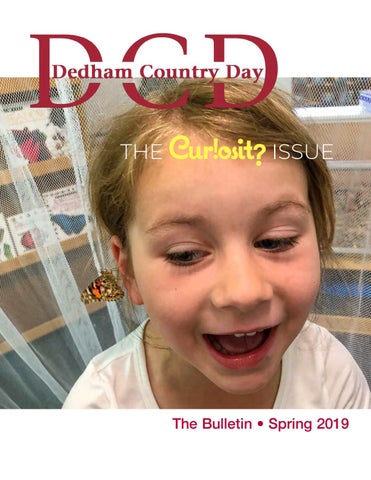
THE
ISSUE
The Bulletin • Spring 2019
Mission Statement Dedham Country Day School •Provides to each child a unique educational balance of challenging academics, arts, and athletics; •Embraces an inclusive, interdependent community of students, teachers, and parents that fosters trust and encourages children to take risks; •Creates independent, resilient, lifelong learners through engaging, developmentally-based teaching designed to meet varied learning styles; •Inspires students to become caring, ethical members of the larger world by emphasizing thoughtful citizenship and respect for self and others. Diversity Statement At DCD, we define diversity as an umbrella term that includes race, gender, age, ethnicity, culture, nationality, sexual orientation, social and economic class, physical and learning differences, and religion, as well as other characteristics that contribute to each individual’s full identity. We strive to provide a multicultural education, which celebrates the diversity of our community and the larger world. At DCD, respect permeates all aspects of school life. We want children to learn to understand and value multiple perspectives, identify and reject stereotypes and prejudices, and work for equity and justice. Dedham Country Day is strongly committed to ensuring a sense of community in which every member is safe, valued, and treated with dignity. We believe that a broad range of experiences and viewpoints enhances learning and enriches life. Admissions Inquiries should be submitted to Emilie Liebhoff, Director of Admissions and Assistant Head of School Dedham Country Day School 90 Sandy Valley Road Dedham, MA 02026 Tel: 781.329.0850 Web: www.dedhamcountryday.org B
Head of School Allison D. Webster
In Thi s Issue
Director of Admissions and Assistant Head of School Emilie Liebhoff
Head’s Report
2
Creating a Culture of Giving by Allison D. Webster
2
Director of Advancement Charles S. Rudnick Director of Communications Leslie Bowen
THE
ISSUE
Curiosity Spurs Day of Learning and Teaching for DCD Faculty and Staff. . 5
Contributing Writers Abby Ackerman Leslie Bowen Emilie Liebhoff Annette Raphel Hilary Rochelle Allison Webster
Genius Hour: A Way for Children to Explore What They’re Curious About. 6
Class Notes Abby Ackerman
Curiosity Is Foundation of Toy Math Activity in Second Grade. . . . . . . . 8
Design Jason Fairchild, Truesdale Group Photography Abby Ackerman Leslie Bowen Ben Brocko Kristie Gillooly Dean ’02 Christine Holden Lexi Jackson Hilary Rochelle Sue Shirley Printing Recycled Paper Printing, Inc.
Front cover photo by Lexi Jackson Inside front cover photo by Hilary Rochelle Outside back cover photo by Abby Ackerman
Sally Taylor: New Curriculum Fosters Curiosity. . . . . . . . . . . . . . . . . . . . . . . . 7
On Campus
10
DCD Partners with Cradles to Crayons to Help Kids Back to School for Grandparents and Special Friends Japanese Student Teachers Visit DCD Second-graders Host a Walkathon to Benefit the Make-a-Wish Foundation Latin is Definitely Not Dead! Mindfulness for All DCD Welcomes Expert Visiting Team in Math SEED Program Grows at DCD All About the Hawk!
10 11 12
Student and Community News
24
Sports Roundup
20
Alumni Association
29
Alumni Spotlights Patrick Kearney ’09 Credits DCD for His Preparedness in Politics ZeeZee Canning ‘14: Using Storytelling to Create Greater Understanding 2019 Alumni Award: Edie Carey ’88 Alumni News & Events May 3 Alumni Event Alumni Spotted at the Fair
29
Class Notes
34
Alumni Highlight: Jackie Barrett ’02
35
12 13 14 14 15 16
29 30 31 32 32 33
Head’s Report Creating a Culture of Giving
E
by Allison D. Webster
• People who are driven more by a sense of purpose ach summer, we vacation with my husband’s than a feeling of obligation are energized by their Midwestern family on Lake Michigan. The trip giving. includes his five siblings, their five spouses, fifteen young adult children (now ages 18-26), their boyfriends, • Givers who take time for their own interests and goals girlfriends and spouses, many family pets, day trips, are better able to help meet the needs of others. improvised sleeping arrangements, rental cottages, and • Givers who are more focused on the work getting dietary preferences ranging from omnivore to vegan to done than on recognition for their contributions are gluten-free. While this combination may sound like a more inspired by their giving. recipe for chaos, especially during the years when the 15 kids were all under age 10, it has always been one of the After reading this research, it is easy to understand most relaxing and fun weeks of our year. Why? The answer DCD’s success since we hone a culture of such outstanding is simple. His family is made up of a group of givers, and givers. DCD has been built by our culture of successful the way everyone gives freely of their time and resources givers over the decades and is sustained by it today. towards the greater goal of building a wonderful vacation Everything from our facilities to our academic program to makes things run smoothly. our endowment has been built in deliberate ways by givers. So what does it mean to be a giver? In his book, Give and As our media and researchers lament the loss of civility Take, Adam Grant identifies and connection in the three types of people: givers, culture at large, and NAIS takers, and matchers. Takers publishes articles about the are the kind of people who reduction in volunteering, “Successful givers are motivated by a focus on their own interests somehow DCD continues and needs, always asking, shared sense of purpose more than a to sustain and build a “what’s in it for me?” when culture of givers. What asked to contribute. Matchers feeling of obligation.” makes this so? are people who are willing The first factor – and a to offer support and help, critical one – is our shared but who look immediately sense of purpose and to getting something in mission. We all know that we are trying to build the best return. Givers are people who simply ask, “how can I possible school for cultivating the long-term well-being of help?” without any expectation of an immediate reward children. Successful givers are motivated by a shared sense for their contribution. They give with no strings attached of purpose more than a feeling of obligation. Our shared and they don’t keep score. In his book, Adam Grant shares purpose energizes our giving of time, treasure, and talent. research on engineers, salespeople, and medical students Another key to our culture of giving is strong selfto understand which reciprocating style—giver, taker, or efficacy that is felt by students, families, and faculty across matcher—leads to long-term success. the school. Self-efficacy is the belief that you can affect Givers are both the most and least successful in these change through your actions—that your actions matter. studies. What determines which givers are at the top and This fall, a group of eighth-grade students, Bryan Mann, which are on the bottom? It turns out that how they give Kerr Sjostrom, and Max Nye, came to me with an idea dictates the outcome. Successful givers ask three core to improve a hallway space at school. Months later, after questions before giving: Why am I giving? When do you working with service-learning coordinator co-chair Dan need my help? Who will benefit? Studies have also found Balk, I saw them unfurl the mural they created with art the following to be true: teacher Lisa Houck, impressing the fully assembled middle
2
level of body fat maintained. Whatever one seeds a group with, that is what will spread. We are lucky that in our case, DCD’s social contagion spreads motivation, ownership, and a culture of successful giving. So take note of all the giving around you. In just the past weeks, I’ve seen the following gifts offered and accepted: • An ode to DCD written by a first-grader given as an act of kindness and connection; • A fantastic party created for all faculty, staff and trustees by our board chairs, John Connors and Susanne Joyce; • A huge smile and a wish of “Happy Mother’s Day” provided by a 5th grader; • Volunteer hours offered by parents to support our Medieval Feast; A pre-K student has a close encounter with a butterfly hatched in the classroom.
school. These students demonstrated what our students consistently feel at DCD. They know their actions matter, and that each of us has something we can contribute to strengthening our school. Every group at DCD has a sphere of influence. Faculty know they have the autonomy to build curriculum and experiment with innovations; parent volunteers organize events that express our school’s unique culture; our Board helps to shape the future of the school. In many domains, people have real authority and responsibility for DCD’s health and future, which leads us all to know that our actions matter. The ownership all of us feel over DCD and our sense of responsibility for its well-being are also fueled by the small size of our school. It is a place where we ask, “If not me, then who?” One of the things that struck me when I first spent time on DCD’s campus was seeing a child—far ahead of me in a hall and not aware of being watched—pick up a wrapper he found on the ground. As he casually scooped it up, I was struck by the feeling of responsibility he must have felt over DCD’s campus. While the wrapper was not his, he knew the hallway was, and he must have also appreciated the feeling of order that results when we all take care of our school. Social contagion is a well-documented phenomenon. Highly connected groups can “contaminate” each other with everything from awe to the inclination to smoke, to the
• A significant contribution to our Annual Fund donated by a grandparent; • A weekend of hard work to make the DCD Fair magic for children provided by the Fair Chairs, Facilities and Advancement Team along with a fleet of volunteers; • Faculty giving their time to take on extra projects across the school, including evaluating our schedule and reviewing our math program, • And on it goes. Years of hard work and thought have brought our school to our current moment, and our next chapter will be built by the way our generation of DCD students, families, faculty, board members, alumni and supporters comes together to demonstrate the power of a group of givers.
For those of you who haven’t already received it, we are excited to share the strategic plan inserted in this issue of the Bulletin. You’ll spot many examples of the five key pillars identified in the plan— accomplishment, relationships, innovation, health, and meaning— described in the articles that follow, as we have already launched many of the plan’s key initiatives. Look for these icons as you read:
3
THE
4
ISSUE
Curiosity Spurs Day of Learning and Teaching for DCD Faculty and Staff By Leslie Bowen
W
hat are you curious about? That was a question asked of faculty and staff earlier this fall, which prompted visits to nearly 30 schools and organizations, both public and private, on their professional development day, Monday, November 26, a day that was dedicated to teaching and learning. To prepare for the day, faculty were asked to decide what they were curious about, identify where they wanted to go and whether they wanted to go on their own or with a group, to discuss their ideas beforehand within their divisions, and finally to plan their trip. The professional development day itself consisted of two parts: In the morning, teachers and staff members visited a school or educational program of their choice. In the afternoon, they returned to DCD to come together as a community for lunch, conversation, and sharing their experiences, first in small groups, then later all coming together for a final session. Both parts of the day were equally important to the learning process.
List of schools and organizations visited: Brimmer & May School BB&N Beaver Country Day School Belmont Day School Birches School Brookline Public Canton Public Library Cottage Street School Countryside Elementary School Dana Hall School Endicott Community Garden The Gordon School Greenlodge School Lexington Montessori School
Mass College of Art Milton Academy Mitchell School Museum of Fine Arts Noble and Greenough School NUVU: The Innovation School Park School Pollard Middle School Rashi School Thayer Academy Walnut Hill School for the Arts Whitney Academy The Winchendon School Xaverian Brothers High School
Areas of interest explored during the day included forest kindergarten, Native Americans and art, cross-curricular learning models, social-emotional well-being, non-traditional school environments, interdisciplinary music programs, and many other topics. Middle-school math teacher Jim Pinola was interested in the topic of leveling in math and dealing with students who enter at a young age and have difficulty meeting expectations as they get older. He visited Whitney Academy, which serves students with a combination of severe learning and psychological issues. “Prior to working as a teacher,” he explained, “I worked in group home with adults with mental retardation, autism, and mental health problems, so this has been an area of interest to me.” At Whitney Academy, he said,students are grouped by ability not age, a model that may require some adjustments if it were to work here at DCD. A group of faculty members, including science teacher Sarah Walsh, visited the NuVu Innovation School. NuVu’s approach to fostering creativity, collaboration, and curiosity is centered around using the design process as a way to engage students with real-world problems and situations. Courses, which are called studios, range from designing prosthetic body extensions for ballet dancers in New York City to the art and architecture of pastry design. “High ceilings, power tools galore, and groups of mixed ages— nothing about it looked like your traditional school setting,” noted Sarah. “It was inspiring to hear about the work these teenagers are able to accomplish, as well as how the emphasis is mostly put on the process rather than the final product,” she said. “As a science teacher, I’m constantly reflecting on what my students need to know as they grow as learners and how we can make our time together at DCD as meaningful as possible, so this trip to NuVu was an invigorating experience!” Teachers brought what they learned back to the classroom, their own professional growth enhancing the learning experience for students. 5
THE
ISSUE
Genius Hour: A Way for Children to Explore What They’re Curious About By Hilary Rochelle
G
enius Hour has come to DCD’s fifth grade! Modeled after Google’s Genius Hour, where employees are allowed to spend 20 percent of their time on pet projects to spur on creativity and boost productivity in the workplace, many schools are now joining the Genius Hour movement. By letting students have some choice in what they learn, the goal is to encourage the pursuit of passions, independent learning, and creativity in the classroom. DCD fifth-graders have their Genius Hour on Tuesday mornings. Step one for this hour of independent learning was for students to identify a topic and create a learning plan, which they had to review with their teacher. The only stipulation is that the topic needs to be authentic and researchable. This was actually the most challenging part of this new classroom endeavor. It’s been a great learning experience for these students as they grapple with the freedom to decide what they are passionate about and what they might want to learn. For some, their ideas came right away, for others, it took a few starts and stops to hone in on what they’d actually like to spend their time pursuing. Step two was to conduct the research either with a hands-on experiment or by doing some research using both online and library-based resources. And, step three was to make a presentation to the class on what they learned. Here are some examples of current projects: • How has the sport of gymnastics changed over time? • Which Slime formulas are most appealing? • How do people use virtual reality to overcome a physical struggle? • What is air-suspension technology, and what are some of its applications?
6
Fifth-graders explore the unique qualities of Slime during a Genius Hour activity.
Fifth-grade teacher Joanna Bemis began piloting this program for her section during the fall. It was so successful that by mid-year, it was rolled out in Stephanie Chiari’s section. Joanna sees this as a productive time for her students. “Learning to fail is a huge part of the process,” she says. “Students are learning to be flexible and adapt when they hit a roadblock.” By the time the school year comes to an end, students should have several projects under their belts. While these projects might not yield the next new business idea or hot piece of technology, this hour of exploration certainly energizes the class and helps each child experience what it’s like to dive into the creative process, using their own natural sense of curiosity as motivation.
Sally Taylor: New Curriculum Fosters Curiosity By Hilary Rochelle
S
ally Taylor, musician, artist and founder of Consenses, came to campus as part of our DCD Connects initiative this spring. In addition to music and art, Sally is passionate about the subject of curiosity. It’s this passion for asking questions, listening to how different people answer differently, and seeing the array of perspectives that emerge, that inspired her to start the Consenses Project and its subsequent curriculum. Children enter this world curious. As babies, they are figuring things out with non-verbal communication and exploration. When they can talk, they are full of questions: Why is the sky blue? Why is water wet? Where do you go when you die? At an early age, you aren’t expected to know the answers to such questions or to understand and know what is going on around you. But as we get older, Sally noted,
Sally Taylor visited DCD to speak about the importance of encouraging curiosity in children.
we think we are supposed to have all the answers. That lack of knowledge or the presence of uncertainty leads to anxiety and discomfort. Adults often experience this in daily life, and children experience it, too, especially in school, where there has been so much pressure to come up with the right answer on a test or in response to a teacher. This prompted her to ask, Why not turn uncertainty into curiosity? After
all, it’s curiosity that allows us to learn more about the world around us and to see and experience the perspectives of other people. Sally quoted from the 13th-century poet-philosopher Rumi who once said, “Sell your cleverness and buy bewilderment” as a jumping-off point for the evening’s presentation. Sally shared an “out-of-the-box” way of encouraging curiosity and creativity. As the daughter of James Taylor and Carly Simon, it’s no surprise that her musical and artistic heritage has provided the backdrop for her novel way of thinking, spawning Consenses, which has now evolved into a fascinating multidisciplinary curriculum for social and emotional learning developed in collaboration with the Harvard University School of Education. The curriculum encourages students to use art in its many forms (music, dance, poetry, painting, drawing, perfume) as both a “language and a lens” for expressing, listening to, and seeing different ideas and perspectives. Sally likens it to a giant game of telephone in which participants are tasked with extracting and interpreting the essence of a message. Using the curriculum she’s developed, students learn how to find what is essential in a given work of art, whether a song, a photograph, a dance, or a painting, for instance, and then reflect that interpretation back into the work they create. So, a musician may look at a photograph and interpret it as a song, a dancer takes the song and interprets it as a dance, a painter sees the dance and renders it as a painting, a poet interprets the painting in the form of a poem, and a perfumer takes the poem and makes a scent. When you look at the chain of these expressions, you can see and experience the collection of different perspectives that are born out each individual’s creativity and curiosity. While we didn’t have the time to “create” any art in our short time with Sally, she took the audience through an interactive exercise or “game” as she called it to illustrate the power of extracting the essence of a work of art. She asked us to look at a painting and think about what it would be like if it were a song, if it were a food, or if it were an animal. As people shared their various interpretations and authentic ideas, the power of different perspectives was apparent. It was a gift to take a moment to think and be curious in a way that was free of judgment, where the answer was of our own making, and our voice was appreciated. It also illustrated for the adults in the room the importance of continuing to fuel curiosity in our children as a means to understanding and appreciating the world around them. To learn more about Sally Taylor’s Consenses Project and the curriculum she has developed for schools, visit her website, www.Consenses.org
7
THE
ISSUE
Curiosity Is Foundation of Toy Math Activity in Second Grade By Annette Raphel
A
cents, two students would work together to estimate the s each name in Mrs. Holden’s class was called, value of their pair of toys and eventually join up using the familiar random popsicle system, the with another pair of students to find the value of child approached a big canvas tote bag, and without four toys. looking inside, gingerly reached in. There were small toys First, as in many good lessons, there was a sample within, and as each toy was extracted, there were a variety of problem to elicit the variety of ways that the addition of four reactions. Sixteen individual toys and sixteen excited second money values could be calculated and to demonstrate how to graders. What would they be doing with them? record your thinking so that a teacher could figure out what Each student got a Post-it Note and had to assign a value strategy you used. There were four hypothetical toys: to their toy that was under a dollar. The skill of the day was A wind-up car for 82¢ to be using two values under a dollar, to estimate, and then A ball for 45¢ to compute the sum. The first lesson relied on pictures of A puzzle for 57¢ playthings, for example, a viewfinder, with values that our A small stuffed bear for 18¢ savvy students knew to be disguised computation practice (a Ella started us off by viewfinder for 11 cents?). We suggesting that you could asked, Why not put them in In real life, we routinely are curious add a pair of numbers and charge of figuring out their then another pair of numbers own math problems instead about something and invent the problem and then add the two sums of always solving someone together. She suggested that else’s? Mathematician Stephen as well as collect the data. we start with the two largest Brown calls this Problem numbers to get them out Posing, as opposed to much of the way, so she added more familiar and ubiquitous 82+57=139 and 18+45=63 and Problem Solving. In real life, then added 139 and 63 to get a total of 202. Along the way, we routinely are curious about something and invent the there was a vibrant discussion about the decimal point and problem as well as collect the data (For example, how much cents and dollar signs. We worked initially all in pennies and do you really save if there is a 40-percent-off sale with a then decided how many dollars and cents that would be: coupon of an additional 20 percent off?). $2.02. While there are correct and incorrect answers in arithmetic, The next student, Avery, lined up the numbers in a vertical there are a variety of ways to think about a problem. column: Composing and decomposing numbers (taking them apart 82 and reconfiguring them) often make good use of number 45 sense and may result in efficiencies over always relying on 57 the standard algorithm. While algorithms were invented 18 because they always work, they are not always the most However, she did not add them in order, instead preferring efficient and often disregard reasonableness of an answer to seek out compatible combinations. 2+8 equaled 10 and (If you want proof, see how often students get 112 for the 7+5 equaled 12 in the ones column. Together, that totalled answer of 1,000 - 998 after crossing out lots of zeroes when two tens and two ones. So she saved the two ones and said if they just thought about it, they could probably realize that she would remember to add the two tens to her grouping the answer is 2!). of tens. Then she added the tens column: 5+4+1 equaled 10 With values ranging from one cent (a perhaps undertens, and then she added eight more so she had 18 tens, and appreciated teenage mutant ninja figure) to a high of 99 8
then added the two from her addition in the ones (or units) column. So she had 20 tens, which were the same as 200, plus the two she already had. She also got $2.02. Diego saw that 82¢ + 18¢ equaled $1.00. Using combinations to reach benchmark numbers (in money, dimes, quarters, half dollars, and dollars are particularly useful) is an excellent strategy. Then he had 45 and 57 left to add: 40+50 = 90 and 5+7=12. He split the 12 into 10+2, then added 90+10 to equal a dollar. So, he now had two dollars and two cents or $2.02! Lindy used what we came to call the “Lindy chain method.” She just started with the first number and added it to the next. Then she took that sum and added it to the following number. She did that once more until she had accounted for all four numbers: 82+45=127. 127+57=184. 184+18=202. Again, the answer was $2.02. Kimaya used what the class knows as the stack method, actually the standard algorithm. 82 45 57 18 She added the units in order (2+5=7, 7+7=14, 14+8=22), put down the 2 and carry the 2 (8+4=12, 12+5=17, 17+1=18), 18 + the 2 that you carried is 20. The result is 202, or $2.02. The point of the exercise was not which approach was the best, rather that there are a variety of meaningful ways to arrive at a correct sum. By being exposed to classmates’ thinking, students could add to their toolbox of effective strategies. And, small toys were an enticing way to invite meaningful math practice.
Annette Raphel demonstrates ways of problem-solving in math.
Second-graders work together to solve a problem in math. 9
On Campus DCD Partners with Cradles to Crayons to Help Kids in Need
O
Gym distributing everything n Saturday, February 2, among the different sorting Dedham Country Day School Overall: 955 children served stations set up around the room. hosted a special day of service Donated and Sorted: Each student, parent, and staff to benefit children in the greater member was assigned to work at a specific Boston area served by the Cradles Clothing - 49 bags station. Armed with toothbrushes, spray to Crayons organization (C2C). Shoes - 7 bags bottles, and paper towels, volunteers C2C’s mission is to provide children Books - 17 bags cleaned the soles of shoes, wiped down from birth through age 12, living in Toys - 14 bags toys, and inspected clothing and books homeless or low-income situations, Nursery Items - 4 bags to make sure every item was in good with the essential items they need to condition. thrive at home, at school and at play. Head of School Allison Webster Reflecting DCD’s longtime commented, “We know children—even at a very young commitment to community service involving all ages, age—are able to make a difference in the world and want to families arrived together to take part in the school’s “Family contribute to something larger than themselves. Seeing the Volunteer Morning” to benefit C2C. Joining DCD staff and commitment of our students and families and the tangible alumni, they formed a group of nearly a hundred volunteers support we were able to provide to children and families in all who spent the morning sorting, inspecting, and in need, demonstrates in practice a central value of our organizing all the gently used clothes, shoes, books, and toys school community of being caring, ethical members of the that were collected during the school’s month-long drive larger world. I am grateful to Cradles to Crayons for their in January. All the goods were then transferred back to the partnership.” Cradles to Crayons facility where everything was prepared After keeping a running tally of bags, the final count of and packaged for distribution to the children. children served at the end of the event was 955, an increase Carrying big purple sacks full of donations, volunteers of 234 children served over last year. brought all the items from the storage container to the Rand 10
On Campus
Back to School for Grandparents and Special Friends From pre-K to grade 8, DCD’s classrooms and halls were bursting at the seams as grandparents and special friends joined their loved ones for an opportunity to experience what it’s like to be a student at Dedham Country Day. Armed with campus maps, class schedules and a whole lot of coffee and yummy snacks, our visitors moved from solving complicated equations in middle-school math class to smoothing out the top of a rustic bench with fine-grit sandpaper in the woodshop, to experiencing choice time in pre-K, to programming robots, and playing history bingo in grade 3. No matter where you looked, every nook, every cranny, every seat, was filled with engaged students, grandparents, and special friends connecting in joyful learning. Thank you to all the grandparents and special friends who came from near and far to DCD and to all the parent volunteers who organized, guided, prepped food, and helped with transport. It was a wonderful day for the youngest and the oldest members of the DCD community!
11
On Campus JAPANESE STUDENT TEACHERS VISIT DCD A group of 10 student teachers visited DCD from the Early Childhood Education Program at Showa Boston, a satellite campus of the Showa Women’s University in Tokyo.
Each winter, students from the Tokyo campus visit Boston, tour area schools and complete a practicum at a local Boston school. They visited DCD along with their Japanese translator and program coordinator. In addition to observing the pre-K – grade-2 classrooms, they explored the wood shop, art studios, music room, and gym.
SECOND-GRADERS HOST A WALKATHON TO BENEFIT THE MAKE-A-WISH FOUNDATION
Second-graders hosted a walkathon during the annual MLK Jr. Day of Service in January to benefit the Make-A-Wish Foundation of Massachusetts and Rhode Island, raising more than $2,400 to support Wish-Kids! Congratulations on making every step count. Representatives from the organization helped students recognize how much their hard work helps other children.
12 12
On Campus
Latin Is Definitely Not Dead! By Hilary Rochelle
F
ifteen out of twenty DCD middleschool students studying Latin in seventh and eighth grade were recently recognized for their performance on the National Latin Exam, which they took at the end of February. In seventh grade, there are two levels of recognition: Three students received a Certificate of Achievement, and three received a Certificate for Outstanding Achievement. In eighth grade, there are four levels; Cum Laude, Magna Cum Laude, Maxima Cum Laude, and Summa Cum Laude. Three students received Magna Cum Laude recognition, and six students received the highest honor of Summa Cum Laude. Welcome to Latin at DCD! Middle-school students have their first taste of Latin during sixth grade when they spend half the year in Latin class and half the year in Spanish class. As they prepare to move up to seventh grade, students choose between Latin and Spanish for the rest of their time at DCD. This year, more than a third of students between seventh and eighth grade are studying Latin. Though it’s a smaller group of students that choose to study Latin, it’s an active one as evidenced by their performance on the exam. When asked what the recipe for this success is, DCD middle-school Latin teacher Bo Harrington credits his engaged, hardworking students. The students will tell you that they really enjoy Mr. Harrington’s class because of the way he teaches Latin. “He makes it fun and interesting,” commented one student. On April 21, Latin students celebrated the founding of Rome with a birthday party. According to Mr. Harrington, students who enjoy math and science often enjoy Latin. “It’s very analytical and almost like a puzzle,” he explained. “They seem to enjoy breaking down the
A student works on a Latin phrase at the board during class.
pieces of a sentence and seeing how changing word endings can impact its meaning.” While studying Latin helps build a student’s vocabulary among its many benefits, Mr. Harrington’s heavy focus on grammar gives students an excellent foundation for learning how languages work in general, which helps students in their own writing as well as gives them a strong foundation for their study of modern languages down the road. He also includes some ancient Roman history as a context for studying the language in eighth grade, and in seventh grade, students read an adapted version of Virgil’s Aeneid. When asked about challenges students might face in studying Latin, he says that not being able to practice speaking with others makes it harder to learn than more modern spoken languages. “It’s not like you can land in Rome and practice your Latin!,” he jokes. However, he acknowledges that for most of his students, this doesn’t seem to really matter. To them, Latin is very much alive!
Latin Award Winners 7th Grade Certificate of Achievement Charlie Overman Amanda Hiatt Ben Clay Certificate of Outstanding Achievement Emma McNealy Cameron Yao Abby Rochelle 8th Grade Magna Cum Laude Martha Arends Hannah Peters Max Nye Summa Cum Laude Luke Hotra Carly Ward Cameron O’Rourke Lidia Rodriguez Megan Fuqua Matthew Volfson
13
On Campus DCD Welcomes Expert Visiting Team in Math By Emilie Liebhoff
I Mindfulness for All Ages By Hilary Rochelle
L
ast fall, DCD began a mindfulness program with the goal of equipping students and teachers with skills to better handle transitions, improve focus, and keep behavior in check. DCD faculty members Marie Nagode and Meaghan Daniels, who have training and experience in mindfulness techniques for children, have been working regularly in the classrooms to explore such topics as self-awareness, positivity, handling strong emotions, and techniques for calming the mind and body. Some typical exercises they might engage in on a given day include: • Mindful listening with a chime • Using breath as a way to anchor attention • Blindfolded sorting of pasta or candy (using touch as a focal point) • Coloring mandalas or creating zentangle drawings • Exploring emotions and their physical sensations • Creating bookmarks with positive messages • Reading books related to mindfulness with younger children Each week, Marie and Meaghan are prepared with an array of age-appropriate activities to engage students and teachers in learning these life-long skills. Our mindfulness program is currently running successfully in all three divisions!
14
n April, the school welcomed math experts from area schools and organizations as part of DCD’s program review in math. Our visitors spent three days at DCD observing classes, talking with teachers and administrators, and interviewing parents and students. Our visiting team included the following experts: • Nancy Anderson, Former K–8 Math Specialist and Middle School Head at Milton Academy • Dr. Ellen Boiselle, Math Learning Specialist in the Department of Neurology at Children’s Hospital • Lauren Giordano, Math Specialist at Chestnut Hill School and Math Leadership Network Coordinator • Steve Goldman, Math Specialist at BB&N and Math Leadership Network Coordinator • Lainie Schuster, Head of Lower School at the Fay School and presenter at the Summer Math Workshop, author of many math education books • Dr. Adrian Mims, founder of The Calculus Project, which looks at the experience of students of color in math We were thrilled to bring this group together to delve into our math program and explore our curriculum, delivery methods, and student experience in math at DCD. The immediate feedback is that we are doing much right in how we teach math at DCD! Thanks to our internal Math Program Review Team consisting of Brenda Leith, Stephanie Chiari, Alyssa Sinclair, Cheryl Price, and Emilie Liebhoff for spearheading the Math Program Review throughout this year and setting the stage for a great visit for our experts. The team observed classes and engaged in conversations with teachers, administrators, and parents. They were incredibly complimentary of our school and their experience visiting DCD. We have now received the report from the visiting team and have been assessing all of the commendations and recommendations, and we are excited to be able to share this information with you in the fall Bulletin!
On Campus
SEED Program Grows at DCD (Seeking Educational Equity and Diversity) By Hilary Rochelle
A
s part of our long-term goal of establishing and maintaining an inclusive and diverse community, we have established our own SEED Program at DCD. SEED stands for Seeking Educational Equity and Diversity and is supported by a 30-year-old national organization that provides peer-led training and programming to promote change on campuses, in workplaces, in communities, and in curriculum. To participate, DCD had to apply to the program and commit budget and other resources to support a structured SEED seminar on campus. Last summer, the school sent two representatives, third-grade teacher Lynne Mayard and Director of Advancement Charles Rudnick, to a week-long intensive training to prepare them to implement a SEED program at DCD. DCD has been prioritizing diversity and inclusion for some time in fulfillment of the school’s mission, through the efforts of our Board, Diversity Committee, and the student-focused Lower School Culture Club and Middle School Affinity Groups. In establishing a SEED group at DCD, the goal was to foster an ongoing conversation about these issues within our community, helping to build connections and raise awareness about how a person’s background can consciously or unconsciously impact the way they think and act. The SEED program is a specific component of DCD’s new strategic plan, in support of the “Relationships” pillar that focuses on developing a better understanding of the role of identity in relationships. The school decided to open its first SEED group to faculty and staff, and before the school year started, 25 faculty members committed to a monthly three-hour session to work through discussions and exercises delving into various topics about identity, equity, and inclusion. Some of the issues addressed during the course of the school year included the impact of “windows and mirrors” in our work and school environments, family and home-life backgrounds, gender identity, social class, race, religion, and more. Feedback from DCD’s inaugural SEED leaders and participants has been very positive.
“SEED has been an incredible journey for all of us,” said co-facilitator Lynne Mayard. “While we knew generally what we had signed up for, I think the true power of the shared experience throughout the year was unexpected and created strong connections among the group members.” “The SEED model uses participants’ own experiences to help explore issues of equity, justice, and inclusion – a model that helped us all gain insights into ourselves and some of the critical societal issues of today’s world,” added co-facilitator Charles Rudnick. “Ultimately, this will help us become better educators and better people.” DCD plans to expand the SEED program during the 201920 school year to include a new parent SEED group led by Sharisse Cail Perry and Karen Salfity and a second faculty/ staff SEED cohort led by Rick Edie and Ali Fernandes.
Charles Rudnick and Lynne Mayard, pictured at the Fair where they were announcers, headed up the first year of the SEED Project at DCD. 15
Have a “Hawk” of a Good Time Fair This year’s DCD Fair capitalized on our new mascot, the Hawk, creating fun new games and activities, like the Hawk Toss, Hawk Race, and Lollipop Hawk Tree.The Cakewalk featured hawkthemed cakes, and hawk merchandise made its way into the Artisan Marketplace. Everyone had a “Hawk of a Good Time” thanks to Co-Chairs Jill Creevy and P. J. McNealy!
68th Annual DCD Fair Saturday, May 4, 2019
"
Have a Hawk" of a Good Time!
16
Allison Webster and Erin Keith Epker ‘86
Jen Mike and Kristen Cloonan and
ke Canty and LaToya Shirley Anderson, Tamara Bla McGlothin
and John DeSisto
Kevin Connors and P. J. McNealy
Keohane Wands and Andrea Michael and Lindsey
Andy Mims, Chester Hedgep eth, and Rick Freniere
Chris Cheever ‘94 and Tim Brennan
Whitney Cheever and Ang e Cavallo
Bill and Jill Creevy
Steve Perry ‘85, Mary Mumford, and Lee Mumford Peterson ‘86 Jay and Julie Layden
Jonathan Keith and Ben Cav allo
Hawk’s Nest Spring Fundraiser
Heather and Ken Crowley, Dave and Tara McDonald, and Mary Ellen Maloney
The Hawk made an appearance at our annual spring fundraiser chaired by Ange Cavallo and Whitney Cheever. The event raised $50,000 for the Head’s Innovation Fund. 17
Hawk Joins Heads for a Day at Fun Dance Party During Morning Carpool It wasn’t all fun and games while “Heads for the Day” Walker Mims and Presley Upton were in charge! In addition to hosting a fun dance party during morning carpool featuring the DCD Hawk and playing board games, frisbee, and foosball at the Head’s residence at Hale House, they also learned some important lessons about leadership and how to take good care of people. In addition to keeping things fun, they said that doing what you say you will do and being on time also showed good leadership. 18
Pre-K Play: The Hawks of DCD The hawks have landed on the DCD stage! In an original play by Drama Director Elisa Sidoli, pre-kindergartners found their way back home to DCD after flying away to escape the cold. The DCD Hawks loved living at DCD but when the cold weather arrived, they moved to Florida, Mexico, and South America. Although they loved their time in the sun, they couldn’t wait to get back to all their friends at 90 Sandy Valley Road.
19
SportsRoundup Fall 2018 Varsity Field Hockey Varsity field hockey had an amazing undefeate season of 9 wins and no losses. The team as whole improved over last year’s record of scoring 29 goals with 23 goals scored against. This year the team scored 34 goals with just 2 goals scored against! Captains Grace, Megan, and Carly were incredible as a midfield line, working togethe at both ends of the field. They inspired a challenged the team to reach great heights with collaborative and inclusive team play. Goalies this season were Abby, Summer, Jessie, and Caroline. A big thank you to the 7th-graders who played in both JV and varsity games, Elena, Brynn, Cate, Summer, Amanda, Emma, and Shalease, who made up half the varsity team. —Deb White
JV Field Hockey The JV field hockey team was a lean squa allowing eight 6th-graders plenty of time and exposure to develop into a formidable core that was enhanced by the experience of seven 7thgraders. The team began and ended the seaso with impressive wins against Milton Academy and an overall record of 5-1-2. The one loss of th season came against Derby’s varsity team, which proved to be an essential lesson and motivator. With no set captains, each player stepped up to lead in her own way every practice and when asked for in games. New 6th-grader Keira Welch received the Most Improved Player Award for the incredible progress she made having just started the sport this summer, and Jessie Ward received the Coach’s Award for her determination and impact all over the field, scoring 11 goals for th team. —Wendy Soutsos
Varsity Flag Football Varsity flag football had a great season. In pra tice, the team enjoyed working on offense (thro ing, catching, and running plays) and defense (especially flag-pulling drills). The boys took fu advantage of being a relatively large team (16 players) and competed hard against each other in fun and productive scrimmages. The team ca tains (Quinn Kelly, Riggs Catlin, Max Nye, and Hugh Geraghty) led the team into games. One highlight from the season included a great comeback that led to a 30-25 victory in the opening match against Park School. The team finished t season with a record of 4-6. —Dan Balk
JV Flag Football The 12-member boys’ JV flag football team had great season! They were an energetic, skilled, an competitive group. Each player was determined to develop his flag football skills. The team h a seven-game schedule and ended with a record of 4–3. The team focused in practice on fl pulling, throwing, catching, offensive formations and defensive formations. A highlight of the season was the team’s 33-8 victory over Thaye Academy, which featured touchdowns scored by four different players. The squad also battl Tenacre in a high scoring game that ended with a win of 41–12. The team put in an enormou amount of effort and intensity during eac practice and game. —Kyle Sminkey
Girls’ Soccer The girls’ soccer team was small but mighty thi year. Typically, you need 11 people to play in a full-sided game consisting of 10 on the field an a goalie, but our team had only 10 girls, so we played 10 vs. 10 or 9 vs. 9 and with one sub. Th girls were able to play different positions becaus we had to sub and/or switch around depending
on who needed a break or what we needed to do as a team. As a result, this group of girls can go and play any position that is asked of them! One highlight for the coach was that all 10 players earned either a goal and or an assist! That is very difficult to accomplish says a lot about this group of girls. —Elaine Gage
Boys’ Soccer Through determination and teamwork, this year’ boys’ soccer team compiled an impressive 8-3 re cord. They encouraged and supported each othe throughout the season and faced some impressive squads with grit and poise. One highlight was a great come-from-behind win at Charles River on Rivalry Day. Outstanding leadership came from our five eighth-graders, Cam O’Rourke, Ker Sjostrom, Bryan Mann, Danny Welch, and Charlie Cao. For three years of consistent play and leadership, Kerr Sjostrom and Cam O’Rourke were awarded the Coach’s Award. For his persistence and selfless play, Ben Clay was awarded th Most Improved Player Award. —Kevin Coakley
Cross Country This fall, the cross country team put in a stron season of hard work and fast running. The tea this year had three 8th-graders: Luke Hotra, Eli Leder, and Matthew Volfson, three 7thgraders: Maia Pantazelos, Rose Quinn, and Abby Rochelle, and three 6th-graders: Rory Taylor, CeCe Upton, and Zach Walton. In our weekly races, our runners got the chance to race against many of our area schools and put in excellent times throughout the season. This year’s awar winners were Rose Quinn (Most Improved Player Award) for her terrific improvemen and hard work and Matthew Volfson (Coach’s Award) for showing a strong dedication to the sport.—Bo Harrington
Team Records
20
Varsity Field Hockey 9-0 Coaches: Deb White Captains: Grace Freyermuth, Megan Fuqua, Carly Ward
Boys’ Soccer 8-3 Coaches: Kevin Coakley Captains: Charlie Cao, Bryan Mann, Cam O’Rourke, Kerr Sjostrom, Danny Welch
JV Field Hockey 5-1-2 Coaches: Wendy Soutsos No Captains
Girls’ Soccer 3-3-2 Coach: Elaine Gage Captains: Lizzie Cochran, Lidia Rodriguez, Mari Rounds, Natalie Rudnick
Varsity Flag Football 4-6 Coach: Dan Balk Captains: Riggs Catlin, Hugh Geraghty, Quinn Kelly, Max Nye JV Flag Football 4-3 Coaches: Kyle Sminkey Captains: by games
Cross Country 8 races Coach: Bo Harrington No Captains
Awards
Coach’s Award Most Improved Player Award
Varsity Field Hockey JV Field Hockey Flag Football JV Flag Football Boys’ Soccer Girls’ Soccer Cross Country
Carly Ward Jessie Ward Riggs Catlin Max Nye Neil Burmeister Cameron O’Rourke Kerr Sjostrom Lizzie Cochran Matthew Volfson
Photographs by Hilary Rochelle and Sue Shirley
Elizabeth Nicholson Keira Welch Jack Knight Ben Clay Natalie Rudnick Rose Quinn
21 21
SportsRoundup
Winter 2019 Boys’ Varsity Basketball
Girls’ Varsity Basketball
The varsity boys’ basketball team had fantastic season! The team—consisting of seven 8th-graders and three 7th-graders, and led by captains Eli Leder and Luke Hotra— was talented, hard-working, and remarkably cohesive. These characteristics made for a hugel successful season in terms of individual and team improvement, and in terms of results. The team achieved more success than any varsity basketball team in my eight-year tenure coaching at DCD, finishing with a record of 10-1 (including 3-0 showing at the DCD/Charles River School Tournament). Highlights from the season included a 34-33 win against Belmont Day, a 37-36 win against Derby (thanks in large part to a game-winning three-pointer at the buzzer by Luke), and a 51-47 comeback win against Rashi. It was a pleasure to get to coach this team, and I congratulate each of the boys for their excellent work this season! —Dan Balk
Varsity girls’ basketball had an outstanding season this winter. We were comprised of fiv 8th-grade girls, three 7th-grade girls, and two 6th-grade girls. The team was undefeated wit a record of eight wins and no losses, outscoring their opponents 243 to 119. This team also wo a tournament that was held at DCD competing against schools from Derby, Charles River, and Marie Phillips. The girls won all three games an outscored their opponents 72 to 22. Everyone on the team scored at least three baskets, and all the girls truly worked as a team. It was an absolute pleasure to coach this motivated, competitive, and amazing team.—Elaine Gage
Boys’ JV Basketball The ten-member boys’ JV basketball tea enjoyed a fantastic season. The basketbal team consisted of four 6th-graders and four 7th-graders. The energetic and extremely hard working team finished the season with a recor of 3 wins and 5 losses. The team improve tremendously from the beginning of the season to the end. Practices were a mix of ball-handling drills, shooting, offensive and defensive review and scrimmages. The boys consistently brough positive attitudes, energy, and the desire to improve both individually and as a team. Th highlight of the season was a come-from-behind, 37-33 victory against Rashi School. Every player gave their absolute best on defense and attacked the offensive zone with excellent ball movemen and shooting. I’m so proud of how hard this team worked in practice and in games! —Kyle Sminkey
Boys’ 6th Grade Basketball The 6th-grade boys’ basketball team had a goo season. The players’ experience ranged fro participating on travel teams to picking up a basketball for the first time this winter. Whil our record did not show any wins, we were competitive in many games and had many individual successes. Every player scored at least two baskets and made considerable improvement this season. The players have positione themselves to be solid contributors to their teams next year. —Nate Buffu 22
Girls’ JV Basketball
Squash
The girls’ JV basketball team had a fantasti season improving on athleticism and teamwork. After five home and three away games, the finished out the season 8-0 making the JV tea undefeated! In their final away game, they playe in their first overtime game against Nashob Brooks School. The score was 10-10 by the en of the halves, and the emotions were intense. The girls had three minutes to turn the gam around in overtime, and the game resulted in favor of DCD with a score of 16-12! The girl put up a total of 146 points for all eight games total and averaged at about 18 points per game, and they did it together. A ‘well-done’ and ‘congratulations’ is for the teamwork put in to have this outcome! —Caiti Pina
The 2019 squash team enjoyed a seaso of good competition and personal growth. The team of 20 players (fi 6th-graders, six 7th-graders, and nine 8th-graders), led by captain Cameron O’Rourke, ranged from complete beginners to players with tournament experience; all had fun and worked hard learning the intricacies of the sport. The team’s final record included a win ov Squashbusters, and every player was involved in several close matches over the course of the year. Eighth-graders Cameron O’Rourke and Ethan Rosensweig received the Coach’s Award and Most Improved Player Award, respectively. Congratulations on a fine year, and thank you t everyone on the team!—Rick Edie
Hockey The hockey team enjoyed a successful an exciting 4-3-1 season on the strength of its leadership, effort, and attitude. Captains Carl Ward and Vincent Jaeger set a positive example by giving their best in practice, sparking our offense with full-ice rushes, and incorporatin newer skaters into the flow of play. Highlight of the season include hard-fought one-goal games versus Nobles, Derby, and Park. The tea worked hard each day as we developed skating skills and participated in competitive small-ice games, and the entire group improved measurably as the season progressed. Above all, this team embodied a positive and cooperative approach, which made each player’s experience fun and the coaches’ job a real pleasure. Mr. Jackson, Mr. Santry, and Ms. Soutsos would like to thank the hockey players for making this season an extraordinary one. —Mark Jackson
Photographs by Kristie Gillooly Dean ‘02
S p o rC tl os sRi nog uE xn edr cui ps e s
Team Records Boys’ Varsity Basketball 8-0 Coach: Dan Balk Captains: Luke Hotra, Eli Leder Boys’ JV Basketball 3-5 Coach: Kyle Sminkey Captains: by game Boys’ 6th Grade Basketball 0-8 Coach: Nate Buffum Captains: by game
Awards
Coach’s Award
Most Improved Player Award
Boys’ Varsity Basketball Boys’ JV Basketball Boys’ 6th Grade Basketball Girls’ Varsity Basketball Girls’ JV Basketball Hockey Squash
Jonathan Oliveira Quinn Kelly Gabe Salfity Irini Kolovos Keira Welch Emma McNealy Ethan Rosensweig
Luke Hotra Ben Clay Drew Michaeli Mari Rounds Marin Reeds Vincent Jaeger Cameron O’Rourke
Girls’ Varsity Basketball 8-0 Coach: Elaine Gage Captains: Grace Freyermuth, Megan Fuqua, Mari Rounds Girls’ JV Basketball 8-0 Coach: Caiti Pina Captains: by game Hockey 4-3-1 Coaches: Mark Jackson, Bob Santry, Wendy Soutsos Captains: Vincent Jaeger, Carly Ward Squash 1-8 Coaches: Rick Edie, Bo Harrington Captain: Cameron O’Rourke
23
23 23
Student and Community News Student Achievements DCD seventh grader Evan Michaeli is a testament to the impact that young people can have on the issues affecting our planet. Evan founded the school’s student-run Green Club along with his brother Drew, a sixth grader, and eighth grader Matthew Volfson. An ardent environmentalist, Evan decided to make his case public last fall when he presented facts about environmental risks to the Town of Dedham’s Sustainability Committee. Since then, he’s been an active member of its plastic bag ban sub-committee, and along with fellow Green Club members, plans to also submit a proposal to DCD to ban theFebruary use of plastic of the interview Times that appeared in the Dedham Times: 15,water 2019bottles at campus-run events. Read the full text The Dedham
DCD student a stand DCD Student Takes a Stand Evan on theMichaeli Impact takes of Plastic Bagsagainst on the Environment
E
the impact of plastic bags on the environment
Contributed to at Dedham van Michaeli, a seventh-grader The Dedham Times Country Day, is passionate about the Evan Michaeli (photo, environment. During he presented right),the 12, fall, a student at Dedham Country is passionate about facts about environmental risksDay, to the Town of the environment. Dedham’s Sustainability Advisory Committee During the fall, he presented facts about environmental risks and has since been an active member of its plastic to the Town of Dedham’s Sustainability Advisory Commitbag sub-committee. Members are constantly tee and has since been an active inspired by his activism member and positive of its spirit. plastic bag ban Evan recently spoke tosub-committee. members of the Members are constantly inCommittee. That conversation below: spired byis hisincluded activism and posi-
tive spirit. Evan recently spoke to membersPLASTIC of the Committee. That conSINGLE-USE BAGS SHOULD BE PHASED versation is included below:
there will be plastic in the mistakes wemore make today. For example, ocean than fish. The animals in the News, ocean are according to BBC in 2050 it is getting entangled in the plastic projected that there will be and mistaking it for food. An ex- more plastic ample be than a turtlefish. that eats in thewould ocean The animals in a plastic bag thinking it is a jelthe ocean are getting entangled in the plastic lyfish. The ocean is a major source and mistaking it for food. An example would of oxygen for humans and marine life is also usedeats for food and bag thinking it is a be a turtle that a plastic medications. By destroying the jellyfish. is a the major source of oxygen oceans, weThe are ocean destroying foodhumans chain andand the habits of the for marine life is also used for food ocean. and medications. By destroying the oceans, we What steps can young are destroying the food chain people – such as and K-12 the stu-habitats of the ocean.
dents – take to have a posiWHY DO YOU FEEL OUT WHAT STEPS CAN PEOPLE – environSUCH AS K-12 STUDENTS – TAKE TO tiveYOUNG impact on the IN DEDHAM? ment? HAVE A POSITIVE IMPACT ON THE ENVIRONMENT? Why you feel for singleSince single-use plastic bags aredo unhealthy the Students can take individual by using fewer Students can takeresponsibility individual use plastic bags should be responsibility by using fewer phased out in Dedham? environment, I feel that they should be banned in general. plastic products. can They encourage plasticThey products. can en-their parents to use According to The World Counts, the world uses courage their water parentsbottles to use reSince single-use plastic bagsfive tertrillion several monthsreusable of cleaning bags, reusable and metal straws. are though unhealthybanning for the environthe beaches, we started learn- usable bags, reusable water botplastic bags per year. Even plastic bags in Students can learn how to recycle plastics correctly. ment, I feel that they should be ing about the effects of plastic tles and metal straws. Dedham is a small step,banned it willinhelp solve a much bigger Students can learn how to regeneral. bags in the water and how they According to the New York Times, 70% of plastic is not According to The World impact marine life and the envi- cycle plastics correctly. Accordproblem worldwide. Counts, ing to the New York the Times, 70% the world uses five tril- ronment. This opened my mind However, recyclable. within remaining 30%, only 9% is lion plastic bags per year. Even to how I can help save the world of plastic is not recyclable. How-
properly. HOW DID YOU DEVELOP YOUR INTEREST IN SUSTAINABILITY ever, within the remaining 30%, though banning plastic bags in AND from drowning in recycled plastic bags. a Green only 9% is recycled properly. ENVIRONMENTAL ISSUES? Dedham is a small step, it will So, I decided to start AREat THERE ANY OTHER MATERIALS YOU’D LIKE TO SEE BANNED OR help solve a much bigger prob- Club with my friends Dedham I spent last year at school Newport, RI where I could see lemin worldwide. Country Day whereLIMITED I now attend. IN USE? Are there any other materials you’d like to see the ocean from my classrooms. Being so close to the ocean, How did you develop banned limited in use? Why should older gener- Bags Of course! are or just the beginning. I would love to see your interest in sustainabilations worry about the envithe school had a heavy focus on it and other environmental plastic water bottles, plastic straws and ity and environmental is- ronment? Of course! Bags are just the Styrofoam banned issues. In science class, we spent a lot of time cleaning the sues? beginning. or limited in use. All of these have negative impacts on the I would love to see plastic Things always work out, beach. After several months of cleaning the beaches, we According to The Telegraph (UK), it takes I spent last year at school in don’t they? Olderenvironment. bottles, plastic straws and generations water started learning about the effects ofwhere plastic bagsseein the water Newport, R.I. I could should worry about the environ- Styrofoam banned or limited in 500-1,000 years to degrade these materials. the ocean from my classrooms. ment because they are living in use. All of these have negative and how they impact marine life and environment. Being so close to the the ocean, the it andThis also their children and impacts on the environment. AcASKtoMEMBERS OF CONGRESS TO DO WITH RESPECT a heavy on it from cording The Telegraph (UK), grandchildren willWHAT sufferWOULD from YOU opened my mind to howschool I canhad help save focus the world and other environmental issues. the mistakes we TO takesENVIRONMENT? 500-1,000 years to demake today. it OUR PROTECTING drowning in plastic bags. In science class, we spent a lot For example, according to BBC grade these materials. I wouldthat ask Congress to listen to the facts and realize what is of time cleaning the beach. Af- News, in 2050 it is projected WHY SHOULD OLDER GENERATIONS WORRY ABOUT THE ENVIRONMENT? What would you ask happening. Imembers hope Congress will pass a law to ban the use of of Congress to do Things always work out, don’t they? Older generations should with respect toalso protecting single-use plastics. I would like Congress to educate kids our environment? worry about the environment because they are living in it and and teachers in schools, so they can learn about the effects of also their children and grandchildren will suffer from the Congress to lisplastic materialsI would in theask environment. 24
Reprinted courtesy of the Dedham Times
ten to the facts and realize what is happening. I hope Congress will pass a law to ban the use of single-use plastics. I would also like Congress to educate kids and teachers in schools, so they can learn about the effects of
Student and Community News
A Well-Traveled Geography Bee Journey! By Hilary Rochelle
W
hile Matthew Volfson has come to the end of his National Geographic Geography Bee journey, his passion and interest for places and people will continue on into high school. For the last five years, Matthew has occupied a seat at the school’s Geography Bee table emerging as DCD’s winner each year since fourth grade! National Geographic’s Geography Bee is open to students in grades four through eight. After winning their school’s Bee, students take an online test to qualify to compete among the top one hundred students at the state level. The Massachusetts competition is held each year in early spring. Matthew has had the good fortune of traveling to the state-level competition for the past four years, which is quite an accomplishment! His interest in geography began in second grade as he started to participate in school field trips to museums and historical sites in and around Boston. He says it was at that time that he became interested in history and learning about different cultures. Matthew doesn’t proclaim to be a geography genius. He says his knowledge really comes from his curiosity about the world, politics, and
Eighth-grader Matthew Volfson, left, pictured with this year’s runner up, seventh-grader Jay Caponigro, won DCD’s Geography Bee all five years he was eligible to participate, starting in fourth grade.
people. Sure, he’s taken advantage of some geography-specific resources like Lizardpoint.com and world atlases, but by paying attention to current events in the news, learning more about politics, and really diving into his history lessons at school, he discovers a lot about world geography. In fact, his eyes light up when he starts talking about history and different cultures. When asked what he does if he gets stumped on a geography question, he says he makes an educated guess. But as he explains further, it’s not really guessing. He’s using his powers of deduction by taking what he’s learned about a given part of the world and thinking critically about the question to arrive at his answer. Matthew has been excited to be a part of the statewide competition for
the past four years but has not been able to break into the top 10. He’s totally okay with that since he still gets so much out of participating and is very clear that he doesn’t want just to memorize geography facts. His geography knowledge is a by-product of his interest and passion for history and politics! Matthew’s Geography Bee run has helped him to build his confidence and reduce his shyness, and has amplified his curiosity about the world. When he heads to Boston University Academy next year, he’s looking forward to using his experience with the Geography Bee as a jumping-off point to getting involved in the debate club and the Model UN. Congratulations, Matthew, on a journey well-traveled!
25
Student and Community News 2019 SISAL Awards Announced 2019 SISAL Participants
2019 SISAL Results
Willy Connors Lilly Liebhoff Parker Holden — 2 Pieces Ella Miller — 2 Pieces Grace Freyermuth — 2 Pieces Kerr Sjostrom — 3 Pieces CeCe Upton — 2 Pieces Megan Fuqua Hugh Geraghty Carly Ward — 2 Pieces Hannah Peters Addie Mims Elizabeth Nicholson Lidia Rodriguez Lizzie Cochran — 2 Pieces Mari Rounds — 3 Pieces Marin Reeds Lilly O’Connell John Hoffman Rory Taylor Cameron O’Rourke Ollie Farber LJ Gage Zach Walton Elena Ferrara Edna Dupie Charlie Cao, Luke Hotra & Matthew Volfson — Group Piece
Fiber Arts Addie Mims, 3rd Place Lidia Rodriquez, Honorable Mention
26
Metalsmithing Ollie Farber, 1st Place Cameron O’Rourke, 2nd Place LJ Gage, Honorable Mention Mixed Media CeCe Upton, 3rd Place
Above: Chair by CeCe Upton
Printmaking Hannah Peters, Best in Show Hannah Peters, 1st Place
Below: Print by Hannah Peters, Symmetry
Wheel-Thrown Ceramics Lizzie Cochran, 2nd Place Mari Rounds, 3rd Place Woodworking Lilly O’Connell, 3rd Place CeCe Upton, Honorable Mention
Student and Community News
Gita Iyer: Horizons Hero Past DCD Parent and Trustee Gita Iyer Receives Horizons Hero Award By Leslie Bowen
H
their stories at school orizons National honored assemblies. past DCD parent and Seeking to find new trustee Gita Iyer for her ways for the school to increase dedication to the Horizons at DCD diversity and inclusion, she and program and her work on behalf of another member of the school’s Horizons National presenting her board of trustees traveled to with the Horizons Hero award at Connecticut to investigate two welltheir annual national conference established Horizons programs and meeting held February on the recommendation of Nick 28-March 2 in Baltimore. Horizons Thacher, who was DCD’s head of National board member and former school at the time. Two years later, DCD Head of School Nick Thacher in 2009, she was instrumental in presented Gita with the Award. Left to right, Former DCD Head of School Nick Thacher, Horizons at DCD Board launching the first Horizons affiliate The Horizons Hero award, Chair Gita Iyer, and Horizons at DCD Executive Director Meredith Laban in Massachusetts at DCD as a established in 2012, recognizes those founding board member of the program. Since then, she has individuals who contribute in extraordinary and sometimes worked tirelessly to nurture its growth as board chair. Now unexpected ways to the Horizons National Network. entering its 11th summer of operation, the program serves Horizons National is a network of high-quality, community150 students in pre-K through 8 and has expanded its reach centered education programs that put low-income children in the greater Boston area. on a path to success in school and life. Horizons students Nick Thacher, who presented Gita with the Horizons attend a six-week summer program on the campus of an Hero award, remarked, “I am delighted to present this year’s independent school, college, or university, and receive Award to Gita, from whose grace and dedication we have all additional support throughout the year. benefitted over the last decade. … We are forever grateful The first Horizons program was launched in 1965 at New for Gita’s innumerable contributions, for her gracious Canaan Country School in Connecticut, where Nick Thacher friendship and—above all—for her deeply held passion for was head for 21 years and an active member of that program’s the Horizons mission to which everyone in this room is board. Horizons National was formed in 1995 to bring the committed.” program to new communities, adding two new programs. Gita’s efforts and contributions have expanded in scope Horizons at DCD was the 16th affiliate to join the network beyond DCD to benefit other Horizons affiliates around and the first in Massachusetts. There are now 55 affiliates in the country. In leading the program’s strategic planning 18 states serving more than five thousand children. process at DCD, she established a template that could Gita, a DCD trustee from 2005 to 2011 and the mother of be used by other affiliates. She also took a major part in alumnae Anisha Vishwanath ’05 and Anjali Vishwanath ’11, forming the Affiliate Board Council, in which she now was an outspoken advocate for diversity and inclusion at actively participates. She has presented at Horizons National DCD. As chair of the Cultural Enrichment Committee, she conferences in workshops and panels and contributed supported the school’s efforts in this area in many different in many other ways, always lending her voice to the ways, including organizing its first multicultural conference conversation about furthering the mission of Horizons and and starting a program “Tell Us Your Story” as a way of ultimately, helping children to a brighter future. engaging families from all kinds of backgrounds in sharing
27
Student and Community News Student Achievements Third-Grader Téa Walton Pursues Dream of Becoming an American Ninja Warrior By Abby Ackerman
W
hat do you say when your child tells you she dreams of becoming a Ninja when she grows up? In the case of Teafilia (Téa) Walton, you say “Go for it!” Téa, a third-grader at DCD, is well on her way to realizing the dream of becoming a Ninja, an American Ninja Warrior, that is. The sport of Ninja obstacle courses gained attention from the popular television series “American Ninja Warrior” but has also become a rapidly growing sport for junior athletes. The competitions feature a series of challenging obstacles like the “floating steps,” “jumping spiders” and “spinning barrel,” which test an athlete’s strength, agility, balance, and endurance. For over a year, eight-year-old Téa has competed in more than 50 regional and elite National Ninja League competitions. In 2018, she qualified for Nationals and traveled to Michigan to compete among hundreds of 8- to 17-year-olds. This year, Téa competed in the World Championships in Hartford, Connecticut, and became the champion of the girls’ 6- to 8-year-old division and came in 3rd overall in the kids division (beating out two boys in the final stage). Téa’s parents, Myles Walton and Annalisa Weigel, are “all in” when it comes to this sport and transformed their backyard swing set into a training facility, replacing traditional fixtures with ninja grips, pull up, slack line, and balance beam. “Ninja competition has inspired both Téa and her brother, Zach (a sixth-grader at DCD), to stay active as an alternative to team sports, and has become the foundation for their athletic strength and fitness,” explains Annalisa. Despite her numerous athletic accolades, Téa is quiet, unassuming, and modest about her accomplishments. Many of her DCD classmates didn’t even know she competed at a 28
national level until this past February. When asked what she has learned from her sport, Téa told us “Even if it doesn’t feel like I can do something, I realize I actually can, and I never give up trying.” This attitude has translated to her dedication to her schoolwork, according to her teacher, Lynne Mayard. “Without a doubt, Téa is one of the most modest, unassuming, honorable, and caring kids,” says Lynne. “She will help classmates look for something or help them out without uttering a word, pointing it out, drawing attention to herself, or expecting accolades.” So, what’s next for this model of strength and determination? Téa will continue to train for the next age bracket and prepare for the Ultimate Ninja Athlete competition this summer in Minnesota. Téa’s top finish at Worlds qualified her for this elite competition where thousands of competitors will compete for the championship title. “It’s her way of attacking the world,” her mother remarks. When asked what some of her goals are, Téa’s eyes light up: “Competing on the TV series American Ninja Warrior Junior!” And, now that dream has become reality as she has been invited to the competition, which films in Los Angeles July 12 through 17. Up until the filming, she can talk about it with her friends, but after the competition, she is sworn to secrecy, according to her mother. If anyone would like to send along well wishes for success, her mother says Téa would love the support. In the meantime, you can probably catch a glimpse of her on the playground squeezing in a little training in between classes.
Alumni Association Alumni Spotlights Patrick Kearney ’09 Credits DCD for His Preparedness in Politics By Abby Ackerman
A
Seaport Economic Council. The t 23, Patrick Joseph Kearney ’09 council helps coastal communities is the youngest currently-serving develop and improve local assets member in the Massachusetts to facilitate economic growth and state legislature and a proud DCD fund infrastructure projects. Having alumnus. grown up fishing the Massachusetts Despite having a family history in coastline all his life, Kearney recognized politics (his mother Maryanne Lewis is a the importance of appointing a local former state representative for Dedham Marshfield resident with the perspective and Westwood), Patrick never really of a commercial fisherman to the council. considered a run for political office. When asked what he remembers about After nine years at DCD, Kearney went his years at DCD, Kearney recounts on to graduate from BC High and the the impact his teachers and experience Mass Maritime Academy. He became had on him. “What makes me a good an officer in the Naval Reserves and is legislator is the education I got at DCD. a certified U.S. Coast Guard Captain. The school understands the importance Kearney was gearing up to take himself of balancing academics, music, and out of the Reserves and go on a threesports to build confidence in students.” year deployment with the Navy, when a “What makes me Kearney credits DCD’s dramatic arts House seat became available in his district. program and Ms. Sidoli with many of In November 2018, Kearney defeated two a good legislator is the critical skills his job requires of him, challengers and embraced the chance to including public speaking and learning give residents in Marshfield and Scituate a the education I got to make adjustments on the fly when he voice at the State House. makes a mistake. Kearney is helping to manage the at DCD.” —Patrick “There were teachers at DCD that $43 billion budget and is committed to changed my life and prepared me well improving funding for public education Kearney ’09 for high school, college, the military, and and special needs, and addressing issues even politics. Being committed to learning around the growing opioid epidemic, Spanish with Mrs. Jackson, writing lab reports for Mrs. including prevention, care for addicts, and prescription Gow, and preparing for changing situations in the science monitoring and tracking. “I could spend all my time in the room with Ms. Pereira all help me face challenges in my districts talking to residents about the issues they face, but job today.” Kearney notes he still loves to sing and has an I have to find the balance between building relationships appreciation for the arts thanks to Mrs. Glaser and her and getting the work done for them at the State House,” he ability to “help me look at the world beyond what is just in says. front of me.” Kearney serves on four committees including the Now he’s perfectly positioned to make a difference in Housing, Steering and Policy, Public Safety and Homeland the lives of others, particularly in the communities he Security, and Exports. His proudest accomplishment so represents in Scituate and Marshfield. far, in his new position, has been the success of getting a representative with commercial fishing experience on the 29
Alumni Association Alumni Spotlights ZeeZee Canning ’14: Using Storytelling to Create Greater Understanding By Leslie Bowen
Z
eeZee Canning ’14 is a game changer, a visionary who can conceive of entirely new ways of doing things. And he might just have a key to solving some of the world’s problems with his latest project. While still a student in college at NYU’s Gallatin School of Individualized Study, ZeeZee was invited to make a presentation on a recent project of his at the AISNE conference hosted by DCD last fall, whose theme was “Use Your Voice.” Joined by his friend and project collaborator Ben Kahan, they talked about the multimedia project they’ve been working on together for the past four years, an undertaking that began while ZeeZee was a sophomore at Cambridge School of Weston. The idea for the project started in his high school English class as a way to better tell a story, a different story, by merging film and stage in multimedia production. The course, called The Holy Grails, explored religion, Christianity, the Crusades, the Grail, the origin of the story, and how we perceive of religion and storytelling in general. The story for his project, King’s Dharma, is set in India and is essentially a religious text and epic in scope, like Homer’s Odyssey or the Bible. “This is something we don’t really hear about in the west,” he said, but with the technology and media today, it’s so crucial for us, especially in the states, to hear these stories.” His teacher, a Hindu, wanted to do a performance on the text so that western students who don’t have a background in eastern philosophy could understand the story and what it’s trying to tell: how to live your life, what your duty is as a teacher, as a parent, what’s acceptable and what’s not. In the spring of 2015, they talked about how to turn it into a multimedia production, something that had never been done before at the school. That was when ZeeZee, a graphic designer and digital artist who is used to an interdisciplinary approach to subject matter, teamed up with Ben, a photographer and 3D designer to figure out how to express an unfamiliar idea using technology and art. “We used our voice through this production to share an idea, a foreign idea,” he said. Their 30-minute presentation at the conference explored the concept of ideology, how we 30
all live based on our own ways of seeing the world. “It seemed the simplest way to explain the goals of the project to younger students who might not be familiar with such higher concept ideas,” he said. Right now, the pair are in the research and development stage for pioneering the new technology the project requires. “To develop the technology to meet our needs takes time, money, and resources. Finding investors and grants is a whole huge project on its own. How to officially go forward with next steps is something you don’t learn in high school,” he says, “you’ve got to figure it out.”
DCD Experience On a recent visit to DCD, ZeeZee said he was encouraged by the innovation he saw happening in the new makerspace in the Adams Lab. “I love it; it’s great to see younger kids goof around with 3D space, which is another art form. That’s where the world is going. I’m so glad to see young people be able to experiment.” His time as a student at DCD allowed him to explore through its laptop program. “I can say that DCD had an impact on my future. I think middle school, especially, is one of those times that really impacts your future.” “As an artist, it started here in the woodshop,” With the exposure to the art he received, both here at DCD and at home, he was able to create a board game in conjunction with a seventh-grade history class taught by Rob Thacher. “Mr. Thacher was using ripped-up pieces of paper for the game, and I suggested that we create a physical board game, which he gave me as a project.” “I like how academics influence my art, which is why I love learning so much,” he says. “A lot of inspiration for
AlumniAssociation
2019 Alumni Award these big projects stems from the courses I take and the people around me. The way that I work now, taking on a project that has a context in a class and making it a lift-off point for art that I do, started here at DCD.”
A Different Kind of Learner As an artist and academic, he appreciates the value of an interdisciplinary approach to learning, especially, he says, because he’s not the best test taker. “I’m not your standard type of student. I really value discussion-based, small classes, sitting at a u-shaped table with fifteen other students, so you really get to know the teacher and the others in your class.” “I’m still learning and developing an idea of how I learn,” he says. “Learning how to learn, and how you learn best is so important.” At the Cambridge School of Weston, their modular system allowed him to take lots of classes so he could still do pre-calculus and physics while also doing some exciting projects. He found a similar structure at Gallatin, where he could create an individualized major designed with his advisor that allows him to explore his interests, continue his art, and still take more traditional classes for credit, in the business school, for instance. The program at Gallatin is set up to help students get an idea of what they want to concentrate on and virtually design their own four-year program. He explains it’s not just a double major, like engineering and economics, but more about integration and where ideas and concepts intersect. Undertaking these projects has expanded his world view. “There are so many experiences that have a lot of universalities. People today are seeking individuality, but they should also consider the idea of universality as a way of understanding others and appreciating different perspectives.” “One of the biggest problems for people today is feeling that no one understands them or the opposite, stereotyping others.” “Storytelling is one of the best means of exploring what we do share as a collective community because it gives you so much freedom. Everyone understands a story so you can use it as a way of appreciating the value of others’ experiences.” “I want to be part of a network of international people, connecting with others from all over the world,” he says.
EDIE CAREY ’88 Folk singer and songwriter Edie Carey ’88, this year’s Alumni Award recipient, has been touring and singing at festivals, colleges, and listening rooms across the U.S., Canada, and Europe, often performing alongside such other well-known artists as Sara Bareilles, Brandi Carlile, Emmylou Harris, Lyle Lovett, and Shawn Mullins.
On tour from her home base in Colorado, Edie stopped in at DCD in February to spend some time with students in a couple of classes and to share her music with the whole community in an afternoon concert. Pulling songs from her nine albums, Edie mesmerized the audience with her soulful voice, warmth, and humor. In concert, she generally accompanies her songs on guitar, but on this occasion, she asked the audience if it would be okay to switch to piano, which she has used to write her songs but never when performing. When the song was over, she told the students, “It’s always fun to move out of your comfort zone and try new things!” The students had some great questions to ask Edie about her career as a singer-songwriter: How many songs in total had she written? 200. When and how does her inspiration come to her? Early morning, before her children arise. When did she start taking music lessons? piano just last year, singing during her DCD days, guitar in college. Where does she travel? across the U.S., Canada, and Europe. How long does it take her to write a song? about a week from start to finish. Edie had the whole auditorium singing along in the last song of her set – even the normally reserved middle schoolers jumped at the chance to join in!
3131
Alumni Association
Alumni News & Events
May 3 Alumni Event The Alumni Association sponsored a reception in celebration of the arts on May 3 to honor the 2019 Alumni Award recipient Edie Carey ‘88, a singer-songwriter, and departing arts faculty Gerry Clifford and Duane Claussen.
Kristin Kara ‘91, Mary Ellen Maloney, and Emily Oates Torres ‘93
Director of Arts Kevin Coakley presenting a gift
Duane Claussen, center, laughing during remarks
Alex Burmeister 17, Eleni Kolovos ‘18, Matthew O’Rourke ‘17, Owen Nagode ‘17, Alex Hiatt ‘17, and Sophie Hiatt ‘18 with Sue Sherman
Tim Carey, Mary Burchenal, Duane Claussen, Allison Webster, and Erin Keith Epker ‘86
Gerry Clifford and Matthew O’Rourke ‘17, who spoke at the event about his experience in the woodshop 32
Gerry Clifford, Allison Webster, Duane Claussen, and Kevin Coakley
Tim Carey accepted the award for daughter Edie Carey ‘88 pictured on screen behind him.
Shirley family: Rob ‘02, Andrew ‘05, Sue and Tom
AlumniAssociation
Alumni Spotted at the Fair
Clockwise from top left, Claire Weiss Lewis ‘00 and son with Mary Ellen Maloney at the petting zoo; Colby Moore ‘96 and her baby at the alumni tent; Liz and Vincent Marino ‘95 with daughters Grace, entering first grade, and Ellie, entering pre-K in the fall; 2018 classmates Nyla Johnson, Aimée Coleman, Halden Dyer, and Eleni Kolovos; Alex Burmeister ‘17, Gabby Rayev ‘17, Sophie Hiatt ‘18, and Maeve Haggerty ‘18; Audrey Volpe ‘18, Alex Burmeister ‘17, and Matthew O’Rourke ‘17; Molly Epker ‘18, Audrey Volpe ‘18, Julia Capone ‘18, and Mary Connors ‘18; Vijay Sherring ‘18, Gunner Peterson ‘18, and Jack McNealy ‘18. 33
Class Notes
ClosingExercises
Staying in Touch
1950s
1990s
Liz Valsam Hunter ’57 writes, “I got
Asher Hurwitz was born December 12, 2018, to Deb Morris Hurwitz ’95 and her husband Michael. Deb teaches second grade in Newton. She says she was inspired to teach by her early education experience at DCD.
a new hip in November 2018, and it is WONDERFUL!”
Jenny Hamlin Russell ’57 writes, “The best part of taking off a semester of tutoring/instructing at Berkshire Community College has been time to catch up with friends via letters or phone. Liz Valsam Hunter ’57 and I have been conferring about the new orthopedic excitements we have acquired this past fall, she a hip and I a knee. I remember Mr. Ladd exclaiming at my twice-weekly knee disasters in the Pine Grove and comparing my various crashes to my mother’s (Jane Hamlin Bragdon ’29) when he had been a young principal!”
Eleanor Richardson ’59 writes, “In October, I published The Ingraham Diaries 1795-1875, 1169 pages. This was a 10-year project with my husband Peter, an 80-year daily history of Rockland, Maine, by his third and fourth great grandfathers.”
Kimberly Maloomian ’97 has written a book, Kimba’s Kitchen Healthy Revolution, which became available on Amazon in December 2018. Kimberly continues to consult on nutrition for the state of Rhode Island’s early intervention program. She traveled to India in January 2019 having written the nutrition protocol for a first-ofits-kind study on the effects of malnutrition on drug efficacy in tuberculosis patients. The study is being conducted by doctors from Boston Medical Center and Boston University. Kimberly has taken her five horses to West Palm Beach for the winter to show.
Gregory Maloomian ’99 and his
Jackie Barrett ’02 has started her own business, Hide Altitude, along with her mother Patty Barrett, making and selling Western-style clutches, tote bags, and pillows (see story at right).
2010s Max Kliman ’11 and Jake Daniels ’11 were nominated with eight other Northwestern University students for a College Television Award, which recognizes and rewards excellence in student-produced programs. Their show “The Blackout Quarter Update” was nominated in the Variety category. https://bit.ly/2Ep3EPx
Mollie White ’11 received the Leadership Award from the National Student Nurses’ Association at graduation from Georgetown University’s School of Nursing and Health Sciences on May 17, 2019.
wife Alex live in Simi Valley, California. He continues as CFO in Los Angeles for a franchise with holdings of 40+ Crunch Gyms. On January 15, 2019, they welcomed their daughter Hailey Brooke into their family.
2000s Daniel Naparstek ’03 was married to his long-time romance, Mahika Sharma, in Bristol, Rhode Island, last fall.
Dee Dee Hunter ’01 married on Asher Hurwitz, son of Deb Morris Hurwitz ’95, born December 12, 2018. 34
September 8, 2018, to Mathew Reardon. Anna Blackett ’01 was Maid of Honor.
Dan Naparstek ’03 and Mahika Sharma at their wedding last fall
ClassNotes
ClosingExercises
Alumni Highlight: Jackie Barrett ’02, by Leslie Bowen
Jackie displaying her bags at this year’s DCD Fair Artisan Marketplace
J
ackie Barrett ’02 has teamed
up with her mother Patty Barrett to start a new company, Hide Altitude, inspired by her time living in Jackson, Wyoming. “My mother and I were looking for a Western-style clutch and couldn’t find one, so we decided to make one for ourselves and then went on to make them for other people,” she explains. The initial prototype was made by her mother’s tailor.
Her work as a graphic designer has made it easy for her to take on marketing the product line and creating a website. Now back in the Boston area, she is showing her bags at local stores, art and craft fairs, and at pop-up shops. “You meet so many fascinating, creative people at these events,” she said. She’s sold her bags at It’s For Now in Boston’s Seaport district, and she recently leased space in Wellesley,
with other women-run businesses, where former DCD teachers Kevin Coakley and Pamela Senese paid her a visit. Her bags are also available at Nest in Dedham Square. Her work sells better on the East Coast than it does in the West. “There’s a way better market here for the bags, probably because they’re different than what you usually see here.” For now, her line consists of clutches, tote bags, and pillows, which are made in Fall River by a commercial seamstress. “There have been a ton of iterations of the bag,” she says, “trying different leathers and seeing what works and what doesn’t. My mom goes down to Fall River every couple of weeks. She likes the designing work, and I do everything else.” She is also working with past DCD parent David Jackson doing graphic design in his start-up enterprise targeted to Baby Boomers who are retiring called “The Bucket.” “It’s fun to work with him,” she says. “I like working in a creative environment with a team.” Before getting into graphic design, Jackie managed summer camps in Wyoming after spending a month at a Western-style camp. “I just happened to fall into it,” she says. Now that her work has taken her in a new creative direction, she’s settled back on the East Coast, at least for now. 35 35 35
Class Notes
ClosingExercises
Deaths Clare Harwood Nunes, ’46 passed away on Thursday, January 10, 2019, at the age of 84. Arnold W. Hunnewell, father of Amory
Hunnewell Julian ’79, Arnold W. (Tom) Hunnewell Jr. ’82, and Robin Hunnewell ’86, passed away on March 19, 2019. He was a DCD trustee from 1971–1979, President of the Board 1975–1979, and a Corporation member.
Gold on Willow, by Gerry Clifford, was one of three pieces he exhibited at the Duxbury Art Association Winter Juried Show, held February 3 through April 13 at the Art Complex Museum in Duxbury. The piece was made for former Board of Trustee President Sheila Hiatt and loaned to the show.
Faculty News Lily Irish Balk was born on February 23, 2019, at 4:38 p.m. She was 21 inches long and weighed 6 pounds, 9 ounces. The arrival of Lily has made her parents, Dan Balk and wife Elise, very happy (see photo below).
Dan Balk holding baby daughter Lily 36
Woodworking teacher Gerry Clifford exhibited three wooden bowls at the Duxbury Art Association juried show (see photo above). He writes, “My work over the past ten years has been focused on presenting a juxtaposition between natural forms and my interpretations. In Gold on Willow, the orbs surrounding the perimeter of the piece add shadow and mystery to the quieter action taking place on the flat surface above. The simple bowl form in gold leaf is a stabilizing element in contrast to the swirl of grain and undulating orbs.” Gerry has embarked on a new venture, Bespoke Wood Studio, located in his barn in Needham, where he will be spending his time after retiring in June 2019. Visit his website for more information: bespokewoodstudio.com. Instrumental music teacher Duane Claussen, who is retiring this June, has launched a new enterprise, Duane Works. You can view his work in metal, glass, and wood on his website duaneworks.com.
Charles B. Ohl, Sr. ’45, brother of Anstiss Ohl Miller ’40, who predeceased him, passed away on January 10, 2019. Rosita Watson, mother of Donald C. Watson ’63 and Nathaniel F. Watson ’67, passed away on March 12, 2019. Catherine Novicki, the mother of
Kathryn Novicki ’85, Christina Novicki ’86, and Joseph Novicki ’78, and grandmother of current students Lily Baumeister ’25 and Teddy Baumeister ’27, passed away on March 18, 2019. She was a trustee from 1979 to 1985 and volunteered in many other capacities. Donations in her honor may be made to support the Head’s Innovation Fund at DCD. Checks can be made payable to Dedham Country Day School, Attn: Charles Rudnick (in honor of Catherine P. Novicki), 90 Sandy Valley Rd., Dedham, MA 02026. Donald Suchma, husband of DCD reading specialist Kathleen Suchma, passed away on March 26, 2019. Grier Monroe, father of Mina ’84 and Jenny ’86, passed away on May 9, 2019.
ClosingExercises
One
MANY PEOPLE,
PURPOSE
CREATING AN EXCEPTIONAL EDUCATION TOGETHER DCD ANNUAL FUND 2018-19
togethe
WE COME
IN A SHARED PURPOSE.
The DCD community is a family with shared purpose and potential. Our goal is 100% parent participation in the Annual Fund—all to support an exceptional foundation for our children.
Your gift supports the arts, athletics, field trips technology, faculty professional development, and other vital components of the DCD education we cherish.
Give Online Today
DEDHAMCOUNTRYDAY.ORG/ANNUALFUND
Non-Profit Org. U.S. Postage PAID Holliston, MA Permit No. 72
Dedham Country Day School 90 Sandy Valley Road Dedham, MA 02026-5898 Change Service Requested
Baseball Backstop Dedicated
The home of the DCD Hawks baseball team has been vastly improved thanks to the generosity of the Cavallo family, who were present for the dedication of the new baseball backstop on May 21 to honor B. Benjamin Cavallo, father of Ben Cavallo and grandfather of Sam ‘23 and Ellie ‘28. Left to right, Ange Cavallo, Head of School Allison Webster, Ellie Cavallo, holding the dedication plaque, who is starting in kindergarten this fall, Ben Cavallo, and Sam Cavallo, a rising fifth-grader. For more ways the DCD Hawk made it into the year’s activities, see center spread of this issue, “All About the Hawk.”