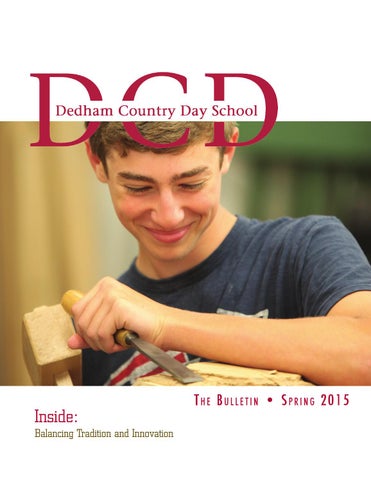
Inside: Balancing Tradition and Innovation
T h e B u l l e t i n • S p r i n g 2 0 15
iPads Offer New Ways of Enhancing Learning This year, every child in grades 3 through 5 was given an iPad, and students in grades 1 and 2 had them available in their classrooms.
Photo by Hilary Rochelle
Contents Head of School Nicholas S. Thacher
Emilie Liebhoff
Tara Spalding
Director of Communications Leslie Bowen
Copy Editor Kathryn Sargent
F]o ;dYkk af ;gehml]j ;g\af_$ k]] klgjq gf hY_] /&
Class Notes Danise Cavallaro
Michele Page, Design Communications
Layout and Production Leslie Bowen
Photography
?jYf\hYj]flk Yf\ Kh][aYd >ja]f\k Nakal <;<$ k]] klgjq gf hY_] 0&
Mission Statement Dedham Country Day School •Provides to each child a unique educational balance of challenging academics, arts, and athletics;
9dmefa 9kkg[aYlagf J][]hlagf Zjaf_k nakalgjk ZY[c lg [Yehmk lg `gfgj *()- 9dmefa 9oYj\ j][aha]fl$ k]] klgjq gf hY_] +*&
Statement of Non-Discrimination Dedham Country Day School admits qualified students of any race, religion, or ethnic origin to all rights, privileges, programs, and activities generally accorded and made available to students at the school. The school does not discriminate on the basis of race, religion, sexual orientation, ethnic origin, disability that can be reasonably accommodated by the school, or family composition in the administration of its educational policies, admissions policies, financial aid program, athletic program, or any other school policy or program. Admissions inquiries should be submitted to: Director of Admissions Dedham Country Day School 90 Sandy Valley Road, Dedham, MA 02026-5898 L]d2 /0)&+*1&(0-($ ]pl& *-(+ >Yp2 /0)&+*1&(--) Web site: www.dedhamcountryday.org
>jgfl ;gn]j H`glg Zq Bae @]Yd]q
, . /
0
0 )( ))
Hjg^]kkagfYd <]n]dghe]fl
)*
Klm\]fl F]ok
),
a\\d] K[`ggd Klm\]flk J][]an] J][g_falagf af l`] 9jlk E *()- KAK9D 9oYj\k 9ffgmf[]\ Klm\]fl Oafk K[`gdYkla[ 9jl 9oYj\k FYlagfYd ?]g_jYh`a[ ?]g_jYh`q :]] Kh]ddaf_ :]] EYl` ;gmflk J]_agfYd ;geh]lalagf DYlaf 9oYj\k FYlagfYd KhYfak` =pYeafYlagf F]o =f_dYf\ EYl` D]Y_m] 9oYj\k
)*
), )). ). )/ )0 )1 )1
*( *( ** *+
Khgjlk Jgmf\mh
*,
9dmefa 9kkg[aYlagf
*0
•Embraces an inclusive, interdependent community of students, teachers, and parents that fosters trust and encourages children to take risks;
*
? jYf\hYj]flk Yf\ Kh][aYd >ja]f\k <Yq <]d]_Ylagf g^ L]Y[`]jk Nakalk ^jge Fa_]jaY F]o @gjargfk <aj][lgj LYc]k l`] @]de
L`jan]& L`] ;YehYa_f ^gj <;<& @mfl]j ;`Ydd]f_] BmehklYjlk =f\goe]fl 9 >Yeadq ;geeale]fl K[`ggd <Yr]
Recycled Paper Printing
•Inspires students to become caring, ethical members of the larger world by emphasizing thoughtful citizenship and respect for self and others.
Gf ;Yehmk
<]n]dghe]fl Mh\Yl]
Printing
•Creates independent, resilient, lifelong learners through engaging, developmentally-based teaching designed to meet varied learning styles;
,
?jgoaf_ Mh Dal]jYl]$ Zq E]Y_`Yf E[Dgm_`daf
Design Consultant
Leslie Bowen Danise Cavallaro Dan Doane, Creosote Affects Ali Fernandes Jim Healey, Peapod Design John Leith Lge FYk` // Hilary Rochelle Tracy Rodriguez Photography
:YdYf[af_ LjY\alagf Yf\ AffgnYlagf
K`Yc]j Ogjck$ L`]f Yf\ Fgo2 Emk]me =p`aZal :d]f\k Gd\ Yf\ F]o :mad\af_ ;jala[Yd L`afcaf_ Kcaddk oal` JgZgla[k Afl]jna]o oal` Lge FYk` // ;g\af_ =f_Y_]k Klm\]flk af D]Yjfaf_ YZgml ;gehml]j Hjg_jYeeaf_
Director of Development
Leslie Bowen Hilary Rochelle
*
<;< k =\m[YlagfYd =ngdmlagf$ Zq Fa[c L`Y[`]j
Director of Admissions and Assistant Head of School
Writers
@]Y\ k J]hgjl
>Ydd *(), Oafl]j *()-
*()- 9dmefa 9oYj\ Fa[c BY[ckgf 0/ 9dmefa Kh]Yc]jk K]ja]k CYla] ?agj\Yfg )+ @]fjq C]]f] +0 9dmefa O]]c]f\ *() 9dmefa J][]hlagf -(l` J]mfagf 9dmefa F]ok 9dmefa 9ll]f\ >Y[af_ @aklgjq Yf\ Gmjk]dn]k 9dmefa Khgll]\ Yl l`] >Yaj >]ZjmYjq ;`Ydd]f_] :gklgf 9dmefa =n]fl Yf\ @Yhhq @gmj *()-%*(). ;Yd]f\Yj g^ =n]flk
;dYkk Fgl]k
*, *.
*0 +( +) +* ++ +, +, +, ++-
+.
@]Y\ k J]hgjl
I
suppose there really are new things under the sun—I, for one, never imagined Instagram when I was a child, though I thought the “wiggle pictures” you could unearth from the bottom of cereal cartons were pretty cool—but in educational circles, today’s much heralded new “innovations” or “21st-Century skills” often tend to be old news, though tricked up in sexy new clothing or verbiage. Take, for example, “STEM” or the latest nuclear arms race among independent schools, “Innovation Labs,” where students are free to experiment with, say, robotics, coding, 3-D printers, STEM (Science! Technology! Engineering! Math!) or STEAM (add “Arts” to the acronym). This is new? I find myself wondering what Everett Ladd, who presided over DCD from 1928 to 1963 would make of all this—Mr. Ladd, who in addition to rigorously instructing 35 years of DCD children in the 3 R’s found time in the school day to take them out on trips to his woodlot (now our current campus) and poke around in the flora and fauna and insisted they each learn to design and build canvas-covered kayaks and wooden boats they could actually row and sail. When the kids weren’t sketching or memorizing their lines for “H.M.S. Pinafore” or, in 1952, “Ali Baba and the Forty Thieves,” they helped build and maintain a towering toboggan slide that added to their winter adventures until the lawyers and insurance companies put an end to the fun. So much for that generation’s “innovation lab.” I hope I don’t sound cranky here; don’t get me wrong. It’s a fine thing that Americans are once again getting excited
2
about greater emphasis on science and engineering in our nation’s schools. But those of us who lived through the postSputnik frenzy a half century ago recognize this as evolution, not revolution. It’s not exactly new. Similarly, balancing tradition with innovation is nothing new in DCD’s 112year history. Here’s what an educational consultant had to say more than a century ago about Miss Faulkner’s newly-founded school when he visited the campus in 1903: I find that Miss Falkner in planning the work has given as much time to the fundamentals as children of that age can use to advantage; that she has assigned for this work the periods at the beginning of the morning when the children’s minds are freshest and they can do the most efficient work, and that she is using such secondary subjects as Sloyd (woodworking), Nature Study and the other modern additions to primary work…for the purpose of occupying the children’s time when their minds are in danger of being tired…. Her successor Everett Ladd, writing in 1939, declared: Learning by doing in an atmosphere of activity which is full of child interest provides the very foundation for sound educational achievement. Routine drills and formal recitations are mental setting-up exercises, useful as such, when the need arises. However, healthy children require a daily program of active,
interest-absorbing things to do that will awaken their curiosity, arouse their interest and give them varied experiences on which their knowledge, character, and personality are built. Plus ça change! And today’s kids? As the contents of this Bulletin attest, the thoughtful balance of tradition and innovation—of mathematical “Mad Minutes” with online Pearson instruction, of embroidery classes with coding or robotics, of learning to master cursive handwriting with iPads—continues. I suppose, to be trendy, we could relabel Ms. Gow’s long-standing eighth grade “simple machines” science unit as “engineering.” Or we could assign our sixth graders’ challenging production of “The Ragged Children” a more portentous academic title: “Dramatic Interpretations of the Mid-Victorian Social Contract: The Dickensian Dilemma.” But whom would we be trying to impress? And, more important, why? Traditions are very important to DCD. Some are long-standing, deeply embedded in the fabric of our historical culture: the Olympics, the Hallowe’en Assembly, the Holiday Assembly, our second graders’ Thanksgiving Assembly, the Fair. Other, more recent “traditions” help the children measure their individual personal growth as they progress from grade to grade, often following with excitement the footsteps of older siblings: pre-k’s multicultural puppets and butterfly hatch and the “Fancy Breakfast,” kindergartners’ “buddies” and Boat Trip, grade 1’s Insect Museum, grade 2’s Beatrix Potter tea party, grade 3’s World’s Fair and car wash, grade 4’s
H`glgk Zq Bae @]Yd]q
DCD’s Educational Evolution by Nick Thacher
@ ] Y @\ ] Yk\ kJR]e hp ogr jt l
Balancing Tradition and Innovation
...in educational circles, today’s much heralded new “innovations” or “21st-Century skills” often tend to be old news, though tricked up in sexy new clothing or verbiage. Medieval Feast and Fun Run, grade 5’s Odyssey storytelling and Greek Feast and trip to Stone, grade 6’s trek to the Farm School, grade 7’s to Pinkham Notch, grade 8’s to Washington D.C. as the culmination of “Facing History and Ourselves.” Traditions matter! Eighth grade announcers in all-school assemblies. Mr. Clifford’s biannual Penguin Parade. Pasta on Thursdays; meatball subs on the first day of each term; OMG, French toast and sausages on rare occasions. Dunking the Head of School in the dunking booth. Mrs. Shirley’s annual “rainstorm” in the darkened Lowell Center; Mrs. Farquharson’s storytelling; hot dogs, popcorn, and Red Sox Bars on Opening Day; jeans and t-shirts day before the Fair. Way leads on to way, the poet said, and our own DCD road constantly blends the new with the familiar. Fifty years ago—the time of Sputnik hysteria—we used blackboards and chalk; children knew how to bang out erasers and sniffed the duplicating fluid on the quiz papers. Twenty years ago we had no laptops and no Smartboards; ten years ago we had no iPads, and most of our Smartboards were already outmoded.
But what we have always had at DCD is teachers who care, teachers who balance the traditional with the innovative and— like their students—keep learning and experimenting, teachers who themselves aren’t afraid to try new ideas and new curricula and who, modeling for the children, aren’t afraid to fail from time to time in the interest of experimentation. Such a mindset is particularly important given the long tenure of our faculty, whose median experience is north of 22 years. This year DCD participated in a research project based out of the Harvard Graduate School of Education entitled “Making Caring Common.” Students in grades 5 through 8 were asked to complete a series of Caring Schools Initiative surveys designed to assess school climate, identify innovative ways to improve student attitudes, and reduce bullying and other negative behaviors. Our DCD students’ responses could be (and were) compared to a much larger national sample, and the most telling preliminary result was an affirmation that—in our current students’ eyes—the school valued “caring” above all else. Not that we were perfect, mind you! But in striking contrast to the students
enrolled in other schools, most of the DCD children, most of the time, felt safe and felt valued—by their teachers and by their peers. Whether this finding is “traditional” or “innovative,” it is certainly reassuring. To me it reaffirms the value of the constant “tinkering” and self-examination which takes place at DCD, as teachers seek not to leap onto faddish bandwagons (Mandarin, anyone?) but to experiment thoughtfully with genuinely groundbreaking materials or approaches. This is most easily exemplified in the constantly shifting panorama of our middle school arts offerings—metal-smithing, rusticfurniture-making, musical sound sculpture. But hold on a moment! What’s that I see in the curriculum this year, nestled up against chorus and band? Ukulele? A new elective in ukulele? Hmm. What’s that all about? Tradition? Innovation? What would Miss Faulkner or Mr. Ladd make of such a thing? Time will tell, I suppose. It wasn’t, after all, that long after Sputnik that the Berlin Wall came a’tumblin’ down.
3
Shaker Works, Then and Now
L`] h][mdaYj _jY[] g^ Y K`Yc]j [`Yaj ak \m] lg l`] ^Y[l l`Yl al oYk eY\] Zq kge]gf] [YhYZd] g^ Z]da]naf_ Yf Yf_]d ea_`l [ge] Yf\ kal gf al& L`geYk E]jlgf$ LjYhhakl egfc$ Yml`gj$ hg]l
Museum Exhibit Blends Old and New
A
s an artisan and woodworker, DCD woodworking teacher Gerry Clifford has always
been drawn to the simplicity and beauty of Shaker furniture. For a number of years, he has been visiting the Art Complex Museum in Duxbury, both on his own and with students, to view the museum’s impressive collection of Shaker works and to gather information and ideas for
K`Yc]j Z]f[` Zq 9d]p >mimY
his classes. This spring, the museum invited him to select works handcrafted over the years in his middle school courses on Shaker Furniture, Low Back Chair, and Shaker Oval Box to be displayed along side the museum’s notable collection of original Shaker works in the exhibit “Shaker Works Then and Now: Youthful Interpretations of the Shaker Form,” on
K`Yc]j Zgp Zq ;YehZ]dd J]kfa[c H`glgk l`ak hY_] Zq D]kda] :go]f$ ^Y[af_ hY_] Zq <Yfak] ;YnYddYjg 4
display from February 22 through May 17, 2015.
Balancing Tradition and Innovation
Many visitors to the show couldn’t immediately tell the difference between the originals and the student work. “You can tell the real ones,” said Gerry, “but the student pieces really hold up. They blend nicely.” The show also featured photographs of students working, showing the process of making the beautiful pieces on display. Process is a word that is bandied about these days in art circles, but Gerry says he prefers to use the word “stages” in discussing the completion of a work from beginning to end. He asks his students to slow down, to approach the work methodically, to step back from it and think carefully about the next steps, redoing their work if necessary. Working on a project that may take months to complete is contrary to the breakneck speed of today’s technology-driven pursuits, but one that has value, he says, not just in the art studio but in many other areas of life as well. “If students start a project with me, they’re going to finish,” he says. “I sense that kids are given the option to walk away from things. They want to stop something if it’s not coming out to their liking, if it’s not perfect. I try to get across to them the value of this slow, methodical approach. It’s a hard concept for kids to understand when they are living in a disposable world.” The key to getting the professional-looking results of the pieces in the exhibit is this no-nonsense, streamlined approach that he says he discovered in the Japanese system of teaching art. “Children have a most wonderful capacity that you can tap into if you don’t baby them or coddle them,” he says, “but instead remind them, ‘I think you could
try this or give it more effort.’ Then something more wonderful can come out of it.” Starting as early as first grade, he works on establishing this mindset, ramping up the project challenges each year to stretch his students’ skill sets and capacities. “By the time they get to middle school,” he says, “they have a good working vocabulary of the medium. They know that slow, methodical approach and can take on some pretty substantial work.” While it’s “pretty heady stuff,” as he says, it’s not perfect. He tells his students not to worry about perfection, but just to put in their best effort. “I try to get them to buy into the premise that perfection can be boring. Part of my mission as a teacher is to share with my students the mystery, magic, and at times, whimsical nature of wood. There are wonderful qualities within wood to be seen and discovered. There is a certain beauty in the imperfection of a crack in a slab of walnut, especially if you know how to showcase it.” In contrast, by studying a manufactured piece together in class, they come to appreciate the differences between it and something that is handmade. “There’s no hand, no human signature; it’s pressed out of a machine; it’s efficient, it works, the table holds stuff, but it doesn’t do anything for my soul, it doesn’t do anything for my head. I think they get it at a certain age. If they’re with me long enough, they get it.” “I tell them, your piece will have your name on it, and it will sing who you are at this moment in your life, and that’s beautiful.” —Leslie Bowen 5
L]Y[`af_ oal` L][`fgdg_q Building Critical Thinking Skills with Robotics: Interview with Tom Nash ‘77
“R
H`glg Zq Lge FYk` //
obotics is such a great course to teach because it involves so many important skills for twenty-first century learning and thinking,” says Tom Nash ’77, director of the Extended Day Program (EDP) at DCD. Tom has been running a new robotics course offered after school that uses Lego Mindstorm. “I’ve always been interested in technology,” he says, “and I’ve used elements of the Lego program in the schools where I’ve taught in the past.” In robotics class, it’s not just about diving in and building something cool instantly, he explains. First, it’s about critical thinking, planning, and problem solving. Tom says that Lego Mindstorm is an excellent tool for teaching beginning robotics to young students. “What’s great about Lego, is that it’s a universal language for kids,” says Tom, noting that almost every child has constructed something with Legos. “They know how to fit the blocks together and know how to follow the instruction schematics,” he says.
In the beginning sessions of Tom’s robotics class, he works with the students to figure out what kind of task they want their robot to accomplish. They plan, design, build, and test. A recent task they chose for their robot was to have it deliver snacks to two tables of class participants. Equipped with sensors, the robot was able to navigate a straight line past both tables. Though a relatively simple task, one can hear the excitement in Tom’s voice when he talks about the “brain” and the different kind of sensors used in robotics that approximate some of our own senses, such as touch, hearing, and seeing. In addition, there are so many other things students learn in the process. For example, if the robot is going to have wheels and move distances, students need to explore concepts of speed, torque, and rotation. If it has moving arms, then working with gears comes into play. The building part is a lot of fun, but before they begin putting pieces together, there is a lot of organization that has to happen. In Tom’s class, organization and teamwork are key skills students learn. “Because we are working with Legos,
the kids know from their own past building experiences that if you don’t take time to plan and figure out what you’re going to need, going back and reconstructing and diagnosing the problem is time-consuming and hard.” Once the robot is built, students turn to programming the brain. With the particular Lego Mindstorm kit used in his class, students are not yet writing code but using modules that are built into the Mindstorm software to “tell” the brain what they want their robot to do. Tom says it is really great to watch the students deconstruct the program to figure out what changes they need and want to make. Should it go faster or slower? Should it go longer? What worked? What didn’t? These are some of the questions they must ask themselves. Tom’s robotics classes have been hugely successful and are often over subscribed. He has enjoyed watching how boys and girls attack the array of projects differently. Though the classes at times have been male-dominated, he says the girls who get involved really get into it with amazing focus. Tom views these initial robotics classes in EDP as just the beginning, and he is excited to see what middle school students can do with the more sophisticated modules offered by Lego that allow for a significant degree of flexibility, autonomy, and creativity. “They can really take it to the next level in terms of diving into the complexities of programming,” he says. Completing his second year as EDP director, in September Tom will be expanding his role to teaching in the Middle School Arts Program. Given his background in technology, he will be focused on the digital arts with graphic design and video production. “It’s going to be a lot of fun!” he says. —Hilary Rochelle
6
Balancing Tradition and Innovation Coding Engages Students in Learning about Computer Programming
explore these new programming concepts as they develop, check, and debug the code to make the bird move. Once students progress, they move onto
&&&afljg\m[af_ ]d]e]flk g^ [gehml]j k[a]f[] Yl Yf ]Yjdq Y_] ^gkl]jk dg_a[Yd j]Ykgfaf_$ hjgZd]e kgdnaf_$ Yf\ [j]Ylanalq&
H`glgk Zq 9da >]jfYf\]k
T
his spring Librarian Marge Farquharson and Technology Director George Silvestri have teamed up to offer an after-school introductory computer science experience for lower school students that blends both online and “unplugged” activities to learn about coding. Before they get to use the computer screen and keyboard, students engage in a series of unplugged activities to learn basic computing concepts. At this introductory level, they learn that creating code is a means of articulating the steps required to solve a problem or complete a task depending on certain conditions or circumstances. During the online part of the program, they are able to explore and practice algorithmic thinking using scaffolded sets of programming instructions. In the early lessons, using familiar characters from “Angry Birds,” students
additional coding programs and activities designed specifically for elementary school students using a program from Code.org. DCD is very excited to offer this class to lower school students — introducing elements of computer science at an early age fosters logical reasoning, problem solving, and creativity. And, the children can’t seem to get enough. They are so engaged and excited that the hour just flies by! —Hilary Rochelle
7
Gf ;Yehmk Grandparents’ and Special Friends’ Day
F
riday, April 10, was a particularly lively day at DCD. Classrooms were bulging and buzzing, the halls were lively, and every last parking space was taken as more than 250 grandparents and special guests had the opportunity to share a day in the life of a DCD student!
;`Yjda] Ngdh] Yf\ :YjZYjY Ngdh]
:]lkq C]g`Yf] Yf\ ;gffgj C]g`Yf]
Caf\]j_Yjl]f [dYkk af Ogg\ogjcaf_ Klm\ag
@YffY` HYndgk Yf\ ;Yjgd Fgjlgf
H`glg_jYh`k l`ak hY_] Zq D]kda] :go]f
@Yd]q E]\d]q Yf\ @]d]fY >gfk][Y
8
Gf ;Yehmk
=ad]]f Yf\ Bae ;Yjj oal` ;dYaj] @gd\af_ Yf\ C]fra] C]ddq
9ae足] ;gd]eYf Yf\ N]jgfa[Y ;gd]eYf%<Ynak
:jaYf Kmee]jk$ EY__a] E[C]]$ Yf\ @]Yl`]j Kmee]jk
9da[] Ogg Yf\ ;Ye]jgf QYg
=dda] Lg\\$ CYl`d]]f Yf\ Bg] @]_]fZYjl
H`glg_jYh`k l`ak hY_] Zq <Yfak] ;YnYddYjg
?ag ;dYjc%:Yk[ge Yf\ <gjgl`q ;dYjc
9
Gf ;Yehmk
H`glg_jYh`k Zq @adYjq Jg[`]dd]
Delegation of Teachers Visits from Nigeria
9Zgn]$ Fa_]jaYf ]\m[Ylgjk oal` ;Yjqd DYllg^$ =p][mlan] <aj][lgj g^ @gjargfk Yl <;< []fl]j!$ Yf\ @]Y\ g^ K[`ggd Fa[c L`Y[`]j k][gf\ ^jge ja_`l!$ Yf\ Z]dgo$ Y e]eZ]j g^ l`] \]d]_Ylagf ]fbgqk dmf[`lae] [gfn]jkYlagf oal` klm\]flk& group of five educators from Nigeria visited DCD on February 24. Here for the NAIS conference in Boston February 25-27 at the Hynes Convention Center, they took some time out of their schedule to get to know a local school. None of the teachers knew each other before arriving in Boston. Ade Fakoya, a teacher and academic dean from the Sunnydale School in Lagos, said they chose DCD from three possible NAIS schools to visit, including Buckingham Browne & Nichols School and Boston Latin School. “We looked at the Web sites, and DCD seemed closest to our own schools in its small size and in having two classrooms Omole remarked on the informal dress code at DCD, noting per grade.” Speaking about her own school, she said, “We are that students in Nigeria wear uniforms. Fakoya said she found deliberately small.” that students were very “immersed” at DCD, comparing our She and the others—Victoria Muorah, of the CEDEC students’ work on Medieval wooden shields in woodworking class International Group of Schools, Patricia Okafor and Florence to her students’ flag-making projects, noting both used the same Omole of the Halifield Schools, both in Lagos, and Agnes Eta of hands-on approach to learning about a subject but with different AP Montessori School in Calabar—visited classrooms, met with materials. She ended the visit by saying “You have a beautiful teachers and administrators, and enjoyed lunch and conversation school, not just in appearance, but in the ambiance and in the with lower school students. Each of the five teachers privately nature of the children.” funded her own trip. —Leslie Bowen
A
10
Gf ;Yehmk
New Horizons Director Takes the Helm
I
t’s been a very busy year for Caryl Lattof, Horizons’ new Executive Director. Caryl came to Horizons with a wealth of experience working in child-focused community-based nonprofit organizations. Her focus in the fall was grant proposals, over the winter she was knee-deep in program details, and the spring has brought both a hugely successful gala and a flurry of activity to ensure that everything is in place when the children arrive in July. This summer, the program’s seventh, Horizons at DCD will serve about 120 public school children from low-income families who live in Boston and here in Dedham. For six weeks, DCD classrooms and campus will be home to Horizons students in prekindergarten through sixth grade. The program, including transportation and meals, is provided free of charge. Caryl and her staff are excited to be a part of this life-altering experience for these young students. Horizons students have an opportunity to learn in a dramatically different setting than they normally would during the regular school year. Special friendships with peers and connections with teachers are made and sustained as the same students return year after year through eighth grade. Commitment and continuity mean continued growth for these students over the years they participate in Horizons. Caryl and her staff are about to embark on their “Super Saturdays,” when students return to DCD on three Saturdays in advance of the summer for testing and placement. Toward the end of the program in early August, students will be tested again to assess skill development and progress made as a result of the program. From what Caryl has seen from past data, skill improvement has been quite impressive, as rather than the typical loss of reading and math skills over the summer months, students make substantial gains. A typical day at Horizons begins with a healthy breakfast upon arrival at 8:30 a.m., followed by an academic period where the focus is on math and reading. Lunch is next, and from 1:00 to 3:30 p.m., activities range from sports and swimming to drama to STEM exercises. Each week, every grade takes a field trip. “We are particularly excited about a new field trip we have added this year,” Caryl reports. “One of our corporate donors here in Dedham has invited us to visit another company he owns, New England Country Pies, a factory where the kids will learn about making organic pies. Every child will get to go home with a pie!” Beyond this new field trip, some new teachers, and tennis for sixth graders at the Dedham Country and Polo Club, Caryl has made few changes to the program so far. “Though I am busy
KhdYk` :Yk` Kh]Yc]j2 Gdqeha[ koaee]j <YjY Lgjj]k oYk l`] ^]Ylmj]\ kh]Yc]j Yl l`] YffmYd @gjargfk khjaf_ ]n]fl$ KhdYk` :Yk`$ `]d\ gf EYq 0$ *()-& L`] ]n]fl jYak]\ +,($((( ^gj l`] hjg_jYe& <YjY ak ha[lmj]\ YZgn] oal` @gjargfk klm\]flk$ :mfea Yf\ EYll`]o& nailing down the final details for this summer, I have walked into an already very strong and well-run program,” says Caryl. “There is so much talent and expertise in the staff we have. Wonderful seasoned teachers join Horizons for the summer as well as a group of high school volunteers from Beaver, Nobles, and recent graduates from DCD.” Caryl can’t wait to finally see the program in action. “I have been looking at student names and hearing about them, and I am excited to match names with faces!” During the six-week program, Horizons will host two Open House events, when community members can stop by and see the program in action as well. Keep an eye on the Horizons at Dedham Country Day facebook page for dates and details or visit www.horizonsgreaterboston.org.
—Hilary Rochelle 11
Hjg^]kkagfYd <]n]dghe]fl Growing Up Literate, by Meaghan McLoughlin
L
ast fall I led an assembly for DCD’s middle school students and faculty. I began with a question: “With your eyes closed, try and recall a time when an adult read a book aloud to you. Can you remember the person reading aloud, the book, or both?” Every child and adult in the Valentine Center raised a hand.
The students and teachers opened their eyes, and one student made a powerful observation: the entire middle school community shares a common memory in which reading was important. Close to 100 people in our small community could recall a moment years earlier, marked by an emphasis on literacy and the value of reading. I 12 12
asked the group to close their eyes again and think of that same early memory. I asked, “What do you think it would feel like if you did not have that memory?” I heard responses from a sixth grader, a seventh grader, an eighth grader, and a faculty member. All agreed it would be worrisome and problematic if our childhoods were not rich with adults reading and sharing stories with us. The moment of awe was shortlived. “OK, so what is the big deal, Ms. McLoughlin?” I got right to the point: I was not always aware that the childhood experience of having an adult read a book aloud is not universal. This admission is perhaps embarrassing
considering my undergraduate studies in global politics and its effect on literacy and education around the world. But it came as a surprise that hearing a book read aloud is not an experience that all children in the world share. To me, this is a big deal. Just after I graduated from college, I was eager to take on the arduous career of teaching the world’s young learners. It wasn’t long before some of my colleagues and I were working at Escuela Serapio Lopez Fajardo and living in a rural village in Costa Rica. Our faculty mentor was Maestra Seidy. I had arrived with my lesson planning savvy honed back home, and a wheelie-suitcase filled with lesson
Hjg^]kkagfYd <]n]dghe]fl
“The incalculable value of having had adults read a story aloud and the importance of being a literate student in a fast-paced, demanding world are what endure from my trip abroad.” plan binders, bilingual books, Crayola markers, Elmer’s glue, glitter, construction paper, Expo markers, and scissors. The crafty goodies were highly necessary; the binders of laminated lesson plans might as well have been bricks. My co-teacher and I took on first-, second-, and third-grade English Language Arts, teaching roughly 30 students per grade in one classroom. Armed with limited Spanish-speaking skills, and very limited instructional-Spanish skills, we had great intentions but were stumped almost immediately. Our young, enthusiastic learners’ primary (Spanish) language skills were so underdeveloped that starting the year teaching only English was nearly impossible. We spent our evenings readjusting the curriculum to give these students the foundational literacy skills that would take them into more advanced academic reading, as well as acquiring English as a second language. There was one very powerful, yet simple, activity we could always depend on—reading aloud to our students. Sitting down with young students in this Costa Rican village and reading aloud was life-changing for them and remarkable for me. The first time I brought a group of students to the public library, several were incredulous that they could pick any book out from the shelves and I would read the words to them. I remember one student asking me why I wanted to read to them—what was the point? what was I getting out of this? It was then I realized that not every child had the education I had, rich with books and access to endless stories and portals to new worlds. A graduate school professor described my instructional design as a means of
“bringing the world into the classroom.” I still strive for this today, and I am able to weave the world into my teaching because of the opportunities that DCD gives its faculty to continue learning. DCD faculty can get off campus throughout the year to meet and work with other teachers, to see other school communities, and to figure out how to bring the world into our small classrooms on Sandy Valley Road. Thanks to this encouragement and support, I was able to return to Escuela Serapio Lopez Fajardo for a week this past November. When I arrived in Maestra Seidy’s classroom, I could see much greater emphasis on building strong foundations in literacy than when I had last been there. I brought a handful of books for the classroom, and before I could even introduce the stories the students were eager to jump in, ready to have someone read to them. This was clearly a familiar activity to them. I am grateful for the opportunity to travel back to Costa Rica to reconnect with former colleagues and students. I was able to bring a new perspective back to my work at DCD and see even more acutely how our community values literacy. I looked at the middle school programs and projects in place and realized that this work is about so much more than providing opportunities for more reading. Each summer, for example, the middle school faculty encourages students to read from a selected list of texts that are not necessarily linked directly to classroom content. When the students return in the fall, they are organized into mixed groups of sixth, seventh, and eighth graders that design projects to be presented to the middle school community. English and Humanities teacher Rick Edie encourages
his students to complete reports on books that have won the Massachusetts Children’s Book Award. Rob Thacher has inspired his eighth-grade advisees to recommend books to other students. I recently watched beloved math teacher Jim Pinola lead a discussion of Roll of Thunder, Hear My Cry with a group of sixth graders. Every adult in our school community is a reading teacher. The incalculable value of having had adults read a story aloud and the importance of being a literate student in a fast-paced, demanding world are what endure from my trip abroad. It can be easy to forget how fortunate we are to have an incredible school library, professionals dedicated to helping children develop fluency, and hundreds of parents who instinctually read to their children. I am indebted to the community that encouraged me to never stop reading as a child, and I am grateful that I teach at a school that gives children this same foundation in learning. 13
Klm\]fl F]ok
Middle School Students Receive Recognition in the Arts 2015 SISAL Awards Announced
H`glg Zq Cjakla] ?addggdq <]Yf (*
M Kapl` _jY\]j =eadq K`a` ogjck gf `]j jmkla[ Z]f[` ha[lmj]\ Z]dgo!$ o`a[` j][]an]\ >ajkl HdY[] af l`] ogg\ogjcaf_ [Yl]_gjq Yl l`] YffmYd bmja]\ k`go khgfkgj]\ Zq KAK9D KeYdd Af\]h]f\]fl K[`ggd 9jl D]Y_m]!&
iddle school students received 15 awards at the annual SISAL (Small Independent School Art League) juried show. All 45 pieces entered by DCD students were displayed at Dexter SouthďŹ eld School in April.
PAINTING Brian Akukwe Honorable Mention Julia Bemis Honorable Mention Molly Moir Honorable Mention
MIXED MEDIA Hannah Curran Second Place Mia Canning Honorable Mention
PRINTMAKING Julia Bemis Honorable Mention Alyssa Landry Honorable Mention
FIBER ARTS Julia Landry Honorable Mention
CERAMICS Maeve Dardinski Third Place Susan Rowley Honorable Mention
WOODWORKING
H`glg Zq D]kda] :go]f
Emily Shih First Place Mia Canning Third Place Aidan Murray Honorable Mention
14
METALSMITHING Alyssa Landry First Place
PHOTOGRAPHY Emily Shih Honorable Mention
“I’m a creative person. I like thinking of ideas for just about everything.” —William Rowan, Class of 2015
Student Wins Scholastic Art Awards
W
illiam Rowan isn’t your typical teenager. Quiet, thoughtful, dedicated, he’s been studying art since he was in third grade, taking classes at the Museum of Fine Arts in Boston. So when an opportunity came up to submit his work to the Globe Scholastic Art Awards, hosted for the first time this year by the MFA, he jumped at the chance. William submitted four pieces and received a Silver Key for his rustic bench, an honorable mention for two wooden spoons, all made in the woodshop at DCD, and an honorable mention for a stone sculpture of a seal made in a class he took at the MFA. “Not many schools offer sculpture,” he says. “A lot of schools offer drawing and painting, but not sculpture in different mediums. I like making things that are three-dimensional. If I draw something, there’s always some better interpretation of it somewhere else, like in a photo. The thing I like about sculpture is that it’s something you can’t print off the Internet.” Noting that now with 3-D printers it’s becoming possible to do just that, William says he has visited the Maker Bot store next to his home in Boston’s Back Bay. The Internet has also inspired him in a project he undertook in the virtual worlds class taught at DCD by George Silvestri. And he’s using technology to aid him in making a classicalstyle sculpture of his grandfather, who lives in Connecticut. “I couldn’t go there to take pictures, so I face timed him and had my uncle move the iPad around to get all the angles.” Asked if he’s thinking of becoming a sculptor, he responds quickly that he’s
H`glg Zq D]kda] :go]f
EgkYa[ Zq EaY ;Yffaf_
Klm\]fl F]ok
=a_`l` _jY\]j OaddaYe JgoYf$ ha[lmj]\ YZgn] af l`] ogg\k`gh$ j][]an]\ Y Kadn]j C]q Yf\ l`j]] `gfgjYZd] e]flagfk ^jge l`] :gklgf ?dgZ] K[`gdYkla[ 9jl Ojalaf_ 9oYj\k$ l`] j]_agfYd \anakagf g^ Y hj]kla_agmk fYlagfYd hjg_jYe l`Yl `gfgjk Yf\ _an]k ]p`aZalagf ghhgjlmfala]k Yf\ k[`gdYjk`ahk lg qgmf_ Yjlaklk Yf\ ojal]jk af _jY\]k / )*& thinking of becoming an engineer, a job where he could “make stuff.” “I have ideas of things that people could use,” William explains. He gives the example of computers that can catch on fire and burn down homes because they overheat. “I have an idea for a charger with a temperature gauge so that when it overheats it will eject. Using reverse polarity on a magnet, you can set it at different degrees of heat.” “I’m a creative person. I like thinking of ideas for just about everything. I see things spinning around in my mind, in three dimensions.” After graduating from DCD this spring, William will head to the New Hampton School, where he says there is “a really good art program,” and where he’ll also play soccer and basketball as he has at DCD. Of his experience at DCD, he says, “I really like it how everything is all in one place. It seems simple, but it’s really complex with all the different things you can do. In
the arts, there are a ton of different options, and we have it every day here, whereas some schools just have it every week. Here there are a bunch of different arts you can take, not just one generic course with one teacher. You can take whatever interests you.” He says he also likes the options available in academic classes that allow flexibility in what you can present and how you can present it. “There’s a wide variety of things you can do. If you have an idea that you want to present and it’s not on a list of things you can do, you can approach your teacher, ask about it, and he will most likely say yes.” From spoon carving to the digital arts, William finds in the arts a way of conceptualizing and thinking. He has found the kinds of challenges offered at DCD stimulating. “I’m not the best person at every single thing,” he says, “but I try to do it all.” —Leslie Bowen 15
Klm\]fl F]ok Academic Highlights National Geographic Geography Bee This year’s winner was Matthew Volfson, a fourth grader. Fellow fourth grader Patrick Berg was the runner up, and Patrick’s brother Myles Berg, a fifth grader, came in third.
H`glg Zq D]kda] :go]f
The other participants this year were Joey Shagoury (fifth grade); Gabby Rayev and Liam Wilson (sixth grade); Calvin Cochran and Kelsey Lynch (seventh grade); and Molly Connors and Nick Whalen (eighth grade).
T
en students in grades 4 through 8 participated in DCD’s annual Geography Bee, which was held in the Lowell Center on Thursday, January 22.
Schools with students in grades 4 through 8 are eligible for this entertaining and challenging test of geographic knowledge sponsored by the National Geographic Society. Each year thousands of
schools across the United States participate in the contest, which is designed to encourage teachers to include geography in their classrooms, spark student interest in the subject, and increase public awareness about geography. After winning the DCD contest, Matthew was eligible, along with other winners from around the country, to take a statewide test to determine his eligibility for the national exam held at National Geographic Headquarters in Washington, D.C. in the spring. The winner of that contest receives a $25,000 scholarship.
Spelling Bee
S H`glg Zq D]kda] :go]f
eventh grader Charlie Volpe emerged the winner of the DCD Spelling Bee for the second time.
16
The champion in 2013, he became the 2015 champion by successfully besting eighth grader Julia Bemis by correctly spelling “accommodation.” Other final-round words included “extraordinary,” “cerise,” and “unenforceable.”
Fourth grader Eli Leder and sixth grader Jackson Abreu were the other finalists. Charlie was competing for the fourth time; Julia for the third time; and Eli and Jackson for the first time. The other contestants, champions of their own grades, were: Catherine Ross (grade 4), Maeve Haggerty and Parker Collins (grade 5), Amanda Shih (grade 6), Hannah Curran (grade 7), and Meera Singh (grade 8).
Klm\]fl F]ok
H`glg Zq Bg`f D]al`
Math Counts Regional Competition
D]^l lg ja_`l$ ^jgfl jgo$ BYj]\ JYn][`$ EYll`]o G Jgmjc]$ 9d]p :mje]akl]j$ KYjY` D]\]j3 ZY[c jgo$ Egddq Egaj$ CYa <apgf$ ;`Yjda] Ngdh]$ Yf\ 9f_]dY ?agj\Yfg&
E
ight middle school students represented DCD at the annual Math Counts regional competition on February 7 at Melrose High School. Math Coordinator Brenda Leith worked with the group over several months to help them prepare for the test. Students who were interested in competing in the contest took a qualifying exam made up of questions from past years’ tests. Because they hadn’t yet studied most of the material covered, it required
them to use their reasoning abilities instead of just memorization or computation. Once selected, this year’s group of “mathletes”—Alex Burmeister, Kai Dixon, Angela Giordano, Sarah Leder, Molly Moir, Matthew O’Rourke, Jared Ravech, and Charlie Volpe—took on extra work to prepare for the competition, including coming to school early once a week for Math Club at 7:30 a.m.
Competing against 260 students in grades 6–8 from area schools in the most competitive chapter in Massachusetts, students answered questions in three rounds, two independently and one in groups of four. The answers were timed, and students had to work quickly without making errors, paying careful attention to reading each question in detail. In the final stage of the competition, the top ten scorers from the three rounds compete jeopardy style.
17
Klm\]fl F]ok
K]n]fl` _jY\] DYlaf 9oYj\ j][aha]flk$ d]^l lg ja_`l$ ^jgfl jgo$ ;`Yjda] Ngdh]$ EYll ;Yhgf]$ BmdaY DYf\jq$ EaY ;Yffaf_$ E]dafY CYhgmj]dYcgk$ @YffY` ;mjjYf$ Yf\ DYmj]f nYf N]]f3 ZY[c jgo$ CYa <apgf$ ;gffgj E[CYq$ 9d^a] Jm\fa[c$ ;`jak ;Yhgf]$ ;Ydnaf ;g[`jYf$ Egddq Caf_$ Yf\ 9f_]dY ?agj\Yfg& H`glgk Zq D]kda] :go]f
Latin Awards
T
his year over 153,000 students participated in the National Latin Exam, from all 50 states and 20 foreign countries.
INTRODUCTION TO LATIN (GRADE 7) Perfect Paper Certificate Angela Giordano Certificate of Outstanding Achievement Hannah Curran Julia Landry Charlie Volpe Certificate of Merit Mia Canning Chris Capone Matt Capone Calvin Cochran Kai Dixon Melina Kapourelakos Molly King Connor McKay Alfie Rudnick Lauren van Veen 18
D]^l lg ja_`l$ 9jdg ?go$ C]dk]q :g[`$ KYjY` D]\]j$ KmkYf Jgod]q$ Yf\ 9ffYZ]d @Y__]jlq
LATIN I EXAM (GRADE 8) Summa Cum Laude (Gold Medal) Susan Rowley Maxima Cum Laude (Silver Medal) Arlo Gow Annabel Haggerty Sarah Leder Cum Laude Kelsey Boch
Klm\]fl F]ok
Latin, Spanish, Math Awards National Spanish Examination
T
he National Spanish Examinations are online assessment tools for students in grades 6 through 12 that are given voluntarily by more than 3800 teachers throughout the United States. The test is designed to measure achievement and proficiency of students who are studying Spanish as a second language. Four middle school students received recognition on this year’s test.
PREMIO DE PLATA (SILVER) Molly Connors Meera Singh PREMIO DE BRONCE (BRONZE) Julia Bemis Kyia Jackson
New England Math League Awards
T
he results of the New England Math League Contest were announced at assembly this past May. Each year all students in grades 4 through 7 take the exam. In grades 4 and 5 they have 30 minutes to answer 30 questions, and in grades 6 and 7 they have 30 minutes to answer 35 questions. The questions on the test are conceptual, testing students’ ability to think through problems rather than memorize algorithms. The top three students receive a certificate, and the top scorer in each grade receives a book. The highest scorers in each grade are listed in order below:
GRADE 4 Patrick Berg Brogan Chitkara Catherine Ross Eli Leder
GRADE 6
D]^l lg ja_`l$ BmdaY :]eak$ E]]jY Kaf_`$ Egddq ;gffgjk$ Yf\ CqaY BY[ckgf
Alex Fuqua Alex Burmeister Jackson Abreu Daniel Ko Eddy Shin Gabby Rayev
GRADE 5 Parker Collins Caroline Sullivan Nyla Johnson Eli Gow
GRADE 7 Charlie Volpe Julia Landry Molly King
19
S UCCESSFUL H UNTER C HALLENGE J UMPSTARTS E NDOWMENT C AMPAIGN THRIVE GOALS
$ $2 M I L L I O N I N NEW ENDOWMENT
Our deepest thanks to Susie Hunter and daughters Colby ’91, Kristin ’95, and Whitney ’98, whose $500,000 challenge gift jumpstarted the endowment portion of our campaign. The Hunter Challenge inspired an additional $705,206 in pledges and gifts, for a total of $1.2 million raised to benefit DCD’s endowment. The Hunter family has set a path that—with your help— will secure the school’s future for years to come.
1 NEW LOWER SCHOOL BUILDING
13 S TAT E - O F - T H E - A RT CLASSROOMS
HELP US REACH OUR $2 MILLION ENDOWMENT GOAL The Hunters’ generous gift highlighted the need for a strong endowment. Small in comparison to those of its peer schools, DCD’s endowment is like a savings account that helps the school weather difficult times and become less dependent on tuition revenue. More importantly, a substantial endowment will ensure DCD maintains the standards of excellence that have been its hallmark for more than a century. Gifts to the endowment are a crucial long-term investment that will enable DCD to: • Attract and retain the best teachers by offering competitive salaries and professional growth opportunities. • Provide sufficient financial aid for deserving students, regardless of ability to pay full tuition.
1 NEW P L AY G R O U N D
20
• Support educational initiatives that prepare graduates to be lifelong learners. • Achieve these goals without having to substantially raise tuition, which DCD currently relies on for 87% of its annual revenue.
Building a strong endowment is key to financial stability.
THRIVE The Campaign for DCD
THRIVE HAS TRANSFORMED D C D’ S C A M P U S From new classrooms to a new playground, your generosity has transformed the campus. For all of us, Thrive has been more than a building campaign—it has always been about what happens in and around the buildings.
“Not only do we now have two classrooms per grade, but the breakout rooms allow for additional small group interactions so more voices can be heard.” —Kelly Kennedy, Grade 4 Teacher
“We are really blessed to have this amount of space. There’s an atmosphere that invites kids to come in and experiment and play, in the purest sense of play.” —Duane Claussen, Grade 3-5 Music, Lower and Middle School Band
“The bikes are the best things that ever happened!” —Grade 2 Student
Make a gift at www.DedhamCountryDay.org or contact Director of Development Tara Spalding at (781) 915-2557. 21
A F AMILY C OMMITMENT For Nevin and Kristine Chitkara, supporting DCD is a family commitment. Nevin, a portfolio manager at MFS Investment Management, is a member of the Board of Trustees and heads up the school’s Finance Committee. He and Kristine have served as Annual Fund Ambassadors, and Kristine has volunteered on many parent-run committees over the years, including chairing the Fair. She also chairs the Community Affairs division of the Parent Association. “As a family we like to get involved,” says Nevin. “Volunteering has allowed us to contribute and have a connection and something in common with our kids. DCD has been the community for all of us for the past several years.” Agreeing, Kristine says, “We love the school, we love the people, and we want to do what we can.” They credit the school with molding their three children—Brenna, a sophomore at Middlesex, Brady, a seventh grader at Belmont Hill, and Brogan, a fourth grader at DCD—into the kind of exceptional individuals who excel in life, something that could not be achieved by textbooks and test scores alone. “Our children are willing to put themselves out there, to try something new, to present in front of people,” says Kristine. “They’re not afraid to assert themselves, ask questions, and get rejected. The experience at DCD has made our kids strong, independent, and eager and happy to learn.” She and Nevin have made DCD a top priority for their giving, recognizing the need and knowing their gift would make a significant impact. “Our children have benefited from prior capital campaigns,” she says. “We’ve been able to enjoy changes and additions that have been made to the
22
“The experience at DCD has made our kids strong, independent, and eager and happy to learn.” —Kristine Chitkara
community, infrastructure, and faculty, and we want to make sure that future generations benefit, too.” Yet Nevin says the school hasn’t changed in one essential way: “What’s in the best interest of the child always comes first.” “If you don’t move forward, you’re actually moving backwards,” he says, noting DCD’s continuous effort to improve everything from the way the school interacts with families in the enrollment process to the way individual classes are taught. Moving the school forward with this latest campaign has been a “big positive in creating a stronger school that can last for a very long time.” Both agree that by giving financially and as volunteers, “We’ve gotten more out of it than we’ve put in.”
“As a family we like to get involved.” —Nevin Chitkara
—Leslie Bowen
S
L
OO H C
March 6 DA
ZE
At the School Daze event on March 6, parents and teachers joined together in raising more than $20,000 to support faculty professional development by bidding, eating, dancing, and socializing in a transformed Primary Gym.
Photographs by Tracy Rodriguez
Bg`f Yf\ B]kka[Y H]l]jk$ CYla] Yf\ =nYf Gm]dd]ll]
Jgf <apgf Yf\ ;`]kl]j @]\_]h]l`
Kl]n]f Yf\ LjY[q 9f_]da$ BYq DYq\]f
;`jaklaf] Yf\ B]^^ >j]q]jeml`$ EYjc =hc]j
KmrYff] AZZ]c]f$ =dYaf] Yf\ D]oak ?Y_]
KmkYff] Bgq[]$ CYla] OYc]d]q$ ;gdd]]f @mdl_j]f
E]dYfa] ?m]jjY 0. Yf\ EYjc ?jgf]e]q]j
Daf\Y K`a`$ @]a\]] 9fYklgk$ 9k`d]q K`a` 23
KhgjlkJgmf\mh
>Ydd *(), Varsity Field Hockey
:gqk NYjkalq Kg[[]j
:gqk BN Kg[[]j
This season the varsity field hockey team consisted of seven seventh graders, who split their time between vartsity and JV, and eleven eighth graders. We ended with a team record of 5 wins, 2 losses, and 2 ties. We also enjoyed competing for the third time in a tournament hosted by the Lincoln School in Providence. Season highlights were in games that we did not win. The first was the 0-0 tie on the turf at Nobles, a game that involved intense focus and required everyone to bring their A game. Second was the Thayer game, when down by 2 at the half, the team rallied to tie 2–2. The final highlight was our play against a strong 7-9 Fay team. Captains Caitlin Sullivan and Madi Weber were an energtic and enthusiastic duo who showed incredible leadership throughout the season. —Deb White
The boys’ varsity soccer team compiled a 3-7-0 record this fall. Regardless of the score line, they worked hard to the final whistle and never hung their heads when the results did not go their way. They kept their sense of humor and treated teammates, opponents, and officials with respect. Captains Quin Feeney, Aidan Murray, and Campbell Resnick led the team with distinction and set a fine example for their peers. For his diligence and perseverance, William Rowan earned the Most Improved Player Award, and for being the consummate teammate, James Geraghty received the Coach’s Award. — Kevin Coakley
The boys’ JV soccer team had an awesome fall. The team consisted of 14 sixth and seventh graders who kicked off their season with a 2-1 win at Derby. Alex Fuqua and Charlie Sinnott chipped in with the goals. Over the course of the season, the team was enthusiastic and came to practice every day ready to play, work on their skills, and compete with each other. In games, the boys rallied around the skill and enthusiasm of their three captains—Alex Fuqua, Connor McKay, and Alfie Rudnick. They displayed great sportsmanship and work ethic playing in many exciting, close games. The team finished with a record of 3-6. —Dan Balk
?ajdk Kg[[]j
Cross Country
Girls’ soccer had a very successful season this year — in terms of both our record and our bonding as a “team.” Twenty-four sixth-, seventh-, and eighth-grade girls made up the roster. The team’s record was 8 wins and 4 losses. We outscored our opponents 45–26. The season began with the girls earning five wins out of six games. But then there were a few key injuries and the team had three straight losses. Most teams would have found this to be a struggle, but it actually became a positive for the girls. The whole team stepped up and filled in for those who were injured, everyone’s confidence and skills grew, and the players became a true team. The girls took care of each other both on and off the field. It was a gratifying season. The Coach’s Award went to Susan Rowley, and Keesha Theodore received the Most Improved Player Award. —Elaine Gage
The cross country team was a small, hardworking group of eight runners. They worked hard each day and, more importantly, shared many laughs. The team lucked out this fall with perfect running weather; however even on the rainiest and coldest of days, the team was dressed and ready to go! Each week the team varied where they ran, rotating between running laps around Stoney Lee, trail running at Hale Reservation and Wilson Mountain, and occasionally running laps around the DCD campus. Every single runner showed improvement throughout the season and increased their distance with each practice. They were both supportive and encouraging teammates, who displayed wonderful sportsmanship at our meets. —Lindsay Bababekov
JV Field Hockey The JV field hockey team set the bar high. This team of eight sixth graders and seven rotating seventh graders had an undefeated, shut-out season and came to every practice filled with enthusiasm and intensity. Most games were spent on “yellow” or “red,” codes for making four consecutive passes before shooting or no shooting at all when the games became lopsided in our favor. Twelve different players scored or assisted this season, which shows the depth of the team. Lexie Ravech earned Most Improved Player honors for her ability to see the field and execute clean passes. The Coach’s Award went to Alex Burmeister, for her joy and dedication to the sport. —Megan Rothwell Saia ’97
Team Records
:gqk BN Kg[[]j +%. ;gY[`2 <Yf :Ydc ;gY[`2 <]Z O`al] ;YhlYafk2 9d]p >mimY$ ;gffgj E[CYq$ ;YhlYafk2 ;Yaldaf KmddanYf$ EY\a O]Z]j 9d^a] Jm\fa[c JV Field Hockey 8-0 ?ajdk Kg[[]j 0%, ;gY[`2 E]_Yf Jgl`o]dd KYaY 1/ ;gY[`2 =dYaf] ?Y_] ;YhlYafk2 Zq _Ye] ;YhlYafk2 KYjY` D]\]j$ KmkYf Jgod]q Varsity Field Hockey 5-2-2
24
:gqk NYjkalq Kg[[]j +%/%( Cross Country ;gY[`2 C]naf ;gYcd]q ;gY[`2 Daf\kYq :YZYZ]cgn ;YhlYafk2 Imaf >]]f]q$ 9a\Yf EmjjYq$ ;YehZ]dd J]kfa[c
H`glg Zq Daf\kYq :YZYZ]cgn
Awards ;gY[` k 9oYj\ Egkl Aehjgn]\ Player Award
NYjkalq >a]d\ @g[c]q BN >a]d\ @g[c]q :gqk NYjkalq Kg[[]j :gqk BN Kg[[]j ?ajdk Kg[[]j ;jgkk ;gmfljq
;Yaldaf KmddanYf 9d]p :mje]akl]j BYe]k ?]jY_`lq EYll`]o G Jgmjc] KmkYf Jgod]q <mf[Yf 9qd]k
H`glg_jYh`k Zq Bg`f D]al`
;dYj] Imaff D]pa] JYn][` OaddaYe JgoYf ;gffgj E[CYq C]]k`Y L`]g\gj] FgY` Oadkgf
25
KhgjlkJgmf\mh
Oafl]j *():gqk NYjkalq :Ykc]lZYdd
?ajdk NYjkalq :Ykc]lZYdd
This winter, the DCD boys’ varsity basketball team consisted of five seventh graders and five eighth graders. Led by captains Aidan Kelly and Jared Ravech, the team was made up of a great mix of experienced players and players who were new to organized basketball. The team was very enthusiastic about getting better and worked very hard during practice, which led to great progress over the course of the season. Highlights from the season included wins against Rashi and Brimmer & May and a team trip to watch the Boston College men’s basketball team take on Virginia. I greatly enjoyed working with the team and was especially impressed with their resilience and grit in taking on an especially tough schedule of opponents. —Dan Balk
The DCD varsity girls’ basketball team enjoyed a very successful year. Led by captains Maeve Dardinski, Sarah Leder, and Madi Weber, the team finished with a 7-2 season record. Wins over Derby, Beaver Country Day School, Rivers and Fay were all impressive and hardfought games. The team played hard and with great enthusiasm. Our team motto was “together” with every player contributing and doing whatever was necessary to help the team play well. It was truly a season in which all the girls can feel very proud of their accomplishments. —Fred McPhee
:gqk BN :Ykc]lZYdd The DCD boys’ JV basketball team had an electric run this winter. Embarking on a hardfought 5-3 campaign, this group of ten sixth graders showed tremendous determination and drive throughout the season. Forcing our season opening game into overtime with a three-point buzzer-beater, Mikey Anastos willed the team to a four-point victory over Derby. Captain Duncan Ayles led each practice focusing on fundamentals and mastering defensive and offensive schemes. Point guard and floor general Liam Wilson received the Coach’s Award, while Thomas O’Connell earned the Most Improved Player Award. The team’s ability to work together, play hard, and have fun was the highlight of the season. —Ali Fernandes
?ajdk BN :Ykc]lZYdd The girls’ JV basketball team had a great 2014– 2015 season. Although it wasn’t a “winning” season in terms of wins and losses, it was a “winning” season in the way of improvement (basketball IQ and skills), game play, and camaraderie. One of the many highlights of the season came during our last game with Thayer. All twelve girls played with 100 percent heart and determination and we came back to win 14–12. The girls were very proud of what they accomplished and truly played as a team. It was a very fulfilling and satisfying season for the coach in that everyone worked hard, improved, had fun, and were there for each other. —Elaine Gage
26
KimYk` The 2105 squash team enjoyed a good season. Led by captains Molly Moir and Clare Quinn, the team of 21 players (8 sixth graders, 5 seventh graders, and 8 eighth graders), had fun and worked hard learning the intricacies of the sport. The players enjoyed a sock tie-dye party early in the season, and despite all the snow we experienced, not a single match was cancelled! The team earned wins over Dana Hall, Squashbusters, and Nashoba Brooks, and every player was involved in several close matches. Clare Quinn received the Most Improved Player Award, and Molly Moir received the Coach’s Award. Congratulations on a fine year, and thank you to everyone on the team! —Rick Edie
Hockey The 2014–2015 DCD hockey season was a success on many levels. The twenty-fourmember team had a wide range of ability and experience with each player working hard in practices and games. James Geraghty and Caroline Hoffman did an excellent job as captains with leadership also provided by fellow eighth graders Kelsey Boch, Quin Feeney, Kyia Jackson, Jenny Lynch, Jackson McGuire, Caitlin Sullivan, and Nick Whalen. On-ice highlights were the victories over Fay and Carroll Schools, the end-of-season tie against Fay, as well as a back-and-forth 3-1 loss to Park School. Goalie Kai Dixon was the Most Improved Player with Caroline Hoffman winning the Coach’s Award. Coaches Lindsay Bababekov, Mark Jackson, and Rob Thacher very much enjoyed working with this cohesive and cooperative group and look forward to getting back on the ice in 2015– 2016. —Mark Jackson
KhgjlkJgmf\mh
Awards
;gY[` k 9oYj\
:gqk :Ykc]lZYdd :gqk BN :Ykc]lZYdd ?ajdk NYjkalq :Ykc]lZYdd ?ajdk BN :Ykc]lZYdd KimYk` @g[c]q
;YehZ]dd J]kfa[c DaYe Oadkgf EY]n] <Yj\afkca 9d]]kY :gj_`a Egddq Egaj ;Yjgdaf] @g^^eYf
Egkl Aehjgn]\ Player Award
JqYf :g_Yj L`geYk G ;gff]dd KmkYf Jgod]q Kgh`aY H]jjq ;dYj] Imaff CYa <apgf
Team Records :gqk NYjkalq :Ykc]lZYdd *%. ;gY[`2 <Yf :Ydc ;YhlYafk2 9a\Yf C]ddq$ BYj]\ JYn][` :gqk BN :Ykc]lZYdd -%+ ;gY[`]k2 9da >]jfYf\]k ;YhlYaf2 <mf[Yf 9qd]k ?ajdk NYjkalq :Ykc]lZYdd /%* ;gY[`2 >j]\ E[H`]] ;YhlYafk2 EY]n] <Yj\afkca$ KYjY` D]\]j$ EY\a O]Z]j ?ajdk BN :Ykc]lZYdd +%;gY[`2 =dYaf] ?Y_] ;YhlYafk2 9ffY ?dYkk$ E]dafY CYhgmj]dYcgk$ Kgh`aY H]jjq KimYk` +%;gY[`]k2 Ja[c =\a]$ E]_Yf Jgl`o]dd KYaY 1/ ;YhlYafk2 Egddq Egaj$ ;dYj] Imaff @g[c]q *%/%) ;gY[`]k2 Daf\kYq :YZYZ]cgn$ EYjc BY[ckgf$ JgZ L`Y[`]j ;YhlYafk2 BYe]k ?]jY_`lq$ ;Yjgdaf] @g^^eYf
H`glg_jYh`k Zq Bg`f D]al` 27
9dmefa 9kkg[aYlagf
H`glg Zq <Yfak] ;YnYddYjg
2015 Alumni Award: Nick Jackson ‘87
BY[ckgf ^Yeadq e]eZ]jk gf `Yf\ ^gj l`] Yffgmf[]e]fl g^ l`] YoYj\ Yl l`] 9dmefa J][]hlagf gf EYq )$ o]j]$ d]^l lg ja_`l$ ^jgfl jgo$ Fa[gd] BY[ckgf$ EY]n] BY[ckgf$ :jggck BY[ckgf$ Kmka] BY[ckgf$ KmkYffY` BY[ckgf KmddanYf 1/$ Fa[c BY[ckgf 0/ Yf\ KYjY` ?Yq3 ZY[c jgo2 KYe BY[ckgf 01$ Bg`f KmddanYf$ Yf\ Lae BY[ckgf -0
N
ick Jackson ’87 never envisioned himself in his current job as director of Toole Design Group’s Boston office. As a Vice President and Senior Planner for the firm, he has been designing sustainable transportation systems for the past 12 years, most recently for the City of Boston. Nick is highly regarded for his ability to find solutions to complex urban transportation problems, work for which he has received numerous awards and recognition, most recently the National Planning Excellence Award from the American Planning Association in 2015 for his Complete Streets Design Guidelines for Boston. That’s a long way from his first job after college as a bicycle messenger in San Francisco, a job he calls “very exciting.” Still a regular bike commuter, he has lived car free for 15 years and is an avid proponent of walking, biking, and public transit to get around. “I always had an interest in transportation,” he says, “but growing up I never saw myself having the career that I have now.”
28
Working in a profession that is relatively new, he has been able to draw on many different aspects of his past experience. His interest in sustainability and the environment goes back to his time at the Chewonki Maine Coast Semester he completed in high school. He started to become interested in city streets and spaces while in college after spending an urban studies semester in Chicago and having his first experience living in a big city. After his stint as a bicycle messenger, he moved back to Chicago where he worked for almost 10 years at the non-profit Active Transportation Alliance. Eventually he came to combine all these different interests— transportation, sustainability, and the urban environment—in his professional work. He credits much of his success in finding new and creative solutions to urban transportation problems to the multidisciplinary foundation he received at DCD. “DCD was important in giving me the belief that you need to understand yourself and to trust your own feelings. I think I’ve been
9dmefa 9kkg[aYlagf
“DCD was important in giving me the belief that it’s important to understand yourself and to trust your own feelings. I think I’ve been able to do what I have with my career because of that foundation.” able to do what I have with my career in part because of that foundation. I’ve been willing to take some risks and combine different things in new ways.” “A lot of my job involves visuals, whether drawing, photography, or engineering designs. DCD fostered a strong balance of the arts, athletics, and academics. Now in my career I really combine all those different elements.” His parents, who both taught at DCD for many years, also played a role in fostering his career success. The influence of Nick’s father, Tim ’58, now DCD’s business manager, who for years taught math, and his mother, Susie, a talented artist who taught Spanish at DCD, can be seen in how he approaches his own work. “They certainly encouraged me to think about what I was good at, what I enjoyed doing. My job is very creative, requiring me to think creatively about redesigning public spaces, but I’m also running a business. I
draw on both of those skill sets I inherited from my parents.” Nick, who received the Charlotte Lowell Award at DCD, says that despite receiving many professional accolades over the years, being named the recipient of this year’s DCD Alumni Award is “special.” “This one felt a little different,” he said. “DCD has been a huge part of my life and my family’s life.” All three of Nick’s siblings also went to DCD: Sam Jackson ’89, Sally Jackson ’92, and Susannah Jackson Sullivan ’97. “I feel very lucky to have a relationship with DCD and to have it be a family affair. It means a lot to me to be recognized this way.” Remembering his time as a student here, he said, “I have a lot of memories of the learning environment, the exciting discussions we had in class, and the great teachers who cared a lot about every student. There were a lot of things that at the time
I didn’t really value because I didn’t know anything else. But since I have grown and met people from different walks of life I see how unique DCD is.” Nick’s passion for his work, his community-minded approach to designing city streets and spaces that make life safe and enjoyable for everyone, both young and old, reflect DCD’s values and express its mission to provide a balanced curriculum, foster trust and encourage children to take risks, and promote thoughtful citizenship. “What are the benefits of walking and cycling? There’s the obvious one of helping the environment, and it’s economical. But we overlook the other one—that it’s fun. How can we increase happiness in this world we’re all interested in? It’s important to create good spaces, where people feel comfortable walking around. If you do that, you’re along the way to making it a place where people want to live and raise their families.” —Leslie Bowen
2015 Alumni Council PRESIDENT Erin Keith Epker ’86 VICE PRESIDENT Liza Connelly ’81 COUNCIL MEMBERS Nicole Mayard Allen ’00 Torie Allen ’01 Jeff Barker ’69 Jen Cabot Breslin ’87
Katie Keally Cochran ’82 Lizzie Crocker ’00 Nick Crocker ’96 Kristie Gillooly Dean ’02 Odile Weissenborn Gordon ’84 Zander Grant ’70 Melanie Guerra ’86 Elizabeth Pyle Handler ’79 Louisa Harrison ’04 Beth Woelfel Harvey ’92 Whitney Hunter-Thomson ’98 Jason Indelicato ’94
Alex Nessa ’02 Cate Tynan O’Dwyer ’90 Lindsey Marich Owen ’97 Nick Papps ’95 Steven Perry ’85 Lee Mumford Peterson ’86 Colby Hunter-Thomson Previte ’91 Ted Russell ’53 (Emeritus) Jamie Stoddard ’97 Elizabeth Ward ’77 Jen Bigelow Williams ’86 Linda Mixter Woodard ’58
29
9dmefa 9kkg[aYlagf Alumni Speakers Series
H`glg Zq <Yfak] ;YnYddYjg
Young Author Katie Giordano ‘13 Speaks to Middle School Students
“B
e patient, don’t force your ideas…” These are the words of advice young author, Katie Giordano ’13, imparted on other “would be” young authors on a recent visit back to DCD where she spoke to middle school students during an assembly. Katie has been writing stories since she was four years old. “I dictated my first story to my parents, and they wrote it down for me.” By fifth grade, she penned her first one-hundred-page fantasy novel, Star Struck. In seventh grade, she began her five-book series, The Kryptonite Chronicles. Her goal was to have her first book published by age 14. And that she did! Working with editors, illustrators, and Web site designers, Katie’s stories and characters have truly come to life. Now in her sophomore year at Nobles, Katie continues to write. She is still working on the Kryptonite series but is generating ideas and concepts for her next project. When asked by a student in the audience what she’d like to be when she “grows up,” Katie answered,
30
“My dream job is to be an author like JK Rowling.” And even if it turns out that she cannot be an author full time, she says that there will never be a time where she is not writing for at least part of her day. “I cannot not write—writing is a part of me! It’s not a chore, it’s therapeutic and comforting. It helps me when I have a bad day – I use my characters to absorb my feelings.” Katie was inspired to become a writer because she loved reading works by JK Rowling and similar authors, and she recognized that writing was a great outlet for her own imagination and creativity. She also found that DCD teachers and fellow students provided a supportive environment for her writing endeavors. She looks back on the literature she was exposed to during English classes with Mr. Edie and Mr. Thacher where she learned that ideas can come from anywhere. She remembers short stories having a big impact on her, especially during the unit on Edgar Allen Poe. As an author, Katie’s focus is on fantasy fiction and using the serial novel as her writing platform. She loves that anything can happen in fantasy and that there are no limitations or restrictions. “In regular fiction,” Katie says, “you are limited to what is humanly possible. In fantasy fiction, ideas can be so unknown to us. It can open our eyes to a completely different world.” Writing a series allows her to develop her characters deeply and to delve into their lives, while letting her explore her own ideas about their stories. Katie acknowledges that writing is not easy and that she is not immune to writer’s block. “There are days and times where I am just not feeling it…or I have my doubts about my progress.” But over time, she says she has learned to be patient and to appreciate any amount of progress. “I know my writing improves every time I write and with everything I read.” When Katie was ready to have her work published, she reached out to fellow DCD alumnus and young author Jake Daniels ’11 for advice. He had published his first book, Do Dragons Burn their Tongues? as a middle school student. Jake was very willing to share his experience and offer advice. “He gave me some great inspiration, ideas, and support,” recounts Katie. When asked for advice to give to DCD students who are interested in pursuing writing, Katie said that it always helps her to keep asking, “What if?” over and over. This mantra helps her to keep ideas flowing and enables her to think in depth about possibilities. She encouraged her younger peers to read a lot, to keep a running list of story ideas, and to keep writing even if your first ideas don’t work out. —Hilary Rochelle
9dmefa 9kkg[aYlagf
Henry Keene ‘38 Imparts Lessons on Wood Ducks to Fourth Graders
H
enry Keene ’38 visited the fourth grade science class on April 1 to share his knowledge and love of wood ducks. He also shared memories of being a student at DCD during the 1930s, showing students a small wooden boat he made in the wood shop. For the science class, he brought pictures along with an actual wood duck nesting box, just like the ones behind his home in Dedham, and he even had a duck egg to show to students. Because ducks are fearful of people, he said he watches them from his back window. He described how they play and search for food and even communicate with each other, saying how “they know what they’re doing.” He keeps a detailed log of their activities, which he also shared with the children. Students were fascinated, asking many questions and wanting to know if it would be possible to set up a duck house at DCD. Having just celebrated his 90th birthday this past April, Henry truly embodies the DCD motto of “Learning Is a Way of Life.” —Leslie Bowen
H`glgk Zq D]kda] :go]f
If you are interested in coming back to DCD to share your experiences, please contact Ashley Linell, Director of Annual Giving and Alumni Affairs, alinell@dcds.net or 781-329-0850, ext. 2562.
31
9dmefa 9kkg[aYlagf
Alumni Weekend 2015
Alumni Reception
Fa[c HYhhk 1- Yf\ Fa[c BY[ckgf 0/
=jaf C]al` =hc]j 0.$ B]f :a_]dgo OaddaYek 0.$ D]] Eme^gj\ H]l]jkgf 0.$ E]dYfa] ?m]jjY 0.
<]Z O`al] Yf\ B]f ;YZgl :j]kdaf 0/
<a[c :Yc]j Yf\ Bae :go]j
Bg`f Ogg\Yj\ -* Yf\ Fa[c BY[ckgf 0/
B]ffq @Yedaf Jmkk]dd -/$ CYlq @Yedaf RYhhYdY --$ Yf\ B]ffq @Yedaf Jmkk]dd -/ Yf\ CYlq @Yedaf RYhhYdY -@adYjq @Yedaf .* n Friday, May 1, Nick Jackson ’87, recipient of DCD’s 2015 Alumni Award, was honored at an evening reception for all alumni. In addition to catching up with classmates and faculty, guests enjoyed a special performance by the Middle School Chorus (pictured at left), led by Choral Music Director Susan Glaser.
Kl]n]f H]jjq 0-$ Bgj\Yf @Ydd 0/$ Yf\ Lae BY[ckgf -0
O
H`glg_jYh`k Zq <Yfak] ;YnYddYjg 32
CYl] Ogg\ogjl` .- Yf\ :add Qgmf_k
9dmefa 9kkg[aYlagf
50th Reunion
T
he Class of 1965 held a special luncheon on Saturday, May 2, at the home of Kate Woodworth, in honor of their 50th class reunion. The classmates invited beloved former DCD English teacher, Bill Youngs, to join them for the day. Kate writes, “We had a great luncheon at my house on Saturday, attended by Louise Riemer, Holly Smith, Paul Gates, James Myers, Bertie Shaw, John Bailey, and Mr. Youngs. Angie Yerxa was ‘virtually’ with us as well; we had a Skype call with her that lasted more than an hour and included Angie, Holly, and James singing songs from H.M.S. Pinafore, which was our sixth grade class play.”
D]^l lg ja_`l$ ZY[c jgo$ JgZ]jl K`Yo$ Bg`f :Yad]q3 ea\\d] jgo$ HYmd ?Yl]k$ :add Qgmf_k$ BYe]k Eq]jk3 :gllge jgo$ Dgmak] Ja]e]j$ CYl] Ogg\ogjl`$ @gddq Keal`
CYl] Ogg\ogjl` Yf\ [dYkkeYl]k lja]\ lg a\]fla^q Ydd l`] klm\]flk af l`] YZgn] h`glg_jYh` ^jge l`] hdYq$ @&E&K& HafY^gj]& ;Yf qgm fYe] Yfq g^ l`gk] d]^l mfa\]fla^a]\7 D]^l lg ja_`l$ ZY[c jgo$ KmkYf :jgof$ :]f Klgf]$ ;af\q ?jYfl$ B]^^j]q >jYfcdaf$ ^gmj mfa\]fla^a]\$ @gddq Keal`$ gf] mfa\]fla^a]\$ Yf\ DakY Oja_`l3 ^jgfl jgo$ JgZ]jl :jgof oal` hYl[` gn]j ]q]!$ ;Yjgdqf >alrhYlja[c$ JgZ]jl K`Yo$ L`geYk ;jggck$ Dgmak] Ja]e]j$ ?jYfl :Yjc]j$ CYl`]jaf] Q]jpY$ BYe]k Eq]jk$ CYl] Ogg\ogjl`$ Bg`f :Yad]q$ N]] Dgo]dd$ HYmd ?Yl]k$ Yf\ l`j]] mfa\]fla^a]\& 33
9dmefa 9kkg[aYlagf
;dYkkFgl]k
Alumni Attend “Facing History and Ourselves”
Alumni Spotted at the Fair
A
lumni were invited back to sit in on a “Facing History and Ourselves” class on Friday, May 1, which featured a guest lecture by former faculty member Bill Youngs. Bill gave a presentation about transportation within national parks across the globe, complete with video and photographs of his travels via train, motorcycle, helicopter, and even dog sled. He led a thoughtful discussion among students and alumni about which types of transportation were the most environmentally friendly.
O
Former faculty member Bill Youngs teaches a class to current eighth graders and alumni guests.
Archie Dean and Kristie Gillooly Dean ’02 with their baby girl, Sunny
Jenny Hamlin Russell ’57 and her husband Hilary Russell, students Susan Rowley, Julia Bemis and Maeve Dardinski, and (back row) Kate Woodworth ’65 participate in a “Facing History and Ourselves” class with Rob Thacher.
Isabella Collins ’14, Marianna Tsoumbanos ’14, Arianna Sougarides ’14, Madeleine Jordan ’14, an unidentified friend, Georgia Cabot ’14, Julia Cochran ’14 and Holden Corcoran ‘14 enjoy the DCD Fair.
H`glg Zq @adYjq Jg[`]dd]
H`glgk Zq <Yfak] ;YnYddYjg
H`glg Zq D]kda] :go]f
n Saturday, May 2, many alumni came back to DCD for the 64th Annual DCD Fair. The beautiful weather enticed alumni to come spend the day outside at DCD with their friends and families. Many young alumni brought their babies or young children along for the day, and they were proud to introduce them to their former teachers and classmates.
February Challenge
DCD
participated in the 3rd annual February Challenge this winter. The February Challenge is a friendly competition among a group of independent schools in Massachusetts that encourages young alumni to make a gift of any size to their alma mater’s Annual Fund. This year, DCD competed against 10 other schools and for most of the month was locked in a tight race with Charles River
34
and Chestnut Hill. DCD finished in 5th place with 36 new gifts received in February, and more than doubled our young alumni giving percentage in one week. Next year, the Classes of 1995–2015 will be competing. If you graduated between those years and you’d like to participate in DCD’s Annual Fund, please make your gift in February 2016, so we can count you in for the challenge!
9 d m e f a 9 k kC lga [s sa NY ol t ae gs f
Alumni News Boston Alumni Event and Happy Hour
N
early 20 alumni gathered at the Downtown Harvard Club of Boston on Thursday, April 2, 2015, for the chance to catch up with one another and learn more about current events at DCD. Guests were treated to a sunny view of downtown Boston after a long, snowy winter, which forced the postponement of this event from February to April.
Alumni Association 2015–2016 Calendar of Events AUGUST 31, 2015 5:00 p.m.
Class of 2015 BBQ
FALL 2015 Dates TBA 8:15 a.m.
Alumni speakers at all-school assemblies: Nick Jackson ‘87 Kate Woodworth ‘65
NOVEMBER 18, 2015 6:30 p.m.
Alumni Council Meeting #1
NOVEMBER 25, 2015 9:00 a.m. 10:00 a.m.
Annual Thanksgiving Assembly Young Alumni Breakfast
DECEMBER 18, 2015 9:00 a.m.
Holiday Assembly
JANUARY 14, 2016 6:30 p.m.
Alumni Council Meeting #2
MARCH 3, 2016 6:00 p.m.
Alumni Association Farewell to Head of School Nick Thacher Alumni Award Announced
Louisa Harrison ‘04 and Elizabeth Ward ‘77 MAY 7, 2016 10:00 a.m. – 3:00 p.m. 12:00 – 2:00 p.m.
H`glgk Zq <Yfak] ;YnYddYjg
JUNE 3, 2016 10:00 a.m.
DCD Olympics – Young Alumni Welcome
JUNE 9, 2016 10:00 a.m.
Will Shapiro ‘95, John Allen ‘97, Nick Crocker ‘96, and Nick Papps ‘95
65th Annual DCD Fair Alumni Luncheon
Closing Exercises
STAY CONNECTED!
2016 ALUMNI AWARD Call for Nominations Please go to our Web site to fill out a nomination form: www.dedhamcountryday.org/alumni/award.
THE ALUMNI AWARD will be announced at the Alumni Association Farewell to Nick Thacher on March 3, 2016. STAY CONNECTED!
35 35
;dYkk Fgl]k 1930s Catherine Martinez Moses ’39 writes, “DCD brings back many happy times. I wonder what has happened to that big old building we were in then. I remember that I was the star kicker on our touch football team—maybe Henry “Hank” Keene ’38 would disagree. Loved that photo in the DCD Bulletin, fun to see us all together then. All’s well in Florida, especially now that it has cooled off some.”
Gregory Maloomian ’99 is working for Crunch Gyms in the San Diego area. He is engaged to Alexandra Robbins and a 2016 wedding is planned.”
Liz Valsam Hunter ’57 writes, “2014 has been quite a year—my husband, Robert Douglas Hunter, died this August. In December, on the 5th, our daughter Dee Dee ’01, also a DCD alum, graduated from Northeastern with a BS in Nursing.”
Jenny Hamlin Russell ’57
the great work—changing lives! Still teaching English at Senior College and still coaching wrestling (and wrestling with kids) at the local high school at 78. Shall be in Brazil for the Olympics in two years. DCD was a super beginning of my education!”
writes, “We have continued growing an abundance of vegetables, building elegant skin-on-frame canoes & kayaks (19 to 32 lbs.), and celebrating our granddaughter Oona Russell-McDade in Vermont. My extraordinarily satisfying life at community college has shifted to tutoring from teaching, but I work with at least 12 students on campus during the day each week, each of whom sends writing to me at night. I am busy!”
1950s
1960s
Terry Cunningham Maloomian ’55 writes, “Kimberly Maloomian ’97 continues to show her horses and
Lisa Wright Wigglesworth ’65
1940s Ted Reese ’48 writes, “Keep up
works as a dietitian in the bariatric centers of Miriam Hospital in Providence, RI. Last June she took home Overall Grand Hunter Champion Honors with “Russian Gold” in the Amateur Owners at the Devon, PA Horse Show. In September, she rode her mother’s horse “Urlala” to win the $250,000 platinum performance finals in Saugerties, NY. And on December 6, 2014 she married Theodore Iorio at the Amelia Island Resort in Jacksonville, FL. 36
Staying in Touch
is living in Larkspur, California and has worked with the Human Awareness Institute in various capacities since 1988. a nonprofit organization focusing on
relationship and personal growth work. She was their first off-site producer, bringing the work to the East Coast, and it’s still very much alive and well. Find out more at www.haiglobal.org. After a career in medical writing with a special focus on cancer research and patient care, Kate Woodworth ’65 is focusing on the love she discovered at DCD: writing fiction. She lives in Arlington, MA, and enjoyed reaching back over a half century to reconnect with DCD classmates and teachers.
Dennie Fitzpatrick ’65 sends greetings from Everett, WA, where she is an elected official in the local county government. She is married and has two daughters (and a cat).
Robbie Wrenn ’65 is living in Berkeley, CA. After DCD, he went to boarding school and then to Penn in Philadelphia. He crossed paths with James Myers last summer on Isle au Haut, in Maine.
Angie Yerxa ’65, who lives in Portland, OR, is married with a son, daughter, and twin stepsons. She is a mental health therapist who specializes in working with couples.
Bill Jones ’84 and his wife Julie performed a puppet show for pre-k on December 3, 2014. Pre-k teacher Caroline Swan writes, “Bill and Julie performed with their puppets “Paul the Chicken” and “Phillip the Monster.” The show was silly and very entertaining!! After Bill and Julie left the children kept asking when they might come back again.”
;dYkk Fgl]k
1970s
Edie Carey ’88 writes, “Hi, DCD Folks! My husband Matt, our two-yearold son Luca, and I are doing well here in Chicago. My best friend Sarah Sample and I put out a lullabies album called “’Til the Morning: Lullabies and Songs of Comfort” this summer. More info at ediecarey.com. I really love seeing DCD folks at my concerts. I wish we were closer so Luca could experience DCD like my sister Farr Carey ’86 and I did. All my best to everyone there!”
Thaddeus Herrick ’74 writes, “I lead communications for Spain-based BBVA’s U.S. banking franchise, after several decades as a newspaper reporter. Casey is at Wesleyan University and Isabel is headed to Middlebury! My wife Linda and I live in Houston.”
Eve Agush Costarelli ’78 writes, “My husband, Rob, and I are living in Natick, and our son, Anthony, age 13, is in 7th grade. He is very computer oriented and has taught himself a number of computer languages and is working on becoming a software engineer already! I am teaching flamenco, yoga, and tap dancing with a specialty of working with youth with special abilities and their families. I am the lead teacher for Open Spirit’s ‘Nourishing Teachers, Strengthening Classrooms’ project; through this, I am bringing yoga and mindfulness into the Framingham Public School system. I also have a show, called the Birth of Flamenco, that is part of both Young Audiences of Massachusetts and Celebrity Series: Art For All! We bring the show to schools K–12 throughout New England.”
1980s Nick Jackson ’87 received the 2014 Private Sector Professional of the Year award from the Association of Pedestrian and Bicycle Professionals. Nick is the Vice President and New England Regional Office Director for Toole Design Group, where he manages engineers, planners, and landscape architects who plan and
Sarah Kurker ’88 writes, “All is well Oliver Andrew Tipsis, born December 29, 2014, the son of Kristin Kara Tsipis ’91, is welcomed by big brother Henry.
in Arizona. Emily is in third grade, Evan is in second. I love volunteering in their school. We enjoy hiking and walking our new rescue dogs. Emily and Evan raise
design cycle tracks, streetscapes, and other multimodal projects throughout New England.
Joseph Perrotto ’87 writes, “I currently reside in Broomfield, CO, with my wife Emily, son William (6) and daughter Elena (5). I’m the co-owner of Burden Incorporated, a commercial real estate investment company with over 500K square feet of commercial and multifamily properties in the North Denver metro area. In my spare time, I focus on my hobby of flying land-based and seaplane aircraft. My brother, Dr. John Perrotto ’88, is a fellowship-trained MOHS surgeon practicing and residing in Palm Beach, FL. He spends his free time with his wife Barbara, daughter Elle (5) and son Cole (1) fishing and enjoying all of the warm weather activities that south Florida has to offer.”
Lukas Eckert Wieczorek, son of Hilary Watts Wieczorek ’93 and Jerzy Wieczorek, was born on January 9, 2015.
Arayel Osborne Wanner ’95 and her husband Greg Wanner welcomed their second daughter, Greta Elizabeth Wanner, on February 21, 2015. 37
;dYkk Fgl]k for Business and the Environment and in the Department of Geography.
2007
2001
Lily Bowen ’07 graduated from
Lizzy McElroy ’01 is a preschool teacher in the Belmont Public Schools. She lives in Boston.
2002
Kristin K i i H Hunter-Thomson Th ’’95 95 gave bbirth i h to a boy, Ansel Mennen Hunter-Pinsky. He weighed 9 lbs. 3 oz. and was 22 inches long.
money for shelters by making dog toys and beds.” Sarah is a professor at ASU School of Social Work and teaches fitness.
2003 George Howland ’03 writes,
1990s
“Living in Manhattan with 2003 classmate Pete Jackson! Also seeing lots of Colin Clark ’03 in New York City.”
Kristin Kara Tsipis ’91 and her
2004
husband Yanni welcomed their second son, Oliver Andrew Tsipis, on December 29, 2014. Oliver joins Henry, born in 2013. She writes, “We moved to Westwood at the end of last summer. It’s great being near our families! I’ve already run into some old DCD friends, which has brought back so many great memories of DCD.”
Kristin Hunter-Thomson ’95 gave birth to a boy, Ansel Mennen HunterPinsky. He weighed 9 lbs. 3 oz. and was 22 inches long.
Caitlin McElroy ’98 received her doctorate from Oxford University in 2013. She is teaching at Oxford’s Smith School
38
Kristie Gillooly Dean ’02 writes, “Archie and I had our first daughter, Sunny Louise Dean, on April 14, 2015.” Kristie taught middle school photography this past school year.
Clemson University on May 8 with a B.A in English (Writing & Publication Studies) and a minor in Creative Writing. She received the Undergraduate Creative Writing Award in Poetry and made the Dean’s List her final semester. She will be attending The New School in New York City in the fall to earn her MFA in Creative Writing.
Michael Menna ’07 graduated Summa Cum Laude from Columbia College on May 20, earning a joint degree in Economics and English and admission to Phi Beta Kappa.
2008 Lucy Hurlock ’08 was named the New England Women’s and Men’s Athletic Conference (NEWMAC) Field
Grace Emmons ’04 was engaged to Ryan Carroll in January 2015. Ryan graduated from Harvard University, where he played goalie for the hockey team.
2006 Esme Yozell ’06 writes, “I am living in New York City with Roxana Mead ’06 (my best friend since prek!) and working for a brand called “The Styleliner,” a fashion accessories truck. Roxana is working at the start-up ZocDoc, a must-use for young adults in new places or at home.
SSarahh C Cochran h ’96 ’9 ’96, 6 lleft, f andd N Nick i kC Crocker k ’96, joined in celebrating the engagement of Colby Moore ’96 to Jim Reilly last November 22 in Dedham.
;dYkk Fgl]k
2011 Maddie Ayles ’11, who was named an ISL League All-Star in field hockey by the Boston Globe during her senior year at Nobles, will be a starting freshman on the Brown University field hockey team in the fall.
Waverly Jackson ’11 and Jenny Parent ’11 will be playing field
A game between Thayer Academy and Buckingham Browne & Nichols brought DCD field hockey players back together. Left to right, Erica King ’12, Tracy Alperin ’11, Carly Alperin ’11, Kate Swanson ’12, Liza Huschle ’12, Jenny Parent ’11, Maggie Swanson ’14, Julia Cochran ’14, and Isabella Collins ’14. Hockey Defensive Player of the Week for the period ending October 26. Lucy is a goalkeeper for Wellesley College.
2009
hockey for Northeastern University in the fall. Waverly, a student at Westwood High School, was named a Tri-Valley All-Star in field hockey by the Boston Globe.
Matthew Kearney ’11, a senior
season in Florida. Nick, a freshman at Brandeis, plays shortstop for the team.
at Boston College High School, was inducted into the Robert J. Fulton, SJ chapter of the National Honor Society on January 22.
Josie Linell ’10 was named to the
PJ Kelleher ’11, a senior at the
Dean’s List for the Fall 2014 semester at Bucknell University.
Brooks School, was selected as a NEPSAC All-Star for boys’ hockey.
Stephanie Mace ’09 is attending Claremont McKenna College in Claremont, CA, which is part of a fivecollege consortium. Last summer, she interned at a Warner Brothers subsidiary in Los Angeles.
2010 Katherine Dutile ’10 is a freshman at Vanderbilt University. She made the Dean’s List for the fall semester and pledged Kappa Alpha Theta sorority.
Nick Falkson ’10 was named the University Athletic Association Hitter of the Week and was named to the D3baseball.com Team of the Week during the first week of spring baseball
Jake Daniels ’11 and Max Kliman’11 starred in Milton Academy’s production of Spamalot. Jake was King Arthur (center) and Max was a knight (left, back row). 39
;dYkk Fgl]k Jenn Mace ’11 received the Michele Dufault Award at Nobles in May 2014, presented to a junior distinguished by the overall strength of his or her academic program and consistent excellence performance within it, in memory of the extraordinary achievements and qualities of Michele Dufault (Nobles ’07). This past May, Mollie White ’11 went on her fourth medical outreach trip to Haiti, where she has been involved in supporting a local clinic, school, and orphanage. The experience has inspired her to pursue a nursing degree at Georgetown University, which she will begin in the fall.
2012 Mac Perry ’12 achieved High Honors during the fall 2014 term at Phillips Exeter Academy.
Ali Kostick ’12, a student at the Woodward School, was named an IGC League All-Star in girls’ soccer by the Boston Globe.
2013 Katie Giordano ’13 published The Kryptonite Chronicles: The Weatherman, the first in a series of five fantasy novels.
2014 Jacquie Nagode ’14 writes, “I am so happy at Dexter Southfield! Thank you very much for everything!”
Jimmy Scannell ’14 achieved Honors for the second quarter at St. Sebastian’s.
40
Faculty/Past Faculty
Deaths
DCD Nurse Erin Hartford was named one of greater Boston’s outstanding nurses in the Boston Globe Salute to Nurses section on May 3, 2015.
Ned Colt ’69, brother of Mark Colt ’76, died on February 10, 2015. Their mother Lisa Colt taught art at DCD during the 1970s. Guy Denizard, father of Anthony Denizard ’95 and Lauren Denizard ’98 and brother of Janine Saint-Louis, died on December 12, 2014. Ed Games Jr., father of Timothy Games ’76 and Alison Games ’77, died on March 31, 2015.
Second grade teacher Christine Holden and her husband, facilities crew member Phil Holden, welcomed a baby girl, Molly Ann Holden (pictured above with older sister Ella), on March 26, 2015.
Jeff Harrison, father of Kristin Harrison ’95, died on January 24, 2015.
Richmond Mayo-Smith ’34, father of Katrina Mayo-Smith ’69 and brother of Worthington MayoSmith ’37 died on January 10, 2015 at the age of 92.
Jim Bower (1981–1996) will be stepping down from his position at the San Miguel School in Providence, RI, at the end of the academic year. He writes, “It’s been 13 wonderful years.”
Jonas Jeswald (2006–2013) was named Head of Middle School at Germantown Academy.
Nancy Zoller (1980–2005) writes, “Hello to all! We are still happy out here in Nevada. Our “kids” are great. Daniel ’99 is a chef in Portland, Oregon—also an artist and photographer. He uses his DCD woodshop skills in his artwork. Thanks, Gerry Clifford! Sarah ’95 and husband Craig are expecting a second daughter in April. She’ll join her sister Rory (4) and their menagerie of dogs, cats, and bunnies!”
Connie Setian, former Head of Lower School and a fourth grade teacher (1975–1995), died on February 16, 2015.
Kitty Ohl Whitley ’47, sister of Michael Ohl ’39, Anstiss Ohl Miller ’40, Charles Ohl ’45, and Edwin Ohl ’53, died on February 16, 2015. Vee Vee Wood, former DCD trustee, mother of Ceelie Wood Beacham ’59, Tony Wood ’55, and Oie Wood Smith ’63, and grandmother of Polly Smith ’96, died on May 9, 2015.
ion?
ducat e l a n o i t p e an exc r o f a l u m r aculty. f g DC D’s fo n i d n a t Our outs
achers. te d te n le ta upport our s to d n u F l online to Annua o e g th r o to , 2 e 6 iv 5 g Please (781) 915-2 t, e .n s d c d yday.org linell@ tr a n , u ll o e c in m L a h y d le www.de Contact Ash
Now Available Exclusively Online
on the DCD Website.
Click on School Store under Support DCD.
Non-Profit Org. U.S. Postage PAID Holliston, MA Permit No. 72
Dedham Country Day School 90 Sandy Valley Road Dedham, MA 02026-5898 Change Service Requested
Save the Date! March 3, 2016
Photo by Tom Nash ‘77
Alumni Association Farewell to Nick Thacher
Children assemble robots in a new class offered after school. See story on page 6.