Vol. LV No. 3
September 2020
LES NEWS GLOBAL
Highlights
A D V A N C I N G
Meetings
Societies’ News
T H E
B U S I N E S S
O F
New Members
I N T E L L E C T U A L
P R O P E R T Y
Reviews G L O B A L L Y
The Renaissance Of LESI Through Innovation: Let’s Innovate For Good By Audrey Yap, President, LES International
T
he bustling metropolis that is Singapore, a city state that never sleeps, was on pause due to COVID-19 from April. It is now slowly reviving as the country brings the pandemic under control and the ‘circuit breaker’ restrictions are gradually lifted. Shopfronts are reopening, streets are beginning to fill, restaurants are back in business, almost hesitantly yet with great relief as the infection numbers lower due to the imposition of safe distancing and health safety measures. The strange quiet of a deserted business district is now awakening to movement and life. This may sound familiar or a scene you anticipate depending on which stage of the cycle the city you live in is at. It is a peculiar feeling to have constant media bombardment of escalating numbers of COVID-19 infections and be touched by the personal stories of those who suffer and heart breaking realities of those who succumbed. We remember those in healthcare on the frontlines, battling to save those they can whilst still struggling with unimaginable limitations themselves—lack of personal protective equipment and supplies—and having the painful responsibility of making life and death choices for patients. We read of job losses and dissolution of businesses, countries in recession as never seen before in decades. These are difficult things to write about in a President’s message, but in my mind necessary: this is our world today. It has been 11 weeks since I was appointed President of LES International on May 19, 2020. I am writing this in late July as our September LES Global News goes to press. At the rapid rate at which things are changing, what I am now writing may be dated by the time you read this, but the current number of people infected worldwide now stands at over 17.4 million. On May 19, 2020, the daily infection rate was 95,898 and we thought it was horrific. By July 29th, the daily case rate had become 289,053. We all recognise that COVID-19 is a medical emergency with far-reaching economic implications. And these contours I describe of the new world are still just continuing to emerge, as we all struggle to plan in advance against events and movements we cannot truly predict. No one knows how long the pandemic will last, how many waves of the disease there will be, and how widely and equitably distributed worldwide any cures and vaccines will be if and when they are found.
But we must hope. We must use this collective experience to unify, and to support each other. As LESI President, I ask myself, how do I serve in times like these? While I shared about the renaissance of LESI through innovation in my last message, I want to underscore in this edition of Global News that the Renaissance pushed forward the idea of humanism in business and this is all the more critical today, as ironically the pandemic is enforcing a reduction in direct human to human interaction, and promoting the acceleration of AI, digitalization, and e-commerce. While these are powerful tools, they can also be dehumanizing. Remember that prior to the Renaissance, innovation was held back to the point of being prevented; but when innovation was freed, it generated progress and wealth. To quote the leading expert on the subject, Professor Piero Formica: “The spark of prosperity is characterized by discontinuity” Professor Formica wrote that the culture of the impossible is the hallmark of a renaissance. “Possible” is the equivalent of incremental change. Renaissance entrepreneurs by contrast are unreasonable people that “abandon the shore of today’s opportunities” to sail into the “sea of absurdity” seeking business opportunities that will not become clear until long after the original perception.
President, continued on Page 2
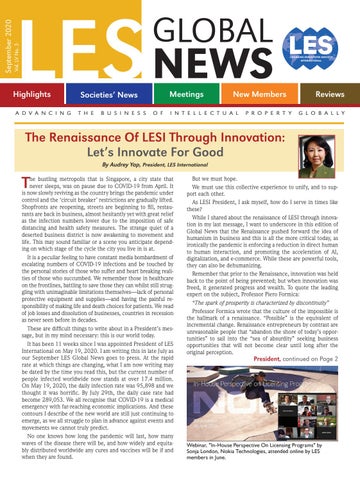
Webinar, "In-House Perspective On Licensing Programs" by Sonja London, Nokia Technologies, attended online by LES members in June.
LES Global News—Highlights
Inside LES Global News Highlights –Pages 1-14, 16-19, 30-32, 34-36 Society News, Committee Reports –Pages 21-26, 28-29, 33
Meetings & Delegates –Pages 15, 27, 37-41
Book Review –Page 20
Memoriam –Page 20
Quick Links: www.lesi.org www.lesi.org/les-nouvelles www.lesi.org/les-societies www.les-europe.org www.les-asiapacific.org
Call For Content We request contributions from all societies and individuals about important events, changes in the law in your country or region, conferences, annual meetings, board changes, and the like from your society. You can submit articles or announcements to the editor or use the form on the website at the following address: www.lesi.org/les-societies/lesglobal-news/submission-form. Deadlines: January 15, April 15, July 15 and October 15 Editor: David Drews, 9320 Chesapeake Drive, Suite 110, San Diego, CA 92123, Email: editor@LESI.org Copyright ©2020 Licensing Executives Society International
President, continued from Page 1 I love the idea of the pursuit of the impossible in this time, as I believe duress brings out human ingenuity. “Creativity is an input to innovation and change is the output from innovation”—Brandon Kelley With these ideas in mind, I sought to up our game at LESI and launched the President’s “Let’s Innovate“ challenge on May 21, 2020, at the Committee leadership meeting. The challenge was to organize an online or virtual activity to further LESI’s objectives as reflected in each Committee’s mandate, and collaborate with another committee or national society to promote cohesiveness and cooperation. Innovation could be reflected in the theme or how it’s organized or an introduction of a new way to interact. I held two National Presidents Council Meetings on May 27, 2020, and July 1, 2020, with incredible participation and support displayed by the collective leadership of LES, including an average 26 national presidents out of our 33 chapters at each sitting joining and contributing to the LESI effort and plan globally. I am delighted to report that in these past few weeks we have had more than 20 webinars organized, not including those held at the national level that we have not updated on our common calendars. Over 50 committee zoom meetings have been held and many LESI committees have submitted exciting action plans for the term, the results of which will be seen in the months ahead. Due to constraints of time and space, I cannot write about all 20 webinars, but have set out below a few key highlights.
Innovative Webinars The webinar organized by the LESI CEEM (Chemical, Energy, Environment & Materials) Committee was remarkable as it not only brought together speakers from Australia, France, Thailand, USA and China, it covered industry sectors such as oil and gas, chemicals, mining, manufacturing and data analytics & IP expertise in a punchy lively session. Another instructive seminar on July 2nd was very ably co-organized by LES South Africa, the Patent and Technology Licensing Committee and LESI on Cannabis—Regulatory and IP views, bringing together a national society and an LESI committee as well as the engagement of experts from Europe, Canada, South Africa and the USA. Special mention must be made of Madelein Kleyn who was instrumental in bringing this to us. LES Asia Pacific Committee together with four ASEAN LES societies: LES Philippines, Malaysia, Singapore and Thailand pushed forward the “WE are family” theme and organized a well-attended and well-received webinar on Mediation with WIPO that had participants across Asia and Europe logging on to participate. I had the great pleasure of joining as a speaker and being part of the 10th Anniversary celebrations of LES Turkey. The theme of the online event was The Renaissance of Innovation (how wonderful!). After being welcomed by Murat Idal, President LES Turkey, we had a surprise performance by a leading Turkish opera singer. An innovative mix of arts and science! After that interlude of music, Professor Dr. Habib Asan, President of Turk Patent, led the presentations. We learned from Dr. Habib that Turkey is introducing a novel IP financing model and has a vibrant start up scene. This was followed by my talk, and those of Dr. Marco Aleman (Director Patent Law Division, WIPO) and Sonja London (President LES Scandinavia, and Director of Licensing of Nokia Technologies). I also had the pleasure and privilege of providing welcome speeches to two amazing virtual events. The first was the regional online conference co-organized by LES Brazil and LESI Americas Committee held over six sessions in July and
President, continued on Page 3 2
Licensing Executives Society International
LES Global News—Highlights
President, continued from Page 2 August. The theme “Licensing Success in the Changing Global Market” was well thought-out and covered a good range of IP topics from IP valuation to enhance corporate value to data protection, smart contracts, AI, as well as the circular economy. It even incorporated a Mock Panel for licensing! Karina Muller, President of LES Brazil also shared how LES Brazil is looking to organize activities supportive of practitioners and businesses in these challenging times beyond the intellectual but including also the emotional needs as well. Brava! The other virtual event was the LES Japan Annual Meeting with the theme “Innovation for IP Activities after COVID-19.” It brought together experts from academia (Kyoto University and Tokyo University) as well as industry (Fujifilm, Suntory Holding, Canon and Honda Motor), and was attended by 150 participants. The keynote addressed the important need to overcome COVID-19 through international collaborative research. In my speech, I shared that, in order to innovate so as to address the COVID-19 problems that are presented to enterprises and governments today, we can think in these important steps: • 解決する (Kaiketsu-suru): Resolve, to address the challenges • 弾力性 (Danryoku-sei): Build resilience • 機敏 (Kibin): Agility, be agile • 予定 (Yotei): Plan Resilience and agility would involve reducing costs and stabilizing supply chains, focus on transformation to engage opportunities; plan to embrace the virtual world, reimagining the new normal or reinventing ourselves, including digitalization or telecommuting and other innovative solutions. In this, I highlighted that Suntory, an active supporter of LES Japan, has been producing neutral alcohol to distribute to hospitals as a disinfectant and Beam Suntory has been producing hand sanitizers and donating these to first responders and medical professionals in Kentucky and Chicago in the USA. This example underscores that a crisis can bring us together to innovate for good and across boundaries. Even though we are physically apart, we are joining hands across the world. And this is so encouraging and in keeping with my presidential theme of Let’s Innovate.
les Nouvelles Live! My report would not be complete if I did not mention our very innovative interactive new LES pilot event called “les Nouvelle LIVE!” organized in collaboration with the EPO and the LESI High Growth Enterprise (HGE) Task Force. In celebration of our special joint LESI-EPO edition published in June 2020, we hosted a launch event where our wonderful Editor David Drews and the authors/contributors of articles in this edition came online to share about their writing journey, their motivations and experiences leading to their very practical perspectives and recommendations allowing readers for the first time to see and hear from authors first hand. Our very able moderator for the session was Dana, our Executive Director. It was a convincing case of establishing that this was a “must read” publication and a real keeper, given the invaluable insights on High Growth Technology businesses and the conference that inspired it (HTBC). In my mind this was an outstanding effort.
Tripartite Memorandum Of Understanding It is my great pleasure to announce and share with you that LESI on July 24, 2020, signed an MOU with the University of Padua’s Tech Transfer Office-UNISMART, LES Italy, and Commax Venturus Ltd, a Korean start-up accelerator, to collaborate to exchange best practices, organize delegations and workshops to promote cultural exchanges and innovation with LESI as a key knowledge partner. The fields of focus will include ICT, AI, the Internet of Things, Industry 4.0 technologies, Fintech and Life Sciences. It warms my heart to know in these times the spirit of enterprise and endeavour pushes through and the desire to continue to collaborate amidst a pandemic emphasizes the human resolve to prevail.
Closing As they say, struggles can have beautiful results, like the butterfly that emerges from a cocoon in which it has been through significant agitation physically in order to transform. The pandemic reminds us of the continual indomitable quest for survival in nature that for a long time now mankind has taken for granted. Whilst we have seen some countries retreating into their nationalistic core, interestingly and as never before this shared pain has also resulted in a surge of empathy worldwide. I believe as seen in the activities across the globe in LESI that empathy will bind our efforts to stay relevant in the world. Together we have built for a shared future before and together we will build again. I will call on this international family of national societies that is LESI to stand in solidarity to share resources, open your doors and in this way provide for our collective well-being together. This is why I am so encouraged by the enhanced interaction and inclusivity I see, the heightened interest to engage with each other in as many ways possible and the camaraderie we have shown in spite of the times. Let us innovate to be a catalyst for positive change and cultivate a greater compassion for each other. I want to look back and be able to say, “The pandemic brought out the best in LESI, not just by what we said, but what we did.” Carry on LESI! Let’s Innovate! Audrey Yap
Participants in the new LES pilot event called “les Nouvelles LIVE!” organized in collaboration with the EPO and the LESI High Growth Enterprise (HGE) Task Force.
September 2020
3
LES Global News—Highlights
LES International Calendar Meetings & Events 2020 September 17
LES France's 50th Anniversary! POSTPONED
Paris
September 22
LES Scandinavia Annual Conference 2020 POSTPONED
Helsinki
October 1
LES Philippines “Back-to-School: Studying the IUGT Pandemic” Response 2
Virtual Event
October 6
LES France Life Sciences: Connected Health Conference
Virtual Event
October 18-21
LES USA & Canada 2020 Annual Meeting
Virtual Event
November 2
LES Britain & Ireland LES100 Training Course
Scotland
November 3
LES Britain & Ireland Annual Conference 2020
Glasgow
November 6
LES Britain & Ireland LES100 Training Course
London
April 7-9
LES ANZ Annual Conference 2020
Christchurch
May 30-June 1
2021 LES International Annual Conference
Seoul
2021
Introducing The New LES USA & Canada Website
A
fter months of hard work, we are excited to announce the new LES USA & Canada website. We have updated our logo and incorporated new colors into our brand to give it a fresher feel. The new brand and navigation make it easier for you to find your favorite LES resources when you need them, including useful industry website links; course information; and upcoming and archived events, recordings, presentations, and more—available 24/7. The new navigation allows you to find what you are looking for with just one simple click. Have a look around the new website at https://www.lesusacanada.org/ ■
4
Licensing Executives Society International
LES Global News—Highlights
LESI 2021 Annual Meeting Now Accepting Submissions For Workshops And Mini-Plenary Sessions
L
ESI 2020-2021 Committee Leaders: The LESI 2021 Annual Meeting Organizing Committee is now accepting submissions for workshop and mini-plenary session proposals. Although it may seem far away, now is the time to consider what topics would be timely, engaging and of value to those who choose to join us next year. The 2021 Annual Meeting is planned for Seoul, Korea from May 30th–June 1st. Earlier this year, LESI President Audrey Yap adopted the organizational theme, “Let’s Innovate.” The organizing committee is still considering how best to implement this theme in the context of the substantive program and will certainly be influenced by your committee’s proposal. 2020 has produced a wide variety of activity and innovations in response to the COVID-19 pandemic. Not only has this time fueled more rapid innovation necessary to respond to the global crisis, but it has also impacted the way that parties are engaging in partnerships and finding ways to expedite the development of products needed in the marketplace. Crisis certainly fuels innovation. Most of you have already gathered your leadership team and committee members and begun to talk about potential panels for the meeting, and some have already organized webinars. We hope that the webinar activity will continue throughout the year as you all compete in the President’s Challenge—and perhaps some of these discussions will inform proposal(s) you might submit for the Annual Meeting. Please submit your proposals by September 7 to the following three people:
• Arthur Choy, LES Korea, leading the 2021 meeting organizing committee, (arthur.choy@dentons.com); • Thomas Adocker, LESI Meetings Committee Chair, (adocker@schwarz-schoenherr.com); and • Dana Robert Colarulli, LESI Executive Director, (dana@lesi.org). While we have asked that the organizing committee consider all committee workshop proposals, we regret that they cannot guarantee your committee request will be granted. We regret that LESI policy does not generally allow for the funding of speaker travel except in rare circumstances. We continue to monitor the impact of the COVID-19 on professional travel and expect that the conference will include a significant virtual component. We would like speakers whose contribution to the conference would be considered highly valuable, and encourage you to consider speakers that may not otherwise be able to travel and could participate virtually. This could include live or prerecorded remarks. Please take these factors into account as you consider the best speaker participants for your proposed session. Our 2021 Annual Meeting can only be a success with your help and input. Please do not hesitate to contact me with any questions about the LESI Annual Meeting or the proposal submission process. Thank you! ■ Dana Robert Colarulli, Executive Director, Licensing Executives Society International (LESI)
Committee Proposals For The 2021 LESI Annual Meeting Hints And Guidelines For Committee Proposals
T
he LESI Annual Meeting is a two-day event following an opening reception the evening beforehand. As a result, only a limited number of workshop slots are available. The Meetings Committee and LESI staff offer the following submission hints for your consideration as you structure your proposal: • Moderators and speakers must be willing to share their personal experiences on the topic—so that the audience learns from the experiences of the panelists by considering key elements of certain case studies—avoid the “Sage on the Stage” type session. • Where it is not possible or practical to confirm panelists prior to submitting a workshop proposal, please identify prospective speakers and note that they are being considered or have been invited (else, provide a speaker profile, e.g., corporate speaker from the life sciences industry). The organizing committee will work with organizers of accepted proposals to build out and enhance the workshops • Moderators and speakers from diverse professional settings should be proposed, and each session should have at least one person from an operating company on the panel.
Thereafter, the panel may include a representative cross section of the LES Membership including but not limited to private industry, both large and small, government, and academia; and, as appropriate, representing diverse perspectives, e.g., licensing, business development, legal, regulatory as well as from the commercial, academic, nonprofit and government sectors. • There can be only one member of each panel from the same organization. • Diversity is strongly encouraged—new topics, women and younger members and geographically diverse speakers from a wide variety of industries. Individuals who have never spoken at a LES conference and bring with them unique experiences and perspectives related to innovation and licensing are welcomed. • The maximum number of panelists for each session is generally four (4), based on time constraints as well as, if in-person, physical set-up of meeting rooms. • As you consider your proposal, please bear in mind that the sessions are meant to provide knowledge dissemination through discussion and interaction. Sessions are not a venue for speeches or promotional presentations. ■ September 2020
5
LES Global News—Highlights
Patent And Technology Licensing Committee Action Plan By Madelein Kleyn (LES South Africa)
T
he LESI has thirteen industry, professional and regional committees responsible for providing content for LES meetings and conferences and for providing a forum where members with an interest in a particular industry or a particular region or aspect of the licensing profession can meet, network with and exchange ideas and experiences with like-minded members. The PTLC is a small committee with big dreams. The committee is co-chaired by Patrick Terroir (LES France) and Madelein Kleyn (LES South Africa) with Vice Chairs: Robin Corwin (LES USA & Canada), Taruna Gupta (LES India), Qinghong Xu (LES China), Cândida Ribeiro Caffé (LES Brazil) and Jennifer Pierce (LES B&I). The focus of PTLC is to create a network of professionals across the globe and to make an impact that goes beyond technology and patent licensing. This year’s action plan is evident of that and includes the following activities: Activities And Initiatives
In Charge And Comments
Status 01/06/2020
1 Strengthen the committee organization. 1.1 Renew the committee working team and build a true committee membership.
The opportunity and the feasibility to get more members in the committee will be studied this summer.
1.2 Liaise with other relevant LESI Com- • Cooperation with regional LES to be mittees to plan common actions. initiated: –Africa: Madelein Kleyn –Asia: Qinghong Xu –North America: Mihaela Bojin –South America; Candida Ribeiro –Europe: Jennifer Pierce • Cooperation with technical committees; High Tech, Copyright & Trademark, to be initiated: Mihaela Bojin/Madelein Kleyn in assistance. • Cooperation with IP Valuation Committee. Cooperation with YMC: Madelein Kleyn with LES SA YMC Committee delegates. • Collaboration with LES Arab countries on sharing best practices and training on licensing.
Claudia Tapia has joined the board. Madelein and Patrick as co-chairs starting May 2020. The members of the board committee are developing their own action plans for their domain. Mihaela has established a liaison with the Copyright Licensing Committee—Johan and George. Trademarks, Designs, and Merchandising Committee—Charmaine and Stefan and Young Members Congress—Stacey Dunn (Vincent Bergeron will be our contact). Qinghong Xu has been contacting LES local divisions in China, Japan, and Korea and discuss possible collaborations. Project to help draft a handbook of licensing practices for small enterprises with LES Singapore (suspended). Madelein has contacted IP Valuation Committee about an IP Valuation course and Financial Modelling course and templates for non-financial managers.
2 Confirm LESI as a recognized international expert. 2.1 Pursue the active participation in Patrick Terroir is the representative of LESI the ISO standard making on innovation in ISO process. He collects the comments of LES regional societies. management and IP management. After the document on IP management other documents on innovation will be discussed.
The working meeting of ISO on Innovation management was held virtually on 11-15 May 2020. Many comments from LESI have been retained. The ISO document has been improved, and will be adopted soon. The next ISO meeting will be in November.
2.2 Contribute to and promote les Nouvelles.
Madelein contributed to the special issue of the June edition with the EPO. Jennifer Pierce is preparing a special issue for 2021 on trade secrets in the world (outside Europe). The contributing authors were identified.
6
The special issue on “Knowledge Transfer and IP” organized by the committee was published in July-August. Board members to take initiatives to use this issue on a regional level. Identify new key topics.
Licensing Executives Society International
LES Global News—Highlights PTLC Action Plan, continued from Page 6 Activities And Initiatives
In Charge And Comments
Status 01/06/2020
For the Berlin conference, the Committee 2.3 Organize PTL workshops at LES had proposed 5 topics. Two have been remeeting. tained. (SARIMA and ATTP acknowledgement and collaboration of LES training material—advanced licensing and valuation courses).
After the cancellation of the conference, the planned speakers of the workshops agreed to participate in a webinar.
2.4 Organize webinars
A webinar on “open science and protection of IP” has been proposed to LESI in June.
Waiting for confirmation from LESI.
2.4 Pursue and multiply the working groups with industrial firms on patent licensing and technology transfer (See item 2.3 above).
To organize with national societies working groups with industrial firms (topics and tools).
To be initiated and to see if we could have our LES TT activities accredited for RTTP recognition. MK in process with this. It is decided by the ATTP board—meeting set up to discuss.
2.5 Organize a “Kids IP Day” for the World IP Day 2021.
• To imagine how to mobilize the regional societies (for example a challenge for the best event). • To prepare a set for presentation aimed at different age groups. • To prepare with LESI in September 2020. • To associate WIPO (potentially)?
This project has been agreed in principle by LESI board.
3 Provide tools and services to LESI members. 3.1 Explore the needs of LESI members for LESI tools in the licensing domain.
Approach LESI members to ascertain their needs. This could be a zoom call with all LES regional presidents and a questionnaire to LES members.
3.2 Create an open library of IP licensing agreements in collaboration with international organizations.
Target must be high-level as there are already many materials available. Collaboration with organisations like AIPLA, AUTM and INTA. Some tracks to explore: • A “guide” of available tools with assessment of usefulness, cost and links for direct access is considered. • A platform for hosting an integrated agreement library focused on IP licensing that is free to our members who contribute sources to the platform.
LESI board has agreed to providing access to a number of resources for LES members, namely creating a “toolkit” or “tools for LESI members” areas on LESI website. We have been informed that AIPLA and LESI are going to build a closer collaboration. (MK is involved in an activity with the education committee for this).
3.3 Initiate a close cooperation with the working groups HGE and LIT.
The PTL Committee could provide materials on sophisticated IP tools that our industry needs; for example the digital economy (IoT, AI, blockchain…), the way to deal with SEP, etc.
Custos Start-up company of Stellenbosch University—I can arrange a webinar—it would be another online activity for us, but also access to amazing technology. (MK) Have a look here: www.custostech.com/.
Advertising in les Nouvelles We have issued new pricing for advertising in les Nouvelles. You can now advertise through a ¼ page ad, in color or black and white. See www.lesi.org/ content/advertiseinlesNouvelles.aspx Although we do not have a Jobs and Employment section of les Nouvelles as yet, employers can advertise to fill important positions through les Nouvelles. We reach more than 7,000 members worldwide. September 2020
7
LES Global News—Highlights
Force Majeure Under PRC And Russian Law By Yulia Vasilyeva & Jingya Wang
C
hina and Russia were both selected by the then-Chairman of Goldman Sachs in 2001 as part of the group of four emerging economies that would come to dominate the global economy, if the relevant governments managed their economies well. These were labelled the BRIC countries based on the first letters of their names (Brazil, Russia, India and China). The Russian Federation had the highest GDP per head at that time, and Brazil was second. India’s GDP per head was significantly lower than the others. But it has not all proceeded as foreseen. The Russian Federation still has the highest GDP per head, but is now barely ahead of the People’s Republic of China. Brazil has definitely slipped and may slip more given its current administration and the way it is handling the pandemic. Brazil’s slide is a significant development. The original research paper from Goldman Sachs emphasized that the quality of the respective governments would be a major factor in the country’s ability to fulfill the vision of significant development. A well-functioning legal system is a necessary part of the service that the governments need to provide to encourage the required growth. The COVID-19 pandemic is a test of these governments and others, and will be a test of their legal systems. In this article we look at the provisions in the existing legal structure and new pronouncements for the two BRIC countries with the highest GDP per head: China and Russia. This aspect of their legal systems will be tested as they move to recovery. As an important manufacturer and industrial producer, China is an integral part of the global supply chain. Prior to European and American countries being hit by the COVID-19, a major concern was whether Chinese suppliers would be able to deliver the ordered goods in time. At the current stage, there is a possible shift of the risks to the buyer’s side due to the shutdown of factories in Europe and America. Despite the operative economic sanctions and countersanctions, Russia remains a global exporter of oil & gas, metals, chemicals, machinery, weapons, and food, as well as an importer of various goods and services. Although the country was spared from the early expansion of the virus, it has now joined the ranks of countries like Italy, France and Spain, closely monitoring its number of cases of COVID-19 and putting entire regions of the country, and first and foremost its capital, Moscow, under strict lockdown. Thus, the question has become not if but when will Russian parties begin to underperform under their agreements, and how those situations might be handled under Russian law. 8
Licensing Executives Society International
This article will discuss the force majeure and other relevant provisions under the laws of the PRC and Russia. I. Force Majeure and Other Relevant Considerations Under the PRC Law. 1. What are the legal provisions governing force majeure under the PRC law? We will first look at the legal provisions and then analyze these rules. On May 28, 2020, the National People’s Congress, namely, the legislature of the PRC, passed the Civil Code of the People’s Republic of China (中华人民共和国民法 典), the “PRC Civil Code”, which will come into force on January 1, 2021 and replace nine existing legislations in the same area. Until then, the General Rules of the Civil Law (民法总则) and the Contract Law (合同法) continue to serve as the governing statutes for the issue of force majeure. As such, we will include both the old rules and the new rules in our discussion. The tables below contain the text of the rules relevant to force majeure. The old rules are on the left, and the new rules are on the right. Under each table, we will analyze if the new rules has made any changes.
Table 1: Definition Of Force Majeure General Rules Of The Civil Law
The PRC Civil Code
第一百八十条 因不可抗力不 能履行民事义务的,不承担民 事责任。法律另有规定的,依 照其规定。 不可抗力是指不能预见、不能 避免且不能克服的客观情况。
第一百八十条 因不可抗力不 能履行民事义务的,不承担民 事责任。法律另有规定的,依 照其规定。 不可抗力是指不能预见、不能 避免且不能克服的客观情况。
Article 180 If the failure to fulfill civil obligations is caused by force majeure, no civil liability shall be borne. Where there are other provisions in the law, such provisions shall apply. Force majeure refers to any objective circumstance that is unforeseeable, unavoidable and insurmountable.
Article 180 If the failure to fulfill civil obligations is caused by force majeure, no civil liability shall be borne. Where there are other provisions in the law, such provisions shall apply. Force majeure refers to any objective circumstance that is unforeseeable, unavoidable and insurmountable.
Article 180 of the General Rules of the Civil Law provides for the definition of force majeure. The PRC Civil Code did not make any change in this regard. (See Table 1).
Force Majeure Issues, continued on Page 9
LES Global News—Highlights Force Majeure Issues, continued from Page 8 Table 2: Statutory Rescission Right Contract Law
The PRC Civil Code
第九十四条 有下列情形之一 第五百六十三条 有下列情形之 一的,当事人可以解除合同: 的,当事人可以解除合同: (一)因不可抗力致使不能实 (一)因不可抗力致使不能实 现合同目的; 现合同目的 Article 94 The parties to a contract may rescind the contract under any of the following circumstances: 1. the purpose of the contract is rendered impossible to achieve due to force majeure.
Article 563 The parties to a contract may rescind the contract under any of the following circumstances: 1. the purpose of the contract is rendered impossible to achieve due to force majeure.
Table 3: Exemption Of Liability And The Obligation Of Notice And Proof Contract Law
The PRC Civil Code
第五百九十条 当事人一方因不 可抗力不能履行合同的,根据 不可抗力的影响,部分或者全 部免除责任,但是法律另有规 定的除外。因不可抗力不能履 行合同的,应当及时通知对 方,以减轻可能给对方造成的 本法所称不可抗力,是指不 损失,并应当在合理期限内提 能预见、不能避免并不能克服 供证明。 的客观情况。 当事人迟延履行后发生不可 Article 117 Where a contract 抗力的,不免除其违约责任。 is not able to be performed due to force majeure, the lia- Article 590 Where a party is bilities shall be exempted in unable to perform the contract part or in whole in light of the due to force majeure, the party effects of the force majeure, shall be exempted from its liability in part or in whole based except as otherwise provided on the impact of force majeure, by law. If the force majeure oc- except as otherwise provided curs after one party has de- by law. In such a case, the parlayed its performance, the lia- ty shall promptly notify the bilities of the party shall not other party to mitigate the loss possibly caused to the other be exempted. party and provide proof within For the purpose of the Law, a reasonable time limit. force majeure refers to the objective circumstances that are If force majeure occurs after a party delays performance, the unforeseeable, unavoidable party shall not be exempt from and insurmountable. liability for breach. 第一百一十八条 当事人一方 因不可抗力不能履行合同的, 应当及时通知对方,以减轻可 能给对方造成的损失,并应当 在合理期限内提供证明。 第一百一十七条 因不可抗力 不能履行合同的,根据不可抗 力的影响,部分或者全部免除 责任,但法律另有规定的除 外。当事人迟延履行后发生不 可抗力的,不能免除责任。
Article 118 Either party to a contract that is not able to perform the contract due to force majeure shall give notice to the other party in time so as to reduce the losses that may be caused to the other party and provide evidence within a reasonable time limit.
Article 94 of the Contract Law provides that the parties may rescind the contract if the purpose of the contract is no longer achievable as a result of force majeure. Although Article 563 of the PRC Civil Code made some changes to Article 94 of the Contract Law, the part of the text that is relevant to force majeure remains unchanged. (See Table 2). Articles 117 and 118 of the Contract Law provide for the exemption of responsibilities and the obligation of notice and proof on the part of the defaulting party. Article 590 of the Civil Code merged Articles 117 and 118 of the Contract Law into one clause. While the language of the new rule is more concise, the substance of the rule remains unchanged. (See Table 3). Article 119 of the Contract Law provides for a mitigation obligation on the part of the innocent party. This rule not only applies to a default resulting from force majeure, but also applies to a default resulting from other causes in general. Article 591 of the PRC Civil Code only made some verbiage changes to the text. For example, 要求 (demand) was changed to 请求 (request), and 承担(undertaken) was changed to 负担 (borne). Although there are some nuances as to the way a party exercises its right or carries out its obligations, the essence of the rule remains unchanged. (See Table 4).
Table 4: Mitigation Of Damages Contract Law
The PRC Civil Code
第一百一十九条 当事人一方 违约后,对方应当采取适当措 施防止损失的扩大;没有采取 适当措施致使损失扩大的,不 得就扩大的损失要求赔偿。
第五百九十一条 当事人一方违 约后,对方应当采取适当措施 防止损失的扩大;没有采取适 当措施致使损失扩大的,不得 就扩大的损失请求赔偿。
当事人因防止损失扩大而支出 当事人因防止损失扩大而支 的合理费用,由违约方承担。 出的合理费用,由违约方负 担。 Article 119 Where a party is in breach of contract, the other Article 591 Where a party is in party shall take appropriate breach of contract, the other measures to prevent the ag- party shall take appropriate gravation of losses; and if the measures to prevent the agfailure to do so results in the gravation of losses; and if the aggravation of losses, the oth- failure to do so results in the er party may not demand com- aggravation of losses, the othpensation for the aggravation er party may not request compensation for the aggravation of losses. The reasonable expenses in- of losses. curred by the other party to The reasonable expenses inprevent the aggravation of curred by the other party to losses shall be undertaken by prevent the aggravation of losses shall be borne by the the party in breach. party in breach. (Emphasis added.) (Emphasis added.)
Overall, the PRC Civil Code did not make any substantial change to the rules that govern force majeure. Generally, previous judicial interpretations, articles and analysis should still apply. We will now break down the above-mentioned rules and
Force Majeure Issues, continued on Page 10 September 2020
9
LES Global News—Highlights Force Majeure Issues, continued from Page 9 analyze the legal effects, elements, and procedures of force majeure. (1) The Legal Effects of Force Majeure If a party cannot fulfill its obligations under the contract due to force majeure, then based on the impact of the circumstances, the party’s liabilities can be exempted in whole or in part, including liabilities for breach of contract. Further, if the purpose of the contract becomes impossible to achieve due to force majeure, then both parties have a statutory right to rescind the contract. (2) The Elements of Force Majeure The definition of force majeure is “objective circumstance that is unforeseeable, unavoidable and insurmountable.” As such, the following three elements must be present: i. Reason: the circumstances are objective and unforeseeable, unavoidable and insurmountable The PRC law’s approach to the scope of force majeure is to set a broad definition to the term rather than enumerating a list of circumstances. This approach affords a certain degree of flexibility with respect to what incidents may qualify. As such, even though pandemic is not listed in the law, it may nevertheless be interpreted as force majeure, depending on the severity of the pandemic. The definition of force majeure also requires the circumstance to be objective, unforeseeable, unavoidable and insurmountable. If the defaulting party is at fault and contributes to the breach, then force majeure may not apply. If the contract is signed after the incident has happened, then force majeure does not apply. Similarly, if the force majeure happened after the defaulting party has delayed its performance, then force majeure does not apply. ii. Result: one party or both parties cannot perform the contract If the party can still perform the contract but just the cost of such performance will increase, or the challenge is grave but can nevertheless be overcome, then force majeure does not apply. However, the defaulting party may turn to another statutory defence—the change of circumstances, which will be discussed in section 4 of this article. iii. Causation: the fact that parties cannot perform the contract is a direct result of the force majeure Whether force majeure applies and whether other statutory defences may apply is a highly fact-specific analysis. For example, a clothing factory may be ordered by the government to turn its production line into manufacturing facial masks with the raw materials that the factory has, then it is likely that force majeure will apply when the clothing factory cannot deliver its orders in time. However, if some workers cannot come to work due to sickness or the government’s travel ban, the factory can nevertheless fulfill its orders by hiring extra workers or prolonging its working hours, then force majeure is unlikely to apply. (3) The Procedures to Apply Force Majeure in Contract Performance Force majeure is a statutory defence. The defaulting par10
Licensing Executives Society International
ty’s liability is exempted by law, and the parties may amend their contract to better align their rights and obligations with the changed circumstances. If the other party disputes the application of force majeure or the extent of the exemption, either party may resort to judicial proceedings. With respect to statutory rescission right, pursuant to Article 96 of the Contract Law and its replacing Article 565 of the PRC Civil Code, parties may exercise this right by notifying the other party, and the contract shall be terminated when the notice is delivered. If the recipient of the notice disputes the rescission, either party may request the court to confirm whether the statutory rescission applies to their case. (4) Notice and Proof Obligation of the Defaulting party The party under the influence of the force majeure has an obligation to promptly notify the other party so that the other party can adopt appropriate measures to prevent its further loss. Further, the party under influence shall also provide proof to the other party within a reasonable time. Such proof may include government orders to reject goods from a certain country, records of reasonable efforts that have been taken by the parties, and statements issued by trade associations. (5) Mitigation Measures of the Innocent Party Under the Contract Law and its replacing PRC Civil Code, the innocent party shall take reasonable mitigation measures to prevent its further loss. If the innocent party fails to do so, then the defaulting party may not be liable for the further loss suffered by the innocent party. Further, the cost of such mitigation measures shall be borne by the defaulting party, so the innocent part is strongly recommended to take appropriate measures. 2. Can the COVID-19 pandemic be considered a Force Majeure? Currently, the most relevant issue is whether the coronavirus pandemic can be considered as force majeure. On February 10, 2020, a spokesperson of the Legislative Affairs Commission of the Standing Committee of the National People’s Congress, the legislature of the PRC, declared that the COVID-19 is force majeure for parties who cannot perform the contract, subject to other provisions of the law. However, whether the force majeure provisions will apply to a given case is highly fact-specific. The same government order may constitute force majeure for one contract performance, but may not necessarily apply to another. On April 20, May 20, and June 16, 2020 the Supreme People’s Court of China successively issued three guidances on civil disputes related to the COVID-19 pandemic, the Circular on Issuing the Guiding Opinions on Several Issues concerning the Proper Trial of Civil Cases Related to the COVID-19 Epidemic According to the Law (I), (II) and (III) (关于依法妥善审 理涉新冠肺炎疫情民事案件若干问题的指导意见)(一) 、(二)和(三)). Pursuant to the first circular, the Supreme People’s Court of China differentiated contract performances under the COVID-19 pandemic into three categories:
Force Majeure Issues, continued on Page 11
LES Global News—Highlights Force Majeure Issues, continued from Page 10 i. Performing the contract will be difficult If the COVID-19 pandemic or related government policies only renders it difficult to perform the contract, but not impossible, the parties may renegotiate. If the affected party can continue to perform the contract, the court will mediate and encourage the parties to continue to perform the contract. If a party requests a rescission of the contract on the ground that it has difficulties with performing the contract or the cost of performance will increase, but the court determines that the purpose of the contract can nevertheless be achieved, then the court will reject the party’s request of rescission. ii. Performing the contract will be significantly unfair to one party If it is significantly unfair for one party to continue to perform the contract, and the party requests changes to the time of performance, way of performance, or the contract price, the court will decide whether to uphold its request in light of the actual situation of the case. If, after the contract has been changed, a party further claims partial or full exemption from liability, the court will reject such claim. iii. Performing the contract is impossible or the purpose of the contract is no longer achievable If the COVID-19 pandemic or related government policies renders it impossible to perform the contract, rules regarding force majeure shall apply, and liabilities of the affected party shall be exempted in part or in whole depending on the impact of the COVID-19 pandemic or the related government policies. If the COVID-19 pandemic or related government policies renders the purpose of the contract no longer achievable, the court will uphold the obligee’s request to rescind the contract. However, the court will reject the obligee’s claim for breach of contract. Overall, the Supreme People’s Court’s guidance is aligned with the provisions of the Contract Law and the PRC Civil Code. Whether the pandemic can be considered a force majeure largely depends on whether performing the contract is still possible and whether the purpose of the contract can still be achieved in the specific context. 3. What Shall Apply, the Contract or the Contract Law? In practice, parties usually would include a force majeure clause in their contract, which may or may not conform with the provisions in the Contract Law and the PRC Civil Code. Generally, there are two types of variations in private contracts. One is excluding certain circumstances from the application of force majeure provisions (the “Restricted Approach”). In this way, if the excluded circumstances occur, parties are barred from claiming force majeure. The other approach is including certain circumstances that do not fall in the definition of force majeure under the law (the “Expanded Approach”). According to the Expanded Ap-
proach, even though the included circumstances do not meet the legal requirements for force majeure, parties may still claim force majeure. We will address these two approaches in turn. (1) The Restricted Approach is unlikely to block a party’s statutory right Because force majeure is a statutory defence, parties’ intention to contract out force majeure may not be recognized by the court later on. In a construction dispute in 2008 (卓盈丰制衣纺织(中 山)有限公司与广东长城建设集团有限公司建设工程施 工合同纠纷案[最高人民法院(2008)民一抗字第20号 民事判决书] ), the PRC Supreme Court held that force majeure is a statutory defence. If the scope of force majeure agreed by the parties in the contract is smaller than that in the statute, the parties may still claim statutory force majeure protections. (2) The Expanded Approach is likely to exempt a party’s liabilities Unlike the Restricted Approach, courts generally would respect the parties’ decision to expand the scope of force majeure and regard it as a valid liability exemption (see (2009) 一民中字第7584号and (2019)苏06民终32号). 4. What is the Change of Circumstances? How is it Different from Force Majeure? As discussed above, the test for force majeure is rather strict since it requires that it is impossible for the parties to perform the contract as a direct result of the circumstance. If the influence of the COVID-19 to the parties is not as severe, an alternative defence available to the defaulting party is the change of circumstances. The change of circumstances definition is provided in Article 26 of the Interpretation of the Supreme Court on Certain Issues Concerning the Application of the PRC Contract Law (II) (《最高人民法院关于适用<中华人民共和国合同法 >若干问题的解释(二)》, the “Judicial Interpretation of the Contract Law”) and Article 533 of the PRC Civil Code. Similar to the Contract Law, this judicial interpretation will continue to be effective until the PRC Civil Code comes into force on January 1, 2021. (See Table 5). The change of circumstances can come into effect after the parties have entered into a contract. The unforeseeable circumstances render the performance of the contract significantly unfair or the purpose of the contract is no longer achievable. The legal consequence is alteration or rescission of the contract, and it does not automatically allow the parties to rescind the contract or exempt their liabilities. The PRC Civil Code made several changes to the rules governing the change of circumstances. A detailed discussion of these changes is beyond the scope of this article. One change that is relevant to force majeure is that force majeure now
Force Majeure Issues, continued on Page 12 September 2020
11
LES Global News—Highlights Force Majeure Issues, continued from Page 11 Table 5: Change of Circumstances Judicial Interpretation of the Contract Law (II) 第二十六条 合同成立以后客 观情况发生了当事人在订立合 同时无法预见的、非不可抗力 造成的不属于商业风险的重大 变化,继续履行合同对于一方 当事人明显不公平或者不能实 现合同目的,当事人请求人民 法院变更或者解除合同的,人 民法院应当根据公平原则,并 结合案件的实际情况确定是否 变更或者解除。 Article 26 After a contract has been concluded, and the objective circumstances for the contract have undergone a major change which was unforeseeable by the parties at the time of conclusion, which is not force majeure, and which does constitute commercial risks, if it is obviously unfair to one party to continue to perform the contract or the purpose of the contract is no longer achievable, and the parties may request a people’s court to modify or rescind the contract, the people’s court shall decide whether to modify or rescind the contract based on the principle of fairness and take into account the acutal circumstances of the case. (Emphasis added.)
The PRC Civil Code 第五百三十三条 合同成立后, 合同的基础条件发生了当事人 在订立合同时无法预见的、不 属于商业风险的重大变化,继 续履行合同对于当事人一方明 显不公平的,受不利影响的当 事人可以与对方重新协商;在 合理期限内协商不成的,当事 人可以请求人民法院或者仲裁 机构变更或者解除合同。 人民法院或者仲裁机构应当 结合案件的实际情况,根据公 平原则变更或者解除合同。 Article 533 After a contract has been concluded, and the basic conditions for the contract have undergone a major change which was unforeseeable by the parties at the time of conclusion and which does not constitute commercial risks, if it is obviously unfair to one party to continue to perform the contract, the party adversely affected may renegotiate with the other party; if the negotiation fails within a reasonable period, the parties may request a people's court or an arbitration institution to modify or rescind the contract. The people's court or arbitration organization shall take into account the actual circumstances of the case and amend or rescind the contract pursuant to the principle of fairness. (Emphasis added.)
may give rise to the change of circumstances under the new rule. Under the old rule, the change of circumstances and force majeure are mutually exclusive as the cause of the material change that raises the change of circumstances cannot be force majeure. Given the Civil Code has taken out this requirement, parties that are affected by force majeure may claim either force majeure or the change of circumstances. The main difference between force majeure and the change of circumstances is the severity of the given circumstance on the performance of the contract. If performing the contract becomes impossible, the parties should consider using force majeure as a defence. Alternatively, if performing the contract is still possible but the cost is unfair or the purpose of the contract can no longer be fulfilled, then the parties should consider using the change of circumstances as a defence. 12
Licensing Executives Society International
Table 6: Force Majeure is Defined in Section 401(3) of the Civil Code of Russia (the CCR) 3. Если иное не предусмотрено законом или договором, лицо, не исполнившее или ненадлежащим образом и с п о л н и в ш е е обязательство при о с у щ е с т в л е н и и предпринимательской деятельности, несет ответственность, если не докажет, что надлежащее исполнение оказалось невозможным вследствие непреодолимой силы, то есть чрезвычайных и непредотвратимых при данных условиях обстоятельств. К таким обстоятельствам не относятся, в частности, нарушение обязанностей со стороны контрагентов должника, отсутствие на рынке нужных для исполнения товаров, отсутствие у должника необходимых денежных средств.
3. Unless otherwise stipulated by the law or by the contract, the person who has failed to discharge, or has discharged in an improper way, an obligation, while performing business activity, shall bear responsibility, unless it proves that the proper discharge was impossible because of a force majeure, i.e., because of extraordinary circumstances, which were impossible to avert under the given conditions. To such kind of circumstances shall not be referred, in particular, violations of obligations on the part of the debtor's counteragents, the absence on the market of commodities indispensable for the discharge, or the absence of the necessary means at the debtor's disposal.
II. Force Majeure and Other Relevant Considerations Under Russian Law. 1. What are the legal provisions governing force majeure under Russian law? 1.1. Statutory Definition (See Table 6). The provision has been clarified and expanded on in the Resolution of the Plenum of the Supreme Court of the Russian Federation of March 24, 2016 No. 7 “On the application by courts of certain provisions of the Civil Code of the Russian Federation on liability for violation of obligations.” 1.2. Contractual definition As a dispositive provision, force majeure is often supplemented, modified or contracted out of by parties to an agreement. Therefore, it is equally important to check the contractual force majeure provisions to determine how each individual commercial relationship is governed. In particular, a contractual force majeure provision may provide for: • The scope, i.e., what circumstances are considered force majeure; • Procedures that must be complied with to trigger the provision; • The duration of force majeure protection and any renewal or prolongation rights; Force Majeure Issues, continued on Page 13
LES Global News—Highlights Force Majeure Issues, continued from Page 12 • Effect of the force majeure provision, such as limitation or exemption of liability, and any termination rights. (1) The Legal Effects of Force Majeure If a party proves that it could not fulfill its obligations under the contract due to force majeure, then the party’s liability for contractual nonperformance or underperformance can be exempted in whole or in part, including liabilities for breach of contract. It is important to note that force majeure does not completely terminate an obligation, and the defaulting party must still perform it after the force majeure circumstances have passed. At the same time, under section 401(3) and section 405(2) of the CCR, the creditor may terminate the contract if, as a result of the delay caused by force majeure, he is no longer interested in the performance of the contract. However, in this case the defaulting party will not be liable to the creditor for the damages caused by the delay arising out of force-majeure circumstances. (2) The Elements of Force Majeure To take advantage of the force majeure liability exemptions, the party seeking relief must prove: 1. Unforeseeability: the circumstances that caused the party to default on its obligation were unforeseeable. 2. Unpreventability: the non-performing party could not have prevented the circumstances giving rise to a force majeure claim. The party seeking relief must prove that there was nothing they could do to fulfill their obligations. This is a highly fact-specific question that must be assessed on a case-by-case basis, while paying close attention to the exact scope of one’s obligations under a given agreement. 3. Causation: the force majeure circumstances caused the impossibility or the delay in performance. 4. Unintentional Breach: force majeure provisions do not protect the defaulting party when the breach is intentional. An important factor is what the nonperforming party has done to mitigate the damages resulting out of its non- or underperformance, and whether the extent of the damages is fully attributable to the pandemic. 5. Pre-existence: the emergence of force majeure circumstances must pre-date the default. In other words, the defaulting party may not blame a breach of contractual obligations on a force majeure that occurs later. 6. Mitigation: the defaulting party made all reasonable efforts to prevent or minimize possible risks and damages. The law provides that violations of obligations on the part of the debtor's counteragents, or the absence on the market of commodities required for the discharge of the obligation, or the absence of the necessary means at
the debtor's disposal will generally not be considered to constitute a force majeure. (3) The Procedures to Apply Force Majeure in Contract Performance The parties do not need a court order to invoke the force majeure regime. However, both parties are strongly advised to keep detailed records of all correspondence and agreements detailing the circumstances and extent of any agreement to exempt the nonperforming party of liability due to force majeure, in anticipation of potential future disputes. According to sections 307(3) and 393(1) of the CCR, the defaulting party must make all reasonable efforts to mitigate the damages inflicted on the creditor as a result of a force majeure, including notifying the creditor of the force majeure. If the defaulting party fails to do so, it will be responsible for damages caused by the failure. In addition, the nonperforming party is well-advised to obtain a certificate of force majeure from the Chamber of Commerce and Industry of the Russian Federation, which is accepted as evidence that the party did not perform due to force majeure circumstances. While normally a party would have to pay for such a certificate, the procedure has been made free due to the coronavirus pandemic. 2. Can the COVID-19 pandemic be considered a Force Majeure? On April 21, 2020, the Supreme Court of Russia issued a “Review of selected issues of judicial practice related to the application of legislation and measures to counteract the spread of the new coronavirus infection (COVID-19) No. 1 in the Russian Federation.” It confirms that circumstances arising out of the COVID-19 pandemic may be considered a force majeure if the legal test is met. However, the Court highlighted that the pandemic will not be universally considered a force majeure for all categories of debtors and contracts, and the finding will be made on a case-by-case basis having regard to their particulars. The Court also clarified that, despite the general rule that the lack of money is not an excuse from contractual performance, if the lack of financial means necessary to perform is caused by the restrictive measures put into place to control and eliminate the spread of COVID-19, it may indeed relieve the defaulting party of liability for nonperformance. In this case the defaulting party would have to prove that a reasonable and duly diligent party in the same line of business as the defaulting party could not have avoided the adverse financial consequences caused by the restrictive measures (for example, in case of a restaurant forced to temporarily close its operations and experiencing significant losses as a result). The injured party may argue that the impact of the COVID-19 pandemic was not unforeseeable depending on the timing when the agreement was concluded, and possibly
Force Majeure Issues, continued on Page 14
September 2020
13
LES Global News—Highlights Force Majeure Issues, continued from Page 13 summoning arguments about past epidemics and pandemics that have happened in more recent times, like the 2002-2004 SARS outbreak, 2009 H1N1 (swine flu) pandemic, the 2012 MERS outbreak, the 2013-2016 Ebola epidemic, etc. However, it could be countered that none of them ever reached the scale of the ongoing coronavirus pandemic. Moreover, it should be noted that the Chamber of Commerce and Industry of Russia (the “CCIR”), the government body that issues certificates of force majeure, has expressly held that epidemics, pandemics, and government-imposed transportation, travel and trade restrictions are all considered force majeure. 3. Impossibility of Performance Article 416 of the CCR states that “an obligation is terminated due to the impossibility of performance if it is caused by a circumstance that transpired after the obligation arose, for which neither of the parties is responsible.” It is important to note that the impossibility must become evident after the contract is executed. If the parties knew at the time they were entering into an agreement that performance would be impossible, such a contract is considered void. However, if the creditor thought that performance was possible, the obligation stands and the defaulting party remains liable. Impossibility of performance applies in three cases: 1. If it is still impossible to perform the obligation even after the circumstances causing impossibility of performance pass; 2. If it is evident that the circumstances giving rise to impossibility of performance will not pass until after the expiry of the obligation; 3. If a party can technically fulfill its obligations, but to do so would be against the law.1 The legal consequence of impossibility to perform is an automatic termination of the agreement. Notification of the other party about the performance impossibility is not required, although as a practical matter it would still be prudent to send one. 4. Termination or Amendment of Contracts Due to The Change of Circumstances Unless provided otherwise by the agreement or by the factual matrix surrounding it, pandemic-related circumstances
1. CCR, art. 417.
14
Licensing Executives Society International
may serve as grounds for the amendment or termination of the agreement under Article 451 of the CCR, if the party seeking to terminate the agreement proves that had it been able to foresee the circumstances, the agreement would not have been concluded, or its terms would have been significantly different. The concept of the change of circumstances under Russian law is similar to the force majeure provision in that it allows a party to avoid the performance of a contract; however, the difference is that under the change of circumstances doctrine, the contractual obligation can still be performed, but the performance would significantly alter the balance of interests of the parties. In other words, forcing a party to perform the contract in the changed circumstances would unfairly burden one of the parties. In the context of the current pandemic, the parties should first try to negotiate amendments to the contract to try to rebalance their rights and obligations under the changed circumstances, for example, by extending delivery deadlines, changing prices, quantities, etc. However, if re-negotiation is not successful, a party may file a claim to the court to demand termination of the agreement due to the change of circumstances. The amendment of an agreement due to a significant change in circumstances on the request of a party is possible only in extraordinary cases, if termination of the agreement would be against public interest or would inflict damage on the parties significantly more than the expenditures required to perform the contract under the amended terms. In addition, parties may have rights of termination or amendment of agreements in certain other circumstances prescribed by Russian law. Conclusion If parties are faced with challenges in performing their contracts due to COVID-19, they may be eligible to claim various defences under the PRC and Russian laws, subject to all the surrounding circumstances of the relationship and its factual matrix. Consultation with legal professionals in the appropriate jurisdiction is highly recommended. ■ The authors thank Paul Jones and Katya Logunov for their comments and assistance.
LES Global News—Advertisers
SEPTEMBER 2020
les Nouvelles JOURNAL OF THE LICENSING EXECUTIVES SOCIETY INTERNATIONAL
Advancing the Business of Intellectual Property Globally
LES NOUVELLES JOURNAL OF THE LICENSING EXECUTIVES SOCIETY INTERNATIONAL
Volume LV No. 3
www.lesi.org
September 2020
September 2020
15
LES Global News—Highlights
The Ministerial Draft Bill Ratifying The Unitary Patent Convention—Is The Convention Ready To Enter Into Force? By Prof. Dr. iur. Tilman Müller-Stoy and Dr. iur. Rudolf Teschemacher
T
he history of the Unitary Patent and the Unified Patent Court project has been full of surprises with it taking a new course in February 2020 on account of the two present obstacles to the successful conclusion of the project: the participation of the United Kingdom following Brexit and the ratification process in Germany being halted pending constitutional complaints against the law ratifying the Agreement on a Unified Patent Court (UPCA). 1. Introduction On February 27, a spokesperson for the British government announced in a publication that the United Kingdom would not be seeking participation in the Unitary Patent and the Unified Patent Court and that participating in a court that applies EU law and is bound by the case law of the CJEU is inconsistent with the aim of becoming an independent and self-governing nation. In its decision of February 13, 2020,1 the German Federal Constitutional Court nullified the law ratifying the UPCA and the Protocol on Provisional Application on the grounds that the constitutional requirements for sovereign powers to be effectively transferred to the Unified Patent Court (UPC) have not been observed, since the law was not passed with the two-thirds majority required. Both of these situations have given rise to all sorts of speculation regarding the fate of the Unified Patent Court (UPC) and thus the entire “Unitary Patent” reform package. Speculation ranges from predictions of it being the “end of the line” through to it being postponed for at least five years through to another ratification later this year. In any case, Alexander Ramsay, Chair of the UPC Preparatory Committee, announced that the necessary arrangements will be made to deal with the practical implications of the UK’s departure as soon as Germany is in a position to ratify the UPC Agreement and the Protocol. Shortly afterwards, on March 20, the German Federal Minister of Justice and Consumer Protection made the following statement to the press: “I shall continue to make every effort to ensure that we can provide innovative industry in Europe with a European Unitary Patent and a European Patent Court. The German Federal Government shall carefully analyze the decision of the German Federal Constitutional Court and shall, within this parliamentary term, examine possibilities for remedying the lack of compliance with legal formalities as found by the Court.” A European patent for the common market has been on the political agenda since the early stages of the European Eco1. 2 BvR 739/17, GRUR 2020, 506.
16
Licensing Executives Society International
Dr. iur. Tilman Müller-Stoy
Dr. iur. Rudolf Teschemacher
nomic Community, but national interests have thwarted the many attempts to implement it. In particular, the issue of language and the various ideas about a common court system have posed insurmountable difficulties and ever greater enlargement of the Community has not made the task any easier. The possibility of “Enhanced Cooperation” between a group of EU states, which was made possible by the Treaty of Amsterdam, finally overcame the power of veto held by particular states, allowing a Unitary Patent package to be put together. In 2013, it seemed as though all political obstacles had been removed. The Regulations on the Unitary Patent entered into force and the UPCA was signed. However, the necessary ratifications took considerably longer than anticipated and then, in June 2016, came the shock of the Brexit vote. Shortly after this, a “Plan B” was considered—in other words, a system without the participation of the United Kingdom. This new development in turn prompted the UK’s responsible politicians, right up to the Prime Minister Theresa May, to affirm their continued interest in participating in the Unitary Patent and the Unified Patent Court. Without any progress having been made in this matter, Plan B was dropped, at least from the political agenda. However, in the various literature, it was disputed whether a Unitary Patent System with the participation of the United Kingdom could be legally possible on the present basis.2 The statements from the British government under Johnson make this dispute irrelevant, prompting those concerned to express their interest in a Unitary Patent without the United Kingdom. On June 8, the German Federal Ministry of Justice and Consumer Protection sent the institutions concerned with patent law the ministerial draft bill ratifying the UPCA, which in substance has remained unchanged with merely the explanatory statement having been updated. According to the bill, the fact that the United Kingdom is leaving the UPCA following Brexit does not prevent the Agreement from being implemented and the provisions relating to entry into force are to be construed such that the unforeseeable departure of one of the three mandatory states does not prevent the entire Agreement from entering into force for the remaining
Ministerial Draft Bill, continued on Page 17 2. See, for example, Leistner/Simon, GRUR Int. 2017, 825, Auswirkungen des Brexit auf das europäische Patentsystem, in contrast with Ubertazzi, GRUR Int. 2017, 301, Brexit and the EU Patent as well as Broß/Lamping, GRUR Int. 2018, 907, Das Störpotential des rechtsstaatlich-demokratischen Ordnungsrahmens am Beispiel der europäischen Patentgerichtsbarkeit, with numerous references.
LES Global News—Highlights Ministerial Draft Bill, continued from Page 16 parties. It indicates that the provision of the UPCA relating to a central division of the UPC in London is not to be understood to mean that a central division could be established or allowed to remain in a non-Contracting State, but rather to be construed such that, where London ceases to be the location of this central division, the latter’s jurisdiction shall, at least during the transitional period, fall to the other central divisions in Paris and Munich. According to the bill, an express provision can be made at any given time when examining the functioning of the Court as provided for under Art. 87(1) and (3) of the UPCA. The remaining Contracting Member States are seeking a political declaration on these issues. 2. Outstanding Issues Whether the actual current situation justifies concluding the ratification process or whether further conditions are to be created to turn the Unitary Patent and Unified Patent Court project into reality needs to be examined. 2.1 The Status of the United Kingdom as a Contracting State of the UPCA The United Kingdom ratified the UPCA before it left the EU with effect as from January 31, 2020. Unlike the EU Regulations on the Unitary Patent, the UPCA is not EU secondary legislation, which ceases, by operation of law, to apply to a state upon leaving the EPC, but rather an international treaty. Therefore, where a state leaves the UPCA, rules of international law prevail.3 In the absence of an explicit provision relating to a state leaving the Agreement, the general rules of international law apply, as laid down in the Vienna Convention on the Law of Treaties (VCLT).4 The provision of primary relevance here is Art. 54(b) VCLT, according to which a Contracting State may withdraw by consent of all Contracting States. The United Kingdom has not as of yet given notice of its intention to withdraw. It seems it has not made any declaration to the other Contracting Member States. The only formal declaration made by a member of the government was a letter dated March 24, 2020 from the relevant Minister to the Judicial Committee of the House of Lords, in which the Minister confirmed the announcement made by the press officer the previous month. Early notice is problematic for the very reason that the Protocol on the Provisional Application of the UPCA provides that 13 signatory states (specifically including the United Kingdom) must have ratified the Protocol for the latter to enter into force. Previous notice would possibly render this ratification moot. Pursuant to Article 2(b) and (c) as well as Article 84(1) and (4), the UPCA provides for the participation of merely Member States of the EU in order to accommodate the concerns raised in the expert opinion of the European Court of Justice G 1/09 with regard to the participation of third-party states. According to this, the continued membership of the United Kingdom would breach the UPCA and probably EU law as well. Pursuant to the duty to act in good faith under Art. 18 3. Aymaz, Horn, Karaosmanoglou, Mitt. 2020, 197, Rechtliche Vorgaben für einen neuen Anlauf zur Ratifizierung des UPC-Übereinkommens. 4. Weiden, GRUR 2020, 503, Aktuelle Berichte—Mai 2020.
VCLT, Germany may not act in such a way as to defeat the object and purpose of the UPCA. Germany must therefore ensure that a ratification triggering the UPCA to enter into force does not result in the United Kingdom remaining a Contracting Member State of the UPCA. It will hardly be possible for the United Kingdom to be excluded from the UPCA against its will and certainly not where unilaterally construed by a single Contracting Member State. Therefore, the cooperation of the United Kingdom will be necessary to ensure that the departure takes a form that is binding under international law. Recently, the United Kingdom’s interest in the UPCA has fundamentally changed. As long as the United Kingdom was participating, the UK (or at least its public stakeholders) were strong supporters of the UPCA in the hope of strengthening London as a legal venue. In the future, the English courts will not only be in competition with other national patent courts, particularly those in Germany, France and the Netherlands, but also specifically in competition with the UPC, which ought to attract patent litigation of particular economic significance. Thus, by all accounts, the London venue is already reflecting on how they can stand their ground amongst such competition. The United Kingdom has obviously understood that, by using clever tactics, it can delay a Plan B for a system without the UK following Brexit. Now the United Kingdom no longer has any tangible interest in constructive cooperation to help overcome the consequences of Brexit for the UPCA. In any case, with the hard Brexit that is currently feared, it cannot be ruled out with the necessary certainty that the UK may try to hold the UPCA hostage for the purpose of obtaining concessions in other areas. 2.2 Article 7(2) UPCA—The Central Division of the UPC in London There are three alternative answers to the question as to what ought to happen to the cases intended for the London central division pursuant to Art. 7(2) UPCA in combination with Annex II of the Convention: • subsidiary jurisdiction at the seat of the central division in Paris; • accumulation of cases falling to the remaining central divisions in Paris and Munich; • a new substitute central division in another Contracting Member State, e.g., Italy or the Netherlands. There are good legitimate arguments for each of these alternatives, which cannot be reviewed here. From a German point of view, it would be preferable for the resources to be strengthened in Germany as the Contracting Member State in which by far the most patent cases are heard and in which there is the greatest potential with regard to the availability of experienced judges. In any case, it is obvious that the Contracting Member States here have different interests that they cannot easily, or will not, set aside. It should be pointed out here that the seat
Ministerial Draft Bill, continued on Page 18 September 2020
17
LES Global News—Highlights Ministerial Draft Bill, continued from Page 17 of the central division was at issue up until shortly before the UPCA was signed and could only be decided by means of a political compromise at the highest level. No solution in the sense of any one of the three alternatives mentioned can be inferred from the Convention. In any case, it is not unlikely that the Registrar of the UPC will claim the jurisdiction, in accordance with their powers under Art. 23 and 24 of the Statute of the UPC in combination with Rule 17.3 of the RoP, to assign the cases to the organizational unit that the Registrar considers appropriate, i.e., to the seat of the central division in Paris or Munich. If necessary, the President of the Court of First Instance or of the Court of Appeal could also attempt to exercise influence under Art. 18(1) of the Statute. Aside from the fact that such a solution seems, from a German point of view, to be dubious for the very reason of its legal basis (the right to a legally competent judge—a “fundamental procedural right”—even if the practice of international panels of judges may not always comply with this right), such a purely administrative solution is simply inadequate. A solution that is to be clarified politically by the Contracting Member States and which is independent of the individual case and the opinion of single individuals (i.e., a universally applicable solution) is clearly preferable, not least in order to promote the users’ trust in a court system that is only just being created. 2.3 The Legal Status of the Judges of the UPC The explanatory statement to Art. 1(1) of the ratifying law states that the German Federal Constitutional Court based the nullity of the ratifying law merely on the fact that the requirement of a two-thirds majority pursuant to Art. 23(1) of the German Constitution was not observed. It could be concluded from this that the German Federal Constitutional Court did not consider the objections raised with regard to the independence of the judges to be convincing, from which it follows that a further constitutional complaint relating to the ratifying law would not have any prospect of succeeding.5 This is at best an embellishment. The objections raised in the matter have currently not yet been resolved: The crux of the decision is that citizens are granted a right to the effect that sovereign powers will only be transferred as provided for by the German Constitution. However, this does not allow citizens to have the emergent law fully examined with respect to its constitutionality by way of a constitutional complaint, since this would ultimately amount to an abstract judicial review as an individual legal remedy, which is not provided for under the German Constitution. Therefore, in the case specifically to be ruled upon by the German Federal Constitutional Court, e.g., the inadmissibility (not the lack of merit) of the objections relating to the appointment and reappointment of judges, the Court stated the grounds that the appellant had not substantiated that the deficiencies high-
5. Tilmann, GRUR 2020, 441, Zur Nichtigerklärung des EPGÜRatifizierungsgesetzes.
18
Licensing Executives Society International
lighted affect the democratic legitimacy of the judges. This will also form the test to be applied in any future constitutional complaint regarding the ratifying law. However, the situation would be very different if, in the future, a constitutional complaint were to be based on the appellant’s rights having been infringed by the UPC, because the ruling judge did not meet the constitutional standards for an independent court. The decision of the German Federal Constitutional Court dated July 24, 20186 regarding effective judicial relief against the acts of one of the European schools is relevant here. As a matter of principle, the German Federal Constitutional Court declared that international organizations must ensure that fundamental rights are protected, maintaining the minimum constitutional standard, particularly guaranteeing the essence of the German constitution, and especially observing the rule of law. The guarantee of effective judicial relief includes access to independent courts. Personal independence,7 which is affected by re-appointment, is an essential aspect of this independence. This is clear from the decision of the German Federal Constitutional Court dated March 22, 20188 with regard to relieving the burden on the administrative courts by appointing acting judges, where it found that the possibility of acting judges being re-appointed cannot be justified under constitutional law. If, after the term of office expires, a decision could be made to re-appoint judges for a further term of office, then the continuation of judicial functions could be controlled by the executive; this could infringe the rule prohibiting the dismissal of judges, which serves to protect judicial independence. It remains to be seen how the German Federal Constitutional Court will consider the aforementioned decision in relation to its statement in 2 BvR 739/17 to the effect that international treaties cannot be subject to the same requirements of certainty and volume of legislation as are imposed on national law. In any case, the earlier decisions cited by the German Federal Constitutional Court in this context do not relate to fundamental procedural rights. Further light could be shed on this by the decisions announced for this year in the Court’s annual preview, which relate to the four constitutional complaints based on insufficient judicial relief against decisions of the EPO Boards of Appeal. These cases also involve detailed discussion of the issues of appointment and re-appointment. It would be unreasonable not to consider the relevant findings of these decisions in the legislative proceedings now initiated prior to the parliamentary proceedings.
Ministerial Draft Bill, continued on Page 19 6. BVerfGE 149, 346. 7. With regard to Union law, see ECJ C-619/18, EWS 2018, 360, EU Commission versus Poland. 8. BVerfGE 148, 69.
LES Global News—Highlights Ministerial Draft Bill, continued from Page 18 2.4 Appeal of the Unitary Patent The UPCA is just one part of the Unitary Patent package. The functioning of the UPC is largely based on the Unitary Patent being accepted. During the transitional phase pursuant to Article 83 UPCA, the UPC has exclusive jurisdiction only for Unitary Patents; the national courts retain concurrent jurisdiction for European bundle patents. The renewal fees for the Unitary Patent were calculated by the Select Committee of the European Patent Organization according to the “True Top 4” model. This is based on the idea that the renewal fees for the Unitary Patent ought to correspond to the fees paid by patent proprietors for national patents in the four participating Contracting States in which the European patent is most frequently validated (DE, FR, NL, UK). The renewal fees have not yet been recalculated on account of Brexit, which raises important questions. The “commercial basis” for the cost comparison between bundle patents and Unitary Patents has changed considerably as a result. In the future, applicants will additionally have to pay the renewal fees for the United Kingdom, which will increase from GBP 70 to GBP 610 by the end of the term. This does not make an enormous difference for applicants validating their patents throughout Europe. However, a considerable majority of applicants validate their patents, at most, in the four States forming the basis of the “True Top 4” calculation. It can be safely assumed that this will be reflected by the course of action taken by applicants. This in turn ought to have an effect on the volume of cases heard by the UPC. Ultimately, it cannot be denied that, with the United Kingdom out of the picture, the appeal of the UPC itself will also decline. Not only will excellent judges and lawyers be excluded, but the UPC will not be able to rule on cases with effect for the UK’s important economic market, thus entailing the risk of duplicated proceedings (not to mention procedural costs). The procedural costs for British litigation proceedings are generally far higher than the procedural costs in the important patent jurisdictions in continental Europe, i.e., Germany, France, the Netherlands and Italy. Summary and Evaluation The ministerial draft bill assumes that the issue of the UK’s
departure is to be resolved through interpretation of the UPCA. Firstly, doing so will not answer the question as to the time and manner of the United Kingdom’s departure. The participation of the three mandatory states is indeed central to the UPCA. With the departure of one of these states, the commercial basis for the present agreement is doubtful. Therefore, an opinion needs to be formed among the remaining states in a manner that is binding under international law, in order to create a secure and stable legal basis for the UPC. There is no body competent to give a binding interpretation of the UPCA if such an agreement cannot be reached. An internationally binding agreement as to the competent body for cases intended to be heard by the central division in London pursuant to the UPCA is necessary before the UPCA enters into force. Article 87(2) UPCA is not a suitable instrument for establishing this competence due to the requirement of unanimity and the existing conflict of interests. An agreement between the Contracting Member States regarding the distribution of cases, as initially sought by the government’s bill is unlikely from a politically realistic point of view. Finally, the changes in the framework conditions require financial follow-up action. This involves, firstly, reducing the renewal fees for the Unitary Patent in order to compensate for the UK’s departure (the Select Committee of the European Patent Organization is responsible for this, but no session has been scheduled for it in 2020) and, secondly, reassessing the volume of cases expected to be heard by the UPC in the conclusion of the explanatory statement to the ratifying law, which will affect the financial contributions to be paid by the Contracting Member States pursuant to Article 37 UPCA. In summary, the Unitary Patent and the Unified Patent Court are of course fundamentally desirable in the authors’ opinion and this may still be the prevailing view in the patent industry according to media reports. However, there is increasing skepticism. There is an understandable major interest as it were in a swift entry into force after many years’ delay—but not at any price and not with such haste that would entail wholly unnecessary risks. After all, the quality and stability of the court system and the financial burden ultimately to be borne by European citizens are just as important values. ■
September 2020
19
LES Global News—Book Review
Book Review | By Michael Lasinski
The Long Journey To Software Valuation By Dwight Olson, CLP Publisher: Larry Goldstein (July 5, 2013) ISBN 978-1-7344129-0-1
T
rue to its title, Dwight Olson’s book takes the reader on a “journey.” Unlike other valuation texts that assume that software is an asset, it starts by giving the reader a framework that is important to the understanding of how software became an asset worthy of valuation and why the software asset’s journey was important to corporate financial management, accountants, investors and some of the most valuable companies in the world. Sure it covers the traditional cost, market and income methods to valuing intellectual property (including software), but it also builds on those traditional approaches and highlights the TSV or total software value, which considers the value of ownership, market value and internal cost savings, and how one should think about that in context. Importantly, this book is more than just a valuation text. The journey it takes the reader on is important for those that are transacting software as an asset and how they can protect themselves and the asset they have developed or acquired. This is particularly important in a cloud-based world where traditional rules of the road are no longer adequate in securing a company’s software and data. It considers the importance of access controls, anti-virus technology, and the use of distributed environments. I have even taken a page out of the text and required some of my clients to get licensor’s to escrow their trade secrets (chemical formulas) when entering into partnership arrangements. The best way to use this text is to read it cover-to-cover (it’s 173 pages, not including its useful exhibits). But then keep it with you and refer to it when completing software-intensive deals (and other types of intellectual property as well). It will help the reader not only value the assets, but identify value drivers and minimize risk. ■
In Memory of:
Jack Ott
To All Members of LES Societies Globally, We honor Jack Ott, a good friend and colleague to many of us in the Licensing Executives Society. Jack recently passed after living a wonderful life for 88 years and we will miss him. Jack contributed mightily to the Licensing Executives Society. He served as editor of the quarterly publication les Nouvelles from 1974 to 2000 and also edited other publications including LES Viewpoints and the LES USA & Canada Annual Report. We all appreciate his devotion to LES in chronicling its founding and early years in a short book called The Licensing Executives Society: The First 40 Years A Living History. In his early years, Jack attended Ohio State University where he graduated with a degree in journalism and married his high school sweetheart Phyllis Roley in 1953. Together they raised four sons while moving around Ohio as Jack worked as a photographer, reporter and editor at the Dayton Daily News, the Painesville Telegraph and finally
20
Licensing Executives Society International
for SOHIO, where he edited and wrote for their publications about the Alaska pipeline. Jack was accomplished in scouting, reaching the top rank of Eagle Scout as did all four of his sons and four grandsons. He could always be found with a camera in hand. Additionally, Jack ran many triathalons, and loved to take his boat Osprey out for scuba diving adventures. He thoroughly enjoyed spending time with his family and friends. We honor Jack and appreciate all he did for LES, especially in his friendship and in maintaining the high quality of our publications. View Jack Ott's Obituary Thank you to LES USA & Canada for putting together this memoriam. ■
LES Global News—Society News
LES Brazil
Virtual Event—Licensing For Success In Changing Global Market—LESI Americas
T
he LESI Americas committee conducted a virtual event titled “Licensing for Success in Changing Global Market—LESI AMERICAS.” The event was initially planned to be held in Sao Paulo, but was postponed and transformed into the virtual format through the inovabra habitat platform due to concerns over COVID-19. A total of six sessions were presented: July 20, 21, 23 and August 3, 5 and 7. The event discussed key topics related to high-tech and cross-border opportunities and experiences in this field,
including privacy, transactional IP, industry-specific legislation, and impact issues so relevant in our lives. It was a unique opportunity to discuss the most relevant technology trends in the world and their legal implications, with the participation of speakers from different origins. We would like to extend our sincere thanks to all of our speakers, sponsors and contributors who contributed to the success of this event. Finally, many thanks to the Planning Committee for its hard work to make the LESI Americas 2020 Conference an event to remember. ■
China Taipei
LES Directors And Supervisors Meeting And Official Website Launched The Licensing Executives Society Chinese Taipei Directors and Supervisors Meeting was held online on July 22nd.
T
hank you very much for your support. Our seventh term in October is coming to an end. Due to COVID-19 this year, the Licensing Executives Society Chinese Taipei Directors and Supervisors Meeting has been unable to be held as scheduled. After a discussion between President Vincent L. Shih, Secretary and Treasurer James Hou and David Su, it was decided that the meeting was to be held online on July 22nd. The agenda was sent to all directors and supervisors as soon as possible after this decision.
The Licensing Executives Society Chinese Taipei’s official website is online.
This year we reorganized and launched the official website (https://www.lesct.org.tw/) . We will organize the latest events from time to time; you are welcome to watch the news on the website and give us more suggestions. In addition, we would like to say we are sorry. Because of COVID-19, we have had to cancel many planned activities. We hope COVID-19 will pass as soon as possible so that we can continue to serve you. Thank you for your cooperation. ■ September 2020
21
LES Global News—Society News
LES Turkey
LES Turkey Celebrated Its 10th Anniversary
L
ES Turkey has proudly celebrated its 10th anniversary throughout the year with different occasions and meetings around the world. The final event of these celebrations was an online gathering for a #fridayiptalks event on 26 June 2020. Approximately 150 participants all around the world attended this great event. At the beginning of the event, Mr. Murat Idal, President of LES Turkey, welcomed all speakers and guests. He presented the histor y and success stories of LES Turkey and included his personal thanks to all LES presidents, related Ministries of Turkish Republic and all workers of innovation of IP ecosystem. As the final part of the opening ceremony, a mini-concert was held by Ms. Gokcen Asik, a distinguished opera singer for the Turkish State Opera and Ballet. Her performance on G. Puccini & L.V. Beethoven attracted a lot of Ms. Gokcen Asik attention and was much appreciated. The main theme of this anniversary event was “Renaissance of Innovation” and prestigious speakers around the world took the stage during a 2.5 hour online event, which was effectively moderated by Mr. Mustafa Cakir, General Secretary of LES Turkey. The speakers and their speeches for this event were the following: Audrey Yap (LESI President): The Renaissance of Innovation and Intellectual Property; Prof. Dr. Habip Asan (TÜRKPATENT President): The Renaissance of Innovation: the Turkish Perspective; Dr. Marco Aleman (Patent Law Division at WIPO): The Role of Patents in Promoting Innovation and Current Challenges; Sonja London (Director at Nokia Technologies): An Inhouse Perspective on Licensing Programs.
Speakers from top: Audrey Yap, LESI President; Dr. Habip Asan; Professor Dr. Marco Aleman and Sonja London.
22
Licensing Executives Society International
At the end of the event participants from around the world had a chance to ask their questions to prestigious speakers. As part of this event, five saplings were donated by LES Turkey on behalf of each speaker to help leave a better world to the future and to inspire us to innovate together. Feedback on this event on social media was also a great success. Thousands and thousands of people around the world liked, joined, shared and congratulated LES Turkey on various social media platforms like Twitter & LinkedIn. Our seventh event of the #fridayiptalks series was held on 24 April 2020 via an online platform. Under the moderation of Ms. Hande Hancer, Treasurer of LES Turkey, we discussed COVID-19 and IP regulations in Turkey. Our keynote speakers were Mr. Dogan Taskent from Atabay Ilac, Mr. Ersin Dereligil from IPART and Mr. Evren Bukulmez from T.T.G.V. There was a wide range of topics from compulsory licenses to commercialization of IPR during the COVID-19 outbreak. LES Turkey has signed a MOU with USIMP (University—Industry Collaboration Centers Platform of Turkey) to explore further opportunities of collaboration, which will provide exceptional chances for the community of inventors and open new horizons to the world of innovation. Presidents of both organizations (Mr. Murat Idal— LES Turkey, Mr. Hamit Serbest— USIMP) announced that this collaboration will create more education and Murat Idal and more added values to not only memHamit Serbest bers, but also to the whole community. LES Turkey was invited to present at the first workshop organized by the Ministr y of Industr y & Technology and TURKPATENT. Mr Murat Idal (President of LES Turkey) and Mr. Mustafa Cakir (General Secretar y of LES Turkey) gave a presentation to this workshop on how LES Turkey can contribute to Turkish SEP infrastructure. ■
LES Global News—Society News
LES France
Conference And Webinars Held By LES France
D
ue to COVID-19, the first semester of 2020 (January to June) was different from usual and, as a result, we organized several webinars. The first conference was a “normal” one, held on February 6, 2020: “Licensing and Taxation: the 2019 French Law: One Year After.” Organized by Jean-Hyacinthe de Mitry and Jean Christophe Lafon, Alfred de Lassence (Air Liquide) and Christian Nouel (Gide) explained the new rules and the ways to apply them. The topic is complex and the companies are still looking for the right declarations to make to the official instances. Then came several webinars (each was well attended by approximately 90 people): On April 1, 2020, the Software Committee managed by Antoine Dupont and Regine Poret proposed a presentation on Open Source Licenses and Business. After an introduction by Regine Poret (Technicolor), Jean-Baptiste Sirand (3ds), Vincent Chevrotin (Faurecia) and Blandine Bruno (Saint Gobain) gave the point of view of each of their respective companies. Afterwards, Laurent Charles (CEO Enalean Editor) presented his remarks. The conclusion was provided by Antoine Dupont (CEA). On April 23, 2020 a webinar organized by LES France and emlyon (Economics School in Lyon) was presented discussing valorization of the data in the enterprise. After an introduction by Clement Levallois (co-organiser, emlyon) the speakers were: Adrien Basdevant (Basdevant Avocats), who discussed Valuable Data and the right to utilize them, as well as contractual freedom. Véronique Blum (co-organiser, emlyon), who presented a guide to data valuation for data sharing. Michael Kefi (Uber), who presented his point of view on the data obtained in his company. Clement Levallois, who discussed how to valorize data, including different managerial ways of doing so. Finally, Veronique Blum discussed registering data on the accounting balance sheet. On May 7, 2020, a webinar presented by the Life Sciences Committee on COVID-19: Intellectual Property in the time of COVID-19. Anne-Charlotte Le Bihan (Bird&Bird) presented the state of the law and decisions in the world on compulso-
Christian Nouel, Alfred de Lassence, Jean-Christophe Lafon, JeanHyacinthe de Mitry
ry licenses and licenses in the interest of health. Olivier Herbreteau (Sanofi) explained to us the rules on IP Rights and COVID-19 vaccines. Benoit Labarthe (APHP Hopitaux de Paris) showed how they are managing patents and patent applications regarding 3D printing in one of the hospitals. Adrien Migeon (Danone) explained how his company manages its IP during the time of COVID-19. Pascal Reutler (Saint Gobain) presented on IP and technologies such as respiratory masks (the number of patents in this field is impressive). On June 16, 2020, LES France and ASPI (French Association of Industry Patent Attorneys) organized their annual conference on the jurisprudence in the Life Sciences domain as a webinar. There were three topics this year: SPC Waiver in Europe: Philippe Bouvet (Sanofi) explained the very complex situation and measures to be taken after the Regulation of 2019. SPC Jurisprudence in Europe: Thierry Caen and Véronique Marcadé (Santarelli) provided a very complete list of decisions rendered in different European countries and by the EUCJ. Laetitia Bénard (Allen&Overy) presented the decisions on the second therapeutical indication in Europe and the problems linked to its carve-out and infringement. On June 30, 2020, a webinar organized by the Software Committee was presented: Artificial Intelligence and generated inventions by computers: who are the inventors and who is the owner of the products of the inventions? The Introduction was presented by Regine Poret and Antoine Dupont. Matthieu Dhenne (lawyer) and Patrick Terroir (lawyer) gave the legal point of view and presented the state of the jurisprudence in France and in other countries. Yann Gaston-Mathé (Iktos) and Yann Dietrich (Atos) presented the point of view of the enterprises. ■
September 2020
23
LES Global News—Society News LES India
Virtual Sessions Held By LES India
L
ES India organized a webinar on the topic “Revisiting Licensing in the Time of COVID-19,” which was presented on the 18th of July 2020. The duration of the webinar was 1.5 hours. As with all other transactional work required to be carried out by the manufacturing and service industries in India, the COVID-19 pandemic has compelled every single individual and organization to reinvent themselves to fit into the paradigm shift of sorts. The webinar focused on how the pandemic has affected various sectors such as the government, multinational corporations, academia and the start-up industry. The representatives touched upon the key impact, learnings and how they have adapted to the “new normal” under the able moderation of the panel discussions by Ms. Lakshika Joshi, Secretary, LES India.
A Brief Note about the Panelists: The first panelist was Dr. H Purushotham (Chairman & Managing Director, NRDC). The National Research Development Corporation (NRDC) is a Central Public Sector undertaking under the Ministry of Science & Technology, Government of India. He has acquired over 35 years of diverse experience across the innovation value chain by working at different government institutions of repute. His core competencies include R&D process development, scale-up, IPR management, technology transfer, techno-economic feasibility analysis, incubation, entrepreneurship and start-up, consultancy, venture funding, industrial R&D project reviews and monitoring, etc. The second panelist was Ms. Chitra Iyer (Director & Licensing Program Leader–India for Philips Intellectual Property & Standards. Chitra Iyer is also Vice President, LESI (West). Chitra has combined expertise of around 15 years in the area of intellectual property protection including law firm and inhouse practice. Previously she was a senior scientist for about ten years before moving to the IP-legal domain. Chitra has held leadership positions in various MNC’s in India and Europe, while handling a wide range of technology areas with responsibilities for South Asia, ASEAN and ANZ before moving to her current role in licensing within Philips. Ms. Chitra actively supports IP advocacy matters in India actively participating with ASSOCHAM (co-chair), FICCI, CII apart from LES India. The third LES panelist was Dr. Kshitij Kumar Singh (Assistant Professor, Campus Law Centre Faculty of Law University of Delhi). Prior to this, he worked as an Assistant Professor in Amity Institute of Advanced Legal Studies, Amity University UP (NOIDA Campus). Dr. Singh obtained his LL.M. and Ph.D. degrees from Banaras Hindu University and received Canadian Commonwealth Scholarship AsiaPacific 2010. He was a Visiting Research Fellow to Faculty 24
Licensing Executives Society International
of Law, University of Western Ontario, Canada in 2009 and 2010. Dr. Kshitij specializes in intellectual property law and biotechnology law and has published numerous books and articles on various aspects in the topics of intellectual property law and biotechnology law. He is a resource person and speaker in national and international workshops, conferences, seminars and government consultative groups (viz. FICCI, ONGC, RIS, RGNIIPM, IP Office India, DIPP Ministry of Commerce & Industry). The fourth panelist is Ms. Rashmi Chadha (Founder & CEO, Wovoyage). Rashmi built the foundation of Wovoyage, a women centric travel startup with a vision to build an accessible & safe platform for women to travel across the world. With her entrepreneurial prowess along with business acumen, she carved the niche for Wovoyage in the travel and tour industry. This TEDx speaker has won many accolades lately for her leadership role across the industry. Rashmi has incorporated a techenabled ecosystem at Wovoyage to have a tech driven journey onboard.
An exciting virtual session by LES India was held on 22 August 2020 The session was titled, "To Invest or To Divest!" The presenter was Mr. Rohan Turior, Head–IP, Fleetguard Filters.
Session details: Some of the aspects covered in this session included anticipating technology trends to invest wisely and always getting it right the first time. The talk also included suggestions on identifying the right licensing opportunities.
About the speaker: Mr. Turior is an electrical engineer by qualification, a seasoned intellectual property management leader, and a wellversed technocrat with more than 14 years of rich and insightful experience in innovation, IP protection, problem solving, patent circumvention and technology management. He is Theory of Constraints (Fundamentals) Qualified and TRIZ Level 3 Master Practitioner having expertise in patent circumvention, IP strategy—framework creation and execution.
LES Global News—Society News
2020 Committee Reports Meetings Committee he Meetings Committee is now concentrated on communicating with the Organizing Committee of 2021 Annual Conference to make plans regarding the venue, budget, contracts, cooperation with PCO, etc. There have been several teleconferences discussing the organizing process of the Annual Conference and how we can best assist the Organizing Committee, so that they stay on target with various deadlines. In parallel with these efforts, we discussed how to make LESI and, in particular, LESI conferences more effective in terms of its digital interactions with members and attendees of conferences, all while maintaining the physical off-line format of the conferences. As is disclosed on Page 5 of this LES Global News, the call for Committee Proposals for the 2021 LESI Annual Meeting was sent out on August 1, 2020. Patent & Technology Licensing Committee The Patent & Technology Licensing Committee has been active over the last several months. Madelein Kleyn is working with the IP Valuation Committee and with South AfricaMoolman Institute on an IP valuation and financial modeling course, including templates for non-financial managers. In addition, Jenny Pierce sent out a questionnaire to the
T
PTLC membership inquiring about trade secrets with an eye toward producing a special edition of les Nouvelles. The questionnaire is to be filled in by December. Young Members Congress The YMC Tournament is successfully under way! So far there are more than 50 participants. The latest quiz was administered on July 31. We are hopeful that the numerous plans for face-to-face interaction opportunities next year will go forward. These include a Pan-American YMC Conference to be held in NYC, June 2021; a Pan-European YMC Conference to be held in Milan, September 2021; and an Asia Pacific YMC Conference to be held in Manila, November 2021. We also have begun preparing for the Annual LESI Conference in Seoul 2021: there are plans for a YMC committee meeting during the IMDM; a YMCs and first-time attendees special ‘orientation’ before the welcome reception; a YMC reception and night out; dedicated YMC panels and workshops throughout the conference; a speaking opportunity at the LESI Seoul conference for the Ultimate YMC Champion; and an award ceremony for the winners of the YMC Tournament. Finally, we are preparing webinars with LES Philippines (for September) and with LES Poland (for October). ■
LES Russia
LES Russia Webinar—
Venture Capital: How To Set Up A Business On Intellectual Products
O
n June 18, 2020, LES Russia in cooperation with ICC Russia and the law firm Gorodissky & Partners held the webinar "Venture Capital: How to Set Up a Business on Intellectual Products." The webinar covered the most important and practical issues to be considered by the business people when commercializing and transacting IP assets. As always, the panel of speakers was brought together in a way that the topics were discussed from both commercial and legal perspectives. Professor Natalia Karpova, Ph.D., Vice President of LES Russia, who is a very experienced IP practitioner and honorable teacher, moderated the discussions perfectly. Within the first round of discussions, the speakers (Veronika Fridman, Ph.D., Counsel with Gowling WLG and Natalia Polyakova, Ph.D., Director of Legal with JSC Russian Venture Company) provided the overview on start-ups and joint ventures, as well as the role of IP assets in these structures, and described the basic stages of the newly born and IP-related project. Ph.D. Polyakova also commented on the practical values of inviting IP and investment professionals to the IP projects at the very beginning, so as to avoid any inconsistencies and concerns in the future. Another section of the webinar was devoted to the valu-
ation of IP assets. Alexey Sergeev, Ph.D., Director of Corporate Valuation and Consulting with Swiss Appraisal, spoke about recent practices in this particular field, and analyzed the advantages and disadvantages of the various models and approaches applied to value IP rights. Sergey Medvedev, Ph.D., LL.M., Partner at Gorodissky & Partners, delivered the presentation on security interests over IP rights in financial transactions. He emphasized that the banking and financial sector is getting more and more familiar with the essence and role of IP assets used to secure loans, credits, investments, etc. Dr. Medvedev also described the structure of the relevant transactions secured with IP, and commented on practical tips and best practices in this special area. The final topic was devoted to IP due diligence and audit. Sergey Vasiliev, Ph.D., Partner at Gorodissky & Partners, put some stress on practical aspects, technologies and methodologies to be applied when running IP checks. Collecting data, proper data processing, questioning the personnel and discovering the risks were all discussed within this section. Despite the on-line format, the event was very productive and attracted an impressive audience. About 70 people and IP experts attended the webinar. ■ September 2020
25
LES Global News—Society News
LES USA & Canada
The 2020 LES Annual Meeting Is Coming To You October 15–October 20, 2020
J
oin us for a digital gathering where you will gain the insight, knowledge, and connections that you have come to expect from LES in a new and exciting way. We are using the latest technology to deliver a thought-provoking program of high-quality intellectual property and licensing content to help you in your job. Log into any of our 30+ live and on-demand sessions and participate in peer-to-peer discussion groups. You will hear from some of our industry’s most prominent voices, including our two keynote speakers: Fabian Gonell, Senior Vice President, Licensing Strategy and Legal Counsel from Qualcomm, and Dr. Daria Mochly-Rosen, Stanford University professor and founder and director of The SPARK Program. Much of the program will be presented live and, if you can’t join a session, it will be available to view on your schedule. Even though this will be a virtual meeting—there will still be plenty of opportunities to connect with your colleagues. We’ve planned sector- and topic-specific discussion groups, a Women in Licensing lunch gathering, festive cocktail hours, and some fun—and competitive—activities and games.
In addition, you benefit from reduced registration rates (see our early bird rates) and a time-zone-friendly program that provides extended opportunities to learn, make connections, and advance your career. For more details and to register, visit https://lesmeetings.org/am20/.
September Lunch & Learn Webinars
This is a four-part series of online webinars focusing on the mechanics of a licensing agreement. Each session runs from 12:00PM–1:30PM EST every Wednesday in September and features one hour of content and one-half hour for Q&A and networking. • Wednesday, September 2, 12:00PM–1:30PM: Mechanics of a Licensing Agreement–Grant Clause • Wednesday, September 9, 12:00PM–1:30PM: Mechanics of a Licensing Agreement–Indemnifications/ Representations/ Warranties Clause • Wednesday, September 16, 12:00PM–1:30PM: Mechanics of a Licensing Agreement–Royalty Clause • Wednesday, September 23, 12:00PM–1:30PM: Mechanics of a Licensing Agreement–Innocuous portions of a license agreement that can prevent/result in litigation.
LES Thailand
Activity Reports From Local Societies I. Since the lockdown in April, LES Thailand has been hosting live miniwebinars related to COVID-19 bi-monthly. Webinar 1 on 8th May: “Thai FDA and Department of Internal Trade responses to COVID-19” by Dr. Atthachai Homhuan and Kittiya Nopparatrungroj, Tilleke & Gibbins, with 44 participants. Webinar 2 on 22nd May: “MTA: Key elements and its Pitfalls–the Industry Perspective” by Kevin Nachtrab, J&J, Belgium, with 35 participants. Webinar 3 on 28th May: “The Force Majeure” by Noppramart Thammateeradaycho, Tilleke & Gibbins, with 49 participants. Webinar 4 on 19th June: “Open COVID-19 Declaration” by Kenichi Nagasawa, Canon Inc., with 27 participants. Webinar 5th on 31st July: “From Bench to Bedside during COVID-19 Pandemic” by Dr. Javier Garcia Martinez, President of International Union of Chemistry, Spain and Supathida Ratanaswasd, SCG Chemicals, with 30 participants. Jointly hosted by and between LES Spain & Portugal and LES Thailand.
II. Collaboration with Stock Exchange of Thailand (SET) on IP education. LES Thailand and SET are going to jointly host the series of SET Micro Learning on four key topics for new entrepreneurs and startup companies. The topics include 1) Intellectual Property, 2) Patents: Important IPRs for startups, 3) Strengthening startups through an IP portfolio, and 4) Startups and their IP valuation. ■
26
Licensing Executives Society International
LES Global News—Meetings
PROTECTING & COMMERCIALIZING FUTURE TECHNOLOGIES THE FUTURE IS NOW! KEYNOTE SPEAKERS
Gain the insight, knowledge, and connections that you have come to expect from LES, in a new and exciting way. We are using the latest technology to deliver a thought-provoking program of high-quality intellectual property and licensing content to help you in your job. Join us for this digital gathering and log into any of our 30+ live and on-demand sessions and participate in peer-to-peer discussion groups.
Fabian Gonell Senior Vice President, Licensing Strategy and Legal Counsel, Qualcomm
Dr. Daria Mochly-Rosen Professor, Stanford University and founder and director of The SPARK Program
October 15-20, 2020
PROGRAM TOPICS INCLUDE: •
Patent Eligibility for Machine Learning Networks, Home Automation, and the Internet of Things
•
Promoting Innovation Where Market Incentives Don’t Work
•
Top 10 Court Decisions of the Year Affecting Licensing
•
International IP Strategies for Protecting Emerging Technologies
•
Commercializing Big Data for Life Scientists (and Everyone Else!)
•
Machine Learning in the Lab and in the Marketplace -- Biases and Other Risks in Technologies that Teach Themselves
•
Why Is It So Hard to License Programs Out of Large Pharma
Don’t miss this exciting opportunity to learn how to handle IP and licensing issues around new technologies.
LESMEETINGS.ORG/AM20 Expand your brand and increase your exposure with hundreds of IP and licensing professionals. Sponsor or exhibit at the 2020 LES Annual Meeting. Contact enelson@les.org for details.
September 2020
27
LES Global News—Society News LES South Africa
Awards
T
he 2019 year’s activities were rewarding in more than the satisfaction of educating our members, as LES SA was nominated for two LESI awards, vis-à-vis the extraordinary performance of LES Member Societies and The President's Most Progressive Society of the Year Award, with the latter being awarded. There the members of the Board of Directors achieved personal awards for contribution to LESI: Alan Lewis received the Peter Hess award for his extraordinary commitment to LESI over many years; Danie Dohmen and Madelein Kleyn received Service Recognition Awards.
Events
After a busy first quarter with afternoon talks and LES 100 training sessions, LES SA plans for 2020 had to be COVID-19 redesigned. The challenge of LESI President for virtual activity in the pursuit of the theme ”Let’s Innovate” inspired us to convert our planned afternoon talk of July 2nd to a virtual international conference. On 2 July 2020, LES South Africa, in collaboration with the LESI and the LESI Patent and Technology Licensing Committee, brought together experts from South Africa, Canada, Europe, and the U.S.A. for a very topical webinar on cannabis, IP and regulation. With the assistance of LESI staff Dana and Esha, the Zoom conference was a great success. The global interest in medical cannabis as a viable alternative for various therapeutic indications has sky rocketed in the past five years, whether the focus is on cannabinoid derived medicine, medical cannabis, or CBD only alternatives. In the wake of the increase in clinical evidence, many countries have opted to allow the domestic cultivation of medical cannabis, either to fulfill local demand, or supply the ever growing international market. Interesting recent developments relating to brand protection, patentability and plant breeders’ rights protection for cannabis plants and products and regulatory aspects relating to food ingredient cannabis products and medicinal cannabis products were presented. Unique challenges and opportunities that require innovative thinking were highlighted by the experts. The expert speakers included Dr. Joanne van Harmelen (ENSafrica), Janusz F. Luterek (Hahn & Hahn Inc) and Henk 28
Licensing Executives Society International
Krebs (AgribioMed) from South Africa, Dr. Rob Docherty (Symbiosis IP Limited) from the UK, Christopher Dejardin and Dr. David Barrans (Cassan Maclean IP Agency Inc) from Canada and Margaret Polson (Polson Intellectual Property Law PC) from the U.S.A. Henk discussed medical cannabis as a viable alternative for various therapeutic treatments and informed the audience that South Africa was the second country to allow the cultivation of medical cannabis, under the auspices of the SA Health Regulatory Association, and to a lesser extent, Dept. of Agriculture. His presentation sought to clarify the more complex aspects of the regulations, as well as guidance on the process for cultivation and licensing. Janusz discussed the regulatory aspects for food ingredient cannabis products, including opportunities and challenges for South Africa. He addressed the haze surrounding the use of cannabis in South Africa ever since the Constitutional Court Judgement in the Prince case in 2018, which made it clear CBD and Cannabis may not be used in food. There seems to be uncertainty about the use of hemp, as hemp protein and derivatives have been sold for a long time in South Africa (usually in health shops) as food. The difficulty is the distinction between hemp and cannabis and whether the hemp is really hemp! In the U.S.A. it has been shown that a large proportion of hemp and CBD supposedly derived from hemp actually has levels of THC associated with cannabis and in excess of the maximum permissible in the U.S.A. (and thus in South Africa even under the SAHPRA position). Joanne discussed the South African considerations relating to IP protection, in particular by way of patent and/or plant breeders’ rights, of cannabis products, plants and processes of production in view of the relatively recent relaxation on the scheduling of cannabis and cannabis products by the South African Health Products Regulatory Authority (SAHPRA). Margaret considered the types of protection available as well as the strategies to deal with the limitations in view of the fact that marijuana remains illegal at the Federal level, and legal to varying degrees in many, but not all U.S. states, obtaining and enforcing IP rights in the U.S. remains a complicated issue. Chris’ presentation focused on the Canadian regulatory framework for cannabis marketing, with emphasis on promotional, packaging, and labeling restrictions, and touched upon trademark protection for cannabis brands and provided some practical tips for marketing cannabis products in Canada. David advised that since the legalization of recreational cannabis in Canada in October 2018, there has been enhanced interest in the protection of cannabis related innovations and a significant increase in patent application filings. His presentation summarized the current state of patentability in Canada as it relates to various types of cannabis-related subject matter, in view of the existing Patent Act and Rules and Canadian patent practice and included a brief discussion on Plant Breeders’ Rights.
LES South Africa, continued on Page 29
LES Global News—Society News
LES South Africa, continued from Page 28
Left to right, bottom to top: Chris Dejardin; Rob Docherty, Joanne van Harmelen, Margaret Polson, Janusz Luterek; Henk Krebs and David Barrans
Rob provided an interpretive summary of the EPO Enlarged Board of Appeal decision G3/19 dated 14 May 2020 wherein it was found that plants, plant materials or animals, if exclusively obtained by an essentially biological process, are excluded from patent protection. This decision has no retroactive effect on European Patents granted before 1 July 2017 or applications having an effective filing date prior that date.
Annual General Meeting (AGM) LES SA AGM is scheduled for August 28, 2020 via virtual conference and we hope to include some of the LESI AGM sessions of Berlin that were not put to use. Our theme this year is insight into the future of the IP/licensing practice.
Education We are quite excited about our new service offering Master Financial Modelling to LES SA in collaboration with the
Moolman Institute. As a licensing executive, you often need to build financial models in order to do valuations of projects, technologies, intellectual property or businesses. You can outsource the analysis to others, but you can't outsource decisions and accountability. The Master Financial Modelling Course Series provides comprehensive training for any licensing professional to empower you to understand, build and interpret financial models and to evaluate financial viability of licensing opportunities. It provides a strong foundation if you are planning to do any of LES’s valuation courses. At present we are negotiating with the IP Valuation and Education Committees to include this service offering into the LESI toolkit. For more information see: https://moolmaninstitute.com/p/master-financial-modeling-course-bundle-lesi.
Publications LES SA participated in the recent EPO/LESI special edition of les Nouvelles (June 2020) which was made available to the public as part of a collaboration with the European Patent Office (EPO) and focuses on issues critical to High Growth Enterprises. The article was entitled: Virtual Reality And Hard Data Of Successful University Start-Ups That May Succeed…Or Not. Please stay safe! ■
LES Mexico
Free Webinar Held About COVID-19, Patents And Licenses Of Public Utility In Mexico
O
n May 13th, 2020, LES Mexico held a free webinar. We had a panel of three experts talking about “COVID-19, Patents and Licenses of Public Utility in Mexico: Myths, Realities and Experiences.” Our experts were Hector Chagoya, Mauricio Jalife and Abraham Alegria, and the panel was moderated by Claudio Ulloa, President of LES Mexico. We had more than 150 participants from Mexico and Latin America. Our webinar was a success! ■
Hector Chagoya
Mauricio Jalife
Abraham Alegria
Claudio Ulloa, President of LES Mexico
September 2020
29
LES Global News—Highlights LESI—Reaching As Many IP Professionals As Possible Throughout The World Dear Readers, LESI is interested in reaching as many IP professionals as possible throughout the world. Toward that aim, we are exploring the possibility of including a selected article in both English and the author’s native language in either les Nouvelles or LES Global News. We believe this will enable numerous marketing efforts among LES societies in which the native language is relevant, whether that is through social media, website postings, targeted emails, etc. The first entry in this effort is the below article on a recent FRAND decision in Germany. See the same article in German on Page 34. Please respond to editor@lesi.org regarding your thoughts on this initial test effort.
FRAND Objection: German Federal Court Of Justice, Judgment Dated May 5, 2020—Docket No. KZR 36/17 By Dr. Jan Bösing and Prof. Dr. iur. Tilman Müller-Stoy
B
y its recently published judgment dated May 5, 2020, docket no. KZR 36/17, the German Federal Court of Justice for the first time interpreted and applied the requirements that were defined by the ECJ in its “ZTE vs. Huawei” decision (C-170/13, hereinafter ECJ decision). Contrary to the case law of the courts of lower instances to date, the German Federal Court of Justice imposes high requirements with regard to the alleged patent infringer’s willingness to take a license. As regards other aspects, in contrast, it confirms the position of the courts of lower instances.
I. Facts and Circumstances The Plaintiff is the proprietor of an extensive portfolio of standard-essential patents. This also includes the present patent-in-suit, which has been declared essential for the GPRS mobile phone standard and for which the Plaintiff has made a licensing commitment on fair, reasonable and nondiscriminatory (FRAND) terms towards the ETSI standard setting organization. In three letters in December 2012 and in 2013, the Plaintiff indicated infringement of the patent-in-suit to the Defendant’s parent company and offered a license on FRAND terms to it. The Defendant’s parent company only responded to this in December 2013, expressing the hope that one might enter into negotiations, and requesting information about a discount. Subsequently, negotiations on a license took place and several license offers were exchanged. However, after the conclusion of an agreement had failed, the Plaintiff asserted its rights in court.
II. Lower Courts The Regional Court of Düsseldorf entirely found for the Plaintiff in response to its complaint for injunctive relief, recall and destruction, information and rendering of accounts as well as determination of the obligation to pay damages (judgment dated November 3, 2015–4a O 93/14). In doing so, the Regional Court of Düsseldorf dismissed the Defendant’s defense of compulsory license under antitrust law, since, contrary to its obligations arising from the ECJ decision, it had not rendered accounts of its previous acts of use 30
Licensing Executives Society International
Dr. iur. Tilman Müller-Stoy
Dr. Jan Bösing
and did not provide a security for this. In view of this, the Regional Court of Düsseldorf did not determine whether the Plaintiff, in turn, had fulfilled its obligations arising from the CJEU decision. Upon the Defendant’s request, the Higher Regional Court of Düsseldorf stayed the enforcement of the first-instance judgment (order dated January 13, 2016 – I-15 U 66/15). In the opinion of the Higher Regional Court of Düsseldorf, it was not permissible for the Regional Court of Düsseldorf not to determine whether the Plaintiff had met its requirements arising from the CJEU decision, particularly its obligation to make a FRAND license offer, before reviewing the Defendant’s obligations regarding accounting and a provision of security. In the appellate proceedings, the Higher Regional Court of Düsseldorf confirmed infringement of the patent-in-suit, but partially dismissed the complaint as currently unfounded due to the Defendant’s defense of compulsory license under antitrust law (judgment of March 30, 2017 – I-15 U 66/15). The Higher Regional Court of Düsseldorf arrived at the conclusion that the Defendant had sufficiently declared its willingness to take a license, but that the Plaintiff had subsequently not made a license offer on FRAND terms since the Plaintiff’s license offer discriminated against the Defendant compared to a third-party licensee.
III. The Decision of the German Federal Court of Justice The German Federal Court of Justice confirmed infringement of the patent-in-suit, but dismissed the Defendant’s defense of compulsory license under antitrust law and thus reversed the judgment of the Higher Regional Court of Düsseldorf to the extent to which its finding was to the Plaintiff’s disadvantage. As the reason for dismissing the defense of compulsory license under antitrust law, the German Federal Court of Jus-
FRAND, continued on Page 31
LES Global News—Highlights FRAND, continued from Page 30 tice stated that the Defendant had not declared its willingness to conclude a license agreement on FRAND terms. For this, the German Federal Court of Justice requires the infringer to clearly and unambiguously declare its willingness to conclude a license agreement on reasonable and non-discriminatory terms to the patent proprietor and to cooperate in the license agreement negotiations in a purposeful manner. The Defendant failed to do so by not reacting to the Plaintiff’s indication of infringement at all at first, and later declaring its willingness to take out a license merely in a noncommittal or conditional manner. Finally, the German Federal Court of Justice also found, in an obiter dictum, that the Plaintiff’s license offer may possibly have been non-discriminatory according to the findings of the courts of lower instances, since the unequal treatment compared to the third-party licensee may be justified.
IV. Analysis In its decision, the Federal Court of Justice addresses a number of questions which have so far been disputed between the different courts of lower instances, specifying the obligations of the parties in the context of a dispute about standard-essential patents. 1. Dominant Market Position The Federal Court of Justice first confirms the established case law according to which a dominant market position is given if a patent is standard-essential and its technical teaching furthermore cannot be substituted by a different technical design of the product (marg. 58). In the view of the Federal Court of Justice, this is the case for the patent-in-suit, which is essential for the GPRS standard. In particular, the GPRS standard cannot be substituted by predecessor or successor standards (marg. 59). The Federal Court of Justice furthermore rejects the Plaintiff’s argument that a dominant market position cannot be present because the infringer can use the teaching of the patent, and thus access the market, even without a license. The Federal Court of Justice finds that the market entry barrier is already provided by the fact that it is unreasonable for a company to be active on the market without a license (marg. 63). Finally, the Federal Court of Justice clarifies that the dominant market position ends upon the expiration of the patent (marg. 65). 2. Abuse of the Dominant Market Position The Federal Court of Justice first confirms its decision “Orange-Book-Standard,” according to which an abuse of a dominant market position is given if the infringer has made an unconditional license offer under terms and conditions which the patent holder cannot reject without violating the prohibition of abuse or discrimination (marg. 71 with reference to BGHZ 180, 312, marg. 27, 29 – Orange-Book-Standard). With reference to the decision by the European Court of Justice in the case “ZTE vs. Huawei” (C-170/13), the Federal Court of Justice then introduces another situation where the assertion of a SEP can be abusive, namely if the infringer is not yet ready to conclude a license agreement, but the patent
proprietor itself has not made sufficient efforts to enable the willing infringer to conclude a license agreement on FRAND terms (marg. 72). On this basis, the Federal Court of Justice comments on several obligations set by the European Court of Justice and specifies them as follows: a. Notification of infringement by the patent holder Concerning the infringement notification, the Federal Court of Justice mainly confirms the current case law of the courts of lower instances: • It is sufficient for the infringement notification to describe the infringement action and the attacked embodiment (marg. 85). • Detailed technical or legal explanations are not necessary. The infringer must only be put in the position to evaluate the infringement accusation itself, or by external advice (mar. 85). • The presentation of the infringement allegation by “claim charts” is generally sufficient, but not mandatory (marg. 85). • The patent holder can expect the infringer to respond within a short time frame if the provided information is not sufficient to evaluate the infringement accusation (marg. 87). • It can be sufficient to provide the notification to the parent company of the infringer (marg. 89). b. Willingness to take a license by the infringer Contrary to the previous case law of the court of lower instances, the Federal Court of Justice sets significantly stricter requirements to the infringer’s declaration of willingness to take a license. Mere “lip service” is not sufficient in this regard: • The infringer must clearly and unambiguously declare its willingness to conclude a license agreement under reasonable and non-discriminatory terms and must subsequently contribute to the negotiations with determination (marg. 83). • The mere consideration of concluding a license agreement or entering into negotiations about it is not sufficient (marg. 83). • In other words: “a willing licensee must be one willing to take a FRAND license on whatever terms are in fact FRAND” (marg. 83 with reference to EWHC, decision dated April 5, 2017, [2017] EWHC 711 (Pat), marg. 708 – Unwired Planet v Huawei). • While the infringer can reserve the right to challenge the alleged infringement and the validity of the patent-insuit, it cannot make the willingness to take a license conditional to this (marg. 96). c. FRAND license offer by the patent holder Even though the decision of the Federal Court of Justice did not depend on the Plaintiff’s license offer, the Federal
FRAND, continued on Page 32 September 2020
31
LES Global News—Highlights FRAND, continued from Page 31 Court of Justice also made several general comments in this regard: • The infringer has the burden of presentation and proof for obstruction or discrimination by the patent holder. The patent holder has the burden of presentation and proof for the justification of a non-equal treatment (marg. 76). • The patent proprietor may be required to substantiate its license request, to enable the infringer to verify the license request (marg. 76). • A portfolio license offer is harmless, as long as it does not include non-standard-essential patents and the royalties are calculated in a way that does not discriminate against a user that only wants to develop a product in a restricted geographic area (marg. 78). • Negotiations about worldwide portfolio licenses are common practice and also benefit the user from an efficiency standpoint (marg. 78). • If the patent proprietor provides a portfolio license offer, the patent proprietor must provide the same information for the portfolio as in the infringement notification for the patent-in-suit, i.e., the patents, the infringement action and the attacked embodiments, but not any further technical or legal details (marg.98). • The scope, level of detail and timing of the information depends on the individual circumstances and in particular on the reaction of the infringer (marg. 79). • The patent proprietor is not generally required to grant licenses to all uses on equal terms. Reasonable terms are generally not objectively defined but are the result of negotiated market processes. Thus, the serious and determined contribution of the infringer in the negotiations is crucially important (marg. 81). • The lack of legal enforceability of patents and threatened personal or economical disadvantages can justify the licensing of a portfolio under more beneficial terms (marg. 102). 3. Legal Consequences of the Defense of Compulsory License Also as an obiter dictum, the Federal Court of Justice finally establishes that the patent holder’s claim for damages is not limited to the result of a determination under the license analogy measurement (marg. 110).
By this, the Federal Court of Justice rejects the previous case law practice of the Düsseldorf court of lower instances, according to which the defense of compulsory license could also be asserted against the claims for information and accounting if the Plaintiff requested information about costs and profits.
Summary and Outlook The decision of the German Federal Court of Justice is welcome, since it provides legal certainty with regard to key questions on the requirements of the defense of compulsory license under antitrust law. It is particularly to be emphasized that the German Federal Court of Justice creates an appropriate balance between hold-up and hold-out by clearly rejecting passive behavior of the parties or dilatory tactics, which have occurred rather frequently due to the first-instance case law. The German Federal Court of Justice rightly uses realistic negotiations as a basis, specifically ones in which parties that are seriously interested in a license agreement being concluded converge sensibly and do not act in an inherently obstructive manner. By this, the German Federal Court of Justice moves considerably closer to the case law of the patent dispute courts of the United Kingdom, as is apparent not least from the specific reference to a decision of the High Court of England and Wales (J. Birss). Nonetheless, the decision of the German Federal Court of Justice is to be read with caution, specifically with two reservations: On the one hand, the German Federal Court of Justice decided on an individual case, the specific circumstances of which in the context of an overall consideration of the parties’ behavior were decisive for the dismissal of the defense of compulsory license under antitrust law. On the other hand, while the German Federal Court of Justice did specify the parties’ obligations in more detail in part, as was established above, it has become apparent in the past that any court decision on the requirements of the defense of compulsory license under antitrust law raises new questions. Thus, while the present decision is an important start, the end of the path to handling the defense of compulsory license under antitrust law in a manner that provides certainty of the law has by no means been reached. ■
See this article translated into German on Page 34.
32
Licensing Executives Society International
LES Global News—Advertisers
September 2020
33
LES Global News—Highlights FRAND article from Page 30 translated into German
FRAND-Einwand: Bundesgerichtshof, Urteil vom 5. Mai 2020—Az. KZR 36/17 Berichtet von Dr. Jan Bösing und Prof. Dr. iur. Tilman Müller-Stoy
M
it seinem kürzlich veröffent- lichten Urteil vom 5. Mai 2020, Az. KZR 36/17, hat der BGH erstmalig die vom EuGH in seiner Entscheidung “ZTE vs. Huawei” (C-170/13, nachfolgend EuGH-Entscheidung) definierten Voraussetzungen für den kartellrechtlichen Zwangslizenzeinwand ausgelegt und angewendet. Entgegen der bisherigen Rechtsprechung der Instanzgerichte stellt der BGH dabei hohe Anforderungen an die Lizenzwilligkeit des angeblichen Patentverletzers. In anderen Punkten bestätigt er hingegen die Position der Instanzgerichte.
I. Sachverhalt Die Klägerin ist Inhaberin eines umfangreichen Portfolios standard-essentieller Patente. Hierzu gehört auch das hiesige Kla-gepatent, welches für den Mobilfunkstandard GPRS als essentiell deklariert worden ist und für das die Klägerin gegenüber der Standardsetzungsorganisation ETSI eine Lizenzverpflichtungserklärung zu fairen, angemessenen und nichtdiskriminierenden (FRAND)Bedingungen abgegeben hat. In drei Schreiben im Dezember 2012 und im Jahr 2013 wies die Klägerin die Muttergesellschaft der Beklagten auf die Verletzung des Klagepatents hin und bot dieser eine Lizenzierung zu FRAND-Bedingungen an. Die Muttergesellschaft der Beklagten reagierte hierauf erst im Dezember 2013, indem sie die Hoffnung äußerte, dass man in Verhandlungen eintreten könne, sowie um Informationen über einen Rabatt bat. In der Folge kam es zu Verhandlungen über eine Lizenz sowie den Austausch mehrerer Lizenzangebote. Nachdem ein Vertragsabschluss jedoch scheiterte, machte die Klägerin ihre Rechte gerichtlich geltend.
II. Vorinstanzen Das Landgericht Düsseldorf gab der Klage der Klägerin auf Unterlassung, Rückruf und Vernichtung, Auskunft und Rechnungslegung sowie Feststellung der Schadensersatzpflicht vollumfänglich statt (Urteil vom 03.11.2015-4a O 93/14). Das Landgericht Düsseldorf wies dabei den kartellrechtlichen Zwangslizenzeinwand der Beklagten zurück, da diese entgegen ihrer Pflichten nach der EuGH-Entscheidung nicht über die vergangenen Nutzungshandlungen abgerechnet und hierfür Sicherheit geleistet hat. Vor diesem Hintergrund lies das Landgericht Düsseldorf offen, ob die Klägerin ihrerseits ihre Pflichten nach der EuGH Entscheidung erfüllt hatte. Auf Antrag der Beklagten stellte das Oberlandesgericht 34
Licensing Executives Society International
Dr. iur. Tilman Müller-Stoy
Dr. Jan Bösing
Düsseldorf die Zwangsvollstreckung aus dem erstinstanzlichen Urteil ein (Beschluss vom 13.01.2016-I-15 U 66/15). Nach Ansicht des Oberlandesgerichts Düsseldorf hätte das Landgericht Düsseldorf nicht offenlassen dürfen, ob die Klägerin ihre Pflichten nach der EuGH Entscheidung erfüllt hat, insbesondere ihre Pflicht, ein FRAND-Lizenzangebot zu unterbreiten, bevor es die Pflichten der Beklagten zur Abrechnung und Sicherheitsleistung prüfte. Im Berufungsverfahren bestätigte das Oberlandesgericht Düsseldorf die Verletzung des Klagepatents, wies die Klage aber aufgrund des kartellrechtlichen Zwangslizenzeinwandes der Beklagten teilweise als derzeit unbegründet ab (Urteil vom 30.03.2017-I-15 U 66/15). Das OLG Düsseldorf kam zu dem Ergebnis, dass die Beklagte hinreichend ihre Lizenzwilligkeit erklärt hatte, die Klägerin daraufhin jedoch kein Lizenzangebot zu FRAND-Bedingungen unterbreitet hatte, da das Lizenzangebot der Klägerin die Beklagte gegenüber einem Drittlizenznehmer diskriminierte.
III. Entscheidung des BGH Der BGH hat die Verletzung des Klage patents bestätigt, den kartellrechtlichen Zwangslizenzeinwand der Beklagten jedoch zurückgewiesen und das Urteil des OLG Düsseldorf folglich insoweit aufgehoben, als es zum Nachteil der Klägerin erkannt hat. Die Zurückweisung des kartellrechtlichen Zwangslizenzeinwandes hat der BGH damit begründet, dass die Beklagte sich nicht zum Abschluss eines Lizenzvertrages zu FRANDBedingungen bereit erklärt hatte. Der BGH verlangt hierfür, dass sich der Verletzer klar und eindeutig bereit erklären muss, mit dem Patentinhaber einen Lizenzvertrag zu angemessenen und nicht-diskriminierenden Bedingungen abzuschließen und zielgerichtet an den Lizenzvertrags verhandlungen mitwirken muss. Dies hat die Beklagte versäumt, indem sie zunächst gar nicht auf den Verletzungshinweis der Klägerin reagierte und später ihre Lizenzbereitschaft lediglich unverbindlich oder bedingt erklärte. In einem obiter dictum stellte der BGH schließlich noch fest, dass das Lizenzangebot der Klägerin nach den Feststellungen der Instanzgerichte möglicherweise nicht diskriminierend war, da die Ungleichbehandlung gegenüber einem Drittlizenznehmer gerechtfertigt sein könnte.
FRAND, continued on Page 35
LES Global News—Highlights FRAND, continued from Page 34
IV. Analyse In seiner Entscheidung adressiert der BGH eine Reihe von Fragen, die bislang zwischen den verschiedenen Instanzgerichten umstritten waren, und konkretisiert damit die Pflichten der Parteien im Rahmen eines Streits betreffend standardessentielle Patente. 1.Marktbeherrschende Stellung Der BGH bestätigt zunächst die herrschende Rechtsprechung, nach der eine marktbeherrschende Stellung vorliegt, wenn ein Patent standardessentiell ist und seine technische Lehre darüber hinaus nicht durch eine andere technische Gestaltung des Produkts substituierbar ist (Rn. 58). Dies ist nach Ansicht des BGH bei dem für den GPRS Standard essentiellen Klagepatent der Fall, insbesondere ist der GPRS Standard nicht durch Vorgängeroder Nachfolgestandards substituierbar (Rn. 59). Der BGH weist darüber hinaus das Argument der Klägerin zurück, eine marktbeherrschende Stellung könne schon deshalb nicht vorliegen, weil die Nutzung der vom Klagepatent geschützten Lehre und damit der Marktzutritt auch ohne Lizenzierung möglich sei. Die Marktzutrittsschranke ergibt sich laut BGH schon daraus, dass der Marktauftritt ohne Lizenzierung unzumutbar ist (Rn. 63). Der BGH stellt schließlich klar, dass die marktbeherrschende Stellung mit dem Ablauf der Schutzdauer des jeweiligen Patents endet (Rn. 65). 2. Missbrauch der marktbeherrschenden Stellung Der BGH bestätigt zunächst seine Entscheidung “OrangeBook-Standard,” wonach ein Missbrauch der markbeherrschenden Stellung dann vorliegt, wenn der Verletzer dem Patentinhaber ein unbedingtes Lizenzangebot gemacht hat, das der Patent inhaber nicht ablehnen darf, ohne gegen das Missbrauch soder das Diskriminierungsverbot zu verstoßen (Rn. 71 mit Verweis auf BGHZ 180, 312, Rn. 27, 29 Orange-Book-Standard). Unter Verweis auf die Entscheidung des EuGH in Sachen “ZTE vs. Huawei” (C-170/13) führt der BGH dann eine weitere Situation ein, in der die Geltendmachung eines SEP missbräuchlich sein kann, nämlich wenn der Verletzer zwar noch nicht zum Abschluss eines Lizenzvertrages bereit ist, der Patentinhaber sich aber nicht hinreichend bemüht hat, dem lizenzwilligen Verletzer den Abschluss einen Lizenzvertrags zu FRAND-Bedingungen zu ermöglichen (Rn. 72). Unter diesem Aufhänger nimmt der BGH zu einigen der vom EuGH vorgegebenen Pflichten der Parteien Stellung und konkretisiert diese wie folgt: a. Verletzungshinweis Bezüglich des Verletzungshinweises bestätigt der BGH weitestgehend die bisherige Rechtsprechung der Instanzgerichte: • Für den Verletzungshinweis ist es ausreichend, wenn das Patent, die Verletzungs- handlung und die angegriffene Ausführungsform bezeichnet werden (Rn. 85).
• Detaillierte technische oder rechtliche Erläuterungen sind nicht erforderlich. Der Verletzer muss lediglich in die Lage versetzt werden, den Verletzungsvorwurf überprüfen zu können, ggf. mittels externem Rat (Rn. 85). • Die Darlegung des Verletzungsvorwurfs anhand von “Claim Charts” ist regelmäßig ausreichend, aber nicht zwingend geboten (Rn. 85). • Wenn dem Verletzer die ihm zur Verfügung gestellten Informationen nicht genügen, darf der Patentinhaber erwarten, dass der Verletzer dies innerhalb kurzer Frist mitteilt (Rn. 87). • Der Verletzungshinweis an die Mutterge sellschaft des Verletzers kann ausreichend sein (Rn. 89). b. Lizenzbereitschaftserklärung des Verletzers Entgegen der bisherigen Rechtsprechung der Instanzgerichte stellt der BGH deutlich strengere Anforderungen an die Lizenzbereitschaftserklärung des Verletzers. Ein bloßes “Lippenbekenntnis” ist hierfür nicht ausreichend: • Der Verletzer muss sich klar und eindeutig bereit erklären, einen Lizenzvertrag zu angemessenen und nichtdiskriminierenden Bedingungen abzuschließen, und muss in der Folge zielgerichtet an den Verhandlungen mitwirken (Rn. 83). • Die bloße Erwägung des Abschlusses eines Lizenzvertrages bzw. des Eintritts in Verhandlungen darüber, ist nicht ausreichend (Rn. 83). • Mit anderen Worten: “A willing licensee must be one willing to take a FRAND license on whatever terms are in fact FRAND.” (Rn. 83 mit Verweis auf EWHC, Urteil vom 5. April 2017, [2017] EWHC 711 (Pat) Rn. 708-Unwired Planet v Huawei). • Der Verletzer darf sich zwar vorbehalten, die Verletzung und den Rechtsbestand des Patents gerichtlich überprüfen zu lassen, die Lizenzbereitschaft darf aber nicht darauf bedingt werden (Rn. 96). c. FRAND-Lizenzangebot des Patentinhabers Obwohl es für die Entscheidung des BGH auf das Lizenzangebot der Klägerin nicht ankam, hat der BGH auch hierzu einige allgemeine Feststellungen getroffen: • Der Verletzer trägt die Darlegungsund Beweislast für eine Ungleichbehandlung und eine Behinderung durch den Patentinhaber. Der Patentinhaber trägt die Darlegungsund Beweislast für die Rechtfertigung einer Ungleichbehandlung (Rn. 76). • Der Patentinhaber kann aber verpflichtet sein, seine Lizenzforderung zu begründen, um dem Verletzer die Überprüfungder Lizenzforderungen zu ermöglichen (Rn. 76). • Ein Portfolio-Lizenzangebot ist unbedenklich, so lange die-
FRAND, continued on Page 36 September 2020
35
LES Global News—Highlights
FRAND, continued from Page 35 ses keine nicht standardessentiellen Patent umfasst und die Vergütung so berechnet wird, dass ein Anwender, der ein Produkt nur für ein geografisch begrenztes Gebiet entwickeln will, nicht benachteiligt wird (Rn. 78). • Verhandlungen über weltweite Portfolio-lizenzen sind praxisüblich und kommen unter Effizienzgesichtspunkten auch dem Patentnutzer zugute (Rn. 78). • Wenn der Patentinhaber ein Portfolio Lizenzangebot unterbreitet, muss er hierzu dieselben Informationen zur Verfügung stellen, wie beim Verletzungshinweis bezüglich des Klagepatents, also die Patente, die Verletzungshandlungen und die angegriffenen Ausführungsformen, aber keine weitergehenden technischen oder rechtlichen Detailinformationen (Rn. 98). • Der Umfang, Detaillierungsgrad und Zeitpunkt der Informationen hängt von den Umständen des Einzelfalls und insbesondere von der Reaktion des Verletzers ab (Rn. 79). • Der Patentinhaber ist nicht grundsätzlich verpflichtet, allen Nutzern Lizenzen zu gleichen Bedingungen einzuräumen. Angemessene Bedingungen stehen regelmäßig nicht objektiv fest, sondern sind das Ergebnis ausgehandelter Marktprozesse. Daher kommt der ernsthaften und zielgerichteten Mitwirkung des Verletzers entscheidende Bedeutung zu (Rn. 81). • Die fehlende Möglichkeit der gerichtlichen Durchsetzung von Patenten sowie drohende persönliche oder wirtschaftliche Nachteile können die Lizenzierung eines Patentportfolios zu günstigeren Bedingungen rechtfertigen (Rn. 102). 3. Rechtsfolgen des kartellrechtlichen Zwangslizenzeinwands Ebenfalls in einem obiter dictum stellt der BGH abschließend fest, dass der Schadensersatzanspruch des Patentinhabers nicht auf dasjenige beschränkt ist, was sich nach dem Maßstab der Lizenzanalogie ergibt (Rn. 110). Damit erteilt der BGH der bisherigen Rechtsprechungspraxis der Düsseldorfer Instanzgerichte, nach der der
36
Licensing Executives Society International
kartellrechtliche Zwangslizenzeinwand auch den Ansprüchen auf Auskunft und Rechnungslegung entgegengehalten werden konnte, sofernder Kläger Informationen über Kosten und Gewinne verlangte, eine Absage.
Zusammenfassung und Ausblick Die Entscheidung des BGH ist zu begrüßen, weil sie hinsichtlich bedeutender Fragen über die Voraussetzungen des kartellrechtlichen Zwangslizenzeinwands Rechtssicherheit schafft. Besonders hervorzuheben ist, dass der BGH eine angemessene Balance zwischen hold-up und hold-out herstellt, indem er passivem Verhalten der Parteien bzw. aufgrund der instanzgerichtlichen Rechtsprechung häufiger aufgetretenen Verzögerungstaktiken eine klare Absage erteilt. Der BGH legt zu Recht realitätsnahe Verhandlungen zu Grunde, nämlich dass ernsthaft an dem Abschluss eines Lizenzvertrages interessierte Parteien vernünftig konvergieren und nicht per se blockieren. Der BGH nähert sich damit deutlich der Rechtsprechung der Patentstreitgerichte des Vereinigten Königreichs an, was nicht zuletzt der konkrete Verweis auf eine Entscheidung des High Court of England and Wales (J. Birss) zeigt. Dennoch ist die Entscheidung des BGH vorsichtig, nämlich unter zwei Vorbehalten zu lesen: Zum einen hat der BGH einen Einzelfall entschieden, dessen konkrete Umstände im Rahmen einer Gesamtschau des Verhaltens der Parteien für die Zurückweisung des kartellrechtlichen Zwangslizenzeinwands entscheidend waren. Zum anderen hat der BGH zwar die Pflichten der Parteien teilweise konkretisiert, wie oben dargelegt, die Vergangenheit hat jedoch gezeigt, dass jede Gerichtsentscheidung über die Voraussetzungendes kartellrechtlichen Zwangslizenzeinwands wieder neue Fragen aufwirft. Die vorliegende Entscheidung ist daher ein wichtiger Anfang, jedoch noch keinesfalls das Ende auf dem Weg zu einem rechtssicheren Umgang mit dem kartellrechtlichen Zwangslizenzeinwand. ■
LES Global News—Society News LES Italy
LES Italia Organized A Cycle Of Webinars And Panel Discussions On Hot Topics In IP Law
T
he COVID-19 emergency deeply changed our lives in the first months of 2020, and of course has impacted our professional activities as well, changing the means and ways of connection with clients and colleagues. Also, the activities carried out by our association deeply changed, since no inperson events (meeting, seminar, course) were possible. Despite this, LES Italia organized a cycle of webinars and panel discussions on a weekly basis on hot topics in IP law and litigation during the COVID-19 emergency. On June 11 the first webinar took place on license agreements and force majeure clauses in light of the COVID-19 emergency. The speakers were Prof. Avv. Giovanni Guglielmetti (Partner of Studio Bonelli Erede) and Avv. Sara Citterio (Head of the Corporate Affairs, Legal and Compliance Department at Trussardi and member of the board of LES Italy). The second webinar took place on June 18, and was dedicated to the analysis of contributory infringement on patent litigation—“Contributory Infringement. An Update on the Application of Art. 66 Comma 2 bis, ter and quater CPI.” The speaker for this webinar was Prof. Avv. Mario Franzosi (Franzosi e Associati). The tridimensional trademarks and articles 151 and 152 of EUTMR were the subject of the third webinar that took place on June 23. During this webinar—“Distinctive Character of the Tridimensional Trademarks. When the Shape is not Distinctive Per Se”—the speakers were Prof. Avv. Marco Spolidoro (Studio Marco Spolidoro) and Dott. Giovanna Del Bene (Thinks S.r.l.). On June 30, the annual roundtable “Recent Trends on IP Case Law” took place via the Internet. This represents one of the most important annual events of LES Italia as it is the only appointment where the IP judges of the most important Italian IP courts have the opportunity to discuss among them-
selves the leading cases handed down in the previous year. During this event the judges of the specialized IP sections of the Courts of Milan, Turin and Naples confronted on selective distribution, tridimensional trademark and shape of the product, exhaustion of the trademark and parallel markets and contributory infringement. We were particularly glad of the interest that this webinar generated amongst our associates: more than 100 people participated. The fifth webinar took place on July 8 and was titled “The Protection of the Concept Store Between Copyright and Unfair Competition.” The speakers were Avv. Benedetta Cartella (Cartella e Manzoni Studio Legale) and Architect Gianni Arnaudo, who commented on a recent judgment issued by the Italian Supreme Court in the case Kico vs Wycon. On July 16, Russell Levine shared with both LES Italy and LES International’s associates his panel “Top 10 Mistakes Commonly Made When Drafting and Negotiating Patent License Agreements.” This webinar was also a great success, being followed by more than 80 participants. On July 23, Ing. Valentina Piola (Sisvel SpA) and Prof. Avv. Cesare Galli (Studio Galli IP) held the webinar titled “Patents in the License Agreements: New Prospective in Licensing.” Finally, on July 30 the three members of the board of LES Italy, Avv. Simona Cazzaniga (Studio Sutti), Dott. Andrea Vestita and Ing. Antonio Di Bernardo (Thinks Srl), held a mock trial on the main aspects of the damage compensation arising from the infringement of IP rights. We are very happy with the weekly organization of these webinars, which have been made possible in thanks to the technical help of Dana Colarulli on the ZOOM platform used by LESI. The participation of the associates has always been over 50 people and the topics and webinars are well received. ■
Announcing A Change To les Nouvelles ! now
SEPTEMBER 2020
r de Or
L
litigation matters. Each of the 72 Best Practices chapters presents a discussion of the current thought leadership on topics such as business valuation methods, business valuation discounts and premiums, intangible asset valuation methods, intellectual property analysis, tangible property valuation, property tax valuations, ESOP and ERISA valuations, family law valuations, gift and estate tax valuations, fair value measurements, financial advisor services, damages measurement methods, forensic accounting analyses, and transfer pricing methods. With a detailed index, this book provides practical guidance to lawyers, valuation practitioners, forensic analysts, and other professionals involved in the practice of valuation, damages, or transfer price analysis.
www.willamette.com
Advancing the Business of Intellectual
Property Globally
SOCIETY INTERNATIONAL
Published by Valuation Products and Services, the regular price of the book is $199 (+ shipping and handling). For a limited time, we are offering les Nouvelles readers a 10% discount off the regular price of the book. To order the book, visit: www.willamette.com/best_p ractices.html. The discount code is BP10LN.
JOURNAL OF THE LICENSING EXECUTIVES SOCIETY INTERNATIO NAL
JOURNAL OF THE LICENSING EXECUTIVES
Best Practices includes over 1,200 pages of thought leadership on a wide range of topics, including the valuation of private company securities and intangible assets, valuation for property tax purposes, valuation for ESOPs, fair value measurement for financial accounting purposes, transfer price analysis, and economic damages measurement. Written by Willamette Management Associates managing directors Robert Reilly and Bob Schweihs, this book provides an anthology of related discussions that address valuation, damages, or transfer price principles. These topics generally are not found in most textbooks. Our focus is on topics that present themselves in client situations where there is a risk— and a cost—of being wrong. Such client situations include complex transactions, tax controversies, and
les Nouvelles
LES NOUVELLES
ESI is continuously looking for ways to increase our digital interaction with members, as this represents the most cost-effective and environmentally-friendly method for keeping in contact and providing current information. As part of these efforts, les Nouvelles is becoming a digital-only publication twice a year, starting with the September 2020 issue. Going forward, we will have two editions that will be primarily digital (March and September) and two editions that will continue to be print and mail (June and December). As is currently the case, all four editions will be available to members online. Readers can browse the digital les Nouvelles on any platform—from a desktop computer, laptop, tablet or smartphone. They’ll also find multimedia content our print edition simply can’t offer, such as links to interactive tables and article source materials. We are confident that you will continue to enjoy the timely and informative articles that are a mainstay of les Nouvelles, one of the most highly regarded quarterly publications in the industry. ■
Volume LV No. 3
www.lesi.org
September 2020
September 2020
37
LES Global News— LESI Delegates
Officers
®
President President-Elect Past-President Vice-President Vice-President
Audrey Yap John Paul Fiona Nicolson Tatiana Campello Sergey Dorofeev
Delegates
Vice-President Vice-President Secretary Treasurer Legal Counsel Executive Director
Jose-Miguel Lissen Christopher Shaowei Pamela Cox Mike Lasinski Russell Levine and Mattia Dalla Costa Dana Robert Colarulli
Society Officers
Chapter President Secretary Japan Andean Community Enrique Berckholtz Chikako Hashimoto Andean Community Enrique BERCKHOLTZ Renzo SCAVIA Renzo Leonello Scavia Kenichi Nagasawa Arab Countries Majd KHADDASH Talal ABU-GHAZALEH Arab Countries Makoto Ogino Argentina Ignacio BERETERVIDE Gustavo P. GIAY Nabil Salame Junko Sugimura Australia & New Zealand Duncan FERGUSON Michael COSSETTO Talal Tawfiq Abu-Ghazaleh Hiroki Saito Austria Thomas ADOCKER Rainer HERZIG Argentina Korea Benelux Jurriaan JANSEN Achim KREBS Gustavo Giay Hyoseon Choi Brazil Verónica Canese Cedric SIKANDAR Karina Haidar MÜLLER Youngtack Shim Britain & Ireland Australia & New Zealand Colin HUNSLEY Simon CHALKLEY Malaysia Michael Cossetto Chile Andrea LOBOS Francisca RODRIGUEZ Anita Kaur Gerewal Duncan Ferguson China-Hong Kong Michael LIN Charmaine KOO Sri Sarguna Raj Mark Pullen China Aimin HUO Zhongqi ZHOU Mexico Austria Chinese Taipei James HOU Vincent SHIH Abraham Alegria Karin Hofmann Czech Republic & Slovakia Petra de BRANTES(Korejzová) Denisa ŠVECOVÁ Philippines Andreas Pföstl Anne-Céline TRUCHOT-BOTHNER Charlotta LJUNGDAHL Bienvenido A. Marquez III France Benelux Germany Stephanie PAUTKE Udo MEYER Bayani Loste William (Bill) Bird Hungary Zsófia KEREPESI István MOLNÁR Achim Krebs Poland India Lakshika JOSHI Richa PANDEY Alicja Rogozinska Brazil Israel Thereza Gonçalves Curi Abranches Jakub Mrozowski Dalit SAGIV Hananel KVATINSKY Italy Paula Mena Barreto Alessia FERRARO Mattia DALLA COSTA Russia Japan Britain & Ireland Masaki HATANO Hiroki SAITO Natalia Karpova Patrick Cantrill Korea Jeehye HAN Kwang Jun KIM Alexey Vakhnin Simon Chalkley Malaysia Aisya Abu BAKAR Anita Kaur GEREWAL Scandinavia Hayley French Mexico Claudio ULLOA-ESCOBEDO Mariana GONZÁLEZ-VARGAS Sonja London Chile Philippines Bienvenido A. MARQUEZ III Reena MITRA-VENTANILLA Olli Pekonen Andrea Lobos Poland Per Ericsson Jakub MROZOWSKI Wojciech KULIS Francesca Rodriguez Russia Alexey VAKHNIN Sergey DOROFEEV Singapore China Scandinavia Olli PEKONEN Sonja LONDON Lionel Tan Singapore Chiew Yu Sarn Catherine LEE Lionel TAN Aimin Huo South Africa Zhongqi Zhou Chyreene TRULUCK Madelein KLEYN South Africa China Hong Kong Spain & Portugal Guillermo CRIADO Francisco VELASCO Madelein Kleyn Rosita Li Switzerland Stefan KOHLER Raymond REUTELER Johan Du Preez Annie Tsoi Thailand Orakanoke PHANRAKSA Chalermpol TUCHINDA Spain & Portugal Chinese Taipei Turkey Mustafa ÇAKIR Murat IDAL Vincent L. Shih José Miguel Lissén USA & Canada James Hou Kevin SPIVAK Gary FEDOROCHKO Guillermo Criado Czech Republic & Slovakia Switzerland Petra de Brantes Philipp Groz les Nouvelles Vojtech Chloupek Regula Altmann-Jöhl France Volume LV Number 3 (ISSN 0270-174X) Stefan Kohler Alfred Chaouat les Nouvelles is published quarterly by the Licensing Executives Society International (LESI). LESI is Emmanuel Gougé Thailand an association of 33 National and Regional Societies, each composed of individual members who are Charlotta Ljungdahl Chalermpol Tuchinda engaged in the profession of licensing and other aspects of transferring or profiting from intellectual Jean Hyacinthe de Mitry Vikran Duangmanee property. Subscription to the journal is included in the membership dues paid by all members. SubscripGermany tion for the print/digital publication is available to non-members for US$250/year. Please contact the Turkey Christian W. Appelt Editor for further details or go to www.lesi.org/les-nouvelles/about-les-nouvelles/non-member-subscription Murat Idal Ingo A. Bruckner Alexander Haertel Mustafa Cakir The articles published in les Nouvelles reflect the views of the authors and not of the Society as an Jochen Schäefer association or its officers. Material printed in the journal is covered by copyright. No parts of this U.S.A. and Canada Guido von Scheffer publication may be reproduced, displayed or transmitted in any form, without prior permission from Vincent Bergeron Mathias Zintler the Editor or Board of LESI. Jim Bratton Hungary A peer review and evaluation system is used to maintain the scholarly nature of the material published Gary Fedorochko Georgina Buskui in this journal. All articles submitted for publication are reviewed and evaluated by members of the Gillian Fenton István Molnár Editorial Review Board (ERB). The ERB members are chosen for their expertise in the fields of licensing India Lalit Gaur and intellectual property. All evaluations are reviewed in a double-blind fashion to remove any bias in Richa Pandey Bob Held the results. The final decision on publication rests with the editor. Mike Lasinski Israel A guideline for authors can be found on our Web site at the following address: www.lesi.org/lesnouvelles/ Dalit Sagiv Keith Lutsch Liad Whatstein advertise.asp#submission Brian O’Shaughnessy Italy Natalie Raffoul Copyright ©2020 Licensing Executives Society International. Antonio Di Bernardo Hilton Sue DEADLINES FOR les Nouvelles: Copy for publication in les Nouvelles should be received by the Editor Sergio Lasca Jeff Whittle in-Chief as far as possible in advance of the final deadlines, January 1, April 1, July 1 and October Dario Paschetta 1. Articles are reviewed by the LES Editorial Review Board, and they are published as soon as possible Marilena Garis after acceptance. All materials are to be submitted electronically in either MS Word or Text Only format.
38
Licensing Executives Society International
LES Global News— LESI Delegates
Licensing And Intellectual Property Organizations Meetings For more information on LESI Meetings, go to www.lesi.org
2020
November 3 LES Britain & Ireland Annual Conference 2020 Glasgow, Ireland
September 8 LES Britain & Ireland IP Valuation Webinar Virtual Event
2021
October 1 LES Philippines “Back-to- School: Studying the IUGT Pandemic” Response 2 Virtual Event October 6 LES France Life Sciences: Connected Health Conference—Virtual Event October 15-20 LES 2020 Annual Meeting—Virtual Event
April 7-9 LES ANZ Annual Conference 2020 Christchurch, New Zealand May 30-June 1 2021 LES International Annual Conference Seoul, Korea Notice: In-Person Meetings have been cancelled in response to the COVID-19 Global Health Crisis. See the website for webinars and online education courses.
International Past-Presidents 1974 1975 1976 1977 1978 1979 1980 1981 1982 1983 1984 1985 1986 1987 1988 1989
J. Gay M. Finnegan B. Hedberg M. Okano D. Smith J. Gaudin J. Stonier S. Heijn W. Poms H. Hodding F. Pombo M. Ariga L. Mackey P. Hug D. Ryan K. Payne
1990 1991 1992 1993 1994 1995 1996 1997 1998 1999 2000 2001 2002 2003 2004
J. Portier F. Noetinger A. Mifune L. Evans O. Axster N. Jacobs J. Brown S. Layton Jr. R. DeBoos P. Mandros H. Goddar E. Shalloway T. Sueur M. Jager J. Gulliksson
2005 2006 2007 2008 2009 2010 2011 2012 2013 2014 2015 2016 2017 2018 2019 2020
W. Manfroy P. Chrocziel R. Grudziecki C. Fukuda A. Liberman P. O’Reilley A. Lewis J. Malackowski K. Nachtrab Y. Chua A. Michel J. Sobieraj P. Bunye P. Hess F. Painchaud F. Nicolson
les Nouvelles Editorial Review Board Chair: Rodney DeBoos, Melbourne, Australia Lex van Wijk, Amersfoort, Netherlands Heinz Goddar, Munich, Germany Sherry Rollo, Chicago, Illinois U.S.A. Sun R. Kim, Seoul, Korea Masato Kobayashi, Tokyo, Japan Kenneth D. McKay, Toronto, Canada Thomas Bereuter, Vienna, Austria Eduardo C.A. de Mello e Souza, Rio de Janeiro, Brazil Frank Tietze, Cambridge, United Kingdom Dana Robert Colarulli, LESI Executive Director Tel: +(202) 841-0276 E-mail: dana@lesi.org
David Drews, Editor 9320 Chesapeake Drive, Suite 110, San Diego, CA 92123 Tel: +1-858-603-8825 E-mail: editor@lesi.org
Carla J. Blackman & Anita Morselli-Zakrajsek Design Interface Inc. - Design & production
LESI Management Committees Chairs & Co-Chairs
Audit Awards Communications Education External Relations Investment IP Maintenance Legal Long-Range Planning Meetings Membership
Nominations Publications
Industry
Jim Sobieraj Kevin Nachtrab Patricia Bunye Vincent Bergeron Jean-Christophe Troussel Natalie Raffoul Martin Schneider Patricia Bunye Arnaud Michel François Painchaud Jim Sobieraj Janet Pioli Rinaldo Plebani Mattia Dalla Costa Russell Levine Juergen Graner Patrick O’Reilley Sherry Rollo Thomas Adocker Laura MacDonald Hector Chagoya Cortes Alexander Cizek Guillermo Criado Yorikatsu Hohokabe David Swain Fiona Nicolson Bruno Vandermeulen
LESI Industry, Professional & Regional Committees
Consumer Products EEMC High Tech IUGT Life Sciences
Professional
Copyright Licensing Dispute Resolution Patent & Tech Licensing Trademarks, Designs and Merchandising IP Valuation Women in Licensing Alliance
Matteo Sabattini Junko Sugimura Ningling Wang Dallas Wilkinson Sonja London Keith Lutsch Alfred Yip Duncan Ferguson Karin Hofmann Orakanoke Phanraksa Kate Berezutskaya Richa Pandey Eric Victory Johan Du Preez George Hwang Tilman Müller-Stoy Patrick Terroir Madelein Kleyn Charmaine Koo Lionel Tan Javier Fernández-Lasquetty Quintana Andrè Gorius Pam Cox
Regional Americas Asia-Pacific European
Paula Mena Barreto Jeff Whittle Yu Sarn Chiew Vikran Duangmanee Emmanuel Gougé
Ad Hoc Committees
Global Technology Impact Forum Mark Wilson Young Members Congress Georgina Busku
September 2020
39
LES Global News—Advertisers
de r O
w! o rn
Best Practices includes over 1,200 pages of thought leadership on a wide range of topics, including the valuation of private company securities and intangible assets, valuation for property tax purposes, valuation for ESOPs, fair value measurement for financial accounting purposes, transfer price analysis, and economic damages measurement. Written by Willamette Management Associates managing directors Robert Reilly and Bob Schweihs, this book provides an anthology of related discussions that address valuation, damages, or transfer price principles. These topics generally are not found in most textbooks. Our focus is on topics that present themselves in client situations where there is a risk— and a cost—of being wrong. Such client situations include complex transactions, tax controversies, and
litigation matters. Each of the 72 Best Practices chapters presents a discussion of the current thought leadership on topics such as business valuation methods, business valuation discounts and premiums, intangible asset valuation methods, intellectual property analysis, tangible property valuation, property tax valuations, ESOP and ERISA valuations, family law valuations, gift and estate tax valuations, fair value measurements, financial advisor services, damages measurement methods, forensic accounting analyses, and transfer pricing methods. With a detailed index, this book provides practical guidance to lawyers, valuation practitioners, forensic analysts, and other professionals involved in the practice of valuation, damages, or transfer price analysis.
Published by Valuation Products and Services, the regular price of the book is $199 (+ shipping and handling). For a limited time, we are offering les Nouvelles readers a 10% discount off the regular price of the book. To order the book, visit: www.willamette.com/best_practices.html. The discount code is BP10LN.
www.willamette.com 40
Licensing Executives Society International
LES Global News—Advertisers
LESI BUSINESS BRIEFINGS
2020
LESI Business Briefings Available For Download LESI has developed three business briefings for the IP Licensing community and for high-growth, innovative business that offer practical advice to businesses looking to monetize their intellectual property. Written by LESI members and experts from around the world, the three briefings are available for download below. For more information, contact the LESI Office at admin@lesi.org. Managing Your Intellectual Property (IP) is FREE The Value of Intangible Assets and License Your Valuable Assets is Free to Members, Non-Members $25 USD
Download these LESI Business Briefings at: www.lesi.org/businessbriefings September 2020
41