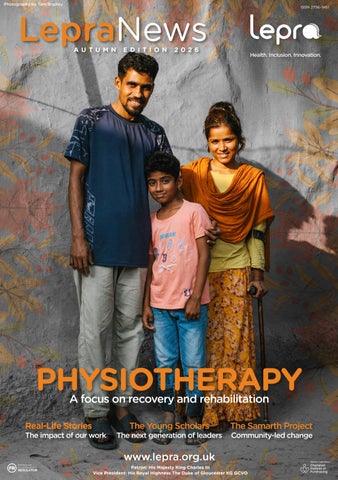
Photography by Tom Bradley
LepraNews AU T U MN
EDI T I ON
ISSN 2756-1461
2026
PHYSIOTHERAPY A focus on recovery and rehabilitation
Real-Life Stories
The impact of our work
The Young Scholars
The next generation of leaders
The Samarth Project
Community-led change
www.lepra.org.uk Patron: His Majesty King Charles III Vice President: His Royal Highness The Duke of Gloucester KG GCVO
INTRODUCTION
Welcome We are joined by Dr Vishal Pandey, Consultant Physiotherapist at LEPRA Society’s Indira Gandhi Hospital Referral Centre, for our autumn Lepra News appeal. It is my pleasure to introduce the Autumn issue of Lepra News, which focuses on the physiotherapy treatment and community self-care practice that plays a vital role in restoring people’s mobility, dignity and hope. I joined LEPRA Society as a physiotherapist in 2023 after completing my university training. This career has been a dream of mine from a young age; to be someone that can make a real difference, help heal people and help improve their lives. The best part for me as a physio, is that improvements can be made without the use of medicines, which means there are no negative side effects like there can be with many medications.
rehabilitation, it plays an important role in helping people to overcome the stigma and discrimination that so many vulnerable people still face. It helps people who have become isolated in their own community, find the confidence and emotional strength to once more find their place in society, and thrive. It gives me an enormous sense of achievement to see someone who had lost all hope walk again, use their hands again or return to work so they can earn money to support their family. For many people this treatment is transformational and life-changing.
Physiotherapy treatment is not just about physical
i
In the image above, Dr Pandey is conducting a ‘voluntary muscle test’ (VMT) to check the strength of muscle function. In this case, the ‘abductor pollicis brevis’ (the muscle present around the thumb) is being examined, which is often affected by inflammation of the median nerve.
2 I LEPRA NEWS AUTUMN 2026
The Indira Gandhi Hospital, New Delhi
One of the greatest challenges for us, is too many patients are coming to us late in the progression of their disease. There are many reasons for this, and many barriers that cause people to delay treatment. Many people fear being labelled by their diagnosis, not understanding that early treatment can prevent disabilities. Many people fear the financial burden of long-term treatment, and do not understand that multidrug therapy is provided for free by the National Leprosy Programme. In this issue of Lepra News, we also learn about Lepra’s work in endemic communities, which is helping to challenge the misinformation surrounding leprosy and lymphatic filariasis, and provide community support structures and self-support groups which are helping to overcome the barriers to treatment. We meet the new ‘Young Scholars’ from Bangladesh, who will be creating the next generation of community services for people affected. We will hear the inspirational ‘real-life story’ of Khaleda and her husband Sajib who received training to learn simple physiotherapy techniques to help manage their recovery together from their own home.
We will also hear about the outcomes of Lepra’s Samarth project in Madhya Pradesh, which for several years has helped establish and develop the practice of hundreds of self-support groups, in some of the most vulnerable communities of India. The project has supported over 1,200 people to learn self-care techniques, create opportunities to support people’s physical, social and emotional recovery. I hope you enjoy this issue, and can offer your support to our Autumn appeal, which will help countless people affected find the treatment and care they deserve. If you would like to hear me speak about my role as a physiotherapist, and hear more about the people I have supported, please scan the QR code below to watch a video interview I recently took part in for Lepra UK.
SCAN ME
“It’s not just about the physical rehabilitation, it’s about restoring dignity to the people who have been isolated by their own community and loved ones due to this disease.” - Dr Vishal Pandey.
FIND OUT MORE
LEPRA NEWS AUTUMN 2026 I 3
REAL-LIFE STORY
Khaleda’s Real-Life Story With treatment, counselling and self-care, Khaleda has overcome the physical and emotional impact of leprosy. Khaleda, aged 31, grew up in a remote village in Bogura, Bangladesh. Because of financial hardship, Khaleda never had the opportunity to attend school and spent her childhood helping with household chores and caring for her siblings. At the age of seven, an ulcer appeared on the sole of her right foot. As it worsened, people in the village began to spread rumours and superstitions. Her parents took her to several local doctors and traditional healers, but none of the treatment worked. Khaleda later went to hospital, where she was diagnosed with leprosy and given a course of multidrug therapy. Due to a long-lasting wound and prolonged infection, the bones below Khaleda’s ankle joint had become severely damaged and her foot could no longer support her body weight.
Eight years ago, Khaleda was fitted with a leg brace which enables her knee joint to take the pressure, allowing her to stand and walk. To further protect her feet, Khaleda wears custom-made footwear which safeguards against injuries that may otherwise go unnoticed due to loss of sensation caused by leprosy. The protective footwear, combined with the leg brace, help Khaleda to maintain mobility, independence and improve her overall quality of life. During her leprosy treatment, Khaleda met Sajib who is also affected by the disease. Sharing similar experiences, they supported each other and later married. The family have faced extraordinary social and emotional strain as Photography by Tom Bradley
4 I LEPRA NEWS AUTUMN 2026
“My husband is always supportive and always helps.” - Khaleda and Sajib’s relationship has been an important source of strength and resilience as they recover from their leprosy diagnosis.
a result of their diagnosis and Khaleda and Sajib are worried about the impact this has had on their son. Sajib explains:
“We want him to have a better future than we had.” The couple regularly practise self-care techniques to support the healing of existing wounds and prevent new injuries from forming. The practices help them to identify problems early and avoid further complications and disabilities. Years of stigma and social rejection deeply affected Khaleda’s confidence and emotional wellbeing. However, her situation began to improve when she received mental health counselling support through Lepra. With compassionate guidance and support, she gradually rebuilt her confidence and regained hope.
The couple are now supported by Rupali, a voluntary ‘Mental Motivator’ who regularly visits them at home to provide emotional support and guidance on selfcare. Today, Khaleda continues to face challenges but remains determined to live with dignity and create a better future for their seven-year-old son. Her story highlights the importance of compassionate care, community awareness, and psychosocial support for people affected by leprosy. To find out more about the inspirational personal accounts of people affected by leprosy and lymphatic filariasis, please scan the QR code below.
SCAN ME
SCAN ME
FIND OUT MORE
Rupali meets regularly with Khaleda to support her through the physical, social and emotional impact of a leprosy diagnosis.
FIND OUT MORE
Photography by Tom Bradley
LEPRA NEWS AUTUMN 2026 I 5
RESEARCH FOCUS
Samarth’s Community-Led Change Samarth is a community-led project working with people affected by leprosy and lymphatic filariasis in Chhatarpur district, Madhya Pradesh. Samarth was created to help people affected manage their health, support one another and become more confident in speaking up for their needs. Samarth worked with more than 1,200 members of self-support groups across three blocks and over 100 villages. Building on the groups established during the first phase of Samarth, the project used a harmonised communitydevelopment approach known as UPLIFT to strengthen self-care, peer support, leadership, feedback, advocacy and connections to local services. At the heart of the project was a simple but critical shift: people affected by leprosy and LF were not only receiving support, they were identifying their own priorities, learning how to manage their health, supporting peers, leading meetings and building a stronger collective voice within their communities.
Local groups taking the lead By the end of the project, members were running groups themselves instead of depending on project staff. They had chosen their own leaders, agreed how decisions would be made, identified the challenges affecting members and built connections with nearby health centres and local services.
i
In 96% of the groups, meetings were led by trained members. Every group also had a clear way for people to raise concerns and make suggestions. Trained peer supporters provided practical and emotional support to others. Members felt more confident speaking openly, making decisions together and asking for help. Samarth also played a vital role in helping members learn simple selfcare routines to protect their skin, manage swelling and identify complications early. By the end of the project, 98% of members had received selfcare training and 95% were practising selfcare regularly, either daily or several times a week. Daily self-care alone increased from 51% to 59%. Members also became more confident in looking after their health without ongoing NGO support. The proportion who felt very confident managing their own self-care almost doubled, rising from 21% to 38%.
The image above shows young students from the Chhatarpur district, taking part in an awareness rally, helping to change attitudes and spread important health messaging.
6 I LEPRA NEWS AUTUMN 2026
x
Confidence, dignity and inclusion Samarth was designed to address more than physical health. People affected by leprosy and LF can experience shame, isolation, discrimination and loss of confidence; barriers that can be as damaging as the conditions themselves. At the end of the project, 90.7% of respondents reported an improvement in their overall quality of life, compared with 74.7% at the beginning. Measures of mental wellbeing and self-efficacy also improved. The proportion reporting no discrimination from society increased from 80.0% to 93.3%, while those who said their family treated them the same increased from 86.4% to 97.2%.
Changing what communities know The project supported the participating self-support groups through the delivery of a range of information, education and communications activities, encouraging greater awareness and engagement which played a significant role in changing beliefs and behaviours. This included; school awareness sessions, the commissioning of public artworks, supporting Accredited Social Health Activist workers during MDA pill distribution, peer support work
i
and participation in ‘Village Health and Nutrition Day’ sessions conducted at ‘Anganwadi Centres’. The project’s influence extended beyond self-support group members. Community awareness of the signs, transmission and treatment of leprosy and LF improved substantially. Recognition of skin patches with loss of sensation as a sign of leprosy increased from 49% to 76%, while knowledge that leprosy treatment is available through government health centres rose from 61% to 90%. Awareness of LF increased from 70% to 97%, and correct identification of mosquito bites as the mode of transmission rose from 65% to 86%. Fearbased avoidance of people affected by leprosy or LF wearing protective footwear fell from 24% to 7%.
The work continues As the project comes to an end, the next priorities are clear: strengthen links with community and public health services, continue mentoring group leaders and peer supporters, remove the barriers that limit women’s participation, deepen work on family and marriage-related stigma, and ensure that every group has a practical plan for the future. The most important achievement of the project however, may be the shift behind those numbers: groups are increasingly able to organise, support members and solve problems for themselves. When people affected by leprosy and LF have the knowledge, confidence and opportunity to lead, support becomes more local, more relevant and more sustainable.
The Samarth project was delivered in partnership with Effect Hope and LEPRA Society, with funding contributed from The St Lazarus Charitable Trust
SCAN ME
FIND OUT MORE
LEPRA NEWS AUTUMN 2026 I 7
The Young Scholar Programme
A new two-year programme is supporting people affected by leprosy to develop their leadership skills, gain financial autonomy and become pivotal players in shaping solutions within their communities.
People affected by leprosy between the ages of 18 and 35 from the Bogura district of Bangladesh, were encouraged to apply to the Sasakawa Leprosy Initiative Young Scholar Programme, which aims to develop role models to foster future leaders who will impact local communities and beyond. The programme aims to play a critical role in nurturing the next generation of community leaders by placing meaningful participation, ownership, and leadership at its core. Rather than positioning scholars as passive recipients of training, the programme will treat them as active partners and future decision-makers who are central to shaping solutions within their own communities. Through the programme, scholars will build the confidence, skills, and selfbelief needed to take on leadership roles 8 I LEPRA NEWS AUTUMN 2026
“
within the community. This aligns closely with global commitments, including World Health Organization guidance, which emphasises that people affected by leprosy should not only participate in services, but also play an active role in leading programme design, advocacy, and implementation.
A key expectation is that the programme will create safe and supportive spaces for co-creation, where scholars reflect on their lived experiences and translate them into practical actions that address stigma, exclusion, and barriers to healthcare and social support. By engaging scholars in both learning and decision-making processes, the programme strengthens their sense of agency and responsibility for collective outcomes. Out of 44 potential candidates, following a rigorous selection process, five Young Scholars were chosen for the programme.
i. Image above shows the Young Scholars attending the TMSS Technical Institute in Bogura with mentors as part of their pre-training orientation.
“
Meet The Scholars!
PROGRAMME UPDATE
Over the coming months, we will follow the progress of the project, as the next generation of local community leaders grow and develop! Yousuf - Age 23 (Bottom left)
Lalon - Age 30 (Bottom right)
“As a Young Scholar, I want to advocate for the rights of people affected by leprosy, promote inclusion, and help create a society free from stigma and discrimination.
“I want to work for people affected by leprosy and other marginalised communities who are often neglected and deprived of their rights. I want to stand beside them, raise my voice for their rights, and support them in improving their quality of life.
I want to raise awareness, help people access timely treatment, and make a positive difference in my community.” Shompa - Age 23 (Top middle)
“I am committed to raising awareness about leprosy, promoting dignity and respect for people affected by the disease, and helping them access the healthcare and support they need.
As a scholar, I want to change the negative attitudes and misconceptions about leprosy in our society by raising awareness and promoting inclusion and respect for people affected by the disease.“
I also want to help create a community where no one is judged, neglected, or discriminated against because of leprosy.“ Taslima - Age 29 (Top right) “I am committed to serving people affected by leprosy and advocating for their rights. Let us learn the facts about leprosy, help others become aware of them, and work together to create an inclusive society where no one is left behind.“ Riya - Age 20 (Top left) “Inspired by my own experience, I want to reduce stigma, promote inclusion, and support marginalised communities. Through strong leadership, we can end the myths and stigma surrounding leprosy, encourage early diagnosis and treatment, and ensure no one suffers because of fear or misinformation.“ We look forward to following the progress of the Young Scholars and will be sharing updates via our website and social media channels. For more information on the Sasakawa Leprosy Initiative Young Scholar Programme, please scan the QR code.
SCAN ME
FIND OUT MORE
LEPRA NEWS AUTUMN 2026 I 9
EVENTS
The ‘New Face for Leprosy’ Exhibition Returns to Dedham In June, the New Face for Leprosy exhibition returned, with a special exhibition at the St. Mary’s Church in the historic village of Dedham, Essex. In February 2026, Lepra’s Patron, His Majesty King Charles III visited Dedham, and met with representatives of several charities and organisations, including Lepra. This June, the team returned to Dedham for a special outing of the New Face for Leprosy exhibition at the beautiful St. Mary’s Church, which is something of a local attraction for visitors to the historic village. For this two week event, five images and their accompanying real-life stories were exhibited, with a history of the project. This included the personal accounts from Tohmina, Haider, Bizly, Shah and Shamol, which are all available to read on the Lepra website. It was great to see so many visitors to the church throughout the exhibition, with many people stopping to read and engage with the real-life stories. The exhibition was in great company too, as it sat within the presence of a true artistic masterpiece: John Constable’s ‘The Ascension’, which was commissioned in 1821, the same year Constable painted The Hay Wain. If you would like another chance to see the New Face for Leprosy photographs, the full exhibition will be coming to Colchester Library in October. Sign up to our email updates and social media to find out more!
i
Created by Professor Diana Lockwood and photographer Tom Bradley, the ‘New Face for Leprosy’ exhibition is a thought-provoking series of portraits and real-life stories, celebrating the lives of people affected by leprosy and lymphatic filariasis and challenging the myths surrounding neglected tropical diseases.
10 I LEPRA NEWS AUTUMN 2026
AWARENESS
Lepra’s ‘Back to School’ Maria’s Island Reading Resources As children return to school this September, our ‘Maria’s Island’ school resources are helping the next generation of students explore curriculumbased themes such as prejudice, isolation, discrimination, and most importantly, hope. Written by Lepra Ambassador and bestselling author Victoria Hislop, the story follows a family impacted by leprosy, a disease which is often misunderstood. Aimed at young people aged 7-14, the book examines the challenges the family face and how they overcome them. Victoria explains, “The story focuses on the Cretan village of Plaka which overlooks the island of Spinalonga which from 1903-1957 is where people affected by leprosy, a then incurable disease, were sent away to. My story focuses on one family where the mother discovers she has leprosy and has to go and live in Spinalonga. It follows the impact on her family, how they survive and how she survives. Many of the people who went to
Spinalonga survived for maybe decades because leprosy is not a fast-growing disease, so the people who went there actually went to live there as well as knowing that they would probably die there. I think in recent times, Spinalonga has felt more relevant than ever as we have all faced a new disease that we have all been afraid of. I think a new relevance is to celebrate the work of scientists, the amazing miracle that they perform in bringing solutions to what one day seems incurable and the next we have a happy ending.” Maria’s Island by Victoria Hislop is illustrated by Gill Smith and published by Walker Books. It can be purchased in all good bookshops or online. Lepra has produced a range of educational resources about Maria’s Island which carefully and sensitively explore curriculum-based themes such as prejudice, isolation, discrimination, and most importantly, hope. Scan the QR code below to explore the educational resources, or search for ‘Maria’s Island’ on the Lepra website:
www.lepra.org.uk
SCAN ME
FIND OUT MORE
LEPRA NEWS AUTUMN 2026 I 11
“
A message from Khaleda “Curing leprosy takes medicine, but rebuilding a life takes long-term rehabilitation, physical therapy, and compassionate care. Today, my husband and I can look ahead with peace in our hearts, knowing we can care for our family and give our young son the happy childhood he deserves. SCAN ME
FIND OUT MORE
Please support Lepra today. Your gift will help provide custom-made footwear, physiotherapy, and home visits for someone who is waiting to rebuild their life. With my warmest greetings and gratitude.”
(Khaleda)
Photography by Tom Bradley
Help us support some of the world’s most vulnerable people.
Together we can build a better future!
£20
£50
£20 will provide a self-care kit for three people, containing protective bowls, towels, soap, gauzes, and ointment, to help people to care for their skin at home, prevent infection, and protect their independence.
£50 funds five days of hands-on wound management by a trained health worker, alongside essential antiseptics and dressings. This gentle care helps foot ulcers heal safely, relieving pain and preventing secondary infections.
£200 £200 will provide two weeks of specially trained physiotherapist care, including tailored exercise sessions and rehabilitation for 20 people, helping to rebuild muscle strength, restore mobility, and prevent permanent disability.
Five reasons to give regularly
1
Help people and their families affected by leprosy and LF receive the right care, at the right time and in the right place.
2
Help us plan future projects in the areas which need it most.
3
Spread your giving across the year, and change or stop payments at any time.
4
Help keep our administration costs low.
5
Stay informed through regular newsletters and progress updates.
Lepra, 28 Middleborough, Colchester, Essex, CO1 1TG 01206 216 700 - www.lepra.org.uk - lepra@lepra.org.uk Registered charity number: 00213251 (England and Wales) SCO39715 (Scotland)