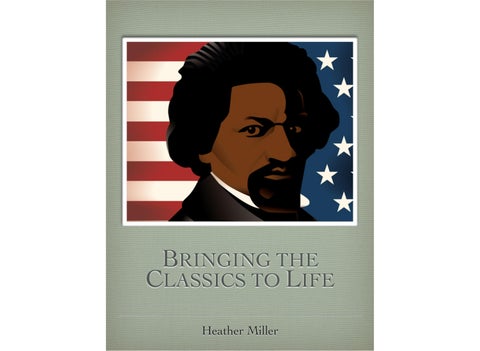
BRINGING THE CLASSICS TO LIFE Heather Miller
FOREWORD BY DANA GIOIA
WHY LITERATURE MATTERS In 1780 Massachusetts patriot John Adams wrote to his wife, Abigail, outlining his vision of how American culture might evolve. ''I must study politics and war," he prophesied, so ''that our sons may have liberty to study mathematics and philosophy." They will add to their studies geography, navigation, commerce, and agriculture, he continued, so that their children may enjoy the ''right to study painting, poetry, music . . . " Adams's bold prophecy proved correct. By the mid 20th century, America boasted internationally preeminent traditions in literature, art, music, dance, theater, and cinema. But a strange thing has happened in the American arts during the past quarter century. While income rose to unforeseen levels, college attendance ballooned, and access to information increased enormously, the interest young Americans showed in the arts -- and especially literature -- actually diminished.
i
According to the 2002 Survey of Public Participation in the Arts, a population study designed and commissioned by the National Endowment for the Arts (and executed by the US Bureau of the Census), arts participation by Americans has declined for eight of the nine major forms that are measured. (Only jazz has shown a tiny increase -- thank you, Ken Burns.) The declines have been most severe among younger adults (ages 18-24). The most worrisome finding in the 2002 study, however, is the declining percentage of Americans, especially young adults, reading literature.
decidedly literary in character: not ''linear, logical, analytical talents," author Daniel Pink states, but ''the ability to create artistic and emotional beauty, to detect patterns and opportunities, to craft a satisfying narrative." When asked what kind of talents they like to see in management positions, business leaders consistently set imagination, creativity, and higher-order thinking at the top. Ironically, the value of reading and the intellectual faculties that it inculcates appear most clearly as active and engaged literacy declines. There is now a growing awareness of the consequences of nonreading to the workplace. In 2001 the National Association of Manufacturers polled its members on skill deficiencies among employees. Among hourly workers, poor reading skills ranked second, and 38 percent of employers complained that local schools inadequately taught reading comprehension.
That individuals at a time of crucial intellectual and emotional development bypass the joys and challenges of literature is a troubling trend. If it were true that they substituted histories, biographies, or political works for literature, one might not worry. But book reading of any kind is falling as well. That such a longstanding and fundamental cultural activity should slip so swiftly, especially among young adults, signifies deep transformations in contemporary life. To call attention to the trend, the Arts Endowment issued the reading portion of the Survey as a separate report, ''Reading at Risk: A Survey of Literary Reading in America."
Corporate America makes similar complaints about a skill intimately related to reading -- writing. Last year, the College Board reported that corporations spend some $3.1 billion a year on remedial writing instruction for employees, adding that they ''express a fair degree of dissatisfaction with the writing of recent college graduates." If the 21st-century American economy requires innovation and creativity, solid reading skills and the imaginative growth fostered by literary reading are central elements in that program.
The decline in reading has consequences that go beyond literature. The significance of reading has become a persistent theme in the business world. The February issue of Wired magazine, for example, sketches a new set of mental skills and habits proper to the 21st century, aptitudes
The decline of reading is also taking its toll in the civic sphere. In a 2000 survey of college seniors from the top 55 ii
colleges, the Roper Organization found that 81 percent could not earn a grade of C on a high school-level history test. A 2003 study of 15- to 26-year-olds' civic knowledge by the National Conference of State Legislatures concluded, ''Young people do not understand the ideals of citizenship . . . and their appreciation and support of American democracy is limited."
young people to events from the past and principles of civil society and governance. Just as more ancient Greeks learned about moral and political conduct from the epics of Homer than from the dialogues of Plato, so the most important work in the abolitionist movement was the novel ''Uncle Tom's Cabin." Likewise our notions of American populism come more from Walt Whitman's poetic vision than from any political tracts. Today when people recall the Depression, the images that most come to mind are of the travails of John Steinbeck's Joad family from ''The Grapes of Wrath." Without a literary inheritance, the historical past is impoverished.
It is probably no surprise that declining rates of literary reading coincide with declining levels of historical and political awareness among young people. One of the surprising findings of ''Reading at Risk" was that literary readers are markedly more civically engaged than nonreaders, scoring two to four times more likely to perform charity work, visit a museum, or attend a sporting event. One reason for their higher social and cultural interactions may lie in the kind of civic and historical knowledge that comes with literary reading.
In focusing on the social advantages of a literary education, however, we should not overlook the personal impact. Every day authors receive letters from readers that say, ''Your book changed my life." History reveals case after case of famous people whose lives were transformed by literature. When the great Victorian thinker John Stuart Mill suffered a crippling depression in late-adolescence, the poetry of Wordsworth restored his optimism and self-confidence -- a ''medicine for my state of mind," he called it.
Unlike the passive activities of watching television and DVDs or surfing the Web, reading is actually a highly active enterprise. Reading requires sustained and focused attention as well as active use of memory and imagination. Literary reading also enhances and enlarges our humility by helping us imagine and understand lives quite different from our own.
A few decades later, W.E.B. DuBois found a different tonic in literature, an escape from the indignities of Jim Crow into a world of equality. ''I sit with Shakespeare and he winces not," DuBois observed. ''Across the color line I move arm in arm with Balzac and Dumas, where smiling men and
Indeed, we sometimes underestimate how large a role literature has played in the evolution of our national identity, especially in that literature often has served to introduce iii
welcoming women glide in gilded halls." Literature is a catalyst for education and culture. The evidence of literature's importance to civic, personal, and economic health is too strong to ignore. The decline of literary reading foreshadows serious long-term social and economic problems, and it is time to bring literature and the other arts into discussions of public policy. Libraries, schools, and public agencies do noble work, but addressing the reading issue will require the leadership of politicians and the business community as well. Literature now competes with an enormous array of electronic media. While no single activity is responsible for the decline in reading, the cumulative presence and availability of electronic alternatives increasingly have drawn Americans away from reading. Reading is not a timeless, universal capability. Advanced literacy is a specific intellectual skill and social habit that depends on a great many educational, cultural, and economic factors. As more Americans lose this capability, our nation becomes less informed, active, and independent-minded. These are not the qualities that a free, innovative, or productive society can afford to lose. Dana Gioia is chairman of the National Endowment for the Arts.
iv
PREFACE BY HEATHER MILLER
There are a few basic premises behind the supplemental program, Bringing Classics to Life.
•
Not all literature is created equal. Some books have greater educational value than others.
•
Literature has a history. By reading classical texts, students become familiar with how literature has developed over time.
•
The reading of classic literature is an intellectual discipline that improves with repeated practice.
•
The persistence and concentration required to read classic literature improves the child’s ability to read anything else.
•
All children are capable of reading age-appropriate, great works of literature.
•
Classic literature is relevant to young readers of all cultural backgrounds, walks of life, and periods. That’s what makes it classic!
v
I created this program to ensure that children of widely varying backgrounds and reading abilities could enjoy some of the best stories ever written. But how do you teach the Call of the Wild to a recent immigrant from Yemen? And how do you engage a tween from the Bronx in the rarified world of the Tudor court? Classic literature is known for its rigor. How can children who fail the end of year state exams possibly read a text that is three grades above their reading level?
•
Students in Charter Schools with class sizes of 20
•
Students in Public Schools with class sizes of 30
Reaching All Learners Bringing Classics to Life encompasses •
project-based learning to build background into the novel’s setting
•
dramatic adaptations of classic literature to build student engagement and fluency
•
the use of performance in the classroom to actively engage students in performing the text
•
slow and close readings of the original texts to develop comprehension skills Incorporating Nonfiction through Project-Based Learning: Spy Week
Through these techniques, the program has been successful with: •
English Language Learners
•
Students with Learning Challenges
•
Students in Gifted and Talented Programs
The program begins with Spy Week. During this week, students form teams and analyze informational texts to produce a “briefing” or “dossier” on their assigned topic. Each team is provided with a unique set of research vi
Performance in the Classroom
questions and deliverables. The questions are designed to address aspects of the setting and context of the novel.
The reading of the classic text is interspersed with performing dramatic adaptations of the classic story. Each student is assigned a role (or cluster of roles) and performs their character throughout the reading of the novel. When
Student teams must use the data to produce: maps • charts and tables • illustrations and diagrams • timelines • written reports At the end of Spy Week, each team presents their research to the Lead Spy who evaluates the quality of the group’s work. With the sharing of each team’s knowledge, the class is ready to begin reading the classic novel. As the students read the novel, they will catch all the historical and cultural references---for they built this background during Spy Week. •
the class reads the novel, students read the dialogue belonging to their assigned character. The dramatic adaptations (play versions) of the classic story remain very close to the original text. They do not condense or abridge the original. Students rehearse their assigned character’s lines for homework. During the lesson, they come to the front of the classroom and perform their scenes for their classmates. Working on this dramatic performance of the scenes from the novels builds confidence, fluency and engagement. vii
A program that appeals to boys
Moreover, it is important that students feel comfortable speaking literary language. This heightened English prose can be intimidating. By performing literary English regularly in the classroom, students come to feel comfortable and familiar with the conventions of different periods of English literary style.
One of the biggest surprises of implementing Bringing Classics to Life is how popular it is with boys of all ethnic and racial backgrounds, including boys who are classified as “reluctant readers.” In one school, a group of boys organized an afterschool practice session for enacting the script version of the classic text, The Prince and the Pauper. The boys were all English Language Learners born in countries as diverse as
The impact on student writing Reading and writing are complimentary processes.What a child reads will have a huge impact on how well she writes. Reading classic literature helps develop an eye and ear for beautiful English prose. By reading and hearing and performing the words of Mark Twain, Jack London, Robert Louis Stevenson, Charles Dickens, Frederick Douglass, Shakespeare and Harper Lee, students absorb the brilliance of these writers. All good writers “steal” from the authors they read. Child writers are no different; their sharp ears grow attuned to particular turns of phrase; elegant sentence structures and magnificent transitions. We see how much they have gained from the program when we note the traces of the authors we’ve read in the students’ written work.
viii
Bangladesh; Mexico, Yemen, Russia and Dominican Republic. In addition to their daily after-school sessions, these 12 year old boys started visiting each other on the weekends to practice play-acting the action scenes from the book. The love these boys showed for the program was particularly affecting because the school rarely observed inter-ethnic socializing in or outside of school.
particular place and time. In this way, students make the connection between reading literature and civics.
At other schools, boys and girls display similar enthusiasm for the opportunity to get up out of their seats and perform the characters from the stories. What could explain the particular love of these stories and dramatic play especially in boys? While the great adventure narratives of Treasure Island and Prince and the Pauper have always had universal appeal, I learned through observing the program in action that the boys of today are especially hungry for these tales of heroism, physical courage and adventure. The dramatic activities and soaring narrative arcs seem to answer a deep need to exercise both boys’ physical bodies and their imaginations.
•
The Social Studies Dimension Every classic text reflects the period it was born in. The cultural and historical aspects of the literature are explored throughout the reading of the novel. Students learn that great works of literature use the fiction form to reflect on philosophical, economical and ethical questions of a ix
SECTION 1
Each team has
∏ SpyWeek: Building Background through Nonfiction Sources
•
a student leader who is in charge of ensuring that all team members have clear deliverables to work on
•
a technology coordinator in charge of bringing laptops to the team and putting them away
Throughout the week, each team works autonomously on their projects. The teacher circulates the room, checking in with each team’s leader to ensure that every student has a clear task and is working on a deliverable. Teams produce a wide range of informational texts, including:
Before reading a work of classical literature, students build background through participating in Spy Week. Spy Week begins with a visit from an intelligence agent who asks the class to support the work of Scotland Yard in researching a subject. The class breaks into teams of 4 or 5 students. Each team is assigned a subtopic and has a detailed list of questions to research and deliverables to deliver. Every question is designed to develop a knowledge base that will “pay off” during the reading of the text. Rather than feel at sea in a challenging text, students understand the world of the book, grasp references the text makes and feel grown-up in their worldly knowledge.
•
maps
•
timelines
•
diagrams
•
illustrations
•
charts and tables
•
written reports
At the end of Spy Week, the intelligence agent returns to the class to be briefed on the class’ research. Each team presents their deliverables and a written “dossier” comprised of a thorough write-up on their assigned topic. 10
Spy Week
PROJECT-BASED LEARNING PROCESS •
Students are grouped into teams of four or five for a week-long task.
•
Each team has a team leader and a tech coordinator.
•
Each team is given a packet that includes • • •
sources research questions list of deliverables and deadlines
•
The team leader ensures that each teammate has a question and deliverable to work on.
•
For every day in the next week, the team will deliver one deliverable, eg a timeline, a map, a chart, or a written response.
•
On the final day of Spy Week, the team presents its research and deliverables to the class in a “briefing.”
Spy Week gives students a fun opportunity to interact with informational sources and quickly get up to speed with an area of research that they knew little about. Teachers become facilitators who circulate their classrooms, checking in with team leaders on the progress of each team’s research and deliverables. Students enjoy the autonomy and responsibility that comes with this week of project-based learning. 11
Example of 7th Grade Spy Week Team Task MEMO TO: Reformation Team (Marla Jones, Kadezia Watkins, Jose Nunez, Simon Woo) FROM: Head Spy RE: Your Spy Week Deliverables DATE: 01/22/15 _____________________________________________________________________________ Your sources are: The Reformation Team consists of • Marla Jones (Team Leader) • Martin Luther, His Road to Reformation, p. 180-190 • Jose Nunez (Tech Coordinator) • Henry the VIII, p, 240-250 • Simon Woo • Encyclopedia Brittanica Online • Kadezia Watkins • Martin Luther entry Your Research Questions are: • Protestant Reformation entry • What was the Protestant Reformation? • Indulgence entry • Who was Martin Luther? • Henry the VIII entry • What was an indulgence? • Why did King Henry the VIII change the religion of his kingdom?
Your Deliverables are: Tuesday, January 27: • Timeline of Major Events in Protestant Reformation starting with Martin Luther and ending with Henry the VIII’s change of religion • Paragraph Summary Response to “What was the Protestant Reformation?” Wednesday, January 28 • Cause and Effect Chart that explains “What is an indulgence?” • Short, one page biography of Martin Luther (answer to Who was Martin Luther?) Thursday, January 29 • Graphic Novel Depiction of causes for Henry the VII’s change of religion Friday January 30 • In-class presentation of research and deliverables.
12
Rubric for Evaluating Spy Week Presentations
RESEARCH QUESTION
CLARITY OF WRITTEN/ SPOKEN ANSWER
QUALITY OF EVIDENCE
QUALITY OF REASONING
QUALITY OF INFOGRAPHIC
What was the Protestant Reformation?
1
2
3
4
1
2
3
4
1
2
3
4
1
2
3
4
Who was Martin Luther?
1
2
3
4
1
2
3
4
1
2
3
4
1
2
3
4
What was an indulgence?
1
2
3
4
1
2
3
4
1
2
3
4
1
2
3
4
Why did Henry the VIII change the religion of his kingdom?
1
2
3
4
1
2
3
4
1
2
3
4
1
2
3
4
1
2
3
4
Poor
Fair
Good
Outstanding
13
CLOSE READING
∏ PROCESS
•
A short (1-2 page) section of a text is focused on for close reading.
•
By reading it dramatically, and engaging students in visualizing the text, the teacher ensures that all students understand its content.
•
The teacher asks a series of probing questions to prompt students to delve deeper into the text.
•
Students are encouraged to build on each other’s answers.
•
Five minutes of silent writing is assigned to promote concentration and “writing as thinking.”
•
Finally, students discuss the main analytical question.
Engaging with a Text The art of close reading presupposes a rich text worthy of repeated re-readings. Classic literature is ideal for close reading for exactly this reason. As masterpieces that have stood the test of time and entertained generations of serious readers, classic stories and novels reward the effort of close reading.
Bringing the Classics to Life provides teachers with short sections of the classic text to use for close reading. It also gives teachers a questioning sequence for each passage that is designed to probe student thinking and foster sophisticated analysis and meaning-making. The end result are student who genuinely enjoy digging into a text and have confidence in their ability. 14
Sample of 6th Grade Close Reading Text PROBING QUESTIONS •
Why does Dickens open A Tale of Two Cities with the prose poem that forms the first paragraph? What is he trying to accomplish?
•
Let’s assume the first paragraph tells about the setting. What aspect of the setting is Dickens writing about?
•
What is the text structure of the second paragraph?
•
Look at the final sentence of the second paragraph. What does it make you predict will happen? Why does it make you predict that?
•
Based on just these two paragraphs, what theme(s) do you think Dickens is writing about? Why?
During Spy Week, students will have built background on the causes of the French Revolution and the differences between French and English monarchies in the late 18th century.
Chapter I The Period It was the best of times, it was the worst of times, it was the age of wisdom, it was the age of foolishness, it was the epoch of belief, it was the epoch of incredulity, it was the season of Light, it was the season of Darkness, it was the spring of hope, it was the winter of despair, we had everything before us, we had nothing before us, we were all going direct to Heaven, we were all going direct the other way--in short, the period was so far like the present period, that some of its noisiest authorities insisted on its being received, for good or for evil, in the superlative degree of comparison only. There were a king with a large jaw and a queen with a plain face, on the throne of England; there were a king with a large jaw and a queen with a fair face, on the throne of France. In both countries it was clearer than crystal to the lords of the State preserves of loaves and fishes, that things in general were settled for ever. 15
DRAMA IN THE ELA CLASSROOM
Dramatic Reading
PROCESS •
Each student is assigned a character, or set of characters, in the book.
•
Each student keeps a journal reacting to the events of each chapter from the point of view of the character.
•
When the class reads the novel aloud, the student reads the dialogue of his/her character with appropriate tone, expression and accent.
•
Using the play adaptation of the classic text, students turn the front of the classroom into a stage and perform scenes from the book in front of their classmates.
•
The process of dramatic reading builds fluency, engagement, comprehension and confidence.
Dramatic reading is at the heart of Bringing Classics to Life. For most of history, people told stories orally. Even after literacy in the West was widely practiced, novels were read aloud to friends and families for diversion in the evenings. It is only relatively recently that reading literature as a silent, solitary activity has been the norm. All learners benefit from the repeated readings and the interactivity of merging our literature study with the dramatic arts. 16
Sample of Fourth Grade Play Adaptation of Classic Text: The Lion, The Witch and The Wardrobe NARRATOR At the foot of a tree sat a merry party, a squirrel and his wife with their children and two satyrs and a dwarf and an old dogfox, all on stools round a table. QUEEN (angrily) Holly? Plum pudding? What is the meaning of this? Speak, vermin! Or do you want my dwarf to find you a tongue with his whip? What is the meaning of all this gluttony? This waste? This self-indulgence? Where did you get all these things? FOX Please, your Majesty, we were given them. And if I might make so bold as to drink your Majesty’s very good health-- Who gave them to you?
QUEEN
F-F-F-Father Christmas.
FOX
WITCH What? He has not been here! He cannot have been here! How dare you---but no. Say you have been lying and even now you shall be forgiven. 17
LITERARY ANALYSIS PROCESS •
•
•
Students read the classic text in class, acting out the dialogue and dramatic action. Teachers facilitate rich discussions about literature that require close reading. Students focus on 1-2 page passages from the classic text. Teachers follow a questioning sequence designed to probe student thinking and develop analytical skills.
•
Students complete pre-writing activities to identify evidence.
•
Students are given a prompt designed to require evidencebased writing.
•
Teachers evaluate student writing using a rubric.
Writing from Evidence Writing well takes lots of practice.
Throughout Bringing Classics to Life, students have the opportunity to practice short and long responses to prompts.
Pre-writing activities help students build skills at identifying relevant details and quotes to support an argument.
Throughout the drafting process, students read their essays aloud to themselves, their peers and teachers so that they can hear dysfluencies or “logic gaps.” By making the act of sharing their work another opportunity at public reading, students develop a stronger sense of authorship, exactitude and pride in their written work.
When final drafts are submitted, teachers use clear rubrics to evaluate the success of student thinking and writing.
18
Sample of Seventh Grade Pre-Writing Activity
Good writing starts with good questions so Bringing the Classics to Life provides strong questions and supports teachers as they facilitate student inquiry and insight.
19
Sample of Seventh Grade Pre-Writing Activity The Teacher’s Edition helps teachers to promote student analysis of telling details; helping young writers marry evidence and reasoning.
20
Sample of Seventh Grade Essay Prompts
21
Sample of Seventh Grade Essay Rubric Essay Prompt: How does the narrator want the reader to think about Mathilde? Does the narrator want the reader to like Mathilde or dislike her? Use three quotes or details from the text to support your response. CRITERIA
EXCELLENT
GOOD
FAIR
POOR
THESIS
Clear thesis that shows thoughtfulness and originality
Clear thesis that shows thoughtfulness.
Basic thesis that shows little depth of thought
Absence of thesis or unclear thesis
DETAIL #1
Highly relevant to the thesis
Relevant to the thesis
Somewhat relevant to the thesis
Not relevant to the thesis or missing
DETAIL #2
Highly relevant to the thesis
Relevant to the thesis
Somewhat relevant to the thesis
Not relevant to the thesis or missing
DETAIL #3
Highly relevant to the thesis
Relevant to the thesis
Somewhat relevant to the thesis
Not relevant to the thesis or missing
TRANSITIONS
Well-chosen transitions that add to the clarity and flow of the essay
Mostly well-chosen transitions
Few transitions or more than two ill-used transitions
Inappropriate transitions or none at all
Clear, well-written conclusion that reiterates thesis
Basic conclusion that restates thesis in the same words as in the first paragraph.
Missing or unclear conclusion
CONCLUSION
Thought-provoking conclusion that reiterates thesis in a fresh way
22
ENGLISH LANGUAGE LEARNERS SUPPORTS •
Multimodal learning approaches to Spy Week (nonfiction research) and classical literature
•
Adapted classic texts with vocabulary support
•
Repeated readings help ELLs and LEP students internalize vocabulary and syntax and improve comprehension
•
Pre-writing activities provides scaffolding for ELLs
•
Cloze passages help students with significant language challenges structure their essays.
•
Emphasis on spoken word provides much more accessibility for ELLs to develop their language skills.
Reaching All Learners Bringing Classics to Life is an unapologetically demanding program. We have found that students embrace the inherent challenge of the rigorous texts in the program. Ironically, the fact that most texts are well above the target grade level evens out the playing field for those students who struggle with English Language Arts. Finally, they are in a classroom where the text is difficulty for everyone---and there is no shame in struggling to comprehend. The program does provide adapted texts for students who would benefit from reading the text first at a lower lexile, and then in the original. The play adaptations and assignments of characters to individual students motivate them to rehearse a limited number of lines as homework. The repetitive nature of rehearsal is ideal practice for building comprehension and fluency. Finally, the culture of the program is highly collaborative. Students are encouraged to recognize their set of comprehension strategies and to use them and their peers as resources while making sense of a challenging text. 23
Reaching All Learners For students who require additional language support, a version of the classic text with easier syntax and significant vocabulary support is made available. An interactive version of the text enables students to click on the boldfaced word to get both a visual and verbal definition. Idioms are covered as well.
24
MAKING PARENTS WELCOME OPPORTUNITIES •
Invite parents and family to the Spy Week Briefing so that students’ relatives can join in the fun and pride of the research presentations for the “Head Spy”
•
Have students perform a scene from their Classic Text at Parents’ Night
•
Share Bringing Classics to Life with your school’s after-school provider so that students can continue the dramatic arts engagement in the late afternoon.
•
Make two copies of each script for each student: one to remain at school and one to remain at home. Encourage students to “rehearse” with their parents and siblings.
Family and Community Engagement Everyone loves to watch their child perform. The work students do in class on dramatizing memorable scenes from classic literature translates beautifully into opportunities for family and community engagement. The playfulness of student performances provides a happy context for parents to visit the school. And families can also take pride in their child tackling one of the great works of world literature. In the photo below, a student leads a classmate in the opening ceremony of Bringing Classics to Life. Each student has to promise to rise to the challenge of the difficult task by using his strategies, and resources and leaning on each other to get through the entire book.
25
By providing an “at-home” copy of each play script, students can involve family in practicing their lines. In our experience, children often enjoy inviting their classmates over for rehearsal sessions. This is a perfect opportunity for them to play parts beyond the ones they have been assigned. The highly collaborative and multimodal nature of Spy Week makes it a wonderful activity for afterschools and summer schools. At the end of a long school day, map-making, illustrating and diagramming are highly visual ways for students to work together and produce something they can be proud of. The knowledge products produced by Spy Week can be presented as a Gallery show to which parents and family can be invited. Finally, the highly social nature of dramatic arts fosters a stronger sense of classroom community. Students learn that working hard can be fun and that challenging literature can be studied in an environment of risk-taking, experimentation and laughter. The most rewarding aspect of leading this program in schools is watching friendships form and deepen through the process of acting out scenes...and rehearsing them in the lunchroom, the hall ways and after school.
26
GRADE PRE-K
∏
MOTHER GOOSE RHYMES The classic rhymes of Mother Goose are like multivitamins for small children’s language skills. Nursery rhymes are full of alliteration and rhymes. Hearing them repeatedly helps build phonemic awareness. Learning these rhymes is an early start to cultural literacy. Many children’s books assume familiarity with Mother Goose.
AUTHOR Folk Culture GENRE Nursery Rhymes
LITERARY FEATURES
LANGUAGE DEVELOPMENT Phonemic awareness
•
•
Rhyme
•
•
Alliteration
•
•
•
Blending and syllable splitting
•
Syntax
•
•
•
• •
Rhythm
• •
frame story allusions allegory portal third person omniscient narrator motif and symbol setting character different temporal speeds
MOTOR SKILLS •
Students develop fine and gross motor skills through dramatic and kinesthetic activities performed while reciting Mother Goose Rhymes. These include:
MOTHER GOOSE RHYMES This curriculum includes: •
Hey, Diddle, Diddle
•
pat-a-cake
•
Three Blind Mice
•
acting out the story
•
Jack and Jill
•
clapping, skipping, snapping and stomping
•
Old King Cole
•
This Little Pig
•
finger puppets
28
GRADE K
∏ CINDERELLA The most important lesson of literature: that things are not always what they appear is the heart of Cinderella’s message. Cinderella starts off wealthy, gets turned into a maid and finally triumphs as a princess. Throughout all her outward transformations, she remains internally the same: honest, good and kind. Children delight in rooting for this worthy heroine.
AUTHOR Various: Charles Perrault, The Brothers Grimm GENRE Fairy Tale
DRAMATIC RETELLING •
•
•
•
LANGUAGE SKILL
The teacher or PD consultant performs a dramatic retelling of Cinderella. Audience participation (repeated refrains, lines of dialogue) are encouraged. The story is retold repeatedly; students are invited to act out the roles of different characters.
LITERARY FEATURES • • • • • • •
setting character conflict hero villain supernatural happy ending
Gradually, the class is able to tell the story from memory; acting out pivotal scenes and reciting phrases from memory.
DEVELOPMENT •
active listening
•
draw conclusions about characters’ traits and motivations
•
vocabulary development
•
plot structure: beginning, middle, end
•
asking and answering questions
•
recalling events in order
WRITING Students are provided with a cartoon strip with six squares. They are asked to draw what happens in the the first square and the last square. Space is provided for them to write captions for each picture. This tests their ability to identify the beginning and the end of the story. Then students are asked to identify the four most important events that happen in the story in correct order. This involves discussion and critical judgment. There is no one right answer---but correct choices reflect the ability to distinguish details from major events in the plot. Students draw the events in squares 2-5. This tests their ability to identify the middle of the story and put the events in order. 30
GRADE K
∏ LITTLE RED RIDING HOOD Following directions is a key Kindergarten skill. What story drives the importance of this skill home better than Little Red Riding Hood? Through this dramatic version, children learn to enjoy the feeling of suspense; the thrill of knowing more than the characters and the satisfaction of a happy ending.
AUTHOR Folklore, Charles Perrault GENRE Fairy Tale
DRAMATIC RETELLING •
•
•
•
LANGUAGE SKILL
The teacher or PD consultant performs a dramatic retelling of Little Red Riding Hood.
LITERARY FEATURES • •
Audience participation (repeated refrains, lines of dialogue) are encouraged.
•
The story is retold repeatedly; students are invited to act out the roles of different characters.
•
Gradually, the class is able to tell the story from memory; acting out pivotal scenes and reciting phrases from memory.
•
• • • •
setting character goal conflict climax hero villain dialogue happy ending
DEVELOPMENT •
active listening
•
mimicking voices/ styles of speaking
•
draw conclusions about characters’ traits and motivations
•
vocabulary development
•
two-track plot structure: beginning, middle, end
•
asking and answering questions
WRITING Students are provided with a cartoon strip with six squares. They are asked to draw what happens in the the first square and the last square. Space is provided for them to write captions for each picture. This tests their ability to identify the beginning and the end of the story. Then students are asked to identify the four most important events that happen in the story in correct order. This involves discussion and critical judgment. There is no one right answer---but correct choices reflect the ability to distinguish details from major events in the plot. Students draw the events in squares 2-5. This tests their ability to identify the middle of the story and put the events in order. 32
GRADE 1
∏ HANSEL AND GRETEL First graders are learning that people have minds of their own. The story of Hansel and Gretel dramatically captures this as the treacherous step mother and weakwilled father betray their children not once, but twice! It emphasizes this idea again when the children successfully trick the witch. It’s a perfect story for learning about plot structure.
AUTHOR Oral folklore; The Brothers Grimm GENRE Fairy Tale
DRAMATIC RETELLING •
•
•
LANGUAGE SKILL DEVELOPMENT •
active listening
•
draw conclusions about characters’ traits and motivations
•
vocabulary development
•
plot structure: beginning, middle, end
•
asking and answering questions
•
recalling events in order
•
identifying cause and effect
•
The teacher or PD consultant performs a dramatic retelling of Hansel and Gretel. Audience participation (repeated refrains, lines of dialogue) are encouraged. The story is retold repeatedly; students are invited to act out the roles of different characters. Gradually, the class is able to tell the story from memory; acting out pivotal scenes and reciting phrases from memory.
LITERARY FEATURES • • • • • • • • •
setting character character traits conflict hero villain supernatural dialogue happy ending
WRITING Students are provided with a cartoon strip with six squares. They are asked to draw what happens in the the first square and the last square. Space is provided for them to write captions for each picture. This tests their ability to identify the beginning and the end of the story. Then students are asked to identify the four most important events that happen in the story in correct order. This involves discussion and critical judgment. There is no one right answer---but correct choices reflect the ability to distinguish details from major events in the plot. Students draw the events in squares 2-5. This tests their ability to identify the middle of the story and put the events in order. 34
GRADE 1
∏ PUSS IN BOOTS This ancient story comes to us from 17th Century Italy---where social mobility was little more than a fantasy. Through his wit (and willingness to deceive), Puss in Boots is the ultimate consigliere winning fame, fortune and love for his master. This tale introduces concepts of social structure, injustice, and reinforces the idea that images can be illusions.
AUTHOR Oral folklore; Giovanni Francesco Straparola GENRE Fairy Tale
DRAMATIC RETELLING •
•
•
•
LANGUAGE SKILL
The teacher or PD consultant performs a dramatic retelling of Puss in Boots. Audience participation (repeated refrains, lines of dialogue) are encouraged. The story is retold repeatedly; students are invited to act out the roles of different characters. Gradually, the class is able to tell the story from memory; acting out pivotal scenes and reciting phrases from memory.
LITERARY FEATURES • • • • • • • • • •
setting character character traits conflict hero villain supernatural dialogue happy ending moral
DEVELOPMENT •
active listening
•
identify characters’ traits and motivations
•
vocabulary development
•
plot structure: beginning, middle, end
•
asking and answering questions
•
recalling events in order
•
compare and contrast
WRITING Students are provided with a cartoon strip with six squares. They are asked to draw what happens in the the first square and the last square. Space is provided for them to write captions for each picture. This tests their ability to identify the beginning and the end of the story. Then students are asked to identify the four most important events that happen in the story in correct order. This involves discussion and critical judgment. There is no one right answer---but correct choices reflect the ability to distinguish details from major events in the plot. Students draw the events in squares 2-5. This tests their ability to identify the middle of the story and put the events in order. 36
GRADE 2
∏ THE EMPEROR’S NEW CLOTHES By Grade 2, students are learning that you can convince people of things, even things that aren’t true. This story from Hans Christian Anderson delivers a sophisticated idea in an age-appropriate way: it’s always best to trust your own judgment and think for yourself. Children delight in the silliness of the vain emperor and his easilyintimidated advisors in this humorous tale.
AUTHOR Hans Christian Andersen GENRE Fairy Tale
DRAMATIC RETELLING •
•
•
LANGUAGE SKILL DEVELOPMENT •
active listening
•
draw conclusions about characters’ traits and motivations
•
The teacher or PD consultant performs a dramatic retelling of The Emperor’s New Clothes Audience participation (repeated refrains, lines of dialogue) is encouraged.
LITERARY FEATURES • • • • •
Students are given a script version of the play and are assigned the roles of different characters.
•
The class practices performing the play as Readers Theatre.
•
• •
•
setting character character traits imagery hero villain humor witty banter dialogue happy ending
WRITING Students are provided with a cartoon strip with six squares.
•
vocabulary development
•
plot structure: beginning, middle, obstacles, climax, end
•
asking and answering questions
•
recalling events in order
Then students are asked to identify the four most important events that happen in the story in correct order. This involves discussion and critical judgment. There is no one right answer---but correct choices reflect the ability to distinguish details from major events in the plot.
•
recognizing humorous situations
Students draw the events in squares 2-5. This tests their ability to identify the middle of the story and put the events in order.
They are asked to draw what happens in the the first square and the last square. Space is provided for them to write captions for each picture. This tests their ability to identify the beginning and the end of the story.
38
GRADE 2
∏ GREEK MYTHS The Greek Myths introduce second graders to a rich set of characters from Pandora to Pygmalion, from Hera to Zeus, from Aphrodite to Athena. These stories reveal the idiosyncrasies of human nature while also providing imaginative explanations for the natural world. Myths are also a new genre for young readers who learn the distinctions between fable, fairy tale, and myth.
AUTHOR Folklore GENRE Mythology
•
•
•
LANGUAGE SKILL
•
The teacher or PD consultant performs a dramatic retelling of Greek Myths. Audience participation (repeated refrains, lines of dialogue) is encouraged. Students are given a script version of the myths and are assigned the roles of different characters. The class practices performing the play as Readers Theatre.
DEVELOPMENT •
active listening
•
draw conclusions about characters’ traits and motivations
•
vocabulary development
•
plot structure: beginning, middle, obstacles, climax, end
•
asking and answering questions
•
recalling events in order
•
compare and contrast
LITERARY FEATURES
DRAMATIC RETELLING • • • • • • • • • • •
legends gods goddesses setting character character traits imagery hero villain supernatural fate
WRITING Students are provided with a cartoon strip with six squares. They are asked to draw what happens in the the first square and the last square. Space is provided for them to write captions for each picture. This tests their ability to identify the beginning and the end of the story. Then students are asked to identify the four most important events that happen in the story in correct order. This involves discussion and critical judgment. There is no one right answer---but correct choices reflect the ability to distinguish details from major events in the plot. Students draw the events in squares 2-5. This tests their ability to identify the middle of the story and put the events in order. 40
GRADE 3
∏ A SERIES OF UNFORTUNATE EVENTS Is there a better example of narrative tone than the snide and overbearing tone of Lemony Snicket, the narrator of A Series of Unfortunate Events? Third graders appreciate the fastmoving, melodramatic plot and identify with the hapless orphans. The inherent theatricality of this text makes it perfect for dramatic reading; building both confidence and fluency in young readers.
AUTHOR Lemony Snicket/ Daniel Handler
LITERARY FEATURES
DRAMATIC READING •
GENRE Humorous Suspense Fiction •
LANGUAGE SKILL
Students are assigned a role or set of roles in the book, including taking turns as narrator. They read their character’s lines and write responses from their character’s point of view.
•
The teacher pretends to take the side of Count Olaf --- and requires students to provide text evidence to prove his guilt.
•
active listening
•
draw conclusions about characters’ traits and motivations
•
vocabulary development
•
plot structure: beginning, middle, obstacles, climax, end
•
asking and answering questions
• • • •
• • •
DEVELOPMENT •
•
•
setting narrator tone character traits allusion villain wit dialogue plot twists mystery alliteration
WRITING Creative Writing Students write creative responses in the form of letters from the point of view of their assigned character. These letters are alternately addressed to Count Olaf, Justice Strauss and Mr. Poe. Academic Writing During the reading of the novel, students write
•
recalling events in order
•
short and long responses to prompts
•
recognizing humorous situations
•
analytical essays based on close reading 42
GRADE 3
∏ ARABIAN NIGHTS
Arabian Nights is a collection of Middle Eastern and Indian stories including the famous tales Aladdin, Ali Baba and Sinbad. It is a composite work, with no single author. The strand that ties all the stories together is the narrative frame, the story within the story of Scherezade, the young princess who distracts a Sultan from murdering her by telling him wonderful stories.
AUTHOR Oral Folklore GENRE Folk Tales, Frame Story
DRAMATIC READING •
•
•
LANGUAGE SKILL
LITERARY FEATURES
The teacher or PD consultant performs a dramatic retelling of Aladdin, Sinbad and Ali Baba and the Temple of Thieves. Students are given a script version of the folk tales and are assigned the roles of different characters. The class practices performing the play as Readers Theatre.
• • • • • • • • • •
the supernatural frame story setting narrator character traits conflict allusion villain dialogue plot twists
DEVELOPMENT •
compare and contrast
•
cause and effect
•
vocabulary development
•
plot structure: beginning, middle, obstacles, climax, end
•
asking and answering questions
WRITING Creative Writing Students write creative responses in the form of letters from the point of view of their assigned character. Academic Writing During the reading of the novel, students write
•
recalling events in order
•
short and long responses to prompts
•
recognizing irony
•
analytical essays based on close reading 44
GRADE 4
∏ THE LION, THE WITCH AND THE WARDROBE Combining fantasy, mythology and adventure, C.S. Lewis’ legendary novel introduces children to a world where it is always winter, but never Christmas. Written in the wake of World War II, the Lion, the Witch and the Wardrobe is an allegorical tale. Third graders learn the history behind the book’s wartime English setting and the long war that is symbolized as an endless winter.
AUTHOR C.S. Lewis
DRAMATIC READING •
GENRE Fantasy PUBLICATION DATE 1950
SPY WEEK •
Teams are assigned to research the following topics which inform the historical and religious background to the novel: •
•
Overview of World War II and rise of Hitler Blitzkriegs in London and evacuation of London children to the countryside
•
The Gospel of Luke 22-4
•
The Snow Queen and Norse Mythology
•
•
•
Each character is assigned a role or set of roles from the book. The class alternates between reading the novel and the play adaptation. During in-class novel reading, the students read their characters’ dialogue dramatically while the teacher or a student reads the narration. Students rehearse the playscript and record it as a radio play.
WRITING During SPY WEEK, students produce •
maps, timelines, charts and illustrations
•
expository writing
During the reading of the novel, students write •
short and long responses to prompts
•
analytical essays based on close reading 46
LITERARY FEATURES • • • • •
• • • •
frame story allusions allegory portal third person omniscient narrator motif and symbol setting character different temporal speeds
GRADE 4
∏ ROBIN HOOD Fourth graders are ready for a complex hero: a man who does wrong for all the right reasons. This centuries-old legend takes us into the world of Medieval England and the strict social stratification of that time and place. During Spy Week, we learn about the chivalric code and how Robin Hood embodies is. We also learn about feudalism, how boys became knights and the way of life in Medieval English towns and castles.
AUTHOR Howard Pyle GENRE Legend PUBLICATION DATE 1883
LITERARY FEATURES
DRAMATIC READING Each character is assigned a role or set of roles from the book. The class alternates between reading the novel and the play adaptation. During in-class novel reading, the students read their characters’ dialogue dramatically while the teacher or a student reads the narration. Students rehearse the play script and record it as a radio play.
SPY WEEK Teams are assigned to research the following topics which inform the historical background to the novel:
WRITING During SPY WEEK, students produce
•
Chivalric code
maps, timelines, charts and illustrations
•
Feudalism
expository writing
•
Social structure in latemedieval England
•
King Richard the Lionheart
During the reading of the novel, students write short and long responses to prompts analytical essays based on close reading 48
the ballad tradition legends oral storytelling hero anti-hero villain English folk mythology setting character rescue plots
GRADE 4
∏ TREASURE ISLAND This is the ultimate adventure story---and the first long novel ever written for children! In Robert Louis Stevenson’s timeless prose, the characters of Long John Silver, Jim Hawkins and Dr Livesey come alive. Our dramatic adaptations enable fourth graders to act up a storm in swashbuckling action scene after action scene.
AUTHOR Robert Louis Stevenson GENRE Adventure Novel PUBLICATION DATE 1881
LITERARY FEATURES
DRAMATIC READING Each character is assigned a role or set of roles from the book. The class alternates between reading the novel and the play adaptation. During in-class novel reading, the students read their characters’ dialogue dramatically while the teacher or a student reads the narration. Students rehearse the play script and record it as a radio play.
SPY WEEK Teams are assigned to research the following topics which inform the historical background to the novel: •
The British Empire in the 18th Century
WRITING During SPY WEEK, students produce maps, timelines, charts and illustrations expository writing During the reading of the novel, students write
•
Transatlantic Shipping Lines
•
Piracy in the 18th Century
short and long responses to prompts
•
Geography in the Caribbean
analytical essays based on close reading 50
the quest hero anti-hero villain first person narration dialect theme symbol setting character figurative language
GRADE 5
∏ NARRATIVE OF THE LIFE OF FREDERICK DOUGLASS Frederick Douglass’ autobiography allows fifth graders to experience the horrors of slavery through the eyes of someone who survived it. During SpyWeek, we cover the global history and economics of the slave trade. First, we study slavery as it existed within Africa. Then, we study the development of the transatlantic slave trade and its central role in colonialism. This background knowledge enables students to fully appreciate Frederick Douglass’ life and work.
AUTHOR Frederick Douglass
LITERARY FEATURES DRAMATIC READING
GENRE Autobiography PUBLICATION DATE 1845
Each character is assigned a section of the text to read dramatically. As they prepare to read their excerpt, students master speaking with correct tone, pace, emphasis and prosody. Students perform their excerpt (reading from the book) before the class and receive feedback from their peers.
SPY WEEK Teams are assigned to research the following topics which inform the historical background to the novel: •
•
•
•
Slavery within Africa pre1500 Transatlantic Slave Trade 1500-1800 The Constitution, US Laws and Slavery
WRITING During SPY WEEK, students produce •
maps, timelines, charts and illustrations
•
expository writing
During the reading of the novel, students write •
short and long responses to prompts
•
analytical essays based on close reading
Slave Narratives 52
anecdote description flashback memoir theme narrative tone treatise setting character literary language first person narration
GRADE 5
∏ SHERLOCK HOLMES AND THE RED-HEADED LEAGUE Is there a better genre for teaching close reading than the detective genre? Detectives are the ultimate close readers. Through looking over the shoulder of Sherlock Holmes, fifth graders learn to pay attention to details and not take anything at face value. When students complete this wonderful story, they will be better close readers and able to spot a red herring a mile away!
AUTHOR Arthur Conan Doyle GENRE Detective Story PUBLICATION DATE 1891
LITERARY FEATURES
DRAMATIC READING Each character is assigned a role or set of roles from the book. The class alternates between reading the novel and the play adaptation. During in-class novel reading, the students read their characters’ dialogue dramatically while the teacher or a student reads the narration. Students rehearse the play script and record it as a radio play.
SPY WEEK Teams are assigned to research the following topics which inform the historical background to the novel: •
Society in Victorian London
WRITING During SPY WEEK, students produce maps, timelines, charts and illustrations expository writing
•
Crime in Victorian London
•
Science and Technology in Victorian England
short and long responses to prompts
•
British Empire in the 1800s
analytical essays based on close reading
During the reading of the novel, students write
54
mystery plot anti-hero villain red herring anomalies setting character clues
GRADE 6
∏ A TALE OF TWO CITIES An epic work of historical fiction, A Tale of Two Cities is part mystery, part romance, part suspense novel. During SpyWeek, students learn about the causes of the French Revolution and the differences between the political systems in England and France in the late 1700s. They also learn about the impact of the American Revolution on the French. This is an ambitious book for 6th graders, but makes a lasting impression.
AUTHOR Charles Dickens GENRE Historical Fiction PUBLICATION DATE 1859
LITERARY FEATURES
DRAMATIC READING Each character is assigned a role or set of roles from the book. The class alternates between reading the novel and the play adaptation. During in-class novel reading, the students read their characters’ dialogue dramatically while the teacher or a student reads the narration. Students rehearse the play script and record it as a radio play.
SPY WEEK Teams are assigned to research the following topics which inform the historical background to the novel:
WRITING During SPY WEEK, students produce
•
Montesquieu
maps, timelines, charts and illustrations
•
The Enlightenment
expository writing
•
Causes of the French Revolution
•
King Louis XIV and Queen Marie-Antoinette
During the reading of the novel, students write short and long responses to prompts analytical essays based on close reading 56
duality; twins theme motif comic relief tableaux vivants “set pieces” hero anti-hero villain setting character rescue plots
GRADE 6
∏ CLASSICAL MYTHOLOGY As students begin to read challenging poetry, they benefit from a tour of classical mythology. Greek and Roman myths provide imagery in Shakespearean plays and in many of the most famous English poems. Reading these myths as older children enables students to reflect on the insights they shed into human nature.
AUTHOR Edith Hamilton GENRE Mythology PUBLICATION DATE 1942
LITERARY FEATURES
DRAMATIC READING Each character is assigned a role or set of roles from the collection of myths The class alternates between reading the myths and the play adaptation. During in-class reading, the students read their characters’ dialogue dramatically while the teacher or a student reads the narration. Students rehearse the play script and record it as a radio play.
SPY WEEK Teams are assigned to research the following topics which inform the historical and literary background to the novel: •
Homer’s Iliad and Odyssey
•
Edith Hamilton
•
Ovid’s Metamorphoses
•
Virgil’s The Aeneid
WRITING During SPY WEEK, students produce maps, timelines, charts and illustrations expository writing During the reading of the novel, students write short and long responses to prompts analytical essays based on close reading 58
oral storytelling the hero’s quest archetype tragedy symbols imagery hero anti-hero villain setting character
GRADE 6
∏ JULIUS CAESAR Sixth graders are at the start of adolescence --- and are all too familiar with the idea that there is a public self and a private self. Shakespeare’s Julius Caesar delves into just this distinction, and also explores themes of betrayal, misinterpretation and fate. The power dynamics within Julius Caesar are not so unfamiliar to the 6th grade classroom---making this a wonderful first exposure to Shakespeare’s genius.
AUTHOR William Shakespeare GENRE Tragedy/ Drama PUBLICATION DATE 1599
DRAMATIC READING Each character is assigned a role or set of roles from the play. The class alternates between reading the original play and an adapted version that is easier to understand. Students rehearse scenes from the play and record it as a radio play.
SPY WEEK Teams are assigned to research the following topics which inform the historical background to the novel: •
Ancient Rome 44 BC
•
Elizabethan England
•
Julius Caesar
•
Geography of Ancient Rome 44 BC
WRITING During SPY WEEK, students produce maps, timelines, charts and illustrations expository writing During the reading of the novel, students write short and long responses to prompts analytical essays based on close reading 60
LITERARY FEATURES tragic flaw omens supernatural tragedy soliloquy themes figurative language irony motif paradox allusion foreshadowing iambic pentameter
GRADE 7
∏ ROMEO AND JULIET Seventh graders are ready for the tour de force that is Shakespeare’s Romeo and Juliet. During Spy Week, students learn about the medieval marital habits of aristocrats; the norms of marrying age and the role of the church in intervening in family disputes. This sets the context for the star-crossed lovers. Students enjoy bringing this script to life through in-class dramatizations.
AUTHOR William Shakespeare GENRE Tragedy/ Drama PUBLICATION DATE 1595
LITERARY FEATURES DRAMATIC READING Each character is assigned a role or set of roles from the play. The class alternates between reading the original play and an adapted version that is easier to understand. Students rehearse scenes from the play and record it as a radio play.
SPY WEEK Teams are assigned to research the following topics which inform the historical background to the novel: •
Marriage in Medieval England
WRITING During SPY WEEK, students produce maps, timelines, charts and illustrations expository writing
•
Pyramus and Thisbe
•
Elizabethan Theatre
•
Arthur Brooke
short and long responses to prompts
•
William Shakespeare
analytical essays based on close reading
During the reading of the novel, students write
62
pun sub-plot prologue sonnet blank verse elegy omens soliloquy themes figurative language irony motif
GRADE 7
∏ THE CALL OF THE WILD What role does nature play in determining who we become? What role does nurture play? These timeless questions are explored in Jack London’s The Call of the Wild. During Spy Week, students study the geography of the Yukon and learn about the Gold Rush. They identify the unique value that powerful dogs offered in this extreme climate.
AUTHOR Jack London GENRE Adventure Novel PUBLICATION DATE 1903
DRAMATIC READING Each character is assigned a role or set of roles from the book. The class alternates between reading the novel and the play adaptation. During in-class novel reading, the students read their characters’ dialogue dramatically while the teacher or a student reads the narration. Students rehearse the play script and record it as a radio play.
SPY WEEK Teams are assigned to research the following topics which inform the historical background to the novel: •
The Yukon
•
Klondike Gold Rush
•
Charles Darwin
•
Iditarod
WRITING During SPY WEEK, students produce maps, timelines, charts and illustrations expository writing During the reading of the novel, students write short and long responses to prompts analytical essays based on close reading 64
LITERARY FEATURES literary naturalism third person limited p.o.v. diction allegory soliloquy themes hero irony motif setting allusion foreshadowing villain
GRADE 7
∏ THE PRINCE AND THE PAUPER The notion of the double, or twin, is a recurring one in literature. Mark Twain created one of the most famous set of twins in The Prince and The Pauper. The novel offers countless opportunities to compare and contrast characters, settings and themes. During SpyWeek, students study Tudor England, including the Protestant Reformation and the dissolution of the monasteries.
AUTHOR Mark Twain GENRE Historical Fiction PUBLICATION DATE 1881
LITERARY FEATURES
DRAMATIC READING Each character is assigned a role or set of roles from the book. The class alternates between reading the novel and the play adaptation. During in-class novel reading, the students read their characters’ dialogue dramatically while the teacher or a student reads the narration. Students rehearse the play script and record it as a radio play.
SPY WEEK Teams are assigned to research the following topics which inform the historical background to the novel: •
The Reformation
•
Society in Tudor London
•
Tudor Royal Family
•
Edward VI
WRITING During SPY WEEK, students produce maps, timelines, charts and illustrations expository writing During the reading of the novel, students write short and long responses to prompts analytical essays based on close reading 66
doubling; twins tableaux vivants: set pieces themes figurative language irony motif paradox allusion foreshadowing setting villain
GRADE 7
∏ THE NECKLACE The tale of an envious French woman who wants what she cannot have is filled with irony. Seventh graders flex their close reading muscles as they ask what the story’s twist ending means. During Spy Week, students learn about the rise of consumerism in late 19th Century Paris, the expansion of that city and the links of these trends to Industrialization.
AUTHOR Guy de Maupassant GENRE Short Story PUBLICATION DATE 1884
SPY WEEK Teams are assigned to research the following topics which inform the historical background to the novel: • •
•
•
Guy de Maupassant Rise of consumerism in Paris in late 1800s Opportunities for women in France in late 1800s Social structure in France in late 1800s
LITERARY FEATURES
DRAMATIC READING Each character is assigned a role or set of roles from the book. The class alternates between reading the novel and the play adaptation. During in-class novel reading, the students read their characters’ dialogue dramatically while the teacher or a student reads the narration. Students rehearse the play script and record it as a radio play.
WRITING During SPY WEEK, students produce •
maps, timelines, charts and illustrations
•
expository writing
During the reading of the novel, students write •
short and long responses to prompts
•
analytical essays based on close reading 68
twist ending irony motif paradox allusion foreshadowing setting character traits themes
GRADE 8
∏ TO KILL A
MOCKINGBIRD Racial injustice in the Depressionera South is the subject of this powerful novel by Harper Lee. The narrator is a young girl making sense of her hometown and its endemic prejudice. When her father defends an unjustly accused African-American man, the legacy of slavery and persistent apartheid is brought up close and personal. An ideal book for teaching about how novels can explore themes of class and justice.
AUTHOR Harper Lee GENRE Southern Gothic/ Coming of Age Novel PUBLICATION DATE 1960
LITERARY FEATURES
DRAMATIC READING Each character is assigned a role or set of roles from the book. The class alternates between reading the novel and the play adaptation. During in-class novel reading, the students read their characters’ dialogue dramatically while the teacher or a student reads the narration. Students rehearse the play script and record it as a radio play.
SPY WEEK Teams are assigned to research the following topics which inform the historical background to the novel: •
Class Structure of the Deep South
WRITING During SPY WEEK, students produce •
maps, timelines, charts and illustrations
•
expository writing
•
Slavery in the South
•
The Great Depression
•
short and long responses to prompts
•
Jim Crow Laws
•
analytical essays based on close reading
During the reading of the novel, students write
70
Gothic coming-of-age novel supernatural tragedy realism diction figurative language irony symbolism epithet allusion courtroom scene first-person narrator
GRADE 8
∏ TWELFTH NIGHT
Mistaken identity, romance, deceit and disguise---it’s all at the heart of Shakespeare’s comedy, Twelfth Night. This play is all the more powerful in an age when gender constraints are increasingly challenged. Eighth graders will enjoy the rich comic fare and the intrigue of the romantic plot.
AUTHOR William Shakespeare GENRE Comedy/ Drama PUBLICATION DATE 1601
LITERARY FEATURES DRAMATIC READING Each character is assigned a role or set of roles from the play. The class alternates between reading the original play and an adapted version that is easier to understand. Students rehearse scenes from the play and record it as a radio play.
SPY WEEK Teams are assigned to research the following topics which inform the historical background to the novel: •
Elizabeth I
•
Festival of Twelfth Night
•
Carnival
•
Puritans and the Theatre
WRITING During SPY WEEK, students produce •
maps, timelines, charts and illustrations
•
expository writing
During the reading of the novel, students write •
short and long responses to prompts
•
analytical essays based on close reading 72
twins, doubling mistaken identity cross-dressing witty banter subplots figurative language letters motif rhyming couplet the clown word play iambic pentameter
GRADE 8
∏ WHO’S IRISH?
A brilliantly humorous story about a Chinese grandmother raising her half-Irish, half-Chinese granddaughter, Who’s Irish? tackles cultural assimilation and crosscultural child-rearing practices.
During Spy Week, students learn about Confucian philosophy and the differences between progressive and traditional parenting styles.
AUTHOR Gish Jen GENRE Short Story PUBLICATION DATE 1999
LITERARY FEATURES
DRAMATIC READING Each character is assigned a role or set of roles from the story. The class alternates between reading the story and the play adaptation. During in-class reading, the students read their characters’ dialogue dramatically while the teacher or a student reads the narration. Students rehearse the story version and record it as a radio play.
SPY WEEK Teams are assigned to research the following topics which inform the historical background to the novel: •
Confucius
•
Amy Chua: Tiger Mother
•
Dr. Spock
•
The Triple Package
WRITING During SPY WEEK, students produce •
maps, timelines, charts and illustrations
•
expository writing
During the reading of the novel, students write •
short and long responses to prompts
•
analytical essays based on close reading 74
first person narrator unreliable narrator cross-cultural misunderstanding foil themes figurative language irony humor allusion social commentary
IMPLEMENTATION Bringing Classics to Life is a supplemental program designed to be taught at least twice a week for 30 minutes in the ELA block throughout the school year. In some schools, it has been used as a central reading program and used on a daily basis. Because of its strong arts infusion and adaptations for below-level readers, the program also works well •
as an after-school program
•
as a small-group Targeted Assistance program
•
for Saturday Academy
•
as the curriculum for a literacy-enriched Arts elective
•
for summer schools
Professional Development Professional Development for Bringing Classics to Life is offered exclusively through LePage-Miller, Inc. which operates in New York City and Miami. lxxv