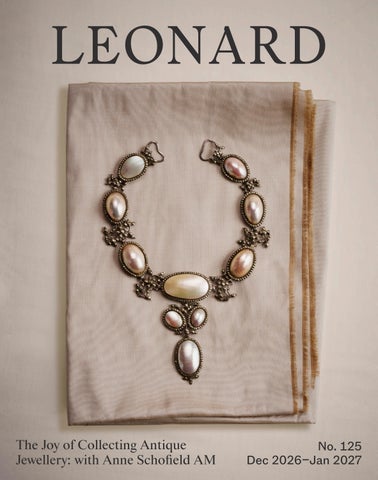
The Joy of Collecting Antique Jewellery: with Anne Schofield AM
No. 125 Dec 2026–Jan 2027
No. 125
Welcome to the holiday issue of LEONARD Magazine. Our 125th issue is filled with articles perfect for summer reading, from exhibitions worth a visit over the holidays, to reflections on motherhood inspired by the most enduring images of matrescence in Western art: the Madonna and Child. We delve into the fascinating histories behind exquisite jewels with renowned antique jewellery dealer Anne Schofield, trace the evolution of Chanel’s iconic handbag designs over the decades, demystify the sometimes lengthy cataloguing descriptions of prints and other editioned works, and more. We also had the pleasure of chatting with Nick Flood, a conservator of objects and archaeology, about his current projects and the practices and techniques that shape his work both in the laboratory and out in the field. We wish you an enjoyable, restful holiday season and look forward to embarking on a busy and exciting 2027 auction calendar with you in the new year.
auction calendar
December 2026 – January 2027
4
features
Promise Kept: Living with an Arts Project Australia Portrait Reading the Fine Print: Understanding the Cataloguing of Prints & Multiples The Joy of Collecting Antique Jewellery: with Anne Schofield AM The Tourbillon de force of Breguet Curated for Summer: The Art Department’s Top Exhibition Picks A Century of Creative Crossovers The Art of Motherhood: From Madonna to Modernity Chanel Handbag Design Through the Years Kokeshi Dreaming
6 10 12 16 18 22 24 28 30
in focus
Five Minutes with Luke Guan From the Workshop: The Art & Science of Conservation with Nick Flood The Collector’s Forecast 22nd Report: Meet Oaka, the Rescue Dog Training to Save Koalas A Last Look
31 32 36 37 40
join us
Connect Value, Sell & Buy
42 43
cover: Rare Georgian coque de perle, marcasite and cut steel necklace, circa 1740 $3,800-4,800 The Anne Schofield AM Collection - A Legacy in Antique Jewellery Auction Tuesday 1 December below: Pair of diamond earrings $7,000-10,000 Fine Jewels Sydney Auction Wednesday 2 December
December 2026 – January 2027
3
AUCTION CALENDAR DECEMBER 2026 – JANUARY 2027
December
Prints & Multiples Tue 1 Dec, 10am Melbourne The Anne Schofield AM Collection - A Legacy in Antique Jewellery Tue 1 Dec, 6pm Sydney Fine Jewels Sydney Wed 2 Dec, 6pm Sydney Kokeshi Dreaming: The Kirsten Albrecht Collection Mon 7 Dec, 10am Melbourne Holiday Jewels & Timepieces Thu 10 Dec, 10am Melbourne
4
January
The Summer Salon Edit Thu 14 Jan, 10am Melbourne
The Auction Salon
Furniture & Interiors Objects & Collectables Jewellery Art Every Thu from 10am Melbourne
LEONARD, No. 125
Highlights from the Holiday Jewels & Timepieces Auction Thursday 10 December
December 2026 – January 2027
5
Some time ago, I wrote about my intention to commission a portrait through Arts Project Australia. At the time, it was simply an idea, one that intrigued me because it involved a place I care deeply about. Today, I am proud to say that promise has been kept. by john albrecht, managing director & head of important collections
Promise Kept: Living with an Arts Project Australia Portrait 6
LEONARD, No. 125
December 2026 – January 2027
7
My first introduction to Arts Project Australia came through an extraordinary portrait that immediately captured my attention. As I have come to know the organisation better, and to understand the importance of the work they do alongside more than 150 artists with intellectual disabilities, my admiration has only grown. Their mission is not simply to produce art. It is to create the conditions for artists to flourish, to develop professional practices, and to experience the freedom and fulfilment that comes from being recognised and valued as artists. When I first suggested the idea of a portrait commission, I was invited to sit for three artists, each of whom produced sketches in their own style. Choosing between them was not easy. Each offered a completely different look and feel. Ultimately, I selected the work of Anthony Romagnano. I was drawn to its structure and highly colourful approach and was definitely curious to see where the final work would settle. Several weeks later, I collected the finished portrait. Like most people, I have seen countless portraits over the years. As an auctioneer and valuer, portraits have been a constant presence throughout my working life. Many of the great historical portraits possess tremendous power and presence, while much contemporary portraiture can sometimes feel, well, very predictable, striving for likeness and not much else. What I received from Anthony was something entirely different. The portrait is unmistakably me, yet it is also a work that stands independently of its subject. It is colourful, layered, abstracted, and full of personality. The result is not just a portrait, but an interpretation. Every time I look at it, I see something new. That, perhaps, is what has made the whole experience so satisfying. The commission was never simply about obtaining a likeness for the wall. It was about engaging directly with an artist and supporting an organisation that creates genuinely life-changing opportunities. In a world increasingly dominated by mass production and digital imagery, there is something very rewarding about commissioning an original artwork, made specifically for oneself.
Having now experienced the process firsthand, I am excited to see Arts Project Australia formally offering portrait commissions as part of its selling program. It is a wonderful initiative for several reasons. It creates meaningful opportunities for artists to generate income through their work. It provides an additional revenue stream for the organisation, helping support its broader activities, and perhaps most importantly, it allows members of the public to form a direct connection with an artist and this magical studio in Northcote. The cost of a commission starts at approximately $2,500, beginning with an initial sitting and the opportunity to choose from several artistic interpretations before selecting the artist who will complete the final portrait. The outcome is not merely a portrait of a person. It is an original work of contemporary Australian art with a story behind it. I am super proud of the portrait that now hangs in my collection, but even more pleased by what it represents. It stands as a reminder of the talent within Arts Project Australia, the importance of supporting creative communities, and the value of seeing ourselves through another person’s artistic lens. For anyone who has ever considered commissioning a portrait, whether for themselves, a family member, or a friend, I can wholeheartedly recommend the experience. Few portrait commissions will leave you with something so personal, so distinctive, and so meaningful.
previous page: Anthony Romagnano Untitled (John Albrecht) 2026 acrylic, paint pen on canvas 100 x 80cm Image courtesy of the artist and Arts Project Australia opposite: Anthony Romagnano and John Albrecht during the handover Photo by Patrick Pantano left: John Albrecht during the sitting / Arts Project Australia
8
LEONARD, No. 125
December 2026 – January 2027
9
Reading the Fine Print: Understanding the Cataloguing of Prints & Multiples by Hannah Ryan, Senior Art Specialist, Manager of Specialty Auctions
left: Brent Harris (born 1956) Lands End 2018 lithograph, ed. 17/25 75 x 57cm (sheet); 88 x 69cm (frame) PROVENANCE Tolarno Galleries, Melbourne Private collection, Melbourne 2020 EXHIBITIONS Brent Harris: Surrender & Catch, Art Gallery of South Australia, Adelaide, 6 July - 20 October 2024 (another example) LITERATURE Zagala, M., Brent Harris: Surrender & Catch, Art Gallery of South Australia, Adelaide, 2023, p. 192 (illus., another example) OTHER NOTES Other examples of this print are held in the collections of the Art Gallery of South Australia, Adelaide; and Christchurch Art Gallery, Christchurch. Sold for $3,000 (IBP) © Brent Harris, 2026
10
LEONARD, No. 125
Auction catalogues have a language of their own. At first glance, the lines beneath an artwork can look like a collection of dates, dimensions, and abbreviations, but knowing how to read them can reveal much more. For prints in particular, these details can tell us a great deal about the artwork itself, from how it was made to where other examples have appeared. As a specialist, this is where the research begins. So, let’s take a closer look. What are we actually looking at? The first few lines of a catalogue entry give us the basics, including the artist, their birth and death dates, the title, and the date. From there, we record the details of the print itself. George Baldessin’s Personage and Factory Works from 1974 provides a good example of how this information appears in a catalogue (see captions). From this, we know the technique, where this example sits within the edition, and where Baldessin has signed, titled, and dated the work. You may also come across terms such as “signed in plate”, “initialled”, or “inscribed”. Together, these details give us a clear record of what appears on the sheet. Image, sheet, or frame? Prints will often have more than one set of measurements. The image is the printed area, while the sheet is the entire piece of paper. If the work is framed, we may also include the frame dimensions. It is a useful distinction, particularly when bidding online. A 20 x 20cm image might sit on a 50 x 50cm sheet, and once framed, take up considerably more space on the wall than the image dimensions alone might suggest. What does ‘another example’ mean? Because prints are generally produced in editions, there can be several examples of the same image. One might be held in a public gallery, another may have appeared in an exhibition, while another is sitting in front of us at Leonard Joel. Brent Harris’ Lands End from 2018 is a great example. Other examples of this work have appeared in exhibitions and publications and are held in the several major Australian public collections. When you see “another example” beside an exhibition or literature reference, it means another example of the same print was exhibited or published, rather than the particular print being offered at auction.
Exhibition history, literature, and ‘illus.’ An exhibition reference records where the print, or another example from the edition, has been shown. Literature can lead us to books, catalogue raisonnés, and exhibition catalogues in which the image has been referenced or reproduced. “Illus.” is auction shorthand for “illustrated” and simply means the work appears in that publication. Not every print will have a long list of exhibitions and literature, especially for contemporary editions, and that is completely normal. Where these references do exist, they can help place an image within the artist’s wider body of work. Following these references is one of my favourite parts of cataloguing. There can be a real sense of discovery when a reference in an old exhibition catalogue leads to another publication, another example, and occasionally, information that has not previously been recorded at auction. And finally, the estimate There is no magic formula behind an auction estimate. When looking at a print, we consider the artist, image, edition, condition, rarity, and previous results for comparable examples, together with what we are currently seeing in the market. Two prints by the same artist can sit at very different values. One image may be more sought after, an edition may be smaller, or a particular print may simply appear at auction less often. The estimate is a guide to where we believe the print may sit at auction. Where the bidding takes it from there is all part of the fun. So, next time you are flicking through an auction catalogue, take a moment to look beyond the image. You might be surprised by the stories waiting to be discovered in those few lines beneath it. The Prints & Multiples auction will take place on Tuesday 1 December in Melbourne. For viewing times and to see the full catalogue please visit our website.
right: George Baldessin Personage and Factory Works 1974 etching and aquatint, ed. 3/15 signed and dated lower right: GeorgeBaldessin 74 titled lower centre editioned lower left 60.5 x 76cm (image); 70 x 90cm (sheet); 92 x 112cm (frame) Sold for $8,750 (IBP) © George Baldessin/ Copyright Agency, 2026
December 2026 – January 2027
11
With a career spanning more than six decades, renowned antique jewellery dealer Anne Schofield has dedicated her life to discovering, collecting, and sharing extraordinary jewels from across the centuries. by lauren boustridge, head of fine jewels & timepieces, sydney
The Joy of Collecting Antique Jewellery: with Anne Schofield AM 12
LEONARD, No. 125
December 2026 – January 2027
13
As Leonard Joel prepares to present a special single-owner auction featuring pieces from her celebrated Queen Street, Woollahra premises, we sat down with Anne to gain a deeper understanding of the collection, the stories behind its treasures, and the enduring passion for antique jewellery that has shaped her remarkable career.
Jewellery crafted from unusual materials or originating from different cultural backgrounds has always piqued my interest, opening up new frontiers for learning and discovery. The pieces presented in this auction are all beautiful examples of their genre.
You have handled countless extraordinary pieces throughout your career. What is it that first draws you to a jewel? Is it the craftsmanship, historical significance, beauty, or something less tangible? Antique jewellery, in all its expressions, has been a lifelong passion of mine. I have found that fine examples of antique jewellery are always turning up, sometimes revealing their stories, sometimes cloaked in mystery, and always inspiring further research. New pieces bring with them new insights and new histories to explore. I love the unusual, but always with good design - semi-precious Art Nouveau and Arts and Crafts pendants, eye miniatures, and ancient intaglios. I am also fascinated by the jewellery of non-European cultures, including Indian, Chinese, Japanese, and Turkmen.
Is there a particular piece or group of jewels within this auction that you feel deserves special attention, perhaps for its craftsmanship, unusual design, or historical significance? The mid-18th-century parure in peacock-blue paste is one of the most historically significant items in the collection, as this type of jewel rarely comes to market. I believe it has survived because it is made of paste. Had it been set with gemstones, it would probably have been broken up and sold piece by piece. These necklaces were worn high on the neck, with a pear-shaped pendant. The design was very fashionable in the 1750s and 1760s and appears in numerous portraits from the period. It tells the story of the beginnings of costume jewellery.
Your collection spans centuries, cultures and styles. Are there particular periods or movements in jewellery history that you feel are especially underappreciated today? Today, there is a fashion for fine Edwardian and Art Deco jewels set in platinum, while the larger, more ornate Victorian pieces are less popular. Among the most underrated, especially in Australia, is the ancient art of engraving gemstones as intaglios and cameos, although these have become highly appreciated internationally. At a Christie’s ‘Masterpieces in Miniature’ sale in New York in 2019, the Getty Museum purchased the majority of the intaglios at record prices. I have always loved these pieces and assembled a collection of ancient carved and Neoclassical gemstones, which I exhibited in 2009. I often wear three of my favourites: a cameo of a Roman Emperor, a pale amethyst intaglio of Demeter, and a carnelian intaglio of Priapus. Each tells a story drawn from classical Greek or Roman myth and legend. The pieces selected for this auction reflect a lifetime of knowledge, discovery, and collecting. What do you feel connects them, and what do they reveal about your personal taste? While the simple styles of the Georgian period suit my personal taste, I have always been attracted to beauty, excellence in design, and fine craftsmanship.
They say every antique jewel has lived several lives before reaching us. If one piece from this collection could tell its story, which would you most like to hear from? The theatre has always been a great interest of mine, so I am particularly intrigued by the double-sided agate cameo of Dionysus, showing the two faces of Comedy and Tragedy. I would love to know its story. Was it made for an author or an actor, or perhaps given as a token of appreciation by a lover of the theatre? As you prepare to present this collection to a new generation of collectors, what do you hope they will appreciate or discover through these pieces? I hope a new generation of collectors will discover a love of antique jewellery and the joy of learning about the history and fine craftsmanship of these pieces. Above all, I hope they develop an appreciation for the extraordinary skill of jewellers of the past, who created these miniature works of art entirely by hand, without the aid of modern technology or digital design. The Anne Schofield AM Collection - A Legacy in Antique Jewellery auction will take place on Tuesday 1 December in Sydney. For viewing times and to see the full catalogue please visit our website.
previous page: Anne Schofield at her Woollahra store left (part): Spectacular Georgian peacock blue paste demi parure, circa 1760 $7,000-9,000 right (double sided): Ancient Roman carnelian double cameo pendant, 2nd–1st century BCE $3,000–5,000 opposite: Antique amethyst letter opener $1,500-2,000
14
LEONARD, No. 125
December 2026 – January 2027
15
The Tourbillon de force of Breguet by Patricia Kontos, Senior Jewels & Timepieces Specialist
left: Tourbillon, original drawing by Abraham-Louis Breguet for patent request, 1801 / Institut National de la Propriété Industrielle, Paris. opposite left: Abraham-Louis Breguet, circa 1800, artist unknown opposite right: A Tourbillon Wristwatch by Breguet Sold for $59,520
16
LEONARD, No. 125
There may be many matters up for debate in the world of horology, but one proposition on which everyone would likely agree, is that the foundational influence and horological achievement of one Abraham-Louis Breguet (1747-1823) is the standout of the ages, and many have gone that one step further in naming him the ‘GOAT’. What is it about the name Breguet that immediately commands reverence and awe? The Swiss watchmaker was born in Neuchatel in 1747 and by the age of 15 had moved to Versailles where he would work for a decade under two acclaimed watchmakers, Ferdinand Berthoud and Jean-Antoine Lepine. Not long after, in 1775, he set up his workshop in the Ile de la Cite in Paris which would provide entrée to the French Court and royalty, and before long – voila! - his list of clients would include Queen Marie Antoinette and King Louis XVI. A clientele of that calibre is an indicator of the level of genius we are dealing with here. To describe Breguet merely as a watchmaker is like describing Leonardo da Vinci as only a painter. His innovations reshaped the craft from within and without. Outwardly, guilloche dials, pomme hands (or Breguet hands), welded lugs, and secret signatures continue to define classical watchmaking. Internally, the self-winding Perpétuelle, the Breguet overcoil, the pare-chute shock protection system, the sympathetic clock, and numerous advances in repeating, calendar, and astronomical complications are all innovations that can be traced back to Breguet’s fertile imagination. Though horologists generally view many of these breakthroughs as the more functionally transformative for watch accuracy, the tourbillon is Abraham-Louis Breguet’s most famous horological contribution. By the closing years of the eighteenth century, one persistent problem continued to weigh heavily upon watchmakers. Pocket watches of the era spent much of their time sitting vertically in a waistcoat pocket. In this position, gravity exerted a constant influence upon the escapement and balance, the delicate regulating organs responsible for keeping time. Small imperfections could produce variations in rate, causing a watch to gain or lose time depending upon its position. Enter Breguet; where others before him saw an obstacle, he would see an opportunity and literally turn the problem on its head. Breguet’s ingenious solution was to place the escapement and balance inside a mobile cage that rotated upon itself, traditionally completing one revolution every minute. Rather than allowing gravity to act continually upon the mechanism from one direction, the rotation carried it through a succession of vertical positions. The resulting variations did not disappear but were averaged out through what Breguet described as a process of mutual compensation. He was not defeating gravity so much as taking it for a ride.
December 2026 – January 2027
In June 1801, Breguet claimed a ten-year patent for his completely “new type of regulator” which he poetically called the tourbillon, French for whirlwind. It was a dramatic, if not ironic, title for an invention that turned chaos into calm and bound it into a delicate, controlled motion. Yet as previously witnessed, the course of horology rarely runs smoothly. Brilliant in theory, the tourbillon was extraordinarily difficult to execute. Its tiny rotating carriage had to remain light, perfectly balanced, and sufficiently robust, while receiving enough energy to maintain its constant motion. The innovation remained rare, expensive, and demanding to make. And unlike calendar or chronograph complications, it offered little practical information and nothing to display. In fact, tourbillons were produced in small numbers and largely confined to observatory chronometers and precision competition watches. Even Breguet himself made relatively few during his lifetime. The late twentieth century however saw one of watchmaking’s most fascinating reversals of fortune. As quartz technology rendered mechanical watches obsolete from a purely practical standpoint, collectors began to value them for different reasons. Craftsmanship, history, ingenuity, and beauty increasingly became the measures by which fine timepieces were judged. Under these criteria, the tourbillon was perfectly positioned for revival. What was once seen as a highly specialised precision device was now the trophy complication in high end watches. As the twentieth century progressed, instead of fading into obsolescence, the mechanism underwent an artistic evolution in the mid-1980s. Master watchmakers like Audemars Piguet and Vacheron Constantin realised that the value of the tourbillon lay in its incredible micro-engineering. By cutting an aperture directly into the dial side of the watch face, they transformed a hidden piece of chronometric utility into a hypnotic display of haute horlogerie. Two centuries later, and the tourbillon remains a controlled whirlwind and a monument to watchmaking. This mechanism encapsulates Abraham-Louis Breguet’s enduring genius. It reveals why his name is surrounded by an undeniable aura and explains why to this day Breguet serves as the definitive benchmark against which all master watchmakers are measured.
17
As summer approaches and the holiday season draws near, it is the perfect time to slow down, step into a gallery, and discover something curious. by wiebke brix, head of art & Amanda Hayward, Senior Art Specialist
Curated for Summer: The Art Department’s Top Exhibition Picks 18
LEONARD, No. 125
Takashi Murakami 'Rainbow' 2023–24, photo: Joshua White ©2023–24 Takashi Murakami/ Kaikai Kiki Co., Ltd. All Rights Reserved. Takashi Murakami: When the Mountain Is High, the Moon Rises Higher / Art Gallery of NSW
December 2026 – January 2027
19
This year’s summer exhibition calendar offers an exciting mix of art. Whether you are planning an interstate holiday or simply looking for inspiration closer to home, we have selected six exhibitions that we believe are well worth making time for. Some offer a fresh perspective on artists you may already be familiar with, while others promise something entirely unexpected. NGV Triennial 2026 | National Gallery of Victoria, Melbourne 13 December 2026 to 11 April 2027 The NGV Triennial is particularly exciting because it challenges our expectations of what art can be. Bringing together contemporary art, design and architecture from across the globe, it offers a wonderful opportunity to encounter artists and ideas that might otherwise remain unfamiliar. What makes the Triennial so enjoyable is its sense of discovery. You never quite know what awaits around the next corner, whether an extraordinary installation, an unexpected material or an entirely new perspective. It is an exhibition we would recommend to anyone, including those who might not ordinarily consider themselves regular gallery visitors. Margaret Preston: A Retrospective Exhibition | NGV Australia, Melbourne 4 September 2026 to 31 January 2027 Margaret Preston (1875–1963) has long been one of our favourite figures in Australian modernism. Fiercely independent, outspoken, and remarkably progressive, she helped redefine what Australian art could look like. While her vibrant floral still lifes and striking woodcuts are instantly recognisable, there is so much more to her artistic practice. This exhibition explores the breadth of her work and shows how her artistic vision evolved over time. Retrospectives are wonderful opportunities to look beyond the familiar works and gain a deeper understanding of an artist’s ambitions, experiments and achievements. Nolan: Origins | Art Gallery of New South Wales, Sydney 3 October 2026 to 7 February 2027 We all recognise Sidney Nolan’s iconic Ned Kelly paintings, but how much do we know about the artist before those images became part of Australia’s cultural identity? This is what makes Nolan: Origins particularly intriguing. Rather than concentrating solely on the works for which Nolan (1917–1992) is best known, the exhibition explores the formative experiences and artistic experimentation that shaped his career. Earlier chapters of an artist’s development are especially fascinating, as they often reveal unexpected influences and creative directions. For anyone interested in Australian art, this promises to be a rewarding opportunity to see Nolan through fresh eyes.
20
Takashi Murakami: When the Mountain Is High, the Moon Rises Higher | Art Gallery of New South Wales, Sydney 5 December 2026 to 18 July 2027 If there is one exhibition guaranteed to bring colour and energy to the summer holidays, it is this one. Japanese contemporary artist Takashi Murakami (born 1962) has created an extraordinary visual universe in which traditional Japanese aesthetics collide with manga, anime and popular culture. His work is playful, exuberant and immediately accessible, yet beneath its colourful surface lie complex ideas about history, consumerism and contemporary society. We particularly admire how Murakami moves so effortlessly between fine art and popular culture. This is certainly one that promises to appeal across generations. Eric Thake: Do You See What I See? | Geelong Gallery, Victoria 14 November 2026 to 8 March 2027 Closer to home, Geelong Gallery offers a wonderful reason for a summer day trip. Eric Thake (1904–1982) is perhaps less familiar than some of Australia’s celebrated modernists, but his work is full of originality, humour, and remarkable observation. We appreciate artists who can find something extraordinary in the ordinary, and Thake had a particular gift for transforming everyday subjects into clever and beautifully composed images. Featuring more than 100 works, this exhibition offers a rare opportunity to appreciate the full extent of his practice. We suspect many visitors will leave wondering why his name is not more widely celebrated. Rosalie Gascoigne | National Gallery of Australia, Canberra 24 October 2026 to 14 February 2027 Renowned for her sculptural assemblages, Rosalie Gascoigne (1917–1999) uncovers the beauty of discarded objects. This free retrospective exhibition is a wonderful opportunity to learn more about this influential Australian artist. Known for her evocative use of found materials and poetic reinterpretations of the landscape, Gascoigne transformed everyday objects into meaningful assemblages that resonate with memory and place. It is fitting that the exhibition takes place at the NGA given Gascoigne’s connection with the Kamberri/Canberra region. Drawing inspiration from the local environment, she reimagined found objects such as retro-reflective road signs, soft drink bottle crates, feathers, and weathered wood, into compositions that merge wordplay, abstraction, and emotional resonance for viewers to ponder and enjoy. With so much on offer, we hope these exhibitions provide a little inspiration for your summer travels. There is something particularly rewarding about experiencing art away from the demands of everyday life and perhaps discovering a new favourite artist along the way.
LEONARD, No. 125
opposite left: David Claerbout Birdcage 2023 © David Claerbout / NGV Triennial opposite right: Eric Thake Black swan 1953 brush and ink on paper National Gallery of Victoria Gift of Mr W Ritchie through the National Gallery Society of Victoria, 1953 © Estate of Eric Thake / Geelong Gallery, Victoria top: Nolan: Origins Installation view featuring works by Sidney Nolan, all artworks © The Sidney Nolan Trust, all rights reserved, DACS / Copyright Agency, photo © Art Gallery of New South Wales, Diana Panuccio bottom: Installation view of Margaret Preston's Still life 1915 (left) and Still life c. 1915-16 (right) in Margaret Preston, on display 4 September 2026 – 31 January 2027 at The Ian Potter Centre: NGV Australia, Melbourne
December 2026 – January 2027
21
A Century of Creative Crossovers by rebecca stormont, Senior Modern Design Specialist
22
LEONARD, No. 125
The relationship between fashion and industrial design has never been more dynamic. Today, it is commonplace to see fashion houses producing furniture collections, lighting, and interior objects, while industrial designers move effortlessly between creating furniture, products, retail environments, and apparel collaborations. Yet this exchange is not a contemporary phenomenon. It is the result of a century-long dialogue between two creative disciplines. The origins of this crossover can be traced to the early twentieth century, when designers increasingly rejected the boundaries separating the decorative arts, fashion, and architecture. The emergence of Modernism encouraged designers to think holistically about how people lived, dressed, and interacted with objects. Fashion visionaries such as Coco Chanel embraced modern interiors and collaborated with influential designers and decorators, while contemporaries such as Elsa Schiaparelli blurred the distinction between fashion, art, and design through experimental collaborations. By the 1950s and 1960s, Italy had become the epicentre of this multidisciplinary approach. Architects and industrial designers including Gio Ponti, Ettore Sottsass, and Gae Aulenti worked across furniture, interiors, exhibition design, and retail environments, often engaging with fashion brands and boutiques. At the same time, couturiers were expanding beyond clothing. Pierre Cardin became one of the earliest fashion figures to embrace industrial design on a grand scale, licensing his name across furniture, lighting, and consumer products. His vision foreshadowed the lifestyle empires and cross-disciplinary collaborations that would emerge in the decades to come. For collectors, these intersections have become increasingly significant. Objects born from fashion and design collaborations occupy a unique position within the market, combining the cultural influence of fashion with the technical rigour of industrial design. Frequently released as limited editions or short-run productions, they often possess a scarcity that extends beyond conventional manufacturing. Some collaborations evolve into highly sought-after design objects, as exemplified by the colourful resin chairs created by Gaetano Pesce for Bottega Veneta’s Spring/Summer 2023 runway presentation. Reflecting Pesce’s playful and deeply individual design language, each chair was unique, blurring the boundaries between furniture, art, and fashion artefact. Created for a fleeting moment within a fashion show, the chairs quickly transcended their original role, becoming coveted examples of contemporary collectable design. Their cultural reach extended beyond the runway, with one example notably appearing in Julianne Moore’s Architectural Digest home tour, further cementing their status as significant design objects.
Others demonstrate how fashion brands can shape industrial production on a broader scale. Diesel Living’s long-running partnership with Italian lighting manufacturer Foscarini translated the brand’s irreverent and unconventional aesthetic into commercially produced lighting. Rather than simply applying a fashion label to an existing product, the collaboration produced distinctive objects that brought a fashion-led sensibility to contemporary interiors while retaining the technical sophistication expected of industrial manufacturing. The success of the partnership demonstrated how design and fashion could inform one another without compromising their respective disciplines. More recently, designers such as Faye Toogood have embodied the increasingly fluid relationship between fashion and industrial design. Known for her sculptural furniture, interiors, and objects, Toogood has successfully applied her distinctive visual language to collaborations with Birkenstock. Whether designing seating, garments, or accessories, her work is united by a consistent approach to form, materiality, and craftsmanship. Rather than treating fashion and product design as separate pursuits, her practice reflects a contemporary generation of designers who move comfortably between disciplines, carrying ideas from one field to another. The late 20th and early 21st centuries witnessed an acceleration of this exchange. As fashion brands expanded beyond clothing, designers became increasingly valuable cultural collaborators. Figures such as Philippe Starck, Marc Newson, Ron Arad, Patricia Urquiola, and Tokujin Yoshioka brought an industrial design sensibility to projects within the fashion sphere, while fashion houses sought new ways to communicate their identities through architecture, furniture, and product design. This combination of scarcity, strong design identity, and cross-disciplinary appeal has broadened the collector base, drawing together design enthusiasts, fashion followers, and contemporary art collectors alike. What makes these objects particularly compelling is not simply their rarity, but their ability to capture a unique moment where creative disciplines converge. As fashion and industrial design continue to influence one another, such collaborations are likely to remain among the most culturally resonant and collectable expressions of contemporary design.
opposite: A model walks on the runway at the Bottega Veneta fashion show during the Spring Summer 2023 Collections Fashion Show at Milan Fashion Week in Milano on September 24 2022, amongst chairs by Gaetano Pesce. Photo by Jonas Gustavsson/ Sipa USA / Alamy right: Diesel Living 'Fork' standard lamp for Foscarini Sold for $1,187
December 2026 – January 2027
23
The depiction of mother and child is one of the oldest and most enduring themes in art history. by Madeleine Mackenzie, Head of Decorative Arts & Art, Sydney
The Art of Motherhood: From Madonna to Modernity
24
LEONARD, No. 125
December 2026 – January 2027
25
From ancient fertility figures and Egyptian tomb paintings to Renaissance altarpieces and contemporary conceptual art, artists have long engaged with the complex experiences of motherhood. Exploring both universal and culturally specific ideas, the following works reveal how society’s understanding of motherhood has shifted over the centuries from a symbol of perfection to a vehicle for exploring difficult and deeply personal experiences. The most recognisable archetype of motherhood in Western art is undoubtedly the Madonna and Child. Emerging in early Christian imagery and reaching its height during the Renaissance, the motif presented the Virgin Mary and the infant Christ as the ultimate expression of maternal love, purity, and devotion. In The Madonna and Child with an Attending Angel and Seraphim by the Florentine painter Neri di Bicci, Mary’s serene expression, graceful posture, and tender embrace exemplifies the idealised vision of the mother that dominated religious art for centuries. In churches across Europe, paintings, mosaics, and stained-glass windows perpetuated themes of nurturing, sacrifice, and protection. The Virgin Mary became the epitome of the “perfect mother”, a divine model rather than a reflection of everyday experience. By the nineteenth century, depictions of motherhood had begun to move beyond exclusively religious contexts, though many traditional ideals remained intact. In Kate (Catherine) Bisschop-Swift’s Mother and Child at the Cradle from 1872, the artist depicts an intimate domestic scene with a mother gently laying her baby in the cradle while her elder daughter helps by holding up the blanket. This tender moment typifies the prevailing Victorian expectations that a female’s role within society was firmly centred on domesticity and as that of the nurturer and caregiver. The late nineteenth and early twentieth centuries brought a profound shift. As artists moved away from religious commissions and rigid academic conventions, they began to observe daily life with greater immediacy. Motherhood was brought down from the heavens and into the nursery, garden, and seaside. Impressionist painters such as Mary Cassatt pioneered this approach, portraying caregiving as an ordinary yet meaningful part of everyday existence.
This spirit is evident in Dorothea Sharp’s Mother and Children Walking Through the Summer Grass. Rather than emphasising symbolism or moral virtue, Sharp captures a spontaneous and affectionate interaction. Her bright palette and loose brushwork celebrate the warmth of familial connection, while the playful atmosphere reflects broader modernist interests in childhood, leisure, and lived experience. As the twentieth century progressed, artists increasingly challenged traditional narratives. Motherhood came to be understood not simply as nurturing and joyful, but also as complex, demanding, and emotionally layered. In Robert Dickerson’s Waiting Mother and Child from 1991 the mood shifts noticeably. Here, motherhood is no longer presented as an uncomplicated ideal but instead depicts the harsh realities of life. The mother, seated with her child limp across her lap, speaks of despair and anguish, capturing a moment of raw grief or helplessness. The painting becomes a space through which broader themes of vulnerability, uncertainty, and social experience can be explored. Such works reflect a growing willingness among artists to acknowledge the realities and struggles of family life. Contemporary artists have pushed these boundaries even further. In Destiny Deacon’s powerful photographic work Adoption, motherhood becomes a lens through which to examine identity, displacement, loss, and intergenerational trauma. Deacon’s practice challenges viewers to confront difficult histories and question assumptions about family, belonging, and care. Rather than presenting motherhood as universally comforting or uplifting, contemporary artists have often tended to recognise it as a multifaceted experience shaped by culture, politics, and personal history. From the divine perfection of the Renaissance Madonna to the challenging social commentary of contemporary art, depictions of mother and child reveal a remarkable evolution. Yet despite dramatic shifts in style and meaning, the theme remains enduringly relevant. Across all eras, motherhood continues to serve as a powerful artistic metaphor for creation, connection and human resilience.
26
LEONARD, No. 125
previous page: Neri Di Bicci (Florence, 1418-1492) The Madonna and Child with an attending Angel and Seraphim Sold for $237,500 opposite left: Kate (Catherine) Bisschop-Swift (British/Dutch, 1834-1928) Mother and Child at the Cradle 1872 Sold for $875 opposite right: Destiny Deacon (1957-2024) Adoption 1993/2000 Sold for $30,000 top: Dorothea Sharp (British, 1873-1955) Mother and Children Walking Through the Summer Grass Sold for $32,500 bottom: Robert Dickerson (1924-2015) Waiting, Mother and Child 1991 Sold for $57,500
December 2026 – January 2027
27
Chanel Handbag Design Through the Years By Sisi Levinson, luxury specialist
left: Dua Lipa wears a 25 bag at the Chanel Haute Couture Spring / Summer 2025 fashion show, Paris. / Alamy opposite left: Chanel, 19 large flap bag Sold for $6,250 opposite right: A Boy bag by Chanel Sold for $5,625
28
LEONARD, No. 125
At time of writing, Paris Fashion Week Spring Summer 2027 is coming to a close, and Matthieu Blazy has shown yet another frenzily received show for Chanel with a plethora of new handbag designs for the Chanel collector. With Blazy trailblazing a new era at the iconic French maison, let’s look back at Chanel handbag designs of years past. 1955 – the original 2.55 bag Where it all began: February 1955, Coco Chanel created the 2.55 bag (named for the month and year of its creation). Tired of bags only existing in handbag form for women, Chanel added a shoulder strap to her bags, inventing the modern-day shoulder bag, and freeing women’s hands up for more important tasks. The original design featured quilted jersey fabric or leather outer, a rectangular turnlock clasp, and an interwoven leather and chain strap, which have endured as signatures of the house. 1983 – the Classic Flap bag Fast forward a few decades, and Karl Lagerfeld helms Chanel under what would become a 36 year long tenure; the 80s are bold and glamorous, and Lagerfeld updates the 2.55 turnlock with a double C logo – emblematic of the logo-driven opulence of the decade. Rendered in lambskin leather, tweeds, denim, and many other fabrications besides – the Classic Flap became, and continues to be, one of the most recognisable bags in the world. 1997 – the Wallet on Chain Towards the end of the 90s, the wallet on chain - or WOC as it’s come to be known – was launched. The slimline, lightweight, on-the-go style tapped into the more minimalist aesthetic the decade was known for and offered a more entry level price point into Chanel. The style became beloved for its practicality and functionality, offering multiple ways to wear and being able to be easily taken from day to night. 2011 – the Boy bag Named for Coco Chanel’s lover and muse, Boy Capel, the Boy Bag was a particularly modern, bold, and androgynous turn for the house. The boxy silhouette, signature “Boy” push-lock clasp, and chunky shoulder strap chain reflected a youthful and more boyish energy that customers who preferred something edgier than the Classic Flap, loved.
December 2026 – January 2027
2019 – the Chanel 19 bag Named for the year it was launched – a continuing trend thereafter – the Chanel 19 bag was the final bag design Karl Lagerfeld created for the house before his passing. It was once again a reimagining of the classic Chanel codes of quilted leather, CC logo clasp, and mixed metal and leather interwoven chain, but with everything blown up in size and scale. Opposite in style to the structure and rigidity of the Boy bag that came before it, the Chanel 19 was instead slouchy and relaxed, with an almost pillow-like appearance. The casualisation of Chanel bags would continue from here. 2022 – the Chanel 22 bag Designed by Virginie Viard, the Chanel 22 bag was a complete departure from the flap bag styles of its predecessors. An oversized tote, sacklike in style, with a drawstring closure, metal and leather chain strap, and CHANEL spelled out in large lettering, it is a style for those who prioritise practicality without compromising on luxurious leathers and finishes. Undeniably casual, it was a polarising addition to the Chanel handbag lineup but has many loyal fans. 2025 – the Chanel 25 bag Viard’s final bag design for the house merged classic house codes with a modern hobo silhouette, once again grounded in functionality and everyday elegance. It blended the house codes of quilted leather, classic chain, and iconic CC logo into a structured yet slouchy trapezoid silhouette, with multiple pockets and easy access to the inside from the top. Rendered in supple suedes, leathers, and denim, and a range of sizes that suited a variety of lifestyles, the Chanel 25 has instantly become an iconic design with celebrities and modern-day fashionistas clamouring to get their hands on the stylish yet practical bag. So what’s next for Chanel in terms of their next big handbag hit? Will it be the Souplissimo maxi flap style, large and in charge? Or the shopping bag styles, a reissue and throwback to yet another vintage design? All strong contenders that Chanel enthusiasts have heartily embraced; but as for which one of Blazy’s handbag designs will become the next new classic, only time will tell.
29
KOKESHI DREAMING by chiara curcio, Head of Decorative Arts, Design & Interiors
5 Things You May Not Know About Japanese Kokeshi Dolls Kokeshi are sweet, simple traditional Japanese dolls, carefully crafted by hand out of local wood and painted with floral motifs, kimono patterns, or colourful rings before being sealed with wax. While they are mostly known as children’s toys, gifting kokeshi also symbolises wishes for happiness and good fortune. Here are five things you may not know about these charming dolls:
4. The main street of the Naruko Onsen Village in northern Japan is known as “Kokeshi Street”. It is here that the oldest kokeshi dolls were produced, and today, visitors can enjoy browsing in many local kokeshi shops operated by the craftsmen, try their hand at painting their own kokeshi, order custom pieces, and visit the Japan Kokeshi Museum.
1. Kokeshi began as souvenirs for visitors to Japanese onsen towns. The first kokeshi are said to have been produced by Japanese woodworkers, called “kijishi”, as early as the Edo period (1600–1868) as souvenirs for visitors to onsen towns in the north-east of Japan who would spend the cold winter months warming up in the healing waters of the ancient, natural springs. Over time, each town developed its own distinctive shapes and patterns.
5. From Snoopy to Nintendo, the art of kokeshi continues to inspire in the modern-day. From kokeshi in the forms of Snoopy and Charlie Brown to raccoons and mythical creatures, modern-day makers create singular, hand crafted pieces that can be just as collectable as dolls in the traditional style. Kokeshi have even influenced popular culture, inspiring the distinctive style of Nintendo’s Mii avatars, which players can customise to match their own appearance.
2. Kokeshi were traditionally made from scraps of wood from other projects. The Japanese philosophy of not letting things go to waste is exemplified in kokeshi. The kijishi who first made them were predominately working on trays, bowls, and other tableware, but not wanting to waste beautiful local wood, they would transform the scrap pieces into simple children’s toys.
Kokeshi have captured the hearts of collectors in Japan and far beyond, cherished for their craftsmanship, cultural significance, and humble charm. Kokeshi Dreaming: The Kirsten Albrecht Collection auction will take place on Monday 7 December in Melbourne. For viewing times and to see the full catalogue please visit our website.
3. Kokeshi generally come in two types: traditional and creative. Traditional kokeshi (dento-kokeshi) dolls’ shapes and patterns follow specific regional styles and are classified under eleven types, with Naruko being the most dominant type. Creative kokeshi (shingata-kokeshi) were developed after the second world war and really have no rules, giving the artisan complete freedom of expression with regards to the shape, design, and decoration.
image: Five Sosaku Kokeshi by leading artist Yamanaka Sampei $500-700
30
LEONARD, No. 125
FIVE MINUTES WITH LUKE GUAN This issue, we chat paintings, movies, and music with our Head of Asian Art, Luke Guan. Favourite artist My favourite artist would be Sanyu (Chang Yu, 1901-1966), who was one of the earliest Chinese artists to settle and work in Paris. He developed a highly distinctive style that fused the elegance of Chinese calligraphy with the modernist aesthetics of the School of Paris. What is most remarkable about Sanyu’s art is his extraordinary ability to capture the essence and vitality of his subjects through the simplest of lines. Whenever I look at Sanyu’s paintings, I am reminded of the poetry of Gu Cheng. In both artists’ work, one senses a childlike purity coupled with a delicate sadness born from an inability to fully reconcile oneself with the order and conventions of the real world.
Leonard Joel staff all seem to have a side project or talent, what’s yours? I like playing bass, I love post-punk, experimental, noise-punk, garage rock music. I used to play in a local garage rock/power pop band called “Tetsuians”, we put out four albums before disbanding at the end of last year. You can still listen on Spotify, Bandcamp, Youtube, Apple Music etc.
Favourite auction purchase My favourite auction purchase would have to be a miniature Tang-dynasty elephant from the Alan and Simone Hartman Collection. What makes it so special is its extraordinarily rare combination of sancai glaze and a marble-glazed base, something I’ve never seen on another example and which may well be unique. Some have suggested it may have been an experiment or a playful conceit, but I’ve always liked the idea that it could have been a special commission, perhaps even a luxury toy made for a child of a noble Tang family. The piece was originally offered with several other miniature sancai pieces as one group lot at Bonhams New York. I actually missed the original Bonhams auction, which was painful at the time, but luckily a close friend bought the group lot. A few years later, after quite a journey involving Hong Kong, a mutual dealer friend, and a private online sale where the pieces were offered individually, I finally managed to buy the elephant myself. The story behind acquiring it is almost as memorable as the piece itself.
Favourite movie The movie that I’ve watched most times is All about Lily Chou-Chou by Japanese director Shunji Iwai. What stays with me is not just the story, but the atmosphere. The cinematography and colour palette are extraordinarily beautiful, almost dreamlike, creating a striking contrast with the loneliness and brutality experienced by the characters. Before making the film, Shunji Iwai created an online forum called “Lilyholic” dedicated to a fictional singer, Lily Chou-Chou. Posting as various characters himself, he gradually built her mythology while real internet users unknowingly joined in and became emotionally invested in the imaginary star. The online community that emerged eventually inspired the film itself, blurring the line between fiction and reality.
Your ideal day in Melbourne Sleep in, have a cinnamon bun and a flat white at Heart Coffee, then go to the NGV or other galleries for some interesting shows, then sit on the grass and read a book at the Botanic Gardens while listening to some music. In the evening, I’d go to a cool gig or play music myself.
December 2026 – January 2027
31
From the Workshop
The Art & Science of Conservation with Nick Flood 32
LEONARD, No. 125
Nick Flood in the laboratory at Grimwade Conservation Services
December 2026 – January 2027
33
For this issue, we were excited to visit Nick Flood, Team Leader of Objects and Archaeology at Grimwade Conservation Services, part of the Robert Cripps Institute for Cultural Conservation at the University of Melbourne. Since 2009, Nick has worked across Australasia in the conservation sector, developing expertise in metals and sculpture conservation, protective coatings, maritime and industrial archaeology, conservation imaging, heritage management, and project management. Here, we discover more about his work in the lab and out in the field. What path did you take to become a conservator and what first drew you to the profession? I guess my story begins as a kid in dad’s shed. Making and mending things, playing with his tools, and learning how to work with my hands. After time in a trade, I enrolled in a double arts and science degree where I gained a broad exposure to a range of useful ideas and skills, from art history to chemistry. Near the end of my undergraduate studies, I took a semester abroad in Europe and it was there that I first became aware of the conservation profession and how well suited I was for it. After graduation, I found work as a conservation technician and begun studying the Master of Cultural Materials Conservation at the University of Melbourne. Since then, my career has taken me across Australia, New Zealand, and South East Asia. I have recently returned to the University of Melbourne, joining the team in the fee for service laboratories at Grimwade Conservation Services. Can you take us through a typical day in the lab at Grimwade Conservation Services? A typical day might begin with a consultation with a client. By appointment, our clients can bring their treasured objects in for an assessment. We usually take time to talk about what it is that’s important about the object, what led to its current condition, and discuss the conservation treatment options available. Once everyone is happy, we photograph the object and begin treatment. For large, complex, outdoor, built heritage, and archaeology conservation projects our days involve another set of activities, including project management, detailed documentation, research, and scientific analysis. Project work often involves long days onsite, working hands-on, dressed in high-vis clothing. At the end of the day, when we have completed our treatment, it’s the knowledge that we’ve helped to preserve an important piece of cultural heritage that makes it all worthwhile.
Can you tell us about some of the tools or technology that you use in your work? And how do you approach projects on-site where you may not have access to all the equipment, for example public art restorations that need to remain in-situ, or archaeology in the field? The tools that I most commonly find myself using are fairly simple: a scalpel, a wooden skewer, and a cotton swab. When working remotely, on an outdoor bronze sculpture for example, you might see me with a gas blow torch, a brush, and tub of wax in hand. On an archaeological site, sometimes fragile objects need to be wrapped in plastic and plaster to protect them before they are lifted from the excavation using rigging equipment. At Grimwade Conservation Services we are fortunate to have access to a wide range of scientific equipment, cutting edge technology, and sustainable laboratory practices. As we are part of the University of Melbourne, we have access to many types of analytical equipment that allows us to accurately characterise an object and identify the processes by which it is degrading. We boast expertise in a range of modern conservation techniques, including laser cleaning, 3D scanning and printing, and the use of solvent gels. Grimwade Conservation Services are pioneers in sustainable conservation practices and have been recognised with the highest level of My Green Lab Certification. Can you give an overview of some projects currently underway at Grimwade? The Objects and Archaeology lab is currently busy with the treatment of small ceramics, several sculptures, a mosaic on a heritage building, and an assemblage of archaeological objects recovered from a major construction site. What advice would you give to someone interested in a career in conservation? There are some excellent local resources out there for people who are thinking of becoming a conservator. If you are interested, you could start by visiting the Australian Institute for the Conservation of Cultural Material website or viewing the @TheConservationStarter YouTube channel. Additionally, you are always welcome to join us for the next Open Day at the Robert Cripps Institute for Cultural Conservation at the University of Melbourne. With thanks to Nick for his time.
Working across three-dimensional artworks, decorative arts, outdoor sculpture, historic and industrial heritage, and archaeology, you must have seen some fascinating pieces over the years. Can you tell us about a particularly memorable or unusual project? Artists are increasingly choosing to work with modern materials, using non-traditional methods. This poses a challenge to conservators and forces us to adapt with the times. I have recently completed the treatment of a large sculpture made from plastics and foam. These materials are inherently vulnerable to decay. With this in mind, we designed a treatment that sought to repair the sculpture while extending its useful life. Another memorable project, of a different type, was the preservation of a collection of highly significant archaeology objects. In 1770, James Cook and his crew jettisoned many heavy objects from HMB Endeavour when stranded on what later became known as Endeavour Reef, Queensland. Jumping forward 200 years, to the 1970s, these objects were recovered by maritime archaeologists and then treated by conservators. Amongst these objects were several dozen iron ballast (kentledge). By the 2020s, the clear protective coating that had been applied to the kentledge in the ‘70s was beginning to fail. In a novel approach, a specially designed laser was used to selectively remove this coating without damaging the object.
34
LEONARD, No. 125
opposite: Fine details observed using a stereomicroscope top: Inpainting small areas of loss, the final steps of a ceramic treatment bottom: Materials and equipment used by the Objects and Archaeology team
December 2026 – January 2027
35
THE COLLECTOR’S FORECAST December 2026 | January 2027
Discover what the stars have in store for you and your collection this festive season. ARIES (March 21 – April 20) December encourages discovery and a willingness to follow your instincts. You may find yourself drawn to something outside your usual collecting territory, perhaps a print, a piece of jewellery or an object whose appeal you can’t immediately explain. January asks for a little more patience and consideration. Not every decision needs to be made at auction speed.
TAURUS (April 21 – May 20) The festive season turns your attention towards home and the pleasure of being surrounded by things you genuinely love. As summer settles in, take a fresh look at your surroundings. What still brings you pleasure, and what have you simply stopped noticing? Making space for something new can begin with knowing what you’re ready to let go.
GEMINI (May 21 – June 20) December rewards curiosity. With plenty to discover before the year draws to a close, allow yourself to look beyond the familiar. An unexpected maker, a Japanese object or a work on paper might lead you somewhere entirely new. The most interesting collections are often built one curiosity at a time.
CANCER (June 21 – July 22) A Full Moon in Cancer arrives around Christmas, placing home, family and memory firmly in focus. Objects passed between generations may take on particular significance. Jewellery especially can carry stories far beyond its material value, reminding us that what we choose to keep can be every bit as meaningful as what we choose to acquire.
LEO (July 23 – August 23) Jewellery season suits you rather well. December brings opportunities for beauty and celebration, while Jupiter’s retrograde in Leo asks you to consider what genuinely deserves your attention. Whether choosing a gift or something for yourself, look for the piece that feels enduring rather than simply impressive.
VIRGO (August 24 – September 23) As the year winds down, your attention turns naturally towards order. December is an excellent time to take stock: catalogue, rearrange, frame and perhaps part with the things that no longer belong. If the summer break inspires a proper clear-out, it may also be the perfect time to discover what something is worth.
SCORPIO (October 24 – November 22) Venus moves into Scorpio in December, heightening your attraction to objects with depth, history and provenance. A private collection may hold particular fascination: knowing who chose something, wore it or lived with it can transform the way we see it. This month, the story behind an object may matter as much as the object itself.
SAGITTARIUS (November 23 – December 21) A New Moon in Sagittarius makes December feel more like a beginning than an ending. Follow your curiosity into unfamiliar territory. Japanese craft, works on paper, jewellery or something completely unexpected could catch your attention. Don’t worry too much about whether it “fits” your collection. Sometimes the collection catches up later.
CAPRICORN (December 22 – January 20) January offers the clean slate you appreciate. Use the summer pause to reconsider your surroundings: move things, edit things, finally hang the work that’s been leaning against the wall, and be honest about what you’re unlikely to display again. A collection evolves as much through what we let go as through what we acquire.
AQUARIUS (January 21 – February 19) The quieter summer weeks favour looking at familiar things differently. An object you’ve lived with for years may suddenly feel ready for another home, while something unexpected catches your eye in its place. Collecting is rarely static. Sometimes letting one thing go creates room for the next discovery.
PISCES (February 20 – March 20) December and January bring a more reflective mood. Prints, jewellery and handmade objects may appeal less for their value than for the stories they seem to contain. Allow yourself an emotional response. The object you continue thinking about long after closing the catalogue is usually worth another look. If the summer break has you reconsidering your collection, submit a complimentary auction valuation online. Our specialists will be back from 11 January and look forward to discovering what the new year brings.
LIBRA (September 24 – October 23) Venus gives beauty particular emphasis this festive season, and December offers plenty of temptation. Jewellery, art and beautifully considered objects for the home may all prove difficult to resist. Trust your eye, but choose what you’ll still love long after the decorations come down. And yes, buying something for yourself while Christmas shopping still counts.
Forecasts are inspired by the planetary movements of December 2026 and January 2027, interpreted through the lens of art, jewellery, design and collecting.
36
LEONARD, No. 125
22ND REPORT By IFAW Oceania head of programs Josey Sharrad
Meet Oaka, the rescue dog training to save koalas It has been six months since our beloved Bear, the koala detection dog, hung up his famous red booties, swapping traipsing through the Aussie bush for lazy beach walks in retirement. His powerful nose, boundless energy and hyper-focus were game-changers when it came to searching for koala survivors after devastating bushfires. He located over 100 koalas in the wake of Black Summer, most of which we would never have found without him. Bear was one of a kind, a true trailblazer, and his retirement at 11 years old left a huge gap—and a pair of very big boots to fill. The race was on to find the next one-of-a-kind pup to continue his legacy. When IFAW put out the call for new recruits in May, we really weren’t sure we could find a dog to follow in his famous pawprints and continue his lifesaving work. It takes a very special combination of qualities to become a koala detection dog, including high play drive, zero prey drive, and dogged determination. We were also looking specifically for a rescue dog, to give one a new lease on life and a forever home alongside the job. We received over 50 applications from all over Australia—even one from South Carolina in the US. We tested 13 awesome dogs, putting them through their paces with our partners at Innovation for Conservation and our international dog trainer, Frédéric Chappée. But one dog stood out from the rest. Meet Oaka. Oaka is a two-year-old koolie with a strikingly similar background to Bear. She was a bit too much for her family to handle and was surrendered to our friends at DM Rescue in Coffs Harbour, New South Wales. Local dog trainer Avery Keller immediately spotted Oaka’s pawtential and got in touch with us, driving five hours to the Sunshine Coast, Queensland to bring her in for testing. Oaka passed her initial tests with flying colours, and we were all blown away by her. We couldn’t believe our luck. It was like striking gold twice. Now officially adopted, Oaka has joined the team as Australia’s newest koala detection dog in training, working with dog trainer Russell Miller in collaboration with Frédéric Chappée. Even though he lives on the other side of the world in France, Mr Chappée has successfully developed a ‘doggy distance learning program’ which includes in-person trainings and assessments a few times a year. The training involves scent and search exercises with balls before progressing to scent training where Oaka needs to learn to find koala fur.
Training a dog to detect koalas high up in trees is a difficult and long process. Their job is much harder than one who is trained to find koala scats. A koala might be many metres high up in a tree, but its strongest scent may be on the ground, far from the base of the tree. This makes it even more difficult for a dog to pinpoint exactly where the koala is. Bear, who was one of the first dogs in Australia trained on the scent of the fur of live koalas, was trained in two years. We’re fast-tracking her training because we know how critical it is to get a highly skilled koala detection dog back in the field. With El Niño already here and a tough summer on the horizon in Australia, our koalas will need all the help they can get. Oaka has a big journey ahead of her, from mastering the basics, to her first real search and rescue. We’ll be sharing her progress every step of the way.
top image: IFAW Oceania head of programs Josey Sharrad and IFAW director of canine units Frédéric Chappée with koala detection dog in training Oaka. Photo: © Suzanne Pearson / IFAW bottom image: IFAW’s new koala detection dog in training Oaka. Photo: © Suzanne Pearson / IFAW
On 22 March 2017, the first industry briefing between IFAW (International Fund for Animal Welfare) and auctioneers and antique dealers from Australia took place, with the view to ending the auction and antiques trade in rhinoceros horn and ivory. That same year, Leonard Joel introduced a voluntary cessation policy and we are proud to no longer sell these materials. In the 22nd Report, IFAW share the latest news about their conservation projects.
December 2026 – January 2027
37
ISSUE 56 OUT NOW
JULIAN CHARRIÈRE, SHILPA GUPTA, AKIE HAGA, FLORENTINA HOLZINGER, RACHEL KNEEBONE, LADY DIOR, ANGELA LANE, MARK MAURANGI CARROL, TRACEY MOFFATT, MARGARET PRESTON, AUGUSTA VINALL RICHARDSON, ALEX WALKER, TIM WALKER, JOSHUA YELDHAM & MORE
SUBSCRIBE NOW VAULTMAGAZINE.COM
JOSHUA YELDHAM Surrender Room (detail), 2025–26 site-specific installation, mixed media Installation view, Phrontisterion, the Museum of Old and New Art, Nipaluna/Hobart 2026 Photo: Indigo Yeldham © the artist Courtesy the artist and the Museum of Old and New Art, Nipaluna/Hobart
A LAST LOOK
Mary Cecil Allen was a painter, educator and critic whose career helped shape Australia's engagement with modern art. Allen's contribution extended well beyond her own painting. In 1925 she became the first woman appointed art critic for The Sun, followed a year later by her appointment as the National Gallery of Victoria's first female guidelecturer. At a time when few women held such public roles, she became an influential voice within Melbourne's art world, encouraging a broader understanding of contemporary art through her writing and lectures. Mary Cecil Allen (1893-1962) (Reflections) c.1920 Sold for $18,750 (Auction Record) Women Artists, September 2026
In this feature, we revisit a handful of beautiful and extraordinary pieces that have passed through our doors since the last issue. Arthur Streeton (1867-1943) (Lorne and the Bay) 1921 Sold for $250,000 Fine Art, October 2026
Shiro Kuramata 'Sofa with Arms' for Cappellini Sold for $5,000 Modern Design, September 2026
40
LEONARD, No. 125
Pablo Picasso (Spanish/French, 1881-1973) Paysage (A.R. 208) 1953 Sold for $12,500 The Collector's Auction, September 2026
Paspaley, pair of 18ct white gold, diamond and south sea pearl 'Jellyfish' earrings Sold for $55,000 Fine Jewels, October 2026
Rolex Datejust Ref 16018 an 18ct gold bracelet watch with date circa 1986 Sold for $17,500 Timepieces, October 2026
Presented in its original setting at ‘Mountain View’ in Maleny, Queensland, Dr Lee Price's collection spanned Japanese and Asian art, furniture and decorative arts. His home and the collection within it were clearly his sanctuary, a place of reflection, study, and enjoyment, where the beauty of objects and ideas could coexist. The Collection of Dr Lee Price, Maleny, achieved a white glove result with a 100% sale rate. A large Meiji period Satsuma vase by the Kinkozan Studio Sold for $13,750 The Collection of Dr Lee Price, Maleny, September 2026
December 2026 – January 2027
41
CONNECT With regular auctions in Fine Art, Jewels & Watches, Decorative Arts, Modern Design, Luxury and more, there’s something to suit every taste at Leonard Joel.
browse
bid
now delivering
connect
Browse our online auction catalogues or view in person at one of our salerooms.
Create an account online and use it whenever you bid. You can also receive Lot alerts tailored to your interests.
Get your auction purchases delivered straight to your door with Leonard Home Delivery (Melbourne only), our convenient, fast, reliable delivery service managed by our in-house team. Please visit our website for more information or contact delivery@leonardjoel.com.au
Subscribe to our email newsletter through our website to stay up to date with news on upcoming auctions, special events, and industry insights.
Bidding is simple and you can do so in person, online, by phone or by leaving an absentee bid. Our team is always on hand to guide you.
42
LEONARD, No. 125
website leonardjoel.com.au instagram @leonardjoelauctions facebook facebook.com/leonardjoelauctions youtube youtube.com/user/leonardjoel1919
VALUE, SELL & BUY Contact a Leonard Joel Specialist
managing director & head of important collections John Albrecht 03 8825 5619 john.albrecht@leonardjoel.com.au
asian art Luke Guan Head of Department 0455 891 888 luke.guan@leonardjoel.com.au
adelaide Anthony Hurl Representative Specialist 0419 838 841 anthony.hurl@leonardjoel.com.au
Marketing & Communications Blanka Nemeth Head of Marketing & Communications 03 8825 5620 blanka.nemeth@leonardjoel.com.au
Auction Specialists
modern design Rebecca Stormont Senior Modern Design Specialist 03 8825 5637 rebecca.stormont@leonardjoel.com.au
perth John Brans Representative Specialist 0412 385 555 john.brans@leonardjoel.com.au
Maria Rossi Graphic Artist
luxury Sisi Levinson Luxury Specialist 03 8825 5605 luxury.specialist@leonardjoel.com.au
The Auction Salon Specialists
Adam Obradovic Photographer & Videographer
fine jewels & timepieces John D'Agata Head of Department, Melbourne 03 8825 5645 john.dagata@leonardjoel.com.au Lauren Boustridge Head of Department, Sydney 02 9362 9045 lauren.boustridge@leonardjoel.com.au fine art Wiebke Brix Head of Department 03 8825 5624 wiebke.brix@leonardjoel.com.au Amanda Hayward Senior Fine Art Specialist 03 8825 5644 amanda.hayward@leonardjoel.com.au decorative arts Chiara Curcio Head of Department 03 8825 5635 chiara.curcio@leonardjoel.com.au
prints & multiples Hannah Ryan Senior Art Specialist, Manager of Specialty Auctions 03 8825 5666 hannah.ryan@leonardjoel.com.au sydney Ronan Sulich Senior Adviser 02 9362 9045 ronan.sulich@leonardjoel.com.au Madeleine Mackenzie Head of Decorative Arts & Art, Sydney 02 9362 9045 madeleine.mackenzie@leonardjoel.com.au brisbane Troy McKenzie Head of Private Collections, Queensland 0412 997 080 troy.mckenzie@leonardjoel.com.au
December 2026 – January 2027
art Millie Lewis 03 8825 5630 art.manager@leonardjoel.com.au
Paolo Cappelli Senior Photographer & Videographer
Jon Bader Photographer & Videographer, Sydney Sale Rooms
furniture Alex Sargeant 03 8825 5640 furniture.manager@leonardjoel.com.au jewellery Anna Akacich 03 8825 5618 jewellery.manager@leonardjoel.com.au objects & collectables Kieran Grogan Carpenter 03 8825 5655 objects.manager@leonardjoel.com.au Valuations David Parsons Head of Private Estates and Valuations 03 8825 5638 david.parsons@leonardjoel.com.au
melbourne 2 Oxley Road, Hawthorn, VIC 3122 03 9826 4333 sydney The Bond, 36–40 Queen Street, Woollahra, NSW 2025 02 9362 9045 Leonard Magazine editor Blanka Nemeth graphic design Maria Rossi
subscriptions For Leonard Magazine subscription enquiries and requests, please contact lucy.lewis@leonardjoel.com.au
43
melbourne 2 Oxley Road, Hawthorn, VIC 3122 03 9826 4333 sydney The Bond, 36-40 Queen Street, Woollahra, NSW 2025 02 9362 9045 brisbane 54 Vernon Terrace, Teneriffe, QLD 4005 0412 997 080 adelaide 429 Pulteney Street, Adelaide, SA 5000 0419 838 841 perth 0412 385 555 info@leonardjoel.com.au leonardjoel.com.au
This document has been produced to international environmental management standard ISO14001 by Ellikon Fine Printers, a certified green printing company.