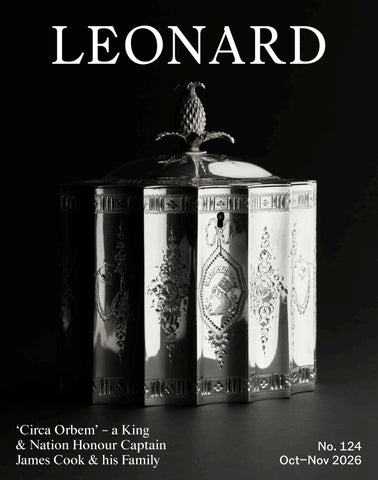
‘Circa Orbem’ – a King & Nation Honour Captain James Cook & his Family
No. 124 Oct–Nov 2026
No. 124
Welcome to issue 124 of LEONARD Magazine. In this issue, we discover the stories behind some fascinating pieces coming up for auction, including a silver tea canister engraved with Captain James Cook’s crest and motto, a dramatic Parisian scene by British modernist painter Christopher Wood, and four distinctive paintings capturing the Australian landscape. We also speak with historian Tracey Judd Iva about jewellery’s place across art, fashion and design, step inside the studio of art conservator Helen Gill, and chat with Christabel Blackman about her father Charles’ remarkable artistic legacy. We hope you enjoy these stories, along with many more from our specialists and guest contributors.
cover: Elizabeth Cook's sterling silver tea canister, engraved with the crest of her husband, Captain James Cook, Thomas Daniell, London, 1786 $20,000-30,000 Decorative Arts Auction Monday 16 November below: Ron Barassi's Melbourne Football Club premiership guernsey $20,000-40,000 The Ron Barassi Collection, offered by Paul Little AO Auction Monday 2 November
October – November 2026
auction calendar
October – November 2026
4
features
Cricket Cages: The Little Ones From Master to Master: Passing the Baton of British Horology Artist Profile: Christopher Wood (1901-1930) A Land Without Shadows: Lloyd Rees & the Light of Australia ‘Circa Orbem’ – a King & Nation Honour Captain James Cook & his Family A Sense of Place The Return of the Antique Diamond Moments From Cartier: A Selling Exhibition Art & Love: In Conversation with Christabel Blackman In Conversation with Tracey Judd Iva on Jewellery, Art, Objects, History, Curatorship & Becoming Custodians Stepping It Up Chandeliers: Interior Jewels My Day Filming Antiques Roadshow From the Printer’s Collection: Fred Genis
6 8 10 14 16 20 24 25 29 30 32 34 38 40
in focus
From the Workshop: The Art of Conservation with Helen Gill Five Minutes with Kieran Grogan Carpenter 22nd Report: Overwhelming Majority of Australians Back Ivory & Rhino Horn Trade Ban A Last Look
42 44 45 48
join us
Connect Value, Sell & Buy
50 51
3
AUCTION CALENDAR OCTOBER – NOVEMBER 2026
October
Fine Jewels & Timepieces Mon 5 Oct, 4pm Melbourne Fine Art Tue 6 Oct, 6pm Melbourne Contemporary Art from Tim Olsen's Personal Collection Tue 13 Oct, 10am Sydney Works from the Charles Blackman Estate Thu 22 Oct, 10am Melbourne Important Chinese & Asian Art Sun 25 Oct, 11am Melbourne Arts of Asia Mon 26 Oct, 10am Melbourne
November
The Ron Barassi Collection, offered by Paul Little AO Mon 2 Nov, 10am Melbourne Luxury Mon 9 Nov, 10am Melbourne Sidney Nolan - Heide, St Kilda, Wimmera, & Outback 1938-1949 Wed 11 Nov, 10am Sydney
Georgina Weir outside the Le Louvre Collins Street Store
Decorative Arts Mon 16 Nov, 6pm Melbourne The Sydney Jewellery Edit Wed 18 Nov, 10am Sydney Modern Design Mon 23 Nov, 10am Melbourne The Estate of Georgina Weir, Including Selected Contents of Le Louvre Mon 30 Nov, 10am Melbourne The Collector's Auction Mon 30 Nov, 6pm Sydney The Auction Salon
4
LEONARD, No. 124
Furniture & Interiors Objects & Collectables Jewellery Art Every Thu from 10am Melbourne
William Delafield Cook (1936-2015) Hillside, Euroa 1987 (detail) $200,000-300,000 Fine Art Auction Tuesday 6 October
October – November 2026
5
Cricket Cages: The Little Ones by john albrecht, managing director & head of important collections
6
LEONARD, No. 124
I’m on a plane. My favourite place to write. No distractions, a compact environment; the perfect antidote to a distracted mind. Cricket cages are on my mind, and not the sporting ones. Well, at least not the open-air sporting version requiring a bat and ball and a wide-open space. Here I’m talking about the tiny ones. The first time I learnt what these tiny cages were for was during the end scene of The Last Emperor. The scene is as poignant as it is implausible. Puyi returns to the Forbidden City and discovers his cricket, still alive in his cricket cage. That was my first element of education on the subject. Rewind to the late 1970s and a couple more later trips with my father Kurt to Hollywood Road in Hong Kong and I do recall seeing all manner of miniature cages. At the time I probably assumed they were all for tiny birds. But the very little ones were no doubt souvenir-style versions of cricket cages. Now, in 2026 I find myself following a bidding frenzy on a cricket cage from the Alsop collection that we recently handled from Perth. With a modest estimate of $800-$1,200, it soared to a final figure of $11,250 IBP. It piqued my interest. Not just because of the extraordinary price, that excited me as the momentary greedy auctioneer, but because of the very nature of the object and its purpose. Does it get more cerebral and intense and cultured than housing and maintaining an insect in a tiny vessel for music? I’ll leave the more gruesome side of this pastime for later. Was it the 2000-year-old answer to the bedside or portable radio? I thought the Sony Walkman was the first portable music device. Evidently not. I began researching these vessels online. The three pieces of information that intrigued me most were these: firstly, that in its highest form, this pastime perfected the maintenance of a living cricket, for example with different materials for cages during the different seasons. The gourd example we just sold, likely moulded on the tree to create the perfect pear-shape, was considered the ideal material for the warmer months, while in winter, ceramic cages were favoured. Secondly, and perhaps not surprisingly, they became another focus of artisans with sponsors wealthy enough to commission examples as beautiful and intricate as they were practical. Both to form part of an interior and adorned when traveling one’s cricket was required. Finally, and most macabrely, the cages were also designed and enhanced to house and nurture cage fighting crickets. Yes, fighting crickets. An ancient insect sport that was banned during the Cultural Revolution but, grimly, has been revived since.
If one were looking for other examples, you could easily search up a lovely collection of some 40 plus within the online Metropolitan Museum of Art archive and start your immersion there. The Suzhou Museum in China is known to have at least one Qing-dynasty cricket cage in its collection, but I’m also sure that many more fine collections exist. I will now finally admit that until exploring this subject, I was not even sure whether Leonard Joel had ever sold one before. I began the search online before I took off to Sydney and sure enough this beautiful Japanese porcelain example, illustrated here, was presented. This Chinese origin spread throughout many continents, and I will say I’m now intrigued by these tiny vessels with such a complex purpose, and I hope more examples find their way to Leonard Joel. Would I ever keep a live cricket? Never. I respect nature enough to never contemplate such captivity, but would I like to acquire an example one day? Yes, indeed, and then I’ll explore whether I can miniaturise a speaker enough to fit inside one, and if that’s possible, I’ll then listen to cricket music from within that cage.
opposite: A Japanese lacquer mushikago (insect cage) Edo period, 18th century Sold for $1,612 right: A Japanese Satsuma cricket cage, Meiji period Sold for $560
October – November 2026
7
From Master to Master: Passing the Baton of British Horology by Patricia Kontos, Senior Jewels & Timepieces Specialist
8
LEONARD, No. 124
It is perhaps no accident that a teenager from Bolton with modest academic ambitions ended up as the chosen apprentice to the man who fundamentally rewrote the laws of modern timekeeping. The legendary pairing of Dr. George Daniels CBE and Roger W. Smith OBE is widely celebrated as the modern fairytale of British horology. In reality, this fairytale did not happen by magic. It demanded an obsessive level of grit, initial rejection, and two masterful minds willing to converge and chase perfection across a windswept island. Born near Manchester in 1970, Roger Smith was just sixteen when his father suggested enrolling him in the Manchester School of Horology. It proved to be a “duck to water” moment. Roger graduated top of his class and clinched the British Horological Institute’s Bronze Medal. During his time at the school, a distinguished gentleman appeared as a guest speaker. This was the renowned titan of horology George Daniels, inventor of the groundbreaking co-axial escapement. It was 1987, and feeling the reverberations of the Quartz Crisis, Daniels compellingly explained the art of crafting timepieces completely by hand - a master craft that would later inspire a new generation of independent watchmakers. Sitting in the classroom that day, a seventeen-year-old Roger Smith had his destiny set. Hearing Daniels speak made an indelible impact, giving him all the inspiration he needed to view watchmaking as a lifelong passion and vocation. Equipped with conviction and a copy of Daniels’ textbook Watchmaking, Smith spent his spare time obsessively constructing his first pocket watch. In 1990, he nervously travelled to Daniels’ base on the Isle of Man, laying his creation before the master. It was met with a brutal rebuff. Daniels took one dispassionate, clinical look at the timepiece and told Smith to go back and try again. He was told to make it look like a proper watch created from "thin air", rather than something merely "handmade". Rather than turning on his heels demoralised, Smith found his fuel. Retreating to his workshop for five gruelling years, he set out to master the thirty-two separate traditional horological skills required to conquer the rigorous “Daniels Method.” When he returned to the Isle of Man with his second pocket watch, Daniels inspected the mechanism and smiled in approval. The relief at that moment must have been palpable, the years of self-doubt dissolving into pure validation. Decades later, in June 2023, that very same second pocket watch shattered records at a Phillips auction in New York, selling for an astonishing $4.9 million. From the master’s nod of approval followed a golden ticket: the invitation to join Daniels on the Isle of Man as his apprentice. There, the
duo forged the historic Daniels Millennium series. Produced between 1998 and 2001, the series celebrated the Swiss watch industry’s adoption of Daniels’ revolutionary co-axial escapement. The crowning jewel of the collection was the final, unique white-gold piece of 2001. Handed to Smith in lieu of a financial bonus, it was the only watch co-signed by both Daniels and Smith on the dial, later hammering for a staggering $2.42 million at Sotheby’s Geneva in November 2023. Emboldened by this triumph, Smith stepped out from the master’s shadow to shape his own destiny. He debuted the Series 1, a run of only nine rectangular timepieces with a mesmerising retrograde calendar, before following it up with his critically acclaimed Series 2 in 2006. However, the cosmic pull of the Daniels-Smith partnership was not finished. In 2010, they united for their swan song: a thirty-five-piece anniversary edition celebrating Daniels’ friction-free co-axial escapement. Conceived by Daniels to celebrate his invention, Daniels designed the aesthetics and movement layout. Being in the twilight of his life, he commissioned his protégé to entirely hand-produce the line in Smith’s Isle of Man workshop. Sadly, Daniels passed away in 2011, just weeks after approving Smith’s first working prototype. Smith spent the next decade executing and delivering the series according to the master’s wishes. Today, those thirty-five watches are universally revered as the absolute holy grail of independent watchmaking. Daniels bequeathed his entire workshop to his protégé. If actions speak louder than words, there is nothing left to be said of George Daniels’ immense regard for Roger Smith. Today, the workshop operates as a living cathedral of horology, utilising tools dating back to the 1820s. Decorated with his own OBE received in 2018, Roger W. Smith now stands alone at the apex, handcrafting a handful of elite timepieces each year, ensuring the legendary baton of British horology continues to tick in masterful hands. Roger W. Smith O.B.E is a guest speaker at the Watch & Clockmakers of Australia National Conference, from 23-25 October 2026, at the Stamford Plaza Hotel, Melbourne, proudly supported by Leonard Joel. Registration and information: wca.org.au The Timepieces Auction will take place on Monday 5 October in Melbourne. For viewing times and to see the full catalogue please visit our website.
opposite far left: Roger W Smith and George Daniels / Roger W Smith opposite left & right: George Daniels, an 18k yellow gold chronograph with Daniels independent double-wheel escapement, mean-solar and sidereal time, age & phase of the moon, and equation of time indications, circa 1982 / Sotheby's, Roger W Smith far right: Roger Smith platinum watch handmade on the Isle of Man / Alamy
October – November 2026
9
Christopher Wood's career lasted barely a decade, yet his paintings occupy a distinctive place in British modernism. Born in Liverpool in 1901, Wood initially studied architecture and medicine before moving to painting, encouraged by the Welsh painter Augustus John.1 by Amanda Hayward, Senior Art Specialist
Artist Profile: Christopher Wood (1901-1930)
10
LEONARD, No. 124
October – November 2026
11
In 1921 christopher wood travelled to Paris and enrolled at the Académie Julian, beginning a relationship with the city that would profoundly shape his artistic development.2 Paris introduced Wood to the international avant-garde. While moving between Paris and London, he encountered artists such as Jean Cocteau and Pablo Picasso, as well as Sergei Diaghilev, for whom he produced set designs for the Ballets Russes production of Romeo and Juliet in 1926, although they were never used.3 Despite the influence of Paris, Wood was never simply a British supporter of French modernism, as his work absorbed the lessons of Post-Impressionism and modernist simplification while retaining an instinctive, almost naïve directness that became increasingly characteristic of his style. The painting titled Paris offers a particularly vivid expression of this synthesis of styles. The composition is dominated by intensely coloured blocks of architecture, including crimson red, greens, and deep, midnight blues. Dark, twisting trees cut across the buildings, flattening out the space and creating a theatrical framework. At street level, small groups of figures animate the lively scene of Paris after dark. The figures’ scale is deliberately subordinate to the architecture, yet they give the painting its sense of everyday life. Wood's depiction of Paris is less a conventional cityscape and more a psychological landscape. Perspective is compressed, forms simplified, and colour becomes expressive. The red façades seem to glow against the dark, blue-grey atmosphere, while the large blue building on the right creates a dramatic counterweight. In paintings such as Paris, the city is both real and imagined. The buildings are solid, its figures recognisable, and the trees are firmly rooted in the street, however, Wood's colour and compressed perspective transform them into something more elusive. The result is a painting that feels less like a record of Paris and more like a memory of it, one that is vivid, fragmentary, theatrical, and dynamic. This combination of directness and sophistication places Wood within the remarkable circle of British artists who were redefining painting during the 1920s. His friendship with artists such as Ben and Winifred Nicholson was particularly significant. In 1926 he joined the Seven and Five Society and the London Group, then a year later, he exhibited with the Nicholson’s at the Beaux Arts Gallery (April - May 1927), becoming close to them personally and professionally.4 Whilst on a trip to St Ives, Wood and Ben Nicholson encountered the self-taught painter Alfred Wallis, whose simplified forms and instinctive approach to painting had a profound influence on both artists. 5
The importance of Paris to Wood's development is also evident in his artwork titled Bridge over the Seine 1927 in the National Galleries of Scotland collection. The painting depicts a Parisian bridge and the river Seine with buildings and factory chimneys set in the background, while a mother and child are overlooking the scene. The work emphasises the ordinary activities of Parisians rather than an idealised view of the city and demonstrates Wood's recurring fascination with figures, architecture, and daily life, as elements within a highly personal visual language. Wood’s life and career came to an abrupt ending when he died in 1930 at twenty-nine, after a period of increasing psychological instability and opium addiction. His reputation nevertheless grew rapidly after his death. The Redfern Gallery in London held a Christopher Wood exhibition in 1936 and later organised a major retrospective in 1938, in which the artwork Paris was exhibited, which helped establish his position within the history of British modern art. The body of work that Chrisopher Wood produced in his fleeting career demonstrates why his work continues to fascinate contemporary audiences. His paintings are modern without being doctrinaire and sophisticated without sacrificing spontaneity. In his depictions of Paris, the cityscape, architecture, trees, and people are transformed into a vivid arrangement of colour and line. Paris becomes not simply a place Wood observed, but a place he reinvented, a city of memory, sensation, and imagination. 1. The Redfern Gallery, Christopher Wood, accessed on 23 August 2026: https://www.redfern-gallery.com/artists/76-christopher-wood/overview 2. Ibid. 3. Tate Britian, Christopher Wood, accessed on 23 August 2026: https://www.tate.org.uk/art/artists/christopher-wood-2167 4. The Redfern Gallery, Christopher Wood, accessed on 23 August 2026: https://www.redfern-gallery.com/artists/76-christopher-wood/overview 5. Ibid.
The Fine Art Auction will take place on Tuesday 6 October in Melbourne. For viewing times and to see the full catalogue please visit our website.
previous page: Photograph of the artist Christopher Wood sitting next to a model box, possibly his own for the Russian ballet © Tate left: Christopher Wood (British, 1901-1930) Bridge over the Seine 1927 © National Galleries of Scotland. Bequeathed by Miss Elizabeth Watt 1989 right: Christopher Wood (British, 1901-1930) Self portrait 1927 / Alamy
12
LEONARD, No. 124
above: Christopher Wood (British, 1901-1930) Paris oil on board 37.5 x 45.5cm $80,000 – 120,000
October – November 2026
13
A Land Without Shadows: Lloyd Rees & the Light of Australia by Madeleine Mackenzie, Head of Decorative Arts & Art, Sydney
left: Lloyd Rees (1895-1998) Morning at Bathurst 1971 oil on canvas signed and dated lower left: L REES 71 61 x 51cm (76 x 56cm) PROVENANCE: The artist Gift from the above to Michel Santry The Estate of Michel Santry Menzies, Sydney, Australian & International Fine Art & Sculpture, 10 December 2015, lot 20 (label verso) Private collection, Sydney $20,000-30,000 opposite left: Lloyd Rees sketching, 1920 / The University of Queensland Library opposite right: Lloyd Rees, The waterfall, Tasmania, 1982 © A&J Rees / Copyright Agency / Art Gallery of NSW
14
LEONARD, No. 124
The history of Australian landscape painting is, in many ways, a story about light. From early colonial artists struggling to interpret an unfamiliar environment to modern painters who embraced its unique qualities, generations of artists have sought to understand how the Australian sun transformed the land. Among them, Lloyd Rees stands out as one artist who had a profound impact on the way Australians saw their landscape, revealing not just its physical form but its atmosphere, luminosity, and sense of place. Early colonial painters often viewed Australia through European eyes. They attempted to impose European artistic conventions onto a landscape that appeared strange and unknown. By the late nineteenth century, however, painters of the Heidelberg School, including Arthur Streeton and Tom Roberts, began painting en plein air and embracing the teachings of European Impressionism combining them with the brilliance of the Australian sun. The twentieth century brought new approaches to depicting the unique Southern Hemisphere sun. Artists associated with Australian Tonalism, led by Max Meldrum, focused on tonal relationships rather than colour. Meldrum taught his students to observe carefully and objectively, arguing that precise tonal renderings alone would produce the sensation of the picture plane and create a unified sensation of light, atmosphere, space and distance.1 His ideas profoundly influenced a generation of Australian modernists, including Lloyd Rees. Born in Brisbane in 1895, Rees studied art before moving to Sydney in 1917. A visit to Europe in 1923 and 1924 exposed him to the works of artists such as Camille Corot and J. M. W. Turner, whose approaches to landscape left a lasting impression. Yet rather than simply adopting European methods, Rees returned determined to discover what made Australian light different. He recognised that the Australian landscape was defined not by dramatic shadows and theatrical contrasts, but by a broad, open illumination. Along with Rees’ exceptional draftsmanship, this sensitivity to light and landscape became a hallmark of his artistic career which spanned over seven decades. His early works demonstrated extraordinary precision and skill, but over time he became less interested in exact description and more focused on capturing the experience of seeing. As he wrote later in his career: All my early thinking on the matter has been that you can paint reflective light but not the source of it. In a realistic sense that is true but when I think round it, painting is not reality – painting is symbolism. 2 While Lloyd Rees is most often associated with his celebrated depictions of Sydney Harbour and its foreshore suburbs, he also maintained a deep personal connection to the Bathurst district of New South Wales. Through his wife Marjory Pollard's family connections, he visited the re-
October – November 2026
gion regularly from the 1930s onwards and developed a deep affection for its wide-open spaces. He recalled the stillness of winter mornings at Mt Rankin, the warmth of family homes and the expansive views stretching towards the Macquarie Plains. These experiences became a rich source of artistic inspiration. 3 A notable example is Morning at Bathurst (1971), a work that sits comfortably within Rees's mature oeuvre. By this stage of his career, Rees had moved beyond the precise analytical approach of his early years towards the luminous "visions of light" that characterised his later work. From the late 1960s when his son settled in Hobart, Rees was also inspired by the Tasmanian landscape and it features heavily particularly throughout his later work. He lived his final years in Tasmania, continuing to paint despite failing eyesight. Here he produced larger canvases that revealed an increasingly ebullient and experimental approach. In 1982, he won the Wynne Prize for a second time for his sizable canvas Morning on the Derwent (1982).4 Rees's influence on Australian art was immense. His work inspired younger artists including John Olsen and Brett Whiteley, the latter dedicating a painting in his honour. By focusing on the unique qualities of Australian light, he helped redefine how the nation saw its landscape. As critic David Cox wrote in reviewing Rees's 1969 retrospective, “The story of this man's working life begins in light” and would ultimately “end in light”.5 It is a fitting assessment of an artist whose enduring legacy lies in revealing the luminous beauty of Australia itself. 1. Art Gallery of South Australia. “Introducing Max Meldrum.” Accessed August 26, 2026. https://www.agsa.sa.gov.au/education/resources-educators/resources-educators-austra lian-art/clarice-beckett-present-moment/introducing-max-meldrum/ 2. Holmes à Court Gallery. “Lloyd Rees: Looking for Light.” Accessed August 26, 2026. https://www.holmesacourtgallery.com.au/exhibition/lloyd-rees-looking-for-light/ 3. Bathurst Regional Art Gallery. “Exhibition Focus: Lloyd Rees.” Accessed August 26, 2026. https://bathurstart.com.au/permanent-collection/exhibition-focus-lloyd-rees/ 4. Art Gallery of New South Wales. “Lloyd Rees.” Accessed August 26, 2026. https://www.artgallery.nsw.gov.au/collection/artists/rees-lloyd/ 5. Holmes à Court Gallery. “Lloyd Rees: Looking for Light.” Accessed August 26, 2026. https://www.holmesacourtgallery.com.au/exhibition/lloyd-rees-looking-for-light/
The Collector's Auction will take place on Monday 30 November in Sydney. For viewing times and to see the full catalogue please visit our website.
15
At the time of his violent death in 1779 on a beach in Hawaii, Captain James Cook was one of the most famous and respected of Englishmen. by david parsons, Head of Private Estates & Valuations, Decorative Arts Specialist
‘Circa Orbem’ – a King & Nation Honour Captain James Cook & his Family 16
LEONARD, No. 124
October – November 2026
17
Between 1768 and his end, Cook commanded three lengthy voyages of discovery to different parts of the Pacific and south Atlantic oceans, all serving a variety of scientific and British territorial purposes (including, in 1770, his landing at Botany Bay and careful scientific surveys and charting of Australia’s east coast, claiming this for the British Crown). Aided by Cook’s exceptional abilities as a navigator and leader of men generally, these voyages, each with entourages of scientists in various fields, their assistants, artists, and naval personnel capable of assisting their work, were immensely successful in what they yielded, advancing knowledge in a wide range of areas. In a period in which the intellectual curiosity of the Enlightenment ran hand-in-hand with Britain’s growing territorial expansion, Cook’s accounts of his voyages and exotic discoveries made by these, published with illustrations after drawings by the artists who accompanied him, were keenly read by the elite and intellectually curious in Britain, Europe, and North America. These same classes and many others beyond were then shocked by news of Cook’s death, which reached the Admiralty in London on 10 January, 1780, nearly a year after the event, and was published the following day in the London Gazette. King George III, reportedly moved to tears by the news, immediately granted Cook’s widow Elizabeth a substantial pension for life. Tributes and letters of condolence poured from the great and good across Britain and Europe. The Royal Society, which had sponsored Cook’s first Pacific voyage and was now headed by Joseph Banks who had been on that voyage, commissioned a commemorative medal to be struck in gold, silver, and bronze. At a more popular level, Cook’s life and death – generally depicted as heroic – was remembered in songs, plays, prints, and commemorative ceramics, including a fine relief portrait modelled by John Flaxman for Wedgwood. Throughout all of this Cook’s devoted widow Elizabeth was quietly retiring. But in 1785, wishing to have an honour for her husband to be perpetuated by his family, she applied for a grant of arms prompted by ‘her Anxiety to preserve on record in the College of Arms the Memory of her late dear Husband, the ablest and most renowned Navigator which this or any other Country has produced’ (as it is recorded on the subsequent grant of arms). It is a mark of George III’s regard for Cook that he approved this exceptional grant – apparently, the only posthumous grant of arms ever made by the College of Arms.
In seeking the grant, Elizabeth requested ‘such Armorial Ensigns as may allude to [Cook’s] distinguished Character to be borne by his Descendants and placed on any Monument or otherwise to his Memory’. The blazons (formal descriptions) of Cook’s armorial bearings specify his crest to be ‘an Arm embowed, vested in the Uniform of a Captain of the Royal Navy, in the Hand the Union Jack on a staff ’. The Letters Patent granting the arms on 3 September, 1785 (now in the State Library of NSW) includes a rendering of the bearings with two apt mottos, ‘Circa orbem’ (‘Round the world’) for the crest and ‘Nil intentatum reliquit (‘He left nothing unattempted’) for the coat of arms. Sadly for Elizabeth, there was little opportunity for her family to use the bearings as she hoped, with all six of the Cooks’ children dying prematurely, the last in 1794, leaving no other descendants. Consequently, very few objects closely associated with the Cooks and bearing his arms are known. A silver salver in the National Library of Australia, assayed in 1764 and believed to have been used by the Cooks together in their household, was later engraved with his full coat of arms shortly after these were granted. A pair of silver candlesticks in the National Maritime Museum, London, assayed in 1784 and acquired by Elizabeth, is engraved with Cook’s crest and motto ‘Circa orbem’. Cook’s bearings were also used for a bookplate commissioned by Elizabeth and applied by her to the Bible which accompanied him on his three great voyages, now in the Mitchell Library, Sydney. Now, Leonard Joel is honoured to offer another fine object to be added to this extremely rare group: a silver tea canister by Thomas Daniell, assayed in London in 1786 and engraved with James Cook’s crest and motto ‘Circa orbem’, presumably acquired by Elizabeth at this time and, like the salver and candlesticks, promptly and proudly engraved with the then newly-granted crest in honour of her much-loved husband.
18
LEONARD, No. 124
The Decorative Arts Auction will take place on Monday 16 November in Melbourne. For viewing times and to see the full catalogue please visit our website.
opposite left: Nathaniel Dance-Holland Portrait of James Cook c. 1775 National Maritime Museum, London opposite right & previous: Elizabeth Cook's sterling silver tea canister, engraved with the crest of her husband, Captain James Cook, Thomas Daniell, London, 1786 $20,000-30,000 ABOVE: Grant of arms made to Mrs Cook and to Cook’s descendants in 1785 / State Library of NSW
October – November 2026
19
Recently, three Australian landscapes arrived in the art department to be catalogued and researched for auction. Looking at them together, I was struck by just how distinctive the representations of the Australian landscape can be. There is no single way of seeing this country, and yet each view is intrinsically intertwined with the place that inspired its creation. by wiebke brix, Head of ART
A Sense of Place
20
LEONARD, No. 124
October – November 2026
21
Australian artists have, of course, inherited and responded to a long European tradition of landscape painting. Artists such as Arthur Streeton travelled between Australia and Europe, painting both environments, while successive generations of artists have continued to negotiate what it means to represent a landscape that looks and feels quite unlike anywhere else. Perhaps what interested me most about these three works which are by Russell Drysdale, William Delafield Cook, and Emily Kam Kngwarray was that each found a personal visual language for the Australian landscape. Landscape is the most readily available subject an artist can find. It requires no model, no elaborate staging. It simply exists around us. Yet the persistence of landscape throughout the history of art suggests something deeper than convenience. We seek out landscape ourselves. We travel to beaches and mountains, walk through forests and escape cities in search of places where the presence of the nature is greater than our own. Perhaps this desire has become even more pronounced as our lives become increasingly technological. Nature offers something our constructed world cannot; space, silence and an opportunity to reconnect with ourselves. In Australia, that experience has a particular dimension. This is an immense continent occupied by a relatively small population. Australia has a population density of just 3.6 people per square kilometre, compared with approximately 34 across Europe.¹ There are vast places where the horizon seems almost uninterrupted by human presence. Perhaps this helps explain why emptiness, distance, and space have become such powerful elements within Australian art. For Russell Drysdale, a journey through drought affected inland Australia in 1944 proved transformative. He encountered the parched plains, exposed rock formations, and skeletal vegetation that would remain central to his work for decades. As Drysdale continued to travel through the outback and far north, his understanding of the landscape became more complex. He engaged with Indigenous communities and became increasingly aware of their displacement from Country as mining and agriculture pushed further into remote Australia.² Drysdale developed a distinctive visual language for the vastness and strangeness of inland Australia, capturing not only its physical character, but a landscape carrying histories far deeper and more complex than its appearance alone. William Delafield Cook’s relationship with the Australian landscape was quite different. Although he made his home in England, Austra-
lia remained the landscape he wanted to paint. On his regular returns to Australia, he travelled extensively, gathering photographs and sketches of places to which he felt particularly drawn to. Back in his London studio, he would spend months painstakingly reconstructing these places. For Delafield Cook, painting Australia was explicitly personal. It encompassed his childhood, memories, sense of place and where he felt he belonged.³ Looking at his extraordinarily detailed landscapes, I cannot help but imagine that the slow, meticulous process itself offered a kind of stillness: months spent absorbed in a landscape that, for him, represented home. For Emily Kam Kngwarray, Country cannot simply be understood as scenery or something observed from a distance. Her painting emerged from a profound cultural and spiritual relationship with the land. Deborah Edwards described Kngwarray’s technique as embodying her sense of the “explosive, yet ordered, rhythms of the natural world.”⁴ There is something simple yet considered in her mark-making. Repeated gestures accumulate across the surface, creating rhythm and movement, but also an extraordinary sense of calm. There is a meditative quality to the act itself; the physical repetition of mark after mark, painting close to the ground, immersed in Country. The process and subject seem almost inseparable. What unexpectedly connects these three artists for me is that they did not simply record what was in front of them. They found within the land something personal; memory, identity, belonging, culture, and spirituality. Their landscapes could only have emerged from this continent, yet they remind us of something universal. We do not simply look at a landscape. We form relationships with it, carry it with us and, sometimes, understand ourselves through it. 1. Australian Bureau of Statistics, Regional Population, 2024–25, population density at June 2025; United Nations, UN Data, Europe, 2025 population and population density. (https://www.abs. gov.au/statistics/people/population/regional-population/2024-25, accessed 23 August 2026) 2. Fry G., Russell Drysdale, The White Blow, Leonard Joel, October Fine Art catalogue, 2026. 3. Cotter J., William Delafield Cook, Hillside, Euroa, Leonard Joel, October Fine Art catalogue, 2026. 4. Edwards D., in Tradition Today: Indigenous Art in Australia, Art Gallery of New South Wales, Sydney, 2014 (artgallery.nsw.gov.au/collection/artists/kngwarreye-emily-kame/, accessed 23 August 2026)
The Fine Art Auction will take place on Tuesday 6 October in Melbourne. For viewing times and to see the full catalogue please visit our website.
previous page: Emily Kam Kngwarray (c.1910-1996) (Language group: Anmatyerr) Summer Awelye 1991 synthetic polymer paint on linen 130 x 220cm $200,000-300,000 © Emily Kam Kngwarray/ Copyright Agency, 2026 left: Emily Kam Kngwarray (c.1910-1996) (Language group: Anmatyerr) Alhalkere 1994 synthetic polymer paint on linen 51 x 41.5cm $30,000-50,000 © Emily Kam Kngwarray/ Copyright Agency, 2026
22
LEONARD, No. 124
opposite top: Russell Drysdale (1912-1981) The White Blow 1967 oil on canvas 49 x 75cm $180,000-220,000 © Courtesy of The Estate of Russell Drysdale, 2026 opposite bottom: William Delafield Cook (1936-2015) Hillside, Euroa 1987 synthetic polymer paint on canvas 111 x 281.5cm $200,000-300,000
October – November 2026
23
THE RETURN OF THE ANTIQUE DIAMOND by Lauren Boustridge, Head of Fine Jewels & Timepieces, Sydney
Diamond Cutting from the 14th–19th Centuries The resurgence of antique diamonds has found an unlikely modern ambassador in Taylor Swift. Her engagement ring, with its elongated antique-style diamond, has drawn fresh attention to the beauty of old-cut stones and the qualities that set them apart from their modern counterparts. Rather than the precise symmetry and engineered brilliance we have come to expect, antique diamonds have softer proportions, larger facets and an individuality that comes from being cut by hand. In a world where technology can now calculate and control almost every facet of a diamond, there is something rather wonderful about a stone whose character was shaped by the eye and hand of a cutter generations ago. From the soft glow of the Rose Cut to the chunky charm of the Old Mine Cut and the distinctive brilliance of the Old European Cut, the evolution of antique diamond cutting offers a fascinating window into the history of jewellery. Each development brought a new approach to working with this extraordinarily hard and precious material, while reflecting the changing tastes of the people who wore it. 14th–17th Century The story of diamond cutting begins in medieval Europe in the 14th century with the Point Cut. Limited by the technology of the time and diamond’s exceptional hardness, early cutters worked with the stone’s natural octahedral form, simply polishing its eight faces to enhance its surface and allow it to catch the light. During the Renaissance, the Table Cut emerged as an important development. By grinding down one of the diamond’s points, cutters created a flat surface, or “table”, providing a window into the stone and beginning the transition towards more sophisticated faceting. The next major innovation was the Rose Cut, named for its resemblance to a rosebud. With a flat base and a domed upper surface of triangular facets arranged in rows and meeting at a central point, it produced a soft, subtle play of light. Believed to have originated in India in the late 15th century, the rose cut was refined in the diamond-cutting workshops of Antwerp and Amsterdam and became highly fashionable throughout the 16th and 17th centuries. Because of its flat base, the rose cut could appear relatively subdued by today’s standards. To enhance its luminosity, diamonds were sometimes foiled, with reflective or coloured foil placed behind the stone. Under candlelight, this gave rose-cut diamonds a warm, atmospheric glow perfectly suited to the jewellery of the period.
24
18th–19th Century At the beginning of the 18th century, diamond cutting took another significant step forward with the development of the Old Mine Cut. These early stones were typically square or cushion-shaped with softly rounded corners. Cut by hand, they were designed to retain as much of the valuable rough diamond as possible, resulting in a high crown, deep pavilion and often a noticeably large culet. Unlike the symmetry we expect from diamonds today, Old Mine Cuts were individual and often slightly irregular, with smaller tables, larger facets and proportions that varied from stone to stone. Rather than the sharp brilliance of a modern diamond, they produced a softer, warmer play of light, particularly beautiful under candlelight. By the late 19th century, diamond cutting had reached another important turning point with the emergence of the Old European Cut. While still unmistakably antique, it represented a move towards greater precision and symmetry and would ultimately provide the foundation for the modern round brilliant. Typically round in outline, old European cut diamonds featured a high crown, small table, deep pavilion and distinctive culet. They were still fashioned by hand, meaning no two stones were exactly alike, but cutters were becoming increasingly focused on proportion, symmetry and the way light travelled through the stone. Advances in cutting technology, including improved bruting and polishing techniques, allowed cutters to achieve greater accuracy. At the same time, the introduction of electric lighting changed the way diamonds were viewed, creating new expectations for brilliance and sparkle. The old European cut was the final link between the romantic individuality of antique diamonds and the precision that would define the modern brilliant. Perhaps that is why antique diamonds continue to capture our imagination. Their appeal lies not in perfection, but in individuality, each stone carrying the marks of its time, its maker and the person who first chose it. And if Taylor Swift’s ring is anything to go by, sometimes looking backwards is the most fashionable way forward.
image: 9.29ct old European-cut diamond solitaire ring, France $70,000 - $80,000 Fine Jewels Sydney, Auction Tuesday 1 December
LEONARD, No. 124
MOMENTS FROM CARTIER: A SELLING EXHIBITION Thank you to our guests for helping to make our Melbourne and Sydney exhibitions such an extraordinary success. We are thrilled that so many exceptional pieces found new homes in Australian collections.
Sydney Event Photography: Chloe Paul
October – November 2026
25
26
LEONARD, No. 124
October – November 2026
27
28
LEONARD, No. 124
ART & LOVE By wiebke brix, head of art
In Conversation with Christabel Blackman In the lead up to our forthcoming sale Works from the Charles Blackman Estate, I had the pleasure of speaking with the artist’s daughter, Christabel Blackman. Christabel has devoted herself to preserving and sharing her father’s remarkable artistic legacy and is the author of Charles & Barbara Blackman: A Decade of Art and Love. In this conversation, she reflects on his creative life, lesser known bodies of work, distinctive personality, and his exploration of the human psyche. Having spent years researching your father’s life for your book, did you come to see any particular period or series of his work differently than you had before? A Decade of Art and Love deals with Charles’ creative life in the 1950s. Both he and Barbara were intrinsically involved in the burgeoning art scene around Melbourne and especially with the Heide circle of artists. They lived in a tiny coach house and Charles painted continuously. During this time, he exhibited his paintings however it was not until the end of that decade that he started to be recognised and collected. He worked as a chef to support his family. His most famous paintings from that era are the Schoolgirls and Alice in Wonderland series. When they were first exhibited, there were very few sales. They were complex and sophisticated artworks and the public was still not ready for the strength of these images. His work visited different subject matters during that decade, including musicians, hoardings, streetscapes, cats, and his Women and Flowers series. Charles drew obsessively, portraits, street scenes and behavioural observations. Often the drawings were complete works in themselves and not considered just as sketches. Many collectors know the iconic Schoolgirl and Alice paintings, but are there themes or bodies of work that you feel remain under appreciated and deserve a fresh look today? Charles was an explorer with images and searched for new subject matters that inspired him. He was never an artist who repeated the same picture. He had an ability and vision to always come up with something new. Often he painted a series around the same theme, like his writers and musician portraits, London paintings, Nudes or Garden series. He was incredibly versatile as an artist, moving into different areas like printmaking, ballet scenography, tapestries, and sculptures.
His portraits give an insight to the soul of the sitter and in this collection there are several interesting drawings of his wife Barbara, the poet Judith Wright, philosopher Max Nicolson, art patron John Reed, and Joy Hester. They form a part of history that went on to define our cultural identity in Australia. There are some of his extraordinary sculptures which were conceived in the 1960s. He used to say that it was as much what is left out as what is put in the image and his cut out sculptures illustrate that perfectly. As someone who knew Charles both as a father and as an artist, what do you think collectors often miss when they look at one of his paintings? Is there something about his personality or creative process that changes how we should read the work? He had a strong message in his artworks, often psychological. Many paintings are about the opposites that we confront, fear and innocence, fragility and boldness, frustration and triumph, abandonment and hope. Charles had a wicked sense of humour which is often missed. There is always more to the image than what we first encounter. When people acquire a Charles Blackman painting today, what do you hope they see beyond the image itself? What legacy do you think your father would most want his works to leave with future generations? I have met many collectors over the years and have seen how much they love my fathers’ pictures, and they hold on to them. Perhaps it is best defined by a collector when he explained to me “Every single day I sit and stare at your father’s painting. It brings me incredible joy, especially in my bleakest moments. Sometimes I just stare at it and weep.” The best aspect of a Blackman painting is its ability to draw in the viewer because it will always have something new to say to us. The legacy Charles Blackman leaves with us is in his relentless curiosity about the human psyche and that is always relevant. The Works from the Charles Blackman Estate Auction will take place on Thursday 22 October in Melbourne. For viewing times and to see the full catalogue please visit our website.
image: Blackman Family Seated Cat At the Window SCW2 Bronze Powder Coloured 25 x 18.5cm $2,400-3,000 © Charles Blackman/Copyright Agency, 2026
October – November 2026
29
In Conversation with Tracey Judd Iva on Jewellery, Art, Objects, History, Curatorship & Becoming Custodians by Annie Soust, Head of Fine Jewels & Timepieces
left: Portrait of Tracey Judd Iva opposite: Cartier ‘Panthère’ diamond, onyx and emerald ring
30
LEONARD, No. 124
Tracey Judd Iva is an award-winning jewellery, object, and art historian, curator, writer and public speaker with a rich career forged at the National Gallery of Victoria, curating a number of significant international exhibitions locally and internationally before establishing ARTerior Cultural, a freelance cultural consulting agency. I spent an afternoon speaking with Tracey in the lounge room at Leonard Joel. Tracey, you’ve built a fascinating career at the intersection of jewellery history, art, and curation. What first drew you to jewellery and ultimately led it to become the heart of your career? My beloved grandfather used to say, “Find a job you love, and you’ll never work a day in your life.” That stayed with me. I always loved art, art history, drawing and sketching, but I also always loved jewellery. My mother called me a little magpie because I loved anything shiny. I combined those interests through studying art history, museum management, curatorship and later gemmology. For me, jewellery has always been a wearable work of art and a means of self-expression. Looking at Leonard Joel’s recent exhibition of Cartier, is there a particular jewel you found especially compelling? I have always loved the Panthère as a symbol and code of Cartier, and the collection contains wonderful examples across different periods. For me, the standout is the diamond, onyx and emerald Panthère ring. It reminds me of Epictetus: “First know thyself, and then adorn thyself accordingly.” This ring is for someone with a strong sense of self. The emerald eyes, onyx nose, and spots are instantly recognisable as Cartier. How do you curate jewellery so visitors see it not simply as a beautiful object, but as a work of art combining social, historical, and cultural significance? Curating begins with intellectual rigour. What is the argument? What story are you communicating? Every object must contribute to that idea. You place jewellery within its artistic, cultural and historical milieu: when it was made, what designers were doing and what was happening in society and human history. Exhibition design, lighting, and interpretation support that story, but should never overwhelm the object. When I worked with Cartier pieces for the Victoria and Albert Museum’s Art Deco 1910–1939 exhibition, we deliberately minimised the human element and allowed the works to breathe. Ultimately, a curator provides avenues through which people can enter into a relationship with an object, whether through scholarship or simply through its beauty, rarity and history.
Jewellery sits between art, fashion, design, and history. Has it traditionally been undervalued within the art world? Yes, particularly when value has been determined by materials rather than artistic merit. I dislike rigid distinctions between “precious” and “non-precious”. When I curated Bejewelled: Contemporary Jewellery from the National Gallery of Victoria, I wanted different materials considered together for their artistic significance. I also advocated for Dinosaur Designs to enter the NGV collection. At the time, someone asked, “Why should we bring plastic in?” My argument was that it wasn’t about plastic; it was about a changing artistic dynamic. Bakelite revolutionised costume jewellery during the Art Deco period. Resin represented another such moment. Interestingly, audiences responded particularly strongly to the Dinosaur Designs pieces. An internally flawless diamond, bakelite, and resin can all exist within the broader continuum of jewellery as art. What can contemporary designers learn from historic jewellery houses, and what can contemporary jewellery teach us about historic pieces? Historic houses teach emotional symbolism, craftsmanship, and the marriage of art and engineering. Historic jewellery also teaches theatre, fantasy, and drama. Contemporary jewellery, conversely, challenges us to look beyond financial value towards artistic integrity, using unexpected materials such as paper, plastic, found objects, and resin. There is a wonderful nexus between past and present; each informs the other. How differently do museums and the commercial jewellery world value and communicate jewellery, and where is the most interesting crossover? Museums primarily consider the object’s artistic, historical and cultural importance; commercially, an object must also have monetary value. The fascinating crossover is an exhibition such as Cartier at Leonard Joel. It was presented with a museological sensibility, yet visitors had the extraordinary opportunity to acquire a piece. That means becoming part of its continuing story. Elizabeth Taylor understood that you don’t simply own great jewellery; you become its custodian. You preserve it, enjoy it, and eventually pass it to another generation. These pieces will exist long after us, carrying the stories of the people who wore them. Whether it is an engagement ring or a jewel bought to mark a personal milestone, part of our own story becomes embedded within it. That is why seeing significant heritage jewellery destroyed or melted down is heartbreaking. Jewellery has a life and history beyond any one owner. We are simply its custodians for a time. With thanks to Tracey for her time.
October – November 2026
31
Stepping It Up By Sisi Levinson, luxury specialist
left: Zendaya attends the photocall for the movie "Challengers" in Hotel Hassler in Rome, wearing custom Loewe tennis ball pumps / Luigi de Pompeis, Alamy opposite: Margaret Qualley wearing a pair of Chanel barefoot sandals / Alamy
32
LEONARD, No. 124
Luxury footwear is undergoing somewhat of a revival. After years of sneakers and loafers dominating the shoe trends – that is to say, practical and solid styles, for the most part – fun and whimsical designs have been creeping back into the spotlight. Heels and dress shoes have had a refocus by luxury brands seeking to expand their offerings and capitalise on the explosion of interest in vintage designs. Jonathan Anderson has led the charge for unconventional, conversation-sparking designs at Loewe (where he was creative director until last year) with styles featuring balloons, makeup brushes, and even the custom tennis ball heels he created for Zendaya for the Challengers press tour. Now, as creative director at Christian Dior, he’s bringing his signature playfulness to the iconic maison. Alongside Nina Christen (the design director of shoes at Dior), his Autumn Winter 2026 debut featured standout heels designed to look like you were walking on lily pads, with sculpted flowers blooming right out of your toes. They’ve followed it up with their recent Autumn 2026/2027 Haute Couture show with fully embellished pumps featuring beads, charms, and feathers, as well as 3D floral appliques, continuing the flower theme. Over at Chanel, Matthieu Blazy has been setting wish lists on fire with his array of quirky takes on Chanel’s greatest hits. In the Spring Summer 2026 Haute Couture show, he featured the iconic cap-toe reimagined with delightful mushroom shaped heels, one replete with a bird perched fancifully upon the caps. His Cruise 2027 show made a bold footwear statement, in sending a shoe down the runway that was hardly a shoe at all. The barely-there sandal, consisting of thin straps wrapped around the ankles and a small heel only, leaving the sole of the foot completely unprotected, was worn on the red carpet by Margaret Qualley, sparking conversation about whether it constituted footwear at all. No matter where one may come down on it, one cannot deny that it has become a moment that people are talking about – and that may just be the entire point. The not quite barefoot, not quite sandal, is a continuation of the Chanel two-tone code, interrogated and inverted further than ever before by Blazy.
October – November 2026
The quirky shoe has even hit men’s luxury footwear, with Saint Laurent bringing out one of the year’s most divisive silhouettes in their men’s Spring Summer 2027 show: a see-through dress shoe. The subversive design once again raises questions about what defines a dress shoe, and how it fits with a traditional suit ensemble. The conversation ignited around the design perhaps was ultimately the intended result. Even before the latest slew of fanciful designs, the quirky shoe movement had gained serious viral momentum through styles such as the Tabi, the iconic split-toe shoe from Maison Margiela. Never before has a previously underground, “if you know you know” design broken through into the mainstream so decisively. Vintage designs have also undoubtedly helped fuel interest in the luxury footwear category, with Chanel, Gucci, and Prada all in the mix of fashion’s most wanted. One need only spend a short amount of time on Instagram to see the proliferation of online boutiques curating specific vintage drops and collections for their dedicated clientele. The mantra currently being pushed within fashion is to embrace individuality. Vintage footwear does this by offering exclusivity and rarity. The new guard of luxury footwear is simply following along and reveling in the thrill of breaking the old rules of fashion, experimenting with style, and celebrating confidence. So have a look at the bold designs out there and perhaps choose a shoe less travelled and enjoy it, one bold step at a time. The Luxury Auction will take place on Monday 9 November in Melbourne. For viewing times and to see the full catalogue please visit our website.
33
Inspired and mesmerised by many of the recent chandeliers Leonard Joel has had the privilege of selling, (special mention to the stunning Castorina & Co canopy of lights at the Gertrude Street auction viewing), I have been looking at the techniques of the traditional craft and towards its limits at a grand scale. by rebecca stormont, Senior Modern Design Specialist
Chandeliers: Interior Jewels
34
LEONARD, No. 124
October – November 2026
35
Chandeliers are sometimes referred to as the jewellery of an interior. And like important jewels that become as famous as the person who once owned them, there are chandeliers that take centre stage and have a life of their own in notable buildings. Let’s begin in Murano, where Carlo Scarpa spent decades pushing Venini’s glassworks toward something closer to sculpture than lighting. The Poliedri system, small hand-blown polyhedral “gems” of clear, pink, blue and amber glass threaded onto slender metal frames, emerged in the late 1950s as a remarkably versatile modular element. It was first employed on a monumental scale in the great Venini chandelier designed by Ignazio Gardella, Paolo Venini and Enrico Peressutti for the Italian Pavilion at the 1958 Brussels World’s Fair. Scarpa later embraced and expanded the concept for the Italia ’61 exhibition in Turin, where a cascading installation of more than four thousand glass elements descended like a crystalline stalactite. Neither installation survives today, but together they established a new idea of the chandelier: an architectural form built from thousands of repeated units, hovering somewhere between light fitting, sculpture and geology. That same idea of accumulation, of a chandelier as thousands of small parts behaving as one continuous gesture, found its most refined expression half a century later at the Château de Versailles. In 2013, Ronan and Erwan Bouroullec were commissioned to create the palace’s first ever permanent contemporary installation: the Gabriel Chandelier, suspended over the Gabriel Staircase at the main entrance. Working with Swarovski,
the brothers threaded some 429 lighting modules - 858 individually manufactured crystal shade halves - onto a stainless steel rope, engineered to nest and move like a necklace, with tolerances between components of just 0.1 millimetres. Rather than draw the chandelier’s form, the designers let gravity decide it, allowing the crystal chain to settle into three natural, looping catenaries. Standing twelve metres tall and weighing half a tonne, it is proof that even in a palace defined by 17th-century opulence, a chandelier can still be genuinely new. Where Scarpa and the Bouroullecs pursued precision and repetition, Dale Chihuly went in the opposite direction entirely. His 2001 chandelier for the entrance rotunda of London’s Victoria and Albert Museum abandons geometry altogether in favour of exuberant, organic excess. Made of over a thousand individually blown and mould-blown glass elements in ice blue, spring green, and yellow, each piece was hand-wired one at a time onto a welded steel armature, a process that took a team of six more than five days. The result reads less like a light fixture than a living organism suspended beneath the glass dome, unmistakably Chihuly’s, and unmistakably a descendant of the same Murano glassblowing tradition that shaped Scarpa’s Poliedri decades earlier. And then there is a chandelier born of diplomacy as much as design: the starburst fixtures of the Metropolitan Opera House at New York’s Lincoln Center. Designed by Hans Harald Rath for the Austrian firm J. & L. Lobmeyr, the twelve chandeliers were a gift from the Republic of Austria, offered in gratitude for post-war Marshall Plan reconstruction aid. When they rose toward the ceiling with the first curtain on opening night in 1966, they drew the evening’s first applause - a moment of pure theatre before a note of music had been played. Inspired by newly available photographs of distant galaxies, their sputnik-like form captured the space age optimism of the era, and today a single restoration of the eleven chandeliers required painstaking work across 51,500 crystals and 800 sputnik elements. Few fixtures anywhere have become so completely synonymous with the building that houses them. The Modern Design Auction will take place on Monday 23 November in Melbourne. For viewing times and to see the full catalogue please visit our website.
previous page: The Victoria and Albert museum Rotunda Chandelier by Dale Chihuly / Alamy top left: One of the 'Sputnik' chandeliers at the Metropolitan Opera House, New York, designed by Hans Harald Rath for J. & L. Lobmeyr / Alamy bottom left: Polyhedron chandelier in the Veneto pavilion at Italia 61 in Turin, designed by Carlo Scarpa / Paolo Monti right & opposite: Gabriel Chandelier 2013 Château de Versailles © Studio Bouroullec
36
LEONARD, No. 124
October – November 2026
37
My Day Filming Antiques Roadshow by Madeleine Mackenzie, Head of Decorative Arts & Art, Sydney
38
LEONARD, No. 124
It was a sunny day in mid-May 2025 when I jumped in the car with my colleagues Ronan Sulich and Lauren Boustridge and we set off for the Norman Lindsay Gallery & Museum in Faulconbridge. Nestled in the heart of the Blue Mountains district in New South Wales, this historic National Trust house and garden is the former residence of Australian artist Norman Lindsay and provided the perfect backdrop to shoot the pilot episode for Antiques Roadshow Australia with BBC Studios. We arrived early, suited and booted for a cold mountain’s morning, only to find the sun shining and the place bustling. The Norman Lindsay Gallery was hosting its annual vintage fair which featured an array of market stalls showcasing vintage, retro, and collectible goods, as well as a display of classic vehicles, a vintage fashion parade and live music and dancing. As the fair goers began to trickle in, we met with the producers, camera operators, and other valuers and presenters who were there to capture the many stories from those members of the public who had brought treasures in to be valued for the show. I was up first to film a collection of over 30 vintage musical powder compacts from a local resident. Whilst this particular story didn’t make it into the final cut, it was a wonderful warm up. I wasn’t prepared for the number of takes that were required for the various camera angles, nor to hear my own voice repeating itself so many times. Meanwhile, with another camera crew operating simultaneously, Lauren Boustridge, our Head of Fine Jewels & Timepieces in Sydney, met with a gentleman who had amassed a large collection of ‘Man in the Moon’ jewellery. I was able to have a brief respite before jumping into my second valuation for the day while I waited for Ronan Sulich, our Senior Advisor in Sydney, to speak with a woman who had brought in her family’s embroidered devotional image dating back to the 18th century. My second valuation proved to be quite an interesting snapshot in time. They were a pair of Neoclassical silver candlesticks which although appearing identical happened to have hallmarks dated one year apart, one was made in 1796 and the other was dated 1797. The interesting thing about the one from 1797 is that it had a double duty mark composed of two stamps of the head of King George, this represented the duty on silver being doubled for a nine-month period in that year to raise funds for the Napoleonic Wars. The candlesticks had belonged to the owner’s father and so whilst she was interested to hear that they might fetch between $3,000-5,000 at auction, she certainly wasn’t ready to part with them any time soon.
For my last filming segment, I met with a gentleman who was a luthier by trade. He had picked up a broken guitar at auction in the USA which came with a fascinating back story, having once been owned by Jack Bruce of Cream and then gifted to his friend and producer Andy Johns (who also produced albums for the likes of Led Zeppelin and the Rolling Stones). The story went that Jack and Andy had been enjoying a few drinks together one night when one of them knocked over the guitar and the headstock broke off. The next morning when the two awoke to discover the damage they each blamed the other and no one ever found out who was responsible for the damage. The broken guitar remained in Andy’s collection until his passing in 2013 and was later put up for auction by his estate along with a letter from his widow detailing the ‘rock ‘n’ roll’ tale to accompany it. The luthier had lovingly restored the guitar to its former glory. It was such a joy to speak with him about his love of music and guitars that I think the valuation became secondary to the story, however, I did receive a fantastic reaction when I revealed that the guitar might well be expected to fetch $25,000-35,000 if offered at public auction today. Alongside the stories I uncovered on that day my colleagues and other valuers were shown all sorts of rare and wonderful objects, including a Black Forest ‘bear’ hall stand, a pair of ivory gate passes in the name of the Archbishop of York which allowed passage to visit Buckingham Palace, and a beautiful Victorian horseshoe brooch which was gifted as part of a brief romantic dalliance in the 1970s. As Ronan, Lauren, and I bundled ourselves back into the car exhausted after a busy day of filming, the crew and other participants were still working hard late into the afternoon. It was a busy and jam-packed day but one filled with wonderful stories, connections and a shared love of history and antiques. Watch Antiques Roadshow Australia on YouTube @BBCAntiquesRoadshow
images: Behind the scenes filming Antiques Roadshow Australia / BBC Studios opposite left to right: Issa Schultz, Madeleine Mackenzie, Lauren Boustridge, Ronan Sulich, and Elizabeth Hastings / BBC Studios
October – November 2026
39
From the Printer’s Collection: Fred Genis by Hannah Ryan, Senior Art Specialist
left: Brett Whiteley (1939-1992) Lipstick 1982 lithograph, ed. T/P 2 106 x 75cm $20,000-30,000 © Wendy Whiteley/ Copyright Agency, 2026 opposite left: Walasse Ting (Chinese, 1929-2010) Flower 1969 Lithograph, ed. 5/50 59 x 76cm $600-800 © Walasse Ting/Copyright Agency, 2026 opposite right: Fred Genis and Willem de Kooning in the workshop
40
LEONARD, No. 124
The making of a print can often involve more than one pair of hands, and one of the things that I have always loved about prints is discovering the relationships behind them. Who printed the work, where it was made, and the relationship that developed between artist and printer can reveal another side to an artwork and its history. So, when works from the Estate of master lithographer Fred Genis came to Leonard Joel, I quickly became a little obsessed. Genis made a name for himself through his technical skill and collaborations with some of the most significant artists of his time and has been described as Australia’s first ‘celebrity printer’.1 His work took him through some of the great print workshops of the United States and Europe, before he settled permanently in Australia in 1979 and established his own studio in Sydney. This December, Leonard Joel is pleased to present Important Works from the Collection of Fred Genis in our Prints & Multiples auction. The relationship between artist and printer has long been an important part of printmaking. Lithography in particular is a technically demanding process, requiring specialist materials, equipment, and knowledge, with the two working closely together. The artist brings their ideas and individual approach, while the printer brings an intimate knowledge of the medium, allowing the artist to explore printmaking in new ways. Genis described the printer as being ‘like water’,2 able to adapt to the artist and respond to what was needed. He believed that no two artists’ prints should look alike simply because they had been made alongside the same printer. Each should remain true to the artist – ‘like the artist, not like the printer’.3 In the 1960s, Genis became part of a period of renewed interest and experimentation in American printmaking. In 1966, he joined Kenneth Tyler at Gemini Ltd in Los Angeles, before moving to New York, where he became a master printer at Universal Limited Art Editions and later a partner at Hollander’s Workshop. These studios brought leading contemporary artists together with master printers, whose technical knowledge allowed artists to explore new possibilities in printmaking. During these years, Genis worked with Robert Rauschenberg, Willem de Kooning, Jasper Johns, Robert Motherwell, Sam Francis, Helen
October – November 2026
Frankenthaler, and James Rosenquist. Working with such different styles required more than technical skill, as Genis needed an instinctive understanding of how each approached their art and how his knowledge could be used to realise their ideas in print. After returning to the Netherlands and running his own lithographic workshop for several years, Genis settled permanently in Australia in 1979, establishing a studio in Sydney. Here, he formed close relationships with John Olsen, Brett Whiteley and Tim Storrier, and later Guan Wei. They came to Genis with their own talents and ideas, while he brought decades of international experience and an intimate knowledge of the lithographic process. Genis’s contribution to printmaking was recognised by the National Gallery of Victoria in 1982 with The Artist and the Printer, an exhibition drawn from his collection of American printer’s proofs, which the Gallery acquired two years later. His Australian collaborations were also celebrated by the Art Gallery of New South Wales in the 1993-94 exhibition From the Lithographer’s Workshop, which brought together fifteen years of prints made with Australian artists. The range of artists Genis printed for is perhaps the best reflection of his approach. From de Kooning and Rauschenberg to Whiteley and Olsen, their individual styles remained entirely their own, while Genis adapted his technical knowledge and approach to each artist. Important Works from the Collection of Fred Genis at Leonard Joel this December gives us the chance to celebrate not only the finished prints, but the relationships behind them, and the important part Genis played in bringing each artist’s ideas to print. 1. Butler, R., Printed Images by Australian Artists 1942–2020, National Gallery of Australia, Canberra, 2021 2. Dean, S., The Artist and the Printer: Lithographs 1966–1981 - A Collection of Printers Proofs, National Gallery of Victoria, Melbourne, 1982 3. Ibid
The Prints & Multiples Auction will take place on Tuesday 1 December in Melbourne. For viewing times and to see the full catalogue please visit our website.
41
From the Workshop The Art of Conservation with Helen Gill
42
LEONARD, No. 124
In this series, we visit the ateliers of skilled artisans to learn more about interesting, rare trades and crafts. This issue, we chat to art conservator, Helen Gill. Helen has worked with major institutions in Australia and overseas, including the NGV and National Gallery of Denmark, as well as private practice, restoring works from sentimental pieces to major paintings by renowned artists. What inspired you to become an art conservator, and how did you learn the craft? I don’t remember being aware of conservation as a profession until I travelled to Europe in 2001 after completing my Creative Arts undergraduate degree. I came across an exhibition in the Netherlands that had paintings displayed next to their x-ray images and paint cross-section studies. I was drawn to the focus on surface and materials and techniques in an applied scientific approach, in contrast to the theoretical approach to looking at art. I already had a good technical training in art practice, but I had to brush up on my organic chemistry with a bridging course before undertaking the Masters of Cultural Materials Conservation at the University of Melbourne. The Masters set me up well with the ethics, history, and theory of conservation and then I further developed my technical skills through internships and fellowships where I was mentored by experienced senior conservators. What does a typical day at your studio look like? (If there is such a thing!) What I enjoy about my job is that there isn’t really a typical day in the studio, my working days can really vary. Sometimes I will spend the whole day responding to emails and quoting or writing treatment reports, broken up with the odd hour or two treating an artwork. Some days I will be focussed on a single treatment all day, particularly if it is a nice satisfying treatment that is a pleasure to work on. Other days I have clients coming and going delivering and collecting artworks, and some days I am out of the studio all day condition reporting on paintings or assessing a work in a collection for treatment. Is there a particularly memorable project that you have worked on that has stayed with you? I would have to say the most memorable project I’ve worked on was also the most obscure, but also one of the best experiences of my life. I had the opportunity to help a Danish colleague on a project in a tiny village in Greenland. We were there to restore the painted canvas ceilings of a mid-
18th century harbour master’s house which was being restored by heritage architects and converted into a restaurant. The ceilings were lined with canvases which we found were actually old, recycled cloth sails which had been painted green and nailed up to function I guess like wallpaper. They were covered in centuries of soot and grime, they were really, really dirty and our brief was to essentially get them clean and looking like something people would want to eat under. It was hard, dirty, physical work in a construction site environment but we had icebergs and whales floating past the windows as we worked. It was also arctic summertime so we had hours of sunshine and a lovely community of Greenlandic people and their warm culture to experience. What advice would you give to collectors on caring for artworks, and what are some common mistakes to avoid? Preventive conservation is not to be under-estimated; making sure artworks are securely housed in their frames, and that hanging systems are adequate is so important to prevent the many types of damage I see from artworks falling out of their frames and off walls. I would recommend collectors have any artwork they have just purchased get a basic assessment from an accredited conservator to identify any active instability so that it can be addressed before further damage occurs. I also recommend really considering where paintings are hung - are they hung low in a thoroughfare, or too near chair backs, swinging doors, and entrances where bags are brought in? Are they hung too close to a heating or cooling source? Can the new puppy, or child with texta reach it? Avoid humid environments like bathrooms, or overly hot, bright sunlit locations. Is there something you wish more people understood about art conservation? I wish more people understood that sentimental value is equal to monetary value as far as I’m concerned. I get clients saying, “oh it means a lot to me, but it’s got no financial value, so it’s not worth spending the money on”. Some of the most satisfying treatments that come through the studio are the sentimental artworks that need some love and care, and I get to see the happiness it brings the owners when they see their much-loved artwork looking stable and cared for. With thanks to Helen for her time.
images: Helen Gill in her studio
October – November 2026
43
FIVE MINUTES WITH KIERAN GROGAN CARPENTER
This issue, get to know our Objects & Collectables Manager, Kieran. Favourite artwork
Favourite cocktail
My favourite artwork is actually a piece of architecture, the lost house that modernist architect Adolf Loos designed for Josephine Baker in Paris. Loos was entranced by Baker and, unprompted, designed a ‘Small Varieté for Josephine’ as a type of love letter. Baker loved to swim and central to the design was a vast and mysterious internal swimming pool. Glass walled and lit from above, it was surrounded by a viewing gallery and intended as a liminal space of spectacle and performance. Never built, the house survives only in a handful of drawings left behind by Loos. In the end, Baker turned her back on modernism’s plans for her and bought herself a 14th-century French chateau instead. She’s said to have told Loos’ colleague Le Corbusier: “What a pity you are an architect, Monsieur! You would have made a sensational partner.”
My favourite drink to serve at a party is Death in the Afternoon, the absinthe and champagne cocktail invented by Ernest Hemingway. His instructions are as follows: “Pour one jigger of absinthe into a Champagne glass. Add iced Champagne until it attains the proper opalescent milkiness. Drink three to five of these slowly.” I like to also add a sugar cube. A warning - unless you share Hemingway’s constitution, one is usually more than enough!
Your ideal day in Melbourne
Favourite auction purchase A small bronze of a nun in prayer by Hans Knorr - this sits by my bedside and I love its austerity and stillness.
I would start by taking my corgi Marcel to the Altona dog beach. On a sunny morning, I think this could be the happiest place in Melbourne with all the dogs frolicking and paddling. I’m a real homebody so next I would return home for some extended pottering and home organising time which always helps me organise my thoughts as well! I have a large paludarium which is a type of mixed land and water terrarium that always needs tending. In the evening, I would go with family for dinner to Sapa Hills, our delicious local Vietnamese. Then on to meet friends for a drink, ideally at Marion or the Carlton Wine Room.
Leonard Joel staff all seem to have a side project or talent, what’s yours? Very non arts related but a few years ago my husband and I started a low waste nutrition business called QOTA as a side hustle. We started off handmaking our products in our kitchen on the weekends - the very first batch we sold out to 50 customers and we thought that was amazing! Our products are now stocked at Coles, so it’s been a fun journey and I’m really proud of it.
44
LEONARD, No. 124
22ND REPORT By Dominica Mack, IFAW Oceania communications manager
Overwhelming Majority of Australians Back Ivory & Rhino Horn Trade Ban Seven years ago, the Australian government promised to ban the domestic trade in elephant ivory and rhinoceros horn, but it never did. Today, Australians are sending a clear message: it’s time to deliver on that commitment. New YouGov polling commissioned by the International Fund for Animal Welfare (IFAW), Humane World for Animals Australia and the Born Free Foundation shows overwhelming public support for ending Australia’s domestic ivory and rhino horn market. An extraordinary 95% of Australian voters want the federal government to fulfil the promise it made following a federal parliamentary inquiry in 2019, which recommended stronger action to address the domestic trade in these wildlife products. The poll also found that almost all Australians (97%) think it is important for Australia to introduce the ban, including 59% who say it is extremely important, 25% who say it is very important and 13% who say it is slightly important. One of the most striking findings from the poll is that 95% of Australians surveyed believe or assume that buying and selling elephant ivory and rhinoceros horn within Australia is already illegal. Why domestic markets matter Elephants and rhinos continue to face serious threats from poaching and wildlife trafficking. Since Australia’s commitment seven years ago, 197 tonnes of ivory have been seized globally, equivalent to an estimated 29,500 elephants1. While international trade restrictions play a critical role in protecting these species, domestic markets provide loopholes that enable trafficked products to enter legal supply chains. They can also help sustain demand for ivory and rhino horn, creating incentives for poaching and organised wildlife crime. In 2017, IFAW worked with Leonard Joel to pioneer an industry-leading policy to end the auction of elephant ivory and rhinoceros horn items. As a result, Leonard Joel no longer sells objects made entirely of ivory; including ivory netsuke, chess pieces and dinnerware. They advocate for all Australian auction houses and antique dealers to do the same. By closing these markets, Australia can remove a pathway that allows illegal wildlife products to circulate and demonstrate its commitment to protecting some of the world's most iconic and threatened animals.
A promise seven years in the making The call for action is not new. A federal parliamentary inquiry recommended stronger measures to address Australia's domestic ivory and rhino horn trade, leading the government to commit to a ban. Yet seven years later, that commitment remains unfulfilled. Meanwhile, many countries around the world have strengthened protections by restricting or closing their domestic markets. The time to act is now Australians have spoken. They want stronger protections for elephants and rhinos, and they want the government to honour its commitment. Closing Australia's domestic ivory and rhino horn market would align national policy with public expectations, strengthen global efforts to combat wildlife trafficking, and help protect elephants and rhinos from the pressures that continue to threaten their survival. Notes: • All figures, unless otherwise stated, are from YouGov Plc. Total sample size was 1503 Australian voters. Fieldwork was undertaken between 14th July – 21st July 2026. The survey was carried out online. The figures are representative of the voting population by age, gender, region, income, education, 2025 Federal Election vote and 2023 Voice Vote. • Other countries which have implemented domestic bans and strict regulations include China, United Kingdom, United States, Canada, France, Taiwan, Luxembourg, the Netherlands, the European Union, Singapore and Hong Kong. 1.
Environmental Investigation Agency; Global Environmental Crime Tracker https://eia-international.org/global-environmental-crime-tracker/
image: White rhino in Kenya. © IFAW
On 22 March 2017, the first industry briefing between IFAW (International Fund for Animal Welfare) and auctioneers and antique dealers from Australia took place, with the view to ending the auction and antiques trade in rhinoceros horn and ivory. That same year, Leonard Joel introduced a voluntary cessation policy and we are proud to no longer sell these materials. In the 22nd Report, IFAW share the latest news about their conservation projects.
October – November 2026
45
ISSUE 55 OUT NOW
ISABEL AVENDAÑO HAZBÚN, CAROL BOVE, MARCEL DUCHAMP, ROSALIE GASCOIGNE, CRAIG GREEN, LOU HUBBARD, SUSAN JACOBS, NADIA MARYCHURCH, MONA PHRONTISTERION, JOHN STEZAKER, KARA WALKER, GAYPALANI WANAMBI, ANNE ZAHALKA, SIMON ZORIC & MORE
SUBSCRIBE NOW VAULTMAGAZINE.COM
MARCEL DUCHAMP Fountain, 1950 (replica of 1917 original) porcelain urinal 30.5 × 38.1 × 45.7 cm © Artists Rights Society (ARS), New York / ADAGP, Paris / Association Marcel Duchamp
Cartier, London Necklace 1934, special order. Cartier Collection © Cartier. Photo: Nils Herrmann (background) Image: Studio Sabine Marcelis
A LAST LOOK
Kathleen Ngal (c.1934-2021) (Language group: Anmatyarr) Bush Plum Sold for $75,000 A Private Collection of Indigenous Art, August 2026
In this feature, we revisit a handful of beautiful and extraordinary pieces that have passed through our doors since the last issue. Spectacular diamond solitaire ring Sold for $93,750 Fine Jewels Sydney, August 2026
Royal Worcester porcelain reticulated ewer by George Owen Sold for $32,500 Decorative Arts, July 2026
48
LEONARD, No. 124
Patek Philippe Nautilus ref. 3800/1, a fine 18ct gold bracelet watch with Sigma dial, circa 1995 Sold for $118,750 Timepieces Sydney, August 2026
An 18k gold pen, formerly the property of the Duke and Duchess of Windsor Sold for $16,250 Decorative Arts, July 2026
Sergio Moscheni 'Giraffa' floor lamp for Selenova Sold for $23,750 Castorina & Co: A Legacy of Italian Design, August 2026
Hermès, Kelly Lakis 35 Sold for $15,000 Luxury, August 2026
October – November 2026
49
CONNECT With regular auctions in Fine Art, Jewels & Watches, Decorative Arts, Modern Design, Luxury and more, there’s something to suit every taste at Leonard Joel.
browse
bid
now delivering
connect
Browse our online auction catalogues or view in person at one of our salerooms.
Create an account online and use it whenever you bid. You can also receive Lot alerts tailored to your interests.
Get your auction purchases delivered straight to your door with Leonard Home Delivery (Melbourne only), our convenient, fast, reliable delivery service managed by our in-house team. Please visit our website for more information or contact delivery@leonardjoel.com.au
Subscribe to our email newsletter through our website to stay up to date with news on upcoming auctions, special events, and industry insights.
Bidding is simple and you can do so in person, online, by phone or by leaving an absentee bid. Our team is always on hand to guide you.
50
LEONARD, No. 124
website leonardjoel.com.au instagram @leonardjoelauctions facebook facebook.com/leonardjoelauctions youtube youtube.com/user/leonardjoel1919
VALUE, SELL & BUY Contact a Leonard Joel Specialist
managing director & head of important collections John Albrecht 03 8825 5619 john.albrecht@leonardjoel.com.au
asian art Luke Guan Head of Department 0455 891 888 luke.guan@leonardjoel.com.au
adelaide Anthony Hurl Representative Specialist 0419 838 841 anthony.hurl@leonardjoel.com.au
Auction Specialists
modern design Rebecca Stormont Senior Modern Design Specialist 03 8825 5637 rebecca.stormont@leonardjoel.com.au
perth John Brans Representative Specialist 0412 385 555 john.brans@leonardjoel.com.au
luxury Sisi Levinson, Luxury Specialist 03 8825 5605 luxury.specialist@leonardjoel.com.au
The Auction Salon Specialists
fine jewels & timepieces Annie Soust Head of Department, Melbourne 03 8825 5645 annie.soust@leonardjoel.com.au Lauren Boustridge Head of Department, Sydney 02 9362 9045 lauren.boustridge@leonardjoel.com.au fine art Wiebke Brix Head of Department 03 8825 5624 wiebke.brix@leonardjoel.com.au Amanda Hayward (née North) Senior Fine Art Specialist 03 8825 5644 amanda.north@leonardjoel.com.au decorative arts Chiara Curcio Head of Department 03 8825 5635 chiara.curcio@leonardjoel.com.au
prints & multiples Hannah Ryan Senior Art Specialist, Manager of Specialty Auctions 03 8825 5666 hannah.ryan@leonardjoel.com.au sydney Ronan Sulich Senior Adviser 02 9362 9045 ronan.sulich@leonardjoel.com.au Madeleine Mackenzie Head of Decorative Arts & Art, Sydney 02 9362 9045 madeleine.mackenzie@leonardjoel.com.au brisbane Troy McKenzie Head of Private Collections, Queensland 0412 997 080 troy.mckenzie@leonardjoel.com.au
art Millie Lewis 03 8825 5630 art.manager@leonardjoel.com.au furniture Alex Sargeant 03 8825 5640 furniture.manager@leonardjoel.com.au jewellery Anna Akacich 03 8825 5618 jewellery.manager@leonardjoel.com.au objects & collectables Kieran Grogan Carpenter 03 8825 5655 objects.manager@leonardjoel.com.au Valuations David Parsons Head of Private Estates and Valuations 03 8825 5638 david.parsons@leonardjoel.com.au
Marketing & Communications Blanka Nemeth Senior Marketing, Media, and Communications Manager 03 8825 5620 blanka.nemeth@leonardjoel.com.au Maria Rossi Graphic Artist Paolo Cappelli Senior Photographer & Videographer Adam Obradovic Photographer & Videographer Jon Bader Photographer & Videographer, Sydney Sale Rooms melbourne 2 Oxley Road, Hawthorn, VIC 3122 03 9826 4333 sydney The Bond, 36–40 Queen Street, Woollahra, NSW 2025 02 9362 9045 Leonard Magazine editor Blanka Nemeth graphic design Maria Rossi
subscriptions For Leonard Magazine subscription enquiries and requests, please contact lucy.lewis@leonardjoel.com.au
October – November 2026
51
melbourne 2 Oxley Road, Hawthorn, VIC 3122 03 9826 4333 sydney The Bond, 36-40 Queen Street, Woollahra, NSW 2025 02 9362 9045 brisbane 54 Vernon Terrace, Teneriffe, QLD 4005 0412 997 080 adelaide 429 Pulteney Street, Adelaide, SA 5000 0419 838 841 perth 0412 385 555 info@leonardjoel.com.au leonardjoel.com.au
This document has been produced to international environmental management standard ISO14001 by Ellikon Fine Printers, a certified green printing company.