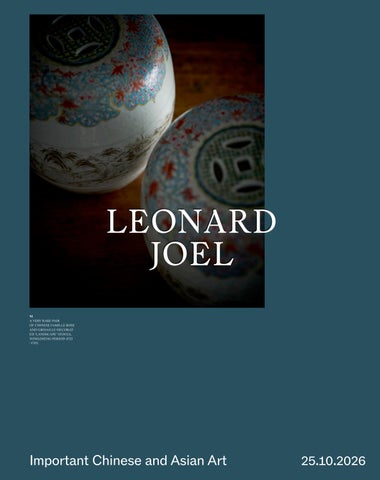
14 A VERY RARE PAIR OF CHINESE FAMILLE ROSE AND GRISAILLE-DECORATED ‘LANDSCAPE’ STOOLS, YONGZHENG PERIOD (1723 - 1735)
Important Chinese and Asian Art
25.10.2026
Important Chinese & Asian Art 25.10.2026, 11am
VIEWING
CONTACTS
thu 22 oct – sat 24 oct 11am – 5pm 2 Oxley Road, Hawthorn, VIC 3122
luke guan head of asian art 0455 891 888 luke.guan@ leonardjoel.com.au
重要中國與亞洲藝術
148 A FINE AND RARE CHINESE CELADON VASE, SUI DYNASTY (581-618) $25,000-35,000
1
91
2
Important Chinese and Asian Art
Leonard Joel is pleased to present this Important Chinese and Asian Art auction, bringing together works from private collections across Australia and abroad. The sale spans a broad range of categories, including archaic jades, early ceramics, Ming and Qing porcelains, scholar’s objects, Buddhist sculpture, and other notable works of Asian art. Highlights include Lots 53-68, a single-owner collection of sixteen jade animal carvings from a distinguished Sydney collection; and In the Eye of the Beholder: The Raphy Star Collection (Lots 121-132), featuring twelve works from one of Australia’s most respected collectors of Asian art, including a rare Northern Song persimmon-glazed Ding ware bowl (Lot 125) and a Northern Song qingbai ewer with lion-form finial (Lot 127). The archaic jade section (Lots 157-174), from a private New South Wales collection, is supplemented by Warring States agates, early rock crystal carvings, and archaic bronzes. A standout is Lot 182, a rare late Shang dynasty yellow jade buffalo formerly in the collection of Grass Court Studio, Hong Kong. Additional highlights throughout the sale include a Yongzheng-period famille-rose and grisaille garden seat (Lot 14), an eighteenth-century huanghuali and zitan brush washer (Lot 42), a white jade phoenix vase (Lot 75), two Sui dynasty white-glazed cups (Lots 102 & 112), a rare Tang dynasty Lushan ware ewer (Lot 134), a Tang sancai tripod censer (Lot 147), and a pair of Tang painted pottery polo players (Lot 151). The Buddhist and Religious Art section features important devotional sculpture from across Asia, including a rare eighteenth-century Sri Lankan gilt-bronze standing Buddha (Lot 194) and a monumental Tibetan gilt-bronze figure of Avalokiteshvara (Lot 214). The Himalayan and Buddhist works offered in Lots 188-216 have been examined and dated by Professor Davide Templeman, noted scholar of Himalayan history, religion, and art. Leonard Joel is delighted to present this diverse offering and hopes the catalogue will provide collectors and scholars alike with an opportunity to engage with the rich artistic traditions of China and Asia. 「萬靈」(Lot 53-68)為本次拍賣頗具特色的單一藏家專題,匯集悉尼重要玉器藏家 珍藏之十六件動物玉雕。諸作造型生動,各具神采。玉器自古象徵溫潤高潔之德,而動 物題材亦長期活躍於中國藝術之中,廣見於器物、雕塑及文人雅玩,承載豐富的文化寓 意。 「藏之眼:Raphy Star 珍藏」(Lot 121-132)精選澳洲重要亞洲藝術藏家 Raphy Star 先生舊藏十二件中國藝術珍品。自1970年代起,Star 先生在 Ray Tregaskis、Eskenazi、J.J. Lally、Jules Speelman 及 Nicholas Grindley 等國際古董商 的影響下建立其收藏體系,以瓷器、木器及雕塑見長。當中尤以 Lot 125 北宋柿釉定窯 盌及 Lot 127 北宋青白釉狻猊鈕執壺最為矚目。 「沁髓」(Lot 157-174)古玉專場來自新南威爾士單一藏家多年積累,涵蓋禮器、佩飾 及陳設玉器等不同門類。另有戰國瑪瑙、高古水晶及錯金銀青銅器同場呈現。其中 Lot 182 商晚期黃玉牛尤為珍罕,原屬香港著名古董商草雅居舊藏。 除專題收藏外,本場於高古瓷、明清瓷器、玉器專題「崑崙」及文房專題「含章」中亦 呈獻多件重要佳器,包括 Lot 14 清雍正粉彩墨彩山水鼓凳、Lot 42 清中期黃花梨及紫 檀筆洗、Lot 75 白玉雙鳳紋瓶、Lot 102 及 112 隋代白釉盃、Lot 134 唐魯山窯龍首執 壺、Lot 147 唐三彩貼花三足爐,以及 Lot 151 一對唐彩陶馬球俑。 「飲煌清音」喜馬拉雅與佛教藝術專題中,Lot 194 為十八世紀斯里蘭卡銅鎏金佛陀立 像,風格鮮明;Lot 214 則為十四至十五世紀西藏銅鎏金觀音菩薩立像,體量宏大,兼 具克什米爾與早期藏地造像特色,充分展現喜馬拉雅佛教藝術的傑出成就。本專題 Lot 188-216 所呈獻之喜馬拉雅及佛教藝術作品,均經著名喜馬拉雅歷史、宗教與藝術研究 學者 Davide Templeman 教授考察並提供斷代意見,進一步彰顯其學術與收藏價值。 luke guan head of asian art
42
3
3
1
A CHINESE BLUE AND WHITE BOWL, SHUNZHI/KANGXI PERIOD, 17TH CENTURY 17.5cm diameter provenance A private collection, Auckland. $1,000-2,000 2
A CHINESE BLUE AND WHITE BOWL, TRANSITIONAL PERIOD, 17TH CENTURY The base is with an apocryphal Chenghua mark. 18cm diameter 1
provenance A private collection, Auckland. $1,000-2,000 3
A SMALL CHINESE UNDERGLAZE BLUE AND IRON-RED DRAGON DISH, DAOGUANG PERIOD (1821 - 1850) 9.4cm diameter $1,000-2,000 4
A PAIR OF CHINESE FAMILLE ROSE DRAGON DISHES, QIANLONG MARK, GUANGXU PERIOD (1875 - 1908) With an original Certificate Of Authenticity by Orientique, Hong Kong, in May 13, 1992. 24.5cm diameter each provenance A private collection, Sydney. $1,500-2,500 2
4
5
A CHINESE BLUE AND WHITE DRAGON BOWL, DAOGUANG MARK 17.5cm diameter $800-1,200 6
A RARE IMPERIAL TRANSPARENT GREEN GLASS ‘CHRYSANTHEMUM’ DISH, QIANLONG INCISED FOUR-CHARACTER MARK WITHIN SQUARES AND OF THE PERIOD (1736-1795) The rounded sides moulded with fluted petals rising to a foliate rim with bevelled edge, all resting on a solid ring foot. Glass dishes of this form are extremely rare and only four other Qianlong marked examples known, a lemon yellow dish from the collection of the Baronesses Sapuppo & d’Essen, sold at Sotheby’s Hong Kong, 30 October 2000, lot 291, and illustrated by Emily Curtis (ed.), Pure Brightness Shines Everywhere, Vermont, 2004, no. 10.4 and cover; an opaque orange example from the Charlotte and John Weber Collection was included in the exhibition, Clear as Crystal, Red as Flame, China Institute, New York, 1990, and illustrated in the Catalogue, no. 32; and a translucent red glass example sold at Sotheby’s Hong Kong, 20 November 2002, lot 305; furthermore, a translucent blue glass example sold at Christie’s Hong Kong, 1/6/2011, lot 3804, sold again at Poly Beijing, 20/7/2026, lot 6698. 17.9cm diameter
6
provenance A private collection Melbourne. $3,000-5,000 7
A CHINESE YELLOW- GLAZED BOWL, GUANGXU SIX-CHARACTER UNDERGLAZE BLUE MARK AND OF THE PERIOD (1875-1908) The bowl is potted with deep, rounded sides rising from a short foot to a gently flared rim, and is covered inside and out with a rich egg-yolk yellow glaze, graduating to a warm amber tone around the foot. 19.3cm diameter $2,500-3,500 8
A CHINESE CELADON ICE-CRACKLE GLAZED BOTTLE VASE, QING DYNASTY (1644 - 1911) 12cm high provenance A private collection, VIC. $1,000-2,000
7
5
10
9
A RARE CHINESE AGATE BOWL, QIANLONG MARK POSSIBLY OF THE PERIOD (1735 - 1796) Its glistening surface left unadorned but for natural inclusions of peach and blood-red, the present bowl is an extraordinary example of true Qianlong’s taste. While agate was likely first embraced by the Qing court out of necessity in the face of disrupted jade trade routes, it soon became embraced in its own right as a much sought-after carving material. The present piece is both understated and remarkable in equal measure; its undecorated surface left free to highlight the beauty of the stone itself. For a similar agate bowl, see Sotheby’s London, 6/11/2025, lot 86. 11.5cm diameter provenance A private collection, Melbourne. $2,000-3,000
6
10
A FINE CHINESE CELADON GLAZED ‘LOBED’ VASE, QIANLONG SIX-CHARACTER UNDER GLAZE BLUE MARK AND OF THE PERIOD (1736- 1795) Of ovoid shape with flaring base and slightly waisted neck, the exterior under a glaze of greenish-grey bubble-suffused tone thinning to white along the vertical extremities and pooling evenly around the lobes above the base, the interior glazed white. It’s with a fitted zitan stand and an old Japanese wooden box. 30.5cm high provenance A private collection, Tokyo, Japan. $35,000-55,000
11
11
A CIHNESE LARGE AND RARE YIXING JUN GLAZE VASE, QING DYNASTY, 18TH CENTURY 31cm high $15,000-25,000 13 12
A CHINESE WHITE GLAZED ANHUA DECORATED ‘DRAGON’ STEM-CUP, GUANGXU SIX-CHARACTER MARK IN UNDERGLAZE BLUE AND OF THE PERIOD (1875-1908) 9.8cm high provenance A private collection, VIC., acquired from China in the early 90s. $1,500-2,500
A FINE AND LARGE CHINESE DEHUA BLANC-DE-CHINE LIBATION CUP WITH A DRAGON, A QILIN, A TIGER AND A CRANE, 18TH CENTURY A similar example, see, P.J. Donnely, ‘Blanc de Chine’, no. 25B, for which was described as ‘of exceptional size’. 20cm long; 16.6cm wide; 10.5cm high provenance A private collection, NSW. $1,500-2,500
7
8
14
A VERY RARE PAIR OF CHINESE FAMILLE ROSE AND GRISAILLE-DECORATED ‘LANDSCAPE’ STOOLS, YONGZHENG PERIOD (1723 - 1735) Each of the barrel-shaped stool with a pierced ‘cash’ motif on the slightly convex top, painted in famillerose palette with a floral motif of prunus blossom on a green ground draping over the sides terminating in four ruyi scroll heads, the body covered with a continuous landscape with scholars finely painted in grisaille and sepia tone, set between famille-rose painted detached flowers around the top and a floral scroll border around the base. The classical style of the exquisitely depicted mountain landscape, which resembles traditional Chinese ink painting, coupled with the delicate ‘boneless’ style of painting contemporary to the seat of the floral branches capture the uniqueness that is characteristic of the Yongzheng and Qianlong periods. Such experimentation and advances were made possible by the technical development achieved by the craftsmen in Jingdezhen. For vases decorated with similar intricately executed landscapes painted in grisaille, sepia and gilt, and on a floral famille-rose ground, see a pair sold at Christie’s New York, 25th March 1989, lot 232.
For an almost identical stool, see Sotheby’s Hong Kong, 7/10/2009, lot 1601; a brushpot also dated from Yongzheng period, with a very similar grisailledecorated ‘landscape’ scene, see Christie’s Hong Kong, 28/5/2014, lot 3321. 24cm high; 24cm wide
器身所繪山水景致格調高古,頗具傳統水墨畫意 境,與墩面所繪細膩柔美、富於寫生趣味的沒骨花 卉相映成趣,充分展現雍正、乾隆時期御窯瓷器雅緻 清新的藝術風格。此類創新裝飾手法,正反映景德 鎮御窯廠於十八世紀前期在彩瓷工藝與繪畫技法上 的高度發展與成熟。
provenance Collection of Maison Buttin-de-Loes, Buttin-de-Loes Foundation, Switzerland. DognyAuction, Switzerland, 1/10/2019, lot 569 (sold for $86,058 CHF, about $150,000 AUD). A private collection, Sydney. $100,000-200,000
與本對坐墩風格相近者,可參考一對粉彩地兼墨 彩、描金山水圖瓶,售於佳士得紐約,1989年3月25 日,拍品232號,其山水繪畫同樣筆法細膩,構圖 繁複精工。
清雍正(1723-1735)一對極為罕見的粉彩墨彩山水 人物圖坐墩 一對,鼓形坐墩,墩面微拱,其上鏤雕錢紋。墩面 以粉彩繪綠地折枝梅花紋,紋飾自頂部垂覆至器身 上部,止於四組如意雲頭。器身通景以墨彩及褐彩 精繪山水人物圖,亭臺樓閣掩映於崇山峻嶺之間, 高士悠遊其間,筆意雋雅。上部飾粉彩折枝花卉紋 一周,下承纏枝花卉紋邊飾,構圖繁而不亂,層次 分明。
另可比較一件幾乎相同之坐墩,售於香港蘇富 比,2009年10月7日,拍品1601號;以及一件雍正 時期墨彩山水人物圖筆筒,其山水構圖與繪畫風格 極為相近,售於香港佳士得,2014年5月28日,拍 品3321號。 來源: 瑞士 Buttin-de-Loës 莊園產業,Buttin-de-Loës 基 金會舊藏。 DognyAuction,瑞士,2019年10月1日,拍品569號 (成交價 CHF 86,058,約合 AUD 150,000)。 澳洲悉尼私人收藏。
14
9
16
15
A CHINESE FAMILLE-ROSE BOWL, GUANGXU FOUR- CHARACTER IRON RED MARK AND OF THE PERIOD (1875 - 1908) With a fitted box. 13cm diameter $1,000-2,000 16
A CHINESE FAMILLE-ROSE ‘HUNDRED BATS’ VASE, GUANGXU SIX-CHARACTER MARK IN IRON RED AND OF THE PERIOD (1875-1908) 39cm high $5,000-7,000 17
A SMALL CHINESE WHITE GLAZED JAR, KANGXI PERIOD (1644 - 1722) 8.5cm wide $500-700
10
17A
17A
A CHINESE CLOISONNE MOONFLASK, QIANLONG MARK AND OF THE PERIOD (1736-1795) The vase is decorated to the compressed sides with large multi-coloured chrysanthemums in various stages of bloom springing up from a ground with morning glories, lingzhi, and other small blooms, all before angular rocky outcrops repeated on both sides, with applied gilt-bronze stylised dragon handles flanking the cylindrical neck. A large example without Qianlong mark, see Sotheby's London, 10/5/2017, lot 168; also see another vase, sold at Bonhams London, 3/3/2010, lot 249. 37cm high PROVENANCE Private Collection, Melbourne, acquired from Jade Gallery, October 1988. $2,000-3,000
11
18
A LARGE CHINESE DAYAZHAI FAMILLE ROSE AND EN GRISAILLE-DECORATED TURQUOISE -GROUND BALUSTER VASE, FOUR-CHARACTER YONG QING CHANG CHUN MARK IN IRON-RED, GUANGXU PERIOD (1875-1908) The unusually large vase of elegant baluster form finely decorated with leafy sprays of fruiting wisteria entwined around slender branches on which a single singing bird perches, the branches surrounding the three-character hallmark in iron-red, and a five-character seal mark enclosed by a border of two dragons pursuing a flaming pearl, the applied handles each shaped as a stylised blue-enamelled elephant suspending gilt ring-handles from its trunk, the neck with four grisaille lotus blossoms on a continuous foliate meander, two beneath a pendent bat and all beneath a band of ruyi head at the rim. A similar vase in a yellow ground, see Christie’s New York, 12/5/2017, lot 421. 52cm high provenance The Loh family collection, L.A., California, U.S.A., acquired from Singapore over 70 years ago. A private collection, Sydney. other notes The mark “daya zhai” (大雅齋), ‘Studio of the Greater Odes’, is strongly associated with the Dowager Empress Cixi. Although no such hall has been located, a framed wooden plaque has been found in the Imperial Workshops bearing the three characters and with a seal reading “tiandi yijia chun” (天地一家春) ‘The Whole World celebrating as One Family’. G. Xingkuan and W. Guangyao in Guanyang Yuci, Beijing 2007, pp.145-147 suggest that the distinctive porcelain services bearing the daya zhai mark were commissioned for the rebuilding of the Yuanmingyuan that commenced in 1873 during the reign of Tongzhi. However, R. Scott in For Her Majesty’s Pleasure - Dayazhai Porcelain, Christie’s Hong Kong, 3 December 2008, p.23, suggests that the porcelains were not produced until the Guangxu reign. Since the restoration of the Yuanmingyuan had been delayed by this time, the vessels would have simply been delivered to the Forbidden City instead. Normally seen as a moment of renewed quality in Imperial porcelain production, Dayazhai wares continued to be produced into the very last years of the Qing Dynasty. The present lot seems to belong to a group of large archaic-form vases with Dayazhai palette enamelling that date to the early 20th century. The combination of grisaille enamelling and the red ‘seal mark’ lends the main decorative band a scholarly feel, evoking monochrome ink painting, and the design was reputedly taken from Cixi’s own compositions of birds and flowers. The massive vase itself is of archaic form, modelled after a Spring and Autumn period bronze vase, hu, and further embellished with archaistic borders at the shoulder. Porcelain versions of this form are first seen in the mid-18th century, compare the present lot with an Imperial blue and white hu vase, Qianlong seal mark and of the period, in the National Palace Museum collection, illustrated in Blue and White Wares of the Ch’ing Dynasty II, Taiwan, pl. 2. $20,000-30,000
18
12
清光緒(1875-1908)粉彩墨彩松石綠地花鳥紋大雅 齋觀音尊 礬紅「永慶長春」四字款 「大雅齋」款識,即「大雅齋」三字,與慈禧太 后有著密切關聯。雖然迄今尚未發現名為「大雅 齋」的實際殿堂,但在清宮造辦處曾發現一塊懸掛 木匾,上書「大雅齋」三字,並鈐有「天地一家 春」印章。耿興寬、王光堯於《官樣御瓷》(北 京,2007年,頁145-147)中提出,帶有「大雅齋」 款識的特色御瓷器應為同治年間(1862-1874)重 建圓明園工程所訂燒的陳設瓷器。圓明園重建工程 始於1873年。然而,蘇玫瑰(Rosemary Scott)於 《For Her Majesty’s Pleasure: Dayazhai Porcelain》 (佳士得香港,2008年12月3日,頁23)一文中則認 為,大雅齋瓷器實際上應至光緒朝方開始燒製。由 於當時圓明園修復計劃已經延宕,故這批瓷器最終 或僅送入紫禁城內廷使用。 長久以來,大雅齋瓷器一直被視為晚清御窯瓷器品 質復興的重要代表,其燒造時間甚至持續至清朝覆 亡前夕。本拍品應屬一組製於二十世紀初期的大型 仿古式大雅齋彩瓷瓶。其主要紋飾帶以墨彩繪畫並 配以朱紅印章式款識,富有濃厚的文人氣息,頗具 水墨花鳥畫意境;據傳其紋樣更取材自慈禧太后親 自繪製的花鳥稿本。
19
器形碩大,採用仿古壺(壺尊)式樣,原型可追溯 至春秋時期青銅壺(Hu)器,肩部並飾仿古夔龍及 幾何紋飾帶,進一步強化其青銅器風格。此類瓷質 仿古壺式瓶最早見於十八世紀中葉,可參考臺北故 宮博物院藏一件乾隆款及乾隆御製青花壺式瓶,載 於《清代青花瓷器 II》,圖版2,其器形與本拍品 頗為相近。 19
A PAIR OF FINE CHINESE FAMILLE-ROSE ‘BOYS’ CUPS, XUANTONG PERIOD (1909-1911) Each cup with a maker’s mark Jiangxi ciye gongsi (Jiangxi Porcelain Company). The pair is with a fitted box. Jiangxi Ciye gongsi was the mark for the Jiangxi Porcelain company, a company established in 1910 which took over much of the production which previously had been undertaken by the Imperial kilns. A pair of famille rose dishes each also with Jiangxi ciye gongsi mark on the base, see Sotheby’s New York, 23/3/2019, lot 496. each cup: 6.8cm diameter; 6cm high provenance A pair collection, Sydney. $10,000-20,000 20
A SMALL CHINESE DOUCAI WINE CUP, KANGXI MARK 6cm diameter; 4.5cm high provenance A private collection, Melbourne. $3,000-5,000 21
A CHINESE FAMILLE ROSE ‘BUTTERFLY’ BOWL, LATE QING DYNASTY With a fitted box. 14.5cm diameter $600-800
20
13
22
A CHINESE RARE AND LARGE BLUE AND WHITE ‘LOTUS’ JAR AND COVER, GUANGXU SIX-CHARACTER UNDERGLAZE BLUE MARK AND OF THE PERIOD (1875 - 1909) The jar is stoutly potted, the ovoid body with broad shoulders and a short tapered neck, painted in vivid underglaze blue with large lotus blossoms borne on scrolling vines and arabesques above a band of lappets enclosing floral sprays. The shoulder is encircled by the Eight Buddhist Emblems amid clouds and flames, below an archaistic band and a ruyi collar, the base inscribed in underglaze blue with a six-character Guangxu mark. According to archival records published in Qinggong Ciqi Dangan Quanji (Complete Collection of Qing Palace Porcelain Archives), fifty blue-and-white covered vases were ordered for the Palace of Earthly Tranquillity (Kunning Gong) in the first year of the Guangxu reign (1875). This documentary evidence strongly suggests that the present vase was produced as part of this imperial commission and therefore may be dated to the inaugural year of the Guangxu period. Significantly, the archives record a production of only fifty examples, highlighting the rarity of this type among late Qing imperial porcelains.
14
Compare a jar and cover of closely related form and decoration in the collection of the Palace Museum, Beijing, illustrated together with its original design drawing in Guanyang ciqi: Gugong bowuyuancang Qingdai zhici guanyang yu yuyao ciqi (Imperially Designed Porcelains: Qing Imperial Porcelain and Their Designs in the Collection of the Palace Museum), Beijing, pl. 106. Another example, preserved in the National Palace Museum, Taipei, is illustrated by H.A. van Oort in Chinese Porcelain of the 19th and 20th Centuries, Lochem, 1977, pl. 66. For a closely comparable jar, lacking the Guangxu reign mark and fitted with an associated cover, see Christie’s New York, 18 January 2018, lot 28, sold for US$43,750. 53cm high overall provenance An important private collection, Sydney, Australia. $35,000-55,000 清光緒 「大清光緒年製」六字楷書青花款及本朝 青 花纏枝蓮紋大蓋罐 此罐器形飽滿敦厚,溜肩,短頸微收,通體以青花
22
繪飾。腹部主體繪纏枝蓮紋,碩大的蓮花盛放於卷 草紋與阿拉伯式蔓草紋之間,下承一周內繪折枝花 卉的仰蓮瓣紋。肩部環飾八寶紋,周圍點綴祥雲與 火焰紋,其上飾仿古帶紋及如意雲頭紋。底書青花 「大清光緒年製」六字雙行楷書款。 據《清宮瓷器檔案全集》記載,光緒元年(1875年) 曾為坤寧宮燒造「青花有蓋瓶」五十件。此項宮廷 檔案記錄為本器的斷代提供了重要依據,顯示其極 可能即屬此次御窯特別燒造之作,因而可推定其燒 造年代為光緒元年。尤為值得注意的是,檔案僅記 載燒造五十件,數量極為有限,不僅反映其專為宮 廷陳設而作的特殊性,亦彰顯此類器物於晚清官窯 瓷器中的罕見程度與重要地位。 可比較北京故宮博物院藏一件形制及紋飾相近的青 花蓋罐,其連同對應設計畫稿收錄於《官樣瓷器: 故宮博物院藏清代製瓷官樣與御窯瓷器》,圖版106 。另一例藏於臺北國立故宮博物院,著錄於 H.A. van Oort《Chinese Porcelain of the 19th and 20th Centuries》,Lochem,1977年,圖版66。 另可參考佳士得紐約2018年1月18日拍賣,拍品28 號,一件與本器形制及紋飾極為相近的青花罐,惟 底部無光緒年款,並配後配蓋,成交價43,750美元。
15
23
A CHINESE BLUE AND WHITE VASE, KANGXI MARK, 19TH CENTURY 15.8cm high $400-600 24
A CHINESE BLUE AND WHITE DEEP BOWL, EARLY QING DYNASTY (1644-1735) With a Japanese black lacquer cover. 17.6cm diameter; 13.5cm high provenance Formerly in an Urasenke school Tea Master’s Collection (by repute). $4,000-6,000 25
A CHINESE CLAIR-DE-LUNE GLAZED APPLE-FORM WATER POT, KANGXI MARK, QING DYNASTY (1644 - 1911) With a fitted a zitan stand. 8.5cm high; 10cm wide $2,000-4,000
25
24
16
26
26
A CHINESE FAMILLE ROSE LANDSCAPE BOWL, JIAQING SIX-CHARACTER SEAL MARK IN IRON-RED AND OF THE PERIOD (1796 - 1820) 17.5cm diameter provenance A private collection, Melbourne. $3,000-5,000 27
A CHINESE GILT-DECORATED BLUE-GROUND BOTTLE VASE, GUANGXU SIX-CHARACTER MARK AND OF THE PERIOD (1875-1908) For a similar Guangxu-marked bottle vase, see National Museum of History: Major Holdings of the National Museum of History, Taipei, 1988, p. 72. Another example from the Kwan Collection was included in the exhibition, Imperial Porcelain of Late Qing, The Chinese University of Hong Kong, 13 August - 25 September 1983, p. 125, no. 126. Also see a similar vase sold at Christie’s New York, 21 March 2014, lot 2199. 37.6cm high provenance A private collection, Sydney. $2,000-3,000 27
17
28 28
A CHINESE FAMILLE-ROSE SEATED FIGURE OF BUDAI, SEAL OF ZENG LONGSHENG (1901 - 1964) The back of the base with a square seal mark and a doulbe-gourd shaped mark. The base is stamped with seal ‘Zeng Longsheng Su’. Zeng Longsheng (1901-1964) was a celebrated potter at the Jingdezhen kilns who specialised in figural sculptures. A complete set of the Eighteen Luohan by Zeng Longsheng can be found in the collection of the University Museum and Art Gallery, The University of Hong Kong. The set was donated to the museum by Sir Kenneth Ping-fan Fung. A similar example see Christie’s Hong Kong, 6/4/2015, lot 237. 19cm high provenance A private collection, Sydney. $4,000-6,000 曾龍升 (1901-1964)粉彩瓷塑布袋和尚坐像 底座背面刻有方形款印及葫蘆形款印各一。底座鈐「 曾龍升塑」款。 曾龍升為景德鎮著名陶瓷藝匠,以人物雕塑聞名於 世。香港大學美術博物館(University Museum and Art Gallery, The University of Hong Kong)藏有一 套完整的曾龍升《十八羅漢》瓷塑作品。該套作品由 馮平山爵士(Sir Kenneth Ping-fan Fung)捐贈予 博物館收藏。 29
A CHINESE LAVENDER JADEITE FIGURE OF GUANYIN 16.3cm high provenance A private collection, NSW. $6,000-8,000 29
18
30
A FINE AND RARE YIXING ZISHA ‘MOONWHITE’ GLAZED FIGURE OF SHAKYAMUNI, LATE MING DYNASTY, 17TH CENTURY It’s with a finely carved zitan lotus stand. An unglazed yixing figure of Budai, dated to Ming dynasty, 17th century is in the National Palace Museum collection, Taipei, (accession number zengci-000172-N000000000). Also see an unglazed Yixing Shakyamuni, dated in the same period, sold at Christie’s New York, 16/9/2016, lot 1339; another slip-decorated Budai, sold at Christie’s Hong Kong, 2/10/2017, lot 184. 23.5cm high $10,000-20,000 晚明 十七世紀 宜興紫砂月白釉釋迦摩尼立像 30
19
31
32
31
A CHINESE CARVED JADEITE CARVED PARROT 5.6cm high; 4.5cm wide provenance A private collection, Auckland, New Zealand. $5,000-7,000 32
A CHINESE CORAL NECKLACE Comprising 45 graduated polished coral beads, measuring approximately 13.00 - 17.00mm, silver gilt ball clasp. weight 226gm, length 68.0cm. provenance Bonhams Sydney, 11/12/2024, lot 117. A private collection of a Lady, NSW. $10,000-20,000
20
34
33
A CHINESE ALOESWOOD ROSARY, QING DYNASTY (1644 - 1911) With a fitted pewter box. 26cm long overall; 33.5g weight provenance Sotheby’s Australia, lot 56. A private collection, Sydney. $3,000-5,000 34
A CHINESE ALOESWOOD AND JADEITE ROSARY, QING DYNASTY (1644 - 1911) With a fitted pewter box. 39.5cm long overall; 55g weight provenance A private collection, Sydney. $3,000-5,000
33
21
35
35
A PAIR OF RARE CHINESE CLOISONNEENAMEL PARROTS, QING DYNASTY, QIANLONG/JIAQING PERIOD, 18TH/19TH CENTURY Each parrot finely cast with head slightly turned to the side, the light green body and white breast with gilt cloisons defining the plumage, the wings and tail colourfully enamelled with white, red, yellow, dark green, light purple and dark purple with the beak and claw in gilt. With a fitted box. Though wild parrots and parakeets were native to certain parts of China, they gained popularity in the Tang dynasty and there are records of gifts of exotic parrots from Indonesia and Indochina. Because of their colourful plumage, their intelligence, and their ability to ‘speak’, parrots, parakeets and lories have long been admired in China. The parrot is also a symbol of filial piety, featuring in various Buddhist texts, including Guanyin and the Filial Parrot (also known as ‘The Precious Scroll of the Parrot’ Yingge Baozhuan). A similar parrot moulded on a stand, see Christie’s London, 7/11/2017, lot 111. 23.5cm wide; 15.5cm high provenance Roger Keverne, London. Mossgreen Melbourne, 16/6/2015, lot 10. $3,000-5,000
22
36
36
A VERY RARE AND FINE CHINESE CINNABAR LACQUERED YIXING TEAPOT, MID-QING DYNASTY, 18TH CENTURY With a Japanese wood box, the box is inscribed. For a similar yixing teapot with cinnabar lacquer decoration, see Sotheby’s Hong Kong, 9/10/2020, lot 3662. 14.5cm high provenance A private collection, Kyoto, Japan. $20,000-30,000 清十八世紀 紫砂剔紅開光賢仕圖金鐘壺 在紫砂胎上雕漆是乾隆朝的新嘗試。此作品長方形 壺口,上有鈕蓋,形似拱橋,小巧別緻。彎嘴與端 把線條流暢,曲線優美。壺身自上而下向外撇出, 狀如小丘,匠心獨具。蓋內與足底髹黑漆,漆質純 正濃郁,其他部位遍施剔紅,於錦地之上刻畫格式 紋樣。尤其是壺身兩側開光內,一側表現兩位賢士 相互作揖,體現出禮儀之邦的博大精深;另一側描 繪小童揮扇撲蝶,老者則靠坐在青石上靜靜觀看, 動與靜的結合恰到好處,畫面感極強。 這件作品器型獨特,施漆上佳,剔紅的工藝則是巧 奪天工, 犀利的運刀在漆層上雕出一處處絢麗的紋 樣,無論是是繁茂的枝葉還是栩栩如生的人像,全 都精益求精,細緻入微,體現出清代雕漆匠人傑出 的藝術品味與無與倫比的精湛手藝,確是一件難能 可貴的傑作。
23
37
A CHINESE ROCK-CRYSTAL ARCHAISTIC RECTANGULAR VESSEL AND COVER, TULU, QING DYNASTY, 19TH CENTURY The square-sectioned vessel is supported on four feet and has rounded corners. The sides are carved in low relief with a band of confronted kui-dragons and two elephant - head ring handles. The cover is carved in a similar fashion below a dragon finial. It’s with a finely carved fitted hongmu stand and a Japanese wooden box. This distinctive vessel was carved in imitation of an archaic bronze form and would have originally held artist’s materials. Coloured pigments were kept in the tubular compartments at each corner and subdivided by wooden compartments. The central compartment held a saucer and water for mixing the colours. For a discussion of the bronze prototypes, see Cheng Te Kun, ‘The T’u-Lu Colour-Container of the ShangChou Period’, B.M.F.E.A., no. 37, 1965, p. 239-249, pl. 1-6, where examples in jade, marble and pottery are also illustrated. This vessel may be compared in form, decoration and size to the jade tulu (14 cm wide) from the Qianlong period sold at Christie’s London, 15 May 2012, lot 198. Aslo compare to a very close rock-crystal example, see Christie’s London, 14/5/2019, lot 228. 12.8cm wide; 10.5cm high provenance A private collection, Auckland, New Zealand, acquired in Japan in the early 2000s. $5,000-7,000
37
24
38
A PAIR OF CHINESE CINNABAR VASES, QING DYNASTY, 19TH CENTURY each 41.5cm high $2,000-3,000 39
A FINE CHINESE WHITE JADE CARVED SNUFF BOTTLE, QING DYNASTY (1644 - 1911) 8.8cm high provenance A private collection, Sydney. $4,000-6,000 40
A FINE CHINESE CINNABAR LACQUER BOX AND COVER, QIANLONG PERIOD (1736-1795) Containing a jade thumb ring and a bone thumb ring. Each thumb ring engraved with a “QIANLONG NIAN ZHI” mark. 12cm wide; 5.3cm wide
39
39 (reverse)
provenance An old private collection, Kyoto, Japan. $15,000-25,000 41
A CHINESE CELADON WHITE JADE CARVED WASHER, QING DYNASTY (1644 - 1911) With a fitted carved stand and a fitted box. 14cm long; 11.5cm wide $2,000-3,000
40
25
26
42
A RARE CHINESE ZITAN RUYI-FORM WASHER, QING DYNASTY, 18TH CENTURY the giant fungus beautifully carved with smaller ruyi on the curled up sides and exterior and a bat in flight above more fungus and tendrils forming a base, the timber dark purple; the washer supported on the original huanghuali stand, which is intricately carved with further intertwined ruyi heads. washer: 13.7 long, 9.9 cm wide (variable); stand: 5.6 cm high, 13.4 cm wide, 8.3 cm deep provenance Knapton Rasti Fine Art, London, 7/7/2006. Raymond and Vicotoria Tregaskis Oriental Art, Sydney. A private collection, Toorak. $40,000-60,000 清 十八世紀 紫檀筆洗與原配黃花梨底座 源流: 2006年7月7日購於Knapton Rasti藝廊。 澳洲悉尼 Raymond and Victoria Tregaskis Oriental Art。 澳洲墨爾本圖拉克(Toorak)私人收藏。
42 (Back)
42
27
43
A CHINESE FALANG ENAMEL PORCELAIN TRIPOD CENSER, QING DYNASTY (1644-1912) The base is with a Qianlong mark. It’s with a Japanese wooden box. 10.6cm high $1,500-2,500 44
A SET OF CHINESE CLOISONNE INCENSE VESSELS, QIANLONG MARKS AND OF THE PERIOD (1735 - 1796) Comprising an elephant head handled tripod censer with a fitted carved zitan stand; a gu-shape vase on a gilt bronze recumbent elephant stand, and a pair of gilt-bronze incense sticks and a gilt-bronze incense spoon. censer: 20.3cm high; vase: 13.4cm high $15,000-25,000 乾隆款及本朝 掐絲琺瑯香具一套
44
28
45
A CHINESE CLOISONNE HIGH FOOT BOX AND COVER, MID-QING DYNASTY, 18TH/19TH CENTURY 8cm high; 7.5cm diameter provenance A private collection, NSW. $5,500-7,500 46
A CHINESE CLOISONNE ENAMEL MIRROR AND A ZITAN STAND, QIANLONG MARK, QING DYNASTY (1644 - 1911) 16.5cm diameter $1,500-2,500 47
A CHINESE CLOISONNE VASE FORMED BOX AND COVER, QIANLONG MARK, QING DYNASTY (1644-1912) 16cm wide; 5.5cm high $3,500-5,500
45
47
29
48
A PAIR OF CHINESE CLOISONNE ENAMEL ‘SANSKRIT’ SQUARE VASES, CONG, QIANLONG MARK, 18TH/19TH CENTURY 34.5cm high each $10,000-20,000 49
A CHINESE SILVER ENAMEL AND WHITE JADE BRACELETS, REPUBLIC PERIOD, EARLY 20TH CENTURY The open-work jade plaque is from Ming Dynasty (1368 - 1644). 7cm diameter; Weight: 64g $1,000-2,000 50
A CHINESE GILT-SILVER ENAMEL AND SEMI-PRECIOUS STONE INLAY PHOENIX LAMP, REPUBLIC PERIOD, EARLY 20TH CENTURY A “silver” mark on the base. 36cm high; weight: 1138g provenance A private collection, Sydney. $6,000-8,000
50
48
30
51
A SMALL CHINESE GILT-BRONZE ‘FLORAL’ JAR, QIANLONG MARK AND OF THE PERIOD (1735 - 1796) 5cm high $4,000-6,000 52
A CHINESE GILT-BRONZE OFFERING CUP AND STAND SET, QIANLONG MARK, QING DYNASTY (1644 - 1911) This offering set comprises a cup and stand, both richly gilt throughout. The cup is formed with a flared rim, rounded body, and straight foot, and is finely chased with a pair of dragons contesting a flaming pearl amidst scrolling lotus blooms. The dragons are powerfully rendered, their manes rising dramatically between their horns in a manner suggestive of windswept hair, with upward-arched brows and slender necks. These features are characteristic of dragon depictions from the Qianlong period. The stand is fashioned with a foliate rim, shallow rounded sides, and a raised foot ring. Both the interior and exterior are intricately chased with confronting dragons amid lotus scrolls, while the foot is further decorated with lotus-petal motifs. The exterior base bears a gilt inscription reading “Da Qing Qianlong Fanggu” (Made in Archaistic Style during the Qianlong Reign of the Great Qing). The vessel is exceptionally well-proportioned and preserved. Through years of handling, it has acquired an even more restrained and mellow character. The superb craftsmanship displayed throughout reflects the political strength, economic prosperity, and cultural sophistication that characterized in the Qing Dynasty. A similar example, dated to Xuande period, see Poly Beijing, 8/6/2015, lot 9703. 15cm wide; 9.5cm high $6,000-8,000
51
52
31
A Gentleman’s Collection of Chinese Jade Animals, Sydney lots 53 – 67
53
A CHINESE WHITE JADE CARVING OF TWO HORSES, MING/QING DYNASTY, 17TH CENTURY With a fitted box. Similar jade carving of two horses, dated to YuanMing Dynasty, see Chinese Jade Animals, Hong Kong, 1996, no. 133 & 136, pp. 152 - 155. 8cm wide provenance A private collection, Sydney. $2,000-3,000 54
A CHINESE WHITE JADE CARVED ‘CHILONG DRAGON’ PENDANT, MID-QING DYNASTY, 18TH CENTURY 4.5cm diameter $1,000-2,000 53
55
A CHINESE YELLOWISH - WHITE AND RUSSET JADE ELEPHANT, MING DYNASTY (1644 - 1911) The elephant is carved from a single large jade pebble, the elephant is rendered in a naturalistic and highly evocative manner. Shown recumbent with its head turned back over its shoulder, the animal possesses a well-rounded, compact body that is defined by only a few simple incised lines. The tail curves neatly against the hind leg and is indicated with shallow engraving. In contrast, the head is more meticulously detailed, featuring carefully carved eyes and ears, a gently curving trunk, and a pair of long tusks.The use of a large river pebble, skilfully worked to preserve and enhance its natural form, is a distinctive characteristic of Ming dynasty jade carving, reflecting the period’s appreciation for the innate beauty of the material and the sculptor’s ability to harmonise artistic conception with the stone’s original contours. It’s with a fitted box. A similar white jade elephant, also carved from a single pebble, dated in the same period, see Chinese Jade Animals, Hong Kong, 1996, no. 157, pp. 168 - 169. 13cm wide; 6.5cm high 54
provenance A private collection, Sydney. $2,000-3,000 56
A CHINESE WHITE JADE CARVING OF A RABBIT, QING DYNASTY (1644 - 1911) 5.7cm wide provenance A private collection, Sydney. $1,500-2,500 57
A CHINESE WHITE JADE CARVING OF A LION AND A CUB, MING/QING DYNASTY, 17TH CENTURY 6.8cm wide provenance A private collection, Sydney. $1,000-2,000
56
34
58
A CHINESE PALE WHITE AND DARK JADE CARVING OF TWO HORSES, MING DYNASTY (1368 - 1644) The use of a large river pebble, skilfully worked to preserve and enhance its natural form, is a distinctive characteristic of Ming dynasty jade carving, reflecting the period’s appreciation for the innate beauty of the material and the sculptor’s ability to harmonise artistic conception with the stone’s original contours. Compare to a single jade horse, also carved from a singe large jade pebble, dated to the same period, see Chinese Jade Animals, Hong Kong, 1996, no. 169, pp. 178 - 179. 18.5cm wide; 7cm high provenance A private collection, Sydney. $2,000-3,000
57
59
A CHINESE WHITE CARVED MYTHICAL BEAST, QING DYNASTY (1644 - 1911) 8cm long $1,500-2,500 60
A CHINESE WHITE JADE CARVING OF A ROOSTER, SONG/MING DYNASTY, 10TH/17TH CENTURY A similar jade rooster, dated to Song Dynasty, see Chinese Jade Animals, Hong Kong, 1996, no. 105, pp. 128 - 129. 6.3cm wide; 5cm high provenance A private collection, Sydney. $1,500-2,500 61
A CHINESE WHITE JADE CARVING OF A DOG, SONG/MING DYNASTY, 11TH/17TH CENTURY 9cm wide provenance A private collection, Sydney. $1,500-2,500 62
A CHINESE WHITE JADE CARVING OF A BOY RIDING A BIRD, QING DYNASTY (1644 - 1911) 10.5cm wide
60
provenance A private collection, Sydney. $2,000-3,000 63
A CHINESE WHITE JADE ‘LION AND CUB’ GROUP, QING DYNASTY (1644 - 1911) 6.5cm wide $1,000-2,000 64
A CHINESE CELADON AND RUSSET JADE HORSE, MING/QING DYNASTY, 17TH CENTURY For a closely related example dated to Ming Dynasty, sold at Sotheby’s Hong Kong, 30/11/2021, lot 472. Other comparable jade horses, dated to Yuan-Ming Dynasty, see Chinese Jade Animals, Hong Kong, 1996, no. 132 & 134, pp. 150 - 153. 6.2cm wide provenance A private collection, Sydney. $1,000-2,000
64
35
65
A CHINESE WHITE AND RUSSET JADE PARROT, QING DYNASTY (1644 - 1911) 7cm high $2,000-3,000 66
A CHINESE CELADON JADE CARVING OF A THREE-LEGGED TOAD, QING DYNASTY (1644 - 1911) With a fitted box. 7.8cm long $1,500-2,500 67
67
A CHINESE WHITE JADE CARVED ‘DRAGON’ PENDANT, QING DYNASTY (1644 - 1911) 8cm diameter $2,000-3,000
END OF COLLECTION
68
A FINE CHINESE WHITE AND GREY JADE MANDARIN DUCK, MING DYNASTY (1368 - 1644) It was carved crouching, grasping a lotus stem in its beak, the stone with natural inclusions. 6.5cm wide; 5.8cm high provenance A private collection, Melbourne, Australia, acquired in the 70s. A private collection, Toorak. $3,000-5,000 69
A FINE CHINESE WHITE JADE RECUMBENT MYTHICAL BEAST, MID-QING DYNASTY, 18TH CENTURY With a fitted box. 9.2cm wide; 5cm high $5,000-7,000 68
70
A CHINESE WHITE JADE CARVED BOY, QING DYNASTY (1644 - 1911) 6.8cm high provenance A private collection, Perth. $800-1,200 71
A FINE CHINESE WHITE JADE CARVED BUDDHA’S HAND FINGER CITRON, QING DYNASTY (1644 - 1911) With a fitted wood stand 6.6cm wide provenance A private collection, Perth. $1,000-2,000
69
36
72
A FINE CHINESE WHITE CARVING OF A LION, MID-QING DYNASTY, 18TH CENTURY With a fitted wood stand. 8.2cm wide; 4cm high provenance A private collection, Perth. $1,500-2,500 73
A FINE CHINESE WHITE JADE ‘DRAGON’ BELT HOOK, QING DYNASTY (1644 - 1911) With a fitted box 11.8cm wide $1,000-2,000 74
A FINE CHINESE WHITE JADE DRAGON BELT HOOK, QING DYNASTY (1644 - 1911) With a fitted box 12.5cm long provenance A private collection, Sydney. $2,000-3,000 75
A LARGE AND FINE CHINESE WHITE JADE CARVED ‘PHOENIX’ VASE AND COVER, QING DYNASTY (1644 - 1911) A smaller comparable example, see Sotheby’s London, 8/11/2017, lot 27. 20.5cm high; 13cm wide provenance A private collection, Auckland, New Zealand. $25,000-35,000 清 白玉鳳首活環蓋瓶
75
37
76
76
A CHINESE WHITE JADE CARVED BRUSH POT, QIANLONG MARK, QING DYNASTY (1644 - 1911) With a fitted zitan stand. 10.7cm high provenance A private collection, Perth. $3,000-5,000 77
A CHINESE PALE WHITE JADE LEAF FORM WASHER, LATE QING DYNASTY/REPUBLIC PERIOD, EARLY 20TH CENTURY 17.5cm long $2,000-3,000 78
A CHINESE CELADON JADE CARVED CONCH-FORM WASHER, QING DYNASTY (1644 - 1911) With a fitted box 8.5cm long $1,000-2,000 79
A FINE AND LARGE CHINESE WHITE JADE ‘LION AND CUB’ GROUP, MID-QING DYNASTY, 18TH CENTURY With a finely carved fitted zitan wood stand. 12.3cm wide; 8.5cm deep; 6.5cm high $6,000-8,000 79
38
80
A VERY FINE PAIR OF CHINESE WHITE JADE CUPS AND STANDS, QIANLONG MARK AND OF THE PERIOD (1736-1795) With a fitted box. each cup: 5cm diameter; each dish: 10.5cm diameter provenance A private collection. $15,000-25,000
80
39
85
81
81
A FINE CHINESE WHITE JADE DOUBLE - GOURD WASHER, QIANLONG MARK, 18TH/19TH CENTURY It’s inscribed with an imperial poem of Qianlong. It’s with a finely carved openwork fitted wood stand. 19.5cm long provenance A private collection, Sydney. $8,000-12,000 82
A CHINESE CELADON JADE CARVED DOUBLE PEACHES, QING DYNASTY (1644 - 1911) 9cm wide; 6.2cm high $800-1,200
40
83
A RARE PAIR OF FINELY CARVED CHINESE WHITE JADE VASES, QING DYNASTY, QIANLONG PERIOD (1735 - 1796) Finely carved from exceptionally even white jade of luminous, subtly translucent tone, each vase is elegantly potted with a flared mouth rising above a tall waisted neck flanked by openwork archaistic handles formed as stylised confronted dragons. The ovoid body is crisply decorated on either side with a large circular medallion enclosing the character shou (longevity), framed by a narrow diaper band and further accentuated by a row of lappets above the foot. It's with a finely carved fitted zitan wood stand and a fitted box. The present pair exemplifies the Qianlong Emperor's admiration for antiquity and his passion for jade carving, combining a vessel form derived from archaic bronzes with auspicious motifs favoured by the Qing court. The restrained decoration accentuates the purity of the stone, while the precise symmetry of the carving reflects the extraordinary technical standards achieved by the Imperial Workshops during the High Qing period. The elegant balance between archaistic form, auspicious symbolism and flawless material places the present vases among the most refined expressions of eighteenth-century imperial jade carving. 15cm high
清乾隆 白玉雕夔龍耳壽字紋瓶一對 精選上乘和闐白玉雕琢而成,玉質細膩均勻,瑩潤 凝潔,微透光澤。成對玉瓶撇口長頸,頸部兩側飾 鏤雕仿古夔龍耳,線條流暢而典雅。鼓腹兩面各飾 團壽紋,周圍環以幾何錦地紋飾,下承蓮瓣紋座, 整體構圖端莊勻稱,盡顯清代宮廷玉雕之精湛工 藝。原配精雕紫檀木座及製作講究之配箱,保存完 整,更顯珍貴。 此對玉瓶充分體現乾隆皇帝崇尚古雅之審美追求, 以及對玉器藝術之熱忱。其器形取法商周青銅禮 器,並巧妙融入象徵長壽吉祥之「壽」字紋飾,為 乾隆朝宮廷仿古玉器之典型佳作。全器裝飾含蓄而 不失華美,更突顯玉材本身純淨無瑕之美;其造型 比例精準,雕工嚴謹對稱,展現盛清宮廷造辦處所 達至之卓越工藝水平。 古雅端莊的器形、寓意吉祥的紋飾與溫潤純美的玉 質三者相得益彰,使本對玉瓶成為十八世紀乾隆宮 廷玉雕藝術中極具代表性的典範之作。
84
A FINE CHINESE WHITE JADE ARCHAISTIC POURING VESSEL AND COVER, GONG, MID-QING DYNASTY, 18TH CENTURY It’s with an brocade stand and a fitted box. Similar example in a yellow jade, see Christie’s New York, 15/09/2011, lot 17; Also see a slightly larger example with a similar form, see Sotheby’s Hong Kong, 9/4/2024, lot 3639. 11.8cm high provenance A private collection, Kyoto. $4,500-5,500 85
A FINE CHINESE WHITE AND RUSSET JADE HORSE, QING DYNASTY (1644 - 1911) With a fitted carved bone stand 7cm wide provenance A private collection, Sydney. $3,000-5,000
PROVENANCE An important private collection, Tokyo. $15,000-25,000
83 81
41
86
A RARE AND FINE CHINESE WHITE JADE RECUMBENT MYTHICAL BEAST FORMED HANDLED VESSEL, YOU, QIANLONG MARK AND OF THE PERIOD (1735 - 1796) Inspired by ancient auspicious animal forms traditionally believed to ward off evil and invite blessings, the present censer is masterfully carved as a recumbent mythical beast. The beast raises its head alertly, its expression imbued with dignity and vitality, while the powerful body rests firmly on four legs, conveying a sense of stability and restrained strength. The back is surmounted by a movable overhead handle formed as a loose ring suspended from a pierced support, an ingenious feature that not only facilitates handling but also enlivens the composition. The body is meticulously decorated with finely engraved scrolling cloud motifs and archaistic patterns, the fluid lines and subtle variations demonstrating the Qing lapidary’s sophisticated understanding of archaic forms and decorative traditions. The stone is of an even white tone with a soft, lustrous polish. Areas of natural russet suffusion enhance the antique character of the piece and provide an attractive contrast to the smooth surface. Combining practical function with sculptural elegance, the censer would have served both as a vessel for the burning of incense and as an object of refined appreciation in the scholar’s studio, embodying the aesthetic ideals of the cultivated literati. The base is carved with “Qianlong Fang Gu” fourcharacter mark. 11.3cm wide; 9cm high provenance Collection of a scholar. $15,000-25,000 清 白玉雕瑞獸形提梁卣 「乾隆年製」款 此器取古人以瑞酸胖邪納吉之意,器形作伏獸狀, 獸首昂起,神態莊重 動,四足伏地,體態敦厚穩 催。背負活環提梁,穿環部可轉動,設計巧妙,既 便於提攜,亦增添動態趣味。獸身通體陰刻卷雲紋 與装餅紋様,線條流暢,富層次變化,體現濟代玉 雕對仿古造型與細膩紋飾的掌握與審美取向。 玉質溫潤細膩,抛光良,局部可見天然色沁,更添 古雅之崩。此器兼具寶用性與陳設價值,可作香蒸 之用,亦可置於書齋案頭,雅致消幽,别具文人清 玩之趣。
42
87
A FINE CHINESE WHITE JADE LION, QING DYNASTY (1644 - 1911) 8.8cm wide; 5cm high $2,000-3,000 88
A FINE CHINESE CALCIFIED GREY JADE VASE AND COVER, QING DYNASTY (1644 - 1911) With a fitted box. 23cm high provenance A private collection, Sydney. $3,000-5,000 89
A CHINESE WHITE JADE CHILONG CARVING PENDANT, QING DYNASTY (1644 - 1911) With a fitted zitan wood stand. Jade: 7.5cm high; 4.6cm wide; 12.8cm high (Overall including the stand) $4,000-6,000 90
A CHINESE WHITE JADE OPENWORK PHOENIX BI DISC, QING DYNASTY (1644-1912) With a fitted a zitan wood stand. 8.5cm diameter (jade); 15.5cm high (overall) $1,500-2,500 91
A CHINESE JADEITE PENDANT, QING DYNASTY (1644 - 1911) With a GSLcertificate, classified as Type A Jade, certificate ref no. AA71168/2. 5.6cm high; 28.1g weight $6,000-8,000
86
92
A MAGNIFICENT CHINESE WHITE AND RUSSET ARCHAISTIC JADE ‘PHOENIX’ VESSEL AND COVER, GONG, QING DYNASTY (1644-1912) The well-hollowed vessel is carved in the form of an archaistic phoenix, standing with its talons firmly tucked beneath the body. The bird is finely detailed with a stylised crest surmounting its head, while its elegantly sweeping tail forms the handle, intricately pierced and carved with ruyi-shaped plumage extending gracefully around the vessel. The sides are carved in high relief with outstretched wings, richly embellished with layered feathers and archaistic scroll motifs. The translucent stone is of an even, lustrous white tone, enhanced by attractive russet inclusions to one side.The fitted cover is carved as a mythical beast with a rounded head and a pair of horns flanking a ridged spine, further embellished with a chilong rendered in high relief. With its original Japanese tomobako (wooden storage box), the cover impressed with a red seal reading Gongfeng Tianlan (“Presented for Imperial Appreciation”), and bearing an old paper label indicating that the piece entered the collection in the first year of the Taisho era (1912). 25.3cm high provenance Formerly from a Japanese aristocratic collection, presented for Imperial viewing during the Taisho period (1912-1926). (according to the red seal and the old level on the box). other notes Jade carvings of this impressive scale, fashioned from white jade of such exceptional purity and quality, are exceedingly rare. The present vessel takes its inspiration from the archaic bronze gong wine vessels first produced during the later Shang dynasty, particularly the second phase of the Anyang period, when they largely supplanted the earlier zoomorphic zun forms. The type enjoyed a notable revival during the Song dynasty and was subsequently embraced by the Qing court. Under the patronage of the Qianlong Emperor, the study and reinterpretation of antiquity became a central tenet of imperial artistic production. Advocating a return to the virtues embodied in ancient forms, the Emperor encouraged artisans to draw inspiration from archaic prototypes, believing that such models would imbue their works with dignity, sincerity, and refined elegance. As noted by Chang Li-tuan, the concept of “restoring the ancient ways” reflected an appreciation of the intrinsic qualities of honesty, simplicity, and harmonious vitality; see Chang Li-tuan, The Refined Taste of the Emperor: Special Exhibition of Archaic and Pictorial Jades of the Ch’ing Court, National Palace Museum, Taipei, 1997, p. 49. In the present example, the master craftsman successfully harmonised the ancient ritual-vessel form with the graceful naturalism of the phoenix, creating a sophisticated reinterpretation of a classical prototype. The result is a work that is both firmly rooted in antiquity and distinctly reflective of eighteenth-century imperial taste. The extraordinary quality of the jade itself further elevates the piece. Following the Qianlong Emperor’s campaigns against the Dzungar Khanate between 1755 and 1759, the imperial workshops enjoyed unprecedented access to the finest nephrite from Xinjiang. Such material enabled court craftsmen to
44
create works on a grand scale while showcasing the exceptional translucency and texture of the stone. In keeping with the finest traditions of Qing jade carving, the artisan expertly balanced richly carved decorative elements with expanses of unadorned, meticulously polished surfaces, allowing the natural beauty of the material to remain a defining feature of the work. The present vessel appears to rank among the largest and finest known examples of its type. Compare a related white jade phoenix-form gong vessel of smaller size (16.6 cm high) in the collection of the Palace Museum, Beijing, illustrated by Yang Boda in Zhongguo Yuqi Quanji, Hebei, 2005, p. 542, no. 37. See also two related examples, one of pale celadon jade and the other of white jade, from the Qing Court Collection (19.5 cm and 14.1 cm high), illustrated in Compendium of Collections in the Palace Museum: Jade, Vol. 10, Qing Dynasty, Beijing, 2011, pls. 82 and 84. Another related white and russet jade gong vessel of smaller size (11.5 cm high), excavated from the Yuanmingyuan and now in the Musée National du Château de Fontainebleau, is illustrated in Tsao Huei-Chung, Jade: From Emperors to Art Deco, Paris, 2016, no. 194. Further comparison may be made with another related example illustrated by R. Y. Lefebvre d’Argencé, Chinese Jades in the Avery Brundage Collection, San Francisco, 1977, pl. LVII. Closely related archaistic vessels were also produced by the imperial workshops in other media. Compare, for example, a Qianlong-period cloisonné enamel rhyton of comparable form illustrated in Colorful, Elegant and Exquisite: A Special Exhibition of Imperial Enamel Ware from Mr Robert Chang’s Collection, Suzhou, 2007, pp. 34-35. For a particularly comparable white jade example lacking its cover and of slightly smaller size (18.8 cm high), dated to the Qianlong period, see Bonhams Hong Kong, 29 May 2018, lot 27. Another closely related imperial white jade archaistic gong vessel and cover, also dating to the Qianlong period, was sold at Christie’s London, 13 May 2008, lot 65. $30,000-50,000 清 白玉帶沁雕鳳形觥及蓋 此件玉觥掏膛精良,以仿古鳳鳥為形。鳳鳥昂首挺 立,雙爪內斂伏於身下,姿態穩健端莊。頭頂飾卷 雲式冠羽,刻畫細緻生動;長尾向後舒展並巧作提 柄,羽翎雕琢成如意形紋飾,鏤雕玲瓏剔透,環繞 器身,線條流暢優美,極富動感。 器身兩側以高浮雕技法刻劃展翅羽翼,層層翎羽排 列有序,其間飾以仿古卷雲紋及夔龍式紋樣,紋飾 繁縟而不失典雅,充分展現清代玉匠對商周青銅器 造型與裝飾藝術的深刻理解。玉質瑩潤細膩,呈勻 淨通透之白玉色澤,一側保留天然沁色,褐紅相 間,色彩對比鮮明雅致,更添古樸韻味。 原配器蓋雕作神獸形,獸首圓渾飽滿,頭生雙角, 脊背起棱,氣勢古穆。蓋面另雕一條螭龍盤踞其 上,採高浮雕技法琢製,身軀蜿蜒靈動,細節刻畫 精湛,進一步增添整器的層次感與觀賞趣味。 白玉光潔瑩潤,局部烤色。仿古彝器,扁筒式,口 微敞,器形修長,器身前後分別圓雕及鏤雕鳳凰首 尾,雙目圓睜,頂戴羽冠,昂首仰胸,氣宇軒昂, 鳳尾成如意形羽狀,捲曲上揚,鳳凰雙翼浮雕於觥 腹兩側,作仿古夔龍紋,器底雕鳳足,生動寫實又 不失古雅之風。
體量如此宏大且採用品質如此卓絕之白玉琢製而成 的玉器,實屬罕見珍貴。本件鳳形觥取法於商晚期 青銅酒器之古代觥制。此類器形最早見於殷墟時 期,並於當時逐漸取代部分獸形尊器,成為重要的 禮儀用器。至宋代,仿古之風興盛,古代青銅器形 制再次受到文人士大夫推崇,觥式亦隨之復興。清 代乾隆皇帝尤為崇尚古制,提倡「復古」之風,強 調從上古器物中汲取藝術靈感,認為玉工若能師法 古器,便可在作品中體現質樸誠敬之精神,進而達 到高雅精緻之藝術境界。正如張麗端於《清代宮廷 玉器與圖畫玉器特展》中所述,「復古」所追求 者,乃是一種蘊含真誠、樸實與和諧生機的精神價 值(見張麗端,《清代宮廷玉器與圖畫玉器特展》 ,臺北故宮博物院,1997年,頁49)。 本器巧妙融匯古代禮器之莊重形制與鳳鳥之靈動神 韻。玉匠以高超技藝重新詮釋傳統觥器,既保留上 古青銅器之典雅氣韻,又賦予鳳鳥生動自然之姿 態,展現乾隆時期宮廷玉雕兼具考古精神與審美創 新的藝術特色,可謂集仿古與創新於一身之宮廷佳 作。 尤為難得的是,本器所用玉材品質極為出眾。乾隆 二十年至二十四年(1755-1759年)間,清廷平定準 噶爾汗國後,新疆和田地區優質玉料得以源源不斷 輸入宮廷造辦處,為大型宮廷玉器的製作提供了豐 富而優越的材料來源。本器玉質純淨細膩,凝潤瑩 澤,匠師在繁複精湛的浮雕與鏤雕裝飾之外,特意 保留大面積光素無紋之處,並施以細緻拋光,使玉 石天然之溫潤光澤得以充分展現,更凸顯其卓越材 質。 綜觀已知同類作品,本器無論體量或玉質,均可列 屬現存同類鳳形觥中的佼佼者。可資比較者包括 北京故宮博物院藏一件白玉鳳形觥,高16.6公分, 著錄於楊伯達編《中國玉器全集》,河北美術出版 社,2005年,頁542,圖版37;另可參考《故宮博 物院藏文物珍品大系.玉器卷十.清代》所載兩件 清宮舊藏觥式器,分別為青白玉及白玉質地,高19.5 公分及14.1公分(北京,2011年,圖版82及84)。 此外,楓丹白露宮國家博物館藏一件出自圓明園之 白玉帶沁色觥,高11.5公分,著錄於曹惠中《Jade: From Emperors to Art Deco》,巴黎,2016年,編 號194。另有一例收錄於R. Y. Lefebvre d’Argencé, 《Chinese Jades in the Avery Brundage Collection》 ,舊金山,1977年,圖版LVII。 值得注意的是,此類仿古宮廷器形不僅見於玉器, 亦廣泛應用於其他宮廷工藝媒材。例如一件乾隆 時期掐絲琺瑯犀角形觥,即可見相近設計理念,著 錄於《Colorful, Elegant and Exquisite: A Special Exhibition of Imperial Enamel Ware from Mr Robert Chang’s Collection》,蘇州,2007年,頁34至35。 拍賣市場上,與本器極為相近者可參考邦瀚斯香港 2018年5月29日拍賣,第27號拍品,一件乾隆時期白 玉鳳形觥,高18.8公分,惟原蓋已佚。另有一件乾隆 時期御製白玉仿古觥連蓋,於佳士得倫敦2008年5月 13日拍賣,第65號拍品成交。相較之下,本器保存完 整,體量更為宏大,玉質亦尤為精純,彌足珍貴。 本器保留原配日本時代木箱(供箱),盒蓋鈐有「 供奉天覽」朱文印,表明其曾於大正時期呈獻日本 天皇御覽,地位殊為尊崇。箱內並附舊藏標籤,記 載其於大正元年(1912年)入藏日本,來源清晰, 流傳有緒。完整保存之木箱、印記及收藏標籤,不 僅大幅提升本器之歷史意義,亦為其流傳經過提供 確實佐證。 源流: 日本華族舊藏,大正時期(1912-1926)曾供奉天 覽。據原配木盒所鈐「供奉天覽」朱印及舊藏標籤 記載。
92
45
93
A CHINESE WHITE JADE FIGURE, WENGZHONG, QING DYNASTY (1644 - 1911) 5.5cm high $800-1,200 94
A FINE AND RARE CHINESE ARCHAISTIC WHITE JADE ‘DRAGON AND PHOENIX’ TWIN VASE GROUP AND COVER, QING DYNASTY (1644 - 1911) Carved from a single exceptionally large piece of white jade, the present work represents a highly accomplished example of the innovative archaistic jade carvings produced during the Qianlong period and the mid-Qing dynasty. Conceived as a twin vessel group, the composition combines a principal covered vase and a subsidiary zun-form vessel supported by a celestial bird, both united upon a shared openwork cloud-scroll base. The principal vase rising from a waisted foot to a gently flared neck set with a pair of archaistic kuidragon handles. The domed cover is surmounted by a recumbent chilong finial, while the exterior is further embellished with high-relief chilong dragons sinuously traversing the body, their finely rendered forms lending movement and vitality to the otherwise symmetrical composition. The subsidiary vessel is ingeniously conceived as a small archaistic zun carried upon the back of a celestial bird, or tianji. Standing proudly with head raised, the mythical bird is finely carved with stylised plumage and archaistic decorative motifs. The diminutive zun borne upon its back is further enriched with taotie-inspired masks and archaistic ornament, reinforcing the antiquarian character of the ensemble. Remarkably, the entire composition has been carved from a single block of jade without assembly. The openwork base is exquisitely pierced with scrolling cloud motifs, creating a sense of visual lightness while maintaining structural harmony. Rich in auspicious symbolism, the combination of chilong dragons and the celestial bird evokes imperial authority, peace, prosperity, and longevity, reflecting the fascination of the Qianlong court with the reinterpretation of ancient forms through the medium of jade. The stone is of fine, even white tone characteristic of prized Hetian jade favoured by the Qing court. Areas of natural inclusions and pale russet suffusions enhance the material’s visual appeal, while the silky lustre and meticulous finish attest to the high standards of craftsmanship associated with the Imperial Workshops during the eighteenth century. The origins of the twin-vessel form may be traced to the Neolithic hehuan hu (joined vessels). By the Qianlong period, however, court craftsmen had transformed these early precedents into increasingly sophisticated sculptural compositions, combining auspicious creatures with vessels of archaistic inspiration. Surviving examples remain rare and are predominantly associated with former imperial collections. The present vessel may be closely compared to the celebrated White Jade Phoenix and Chilong Twin Vase and Cover in the collection of the Tianjin Museum. Both works share an almost identical conceptual arrangement, consisting of a principal covered vase paired with a subsidiary vessel borne by an auspicious bird and joined upon a unified carved base. Together they represent a distinctive category
46
of innovative composite vessels developed under imperial patronage during the Qianlong period. Related examples of celestial bird-form vessels and composite twin-vase constructions are also preserved in the collections of the National Palace Museum, Taipei, illustrating the Qing court’s enduring enthusiasm for archaistic forms and inventive reinterpretations of ancient ritual prototypes. Similar white jade vase group also in archaistic form and decorated with phoenixes, see Christie’s New York, 23/03/2012, lot 1905. Also see a similar example with yellow jade, sold at Christie’s Hong Kong, 1/06/2011, lot 3906. 22cm high provenance Formerly in the collection of Simone & Alan Hartman, New York, in the 1980s. Japanese private collection. $30,000-50,000 清乾隆 白玉螭龍鳳鳥雙聯蓋瓶 此件雙聯蓋瓶以整塊和田白玉精雕而成,屬乾隆時 期宮廷玉器中極具代表性的仿古創新之作。一器雙 體,由帶蓋螭龍雙耳主瓶與天雞負尊副瓶組成,二 者巧妙連結於同一鏤雕雲紋底座之上,構思精巧, 氣勢恢宏,充分體現乾隆朝對上古禮器的崇尚與創 新演繹。 主瓶束頸鼓腹,頸部飾夔龍式雙耳,器蓋以盤伏螭 龍為鈕。瓶身高浮雕數條螭龍穿梭遊走,其身姿婉 轉靈動,雕工細膩流暢,富有生氣。副瓶則別出心 裁地以天雞為座,神鳥昂首挺立,姿態雄健,羽翼 飾以仿古紋樣,層次分明。鳥背承托一件小型尊式 器,尊口外撇,頸部飾獸面紋,古意盎然。 全器由一塊玉料雕琢而成,通體鏤空透雕,絕無拼 接痕跡。底座飾卷雲勾連紋,繁而不亂,層次豐 富,而整體布局均衡和諧。螭龍象徵帝王權威,天 雞寓意吉祥瑞應,二者結合蘊含國泰民安、福壽綿 長之美好祝願,充份反映清宮祥瑞文化與宮廷審美 趣味。 玉材為典型乾隆時期所珍視的和田白玉,質地細膩 溫潤,油脂光澤柔和內斂。局部保留天然玉綹與淺 褐色沁斑,更增天然之美與古雅韻味。整器打磨精 細,拋光考究,工藝特徵與清代中期宮廷造辦處玉 雕作品高度契合。 天津博物館藏清乾隆 白玉鳳螭紋雙聯蓋瓶可作本器 最直接之館藏比較例。二者構思如出一轍,均採用 主蓋瓶與瑞鳥背負小尊之連體設計,共用一體式底 座,應屬乾隆宮廷玉作創新發展出的雙聯瓶式樣。 此外,臺北國立故宮博物院亦藏有數件同類天雞尊 及雙聯瓶作品,可資參考乾隆一朝對仿古複合器型 的特殊偏好與藝術追求。 雙聯瓶之淵源可上溯至新石器時代之合歡壺。至乾 隆時期,宮廷玉匠已不滿足於簡單雙器相聯的形 式,而進一步演化為主瓶結合瑞獸或瑞禽負瓶的複 雜構圖,不僅技術要求極高,亦極具宮廷陳設氣 派。此類作品傳世稀少,多見於清宮舊藏及重要收 藏機構,彌足珍貴。 源流: 日本私人收藏。 二十世紀八十年代購自美國紐約 Alan Hartman 與 Simone Hartman 伉儷舊藏。
94
47
95
A CHINESE ARCHAISTIC WHITE JADE AXE FORM PENDANT, QING DYNASTY, 18TH/19TH CENTURY 9.5cm long; 5.5cm wide provenance Formerly from a Japanese noble family’s collection (by repute). $3,000-5,000 96
A CHINESE WHITE JADE CARVED DRAGON BELT HOOK, QING DYNASTY (1644 - 1911) 17cm long $2,000-3,000 97
A CHINESE WHITE JADE ARCHAISTIC ANIMAL-FORM POURING VESSEL, GONG, QIANLONG PERIOD, QING DYNASTY (1644-1912) With a finely carved fitted hongmu stand. 12.6cm wide; 7.2cm high provenance A private collection, Kyoto. $5,000-7,000 98
95
97
48
A CHINESE WHITE JADE FISH CARVING, QING DYNASTY (1644-1912) With a fitted carved zitan stand. 11.5cm wide $4,000-6,000
98
99
A FINE CHINESE WHITE JADE PLAQUE, QING DYNASTY, 18TH/19TH CENTURY The rectangular plaque is finely carved to each side with a panel surmounted by two archaic kui dragons, one side is carved with as two boys playing in the garden, while the other side is carved with a poem followed by the signature Zigang. The plaque is carved from lustrous, finely textured jade of attractive translucency, displaying meticulous workmanship throughout. Measuring 6 cm high, 4 cm wide, and 0.8 cm thick, it conforms to the classic proportions of the renowned zigang pai (Master Zigang plaque), commonly referred to by collectors as a “six-by-four” plaque (liu-si pai). This format, defined by its harmonious dimensions, is widely regarded as the archetypal size for such revered jade carvings. A closely related six-by-four zigang pai, carved on one side with a depiction of Buddha riding an ox, was sold at Christie’s Hong Kong, 3 June 2015, lot 3164. It’s with a fitted box. 6cm long; 4cm wide and 0.8cm thick
99
99 (Reverse)
provenance An important private collection, Hong Kong. $2,000-3,000 清 十八/十九世紀 白玉子岡牌 此玉牌以質地瑩潤細膩之美玉雕製而成,包漿溫 潤,雕工精妙。牌長6公分、寬4公分、厚0.8公分, 尺寸完全符合傳統子岡牌最經典之比例,藏家俗稱 「六四牌」,被視為子岡牌最標準、最具代表性的 形制。其比例勻稱典雅,充分展現文人玉器所追求 之簡潔與高古韻致。可比較一件尺寸相近之六四子 岡牌,其正面雕刻「佛祖騎牛」圖案,曾售於香港 佳士得,2015年6月3日,拍品編號3164。 100
A CHINESE WHITE JADE CARVED PENDANT, QING DYNASTY (1644 - 1911) 7.2 x 4.3 x 0.9cm $2,000-3,000 101
A PAIR OF CHINESE CELADON GLAZED CUPS, EASTERN WEI DYNASTY (534 -550 AD) each 8.5cm diameter $2,000-3,000
101
49
102
A CHINESE LARGE HIGH-FIRED WHITEGLAZED CUP, SUI DYNASTY (581-618) Fine high-fired white wares of this form were made at both the Xing kilns in Hebei and the Gongxian kilns in Henan. Closely related Sui dynasty cups were excavated at the Xing kiln site and published in Wenwu, 1987:9, pp. 4-5, figs. 6 and 10:4. Compare also a larger example (12.9 cm. diam.), sold at Christie’s New York, The Falk Collection I, 21 September 2001, lot 10, and a pair of similar cups (12 cm. diam.) illustrated in The Charles B. Hoyt Collection Memorial Exhibition, 1952, p. 37, no. 142. Another comparable example was sold at Christie’s Hong Kong, 30 October 2025, lot 1019. The cup is with a Japanese wood box. 9cm diameter; 7cm high provenance A private collection, acquired in Japan. $25,000-55,000 隋 白釉盃
102
50
103
103
A CHINESE SMALL CIZHOU SGRAFFIATO JAR, JIN-YUAN DYNASTY, 13TH-14TH CENTURY The deep, rounded sides are carved through the brown glaze with a broad band of leafy scroll between single line borders. For a similar jar sold at the auction, see Sotheby’s New York, 18/9/2025, lot 144; also see Christie’s New York, 13/9/2018, lot 823. 10.3cm wide provenance A private collection, VIC., acquired in Hong Kong in the early 2000s. $3,000-5,000
51
105
104
A RARE CHINESE SMALL LONGQUAN GUAN-TYPED BOTTLE VASE, SOUTHERN SONG DYNASTY (1127 - 1279) The vase is potted with a bulbous body, cylindrical neck and a disc mouth, the dark clay body is covered with a thick ice-crackle glaze of sea-green tone. A slightly larger vase (15.2cm high) dated to Yuan dynasty, see Christie’s Hong Kong, 6/10/2015, lot 116. 9.6cm high provenance A private collection, Osaka. $4,000-6,000 105
A CHINESE QINGBAI SQUARE FORMED WATERDROPPER, SOUTHERN SONG DYNASTY (1127 - 1279) Compare to an almost identical waterdrop in a scholar’s writing set from The Longsdorf Collection, see J.J. Lally & Co. Oriental Art, Song Dynasty Ceramics: The Ronald W. Longsdorf Collection, No.7. 5.7cm long provenance Capital Gallery, Hong Kong. A private collection, Hong Kong. $4,000-6,000 104
52
106
106
A LARGE AND FINE CHINESE JUN ‘MOON-WHITE GLAZED BOWL, YUAN DYNASTY (1271 - 1368) The bowl is covered with a moon-white glaze of milky lavender-blue, draining to a mushroom colour at the rim. One of the ‘five famous wares of the Song dynasty’, ‘Jun’ ware was much admired for the beauty of its glaze, which ranged from moon-white to sky-blue, and often contrasted against a vivid purple splash. Deriving its name from the kiln near Juntai terrace within the north gate of the Yuzhou prefecture in Henan province, ‘Jun’ wares were produced from the end of the Northern Song period to the Ming dynasty. See a ‘moon-white’-glazed ‘Jun’ bowl of closely related colour, in the Qing court collection, illustrated in Selection of Jun Ware: the Palace Museum’s Collection and Archaeological Excavation, Beijing, 2013, cat. no. 9. See another ‘Jun’ bowl of
closely related form and size, but with a sky-blue glaze, discovered in 1963 at Huangzhuang, Henan province and now in the Henan Provincial Museum, published in Zhongguo taoci quanji [Complete series on Chinese Ceramics], Shanghai, 1999-2000, vol. 7, pl. 186. See another Jun bowl with moon-white glaze, sold at the auction, see Sotheby’s New York, 15/9/2015, lot 5; also compare to a much smaller one (8.8cm diameter), see Sotheby’s Hong Kong, 29/4/2022, lot 3607. 19cm diameter; 8.2cm high provenance The Peter Elliott Collection. Mossgreen Sydney, 1/9/2015, lot 0627 (sold for $13,750). Collection of Rex Kenneth Stevenson AO, ACT. Private collection, VIC. $6,000-8,000
53
107
A CHINESE CIZHOU WHITE GLAZE TEA BOWL SONG DYNASTY (960 - 1279) With a Japanese wooden box. 11.7cm diameter $1,000-2,000 108
A RARE CHINESE YAOZHOU ‘MOONWHITE’GLAZE FLORAL-FORM DEEP BOWL, FIVE DYNASTIES (907 - 960) The bowl is crisply and delicately potted as a flower head within five petals, covered overall with a pale olive-green glaze. With a fitted box. The form and glaze colour of the present bowl were inspired by the famous “mi se” (secret colour) bowls produced at the contemporaneous Yue kilns. A similar floral-form bowl is illustrated in Beauty & Entirety - Ceramics of the Song Dynasty from The Palace Museum, Museum of Art in Macau, 2012, plate no. 99. 18cm diameter provenance Capital Gallery Hong Kong. A private collection, Sydney. $20,000-30,000 五代 月白釉耀州花口盌 109
A FINE KOREAN SLIP - INLAID CELADON ‘PHOENIX’ BOWL, GORYEO DYNASTY, 12TH/13TH CENTURY With a fitted box. 19.2cm high provenance Raymond and Victoria Tregaskis Oriental Art, Sydney. $2,000-3,000
109
108
54
110
A FINE AND RARE CARVED CHINESE QINGBAI FOLIATE RIM ‘DUCK’ BOWL, SOUTHERN SONG DYNASTY, 12TH CENTURY The interior of the bowl is finely carved with three ducks swimming amidst lotus blossoms and aquatic foliage. It is covered overall with a beautiful with a translucent glaze of a lustrous bluish tone appearing lucid in areas where it pools. It’s with a fitted box. A qingbai bowl with similar form, carved with flowers on the interior, see Christie’s New York, 27/03/2026, lot 612. 18.5cm diameter provenance A German private collection. A private collection, Melbourne. $20,000-30,000
111
111
A CHINESE STEATITE CIRCULAR PASTE BOX AND COVER, TANG DYNASTY (618-907 CE) The box is of squat form, with a slightly domed cover, both finely carved. It’s with a fitted box. A similar example see Christie’s New York, 17/3/2016, lot 1206; a larger example (19cm diameter), see Bonhams London, 11/5/2021, lot 59. 7cm diameter $3,000-5,000
110
55
56
112
A CHINESE HIGH-FIRED WHITE-GLAZED CUP, SUI DYNASTY (581-618) The present cup is a rare example of the fine highfired white wares produced during the Sui dynasty, distinguished by its refined clay body and thin, translucent glaze suffused with an attractive crackle. Vessels of this type represent an important stage in the development of northern white wares and embody the pursuit of purity and elegance that would culminate in the celebrated porcelains of the Tang dynasty. Closely related examples are known, including a comparable cup in the collection of the Xi’an Institute of Cultural Relics Preservation, illustrated in Complete Collection of Ceramic Art Unearthed in China, Vol. 15: Shaanxi, Beijing, 2008, p. 14, no. 14. Similar cups of larger size have also appeared on the market, including an example measuring 12.1 cm in diameter sold at Sotheby’s New York, 21 September 2022, lot 321, and another from the Annenberg Jaffe Hall Collection, measuring 12.2 cm in diameter, sold at Christie’s New York, 24 March 2023, lot 1001. Compare also a related example sold at Christie’s Hong Kong, 30 October 2025, lot 1019. The result of thermoluminescence test (no. HZX6829) is consistent with the dating of this lot. 7.8cm high; 8.8cm diameter provenance A private collection, Japan. $50,000-80,000 隋 白釉盃
57
113
113
A FINE CHINESE CARVED QINGBAI ‘BOYS’ BOWL, NORTHERN SONG DYNASTY (960-1127) The thinly potted bowl is carved on the interior with two boys amidst peony scroll and covered overall with a pale bluish-green glaze. It’s with a fitted box. A similar bowl from Muwen Tang Collection, see Christie’s Hong Kong, 30/4/2026, lot 940; another similar example, Christie’s New York, 21/9/2023, lot 868. 20.5cm diameter
114
58
provenance A private collection, Osaka. $3,000-5,000
114
A FINE CHINESE XIANGZHOU WHITE-GLAZED IRON SPOT AND CARVED DECORATED BOX AND COVER, TANG DYNASTY (618 - 907) With a fitted box. 6.3cm diameter provenance A private collection, Hong Kong. $1,500-2,500
115
A VERY FINE SMALL CHINESE JUN TRIPOD CENSER, NORTHERN SONG/JIN DYNASTY (AD 960-1234) The compressed globular censer has a cylindrical neck rising to an everted rim, and is covered in a pale blue glaze that thins to mushroom on the rim. A similar censer see Christie’s New York, 19/3/2021, lot 886; also see a smaller example (4.2cm high), sold at Sotheby’s London, 5/11/2025, lot 15 and a larger one (9.1cm high) sold at the same sale, lot 124. In addition, compare to a Jun censer with almost identical shape and size, with purple-splashed decoration, see Christie’s Hong Kong, 30/5/2022, lot 2885. 6.5cm high; 7.3cm diameter provenance Mr. Wang Jui-Chin (1954-1998) of Elegant HouseChinese Curios, Hong Kong, 1990s. 源流: 香港草雅居 王瑞欽先生舊藏。 $30,000-50,000
59
117
116
A CHINESE CARVED DING “LOTUS” JAR, NORTHERN SONG DYNASTY (960 - 1127) 11cm high $1,500-2,500 117
A FINE CHINESE JIAN DARK GLAZED ‘HARE’S FUR’ TEA BOWL, SOUTHERN SONG DYNASTY (1127 - 1279) 12.7cm diameter $8,000-12,000 118
A RARE CHINESE JUN BLUE-GLAZED LOBBED EWER, JIN-YUAN DYNASTY (1115-1368) The vessel is covered overall with a thick pale blue glaze thinning to a mushroom colour towards the mouth rim and edges. A similar example, see Christie’s New York, 15/9/2017, lot 1153. 13.5cm wide; 10.2cm high provenance Earl Mosse Collection (according to the sticker on the base). A private collection, Sydney, acquired in 1992 in an antique shop at 2nd floor of 255 Pitt Street, Sydney. $3,000-5,000 118
60
119
119
A CHINESE WHITE GLAZED FOLIATE RIM DISH, NORTHERN SONG DYNASTY (960 - 1127) 14.2cm diameter provenance A private collection, Hong Kong. $4,000-6,000 120
A CHINESE LONGQUAN CELADON “TWIN-FISH” WASHER, SOUTHERN SONG DYNASTY (1127 - 1279) The two fish in the central medallion are exceptionally crisply moulded, a feature rarely encountered among Longquan celadon twin-fish washers. The vessel is covered overall with a lustrous pale celadon glaze of pleasing tone, elements that place it among the finer examples of Longquan ware. For a comparable twin-fish washer, with less sharply defined moulded decoration and slightly darker glaze colour, see Christie’s Hong Kong, 4/4/2017, lot 113. Also compare to a larger washer (16.5cm diameter), see the same house, 15/5/2025, lot 1175. The washer is with a Japanese wooden box. 13.3cm diameter provenance A private collection, Osaka. $2,000-3,000 120
61
In the Eye of the Beholder: The Raphy Star Collection lots 121 – 132
The Raphy Star Collection reflects over four decades of dedicated collecting, guided by a profound appreciation for the artistic traditions and cultural histories of Asia. Since beginning his collecting journey in the mid-1970s, Raphy Star has assembled a carefully curated collection spanning Chinese ceramics, Chinese jades, Scholar's objects, Buddhist sculpture, Japanese lacquer, and contemporary Japanese ceramics. His pursuit has been shaped not only by an admiration for beauty and craftsmanship, but also by a deep respect for the cultures from which these works emerged. Extensive travels throughout Asia, Europe, and North America brought Mr. Star into contact with some of the leading dealers, scholars, collectors, and galleries in the field, enriching both his collection and his understanding of Asian art. Over the years, the collection evolved into a reflection of a lifetime of learning, friendship, and discovery, with each object chosen for its artistic merit, historical significance, and emotional resonance. The Raphy Star Collection stands as a testament to a passionate and discerning collector whose enduring commitment to Asian art has resulted in an exceptional and deeply personal assemblage. 尚義星(Raphy Star)先生醉心亞洲藝術逾四十載,其收藏歷程始於1970年代中期。多年 來,他憑藉對亞洲藝術傳統與文化歷史的深刻熱愛,建立起一批內容豐富且眼光獨到的收 藏,涵蓋中國陶瓷、中國玉器、文房雅玩、佛教造像、日本漆器,以及當代日本陶藝等多個 領域。對史達先生而言,收藏不僅是對藝術之美與精湛工藝的欣賞,更是對孕育這些作品之 文化傳統的尊重與探索。 憑藉廣泛的國際閱歷,尚義星先生足跡遍及亞洲、歐洲及北美洲,並於收藏旅程中結識眾多 知名古董商、學者、收藏家及藝廊經營者。這些交流與經歷不僅豐富了其收藏體系,也深化 了他對亞洲藝術的理解與鑑賞能力。歷經數十年的積累,其收藏逐漸成為一部關於學習、友 誼與探索的個人篇章;每一件作品皆因其藝術價值、歷史意義及情感共鳴而被悉心珍藏。 尚義星珍藏見證了一位充滿熱忱且具卓越眼光的藏家畢生對亞洲藝術的投入與追求。這批珍 藏不僅展現其深厚的美學修養與收藏品味,更凝聚了數十年來對藝術、文化與歷史的真摯情 感,成就一組兼具學術價值與個人情懷的重要收藏。
62
63
121
122
123
121
A RARE TIBETO-CHINESE QUADRILINGUAL BOOK COVER, QING DYNASTY, 17TH-18TH CENTURY Polychrome and gilt on a black ground, the cover is inscribed in four languages; Tibetan, Manchu, Mongolian and Chinese, flanked on the left is a seated Buddha, Manjushri on the right. 23.8cm high, 70cm wide provenance Suzy Labasi, Soo Tze Oriental Antiques, Tasmania. The Raphy Star Collection, Melbourne. $6,000-8,000 漢藏 十七至十八世紀 木漆彩金經卷刻板 源流: Soo Tze Oriental Antiques藝廊 尚義星(Raphy Star)珍藏
64
122
123
A TIBETAN SUTRA LEAF, CIRCA 12TH-15TH CENTURY The leaf is from the Perfection of Wisdom text, polychrome and gilt on a black ground, with an inscription in Tibetan, one flanked by Prajnaparaminta and Buddha Sakyamuni. See Treasures of Asian Art, Selections from the John D. Rockefeller Collection 1999, cat. no. 17, pp. 36-36 for a similar manuscript of five pages, dated circa 1150. 21.5cm high, 73cm wide
A TIBETAN SUTRA LEAF, CIRCA 12TH-15TH CENTURY The leaf is from the Perfection of Wisdom text, polychrome and gilt on a black ground, with an inscription in Tibetan, one flanked by Prajnaparaminta and Buddha Sakyamuni. See Treasures of Asian Art, Selections from the John D. Rockefeller Collection 1999, cat. no. 17, pp. 36-36 for a similar manuscript of five pages, dated circa 1150. 18cm high, 71cm wide
provenance Cito Cessna, Parkham Place Gallery, 11/4/2006. The Raphy Star Collection, Melbourne. $5,000-7,000
provenance Cito Cessna, Parkham Place Gallery, 11/4/2006. The Raphy Star Collection, Melbourne. $5,000-7,000
西藏 十二至十五世紀 彩金經卷 源流: 尚義星(Raphy Star)珍藏
西藏 十二至十五世紀 彩金經卷 源流: 尚義星(Raphy Star)珍藏
124
A LARGE CHINESE BLUE AND WHITE ‘LOTUS’ DISH, KANGXI PERIOD (1662 - 1722) Compare with another dish of closely related decoration bearing a Kangxi mark on the base, sold at Bonhams London, 17 May 2012, lot 271. It’s with a fitted box. 39cm diameter provenance The Raphy Star Collection, Melbourne. $1,500-2,500 清 康熙青花大盤 源流: 尚義星(Raphy Star)珍藏 125
A RARE CHINESE PERSIMMON-GLAZED DING BOWL, NORTHERN SONG DYNASTY (960 - 1127) The bowl is covered with a very fine silver flecked glaze, an uneven pooling line on the interior cavetto, the glaze thinning at the mouth and stopping at the white unglazed foot, a splash of persimmon to the base. For a similar example, please see Monika Kopplin, The Monochrome Principle: Lacquerware and Ceramics of the Song and Qing Dynasties, 2008, cat. no. 12, p. 75 for a very similar example; also see Freer Gallery of Art, acc. no. F1911.367 for a similar example, also see Victoria and Albert Musuem, museum no. CIRC.153-1935. Also see a hexafoil example sold at Christie’s Hong Kong, 30/4/2026, lot 801; and a darker glazed example, Christie’s New York, 23/3/2023, lot 865. 15.2 cm diameter, 4.4 cm high
124
provenance Raymond & Victoria Tregaskis Oriental Arts, Sydney. Mossgreen, 29/11/2010, Lot 939. The Raphy Star Collection, Melbourne. literature Daniel McOwan, In The Eye of The Beholder: The Raphy Star Collection, Melbourne, 19 May 2024, p.48. $25,000-35,000 宋/金 十二世紀 紫金釉定窯碗 源流: 澳洲已故最大亞洲藝術古董商Raymond Tregaskis 舊藏。 慕仕閣2010年11月29日,拍品編號:939。 尚義星(Raphy Star)珍藏
125
65
126
126
A CHINESE CIZHOU DARK GLAZED RIBBED OVOID JAR, JIN DYNASTY (1115-1234) The jar is with five sets of three vertical pale brown ribs on a bluish black glaze, recessed base. See Regina Krahl, Chinese Ceramics from the Meiyintang Collection, Vol. 1, 1994, cat. no. 450 for a brown-glazed example of similar shape. 10cm high; 11cm diameter provenance Raymond & Victoria Tregaskis Oriental Art, Sydney. The Raphy Star Collection, Melbourne. literature Daniel McOwan, In The Eye of The Beholder: The Raphy Star Collection, Melbourne, 19 May 2024, p.46. $6,000-8,000 金代 磁州窯黑釉出筋線罐 源流: 澳洲已故最大亞洲藝術古董商Raymond Tregaskis舊藏。 尚義星(Raphy Star)珍藏
66
127
A FINE QINGBAI EWER AND COVER, NORTHERN SONG (960-1127) The ewer is covered with a creamy-white glaze, the cover surmounted with a Buddhist lion, the body with a high looped handle and curved vertical spout, a raised band around the shoulder, the unglazed base chalky-white. A smaller ewer (21cm high) with more simple decorations, see Christie’s Hong Kong, 5/4/2016, lot 62. In addition, a similar ewer with a warming bowl, formerly from Okada Museum of Art, Japan, see Sotheby’s Hong Kong, 4/9/2026, lot 2079. 23 cm high provenance Raymond & Victoria Tregaskis Oriental Art, Sydney. The Raphy Star Collection, Melbourne. literature Daniel McOwan, In The Eye of The Beholder: The Raphy Star Collection, Melbourne, 19 May 2024, p.44. $18,000-22,000 北宋 青白獸鈕執壺 源流: 澳洲已故最大亞洲藝術古董商Raymond Tregaskis 舊藏。 尚義星(Raphy Star)珍藏
67
128
128
A RARE CHINESE SIX-LOBED PARCEL GILT-BRONZE CUPSTAND (ZHAN TUO), SONG DYNASTY (960-1279) It’s with a fitted box. For a Ru ware cupstand with the same shape, see British Museum, reg. no.: 1971, 0921.1; also see Arthur M. Sackler Gallery, acc. no. S1987.368 for a similar example in lacquer form. 14.5 cm diameter; 5.5 cm high provenance J.J. Lally & Co. Oriental Art, New York. The Raphy Star Collection, Melbourne. literature Daniel McOwan, In The Eye of The Beholder: The Raphy Star Collection, Melbourne, 19 May 2024, p.50. $7,000-9,000 宋代局部鎏金荷葉型茶盞托 源流: 購於紐約J.J. Lally東方藝術藝廊 尚義星(Raphy Star)珍藏
68
129
A RARE AND FINE CHINESE HENAN RUSSET SPLASHED DARK-GLAZED TRUNCATED MEIPING VASE, TULUPING, JIN /YUAN DYNASTY, 13TH-14TH CENTURY The vase is heavily potted, with a small everted mouth and short neck, covered in a glossy streaked russet pattern on bluish-black glaze pooling in thick globules at the foot, the recessed base unglazed. See a closely related example with a shorter neck, illustrated in Regina Krahl, Chinese Ceramics from the Meiyintang Collection, vol. III (ii), 2006, no. 1510. Another similar vase with smaller dimension, is illustrated in Sekei toji zenshu/ Ceramic Art of the World, Tokyo, 1977, vol. 12, p. 244, pl. 246. Also compare to a similar vase with wider mouth, was offered to Sotheby’s Hong Kong, 2/10/2018, lot 3114. 19cm high provenance Raymond & Victoria Tregaskis, Sydney, 21/10/2002, Inv. No.:1002002. The Raphy Star Collection, Melbourne. $6,000-8,000
金/元 十三至十四世紀 黑釉鐵鏽斑嘟嚕瓶 源流: 2002年10月21日購於澳洲已故最大亞洲藝術古董商 Raymond Tregaskis,發票編號:1002002。 尚義星(Raphy Star)珍藏。
69
130
130
A RARE CHINESE GILT-BRONZE MIRROR, LATE EASTERN HAN/THREE KINGDOMS PERIOD, LATE 2ND/3RD CENTURY The large knob surrounded by deities and mythical beasts within a border of half circles with whorl motifs and squares enclosing four characters, below a dogtooth band, a band of racing dragons, birds, animals, deities and a chariot, and an outer band of scroll pattern, all gilded. The gilding on this mirror is quite unusual, although it is found on others of this type. A mirror similar both in size and decoration, excavated at Shaoxing in Zhejiang province, is illustrated by Wang Shilun, Bronze Mirrors Unearthed in Zhejiang, Beijing, 1987, pl. 56. The Shanghai Museum has several mirrors of this type including one also excavated in Shaoxing, illustrated in Ancient Bronze Mirrors in the Shanghai Museum, Shanghai, 2005, no. 60, and another similarly gilded example with smaller size (14.1 cm.), no. 62. Also compare to a mirror with almost identical decorations see Christie’s New York, 16/9/2010, lot 864; another almost identical one was formerly in Robert H. Ellsworth Collection, see Christie’s New York, 22/3/2012, lot 1427. 16cm diameter provenance The Raphy Star Collection, Melbourne, acquired in Hong Kong in the 90s. $12,000-20,000 東漢晚期/三國 銅鎏金鏡 源流: 尚義星(Raphy Star)珍藏。
70
131
A VERY RARE CHINESE ARCHAIC TINY BRONZE BELL, EASTERN ZHOU PERIOD (771 - 221 BCE) The bronze bell is finely cast with four frogs, the shoulder with two pairs of confronting stylized dragons, the body slightly compressed and covered with an unctuous smooth green patina, the rim slightly concave 6.5cm high
131
provenance Raymond & Victoria Tregaskis, Sydney, 10/3/2003, invoice no. 0246. The Raphy Star Collection, Melbourne. $10,000-15,000 春秋時期 青銅鐘 源流: 2003年3月10日購於澳洲已故最大亞洲藝術古董商 Raymond Tregaskis,發票號:0246。 尚義星(Raphy Star)珍藏。 132
A RARE LARGE CHINESE MYTHICAL BEAST BRONZE MIRROR, HAN DYNASTY (202 BCE - 220 CE) The reverse of the mirror is cast in high relief with a prominent central knob, encircled by a register of mythical beasts. An outer band, further decorated with mythical creatures interspersed with raised bosses and an inscriptional band, further enriches the design. The decoration is framed by finely hatched and saw-tooth borders, creating a harmonious and richly textured composition characteristic. It’s with an old fitted box. 19cm diameter provenance The Raphy Star Collection, Melbourne, acquired in Hong Kong in the 90s. $4,000-6,000 END OF COLLECTION 133
A FINE CHINESE SANCAI WATERPOT, TANG DYNASTY (618 - 907) 9cm diameter provenance A private collection, Hong Kong. $6,000-8,000 133
71
134
AN EXTREMELY RARE CHINESE LUSHAN WARE OVOID PHOSPHATIC EWER, TANG DYNASTY, 8TH/9TH CENTURY The ewer is potted with a compressed globular body, the spout ingeniously modelled as a makara head with three projecting horns and applied to the shoulder opposite a looped strap handle. The body is further enriched with a series of applied bosses surrounding the spout and handle. Covered overall with a rich chocolate-brown glaze, the interior is fully glazed, while the exterior glaze terminates irregularly above the foot, revealing the buff-coloured stoneware body beneath. Milky-white and pale cobalt-blue phosphatic streaks cascade freely over the surface, pooling unevenly around the lower body and onto the foot. The slightly splayed foot is neatly knife-cut and rests on a flat base. The form of the present vessel is particularly noteworthy. The makara-head spout, loop handle, and the moulded decorative motifs suggest derivation from a metal prototype, most likely originating in Central Asia. During the Tang dynasty, foreign luxury objects entered China in unprecedented numbers through the Silk Road, profoundly influencing contemporary decorative arts. Ewers inspired by Sogdian and other Central Asian metalwork became especially fashionable, and the present example may be viewed as a ceramic reinterpretation of such prestigious imported models. The fantastical makarahead terminal, itself a motif transmitted across India, Central Asia, and China, further reflects the cosmopolitan artistic environment of the Tang empire. Tang dynasty phosphatic-splashed ewers of this distinctive type are of the utmost rarity. Indeed, fewer than three examples with a makara-head spout appear to be recorded. The closest published comparison is a phosphatic-splashed ewer in the Arthur M. Sackler Collection, now preserved in the National Museum of Asian Art, Smithsonian Institution, Washington, D.C. (accession no. S2006.6), which shares the distinctive makara-head spout and applied ornamental details. The present example, however, differs in its more globular body and in the heightened dramatic effect of its darker blue and milky-white glaze splashes. Further comparison may be drawn to a Tang dynasty sancai-glazed ewer with a similarly modelled makara-head spout in the collection of the Shanghai Museum. Although executed in the more familiar three-colour palette, the Shanghai example demonstrates the popularity of this exotic zoomorphic spout form among luxury ceramic wares
72
of the Tang period. The present vessel is particularly important in translating this sculptural motif into the exceptionally rare phosphatic-splashed tradition associated with the Lushan kilns. Additional related examples include a Tang dynasty phosphatic-splashed ewer with a straight spout and strap handle in the Palace Museum, Beijing, illustrated in Ceramics Gallery of the Palace Museum, Part I, Beijing, 2011, pp. 132-133, no. 75, and another example with a short straight spout in the Museum of East Asian Art, Bath, illustrated in The Museum of East Asian Art, Vol. I, cat. no. 30, p. 67. While these vessels demonstrate the development of the form within the Tang flower-wares tradition, neither possesses the remarkable zoomorphic makara-head spout of the present ewer. Combining an elaborately sculpted makara-head spout, applied boss decoration, and richly variegated phosphatic splashes, the present vessel ranks among the rarest surviving products of the Tang dynasty Lushan kilns. Its distinctive form, likely inspired by Central Asian metalware, together with its highly experimental glaze treatment, embodies the cosmopolitanism and technical innovation that characterize the finest ceramics of the Tang period. Few comparable examples remain outside institutional collections, rendering the present ewer an exceptionally important survivor of the celebrated Tang flower-ware tradition. The dating of the present ewer is supported by Oxford Authentication thermoluminescence analysis, Certificate no. P110g61, the results of which are consistent with manufacture during the Tang dynasty (AD 618-907). 26cm wide; 19 cm high provenance Raymond and Victoria Tregaskis Oriental Art, Sydney, acquired from Ben Ng of Pan Pacific Arts Co., Hong Kong. $50,000-70,000 唐代魯山窯花瓷馬卡拉首流執壺 此壺器身呈扁圓鼓腹,肩部一側塑貼馬卡拉 (Makara)首形流,流首飾三角狀犄角,與後方 環形帶狀把相對而設。流與把四周飾多組乳釘狀貼 飾,使器身更顯立體繁麗。通體施濃潤巧克力褐色 釉,內壁滿釉,外壁釉層則不及底,於下腹處呈不 規則界線收釉,露出淺褐色石質胎。其上再施月白 至淡鈷藍色磷酸鹽斑釉,釉汁自然流淌,沿器壁蜿 蜒而下,並於近足處聚積流漫。圈足微撇,刀削修 足俐落,平底。
本器造型尤為引人注目。其馬卡拉首形流、環形把 以及貼塑裝飾細節,均顯示其設計很可能源自中亞 地區金屬器原型。唐代藉由絲綢之路與西域諸國往 來密切,大量異域工藝品及奢侈器物傳入中原,對 當時藝術與工藝產生深遠影響。受粟特及其他中亞 金銀器啟發而製作的執壺,於盛唐時期尤為流行, 而本器可視為中國陶工將此類珍貴金屬器轉化為高 溫瓷器的傑出例證。馬卡拉作為源自印度並經中亞 傳播至中國的神獸形象,其出現亦充分反映盛唐兼 容並蓄、海納百川的文化特質。 唐代魯山窯花瓷執壺本已極為罕見,而採用馬卡拉 首流之例更屬鳳毛麟角。目前所知同類傳世品不逾 三例。最接近之比較例為美國華盛頓史密森尼學會 國立亞洲藝術博物館(National Museum of Asian Art)所藏原阿瑟.賽克勒(Arthur M. Sackler) 舊藏花瓷執壺(館藏編號 S2006.6),其同樣採用 馬卡拉首流並飾有相近之貼塑裝飾。本品則腹部更 為飽滿圓渾,月白及藍色斑釉流淌更具層次與戲劇 性效果。 另可比較上海博物館藏一件唐代三彩馬卡拉首流執 壺,其流部造型與本器極為相似。雖施以典型三彩 釉色,但足證此類異域神獸流口曾見於唐代高等級 陶瓷器物之中。本品尤具研究價值之處,在於將此 一充滿異域色彩的造型融入極為罕見的魯山窯花瓷 體系之中。 其他相關例子可參見北京故宮博物院藏唐代花瓷執 壺,著錄於《故宮博物院藏文物珍品大系.陶瓷館 (上)》,北京,2011年,頁132至133,圖版75。另 英國巴斯東亞藝術博物館(Museum of East Asian Art)亦藏有一件帶狀把花瓷執壺,著錄於 The Museum of East Asian Art, Vol. I, 圖錄30,頁67。 上述諸例雖展現唐代花瓷執壺之發展脈絡,然皆不 具本器極為罕見之馬卡拉首流裝飾。 集精妙雕塑化馬卡拉首流、貼塑乳釘紋飾及瑰麗流 淌之花瓷斑釉於一身,本器堪列現存唐代魯山窯製 品中最罕見之列。其造型所體現之中亞金屬器影 響,以及奔放而富實驗性的釉色表現,共同彰顯盛 唐時期的國際視野與製瓷技術創新。大多數可比較 之例均藏於重要公共收藏機構,因此本器實為唐代 魯山花瓷傳世器中極具學術價值與收藏意義之珍罕 遺存。 牛津熱釋光檢測(Oxford Authentication)證書編號 P110g61,其檢測結果與本器斷代為唐代(公元618至 907年)相符。 源流: 悉尼Raymond and Victoria Tregaskis 亞洲藝術舊 藏,購於香港宋瓷。
134
73
135
A LARGE CHINESE POTTERY FIGURE OF A GROOMING COURT LADY, TANG DYNASTY (618 - 906) this elegant plump beauty standing slightly swayed, in flowing robes, falling to the tips of her elaborate cloud-toed shoes, as she attends to her toilette, gazing appreciatively into a mirror that she holds in one hand, with her other hand raised as if to fix her already immaculate coiffure with the other, her rouged cheeks, arched ‘moth-like’ eyebrows, and cherry lips are all consistent with the high fashion of the day, the present pottery figure is especially fine for its graceful and elegant modelling and quite rare for its larger size. As with other pottery court ladies of this type, this plump beauty, was modelled on the ‘ideal’ of the day, and is a reflection of the fashion of the court during the middle of the 8th Century beginning in the reign of Xuanzong, due largely to the physical attributes of the infamous and romantic Imperial Concubine Yang Guifei (719-756), who the Emperor fell in love with after he saw her emerge from the hotspring baths in a transparent gauze robe and whose beauty was considered so great, she was responsible for toppling an empire. Please compare to a similar, though much smaller example of a Tang Dynasty Grooming Lady sold at Sotheby’s, New York, 21 September 2005, New York, Lot 257. In its style it can also be compared to a group of painted pottery figures of plump ladies; See also a pair of pottery figures sold Sotheby’s, New York, 20 March 2002, lot 65. As well as the figures excavated from a tomb at Hansenzhai, Xi’an, Shaanxi province, three of which are illustrated in Treasures of a Nation, Beijing, 1999, pp. 212, 213 and 219; five others were included in the exhibition The Golden Age of Chinese Archaeology, National Gallery of Art, Washington D.C., 1999, Cat. no. 173. The dating of this lot is consistent with the result of the German Laboratory Ralf Kotalla thermoluminescence test no. 11G220414. 85cm high provenance Leonard Joel, Melbourne: The Graham Geddes Collection: 20/3/2016, lot 389. $20,000-30,000 135
74
136
136
A CHINESE DING WHITE GLAZE FOLIATE RIM DISH, FIVE DYNASTY/NORTHERN SONG DYNASTY, 10TH CENTURY A similar bowl with Guan mark on the base, see Sotheby’s Hong Kong, 29/4/2022, lot 3688. Another larger example (16.5cm diameter), see Christie’s Hong Kong, 5/4/2016, lot 80. The bowl is with a fixed box. 12.5cm diameter provenance An important private collection, Sydney. $7,000-9,000 137
A SMALL CHINESE WHITE - GLAZED WASHER, SUI DYNASTY (581 - 618) 6cm wide; 4cm high $1,000-2,000 137
75
138
138
A CHINESE WHITE GLAZED VASE, LATE SUI / EARLY TANG DYNASTY, 7TH CENTURY 14.8cm high $6,000-8,000 139
A VERY RARE CHINESE CHANGSHA CELADON POLYCHROME DECORATED BIRD’ FOLIATE RIM DISH, TANG DYNASTY (618 - 907) With a fitted box. 15.5cm diameter provenance Capital Gallery Hong Kong. A private collection, Sydney. $4,000-6,000 139
76
140
140
A RARE CHINESE BLUE AND GREEN GLAZE BOWL, TANG DYNASTY (618 - 907) 11cm diameter provenance A private collection, Melbourne, acquired in Hong Kong. $5,000-7,000 141
A CHINESE ‘MOON-WHITE’ GLAZED JUN BOWL, YUAN DYNASTY (1279 - 1368) The bowl is covered with a moon-white glaze of milky lavender-blue, draining to a mushroom colour at the rim. It’s with a fitted box. One of the ‘five famous wares of the Song dynasty’, ‘Jun’ ware was much admired for the beauty of its glaze, which ranged from moon-white to sky-blue, and often contrasted against a vivid purple splash. Deriving its name from the kiln near Juntai terrace within the north gate of the Yuzhou prefecture in Henan province, ‘Jun’ wares were produced from the end of the Northern Song period to the Ming dynasty. See a ‘moon-white’-glazed ‘Jun’ bowl of closely related colour, in the Qing court collection, illustrated in Selection of Jun Ware: the Palace Museum’s Collection and Archaeological Excavation, Beijing, 2013, cat. no. 9. See another ‘Jun’ bowl of closely related form and size, but with a sky-blue glaze, discovered in 1963 at Huangzhuang, Henan province and now in the Henan Provincial Museum, published in Zhongguo taoci quanji [Complete series on Chinese Ceramics], Shanghai, 1999-2000, vol. 7, pl. 186. See another Jun bowl with moon-white glaze, sold at the auction, see Sotheby’s New York, 15/9/2015, lot 5; also compare to a much smaller one (8.8cm diameter), see Sotheby’s Hong Kong, 29/4/2022, lot 3607. 16.8cm diameter provenance A private collection, Osaka. $3,000-5,000 141
77
144
144 143
142
A CHINESE SANCAI LION, LIAO DYNASTY (916 - 1125) 29cm wide; 20cm high provenance A private collection, Sydney. $6,000-8,000 143
A RARE AND FINE CHINESE SANCAI GLAZED MOULDED ‘DRAGON’ EWER, LIAO DYNASTY (916 - 1125) The ewer is modelled with a compressed globular body rising to a flared mouth formed as a lotus leaf with delicately foliate rim. The shoulder is applied with a short spout opposite a strap handle moulded with scrolling foliage. The body is crisply moulded on either side with a pair of lively dragons picked out in amber and green glazes, soaring amidst green-glazed turbulent waves, all framed by double bands of small amber- and green-glazed bosses. A band of upright lotus petals encircles the lower body above the splayed foot. The vibrant sancai glaze falls short of the foot, which is left unglazed in the firing. The ewer is accompanied by a Japanese fitted wooden box, an old photograph, and a collection label from the Hayashibara Museum of Art.
78
Liao dynasty pottery flasks of this type are rare. A related example decorated in amber and green glazes, but lacking the distinctive lotus leaf-shaped mouth, is preserved in the Liaoning Provincial Museum and illustrated in Zhongguo Taoci Quanji, vol. 9, Shanghai, 2000, pl. 119. Another flask of closely comparable form, similarly embellished with a dragon motif in amber, green and colourless glazes, is illustrated in The Tsui Museum of Art: Chinese Ceramics I, Neolithic to Liao, Hong Kong, 1993, pl. 154. Further examples of this form are held in the collection of the San Antonio Museum of Art, Texas.A related ewer of spherical form, moulded with a comparable dragon-and-lotus design and formerly in the Museum of Chifeng City, was exhibited in Gilded Splendour: Treasures of China’s Liao Empire, Asia Society, New York, 2006, cat. no. 91, p. 312. In the accompanying discussion, the author suggests that the iconography may reflect Buddhist influences. For a closely comparable ewer, see the example sold at Sotheby’s New York, Chinese Art through the Eye of Sakamoto Goro: Ceramics, 17 March 2015, lot 14. 16.5cm high; 14.5cm wide provenance Collection of Hayashibara Museum of Art, Okayama. $4,000-6,000
A RARE CHINESE PAINTED POTTERY FIGURE OF A SEATED BOY, SONG DYNASTY (906 - 1279) While depictions of boys were a popular theme in the Song dynasty, such large pottery figures as the present boy are extremely rare. The theme expresses the wish for many male children, and boys appear as decoration in every media, including qingbai and Yaozhou wares and as the figural base of pillows. Song-dynasty miniature pottery figures can also be found, such as a group of five Northern Song miniature red pottery boys in the Zhengjiang City Museum, illustrated in Zhongguo wenwu jinghua daquan: taocijuan (The Compendium of Chinese Archaeological Treasures: Ceramics Volume), Hong Kong, 1993, p. 171, no. 584. A rare miniature Ding figure of a boy from the Falk Collection was sold at Christie’s New York, 16 October 2001. The current life-size figure of a boy is extremely rare. A related pottery figure of a boy, also seated with the hands raised was offered at Sotheby’s New York, 21 September 2005, lot 60. This related figure also wears with bracelets and an amulet at the neck, but is mollded and painted with clothing. Also compare to another pottery boy from the same period, with legs outstretched, see Christie’s New York, 22/3/2024, lot 807. When the present figure was included in the exhibition Children to Immortals: Figural Representations in Chinese Art at The Metropolitan Museum of Art, New York, it was noted that “Song historical tests and archaeological discoveries indicate that this type of pottery doll (nihai’er), elaborately dressed with real clothes and jewelry, was made for the Qixi Festival (the seventh day of the seventh lunar month) and kept in people’s homes to express the wish for many male children.” (https:// www.metmuseum.org/art/collection/search/775525) 26cm high $2,500-3,500
145
147
A VERY FINE CHINESE QINGBAI CARVED DRAGON CONICAL BOWL, SONG DYNASTY (960 - 1279) The bowl is exquisitely potted with wide flaring sides rising from a small foot ring. The interior is finely carved with two chilong dragons encircling a flower. It is covered overall with a pale blue glaze appearing lucid in areas where it pools. It’s with a fitted box. 19.3cm diameter
A RARE AND FINE CHINESE SANCAIGLAZED MOULDED TRIPOD CENSER, TANG DYNASTY (618 - 907) The somewhat compressed globular body raised on three amber-glazed paw supports and applied at mid-body atop a bow-string band with six foliate medallions alternating with six flower-form medallions applied on the shoulder, glazed in green, amber and ivory. A sancai tripod censer decorated with moulded animal motifs and foliate medallions, see Christie’s Hong Kong, 14/9/2018, lot 1271. 18cm wide; 14.3cm high
provenance A Private Collection, Hong Kong. $15,000-25,000 宋 影青刻雙龍紋斗笠盞 源流: 香港私人收藏。 146
A CHINESE CIZHOU PERSIMMON-GLAZED VASE MEIPING, SONG DYNASTY (960 - 1279) 18cm high
provenance Joyce Gallery Hong Kong, acquired in early 90s. A private collection, Hong Kong. $10,000-20,000 唐 三彩貼塑三足爐
provenance Raymond and Victoria Tregaskis Oriental Art, Sydney. $2,000-3,000
147
79
148
A FINE AND RARE CHINESE CELADON VASE, SUI DYNASTY (581-618) With a Japanese wood box, the box is with an old wirtten label by Kochukyo. Compare to a green glazed vase dated to Sui/Tang Dynasty, see Sotheby’s London, 15 May 2026, lot 15. 19.8cm high provenance Kochukyo, Tokyo. Senshutey, Tokyo (with original receipt). Maya Gallery, Osaka. exhibitions Osaka, Maya Gallery, Hei se shi yi shu guang (Black is a bean of light), 2025. literature Maya Gallery, Hei se shi yi shu guang (Black is a bean of light), 2026, p. 52. $25,000-35,000 隋 綠釉盤口瓶 源流: 壺中居,東京; 千秋庭,東京 (原發票); 瑪雅藝廊,大阪
148
80
149
A FINE AND RARE CHINESE ‘DING’ RUSSET AND BLACK-GLAZED BOWL, NORTHERN SONG DYNASTY (960 - 1279) The conical bowl is well potted on a short foot, the exposed white rim suffused with a russet-glaze fading to an olive/black to the centre, the reverse similarly spectacularly coloured, the foot rim unglazed. This ‘Ding’ bowl belongs to one of the rarest and most highly prized groups of Song wares. ‘Ding’ vessels covered with russet and black glazes are extremely rare and the glaze found on this bowl is especially lustrous and glossy. The thin potting of the very fine white body, as seen exposed at the foot and equally visible through the slip at the rim, and the perfectly shaped conical form of this bowl are characteristic of the finest ‘Ding’ vessels developed in the Dingzhou kilns at Quyang, Ding county, Hebei province in the Northern Song period. The closest comparable example to the present piece is the ‘Ding’ bowl in the Arthur M. Sackler Museum, Cambridge, Mass., of classic conical form with variegated deep russet glaze with small brown flecks, illustrated in Robert D. Mowry, Hare’s Fur, Tortoiseshell, and Partridge Feathers, Cambridge, Mass., 1995, pl. 16. Mowry, ibid., p. 112, also mentions a related unpublished russet ‘Ding’ bowl in the Asian Art Museum of San Francisco that has the same shape, foot rim type and exposed ring of body clay above the foot, but its glaze has a more intense russet skin, and it lacks the flecks found on the Sackler bowl. See also a black ‘Ding’ bowl decorated with the pattern of ‘partridge feathers’ in brown glaze, from the collections of Mr. and Mrs. Eugene Bernat and the Manno Art Museum, Tokyo, sold in Sotheby’s New York rooms, 7/11/1980, lot 91, and again at Christie’s Hong Kong, 28th October 2002, lot 515; another black ‘Ding’ conical bowl sold at Sotheby’s London, 15/5/2013, lot 35. In addition, a smaller dark ‘Ding’ bowl with prominent russet splashes, in the Hebei Provincial Museum, published in Zhongguo wenwu jinghua daquan. Taoci juan, Hong Kong, 1993, pl. 346. 14.3cm diameter
149
provenance Collection of Dr. Jonathan Broido (1941 - 2008). Dr. Jonathan Broido was a professor of mathematics and philosophy. He received his PhD from the University of Pittsburgh and lectured in the US, Israel and the UK, in philosophy, mathematics, AI and interdisciplinarity. He was also an avid collector and lecturer on antiques and rugs - known in particular for his expertise and love of Asian ceramics and rare and archaic Turkoman weavings. He travelled throughout Asia acquiring pieces, as well as making finds in London’s antique markets and the US. Sotheby’s London, 10/06/2004, lot 266. Sworders, Essex, UK, 19/5/2023, lot 20. $35,000-55,000
149
81
150
A FINE CHINESE GREEN-GLAZE JAR, NORTHERN QI DYNASTY (550 - 577) 12cm high $1,500-2,500 151
A PAIR OF VERY FINE AND RARE CHINESE PAINTED POTTERY FIGURES OF HORSES AND POLO PLAYERS, TANG DYNASTY (618 - 907) Each spirited horse modelled in full gallop with a polo player wearing a long close-fitting robe and raising their right hand, each face detailed with black, white and pink pigments, both horses painted in red and decorated with red dots on a white ground, stands. 38.5cm wide; 29cm high provenance A private collection, Sydney, acquired from a gallery in Hollywood road, Hong Kong in the late 90s. $20,000-30,000
151
82
152
A CHINESE BRONZE VASE , JINGPING, NORTHERN AND SOUTHERN DYNASTIES/ TANG DYNASTY, 5TH/10TH CENTURY It’s with an old Japanese pouch and Japanese wooden box. Similar examples see Chugoku no Kyodo Rokuro hiki no seido / Tin-bronze of China, Kuboso Memorial Museum of Arts, Izumi, 1999, cat. no. 9, 50, 51, 52, 53, 54 & 55. Also see one with cover, formerly in Mineo Hata Collection, sold at Sotheby’s Hong Kong, 5/5/2026, lot 350, another one formerly in Junkunc collection, sold at Sotheby’s New York, 27/9/2021, lot 514. 24cm high provenance A private collection, Osaka. $10,000-20,000
152
南北朝 /唐 銅淨瓶 153
A LARGE CHINESE PAINTED POTTERY FIGURE OF A WARRIOR, POSSIBLY TANG DYNASTY (618-756), OR POSSIBLY EARLIER The standing figure raised on a rectangular base wears a long sleeved tunic, one arm pendant with hand open as if to hold a weapon the other arm straight with hand bent, his hair arranged in a side swept topknot. The result of CityU Professional Services Ltd thermoluminescence test no. 01277 is consistent with the dating of this lot. 102cm high provenance Leonard Joel, Melbourne: The Graham Geddes Antiques Relocation Auction: 23/3/2015, lot 1454. $6,000-8,000 154
A RARE AND LARGE CHINESE PAINTED POTTERY FIGURE OF AN OFFICIAL, MING DYNASTY (1368-1644) the tall, slender figure, with flowing robes and cap of office, holding a vermilion sash in his hands, standing on a plinth carved with two dragons chasing a pearl , traces of pigment throughout. 98cm high provenance Collection of New England Regional Museum, NSW. Sotheby’s Melbourne, 1-2/5/2007, lot 233. Leonard Joel, Melbourne: The Graham Geddes Antiques Relocation Auction: 23/3/2015, lot 1435. $4,000-6,000 154
83
Chinese Archaic Jades from the Collection of a New South Wales Gentleman lots 157 – 174
160
157
A CHINESE WHITE AND RUSSET JADE SILKWORM PENDANT, SHANG DYNASTY (1600 - 1046 BCE) 3.1cm wide
155
A CHINESE PAINTED POTTERY HORSE, EARLY TANG DYNASTY (618-906AD) The dark horse free-standing, with detachable saddle, decorated by an incised design, the gentle face of the horse, framed by a lovely black mane, with a knotted tail. The result of Oxford Authentication Ltd thermoluminescence luminescence test no. C112d97 is consistent with dating of this item. 46cm high provenance Leonard Joel, Melbourne: The Graham Geddes Antiques Relocation Auction: 23/3/2015, lot 1491. $2,000-3,000 156
A CHINESE POTTERY FIGURE OF A HORSE AND RIDER, POSSIBLY TANG DYNASTY (618-906) Decorated with red and black pigment and patterned designs to the horse and rider. The result of CityU Professional Services Ltd thermoluminescence test no. 01645 is consistent with the dating of this lot. 85cm high provenance Leonard Joel, Melbourne: The Graham Geddes Antiques Relocation Auction: 23/3/2015, lot 1455. $7,000-9,000 159
84
provenance A private collection, NSW., acquired in the late 90s. $1,000-2,000 158
A CHINESE WHITE AND RUSSET JADE ‘DRAGON’ PENDANT, WARRING STATES PERIOD (5TH CENTURY BCE-3RD CENTURY CE) 2.8 x 2.7cm provenance A private collection, NSW., acquired in the late 90s. $800-1,200 159
A LARGE CHINESE PUDDING STONE AXE, ZHANG, POSSIBLY NEOLITHIC PERIOD 37cm long provenance A private collection, NSW., acquired in the late 90s. $3,500-5,500 160
A CHINESE CELADON PUDDING STONE AXE, YUE, POSSIBLY NEOLITHIC PERIOD With a fitted box 19.2cm wide provenance A private collection, NSW., acquired in the late 90s. $2,000-3,000
161
165
161
164
A CHINESE JADE RING, HUAN, EARLY LIANGZHU CULTURE, CIRCA 3300-2800 BCE The smoothly polished ring is carved with a large central aperture with straight outer and inner sides. Comparable examples sold in the auctions, including a dark one, see Sotheby’s Hong Kong, 20/5/2025, lot 3488; a white coloured one sold at Christie’s Hong Kong, 27/11/2019, lot 2725; and an ivory coloured one from The Collection of Robert H. Ellsworth, see Christie’s New York, 19/3/2025, lot 472. 8.7cm diameter; 2.4cm high
A CHINESE WHITE JADE CICADA, WARRING STATES/HAN DYNASTY, 5TH CENTURY BCE/3RD CENTURY CE 2.2cm long
provenance A private collection, NSW., acquired in the late 90s. $3,000-5,000 162
A CHINESE WHITE JADE TIGER PENDANT, WARRING STATES/HAN DYNASTY, 5TH CENTURY BCE/3RD CENTURY CE 4.9cm wide provenance A private collection, NSW., acquired in the late 90s. $1,000-2,000 163
A CHINESE MOTTLED JADE SILKWORM, SHANG DYNASTY (1600 - 1046 CE) 2.5cm high provenance A private collection, NSW., acquired in the late 90s. $1,000-2,000
provenance A private collection, NSW., acquired in the late 90s. $800-1,200 165
A CHINESE CALCIFIED WHITE JADE BIRD-FORM HAIR ORNAMENT POSSIBLY POST SHIJIAHE CULTURE, CIRCA 2100-1600 BCE It is believed hair ornaments of this type were inserted upright into a Shaman¡¯s hair, and probably used as a ritual object to increase Shamans¡¯ powers of communication with heaven. An almost identical hair ornament (11.45 cm.), dating to the late Shijiahe Culture, is in the National Palace Museum Collection (acquisition no. guyu 1082/tian-717- 1-714) and illustrated in Art in Quest of Heaven and Truth- Chinese Jades through the Ages, Taipei, 2012, pl. 4-5-11. In the catalogue, it is stated that the Shijiahe people belonged to the bird-worshipping Yi people who moved from the Shandong Peninsula to the middle reach of the Yangzi River. Another very similar but reduced example in the Museum (acquisition no. guyu5821/lv-1804-1) is illustrated ibid., p. 35, pl. 3-3-30. A slightly longer jade ornament of almost identical design (13.6 cm. long) and attributed to Shijiahe Culture was excavated from the Shang dynasty Fu Hao tomb, its line drawing illustrated in Teng Shuping, Collectors’
Exhibition of Archaic Chinese Jades, National Palace Museum, Taipei, 1999, p. 30, pl. 21:1. A larger example (11cm high) sold at the auction see Sotheby’s Hong Kong, 21/5/2025, lot 5807; also see a green jade example sold at the same house, 9/10/2023, lot 3706. Also compare to two white jade examples sold at Christie’s Hong Kong, 29/11/2017, lot 2721 and 27/11/2019, lot 2753. 7.8cm high provenance A private collection, NSW., acquired in the late 90s. $3,000-5,000 166
A CHINESE MOTTLED JADE AXE, POSSIBLY LIANGZHU CULTURE 6.5cm high; 4.2cm wide provenance A private collection, NSW., acquired in the late 90s. $1,500-2,500 167
A CHINESE MOTTLED JADE CYLINDRICAL PENDANT, LIANGZHU CULTURE, CIRCA 3300-2300 BCE With a fitted box 5.5cm long provenance A private collection, NSW., acquired in the late 90s. $1,000-2,000
85
168
170
A CHINESE PALE WHITE JADE ‘CHILONG’ CYLINDRICAL PENDANT, WARRING STATES PERIOD (475 - 221 BCE) With a certificate from Xanthos Antiquities and Fine Arts, NSW. 4.5cm high
A CHINESE CHICKEN BORN JADE PIG DRAGON, LIANGZHU CULTURE, CIRCA 3300-2300 BCE With a fitted box. 4.7cm high provenance A private collection, NSW., acquired in the late 90s. $3,000-5,000
provenance Xanthos Antiquities and Fine Arts, NSW. A private collection, NSW. $3,000-5,000
171
169
A FINE CHINESE MOTTLED JADE CARVED CHILONG SWORD CHAPE, WESTERN HAN DYNASTY (206 BCE- 8 CE) The trapezoidal chape is finely carved in high relief on one side with a sinuous chilong amid scrolling foliage, while the reverse is decorated in low relief with a stylised zoomorphic mask marked with scrollwork. Comparable jade chapes include an example decorated on both sides with stylised scrollwork, sold at Christie’s Hong Kong, 29 November 2022, lot 2761. See also a related example sold at Sotheby’s Hong Kong, 5 December 2023, lot 741. For another comparable chape carved with similar zoomorphic masks on both sides, see Sotheby’s Hong Kong, 1 April 2019, lot 3019. 5.5 x 5.5cm
A CHINESE WHITE JADE SWORD SLIDE, HAN DYNASTY (296 BCE - 220 CE) 6.4cm long provenance A private collection, NSW., acquired in the late 90s. $1,500-2,500 172
A CHINESE DARK GREEN JADE RING, WARRING STATES PERIOD (475 BCE - 221 BCE) With a certificate from Xanthos Antiquities and Fine Arts, NSW. 8cm diameter; 3cm high provenance Xanthos Antiquities and Fine Arts, NSW. A private collection, NSW. $2,000-3,000
provenance A private collection, NSW., acquired in the late 90s. $5,500-6,500
169
86
170
173
175
A LARGE CHINESE CELADON JADE CONG, QIJIA CULTURE, CIRCA 2300-1500 BCE Compare a few Qijia culture jade cong unearthed in Gansu province with similar styles: one slightly shorter example (12.8 cm), illustrated in Gu Fang, The Complete Collection of Jades Unearthed in China, Beijing, 2005, vol. 15 Gansu, Qinghai, Ningxia, Xinjiang, pl. 38; another of similar proportions but of a darker green jade, illustrated ibid., pl. 37. A larger example (18cm high) sold at auction this year, see Sotheby’s New York, 16/9/2026, lot 90. 15.8cm high; 8.9cm wide
A LARGE CHINESE CELADON JADE CEREMONIAL BLADE, QIJIA CULTURE, CIRCA 2050-1700 BCE With a fitted box. 47.2cm wide
176
provenance A private collection, NSW., acquired in the late 90s. $4,000-6,000
A SET OF THREE CHINESE CELADON JADE PENDANTS, HUANG, QIJIA CULTURE, CIRCA 2050-1700 BCE With a fitted box. Overall 19.5cm diameter $3,000-5,000
174
177
A GROUP OF 8 CHINESE JADE BEADS, LIANGZHU CULTURE, CIRCA 3300-2300 BCE Comprising 7 cylindrical beads and one rounded bead. 24.5cm long
A VERY RARE CHINESE RED AGATE CARVED SILKWORM, WESTERN ZHOU (1050-771 BCE) Four smaller examples (2.3-2.5cm long each), please see Sparkling Splendours: The Art of Ancient Chinese Carvings on Rock Crystal and Agate, The Taoshi Zhai Collection, no. 35, p. 80. 4.1cm long
provenance A private collection, NSW., acquired in the late 90s. $3,000-5,000
END OF COLLECTION
173
provenance A private collection, Sydney, NSW. $5,000-8,000
provenance A private collection, Hong Kong, acquired in the early 80s. $1,500-2,500 西周 南紅瑪瑙蠶
172
87
178
A CHINESE ARCHAIC BRONZE RITUAL VESSEL, ZUN, LATE SHANG/EARLY WESTERN ZHOU DYNASTY, 12TH-10TH CENTURY BCE The bulbous mid-section is boldly cast with a wide band depicting taotie masks, set between concentric bands encircling the flaring neck and the spreading foot. Related bronze zun vessels of this type are held in several important museum collections. A particularly close comparison, matching the present vessel in proportions and decorative scheme, but slightly smaller in size, is illustrated by Jessica Rawson in Western Zhou Ritual Bronzes from the Arthur M. Sackler Collections, vol. IIB (Cambridge, Massachusetts, 1990), pp. 548-549, no. 79, and
88
is dated to the late Shang or early Western Zhou period. Further comparable examples include a zun in the Shaanxi Provincial Museum, published in Wenwu, 1995, no. 6, and the renowned Fuxin Zun in the National Palace Museum, Taipei, illustrated in Masterworks of Chinese Bronze in the National Palace Museum (Supplement) (Taipei, 1973), no. 23, p. 103. Another related zun decorated with taotie masks framed by concentric bands is illustrated by Rawson, op. cit., vol. IIB, pp. 554-555, while a similarly flared example is published in The Freer Chinese Bronzes, vol. I Catalogue (Washington, D.C., 1967), pp. 78-82. A similar Zun sold at Christie’s New York, 10/11/2015, lot 21; also see another comparable example sold Sotheby’s New York, 22/3/2022, lot 103. 25.5cm high
provenance TK Asian Antiquities, VA., New York, USA, 2000. Private Collection of Professor Liu, San Jose, C.A., U.S.A. Joyce Gallery, Hong Kong. exhibitions Virginia, TK Asian Antiquities, Celestial Guardians of Ancient China. literature TK Asian Antiquities, Celestial Guardians of Ancient China, 2000, p. 21. $50,000-70,000
商晚期至西周早期,公元前12至前10世紀 青銅饕 餮紋尊 同類青銅尊器見於多家重要博物館收藏。其中一件 與本器形制比例及紋飾佈局極為相近而尺寸稍小之 例,著錄於 Jessica Rawson《Western Zhou Ritual Bronzes from the Arthur M. Sackler Collections》,第 IIB 冊(麻薩諸塞州劍橋,1990 年),頁548-549,編號79,並斷代為商晚期至西周 早期。其他可資比較之例包括陝西省博物館藏尊, 發表於《文物》1995年第6期;以及臺北國立故宮博 物院藏著名「父辛尊」,收錄於《Masterworks of ChineseBronze in the National Palace Museum (Supplement) 》(臺北,1973年),編號23,頁 103。 此外,Arthur M. Sackler 收藏中另有一件相近 尊器,其饕餮紋飾置於同心弦紋帶之間,亦載於 Rawson 前述著作,第 IIB 冊,頁554-555。另可 參考華盛頓 Freer Gallery of Art 收藏之一件敞口 尊,其形制相若,著錄於《The Freer Chinese Bronzes》第一冊(華盛頓,1967年),頁78-82。 拍賣市場方面,一件相似青銅尊曾售於紐約佳士 得,2015年11月10日,拍品21號;另可參見一件可 資比較之例,售於紐約蘇富比,2022年3月22日,拍 品103號。 源流: TK 亞洲古美術,紐約,美國,2000年。 美國加利福尼亞州劉教授私人舊藏。 香港御雅居。 香港私人珍藏。 展覽: 維吉尼亞州,TK 亞洲古美術,《華夏上古天神護法 展》(Celestial Guardians of Ancient China) 出版: TK 亞洲古美術,《華夏上古天神護法》(Celestial Guardians of Ancient China),2000, 頁: 21.
89
179
A CHINESE BRONZE TIGER-FORM WEIGHT, HAN DYNASTY (206 BC-AD 220) The tiger is shown recumbent with head raised and jaws open. There is some green encrustation. A very similar bronze weight, see Christie’s New York, 18/3/2021, lot 613. 8cm wide; 4cm high provenance Mr. Wang Jui-Chin (1954-1998) of Elegant HouseChinese Curios, Hong Kong, inventory number 001240, prior to 1996. Inventory record dated 1996.02.28 enclosed. $6,000-8,000 源流: 香港草雅居 王瑞欽先生舊藏,存貨編號001240,於 1996年前入藏。附1996年2月28日存貨登記記錄。 180 179
A VERY RARE CHINESE AGATE CARVED ‘ELEPHANT AND GOOSE’ BELT HOOK, WARRING STATES/HAN DYNASTY, 5TH CENTURY B.C./3RD CENTURY A.D. Two similar examples, please see Sparkling Splendours: The Art of Ancient Chinese Carvings on Rock Crystal and Agate, The Taoshi Zhai Collection, no. 154 & 155, p. 166. 3.1cm long and 2.8cm wide provenance A private collection, Hong Kong, acquired in the early 80s. $2,000-3,000 戰/漢 紅瑪瑙雕象首雁形帶鉤 181
A VERY RARE CHINESE ROCK CRYSTAL CARVED RAM, WARRING STATES/HAN DYNASTY, 5TH CENTURY B.C./3RD. CENTURY A.D. For a similar example in agate, please see Sparkling Splendours: The Art of Ancient Chinese Carvings on Rock Crystal and Agate, The Taoshi Zhai Collection, no. 203, p. 197. 3.3cm long; 2.9cm high
180
provenance A private collection, Hong Kong, acquired in the early 80s. $3,000-5,000 戰/漢 水晶雕臥羊
181
90
182
A RARE CHINESE YELLOW JADE OX, LATE SHANG DYNASTY, CIRCA 1250 - 1046. The thick yellow jade carved in the form of a recumbent ox with the features of the face and limbs delineated in grooved details, the yellow stone with areas of russet inclusions. Compare a greyish-white jade ox-shaped ornament of similar form, Shang dynasty, illustrated in The Complete Collection of Treasures of the Palace Museum: Jadeware (I), p.82, pl.69. See also a jade ox, late Shang dynasty, illustrated by Cai Qingliang, Jades of Shang Dynasty, Aurora Art Museum, Taipei, 2010, p.225, pl.181. Also see a green jade ox, sold at Bonhams Hong Kong, 30/05/2017, lot 19. A smaller green-yellow jade tiger (4.3cm), dated from the same period, sold at Christie’s Hong Kong, 30/11/2020, lot 2728. 5.4cm wide provenance Taipei Private Collection, acquired in the 80s-90s. Joyce Gallery Hong Kong. An important private collection, Hong Kong. $40,000-60,000 源流: 台北私人收藏,於1980至1990年代入藏。 香港御雅居。 香港重要私人收藏。
91
183
A CHINESE SILVER-INLAID BRONZE BELT HOOK, WARRING STATES PERIOD (475-221 BCE) 9cm long $1,500-2,500 184
185
TWO VERY RARE CHINESE ROCK CRYSTAL ARCHER’S RINGS, WARRING STATES/ HAN DYNASTY, 5TH CENTURY BCE/ 3RD. CENTURY CE For similar examples in rock crystal or agate, refer to Sparkling Splendours: The Art of Ancient Chinese Carvings on Rock Crystal and Agate, The Taoshi Zhai Collection, nos. 72, 73, 112, and 113, pp. 105 and 139. 4.5cm and 3.4cm long provenance A private collection, Hong Kong, acquired in the early 80s. $4,000-6,000 185
A VERY RARE CHINESE ROCK CRYSTAL CARVED DRAGON EARPICKS, WARRING STATES/HAN DYNASTY, 5TH CENTURY B.C./3RD CENTURY A.D. An almost identical pair, please see Sparkling Splendours: The Art of Ancient Chinese Carvings on Rock Crystal and Agate, The Taoshi Zhai Collection, no. 64, p. 99. 6.7cm long provenance A private collection, Hong Kong, acquired in the early 80s. $3,000-5,000 186
A VERY RARE CHINESE AGATE CARVED DRAGON BELT HOOK, WARRING STATES/ HAN DYNASTY, 5TH CENTURY BCE/ 3RD CENTURY CE A similar example, please see Sparkling Splendours: The Art of Ancient Chinese Carvings on Rock Crystal and Agate, The Taoshi Zhai Collection, no. 153, p. 165. 9cm long provenance A private collection, Hong Kong, acquired in the early 80s. $2,500-3,500 戰/漢 紅瑪瑙雕龍形帶鉤 184
92
187
A FINE CHINESE SILVERY BRONZE ‘MYTHICAL ANIMALS AND GRAPES’ MIRROR, TANG DYNASTY (618 - 907) The mirror is crisply cast with a central knob formed as a crouching animal surrounded by six lions frolicking amidst fruiting grapevine that continues over a raised edge into the outer field where six further lions alternate with birds shown from various angles, all below a band of small detached clouds at the rim. The mirror has a silvery patina and areas of malachite encrustation. It’s with a Japanese wooden box. A larger example (26.8cm diameter), see Christie’s Hong Kong, 4/4/2017, lot 82. 11.8cm diameter
186
provenance A private collection, Melbourne, acquired from Tokyo, Japan. other notes The mirror is crisply cast with a central knob formed as a crouching animal surrounded by six lions frolicking amidst fruiting grapevine that continues over a raised edge into the outer field where six further lions alternate with birds shown from various angles, all below a band of small detached clouds at the rim. The mirror has a silvery patina and areas of malachite encrustation. $3,000-5,000 188
A SINO-TIBETAN GILT-BRONZE REPOUSSE SEATED FIGURE OF WHITE TARA, 18TH CENTURY 20.5cm high provenance A private collection, Toorak. $2,000-3,000 189
A SINO-TIBETAN SILVER BRONZE SEATED FIGURE OF SHAKYAMUNI, 18TH CENTURY With a fitted box. 19cm high $3,000-5,000 190
A SINO-TIBETAN PARCEL-GILT-BRONZE FIGURE OF GARWA NAGPO, QIANLONG MARK AND OF THE PERIOD (1735 - 1796) 18cm high $3,000-5,000 191
A CHINESE GILT-BRONZE NINE-PRONG NYINGMA BAJAR, MID - 18TH CENTURY With a fitted box 19.2cm long provenance A private collection, Sydney. $1,500-2,500 187
93
192
194
A SINO-TIBETAN GILT-BRONZE FIGURE OF GREEN TARA, MING DYNASTY, 15TH/16TH CENTURY With a fitted hongmu wood box and an old exhibition label, the cover of the box is with a collector’s stamp. 13.5cm high $3,000-5,000 明十五/十六世纪 銅綠度母坐像
A RARE AND LARGE SRI LANKAN SOLID-CAST GILT-BRONZE FIGURE OF BUDDHA SHAKYAMUNI, KANDYAN PERIOD, 18TH CENTURY The present figure is a superb example of late Sri Lankan Buddhist sculpture, distinguished by its broad-shouldered silhouette, elegantly cascading robes with rhythmic folds, and prominent siraspata crowning the head. Its significance is further enhanced by its impressive scale and substantial weight, a consequence of the solid-casting technique employed by Buddhist image-makers during the Kandyan period. Following several centuries of relative decline, Buddhism experienced a remarkable revival throughout the Kandyan Kingdom during the latter half of the eighteenth century under the patronage of King Kirti Sri Rajasinha (r. 1747-1782). The king actively supported Buddhist institutions and invited learned monks from Burma and Thailand to reestablish and strengthen the monastic tradition in Sri Lanka. In accordance with canonical prescriptions dating as early as the ninth century, Buddhist images in Sri Lanka were traditionally cast solid rather than
此尊綠度母銅像肅穆靜謐,頭戴五佛寶冠,耳飾耳 鐺,面容豐盈,表情祥和,寶繒垂肩,頸配項圈, 裸露的胸前飾有瓔珞寶珠,肩頭兩旁盛開蓮花。雙 手結印,兩足自在曲起,盡顯自由自在的身段與流 暢的線條。此像體型勻稱合理,線條流暢自如,刻 紋精美細巧,盡顯匠人的精湛手藝,是一件不可多 得的佛造像佳作。 193
A TIBETAN SILVER BRONZE SEATED FIGURE OF LAMA, LATE 16TH CENTURY 12cm high provenance A private collection, Sydney. $4,000-6,000
194
94
192
hollow. The use of substantial casting moulds during the Kandyan period contributed to the distinctive monumentality and consistency of the sculptural style. While Kandyan bronze figures are generally characterised by their powerful broad-shouldered proportions, subtle variations can be observed in the treatment of the robes, particularly in the undulating folds and the hem of the sanghati draped across the left shoulder. The present sculpture exemplifies these characteristics with exceptional clarity and refinement. For a closely comparable standing figure of Shakyamuni Buddha, see the example sold at Christie’s New York, 11 September 2019, lot 335. 46cm high (Overall including the base); 36.8cm high (figure) provenance Jazmin Asian Art, Singapore. A private collection Sydney, acquired from Eastern Discoveries Antiques, Singapore, in 2007. exhibitions San Francisco, Arts of Pacific Asia Show, 2006. $20,000-30,000
195
197
A TIBETAN BRONZE SEATED FOUR-ARMED FIGURE OF VAJRABHAIRAVA AND CONSORT VAJRAVETALI, MID-16TH CENTURY 37.2cm high
A VERY FINE TIBETAN SILVER- AND COPPER- INLAID BRONZE SEATED FIGURE OF KHASARPANA LOKESHVARA, EARLY/ MID 16TH CENTURY Elegantly cast seated in lalitasana on a double-lotus pedestal, with the right foot poised upon a separately modelled lotus blossom issuing from the base, the bodhisattva holds the stem of a lotus supporting a kundika in the lowered left hand, while the right hand is raised gracefully before the chest. Delicate lotus sprays rise along either side of the figure to frame the shoulders. The tranquil face is with a silver-inlaid urna, silver-and-copper-inlaid eyes and copper-inlaid lips, and is surmounted by an ornate multi-tiered tiara above large circular earrings. The body is lavishly ornamented with beaded jewellery, while the dhoti is exquisitely engraved with floral scrolls. Particularly notable is the rich use of silver and copper inlay throughout, enlivening the crown, jewellery, lotus stems and pedestal, and demonstrating the remarkable sophistication of the caster’s art.
provenance A private collection, Sydney. $8,000-12,000 196
A SINO-TIBETAN PARCEL-GILT- BRONZE FIGURE OF USHNISHAVIJAYA, QIANLONG MARK AND OF THE PERIOD (1735 - 1796) 18cm high provenance A private collection, Sydney. $3,000-5,000
An inscription in Tibetan is engraved on the reverse of the base, reading: “Om Sva Di - dran mchong dbang gi rgyal po’i sku ‘di la sangs rgyas bstan pa yi ring gnas pa’i bkris shogs.” This may be translated as: “By virtue of the recitation of the mantra ‘Om Sva Di’, and through the creation of this image of the Perfectly Recollected Powerful King (here referring to the Buddha represented), may the teachings of the Enlightened One endure for an immeasurable length of time, and may auspiciousness and happiness prevail for all beings.” Translated by Dr. David Templeman, Monash University It’s with a fitted box. 40.5cm high provenance Am important private collection of Himalayan Art, NSW. $15,000-25,000
197
195
95
198 201
199
十五/十六世紀 西藏銅鎏金文殊菩薩像 198
A TIBETAN GILT-BRONZE FIGURE OF MANJUSHRI, 15TH/16TH CENTURY This richly decorated and extremely finely made image depicts Manjushri, the holder of spiritual Wisdom. He is seen with his hands held in the gesture of holding Buddhist secret wisdom-teachings and from his hands emerge the stems of two lotuses which may be seen blooming at his shoulders. At his left shoulder on top of the lotus is seen the (Tibetan style) Book of the Perfection of Wisdom which Manjushri himself embodies. At his right shoulder is another lotus which should have an upright sword (here missing) which represents the cutting away of pure Wisdom from worldly ignorance. Manjushri is decorated with the most luxurious robes and a profusion of jewellery. The overall effect is remarkably rich and sumptuous as befits a deity of such huge importance. His robes are extremely finely chased and represent the finest silks and they are further heightened by the insertion of turquoise at many points. His elaborate crown is typical of images from this period and adds further to the overall magnificence of this piece. The image is typical of the finest Nepalese (Newar) workmanship often found in Tibet and it may be dated to the 15th century. (Dr. David Templeman, Monash University) 26cm high provenance A private collection, WA. $6,000-8,000
96
此尊造像製作精絕華美,所表現者為文殊菩薩 (Manjushri),即佛教智慧的化身。整體造型莊嚴 典雅,工藝細膩入微,充分展現十五世紀尼泊爾紐 瓦爾(Newar)工匠精湛卓越的鑄造與裝飾技藝。 文殊菩薩雙手於胸前結說法印(或持誦密法之手 印),象徵弘揚佛法與傳授殊勝智慧。自雙手伸出 的蓮莖蜿蜒上升至雙肩兩側,各托一朵盛開蓮花。 左肩蓮花之上承載藏式《般若波羅蜜多經》,此經 為般若智慧的最高象徵,而文殊菩薩正是般若智慧 的人格化化現。右肩蓮花原應承托智慧寶劍(今已 佚失),其劍象徵斬斷無明煩惱,以無上智慧照破 世間迷障。 菩薩通體瓔珞嚴飾,佩戴華麗耳璫、項飾、臂釧及 手鐲,裝束富麗堂皇,充分彰顯其崇高地位。衣袍 紋飾尤為精美,表面以細密鏨刻工藝描繪繁複紋 樣,生動再現上等絲織品柔軟華貴的質感。多處鑲 嵌綠松石,色彩對比鮮明,不僅增添視覺層次,亦 進一步提升整體裝飾效果。 頭戴高聳華冠,造型繁縟而不失典雅,為此時期喜 馬拉雅地區造像的重要特徵之一。華冠與瓔珞相互 輝映,使整體形象更顯莊嚴華貴,散發出非凡的宗 教與藝術魅力。 本像完整呈現十五世紀尼泊爾紐瓦爾藝術對西藏佛 教造像的深遠影響。無論是優雅修長的身姿比例、 精緻細膩的裝飾工藝,抑或華麗繁複的整體風格, 皆展現出當時最頂尖的紐瓦爾金銅造像藝術成就, 可謂兼具宗教意涵與藝術價值之佳作。
A TIBETAN GILT-BRONZE SEATED FIGURE OF TSONGKHAPA, MID - LATE 18TH CENTURY 15.2cm high $3,000-5,000 200
A TIBETAN BRONZE SEATED FIGURE OF SHAKYAMUNI, LATE 15TH CENTURY With a fitted box. 20.8cm high provenance A private collection, Sydney. $2,500-3,500 201
A NEPALESE GILT-BRONZE FIGURE OF STANDING MAITREYA, 18TH CENTURY With a fitted wood stand. 24cm high provenance The estate of Markov family of Toorak. Collection of Jan & Maryla Bayer, Melbourne. $1,000-2,000 202
A TIBETAN BRONZE SEATED FIGURE OF LAMA FROM NYINGMA SCHOOL, MID-LATE 18TH CENTURY With a fitted box. 21cm high provenance A private collection, Sydney. $4,000-6,000
203
A TIBETAN SILVER INLAID GILT-BRONZE SEATED FIGURE OF TARA, 14TH/15TH CENTURY This beautiful bronze image inlaid with semi-precious stones and silver inlay represents the goddess who is known for her gentle kindness as well as her ability to save people from the dangerous states they get themselves into. In the India of the 5th-8th century a great number of hymns were composed to Tara which were intended to be sung by people who were in great danger or situations of strife. By singing them it was believed that Tara herself would swiftly descend and restore the situation to normalcy. In this image from the 15th century or possibly some time before that period - perhaps as early as the 14th century - we see Tara looking at the viewer with a faint smile and with her silver-inlaid eyes giving her an almost lifelike aura. The design on her garments suggest that the artisan was familiar with Indian luxury fabrics of the period and they reflect her high status. Her left hand holds a lotus which represents her absolute purity and informs the viewer about Tara’s own youthful virginity. This purity is suggested here in her lack of breast development and she is most often represented as a more mature young woman. Only very rarely do we find an image of her as a young maiden, making this an image of particular rarity. Tara holds her right hand in the gesture of generosity while her raised left hand show the gesture of protection from harmful forces. The base on which she sits is created in the style commonly found in western India as well as in the Bengal of the 10th
century. This leads to the idea that this image which was created in Tibet by someone who was intimately familiar with the earlier Indian styles of representing her in images. This is a particularly charming and lively image and shows the ability of the artisan to convey several different aspects of the deity’s nature at the same time. It is to be noted that there also exist a number of images of Tara where she is depicted as a fully mature woman often seated in an extremely relaxed manner and shown with a slightly generous bodily proportion. (Dr. David Templeman, Monash University) 33.5cm high provenance An important private collection of Himalayan Art, NSW. $6,000-8,000 十四至十五世紀 西藏銀錯銅鎏金度母坐像 此尊造像以銅鎏金鑄造,並飾半寶石及銀錯工藝, 表現佛教中最受崇敬的女性本尊之一——度母 (Tārā)。度母以慈悲柔和著稱,被視為救度眾生 脫離各種險難與怖畏的守護者。早在五至八世紀的 印度,便已有大量讚頌度母的讚歌與祈禱文流傳於 世,供身處危難、疾病或困厄中的信眾誦念。依據 傳統信仰,虔誠持誦其名號與讚頌文,便能感得度 母迅速示現救護,使艱難處境得以化解。 本像年代約為十五世紀,亦不排除可早至十四世 紀。度母面容安詳,雙目以銀錯工藝鑲嵌,目光炯 炯有神,彷彿具有生命力;嘴角微含笑意,更流露 出其慈悲溫和的本質。衣飾紋樣繁縟精美,顯示工
匠對當時印度高級絲織品裝飾風格有深刻理解,並 藉此彰顯度母尊貴崇高的神格地位。 度母左手執蓮花莖,蓮花象徵清淨無染與究竟圓滿 的德性,同時亦寓意度母本身純潔無垢的本質。值 得注意的是,本像刻意塑造出較為年輕的女性形 象,其胸部發育尚未完全成熟,與藏傳佛教藝術中 常見的成熟端莊度母有所不同。此類以少女形態呈 現的度母造像極為罕見,因而使本像更具特殊性與 收藏價值。 度母右手下施與願印,象徵布施、慈悲與滿足眾生 所求;左手則結護佑印,寓意救護眾生免受災難與 一切有害力量侵擾。兩種手印共同體現度母慈悲濟 世與廣施救度的神聖職能。 其所坐蓮座的樣式值得特別關注。蓮座造型與裝飾 風格可追溯至十世紀西印度及孟加拉地區佛教造像 傳統,說明本像雖製作於西藏,但創作者對早期印 度佛教藝術具有深刻認識,並有意延續其經典造型 語彙。這種跨地域藝術傳統的承襲,正反映出印度 佛教藝術對西藏造像發展的深遠影響。 整體而言,本像氣韻生動而富於親和力,不僅成功 展現度母慈悲、清淨與救護眾生等多重面向,更充 分體現工匠卓越的藝術表現能力。須知在藏傳佛教 藝術中,亦有不少度母造像被塑造成體態成熟豐 盈、神情悠然自在的女性形象;相較之下,本像以 青春少女之姿示現,實屬罕見而別具特色之作。其 精美的銀錯工藝、優雅的人物比例及鮮明的宗教象 徵意涵,均使其成為十四至十五世紀西藏佛教藝術 中極具代表性的精品 -——墨爾本蒙納士大學 戴維‧ 坦普曼(David Templeman)教授
203
97
204
204
A VERY FINE AND RARE SINO-TIBETAN GILT-BRONZE FIGURE OF MAHAKALA CHATURBHUJA, LATE 18TH/MID 19TH CENTURY The wrathful protector is seated in lalitasana upon a beaded lotus base, holding a skullcup and decorated with elaborate beaded jewellery, entwined serpents, and a garland of freshly severed heads. He wears a tiger-skin dhoti and a billowing celestial scarf draped about the shoulders. Mahakala is one of the principal protective deities of Tibetan Buddhism, revered both as a guardian and as a meditational deity. Manifesting in numerous forms, the four-armed Mahakala (Chaturbhuja Mahakala) occupies an important position within both the Nyingma and Sarma traditions. In this form, he serves as the principal protector of the Chakrasamvara cycle of Tantras, one of the most significant traditions within Vajrayana Buddhism. He is typically depicted seated, with his primary hands holding ritual attributes while the secondary hands brandish a sword and a staff, symbolising the destruction of obstacles and the protection of the Buddhist teachings. The present figure may be compared with a slightly larger example (19.5 cm high) displaying a closely related posture and iconography, notably including a small seated Buddha positioned above the head at the back of the crown. Dated to the Yongle period and preserved in the collection of the Jokhang Temple, Lhasa, it is illustrated by Ulrich von Schroeder in Buddhist Sculptures in Tibet, vol. II, Hong Kong,
98
2001, pl. 347A. Another closely related example may be found in the Zimmerman Collection, illustrated as a Mahasiddha in J. Auboyer, Dieux et Démons de l’Himalaya, Paris, 1977, p. 152, fig. 150. Further comparison may be made with a monumental Xuande-period example measuring 74 cm in height, sold at Sotheby’s Hong Kong, 7 May 2025, lot 3601. See also a sixteenth-century parcel-gilt bronze with silver and copper inlay sold at Christie’s New York, 15 September 2015, lot 26, which shares several stylistic and technical features with the present figure. 16.5cm high provenance A private collection, Tokyo, Japan. $25,000-35,000 十八世紀晚期至十九世紀中期 鎏金銅四臂大黑天像 此尊四臂大黑天(Chaturbhuja Mahakala)像造型 威猛莊嚴,結跏趺坐於蓮瓣座上。四臂分持法器, 其中一手托顱器,其餘手臂原持忿怒尊常見法物。 全身飾瓔珞珠串、盤繞靈蛇及人頭鬘,腰束虎皮 裙,下襬自然垂墜;披帛飄揚於雙肩兩側,更增動 感與威儀。整體造像比例勻稱,鑄工精細,充分展 現藏傳佛教忿怒護法尊像的攝人氣勢。 大黑天(Mahakala)為藏傳佛教最重要的護法神 之一,兼具本尊與護法兩種身份。其化現眾多,而 四臂大黑天在寧瑪派(Nyingma)及後弘期各教派
(Sarma)傳承中均具有崇高地位。此尊所表現之四 臂大黑天,為勝樂金剛(Chakrasamvara)密續體系 的重要護法神。於金剛乘佛教傳統中,勝樂金剛法 門被視為最核心的修持體系之一,大黑天則肩負守 護法脈、摧滅障礙與護持修行者之重要職能。其忿 怒之相象徵降伏魔障與煩惱,而所持諸法器則寓意 摧毀無明、護持正法與成就修行。 本像可與一尊尺寸稍大(高19.5公分)、姿態與圖 像學特徵極為接近的永樂時期大黑天像相比較。該 例皇冠後方頭頂飾有一尊小型坐佛,現藏於拉薩 大昭寺,著錄於 Ulrich von Schroeder《Buddhist Sculptures in Tibet》,卷二(香港,2001年), 圖版347A。另一件相近作品則見於 Zimmerman 舊藏,刊載於 J. Auboyer《Dieux et Démons de l’Himalaya》(巴黎,1977年),頁152,圖150,書 中將其定名為大成就者(Mahāsiddha)。 此外,亦可參考一件體量宏偉、高達74公分的宣德 時期大黑天像,售於香港蘇富比,2025年5月7日, 拍品3601。另有一件十六世紀局部鎏金並嵌銀、嵌 銅的大黑天銅像,售於紐約佳士得,2015年9月15 日,拍品26,其造型風格及工藝特色與本像亦呈現 若干相似之處。 此尊造像兼具十八至十九世紀漢藏佛教藝術特色, 既承襲明代永樂、宣德宮廷造像傳統,又融入後期 藏傳佛教護法像的審美特徵,形神兼備,具有重要 的藝術與宗教價值。
205
A TIBETAN SILVER-BRONZE SEATED FIGURE OF LAMA, EARLY 16TH CENTURY the lama seated in vajraparyankasana on a doublelotus throne with both hand held in dhyanamudra at the lap. It with a fitted box. 27cm high $8,000-12,000 206
A TIBETAN BRONZE SEATED FIGURE OF DOLPOPA, 16TH CENTURY The figure is with remains of pigments on eyes and lips. The bronze has a pleasing, lustrous patina aided by the smooth, rounded contours of the corpulent lama wrapped in his plain meditation cloak. He has a sympathetic expression, and as he rests both hands over his knees, he is commemorated as a master of meditation, suggested by the mala in his left hand which is used to count mantra recitations. It’s with a fitted box. 38cm high provenance An important private collection of Himalayan Art, NSW. $6,000-8,000
206
205
99
207
A TIBETAN GILT-BRONZE SEATED FOUR ARM FIGURE OF AVALOSHKIVARA, 15TH CENTURY This elegant and balanced image shows a form of the deity of Compassion - Avalokiteshvara. Its style suggests that the image was made in Tibet by Nepalese (Newar) artisans at some time in the 15th century. The Newar aesthetic approach became one of the most popular in Tibet and this is a superb example of the creative brilliance of the Newar bronze caster. Tradition says that there are 108 forms of Avalokiteshvara with each one possessing a specific spiritual function. The present image shows the deity holding the attributes associated with him. His lower left hand holds a fully flowered lotus of purity and his raised left hand holds a conch shell representing the pure sound of the Teachings. The white lotus represents stainless purity and the white conch represents the absolute sound of the Buddhist teachings. He holds his right lower hand in a variation of the gesture of open-handed generosity and his raised right hand holds the rosary of 108 beads made from pure white conch-shell. Worship of Avalokiteshvara, whose essence is said to be the heart of each member of the lineage of Dalai Lamas, is the most popular worship of all deities in Tibet and has been so since the 9th -10th centuries. The 108 forms he is said to adopt reflect the types of compassionate activity he is capable of extending. (Dr David Templeman, Monash University) It’s with a fitted wooden stand. 19cm high $6,000-8,000 十五世紀 西藏銅鎏金四臂觀音坐像 此尊四臂觀音像造型優雅端莊,比例均衡和諧,表 現佛教慈悲化身觀世音菩薩(Avalokiteśvara)的莊 嚴形象。從其藝術風格觀察,應為十五世紀期間由 尼泊爾紐瓦爾(Newar)工匠於西藏製作。紐瓦爾 藝術傳統憑藉精湛的鑄造技藝與優雅細膩的造型語 言,對西藏佛教藝術產生深遠影響,並成為最受推 崇的藝術風格之一。本像正是紐瓦爾金銅造像藝術 卓越成就的典範之作。 佛教傳統認為,觀世音菩薩具有一百零八種化現, 每一種皆承擔不同的濟世救度功能,以回應眾生的 各種需求。本像所持法器皆為觀音菩薩的重要象徵 物。其左下手持盛開蓮花,象徵清淨無染;左上手 執法螺,象徵佛法廣傳、法音遠播。白蓮花代表究 竟清淨與圓滿智慧,而白色法螺則象徵佛陀教法的 清淨妙音。 右下手施與願印之變相,掌心向外,寓意慈悲施予 與利益眾生;右上手持一串由白色法螺製成的一百 零八顆念珠,象徵修持佛法、積聚功德以及度化眾 生的廣大願行。各種法器與手印共同彰顯觀音菩薩 大慈大悲、普度群生的精神內涵。 在藏傳佛教信仰中,觀世音菩薩的崇拜具有極其重 要的地位。自九至十世紀以來,其信仰已成為西藏 最為普及且深遠的宗教傳統之一。歷代達賴喇嘛皆 被視為觀世音菩薩在人間的化身,其慈悲本質據稱 延續於達賴喇嘛傳承之中。觀世音所示現的一百零 八種化身,象徵其能以無量方便善巧,隨機應化, 廣施慈悲,救度一切眾生。 本像工藝精湛,鑄造細膩,體現十五世紀西藏融合 尼泊爾紐瓦爾藝術傳統的成熟風格,不僅具有高度 的宗教意涵,亦充分展現當時喜馬拉雅地區金銅造 像藝術的卓越水準。——墨爾本蒙納士大學 戴維‧坦 普曼(David Templeman)教授 207
100
208
A TIBETAN BRONZE SEATED VAJRASATTVA, MID-LATE 16TH CENTURY 13.7cm high provenance An old private collection, Sydney. A private collection, Toorak. $1,000-2,000 209
A TIBETAN SILVER- AND COPPER- INLAID BRONZE SEATED FIGURE OF MARPA LOTSAWA, LATE 15TH/16TH CENTURY Marpa lived between 1012 and 1097 and is renowned as one of the most important figures in Tibetan Buddhism. He travelled from Tibet to India in search of rare tantric texts and on his return to Tibet he became their sole teacher and transmitted them to a few select disciples. He was remarked on for his sense of strictness which sometimes became quite frightening to his disciples. The image which might be dated to about the 15th century shows him with a rather gentle look on his face but a certain firmness may also be noted as well. His hands are held in the position that is the same as that of the Buddha Shakyamuni telling the viewer that the spiritual realization Marpa had attained was the same as that of the Buddha himself. His robes are beautifully depicted and closely follow the contours of his body, arrayed as they are in perfect folds. His bright silver inlaid eyes lend the image a sense of piercing direct insight which is a feature of Marpa’s teachings. He sits on a lotus of purity which in turn is located on top of a throne supported by lions. The Buddha’s teachings were referred to as the ‘Lion’s roar’ and the lion is still regarded as the emblematic animalprotector of Tibet. (Dr David Templeman, Monash University) The back of the base with a line of Tibetan inscription. 14.5cm high provenance A private collection, Sydney. $2,000-3,000
209
101
十一至十二世紀 西藏铜错银错红铜釋迦牟尼立像 此尊釋迦牟尼佛立像右手施無畏印,年代很可能可 追溯至十二世紀,甚至略早。從其整體風格判斷, 尤其是面部特徵,以及以銀金合金(electrum)鑲嵌 而成的雙眼,可見其典型地反映了此時期西藏西部 邊疆地區佛教造像的藝術特色。根據其造型風格推 測,此像極有可能源自斯瓦特(Swat)地區,該地 位於克什米爾以北,自古即為印度、西藏與中亞佛 教藝術交流的重要樞紐。 此尊佛像原應並非單獨供奉,而是某一組造像中的 組成部分。從底座結構觀察,其設計顯示原本應 與其他同類佛像共同陳設,以不同手印表現佛陀 教法的核心義涵。本像右手所施無畏印(Abhaya Mudra),象徵消除恐懼、賜予眾生安慰與庇護。 造像表面可見明顯而自然的磨損痕跡,應為歷經數 百年虔誠供奉與長期摩挲所致,亦進一步印證其 悠久年代。尤為值得注意的是,佛陀下垂的左手 優雅地提持袈裟一角,其間似藉由一條特製繫帶 固定衣褶,表現手法細膩自然,充分展現工匠對於 衣紋細節的敏銳觀察與高超技藝。整體造型比例和 諧,神態沉靜莊嚴,不僅體現西藏西部地區深受克 什米爾與斯瓦特藝術傳統影響的造像風格,更為研 究喜馬拉雅地區早期佛教藝術交流提供了重要實 例。——墨爾本蒙納士大學 戴維‧坦普曼(David Templeman)教授 211
A TIBETAN COPPER - INLAID SILVER BRONZE AND GILT-BRONZE SEATED FIGURE OF LAMA, MID 15TH/MID 16TH CENTURY This powerful figure of an unidentified Lama is impressive for its size and its overall effect. It is likely to date to somewhere between the mid-15th and mid-16th centuries and is likely to have been created in the Tsang region of Tibet. We have no identifying inscription to inform us who he was but it can be said that he was certainly a highly regarded person. This is suggested because of the manner of his depiction - he holds the vajra-topped bell of wisdom (the female element) in his lowered left hand and the vajra of power (the male element) in his raised right hand and these inform the viewer that whoever the Lama might have been, he had attained the state of Vajradhara (‘He Who Holds the Vajra’) - that is, he had become Fully Enlightened in his lifetime. His robes are depicted depicting a prominent cloud design and such designs sometimes suggest that he had ascended into the heavens, implying that he had passed away and that the image was made in his memory. He sits on a throne supported by two lions emblems of Tibet from ancient times. The lion is also one of the protectors of the Buddhist teachings and we note a central figure of a powerful athlete known as an ‘atlantes’ who supports the entire Universe with his strength. (Dr. David Templeman, Monash University) 39.5cm high $15,000-25,000
210
210
A RARE TIBETAN SILVER AND COPPER INLAID BRONZE STANDING FIGURE OF SHAKYAMUNI, 11TH/12TH CENTURY This image of the standing Buddha with his right hand held in the gesture of reassurance, quite possibly dates to the 12th century or slightly earlier. From its style - especially its facial features and notably the eyes made from silver-gold electrum, the image is typical of those made in the western borderlands of Tibet in this period. From its style it is possible that this piece originated in area of Swat located just north of Kashmir. The image appears to have been part of a group as its base suggests it was
102
never intended to stand alone and that it was part of a group of similar images depicting core aspects of the Buddha’s teachings through their gestures. The image holds his right hand in the gesture of reassurance. The wear evident on the image is likely to be due to centuries of respectful handling and goes to confirm its age. Of note is the delicate manner in which the Buddha holds the robe with his lowered left hand by means of what appears to be a special cord for that purpose. (Dr David Templeman, Monash University) 21.5cm high $3,000-5,000
十五世紀中期至十六世紀中期 西藏錯紅銅上師坐像 此尊上師像體量碩大,氣勢莊嚴,整體造型極具攝 人力量,應為十五世紀中期至十六世紀中期之間的 作品,推測產自西藏後藏(Tsang)地區。雖然造像 未見題記或銘文可供辨識其具體身份,但從其尊貴 的造像形式及所持法器判斷,應為一位地位崇高且 備受敬仰的高僧大德。 上師結跏趺坐,左手下垂持金剛鈴,右手上舉執 金剛杵。金剛鈴象徵智慧(般若),為女性原理 的化現;金剛杵則象徵方便與力量,代表男性原 理。二者合而為一,乃金剛乘佛教最重要的象徵 之一。此種持法方式顯示該上師已證得金剛總持 (Vajradhara)之境界,即於此生圓滿成就無上正 覺,因此得以金剛總持的形象示現。 袈裟表面飾有醒目的雲氣紋,在藏傳佛教造像中, 此類題材有時寓意上師已脫離塵世、昇登淨土或天 界,因此本像亦有可能為其圓寂後所造的紀念像, 以表達弟子與信眾的追思與崇敬之情。 上師安坐於寶座之上,座下兩側各有一頭雄獅承 托。獅子自古便為西藏的重要象徵,同時也是佛法 的守護者,寓意威德與無畏。寶座中央另雕一尊肌 肉發達、孔武有力的人物,其形象類似西方藝術中 所謂的「擎天者」(Atlantes),以雙肩托舉寶座, 象徵以無窮力量支撐宇宙萬物。此一設計不僅增添 造像的莊嚴氣勢,亦強化其宗教象徵意涵。
212
本像融合十五至十六世紀西藏後藏地區成熟的造像 藝術傳統,鑄造精良,氣韻沉穩,既彰顯上師證悟 圓滿的精神境界,亦反映當時藏傳佛教對祖師崇拜 與傳承信仰的重要地位。其保存至今,誠為研究西 藏高僧肖像與金剛乘藝術發展的重要實例。——墨 爾本蒙納士大學 戴維‧坦普曼(David Templeman) 教授 212
A TIBETAN SILVER INLAID GILT-BRONZE SEATED FIGURE OF A LAMA, MID-LATE 16TH CENTURY The inscription on the sutra translated as “The Previous Incarnation of Rajarshi “. 15.5cm high; 18.5cm wide; 13.5cm deep provenance Overall in good condition. $3,500-5,500
211
103
213
A TIBETAN GILT-BRONZE FIGURE OF YELLOW JAMBHALA, 18TH/19TH CENTURY 5.9cm high $1,500-2,500 214
A TIBETAN GILT - BRONZE STANDING FIGURE OF AVALOKITESHVARA, 14TH/15TH CENTURY This impressive image depicts Avalokiteshvara, the deity who possesses a compassion capable of saving beings from all negative things. We might compare it to that of the same deity made in Western Tibet in the 10-11th century and found in the Cleveland Museum of Art. That image is depicted in the book Collecting Paradise: Buddhist Art of Kashmir And Its Legacies, by Rob Linrothe as Figure 2.31. I suggest that the present image is from much the same period and appears stylistically to have emanated from a workshop at some distance from those of Kashmir which were seminal as creating the basis for a ‘Tibetan’ style. It is possible that the image originates from Western Tibet where Kashmiri masters are known to have passed on their skills to local artists up to the mid-12th century. Avalokiteshvara is shown holding a lotus stem (demonstrating his compassionate nature) in his left hand and showing the gesture of bestowing generosity with his right hand. Although the present image appears to be more rigid in his leg stance than the abovementioned image and has a deeper golden hue, he comes from more or less the same period as the example cited above. In several small aspects the present is presented less as a deity and far more as a human. This is suggested by the roll of fat around his belly and his far more ‘realistic’ face. The present image relies less on its adornments such as jewelled necklaces, detailed silk lower garments etc. to create a powerful impression and the precedent for this modest adornment may be seen in many of the clay figures dating from the same period as the present piece. These may be noted in the abovementioned book. The image is highly impressive as much for its size (about 66 cm) as for its antiquity and its deep red copper hue lends it a sense of humanity not always found in gilded or overly decorated pieces. (Dr. David Templeman, Monash University) 66cm high provenance An important private collection of Himalayan Art, NSW. $15,000-25,000 十四至十五世紀 西藏銅鎏金觀音菩薩立像 此尊造像氣勢恢宏,表現大慈大悲、普濟眾生的觀 世音菩薩(Avalokiteśvara)。觀音菩薩被視為慈 悲的化身,能救度眾生脫離種種苦難與障礙。其造 型風格可與美國克里夫蘭藝術博物館(Cleveland Museum of Art)收藏的一尊十至十一世紀西藏西 部觀音像相比較,該例著錄於 Rob Linrothe 所著 《Collecting Paradise: Buddhist Art of Kashmir and Its Legacies》一書,圖2.31。 筆者認為,本像的年代應與上述作品相近,其藝術 風格顯示其應出自一處距離克什米爾藝術中心較遠 的作坊。克什米爾地區的佛教造像傳統對早期西藏 藝術發展具有奠基性的影響,並逐漸形成獨具特色 的「藏式」造像風格。本像極有可能產自西藏西部 地區;歷史記載顯示,來自克什米爾的工匠大師曾 於十二世紀中葉以前持續在當地傳授技藝,對區域 佛教藝術的發展產生深遠影響。 214
104
造像中的觀音菩薩左手執蓮花莖,象徵其清淨慈悲 的本質;右手下垂施與願印,寓意布施、慈悲與滿 足眾生所願。相較於前述克里夫蘭藝術博物館藏 例,本像雙腿姿態略顯端直,鎏金色澤亦更為深 厚。然而,從整體造型語言及藝術風格判斷,兩者 應屬大致相近的時期作品。 尤為值得注意的是,本像在若干細節上減弱了神祇 超凡脫俗的表現,而更強調自然寫實的人物特徵。 例如腹部略見自然起伏的脂肪層,以及面部更具真 實感的人物刻畫,都賦予造像一種鮮明的人性化特 質,使觀者更容易感受到觀音菩薩慈悲親近的精神 內涵。 與許多著重珠寶瓔珞、華麗裙褶及繁複裝飾的佛像 相比,本像較少依賴外在裝飾來營造神聖感。其項 飾、衣紋及佩飾均處理得相對簡潔含蓄,而這種 樸素典雅的審美取向,可見於同時期多件泥塑佛 教造像之中,相關例證亦收錄於前述《Collecting Paradise: Buddhist Art of Kashmir and Its Legacies》 。
十二世紀中晚期 西藏銅鎏金釋迦牟尼佛坐像
由其面部造型觀察,本像極有可能出自西藏西部早 期本地工匠之手,屬於承襲克什米爾藝術傳統的第 一代或第二代造像作品。十一至十二世紀期間,大 批克什米爾工匠及其藝術風格傳入西藏西部地區, 對當地佛教造像藝術的發展影響深遠。本像面部輪 廓柔和而立體,雙唇微抿,流露出含蓄內斂的神 采,這些特徵均可見於若干較早期的西藏西部造像 之中。
此尊釋迦牟尼佛像氣勢莊嚴,年代可追溯至十二世 紀中晚期,甚或略早。佛陀雙手於胸前結說法印 (Dharmachakra Mudra),象徵初轉法輪、宣說甚 深佛法之神聖時刻。整體造型比例和諧,神態寧靜 祥和,流露出深厚的宗教感染力。 佛身所著袈裟以細密流暢的陰刻衣紋表現,褶紋排 列工整勻稱,展現出卓越的鑄造工藝與高度成熟的 藝術表現。衣紋線條纖細而富有節奏感,不僅增添 造像的莊嚴氣質,亦進一步提升整體的視覺美感。 佛陀左手指尖輕巧地提起袈裟一角,此一細節刻畫 尤為生動自然,充分展現工匠對人物神態與衣飾動 態的細膩掌握。
本像不僅體現了克什米爾藝術傳統向藏地傳播與本 土化發展的重要歷程,更展現出十二世紀西藏西部 佛教造像融合外來藝術影響與本地審美特色的成熟 風格。其精湛工藝、優美比例及深厚的宗教內涵, 使其成為研究早期藏地佛教藝術與跨區域文化交流 的重要實例。 ——墨爾本蒙納士大學 戴維‧坦普曼(David Templeman)教授
佛首尚可見藍色彩繪髮髻殘留痕跡,其是否為原始 彩繪尚有待進一步考證,然而此類藍彩裝飾於早期 西藏及喜馬拉雅地區佛教造像中並不罕見。
本像不僅以其約六十六公分的宏大體量令人矚目, 更因其悠久年代而彌足珍貴。銅質表面呈現深沉溫 潤的紅銅色澤,賦予造像一種質樸而富有人文氣息 的美感,此種特質在通體厚鎏金或裝飾繁縟的佛教 造像中並不多見。整體而言,本像兼具克什米爾藝 術傳統與早期藏地造像風格的特色,展現出十四至 十五世紀喜馬拉雅地區佛教藝術成熟而獨特的藝術 成就。——墨爾本蒙納士大學 戴維‧坦普曼(David Templeman)教授 215
A TIBETAN GILT-BRONZE SEATED FIGURE OF SHAKYAMUNI, MID-TO-LATE 12TH CENTURY This impressive image of the Buddha dates to the mid-to-late 12th century or slightly earlier. His hands are held in the teaching position in which he is depicted explaining the most profound Buddhist teachings. His delicately striated monastic robes are impeccably uniform in their style, adding considerably to the beauty of the image. The image still retains traces of blue painted hair which may or may not be original. One end of his robe is shown being held delicately in the fingers of his left hand. From the style of the image’s face it is quite possible that this image was among those made by the first or second generation of Western Tibetan artisans who ‘inherited’ the Kashmiri style of image making and its facial features including its pursed lips are sometimes noted in other earlier pieces from western Tibet. (Dr. David Templeman, Monash University) 32.5cm high provenance An important private collection of Himalayan Art, NSW. $6,000-8,000
215
105
216
216
A FINE TIBETAN GILT-BRONZE SEATED PREACHING LAMA, 18TH CENTURY 11cm high $10,000-20,000 217
A CHINESE GILT-LACQUER BRONZE SEATED FIGURE OF MEDICINE BUDDHA, MING DYNASTY (1368 - 1644) 17cm high $2,000-3,000 218
A CHINESE FAMILLE-ROSE STUPA, POSSIBLY QING DYNASTY/REPUBLIC PERIOD Symbolic of nirvana, stupas represent the past and the present, and were originally memorial monuments built over the mortal remains of Buddha Shakyamuni and other important figures. The unique architectural form of the present example blends Indian and Tibetan features. The square base, for example, is Tibetan in style and represents Mount Sumeru, while the rounded dome is Indian in origin. The harmika, consisting of a conical spire of thirteen layers, symbolises the thirteen stages of Enlightenment. A similar stupa with ruby-ground, dated to18th century, in the Qing Court Collection, is illustrated in Dihuang Yu Gongting Ciqi vol.2, Beijing, 2010, p.359. Also see another ruby-ground stupa sold at Bonhams London, 13/5/2021, lot 17. 43.5cm high provenance I.M. Chait Gallery, 14 June 2009 (by repute). $8,000-12,000 218
106
210
220
219
A TIBETAN CARVED BORN PLAQUE FROM A TANTRIC SHANMUDRA, 17TH CENTURY 13.2cm long $1,000-2,000 220
A LARGE AND FINE TIBETAN SILVER MOUNTED CORAL AND TURQUOISE INLAID BUDDHIST CEREMONIAL CONCH SHELL, DUNG-DKAR, 19TH CENTURY 24cm long; weight: 1566g provenance A private collection, Toorak. $2,000-3,000 221
A FINE AND LARGE CHINESE CAST IRON HEAD OF A DAOIST DIETY, MING DYNASTY (1368 - 1644) With a fitted old huanghuali wood stand. 29.8cm high (head); 41cm high (overall including the stand) provenance An important private collection, Perth, acquired from Moron Pere et fils Antiquites, Marseillel, France. $3,000-5,000 221
107
222
A CHINESE GILT-BRONZE AND ENAMEL BUDDHIST SHRINE ENSHRINING A ZANABAZAR-STYLE FIGURE, QING DYNASTY (1644 - 1911) This finely crafted imperial gilt-bronze shrine is conceived in the form of a traditional Chinese pavilion with double-eaved roofs, its soaring upturned eaves imparting an air of dignity and elegance. The exterior is richly gilded throughout and meticulously chased with scrolling cloud and floral motifs that flow seamlessly across its surfaces. The base and eaves are further embellished with enamel decoration, the vibrant colours providing a striking contrast to the lustrous gilding. Executed with exceptional precision and refinement, the shrine exemplifies the exacting standards and aesthetic sophistication of Qing imperial workmanship. Enshrined within is a figure rendered in the Zanabazar style, one of the most celebrated traditions of Mongolian Buddhist sculpture. Seated in dhyanasana, the deity displays a serene and graceful bearing, with finely modelled features, gently rounded contours, and elegantly proportioned limbs. The delicately rendered ornaments and refined modelling reflect the harmonious fusion of Tibetan and Mongolian artistic influences, imbued with a sense of spiritual tranquility and devotion. The pavilion-form shrine itself functions as a miniature temple, providing a sacred architectural setting for the image it houses. Protected by the finest court craftsmanship on the exterior and animated by the solemn presence of the sacred figure within, the ensemble embodies the rich multicultural religious aesthetics of the Qing court. Combining devotional significance, artistic excellence, and architectural ingenuity, it represents a rare and distinguished example of a shrine intended for personal worship and contemplation. 38.5cm high (Stupa); 10cm high (Buddha) provenance Acquired from a British private collector in the 1990s. $15,000-25,000 清 鎏金銅加彩佛龕及佛坐像
222
108
223 223
A LARGE CHINESE GILT-LACQUERED BRONZE FIGURE OF A SEATED BUDDHA, MING DYNASTY (1368 - 1644) With an old fitted wood stand. A larger gilt-lacquered bronze Guanyin from the same period, sold at Christie’s New York, 19/9/2014, lot 1028. 30cm high $3,000-5,000 224
A FINE CHINESE MARBLE CARVE HEAD OF BODHISATTVA, MING DYNASTY (1638 -1644) 29.3cm high (head); 48cm high (overall including the stand) provenance Royal Academy of Art, London, International Exhibition of Chinese Art, 1935/36 (according to the label on the stand). An important private collection, Perth. exhibitions London, International Exhibition of Chinese Art, Royal Academy of Art, London, 1935/36 (according to the label) $6,000-8,000 225
A TIBETAN JADE AND SEMI-PRECIOUS INLAID SILVER VASE AND COVER, 19TH CENTURY 27.5cm diameter $6,000-8,000 226
A CHINESE SILVER INLAID BRONZE FIGURE OF GUANYIN, MING DYNASTY (1368-1644) With an old Japanese wood box. 25.5cm high $2,500-3,500 224
109
227
227
A RARE TIBETAN VALENCE (SCROLL) FOR A STUPA, CIRCA 18TH/19TH CENTURY mineral pigments on material, depicting the Seven Precious Gifts for a king (Cakravartin); the precious wheel of Buddhism, the precious Jewel (of wisdom), the precious Queen, the Minister, the Elephant; the Horse and the Military general. Between the gifts are place offering goddesses holding other auspicious items. 269 cm long, 21.5 wide provenance Collection of Alex Biancardi (c.1923 - 1998) Collection, NSW. Mossgreen Melbourne, 16/11/2009, lot 309. $4,000-6,000 西藏 大約十八世紀 掛軸 源流: 購於慕仕閣Alex Biancardi專場拍賣,2009年11月16 日,拍品編號:309 228
A TIBETAN THANGKA OF THE MEDICINE BUDDHA, 19TH CENTURY 67.5 x 45cm (image); 97.5 x 65cm (overall) $1,500-2,500
110
229
A LARGE CHINESE CARVED POLYCHROME LACQUERED WOOD CARVED SEATED DAOIST FIGURE, MING DYNASTY (1368 - 1644) The carved seated figure with legs pendant, his hands raised before his chest holding a tablet, wearing long flowing robes with remnants of polychrome lacquer, tied around the waist with a belt, the downcast face with serene expression, remnants of a moustache and beard and high sage cap with mirrored roundel. Representations of the Heaven Official (Tianguan), a deity traditionally associated with the bestowal of blessings, prosperity and official success, occupied an important place in popular religious practice throughout imperial China. Venerated in both public and private settings, such figures were especially prominent during New Year celebrations, when prayers and offerings were made in anticipation of good fortune for the year ahead. The inscribed tablet held before the chest typically symbolizes the conferral of auspicious wishes and heavenly favour. The present figure is further distinguished by its exceptional craftsmanship. The voluminous robes are rendered with remarkable fluidity and depth, the naturalistic folds conveying both dignity and movement. Traces of gilding remain across the surface, indicating that the sculpture was originally enhanced with gold leaf, a costly embellishment reflecting the high degree of reverence accorded to the image by its devotees. A hollow compartment carved into the reverse was likely intended to house consecratory materials or dedicatory documents, a practice commonly associated with sacred sculptures. As early as the Tang dynasty, sculpted and painted representations of Confucius and other revered figures of the literati tradition received ritual offerings at the imperial court. This practice, however, became increasingly contested, and in 1530 the Jiajing Emperor decreed that images of Confucius and his disciples in official temples should be replaced with spirit tablets, emphasizing the veneration of their teachings rather than their physical likenesses. Surviving sculptural figures dating to the Yuan and early Ming periods are therefore comparatively rare. The present work belongs to a broader tradition of devotional sculpture that flourished before such reforms, enhancing both its historical significance and rarity. An almost identical figure with larger size (108cm high), dated to late Yuan/early Ming Dynasty, was offered at Bonham London, 12/5/2008, lot 84. 75cm high provenance A private collection, NSW., acquired from Humble House Gallery, ACT, 15/2/2002 (with original receipt, no. 78). $4,000-6,000 明 木雕彩漆天官坐像
229
111
230
A RARE CHINESE POLYCHROME STUCCO HEAD OF A GUARDIAN, YUAN DYNASTY (1279-1368) realistically resolved with a fierce expression and inset glass eyes, the lobes cut deeply, crowned in an elaborate plumed headdress, raised on a rod and plinth base. the head 56cm high provenance Collection of the New England Regional Museum. Sotheby’s Melbourne, 1,2/5/2007, lot 215. Leonard Joel, Melbourne: The Graham Geddes Antiques Relocation Auction: 23/3/2015, lot 1466. $2,000-3,000 231
A RARE CHINESE POLYCHROME STUCCO HEAD AND TORSO OF A GUARDIAN FIGURE, YUAN DYNASTY (1271 - 1368) The upper body of a combatant, his face instilling terror with one arm defiantly raised, dressed in a tunic and body armour, crowned with a comparable headdress. 78cm high provenance Collection of the New England Regional Museum. Sotheby’s Melbourne, 1,2/5/2007, lot 214. Leonard Joel, Melbourne: The Graham Geddes Collection, 20/3/2016, lot 406. $3,000-5,000 230
112
232
AN INDIAN SILVER FIGURE OF GANESHA, 19TH/EARLY 20TH CENTURY 11cm high; weight: 322g $1,000-2,000 233
A CHINESE GILT-LACQUER WOOD SEATED FIGURE OF GUANYIN, 17TH CENTURY 24.5cm high provenance A private collection, Melbourne. $1,000-2,000 234
A CHINESE GILT-BRONZE SEATED FIGURE OF BUDAI, 17TH CENTURY 28.5cm high provenance A private collection Sydney. $3,000-5,000 235
A FINE AND LARGE THAI BRONZE BUDDHA HEAD, 15TH/16TH CENTURY 45.5cm high provenance An important private collection, Perth. $5,000-7,000 236
A FINE TIBETAN GILT-BRONZE HEAD OF A BODHISATTVA, 15TH/16TH CENTURY 17.5cm high; 17.5cm wide $2,000-3,000 231
113
The Estate of W.Y. Thomas Kwok (1944 – 2017) Part IV, Collected in Hong Kong from the 1980s onwards
Born in Macau, Mr. Kwok studied architecture in Melbourne and built a four-decade career with Wong & Ouyang, shaping Hong Kong's skyline. His collecting began with Japanese occupation stamps (1941 - 1945), issued during Japan's wartime administration of Hong Kong and other territories. Gradually, his passion shifted to jade, inspired by visits to auction houses. At the time, Hong Kong's auction scene was emerging with Sotheby's debuted in 1973, Christie's in 1986. By the late 1980s, Kwok was attending smaller sales, joining the city's first generation of serious collectors. His jade holdings embody not only technical excellence and cultural symbolism but also the personal evolution of a connoisseur whose interests bridged philately, architecture, and Chinese art heritage. 郭偉仁先生(Kwok, Thomas Wai Yan)1944年出生於澳門,青年時在墨爾本攻讀建築專 業並開啟了建築設計的事業。1984年,Thomas加入香港著名建筑师事务所WONG & OUYANG (HK) LIMITED 王歐陽(香港)有限公司担任董事,并于1992至1995年间,担任香港 注册建筑师委员会主席。在1980年前后,苏富比和佳士得首次进入香港。郭偉仁先生对于玉 器收藏的热情随之得到了滋养,逐渐形成了自己的品味和收藏体系。郭偉仁先生是香港最早 开始收藏的初代收藏家之一。
lots 237 – 260
238
114
237
A CHINESE WHITE JADE CARVED OPENWORK PLAQUE, YUAN/MING DYNASTY, 14TH/17TH CENTURY With a fitted box. 10 x 9cm $1,000-2,000
A FINE CHINESE PALE WHITE JADE CARVING OF MAGU PRESENTING LONGEVITY ON A BOAT WITH A BOY ATTENDANT, QING DYNASTY (1644 - 1911) 14cm wide; 8.5cm high $1,000-2,000 239
A CHINESE YELLOW JADE CARVED OPENWORK PLAQUE, QING DYNASTY (1644 - 1911) With a fitted box. 7 x 5cm $1,000-2,000
239
240
A CHINESE WHITE JADE CARVED EAGLE FORM PENDANT AND A TIGER FORMED PENDANT, HUANG, POSSIBLY LINGJIATAN CULTURE With a fitted box. Eagle: 8cm wide; tiger: $1,000-2,000 241
A CHINESE MUGHAL-STYLE PALE WHITE JADE CARVED EWER AND COVER, QIANLONG MARK, 19TH/EARLY 20TH CENTURY With a fitted box 20.5cm high $2,000-3,000 242
A CHINESE CELADON JADE VASE, TOUHU, SONG/MING DYNASTY, 12TH/17TH CENTURY With a fitted box. 14.5cm high $1,000-2,000
243
243
A CHINESE CELADON JADE CARVED DISC, BI, POSSIBLY WARRING STATES PERIOD (475 - 221 BCE) With a fitted box. 10.3cm diameter $1,000-2,000 245
A CHINESE WHITE JADE DEER, QING DYNASTY (1644 - 1911) 8cm wide; 7.3cm high $1,000-2,000 246
A CHINESE WHITE JADE DEER, QING DYNASTY (1644 - 1911) 9.3cm wide; 5.4cm high $1,000-2,000 246
115
247
A CHINESE WHITE JADE DEER FORM PENDANT, POSSILBY MID-WESTERN ZHOU DYNASTY, CIRCA MID-10TH-MID-9TH CENTURY BCE 4.4 x 4cm $1,000-2,000 248
A CHINESE CELADON AND RUSSET JADE CARVING OF A HORSE, POSSIBLY HAN DYNASTY With a fitted box. A similar celadon jade horse, see Translucent World: Chinese jade from the Forbidden City, no.37, p. 86. 7.5cm wide; 5.3cm high $1,000-2,000
247
249
A CHINESE YELLOW JADE BEAR, SONG/MING DYNASTY, 10TH/17TH CENTURY OR EARLIER 5cm high $1,000-2,000 250
A GROUP OF 6 CHINESE MINIATURE JADE AND TURQUOISE BIRDS, SHANG DYNASTY (CIRCA 1600 - 1046) AND LATER Largest 4.5 x 4.5cm $2,000-3,000 251
TWO CHINESE TURQUOISE MATRIX TIGER PENDANTS, POSSIBLY SHANG DYNASTY OR LATER Compare to a similar turquoise tiger pendant, see Bonhams New York, 20/9/2021, lot 136. 7.5cm wide and 6cm wide $1,000-2,000 252
TWO CHINESE CELADON JADE ‘BIRD’ PENDANTS, PROSSIBLY WESTERN ZHOU DYNASTY With a fitted box. 9.3cm wide; 6cm high and 6cm wide; 4.5cm high $1,000-2,000 253
A CHINESE CELADON JADE ‘CLOUDSCROLL’ ORNAMENT, POSSIBLY HONGSHAN CULTURE, CIRCA 3500 BCE With a fitted box. 17cm long $2,000-3,000
254
254
A CHINESE WHITE JADE OPENWORK PHOENIX PENDANT, YUAN/MING, 14TH/17TH CENTURY With a fitted box. 9.5cm wide; 8cm high $1,000-20,000
250
116
255
A LARGE CHINESE PALE WHITE AND GREY JADE CARVED MYTHICAL BEASTS WEIGHT, POSSIBLY MING DYNASTY (1368 - 1644) OR EARLIER With a fitted box. 13.5 x 12.5 x 11.5cm $3,000-5,000 256
A CHINESE WHITE JADE FIGURE OF A PIG, HAN DYNASTY, 2ND/1ST CENTURY BCE With a fitted box. A pair of similar jade pigs, see Christie’s New York, 19/3/2015, lot 588. Another almost identical white jade pig, dated to the same period, see Chinese Jade Animals, Hong Kong, 1996, no.36, pp. 68 - 69. 11.4cm long $2,000-3,000 257
A CHINESE CELADON JADE CARVED CENSER, MING/QING DYNASTY, 17TH/EARLY 20TH CENTURY With a fitted box. 8.5cm diameter; 7cm high $1,000-2,000 258
A CHINESE DOUBLE-RING BI DISC, POSSIBLY WARRING STATES PERIOD (475 - 221 BCE) It’s decorated with comma-spiral motif on each side. It’s with a fitted box. A close related example is in The Ancient Chinese Jade Gallery of Shanghai Museum. 12.3cm diameter $1,000-2,000
259
259
A LARGE CHINESE PALE WHITE AND RUSSET JADE CARVED BOULDER OF SCHOLARS IN LANDSCAPE, QING DYNASTY (1644 - 1911) With a fitted box. 19.5cm wide; 15cm high $3,000-5,000 260
A LARGE CHINESE CELADON JADE SQUARE CENSER, FANGGUI, MING DYNASTY (1368 - 1644) With a fitted box. 24cm wide; 10.3cm high $2,000-3,000 END OF COLLECTION
260 237
117
261
A CHINESE GREYISH WHITE JADE ‘DRAGON’ BELT-HOOK, QING DYNASTY (1644 - 1911) With a fitted box. 16.8cm long $1,000-2,000 262
A CHINESE YELLOW JADE CARVED CAMEL, SONG/MING DYNASTY, 10TH/17TH CENTURY With a fitted hongmu stand. 11cm wide; 8cm high provenance A private collection, NSW. $2,000-3,000 263
A RARE CHINESE BRONZE “ARABIC CHARACTER” CIRCULAR BOX AND COVER, MING DYNASTY , 16TH/17TH CENTURY The cover is deeply cast with stylised Arabic script on a punched ground, and the box is of plain form. With a fitted box. A very similar example, see Christie’s London, 10/11/2015, lot 151; also see the same house, 14/5/2014, lot 636; further comparable example, see Bonhams London, 12/11/2024, lot 77. 11cm diameter; 6cm high
263
provenance A private collection of a scholar, Tokyo, Japan. $3,000-5,000
264
A CHINESE BRONZE TRIPOD CENSER, MING DYNASTY (1368 - 1644) 14cm high; 11.2cm wide provenance A private collection, Toorak. $2,000-3,000 265
A CHINESE MOTHER - OF - PEARL - INLAID BLACK LACQUER FOUR-SIDED BOWL, KANGXI PERIOD (1662-1722) 14.5cm diameter; 7.3cm high $2,500-3,500 266
A CHINESE CHRYSANTHEMUM-SHAPED RED LACQUER DISH, MING DYNASTY, 15TH CENTURY The shallow dish with an everted lobed rim reflecting the shape of the chrysanthemum petals forming the cavetto, the exterior of conforming floral shape, resting on a circular recessed base. It’s with an old Japanese wooden box. An almost identical one, sold at Christie’s London, 13/05/2011, lot 1302. 27cm diameter $2,000-3,000 266
118
238
269
267
267
A CHINESE RED LACQUER FLOWER SHAPE DISH, SONG/YUAN DYNASTY, 12/14TH CENTURY With old Japanese wood box. 17.8cm diameter $8,000-12,000 268
A CHINESE CARVED BLACK LACQUER OVAL DISH, YUAN DYNASTY (1279-1368) It’s with an old Japanese brocade and an old lacquer wooden box. A smaller circular black lacquer dish (17.3cm diameter) with very similar decoration, see Christie’s New York, 20/09/2013, lot 1469. 30.7cm wide $20,000-30,000 269
A CHINESE CRAVED ZITAN FLOW FORM BOX AND COVER, KANGXI PERIOD (1662 - 1722) 8cm diameter; 4.8cm high provenance Halls Holdings Ltd., UK. Raymond and Victoria Tregaskis Oriental Arts, Sydney. Private collection, Sydney. $5,000-7,000 270
A FINE CHINESE BAMBOO CARVED BRUSHPOT, BITONG, MID-QING DYNASTY, 18TH/19TH CENTURY 12.8cm diameter $6,000-8,000 268
119
271
A FINE CHINESE CARVED CINNABAR LACQUER BOX AND COVER, MING DYNASTY (1368 - 1644) With an old Japanese pouch and a Japanese wood box, the front and interior of the cover has inscribed and signed. 7.2cm diameter $1,500-3,500 272
A FINE CHINESE CARVED POLYCHROME LACQUER MELON SHAPED BOX AND COVER, QIANLONG PERIOD (1736-1795) 13.2cm wide; 5cm high
271
provenance An old private collection, Kyoto. $4,000-6,000 273
A CHINESE BAMBOO TWIN BRUSHPOT, MIDQING DYNASTY, 18TH/19TH CENTURY 15cm high provenance Raymond and Victoria Tregaskis Oriental Art, Sydney. A private collection, Sydney. $1,500-2,500 274
A CHINESE HUANGHUALI BRUSHPOT, QING DYNASTY (1644 - 1991) 14.3cm diameter; 14cm high $1,000-2,000 275
A CHINESE CINNABAR LACQUER BEGONIA-SHAPED DISH, QIANLONG PERIOD (1736-1795) With Japanese lacquer wood box. 18.5cm x 13.5cm $2,000-3,000
272
276
A CHINESE CINNABAR LACQUER ‘LANDSCAPE’ FOLIATE RIM DISH, MING DYNASTY, 15TH CENTURY With a Japanese wood fitted wooden box. 19.5cm diameter provenance Formerly in the collection of Matsumoto family, of Tobata, Kitakyushu, Fukuoka Prefecture, Japan (according to the inscription on the box). *Matsumoto Kenjir (1870 -1963), prominent Japanese businessman and industrialist, founder of the Matsumoto family conglomerate in northern Kyushu. An old Japanese private collection, Kyoto. $8,000-12,000 276
120
277
A CHINESE YELLOW AND DARK JADE ‘CHILONG’ CARVING, SONG/MING DYNASTY, 12TH/17TH CENTURY 5cm wide $2,000-3,000 278
A CHINESE PALE WHITE JADE MYTHICAL BEAST SEAL, QING DYNASTY (1644 - 1911) With a fitted zitan stand 5.5cm high $3,000-5,000 279
A RARE CHINESE WHITE JADE BUDDHIST “DRAGON” SEAL, MING/QING DYNASTY, 17TH CENTURY The seal is finely carved on the top with a crouching dragon, the body is pierced with an aperture through the centre, and the base is deeply and crisply carved with a lanca character. A similar mottled jade seal dated to Yuan dynasty, see Christie’s London, 14/5/2013, lot 129. 6.3cm wide; 5cm high
279
provenance A private collection of a scholar, Tokyo. $5,000 – 8,000 280
A CHINESE TIANHUANG LION AND CUB SEAL, SIGNATURE OF ZHAO SHI, LATE QING/REPUBLIC PERIOD, 19TH/20TH CENTURY With a Japanese wooden box. 4.5cm high provenance A private collection of a scholar, Tokyo, Japan. $3,000-5,000 清 『趙石 』款 田黃獅鈕鈕印章 源流: 東京學者珍藏
280
281
A LARGE AND FINE CHINESE TIANHUANG CARVED PHOENIX SEAL, QING DYNASTY (1644-1912) The seal face is carved: “Zhu Shan Wei Shi” meaning “Take virtue as one’s teacher.” 8.8cm wide; 5.8cm high; weight: 337 provenance A private collection of a scholar, Tokyo, Japan. $6,000-8,000 清 田黃雙鳳鈕印章 印面:“主善為師” 源流: 東京學者珍藏 281
121
282
A CHINESE TAIHU SCHOLAR’S ROCK 20.5cm wide $1,000-2,000 283
A LARGE CHINESE SOAPSTONE DRAGON SEAL, QING DYNASTY (1644-1912) 11cm high $3,500-5,500 284
A CHINESE SOAPSTONE CARVED SEAL WITH A LION FINIAL, QING DYNASTY (1633 - 1911) 6cm high; 5.1cm wide $2,000-3,000 285
A CHINESE LINGBI SCHOLAR’S ROCK 58.5cm wide; 30cm high $1,500-2,500 283
284
282
122
286
A CHINESE TIANHUANG BOULDER CARVING, SIGNATURE OF LIANG TONGSHU (1723 - 1815) Inscribed poem on one side, translated as : “Blessed with longevity and serene happiness, one may enjoy an everlasting life.”, signed “Shan Zhou”. Shanzhou was the sobriquet of Liang Tongshu, the renowned Qing dynasty statesman and calligrapher. It’s with a finely carved fitted zitan stand and a fitted box. Boulder: 7.8cm high; 7.5cm wide; weight: 259g $5,000-7,000
286
123
287
A CHINESE SCHOLAR’S ROCK 26.5cm high $1,000-2,000 288
A CHINESE ROOTWOOD CARVING 94cm high; 73cm wide $3,000-5,000
287
124
288
289
291
A CHINESE CORAL CARVING OF A FEMALE DEITY AND A PHOENIX 27cm high $5,000-7,000
A LARGE CHINESE GOLD SPLASHED BRONZE TRIPOD CENSER AND STAND, XUANDE MARK, 17TH/18TH CENTURY A similar censer with dragon handles, see Christie’s New York, 26/3/2010, lot 1324; also see another example sold at Sotheby’s New York 23/9/2020, lot 625. 19.8cm wide; 19.5cm high
290
A SMALL CHINESE BRONZE CENSER, YUTANGQINGWAN CAST MARK, 17TH/18TH CENTURY 9.2cm wide; 496.5g $1,000-2,000
291
provenance An important privation collection, Perth, acquired from a private estate, possibly acquired from UK in 1950’s. $6,000-8,000
289
125
292
292
A CHINESE TIANHUANG ‘MYTHICAL BEAST’ SEAL, REPUBLIC PERIOD, EARLY 20TH CENTURY One side of the seal carved “Cichang”. It’s with fitted mother - of - pearl inlaid hongmu box. 5.3cm high; weight: 43g provenance A private collection of a scholar, Tokyo, Japan. $3,000-5,000 慈廠款 田黃獸鈕印章 源流: 東京學者珍藏 293
A CHINESE YELLOW SOAPSTONE MYTHICAL BEAST SEAL, POSSIBLY TIANHUANG, QING DYNASTY (1644 - 1911) 7.2cm high; weight: 148g provenance A private collection of a scholar, Tokyo. $3,500-5,500 清 田黃獸鈕印章 印面“文瀾閣掌書史”
293
126
源流: 東京學者珍藏
294
294
A CHINESE TIANHUANG RECTANGULAR ‘BEAST’ SEAL, WENG DANIAN SIGNATURE, REPUBLIC PERIOD, EARLY 20TH CENTURY The seal face is carved “ Han wu er guang”, with a finely carved fitted zitan box. seal: 5cm wide; 4.8cm high, weight: 78g provenance A private collection of a scholar, Tokyo, Japan. $4,000-6,000 翁大年款 田黃獸鈕印章 印面“含萬物而化光” 源流: 東京學者珍藏 295
A CHINESE LARGE HUANGHUALI BRUSHPOT, QING DYNASTY (1644 - 1991) 17.4cm diameter; 17cm high $1,500-2,500 296
A CHINESE HUANGHUALI BRUSHPOT, QING DYNASTY (1644 - 1991) 16.8cm diameter; 16cm high $600-800 297
A CHINESE BRONZE CENSER, XUANDE MARK,17TH/18TH CENTURY 11.8cm wide; 1036.5g provenance A private collection, Sydney. $1,500-2,500 298
A JAPANESE CLOISONNE VASE AND COVER ATTIBUTTED TO NAMIKAWA YASUYUKI (1845-1927), MEIJI PERIOD, 19TH CENTURY The vase is decorated with spring flowers and a butterfly on cream ground, the opposite panel decorated with a young sapling, leaves, daisies and butterfly on a caramel brown ground. A very similar jar is illustrated on page 110, JAPANESE CLOISONNE, Gregory Irvine, Victorian and Albert Museum, Far Eastern Series. For a comparable vase signed by Kyoto Namikawa, sold at Sotheby’s London, 3/11/2020, lot 128. 10cm high $3,000-5,000 298
127
299
AN IMPORTANT JAPANESE BIZEN KATANA (16TH CENTURY) IN WWII MOUNTS A Katana, the blade honzukuri, iorimune, torii-zori shape with chu-gissaki, itame hada, nodare hamon, ubu nakago signed Bizen Kuni Ju Osafune Sukesada & Tensho Second year, Eighth Month (1574) on the reverse; in a green lacquered saya and typical military mounts. Accompanied by facsimile documentation from the owner stating the sword was surrendered in Rabaul, New Britain (PNG) 94cm long $7,000-9,000 300
A CHINESE SILVER CUP, JUE, 20TH CENTURY 16.5cm high; 369g $3,500-5,500
301
301
A CHINESE BRONZE AND SILVER INLAY CENSER, SHISHOU MARK, QING DYNASTY (1644 - 1911) 9.5cm diameter; 5.5cm high provenance A private collection, Sydney. $2,000-3,000
299
128
302
A CHINESE FAMILLE ROSE PORCELAIN PLAQUE BY CHENG SHUIJIN (1903 -1977) 47.5 x 32.5cm (overall including the frame) provenance A private collection, Sydney. $2,000-3,000 303
A CHINESE HUANGHUALI SQUARE BOX AND COVER, 19TH/EARLY 20TH CENTURY 28 x 28 x7.8cm $1,500-2,500 304
A CHINESE CELADON JADE AND HONGMU TABLE SCREEN The inlaid jade openwork dragon and phoenix plaque is Ming Dynasty (1368 - 1644) 29.5 x 27.5 x 18cm $3,000-5,000
302
304
129
305
A CHINESE HUANGHUALI CHEST, QING DYNASTY, LATE 18TH CENTURY Cabinets of this type, characterized by multiple drawers of uniform scale and the absence of enclosing doors, are uncommon. Constructed from highly prized huanghuali, they represent some of the most sophisticated forms of Ming and Qing furniture, combining exceptional utility with the aesthetic refinement associated with the finest hardwood furnishings. Related examples have been published by Wang Shixiang, including an eighteen-drawer cabinet enclosed by a pair of doors (Connoisseurship of Chinese Furniture: Ming and Early Qing Dynasties, Hong Kong, 1990, no. E22) and another illustrated in Classical Chinese Furniture, Ming and Qing Dynasties (Hong Kong, 1986, no. 159). See also Robert Jacobsen, Classical Chinese Furniture in the Minneapolis Institute of Arts (1999, no. 70), for a cabinet of comparable form and size. Auction comparable examples include a similar huanghuali chest of thirty-two, see Sotheby’s New York, 19/3/2007, lot 303. Also see, a larger twenty-eight-drawer huanghuali example from the Jingguantang Collection, sold at Christie’s New York, 20 March 1997, lot 8, and again on 21 September 2004, lot 15, as well as a related cabinet from the Robert Hatfield Ellsworth Collection, sold at Sotheby’s New York, 30 March 2006, lot 118. 66.5 x 64.5 x 43cm provenance A private collection, Melbourne, acquired from Contes D’Orient Ltd. (Oi Ling Fine Chinese Antiques Gallery), Hong Kong, 14/6/1999 (with original receipt, no. 0207) $4,000-6,000 清 十八世紀 黃花梨櫃子 源流: 墨爾本私人收藏,1999年6月14日購於香港燕譽堂 (附原發票,發票號:0207)
305
130
306
307
306
A RARE LARGE FRAMED CHINESE DAOIST PANTING OF TIANZUN, MING DYNASTY, 17TH CENTURY ink and colour on paper, framed. 166 x 77cm (painting); 194 x 102.5cm (overall with frame) $3,000-5,000 307
A RARE LARGE FRAMED CHINESE DAOIST PANTING OF TIANZUN, MING DYNASTY, 17TH CENTURY ink and colour on paper, framed. 175.5 x 75cm (painting); 202 x 102.8cm (overall with frame) $3,000-5,000
131
308
HUANG JUNBI 1898-1991 Waterfall Landscape ink and colour on paper Inscribed and signed, with three red seals of the artist Dedicated to Dr. Cheer Sheo-Nan (Qi Shounan) and wife Dr. Tao Zhongchen (niece of Duan Fang). Ink and colour on paper, framed. Painting: 60 x 36.5cm provenance Collection of Dr. Qi Sheo-Nan and Dr. Tao Zhongchen, hence by descent, ACT. other notes Dr. Sheo-nan Cheer (Qi Shounan, 1893-1974) was a distinguished Chinese physician, medical educator, and pioneer of modern internal medicine in China. Educated at Johns Hopkins University School of Medicine, he served as Professor of Internal Medicine at Peking Union Medical College, became the founding dean of the Medical College of National Central University, and represented China at the inaugural World Health Assembly in 1948. Dr. Tao Zhongchen (also known by her other name, Xun) was the wife of the prominent Chinese physician Dr. Sheo-nan Cheer (Qi Shounan). She was a niece of Duanfang, the influential ManchuChinese politician, reformer, and art collector who served as a high-ranking governor and viceroy during the late Qing dynasty. Duanfang’s ancestors were Han Chinese from Zhejiang with the family name Tao, who were later enrolled in the Manchu Plain White Banner, altering their surname to the Manchusounding “Tohoro”. $15,000-25,000 黃君璧(1898-1991) 飛瀑山水 款識並簽名,鈐藝術家朱文印三方。 上款贈戚壽南博士伉儷(戚壽南、陶鍾岑)。 設色紙本,鏡框裝裱。 戚壽南博士(Dr. Sheo-nan Cheer,1893-1974)為 中國近代著名醫學家、醫學教育家及現代內科醫學 先驅。畢業於約翰霍普金斯大學醫學院,曾任北京 協和醫學院內科教授,後出任國立中央大學醫學院 首任院長,並於1948年代表中國出席首屆世界衛生 大會。 陶鍾岑博士(又名陶洵)為著名醫學家戚壽南博士 之夫人。她為端方(1861-1911)之姪女。端方為清 末重要滿漢官員、政治改革家及著名藝術收藏家, 歷任總督等顯要職務。端方家族原為浙江漢人陶 氏,後隸滿洲正白旗,並改用滿洲姓氏「托霍羅氏 (Tohoro)」 來源: 戚壽南博士(Dr. Sheo-nan Cheer)與陶鍾岑博士 舊藏,後由家族承傳.
132
309
309
HUANG JUNBI 1898-1991 Landscape (12) ink on paper and ink and colour on paper Comprising nine ink on paper paintings and three ink and colour on paper paintings. Each with one red seal of the artist. each 30 x 28cm provenance Collection of Qi Jilan (Nancy Lee), thence by descent. Qi Jilan, also known as Nancy Lee, was the daughter of Dr. Sheo-nan Cheer (Qi Shounan) and Dr. Tao Zhongchen. A notable testament to the family’s distinguished cultural heritage is an inscribed Western Han dynasty ink rubbing presented by Duanfang (1861-1911) to his niece Tao Zhongchen in 1909. The rubbing was subsequently preserved within the family and was later donated by Nancy Lee to the Art Gallery of New South Wales. $8,000-12,000
源流: 戚季蘭(Nancy Lee)舊藏,後由家族承傳。 戚季蘭(Nancy Lee)為戚壽南博士與陶鍾岑博士 之女。其家族承襲深厚文化傳統,1909年,清末重 臣、改革家暨著名收藏家端方(1861-1911)曾將一件 西漢刻石拓本題贈其姪女陶鍾岑。該拓本後由戚季 蘭捐贈予新南威爾士美術館。
133
310
SHE XUEMAN 1908 - 1993 Calligraphy in Running Script ink on paper Inscribed and signed, with one red seal of the artist Dedicated to Qi Jilan (Nancy Lee). 62 x 42.5cm provenance Collection of Qi Jilan (Nancy Lee), thence by descent. Qi Jilan, also known as Nancy Lee, was the daughter of Dr. Sheo-nan Cheer (Qi Shounan) and Dr. Tao Zhongchen. A notable testament to the family’s distinguished cultural heritage is an inscribed Western Han dynasty ink rubbing presented by Duanfang (1861-1911) to his niece Tao Zhongchen in 1909. The rubbing was subsequently preserved within the family and was later donated by Nancy Lee to the Art Gallery of New South Wales. $800-1,200 佘雪曼(1908-1993) 書法 源流: 戚季蘭(Nancy Lee)舊藏,後由家族承傳。 戚季蘭(Nancy Lee)為戚壽南博士與陶鍾岑博士 之女。其家族承襲深厚文化傳統,1909年,清末重 臣、改革家暨著名收藏家端方(1861-1911)曾將一件 西漢刻石拓本題贈其姪女陶鍾岑。該拓本後由戚季 蘭捐贈予新南威爾士美術館。 311
A CHINESE FRAMED EMBROIDERED SILK ‘ROCK AND BIRD’ PANEL, KESI, QING DYNASTY (1644 - 1911) 128.5 x 70cm; 136 x 77cm (overall including frame) provenance A private collection, Sydney. $1,000-2,000
310
134
Arts of Asia Timed Online Auction 26.10.2026
melbourne 2 Oxley Road, hawthorn, vic 3122 t: (03) 9826 4333 info@leonardjoel.com.au leonardjoel.com.au
Luxury Timed Online Auction 09.11.2026
melbourne 2 Oxley Road, hawthorn, vic 3122 t: (03) 9826 4333 info@leonardjoel.com.au leonardjoel.com.au
image Louis Vuitton, Speedy 30 Handbag $1,200 - 1,600
Decorative Arts 16.11.2026
melbourne 2 Oxley Road, hawthorn, vic 3122 t: (03) 9826 4333 info@leonardjoel.com.au leonardjoel.com.au
image Elizabeth Cook's sterling silver tea canister, engraved with the crest of her husband, Captain James Cook, Thomas Daniell, London, 1786 $20,000-30,000
Conditions of Business / Summary special conditions of sale – jewellery Jewellery and watches offered by Leonard Joel are sometimes accompanied by an Independent valuation as stated in the catalogue. These valuations are conducted by registered valuers and are offered purely as independent opinions. Variation may be found as to the colour, clarity and size of stones described in these reports, consequently Leonard Joel does not guarantee these Independent Valuations. Where stones can be weighed accurately, weights will be provided. Weights of set stones are estimates only and are provided to the best of our technical ability. Gram weight on gold and other precious metals are also given as an approximation. Wristwatches and pocket watches are offered in there current condition and Leonard Joel does not guarantee that they are in working order. Items may be thoroughly inspected during the viewing period or by prior arrangement. authenticity certificates As various manufacturers may not issue certificates of authenticity, Leonard Joel has no obligation to furnish a buyer with a certificate of authenticity from the manufacturer, except where specifically noted in the catalogue. Unless Leonard Joel is satisfied that it should cancel the sale in accordance with the Limited Warranty provided in the General Conditions of Business, the failure of a manufacturer to issue a certificate will not constitute grounds for cancellation of the sale. gst In the event that the vendor is registered for Goods & Services Tax (GST), the invoice to the buyer will provide a separate entry for the GST which is included in the purchase price. All Leonard Joel charges for services referred to in this catalogue are exclusive of GST. Overseas buyers may be entitled to a rebate for GST charged. For further information contact: accounts@leonardjoel.com.au admission Leonard Joel has the right at its sole discretion without assigning any reason therefore to refuse admission to the premises or attendance at any of its sales of any person. commission (absentee) bids Leonard Joel will execute absentee bids when instructed. Lots will be bought as cheaply as allowed by other bids and/or reserves. telephone bidding Buyers interested in bidding by telephone should contact Leonard Joel as soon as possible. Please note that telephone bidding facilities are available on a first-come, first-served basis. bidder registration To recognise bidders during the sale all intending buyers are required to complete a Bidder Registration Form providing full photo identification and appropriate references if required before the Sale which will enable them to bid by way of a numbered paddle allocated to them. buyer’s premium There will be a buyer’s premium added to all purchases.The buyer’s premium will be calculated at the rate of 25% of the hammer price on each lot. This is inclusive of GST. The buyer’s premium is reflected by a reduction in the Seller’s Commission and is a common practice throughout Australia and overseas. property subject to the artist resale royalty Lots with the § sign will be subject to payment of the Artist Resale Royalty in the event that the lot is sold for a hammer price of $1,000 or more. The Australian Resale Royalty is a flat rate of 5 percent (5%) levy on the hammer price (including GST). The Australian Resale Royalty is payable by the buyer in addition to the buyer’s premium plus applicable GST.
138
damage Any viewer who damages a Lot will be held liable for all damage caused and shall reimburse Leonard Joel for all costs and expenses relating to rectification of such damage. title Leonard Joel guarantees good title to all lots. warranties and condition reports Condition reports will be available for any lot upon request, subject to conditions. estimates Estimates are a reflection of Leonard Joel’s opinion of the current market values, based on historic and current market realisations of similar lots. Estimates are inclusive of any GST, which may be applicable. Actual prices at this sale may fall short or exceed the estimates. payment In any event accounts must be settled with Leonard Joel no later than 4pm two days after the auction. Attention is specifically drawn to condition 22 of the Buyer’s Conditions of Sale. Payment may be made by way of cheque, most credit cards, eftpos or telegraphic transfer. Please note: payments made by cheque are subject to a 5 day clearance before goods can be collected. Credit card fees may apply. Bank telegraph transfers should be directed to: account name: Leonard Joel Pty Ltd address: Westpac Banking Corporation 150 Collins Street, Melbourne VIC 3000 Australia bsb: 033–364 account no: 942956 collection of lots Purchased lots must be collected no later than two days after the auction; otherwise lots shall be moved to storage at the Buyer’s expense (see below). Lots are at the Buyer’s risk from the fall of the hammer. It is strongly advised that overseas and interstate purchasers and absentee bidders make their arrangements with Leonard Joel in advance of the Sale. Charges are outlined below and are quoted in Australian dollars. removal and storage Any lots not collected within two days after the auction, may be stored or resold at the Buyer’s expense.
Information about the PMCH Act, the Protection of Movable Cultural Heritage Regulations 1987 and the 1970 UNESCO Convention, can be found on the Department of the Environment, Water, Heritage and the Arts website at: www.environment.gov.au/heritage/movable/index exporting significant australian cultural heritage The export of Australia’s significant cultural heritage is regulated under the Protection of Movable Cultural Heritage Act 1986 (PMCH Act.) It is not intended to restrict normal and legitimate trade in cultural property and does not affect an individual’s right to own or sell within Australia. The PMCH Act implements a system of export permits for certain heritage objects defined as ‘Australian protected objects’. More information is available on the Department of the Environment, Water Heritage and the Arts’ website: www.arts.gov.au/movable_heritage Enquiries can be made to the Cultural Property Section at the Department of the Environment, Water, Heritage and the Arts, T: 02 6274 1810 E: movable.heritage@environment.gov.au cites regulations It is the buyer’s sole responsibility to comply with all export and import regulations relating to your purchases and also to obtain any relevant export and/or import licences. The refusal of any import or export licences, any delay in obtaining such licences or any limitation on your ability to export a lot shall not permit the cancellation of the sale. Please note that all lots marked with the symbol * are subject to CITES regulations when exporting these items outside of Australia. Information about these regulations may be found at www.environment.gov.au/biodiversity/tradeuse/cites/index.html or may be requested from: The Director International Wildlife Trade Department of Sustainability, Environment, Water, Population and Communities GPO Box 787 CANBERRA ACT 2601 leonard home delivery Purchases can be delivered to your door via Leonard Home Delivery. Please note this service is available in Melbourne (Select suburbs) only and is not available for Sydney auction purchases. For any enquiries about this service please contact delivery@ leonardjoel.com.au recommended carriers For recommended carriers please refer to our website.
removal charges Each lot: $55 storage charges Each lot: $33 per day protection of movable cultural heritage act 1986 (pmch act) Buyers should be aware of the PMCH Act which protects Australia’s heritage of movable cultural objects and supports foreign countries’ right to protect their heritage of movable cultural objects. The PMCH Act regulates the export of nationally significant heritage objects, it is not intended to restrict normal and legitimate trade in cultural property, and does not affect an individual’s right to own or sell objects, within Australia. The PMCH Act was enacted in response to the 1970 UNESCO Convention on the Means of Prohibiting the Illicit Import, Export and Transfer of Ownership of Cultural Property. It is the responsibility of the Buyer to ensure that the export of any lots purchased are not subject to, or in breach of, this Act.
This document has been produced to international environmental management standard ISO14001 by Ellikon Fine Printers, a certified green printing company.
Our Specialists
Managing Director & head of important collections John Albrecht, BA LLB MBA sydney Madeleine Mackenzie BFA, BComm, MLitt, Head of Decorative Arts & Art Ella Nail, Office Manager & Administrator Ronan Sulich, Senior Adviser fine art Wiebke Brix, Head of Art Amanda Hayward (née North), Senior Art Specialist Hannah Ryan, Senior Art Specialist, Manager of Specialty Auctions Daisy Giuffrida, Administrator and Registrar decorative arts Chiara Curcio BA, Head of Department David Parsons, Head of Private Estates and Valuations, Decorative Arts Specialist Amie Paternoster, Administrator asian art Luke Guan MLitt, Head of Department Kyle Walker, Administrator and Coordinator Zoe Cenche, Curator & Senior Specialist fine jewels & timepieces John D'Agata, Acting Head of Department, Melbourne Lauren Boustridge BSc, AJP, GG (GIA), Head of Department, Sydney Patricia Kontos F.G.A.A., Senior Timepieces & Jewellery Specialist Piper Jiang, Jewellery & Luxury Administrator Hui Chong, Jewellery Administrator, Sydney Bethany McGougan, Senior Auctioneer and Jewellery Consultant Henrietta Maiyah, Consultant modern design Rebecca Stormont, Senior Modern Design Specialist luxury Sisi Levinson, Luxury Specialist prints Hannah Ryan, Senior Art Specialist
furniture Alex Sargeant, Manager Inigo Fleming, Assistant Dylan Halcrow, Assistant Zach Coles, Assistant Shawn Mitchell, Interiors Consultant jewellery Anna Akacich, Manager Zoe Tsamis, Jewellery Assistant art salon Millie Lewis, Manager Patrick Curtis, Assistant objects & collectables Kieran Grogan Carpenter, Manager Charlotte Dippie, Assistant valuations David Parsons, Head of Private Estates and Valuations, Decorative Arts Specialist Troy McKenzie, Head of Private Collections, Queensland Anthony Hurl, Representative Specialist, South Australia John Brans, Representative Specialist, Western Australia accounts Ety Liong, Finance Manager Michelle Draper, Accounts Manager Vishwa Patel, Finance & Accounts Assistant client services Kim Clarke, Saleroom & Office Manager Amelia Lewis, Client Services Liaison Richard Grieve, Client Services Liaison operations & logistics David Price, Operations, Delivery & Logistics Manager marketing & communications Blanka Nemeth, Head of Marketing & Communications Lucy Lewis, Marketing & Database Coordinator photography Paolo Cappelli, Senior Photographer & Videographer Adam Obradovic, Photographer & Videographer Jon Bader, Photographer & Videographer, Sydney graphic design Maria Rossi
139
140
melbourne 2 Oxley Road, Hawthorn, VIC 3122 03 9826 4333 sydney The Bond, 36-40 Queen Street, Woollahra, NSW 2025 02 9362 9045 brisbane 54 Vernon Terrace, Teneriffe, QLD 4005 0412 997 080 adelaide 429 Pulteney Street, Adelaide SA 5000 0419 838 841 perth 0412 385 555 info@leonardjoel.com.au leonardjoel.com.au
AUCTION CATALOGUE VOLUME 19 ISSUE 16 LJ8825