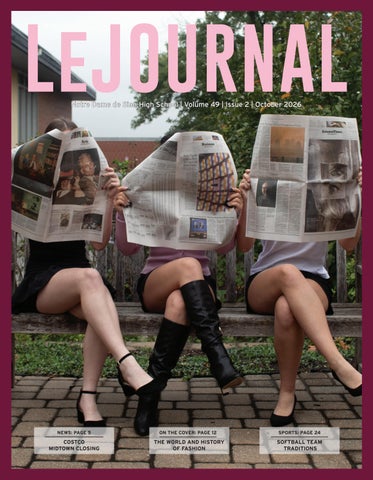
LeJOURNAL Notre Dame de Sion High School | Volume 49 | Issue 2 | October 2026
NEWS: PAGE 5
ON THE COVER: PAGE 12
SPORTS: PAGE 24
COSTCO MIDTOWN CLOSING
THE WORLD AND HISTORY OF FASHION
SOFTBALL TEAM TRADITIONS
CONTENTS 05
Costco Midtown closes and El Niño’s effects
06
How Sion is trying to increase school spirit
07
Volleyball Dig Pink game recap
ON THE COVER
12
The Function of Fashion: The fast and ever-evolving world of fashion
FEATURES
08
The farm girls of Sion
10
Vive Cafe and Sion Shoppe are expanding their offerings
16
Fashion trends are shrinking childhoods
17
Tipping should be a reward, not an obligation
A&E
18
19
Where to thrift in KC and Season 4 Ted Lasso review
20
Haunted houses and pumpkin patches to visit
22
Pilates & yoga trend and quinceañera dresses on display
23
The moon phases and impacts
SPORTS
24
Softball traditions help to welcome newcomers into the fold
26
A quarter wrap up of Sion sports
WHAT’S ONLINE A Journey to a New Life
The Burnout Behind the Grind
PRIMA in Pink
By Evie Christy
By Elena Vergara
By Kate Reid
02 | LE JOURNAL
21 08 06
Fall Book Review
PHOTO |LUELLA MOOK
04
News in Brief
PHOTO | SOPHIA THOMAS
OPINIONS
PHOTO | SOPHIA THOMAS
NEWS
08
22
editor’sink H
ey Sion! As we return with our second issue of the year, we wanted to bring to your attention to some of the routines in our lives that are engraved in our culture, while going almost unnoticed. On page 12, deep dive into overconsumption in fashion and its hidden harms. Page 16 examines how childhoods are shrinking, and the current “rush to grow up.” Turn to page 17 to read why tipping culture should not be the norm, or to page 10 to understand the ins and outs of our very own Vive Cafe. To get a glimpse into the lives of
three students’ family farms, flip to page 8. If you are feeling the fall spirit, wander to over to 21 for a tale of KC haunted houses or to 20 for some pumpkin patch recs. We hope you are able to soak this issue in and find yourself reflecting on the impacts your choices have on the world. We also want to thank the incredible Le Journal staffers who, through their countless hours and determination, brought this issue to life. Enjoy!!
S
WE’VE GOT SPIRIT
ydney Blaine and Cecile Kowalewich are the senior Student Engagement Leaders on student council and have taken on the former Scream Team responsibilities. “We plan the pep assemblies, do the event of the week planning, pick out themes and just kind of try to build up school spirit,” Kowalewich said. “I really hope that this sets the tone for the next however many years and that this can continue being the norm with people showing up for everybody.” The Event of the
Week promotes an event each week for students to attend and earn double spirit points. The dance team tailgate, Dig Pink volleyball game and fall sports senior night have been featured as so far been successful in its first year. Attendance has markedly increased at these events. “Once one person starts acting crazy, everyone starts acting crazy and just going crazy, going wild,” Blaine said, “and I think it’s just kind of a domino effect.” For more on student engagement, go read the story on page six.
Love,
CORRECTIONS
Seniors and student engagement leaders Sydney Blaine and Cecille Kowalewich.
In the last issue, on page 14 it should have been Sadie Hine, not Sadine Hine.
ON THE COVER Sophomore Marion Shaw and seniors Elena Vergara and Claire Steiner model fashion. Photo by Sophia Thomas.
LeJOURNAL. 2026 | 2027 LE JOURNAL IS THE OFFICIAL STUDENT PUBLICATION OF NOTRE DAME DE SION HIGH SCHOOL - 10631 WORNALL ROAD - KANSAS CITY, MISSOURI 64114
MEMBER
Missouri Scholastic Press Association National Scholastic Press Association International Quill and Scroll Journalism Educators of Metropolitan Kansas City Missouri Journalism Education Association
LETTERS TO THE EDITORS
Le Journal accepts letters to the editors in response to published articles. Letters must be signed, verified, and no longer than 200 words. Letters may be edited for length, grammar, spelling and content. Letters will not be printed if content is obscene, invasive, encouraging disruption of school and/or is libelous.
PRINTER
Neal/Settle Printing, Grandview, MO
CO-EDITOR-IN-CHIEFS
SOCIAL MEDIA EDITOR
Daniella Johnson Sophia Thomas
Santina Bonino
DESIGN EDITOR Nora Gedney
WEB EDITOR Claire Steiner
COPY EDITOR Luella Mook
BROADCAST EDITOR Addison Porter
REPORTERS Alex Cameron Elise Gedney Zooey Goss Kate Reid Marion Shaw
keep up with us: @sionstudentmedia Use your camera to visit sionstudentmedia.com!
NEWS & SPORTS EDITOR Riley Pintado
FEATURES EDITOR Sophia Schlichting
OP/ED EDITOR Elena Vergara
OCTOBER 2026 | 03
NEWS
news in brief
A wrap up of the quarter’s major news, both locally and nationally.
Life Beyond Sion
Storm Stomp
Beatification relation
Hispanic Heritage Month
The sixth annual Life Beyond Sion Conference kicked off Oct. 15. This year, the off campus courses included a trip to the KCRep Theater to see the play “John Proctor is the Villain,” a tour of the CPKC stadium, an overnight trip to St. Louis to see the Cahokia Mounds and a trip to KC Aerial Arts.
Students and staff rallied on the field Oct. 9 to compete in the multi-phase obstacle course that fundraised over $28,000 for student scholarships, surpassing the amount raised in 2025 by over $10,000. “This year we made it a lot more fun for people,” senior and Storm Stomp Co-Chair Taylor Earnest said.
Archbishop Fulton J. Sheen from St. Louis was beatified Sept. 25, the second final step before sainthood. Freshman Sofia Kasper is Sheen’s great-great niece and attended the four hour long ceremony. “He brought a stillborn child back to life after 61 minutes and there were six other people who came forward at the beatification saying that they have also witnessed a miracle,” Kasper said.
The Hispanic Heritage celebration was Oct. 1 and featured speaker Marissa Gencarelli, founder of Yoli Tortilleria, a mariachi performance, dancing, paletas from Palacana and tacos, tamales and churros for lunch. “I think it helps everyone understand there is diversity and we need to respect every culture,” Spanish teacher Martha McClung said.
PHOTO | SOFIA KASPER
PHOTO | SOPHIA SCHLICHTING
PHOTO | SOPHIA THOMAS
BY DANIELLA JOHNSON CO-EDITOR-IN-CHIEF AND RILEY PINTADO NEWS & SPORTS EDITOR
PHOTO | SOPHIA THOMAS
students attend international conference national
A
As part of the collaboration between the 22 Sion schools world-wide, junior Sydnee Peghee, sophomore Sophia Goffinet, sophomore Cecelia Williams and sophomore Addie Avila will visit France for the NDS international conference Oct. 26 Nov. 2. “I’m looking forward to seeing other Sion schools and how their cultures are different from ours, and how we’re also similar because we’re all the same kind of school,” Williams said. The week-long conference will take place in Evry where students will stay with a host family, attend meetings and participate in Sionfacilitated activities. They will also visit Paris and Strasbourg where they will tour the European Union parliament, as well as three other Sion schools. “I’m excited to just be in Paris and go to the Eiffel Tower, and also
there’s a dance or something at the end, and we all get to just be together,” Goffinet said. The student conference occurs every three years and rotates locations. The theme of this year is “How do Father Theodore’s educational insights help shape who I am today?” “We all know Sion’s values,” Williams said. “I think we’re all just going to come together and we’re going to have to figure it out and just enjoy this leadership conference.”
Williams and Goffinet pose before their trip. PHOTO | DANIELLA JOHNSON
november voting
T
he Midterm elections are Nov 3. For residents of Kansas City, Missouri voters will decide on whether to keep the voter-approved amendment providing reproductive healthcare rights. On the Kansas side, voters will decide on their new state governor. The candidates are Democrat Cindy Holscher and Republican Ty Masterson. For congress, citizens of Kansas will also vote for their senator. The race for this seat is between Democrat Adam Hamilton and Republican Roger Marshall. “[The Midterms] are really important because of the way that our Senate and our House of Representatives term cycle lines up,” American Government teacher Maggie Schlink said. “Oftentimes at midterms, we are electing senators and representatives. Those people are a way that we can directly have a voice in our government. We pick them based on their ideals, their beliefs, the policy that they run for to make sure that our similar ideals and beliefs are represented in our government.” PHOTO | WIKICOMMONS
what to do in kc Glow Wild at the KC Zoo
04 | LE JOURNAL
Café Corazón
oct. 1 - dec. 20
locations in brookside, the crossroads and westport
PHOTO | DANIELLA JOHNSON
PHOTO | DANIELLA JOHNSON
downtown kc farmers market open year round PHOTO | DANIELLA JOHNSON
NEWS
Nuestro Clima Cambiante Meteorologists warn that we are now in a super El Niño. BY RILEY PINTADO NEWS & SPORTS EDITOR
E
very year the Earth goes into a state of either El Niño, La Niña or La Nada. These phenomena are completely normal, and are usually tractable for the regions most affected. However, The National Oceanic and Atmospheric Administration officially announced June 11 the arrival of the current Super El Niño. A regular El Niño is caused by surface water in the central-eastern Pacific warming up considerably, which forces the air circulation across the globe to reverse. Researchers are yet to discover what exactly triggers the water to heat up, but its impact affects millions of people around the globe. During the Super El Niño, these effects will be felt ten fold. “[Climate researchers] usually think that we might go into neutral before the waters tend to change direction. Everything settles, and then it builds up again,” KMBC
COSTCO
CONVERSION
Costco Wholesale in midtown Kansas city is transforming into a business center. BY ZOOEY GOSS REPORTER
C
ostco Wholesale in Midtown, Kansas City, is transitioning into a Costco Business Center. The store closed Oct. 1 to start a six-month renovation process, and plans to reopen in the spring of 2027. The business center will cater towards restaurants, commercial enterprises, and convenience stores. Merchandise will be sold in industrial amounts rather than household quantities. The Midtown location wasn’t performing as well as other Costcos, according to the Kansas City Star. When asked, Costco would not give further information and declined an interview. According to a story on KMBC, Midtown citizens claimed this was a huge blow to their community. People relied heavily on this Costco for groceries, glasses, hearing aids and so much more. It was a highfunctioning store that had become critical to those who shopped there. “It’s going to be really hard on the neighborhood. Midtown has had Costco for 25 years, and a lot of other businesses that might have moved into Midtown didn’t, because they couldn’t compete,” Sion parent and Midtown resident Claire Murphy- Shaw said. “The neighborhood grew really reliant on the services offered
News meteorologist Katie Horner said. “Nature does not like stability. It always wants to change. So when there’s low pressure, it fills in with high pressure.” According to the National Weather Service, locally, the average temperature was about 6.5 degrees hotter than years past. The heat was so intense, practices had to be canceled and outdoor school events were moved to later dates. “NFHS is an organization that puts out guidelines for heat and weather, and MSHAA uses those guidelines to determine if we can or cannot have practices,” Athletic Director Anna Avila-Williams said. “In September and August there were a lot of cancellations because we were either in the black zone, which means you can’t do any activities at all, or the red zone where you can only participate outside for an hour.”
While the extreme weather conditions we’ve experienced throughout this year could be due to the El Niño, Horner said that after her months-long research she had found no data to back this claim. “Over the 36 years I’ve been a meteorologist, I have gone through and looked at every time we’ve had a Super El Niño or a La Niña or an El Nada, and compared it to temperature trends, precipitation trends, severe weather trends, snowfall amounts all just for Kansas City,” Horner said. “What I came up with is that there is no difference here. When you look at national maps [during an El niño] they are going to read warmer than normal, or wetter than normal. We’re always right on the edge of that in the middle of the country.”
at the Costco. And now that it’s converting to a business center, it feels like it’s going to leave a big hole in the services available to Midtown residents.” Turning it into a business center means weekly grocery shopping for Midtown residents is much less convenient. The next nearest Costco is a half-hour drive away. However, there is a Whole Foods that is around a 15 minute drive, but Whole Foods does not have warehouse prices. “My family is now gonna be shopping at Whole Foods. We’ve been shopping at Whole Foods so Costco shutting down isn’t a crazy inconvenience to us, but I know it’s an inconvenience to the community,” senior Lucy Kehoe said. While some products at the business center will still have the regular size along with the industrial size, many amenities are being removed. The services leaving the Midtown Costco include the food court, optical center, hearing aids, clothing section, tire services, bakery, deli, furniture and the liquor department. “I’m sad about it because it is a main place for shopping for everything you need in one place in Kansas City, and it also brings people together,” Midtown resident and Sion grade school parent Andrea Mallory said. Citizens and residents have pushed back on the transformation with community petitions, public hearings and direct emails to the corporate Costco officials, according to Fox4 News. As a way of compromise to the complaints, Costco has agreed to keep a few of its original amenities open despite the
transformation. “I think it’s great that the gas is staying. I think that is really important because it’s a safe place for people in Midtown to get gas. And I also saw that they agreed to extend the pharmacy for at least one year. The pharmacy is really critical in Midtown, and that’s where a lot of people rely on getting their medicine,” Murphy-Shaw said. “But I hope they’ll agree to maybe prolong that even further because it’s so important for people to have access to that affordable medicine.” Even with the gas and pharmacy staying, it will not accommodate for what the midtown community has lost. The change into a business center leaves the community with a gap in where to shop for essentials. “It’s kind of like a bait and switch, and that’s really upsetting because the people of Midtown made a big sacrifice up front,” Murphy-Claire said. “Houses were torn down, money was diverted from other projects so that Costco would come, and now it remains to be seen what services the community can really access in the new model.”
PHOTO | ZOOEY GOSS
OCTOBER 2026 | 05
NEWS
spirit week PHOTOS | MEGHAN FIMMEN
bbq dads vs soccer moms
no place This school year, our community has been focused on reviving school spirit, and the Dig Pink volleyball game shows it.
STORY BY LUELLA MOOK COPY EDITOR DESIGN BY NORA GEDNEY DESIGN EDITOR
picking up pride
I met gala vsco/ 2016 throwback
purple out 06 | LE JOURNAL
n the South Six hangs a picture of a completely packed student section. Girls screaming. Purple face paint. Pom-poms. Hands thrown up in celebration. This picture serves as a reminder of a time when our students truly showed up to support their classmates. A time when school spirit was through the roof. For Principal Jana Cooper, her time at Sion was filled with spirit and support. “There was school spirit for everything, not just sports activities. Whether it was the play, or choir or Le J, there was just a buzz,” Cooper said. “Girls wanted to support each other.” In the past few years, attendance at games and school events has noticeably dropped, so this year the administration is focused on bringing that school spirit back. Cooper believes that what changed for students between the 90s and today is the stress levels associated with high school. “I think our students have more pressure on them than we did, or we chose to accept. The typical Sion student today seems very driven on all fronts: academic, developing their spirituality and service,” Cooper said. “I think that coming to events and feeling connected to your Sion sisters or dedicating time to spend with your friends gives you the fuel to keep going with all of those things.” The administration and Student Council’s desire to prioritize school spirit has led to a variety of new events and incentives, for example “events of the week.” Student engagement coordinators Sydney Blaine and Cecille Kowalewich are designating specific games and other activities as the events of the week, to encourage students to attend them. Each event of the week has a different theme. For example, the volleyball home opener’s theme Sept. 8 was Jersey Out. The student section was packed with a variety of soccer, basketball and football jerseys. Another large addition made to the community this year is the grouping of maisons into chateaus. Chateau is the
like
French word for castle, which is fitting, because these groups of students are meant to form tight-knit families within the school community. French teacher Liz Lopez proposed the idea for chateaus after visiting a Catholic school in St. Louis that used a house system. “I noticed that the students were wearing different colors, there were pins, their doorways were painted certain colors. They were so excited to talk about their houses,” Lopez said. After seeing the excitement the students held for their multi-grade level houses, in addition to the opportunity for house competitions provided by this system, Lopez knew that this was something that could benefit the Sion community. Chateaus are already competing for spirit points. These points are earned by attending games, masses, theater events, participating in Storm Stomp, encouraging shadow students, good behavior and the Chateau’s students maintaining high GPAs. The Chateau with the most spirit points at the end of each quarter will earn different awards. The ultimate goal is that the competition between Chateaus will bolster attendance at games. Varsity volleyball setter and junior Molly Rome said that attendance at games has “skyrocketed” this year, which could indicate that the Student Council’s incentives are working. “It’s so fun to play for a crowd. You’re playing for something bigger than yourself, and that’s a lot more empowering than just playing for your team record,” Rome said. “Our home opener- the crowd was so good. It was such a shift from last year to this year.”
passing in pink
S
ion volleyball lost to St. Teresa’s Academy in four sets Friday, Oct. 9. The stands were packed on both sides, with the STA students dressed as smurfs and Sion students decked out in pink, to support the fight against breast cancer.
NEWS
This was the annual Dig Pink volleyball game, raising money for Peace Out Cancer. This organization provides recliners for breast cancer patients in recovery. Seniors Maddie Westmeyer and Frances Groves planned and organized the Dig Pink game, raising over $1,500 through fundraising, the sale of Dig Pink T-shirts and a bake sale. “We had to do a lot of reaching out to where we were gonna donate, and we also had to coordinate with the whole school to figure out donations,” Westmeyer said. “Me and Frances both have family members with breast cancer, so it’s close to home.” The game consisted of four lively sets. STA won the first two sets by fewer than five points. Sion took the third set from STA, adding another set to the game. Sion lost the fourth set 23-25, to end the game. “Hard loss, but I feel that’s probably the best we’ve played all season,” senior captain Vivi Drosos said. “Our energy was consistent, and we didn’t get in any ruts where we lost multiple points in a row. I think, overall, we hung pretty close with them the whole time, especially that set that we won.” The Sion volleyball team stayed positive the entirety of the night, having high energy rallies throughout the game. “We had some crazy hustle play, and then Molly or Hadley were able to get a set off of it, and then we were able to turn into a kill where Maddie put it right down,” Drosos said. Westmeyer had over five kills during the game. The volleyball team has two more regular season games before the end of the season, and senior captain Hadley Clevenger has a clear goal for the team. “No more losses,” Clevenger said. “I think we can do that.”
Senior Vivi Drosos warms up before the game. Students cheer for the Dig Pink volleyball game in the student section while cheerleaders also perform. Junior Molly Rome gets ready to serve at the game. PHOTOS | SOPHIA THOMAS
OCTOBER 2026 | 07
FEATURE
LIFE
on the
The life and activities of students who live on farms. BY NORA GEDNEY DESIGN EDITOR
animals you might see:
08 | LE JOURNAL
states, but they have some truth to them. Senior Luella Mook is an example of these stereotypes holding true. She has lived on a farm her whole life. Her farm has horses, chickens and one goose named Shirley Temple. Her family rents part of the land to a farmer, who grows crops and runs cattle on it. They take care of the other animals, garden and enjoy the beautiful nature. “I loved growing up around all the nature,” Mook said. “It’s just so pretty where I live. Whenever it snowed, my dad would pull us behind a four-wheeler on a sled.” Growing up, Mook also got to ride her horses while competing in western horse shows. Her mom originally wanted the horses because she was a barrel racer in high school, so a love for horses runs in the family. “My mom loves them,” Mook said. “Even though they are old and can’t be ridden anymore, we still love them and get to take care of them.” Mook drives a 30mile commute that takes her through three towns and down two major highways. “Whenever I’m on
I-435, I wish I lived closer. But other than that, I’m very happy with my life.” Another student who lives on a farm is senior Cate Karumbi. She has lived on a farm since 2020. She loves her farm but
“
Whenever I’m on I-435, I wish I lived closer. But other than that, I’m very happy with my life. -Luella Mook, '27
“
L
iving in Kansas and Missouri can mean a lot of things. When anyone from another state or even country thinks of Midwesterners, they often wonder, “Do you live on a farm? Do you have cows? Have you ever even seen the city?” These are stereotypes of the
misses how close to everything she was when she lived in Independence. Now, most of her time is spent driving, whether it’s 45 minutes to school, or almost an hour to see her friends in the city. “I was right by everything, and now I feel very removed, so it’s kind of strange,” Karumbi said. “It takes me forever to get
FEATURE anywhere.” Her family operates a goat farm, with about 40 goats, four cows and 30 chickens. They decided to get the farm because her dad also grew up on a goat farm in Kenya. Having a similar experience to her father helps her feel connected to his upbringing. They sell some animals, but also use them for themselves. They keep about half the beef for themselves and sell the rest. They also sell some of their goats, so it’s a good profit. Since they make their own meat it’s another thing they don’t have to go purchase from the grocery store. They get the benefit of fresh free food. “We don’t have to buy any meat outside of my house other than chicken, and we sell the extra meat,” Karumbi said. She also has some chores to help her family out. As part of her role on the farm, she lets the dogs out and feeds the chickens. Karumbi said that one of her favorite parts about owning the farm is getting to see all the animals everyday. “I usually see the cows as I’m leaving for school in the morning,” Karumbi said. “It’s so pretty because the sun is right behind them and it just looks so cinematic.” Karumbi values her social life as well. She doesn’t let the fact that she is so far get in the way of seeing her friends. “I have learned to love driving so now it’s not that much of a burden on my life,” Karumbi said. “I still will drive to Blue Sushi in Power and Light to have dinner with my friends.” Sophomore Payton Pace is another student who lives on a farm. She has by far the most animals. Her family moved to a farm due to the fact they had so many. They originally lived in Lee’s Summit but, due to homeowner’s association rules, they were not allowed to keep so many pets. So they moved to a farm. When they first moved to the farm they had alpacas, llamas, koi fish, dogs, cats and more. Since then they have downsized the farm. “It was so much work taking care
of over 300 animals, so we decided to downsize,” Pace said. They still have a lot of animals, but it is just a more manageable amount. Pace helps out on the farm by taking care of the indoor animals. She feeds her 30 cats and does other things to help out around the home. Her parents do more of the outdoor farm work. Pace says that her cats are her favorite animals. She said that even though she has many, she still loves all of them individually. She also enjoys showing them to her friends and hearing how surprised they are when they see her farm. “Whenever I invite people over they always love spending time with the animals,” Pace said. One of the most unique parts of their farm is their koi fish ponds. They have two ponds that hold around 80 koi. They love being able to walk by the ponds and connect with nature. “It’s pretty cool because it’s not something you would usually see on a farm in Missouri,” Pace said. Farm life is full of outdoor stories and a lot of different animals. They get to have an individual experience that will stay with them forever. “Growing up around beautiful nature is the best part,” Mook said. “I wouldn’t change it.”
PHOTOS | SUBMITTED BY LUELLA MOOK, PAYTON PACE AND CATE KARUMBI
OCTOBER 2026 |09
FEATURE
LOCKED AND L T
he sharp buzz of the espresso machine running and the scent of caramel syrup filled the air at a crisp 7:45 a.m., as students clocked into their early morning shift at Vive Cafe. This has been the routine for dozens of students in the Internal Impacts class since 2022, when it reopened as the business it is today. The class originally started in 2020, but it shut down due to the COVID pandemic. When Amanda Loflin, Internal Impacts and French teacher, was brought on in 2022, she teamed up with another teacher, Lori Moore, to revive the then defunct cafe. “Ms. Moore wanted to retire, so in 2022 Ms. Carmody knew that I had started my own business, and she thought I would be quite natural in the role of taking over this class,” Loflin said. “I was learning as I went along.” Now four years in, the shop has recently expanded their offerings. The fourth hour is a new addition to the Cafe’s arsenal this year. It’s part of an array of initiatives aimed at increasing attendance and hype—and it seems to be working. In a Sion Student Media poll of 172 students, 61.7% of students reported that these new initiatives made them want to shop there more. “I think it’s made people kind of want to come more,” junior Avery Mayes, a student during the fourth hour Vive Cafe, said. “I feel like [the new initiatives] just makes it more fun and a better environment.” Some initiatives include parent orders, menu additions, music and lots
DRINK RECS Vive Cafe’s baristas recommend their favorite drinks. 10 | LE JOURNAL
of decorations (including some window drawings). While these have increased sales, they have come with their own challenges for the team. Organizing the delivery for the lunch period opening was a major hurdle. “When we first started, it was kind of disorganized,” Mayes said. “No one really knew how to do it or how to deliver it to the freshmen and sophomores. I think that was our biggest challenge.” Another goal for the end of the semester is forming a mobile coffee cart that will service Sion lower and other private schools in the area. Students will pitch business ideas and plans to Loflin, the principal Jana Cooper and other community partners of the cafe. The cafe is run by two class periods. They share responsibilities and finances, but otherwise remain separate and run as their own entities. While the two hours do mostly the same things, the first hour class also runs the website and keeps it up to date. Students in the classes are split up into three groups: Social Media/Marketing, Business and Shop. The Marketing team’s main job is to promote Vive Cafe, primarily through their Instagram, @vivesioncoffee. Posting has increased this year, partly thanks to a new posting schedule. “We’d try to have constant stuff going out,” senior and marketing team member Alexius Wolff said. “[When we post reels], we could talk about what we like and brainstorm public ideas of what we want to
ADDI LEVIN ‘27 Mocha Frappe
“It tastes like coffee and I love coffee.”
do next.” The Business side runs all of the finances, manages orders and adjusts menu prices as needed to keep profits afloat. All of the cafe’s profits go into buying the needed supplies, pastries and coffee beans. Vive Cafe sources their coffee beans from Broadway Roasting Company and their pastries from McLain’s. These businesses give them discounts, which helps with making sure there’s enough finances to go around. If enough money is made, the team can decide on extra purchases: the light up sign or the pom-pom decorations are some of these buys. According to Mayes, these decorations are a big part of aiding in the cafe’s appeal. “I think that it’s led to an increase of interest in the shop,” Mayes said. “I feel like it’s kind of improved profit for Vive Cafe, and it’s made it more exciting.” The Shop team cleans up the café after every shift and makes note of what needs to be ordered, whether that be syrups or lids. It’s a complicated system, but it’s been the one that’s
MAYE WHITTAKER ‘28 Mango Smoothie “It’s really refreshing and you can never go wrong with a smoothie.”
LATTE
8
worked for four years. Through this class, students can learn the ins and outs of the business. That’s one of its main draws. Students are able to experience all of the different factors that make or break a business and can use that knowledge not only in school, but in their own lives. “You need to be really organized and there’s going to be stuff where you’re like ‘Oh, I don’t need to do this’, but really you do,” junior Maye Whittaker said. “There’s also competition from other food spots like
THE FIRST MONTH
FEATURE
The business behind Vive Cafe is complicated and provides teaching opportunities. BY SOPHIA THOMAS CO-EDITOR-IN-CHIEF
the vending machines or bake sales, which adds an additional problem.” Aside from the entrepreneurial benefits, the class also teaches a slew of real-world skills, and provides students the opportunity to explore their interests (and maybe learn how to make their coffee order along the way). “I think it is valuable to any person, even if you’re not thinking about going into something like marketing,” Wolff said. “Making the drinks is a lot of fun because
$1942.25 $5.11 total money made
average sale
55%
I’ll be so honest, I didn’t know how to make coffee, and I didn’t realize my order from Starbucks was so simple until I literally started helping.” Junior Madison Brox laughs while scooping ice into a latte. Sophomore Cecelia Williams pays for her order during her lunch break. The lunch opening is one of Vive Cafe’s new initiatives. Junior Ava Grojean taps cinnamon onto a frappe. Junior Maye Whittaker pours a mango smoothie into its cup. PHOTOS | MAYE WHITTAKER AND SOPHIA THOMAS
45%
of sales are made of sales are made with card. with cash.
Statistics from Vive Cafe’s first month being open. OCTOBER 2026 | 11
cover story
FASHION A deep dive into how the fashion industry functions in today’s world. BY ELENA VERGARA OP/ED EDITOR AND CLAIRE STEINER ONLINE EDITOR-IN-CHIEF
C
hristian Dior. Vogue. Luxury. These words could resemble the idea of fashion in a glance, but there is much more underneath the surface. Immense social movements and identities have been driven by the use of textiles. All sorts of innovative ideas and expressive techniques have helped to develop society and cultures throughout the centuries. Fashion is a way to communicate voice and meaning beyond what is surfacely understood. “Clothing can represent someone’s personality, beliefs, culture and overall individuality without them necessarily having to speak. With designing specifically, a garment can go beyond simply being something that looks visually appealing and can instead communicate a much deeper message,” Marist Fashion Design Apparel Construction student Makayla Montenegro said. One way fashion is used is to convey a sense of individuality. Various styles have formed throughout history, showcasing people’s identity. For example, in the 1970s, hippie, now known as boho, was widely popular, featuring tie dye clothing, fringes, bell bottoms and flowy garments which
symbolized their advocacy for peace and freedom from traditional norms. In the 1980s, with the rise of hip hop came streetwear, a popular style featuring baggy jeans, oversized hoodies, graphic tees and statement shoes. These, along with countless other styles, have been used to express an individual’s culture and uniqueness. “Fashion really ties people together, especially for the circles you run in,” senior Abby Gural said. “It could express the activities you do. So if you’re athletic, you’d wear leggings or a sports top. Or if you’re in the theater, you’d wear this weird subsect of clothes.” Another way fashion has been used throughout the years is to express gender fluidity. In certain cultures, unisex wear has been practiced throughout history, but for most, tradition reigned. Women would wear dresses that accentuated the idealized silhouette, and men primarily wore neutral trousers and shirts. However, in the 1900s, men embraced more feminine aspects of fashion, including brighter colors, while women began wearing pants. Later on, the fashion industry began to mesh the affiliated clothing. For example,
in 1966, Yves Saint Laurent came out with the first ever women’s tuxedo, Le Smoking. “The mid 20th century was really the first time that it became socially acceptable for women to wear pants, and that was a huge shift in Western culture. Menswear was adopting things from women’s wear as well. Men started embracing clothes like tunics which had a more feminine association prior to that,” Assistant Professor of Fashion at Marist University Mario J. Roman said. “These aspects coming together made androgynous dressing in the 21st century more possible.” Fashion is known for being used as a tool in protesting. During the Civil Rights Movement, fashion was used to express strength and unification against racism by protesters wearing their “Sunday best.” During the women’s 1913 suffrage movement in Washington D.C., women wore modest, well constructed white dresses to signify innocence, purity and higher status to falsify the narrative of female activists being aggressive. “Both groups chose the idea to present themselves respectably for a purpose because they’re trying to communicate
PHOTO CREDITS | WIKIMEDIA CREATIVE COMMONS
ICONS THROUGH THE DECADES
1970s
1990s KATE MOSS
DIANA ROSS
1960s TWIGGY
12| LE JOURNAL
1980s MICHAEL JACKSON
2000s
BRITNEY SPEARS
cover story stores like Amazon, Shein and Zara make trendy clothing not only readily available, but at your doorstep within a day. But accessibility doesn’t just refer to how fast you can get whatever you need. Buying from these stores comes with the risk of receiving lower quality items that won’t last very long. This is not to say that every cheap item of clothing purchased is of poor construction, or that a high price means a higher standard. But, when picking out pieces for your wardrobe or looking at brands to buy from, quality plays an important role. “We think we have access to all of the clothing in the world because it’s so cheap,” Clark said. “But most of it is ugly and made of really terrible fiber.” According to an article written by the Business of Fashion, 51% of global customers say quality is a key driver in creating a high-end brand perception. The accessibility of garments is dictated by their quality. Today, with so many accessible fashion brands cutting corners in order to make their clothing, quality and affordability are almost at odds STATUS with one another. The term “fast fashion” The items in your closet can signal to was coined in 1989, and was originally seen the world who you are. This might not be as a positive thing. something that you realize, but according “It really is a feat of technology that to research done by Marija Kertakova they’re able to streamline the processes and Jordan Efremov from Goce Delcev because there’s so many steps involved in University, clothing is one of the first and this idea of a garment, then to get it in the primary markers that provide information hands of the consumer,” apparel designer about an individual’s national and class and fashion educator at Johnson County affiliation, wealth and age. The more poised and polished a person looks and dresses, the Community College Jordan Gomez said. The fact that clothing could be made more reliable and influential they feel. “Dressing isn’t just about looking cute,” quickly and bought for a lower price used to be exciting. It was seen as a feat of Hadley Clark, a member of University of manufacturing, that clothing could be made Kansas’s textile department said. “It is like so quickly and affordably. For the first time armor for your day. It can change the way you feel. It can mimic the way you feel on the people who couldn’t afford luxury brands were able to wear the same styles that they inside.” were currently seeing on the runways of high-end brands. ACCESSIBILITY & QUALITY “As a consumer, it can transport us into In the age of fast fashion and micro something else,” Clark said. “Or to dream trends, clothing for any occasion is easy that we’re someone else for $20.” to come by. The fact that the clothing Fast fashion isn’t going away, but is cheap, on trend and readily available accessible, quality clothing is. According to makes purchasing simple. Online retail to the public that they are respectable and upstanding citizens,” Roman said. “The suffragettes, dressing in head to toe white dresses, was this argument that they can be trusted with the right to vote because they are already respectable American citizens.” Fashion has also been a symbol of feminist change throughout the years. In the early 1900s, women stopped using rigid silhouettes and instead switched to more flowy clothing symbolizing the change in the women’s societal roles and freedom being gained. Another instance of feminist action was at the Miss America Protest in 1968, where women congregated and burned feminine clothing items like bras and stockings to object the unattainable beauty standards society pushes women to have. “Clothes are very symbolic,” Social Studies teacher Maggie Schlink said. “People sometimes think of protesting as people in the streets, holding signs, chanting, but protests can be nonverbal, and being able to use clothing as a symbol of that is really important.”
story continued on page 14
2010s ZENDAYA
2020s ASAP ROCKY
OCTOBER 2026 | 13
cover story
FAST FASHION ALTERNATIVES Try the following options to create healthier clothing habits.
THRIFTING Instead of going to the mall and trying to find new pieces, try shopping second hand. Thrift stores and antiquity stores not only have so many clothes in their sections, but you find pieces that are of high-quality and often the same price as if you were to buy them new off a fast-fashion website.
BUYING LESS OFTEN Try purchasing garments that are of better quality even if they are more expensive. Try saving up in order to purchase pieces that can last a lifetime, rather than one cycle of the washing machine. Take the time to curate a wardrobe built of items that not only have value, but were constructed with purpose.
FIX UP YOUR CLOTHES Think before you toss your garments. Try fixing them up before sending them to another landfill. Patch the holes, take it in, or make it an entirely different piece of clothing.
CLOTHING SWAPS Before throwing out or buying new clothing, swap with those around you. Sister to Sister, founded by seniors Kate Suter, Claire Steiner and Giuliana Ferrara, is holding a formal wear swapping event Thursday, Nov. 12 from 2:30 to 5:30 to prioritize sustainability, affordability and sisterhood connection. Visit the following website to learn more about Sister to Sister.
14 | LE JOURNAL
story continued from page 13
an article written by Selvane, raw material costs constitute an average of 40-60% of a garment’s intrinsic value before brand markup. So on top of paying for the quality of the item, you’re also paying for the brand name, because high quality clothing comes with a level of craftsmanship and branding that makes it almost impossible to be done affordably. “It is a privilege. Full choice of what you get to put on your body. The privilege of that choice, the privilege of access,” Clark said. “You need to treat that with a lot of integrity and care.”
FABRICS & FAST FASHION Fabrics are the base of any piece of clothing. In order to make a design, fabrics are often one of the most important parts that must be considered. Part of what makes some items of clothing so accessible is the fabrics they’re made of. For example, because of the amount of production it takes in order to make them, natural fibers cost significantly more than synthetic fibers. One of the big things about synthetic fibers is their ability to be made cheaply and quickly. Unlike natural fibers, synthetics don’t have to be grown. They’re man-made through a chemical process that reduces the cost and time for production. But often this leads to problems in quality and longevity. Despite the negative reputation that surrounds the world of synthetic fibers, they’re one of the leading globally produced fibers today. “The earth and the minerals and the soil that we have access to is totally different than it was 50, 75 years ago," Clark said. "So the effort that would go in for the production of a synthetic fiber is less.” According to the 2025 Materials Market Report, polyester continues to be the most widely produced fiber in the world accounting for 59% of global fiber production. “Polyester is interesting because it can be made into almost anything,” Gomez said. “It’s man-made which means that it can be made with efficiency and at a price that is done affordably. In contrast the second most globally produced fiber is cotton. Cotton, because it is a natural fiber, is widely considered to be superior to any synthetic fiber. This is due to its breathability, absorbency and comfortability. Despite cotton being the second most produced fiber globally, it only accounts for 19% of the global textile market. “Something that is made of cotton grows from the earth,” Clark said. “So it takes more manpower to work with natural fibers than it would to make something that is synthetic.” Beyond the poor quality that comes from buying cheap and buying frequently,
fast fashion faces major ethical issues. One of the biggest issues within the realm of fast fashion is the environment the people making the clothes work in. The work stations typically have poor lighting, toxic chemicals and unfair pay. One of the most well-known and extreme examples of the consequence that fast fashion can have on workers is the collapse of a building in the Rana Plaza. “There has been a lot of legislation passed to protect the rights of workers since, but situations like this still get swept under the rug,” Gomez said The Plaza, located in Dhaka, Bangladesh, was a garment factory for many well known western companies like Walmart, Children’s Place and Zara. According to the University of Alabama at Birmingham, workers in the factories told their managers that they had noticed cracks in the building but were told to go back to work. At one point, the managers were even given an evacuation order (which they ignored). As a result, 1,129 workers died, and even more were injured. “You’re talking about a whole ecosystem of something that’s happened. You’re not just talking about the clothing," Clark said. "You’re talking about the humans involved.” The treatment that many face at the hands of the corporations that feed fast fashion isn’t the only problem. Fast fashion is designed to be on trend. With a new microtrend popping up every week, no one can wear the clothing as fast as it’s being produced. “We need more intimacy, more care and more reverence for the things that we own,” Clark said. “It doesn’t just disappear because it’s out of your hands.”
ENVIRONMENTAL EFFECTS Fashion poses a threat to the environment. The fashion industry produces around 100 billion pieces of clothing every year with 60 billion pieces being thrown away annually due to the rise of trends while prioritizing cheap over lasting. “Our society has become very focused on mass consumerism from shops like H&M, Zara, Shein and Target,”senior and Green Team Co-President Finley Glennon said. “These shops pump out clothing that is popular for five minutes and then, as soon as the trend is done, people throw it all away because it is so cheap.” According to Rebeka Clarke in an article about fashion carbon emission, the production and transportation of clothing accounts for about 10% of total greenhouse gasses. That means the fashion industry releases around 1.2 billion tons of carbon into the atmosphere annually. Creating materials like polyester and nylon, that are composed of fossil fuels in the form of plastic fibers, result in mass carbon emission as well. “The production of clothes takes up
cover story a lot of resources and energy and puts more carbon into the atmosphere,” senior and Co-Founder of The Sewing Club Emily Maldonado said. “Fossil fuels are finite resources, we only have so much. So when we use them to make trends that will just be thrown away in a couple months, it wastes those resources.” Production and disposal of clothing can also leak toxic chemicals into water sources. These toxic chemicals come from the dyes in the fabrics. Take the richly colored clothes in your favorite store. When manufactured or thrown away, the chemical dyes used to attract customers seep into soil, rivers and water sources. Due to this, the soil becomes less fertile, water sources for animal and human use are contaminated, and ecosystems are destroyed. “Leathers can be really cool, but the chemicals we use to tan a hide are very toxic,” science teacher Rick Knowles said. “Run off from these toxic chemicals goes down into creeks, and it can be very dangerous. In some countries, kids are drinking that polluted water.” Additionally, the fashion industry consumes an enormous amount of water and one example of this can be found in the growing and production of cotton. According to Taylor Mogavero from FSU 175, to grow a kilogram of materials like cotton, it takes between 7,000 to 29,000 liters of water. After being spun, dyed and produced, the water usage can really add up. It takes about 2,700 liters of water to produce one cotton shirt. “When you create fabrics, they tend to use clean drinking water and a lot of times it is being contaminated,” Maldonado said. “We only have so much accessible water. The amount of fresh water we have is only 3% of the world's total water. So a lot is being used when you produce fabrics.” Microplastics released from textiles often land in water sources. For example, 35% of all microplastics found in the ocean are from clothing. Due to clothing made of cheap, synthetic materials, more and more microplastics have been found in oceans and watersheds. When clothing is washed, tiny pieces of plastic enter the plumbing system and later find their way into streams and rivers, commonly used for human consumption, carrying them into the ocean. “Microplastics are such small pieces of plastic that once they enter oceans and ecosystems, they become extremely difficult to completely remove,” Montenegro said. “Marine animals can consume these plastics, allowing them to continue moving throughout food chains and affecting ecosystems beyond the original area where the pollution occurred.” Overconsumption, caused by fast fashion and trending styles, has additionally decreased the value in clothing. According to Giada Nizzoli from Project Cece, the
average person wears a piece of clothing seven times before throwing it away. On average, people are buying 60% more clothing now than in 2000. This cycle promotes the production of excess low quality clothing while supporting fast moving trends and pollution. “Society can pressure you so much, too,” senior and Green Team Co-President India Browning said. “If someone has this set, and you see them wearing it all the time, you’re going to want that too. It becomes a whole cycle. It doesn’t stop. You feel like you’re missing out, and sometimes that’s a really hard feeling to overcome. So people don’t. They buy.” Focus on what you can do now. An important piece of advice is learning how to take care of the clothes you have now in order to maximize their lifespan. According to Roman, it is important to be conscious when you decide to wash a piece of clothing. Unless it is a foundational piece, ask yourself if it is necessary to wash in order to create less wear and stress on the garment. To increase the longevity and structure of your knitted items, ditch the hanger and fold them instead. Finally, to ensure that hung clothing continues to hold up, invest in hangers that will support certain fabrics. In the future, invest in durable, well made, high quality pieces. Throughout the years, you will be able to grow your wardrobe to create a long lasting, rotating closet.
SION IN STYLE Sion students show off their own unique style. Senior Giuliana Ferrara, junior Cielo MagañaMora and freshman Sadie Hine show their styles.
PHOTOS | CLAIRE STEINER & ELENA VERGARA
OCTOBER 2026 | 15
Editorial
Yolo W
Modern culture and fashion trends are causing young girls to “grow up” faster.
blast from the past Toys from the last genereation, and their downfall.
The Barbie Doll came out March 9, 1959 and was an instant success, selling over 300,000 dolls in the first year. Sales experienced an all time low in 2015 according to LinkedIn. Girls are now turning to Bratz dolls, who have extreme makeup and mature style. Build a Bear opened in 1997 in St. Louis. It originally cost between $10 and $15. Over 40% of shoppers are teens and adults. The store also is now mostly online. Children are now gravitating towards Jellycats, which cost anywhere from $20, to $100. The Cabbage Patch Kids were founded in 1983 and were an instant hit. They were a little on the pricey side, selling for between $20 and $25. Sales continually decreased and kids are now buying Cuties and Mini Babies. The original Beanie Baby was created in 1993 and sold for about $5. The craze over these stuffed animals occurred during the mid to late 1990s. Sales have steadily decreased since 2010, with kids now turning towards Beanie Boos, or more trendy stuffed animals. The Polly Pocket was invented in 1983, and cost under $10. According to Grunge, 75% of young girls owned a Polly Pocket in the 1990s. Polly Pocket experienced years of decreased sales, before eventually getting discontinued in 2015. Girls are now playing with Mini Brands.
student takes 95%
Think that modern fashion trends are causing young girls to rush their childhood. ALL PHOTOS | SOPHIA SCHLICHTING
16 | LE JOURNAL
The American Girl doll was another top— seller. Now, girls are ditching their expensive doll for an equally expensive pair of leggings they will grow out of in six months. According to CNBC, American Girl doll sales earing patterned bright colored reached their peak of $600 million in 2016, clothing as a child of the 2010s but sales have fallen dramatically, reaching generation felt like a right of only $200 million in 2023. passage. Going to Justice, the Girls are also influenced by celebrities loudest, brightest dresses waited on the like Sabrina Carpenter. Carpenter has a very hangers. Children at Oak Park Mall were young fan base, but her songs do not match heard begging to ride the carousel. Other this youth. Her albums contain a plethora of moments included waiting for the Build-aBear party invite or dragging a parent to buy explicit songs. “Taste.” “Juno.” “Tears.” All of these songs have something in common: Disney princess costumes. their lyrics are extremely inappropriate and All throughout elementary school, outfits were a statement. The fit was a way suggestive. In contrast, at a Carpenter concert the to express yourself by wearing the newest wheely tennis shoes, or the latest Jojo Bow. majority of the audience is young girls and teens. This is another reason why children Now, elementary school girls are feel the rush to grow up. If their favorite wearing high-end athleisure like Alo. Or artist is wearing scandalous clothing and they’re carrying their Sephora bags of makeup and skincare, with a new set of fake talking about mature topics, then they should too. nails or freshly dyed hair. Wearing expensive, plain and mature Girls are now rushing to grow up, forsaking dolls and sequins for leggings and clothing, getting highlights or getting your nails done every three weeks shouldn’t crop tops. But they are rushing through a be the norm. Childhood is something to time in their life that they will never get back. Girls have their whole lives to get their be cherished, a time in your life that you will never get back. Don’t teach the next hair done and wear expensive clothing. generation to rush through it. According to Remind Magazine, the It starts with the biggest role models top selling toy of 1980 for kids and teens the girls have: parents. Gentle parenting has was a Rubik’s Cube. Girls were playing with become a new normal that is tremendously Cabbage Patch Kids, My Little Ponies and impacting the next generation. Parents are Care Bears. It was normal for girls to play becoming more accommodating, and saying with dolls until they were in their teens. It “yes” is getting easier and easier. Girls was normal to wear jelly shoes or colorful cannot pay for these things by themselves. T-shirts featuring Garfield, the Smurfs They aren’t going out and buying Alo, Vuori or Strawberry Shortcake. Glamour Daze or Lululemon with their own money. Their Fashion Archive says neon colors were the parents are enabling this kind of behavior by most popular, along with stiff jeans in the saying yes. 1980s and 1990s. The moral of the story is parents have to Now, when you look up the top clothes say no. They have to learn to put their foot for tweens, $50 sweat sets from Comfrt down and say “end of story.” and plain black leggings that cost $118 are We cannot tell Carpenter to stop singing what comes up. No bright colors in sight. No patterns. Nothing that would differentiate a explicit songs. We can’t tell Gap to redo their fall collection. But we can encourage our 10-year-old girl from a 30-year-old woman. parents, our aunts and uncles to say no. We Companies like Gap have facilitated can tell our young cousins to soak it in and the shift in trends, with their girls section to stop trying to rush childhood. featuring sweatpants, leggings and more sweatpants. The one pattern seen is a dupe of the Ralph Lauren bear on a sweater. There This editorial reflects the views of the entire Le Journal staff. are no items that signify that this section is for young girls. If children want to dress more colorfully or with more patterns, good luck finding a store that features more than pastels and solid color. If a girl wants ribbons, ruffles, sequins—forget it. Justice clothing was another staple for girls growing up in the 2000s and 2010s. The clothes were unique and had personality. Now the store has closed and it is only sold at Walmart or on Amazon. Even then, it’s not the true Justice. Customers don’t get the walk-in experience and they don’t get to see the racks on racks of clothing. Neon shirts lined the walls and displays of bows were stationed at every corner. Stores like Justice are going out of business, because that is simply not what girls want anymore. ILLUSTRATION BY ALEX CAMERON
TIPorDIP T
he obligation to tip should not be a norm in the United States. It should be set as a reward for exceptional service. Tipping is a courtesy. It’s saying, “Thank you for putting effort into the food.” If the meal or service wasn’t up to the person’s standards, they shouldn’t have to tip. And now in the United States, tip creep has increased. Tip creep is the expansion of tipping requests in everyday business and non-service roles, making it hard for people to decide whether to tip or not. Fast food restaurants want a tip for just taking an order. This is absurd. All the employee did was take the customer’s order. There is no true service being represented. And sometimes, even when you order on a self-service kiosk, a tip request is added. The customer did the work. It wouldn’t make sense for the employee to get compensation. More shops in Kansas City have been requesting tips when asking for a tip is unethical. One example is the popular frozen yogurt shop, Fifth & Emery, located in different areas of Kansas City. Fifth & Emery is known for being a self-serve shop, but still asks for tips. The employees take your money and you make your order. No service is rendered to the customer. The Vive Cafe Shop doesn’t ask for tips. Vive Cafe is a fully student run coffee shop, providing food, drinks and hospitality. Yet this self-serve yogurt shop does. The worst moment is when you’re in a long line to get a cup of coffee, and the screen below pops up asking if you want to tip or not. You start to hesitate. People are behind you, and you feel their stares on you—the irritation and annoyance radiating from them. This is the exact social pressure tipping can cause. Social pressure contributes to tip
Opinion
Tipping culture has gotten out of control. Tips should be rewards rather than something workers have to rely on. BY ADDISON PORTER BROADCAST EDITOR
creep. The psychology of tipping is socially driven by the desire for the approval of others. The American Psychological Association says there is a 70% difference in the number of people who tip when they are around others and fearful of their disapproval. The social expectation is for you to tip after receiving some type of service, to live up to those expectations. Nobody wants the disapproval of others, or to have their judgment questioned. Social rapport is the connection that is built between the server and the customer. The customer felt as though the server provided good service and cared about them, causing the customer to tip. A book called “Unreasonable Hospitality” discusses creating an unspoken experience for guests. The author, Will Guidara, argues that people will forget what you said, but will never forget the way you made them feel. Social rapport can cause a person to leave a tip or increase the value of their tip because of how they felt after the interaction. The reason why people feel inclined to tip doesn’t change the fact that some servers depend on tips to make a livable wage. Looking at individual states, Missouri and Kansas have taken the same approaches to paying tipped employees. In Missouri, the minimum wage is $15 an hour, but employers covered by the state law are only required to pay tipped employees $7.50 directly, leaving the other 50% to be covered by tips. If employees don’t earn enough in tips, employers must make up the difference, and Kansas has the same system. There is a fine line between allowing tips to be part of the employee’s wages and relying on them to provide the majority of their income. Nearly 70%
of the federal minimum wage shouldn’t depend on customers. Employers have to look at their finances to ensure that relying on tips to cover a portion of their employees’ wages is the right choice. However, the federal government also plays a vital role in allowing this system to continue. Businesses argue that using tips to cover part of employees’ wages helps lower their labor costs. But the financial impact on employees should also be considered. Workers’ wages shouldn’t be dependent on customers coming in, leaving them fearful of a slow day. The difference between these states raises the concern about whether the federal government will continue allowing tips to cover such a large percentage of employees’ wages. However, tips need to be additional income for providing good service, not just something employees depend on. The use of tip creep needs to stop. If an employee provides great service, or makes a great meal and/or drink, provide a tip. But the use of tip screens at fast food restaurants that only take your order and don’t provide a real kind of service is when tipping isn’t necessary. The increase in tips should be because of an increase in good service. Employees shouldn’t be dependent on tips to bring home an income, and customers shouldn’t feel the pressure of others for what we call “normal” when tipping. Tipping needs to be decided on by the individual, not what others decide.
PHOTO | ADDISON PORTER
Do Students feel obligated to tip when at a restaurant?
90% YES 10% NO October 2026 | 17
A&E
LASSOSTATE OF MIND
A review of season four of Apple TV’s Ted Lasso. BY KATE REID REPORTER PHOTO | APPLE TV
T
he new season of Apple TV’s Ted Lasso will have you laughing and crying till the cows come home. After a long two years of waiting, episodes dropped Aug. 15 to Oct. 7, showcasing Kansas City front and center. This season focuses on the AFC Richmond’s new women’s soccer team. Jason Sudeikis, Ted Lasso’s actor, co-creator of the show and Kansas City native, was inspired by the growth and development of Kansas City’s own women’s soccer team, the Kansas City Current. Episode one, “Home,” even features their CPKC Stadium, the first professional women’s sport stadium in the world. At the end of Season three, Lasso’s journey coaching London’s AFC Richmond’s men’s soccer team closes as he returns to his hometown of Kansas City, Kansas to spend time with his son Henry. The new season kicks off with a touching reunion between
AFC Richmond’s owner Rebecca Welton, the soccer club’s manager Leslie Higgins and marketing consultant Keeley Jones at the famous Gates Bar-B-Q in Kansas City. This first episode also features iconic places such as the Country Club Plaza, 18th and Vine and the Negro Leagues Baseball Museum. These scenes highlighting Kansas City may especially excite viewers. The trio entices Lasso with an opportunity to return to London to coach the new women’s team. Upon returning to AFC Richmond, he reunites with his best friends and coaching companions Roy Kent and Coach Beard while embracing a new addition to the staff, a refreshingly honest coach, Alice Chilton. Throughout the season, there are numerous “laugh out loud” scenes and a couple which will make you shed a few tears. But the energy and intimacy is ever present and is punctuated by the impactful soundtrack.
WHERE TO THRIFT IN KC Uis open once a month. It features items from across the nation,
rban Mining is a vintage antique market located in Midtown that
sought after by more than 40 entrepreneurs. Carve out some time to explore their exclusive selection of clothing, jewelry, furniture and decorative items. The moody two story vintage emporium, RexKC and Cafe is filled to the brim with unique finds. It’s owned by two brothers with a passion for thrifting. They just moved into their new 14,000 square foot store in the West Bottoms as of July. Check out their new cafe, now serving pastries. Follow them at @rexkc and @caferexkc. Daisy Lee Vintage has been a vintage staple in Kansas City since 2017. It features styles of all kinds, all pieces artfully curated and restored. Follow their Instagram @daisyleevintage for outfit inspiration and restocks. 6 Foot Closet is a store combining grungy vintage pieces from all eras. The store itself has a vibrant feel to it, full of life from all the endless possibilities of outfits. Buy, sell, trade and follow them at @6footcloset. City Thrift is an affordable option when it comes to thrifting. They have locations all over the Kansas City area, including donation centers. Keep up with their flash sales and inventory at @citythriftkc. PHOTOS | KATE REID
18 | LE JOURNAL
Some standout songs include “Kansas City” by the New Basement Tapes and Brandi Carlile’s cover of the Ted Lasso Theme. However, “Jump Around” by House of Pain brings a whole new meaning to pain. The finale, which seems more like a series finale, was done beautifully. It was sentimental and personal, wrapping up the loose ends and plot twists. This season was a perfect reminder of why fans fell in love with the show in the first place: camaraderie and hardship. Season four was hilarious, unpredictable and a gentle reminder that even though things may not go to plan, we are all still part of a team. Fans speculate if “day one” characters will be returning, given that for a couple of beloved characters it felt as though this was the perfect sendoff. With changing positions, families, and relationships, Ted Lasso fans can’t help but wonder about a possible fifth season.
Top places to shop resale in Kansas City. BY KATE REID REPORTER
A&E
The love story at 5th and broadway
A
uthor Lynn Painter has done it again. “Trust Fall” is the type of book readers pick up on a cozy, rainy day. While the plot is predictable, the witty banter and
likeable characters make it worth it. Main characters Julia Lowell and Damion Rutledge are some of the most entertaining characters Painter has written. With Lowell’s “farm girl in a big city” vibe and Rutledge’s “I’m so much smarter than you” attitude, their conversation is hilarious. The dual first person point of view allows the reader to see into both of their heads. With rhetorical questions and sarcastic remarks, their inner monologue is almost as enjoyable as the dialogue. Lowell is also one of the most awkward characters Painter has written, second to Liz Buxbaum in “Better Than the Movies.” She is sure to make the reader cringe and feel every embarrassing moment with her. On the other hand, Rutledge is perfect. He is a confident, glasses-wearing brunette which makes him a perfect book boyfriend. With the book set in the Upper West Side of New York City during the fall, the atmosphere is pretty perfect. There are lengthy descriptions of Gardenwood Academy, the school Lowell and Rutledge
BY SOPHIA SCHLICHTING FEATURES EDITOR attend, and old-timey houses that bring the reader to the moment. The release date of the book was perfect timing for the fall season. This book is an excellent blend of “Gossip Girl,” “Gilmore Girls” and “Sterling Point.” It has the prep school, New York aspect of “Gossip Girl,” the banter and fall feel of “Gilmore Girls.” The book also has the inheritance plot and hilarious characters of “Sterling Point.” The stereotypical plot is the one setback of this book. It felt like the reader could write the whole storyline after reading the first 30 pages. While this isn’t necessarily a bad thing, there were no great plot twists or drama that the reader couldn’t have laid out themselves. However, this book still makes its way into the top fall books. A definite must read for rom-com lovers, or for anyone looking for an entertaining read.
flipping through fall Reviews of new fall releases from popular authors Freida McFadden and Lynn Painter. ILLUSTRATIONS | KATE REID
LOCK YOUR DOORS AND DON’T COME OUT
A
uthor of several notable thrillers, Freida McFadden, surprises readers with “The Witch,” a unique and frightening story. However, towards the end McFadden lets down readers. Sara Cohen, under the pseudonym of McFadden, specializes in brain disorders and
is based in Boston, Massachusetts, which is no doubt the inspiration for her newest book. “The Witch” is a thriller that leans into more horror elements as it focuses on dual timelines. It follows present day Julia Barlow and 17th century mistress Caroline Eldridge and is set in Woodhaven, Massachusetts. Barlow moves into her grandmother’s 17th century estate, Pemberton, to find that the alleged ghost of Eldridge is lingering in the halls. Back in 1692, Eldridge’s timeline follows her story of being accused of witchcraft. The Witch is McFadden’s fourth release of the year and appears to be the best example of her writing. Barlow’s detailed encounters with the ghost are terrifying and McFadden’s writing for these tense scenes creates a horrifying illustration of what it would truly be like to commune with the dead, as well as life in the 17th century. Altogether, the dual timelines align only once or twice, leaving you guessing about what is to come. However, the overarching themes were unlike another book and there are parts where you are unable to
BY KATE REID REPORTER guess which direction the story is heading. Nevertheless, Barlow’s narrative was weak and lacking in character development while Eldridge’s was compelling. Overall, this book was a great experience to read, distinctive and spooky. There were some elements, such as the unexpected romance, that seemed unnecessary but slowly weaved itself into the ending. The ending however, was disappointing and unexpected. It lacks the suspense and terror found in the middle of the story. Both Barlow’s and Eldridge’s resolution seems too good to be true and frankly, boring. Though the plot twists in either timeline were unexpected, they were without a doubt the last climax of the book, leaving an unimpactful ending. Despite the unimpressive ending, "The Witch" is paranormal, gritty, and breaks the laws of McFadden’s average domestic thrillers. It is the perfect thriller for the fall season.
October 2026 | 19
A&E
FALL FESTIVITIES Fall activities can be a great way to support local farms and businesses this season. STORY BY ELISE GEDNEY REPORTER DESIGN BY MARION SHAW REPORTER
P
laces such as Johnson Farms, a local pumpkin patch, or the farmers market in the River Market are two locations to add to your fall-themed to-do list. Johnson Farms is located in Belton, Missouri. It’s a 16 minute drive from Sion, expect to spend at least $20 on a walk in ticket with discounts available online. An admission ticket includes many of the rides, games, and scenic areas, but there are additional charges for activities like paintball, produce, flower picking, food, the pumpkin patch and apple picking. “Make sure you wear a cute outfit and bring a digital camera,” sophomore Pamela Yi said. “And there’s a lot of walking that you’re gonna do, lots of activities.” They serve plenty of bar and grill food or apple cider slushies, but the main event is their pumpkin spice and apple cider donuts. The pumpkin spice donut is flavorful and has a sweet cinnamon taste, yet lacking in the pumpkin flavor that you expect. As for the apple cider donuts the apple was subtle, but still gave that “fall taste”. The consistency was also very fluffy and airy. “It tasted so good, like how a Bath and Body Works candle smells,” Yi said. Johnson Farms had plenty of scenic photo opportunities, including a sunflower field, an apple orchard, a pond, hay rides, and, of course, the pumpkin patch. In the orchard/patch, you can pick your own apples and pumpkins to purchase. Johnson Farms also had plenty of attractions geared towards children, from farm animals to a corn maze. “There were lots of sunflowers and picture frames for photos,” Yi said. “And just very aesthetic places to take pictures.” If you don’t have time to go to a farm, let the farm come to you. The City Market, widely known as the River Market, was founded 1857 in downtown Kansas City along the Missouri River and is the longest running farmers’ market in KC. It is open
20 | LE JOURNAL
every weekend, spring through late fall, with reduced winter hours, and is a great spot to get fresh produce or to spend a morning. “You can buy all different types of things,” sophomore Hope Johnson said. “And there are a lot of people walking around. It’s very cheerful.” Farmers rent out stalls to sell goods such as pumpkins, eggs, flowers, vegetables, fruits and honey. Every weekend comes with different produce based on season and harvest. Part of the appeal of this form of grocery shopping is that it’s also an experience. “I loved all the shopping,” senior Lucy Kehoe said. “It was so fun to be there.” Beyond produce, you can find rows of stalls selling vintage clothing or locally made art coming in all forms. The goods sold can be anything from incense to jewelry, leaving something for everyone. Not only are farmers’ markets ways to get great pictures, but also to shop and support local businesses. Farmers’ markets, compared to regular farms, are a costconscious option. Instead of paying to get
in, it is completely free. “I’m going back this weekend,” Kehoe said. “I really liked it, and the vibes were super chill.”
Sophomore Pamela Yi posed for a photo with a wheelbarrow while standing in a pumpkin patch. Yi went with her friends to Johnson Farms, a local pumpkin patch in Belton. PHOTO|MARION SHAW
PREPARE FOR
Sophomore Bridget Murray walks along the haunted trail at Exiled KC Oct. 2. PHOTO|MARION SHAW
Haunted houses have been making a comeback in the past few years, and Kansas City is home to several of the country’s top scare desinations. STORY BY ALEX CAMERON REPORTER DESIGN BY MARION SHAW REPORTER
H
aunted houses have been experiencing a boost in ticket sales, as they grow from neighborhood haunts, to multibillion dollar companies. Most notably in the KC area are Edge of Hell and The Beast, both of which are owned by the company Full Moon Productions. Both are only open on Fridays and Saturdays (with the exception of Thursdays Oct. 22 and 29). “I think over the last 15 years people have started going to haunted houses more,” Director of Experiential Learning Richard Shrock said. “We were doing haunted houses in the 80s, and there were huge crowds that came.” Kansas City didn’t become involved with haunted houses till the early 70’s when Foolkillers debuted as one of the first commercial haunts in the greater KC area. Soon after The Edge of Hell opened and moved to the West Bottoms over a decade later. The 80s is when KC hit gold with haunted houses, with 14 operating scares it became the hub for horrors. “I really like helping other people out and scaring the bejeezus out of them while they’re in the carnival,” Exiled KC Carnival worker Ashlyn Shields said.“I feel like opening night is gonna be a really good success.” Haunted Houses started in the early 1800s, when French artist Marie Tussaud opened the most famous wax museum of the time. Madame Tussauds offered the public an early taste of a ghastly walkthrough experience. While Tussauds’ wax walk-through influenced early interest in the frightening experience of horror, the idea of a “haunted house” didn’t come to America until the Great Depression, when neighborhoods would make “trails of
A&E
THE SCARE! terror” in their basements, so delinquents wouldn’t vandalize the town on Halloween. “I think they’re fun. It depends on what kind you’re going to,” senior Abby Gural said. “When you’re younger, you can go to the silly ones.” The Edge of Hell ranked second place on American radio personality Richard Christy’s top Haunted Houses, and is Considered the “grandmother of all haunted houses” by the Kansas City Star. It opened in 1975, featuring elements such as pitch black rooms, a snake pit, crypts full of live rats and a 5 story slide. “You have to walk in like a single file line,” junior Ava Grojean said. “And one time I went first. They scare you the most when you’re first. They jump out and chase you with chainsaws.” The Beast opened 1991, and has a sprawling open floor plan, two live alligators and a 25 foot snake. The Beast is ranked number 1 in nation rankings by America Haunts, which is a national association that comprises a list of America’s top 20 haunted houses. Both haunted houses are considered a nine out of 10 by The Scare Factor, a nation-wide online collection dedicated to evaluating scares. General admittance for both is $40. “They chase you around, and sometimes they split you up purposefully from your group and you cannot find the way out. At the end there is a guy with a chainsaw,” sophomore Addie Avila said. “When you think you’re done, he chases you out the doors.” Exiled KC has been running for 10 years this fall and now resides in Bonner Springs. While it is out of the way for many students, it is a fright of passage. Exiled features everything from toppled buses to clown carnivals. As of now, the trail is a mile long and takes around 45 minutes to walk through. Tickets cost $39 on Monday through Friday nights and $10 more on Saturdays. I tell the new workers my firm philosophy is if I can’t scare you, I’m gonna make you laugh,” Exiled KC manager Rookie said. “If I can’t make you laugh, I’m gonna roast you and have your group laugh at you.
According to multiple studies done for the National Library of Medicine, haunted houses have more of an effect than short term terror. Haunted houses help people manage reactions to scary situations and practice emotional resilience. The adrenaline rush caused by fright, such as scare actors jumping out at you, helps teach your nervous system how to calm down quickly and assess what’s going on. Haunted houses are a place where you can feel uneasy in a controlled environment. “I think that haunted houses make you face your fears,” sophomore Bridget Murray said. “If you’re scared of a clown and a clown jumps at you and you scream, but then you think ‘Oh, I’m okay.’ The fear’s gone.”
A scare actor gets his make-up done behind the scenes of Exiled KC Oct 2. PHOTO|MARION SHAW
Bridget Murray gets scared while exploring the haunted trail at Exiled KC Oct 2. PHOTO|MARION SHAW
October 2026 | 21
A&E
SWEAT IT OUT STORY AND DESIGN BY SOPHIA THOMAS CO-EDITOR-IN-CHIEF
T
he hike up a stairmaster, an instructor going “and hold…” are all common occurrences for an increasing number of teenage girls. “I actually do feel like I have seen [an increase in teen attendance],” Bri Blackwell, a PowerLife yoga and Pilates instructor of nine years, said. “I feel like [they] feel connected with people, and have a safe space to go and be a part of a community.” Aside from the social benefits reaped, there’s also immense physical and mental benefits. According to a National Institute of Health study, participating in pilates and yoga leads to better stress
Students are going to pilates and yoga more, reflective of a broader trend.
management, nutrition, physical activity and even spiritual growth. Pilates has been on the rise for a long time. According to the Sports and Fitness Industry Association, it’s seen a 40% increase in the past six years, and among about 10% of younger women aged 18-24 participate in it. Now, the benefits are spreading to teen girls. “I started going to [Sweatlab] because I wasn’t really into sports. I don’t really have that competition in me,” senior Brooke Hellebusch, who goes to Sweatlab, a hot pilates studio, said. “I’ve really loved moving my body and that’s always been my therapy.”
For Hellebusch, pilates provides a buffer of peace and relaxation between school and assignments. “Carving out 50 minutes for myself helps me to show up for every other aspect of my life,” Hellebusch said. “It’s totally just mental clarity for 50 minutes.” Pilates or yoga can provide the chance for teens to increase their health and exercise while building a new community. “I totally recommend [it],” Hellebusch said. “Even if working out isn’t your thing, I would just recommend finding something that you can show up just for yourself and no one’s really asking anything of you.”
DANCE THE NIGHT AWAY BY DANIELLA JOHNSON CO-EDITOR-IN-CHIEF
D
raped in sparkles, lace and bright red, green and blue, sit three quinceañera dresses by the entrance of the library. Sophomore Eva Ippolito, sophomore Cami HernandezNolasco and junior Ciel Magaña-Mora are the owners of these dresses. “I knew I wanted it to be red. I knew I wanted it to have gold and I knew I wanted it to have fallish vibes, but also royalty,” Ippolito said. “I love my bodice, the designs on the bottom of my dress, the sleeves and the details on the top of the bodice.” Quince dresses often weigh close to 15 pounds, and
ALL PHOT OS | SOP HIA
selecting and tailoring the perfect one is typically over a year long process. “It’s a coming of age ceremony for the Hispanic community,” HernandezNolasco said. “It’s kind of like turning 18, you’re going into womanhood.” After a long morning of preparation, quinceañeras typically begin with a Mass, followed by photographs and a celebratory party. The quince honoree also chooses 14 friends to make up her court who hold special roles throughout. “I think my absolute favorite part was my surprise dance with my court,” Ippolito said. “At the
very end, we grabbed everyone to the dance floor and we just all started dancing. It was such a magical moment.” Towards the beginning of the celebration is the changing of the shoes, where the father presents his daughter with heels in exchange for flats to represent literally “stepping into” womanhood. At the end of the night, the honoree is also given a “la última muñeca,” or “last doll,” signifying her final childhood gift. “I think I’ve honestly grown closer to my culture and just my family and friends through the quince practices, party and everything after,” Ippolito said.
ALL ILLUSTRATIONS | ELISE GEDNEY
SWEATLAB Sweatlab is a hot pilates studio that focuses on lowimpact training. They have locations in Leawood, Mission and they have a location that is about to open in Lawrence.
POWERLIFE Powerlife has a wide range of classes including yoga, Power Sculpt, Power Barre, Hot Pilates and F.I.T.. They focus on community and have locations in Kansas City, Prairie Village, Lenexa and Lees Summit.
bodybar pilates Bodybar is a reformers pilates studio and has locations in Kansas City, Lenexa and Overland Park.
TH OM AS
22 | LE JOURNAL
Quinceñera dresses were displayed in the library.
PLACES TO DO YOGA OR PILATES
L R I A G H N U T L
A&E
BY DANIELLA JOHNSON CO-EDITOR-IN-CHIEF
The moon and lunar cycle hold a host of impacts on Earth.
T
inted by orange and yellow hues, the night sky will be illuminated Nov. 24 by the annual full Beaver Moon. The moon will be approximately 2,500 miles closer to the Earth than during a micromoon and appear up to 16% brighter than normal. “Every year and every month, the moon is at a point where it’s closest to Earth because it’s in technically an oval, or elliptical type, shape,” Jake Roberts, a member and volunteer at Astronomical Society of Kansas City said. “Every month, that distance varies a little bit.” The 27.5 days it takes for the moon to cycle through from new moon, to full moon, then back again is known as the lunar cycle. There are eight phases of the lunar cycle: New moon, waxing crescent, first quarter, waxing gibbus, full moon, waning gibbus, last quarter and waning crescent. “I mostly just watch when the moon is coming, and when the full moon comes, I reflect on my goals,” freshman Addison Achberger said. “Every new moon I set myself a goal, and then when the full moon comes, I think of if I’ve done well or not.” Humans have used the moon cycle as a way of time measurement and as a guide for activities such as planting and harvesting, and the length month is roughly based approximately on the full rotation of the lunar cycle. “Our months are based on the moon,” Roberts said. “The moon technically goes around the Earth every 27 and a half days, but because the Earth is also moving, it technically takes another two days to fully catch up to that same spot, which is how we get lunar months.” The 24 hour day is also a direct impact from the moon because
the moon’s gravitational pull slows down the Earth’s axis rotation. Without the moon, it is estimated a day would be between six and 12 hours. The moon’s gravitational pull on Earth is also accountable for the ocean tides, the highest tides happen when there is a full moon or new moon. “Gravity is the biggest impact,” Roberts said. “It causes the tides, high tide and low tide around Earth because the gravity, Earth, and the Moon are both pulling on each other.” According to Cleveland Clinic, the phase of the moon cycle has shown some level of impact on our mental health, sleep and circadian rhythm. Some studies suggest the light relayed from a full moon may even decrease the amount of melatonin released and make us more energetic while reducing sleep. Although this is not proven, it may be where legends regarding crazy behavior during the full moon stemmed from. “If you’ve got good eyes, it’s bright enough to read by when it’s full,” Jay Manifold, a 40 year-long member and volunteer at Astronomical Society of Kansas City said. “And interestingly enough, that’s about the threshold where light brighter than that can start to interfere with sleep which suggests that we’re adapted to that.” In astrology, the moon has meanings tied with renewal, guidance, balance and intuition. Across many cultures, moon goddesses and gods were presented as figures of protection and wisdom: Lunar, a Roman goddess, embodied peace and Khonsu, an Egyptian god, was considered a healer and protector. “I don’t know if I really believe in it but, I have a couple crystals that I’ve collected, and sometimes I put them out in the moon [light] to charge them,” sophomore Ellie Baron said. “It might just be placebo, but they kind of get their color back. It’s cool.”
little known lunar facts
1
2
3
4
The illusion that the moon looks biggest on the horizon is referred to as the Ponzo Illusion, but scientists are unsure of exactly why.
It’s theorized the moon formed about 4.5 billion years ago when an object about the size of Mars crashed into Earth.
The full moon rises right as the sun sets because during a full moon, it is directly opposite the Sun’s orbit.
At the Moon’s equator, the temperature can vary from 250 degrees Fahrenheit during the day to colder than -200 degrees at night.
PHOTOS | WIKIMEDIA COMMONS
The Astronomical Society of Kansas City offers public events May through October at Powell Observatory in Louisburg and at Warko Observatory at UMKC.
OCTOBER 2026 | 23
Sports
the sprint home From their daily check-ins at practice to themed get togethers outside of the season, the softball team works together to create traditions that last a lifetime and an environment focused on community. BY CLAIRE STEINER ONLINE EDITOR-IN-CHIEF
W
ith the fall season coming to an end, there is so much to appreciate about this talented team of 11, not only for the work they put in on the field but for the consistent positivity and welcoming environment they have built. “We try to push aside the negative stuff, like a bad test or just an overall negative day,” junior Kylie Fitzsimmons said. “We treat softball as something we look forward to at the end of the day, and we create a safe space if we wanted to talk.” What makes this group of athletes so special is not merely their athletic abilities but rather the space they bring for one another. Because of their team size, players learn to treat each other more than just teammates. They find true friendship. Spending countless hours a week together has taught these athletes the importance of forming bonds and how to work as a unit while cheering each other on for every success, big or small. “Because we’re smaller, we get more excited for each other’s wins. For example, at our STA game, our sophomore Reagan caught three fly balls, and I was so proud of her. Just seeing growth in each individual player, it makes you think, ‘Oh my gosh, you did it and I’ve seen you practicing
it’,” senior captain Kate Suter said. “Whether it’s Giuliana getting that ball she’s been struggling with, an outfielder making a catch or someone hitting an absolute bomb, celebrating everyone else’s wins makes you excited to make your own.” Providing a welcoming environment for all is especially important; whether by having daily check-ins before practice to see how teammates are doing outside of a game mindset or creating a team motto of keeping the cup overflowing, seniors truly embody positive leadership. And as official leaders of the team, the captains make a conscious effort to always keep an upbeat attitude and focus on establishing a space to help each individual grow. “As a captain, it’s not just a title. It’s actually a major responsibility. So our main values are keeping the positivity high and keeping the vibes high,” senior captain Grace Baggott said. “Personally, I try to not just be a teammate but also a coach. I’ve spent a lot of time watching the other team so that I can give tips on how somebody could play better.” These athletes know how to make fun a priority while still playing to the best of their abilities. In the dugout, players cheer each other on through chants praising their
Senior Kate Suter in her catching stance during warm ups. PHOTO | ELENA VERGARA
24 | LE JOURNAL
Freshman Bea Drysdale in position to pitch during the home game against St. Pius. PHOTO | ELENA VERGARA
speed or applauding their hits. “If someone is on third base, we’d say, ‘We miss you, we’re running out of tissues. Come home [clap clap, clap clap] come home [clap clap, clap clap]’,” Suter said. “Another one is ‘Lightning McQueen… Kachow’ if they run really fast or they steal.” Having traditions outside of practice and games is how the team truly becomes a family. One way they do this is through the softball sleepover. In this tradition, seniors prepare a night full of activities where freshmen can feel fully welcomed into the softball community. It starts out with random challenges where the athletes have to complete a list of tasks like holding a handstand or arm wrestling a stranger. Later in the evening, the baking competitions begin, where they go head to head playing the Blind, Deaf and Mute challenge. Afterwards, they cool off with a dip in the pool. Finally, the time comes for the freshmen to be officially welcomed into the softball community with a casual ceremony led by the seniors and finishes off with a team movie and popcorn. “My favorite softball memory is the sleepover,” senior Giuliana Ferrara
Sports said. “It’s genuinely the time we get to find out who these people are outside of school and softball. You get to know people’s interests, their personalities, what they like and don’t like. It’s a key time for the softball team.” The softball team is incomplete without their themed parties and hangouts. Players get together outside of the fall season to spend an evening with one another, connecting once again. One afternoon in the fall, the team will meet at Starbucks to try the fall menu and enjoy pumpkin spice lattes and spiced chai. During the football season, they host watch parties for the Chiefs. As for the holiday seasons, the team meets for a Friendsgiving potluck to carve turkeys and watch movies in November, and in December, they have a Secret Santa party. “After senior night, we have a team dinner and that’s where we do senior roasts,” Baggott said. “The team will get together, minus the seniors, and make roasts about these habits that they’ve noticed the seniors have over the season. I think it shows the team’s playful and witty relationship and how we are able to take criticism and make it into a joke. It shows me that our team knows us and cares about us.” The social media presence of the softball team has also been growing thanks to seniors Maria Carson and
Baggott. When Carson joined last season, she decided to build the team’s TikTok and Instagram presence back up with videos being made before and after practice as well as a shared folder on Google Drive for Almost Game Day posts featuring funny moments, including one of Carson’s favorites. “There was one moment this year during a game where center fielder Rhegan Williams, and right fielder Reagan North, ran into each other in the middle of the game going for the ball and we have a picture of them falling,” Carson said. “It was probably the funniest moment this season.” By bringing a positive attitude and building a supportive environment, the softball team has created something special. At the end of the day, the team has been able to make lasting impacts on one another through their sense of community. “When you look at the team as a whole and see everyone individually, you wouldn’t imagine us all together,” Baggott said. “But, it shows we set our differences aside and come together as one. Even though we have differences, we also have so many similarities that make us friends and it shows how close we are.”
Freshman Londyn Edwards throwing the ball in field after catching a pop fly. PHOTO | SOPHIA THOMAS
Batter Up
Showcasing the softball player’s and their walk up songs.
Sophomore Scarlett Lind EoO by Bad Bunny
Freshman Reagan North All the Small Things by Blink-182
Senior Giuliana Ferrara Pocket Full of Sunshine by Natasha Bedingfield
Sophomore Addie Zachary up to bat during an away game against St. Teresa's Academy. PHOTO | SOPHIA THOMAS
Senior Grace Baggott Pony by Genuine
Junior Kylie Fitzsimmons Welcome to the Jungle by Guns N’ Roses
OCTOBER 2026 | 25
SPORTS
CAPTAIN’S CORNER
SOFTBALL
Captains from all the fall sports recap their seasons.
Current Record: 4-4
Season Highlight: Winning against Lincoln Prep
SENIORS HADLEY CLEVENGER & VIVI DROSOS
PHOTO | SOPHIA THOMAS
Volleyball
SENIORS KATE SUTER & GRACE BAGGOTT
We continue to grow and connect as a team! With each week that comes, everyone works on a new skill to improve both individually and together as a team. We always try to keep our spirits high and support strong! We’re proud of the continuous effort from the team.
Softball
SENIORS EVELYN CRAMER, DANIELLA JOHNSON, CLAIRE STEINER & ABIGAIL GUERRA
We are headed to Districts with a very strong season behind us! We’re super proud of the dedication and perseverance the team has shown throughout the season, and how the 11 of us continue to motivate one another and create such a positive team spirit.
Cross Country
SENIORS VALERIA CARIGNAN & CLAIRE HENKE
Our golf season this year has been amazing! Two of our girls are going to State. Overall our team placed 3rd in Districts and had many medals throughout the season! So proud of our girls for their hard work and dedication!
Golf
Q UARTER ONE SPORTS WRAP U P
Our season’s very productive this year and we’re getting better with each game and we’re getting better at playing together. I’m feeling confident going into districts. We’re really proud of how everyone keeps showing up for the team and each other and our coaches who keep believing in us.
VOLLEYBALL Current Record: 7-11
Season Highlight: Playing the Dig Pink game PHOTO | SOPHIA THOMAS
CROSS COUNTRY District IV Class III
Season Highlight: Winning Gans Creek Invitational PHOTO | AMELIA HANCOCK
GOLF District IV Class II
Season Highlight: Placing in Districts PHOTO | SOPHIA THOMAS
TENNIS Current Record: 1-4
Season Highlight: Winning against St. Michael’s PHOTO | SOFIA CAMACHO
SENIORS AMELIA HANCOCK & STELLA HENDERSON
The season was really great, even though we didn’t play a lot of matches and tournaments because of the weather. We had a lot of fun and got a lot of chances to bond at practice and at the all-day tournaments. I saw a lot of improvement during the season!
field hockey Current Record: 3-4-6
Season Highlight: Defeated Pembroke
Tennis
SENIORS NORA MILLER, CAROLINE REID & EMILY MALDONADO
Our season is going good so far! We have so many underclassmen players who are growing and improving and our varsity is strong. We hope to keep improving and having fun together throughout the remainder of the season!
26 | LE JOURNAL
PHOTO | SOPHIA THOMAS
STORM WATCH Looking ahead next quarter to major sports events happening.
NOV 6
CROSS COUNTRY STATE
Field Hockey
@ GANS CREEK COLUMBIA
SPORTS
LIONS, FISH AND DOGS! Golf’s tradition of animal head covers brings the team together.
A
s the crack of metal against the golf ball rings out across the golf course, there’s something hiding in the trees: dogs and fish golf head covers. The tradition isn’t unique to the Sion golf team. It’s a widespread practice in the golf world, first started when golf superstar Tiger Woods used a tiger cover on his clubs. On the golf team, there are three members who have animal coverings: senior Claire Henke, junior Lou Ingram and junior Lily Schultz. Henke and Ingram have dog coverings, while Schultz has a goldfish one. They help aide in the creation of team jokes and are also reminders that golf isn’t serious all the time. “It’s fun to see what different animals everyone has and how that shows their personality,” Henke said. “It’s fun to compare and it brings a fun aspect to the sport.” Along with the levity benefits, the covers bring memories and
NOV 9-13
SWIM AND DIVE TRYOUTS @ ROCKPLEX
STORY BY SOPHIA THOMAS CO-EDITOR-IN-CHIEF
sentimental values to the sport for players. Henke, for example, has had the same cover since she was 11, and it’s based off of her elementary school’s mascot. “[The cover] has just stayed with me the whole time,” Henke said. “It’s just kind of seen me grow as a golfer and as a person, and it’s nice to see my younger self through that symbol.” Ingram has a bernedoodle, which her dad got her after they got their family dog. Schultz’s goldfish, also given to her by her dad, is based on a goldfish’s memory. “He always says be a goldfish, meaning just forget about the last ball you hit and focus on the one you’re hitting now,” Schultz said. This uplifting tradition can also spark conversation not only between teammates, but also between other golfers. “It builds connection through talking about a story behind it,” Henke said. “It’s just a nice way to engage with others.”
NOV 17
BASKETBALL JAMBOREE
@ SION
OCTOBER 2026 | 27
pretty in pink
The Dig Pink game made a splash with a vibrant student section, a combined drum line and inter-school competitions. DESIGN BY SANTINA BONINO SOCIAL MEDIA EDITOR PHOTOS BY ZOOEY GOSS REPORTER AND SOPHIA THOMAS CO-EDITOR-IN-CHIEF
Top Left- Senior captain Vivi Drosos celebrates a point against St. Teresa’s Academy during the Dig Pink game Oct. 9. Top Right - The Storm student section goes wild for the varsity volleyball point against St. Teresa’s Academy at the Dig Pink game Oct. 9. Bottom Left - Freshman cheerleader Stella Schlichting leads “Let’s Get Fired Up” at the Dig Pink game Oct. 9. Bottom Right - Senior captain Hadley Clevenger prepares to receive the serve at the Dig Pink game Oct. 9.