GLOBAL MEDIA PARTNER ISSUE 9 2026
ISSUE
HCMmag.com
SIGN UP FREE
@HCMmag
F I T N E S S , H E A LT H , W E L L N E S S
LIFE LESSONS
Jordy Kool Make sure you do work you love – then figure out how to do less of it
HCM EVIDENCE HCM and Active Insight reveal collaboration
Phil Howard The common denominator among our members is intent
Philipp RoeschSchlanderer The CEO of EGYM on his passions and personal mission
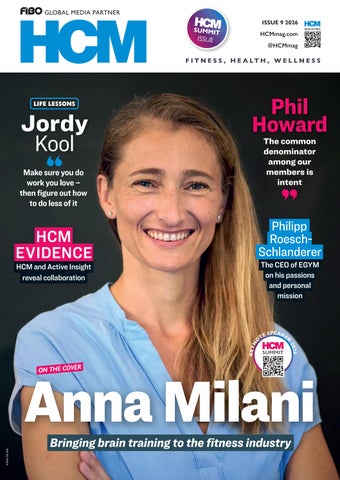
Anna Milani R ON THE COVE
ANNA MILANI
www.HCMsummit.live
Bringing brain training to the fitness industry
Elevate your offering with Reformer, redefined lesmills.com/uk
Introducing Reformer meets rhythm – an unmatched Reformer Pilates experience backed by Les Mills’ science, expert coaching, and signature production. With this premium programming on your timetable you’ll elevate your offering, attract new members, and keep them coming back for more.
Scan to learn more
ED ITO R’ S LE T TER
L
Brain training is the industry’s next big thing, unlocking a new era of human optimisation and transforming how we design, programme and deliver facilities and experiences
ook into many care and nursing home settings and you’ll see interventions – from interactive screens to group activities – being used to support cognitive function in people experiencing cognitive decline and dementia. Perhaps this explains why we haven’t adopted these approaches preventatively on a mass scale – they’ve been categorised as ‘things you do when you’re old’. But brain training belongs in a wider conversation about optimisation, prevention and peakspan – developing our capabilities now and sustaining them through life, rather than fighting decline in older age. The World Health Organization’s position paper, Optimizing brain health across the life course, defines brain health in terms of cognitive, sensory, social-emotional, behavioural and motor function, giving us a powerful framework for expanding our ambitions as an industry. Turning our focus to brain training doesn’t just mean adding another class or specialist studio. It must change our perspective on everything from gym design, equipment and programming, to staff training and how we communicate value to consumers. Embedding it into our sector represents one of the biggest growth opportunities the industry has ever seen. In addition to being engaging for members, this change will also strengthen our links with the medical sector, creating new opportunities for collaboration in prevention, rehabilitation and healthy ageing. Anna Milani, a keynote at this year’s HCM Summit, is opening our eyes to what’s possible. In her interview on page 44, she explains how combining cognitive challenges with exercise creates stimulating, engaging and fun experiences that build brain and body. Things such as testing reactions, mastering complex challenges, competing with friends and developing new capabilities will introduce an exciting dimension to exercise, with appeal across all generations. The opportunity also spans every price point, from cognitive challenges incorporated into
+4 4 (0)1462 431385
W W W. HCMmag.COM
SHUTTERSTOCK/JACOB LUND
JACK EMMERSON
Brain training
Adding brain training will transform the sector
Embedding brain training into our sector represents one of the biggest growth opportunities the industry has ever seen familiar workouts to sophisticated technology for personalised training and performance measurement. To drive this into the mainstream health club sector, we need a common language. ‘Brain training’ is the consumer-facing term, ‘brain-body training’ the integrated approach, ‘cognitive-motor training’ the technical discipline and ‘dual-task training’ one of its methods. We’re calling on educators, operators, suppliers and trade associations to collaborate, so we can create the infrastructure, programming and qualifications we need to underpin success in delivering this exciting discipline. ● Liz Terry, editor lizterry@leisuremedia.com
HCM@LEISUREMEDIA .COM
W W W. LEISURESUBS.COM ©Cybertrek 2026 Issue 9 2026
5
HCMmag.com
CONTENTS
Uniting the world of fitness
SHUTTERSTOCK / LITHIUMPHOTO
ANNA MILANI
ISSUE 9 2026 No 354
44 Anna Milani on how brain science and training could influence the fitness sector
05 Editor’s letter
26 HCM buzz
Brain and cognitive health is the new frontier for health club operators, says Liz Terry
Jab Boxing gears up for flagship launch, Urban Gym Group heads to Dubai with new performance concept and Fitness Worx reveals its latest location
10 HCM Forum Ireland Active’s CEO on the sector’s strong foundations, plus a debate on whether ‘less is more’ for exercise choice
14 HCM zeitgeist
The founder of EGYM shares insights into his life’s mission to deliver prevention through every part of the business
Family-focused OurHouse grows its membership, while PureGym agrees to acquire Swiss chain NonStop Gym
38 HCM people Phil Howard
18 HCM news roundup GymNation has bullish plans for Asia and Merrithew expands with Gyrotonic 6
32 HCM people Philipp Roesch-Schlanderer
Issue 9 2026 ©Cybertrek 2026
The founder of Fitness Connection and former US Navy SEAL talks about why premium fitness experiences should be offered at every price point
44 Interview Anna Milani The founder of Brain & Fitness and SPARKD is exploring how cognitive-motor training could become a new category for the fitness industry
58 Everyone’s talking about Brain training Kath Hudson explores the science of neuroplasticity and asks how the industry can help people build healthier brains
68 What’s in a name? The industry is expanding into wellness, recovery and prevention, but is consumer language keeping pace? A study by HCM Evidence lifts the lid, as Liz Terry reports
THIRD SPACE
EGYM / BENJAMINOLSZEWSKI
100 Third Space
32 Philipp Roesch-Schlanderer
Kath Hudson talks to the investor, entrepreneur and co-founder of Urban Gym Group about his career journey and life learnings
84 Growth formula
100 Third Space Third Space Paternoster is the most recent expression of the high-end model
112 HCM Innovate Julie Cramer rounds up the latest fitness, health and wellness kit
HFA’s new global report reveals revenue growth outpacing membership growth and efficiency supporting profitability, as Liz Terry reports
114 HCM Directory
92 Healthy approach
116 Research Bone gains
Julie Cramer asks the companies behind workplace wellness programmes to put a number on the financial benefits they deliver
68 HCM Evidence launches in partnership with Active Insight
MARTIJN VAN DAM FOTOGRAFIE
78 Life lessons Jordy Kool
SHUTTERSTOCK / PEOPLEIMAGES
SHUTTERSTOCK / ORION PRODUCTION
84 HFA reports on global growth
The HCM Directory is part of a network of resources for buyers that includes www.HCMmag.com/CompanyProfiles
Various forms of exercise can protect bone mineral density in different parts of the skeleton, according to research ©Cybertrek 2026with IssueJordy 9 2026 Kool 78 Life Lessons
7
Issue 9 2026 Volume 32 Number 354
www.HCMmag.com MEET THE TEAM theteam@leisuremedia.com
Editor Liz Terry +44 (0)1462 431385
Managing editor Julie Cramer +44 (0)1462 431385
Publisher Jan Williams +44 (0)1462 471909
Head of news Kath Hudson +44 (0)1462 431385
Choose how you read
Other resources from
HCM digital
Fit Tech magazine
Read free online and enjoy extra links and searchability
www.fittechglobal.com www.fittechglobal.com/archive
www.HCMmag.com/digital
HCM Handbook
www.HCMhandbook.com www.HCMhandbook.com/pdf
HCM magazine is
HCM Online library
available in print from
www.HCMmag.com/archive
www.leisuresubs.com
HCM newsletter & Instant news www.leisuremedia.com/signup
Editor-at-large Magali Robathan +44 (0)1462 431385
Assistant editor Helen Andrews +44 (0)1462 431385
HCM PDF
Leisure Opportunities news
A PDF edition is available
www.leisureopportunities.co.uk
to read offline at:
Buyer Search Engine
www.HCMmag.com/pdf
www.fitness-kit.net
Email us:
Customer service +44 (0)1462 471901
Advertising +44 (0)1462 431385
Subscriptions +44 (0)1462 471910
Circulation +44 (0)1462 471932
Finance +44 (0)1462 471930
8
GLOBAL MEDIA PARTNER
INVEST SUMMIT www.hcmsummit.live
To subscribe to HCM in print (Health Club Management): log on to www.leisuresubs.com, email subs@leisuremedia.com or call +44 (0)1462 471930. Annual subscriptions: UK £45, Europe £57, rest of world £80, students (UK) £22. Style: HCM follows an editorial house style which precludes the use of marketing devices in body text and headlines when it comes to company names and registered trademarks. CamelCase and logical capitals are allowed. Contact the editor for more details – lizterry@leisuremedia.com. Copyright details: HCM (Health Club Management) is published 12 times a year by Leisure Media, PO Box 424, Hitchin, SG5 9GF, UK. The views expressed in this publication are those of the authors and do not necessarily represent those of the publisher. All rights reserved. No part of this publication may be reproduced, stored in a retrieval system or transmitted in any form or by means, electronic, mechanical, photocopying, recorded or otherwise, without the prior permission of the copyright holder, Cybertrek Ltd 2026.
Credit control
Print and distribution Printed by The Manson Group Ltd. Distributed by Royal Mail Group Ltd and Whistl Ltd in the UK and Total Mail Ltd globally.
+44 (0)1462 733477
©Cybertrek Ltd 2026 ISSN 1361-3510 (print) / 2397-2351 (online)
Issue 9 2026 ©Cybertrek 2026
New era of Legend:
Same trusted partner, completely re-engineered platform
Cloud-native, all-in-one leisure management software For almost 25 years, Legend has been working with leisure operators and higher education institutions to continuously improve the tools relied on to run outstanding leisure and sports facilities.
SEE THE NEW PLATFORM FOR YOURSELF Visit legendware.co.uk
This commitment to continuous improvement remains the same. And with this in mind, the Legend platform has been completely rebuilt and is now cloud-native.
Everything you need, in one place Teams can work from anywhere Ready to evolve and meet future demands Deep expertise behind every interaction Built and continuously developed in partnership with you
An enterprise level solution from
LETTERS
HCM Forum Fuel the debate about issues and opportunities across the industry. We’d love to hear from you. Write to forum@leisuremedia.com
The story is not simply one of an underpenetrated fitness market beginning to mature Ireland’s fitness sector has strong foundations I read your recent feature in HCM (HCM Issue 8 2026, www.HCMmag.com/Ireland) on the growth and future potential of Ireland’s health and fitness market with great interest. It’s positive to see the Irish sector receiving this level of international attention, particularly given the investment now taking place. The article identifies several opportunities the Irish sector needs to develop, particularly professional standards, supported exercise, rehabilitation, healthy ageing and closer integration with healthcare.
Existing infrastructure In reality, considerable infrastructure is already established in these areas through trade body Ireland Active and our partners. We represent commercial gyms, leisure centres, swimming pools, hotel leisure facilities and community and public-sector operators. Our work spans government policy, public health, professional standards, workforce development, facility quality and long-term sustainability. 10
Issue 9 2026 ©Cybertrek 2026
I represent Ireland Active on the Irish Government’s Sports Leadership Group, chaired by the Minister for Sport, giving our sector a voice in national sport and physical activity policy. We also work closely with government departments and key agencies, including Sport Ireland, the Health Service Executive and Skillnet Ireland. The connection between fitness and health highlighted in your article is already a major focus. I sit on the Physical Activity for Chronic Conditions Steering Committee, a national initiative bringing together health, sport, physical activity and academic stakeholders to develop standards and pathways for supporting people with long-term health conditions through physical activity. Professional standards are central to this. Ireland Active operates the Register of Exercise Professionals Ireland, supporting recognised qualifications, registration and continuing professional development. Through the Leisure, Health and Fitness Skillnet, operating within
EVERLAST GYMS / DUBLIN
Karl Dunne, CEO, Ireland Active
the government’s Skillnet Ireland framework, we’re investing in the specialist workforce required to support our sector’s evolving role. This includes our Specialist Instructor Course in Cancer and Exercise Rehabilitation and cardiovascular rehabilitation training based on the British Association for Cardiovascular Prevention and Rehabilitation framework – both adapted for Ireland. We also provide specialist training in exercise prescription and working with older adults.
Strengthening links These aren’t simply future ambitions. They’re programmes already developing appropriately qualified professionals to support rehabilitation, healthy ageing and people with longterm conditions, while strengthening links between healthcare and community-based exercise.
Ireland has well established infrastructure and support for the fitness and leisure sectors
ACTIVE IRELAND
Ireland Active has also been campaigning for a Gym and Swim Membership Tax Credit to improve access to structured physical activity. Independent RED C research commissioned by Ireland Active found 28 per cent of adults said they would be likely to take up gym or swimming pool membership if such an incentive were introduced. We continue engaging with government to make the case for physical activity as an investment in preventative health. Swimming is another important focus. Ireland Active contributed to Ireland’s first National Swimming Strategy 2024–2027 and, with Swim Ireland, is administering more than €3.5m in government funding to pool operators through the Sports Energy Support Scheme. Facility standards are also established. Ireland Active’s National Quality Standard, introduced in 2001,
Karl Dunne
Ireland already has infrastructure around standards, workforce development, quality, government engagement and integration with health
celebrates its 25th anniversary this year, providing a quality framework. I agree Ireland has considerable potential for growth, but it’s important to distinguish between areas requiring development and those that already exist. The arrival of PureGym, Everlast and Urban Gym Group is a vote of confidence, but the story isn’t simply one of an underpenetrated fitness market beginning to mature. Ireland already has established infrastructure around professional standards, workforce development, facility quality, government engagement and integration with preventative health and long-term condition management. There’s undoubtedly more to do, but Ireland Active and our partners have been developing this agenda for years. That work is an important part of understanding where the Irish market is and where it’s heading. ©Cybertrek 2026 Issue 9 2026
11
LETTERS
Perhaps we underestimate how exhausting it can be to repeatedly decide what to do
Supervised and group exercise can offer benefits, including social connection
ORANGETHEORY
Is less choice the key to exercise consistency? Rachel Vaziralli, director of fitness, Orangetheory Fitness Between step counts, debates over Zone 2 training versus HIIT and an endless stream of fitness trends, working out has become as much a mental exercise as a physical one. We’re constantly being asked to make decisions: how often should I train? How hard? Cardio or strength? How long should I rest? Am I doing enough? Or too much? With many people already carrying a mental load, perhaps one of the most valuable things the fitness industry can offer is to take away the need for some of those decisions. For World Mental Health Day on 10 October, we reflected on the role Orangetheory’s structured, coach-led exercise can play in making physical activity easier to sustain. The Orangetheory premise is simple. Turn up and the workout has already been designed. A coach tells you what to do, helps you adjust the intensity and guides you through the session. 12
Issue 9 2026 ©Cybertrek 2026
Rachel Vaziralli
The premise is simple. Turn up and the workout has already been designed Rather than constructing a workout from scratch, much of the thinking has been done for you. Supervised and group exercise can offer other benefits too. A major umbrella review published in
the British Journal of Sports Medicine in 2026, involving almost 80,000 people, found exercise reduced symptoms of depression and anxiety, with group-based and supervised exercise associated with greater reductions in depressive symptoms than individual or unsupervised exercise. Several factors may contribute, including social connection, accountability and support. But we believe there’s another variable worth exploring – the value of reducing cognitive load. We talk a great deal about motivation, but underestimate how exhausting it can be to repeatedly decide what to do. For some people, consistency may be driven less by metrics or choices, than by an environment where the only real decision is to show up. Could making exercise mentally simpler be one way to make it easier to sustain? l
SAVE THE DATE
7 OCTOBER 2027 Queen Elizabeth II Conference Centre
LO N D O N www.hcmsummit.live
Go to www.HCMmag.com/signup to get breaking news alerts
Zeitgeist Kath Hudson distills the essence of the latest HCM news to tap the trends driving the direction of the sector
Wellbeing is part of Towns Fund regeneration scheme
TAP OR SCAN
PAUL CALVER
OurHouse grows with its members
http://lei.sr/5D2N3_H
http://lei.sr/7c9z7_H
Operator of family-focused health clubs, OurHouse, which offers workout and co-working facilities alongside childcare, is broadening the proposition to include care for children aged four to 13+. Founder, Charlie Gardiner, says this is being offered in response to feedback from some 200 families who said they wanted structured programmes for their older children and some breathing room for themselves. PureGym has agreed a refinancing deal OurHouse supports working families to be active
PureGym gets fresh funding for rollout
OURHOUSE
PureGym has agreed the terms of a refinancing deal that will give it more financial flexibility as it expands and pushes back a major TAP OR SCAN debt repayment. CEO, Alex Wood, said this provides greater long-term financial certainty, increases liquidity and accelerates the next phase of growth.
http://lei.sr/Z4C3G_H
14
Issue 9 2026 ©Cybertrek 2026
FAULKNERBROWNS ARCHITECTS
Stevenage is being regenerated with wellness
Stevenage Borough Council in the UK says it’s future-proofing the provision of sports, health and wellbeing in the town with a £45m leisure centre that will bring wet and dry facilities together. TAP OR SCAN Designed by FaulknerBrowns Architects, facilities will include a pool, gym, sports hall, group exercise studios and soft-play. The scheme is part of a regeneration plan supported by the Towns Fund (www.hcmmag.com/TF).
URBAN GYM GROUP
Urban Gym Group grows Trainmore ‘cashback’ brand As well as making its debut in Dubai in September, Urban Gym Group has acquired the Dutch operator, Rhythmsports, adding two clubs which will TAP OR SCAN be rebranded under the premium TrainMore Black Label. The first two TrainMore sites have also been announced in the UK – a former PureGym in Wembley and a site in Marlow.
TrainMore refunds members for working out
http://lei.sr/6a3h2_H NEKO
Active North Yorkshire widens access
TAP OR SCAN
http://lei.sr/y8g3Q_H http://lei.sr/8W3Q5_H ACTIVE NORTH YORKSHIRE
Active North Yorkshire has launched two new wellbeing memberships. For an additional £5 per month, members can gain access to digital healthcare services through HealthHero, as well as online workouts through a tie up with Sh1ft Fitness. For £9.99 a month people can access these services without being a member of the physical facilities. NEKO clinics use proprietary software
New Yorkers embrace Neko More than 25,000 people joined the waitlist for the Neko Health Scan ahead of the Swedish health-tech company opening its ninth site, marking its debut in New York City. The 30-minute, radiation-free assessment can identify potential risk TAP OR SCAN indicators before symptoms develop. Wearable integration via Apple Health and body composition analysis has been added as part of an upgrade.
http://lei.sr/p9d9j_H
Active North Yorkshire has introduced two new wellbeing membership options ©Cybertrek 2026 Issue 9 2026
15
zeitgeist
Colruyt Group is combining working out and healthy eating
The Women’s Gym adds reformer Pilates
Jims creates Move & Save membership
Total Fitness has launched a reformer Pilates studio at its Women’s Gym in Wilmslow. CEO, Sophie Lawler, says: “Our research suggests reformer Pilates plays a significant TAP OR SCAN role for women in strength training, as a more accessible and achievable route to strength than working out in a gym environment.”
Belgian operator, Colruyt Group, has launched a new membership package that combines physical activity and healthy eating. The €14.99 a week Move & Save membership allows a family of three TAP OR SCAN to train at participating gyms. If they complete three sessions between them in a week they earn €5 to spend on fresh fruit and vegetables at all Colruyt stores.
http://lei.sr/x9y4F_H
http://lei.sr/7e4J9_H
COLRUYT GROUP
TOTAL FITNESS
Total Fitness has launched a reformer Pilates concept for women
Strong Pilates heads to Saudi Arabia
http://lei.sr/7h4c5_H
Saudi Arabia is a new territory for Strong Pilates
16
Issue 9 2026 ©Cybertrek 2026
STRONG PILATES
Strong Pilates has announced plans for 21 locations in Saudi Arabia over the next 10 years, following the signing of a master franchise agreement with local operator, Healthpreneurs. CEO, Michael Ramsey, says: “Consumers TAP OR SCAN here are moving towards specialised, experience-led fitness, which is exactly where Strong sits. Twenty one sites is our floor, not our ceiling.”
UK ACTIVE
All age groups seek community at the gym It’s not just Gen Z who value the social opportunity that gyms offer according to consumer insights commissioned by UK Active. CEO, Cameron Saunders, says: “Our findings show people TAP OR SCAN of all ages are looking for friendship and community in the gym.” The trade association suggests offering activities and events to help people make new friends.
UK Active is celebrating National Fitness Day
http://lei.sr/U7c3U_H
New social wellness model for London
TAP OR SCAN
Solidcore Ascend focuses on strength
http://lei.sr/j5b9p_H
Opening in west London next year, Sonara will bring dining into a bathhouse experience. After changing into swimwear and robes, guests will be allocated a table at the restaurant that they will keep returning to for food in between participating in thermal experiences, treatments, relaxation and socialising as part of a multi-hour ritual.
SOLIDCORE
SONARA
Solidcore launches Ascend Solidcore has innovated with a new format, Solidcore Ascend, which offers a floor-based strength training concept, Strong50. The workout uses dumbbells, kettlebells and resistance bands in TAP OR SCAN a heated studio to develop strength and power. The first site opens in Manhattan in December, there will be standalone and dual-modality sites.
http://lei.sr/s6s3m_H
The club will occupy 1,500sq m across two floors ©Cybertrek 2026 Issue 9 2026
17
news roundup PureGym snaps up Swiss operator NonStop
P
NONSTOP GYM
ureGym has agreed to acquire Swiss low-cost operator NonStop Gym for £235 million ($311.4 million, €277.8 million), in a deal that will more than double its presence in Switzerland and create the country’s largest low-cost gym business. The transaction, announced on 15 October, is expected to complete on 2 November 2026. The acquisition will add 47 gyms and more than 100,000 members to PureGym’s existing Swiss portfolio of 49 clubs, with the combined
PureGym is paying €5.9 million per location for NonStop Gym
PUREGYM
network expected to exceed 100 locations by the end of 2026. In an interview with HCM in 2025, former PureGym CEO Clive Chesser identified Switzerland as a growth opportunity, revealing that the group saw potential for 100 additional locations. Founded in 2014, NonStop Gym has a presence in French-speaking
“We have long admired NSG and their team” Alex Wood
Switzerland, with additional operations in Italian-speaking areas, complementing PureGym’s network, which is concentrated in German-speaking regions. The company TAP OR SCAN operates a 24-hour, low-cost model and has an established development pipeline.
http://lei.sr/2V5U2_H
Go fit reports record sales and more growth
G
GO FIT
Go fit is forecasting record revenues for this year
18
Issue 9 2026 ©Cybertrek 2026
o fit expects revenue to pass €105m for the first time in 2026, following record sales and a sharp increase in profit last year. The operator of sports and wellbeing facilities generated revenue of €93.3m in 2025, up 11 per cent on 2024, according to accounts analysed by 2Playbook. Net profit rose ninefold to more than €2.6m, while EBITDA reached a record €37m. Like-for-like revenue across its existing centres in Spain and Portugal grew by 6 per cent. Growth was helped by the openings of Go fit Santa Cruz de Tenerife and Mercato dei Fiori in Turin, its first Italian centre. The company ended 2025 with 258,000 members and recorded 15.2 million visits during the year.
Go fit expects further growth at established facilities, supported by demand for personal training and family products. The results give the company momentum as it develops three more centres in Milan, Bologna and Vitoria-Gasteiz, which it is preparing to open in 2027, taking the estate to 25 facilities: 20 in Spain, three in Italy and two in Portugal. Rome is among the locations being explored, while in Madrid Go fit is working on a facility next to the Riyadh Air Metropolitano stadium. The three projects form part of a €150m investment TAP OR SCAN programme in eight facilities through to 2028, when Go fit expects to operate 30 centres. http://lei.sr/5a2w5_H
Get live news at www.HCMmag.com
Merrithew steps up expansion with Gyrotonic
CREDIT: MERRITHEW
“We will preserve Gyrotonic’s philosophy and education standards” Jim Heidenreich
components to enable fluid, threedimensional movement, while its sister discipline, Gyrokinesis, is practised without equipment. Horvath previously told HCM’s sister magazine, Spa Business, that he wanted to ensure the company didn’t grow so quickly that it lost its purity. This creates an interesting challenge for Merrithew as it brings its commercial and distribution capabilities to bear on the brand. Merrithew CEO Jim Heidenreich has said the company intends to preserve Gyrotonic’s philosophy and education standards while supporting the growth of its global community Merrithew has grown from a Pilates education company into an international equipment, education and content business, with more than 100,000 students and partners across more than 135 countries.
Gyrotonic allows movements in a wide range of planes
BODY BALANCE INSTITUTE
M
errithew is building a global portfolio of Pilates and mindful movement brands, following its acquisition of the Gyrotonic organisation. The Canadian company, which owns Stott Pilates, has acquired Juliu Horvath’s Gyrotonic and Gyrokinesis method. Founded by former dancer Horvath, Gyrotonic uses specialist apparatus incorporating pulleys and rotating and sliding
The acquisition comes as demand for Pilates, Reformer training and adjacent movement disciplines is accelerating globally, increasing the strategic value TAP OR SCAN of businesses which combine proprietary methods, equipment and instructor education. http://lei.sr/8h2p7_H
Providence bids €600m for Fitness Park
P
FITNESS PARK
rovidence Equity Partners, owner of VivaGym, has formally notified the French competition authority of its proposed acquisition of Fitness Park, moving the transaction beyond September’s reported €600m bidding process. The US private equity house filed its plans on 2 October 2026, seeking exclusive control of Gymspa SAS, the holding company of the Fitness Park group. The transaction is undergoing Phase 1 regulatory review, with third parties invited to submit observations by 16 October. The filing does not confirm the purchase price or establish that the acquisition has completed. Fitness Park operates more than 300 clubs in France, alongside an international franchise network. Across its wider network, Fitness Park has more than 400 clubs and around 1.4 million members. Network
Providence Equity Partners has revealed its plans to acquire Fitness Park
revenues, including franchised operations, were reported at €461m in 2025, with EBITDA around €60m. Its independently operated Spanish franchise network grew from 79 clubs at the end of 2025 to 107 this year. Fitness Park has outlined ambitions to open up to 100 clubs annually
over the coming decade, with company-operated sites accounting for roughly a quarter of its estate. CEO Philippe Herbette has identified the UK and TAP OR SCAN Germany as potential long-term expansion markets for the brand. http://lei.sr/3E6c6_H
©Cybertrek 2026 Issue 9 2026
19
news roundup GymNation announces bullish plans for Asia
G
COMMON BOND
ymNation has announced its launch into Asia, with the first Thailand gym set to open in Bangkok in January 2027, with the goal of 30 more within three years. This is the first step outside of the Middle East for the operator. The flagship site will exceed 40,000 square feet and be located within Big C Supercenter Ratchadamri, Pathum Wan. Thailand has been chosen for the first site in Asia because of its rapidly expanding health and GymNation has announced its first site in Thailand at the Big C Supercenter GYMNATION
wellness market and young, fitnessconscious population, with more than 7,500 people registering their interest in the first week. Memberships will be 999 THB per month (€26.25, US$29.75 or £22.50), offering access to more group exercise, extensive training zones and Hyrox, reformer Pilates and Les Mills classes.
“We’re now going to raise the standard for what a gym can be in Thailand” Loren Holland
Loren Holland, founder and CEO of GymNation, says this is a milestone: “The gyms we are about to open in Thailand are next-level, from the scale of the space to the combination of world-class facilities, TAP OR SCAN equipment and design. “We’re going to raise the standard for what a gym can be in Thailand.” http://lei.sr/5g6Z5_H
UK membership could reach 17 m by 2032
T
JACK EMMERSON
UK Active CEO, Cameron Saunders, addressed the HFA European Congress
20
Issue 9 2026 ©Cybertrek 2026
he UK health and fitness sector could reach 17 million members by 2032 if its current growth trajectory continues, but operators will need to work harder to reach women, lower socioeconomic groups and older adults if the industry is to fulfil its potential. Speaking at the HFA European Congress at London Stadium on 24 September UK Active CEO Cameron Saunders, highlighted the rapid growth of the UK fitness sector and the market opportunities which lie ahead. The UK now has 12.2 million health and fitness club members – almost one in five people – with 679 million visits made to facilities during 2025 and £5.7 billion generated in membership income.
Between 2023 and 2025, the market added around 1.4 million members and 110 million annual visits, while membership income increased by £947 million. If current rates of growth are maintained, UK Active projects membership could rise to around 17 million by 2032 – equivalent to approximately one in four people – and 22 million by 2039, or around one in three. While Gen Z participation appears to be plateauing at a high base, older adults are emerging as an important opportunity. Membership among over-55s has increased TAP OR SCAN by 44 per cent, although participation remains considerably below that of younger age groups. http://lei.sr/7B5N4_H
Reformer Pilates, without the footprint problem. More operators want Reformers on the floor, most can’t find the space for it, FÔLD solves it.
Find out more
Why
:
Patented Easi-Fold™ design: fold a full studio-quality Reformer down for storage in seconds. No straining, no compromise on function or build.
Trusted by:
foldreformer.com
Turns your current space into a Reformer Pilates Studio.
w
news roundup Everyone Active accelerates wellness push
JACK EMMERSON
www.HCMsummit.live
“There’s a huge pivot from fitness to wellness” Duncan Jefford
Dunstable’s Grove Theatre on 23 September. More than 500 Everyone Active colleagues and representatives from 25 partner organisations attended the event. Introducing the event, Jefford said: “I’m really excited about where we’re taking the business. There’s a huge pivot from fitness to wellness and it’s really important from a colleague perspective and also a customer perspective that we really start to deliver on wellness rather than fitness.” Group exercise and PT will also be strong areas of focus – the Everyone Active TAP OR SCAN strategy is to engage members in as many modalities as possible to improve retention.
MARCEL GRABOWSKI
P
ublic sector operator, Everyone Active, will be increasingly focusing on wellbeing going forward, with a push to get onethird of its members onto the You+ wellbeing membership next year, as well as doubling down on efforts to engage members with a wider range of the modalities it has on offer. HCM attended the company’s National Fitness Launch held at
Everyone Active is promoting its You+ membership
http://lei.sr/4x8H7_H
Wave Active acquires physiotherapy business
W
ave Active has acquired Southdowns Physiotherapy, to expand its ability to support people throughout their health journey from recovery and rehabilitation through to long-term physical activity, wellbeing and prevention. By bringing physiotherapy together with its existing health and wellbeing
programmes, Wave Active will be able to provide a more joined-up approach to support people beyond clinical treatment and help them remain active for longer. “We know that many people need more than treatment alone” Duncan Kerr
WAVE ACTIVE
Former Southdowns Physiotherapy owner, Dave Peachey and Duncan Kerr
22
Issue 9 2026 ©Cybertrek 2026
Wave Active delivers a wide range of health, fitness and wellbeing services across East Sussex, UK, adding physiotherapy strengthens this offer by introducing expert clinical assessment, diagnosis and rehabilitation. Wave Active CEO, Duncan Kerr, told HCM: “As Wave Active has been evolving to create a new model of community health that combines physical activity, prevention and wellbeing, integrating Southdowns Physiotherapy feels like a natural next step on that journey. It enables us to offer more joined-up care, helping people move seamlessly from treatment and rehabilitation into long-term active living. Patients receiving physiotherapy will have access to a broader range of evidence-based TAP OR SCAN activities designed to support recovery, improve strength and increase mobility. http://lei.sr/2x8s6_H
news roundup Apple makes power play for preventive health
A
APPLE
pple is making a major move into preventive health and longevity, unveiling an integrated ecosystem that combines wearable data, health records, laboratory testing and AI-powered guidance. Rather than simply recording workouts, Apple is positioning its devices as a gateway to continuous preventive health management. The strategy will be delivered through a redesigned Apple Health app and the new Apple Watch Series 12, putting services currently associated with specialist platforms such as Oura and Whoop into the hands of Apple’s vast user base. A new Health Age feature will analyse information including VO2 max, heart-rate variability, sleep and blood biomarkers to indicate which factors may be adding or removing years from a user’s health age. A Longevity tab will bring together longitudinal data covering heart health, sleep and movement, while
Apple is moving further into the health market with a focus on prevention
Apple Intelligence will interpret the information and offer personalised recommendations – such as adding intervals to a running programme to improve cardio fitness. Users will also be able to incorporate medical records or laboratory
results into the platform. In the US, Apple has partnered with Quest Diagnostics to enable TAP OR SCAN consumers to order a test covering more than 50 biomarkers directly through the Health app. http://lei.sr/5a2S5_H
Ian Mullane addresses HFA Congress on AI
A
ddressing delegates at the HFA European Congress at London Stadium recently, Keepme founder and CEO, Ian Mullane, explored the rise of AI agents and their potential to reshape the fitness industry. KEEPME
Ian Mullane spoke about AI
24
Issue 9 2026 ©Cybertrek 2026
He said the technology would create more time for the human interactions on which the industry is built, and predicted agents will increasingly inform consumers’ choices over gyms and even sign them up. Mullane sits on the board of Middle Eastern operator GymNation, which uses AI agents to answer enquiries outside of normal working hours, respond in multiple languages, take payments and book inductions. Agents can also follow up with prospects who are not ready to join immediately, monitor member activity and suggest interventions when engagement declines. The technology is particularly important as GymNation scales across multiple markets. Agents
have taken on repetitive tasks such as lead management and follow-up, allowing membership consultants to spend more time with prospects who need human support. Mullane recommends that operators focus on the tasks AI can remove and involve employees early enough for them to help shape the new way of working – the time of membership consultants is better spent with nervous prospects on their first visit than following up emails. He advises operators to identify work agents can do; prepare websites and joining TAP OR SCAN journeys for consumers who use agents; and involve employees from the beginning. http://lei.sr/8y9B2_H
WE SEND
OUR SALES TEAM TO YOUR CLUB TO SIGN
MEMBERS
A simple, results-driven marketing system built for health clubs.
01
02
ATTRACT
CONVERT
Multi-Faceted Marketing
On-site Sales Team
More Members
Brand Awareness
Tours & Follow-Up
Higher Revenue
Local Exposure
Lead Conversion
Long-Term Momentum
03
GROW
NO UPFRONT COST. WE WORK ON A PROFIT SHARE MODEL
SCAN FOR YOUR INFO PACK
CFM.NET
CFM
0115 777 3333
Average results based on previous campaigns. Individual results may vary depending on factors such as facility. market conditions and execution.
buzz
U
26
Issue 9 2026 ©Cybertrek 2026
sdf
URBAN GYM GROUP
rban Gym Group, has expanded operations into a fourth country with a launch in Dubai, in partnership with fitness and wellness entrepreneur, Stewart Miller. Described as a wellness performance club, Arkhe offers a gym, an outdoor hybrid training area and a recovery suite with saunas, an ice bath, a hyperbaric chamber and red light therapy. As a bolt-on, the facility also offers longevity diagnostics in partnership with Longevity-UK; a PILAT3S dynamic reformer studio and a café overlooking the Dubai marina. Neil Randall, CEO of Urban Gym Group, says: “Arkhe is an exciting new launch. We are now able increase our scope and ability to deliver on improving health, longevity and premium experience in one location and with one membership.” Miller is the founder of Arkhe and continues to lead the club and the joint venture on the ground. With more than 25 years in the industry, he brings local market knowledge and concept thinking. UGG contributes group scale, innovation, operational expertise, commercial and technology infrastructure, and capital for growth. “Arkhe is built to be the last membership you need,” says Miller. “A performance floor with bestin-class equipment, a full recovery suite included rather than sold as an upgrade, real diagnostics so members actually know what is happening in their body, Reformer, classes, and a café you want to work from. Everything is designed to work together.” Jordy Kool, chair of the board at Urban Gym Group, says: “Our industry is an interesting place. What members ask of a club has broadened. Training is still the core, but recovery, understanding your own health, and having somewhere you actually want to spend time have become part of the same conversation. It is a good thing for the industry, and Arkhe is a strong example of what it can look like when it is done well.
ARKHE / URBAN GYM GROUP
Urban Gym Group enters its fourth market with Dubai debut
Recovery is as important as the fitness offering
“Our industry is in an interesting place. What members ask of a club has broadened” Jordy Kool
Dubai also enables us to offer innovative services we have not been able to before in our other markets.” Urban Gym Group operates more than 60 clubs across the Netherlands, the UK, Ireland and UAE. Its portfolio spans full-service clubs, boutique studios and recovery concepts, including TrainMore, Gymbox, ClubSportive, The CLB, Rush, PILAT3S, TRIB3 and now Arkhe. UGG is inviting conversations with operators, investors, chains, single-site club owners TAP OR SCAN and studio operators to get in touch about partnerships, acquisitions or joint ventures. l To find out more, turn to our profile of Jordy Kool on page 78
http://lei.sr/8W8F9_H
ARKHE / URBAN GYM GROUP
Get live news at www.HCMmag.com
Urban Gym Group’s Arkhe is described as a performance wellness club ARKHE / URBAN GYM GROUP
buzz
Get live news at www.HCMmag.com
Jab Boxing gears up to launch flagship after taking on investment
ab Boxing is preparing to launch a flagship gym in Moorgate, London this autumn, building on the success of its first club, before taking the brand global next year. The three-storey site will provide a boxing ecosystem, with a gym, a 20,000 sq ft boxing and training studio, a recovery suite complete with plunge pools, a 30-person sauna and a mix of recovery technology, alongside Joey’s, the signature health cafe and social hub. Jab Boxing Club was founded in 2018, by George Veness, to bring the benefits of the sport to a wider audience. It combines the authenticity of traditional boxing with a modern, high-performance approach to training, recovery and wellbeing, offering expert coaching, progressive programming, nutrition guidance and human connection to deliver measurable results. Members will benefit from boxing, strength and conditioning, and recovery classes, alongside personalised coaching and guidance from Jab’s performance team. Former captain of England’s boxing team, Veness is a sought-after trainer, who has worked with a number of internationally renowned actors, musicians, models and entrepreneurs, including Woody Harrelson, Rita Ora, Lily Allen and Sam Rockwell. 28
Issue 9 2026 ©Cybertrek 2026
The female vanity area is high end
JAB BOXING
J
JAB BOXING
Jab Boxing has created a performance ecosystem around boxing
An open gym Get live news at www.HCMmag.com
JAB BOXING
complements the boxing facilities
Veness says: “I built Jab on a simple belief that boxing changes people. Not just their fitness, but their mindset, confidence and sense of self. To bring that belief to EC1, close to where I first learnt to box, is incredibly special. “Beyond the training, what sets Jab apart is its community. Everyone who walks through our doors finds people who understand what they’re striving for and push each other to be better. That’s what Jab is, and that’s what it’s always been about.” This marks a pivotal moment for Jab, following a successful £20 million fundraising round and the appointment of David Cooper as chair, as the brand prepares for its global expansion in 2027. Founding memberships are now available, with prices starting from £240 per month. A range of classes have been curated:
n Boxing: A 50-minute, 12-round boxing workout
designed to build endurance, power and technique. n Fundamentals: A 50-minute workout breaking
down the basics of boxing, slowing down drills to teach people true fundamentals. n Train: A 50-minute strength and conditioning session focused on building strength, fitness and lean muscle. n Perform: A 50-minute performance focused strength session, designed to home in on compound lifts, improving power output and athletic ability n Contrast: A 50-minute recovery session, combining breathwork, lymphatic TAP OR SCAN drainage, sauna and ice bath n Method: A 50-minute athletic-pilates inspired activation class designed to improve core, posture, and reduce risk of injury.
http://lei.sr/2Z4q6_H
©Cybertrek 2026 Issue 9 2026
29
buzz
I
Get live news at www.HCMmag.com
Fitness Worx Gyms opens doors to its most successful site to date
ndependent operator Fitness Worx Gyms says its new Solihull club has exceeded its membership target less than three weeks after opening. The Midland-based company has plans to open three or four gyms every year. Head of operations, Matt Gibson, says: “This is our most successful launch to date. We’ve clearly found a gap in the market in Solihull, and the response from the local community has been incredible, which tells us we’ve created something people genuinely want.” The 12,000sq ft site is its 10th gym and the largest to date. More than 1,500 people visited during its opening weekend on 12 and 13 September, with a high conversion rate of people coming on day passes taking out memberships. The club brings together bodybuilding, powerlifting, functional fitness, Hyrox and cardio training. It has
Nautilus and Gymleco strength equipment, a dedicated glute training area featuring Precor’s selectorised Glutebuilder line, and a Hyrox zone with a 16m track. Attention has been paid to the look and feel, with extensive LED lighting throughout and custom graffiti artwork. The male and female changing rooms also have saunas, available to members at no additional cost. “We’ve taken everything we’ve learned from opening our previous nine gyms and brought it together under one roof, creating a facility that caters for virtually every training style,” says Gibson. “Reaching 10 gyms is a massive milestone, but we’re only just getting started. We’ve TAP OR SCAN got another two locations to announce very soon, and our goal is to continue opening three to four gyms every year while remaining proudly independent.” HTTP://LEI.SR/J3J3N_H
Fitness Worx Gyms has opened its 10th UK site
Issue 7 2026 ©Cybertrek 2026
FITNESS WORX GYMS
30
FITNESS WORX GYMS
Attention has been paid to the look and feel of the club
Get live news at www.HCMmag.com
FITNESS WORX GYMS
“We’ve taken everything we’ve learned from opening our previous gyms and brought it together under one roof” Matt Gibson
Solihull is described as the most successful launch
31
FITNESS WORX GYMS
©Cybertrek 2026 Issue 9 2026
HCM PEOPLE
HCM people FOUNDERUS I N F OC
I want EGYM to be an engine for good
Philipp RoeschSchlanderer CEO, EGYM What’s your mission? I have such a big ambition for our industry. I want 100 per cent of people to work out regularly in the same way that 100 per cent of people brush their teeth.
EGYM / BENJAMINOLSZEWSKI
Was that always the plan? From day one, in our pitch deck for EGYM when we were starting out in 2010, we said that the gym doesn’t work for many people and this is why some operators have such high churn rates. We also believed fitness could have the biggest impact on the biggest market in the world: healthcare. We’re spending so much as a society on treatment, while many chronic conditions could be prevented or managed through people making better lifestyle choices. That first pitch deck, which got us funded in January 2011, said we’d develop technology so everyone, independent of knowledge or motivation, could work out successfully. The plan was to integrate this into healthcare and dramatically grow the fitness market.
Philipp Roesch-Schlanderer
But then you pivoted… We initially thought we could integrate directly into systems such as the NHS in the UK or Germany’s public health insurance system. But we learned that shifting public healthcare from treatment towards prevention is not simply a matter of evidence or good intentions. It also depends on how incentives and decisions are structured.
EGYM has around 30 pieces of equipment in its product range
Why the focus on employers? Employers are rational, independent decisionmakers. They benefit enormously from healthier, less absent workforces. In the US, employers also often carry health insurance costs for their staff, so there’s also a direct incentive to reduce these by offering wellness services. We decided to aggressively integrate through partnering with employers to deliver exercise interventions and to grow Wellpass to be so big that, at some point, not even politicians could ignore us. Ultimately we need political leaders to decide to spend on real, measurable prevention.
EGYM technology in gyms, fitness equipment in workplaces and employerfunded access are all building blocks of the same mission EGYM
Through my investor contacts, I spoke with executives at large European public health insurers. Some described a difficult dynamic: an insurer investing in prevention might bear the cost, while the benefits could be shared across the wider system. That makes it hard for any one insurer to justify taking the lead. In Germany, that helped me understand why progress could be slow. The incentives weren’t aligned with the long-term benefits we believed prevention could deliver, so we decided not to spend time pursuing that route. It was clear we needed another path into healthcare and so we made our big pivot: to go direct to employers with a product we called Wellpass to build our presence in the corporate market.
What’s wrong with the current approach? In our view, selectorised strength equipment is one of the best ways for inexperienced people to train safely and effectively, but in Germany, although there is some public prevention funding, the criteria for this support exclude large exercise machines. It’s an example of how prevention policy can end up excluding the things we believe could help. If employers, insurers and eventually the NHS benefit when people exercise, they should help pay for it. Is the employer strategy working? Through our Wellpass and EGYM Hussle operations (the name for Wellpass in the UK), we can see that after an employer has worked with us for 24 months, an average of 45 per cent of its workforce uses a gym at least once a month. That’s a meaningful change. ©Cybertrek 2026 Issue 9 2026
33
HCM PEOPLE
Where do weight loss drugs fit in? This is another enormous opportunity our industry has, so far, largely missed. People using these drugs need to think about preserving lean body mass, yet we haven’t created a clinically standardised strength-training methodology. We’ve invested US$3 million and received US$5 million in research grants to undertake a US$8 million
clinical study. We want to test whether people using weight loss drugs can retain more muscle with the right programme on our connected equipment.
How’s the research progressing? The study has started and will run until the middle of 2027, followed by analysis and – we hope – publication. The aim is for members to have access to the programmes on our equipment, delivered consistently in line with what was tested during the study. Why does that consistency matter? The approach needs to be clinically standardised. Whether somebody succeeds can’t depend entirely on their individual training set-up. Imagine the NHS paying for a medicine if every pharmacy mixed it differently. How would you know it was the same as the one that had been tested? Our programming starts with assessment. You do a strength test and get prescribed training intensity based on that. This can be scaled globally while adapting to the individual’s ability. I’ve spoken with researchers who’ve demonstrated benefits from strength training – improvement in back pain, for example, and then wondered why insurers won’t cover it. I ask them how they’ll ensure people in a gym actually follow their protocol and there isn’t a way for this to be delivered. This is one of the reasons we’ve invested so heavily in connected and calibrated equipment and now in exercise protocol testing. We want the exercise that’s delivered to match the exercise tested, so it meets the requirements of medics.
We want the exercise that’s delivered on our connected equipment to match the exercise tested in research studies
EGYM has commissioned research to prove exercise protocols
EGYM / BENJAMINOLSZEWSKI
EGYM
We’re also testing five-minute strength workouts in workplaces for those employees who are not ready to go to a gym. In a pilot with three US employers, we have around 15 per cent of the workforce participating who tell us they weren’t exercising before. The aim is to prepare them to move gradually onto the Wellpass system and into the gym. The point is to have different initiatives, each potentially bringing another five or 10 percentage points of the workforce into our industry. EGYM technology inside gyms, fitness equipment in workplaces and employer-funded access are all building blocks of the same mission.
EGYM connected equipment has digitised the customer journey
Let’s turn to the Playlist deal. How did it begin? It started with Fritz Lanman [CEO of Playlist] and me becoming friends. He’d built an enormous network of gyms and health clubs in North America and Asia through Classpass and also had Mindbody’s software for studio operators, while I’d built a European network through Wellpass and EGYM Hussle. I wondered whether we could make a commercial deal, so I could leverage his network to sell corporate wellbeing and equipment in those markets. But I didn’t want him accessing my network. I believed at the time that B2C gym aggregation was bad for operators. It took margin out of the industry rather than expanding it. We tried to structure a commercial agreement, but it became very complicated. What changed your mind? Fritz showed me how they’d examined the business after Mindbody and Classpass came together. He acknowledged that my original fears about consumer aggregation had been legitimate. But they now had more member data – who joins, who stays, who uses ClassPass and goes on to become a direct member – and they’d used this to rethink the product. With B2B aggregation, employers help pay for access, so you expand the pie. But I came to see that B2C aggregation, where consumers
pay for access to multiple gyms and studios, can also solve a problem operators can’t solve on their own: filling quiet periods. Gyms are fixed-cost businesses: at 6.00pm they’re packed, and at 2.00pm they can be empty. Traditional dynamic pricing can drive down the price everyone pays, because people want the discount but still want to come at peak time. ClassPass works differently. People have a limited number of credits to spend, and sessions cost different amounts depending on demand. A 2.00pm session might cost two credits and a 6.00pm session 10. Suddenly there’s a real incentive to go off-peak. You can bring new people in and help operators balance their capacity by making quieter sessions busier. Once I realised they’d taken a hard look at the business and genuinely wanted to add value for operators, I thought: “You’re the right sort of people. I can imagine building this mission forward.” Doing a commercial agreement was too complicated, so we joined forces.
Did you have any non-negotiables? Yes. For 15 years I’d had minority venture capital investors who followed my advice. Now we were combining with a business that had a majority private equity owner. I worried we’d sometimes make decisions that were good in the short term but not in the long term, and that wouldn’t be good for my mission. ©Cybertrek 2026 Issue 9 2026
35
HCM PEOPLE
Where are the synergies? The most obvious are that Wellpass users can access Classpass venues, and Classpass users are gaining access to more Wellpass venues. Classpass’s agreements already cover B2C and B2B, while some Wellpass operators need to consent to consumer access, so there’s technical integration and partner work to be done, but ultimately, it opens up a much larger network. What part will AI play? AI has become huge across the company. We’re budgeting an eight-figure amount for AI this year, with 70 per cent going into engineering. We’re bringing in more people and giving them much more powerful tools. We want everybody to be more productive. What defines the way EGYM operates? I’ll never bring a product to market unless I have confidence it can be the best in its category. Some equipment competitors have hundreds of products; we have about 30. I’d rather be exceptional in a smaller number of areas. It’s the same with our AI-powered training platform, EGYM Genius, which has been designed to connect the entire gym floor to create a coordinated training experience. It uses member assessment and workout data to create personalised exercise programmes, 36
Issue 9 2026 ©Cybertrek 2026
EGYM is part of Playlist, along with Classpass, Mindbody and Booker CLASSPASS
My demand was that Fritz and I have lifelong supervoting rights. If we agree, we can make most decisions, except things such as our own salaries; if we disagree, our largest shareholder, Vista, has a tie-breaking vote. That was the constitution of the deal I needed. It allowed me to say: this accelerates the mission.
You need to be financially successful to make the big investments this mission demands adapting them to individual goals, fitness levels, progress and the equipment available in each gym. We’ve collected strength-test data for years. With cardio, a wearable can give you an estimate of VO2 max, but how does an AI know what weight you should use on a chest press? How does it know whether you’re getting stronger? We have all that assessment and progress data to drive our system.
How are the team gelling? The biggest positive since the merger is how well our exec teams have come together. We’re very aligned. Around the time our son was born, I read a quote attributed to Albert Schweitzer: “Example is not the main thing. It is the only thing.” That’s how you create culture. It’s not what you say; it’s what you do. And you need to be financially successful to make the big investments this mission demands. I want the company to be an engine for good, but that takes commercial success. That’s what I’m trying to achieve. ●
CO M E
powered by
US! IN JO
THE GYM OPERATOR CONFERENCE THE FUTURE OF FITNESS OPERATIONS STARTS HERE
Expect no-nonsense insights, bold ideas, and a room full of people who get what it takes to operate in today’s 18TH - 19TH NOVEMBER 2026 CRANMORE PARK, CRANMORE AVE, SHIRLEY, SOLIHULL, B90 4LF WWW.INDEPENDENTGYMS.CO.UK
HCM PEOPLE
FITNESS CONNECTION
From the beginning, our goal was simple: provide a full-service gym experience at a price point that people could afford
Phil Howard Fitness Connection: founder What is your background? After serving in the US Navy as a Sea/Air/ Rescue (SAR) Swimmer I took an entry-level sales job at Gold’s Gym in Houston, TX. I’ve always had a passion for making fitness more accessible to more people. Throughout my career, I’ve been focused on building businesses that remove barriers to exercise and create welcoming environments where people of all fitness and income levels feel comfortable pursuing healthier lifestyles. At Fitness Connection, that mission continues to guide every decision we make. When was Fitness Connection launched? A group of partners and I founded Fitness Connection in 1998 with the belief that everyone deserves access 38
Issue 9 2026 ©Cybertrek 2026
to a high-quality fitness experience at an affordable price. Since then, we’ve grown to 46 locations across Texas, North Carolina, Georgia, and Nevada.
Who is it owned by? Fitness Connection is privately held and backed by Roark Capital, a private equity firm with investments across the fitness, restaurant, and consumer services industries. As an original founder, I also remain a shareholder. What was the original offering? From the beginning, our goal was simple: provide a full-service gym experience at a price point that people could afford. While many operators required expensive memberships or limited amenities, we
The brand was founded in 1998 and now has 46 sites
focused on delivering spacious clubs with extensive cardio and strength equipment, group fitness, basketball courts, women’s workout areas, kids club and other amenities that offered exceptional value.
Who is the target market for Fitness Connection? The common denominator among our members isn’t age or income – it’s intent. They’re serious about improving their health, becoming stronger, and living healthier lives. They want an environment that supports that commitment with exceptional equipment, recovery amenities, knowledgeable associates, and a welcoming community. We believe those experiences shouldn’t be limited to premium-priced clubs.
FITNESS CONNECTION
The common denominator among our members isn’t age or income – it’s intent How many of your members are new to gyms? We have members who are just getting started as well as those who have been working out for years. We pride ourselves in helping people take the first step toward a healthier lifestyle. We’ve intentionally created health and fitness clubs that are welcoming, inclusive and designed to meet members wherever they currently are on their fitness journey. Can you talk us through the latest evolution – what elements are being added and why? Consumer expectations have evolved significantly over the past several years. Today’s members aren’t just looking for a place to work out – they’re ©Cybertrek 2026 Issue 9 2026
39
HCM PEOPLE
We believe that premium fitness experiences, recovery and community shouldn’t be reserved for premium price points. People deserve access
FITNESS CONNECTION
looking for a place that supports their overall health and wellness while fostering a sense of community. They want spaces where they are able to train, recover and connect with others and make fitness part of their everyday lifestyle. That’s why we’re investing in upgraded strength training equipment, expanded functional training areas, dedicated recovery spaces featuring amenities like cold therapy, compression therapy, red light therapy and saunas, along with refreshed club environments that encourage our members to stay longer and engage more with their fitness community.
40
Club membership options range from US$15 – 40 per month
Issue 9 2026 ©Cybertrek 2026
Our goal isn’t to become a luxury gym – it’s to redefine what members should expect from a high-value fitness membership. We believe premium fitness experiences, recovery and community shouldn’t be reserved for premium price points. People deserve access to the tools and environment that help them achieve their goals.
What is the price point for the new additions? Our philosophy has always been that premium experiences shouldn’t require premium prices.
Across our clubs, membership options range from roughly US$15 to US$40 per month, depending on the location and amenities.
Do you think that all low-cost operators will start adding additional services? I think the industry will continue to evolve because consumer expectations are evolving. Today’s members expect more than just access to equipment – they’re looking for a complete health and wellness experience that includes strength training, recovery, community and convenience. Every operator will respond differently, but I believe the future of high-value fitness will be defined by those who can deliver the greatest overall member experience while maintaining affordability. What impact will this have on the market? Ultimately, I think it’s a win for consumers. As operators continue to invest in better facilities, enhanced amenities, and more complete wellness experiences, members will benefit from greater choice and more value than ever before. At Fitness Connection, we’ve always believed highvalue, affordable fitness should continue to evolve alongside our members’ expectations. If our investments help raise the standard for what consumers expect from an affordable fitness membership, that’s a positive outcome for both the industry and the people we serve. l ©Cybertrek 2026 Issue 9 2026
41
FITNESS CONNECTION
Club members are looking for a complete wellness experience
TECHNOGYM REFORM
THE PILATES DESIGN REVOLUTION Developed with the world’s top master teachers, Technogym Reform redefines Pilates with unmatched quality and design. Offering quick and intuitive adjustments and a library of on-demand content, Technogym Reform is the complete solution for personal training and group classes. Discover more
Call (646) 578-8001 (US) +44 20 3907 5000 (UK) +39 0547 650111 (Rest of the world) or visit technogym.com
HCM SUMMIT
We’ve spent decades teaching people to train their hearts, muscles, balance and mobility. It’s time we became equally intentional about training the brain and body together
ANNA MILANI
Anna Milani will be a keynote speaker at the HCM Summit 2026
Milani originally trained in contemporary 44 Issuedance 9 2026 ©Cybertrek 2026
Anna Milani
The brain training expert is exploring how cognitive-motor training could develop into a new category for the fitness sector. She talks to Liz Terry about emerging science, opportunities and boundaries
For readers who aren’t familiar with your work, could you bring us up to speed?
What do we know now about the brain/body connection when it comes to exercise?
I’ve always worked at the intersection of movement, fitness and human performance. I originally trained in contemporary dance and have spent more than 20 years working in fitness and personal training in London and Singapore. My focus increasingly moved towards neuroscience, cognitive performance and longevity, which led me to create Brain & Fitness – a concept combining physical exercise with cognitive-motor training challenges – and to develop SPARKD (www.hcmmag.com/AM). SPARKD was acquired by a longevity medical clinic in 2025 and since then my work has expanded. Today I work across brain health, fitness, longevity and hospitality, advising on concepts that integrate cognitive fitness into gyms, wellness and corporate environments and preventative health programmes. I’ve also started developing the Brain Body Exercise Coach education programme and working on new brain-body training concepts and technologies. Digital interventions are particularly fascinating, as they have the potential to democratise this type of training. Alongside this, my academic work is increasingly focused on cognitive-motor training and how factors such as exercise, cognitive load and auditory stimulation can influence cognitive performance. Ultimately, everything I’m doing comes back to one question: how do we train the brain and body together to help people perform better today while protecting their health and function for the future?
Saying ‘exercise is good for the brain’ is a little like saying ‘exercise is good for the body’. It’s true, but it isn’t specific enough. We wouldn’t prescribe exactly the same exercise programme to improve strength, VO₂ max, balance and power, so why should we assume every type of exercise affects cognitive function in exactly the same way? We’re beginning to look much more closely at the type of physical stimulus and the cognitive demand associated with it. Aerobic exercise, resistance training, balance, coordination and complex motor learning can provide different challenges. We can then deliberately add cognitive demands involving attention, reaction time, processing speed, memory, inhibition, decision-making or executive function.
Where do you see the greatest impacts? One area I find particularly exciting is cognitive-motor and dual-task training, where somebody has to perform a cognitive task while simultaneously moving. That might mean reacting to visual stimuli while exercising, remembering information while balancing, making decisions during an agility task or responding to changing instructions while walking. There’s a growing body of evidence supporting this approach. Rieker et al (2022) examined 50 intervention studies involving 6,164 healthy older adults. Their systematic review and multi-level metaanalysis found benefits from combining cognitive©Cybertrek 2026 Issue 9 2026
45
HCM SUMMIT
The question is no longer simply: ‘Is exercise good for the brain?’ We can start asking: which type of exercise? Which cognitive challenge? At what intensity? In what combination? physical interventions. Simultaneous and interactive approaches produced particularly encouraging results across executive function, processing speed and global cognition, as well as physical function. This is interesting because real life is essentially a continuous dual task. We rarely move without thinking. We walk while navigating an environment, make decisions while on the move, react to unexpected situations and divide our attention between competing demands. The same applies to sport, where perception, anticipation, decision-making and movement have to happen almost simultaneously.
What other work has been done in this area? I’ve had the opportunity to contribute as a co-author to the PROMETHEUS clinical trial, led by Professor Andrea Maier and colleagues at the NUS Academy for Healthy Longevity (www.hcmmag.com/prometheus). PROMETHEUS is investigating a personalised, multi-modal approach to healthy ageing, with cognitive-motor training deliberately incorporated alongside cardiovascular and resistance exercise within the intervention. The cognitive-motor component, which I programmed for the study, progressively challenges areas including memory and rea, processing speed and motor skills, and executive function and mobility. The aim isn’t simply to add a random cognitive task to exercise. Both the physical and cognitive demands can be structured and progressed. For me, that’s where this field becomes really exciting. The question is no longer simply: “Is exercise good for the brain?” We can start asking: Which type of exercise? Which cognitive challenge? At what intensity? In what combination? For which person – and for which cognitive outcome? That could eventually allow us to think about cognitive fitness using the same programming principles we already apply to physical fitness. There’s much more to understand, however, and investigating the specific mechanisms will need to be part of future research. 46
Issue 9 2026 ©Cybertrek 2026
Where’s the evidence strongest at the moment? We have decades of research showing that exercise can influence cognitive function and brain health, and it’s important to acknowledge the pioneers who established the foundations of this work. Some of the early mechanistic work came from researchers such as Henriette van Praag and Fred Gage. In a landmark study, van Praag et al (1999) demonstrated that voluntary running increased hippocampal neurogenesis, enhanced synaptic plasticity and improved learning. That was important because it helped demonstrate that the adult brain is responsive to physical activity at a biological level. Researchers including Arthur Kramer and Stanley Colcombe then began producing more influential evidence. Their early meta-analysis found that aerobic fitness training had selective benefits for cognition in older adults, with some of the largest effects seen in executive-control processes (Colcombe and Kramer, 2003). Their wider work also helped demonstrate relationships between aerobic fitness, ageing and preservation of brain structure. A randomised controlled trial by Kirk Erickson and colleagues in 2011, aerobic exercise increased hippocampal volume in older adults and improved memory, provided important human evidence that the ageing brain retains meaningful plasticity and can respond to exercise. The evidence isn’t confined to aerobic exercise. In 2010, Teresa Liu-Ambrose and colleagues showed in a 12-month randomised controlled trial involving older women that once- or twice-weekly resistance training improved aspects of executive cognitive function, particularly selective attention and conflict resolution.
What more do we need to know? The next question is whether we can become more precise. Rather than simply asking whether exercise benefits the brain, researchers are investigating whether particular combinations of physical and cognitive challenge can target aspects of cognitive and physical function more deliberately.
Cognitive-motor and dual-task training can benefit the brain
47
SHUTTERSTOCK / JACOB LUND
©Cybertrek 2026 Issue 9 2026
HCM SUMMIT
SHUTTERSTOCK / JAVI_INDY
Brain body connections define skills such as balance and reaction time
48
Issue 9 2026 ©Cybertrek 2026
Cognitive fitness should become another recognised pillar of fitness, alongside strength, cardiovascular fitness, mobility and body composition This is where the emerging evidence around combined cognitive-physical and dual-task training becomes particularly interesting. Research on dual-task and cognitive-motor training is promising and increasingly evidence-based, but it isn’t a finished science – which makes this such an interesting and innovative field.
You’re now working at the intersection of fitness and medicine. What can the fitness sector contribute to preventative healthcare that traditional healthcare systems struggle to deliver? Healthcare is extremely good at treating disease, but historically it has been much less effective at keeping people healthy before they become patients. This is where fitness has an extraordinary opportunity. People might see their doctor periodically, but they can interact with a fitness or wellness environment several times every week. That gives our sector something incredibly valuable: frequency, engagement and the ability to influence behaviour over years rather than during occasional clinical encounters. Access to fitness facilities can help people improve cardiorespiratory fitness, strength, metabolic health, balance, mobility, social connection and aspects of cognitive performance – many of the factors that contribute to healthy ageing. But while I don’t think fitness should try to become medicine, there’s an opportunity to build a much stronger bridge between the two. Imagine a future where someone can have appropriate health and cognitive assessments, receive an evidence-informed exercise prescription, train within a professionally supervised environment, track meaningful outcomes over time and, where appropriate, have those results communicated back to healthcare professionals. That could turn parts of the fitness industry into a genuine delivery system for preventative health and create a meaningful ecosystem for clients.
What opportunities do you see for new brain-training concepts? I think the opportunity is enormous. Cognitive fitness can be physical, cognitive, immersive and social and I believe it should ultimately be integrated into people’s lives. Imagine walking into a gym where, alongside strength and cardiovascular training, you can train reaction speed, coordination, balance, visual processing, decision-making, attention and dual-task ability. Some of this can be tech-driven – interactive lights, sensors, screens, cognitive-motor platforms, virtual environments and increasingly AI-driven adaptive training. But it doesn’t always require expensive technology. A skilled coach can introduce cognitive demands into movement very effectively. I think we’ll also see much better measurement. Rather than simply saying someone completed a brain-training session, we can start tracking reaction time, accuracy, cognitive-motor interference, balance, processing speed and other performance measures longitudinally. For me, cognitive fitness should eventually become another recognised pillar of fitness, alongside strength, cardiovascular fitness, mobility and body composition.
If operators want to move into this space, how should they approach this? At one end of the spectrum, cognitive-motor exercise can absolutely become part of mainstream fitness. Trainers can learn how to incorporate reaction, coordination, memory, decision-making and dual-task challenges into programmes safely and progressively. But once you start dealing with people with mild cognitive impairment, neurological conditions or significant medical risk, the situation changes. These scenarios require appropriate screening, professional boundaries and much closer collaboration with clinicians. I think we’ll therefore see different levels of delivery, depending on the profile of the members involved. ©Cybertrek 2026 Issue 9 2026
49
HCM SUMMIT
Researchers are investigating whether particular combinations of physical and cognitive challenge can target aspects of cognitive and physical function Mainstream fitness professionals will increasingly understand the fundamentals of brain health and cognitive-motor training. More specialised practitioners will have additional education in cognitive assessment, neuroscience and working with clinical populations. There will also be programmes delivered through multidisciplinary partnerships involving doctors, physiotherapists, psychologists and other healthcare professionals. The important thing is that fitness professionals don’t start diagnosing neurological conditions. Our role is training, measurement and behaviour change, with appropriate referral pathways when something falls outside our scope.
SHUTTERSTOCK / LITHIUMPHOTO
Are we potentially looking at an entirely new category of service rather than simply another type of exercise programme? The opportunity is becoming larger and, yes, I believe we’re looking at a new service category. Cognitive fitness is potentially valuable across the lifespan and healthspan and we need to be able to offer such services to an increasingly educated and demanding consumer. Brain health is becoming one of the defining health challenges of an ageing population. More than 57 million people currently live with dementia worldwide and the WHO estimates that a substantial proportion of dementia risk is associated with potentially modifiable factors. At the same time, people aren’t simply asking: “How can I live longer?” They’re asking: “How can I remain physically capable, cognitively sharp and independent for longer?” That changes the role of fitness. I can imagine cognitive fitness developing into a genuine category with its own assessments, programming, technologies, spaces and specialist practitioners – much as strength and conditioning, Pilates or rehabilitation developed into recognisable categories. 50
Issue 9 2026 ©Cybertrek 2026
Many children and young people could benefit from cognitive challenges alongside activity
And I don’t think this will exist only in health clubs. We could see cognitive fitness environments within hotels, longevity clinics, workplaces, schools, retirement communities and healthcare settings.
Who will benefit from this type of training across populations? Healthy ageing is clearly a major market. People in their 40s, 50s, 60s and beyond are becoming much more aware of brain health and are actively looking for ways to protect cognitive function. But there’s also a performance market, with athletes already understanding that sport requires perception, reaction, anticipation and decision-making under physical pressure. Executives and high-performing professionals are also interested in focus, resilience, cognitive performance and maintaining performance under stress. Then there are children and young people, where movement, coordination and cognitive challenge can be integrated into engaging physical activity. So I see a continuum: development, performance, prevention, healthy ageing and rehabilitation. The training and objectives change, but the fundamental principle – challenging the brain and body together – remains relevant across the lifespan.
What would need to happen for insurers and medical professionals to refer people for brain health exercise? We need evidence, standards and trust. Doctors need confidence that when they refer somebody into an exercise programme, the person delivering it is appropriately trained, the intervention is evidence-informed, there are clear safety protocols and meaningful outcomes are being measured. The fitness industry also needs to become much better at speaking the language of healthcare. ©Cybertrek 2026 Issue 9 2026
51
HCM SUMMIT
The important thing is that fitness professionals don’t start diagnosing neurological conditions Attendance and calories burned aren’t enough. We need validated assessments where appropriate, measurable outcomes, longitudinal data and clear referral pathways. The healthcare system also has to recognise that prevention can’t happen exclusively inside hospitals and clinics. The next step is building credible delivery systems outside traditional healthcare settings that clinicians can trust. If we can demonstrate outcomes and create professional standards, I think referral pathways between medicine and appropriately qualified fitness professionals could become much more common. The fitness industry also has to reach out to healthcare and demonstrate how it can contribute to the bigger picture.
You’ll be exploring this subject in greater depth at the HCM Summit. What’s the assumption you’d most like to challenge when you come to London? The assumption I want to challenge is that because exercise is good for the brain, the fitness industry is already doing enough for brain health. I don’t think we are. We’ve spent decades becoming incredibly sophisticated about how we train the body. We measure strength, power, VO₂ max, heart rate, mobility and body composition. We understand progressive overload and periodisation. We build dedicated spaces for strength, cardio, Pilates, recovery and functional training. But where is cognitive fitness? When I started working specifically with cognitivemotor training in Singapore around six years ago, it was still a very unfamiliar concept. I often found myself explaining why somebody would combine reaction, memory, attention or decision-making with physical movement in the first place. Today the conversation is very different. We’re seeing more research, more technology and more 52
Issue 9 2026 ©Cybertrek 2026
concepts beginning to emerge around brain health and cognitive performance. That’s encouraging – but compared with the attention the industry gives to physical fitness, we’re still at a very early stage. So one of the questions I want to put to the industry in London is simply: What are we waiting for? The science telling us that exercise affects the brain didn’t appear yesterday. Yet cognitive fitness still isn’t a standard part of most fitness assessments, programming or facilities. There are understandable barriers. The science of cognitive-motor training is still developing and we don’t yet have universally accepted protocols or benchmarks. Trainers generally aren’t educated in cognitive function or cognitive assessment. Operators may not know where fitness ends and medicine begins. Technologies don’t always communicate with one another and we still need stronger longitudinal evidence demonstrating which interventions produce meaningful transfer into everyday cognitive function. But those barriers shouldn’t prevent innovation. They should tell us what infrastructure we need to build around it – education, standards, better assessment, evidence-informed programming, technology integration and stronger partnerships between fitness, neuroscience and healthcare. I believe we’re approaching a tipping point. Ageing populations, greater public awareness of dementia and brain health, the growth of longevity medicine, advances in wearable and cognitive technology and consumers increasingly wanting to remain mentally as well as physically capable are all converging. I don’t know exactly when cognitive fitness will “explode”, but many of the ingredients for a new category are beginning to come together.
Who will ultimately drive this change? Importantly, this isn’t only about older adults or dementia prevention. It’s about the executive who wants to maintain cognitive performance, the
Cognitive fitness is important for people in all age groups
Compared with the attention the industry gives to physical fitness, we’re still at a very early stage we wait until cognitive fitness becomes an established category and then follow it – or do we start helping to build the category now? We’ve spent decades teaching people to train their hearts, muscles, balance and mobility. Perhaps it’s time we became equally intentional about training the brain and body together. ● ©Cybertrek 2026 Issue 9 2026
53
SHUTTERSTOCK / MARCOGARRINCHA
athlete who needs to make faster decisions under pressure, the child developing cognitive and motor skills, the 50-year-old thinking about healthy ageing and, eventually, people who may be referred from healthcare into appropriately designed programmes. My challenge to the health and fitness industry at the HCM Summit will be: do
SPONSORED
RESET ROOMS A new studio in north London has created an inspiring wellness space with Technogym Reform
E
stablishing itself as a premium destination for boutique wellness, The Reset Rooms in north London combines Reformer Pilates, yoga, sauna and cold therapy in one design-led space. Founded by Becky Chalmers, the wellness studio has been created around movement, recovery and reconnection. Chalmers explains why creating the right experience mattered and how partnering with Technogym helped bring the Reformer studio to life. After managing studios around the world, she set about creating the kind of space she had always wanted to visit. Occupying a high street property just five minutes from her home, The Reset Rooms is designed around a philosophy of enjoyment, movement and reconnection. Inspired by exceptional wellness spaces she saw on her travels, Chalmers carefully considered everything from interior design and materials to atmosphere and the customer journey.
Wellness as a reset Reformer Pilates is a core part of the offering and choosing the equipment was one of the most important aspects of the investment. Having experienced a variety of reformers herself, Chalmers understood how equipment can influence both instructor delivery and the client experience. Recommendations from director of Pilates, Gemma Formaston, combined with her own research, led her to Technogym Reform. “I’d experienced a lot of reformers that felt unstable or weren’t built for every body type,” she says. “The larger platform and stability stood out and as soon as I tried it, it was the obvious choice.” Creating an inclusive experience was fundamental to the brand and selecting equipment designed around a similar philosophy reinforced that vision. The Reset Rooms installed 10 Technogym Reform beds in the Sand Stone finish, complementing the studio’s reclaimed wood, natural stone and light-filled interiors.
The reformers have a natural sandstone finish
Issue 9 2026 ©Cybertrek 2026
TECHNOGYM / THE RESET ROOMS
54
The larger platform and stability of Technogym Reform stood out immediately. It was the obvious choice
©Cybertrek 2026 Issue 9 2026
55
TECHNOGYM / THE RESET ROOMS
The classes focus on movement, enjoyment and reconnection
SPONSORED Technogym supported the design, planning and marketing
ET R
OOMS
It’s exciting that Technogym Chalmers, Pilates offers an accessible As a first-time founder launching a way for people to improve strength, is expanding its Pilates R&D. physical facility, Chalmers initially mobility and body awareness. thought Technogym’s premium That philosophy extends This expansion is aligned equipment would be beyond reach. throughout the studio, where with our own growth and Instead, flexible leasing options small class sizes and a calm I’m looking forward to made Technogym Reform a viable environment are designed to growing our partnership investment, enabling The Reset remove some of the barriers that Becky Chalmers Rooms to install its preferred can prevent people engaging with equipment while preserving capital. more traditional fitness settings. Beyond supplying the beds, Technogym supported the project with layout planning, Long-term Pilates partnership studio design, marketing and instructor education With Technogym continuing to expand its Pilates ahead of launch. The collaboration helped portfolio, Chalmers sees opportunities for The Reset create a studio where equipment, design and Rooms to evolve alongside customer expectations. customer experience work together to deliver She’s excited about the arrival of Technogym an elevated yet welcoming environment. Tower, while future plans include introducing “I’ve thought about every detail of this studio, new classes and opening a second location. so it was reassuring to work with a partner who “It’s exciting that Technogym is expanding its puts the same level of care into every detail,” says Pilates research and development,” she says. “Their Chalmers. “As a new founder, there were so many expansion in the space is aligned with our own growth things I appreciated about working with Technogym.” and I’m looking forward to growing our partnership.” The Reset Rooms has created a space designed to Wellness without barriers be somewhere people look forward to visiting. By The Reset Rooms reflects a wider shift in wellness, combining considered design with Technogym Reform, with consumers increasingly interested in experiences Chalmers has built a studio focused on long-term that combine movement and recovery as part of a wellbeing. As both businesses expand their presence longer-term approach to health and wellbeing. in the Pilates market, the partnership will support The Rather than focusing solely on transformation or Reset Rooms as it evolves its customer experience performance, The Reset Rooms encourages people while remaining true to its original vision. l l More: www.technogym.com to make time to reset both body and mind. For 56
Issue 9 2026 ©Cybertrek 2026
TECHNOGYM / THE RESET ROOMS
RES
Supporting wellness founders
E TH E E V AT SA D
16-17 JUNE 2027 EXCEL | LONDON
Follow us on socials
elevatearena.com
TA L K I N G P O I N T
Everyone’s talking about
Brain training The brain is constantly adapting to how we think, move and behave. Kath Hudson explores the science of neuroplasticity and asks how the industry can help people build healthier brains
SHUTTERSTOCK / MARIDAV
N
europlasticity is the brain’s ability to physically change as a result of learning and repetition. Repeated experiences, thoughts and behaviours can strengthen neural connections and reshape patterns of activity in the brain, while less-used connections may weaken over time. The Nun Study, a longitudinal investigation into ageing and Alzheimer’s disease, which began in 1986, provides fascinating insights into how some brains remain resilient in the face of ageing and disease. The study tracked 678 nuns over several decades, many of whom donated their brains to science. Post-mortem examinations revealed that some participants had significant physical markers of Alzheimer’s disease despite showing relatively little cognitive impairment during life. The findings helped advance understanding of cognitive reserve – the idea that education, learning and mentally and socially stimulating lives may help the brain remain more resilient to age-related changes and disease. At a press conference during the 2026 Winter Olympics, freeskier
58
Issue 9 2026 ©Cybertrek 2026
Eileen Gu described how she applies the concept of neuroplasticity to her own development, saying: “You can control how you think, and therefore you can control who you are. “As a young person, with neuroplasticity on my side, I can literally become exactly who I want to be.” However, the same adaptability can also reinforce unhelpful patterns. Repeatedly dwelling on worries and negative experiences can reinforce patterns of thought and emotional response, potentially creating a self-reinforcing cycle. Recalling negative experiences or repeatedly imagining threatening scenarios can activate brain regions involved in processing threat and stimulate the body’s stress response. Prolonged exposure to elevated stress hormones can adversely affect processes involved in neuroplasticity, particularly in brain regions associated with learning and memory. So how can we cultivate more helpful patterns of thinking, and how could the health and fitness industry support brain health through exercise, learning and social connection? We ask the experts…
The fitness industry can support brain health through skill-based exercise
©Cybertrek 2026 Issue 9 2026
59
TA L K I N G P O I N T
The sector can position physical training as a way of supporting neuroplasticity, cognitive reserve and brain health Oliver Patrick Physiologist
T
he brain is a dynamic organ shaped by what we repeatedly do. This adaptability, known as neuroplasticity, underpins learning and skill acquisition, but can also reinforce unhelpful patterns, including those associated with addiction. Alongside this is synaptic pruning – a process through which the brain removes some weaker or less-used connections while strengthening others. Repeated activity can also influence myelination, helping neural networks communicate more efficiently. Understanding that our experiences and behaviours can physically shape the brain offers a powerful framework for thinking about learning, behaviour change and maintaining cognitive health. Neuroplasticity is not the sole preserve of youth. Although the rapid malleability of childhood slows over time, the brain remains plastic at all ages – a 65-year-old can still master new skills and may be able to build cognitive reserve associated with greater resilience to age-related cognitive decline. This intersection between physical movement and cognitive function is now arriving directly onto gym floors. With Checkup, Technogym is introducing cognitive assessments alongside traditional physical metrics. Bringing cognitive testing onto the gym floor reflects the growing recognition that exercise has a role to play in supporting brain as well as physical health. Maximising the potential of neuroplasticity requires managing lifestyle factors, particularly stress. Brief spurts of stress are natural, but chronic stress and prolonged exposure
60
Issue 9 2026
www.HCMsummit.live to elevated cortisol can adversely affect hippocampal function and processes involved in neuroplasticity. Persistent stress can also disrupt sleep – an essential state for memory consolidation and learning. High stress without adequate recovery is like working on a document all day but forgetting to press save. Physical activity can support brain health and increase circulating levels of brain-derived neurotrophic factor (BDNF), sometimes described as fertiliser for the brain because of its role in supporting neuronal health, synaptic plasticity and processes involved in learning and memory. There is also emerging interest in passive heat exposure. In one small study of 10 men, whole-body heating temporarily increased circulating BDNF. Separately, sauna research has identified cardiovascular responses that overlap with exercise, although this doesn’t mean passive heating delivers equivalent benefits. Researchers are investigating its potential as a complementary intervention, particularly for people who are unable to undertake sufficient physical activity. Teaching complex, multi-planar or unilateral exercises challenges motor learning and coordination, providing a stimulus for neural adaptation as well as physical development. Coaches can pair this with growth-oriented language, encouraging clients to replace “I’m not good at this” with “I’m not good at this yet.” Rather than framing exercise solely around aesthetics or weight management, the sector can also position physical training as a way of supporting neuroplasticity, cognitive reserve and brain health throughout life. Oliver Patrick will be talking about brain training at the HCM Summit on 22 October. www.HCMsummit.live
©Cybertrek 2026 Issue 9 2026
61
SHUTTERSTOCK / FRIENDS STOCK
Exercise boosts brain-derived neurotrophic factor (BDNF)
TA L K I N G P O I N T
Dr Greg Shields
NAYA HEALTH
Brain health should be viewed as a lifelong continuum rather than something addressed only when illness or decline appears Dr Greg Shields
Consultant psychiatrist, Naya Health
C
NAYA HEALTH
ognitive decline doesn’t have to be the inevitable price of a long life. Thanks to advances in brain research, population-level data and intervention-based studies, we now know that lifestyle and other modifiable factors can play an important role in supporting brain health and reducing the risk of cognitive decline. Exercise is one way to support neuroplasticity, with changes in brain-derived neurotrophic factor, or BDNF, among the mechanisms being investigated. Mindfulness involves repeated attention training: each time someone notices their mind wandering and gently brings it back, they’re practising processes involved in attention and self-regulation. Neuroimaging studies have explored whether mindfulness influences activity and connectivity in networks involved in attention and emotional regulation, including the amygdala. Functional changes have been reported, although structural findings remain inconsistent. Mindfulness practice may help people recognise and disengage from patterns of rumination. The number of adults with dementia worldwide is projected to nearly treble, from approximately 57 million in 2019 to 153 million by 2050.
62 Issue 9 2026from ©Cybertrek 2026 neural pathways Magnetic stimulation Naya resets
In 2024, the Lancet Commission estimated that, at a population level, up to 45 per cent of dementia cases could potentially be prevented or delayed by addressing 14 modifiable risk factors, including hearing loss, high LDL cholesterol in midlife, physical inactivity and social isolation. A US trial also found that a structured multi-domain lifestyle programme incorporating exercise, diet, cognitive challenge, social engagement and cardiovascular health monitoring produced a modest but measurable improvement in cognition compared with a self-guided programme over two years. As we learn more about protecting ageing brains, we must also consider how developing brains are being shaped. A recent systematic review found mixed effects overall, although excessive or problematic social media use was associated with poorer attention, working memory and executive function in young people. Data from the Adolescent Brain Cognitive Development study has also linked higher social media use with differences in cortical regions involved in functions including attention and executive control. However, observational findings such as these cannot establish whether social media caused the differences. If prevention science is teaching us how to protect cognition in later life, we also need to understand what intensive social-media use may mean for the developing brain. We need to stop treating brain health as an abstract future concern and begin actively protecting it now. At Naya Health, we believe brain health should be viewed as a lifelong continuum rather than something addressed only when illness or decline appears. This means measuring cognitive function earlier, identifying modifiable risks and supporting evidence-based lifestyle approaches, while using clinical interventions where specifically indicated.
Gratitude practices can support our psychological wellbeing
We can change our attitudes, beliefs and mindset, which can change how we experience our lives
BWRT practitioner and hypnotherapist
I
f we believe we can influence how we respond to our thoughts, instead of thinking we’re at their mercy, the brain becomes a powerful tool. Thoughts are brain activity, not facts, and although we don’t have control over what thoughts come to us, we can learn to question them rather than automatically accepting them or allowing them to take over. Our responses can be influenced by previous experiences and patterns of thinking, some of which may no longer be useful. Becoming aware of these habitual responses gives us an opportunity to challenge them and respond differently. The first step to changing our relationship with our thoughts is developing awareness of them – recognising when we’re in a thought spiral and finding a way to interrupt it. One technique is visualising a stop sign before replacing the thought with an affirmation such as “I’m calm and in control” or “I’m safe and secure.” Also helpful for shifting our focus is to keep a list of
all the things you enjoy or that interest you somewhere obvious and re-read it each morning. This reminds us that we are not just our jobs or our family role; we are unique individuals to be valued and celebrated. Once a week, pick your favourite three things and think about how you could get more of them into your life. Julie Escott Research into gratitude practices suggests they can support psychological wellbeing, with studies reporting improvements in positive mood and reductions in symptoms of anxiety and depression. Rather than needing to understand the precise neuroscience, the important point is that deliberately noticing positive aspects of our lives can help shift where we place our attention. By asking clients what was good about their day or week, fitness professionals can encourage them to notice positive experiences. Questions such as “What was the happiest moment of your life?” can similarly redirect attention towards positive memories. They can also encourage clients to keep an open mind about the possibility of feeling happier and lighter and to question fixed beliefs such as “this is who I am, so I’m going to be like this forever.” Leopards don’t change their spots, but people aren’t leopards. ©Cybertrek 2026 Issue 9 2026
SHUTTERSTOCK / SOLARSEVEN
Julie Escott
63
TA L K I N G P O I N T
I prefer to talk about intentional thinking rather than positive thinking. We don’t need to pretend life is always positive Julia Seibold Happiness coach
W
64
Issue 9 2026 ©Cybertrek 2026
Julia Seibold
SHUTTERSTOCK / DAVID PEREIRAS
JULIA SEIBOLD / KERSTI NIGLAS
e often underestimate the influence of our everyday experiences, yet they’re constantly shaping our brains, our habits and our emotional responses. The greatest tool we have is self-awareness. To change our thoughts, we first have to notice them. Once we’re aware, we have a choice. We can ask ourselves: Is this thought helping me? Is it moving me towards the person I want to become? That’s why I prefer to talk about intentional thinking rather than positive thinking. We don’t need to pretend life is always positive. We need to become aware of the conversations we’re having with ourselves. Our attention is like sunlight. What we repeatedly focus on can become more familiar and habitual. That’s why practices such as movement, journaling, gratitude, mindful breathing and asking ourselves better questions can be useful tools for supporting wellbeing, resilience and emotional regulation. As a daily practice, it can be useful to ask ourselves what we practised. Curiosity? Gratitude? Courage? Or worry, comparison or self-criticism? Whatever we repeatedly practise can become easier to return to tomorrow. That awareness gives us the opportunity to move from autopilot into the driver’s seat of our thoughts, emotions and behaviours. By promoting positive repetition, health clubs can create a supportive environment for lasting change. I love the idea of coaches asking members what they’re training mentally that day. That simple question shifts attention and creates intention. It reminds people that every workout is an opportunity to practise the way they think, feel and respond. The future of fitness isn’t only physical fitness, but helping people become mentally and emotionally fit too. Julia Seibold is author of Driving Licence for Life www.hcmmag.com/DLFL
BrainWorking Recursive Therapy asks: if the brain learned this response once, can we help it learn a better one? Terence Watts
TU
TE
RN A TIO
THE INTE
O
NA
LB
W
RT
IN
hips, breathing and posture, but with repetition the movement becomes Founder, The International more natural and eventually you no BWRT Institute longer have to consciously work through every stage because the ne of the most brain has learned the pattern. empowering things The same thing can happen about neuroplasticity with emotional responses. is the realisation The brain is an extraordinary that an automatic learning machine, but it doesn’t response doesn’t have to check whether everything it learns be a permanent one. is useful. Responses associated BrainWorking Recursive Therapy with anxiety, fear and avoidance can Terence Watts (BWRT) is a psychological approach I become habitual or automatic too. developed with the aim of helping people BrainWorking Recursive Therapy takes that change unwanted automatic responses, such as idea into the therapy room and asks: if the brain anxiety, fears and phobias, trauma-related reactions, learned this response once, can we help it learn a confidence issues and performance anxiety. better one? I first came across an idea that helped Think about learning a squat in the gym. At first, you inspire the therapy in a 2011 New Scientist piece on may be consciously thinking about your feet, knees, Benjamin Libet’s experiments into conscious intention and voluntary action. Libet’s experiments did not test BrainWorking Recursive Therapy or provide evidence that the therapy works, but the concept became a jumping-off point for its development. BrainWorking Recursive Therapy is based on the premise that an unwanted automatic response can be interrupted and replaced with a preferred response. The client briefly brings the unwanted response to mind, we interrupt that pattern and they decide how they’d prefer to respond instead. The process is intended to reinforce their chosen response. The approach is based on the principle that something the brain has learned to do automatically can be updated with new information. BrainWorking Recursive Therapy is designed to be focused and private – people don’t need to tell the therapist all the intimate details of the event or memory behind their problem. They access the response without necessarily having to describe or relive the underlying memory in detail. The therapy is now crossing over into fitness through a proprietary application called Neurophysical Enhancement Training (BWRT-NET), which can be used for performance training, confidence after injury and pre-competition mental preparation. l Editor’s note: Independent evidence for BrainWorking Recursive Therapy remains limited. A University of People need to learn how Bergen randomised trial is under way comparing the to reconnect more fully approach with established treatments for PTSD. to themselves and others I ST
©Cybertrek 2026 Issue 9 2026
65
SPONSORED THIRDWAY
Ultimately, we want the gym to support a culture where wellbeing is part of our working life
LIAM SPENCER The MD of architectural practice Thirdway, explains how a focus on workplace wellness and a partnership with BLK BOX has led to the creation of a workplace gym
The new gym is part of our wider commitment to employee wellness and to creating a new HQ workplace that people genuinely want to be part of. Our HQ office – which is in a repurposed warehouse – has been almost three years in the making. We inherited an old loading-bay space which we protected use of as a gym right from the start of the concept development. Staff retention and attraction are huge priorities for Thirdway, which has over 200 employees, so investing in a high-quality training space was a natural extension of that.
What were your priorities? As a design and build company and architecture practice, we also wanted the gym to reflect our own standards – it needed to be exceptionally well designed, aesthetically strong and beautifully installed, as well as being practical, durable and built to a high standard. We wanted a partner that understood that this wasn't simply an equipment fit-out. The design, detailing and overall aesthetic were just as important to us as the quality and functionality of the equipment. 66
Issue 9 2026 ©Cybertrek 2026
BLK BOX stood out because it can deliver across all of those areas, with a strong understanding of how to create a premium, cohesive training environment. The team’s approach felt aligned with our own design-led mindset and we had confidence the finished space would look great and meet our performance criteria.
How did the working relationship with BLK BOX unfold? The process felt much more collaborative and considered than some of the other options we'd seen. BLK BOX took the time to understand what we were trying to achieve, rather than simply presenting an equipment package or CV/pin machine-led approach. That was particularly important to us because as a company, we're very focused on the relationship between aesthetics, functionality and build quality. They understood that expectation and worked with us to create something that felt properly integrated into the wider workplace, and the overall design aesthetic and finishes we’d already selected, rather than simply being a gym placed within it.
How is that new gym being used? In the few months since we moved into the new office, the take-up has been enormous. We’ve
THIRDWAY / BLK BOX
You’ve created an impressive functional fitness space for your employees…
THE BLK BOX THIRDWAY SPEC BLK BOX worked with Thirdway to deliver an end-to-end workplace gym solution, combining space planning, product selection and installation to create a premium training environment. Equipment Highlights include: ■ 3 Series Nexus Compact Racks ■ Strength Equipment ■ Selectorised Leg Extension
and Curl Machine ■ 5 Series Adjustable Benches ■ Basecamp Storage and wall-
mounted storage
The new workplace gym has been extremely well used since opening
brought on board a full-time Wellness Coach and PT who runs lunchtime classes and PT sessions. We expect it to be a genuinely active part of the working day, with people using it for individual training before or after work, as well as fitting workouts into their day.
Is this investment part of a culture shift for the business? Ultimately, we want the gym to support a culture where wellbeing is part of our working life. It's a space for exercise, but also somewhere people can switch off, socialise and spend time together. Having elements such as the branded squat racks aligned perfectly with our new brand launch and reaffirms the pride we have in the company. We're most excited to see the space being used and becoming part of everyday routines at Thirdway. We hope employees see it as a genuine benefit – somewhere they can improve their
Creating an environment that supports wellness, community and enjoyment is important to retaining our existing team and attracting new talent physical and mental wellbeing, take time away from their desks and connect with colleagues. From a wider perspective, it's another way for us to demonstrate that we invest in our people. Creating an environment that supports wellness, community and enjoyment is important to both retaining our existing team and attracting new talent. It’s been fantastic to show clients around this part of the HQ, as it’s always such a talking point. More: www.blkboxfitness.com ©Cybertrek 2026 Issue 9 2026
67
NEW SERIES
What’ s in a name? EVIDEN
CE
The fitness industry is expanding into wellness, recovery, healthy ageing and preventative health, but has consumer language kept pace? HCM Evidence lifts the lid on how consumers feel about the sector, as Liz Terry reports
T
he sector has spent years debating whether it has outgrown the word fitness. Health clubs are investing in recovery, sleep, nutrition, mental wellbeing, diagnostics and healthy ageing, while wellness, longevity and healthspan have become familiar expressions in sector discussions. But what terminology do consumers associate with the industry? HCM Evidence worked with Active Insight to ask a sample of 545 UK adults which of eight terms they felt best described the sector. Respondents were able to select multiple answers and collectively, they made 999 selections – an average of 1.83 per person – indicating that the sector is associated with more than one idea. The results – published in a report called The Language of Fitness – reveal a clear hierarchy, showing that consumer language varies in more complex ways than simple divisions between younger and older people or men and women might suggest.
of respondents – 288 people – putting it 23.12 percentage points ahead of its nearest rival, ‘physical activity’, which was chosen by 29.72 per cent. Wellness followed closely at 28.44 per cent, with just 1.28 percentage points separating the two. Health was selected by 22.57 per cent, leisure by 16.88 per cent and movement by 12.48 per cent. The industry’s newer language performed less strongly, with longevity chosen by 11.19 per cent and healthspan by 9.17 per cent (see Table 1). Fitness, therefore, attracted almost twice the support of wellness and almost six times that of healthspan at 52.84 per cent. This doesn’t show that consumers are resisting the sector’s evolution, but it does establish that fitness remains its most widely recognised descriptor. It also suggests operators should be cautious about discarding familiar language as they expand their propositions. Wellness, recovery and health services can broaden the offer without requiring businesses to obscure their fitness credentials.
TAKEAWAY 1. ‘Fitness’ remains the strongest Despite the industry’s widening remit, fitness remains the term consumers most strongly associate with the sector. It was selected by 52.84 per cent 68
Issue 9 2026 ©Cybertrek 2026
Fitness remains the clearest point of reference for consumers. Operators can extend their positioning into wellness and health without assuming the word fitness has lost its relevance
Introducing HCM EVIDENCE HCM Evidence is a new partnership between HCM magazine and Active Insight, bringing consumer intelligence to the health, fitness and wellness sector. Combining Active Insight’s research expertise with HCM’s industry knowledge, the initiative will uncover trends, challenge assumptions and translate consumer findings into actionable insights. “Understanding consumers is fundamental to our sector’s success,” says HCM editor Liz Terry. “We want to close the gap between research and the people who can benefit from it.” Julie Allen, MD of Active Insight adds: “The real value lies in identifying the findings that matter and understanding what they mean for the market.”
Despite the industry’s widening remit, fitness remains the term consumers most strongly associate with the sector The close contest between physical activity and wellness is one of the study’s most interesting findings. Physical activity was chosen by 29.72 per cent and wellness by 28.44 per cent, putting both well ahead of health at 22.57 per cent. Physical activity is frequently used by policymakers and public health bodies, and its performance in this study suggests the phrase is also readily understood by consumers. Wellness was selected at similar rates across the age groups: from 27.27 per cent among 55- to 64-year-olds to 31.90 per cent among 45- to 54-year-olds. The difference of just 4.63 percentage points is the smallest age-group range recorded for any of the eight terms (see Table 5).
SHUTTERSTOCK / NDAB CREATIVITY
2. Wellness and physical activity form a second tier
The word ‘longevity’ was chosen by 11.19 per cent of respondents
Votes for ‘physical activity’ were also relatively consistent, with the term ranged from 22.22 per cent among 18- to 24-year-olds to 32.73 per cent in the 25- to 34-year-old group (see Table 5). Overall, the results indicate that this language is not the preserve of younger lifestyle consumers or older people focused on healthy ageing. Its appeal crosses the generations. Physical activity also appears to have greater consumer currency than its institutional origins might imply. Neither was confined to a particular generation.
TAKEAWAY Wellness and physical activity have broad demographic reach. Both can support inclusive propositions, but neither currently approaches the recognition enjoyed by fitness. ©Cybertrek 2026 Issue 9 2026
69
NEW SERIES
SHUTTERSTOCK / PEOPLEIMAGES
3. The longevity sector is ahead of consumer language The gap between industry discourse and consumer terminology is most visible around longevity – which was selected by 11.19 per cent of respondents – and healthspan, which ranked last at 9.17 per cent. Together, the results suggest that these concepts which are attracting substantial investment have not yet become mainstream descriptions of the sector for consumers. Responses to longevity varied by age, rising from 11.11 per cent among 18- to 24-year-olds to 16.36 per cent among 25- to 34-year-olds, before recording 12.64 per cent among 35- to 44-year-olds and 15.52 per cent among 45- to 54-year-olds. It then fell to 5.59 per cent among 55- to 64-year-olds and stood at 9.68 per cent among 65 and over. Healthspan was more stable, ranging from 6.29 per cent among 55- to 64-year-olds to 11.49 per cent among 35- to 44-year-olds (see Table 5). The language is not necessarily strongest among the people the industry might instinctively
associate with healthy ageing. This may indicate that consumers are more responsive to the outcomes promised by longevity services – remaining active, feeling well and preserving quality of life – than to the terminology itself.
TAKEAWAY Businesses entering the longevity market should explain the practical benefits rather than relying on consumers to understand emerging industry language
4. Age changes the health conversation Age produces broader variations than gender across most of the terminology tested, but the pattern is not a simple progression from fitness among the young to health among the old. Fitness was selected by 77.78 per cent of 18to 24-year-olds, although this figure is based on 18 respondents and must be treated with caution. It was selected by 47.27 per cent among
People aged 45 to 54 selected more descriptors per person than any other age group
The pattern is not as simple as progression from ‘fitness’ among the young to ‘health’ among the old
EVID
ENC
25- to 34-year-olds and rose to 55.17 per cent among 35- to 44-year-olds. It stood at 51.72 per cent among 45- to 54-yearolds before rising again to 53.85 per cent among 55- to 64-year-olds. Among those aged 65 and over, it was selected by 46.24 per cent. Health shows a more distinctive life-stage pattern. It was chosen by only 11.11 per cent of 18- to 24-year-olds, rising to 29.09 per cent among 25- to 34-year-olds, 28.74 per cent among 35- to 44-year-olds and a peak of 32.76 per cent among 45- to 54-year-olds. It then fell sharply to 15.38 per cent among 55- to 64-year-olds and 16.13 per cent among people aged 65 and over. This relationship between age and health language is unlikely to be explained by chance alone. However, the fall after age 54 means the findings don’t support the blanket conclusion that health becomes progressively more important with age. Leisure also peaked in midlife, rising from 5.56 per cent among 18- to 24-year-olds to 12.73 per cent among 25- to 34-year-olds and 10.34 per cent among 35- to 44-year-olds, before reaching 23.28 per cent among 45- to 54-year-olds.
Table 1: How consumers describe the sector Descriptor
Respondents
Fitness
52.8 per cent
Physical activity
29.7 per cent
Wellness
28.4 per cent
Health
22.6 per cent
Leisure
16.9 per cent
Movement
12.5 per cent
Longevity
11.2 per cent
Healthspan
9.2 per cent
Source: The Language of Fitness from HCM Evidence and Active Insight; multiple answers permitted. Percentages may not sum to 100
Table 2: How perceptions vary by gender Descriptor
Women
Men
Fitness
54.1 per cent
50.8 per cent
Physical activity
30.4 per cent
28.6 per cent
Wellness
28.9 per cent
27.6 per cent
Health
23.1 per cent
21.6 per cent
Movement
15.9 per cent
6.5 per cent
Source: The Language of Fitness from HCM Evidence and Active Insight; multiple answers permitted. Percentages may not sum to 100
©Cybertrek 2026 Issue 9 2026
71
E
NEW SERIES
EVIDEN
CE
Table 3: How exercise frequency changes perceptions Exercise frequency Fitness
Wellness
Health
Daily
57.9 per cent
37.7 per cent
20.2 per cent
A few times a week
54.6 per cent
29.8 per cent
23.7 per cent
Once a month or less
50.0 per cent
19.4 per cent
38.9 per cent
Source: The Language of Fitness from HCM Evidence and Active Insight; multiple answers permitted. Percentages may not sum to 100
TAKEAWAY Midlife consumers appear particularly receptive to language that expands beyond fitness. Health, wellness, movement and leisure may all provide effective routes into this market
5. Gender matters – but only for particular words Men and women were far more similar than might be expected across most of the survey. Fitness was chosen by 54.05 per cent of women and 50.75 per cent of men. Wellness scored 28.90 per cent among women and 27.64 per cent among men, while physical activity was selected by 30.35 per cent and 28.64 per cent respectively. Health also produced a narrow
The most active consumers were also the strongest supporters of both the terms ‘fitness’ and ‘wellness’ 72
Issue 9 2026 ©Cybertrek 2026
gap – 23.12 per cent among women and 21.61 per cent among men – as did longevity, selected by 10.98 per cent of women and 11.56 per cent of men. Healthspan was chosen by 10.12 per cent of women and 7.54 per cent of men. A clear exception is ‘movement’ which was selected by 15.90 per cent of women but only 6.53 per cent of men, making women almost two and a half times as likely to choose it. This is the only gender difference in the survey that emerges as clearly significant under simple statistical testing. Leisure moved in the opposite direction, attracting 20.10 per cent of men and 15.03 per cent of women, although this smaller difference is not strong enough to support a firm conclusion. Age and gender should not therefore be treated as competing explanations. Age has its clearest relationship with health, while gender has a specific association with movement. Neither overrides the other across all eight terms.
TAKEAWAY Most sector language does not need to be radically gendered. Movement is the exception and may offer a particularly effective way of engaging female audiences
6. Exercise frequency changes the emphasis The most active among the consumers surveyed were also the strongest supporters of both the terms fitness and wellness. Among daily exercisers, 57.89 per cent chose fitness and 37.72 per cent chose wellness. The corresponding figures among those exercising a few times a week were 54.55 per cent and 29.80 per cent, falling to 41.94 per cent and 27.42 per cent among exercisers who take part weekly. Wellness fell further to 21.05 per cent among those exercising a few times a month, 19.44 per cent
SHUTTERSTOCK / PEOPLEIMAGES
Leisure remained comparatively strong at 18.88 per cent among 55- to 64-year-olds and 16.13 per cent among those 65 and over. Movement followed a similar, although less pronounced curve and midlife peak, at 5.56 per cent, 14.55 per cent, 14.94 per cent, 17.24 per cent, 8.39 per cent and 10.75 per cent respectively. The 45–54 group therefore stands out as the age band with the broadest language relating to the sector. Alongside fitness, it recorded the highest scores for wellness, health, movement and leisure.
Table 4: Regional variations in how consumers describe the sector Region
Selected findings
London
Fitness 65.5 per cent; Movement 21.8 per cent
Eastern
Fitness 59.2 per cent; Wellness 36.7 per cent; Movement 20.4 per cent
West Midlands
Fitness 57.6 per cent
East Midlands
Movement 24.3 per cent
North East
Fitness, Wellness and Physical activity each 38.9 per cent
South West
Wellness 36.5 per cent; Movement 1.9 per cent
More women than men selected the word ‘movement’
Source: The Language of Fitness from HCM Evidence and Active Insight; multiple answers permitted. Percentages may not sum to 100
among people exercising monthly or less, before rising slightly to 21.65 per cent among non-exercisers. Health produced the most eye-catching result among those exercising once a month or less, where it was chosen by 38.89 per cent – compared with 20.18 per cent of daily exercisers, 23.74 per cent of those active a few times a week, 24.19 per cent of weekly exercisers, 21.05 per cent of those exercising a few times a month and 16.49 per cent of non-exercisers. However, the ‘once-a-month or less’ group contained only 36 people, so its relatively high scores for health, longevity at 22.22 per cent and healthspan at 16.67 per cent should be regarded as potentially valuable signals rather than definitive findings.
Non-exercisers weren’t disengaged from the language: 50.52 per cent selected fitness and 28.87 per cent chose physical activity. However, only 3.09 per cent chose longevity and 4.12 per cent chose healthspan. Although the differences suggest avenues for investigation, comparisons don’t establish a consistent association between exercise frequency and the selection of wellness or health.
TAKEAWAY Wellness resonates most strongly with highly active consumers, while health may offer a route to some less frequent exercisers. Longevity is weak among people who don’t exercise ©Cybertrek 2026 Issue 9 2026
73
NEW SERIES
EVIDEN
CE
Table 5: How consumers describe the sector, by age Age group
Fitness (%)
Wellness (%)
Longevity (%)
Physical Activity (%)
Health (%)
18-24
77.78
27.78
11.11
22.22
11.11
11.11
5.56
5.56
25-34
47.27
29.09
16.36
32.73
29.09
10.91
14.55
12.73
35-44
55.17
27.59
12.64
24.14
28.74
11.49
14.94
10.34
45-54
51.72
31.90
15.52
31.90
32.76
8.62
17.24
23.28
55-64
53.85
27.27
5.59
27.97
15.38
6.29
8.39
18.88
65+
46.24
30.11
9.68
31.18
16.13
9.68
10.75
16.13
Healthspan Movement (%) (%)
Leisure (%)
Source: The Language of Fitness from HCM Evidence and Active Insight; multiple answers permitted. Percentages may not sum to 100
For women, movement has distinctive resonance. For midlife consumers, a combination of health, wellness, movement and leisure may best reflect what they want 7. Geography produces outliers rather than a national divide Regional results show some striking differences, but the samples range from only nine respondents in Northern Ireland to 69 in the North West, making caution essential. Fitness led in every region except the North East, where fitness, wellness and physical activity each recorded 38.89 per cent among a sample of 18. Its highest scores were in London at 65.45 per cent, the Eastern region at 59.18 per cent and the West Midlands at 57.58 per cent. London also scored strongly for physical activity at 36.36 per cent and movement at 21.82 per cent. Movement reached 24.32 per cent in the East Midlands and 20.41 per cent in the Eastern region, but only 1.92 per cent in the South West, 3.70 per cent in Wales and 4.65 per cent in Scotland. Wellness ranged from 38.89 per cent in the North East, 36.73 per cent in the Eastern region and 36.54 per cent in the South West to 18.18 per cent in the West Midlands. Northern Ireland recorded 11.11 per cent, although its sample was too small to support wider inference. 74
Issue 9 2026 ©Cybertrek 2026
Health was highest in the South East at 29.09 per cent, followed by the Eastern region at 28.57 per cent and Scotland at 27.91 per cent. It was lowest in Wales at 11.11 per cent. The regional tables are therefore useful for identifying questions for future research, but not for constructing sharply differentiated regional marketing strategies (see Table 4).
TAKEAWAY Geography appears less decisive than life stage, gender or exercise habits. Regional outliers are worth monitoring, but larger samples would be needed before acting on them
The sector needs a language hierarchy The research does not identify one replacement for fitness, nor does it support framing fitness and wellness as competing descriptions, instead, it reveals a kind of hierarchy. Fitness is the term most widely associated with the sector. Physical activity and wellness form a strong second tier, health occupies
Geography appears to be less of a factor than life stage
SHUTTERSTOCK / DRAGON IMAGES
an important but more audience-dependent position and leisure and movement resonate with particular groups. Longevity and healthspan remain emerging terminologies. The commercial opportunity is not to find a single word that does every job. It is to retain the recognition of fitness while selecting additional language according to the audience and proposition. For active consumers, that may mean fitness and wellness. For some less active audiences, health may provide the more compelling benefit.
For women, movement has distinctive resonance. For midlife consumers, a combination of health, wellness, movement and leisure may best reflect what they want the sector to deliver. The findings indicate that today’s consumers already associate the sector with more than just the term ‘fitness’. The opportunity therefore lies in being able to reflect that broader understanding without losing the clarity that fitness still provides. ● Liz Terry is editor of HCM magazine ©Cybertrek 2026 Issue 9 2026
75
SPONSORED
Matrix UK is changing the role that education can play between club operators and equipment suppliers
A
s an industry, we invest heavily in equipment, technology and spaces, yet the return ultimately depends on something less tangible: how exercisers behave. Considerable thought goes into what we buy, where we put it and how a facility should look, but opening the doors is only the beginning. Equipment does not create engagement on its own, just as an impressive space does not automatically create a great experience. The question is not simply what we invest in, but how we ensure people get the intended value from that investment. For Lynn Wilson, training & education manager at Matrix UK, that is changing the role education can play between operator and supplier.
Equipment does not create engagement on its own
“Our role is increasingly about understanding what the operator is trying to achieve, who their customers are, and what their teams need to be able to do. We can then help them turn the investment they’ve made into something people actually use,” she says.
Exerciser behaviour – the real roi? According to the UK Health and Fitness Market Report 2025, membership reached 11.49 million, while member visits increased 8.2 per cent compared with 2024. The same research found only 3 per cent of current gym members were inactive. Demand is clearly there, but the challenge is converting it into long-term member value. Perhaps retention begins during someone’s first experiences of a facility, as they decide whether they understand the environment, feel comfortable within it and can imagine continuing to use it. Onboarding therefore needs to help people answer three fundamental questions: Do I know what to do? Do I feel confident doing it? Can I see myself continuing?
MATRIX FITNESS / NICK BERARD
Knowing how it works isn’t enough This is particularly relevant as the industry invests in strength. Research from ukactive and Les Mills found 73 per cent of UK adults were unaware of the Chief Medical Officers’ guidance on weekly strength training, while 31% were “not at all confident” about how to approach strength-building activity. Members often need to build confidence
MATRIX FITNESS
Maximise the return
MATRIX FITNESS / MATT PEREIRA PHOTOGRAPHY
Matrix is expanding its education provision for its customers
We can create increasingly sophisticated strength environments, yet many people may enter them without knowing what to do, how to begin or whether the space is intended for them. The missing ingredient could be confidence. Knowing how to adjust a machine matters, but so does recognising uncertainty, starting the right conversation and helping someone take an appropriate first step. “Product knowledge is only the beginning, not the endpoint,” says Wilson. “Our customers may also want teams capable of delivering engaging experiences.”
Great spaces still need activating Matrix has seen this challenge across its customer base. In one five-site local authority rollout, what began as equipment training evolved into broader MX4 training, the small-group, circuit-style fitness system created by Matrix, alongside ongoing development. Workplace fitness projects have raised a different question: how do you activate an underused gym where no fitness professional is permanently present? In hospitality, the conversation can extend to programming and the wider guest experience. Different environments require different solutions, so education creates greater value when it starts with organisational identity, target demographics and the desired experience. Matrix is therefore expanding its educational provision beyond traditional equipment onboarding, with structured learning pathways, digital resources, trainer support and
Our role is increasingly about understanding what the operator is trying to achieve Lynn Wilson
CPD-accredited workshops. The ambition is to build capability over time rather than viewing education as a training day when equipment arrives.
What should we expect from a supplier? Product quality, reliability, innovation, technology and service remain fundamental. But should we now expect more from suppliers? A supplier working across leisure, hospitality, education, workplace and commercial fitness develops something valuable beyond equipment: perspective. It sees where members struggle, how facilities are changing and how different operators activate their spaces. Perhaps supplier relationships should therefore be measured by what happens after installation. Are staff more capable? Are members more confident? Are spaces being used as intended? Are we getting more from our investment? We can install equipment in a day, but create its return over years. Suppliers prepared to remain part of that journey may have a very different role to play in the future of our industry. l More: www.uk.matrixfitness.com ©Cybertrek 2026 Issue 9 2026
77
TO U G H TI M ES
Life lesson ____ s
My advice to others is to make sure you do work you love and then figure out how to do less of it
JORDY KOOL Advisor, investor, entrepreneur and co-founder of Urban Gym Group Jordy Kool says the biggest skill he has learned over his career is how to say no. He talks to Kath Hudson
78
Issue 9 2026 ©Cybertrek 2026
Kool reshaped the company along with Marjolijn Meijer
THE CLB
T MARTIJN VAN DAM FOTOGRAFIE
here's a thread running through my whole life: I take on too much and it catches up with me. The first time was at the Royal Netherlands Naval Academy. In my second year I injured my ankle, but kept training and made it worse. In year three I injured the same ankle again and I was done. I left the military and found out 30 years later that I was missing several ligaments in my ankle. In sports I’ve repeated that mistake several times and in business and my personal life it was much bigger. I was running an IT company in Europe when I was diagnosed with Crohn's disease and arthritis. Looking back at my medical records, the doctors could see that every year for 12 years I had similar issues. I neglected the issues and didn’t get the right attention and always pushed through, because multiple things were happening in the business – it was growing fast, we had few mis-hires, acquisitions and integrations, were running low on cash and had fraud issues to deal with. Like with my injury, I was too slow to react. I stayed an extra year – out of loyalty – when I knew I was done and it was impacting my health. However, bad luck turned out to be good luck, twice. Without the ankle I'd have stayed in a career I wouldn't have fitted in the long run. Without the diagnosis I'd never have understood what was wrong with me, or changed how I work.
When things are going well, long hours are easy. When things aren’t going well, working harder doesn’t fix it Plan your exit These experiences taught me two lessons. Firstly, loyalty is a great quality until it starts costing you. Secondly, you should start planning your exit before you hit the bump in the road. When you feel you're reaching the end of your time in a role, that's the moment to prepare your successor, not a year later. That doesn't mean I've given up on loyalty. It's still one of the things I value most and some of the people ©Cybertrek 2026 Issue 9 2026
79
TO U G H TI M ES
I work with today have been with me for more than 25 years, in different businesses and different roles. I'm quietly proud of that and it's why we set up a shareholder programme for employees at Urban Gym Group and my other investments. If the people who help build the business stick with it, it seems only fair that they share in the success too. I always say, if you don’t know how to divide/ share, then you don’t know how to multiply. I’ve also learned how to take on less – I keep a list on my phone of what I need less of: fewer meetings, less negativity. I write down what irritates me or stresses me, and then I stop doing it. I even write down lessons from my holidays. This has helped me go from 31 companies to 16 and then to six, and I want to get to three, made up of bigger investments where I can add value, instead of diluting my attention. I also learned something about hard work. When things are going well, long hours are easy. When things aren't going well, working harder doesn't fix it.
The liberation of delegation After running the IT company I decided I wouldn't be a CEO anymore, but then COVID coincided with a shareholder change at Urban Gym Group and I was asked to step back into that role by my business partner, Marjolijn Meijer. Although I still loved the job, running the company alongside a large number of direct investments wasn't manageable in the longer term. During an 18-month period, I worked closely with Marjolijn to reshape the company. Everything was under pressure and we made big decisions which accelerated our business tenfold. We brought in people who could run the business in a structured, disciplined way. We turned old-school, offline marketing into an online marketing machine. We raised debt and equity and created our own playbook. This time I did what I hadn't managed before: I put the right leadership team in place, appointing Neil Randall as CEO, before I got to the point
DAVID STEGENGA FOTOGRAFIE
I keep lists of what I need less of: fewer meetings, less negativity. I write down what irritates me or stresses me and then I stop doing it
UGG ‘is actively looking for great independent brands’ 80
Issue 9 2026 ©Cybertrek 2026
THE CLB
Kool is building a business that does not depend on one person
where I wasn't enjoying it anymore. Everything we do now is about building a business that doesn't depend on any one person. Going from CEO to chair, non-executive, advisor and investor isn’t easy. Each role is a reinvention and you have to work out where you add value, which takes time.
Let go, do less Letting go is never going to be my biggest strength but I’ve developed it as a skill. What changes as you get older is that you start recognising the pattern sooner. I’ve learned the importance of surrounding myself with people who tell me when I’m doing too much. My advice to others is to make sure you do work you love, and then figure out how to do less of it. People copy what you do, so the example you set matters more than what you say. And you don't need a team of tens – we're not building rockets – loyal, hardworking sevens will get you a very long way. Many independent operators have built something special and are carrying it all themselves, just as I did. Urban Gym Group is actively looking for great clubs and brands in London and Dublin, Dubai and the Netherlands, and founders can stay involved as part of the group. If my story resonates and you've built something you're proud of but are thinking about what comes next, I'd genuinely like to hear from you.
©Cybertrek 2026 Issue 9 2026
81
MILAN GOLDBACH
UGG employees have a shareholder programme
SPONSORED
EXPANSIVE
THINKING As expectations evolve, D1 Gyms is developing a broader proposition in partnership with Core Health and Fitness that brings together fitness, wellness and community
O
pen 24 hours a day, D1 Worcester offers strength and cardio equipment, functional training, Hyrox, boxing, Reformer Pilates and a programme of group exercise classes. Beyond the gym floor, the offer also includes a café, dedicated spin studio and saunas, with padel and a spa experience planned. “We’re very much a community-based gym, particularly through the classes we offer,” says Jas Sahi, director of D1 Gyms. “Although we’ve only been open for 11 months, we’ve already become embedded in the local community. “What makes the D1 experience different is the breadth of the offer. Alongside the gym, members have access to Reformer Pilates, the D1 Replenish Café, a dedicated spin studio and saunas in the changing rooms. We’re also introducing padel, with our spa experience coming soon.”
CORE HEALTH AND FITNESS
Creating the right fitness mix
The goal is to create spaces where members can train, relax, eat and work 82
Issue 9 2026 ©Cybertrek 2026
Core Health and Fitness worked with D1 on the Worcester development, supplying equipment and supporting the team as it created the gym floor. “From the outset, D1 had a clear vision to create something that went beyond a traditional gym,” says Paul Jones, senior UK direct manager. “Our role was to help bring that vision to life by providing the right mix of strength, cardio and functional training solutions while supporting the
CORE HEALTH AND FITNESS
Future sites will range from 40,000-100,000sq ft
Building the D1 model D1 is now preparing to extend the concept to further locations, including Birmingham Bank House and a new large-scale site in West Bromwich. The West Bromwich club is expected to open within the next six months and will combine a gym with three doubles padel courts, a Reformer Pilates studio, hot yoga, a spa, barber shop, supplement store and restaurant. “The next major site for D1 Gyms will be the West Bromwich club,” says Sahi. “It will bring together more elements of the D1 concept in one location, including a full spa, padel, Pilates,
CORE HEALTH AND FITNESS
team throughout the project. We’re excited to continue working with D1 as the business grows.” For D1, having access to equipment across several training categories was an important part of selecting its supplier. “When we were looking for equipment partners, we wanted someone with a range that covered strength as well as cardio,” says Sahi. “After visiting FIBO with Core and trying the equipment, we realised it was the right fit for us. “Brands including Nautilus, Star Trac and StairMaster allowed us to create the type of facility we had in mind. We’ve also had a smooth experience with turnaround times, deliveries and installation support. We work to strict timelines and Core has been able to support those.”
D1’s extensive gym floor features Nautilus, Star Trac and StairMaster
hot yoga and an extensive gym floor featuring Nautilus, Star Trac and StairMaster.” The company says future sites will range from around 40,000sq ft to 100,000sq ft and are being designed as places where members can spend more time rather than simply arriving for a workout. “Our goal is to create flexible spaces where members can train, relax, eat and work,” says Sahi. “We want people to be able to come in for a workout, spend time in the spa or restaurant and use dedicated remote-working areas. “We’re continuing to develop the concept and plan to bring the full D1 experience to more locations over the coming months and years.” As D1 expands its combination of fitness, wellness, hospitality and social spaces, Core Health and Fitness will continue to support the development of its gym floors and training offer. l More: www.corehandf.com ©Cybertrek 2026 Issue 9 2026
83
INSIGHT
GROWTH FORMULA A new global report from HFA reveals a sector where revenue is outpacing membership and profitability is being driven by efficiency, as Liz Terry reports
T
he latest insight from the HFA – 2026 HFA Global Report: Data and Insights on the Health and Fitness Industry – shows an industry in good health, with revealing stories lying beneath the headline growth. When reading the report, apparently separate trends begin to coverage. Operators are adding members, but revenue is rising faster. The most profitable businesses are obsessive about controlling payroll rather than simply focusing on chasing volume and they also expect to keep growing revenue and EBITDA without increasing employee numbers at anything like the same rate. Multi-site operators are exploiting scale, while investment is concentrating around proven brands and specialist concepts. Taken together, the data points to a sector becoming more economically sophisticated: better at monetising demand, more disciplined in controlling operating costs and increasingly polarised between value at one end and premium, specialist and high-service offerings at the other. There is a caveat – the source material has been drawn from a wide range of places, with HFA saying the report combines government data, independent research, ‘company disclosures’, third-party estimates and operator submissions. Methodologies also vary by country.
84
Issue 9 2026 ©Cybertrek 2026
It also says country figures should be treated as indicators of market scale and direction, rather than fully standardised measures, while its operator survey is a voluntary benchmarking sample rather than an estimate of the total global market. The most useful insights, therefore, come from looking for patterns that repeat across comparable datasets, rather than from forcing all the country data into one global calculation.
Growth is exceeding volume The clearest pattern to emerge is the gap between revenue and membership growth. HFA’s operator survey covers 244 companies running nearly 27,000 facilities and found that median revenue rose 10.7 per cent in 2025, while net membership increased 6.9 per cent. That means revenue per member rose by roughly 3.6 per cent. With global inflation estimated at 3.3 per cent, the implication is that real revenue per member was broadly flat, so most real growth still came from bringing more people into the market rather than simply charging existing members more, although regional variations mean some operators did increase margins. Europe tells a similar story. The report puts the European market at 75.5 million members
The data points to a sector becoming more economically sophisticated
Club revenues are rising faster than member rates
1 THE SHAPE OF THE SECTOR Value and premium operators are the most bullish about 2026
Revenue growth >5%
EBITDA growth >5%
Member growth >5%
US$50 (£38) or less
75.9%
61.5%
53.6%
US$51–100 (£39–76)
65.5%
50.9%
43.6%
US$101–150 (£76–113)
66.8%
52.9%
40.0%
More than US$150 (£113+) 75.9%
69.0%
42.9%
SOURCE: 2026 HFA GLOBAL REPORT
SHUTTERSTOCK / ORION PRODUCTION
Average monthly membership
INSIGHT
SHUTTERSTOCK / ORION PRODUCTION
Fitness members are also seeking wellness and longevity
and €39.1 billion – around US$44.5 billion (£33.7 billion) – in revenue in 2025, with membership up around 5.8 per cent and revenue up 9.1 per cent. Again, revenue is growing roughly three percentage points faster than the member base, suggesting operators are adding members while broadly maintaining revenue per member once inflation is taken into account.
Profit with well-paced acquisition The relationship between membership growth and profitability is also revealing. Across the operator sample, the median EBITDA margin was 22.1 per cent. But among the highest-profit half of respondents, median EBITDA reached 31.0 per cent, with revenue growth at 12.7 per cent. Net membership growth among the highest-profit operators, 86
Issue 9 2026 ©Cybertrek 2026
however, was only 5.6 per cent – below the 6.9 per cent median for the full sample. The difference was operating efficiency, with payroll representing 32.4 per cent of revenue for the high-profit group, compared with 36.4 per cent across all respondents, meaning the strongest businesses are not simply those signing up members at the fastest rate. They’re the ones who are better at extracting value from the members they have, controlling labour costs and operating a model in which each additional pound or dollar of revenue yields more profit. Scale reinforces the pattern. Multi-site operators reported median revenue growth of 12.2 per cent, against 8.6 per cent for single-site businesses, while their payroll ratio is 35.5 per cent (multi-site) compared with 39.2 per cent (single-site). HFA says single-site operators still retain advantages in loyalty
The strongest businesses aren’t simply those signing up members at the fastest rate, they’re the ones better at extracting value from existing members
2 GROWTH WITHOUT MORE HEADCOUNT
Measure
Expecting growth above 5%
Revenue
70.9%
EBITDA
57.7%
Membership
45.8%
Technology spend
33.5%
Marketing / advertising spend
31.5%
Employees
17.3%
SOURCE: 2026 HFA GLOBAL REPORT
and acquisition cost, but the financial benefit of scale is becoming clearer as the industry grows.
Increasing polarisation When operators were asked about 2026, the strongest expectations for growth came from the two ends of the pricing spectrum, indicating that the industry is becoming a little more polarised. Among clubs charging US$50 (£38) a month or less, 75.9 per cent expected revenue growth above 5 per cent. The same proportion of operators charging more than US$150 (£113) expected revenue growth above 5 per cent. The middle market was slightly less bullish, with 65.5 per cent of operators charging US$51–100 (£39–76) and 66.8 per cent of those charging US$101–150 (£76–113) expecting revenue to rise by more than 5 per cent. The EBITDA expectations are more striking, with 61.5 per cent of the lowest-priced operators expecting EBITDA growth above 5 per cent, rising to 69.0 per cent among the most expensive clubs. The two middle categories came in at 50.9 and 52.9 per cent. This helps explain the investment market. HFA’s M&A review shows
capital concentrating around established HVLP businesses such as EoS, Crunch and Basic-Fit, while investors are also backing differentiated specialist and premium concepts, including Pilates. The uncomfortable place to be may increasingly be the undifferentiated middle.
Growth without headcount Another pattern jumps out of the expectations data: operators plan to grow much faster than they plan to recruit. More than 70 per cent expect revenue to increase by more than 5 per cent in 2026 and 57.7 per cent expect EBITDA to do so. Some 45.8 per cent expect membership growth above 5 per cent. Only 17.3 per cent expect employee numbers to rise by more than 5 per cent, while half expect staffing to remain broadly unchanged. At the same time, two-thirds expect technology spending to increase, with 33.5 per cent forecasting growth above 5 per cent and another 33.0 per cent expecting an increase of between 1 and 5 per cent. The direction is clear. Operators are expecting more revenue, more members and more profit without proportional increases in employment costs. ©Cybertrek 2026 Issue 9 2026
87
INSIGHT
3 WHAT’S DRIVING PROFITABILITY? Operator group
Revenue growth
Membership growth
EBITDA margin
Payroll as % of revenue
All respondents
10.7%
6.9%
22.1%
36.4%
High-profit operators
12.7%
5.6%
31.0%
32.4%
Multi-site operators
12.2%
Higher than single-site*
–
35.5%
Single-site operators
8.6%
Lower than multi-site*
–
39.2%
SHUTTERSTOCK / DRAZEN ZIGIC
SOURCE: 2026 HFA GLOBAL REPORT
That implies a continued drive towards productivity, automation, self-service and technology-enabled operating models. AI may be part of that, but it is the economics rather than the novelty of AI that matter.
What members want is changing The consumer data also suggests operators will need to rethink what they are selling. Strength has moved to the centre of the market. HFA reports free-weight users in the US grew 6.8 per cent to 26.4 million in 2025, with dumbbells the most widely used free-weight equipment. A separate Life Time survey found 46.5 per cent of respondents planned to lift more weights, while longevity was named by 37.8 per cent as the wellness trend most likely to define 2026, ahead of weight loss drugs and AI-guided training. This helps explain the growth of recovery, longevity and preventative health services. HFA says 79 per cent of responding facilities in its benchmarking research offered recovery amenities, while among responding brands with more than US$5 million (£3.8 million) in annual revenue, 96 per cent reported offering mind-body and recovery services. Saunas are already offered by 91 per cent of multipurpose clubs and 63 per cent of fitness-only operators in the sample. 88
Issue 9 2026 ©Cybertrek 2026
Community is becoming another retention tool. ABC Fitness research cited in the report found 73 per cent of respondents agreed that belonging to a fitness community helps them stay motivated and consistent, while 47 per cent of Gen Z respondents said community was the primary reason they remained committed. That turns the old idea of the gym as a room full of equipment on its head. Strength, recovery, social connection and preventative health are converging into a broader proposition centred on long-term wellbeing. Technology has its own contradiction. Only 26 per cent of active consumers say they trust AI-powered fitness tools, yet 64 per cent of Gen Z and 59 per cent of Millennials have already used an AI-powered fitness or wellness app. Adoption is running well ahead of trust, creating an opportunity for operators that can use AI visibly as a co-pilot rather than an opaque replacement for human expertise.
Global white space The country data shows how much room remains for expansion, although the methodological differences mean the numbers need to be treated directionally. Member penetration ranges from just 0.9 per cent in India and 3.6 per cent in China to 23 per cent in Australia, 26.1 per cent in the
Strong community is increasingly becoming a retention tool
Operators are expecting more revenue, more members and more profit, without proportional increases in labour US and 26.5 per cent in New Zealand. The UK sits at 18 per cent, Germany at 14.8 per cent and Europe overall at 9.3 per cent. That spread is a reminder that the global industry is still at very different stages of maturity. Some markets are now fighting for share within an established fitness habit, while others are still building the habit itself. This also reframes the report’s healthcare theme. HFA is pushing for fitness facilities to become part of preventative healthcare and is using the rapid growth of weight loss drugs as a catalyst for closer integration with health systems. Its economic claims around structured exercise and weight loss drugs come from a commissioned
modelling exercise rather than observed long-term outcomes, so they should be read as an advocacy case rather than settled evidence. But the strategic direction is significant. The sector’s next phase of growth is unlikely to come from a single trend. It is emerging from the interaction between scale, operating efficiency, strength training, community, recovery, technology and healthcare. The data shows fitness is becoming bigger, but also more complex. The operators most likely to prosper will be those that understand where they sit in the market, build a proposition with a clear reason to exist and convert rising participation into sustainable economics rather than growth for growth’s sake. ● ©Cybertrek 2026 Issue 9 2026
89
SPONSORED
The UK fitness industry is growing quickly, driven by strong consumer demand and continued investment from gym operators
Corporate connections Wellhub’s Kesh Agarwal explores how corporate wellness partnerships help operators reach new audiences and grow
T 90
Issue 9 2026 ©Cybertrek 2026
WELLHUB
WELLHUB
he UK fitness industry is Power of partnership growing, driven by strong Corporate wellness partnerships consumer demand and offer operators an opportunity to continued investment build on this momentum, introducing from operators. But with their facilities to employees through competition intensifying workplace benefits and reaching and acquisition costs rising, finding potential customers beyond their new members remains a challenge. traditional marketing channels. Kesh Agarwal According to Wellhub’s Fitness Our research suggests operators are Business Growth Report 2026, 90 per cent increasingly recognising this opportunity. of UK gym and studio owners surveyed reported Among UK respondents, 78 per cent viewed membership growth over the previous year, while corporate wellness platforms more positively than 72 per cent said profit margins had improved. two years earlier, while 74 per cent believed these However, all UK respondents reported increased partnerships helped them reach demographics local competition over the previous three years, while they couldn't access through existing marketing. 82 per cent said member acquisition costs had risen. The Gym Group provides an example. It The research surveyed 662 operators across 11 began piloting Wellhub across 190 locations countries, including approximately 60 in the UK. in August 2025, subsequently expanding the
The Gym Group piloted Wellhub across 190 locations and then expanded the partnership to 260 sites, reporting that the arrangement was attracting new members
Wellhub enables employees to access gyms, studios and wellness services through their workplaces
partnership to 260 sites and reporting that the arrangement was attracting new members. Matthew Puddephatt, chief revenue officer at The Gym Group, says: “With repeat visits to our gyms as well as high member satisfaction scores, there is clear demand amongst this audience.” Of course, workplace partnerships complement rather than replace operators’ existing marketing and investment strategies. For operators seeking to broaden their customer base, increase facility utilisation and diversify revenue, corporate wellness represents a route to further
“With repeat visits to our gyms as well as high member satisfaction scores, there is clear demand amongst this audience” Matthew Puddephatt, The Gym Group
growth. By connecting gyms with employees through their workplaces, platforms such as Wellhub SCAN HERE can help operators reach new audiences while making fitness more accessible. ● More: www.hcmmag.com/Wellhub ©Cybertrek 2026 Issue 9 2026
91
INSIGHT
Healthy approach Workplace wellness programmes bring significant benefits to employers and employees, as well as new introductions to the health clubs that deliver them, as Julie Cramer discovers
Owen Clements
people use it, which is why removing barriers to physical activity matters. EGYM Hussle Hussle’s research with YouGov GYM Hussle connects employees among 4,000 employees globally with thousands of gyms, pools found that 61 per cent of UK and wellness facilities across the employees believe long hours UK, giving people the flexibility at a desk are negatively affecting to find something that works for them. their health, while 62 per cent are We want to see more people concerned about the long-term impact Owen Clements active because the benefits extend far of their job. A further 34 per cent say beyond physical fitness, with positive impacts issues such as stress and chronic fatigue have across mental wellbeing, social connection, already affected their performance at work. confidence, healthy ageing, and longevity. However, we should also look beyond the A quickly growing focus on workplace wellness gives immediate workplace economics. Helping more our industry another opportunity to reach people. people become active can support physical Greater flexibility is important because if we can help health, mental wellbeing and healthier ageing. someone find an activity they can enjoy and sustain, Employers have an opportunity to contribute, we have a better chance of creating lasting change. and our industry has the facilities and expertise to deliver it. If we can make activity The data for employees both easier to access and to The economic case starts with participation. A sustain, then everybody stands to benefit. wellbeing benefit creates meaningful value only if More: www.hussle.com
E
A quickly growing focus on workplace wellness gives our industry another opportunity to reach people 92
Issue 9 2026 ©Cybertrek 2026
EGYM HUSSLE CASE STUDY
EGYM HUSSLE / MATT DAVIS
Luxury tailoring house Huntsman wanted to increase engagement with its fitness offering after participation in on-site Pilates sessions fell below 10 per cent. Through EGYM Hussle, employees gained access to a much broader choice of gyms, pools and wellness facilities, allowing them to find activities and locations that work for them. Within the first month, around 25 per cent of Huntsman’s workforce had signed up – more than twice the participation level of the previous provision. Partnerships such as this connect more people with our industry, removing barriers to participation and allowing them to build healthier, more active lives.
After gaining access to a wider choice of fitness and wellness options, staff sign-up more than doubled to 25 per cent
61 per cent were concerned about the health impact of their job ©Cybertrek 2026 Issue 9 2026
93
INSIGHT
WELLHUB
Mental health relevance appears to be growing quickly
Employees choose what they want, when they want it: a boutique class one week, a therapy session the next Kesh Agarwal Wellhub
The data
Wellhub’s Return on Wellbeing Report 2026, based on research among more ellhub offers one subscription than 1,500 HR and benefits leaders that gives employees access across 10 countries, found 61 per to thousands of gyms, cent of organisations measure the studios and wellness apps ROI of their wellbeing programmes. across the UK and Ireland, covering Among those that do, 95 per cent fitness, mental health, nutrition and reported a positive return, with 75 per Kesh Agarwal sleep. Employees choose what they want, cent reporting returns of at least 1.5 times when they want it: a boutique class one week, a their investment and nearly 25 per cent reporting therapy session the next. One benefit that’s broad returns of more than double their investment. enough to suit every employee in a company. Today, wellbeing investment is also increasingly a finance conversation. Trends In the UK research, 89 per cent of HR leaders We’re seeing three trends. First, one-category perks said that employee wellbeing is critical to financial aren’t supporting HR’s needs with 95 per cent of success, while 94 per cent said that finance employees viewing physical, mental, emotional and significantly influences benefits decisions. social wellbeing as connected. Mental health relevance Retention is another priority. As AI reshapes is growing quickly, with 68 per cent of Gen Z saying roles, 88 per cent of organisations surveyed therapy is critical to their wellbeing (Wellhub Work-Life said retaining top performers is a priority, Wellness Report 2026). Finally, HR teams have become while 85 per cent said wellness programmes far more financially analytical, tying investment to are important in supporting retention. actual usage data and asking us to prove the ROI. More: www.wellhub.com
W
94
Issue 9 2026 ©Cybertrek 2026
Among organisations that measure the ROI of their wellbeing programmes, 95 per cent report a positive return, with 75 per cent reporting returns of at least 1.5 times their investment
WELLHUB
WELLHUB CASE STUDY
Retaining top performers is seen as essential by employers
Pro Ref oversees elite match officiating services across professional football in England. Currently, 61 per cent of its people are using Wellhub. Its officials are constantly on the road, travelling to matches and training camps, so they can check in at gyms wherever they are in the UK and use it internationally too. Office staff are using Wellhub for gyms near the office and near home, while group challenges give a team that rarely meets in person a way to connect. Dr Steve McNally, performance support director, points to three benefits: flexible access, care that works for very different roles and a sense of connection. ©Cybertrek 2026 Issue 9 2026
95
INSIGHT
The change we hear about most isn’t a single number, it’s atmosphere: managers say the whole office genuinely feels different Noel Agyei
The ROI
CoverMe Wellness
The economic case is strong and increasingly well evidenced. The overMe Wellness puts live CIPD/Simplyhealth 2025 survey fitness and wellness specialists of more than 1,100 employers in front of employees, rather found sickness absence averaged than another app nobody opens. 9.4 days per employee a year, We build a bespoke programme the highest level recorded by the for everything from movement and survey in more than 15 years. mental health to recovery and nutrition Deloitte estimates that mental healthNoel Agyei sessions, delivered in person at the office related presenteeism – people at work but or live online, so hybrid and home-based staff unable to perform at their usual level – costs are never left out wherever they’re working. employers around three times as much as mental health-related absence, while Deloitte’s 2024 analysis Trends of workplace mental health interventions estimated The clearest trend currently is that employers an average return of £4.70 for every £1 invested. are giving employees two ways to get involved in Our message to corporate clients is simple: wellness programmes: in-person or virtually online. this is not a soft benefit anymore, it’s a Employers use in-person sessions to give hybrid teams measurable line on the balance sheet, and the a reason to come in, supporting return-to-office businesses moving early will own the advantage goals. Live virtual sessions are growing fast, delivering before it becomes standard practice. a format employees already trust and expect, More: www.covermeapp.co just like online GP appointments. The result is a more flexible approach to workplace wellness. COVERME
C
COVERME CASE STUDY One client, a large financial services employer with a mostly office-based team, came to us after noticing rising short-term sickness absence and a return-to-office push that wasn’t landing. We surveyed staff to find out what they actually wanted, then built a mixed programme of in-person movement sessions and live virtual mindfulness classes around the results. The change we hear about most isn’t a single number, it’s atmosphere: teams showing up together, managers saying the whole office genuinely feels different on session days, and steady week-on-week attendance rather than a one-off wellness day that nobody remembers by Friday. Issue 9 2026 ©Cybertrek 2026
for every £1 invested
Sessions can be delivered at the offi ce or live online
COVERME
96
Deloitte’s 2024 analysis of workplace mental health interventions estimated an average return of £4.70
Attract new members with Epassi UK. Join the UK’s largest health and fitness network for free and attract brand new corporate members.
Drive more members Increase revenue Boost brand visibility y
11 mil 11 million+ employee employee e reach rea ach
List your club for free today and join 4,500+ fitness facilities who are already driving more revenue and members into their clubs.
2,500+ corporate clients
0345 300 6474 www.epassi.co.uk
Employers are seeking to off er greater choice to hybrid workers
EPASSI / RINA NAYEE
INSIGHT
Making fitness easier to access turns wellbeing from a cost into an investment
Emma Vivó Epassi UK
E
EPASSI
passi UK gives employees access to discounted memberships at gyms, health clubs, leisure centres and studios through its GymFlex and MyGymDiscounts. GymFlex is a salary deduction scheme and employers can contribute towards costs to drive participation. We deliver full paying members to gym partners — a reliable revenue stream, not incremental usage income. The data is clear: members stay longer and use their gyms more, with the social and community element a key driver. Employers are moving away from one-size-fits-all. They want greater choice for hybrid workforces, varied budgets and different fitness preferences, alongside growing interest in preventative health and supporting older employees to stay active.
98
Issue 9 2026 ©Cybertrek 2026
Emma Vivó
The data Making fitness easier to access turns wellbeing from a cost into an investment. For employers, that means healthier, more engaged employees and support for attraction and retention. For gym operators, it creates a reliable acquisition channel delivering full-paying members and sustainable, long-term membership income. Epassi’s GymFlex data from 2022 shows a strong association between employer subsidy and take-up. Across 600 companies, those offering a subsidy of at least £100 a year averaged 30 per cent membership take-up, compared with 6 per cent among those offering none. The message to employers is simple: don’t just offer a gym benefit – make it accessible. A contribution can materially change participation. Epassi works with 2,500+ companies across the UK and Ireland, connecting employees with 4,900+ fitness facilities across locations, price points and activity types. For employees, that means greater choice in how and where they stay active; for operators, it creates a direct route to new members across multiple sectors and locations. More: www.epassi.co.uk
SOURCE GYMFLEX 2022
Across 600 companies, those offering an employer subsidy of at least £100 a year averaged 30 per cent membership takeup, compared with just 6 per cent among those offering no subsidy
Get New Members With Wellhub. The World's Largest Corporate Wellness Platform.
Find out how to partner with Wellhub today
HCM VISUALISE
Third Space The new Third Space Paternoster combines strength training, specialist studios, recovery and co-working in a richly detailed club near St Paul’s in London
T THIRD SPACE
hird Space’s 16th club brings highlevel training to the heart of the City of London, combining two gym levels with dedicated studios, a sophisticated spa and recovery space and a members’ lounge. The club is also the launch location for the operator’s new Strength concept, with small-group sessions on offer that follow progressive 12-week cycles. The recovery zone provides Hyperice equipment and Normatec compression boots,
100
Issue 9 2026 ©Cybertrek 2026
complemented by bespoke ice baths, red light therapy, cryotherapy and myofascial rolling. Materials help give each space its character, from warm timber in the lounge to black marble, leather benches and fluted cabinetry in the changing rooms. Large lounge windows overlook both the street and gym, connecting club life to the city outside. At reception, a Natural Fitness Food café acts as an interface with the outside world, serving meals, shakes and coffee and giving non-members a taste of the Third Space experience.
The spa combines a 14-person hydropool, 20-person Finnish Löyly sauna, mosaic steamroom and bespoke heated loungers alongside cold immersion
V ICS M H U AVLI SS U A L I S E
THIRD SPACE
THIRD SPACE
Timber finishes and an LED fireplace frame the members’ lounge, with sofas, stools and workspaces overlooking the gym and street
102
Issue 9 2026 ©Cybertrek 2026
Third Space
A separate strength and conditioning studio accommodates progressive group training, including barbell and cable work, within structured 12-week programmes
Arranged across two levels, the gym combines a lane sled track, functional rig, Eleiko strength zone, free weights and Woodway treadmills
THIRD SPACE
V ICS M H U AVLI SS U A L I S E
THIRD SPACE
A central tree column anchors the reformer Pilates studio, where warm timber finishes surround 18 machines for instructor-led group sessions
104
Issue 9 2026 ©Cybertrek 2026
THIRD SPACE
Third Space
A copper ceiling and walnut floors define the 27-person mind and body studio, hosting yoga, barre, meditation and sound baths
©Cybertrek 2026 Issue 9 2026
105
MOTIVATION go UNLOCKED Motivation unlocked Myzone Go brings the power of MoTech to everyone with a smart watch.
-
No barriers, no complex set up, no extra admin
-
Your members simply ‘scan. connect. go’
-
Earn revenue on every renewal
-
Extend reach, boost retention, and grow your community
Learn more at myzone.org/go
WESTPARK FITNESS / MYZONE
N
Myzone now underpins the entire customer journey
SPONSORED
Turning motivation into retention WESTPARK FITNESS
Westpark Fitness has increased visits and unlocked more than €1.1 million in retained membership revenue by embedding Myzone into the member experience
L
ocated in Dublin, Ireland, Westpark Fitness provides members with a comprehensive training environment and premium facilities. However, the team recognised that great equipment alone doesn’t guarantee regular attendance. To drive long-term engagement, it focused on something more powerful: motivation. By integrating Myzone into its operating model, Westpark has transformed the way members are onboarded, coached and supported. Since doing so, member visits have increased by 33 per cent, 12-month retention is 20 per cent higher and long-term Myzone users have generated an estimated €1.1 million in retained membership value.
The heart of the journey Westpark understood that retention starts with consistency, consistency comes from regular visits and visits are driven by motivation. While the club already offered group exercise, personal training and expert coaching, it was
clear that sustaining attendance required a more structured approach to behaviour change. The team wanted to address a number of common challenges, including members losing momentum, uneven engagement across the membership and difficulty building exercise habits. It also wanted greater visibility of effort and progress, particularly as declining visit frequency can be an early indicator of retention risk.
Full integration “Rather than introducing Myzone simply as a wearable device, we integrated it into our operating model, making the technology part of how members are onboarded, coached, recognised and connected with our wider community,” explains Kevin Doyle, GM at Westpark Fitness. Members are introduced to Myzone as a tool for building accountability and consistency. Staff reinforce this by recognising effort, celebrating streaks and milestones, supporting members whose attendance has dipped and creating regular opportunities to engage.
“Rather than introducing Myzone simply as a wearable device, we integrated it into our operating model” Kevin Doyle, GM, Westpark Fitness
Myzone is visible across the club, from live effort displays in classes to monthly challenges and social recognition. Participation is rewarded over performance, ensuring members of all ages and fitness levels feel included. This consistent reinforcement helps members build sustainable exercise habits while strengthening their connection to the club community. By embedding Myzone in the member journey, Westpark has created a measurable link between motivation and commercial performance, demonstrating how behaviour change can deliver value for members and the business. ● More: www.myzone.org ©Cybertrek 2026 Issue 9 2026
107
SUPPLIERS OF
HIGH QUALITY CHANGING ROOM SOLUTIONS FOR THE FITNESS AND LEISURE INDUSTRY »
Lockers, benches, WC and shower cubicles and branded padlocks
»
Changing room design
»
Consultation services
»
Locker servicing and maintenance
»
Financial solutions
Contact us today for more information T: 0203 651 1500 E: info@safespacelockers.co.uk w: safespacelockers.co.uk
Official distributor of SUITMATE® Swimsuit Water Extractor in England, Scotland and Wales
The 24-hour Watford club needed smart and reliable lockers
SAFE SPACE LOCKERS / ANYTIME FITNESS WATFORD
SPONSORED
Setting standards Safe Space Lockers is working with Anytime Fitness to deliver consistent standards across the UK & Ireland
A SAFE SPACE LOCKERS / ANYTIME FITNESS WATFORD
nytime Fitness franchisees have used Safe Space Lockers in 25 clubs in the past year, covering everything from new clubs to refreshes and remodels. Each came with its own challenges, from changing rooms well past their best, to lockers let down by their locks. Over the past 12 months, Safe Space Lockers has handled all three of these scenarios for Anytime
Fitness – there have been 10 new sites, 15 refurbishments and a conversion at Anytime Fitness Putney, where 36 digital locks were retrofitted onto existing doors. Projects have ranged from 25 to 80 lockers, for around 20 different franchisees. Each franchisee is free to choose either hasp, combination or digital locks, with 90 per cent opting to go with digital.
Maintaining standards “In a 24-hour club, the lockers have to work when there’s nobody on the desk,” says Dom Hyett, managing director of Safe Space. “Every franchisee is a separate business with its own budget, but members expect the same club wherever they walk in. Our job is to meet that standard whatever state the building is in, then keep meeting it with servicing and spares.” Peter Chapman, franchisee of Anytime Fitness Watford and
Lockers have wood finishes and LEDs
“Safe Space has provided a high-quality, great-looking and good-value solution for our new Anytime Fitness Watford” Peter Chapman
Croxley Park, says: “Safe Space has provided a high-quality, great-looking and good-value solution for our new Anytime Fitness Watford. “The digital locks, smart wood finish and LEDs add a premium feel for a club. I’ve enjoyed working with them.” The company is set to take this approach to at least eight more Anytime Fitness projects before the end of 2026, as well as a number of projects for other multi-site operators, including Everlast Gyms, Nuffield Health and Snap Fitness. l More: www.safespacelockers.co.uk ©Cybertrek 2026 Issue 9 2026
109
Recovery That Runs Itself. A complete recovery and wellness ecosystem for modern fitness spaces. Self-guided recovery solutions that bring
heat, cold, contrast, massage, red light,
and relaxation together in one premium portfolio. Built for intuitive member
experiences and staff-free operation.
Self-Guided By Design
Built For High Traffic
Engineered, Tested & Proven
Five Innovations. One Complete Wellness Space.
HY�DROMASSAGE Warm Water Experience
-J
Cryolounge� Focused Cold &Heat
;iii; RedZone
PolarWave � � Dry Plunge
RelaxSpace·
Red Light & Infrared Sauna
Cold Plunge Experience without Getting Wet
Relaxation Pod for Mind & Body
·:::· Sauna
http://lei.sr/3B2O3
�
UFC GYM IRELAND / WELLNESSSPACE BRANDS
SPONSORED
Beyond training UFC GYM Ireland has integrated WellnessSpace Brands’ recovery technologies to create a more complete wellness offering.
U UFC GYM IRELAND / WELLNESSSPACE BRANDS
FC GYM Ireland has integrated a dedicated Recovery Studio into its premium fitness offering, making recovery accessible to everyday members as well as serious athletes. The investment reflects changing expectations in the Irish fitness market, where consumers are increasingly combining different training disciplines and looking for facilities that support their wider wellbeing. "It is no longer simply about going to the gym for an hour and going home," says Rory O'Shaughnessy, Irish franchise partner, UFC GYM Ireland. "People are training
more, trying different forms of exercise and becoming increasingly conscious of how important recovery is to their performance, consistency and overall wellbeing." The studio complements the gym's strength and conditioning, boxing, martial arts fitness and group training facilities, extending its offering beyond exercise.
The importance of accessibility A key priority was accessibility. Equipment needed to be intuitive, self-guided and available without bookings or supervision, enabling members to incorporate recovery into their existing routines. Alongside compression boots and massage guns, the studio features three technologies from WellnessSpace Brands. PolarWave Dry Plunge provides a water-free cold experience,
“Consumers expect more from a health club membership now” Rory O’Shaughnessy
UFC Gym Ireland has integrated a dedicated Recovery Studio into its premium fitness offering.
with sessions lasting three to seven minutes. Requiring no plumbing or drainage, it enables consecutive sessions within a commercial gym environment. RedZone Sauna combines infrared heat with red light in sessions of around 10–15 minutes, while HydroMassage offers a personalised warm-water massage experience, adjustable from calves to neck. All three systems can be used fully clothed, making them suitable for convenient, self-directed sessions before or after exercise. For UFC GYM Ireland, the strategy is about broadening access to recovery and strengthening the overall membership proposition. "Consumers expect more from a health club membership now," says O'Shaughnessy. "Our objective is to keep developing UFC GYM Ireland as a complete fitness and wellness destination, rather than simply somewhere people come to work out." The Recovery Studio is designed to make wellness part of the everyday gym experience. More: www.wellnessspace.com ©Cybertrek 2026 Issue 9 2026
111
For more insight, or to get in touch with the companies featured, visit www.fitness-kit.net and type in their keyword
F I T N E S S - K I T. N E T
INNOVATE
Julie Cramer rounds up the latest fitness, health and wellness kit The functional bench offers additional lower limb support, says Mark Lock
PARA BENCH
Para Bench is developing an innovative modular bench system designed to help gyms convert existing combo racks into para bench press setups. Created to reduce the cost and space barriers associated with specialist equipment, the system will enable operators
Mark Lock
PARA BENCH
“Para Bench is focused on helping more facilities welcome disabled athletes”
to support adaptive strength training and para powerlifting preparation without installing a dedicated standalone bench. “Para Bench is an easy to use, safe, comfortable, and functional bench that offers additional lower limb support and does not impede the floor space where space is at a premium,” says co-founder Mark Lock. “It ‘nests’ around the existing benches and folds away if not required.” Operating under the mission of ‘No Exclusion’, Para Bench is focused on helping more facilities welcome disabled athletes, support inclusive programming and make better use of equipment they already own.
The bench offers additional lower limb support fitness-kit.net keyword
Para Bench
The right fragrance can make a club feel more welcoming, energising and premium, says Tarun Malik
SCENTEQ
Clubs can have their own signature scent
112
Issue 9 2026 ©Cybertrek 2026
Solutions can be designed for clubs of all sizes – from larger clubs where HVAC ventilation can carry consistent scent coverage across the floor, through to standalone scent diffusers for boutique sites. For changing rooms the focus is on odour neutralisation first rather than masking gym smells. The company also works with clubs on signature scent development. VP of Scenteq, Tarun Malik, says: “Scent has a powerful connection with emotion and memory. The right fragrance can make a club feel more welcoming, energising and
“Scent if often the first thing you notice and the last thing you remember” Tarun Malik
premium – helping members enjoy their time in the space and creating a sensory experience they associate with your brand. “It’s a way to add another dimension to the member journey, while strengthening brand identity and helping a club stand out from the competition.” fitness-kit.net keyword
Scenteq
SCENTEQ
Gym Scenting, the fitness arm of Scenteq, combines fragrance with scenting technology to create memorable environments for gyms, health clubs and fitness studios.
SUMMIT MEDICAL
Users can choose from over 100 exergames
Jenny Brammall
DD Robotec combines smart resistance training and precision diagnostics with digital gaming, says Jenny Brammall The new DD Robotec is a lower limb robotrainer for enhanced athletic performance, injury recovery and longevity. Developed by Swiss-based company Dynamic Devices AG and represented in the UK by Summit Medical and Scientific, the machine offers testing, workouts and gaming all rolled into one device. The robotic leg press machine offers over 100 exergames and
can test for over 50 biomarkers in as little as 20 minutes, with motivational global leaderboards to keep users engaged. Users are seated on the robotrainer, placing each foot on its own plate then engaging the lower limbs with testing protocols, training exercises and fun exergames throughout the session. Legs can be trained individually or together.
The device tracks and analyses interaction between the central and peripheral nervous system with the lower extremities in real-time, Jenny Brammall, director of operations, says: “It’s more than a simple leg press. It combines smart resistance training and precision diagnostics with digital gaming to revolutionise workouts.” fitness-kit.net keywords
Summit Medical
Shapes, a patented movement and recovery system for footwear, has upgraded the design of its insole to improve stability, body awareness and movement quality inside users’ existing shoes. The product, which retails in Europe and North America at various wellness and health facilities, is designed to provide optimal alignment of the feet, distribute pressure more evenly and enhance natural performance by reducing unwanted movement. Zurab Bigvava, co-founder of Shapes, says: “Shapes 2.0 represents much more than a product update. We’ve refined the product, redesigned our The insole improves stability and body awareness
“The new generation is designed for everyday use ” Zurab Bigvava
GET-SHAPES GMBH
GET-SHAPES GMBH
Our ambition is to combine innovation, design and science into one movement experience, says Zurab Bigvava
branding and strengthened our scientific foundation. Our ambition is to combine innovation, design and science into one movement experience.” The latest generation features a surface texture that improves the grip between the product, foot and the shoe. Additional ‘grip zones’ have been introduced to enhance support during lateral movements, enhancing stability. fitness-kit.net keywords
Shapes ©Cybertrek 2026 Issue 9 2026
113
SUMMIT MEDICAL
“The machine can test for over 50 biomarkers”
FIND A SUPPLIER Tap into HCM’s comprehensive supplier directory and profiles to get in touch with the industry’s leading suppliers of products and services to power your business
CLICK HERE
to search for a supplier on HCM’s Company Profiles Hub
CLICK HERE
to visit the HCM Handbook Company Profiles
DIRECTORY FLOORING
LOCKERS & INTERIORS
Gym Flooring & Acoustic Solutions Premium Wooden Lockers & Changing Room Facilities Over 35 Years in Business Bespoke Design Manufactured In-house Lockers, Benches, Vanities & Cubicles Quality Installation
Contact us now:
Office: +44 (0) 1706 260 220 Email: Sales@TVS-Group.co.uk
www.TVS-Group.co.uk
www.tvs-group.co.uk
www.crownsportslockers.co.uk FUNCTIONAL TRAINING / FLOORING
To book your advert contact the sales team
FITNESS & ACOUSTIC FLOORING
+44 (0)1462 431385
janwilliams@leisuremedia.
janwilliams@leisuremedia.com
www.regupol.com www.regupol.com LOCKERS & INTERIORS
SAVE THE DATE SUPPLIERS OF
SUMMIT 7 OCTOBER 2027 Queen Elizabeth II Conference Centre
LO N D O N Find out more www.HCMsummit.live
HIGH QUALITY CHANGING ROOM SOLUTIONS FOR THE FITNESS AND LEISURE INDUSTRY » Lockers, benches, padlocks and cubicles » Changing room design » Consultation services » Locker servicing and maintenance » Financial solutions
Contact us today for more information T: 0203 651 1500 E: info@safespacelockers.co.uk
Official distributor of SUITMATE® Swimsuit Water Extractor in England, Scotland and Wales
w: safespacelockers.co.uk
www.safespacelockers.co.uk
Different types of exercise benefit different bones
RESEARCH
T
The type of exercise people do influences which parts of the skeleton benefit most, according to a major review published in The BMJ
he research suggests that brisk walking, jogging, combined aerobic and resistance training, and mind-body exercise may produce different benefits at the spine and hips, supporting a more tailored approach to maintaining bone health. The study, Effect of exercise on bone health in middle aged and older adults: hierarchical network meta-analysis of randomised trials, analysed controlled trials involving 18,429 adults aged 40 and over. Researchers examined changes in bone mineral density at three important skeletal sites: the lumbar spine, femoral neck and total hip.
Impact on different bones At the lumbar spine, brisk walking or jogging and combined aerobic and resistance training produced the most favourable improvements in bone mineral density. At the femoral neck – the narrow section of the thigh bone connecting to the hip – brisk walking or jogging and tai chi and yoga, showed the most promise. At the total hip, brisk walking or jogging was the only exercise to show a statistically significant improvement. The results suggest different exercise modalities may provide complementary benefits for skeletal health, rather than one approach being universally superior. While the improvements in bone density were relatively small, the researchers emphasised that this does not diminish their potential significance, because mature bones have a limited capacity to increase their density, meaning relatively small changes can represent important physiological adaptations. 116
Issue 9 2026 ©Cybertrek 2026
Bone health offers fitness operators an opportunity to engage members approaching menopause and older adults seeking greater mobility and independence The extent of the challenge The researchers established a benchmark of 1–2 per cent improvement in bone mineral density as clinically meaningful, reflecting the limited capacity of mature bones to adapt and approximate annual rates of age-related bone loss. This means that an improvement of just 1 per cent relative to an untreated comparison group could offset around a year’s natural bone deterioration. The team also investigated the exercise volumes needed to achieve these benefits, with their modelling suggested meaningful improvements need 400 METminutes weekly for the lumbar spine and 600 for the femoral neck and total hip – equivalent to two to three hours of brisk walking or jogging per week. These were modelled estimates rather than established prescriptions, and bone adaptation depends on mechanical loading as well as exercise volume. For operators, the findings strengthen the case for incorporating varied exercise modalities into programmes for middle-aged and older adults, with the potential to help preserve bone density across different skeletal sites. ● More: www.hcmmag.com/bonehealth
/SHUTTERSTOCKKOSTIANTYN VOITENKO
Bone gains
“The Science, Art & Soul of Wellness” Phuket, Thailand | November 10-13, 2026
A GROWING LIST OF FEATURED SPEAKERS
Ronald Akili Desa Potato Head
Christopher Asandra, MD AsandraMD
Anna Bjurstam Wahayla
Bernhard Bohnenberger Discover Collection
Dan Buettner Blue Zones
Diego Carrete First Abu Dhabi Bank
June Cohen Media & Technology Pioneer
Tal Danai ArtLink
Jiří Dvořák, MD, PhD Schulthess Clinic & BDMS Wellness Clinic
Jonathan Emery Aldar Development
Cathy FelicianoChon Finn Partners APAC
George Gaitanos, PhD Chenot
Simone Gibertoni Clinique La Prairie
William E. Heinecke Minor International
Thomas Heatherwick Heatherwick Studios
Huy Hoang Shishi-Iwa House
Neil Jacobs Wild Origins
Jessica Jesse BuDhaGirl®
Kelly Kovack BeautyMatter
Colin Low Patience Lifestyle
Susan Magsamen International Arts + Mind Lab
Andrea Maier, MD, PhD Chi Longevity Clinics
Dave McCaughan BIBLIOSEXUAL
Lyndon Neri Neri&Hu Design and Research Office
Kittisak Pattamasaevi Montara Hospitality Group
Kenneth R. Pelletier, MD, PhD UCSF & American Health Association
Lexie Rodriguez Capella Hotel Group
Deron Triff Project VELUM
Nick Vaus Free The Birds
Lisa Von Tang Lisa Von Tang
To register, visit globalwellnesssummit.com. Simultaneous translation in over 30 languages will be available during the Summit.
B i oAg e Keep members motivated with progress they can see, feel and repeat.
BioAge 29 years
Real age
49 years