FALL 2018
healthwaves B AY H E A LT H
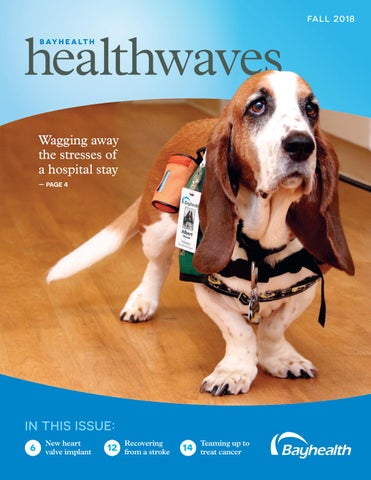
Wagging away the stresses of a hospital stay — PAGE 4
IN THIS ISSUE: 6
New heart valve implant
12
Recovering from a stroke
14
Teaming up to treat cancer
healthwaves Healthwaves is a quarterly publication of Bayhealth. The information is intended to inform and educate. It’s not a substitute for consultation with a physician. Always consult your physician for individualized care.
Bayhealth does not discriminate against any person on the basis of race, color, national origin, disability, or age in admission, treatment, or participation in its programs, services, and activities, or in employment. If you have any questions, please call JoAnn Davis at 302-744-7405. Bayhealth’s TDD or State Relay number is 1-866-237-0174.
TERRY M. MURPHY, FACHE President and CEO, Bayhealth
GWEN GUERKE Writer, Healthwaves
PAMELA J. MARECKI Senior Editor, Healthwaves
Marketing Specialist, Bayhealth AMANDA DOWNES Writer, Healthwaves
Assistant Vice President Marketing Communications, Bayhealth
Marketing Specialist, Bayhealth
AMANDA C. BOWIE Editor, Healthwaves
DANIELLE PRO-HUDSON Writer, Healthwaves
Marketing Operations Manager, Bayhealth
Media Center Coordinator II, Bayhealth JENNIFER MYERS Writer, Healthwaves
LEIGH ANN COLEMAN Photographer, Healthwaves
Marketing Specialist, Bayhealth
Web & Digital Marketing Specialist II, Bayhealth
ALICE RAUSCH Contributor, Healthwaves
JENNIFER DAILEY Writer, Healthwaves
Southern Region Strategy & Brand Program Manager, Bayhealth
Marketing Specialist II, Bayhealth
BRANDON HOWIE Photographer, Healthwaves Marketing Videographer, Bayhealth PAUL STECCA Designer, Healthwaves J&P Stecca LLC
IN THIS ISSUE feature story: 4 Wagging ●
away the stresses of a hospital stay PICTURED ON COVER Albert Einstein is a pet therapy dog who strolls the hospital’s hallways in the evening to bring smiles to faces.
To view Healthwaves online visit: Bayhealth.org/Healthwaves
6 ●
Bayhealth becomes the first hospital in Delaware to implant new heart valve
●
Why vaccines are so important, especially for adults
9 ●
Alleviating the symptoms and risks of white coat hypertension
8
10 ●
2018 Fall Classes
12 ●
Recovering from a stroke takes a community
14 ● 16 ●
Teaming up to treat cancer
18 ●
A runway of hope for cancer patients
Spotlight on the Bayhealth Sussex Campus: An environment of comfort for cancer patients
BAYHEALTH HOSPITAL, KENT CAMPUS
BAYHEALTH MILFORD MEMORIAL
640 South State Street Dover, Delaware 19901 302-674-4700
21 West Clarke Avenue Milford, Delaware 19963 302-422-3311
Letter from the President DEAR NEIGHBORS, When you enter the doors at one of our hospitals, we make it our personal mission to deliver the nation’s best healthcare to you. We also understand that a hospital stay can be stressful. Whether you’re in the hospital for the birth of a newborn or are undergoing the first round of chemotherapy, your visit can be overwhelming. As a Planetree facility focused on patient- and family-centered care, we recognize that the care we provide goes beyond treating your body, but also includes your mental and spiritual health.
You probably know someone who has been affected by cancer. To say a cancer diagnosis is overwhelming would be an understatement. Patients at Bayhealth Cancer Center have the added support of three nurse practitioners who work with people going through chemotherapy, radiation, or a hospital stay. Their goal is to give cancer patients the best quality of life while being their cheerleader through the process and offering a shoulder to cry on. Read about the team of nurse practitioners starting on page 14.
One of the ways we help brighten the days of our patients, visitors, and team members is by offering Pet-Assisted Visitation. The pet therapy teams make visits to patient rooms, spend time with visitors in waiting areas, and drop in on staff. Pet therapy has proven to lift spirits, provide comfort, decrease anxiety, and reduce boredom among other benefits. Read more about our pet therapy program beginning on page 4.
With the opening of the new Bayhealth Sussex Campus in February 2019, we’ll have a newly constructed Cancer Center that was designed specifically to provide the best clinical outcomes and patient experience. In fact, we’re moving from a 12,000- to a 20,000-square-foot facility that includes 11 exam rooms, private infusion bays, additional family space, natural sunlight, and more. Read more about the new center beginning on page 16.
Outside of the hospital, many patients have anxiety about visiting their primary care physician. Unfortunately, this prevents some people from keeping tabs on their health. The term to describe this is “white coat syndrome.” Primary Care Physician Glenda Albizu, MD, shares tips for overcoming this syndrome on page 9.
We encourage you to take care of your mind, body, and spirit. Your first step could be calling your primary care physician to work with him or her to understand how to better care for yourself. If you don’t have a doctor, visit Bayhealth.org/Find-A-Doc or call our physician referral service line at 1-866-BAY-DOCS (229-3627) for a list of doctors accepting new patients.
Maintaining a relationship with your primary care physician is imperative to keeping you in good health. If you’re 50 or older, you should be talking to your doctor about adult vaccines. According to Primary Care Physician Joseph Parise, DO, vaccines prevent you from developing serious illnesses like shingles and pneumococcal pneumonia. Read his tips on page 8.
Here’s to a fulfilling fall season.
Terry M. Murphy, FACHE President and CEO Bayhealth
3
Wagging away the stresses of a hospital stay Albert Einstein might be Bayhealth’s shortest volunteer. While he stands just a few inches tall, he never goes unnoticed while volunteering. Albert is a 9-year-old Basset Hound. He’s a pet therapy dog who visits Bayhealth Hospital, Kent Campus during the evening hours with his faithful owner, Mary Stewart. “Albert puts a smile on everyone’s face,” said Stewart. “As soon as we get to the hospital, Albert starts strutting down the halls. He can’t wait to see patients and families.” Albert and Stewart always come after the workday, partly because Stewart works, but also because they know that’s a time when the hospital is full of patients and visitors. They also know the night hours can be tough on staff members, who could also use the relief the pet therapy teams bring. “When Albert puts his vest on, he’s knows it time to go to work,” said Stewart. “The evening hours are a great time to be at the hospital. This allows us to see the patients, and many times their family members as well, who may be visiting after work themselves. And of course the night staff is always happy to see Albert. It’s hard not to have a smile on your face when you see him.”
36
PET THERAPY TEAMS 4
You can’t walk far down Bayhealth’s halls without seeing someone stopping to pet Albert. He’s even known to make visits on holidays, spending nearly an hour one Easter Sunday with a patient who was missing his pet at home. “We love seeing Albert on our unit. The dogs create a sense of calm and bring sweetness to the unit,” said Dianne Halpern, nurse manager for 1A and Patient Escort. “Our patients love seeing the pet therapy animals, but so do my staff members. It brings us such joy.”
THERE’S NO DENYING THE IMPACT THE PET THERAPY TEAMS HAVE ON OUR PATIENTS AND OUR STAFF MEMBERS. — CARRIE HART
Albert is one of dozens of pet therapy animals who visit both hospitals. The pet therapy teams work through the Volunteer Services department. Bayhealth’s pet therapy animals come in all shapes and sizes. All the dogs are certified through National Capital Therapy Dogs, a nonprofit organization. The handlers on each team must pass a written test and the dogs must pass an evaluation before they can officially test for their certification. Once the team passes all the evaluation measures, the dogs are officially named certified pet therapy dogs.
“We love all of our pet therapy animals and what they bring to Bayhealth,” said Volunteer Services Manager Carrie Hart. “There’s no denying the impact the pet therapy teams have on our patients and our staff members.” Stewart knew as soon as she rescued Albert that he was a special dog. “It was something about the soothing vibe he gives off — I just knew he was unlike any other dog and I needed to share him with others,” she said. “Albert motivates me every day. He loves to work and he loves to make other people happy. Seeing Albert in action shows me that we can always do more to help others. He jumps right into bed with some patients. Or he’ll nuzzle right up to a visitor. And it totally changes their hospital experience. A lot of people are really scared and stressed when they’re in the hospital. We’re just doing our little part to alleviate that.” ■
1,788
HOURS DONATED (FISCAL YEAR 2018)
Visit Bayhealth.org/Volunteer to learn more about volunteer opportunities at Bayhealth, including how to become a pet therapy volunteer.
MARY STEWART AND ALBERT EINSTEIN STOP TO BRING A SMILE TO SEAN WHEATLEY, AN ENVIRONMENTAL SERVICES TEAM MEMBER.
5
Bayhealth becomes the first hospital in Delaware to implant new heart valve As another step forward in the growth of Bayhealth’s cardiac surgery program, the team led by Chief Cardiothoracic Surgeon Gary Szydlowski, MD, and Cardiothoracic Surgeon Daniel Marelli, MD, have successfully performed implantation of the EDWARDS INTUITY Elite valve system in two patients for the treatment of aortic stenosis. Aortic stenosis is a condition that causes a hardening or narrowing of the aortic valve opening. It affects millions of older adults worldwide and typically worsens with age. The Journal of Geriatric Cardiology reports that aortic valve disease affects more than 25% of people over the age of 65. Bayhealth became the first hospital in Delaware to use the nextgeneration device after it received FDA approval. Common symptoms of aortic stenosis may include chest pain, shortness of breath, lightheadedness or dizziness, or inability to exercise. Experts agree that
6
patients with strong symptoms of this condition have a poor prognosis without intervention such as aortic valve replacement. Drs. Szydlowski and Marelli answered questions related to this new device for aortic valve replacement and its use at Bayhealth. This adds to the growing number of options to help their patients with cardiovascular conditions improve their function and quality of life. HOW ARE THE DEVICE AND THE IMPLANTATION PROCEDURE UNIQUE? When patients have aortic stenosis, the valve of their aorta — the main artery supplying oxygenated blood to the body — does not open properly. This means the heart must work harder to pump blood through the aortic valve, resulting in reduced blood flow to the body and a weakened heart muscle. It may lead to heart failure if left untreated.
This device requires full cardiac surgery, or open heart surgery. The advantage is that the surgery doesn’t require sutures and is less invasive. Other valves require 12 to 15 reinforced sutures to secure the valve. The new valve is balloon-dilated into place using the EDWARDS INTUITY Elite valve system. WHAT ARE THE BENEFITS AND RISKS OF THIS PROCEDURE? The benefits are a quicker operation and the fact that it can allow for a minimally invasive approach with a smaller incision. There also is evidence that this new device may relieve the obstruction better than traditional sutured valves. Because it takes up less space on the wall of the aorta, there is less resistance, which creates superior results. There are standard risks to any open heart surgery and this would be no different. Pacemakers are a possibility after any cardiac procedure, especially aortic valve replacement, and the chance is slightly higher in these procedures. With any tissue valve like this, patients typically avoid the need for long-term blood thinners. Clinical studies show that this procedure may mean shorter hospital stays and faster healing times for patients.
THE JOURNAL OF GERIATRIC CARDIOLOGY REPORTS THAT AORTIC VALVE DISEASE AFFECTS MORE THAN 25% OF INDIVIDUALS OVER THE AGE OF 65.
WHAT ARE THE PLANS FOR FUTURE USE OF THIS PROCEDURE? This is another option for aortic valve replacement. As with any treatment, however, this may not be for everyone. We consider the unique conditions of each of our patients and work with them to determine a course of action. â– To be matched with a doctor to meet your cardiac care needs, visit Bayhealth.org/Find-A-Doc or call 1-866-BAY-DOCS.
7
Why vaccines are so important, especially for adults Immunizations are important for everyone from newborns up through seniors. Why? They help prevent you from not only getting sick but potentially spreading an illness to others. Moreover, contracting a preventable disease can lead to more serious health conditions, missed work, hospital bills, and more. “Vaccinations in general are beneficial and are effective in preventing serious illness, hospital stays, and even death,” says Joseph Parise, DO, Bayhealth Primary Care, Dover. While there are many vaccinations available to the community, there are four Dr. Parise recommends to older adults. SHINGLES Adults 50 and older Two doses, once in a lifetime It’s important to get this vaccine because the disease can be painful and can lead to long-term problems. If you had chicken pox as a child, you’re susceptible to having the disease later in life because the virus remains in your body.
INFLUENZA Everyone 6 months and older One dose, annually in the fall This vaccine is the best way to prevent the flu. The influenza virus changes each year, which is why it’s an annual vaccine. Influenza is a debilitating virus with significant symptoms like fever, chills, myalgia, and headache. It can be particularly serious for seniors and children as it can lead to pneumonia, hospitalization, and even death. PNEUMOCOCCAL Adults 65 and older Two doses, one year apart This vaccine is important because pneumococcal is the most common cause of pneumonia in the senior population and can be life-threatening. The first dose protects against 13 strains of pneumococcal while the second protects against 23 strains. TDAP Any age if not administered as a child, after age 6 Initial shot is followed by boosters every 10 years
VACCINATIONS IN GENERAL ARE BENEFICIAL AND ARE EFFECTIVE IN PREVENTING SERIOUS ILLNESS, HOSPITAL STAYS, AND EVEN DEATH. — JOSEPH PARISE, DO
8
TDAP is important because it protects against three diseases — tetanus, diphtheria, and whooping cough. Dr. Parise notes whooping cough has been a problem in Kent County and encourages adults who spend time with children to get vaccinated. Vaccination schedules can differ for community members suffering from chronic disease. Dr. Parise recommends consulting your physician with questions about what immunizations would be beneficial to you. ■ Find the right Bayhealth doctor to give you the support you need. Visit Bayhealth.org/Find-A-Doc or call 1-866-BAY-DOCS.
Alleviating the symptoms and risks of white coat hypertension White coat syndrome, a term describing a patient’s slightly elevated blood pressure when read at the doctor’s office, was once dismissed as a sign of anxiety about doctors or medical situations. Today, doctors take a much more serious look at what has become known as white coat hypertension, says primary care physician Glenda Albizu, MD. “We see it often,” she explains. Normal blood pressure is 120/80. Slightly higher than normal blood pressure in the doctor’s office now gets a second — or even a third — consideration because those higher numbers can be a warning that the patient is developing a serious condition. “It’s a difficult diagnosis,” says Dr. Albizu, noting that doctors need more than one interaction with a patient to determine what is happening with the patient and his or her lifestyle. She emphasizes the necessity of creating a strong relationship between the doctor and patient. First, she suggests patients keep a blood pressure diary, making notes about individual triggers for high blood pressure.
• Decrease alcohol and caffeine and, of course, avoid smoking. • Try to achieve 150 minutes a week of aerobic activity. • Eat a diet low in saturated fat and carbohydrates to reduce plaque in the arteries. • Practice good sleep hygiene. • If you’ve been diagnosed with hypertension, you may need to take a low-dose medication. “The goal is to control blood pressure to avoid increased incidence of coronary artery disease, atherosclerosis, stroke, and/or cardiovascular events. We are seeing white coat hypertension more and more, and it might be a precursor of serious disease.” ■ Visit Bayhealth.org/community-health-and-wellness for more information about high blood pressure.
Next, the doctor will order lab tests. “Lab work is important because it can assess other contributing factors to elevated pressures such as renal compromise, diabetes, and hyperlipidemia,” she adds. She also encourages frequent follow-up visits with the doctor “to establish good rapport.” Here are some tips from Dr. Albizu to help maintain a healthy, consistent blood pressure, thus avoiding white coat hypertension or hypertensive disease: • Develop a good relationship with your doctor, including proper follow-up appointments. • Practice relaxation exercises, such as meditation. Try simple breathing exercises for two or three minutes. Meditation can be trial and error. 9
VISIT BAYHEALTH.ORG/CLASSES FOR A COMPLETE LIST OF CLASSES AND EVENTS.
Maternity BIRTH CENTER TOUR AT BAYHEALTH HOSPITAL, KENT CAMPUS We invite you to an open house tour of the facility where you will meet your new baby for the first time. Visit Bayhealth.org/BirthCenterTour to register. BIRTH INN AND BEYOND TOURS AT MILFORD MEMORIAL Come for a tour of our unique facility, where we offer the convenience of birth and recovery in the same private room. For more information, call 302-430-5739. INFANT CARE These classes focus on basic infant care to give parents confidence in their ability to care for their babies. Call 302-744-7135 to register. This class has a fee. HELLO BABY Adjusting to a new brother or sister can be difficult for the older sibling. Bayhealth’s “Hello Baby” program is designed to help children accept their new role. Call 302-744-7135 to register. This class has a fee. BREASTFEEDING 101 Come learn the basics about breastfeeding. Support persons are encouraged to attend. This class is offered the first Tuesday of every month at Milford Memorial and the third Tuesday of each month at Bayhealth Hospital, Kent Campus. Visit Bayhealth.org/Classes to register.
10
LABOR AND CHILDBIRTH Classes are offered both in-person and online for expectant mothers and their partners. Mothers-to-be are encouraged to register early in their pregnancy. Call 302-744-7135 to register. This class has a fee.
PUMPING, MILK, AND MORE Expectant mothers will learn the ins and outs of what kind of pump works best, based on personal circumstances and preferences. Visit Bayhealth.org/Classes to register. BREASTFEEDING SUPPORT GROUP While breastfeeding is natural, it’s not always easy for new moms. Our Breastfeeding Support Group offers an encouraging environment. For more information, call 302-744-7233.
Healthy Aging FESTIVAL OF TREES Bayhealth’s Festival of Trees is a 12-year tradition where departments decorate trees that are displayed in the lobbies of Bayhealth Hospital, Kent Campus and Bayhealth Milford Memorial. The money raised from the raffle supports the Employee Assistance Fund — a fund that helps employees who have fallen on hard times. The community is welcome to purchase raffle tickets at either or both campuses for their chance to win a Christmas tree. The raffle begins on Friday, Nov. 23, at 8 a.m. Raffle tickets can be purchased for $1 or six for $5 at the Ambulatory Pharmacy at the Kent Campus or the front desk of either hospital. The trees will be raffled off on Dec. 21.
STEPS CARDIOVASCULAR CLINICS Your personal numbers — blood pressure, heart rate, pulse oximetry, and weight — can tell you a great deal about your health. Bayhealth nurses take careful readings when you come to one of our STEPS clinics. And it’s free! For more information, visit Bayhealth.org/STEPS or call 302-744-7135. A MATTER OF BALANCE A Matter of Balance is an awardwinning program designed to manage falls and increase activity levels in older adults. The program is free, but registration is required! To register, visit Bayhealth.org/Classes or call 302-744-7135. STEPS EDUCATION LECTURES Led by expert speakers, these lectures cover a wide variety of health topics targeting the 50+ age group. For more information, visit Bayhealth.org/STEPS or call 302-744-7135.
2018 FALL CLASSES Weight Loss BARIATRIC INFORMATION SEMINAR Learn more about the Bayhealth Bariatric Program including the Laparoscopic Roux-en-Y Gastric Bypass and the Laparoscopic Sleeve Gastrectomy. Find out about the risks, benefits, and outcomes. Meet the surgeons and staff of the bariatric program, ask them questions, and see if you meet the criteria for bariatric surgery. These seminars are free of charge and all are welcome. To register, call the Bayhealth Bariatric Office at 302-430-5454.
CPR & First Aid SAFE SITTER Safe Sitter® teaches boys and girls ages 12 to 15 how to handle emergencies when caring for children. Certified instructors teach safe and nurturing childcare techniques, behavior management skills, and appropriate responses to medical emergencies. Students will also learn CPR. To learn more, call 302-744-7135. This course has a fee. HEARTSAVER ADULT CPR/FIRST AID This course reviews the steps of cardiopulmonary resuscitation (CPR) for adults. Participants will learn how to use an AED (automatic external defibrillator). The first aid section covers general principles, injuries, and medical and environmental emergencies. To learn more, call 302-744-7135. This course has a fee.
HEARTSAVER PEDIATRIC CPR/FIRST AID This American Heart Association course reviews the steps of cardiopulmonary resuscitation (CPR) for children and infants. It also provides information on how to manage a child’s injury during the first few minutes of an emergency until professional help arrives. To learn more, call 302-744-7135. This course has a fee. BETTER BREATHERS This support group is for people with chronic obstructive lung disease and their family members. For more information, please call Clinical Educator Jamann Caselles at 302-744-6227 or Respiratory Care Manager Rachael Ali-Permell at 302-430-5648. FREEDOM FROM SMOKING® This free seven-week program offers support and guidance to help you quit using tobacco products. For more information, call 302-744-7135.
Screenings MAMMOGRAMS Each month, Bayhealth hosts regular mammogram screenings at multiple locations at no cost to those who are uninsured or underinsured. To register, call 302-430-5143 or 302-744-6528.
OPEN HOUSE AT THE NEW BAYHEALTH HOSPITAL AND OUTPATIENT CENTER, SUSSEX CAMPUS You’re invited to join us on Saturday, Jan. 19, 2019, from 2 to 5 p.m., with fireworks at dusk, for an open house and tour of the new Bayhealth Hospital and Outpatient Center, Sussex Campus. The open house is open to all community members — children and adults. There will be tours, a photo booth, a children’s corner, fireworks, and more. We’d appreciate you scheduling your arrival time. Please visit BayhealthSussex.org/Community to pre-register. CLINICAL BREAST EXAMS A clinical breast exam is a physical examination done by a healthcare practitioner trained to notice abnormalities in the breast tissue. Bayhealth offers free clinical breast exams to the community. Registration is required! To register, call Harriet Pinkston at 302-744-6528.
11
Recovering from a stroke takes a community When the text message from her running accountability partner came in at 5 a.m., Dr. Funmilayo “Funmi” Aranmolate, an optometrist in the U.S. Air Force, laced up her running shoes for an outdoor run. But she says divine intervention stopped her from heading out the door, and instead she completed the workout at home. Unfortunately, following her workout, Aranmolate suffered a stroke. It’s taking self-determination and a community of people to help her recover. “My arm went weak at the end of my workout,” she said. She sat on a bench to shake off the feeling. “When I stood up, I fell to the ground. The right side of my body was paralyzed.” She crawled her way to the front yard where she thought she was yelling for help — only to find out later that she was babbling. A neighbor, who didn’t know Aranmolate and assumed she had a mental health disease, took her inside. “When she looked at me, she knew to call 911.”
12
The 41-year-old arrived at Bayhealth Hospital, Kent Campus. “My words were clear to me, but I was talking gibberish to the medical staff,” said Aranmolate, who couldn’t understand why no one would listen to her. Staff performed a CT scan to assess or visualize the brain, and then administered tissue plasminogen activator (tPA) to help dissolve the clot and improve blood flow to the part of her brain that was being deprived. Both Bayhealth Hospital, Kent Campus and Bayhealth Milford Memorial are designated as Primary Stroke Centers. The designation signifies that both Bayhealth hospitals have met and seek to maintain The Joint Commission’s high standards in providing stroke care. Aranmolate spent three days in Critical Care at the Kent Campus. “After I was told that I received tPA, which helps shorten the course of stroke recovery, I thought I would be back to work in a month at most.” She didn’t understand the toll the stroke had taken on her body. In fact she had right-sided weakness and paralysis caused by an injury to the left side of her brain that controls her language and memory. Aranmolate was later medically retired from the Air Force.
ART THERAPY IS REWARDING FOR PATIENTS AND CAN BE A DISTRACTION FROM THEIR DISABILITIES AS THEY ARE CREATING SOMETHING BEAUTIFUL. — KRISTEN WARD, COTA/L, CLIPP, BS
The team of nurses in Critical Care worked with Aranmolate’s sisters to create goals like finding an inpatient rehabilitation facility, connecting her with a neurologist, and introducing her to a social worker to help her on her road to recovery. As a single woman living on her own, Aranmolate relied on her mother to be her care partner. Aranmolate traveled to Towson, Maryland, where one of her sisters lived, for rehabilitation. When she was released after six months, she returned to Dover to start therapy at Bayhealth Outpatient Rehabilitation. She went through speech, occupational, and physical therapies. Aranmolate used outpatient therapy to help her learn how to live on her own again. She needed strength to walk up the steps to her townhouse, to get to doctor appointments, to cook a meal, eat, and write with her right hand, and to walk. The former marathon runner was confined to a wheelchair for three months, and used it off and on for a year while she regained her strength. “The therapists tailored all of the therapy to meet my needs, and it helped me build up strength over time,” she said. “When I first started therapy I was having a hard time stringing words together to make a sentence,” explained Aranmolate. In speech therapy, she worked on fluency and even did music therapy. “I chose the Michael Jackson song ‘Man in the Mirror’ to learn and sing. We worked on it every time and they gave me an app to use at home. It was fun.” Aranmolate was also introduced to art therapy in Occupational Therapy. Occupational Therapy Assistant Kristen Ward, COTA/L, CLIPP, BS,
says that art therapy builds strength and coordination in a hemiplegic arm. “Art therapy is rewarding for patients and can be a distraction from their disabilities as they are creating something beautiful,” said Ward. “Art therapy addresses the same skills that are addressed during traditional therapeutic exercise.” When Aranmolate first put the paint brush to canvas, she doubted herself. But as time went on, she found art therapy to be relaxing and a huge confidence builder. In fact, outside of therapy she enjoys going to paint nights to tap into the creative side she didn’t realize she had on that first day of art therapy. “Everything we did in therapy could translate into real life,” said Aranmolate. “PT, OT, and speech have all been a crucial part of my recovery. The therapy team helped me set goals and mark them off one by one.” This past summer she walked a 5K in Philadelphia with her two sisters — making significant strides toward her goal to run again. “My stroke was life-changing, and it’s taken a community of people to get me where I am today,” said Aranmolate. Now two and a half years after her stroke, Aranmolate says she can see a glimpse of where she wants to be — running again and returning to the job she loves. “Even if I’m having a bad day, I try to work on something to help me get better.” ■ Visit Bayhealth.org/Outpatient-Therapy to see our expansive list of therapy options for community members.
13
Teaming up to treat cancer There’s no denying how scary a cancer diagnosis can be. Undergoing treatment can be challenging for both patients and their family members or support network. That’s where the three nurse practitioners at Bayhealth’s Cancer Centers play a pivotal role. They work together to help patients going through chemotherapy, radiation, or a hospital stay manage their symptoms and find their best quality of life. The nurse practitioners are part of a bigger team at the Bayhealth Cancer Centers, which includes medical and radiation oncologists, nurses, radiation therapists, and nurse navigators all working to help patients going through diagnosis, treatment, and beyond. Cyndi Martin, APRN-BC, ANP-C, MSN, AOCNP, works with patients who need to stay in the hospital. “I always tell patients I’m their best friend while they are here,” said Martin. “I’m their fairy godmother; I even carry a wand with me. We are always here for the patients. Sometimes it’s a shoulder to cry on, sometimes we’re their cheerleader.”
Sandi Voss, FNP-C, AOCNP, works with patients undergoing chemotherapy and patients who require a hospital stay. “The challenge of cancer care is getting patients through the process,” said Voss. “We always consider the human impact. We are always looking for the best way to maintain optimal health while patients are going through active treatment. It’s more than just symptoms — we treat the whole person.” Eileen Fusco, ANP, APRN-BC, AOCNP, works with patients undergoing radiation. The typical regimen for radiation is daily, so she builds a special bond with patients. “I do get to know the patients quite well because of their treatment schedule,” said Fusco. “We set the tone for the patient experience. I always want the patients to know that we are here for them, if they ever have any questions or concerns.” The nurse practitioners also educate the community on the importance of screenings and annual visits to ensure early detection and diagnosis of cancer, which leads to better outcomes. “The more educated our community is, the better we all are,” said Voss. “We do screenings and other education in the community to ensure people know what resources are available to them. We want to extend our reach as far as we can to help our community.”
BAYHEALTH’S CANCER CENTER NURSE PRACTITIONERS (FROM LEFT) EILEEN FUSCO, CYNDI MARTIN, AND SANDI VOSS ENSURE EACH PATIENT FEELS SPECIAL AND HAS A GOOD QUALITY OF LIFE WHILE GOING THROUGH CANCER TREATMENTS.
14
WE ARE THERE TO CHEER WITH THE PATIENTS WHEN THEY ARE DOING WELL. AND WE HOLD THEIR HANDS WHEN THEY AREN’T. — CYNDI MARTIN, APRN-BC, ANP-C, MSN, AOCNP
“Our job is to make sure patients have everything they need for their journey,” said Fusco. “Our patients trust us, and they know we are a true team. Every interaction we have with patients is enjoyable because of the relationship and respect we build together. It’s very special.” The nurse practitioners all note how cancer care has changed and improved through the years. “Cancer care has come a long way. We have good outcomes,” said Martin. “The philosophy at the Bayhealth Cancer Centers is the patients come first. We are there to cheer with the patients when they are doing well. And we hold their hands when they aren’t. We have the best job on the planet.” ■ Visit Bayhealth.org/Cancer to learn more about cancer services at Bayhealth.
15
SPOTLIGHT ON THE BAYHEALTH SUSSEX CAMPUS
An environment of comfort for cancer patients One of the hallmarks of the Bayhealth Sussex Campus is a newly designed integrated cancer center. Located on the garden level of the Outpatient Center directly adjacent to the hospital, the new facility was designed to provide the best clinical outcomes and patient experience. The center consolidates all healthcare providers that specialize in cancer services into one place, enabling Bayhealth’s cancer care team of medical and radiation oncologists, surgeons, nurses, social workers, and others to provide care in a convenient location. “Having all members of the cancer care team in one location allows us to carry forward our mission to provide comprehensive multidisciplinary cancer care,” says Rishi Sawhney, MD, medical director of the Bayhealth Cancer Institute. “We look forward to providing our communities with expedited access to cancer treatment as well as valuable supportive care programs.” The new Bayhealth Cancer Center, Sussex Campus also features an abundance of natural light to brighten the rooms and a beautiful garden just outside the windows to bring the outdoors into view, thereby creating the best healing environment. Other design highlights that will enhance patient experience in the new facility include:
• Sliding glass panels separating the infusion bays (shown above), which give patients the option to converse with fellow cancer patients when opened or to sit privately when closed • Additional space for family members to sit while their loved ones receive treatment • Twice as many private infusion bays for chemotherapy treatments “I’ve been at Bayhealth since 2000, and we have continually elevated radiation therapy technology and treatment services,” says John Lahaniatis, MD, medical director of Radiation Oncology. “The Varian VitalBeam™ linear accelerator will offer patients in the southern region state-of-the-art image guidance, stereotactic radiation therapy, and IMRT [intensity-modulated radiation therapy].”
A side-by-side comparison of some of the key features of the new cancer center at Bayhealth Sussex Campus (BSC) compared to the existing Bayhealth Milford Memorial (BMM)
16
SQUARE FOOTAGE
CHEMOTHERAPY BAYS
EXAM ROOMS
BSC: 20,000 BMM: 12,000
BSC: 14 BMM: 10
BSC: 11 BMM: 5
Along with image-guided radiation therapy (IGRT), stereotactic body radiation therapy (SBRT), and IMRT, other services for treating and supporting cancer patients during their journey will be available at the new Bayhealth Cancer Center, Sussex Campus. They include: • Chemotherapy • Immunotherapy • Multidisciplinary conferences • Nurse navigation program • Supportive care program • Clinical research program • Genetic counseling program
John D. Shevock, FACHE, FACMPE, senior director of operations, oncology service line and executive director, Bayhealth Cancer Institute adds, “We’re very excited about this new opportunity in our southern region to offer state-of-the-art cancer services to our communities. We focused on patient access to the full spectrum of cancer services, both diagnostic and treatment, and on advancing our technology capabilities to enhance the patient experience.” ■ Go to Bayhealth.org/Cancer to learn more about Bayhealth’s Oncology services. For more information about the new Bayhealth Sussex Campus visit BayhealthSussex.org.
• Survivorship program
DR. PRANITHA NAINI WITH BAYHEALTH HEMATOLOGY/ ONCOLOGY ASSOCIATES ENSURES HER PATIENT AND HIS CARE PARTNER UNDERSTAND THE TREATMENT PLAN AND NEXT STEPS.
17
A runway of hope for cancer patients Many of the services and programs provided to Bayhealth cancer patients are made possible because of generous gifts and contributions from individuals, businesses, and organizations in our local communities. Runway of Hope — a fundraiser featuring a silent auction, luncheon, and fashion show that supports the Bayhealth Cancer Institute’s Survivorship Program — is one way the community makes a positive impact on the lives of cancer patients. Bayhealth hosted its eighth annual Runway of Hope fundraiser on Friday, Aug. 3, 2018, and the event raised $87,494 for the Survivorship Program. Bayhealth Cancer Nurse Navigator Renee Hall, RN, and breast cancer survivor and Bayhealth Cardiology Manager Cathy Mundorf, BS, RRT, attended this year’s event as participants in the Survivorship Program. “It’s always nice to see the committee, staff from the Cancer Institute and Bayhealth Foundation, and members of our local community come together to support what we do as cancer nurse navigators for our Survivorship Program,” said Hall.
As part of the Survivorship Program, the nurse navigators present patients who have finished treatment with a document containing their treatment summary — from the time they’re diagnosed through the completion of surgery, chemotherapy, and/or radiation. “We review the summary with the patient, and then we talk about the importance of follow-up care and living a healthy lifestyle, which includes things such as diet and exercise, to help prevent recurrence or second cancers. We also discuss and validate the challenges of adjusting to life after receiving a cancer diagnosis and treatment,” explained Hall. “We address any fears the survivor may have, such as the cancer coming back or possible body image concerns,” she continued. “We also offer referrals for ongoing counseling and any other resources or support they need. Essentially, we want to ensure survivors understand our relationship doesn’t end just because they have completed their treatment.”
CATHY MUNDORF CELEBRATED HER LAST DAY OF CHEMOTHERAPY AT BAYHEALTH’S CANCER CENTER WITH HER MOM AND HUSBAND BY HER SIDE.
18
Mundorf said she appreciates how Runway of Hope supports and focuses on the importance of the Survivorship Program. “It was a lovely event and nice to see how members of the community and other Bayhealth staff come together to acknowledge how difficult it is being a cancer survivor and that you need much more support than just medical treatment,” she said. “Life is never the same. As a cancer survivor, it’s not uncommon to have moments of panic and anxiety. I have peace of mind knowing Renee is only a phone call away for emotional support and even to help me with practical needs such as completion of FMLA paperwork.” “Survivorship begins at diagnosis,” said Rishi Sawhney, MD, medical director of the Bayhealth Cancer Institute. “Our goal is to equip each patient with a comprehensive plan during and after treatment, beginning at the initial conversation with their nurse navigator.” Dr. Sawhney said the support from Runway of Hope and the community helps offset the costs of the Survivorship Program. “The generosity of our community enables our patients to have access to first-class survivorship care throughout their cancer journey,” he said.
The Safeway Foundation granted $4,000 to the Bayhealth Foundation to be used by the Bayhealth Cancer Institute to fund free biopsies for women in need in central and southern Delaware. Pictured from left to right are: Bayhealth Cancer Institute Manager Stephanie McClellan, MSN, RN, CMSRN; Bayhealth Foundation President Dr. Lindsay Rhodenbaugh; Safeway’s Eastern Division Senior Manager of Community & Public Affairs Beth Goldberg; and Bayhealth Cancer Institute Executive Director and Senior Director of Operations of Bayhealth’s Oncology Service Line John Shevock, FACHE, FACMPE.
OTHER RECENT CONTRIBUTIONS Here are a few other examples of how the community has supported Bayhealth cancer patients in 2018.
C.F. Schwartz Toyota in Dover gave a generous gift to support Oncology Services at Bayhealth’s Kent Campus. Bayhealth Foundation Director of Development Chuck Desch (pictured on the left) accepted a check in the amount of $10,000 from C.F. Schwartz President Bob Schwartz and Secretary/Treasurer Linda Schwartz Chi.
For the second year in a row, Dover High School student Meghana Lodhavia made a substantial contribution to the Bayhealth Cancer Institute’s Helping Hands Fund, which provides financial assistance for cancer patients facing difficulty making ends meet while they’re undergoing treatment. She also helped second-grade students at St. Anne’s Episcopal School make get-well cards for Bayhealth’s cancer patients. ■ Visit Bayhealth.org/Cancer to learn more about Bayhealth’s cancer program. To find out how you can make a contribution to the Bayhealth Cancer Institute, visit BayhealthFoundation.org or call the Bayhealth Foundation at 302-744-7015.
19
RUN OR WALK, BUT JOIN US! You’re invited to run or walk with us on Saturday, Nov. 17, for a unique point-to-point race from Milford Memorial to the new Bayhealth Sussex Campus that’s opening in February 2019. Registration will be at the new Bayhealth Sussex Campus, and participants will be bussed to the starting line at Milford Memorial. A free Healthy Kids Run for ages 10 and under will start immediately following the race. Participants will receive a Move on Over 5K shirt, while supplies last. Go to Bayhealth.org/Race to register.