
By Leonna Heuring Benton, MO
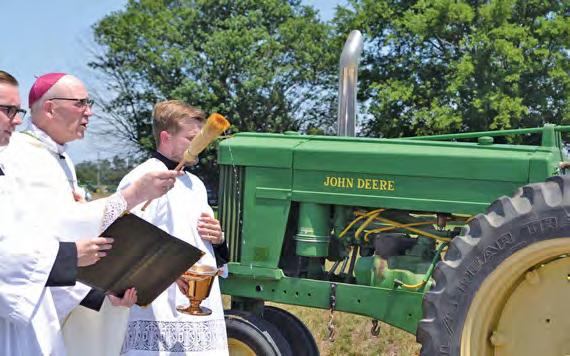
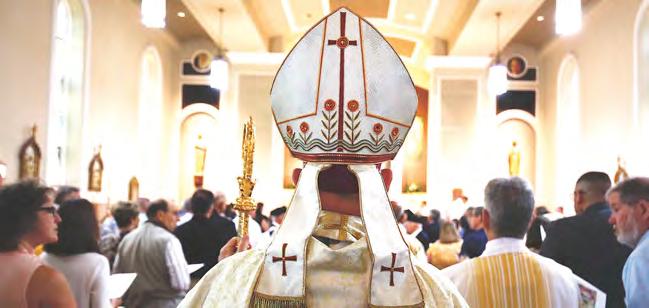
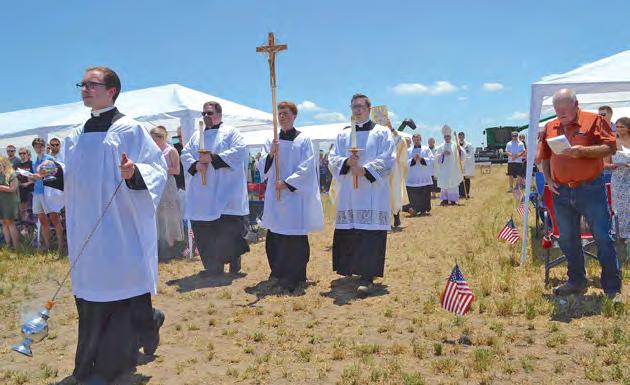
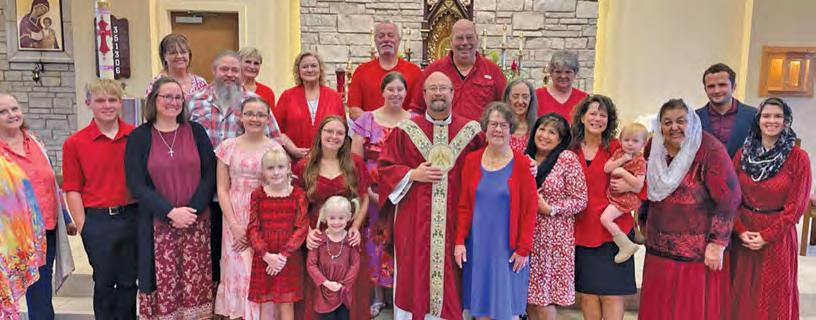
Nearly 250 farmers and community members gathered among tractors and trucks on Sun., May 31, at Hulshof Farms in rural Scott County as the Most Rev. Edward Rice celebrated the Diocese of Springfield-Cape Girardeau’s first Farmers’ Mass for the wheat harvest.
Attendees of all ages sat in lawn chairs under white tents. One man watched from the open cab of his tractor. The family’s red barn formed the backdrop as Bishop Rice, of the largely rural diocese, called the liturgy “a dream come true.”
He said he has received the magazine, Catholic Rural Life, for a decade while hoping to bring the altar into the fields and make clear how important farmers and others in agriculture are, describing them as unsung heroes whose work feeds others.
The Mass, held on the Solemnity of the Most Holy Trinity, drew priests from local parishes, seminarians from the Diocese and beyond, and families from across southeast Missouri. Twins Will and Wyatt Stinnett, of the band Double Take, from Portageville, MO, provided music for the occasion.
Preaching on the Holy Trinity, Bishop Rice told farmers that “mystery” is not confined to theology. He compared the mystery of “one God in three persons” to the uncertainty that governs life on the land, from buried seed to harvest, to weather and markets.
Citing the parable found in Mark’s Gospel, Bishop Rice reminded those gathered: “The Kingdom of God is like a farmer who scatters seed on the ground. Night and day, while he’s asleep or awake,
the seed sprouts and grows, but he does not understand how it happens.”
Bishop Rice drew from Catholic teaching on rural life, quoting a 1946 address by Pope Pius XII to farmers in Rome. The pope referred to farmland as “sweet fields” and noted that “all people depend on the class of farmers as your lives are dedicated to bringing forth from the depths of the earth the abundant riches which the hand of God has hidden there for you.”
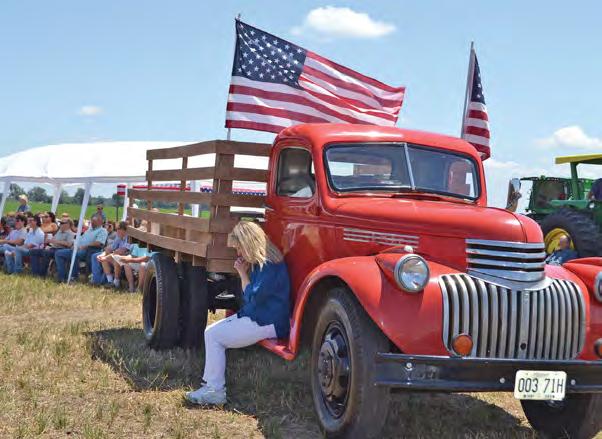
With most parishes sitting in small towns and farming communities, Bishop Rice longed to hold a Farmers’ Mass, the goal of which was to thank God for the land and affirm farmers, truck drivers, and others tied to agriculture the importance of their labor.
The homily highlighted Pius’ insistence that soil “is never to be exploited,” and repeated a line he called a hallmark of the address: “God gave man the earth for his cultivation as the most beautiful and honorable occupation in the natural order.”
He connected that teaching to Pope Francis’ 2015 document, “Laudato Si” (“On Care for Our Common Home”), which warns that “it is the only one we have,” and to Pope Leo XIV’s more recent address marking the 80th anniversary of World Food Day. In that talk, the pope called hunger “a mortal wound that afflicts the whole human family” and insisted, “Food must never be used as a weapon… especially toward women and children.”
to the land, but it ain’t my ground. This is God’s country. We pray for rain, and thank him when it’s falling because it brings the grain and a little bit of money. We put it back in the plate. I guess that’s why they call it God’s country.”
Bishop Rice said he hopes every farmer believes this truly is “God’s country” and that they see themselves as stewards of creation who “cooperate with God in feeding the hungry,” echoing Pius’ praise of working these “sweet fields” as an “honorable occupation.”


Bishop Rice told the crowd that farmers live that responsibility daily and said he often wonders how farmers make it given rain, drought, infestations, hail, fuel costs, market swings, and the wider economy. Seeing crops still come off the fields, he said, “has to be the work of God.”
He quoted singer Blake Shelton’s song, “God’s Country”: “I’ve got a deed
Citing the Gospel for Sunday’s feast of the Holy Trinity — “God so loved the world that He gave us His only Son” — Bishop Rice said the Mass was meant to remind farmers they are not alone, that they have “family, community, and Church,” and their priests and bishop supporting them “in this mystery of life as you till the soil and harvest the crops.”
He closed with another passage from Pius XII’s “On Rural Life”: “Let the Church remain the heart of the farmers. Sunday after Sunday, may the (Church) gather the faithful. … There, may they lift their minds above material things to the praise and service of God and to ask for strength to think and live in a truly Christian manner during the coming week.”
An idea, a magazine & a quick yes
For Brock Hulshof, the Diocese’s summer intern, newly-accepted seminarian, and son of Patrick and Robin
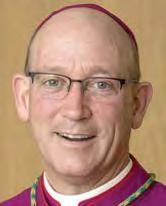
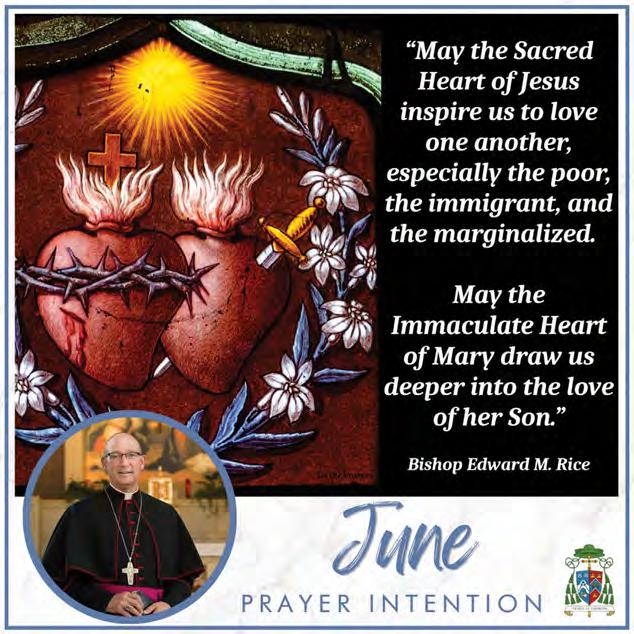
Bp. Edward M. Rice
he month of June is dedicated to the Sacred Heart of Jesus!
Archbishop Etienne of Seattle reminded his people that devotion to the Sacred Heart of Jesus, which signifies the divine response to the wounded human heart, is “more timely than ever,” and he encouraged them to rediscover this beautiful devotion. You can read more about this pastoral letter on p. 9 of this issue of The Mirror
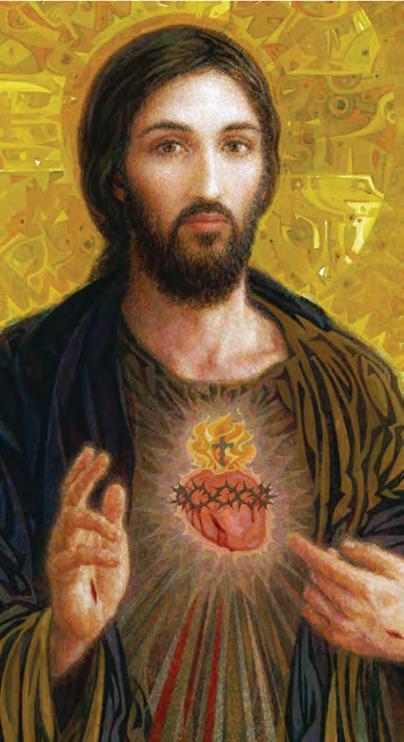
If you ever come to my office in Springfield, you will see displayed on the wall a framed image of the Sacred Heart. It was a wedding gift to my parents, passed down to my sister, who then passed it on to me when I was transferred in 2016 to the Diocese of Springfield-Cape Girardeau. That same image hung over the mantel in our family home as a quiet, ever-present reminder of the love of Jesus.
But I was struck by Archbishop Etienne’s twist on this devotion. Typically, we speak of the Heart of Jesus as being wounded, crowned with thorns, and with drops of blood. Bishop Etienne offers a thought I had not considered, at least formally, that the Sacred Heart of Jesus is “the divine response to the wounded human heart.” Yes, each of us has a wounded, pierced human heart. Each of us has been hurt, disappointed, betrayed, stabbed in the heart, rejected, misunderstood, etc. Maybe that is why, in this wounded world in need of redemption, the Sacred Heart is “more timely than ever.”
Devotion to the Sacred Heart includes going to confession and receiving Holy Communion 9 first Fridays of the month in a row. Attached to this devotion are 12 promises of the Sacred Heart, of which #11 is my favorite, “Those who shall promote this devotion shall have their names written in My Heart.” In November, the
bishops of the United States voted to consecrate our country to the Sacred Heart of Jesus to commemorate the 250th anniversary of our country and its Declaration of Independence. This will occur while many of our priests will be with me in St. Louis June 8-12 on retreat. In consecrating the nation to the Sacred Heart, we follow a longstanding tradition of popes who have praised the practice of consecrating one’s family, home and nation to the Sacred Heart. We seek His blessings on our country so that we may strive to live out the high ideals of the Declaration of Independence: “We hold these truths to be self-evident, that all men are created equal, that they are endowed by their Creator with certain unalienable Rights,

Jesus gave us the image of his Sacred Heart as a dramatic reminder of his love. The image helps us pray. The Heart of God took on flesh in the human Heart of Jesus. Images often depict his Heart, symbol of the most intimate center of who he is, outside of his body, vulnerable and offered to us in love. We consider the wound, where a soldier’s spear pierced Jesus, and we marvel at the depth of suffering Jesus accepted on our behalf. We see the thorns and cross, and we feel close to our God who knows what it is like to be ridiculed and abused. We see the flames, and we rejoice that God’s passionate love can never be extinguished. We trust in the sure hope of his Resurrection. Even death cannot separate us from the love of God.
Draw close to the Heart of Jesus. Like the Beloved Disciple did at the Last Supper, rest your head against the Lord’s chest and let him love you.
that among these are Life, Liberty, and the pursuit of Happiness.“ So let each of us do our part to spread devotion to the Sacred Heart of Jesus not just in June, but throughout the year! God bless America!
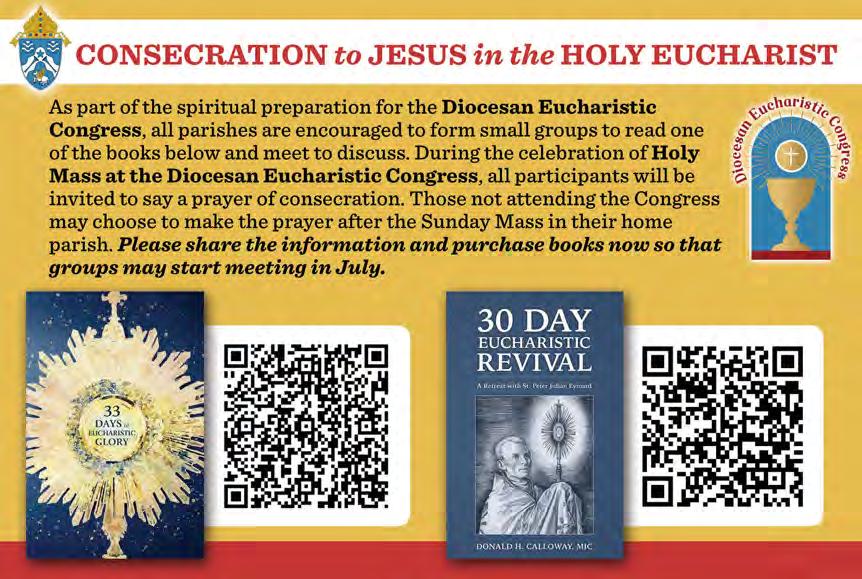
As we continue to prepare for our upcoming Diocese Eucharistic Congress (DEC), August 15, 2026, in West plains, let us focus on the June resources on the diocesan Website. Those resources include paragraphs 1382-1405 from the Catechism, The Paschal Banquet, Chapter 5 of Pope John Paul II’s document “Ecclesia de Eucharistia” the songs “O Sacrament, Most Holy”
And “Gift of Finest Wheat,” the movie “Eucharistic Miracles with Scientific Proof,” and the beautiful piece of art by Hubert and Jan van Eyck, “The Adoration of the Mystic Lamb.” As an activity, many parishes will have a Corpus Christi procession for the upcoming Solemnity of the Most Holy Body & Blood of Christ on June 7 and I encourage everyone to attend.
As we continue Romano Guardini’s Sacred Signs, we focus on the altar:
“Man has the power to know God, to worship Him, and devote himself to Him in order ‘that God may be glorified.’ The external representation of this region of central calm and strength is the altar. The altar occupies the holiest spot in the church. The church has itself been set apart from the world of human work, and the altar is elevated above the rest of the church in a spot as remote and separate as the sanctuary of the soul. … It is not in the dark recess where the actions may be dimly glimpsed, but uncurtained, unscreened, a level surface in plain sight, placed, as the heart’s altar should be placed, open in the sight of God without proviso or reservation. The two altars, the one without and the one within, belong inseparably together. The visible altar at the heart of the church is but the external representation of the altar at the center of the human breast, which is God’s temple, of which the church with its walls and arches is but the expression and figure.”
O Sacrament Most Holy, O Sacrament Divine, all praise and all thanksgiving be every moment Thine. ©TM

By Bishop Emeritus John J. Leibrecht
Before his retirement in 2008 as the Fifth Bishop of the Diocese of Springfield-Cape Girardeau, Bishop John Leibrecht wrote a standing column in The Mirror entitled, “Walking Together.” At the end of each article, Bp. Leibrecht would normally share a funny story referencing his travels to the schools, or time with friends, family, or other bishops. The Mirror has decided to share a few of these in an ongoing series entitled, “Another walk through: ‘Walking Together.’” We hope you enjoy them.
May 5, 1995 A candidate for Confirmation informed me he wanted “John Paul” for his Confirmation name. When I asked how he had made his decision, he said, “Because of the Holy Father! I was born in 1978 on the day of his insurrection.” (I think he meant “installation.”)
May 12, 1995 The doctor’s waiting room was packed. All the chairs were taken and people were standing along the walls. At one point the conversation died down, and,
during the silence, an old man got up from his chair and remarked, “Well, I think I’ll just go home and die a natural death.”
May 19, 1995 A youngster asked me, “Bishop, what do you get if you cross a Jehovah’s Witness with an atheist?” Naturally, I didn’t know. “Somebody at the door,” he said, “with nothing to say.”
Springfield
Bill Hennessey joins Springfield Catholic Schools (SCS) as Mission Director following a 37-year career with Mercy Springfield, where he most recently served as Vice President for Mission. A lifelong leader in Catholic mission, strategy, and community engagement, Hennessey is known for his joyful spirit, steady presence during times of change, and deep commitment to helping people see their purpose and dignity.
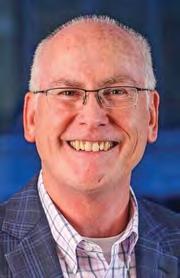
Originally from the St. Louis area, Hennessey is the son of a social worker and a nurse. He attended the University of Notre Dame on an ROTC scholarship, where he met his wife, Dawn. He later earned a master’s degree in health administration from Saint Louis University and completed his military service as an Army Medical Service Corps officer in Hawaii. In 2019, he completed a Master of Arts in Healthcare Mission Leadership from Loyola University Chicago.
Bill and Dawn moved to Springfield in 1989, drawn by Mercy’s faith-based mission and commitment to serving those most in need. With Mercy, Hennessey served in a number of leadership roles, guiding marketing, strategy, communications, and coworker and community engagement before being asked to take on the Mission leadership role 10 years ago. As Vice President for Mission, he provided leadership for mission integration, ethics, pastoral care, and community health.
Bill and Dawn have deep roots in both the Springfield community and Springfield Catholic Schools. Their three sons— John, Andrew (married to Lindsey), and Will—are proud graduates of SCS, and they are blessed with two grandsons, Crosby and Liam. Previously serving on the Springfield Catholic Schools Development Board, including as Board President, Hennessey spent many joyful years playing drums in the orchestra for Springfield Catholic High School musical productions. The Hennesseys are longtime members of St. Joseph the Worker Catholic Church in Ozark.
In his new role as Mission Director, Hennessey will work collaboratively with school and diocesan leadership to strengthen Catholic identity, support faculty and student formation, foster community engagement, and help advance the mission of Springfield Catholic Schools. ©TM
For Michael Eftink, a firstyear seminarian at Conception Seminary College and a native of Cape Girardeau, his call to the priesthood has been present since he was young but grew stronger during his high school years through daily Mass and Eucharistic adoration. The youngest in a lively family of seven, he was raised in St. Mary of the Annunciation Cathedral, drawing inspiration from St. Peter.
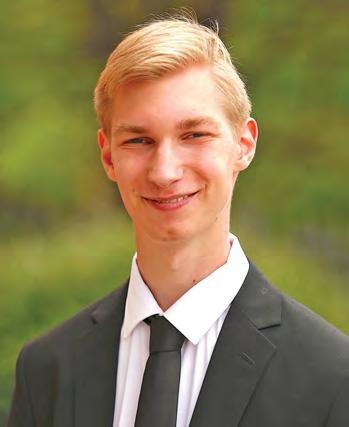
“I relate to St. Peter greatly. Peter in the Gospels and Acts proclaimed Christ as the Son of the Living God and after the Resurrection, worked many great signs, but is shown to be very human and like us he sins, and I relate to him in his humanness,” said Eftink.
His favorite books of the bible are Psalms, the Gospels of Matthew and of John.
Life at the seminary has been filled with study of Scripture, theology, and the catechism, as well as opportunities to serve others, including visits to the poor. Outside the classroom, Eftink enjoys running, listening to music, and spending time with family and friends. He is a classical music fan, a SEMO Redhawks fan, and a fan of Panera Bread restaurant.
“Write something here about sending gift cards to Panera if anyone is looking for a gift idea,” laughed Eftink.
Inspired by the witness of Fr. Jesse Hiett, Director of St. John Henry Newman Center on the SEMO campus, he saw firsthand what it means to love God and serve others with authenticity. Father Hiett has also served as a chaplain in Notre Dame Regional High School and served a time as
Parochial Vicar for St. Mary Cathedral, Cape Girardeau.
“In Fr. Hiett, I saw his love for God and for the faithful. Father was active in my high school and parish, and I saw his love for the People of God from his genuine interest in the people he ministered to,” Eftink said.
As a first-year seminarian, the support of the faithful of the diocese has been very important.
“Having the support of the faithful means so much to me. Thanks to their financial support, I am able to receive the formation that I do and am able to afford it,” said Eftink. “Your prayers and your support show me your love of God, the Church, and the formation of our priests, as they provide the sacraments and administer [them] to us. The faithful’s support shows me how much the faithful care for the Church and for us Seminarians.”
This summer Eftink is looking forward to spending time at his home parish and to the next academic year where he will be learning Philosophy.
One simple piece of advice he would offer a young person discerning a religious vocation?
“Pray. Christ will speak to you when you pray and talk to him. I would also recommend having a spiritual director,” said Eftink.
For everyone else he would offer: “I would tell a person how there is a God using reason and He created you out of love and he gave his only Son, so that everyone who believes in him might not perish but might have eternal life.” ©TM
DURING THIS EUCHARISTIC REVIVAL, FR. DAVID COON OFFERS THE FOLLOWING QUOTE FOR THE REFLECTION ON THE EUCHARIST:
“Do you want many graces? Go and visit the Blessed Sacrament often. Do you want a few graces? Visit the Blessed Sacrament rarely. Do you want none at all? Then never pay a visit to the Blessed Sacrament.”
—ST. JOHN BOSCO
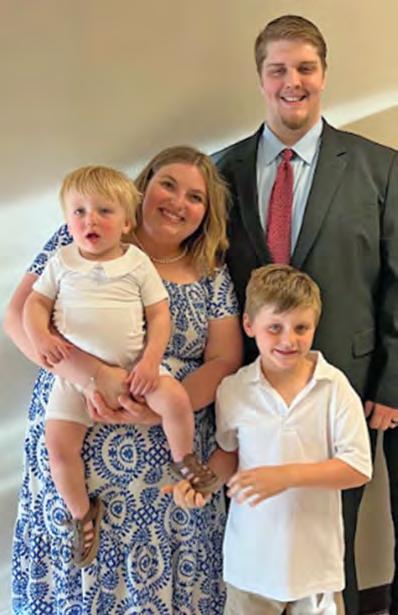
Jason Wright joined the Catholic Church in St. Elizabeth Ann Seton (SEAS) Parish with his wife, Emily, and their two sons. He and his wife were both candidates prior to coming into the Church. In addition to their two children, Landon and Jackson, their family also includes two dogs, Epic and Maggie. The family enjoys spending time together, going to the lake, sports and outdoor activities, and watching the Royals and Chiefs games.
EDITOR’S NOTE:
The Catholic Church in the United States has experienced a notable and widespread surge in new members in 2026, with dioceses across the country reporting some of the highest numbers of converts in years. Data collected from dioceses nationwide confirms the trend, showing significant year-overyear growth as thousands entered the Church at the Easter Vigil. Based on the percentage increase of new Catholic converts, the Diocese of SpringfieldCape Girardeau ranks 11th in the nation according to recent reporting from the National Catholic Register. The number of converts within the Diocese of Springfield-Cape Girardeau continues to increase, growing from a total of 251 new Catholics in 2023 to a total of 519 who joined the Church in 2026. Within the next few issues of The Mirror, we look forward to sharing stories from some of the diocese’s newest Catholics.
What drew you to the Catholic Church? What drew me to the Church was wanting to return to the faith and become confirmed. Growing up Catholic, I stopped attending in my teenage years and wanted to try other Christian denominations. But I never felt like I was at home more than when I was in the Catholic Church.
Were there any preconceived ideas you may have had about the Catholic faith prior to your participation? Growing up in the Church, I already had an idea what Catholicism was like, but I had no idea about some of the other ritual celebrations that are done, like the foot-washing or the Seder dinner that we did as part of our OCIA experience.
What did you enjoy most about your journey into full membership within the Catholic Church? I enjoyed all the support we had from the others around us and our sponsors and the feeling of fellowship amongst our peers and others on the same journey.
What did you find most challenging? Trying to attend the OCIA class every Tuesday. With an unpredictable work schedule (I was having to cover extra shifts) combined with sporting events
and school activities of our oldest son, it made it a challenge to try and attend every Tuesday for months.
How well do you think the Church welcomes seekers to the faith? I think they welcome them with open

arms. We had many people in our class that came from all walks of life, and I never perceived any judgement from anyone. I will say if you are wanting to become Catholic, it has to really be in your heart because of the classes you have to attend and the extra services/events to complete. It is a much longer process than other denominations to join, but well worth it.
What was most memorable about your confirmation and baptism if you were also baptized? The most memorable thing was watching my two boys be baptized. Watching the water being poured over both their heads brought a sense of joy and pride over me—I teared up.
What advice would you give to help draw souls to Christ? To keep praying that they find their way. To be as open as possible with anyone that has questions. I think everyone’s faith is questioned multiple times throughout their lives, and when they need help the most is when the community of other believers will show up for them.
What do you find is the biggest ‘treasure’ of the faith? Taking the sacrament of the Eucharist at every Mass. I find it really special ©TM
BISHOP
‘Farmers are seen, known & loved’
Hulshof, whose farm hosted the liturgy, the Mass was both a work assignment and a family milestone.
He said the idea took shape in January, on his second day in the diocesan office in Springfield, when Bishop Rice handed him an issue of Catholic Rural Life, opened to a story about a barn Mass, and said, “I want to do this.” Hulshof told the bishop: “Let’s do it.”
Within about two days, after a call to his father, Hulshof said they had May 31 on the bishop’s calendar.
One of Hulshof’s first requests at home was for a proper altar. Family friend Von Priggel of Oran, MO, built a “beautiful” portable altar that fits in the bed of a truck and through most doorways, Hulshof said. He went on to fill in a few more details.
A large crucifix, recently delivered to Bishop Rice’s office from a Franciscan sister who had to move, was pressed into service. A truck driver who hauls grain for the farm called to say a rejected order of bottled water had to be given away; the family accepted four pallets for the outdoor event, which reached temperatures into the 90s during Sunday’s Mass.
Around 6 a.m. on the morning of the Mass, family and volunteers began setting up tents. Rain on Friday had settled the dust, Hulshof said, and wheat harvest was set to start Monday, leaving just enough time before combines rolled.
Father Daniel Belken, Pastor of St. Denis Parish, in Benton, and St. Lawrence Parish, in New Hamburg, and diocesan Director of Worship & Liturgy, served as master of ceremonies.
Hulshof noted that while Fr. Tomasz Wilk, pastor of St. Augustine Parish, Kelso, and St. Joseph Parish, in Scott City, was out of the country for the Mass, he’d helped with preparations in advance, as did seminarian Jared Koehler and Deacon Bryan Burger of St. Augustine and St. Joseph parishes.
Concelebrants of the farmers’ Mass included priests of the Diocese of Springfield-Cape Girardeau, and Deacon Burger and Deacon Rob Huff attended to the altar. Diocesan seminarians from Springfield-Cape Girardeau and the Archdiocese of St. Louis served the Mass.
Lectors were Augustus Hulshof and Madeline Hulshof, and gift-bearers were Parker Hulshof and Jake Jansen. Petitions were recited by Anna Hurd.
Bishop Rice said, where most parishes sit in small towns and farm communities, he’d longed to hold a Farmers’ Mass., the goal of which was to show farmers, truck drivers, and others tied to agriculture the importance of their jobs.
For many, the land and machinery are familiar, Hulshof said. He said the Mass brought everyone together in a beautiful way and told farmers: “They’re seen; they’re known and they’re loved — and that’s every human heart’s design.”
Family and friends from as far away as Nashville, TN, came for the Mass. “This is for the people that work: They’re blue collar; they’re white collar. They’re farmers. They’re doctors. They’re everything,” Hulshof said, “and this showed the people of southeast Missouri that they’re known and loved by the Lord.”
Sarah Lee Hunter and her husband, Ferg Hunter, who are members of St. Francis Xavier Church in Sikeston, were among those who attended Sunday’s Mass.
“It was very nice” Sarah Lee Hunter said. “For all the priests to be here and the seminarians with the bishop, it was very special. … And it was such a godwink that we had nice weather today.”
Suzanne Vanderfeen who has farmland in northwest Iowa also attended the Farmers’ Mass. She lives part-time in Cape Girardeau, and learned about the Mass through the Diocese’s publication, The Mirror
“The presence of the Holy Spirit was here. I just felt it,” Vanderfeen said, adding she loved the praise and worship music.
Vanderfeen said she talked to the bishop and is planning to bring a farm Mass to Iowa.
Meanwhile, Hulshof said Rice’s willingness to hold such an event reflects the bishop’s style as “a man of his people.” The Mass fell one day before the 10th anniversary of the bishop’s arrival in the diocese from St. Louis.
Bishop Rice said social media posts
about the liturgy have already drawn invitations from farmers throughout southern Missouri to host a Farmers’ Mass. A producer near Pierce City recently asked the bishop, “When are you doing it for us?”
Bishop Rice said he plans to hold another Farmers’ Mass there in the fall. ©TM
Heuring is the Editor of the Standard Democrat, who generously agreed to cover this event and share the article with readers of The Mirror
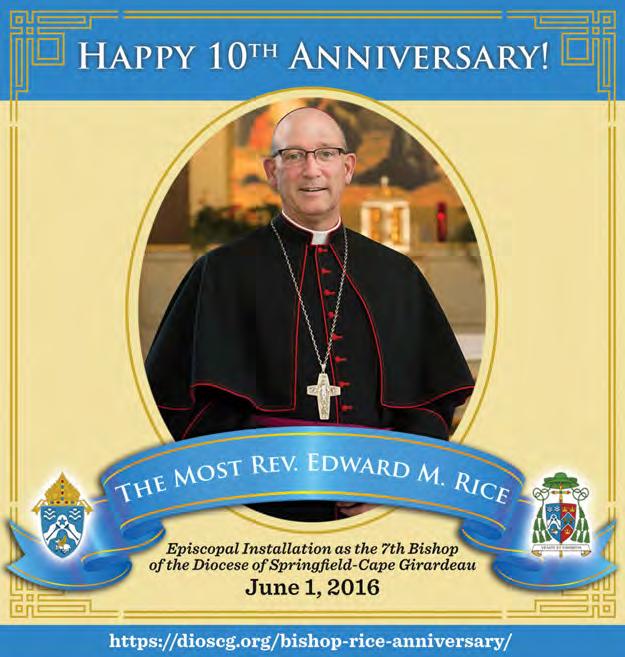

Sign Bishop Rice's virtual anniversary card throughout the month of June!
www.dioscg.org/bishop-rice-anniversary
Cape Girardeau—The Father (Joseph) Kelly Band will perform Fri., June 26, 6:30-9pm, at the KC Hall, located at 318 S. Spanish St. Food and drink will be available for purchase. Cost: Free; donations are appreciated and proceeds will benefit Options for Women.
Florissant, MO Mid-life Singles (mid-30s to 50s): Are you looking for a renewed sense of purpose & belonging? Register today for a life-changing REFLECT weekend retreat at the Pallottine Renewal Center, in Florissant (30 min from downtown St. Louis), on July 17-19, 2026. Take a chance and get involved-you won’t regret it! Cost is $290, includes meals. For details, visit www. ReflectRetreat.com, Email reflect.stlouis@ gmail.com, or call (630) 222-8303.
Springfield—St. Agnes Cathedral will hold its annual Parish Garage Sale, Thu., June 11,7am-4pm; Fri., June 12, 7am4pm; and Sat., June 13, 7-11am, in the St. Agnes gymnasium, located on the west side of The Catholic Center at 601 S Jefferson Ave. Furniture, small appliances, books, dishes, tools, toys, household items, and much more! Prices are reasonable and
all proceeds will benefit the new St. Agnes Parish Center.
Springfield Area—St. Elizabeth Ann Seton Parish is partnering with St. Agnes Cathedral for Vacation Bible School (VBS), Tue., June 23-Fri., June 26, 6-8:30pm and Sat., June 27, 1:30-4:15pm, followed by Mass and a picnic dinner. Information, as well as registration & Media Release forms for participants and volunteers may be found on the SEAS Website at https://www.seaschurch.org/ parish-school-of-religion--psr. VBS is for children entering Kindergarten in the fall through those entering 6th grade in the fall. Youth entering 7-12 grades and adults are invited to volunteer.
Wichita, KS—The 26th annual Midwest Catholic Family Conference will be held July 31-Aug. 2, in the Century 2 Convention Center, Wichita. Additional information and registration are available at https://www.catholicfamilyconference. org/.
Parishes and organizations are invited to submit notices of future events to be printed on a space-available basis. There is no fee.
By Leslie Anne Eidson Lesterville, MO
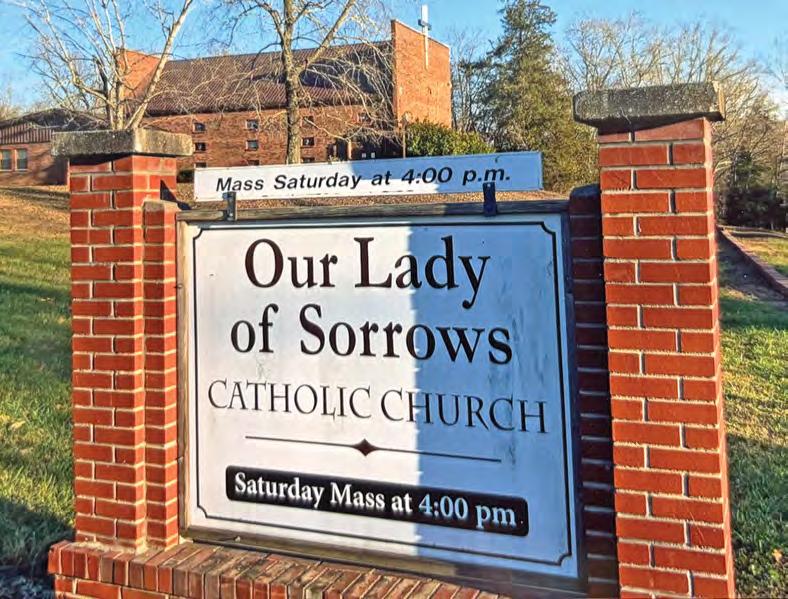
Bishop Edward M. Rice joined the faithful of Our Lady of Sorrows Mission Church, Lesterville, for its last Mass on May 30, 2026. Leadership of the Mission and Fr. Emmanuel Konyeaso, its Pastor, had formally requested for the closure of the church on Jan. 7. 2026, citing the significant challenges facing the community which made its future viability untenable.
In a letter to Bishop Rice, signed by the Pastor and five members of the listed six members of the community’s roster, the challenges included a tremendous decline in liturgy attendance, financial strain, an aging and diminishing congregation, among others.
After consideration of the pastoral and financial realities facing the community, Bishop Rice set in motion the public and canonical requirements for the Decree of Deconsecration and closure of Our Lady of Sorrows Mission Church, resulting in its final Mass on the Solemnity of the Most Holy Trinity. Served from Ste. Marie du Lac Parish, in Ironton, 25 miles away, the faithful of the former Lesterville mission will now attend the parish at Ironton, coming full circle.
the
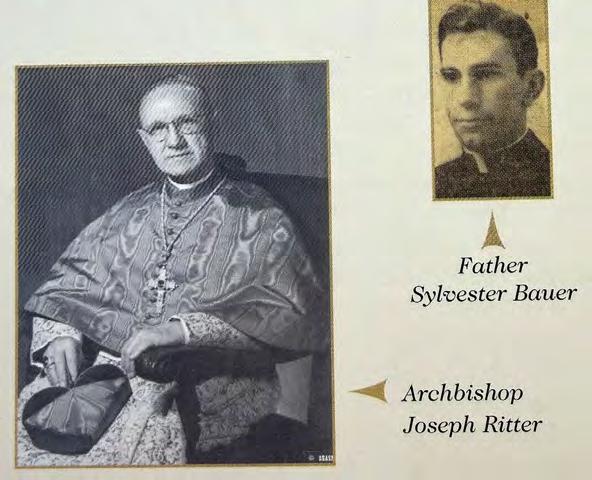
Under the Archdiocese of St. Louis, members of the Servite order attended the largely mountainous Ozark region of south-central Missouri, which at that time, had the distinction of being “one of the least Catholic areas of the North America Continent.” When Archbishop Joseph Ritter (StL 1946-1967; elevated to Cardinal in 1961 by Pope [St.] John XXIII), established the parish in 1952, Fr. Charles P. Lyons, OSM, priest Administrator of Ste. Marie du Lac Parish, Ironton, traveled from Ironton each Sunday to celebrate Mass in a public lodge overlooking the Black River.
On Dec. 12, 1954, it was Fr. Lyons who turned the
west of the Lesterville town limits on Highway 21. Present at the groundbreaking were two priests and six laymen. When the groundbreaking and blessing was undertaken, Missouri’s Reynolds County had a population of 6,917 people. Eleven of them were practicing Catholics. That said, a lot was happening in that area by 1956, when Our Lady of Sorrows Mission Church was dedicated by Bishop Charles H. Helmsing. For one, invited by the area’s lead pastor, then-Fr. Sylvester Bauer, the Daughters of St. Francis of Assisi, from Lacon, IL, were establishing a Catholic hospital (the former Memorial Hospital) at Mountain View, which would be the only hospital within a 100-mile radius.
“The hospital will be a true mission endeavor,” said Fr. Syl Bauer, Pastor of St. Mary Mission Center, in West Plains. “There is no better means of breaking down prejudice than a Catholic hospital.”
“Catholics [in this area] are less than one-half percent,” said Fr. Bauer. He was commenting to the St. Louis Register on the occasion of Bishop Helmsing dedicating not one, but two Catholic churches in Reynolds and Shannon counties on Sun., June 17, 1956: In the morning, the dedication of Our Lady of Sorrows, at Lesterville, in Reynolds County, and five hours later and some 50 miles to the southwest, the bishop dedicated St. Sylvester, in Eminence, in Shannon County. This marked the first time in history that there was a Catholic Church in every county within the Archdiocese of St. Louis, where Bishop Helmsing
served as Auxiliary Bishop.*
Although Catholic missionaries had been working in Eastern Missouri for more than 200 years, the rugged Ozark Country inland from the Mississippi had been a real “outpost of the Faith,” for St. Louis. Combined, the seven southwest counties in the archdiocese (Howell, Texas, Shannon, Carter, Oregon, Reynolds, Ripley) had a total population of 84,000. Thousands of people living in the area had never seen a Catholic, much less a priest.
The new Our Lady of Sorrows Church, in Lesterville, was typical of the uphillstruggle needed to establish the Church in home mission territory. Construction of the churches in the home mission territory were made possible through the Archdiocesan Expansion Fund, with many being assisted financially by more established parishes in the archdiocese. St. Ambrose Parish, St. Louis, sponsored Our Lady of Sorrows, in Lesterville.
The pastor of St. Ambrose Parish, the Right Rev. Monsignor John H. Smith, concelebrated the dedication Mass with Helmsing in Lesterville, to which everyone in Reynolds County was invited. There were three converts to the faith (baptized the day before) who received their First Communion and Confirmation at the dedication, bringing the total number of Catholics in Lesterville to 24 adults and 14 children. The men and women of the church held an open house for visitors after the liturgy. ©TM
* Bishop Charles H. Helmsing was appointed Auxiliary Bishop of the Archdiocese of St. Louis, March 17, 1949.
His Episcopal Consecration & Installation was April 19, 1949. He was appointed to the newly-established Diocese of Springfield-Cape Girardeau, Aug. 24, 1956.
He was Installed on Nov. 28, 1956, serving as the First Bishop of Springfield-Cape Girardeau (1956-1962).

Many changes in life are easy changes, but many are not. The Diocese also experiences many changes, both good and difficult. Recently, we have seen an increase in the number of converts entering the Church, which has been a tremendous blessing. However, at the same time we are also facing the reality that some communities of faith have grown smaller over time, making them increasingly difficult to staff and care for adequately.
This is where a situation (that is thankfully uncommon) can arise: the closure of a parish or mission church. There can be many reasons why a community reaches this point, yet that does not change the fact that it is a difficult decision. Such a decision is made by the bishop in consultation with members of the congregation, while also taking into account the requirements of canon law and the liturgical life of the Church.
or consecration establishes a lasting sacred designation that demands reverence and proper care. Examples include church buildings, altars, the Sacred Chrism consecrated by the bishop during Holy Week, and bishops themselves in their ordination. Blessings, while often simpler rites, also recognize persons or objects set apart in a particular way to draw us closer to God. These blessings are often given by a priest through prayer and the use of holy water. Even if a blessed object is not dedicated in the same way as a church or altar, it still possesses a dignity that calls for reverence and respectful treatment.
Even if a blessed object is not dedicated in the same way as a church or altar, it still possesses a dignity that calls for reverence and respectful treatment.
As a liturgist, there are two areas that particularly draw my attention in these kinds of events: the church building itself, and the sacred furnishings contained within it. Both must be treated with reverence and care, whether the congregation is still actively using them or whether the parish or mission has been dissolved.
Why all the ‘fuss’?
These things matter because the Church uses a series of liturgical events with each of them: blessings, dedications, and, in some cases, consecrations. Each of these rites sets persons or things apart for divine worship in differing ways and with differing levels of permanence. A dedication
With that distinction established, it is worth first considering the church building itself. When a church is dedicated, it is permanently set apart for divine worship. One of the beautiful aspects of the Rite of Dedication of a Church is that the liturgy intentionally mirrors aspects of Christian Initiation. The building is sprinkled with holy water in a manner recalling Baptism, and the walls and altar are anointed with Sacred Chrism in a way reminiscent of Confirmation. Finally, the Eucharist is celebrated and reserved in the tabernacle for the first time. From its dedication onward — and even in its design and construction — the purpose of a church is clear and stable: it exists for the glory of God and the sanctification of His people.
When a church building is decommissioned, this ordinarily means that it is being removed from sacred use. This can happen because of severe destruction, or other grave reasons, such as demographic changes, financial realities, or other challenges that do not substantially impede the faithful from continuing to worship elsewhere. In many cases, the building is either demolished or relegated to what canon law calls “profane but not sordid use.” In other words, while the building may no longer function as a church, it
still should never be put to a use that would be contrary to the dignity it once possessed as a sacred place dedicated to God.
The second major concern involves the sacred furnishings and objects within the church. In any parish or mission there are countless objects that have likewise been set apart for divine worship and therefore deserve reverent treatment. A dedicated altar, for example, is not to be treated as ordinary furniture or casually reduced to secular use. A tabernacle likewise retains a dignity proper to its sacred purpose. Other objects such as ambos, liturgical books, vestments, sacred images, and devotional articles should also be handled with reverence.
If sacred objects can no longer be used reverently or properly cared for, the Church provides for their respectful disposal, destruction, or burial, depending on the nature of the object. Some items may be burned, others buried, and some preserved appropriately for historical or devotional reasons. The guiding principle is that sacred objects should never be treated carelessly or exposed to misuse or disrespect. The same is true for devotional articles such as Rosaries or scapulars, which should ordinarily be buried or burned respectfully when they can no longer be used.
Ideally, however, sacred objects from a closing parish or mission are transferred to other churches where they can continue to serve the liturgical and devotional life of the faithful. While this is not always possible, it is something worth encouraging whenever it can be done. In many ways, it allows these sacred objects to find “new life” in another parish while also preserving a living connection to the history and sacrifices of the community from which they came.
In some respects, the liturgical
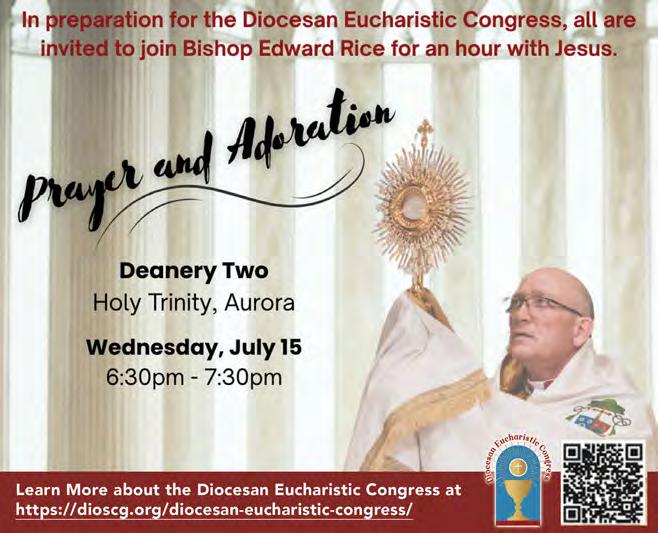
Eucharistic Adoration is all about placing ourselves before our Lord, who is truly and sacramentally present to us in the Eucharist exposed on the altar in the monstrance. Eucharistic Adoration is about listening to His heart from your heart, about His love and joy for you, His plans and inspirations, His forgiveness and ministry, and His ways of helping you grow in your spiritual life, and service of others. Jesus present in the Monstrance (from the Latin word—monstrare, which means to show, which is the root for—demonstrate) enables us to fix our gaze on him for the reparation for sins; the intercession for healing of the world, among other needs or sources of gratitude.
rites surrounding the closing of a church resemble the prayers surrounding a funeral. They recognize that something important is concluding — that a community, in one form or another, is coming to an end. Yet even in that sadness, the rites also point toward hope and continuity. The faithful are encouraged to remember the many ways Christ has worked in their midst, the sacrifices and prayers that shaped the community, and the grace poured out by God there through the years.
Certainly, the closure of a church is never easy. Yet even in these difficult moments, the Church strives to remain mindful of the sacredness of the space, the dignity of the objects used in worship, and the spiritual care of the faithful themselves. In doing so, she continues to promote reverence, memory, and the life of faith even amid the realities of a changing world. ©TM
Fr. Belken is Pastor of St. Denis Parish, Benton, and St. Lawrence Parish, New Hamburg, and serves as diocesan Director of the Office of Worship and Liturgy.

(24 hours a day, seven days a week)
is held in two places in the Diocese of Springfield-Cape Girardeau. Please come and spend time in either of these locations:
Perpetual Adoration at Saint Francis Medical Center, Cape Girardeau Call Donna (573) 450-1451
Perpetual Eucharistic Adoration at Holy Trinity Church, Springfield Call Marilyn (417) 224-4043
As the United States of America commemorates the 250th anniversary of the signing of the Declaration of Independence in 2026, the USCCB joins this celebration by lifting up the contributions of Catholics and the impact of our faith on the history of this country.
“Glory be to God for dappled things –For skies of couple-colour as a brinded cow; For rose-moles all in stipple upon trout that swim.”
Gerard Manley Hopkins, SJ
By Dr. Terence Sweeney, Villanova University
St Augustine’s Confessions are his story of falling in love with God. During his narrative, he asks, “What do I love when I love thee, O Lord?” He asks because the question motivates his search for his Beloved and so deepens his love. Augustine asks also to avoid falling in love with something that is not God, aiming for the reality of God rather than an idol. We should all ask ourselves this question not only of our love of God but of all of what we love. This applies especially now as we consider the 250th anniversary of our Declaration of Independence We ought to ask, ‘what do we love when we love America?’ In asking this, we can understand how to rightly love our country and grasp what is the unique goodness of these United States.

white supremacy rather than the equal dignity of all people, loving the wealth generated by an unfettered market while poor and working people suffer. And we should examine our own hearts for fear of new ways of going wrong, like loving autonomy more than the lives of the sick, loving borders more than our migrant brethren, and loving weapons more than our social infrastructure oriented toward the common good.
of New Orleans, from the Pennsylvania Dutch of the mid-Atlantic to Spanglish spoken across the country. On my little block in Philadelphia, we are Haitian, Liberian, Jamaican, African, Irish, and Venezuelan Americans. James Joyce famously said of the Catholic Church, “Here comes everybody.” You could same the same thing about this country. And it is a great thing
First, the question pushes us to be intentional about how we rightly order the love that is part of our humanity. Augustine understood well that we humans are lovers. We are right to love the scent of BBQ, a cold beer on a hot day, the sound of jazz or bluegrass, the feel of the brisk Atlantic or Pacific air, the stunning grandeur of Yosemite or the Big Apple. All things we love ought to help lead us back to the original love of God. Our loves must not become disordered. It would be grotesque to put a love of baseball above my children. Likewise, although power, money, and freedom can be instruments for good, our love is disordered when we seek power before justice, amass money while neglecting the poor, or hold on to individual freedom at the expense of the unborn. When our loves are disordered, we fall into sin. For Catholics, we need always to love God and His Church far more than any earthly city. We live as pilgrims called to love the place of our pilgrimage and to love our pilgrim destination and our fellow pilgrims more. When we try to figure out what we love about the US, we need to get that order right and never love the US too much. More than wealth, power, or autonomy, we need to love justice, human dignity, and the poor, whom God’s “preferential choice fell upon” as Augustine puts it. This means that a real love of country is unafraid to confess and repent for when our loves have become disordered: putting a desire to expand our the United States above the rights of Tribal peoples, embracing
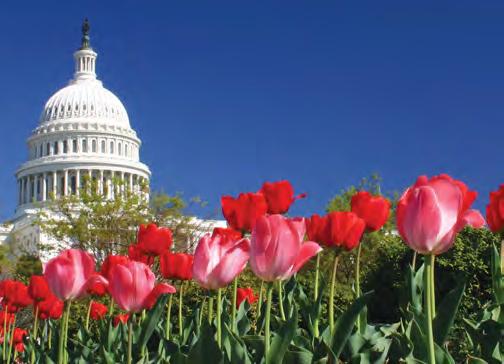
ALL THINGS WE LOVE OUGHT TO HELP LEAD US BACK TO THE ORIGINAL LOVE OF GOD.
What we love about our country is a matter of what Augustine calls “the agreement about the shared objects of our love.” One such object of our love is our nation’s ‘catholicity,’ its way of being a little bit like the Church in being a home to people from all nations. Augustine wrote that our pilgrim church takes “citizens out of all nations and gathers together a society of pilgrims of all languages, not scrupling about diversities in the manners.” The diversity of the Catholic Church reflects the diversity and beauty of the very Body of Christ. God’s plan for his creation includes and celebrates the diversity of cultures, peoples, and experiences. The US has an opportunity to celebrate this pluralism as we welcome people from all nations, languages, and manners, uniting them under our common laws and principles. Catholics celebrate this because of our deep faith in the freedom God gives us a part of our inherent human dignity. As Catholics in the US, we have twice the reason to hope our country lives out this reality. Our nation features a wide variety of regions, different climates, and radically varying terrains. Our shared culture is real, but it varies from old Yankee stock in New England to old Mexican stock in Arizona, from new Hmong immigrants in Minnesota to new Venezuelans in Miami. While English is our primary tongue, we have always had many languages, spoken here from the Quebecois of New England to the Creole
Amidst this diversity, there is still a fundamental unity around certain shared objects of love. Specifically, our country holds certain truths as self-evident; we commit to government of the people, by the people, for the people; we work to make freedom ring from every mountainside; we promise to ask what we can do for our country. We are people with different backgrounds and immigration statuses, with widely different political views and religious traditions. Amidst the manyness, we are a country that stands and pledges to the flag and “to the Republic for which it stands, one Nation under God, indivisible, with liberty and justice for all.” That is what makes us one. Augustine said of real friendship, that it makes e pluribus unum, out of many one. I pray that a rightly ordered patriotic love may help people and the common good to flourish. I pray that we will commit to better shared objects of our love: justice, dignity, and peace. I pray that we will confess our shared failures and celebrate our shared accomplishments. I pray we will celebrate the dappled beauty of our land and our people. I pray we will commit to the shared idea of a republic and the liberty and justice for which it stands. I pray that Catholics will continue to share with our fellow Americans the rich traditions of rightly ordered love, celebration of God’s diversity, and a commitment to human dignity. Committing to those loves is the best patriotism, the kind that knows what it loves when it loves this land. ©TM
This article is part of a series exploring Catholic contributions over 250 years of American history
By Gina Christian OSV News
Devotion to the Sacred Heart of Jesus, which signifies “the divine response to the wounded human heart,” is “more timely than ever,” said Archbishop Paul D. Etienne of Seattle.
The archbishop shared his thoughts in a new pastoral letter inviting the faithful of the diocese “to rediscover this beautiful devotion.”
Released May 18, the nine-page letter, titled, “Learn from Me for I Am Meek and Humble of Heart,” lays out the case for a renewed appreciation of both the theology and practice of devotion to the Sacred Heart.
Archbishop Etienne noted his letter comes as the nation’s Catholic bishops will consecrate the US to the Sacred Heart June 11 to mark the 250th anniversary of the country’s founding.
in unveiling his Sacred Heart, Jesus “is not merely offering a poetic image or inviting sentiment,” but instead “revealing the interior truth of his person.”
Pointing to the Gospels, Archbishop Etienne highlighted that the heart is “consistently” identified by Jesus as “the center of moral and spiritual life.”
The scars of the human heart are reflected in “the disorder of the world” and in “the divisions within families, communities and even within the Church,” said the archbishop.
WHAT WOULD IT LOOK LIKE FOR US AS A NATION TO LIVE THIS CONSECRATION—MUTUAL LOVE, RESPECT FOR PERSONS, LOVING THE NEIGHBOR, WORKING FOR PEACE?
He recounted the origin of the Sacred Heart devotion, which was revealed to St. Margaret Mary Alacoque, a French Visitation nun, in a series of mystical revelations that took place from 1673 to 1675.
During the encounters, Jesus Christ appeared to the sister displaying his heart “on fire with love,” said the archbishop.
He quoted Christ’s words to St. Margaret Mary Alacoque: “Behold, this Heart which has so loved human beings that it has spared nothing, even to exhausting and consuming itself, in order to testify its love.”
The archbishop underscored that
“These are not just structural or political problems. They begin in the human heart,” he stated.
Moreover, he said, “devotion to the Sacred Heart speaks directly to this reality,” and does so “without naiveté, recognizing that the obstacles to conversion are often interior.”
Those hurdles include “tepidity, self-love, pride, and passions left unchecked,” said the archbishop.
Yet, he stressed, “the Sacred Heart is proposed not as a rebuke to our humanity, but as a remedy—the divine response to the wounded human heart.”
Divine response to the wounded human heart
God “gives a new heart,” leading not just to conversion, but to the indwelling presence of Christ in the human heart, said the archbishop.
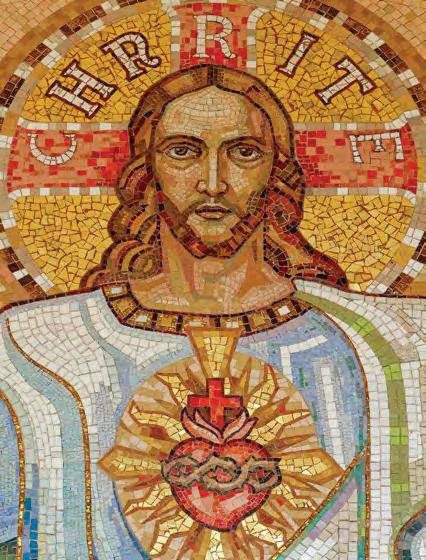
REMEDY TO THE WOUNDED HUMAN HEART—”True devotion to the Sacred Heart does not withdraw the believer from the world but configures the Church for her evangelical mission,” said Seattle’s Archbishop Paul D. Etienne in a new pastoral letter issued May 18 in time for the US Bishops consecration of the USA to the Sacred Heart of Jesus on June 11, 2026 (Cathopic)
He quoted St. Paul’s Letter to the Galatians, in which the saint wrote that “Christ lives in me” (Galatians 2:20), and also cited the saint’s Letter to the Romans, where he explained that “the love of God has been poured out into our hearts through the Holy Spirit” (Romans 5:5).
“Devotion to the Sacred Heart, rightly understood, is profoundly sacramental and ecclesial,” said Archbishop Etienne. “It is ordered toward communion and unity: Christ dwelling in the heart of the believer and shaping the believer’s heart according
to His own.”
A true recognition of Christ’s love “leads toward reparation,” a participation in Christ’s saving work and “the proper response of love to love rejected,” said Archbishop Etienne.
The archbishop, who entrusted his archdiocese to the Sacred Heart, assured “the young, the poor, the sick and all who carry heavy burdens” that “the Heart of Christ is open to you. He is not distant. He is near, merciful and faithful.”
The letter included the text for an act of consecration to the Sacred Heart of Jesus—and regarding the upcoming consecration of the US, Archbishop Etienne asked, “What would it look like for us as a nation to live this consecration—mutual love, respect for persons, loving the neighbor, working for peace?” ©OSV Gina Christian is a multimedia reporter for OSV News. Follow her on X @ GinaJesseReina



By Leslie Anne Eidson Springfield, MO
As reported in The Mirror on Jan. 16, 2026, the Defined Pension Benefit Plan managed by Christian Brothers Services, Romeoville, IL, has experienced a significant shortfall affecting all participating member organizations, to include the Diocese of Springfield-Cape Girardeau. For the diocese, locally, this includes both current and former lay personnel such as teachers, staffers in parish and school offices, employees of the diocesan ministries at The Catholic Center, and employees of Catholic Charities of Southern Missouri.

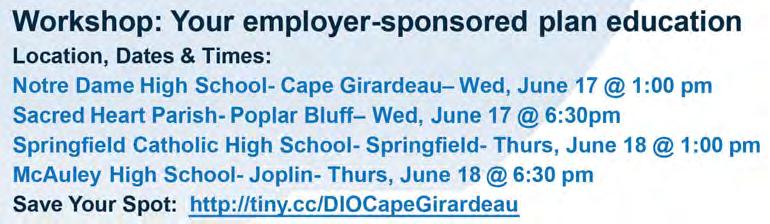
an overview of how the new 403(b) retirement plan works, including eligibility, contribution options, the new employer contributions, and where to find important plan details through the record keeper and HR resources. Also covered will be key considerations such as traditional vs Roth contribution options, contribution limits, vesting schedules, and ways to evaluate your progress toward retirement.
Arthur J. Gallagher & Company has been retained to help transition to a new retirement benefit. Gallagher has worked with over 50 diocesan clients in the United States on a wide range of insurance, pension, and retirement needs. It currently works with the Archdiocese of St. Louis and the Diocese of Kansas City-St. Joseph. They were hired last spring to negotiate the health insurance coverage for diocesan employees. They are also assisting several other dioceses and religious organizations navigate the move from the Christian Brothers Defined Pension Benefit Plan.
The targeted date to implement the new retirement plan is July 1, 2026. With that in mind, Gallagher and the Diocese are hosting New BenefitRetirement Workshops in June for all past and present employees involved with the pension plan, including the 513 retired who are currently receiving benefits. These meetings will cover the current pension plan, which freezes June 30, 2026, and the new 403(b) Retirement Plan, and allow for questions to be addressed about both plans. These sessions will provide
Notre Dame Regional High School, Cape Girardeau — Wed., June 17, at 1 p.m.
Sacred Heart Parish, Poplar Bluff — Wed., June 17, at 6:30 p.m.
Springfield Catholic High School, Springfield — Thu., June 18, at 1 p.m.
McAuley Catholic High School, Joplin — Thu., June 18, at 6:30 p.m.
**Registration is encouraged but not required—Save your spot: http://tiny.cc/ DIOCapeGirardeau.
If you are a retiree or former employee and have not received information regarding these changes in the existing pension plan, or you are unable to attend any of the upcoming New Benefit-Retirement Workshops and have questions, please contact Doug Kissinger at The Catholic Center directly by calling (417) 866-0841, or Email him at dkissinger@ dioscg.org. ©TM



The VIRTUS Protecting God’s Children Safe Environment training for adults is available online.
Preregistration is necessary: If you are a new registrant please go to www.virtus.org and click on “first time registrant” on the left, and follow the prompts to register for Online training. Instructions for the registration process can also be found on the Child and Youth Protection Page of the diocesan Website.
Both in-person and online training sessions are for adults only.
Before engaging in activities involving minors and/or vulnerable adults, new volunteers or employees are required to complete the VIRTUS Protecting God’s Children training for adults, submit a current Background Disclosure and Authorization Form, and read, sign and submit the annual Code of Conduct, which are available on the VIRTUS Website and the Diocese of Springfield-Cape Girardeau Child and Youth Protection Webpage: www.dioscg.org/childyouth-protection/ For more information, please contact the Office of Child and Youth Protection, childandyouthprotection@dioscg.org; or Bill Holtmeyer, billholtmeyer@dioscg.org; or Shelly Ferry, sferry@dioscg.org, (417) 866-0841. www.dioscg.org/wp-content/uploads/How-to-Register-for-a-VIRTUS-withOnline-Option.pdf



Prices are all inclusive w/ airfare from anywhere in the continental US.
Several trips to different destinations: Holy Land, Italy, Greece, France, Portugal, Spain, Lourdes & Fatima, Ireland & Scotland and much more...
We specialize in custom trips for Bishops, Priests & Deacons!
Currently hiring Deacons to promote our many pilgrimages. ATTRACTIVE compensation. For more information contact: Karen@proximotravel.com
To register call 855-842-8001 or go to www.proximotravel.com.