

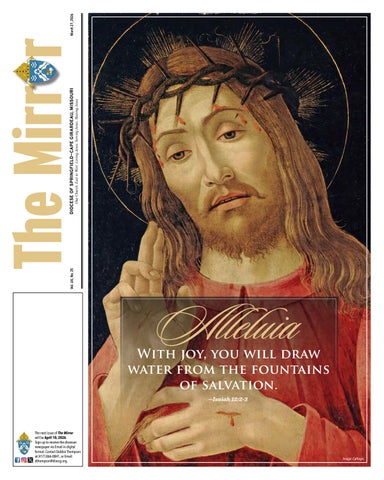
Image: Cathopic
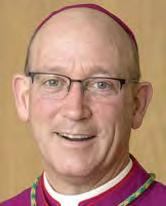
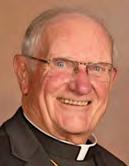
Bp. Edward M. Rice
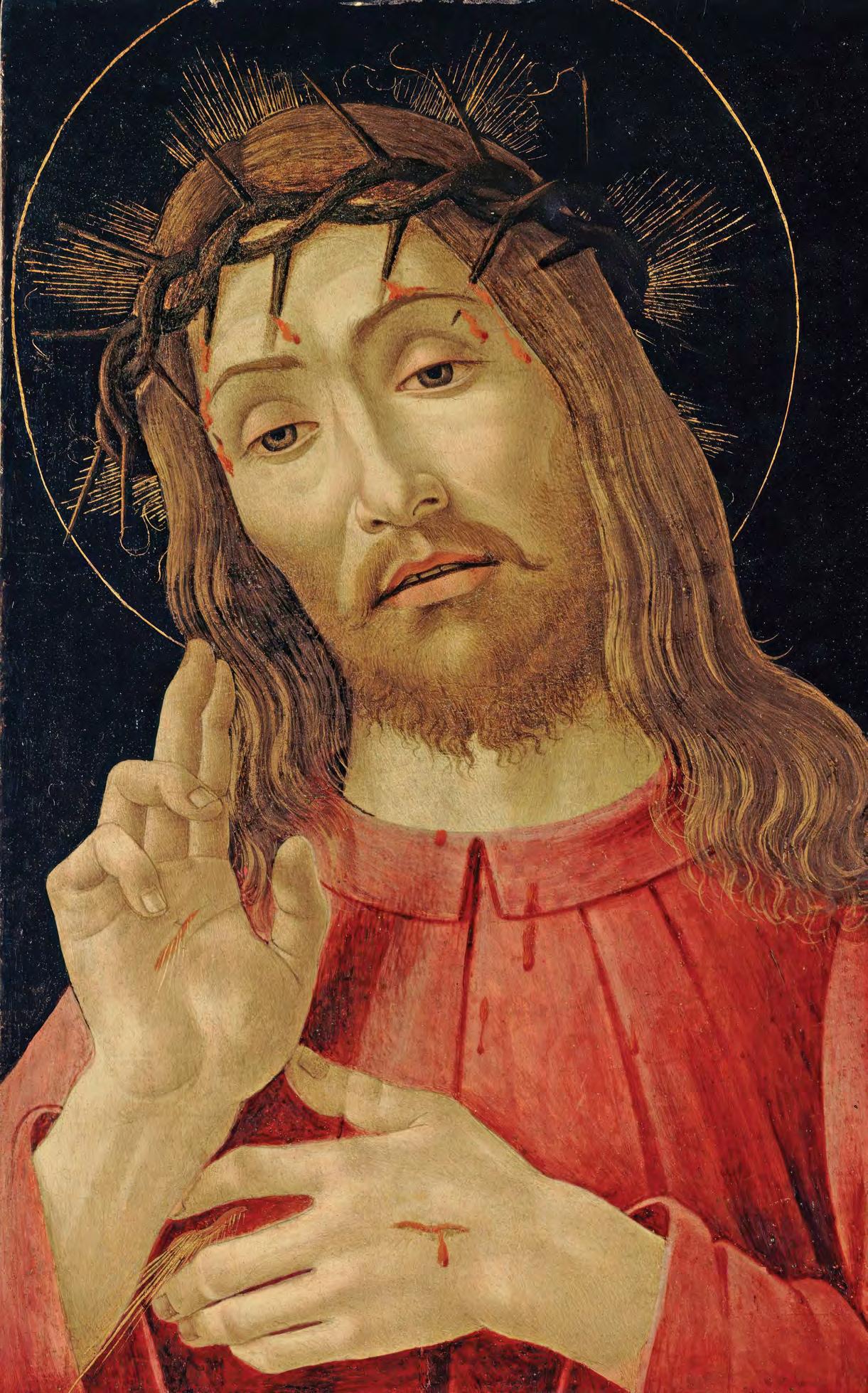
t the Easter Vigil, the prayer for the Easter Candle proclaims, “Christ yesterday and today, the Beginning and the End, the Alpha and the Omega. All time belongs to Him and all the ages. To Him be glory and power through every age and forever. Amen.” That little prayer is expansive, a rather “cosmic” moment that envelops all that has been, all that is, and all that will be. All time is sanctified by Christ: past, present, and future. All time belongs to Christ, through every age, forever. Let that thought sink into your heart and soul.
Then, the great act of redemption comes into play. All time is immersed into the “glorious wounds” of Christ; “By His holy and glorious wounds, may Christ the Lord guard us and protect us. Amen.” As the priest offers that little verse, he places symbolic nails into the candle and once the candle is lit by the Easter fire, the beautiful verse is proclaimed, “May the light of Christ rising in glory dispel the darkness of our minds and hearts.” As the candle is carried into the darkened church, one-by-one, the light is shared,
bringing a warm glow to the sacred space. It is always a rather touching, impressive moment to look out into the congregation and see all the individual candles lit from the light of Christ, the Easter candle.
What follows is the singing of the “Easter Proclamation,” with its haunting melody and beautiful verses: “Exalt, let Angel ministers of God exalt … let the trumpet of salvation sound aloud our mighty King’s triumph! ...Rejoice, let Mother Church also rejoice. …O happy fault. …This is the night … when things of heaven are wed to those of earth, and divine to the human.” Each verse of the Proclamation, sung in the glow of the candles, is worthy of a homily!
The beautiful readings outlining our salvation history then follow: We hear of creation, the parting of the Red Sea, Abraham being put to the test, dry bones coming to life etc. I still recall as a seminarian, getting chills while serving the Easter Vigil at the Cathedral Basilica in St. Louis when the choir sang the verses before the Gospel, “I shall not
die, but live, and declare the works of the Lord. The stone which the builders rejected has become the cornerstone.” At that moment, the victory of Christ over sin and death hit me with full force. Even today, as I recall the experience, it fills me with joy.
Joy – flowing from a relationship with Christ, is my prayer for all of us during this Easter Season. Peace – a peace the world cannot give, is my prayer for all of us during this Easter Season. Throughout the 50 days of the Easter Season, let us live in the light, the peace, and the joy of the Risen Christ. Let the 50 days of the Easter Season overwhelm us! Blessed and Happy Easter Season! Alleluia!
We continue our journey through Sacred Signs, by Romano Guardini, the chapter on “candles.” “One of the images-objects … having more than ordinary force and beauty is that of a lighted candle. …It seems a symbol of selfless generosity. It stands so unwavering in its place, so erect, so clear and disinterested, in perfect readiness to be of service. It stands, where it is well to stand, before God.
By Bishop Emeritus John J. Leibrecht
a funny story referencing his travels to the schools, or time with friends, family, or other bishops. The Mirror has decided to share a few of these in an ongoing series entitled, “Another walk through: ‘Walking Together.’” We hope you enjoy them.
January 20, 1995 Looking out over a mountain range, the young man said, “If you don’t marry me, I’ll jump off this cliff. She said, “That’s a big bluff.”
January 27, 1995 An officer at the police station was obtaining information from an incoming prisoner: name, age, residence. “What religion?,” the officer asked. “Atheist,” came the reply. Not a religious man himself, the officer said, “Never heard of that religion before, but I guess they all worship the same God.”
February 3, 1995 The wife asked her husband to say grace before dinner. Lifting the lid of the casserole dish, he remarked: “I don’t think we need to pray. It looks like everything in the stew was already blessed at a meal earlier this week.”
It stands in its appointed place, selfconsumed in light and warmth. Yes, of course, the candle is unconscious of what it does. It has no soul. But we can give it a soul by making it an expression of our own attitude. Stir up in yourself the same generous readiness to be used … Even as this candle, O Lord, would I stand in your presence. …To be consumed in truth and love, in light and warmth, for God, is the profoundest purpose of human life.”
Be like a candle!!!
O Sacrament Most Holy, O Sacrament Divine, all praise and all thanksgiving be every moment Thine. ©TM


By Laura Kelly Fanucci OSV News
Irecall being propped up on pillows, ice packs piled on my aching chest, as I watched our parish Livestream of the celebration of the Lord’s Passion on Good Friday. After the painful biopsy earlier that morning, I could not make it to church—one more loss in an unexpectedly hard Holy Week.
Two weeks earlier I had found a lump in my breast. The routine exam turned into a mammogram, then an ultrasound, then the biopsy.
That year Lent turned into a physical suffering I carried in my body. During Holy Week, caught in the harrowing in-between, all I had was Christ’s own passion to hold my anxiety and fear.
On that Good Friday, my husband had taken our five boys to church alone— and since our youngest had just turned 3, we were still firmly front-row-people: the only pew where we knew our brood had the best chance to pay attention.
But the angle of the Live-stream camera between the altar and the ambo was also aimed at the front pew. So for the entire solemn service, I watched my beloved family somber-faced without me at their side. Wincing from my incisions, I wrestled with my worst fears: It looked like I was watching my own funeral. My bereaved spouse. My motherless children.
Needless to say, I wept through that
Good Friday. Holy Saturday brought extra weight as we waited for the biopsy results. Even Easter felt hard that year—especially when Easter Monday brought the news that the tumor was cancer. How could I rejoice when I felt my own mortality breathing down my neck?
Three years later, cancer-free and preparing for another Easter on the horizon, I look back on that hardest Holy Week with an unexpected perspective. Not a blithe and bright “everything happens for a reason” cliche. But a bone-deep gratitude for a faith that never shies away from the hardest parts of living, that embraces Christ’s own suffering as a transformation of our grief and loss.
There is nowhere we can go that God has not gone before us.

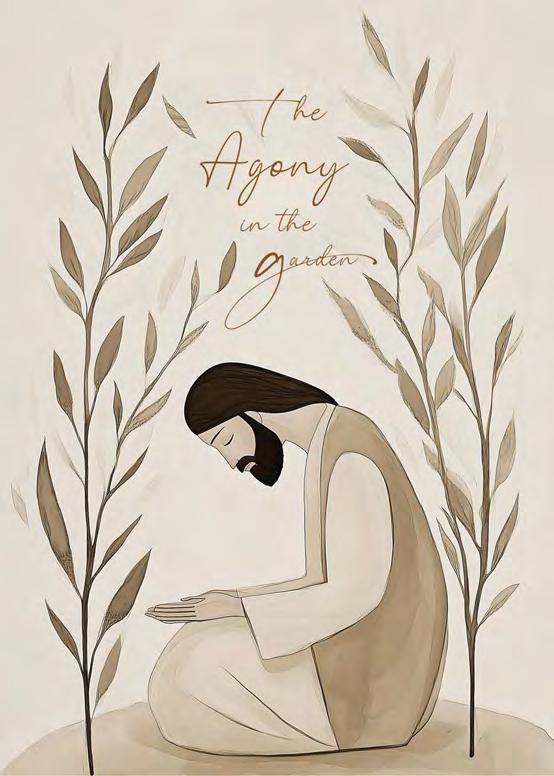
This Lent 2026 has felt extra Lenty, personally and communally. In my home state of Minnesota, friends and neighbors are still reeling from unexpected chaos, suffering, fear, and violence. Our world has once again descended into the chaos of war. At home, my own list of petitions runs long and hard: a couple struggling with infertility, parents and children
estranged because of mental illness, families grieving for grandparents, and a community suffering from the latest gun violence.
Nearly every day I pray the same plaintive plea: “How long, O Lord?”
Yet the reality of resurrection remains the bedrock of my faith. Our
family, our home, and our hopes are built on this firm ground. I will not let seasons of suffering define who we are forever.
As Pope St. John Paul II said, “We are an Easter people, and Alleluia is our song.” Christ’s suffering and dying transform our own, but it is his rising that gives us eternal life. No matter how long our seasons of Lent stretch, Easter is waiting for us.
In the years when life becomes extra Lenty, the gift of the Triduum becomes even more clear. As a Church we enter completely into the passion, death, and resurrection of Jesus. We hold nothing back. All our personal losses and griefs are gathered into Christ’s embrace on the cross—only to be transformed by the astonishing joy of Easter morning.
If this Lent, this year, or what feels like your whole lifetime has been hard and heavy, may you and those you love find hope in the promise of what Holy Week holds. When everything looks like death, God is already at work to bring new life. Even the longest Lents pale in comparison to the stunning light that Easter brings. ©OSV
Laura Kelly Fanucci is an author, speaker and founder of Mothering Spirit. Her latest book is Living Easter: 50 Days to Practice Resurrection
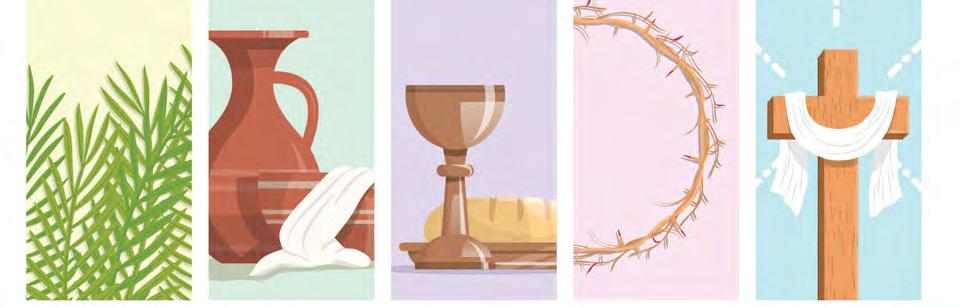
By D.D. Emmons OSV News
It is a time of despair, perplexity and contradiction. The very people who applaud Christ’s entrance into Jerusalem that morning, shouting out “Hosanna” and words of adoration will, within a week, be crying, “Crucify him.” They will go from acclaiming him as the new King of Israel to urging his life be traded in favor of a convicted criminal; they will first praise him and then mock him. Even friends entering Jerusalem at his side will desert Jesus.
All this discord will take place during one week beginning on what we call Palm (Passion) Sunday.
As we read in the Gospels, Jesus went to Jerusalem to join with throngs of other Jews to celebrate the Passover feast as had been prescribed in the Old Testament books of Exodus and Deuteronomy. According to the Gospel of St. John, Jesus and many of his followers journeyed the less than two miles from Bethany on that Sunday, arriving outside Jerusalem. As was the custom, pilgrims that had already arrived in the city went out to greet newly arriving groups; some had never seen Jesus but had heard about the miracles attributed to him and were caught up in the excitement.
Those arriving with and greeting Jesus were large in number as explained by John’s Gospel: “When the great crowd … heard that Jesus was coming to Jerusalem, they took palm branches and went out to meet him, and cried out: ‘Hosanna! / Blessed is he who comes in the name of the Lord, (even) the king of Israel’” (12:12-13).
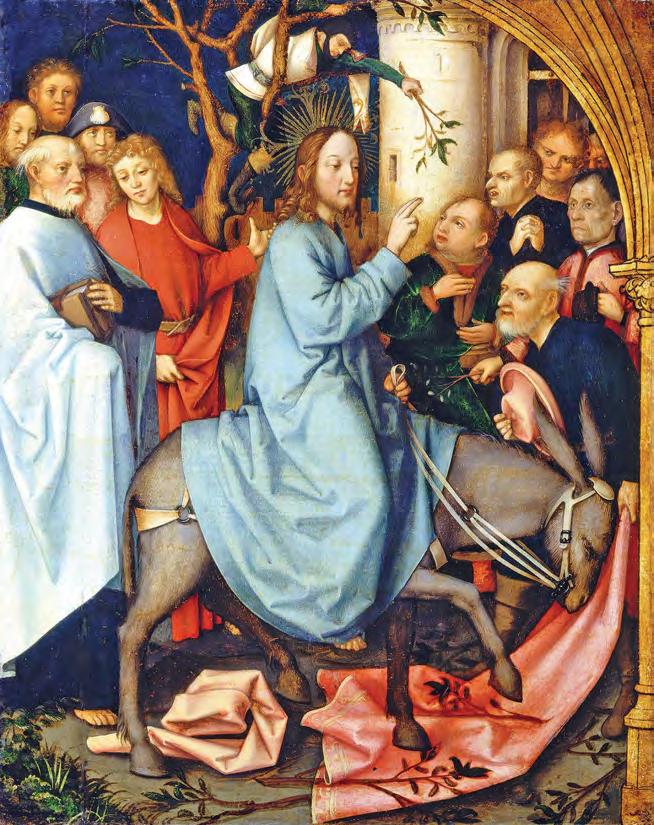
This adulation was not lost on the Pharisees who were present. They said to Jesus, “Teacher, rebuke your disciples.” He said in reply, “I tell you, if they keep silent, the stones will cry out” (see Lk 19:3940). The Pharisees reported the events back to the Jewish high council, the Sanhedrin, which regarded Jesus’ ever growing popularity as a threat to their cozy relationship with the Romans. They were, in fact, planning to murder him.
Previously, Our Lord had deliberately avoided popular acclaim, even fled, but this, upon entering Jerusalem, he accepts. Yet his actions are different than the people expected. He doesn’t present himself as a rival to Caesar; he is not the political messiah or the warrior king the multitude had clamored for. Instead of entering Jerusalem on a war horse or chariot, he enters on a donkey, a sign of peace; and not just any donkey, but one on which no one had ever sat, the prerogative of a king. Seeing him on the donkey, the Jews surging around him recalled the words of the Prophet Zechariah 500 years earlier:
“Exult greatly, O daughter Zion! / Shout for joy, O daughter Jerusalem! / Behold: your king is coming to you; /a just savior is he, / Humble, and riding on a donkey, / on a colt, the foal of a donkey. / He shall banish the chariot from Ephraim / and the horse from Jerusalem” (Zec 9:9-10).
KING OF SIMPLICITY & PEACE
Pope Benedict XVI explained these Old Testament words as they related to Jesus: “He is a king who destroys the weapons of war, a king of peace and a king
of simplicity, a king of the poor. … Jesus is not building on violence; he is not instigating a military revolt against Rome.”
Riding on the borrowed donkey, Jesus made his humble entrance into the city while the crowds were scattering their garments before him and waving their palm branches. This joyful scene belies the traitorous acts, sorrow and agony that will soon follow, belies that this triumphant hero will be crucified like a criminal.
St. Bernard of Clairvaux (1090-1153) offered a homily about Christ’s entry into Jerusalem: “How different the cries, ‘Away with him, away with him, crucify him,’ and then, ‘Blessed is he who comes in the name of the Lord, hosanna, in the highest!’ How different the cries are that now are calling him ‘King of Israel’ and then in a few days’ time will be saying, ‘We have no king but Caesar!’ What a contrast between the green branches and the cross, between the flowers and the thorns! Before they were offering their own clothes for him to walk upon, and so soon afterwards they are stripping him of his, and casting lots upon them.”
Palms were symbols of life among the nomadic tribes, who, when crossing the desert, rejoiced at seeing the palm tree as it indicated an oasis with lifegiving water was near. Palms have long been a sign of victory, success and glory. Victorious armies or leaders returning from the battlefield or a long military campaign were welcomed by the populace jubilantly waving palm branches. Despite Jesus’ peaceful manner, when the Jews waved the palms at him and spread their clothing over which he rode, they were affording him the honors of a conquering hero and simultaneously defying the Roman occupiers.
On Palm Sunday, we still go out to meet him, carry the blessed palms, joyfully sing out our hosanna and join in his triumphant entrance into Jerusalem. But soon our joy turns to somberness as, clutching our palm, we hear the narrative of Christ’s passion. We realize, once again, that his triumph, his true victory, will come through the cross. We know, as Jesus did, how Holy Week will end. We know that joy will turn to sorrow and back to joy. We know that through the horror of his suffering, followed by the glory of his resurrection, good will trump evil and life will trump death.
The palms we take home and put in a special place serve to remind us that Palm Sunday is not lost to the ages but that by Christ’s victory we, too, can achieve everlasting life.
Soon after the Resurrection, Christians wanted to visit the sites of Christ’s passion and even reenact the incidents that had taken place, such as his entry into Jerusalem. But such activity would not be possible until the fourth century when Constantine became emperor of the Roman Empire and ended all religious persecution. Later in that century, a Spanish pilgrim named Eigera visited Jerusalem. In her diary, she recorded how Christians recreated the events of Holy Week. She wrote that they gathered outside the city on the Sunday before Easter and listened to one of the Gospels telling of Christ’s triumphant entrance into Jerusalem. Then they marched together through the city gates while carrying olive or palm branches. Our Palm Sunday processions are akin to what Eigera witnessed 17 centuries ago.
By the ninth century, the procession with blessed palms had expanded beyond Jerusalem, and during the Middle Ages they became widespread throughout Europe. In the 17th century, Christians were not only processing into church with palms but, during Mass, holding the palms while the Passion was being read.
Through the centuries, Palm Sunday and the procession of people holding palms would be celebrated in a variety of ways. In some locations the Blessed Sacrament was part of the procession, in other places the congregation started in the parish cemetery and then went into the church. Palms were sometimes blessed in one church and the people, carrying the palms, marched to another church for Mass. Most typical was the blessing of the people and the palms at a place outside the church and then processing in. For some time, even through the middle of the 20th century, the priest wore red vestments during the palm blessing and procession and then changed to a violet garment for Mass.
In 1955, the Church standardized and simplified the different entrances used on Palm Sunday: either an organized procession that begins somewhere outside the church, a solemn procession starting inside the church, or no procession at all. An entrance procession beginning at a location outside the church is used only once during the weekend Masses; it is not repeated at every Mass. The Church calls this day Palm Sunday of the Passion of the Lord. ©OSV
D.D. Emmons writes from Pennsylvania.
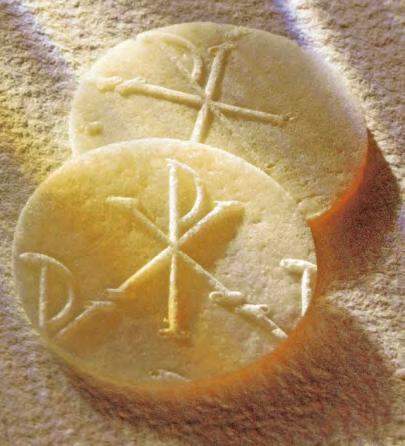
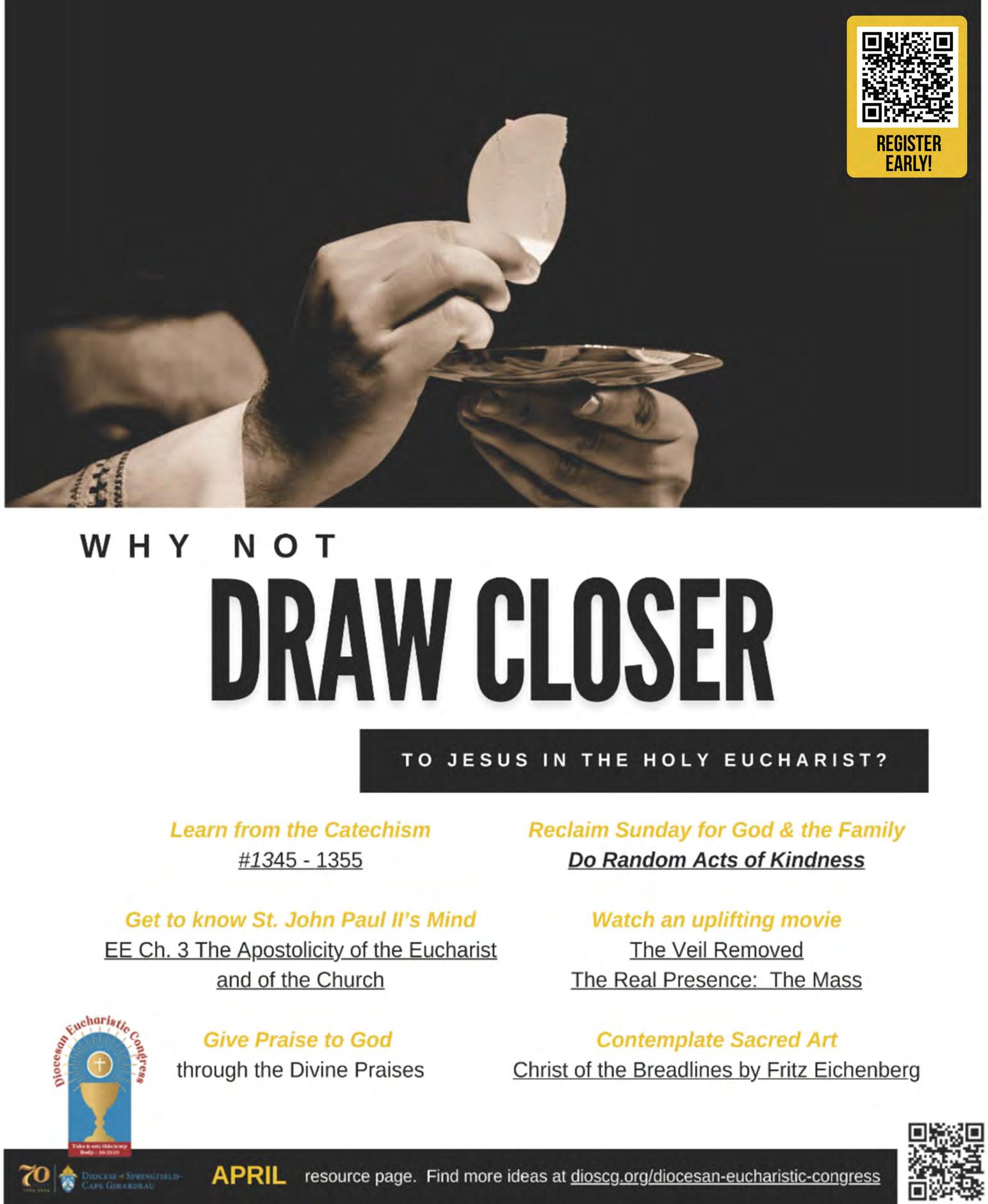
DURING THIS EUCHARISTIC REVIVAL, FR. DAVID COON OFFERS THE FOLLOWING QUOTE FOR THE REFLECTION ON THE EUCHARIST:
“Christ is truly the Emmanuel, that is, God with us, day and night, He is in our midst. He dwells with us full of grace and truth. He restores morality, nourishes virtue, consoles the afflicted, strengthens the weak.”
— POPE ST.
PAUL VI

Seoul, South Korea—The diocesan Office of Youth Ministry is organizing a pilgrimage group to participate in the world’s largest gathering of Catholic youth and young adults at World Youth Day 2027, in Seoul, South Korea! To view the day-today itinerary, pricing, registration information, and more, visit our World Youth Day Website, built by Verso Ministries at: https:// versoministries.com/departures/wydseoul-2027-diocese-of-springfieldcape-girardeau/. Registration is now open! Register now and save your spot to World Youth Day 2027. Registration submissions and initial deposit must be submitted by June 1, 2026.
Buffalo—St. William Parish Council of Catholic Women will have its 47th annual yard sale! The indoor Rummage, Plant, & Bake Sale will be held Thu., May 7 & Fri., May 8, 8am-4pm, inside the church hall, located at 404 N. Locust St. Carthage—The Cursillo® Movement pursues two purposes or objectives. The immediate purpose is to provide a conduit for living what is fundamental for being a Christian, namely, the on-going and total conversion of the person. The end purpose is to vertebrae Christianity in society by means of these persons who live what is fundamental for being Christian (the love of God and neighbor) in their daily lives. Simply explained, the purpose of the Cursillo Movement is that we become the Good News, and that our actions naturally turn out to be evangelical in our daily lives. The next Cursillo Weekend in the diocese is a Women’s Weekend, April 23-26, in Carthage. Find more information and Register Online: https://dioscg.org/ cursillo/.
Jefferson City 2026 March for Life: Join with us as we March for Life in Jefferson City, Thu., April 30! Make plans to attend and support LIFE with your prayers and presence. Diocesan-chartered buses are available and departing from
Springfield. Cost is $7/person. For those who wish to drive, mileage reimbursement will be available for all vehicles transporting three or more people. An optional T-shirt is also available for purchase at $8 each. Please place your order by March 30. Additional information, including bus registration, mileage reimbursement, and T-Shirt orders may be found at https:// dioscg.formstack.com/forms/ midwestmarchforlife.
Kimberling City—Our Lady of the Cove Catholic Church will have its Spring Garage Sale, Fri., May 8, 8am-4pm & Sat., May 9, 8am-Noon. Clothing, furniture, appliances, tools, and much more-there is something for everyone! For more information, call the church office, (417) 739-4700.
Leopold—St. John Parish Council of Catholic Women will have its Rummage Sale, Thu., May 7, 7am5pm; Fri., May 8, 7am-5pm, and Sat., May 9, 7-11am, in the Knights of Columbus Hall. Saturday is $5 bag day. All are invited to shop with us—merchandise is priced to sell! For information, contact Geri Geringer, (573) 208-6445.
Marshfield—The St. Vincent de Paul Society at Holy Trinity Catholic Church will have a Treasure Trove Sales Event, Fri., May 1, 8am-2pm and Sat., May 2, 8-11am. Vintage glassware, furniture, jewelry, and religious items. In conjunction, on Sat., May 2, the Knights of Columbus #10844 will host a pancake breakfast, 8-11am.
Monett—St. Lawrence Parish Council of Catholic Women will have its annual Salad Luncheon, Wed., April 22, 11am-1pm, in the parish hall. Cost: $10 at the door. Shop with local vendors. Dine-in or carry-out available. Proceeds to benefit Monett Historical Museum and St. Lawrence Catholic School.
Parishes and organizations are invited to submit notices of future events to be printed on a spaceavailable basis. There is no fee.
Prices are all inclusive w/airfare from anywhere in the continental US.
Several trips to different destinations: Holy Land, Italy, Greece, France, Portugal, Spain, Lourdes & Fatima, Ireland & Scotland and much more... We specialize in custom trips for Bishops, Priests & Deacons! Currently hiring Deacons to promote our many pilgrimages. ATTRACTIVE compensation.
For more information contact: Karen@proximotravel.com
To register call 855-842-8001 or at www.proximotravel.com.
By Sister Anna Marie McGuan OSV News
Easter Sunday is the Church’s greatest feast day—a day in which we celebrate Jesus Christ’s resurrection from the dead. It is the “feast of feasts” and the “solemnity of solemnities.” The Catechism of the Catholic Church states: “Beginning with the Easter Triduum as its source of light, the new age of the Resurrection fills the whole liturgical year with its brilliance” (No. 1168).
Christians believe that Jesus “crushed death,” and the “mystery of the Resurrection … permeates with its powerful energy our old time, until all is subjected to him” (CCC, No. 1169).
Jesus Christ truly died on Good Friday. There was no mistaken prognosis that Jesus did not really expire on the cross; there was no accidentally identifying Jesus as someone else. There was no theft of Jesus’ body from the tomb; no swallowing up of the body in an earthquake.
From the beginning, Christians proclaimed not only the resurrection of Jesus, but also his very real death. His human soul separated from his human body. All of the Gospels testify to this. Without that death, his appearances to the women and to his apostles on Easter morning would have been humdrum. Instead, people were terrified, overjoyed, and astonished.
There are factors that confirm the Church in her faith in the resurrection of Jesus. First is the empty tomb. The apostles saw the empty tomb and heard
the testimony of the women who went there on the first Easter morning: “…(T)he empty tomb was … an essential sign for all. Its discovery by the disciples was the first step toward recognizing the very fact of the Resurrection” (CCC, No. 640).
Second, the apostles saw Jesus with their own eyes. They disbelieved at first—and who wouldn’t?— but were convinced by the fact that they could touch him, speak to him, and eat with him. Jesus’ body was clearly different than it was before, and almost always the women, the apostles and the disciples do not recognize him at first. Each time, however, Jesus reveals himself to them, and they are able to make the connection that this one standing before them was the same one who died by crucifixion on Good Friday.
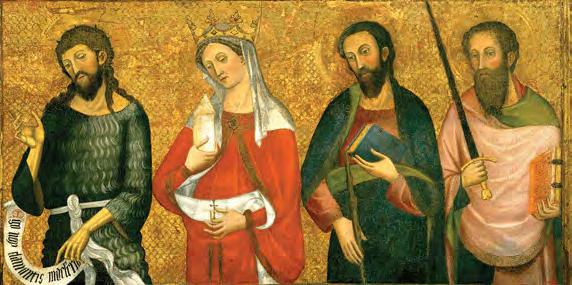
EVANGELIZATION Created in 1385, the work of Pere Serra shows St. John the Baptist, St. Mary Magdalene, St. James the Less, and St. Paul. Because of the evidence of the empty tomb and the encounters of the risen Jesus with the women, the apostles and disciples, and St. Paul, the Church has always believed and preached the resurrection of Jesus from the dead. It is the moment that definitively changed human history forever (Cathopic)
properties. “At Jesus’ Resurrection his body is filled with the power of the Holy Spirit: he shares the divine life in his glorious state, so that St. Paul can say that Christ is ‘the man of heaven’” (CCC, No. 646).
In the encounter with the apostle Thomas, Jesus actually points to his wounds as the way for Thomas to make the connection that the man standing before him, talking and breathing, is the same man who was crucified. Jesus had to lead Thomas and the others to that understanding, because his glorified and risen body was no longer subject to the limitations of space and time. He could appear as he wished, when he wished. He could be in their presence and not reveal himself, and then allow them to recognize him in an instant.
All of this has to do with his glorified, risen humanity and its new
Whatever we call it, Easter is plainly the solemn feast celebrating the resurrection of Christ. It is fine to say Happy Easter. The origin of the word “Easter” is complex. In the Greek language of the Gospels, the word “pascha” was used for the Hebrew word “pesach,” meaning Passover. Latin, too, took up this word, pascha Christ is our Passover Lamb. Most of the European languages derived from Latin use the words derived from pascha such as Italian, pasqua; Spanish, pascua; and French, paques
The Resurrection also brought St. Paul, who hated Christians, to believe in Christ and to be baptized in Damascus, after having encountered him on the road there. He saw him with his own eyes. He heard his voice. He spoke to him. Later, in his letter to the Galatians, Paul had to compare his authority to preach the Gospel as being on par with that of the first apostles, and so he based his valid apostleship on his encounter with the risen Jesus. He himself saw the Lord Jesus risen from the dead, and from that encounter, Paul’s life was transformed, and he became God’s apostle.
It was the fact of the resurrection that compelled the apostles to preach that Jesus was and always
By Msgr. Charles E. Pope
influenced the English word for Easter.
As the English language developed, Easter came to denote that Sunday morning in spring when Christ, our true Light, rose.
Whatever pagan roots the word had (all our words have many different origins), the word Easter in present times clearly refers to the day of the resurrection of Jesus Christ.
Easter came to denote that Sunday morning in spring when Christ, our true Light, rose.
However, English drew from a different source. According to St. Bede (d. 735), the word Easter comes from the word “Eoster,” the Teutonic goddess of the rising light of day—that is, spring and of dawn. The Old German plural for dawn, or East, is “ostern,” and it also
will be the true messiah and the savior of the world. It is still the Resurrection of the Lord Jesus that compels Christians to share his life and message and to dedicate their lives to him.
Without the resurrection, Paul says, Christianity is useless: “For if the dead are not raised, then Christ has not been raised. If Christ has not been raised, your faith is futile and you are still in your sins” (1 Cor 15: 16-17). He continues: “But in fact Christ has been raised from the dead, the first fruits of those who have fallen asleep. For as by a man came death, by a man has come also the resurrection of the dead. For as in Adam all die, so also in Christ shall all be made alive” (v. 20-22).
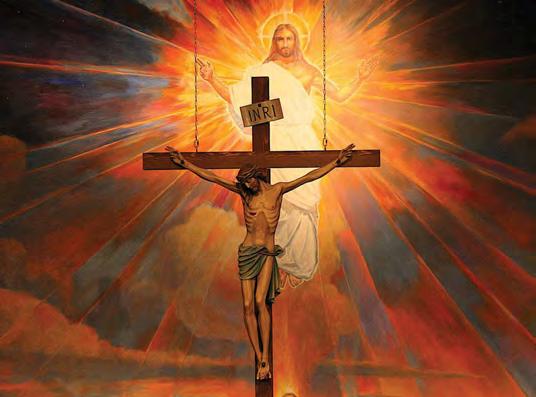
Because of the evidence of the empty tomb and the encounters of the risen Jesus with the women, the apostles and disciples, and St. Paul, the Church has always believed and preached the resurrection of Jesus from the dead. It is the moment that definitively changed human history forever.
Jesus’ rising from the dead was the catalyst for all evangelization, meaning the fact of Jesus’ resurrection impelled the apostles to go and tell people what had happened.
That is still what the Church proclaims today, and she always will. ©OSV
Sister Anna Marie McGuan, a member of the Institute of the Religious Sisters of Mercy, is director of Christian formation in the Diocese of Knoxville.
People are free to say, “Happy Resurrection Day,” as some do, but they ought to avoid a harsh stance that holds that others who do not say this mean something less proper. We do not.
If they are too insistent or inflexible about their preference they can come off as annoying and their practice could become a countersign, showing a lack of charity in the very act of exchanging Easter greetings.
The fact is, the Church, when she is strong, is
often able to take non-Christian practices (as long as they are not intrinsically evil) and often “baptize” them by giving them Christian meaning. That clearly is the case with the name we most commonly use for Easter. ©OSV
By D.D. Emmons OSV News
Every Sunday through the Nicene Creed, we Catholics profess our faith in Jesus Christ and express our complete conviction to the divine persons of the Most Holy Trinity. We stand up in community, in the presence of our Creator and with the communion of saints, and say what we hold in our hearts: that we believe in the Father, the Son, the Holy Spirit and the holy Catholic Church. In a few words, we express our commitment to something eternal, something mysterious, something often scoffed at by the secular world.
The word “creed” is from the Latin “credo,” meaning “I believe”; it’s a commitment to a specific belief, a profession of faith. It is also called a symbol. The Catechism of the Catholic Church identifies creeds as “symbols of faith” (No. 187). It explains: “The symbol of faith, then, is a sign of recognition and communion between believers. … A symbol of faith is a summary of the principal truths of the faith and therefore serves as the first and fundamental point of reference for catechesis” (No. 188).
One creed often cited as the most ancient is the Jewish shema (meaning “hear” or “listen”), and it is found in both the Old and New Testaments:
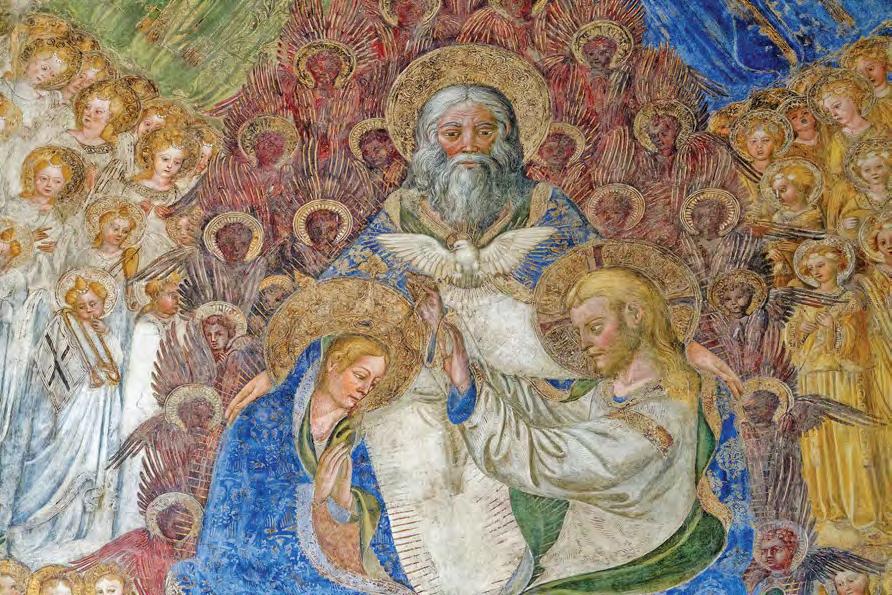
“Hear O Israel! The Lord is our God, the Lord alone! Therefore, you shall love the Lord, your God, with your whole heart, and with your whole being, and with your whole strength” (Dt 6:4-5; see Mt 22:37). St. Paul in his letters to the different churches used language that influenced our creeds. His words to the Colossians resound in the creed said each Sunday: “He is the image of the invisible God, first-born of all creation. For in him were created all things in heaven and on earth, the visible and the invisible. … He is before all things” (Col 1:15-17). Paul exhorts us to confess our beliefs: “For if you confess with your mouth that Jesus is Lord and believe in your heart that God raised him from the dead, you will be saved” (Rom 10:9).
Every Sunday through the Nicene
we Catholics profess our faith in Jesus Christ and express our complete conviction to the divine persons of the Most Holy Trinity, expressing our commitment to something eternal, something mysterious, something often scoffed at by the secular world
Today, the Church acknowledges three creeds: the Apostles’ Creed, the Nicene-Constantinople Creed, and the Athanasian Creed. The first two are familiar to every Catholic and found in the pew missal. The Athanasian Creed is not as well known and is rarely used in the Church. Over the centuries other creeds have been prescribed by popes and Church councils; the Catechism states: “None of the creeds from different stages in the Church’s life can be considered superseded or irrelevant. They help us to attain and deepen the faith . … Among all the creeds, two (Nicene and Apostles’) occupy a special place in the Church’s life” (No. 193).
The Catechism states that “the Apostles’ Creed is so called because it is rightly considered to be a faithful summary of the apostles’ faith” (No. 194). A long-held Church tradition was that at Pentecost, as the apostles prepared to spread the Good News of Jesus, they wanted a common method of doing so. Legend is that they prepared a creed to which they all committed, and each apostle wrote an article of faith into the creed.
This story was believed as late as the Council of Trent (1545-63). The Catechism from that great conference says: “Now the chief truths which Christians ought to hold are those which the holy apostles, the leaders and teachers of the Faith, inspired by the Holy Ghost, have divided into
the 12 articles of the Creed. For having received a command from the Lord to go forth into the whole world, as his ambassadors, and preach the Gospel to every creature, they thought it advisable to draw up a formula of Christian faith, that all might think and speak the same thing.” Many scholars since Trent have debated if the apostles actually wrote the creed, but it certainly contains their beliefs as received from Our Lord Jesus Christ and would influence future professions of faith.
Some scholars debate that the Apostles’ Creed originated with the baptisms of the first Christians. St. Hippolytus (d. 235) in his catechism “Apostolic Tradition” (c. 215) tells how a bishop questioned those who presented themselves for baptism. The bishop asked three questions: “Do you believe in God the Father Almighty? … Do you believe in Christ Jesus, the Son of God, who was born of the Holy Spirit and of the Virgin Mary, who was crucified under Pontius Pilate, and died, and rose on the third day living from the dead, and ascended into heaven, and sat down at the right hand of the Father, the one coming to judge the living and the dead?
… Do you believe in the Holy Spirit and the Holy Church and the resurrection of the flesh?” After each affirmative answer, the bishop lowered the candidate into the water.
Added to these questions were the teachings of the apostles, and by the eighth century the creed included the words we have today. The Apostles’ Creed remains part of every baptism ceremony and begins every rosary. It may also be used in place of the Nicene Creed, especially during the Lent and Easter seasons.
The creed we say on Sundays, although part of Catholic history since
the Ecumenical Council of Nicaea, was not included in the Roman liturgy until the 11th century. At Nicaea, in 325, the bishops condemned the Arian heresy that claimed Jesus was not God. The council issued a creed confirming Jesus as “God from God, light from light, true God from true God, begotten not made, consubstantial with the Father.”
This language struck right at the heart of the heretic Arius and is at the center of what Catholics believe. At Nicaea, the creed addressed the Father and the Son.
It was 25 years later at the first council at Constantinople (381) that the Holy Spirit was included in the creed and, in so doing, rejected those who opposed the divinity of the Spirit. Added to the original Nicene Creed: “We believe in the Holy Spirit, the Lord, the giver of life, who proceeds from the Father …” (later changed in the West, “from the Father and the Son”). The bishops at Constantinople amended and clarified the statements of Nicaea; thus the creed used today is a combination of language from both councils.
The Athanasian Creed is the longest of the three creeds, and, while not written by St. Athanasius, it uses his arguments to buttress against the heresies of the fourth and fifth centuries, including those that refuted Church teachings that the three persons of the Trinity are coequal and co-eternal.
But no matter the creed, words alone, like faith alone, are not enough. Christ tells us to go out and witness to these truths, these ancient yet ever-new beliefs, fulfilling our profession of faith through our words and deeds. ©OSV
D.D. Emmons writes from Pennsylvania.
By James L. Papandrea OSV News
Like Christmas and other Catholic holy days, Easter is often misunderstood and miscelebrated. Either its origins are said to be based on pagan holidays (a myth we will bust), or we treat it as a day to binge after a season of fasting. So, to fully embrace Easter, let’s look at how the early Christians understood and celebrated the day of Christ’s resurrection.
What was Easter like in the early Church? Well, to begin with, they didn’t call it “Easter”—that word would be meaningless to them. The early Christians believed that Jesus’ passion and resurrection were the central part of the whole story of God’s saving activity in the world. These events were not seen as a single, isolated moment in history, but part of the great trajectory of God’s providential interventions.
More specifically, the passion and resurrection of Jesus were understood to be a continuation and fulfillment of the events of the Passover and the Exodus. And not coincidentally, the crucifixion and resurrection of Jesus happened at the time of the festival of Passover, so when the early Christians referred to the annual commemoration of Jesus’ passion and the celebration of his resurrection, they simply called it Passover.
It’s just like the way that Pentecost continues to be named after a Hebrew festival, even though it is given new meaning in the Church as the celebration of the gift of the Holy Spirit.
And so in the early Church, the feast day of the Resurrection of the Lord was simply called Passover, or some translation of that word, as it still is to this day in most languages of the world. This is where we get the word “paschal” in the Paschal Mystery. That just means, “the Passover Mystery.”
So what about the English word “Easter”? Where did that come from? Near as we can figure, it comes from an Old German word for “dawn,” as in, facing toward the dawn—facing east. So then where did the English word “Easter” come from? Before we can answer that, we have to bust a myth or two.
The word “Easter” is not derived from a pagan fertility gods or anything like that. It used to be popular to say that Christianity had borrowed holidays from paganism, supposedly as a way to make it easier for people to transition from paganism into Christianity, and the two most famous examples of that were said to be Christmas and Easter. The myth goes like this: The dates for Christmas and Easter were originally pagan festivals, perhaps the
winter solstice and spring equinox, or maybe Roman festivals like Saturnalia and Lupercalia. Then, the name for the one that comes in the spring (Easter) supposedly came from one of the pagan deities—a fertility goddess who represented “new life” after winter is over.
But when one actually studies the early Church, it’s very easy to see that all of this is nonsense.
The early Christians would be horrified for anyone to think they had borrowed from paganism, and the apologetic documents from the early Church prove this point in how critical they were of paganism.
As far as the dates go, the date for Christmas is exactly nine months after the feast of the Annunciation (the conception of Jesus), and although there was a lot of debate over the date of Easter in the early Church—a debate we don’t need to go into here—the debate itself proves that the date was not based on anything other than the date of Passover. The question was not when to celebrate the Resurrection but how to calculate the precise date relative to Passover.
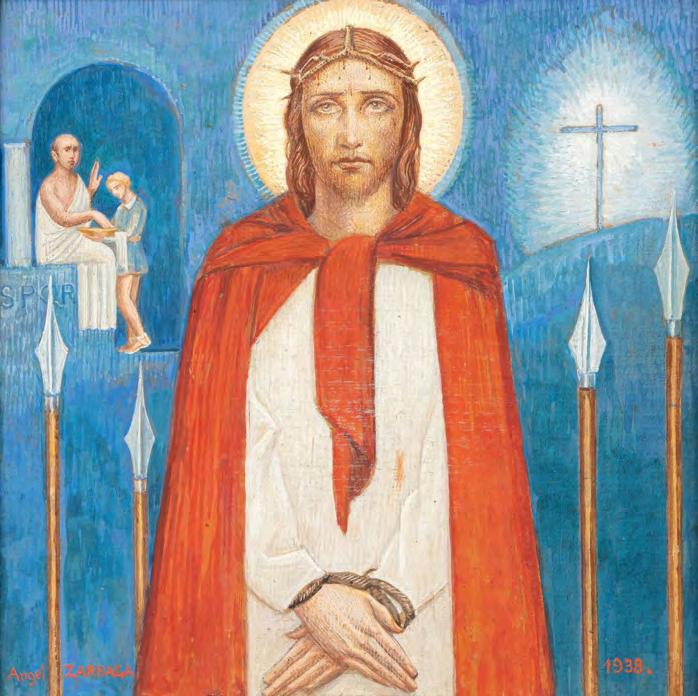
THE TRIAL OF JESUS The work of Angel Zarraga shows the Trial of Jesus. Created in 1938. Technically, the Triduum is from sundown on Holy Thursday to sundown on Resurrection Sunday. But in the early Church, the Pasch extended from Jesus’ betrayal on Wednesday, through the Last Supper and Jesus’ unjust condemnation, and all that he suffered up through his crucifixion, all the way to the end of Resurrection Day. That whole thing was considered a single “holiday/holy day” in which Christians participated in Christ’s passion and resurrection (Cathopic)
Pasch every spring was a way to relive the events of that week in a way that brings them back around so that we can participate in them—just like the celebration of the Passover brought back the events of the Exodus for faithful Jews.
“Past history made present mystery,” as they say.
In any case, nothing pagan to see here.
So what about the English word “Easter”? Where did that come from?
Near as we can figure, it comes from an Old German word for “dawn,” as in, facing toward the dawn—facing east. This is a bit of an oversimplification, but think of the way we can talk about a storm that’s heading in the northeastern direction, and call it a “nor’easter.”
By the same logic, the day we face the dawn in anticipation of our own resurrection is called “easter.” At least that’s how it comes into English, translated from Old German. But it helps to remember that “Easter” is only a word used in English. Most other languages still call it something that is a version of the word for Passover. For example, in Italian, it’s Pasqua
Just as the Eucharist was never just a “remembering” of the passion of Christ, the Pasch was never just an “anniversary celebration” of his resurrection. The celebration of the
In fact, in Hebrew theology, a recurrence of the Passover happens in providential ways at certain significant times throughout history. In the Rabbinic commentaries on the Torah, there is a poetic expansion on the Exodus that speaks of not one, but four Passovers —and all of them were said to take place on the same date in the Hebrew calendar: the 14th day of the month of Nisan, the same day as the Passover at the time of the Exodus. This poem on the Passover is called, “The Poem of the Four Nights.”
The first Passover, “night,” is the creation of the universe, and in Hebrew thought there is a specific date given for creation—also the 14th day of Nisan. This concept of tracing God’s saving acts in history all the way back to creation is why we start with Genesis when we read the whole story of salvation from the Scriptures during the Easter Vigil.
The celebration of the Pasch every spring was a way to relive the events of that week in a way that brings them back around so that we can participate in them—just like the celebration of
the Passover brought back the events of the Exodus for faithful Jews. The second Passover “night” is the binding of Isaac, when Abraham was tested by God’s command to sacrifice his son (cf. Gn 22).
The Church fathers all saw this event as a foreshadowing of the passion of Christ. Just as a ram caught in the thorns became the substitute for the son of Abraham, so Jesus was the Lamb in the crown of thorns who became the substitution for all of Abraham’s children— both his literal descendants and his spiritual children. And yes, the Hebrew scholars believed that this event also took place on the 14th day of Nisan.
The third Passover night was exactly the one you’d think—the one associated with the Exodus, the main event remembered in the ongoing Jewish tradition of the Passover, which was always celebrated on the 14th day of Nisan.
Then the fourth Passover “night” was to be in the future, from the perspective of the Hebrews; this would be the messianic banquet at the “Day of the Lord.” Of course, they didn’t expect that the “Day of the Lord” would actually be two “days”: a first advent of the Messiah, and a later second coming, at which time the final revelation of the kingdom of God would take place.
We live in the time between these two “days.” So we, as Christians, actually have five Passovers. The hope of the messianic banquet was partly fulfilled at the Last Supper, when Jesus instituted the sacrament of the Eucharist. But then he said he would not drink from that cup again until the final consummation at the wedding banquet of the Lamb when the kingdom of God is fully revealed, after the final resurrection. (Jesus hinted at this in his parable of the wedding banquet in Matthew 22.)
There was also a certain way in which the early Christians treated Resurrection Day like the beginning of a new year, in the same sense that we might make New Year’s resolutions to improve ourselves and our habits. So the early Christians used Lent, and then the Pasch, to solidify ways in which they
wanted to take their spiritual lives to the next level.
In a beautiful Paschal sermon Pope St. Leo the Great preached in the fifth century, he encouraged the people to use the season to make real changes in their lives, and after Lent, not just go back to their old ways. So it could be said that a homily for Resurrection Day was a real call to conversion, for as St. Leo said, no one who is proud, or greedy, or who denies the reality of Christ’s divinity and his bodily resurrection, can properly celebrate his Resurrection Day. Here is an excerpt from St. Leo’s sermon (I’ve paraphrased it a bit to make it easier to understand in English):
“I want everyone to remember that you are a new creation in Christ, and in all seriousness, understand what this means—that by identifying with Jesus Christ in your baptism you have been adopted by God the Father. Therefore, do not let anything that God makes new in you slide back into the old ways. This is what Jesus meant when he said that no one who puts his hand to the plow looks backward—to do the work of plowing you
need to keep your eyes on the row ahead of you.
“Don’t fall back into the old version of you, no matter how hard it is, or how weak you think you are—if you think you’re weak or not healthy enough— remember that being strong and healthy means following Jesus through death into resurrection. You did this in your baptism, back when it was easier.
“Now you need to keep following in the path of resurrection that Jesus set for you. Then no matter how slippery the path of life is, you won’t slide into the quicksand, but your feet will stay on solid ground. Keep all this in mind, my beloved, not only for this Paschal season, but all year-round and all your life, for the sake of your sanctification.”
So on the one hand, the Pasch is not just one day, or even the anniversary of one day; it is a part of the recurring cycle of God’s past providential intervention in history, and the seasonal rhythm of our present participation in it.
On the other hand, it was also not just one feast day, as in “Easter Sunday.” For the early Christians, it was the whole Triduum.
Technically the Triduum is from sundown on Holy Thursday to sundown
By James L. Papandrea OSV News
What we call “Easter” is not only for the moment, as if it can just come and go like any other weekend. It’s about the past, present and future.
It brings the past forward, connecting us in the present to the great interventions of God in history. Then the present becomes focused on the future, as we face the dawn, in an “easterly” direction, in the hope of the wedding banquet of the Lamb, that eternal family reunion.
And so as the Pasch approaches for this year, I want to encourage you to think about it—and try to observe it—the way the early Christians did. Here are a few suggestions:
1. Think of Resurrection Day as part of the grand trajectory of all of salvation history. Make a point to go to the vigil on Saturday night, especially if you usually don’t. Pay serious attention to all the Scripture readings, and think about how God is continually getting involved in the world. Think about the great “cloud of witnesses” who have gone before us, and the saints who pray for us, including your loved ones who wait for you at the heavenly reunion. Celebrate with those who are coming into the Church at the vigil.
2. Make a point to observe not only “Easter Sunday,” but Holy Thursday and Good Friday, as well. Again, especially if it’s usually only one day for you, make an effort to observe the whole of the Triduum. Go to Mass on Holy Thursday. Go to a Stations of the Cross or other liturgy on Good
on Resurrection Sunday. But in the early Church, not all Christians reckoned the day in the Jewish way, beginning at sundown, and so it wasn’t even limited to three days. For them, the Pasch extended from Jesus’ betrayal on Wednesday, through the Last Supper and Jesus’ unjust condemnation and all that he suffered up through his crucifixion, all the way to the end of Resurrection Day. That whole thing was considered a single “holiday/holy day” in which Christians participated in Christ’s passion and resurrection.
In fact, the big picture includes much more than Holy Week. For the Church fathers, salvation was not just about the crucifixion, or even just about the cross and the empty tomb. It was the whole of the Incarnation and life of Christ, starting with his conception at the Annunciation.
And notice that we don’t usually wear little empty tombs around our necks, or make the “sign of the empty tomb.” The sign of the cross is the sign that encompasses every aspect of the incarnation—Christ’s life, as much as his
death, and of course his resurrection. Methodius, in a Paschal homily from the early fourth century, wrote that the cross is both a trophy of victory and a ladder to heaven. And this is why we make the sign of the cross on our bodies. Back then, Christians made the sign of the cross on their foreheads, and the Church fathers taught that the forehead of a person was like the lintel of the doorway to his life—in other words, just as the sign in blood on the door lintels at the Exodus saved the children of Israel, making the sign of the cross on the “lintel” of our bodies is a sign of what saves us—But, again, what saves us is not only the death of Jesus, but his whole life.
So the Resurrection was never disconnected from the Passion, and the Passion was never disconnected from the Incarnation. And this sign—just like the ashes we got at the beginning of Lent, which were in the shape of the cross—is a witness to the world that we “proclaim the death of the Lord until he comes” (1 Cor 11:26). ©OSV
James L. Papandrea, PhD, is the author and professor of “Church History and Historical Theology” on the YouTube channel: “The Original Church.”
Friday.
Take off work if you have to (it’s a great testimony to your coworkers), and don’t use up the weekend trying to get work done—give yourself the breathing space to really think about what God has done for you in Christ.
3. Come out of Lent changed. After the Resurrection celebration (and if you’re like my family, after all the leftover ravioli are eaten), don’t just go back to the same old way everything was before Lent, as if now you can simply go back to having whatever you gave up until next year when it’s time to give up something again. Instead of going back, go forward—create some new habits, such as praying the Sign of the Cross more often as a sign to the world of your faith and devotion to Christ.
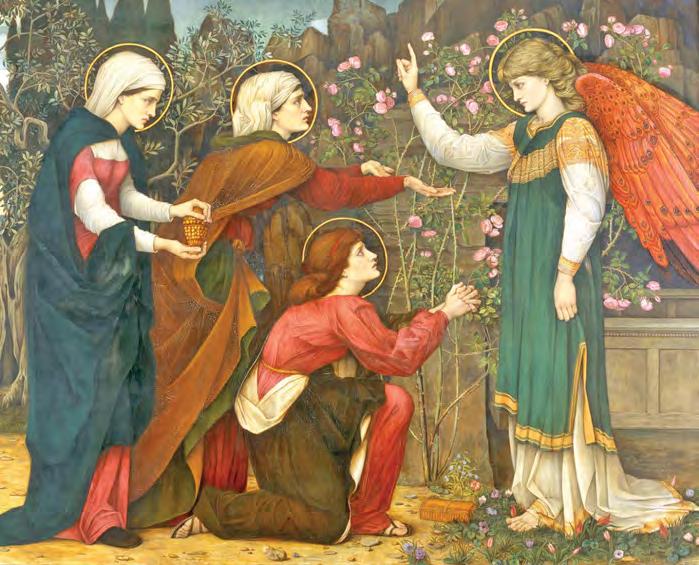
WHY SEEK YE THE LIVING AMONG THE DEAD, ST. LUKE 24:5 The work of John Roddam Spencer Stanhope shows the resurrection of Christ , “Why seek ye the living among the dead, St Luke 24, verse 5. Created 1870-1890 (Cathopic)
If you’re not a regular rosary person, make a point to pray the rosary more often, or the Divine Mercy chaplet, or at least incorporate something into your daily devotions that will remind you to count your blessings and be grateful.
Don’t give yourself permission to miss Mass so often, or if you’ve already gotten into the groove of regular Sunday Mass, give daily Mass a try, or spend time in Eucharistic adoration.
4. Live in gratitude. Make a conscious effort to ground your faith in what God has done in the past. Remember that gratitude for the past empowers faith in the present, and trust in God for the future.
In fact, let your whole life be driven by gratitude. And if you don’t yet have daily devotions, make a start by doing what the early Christians did by at least praying the Our Father every day.
©OSV News
James L. Papandrea is the author and professor of “Church History and Historical Theology” on the YouTube channel: “The Original Church.”
IBy Deacon Tony Peters, MA, RN
n recent weeks, the Missouri General Assembly has heard testimony on House Bill 2153, legislation that would abolish the death penalty and replace it with life imprisonment without parole as the most severe sentence available in our state.
House Bill 2153, sponsored by Rep. Jim Murphy, a Republican representing a portion of south St. Louis County and a parishioner at St. Margaret Mary Alacoque, would eliminate the death penalty as a sentencing option in Missouri. A hearing for the bill took place on March 9 in the Missouri House’s Corrections and Public Institutions Committee.
This moment invites Missouri Catholics to reflect on the dignity of human life and the kind of justice that reflects the Gospel of Jesus Christ.
At the heart of Catholic teaching stands a clear and unchanging truth. Every human person is created in the image of God. Scripture teaches, “God created mankind in his image, in the image of God he created them” (Genesis 1:27). Because of this, human dignity is not earned. God gives it. It is never lost, even after grave sin. The Catechism teaches that the dignity of the human person is established in creation in the image and likeness of God and fulfilled in the person’s call to beatitude and communion with God (CCC 1700). This dignity belongs equally to every human being (CCC 1934, 1935).
The Catechism of the Catholic Church teaches that legitimate public authority has the duty to redress the disorder introduced by offense, preserve public safety, and contribute to the correction of the offender (CCC 2266). Punishment, therefore, must protect society, restore justice, and, when possible, further conversion. Considering the Gospel and modern conditions, the Church now teaches that the death penalty is inadmissible because it is an attack on the inviolability and dignity of the human person (CCC 2267). Modern systems of incarceration protect society without taking a human life.
The United States bishops reinforce this teaching. The key question is not how terrible a crime may be. The question is whether taking a life is necessary. Today, it is not. Life imprisonment without parole protects the public while preserving the possibility of repentance and redemption. The Catechism reminds us that the work of grace continues even in the sinner, since God created man as a rational being who remains free and responsible for his acts, and who is
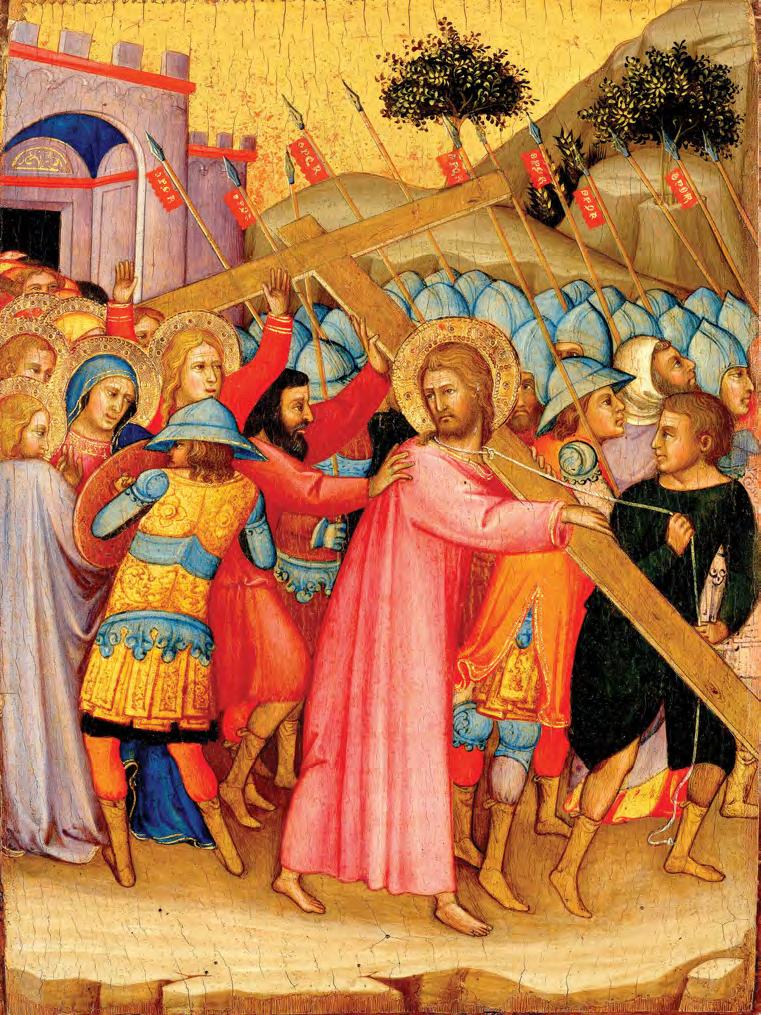
THE WAY TO CALVARY The state executed our Savior Himself: Jesus Christ was condemned under Roman law and crucified. Pontius Pilate declared, “I find no guilt in him” (John 19:6), yet Christ was still put to death. The Cross stands as a permanent warning. Human systems of justice are not perfect. They can fail. When they do, the consequences are irreversible (Andrea di Bartolo-The Way to Calvary; Cathopic)
called to conversion and moral renewal (CCC 1730, 1732).
Our faith carries a powerful memory that shapes this teaching. The state executed our Savior Himself. Jesus Christ was condemned under Roman law and crucified. Pontius Pilate declared, “I find no guilt in him” (John 19:6), yet Christ was still put to death. The Cross stands as a permanent warning. Human systems of justice are not perfect. They can fail. When they do, the consequences are irreversible. Because of this history, the Church approaches the state’s authority over life and death with great caution. The Catechism teaches that intentional killing directly contradicts the dignity of the person and the holiness of the Creator (CCC 2261). It also teaches that the fifth commandment forbids direct and intentional killing as gravely sinful (CCC 2268). Although the state has the
The death penalty imposes a heavy economic burden. Several others testified in support of the bill, noting fiscal concerns that putting a person to death costs up to $4 million more than a sentence of life in prison without parole. Capital cases require years, often decades, of appeals and legal proceedings.
The process also affects victims’ families. Instead of bringing closure, long appeals often prolong grief. Families are required to revisit painful events repeatedly through court proceedings. Catholic moral teaching insists that justice must never be reduced to vengeance. The Catechism warns that hatred and the desire for revenge violate charity, even while legitimate defense and punishment remain proper to public authority (CCC 2302, 2266).
There is also the risk of irreversible error. Since 1973, more than two hundred people in the United States who were sentenced to death have later been exonerated. When an execution takes place, any mistake becomes permanent. The death penalty also carries a human cost for those who must carry it out. Correctional officers, prison staff, and others involved in executions often experience emotional strain. Many describe this as a form of moral injury, the burden of participating in the taking of a human life. This burden reflects the moral seriousness of every act that touches human life, because human life is sacred from its beginning and remains under the special relationship of the Creator who is its sole end (CCC 2258).
authority to punish, that authority is not absolute. It must remain ordered to justice, human dignity, and the moral law.
Missouri has a long and sobering history with capital punishment. The first execution in the state took place in 1810. For many years, executions were carried out by hanging. Later, the state adopted lethal gas, and eventually lethal injection became the primary method. Today, executions take place in Bonne Terre, Missouri, at the Eastern Reception, Diagnostic and Correctional Center.
Since the death penalty was reinstated in 1976, Missouri has executed more than one hundred people. This places our state among the highest in the nation in the use of capital punishment.
This reality carries significant consequences.
The Catholic bishops of Missouri have spoken clearly and consistently on this issue. Following an execution in our state, they called Missourians to move away from vengeance and toward justice and dignity.
Bishop Edward Rice, along with his brother bishops, affirmed that while violent crime is serious and victims deserve justice, taking another human life does not bring healing.
“While acknowledging the gravity of violent crimes and the suffering of victims and their families, we continue to believe that the death penalty degrades the dignity of human life and diminishes us as a society.”
He also emphasized a central truth of the Gospel. Even those who commit grave crimes do not lose their dignity before God. The possibility of repentance remains. This reflects the Church’s constant teaching that no sinner is ever beyond the reach of God’s mercy, and that God predestines no one to damnation, but continually calls the sinner to conversion (CCC 1037, 1427).
Archbishop Mitchell Rozanski
expressed this clearly in testimony before the Missouri legislature, stating that the death penalty is inadmissible because it attacks human dignity, is no longer necessary to protect society, and deprives the offender of the opportunity for redemption.
The Church does not deny the seriousness of violent crime. Justice requires accountability. Society has a duty to protect the innocent. Life imprisonment without parole remains a severe and just punishment. It protects society while preserving the possibility of conversion. Here, the Catechism is clear. Public authority fulfills its duty when it defends human lives and the common good by means proportionate to the offense and ordered toward the protection of society and the correction of the offender (CCC 2265, 2266).
The Catechism teaches that human life is sacred because from its beginning it involves the creative action of God and remains forever in a special relationship with the Creator, its one end (CCC 2258).
THE CHURCH DOES NOT DENY THE SERIOUSNESS OF VIOLENT CRIME. JUSTICE REQUIRES ACCOUNTABILITY.
The Gospel calls us to respond.
We pray for victims of violence and for their families who carry grief.
We pray for those who commit grave crimes that they repent and encounter God’s mercy.
We pray for correctional officers and all who carry the burden of the justice system.
We pray that lawmakers’ decisions reflect truth and dignity.
By OSV News Vatican City
Archbishop Fulton J. Sheen will be beatified on Sept. 24 in St. Louis, the Dicastery for the Causes of Saints announced March 25.
The beatification will take place in St. Louis, with Cardinal Luis Antonio Tagle, pro-prefect for the Dicastery for Evangelization, presiding.
No witnesses testified against the bill at the hearing.
“Republican, Democrat, left, right, all aspects were really represented over at the Capitol on that bill, and that’s not something you see every day,” Morris said. “Everyone comes at it in a slightly different way, but all the testimony agreed that the death penalty is really not necessary in the state of Missouri.”
Missouri executed one man in 2025, Lance Shockley, a decrease after putting to death four men in 2024 and four in 2023. Five men remain eligible for execution on the state’s death row.
As Missouri Catholics, we are called to a consistent ethic of life. We protect the most vulnerable from the womb to natural death. This teaching does not change based on circumstance. It flows from the dignity of the human person.
The Cross of Christ reveals the failure of human violence. The Resurrection reveals the power of redemption. In Christ, even the guilty are not stripped of the call to conversion, and even suffering and sin do not stand outside the reach of divine mercy (CCC 1428, 2267).
Violence does not get the final word. Christ does. ©TM
Deacon Tony Peters, MA, RN, is a Registered Nurse and Permanent Deacon in the Diocese of Springfield-Cape Girardeau, serving at St. Vincent de Paul Parish in Cape Girardeau, MO. He also serves in Mission Integration and Pastoral Care at Saint Francis Healthcare System. A professed Secular Franciscan since 2016, Deacon Peters recently completed a Master of Arts in Theology at Saint Meinrad Seminary and School of Theology in Saint Meinrad, IN. Appointed to the Missouri Catholic Conference’s Public Policy Committee, he seeks to apply the principles of Catholic social teaching to his ministry and public advocacy throughout the state.
On Feb. 9, the Diocese of Peoria, IL, had announced that the Vatican had given the green light for the beatification of Archbishop Sheen to move forward six years after the Holy See had postponed the beatification, initially scheduled for December 2019, only weeks before the event was to take place.
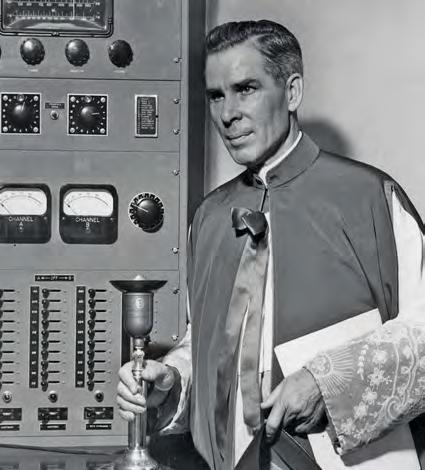
VENERABLE FULTON J. SHEEN Venerable Fulton J. Sheen is remembered as one of the most influential and innovative evangelists in American history. On March 25, 2026, the Dicastery for the Causes of Saints announced the beatification of Archbishop Sheen will take place on Sept. 24 in St. Louis. (OSV News file photo)
“Archbishop Fulton Sheen was one of the greatest voices of evangelization in the Church and the world in the 20th century,” Bishop Louis Tylka of Peoria said in February. “I have long admired his lifelong commitment to serve the Church as a priest, rooted in his deep devotion to the Blessed Mother and the Eucharist. As he journeyed through the different stages of his life, his ability to share the Gospel and truly relate to people drew countless souls into an encounter with Jesus
-- one that transformed not only his life, but more importantly, the lives of those he touched.”
Archbishop Sheen is remembered as one of the most influential and innovative evangelists in American history. Once dubbed “God’s microphone,” Archbishop Sheen announced God’s truth in a nonconfrontational, yet no less lifegiving, manner to untold millions through radio, print, and television.
©OSV

Damn Yankees is a devilishlyclever musical comedy about America’s favorite pastime. Fanatical baseball fan Joe Boyd sells his soul to the devil in order to save his favorite team in this Faustian sports classic. With such illustrious songs as “Whatever Lola Wants” and “Heart,” follow Joe in his journey to save his team…and his soul.
Performances will be held on April 23, 24, and 25 at 7 p.m. at Notre Dame’s Cynthia R. King Performance Hall. Join us for a matinee on Sun., April 26, at 3 p.m.
Tickets are $15 and can be purchased Online starting March 19 at www.notredamehighschool.org/ musical, or at the door (if available).
©TM

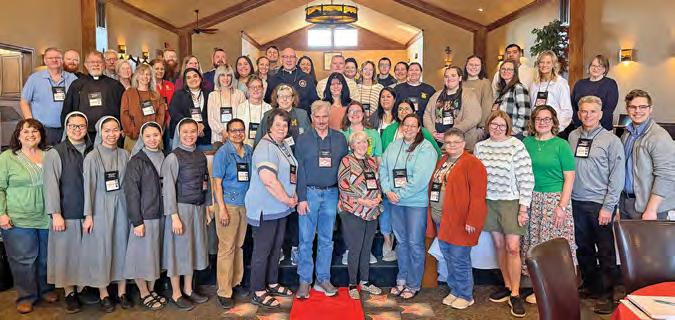
Clergy, diocesan staff, youth leaders, catechists met the last weekend in February for The Gathering! The event focused on the integration of spiritual and mental health when accompanying youth and families.
“Participants got into some practical ways to create a loving and supportive environment for those coming to our ministry groups who may be struggling with things like anxiety, depression, etc.,” said Lynn Melendez, diocesan Director of Evangelization, Family Life, and Youth Ministry. “All of our decorations and take home treats had a V.I.P. theme. We wanted to emphasize that a youth leader or catechist will most likely be a VIP in the life of a youth and/or their family because they help them to experience the love and healing power of Jesus Christ.”

Thanks to these “VIPs” for their witness to the faith, apostolic zeal, and their impact on our families and young people! ©TM
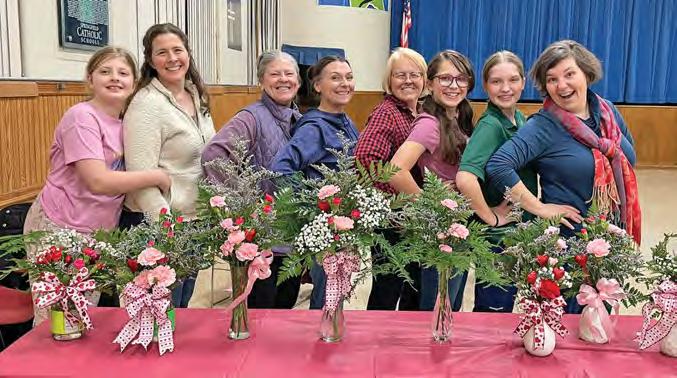
MEMBERS OF ST. JOSEPH PARISH, SPRINGFIELD, and youth from St. Joseph Catholic Academy enjoyed an “Introduction to Flower Arranging” class on Feb. 4, taught by parishioner Vickie Wand, for Valentine’s Day. (The Mirror)

PICTURED ARE THE 3RD GRADE BOYS BASKETBALL TEAM at Guardian Angel Catholic School, Oran, and their coaches. Pictured are (Front): Trase Webb, Brooks Curry, Lane Seyer, and Fisher Gadberry; (Back) Coach Michael Webb, Jameson Levan, Gibson Curry, Tennyson VanGennip, Victor Woods, and Coach Darin VanGennip (The Mirror)
It was an exciting year for the 3rd grade boys at Guardian Angel Catholic School, in Oran. Eight of ten boys played basketball for Guardian Angel this year. They were coached by Darin VanGennip and Michael Webb.
Most of the games were away games, with only three at home. One of the home games got cancelled because of weather. They also played in the Oak Ridge Tournament which finished on Sun., Feb. 15. They won third place in the tournament over St. Vincent de Paul’s team in Cape Girardeau. There were 8 teams in the tournament. Overall, they had 11 wins and 5 losses for the season.
Congratulations on a great year of basketball to these 8 boys and their coaches. ©TM
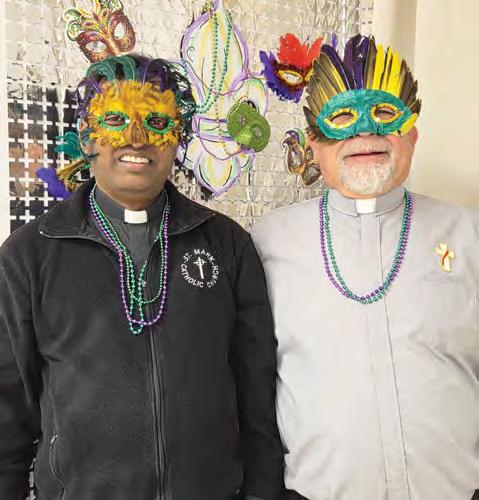
MARDI GRAS (“FAT TUESDAY”) was celebrated with festive attire at St. Mark Parish, Houston, with more than 40 parishioners sharing food, fun, and fellowship before the beginning of Lent 2026. Pictured are Fr. Rayappa “Ray” Chinnabathini and Deacon Mike Evers (The Mirror)
E
ucharistic Adoration is all about placing ourselves before our Lord, who is truly and sacramentally present to us in the Eucharist exposed on the altar in the monstrance. Eucharistic Adoration is about listening to His heart from your heart, about His love and joy for you, His plans and inspirations, His forgiveness and ministry, and His ways of helping you grow in your spiritual life, and service of others. Jesus present in the Monstrance (from the Latin word—monstrare, which means to show, which is the root for—demonstrate) enables us to fix our gaze on him for the reparation for sins; the intercession for healing of the world, among other needs or sources of gratitude.
(24 hours a day, seven days a week)
is held in two places in the Diocese of Springfield-Cape Girardeau. Please come and spend time in either of these locations:
Perpetual Adoration at Saint Francis Medical Center, Cape Girardeau Call Donna (573) 450-1451
Perpetual Eucharistic Adoration at Holy Trinity Church, Springfield Call Marilyn (417) 224-4043
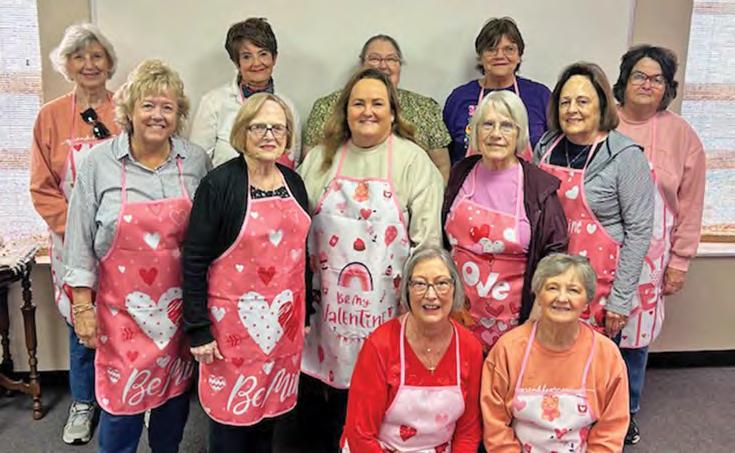
The St. Francis Xavier Catholic Grandparents Association, in Sikeston, wore their Valentine aprons during the Cupid Bash, held Feb. 14. This successful fundraiser helps support VBS and other Catholic Grandparents Association activities.

Children and volunteers are invited to help with “Rainforest Falls” Vacation Bible School (VBS) at St. Elizabeth Ann Seton Parish, Springfield. We are partnering with St. Agnes Parish, and everyone is invited to attend!
Tuesday, June 23 – Friday, June 26, 6-8:30 pm and Saturday, June 27, from 1:30-4:15 pm, followed by Mass and a picnic dinner.
Participants and Volunteers can go to the St. Elizabeth Ann Seton website www.seaschurch.org and print out a registration form (either participant or volunteer) AND a Media Release form and either scan and email to ddumars@seaschurch.org, drop it by our Parish or to St. Agnes Parish, or mail to St. Elizabeth Ann Seton Church, 2200 W. Republic Road, Springfield, MO 65807, Attn: VBS. (3-4 year old Pre-School VBS offered for children of volunteers only.)
VBS is for children entering Kindergarten in the fall through those entering 6th grade in the fall. Youth entering 7-12 grades and adults are invited to volunteer. We welcome children at any time to be part of VBS, but to be guaranteed a t-shirt, we must have the registration form by Wednesday, June 3.
TO THE DIOCESE OF SPRINGFIELD-CAPE GIRARDEAU,
Thank
you to the wonderful people of the diocese for your kind expressions of sympathy and love during the loss of our precious brother, Fr. Mike McDevitt.
Mike was the consummate parish priest. It is easy to see by your expressions of gratitude for his service in your parishes, that his devotion to his parishioners was appreciated by all.
Mike loved all his parishioners and we were grateful for all the years of support he enjoyed.
We know he will be kept in all your prayers and we are confident Fr. Mike will intercede for the diocese to God our Father.
Blessings, The Family of Fr. Mike McDevitt

Lights Camera Auction: A JACS Premiere Event is coming up on April 18th. There
a many ways you can support this event:
• Be A Sponsor
• Donate Items
- Silent Auction Via Amazon Wish List
- Live Auction Items
• Attend the event- Tickets go on sale March 1st!
• Bid Online
• Support Our Fund-A-Vision
©TM

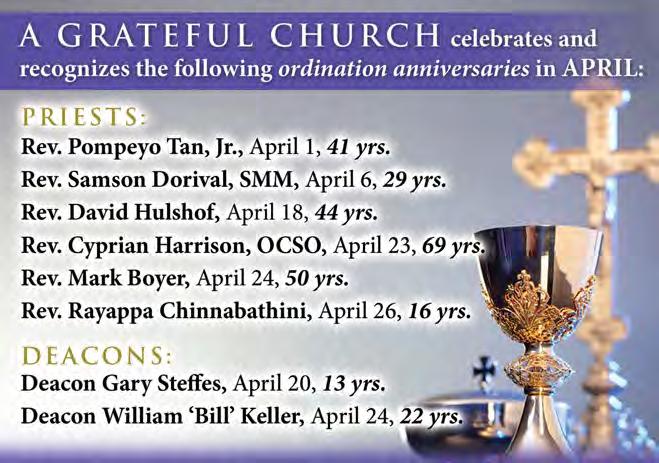
Fr. Mark Boyer will celebrate the 50th anniversary of his priesthood ordination on April 24th. He is retired.
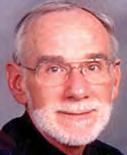
Happy Anniversary, Fr. Boyer!


The VIRTUS Protecting God’s Children Safe Environment training for adults is available online.
Preregistration is necessary: If you are a new registrant please go to www.virtus.org and click on “first time registrant” on the left, and follow the prompts to register for Online training. Instructions for the registration process can also be found on the Child and Youth Protection Page of the diocesan Website.
www.dioscg.org/wp-content/uploads/How-to-Register-for-a-VIRTUS-withOnline-Option.pdf
Both in-person and online training sessions are for adults only.
Before engaging in activities involving minors and/or vulnerable adults, new volunteers or employees are required to complete the VIRTUS Protecting God’s Children training for adults, submit a current Background Disclosure and Authorization Form, and read, sign and submit the annual Code of Conduct, which are available on the VIRTUS Website and the Diocese of Springfield-Cape Girardeau Child and Youth Protection Webpage: www.dioscg.org/childyouth-protection/
For more information, please contact the Office of Child and Youth Protection, childandyouthprotection@dioscg.org; or Bill Holtmeyer, billholtmeyer@dioscg.org; or Shelly Ferry, sferry@dioscg.org, (417) 866-0841.