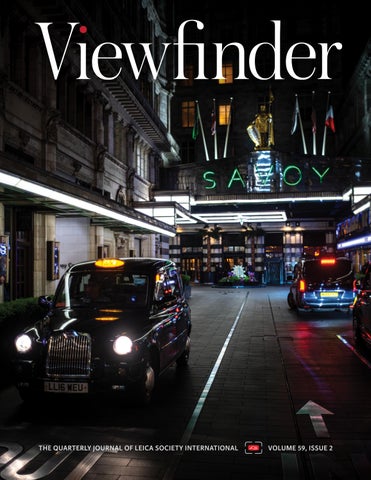
THE QUARTERLY JOURNAL OF LEICA SOCIETY INTERNATIONAL
VOLUME 59, ISSUE 2
Join us in-person at one of our upcoming LSI meetings!
2026 Annual Meeting
2027 Spring Shoot
2027 European Spring Shoot
DETROIT MICHIGAN
CHICAGO ILLINOIS
PARIS FRANCE
October 22–24, 2026
April 15–17, 2027
TBD
JOIN LSI'S NEW ONLINE PLATFORM
LEARN MORE & REGISTER
LSICONNECT.ORG
WWW.LEICASOCIETY INTERNATIONAL.ORG
Join the Leica Society International’s thriving WhatsApp Community to connect with other Leica-minded members and stay up-to-date on important Society new & events.
VIEWFINDER · VOLUME 59, ISSUE 2
INFO@LEICASOCIETYINTERNATIONAL.ORG
WWW.LEICASOCIETYINTERNATIONAL.ORG FRONT COVER
2
THIS ISSUE SUMMER 2026
Photo by Colin McKinley
a letter from the editor
32
by Bill Rosauer
3
a letter from the president by William Fagan
4
by Rubén Martín-Benito
a postcard from lsi london
44 leica 3.3cm f/3.5 stemar 3-d lens
by Jon Cheffings
18
by Jonathan Slack
40 the triumphant victory of grace over sin: corpus christi day in camunas
leicas of london 2026 by Andrew Tobin
11
leica sl3-p: weddings & wildlife and the 100-400 vario elmar
e. leitz (london) the first 50 years
by Jeffery D. Trilling
50 visoflex turret
by Alan Stokes
by Jim Lager
26 poésea: a closer look by Karine Nowak
O F F I C E R S & D I R E C TO R S
PRESIDENT William Fagan Dublin, Ireland
Inquiries about membership, upcoming events, replacement Viewfinder issues, and special orders should be directed to:
VP / TREASURER Amitava "Chats" Chatterjee Manassas, VA
Colin McKinley, Executive Director Leica Society International 14070 Proton Road, Dallas, TX 75244
IMMEDIATE PAST PRESIDENT David Knoble Charlotte, NC
info@leicasocietyinternational.org Viewfinder is the official publication of the Leica Society International, a nonprofit organization incorporated in the state of Delaware. Copyright 2025. Reproduction or use of any material contained herein without permission of the Society if forbidden. Leica is a registered trademark. It and other trademarks pertaining to the Leica System are the property of LEICA CAMERA, USA, INC or LEICA CAMERA AG. ISSN 1543-8732
EXEC.VICE PRESIDENT Robert Levite Coral Gables, FL
PRESIDENTS EMERITUS James L. Lager Rolf Fricke, dec. Bill Rosauer EXECUTIVE DIRECTOR Colin McKinley Golden, CO SENIOR DIRECTORS Gary Hough Woodinville, WA Douglas Drumheller Pittsburgh, PA Alan Weinschel Roslyn Heights, NY Brad Husick Medina, WA
www.facebook.com/leica.society
ELECTED DIRECTORS
Class of 2028 Continued
Class of 2026
Hari Subramanyan Heidelberg, Germany
Sandra Eisert Redmond, WA Tom Fey Oxford, Ohio Wayne Goodman United Kingdom Jonathan Slack United Kingdom Class of 2027 Ayash Basu Austin, Texas Marke Gilbert Royal Oak, MI Wilbur Norman Sante Fe, NM John Pegouske Dearborn, MI Class of 2028 Maura Allen Abiquiu, NM
Kirsten Vignes Minneapolis, MN VIEWFINDER EDITOR Bill Rosauer Buffalo Grove, IL lhsaeditor@yahoo.com VIEWFINDER STAFF Francesca Delaney Graphic Designer Rochester, NY Ed Schwartzreich Associate Editor Waterbury, VT Amitava "Chats" Chatterjee Associate Editor Manassas, VA Richard Rejino Dallas, TX Kirsten Vignes Minneapolis, MN James L. Lager Closter, NJ
David Koppel Montreal, Quebec
@leicasociety
@leicasociety
1
2
VIEWFINDER · VOLUME 59, ISSUE 2
A LETTER FROM THE EDITOR by BILL ROSAUER
In
this issue of Viewfinder, we have a great mix of LSI events, incredible art and stories created by Leica photographers, Leica history, and new Leica products.
Karine Nowak returns to Viewfinder with her wonderful article and images, “Poésea–A Closer Look.” Karine used her Leica M240 and 75/1.Summilux to capture these unique and beautiful abstract images of rusting shipwrecks in Cherbourg’s harbor. As Karine notes, “For me the M camera is the perfect instrument for experimentation.” I am sure you will enjoy her incredible abstract artwork! Rubén Martín-Benito uses his Leica to document the enactment of the Corpus Christi religious celebrations in Camuñas, Spain, in his article “The Triumphant Victory of Grace Over Sin: Corpus Christi Day in Camunas.” Ruben counts on his Leica to be the least intrusive tool to use for his photography among the celebrants and feels it makes his images more spontaneous. I think you will agree that his Leica is the right tool for his work. Earlier this year, we had two Spring shoots: one in Tucson which we featured in the last issue of Viewfinder, and the other in London. In this issue, we have two articles about the London meet. Jon Cheffings, whom I met at the opening of the Chicago store, reports on the meeting with his article “Postcard from LSI London.” We have some wonderful images from the meeting by John and our Executive Director, Colin McKinley. We also have a different take on the meeting with Andrew Tobin’s article, “Leicas of London.” Andrew photographed attendees with the Leicas they brought to the meeting. Seeing other people’s Leicas is a fun aspect of going to our meetings, alongside the program and getting to meet other members, forming new friendships, and spending time with old friends. If you haven’t attended one of our events, put it on your calendar. I look forward to meeting with you all in Detroit and here in Chicago next Spring! Continuing with our London theme, we have Leica historian Alan Stokes’ history of the London branch of Ernst Leitz Wetzlar. I think you will enjoy the story Alan tells in his article. As a Leica collector, I was somewhat familiar with Leitz in London. Reading Alan’s article, I was struck with the parallels between the New York and London branches, especially regarding the challenges of two world
wars and their aftermath. It was also interesting to learn about the involvement of Ernst Leitz’s sons and Conrad Barnack with the London office. I also enjoyed the mention of Walther Benser, postwar Leica lecturer, who became a friend of mine and I would visit with him at several Photokinas where he promoted his books. We also have Jono Slack’s experience with the newly introduced Leica SL3-P and the new 100-400 Vario-Elmar lens. As usual, Jono gives us his insightful take on the new camera and lens. We are fortunate to have Jono writing for Viewfinder. He is a Leica Beta tester and highly regarded in Wetzlar for his input during development. Thank you Jono! Jeff Trilling brings his article on one of the most unique and little-known Leica lenses, the Stemar 3.3cm f/3.5 stereo lens. Jeff has done an incredible job researching and documenting this unusual optic. As Jeff tells the story, the Stemar was Leitz’s answer to the rising popularity of 3-D photography in the early fifties. There were numerous American makers of stereo cameras, and of course Zeiss was involved as well, having one for their Contax rangefinder cameras. Leitz being Leitz, they had to do it better! Unfortunately, the Stemar was one of Leitz’s few failures during those years. Part of the blame was due to the cost of the system, as it was more expensive than even that of the Zeiss stereo lens system. But the biggest reason for its success had to be the overwhelming success of the M3 and M2 cameras, which were introduced in the same time frame as the Stemar. The Stemar simply faded away, making it a super collectible! Of course, we have an article on an obscure Leica accessory from Jim Lager, the rare three-lens Leica turret to enable rapid lens changing on the Leica M. This solution by Leitz addressed the limitation of the M camera not having a zoom lens like the reflex camera makers had. Years later, the answer came for M users with the Tri-Elmar lenses. Bis nächste zeit! Bill
VIEWFINDER · VOLUME 59, ISSUE 2
A LETTER FROM THE PRESIDENT by WILLIAM FAGAN
DEAR LSI MEMBERS AND FRIENDS,
I
hope you have spent the past few months, enjoying your Leica cameras and the benefits of LSI Membership. One of the benefits of the latter is access to our LSI Connect site lsiconnect.org which has continued to develop at a fast pace. One of the main features of the site are the monthly themed competitions with prizes. The first two with “Landscapes” and “Portraits” are completed and, as of this writing, the “Film” themed competition is almost completed. The themes of the competitions for the remainder of 2026 and into 2027 are “Street,” “Architecture,” “Sport,” “Abstract,” and “Water.” Almost everyone should be able find a theme that they like or practice in that sequence. Just to give a flavour of how this works, members can post up to 3 images per day to the competition they wish to enter. At the end of the 4-week period, the LSI Connect Team, led by VP Amitava Chats Chatterjee and Jono Slack, produces a short list of 36 images, mimicking the 36 images on a roll of 35mm film. These are then published on the site and sent without names to an expert international judge at the same time. The judge then nominates the 1st, 2nd, and 3rd place winners with a short comment on each image. This is then announced and prizes are sent to the winners. Our judges are all people of international caliber and renown; the first judge was Karin Rehn-Kaufmann, Art Director and Chief Representative of Leica Galleries International. Trish Lambe, Art Director and CEO of Photo Museum Ireland, was the independent judge for “Portraits.” There are other features on the site, such as the Colour and Monochrome showcases where monthly winners for each category are chosen by Jono and Chats. There are also individual meetup micro-sites showing the images submitted at our LSI in-person meetings such as those in Tucson and London. The site also has
analytics showing the parts of the world where images were captured and the cameras and lenses used and other data. As platform users, please enter this data so LSI Connect’s analytics module is enriched further. A growing part of the LSI Connect site contains areas for individual Leica User Groups called LUGs and there 23 such groups on the site as of today, 13 in the Americas, 5 in Europe, 4 in Asia, and 1 in the Middle East. There is a guide to show the LUG moderators how to use the site, but there are no restrictions or directions for the activities that LUG members might engage in. These groups give you an opportunity to engage with fellow LSI Leica enthusiasts in your city, region or country. We on the LSI Board and Executive Committee are more than willing to assist in any way that we can to get LUGs and their activities up and running. So, my message is please register on the site lsiconnect.org and start engaging with your fellow members to find a whole new dimension to your Leica ownership and LSI membership. For technical reasons this currently requires separate registration to that on the main LSI website. The final point this month is that our Detroit Meeting in October is now open for booking leicasocietyinternational.org/detroit2026 It would be nice to see as many of you as possible in Detroit. I will be making the long journey from Ireland to attend. William Fagan President LSI
3
4
VIEWFINDER · VOLUME 59, ISSUE 2
Kenny’s custom red leatherette M11 and 50 Summicron
Leicas of London 2026 by ANDREW TOBIN
THE LEICA SOCIETY INTERNATIONAL (LSI) SPRING SHOOT CONFERENCE TOOK PLACE IN LONDON THIS WEEK (14-16 MAY 2026).
The presentations, panels and talks have been impressive and inspirational. Meeting lots of members of the Leica family, including people I have only known for years only online, has been fantastic. It was my first ever LSI event and I wanted to say hello to as many attendees as possible. As an icebreaker, I decided to take photographs of some of the many Leicas that people had with them. The variety of cameras (and rarity of some) was a sight to behold for anyone interested in photography, and heaven for Leicalovers. There were many M bodies as you might expect, with some
very exotic versions and lenses on show. A few SLs, a very nice CL, and a flurry of Qs. There was also an X-U which I’ve never seen in the flesh. I spent all my money on my recent Vietnam holiday, otherwise I’d have been over at Leica Mayfair looking to add a Q3 43 to my bag. Here is a selection of pictures for you. Thanks to everyone who was happy to let me photograph their pride and joy. I'm sure you'll let me know if I have misidentified any of them. Enjoy… I hope you enjoyed that as much as I enjoyed seeing all these cameras in the flesh. All images shot with my Samsung S25 Ultra.
VIEWFINDER · VOLUME 59, ISSUE 2
Henning’s M10 Monochrom with 35 Summicron
Aaron’s M11-P Safari and 35 Noctilux
Samson’s M11-D special edition (1 of 100 copies) with new Anastigmat 50mm
5
6
VIEWFINDER · VOLUME 59, ISSUE 2
Nicole’s 1963 M3 with modern 50 Summilux and light meter
Richard’s M10-R with 50 Summilux
Subhash’s Q3 43mm and M11 with 35 APO Summicron
David’s M11P and 90 Summicron AA
Kenneth’s SL3 with 28-70 Vario Elmarit SL
VIEWFINDER · VOLUME 59, ISSUE 2
Henning’s M11 and 35 APO Summicron
David’s M11P and 35 Nocilux, and M11 mono black paint with 28 Summilux
Tareg’s M11P and 50 Summilux
7
8
VIEWFINDER · VOLUME 59, ISSUE 2
Mike’s M11D with 75 Summicron
Scott’s M11-P with 35 Noctilux
Wayne’s X-U
Fred’s M11 and 35 Summilux in an adapted leather case
Aaron’s M11M with 1968 50mm Noctilux f/1.2, and Jim Marshall M240 in unfinished bronze with matching 50 Summilux
VIEWFINDER · VOLUME 59, ISSUE 2
Colin’s 1962 M3 with 1967 50 Summicron Dual Range, SL2S Reporter with 21 Summilux, and M11P with 35 Summicron V1 and Goggles
Roger’s M-EV1 with 35 APO Summicron
Adam’s M11 Black Paint Milan Version with 75 Noctilux
Hans’s CL with silver 35 Summilux
Samson’s personalised M9 with 35 Summicron
9
10
VIEWFINDER · VOLUME 59, ISSUE 2
Jono’s prototype M11 with 35 Summicron and yellow leatherette
Adam’s M11-P with 35 Noctilux
VIEWFINDER · VOLUME 59, ISSUE 2
A POSTCARD FROM LSI LONDON by JON CHEFFINGS
DAY ONE INTROS Our loquacious president William Fagan welcomes us to London. For many, London is not an unfamiliar city, and in my case a 14-year home. Nevertheless, it’s a joy to be back as a tourist and not scuttling to and from work every day. William asks what type of photography we prefer—I would estimate that it was a pretty familiar mix, with a few exceptions. William also asks us to name the favourite Leica that we own. Maybe it shouldn’t be a total surprise, but there’s a very healthy number of Leica Qs.
President of the Leica Society International, William Fagan welcoming the faithful
11
12
VIEWFINDER · VOLUME 59, ISSUE 2
Inevitably it leads to the issue of who controls the narrative, and the level of truthfulness that is shown. In the past, our default setting might have been to believe what we saw. Today, our default is to question what we are seeing. In the age of AI, this has become more problematic. Leica’s move to add content credentials to their cameras is a significant step in establishing credibility.
Karin Rehn-Kaufmann, Art Director, Leica Galleries International explaining the awards programme
PANEL OF GRANT PRIZE WINNERS AND RUNNER-UP Laura Pannack, Adam Rohana and Irina Werning with Karin Kaufmann, Art Director, Leica Galleries International I met Karin at the opening of the new Chicago Leica store a few weeks ago, and it’s easy to see her commitment and dedication to photographers, their craft, and their stories. Laura and Irina are here to present and discuss recent projects. We are often oblivious to what is happening outside our field of view. Both Laura and Irina present topics that may never have occurred to us. The stories they tell are fascinating and heart-tugging, revealing a vulnerability and sensibility that would benefit from further support. Are there ways in which outreach from LSI might help provide that support? I hope so.
DAY TWO EVOLUTION OF THE DIGITAL M CAMERAS | STEFAN DANIEL, LEICA SENIOR GLOBAL BRAND AMBASSADOR Stefan is known as “Mr. M” and has an endless supply of historic Leica stories that underpin why Leica as a company is so highly regarded. On this occasion, Stefan brought the story of the development of the digital M line. At the time, it was an enormous development with significant risk and significant costs. When a company has a core product like an M (e.g. Porsche and the 911) any move to shift direction is a major risk. That “prodding around the edges” of change, until an opening presents itself, is time-consuming but can also fray buyer and retail confidence. And of course, everyone has an opinion!
IMPERIAL WAR MUSEUM—TRUTH, LIES, AND KODACHROME Hilary Roberts, Former Curator of Photography, Imperial War Museum, discusses her book The Camera at War. War photography or photography of strife and human suffering has existed for one hundred and eighty years, starting with the Mexican-American war in 1846. Hilary brought an important perspective on war photography and raised several thought-provoking questions. Tom Spine, Londonderry, New Hampshire, USA
“I hereby decide: we will take the risk.” Leica was not a large company with endless resources or capital. The risks of going digital were therefore much greater and the chances of failure much higher. This is the equivalent of the USS Enterprise “Boldly going where others have not gone before.” In 2003, Leica announced the DIGITAL MODULE-R (DMR), which was a digital attachment for Leica R8 and R9 film cameras. It allowed photographers to swap between shooting 35 mm film and digital images using a 10 MP digital sensor. This can be seen today as a great leap of faith by Leica into the digital world. It was widely considered Leica's first real entry into using a digital workflow. It was praised for its exceptional colours but criticized for its somewhat bulky form factor. M7 was then tested in the form of a “Frankencamera” with DMR transplant added as a “slave” attachment. Thankfully, it worked as a vehicle to test whether Leica could develop digital M cameras. The M8 was the first fully-fledged digital M introduced, featuring a 10.3-megapixel sensor. The sensor is a 1.3 crop of standard 35mm film, which gives the M8 a greater perspective in comparison to its predecessors. It was not without its teething problems, but showed that Leica could have more confidence in pursuing this path.
VIEWFINDER · VOLUME 59, ISSUE 2
Capital restrictions at that time meant all monies were invested in the development of digital Ms to the exclusion of other projects. Leica launched the M9 and followed that with the M9 Titanium. It featured innovative LED framelines and also ushered in the era of Mark Shiphard as head of design. The M9M followed as a high-risk idea but paid off with unexpectedly great success. That brings the story up-to-date with the M11 contains 50 significant innovations, including Content Authenticity Credentials (natively introduced in the M11-P and -D). And now we have an Leica M EV-1 which employs an EVF for the first time that brings a new way to utilize M lenses.
FILM VIEWING | DIE NAZIS, DER RABBI UND DIE KAMERA FRANK DABBA SMITH Frank Dabba Smith is well known to many of us. He is first and foremost a Rabbi who was born in 1955 in California. His other “life” is as a recognised Leica expert and main editor of the Leica Pocket Book published by London Leica dealer Ivor Cooper of Red Dot Cameras. Many of us have seen “Schindler’s List” and have been disturbed by events in the movie. Not many people knew of the Leitz family’s similar role in the “The Leitz Freedom Train” during WWII, to help Jews escape the Wetzlar area of Germany. Ernst Leitz II and his daughter Elsie led the effort. Elsie was interrogated and then taken to prison afterwards. The film that came from this story takes us to the original locations of the action in Wetzlar, New York and Frankfurt am Main. For many years, the story remained known only to a small group of those involved and their descendants. The story is complex and in the film is told in a positive manner, with the children and grandchildren of those who were helped to freedom. We should be grateful for this example of altruism today.
A film discussion panel was chaired by William Fagan that included audience Q&A involvement with Frank Dabba Smith, Author; Dr Oliver Nass, Chairman of Ernst Leitz Foundation and Claus Bredenbrock, the Film Director.
SARAH M. LEE “LEICA, TRUTH, AND AI” Sarah is a professional photographer who has worked for the Guardian and Observer. She is a Leica Ambassador. In her own words, Sarah discovered Leica, bought a Leica, sold her Leica, and rebought a Leica. This might sound familiar to some of us… Sarah tackled the difficult topic of “Leica, truth, and AI.” We may want to believe something is real and true, but we can also be disappointed to discover that AI has played a significant role in masking the truth. Leica’s Content Authenticity Credentials go a long way to reducing the doubts we may have about the truth of an image. She shared some of her recent work, including the most recent BAFTA Awards evening. It is packed with human expressions, joy and humour from actors who normally spend their time being asked to pose in front of the camera. You can discover more about Sarah and her work here: sarahmlee.com/about
NICK HENSMAN STREET PHOTOGRAPHER You could fairly describe Nick’s approach to Street Photography as unusual, using flash during the daytime. The images have a feeling of being on a train and watching another train pass by in the opposite direction. You can find some of Nick’s work here: instagram.com/p/ DYZdqWaiDoK/ Nick then led participants on a photowalk through Soho and Chinatown that evening.
13
14
VIEWFINDER · VOLUME 59, ISSUE 2
VIEWFINDER · VOLUME 59, ISSUE 2
DAY THREE HOW THE CREAM OF MANCHESTER SOLVES LEICA TECH PROBLEMS However much Leica strives to simplify the user interface, there will always be features and controls that users struggle to figure out how to use, in a way that fits their approach to photography. Stuart Rayson from Leica Manchester held a Q&A session to respond to owners’ questions.
JOSE SARMENTO DE MATOS— EVERY PICTURE IS A PORTRAIT José Sarmento Matos (36) is a Portuguese documentary photographer and filmmaker, based in London. He focuses on themes of identity, inequality, migration, and community resilience. Over the past decade, his work has been published internationally in The New York Times, The Guardian, Le Monde, The New Yorker, Newsweek, and The Washington Post. He also collaborates regularly with Bloomberg, NYT, The Washington Post, A+E Networks, HISTORY, and The Guardian Weekend. You can see some of Jose’s work here: josesmatos.com
THE WRAP UP Following Nick and Jose’s photowalks, images from participants were uploaded to the LSI site and then reviewed by Jose, Jono Slack, and William Fagan. As with any creative work, there was a high level of debate about what worked and what didn’t. Round III will be in Detroit this autumn! All images © Jon Cheffings A version of this article originally appeared in Macfilos.com on 10th June 2026
15
16
VIEWFINDER · VOLUME 59, ISSUE 2
LSI photo walk in Chinatown with Nick Hensman (Photo by Colin McKinley)
Last light on the London Eye (Photo by Colin McKinley)
VIEWFINDER · VOLUME 59, ISSUE 21
Photos by Colin McKinley
17
18
VIEWFINDER · VOLUME 59, ISSUE 2
E. Leitz (London)
THE FIRST 50 YEARS by ALAN STOKES, SCOTLAND
On
the 5th October 1932 a Mr. J.P. Norton from Upper Norwood, London wrote to E. Leitz (London) requesting information on the new Model II Leica camera.
The managing director responded to Mr. Norton in a letter dated 6th October enclosing a “complete set of literature on the Leica” and a “booklet descriptive of the new Model II with built in rangefinder automatically focusing the lens.” Mr. Norton went on to purchase a new Leica Model II, serial number 93276 & 50mm “Elmar” lens serial number 44321, both delivered from the Wetzlar factory on 15/12/32. Shown below is the original letter signed by Maximilian Wiedling, managing director of E. Leitz (London) in 1932 and the Leica Model II camera & original “Elmar” lens as delivered from Wetzlar on 15/12/32. Figure 2, Figure 3 Ernst Leitz, Wetzlar had official overseas branches prior to 1900 in Berlin, New York and Chicago. The only presence they had in London prior to 1900 was a depot at 18 Berners Street, London W1.
Figure 1 Photo of 1906-1956 logo
The Leitz New York branch had been established by William Krafft, a Leitz employee and a Wetzlar man. Figure 5 William Krafft then founded the London branch offices in 1906, following a successful tour at some of the English Universities where he was promoting Leitz microscope products. Figure 4
VIEWFINDER · VOLUME 59, ISSUE 2
Figure 3 Photo of Leica model II serial number 93276
Figure 2 Photo of 1932 letter
Figure 5 Photo of William Krafft Figure 4 Photo of 1900 brochure “Hints on the use of the Microscopes made by Ernst Leitz Wetzlar”
19
20
VIEWFINDER · VOLUME 59, ISSUE 2
Figure 7 Photo of 18 Bloomsbury Square
Figure 6 Photo of 9-15 Oxford Street
1906 was a significant year also for Leitz Wetzlar, as Ernst Leitz III was born on the 16th January and the Leitz factory at Wetzlar introduced an 8 hour working day for employees. E. Leitz (London) was located on the ground floor of 9-15 Oxford Street, London W1. Figure 6 Prior to this, Leitz products had sold well in Great Britain for many years but were marketed by English microscope manufacturers W. Watson & Sons and Charles Baker. Initially the London branch had some staffing concerns and the factory at Wetzlar sent Herr Max Gunthert to spend some in London until Mr. J.W. Ogilvy was appointed as managing director at E. Leitz (London). Mr. Ogilvy hired reliable staff and developed the London branch at Oxford Street. In 1912 the London branch at Oxford Street transferred to new premises located at 18 Bloomsbury Square, London. Mr. Ogilvy also set up a new workshop in Calsen Yard, very close to the location of the new premises. The London branch under the management of Mr. Ogilvy further developed the sales of Leitz products within Great Britain and its “empire” colonies until the outbreak of war in 1914 with Germany.
In 1916 the business was then liquidated by the British government and the premises at Bloomsbury Square were occupied by the Y.M.C.A. in which Mr. Ogilvy was actively involved during the war years. At the end of the war in 1918 it was not possible to re-establish the official Leitz branch in London, so Mr. Ogilvy set up a new Leitz agency called Ogilvy & Co at the same location. Ogilvy & Co represented Leitz products and some other German companies, their products were not in competition with Leitz. In 1923, the “Null Series” of 22 test cameras were distributed to trusted recipients and various Leitz branches worldwide for evaluation. There is no record of Ogilvy & Co in London receiving a “Null Series” test camera which is puzzling since Great Britain had many colonies worldwide as part of the “British Empire.” It could be that because Ogilvy & Co was only a Leitz agency at this time and not a full Leitz overseas branch, so they did not get assigned a test camera for evaluation? I could not find any evidence to support this theory, so this must be treated as speculation by myself.
VIEWFINDER · VOLUME 59, ISSUE 2
Figure 8 Photo of “Machine Shop” at Ogilvy & Co, Mortimer Street
Figure 9 Photo of “Demonstration Room” Ogilvy & Co, Mortimer Street circa 1926
circa 1926
Ogilvy & Co remained at Bloomsbury Square until 1924, when they moved premises to a newly built commercial building at 2022 Mortimer Street, London (adjacent to Oxford Street). On the 29th January 1925 the factory “Kamera” delivery records show that two new Leica 1A “Anastigmat” cameras under “Auftragsnummer oder zuruck 430” (order number 430) were shipped to Ogilvy & Co, London. The two new Leica 1A “Anastigmat” cameras are serial numbers 181 and 225, these are thought to be the very first Leica cameras delivered to Great Britain. Leica 1A “Anastigmat” No 181 was returned to the factory service department in July 1929 and again in December 1933 where it received an official factory conversion to a Leica Model III. Leica 1A “Anastigmat” No 225 is significant in that it was the 100th Leica 1A “Anastigmat” camera produced and remains to this day in its original condition. This camera No 225 was one of the star items (lot No 9) at the Leitz Photographic Auction in Leitz Park, Wetzlar on June 27th 2025. This is a historically significant Leica 1A “Anastigmat” camera
and the hammer price at the auction was 132,000 Euros including buyers premium. The 1st January 1928 saw Ernst Leitz, Wetzlar officially take over control of Ogilvy & Co and E. Leitz (London) was re-established with Mr. Ogilvy remaining in his position as Managing Director. In August 1928 Maximilian Wiedling, a Wetzlar man was sent from the Leitz factory to London; he was employed within the London branch as a sales assistant. In autumn 1928, Ludwig Leitz (son of Ernst Leitz II) arrived at the London branch to assist with the running of the new branch. [1] [3] Ludwig Leitz whilst in London in 1929 met a German national Heinrich Stockler who was an existing Leica user (resident in London at this period), but due to Heinrich Stockler’s British visa expiring, he had to return home to Germany. He was then employed at the Leitz factory in the photo laboratory department, enlarging and printing some of Oskar Barnack's original 35mm negatives, later he went on to start the first “Leica School” at the Wetzlar factory in the 1930’s. From 1949 he was Editor in Chief of the new magazine “Leica Fotografie” until 1973. Leica Fotografie is still in current publication to this day. Figure 10
21
22
VIEWFINDER · VOLUME 59, ISSUE 2
Over the next few years Ludwig Leitz visited London several times, sometimes with Alfred Turk (Leitz sales manager at Wetzlar) to further develop the London sales organization.
Then, in the spring of 1932 the new Leica Model II was launched, with built in rangefinder and interchangeable lenses. This sold very well and helped with increased turnover of the London branch.
In 1931 Mr. Ogilvy retired as managing director and Maximilian Wiedling was appointed as managing director. Mr. C. A. Smith was appointed as deputy to Max Wiedling. Figure 11
This coincided with the first floor in Mortimer Street becoming available, which was leased to provide additional space. The workshop was relocated from the basement and the showroom on the ground floor could now be expanded.
Mr. Smith had previously worked as a mechanic in the workshop since 1912 but was now put in charge of Import, dispatch, workshop, warehouse and book-keeping. Figure 12 1931 was when Britain left the “Gold Standard” and it resulted in an increase in the sales price of Leitz products due to the exchange rate for the British pound (GBP) against the German Mark which reduced from circa 20 Marks to below 12 Marks. This was also coupled with an increase in the British import tax on photographic apparatus from 50% to 100%.
On the 1st January 1935, E. Leitz (London) introduced a new monthly periodical brochure called “Leica News and Technique.” This was available “free of charge to all Leica users in the British Isles who have registered their Leica number with us.” Non-Leica users and residents outside of the British Isles had to pay a subscription fee of 4 British shillings & sixpence (post free). Figure 13 Leitz, London proved to be a good training location for technical salesmen and visitors from Wetzlar.
These two factors resulted in a considerable increase in the price of Leitz products and sales at Lhe London branch reached a low level, so much so the London branch was at risk of remaining in business.
Alfred Boch and Emil Keller (who both went on to senior management positions at Leitz, New York) worked there. Emil Keller was an apprentice in 1935 at Mortimer Street, later that year Conrad Barnack (son of Leica inventor Oskar Barnack) visited Emil Keller and they “discovered” London together.
Figure 10 Photo of St Pauls Cathedral by Heinrich Stockler
Figure 11 Photo of Max Wiedling
VIEWFINDER · VOLUME 59, ISSUE 2
Conrad Barnack had brought his car with him to London, they circled Piccadilly Circus in his left-hand drive Opel “drop-head” Coupe and as the London police (“bobbies”) looked on, they disappeared without delay to Leicester Square. [5] 1938 saw a change of company registration and the London branch was now a new Limited company, its new trading name was now E. Leitz (London) Ltd. Company directors were listed as Ernst Leitz Jnr and M. Wiedling. As “storm clouds” appeared over Europe in 1939, the political horizon darkened and in August 1939 the German Embassy diplomats in London were advised to leave. Company director Max Wiedling and his fellow German colleagues at Leitz London were also advised to leave London and departed back to Wetzlar. Max Wiedling then went on to the Leitz, Vienna branch as Managing Director.
The new Managing Director was now Mr. C.A. Smith and his new deputy was now Mr. C.E. Cruesmann (previously a legal advisor to Leitz, London). The business continued during the war years under Mr. Smith and was not liquidated or closed by the British government. The staff numbers reduced due to the war, but the London workshop was awarded British government orders to fulfill. In 1947–48 under the authorization of the British government, connection with the Wetzlar factory could be established again. E. Leitz (London) Ltd was now under the 1950 English war legislation framework, and the sale of the company was ordered. The new buyer immediately liquidated the old Ltd company and formed a new Ltd company utilizing the old company stock.
The outbreak of war in September 1939 saw all connections with the Wetzlar factory in Germany cut off and deliveries stopped. A new Board of Directors had to be filed for this company.
The new company was now called E. Leitz (Instruments) Ltd, Mr. Smith was appointed Managing Director and shares were offered for sale to him on the understanding that the new Ltd company would be assured as an official Leitz branch office. He purchased the shares and became the owner of E. Leitz (Instruments) Ltd.
Figure 12 Photo of Mr. C. A. Smith
Figure 13 Leica “News and Technique” No 1. January 1935
23
24
VIEWFINDER · VOLUME 59, ISSUE 2
This period from 1950 onwards was very difficult due to limitations of imports which continued for many post war years. During these difficult years, the Wetzlar factory provided regular assistance with visits from Dr Henri Dumur (a Swiss national who was a director at Leitz, Wetzlar) and Max Wiedling. The war years and postwar years had proved difficult for Mr. Smith and he announced his retirement as Managing Director in 1954 due to health reasons, he had worked at Leitz, London for over 43 years. It was now possible in 1955 for German companies to have official agencies in Britain, so in April 1955 Ernst Leitz Optische Werke purchased the shares in E. Leitz (Instruments) Ltd from Mr. Smith. The new Board of Directors was Dr Ernst Leitz, Dr Ludwig Leitz, Maximilian Wiedling and Mr. L. J. Parmiter. Mr. Parmiter had worked at Leitz, London since 1932, but his first encounter with a Leica occurred in 1928 when he was at a boarding school in Suffolk. A fellow schoolboy called Grimes owned a Leica 1A and it was demonstrated to other interested schoolboys with its quiet but solid “ker plop” shutter. Grimes even removed the focusing pin stop and unscrewed the lens to demonstrate the focal plane shutter. This Leica knowledge demonstrated by Grimes served him well when Mr. Parmiter attended an interview in 1932 at Leitz, London. He was offered a job at the London branch and started work there in 1932. In 1934, he was sent to the Leitz factory in Wetzlar for “technical training” lasting up to 6 months.
Mr. Parmiter worked at the London branch for 39 years, retiring as Managing Director in 1971. Customer stories from Mortimer Street include a Canadian gentleman who persuaded Leitz, London to “loan” him a Leica camera and several lenses with the offer of “free publicity.” They wrote a letter to the Canadian gentleman detailing the equipment “on loan for the duration of his round the world trip.” Several years later, he was still “hoping to complete his round the world trip,” whilst still keeping the “loaned outfit” as agreed by Leitz, London. The staff at Leitz, London numbered circa 20 in 1955, long term employees were workshop foreman Mr. Kimber (employed since 1921), Mrs. Gibbons (employed since 1930), Mr. Vlakos (employed since 1939). Technical salesmen in 1955 were Manfred Schmidt (who later transferred to Leitz, New York), Erich Herr and workshop mechanics Mr Laurence, Karl Reinhard and David Henning. In 1956 Ernst Leitz III visited London for a trade exhibition. David Henning accompanied him to buy tools for setting up the Leitz display at the trade show. At lunchtime, David and his co-workers hoped Ernst Leitz III would treat them to a good meal, however the German industrialist said he had always wanted to visit “Joe Lyons Teashop”!
His first four weeks at the works were spent in the repair workshop, during this period he started to build “my own Leica” as an undercover task aided enthusiastically by fellow repair technicians who fed him with “reject” parts which were in fact perfectly usable. In due course he possessed a Model I interchangeable body and an Elmar lens mount, but no lens optics. Word went around the ninety-man workshop and it was a day or so before a “spare” optical unit appeared, “remarkably” it was in the focal length group to match the lens mount he already had! There was a whisper that this lens unit had been passed down by a “sympathetic Oskar Barnack, but I was discreet enough not to check this.” Among later pre-war visits Mr. Parmiter paid to Wetzlar, the most interesting was in 1937 when he accompanied Leitz photographic lecturer Walther Benser, taking in lectures at Frankfurt and other German towns. [7]
Figure 14 Photo of L. J. Parmiter
VIEWFINDER · VOLUME 59, ISSUE 2
Figure 15 Photo of a Board of Directors meeting in London. (Left to Right – Gunter Leitz, Ludwig Leitz, L. J. Parmiter, Ernst Leitz III, Kurt Otto (Director, Microsopes), Eric Fry (Accountant), Max Wiedling [2] [3] [4]
Notes [1] - Ernst Leitz II (1871 – 1956) [2] – Gunter Leitz (1915 - 1969) [3] - Ludwig Leitz (1907 – 1992) [4] - Ernst Leitz III (1906 – 1979) [5] – Emil G. Keller (born in Wetzlar on 29th October 1913) worked at Leitz Wetzlar (1930–35), Leitz, London (1935/36) and Leitz, New York (1936–79). He served in the U.S. Army (1942–45). “The source of today’s 35mm photography,” Emil G Keller (1989). Butts Hollow Services, NY.
[6] - Some details in this historical article are derived from the Leitz factory internal magazine “Objektiv” September 1956 Number 16 pages 22-28. My sincere thanks to Tim Pullman (Leica Camera AG) for his assistance with my continuing Leica history research. [7] – March 1965 issue of Photography “The Leica is my life L. J. Parmiter” [8] - Leica Store Manchester “Classic Consultant” David Stephens offers continual support and assistance in my Leica historical research. This is greatly appreciated by the author.
25
26
VIEWFINDER · VOLUME 59, ISSUE 2
POÉSEA A CLOSER LOOK by KARINE NOWAK
VIEWFINDER · VOLUME 59, ISSUE 2
27
28
VIEWFINDER · VOLUME 59, ISSUE 2
P
oésea is an unexpected story inspired by the shipwrecked boats I found in a lost shipyard’s corner, and that the magic of photography transformed into an open-air Museum of Modern Art!
The story began on the day I received my new M camera, the typ240. I was so excited to experiment with its new sensor that I decided to go for a quick photo walk at the Cherbourg’s marina close to my home in Normandy, France. One of the images I made of the boat’s hull was particularly eye-catching on my computer screen. The colours and textures were amazing. Indeed, the sea, the time and the elements transform old ship’s hulls into beautiful abstract paintings. For me, abstract photography is like “Terra Incognita” where imagination is the only compass. I had the intuitive feeling that exploring this universe would be a creative and poetic experience, a path to the unknown. I had in mind the words of Jean Cocteau in his reception speech at the French Academy in 1955: “I know that poetry is indispensable, but I do not know to what…” In these images, the abstract doesn’t oppose the real. Instead, it reveals a beauty or a symbolic dimension that is often lost in the details. By doing so, the abstraction transcends what the eye perceives through emotions and imagination. But it’s not enough to photograph anything or move away from reality to make an abstract picture. It is necessary that the abstract photograph remains intelligible for the viewer.
Abstract photography is like opening a large space of freedom and creativity where the photographer’s imaginary journey merges with that of the viewer, each projecting their own interpretations. The context is very important in photography, both as an element of understanding and to make sense in a global photo-project. But how do you build a strong story with abstract pictures? It seems somewhat counter-intuitive. I found the beginning of an answer to this question in my images when I realized that their strength and their storytelling emerged simply from their visual poetry. Since childhood, I have always been sensitive to poetry as a mode of expression, to the musicality of the words, the rhythm of verses and the enigmatic beauty that springs from a poem. In the hull of these old ships, I have been truly amazed to find many references to the masters of painting which artworks have always been a part of me to the point where they have become fully part of my culture: Vincent Van Gogh, Nicolas de Staël, William Turner, and so many others.
VIEWFINDER · VOLUME 59, ISSUE 2
Obviously, a photographer’s culture greatly influences his gaze on the world and his sensitivity. As a result, it is possible that the artwork of these painters may have influenced my framing choices, consciously or unconsciously. Nevertheless, this alliance between the hand of Man and that of Nature literally captivated me and fuelled this Poésea photo project. The history of photography is marked with experiments by photographers aiming to create abstract photographs. There are a thousand and one ways to achieve this kind of picture that are amazing and often incredible. For me, the M camera is the perfect instrument for experimentation. It is much more than just a camera. It not only allows you to make an image, but it also allows you to feel free to create. Abstract photography should be a different point of view from what the eye perceives by seeing the whole subject, including creative framing, close-ups for a singular and unusual perspective, composition with colours, textures, shapes, materials, shadows, and so on. It echoes the child who is still in each of us. It could also refer to raw art, according to what the French painter Jean Dubuffet called the productions of people free from artistic culture such as madmen. Their artistic expressions are spontaneous and reflect their deep emotions without worrying about social conventions or different artistic currents. As a nod to surrealism, abstract photography is a tentative way of highlighting the unreal in reality. So far, I never really thought about adapting my photo-projects for kids. With Poésea, children made me aware of their extraordinary abilities to understand photography, as their perception is so precise and intuitive. They have a very open interpretation of visual poetry, while adults sometimes have less imagination. Recently, I exhibited Poésea in Normandy in an ancient Manor where the exposed-framework evokes a boat structure. I envisioned a scenario allowing both a global vision of the exhibition and guiding the gaze towards the wooden framework to fully integrate the traditional architecture of the place. A little boy said to his father: “Look at that! It looks like a boat upside-down!” This anecdote illustrated the difference of perception of the world existing between adults and kids. For Poésea, I systematically worked with a tripod, in full sun at noon, at f:16. It allowed me to have very sharp images, despite the perspectives and vanishing lines. The backlight effect is natural, the sun illuminating the rust. I used a circular polarizing filter on my Summilux M 75mm, to capture contrasting images with vivid and bright colours. I placed my tripod about one meter from the boat to compose my “paintings” with a surface of the ship’s hull about 40 cm x 60 cm. The use of the 2 sec self-timer gives enough
29
30
VIEWFINDER · VOLUME 59, ISSUE 2
of a delay between pressing the shutter and the shutter’s firing, to reduce vibrations for more accuracy. Some photographs have been made with long exposures on which dust particles crossed the field leaving an unaesthetic trail on the image, so I sometimes used an umbrella to prevent the wind effects. The presence of my husband Serge, who is always by my side during my photo-walks, was helpful to control all parameters and accessories. Post-processing was minimal. The strength of these photographs comes from their visual poetry, mainly built on creative framing to compose each “painting.” In fact, the main difficulty was to find boats! I was interested in the Normandy maritime heritage and my quest to photograph the hulls of old ships was a pretext to some memorable encounters. I met the Amarrage Association, whose mission is to restore the maritime heritage of Normandy while creating social ties for patients with psychological conditions. Patients and volunteers find themselves at the shipyard to restore traditional sailboats and they sing together in a marine choir that represents Normandy in old fashion sailing events. Restoring the structure allows people to repair the boat while freeing their imaginary journeys. But sometimes, the wounds of the boat echoes that of human wounds, and in an extraordinary way, it is the boat that repairs men! The association helped me find boats to photograph, thanks to their exceptional knowledge of the Normandy maritime heritage. During the shootings, all encounters have been marked by surprise: “May I ask you what you are photographing under this boat? There is nothing there! Everything is so damaged…” It was fun to show them the pictures on the camera screen. They were amazed to see how it could be different than the reality their eyes perceived.
Someone said: “it’s really amazing! When I’m photographing boats, I never capture things like that!” Most of the time, these encounters have led me to other boats and other chance meetings along the coastline, beaches, ports, and shipyards. The poetic dimension of these ship hulls was my main source of inspiration and “Poésea” is simply born from a contraction of Poetry and Sea. The material covered under several layers of paintings, seaweed or shells, is testament to the wounds of the boat. This almost geological mapping of the hulls reveals what happens to the work of man when pitted against the test of time and forces of elements, like old parchment paper telling so many stories. The interpretation of an abstract photo and its emotional impact will be very different from one to another. I’m a rather shy person and the doubt is always present in me, even when I showcase my photo-work. As the painter has to decide when he brings the last touch to its painting, the photographer has to determine when his photo-project is completed. This precise moment is fleeting and very subjective, which leaves room for doubt. Self-doubt of course, but also a doubt reflecting a more complex transition. It ends the creation process, and opens it to the unknown. Art is always a production, a reflection. It is carrying a message. Some artists choose provocation and it often has an impact, but it’s not my temperament. For me, artistic expression is closely linked to the fragile or even to some form of torment. Art turns individual turmoil into something greater, then taking on a universal dimension to its meaning. At that precise moment, art becomes alive and surpasses the artist.
VIEWFINDER · VOLUME 59, ISSUE 2
My approach to photography is always taking its inspiration from my emotions. Even before seeing something to capture, I feel it. Photography is an intuitive language involving the body, the senses, the heart and mind. Sometimes, I capture an image without having really seen all elements in it. But I feel them, so they are present at the right place. Pablo Néruda wrote “It is the experience of emotions that reveals poetry to a soul predisposed to understand it.”
Abstract photography suggests more than it describes. It has led me to experiment by following my imagination and connecting to the child I was (and somewhere I am still). So, with a child’s soul, these spontaneous abstract paintings, painted both by the hand of Man and the one of Nature, becomes simply “the FineArts of Boats!”
31
32
VIEWFINDER · VOLUME 59, ISSUE 2
LEICA SL3-P
Weddings & Wildlife and the 100-400 Vario Elmar by JONATHAN SLACK
INTRODUCTION Today, Leica has not only announced a new member of the SL family of cameras, but also two new lenses, both of which are excellent additions to the L mount stable. This article is mainly about the new camera, the Leica SL3-P. I won’t go into comparisons with the SL2—most of this is covered in my articles about the SL3 and the SL3-S, at slack.co.uk.
(pre-capture, focus stacking, multi-shot mode etc.) make it a compelling package. Perhaps the elephant in the room here is that the SL3-S does not have a stacked sensor. I’m going to address that concern directly in this article.
I have been shooting with the SL3-P since back in November last year, so this really is a long term test.
When Leica lent me the Vario-Elmar SL 100-400 f5-6.3 in April I thought it would be an interesting exercise to compare the SL3-P and to see whether it could replace the OM-1ii with its stacked sensor for this type of nature and wildlife photography (something for which the OM System is renowned).
First impressions were that the camera was kind of a half way house between the SL3 and the SL3-S but extended use and firmware updates have definitely changed my feelings on that.
I’m going to concentrate on nature, wildlife, and weddings in this article. However I’m planning a second article in July to look at the Ladies Tractor Road Run.
I have been shooting quite a lot of nature photography over the last couple of years, I don’t have the patience to sit for hours in hides waiting for a duck to move, but I do spend a lot of time walking in the countryside and taking pictures of what turns up, whether it’s a bird in flight, a zooming dog or an interesting flower. For this type of work I have been using an OM System OM-1ii together with their 40150 (80-300 equivalent) and 50-200 (100400 equivalent) lenses. The camera has a stacked sensor providing lightning fast focusing and of course with the µ43 sensor the kit is all pretty light to carry about. That, and their clever computational options
This year's event is on July 5th, and as usual my wife Emma will be driving her Little Grey Fergie. It’s always my biggest gig of the year, I take upwards of 2000 images of which most have to be good enough to use (the Ladies use them for their fund raising efforts).
THE C AMER A The body is fundamentally the same as the other two SL3 cameras—lighter than the SL2 but with a deeper grip. Construction is all in metal and it is dust and splash proof to IP54,
which, in real life does seem to mean that it’s fine to shoot for hours in a downpour (at least I have done that on a number of occasions!). The SL3 has Leica in white on the body, with a red dot, the SL3-S has black writing
VIEWFINDER · VOLUME 59, ISSUE 2
and a red dot. The SL3-P is splitting the difference with white writing but no red dot. It certainly does look very handsome. The camera absolutely feels like a premium product; right down to the buttons and dials. It’s a lovely thing. Perhaps that shouldn’t be important, but I always think it’s better to be working with satisfying tools. Of course the whole SL3 family qualifies, but I think this camera with the white writing and no Red Dot looks particularly elegant. THE USER INTERFACE We are now on version 4.0.1 for the Leica SL3 family. Leica has continually refined and updated the firmware and the user interface. I think that it’s a work of real inspiration. Each of the function buttons can be programmed individually—you don’t need to do this through the menu. You simply long press on a button and a list of options appears—there are about 60 possibilities, but you can limit these in the Settings to whichever subset you like. The 8 icons on the quick menu on the rear screen can also be programmed—long pressing an icon brings up a list of options. All of these options can be saved to named user profiles, including the icons on the rear screen. I’ve been spending the best part of my life designing user interfaces, and I love this. It’s minima list, intuitive and incredibly configurable. I have different setups for different situations with different icons on the quick menu and different functions for the function buttons—it just works and the more you use it the better it seems.
The Cuckoo Bird Rose Leica Vario-Elmar SL 1:5-6.3 100-400 ISO 100 @400 mm
AUTOFOCUS PERFORMANCE Leica has been doing a lot of work on the AF performance for the SL3 cameras. Firmware version 4 introduces different AF detection types and introduces AI training models.
With respect to autofocus the point at which you can get all the shots you need is the point where you can stop wondering about whether other cameras might be better!
They have also separated out the different functions of the AF in the menus, although this might be a little confusing to start with, it makes it much easier to adjust things as you get familiar with it. What is obvious is that the new SL3-P is much better and faster at AF than the SL3-S was when I reviewed it; much faster! What is less obvious is how much of this improvement has to do with the new firmware changes, but whichever way you cut it the autofocus is great. This year I have been using the SL3-P for birds in flight, general nature photography and tracking zig-zagging dogs. Last weekend I shot a wedding ceremony, and I’ve just gone through nearly 1000 images; as far as I can see it has only failed to nail focus on one image. This exclusively with the small and lovely 28-70 f2.8 VarioElmarit.
Background Image: Morning Flight Leica Vario-Elmar SL 1:5-6.3 100-400 ISO 160 @ 400mm
Tracking Right 1/2000 Sec Leica Vario-Elmar SL @f5.6 ISO 10000 @ 140 mm
33
34
VIEWFINDER · VOLUME 59, ISSUE 2
READOUT AND ROLLING SHUTTER Despite almost doubling the resolution the sensor readout speed of the SL3-P is about 20% faster than that of the SL3-S which in turn is twice the speed of the SL3. This represents a considerable improvement and, as well as allowing a faster shot to shot time (40 frames a second with AF in 12 bit mode) it also significantly reduces rolling shutter. Certainly, in my time with the camera I haven’t noticed any instances of rolling shutter, although I’m sure it could be found—I don’t have any drummers at hand to test for bent drum sticks…except! I shot the ceremony of a wedding exclusively using the electronic shutter without any issues…and then I found three drummers! I used the electronic shutter again and still failed to see any bent drumsticks! COMPUTATIONAL PHOTOGR APHY Computational options are becoming more and more significant in modern cameras (even more so in modern phones). Leica is very aware of this, and the SL3-P already has an excellent 171mp MultiShot mode, producing incredibly detailed images (even hand held, but more so with
a tripod). With firmware version 4 this has developed even further so that if you use a tripod the camera can remove moving objects. Leica Looks can be added to your camera from the Leica FOTOS app—these allow you to customise the look of your images, hopefully at a later date these will also be available in Adobe Lightroom so that they can be applied to DNG files as well. From the point of view of a nature photographer there are a couple of features which I have discussed with Leica, and which I think would be incredibly useful. First of all Pre-Capture, where the camera continuously takes images and stores them in the buffer when you half press the shutter. When the buffer is full, the oldest images are discarded and new ones are taken. When you fully press the shutter the images from the buffer are stored— this means you have images from a second or so before you pressed the shutter. Of course this would be great for shooting wildlife, waiting for a squirrel to jump or a bird to take off. Secondly focus bracketing: If you are using a tripod for macro shots you can do this yourself, but much easier if the camera does it for you! Images can then very easily be combined in your photo
Astonishment at the Straight Drumstick Leica Vario-Elmarit 28-70 ISO 2500 @70mm 1/125 sec @f2.8
Allium Time Leica Vario-Elmarit SL 28-70 @f8 ISO 400 @ 70 mm
editing software. This is great for shooting bugs, flowers and other close up subjects where you need a fast aperture to keep the noise down but where you want as much depth of field for your subject as possible. I’m hoping that Leica has been listening and that these options might be available in the not too distant future. LEIC A FOTOS AND LEIC A LOOKS Leica FOTOS has developed from humble beginnings in 2018 when it was officially released alongside the M10-D. The SL3-P has excellent bluetooth and WiFi hardware and remote connection is fast and effective. I have to admit to having started as a sceptic about FOTOS, but today I use it all the time. I use it on the phone for getting images quickly on to social media, and more importantly on an iPad for culling and triaging images before sharing them directly with Lightroom. On a 3-day wedding shoot, and for the first time, I used the iPad exclusively for selection of images and sharing directly with Lightroom. Each evening after finishing shooting I sat in our van with a glass of wine transferring the images to Adobe Cloud via the FOTOS app. The internet connection wasn’t that great, so the upload didn’t finish until I got home, but that didn’t slow me down and of course the images were safely stored on different devices after copying to the iPad.
VIEWFINDER · VOLUME 59, ISSUE 2
Geotagging is now pretty flawless via FOTOS on your phone, and you can control the camera remotely and update settings. I’m hoping that in the future FOTOS will also be able to manage User Profiles and transfer them between cameras. Currently there are twelve Leica Looks profiles which can be downloaded from FOTOS to SL3 and Q3 cameras: Silver Bleach Greg Williams Teal Brass Chrome Eternal Contemporary Classic Blue Selenium Sepia. Each one is described well in the FOTOS app with sample images. Currently they only apply to JPG files—if you shoot JPG+RAW then importing both will show the Look only on the JPG. Hopefully at a later date they may be able to be applied to DNG files (perhaps only in post processing software). VIDEO I am not a video shooter, but the SL3-P is clearly an extremely capable video performer. In my review of the SL3-S, I included a piece by Ralf Ilgenfritz who had used the camera for a real time interview with Isabel Allende, he also had extensive Sony kit but preferred the operation and results from the SL3-S. You can read about it here . The SL3-P can only be an all-round improvement, with a faster sensor with more resolution. The camera can shoot 8.1K Open gate up to 30fps for real high resolution work using the whole of the sensor. You can shoot 5.9K at 60fps and 4K at 120fps for detailed slow motion work. The Apple ProRes codec has been
integrated and the camera comes with two new in-camera LUTs. Changing from Photo to Video is a simple swipe on the rear screen at which point the menus change from red to yellow to avoid any confusion. There are so many possible changes in configuration for video, not all are compatible with each other! Leica has developed a novel way of dealing with this: You can change any option you want, after which only possible other options are available. You can lock your selection at any time.
CONTENT CREDENTIALS The Content Authenticity Initiative (CAI) is an association founded in November 2019 by Adobe, the New York Times, Twitter and others with the intention of curbing disinformation. The idea is to promote an industry standard for provenance metadata for files defined by the C2PA. The C2Pa is the Coalition for Content Provenance and Authenticity, co-founded by Adobe with Arm, the BBC, Intel and Microsoft and many more, as you can see that big guns are involved in this!
35
36
VIEWFINDER · VOLUME 59, ISSUE 2
Whilst the C2PA is tasked with the formulation of an open, royalty-free technical standard for metadata, the CAI sees its task in the dissemination and promotion of the standard. The idea is to add an additional set of metadata to a file containing information about its provenance, and edits which may have been made using compliant software. This could apply to a photo, a video or a text file.
The base information (added to the metadata by the M11P) shows: The Photographer, The Device, The Location, and Time of the Recording. If you edit the file in Lightroom CC or Photoshop 24 (or another compliant program), then the provenance of any edits are also recorded. Leica is the first camera company to implement this in a camera; sadly the first step is a hardware chip, so it won't be possible to make this backwardly compatible with previous Leica cameras.
The M11-P was the first camera to have this and I dealt with it in more detail in the article here: There was no time to implement it with the SL3, but Leica has implemented it with the SL3-S and now the SL3-P. NATURE C AMER A? Three months ago Leica loaned me the 100-400 Vario Elmar (I already own the wonderful 90-280). This set me off on the path of trying to use the SL3-P for my nature work instead of the OM1ii. Back in the deep and distant past one of my favourite lenses was the Nikkor 100-400 VR. I used it extensively on the Nikon F100 just before turning to digital. It’s a really good focal length range. Leica had loaned me one just before the launch, but it was December, not the best time to be trying out medium telephotos, and I didn’t have it for very long, and only on the SL3, where the 90-280 definitely reigns supreme. Of course the 100-400 has a smaller aperture and is a great deal lighter than the
VIEWFINDER · VOLUME 59, ISSUE 2
90-280. I thought this was a good opportunity to really put it through its paces. The nature pictures here were all taken out walking, I don’t have the patience to sit and wait! Most days I would have the 2870 f2.8 Vario Elmarit (or the Q3 43) in my bag and the SL3-P with the 100-400 either over my shoulder or in my hand. I found the combination easy to manage without a tripod and fine to hand carry for several hours.
I also found that the Autofocus was really quick. The lens focuses as close as 1.1 metres at 100mm to 1.59 at 400mm making it suitable for that first honeysuckle of the season as well as the Marsh Harrier in the distance. The only thing I would change is that it would be great to have a limiter switch (1-5 metres and 3metres—infinity would be good). I did try the teleconverters, but I felt that the lens handled better without them, and the 45mp sensor does have some scope for cropping.
WEDDING C AMER A? A couple of years ago Emma said “no more weddings I can’t take the stress”…until her delightful god-daughter announced her marriage! Last weekend we took off in the VW California to sleep in a field in Somerset (just near Glastonbury). The wedding ceremony was in Bristol on Friday morning. There was a family barbecue back at the ranch on Friday evening and then a big party on Saturday evening with 6 bands from the excellent Bristol jazz scene. I thought this would be a really good chance to put the SL3-P to test in a proper working environment. My previous workhorse for Weddings was the SL3 with the 24-90, with an M11 with a 50 or 75 for more intimate settings. This time I thought I would take a step forward in time and use the SL3-P with the diminutive 28-70 f2.8 for most of the work. I actually also used the M11 with the 50 f1.2 noctilux (classic remake) for those intimate moments. Out of the 601 images which made the ‘first cut’ there were 538 with the SL3-P and 28-75. 42 with the M11 and the Noctilux and 21 with the M11 and the 35mm APO Summicron. For the ceremony itself I used the SL3-P, the 28-75 and the electronic shutter. I set up the AF on continuous with human (eye/face/body) detect together with a slightly extended zone in Zone/Multi field focus (not tracking). The camera was on Aperture priority (mostly at f2.8) with Auto ISO set with a maximum of 12500 ISO. I had free range of the ceremony room and the electronic shutter meant that I wasn’t disturbing anyone with clicks.
The Cake Leica Vario-Elmarit SL 28-70 @f6.3 ISO 250 @ 70 mm
It worked like a charm—even though the room was really very poorly lit. Basically it nailed everything.
37
38
VIEWFINDER · VOLUME 59, ISSUE 2
EVENT C AMER A? Sadly the Ladies Tractor Road run is not until 5th July, but I’m planning to use the camera for that as well, and will write about it later. I don’t have much doubt that it will perform better than any camera I’ve used for it in the past. THE ELEPHANT IN THE ROOM Stacked sensors—lots of people are going to ask “Why doesn’t it have a stacked sensor.” “They have a faster readout time which normally results in faster shot to shot times and quicker AF.” But if, like the SL3-P you have 40 frames per second, a fast readout, and AF (which works really well) with a BSI sensor, you have to ask yourself “What For?” BSI sensors generally have better dynamic range, they probably also hold highlights better than stacked sensors and they are much cheaper to manufacture. In this instance, although I’ve done no sports (where I’m certain it would be excellent), I’ve worked with flying birds, dogs and children (and drummers with straight sticks). Over more than 10,000 shots I haven’t seen any which would have been better with a stacked sensor. NEW LENSES Two new lenses have been announced together with the SL3-P:
Top: Tony's Wood Leica Vario-Elmar 100-400 SL ISO 2500 @136 mm f6.3
LEICA APO-MACRO-ELMARIT-SL 100 F2.8
LEICA SUMMILUX-SL 50 F1.4 ASPH
Many of us remember fondly the previous Leica incarnation of this lens. Indeed, many of us are using the R lens with an adapter as a macro lens on the SL cameras. This new AF APO lens is made in Japan (and none the worse for that). It has the advantage of auto focus and a focus limiter switch and is properly dust and splash resistant. It looks lovely in the pictures but I haven’t got my hands on one yet. I plan to write a proper article about it when I do.
I was lucky enough to play with an early prototype of this lens for a couple of hours when I visited Wetzlar in April. It is apparently the smallest 50 f1/4 autofocus lens ever made. In addition to this it focuses incredibly quickly, especially on the SL3-P.
This is due to ship early in the Autumn.
It is not designed to be of the same optical quality as the existing 50 f1.4 (Size really does Matter here). However it has been designed and made in Germany from the
Bottom: Maple leaves Leica Summilux-SL50 f1.4 Asph
ground up using the very latest technology to have character as well as real quality. Whilst wandering in the springtime woodlands in Wetzlar I shot almost exclusively wide open. It seemed to me to be sharp with really lovely bokeh. I’m hoping to kidnap one of these lenses from Leica in the near future. I can’t imagine I won’t buy one as well, but I will certainly be writing a review of it nearer to the shipping date towards the end of the year.
VIEWFINDER · VOLUME 59, ISSUE 2
Botallack Leica Vario-Elmar SL 1:5-6.3 100-400 ISO 100 @100mm
CONCLUSION —ALL THAT MATTERS When I first used the camera, I wasn’t convinced that it was really enough of a step up from the SL3 and SL3-S, New firmware and a different approach to lens choice has really changed my mind. Of course the old Leica SL lenses—the 16-35, 24-90 and 90-280 together with the SL Summicrons represent the pinnacle of image quality, but they don’t focus as fast as the more modern lenses. Fine if you don’t need it, but if you do, then the newer lenses are definitely faster, you save some money and only lose a little in quality. Personally I’ve rather fallen in love with the 28-70 f2.8 and the 100-400 Vario Elmar. They aren’t too heavy, they focus and track very fast and they both provide excellent image quality (without breaking the bank). If you are more traditional and favour the conventional triumvirate (1424 / 24-70 / 70/200) then they are all great performers too. For some incredibly specialised professional sports situations a global shutter and a stacked sensor might provide some benefits, but only in the hands of a really skilled professional…and the sacrifices are not small! You will be
missing out on the fantastic Leica interface (they really have got this stuff right), the lovely rugged body and design and almost certainly some image quality too. The SL3-P has all that matters in a great package for a decent price (and there are going to be some great bundles at launch). Get it with the 28-75 and you cannot fail to love it (I know I do). ACKNOWLEDGEMENTS Thank you to: Gerrit Gissel at Leica for all his help and support in writing this article and supplying so. much information. Also, and as always to Stefan Daniel for his continued support. Thanks also to Elmar Streyl and all the other Leica Beta testers (you know who you are). This stuff is so much more fun and productive with lovely people to talk to (and to laugh with)—do read Elmar's article at the Leica User Forum. Finally, and always, to Emma, who puts up with my spending time taking photos and writing.
The Handsome SL3-P with the lovely little Vario-Elmarit 28-70 f2.8 Worth mentioning that this camera has been in constant use for nearly 9 months with above 10,000 shots (iPhone 17 pro)
39
40
VIEWFINDER · VOLUME 59, ISSUE 2
THE TRIUMPHANT VICTORY OF GRACE OVER SIN Corpus Christi Day in Camuñas. by RUBÉN MARTÍN-BENITO
ME AND MY ME
C
orpus Christi is celebrated 60 days after Easter Sunday. In Spain, this holiday has lost importance over time, yet in some villages, it remains deeply rooted in centuries old tradition.
In the province of Toledo, the small town of Camuñas celebrates this holiday in a very special way: according to ancient documents, what is now known as the “Festival of Sins and Dancers” has been celebrated for over 400 years. All that remains today are the vestiges of what was probably a religious play intended to show the people the power and mystery of the Eucharist in contrast to other “profane” beliefs and rites. Since it was intended for the common people, it was probably organized around an oral narrative
VIEWFINDER · VOLUME 59, ISSUE 2
41
42
VIEWFINDER · VOLUME 59, ISSUE 2
accompanied by powerful mime to explain the power of the Eucharist and its inscrutable mystery. The most important, eyecatching, and captivating features of this celebration have been passed down over time. They have come down to us as rituals whose original meaning has been lost, erased by the veil of centuries past. The brotherhood charged with celebrating (and keeping alive) Corpus Christi Day is called the “Brotherhood of the Blessed Sacrament” and is made up of two distinct groups, the “Dancers” and the “Sins.” After Mass and before the procession, the “Dancers” dance one by one in front of the consecrated Eucharist, following a strict order. Their repetitive steps are accompanied and directed by the “Grace,” a man (dressed in women’s clothing) who symbolizes (according to current interpretation) the path and joy of achieving communion with God. Hypnotic and repetitive percussion music accompanies this part of the ritual at all times. Once it is over, the procession begins, and the second group, called “Sins,” comes into action. They vaguely symbolize the main temptations that humans can suffer (again, according to current interpretation), and their task is to threaten the consecrated Eucharist by howling and running towards it, only to finally stop, remove their masks, and fall on their knees defeated, a task they repeat over and over again throughout the procession, always with the same result.
The day dawns with the town decorated for such a solemn occasion. The streets where the procession will pass have been adorned with aromatic plants (thyme and rosemary) and small altars where the Monstrance will stop along the way. Before Mass and the procession, the members of the brotherhood arrive and prepare to begin the ritual. The colorful costumes, masks, and decorations in the town are a sight that is hard to match for me. As a photographer, I feel lucky to be here today taking pictures. I have been using my Leica ME and Summarit 35/2.5 for a long time, as this is the equipment that lets me document the festivals and rituals I attend in the least intrusive, most spontaneous way possible. For me, this is the main reason why I use it (along with the obvious quality of the lenses). Shortly after being among them, the participants forget about me and are always relaxed and approachable. They are not bothered by the photographer with a small camera, which, for them, accustomed to imposing DSLRs, is almost a toy. After a full day of work, I finish, satisfied and tired, with the idea that I must return next year.
VIEWFINDER · VOLUME 59, ISSUE 2
43
44
VIEWFINDER · VOLUME 59, ISSUE 2
THE LEICA 3.3CM F/3.5 STEMAR 3-D LENS (Stalled getting to the marketplace by the M3 and doomed by the introduction of the M2/IIIg) by JEFFERY D. TRILLING
The results are some of the best and most compelling 3D images I have ever made. Even with single images/non-3D, the shots I make with the Stemar are excellent. One half of the image (on my M10-R) has the same file size as the images made with my Leica D-Lux 8. Very often, when I have to choose a single camera-lens combination, I choose my M10-R with the Stemar. This gives me the flexibility to capture either an extremely high-quality non-stereo image or a beautiful 3D image pair. In fact, an early Leitz brochure for Stemar used this flexibility as a selling point. The slogan was: “TURN YOUR LEICA INTO A 6-IN-1 CAMERA.” After looking at my images, I began to wonder: Why did Leitz produce so few examples of such a high-quality lens? And why wasn't the Stemar 3D lens more successful?” About a year later, a second 3.3cm “Midland” Stemar set came my way. It turned out to be one of the “prototype” lenses that were engraved ELC. The second lens was so different from the first that I started asking even more questions.
In
2024, I became the proud owner of a Leica 3.3cm f/3.5 Stemar lens set. Soon after I started using it with my Leica M10-R, I realized just how good this Leica lens actually is. It should not have surprised me that the image quality of the f/3.5 Elmar lenses mounted in the Stemar would more than meet my picturemaking expectations. I am a long-time 3D
Even with the research tools at my disposal (today), such as the Internet, Leica production documents, and almost four decades of auction records, I found there was just not much accurate information. Also, much of what I found seemed inaccurate. When I joined Leica Historica Society, I received a copy of VIDOM 22 (1982). The author, Dr. Friedrich Rüttinger, had spent two years researching the history of all Leica stereo/3-D devices. enthusiast who had given up shooting 3D when I stopped using 35mm film years ago. Acquiring a Stemar breathed new life into my stereo photography. Soon after I acquired it, my Stemar and I took several long overseas trips. I visited exotic places such as Cambodia, Vietnam, Europe, and India.
Even this exhaustively researched article contains a sizable number of errors. In the 80’s, Jim Lager researched with Dr. Rüttinger. Recently, I spoke to Jim about some of the errors (such as the assigned production numbers). Jim said that although they had access to a lot of firsthand information during their
VIEWFINDER · VOLUME 59, ISSUE 2
research in Germany over forty years ago, we now have information that Leitz had not previously shared, and that even more information is now available to us on the Internet. The purpose of this article is to tell the story and provide the facts on the postwar Stemar 3D lens. For those who are interested in Leica 3D photography between 1925 and 1952, I refer to VIDOM No. 22. This article will look at some of the production changes made to the Stemar lenses during its short production run. I managed to find images and/or inspect about ninety of the Midland Stemar lenses (15% of the production) to help me identify these variations. I will present what I now believe to be fairly accurate production figures. And I will highlight the differences between the “prototype” Wetzlar lenses and production variants of the Midland lenses. This article will also explore the world of Leitz between 1952 and 1957. A lot was going on. The events surrounding the design, prototyping, early production in Wetzlar, later production in Canada, and the discontinuation of Leica's last foray into 3D/stereo photography all occurred in a brief time period between 1953 and 1958. Cold War Europe was a daunting environment for doing business. In view of the memories of the recent past, namely the Second World War, Leitz decided to protect itself by building a production facility far from the political unrest in Europe. In 1952, the company began building a plant in Midland, Canada, which would eventually become what many experts soon considered the world's best facility for lens design and manufacturing. While all these changes were taking place, Leitz was also developing a revolutionary new camera system with a bayonet lens mount and an improved viewfinder. The Leica M3 was
introduced in 1954. The Leica M2 model followed in 1957 (with full production starting in 1958). A further complication was that Leitz was developing the last of its screw mount camera bodies (the IIIg) in preparation for its market launch in 1957. Stereo photography has been around since shortly after Daguerre successfully exposed his first plates in 1839. The Stereoscope and the theory for stereo photography were actually published in 1838, a year before photography was invented. The creation of 3D/stereo images has repeatedly experienced periods of huge popularity and decline. In 1940, Leitz produced a small series of f/3.5 stereo Elmar and Stemar lenses. In the post-WWI period, and before the Second World War, 3D photography had completely fallen out of popular use. However, after World War II, 3D once again regained popularity with the advent of cameras like the David White Stereo Realist. In the early 1950s, a wide variety of stereo cameras (mostly 35mm) entered the market, and demand for stereo cameras began to rise again. After the war, Leitz did not produce stereo
lenses again until the early 1950s. It may be a coincidence, or it was an incentive that, in 1952, Zeiss (one of Leitz's biggest competitors) began developing a stereo lens system for its Contax camera, called the Stereotar-C. The Zeiss Stereotar-C lens, with its rangefinder coupling and close-up capabilities, is a well-designed system for 3D photography. One can only assume that Leitz did not want to be “left behind.” In 1953, Leitz assigned production numbers and produced its first batch of about 100 “prototypes” of postwar 3.3cm f/3.5 Stemar lenses in Wetzlar. The reason Leitz chose a focal length of 33mm is that if you take the field area of the usable stereo image and adjust the format to the 24x36mm format of a standard Leica camera, a 33mm lens will provide an image with the same perspective as the 50mm lens of a standard Leica camera. Thus, amid a major upswing in 3D photography, Leitz manufactured a small number of prototype lenses in Wetzlar and then transferred production of the Stemar lens/3D product line to the newly founded plant in Midland, Canada.
45
46
VIEWFINDER · VOLUME 59, ISSUE 2
The year 1954 was extremely important for Ernst Leitz Wetzlar GmbH with regard to the Leica camera. On April 11, 1954, Leitz presented the Leica M3 and the M-lens system at Photokina. It is interesting to note that both the Stemar lens and the M lenses were excluded from the 1954 Leitz lens product brochure. Recently, I acquired a flyer/handout printed by E. Leitz NY (in March 1954 for distribution at Photokina in April 1954). It highlighted all the new Leica products that were to be presented at the “fair.” The cover page featured an image of the Stemar lens. The system was depicted and described on the first page. (Note: the M3 and M lenses were not mentioned in the E. Leitz NY flyer) The Photokina brochure announced that the Stemar lens and all accessories would be available by June 1954. The spring 1954 issue of “Leica Photography” (Volume 7, No. 1 Leitz proudly announced: “Now you can use your Leica for 3D.” If you go to my website: jefferytrillingphotography.com, you will find PDFs of a wide variety of period Leica brochures for the Stemar. The 1955 Leica catalog for specialist retailers had full Stemar/3D information for the first time. In 1956, the entire stereo product range was again included. The complete stereo product range also appeared in the 1957/1958 product directory. However, by 1959 the lenses, the prism, and most of the projection equipment items had been removed from the product catalog. From 1959 through 1964, Leitz continued to offer the 3.3cm Stereo viewfinder, lens hood, filters, leather system cases, lens caps, and slide masks for sale. The 1965 product catalog no longer mentioned stereo products at all. The question arises: If Leitz produced the first batch of Stemar lenses in 1953 and then awarded the production series of serial numbers to Midland in 1954, why did they wait until 1955 to begin promoting the sale of the Stemar? I suspect that it was due to the enormous demand for the M3 in 1954 and the effort required to produce substantial amounts of M3 bodies and M
lenses. The Stemar lens was initially put on hold to focus on the production of other Leica products. When the Stemar lens finally hit the market, it was the most expensive 3D solution available. For comparison: a Kodak Stereo Camera with case cost $93.00, a Stereo Realist f/3.5 camera with case cost $138.00, and the aforementioned Zeiss Stereotar-C (with all accessories) cost $285.00. The retail price of a Stemar set for bayonet mount with case was $321.00. In comparison, the cost of an M3 body with a 50mm f/3.5 Elmar lens was only $365.00. The delay to the full launch and the extremely high price were detrimental to sales volume and the product's success.
1957 was the peak of the then-current stereo “boom.” That was the same year Leitz was preparing to introduce its last screw-mount body (IIIg) and the less expensive M2. Leitz had still not sold through the entire first production allotment/batch from 1954. A decision was made to abandon the project and concentrate on more profitable products. In summation, the introduction of the M3 delayed the launch of the Stemar, and the imminent launch of the M2 and IIIg (coupled with weak sales) forced the decision to discontinue the Stemar lens. To put the predicament of the Stemar lens project more into perspective: A Leica IIIg kit with a 50mm f/2 Summicron had a list price of just $292.00.
VIEWFINDER · VOLUME 59, ISSUE 2
In 1957, when the IIIg was launched, records show that year over 20,000 units were produced. During the same year, Leitz manufactured 35,200 of the immensely popular M3 bodies, and in 1958 Leitz produced 16,900 of the new M2 camera bodies. Discontinuing the Stemar was quite an easy decision. Switching gears, I will now discuss the lens itself, its production history, and its production variations. It is well documented that the first production batch of post-war f/3.5 33mm Stemar lenses were assigned serial numbers in 1953. (My website has PDFs of the Xeroxed pages from the production and engraving records obtained by Jim Lager)
The remaining serial numbers for Stemar production were assigned to the Midland plant in 1954. The main problem with these serial number records is that we now know that simply assigning a series of serial numbers does not necessarily mean that the lenses were actually produced. And in the case of the first batch of ELC Stemar lenses, my research has confirmed that Leitz exceeded the assigned serial number range by about 50 units. Not a single lens has been found from the last two batches of serial numbers assigned in 1954.
The production records in the archives in Wetzlar show the following: • In 1953, the serial numbers 1054000 to 1054100 were assigned for the production of the Stemar in Wetzlar. • In 1954, four more serial number batches were assigned for production of Stemar lenses in Canada. These are the serial numbers assigned for production: • 1124001 to 1124500 – 500 Lenses (actual production exceeded by about 50 pieces) • 1140001 to 1140015 – 15 lenses (Made from Wetzlar parts and engraved E.L.C.) • 1175001 to 1175500 – 500 lenses (none made) • 11214501 to 1214500 – 500 lenses (none made)
I located auction records for seven of the prototype Stemar lenses. The lowest number I found was #1054037 (it was auctioned off as a “dummy lens”); the highest number I located was #1054098. It is possible that Leitz actually made only about 100 of these prototype lenses prior to production moving to Canada. All of the Wetzlar “prototype” lenses (and the 15 prototype lenses engraved “ELC”) differ significantly from all the lenses made in Midland. The lowest serial number of ELC Stemar that I was able to locate was lens No. 1124002. In total, I found photographic evidence or examined in person 82 lenses from the first ELC production batch. The highest serial number I found is lens No. 124543. The assigned serial number range, according to the archive in Wetzlar, indicates that production should have ended at 1124500. I found documentation or examined lenses 1124526, 30, 33, 35, 42, and 43. With absolute certainty, I can state that there are serial numbers that go beyond 124500.
47
48
VIEWFINDER · VOLUME 59, ISSUE 2
I also found five lenses from the second batch of 15. What I did not find was even a single lens from the 3rd and 4th batches of assigned numbers. My findings are as follows: If you allow for up to 100 units for the “prototype” lenses, and another 550 pieces for the Midland lenses, and another 15 units for the 15 “prototype” lenses engraved ELC, you come to the conclusion that Leitz produced a maximum total of only about 665 of the 3.3cm f/3.5 Stemar lenses. This contradicts all production figures published to date. It is my belief that total production was only about 665 of these lenses. All Wetzlar Stemar lenses bore the engraving “Wetzlar Germany” on the front cover, and no country was engraved on the lens barrel. All Wetzlar lenses, and the earlier lenses assembled in Midland, had twelve-blade apertures. Most Midland lenses only had six blades. There are no records documenting the reason for the change. All lenses made in Midland (either 6 or 12 blade aperture) differ in appearance and construction details from the Wetzlar lenses. The Wetzlar lenses have an exposed lens element retaining ring on the front surface. All lenses manufactured in Midland have a wide, smooth black bezel. All Stemar lenses use the same small screw-in filters.
Another key difference between the Wetzlar and Midland lenses is the vertical groove on the side of the lens barrel, which maintains the horizontal alignment of the lens panel. The Wetzlar lenses have a 1-mm-wide groove that is flattened at the top and bottom. The ELC lenses have a 2 mm-wide groove that is rounded at the top and bottom. Due to minor production differences, the horizontal orientation of the lenses varied slightly from lens to lens. The original instruction sheet (see my website) said you had to loosen four screws (two on the front and two on the side), adjust the prism so it was parallel to the camera base, and then tighten the screws again. All Stemar lenses (Wetzlar and Midland), with the exception of an unknown number (About 75) of the very last Midland lenses, have a round inner lens mount made of aluminum with four holes on the front. The front panel of all lenses of this type had a 5-mm-wide inner ring on the inside of the front cover, which was about 2.26 mm thick. The 5mm-wide inner surfaces of the Wetzlar lenses are machined from bare brass. The Midland lenses with this type of front cover have chrome-plated finish inside. The very last Midland lenses feature a thinner front plate that fits over the added 1.8mm-thick alignment plate. This was accomplished by milling away portions of the lens mount at the top and
Early Style Wetzlar lens, rare
bottom and adding two additional screw holes to accommodate the 2.93mm-wide oval slots in the new alignment plate. By doing this, Leitz was able to add a little more horizontal adjustment to the lens assembly to ensure there would be proper horizontal alignment for the two lenses. Another way to determine whether a lens has the latest/newest design with the additional alignment plate is that lenses without the additional alignment have a 2mm round pin that fits through the alignment slot on the lens barrel. The newer-style lenses have a 2mm-wide pin in the slot that is squared on top and bottom. From about lens number 1124474 onward, Leitz switched from a rear casting with a Leica L39 screw thread to a chrome-plated casting with a very finely milled Leica-M mount.
Wetzlar lens on left and late Midland lens on right. You can see the difference between the front of the lens and the additional alignment that was added to the last 75 lenses or so.
VIEWFINDER · VOLUME 59, ISSUE 2
Midland lenses (except for the aforementioned last fifteen pieces) have the wider slit and are engraved with "Canada" above and to the left of the screws. As already mentioned, the Wetzlar lenses do not have any country engraving on the barrel. The “prototype/Wetzlar barrel plating finish differs from that of the ELC lenses. The Wetzlar lenses are duller and greyer in color. It is possible that the finish is not plating at all but rather grey chrome lacquer. My extensive testing has shown that all 3.3cm f/3.5 Stemar lenses, whether a Wetzlar (prototype) lens or a later ELC version, deliver images of almost identical quality.
Was the failure due to the delayed market launch? Or can the failure be explained by it being significantly more expensive than the other alternatives? Was Leitz distracted by the Launch of the M3/M lenses, and the subsequent development of the M2 and IIIg? Or was it a combination of all of the above factors? We will never know the exact reason why Stemar “failed.” However, I can say with confidence that the 3.3cm Stemar is the best 3D lens I have ever used. If you enjoy taking stereo photos, as I do, it is worth tracking one down.
It is a shame that despite all the time and money Leitz invested in developing, manufacturing, and marketing the Stemar lens system, they only sold about 665 lenses. Very late ELC lens with factory M-Mount
NOTABLE FEATURES/ONGOING PRODUCTION CHANGES TO THE STEMAR LENSES OF THE POST-WAR PERIOD. Features of Wetzlar 3.3 cm f/3.5 Stemar of the post-war period (and the 15 ELC engraved prototype) • Grey, less durable surface • Apertures with twelve blades • 1mm Round Pin in Rectangular Groove Slits on the front lens holder ring. • No country of manufacture engraved on the lens barrel. • The front of the lens has a retaining ring visible on front element.
Wetzlar “prototype” lens on left and late production ELC lens on right. This image shows the difference in finish on the early lenses, the early tiny pin in the slot on the side of the lens, the last style square pin in the side of the ELC lens, and the lens on the left has a “hump” by the adjustment screws and the lens on the right does not. Lastly, the Wetzlar lens has no country engraved; the ELC lens is engraved Canada
Features of “earlier” 3.3 cm f/3.5 Stemar lenses of Midland production: • Brighter/shinier surface • "Canada" engraved on the lens barrel • Lower numbers have 12-blade apertures; No. 1124050 onwards, 6-blade apertures • The front bezel of the lens is flat and smooth. • The alignment pin slot on the side of the lens is 2 mm wide and rounded at the top and bottom. • The alignment pin has a diameter of 2 mm and is round. • The lens barrel still has a "hump" for the two screws on barrel for the lens alignment. • All were L39 screw-mount or came with an L39 to M adapter ring
Characteristics of the later Midland production of the 3.3 cm f/3.5 Stemar Lenses: • The “hump” on the side of the lens has been removed. • The alignment pin is squared. • The front cover plate is thinner. • The internal lens mounting plate has been machined at the top and bottom. An additional lens alignment plate has been added. • Until about 1124473, lenses were L39, from 1124474 onwards have a finely machined M-mount
The prism was an important part of the Stemar 3D System. The separation between the two lenses gave you good 3D effect up to about 10 feet. Further than that you need to use the prism to increase distance between lenses.
49
50
VIEWFINDER · VOLUME 59, ISSUE 2
VISOFLEX TURRET by JIM LAGER
The
Leitz Wetzlar 14082 OROLF turret circa 1960 fit the M Leica and accepted rangefinder coupled screw mount lenses.
The late 1940's early 1950's Haber and Fink, Inc. New York turret was available for screw mount Leicas. Were other turrets prepared? Leitz Wetzlar was experimenting with a Visoflex II turret (see page 302 in my Volume III-Accessories). A recently discovered specimen is illustrated here.