THE QUARTERLY JOURNAL OF LEICA SOCIETY INTERNATIONAL
VOLUME 59, ISSUE 1
Join us in-person at one of our upcoming LSI meetings!
2026 Annual Meeting
2027 Spring Shoot
2027 European Spring Shoot
DETROIT MICHIGAN
CHICAGO ILLINOIS
PARIS FRANCE
October 22–24, 2026
April 15–17, 2027
TBD
JOIN LSI'S NEW ONLINE PLATFORM
LEARN MORE & REGISTER
LSICONNECT.ORG
WWW.LEICASOCIETY INTERNATIONAL.ORG
Join the Leica Society International’s thriving WhatsApp Community to connect with other Leica-minded members and stay up-to-date on important Society new & events.
VIEWFINDER · VOLUME 59, ISSUE 1
INFO@LEICASOCIETYINTERNATIONAL.ORG
WWW.LEICASOCIETYINTERNATIONAL.ORG FRONT COVER
2
THIS ISSUE SPRING 2026
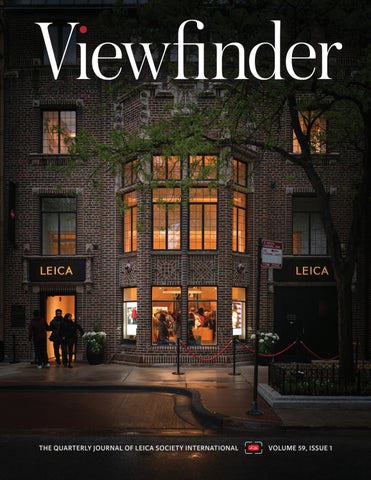
From Bill Rosauer and Jeffery Trilling's article "Leica Store and Gallery Chicago Grand Opening," pp 6-11, photo by Nathan Kellum-Pathe.
a letter from the editor
22 barnack’s desk
by Bill Rosauer
3
by Amitava “Chats” Chatterjee & David Stephens
letter from the president
28 skyelight
by William Fagan
4
by Ruth Oratz MD & Albert B. Knapp MD
remembrances of rolf fricke
36 fogg bags rejuvenated
by Ed Schwartzreich
6
by Jonathan Slack & Marke Gilbert
leica store: chicago
42 a most unusual light lens lab offering
by Bill Rosauer & Jeffery Trilling
12
leica sl3-p: all that matters by Amitava “Chats” Chatterjee
18
leica spring shoot tucson, az by Charlice Lin | NoctiGirl
by Ed Schwartzreich
52
engraved hektor by Jim Lager
54 batteries for leica m (type 240) by Jeffery Trilling
O F F I C E R S & D I R E C TO R S
Inquiries about membership, upcoming events, replacement Viewfinder issues, and special orders should be directed to:
Leica Society International 14070 Proton Road, Dallas, TX 75244
Viewfinder is the official publication of the Leica Society International, a nonprofit organization incorporated in the state of Delaware. Copyright 2025. Reproduction or use of any material contained herein without permission
It and other trademarks pertaining to the Leica System are the property of LEICA CAMERA, USA, INC or LEICA CAMERA AG. ISSN 1543-8732
Class of 2028 Continued
Class of 2026
EXEC.VICE PRESIDENT Robert Levite Coral Gables, FL
Sandra Eisert Redmond, WA
Hari Subramanyan Heidelberg, Germany
IMMEDIATE PAST PRESIDENT David Knoble Charlotte, NC
info@leicasocietyinternational.org
Leica is a registered trademark.
ELECTED DIRECTORS
VP / TREASURER Amitava "Chats" Chatterjee Manassas, VA
Colin McKinley, Executive Director
of the Society if forbidden.
PRESIDENT William Fagan Dublin, Ireland
Tom Fey Oxford, Ohio Wayne Goodman United Kingdom Jonathan Slack United Kingdom
PRESIDENTS EMERITUS James L. Lager Rolf Fricke, dec. Bill Rosauer
Class of 2027
EXECUTIVE DIRECTOR Colin McKinley Golden, CO
Marke Gilbert Royal Oak, MI
SENIOR DIRECTORS Gary Hough Woodinville, WA Douglas Drumheller Pittsburgh, PA Alan Weinschel Roslyn Heights, NY Brad Husick Medina, WA
www.facebook.com/leica.society
Ayash Basu Austin, Texas
Wilbur Norman Sante Fe, NM John Pegouske Dearborn, MI Class of 2028 Maura Allen Abiquiu, NM David Koppel Montreal, Quebec
@leicasociety
Kirsten Vignes Minneapolis, MN VIEWFINDER EDITOR Bill Rosauer Buffalo Grove, IL lhsaeditor@yahoo.com VIEWFINDER STAFF Kirsten Vignes Graphic Designer Minneapolis, MN Francesca Delaney Graphic Designer Rochester, NY Richard Rejino Associate Editor Dallas, TX Ed Schwartzreich Associate Editor Waterbury, VT Amitava "Chats" Chatterjee Associate Editor Manassas, VA James L. Lager Contributing Editor Closter, NJ
@leicasociety
1
2
VIEWFINDER · VOLUME 59, ISSUE 1
A LETTER FROM THE EDITOR by BILL ROSAUER
The
Grand Opening of the Chicago Leica Store and Gallery on April 30. It was quite an event, with a number of luminaries coming in from the Mothership in Wetzlar. Leica has done a fantastic job of making the Chicago Store a reality. You will all have the opportunity to see it yourself next Spring, when we meet in Chicago. I also had the opportunity to meet and spend some time with new CEO Andreas Voll, and I was very impressed with him. Jeff Trilling and I, who have spent our lives involved in the photographic scene here in the Windy City our entire lives, report on this event. In this issue, we have a report on the Tucson Spring Shoot by new contributor Charlice “NoctiGirl,” whom I met a few years ago at our Annual Meeting in Wetzlar. I really enjoyed her take on our LSI meetings, not so much about the actual event itself, but about the camaraderie and fun to be had at our meetings. In my mind, I went back to the meetings I attended as a newbie, meeting Leica luminaries and enthusiasts I had only read about. Her experience echoed my own. I always think of the Society meetings as the highlight of my year, and I was so glad to hear Charlice echo those sentiments. The Society has come a long way, and is much more inclusive and diverse these days and needs to be so to continue to grow. We are starting local LUG Groups, so this might be a great way to grow the Society as well. In this issue, we have an interview with Leslie (Ell) by Jono Slack, who is taking over at FOGG bags. I have been involved with FOGG since the mid-80’s when I was one of the few dealers for them in the U.S. I don’t want to admit to how many FOGG bags I own! A few years ago, they were so nice to provide me with a new set of personalized inserts for a bag I had acquired second hand. I was shocked to hear of bee’s passing and I am so happy to know FOGG is now in very good hands and that there is a future for these wonderful bags I still use. Chats article about Barnack’s Desk. Worked with David Stephens has been re-assembling the desk pictured in Julius Huisgen’s iconic photo of Oskar Barnack in his office in the Hausertorwerk on the Lahn in Wetzlar. Few people at Leica are even aware that this building still exists, let alone its importance to Leica’s history and Barnack’s story. I make a point to visit it every time I am in Wetzlar. Sounds like a good story for Viewfinder!
In this issue, we have a tribute to LHSA founder and President Emeritus Rolf Fricke by Ed Schwartzreich. Rolf was one of the first people I met at my first LHSA meeting, and over the years we became very good friends. Rolf was the MC of our annual meetings for many years, and was a sight to see dressed in his white tux at the banquet! One highlight at one of our annual meetings was when Rolf opened up his home and collection to us. It was absolutely incredible! Many of those items are now in the Archiv at Leitz Park, and its always a treat to see some of those pieces on a visit, each item identified with Rolf’s tags in his own unique handwriting. We miss you Rolf! Ed Schwartzreich writes about a new LLL lens, the 50/1.5 S21 Angénieux lens. Angénieux has been a name well known in photographic and cinema graphic circles for many years. As Ed points out, they have even made some lenses for the Leica system over the years. I think you will enjoy Ed’s story of why LLL decided to make this lens as part of their product line. Chats also has a special report on another new product from Leica, and we will be one of the first to report it here in Viewfinder. Dr. Albert Knapp and Ruth Oratz take us on a photographic tour of the Isle of Skye, Scotland. They have produced some incredible images with their Leicas of the dream like landscape there. Skye is well off the beaten path, and a place very few of us will ever get to see in person. Thank you Ruth and Albert for giving us this window on to such a seldom visited, yet beautiful spot. As we always try to do, we have a Jim Lager article on an engraved Hektor lens. We are also planning on having the story of Jim’s journey to Leica Store Manchester and the Archiv in Wetzlar with David Stephens. Looking forward to it! Bis nächste zeit, Bill
VIEWFINDER · VOLUME 59, ISSUE 1
A LETTER FROM THE PRESIDENT by WILLIAM FAGAN
DEAR LSI MEMBERS,
At
LSI we have just finished two successful meetings in Tucson and London. I would like to thank all who took part and all who were involved in organising and running those meetings. Such events do not just organise themselves and it takes a considerable effort on the part of many people to make them work. Our next meeting is in Detroit from 22nd to 24th October and the organizing team lead by John Pegouske and Marke Gilbert have done a tremendous job at organising an outstanding program for anyone who attends. Booking will open within a few months. Please consider joining us in Detroit where a warm welcome awaits you.
Our competition site is going from strength to strength and in April we had 36 colour and 36 monochrome images selected by our judge, Jono Slack. Jono has been working on our competition site along with VP Amitava “Chats” Chatterjee. Many of you may just think of Jono has the guy who does camera and lens reviews for new Leica products, but he is always a tower of strength on our Board. We have our first themed competition which was launched on 20th May and it will run to 20th of June. The theme is landscape, a very popular subject with photographers. Another feature of the competition site lsicompetitions.org is the growth of sections for Leica User Groups (LUGs) where we have 15 LUGs already in existence as follows:
AMERIC AS US Houston Washington New York San Diego Seattle Chicago Austin Pres
C ANADA Toronto SOUTH AMERIC A Peru EUROPE Austria
ASIA Tokyo Delhi Thailand MIDDLE EAST Qatar
There is room for more LUGs and for local organisers. The potential roles for the LUGs are a lot more than just running online competitions and we will shortly organise a Zoom with LUG leaders to discuss how these roles might be developed. If you feel that you would like to set up a LUG in your country or region, please contact our VP/Treasurer Amitava “Chats” Chatterjee at chatsphotog@chatterjees.com If anyone reading this is not already a member of LSI, please consider joining us in our society and its work. The future for LSI and Leica is bright. William Fagan President LSI
3
4
VIEWFINDER · VOLUME 59, ISSUE 1
Remembrances of Rolf Fricke by ED SCHWARTZREICH
Here is Oscar in Rolf ’s office, still filled with equipment, books and files.
I
had been attending LHSA/LSI Annual Meetings for about 10 years before I first really started to spend time with Rolf. I was one of a bunch, back then, of eager younger members, fully integrated into such things as writing for Viewfinder and having long, equipment-related sessions (“gotcha” sessions showcasing unusual Leica gear we had found since the last meeting) both at breakfasts and over beers. And always waiting for the trade show and the thought of finding something only slightly over our budgets to take home with us.
In 1999 the Society met in Schaumberg, IL, a major meeting attendance-wise. Lots to do. At the end of the meeting, I was in the hotel lobby with my suitcase and so was Rolf. He suggested we carpool in a cab to the airport. I had no idea why he chose me right then; to me Rolf was a somewhat formal, very senior and experienced collector and mentor, a founding member of both the German and U.S. Leica Societies, a friend to the Leitz family; I was somewhat in awe of him. But he couldn’t have been friendlier, and we had a nice conversation.
It was the winter of the next year, I think, that I got a phone call from Rolf, inviting me to join him and a few others at a Zeiss Historica meeting near NYC, where important presenters were going to speak about such people as Hubert Nerwin, designer of the Contax camera and his rescue via Operation Paperclip, and the life of Emmanual Goldberg, the founder of Zeiss Ikon, brutally kicked out of Germany in the early 1930s and went to Palestine to start what became the Israeli optical industry. Both of these stories were told by the sons of those important fellows. It was quite a unique experience and I really appreciated Rolf involving me. After that, Rolf invited my wife Julie and me to his home and put on quite a display: decorating the yard of his home with street signs (purloined under dead of night as they were about to be discarded the next day) from Wetzlar, his garage door open to show the Leica-themed license plates on his cars, and many other touches I no longer can remember (and unfortunately I have looked in vain for my photograph of this). He and Judith served us a pleasant light meal, and following this I was shown Rolf’s collection of rarities.
VIEWFINDER · VOLUME 59, ISSUE 1
articles). I think it was Jim Lager who directed me to Rolf about this. It turned out that Rolf knew personally several of the Leitz persons involved in this major project and had detailed files, or he had contacted and befriended the families of important Leitz figures no longer with us and received relevant materials. Rolf had massive files of all manner of things Leica and Leitz. I spent a weekend at Rolf’s home going over this history in great detail. I was fortunate not only for the hospitality of Rolf and Judith, but also to have permission to make an audio recording of our conversation—both to jog my memory when I got home, and to preserve what was for me a major moment in my own Leica journey.
Rolf and Oscar look at VIDOM issue where Barnack’s M875 exposure tester is described
After that through the years there were phone calls, involvement with Rolf’s book translations, some equipment trades and book sales between us. I saw Rolf again at many Annual Meetings and Spring Shoots, but never again visited until 2 years ago. Rolf was then 96 years old and his son Oscar had hoped we would visit. We spent an afternoon with Rolf and Oscar. Rolf was clearly aged, but was his affable, generous self. Oscar showed us through the still incredible Leica objects that remained after Rolf sold his collection to Leica AG, including new ones since that point. I took a few pictures for memory’s sake, knowing that this was likely the last time we would get together. It turned out that Rolf had placed COVID masks on the Leitz family busts—a typical touch for him! A unique and very special man.
The busts: starting with Barnack, Ernst Leitz I, Ernst Leitz II, the three Leitz sons (Ernst III, Ludwig, Günter), then Elsie Kühn-Leitz
For example, I got to put an Elcan 66mm f/2 lens on my M6. Copies were shown of some of Ernst Leitz II’s UR-Leica pictures from his 1914 trip to the U.S. (I was allowed to copy them with my R-D1 and a BOOWU I had brought along for the ride). Some tightly rolled film strips of unpublished material that Barnack had made were shown, along with the positive images that Kodak had produced from them. And unpublished images of Barnack at work also, one of which the public got to see finally when LHSA published Rolf’s English translation of Ulf Richter’s book on Barnack. And I got to handle a very rare early Leica. And as a coup de grâce, we were shown Rolf’s collection of busts of the Leitz family and Barnack in his upstairs hall! And Rolf happily told us of his history, including growing up in Brazil and his relations with the Leitz family. Quite an afternoon! Just a few years later, I was anticipating writing a presentation for our Annual Meeting on the history and the development of the M3, which project started in the 1930s and continued surreptitiously through the War. (Later this became a series of three Viewfinder
5
6
VIEWFINDER · VOLUME 59, ISSUE 1
LEICA STORE AND GALLERY CHICAGO GRAND OPENING by BILL ROSAUER AND JEFFERY TRILLING
Image of Chicago Store. Credit Nathan Kellum-Pathe
VIEWFINDER · VOLUME 59, ISSUE 1
L.
eica Camera Inc. just opened its Chicago Store and Gallery on April 30, 2026. Located in the heart of Chicago’s Magnificent Mile at 800 North Michigan Avenue, the store is guaranteed to be a draw for Leica fans everywhere when they are in America’s Second City. The new store is located just to the West of the Water Tower, one of Chicago’s most historic buildings and one of the few surviving structures of the Great Chicago Fire of 18710. Leica has been searching for over four years to find its new location and finally found a spectacular home in a historic building dating to 1917. No expense was spared to make this new Leica Store and Gallery the jewel in Leica USA’s crown! For two Chicago boys and lifelong Leica owners, dealers and enthusiasts like Jeff and myself, this was really something special.
Among the Leica luminaries on hand for the grand opening were Mike Giannattasio, President of Leica USA, Karin RehnKaufmann, Global Director of Leica Galleries Worldwide, her son and heir-apparent Max Kauffman, and Andreas Voll, Leica AG’s new CEO. The event was oversubscribed with over 1,100 RSVP’s, and the line outside stretched around the block.
Ribbon cutting ceremony, in spite of the rain. Credit Bill Rosauer
The Ribbon Cutting Ceremony was held outside at the front entrance to the store, and despite the inclement weather, was quite a memorable event. Leica certainly knows how to put on a show, and this one was a real crowd pleaser. Drinks and hors d’oeuvres were passed out in abundance
to the attendees. Fellow board members Amitava “Chats” Chatterjee and Marke Gilbert were here in town for the opening, and I ran into so many people; friends and former customers from my store that it was like a homecoming for me as well.
Interview with Craig Semetko by Karin Rehn-Kaufmann and Gallery Director Lucas Zenk. Credit Amitava "Chats" Chatterjee
7
8
VIEWFINDER · VOLUME 59, ISSUE 1
Store display area. Credit Amitava "Chats" Chatterjee
On the Main Floor, the retail space is devoted to the complete line of Leica products, from cameras and lenses, Leica accessories, binoculars, and the line of Leica watches. The front display counter mimics the shape of the classic M camera. There are beautiful display cases on the perimeter featuring all of these products in a modern setting. There is a coffee bar for store patrons, and behind this area, a comfortable private seating area devoted to Leica Cine projection products along with a nice selection of vintage Leica literature along with some vintage Leica screwmount cameras and lenses. Upstairs is an airy two-story space for the Leica Gallery, with three walls devoted to display of photographs by Leica photographers. There is also classroom space for the Leica Akademie. There is another bar area here as well for guests attending pho-
to talks by Leica photographers. The first guest speaker was our good friend Craig Semetko, who has been featured in Viewfinder and who was also a speaker at one of our annual meetings. Craig’s presentation was about his America Unposed images, and he had the rapt attention of the packed audience. Craig graciously signed numerous copies of his book for the attendees. I talked to Craig about doing a future article for us, and can’t wait to publish it. The featured speaker on Saturday was our own Jim Rice, who spoke about how photography had saved his life and helped him deal with his PTSD from the childhood trauma of his mother’s murder. On a side note, I have been working with a dedicated group of Leica Historians on identifying the locations Ernst Leitz II visited while on his Amerika Reise (America Trip) in 1914 with the Leica Ur
camera. These images are in the Leica Archiv in Wetzlar, and in reviewing them I realized there were many locations he photographed here in Chicago, as well as many other other locations between New York and Chicago! The Archiv calls these images the New York Reise, but I feel their name should be changed to the Amerika Reise. I pointed this out to Karin RehnKaufmann, and she was so impressed with these findings that she will have some of the images printed in Wetzlar for permanent display in the Chicago store to emphasize the connection to Chicago from Wetzlar for over 100 years. I will have an article about this in the next issue of Viewfinder, and we will also be serializing the findings of our historians comparing Ernst Leitz’s images from 1914 with their current locations in America. Stay tuned!
VIEWFINDER · VOLUME 59, ISSUE 1
Craig Semetko signing copies of his book for the audience. Credit Bill Rosauer
Credit Bill Rosauer
Jim Rice telling his own personal story of his mother's murder and his personal story dealing with his PTSD through photography. Credit Bill Rosauer
9
10
VIEWFINDER · VOLUME 59, ISSUE 1
HERE IS JEFF’S TAKE ON THE CHICAGO STORE OPENING: Chicago has always been a significant epicenter of fine art photography in the United States. Its deep-rooted origins can be traced back to the Bauhaus in Germany. Many books have been written about evolution from the new Bauhaus to the Institute of Design. The legacy of the early giants of photographic education in Chicago, such as László Moholy-Nagy, Harry Callahan, Aaron Siskind, and Walker Evans, lives on to this day in the photographic programs at The Art Institute of Chicago, Columbia College, College of DuPage, and many, many other thriving programs (both academic and amateur) scattered around the region. The same can be said about the Gallery and Museum Scene here in the “Windy City.” The photographic collections at the Art Institute of Chicago (one of the highest-rated museums in the World) and the Museum of Contemporary Photography are absolutely world-class. Chicago truly does have a thriving art and cultural “scene” equal to that of any major city in the world. Now, thanks to Leica, located right in the middle of downtown Chicago in a beautiful historic building (it is on the National Registry), adjacent to one of the most iconic landmarks in the city, my home town has a significant new addition to the photographic scene. This new Leica Store
and Gallery is just off Michigan Avenue, right behind the old Water Tower building. Centrally located in what is often referred to as the Magnificent Mile, this new destination location is also very close to other iconic destinations such as Navy Pier (which is now the ceremonial start of Route 66), the Museum of Contemporary Art less than a block away, and just down Michigan Avenue via an easy walk or a bus ride are the other major museums here in Chicago. This central location makes it attractive for both Chicago residents and tourists alike. I need to share some personal biases. I am a third-generation Chicagoan. Both my bachelor’s degree and master’s degree are from top-notch programs here in Illinois. For years, I owned/operated a small specialty camera shop on the North Side of the city, and for an even longer period, I was affiliated with a large format photographic equipment manufacturer/retailer headquartered in Chicago. In my own way, I have always been part of the local photographic community. Since I had access to my very first Leica cameras back in the 70’s, I have been using (and selling) Leica cameras. Traveling the world and doing personal photography is how I spend my life in retirement. Visiting various Leica stores as my wife and I travel around the world has become part of the fabric of our lives. My wife is a saint. She knows how much I enjoy these visits, and she
Chicago store and gallery, street view. Credit Amitava "Chats" Chatterjee
indulges me. Imagine my happiness and her dismay when we found out that Leica was opening a brand-new store, here in Chicago, right across the street from our apartment downtown! For me, visiting a Leica store is an experience that is more than just popping into a place to shop for a new piece of equipment. For me, a Leica Store is a little slice of home in another part of the world. I can step out of the sun, rain, heat, or cold, and
VIEWFINDER · VOLUME 59, ISSUE 1
find a little comfort space in a world I am familiar with. If it is hot, I get offered a cold bottle of water or even a nice cup of coffee. I can visit and chat with like-minded individuals. Browse the pre-owned equipment. Get a firsthand look at the newest Leica offerings and visit the gallery to see the latest show for inspiration. And sometimes I am even able to purchase that “hard-to-find” accessory or piece of “kit” that I have been looking for.
There will be eight new gallery shows a year, highlighting photography. Classroom space for a wide variety of educational programs. There will be meeting spaces. A library reading space. It will tastefully display all Leica products from Accessories to Watches. The new store in Chicago is spectacular. I have been lucky enough to see the store as it was being prepared to open, and it will be (in my opinion) a great asset to the Chicago Photographic com-
munity (and a wonderful place to shop for all things Leica). This new store will make it so much easier for users of our new online platform to conduct our LSI Chicago Chapter LUG meetings. The new Chicago Leica Store and Gallery is really a special place! Our advice; make the time and stop in to pay this new (or for that matter any of the other existing) Leica Store a visit. It will be time well spent!
11
12
VIEWFINDER · VOLUME 59, ISSUE 1
Leica SL3-P:
ALL THAT MATTERS by AMITAVA “CHATS” CHATTERJEE
Leica SL3-P frontal view. Note the absence of the iconic red dot Leica logo. Image courtesy Leica Camera USA.
Washington D.C., June 25, 2026: Editor’s note: In another first for LSI, following on the heels of our Leica M EV1 talk in Montreal, we are pleased to be able to coincide the release of a new Leica product with the publication of Viewfinder magazine. So, this announcement is literally “hot-off-the-press.” LSI is grateful for the trust placed in us by Leica Camera AG.
TL/DR: Leica Camera's new Leica SL3-P, a variant of its fourth generation Leica SL3 sibling, announced June 25, 2026, expands “its SL-System for performance-oriented photography and videography with the release of its most advanced full-frame camera to date” (Leica Press Release). It is equipped with a Leica-developed L bayonet mount, a new, custom-developed 44MP BSI-CMOS sensor with triple resolution technology that pushes out gorgeous 44MP image files “with the fastest readout rate of any Leica sensor, up to 156% faster than the SL3-S sensor,” 14 stops of dynamic range, ISO200,000 light sensitivity and Leica's current Maestro IV processor. It has a fast hybrid autofocus system with 819 focus
points and is built for action thanks to “the fastest continuous shooting in the Leica full frame lineup at 40fps, fully supported by advanced autofocus tracking.” Continuing a long heritage, Leica SL3-P builds on the successful Leica SL platform introduced on October 10, 2015, and possesses several refinements resulting in an elevated experience. Not surprising, Leica SL3-P has “robust IP54 weather sealing, for image making in the most challenging of environments.” In the words of Mike Giannattassio, President, Leica Camera Americas, “the Leica SL3-P represents the distillation of camera features down to “all that matters.” Please note: since I received a pre-production camera, images shot with Leica SL3-P shown herein may not fully represent final image quality.
S
ince the embargo has been lifted as of June 25, 2026, 9:00 a.m. US Eastern Daylight Time, I can share that Leica Camera privately briefed me on the Leica SL3-P. I subsequently received one in mid-June running pre-production firmware. I was able to take it through its paces but did not attempt scientific tests. I just went shooting, spending time at home, Baltimore, Washington D.C., and Gravelly Point, Virginia. I also spent a brief afternoon with it in Occoquan Virginia, where I was able to get some kayakers in the Occoquan River.
VIEWFINDER · VOLUME 59, ISSUE 1
Focus Tracking mit AF Detection Human (Eye/Face/Body. Leica SL3-P und Leica Vario-Elmarit SL 1:2.8-4.0/90-280mm ASPH.
Focus Tracking mit AF Detection Human (Eye/Face/Body. Leica SL3-P und Leica Vario-Elmarit SL 1:2.8-4.0/90-280mm ASPH.
Focus Tracking mit AF Detection Animal Eye/Body. Leica SL3-P und Leica Vario-Elmarit SL 1:2.8-4.0/90-280mm ASPH.
Focus Tracking mit AF Detection Animal Eye/Body. Leica SL3-P und Leica Vario-Elmarit SL 1:2.8-4.0/90-280mm ASPH.
Physically speaking, the Leica SL3-P is similar to its Leica SL family siblings save for a few observable changes introduced with the Leica SL3 and carried over to the Leica SL3-S, including the push button on-off switch. Control buttons remain on the right of the touch screen, and a control dial is to the left of the flash hot shoe. As before, the touch screen articulates and pops out (Leica Q3 owners will instantly recognize this), can be angled, and allows one to shoot from the hip without engaging in stressful Yoga poses. I have been extremely busy with work and forgot to take pictures of the camera. Leica Camera very kindly provided me with images which I am reproducing below (plus, their product photography is definitely better than mine!). Leica SL3-P rear view. Image courtesy Leica Camera USA.
13
14
VIEWFINDER · VOLUME 59, ISSUE 1
Internally, the Leica SL3-P sports a newly custom-developed tri-resolution BSI-CMOS sensor pushing out 8144x5424 pixels for 44MP of resolution, compared to the Leica SL3 at 9520x6336 pixels for 60MP of resolution. A burst shooting rate of 40 fps coupled with 819 focus points and tracking modes for Eye, Body/Eye, Animal, Animal/Eye, Car and Car/Part allow you to capture decisive moments with confidence. High-speed Continuous mode with AF tracking works really well. Here are a few examples using 15 fps drive mode plus Focus Tracking Human (Eye/Face/Body).
As a licensed pilot, I love aviation and airplanes and wish there was an OOTB Airplane mode (tee tee) as well...but Car worked fine. Here are a few examples using Focus Tracking plus Car mode, Human and Animal. 819 focus points and focus tracking across different modes really work quite well.
Focus Tracking mit AF Detection Car. Leica SL3-P und Leica Vario-Elmarit SL 1:2.8-4.0/90-280mm ASPH.
Drive Mode 15fps + Focus Tracking mit AF Detection Human (Eye/Face/ Body). Leica SL3-P und Leica Vario-Elmarit SL 1:2.8-4.0/90-280mm ASPH.
VIEWFINDER · VOLUME 59, ISSUE 1
Leica SL3-P articulated rear screen showing the video mode controls. Image courtesy Leica Camera USA.
Photographers familiar with the Leica SL family will instantaneously take to the new Leica SL3-P. In addition to its photographic prowess, Leica SL3-P also records 8K movie capabilities (which I did not test). In keeping with family commonality (a European “thing,” a la Airbus? A very good idea and I applaud Leica for it), the Leica SL3-P will function with the batteries that power Leica SL and Q family cameras, but in order to take maximum advantage of everything offered by this new imaging platform, one must use the same-sized/shaped BP-SCL6 battery. Leica SL3-P accepts SDXC II and CFexpress Type B memory cards for image storage. It is worth buying the fastest cards you can afford in order to get speedy writes and reads.
FOTOS integration is fast, accurate with GPS tags, and a joy to use. Communication with the Leica FOTOS app allows one to employ an in-field workflow and share images on the go. Image transfers using FOTOS are lightning fast and so usable. Geotagging works extremely well too. Kudos, Nico, for your incredible efforts here. I have been beta-testing the FOTOS app for several years now and it is incredible to see the great work Nico and team are putting into making the app really useful. Seen below is a screenshot from the Adobe Lightroom Maps module for some of the pics I took in Baltimore, Maryland. Love this feature.
I own an SL body and am very picky about when to use it. Leica SL3-P has a similar size and weight (slightly smaller and lighter) and still feels solid. I would use it when I needed autofocus capabilities at an air show or Formula One race, for example. I have no hesitation taking it out in inclement weather. I have had freezing rain fall on my Leica SL2 and gouged it off to use the shutter and would not hesitate to take the Leica SL3-P out in similar conditions either.
Screenshot from Adobe Lightroom showing geotagged images courtesy Leica FOTOS integration.
15
16
VIEWFINDER · VOLUME 59, ISSUE 1
Closing Thoughts on the Leica SL3-P Leica's foray into the SL family began with the Leica SL Typ601 in 2015. I waited until 2019 to get one of my own, having grown immensely comfortable with the weight to image quality ratio of the Leica M bodies. Once I got it, I grew to love it. I was sad when in-camera GPS was taken away in the Leica SL2 but FOTOS integration erased that sadness. I got the Leica SL2 on launch day and still enjoy using it. I could easily see myself using a Leica SL3-P in situations where I have used the Leica SL2. However, I tend to prefer images that come out of Leica M cameras and lenses—personal preference maybe, but it is what it is. Now that I got that out of the way, would I get a Leica SL3-P? Absolutely. Everything in life is about choices, and choices have tradeoffs. What are the tradeoffs with the Leica SL3-P? It possesses “All That Matters,” no tradeoffs as far as I can tell, and many benefits:
1. EXCELLENT IMAGE QUALITY, thanks to the 44MP resolution and the trusted, well-tested excellent optics of the Leica family of L-mount lenses. Very suitable for standard situations, dimly lit rooms, portraits, food, etc. but also great for focus tracking fast moving subjects such as cyclists, planes (no Airplane Mode yet), animals and more. High speed continuous shooting works well with focus tracking enabled.
2. SNAPPY PERFORMANCE thanks to Leica's Maestro IV processor. Incredible focusing and tracking thanks to the various tracking modes and 819 focus points.
3. RELIABLE FOTOS INTEGRATION that allows for effortless geotagging of images, speedy file transfer to iPhone and all the benefits thereof including export to Lightroom or your image editor of choice.
4. TILTABLE REAR TOUCH SCREEN adds a lot of benefits (and avoids Yoga poses too!).
5. SIMILAR MENU that invokes shades of other SL and Q cameras resulting in a very short learning curve.
6. MATCHING PHOTOGRAPHIC QUALITY—LEICA SL3-P images possess the signature Leica Look with detail and micro-contrast afforded by manual aperture control. In addition, Leica Looks can be applied in-camera or in Leica FOTOS.
7. WONDERFUL ACCESSORIES like the handgrip.
Focus Tracking mit AF Detection Animal Eye/Body. Leica SL3-P und Leica Vario-Elmarit SL 1:2.8-4.0/90-280mm ASPH.
VIEWFINDER · VOLUME 59, ISSUE 1
Where can I see additional sample images from the Leica SL3? Please visit my site www.chatsphotog.com, and also check out my Instagram as well. I will keep adding to this collection over the next few days. One more thing Before I forget, please check out Jono Slack’s superb review on www.slack.co.uk. Jono is a personal friend, and he, along with Dr. Andreas Kaufmann, Bill Rosauer, Craig Semetko, Hari Subramanyam, Evris Papanikolas, Marke Gilbert, John Pegouske, and countless others are why I feel blessed to be in our global Leica Camera Family. I can't wait to meet them, and all of you, at a Leica event one of these days. Finally, immense gratitude to Mike Giannattassio, Nathan Kellum and Werner Paul for their support and bearing all my requests with a smile. Thank you!
mit freundlichen grüßen, Chats aka Chatsphotog chatsphotog@chatterjees.com
Amitava “Chats” Chatterjee (“Chatsphotog”) is very active as a Leica Ambassador. Vice-President and Executive Council board member of Leica Society International, published in The Viewfinder and is its Associate Editor/proofreader-at-large. He recently launched lsiconnect.org—LSI's global online digital connections platform, aided by Jono Slack and an amazing group of beta testers. Chats frequents various Facebook Leica Photography groups and believes he is the founder of the Instagram hashtag #Chasing Leitz. You can find him at www.chatsphotog.com, Facebook (@Chatsphotogpilot), Instagram (@Chatsphotog) or Medium (@Chatsphotog). You can also buy him a coffee!
17
18
VIEWFINDER · VOLUME 59, ISSUE 1
Leica Society Spring Shoot Tucson, AZ by CHARLICE LIN | NOCTIGIRL
Group photo in Tombstone, AZ. Photo by Colin McKinley
IT’S ALWAYS ABOUT THE PEOPLE
A
dmittedly, I haven’t been an LSI member for very long, maybe two or three years now. My first event was in Rome back in 2023. It was a smaller gathering, but I had such a great time and met so many wonderful people that I’ve been coming back ever since.
When my good friend Robert Chesrow first told me about LSI many years ago, I’ll be honest, my first thought was: What could someone like me possibly have in common with the people of LSI? I was happily proven wrong.
At every event, I’ve been warmly welcomed. In past years, I’d see Richard Rejino’s friendly face greeting me as I arrived, usually followed by one of his warm hugs. I’d reconnect with familiar faces from previous events, meet members attending for the very first time, and somehow, regardless of where in the country or world we happened to be, we’d all immediately bond over the same things: photography, curiosity, storytelling, and of course, Leica. That’s what I’ve come to love most about LSI. It’s never really just about the cameras.
VIEWFINDER · VOLUME 59, ISSUE 1
SO…WHY TUCSON? And Tucson was no different. When I first heard the location announcement, I remember thinking, Tucson?! Why Tucson? What’s in Tucson?? But I understood almost immediately after arriving. For those of us coming from large urban cities like Los Angeles, Tucson felt refreshingly different. The giant cacti, dusty roads, old signage, western storefronts, and endless desert skies gave everything a quiet nostalgic feeling. It felt cinematic in a way that’s difficult to explain unless you’ve experienced it yourself. LSI always does a wonderful job choosing locations that not only encourage photography, but also encourage exploration.
There’s also something comforting about discovering a new place alongside a group of people who are just as excited to wander around with cameras in hand as you are. The informal meet-and-greet on the night before the official start of the event immediately brought the energy up. This year, Colin McKinley welcomed us warmly as photographers gathered together for cocktails, conversation, and of course, a bit of friendly gear showing-off. Leica people will always find a way to casually place a beautiful camera, or three, on the table “by accident.” And honestly, that’s my kind of people.
Pre-Conference Informal Meet & Greet. Photos by Charlice Lin | NoctiGirl with Leica MP and 35mm Noctilux.
19
20
VIEWFINDER · VOLUME 59, ISSUE 1
Later that afternoon, we made our way to Tombstone, Arizona. Walking through Tombstone honestly felt like stepping onto the set of an old western film. Wooden boardwalks, historic saloons, dusty streets, and actors dressed as gunslingers made the entire town feel like a photographer’s playground. Tombstone turned out to be one of those places where even walking from one corner to another somehow took twenty minutes because everyone kept stopping to photograph something. We watched a fun western performance and were even given the opportunity to photograph the actors afterward in full costume. Everywhere you looked, there was another interesting face, texture, shadow, or scene waiting to be photographed.
A horse-drawn stagecoach waits along the streets of Tombstone, AZ. Photo by Charlice Lin | NoctiGirl with Leica MP + 35mm Noctilux
STORIES OF THE WEST Day one officially began with welcoming remarks from EVP Bob Levite and Executive Director Colin McKinley, before we were introduced to the fascinating work of photographer Maura Allen. Her black-and-white rodeo photos revealed a side of America that many of us have probably only seen through old western films. There was grit, movement, tradition, and humanity in her work that made the rodeo world feel deeply alive. I was especially fascinated by her mixed-media process, where photography merges with screen-printing, printmaking, and even glass work to create something entirely unique. We then enjoyed the travel photography and stories of Pam Perkins, who brought a completely different kind of energy to the room. Beyond the beautiful images, what stayed with me most was her reminder to approach strangers with genuine curiosity and kindness. People can sense intention, and often, the best photographs happen after a real human connection is made.
Portrait of a Native American man in traditional regalia, Tombstone, Arizona. Photo by Charlice Lin | NoctiGirl with Leica MP + 35mm Noctilux
PHOTOGRAPHY IN ALL FORMS Day two began with photographer Bill Royce sharing his beautiful black-and-white photographs of the Southwest, along with a thoughtful look into his post-processing workflow. As
VIEWFINDER · VOLUME 59, ISSUE 1
photographers, we often spend so much time discussing gear that it’s refreshing to hear artists openly discuss the emotional and technical decisions that happen after the shutter is pressed. We then heard from award-winning photojournalist Rudy Gonzalez, whose work ranged from vibrant travel imagery to the heartbreaking documentation of Columbine. Seeing such different worlds exist within one photographer’s career was a reminder of photography’s unique ability to preserve both beauty and history. One of my favorite additions to this year’s event was the very first LSI Member Showcase, where three members shared their work and personal perspectives. What I enjoyed most was seeing how differently each person approached photography. Different styles, different personalities, different ways of seeing the world, yet somehow all connected through the same love of image-making. That afternoon, we visited the Center for Creative Photography at the University of Arizona. Founded in 1975 through a collaboration between University President John Schaefer and Ansel Adams, the CCP has grown into one of the most important photographic archives in the world. During our visit, we were able to enjoy the work of Rollie McKenna, whose portraits and architectural photographs carried a timeless elegance that felt perfectly at home in Tucson. But the evening visit to Wayne Martin Belger’s studio, “The Diaper Factory,” may have been one of the most unforgettable experiences of the trip. Wayne and his partner Alanna welcomed us into a fascinating creative space that felt somewhere between an artist’s workshop, a laboratory, and a mad scientist’s darkroom. Wayne shared his process of building large-format cameras by hand using materials ranging from semi-precious stones to relics, human teeth, organs, and talismans. Everywhere you looked there were tools, machines, photos, sculptures, and strange objects with stories attached to them. It was chaotic, inspiring, and completely unforgettable in the best possible way.
ONE LAST WALK AROUND THE ROOM Day three opened with the nostalgic work of Jim Rice, whose longterm documentation of Chicago Avenue beautifully captured the quiet details, people, and places that shaped his memories growing up in the late 1950s and early ‘60s. His presentation was followed by photographer and mountaineer Cira Crowell, who shared breathtaking black-and-white images created while trekking over 2,000 miles through some of the harshest and most extreme conditions on earth. Hearing her speak about years of using the Leica SL system while mountaineering in the Himalayas was both inspiring and slightly terrifying.
Wayne Belger’s studio. Photo by Colin McKinley
The afternoon brought one of my favorite traditions at every LSI event: member image sharing. I always love this part because it reminds me that even when we all photograph the same locations during the same trip, everyone still comes back with completely different images. Different eyes notice different things. Some photographers are drawn to people. Others to light, architecture, humor, or quiet moments. I think there’s something beautiful about that. And then suddenly, somehow, it’s already the final banquet. That part is always a little bittersweet for me. It’s usually the last opportunity to really spend time with people before everyone heads home the next morning. As I walked around the banquet hall one last time, I said goodbye to the wonderful Bob and Joanne Levite. I hugged the sweet and elegant Julie. I waved over at Colin and Pauli in the middle of a conversation. I gave Scott a hug while he was getting one more serving of ice cream. Small moments, really. But those are the moments I remember most afterward. By the end of every LSI event, I’m reminded once again that photography communities are important not simply because they help us become better photographers, but because they bring people together who genuinely enjoy seeing the world with curiosity and enthusiasm. As I said earlier, it’s always about the people. And I already can’t wait for the next event.
21
22
VIEWFINDER · VOLUME 59, ISSUE 1
Reconstructing a Mind at Work BARNACK’S DESK– A LABOR OF LOVE, TWO YEARS IN THE MAKING AMITAVA “CHATS” CHATTERJEE IN CONVERSATION WITH DAVID STEPHENS, LEICA STORE, MANCHESTER U.K.
Oskar Barnack at his desk. 1934.
VIEWFINDER · VOLUME 59, ISSUE 1
S.
everal years ago, in Luton, Bedfordshire, U.K., David had the opportunity to purchase the home workshop of Alan Clark, a Leitz Camera technician and latterly workshop manager who joined the company in the golden years of the early 1960’s in Mortimer Street, London and retired after some 40 years in 2005 from Leica, Milton Keynes.
The chance to acquire what would turn out to be one of the most historically important collections of factory repair tools, test equipment and items saved from the skip (the act of rescuing discarded items) was something not to be passed. David had no idea what he was going to find, with thousands of spare parts and tools from the pre-war Wetzlar factory and long-forgotten accessories appearing from box after box. A treasure trove of items that would have been lost had Alan not saved them. His work ethic was not to throw anything away, so many thanks, Mr. Clark. There was no master plan. No checklist. No declared outcome, but David vividly remembered the famous photograph of Oskar Barnack’s desk, and the germ of an idea formed in his mind. That famous picture was not simply that of the Master at his workspace. It was a portrait of thought. The tools. The magnifying glass. The quiet order beneath apparent disorder. The tools of a man solving problems with his hands and his eyes.
THE PICTURE The date was Monday, November 19, 1934, and Barnack would have been busy working at his desk in Leitz Camera’s Hausertorwerk
Leitz’s Hausertorwerk Facility. Copyright Bill Rosauer.
facility on the banks of the Lahn River in Wetzlar. Ernst Leitz II had acquired the facility in 1921 to support his expanding business. In 1934, the Leica IIIa which was in development and was a critical year for Leica! At that point in Leica history, Oskar Barnack was already one of the most influential engineers in photography. Barnack had joined Ernst Leitz in Wetzlar in 1911 and created the revolutionary “Ur‑Leica” prototype around 1913. By adapting 35mm cinema film for still photography and establishing the 24×36 mm frame format, he laid the foundation for the modern compact camera. His guiding principle was famously summarized as “Small negative–big picture,” a concept that transformed photography by making cameras portable and capable of capturing spontaneous moments. According to research provided by our member Alan Stokes, this famous photograph of Barnack at his desk, likely on the second floor of Hausertorwerk (as quoted in a Viewfinder 28-1 article by Emil G. Keller), was taken by Julius Huisgen at Ernst Leitz II’s request. Huisgen used a tripod, 50mm lens and Perutz film with a flash bulb. Interested readers can read more about Julius Huisgen by referring to Viewfinder 11-1 page 7 onwards. You may be also interested to note that Julius was a guest speaker at the then LHSA’s 1977 conference. This photo became the inspiration…David’s initial question was disarmingly simple: Could I find these things? Not replicas. Not “similar.” The same kinds of objects, of the same era, character, and intent.
23
24
VIEWFINDER · VOLUME 59, ISSUE 1
THE FIRST OBJECT The telephone caught his attention first. It sits in the photograph almost apologetically, yet unmistakably present. After a period of searching, he found an identical model on eBay. The price—€300 —gave him pause. Then he bought it. That moment, he says, was when the project quietly committed him. “Let’s crack on” he thought—still without knowing “why”.
NO END GAME REQUIRED At no point did David decide what the finished work and outcome would be. It might be sold. It might be kept. It might be permanently assembled, each object fixed in place so the desk could never again be disturbed - an archaeological moment suspended in time. Or it might simply remain a challenge: identifying what belonged there in the first place. That challenge proved formidable. Some elements were straightforward. The inkwell—he made himself. The camera that sat on the desk—he sourced one. Bottles bearing the Leitz name emerged from obscure listings and private collections. Gradually, the lamp appeared. The telephone took its place. The desk itself began to assert its identity. Other objects resisted easy answers.
THE DISCIPLINE OF GUESSWORK Lenses appeared—some genuine, some dummy examples. A Leica I pressure plate surfaced: the original circular version that fits inside the camera body, without a film hole. Then another version. Which one belonged? Which was correct for that desk, at that moment in Leica’s history?
were assembled and refined directly in the Leitz workshops while Barnack tested film stocks, shutter mechanisms, and optical performance in real-world conditions. This was not forensic reconstruction. It was empathy.
THE INTERNET AS ARCHIVE One revelation surprised David more than any individual object: how much of this material still exists. Scattered across the Internet—auction sites, specialist forums, forgotten inventories—were fragments of a working life from a century ago. The tools of experimentation. The byproducts of iteration. The physical evidence of a mind in motion. The hardest part, paradoxically, was the first object. Once found, the rest began to reveal themselves. Each acquisition sharpened the eye for the next. Momentum took over. The desk ceased to be a collection and became a presence.
WHAT ITEMS HAS DAVID SOURCED THUS FAR? By David’s own admission, the famous photo has approximately thirty items on it, of which he has collected around twenty. Let’s delve into the top five items of significant historical value and interest to our readers here. First, a look at the current state of David’s dedicated work to rebuild Oskar Barnack’s desk: Now, let’s take a closer look at some of the items David has managed to collect!.
There were no definitive answers— only informed judgment. David describes the process as “disciplined guesswork”: research layered with intuition, guided by the logic of a working engineer rather than the rigidity of a catalog. This approach mirrors Barnack’s own working style. Historical accounts describe him as a practical engineer who relied heavily on experimentation and iterative prototyping rather than rigid theoretical planning. Early Leica prototypes
Barnack’s Desk by David Stephens, circa 2026 March.
VIEWFINDER · VOLUME 59, ISSUE 1
Siemens and Halske Model ZB.06. Copyright David Stephens. The Ink Blotter. Copyright David Stephens.
Precision Tweezers closeup. Copyright David Stephens. Precision Tweezers. Copyright David Stephens.
I.
THE TELEPHONE—prominently situated just behind Bar-
nack’s left forearm, the telephone was located after an extensive search, and David purchased the identical model from an online seller in Germany. It is a Siemens and Halske Model ZB.06 from the late 1920s. Early twentieth‑century workshop telephones like the Siemens & Halske models were common in German engineering environments. Siemens & Halske, founded in 1847, had become one of Europe’s dominant electrical engineering companies by the 1920s. Their telephones were widely used in industrial facilities including precision manufacturing environments such as the Ernst Leitz works in Wetzlar. Telephones of this type would likely have connected directly to the Leitz internal factory switchboard in Wetzlar, allowing engineers and machinists to coordinate work between optical design, machining, and assembly departments.
II.
THE TWEEZERS—very useful for picking up the hun-
dreds of tiny screws that make up our Leica cameras, but you, dear reader, might think these were easy to find and yes, as
it turns out, a perfect set was hiding at the back of a drawer full of tools. Not any old tweezers but a beautifully aged brass example stamped “AA”. Such precision tweezers were indispensable tools in the Leitz workshops. Camera assembly required careful manipulation of miniature screws, springs, and shutter parts, often measured and fitted with extremely tight tolerances.
III.
THE INK BLOTTER—This was a challenge. First, what
the hell was it, lying at the rear corner of the work desk, hidden behind the lamp and inkwell? There was the clue, a period spring roller ink blotter. This took the longest to find, eventually turning up on Etsy, sitting in France and patiently awaiting its place in Leica folklore. Before the widespread adoption of ballpoint pens after World War II, engineers relied heavily on fountain pens. Ink blotters were common tools used to dry technical notes, sketches, and engineering calculations
25
26
VIEWFINDER · VOLUME 59, ISSUE 1
IV.
THE FETT CAN—Amongst all the boxes were five of
these metal tins filled with grease (“Fett” in German) of varying viscosity, used to lubricate helicoids and the like. The odor is somewhat overpowering but the can takes its place at the center of his desk, sealed tight. Lubrication was critical in Leica design. Precisely machined brass helicoids and shutter assemblies required carefully formulated greases to ensure smooth focusing and reliable shutter operation across different temperatures. Now you know why your lens turns so smoothly, as though sailing on melted butter!
V.
THE LETTER—Correspondence played a significant role
in engineering work at Leitz. Engineers frequently exchanged letters regarding prototype testing, component suppliers, and mechanical tolerances during the rapid camera development period of the 1930s. unfortunately we are unable to decipher the contents of the letter on Barnack’s desk. Alas, the Peter Karbe-designed optical marvels and high sensor resolutions of today were non-existent back then. However, David did find some printed German text and folded/creased the sheets of paper in a manner to mimic the papers on his desk, as shown below.
VI.
THE LEICA IIIA—another gem that surfaced from
VII.
THE PIX—According to Bill Rosauer, our Viewfinder
one of the many boxes in Alan Clarkes’ workshop, and what a coincidence since Barnack’s desk was photographed in 1934 when the Leica IIIa was in development. The Leica IIIa, commercially introduced in 1935 following its 1934 development period, was the first Leica camera capable of a 1/1000 second shutter speed. This represented a major advancement for action photography and bright daylight shooting and marked one of the final Leica models developed under Barnack’s direct supervision.
Editor, who has done a ton of research on the Leitz family, Barnack, Berek and Leica Camera’s rich history, Barnack rarely used an ink pen. Most of his notes in Bill’s possession were in pencil—a Bleistift to be specific—a proper mechanical pencil an engineer would use. Barnack being Barnack, the voracious inventor that he was, even designed a pencil that went on to be produced by Montblanc, branded the PIX. Barnack worked on this with a fellow employee at Zeiss back in the day, with a unique system for the lead. Interested readers can check out Bill’s Viewfinder article and LSI blog post on this.
The Fett Can. Copyright David Stephens. PIX Mechanical Pencil designed by Oskar Barnack. Copyright Alan Stokes.
The Letter. Copyright David Stephens.
VIEWFINDER · VOLUME 59, ISSUE 1
Leica IIIa. Copyright David Stephens.
WHEN IS BARNACK’S DESK BY DAVID FINISHED? David believes there will come a moment when nothing more needs to be added. Not because everything possible has been found, but because the desk will feel complete. Balanced. True. Until then, the work continues—not driven by perfection, but by respect. In reconstructing Barnack’s desk, David has done something quietly radical: he has shifted focus from the camera as artifact to the conditions that made it possible. The tools. The experiments. The unglamorous objects that enabled one of photography’s most enduring revolutions. It is, in the end, not a display of objects at all. It is a labor of love— and a reconstruction of how ideas become reality. What will become of this labor of love? Perhaps it is best to leave it as it was then, oil-stained, dusty and untidy. The desk of a master inventor whose main goal was the end game—not worrying about process and uniformity.
In many ways, David’s reconstructed desk represents more than a historical curiosity. It captures the working environment that produced the Leica—a camera that transformed photography from a slow tripod‑bound process into a portable tool for capturing life as it unfolds. The Leica became the camera of early photojournalists and documentary photographers, shaping modern visual storytelling. Deep gratitude to David Stephens, Bill Rosauer, Alan Stokes and Ed Schwartzreich for their contributions to this article. Amitava “Chats” Chatterjee ("Chatsphotog") is very active in the global Leica community. A Leica Society International Executive Committee board member, he is published in The Viewfinder and its Associate Editor/proofreader-at-large. He frequents various Facebook Leica Photography groups and believes he is the founder of the IG hashtag #ChasingLeitz. You can find him at www.chatsphotog.com, Facebook(@Chatsphotogpilot),Instagram (@Chatsphotog) or Medium (@Chatsphotog). David Stephens is Managing Director, Leica Store Manchester, England. His fantastic store offers retail, Leica Akademie, tours and classes. I can't wait to visit him some day.
27
28
VIEWFINDER · VOLUME 59, ISSUE 1
Skyelight by RUTH ORATZ MD & ALBERT B. KNAPP MD
It
is a very old word—sky—perhaps derived from the ancient Herbrew shamayim, heaven-sent, or the old Norse skuggi for shadow, or Proto-Germanic skeujam which means cloud covered. In English sky is the celestial sphere above the Earth, concentric to our planet in which the sun, moon, planets, and stars appear to be drifting and circling, at times revealed, at times concealed. So it is on Skye. The Isle of Skye beneath this ever-changing sky is shaped like a bird and its name may come from skitis, an early Celtic word for winged, describing how the island's peninsulas radiate out from a mountainous center shaped like large bird skittling off into the sky. Perched beside the northwest coast of Scotland, the island hovers beneath the sky, pierces the sea, is shrouded in mist, battered by winds and rain, but remains rock steady like a strong bird in the gale.
We came to Skye in November in a year when there was already little tourism and long after whatever visitors may have ventured to this place were gone. We were here to experience Skye in her raw and natural beauty, sparsely populated, nearly treeless, wildly exposed. As photographers we were accustomed to chasing light —but on Skye this became even more daunting. The weather here consists of little more than rain and wind. The sky hung low, dense clouds hid the tops of the Cuillin mountains, rain softened the little available sunlight. Rising early, we hoped for a shot of a rosy sunrise and waiting until evening, dreamed of a fiery sunset. Anytime the light shifted from dull grey to blush or canary or lilac felt like a gift. But this only enhanced our awesome experience of the majesty and grace of the Isle of Skye.
VIEWFINDER · VOLUME 59, ISSUE 1
Albert was photographing with his new kit. The Leica SL2 replaced his retired S (Typ 007), allowing for more flexibility because of the lighter overall carrying weight, IBIS (In-Body Image Stabilization) and superior optical reach with three peerless zoom lenses extending from 16mm to 280mm. The SL2 system was a great liberation after years of working with the medium format load of the S cameras. Albert was concerned about the ultimate quality of the images—but quickly realized that the SL2 renders stunningly high-quality photographs and afforded him greater freedom of movement and more opportunity for creative exploration.
Ruth of course had her Q2—but on this trip also worked with the Q2 Monochrom, perfect for the inclement weather and ideal for the soft subtle light on Skye. Intent on never carrying anything heavy, not relying on tripods or gadgets, and wanting maximum ease and flexibility, Ruth was comfortable with both Q2 cameras around her neck, hiking and climbing, in all conditions and on rough rocky and slippery terrain.
29
30
VIEWFINDER · VOLUME 59, ISSUE 1
Skye is the largest and northernmost of the Inner Hebrides islands. It is 1,656 square kilometers (639 sq mi) of jagged coastline, knife edged mountains, glinting lochs and boggy moors. Skye is home to 12 Munros, mountains taller than 3,000 feet, named in honor of Sir Hugh Munro who catalogued them. The Munros boast some of the most challenging ascents and dramatic landscapes in all of Scotland. The Scottish Mountaineering Club has listed 282 Munros and each year duly publishes the names of those who have summited all the peaks. The Black Cuillin range spans 11 km in length and contains 11 Munros. Formed 60 million years ago, they are the remains of eroded magma from huge oceanic volcanoes, and are composed primarily of hard rough gabbro rock along with softer basalt, sculpted over the millennia by wind and water. We came up against the Cuillins again and again. On our first early morning we set out to the Quiraing, a massive landslip of high cliffs and hidden plateaus. It was nearly impossible to walk up; clouds and drizzle obscured the sharp summits, gusts and gales pushed against us, a gentle light turned the verdant moss to velvet underfoot. Figure 1 & Figure 2
As we traveled around the island, we learned of the rich history and ancient lore that imbued these stones and waters. Sligachan is truly a magical place on Skye. Figure 4 Myth tells that Scáthach, the greatest woman warrior of Scotland, lived at Sligachan. Cúchulainn, a renowned Irish warrior came to do battle with her in order to prove who was strongest. As the combat raged, with no end in sight, Scáthach’s daughter cried out to the faeries who live in and around the waters of Sligahan. The faeries told her to dip her face in the river so that she would gain the knowledge as to how to end the battle. She did and learned that by throwing aromatic herbs and nuts onto the hearth fire in preparation of a sumptuous meal, that the warriors would smell this, realize how weary they were of fighting, and lay down their swords. Scáthach and Cúchulainn broke bread together and made peace. It is said now that the waters that rush in Sligachan are enchanted and that if you wash your face in its icy drops you will gain eternal beauty and infinite knowledge. As we stood amid the rushing rapids, we felt the power of courageous warriors. The cool spray on our own skin was a reminder of the enchantment of Sligachan. Figure 5
Figure 1 (above): QUIRAING, ISLE OF SKYE, SCOTLAND. Leica SL2 Vario-Elmarit-SL 24-90mm f/2.8-4 ASPH @ 72mm, f/3.8, 1/160 sec, ISO 1600.
Figure 4 (following page, top): SLIGACHAN RIVER & CUILLIN HILLS, ISLE OF SKYE, SCOTLAND. Leica SL2 Vario-Elmarit-SL 2490mm f/2.8-4 ASPH @ 29mm, f/13, 1/5 sec, ISO 100.
Figure 2 (previous page): QUIRAING, ISLE OF SKYE, SCOTLAND. Leica SL2 Vario-Elmarit-SL 24-90mm f/2.8-4 ASPH @ 38mm, f/3.8, 1/200 sec, ISO 1600.
Figure 5 (following page, bottom): SLIGACHAN RIVER & CUILLIN HILLS, ISLE OF SKYE, SCOTLAND. Leica SL2 Vario-Elmarit-SL 24-90mm f/2.8-4 ASPH @ 21mm, f/9, 1/13 sec, ISO 100.
VIEWFINDER · VOLUME 59, ISSUE 1
31
32
VIEWFINDER · VOLUME 59, ISSUE 1
We wound our way around the curving roads that twist along Skye. Neist Point on the most westerly tip of the island is marked by a lighthouse, first lit in 1909, still provides safe warning of the rocky cliffs to passing ships. At sunset the light in the west dips below the horizon, hovering for a moment over the headland as clouds gather in the sky. Figure 3
The Old Man of Storr is one of the most well-known and frequently photographed sites on the Isle of Skye. It is a large pinnacle rock formation that stands high and can be seen for miles around, when the clouds part and the sky is clear. But the climb up to Storr can be treacherous if the weather does not cooperate. We waited and waited for the right moment to get to Storr. Finally, one early morning we set out. The wind on the trail was howling and the rain was fierce. Albert braved the climb and despite the treacherous conditions was rewarded by the sight. He captured Storr just as a bright beam split through ominous storm clouds, creating an El Greco landscape moment. Figure 6 Ruth remained below and witnessed an entirely different sunrise over Storr. Off in the distance the iconic rock formation was visible as a tiny sharp needle on the far ridge. From down there the sunrise offered warm blush painting the sky above and the loch in the foreground. The promise of blue skies peeked in from one corner. Figure 7 No matter what the vantage point, the Old Man of Storr imposes his powerful presence on the Isle of Skye.
Figure 3 (above left): NEIST POINT & THE MINCH, ISLE OF SKYE, SCOTLAND. Leica SL2 Vario-Elmarit-SL 24-90mm f/2.8-4 ASPH @ 60mm, f/7.1, 1/125 sec, ISO 400. Figure 6 (left): THE OLD MAN OF STORR, ISLE OF SKYE, SCOTLAND. Leica SL2 Vario-Elmarit-SL 24-90mm f/2.8-4 ASPH @ 24mm, f/5.6, 1/125 sec, ISO 800.
VIEWFINDER · VOLUME 59, ISSUE 1
Figure 7 (above): SUNRISE, THE OLD MAN OF STORR, ISLE OF SKYE, SCOTLAND. Leica Q2 Summilux 28 mm f/1.7 ASPH @ f/5.6, 1/125 sec, ISO 1600.
33
34
VIEWFINDER · VOLUME 59, ISSUE 1
Figure 8 (above): STONES, ELGOL BEACH, ISLE OF SKYE, SCOTLAND. Leica Q2M Summilux 28 mm f/1.7 ASPH @ f/4, 1/125 sec, ISO 800.
VIEWFINDER · VOLUME 59, ISSUE 1
Each day we moved from sunrise to days end, through all imaginable weather in a day, wet and dry, temperate and freezing. In November sunset comes early in the evening. On our last day we headed to the beach at Elgol in the late afternoon. Elgol is one of the oldest settlements on the island, having been populated by early Celts, Picts, Vikings and the Highland Clans. The name may come from the Old Norse language—meaning Holy Hill (Helga Hollr). Indeed, when one looks across Loch Scavaig towards the Cuillin, a dark mountain looms large dominating the vista with a strong spiritual energy. The shoreline here is very rocky and the walk out to water’s edge is tricky. Caves carved into the cliffs create blind spots, there are high slippery stone steps to climb, and all is strewn with innumerable slippery wet stones, puddles, and boulders. Bonnie Prince Charlie, following his catastrophic defeat at Culloden in 1746, hid in a cave just south of Elgol, supported by the MacKinnons and other Jacobite sympathizers, before fleeing back to France. We picked our way gingerly across this unstable field. Ruth stopped along the way always intrigued by the smallest details Figure 8. Somehow the brilliance of the sunset and the ruggedness of the beach seemed particularly striking when captured in monotone shades Figure 9. Robert Louis Stevenson captured the romance of Skye in his poem” Sing me a Song of a Lad that is Gone,” often sung to the tune of the Skye Boat Song, which chronicles Bonnie Prince Charlie's escape at the Battle of Culloden. Billow and breeze, islands and seas, Mountains of rain and sun, All that was good, all that was fair, All that was me is gone. Our time on the Isle Skye was mystical and magical. We were far away at the edge of the world caught between cliffs and sea, where the sky and the land carry tales from ages past and inspire the modern day photographer to work at capturing just a wee bit of the enchantment of Skye light.
Figure 9 (right): SUNSET, ELGOL BEACH, ISLE OF SKYE, SCOTLAND. Leica Q2M Summilux 28 mm f/1.7 ASPH @ f/4, 1/250 sec, ISO800.
35
36
VIEWFINDER · VOLUME 59, ISSUE 1
FOGG BAGS REJUVENATED by JONATHAN SLACK & MARKE GILBERT
The Fogg Can Can
INTRODUCTION
Like many other Leica users, I am also something of a camera bag addict; I have far too many bags! But as we all realize, there isn’t one bag which is perfect for all situations. Fogg bags was started in 1986 by Nigel Fogg and bee berman. I wrote a little history back in 2020, together with a review of their first all leather bag, the Satchmo (https://www.slack.co.uk/foggand-the-new-satchmo.html). It was also published in Viewfinder 53 #2, which members can read on the LSI Website. Very sadly, in the Summer of 2023 bee berman passed away. Nigel carried on making bags, but bee had been such a huge part of the equation that he obviously found it difficult. At Viewfinder, we wanted to run a tribute to bee berman, but in the end we decided that Nigel probably preferred privacy.
The excellent news is that Fogg Bags has had a gradual change over the last 3 years and there has been a calm and ordered transition from Nigel Fogg to a new owner and craftswoman, Leslie Lavielle. Nigel has taught her everything he knows, and now Ell (Leslie) is working day and night to make Fogg Bags back into the success it deserves to be. Ell is still working in Nigel's workshop, and he still pops in to see how things are going on. In the meantime Nigel is spending his time with his other love, renovating Citroen 2CVs. We thought it would be great to celebrate this news, and after some thought decided to ask Ell about herself. Marke Gilbert and I worked out some questions to send her by email. I was going to rework her answers into an article, but her replies tell a much better story than I could ever have managed. I have made a few very small changes to clarify the meaning, but they are very small. Here they are!
VIEWFINDER · VOLUME 59, ISSUE 1
Ell in the Fogg Workshop. Image copyright Malcolm Swan
THE INTERVIEW
Viewfinder: Hi there Ell, please could we ask you some questions: Bonjour, Soooooo.... I'll do my best, but to answer in English is gonna be quite rough. I might write and then ask my companion to read and probably correct some sentences. We will see....but i will certainly be quite brief as to write in English is quite a job for me.
I knew they were craftsmen, but would never imagine they would make this kind of quality product. When i heard they worked with leather, it just comes into my mind belts, purses...Not these amazing bags. Finally i did really meet Nigel one day in a pizzeria where i used to work sometimes. bee was not in this world anymore, and he was desperately looking for someone to teach his skills and eventually pass his business on to. I'm naturally curious, so i went there and realized it was not purses, but luxury bags.
How did you meet up with Nigel and did you also know bee berman, is there a story? We did know each other but without really meeting. We used to live in the same neighborhood (2 villages next to each other). So we would eventually come across and say hello. For me, bee and Nigel were this funny couple, always in a different cool car, like a 2CV.
Nigel and Ell
37
38
VIEWFINDER · VOLUME 59, ISSUE 1
The Fogg Satchmo
What is your background in bag making—did you come from leather working? Textiles? Ahah. No background. I'm not stupid with my hands. I mean, since i was young, i did a lot a craftwork, sewing, crocheting...i did a lot of personal projects, always loved it. What is funny is that I'm not into leather at all. It's not a material i really appreciated, i mean things made in leather are not my cup of tea. It's either too hippie or too stylish. So when i discovered the work of Nigel it did change my way of looking at leather work. Mixed with the fabric it really gives a nice classy touch I really fancy. When I met Nigel, i was growing vegetables as my main job. I was my own boss, grew vegs on my land for 7 years. I loved it. Still love it. But it's hard work and doesn't make much money... What made you decide to buy FOGG bags from Nigel It's one of the reasons i thought to give it a go for this incredible adventure! For what i saw and understand, it was actually possible to make a living with making Fogg bags. Nigel taught me his skills for a year, showed me all the bags...I really enjoyed it, and clearly saw me doing all of this by myself. The adventure was exciting, and becoming the new head behind this brand honored me in a way. I was really proud to finally be able to make these bags by myself. It went really well with Nigel, we became friends. The story behind Fogg bags is incredibly rich and to become part of it is something special.
Nigel and Bee maintained a strong sense of connection to their bags, with 2nd, 3rd, and even 4th hand owners writing to seek information about the bags or simply to let Nigel and Bee know where their bags ended up. How does it feel to assume that mantle? Exciting I would imagine. It is indeed!!! Nigel did not. bee was the one keeping contact, sending mail etc. They kept everything, I have access to a mountain of archives! I particularly like the pictures people sent of themselves with their Fogg bags from all around the world. I have one with a man in front of an Egyptian pyramid. It's amazing! When i started by myself, i was really keen to get back on this path. So i added a little card in each bag with my contact info so people who become Fogg owners can write to me. And they do! It's one of my favorite parts, when i get a message just to say thank you or to ask more about or even to give some feedback to improve the bags. I have a customer who actually told me in detail what he puts in his Can Can (after I asked him). It's fascinating! Please, could you describe the process of constructing a bag— what is the most difficult aspect? Which part do you enjoy the most? First of all, i pick up the template. I cut all the pieces i need either in the fabric, lining and the leather. I cut all the leather pieces with a big heavy press like a cookie cutter (it’s emporte pièce in French so i’m not sure in English). (Editor’s Note: Die Cutter). I prepare all the leather pieces, polish them, and apply a nice color coating, bees wax.
VIEWFINDER · VOLUME 59, ISSUE 1
And then it's time to sew! I have my own organization, like if i have a black/havana bag i’ll use 2 different color threads. So i try to do everything I can with one color first and then change my thread and continue with the second color. I often start with the dividers. They are not really exciting to make. I finish with the strap. The most difficult part is definitely the very last bit, where i have to finish all the bags with leather strips (on the edges, not easy to explain). It always gives me a headache and it's rare that i manage to do it on my first go! Knowing you have access to the back catalog and patterns, are there any bag designs you would like to resurrect? What do you particularly like about them? I like the old bigger bags like the Bass which I’m planning to add to the range. They have a nostalgic touch. They are like travel bags, sturdy, full of pockets. The one at Nigel’s, with the tan fabric and havana leather, is my favorite. They are like the typical bags as i can imagine from before. They look vintage of course, like some adventurers' bags I know you have made the carrying handles optional, and the straps detachable - have you made other design changes or improvements to existing bag designs you could tell us about. Working on leather edges, sanding, color coating, and applying bee’s wax...it's a long process but i think it makes a big difference! I may try to add feet to my bags to give extra protection, so when the bag is on the floor it is a bit higher and doesn't touch it. Finishing, so that stitches are all properly hidden. The dust bag that the bags are shipped in, so when people receive their bags it's neater, and more luxurious in a way. It's like a gift for yourself. Now on the Robert White website, you have access to a special leather care kit. It's from a French company call Trimadel. It's high-quality stuff if you really want to take care of your bag. Without saying the obvious “the one I am working on right now.” Is there a favorite piece you have made? Perhaps my beautiful sand colored B-Sharp? I do love your B-sharp and i’m really glad to have the sand fabric back in the game. I think it's my favorite. But yeah, one of my favorite bags is the Blue B major. The blue is profound and vibrant. And the lining is very special.
The Blue B-Major
39
40
VIEWFINDER · VOLUME 59, ISSUE 1
The Sand colour B-Sharp
Details
The new removable strap
VIEWFINDER · VOLUME 59, ISSUE 1
Do you have plans to design new bags? If so, what are you considering? Before planning to design new bags (I'm not really ready for that right now, as I want to know how to make these bags by heart first, plus i don't necessarily have the skills yet. i would need to learn more about the process of making a bag, as how to draw and then make this drawing into a template). At the moment I'm playing with what already exists. So when i started to work by myself, I did a lot of research to try to get all my supplies in France. Didn't manage to, but still working on it! I found a new lining material the same as the striped one and i really love it. Also, the herringbone one under the flaps, comes from a small cooperative in the South of France. I take a lot of care to work with respectable businesses, French if possible, who work in the right way, conscientious. For example, the cooperative that makes the herringbone fabric, is called Virgocoop (https://virgocoop.fr/). They try to locate textile by working with the hemp and wool suppliers. The lining in the blue bag come from an artist, Fétiche, not far from where i live. She does her own screen printing. Her work is beautiful! I'm really lucky to have access to these beautiful products around me and I want to share them with the world! But to answer to your question, i might have a try for a belt bag. And dig up accessories that already existed in the Fogg range before and then update them. How are you maintaining a work/life balance since taking this on? I know only too well how hard it is to keep on top of everything when you are running your own business. Good question. Life is like a big run, but a nice one! I have a 4 year old boy; we are living in a hut in our garden because we bought a house that needs to be completely restored from the roof to the electricity. I'm part of an association and just recently I’ve been made part of the village council. So life is full but full in a very nice way. We live in a tiny village (100 residents), i go to my workshop by bike, and i’m typing these words outside in my garden under the sun with loud music. So i can say it's not too bad! What's more difficult is to take the time away from making the bags to develop the business right now, and also to take the time to answer you instead of making a bag that actually gives me the money to live.
Do you have short- and long-term goals for FOGG? To be honest, at the moment, i’m looking to expand in France. Because as far as I know, the Fogg brand is not really known by French photographers...And I'm French so it's a bit frustrating. Plus i need to make my place and promote that Fogg is not dead! I'm actually trying to develop a range of hand bags to be able to sell my work in the shops around me. Figeac and Lot are tourist destinations, so there are a few craftsmen shops around, plus i can fulfill my passion for colors and fun patterns. How is Nigel getting on with his 2CVs? I think I'm gonna let Nigel answer to this one! .... This is it! Hurray!! CONCLUSION
It seems to me that Fogg is now in very good hands. Better than that, it is in hands of someone who very much respects the muchloved history of the brand. About ten years ago, when I bought my “Last Waltz’ bag I gave my ‘B Sharp’ to my son, who still uses it every day. I wouldn’t exactly say I regretted it, but I certainly missed it! A few weeks ago I received a new ‘B Sharp’ in the new (very old) sand color. There are pictures of it here, it’s such a lovely bag; just the right size with perfectly organized pockets. I’ll be writing more about it later! IF YOU WANT ONE. . .
The new arrangement is that Ell is selling bags directly in France, through her new Fogg Website (https://www.foggbag.com) where you can also contact Leslie. For the rest of the world distribution is by Robert White. (https://robertwhite.co.uk/collections/fogg-specialist-bags) Jack Lockyer at Robert White can manage all the complicated rituals of transport of Fogg's bags all over the world (including the US of course). They currently have the Can Can and many other bags in stock, so the days of long deliveries are over!
Editor's Note: bee berman always used sign herself with lower case . . . . . Ell has answered all the questions with a lower case i—it seems like a tribute to bee berman, whether intentional or not.
41
42
VIEWFINDER · VOLUME 59, ISSUE 1
A MOST UNUSUAL LIGHT LENS LAB OFFERING:
The Angénieux 50mm f/1.5 S21 Updated as the LLL Z21 by ED SCHWARTZREICH
T
his is a lens that I honestly had never heard of. It is from the famed French optical company Pierre Angénieux, from the period of 1953-4. It was made in Alpa and Exacta mount, and a very few in LSM as well. It was a double gauss design which is retrofocus, so usable on various systems.
That book also references a 25/1.4 for cine use, and a 75/2.5 lens in the same Angénieux series. Mr Zhou also sent these Angénieux catalog pages:
Angénieux was and is still well-known for cinema lenses, but they also produced lenses for still cameras. It was Angénieux that developed retrofocus wide angles, at about the same time that Zeiss Jena marketed its similar Flektagon. Angénieux also was the first to develop fixed aperture zooms. The author owns two of these in Nikon mount, and of course there was an Angénieux 45-90mm f/2.8 zoom for the Leica R System from 1969. Angénieux lenses are known for their fine finish and performance. Not too much is known about this 50/1.5. The Lens Collector’s Vade Mecum shows the lens diagram as follows, a retrofocus: With a stroke of good luck, I was able to receive the prototype lens while visiting relatives in South Carolina. At that moment, it was early spring there and offered almost endless shooting possibilities for someone like myself who had been spending months in deep winter mode in New England. The lens is the spitting image of the original, as these were viewed online. Its size is commensurate with an SLR lens of the period and not of a smaller non-retrofocus 50mm lens. Nonetheless it is reasonably light in weight. Its focus and aperture rings turn finely and accurately.
VIEWFINDER · VOLUME 59, ISSUE 1
The MTF curves that LLL have posted online led me to expect smooth gradations but low contrast and some softness for the lens wide open, compared to more modern lenses, but I was surprised at the center sharpness and decent contrast.
Apparently this lens is sought after for its bokeh, and you can judge whether it please you from my images. Later in this review you will see how the lens’s “look” compares to the Nikon S-mount Millennium 50/1.4, the only f/1.4 50mm lens that I own.
Lenses with lowered MTF curves wide open, but with the 10, 20, and 30 lp/mm lines very close together, as with this lens, imply very little distortion, low presence of spherical or chromatic aberration, evenness, and smoothness across the field, with good sharpness (albeit with loss of the finest details).
And here is a translation with some tweaking of what is said in the accompanying booklet (original in Chinese)
The classic double Gauss design structure plus the new design closely mirrors the characteristic style of the “S21" and the imaging performance faithfully reproduces its classic effects. Rather than focusing on the traditional MTF competition-thinking, this lens emphasizes subjective assessment, valuing out-of-focus rendering. and beauty through innovation. While many manufacturers work to eliminate aberrations, we purposefully cultivate them to achieve a more authentic vintage rendering. This approach requires in-depth knowledge of optical design and bold artistic innovation. Other competitors are bent on eliminating aberrations, we are carefully cultivating aberrations—which process requires a deeper understanding of optics and bolder artistic goals. And here are the distortion and field curve graphs. One can see inward (positive) field curvature and fairly low pincushion distortion.
Very (Max) Berek-ian in a sense: the creative use of aberrations to get a pleasing output. Let us see what we get.
43
44
VIEWFINDER · VOLUME 59, ISSUE 1
I took my two standard shots, but actually only after I had returned from South Carolina. Here are my usual “first views” wide open at f/1.5. You can see the shallow DOF and the relatively sharp focus centrally.
VIEWFINDER · VOLUME 59, ISSUE 1
Back to South Carolina, one of the first shots I made was of a bee on a flower, taken with the lens wide open. I was impressed with the acuity. What do you think of the bokeh? Here is a close-up.
45
46
VIEWFINDER · VOLUME 59, ISSUE 1
I took shots of a vase of orchids: at f/1.5, f/4 and f/8.
VIEWFINDER · VOLUME 59, ISSUE 1
Here are a series of shots taken wide open. The one with the sun in it (pictured right) shows the relative resistance to flare that characterizes this lens.
47
48
VIEWFINDER · VOLUME 59, ISSUE 1
Focus on hanging leaves (this at f/4)
And here are a few images (pictured right and on the following page) made at midrange aperture shots, where this lens become a well-behaved normal lens. Some of these images have been cropped, or have had items removed digitally. I also took tripod-mounted shots wide open and at f/2.0 with this lens versus a Millennium Nikor at the same stops. There was very little difference.
VIEWFINDER · VOLUME 59, ISSUE 1
So, what is my bottom line? I was very happy to receive and test the old/new lens. It was most satisfying to use, handles very well, looks cool, and performs well above what its age and lineage would suggest. While this is a 70-year old lens on one hand, on the other, it isn’t! I am no bokeh-maven, but I would be happy with its rendering. There are images online taken with this lens with little lights in the background, and they look neat out of focus. Look them up. Here are two (pictured right), from LLL.
49
50
VIEWFINDER · VOLUME 59, ISSUE 1
I did not see fit to try to replicate this, but used the lens as I would use any lens new to me: to make pictures, both wide open and at mid-aperture range. I think the lens acquitted itself quite well, and I would be happy to use it regularly. It has quite a pleasant feel wide open. If I had a medium format camera that I could mount this lens to, I would have tried it on that too! I have been trying to wrap my head around Mr. Zhou’s «subjective…carefully cultivated/creative use of aberrations». This is of course what Dr. Berek and other lens designers of his period had to do, because they could advance no further with the materials of their day. They had to balance aberrations, and/or live with them. It may have been what Angénieux had to do in the 1950s also. However, what Mr. Zhou and his team have done here is to produce a modern-feeling lens with less-than-ideal-appearing MTF curves, at least wide open. [N.B. The curves of the replica are better than that of the original.] While fine detail and microcontrast wide open fall slightly compared to the most modern optics, nonetheless the expectations at f/1.5 of most lenses have never been over the top. One anticipates some softness, rapid fall-off in acuity, but here these seem barely noticeable. What one apparently gets with all this is interesting bokeh. What Mr. Zhou has done is similar to what Leica did when it set about to produce its modern copy of the classic 50/1.2 Noctilux: it analyzed the lens structure and the image quality and set about to copy it. In music and the arts, we have a word for this type of homage: pastiche. This is not like a parody but a good-hearted attempt to produce a replica that feels right, but it may be modern inside. I have repeatedly stated in my reviews that I am so old-school that I still view the rationale for fast lenses as being their speed, not their bokeh. Again, I would be happy to use this lens as my basic 50/1.5 with or without any bokeh-driven philosophy intruding between me and the image I want. Finally, as recently received, Mr. Zhou has given a lengthy description of their work on this lens, as translated by David. Here are a few sections:
The 50mm f/1.5 “Z21” has been in the design phase since the beginning, representing an entirely different approach to the previous lenses we have made. We had no historical documents or research from enthusiasts/ professionals regarding this lens. We had to rely on our experience with researching, shooting, testing MTF’s and distortions; and also relied on our years of experience with our understanding of the uniqueness in rendering, performance, and also comprehension of lenses that are made with an older generation’s characteristics. We have made an homage to this older design based on an entirely new formula. The Angénieux 50mm f/1.5 “S21” elements are truly “unobtainium” since there are no patents, historical documentation, or research from Angénieux or any other separate source. This is an homage, an entirely new design, with a new element formula and optics based on our understanding and research of the Angénieux S21’s unique rendering and performance. This is not the same as with our Eight Element, ELCAN, or the “1966 Noctilux”, where we could closely follow the original to its elements’ chemical formula. Here we were forced to closely follow the rendering characters and statistics in MTF/distortion of the original S21, and made our elements and design from that. Since there is no historical documentation on the S21, we acquired several copies of it and began testing, extensively redesigning, and closely following the original S21’s characters and rendering, but with entirely new designs on our mechanical parts, glass elements, and optical design. It has been about two/three years since my initial interest in the Angénieux S21 began to grow. From our pattern of research and production with our lenses, you can see that it will require 1–2 years of pure research to have our lenses put into production. It is quite a significant time for pure research. We made several revisions in terms of optics and its performance before finaliz-
VIEWFINDER · VOLUME 59, ISSUE 1
ing on this version. Mainly, the failed prototypes were unsatisfactory in that they did not achieve the aim of creating a combination of a French pastel-esque imagery while improving on its performance as required for modern digital cameras. More specifically, we were not satisfied that our prototypes were not performing close enough to the original Angénieux S21 I acquired over the years of collecting. For these failed designs and prototypes, it means that we had to start all over and remake and design everything from scratch multiple times. This lens had been very difficult to research compared to other lenses that we made over the years. With the lenses we plan to make in the future and in our approach to research/producing lenses, I think many people will notice that we will be splitting our series of lenses into two lines—one is more modern, featuring the “AA, APO” series, where we strive for high-quality, high optical performance: modern lenses. Lenses like the 35/50/75 APO lenses, which we plan to release in the upcoming years. We also want to introduce these new lenses as a new standard in high-performing optical lenses. The second line will be more in line with our prior vintage offerings—we will indeed call it our Vintage Series. This will be a continuation of our current projects, in different focal lengths or other vintage/historical lenses. However, as you can see from our vintage lens philosophy, this will differ from our original projects, such as 8E/ELCAN/1966. We will be more focused on the vintage character of the specific lens (what makes this lens special? Why did this lens have its legendary status?), paying respect/homage to these legendary lens designs. However, we will also implement several optimizations to enhance the lens’s performance, in part to be more suitable for modern digital cameras. This means that a vintage optical design, even optimized ones, will have imperfections and will never, or should never, be compared to modern, more clinical lenses. Even in the center, the lens will never have the same sharpness as a newer designed lens.
Now the question is—what do we do now? Thus, my comments on “Abandon the traditional race for MTF-performance…” meant that for our vintage line, we will never use the lens to outperform newer designed lenses. What we focus on will be the out-offocus aspect of the lens performance. With Z21, our goal for this lens is to have a well-controlled spherical out of focus rendering (or in a for common word—a controlled/spiralspinning bokeh), more of a pastel color rendition (which means controlled diffractions and abbreviations), and also an increase in size of out of focus blur (also known as bokehballs). We also would like to emphasize the word well-controlled since often spiral bokeh can be quite distracting. These characteristics will never appear in technical documents as they are not part of the standard tests for optical performance. However, after testing with the S21, we would very much like to emphasize these “imperfections” as these are part of the characteristics of S21’s rendering.
Mr. Zhou also goes into detail about the two methods of manual focusing that Leica lenses use: helicoid-ring-cam, and camarm. This issue is interesting in itself, and important to LLL in considering its future Leica-compatible lenses, but too complex to be discussed herein. Perhaps at another point.
51
52
VIEWFINDER · VOLUME 59, ISSUE 1
1949 Engravings Uncoated Fake 745679 Assigned to 5cm Elmar
1949 Advertisement Warning of Falsifications
Engraved Hektor by JIM LAGER While researching the myriad intricacies of Leica equipment I have encountered items engraved with Leitz nomenclature. Further investigation suggested the artifacts were not genuine Leitz manufacture. After World War II (especially 1946–1949) Leicas and allied accessories were in very short supply. This shortage opened the market for substitutes (forgeries). Leitz advertising warned Leica enthusiasts to avoid these imposters. A 1949 advertisement headlines “Swindler” Forgeries had arrived. To date I have documented two forged 13.5cm lenses engraved Leitz Hektor. Differences between a real and fake lens could remain undetected by the Leica customer. The lenses shown exhibit subtle differences in knurling, dimensions, and screw placement. Look at your lenses. Are they genuine Leitz?
Real and Fake 13.5cm Hektors
VIEWFINDER · VOLUME 59, ISSUE 1
1949 Vintage Bottom View
Front Details
Lens Heads. Fake 514268 Assigned to 5cm Elmar
Comparison of Exit Pupils
Focusing Mounts
Fake Hektor, Paint Removed
Rangefinder Cam Details
Cam Detail
53
54
VIEWFINDER · VOLUME 59, ISSUE 1
LEICA BP-SCL2 BATTERIES FOR LEICA M (TYPE 240) HAVE ARRIVED. by JEFFERY D. TRILLING
Image of date code on battery. First two digits are week, second two digits are year of manufacture.
F
or a while now, Leica has been working diligently to resolve supply issues with replacement batteries for discontinued camera models such as the M10 and M240 series cameras. Last year they were able to resolve the issue with the M10 (BPSCL5) battery. Getting the M240 batteries back in production proved harder and took a little longer.
The BP-SCL2 Batteries have now been showing up at dealers around the US, and we can expect before too long, backorders will be filled. Please inspect your BP-SCL2 batteries for signs of aging such as swelling and cracking. If these conditions exist, as a safety precaution, it is probably a good idea to purchase a new battery now that they are available.
NEW PART NUMBER IS 420 240 020 000
VIEWFINDER · VOLUME 59, ISSUE 1
55
Understatement IN METAL GRAY