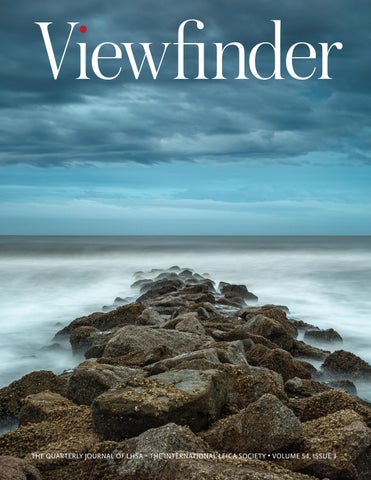
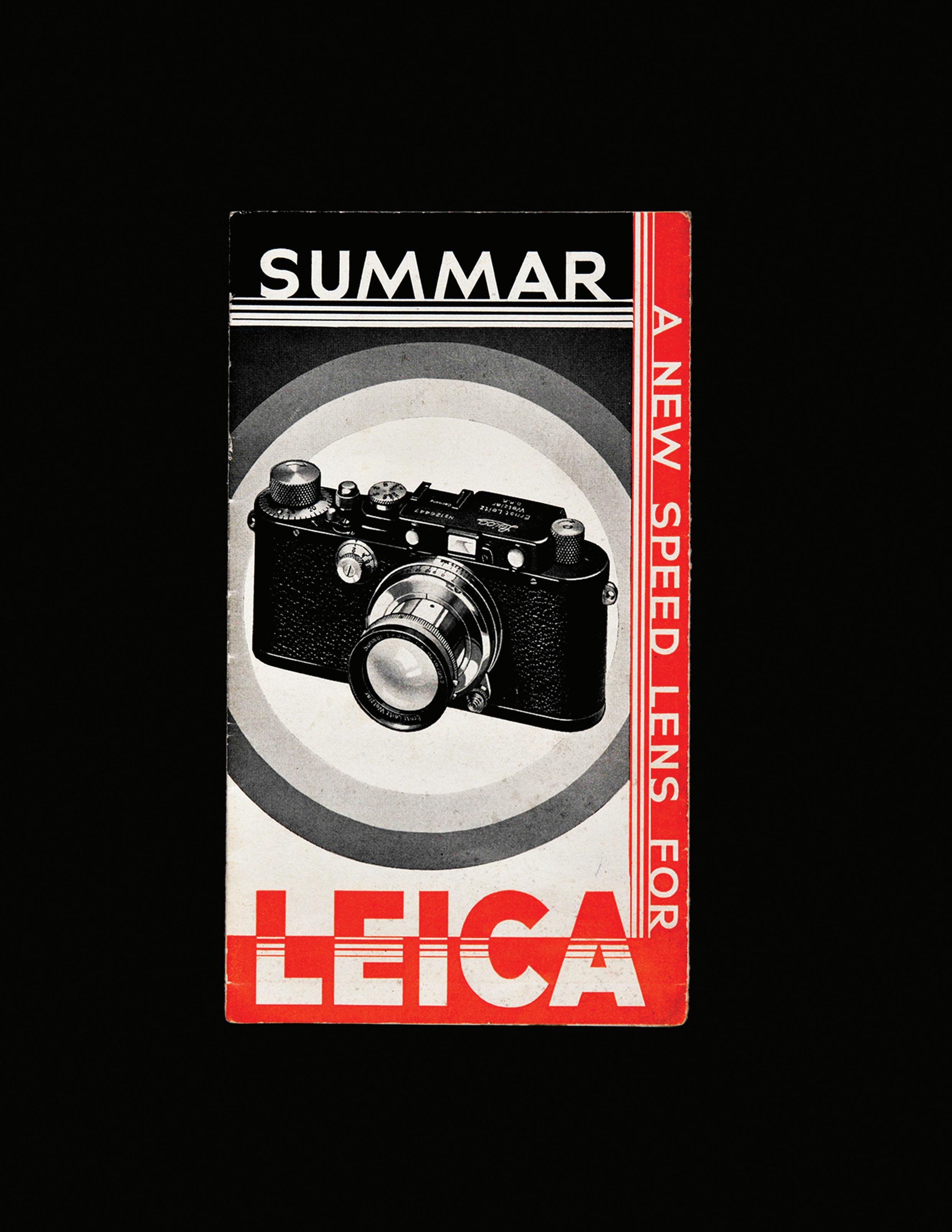
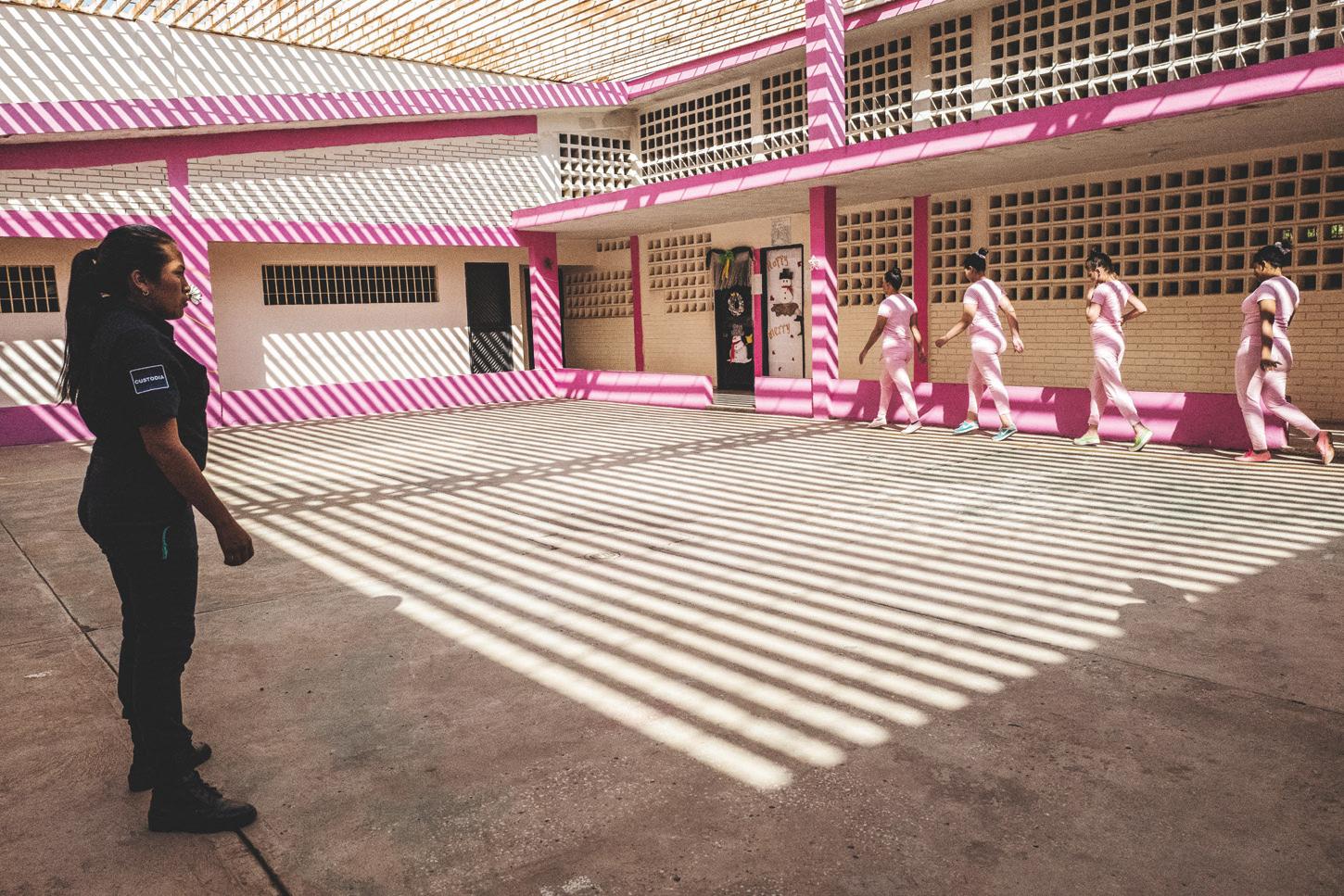
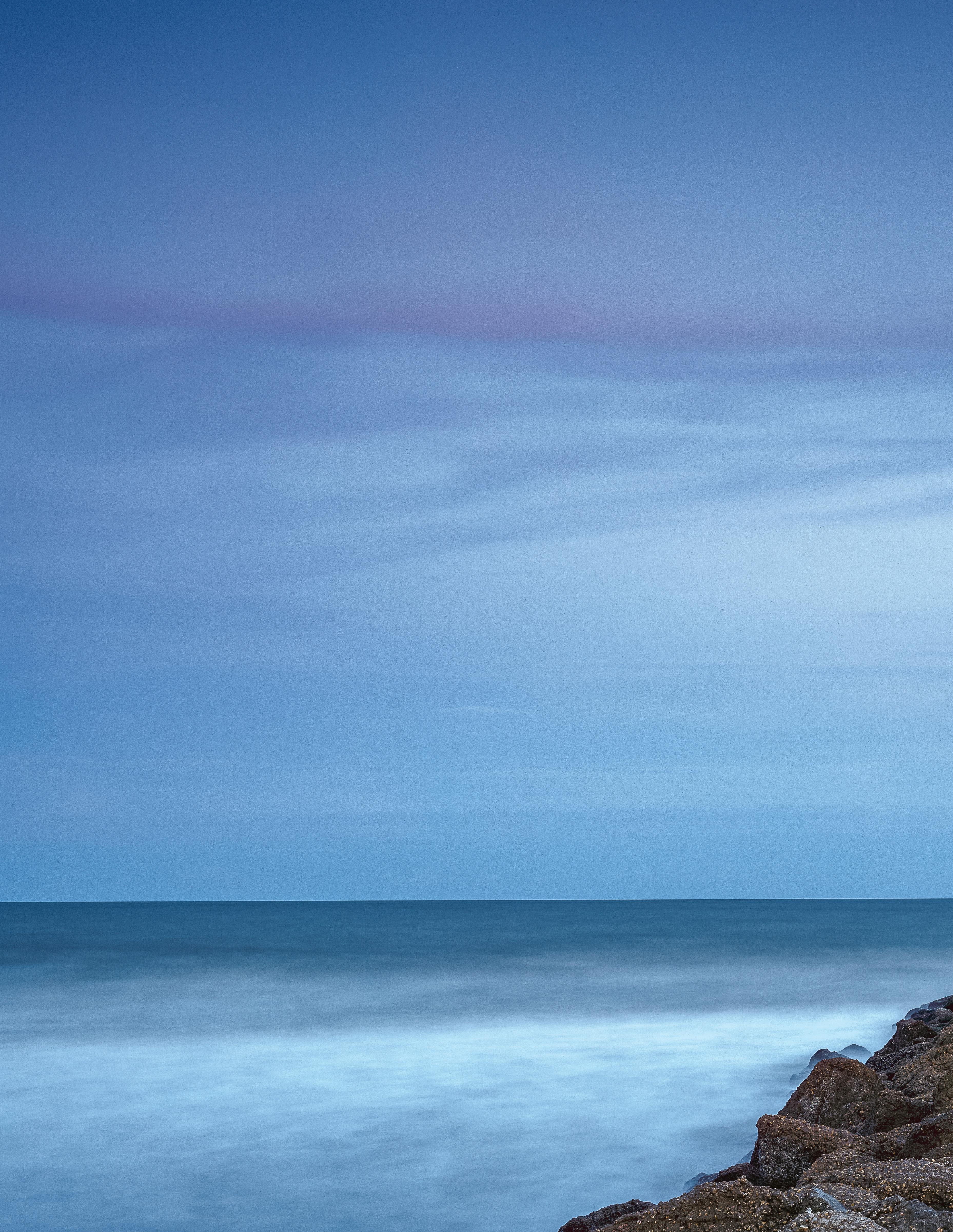
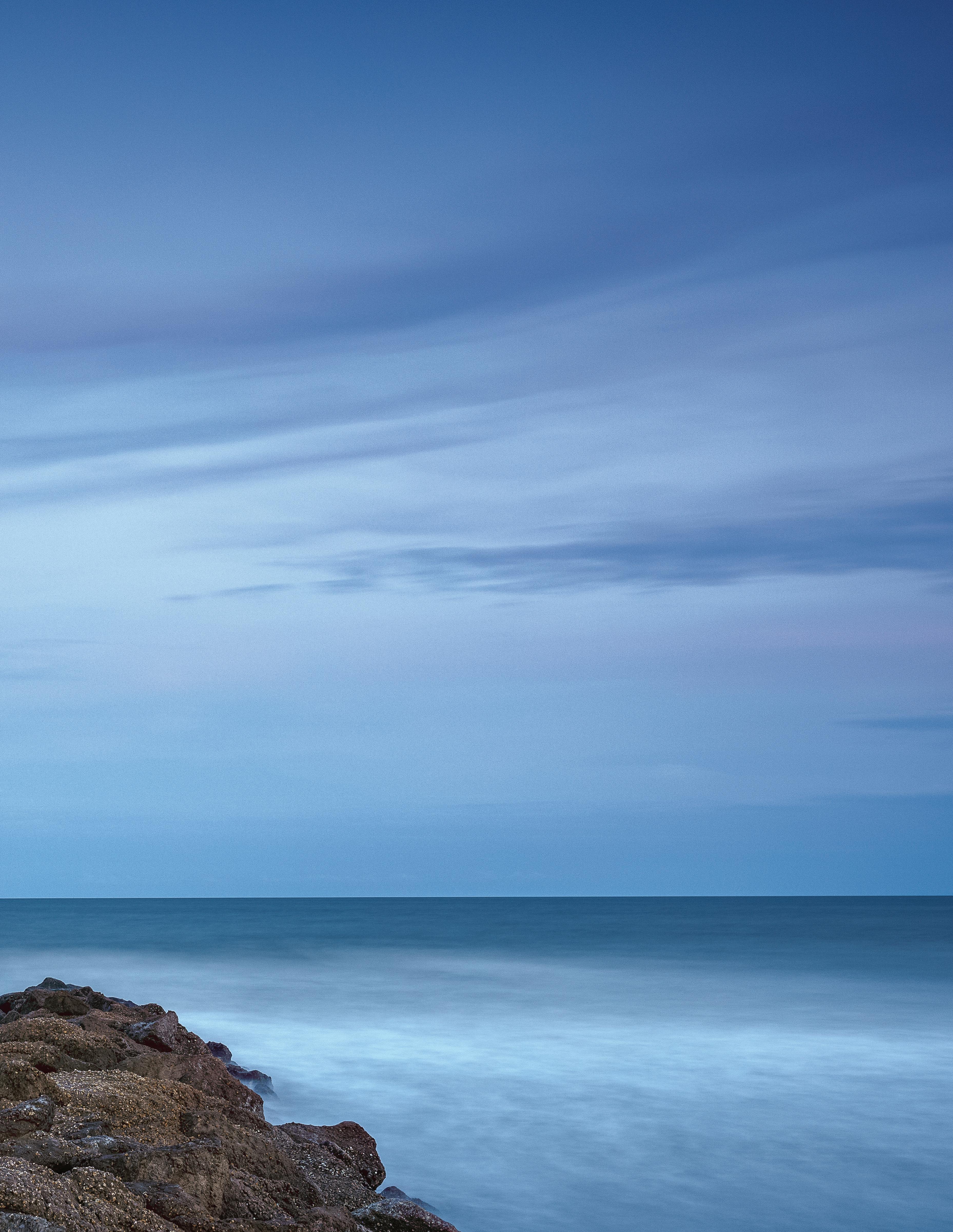
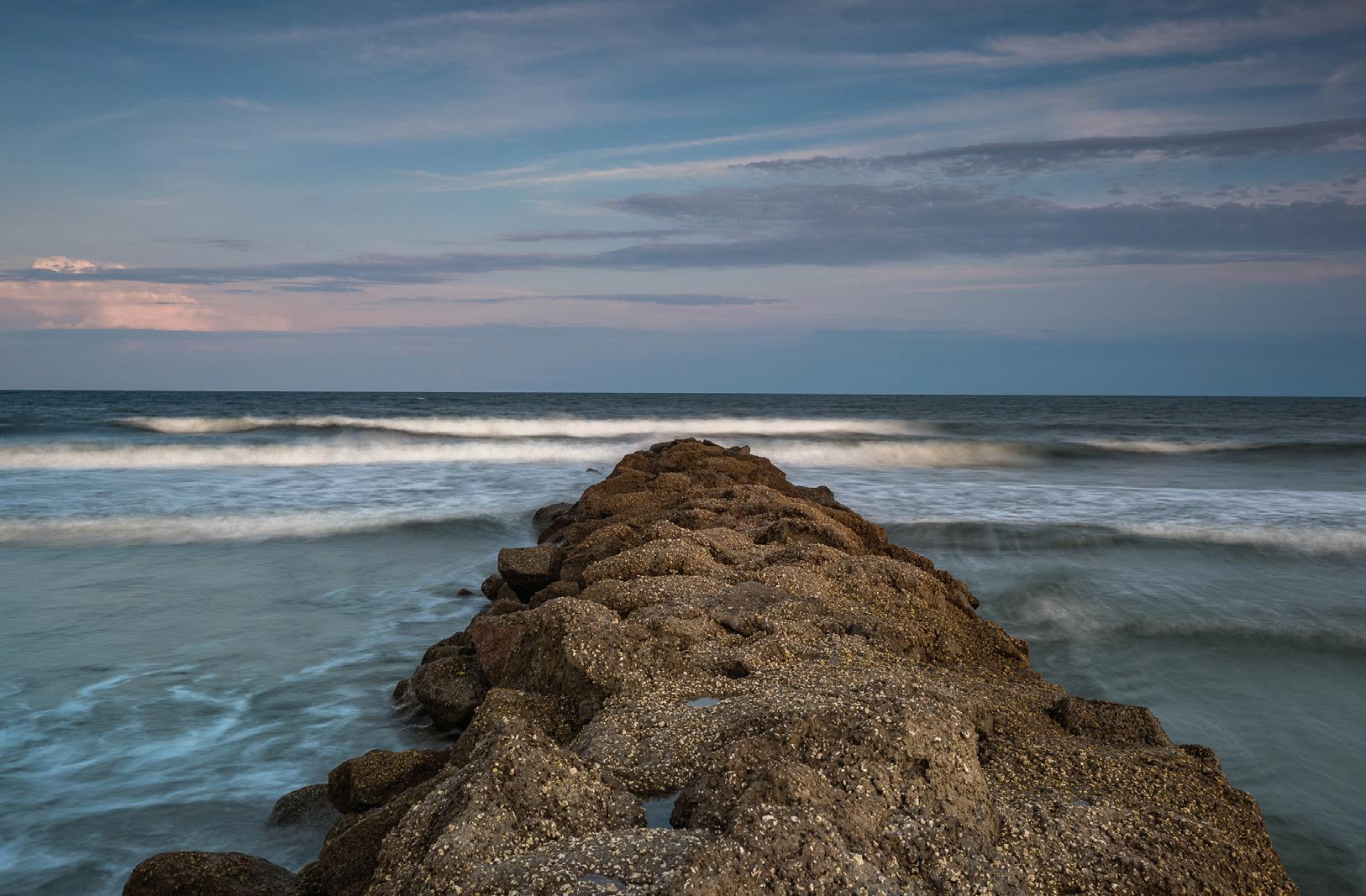
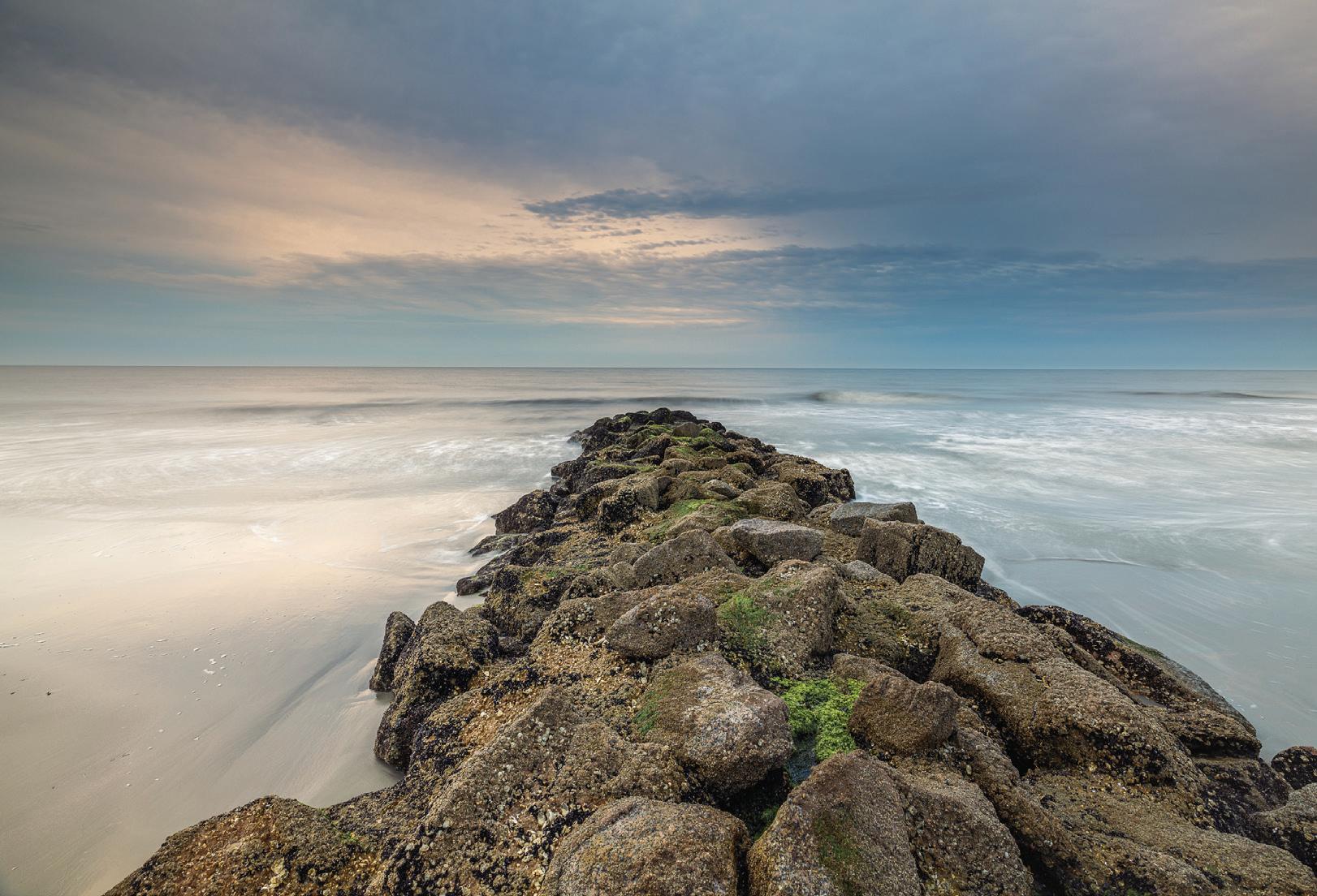
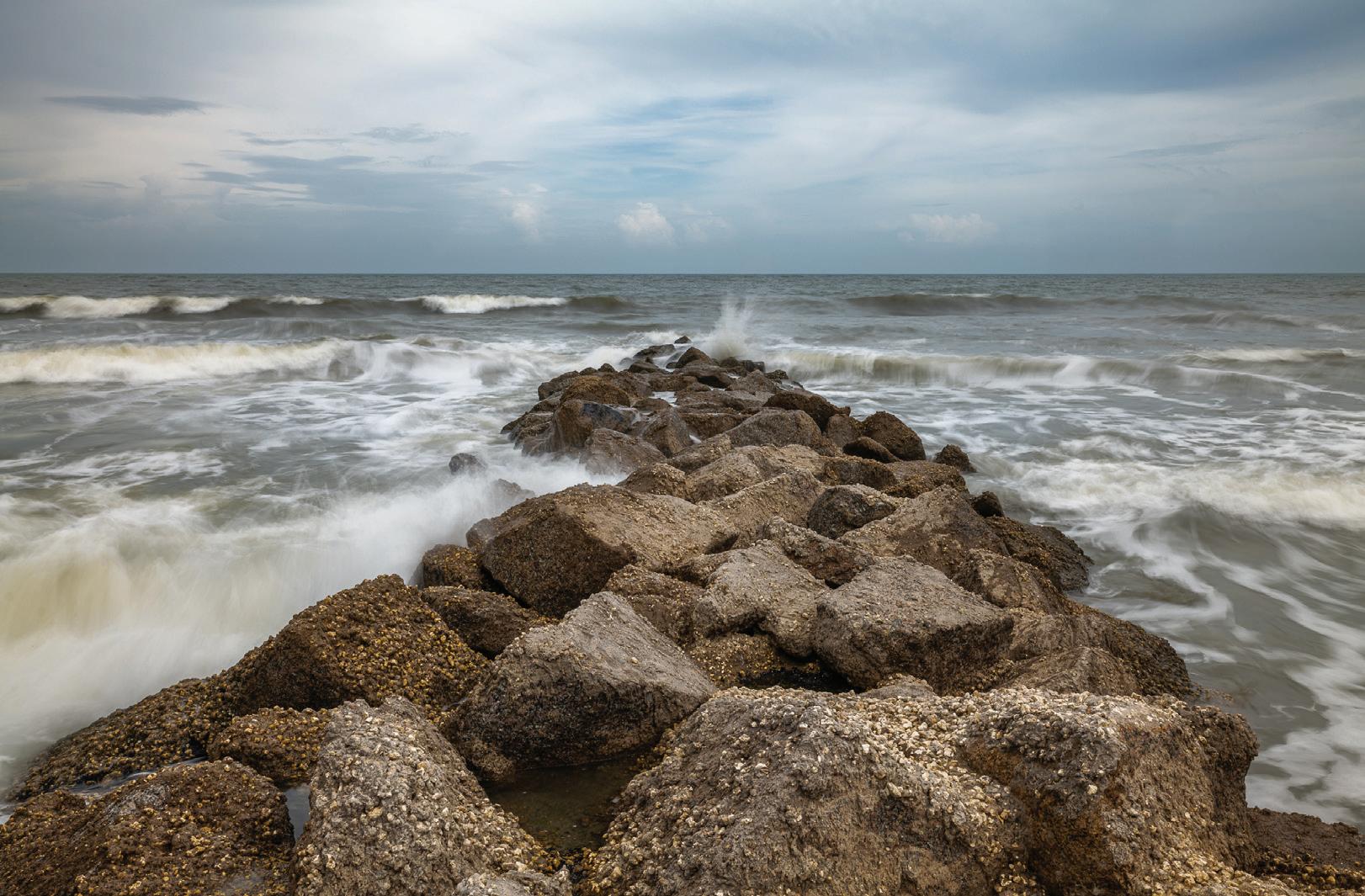
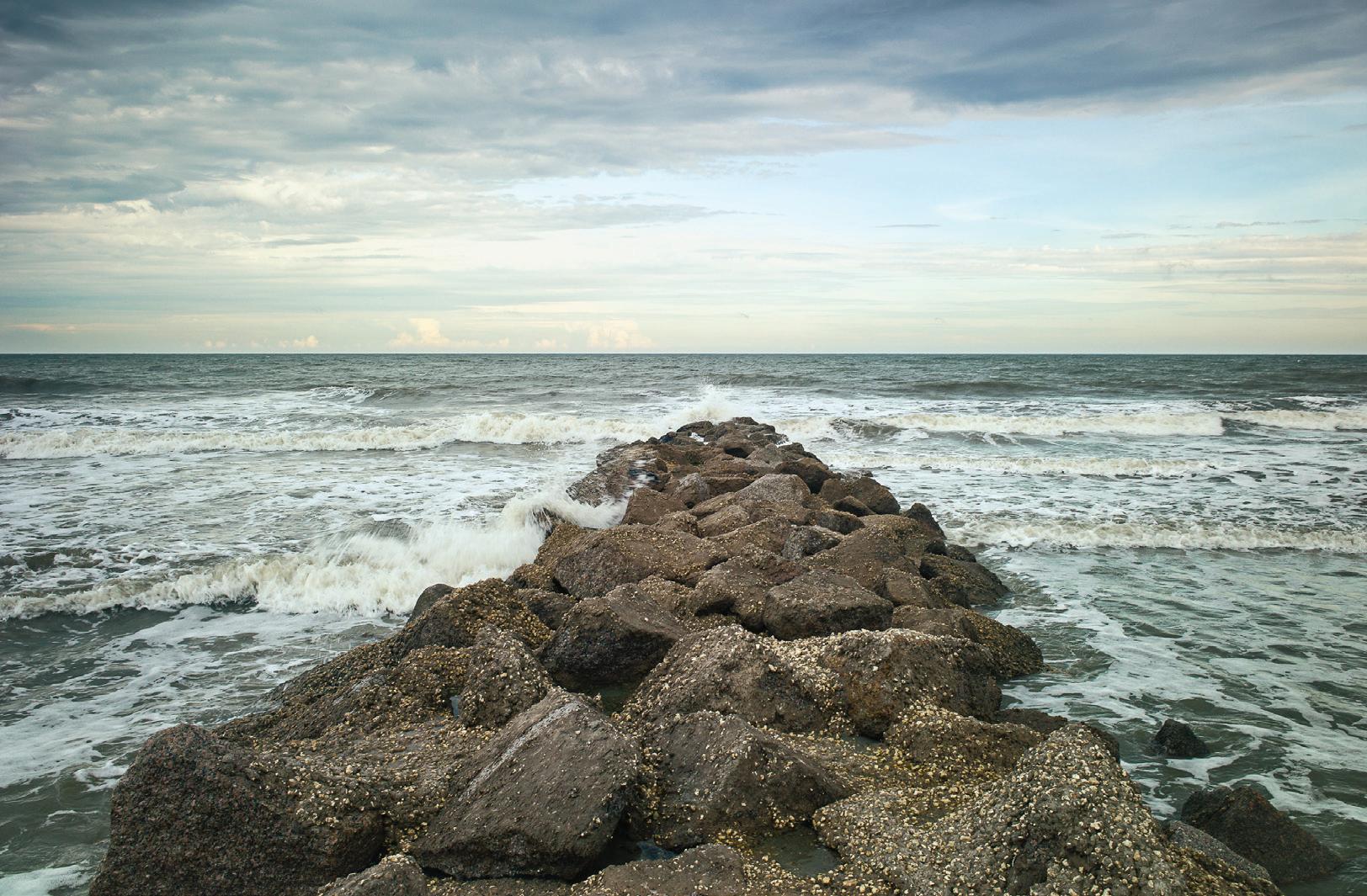
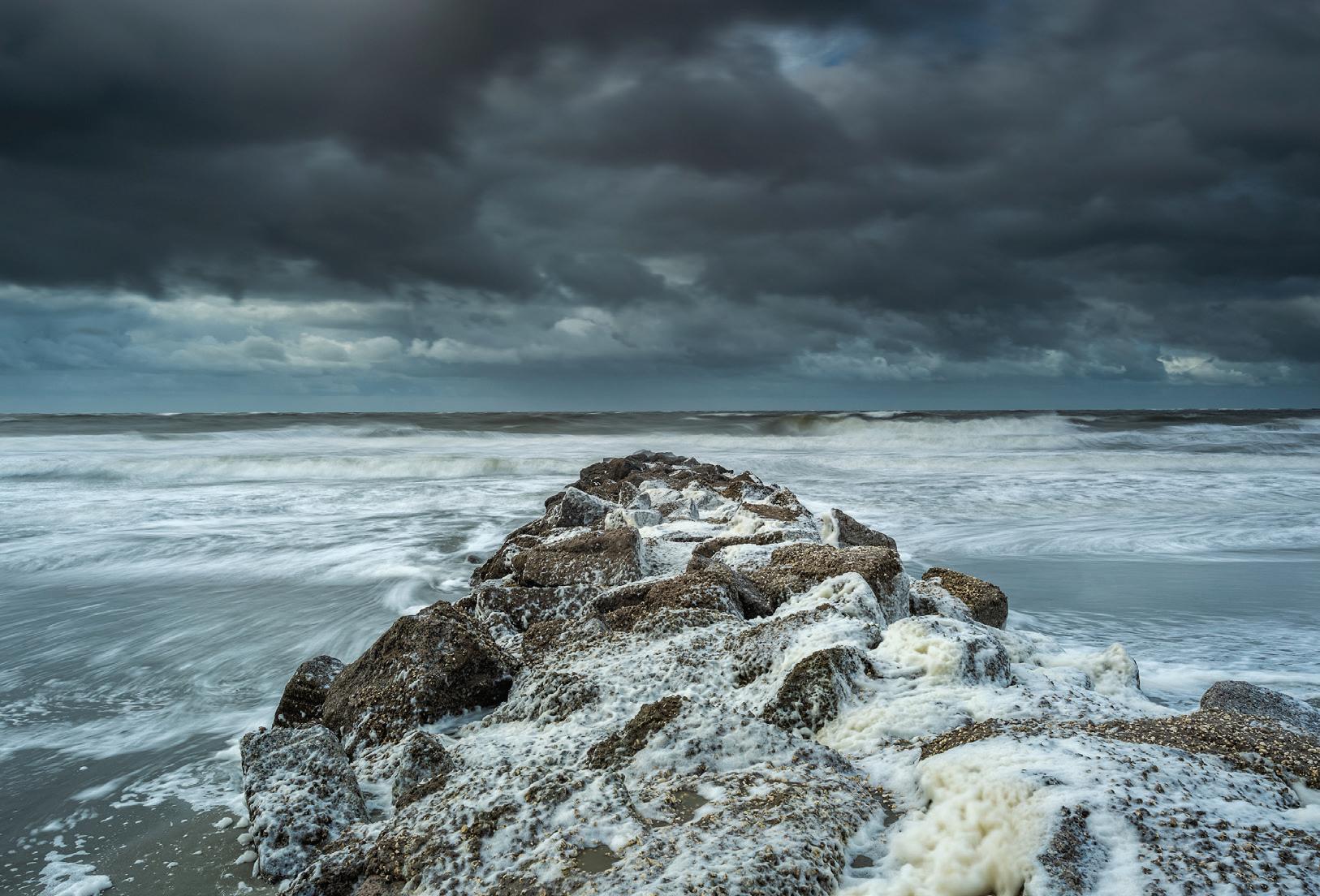
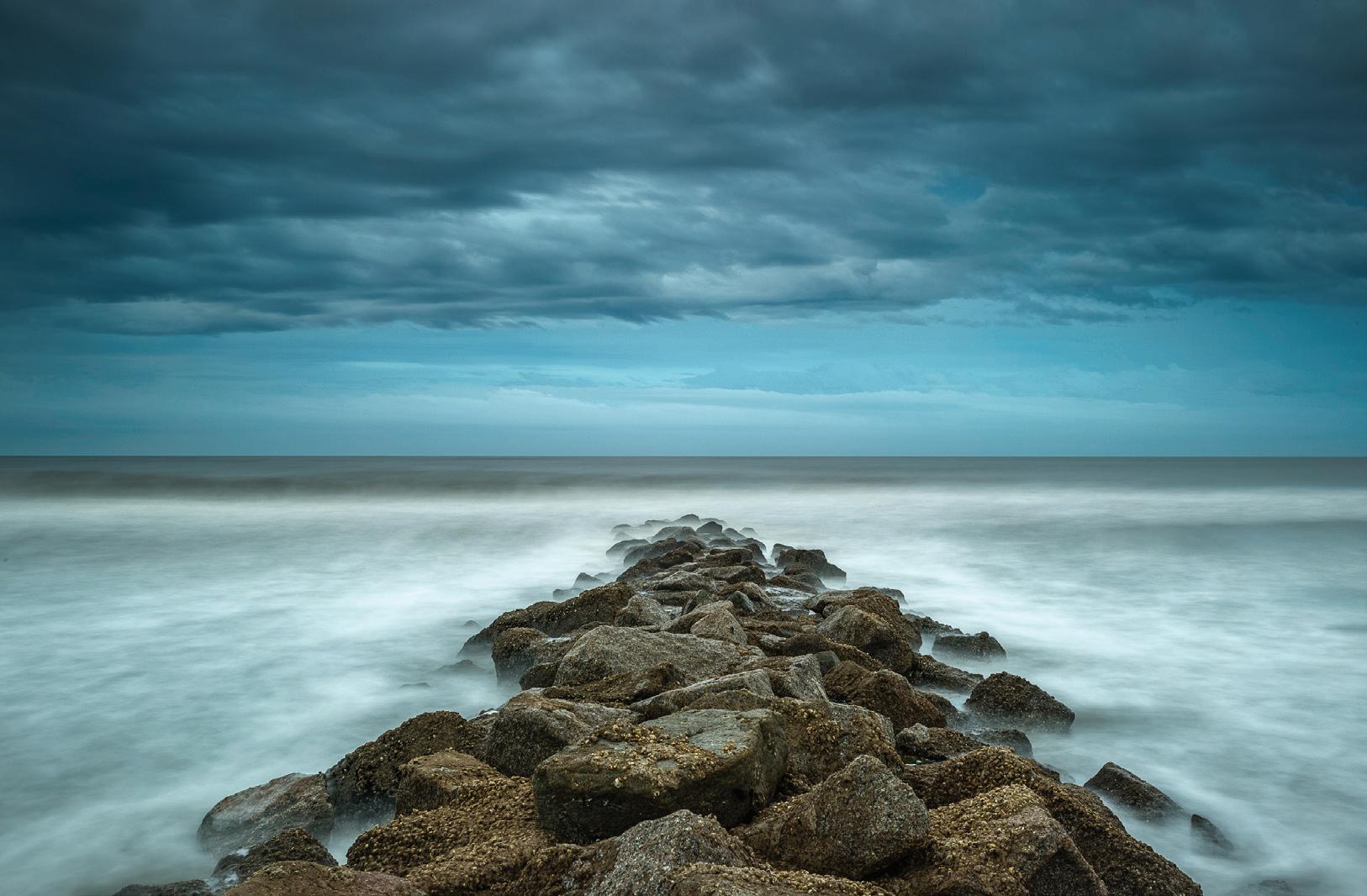
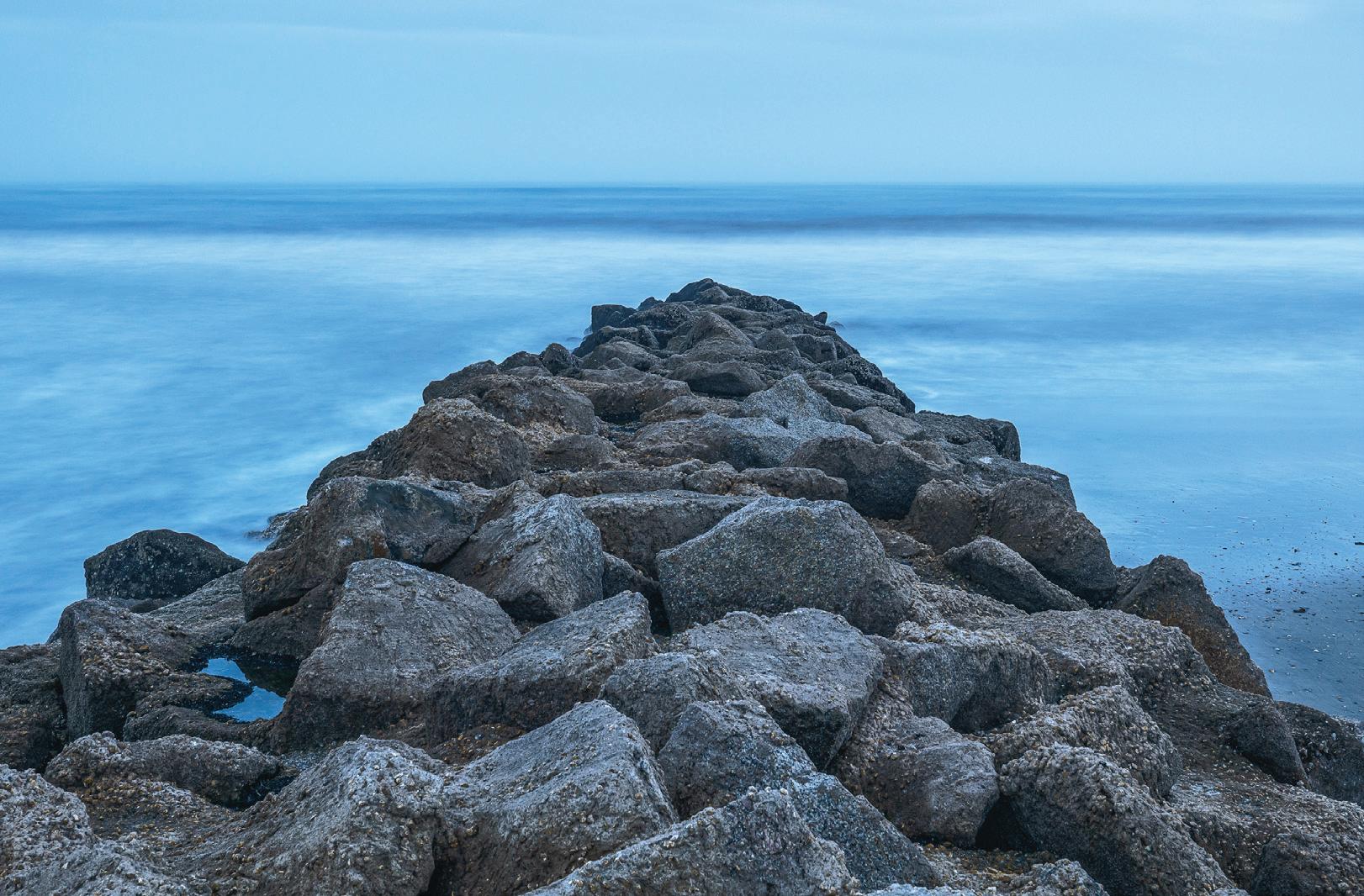
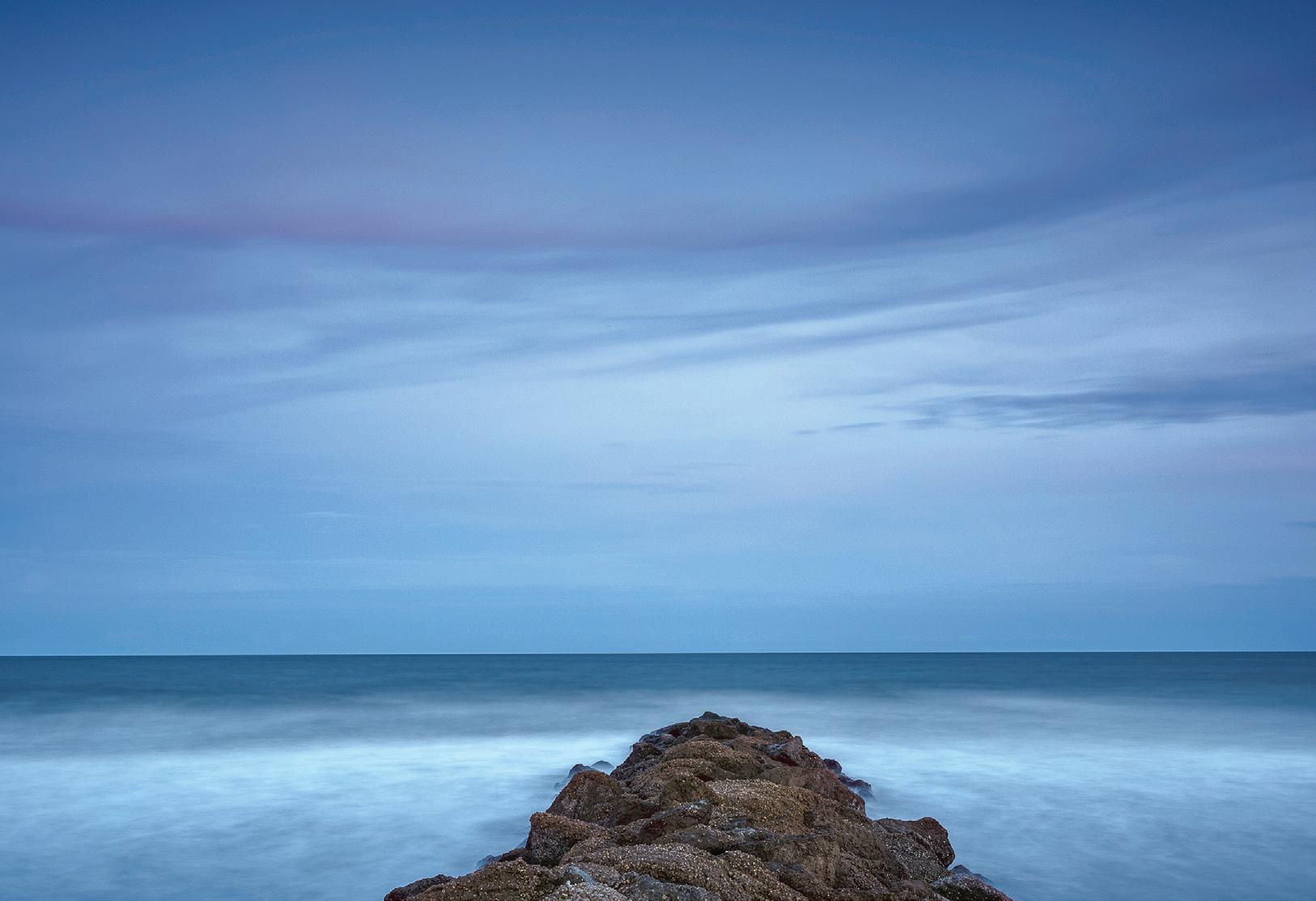
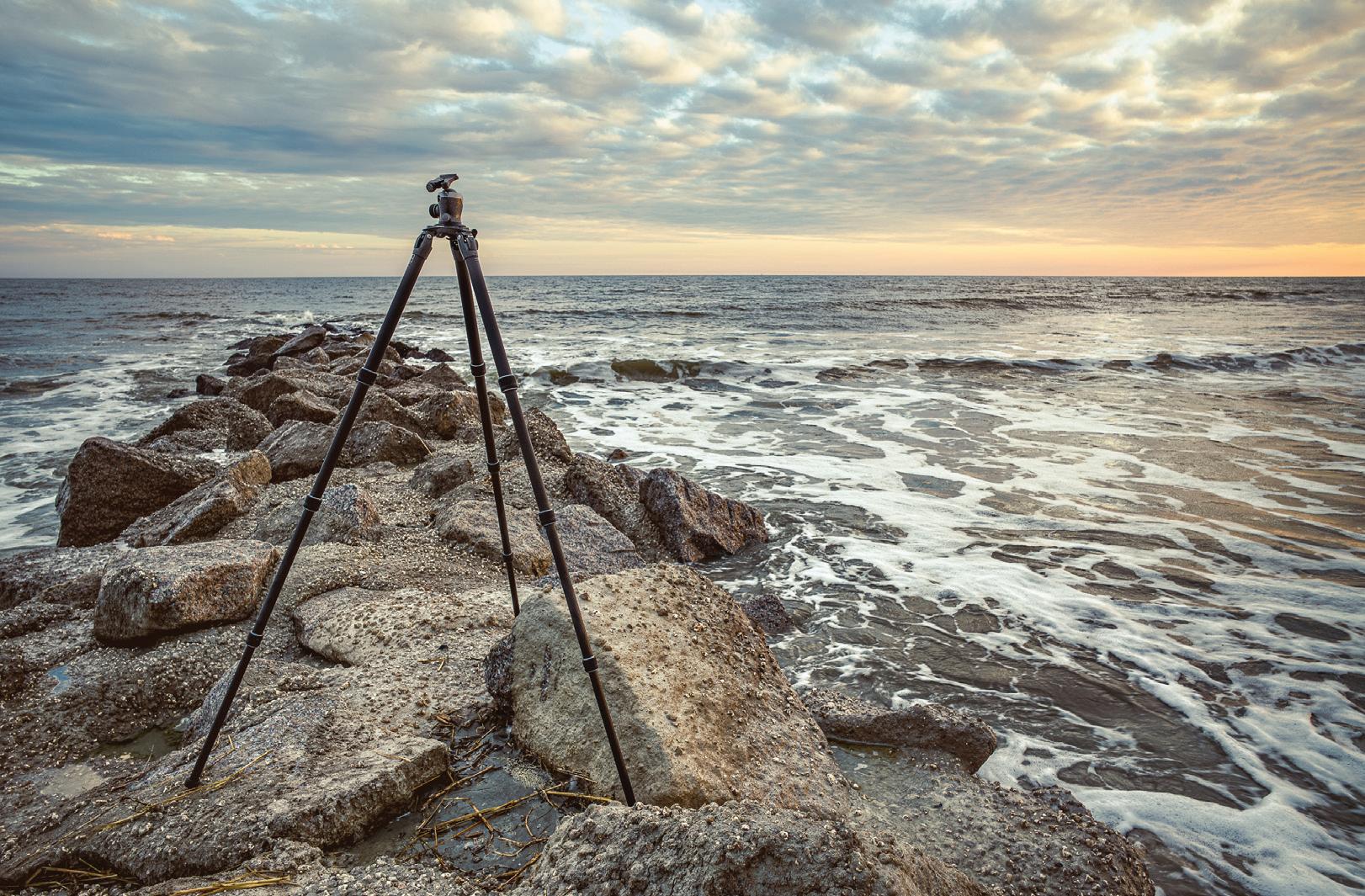
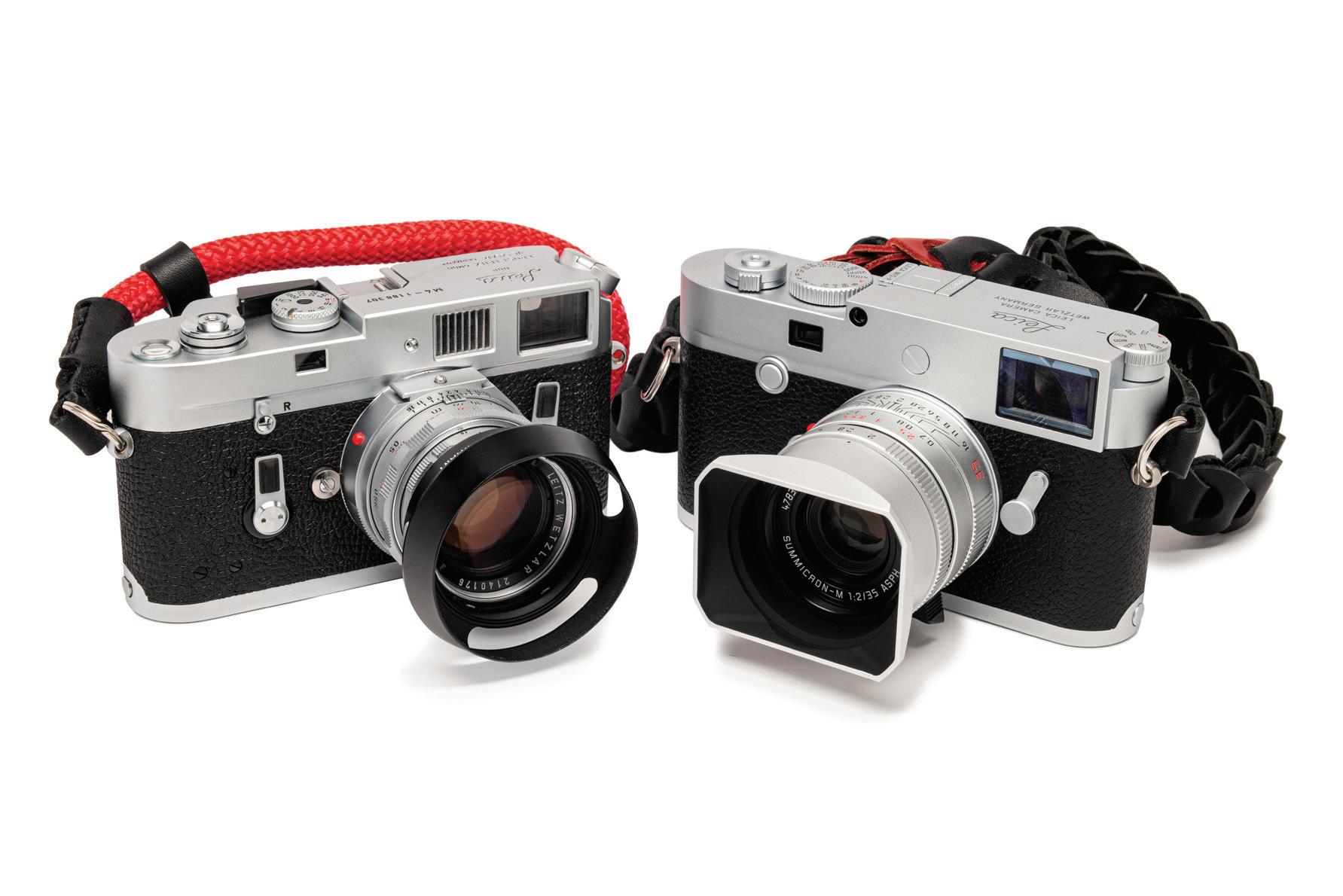
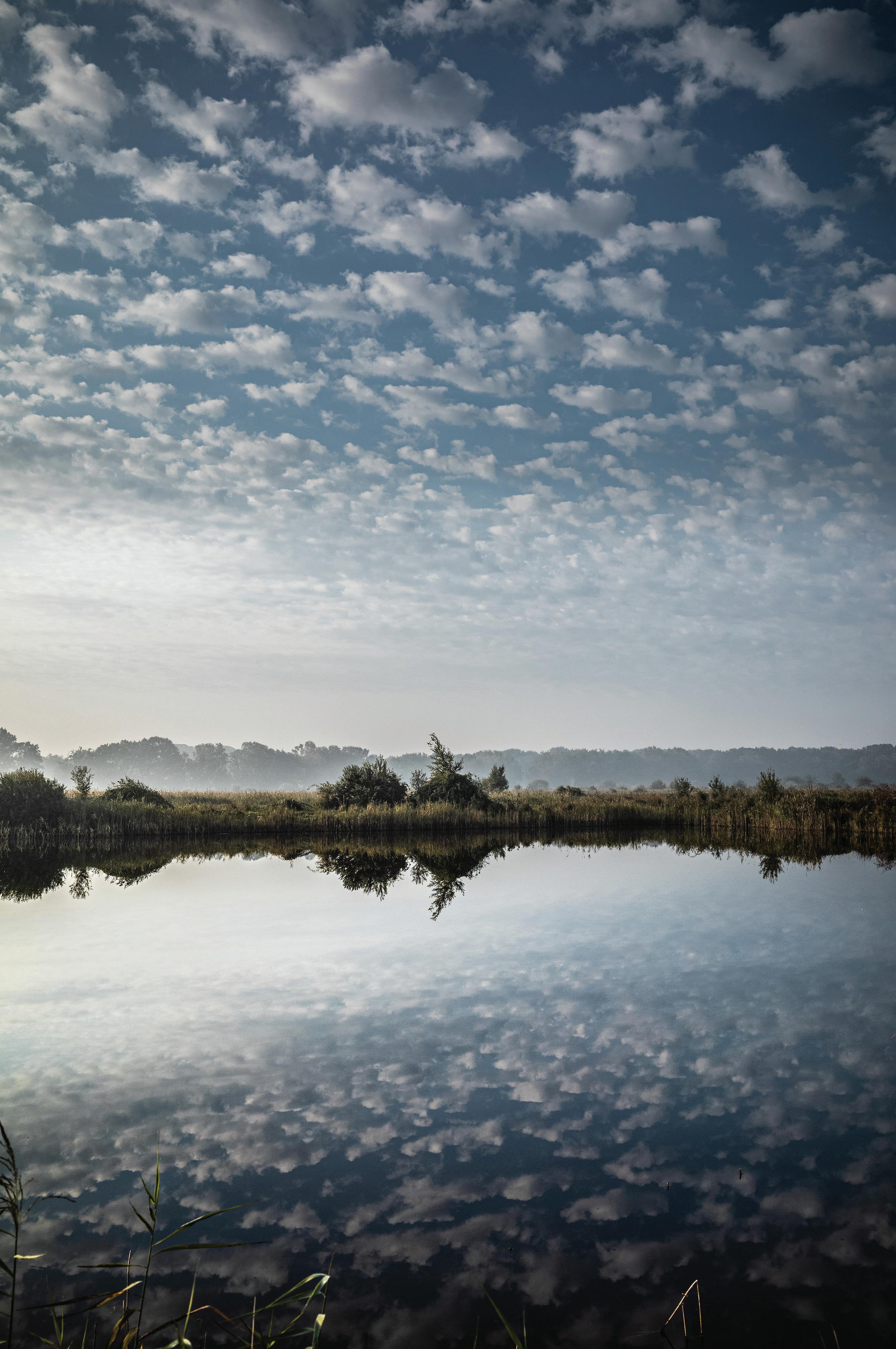
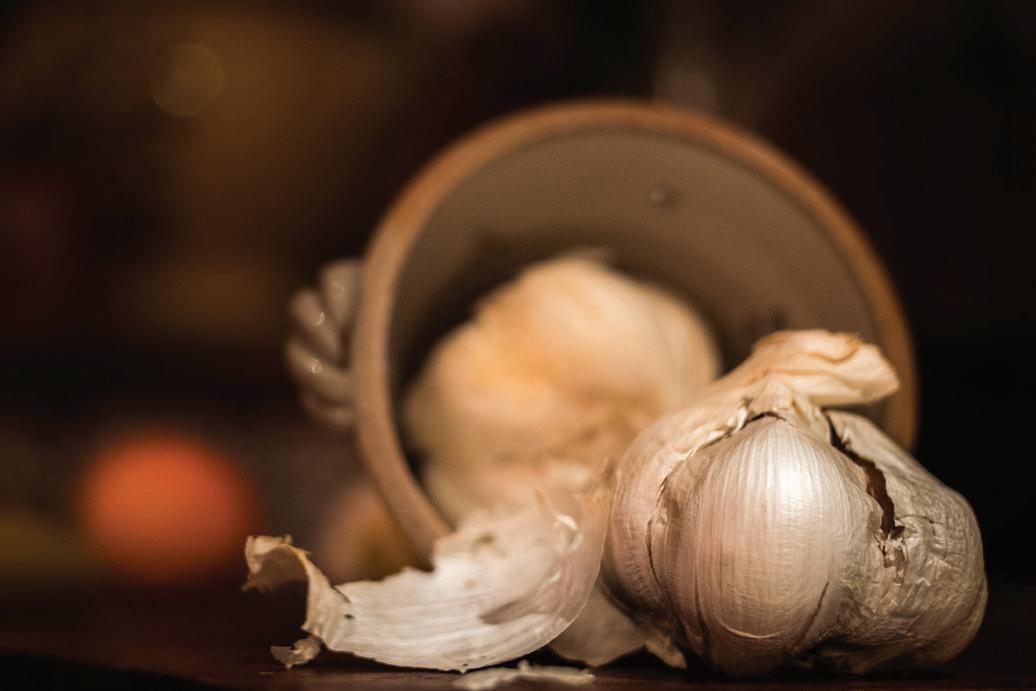
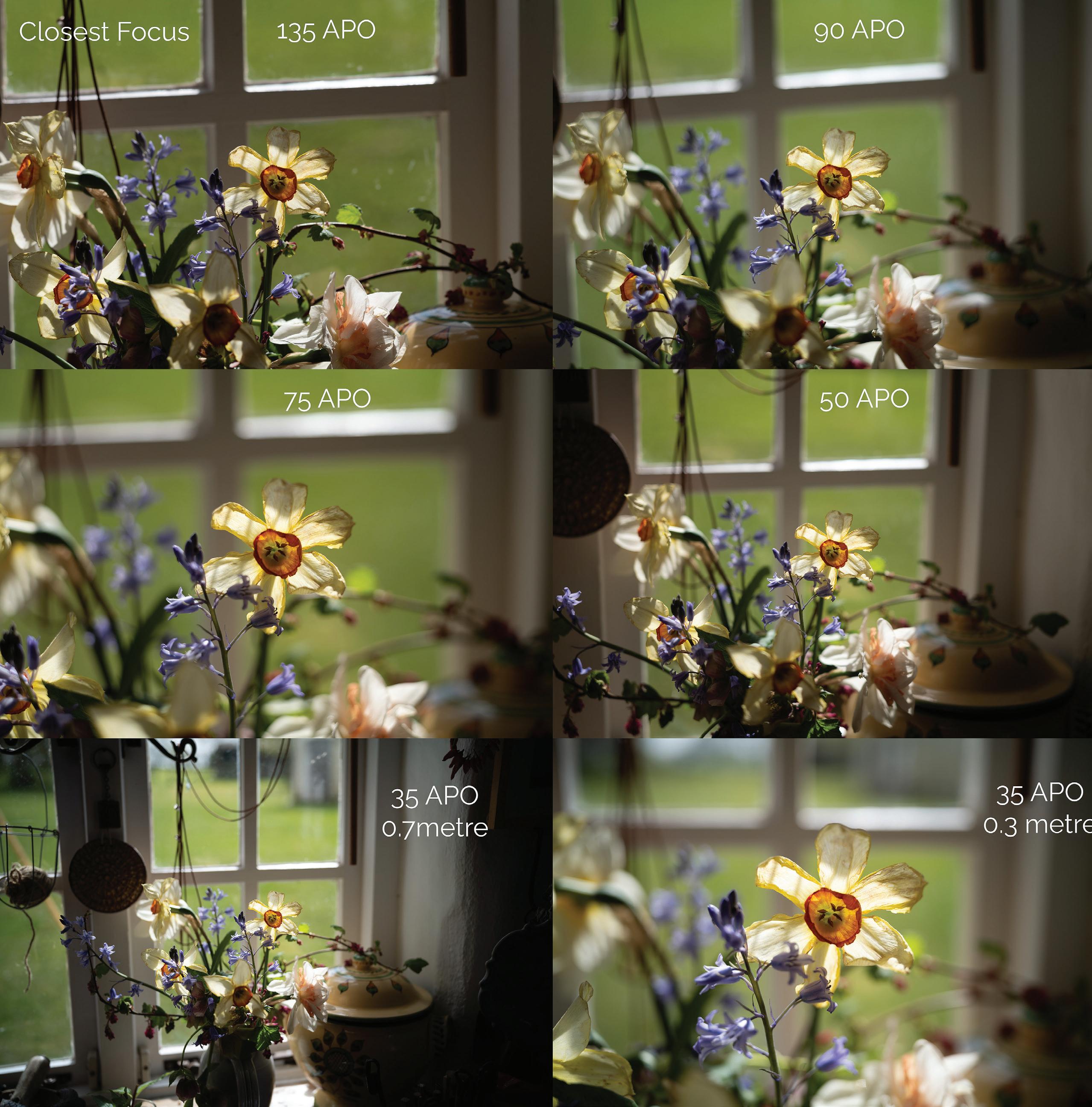
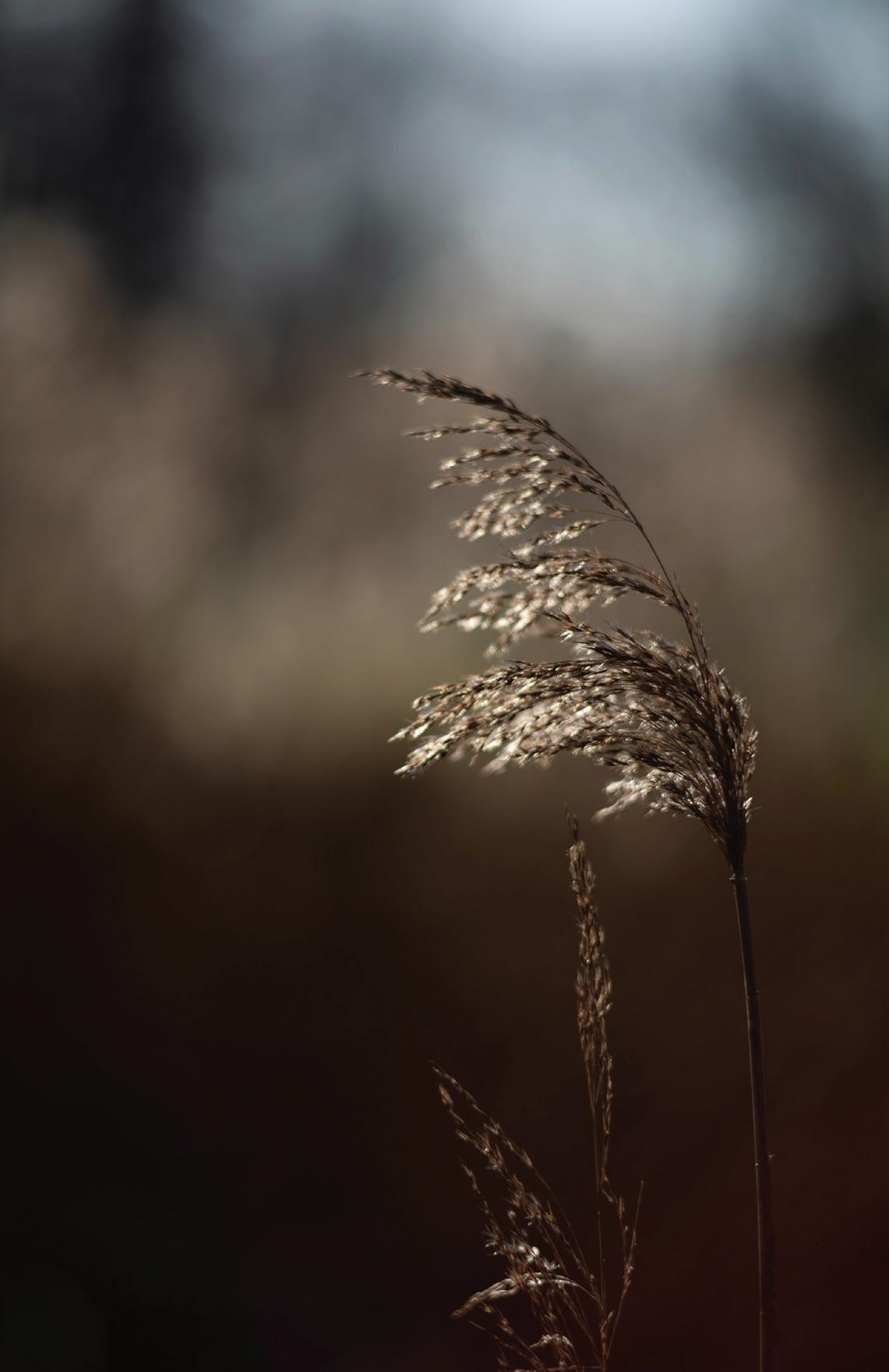
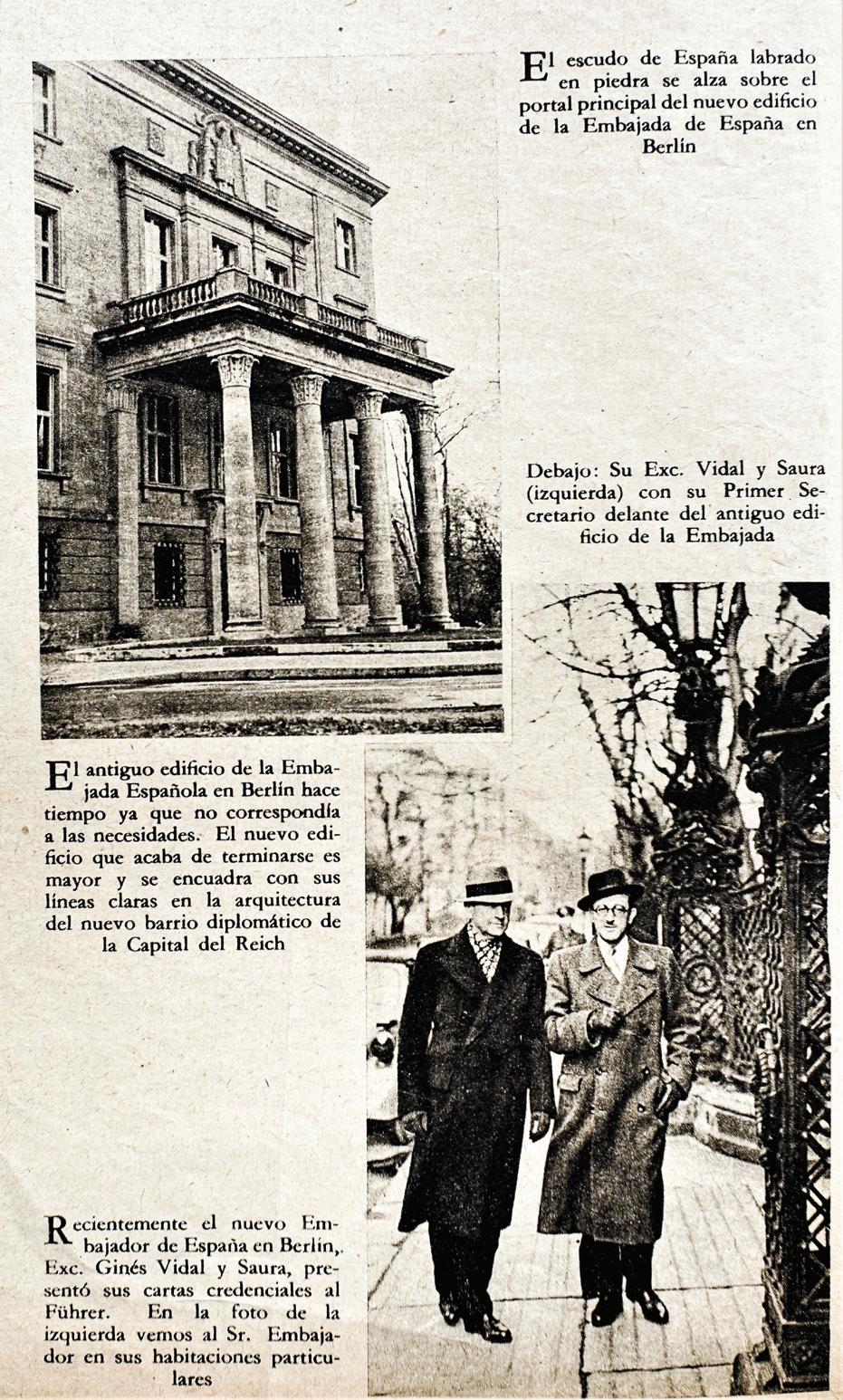
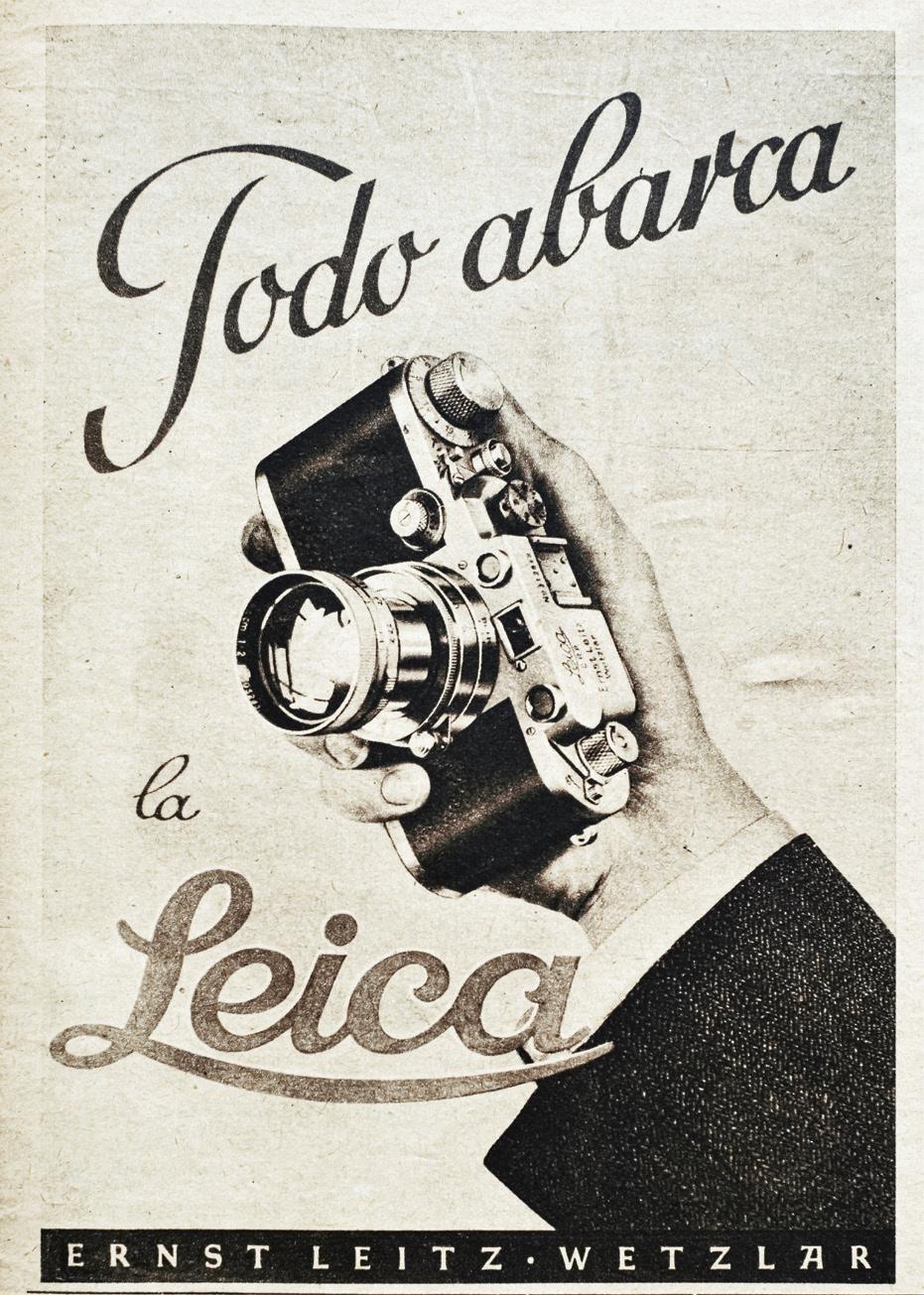
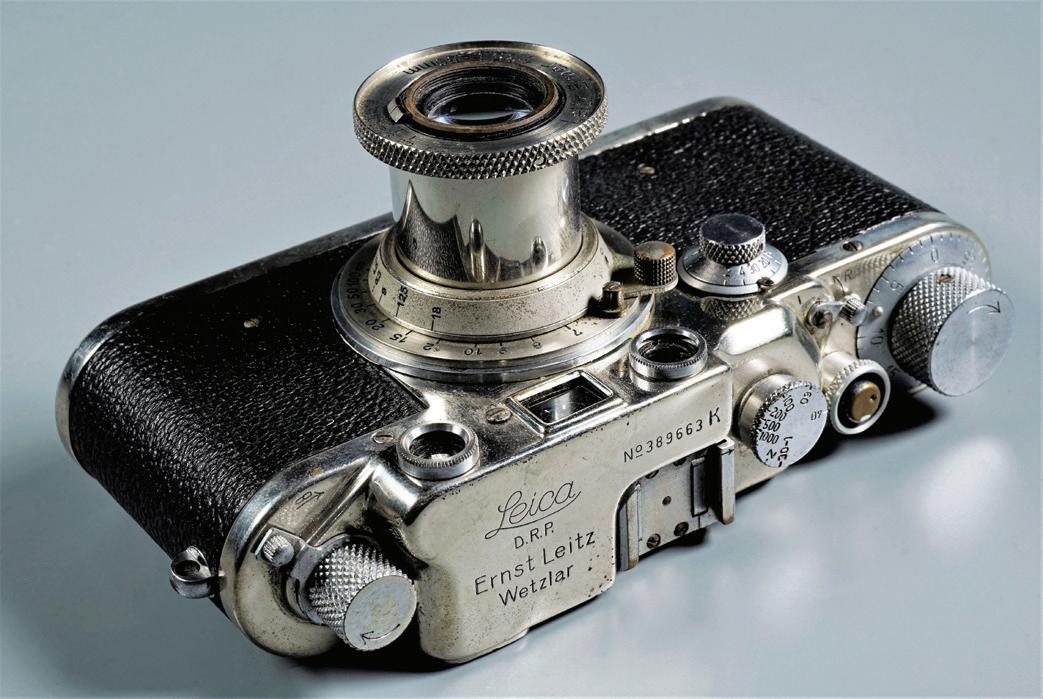
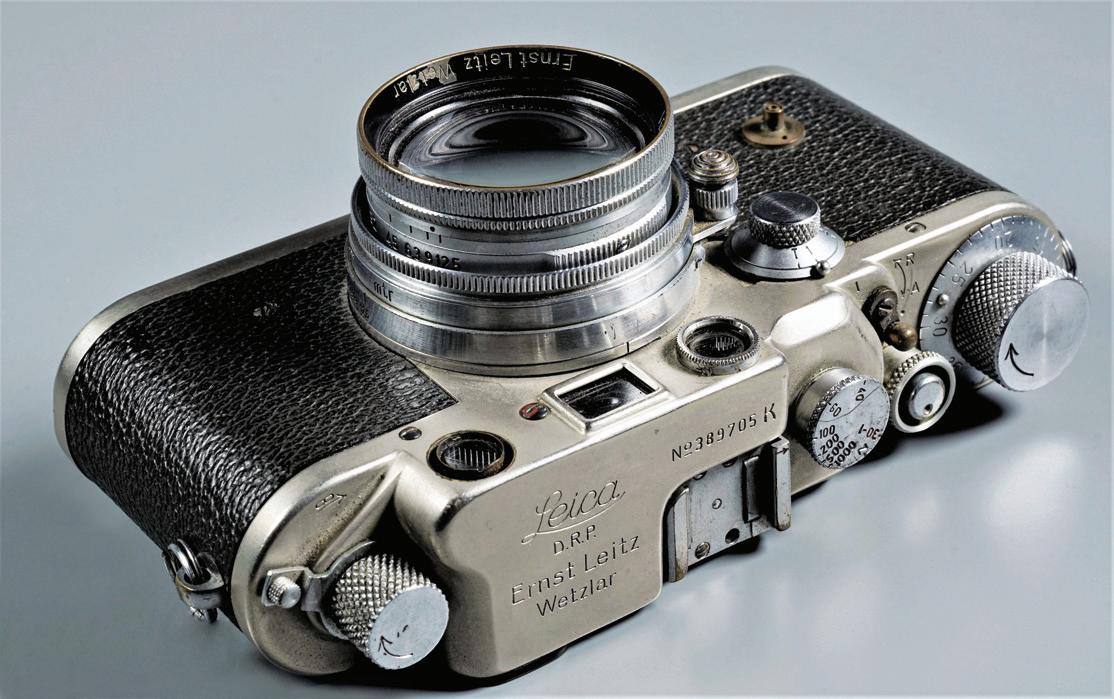
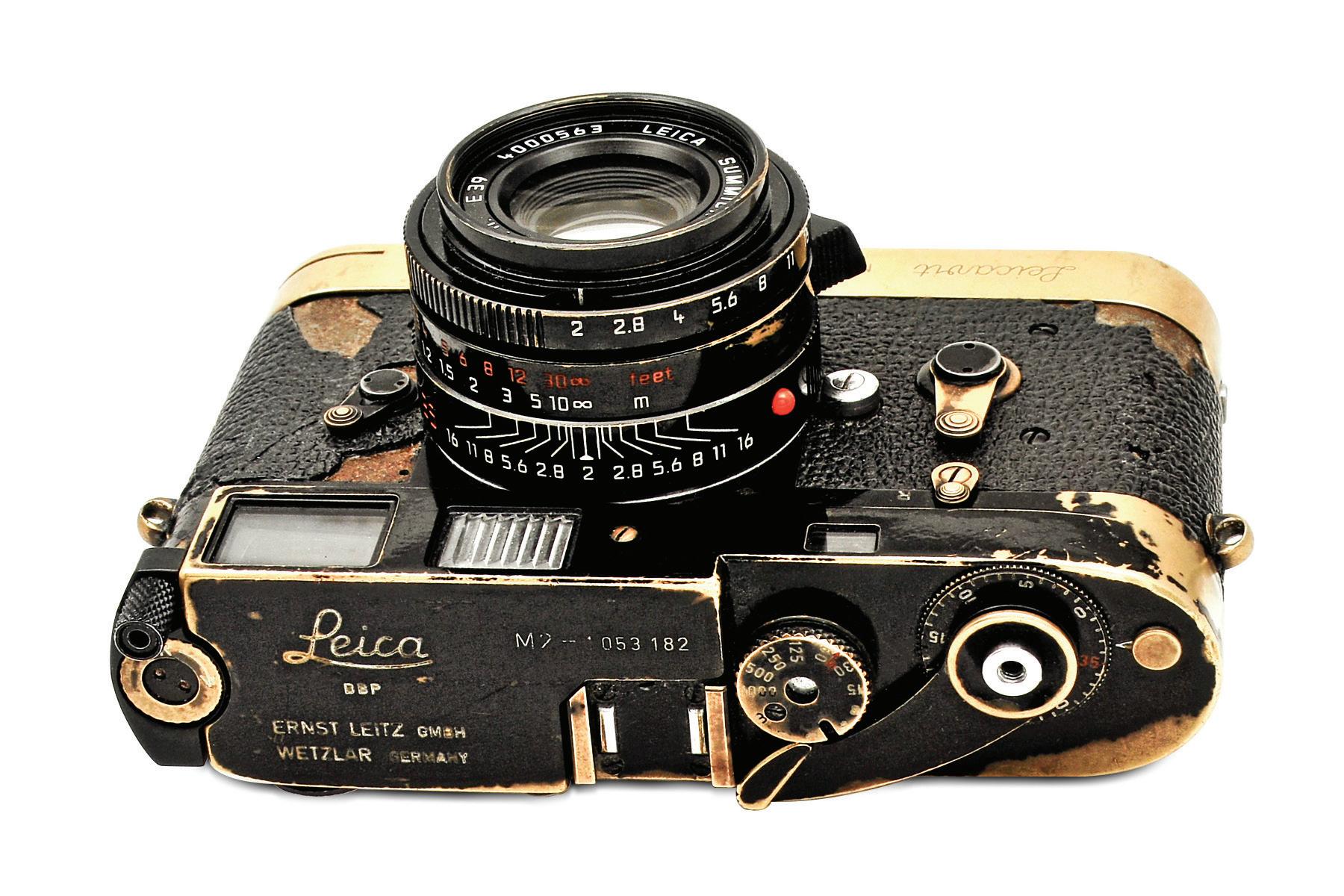
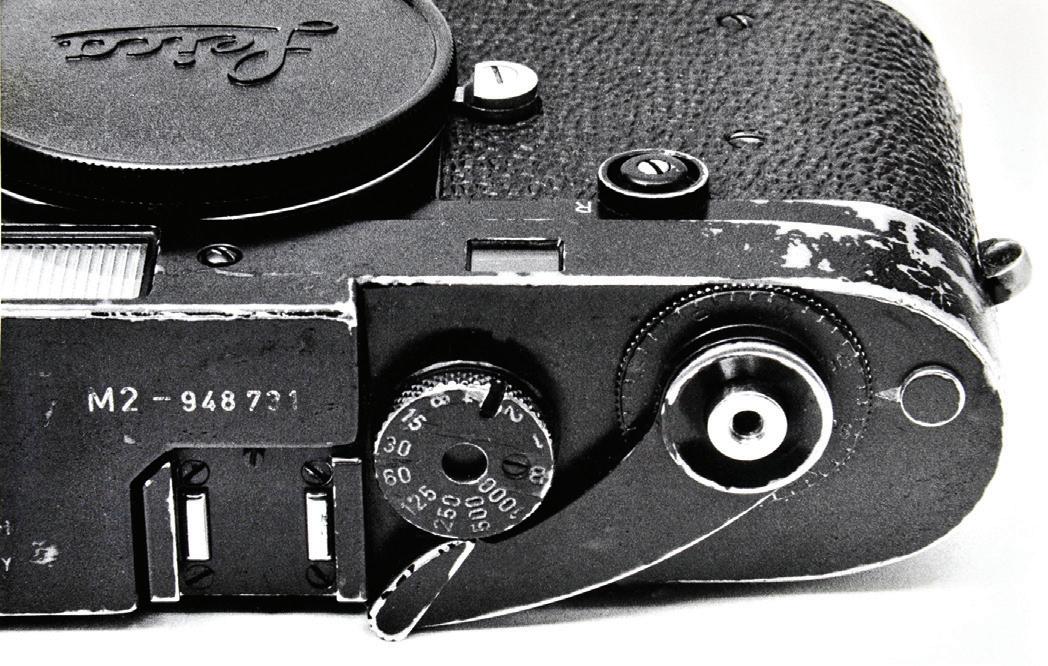
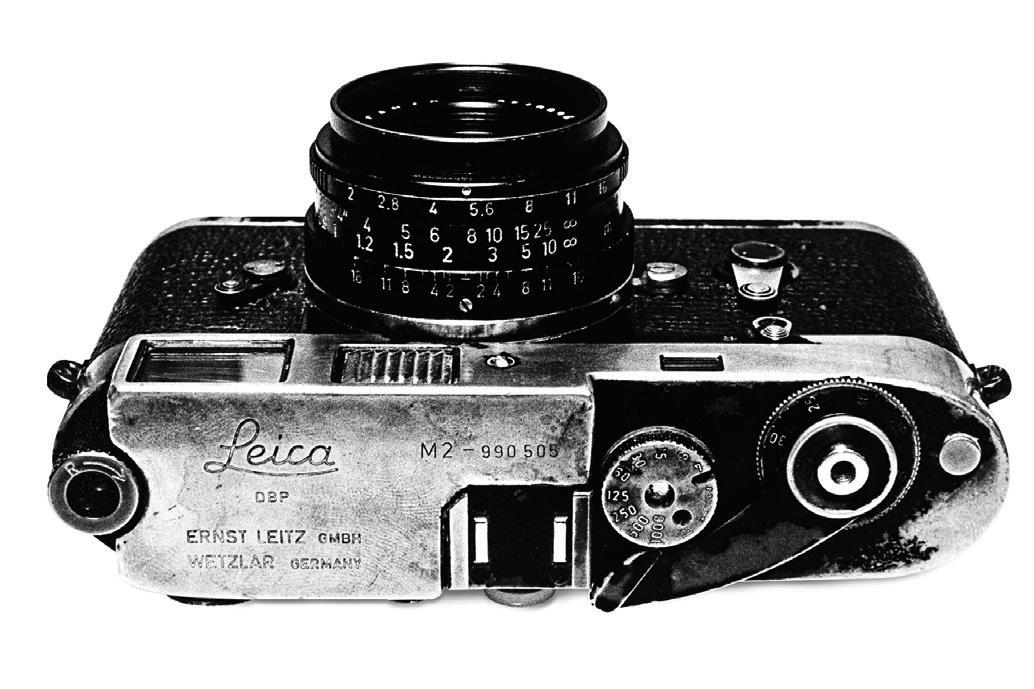
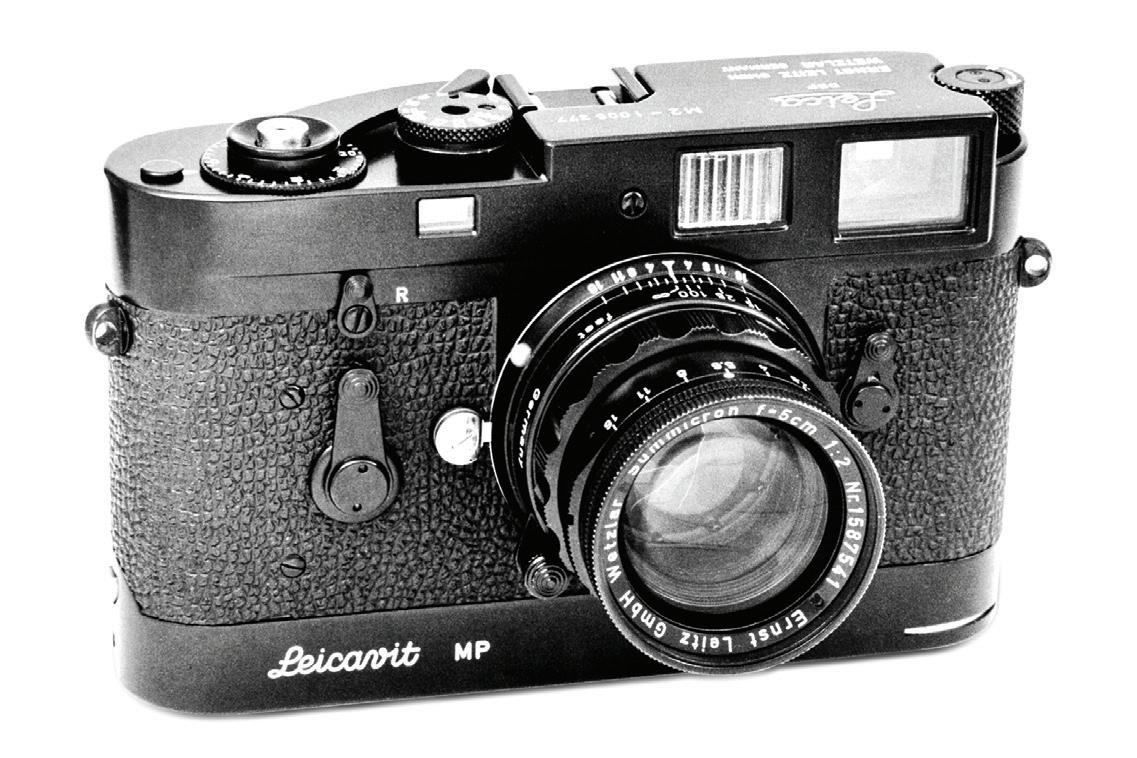
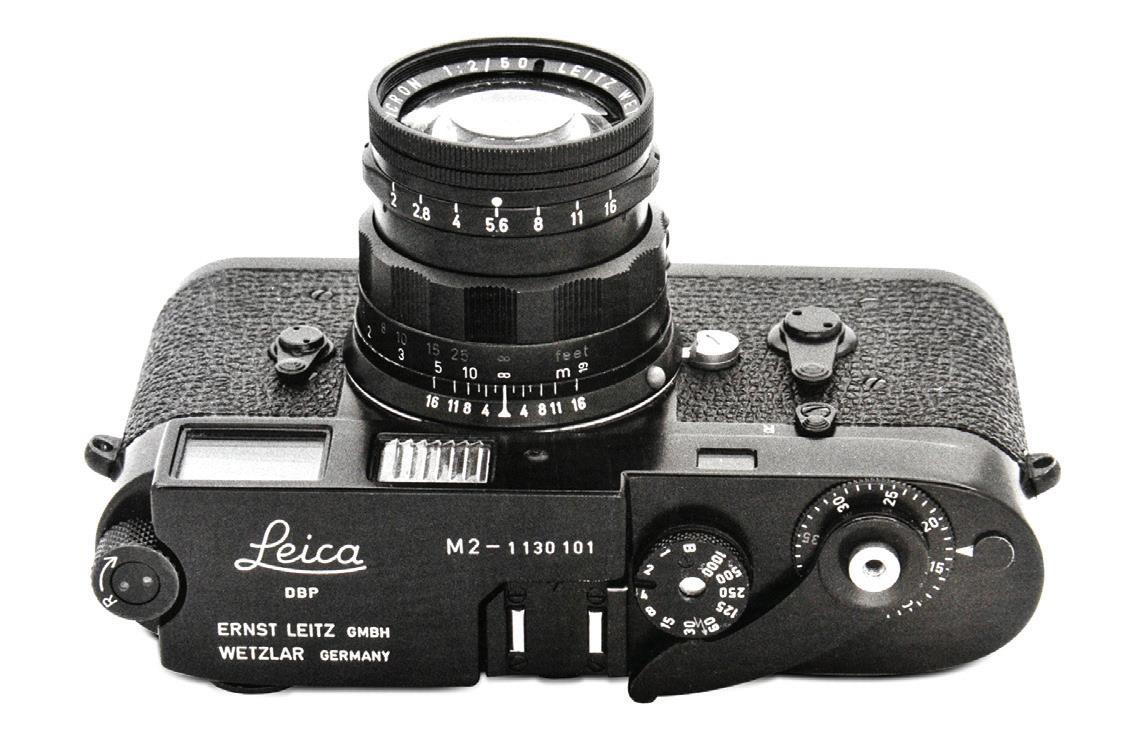
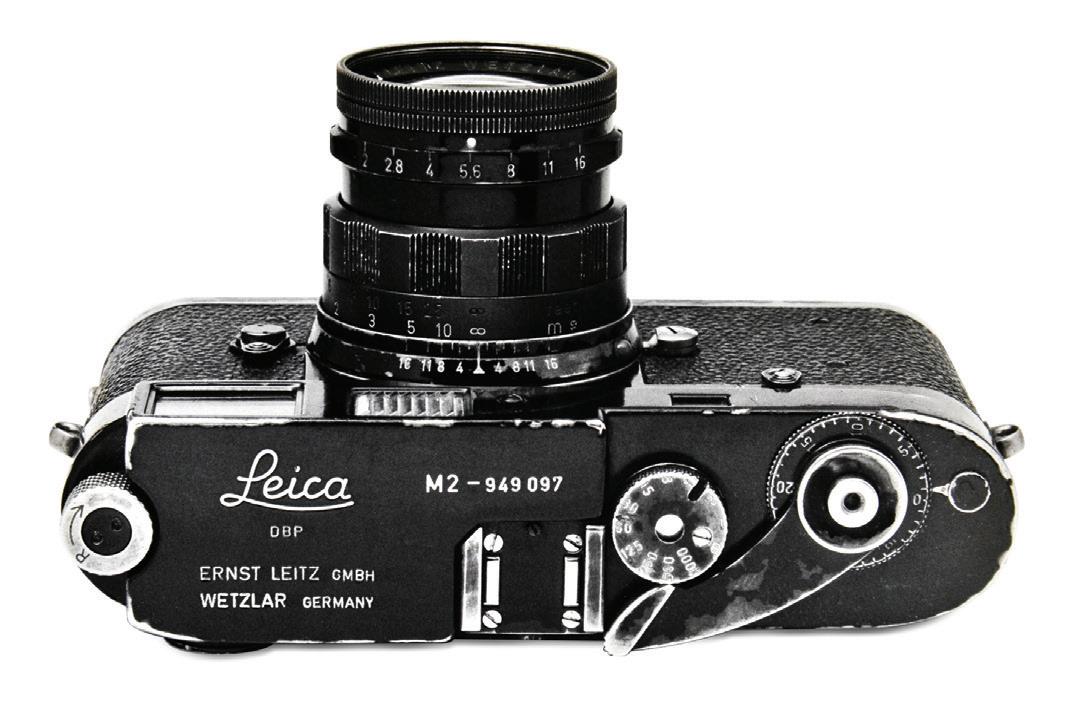
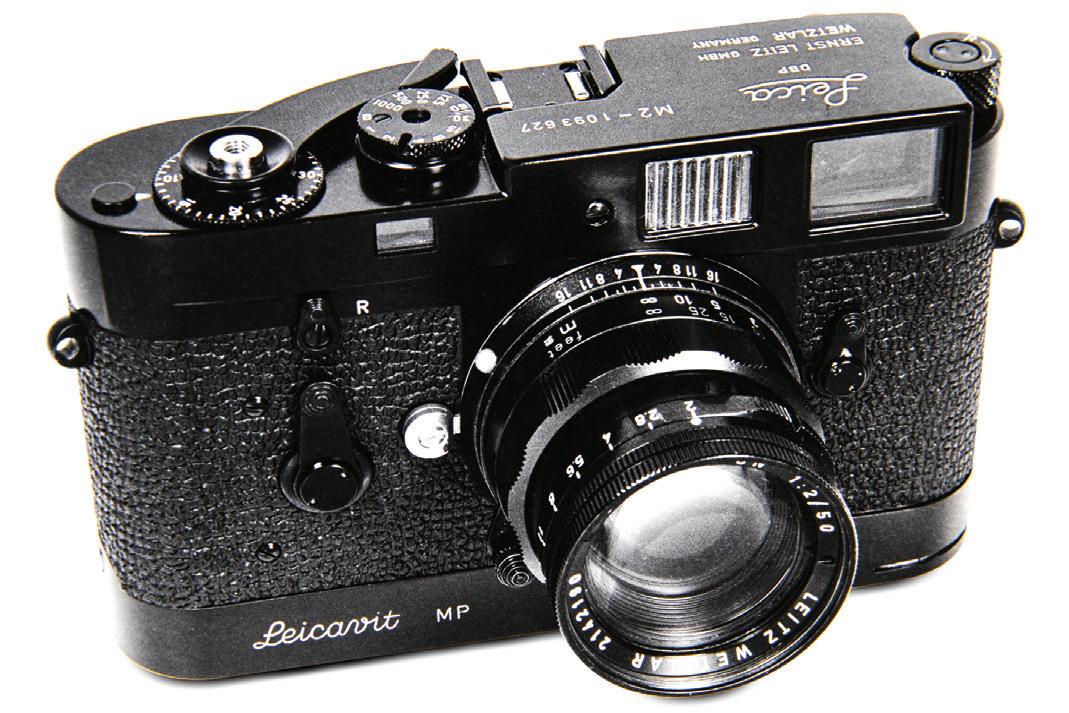
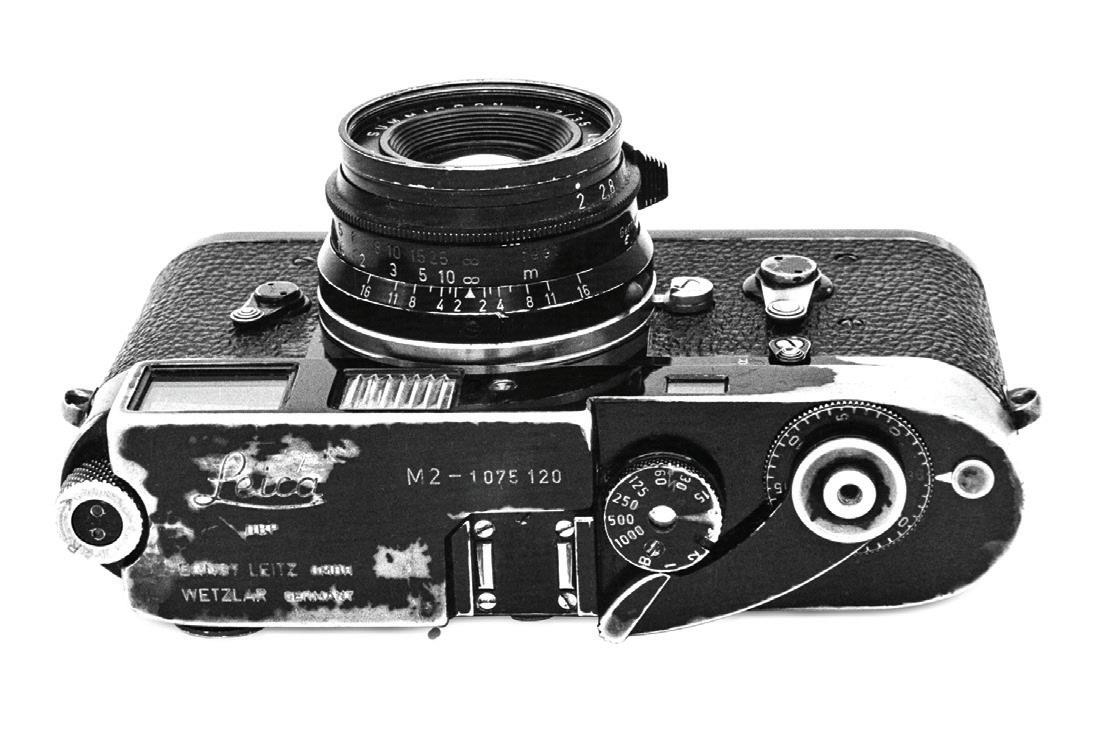
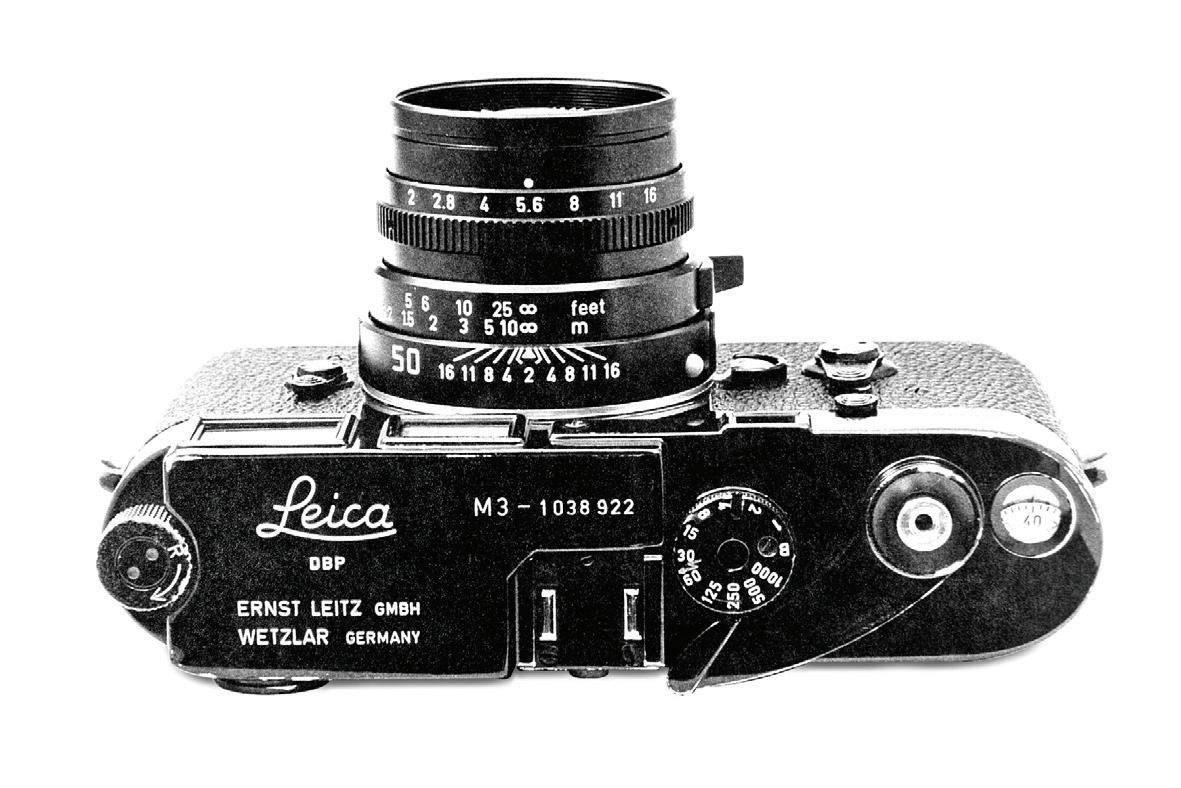
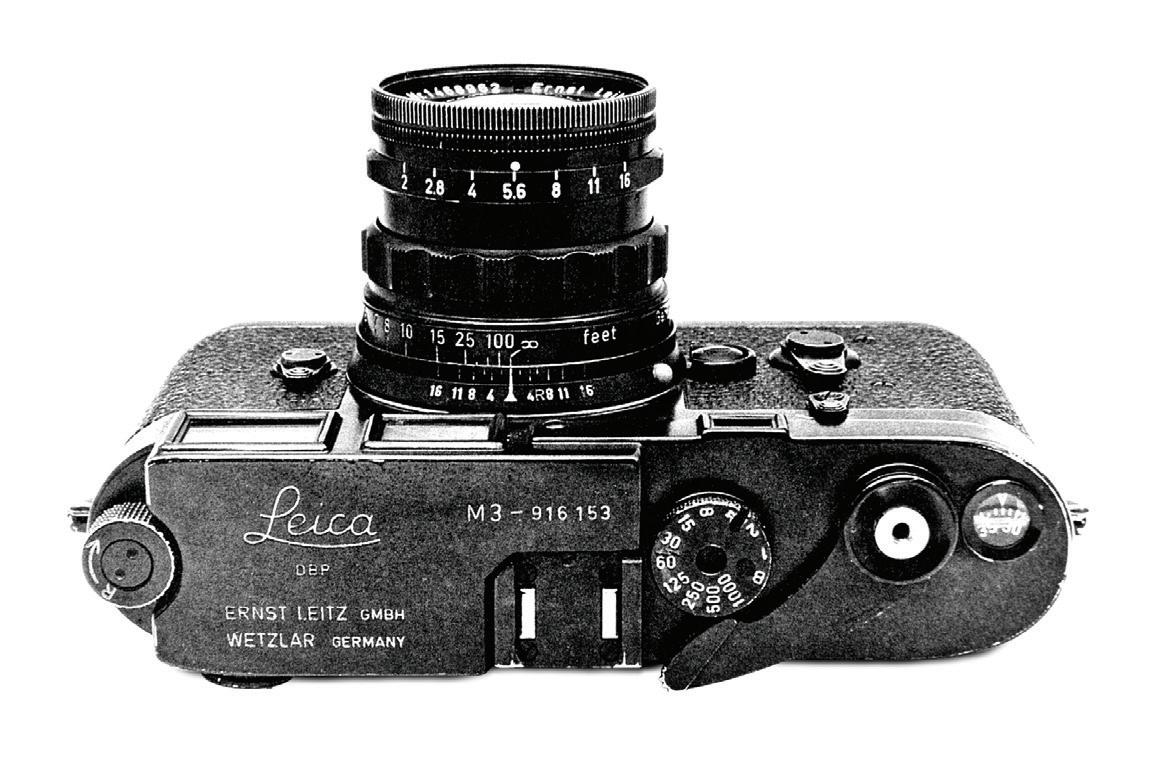
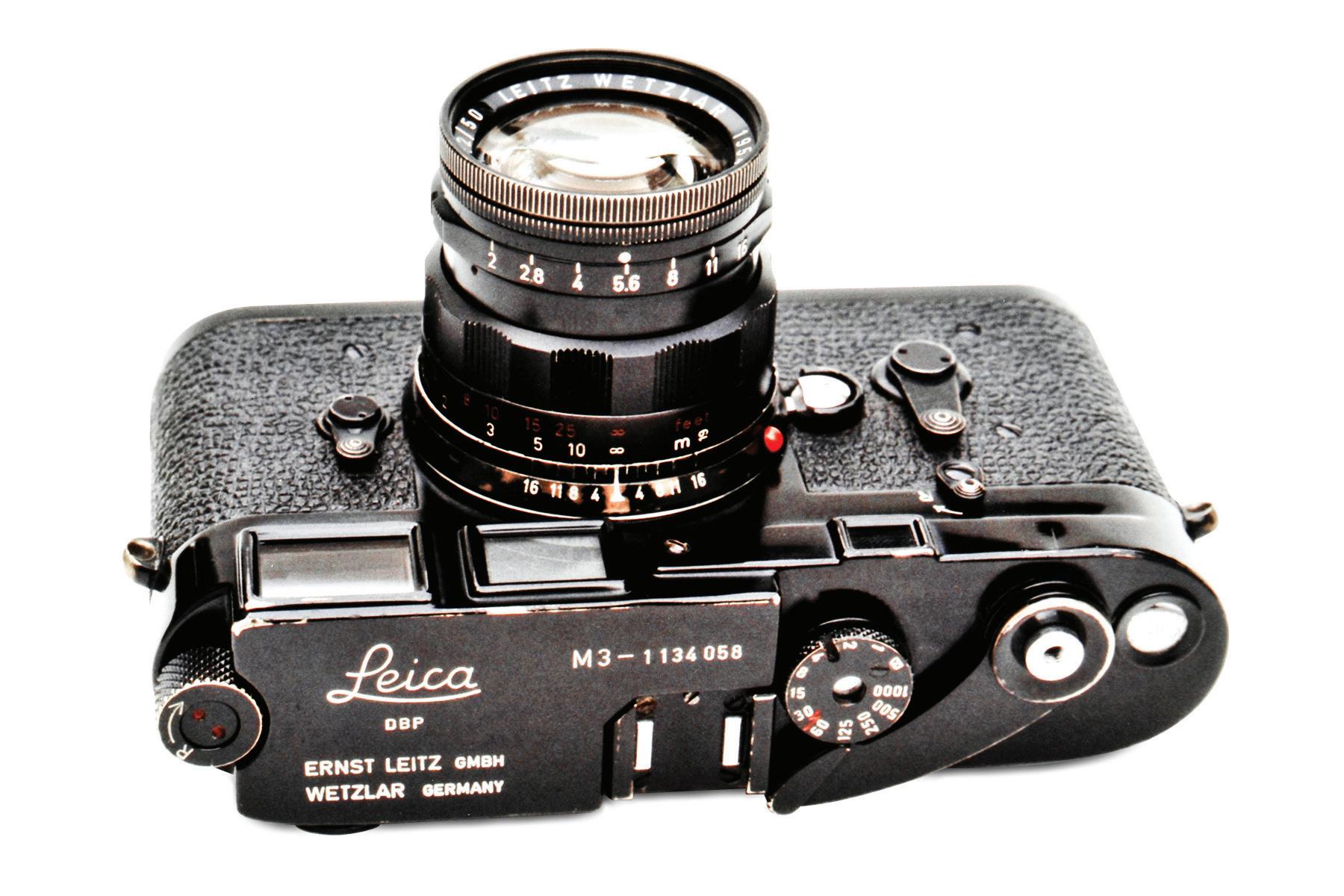
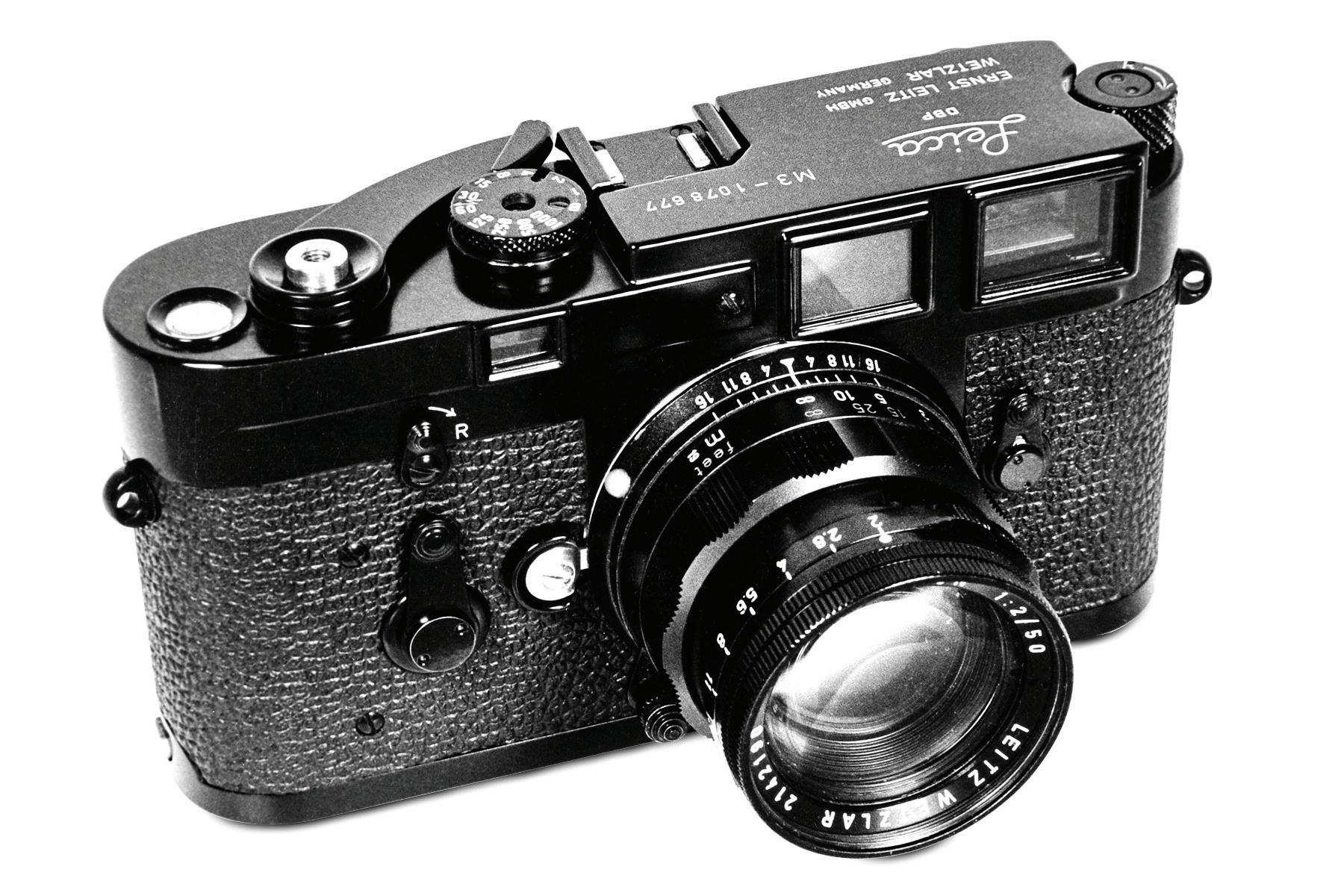
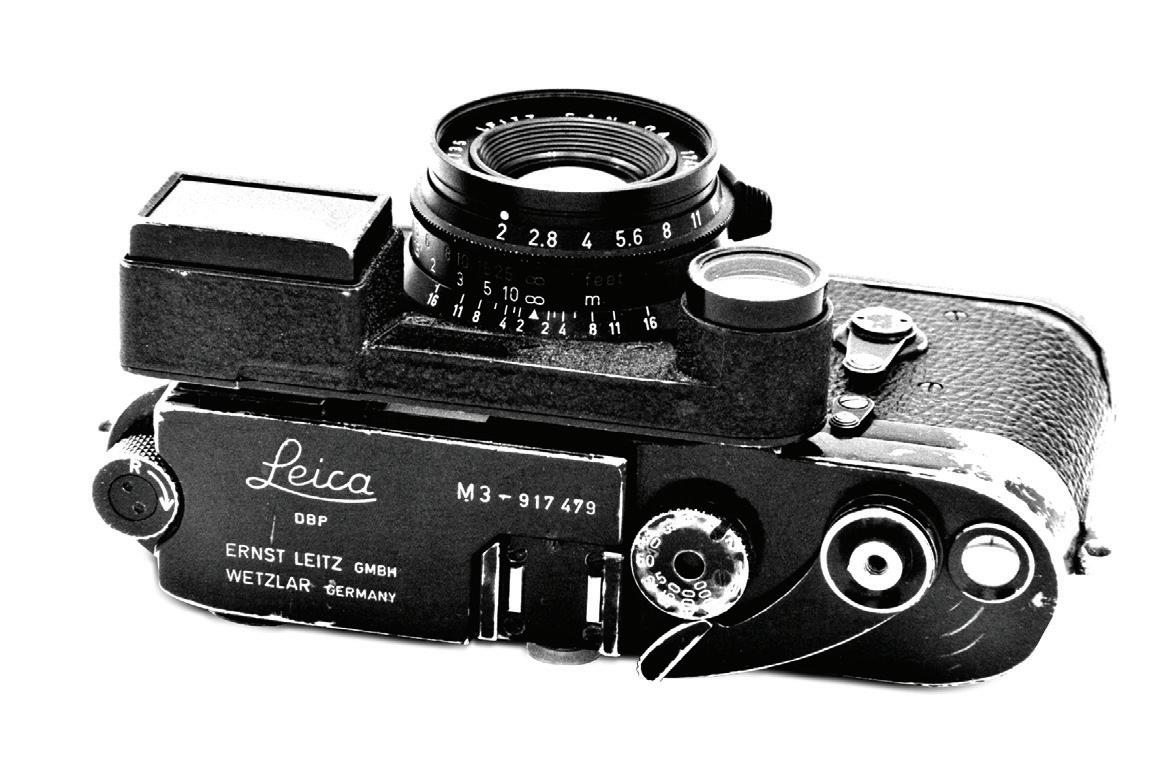
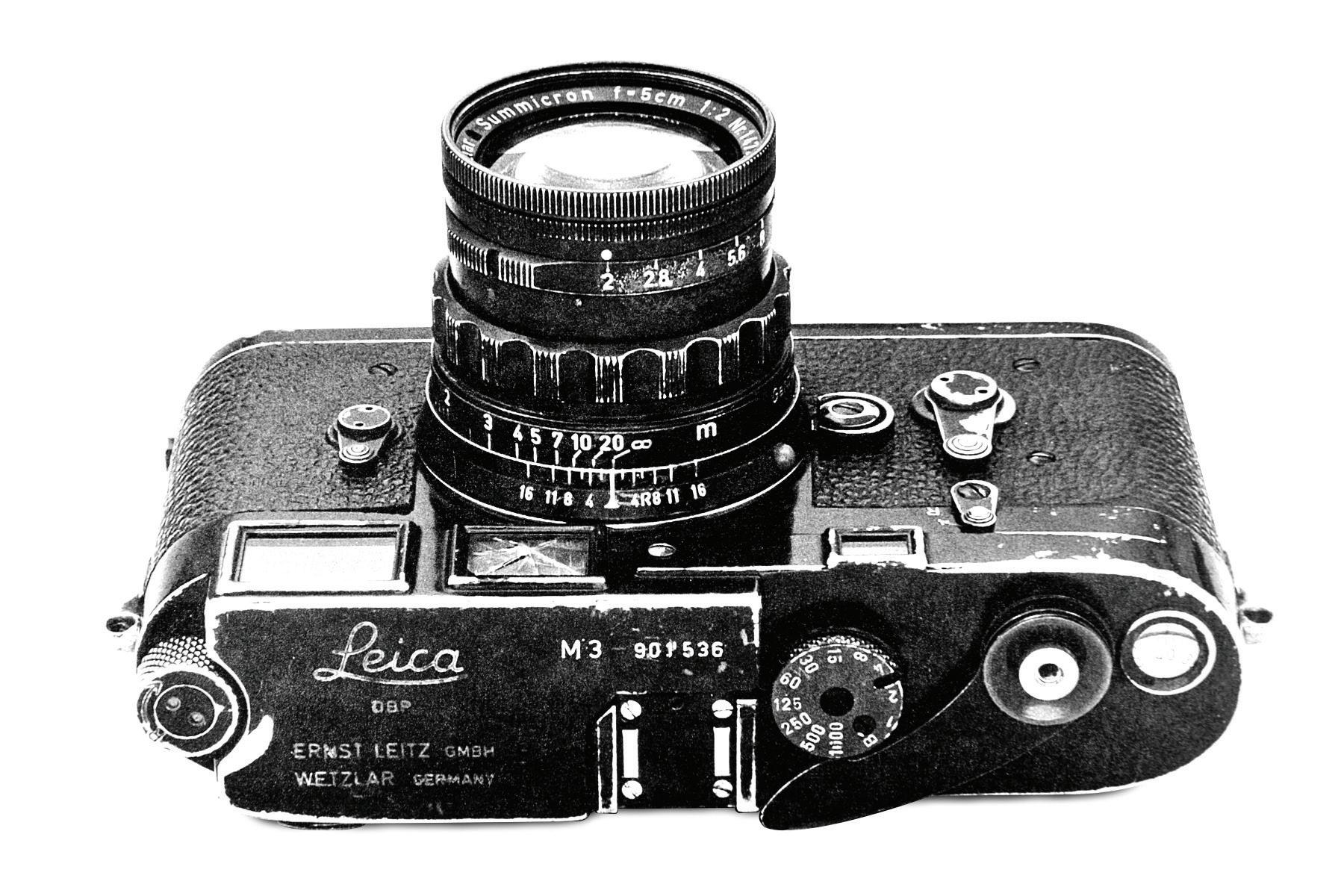
BACK COVER From Agusto Liger's article "The Embassy Leicas" (pp. 45-47)
OFFICERS & DIRECTORS
Inquries about membership, upcoming events, replacement Viewfinder issues, and special orders should be directed to:
Richard Rejino, LHSA Executive Director 14070 Proton Road, Dallas, TX 75244 info@lhsa.org, (972) 233-9107
Viewfinder is the official publication of the LHSA - The International Leica Society, a nonprofit organization incorporated in the state of Delaware. Copyright 2020. Reproduction or use of any material contained herein without permission of the Sociey if forbidden.
Leica is a registered trademark. It and other trademarks pertaining to the Leica System are the property of LEICA CAMERA, USA, INC.
ISSN 1543-8732
PRESIDENT Brad Husick Medina, WA
EXEC.VICE PRESIDENT
David Knoble Charlotte, NC
VP / TREASURER
William Fagan Dublin, Ireland
IMMEDIATE PAST PRESIDENT
Keith R. Sbiral Chicago, IL
PRESIDENT EMERITUS
James L. Lager
Rolf Fricke
Bill Rosauer
APPOINTED OFFICERS Viewfinder Editor
Bill Rosauer Buffalo Grove, IL lhsaeditor@yahoo.com
Associate Viewfinder Editor
Ed Schwartzreich Waterbury, VT
EXECUTIVE DIRECTOR
Richard Rejino Dallas, TX info@lhsa.org
ELECTED DIRECTORS
Class of 2022
Andrew Godlewski Middletown, RI
Bill Royce Kirkland , WA
Kirsten Vignes Saint Petersburg, FL
Philiip Blair Kenmore, WA
Class of 2023
Sandra Eisert Redmond, WA
Ashwin Rao Seattle,WA
Robert Levite Coral Gables, FL
Class of 2024
Wilbur Norman Sante Fe, NM
David Spielman New Orleans, LA
Amitava "Chats" Chatterjee Manassas, VA
SENIOR DIRECTORS
Gary Hough Woodinville, WA
Douglas Drumheller Pittsburgh, PA
Alan Weinschel Roslyn Heights, NY
CONTRIBUTING EDITORS
James L. Lager Closter, NJ
S.R. Gilcreast Jr. Peterborough, NH
S. Williis Wright Port Washington, NY
A LETTER FROM THE PRESIDENT
by BRAD HUSICK
dear members
This is my first letter to you as your new President. Leading this organization is akin to filling a massive pair of 50-year-old shoes worn by all our past presidents. As we move forward, I intend to honor the trust you have placed in me to lead this organization with continued hard work, humility, and an open mind. Leading the Society has always been a team effort, and only as a team, will we thrive. Please know that I welcome your thoughts and participation and I look forward to working with all of you to improve the Society to the benefit of our members and the Leica community at large.
My career has been in technology, where I grew four successful tech companies, but my background has always been rooted in photography. I am a fourth-generation photographer. My great grandfather came to the US in the early 1900s and joined a photoengraving company in New York, where his son also worked. My father was a lifelong photographer and taught me darkroom techniques starting at the age of five. Although I discovered Leica somewhat late in my journey, I fell in love, and now here I am. I also teach for the Leica Akademie.
As an organization, we have had a lot to celebrate over the past year. Our biggest win is our all-new website (www.lhsa.org). It's beautiful, easy to use, loaded with content, and continues to grow and evolve. I encourage you to visit and check out the new searchable database of perhaps the most extensive collection of Leica documentation anywhere. Enjoy your member benefits of ask-an-expert, as well as discounts on Leica Akademie (USA) and Leica repairs (USA). We have also created a new Europe-specific page with lots of content, and we're expanding that with plans and benefits for other parts of the world.
In addition, in 2020 we were all hit with the pandemic. At LHSA, we quickly pivoted to an all-online format and ran successful Spring Shoot and Annual Meeting events online, with record-level attendance from around the world. We just held our first face-to-face event with our 2021 Annual Meeting & Conference in Seattle, where we welcomed more than 70 attendees, held our first Photo Show at the Leica Store Bellevue, and had the pleasure of hosting Mike Giannattasio, Leica NA President, and Kiran Karnani, Leica NA Head of Marketing. We are looking at ways to offer some hybrid in-person and online content in the future. Mark your calendars for our next event, the Spring
Shoot in glorious Colorado Springs, CO, on May 13-14, 2022, and our next Annual Meeting & Conference in mid-October 2022 in historic Dublin, Ireland.
We also created our member-only webinar series as another response to the pandemic. We now have more than 20 webinar recordings available through the website, and we're adding more every month.
We established the Sustaining Member program and currently have more than 100 generous supporters. By investing in The International Leica Society, Sustaining Members enjoy a unique set of benefits - please check it out on the website's About page. In 2022 we plan to begin a special "Conversation with the Photographer" online event series with world-renown photographers for our Sustaining Members.
We have many new, exciting plans for 2022. Our relationship with Leica has never been stronger or more active. Our initial plans include increasing the value of our annual Photo Grant with a loan of a Leica M camera and lens for the grant recipient; co-sponsoring a new Women in Photo grant program in the Spring; beginning weekly joint communications to the entire Leica community, and much more. We appreciate all the generous support we get from Leica.
It's so rewarding to be part of a global community, a family of like-minded people who are passionate about Leica photography. Our goal is to be the best user community in the world. The only way we can get there is to involve our members and work hard to meet the needs and desires of our community worldwide. To that end, we have formed internal working groups to address the organization's central areas, and we welcome members to join these groups and contribute your ideas and time.
In closing, I'd like to ask each of you to start by doing two things to support your LHSA:
1. Invite at least two of your friends to join LHSA.
2. Please share your photos via our social media channels with @leicasociety and #leicasociety.
It's my honor and privilege to serve you. ~ Brad
A LETTER FROM THE EDITOR
by BILL ROSAUER
Ihope you enjoy the latest issue of Viewfinder. Please excuse the lack of new product announcements in this issue, as we are expecting some very exciting news from Leica in the upcoming New Year!
We do have Jono Slack’s article on the story of the APO Leica lenses. I think you will find this most interesting and get a better perspective on Leica’s lens design philosophy and direction for the future. We had Jono’s review of the latest APO lens, the APOSummicron-M 35/2 ASPH in the last issue. This new lens has proven to be so popular with Leica users, it is still in very short supply.
At the beginning of November, I attended the Leica Oskar Barnack Awards in Wetzlar at Leitz Park. We were pleasantly surprised to learn that Ana Maria Arévalo Gosen was the winner of this year’s award. You may recall that Ana Maria was also the recipient of the 2020 LHSA Photoraphy Grant. Please see my short article on the awards in this issue. Prior to our visit to Wetzlar, we also received an exclusive tour of the Leica production facilities in Portugal. I will report on that in the next issue of Viewfinder.
David Knoble shares his approach to landscape photography with us in this issue. This is the first part of a series from David on landscape photography. Hopefully, you can pick up some useful tips from David, and share some of your own with us as well! Also, in this issue we have a short article from new member Douglas Boston, his personal Leica story. When Douglas sent me the article, it really struck a chord in me about our relationship with our fathers and Leica. I hope you enjoy his article as well. I’d like to invite you all to share your Leica stories as well through the pages of Leica.
Dick Gilcreast gives an excellent overview of the “hot setup” for Leica in the 1930’s, the Leica IIIa and Summitar 50/2 lens. This combination was state of the art at the time of its introduction, incorporating many of the lessons learned from the very early days of the Leica. I am sure that many of you have an example in your collection of either the camera or lens or both. Dick’s article makes us consider how good this combination was in its day.
In this issue, we have two articles about the early pioneer of the Leica, Paul Wolff. Lex Bosman takes a look at Wolff ’s connection to the NSDAP, better known as the Nazi Party. What was Paul Wolff ’s relationship with the regime, and what role did this relationship
play with his success in his professional career? I feel this is a very difficult question to answer in light of those very difficult times. One must consider the question, what would I have done if I were in Wolff ’s shoes? Ed Schwartzreich presents some contemporary correspondence between Paul Wolff and Hans Landenberg in the 1940’s which was in the collection of Rolf Fricke. This correspondence raises some very interesting questions regarding Wolff ’s early days with the Leica, in particular Wolff ’s story about having won a Leica in a photo contest and then Tritschler apparently rediscovering it after having put it in a closet for two years. Ed shows a translation of a letter by Theo Kisselbach regarding this. There is other correspondence between Wolff and Landenberg, including a reproduction of one of the actual letters, along with translations and Ed’s commentary. In this are some very interesting comments by Wolff about his hometown of Strassburg in Alsace following its return to Germany after the defeat of France in 1940. Then there is the story of Wolff ’s home and part of his negative archive being destroyed in the bombing of Frankfurt. Henri Dumur, of the Leitz Works had arranged accommodations in nearby Braunfels Castle. Wolff sadly recounts what few possessions from his Frankfurt home that he was able to salvage when he moved to Braunfels.I visited the castle in Braunfels this last November, and asked the guide to show me where Dr. Wolff resided while staying there. I am certain that this is where my father met Dr. Wolff in 1946 and obtained the 9cm Elmar lens I still have in my collection. My dad’s recollection that Dr. Wolff was in poor health and was a “broken man”, is very telling about this period of his life. Both Lex’s and Ed’s articles bring some interesting perspective into who the man known as the “Pioneer of the Leica” was, behind the façade presented in his well-known Leica books.
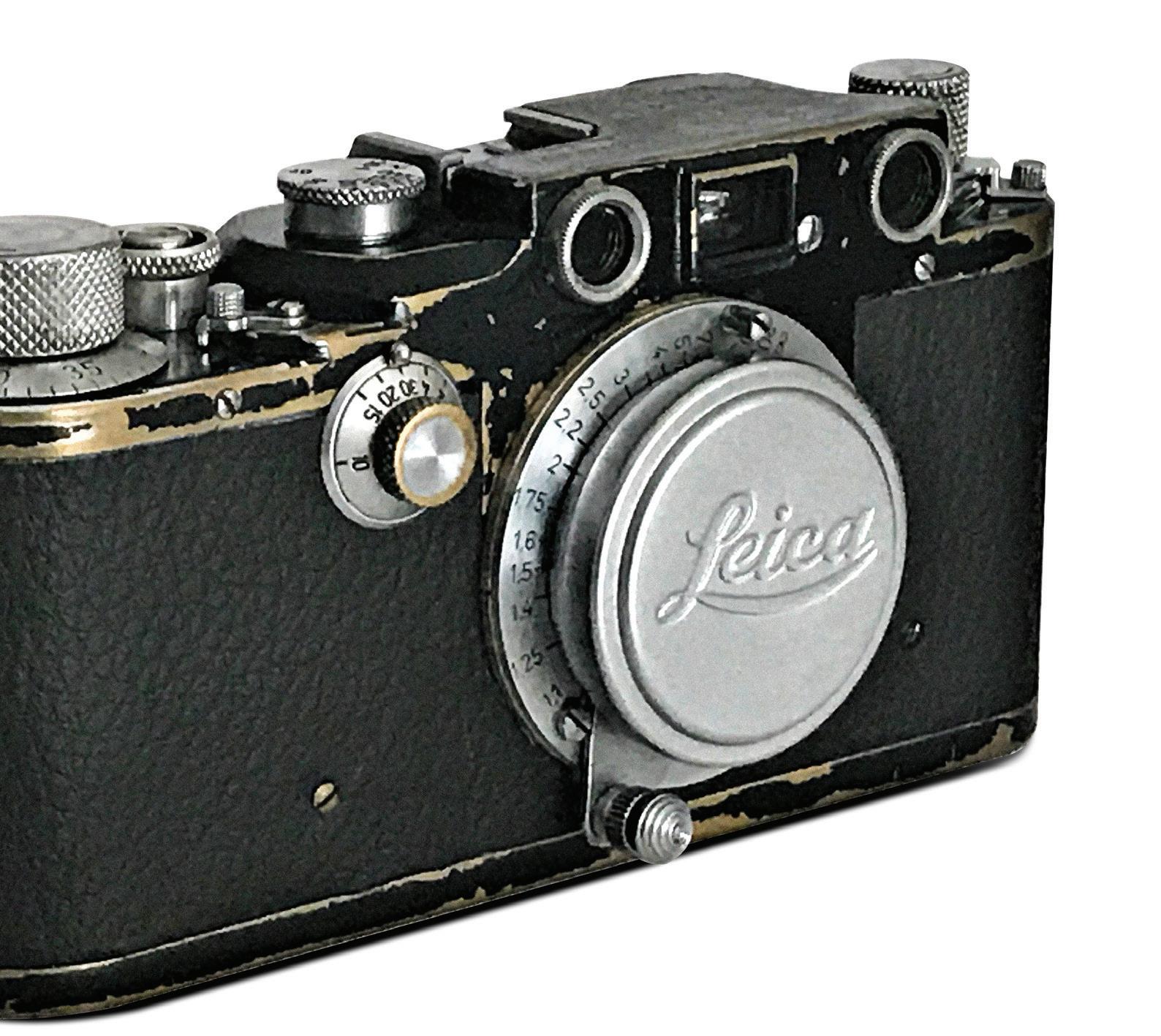
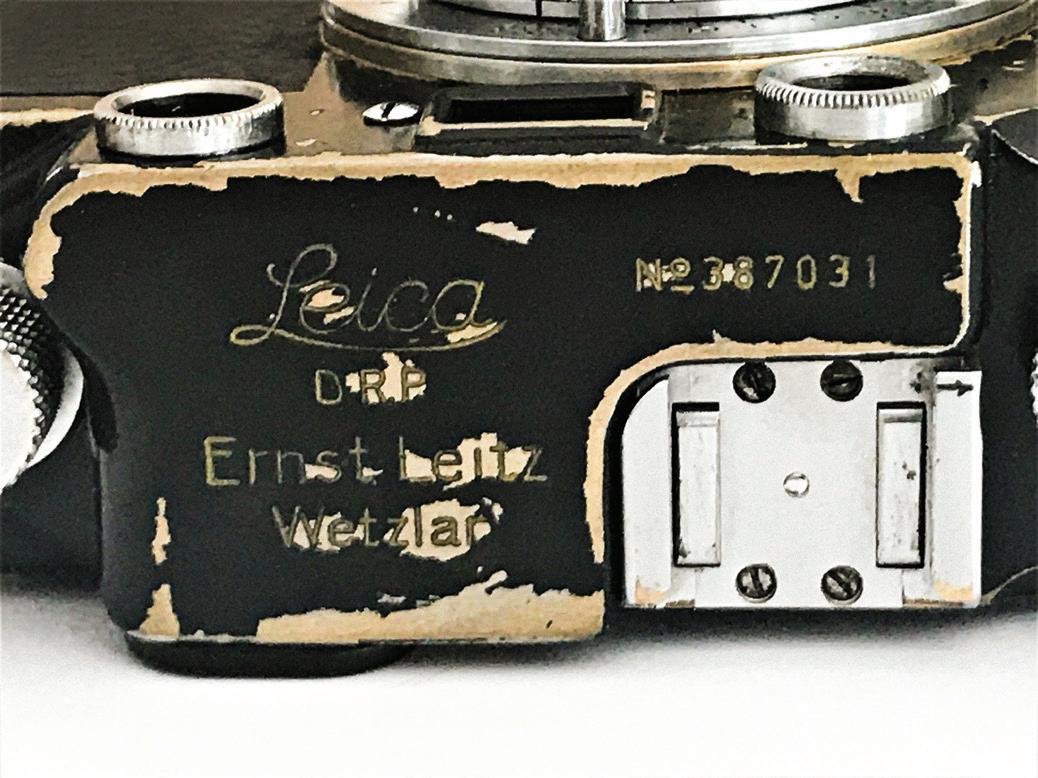
My friend Augusto Liger, tells us the interesting story of the Leicas delivered to the Spanish Emabassy in war-time Berlin. What interesting times these cameras witnessed! Of course, what would Viewfinder be without some contributions from Jim Lager. In this issue the Black Paint M3 and M2 Leicas. Jim is recovering from some serious surgery earlier this year. Please join me in sending Jim our best wishes on his recovery!
Stay tuned for the next issue of Viewfinder where we will have some very interesting new product news!
Bis nächste Zeit! ~ Bill
2021 LEICA OSKAR BARNACK AWARDS [ LOBA ]
by BILL ROSAUER
This November, I was visiting Wetzlar with several members of my tour for four days. During this time, Leica had many events and tours which we participated in. Thank you, Leica Camera, for a wonderful time! On Thursday, November 4, the big event was the Leica Oskar Barnack Awards. Because of COVID, the number of attendees was limited to 200 people. The main entry hall of the Leica AG Headquarters Building was the venue. Entry was gained by a stroll down the Red Carpet to the main entrance, with a stage on the far left and numerous tables set for the evening’s invited guests.
Hosted by Andreas Kaufmann and Karin Rehn-Kaufmann, we were pleasantly surprised to learn that the winner of the 2021 LOBA was none other than Ana Maria Arévalo Gosen, who we recently featured in the LHSA Viewfinder journal. Several of her images were shown on the big screen behind the stage as she was introduced to the audience. The winner this year received
40,000 Euros and 10,000 Euros in new Leica equipment. Over 100 photographers competed this year, and Ana was selected from a shortlist of 12. Ana was very gracious during the award ceremony and genuinely excited when I introduced myself to her as the Editor of the Viewfinder. She sends all of our members her best wishes and we are pleased that we helped introduce her via Viewfinder to the Leica world.
Emile Ducke was the winner of the Newcomer Award for aspiring photographers under 30 years old. He was chosen from a short list of 6, and received a 10,000 Euro prize and a Leica Q2 camera. Ralph Gibson, who is well known to members of the LHSA was inducted to the Leica Hall of Fame. Ralph was very entertaining in talking about some of his images shown on the big screen, and his long career as a world renowned photographer. Ralph was presented with a Leica M10 Monochrom with his signature engraved on the top cover.
the Leica IIIa & 50mm f/2 Summar
by DICK GILCREAST
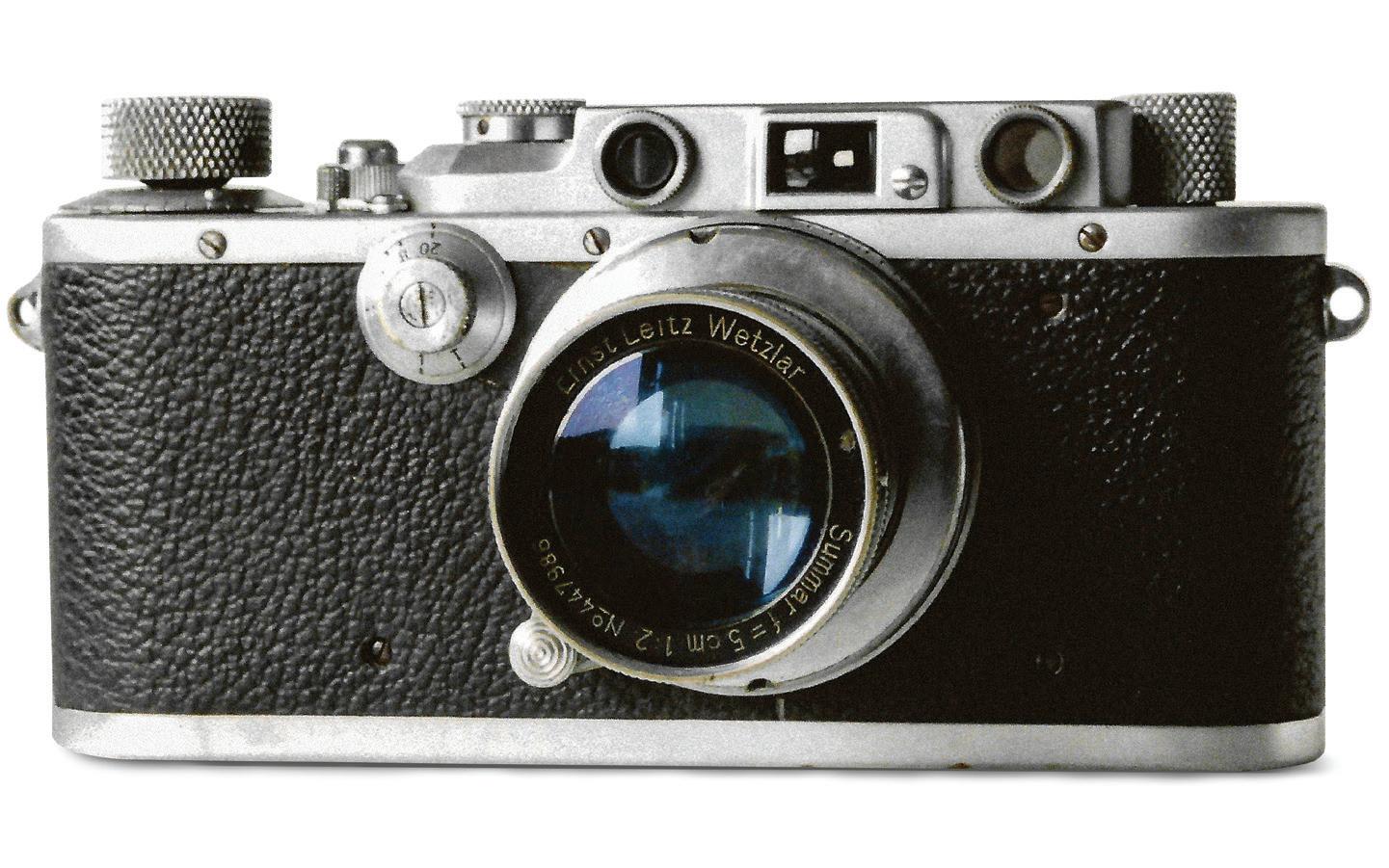
Small and fast-handling, and with an f/2 lens, the Leica Illa was many a photojournalist's constant companion from 1935 until 1950 and beyond. This camera can be dated as 1937 or later by the shape of the fully rounded right side of the frame around the viewfinder, as seen here on Illa No. 237988 from 1937, with Summar (subsequently coated) No. 447385 from 1938 (dates from Leica Pocket Book. 8th edition, Bower & Clark).
theLeica IIIa was the last true Barnack camera built under his oversight. It had his original internal construction, and was essentially a model III from 1933 with with the 1/1000 th shutter speed added as the only change. Both cameras had that wonderful 1.5x magnified rangefinder with diopter adjustment on the eyepiece, the slow speeds from a 20 th down to 1 second plus T on the front dial, and a viewfinder with a slightly larger than half life-size image that was centered close to the lens for very little parallax change down to a one meter distance. (By the way, don't try making that closeup shot with the off-set viewfinders in any of the contemporary Contax models!) . The centrally located viewfinder eyepiece also helps when handholding the camera tight against the face at very slow shutter speeds in lowest light. The IIIa was built primarily from 1935 until 1939, however a
further 607 IIIa cameras were produced by Leitz from 1946 to 1948 (Leica Pocket Book, Bower & Clark). And a few in the Saar region of Germany in 1949 to 51 -- more about them at end of this story.
1935 was a big year for Leica. Along with the IIIa also appeared the extra-wide 28mm f/6.3 Hektor, the first rapid-wind baseplate SCNOO, and the first reflex housing PLOOT with the 200mm f/4.5 Telyt, turning the Leica camera an SLR for both long distance and closeups. Appearing also were the first synchronized flash units VACUB of from Leitz NY, and BTLOO from Leitz Germany (Leica Collectors Guide, Laney).
Therefore, by 1935, the III and IIIa were fully capable, and indeed served in the first ranks of amateur and professional
photographers worldwide until such time in the early 1950's when the newer model Leicas and lenses were again available outside Germany.
One of the primary lenses used for photojournalism with Leicas during that period was the 50mm f/2 Summar, available from 1934 in a non-rotating collapsible mount. It was sharp at f/2, had a commendably flat field, good edge definition, and if kept clean there were not a lot of reflections in the image from the uncoated lens even when used without a hood. It had a normal amount of vignetting at wide open aperture whch didn't bother anyone until the release of contrasty 35mm slide film such as Kodachrome and Agfachrome around 1937, which with their higher contrast showed visibly darkened corners at f/2. So Leica began to design the replacement f/2 Summitar with larger front and rear elements to reduce the effect, with equally good or better performance at all other apertures. The Summitar came out in 1939, but, as with the 1938 IIIb and 1940 IIIc camera models, none of these were widely available outside Germany at the time.
An example of these earlier cameras still being used in 1950 would be David Douglas Duncan's IIIa, probably the one which he had used with Kodachrome while a Marine in the Pacific (8 pictures seen in his 2003 Bio book "Photo Nomad"), and was definitely one of the two cameras, along with a IIIc, that he used to make photographs for LIFE magazine in Korea during 1950 - but by then of course employing the new 50mm and 135mm Nikkor lenses from Japan which he discovered and publicized. That particular camera with its 50mm f/1.5 Nikkor lens, which he credits being used to photograph the first two sections of his book "This Is War" in 1950, can now be seen as a part of the Harry Ransom Collection at the University of Texas at Austin. A closeup photo of that camera and lens appears in Viewfinder , Volume 44, #4, p. 30. The photo shows the presence of 1/1000th on the speed dial, and the serial number 259404 identifying it as a IIIa from 1937.
But, back to the Summar, it was very popular during its 1933 to 1939 period of production, with 122860 examples made (Leica Pocket Book, 8 th edition, Bower and Clark). By comparison, during the reign of the 50 Summar the Leica III (1933 to 1939) sold 76457 examples, and the IIIa (1935 to 1939) sold 92050 examples during that period, with a few more until 1948 (same authority as above). Quite a number of those cameras must have been used with 50 Summars on them!
All Sunnars now being more than 80 years old, they are difficult to find in good condition today. The glass in the front element was relatively soft and easily scratched, so some were returned to the factory for polishing, which made the element slightly thinner and had an effect on the edge rays at large apertures. The lens was also subject to interior dust in the central area near the unusual upward curved diaphragm blades ( possibly
used to eliminate reflections at smaller apertures within the uncoated lens?) so today many Summars need to be cleaned internally. Therefore a clean and unscratched Summar is relatively rare these days, but if found in that condition is a very good performer (see Viewfinder 2003 Volume 36-1, pp. 50-53 on the Summar). Some were returned to the factory for coating, which improved contrast in backlight and side light. It is interesting to note that the curved diaphragm blades are also found in later models of the Summitar, at about the same time that early models of the upcoming 50mm f/2 Summicron lens - all of which used flat blade - were made in small numbers from 1950 until its official release in 1953.
One distinct advantage of the Summar even today is that smaller front flange around the lens which does not encroach into the camera's viewfinder image, as do the larger Summitar and Summicron and Summarit lenses. Therefore the camera and collapsed Summar, the lens very usable without a hood even if uncoated, can take up minimal space while carried since no auxiliary finder is needed to show the full frame of the 50mm lens. Even today it makes one of the smallest yet most capable combinations of camera and lens that can be discreetly carried in a pocket, or on a strap under a jacket, or closed up in its original ever-ready case. And, when used with an all-around capable ISO 200 or 400 film, the f/2 lens is able to work in very low light handheld. This small camera, at a handheld 20 th of a second at f/2, can make a sharp negative that will equal what can be made at a 40 th at f/1.4 or an 80 th at f/1.0 using much larger and heavier cameras!
Further information on the IIIa cameras have appeared recently in Viewfinder . Some Leica IIIa cameras were built in the French-occupied Saar region of Germany by the Saroptico Co. during 1949 to 1951, reported serial numbers 359000 to 359504 -- see "Leica Monte en Saar" by Olaf Nattenberg in Viewfinder Volume 53-3 - some of the cameras having features from IIIc and IIIf such as drum type shutter brakes, sharkskin vulcanite, and IIIf flash synch. Also, see Viewfinder Volume 53-2 "Quest for the Last" about possibly the last Leica IIIa (in 1965!) by Liger & Wasowicz.
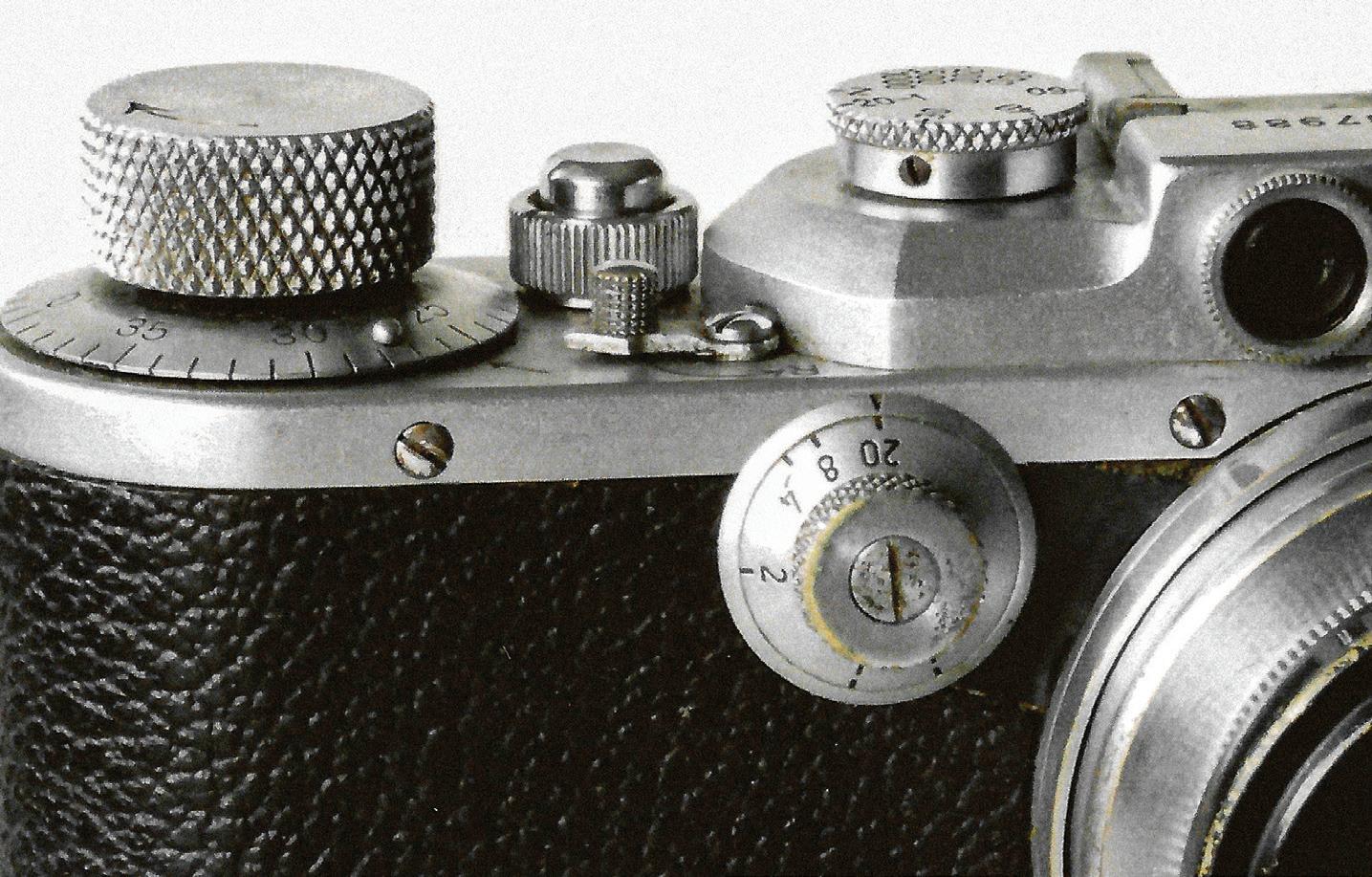
Winding of the film can be done very quickly with a single twist of the knob. The slow speed dial skips from a 20 th down to an 8 th, and from there down to a full second and T. The shutter release button very quickly trips the shutter with only a little more than a 16th of an inch downward pressure. The surrounding ring is removable to attach a cable release.
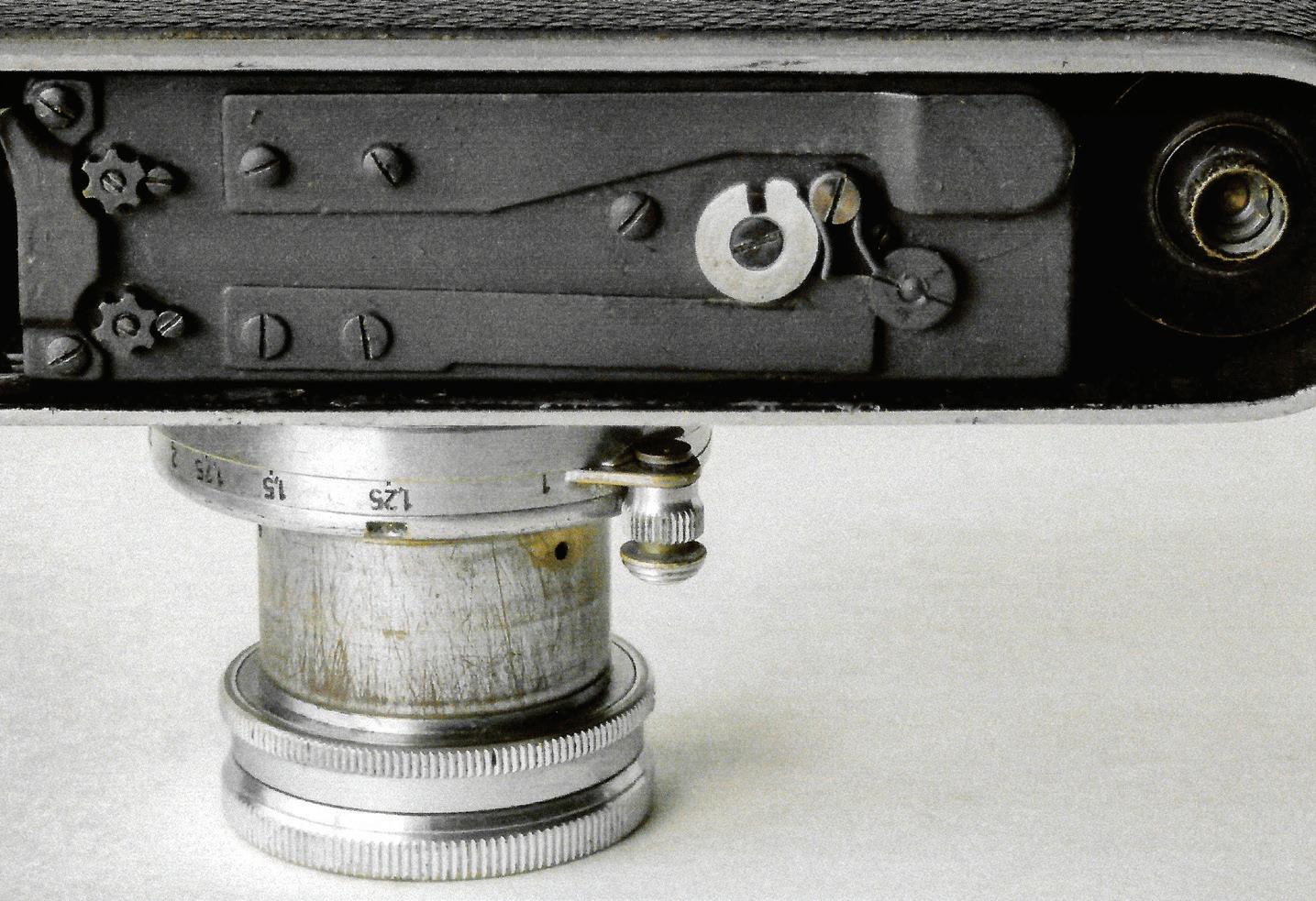
With the baseplate removed, the two shutter tension adjusting star nuts are seen at the left, and the bright metal shutter brake cam is seen with the shutter in its wound position, ready to trip. The take-up spool is seen on the right side. This is the position seen by a photographer on the job while reloading film - with the camera turned upside down suspended on its neck strap, with lens against the chest. The slot in the cam is evidence that the camera was once modified to take a Leitz flash synchronizing baseplate BUNOO (1939) or the NY flash synchronizing baseplate BLISE, also known as the1V1odei Vii, available after 1941 (Leica Collector's Guide, Laney). I had a similar operation done to a IIIc of mine to take a model VIIIa unit in 1955.
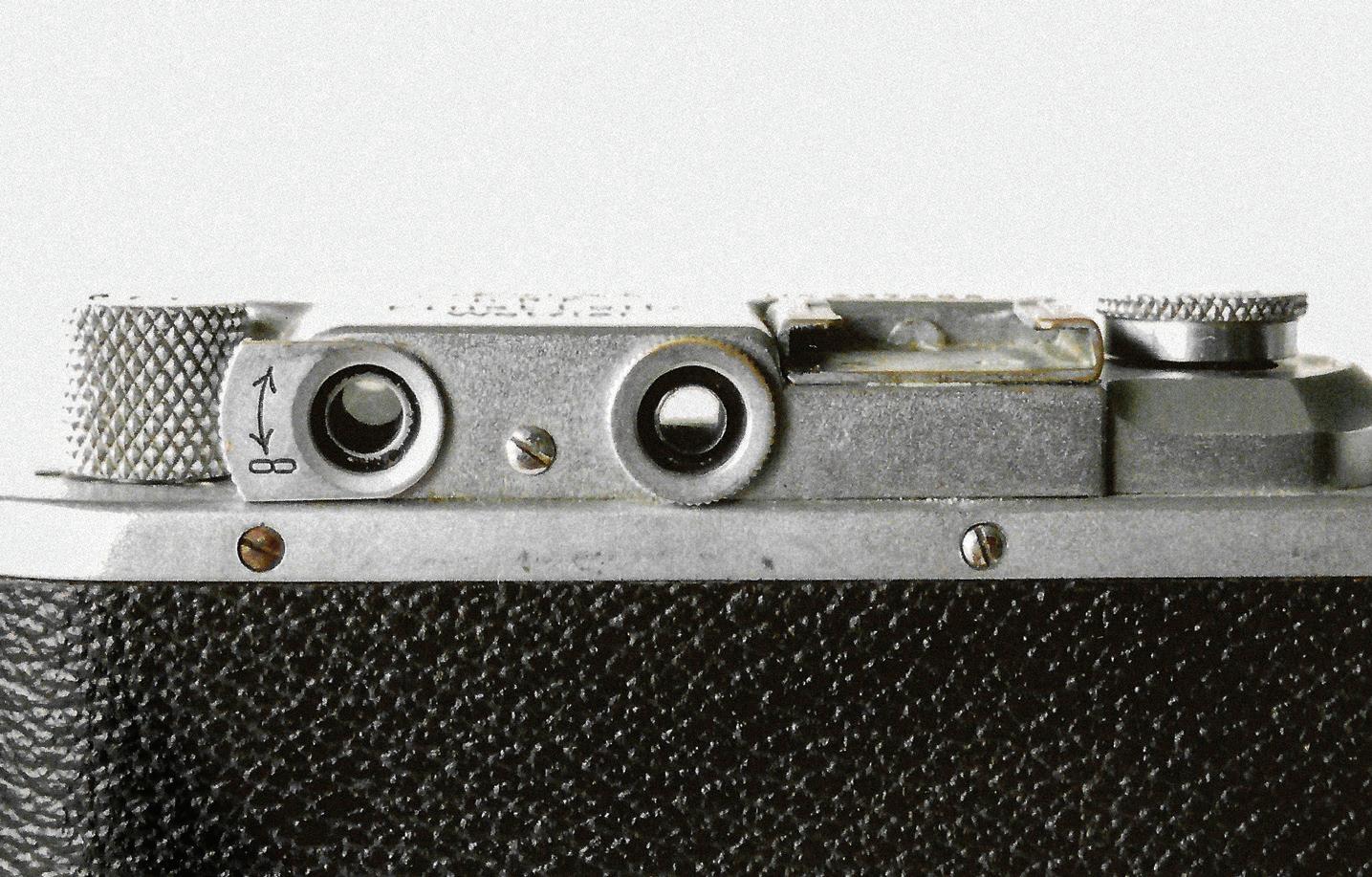
The rangefinder window is on the left, with its rotating diopter correction eyepiece. The viewfinder window is close to the center of the camera - as is the accessory shoe - both well placed for shooting at slow shutter speeds handheld, since there is room for hands holding both ends of the camera to be firmly pressed against the head.
After Twilight - 7/5/21 - Leica S, 45 mm, 45.0 sec at f/9.5
photography thoughts on landscape
It’s All About the Light®
by DAVID KNOBLE
Part One: Location, Repetition & Light
When it comes to landscape photography, it really is all about how the light plays in the scene. Sometimes the light cooperates and sometimes the light causes problems that can be difficult to overcome. Learning how to match the light with technique is an important step in creating better landscape photographs. Here I will share some of the techniques I have grown to use:
1. Location, time & weather
2. Repetition, repetition, repetition
3. Light - direction & subject
4. Equipment - setup & grab bag
5. Post-processing
LOCATION, TIME & WEATHER First and foremost, capturing light entails being setup at a scene and ready to press the shutter when the light gives you the opportunity. Many of the iconic landscape photographs would not exist without planning to be at the right location during the right time. Location provides the basic composition. For example, streams, waterfalls, coastal marshes, mountain peaks, natural formations, etc. You may live near locations that you wish to shoot, or you may plan to visit somewhere with specific scenes you want to capture. Clearly, once on location, composition is also important, but getting to the right place is half the battle. My favorite place is a five block stretch of beach. Ansel Adams had some favorite locations which is evidenced by the volume of photographs he produced. He enjoyed Yosemite Valley with the surrounding area and the High Sierras. Whatever you choose, find a location you can spend time photographing. With practice, taking landscape photographs anywhere can be done with a greater level of confidence.
the time of day. Using studio lights, they create the direction of light and the shadows that cause an image to look truly three dimensional. Studio lighting can also create the color of light. Landscape photographers are beholden to the incessant rotation of the earth around the sun. Just before and after the sun crosses the horizon, different colors of light are available. Shadows lengthen with the movement of the sun whereas harsh light of mid-day sun causes extreme dynamic range challenges. For every given location, with no change in weather, the time of day causes very different results.
I use an app called The Photographer’s Ephemeris®, or TPE. While it is a suite of applications, the main one, TPE, allows me to figure out where the light will come from at any location in the world. I search for a place and put a pin in the location. Next, I rotate a calendar of days and times by simply dragging my finger. The display shows where the sun will rise and set and where the moon will rise and set for that day, including where the sun and moon are at any moment of the day. Even better, TPE shows me when the blue hour and the golden hour will start and stop. Most recently, I found it even knew how to deal with Daylight Savings Time.
I spend a lot of time photographing on Folly Beach, a coastal area in Charleston, South Carolina. The sunrise and sunset move from one side of the island coast to the other during the seasons. In the winter-time, the sun rises out to sea and sets parallel with the western edge of the island. With TPE I can see when the sun will be setting and get photographs of the incredible colors using the coastal houses and tides as backdrops. During the summer months, the sunrise comes up on the other side of the coastline, so the sunrise is unique. Knowing where the sun is helps figure out how the light will play in a landscape.
Another service I use from TPE is called SkyFire™. This paid service predicts the intensity of the colors in sunrise and sunset using weather forecasts and other algorithms. Right now it only works around the continental US and not worldwide, but it has been reasonably accurate. I can look a day or more ahead and decide just how early I want to get up and go to the beachfront or more importantly, if it is even worth getting up. For a sunrise, I like to be setup with my tripod 45 minutes to an hour before the sun will hit the horizon. Whatever method or application is used, planning for the light is very important.
"Landscape photographers are beholden to the incessant rotation of the earth around the sun."
The time of day can be critical to landscape photography. Portrait photographers in a studio have the luxury of creating
Excluding the sun, another challenge in landscape photography is the weather. Absolutely out of our control, clouds can obscure the sun and the light is very different. A thunderstorm can bring too much rain, heavy wind or even lightning - none of which is conducive to photography. Yet, at the same time, extreme weather can produce some incredibly beautiful or ominous images. The same thunderstorm, or storm front, can provide incredible contrast between serene and the raw power
Last Light of Day - 7/5/21
S, 45 mm, 2.0 sec. at f/11
Springtime Morning - 4/18/21
SL2, 16 mm, 3.0 sec. at f/9.0
Summer Storm Warning - 6/6/21
SL2, 31 mm, 0.4 sec. at f/22
Leica
Leica
Leica
of nature. Several of today’s Leica camera systems have some level of weather protection (Leica Q, Leica SL and Leica S) allowing the choice of how much weather to risk. In fact, one camera model, the X-U is meant to photograph under water! Personally, I have used the Leica S system all day in Icelandic rain and just over freezing temperatures with no ill effects. I also regularly use my SL2 in weather at the coast, rinsing it off lightly afterwards if necessary. I would say avoiding weather is not the issue, but using the weather to your advantage is key to developing a unique photograph. Weather is never the exactly same twice.
....using the weather to your advantage is key to developing a unique photograph.
REPETITION Repetition is the best way to work an area for landscape photographs. A few days in a row will help deal with weather. In fact, with the right weather, one area can look like different locations because of all the changes in light. If you have the ability to come back to a location during different seasons, that will also bring variety to the same view. Ansel Adams did this throughout Yosemite. Some of his most famous images are of the Yosemite Valley in both the fall with leaves on the trees and in the winter covered in snow.
Weather brings different light and different feelings or emotion. Landscape photography has a level of uniqueness that can often be overlooked. Weather erodes. Nature grows and dies in a cycle. Rocks and glaciers move as pieces fall. Water floods. Some areas change very slowly, and some areas change by the hour.
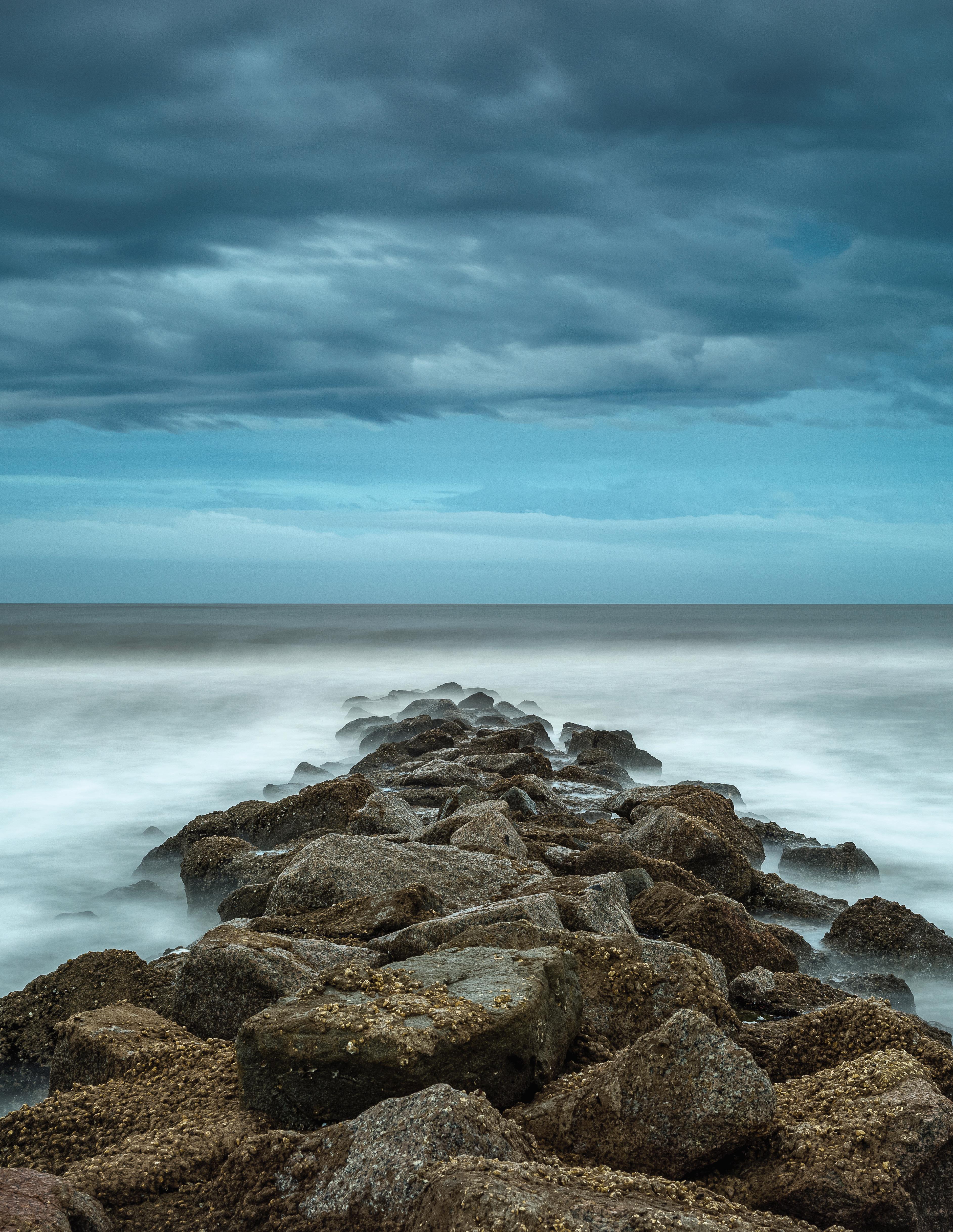
On the coast, which is my primary landscape location, the wind moves the dune grasses causing blurry stalks in an otherwise still image. The ocean waves can be rough and constantly crashing or intermittent with smooth surfaces all the way to the horizon. In the winter months the foam of the sea is washed on the shore like an iceberg from much further north. The same spot of sand changes by the minute at the coast, only the rock groins and the coastal houses can help me show I am in the same spot. Even more dramatic, after a storm comes through (I don’t use the “H” word), the dunes and man-made structures can be in total disarray, causing a smooth landscape to become rough and disorderly.
I have spent the last five years photographing one small location several hundred yards long and I would challenge many viewers to be able to distinguish those images from the others along a two mile stretch of this Atlantic coastline. Such
is the power of repetition in landscape photography. Whether living at the coast or near a national park, finding some spots near home can provide a place for practice and repetition. If landscape photography is a genre to explore, take the challenge of making images with repetition.
I have a good friend in the UK that has taken images every day since the pandemic officially started. Each was taken from his backyard and he posted them on social media with the newspaper headlines that day. He created a book of these images, numbering each day since the pandemic officially started. What a great project and what a great use of repetition to find different ways to photograph the same place! To view Mick Yates project (using the Leica Q2), visit this link: https://www.mickyatesphotography.com/Photo-Essays/Coronavirus-UK/.
The old adage of practice makes perfect is true in landscape photography. While some locations you may only have one day, or even just a few hours, practicing repetition will make you a better landscape photographer and help you view new locations differently when time is not a luxury.
LIGHT After figuring out a location, the light is really the next most important. There are two aspects of light that are important. These are the artistic light and the dynamic light. So, one is creative and the other scientific. We will explore the former here and the latter as we talk about equipment.
Artistic light is hard to teach and comes with looking at many images and getting volumes of practice. I grew up on black and white and I have used all of the Leica Monochrom’s. One lesson I have learned through decades of black and white work is that “white is light and black is not.” That sounds overly simplistic, but it is meant to be. Color works the same way except I would modify to say “white is light and dark is not.” Thinking about this simple phrase helps look for the light. In fact, I believe this is the single most important aspect of art and photography, so I trademarked the phrase “It’s All About the Light®” and use it with my work.
Our eyes tend to even out the lights and darks so that our photographs can end up looking very different from our memory. Looking for the whites helps knowing where the bright parts of the image will be. Looking for shadows or the darks will provide the contrast against the light. For example, at the beach, during a sunrise or sunset, the white parts (light) can be any of the following: the sun, the yellow sky anywhere near the sun, the sky colors reflected in the tide as it moves in and out from shore, foam in the sea after the waves crash, the moon in the other side of the sky and other light areas. Dark and shadow areas include the dark blue and green water in the waves, wet sand, any objects in front of the sun or yellow sky (silhouettes) and areas in the shade from beachfront houses or dunes.
After the Rain - 6/4/21
M9, 28 mm, 1/45 sec. at f/11
Summertime Sea Snow - 7/8/21
Leica S, 35 mm, 1.5 sec at f/11
Inifinity - 1/6/20
Leica S, 45 mm, 24.0 sec at f/11
For color work the changing colors are equally important. As the sun sets, the sky leaves the blue from the day and starts turning bright yellow and then darker orange. After the sun goes below the horizon, these bright colors turn back to blues, purples and other dark colors before night sets in. During a sunrise, the process is reversed. Many times, the entire sky may not change, but only bands near the horizon, adding layers of color. The fun part is that the sky goes from bright to dark. As the sky darkens, the horizon and foam in the ocean become the light.
"...the ocean takes on the mood of the sky."
Clearly all these areas are ripe for composing landscape photographs. Using the shadows to draw attention to the light, or the reverse - using light to draw attention to the shadows - is the creative part of the process. Notice I am not talking about the “rule of thirds” or “square versus rectangular cropping.” All of the composition techniques you have in your bag should be employed. What I am suggesting is that many compositions use lines and directions, and I am adding the component of light as if it were an object in the scene.
Consider a sunrise. Many viewers enjoy the sun partially up above the horizon at the sea. In part, I believe this is because the moment is very short and many viewers do not get up early enough to venture out and see the sunrise. However, I also believe just the sun poking up to say good morning can be a dull photograph. The light cast by the sun on reflective surfaces is what really brings the photograph to life. At the coast, the sky turns colors which are reflected on the ocean and the wet sand if you look at just the right angle. The sun can cast columns of red and orange on the same water and sand. This is the light to capture. I have said many times the ocean takes on the mood of the sky. Grey skies bring grey oceans, blue skies bring blue oceans, and done well, red and orange skies bring red and orange oceans.
After reflections also consider shadows. Sun that is very low to the horizon casts incredibly long shadows. I have taken photographs of my shadow 30 feet long! There is another benefit to low sun. The light level is still very low, which means many of the shadows are not deep black, but have readily available detail. Said another way, the light level is low enough that the contrast is also lower - much lower than at mid-day. Try looking 90 degrees to the left and right from the sun for unique shadows that will quickly fade as the sun rises. Why not directly behind you? Try it sometime and then look for your shadow in the middle of the frame!
Shadows not only provide structure to a photograph, but shadows also provide an opportunity to really show the three dimensional nature of a subject. The bright spots where the sun spotlights a subject provide color. As the light fades off into a shadow, the textures really shine through. Experiment by taking something with texture and shining a flashlight on the surface while viewing the side. Notice how the texture creates shadows from the light. This texture brings out parts of a landscape that keep it from looking flat.
Another way to study how shadows work for your photographs is to study landscape art or paintings. The Hudson River School was an art school from the 1800’s that began its focus in the Hudson River Valley. The artists, male and female, practiced the movement then called Romanticism. This link (https://en.wikipedia.org/wiki/Hudson_River_School) shows many good examples using light and shadows in landscape paintings and a plethora of artists to study. These are only one example, but studying paintings, before cameras and film were widely used, is a great way to get ideas.
In Part II, I will talk about equipment in terms of necessary setup regardless of what camera is used, dynamic range and ways to adjust it, and end with some post-processing ideas.
note: All the images here were taken at the exact same location (repetition) at Folly Beach, South Carolina, USA, during different times of year and different times of day. The cameras and exposure information are listed in the captions.
Cool January Evening - 1/1/21
SL2, 35 mm, 24.0 sec. at f/9.0
After Twilight - 7/5/21
S, 45 mm, 45.0 sec at f/9.5
On Location at Folly Beach - 11/20/18
M10-D, 21mm, 1/45th sec. at f/8
Leica
Leica
Leica
A Leica Stor y
by DOUGLAS BOSTON
Igrew up in a tiny white ranch house with a car port and a flat tar roof in the Western suburbs of Chicago. My father had an imposing mind. He consumed books at an astonishing rate. He was employed here-and-there, mostly as a salesperson. Mostly just making ends meet. Mostly unnoticed. He was affectionate, drank heavily, and had a dangerous temper. My mother was creative, handsome, and had a buoyancy sufficient to keep the whole family afloat. Together they raised five children, which my mother dispensed Pez-like one-after-another in the late Fifties.
Most every night after dinner my father would settle into an old threadbare recliner that was covered over by a beach towel, tucked in, as if re-upholstered. He read until bedtime and reliably rose each morning to read again around 2 a.m. He read all the classics, as well as dense texts on the sciences and philosophy. He had his intellectual dalliances too. On Sunday afternoons he’d listen to opera and solve the chess endgame problems published in the newspaper. Sometimes, in his chair, he dreamt of far-away adventure, and accumulated a small library on subjects like sailing, mountaineering, and outdoor survival, to name a few.
Sacrifices are routine when you have little means. In fact, as they are repeated, they develop a cadence that feels natural. My father knew he was tethered to an inescapable economic reality. He knew to keep his head down and do the expected. But something unexpected happened one day in the summer of 1967. He came home with a brand-new Leica M4 and 50mm Summicron lens.
It was an unspeakable extravagance. My mother burst into tears. Nothing could rationalize this act. But for my father there was no retreat. No contrition. Something had broken for a moment and wasn’t going to be repaired. A temporary flight from economic servitude? An unforgivable act of selfishness? Both, to be sure.
He was not an artist. More of an archivist. With his Leica he dutifully recorded all our significant occasions. It was a family ritual to assemble before the Leica while he fussed with focus and exposure. Birthdays, graduations, proms, weddings, everything was preserved in slide or film. I think he had secret pride that he had command of something, one thing, that was special.
We’d go driving together on Sunday mornings, just the two of us. I never wanted to go, but I did it for us. More times than not, he’d address the subject of photography, instructing me on matters like depth of field or proper exposure. I’d feign interest at the appropriate intervals and watch the scenery smear past. On the return trip, we’d always pick up a couple of quarts of malt liquor and a carton of cigarettes. Once home, I made myself scarce.
As I grew up, we grew apart, and I left home to attend Art school. A couple of years in, I had to declare a minor area of study, and I chose photography. I had no camera, nor could I afford one, but I could borrow one from a small jumble of battered Yashica and Nikkormat SLRs set aside for poor students. I also had no genuine interest. I regarded photography as a second-tier creative expression. I did it for us.
It was rare for me to come home during a school semester, double-so on a bitter cold morning in January, but I was anxious to share the news. It wasn’t far, about an hour’s drive through farm country, white to the horizon everywhere you looked, with the occasional patch of corn stubble uncovered by the prairie winds. The road was freshly plowed and dusted with light snow that swirled, caught the light, disappeared, and then returned again.
When I arrived and mentioned my choice, I knew I was right. He was instantly animated and delivered a stream of knowledge about photography that played through the entire day. Picture-taking, developing, darkroom chemistry, printmaking, little on the subject was left un-addressed.
When I woke up the next morning, I found him in his usual place on his tattered green recliner. He looked up from the book he was reading and carefully turned it over, balancing it open with the binding up on the chair’s arm. Next to him, on the coffee table was a camera bag. Speaking in a matterof-fact tone, he pointed towards it and said, “My camera, it’s yours now.”
I was speechless. Out of the corner of my eye I caught a glimpse of my mother nodding with an approving smile in the kitchen. All I could manage to say was “I’ll take great care of it”. He smiled, leaned forward, and said reassuringly, “I know you will.” With that gesture, his single treasure passed from him to me. We spoke about photography many times after that day, but to his great credit, he never asked about the camera, never once doted on its condition or it’s whereabouts.
Many years have gone. My father is gone. My creative energies were long ago repurposed to more practical alternatives. Still, I keep his M4 close. It’s a talisman of sorts, and it’s always on sentinel duty somewhere in my office. I turn it around in my hands occasionally, but it hasn’t been used but a handful of times in the last 40 years. None in the last 30. Three months ago, I loaded it with film and took it out, expecting the worst. Instead, it performed perfectly. Astonishing.
Inspired, I did something unexpected. I purchased a Leica M10 and 35mm Summicron lens.
APO A P O C H R OMATIC & M O RE
by JONATHAN SLACK
Irecently wrote about the new 35mm APO-Summicron-M and before that about the Summicron-SL lenses. It occurred to me that I hadn't written about any of the other APO M lenses, and as the 75 has been my favorite M lens for many years, I thought it would be a good idea to rectify the situation.
There are currently five such lenses which have all appeared since 1998 (there were several APO R lenses before that, but they were all telephoto designs ).
• APO-Summicron-M 90mm f/2 Asph., 1998
• APO-Telyt-M 135mm f/3.4, 1998
• APO-Summicron-M 75mm f/2 Asph., 2005
• APO-Summicron-M 50mm f/2 Asph., 2012
• APO- Summicron-M 35mm f/2 Asph., 2021
I bought my 75mm around 2007, shortly after buying my M8 and it's still in frequent use today. I also have the 50mm, which I bought on release, and am now the proud possessor of the 35mm. Leica was kind enough to loan me the 90mm and 135mm lenses for this article.
So, what exactly is an APO lens? The truth is that it's rather a vague term and not to be confused with Apochromatic, which isn't vague at all!
Longitudinal Chromatic Aberrations occur when different colors focus at different distances from a lens and cause color fringing around high contrast edges. An Achromatic lens is one which is corrected to ensure that two wavelengths of light focus in the same plane - an Apochromatic lens is where three wavelengths of light focus on the same plane. This is well and good, but it doesn't cover the bokeh, so although it's relevant where an image is completely in focus, it isn't when it's not.
With Leica's APO lenses, chromatic aberrations are reduced by the use of low dispersion glass elements in the lens design. The intention is to reduce chromatic aberration in all areas, both in focus and out of focus. As more APO lenses have appeared they have refined the design, so that they have become more and more successful, culminating in the SL summicron lenses and the new 35 APO Summicron M.
So for practical purposes we might define an APO lens as one which contains one or more low dispersion glass elements. Indeed Leica has made this statement:
"The prefix ‘APO’ in the name denotes Leica lenses with the best imaging performance. From telephotos to wide-angles, all Summicron-SL lenses in the SL-System portfolio bear these coveted three letters before their names. For a long time, this distinction was reserved exclusively for telephoto lenses, as only they could achieve the exceptional quality required.
It is now over 40 years since the first APO lens built by Leica made its appearance – the APO-Telyt-R 180mm f/3.4 in 1975. In 2012, the APO-Summicron-M 50 mm f/2 Asph. became the first standard lens to bear this prestigious prefix.
Thanks to technological progress, more complex construction and new manufacturing methods employed in the SL-System, the design engineers were able to perfectly maximise the optical performance.
To us at Leica, APO means more than just the correction of longitudinal chromatic aberration, for which the purely scientific definition of the term ‘apochromatic’ stands."
This is emphasising that the Leica APO lenses (at least the modern ones) aim to remove chromatic aberrations completely.
But this is not just about chromatic aberration, as Peter Karbe explained to me, the lack of aberrations results in much more contrast at the point of focus than in an ordinary lens, and that this contrast falls off very quickly in front and behind the
point of focus. This means that an f/2 lens can appear to have the same depth of field as an f/1.4 lens (or even less in the case of the 75 f/1.4 compared to the 75 f/2 M lens)
I think that this rapid fall-off of contrast confers a special look on the Leica APO lenses, which are very detailed when in focus, but with a quick roll-off into gentle bokeh. Indeed, I think the whole look is 'gentle.' The in-focus area, although showing a lot of detail doesn't have that 'crunchy' look that many older lenses have when stopped down.
TO SUMMARISE
Leica's definition of an APO lens seems to be, quite simply, one which utilises low dispersion glass in construction with the intention of reducing chromatic aberrations, both in focus and out of focus.
Reducing the aberrations increases contrast noticeably when in focus, which has the visual effect of simulating a narrower depth of field, because the contrast drops sharply as focus is lost.
This has allowed them to produce a range of f/2 lenses, which have the apparent depth of field of faster lenses. This in turn allows the lenses to be smaller and lighter and makes it possible to make them very high quality, they are however extremely difficult to manufacture, which explains why they are so expensive.
FOCUSING
There is quite a lot of information about difficulties focusing the 90mm APO on the internet, but nothing about issues with the other APO lenses, even the 135mm APO-Telyt.
I was a little surprised by this, and so I thought I’d do some proper testing, not just close up, but at a range of distances. The results were enlightening. Of course it’s possible that there was a specific problem with my 90mm APO, but I don’t think so as I've checked it out with other owners who have similar issues.
For the testing I used my M10-R together with the Visoflex EVF, focusing with the rangefinder and then checking it in the EVF.
135MM APO-TELYT-M F/3.4
This is a long focal length for rangefinder focusing, and the frame lines are correspondingly small, but in actual use
I found it’s perfectly possible, even at f/3.4. Focusing was straightforward and accurate all the way from the minimum focus distance (1.5 metre) to infinity. Stopping down mostly extends the area in focus beyond the point of accurate focus, but it also extends it towards the camera.
90MM APO-SUMMICRON-M F/2 ASPH
This feels like it was designed principally for portraits. It focuses accurately using the rangefinder up to about 4 or 5 metres, even at f/2. Stopping down does keep the original focus point in focus, but the in-focus area extends beyond that point, close to the camera remains out of focus.
By 30 metres I found it was back-focusing by 2 or 3 metres. So that when I focused on a car number plate 30 metres away using the rangefinder, and then checked in the EVF, the point of accurate focus was 2 or 3 metres closer.
However, it's worth mentioning in this context that the 90mm APO was designed more than 20 years ago, well before the days of digital M cameras and many of the lenses 'out in the wild' are probably quite old. Some may have been calibrated to specific cameras (which may have had poorly calibrated rangefinders) . It's hardly surprising that they should be out a bit. Probably if one was to buy a new one it would be much closer to correct. As an interesting historical aside, the first of the 90mm APO lenses were manufactured in Canada and around fifty produced. However, making the lens elements proved too challenging and in 1998 it was decided to move production to Solms.
75MM, 50MM & 35MM APO-SUMMICRON-M
These lenses all have a floating element, and as you would expect focusing is accurate and manageable at all distances (and all F stops) , with the area in focus extending both forwards and backwards when stopping down.
IMAGE QUALITY
I've seen a tendency on the internet chatrooms to refer to the modern Leica lenses, and especially the APO lenses as 'clinical' or 'sterile', whereas vintage and older lenses are described as 'artistic'. To me that sounds like it's better to paint a picture with a 50 year old paintbrush! Which doesn't mean for a second that I don't recognise the charm and character of lots of older lenses, but it's a funny old world where 'clinical' = good and 'artistic' = not so good!
The modern APO M lenses are far from lacking character. They have wonderful bokeh and fantastic detail when in focus. What's more, they don't have the 'edgy' look that many older lenses have when stopped down.
All five of these lenses produce wonderful images, right from the widest aperture. There is no need to stop down to improve quality. What's more - the drawing of the lens doesn't change when you do stop down.
In addition they all work really well on the SL family of cameras, the 90mm in particular is better on the SL (or with an EVF on an M) because of the difficulty in focusing at distance with the rangefinder.
But the important thing for me is that all five lenses draw consistently, which means that if you're shooting a wedding or a holiday or just a walk with the dog, then you can swap between different APO M lenses without radically changing the look.
CONCLUSION
Let's face it, in this digital age with very acceptable high ISO, fast lenses are not needed for their light gathering properties, and whilst it might be fun to shoot at f/1.4, the tiny depth of field makes it a risky undertaking if you're shooting something that matters. Designing and manufacturing extremely fast lenses inevitably requires some compromises and they generally need to be stopped down before reaching peak performance.
Even though the Leica APO lenses have a greater depth of field than faster lenses, the rapid contrast fall-off as the lens goes out of focus makes the lens look faster than it is with better bokeh. By giving up on the bragging rights of very fast lenses, Leica APO lenses perform perfectly from the widest aperture.
All these lenses are fantastic quality, with the 50 and 35 being particularly special. I think they have real character, and what's more it's a character born of modern technical innovation, not one which is a function of out-of-date design or technical shortcomings.
Whilst most companies are pursuing the goal of faster and faster prime lenses which are growing larger and larger as a result, Leica have quietly brought out a range of smaller, higher quality lenses.
Acknowledgements: Peter Karbe for checking an earlier draft of this article. Stefan Daniel for arranging the loan of the 90 and 135 and for all his help.
success of several German photographers in the second quarter of the 20th century is undeniably connected with the darkest phase of modern western history. In particular, the names of Walter Hege, Albert Renger-Patsch and Paul Wolff emerged during that period. The rise of the nationalsocialist regime in Germany, the impressive growth in popularity of 35mm photo camera’s, not least of all the Leica and the development of the stardom of several photographers partly occurred in the same ominous years, phenomena that are connected in several moments and in various ways. As in many other fields, this part of photographic history is often rather avoided, for several reasons. Even more than seventy years after the end of the Second World War it is still very difficult to come to terms with the work and achievements of a famous and very important photographer, who may have benefitted from the Nazi regime. To distance ourselves from the appreciation of photographic work and writings and acknowledge the darker side of such histories is not very easy. Because then one might feel the problem of how to evaluate the work, published as photos and writings in books, that you may have started to like and appreciate. Is it still acceptable for instance to like the work of a photographer who may have reached his esteemed position in a political system that one can only reject?
The history of the development of photography on 35mm film is closely connected to the history of Leitz as the manufacturer of Leica camera’s and also to the rise to fame of photographers like Paul Wolff (1887-1951). Wolff was a pioneer of photography with a 35mm camera and with his books he contributed a lot to the appreciation of Leica cameras and to the popularity of amateur photography. There is a line of photobooks aimed at the interested amateur, starting with Meine Erfahrungen mit der Leica (1934), and a series of books for mostly industrial companies celebrating their so-many years of existence, which was a field also practiced by many other photographers. Many of his photos are still worth to be looked at and they continue to inspire many amateur photographers. Among Leica lovers there seems to be a tendency to leave the part of political history aside and enjoy the fascinating photographic work and the books, whereas in scholarly literature it has also been analyzed how Paul Wolff used the situation he found himself in to his own good and benefitted from the rise of nationalsocialist power. Sometimes the question is touched upon whether or not he was a Nazi, and that question is usually answered with a denial. In this contribution I analyze some of the writings of Paul Wolff in order to show the connection between the growing importance in the 1930’s of the national-socialist regime in Germany and Wolff’s rise to photographic stardom.
Paul Wolff most likely was not an outspoken national-socialist, he was never member of the German party NSDAP and apparently he was not interested in politics. However, the party membership may not be the final indication about loyalty to, enthusiasm for or the aversion to the regime. Not a party member, but Wolff seems to have been
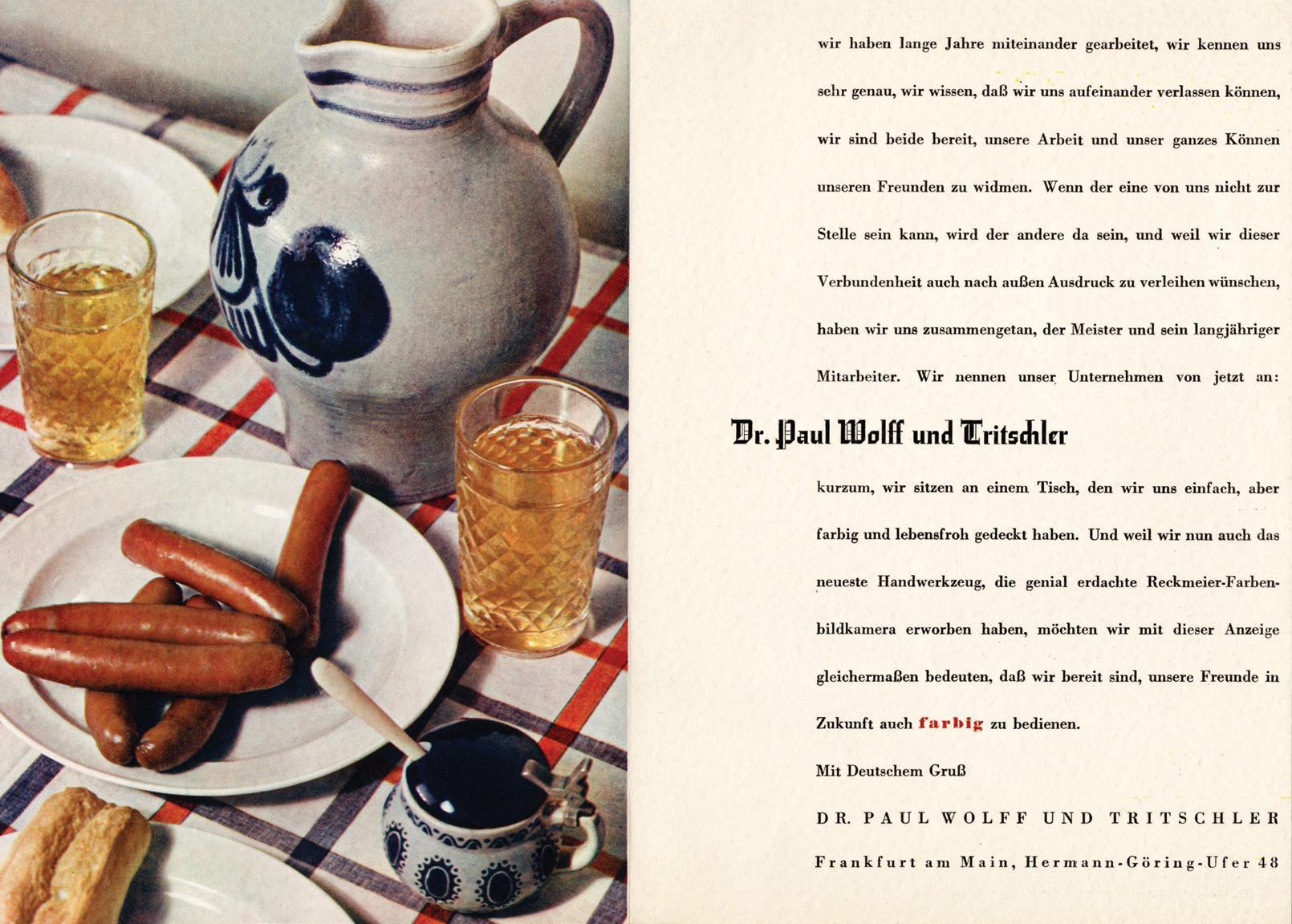
a calculating individual who did not distance himself from the Nazi regime that took over Germany in 1933 and large parts of Europe several years later with military force, which marked the beginning of the Second World War. In several ways Wolff quite often showed a certain loyalty to the regime, which may not always have been forced upon him. But of course, it is obvious that photographers who chose to continue with their work had to find a way to accommodate to the growing importance of the Nazi-regime in all aspects of personal and public life. It is very well-known that Paul Wolff and Alfred Tritschler joined forces and established their photo agency in 1927. On 1 November 1934 the agency officially continued under the name of “Dr. Paul Wolff und Tritschler”, which was announced around that time. At this occasion an announcement was printed to communicate the name of the agency, the text of which was signed “Mit Deutschem Gruß” (“With German salute”), which was not a neutral expression, but a sign of loyalty to the nationalsocialist regime; it is also known as Nazisalute or Hitler-salute. Was this to avoid any misgivings about the position of the firm, or does it reflect at least partly a personal feeling? The folding card with a color photo also served to promote the color photography of the company of Wolff and Tritschler and most likely dates around 1935: the text mentions a recently acquired Reckmeier camera for color photography, which was introduced in 1935 ( figure 1 ).
PHOTOGRAPHY & NATIONAL-SOCIALISM
PAUL WOLFF
by LEX BOSMAN
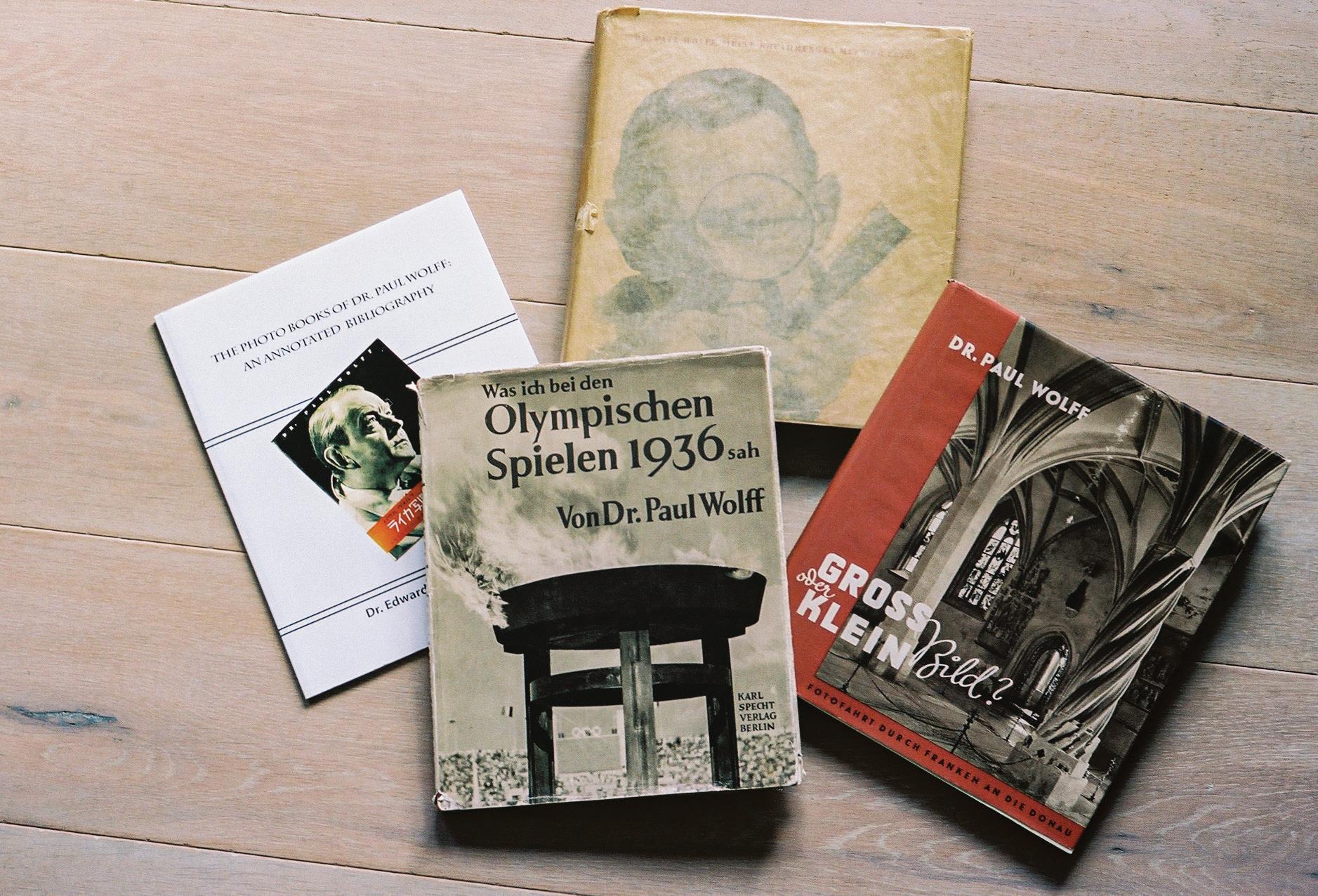
Remarks in the text of some of Paul Wolff’s photobooks and the choice of images give away something of his attitude toward the national-socialist regime as well, as for instance in Was ich bei den Olympischen Spielen 1936 sah , published in 1936. Some of these elements seem to point to a kind of loyalty toward the regime. Particularly interesting are those remarks and notes in this and other books that could have been avoided. For Hitler the Olympic Games in Germany were a showcase to the world of his well-organized country, as a result of which the Olympics were used as a major propaganda vehicle. In the text of his book Wolff reports to his readers about the excitement of the audience, the reporters and photographers, about the program of the games as well as about the restrictions which were posed upon all photographers, since they were not allowed to move around freely. Quite openly Paul Wolff describes how photographers were restricted in their movements and positions. He and Alfred Tritschler brought five cameras and a bunch of lenses but to his disappointment they could not choose the positions they wanted. Apparently, Wolff’s collaborator Alfred Tritschler was not permitted to enter the stadium on the day of the opening of the games, he had a white permit instead of a red one, which Wolff himself had.
Paul Wolff felt hurt in his professional pride, but together with Alfred Tritschler he found a way to put aside his laments about the restrictions and still make good photographs. Two pages of complaints and critical observations contrast with the images in the section with photos: the photos express a positive feeling and attitude about the Olympic games as well as about national-socialist Germany which hosted
1 See also Thomas Wiegand, ‘Olympia 1936 – Fest der Fotografie’, in: Manfred Heiting & Roland Jager (ed.)., Autopsie. Deutschsprachige Fotobücher 1918 bis 1945 Band 2, Göttingen 2014, 522-526.
2 Paul Wolff, ‘Die Geschichte einer kleinen Kamera’, in: Ernst Leitz dem Förderer deutscher Wissenschaft und Technik zu seinem siebenzigsten Geburtstag. 1. März 1941, Frankfurt am Main 1941 , 128-129. Translation in: Ed Schwartzreich, ‘Oskar Barnack, Ernst Leitz II & Dr. Paul Wolff’, in: Viewfinder 48, issue 1 (2015), 33. Also see: Rolf Sachsse, Die Erziehung zum Wegsehen. Fotografie im NS-Staat , Dresden 2003, 114-116, 290-291 (Dok. 4.56-4.57).
the Olympics. When Wolff described how he points his camera and lenses in various directions he (unnecessarily) mentions the place of the Führer because he points a telephoto lens in that direction. That must have been the Telyt 4.5/20cm, since Wolff did not yet have the Telyt 5/40cm at his disposal.
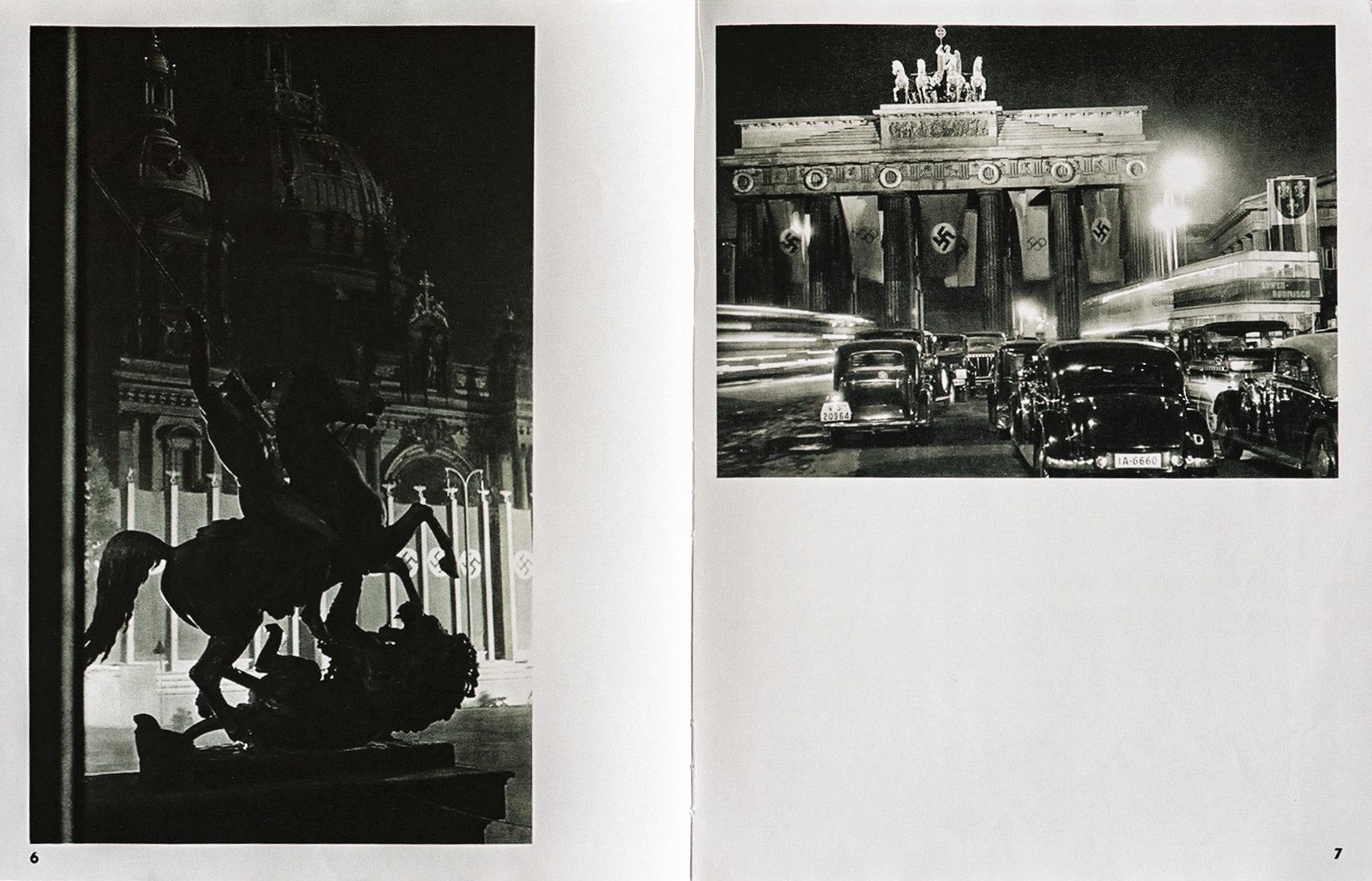
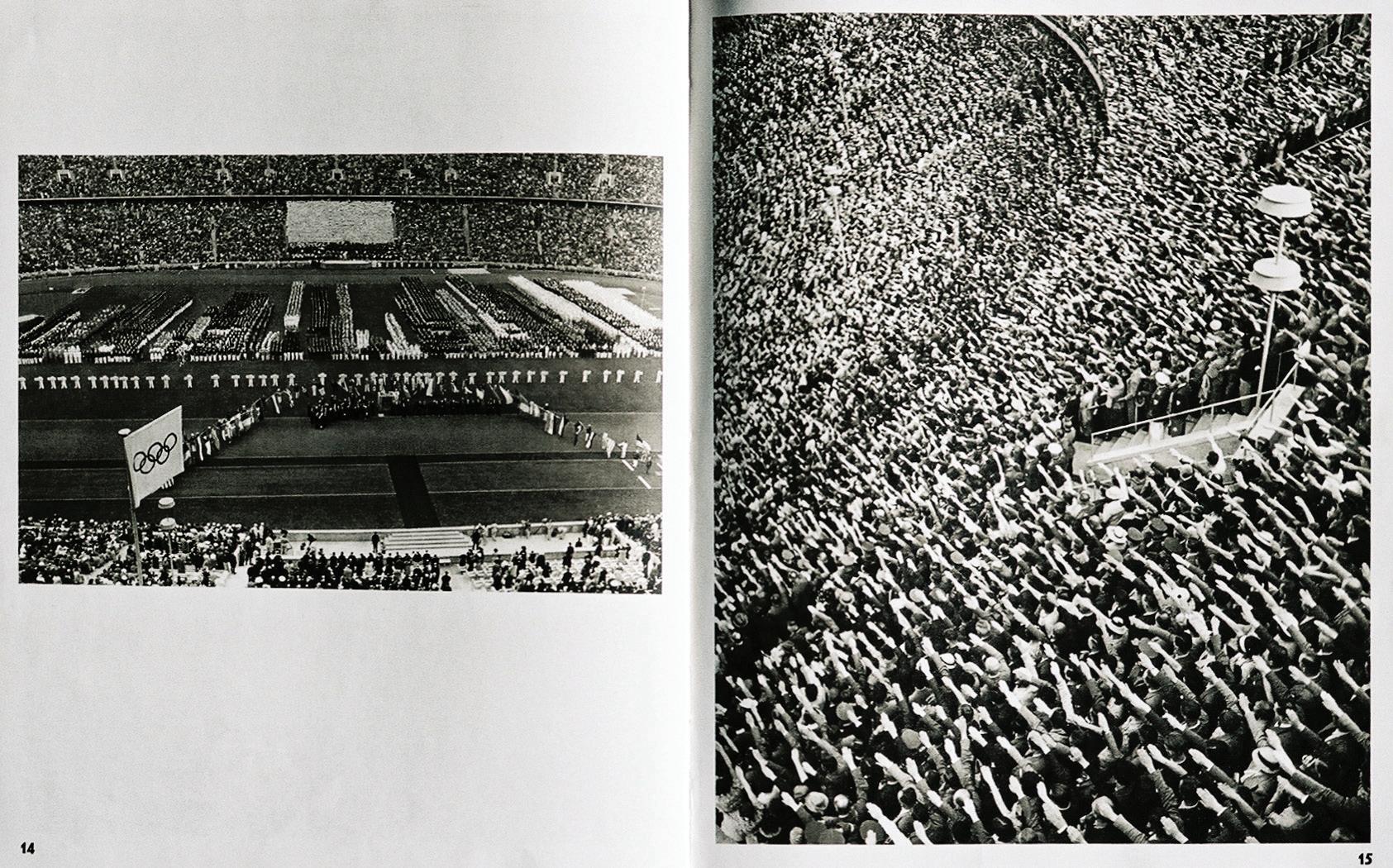
In the sequence of fascinating photographs in the book, the Olympic story unfolds with the fire being brought from Greece, a voyage photographed by Alfred Tritschler. The two following images (6, 7) aren’t harmless pictures introducing Berlin as the city of the 1936 Olympics but are much closer to propaganda photos: evening darkness is contrasting with the lights, the swastika banners are strong visual markers ( figure 2 ). Such images also show that the swastika could not be avoided near official buildings. Photo 15 in the book shows the crowd in the stadium, not accidently at a moment when the people raise their arm; possibly the crowd brought the Olympic greeting instead of the Nazi salute. The confusion about what is commonly referred to as the Hitler salute ( figure 3, remember the “Deutscher Gruss”) and the Olympic greeting makes the reading of this photo ambiguous. Unavoidable may seem photo 71 with Hitler shaking hands, a photo contributed by Hitler’s official photographer Heinrich Hoffmann; photos 108 and 109 show horsemen and a few officials raising their arm for the Nazi salute and a large swastika banner with the crowd in the background.1 So several of the photos, spread across the book, seem to be more propaganda images than neutral photos to introduce Berlin or communicate the various sports of the Olympics, although the choice may not entirely have been Wolff’s own. It should also be noted however that Jesse Owens is portrayed in the book, and another photo shows how his name was carved in the wall among the winning athletes. And we know that Jesse Owens was certainly not Hitler’s most popular contestant. Wolff was not the only one to have chosen a photo of Jesse Owens, however; the American athlete appears in most of the photo books about the 1936 Olympics.
One of the most famous books by Wolff is of course Arbeit! , published in 1937 with the Volk und Reich Verlag. The photos are extraordinary and have had quite an impact on the way photography esthetically visualized themes of modern industry. Not only that, the book also glorifies industry and industrial laborers work. Photography was clearly intertwined with political goals in this book, as is shown in a very direct way by a page with the text of a speech by Hitler in January 1937 about the importance of industry in Germany’s policy of the 1930’s, an addition to the book which most certainly was not Wolff’s choice but mandatory.
Photography in the service of politics is briefly touched upon again in Wolff’s 1938 book G rossbild oder Kleinbild? Ergebnisse einer Fotofahrt durch Franken an die Donau . Paul Wolff explains that the miniature camera has shown to be an indispensable tool for a vivid kind of press photo. He then continues: “We press photographers are putting our capacities and our knowledge happily and convinced in the service of the great events in our German fatherland” (p. 13: “Wir Bildberichterstatter stellen unsere Fähigkeiten und unsere Kentnisse freudig und überzeugt in den Dienst des großen Geschehens in unserem deutschen Vaterlande”). In the 3 rd printing of this book (probably 1940 or 1941) a short paragraph was added to praise the “outstanding” work delivered by the groups of military photo reporters or “image soldiers” (“Bildsoldaten”), which in Wolff’s opinion proved the point of the training of photo reporters to exclusively use a 35mm camera, since one could not easily imagine such a reporter under enemy fire working with a large and more difficult to handle camera. This remark is echoed in another publication.
Five years after the Olympics, in 1941 a celebratory book was published at the occasion of the 70th birthday of Ernst Leitz, with a collection of essays about optics for scientific
use and about the camera that had made the Leitz company famous among a large group of professional and amateur photographers. Paul Wolff was one of the authors of this book; Ed Schwartzreich published about this in Viewfinder . In his interesting contribution “Die Geschichte einer kleinen Kamera” (“The History of a small Camera”) Wolff described the invention and production of the Leica camera as an almost heroic process. To underline his own connection to the success of the Leica camera he mentions that a ministerial decree prescribed the use of a miniature camera (“Kleinkamera”) by press photographers. Then in the next sentence he explains that he had gladly accepted the invitation of the same Propaganda Ministry to justify this decree to an audience of professional colleagues, on 12 November 1937. It is not unlikely that Paul Wolff was pressured in some way to address the press photographers by that speech. This presentation had already been mentioned in Grossbild oder Kleinbild? . The German name of the “Propaganda-Ministerium” (complete name: “Reichsministerium für Volksaufklärung und Propaganda”) may sound less neutral than its English translation; it was the ministry which was founded in 1933 and which was led by Joseph Goebbels, to steer the public opinion in the desired direction and to control written and photographic journalism. Once the regime had understood the importance of photos for propaganda purposes the policy to use photography was further outlined. The decree for press photographers to limit themselves to the use of small cameras like Leica and Contax, apparently so gladly explained and justified by Paul Wolff and issued on 1 August 1937, was part of the national-socialist policy to educate a new generation of press photographers, who would photograph those situations and topics that were allowed by the regime and in such a way that it would serve the propaganda. In the future the possession and complete familiarity with a miniature camera would be a prerequisite for reporters to obtain a special permit indicated by a red arm band, the same color as the permission card issued to Wolff and others for the Olympic games a year earlier.
In another contribution in the same book, Fritz Vith (the well-known author of the Leica-Handbuch ) addressed the importance of the use of good images in school teaching and explained that it was only the “national-socialist revolution” that for the first time brought the slide (“Lichtbild”) to its complete use in school teaching. That this policy was part of the system to control public opinion and steer the visual culture in Germany in the desired direction was not mentioned of course. Interestingly the authors in the same book writing about the development of optics for microscopes did not refer to contemporary politics.
The follow-up of Wolff’s famous Meine Erfahrungen mit der Leica (1934, completely revised in 1939; in English published in 1935 as My First Ten Years with the Leica ) appeared in 1942 as Meine Erfahrungen…farbig (in 1952 published in English as My Experiences in Color Photography ). In the original German introduction Paul Wolff mentions that his colleague Alfred Tritschler would have liked to contribute more to the book, but he had more important things to do as a photojournalist at the front (“Aber er hat Wichtigeres zu tun: Er steht wieder als P.K. Mann an der Front”; P.K. means “Propaganda Kompanie”). In the chapter on the miniature camera and color film Wolff repeats the role of this type of camera for the military photo reporter, again called the “image soldier” (“Bildsoldat”), who in the present war, which in Wolff’s words was being forced on the German fatherland, had to document for all times the enormous struggle of the world history (p. 22: “Sie hat die erstmalige Erscheinung des Bildsoldaten, des PK.-Mannes, geschaffen, der in diesem unserem Vaterland aufgezwungenen Krieg um Sein und Nichtsein die unwiderleglichen Dokumente dieses größten Ringens der Weltgeschichte für alle Zeiten festhält”). Paul Wolff did apparently not try to stay away from the ideology that was forced upon the people and which was to mold and model the way people would judge the war and
Germany’s role in it. It was Goebbels, the minister of the propaganda department, who stressed the important role of the photographers in the PK-Kompanien by calling them soldiers, more than reporters: apart from pistol and hand grenade these men brought other weapons, like their filmcamera, the Leica and some other items.
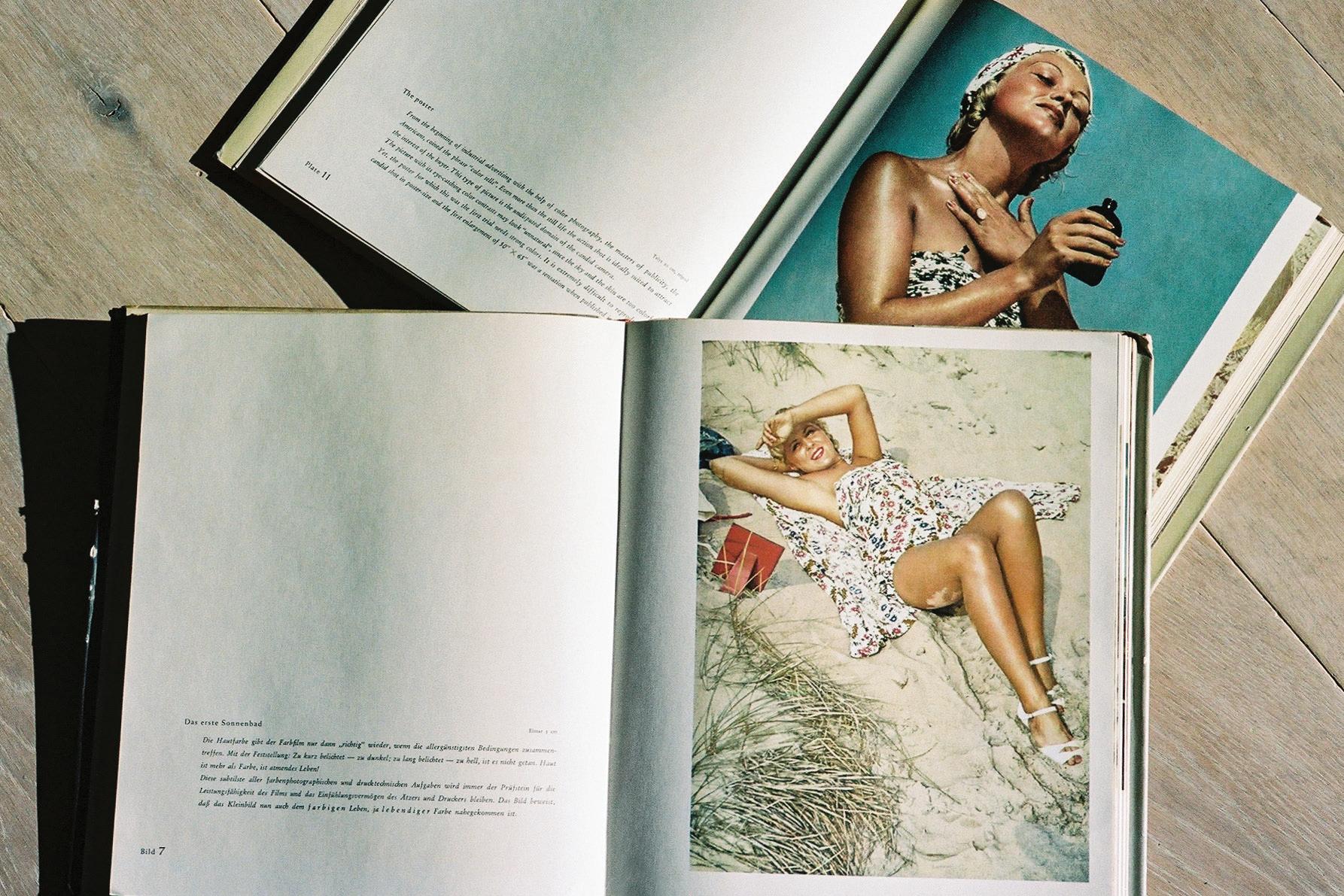
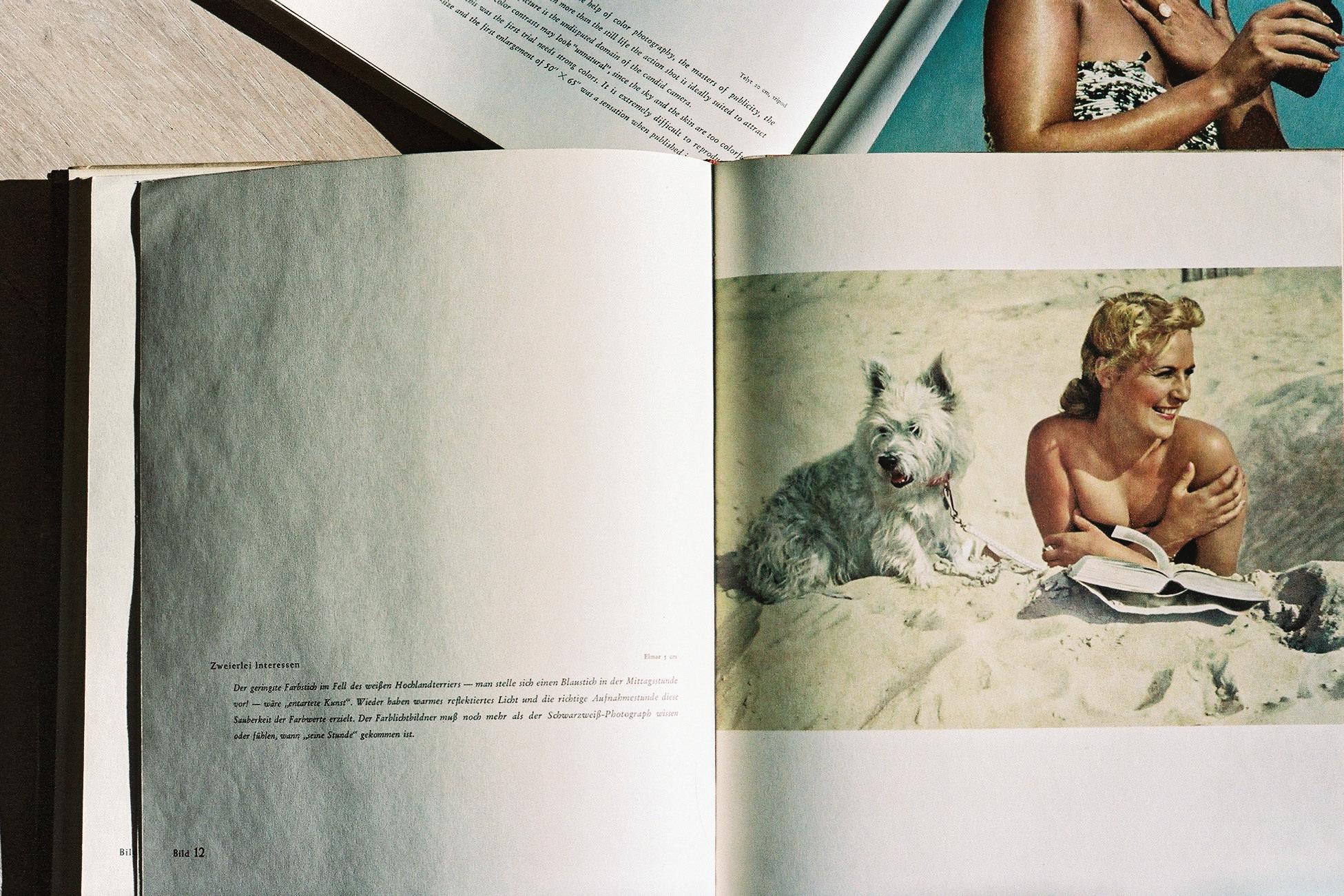
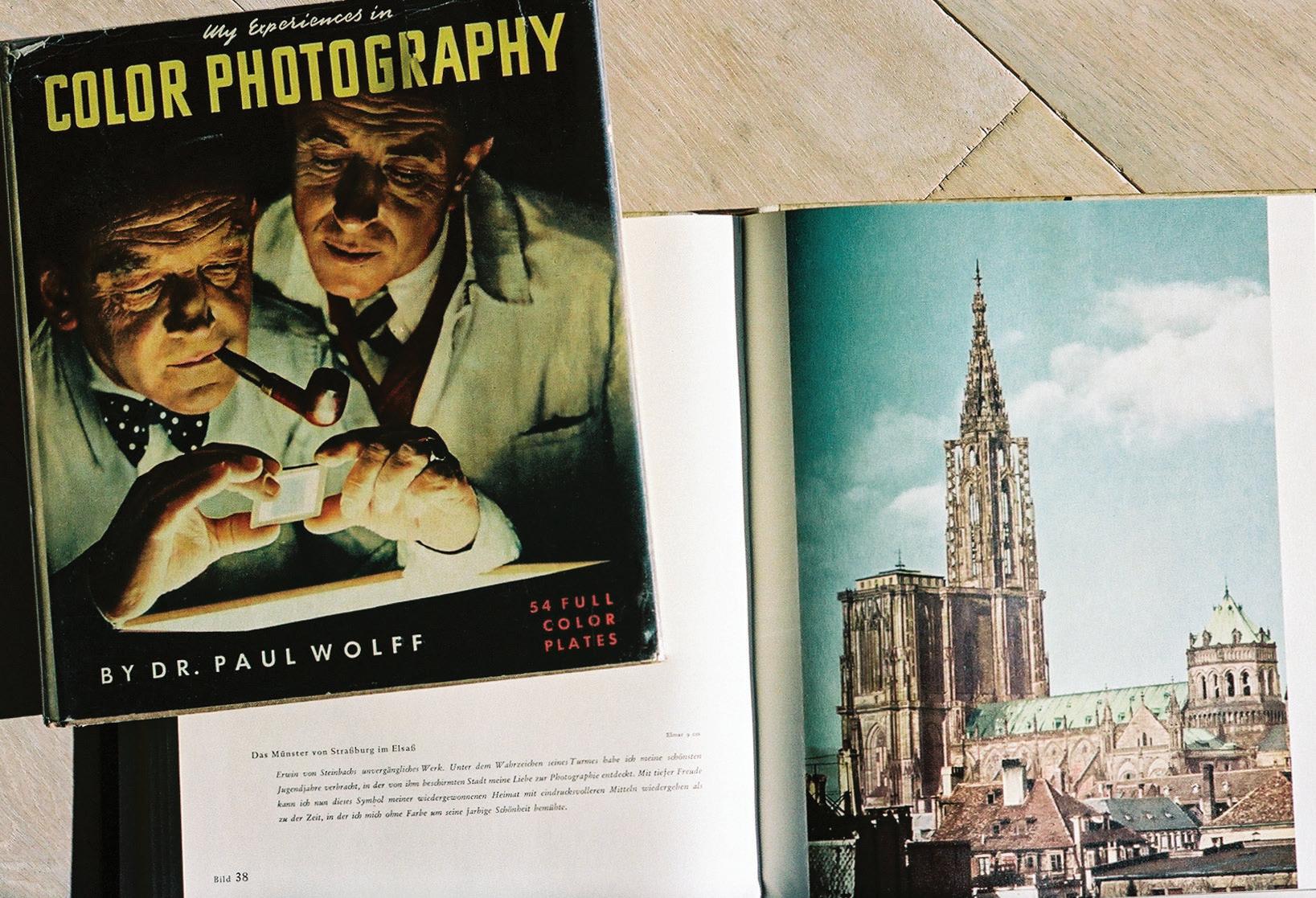
A comparison of the choices of color plates in the original German edition and the post-war American edition of this book with translated texts shows several interesting accommodations. Two plates with blonde female models did not make it to the English edition ( figure 4 ), as is the case with plate 12 of a blonde woman with a dog. Several other plates of the original German edition are absent in the American edition as well. The German text next to this plate 12 has a strange remark pointing in a political direction: Wolff states that a minimal color deviation in the white fur of the little dog would be “Entartete Kunst” (English: degenerate art), the term adopted by the Nazi regime to define modern and jewish art and reject and condemn it ( figure 5 ). The text at the image of the cathedral of Strasbourg (pl. 38; pl. 35 in the English edition) is very political as well. Wolff explains that with great satisfaction he can now show this symbol of his reclaimed homeland (“Mit tiefer Freude kann ich nun dieses Symbol meiner wiedergewonnenen Heimat mit eindrucks-volleren Mitteln wiedergeben”) ( figure 6 ). Paul Wolff was born in Mulhouse in 1887, when the Alsace belonged to the French territory which was incorporated in 1871 in the German Kaiserreich after the French-German war, when Germany conquered part of France. He studied in Strasbourg. After the First World War the Alsace became French again in 1919, but when the larger part of France was defeated by German forces in 1940, unlike most of France, the Alsace was not merely occupied but formally annexed as part of the German Reich. Suddenly the French inhabitants were trapped in this situation since they were treated as Germans, with all the duties that came with it, like military service. With apparent approval by Wolff, but his remark about his reclaimed homeland was left out of the text in the later American edition. Already in 1935, the famous photographer had made a remark with a similar meaning about Strasbourg. In his contribution to Meister der Kamera erzählen (1935, ed. Wilhelm Schöppe) Paul Wolff described how shortly before the end of the First Word War he returned to that city and saw the French tricolore flag on the tower of the cathedral and felt his homeland was lost (“Verlorene Heimat!”).
3 Christian Fuhrmeister a. o. (ed.), „Führerauftrag Monumentalmalerei. Eine Fotokampagne 1943-1945“ , Cologne etc. 2006, 13, 17, 22.
4 Thomas Wiegand, ‘”Es war notwendig, zu warnen, zu unterrichten und zu lehren‘, in: Manfred Heiting & Roland Jager (ed.)., Autopsie. Deutschsprachige Fotobücher 1918 bis 1945 . Band 2, Göttingen 2014, 43.
In April 1943 a campaign was launched to photograph monumental wall paintings in their architectural context to document them before Allied bombing raids would have possibly destroyed them. The astonishing number of about 40.000 color slides were produced as a result of this “Führer-Auftrag”, an operation in which also famous photographers like Walter Hege and Paul Wolff were involved. Wolff was in a position to negotiate a salary much higher than that of most other photographers involved. He briefly mentioned this project in his My Experiences in Color Photography but gave the impression that the project was given to him and his collaborator
figure 6
Kurt Roehrig instead of to a much larger group of photographers. Even though the majority of these photographers may have understood their activity in this enormous project as a technical, photographic assignment instead of political involvement –Paul Wolff expressed this view after the war for instance – the political origin of it can hardly be denied. 3
An analysis of texts and images in several of his publications shows that Paul Wolff’s rise to photographic stardom was to a large degree made possible by and in the context of the national-socialist regime that took over Germany in 1933; the photographic agency that he and Alfred Tritschler founded also delivered quite a lot of the photographic propaganda material for the regime. 4 It was in that particular political context that Paul Wolff made many of his photos and photobooks and secured his position in the history of Leica photography (figure 7). This short, critical survey shows that Wolff was not a neutral bystander during the years of the national-socialist regime in Germany, but that he was politically involved in some way. It seems that in several instances he used his photos and writings to comment on the political situation and express his views about it. A photographer could not be an active photographer in Germany in 1933-1945 without accepting the political determination of all aspects of private and public life. Paul Wolff was not the only photographer who accepted the situation and used it.
Thanks are due to Ed Schwartzreich for our interesting exchange of thoughts on the subject.
literature references:
∙ Christian Fuhrmeister a. o. (ed.). „Führerauftrag Monumentalmalerei. Eine Fotokam-pagne 1943-1945“ . Cologne etc. 2006.
Manfred Heiting & Roland Jäger (ed.). Autopsie. Deutschsprachige Fotobücher 1918 bis 1945. Band 2, Göttingen 2014.
Hanna Koch. ‘Erfahrungen mit der Leica. Fotobücher von Dr. Paul Wolff & Tritschler’. In: Autopsie. Deutschsprachige Fotobücher 1918 bis 1945. Band 2, Göttingen 2014, 446-475.
∙ Kristina Lemke. ‘Dr. Paul Wolff. Eine Fotografenkarriere im Nationalsozialismus‘. In: Rundbrief Fotografie 24 (2017), No. 2, 8-19.
Kristina Lemke. ‘Konform mit der Zeit? Dr. Paul Wolff während des Nationalsozialis-mus‘. In: Hans-Michael Koetzle (ed.). Dr. Paul Wolff & Tritschler. Licht und Schatten. Fotografien 1920 bis 1950 . Heidelberg/ Berlin 2019, 344-365.
Rolf Sachsse. Die Erziehung zum Wegsehen. Fotografie im NS-Staat Dresden 2003.
∙ Ed Schwartzreich. ‘Oskar Barnack, Ernst Leitz II and Dr. Paul Wolff, Part 1-2’, in: Viewfinder 47, issue 4 (2014), 8-15; Viewfinder 48, issue 1 (2015), 30-35.
∙ Edward Schwartzreich. The photo books of dr. Paul Wolff: an annotated bibliography. Waterburg (Vermont) 2015, revised ed. May 2018. Bernd Weise. ‘Pressefotografie: Kamera- und Fototechnik im journalistischen Gebrauch Teil III: 1933–1939‘. In: Rundbrief Fotografie 11 (2005), No. 4, 13-19; also online: www.fotokritik.de/index.php?art=143
∙ Paul Wolff. ‘Die Geschichte einer kleinen Kamera’, in: Ernst Leitz dem Förderer deutscher Wissenschaft und Technik zu seinem siebenzigsten Geburtstag. 1. März 1941 . Frankfurt am Main 1941, 121-129.
∙ Paul Wolff. ‘Ein Auftrag des Führers. Die größte Bewährungsprobe für den Kleinbild-farbenfilm‘, in: Gebrauchsfotografie 51 (1941), Heft 7/8, 61-67.
Paul Wolff. ‘In letzter Minute‘, in: Foto Magazin october 1949, 18-19.
figure
PAUL WOLFF
The Landenberger Letters
by ED SCHWARTZREICH
IN
July 2020, I received an email from Oscar Fricke:
"Are you familiar with the Paul Wolff-Hans Landenberger correspondence from the 1940s (also Theo Kisselbach letter from 1971)? In 2003 my dad purchased the collection. In the interim, he had forgotten he had it all... Since you are also a Wolff aficionado, would you also be interested in the scans?"
Most assuredly, I had not known about any of this, and yes, definitely, I wanted to see the scans. Oscar then forwarded a folder containing the files of this correspondence.
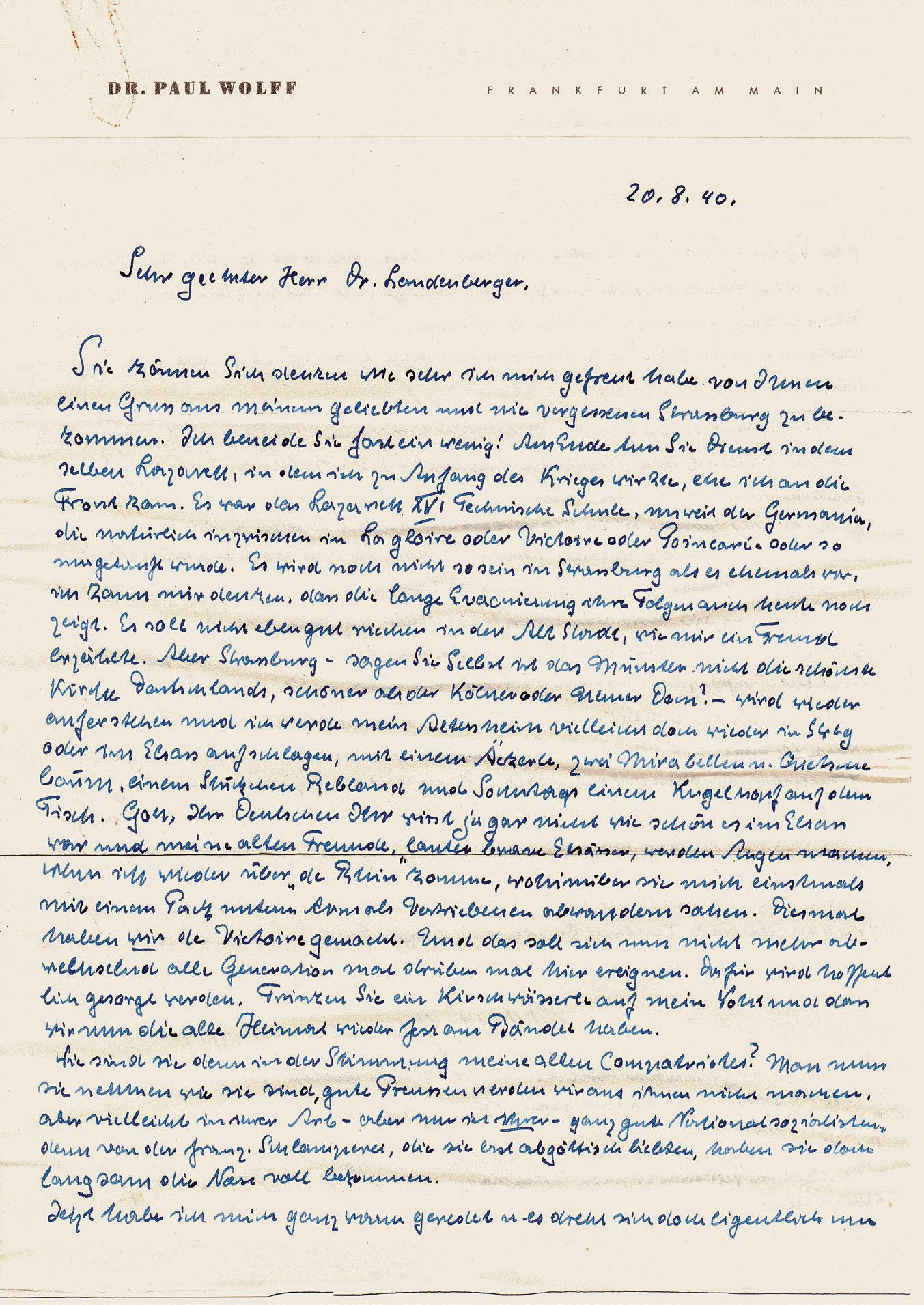
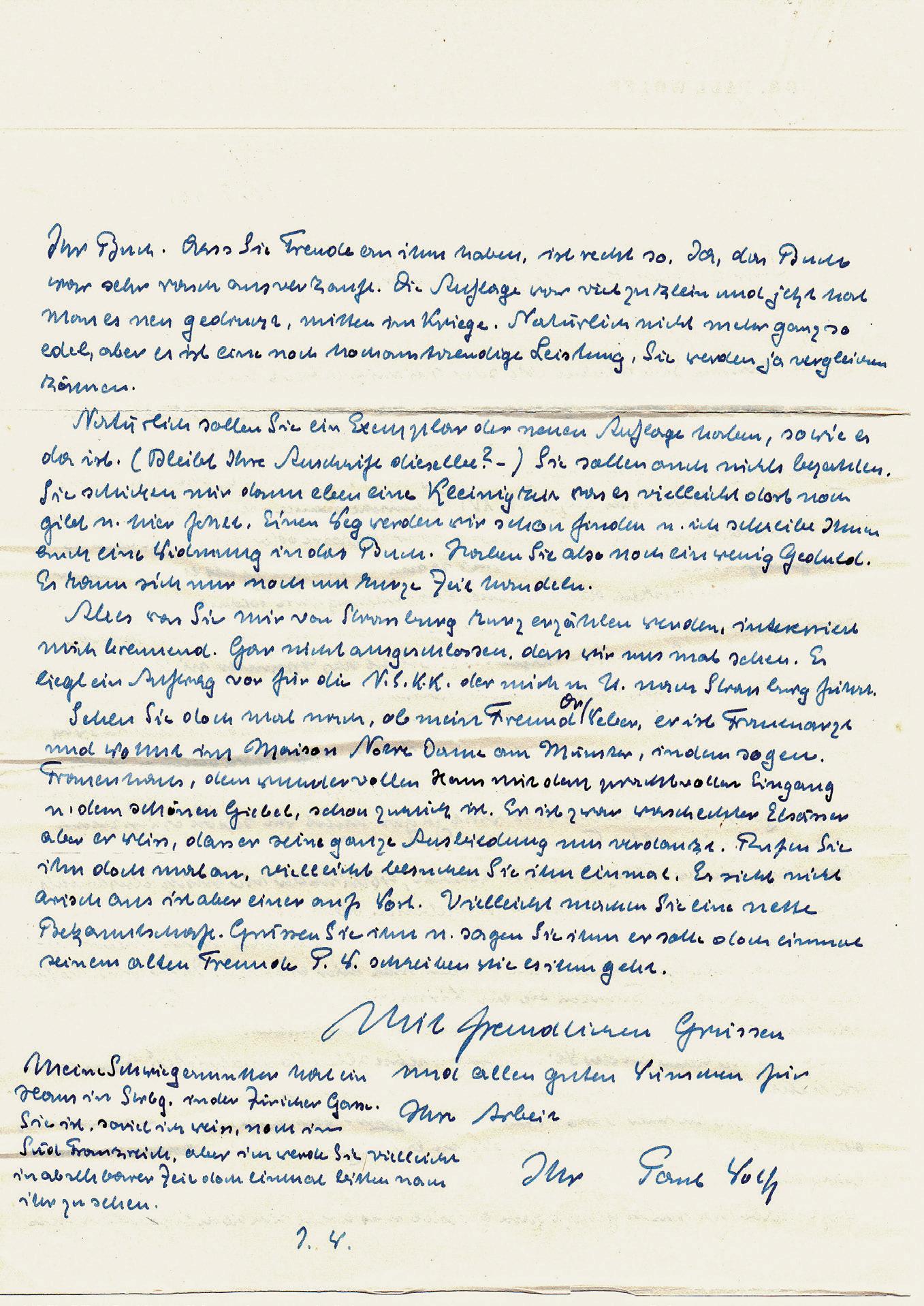
Oscar has done research on Dr. med. Hans Landenberger (19111989); he seems to have been a humanistic and communityminded physician with interests in photography, music, and the arts; he came from an artistic family in the Albstadt / Tübingen region south of Stuttgart. We do not know exactly his relationship to Dr. Wolff or to Leica author Kisselbach, but he was clearly someone who followed Dr. Wolff’s career with interest. And the correspondence: letters and postcards from Paul Wolff, a letter from Kisselbach, and copies of some brochures and one of Dr. Wolff’s books, is of major historical interest for at least two reasons. First, we have Kisselbach’s recollections and opinions about some problematic aspects of Dr. Wolff’s career, but more importantly, we have, in Wolff’s own words, statements about the National Socialists for the first time.
We will first examine the major portion of Kisselbach’s letter of 8 October, 1971. ( Translation by the author.) (right)
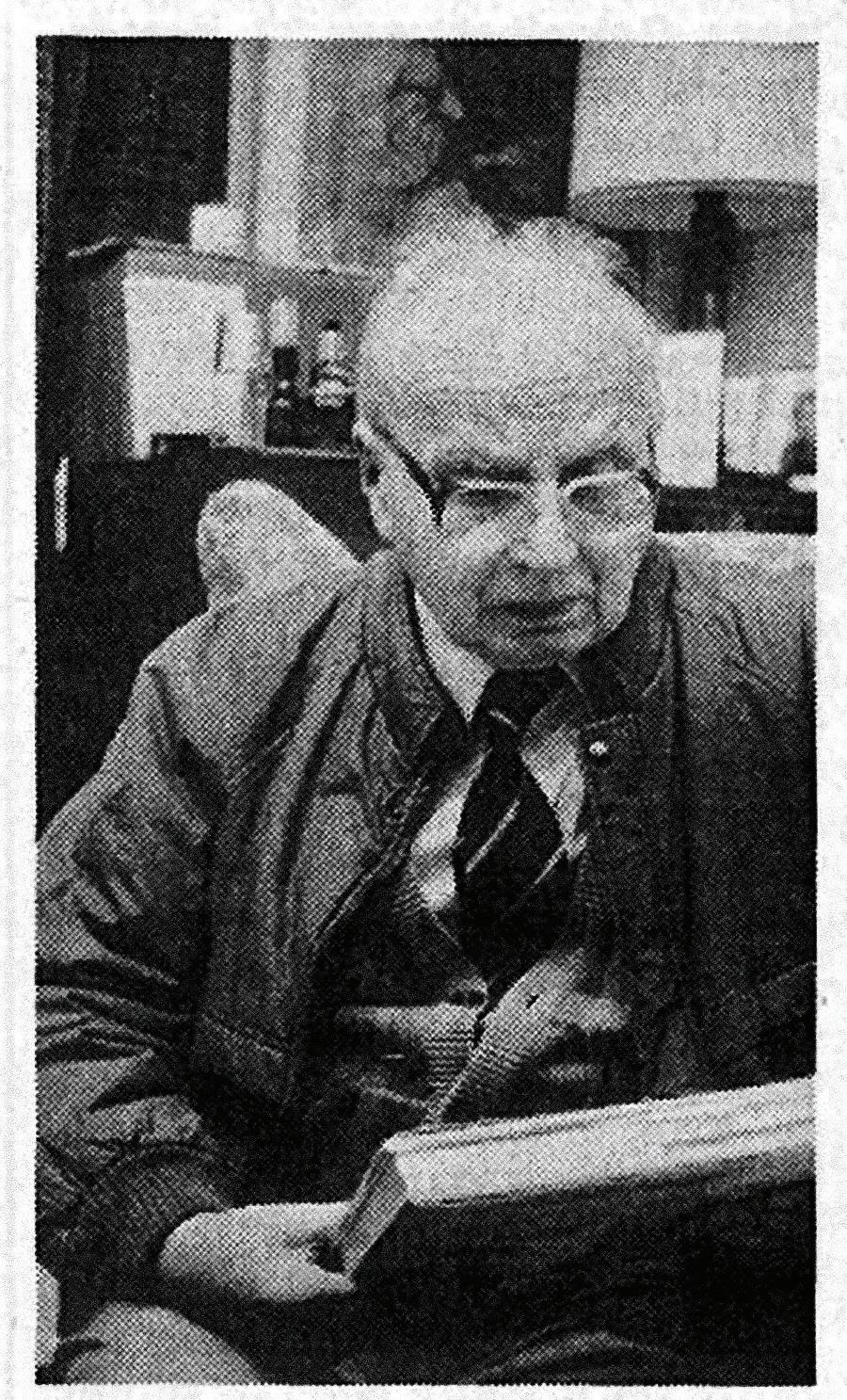
Photo of Dr. Hans Landenberger, from his obituary in the Zollern-Alb-Kurier newspaper (Albstadt, Germany), 29 Nov 1989.
Courtesy Oscar Fricke.
Sehr geehrter Herr Dr. Landenberger,
…Dr. Paul Wolff’s important role in the triumphal procession of the Leica is not contested by me. I knew him well personally because I had had business contacts with him since 1932. I was friends with his colleague and later partner, Alfred Tritschler; I was a soldier with him in the same unit for a long time.
Since I only became an employee of the Leitz company in 1937, I got in touch with various key gentlemen to make inquiries about their earlier working with Dr. Wolff. It was clear that Dr. Paul Wolff came into closer business contact with Leitz starting in 1931 and that the "Wolff Exhibitions" that were so favorable for the Leitz works were agreed upon then. These exhibitions were very successful for both parties. In later years, the two editions of ‘Meine Erfahrungen mit der Leica' appeared with considerable economic support from Leitz.
Within the ‘Dr. Paul Wolff’ company, it was customary that images were published under the company name, regardless of the photographer. Since the company had a number of employees, the proportion of images that Dr. Paul Wolff himself made was much smaller than one might expect…
Since I have been dealing intensively with the historical development of the Leica for some time, I doubt the truth of some of the information that Dr. Paul Wolff has stated: e.g. on page 10 of the 1st edition of "Meine Erfarhungen", the penultimate paragraph says: "1925 was the first year of Leica. It also blessed me with the Leica after having met Oskar Barnack at the Leitz plant two years earlier, who showed me one of the first Leicas with the problematic question of what I thought of it."
The book by Dr. Walther Heering "Meine Foto-Praxis" states that Dr. Paul Wolff won a Leica at an exhibition. Alfred Tritschler confirmed this fact to me. It was the photo exhibition in Frankfurt / Main in 1926. According to his testimony, however, this camera was in effect in the closet for almost two years until it was put into action by him. It was only on the basis of his results that Dr. Paul Wolff was convinced that this camera was suitable for a new way of seeing.
All other facts correspond approximately to the published data. But it cannot be said that Dr. Paul Wolff had a decisive influence on the development of the Leica. The merits of Dr. Paul Wolff's concern for the spread of the Leica should in no way be diminished; however, you can see that he did not become active [with the Leica] until a later point in time from the fact that he is not included in the list of references in the first Leitz General Catalog, published in July 1930. Dr. Paul Wolff received Presentation Leica No. 200,000 in 1936. If he had worked as actively in the early days of the Leica as later, he would have been awarded a presentation camera much earlier.
After the war I very often had things to do with Dr. Paul Wolff and also really appreciated him personally. However, I ask for your understanding if I have to trace some of the legends that have formed around him back to the real facts.
Mit freundlichen Grüßen, Theo Kisselbach
People have struggled with the veracity of Wolff’s Leica narrative: because the dates in various accounts don’t line up; and about the Leica-Prize story specifically, mostly for a lack of evidence of a 1926 contest awarding a Leica as its prize. Both problems seem to render the story at least suspect if not self-serving. What Wolff published about this chronology, about his friendship with Barnack, and about his advocacy for the Leica has become a legend that portrays him as almost a direct heir to Barnack. In his letter to Landenberger, Kisselbach takes issue with this “legend” in several particulars and attempts to correct the record.
ABOUT the DATES Wolff states elsewhere 1 [1941] that the year he originally met Barnack was 1921, when Wolff came to E. Leitz with questions about a micro-cine apparatus, and was referred to Barnack. Later, in 1923, it was likely Barnack himself who sought Wolff out to show him Leica prototypes. So, Wolff already knew about the Leica camera when it was released in 1925, but, if we accept as fact Wolff’s 1926 prize story, that certainly rules out his being “blessed” to own a new production Leica ab initio. And, while Wolff was indeed blessed with prior knowledge about the camera, he is on record as saying that early on he was considerably ambivalent about the Leica’s capability, and only later realized that he had been in error.
"Since at that time we all found ourselves under the spell of the contact print from large plate-formats, how could it be that the small negative format could even give nearly equivalent quality after a necessarily extreme enlargement? This was my own first and very serious, but also valid, objection when I exchanged the first thoughts with Barnack on the future of this little camera at the Leitz Works. I warned him strongly! I was unable to estimate at the time the significance of the constructive thoughts which continually matured in Barnack’s mind about his camera ... Barnack’s little creation led to arguments, pro and con. He probably sought my company because he sensed in me a specialist who was not dogmatic in his opinion and with whom he liked to exchange views about purely photo-technical issues as well as about the negative materials to be used. About these issues I had great doubts. And Barnack heard them ... These technical matters were of secondary importance to him. They would be resolved in due time! It was enough for him when he could show me a pair of pictures of his children in a most informal, natural way as proof that it could be done. Here … Barnack was to be right in the end." 2
So, even when Kisselbach specifically confirms Wolff’s own version of the otherwise-suspicious 1926 prize story via Tritschler’s testimony, all the other evidence downplays the significance of any really early date for associating Wolff actively with the Leica, because Wolff did not appreciate what he had, and, according to Tritschler, was not actually using it until 1927.
However, bringing Tritschler into this is potentially complicating. In several places, but only following Wolff’s death in 1951, Tritschler had added the additional story, as above, that it was Tritschler himself, already familiar with the Leica from its use with movie work at UFA, who was the catalyst for Wolff taking it up in earnest in 1927. Each time Tritschler’s Leica story is retold, other interesting tidbits are added, raising the distinct possibility that Tritschler was building his own legend. The question would be: is Tritschler any more credible here than Wolff? Tritschler’s story retains its basic outlines across accounts, has some external supports as we shall see, and the additional added pieces only amplify, not complicate. Tritschler’s account certainly sounds plausible. Further, the several accounts of Tritschler’s role here are not in any major or really influential publications: i.e., not being used primarily for publicity purposes. And Tritschler never exactly says, in these third-party accounts, that he, Tritschler, was the prime mover here, only the spur. Here is what exists,s chronologically:
1.) Whoever wrote about Tritschler in the Leitz house organ Objektif , April, 1954 (No. 7), p. 17, adds that it took a 1927 joint photographic trip Tritschler made with Dr. Wolff to Franconia to demonstrate to them that the Leica gave images that were more playful and animated than those from their larger format cameras. (Translation by author.)
"When Tritschler joined the Frankfurt company "Wolff-Film" in 1927, his familiarity with the Leica was a plus, because there was also such a camera of this new type there; however, that camera was initially looked at somewhat suspiciously. It wasn't until Dr. Wolff and Alfred Tritschler went on a holiday trip to Franconia together that they "discovered” the Leica, because the pictures that were taken with it "on the side" were much livelier and more appealing than their previous ones [with other cameras], resulting in a completely new way of seeing and taking photographs."
2.) In a biographical note about Tritschler (Translation by author.) in the 1955 Das Deutsche Lichtbild , p. 86, the text appears to imply that it was actually Tritschler who first perfected the using of the Leica in the manner that Wolff & Tritschler employed for years to come:
1. Photografie für alle, No. 5, 1941, p 57 2. Festgabe für Ernst Leitz, 1941, Translation Fred and Jo Mazzulla
3. Dr. Paul Wolff & Tritschler: Light and Shadow - Photographs from 1920 to 1950, Hans-Michael Koetzle editor. Heidelberg: Kehrer Verlag 2019, p. 182
"It was … [at UFA] that he first met the Leica, which [camera] brought him together with Dr. Paul Wolff in 1927 and to which he has remained faithful to this day. He produced numerous industrial advertising films for the company "Wolff-Film" and used every free hour to test the new 35mm camera, and to probe its performance capabilities. One of the first results of these efforts was Dr. Paul Wolff's book on Franconia [author: this was actually a 1938 publication, but the 9x12 images in it were likely made as early as 1927/28, per Thomas Sommer; the author of the biographical note appears to be eliding that book with the story of the 1927 vacation trip to Franconia], in which the advantages of the Leica were demonstrated in an extensive series of large and small format photos that Wolff and Tritschler had made together … The many illustrated books that Dr. Paul Wolff published later were all created in collaboration with Alfred Tritschler, which in many cases clearly reveal the hallmarks of his style."
3.) In Foto Rundschau June, 1957 (also included in this packet from Rolf Fricke, translated author), that same general story is again repeated, but with an interesting twist at the end.
"When Tritschler, Paul Wolff's future partner, joined the photographing doctor in 1927, he used the Leica won a year before for the first time. It was Tritschler who first had had experience as a 35mm photographer. He knew the Leica from UFA, where he used to work, and where he had used it as a light-measuring device. However, in a short time Paul Wolff found his own love for the small device. In order to avoid disputes, he bought a new one and left the old one to his no-less enthusiastic colleague."
Problematically, it is not clear who authored the material in any of the three published narratives mentioned here, nor its sourcing, but the latter had to be Tritschler himself, directly or not, and possibly embellished or not.
4.) Finally, here, we have Kisselbach in 1971, directly from Tritschler himself, again strongly suggesting that Wolff had not used his “prize” Leica (possibly at all) until Tritschler’s arrival on the scene.
ABOUT the “PRIZE STORY” Koetzle 3 , suspicious of the verity of the Leica-Prize aspect of Wolff’s narrative for several reasons, has reproduced two Leitz shipping-record index cards, showing that a person (or persons) named Wolff received Leica Model I(A) cameras on two occasions in 1926: SN 1081 on March 8, and SN 1776 on August 1. The actual log shows only “Herrn Wolff, Wetzlar” and “Wolff, Wetzlar” respectively for these cameras. Koetzle assumes that both were Dr. Wolff, who arranged pick-up at the factory, and that there was no need for a “prize” story as Wolff was actually in 1926 in receipt of more than one Leica: “But what for? And
why two cameras in such a short time? For test purposes? As loans? As - albeit long-unnoticed - gifts?”.
The cards in the Leitz shipping log go no further towards confirming the recipients’ identities. It seems just as conceivable that one of these cameras was actually the one allotted (? as a prize) to Dr. Wolff, picked up for him at the factory, and the other represented a camera that went to someone else with the same common last name (“Wolff” in its variants is the 17th most common surname in Germany in one accounting). The author, with his faulty knowledge of German grammar, nonetheless wonders if the notation for the first camera, “Herrn Wolff, Wetzlar” (“Herrn” in the accusative case that could mean “for Mr. Wolff, Wetzlar”), might imply something slightly different than would merely “Wolff, Wetzlar”. Curiously, none of the other 28 name entries in these forms are written this way. And let us not forget that Kisselbach says that Wolff’s prize camera was “in the closet for almost two years”, so an early March 1926 receipt of a Leica and the trip to Franconia, if in late 1927, would fit the narrative. If these conjectures are true, the prize story and Tritschler’s addendum would both seem to follow seamlessly.
For what it is worth, there was a noted photo exhibition in 1926 in Frankfurt, but it was in August of that year, which would not fit with the above narrative’s time scale, and, as mentioned above, with no documentation of a Leica as a prize. Could there have been another exhibition which awarded Wolff a prize? Tritschler, who would have known what was in Wolff’s camera inventory, supported the prize story and the sequencing, and implied only one Leica with his remarks. Parenthetically, if the Foto Rundschau story is accurate, there ought to be a “Wolff” or a “Tritschler” Leica in the Leitz shipping records for 1927 or 1928. The author asked Jim Lager whether he might have copies of such records, and he does not. He proposes that someone near Wetzlar secure access to the Leica archives to perform this rather laborious search.
To go even further into this thicket, Wolff’s early pictures with the Leica that are illustrated in his 1934 Meine Erfarhungen are assigned Roman numerals to indicate their approximate periods of origin: “I”, the earliest tranche, is labeled “about 1925-1928”. Thomas Sommer of the Dr. Paul Wolff & Tritschler Historisches Bildarchiv has told the author that there are no 35mm negatives in his files from 1925 or 1926, and that the 35mm negative series begins only in 1927. These facts support Tritschler’s story, and further, throw Koetzle’s suppositions more into doubt, for if Wolff was not using a Leica professionally in 1926, why on earth own two of these expensive items? A Model I(A)’s price in 1926, converted to current dollars, would be about $1700.00; Wolff was arguably impecunious in 1926 and would have needed to rationalize such strongly if purchased. If these were test cameras, they would likely have been used prior to Tritschler’s arrival on the scene. Gift or
20, 1940.
Letter from Wolff to Landenberger Aug.
20, 1940.
Letter from Wolff to Landenberger Aug.
loan cameras would be in the same category as a prize camera, but if one had gifted these to Dr. Wolff, the donor might not have been pleased with the lack of follow-through (for two Leicas!), and posterity might well have heard about that.
So, we still have multiple narratives and conjectures that do not fully fit together cleanly. And therefore, one is entitled to one’s opinion here. This author would favor using Occam’s Razor. Tritschler’s narrative, what Wolff himself had to say about Barnack’s invention, Kisselbach’s suspicions, and what Thomas Sommer tells us, all point towards one Leica in 1926, not used by Wolff until 1927, prize or not. •
There are two informative letters from Paul Wolff to Hans Landenberger, dating from August and September, 1940. These letters are handwritten, and because the author of this article has difficulty deciphering old handwritten German, he asked Ulf Richter if he would perform this task. Ulf generously did so, and kindly offered to interpret key passages which included German idioms that might be confusing. His help here has been considerable.
By way of introduction to these letters, it should be noted that in May and June, 1940, Germany had defeated France, and Alsace had reverted to German sovereignty. Landenberger had just arrived in Straßburg. For Paul Wolff, this turnabout was clearly payback of a sort for his longtime pain about having been expelled from the land of his birth over 20 years earlier. Wolff’s feelings expressed in these letters vent about French and German cultures, as well as imagining the possibility of his being ‘back home again’ for good. We also need to be aware that there was general euphoria in Germany about these political and military events. Public sentiment, which had risen when the Rhineland was remilitarized in 1936 in direct contravention of the Treaty of Versailles, had fallen again in the interim, and the German victory rekindled it. Finally, we need to recognize that letters like Wolff had written were subject to opening by the censors, and needed to conform to the correct political sentiments.
Here are portions of the two letters, in translation. First, the body of the letter of August 20, 1940.
Sehr geehrter Herr Dr. Landenberger,
You can imagine how very happy I was to receive a greeting from my beloved and never-forgotten Straßburg. I almost envy you a little! In the end, you'll be on duty in the same hospital where I worked at the beginning of the war before I got to the front. It was the Lazarett XVI Technische Schule, not far from Germania [N.B. author: this possibly was a military hospital for POWs, located in Metz], which of course has since been renamed “La Gloire” or “Victoire” or “Poincaria” or something. It will not be the same in Straßburg as it used to be, as I can imagine that the long evacuation * still has consequences today. It shouldn't be smelling so good in the old town, as a friend told me. But Straßburg - say it yourself, isn't the Münster the most beautiful church in Germany, more beautiful than the Cologne or Ulm cathedral? Straßburg will rise again and maybe I will open an old peoples’ home again in Straßburg or in Alsace, with a field, two yellow Mirabelle [plums] and a purple plum tree, a piece of vineyard and a Gugelhopf on Sundays on the table. God, you Germans don't even know how nice it was in Alsace and my old friends, all good Alsatians, will be amazed when I come back over “de Rhin”, where they once saw me emigrate as a displaced person with only a pack under my arm.
But this time we made the “Victoire”. And such a thing should no longer happen here every generation. Hopefully that will now be ensured. Drink a Kirschwasser on my behalf and that we now have my old home firmly under control again. What is the mood like of my old compatriots? You have to take them as they are. We won't make good Prussians out of them, but maybe in their own way - but only in theirs - very good National Socialists, because the French sloppiness, which they adored at first, they are now getting fed up with.
Everything that you can tell me about Straßburg, even in brief, interests me. It is not at all excluded that we'll see each other. I have a [photo] contract with the N.S.K.K. [N.B. author: Nationalsozialistisches Kraftfahrkorps, the N. S. national automobile association, but with a para-military component] which may lead me to Straßburg. See if
my friend Dr. Weber, a gynecologist who lives in the Maison Notre Dame am Münster, in the so-called Frauenhaus -the wonderful house with the magnificent entrance and the beautiful gable -- is already back in town. He is a genuine Alsatian, but he knows that he owes all of his training to us. Give him a call, maybe visit him someday. He doesn't look Aryan § but one takes him at his word. Maybe you will make a nice acquaintance. Greet him and tell him to write to his old friend P. W. about how he is doing.
Mit freundlichen Grüßen
Und allen guten Wünschen für Ihre Arbeit
Ihr, Paul Wolff
My mother-in-law has a house in Straßburg, in Züricher Gasse. As far as I know, she is still in southern France, but I might ask you to check on her in the foreseeable future.
And from the second letter, September 26, 1940, when Wolff is actually in Alsace, but had not located Landenberger personally:
…I have found my homeland nearly unchanged. Unchanged so far as the French have done really nothing to preserve the nice ‘old town’ in nearly clean condition. Look at the decayed ‘Kleine Frankreich’ neighborhood! Surely, one has to bear in mind the one-year evacuations*, but as far as Straßburg looks today – the street connections† that were started in German times are still there, but with their firewalls staring into space – it shouldn’t have to look like this.
I have met many old friends; some have served in the French army. The general feeling is not sky-high, because the people have actually nothing left in their “nice” Franc savings accounts.
I had to talk a lot and to try to persuade and first tell them from a distance, what the Third Reich is. They have an incomprehensible fear of it. One can understand this, if for years you have read nothing else than that it is “terrible for us”. Very much still has to be done, careful clearing up, not with a stick, and then it will go well for us. The good will is visible to many…
Mit allen guten Grüßen
Heil Hitler §
Ihr, Paul Wolff
It would seem from these 1940 letters that Paul Wolff was a typical German of that historical moment. He appears to have accepted at face value the memes that the regime had been broadcasting, buttressed by his patriotism and his own feelings, clearly over-determined, about Alsace. There is nothing here that indicates significant doubts in Wolff’s mind. Such euphoria was very common; the question is: does it tell us much of any significance about Paul Wolff’s overall views
of the Nazis and whether this changed over time, and about the nature of his relationship with the regime?
Let us look at some evidence, admittedly all indirect / inferential.
When Wolff brings up ‘Aryans’ in the first letter, one cannot tell whether this is an insensitive but light-hearted jest, or an open endorsement of the Zeitgeist. § From what this author, a
psychiatrist, surmises about Wolff’s character and psychological defenses, Wolff habitually avoided dwelling on all but in-one’s-face unpleasantnesses that he could not otherwise escape. To hear much of Wolff’s feelings in his writings is unusual, except around the later time of his cardiac illness, and then it is brief. Wolff’s artistic vision, his photographic style, and likely his thinking, were all focused on accentuating the positive. Given the series of unexpected but severe adversities in Wolff’s earlier life, perhaps optimism, a related high self-regard, and a degree of insensitivity and associated emotional avoidance became his go-to emotional default spositions.
There is information that indicates that Wolff, while definitely a German patriot, tried to distance himself from the regime, actively avoiding actual political partisanship. For example, Wolff apparently joined a sufficient number of governmentsponsored organizations to avoid needing to be a Party member, consistent with how he viewed himself as a non-political actor. Kristina Lemke, in Koetzle’s book, (p. 347) mentions an anecdote, attributed to his former employee Willi Klar, that Wolff angled to get out of state assignments by demanding substantial fees that the regime might be reluctant to pay. And once again, regarding the actual military, we hear from Lemke that Wolff disliked the War once it had started, and only reluctantly rationalized its necessity along the lines of the official State propaganda, and thinking the war would be limited and short-lived.
Wolff did accept a few high-profile photography-related assignments from the regime, probably enlisting in these endeavors because he deemed them professional and not overtly political, and because his self-esteem had been duly massaged.
Then there is this story: Wolff’s home in Frankfurt, the one which got bombed and partly destroyed, belonged previously to a Jewish family. Wolff apparently paid a high price to buy it,
and was funding its rebuilding, but in 1948 its original owner sued for restitution and achieved a settlement. 4 It seems inescapable that Wolff knew that the home he had bought was, in essence, confiscated property. One wonders whether he had any sensitivity at all to these facts and how he rationalized his behavior in purchasing it when he had. Did he feel any sense of relief and closure with that settlement? Yet, prior to the Nazi’s, Paul Wolff appears to have had no animus against Jews, and did not discriminate against Jews in choice of employees nor subject matter for his photography.
Dr. Wolff died in 1951, long before the (West) German nation really started to come to terms with its Nazi history but still well after the Nuremberg Trials and denazification attempts, and, psychologically perhaps especially, after the Allied Control Council’s 1947 formal abolition of the state of Prussia, home to Wolff’s forebears. What evidence we have of Dr. Wolff’s thinking post-War was that he was preoccupied with his business and reputation as a photographer, and with his failing physical (and mental) health. Perhaps one can consider his focus in those last years as a mirror of the entwined devastation and decline that many Germans felt about their country and themselves at that point -- part victim, and part skeptic / amnestic about being a potentially-accused malefactor. And no one wanted to talk about what lay behind these generalized feelings of angst. But yet also for many, the times had a flip side, which was easier to put forth. Since so much in Germany felt like it had been destroyed, the war’s endpoint was “die Stunde Null”: Zero-Hour for a clean sweep to dissociate oneself from one’s Nazi past and start afresh on rebuilding a new Germany. Wolff, in all-but internal exile in Braunfels, and then a bit later Wolff and Tritschler working there together feverishly in quite reduced circumstances to restart their company fits in well with both narratives. Here, to illustrate, is the author’s translation of a card, also in the packet from Rolf Fricke, that Dr. Wolff wrote to Landenberger in May of 1946.
4.
Light and Shadow - Photographs from 1920 to 1950, Hans-Michael Koetzle editor. Heidelberg: Kehrer Verlag 2019, p.398
* Starting at the time of the German invasion of Poland on Sept. 1, 1939, the entire city of Strasbourg was totally evacuated for ten months with the exception of a military presence.
† During the years 1870 - 1918 when Alsace was part of Germany, the Strasbourg old town (Grande-Île island) was to become attached to the expanded city (Neustadt) by the construction of streets, bridges, etc. These connections [Strassendurchbrüche - road breakthroughs, as Wolff refers to them in the letter] were still unfinished in 1940.
§ One cannot be sure of Wolff’s motivations in such instances -- and there is more than one such ambiguously ironic reference in what Wolff wrote during Nazi times. Such could be impish but caustic humor, or might not; there is plausible deniability, but Wolff does seem to be pushing boundaries. A similar issue of apparently cavalier behavior by Wolff is his use of the “Heil Hitler” closing on some, but not all of the letters in this correspondence. Wolff apparently often left off this standard formula in ending his personal letters 5, but such usage was legally mandated by the authorities, and not using this closing or its less-used equivalent “mit deutschem Gruß” left one open to potential problems. Again, Wolff’s seemingly blasé attitude here and his motivations are not clear.
5. Kristina Lemke, personal communication
Dr. Paul Wolff & Tritschler:
Braunfels, 19, 5, 46.
Sehr geehrter Herr Dr.Landenberger,
I certainly remember you, and today I would like to give you the small sign of life you requested, although it is not a very edifying one. I am still convalescing from a serious illness after almost a year. As a colleague on the subject, you can certainly understand how difficult it has been for me to write, even though I am now doing a lot better than a quarter of a year ago when I could hardly write. You must know that I had lost the house in Frankfurt and the business that was housed in it. There is nothing more left of my life's work other than a few small pieces of furniture, a few clothes, a carpet, a quilt and a woolen blanket. Parts of the negative archive from my company had been previously relocated and are still available. This is the basis of our new existence today. My company, i.e., its remnant here in Braunfels, operates under very primitive conditions; we lack raw materials, i.e., chemicals, paper and films, but we keep our heads above water for better or for worse. So, there is not much silk to be spun with me at the moment. But I have plans again and I hope to implement them. One tends to entrust so much to the future and if you are seriously ill (circulatory system, embolism, thrombosis), you are not so free to look to the future as when you were young and healthy. I had already lost everything after the World War. Now it is time to repeat the exercise! Keep your fingers crossed for me.
Mit freundlichen Grüssen stets Ihr, Paul Wolff
While what we have in 1940 indicates that Wolff was pleased with what the National Socialists had done, especially with returning Alsace to the German Reich, it does not address whether Wolff went out of his way with the intent to advance the goals of the regime, especially later when there was more general knowledge of crimes. That is still an open question, but could be asked of anyone owning a business in Nazi Germany, Party member or not. Not that anyone would likely be willing to answer this, post hoc. German industrial firms were co-opted, and dissent was potentially treasonous. Consider how the regime distorted the activities of the three major German optical companies, which like all companies were under their heavy-handed ideological control. At one end of the political spectrum was the Leitz company whose owners were definitely not Nazi’s, but which used forced labor for some of its military contracts: it clearly had no choice. At the other (ridiculous) extreme was Franke & Heidicke, run by strong Nazi sympathizers who were forced by circumstance, probably with quite mixed feelings, to seek special dispensation for their very skilled but mostly Jewish workforce, because of the Reich’s need to produce and repair Rolleiflexes, and their own need to turn a profit. The Zeiss Ikon conglomerate was forced to oust its entrepreneurial Jewish founder and
director, Emanuel Goldberg, who, after brief imprisonment, emigrated to Palestine and, remaining in character, started the Israeli optics industry. This was Germany’s obvious scientific and engineering loss. There were rare exceptions of covert resistance within industry, like from Ernst Leitz II **. Dr. Leitz forbade anyone to talk about what he did, and his story went unheard for two generations post war; even being on the right side of history was not enough to allow exposure then in Germany and to the outside world, so strong were the ideological currents.
Another impressive entrepreneur, Paul Wolff, was primarily an ambitious and hard-headed businessman with a tendency to be self-engrossed, as well as a German patriot of an old-fashioned sort. Despite his fame, Wolff and his firm, like everyone else, was both regularly scrutinized and had little latitude to do anything professionally without prior approval. But other than viewing himself as non-political (however he defined this), Wolff appears, during the Nazi period, to have tried mostly to prosper in his roles as photographer, businessman, and Leica guru, which meant that he too, personally and professionally, was co-opted, because to publish, lecture, or photograph one needed the right credentials. No doubt
his professional success in those difficult times was boosted by his high self-regard, single-mindedness, thick skin, and probably some degree of expedience.
After the war, there is no evidence that Wolff, as with most of his peers, was willing to address publicly much of what had actually happened around him during the Nazi period, much less his own role in it. It seems doubtful that Wolff was willfully blind about events or his feelings, but one can suspect from the evidence of his life (his history of trauma repeatedly overcome, and his resulting personality structure and traits) that he was well-defended psychologically, and that this abetted his business success during the period. His optimism and self-confidence had, of necessity, their flip side character-
ologically, as there is always a need to keep ongoing painful memories and emotions at bay: he could be emotionally insensitive, avoidant, and obtuse. All this likely helped keep him afloat. When we honor Wolff today, it is for his notable photographic images and historically important accomplishments, and in spite of character flaws that may have let him prosper in a crazy and evil totalitarian environment. Based on the available evidence, the author thinks we should consider Dr. Wolff a Leica pioneer, a great photographic talent, a notable photographic author and teacher, and undoubtedly a likeable fellow, but otherwise an ordinary, fallible human being who had both the fortune and the misfortune to live where and when he did.
** The author has read opinions that make it entirely plausible to imagine, albeit possibly counterfactually, that Dr. Leitz’s courageous good works, done very surreptitiously, were nonetheless known to the authorities, but that he was not targeted: because what he did was ‘small potatoes’; because he furthered the Nazis’ aim of removing certain persons from Germany whom they considered undesirable; and especially because his company was overtly compliant with, and vital to, Nazi industrial policy and later the war effort. In almost every other way, the E. Leitz Company was complicit, because it had to be. Dr. Leitz eventually did join the Nazi Party, likely for similar reasons, but also was not above bribing the authorities to protect an employee when the situation arose. The Gestapo’s subsequent arrest of Elsie Kühn-Leitz for interfering with the forced labor program was a far more serious infraction and may have been intended as a severe, costly follow-on warning to Leitz. Paul Wolff, whatever his feelings and inclinations, did not have the layer of protection that was possibly inherent to Dr. Leitz as the head of his eponymous company.
Itall began with a local advertisement of an ugly Leica IIIc type I (wartype) with serial number 387031. By then, I was looking for a wartime camera and this one caught my attention. It was black painted, but not a modern painting and of course, not the original glossy finish of the classic screw mount Leicas. It also had a terrible fake leather skin. Anyway peculiar enough and showing what it could be an interesting life, so I went for it.
As with any other relevant camera, I wrote to Leica Customer Service and they answered that it was a IIIc chrome delivered on Sept. 3rd, 1942 to the Spanish Embassy in Berlin under order 1676. That interesting destination started my curiosity about those Embassy Leicas as well as exports during the war.
The Leica IIIc was introduced during the war (1940) and, at least during its initial delivery, it was considered a kind of war secret and not delivered outside the Axis countries. This can be seen in the article “Captured from the enemy. New model Leica revealed” in The Miniature Camera Magazine from May 1941. In that article the absolute lack of knowledge about the new model make them to call it “Leica IV”, and states that all the cameras captured to that moment were models IIIb.
Jim Lager has pointed that war secrecy was one of the possible reasons for the initial miscoding of the IIIc samples (See article “Believing what you read” in Viewfinder Vol.31-3 pag. 32).
embassy leicas
by AUGUSTO LIGER
The “non-export outside the Axis” policy seems to decay as the war progressed and the need for cash increased.
When I commented this peculiar destination and my interest with Jim Lager, he provided me a lot of information on wartime exports to neutral countries, based on his study of Leica archives during years:
• There were samples exported to Sweden (149), Switzerland (100+), Portugal (56) and Spain (24)
Leica delivered to the "Span. Botschaft" in Berlin on Sept. 1942
Detail of the poor repaint work probably done late 40's or 50's.
• On top of the above, there are at least 38 cameras that went to Spanish Embassy in Berlin. The serial numbers identified so far, are: 387031, 387453, 388196 to 388200 (5), 389515, 389661 to 389670 (10), 389676-685 (10), 389702 to 389705 (4), 389707 to 389710 (4), 389712 and 389716, most of them delivered between April and July 1943.
• My ugly duck IIIc seems to be the first to take that Spanish Embassy route, as well as the only known by then.
I could see a pattern in the distribution of those serial numbers so I started researching the historical context I considered key for understanding these shipments and how they increased their frequency and volume.
On October the 22nd, 1942 (one month and a half after the delivery of that first sample) the Spanish ambassador in Berlin, D. José Finat y Escrivá de Romani, was replaced by D. Gines Vidal y Saura. One of the goals of the new ambassador was to promote the goods imported from Germany, mainly military items, as well the export of raw materials and workforce to Germany. During February 1943, the new Embassy building in Tiergarten (Berlin) was finished and started working.
Once more, I shared my theories with Jim and asked him about eventual information on the shipments/orders, and he provided me the order data, that seemed to match with the timeline of the events happened during that period:
• Order#1676 delivered 3 Sept. 1942. 1 Camera. This points to personal/gift destination.
• Order#1839 delivered 24 Oct. 1942. 1 Camera. This points either to personal/gift destination or pilot for later business or even both purposes at the same time.
• Orders 8758 and 8773 delivered on 19 Mar. and 7 Jun. 1943 with a total of 35 cameras. These seem clearly part of a business.
• Order#8893 delivered on 24 Jul. 1943. 1 Camera. This points either to fulfill an existing pending order or personal/gift destination again.
So, for the currently known samples, there are two units, one right before and another right after (2 days!!) the Ambassador replacement. After those, there’s a quiet period of 5 months, and then 35 cameras in two orders in less than 3 months, with a final unit more than one month later. So it seems evident that, it was during first half of 1943 when the Embassy route for exporting Leica became more relevant. There was such a change in the export policy, that there is even an advertisement of the Leica IIIc (one of the few existing of wartime IIIc) in a Spanish magazine dated 12 of January 1943, saying “Todo abarca la Leica” (Translated: “Everything is covered by the Leica”).
In parallel, this author has asked the Spanish Ministry of Foreign Affairs as well as the Spanish Embassy in Berlin about the records of this period but, unfortunately, the answer has been that there is no information because most of them were destroyed when the new Embassy received the impact of a bomb on November the 22nd, 1943.
That was all the information I had found when, in 2019, I started to document in detail the huge Leica collection property of Mr. José Luis Mur, and among the many interesting samples of wartime Leica IIIc, I found another two cameras that Jim Lager confirmed had taken the same Embassy route.
It’s interesting that both cameras show a non-standard finish. They seem to be like nickel-plated, one brighter or polished (serial 389663 K) and the other one matt (serial 389705 K). According to their serial numbers and period, they should be gray painted. This kind of nickel finish seems, to my eye, original and it could mean a chrome-less option to the grey paint (that is generally accepted as an alternative to chrome due to war shortages). I must say that Jim Lager’s opinion is more in favor of a non-Leitz later rework.
It’s also interesting to note that, despite the export destination, none of these two cameras have the OPEN/CLOSE engraving at the bottom, typical of earlier (prewar) export models. They’re engraved in German only.
Please keep in mind that both cameras have been photographed with the lenses they had when acquired by Mr. Mur for his collection, and do not necessarily match with the cameras.
What was the final destination of all these cameras? We currently don’t know, but the “export” component during the war, together with the non-standard finish in these late units, make them interesting and somehow intriguing items so, if you own or know one of the above mentioned serial numbers (or any camera that could have taken a similar route) please contact the author.
Acknowledgements:
• To Jim Lager for his vast knowledge about Leica and his friendliness when sharing it.
• To José Luis Mur for his incredible collection that is a time travel through Leica History.
• To Leica Customer Service for a century of great photography and keeping their records.
The old pictures of the Embassy and the new Ambassador having a walk as well as the Leica advertisement have been reproduced from the Spanish edition of “Der Adler” number 1 from January 1943 in an article credited to Dr. H. Franz. It has been impossible to determine if they’re still under copyright and, if so, the owner of that.
opposite page
( top ) Pictures of the brand new embassy building and the new ambassador with his First Secretary in front of the old one ( bottom ) Rare wartime IIIc advertisement (1943)
this page
(left) IIIc K Serial 389663 finished in bright nickel (right) IIc K Serial 389705 finished in matt nickel
THE BLACK PAINT LEICA M2
by JIM LAGER
theblack paint finished Leica M2 is eagerly sought by enthusiasts. Valued by photojournalists as well as collectors this M2 shows variations. The film rewind control can be a button (hold down then stay down), later a small lever, with or without selftimer, flat frameline illumination window, and later a stepped window. The illustrations show various examples available between 1958 and 1965. Serial number information inspected by this writer does not indicate cameras 1005277 and 1075120 (1960 production) as black. Research suggests they are factory original black.
1053182 (1962) with Leicavit MP
948731 (1958) with button rewind and flat window
1075120 (1960)
990505 (1960) with self timer
949097 (1958) with lever rewind and stepped window
1005277 (1960) with Leicavit MP
1093627 (1964)
1130101 (1965)
THE BLACK PAINT LEICA M3
Lars Netopil, internationally recognized Leica specialist, has researched the double stroke black paint finished Leica M3 and reported his findings in the Leica Historica magazine VIDOM #105 from 2013. Lars lists by serial number this infrequently encountered M3 variant.
These cameras were undoubtedly prepared on request for specialist applications, i.e. photojournalists wanting to remain as inconspicuous as possible. If you locate a black finish double stroke M3 it may have been factory prepared in this motif. Or it may have been converted from a chrome camera. Leitz Wetzlar and worldwide Leitz service agencies as well as independents could complete such conversions. Check the serial number and the finish (usually a high gloss black lacquer) and seek assistance if you have questions.
by JIM LAGER
Single stroke black M3's constitute the majority of production. The illustrations show examples that many consider the most distinctive of all M Leicas.