Inquries about membership, upcoming events, replacement Viewfinder issues, and special orders should be directed to:
Richard Rejino, LHSA Executive Director 14070 Proton Road, Dallas, TX 75244 info@lhsa.org, (972) 233-9107
Viewfinder is the official publication of the LHSA - The International Leica Society, a nonprofit organization incorporated in the state of Delaware. Copyright 2020. Reproduction or use of any material contained herein without permission of the Sociey if forbidden.
Leica is a registered trademark. It and other trademarks pertaining to the Leica System are the property of LEICA CAMERA, USA, INC.
ISSN 1543-8732
PRESIDENT Keith R. Sbiral Chicago, IL
VICE PRESIDENT
Brad Husick Medina, WA
SECRETARY/TREASURER
David Knoble Charlotte, NC
IMMEDIATE PAST PRESIDENT
Alan Weinschel Roslyn Heights, NY
PRESIDENT EMERITUS
James L. Lager
Rolf Fricke
Bill Rosauer
APPOINTED OFFICERS
Viewfinder Editor
Bill Rosauer Buffalo Grove, IL lhsaeditor@yahoo.com
dreams of summertime: the 28mm apo-summicron-sl by Jonathan Slack
every inch a king: the 2-inch elcan by Marc Hoch
a newlook at the elcan 50/2 by Ed Schwartzreich
the kochmann korelle k with leitz elmar by Claus Walter 48 the ur-leica visits america by Jim Lager
Associate Viewfinder Editor Ed Schwartzreich Waterbury, VT
EXECUTIVE DIRECTOR
Richard Rejino Dallas, TX info@lhsa.org
ELECTED DIRECTORS Class of 2021
Wilbur Norman Santa Fe, NM
Jay Paxton Houston, TX
David Spielman New Orleans, LA
Class of 2022
Andrew Godlewski Middletown, RI
Bill Royce Kirkland , WA
Kirsten Vignes St. Petersburg, FL
Class of 2023
Sandra Eisert Redmond, Washington
William Fagan Dublin, Ireland
CONTRIBUTING EDITORS
S.R. Gilcreast, Jr. Peterborough, NH
James L. Lager Closter, NJ
S. Willis Wright Port Washington, NY
SENIOR DIRECTORS
Gary Hough Woodinville, WA
Douglas Drumheller Pittsburgh, PA
A LETTER FROM THE PRESIDENT
by KEITH SBIRAL
Summer is upon us and there has never been a better time to get out and shoot. While we all anticipate new offerings from Leica, don’t lose sight of the FANTASTIC tools we already have. Regardless whether you are sporting an M3 or an M10-P, a Leicaflex or an SL, a vintage 50 1.2 or…well…a brand new vintage 50 1.2, we have the best equipment in the world to practice our craft of photography.
Consider using your LHSA member discount to book a Leica Akademie or schedule a class through a local camera shop to add
A LETTER FROM THE EDITOR
by BILL ROSAUER
Editor, I am very pleased to bring you all another outstanding issue of Viewfinder. As I write this, the world is gradually emerging from the nightmare of Covid. A new birth if you will, a new beginning, for us all. We are looking forward to returning to normal, being able to see our old friends and family again. Especially our Leica family! Not all areas of the world have made as much progress as others, but I hope in the next few months that we are all doing well and able to get out and travel and photograph with our Leicas again!
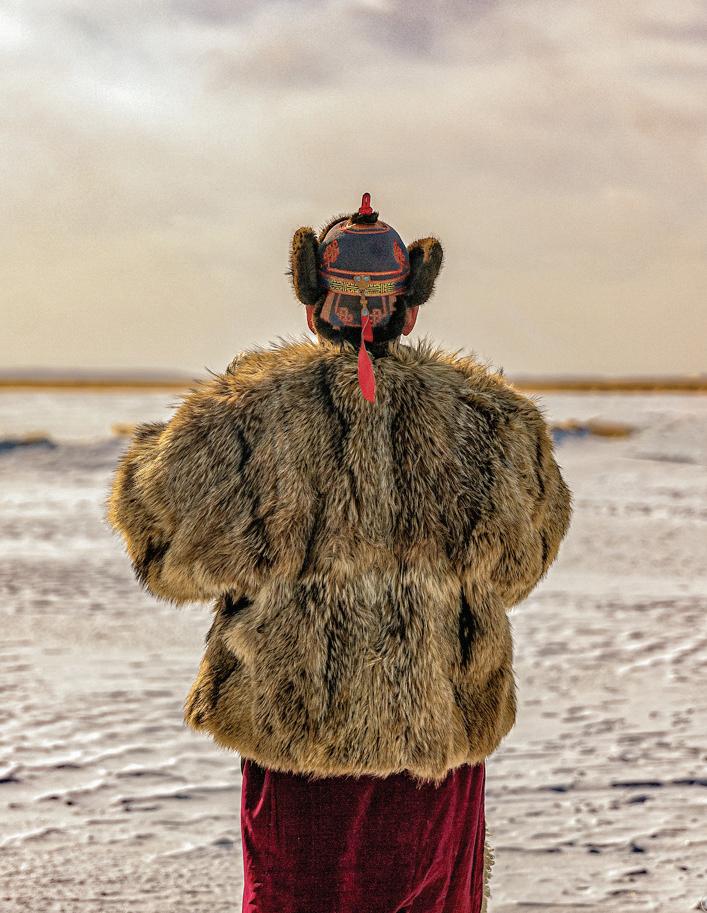
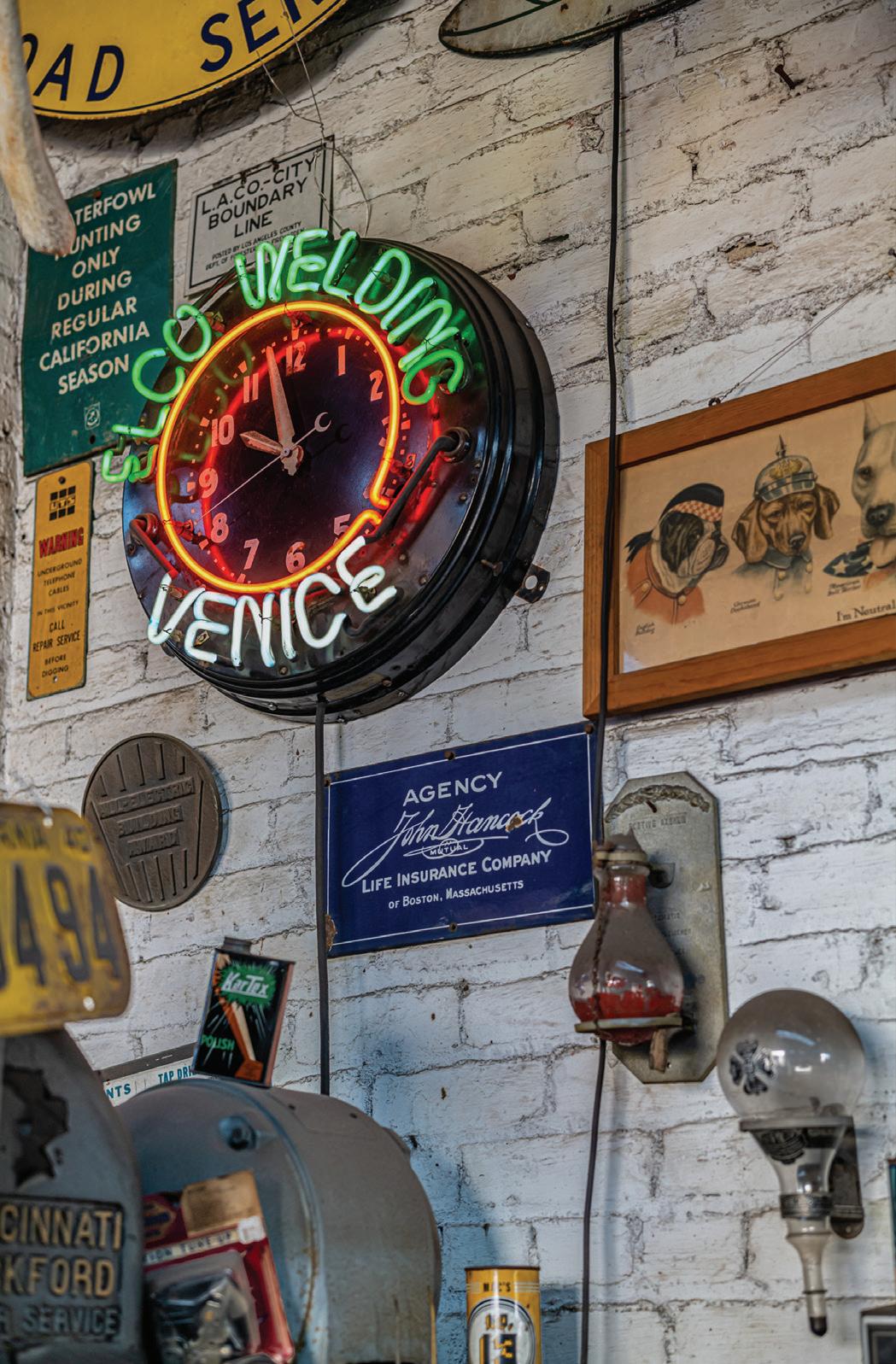
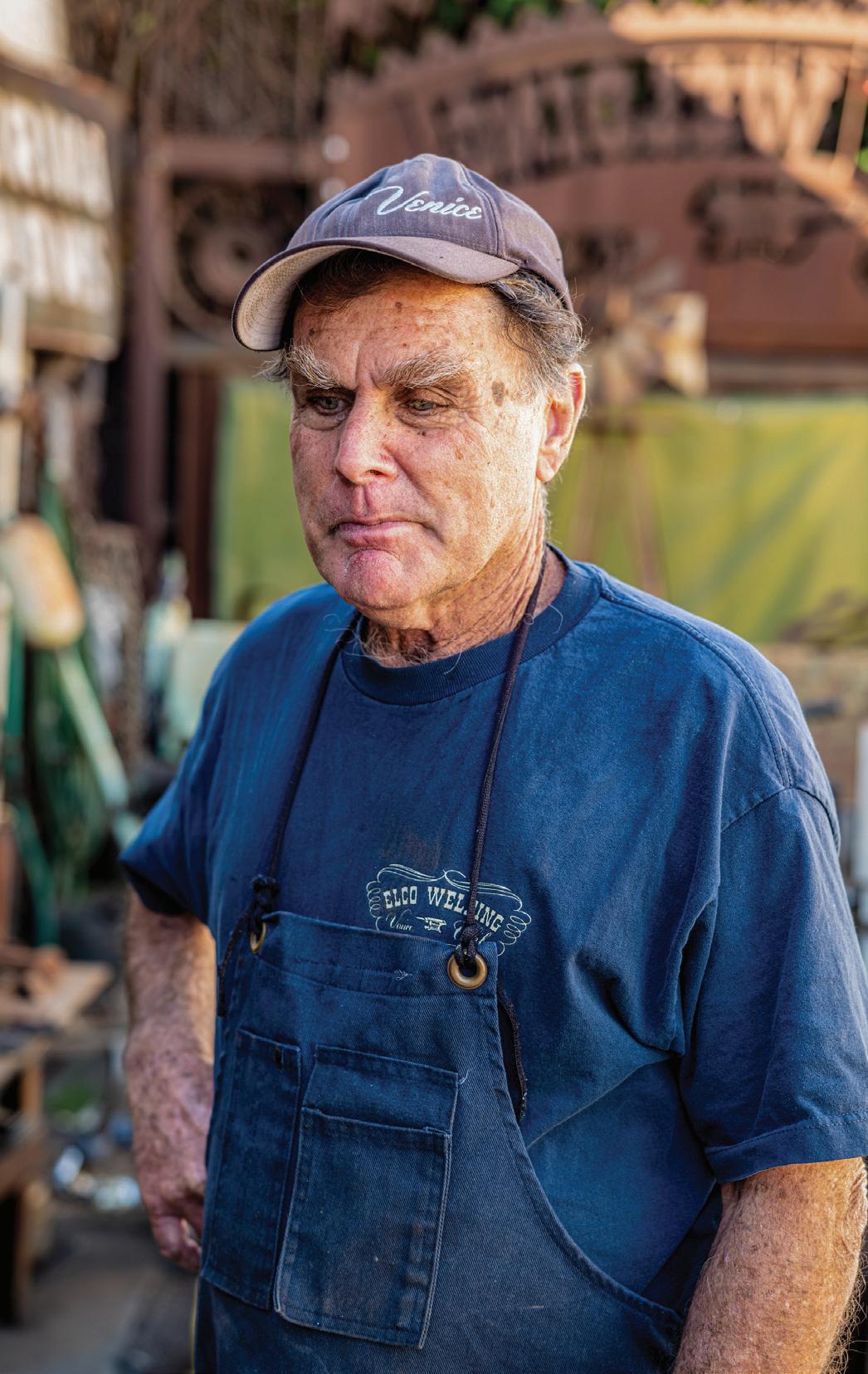
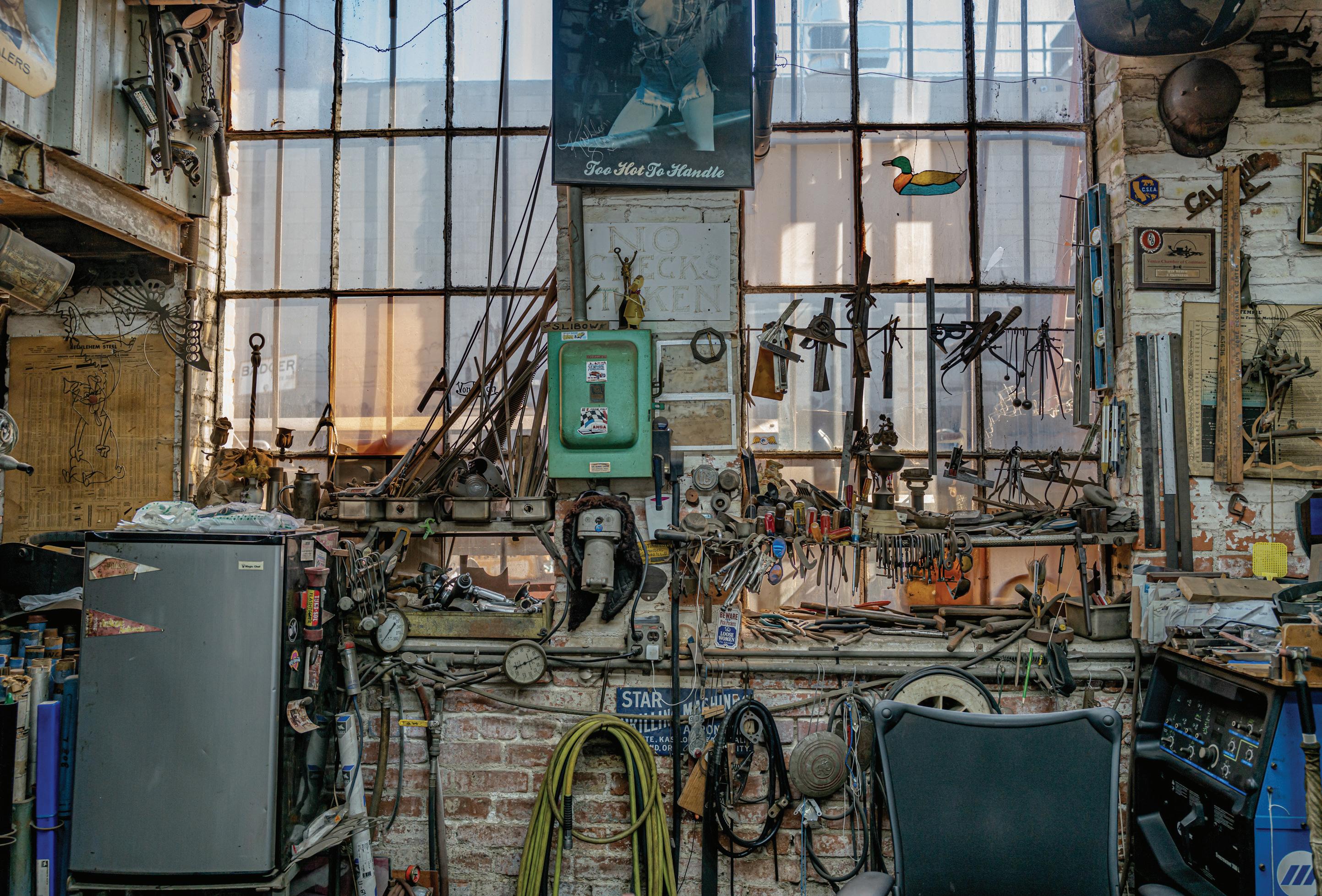
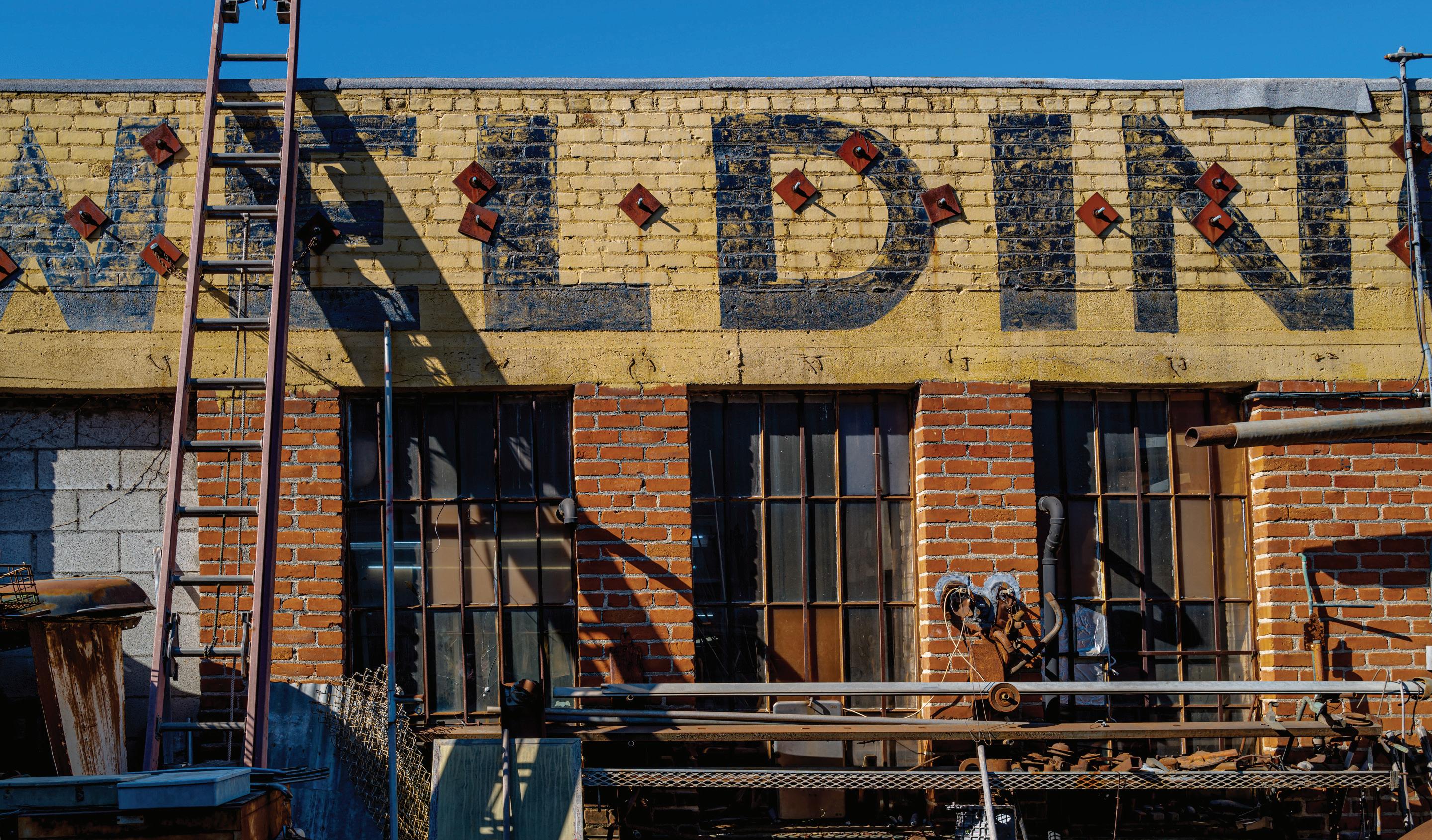
You may have noticed the striking cover photo on this issue of Viewfinder by old friend Tina Manley. I first met Tina years ago at the LHSA Spring Shoot in Charleston, SC, when she was the featured speaker. Roy Moss was the host for that meeting, and everyone had a wonderful time. I have kept up with Tina’s impressive work over the years and when I saw a post about her Trans-Siberian journey, I knew it was a natural for Viewfinder. I think you will agree when you see her article and images. We also have another wonderful article from Albert Knapp and Ruth Oratz on Ireland. Consider this as a primer for the LHSA Annual Meeting next year! Bill Royce ran across the Elco Welding Shop
or perfect a new photography skill. If you have the opportunity to travel, consider seeing your images through the filter of a project or a documentary approach to your subject. Regardless of how you approach summer, I hope you get out and burn some film or fill some cards!
LHSA Update ∙ We continue to offer online programming, but possibly the most exciting news is that the annual fall meeting will be IN PERSON in Seattle, Washington, October 22 and 23. We hope to see record member attendance this event. There will be representation from Leica, AG in Wetzlar, as well as a diverse list of engaging speakers and photography workshops.
I can’t hype this enough. We have had the opportunity to spend an extra year planning and look forward to seeing you all there!
Until the next edition, enjoy summer shooting.
Keith R. Sbiral, President, LHSA International Leica Society
recently in his travels in Venice, California, and captured some very striking images of this time-capsule of a commercial welding shop.
Dick Gilcreast continues his Tips & Techniques series with a look at the original Visoflex system and the various lenses, bellows and other accessories to get the most out of your Leica system. Even with today’s digital Leicas, you can still use the original Visoflex and get excellent results. Even from its early days, the geniuses at Leica worked hard to make the Leica a true “System Camera” able to tackle virtually any photographic challenge. It always amazes me how they took up the challenge to make things work for the Leica photographer.
Jonathan Slack reviews another new and wonderful lens for the SL Sytem. The 28mm APO-Summicron-SL lens. It is amazing how Leica is able to go from one strength to another with so many new lenses for the SL series, retro lenses like the 50/1.2 Noctilux reviewed in the last issue, and even more surprises to come this year. We can hardly wait to review them here for you in Viewfinder
We also have several articles in this issue featuring Leica or Leitz related optics. Marc Hoch brings us a mysterious Elcan lens, the enigmatic 2” Elcan. Featured in the 2020 Tamarkin Auction, it even stumped Dan Tamarkin as to what this lens was. Marc sheds some light on it, and even has taken some images with it adapted to a focusing mount with his M10. Compared to its sibling the 50/2 Elcan of KE-7A fame, it is no slouch. Speaking of the 50/2 Elcan, Ed Schwartzreich shares his experiences with one of these legendary lenses in this same issue! Ed goes into great depth about this
other fascinating Elcan lens. We also have an article by Claus Walter which originally appeared in our sister publication VIDOM of Leica Historica in Germany. In the pre-war days, Leitz often supplied lenses to other camera manufacturers. One of these was the Korelle K by Kochmann of Dresden. William Fagan made this cross-cooperation possible.
Of course, what would Viewfinder be without something from Jim Lager? We have two articles in this issue. First we have an article about a Mr. Alfred Boch, a longtime employee of Ernst Leitz, Wetzlar. Mr. Boch began his 50-year career with Leitz being hired as an apprentice by Ernst Leitz I himself in 1920. Mr. Boch came to work for New York office in 1938, and subsequently became involved in the US end of the fabled “Leica Freedom Train”. After the war, when distribution rights of Leitz products went to Henry Mann in the
REMEMBERING ERWIN PUTS
by BILL ROSAUER
Ihave sad news to bring to LHSA members and Leica enthusiasts in general. Our good friend Erwin Puts passed away in March of this year, very quickly after a short illness. I was not able to report this in the last issue of Viewfinder as we had already closed that issue.
The Leica world knows Erwin mainly through his books about Leica lens and camera design. His first book, The Leica Compendium (2001) was a revelation. It quickly became an essential volume for all Leica enthusiasts to have. Before that, Erwin and I were friends for several years after meeting at one of the Photokinas in Cologne in the 80’s. Erwin was part of the regular group who met at the Frűh Brewery across the Rhine from the fair grounds. Tom Abrahammson, Jem Kime, Terrance Dixon, Arthur Krick and others would gather for some good beer and food and Leica talk. Erwin’s knowledge of Leica was incredible. As was his enthusiasm for all things Leica. Erwin even came to Chicago at my invitation when I hosted the LHSA Annual Meeting, and was one of the scheduled speakers.
Erwin was a tireless researcher and exhaustively tested virtually every Leica lens made. He needed to know every last thing about his subject of interest, which of course was Leica. His magnum opus was the incredible Revised Edition of the Leica Compendium which came out in 2011. Erwin self-published this book, and even did the layout and editing on his own. He insisted on overseeing
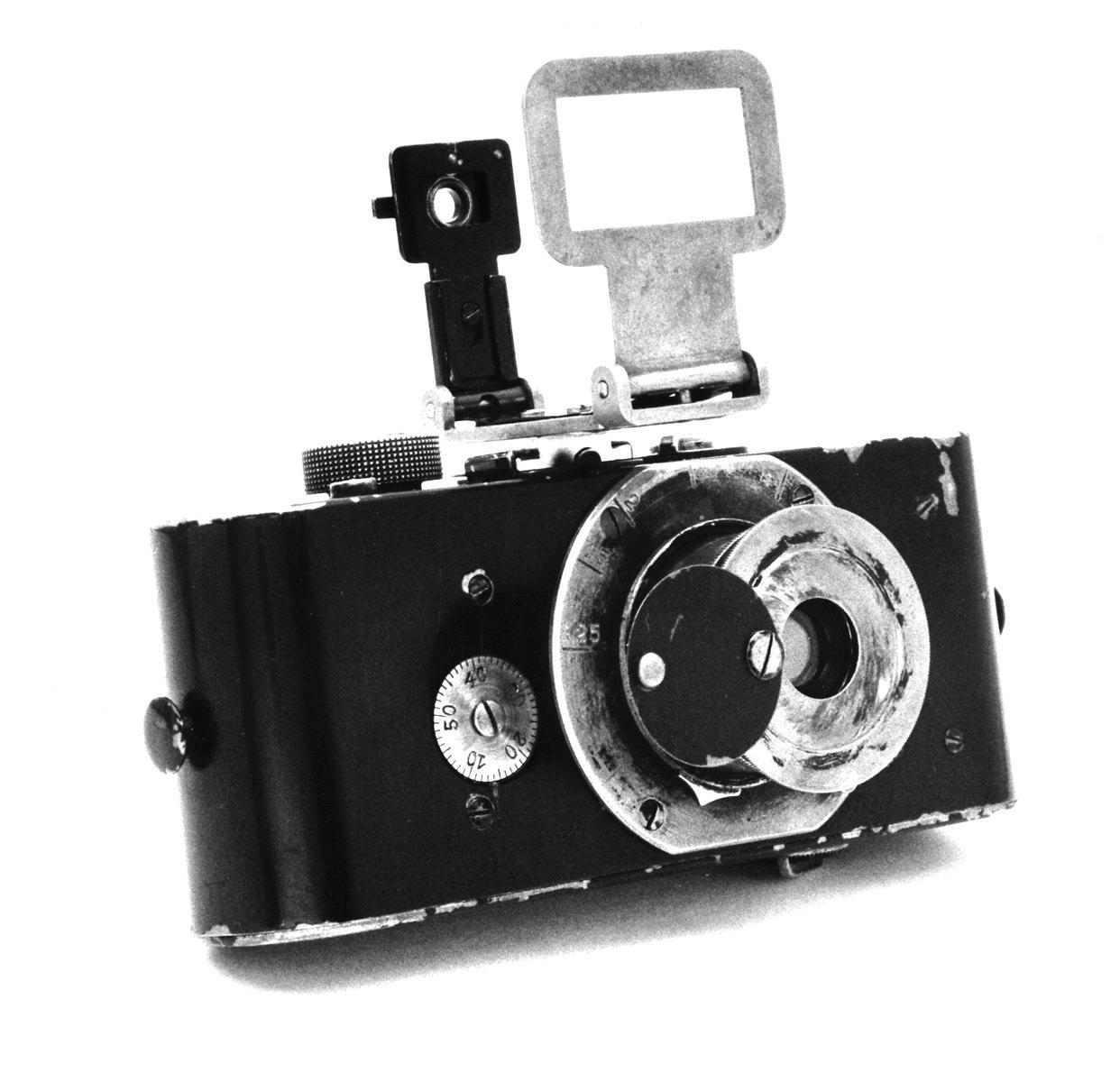
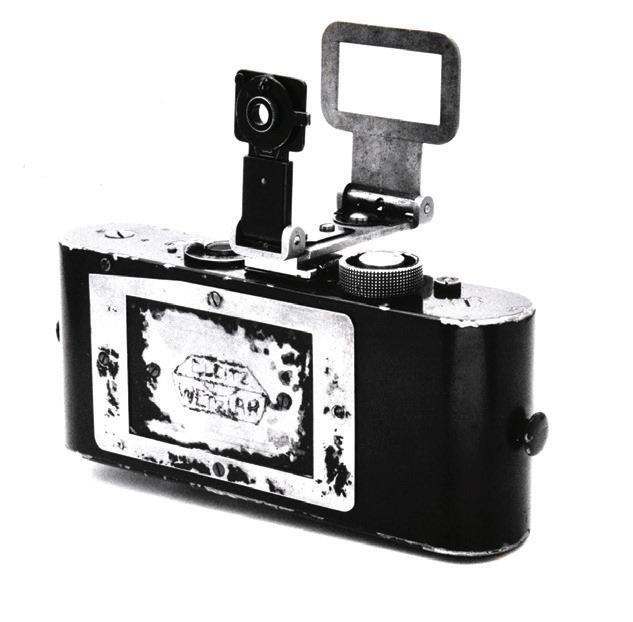
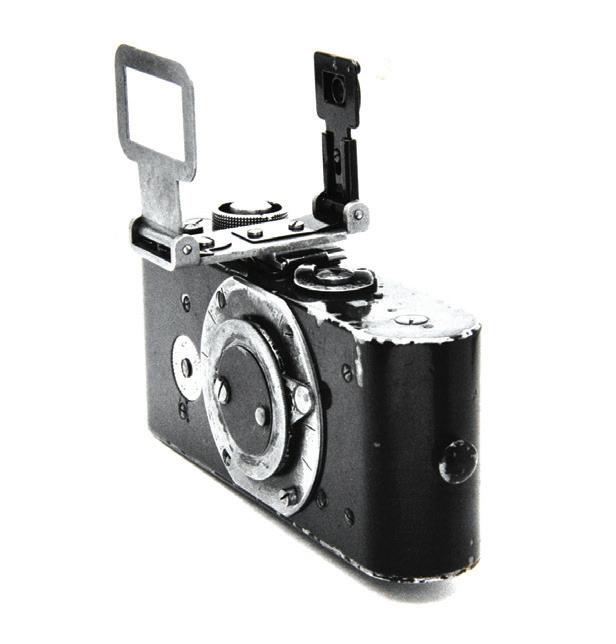
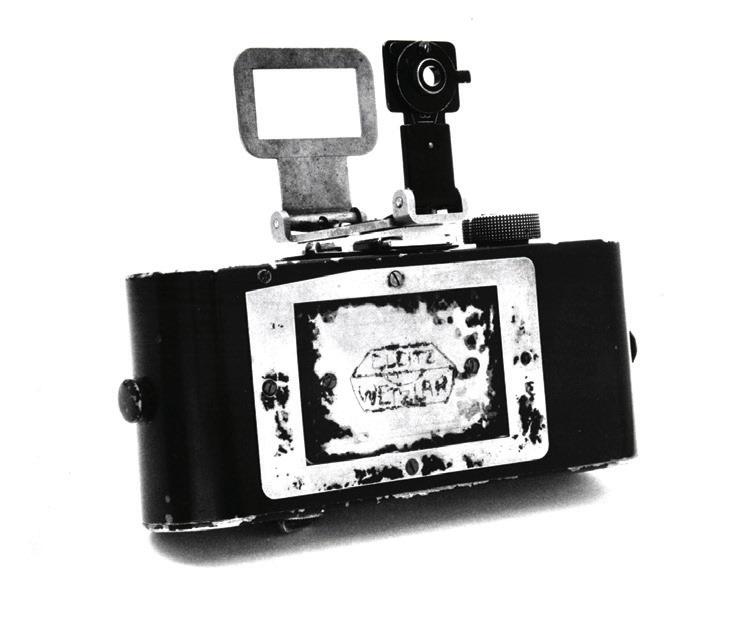
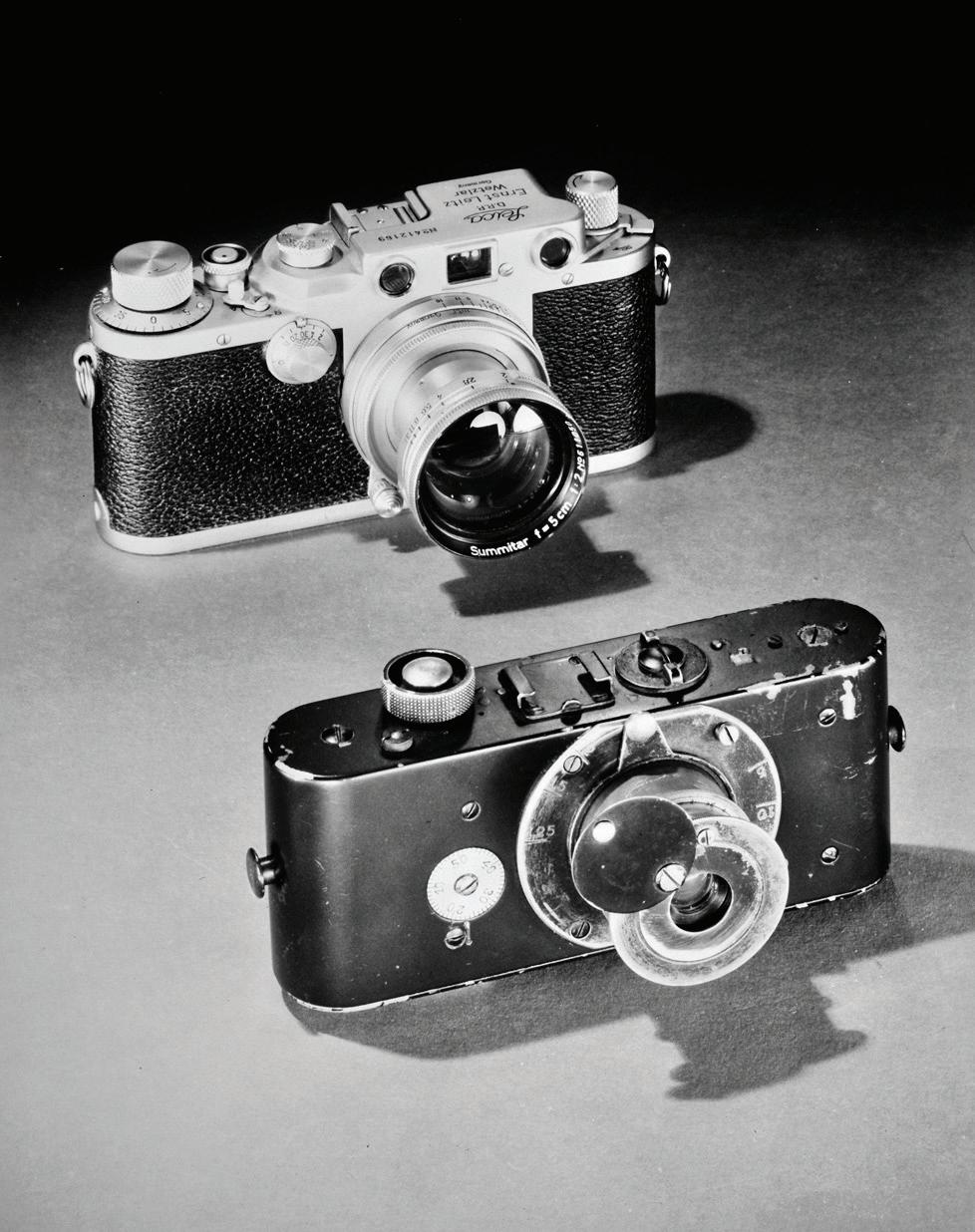
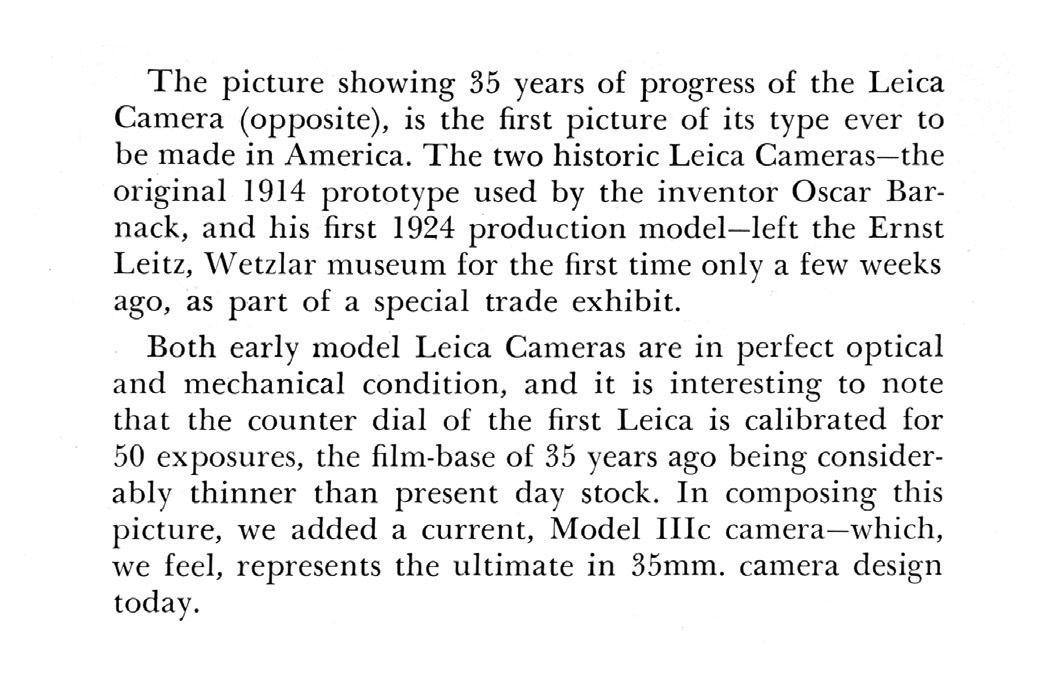
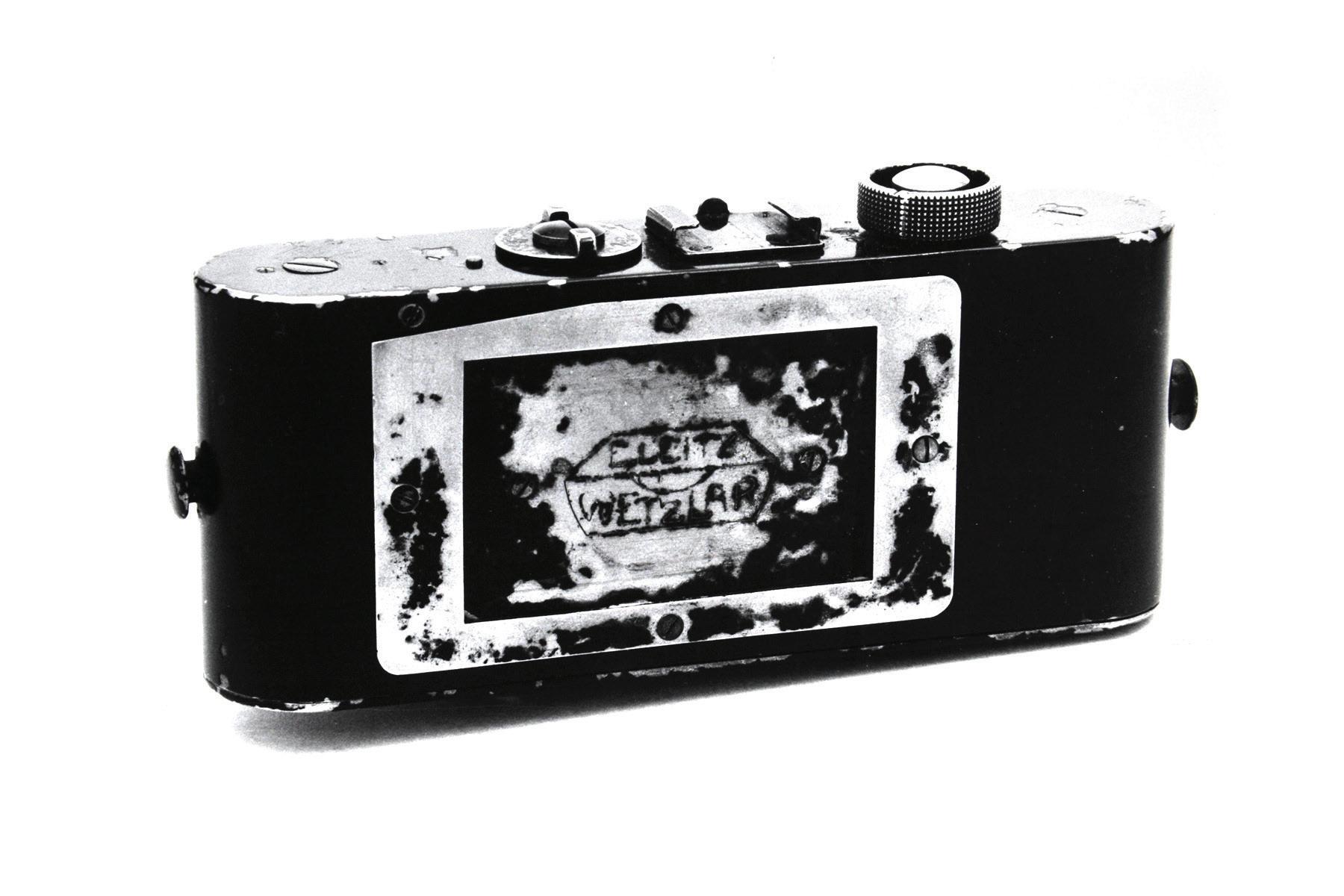
United States (Mannca in the delivery records), Mr. Boch went to work for Henry Mann. Jim does a great job describing this great Leica man’s career for us. Jim also has a wonderful article about when some “Leitz goodies” were brought over to America for the 1978 LHSA meeting in Indianapolis by Dr. Wangorsch, Director of the Museum in Wetzlar. In a gym bag, no less! This was the Ur-Leica’s third and most likely last visit to the United States. I remember being able to handle the Ur-Leica in my bare hands on several occasions at the Leica Academy back in the 80’s. Today, if it leaves the bank vault where it is stored, it is accompanied by armed guards and no one is allowed to touch it. My, how times have changed!
Bis nächste zeit! - Bill
all aspects of his book, and getting it just right! Over 600 pages on everything you would ever want to know on all things Leica, including optical design and theory, the mechanics of lens design and execution, a history of Leica 35mm cameras, the history of the Leitz company and pretty much anything else you might not have realized had to do with Leica. It has been my go-to book ever since Erwin sent me my inscribed volume. If you ever have a question about a particular Leica lens, its design, history or performance along with the MTF curves and lens cross section diagrams and ray tracings for each and every one of them, they are all here.
His third volume was the Leica Lens Saga, which came out in 2016, after the introduction of the Leica 50mm APO-Summicron-M ASPH lens. Erwin traced the development and design of every 50mm Leica lens in this book, culminating in the milestone 50 APO. If you are deeply into Leica, it makes a fascinating read, and you learn an incredible amount of detail and insight into the design process at Leica from Max Berek to Peter Karbe.
Erwin was also an active participant of the original Leica Users Group (LUG), and had many discussions with its members about all things Leica. Erwin also had his own website and blog, which can still be found here https://photo.imx.nl/blog/. In his later years, Erwin became somewhat disenchanted with Leica, and more critical of some of the Leica companies’ decisions. I am not sure what happened between Erwin and Leica, and it is an unfortunate turn in his decade’s long obsession with Leica.
Clearly, Erwin leaves us with a legacy of a tremendous depth of Leica knowledge and history, equally accessible for the Leica fanatic as well as for the enthusiast/user that wants to find out about a particular lens they might be interested in, evaluated in a conscientious and consistent manner. Thank you, Erwin, for this great gift to the Leica family, which will be appreciated for generations to come.
A Very Useful System for Macro Work
by DICK GILCREAST
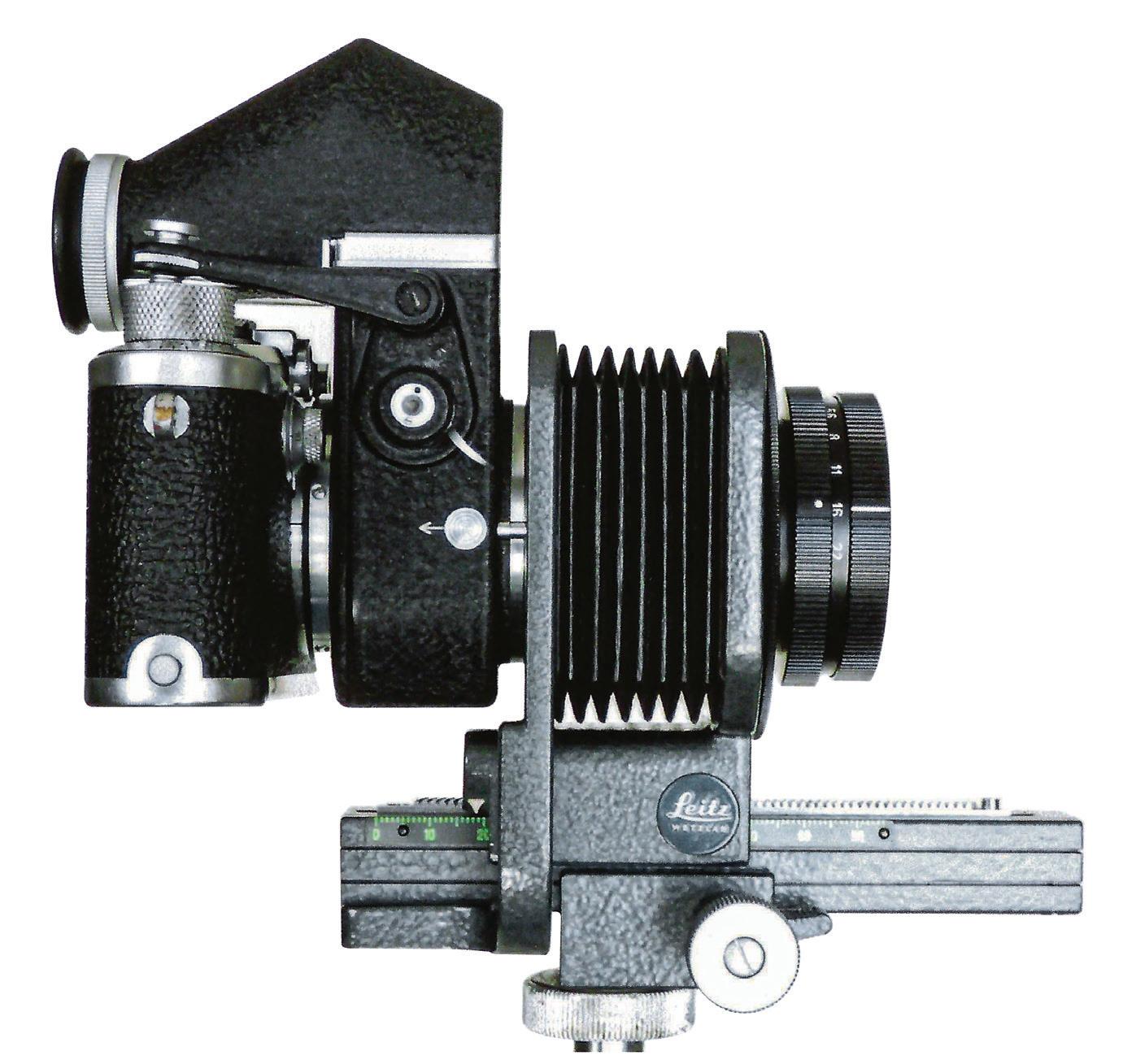
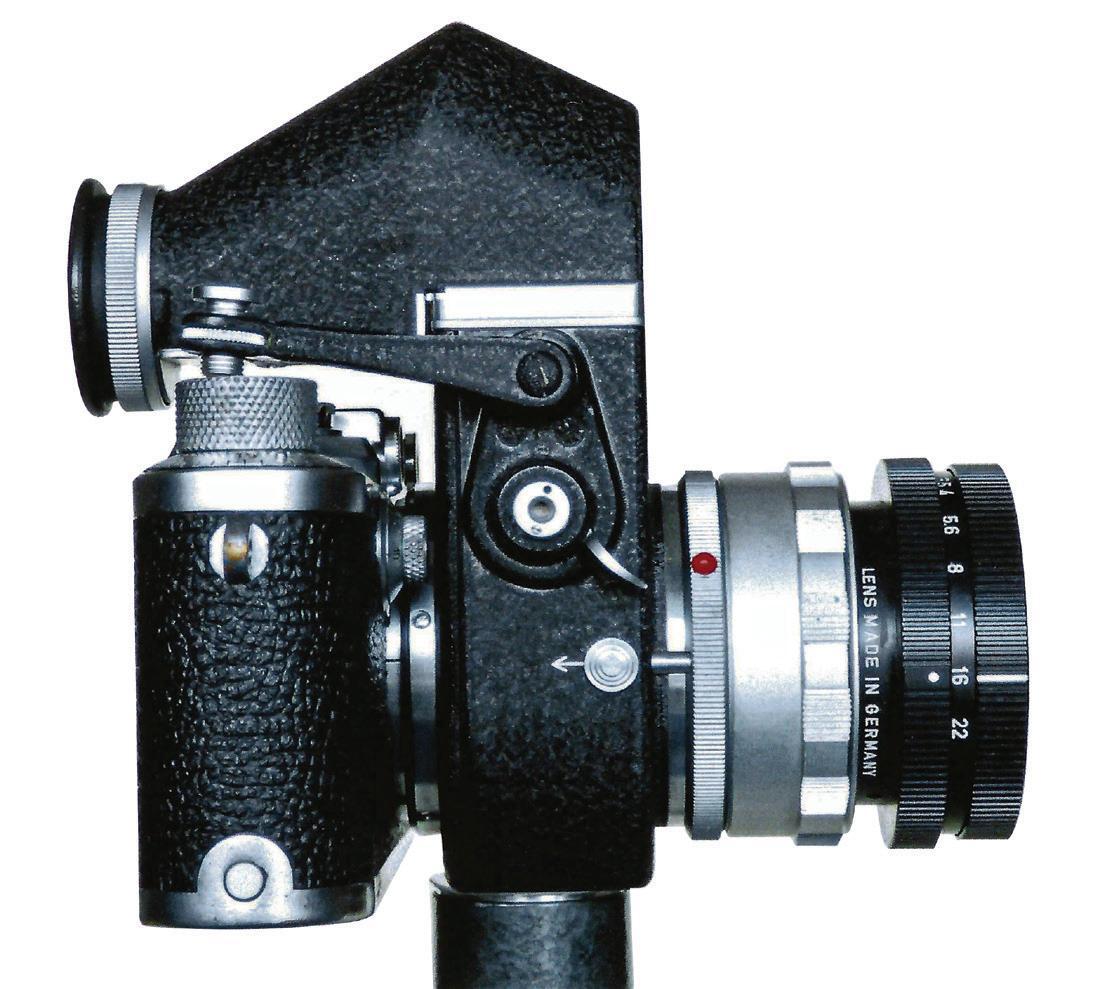
gear shown here can be used with any Leica camera from screw-mount to M to digital M. It consists of a Visoflex II or III reflex housing, a 65mm f/3.5 Elmar-V lens, and either an OTZFO or Bellows II — or both — to hold the lens and focus to close distances.
The 65mm lens is chosen as a single very capable lens to use for general closeup work. The helical focus mount OTZFO (16464) will focus it from infinity down to a 2x3 inch frame, or extension tubes can be added for closer ranges. The pre-set aperture ring on the lens makes switching from wide open focus to taking aperture quick and easy, with no automatic activation to hang up or go wrong.
However for closer work the greater 95mm extension of the Bellows II allows the 65mm lens to reach beyond a 1 :1 image to a larger 1.4:1, more conveniently taking the place of a set of extension tubes. The Bellows II also has another advantage — when fixed on a tripod its lower adjustment knob can move the entire camera and Visoflex and lens assembly two inches forward or back (with a locking lever on it), making it quicker and easier to get an accurate focus, while at the same time allowing an already pre-set extension to be kept on the bellows. The 65mm Elmar mounts directly onto the adapter plate 16558 supplied on the front flange of the Bellows II. Incidentally, infinity focus is also available with the 65mm Elmar mounted on the Bellows 11, but the smaller OTZFO focus mount might be preferable for handheld use or working outdoors. The best route, of course, would be to have both OTZFO and Bellows II to work with as needed. The Visoflex II was made in either SM or M mount.
The Visoflex III is in M mount only. The Visoflex III can accommodate the taller top plate of some M models such as the M6 TTL and some digital models, and may be a little
quicker to operate due to its instant return mirror, but perhaps a bit slower in the extra action of raising the mirror to enable TTL metering. If an M camera is adapted to a Viso II the tripping arm will not reach the camera's shutter button. In this case leave the tripping arm in the forward position to trip the mirror, and use a cable release on the camera. The OTZFO (16464) focus mount is available in either chrome or black. No difference between them other than outer finish. There is a small bellows inside to keep the interior of the lens mount free of reflections or dust or grease from the helical threads.
The 65mm f/3.5 Elmar-V lens first came in chrome, then black. Both have pre-set aperture rings for that quick and accurate setting of the aperture for exposure after wide open focus. The black model shown is the later version which has a different front filter thread. Instead of the E-41 thread of the chrome lens, which is difficult to find filters for, the black lens has a Series VI thread to which a series VI to VII step-up ring can be fitted to use the same series VII filters used on other Leica lenses. These filters are available from many manufacturers in common color correction, partial neutral density, Polarizer, etc.
The Visoflex II shown is a screw-thread model, on which is mounted a black dial Leica lllf which allows the use of flash if wanted. The Viso II can be adapted to an M mount camera with the use of a thread-mount to M adapter ring, leaving the tripping arm in the forward position, as mentioned above. Also, as mentioned above, the Viso II prism is not usable with an M6 TTL or other M cameras with higher top plates because the Viso II prism is set lower, as seen here. The higher setting of the Viso III prism allows those models to be used, and the mirror arm can be adjusted to trip the newer cameras using a cable release on the Visoflex housing.
MR. BOCH
by JIM LAGER
2002 the American Photographic Historical Society published a booklet titled The Greatest Invention of the Leitz Family: The Leica Freedom Train by Frank Dabba Smith. Norman Lipton, a Leitz employee in New York comments on page 9, “ I observed ( the absorption of refugees) in action soon after I was hired by the New York office of Leitz on May18th, 1938. On alternate weeks, I witnessed the arrival and processing of 30 or more Leitz- sponsered refugees who were lined up along the wall of our office waiting to be interviewed by Alfred Boch, Executive Vice President. Boch put them up at the nearby Great Northern Hotel and spent the succeeding days on the telephone finding jobs for them throughout New York and the nation.”
Alfred Boch’s humanitarian concern and action will be long remembered. In 1970 Boch celebrated 50 years with the Leitz organization. In 1977 he was the honoured guest at a surprise party. These events are detailed here. •
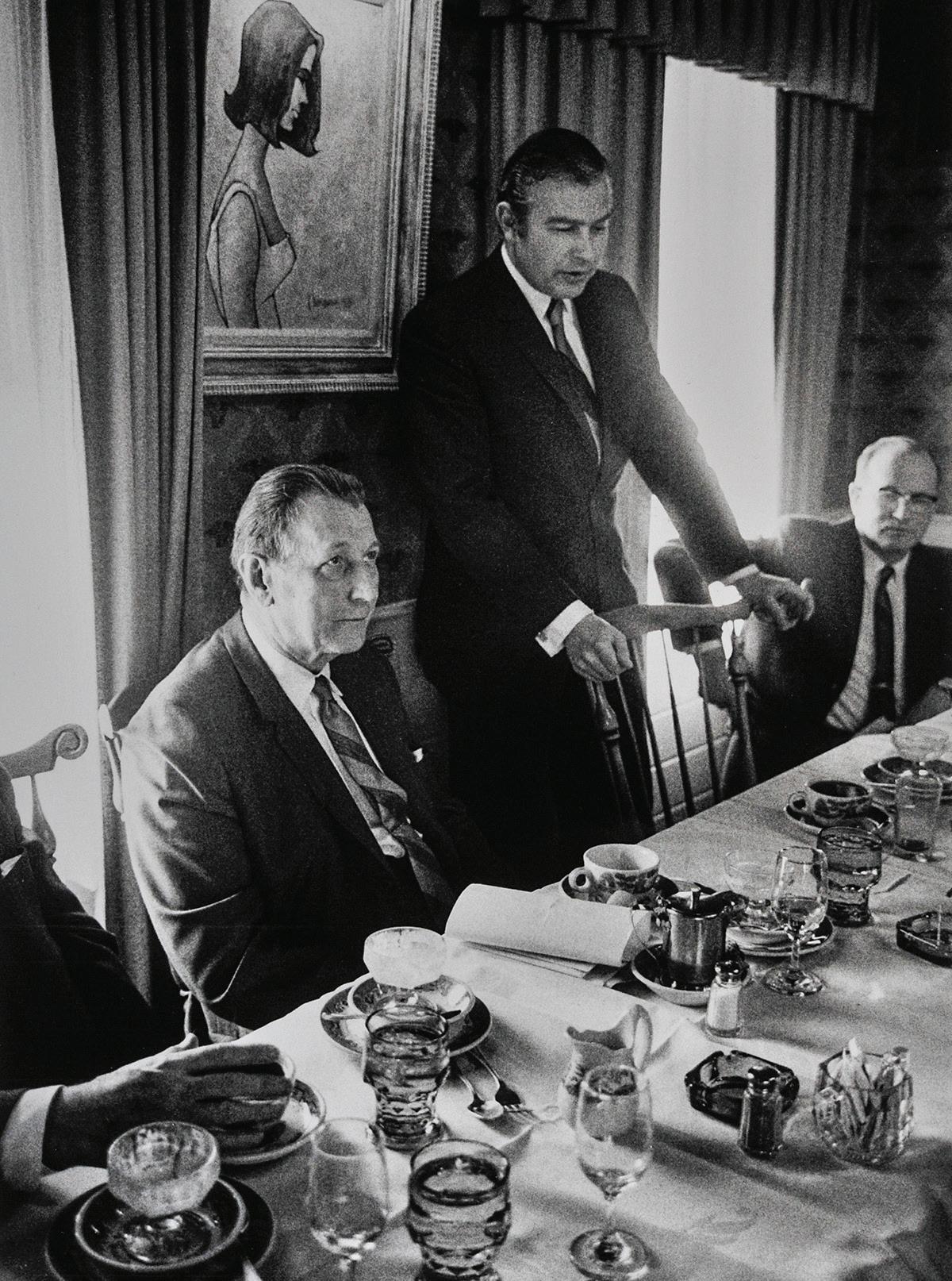
Celebrating 50 years with Leitz, 1970. Left to right Alfred Boch, William Mann &Walter Mandler.
Ladies and Gentlemen, Boys and Girls,my friends. Thank you for your kind words. This surprise party makes me very happy. I am deeply touched to see so many of my associates gathered here to express their good wishes for my retirement years.
I have been very lucky, when in January 1920 I applied for a job at the Leitz Works in Wetzlar and was hired by Ernst Leitz 1 as an apprentice. It was shortly after I arrived in the outskirts of Wetzlar at relatives. I came from Russia where our family was interned in Siberia. My Father was in charge of a brewery where he used a Leitz microscope in his laboratory. Father suggested I contact Leitz as they had an excellent reputation.
I worked at Leitz learning what makes a microscope tick and to appreciate what precision workmanship is like. I wondered what would have happened to me if I had started working for a company dealing with tobacco. How boring it would have been.I also got inside the first Leica camera which was being readied by Oscar Barnack Later I was transferred to sales and customer service departments I did some traveling and in 1932 was sent to the London office. Leitz had the Leica II and a new high speed lens the 7.3cm 1:1.9 Hektor. With this equipment I took pictures in the subways and theatre using high speed film. This was something new at this time and created a great deal of interest. Once I went to a London musical which had many ballet scenes. I succeeded in taking some interesting pictures which were enlarged and displayed in the Leitz London showroom. As a result many actresses and ballerinas called on us and wanted prints. Another time, when an explorer was leaving London and forgot an important part of his Leica equipment I had to chase him to the boat on the English channel to deliver what he forgot.
The second strike of good luck occurred when I was running the newly established Leitz office in Vienna. Later Leitz Wetzlar offered me a top management position at the New York office. I accepted this proposition and in August 1935 arrived in this wonderful country and made it my home. I became accustomed to the American way of life and in due course became a US citizen. Things progressed well until the War started in 1939. Our supplies from Germany were cut off
by the British blockade. In order to keep the company alive we started producing some Leica accessories in the repair shop. The U.S. Army Signal Corps, having obtained Leica equipment for use in the European war theatre, found that with Leica equipment, casualties among their photographic personnel are lowest. They contacted us to purchase several hundred additional equipment sets which, unfortunately, we did not have. We contacted registered owners of Leica cameras and bought equipment back from them. After reconditioning these items were resold to the Army. Later we started producing lenses for the Leica, universal viewfinders, flash guns, etc. Electric colorimeters and microscope accessories were also produced. The capacity of our production department was substantially expanded. When the United States entered World War II the operation of E.Leitz, Inc. Came under the control of the alien property custodian.
The third and most important strike of luck in my life occurred in 1952 when Henry Mann obtained distribution rights for Leitz Wetzlar products and acquired E.Leitz, Inc. after it was sold by the alien proprty custodian. At this time I met William Mann for the first time. Under Henry Mann’s able management many new and efficient methods were introduced. Business expanded and the company became the outstanding concern in the photographic industry. Upon the passing of Henry Mann William Mann took over management. Inflation continued to rise and the revaluation of the Deutschmark created additional burdens. Cost of products made in Wetzlar increased more than 80%. Credit is due to William Mann for successfully steering the company through these obstacles and for building up a company second to none. I felt lucky to be a member of this organization and want to thank Mr. Mann, my fellow officers, department managers, and every employee for the excellent cooperation you gave me in all these years. Without your support and the assistance of my wife Lucy I would not have been able to perform my job.
There were many cases where we had to meet a certain deadline and as you know I do not belive in the phrase “it cannot be done “ . When there is a will there is a way. You did it and I thank you. Continue the good work and show new employees what a real Leitzanian can accomplish. •
With great satisfaction, gratitude, and joy, we record as January 26th, 1970, the Fiftieth Anniversary of Alfred Boch’s association with Leitz.
Alfred Boch was born on November 19th,1904,in the city of Wilno in Russia. He attended schools in Wilno and Estonia (Youryeff) until 1914, when his family was forced to leave their house and were interned in Siberia. Alfred was only a boy of fourteen when the Boch’s returned in 1918. The Russo-Polish War broke out the following year, bringing to the people of the area severe hardships and danger.
It was a terrifying time, with barely enough food available for survival and, with street fighting so intense, the roof of he Boch home was blown off. In the Fall of 1919, young Alfred and his two brothers left Wilno by farm-cart and crossed the border into Germany. The boys were seeking refuge with distant relatives in Wetzlar ; they arrived safely just after the turn of the year. That very day - January 26 th - in the year 1920, Alfred unknowingly began what was to become a long and illustrious career with the Leitz organization. He was interviewed and hired for the job of apprentice instrument maker by Ernst Leitz the founder himself.
In those days, the Leitz works was a relatively small optical and mechanical institute primarily concerned with the manufacture of microscopes and associated instruments. Yet, spectacular events were soon to take place in Wetzlar as the imaginative Oskar Barnack began working on the concept of a miniature camera which might be as optically precise as a microscope, yet small enough to carry in one’s pocket. When Barnack built his first small camera prototypes for 35mm film, Alfred Boch was a member of his department of skilled assistants and it was in this very same shop that the first Leica was born.
In addition to Alfred’s abilities as an instrument maker, he also demonstrated considerable talent in matters of sales and service. From 1926 to 1931, he was assigned to the Technical Correspondence and Customers’ Service Department. During this period, he acquired an intimate understanding of all
operartions of the company and, through first hand experience, he became fully acquainted with the multifaceted Leitz manufacturing program “from glass block to Leica objective”.
In 1931, Alfred was transferred to the Leitz office in London to improve his English and to study British business practice. When he returned to Wetzlar in 1933, he was aked to investigate the opportunities for a Leitz agency in Vienna; his efforts culminated in an office in Vienna, with branches in Hungary and Yugoslavia. Soon to follow, under his direction, was a program of Leica exhibits in major cities throughout the Continent.
In the early 1930's, the United States market assumed a growing importance as a market for Leitz products. Thus when Albet Traeger, the President and Proprietor of E.Leitz, Inc. New York , withdrew from the company for rreasons of ill health, Alfred Boch accepted a management position in the young company acquired from Traeger by Leitz Wetzlar. On August 1st, 1935 , he became a Director and Vice President of E.Leitz, Inc. That same year, he was accepted as a member of the now famous “Circle of Confusion”, a group of prominent photographers, writers, artists, and businessmen who, to this day, still gather to exchange ideas on 35mm photography.
Shortly before the Second World War, Alfred invited Anton Baumann to visit this country with a lecture tour of major cities. Kodachrome film was introduced at about this time , and Baumann’s presentations became convincing vehicles for popularizing 35mm photography in black- and- white and color. This innovation can well be considered the forerunner of the celebrated “Leica Schools”and contributed heavily to the spectacular growth of 35mm photography. Thus, Alfred Boch played a prominent role in the colorful history of the Leica camera.
When Mr. Henry Mann acquired Leitz New York from the Alien Property Custodian in 1952, Alfred joined the revitalized organization as Vice President and General Manager, a position which he still holds today. He has served
us diligently and faithfully during fifty years, not only as an “internatinal Leitz Man” but as one of the cornerstones of E.Leitz, Inc. n the United States.
Throughout his business career,Alfred Boch has complimented his impressive talent for hard work with an enviable throughness and attention to detail. The abundance of fine human qualities that he has so prominently displayed, particularly his character, integrity, loyalty, and warm consideration for his fellowman, have indeed made it a privilege for us all to be associated with him. His total dedication to furthering the best interests of his company and the selflessness and complete disregard for personal gain or glory with which he has pursed his goals, have earned him the everlasting respect and deep affection of his colleagues, not only within the Leitz organization but in the various industries it represents as well.
Therefore, be it resolved that this expression of our high regard and deep appreciation be preserved in the permanent records of E.Leitz, Inc. and that a copy of this resolution be presented to him with our fondest wishes for many future milestones to come.
Adopted by the Board of Directors of E.Leitz, Inc. At a meeting held this Monday , January 26th, 1970.
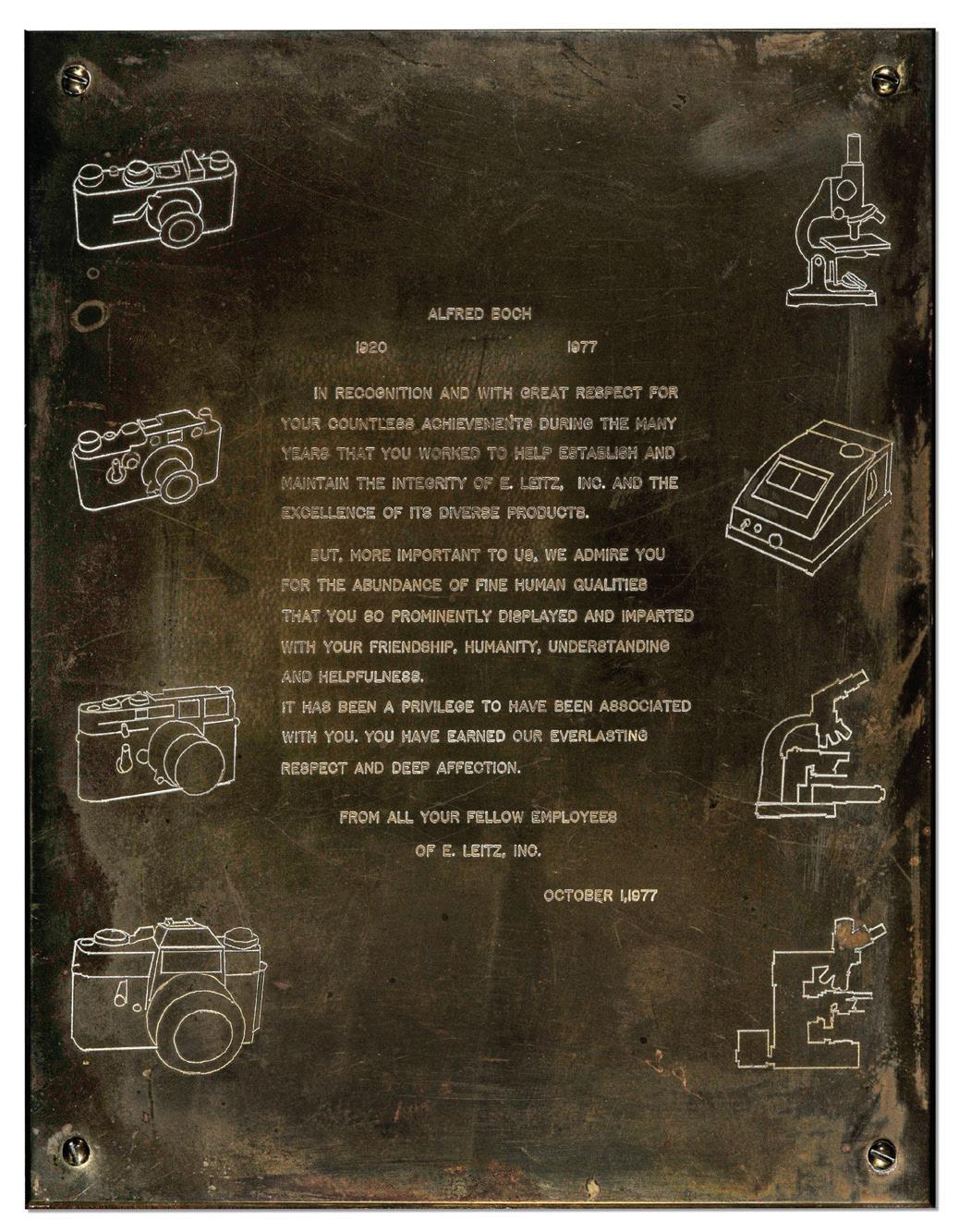
Plaque given to Mr. Boch by E.Leitz, Inc. New York employees in 1977.
ELCO WELDING
An
Old Venice, California Icon
by BILL ROYCE
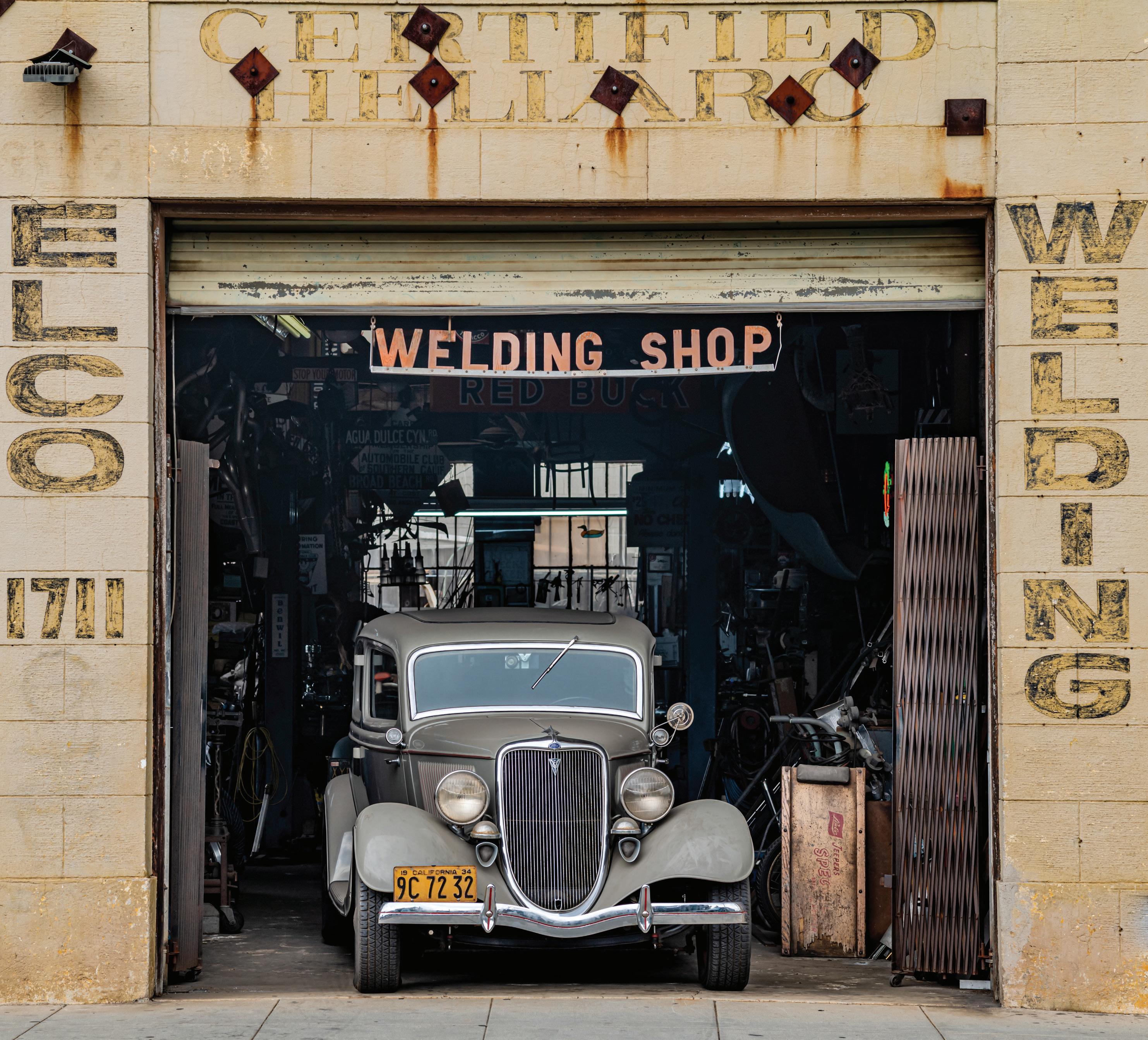
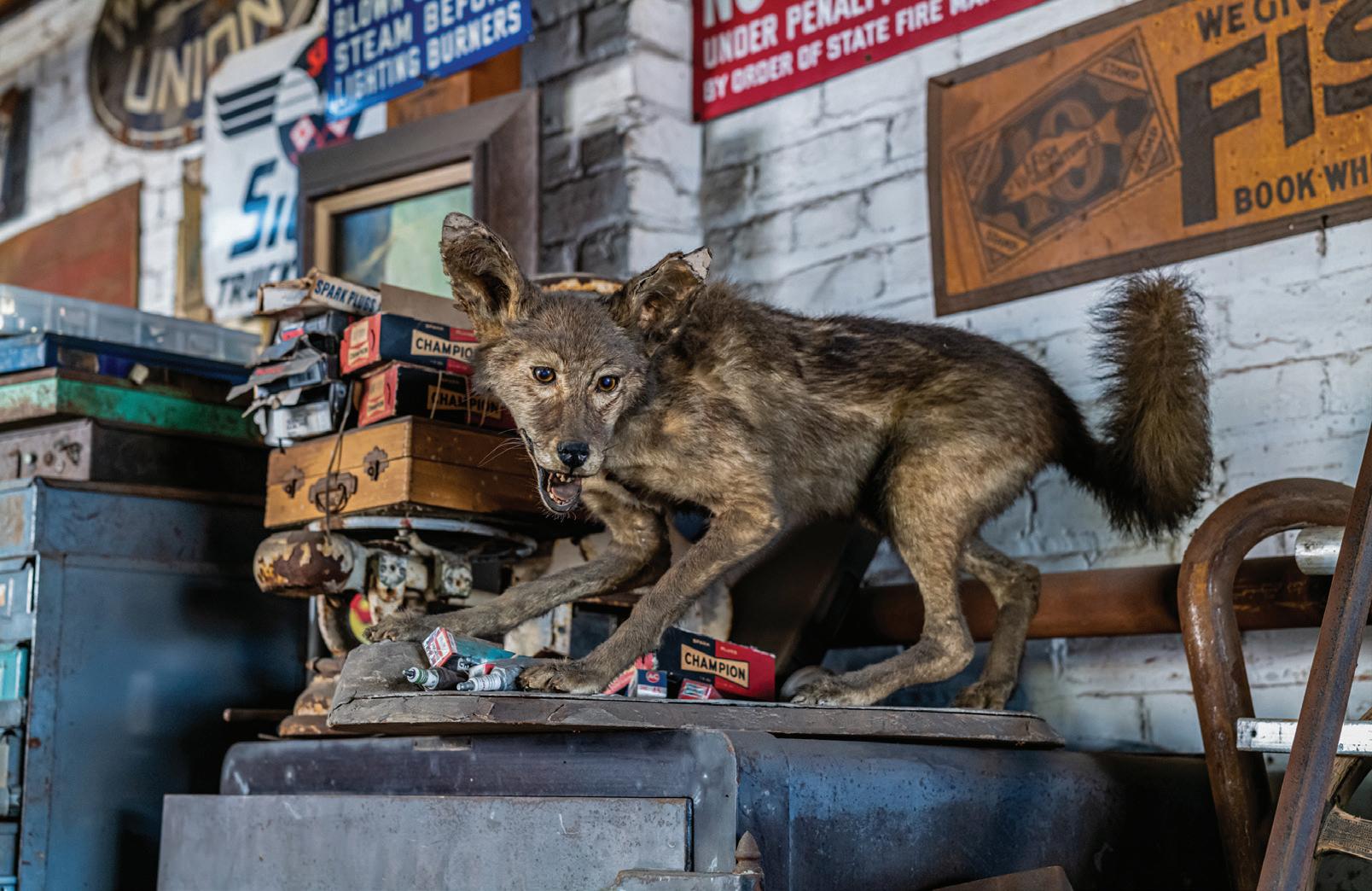
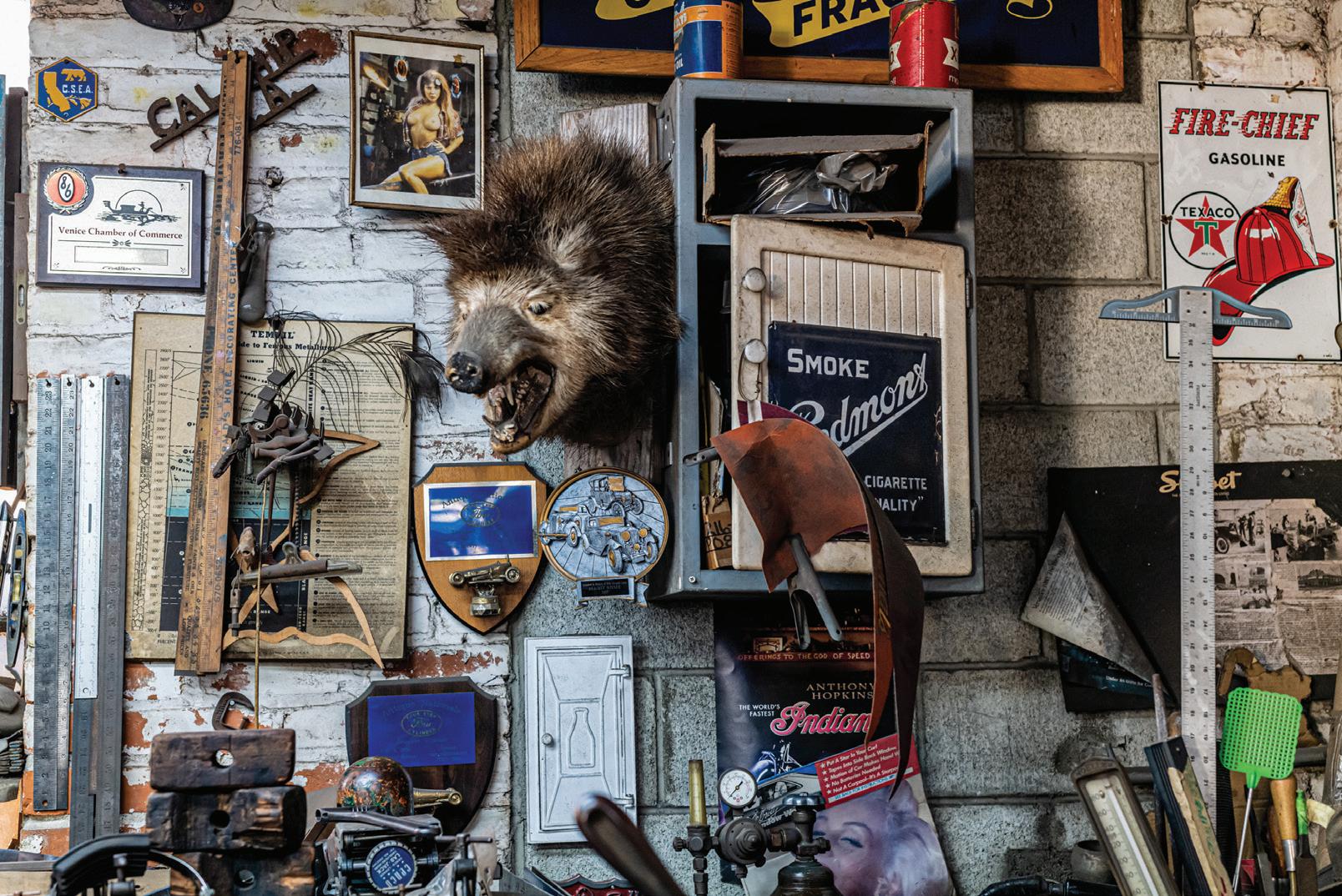
Elco Welding, housed in an old building at 1711 Abbot Kinney Boulevard, in Venice, California, is unique among the many nearby businesses and pricey shops in a very trendy area. Built in 1928, this structure has seen many years of local history, and is still an active welding shop and metal working facility. Two brothers, Mark and Bob Libow, run the business. They inherited it from their father Seymour, who worked for the original owner of the building. This business has outlasted many others in the area because it still provides valuable metalworking skills to other local businesses, car owners and even artists in the process of creating art from metal of all kinds.
Of great historical interest, according to Mark, was the use of the back section of the shop to distribute booze to the LA and Hollywood elite during the prohibition years. “Car repair customers”, including movie stars like Wallace Beery, drove their cars into the shop, the mechanics would open the hood, and stash illicit liquor inside. Money would change hands and the customers were on their way. Also, one metal lathe has placards indicating it met the standards of the US Army Corps of Engineers during World War II.
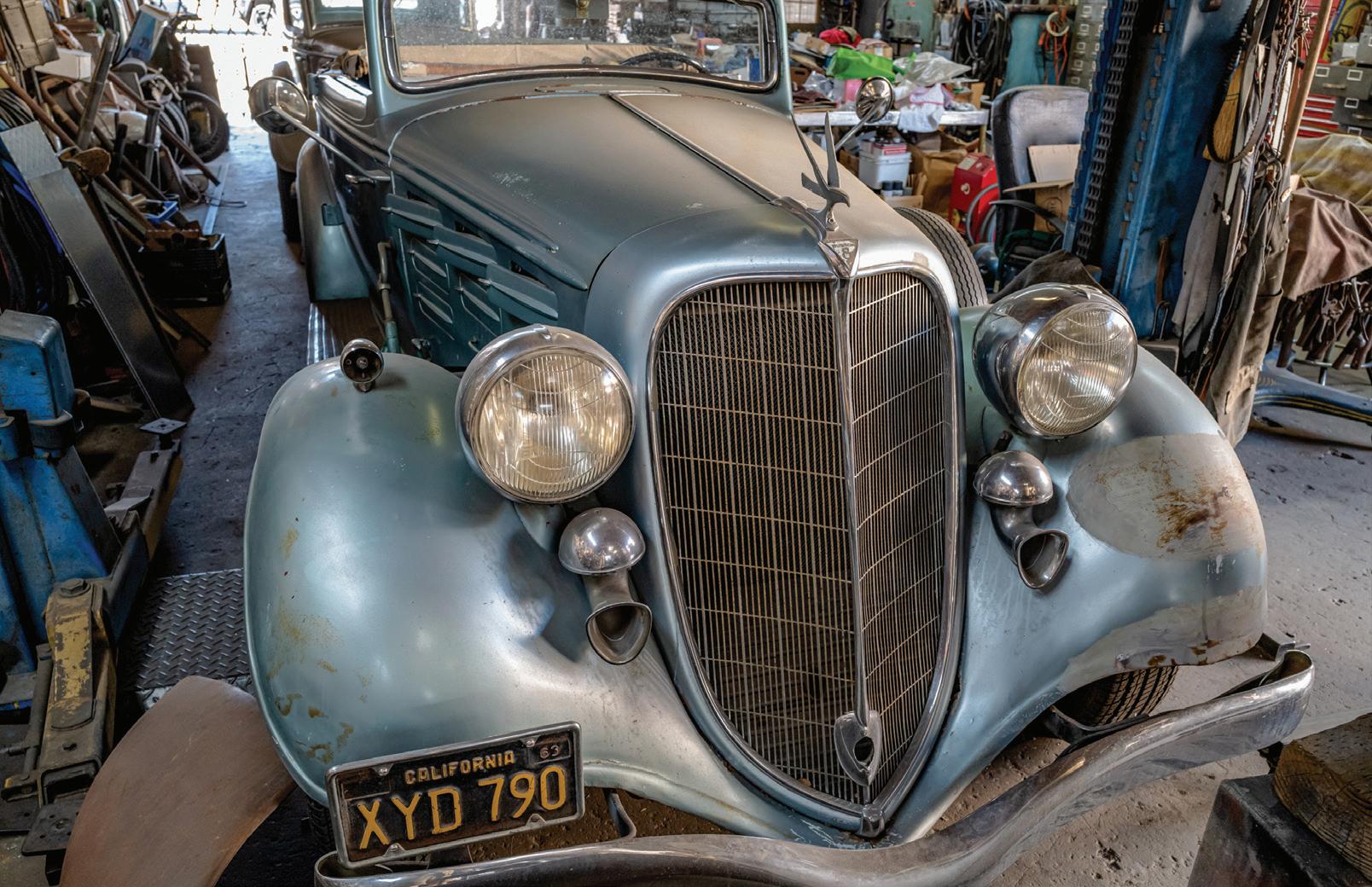
The following images show many of the fascinating machines, tools, antique objects, bizarre collectibles, and old signs scattered throughout the shop. Hundreds of different power and hand tools, many very old, can be seen throughout the shop. Four old cars are inside or in the back of the property are kept in running condition and are occasionally driven. They include a 1934 Ford V8 sedan, a 1934 Hudson convertible, a 1937 Dodge pickup truck (bought from the original owner) and a 1951 Plymouth station wagon. A fifth car, a rare 1941 Graham, is undergoing restoration.
Anyone fascinated with old cars, mechanical objects and curiosities might spend hours in this shop, as I did, Leica in hand. These images were taken with a Q2, and an SL2 with a 50mm APO-Summicron-M, 90mm APO-Summicron-M and an 18mm Super-Elmar-M.
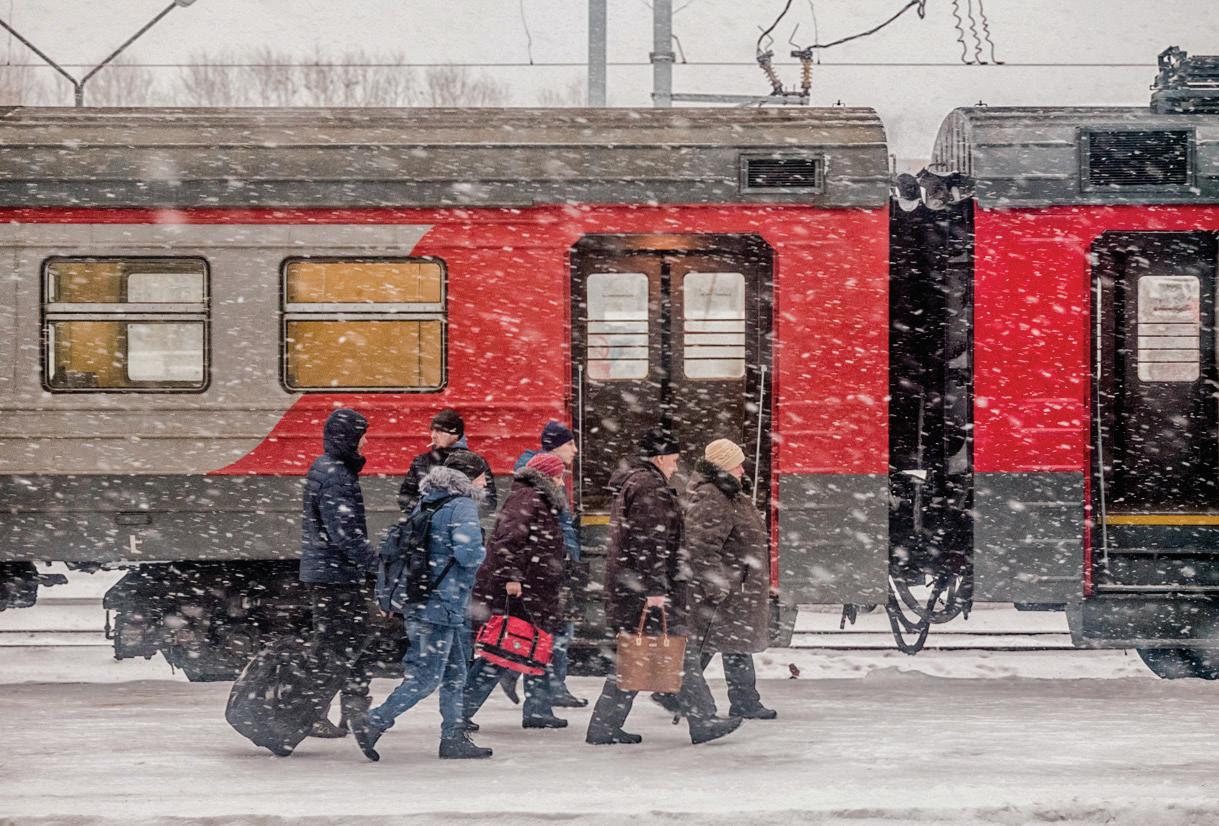
transiberian
transiberian
husband Tom and I spent our 50 th wedding anniversary in a yurt in the Gobi Desert where the temperature was -30 degrees Fahrenheit! In case you ever desire to do the same, here is the story.
Our normal travel custom is to take an annual 4-to-5 week trip to someplace strange in the January/February time frame. That time of year is slow at our farm and is also the off season for many travel destinations. 2017 was special because it was our 50th wedding anniversary. We had always said we would celebrate that anniversary on the Orient Express, but that train trip has changed quite a bit from the past. The main route of the Orient Express today is only a two-day trip from Paris to Venice, not long enough in time or distance covered for us.
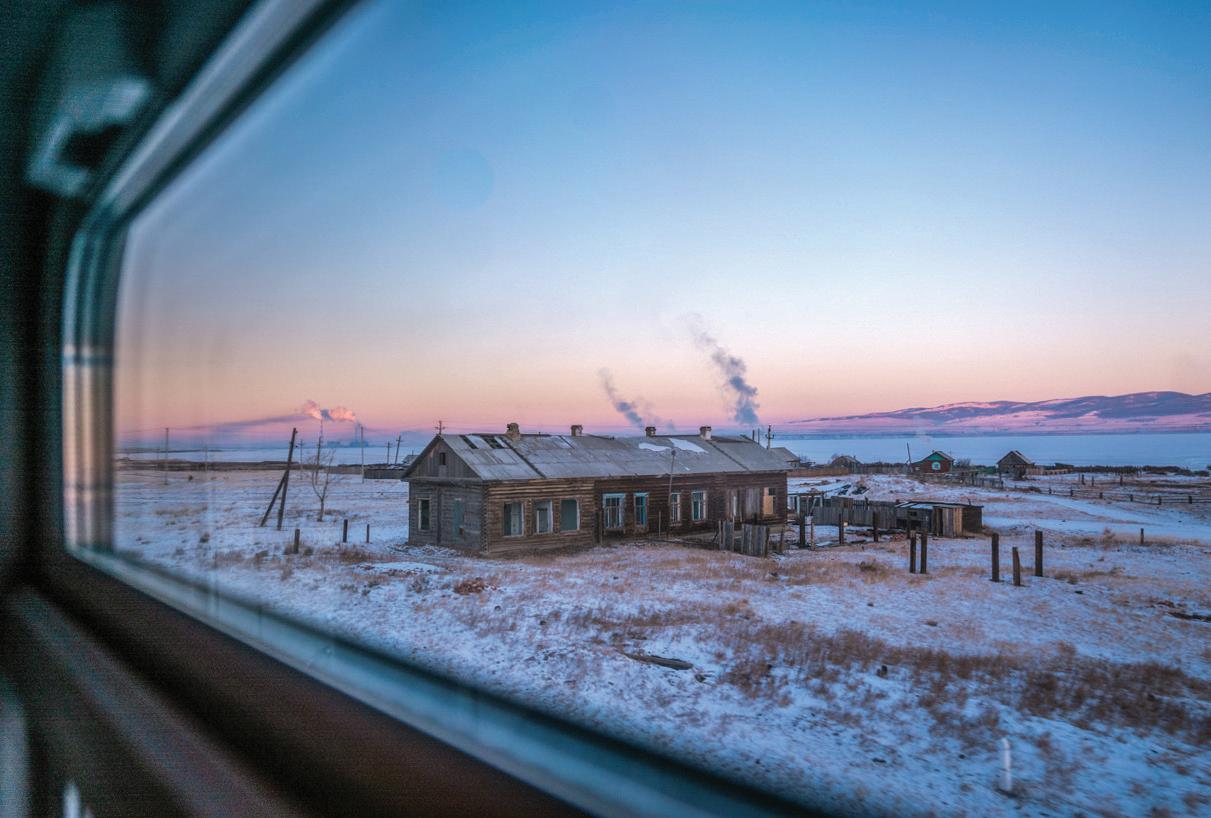
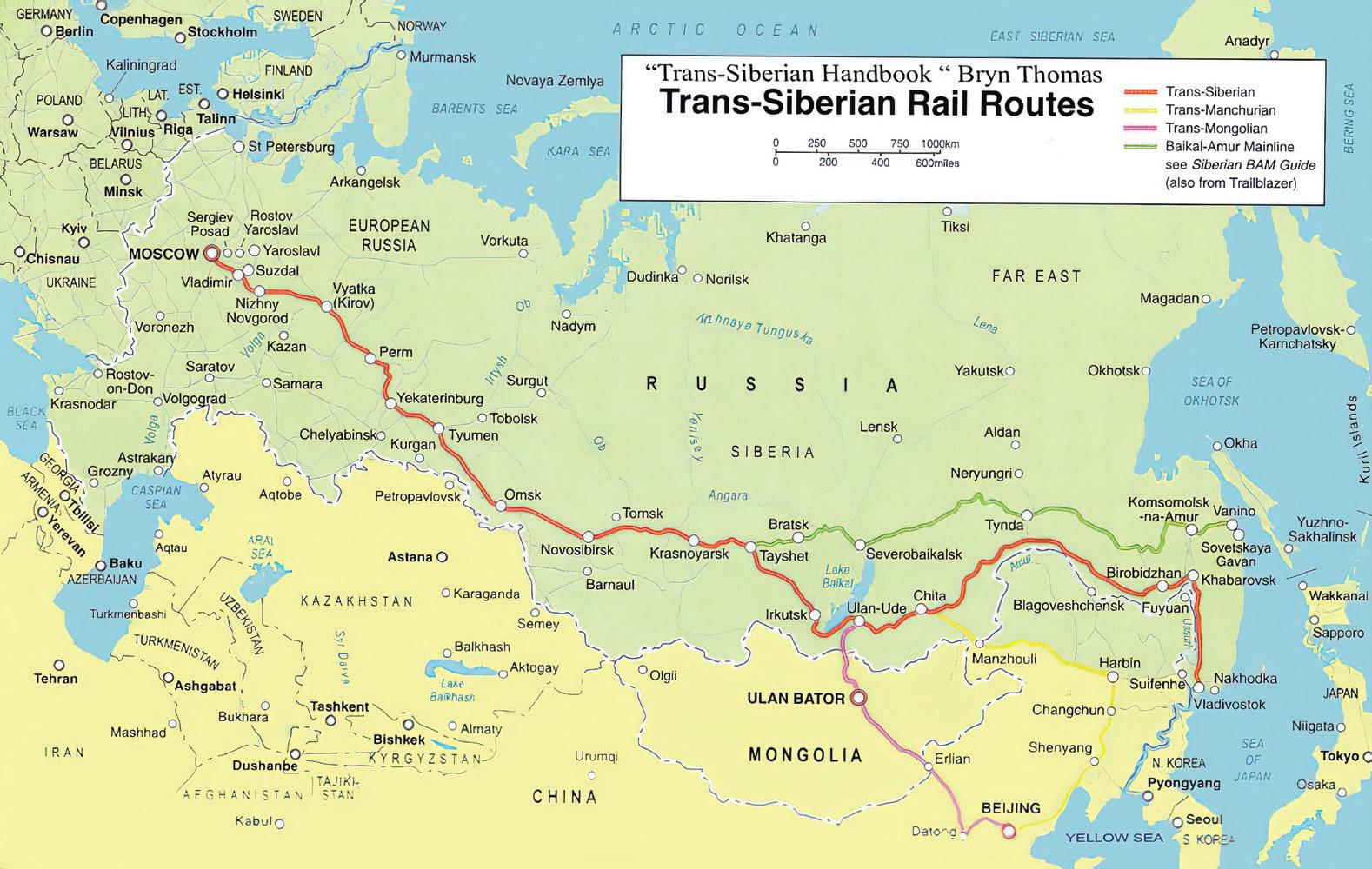
We chose instead the Trans-Siberian Railway from Bejing to Moscow, a journey of some 4,800 miles and requiring six nights if you go straight through. We wanted to spend a
month traveling through China, Mongolia, and Russia with many overnight stops for exploration and photography. We found a travel agency in England that planned the whole trip for us with guides meeting us along the way. It is not one luxury train, but many ordinary connections that local commuters use. We would never have been able to figure out the Russian train time tables on our own!!
Normally we travel light with nothing but carry-on luggage – one rolling suitcase with all of our clothes and one rolling camera bag with my photography equipment. This time, the packing was complicated by the fact that we had to carry heavy coats, boots, mittens, and hats for the extreme cold. We solved that by wearing all of the winter clothes! In my camera bag, I carried my Leica SL with the SL 24-90 and the 50/1.4, the Leica M (Typ 240) with the 24/.28 and the 35/2.0, and the M Monochrom (Typ 246) with the 50/1.4. External hard drives, extra batteries, lots of SD cards, and a laptop filled the rest of the bag.
Arriving in Beijing, we were blessed with a weather front that had completely blown all the smog out of the city. At the hotel we asked for a room as high as possible which can sometimes get you above the low level smog. As soon as we could, we headed out for my favorite type of photography – walking the city and taking photographs of the people. We were close to Temple of Heaven Park, which we knew from prior visits would be filled on a Saturday morning with people dancing or playing music, dominos, cards, xiangqi (Chinese chess); the opportunities for my kind of photography were endless. Our lunch was street food, a Chinese pancake cooked on an open grill. We had stopped to watch and take photos and a customer, noting our interest, insisted on buying one for us. People everywhere were friendly and helpful.
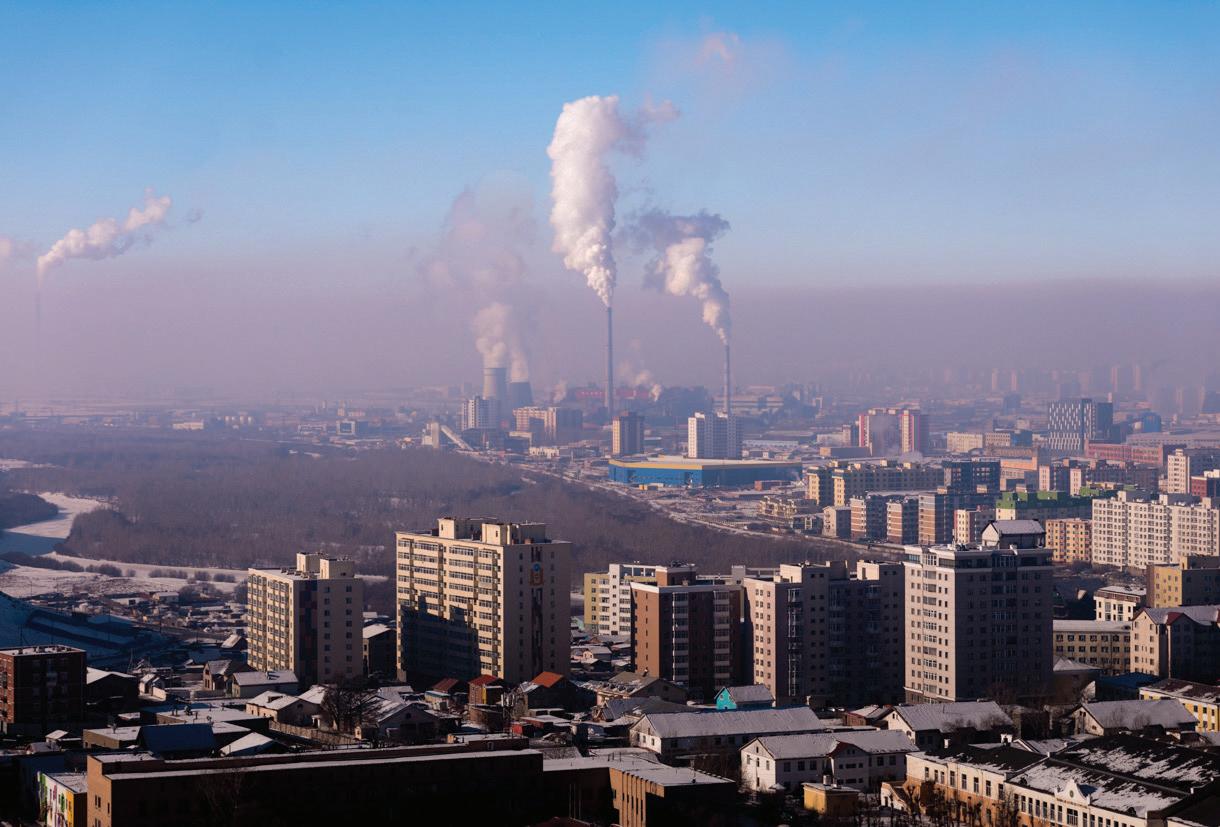
Over the next couple of days, we explored the Great Wall and visited the Summer Palace, Forbidden City and Tiananmen Square. The weather had changed and the smog was back. The air quality index had gone from 25 to almost 300 and you
could see, feel and taste the pollution. The masks, which we brought with us were essential. My favorite photos were still of the people in the park.
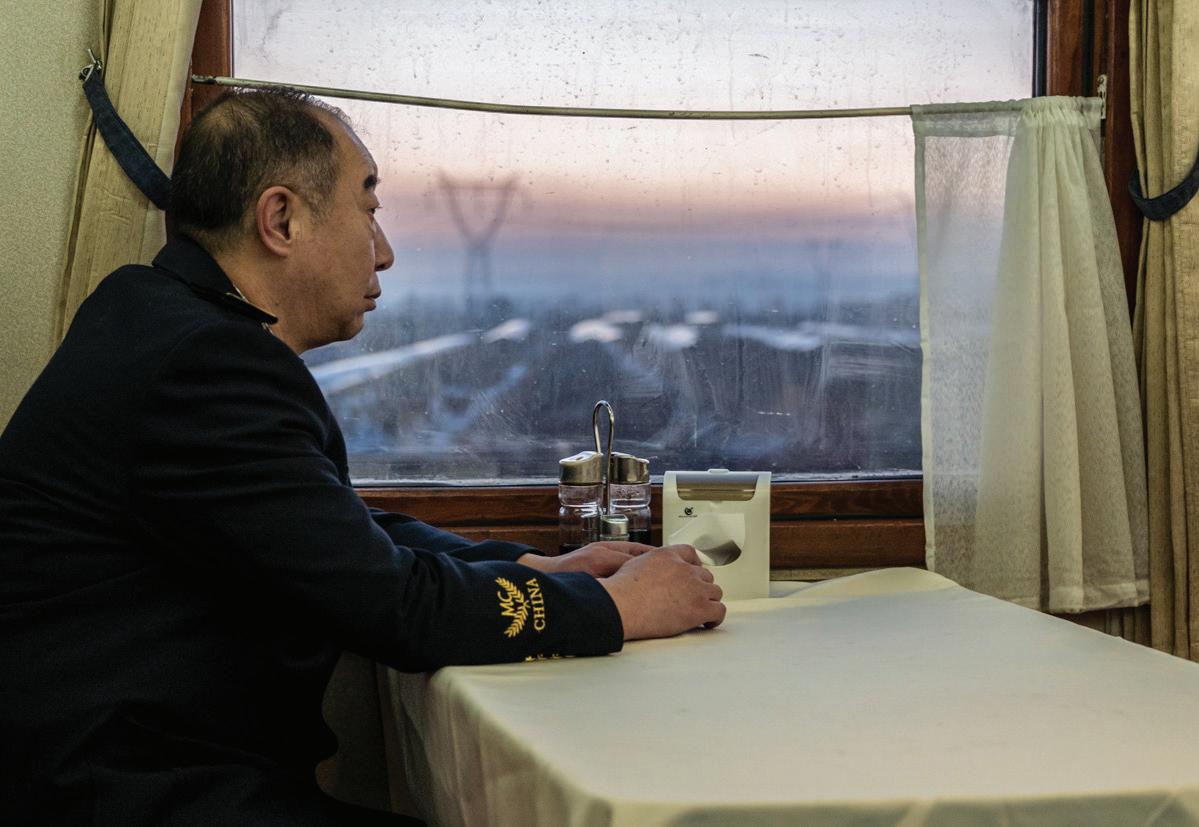
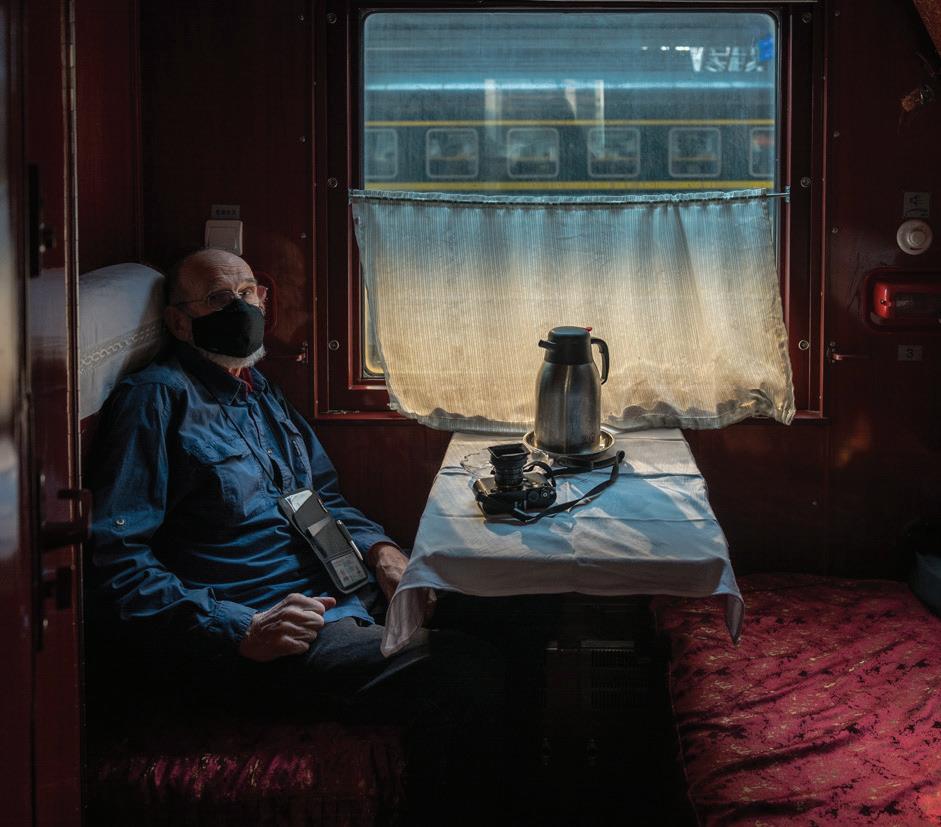
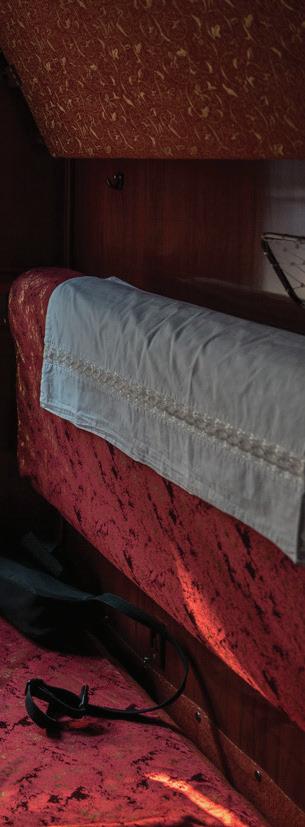
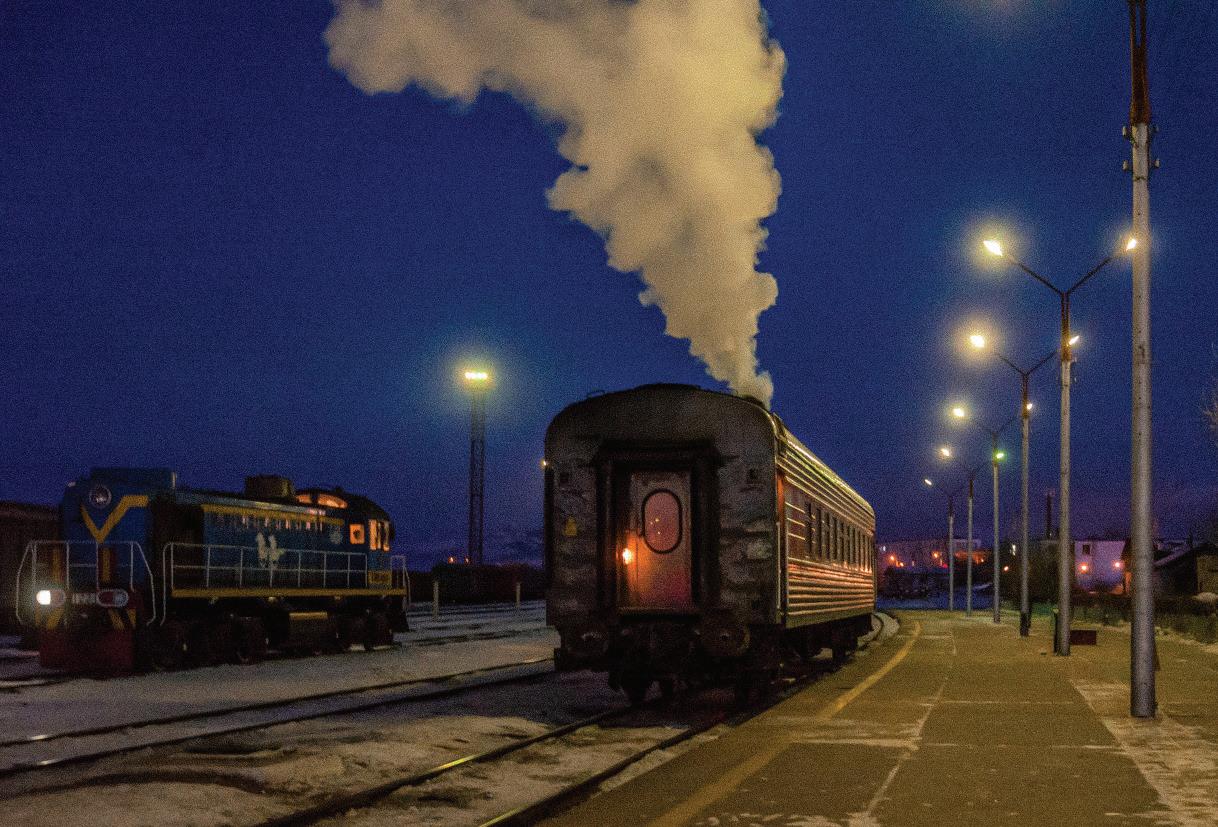
Our Trans-Mongolian train left Beijing’s main train station on 25 January, a couple of days before Chinese New Year and the station was crowded but our train was not. A slight complication of our tickets and passports not matching was solved quickly by our local guide. Our accommodation on the train was a four-berth compartment but we were the only occupants. Two bathrooms were at the end of the car. We ate dinner in a Chinese dining car, featuring a stir fry with rice eaten with chop sticks which was quite good.
At 1:30 or so the next morning we arrived at the Chinese border town of Erlian, which is a long stop because each carriage must be lifted off the Chinese gage wheels and replaced with wheels that fit the wider Mongolian and Russian lines. All of this and passport formalities to exit
China took about three hours and was done while we remained on board in our car. Formalities to enter Mongolia were next and again we stayed on-board.
We lost our Chinese dining car at Erlian and it was not replaced for the next leg of the trip so the next morning we were on our own. This breakfast, which came out of our suit case, was one of our favorite meals. Boiled eggs, nuts, fresh and dried fruit along with tea. Hot water for the tea was provided from a samovar at the end of the car that the conductor kept hot all the time on his coal-fired boiler. Then, the best part - at a stop Tom got off and bought meat pies called Buuz from a little old lady on the platform. She had made them at home and brought them to the station to sell. Five pies for about $2.50 and they were really good!
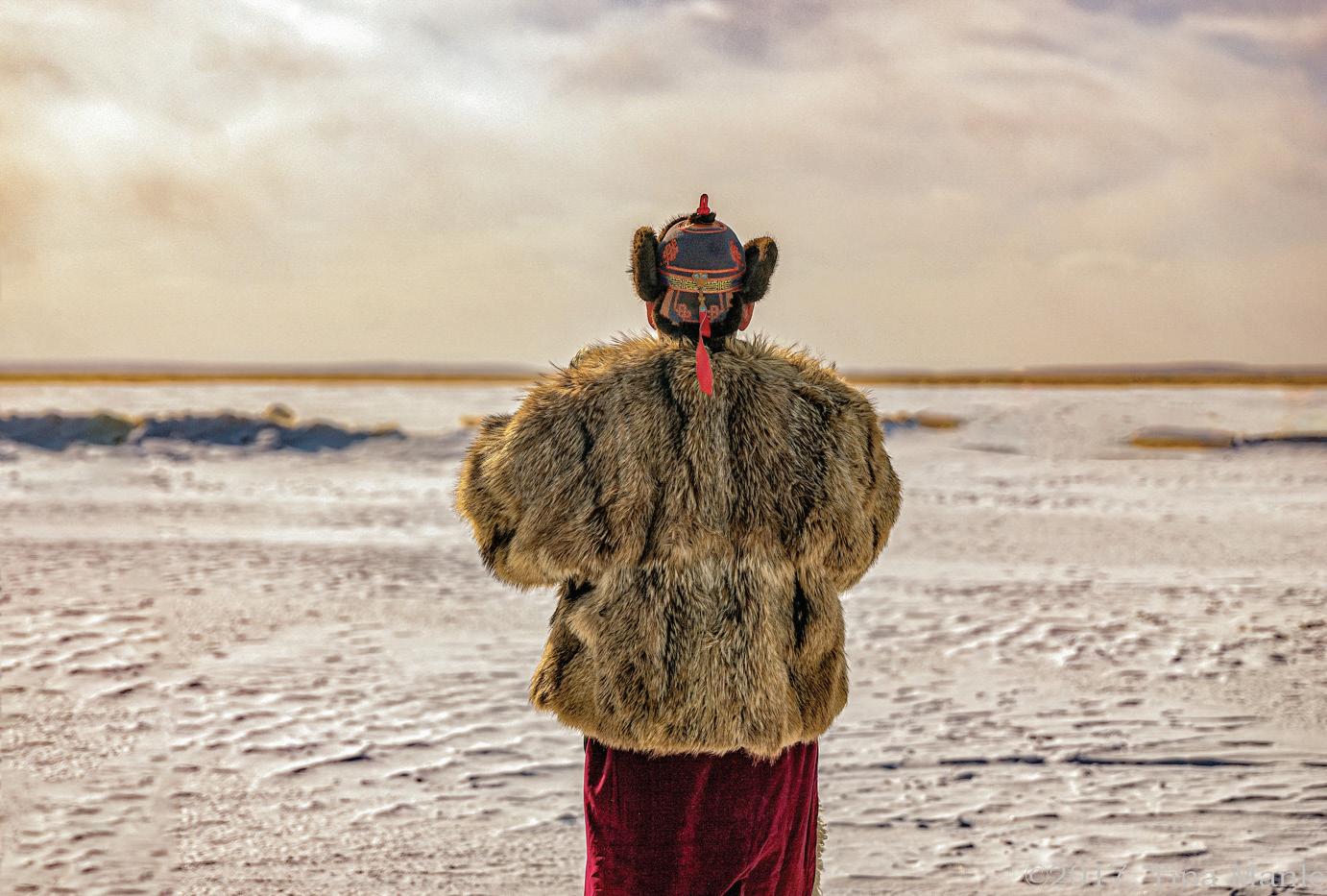
The scenery outside the train was the Gobi Desert, an open arid brown expanse dotted with nomads, yurts and camels. We were in the middle of the Gobi Desert but don't think
sand - think high desert country in the western US with lots of scrubby grass, wind, and freezing temperatures.
We arrived in Ulan Bator in mid-afternoon where we were met by our guide Muuggi, who helped us explore the Southern and Middle Gobi for a few days. While we had an itinerary of tourist sites to see I explained immediately to Muuggi that I wanted to see, meet and photograph the people of the Gobi. Any tourist destination could be skipped if there were opportunities to meet and photograph people. He understood immediately.
There was a lot of snow and it was cold when we arrived, about - 4 F, and -30 F at night but the humidity was low. Air pollution here was even worse than in Bejing. The next morning, we were glad to be leaving the most polluted capital city in the world.
For the next five days we roamed the Middle and South Gobi,
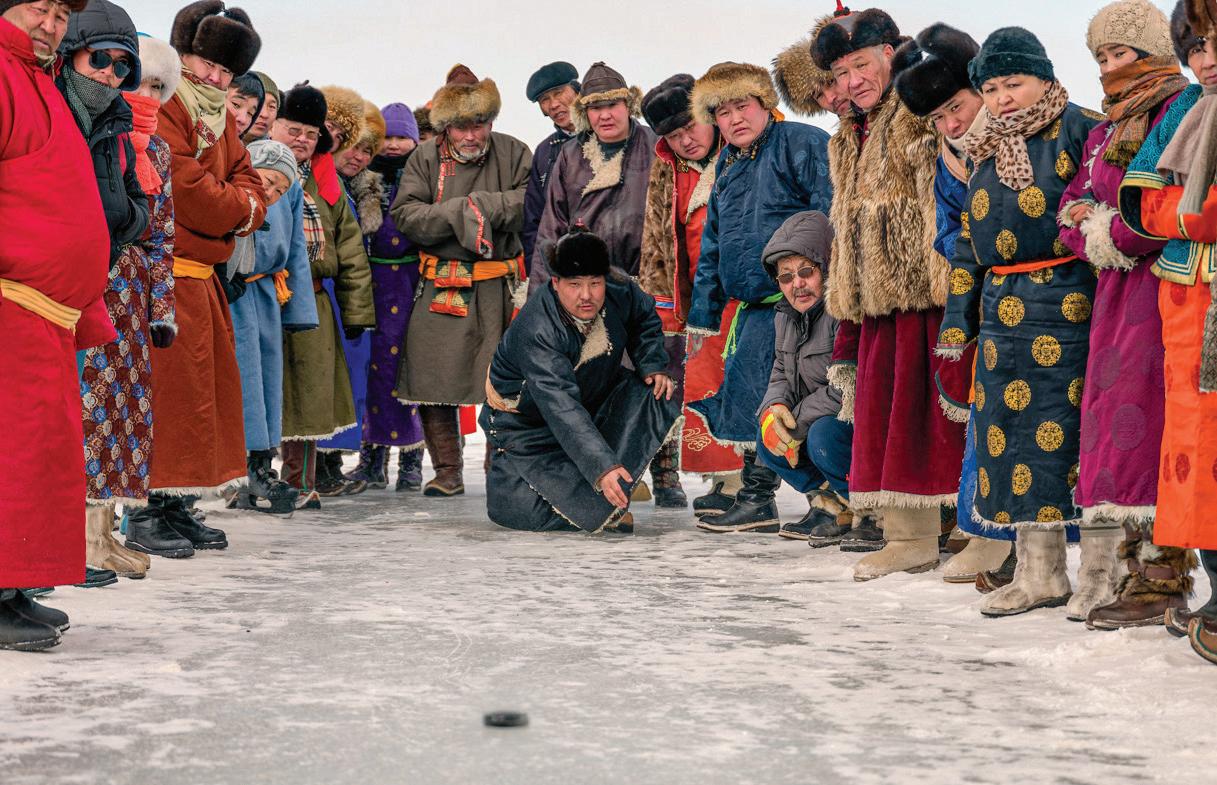
and Muuggi made sure we met as many people as possible. He would stop at a nomad’s yurt in the middle of nowhere and ask if we could come in and talk to and photograph them. No one refused and all offered hospitality including fermented camel’s milk, fried dough and the traditional passing of the snuff bottle. He found a local winter festival on a frozen lake with wrestling, ice bowling, and rope pulls. We were the only non-Mongolians there. It was a photographer’s paradise, in spite of the extreme cold.
Back in Ulan Bator we made an unscheduled stop at the International Hospital where Tom was diagnosed with pneumonia caused by too much air pollution! The doctor wanted to hospitalize Tom for three days, but after a lot of discussion, she agreed that the best treatment might be to get out of the city pollution where the air quality index that day was almost 400. She loaded Tom up with antibiotics, and that afternoon we got on the train headed for Ulan Ude in Russia which was two days travel time away.
The flat, scrubby grassland continued until we reached the Mongolian/Russian border late on 02 February. Our car was the only one continuing and we were shuttled to a side track and left sitting for hours while they sorted everything out. All passport formalities leaving Mongolia and entering Russia were again handled on board.
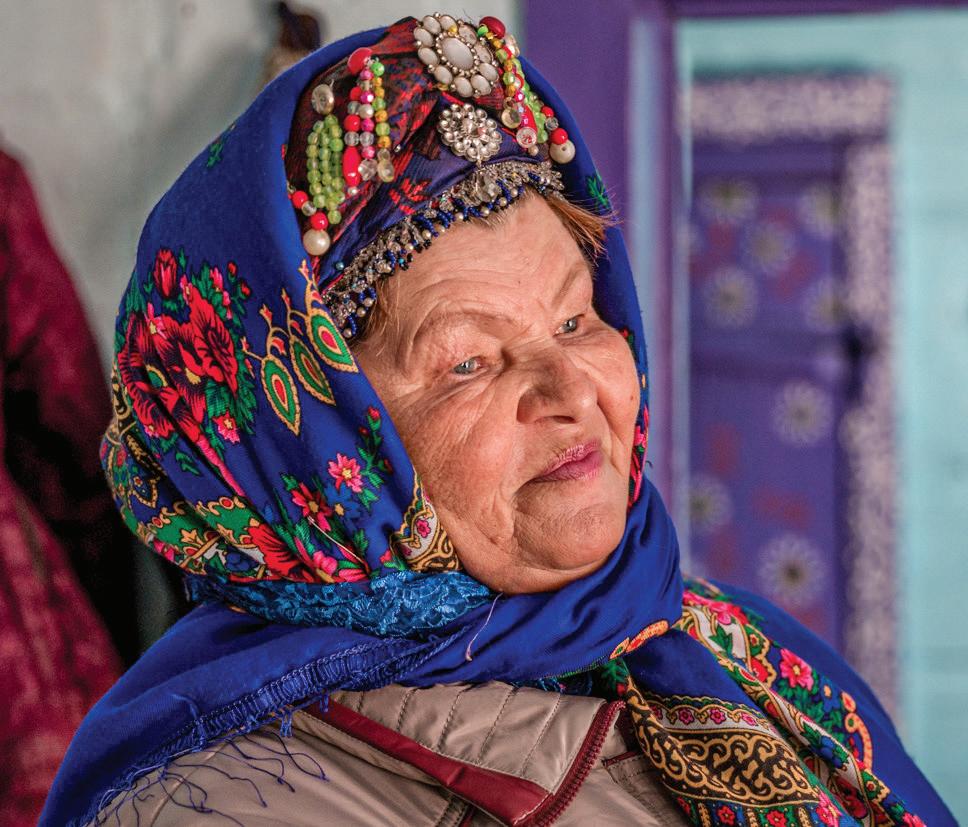
The highlight of our time in Ulan Ude was a visit to the Old Russian Believer’s Village of Buryatiya, a traditional village of religious dissenters that have suffered through 500 years of persecution and exile, still clinging to their traditional way of life. To be sure, this is a tourist village complete with traditional painted houses, museum, and church but did not seem so since we were the only tourists there. In the community center, we enjoyed traditional dancing and polyphonic singing, and a smorgasbord of traditional food with unlimited homemade liquor made from cedar berries. After several glasses, we danced with the ladies and they dressed us in traditional clothing so we could participate in a traditional wedding
ceremony. Maybe this one will last another 50 years!
Back on the train, our next stop was Irkutsk where we enjoyed an ice park, and overnight excursions to Lake Baikal. Then back on the train for a four-day crossing of Russian Siberia into Moscow. The train stopped frequently for 5 to 30 minutes, long enough to stretch your legs, buy food from station vendors and to take a few photographs. We had to stay close to the train because it leaves on schedule with or without you! The terrain here is forested with Silver Birch broken by occasional river crossings, wooden villages, onion domed churches, with small and large industrial cities and lots of snow.
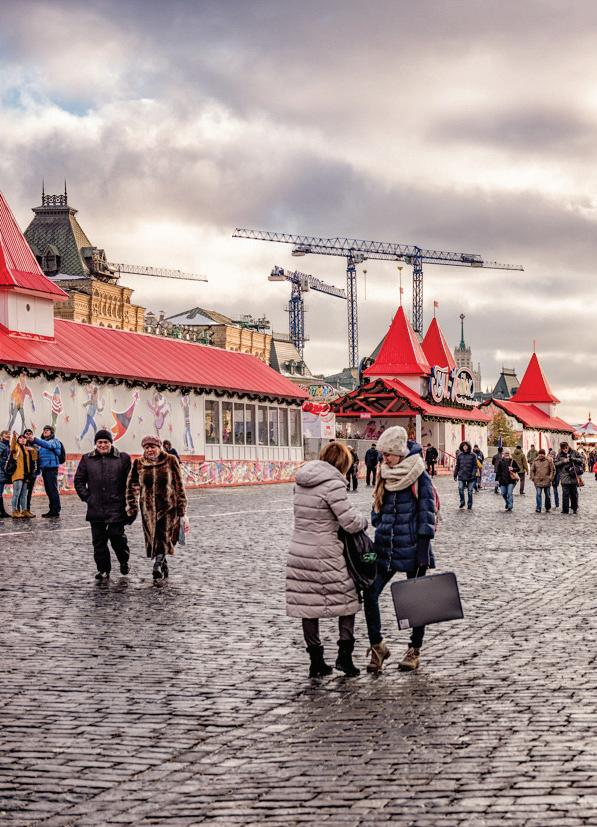
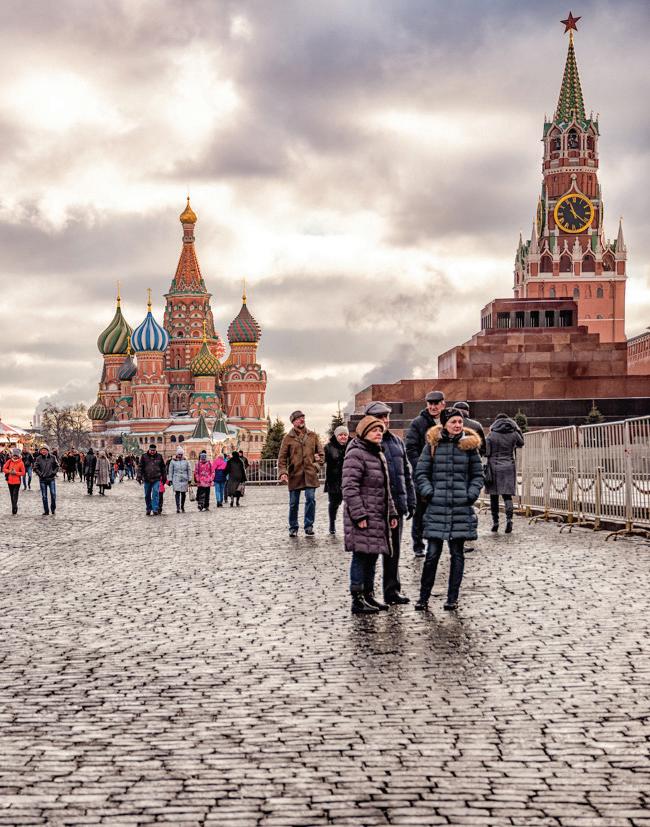
We spent three days in Moscow doing what I love to do best, walking in Red Square, Gorky Park and just walking the streets. The photography opportunities were endless.
Then it was back on the train, this time an express from
Moscow to St. Petersburg a trip of about four hours. St. Petersburg is a great pedestrian city and our centrally located hotel again allowed me to walk the streets to the Hermitage, museums, the waterfront and sometimes just aimlessly walking. My best photographic experiences have always been serendipitous, and walking always puts me in the middle of what is happening.
All in all, our Trans-Siberian Railway trip was an unforgettable experience that I would recommend to anybody interested in travel, trains, photography, and people!
IRELAND
LAND OF ANCIENT SONG
by RUTH ORATZ MD & ALBERT B. KNAPP MD
An ancient bridge, and a more ancient tower,
A farmhouse that is sheltered by its wall, An acre of stony ground,
Where the symbolic rose can break in flower, Old ragged elms, old thorns innumerable,
The sound of the rain or sound Of every wind that blows…
WB Yeats – excerpt from “Meditations in Time of Civil War” (1922)
A bridge, a tower, a wall, all of these images is Ireland, a land of poetry and song, memory and magic.
At the edge of the known world, Ireland had been inhabited for almost 10,000 years with successive layers of civilization building a stony record in the ragged landscape. Mesolithic settlements can be identified along coastal areas and in the river valleys. Later the Celts, originating from Germanic tribes in Central Europe, pushed their way west, bringing language, culture and religion. Vikings descended from the Scandinavian North during the early Middle Ages, wreaking havoc but ultimately merging with the local population. Anglo-Norman influence from British dominance further molded Irish history.
We traveled to West Ireland in pursuit of this rich human legacy, where the ancient and modern coexist, where the spirits of times past mingle amongst the living.
We brought the mighty S (Typ 007), the versatile M (Typ 246) and the impermeable Q2. Ruth was focused on shooting solely in B&W on this trip.
(previous page)
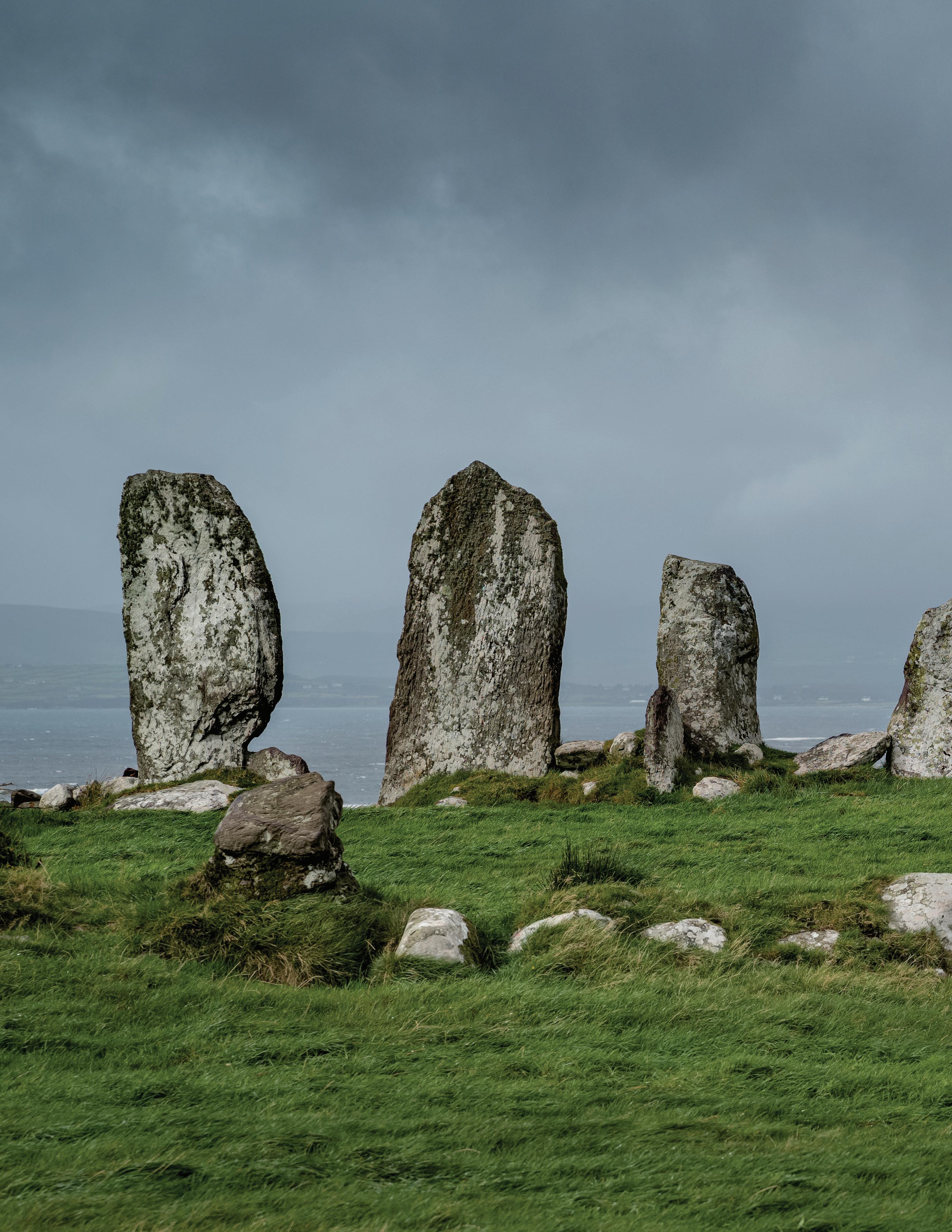
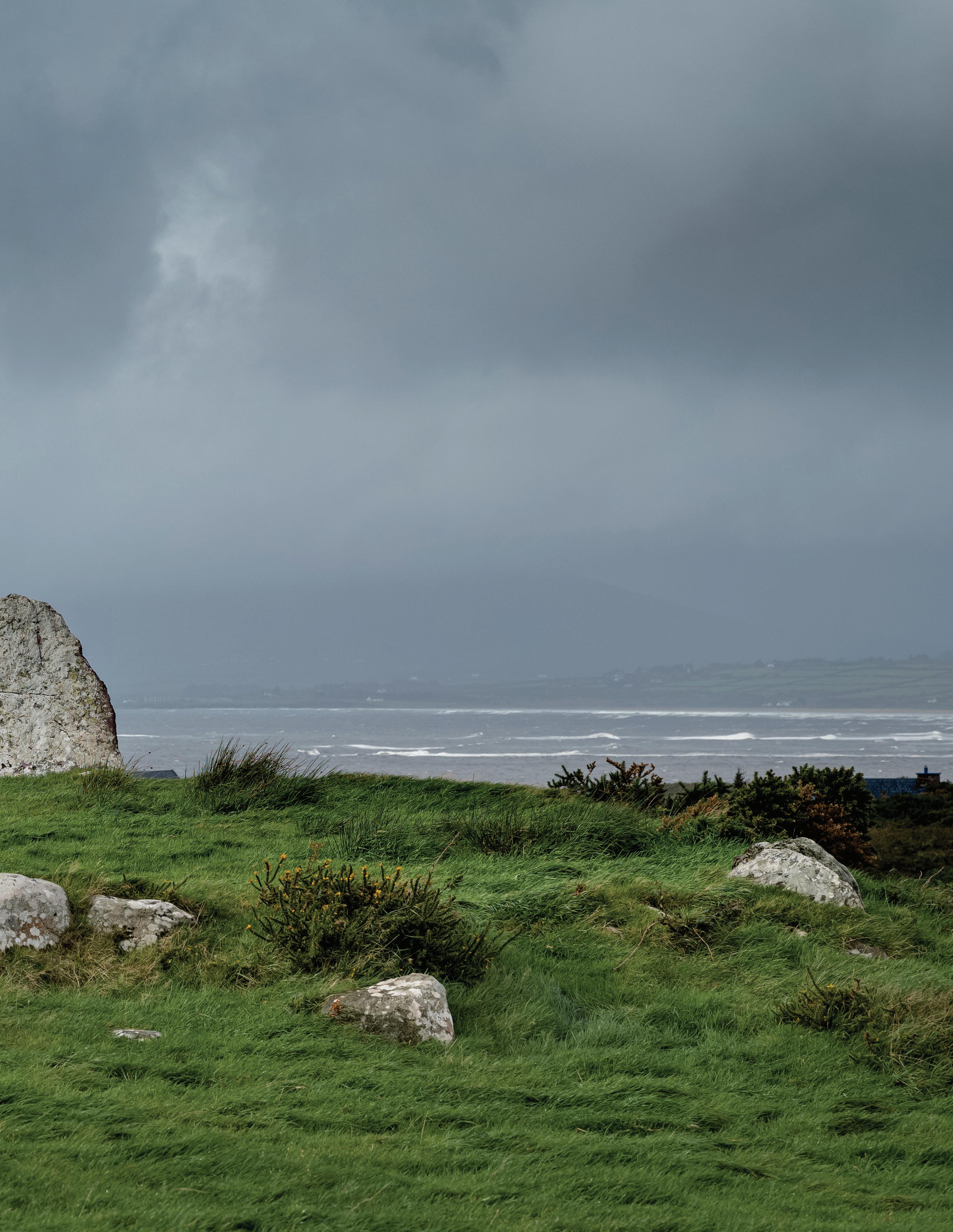
#2. EIGHTERCUA MEGOLITHIC TOMB (ca~19th C BCE), COUNTY KERRY, IRELAND.
Leica S (Typ 007) & Vario-Elmar-S 30-90 mm f/3.5–5.6 ASPH at 90 mm, f/6.8, 1/1000 sec, ISO 400.
(left, top)
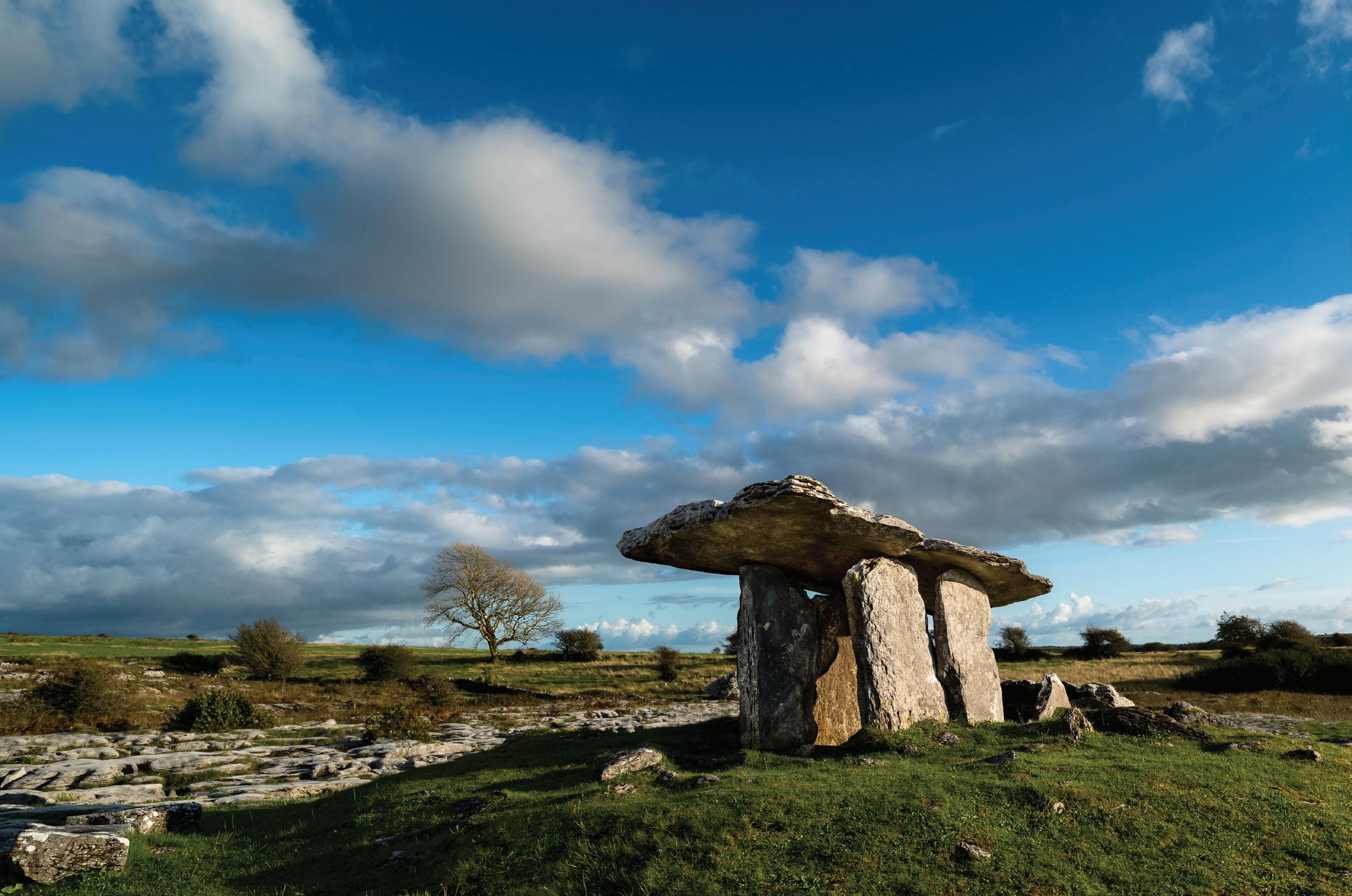
#1. POULNABRONE DOLMEN (ca~30th C BCE) COUNTY CLARE IRELAND.
Leica S (Typ 007) & Super-Elmar-S 24 mm f/3.5 ASPH at f/8, 1/500 sec, ISO 200.
Leica S (Typ 007) & Vario-Elmar-S 30-90 mm f/3.5–5.6 ASPH at 62 mm, f/11, 1/750 sec, ISO 200.
(above)
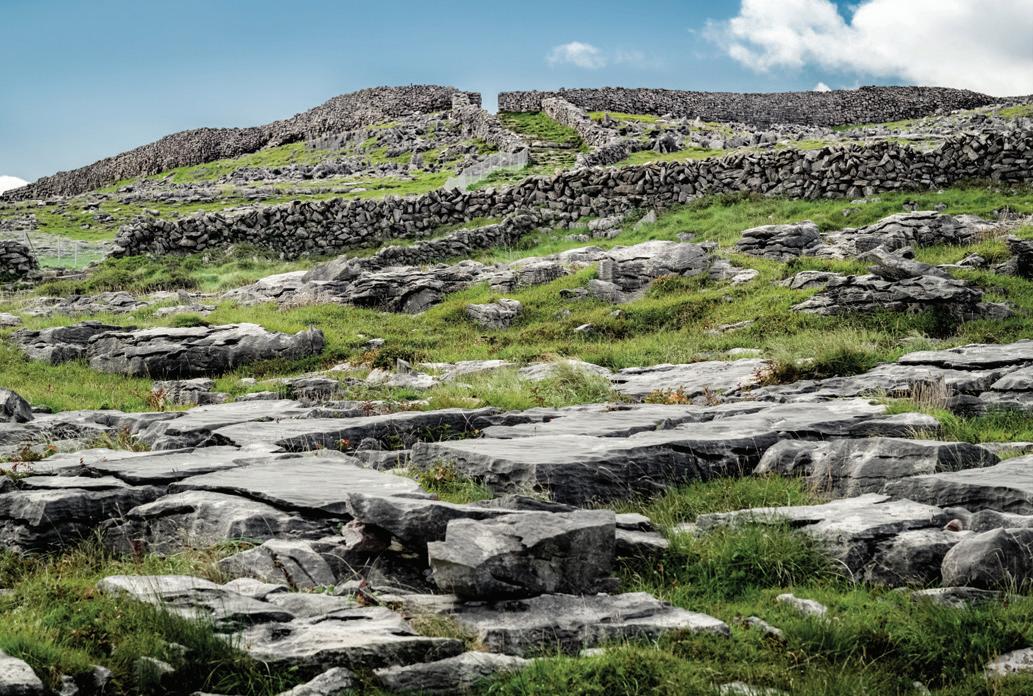
#3. DUN AONGHASA FORTRESS (ca~11th C BCE), ARAN ISLANDS, IRELAND.
Leica S (Typ 007) & Summicron-S 100 mm f/2 ASPH at f/9.5, 1/2000 sec, ISO 800.
The Burren is a vast glaciated landscape of sedimentary rock topped by limestone that was formed approximately 325 million years ago. It spans up to 220 square miles, encompassing the Cliffs of Moher on the Atlantic and spanning Counties Clare and Galway. It is as ancient as the Earth itself and within is spectacular evidence of human habitation.
The Poulnabrone Dolmen (#1), the hole of sorrows, is a portal tomb – transporting us from the world of the living to the world to come. Constructed in about the 30th C BCE, at the same time as the Pharaohs of Egypt erected the pyramids, this imposing dolmen is the oldest dated stone monument in Ireland. Beneath it were found the remains of 21 people, their bones telling tales of hard labor, violent conflict, creativity and craftsmanship – all in a tomb that was in continual use until about 6,000 years ago.
Standing stones, stone circles and stone rows litter the Irish countryside. Along the Ring of Kerry, on a small hill looking west toward the bay and open Atlantic Ocean we espied an elegant alignment of stones, in a nearly oval formation. We jumped out, ran up the road and climbed a fence to approach what beckoned. Erected at about 1800 BCE these stones called Eightercua (#2) mark a holy terrain, the final resting place of Sceine, wife of the local bard-magician-judge. She died at sea. Whose voice carries on this wind? The bay below was named Inber Scene in her memory.
Further on, the Aran Islands emerge from the sea keeping watch over the Galway Bay, the final frontier between Europe and beyond. Dun Aonghasa (#3), built in the 11th C. BCE is a great fortress that sits atop the largest isle of Inishmore. Covering over 14 acres the fort rises up from the base of the island with a long slow climb. We passed the three terraces of walls that surround the final enclosure.
Perched more than 300 ft. above the sea on the edge of a sheer cliff, this imposing fort is a daunting protector of Ireland, its view an enticement to the world unfurled.
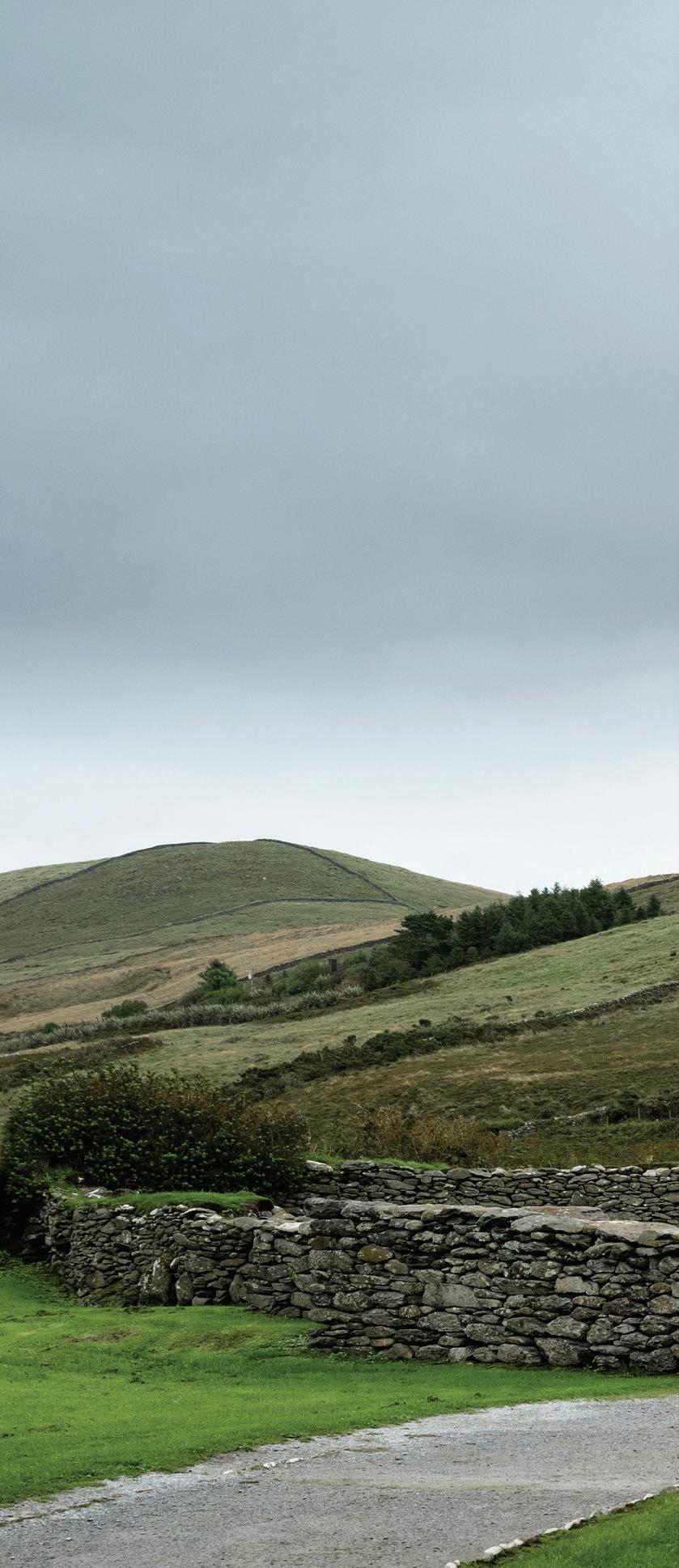
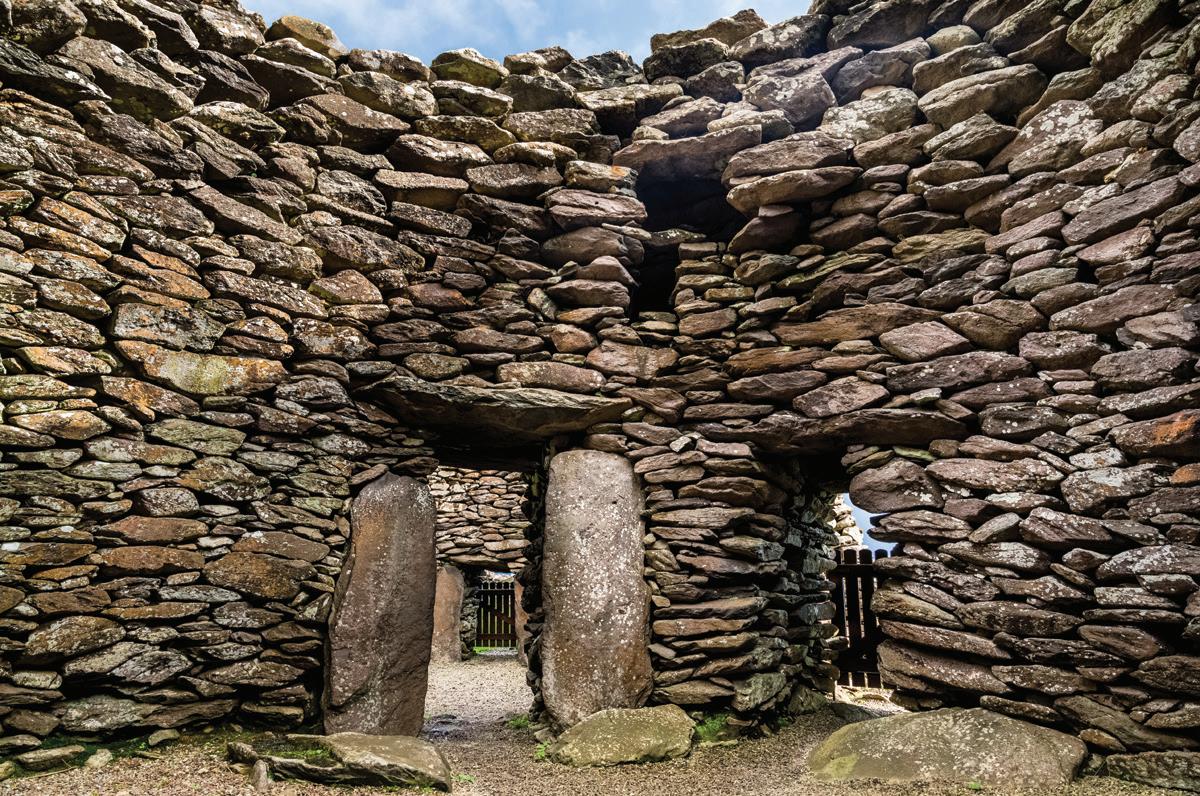
In the Common Era, ancient peoples and new arrivals occupied Ireland sequentially and concomitantly. The Middle Ages saw the coming of Christianity and the emergence of monastic communities, choosing to serve God in isolation and abstinence, living in the harshest of environments. Clochan, or beehive huts (#4), dot the road around the Dingle Peninsula and were home to the hermit monks of the 8th C CE and may have been modeled on pagan homes of earlier times. There is no mortar; dry stones stacked meticulously one above and one next to another creating a dry and snug abode in this damp and hostile place. Although they appear diminutive from the outside, once entered the beehives open up into surprisingly expansive and accommodating spaces.
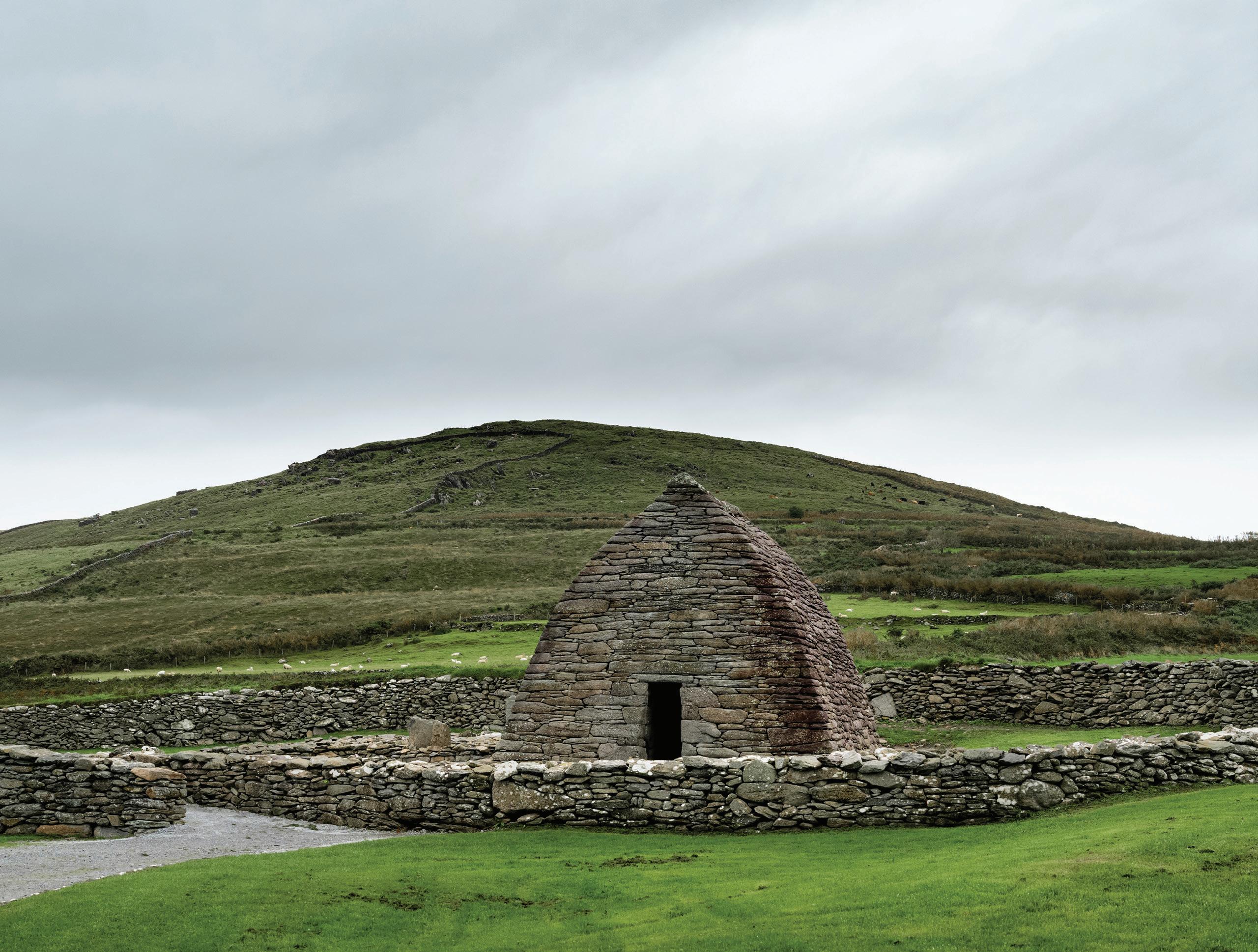
Nearby on the Dingle Peninsula, built at around the same time as the beehive huts in the medieval period, the Gallarus Oratory (#5) employs similar dry stone technique. Fit perfectly together, its elegant form reminds one of an upturned boat. It is believed that the oratory was used as a chapel -- with one small window on the far wall opposite the door. Whoever could climb through this tiny passage of light would have their soul cleansed and immediate access to heaven above. At the solstices, winter and summer, and on every Easter Sunday, the sun’s rays pierce the tiny openings and illuminate the interior of the Gallarus Oratory, sharply and distinctly.
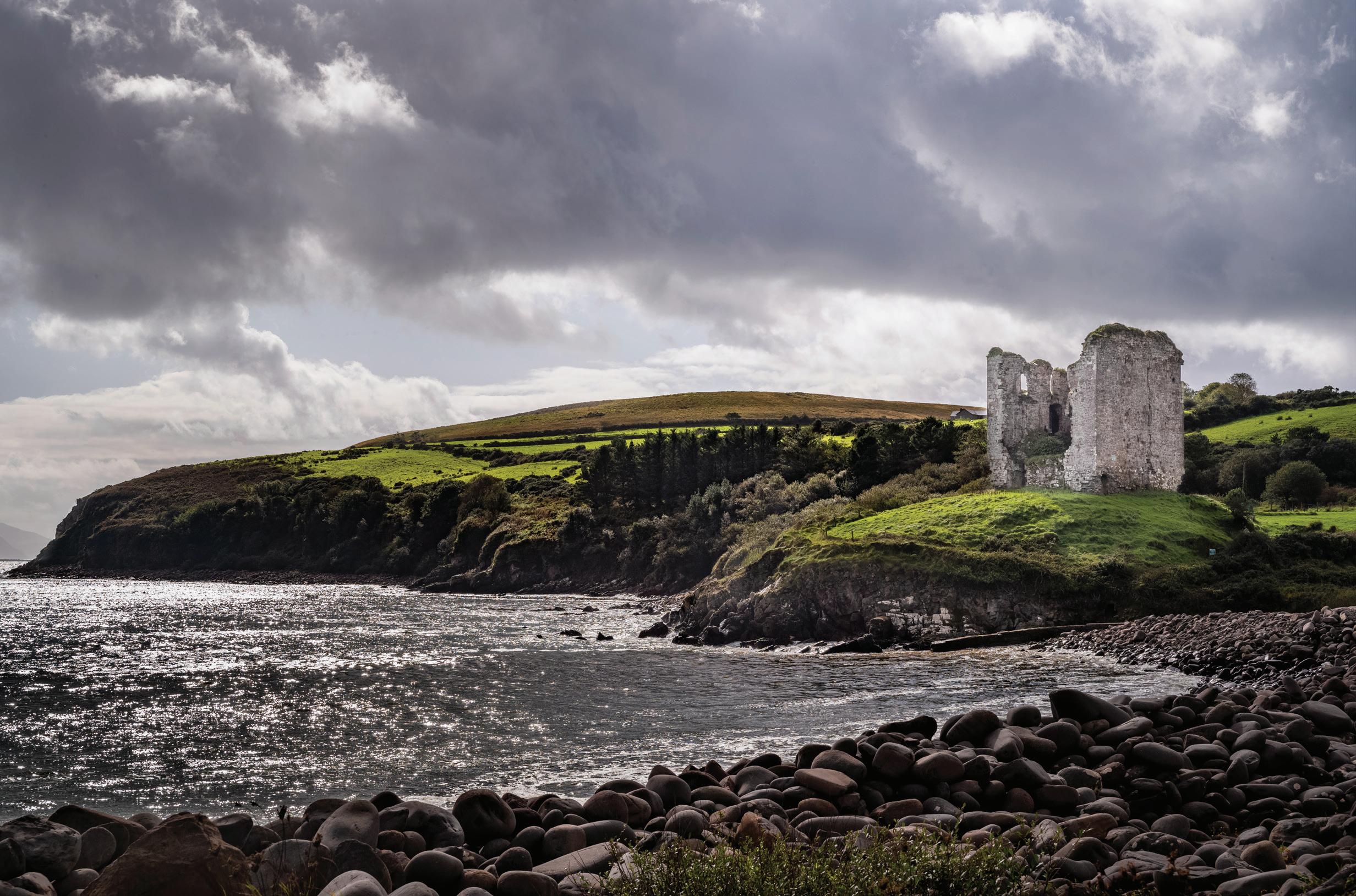
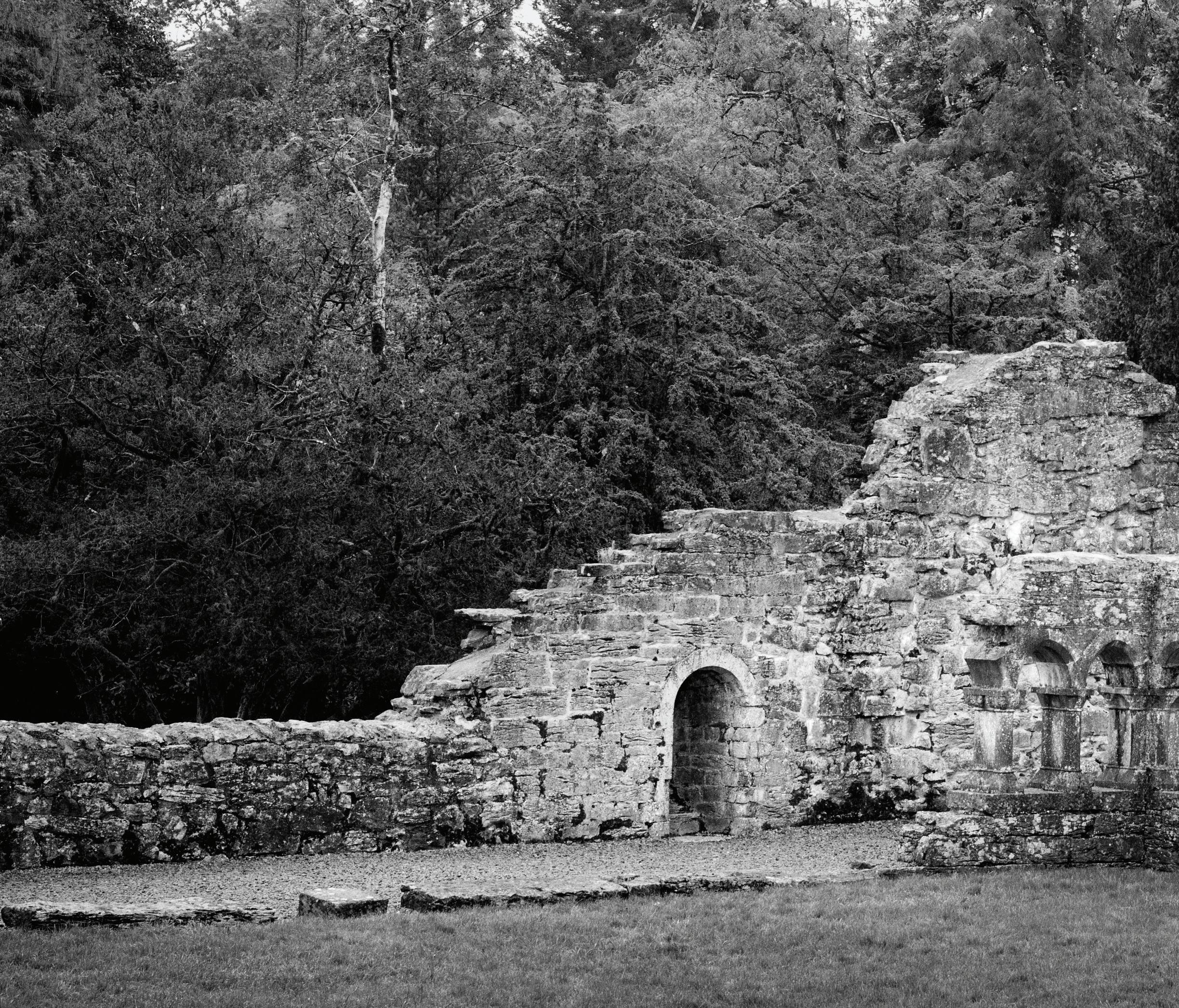
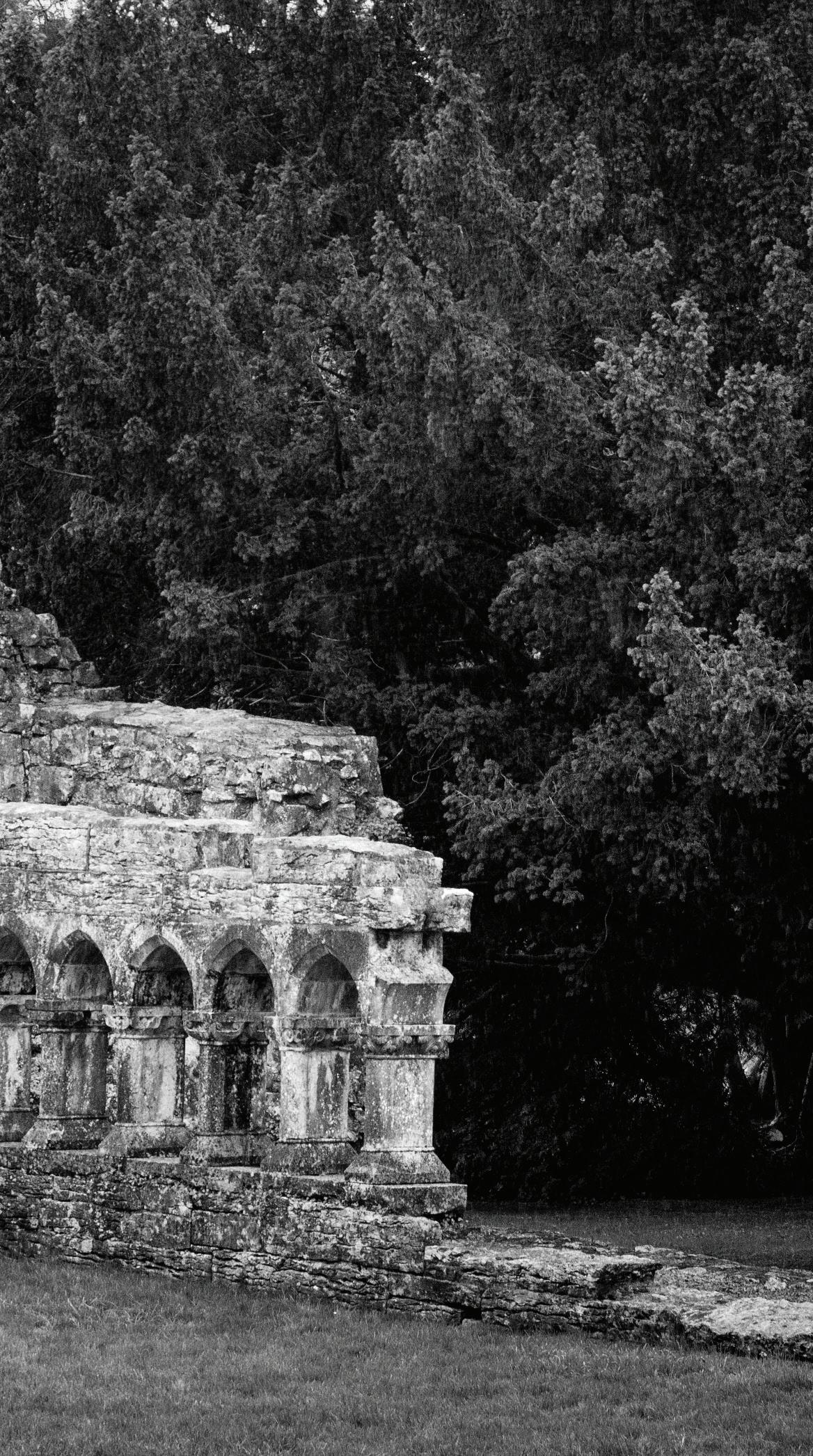
In the following centuries Ireland saw the increasing influence and conflict of Church and State. In the later Middle Ages great cathedrals and abbeys came up all over the island. And from this time forward the English were present in Ireland. In Cong (#6), once the seat of the dreaded kings of Connaught, an Augustinian Abbey was built on the site of an earlier monastic church. It is a fine example of Romanesque architecture, now in ruins, destroyed and looted by the Cromwellian forces in the mid-17th Century. Minard Castle (#7), constructed in the 16th century is situated in a most strategic and gorgeous position, with views across the Irish Sea to the Iveragh Peninsula.
(above) #5. GALLARUS ORATORY (ca~7-8th C AD), DINGLE PENINSULA, IRELAND.
Leica S (Typ 007) & Vario-Elmar-S 30-90 mm
f/3.5–5.6 ASPH at 39 mm, f/6.8, 1/180 sec, ISO 400.
(above) #6. CONG ABBEY (ca~13th C AD), GALWAY, IRELAND.
Leica M (Typ 246) & APO-Summicron-M 50 mm f/2 ASPH at f/11, 1/ 250sec, ISO 2000.
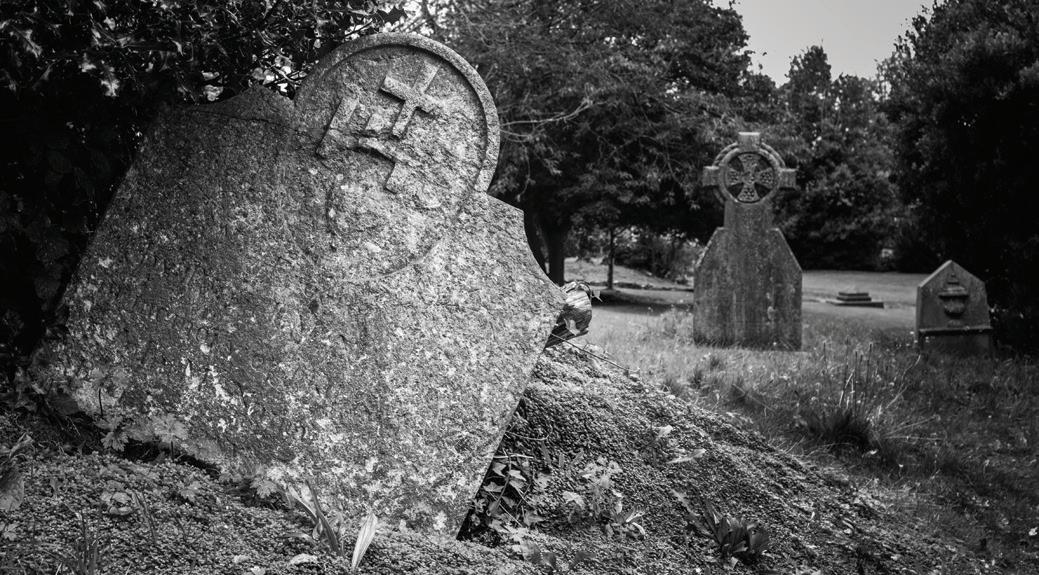
(right) #8. TOMBSTONES, SAINT FINN BARRE’S CATHEDRAL (1863-1879), CORK, IRELAND.
Leica M (Typ 246) & Summicron-M 35 mm f/2 ASPH at f/13, 1/125 sec, ISO 2000.
A testament to its strength and endurance, it still stands proud centuries later, despite detonations set by Cromwell’s men at all four of its corners.
The abbeys, monasteries and cathedrals of Ireland, the village churches, ancient Neolithic sights all honor the memory of those who died in their environs. And even until our time, every churchyard stone marks the tomb of noble and plain folk. Saint Finn Barre’s Cathedral (#8) in Cork was erected in the 19th Century. The original site housed a monastery in the heart of the city. The current Anglican church consecrated in 1870 is in the highly ornate neo-Gothic style.
But the graveyard, is modest, quiet, solemn. Echoes of stone songs that haunt and ring across the Emerald Isle.
dreams
of summertime
THE LEICA APO-SUMMICRON-SL 28MM f /2 ASPH
by JONATHAN SLACK
Ihad a copy of this lens for testing during late July and early August 2020, the gap between the springtime lockdown and the autumn upsurge of the Coronavirus.
When I get ready to write a report, the first thing I do is go through the images taken with the camera / lens and make some basic picks to give me ideas about what to write.
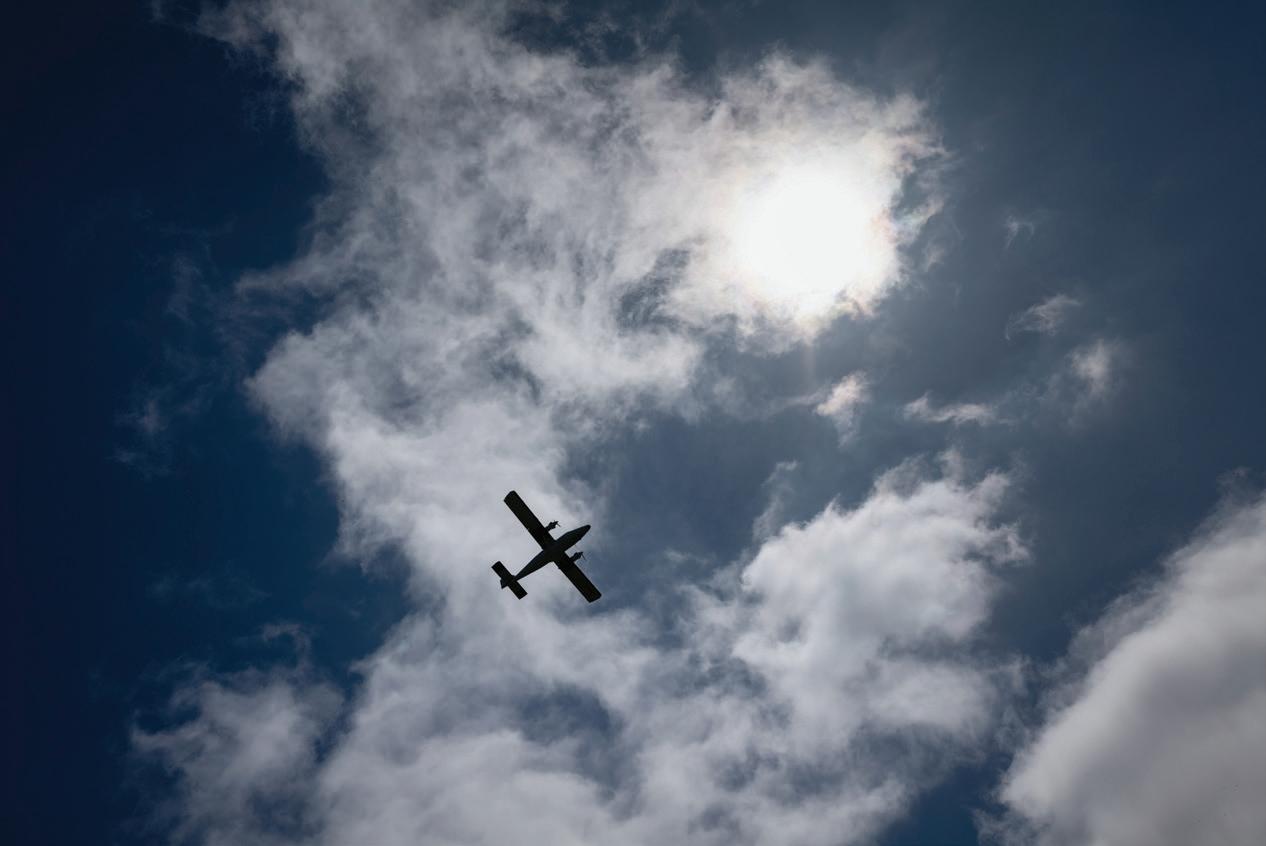
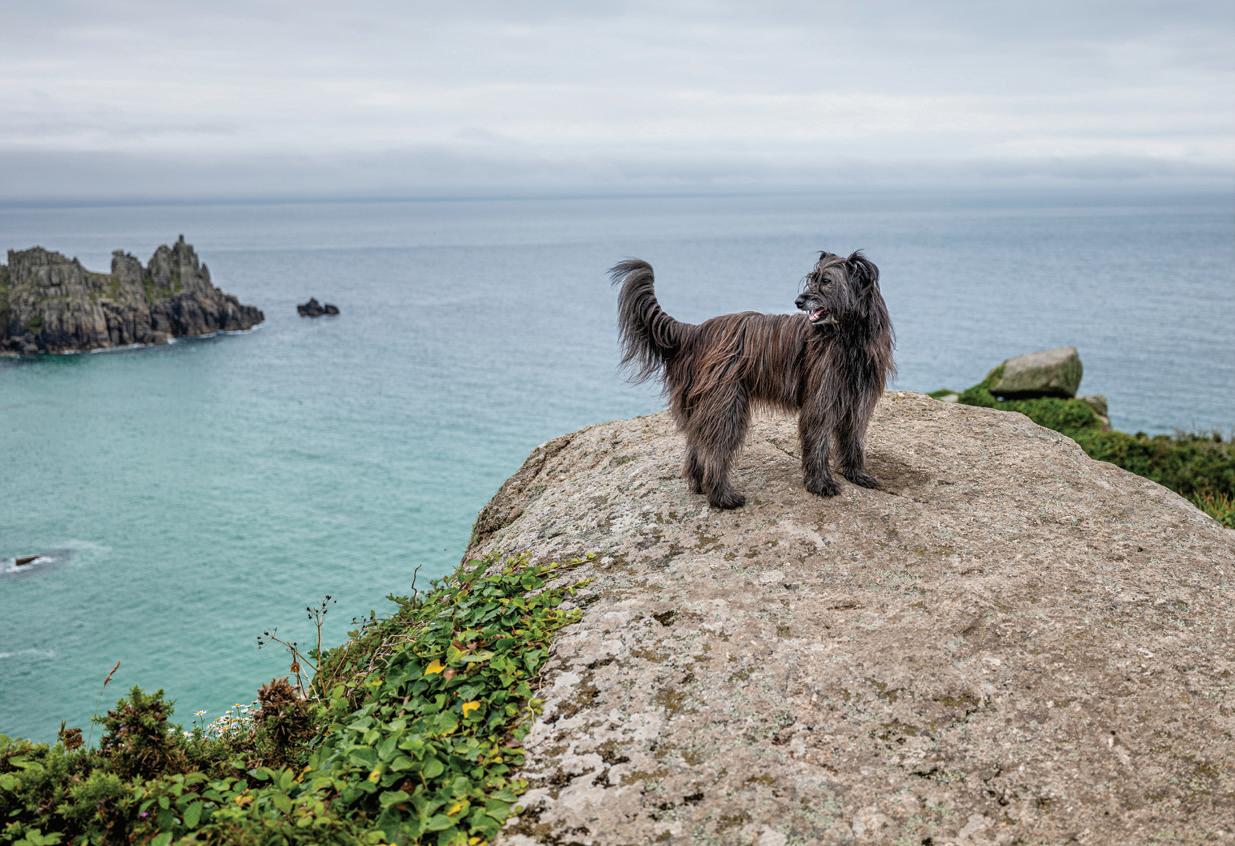
In this instance the pictures seemed like a glimpse into another world, the world of Cornish beaches and moorland in summer sunshine (actually, it rains much of the time, but that isn't what the pictures say).
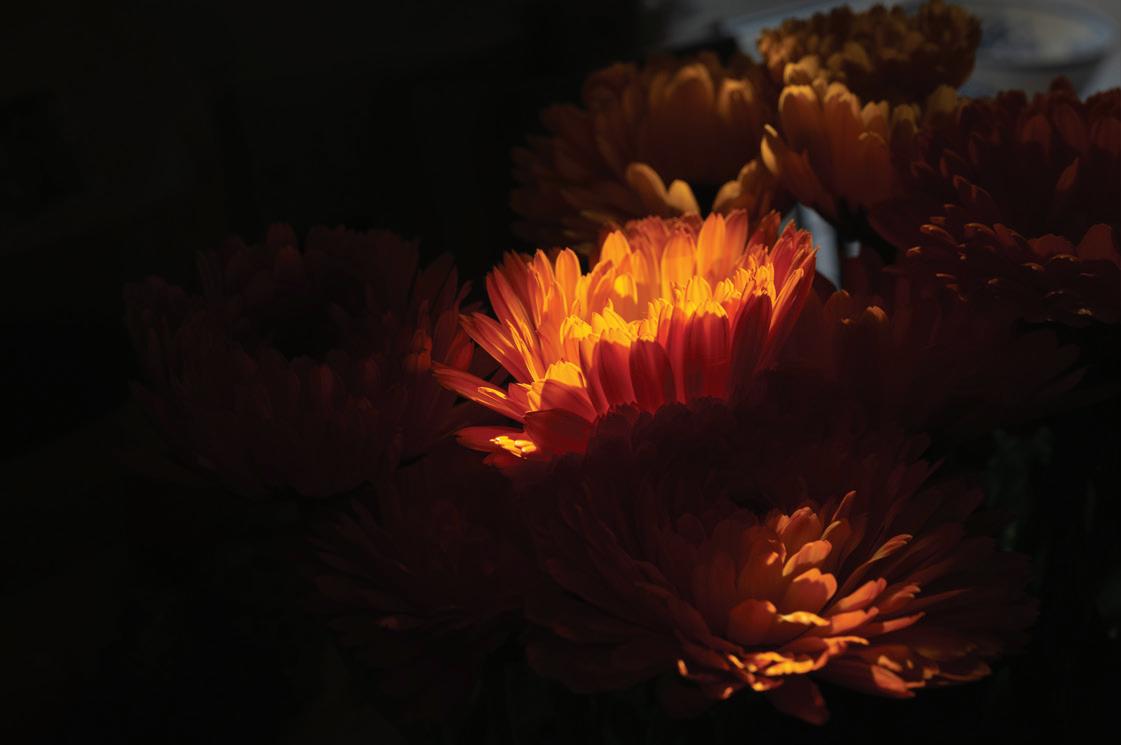
A lot of the pictures in the attached gallery were shot wide open, which adds to the dreamlike feeling surrounding them.
On the other hand, social distancing was definitely the order of the day, so people pictures are few and far between. So here is a short report to celebrate the release of the new Leica APO-Summicron-SL 28mm f/2 Asph.
The 28mm is the fifth lens in the APO-Summicron-SL lineup. There will be more wide angle lenses released during the next year or so, while the 35, 50, 75 and 90mm are already on the market.
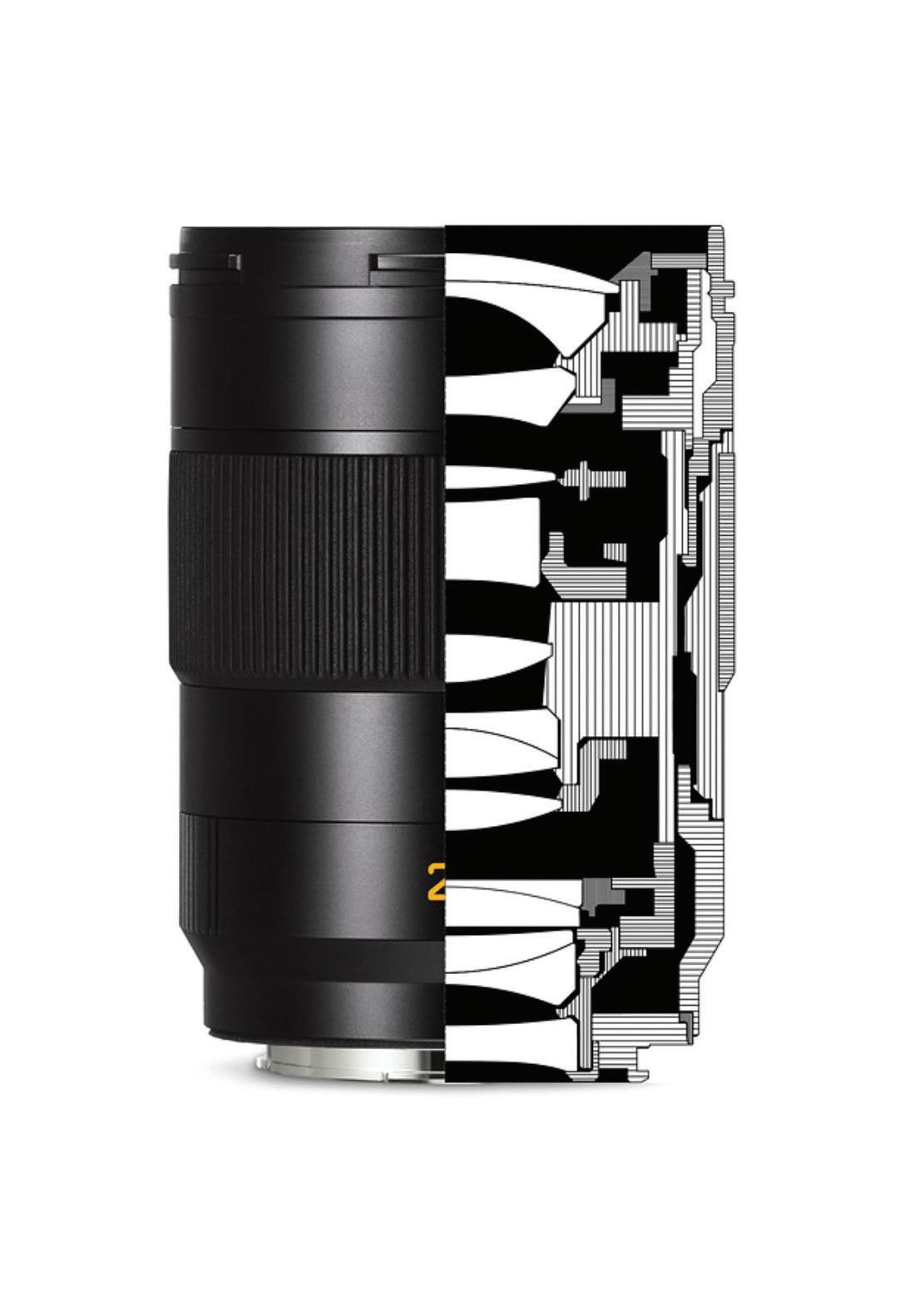
The Lens As expected, the APO-Summicron-SL 28 f/2 Asph. is exactly the same form factor as the previous APOSummicrons, (and the future ones as well) . The optical design varies between the lenses; in this case it is 13 elements in 10 groups with 3 aspherical lenses and 6 aspherical surfaces. Eight of the elements are made with anomalous partial dispersion glass, which helps to completely remove any colour fringing.
The minimum focus distance is 0.24 metres, allowing a magnification of 0.2x (as the other SL Summicrons) .
The lens weighs in at a little over 700 grams without the lens hood - not light perhaps, but it balances perfectly on the SL2 and SL2-S and is fine for a full day of shooting.
Manual Focus is 'focus by wire' but using an innovative system with a magnetic focusing ring, which changes its polarity when the ring is turned. By default this causes an acceleration if the rotational speed is faster. However, with the SL2 and SL2-s you can now make the focus action linear and decide between focus throws from 90-360 degrees in a number of steps.
The lens uses the same 'Dual Syncro Drive' motor as the other SL Summicrons and shares their excellent Auto Focus performance (fast enough and very accurate) .
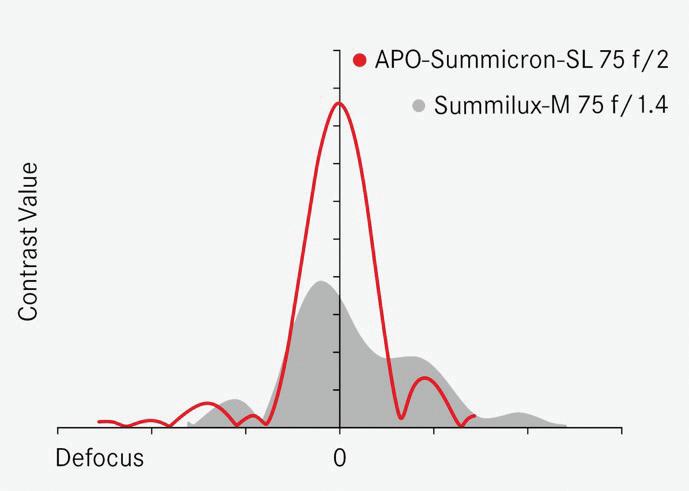
APO Lenses, Contrast & Depth of Field The almost zero aberrations (especially chromatic aberrations) in the new Summicron-SL lenses means a big increase in contrast where the image is in focus. As you move away from the point of perfect focus the contrast drops sharply.
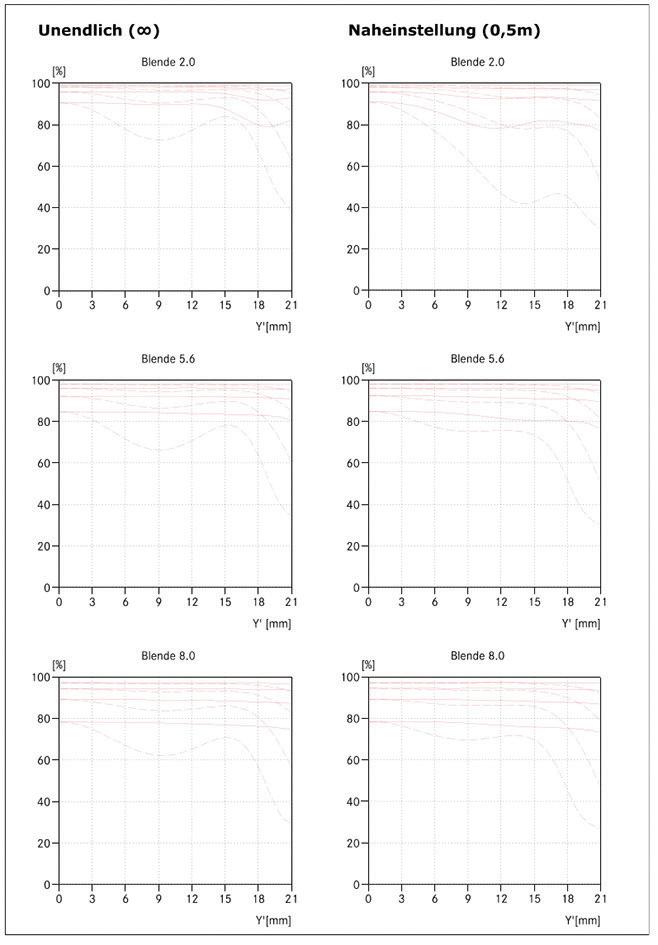
This means that the transition between ‘sharp’ and ‘bokeh’ is defined more quickly and results in smoother out of focus areas than in conventional lenses. I have a diagram drawn for me by Peter Karbe in my notebook, but here is the graph from the Leica website comparing the APO-Summicron-SL 75 with the Summilux-M 75.
The result of this is not just that the 75 APO-SL is sharper (it certainly is ), but that it has apparently the same DOF as the 75 Summilux-M. The MTF figures for the 50 APO are even better, and so the effect is even more visible.
So we have a series of modestly-sized Autofocus lenses for the LMount which perform better than their Aspherical competitors and without any depth of field disadvantage. Of course, they gather less light, but that isn’t often a problem with modern sensors.
MTF Curves Whilst the MTF values for the 28 APO are not quite as jaw dropping as those of its 35mm sibling they are still outstanding, In real terms there is no penalty shooting the 28 APO at f/2 and little shooting at 0.5 metre.
previous page 1/400th
this page (top) 1/160th
f/8,
sec,
ISO 100
sec, f/8, ISO 100 (left) 1/5000th sec, f/8, ISO 100 (right) 1/12500, f/2, ISO 100
Image Quality It’s all very well talking figures (sorry) , and I’m always a little wary of proselytising about the ‘Leica Look’ (it would be easier if I could actually define it) . Like the other SL Summicrons I just love the results this lens produces; many of the images in this article were shot at wide apertures (often at f/2) and there seems to be a real glow about them. This isn’t just evident at base ISO where you might expect it, but right up to ISO 6400 and beyond.
In common with the other lenses in the range, the 28 still shows gorgeous gentle bokeh, both in front and behind the focal plane with a lovely roll-off between in and out of focus areas (nothing edgy) . Stop down a little and the lens is very sharp, right to the corners, but still not in any way harsh. There is little or no distortion (although this is probably corrected in software) . I saw almost no flare whilst testing the lens (often in tricky backlit situations ) and absolutely no chromatic aberration - even in the most challenging high contrast images.
Conclusion Sadly I only had this lovely lens for a short period, a period where taking pictures of people with a wide angle wasn't really possible because of Covid.
I'm increasingly impressed with the range of SL Summicron lenses., It's a fantastic endeavour to create a whole set of consistent primes. It makes total sense for the serious photographer to have a bag of lenses which are identical ergonomically and have a similar visual character.
Although I've only really used them for still photography, the recent firmware development of 'fixed throw' manual focus should make them equally popular with videographersespecially on the SL2-S.
By abandoning large aperture "bragging rights" and making the lenses f/2, it has allowed Leica to maximise the image quality across all apertures and right out to the corners. It also allows them to make the lenses manageably small and consistent in size and weight. The apochromatic character of the lenses makes the depth of field feel like lenses a stop faster anyway, so you get the best of all possible worlds.
This lovely APO-Summicron-SL 1:2 28mm Asph is a worthy addition to the range.
Acknowledgements: Thanks as always to Emma for putting up with this malarkey (and all the related expenses!). Thank you to Steffen Rau at Leica for providing the lens and information. Thank you to Caryl and Dick for being companions on Gwynver beach for more years than any of us would care to remember, and thank you also to Ben (the dog) and Asher (the boy) for being my victims. Matty (the dog) needs no thanks as she is paid in treats!
opposite page (top) 1/50th sec, f/8, ISO 125 (middle) 1/1250th sec, f/2, ISO 100 (bottom) 1/50th sec, f/8, ISO 2000
above
(top) 1/400th sec, f/8, ISO 100 (left) 1/160th sec, f/8, ISO 100 (right) 1/12000, f/2, ISO 100
Every Inch a King
Brother, sister? Or just a fake? About the 2" Elcan.
by MARC HOCH
whenI started collecting Leica many years ago, the abbreviation “KE-7 A” had a magical effect on me. This had mostly to do with Jim Lager. Because in his great book on the history of the Leica, the KE-7A was one of the few cameras that were shown in color. Everything about this black M4 seemed to be desirable to me: the engravings, the word “Midland” and of course this Elcan 50mm f2 in particular. With this rare lens, I believed at the time, you had to become a better photographer - every picture magical, unique, breathtaking. And if you owned the KE-7A, you would finally be happy as a collector (this is an illusion that unfortunately I still have today).
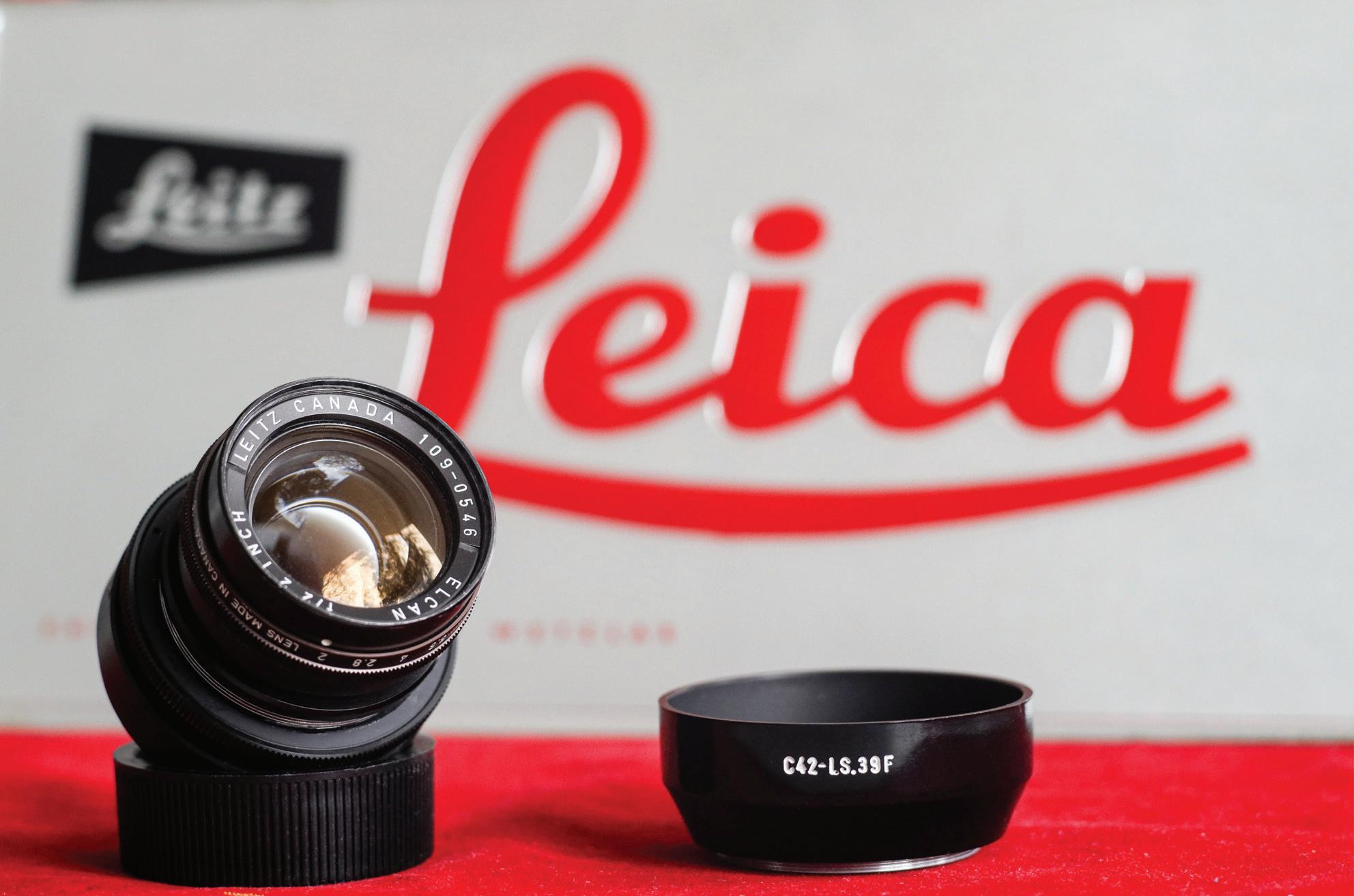
I was young then, and when you are young you have no money. That's a shame, because today you have children and not enough money to buy a "KE-7A". Three years ago I discovered a strange lens that intrigued me because of my “KE-7A” obsession: a brown Elcan f/2 2 inch, No. 109-0546. This is a lens with an aperture ring, but without focusing, an utterly strange piece of photographic history “Made in Canada”. Of course, I already knew this lens: 'After all, I wasted a lot of time reading auction catalogs. And that's why I knew that this Elcan could be adapted for a Leica by photo mechanics in Japan. And so I sent it to Tokyo and got it back after a good two months: with perfect focus, even for my analogue Leicas.
At the time, I actually believed that I had a slightly thicker and bigger brother to the Elcan 50mm f2. And to make the illusion perfect, I had the lens shade engraved with the weird letters that can be found on the real Elcan. But of course that was all just an illusion. My Elcan is not a genetically related brother of the rare original: My Elcan has nothing in common with the original other than the name.
Little information is available about the history of this lens. Anyone who, like me, is interested in photo auctions last saw an Elcan 2inch at Tamarkin auctions in November 2020. But how poor was the auction text for this lens, no explanation, nothing! Why then, Mr. Tamarkin? "It's a mysterious lens," explains Dan when asked. "The few people I spoke to about it who at first seemed familiar each drew a blank when they saw images of the lens."
As is so often the case, unsubstantiated theories about the Elcan 2-inch are circulating on the Internet. Some claim that the Elcan is an enlarger lens, others say that it is an aerial lens, and finally there is the assumption that this lens was used for projection (which is wrong because projection lenses do not have an aperture ring). All of these theories are curious, wild guesses. A short article by R. Bingham appeared in the "Viewfinder" as early as 1982, and here you can read everything you need to know about the Elcan on a single page. Bingham contacted no other than the famous Walter Mandler in Midland and received the following unequivocal answer: "Your
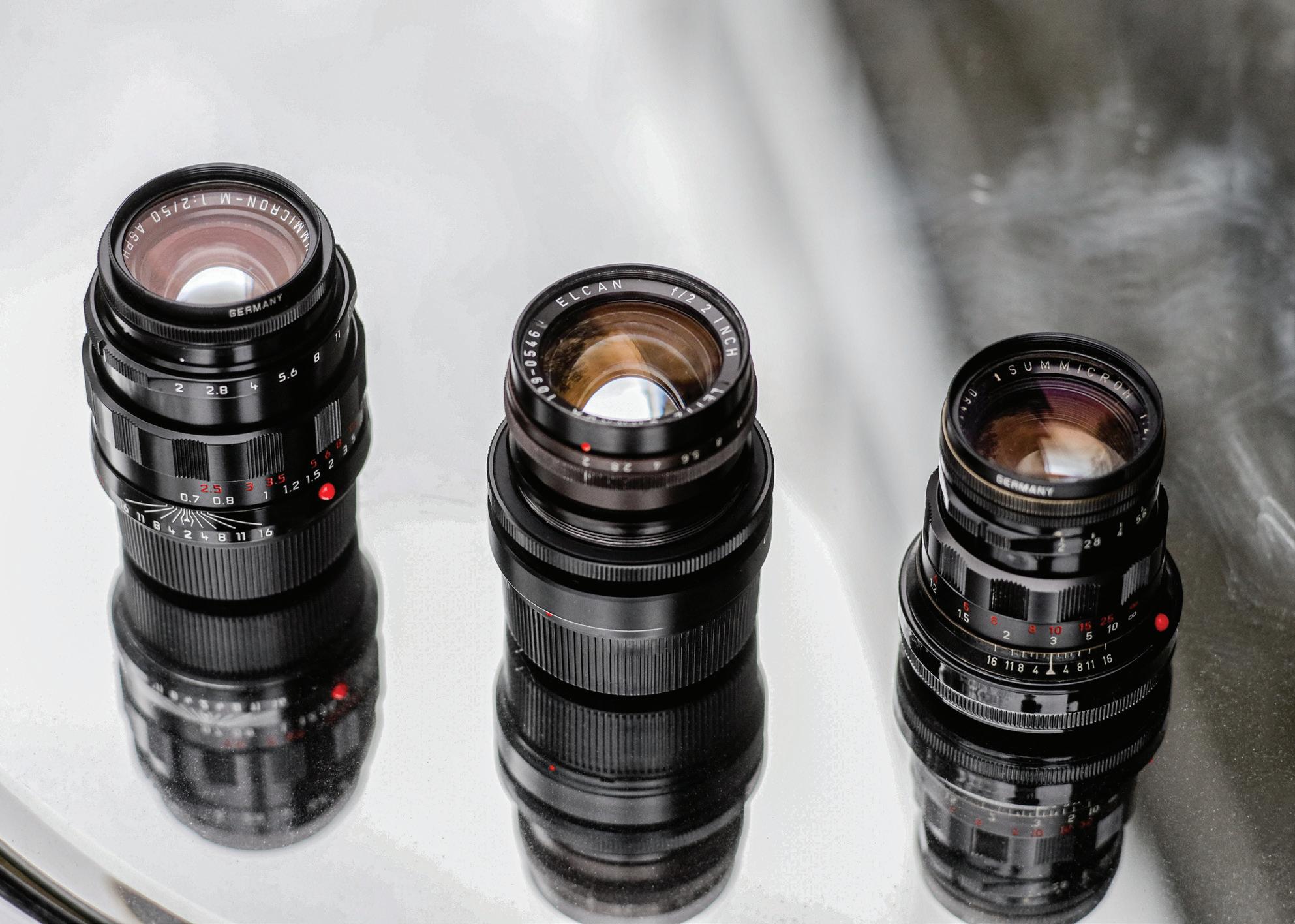
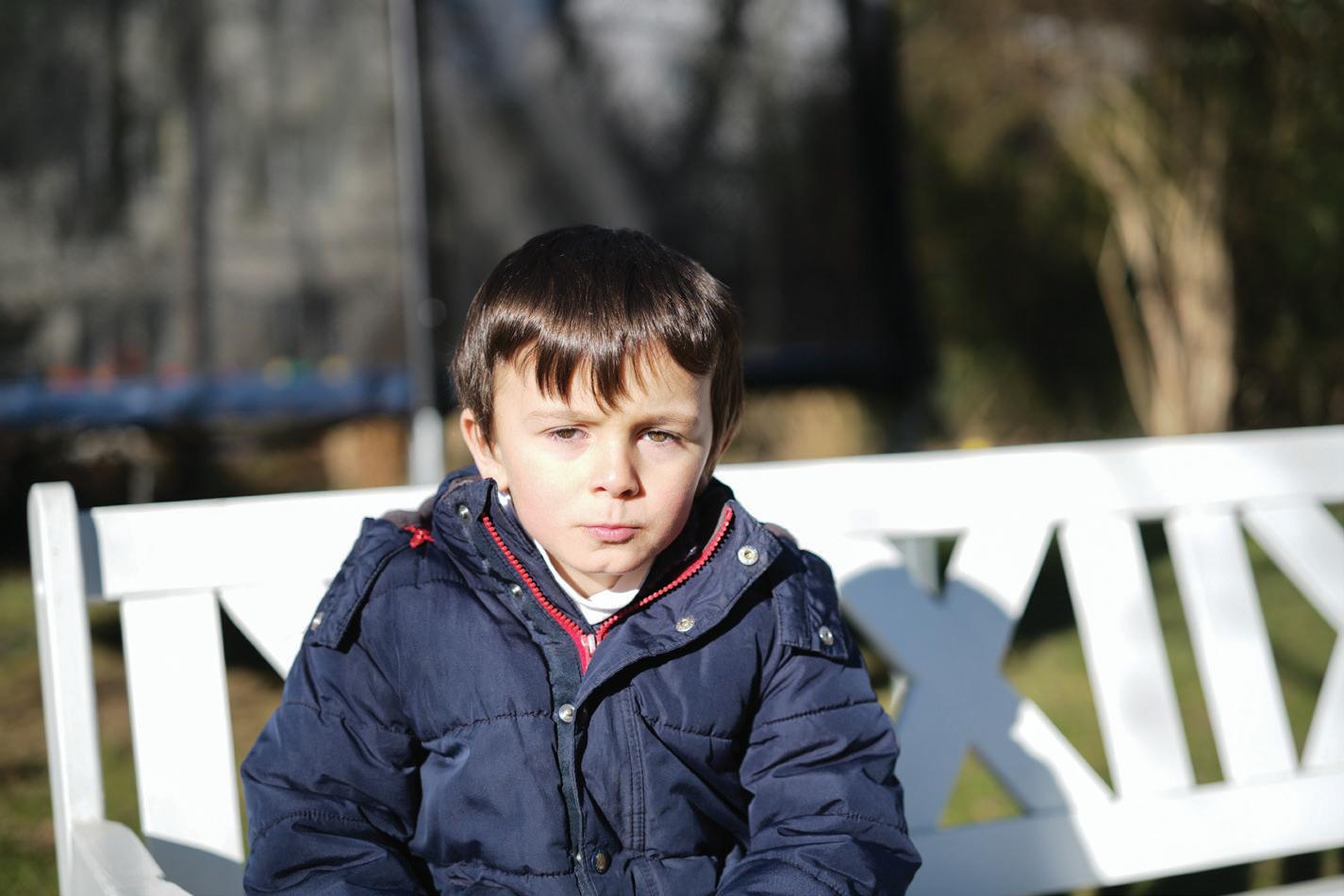
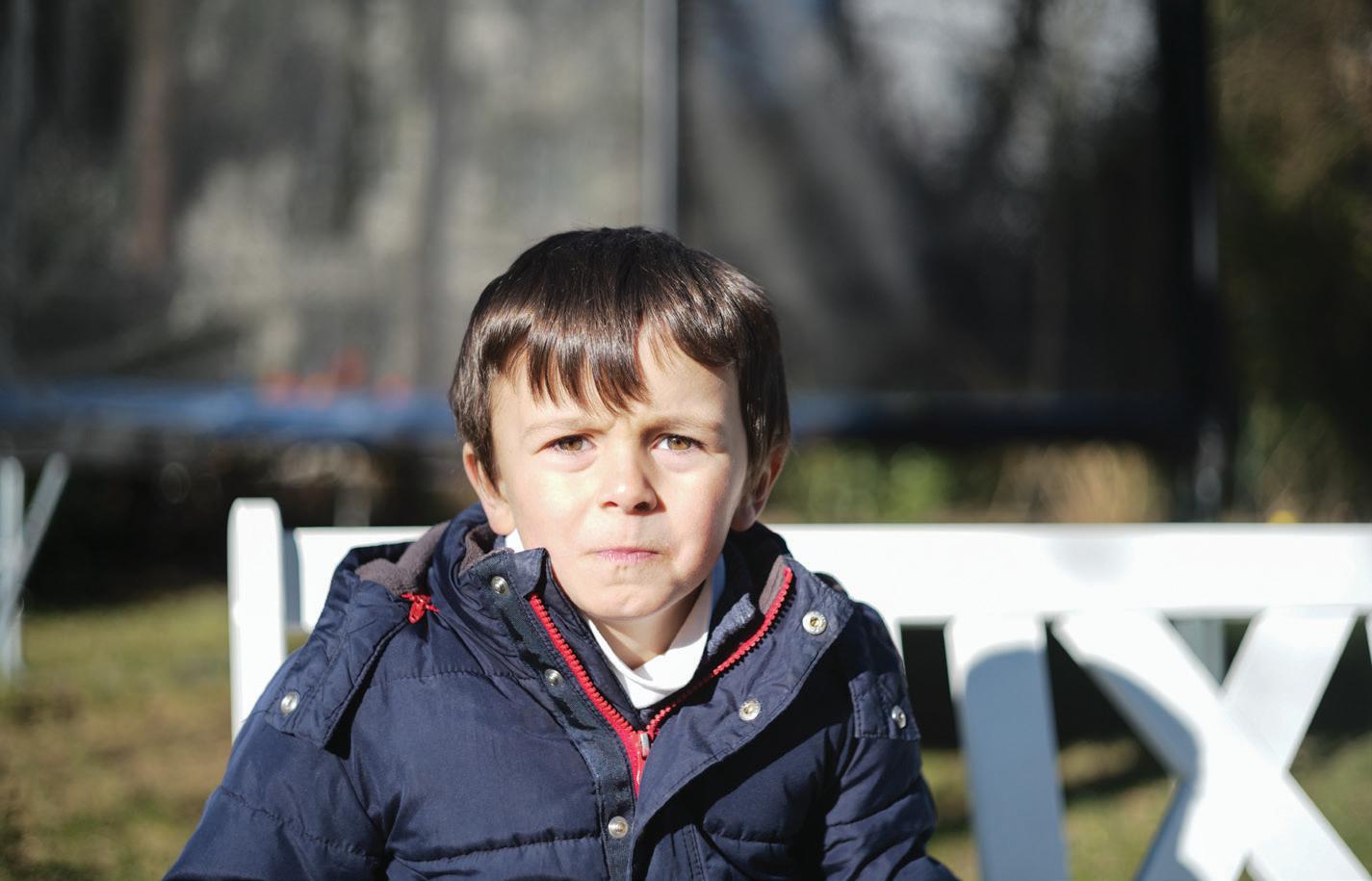
(opposite page) My son. (top) Apo-Summicron-M (bottom) Rigid-Summicron
Mysterium lens comes from Leitz Canada's microfilm program. The lens was developed to permit the microfilming of engineering drawings in rooms of standard height. The lens was first sold to Photo-Devices in Rochester. Subsequently, Eastman Kodak, for several years, equipped their microfilm cameras. Your lens has nothing to do with the KE-7A project. "
A technical lens, and not a “magician” like the original Elcan. That sounds disappointing at a price of $ 2,000. But does that mean you have to be sad? No! Because with the 2-inch you can take great photos.
Let's take it up against the Apo-Summicron 50 and a Rigid-Summicron 50 from the 1960s. The pictures were taken with an M10 and they have not been edited. Do you notice something? The Apo-Summicron is the sharper one, but the Elcan doesn't make a bad impression. The lights in the background have the shape of an egg and are not so circular - but otherwise we can freely say it with Shakespeare: "Every inch a King".
As with many questions in life, when it comes to Leica you have to make compromises, and not every dream comes true. In any case, my “wrong” Elcan has curbed my appetite for the right „KE-7A“ a bit - but I still would like to have it: some day.
A NEW LOOK AT THE ELCAN 50/2
by ED SCHWARTZREICH
Just as when Monty Python declared: “Nobody expects the Spanish Inquisition”, surely nobody here expected an article on the ELCAN 50/2 lens. But here it is. The author had never given the lens more than a passing thought until a combination of factors prompted writing about it. This uncommon early 1970’s lens, made for the specially-prepared military M4 called the KE-7A, had seemed from the available written evidence to be a perhaps optically interesting but otherwise fairly insignificant item, of questionable performance and interest only to collectors. However, Kevin Xu, (who had represented Light Lens Labs [LLL], the Chinese manufacturer of the recent 8-element 35/2 Summicron replica, if one recalls), owns one of these lenses, and has repeatedly referenced his enthusiasm for its imaging qualities. Kevin has posted images on line that he made with the ELCAN, and also shared others with this author. Far from being the poor cousin of the contemporaneous 50/2 Summicron, the ELCAN appears in Kevin’s images to show superior imaging qualities. What Kevin showed this author was therefore intriguing.
Secondly, the author had recently written in Viewfinder about the 105/6.3 Berg Elmar. Its imaging qualities also appeared significantly better than anticipated. It suddenly seemed obvious, if one thinks about it, that the ELCAN lens, like the Elmar, had become almost an orphan in the Leitz / Leica historical family: low production numbers and especially a “learned” consensus that neither lens was a stellar performer have made them both outliers. The author wonders: how reasonable are these opinions about the lenses’ performance?
about the 105/6.3 Erwin Puts, in the Leica Pocket Book, 7 th Edition, describes the Elmar thusly:
At maximum aperture overall contrast is medium, and the lens shows the typical Elmar fingerprint of a central disc of moderate definition of fine detail with outer zones that are softer. At f/11 the performance is very good, as can be expected from a lens with quite moderate speed.
Puts goes on, stating that the design was originally for an f/4.5 medium format lens, and implying that this lens formula was not good enough for the Leica at that maximum aperture without being further stopped down. And also, since when the Elmar was produced, the ISO-equivalent of most common films hovered around 20 - 30, the lens had only specialized usage and was not a big seller. These facts and opinions have relegated the Elmar to collectors’ status only, despite the fact that with the high ISOs available today it is quite a decent and pleasing performer, at least in this author’s hands, even as an uncoated lens, even wide open. In fact, this author would go so far as to offer an opinion that Leica should reissue this lens.
the 50/2 elcan also suffers from characterization which sounds underwhelming. In a Letter to the Editor in Viewfinder
12/1 (1979), Dr. Walter Mandler, co-developer of the lens, made the following statement, in essence downplaying its performance:
Around 1970, a competitive bid was requested for a 35 mm rangefinder camera made on the North American continent. The performance specifications did not require the image quality offered by the 5 cm f/2 Summicron. The way competitive bids for the military are evaluated, the surplus quality would not have counted in our favor. Therefore, it was prudent to design a less expensive lens. That this lens happened to be smaller was incidental. In image quality, I would place it between the 5 cm f/2 Summitar and the first Summicron (or Summitar*). The lens type that we have used is overstrained as far as field coverage goes. As you may have recognized, the new Colorplan 2.5/90† is the same type of optical construction. In this combination of aperture and focal length, the performance is flawless.
Perhaps in contrast to Dr. Mandler’s remarks, currently on-line is a 2018 shoot-out done by Horatio Tan, comparing a Dual Range Summicron 50/2, the ELCAN 50/2 and the APO 50/2 Summicron ASPH, all wide-open, with both film and digital captures. The upshot is that the ELCAN performed very well, with optical resolution at the center (the eyelashes of his model) almost as good as the APO ASPH, and marginally better than the DR (which lens is still some shooters’ preference for sharpness). Additionally, others on-line speak of the “brilliance” of images with this lens.
And further, in spite of the likely veracity of what Dr. Mandler wrote about the lens’ provenance and raison d’ètre, the author has read various somewhat contradictory conjectures, mostly on line and fairly recent, about “why” the ELCAN 50/2 was made for the military. These address topics beside those of cost and the incidental issue of barrel length, and consider ruggedness (temperature and shock resistance due to the non-cemented elements), IR or other radiation protection, and optical resolution questions (due to the choices of the allegedly particularly costly specialized glass types utilized††).
In an attempt to answer these questions, the author wrote to Raytheon ELCAN Optical Technologies, successor to E. Leitz Midland, and also to the Leica Archives in Wetzlar asking whether the actual military contract is in their records and can be reviewed for this article, or whether there was other, pertinent information.
from elcan A nice reply was received from Brian Veall, the Leica Photo Division marketing manager in Midland from 1966 until the late Seventies “when the Wetzlar parent company gradually assumed overall Midland Leica production and export marketing functions”. He retired from Raytheon ELCAN in 2002. He writes:
The ELCAN f/2 50mm was, in essence a 'stripped down', standard Summicron f/2 50mm and incorporated one lenselement fewer (only 4 as opposed to 6) than the latter, resulting in a shorter focusing mount, This, as I recall at the time, was solely for cost reasons. Otherwise, to my knowledge, there were no additional features - winterizing, ruggedness, IR capability etc. - designed into the lens by Dr. Walter Mandler…
Sadly, for Leica enthusiasts such as yourself, in the years following the Leica lens manufacturing transition from Midland to Wetzlar/Solms (except for the Noctilux-M f/1 50mm) much of the documentary information was likely either transferred there also, or indeed purged, as ELCAN then concentrated fully on the government, entertainment, medical and industrial markets. I very much doubt if the contract data relating to the ELCAN f/2 50mm is still extant anywhere. (Most likely you are aware that the entire Midland Leica 'museum' that I initiated in the later Sixties, was transferred 'lock, stock and barrel' to Wetzlar into the LEICA head office museum a few years ago).
from wetzlar It would appear that the Leica Archives are currently in a state of shut-down. The author was directed to email Peter Karbe, whom, he was told, had apparently previously examined the ELCAN records that were sent to Wetzlar. Herr Karbe wrote back immediately and expressed interest in an in-depth look at the ELCAN lens, and wanted to review its optical design via the patent information. However, he was certain that Leica did not have the information on the U.S. Government’s military contract.
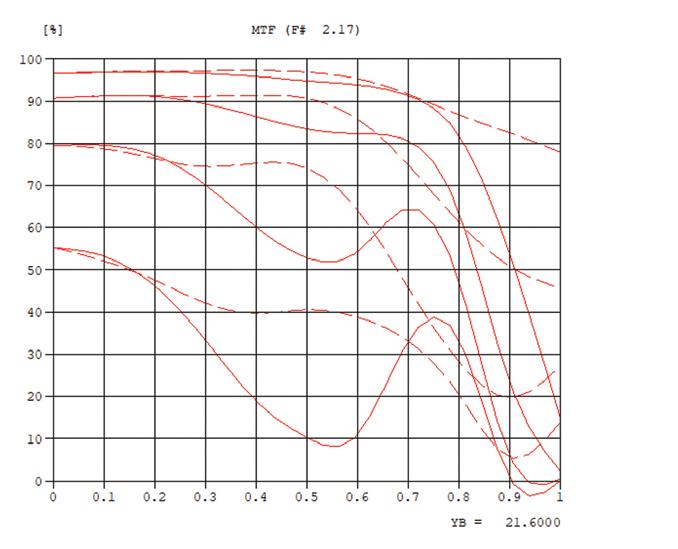
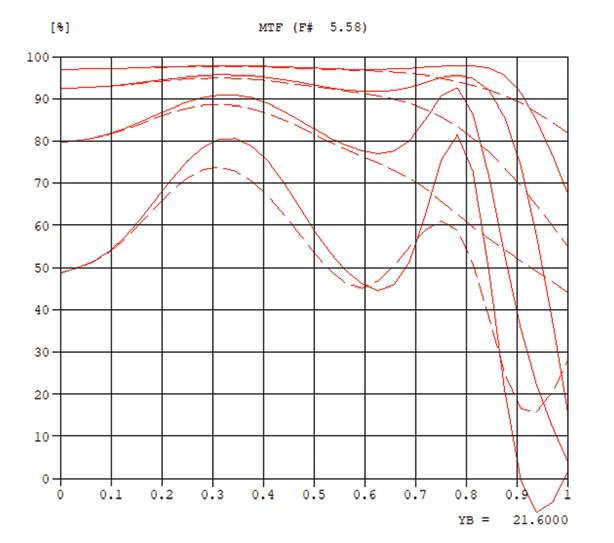
A link to the patent was duly sent to Herr Karbe. He then generated MTF curves calculated from the material in the patent. He writes “We do not know if this is the right design, which was the basis for the production, but it looks reasonable”. He adds: “I think the performance of this lens is good. Take into account that only 4 lens elements are implemented”.
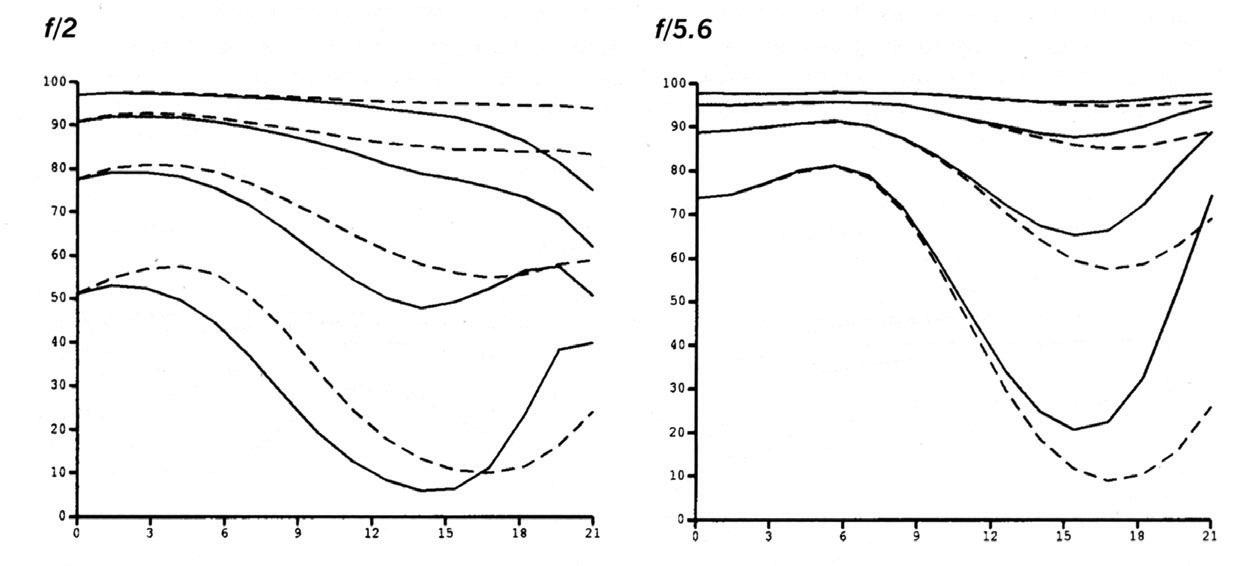
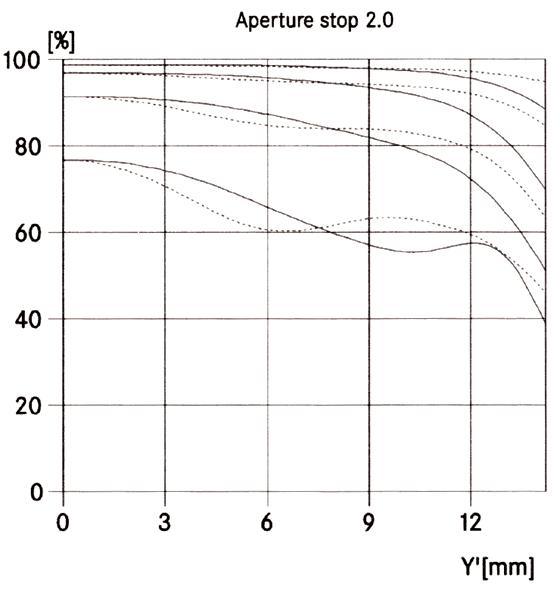
From the comparison of the MTF curves of the 50/2 ELCAN, the contemporaneous (1969) 50/2 Summicron, and the current APO Summicron ASPH, the author thinks one can get a fair idea of what has prompted controversy here. The ELCAN appears to have quite decent central resolution and macro contrast at f/2, and good resolution of the smallest details up to about 4/5 the way out in the field, when what Dr. Mandler describes as coverage being “overstrained” kicks in. In the central part of the field it might slightly exceed the 1969 Summicron. This would appear to indicate that the ELCAN performs well when the central portions of the image are what we care about, but might achieve less good performance nearer the edges. The curves for the APO Summicron ASPH wide open are much better than both, however, as would be expected.
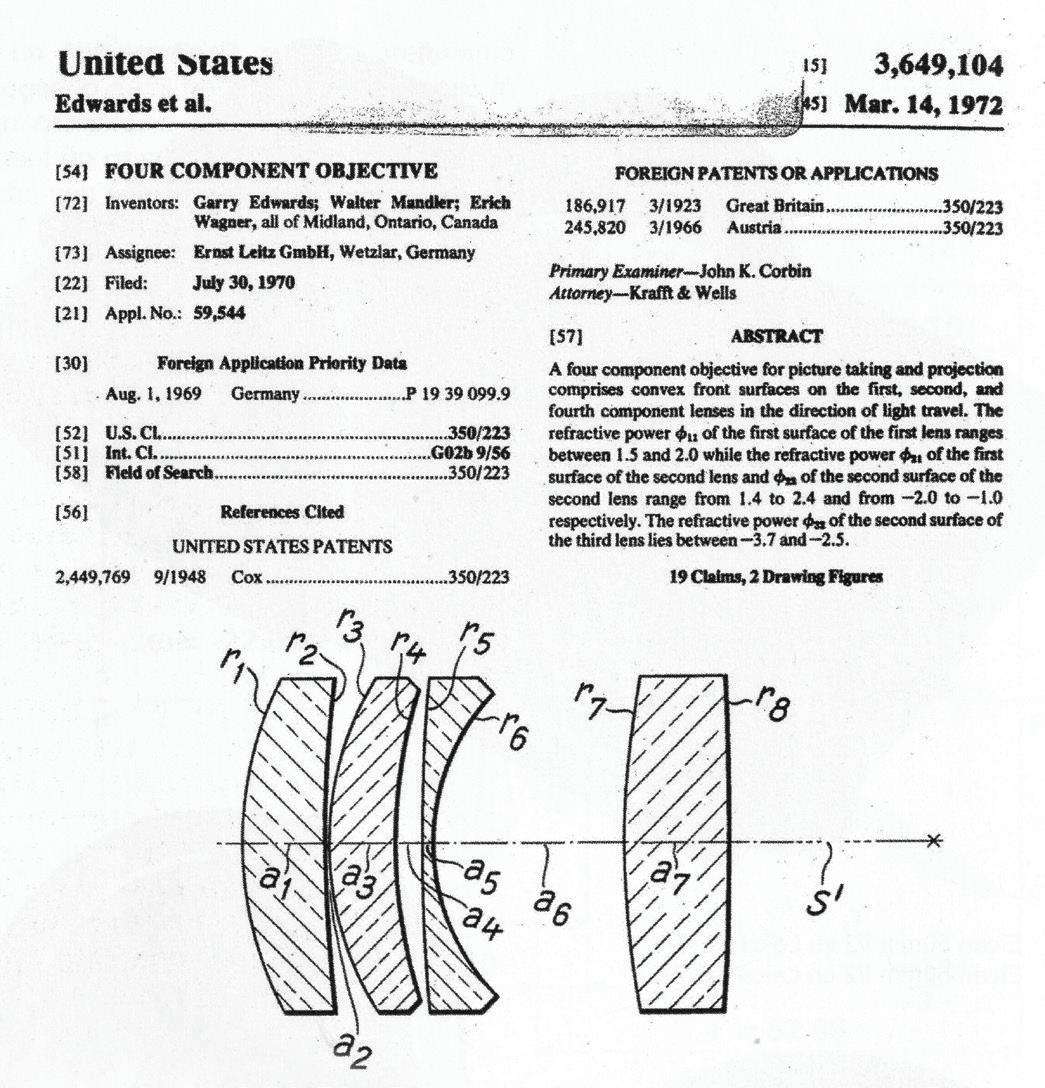
Pierpaolo Ghisetti and Marco Cavino’s book “Summicron” 1 contains a chapter on the ELCAN lens, and lets us view not only the first page of the patent, but also lists the optical glasses used. According to Ghisetti and Cavino’s the front three optical elements of the ELCAN are very similar to that of the contemporaneous 1969 6-element Summicron, whereas here the ELCAN’s one thick back element replaces the three back elements of the Summicron’s design. All are air-spaced. The optical glasses, front to back of the ELCAN are: Lanthanum Crown Glass LaK9; Leitz Special Glass 672460; Flint Glass SF63; and Lanthanum Flint Glass LaFN7.
The patent’s full text, viewed on line, makes the following claims:
There are already numerous four component objectives known in the art, particularly those wherein the third lens is a diverging lens while the remaining three lenses are collecting lenses (here and in the following the lenses are numbered on the assumption that of a picture taking objective the first lens faces the object, while of a projection objective the first lens faces the screen).
Particularly well known is a type of objective — to which also the objectives according to the invention belong — wherein the first refracting surfaces of the first, second, and fourth lenses are convex and wherein the spacing of the third lens from the fourth is greater than the spacing from the second lens. It has already been undertaken to improve upon the imaging quality of such objectives by introducing cemented surfaces of short radius of curvature.
According to another suggestion the first refractive surface of the first lens has to have a radius of curvature which is longer than 55 percent of the focal length of the objective. Additionally, the thickness of the second lens is to be greater than 12 percent of the focal length, while the third lens must consist of a glass having an index of refraction n greater than 1.68 and an Abbe number v smaller than 33. Objectives of this type have good imaging qualities throughout an angular field of up to 40°. [N.B. author: the field angle for a 50mm lens to cover the full 35mm format is about 47°].
summary of the invention - All known four component objectives have in common, however, that their state of correction, particularly with regard to the correction of the spherical zone, to the astigmatic zone and to the coma of higher order, is markedly inferior to the state of correction which can be achieved with objectives of the so-called Gauss-type. [Author: the 1969 50/2 Summicron is a Gauss variant]… Surprisingly it has now been discovered that it is possible to achieve an improvement of the above mentioned imaging errors in four
1. Summicron. Storia, tecnica e vicende della mitiga famiglia di ottiche Leica. Ghisetti, Pierpaolo & Cavina, Mario. Foto Camera, Milan 2015.
component lenses which renders such objectives equivalent in imaging quality to the Gauss-type objectives…According to the invention this result is achieved by providing four surfaces out of the eight existing surfaces with an extremely high refractive power. The introduction of surfaces of high refractive power is contrary to all previous experience since up to now the assumption prevailed that the imaging errors caused by surfaces of high refractive power cannot be corrected.
The patent continues at length to describe technically what is being invented here. This is preceded by these statements:
In the following tables the data of seven preferred embodiments of the invented type of objectives are listed. [N.B. author: the first three examples of data given in the patent’s tables are for lenses with an aperture of f/2 and a field angle of 45 degrees, just short of the approximately 47 degrees that would be needed operationally for the ELCAN 50, to cover the 43.27mm diagonal of the frame.] The state of correction of these objectives shows a remarkable improvement over the state of correction of comparable prior art objectives… This principle of design may
be employed throughout wide ranges of focal lengths with all resulting objectives having relatively large apertures…The costs of manufacture of the invented objectives remain inside the same amounts as are required for the known triplets, owing to the employment of most inexpensive glasses. In addition, the overall length of the invented objectives is shorter by about 15 percent as compared to the triplets.
In conclusion, all the technical material available to this author regarding the ELCAN 50/2 is consistent. When Kevin Xu tells the author “the four-element ELCAN 50/2 is very sharp, in my opinion. It is one of my favorite 50mm lenses … [with] a 3D effect in the center. In my opinion, it performs better than my collapsible Summicron 50/2 and Summicron Rigid”, he is being accurate in his judgment. The lens also has its theoretical deficiencies, as indicated. These may show up as softening of the image in the outer zones, which fact may or may not affect what the photographer wants to do with the lens, depending on, let’s say, portraiture or street photography versus architectural photographic use.
For comparison, here are the MTF curves for the 1969 Summicron 50/2 ( left ). And, for reference, here is the current 50 APO ASPH at f/2, designed by Peter Karbe ( right ).
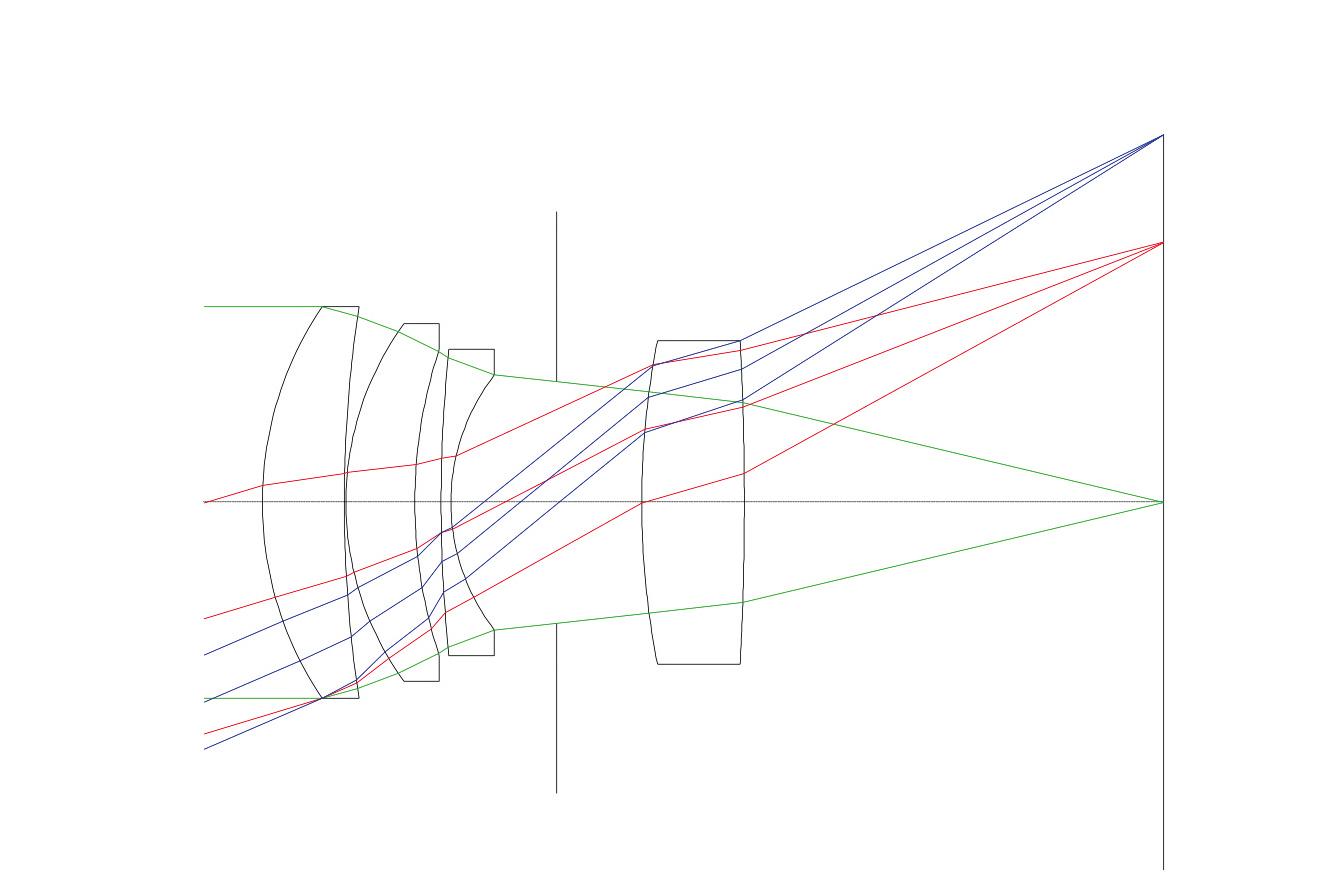
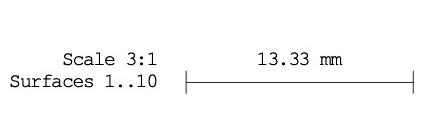
Here is a ray diagram. And here are the MTF curves.
Here are three ELCAN images at f/2.0 from Kevin, taken on an M10. In the first image (top left) , one can see evidence of such softening in the lower left corner.
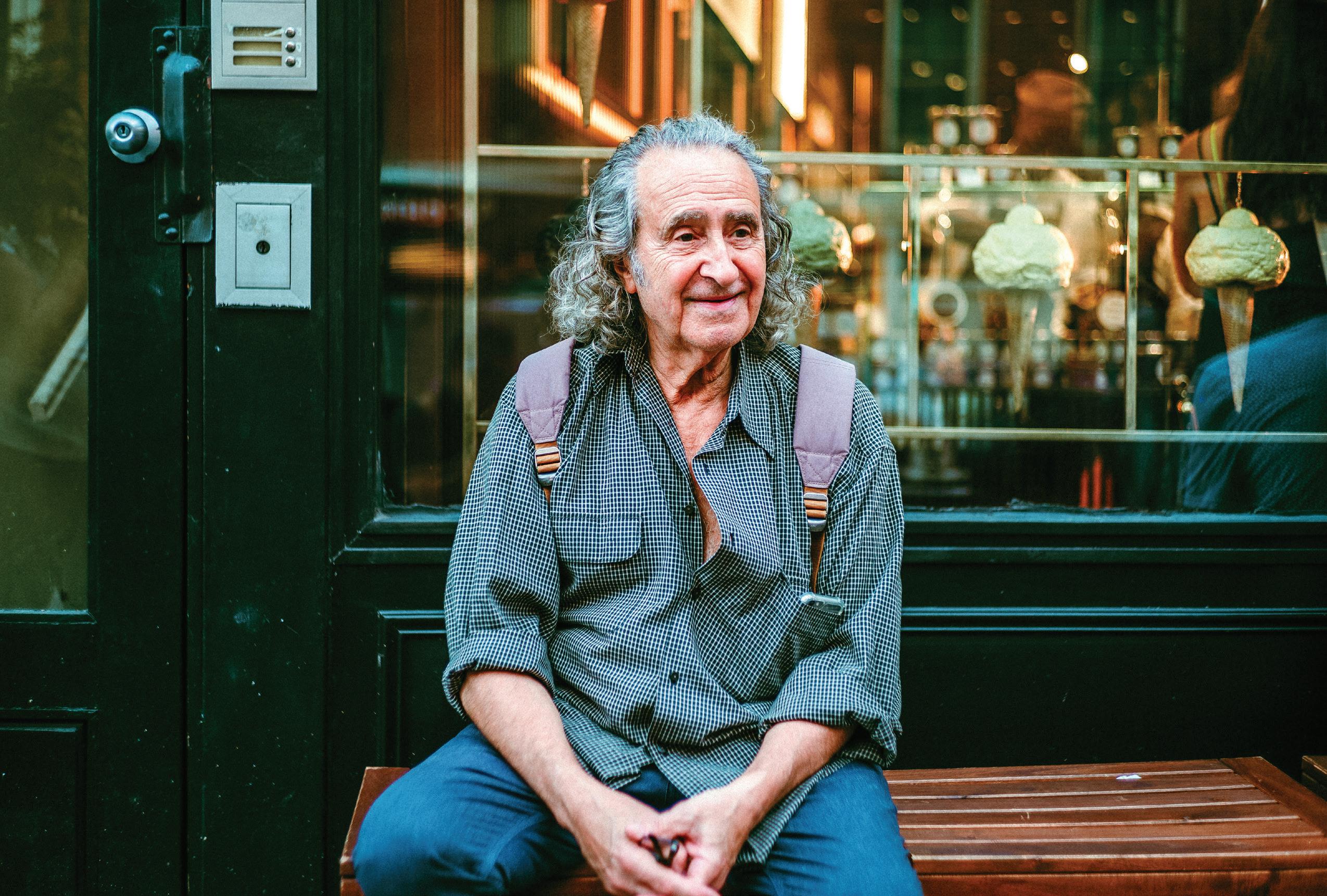
In this second image (bottom left), the drop-off in definition in clearly visible in the signage towards the edge. Yet, there is no denying the brilliance and 3-dimentionality of the ELCAN in the center of the image of the man sitting outside the shop, shown at the head of the article; this image is again taken with the lens wide open.
The author wonders whether this lens derives its beautifully luminous imaging quality from the fact that it has only 4 elements (and 8 air-glass interfaces), which low number would theoretically increase micro-contrast efficiency over that of a more complex lens design, even possibly with optimal coating and use of aspheric elements. The MTF plot for the ELCAN at f/2 appears to show such high micro-contrast, as the 20 lp/mm curve remains near 80% for the first quarter of the field.
However, we still do not have the actual military contract for the lens, so that if there really were specific purposes for its intended use, we still lack that information. Kevin adds, intriguingly: “About the user experience with the ELCAN 50/2, the first thing I want to say is it is a bit stiff to focus. I've learnt that they have built this lens very tight on purpose, to prevent dust or something like that which might get inside the lens. And obviously, this lens is very compact. Solid build but light weight in the hands. It pretty much suits for the military use. And I have to mention that its aperture ring turns in the opposite way to the regular Leica lens. I am still not used to it”. It seems possible to this author that Kevin is referencing build-properties one might expect to find in any mil spec camera lens generally. And it is conceivable that the reversed-direction aperture ring (also the case on the contemporaneous ELCAN 66mm f/2.0) was to emulate the military-use Nikons and Hasselblads of the era, so their users would not become confused when switching between systems. Minus the military contract itself, we just do not know.
In the Army manual which accompanied the KE-7A and the ELCAN 50/2, anything suggesting sophisticated military usage is absent, although there are extensive maintenance instructions. Aside from these and the disturbing instructions about how to destroy the equipment if it is about to fall into the wrong hands, the manual at times reads like “The Leica Guide for Dummies”. Included are warnings not to burn yourself touching a hot flash bulb, and needing to prevent camera movement to avoid blur. Again, one is reminded of Monty Python (the village idiot from their “The Attila the Hun Show” perhaps).
The front cover of the manual for the KE-7A. The KE-7A and ELCAN 50, from the web.
† For those reading this who came of age after the heyday of shooting color transparencies with our Leicas, the Colorplan was Leitz’s premier slide projector lens. The Colorplan lens is a 5-element-in-4-group design, as though the rearmost element of the ELCAN had been split; one can visualize the similarity, though. The Colorplan’s design is also very similar to that of the first Elmarit 90/2.8 R, so, in essence, there is a family of these lenses. But both the Colorplan and the Elmarit were introduced in the 1960’s, prior to the ELCAN, so one can say that the ELCAN derived from the other two, via some alchemy from Dr. Mandler.
†† One on-line commentor in 2011 at l-camera-forum [Sabears] stated that when he / she had made a “request to Leitz Canada if it would be possible to have this lens produced again, they told me that the price would be too high and without benefit for common user in comparison of a common lens”. Apparently, this concerned the expense especially of the SF63 glass element and possibly the proprietary Leitz Glass 672460. However, the patent states otherwise, as above [“the employment of most inexpensive glasses”].
THE KOCHMANN KORELLE K WITH LEITZ ELMAR
by CLAUS WALTER
Many LEICA collectors know that there are some third-party cameras with LEITZ lenses. The Nagel Vollenda and Pupille or Welta Weltini are certainly familiar to a lot of collectors, but the Mentor Dreivier, Beira Okula or Kochmann Korelle K are rarely seen with a LEITZ Elmar.
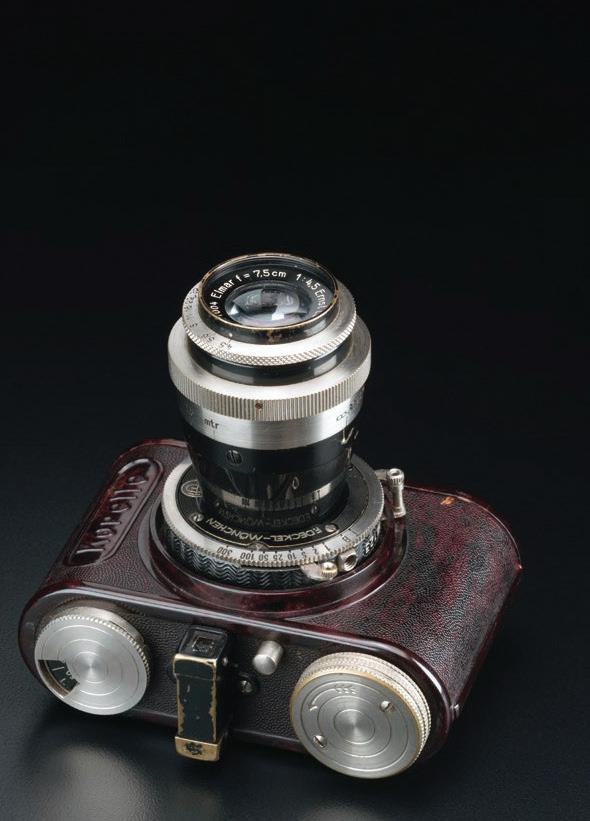
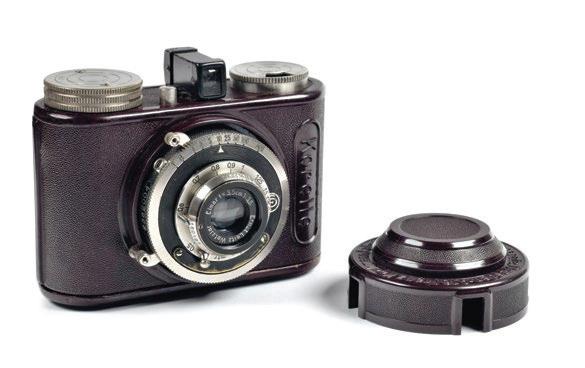
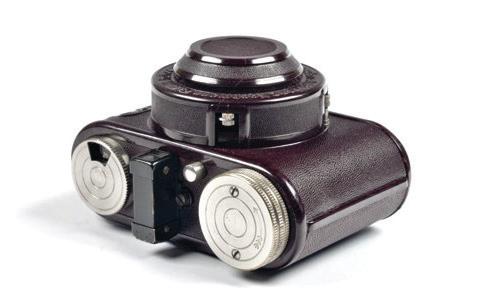
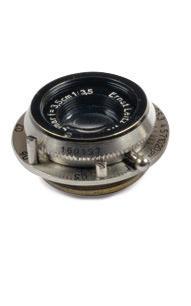
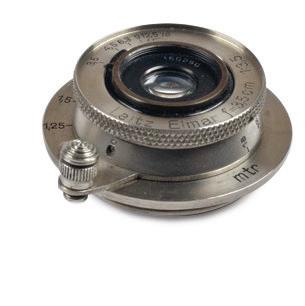
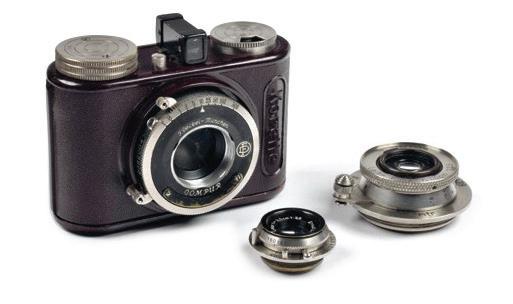
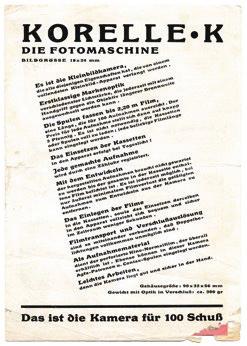
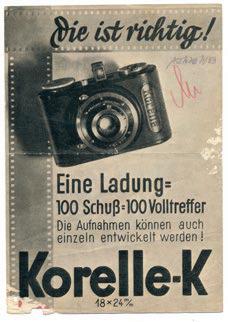
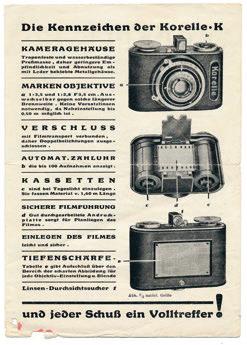
I am lucky to have found a Korelle K made by the Kochmann company from Dresden with a LEITZ Elmar 3.5 / 3.5cm (figure 1) , with both the lens and body in very nice condition, which considering that it is a bakelite camera from 1933 cannot be taken for granted. The "K" in the designation of the Korelle K stands for »plastic«, not, as some LEICA collectors might suspect, for "cold-proof" as with the LEICA IIIc K. Also a bakelite lens cap, which is matching in color, protects the complete shutter and lens combination. (figure 2) It is handy as you can make the camera as compact as possible in your pock -
et without it getting stuck. The camera uses 35mm film and it takes ‘half frame’ images in 18 x24 mm format. The Kochmann Korelle K can usually be found with Meyer, Schneider or Zeiss Tessar lenses. About 200 cameras had been equipped With a LEITZ Elmar f 3.5 / 3.5 cm, which is in a version designed for this camera only. The lenses are in the number range 160001 to 160230. It is clearly smaller than the LEITZ Elmar f 3.5 / 3.5cm for the LEICA LTM models. (figure 3 & 4) The lens has a real aperture adjustment ring, unlike the one for the LEICA LTM, which can only be adjusted with the fingernail. The lens number of the LEITZ Elmar 1: 3.5 / 3.5 cm on the Korelle K shown in this article is No. 160197, that of the version for the LEICA LTM shown here is No. 160290.
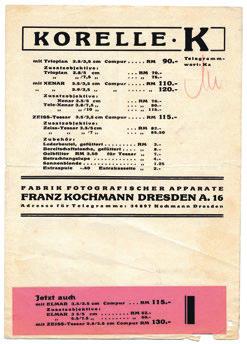
In an original brochure from the time, I discovered a sticker on the back announcing that the camera was now available with a LEITZ Elmar f3.5/3.5cm lens. (figures 5-8) Located on
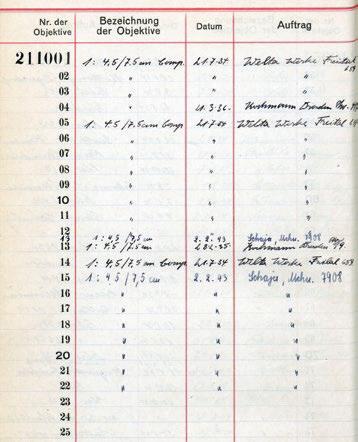
the sticker there is a note that it was also available with other Leitz Elmars, an f3.5 / 5cm and an Elmar f4.5 / 7.5cm. I thought that a set with all three lenses would be a highlight in the showcase, and, so, I continued researching. But searching in my LEICA library and on the Internet brought - apart from a single hint - no more references to these two lenses. In May 2005 a Korelle K with a LEITZ Elmar f 4.5 / 7.5 cm No. 211004 was auctioned. (figure 9) This camera recently went to Wetzlar where it is now in the Leica factory museum collection. The camera appears in the June 2018 release photo book »Museum LEICA« by Lars Netopil (Volume 2) and is shown on page 660. (figure 10) The hope of finding another such lens disappears when you read the entry in the LEITZ lens book. Only two samples were sent to the Kochmann company, No. 211004, which is shown on the camera and No. 211013.
Also interesting is the question of how the viewfinder was adjusted with the various focal lengths. On the camera with the LEITZ Elmar f4.5 / 7.5cm a viewfinder mask was inserted to give the correct view. The front part of the viewfinder is attached with two screws, which suggests the camera was only made with one type of viewfinder, which was adapted with an appropriate mask depending on the focal length of the fitted lens. A picture of the Elmar 1: 3.5 / 5cm on the Korelle K has not been found. It is probably the case also that the 5 cm Elmar has a different construction than that of the 5 cm Elmar lens
for the LEICA LTM models, as because of the Compur mount on the camera the collapse of the 5cm Elmar lens was probably not reproducible. In addition, with the Compur mount the lenses only needed a smaller cross-section for half-format. I would really like to see the design of the lens. Perhaps one is slumbering in the collection of a collector somewhere and has not yet been sold or put up for auction.
For help with researching the Elmar 1: 4.5 / 7.5cm and the illustration of the corelle K with the 7.5cm Elmar, I would like to thank Lars Netopil. Claus Walter.
• Image from the Leitz delivery book for photo lenses (p. 211001ff.) With the kind permission of Leica Camera AG
8.
9.
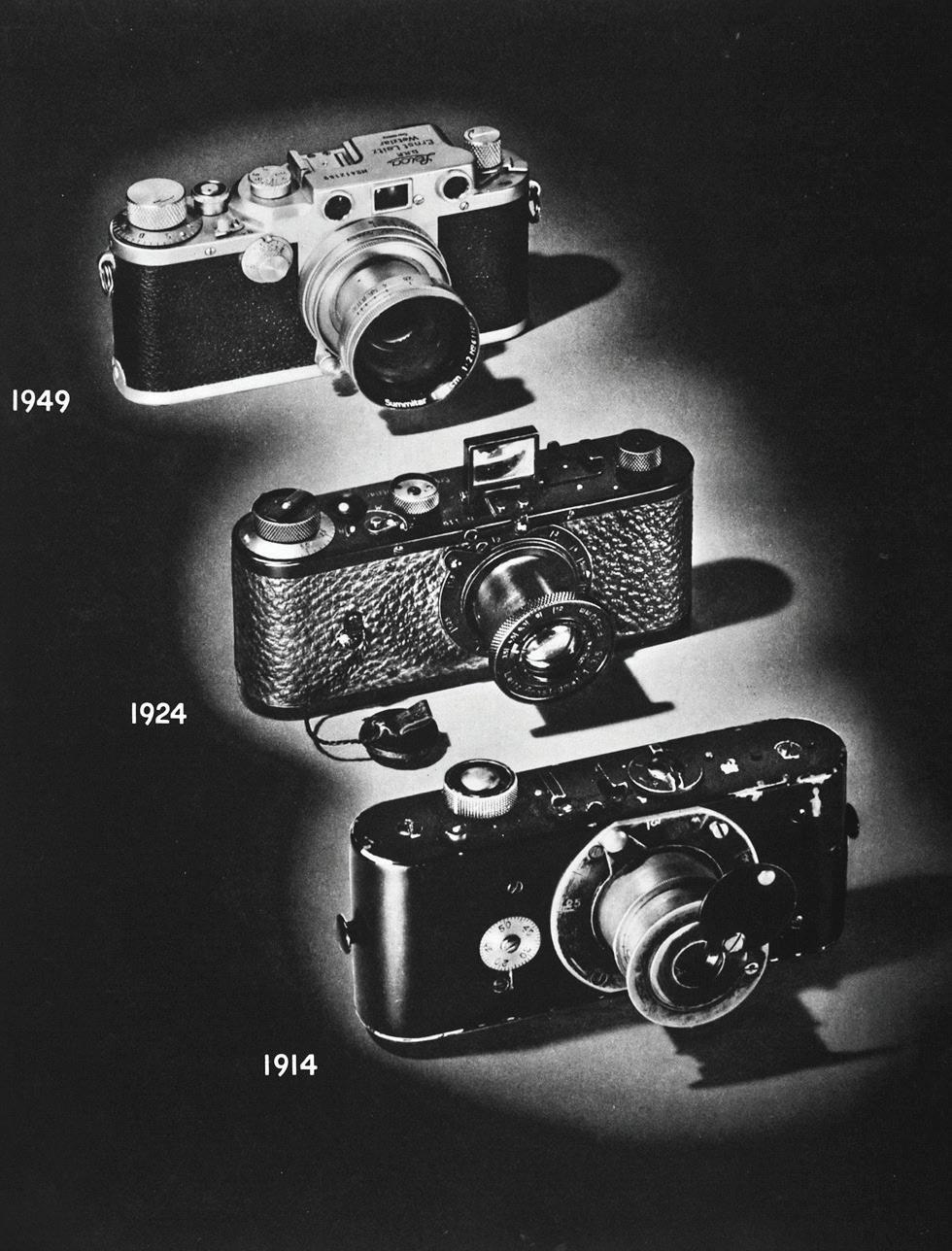
the Spring of 1914 Ernst Leitz II visited America. He carried an UR-Leica. Giani Rogliatti refers to this event on page15 of his 1995 book Leica-the First 70 Years. The 2017 publication Oskar Barnack - From the Idea to the Leica by Ulf Richter contains 1914 photos taken by Ernst Leitz II with an UR-Leica. Street scenes of New York City are on pages 60-61. This is the first time the UR-Leica came to America.
After the Second World War the 100th Anniversary of Ernst Leitz Wetzlar was acknowledged in the Summer 1949 issue of Leica Photography. The UR-Leica and null series camera 119 were photographed with view camera at a NYC studio.The latest IIIc was included in several views. This represents the second UR-Leica visit.
The 1978 LHSA Annual Meeting in Indianapolis featured Dr. G. Wangorsch the Director of the Leitz Wetzlar Museum.
THE UR-LEICA VISITS AMERICA
by JIM LAGER
Various artifacts were shown to LHSA members attending. The UR-Leica was one of them. I photographed it with extreme care doing my best to conceal my nervousness. When it was removed from what looked like a gym bag and handed to me I remember muttering something like Oh My God! The Leica IV and 75 soon followed. Dr. Wangorsch had said he would bring something interesting. I had no knowledge the UR-Leica was included. This is the third visit to America.
The illustrations show the 1949 Leica Photography material. One of my 1978 photos shows a rear view of the UR-Leica with the Leitz condensor logo .In 1988 I “met“ the UR-Leica at Wetzlar. This time it was equipped with a reproduction of an early viewfinder.
Today the UR-Leica is secured by Leica Germany. In my opinion it is unlikely it will ‘visit” America again.
(above) Cover of 1949 Leica Photography Summer Issue. (above left) Leica IIIc and UR-Leica (left) Descriptive paragraph (back cover) Leica IIIc with UR-Leica and null 119
(opposite page) UR-Leica from rear showing logo (1978) (left) UR-Leica with viewfinder (1988)