Inquries about membership, upcoming events, replacement Viewfinder issues, and special orders should be directed to:
Richard Rejino, LHSA Executive Director 14070 Proton Road, Dallas, TX 75244 info@lhsa.org, (972) 233-9107
Viewfinder is the official publication of the LHSA - The International Leica Society, a nonprofit organization incorporated in the state of Delaware. Copyright 2020. Reproduction or use of any material contained herein without permission of the Sociey if forbidden.
Leica is a registered trademark. It and other trademarks pertaining to the Leica System are the property of LEICA CAMERA, USA, INC.
ISSN 1543-8732
PRESIDENT
Keith R. Sbiral Chicago, IL
VICE PRESIDENT
Brad Husick Medina, WA
SECRETARY/TREASURER
David Knoble Charlotte, NC
IMMEDIATE PAST PRESIDENT
Alan Weinschel Roslyn Heights, NY
PRESIDENT EMERITUS
James L. Lager
Rolf Fricke
Bill Rosauer
APPOINTED OFFICERS
Viewfinder Editor Bill Rosauer Buffalo Grove, IL lhsaeditor@yahoo.com
Associate Viewfinder Editor
Ed Schwartzreich Waterbury, VT
24-33).
asana: into the himalayas by Samuel R. J. Gillilan
the q2 monochrom by Jonathan Slack
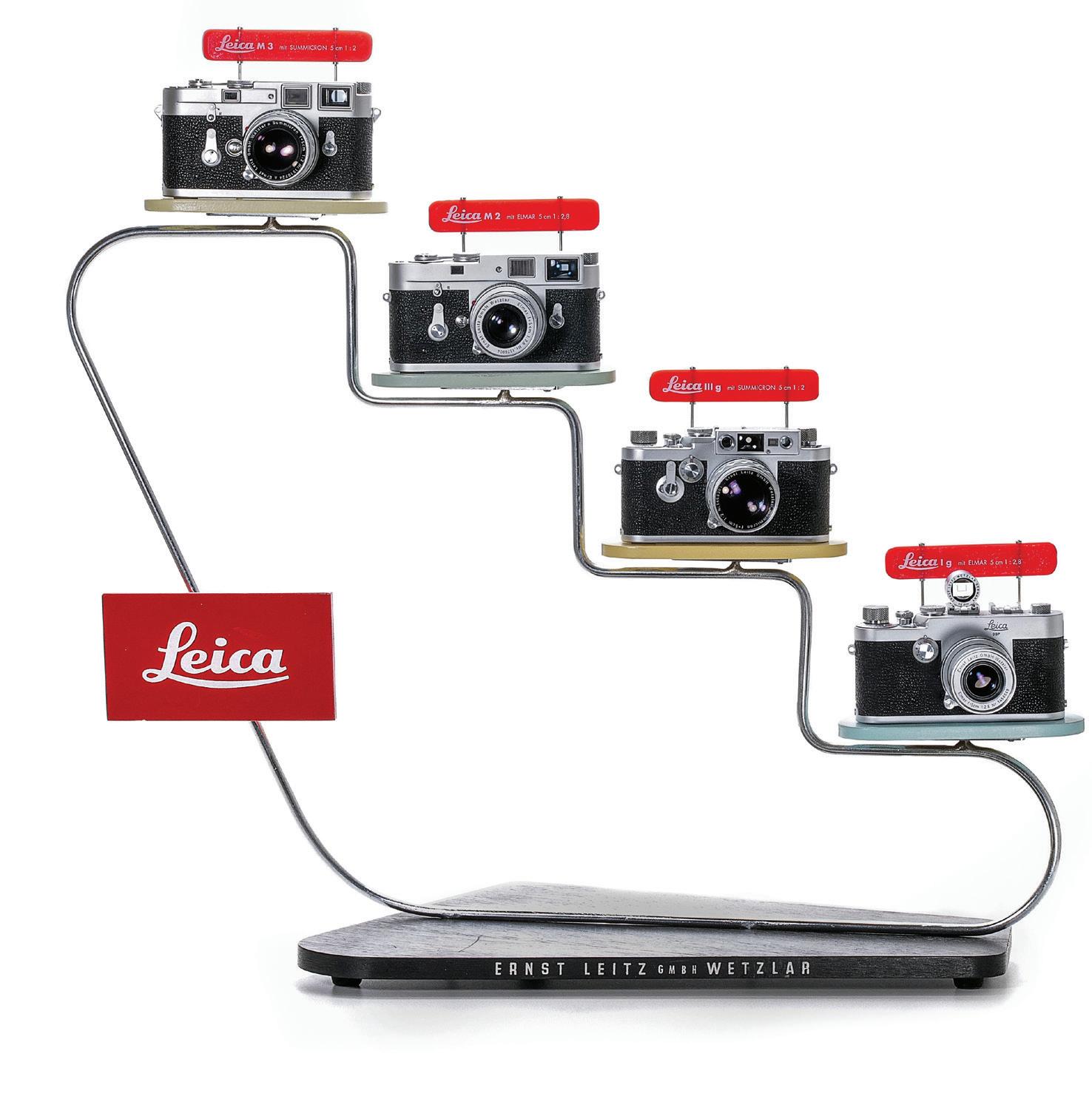
leitz leica window display by Lars Netopil
oskar barnack & the story of the pix by Bill Rosauer 42 paul wolff, doctor by Ed Schwartzreich 48 leica monté en sarre by Olaf Nattenberg
50 silver cases by Jim Lager
EXECUTIVE DIRECTOR
Richard Rejino Dallas, TX info@lhsa.org
ELECTED DIRECTORS
Class of 2021 Wilbur Norman Santa Fe, NM
Jay Paxton Houston, TX
David Spielman New Orleans, LA
Class of 2022
Andrew Godlewski Middletown, RI
Bill Royce Kirkland , WA
Kirsten Vignes St. Petersburg, FL
Class of 2023
Sandra Eisert Redmond, Washington
William Fagan Dublin, Ireland
Dan Tamarkin Chicago, IL
CONTRIBUTING EDITORS
S.R. Gilcreast, Jr. Peterborough, NH
James L. Lager Closter, NJ
S. Willis Wright Port Washington, NY
SENIOR DIRECTORS
Gary Hough Woodinville, WA
Douglas Drumheller Pittsburgh, PA
A LETTER FROM THE EDITOR
by BILL ROSAUER
big news from Leica in this issue of Viewfinder is about the sensational Q2 Monochrom.
We have Jonathan Slack’s report here in this issue. In fact, we were holding this issue for his article and the embargo date from Leica, so please accept my apologies for this. I think you will agree, it was worth the wait!
We also have Brad Husick’s report on the first LHSA Virtual Annual Meeting in October in this issue. By all accounts, it was a great success, but hopefully we will all be able to see each other in person next year!
We welcome our new president, Keith Sbiral, with this issue as well. Thanks again to Alan Weinschel for his hard work over the past two years as president, and all he has done for the Society. Alan will still be actively working for the Society, and he and Keith have a joint President’s Letter in this issue.
We have many contributions from our regulars in this issue, as always. Dick Gilchrist has an article about shooting with an efficient 35 and 50 outfit in Leica Screw Mount. Jim Lager gives us a peak into the contents of some very unusual Halliburton cases. Ed Schwartzreich writes about two very different lenses: the Mountain and the mole-hill Elmars and about Paul Wolff, the doctor.
My good friend Allen Bourgeois shows us how he photographs a fantastic classic car collection in the studio with an M camera.
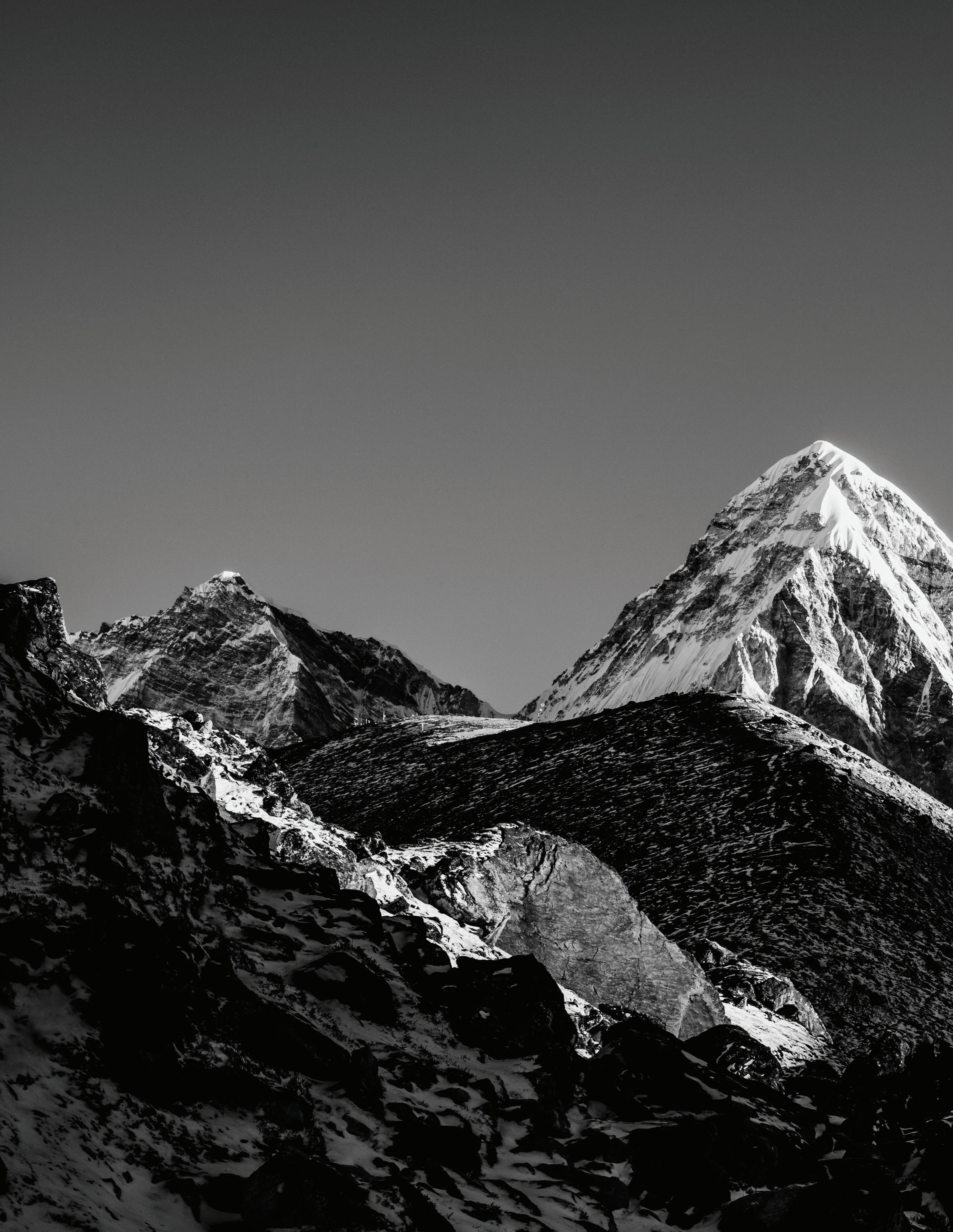
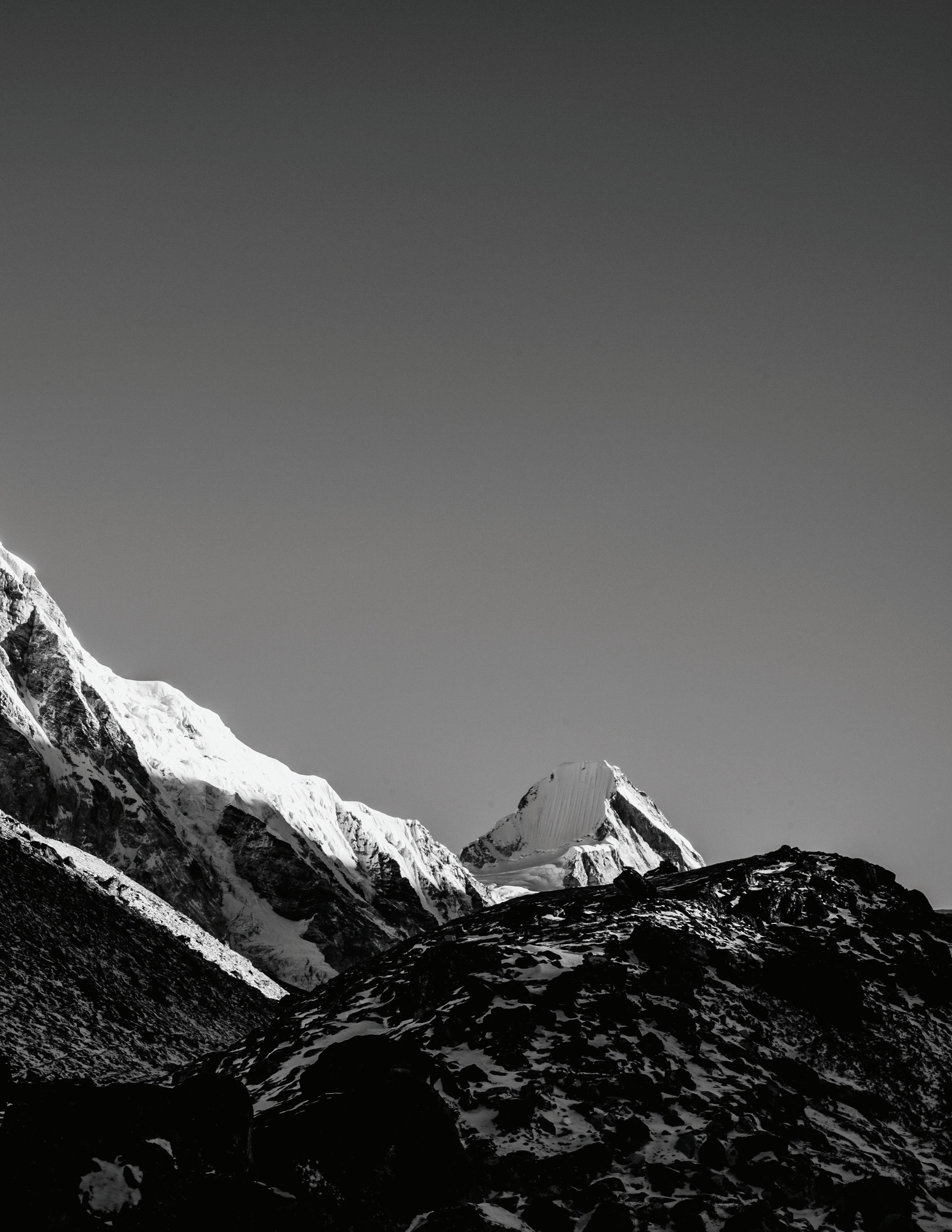
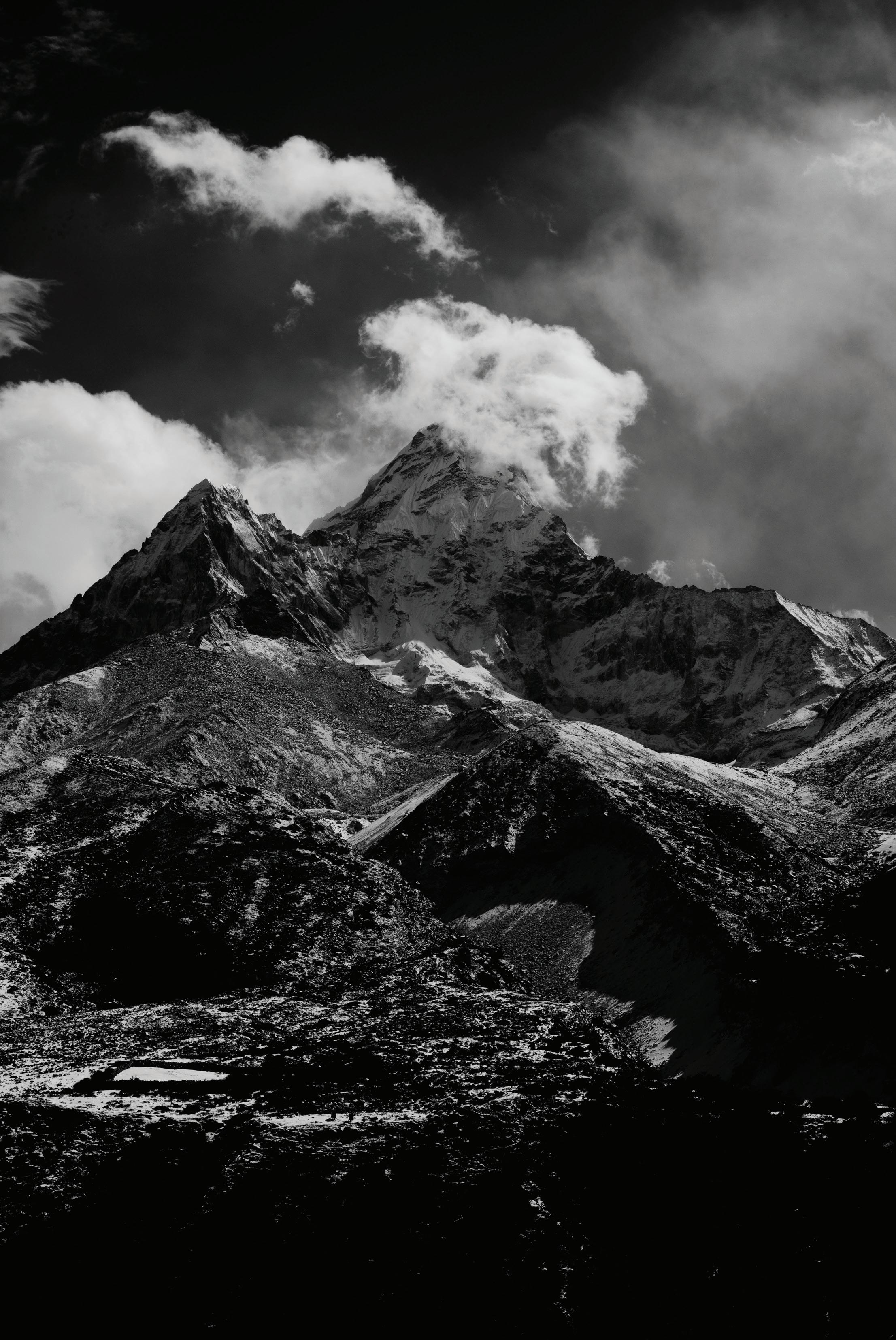
Samuel R. J. Gillilan takes us on an incredible journey into the Himalayas, using his Leica to capture fantastic images.
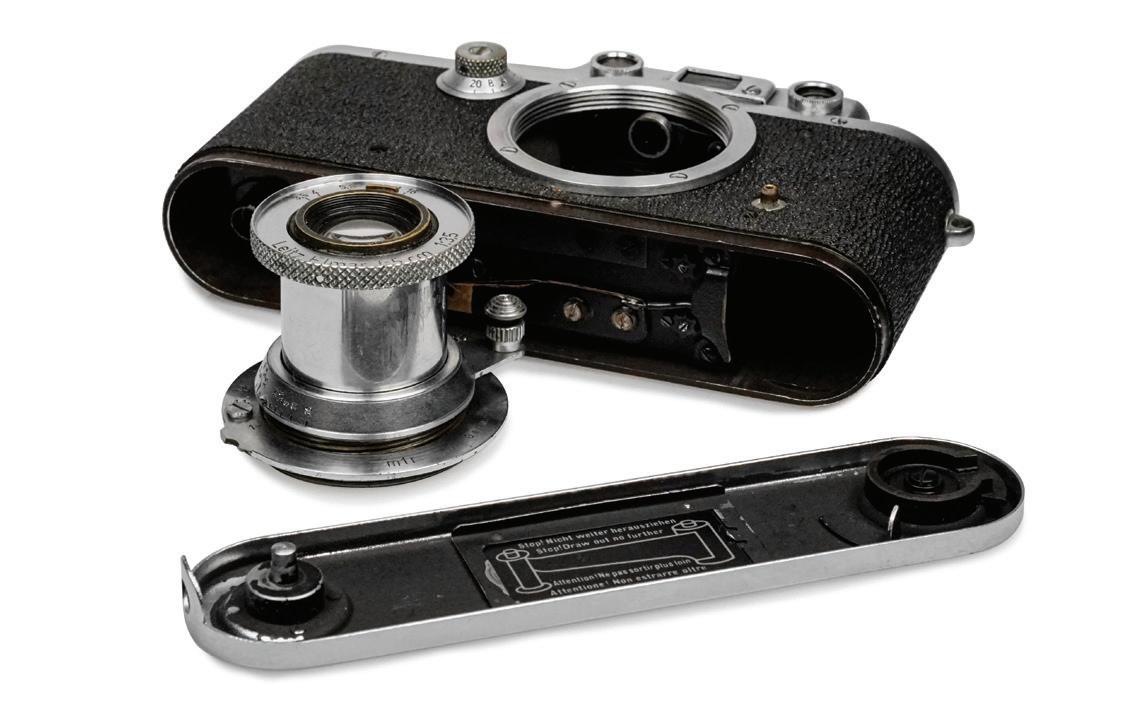
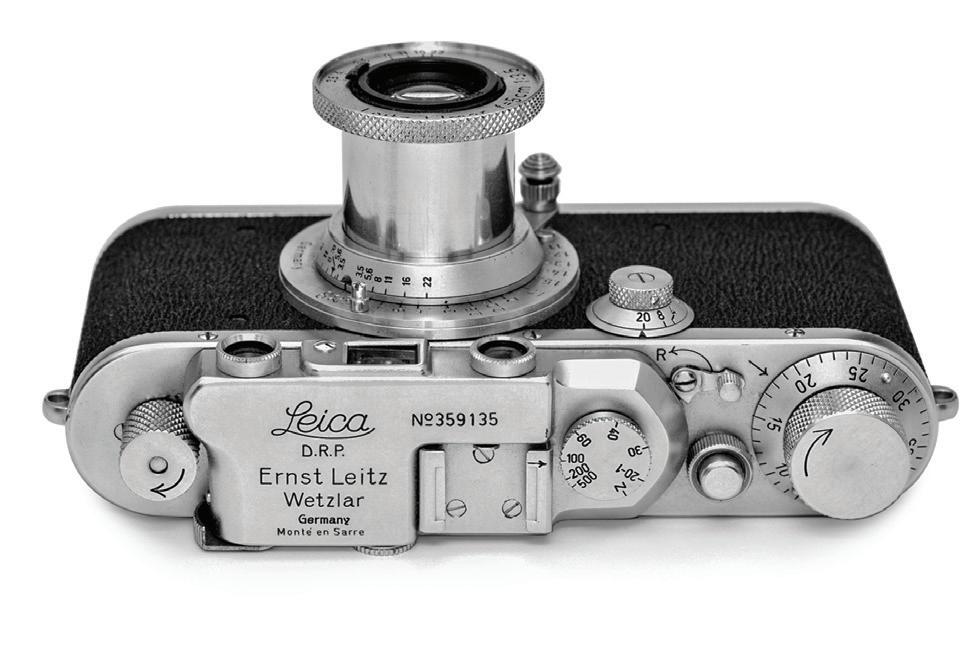
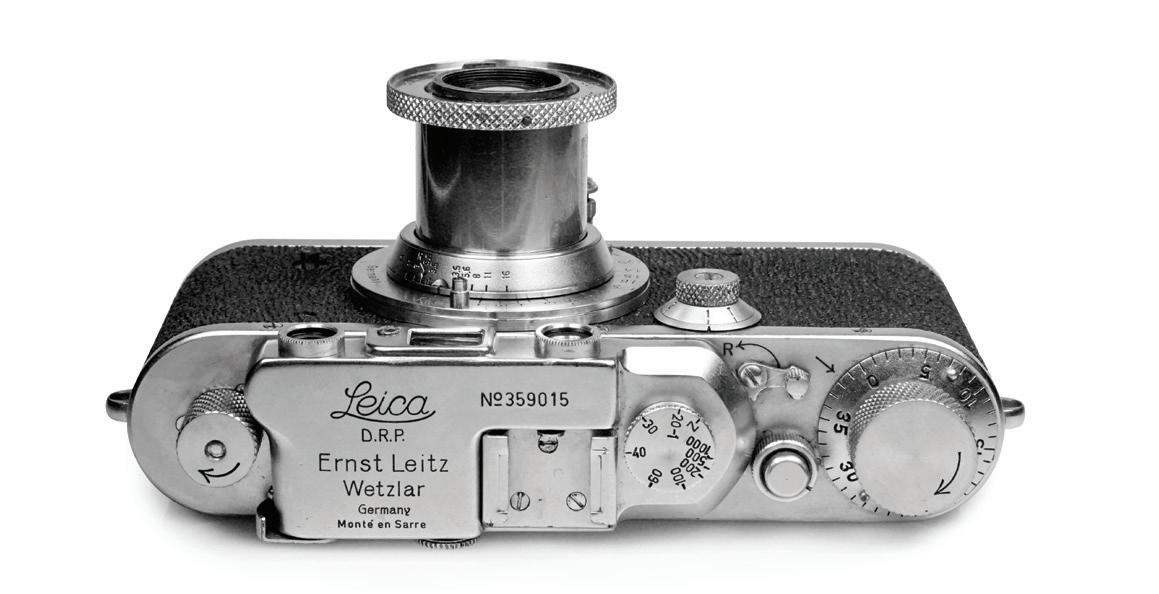
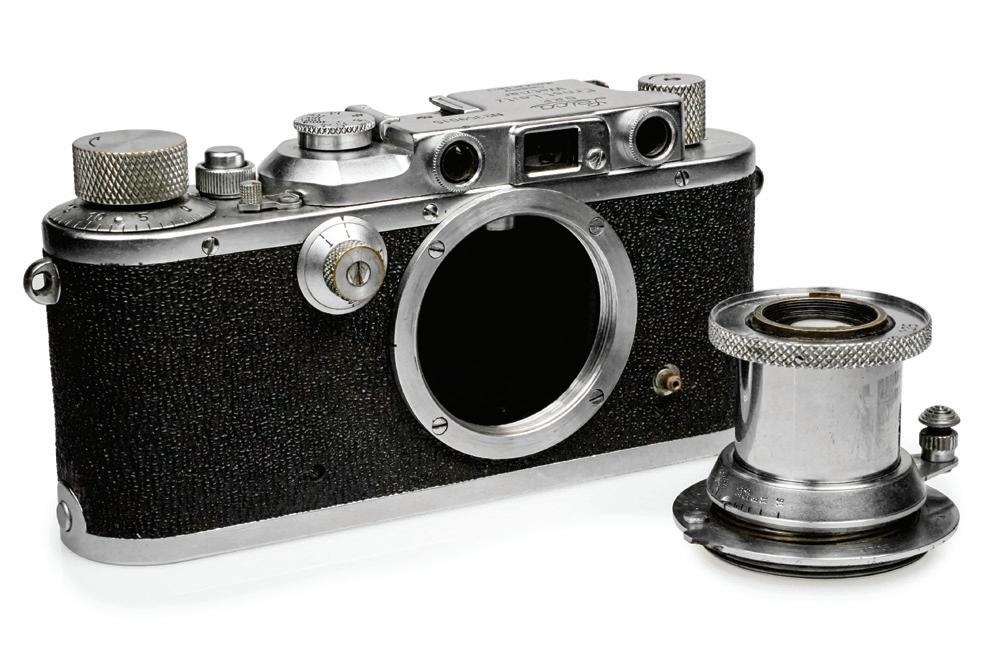
We also have several articles on Leica history in this issue. New contributor Olaf Nattenberg writes about the Leica Monté en Sarre cameras, made in the Saarland after the war to avoid the high French taxes. Our old friend, Walter Kluck of later fame at Leitz Canada, was in charge. Recently, a similar move was initiated by Leica with the Leica Portugal lenses to circumvent the high tariffs on German optics in this country. Lars Netopil shows us a very interesting Leitz shop display stand from the 50’s that was featured at his latest auction in Wetzlar. I write about a little-known chapter in Oskar Barnack’s career as an inventor with his work on the Montblanc PIX mechanical pencil.
Paul-Henry Van Hasbroeck, one of the foremost authorities on Leica, asked me to let all of you know that he is working on a new revised edition of his book, Leica: A History Illustrating Every Model and Accessory, that was first published in 1983 and revised in 1985. He asks if any of our members have any new information to add to his book, especially in regards to experimental models and prototype lenses, to please let him know. I eagerly await his new book, and we will revier it here when it becomes available. You can contact him directly by email at hasbroeck@aol.com
Bis nächste zeit! - Bill
A LETTER FROM THE OUTGOING PRESIDENT
by ALAN WEINSCHEL
is my last President’s letter for Viewfinder, so I am taking the liberty of a look at where LHSA has come from in an adaptation of my “State of LHSA” remarks at the annual meeting. At that meeting, Keith Sbiral took over as President and he also has some things to say below.
The philosopher Hermann Hesse said that “You have to try the impossible in order to achieve the possible.” This is a pretty good description of what we have been through the last several years.
In 2016, we had 747 dues paying members. Membership was stagnant or declining. There was a website that was dysfunctional. There was little or no visibility with Leica, no presence on social media. There was a perception that we had a club for and run by OWRM’s (old white rich men). Ironically, in 2016 we were in a “bubble” – but it was of our own makingisolated and invisible from everybody but ourselves. It is not surprising that finances were in the red and that there talk about an “end-game” for LHSA. They said that it was impossible to revitalize in the face of changes in the industry and we were so far from being viable we shouldn’t even try.
That is where we started from and that is where Hesse comes in. A few years earlier, Leica itself had been able to take itself from the analogue/rangefinder world to something different, and in the process, not lose sight of its roots. Under Gary Hough’s extremely persistent leadership, we too started to try the impossible.
We dipped into our limited savings and invested in ourselves. Understanding the younger generations and social media meant getting help from Helen Todd and Sociality Squared, who remain with us as very valuable partners. The website was rebuilt, the archives were worked on, and we started developing lots of relevant content. We reconnected with Leica, both in Wetzlar and the US and found willing ears open to discussion about what we could do to help each other. We collaborated on a 50mm APO retro design commemorative (thank you Bill Rosauer). Importantly, we decided that one way to reach new members was to give them a try-out year, partnered with Leica, who agreed to put our offer to new camera buyers on its camera registration site and, as it had done in the past, put LHSA flyers in Leica system camera boxes.
Now here we are in the Fall of 2020. Since March, we have been confronted by the pandemic and we have all been in different kinds of bubbles. I am saddened that we were unable to have in person meetings this year. Colorado Springs in May and Seattle at this time would have been great; hopefully, we will be able to do them next year. But despite the pandemic, and maybe because necessity is the mother of invention, we have moved forward. We had a hugely successful “Conversation with Leica” with both Dr. Kaufmann and Stefan Daniel peppered with questions. We learned how to do instructional zoom sessions and have been doing them about every two weeks, with great content. Those zoom sessions enabled us to reach and engage members all over the world. We are going to try to provide at least some form of access on-line even when we resume meeting in person so that those of you who cannot come or are too far to travel can participate in some way. For those of you who can attend in person meetings (and in my book being there can’t be beat), you can look forward to not only Colorado Springs and Seattle next year but Memphis and Dublin, Ireland in 2022 and a return to Wetzlar in 2023. We still have a way to go to achieve sustainability but we are headed in the right direction and are getting closer. We are now at almost 1400 paying members, and when we hit 1500 we will have doubled that 2016 number. We are still running a deficit and that cannot continue forever, (nor can our dues levels, by the way, which haven’t changed in about 10 years) - but the bleeding at least has slowed as we have strengthened. I am also pleased to say that the Board has become more diverse, is no longer OWRM’s and now has a wide range of diverse views, including two women who have just joined as well as our first Board member from Europe. Notwithstanding a pandemic that could have done us in, we are actually stronger. We have continued to try our best to provide members with Engagement, Education, Information, and Inspiration, and we also Contribute through our Photographers Fund Grant.
I want to personally thank some of my colleagues for their hard work and dedication. Richard Rejino, our Executive Director, is truly the glue that holds LHSA together. The Board has been wonderful and the new incoming Officers, Keith Sbiral and Brad Husick, are both able and ready for the hard work that is needed and are going to be great leaders with new ideas going forward. I thank the Board for its support and ideas and commitment to LHSA. I want to thank Gary Hough for joining me at breakfast at a LHSA meeting in San
Francisco, and enticing me on to the Board, as well as for his leadership in starting a turn-around.
Finally, none of this progress could have been possible without you - the members. The support you, the members, have shown, is what has enabled us to keep going. To those of you who have been members for many years, I thank you for sticking with us. To those of you who have joined recently, I thank you. If you are a trial member, I thank you, and ask you to please consider becoming a full-fledged member. I also want to thank those of you who have become Sustaining Members, showing your strong support and I want to thank
those of you who purchased APO 50’s, and those of you who supported us in our Sweepstakes, and finally those of you who have attended meetings, enhancing our community. It is very gratifying to have you in the LHSA family. It has been a gratifying 4 1/2 years since 2016. I thank you for the opportunity to serve as President and now I am thankful I will have more time to actually use my gear. I hope to see you at a meeting next year, god-willing.
- Alan Weinschel
A LETTER FROM THE INCOMING PRESIDENT
by KEITH R. SBIRAL
For more than fifty years, LHSA The International Leica Society has been and continues to be a meeting place for Leica users and collectors, and greatly contributes to preserving the rich history of Leica cameras and gear. Since our founding in 1967, times have changed and we have changed too, now with members from more than 20 countries and embracing digital learning opportunities. What was once a camera born for film has transitioned to the digital age; what was once a small group of enthusiasts has emerged as the meeting point for Leica passion, photography, and community worldwide.
In October I was honored to take the reins as President of the International Leica Society from Alan Weinschel, as he did two years earlier from Gary Hough, and so on into the rich history of LHSA. We joked that this was a peaceful transition of power. But there is some truth to the lightheartedness. Decade after decade new people join our organization, leadership changes, but the overall goal remains: embracing and protecting the rich history of Leica and adapting to the challenges of each decade.
Whether that is the advent of digital imagery or the worldwide pandemic that forced our programming online, we adapt, grow, and transition.
I am looking forward to the coming year. Thanks to the work of our board of volunteers and the work of our executive director, members will soon have the benefit of an archival system of historical documents and information, continued webinars and virtual programming, and hopefully a return of in-person shoots, meetups, and annual meetings. This is all possible because of members like you: the International Leica Society is a fully member-supported organization.
I’m honored to lead this organization and I thank each one of you for playing a role in keeping LHSA - The International Leica Society vibrant and active. I want to thank Alan Weinschel for all of his important leadership and work. It has been a pleasure to work with him over the last two years. I also thank my fellow board members for their willingness to serve our organization in the year ahead. I look forward to a fantastic year!
May the light be in your favor!
- Keith R. Sbiral
the driehaus collection
by ALLEN BOURGEOIS
photographing classic cars with a leica m
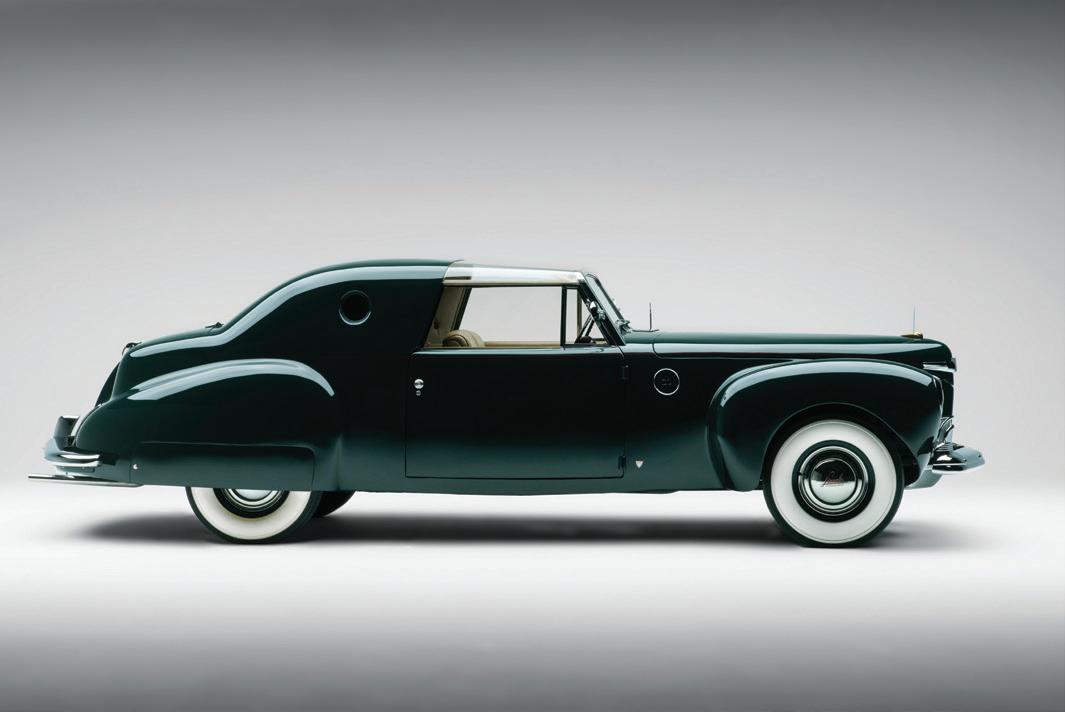
1941 Lincoln Town Car
Richard Driehaus has been a client of mine for over a decade now. He has an amazing American automobile collection that really focuses on design, from a time when American automobile designers were driving the vision. Sorry, I just had to do that.
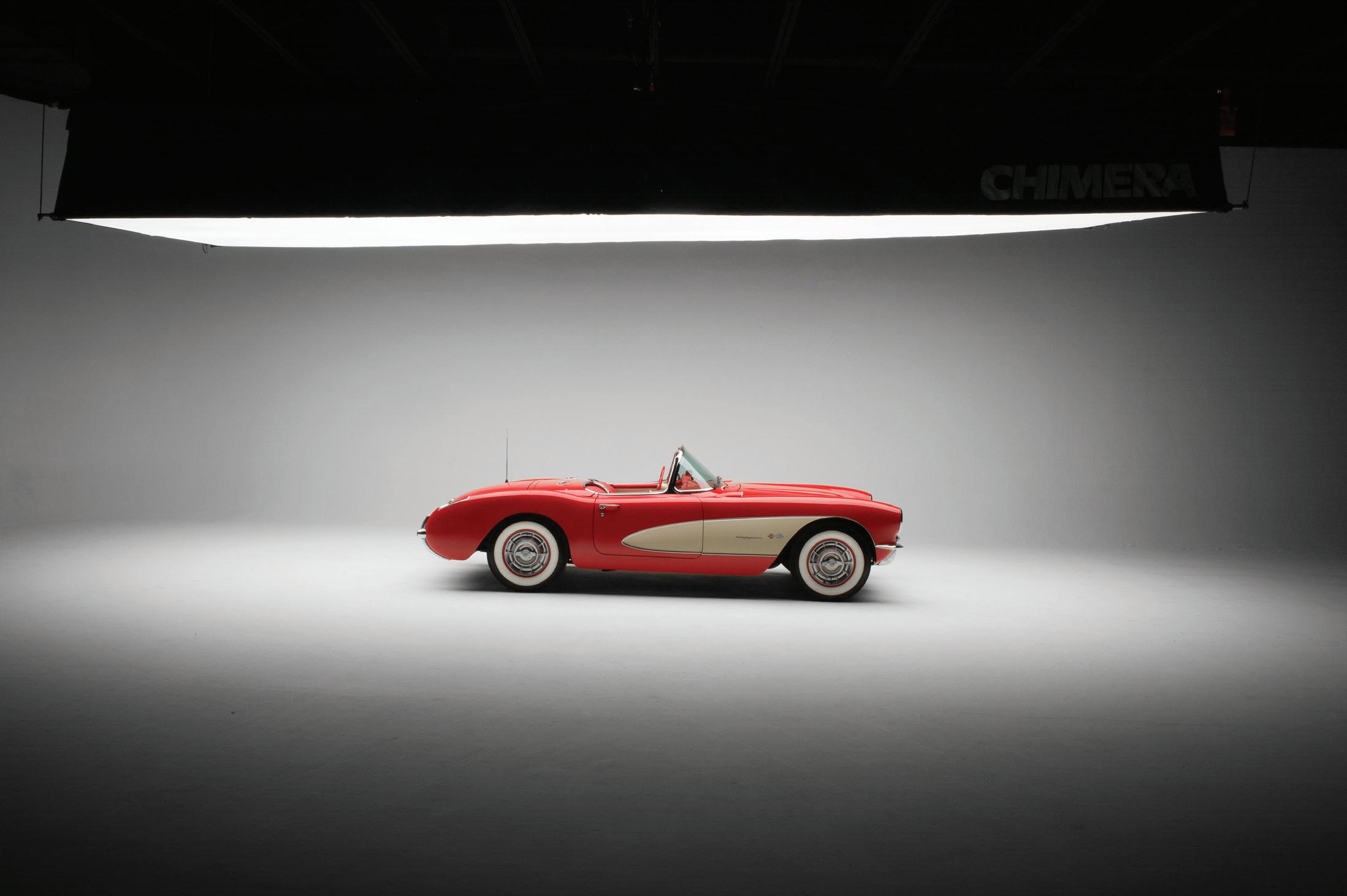
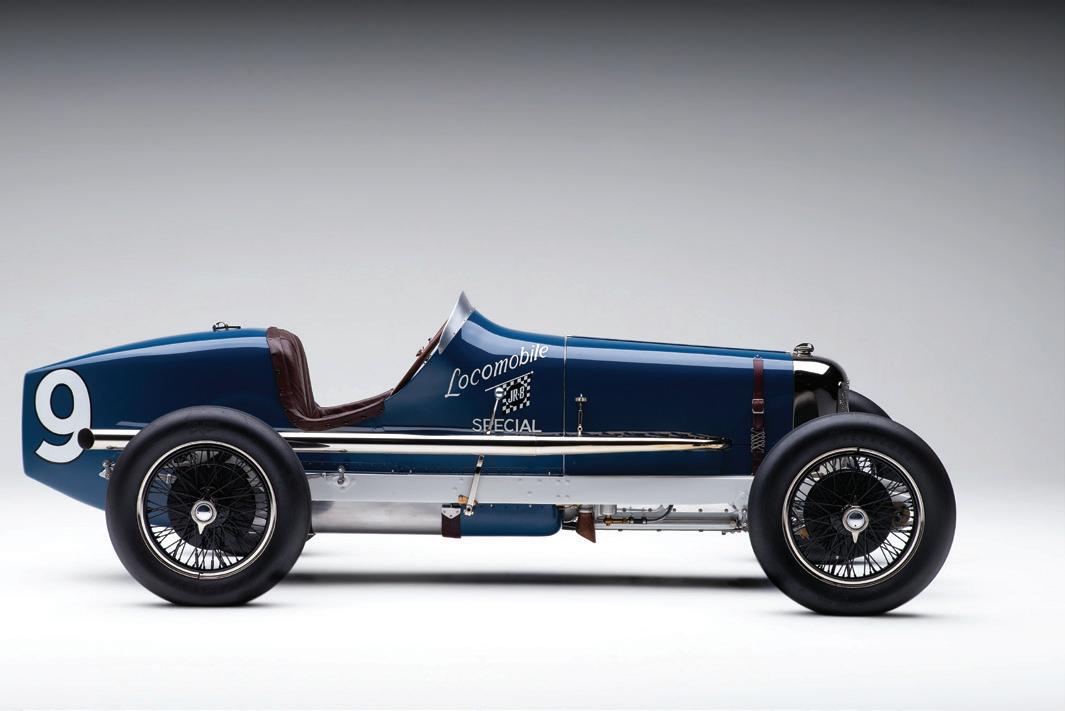
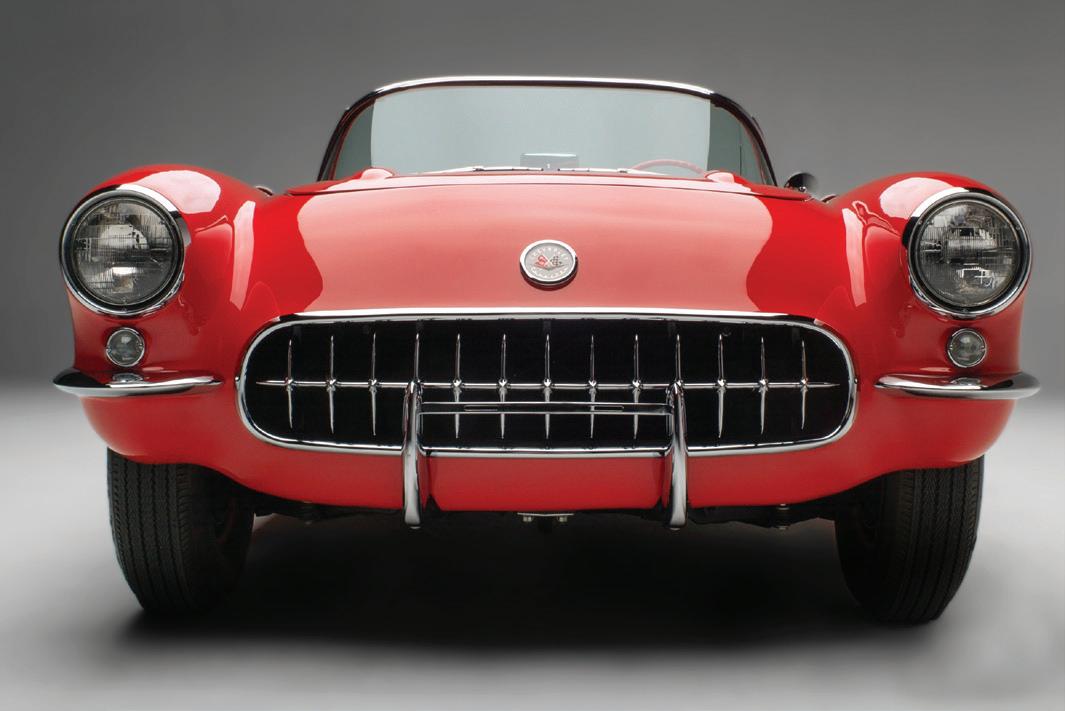
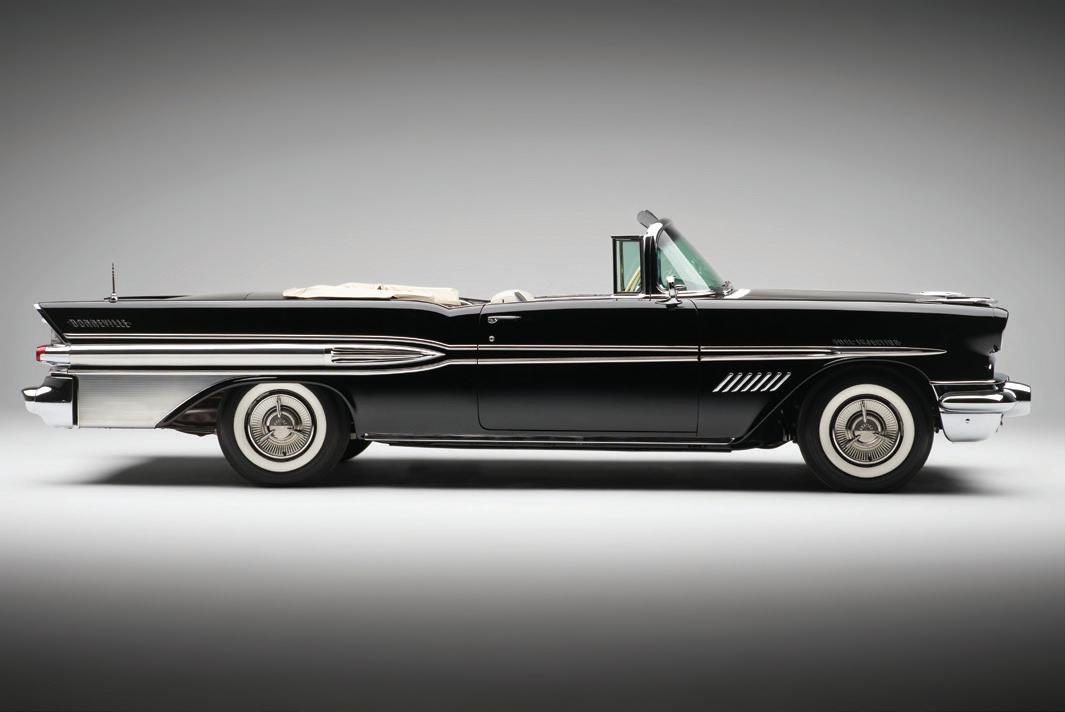
Richard started discussing photographing his collection with me maybe four or so years ago. I had never seriously photographed cars before but I agreed to give it a try. It was a real privilege to have been chosen for this project, not only because Richard could have picked anyone to photograph his collection, but because this collection is so special. I am still working on the project, and as of today we have 68 cars photographed and another one is scheduled to be photographed next week. I believe this will ultimately be in a coffee table book that will be celebrating design.
I shoot with Leica digital M's and all of these cars were photographed with a couple of M10's, M (Typ 262), M-E and an M Monochrom. Leica 24mm Elmarit-M f/2.8, Leica 35mm Summilux-M Asph. FLE f/1.4, Voigtlander 50mm f/1.2 Nokton, Leica 75mm Summarit-M f/2.5 and a Leica 90mm APOSummicron-M f/2. The space we photographed in is Richard's as was the lighting which is four Black Line Speedotron 4801 with four heads each. So 16 heads in a 30ft x 10ft overhead soft box. And the space has a built in sweep and is in an old movie studio.
Having shot some table top work in the past working with automobiles is just a scaled-up version of that. The biggest challenges is having enough space to work in and having the right type of light and light modifiers. The old movie set with a built in sweep and lights and soft box provided were perfect for this type of work.
Studio lighting set-up. Four Black Line Speedotron 4801 power packs with four heads each. 30 x 10 foot soft box.
Studio space is an old movie studio in Chicago, and has a built-in sweep. Doesn't get any better than this!
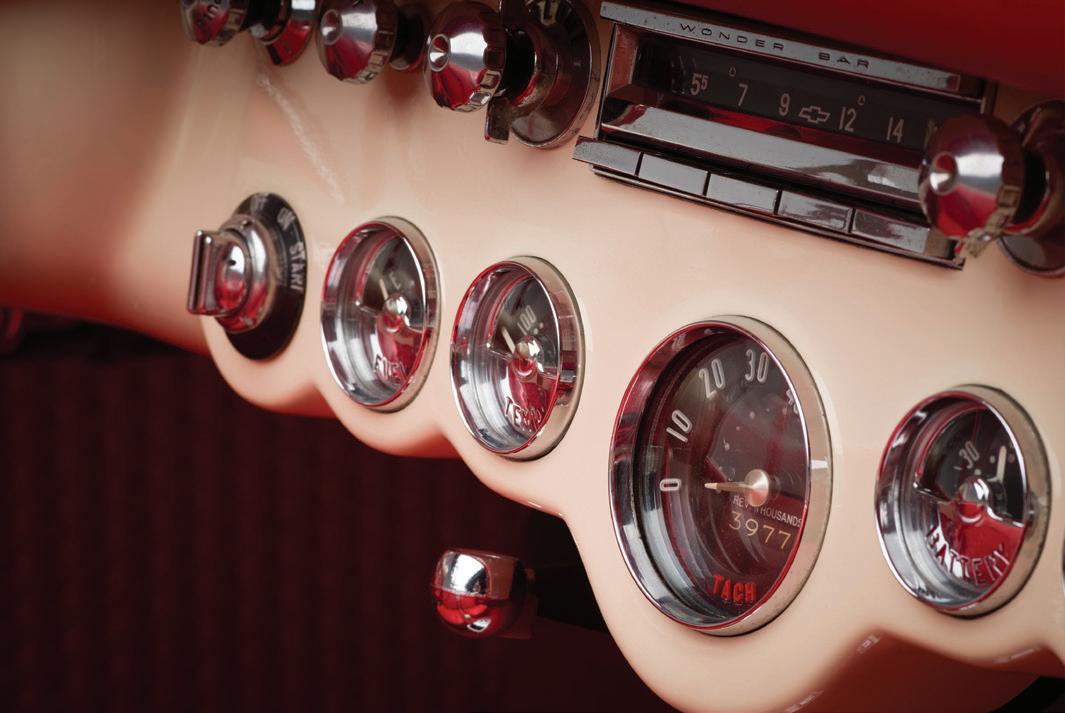
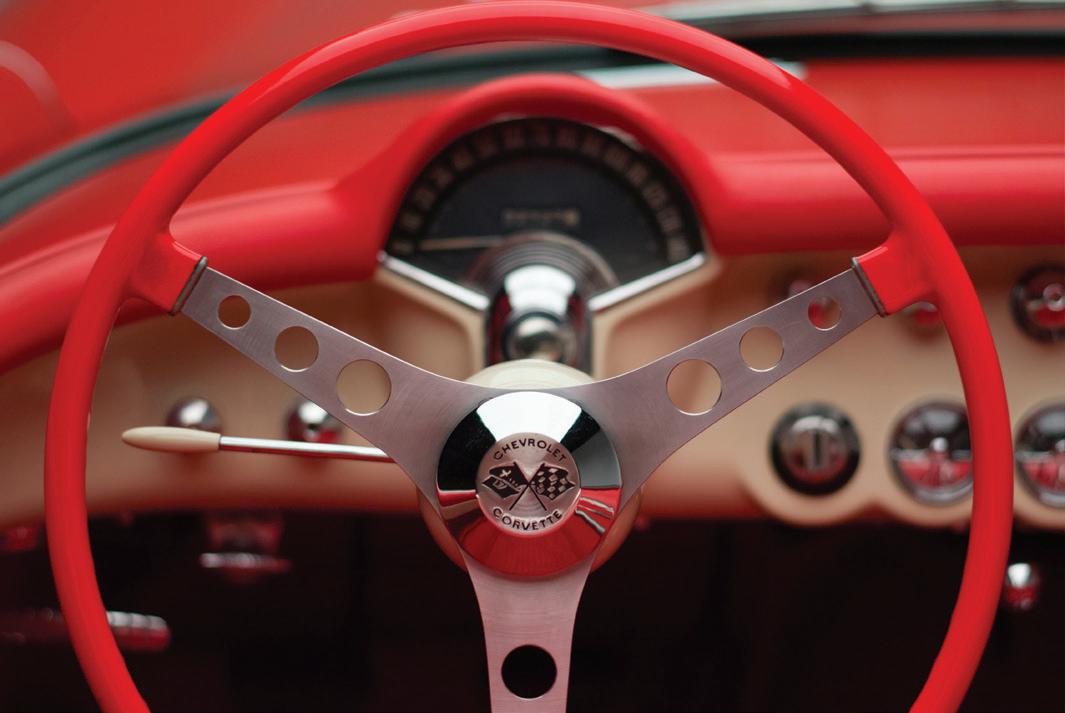
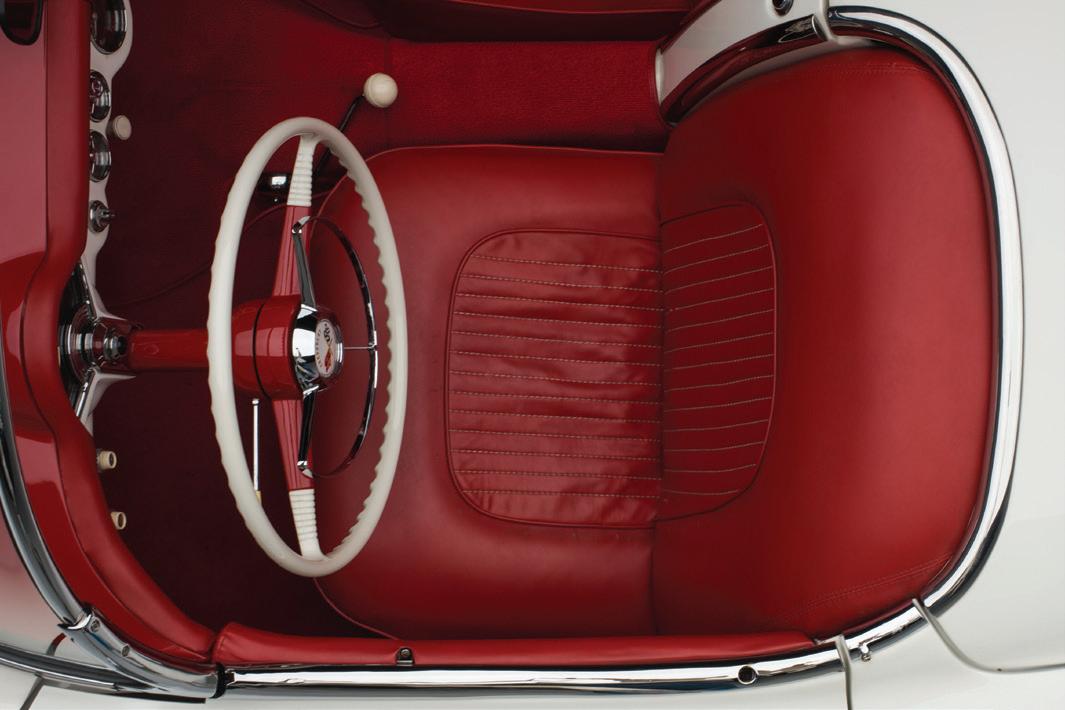
1957 Corvette
top row: (L) 1926 Miller (R) 1941 Lincoln Town Car
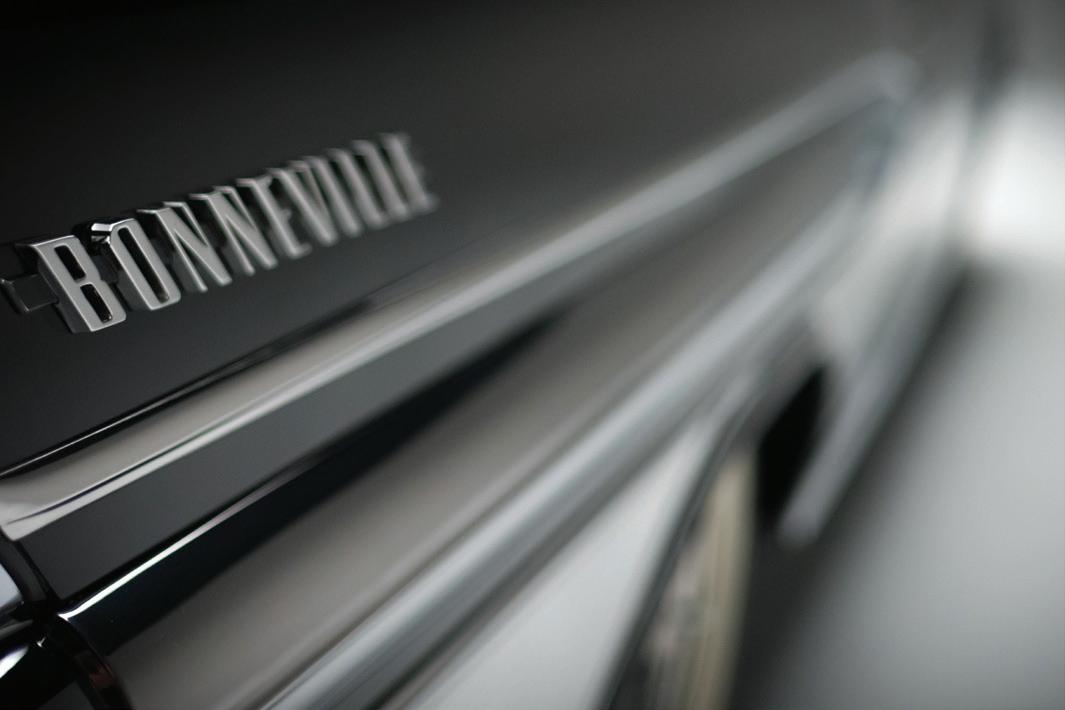
Some of the largest challenges are the reflections in the cars. Keeping myself out of them and making sure there is nothing in the other areas of the shooting space causing problems. It was kind of like shooting glass or any other highly reflective objects. Just a lot larger than table top work. But in many was very similar.
For me shooting with Leica M's is very intuitive. They just fit the way I see and work. I was also working without tripod. Shutter speeds when shooting with the strobes were usually at 1/125 of a second and with those Speedotrons turned all the way down I was at f/11 at 100 ISO and f/16 at 200 ISO. I did go to high ISOs for the detail shots and some of the images with shallow depth of field. 1600, 3200, 6400 and a few at 12,500 ISO. The higher ISOs all with the M 10s. I spend time walking around each car to see what impressions I get from things like line, form, shape and design. I then try and capture what those impressions mean to me.
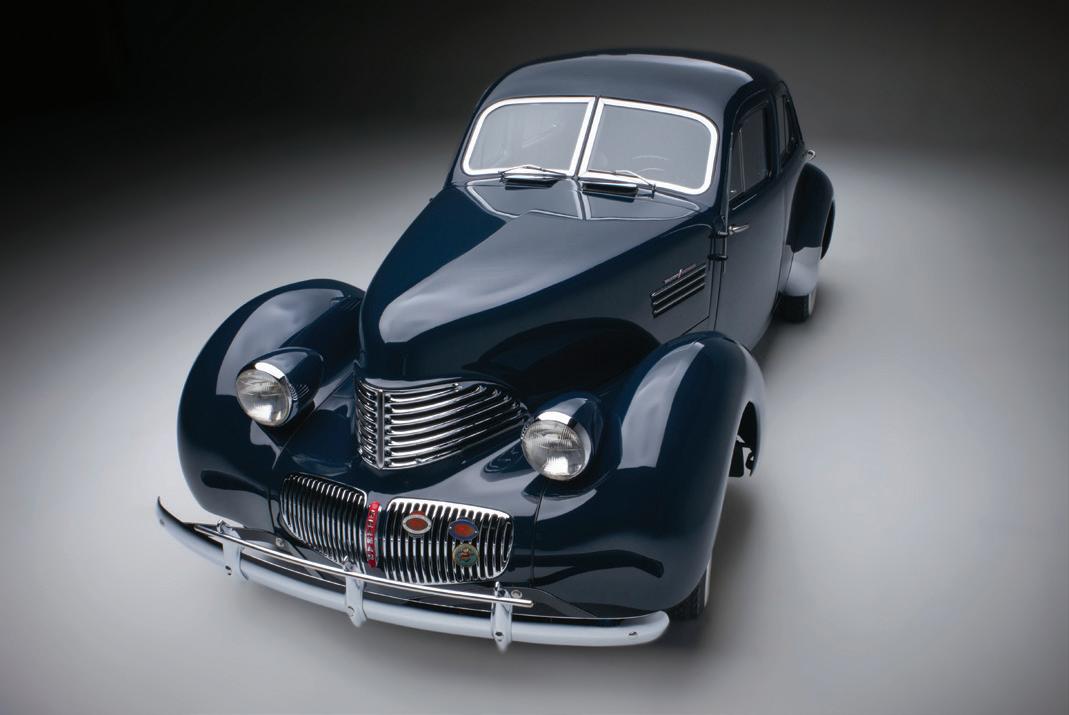
In the case of the 1941 Graham the shape of the body was important so I shot with a slightly wide lens from a higher angle to help show that shape.
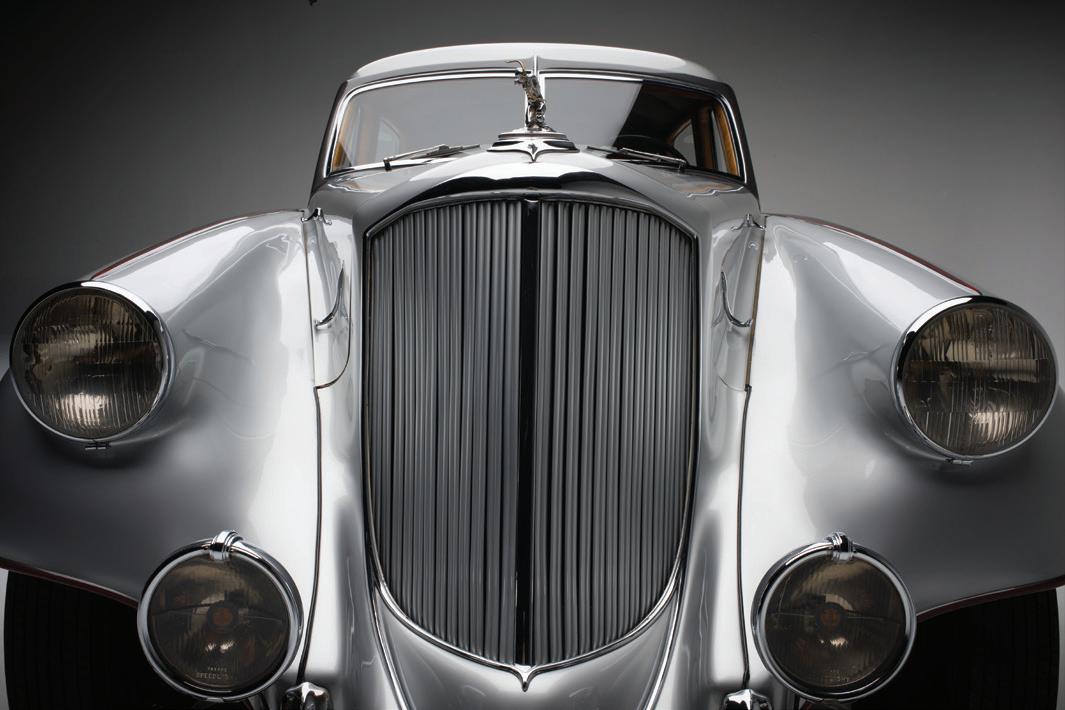
The 1933 Peirce Arrow the back end was so unique. I wanted to make sure I captured that element and what impression it made on me. The front of that car with the hood up I also thought was an interesting visual.
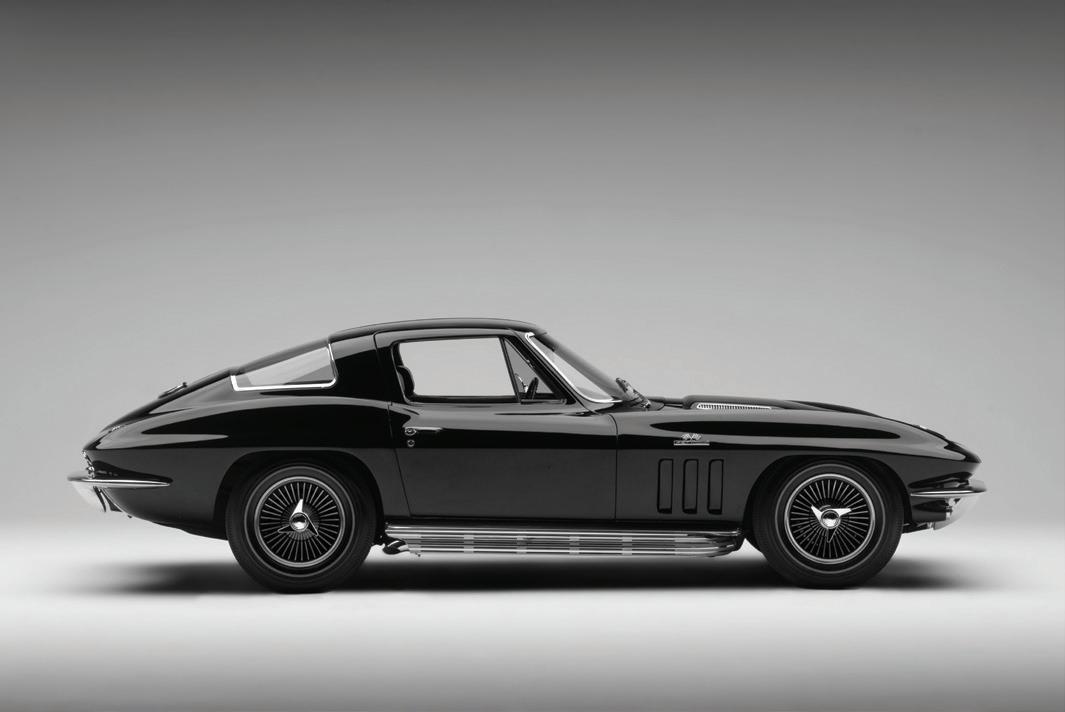
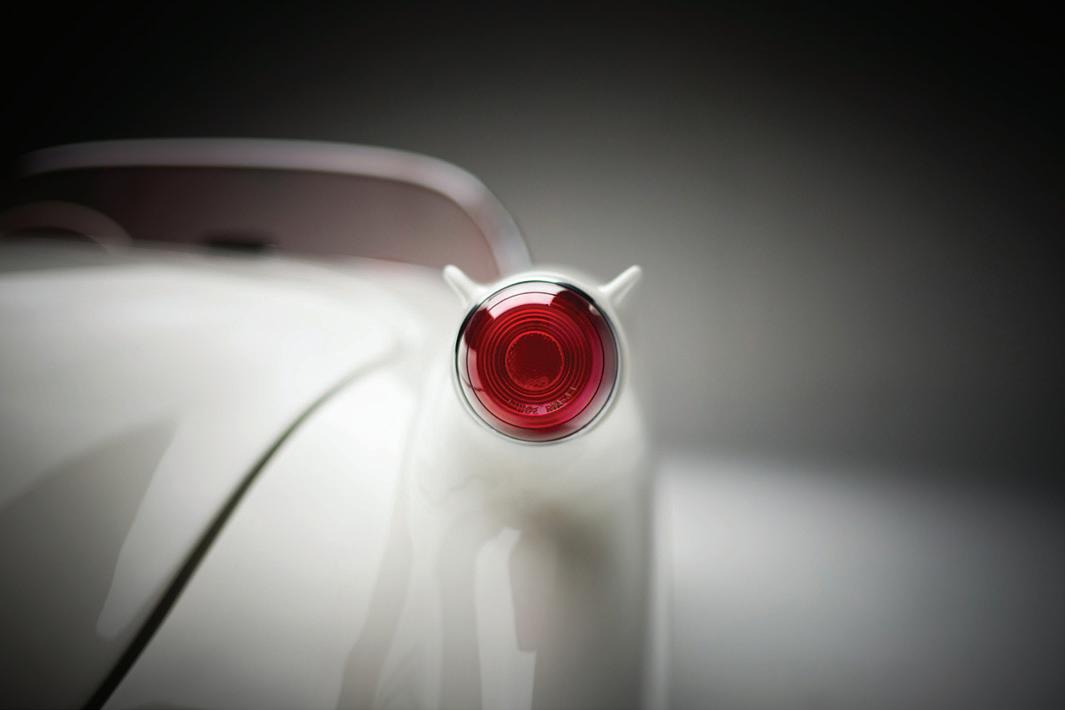
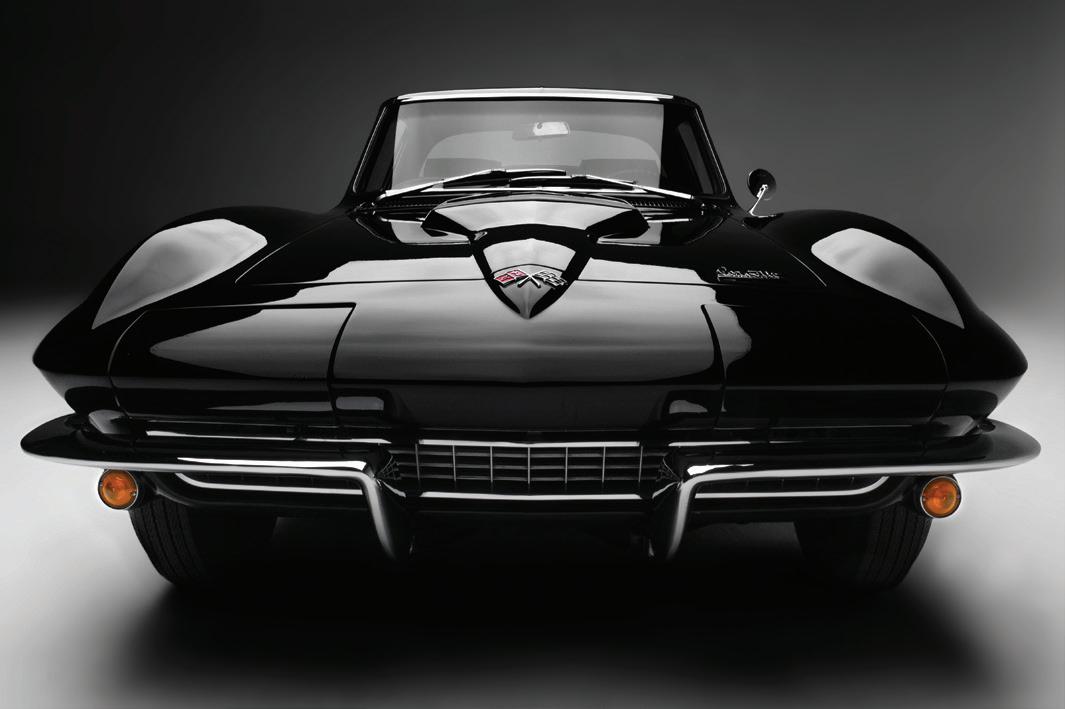
The back of the 1966 Corvette is just a wonderful design. The back of that car was a visual that I couldn’t ignore.
My special thanks to Richard Driehaus for the opportunity to visually capture his wonderful American automobile collection. I also wanted to thank Stephen, Mark, John, Jesus and the rest of the amazing team that takes care of the collection.
1966 Corvette
1941 Graham
Using a Small SM 35 & 50 Leica System
by DICK GILCREAST
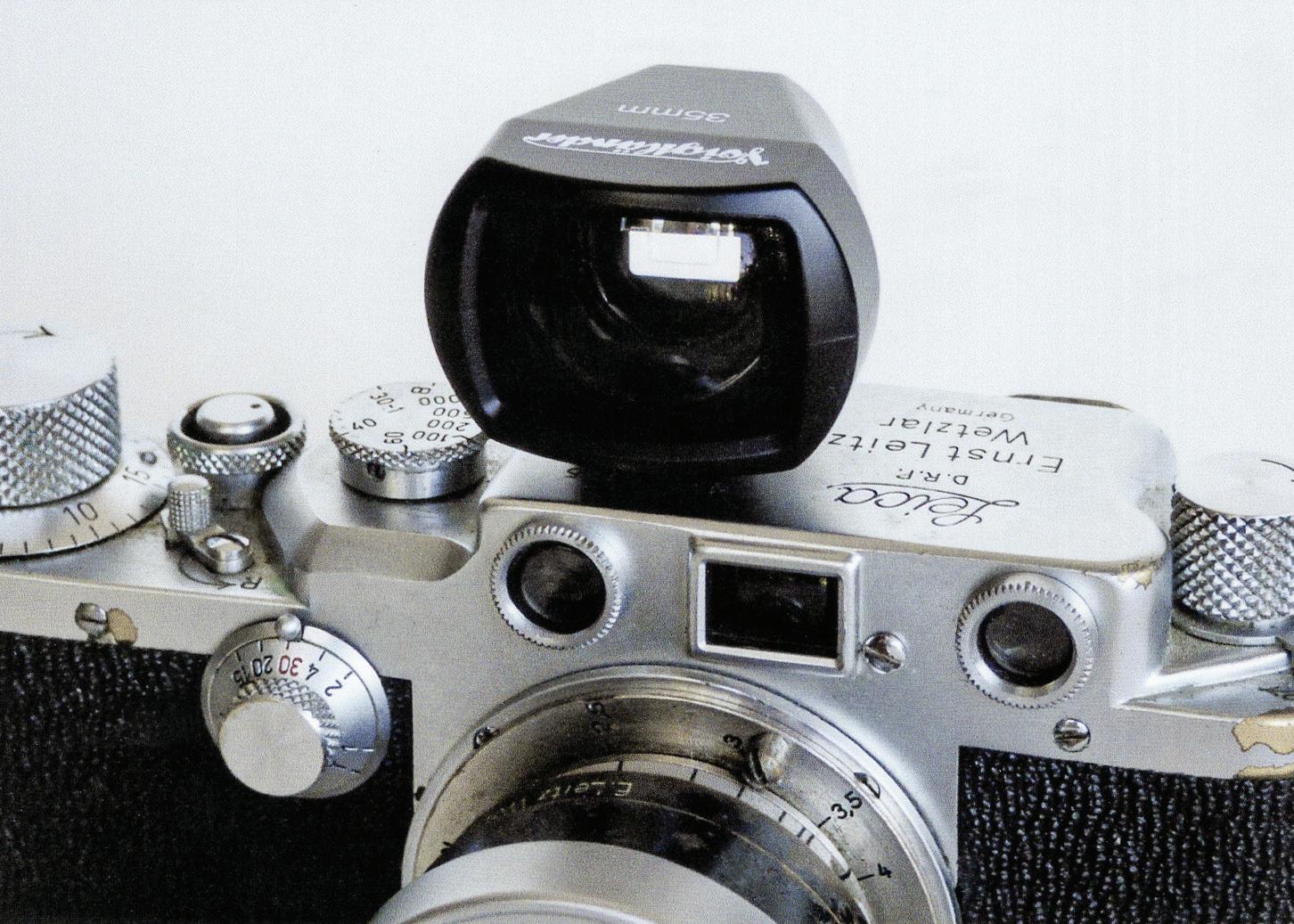
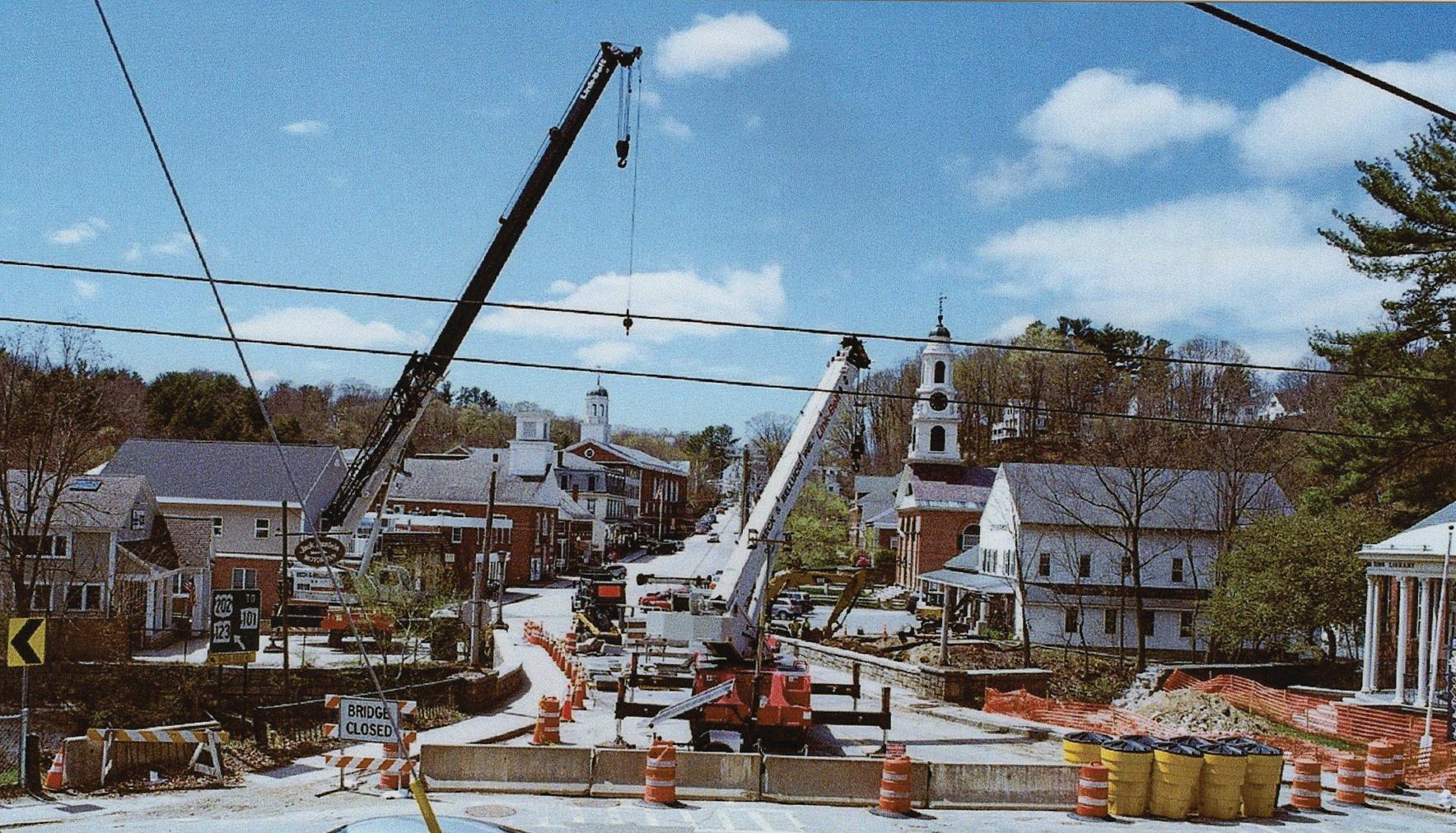
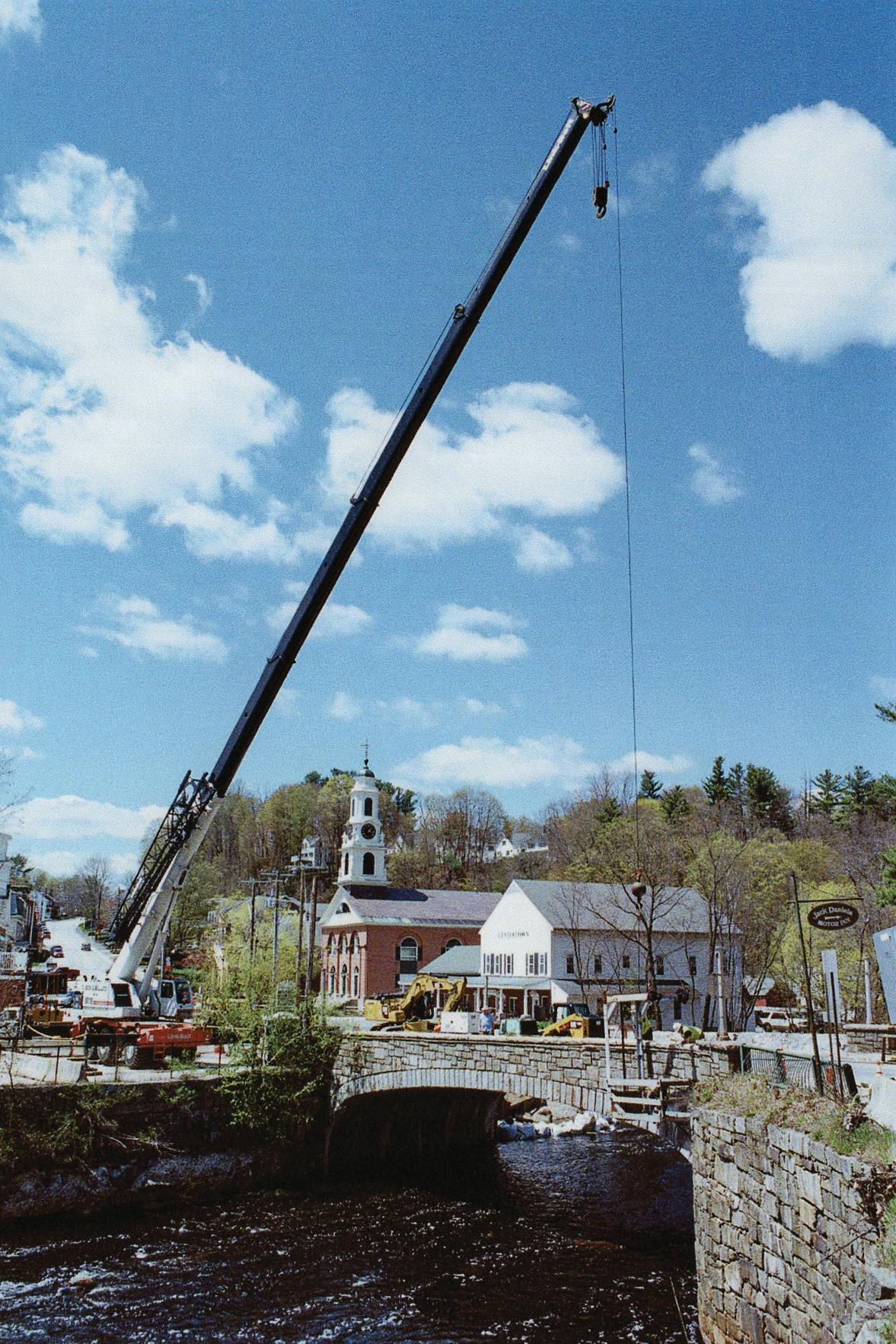
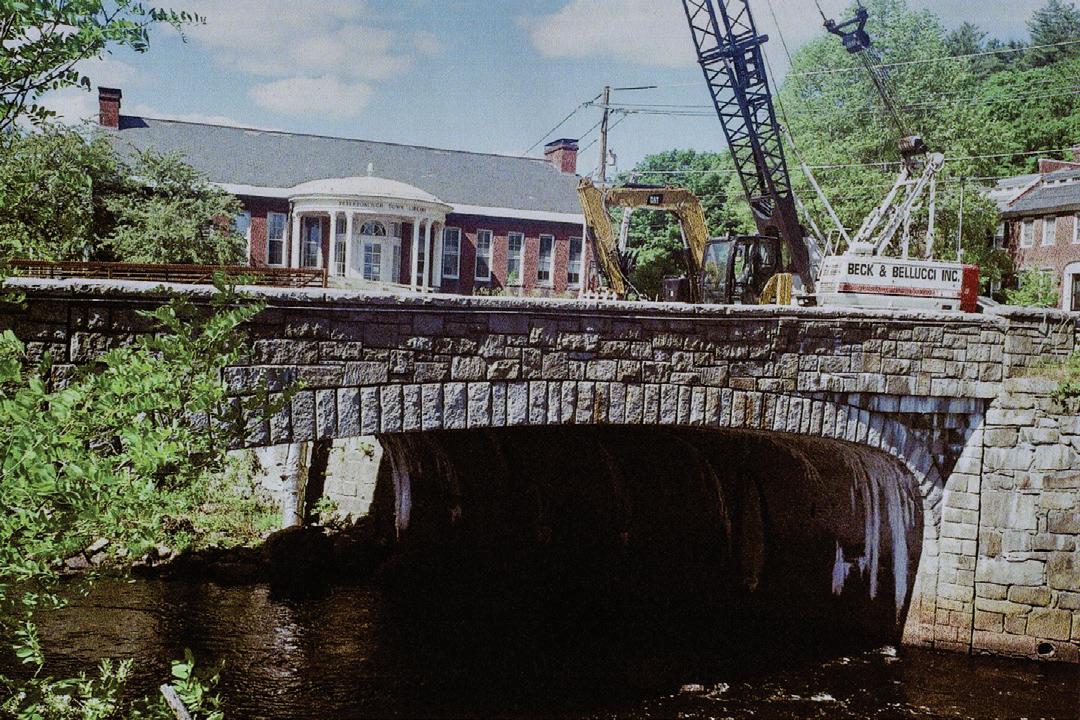
These are the sort of pictures you can get from the side of the road if you have a camera with you. And the small SM Leicas are well suited to this role -- in this case a couple of Illc cameras with 35mm Elmar and 50mm Summitar lenses on them to show the beginning stage of the replacement an 80 year old red-listed Main Street bridge in the small town of Peterborough NH. The vertical shot shows one of the first jobs for the tall crane in suspending a cage over the river with a worker in it taking dimensions and marking some of the larger stones to be used in the reconstruction. The project is estimated to take more than a year, and shots will be made of the demolition and rebuilding, maybe to be used by a local newspaper or magazine.
The two Leicas in a Tenba shoulder bag make up a small system that can do a lot without any backup, and will be used to record this continuing replacement. Either lens can do a whole story working solo, but having both together already mounted on cameras offers more total capability, as well as providing a quick alternative if one camera runs out of film at an inopportune moment.
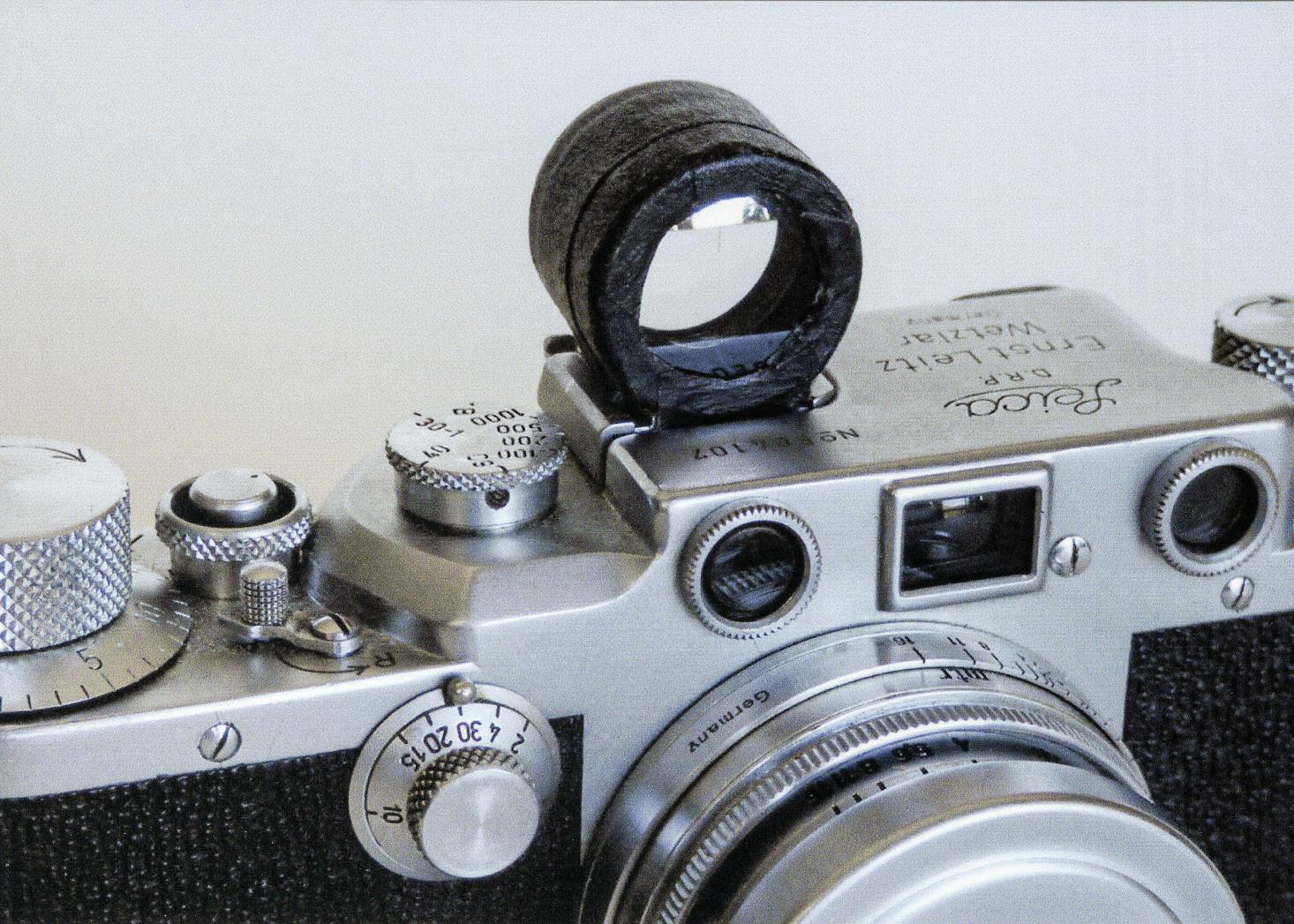
Viewfinders used for both lenses are the brightline types shown. The 50mm finder is the Leitz SBOOI (chrome, covered
with black masking tape), and the 35mm finder is the black plastic finder by Voigtlander-Cosina. Both show just about the same large size frame to the eye so they work well together, and they also both show their whole fields of view when I'm using glasses -- dark glasses in bright sun or clear ones in dim surroundings such as a theater -- in many situations the bright framlelines seem an advantage. And both finders are small and without any sharp edges that can catch on the clothing when the camera is carried under a jacket.
To round out the system in the bag there is also a 135mm Hektor, with its own Leitz brightline SHOOC, and a small auto-flash for impossible light -- both very handy when needed -- one of the Illc bodies having had internal strobe synch added.
Film may be old style, but once in a while for personal work I still enjoy making photographs manually, without a lot of technology calling the shots. I also get to see tangible results in the form of negatives to make the prints from. So I keep carrying and using this small film outfit, ready to be used anytime, anywhere. I can just grab it and go, with no advance preparation needed before going out the door.
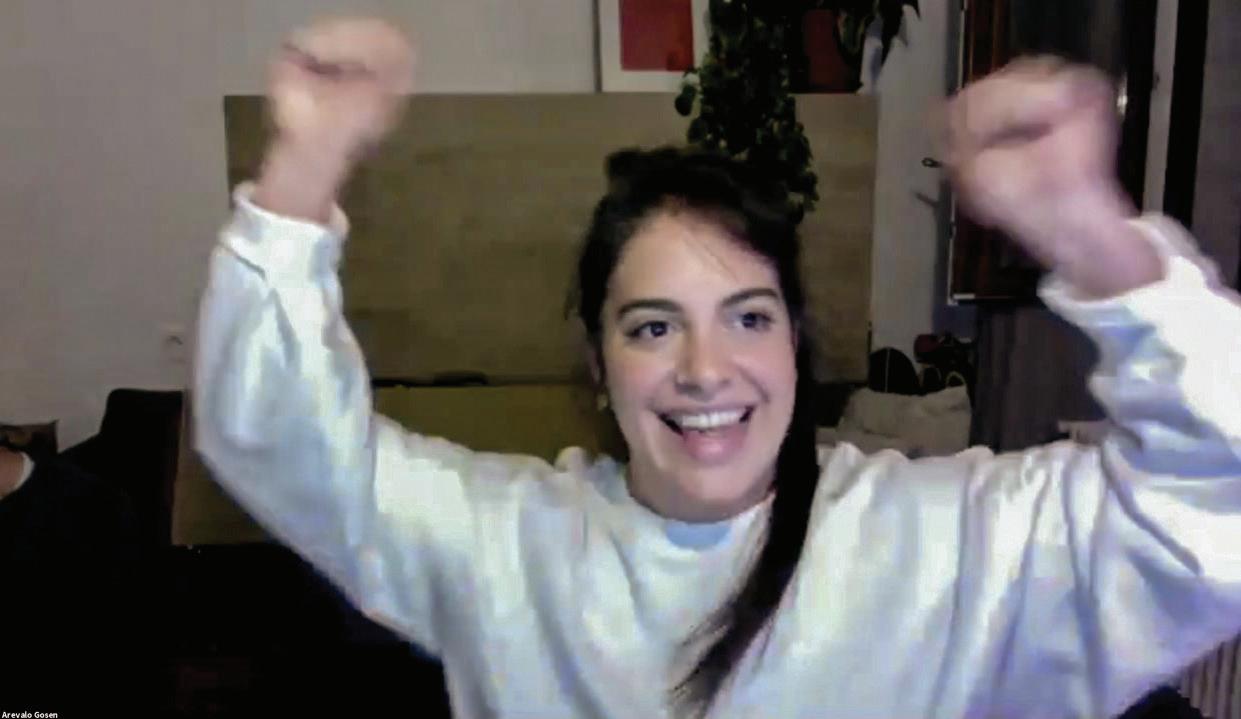
1. Ana Maria Arevalo Gosen, winner of the 2020 LHSA Photography Grant, shared some of her heartbreaking photographs of life in Venezuelan prisons for women.
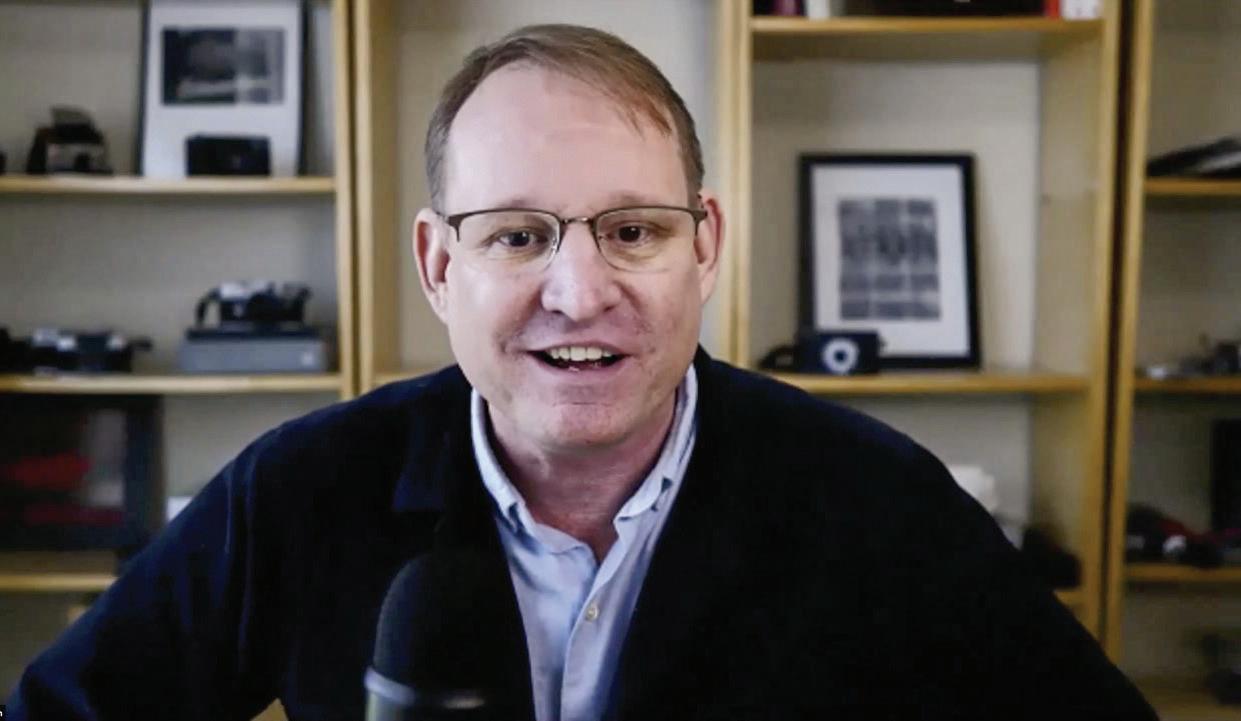
2. - 3. Conference attendees loved the opportunity to have their photographs reviewed by former White House picture editor Sandra Eisert, and Leica Akademie director Tom Smith.
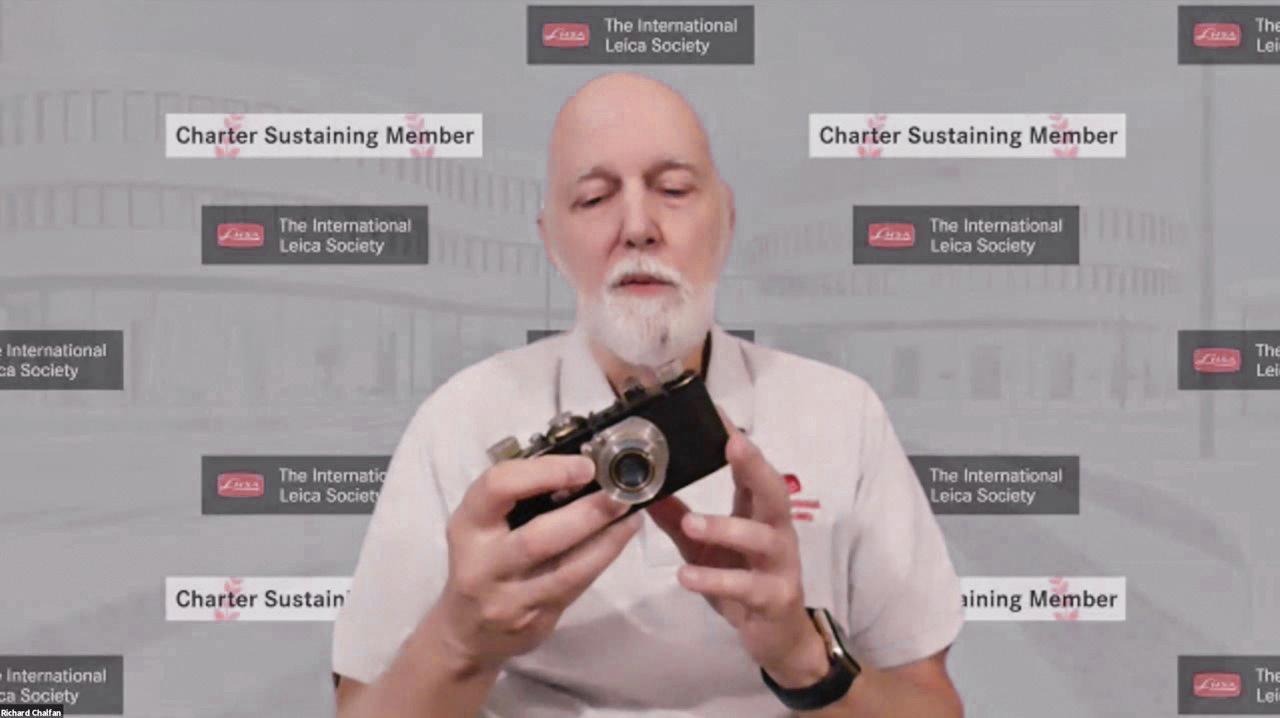
4. Richard Chalfan presented the Leica Model 1A and taught us how to photograph like Henri Cartier Bresson did in 1930.
FALL MEETING WRAP-UP by BRAD HUSICK
October 9 and 10, 2020, the LHSA held its Annual Conference, and for the first time, the entire event was virtual, held on the Zoom conferencing platform. While this was new for us, the event was a big success, bringing in members from across the globe.
The speaker roster was the strength of the program. The conference covered topics from technology to artistic interpretation, and the support from Leica AG and Leica Camera USA was superb. The conference opened with a fascinating presentation from Peter Karbe in Germany, Leica’s “lens master” himself. He began with the earliest cameras and brought us on the journey to today’s digital marvels. The description of lens and film/sensor comparisons, including smartphones, was intriguing. It proves the adage “there’s no such thing as a free lunch.”
Our outgoing president, Alan Weinschel, conducted his final business meeting for the group and announced the next leaders - Keith R. Sbiral as President and Brad Husick as Vice President. Alan has been an extraordinary President, growing LHSA membership to nearly double the number from when he started his executive roles. We will miss his leadership, and we’re excited to see what the new administration will bring.
Brad Husick announced the new LHSA Sustaining Member program, and by the time the conference ended, we had 50 generous supporters. We look forward to welcoming more Sustaining Members, and details of the many benefits are available on the LHSA website.
Leica landscape photographer extraordinaire and Leica Akademie instructor Philip Blair shared his deeply personal story of the role photography plays in his life and outlook. The stunning monochrome photos he shared underscored his narrative. If you could hear a pin drop in a Zoom room, this would have been the time.
It’s hard to imagine topping Philip’s presentation, but new LHSA Board Member Sandra Eisert indeed matched the challenge. Sandra is the first White House picture editor and served under three US Presidents. She has photo-edited more than 100 books and played a crucial role in creating MSNBC. com. Sandra spoke with us about finding meaning and direction in your photography, creating images with purpose. Her insights regarding what makes a photo portfolio improved all of us in the short hour of her talk.
President Keith Sbiral welcomed us to day two of the conference, which started with our friend from Leica Camera USA, Antonio Di Benedetto. He shared his insights on the new Leica M10-R camera and the effect that the new camera
has on imagery. Going far beyond the specs, Antonio was able to use his images to convey the power of technology to create art.
Speaking of art, our next presenter, Richard Chalfan, gave us a unique inside look at the photographic tools that Henri Cartier-Bresson used to create his iconic images. Richard, a former Leica Store Ambassador, has assembled a nearly complete collection of 35mm Leica cameras from the earliest models to starting the digital age with the M8.
Our friend John Kreidler from Leica Camera USA then shared his perspectives on the Leica professional line's newest members, including the SL2 and S cameras and lenses. Seeing different Leica lenses on the same camera taking the same photos gave us a view on the subtle but essential differences lens choice can make. We are all impressed by the incredible quality of the images he brought.
Wrapping up the conference, we decided to try something new, a more interactive experience. Several weeks before the conference we asked registered members to submit one to three photographs on the theme of “close to home.” Tom Smith, director of the Leica Akademie USA, joined Sandra Eisert for a fascinating review of these photos, giving their honest feedback and tips. We all learned from the experience and emerged with new perspectives on the strange year 2020 has been and how our photographs reflect our lives.
We were delighted to announce that Ana Maria Arevalo Gosen is the 2020 LHSA Photography Grant winner. She shared some of her heartbreaking photographs of life in Venezuelan prisons for women. See the website for her story and more of her incredible images.
Throughout the conference we were able to give away valuable door prizes to attendees thanks to the generosity of our sponsors XRite, Novoflex, Oberwerth, Rock N Roll Straps, and DxO. We awarded more than $4000 in prizes. We also awarded direct 1-on-1 sessions with several of our speakers, and the feedback we have received has been inspiring.
A conference this successful only happens with a lot of work behind the scenes and no one deserves more praise than our own Executive Director Richard Rejino. The entire team orchestrated a smooth, trouble-free event for all. We look forward to the time when we can gather face-to-face again, and our next Annual Conference is scheduled for October 2021 in majestic Seattle, Washington.
- Brad Husick, VP
THE MOUNTAIN ELMAR & THE MOLE-HILL ELMAR
by ED SCHWARTZREICH
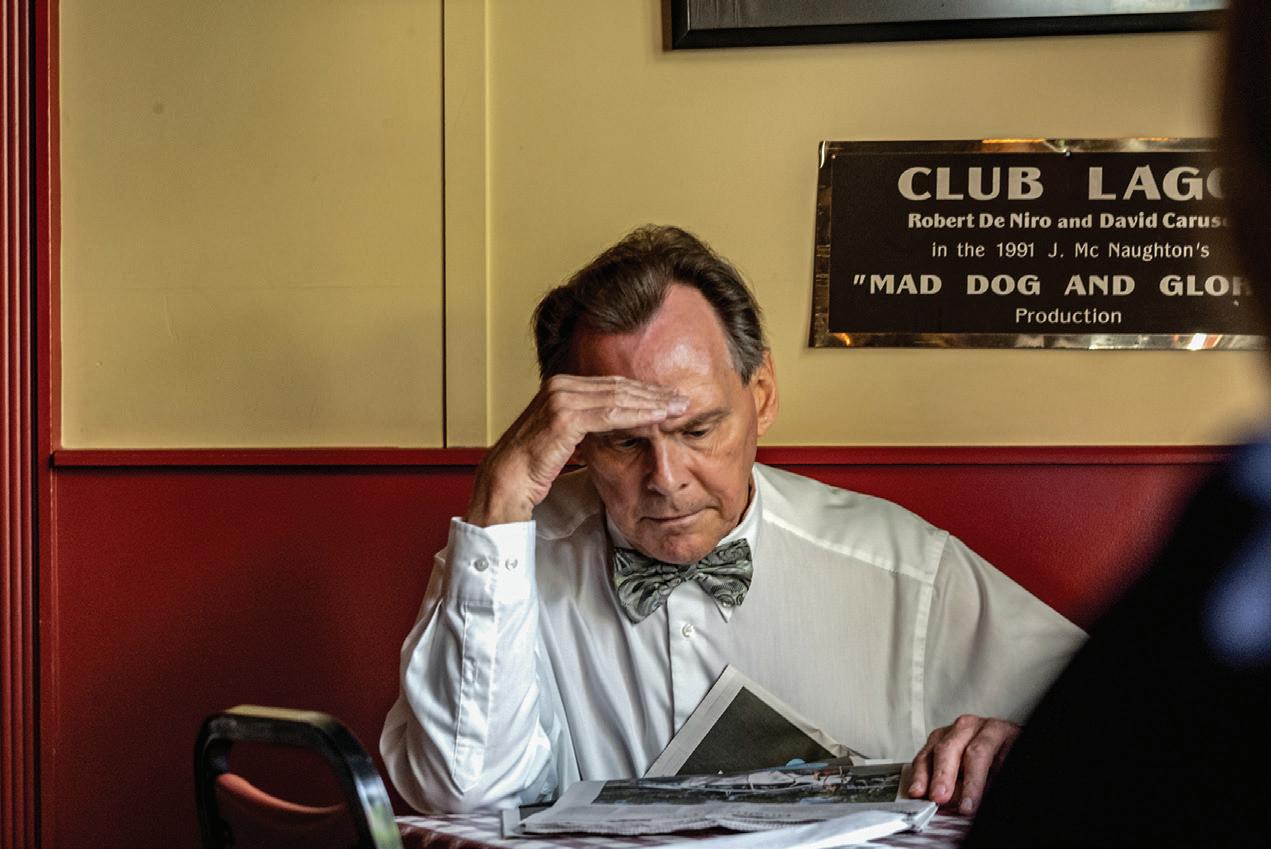
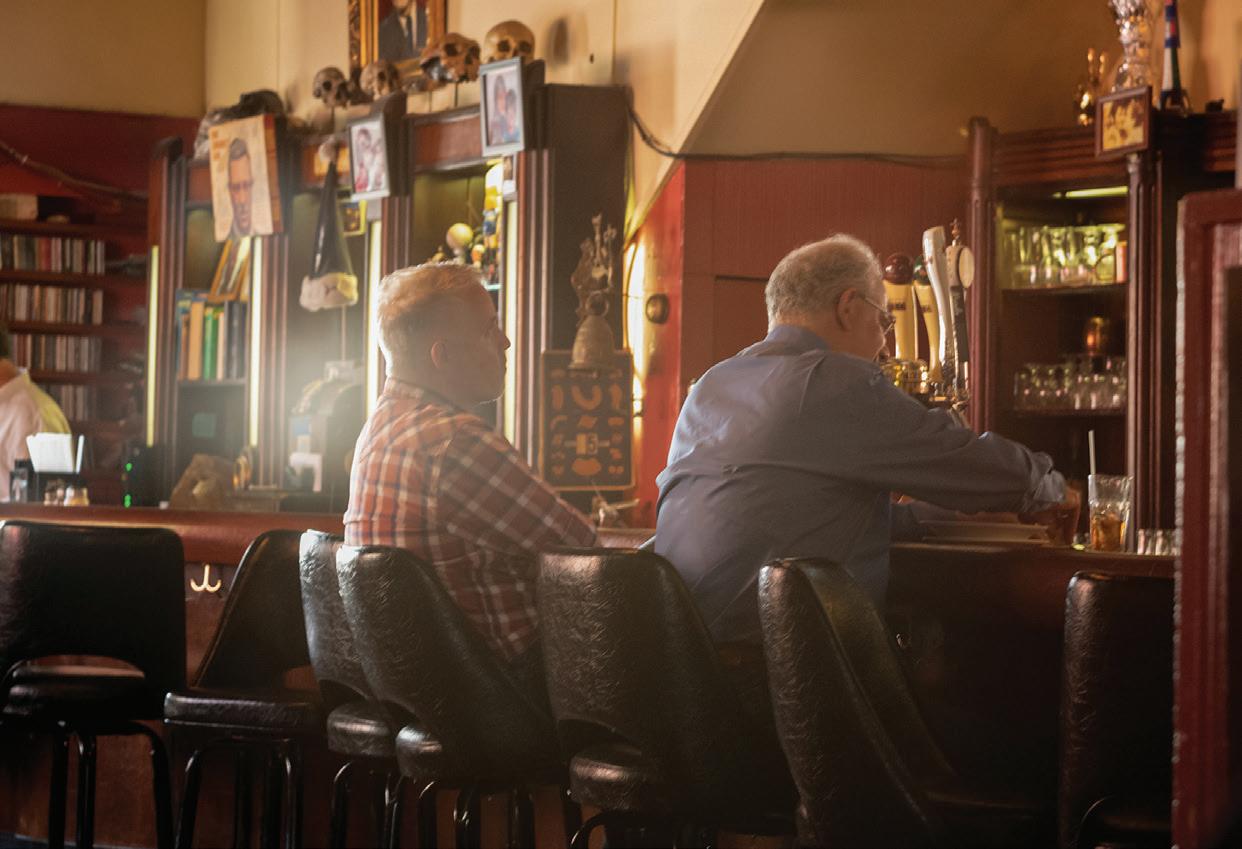
Several years ago, I bought a 1936 black / chrome 105/6.3 Berg Elmar for my collection. I was curious to use this, so right off I put it on my M10. Luckily, I had a SM to M adapter with me -- and made a surreptitious grab shot of a man at a restaurant table a few yards from us who looked like Oskar Barnack. (figure 1) A most appropriate subject and seemingly a good omen, even if my attempt was not critically focused nor free of an intruding object.
However, this Elmar turned out to have a bad flare problem. Here is the very next shot to show this. (figure 2) Nonetheless, the lens was very clean, the easily-lost caps and shade were all there, the price was reasonable, and I felt sure that I could likely remedy the flare by some due diligence.
(figure 1)
When I had time to look into the flare situation, I tried various cleanings of the lens elements and uses of both the original shade and a makeshift one. Nothing really helped. So, I did what we all might do from time to time: declared a truce with the problem and shelved the project for a rainy day. Recently, with the pandemic, that day arrived.
Entirely separately, I had decided that due to the virus I had plenty of time to test out a lens that Tom Abrahamsson had urged me to buy way back when -- the Cosina Voigtländer 50/3.5 Heliar, the lens that Modern Photography had decreed was the best 50 they had ever tested optically. I wanted to compare it, informally, with my go-to 50, the Apo Aspheric 50/2. Tom had suggested that I buy the version of the Cosina lens in Nikon S mount, so that I could use it on several bodies: Nikon RFs and also SM and M Leicas with appropriate adapters. Tom had named the Nikon S version of this lens “The Mole-Hill Elmar” because of its size and shape. (Perhaps the reader can sense where this story is going.)
Well, I both reacquainted myself with the superb Cosina lens (it is amazingly good), and also decided finally to do something about my Berg Elmar. The Elmar was so clean and nice that surely the fix would be simple if I could get my head around it.
Perhaps I was getting an internal reflection from somewhere in the barrel rather than via the lens elements per se, although when I examined the dismantled elements, it did appear that they flared easily. There were places in the barrel where some of the black flocking had worn off, and especially on one screwhead just behind where the lens elements screwed in. That could have been the culprit. I decided to obtain the correct black paint and carefully touch all this up.
Recently there are new developments in the matter of VERY flat black flocking. I chose a paint where I did not have to buy a large amount, and where there was a domestic supplier. My choice is called “Black 3.0” and advertises itself as “the blackest and mattest acrylic paint on the planet. Unlike other super-black coatings it can be safely applied with nothing more than a brush”. And for me, like other acrylics, it is water soluble and easy to clean up.
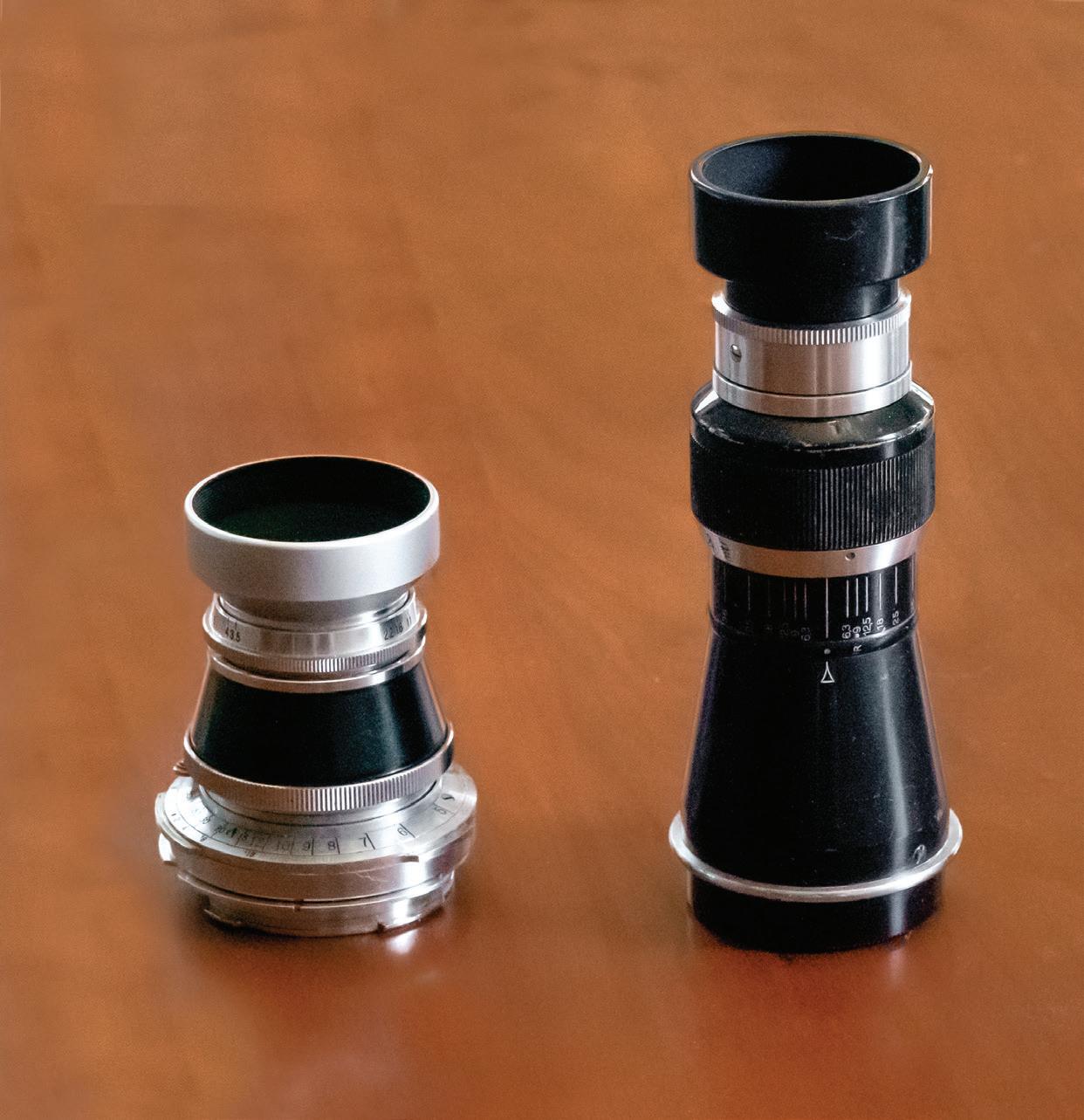
Again, from the fact that I am writing about this in Viewfinder, one can correctly surmise that my re-blackening the interior of the lens barrel corrected the problem. So, here are three more images: a recent shot wide-open with the amazing Cosina lens, a side-by-side of the Mole-Hill and Mountain Elmars, and a shot with the Berg Elmar itself at f/6.3.
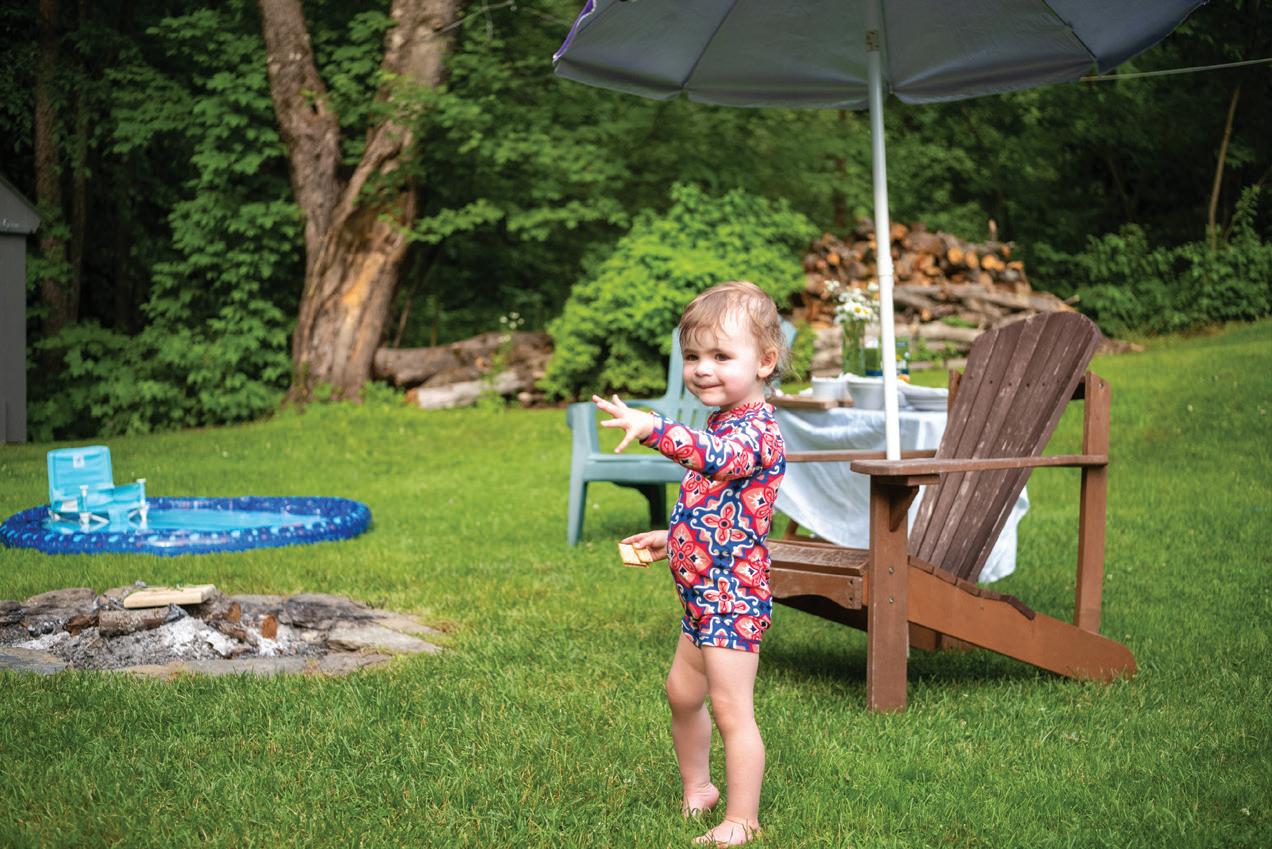
This Cosina shot is actually a crop to a 90mm-or-so FOV. Nice Bokeh! I was invited to neighbors and we sat in our chairs appropriately distanced due to the virus, enjoying our Vermont IPAs. In these relaxed circumstances I took pictures of their little daughter. (figure 3)
Not too much to say about this image, but to remember Tom Abrahamsson and his wit and wisdom. The Cosina 50/3.5 has a Nikon S to LSM adapter, then a SM to M one. (figure 4)
Finally, an f/6.3 Berg Elmar image: that lens is no slouch. No wonder Stefan Kruckenhauser was so fond of it. (figure 5)
(figure 2)
(figure 3)
(figure 5)
(figure 1)
(figure 4)
ASANA
INTO THE HIMALAYAS
by SAMUEL R. J. GILLILAN
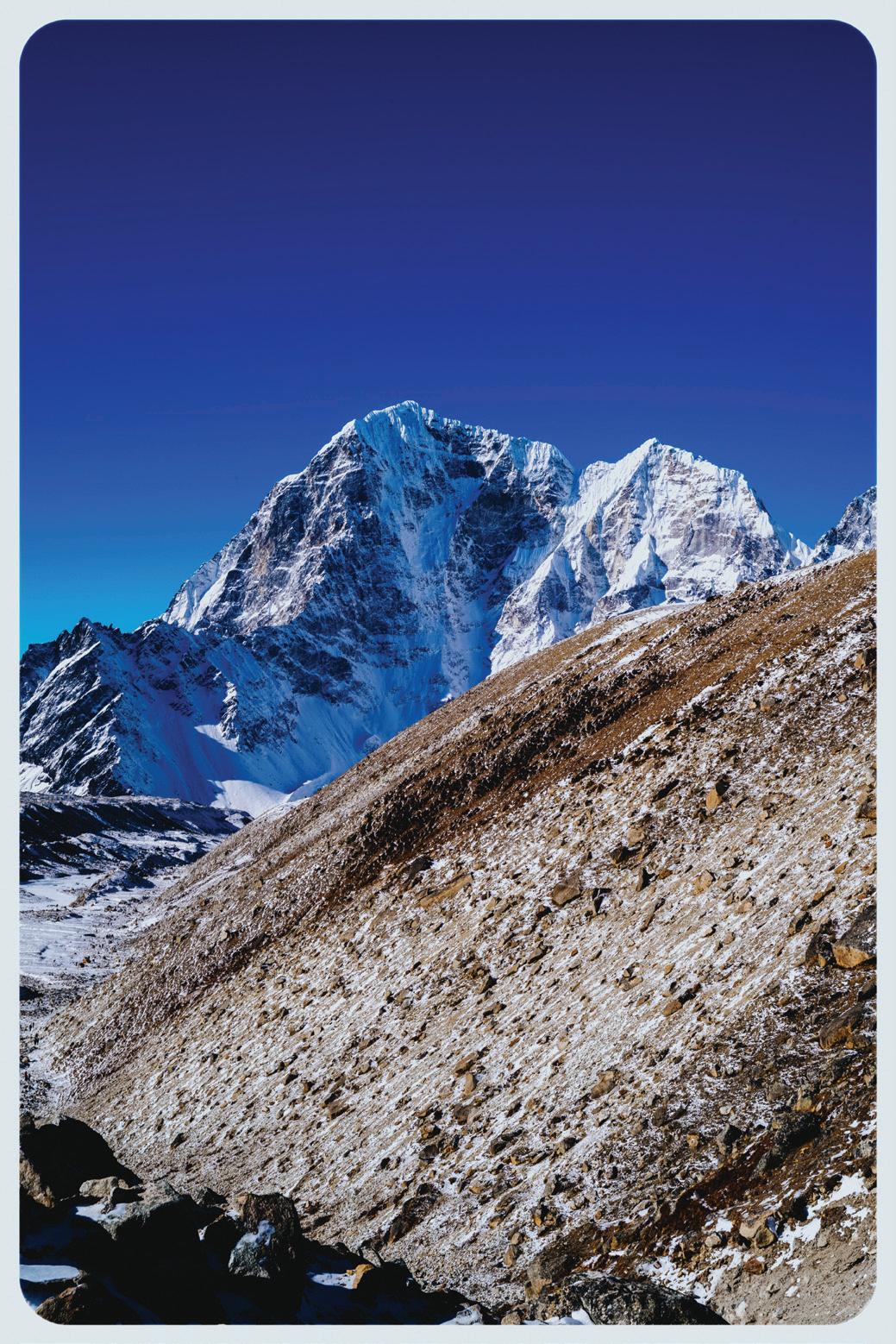
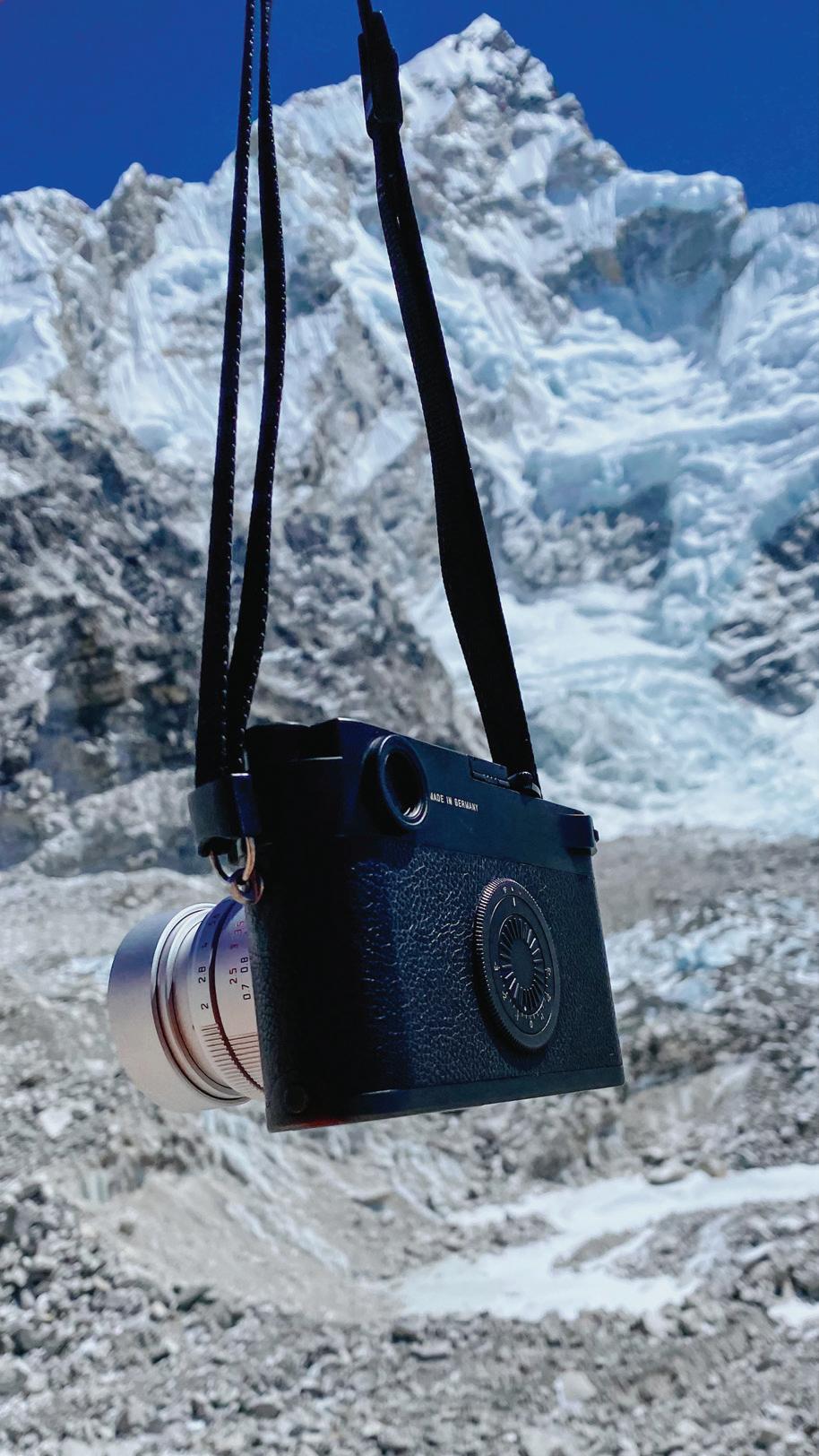
ONthe morning of March 1, 2020, I awoke in my hotel at 4 AM in Kathmandu. With my 20L Peak Design bag packed with all of my worldly belonging, my Leica M10-D and two of my favorite lenses, the Summicron-M 35mm f/2 Asph., and the APO-Summicron-M 50mm f/2 packed in lovingly ready for the coming expedition. This has quickly become my favorite digital Leica M. I have used nearly every previous digital model of the Leica M, the M10-D brings a truly analog with digital benefits, making seeing one’s film roll at the end of the day exciting and builds skill as a Leica M photographer.
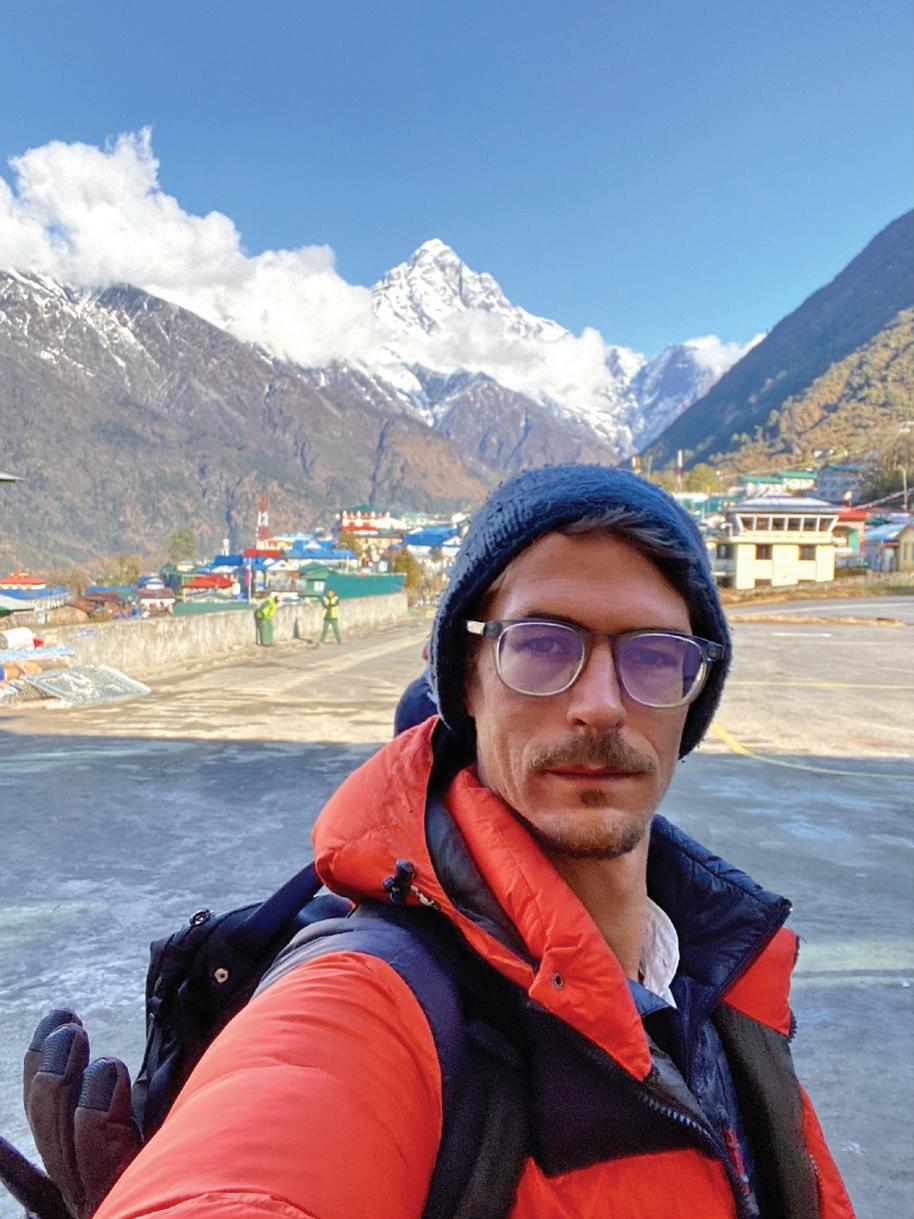
The morning chanting had already begun in the temples nearby, the smell of incense filled the air, the sound of bells rang in my ears, and my neighbor loudly sang the sound of Om. These elements prepared my mind for the journey ahead. This day was special. I booked a sunrise flight with the Nepalese budget airline, Sita Air, from Kathmandu to Lukla, known as the most dangerous airport in the world for landing and take off. Thus began a deeply transformative trek to Mt. Everest Base Camp, a one hundred and fifty mile journey there and back again.
As I arrived to the valley of giants at the Lukla airport, my inner and outer world began to shift. I met my amazing guide, Ramesh, in a local tea house. He was a short Nepalese man with a big smile and a humorous, playful spirit. Despite speaking very little English, he and I communicated as if we were old friends.
"I FELT A TREMENDOUS ACHIEVEMENT TO LAY MY OWN EYES UPON MT. EVEREST."
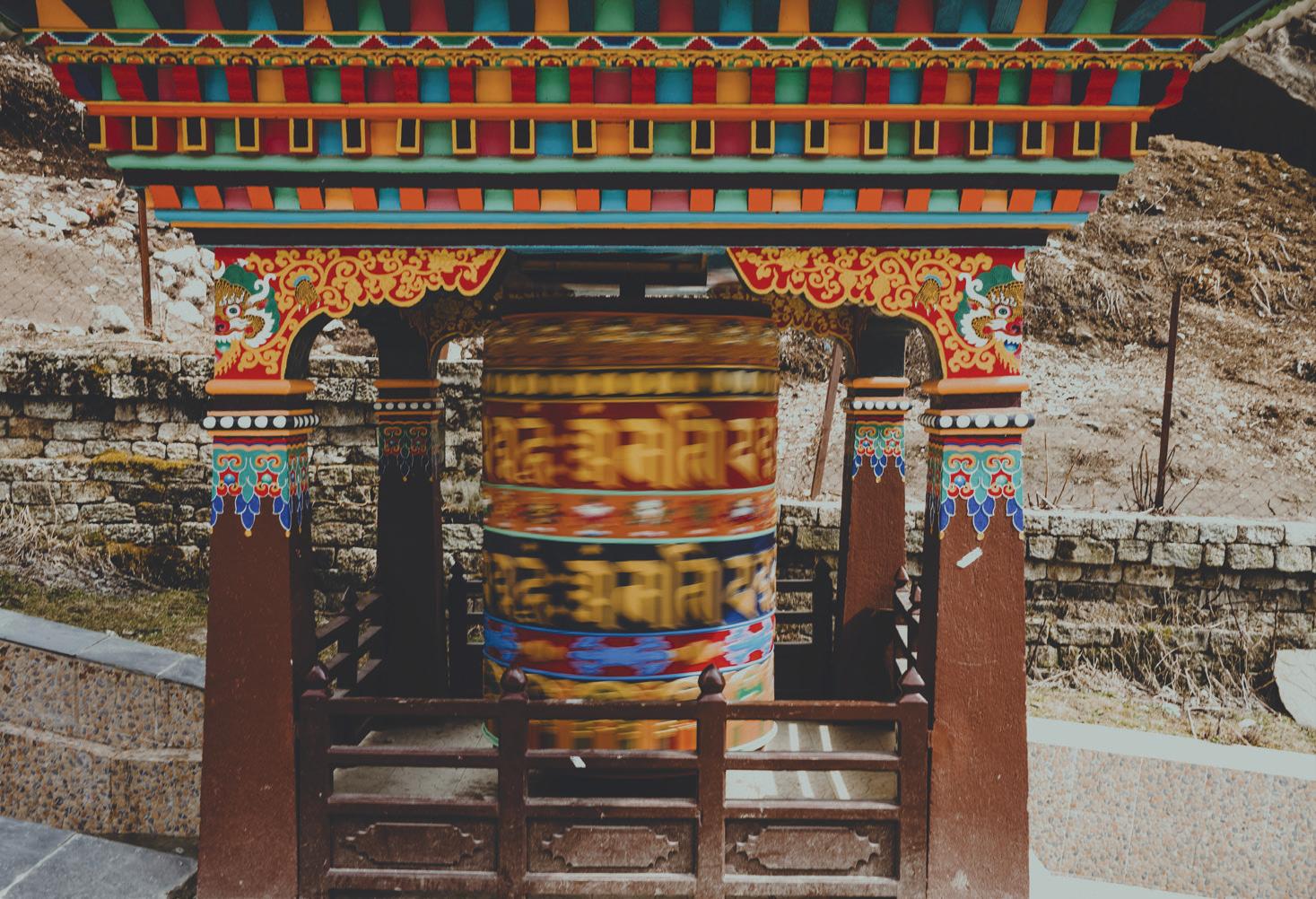
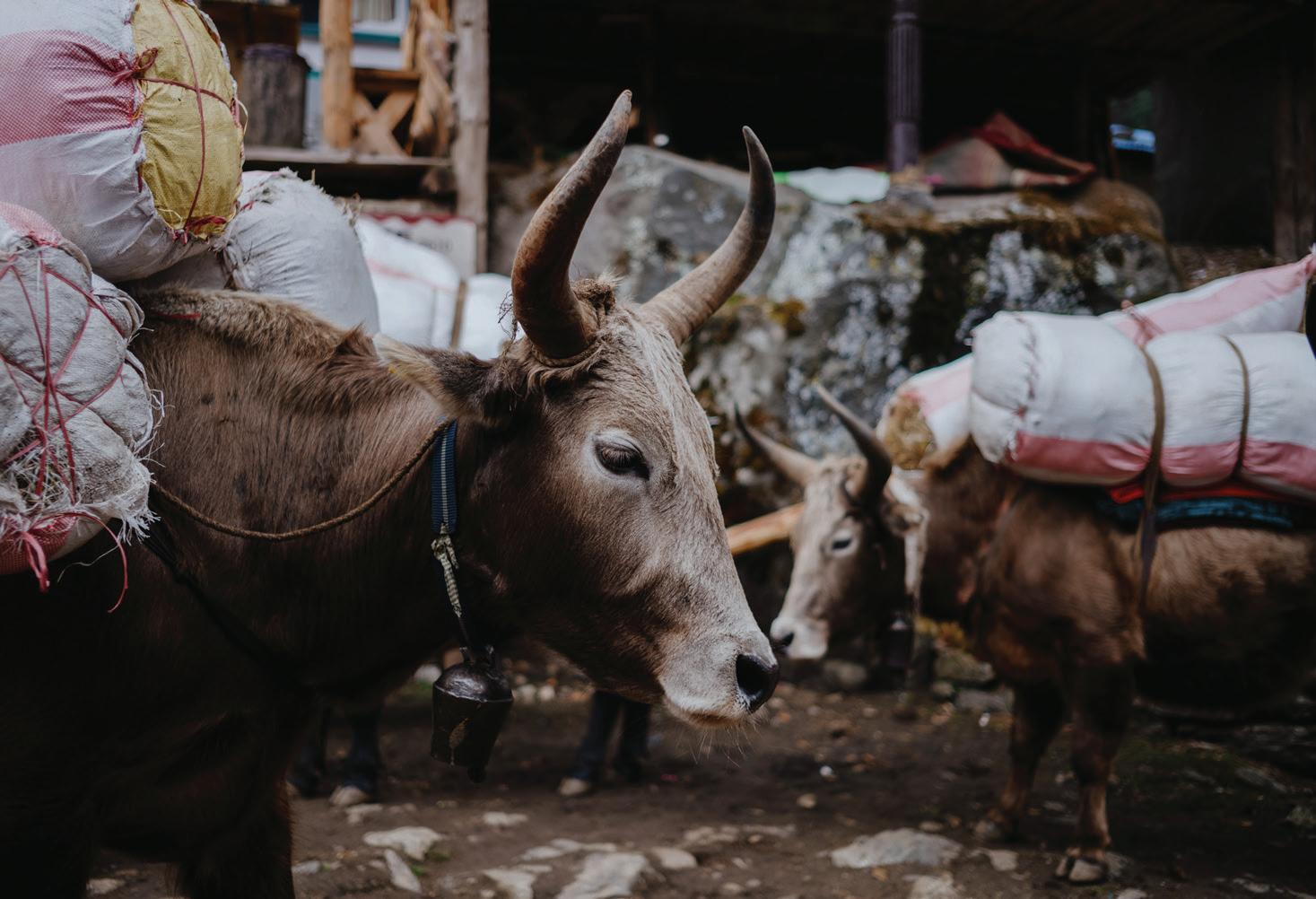
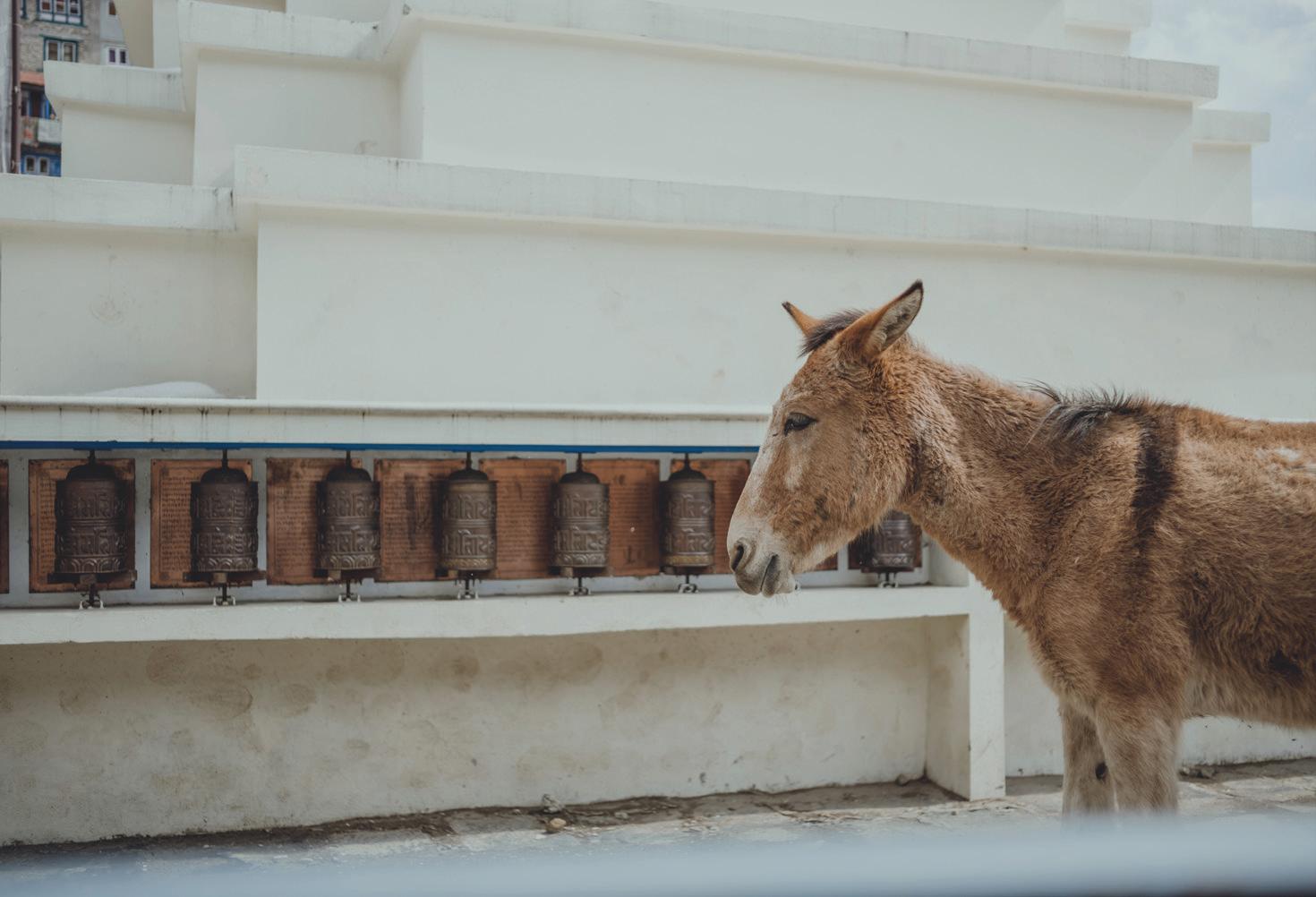
Leaving Lukla on a four hour trek to Phakding, we passed small mountain villages, where people were spinning prayer wheels in their hands and chanting “Om Mani Padme Hum [
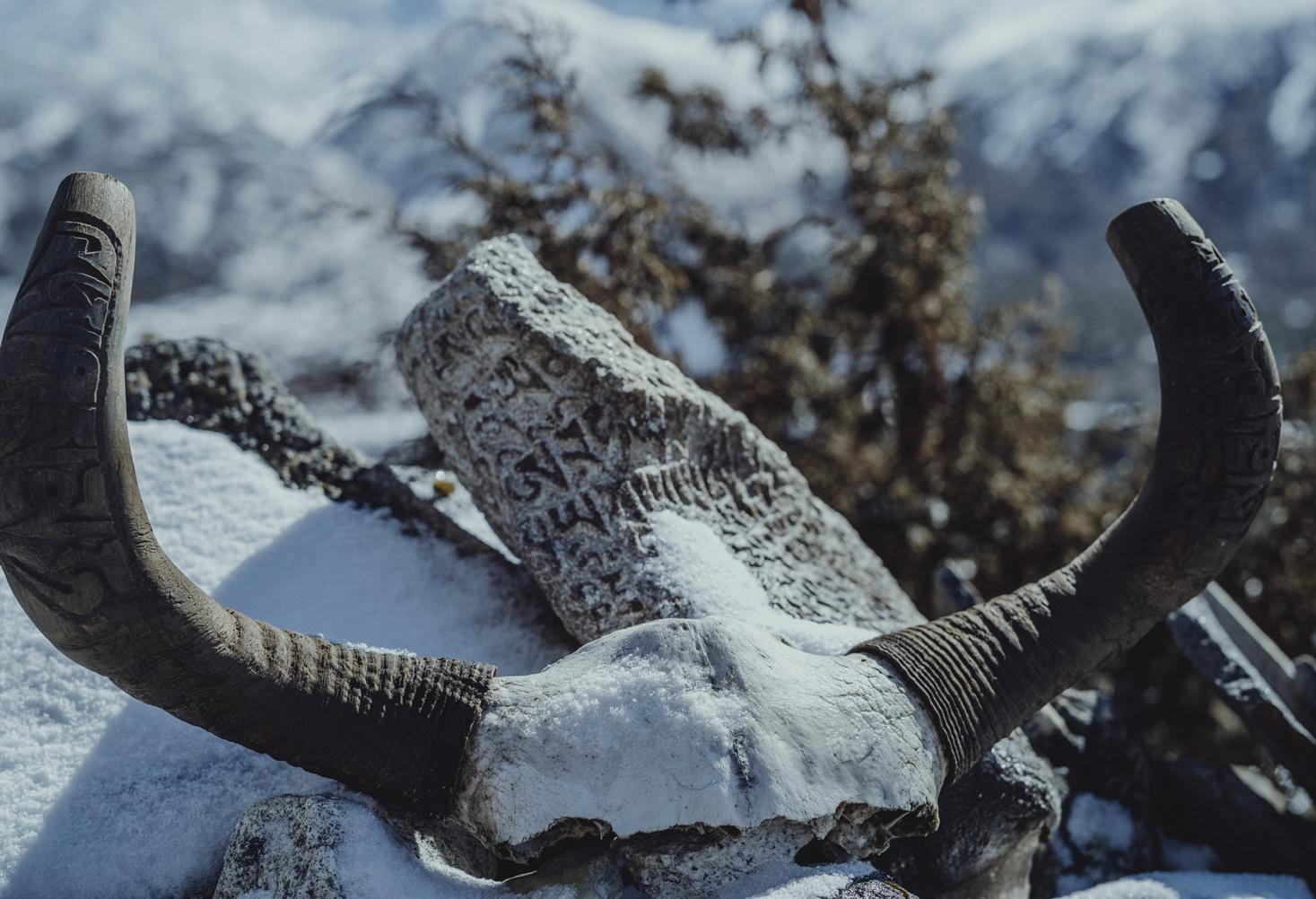
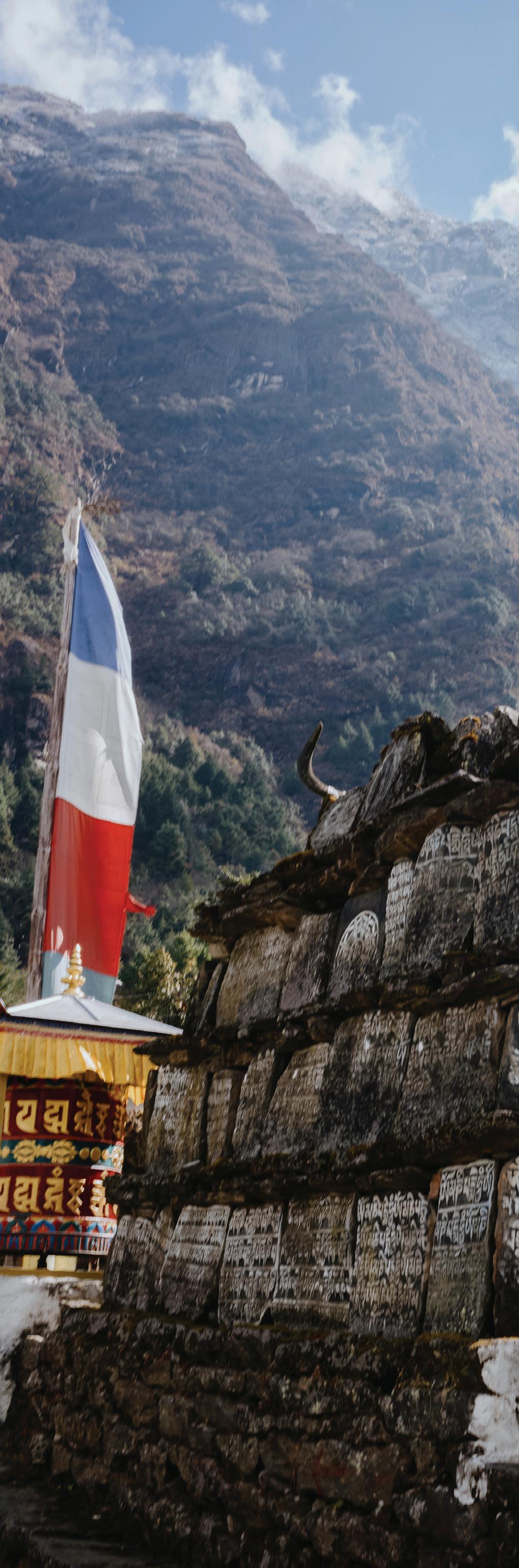
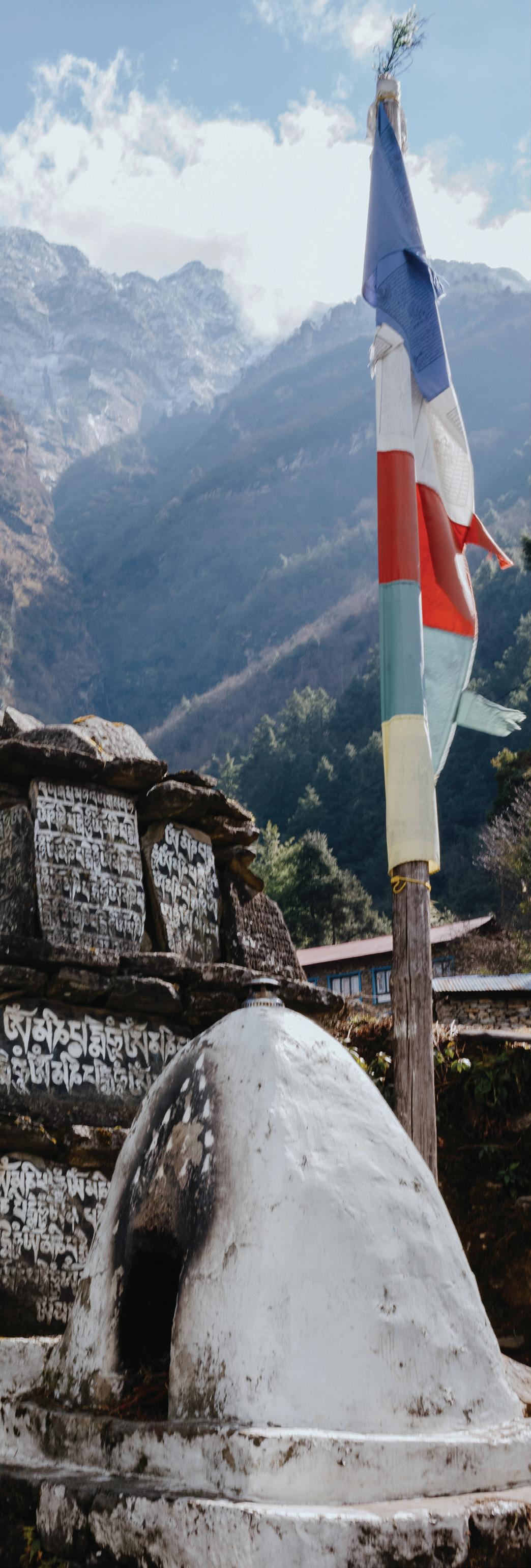
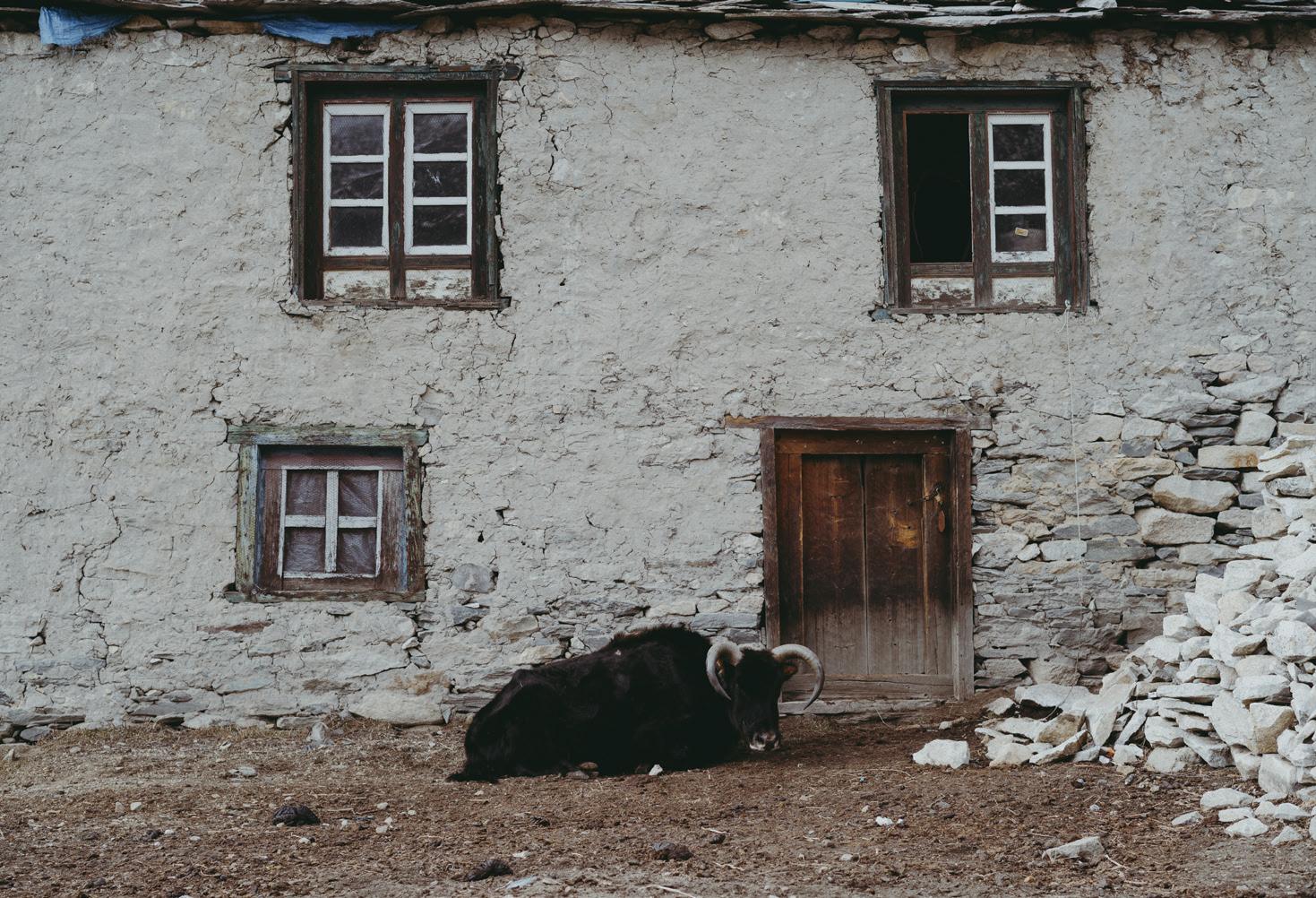
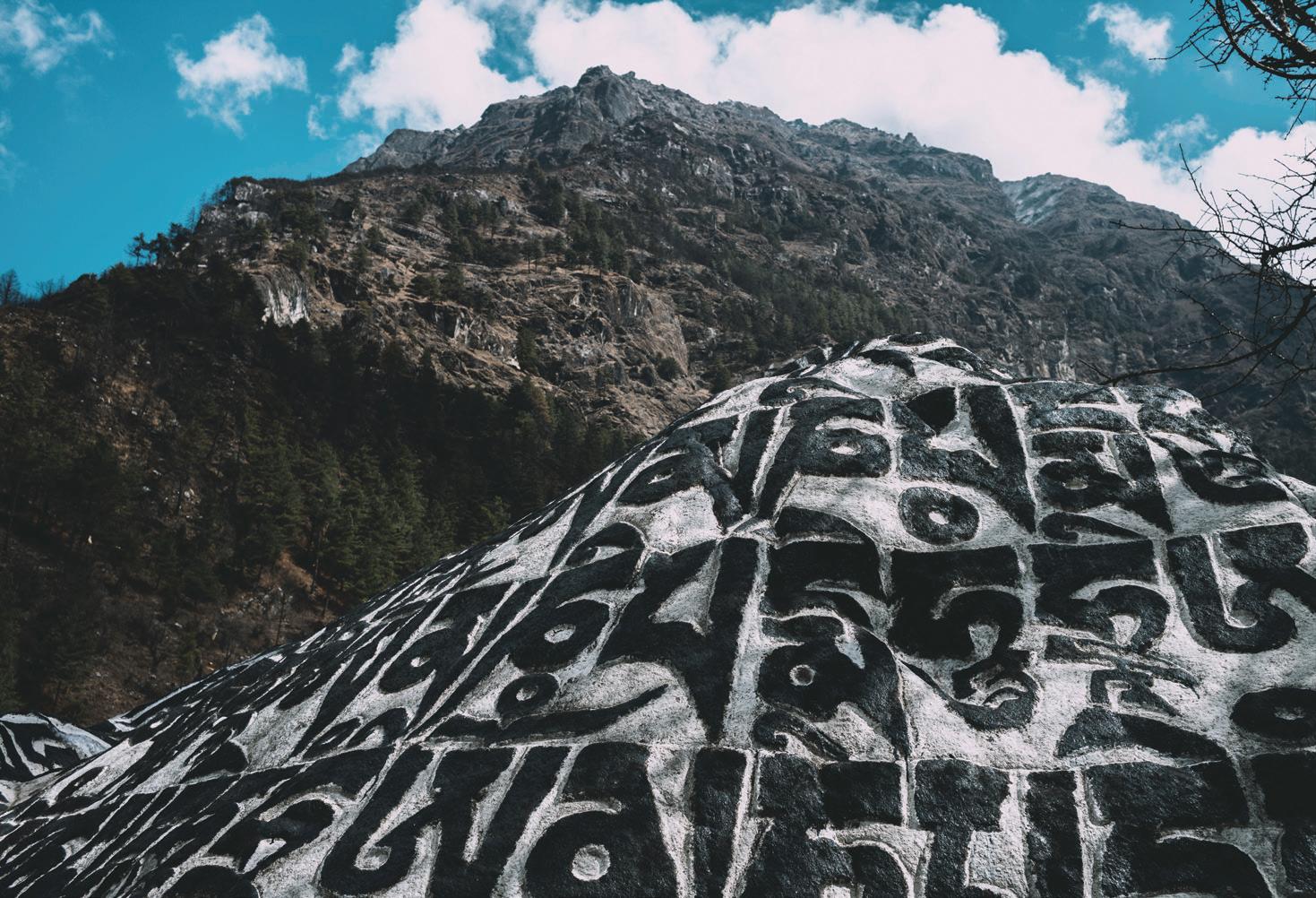
].” The environment was filled with gardens growing in the low lands near the glacial rivers; mules and yak carrying goods and supplies for the Sherpa people; homes and tea houses made of stone; and local dogs huddled together to stay warm. We arrived to the lodge in Phakding for the evening and I began to explore the area. I was in awe that for generations the local people hand carved Tibetan mantras into massive rock formations; and placed stone tablets with prayer inscriptions near stupas on the path.
The next day, a real sense of mysticism sunk in. It felt like
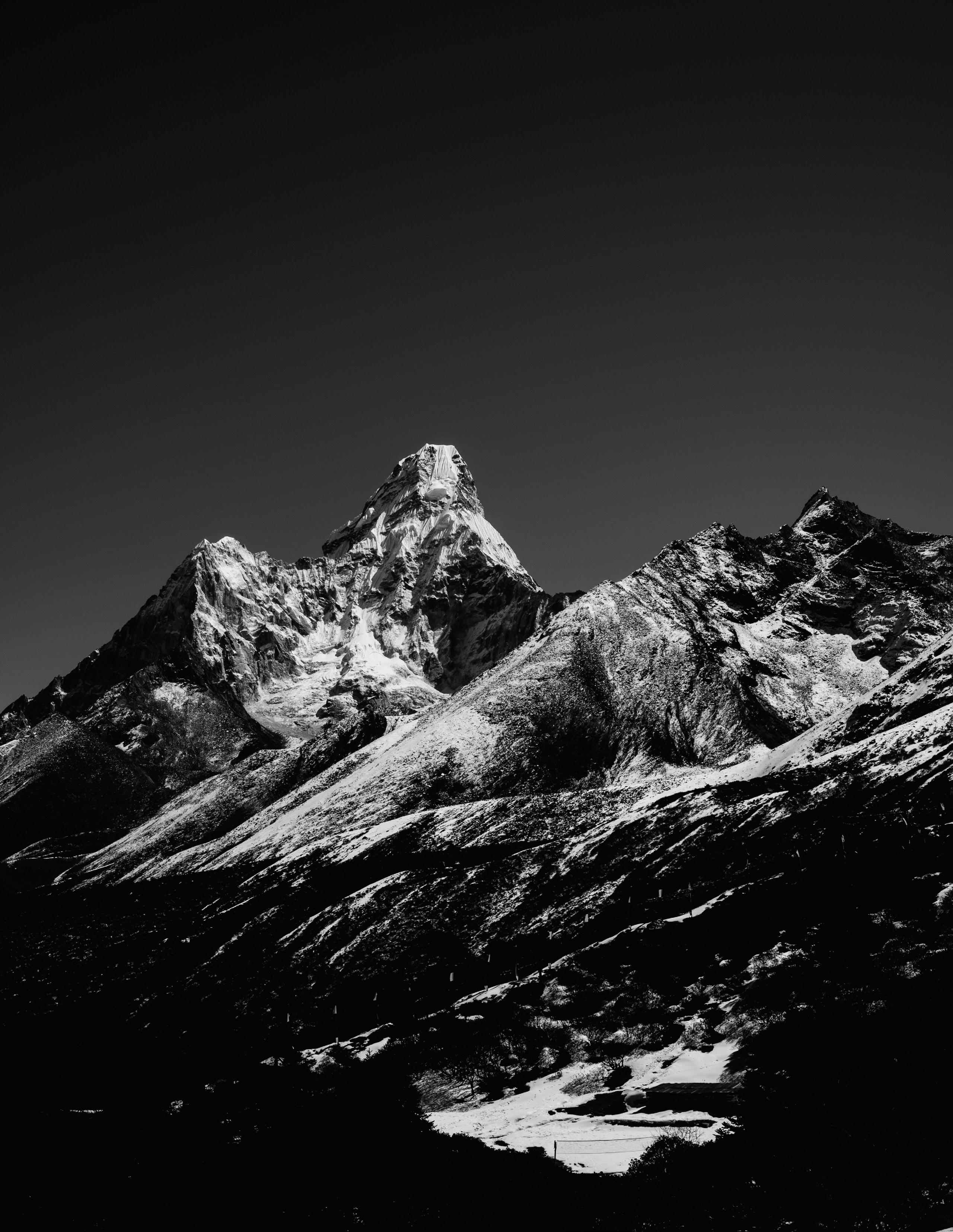
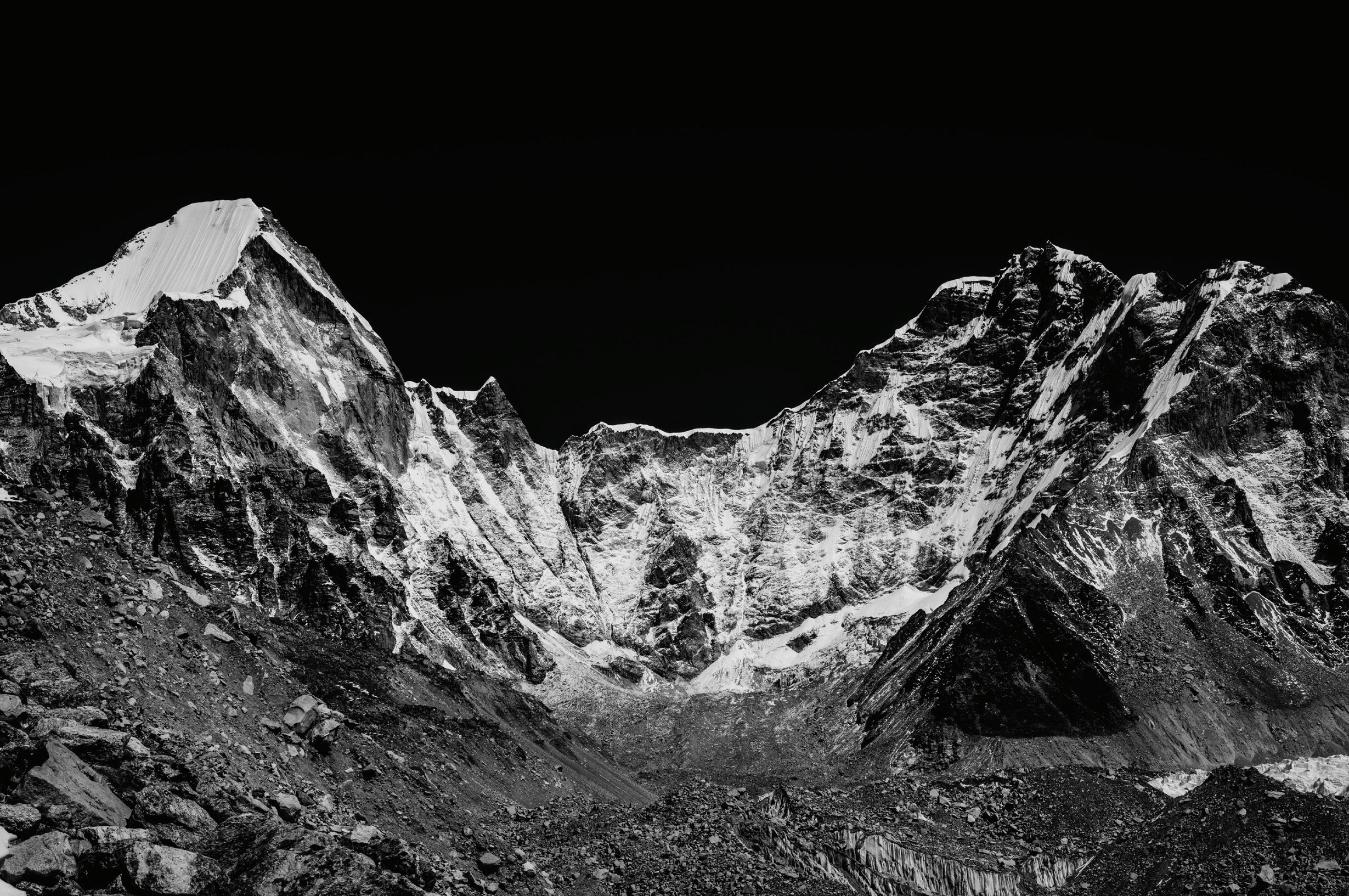
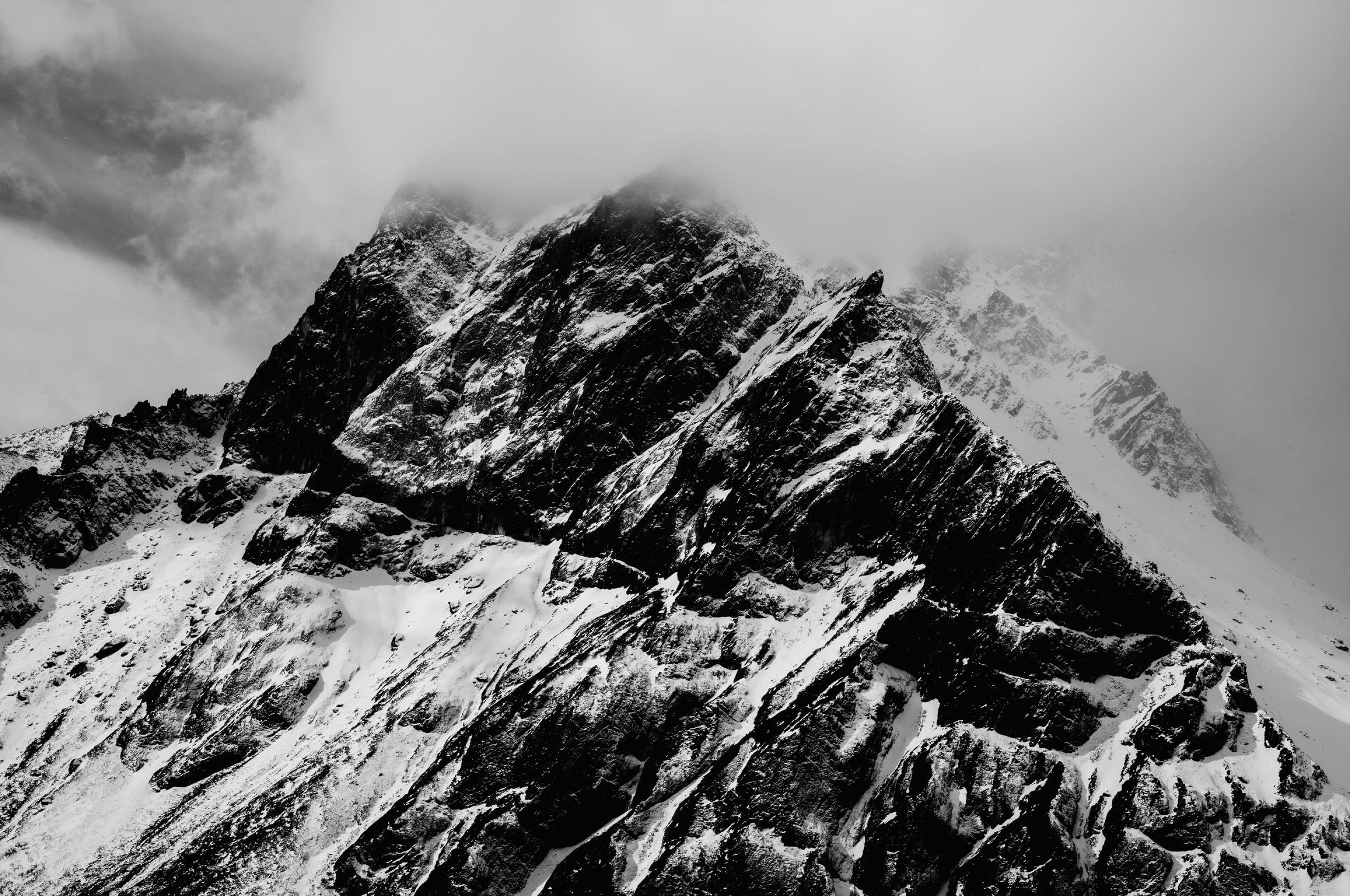
the mountains were speaking in ancient tones through wind, snow and stillness. Because of low oxygen levels at these high elevations, meditation, yogic breathing techniques, and willpower became a necessity for life and balance. I began to exclusively use the APO-Summicron to capture the mystical environment and the majority of images were shot at f/16. The magic this lens produces at full open apertures is incredible for dream-like portraits, however the mountains demanded the utmost detail. That detail can be produced by this same lens, stopping it down in the bright highlands to illustrate the contrast of snow and rock.
The Himalayan mountains towered on every side of the trail as we made our way up in elevation. This was the most physically demanding part of the trek. We hiked for six hours over steep inclines and crossed huge gulfs of glacial rivers on suspension bridges. We ascended the hill to the village of Namche Bazaar at 3440m (11,286ft). This was the first stop to acclimate my body for two days. In the morning, I felt the burdens of altitude sickness with a splitting headache; only to be cured by drinking copious amounts of tea and breathing deeply to regain oxygen levels. Ramesh told me this day was to be the first sights of Sagarmatha. The viewpoint for Sagarmatha was at the top of the hill from Namche, twenty minutes away from our lodge, and near a local museum that commemorates expeditions of the past. My heart rejoiced and spirits lifted tremendously from the morning’s hardships. The day was filled with clear skies and laughs, while hawks soared overhead. I felt a tremendous achievement to lay my own eyes upon Mt. Everest.
On the fourth day of trekking, I realized I made a grave mistake of forgetting trekking poles. A nice set of trekking poles can take up thirty percent of the hiking load, and act as handles when ascending steep inclines. A good friend called me the evening prior excitedly explaining his experience of a ten day Vipassana meditation I had recommended. He had been to Mt. Everest Base Camp a few years ago and suggested I meet Pasang Temba Sherpa, who could provide the proper equipment for the journey ahead.
Pasang grew up in the local area of Khumjung, having guided thousands of people to Mt. Everest; he’s been a trekking guide nearly his entire life and has been part of major documentary and scientific expeditions. We met at a local tea house with a strikingly awe-inspiring view of Ama Dablam and Mt. Everest. It was a serene moment of rest and laughter over the warmth of coffee and smells of incense burning in the local lodge. He shared stories of the challenges he experienced during these expeditions over the past four generations. Before continuing on the trail, he brought me a single trekking pole. This simple object became one of the greatest tools on my journey to Mt. Everest Base Camp.
Ramesh and I continued on for another six hours, crossing the valleys and climbing to Tengboche, which sits at 3860m (12,664ft) in elevation. Tengboche houses a Mahayana Buddhist monastery dedicated to Mahakala [ ནག་པོ་ཆེན་པོ། ], known as The Great Deity of Time that transmutes, cycles, and shifts all that it touches. Ramesh and I stopped for a meditation within the cold walls of this monastery.
The monks began to chant rhythmic tones and mantras as if they were in trance. I closed my eyes and began to breathe, while twisting small prayer beads in my hands, in sync with the sounds. After the meditation, we walked to the local lodge to be turned away. They had no vacancy for the evening. The next possible lodging for the night was another three hours down an icy hill to Deboche. The sun was low on the horizon and snow began to fall on the trail. Lines of yaks trudged up the hill, passing us with ringing bells on their necks, announcing their procession. When we arrived at the lodge, the first stars appeared as temperatures dropped to -20c. The fire inside the lodge emanated warmth and welcomed us to rest from the day’s tiring journey.
On the morning of the fifth day, the sun’s rays of golden hues greeted the landscape. The snow covered valley of Deboche glowed from the early morning light reflected from the Himalayan mountain peaks. This part of the trail had a restful quality. We passed sweeping valleys and rivers, stones with Tibetan inscriptions, and homes with children playing outside while the sun shined its radiant glow on the snowy landscape. Ascending six hours to the next village Dingboche, we passed magnificent views of Ama Dablam, which in Nepalese means “mother’s necklace,” a tribute to the traditional necklaces worn by the local village women as a rite of passage into womanhood.
The village of Dingboche is seated in an ancient glacial valley, at 4410m (14,468ft) in elevation, and is very exposed to the elements with temperatures dropping to -25c at night. The trees began to fade into the lower elevations and were replaced by small, resilient juniper bushes that survive cold temperatures and provide food for the local yaks. The combination of hiking, the thin layer of oxygen, and the cold of night was starting to wear my body down. During the next few evenings, sleeping became very difficult due to low oxygen levels in the environment. To prevent any chance of altitude sickness, I began practicing Qi Gong at night and in the morning to regulate my energy and body temperature. This practice became essential as Ramesh and I climbed higher in elevation.
The next morning, we departed on a seven hour trek to the village of Lobuche. This took us through an expansive valley surrounded by vast mountain ranges and small, local vegeta -
tion. We crossed a memorial of those who died climbing to Mt. Everest. This place spoke of courage and spirit; prayer flags flying in the wind and the sound of silence all around. I came upon a small stupa made for a child, who was climbing with their family only a few years ago, and had perished from an avalanche. This was an emotional moment for me as the deep understanding of risk, adventure, and the unknown all came into focus at once, moving me to tears for those who had died along their journey to the tallest mountains on Earth.
"...THE DEEP UNDERSTANDING OF RISK, ADVENTURE, AND THE UNKNOWN ALL CAME INTO FOCUS AT ONCE..."
After leaving the memorial, the snow began to fall rapidly decreasing the visibility to only 2m (6ft) in front of us. The
path narrowed and turned extremely icy with a 100m (300ft) drop to our left. A fear of falling came into my mind, yet in that moment, the warmth of gratitude for those whom I love deeply in my life, washed over me. This gave me the strength and courage to push through the storm and arrive in Lobuche for the evening.
The small village of Lobuche is elevated at 4910m (16,108ft) and is settled at a glacial river that flows from the Khumbu Icefall near Mt. Everest Base Camp. While trekkers were arriving in Lobuche after a snowstorm passed, a helicopter rescued a hiker who was suffering altitude sickness. After catching a glimpse of the event, we headed into the local lodge for the evening. The lodge had a heartwarming atmosphere filled with laughter, Nepali card games, great food and tea to warm the soul. Outside the full moon rose illuminating the landscape. The moon gave a monochrome quality to the Himalayan peaks nearby. It felt like I had arrived on a primordial version of Earth, or perhaps another world entirely.
The next morning, we left Lobuche at 6am to Gorakshep, a four hour trek. The path took us over the glacial river formed
by the Khumbu Icefall, a site of studies and expeditions over the years. The ice melt from this large glacial structure forms lakes and rivers at lower elevations providing water supply to Nepal and India. I could hear the river bubbling, just below the thick layer of ice, and the sound of my breath reaching for oxygen.
Although my head was pounding, willpower, breath, and Ramesh’s words of encouragement kept me focused on arriving to Gorakshep, the final outpost on the trek that provided lodging, goods, and helicopters. In 1952, this was the original Base Camp of Mt. Everest. The ancient lake bed that Gorakshep sits in, at 5160m (16,929ft), was surreal. This place felt familiar to me. It was the same valley that I had dreamt about many years ago on the island of Kaua’i. Following what the Dalai Lama dubbed “the steps to heaven,” I felt ecstatic to be arriving to Mt. Everest Base Camp today.
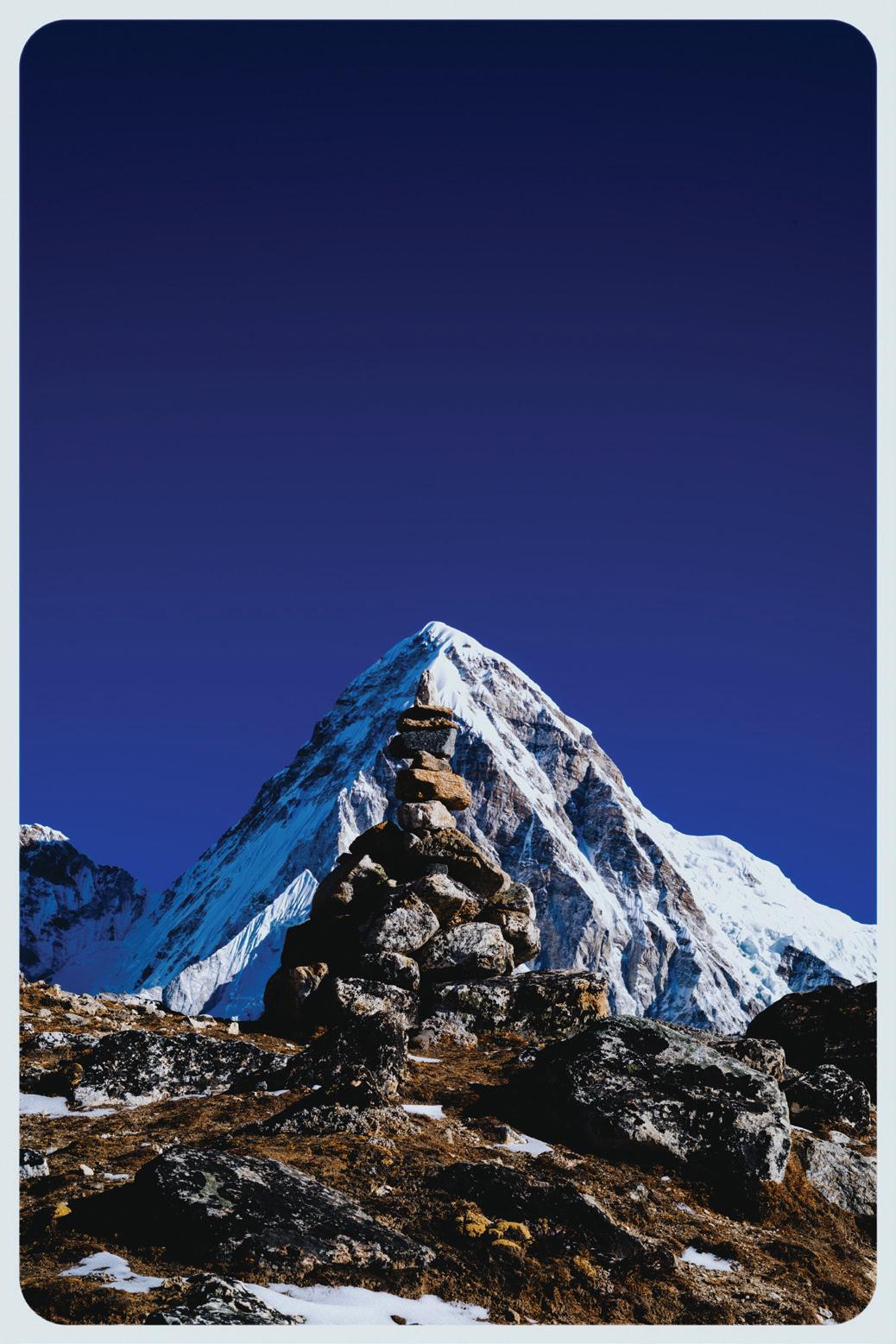
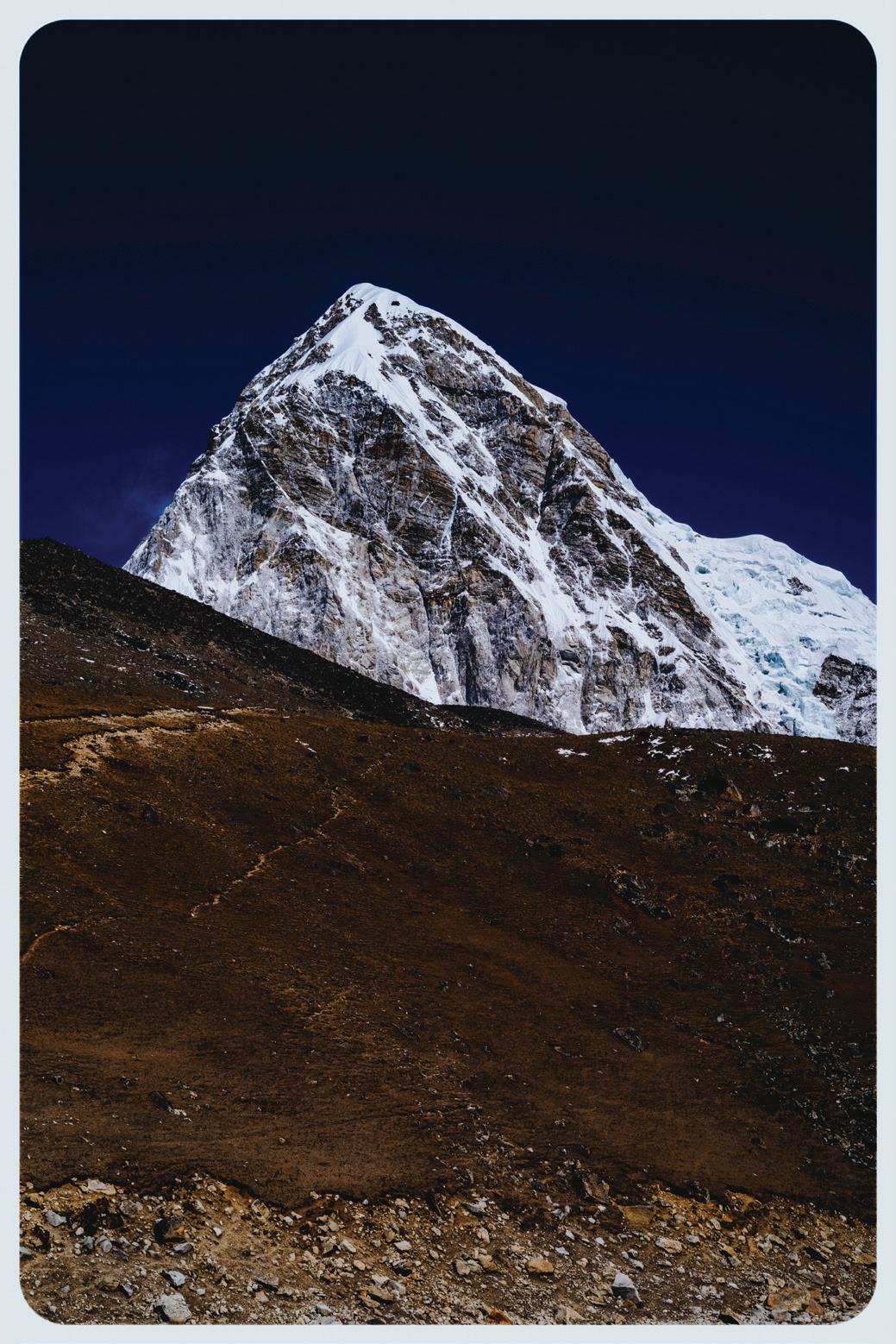
Ramesh and I traversed the long stretch of flatland, towards our final destination, for another hour around Kala Patthar with Nuptse and Lhotse summits to our right and only a sliver of Mt. Everest’s peak. Pumori’s peak reached into the sky. Just
over the mountain range of Lho La was the plateau of Tibet. Finally, we had triumphed our ascension in the land of giants and legends, at 5360m (17,585ft). We made it. My childhood dreams of reaching the tallest mountain in the world had been accomplished. Along the journey, the Holy Himalayan mountains taught me life changing lessons of impermanence and unconditional love. As the mountains shifted with time so did my own heart. It was time to return home.
"WE MADE IT. MY CHILDHOOD DREAMS OF REACHING THE TALLEST MOUNTAIN IN THE WORLD HAD BEEN ACCOMPLISHED. "
About the Author
Samuel R. J. Gillilan (b. 1989) is an award-winning international Leica M photographer, visionary artist, educator, explorer, and author. He spent his early years growing up on a sail boat in the Pacific Northwest. Visual arts and music were at the forefront of his home-based education. After gaining a degree and career within the live music industry for over 10 years, his attention turned towards the medium of photography as a form of expressing the human experience.
Samuel is based on Kaua’i, Hawai’i. He has traveled as a pilgrim to over eighteen countries to document multicultural Holy Sites. These pilgrimages have inspired his self-mastery through the medium of photography; a medium he uses to convey inner visions and ancient symbolism of the human psyche. Ancient traditions, symbolism, time, and the greater nature of reality are themes that thread together Samuel’s imagery.
In March 2020, Samuel Gillilan made a solo expedition to Mt. Everest Base Camp in the heart of Nepal to capture the legendary Himalayan mountains using his Leica M10-D.
www.samuelgillilan.com
LEICA Q2 MONOCHROM
by JONATHAN SLACK
Last month, Leica announced the Q2 Monochrom camera. This is their fourth monochrome camera over the last 8 years. It is especially interesting as it is the first non-rangefinder camera with a black and white sensor.
I think it’s worth starting with a little history of monochrome cameras. Back in the early days of digital capture Kodak ruled the world with cameras costing tens of thousands of dollars. In 1991 they they introduced the DCS 100 DM3 with a 1.3 mp monochrome sensor. This was based on the Nikon F3 camera, and it had a separate DSU (Digital Storage Unit), which went over the photographer’s shoulder (and was extremely heavy) . It cost around $25,000. There is a fascinating article about it at Nikonweb (see references at the end of this article)
In those days the demosaicing process was not as good as it is now, and that camera produced two or three times the definition of the normal colour version. Combined sales of the colour and monochrome versions were apparently 987 cameras.
In 2001 they produced a 6 mp black and white sensor behemoth based on the Nikon F5. The Kodak DCS 760M. By now there was competition from Nikon with the D1 and D1x and the price was a slightly more manageable $8000. There is a very good write up of this camera by Pete Myers on Luminous Landscape.
Sadly Kodak completely failed to capitalise on their head start in digital imaging, and especially the concept of a monochrome camera. Despite producing the first full-frame dSLR in 2002, by 2005 they were out of the professional camera market altogether, the last camera being the DCS Pro SLR/n in 2004. I had one - it was a fine camera (if a little quirky!) , but they never shipped the monochrome version.
Leica had great success with their M8 and then full-frame M9 digital cameras and the idea of making a monochrome version of the M9 seemed a bold and interesting move. I had a test camera in April 2012, and was lucky enough to be at an exciting launch of the M9 Monochrom in November 2012 in Berlin. I still have and use my own M9 Monochrom. It was, and still is, a great camera.
The 24 mp Monochrom (Typ 246) was announced on April 30th, 2015. The M10 Monochrom on January 17th, 2020 with a new 40 mp sensor, and now, less than a year later, we have the Q2 Monochrom with a 47 mp sensor derived from that in the Q2 (and SL2)
I only had the Q2 Monochrom for around three weeks for testing last August. Covid-19 meant that I couldn’t do any trips with the camera, but I took the time to look carefully at its performance in comparison with the SL2, which has essentially the same sensor but with a Colour Filter Array.
As usual I should emphasise that my job with Leica is as a camera tester, and my responsibility is to report problems to Leica (which I certainly do!) . On the other hand, I would never miss out anything which seemed to me to be critical. I don’t get paid for writing these articles (either directly or indirectly) I’m not told what to write, and although I do show the articles to Leica first for fact checking, that is all that they do.
WHY A MONOCHROME CAMERA?
Technical Reasons With a colour digital camera, the sensor itself can only detect the intensity of light, but it has a colour filter array to allow it to create colour images. The process of converting the image to colour is called demosaicing . This calculates the colour for each pixel based on the colour filter, and the results from the surrounding pixels in groups of four. The colour filter array reduces the amount of light reaching the pixels by around one stop, and the demosaicing process has an effect on the resolution because of the combining of information.
With a monochrome camera, you don’t need the colour filter array. This means that each pixel gets the maximum amount of light thus improving the high ISO characteristics of the camera and the dynamic range. As there is no demosaicing process, there is no loss of resolution - each pixel is represented directly in the final image.
Of course, there are also downsides. Many of us have become used to converting colour files to monochrome using the channel mixer in our processing software. This, in effect, allows us to apply filters to our images after the event. With a monochrome camera, if you want a red filter, you need to put it on the lens rather than relying on your computer.
Another issue is that, despite the higher dynamic range, it’s more important to ensure that you don’t overexpose bright areas. With a colour camera you can usually extract some detail from one of the other colour channels, with a monochrome camera, once it’s blown out there is nothing to recover! This is slightly exacerbated by the higher base ISO of the sensor (usually twice that of an equivalent colour sensor)
Photographic reasons Demosaicing techniques have improved over the years, and although there is an obvious improvement in resolution without a colour filter array, it’s not quite as sensational as it was when the M9 Monochrom appeared in 2012 - added to which 47 mp resolution should be quite enough for most uses.
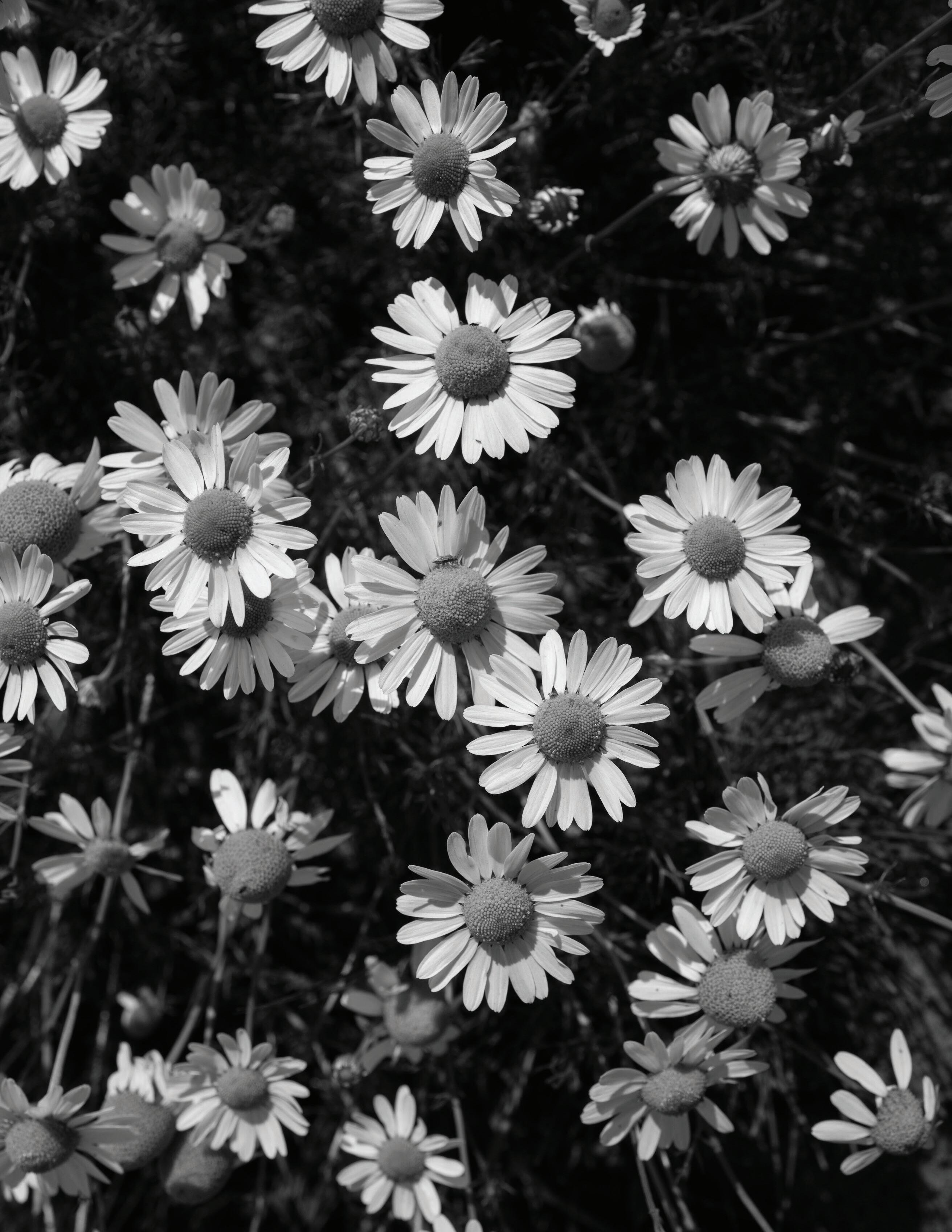
But having spent a lot of time with all of the Leica Monochrom cameras over the year, I’ve come to think that the most important reason for shooting with one is how it changes one’s approach as a photographer. For me at least, it makes me think much more about the structure and composition of an image. With the previous M Monochrom cameras, shooting normally with the rangefinder, you did still see the subject in colour. The Q2 Monochrom takes this a step further in that you see the motif in black and white through the viewfinder. You start to think in black and white!
BODY & DESIGN
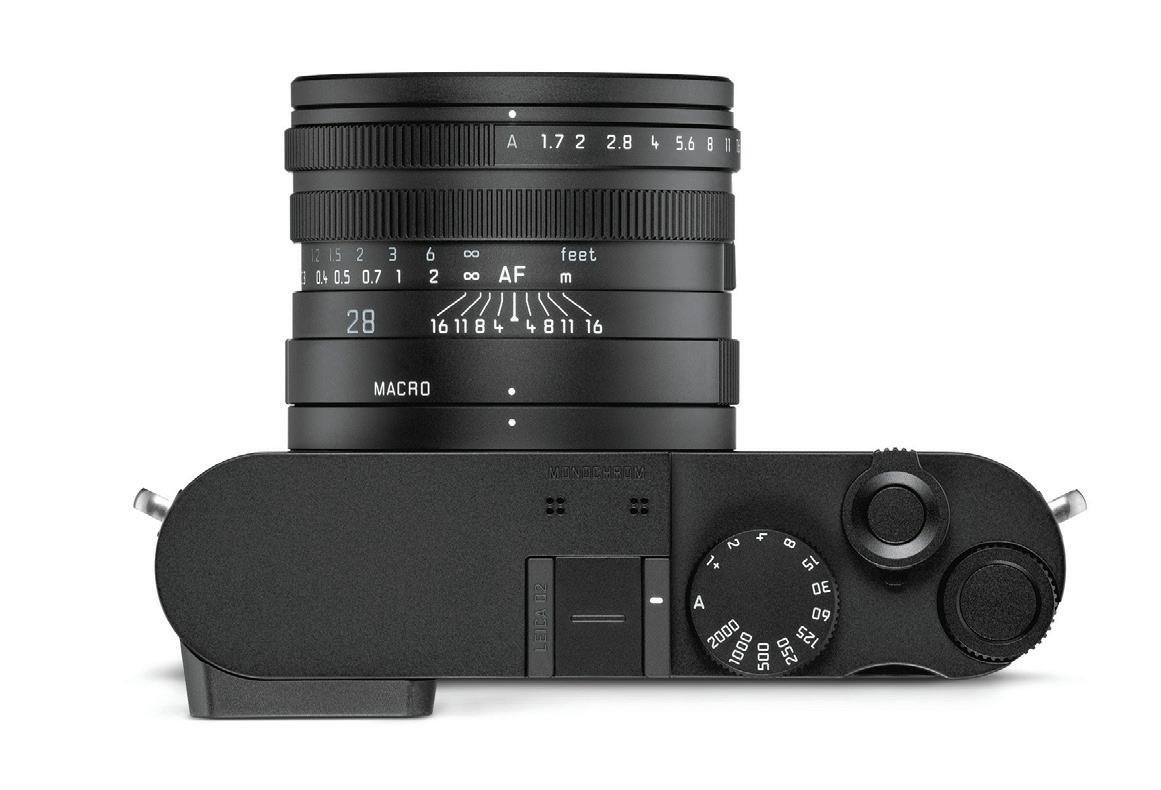
Leica’s design department has gone from strength to strength making increasingly beautiful and functional cameras. The Q2 Monochrom is no exception. With its grey and white markings, it is indeed handsome.
From a functional and operational point of view, with the exception of the obvious lack of White Balance controls, the grey lettering, and the changed ISO values, the Monochrom is identical to the standard Q2.
The Lens The lens is the same as the Q and Q2. If it isn’t broke - don’t fix it! It’s a wonderful lens, compact and very sharp. It does soften up a bit at the corners, especially at wide aperture, but most of the frame is pin sharp right from f/1.7. A simple twist of the lens engages Macro Mode and changes the distance gauge in the most delightful way. Close focus is 30cm in normal and 17cm in Macro Mode.
Controls The aperture ring is on the lens with the shutter speed on the top plate (just like the Leica M cameras) . This makes the camera seem very familiar. Both the Aperture and Shutter Speed dials have an A position.
• A on both = Program Mode
• A on Shutter Speed dial = Aperture Priority
• A on Aperture dial = Shutter Priority
• A on neither = Manual exposure
Three function buttons can be assigned as needed, and the now-familiar Leica rear buttons with Play, Function and Menu are all present. Personally, I would have liked to see a joy stick like the SL and SL2.
The Digital Zoom Digital zoom is something of a dirty word in the photography world, probably from the days when small megapixel cameras offered gravelly shots at apparently extended focal length. The Q2 Monochrom is a bit different because the base resolution is so high, and because the implementation is so good, and so consistent with the Leica rangefinder.
Implementation of crop mode or digital zoom in other cameras usually involves the EVF / LCD zooming in. With the Q2 Monochrom, as with the Q2, you can change between four focal lengths using the Zoom / Lock button. Choosing a longer focal length simply puts framelines in the display showing what you are going to get.
If you shoot JPG files, then that is exactly what you do get. If you shoot DNG, then the image is not actually cropped. However, if you use Lightroom or Lightroom Classic, then the DNG file appears in cropped form and you can use the crop tool to change or remove the cropping in post processing. The four digital zoom modes are:
"Effective aperture” refers to the depth of field effect.
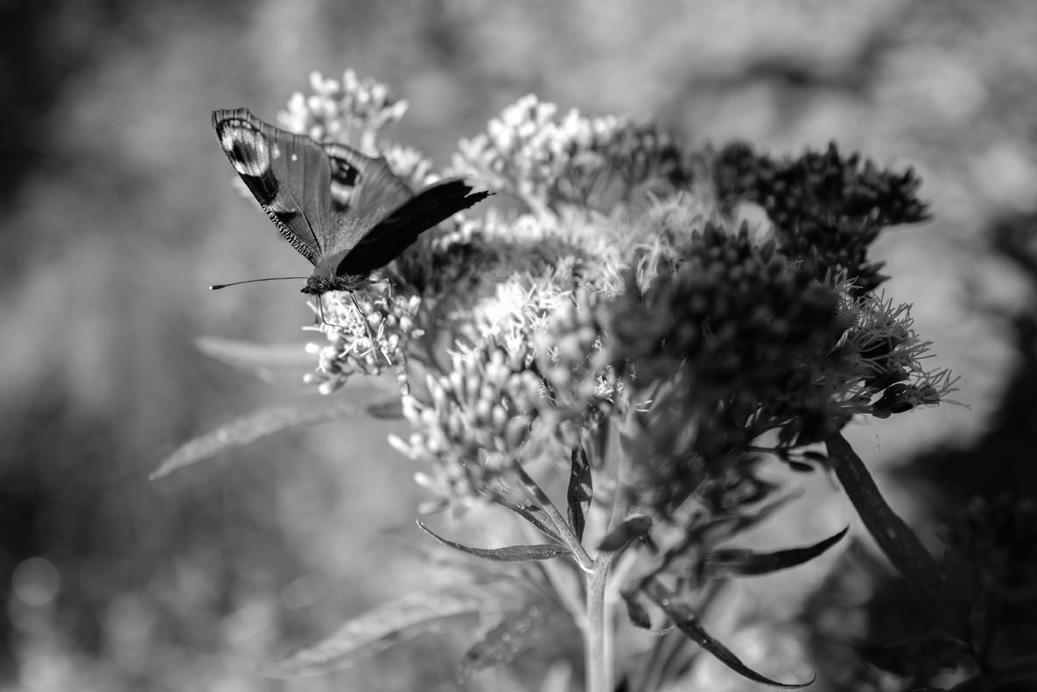
Peacock. f/ 3.2, 1/640 th , iso 200.
f/5.6,
I think this is a great feature, and with the increased resolution of the Q2 Monochrom, it makes the 50mm crop zone perfectly usable and the 75mm okay at a pinch (especially as the lens is so sharp).
Of course, it doesn’t actually turn the lens into a different focal length, but the aspect ratio of the resulting image is exactly the same. What you lose is the depth of field relating to the cropped focal length. Basically this will always be the same as that of a 28mm f/1.7, so it’s harder to use bokeh to isolate the subject.
Due to the big demand for review cameras I don’t have a camera in front of me, but if you want more details then please refer to my original review of the colour Q2.
IMAGE COMPARISONS
During the test period I didn’t have either an M10 Monochrom nor a Q2, both of which would have made interesting resolution comparisons. However, my old friend and partner in crime, Sean Reid, is doing a very detailed comparison of these three cameras. More about that later.
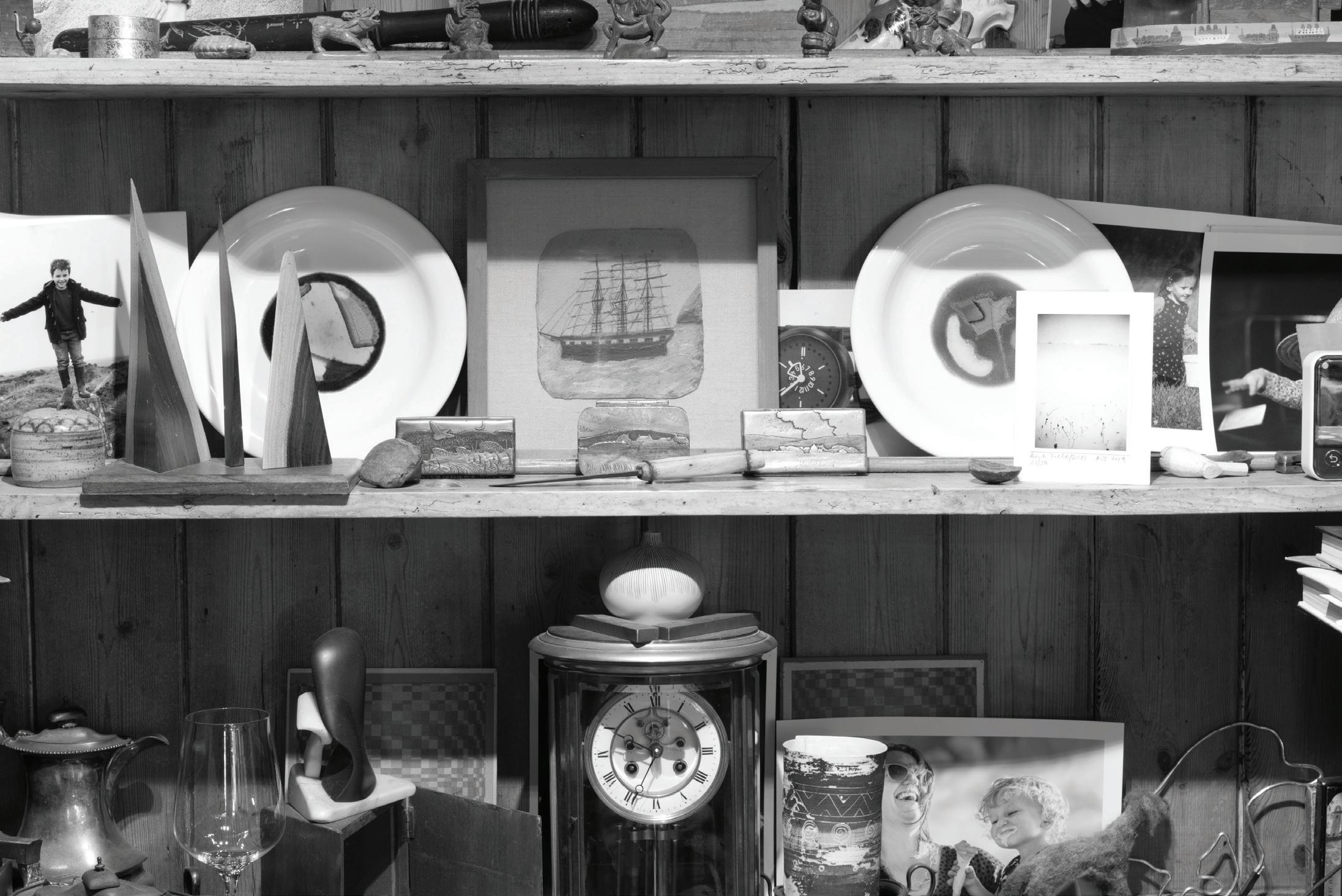
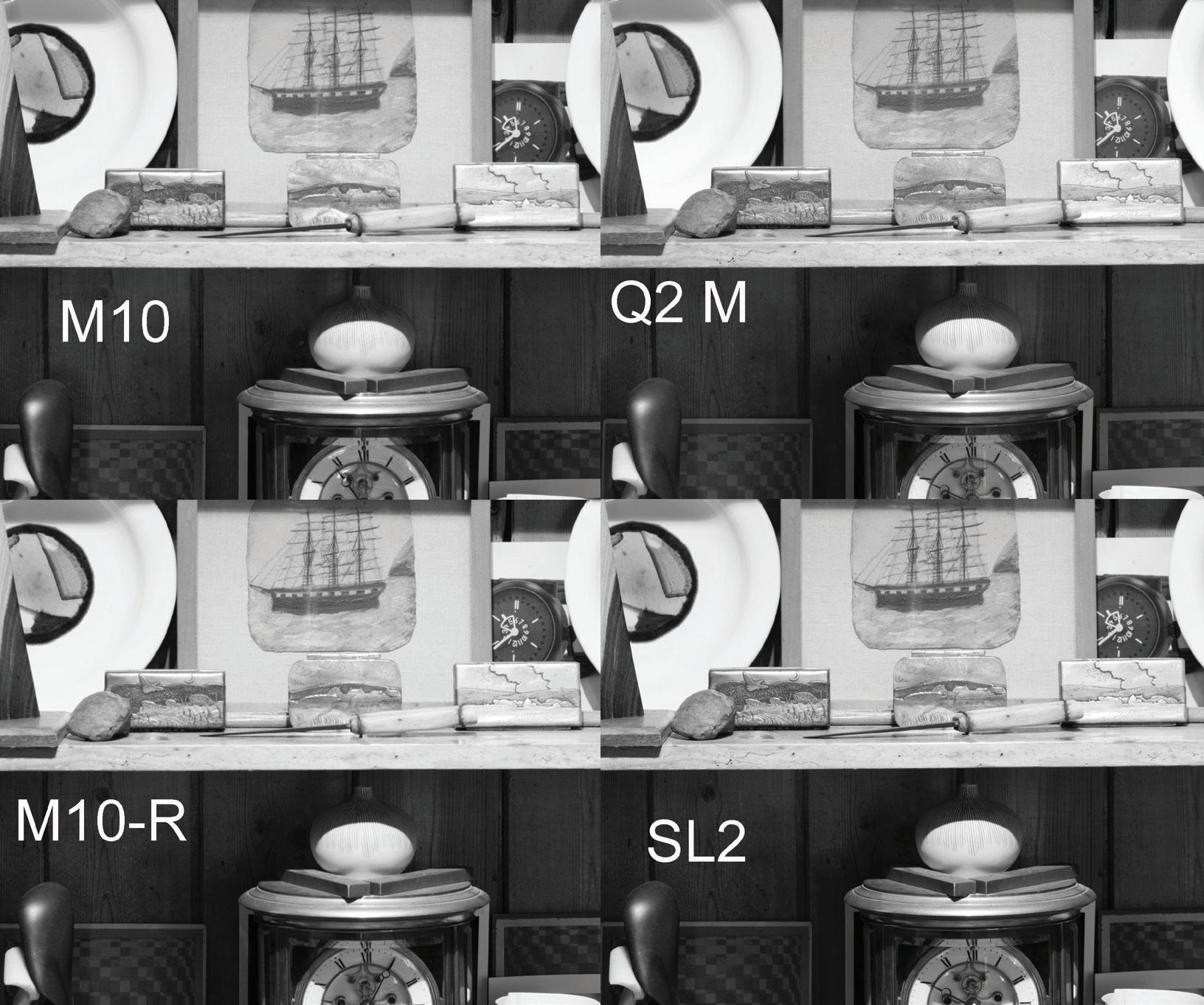
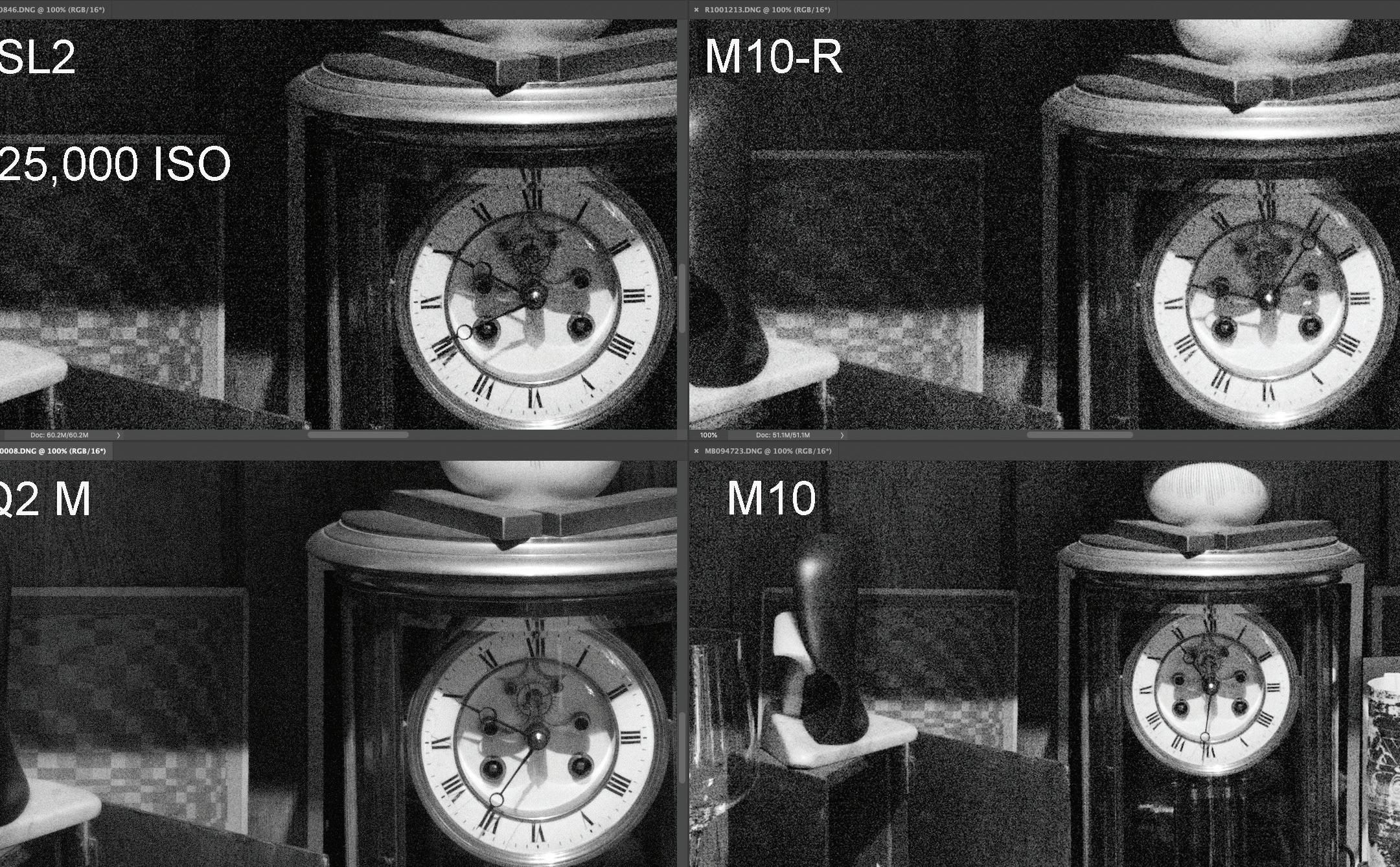
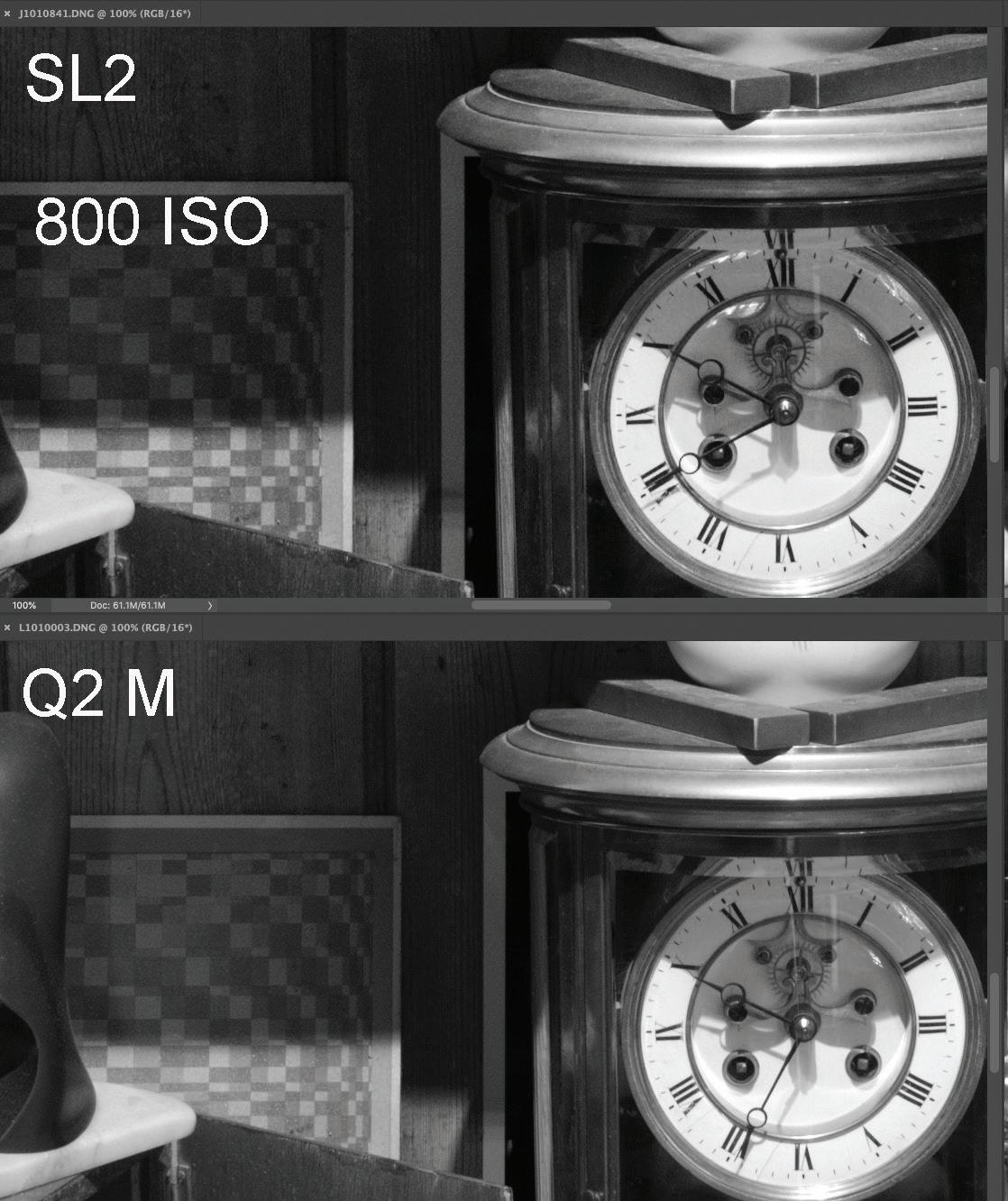
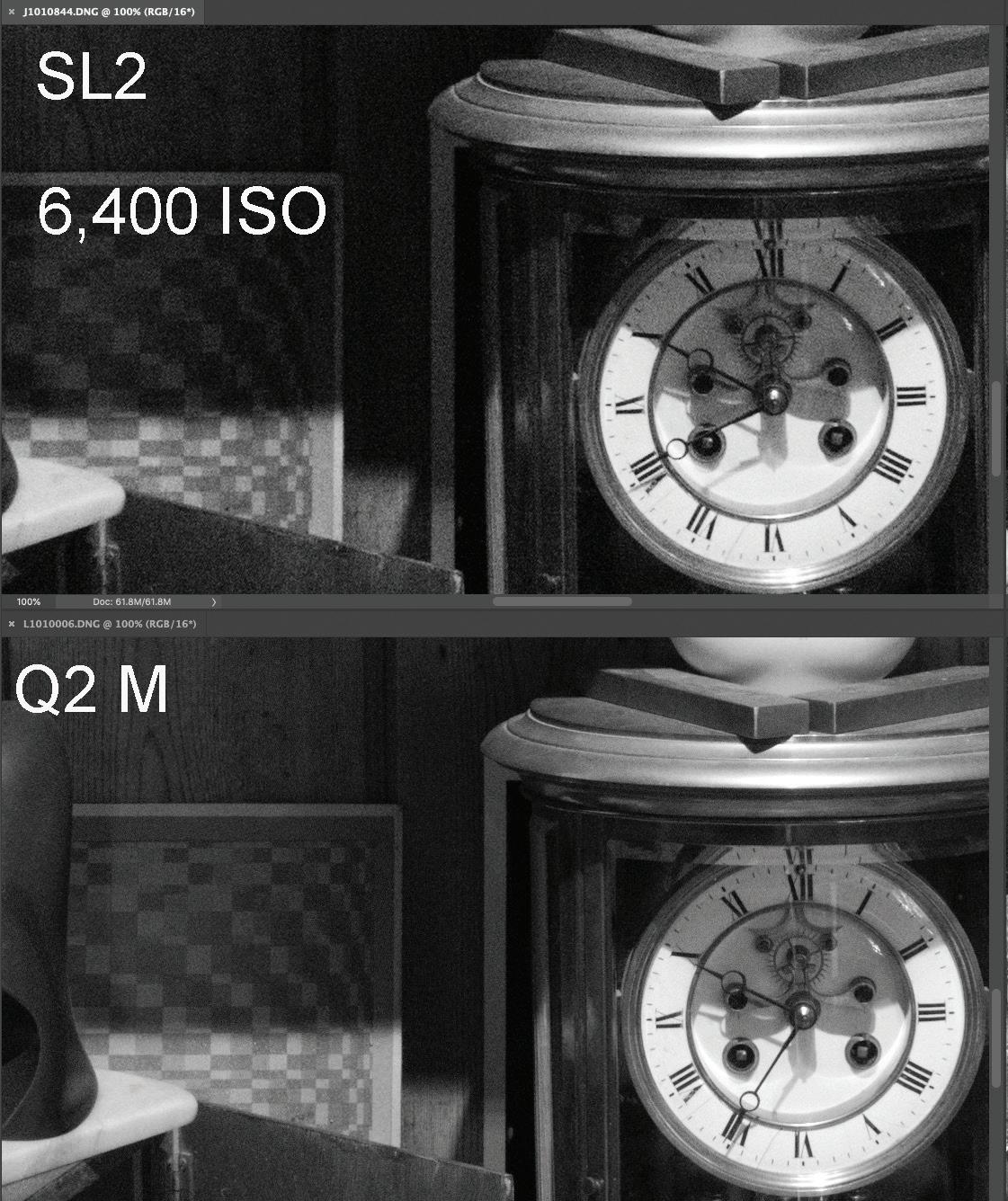
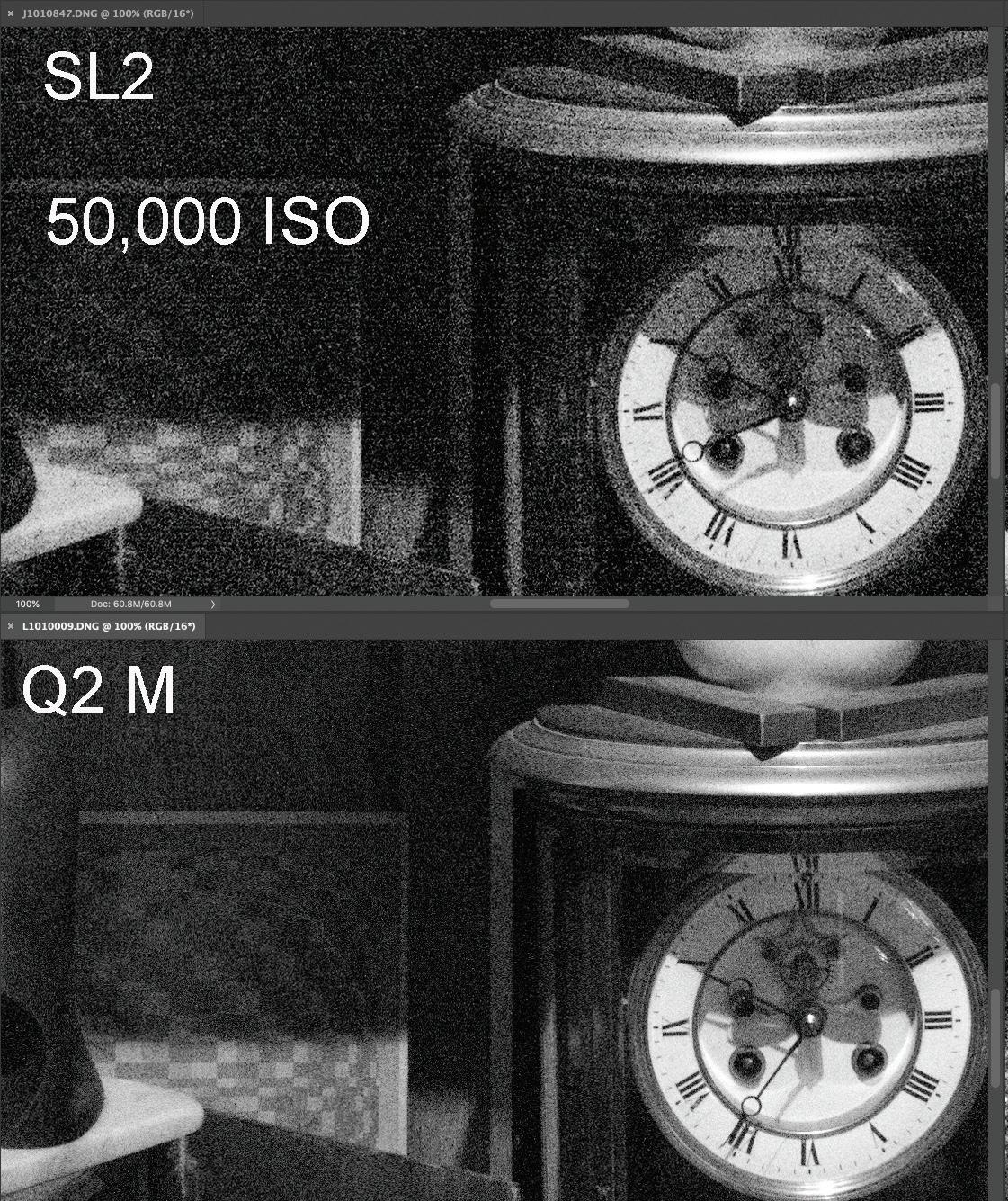
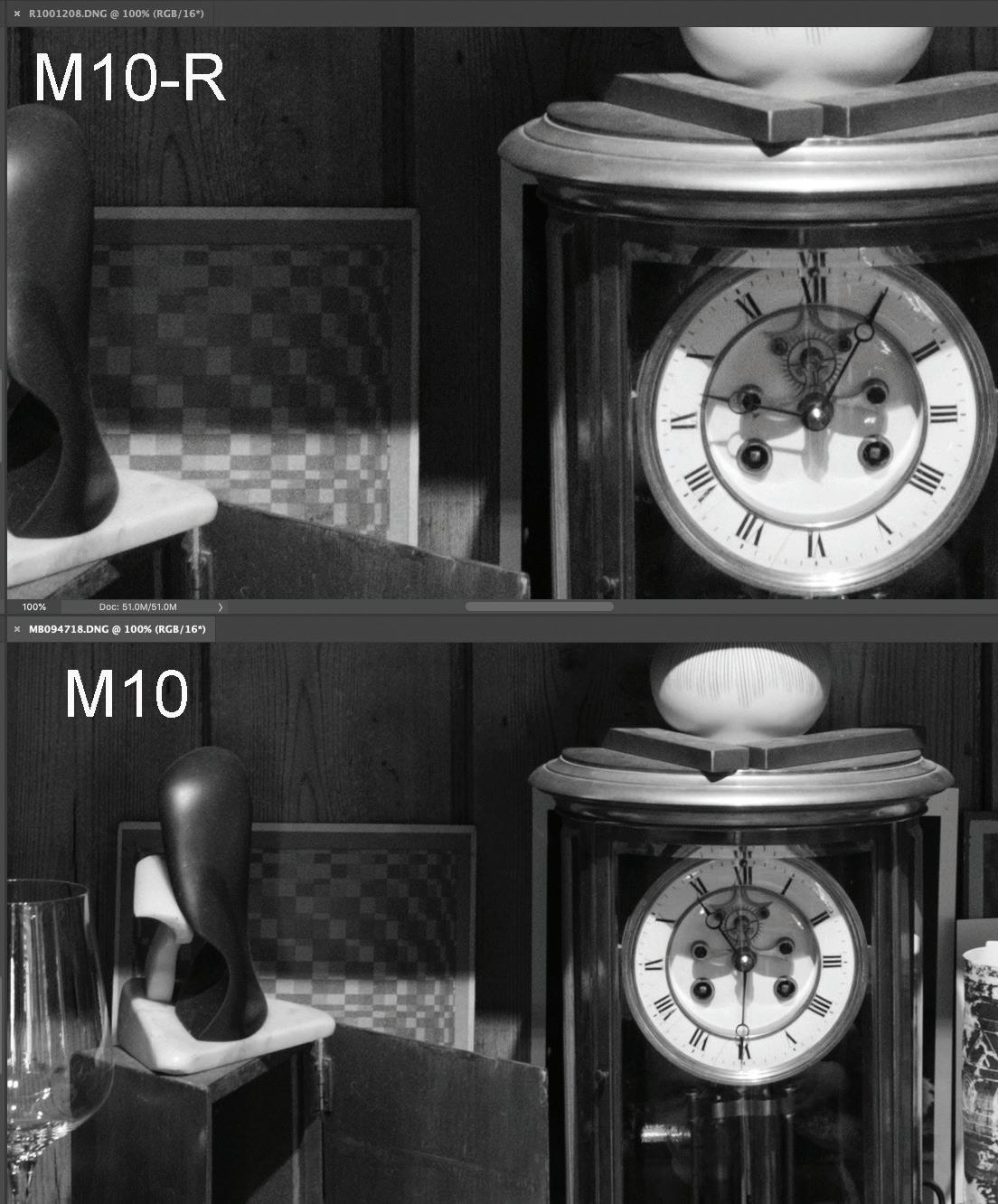
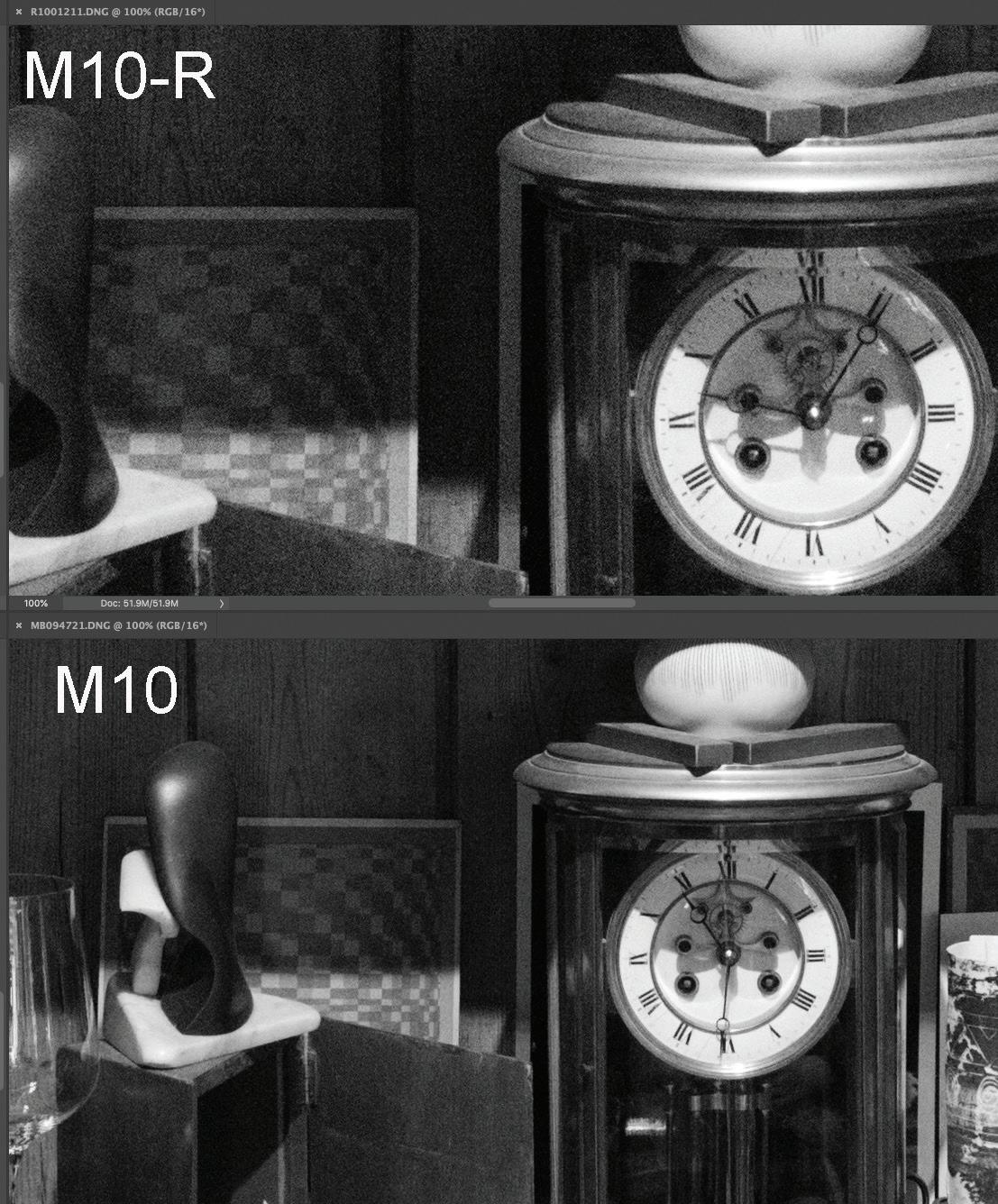
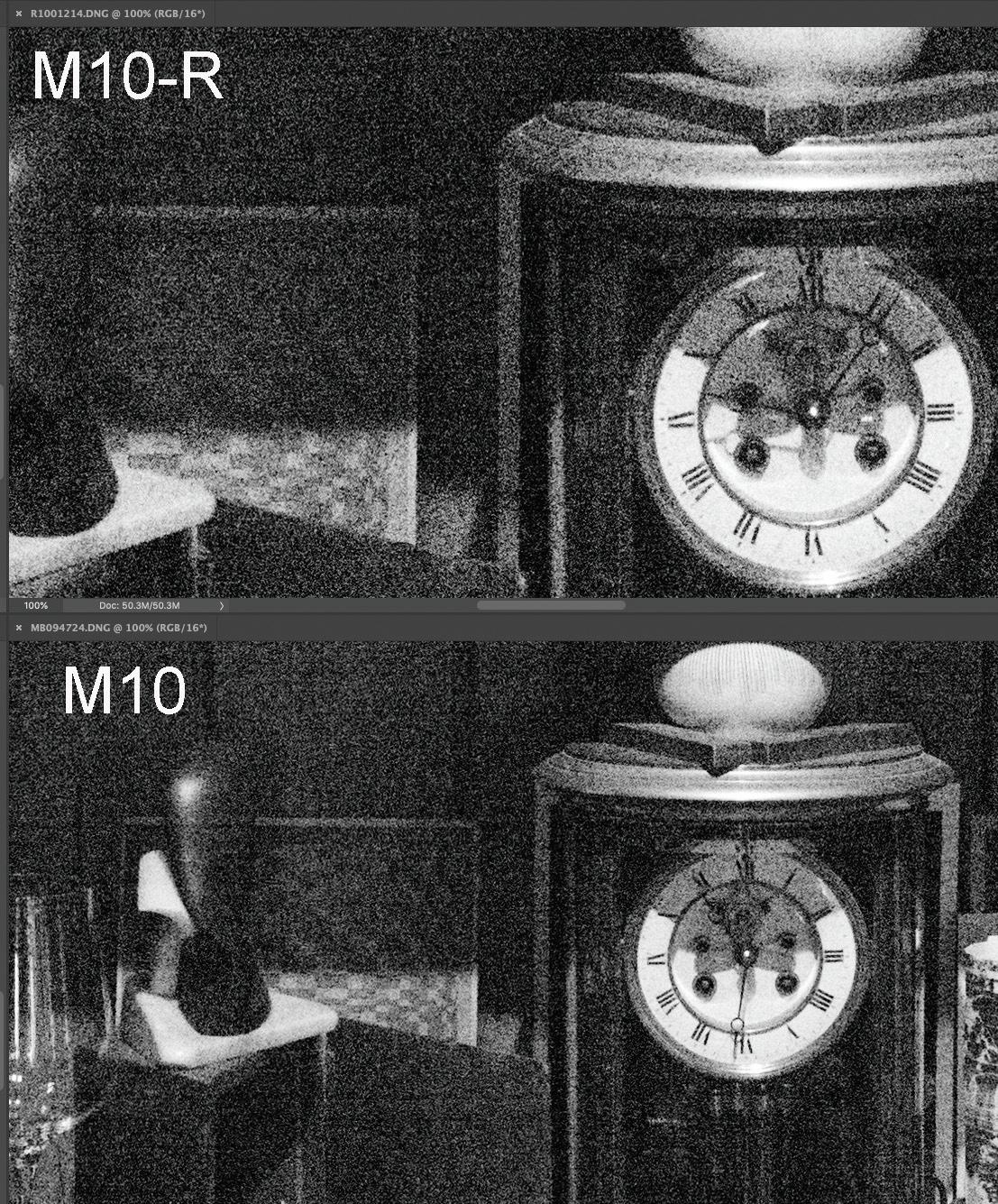
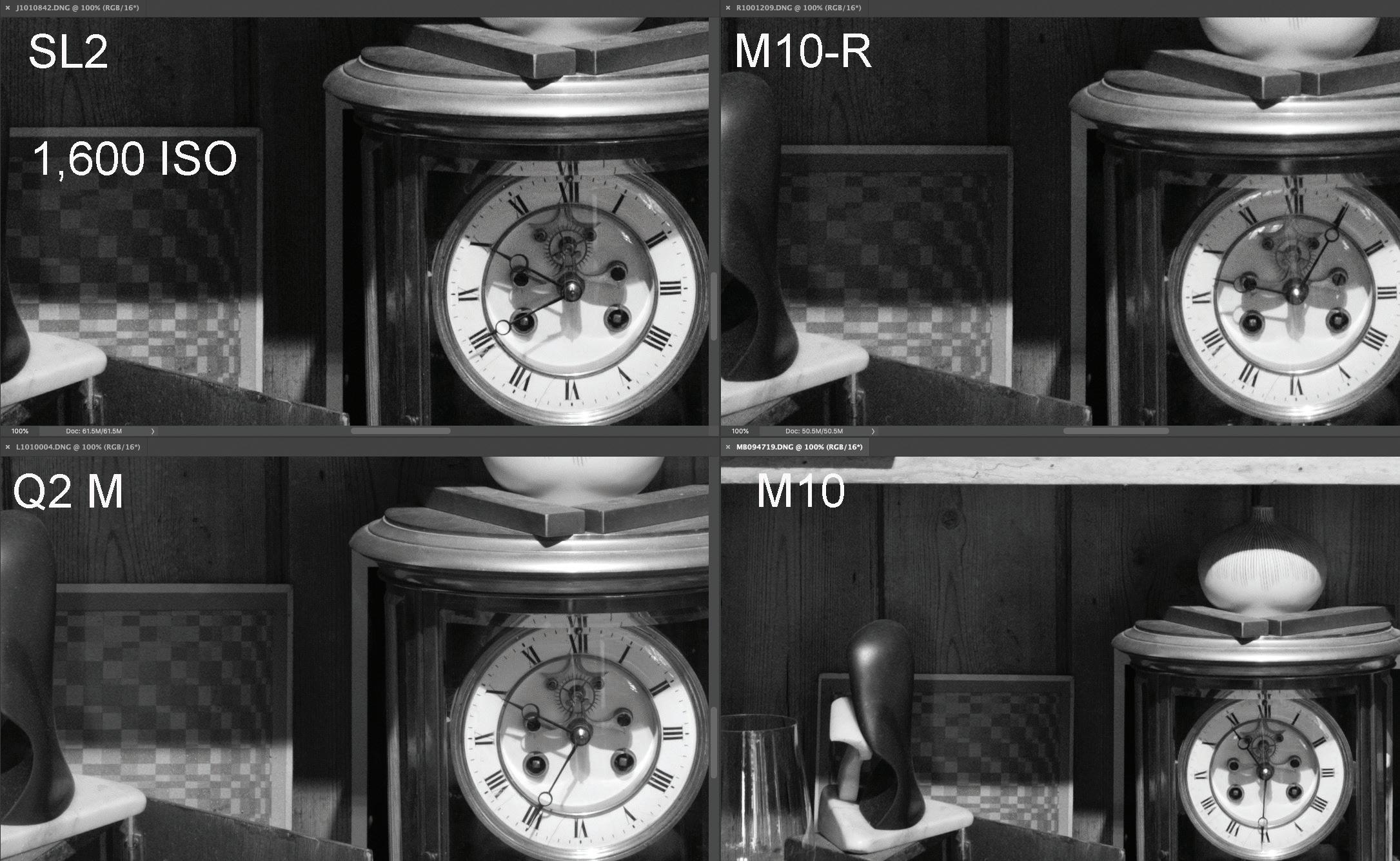
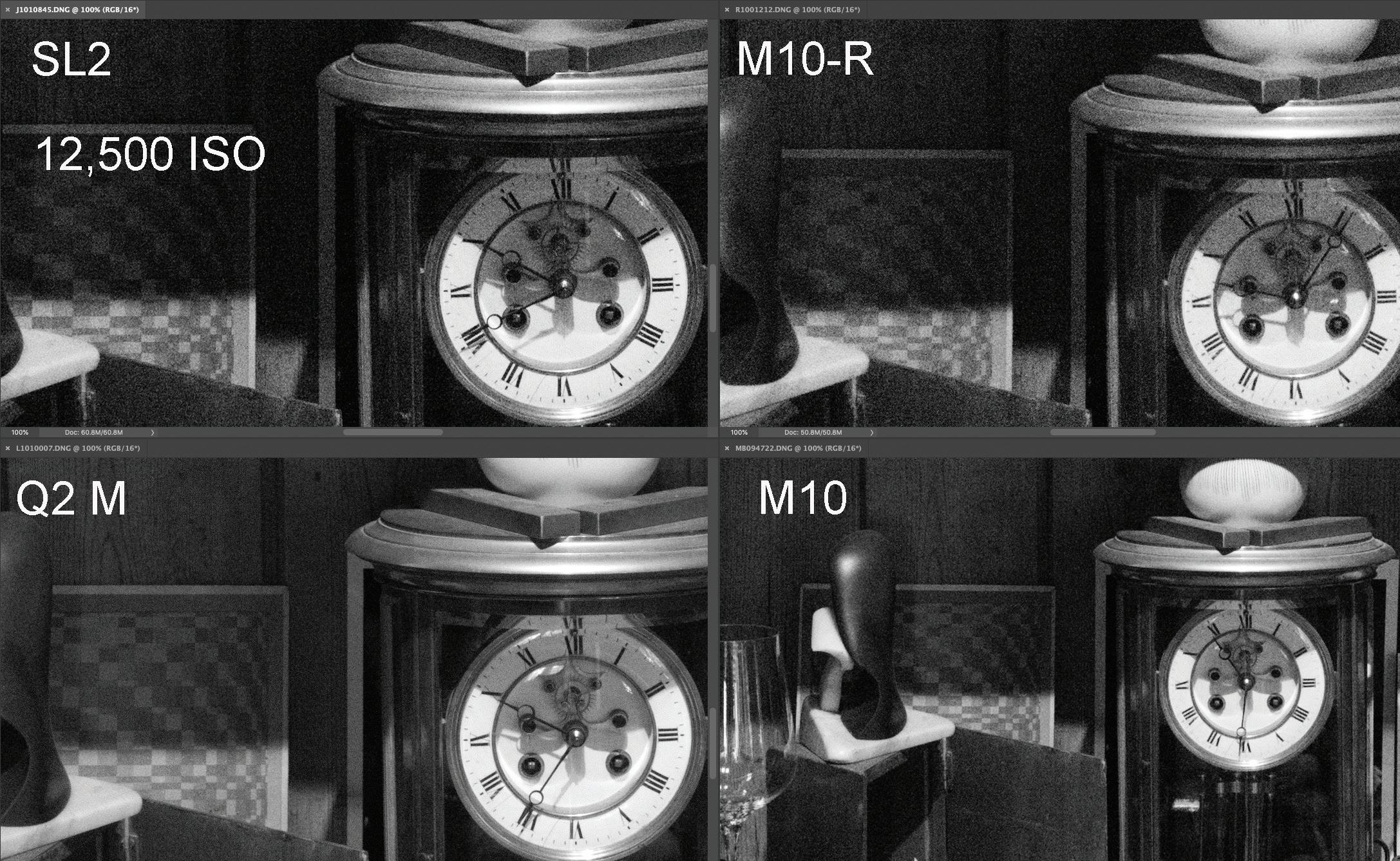
I thought it was interesting to compare the Q2 Monochrom to three of Leica’s recent high resolution colour cameras: the M10, the M10-R and the SL. Of course the lens used is an issue in that one can’t do a real oranges and oranges comparison. In this case I’ve used the 28mm Summilux-M Asph. for the M10 and M10-R, and the 24-90mm Vario-Elmar-SL Asph. at 28mm on the SL2. Images were all shot as DNG and the colour images were converted to black and white in Adobe Lightroom.
For all these tests the camera was set on a sturdy tripod with a two-second shutter delay. To try and limit focus variances, shots were all taken at f/5.6. The shutter speed was allowed to vary to ensure that the images were as consistently exposed as possible.
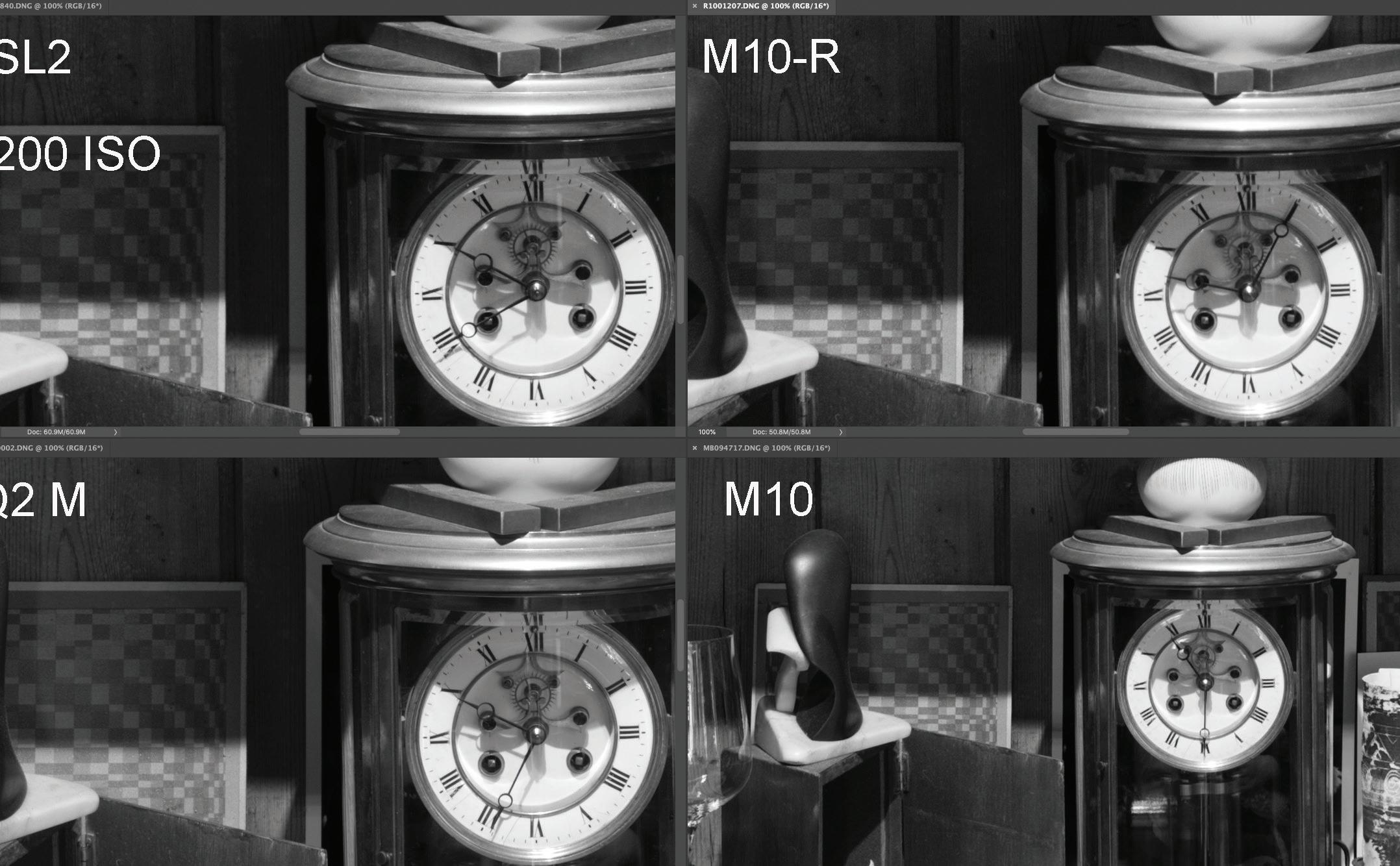
Resolution Of course I’ve shot hundreds of images, but in terms of the resolution, I thought it was more sensible to do a resolution test at 200 ISO. I’ve used the centre of the frame (roughly) for the comparison. The M10 and M10-R images have been upsized in photoshop so that it they are the same size as those from the other two cameras.
In addition to this resolution comparison, I did a series of shots of a hedge at about 10 metres at different apertures. Sadly, there was some movement in the hedge, and on some of the shots there are obvious signs of blurring. I no longer have the Q2 Monochrom, so I can’t redo them, but although most of each frame is very sharp, it isn’t all perfect and I think that posting examples might be misleading, added to which they are very boring!
However what I found was that the Q2 Monochrom shots had an obvious advantage in the centre at all apertures with a real magical presence to the files. At f/1.7 and f/2.8 the Q2 Monochrom was slightly softer at the corners than either the SL2 or the M10-R. Stopped down a little more, the corners were about even, but even at f/8 the Q2 Monochrom still showed an obvious advantage in terms of presence and detail.
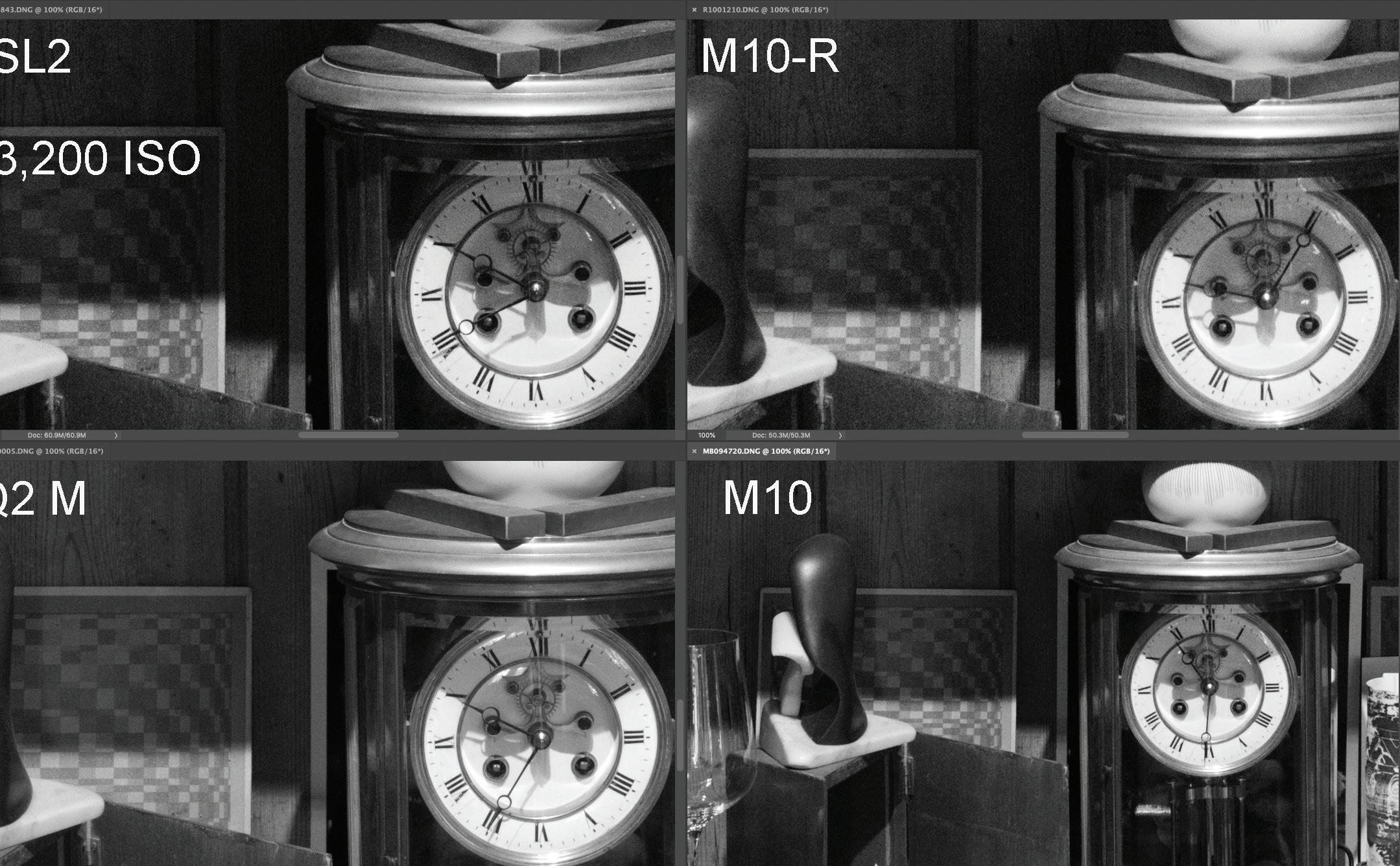
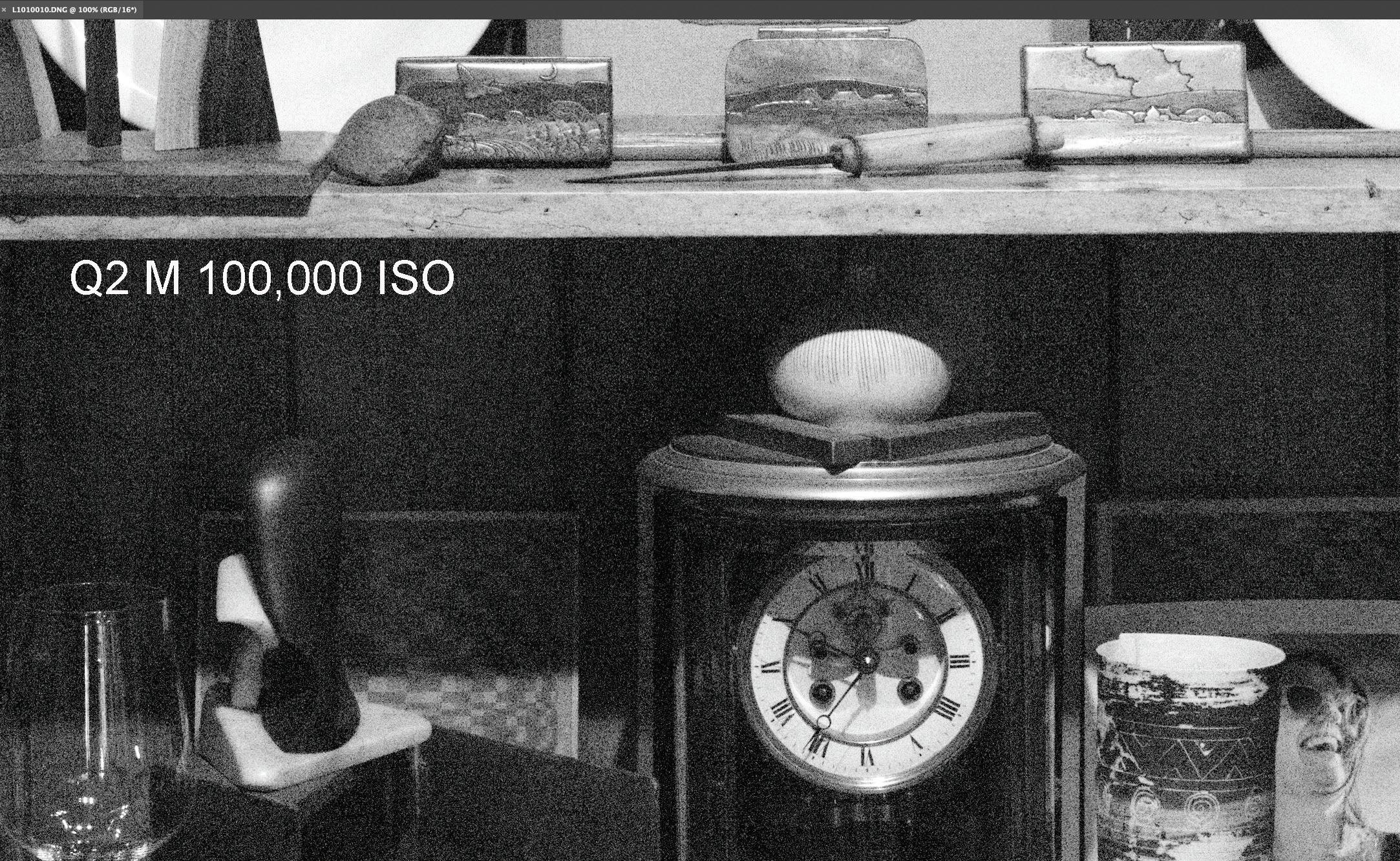
High ISO Performance Base ISO on the Q2 Monochrom is 200; there is also a pull option of ISO 1oo. For this test I did comparisons at the following ISO values:
• 200 • 800 • 1600
• 3200 • 6400 • 12,500
• 25,000 • 50,000 • 100,000
I loaded the groups of four DNG files directly into Photoshop, magnified them to 100%, and then took a screen shot and labelled it.
Looking at these comparisons it’s very clear that the Q2 Monochrom has considerable advantage over the other three cameras, especially as the ISO value increases. At higher ISO values, it’s probably about 1.1/2 stops better. Together with the higher resolution this is obviously going to be a real advantage shooting in very low light. It’s quite remarkable how much detail there is, even in the 100,000 ISO shot, even the banding is very well controlled. An impressive performance.
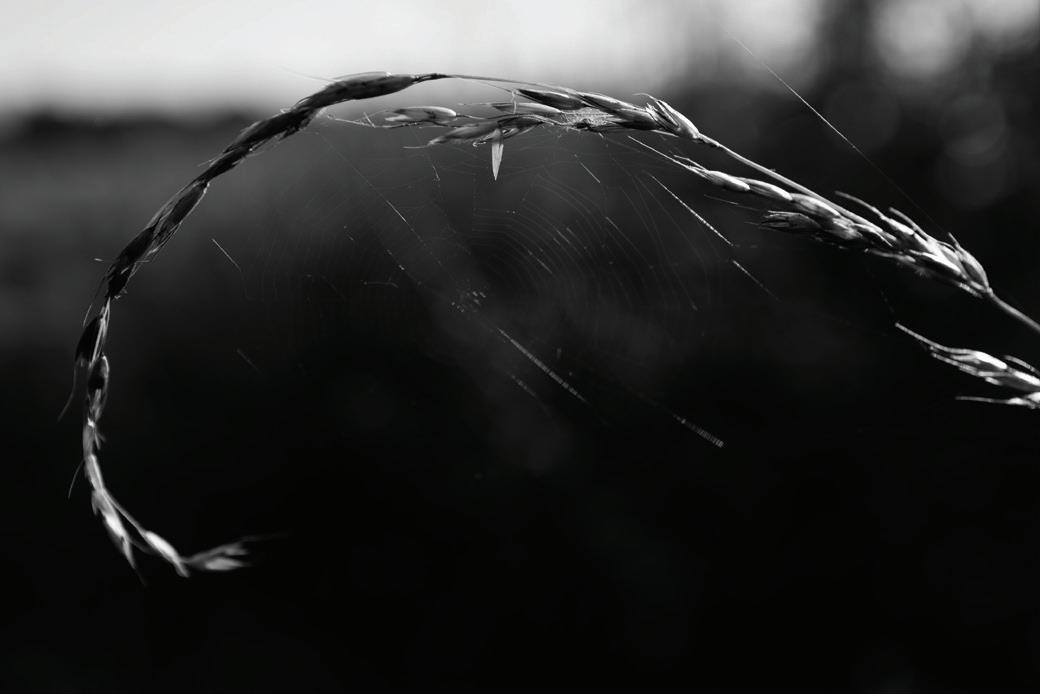
f/8, 1/800 th , iso 200.
(above) Test scene. (left) Resolution comparison.
CONCLUSION
Sadly, because of Covid restrictions and the relatively short time I had the camera, I didn’t manage do any street photography, and precious little portrait photography either. Hopefully with the results of the Pfizer vaccination test recently, we will all be on the move again before too long!
The Q cameras have been a real success story for Leica and a perfect example of their talent for finding a photographic niche and making it their own. The only real competitor has been the Sony RX1R II with a 35 mm lens, but Sony has not updated this since 2016 (which, with their rapid product cycles, sounds like they’ve abandoned it)
I have to admit to starting off feeling that in this day of 48 mp resolution, there wasn’t really a need for a monochrome version of the Q2, but actually I have been quite captivated.
The superb high ISO performance is a real bonus shooting in low light and gives one extra flexibility in normal light.
The resolution might not be needed, but the look of the files is so wonderfully clean and ‘present’.
I think that this camera is going to be a real hit with street and travel photographers, and indeed, anyone who shoots primarily in black and white.
Acknowledgements:
Special thanks to Peter Kruschewski and Stefan Daniel at Leica Camera for supplying the test camera and answering questions.
Thanks also to Emma who has to put up with me moaning and belly-aching when I write these articles.
References:
a) Sean Reid has done a great deal of comparative testing with the Q2 Monochrom. He is planning to publish 4 articles over the next few days on his site reidreviews.com. it is a subscription site, but very much worth the modest fee, Sean doesn’t do any dramatic ‘teasers’, he doesn’t have any brand allegiances and I really feel that he is doing the most useful and honest testing of cameras today.
1. Review based on extensive field testing as well as studio comparison tests of rendering and noise levels (at various ISO settings) for the Q2M, Q2 and M10M with 28/1.4 Summilux ASPH
2. Studio resolution and vignetting tests comparing the Q2M, Q2 and M10M with 28/1.4 Summilux ASPH
3. Field and studio comparisons of how the Q2M renders tonality with each of the three Leica colour filters
4. A studio comparison test of highlight headroom and usable dynamic range for the Q2M, Q2 and M10M with 28/1.4 Summilux ASPH
b) Jarle Aasland’s article on the DCS 100 on NikonWeb http://nikonweb.com/dcs100/
c) Peter Myers review of the Kodak DCS 760m at Luminous Landscape www.luminous-landscape.com/reviews/cameras/kodak-760m.shtml
d) Jim Garvey’s article The DCS Story 1987-2004 http://nikonweb.com/files/DCS_Story.pdf
e) Jonathan Slack’s review of the Leica Q2 https://www.slack.co.uk/leica-q2.html
f) Jonathan Slack’s review of the Leica M10 Monochrom https://www.slack.co.uk/leica-m10-monochrom.html
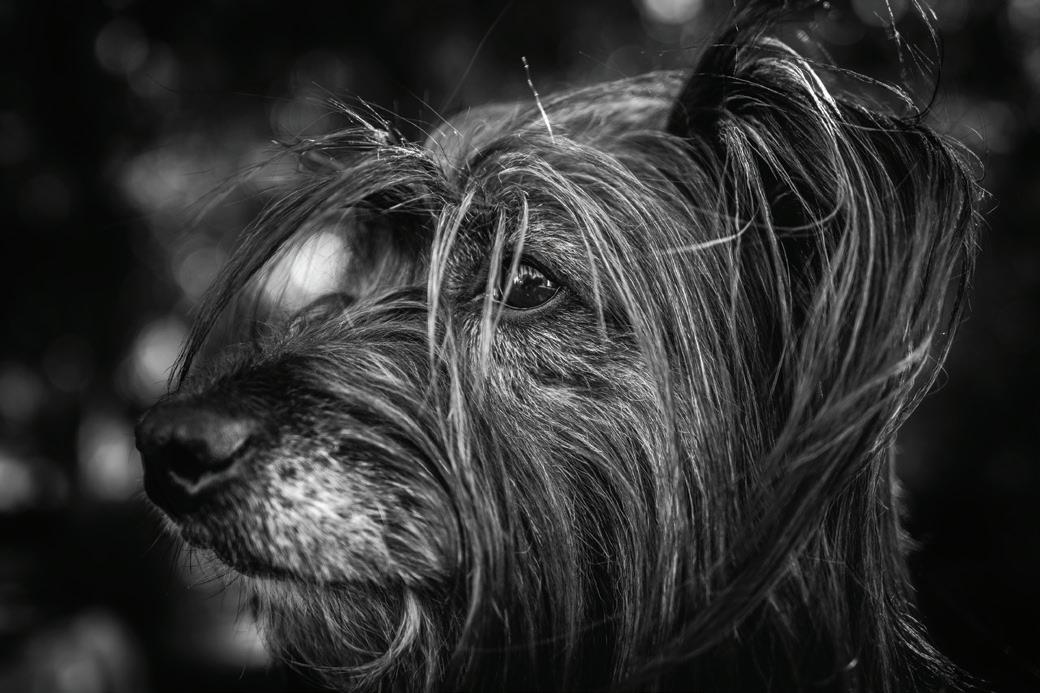
Matty. f/1.7, 1/640 th , iso 200
f/2.8, 1/3200 th , iso 200
LEITZ LEICA WINDOW DISPLAY
by LARS NETOPIL
a
wide range of decorative materials for camera store window displays has been produced for Leica cameras, lenses and accessories over the decades. Unfortunately, not many of the displays from the early period have survived, as sensitive materials such as paper mache, foil, fabrics and also wood were used, and dealers often threw discarded material away at a time when there was no collectors' market at all. Today, these displays are particularly sought after, as they increase the attractiveness of any exhibition in showcases in private collections when they are decorated with the camera models from that time.
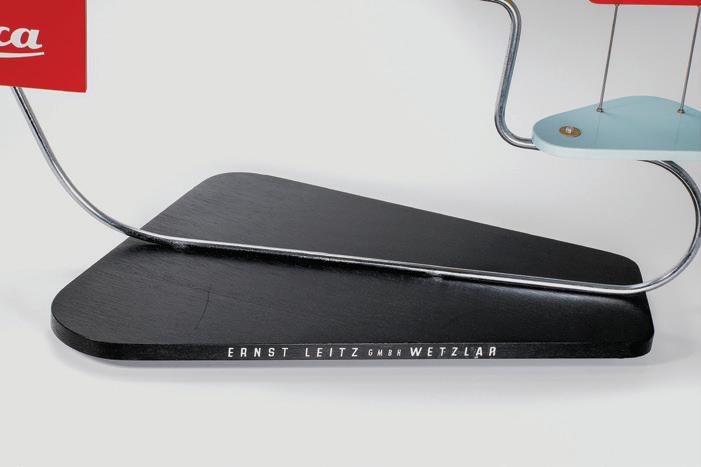
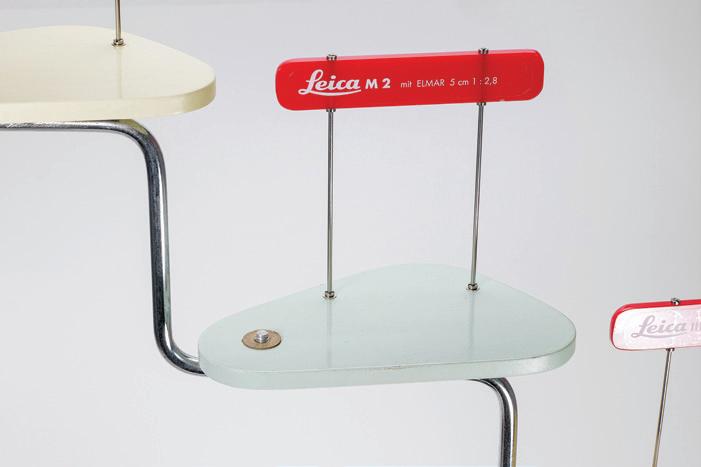
This stand for four Leica models dates from 1958. The construction consists of four panels for the cameras, painted in different pastel colors, mounted on a large metal bracket on a black wooden base plate with rubber feet. The labels attached to the panels are labeled with the names of the individual camera models and lenses.
When I found this display in the basement of the property of a customer and a very long-time collector, I felt a kind of pity that such a piece of jewelry had obviously only been stored for decades and was nowhere to be seen. Nevertheless, buying such an exhibit from a collection is quite a task. A particular challenge, however, was the careful dismantling and very careful packaging of all individual parts on site for shipment to Wetzlar. The storage location did not allow travel by car and so only air freight was considered.
One of the (pre) last tasks was to find the four matching Leica camera models from the same year of construction as the one in which the display was made - and to find them in the most beautiful original condition possible. The display now presents itself beautifully, like a window dressing at a Leica dealer in the late 1950s, and almost smiles at me as the viewer of our current auction catalog. During more than 35 years of daily dealing with the history of the Leica camera and the Leica system, I have not come across any other specimen of this version. I am sure that the future owner has the appropriate space to effectively stage this piece. It would be my wish to finally document this and to present the display to the previous owner in its new environment.
celebrate the 50th Anniversary of the LHSA, an English translation of Ulf Richter’s wonderful book, “Oskar Barnack – From the Idea to the Leica” was published and made available to the membership. If you don’t already own it, I encourage you to obtain a copy. In the book, Ulf talks about Barnack’s life, with chapters devoted to his childhood and education, and his earlier work life before he came to Leitz in 1910, culminating in his greatest invention - the Leica camera.
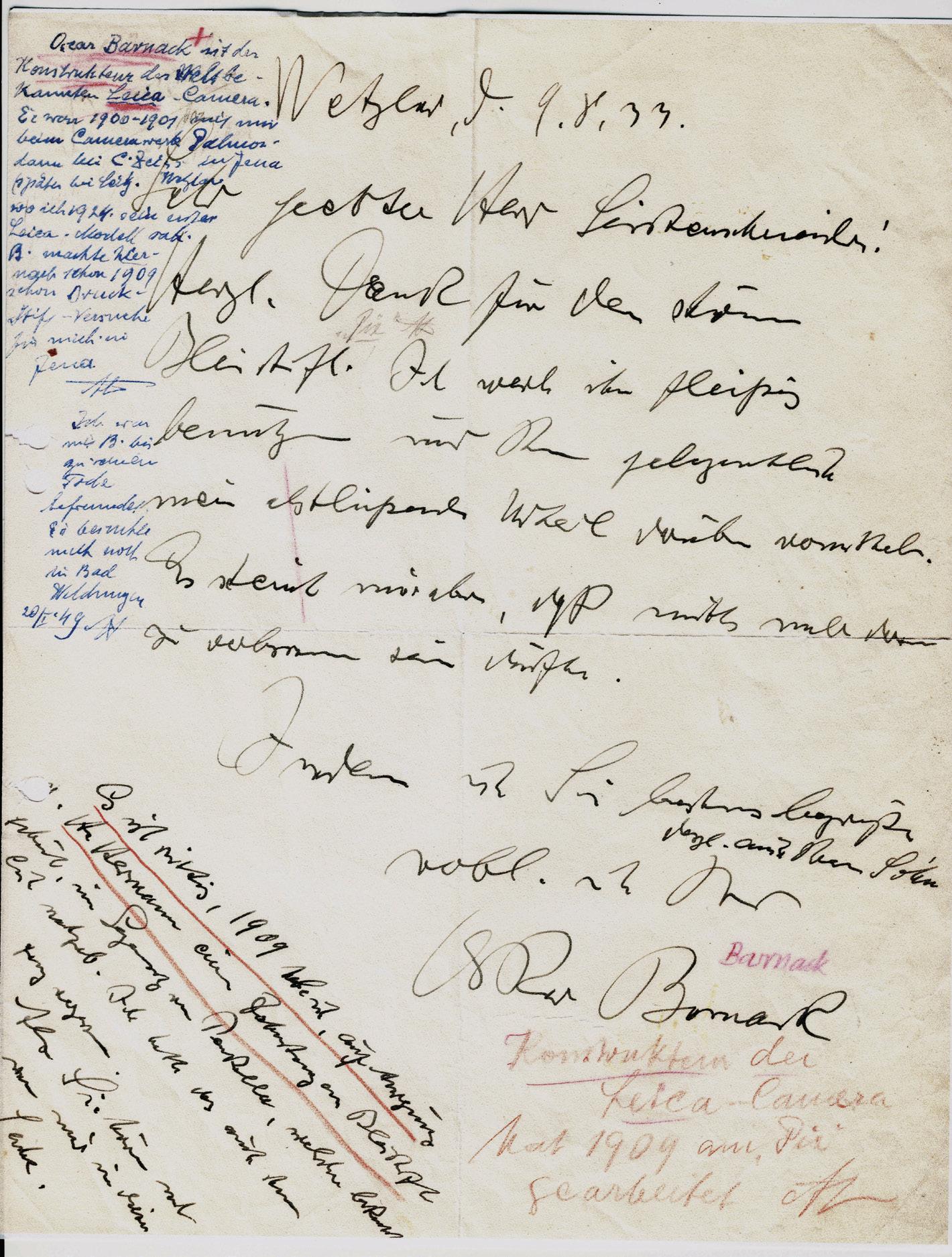
In the chapter on Barnack’s time in Jena, my attention was drawn to a letter written by Barnack. Right away, several things about the letter caught my attention. First it was in Barnack’s own handwriting in ink, which is pretty rare in that we are used to seeing only the short notes and drawings Barnack wrote in pencil about his mechanical designs. Second, there were several “notes” written in the margins of the letter, one of them, in the lower left by Barnack himself. Looking at the translation of Barnack’s hard to decipher handwriting, we find that this was essentially a thank you note from Barnack to a Herr August Leistenschneider, dated 9 August 1933, for the beautiful mechanical pencil he had sent to him. He promises to use it and report back to him with his opinion of it. In closing, Barnack extends his best wishes to Leistenschneider and his son.
camera works and then at Zeiss in Jena. Barnack was already making automatic pencil experiments for me in Jena. Later, at Leitz Wetzlar in 1924, he showed me the first model of the Leica. I was a friend of Barnack until his death. He still visited me in Bad Wildungen.” This note was dated 20 January 1940.
This letter and its notes discuss the popular Montblanc PIX mechanical pencil which Ulf shows on the page prior to the PIX letter, with the PIX placed upon one of Barnack’s pencil notes from the early 1930’s. Ulf’s caption reads, “The Montblanc PIX mechanical pencil designed by Barnack for August Leistenschneider”. We know from Ulf’s book that Barnack was constantly working on everyday items to improve them with small “technical improvements”. He was what one would call a “tinkerer”. Ulf makes some further remarks about Barnack, “it was very understandable that he was striving for a simplification of a much-used writing tool. A small downward pressure and one quickly continues with a fresh lead, the cumbersome and time-consuming pencil sharpening is eliminated.”
THE STORY OF OSKAR BARNACK & THE PIX
by BILL ROSAUER
More interesting is Barnack’s notation in the lower left corner and the two other notes by Leistenschneider on other parts of the letter. Barnack’s additional note discusses that he had in fact designed a mechanical pencil in 1909 at the encouragement of a Herr Hermann at Zeiss, and mentions that he had applied for a patent on it. He further remarks that he had forgotten about this all together. “So, you will hear from me about this matter”. Barnack and Leistenschneider were colleagues and had known each other since 1900 when they were both at the Palmos Kamerawerk, and from 1902 at Carl Zeiss, Jena. We all know that Barnack later went on to work for Ernst Leitz in Wetzlar in 1910. August Leistenschneider went from Zeiss to open his own “Leistenschneider’s Düsseldorfer Photohaus” on Schadowstraße in Düsseldorf in 1918.
The note in red pencil by Leistenschneider below Barnack’s signature states that Barnack, “Konstrukteur” (Designer) of the Leica Camera, worked on the PIX in 1909. Further notes in the upper left corner in blue ink by Leistenschneider, perhaps with an eye to posterity, again mentions that Oskar Barnack was the designer of the world-renowned Leica camera. “He was with me from 1900 to 1901 at the Palmos
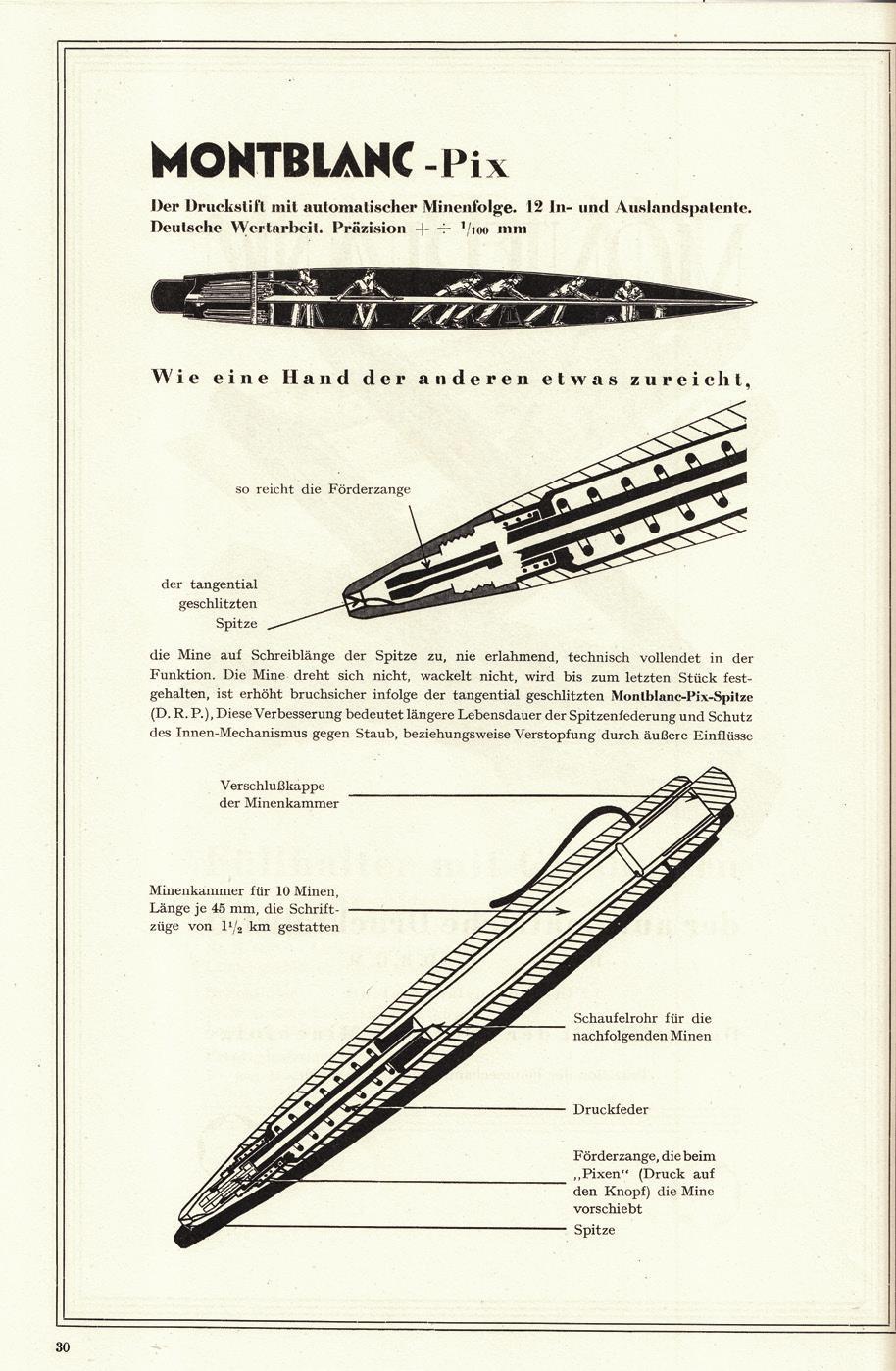
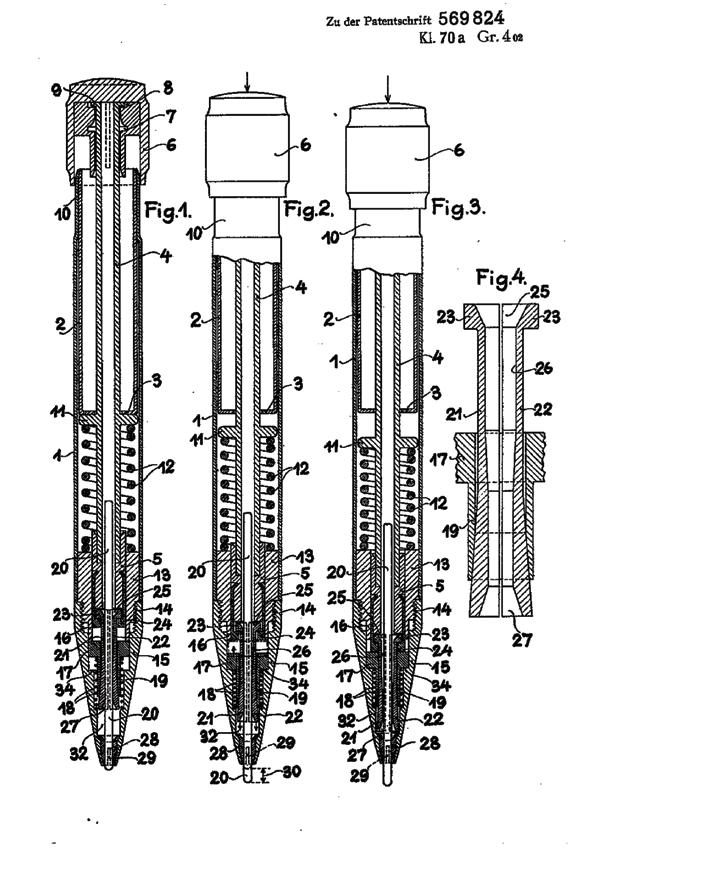
Now Ulf had my attention. What was this Montblanc PIX pencil, and who was the Herr Leistenschneider mentioned in the letter? Of course, I accepted my own challenge to find out everything there was to know about the PIX. Where to begin? I was very familiar with Montblanc fountain pens and have been using several No. 149 Meisterstücks since the early 1970’s. I even have a Montblanc mechanical pencil, but it was nothing like the PIX that was pictured. An internet search revealed there were several for sale on German eBay, and of course I bought one or two! In his on-line store listing, the seller had shown several period advertisements for the PIX. In the advertisements, which I have reproduced here, the unique mechanism of the PIX is shown in cross section. A lead refill chamber (Minenkammer) is loaded with up to ten leads (Minen) from the rear of the pencil after removing the cap that covers it. From there, the leads are fed down a tube to the pencil tip, encircled by the spring-loaded feed mechanism activated by the rear button. Upon pushing the rear button, the pencil gives a reassuring “click” confirming that the lead had been fed forward. At the tip of the pencil, the lead is held firmly in place by a locking sleeve or “collet”, which in turn prevents it from retracting back into the barrel of the pencil. To ensure that the lead stays intact and does not break in use, a unique tapered metal tip (Schreibspitze) over the locking sleeve is cut with three tangential spirals. I feel that this is the mechanism that Barnack worked on while at Zeiss at the urging of Herrmann and Leistenschneider. Perhaps Barnack also worked on the push button auto feed mechanism as well.
Original note from Oskar barnack to August Leistenschneider, thanking him for the gift of the Montblanc PIX mechanical pencil, dated 9 August, 1933. Barnack promises to use it and report back to him with his opinion of it.
Of special interest are the additional notes on the letter written by Barnack and Leistenschneider. Barnack's comment in the lower left corner states that he had in fact designed a mechanical pencil for Herr Hermann while at Zeiss and had applied for a patent on it. He then states that he had forgotten all about this, and that, "you will hear from me about this matter".
The other notes on the letter are from August Leistenschneider at one must assume were at several later dates. The note in red pencil under Barnack's signature, acknowleges that Barnack, designer of the Leica camera, worked on what became the PIX in 1909. The note in blue ink in the upper left corner, dated 20 January 1940 mentions that, "He (Barnack) was with me from 1900 to 1901 at the Palmos camera works, and then at Zeiss in Jena. Barnack was already making automatic pencil experiments for me in Jena. Later at Leitz, Wetzlar in 1924, he showed me the first model of the Leica. I was a friend of Barnack until his death. He still visited me in Bad Wildungen."
Courtesy of the Rolf Fricke collection, via Ulf Richter.
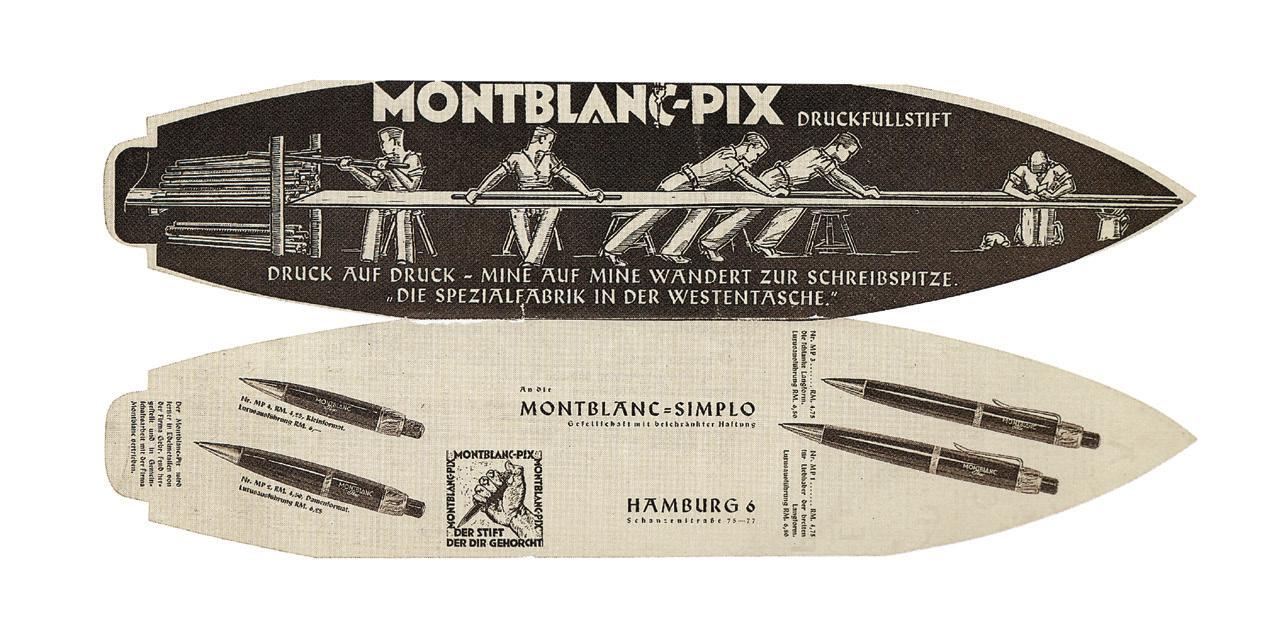
Of course, the PIX was not the first successful mechanical pencil in use, but it solved many of the problems seen in many earlier models. A similar locking sleeve is still used in today’s mechanical pencils, and the push button, spring activated feed mechanism is also still in use. One of the more interesting images Montblanc used in their ads was the fantastic concept that six tiny factory workers, sleeves rolled, were laboring inside the PIX, taking leads from the stockpile at the rear of the pencil and feeding them down an assembly line to the tip for writing. These little workmen even had tiny stools to sit on when they were not hard at work feeding lead through the PIX. The ad copy reads “Druck auf Druck – Mine auf Mine wandert zur Schreibspitze. Die Spezialfabrik in der Westentasche“ (Push after Push – Lead after Lead moves to the Writing Tip. The Special Factory in your Vest Pocket).
I reached out to Ulf Richter as well, and we have had quite a bit of correspondence regarding the PIX. Ulf supplied me with the original German patent for Leistenschneider’s mechanical pencil, and also that of an earlier mechanical pencil described in a Swiss patent from 1906 by an Eduard Penkala from Croatia. We are relatively certain that Penkala’s refill pencil was in use at Zeiss during Barnack’s, Carl Herrmann’s and Leistenschneider’s time there. A pencil was
an ever present and essential tool in the environment which Barnack and the others around him in the Drafting, Design and Mechanical Bureaus would use on an everyday basis. Barnack made countless pencil sketches and notes, and at some point, he must have realized the writing tool in his hand on a constant basis could be “improved” upon. Examining Penkala’s patent reveals what appears to be a simple sleeve into which a lead is inserted, holding the lead while writing. Only one lead at a time can be inserted into the sleeve. There appears to be no way of holding the lead fixed in place mechanically, and if too much pressure is put on the pencil lead while writing, the lead would slide back into the tube. There was also no provision for storing additional leads in the pencil. This would certainly be inconvenient in use, and likely got Barnack to thinking there must be “a better way” of doing this. Apparently, at some point during his time at Zeiss, Carl Herrmann urged Barnack to work on a solution to this problem, along with Leistenschneider. Barnack’s own notes to his letter confirm that he did design an improved mechanical pencil in 1909, and applied for a patent. At this point, the story of the PIX becomes less clear. Barnack departs to work at Leitz in 1910, World War I started in 1914, and Leistenschneider moves on from Zeiss to his Düsseldorfer Photohaus, which he takes over in 1918. Did Barnack ever really apply for a patent,
and if so, was it rejected by the Reichspatentamt? Or did he simply fail to follow through with it, being otherwise occupied with his discussions with Ernst Leitz and his subsequent move to Wetzlar, letting the matter drop? At what point did Leistenschneider take up Barnack’s work on the mechanical pencil, work on filing a patent and actually getting an actual mechanical pencil produced for sale in Düsseldorf, all the while running his camera store? One would have to believe that Leistenschneider continued to work on the mechanical pencil after 1909, but we have no documentation of this before the patent documents were actually filed 22 years later. At some point, he named his mechanical pencil the PIX.
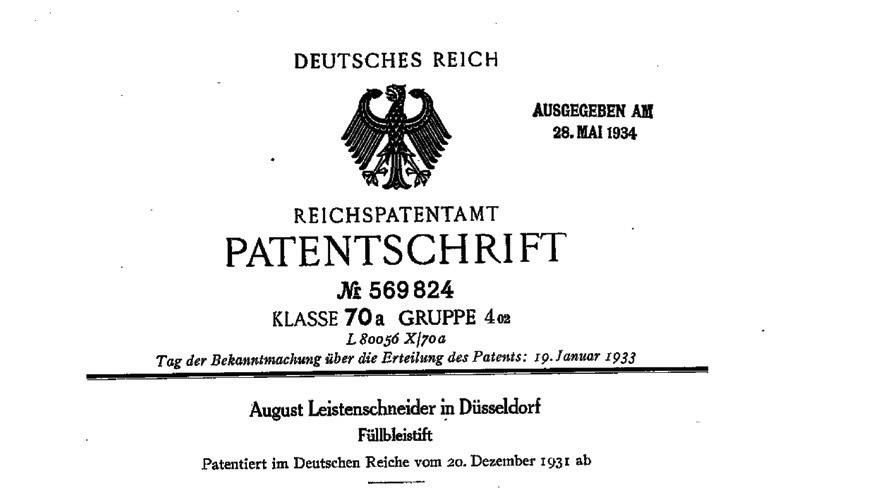
Our timeline moves on to 1931, when the original Reichspatentamt (Reichspatent Office) Patentschrift DRP Nr.569824 was filed on 20 December 1931 by August Leistenschneider of Düsseldorf for a Füllbleistift (Filling Pencil). The patent was granted on 19 January 1933. The Reichspatentamt was located in Berlin. According to Ulf, a patent must satisfy three requirements according to the German patent law:
• The invention must be new, which means it is not the existing, current “state of the art”. In addition, it has not been
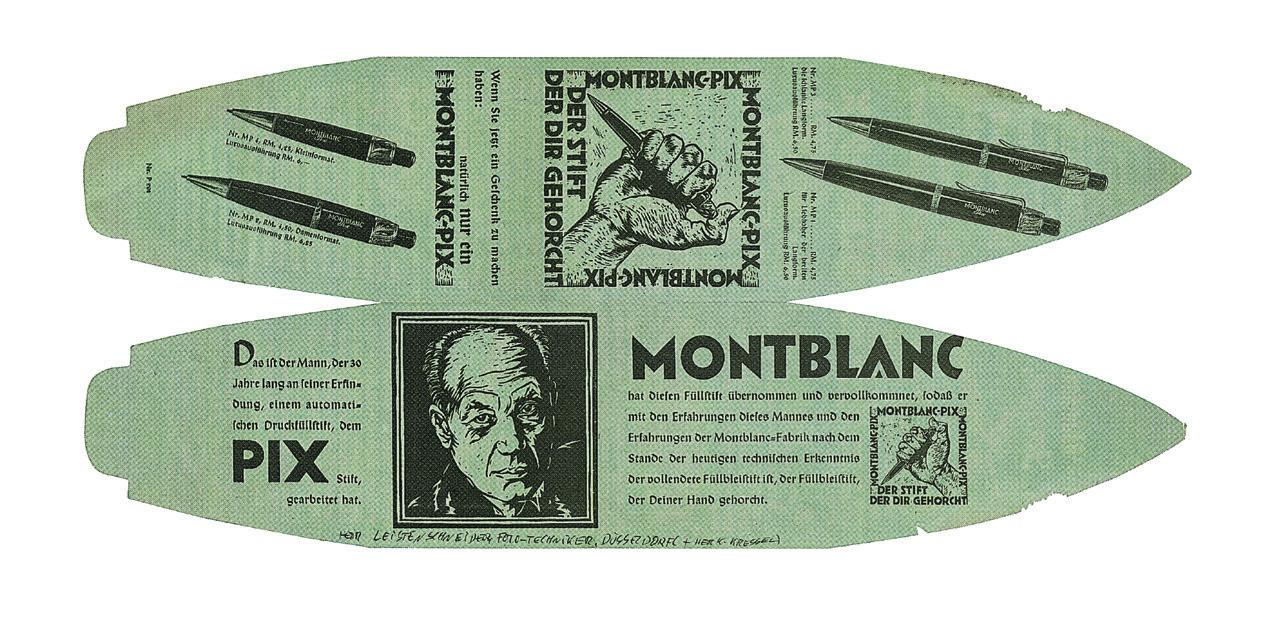
( opposite page ) Period advertisements for the Montblanc PIX mechanical pencil. Left hand ad shows clearly how the push-button feed mechanism works. It also features the fantastic concept of six tiny factory workers, sleeves rolled, feeding lead down an assembly line to the tip of the pencil! Montblanc calls it, "The Speical Factory in your Vest Pocket"!
Advertisement on right features several PIX models and a portrait of August Leistenschneider himself, patent holder for the PIX.
( left ) Original Reichspatentamt patent filing, along with the illustrative drawings from it, showing the mechanism of the PIX push-button feed mechanism.
discussed verbally or in writing, or already being used in the market.
• The solution to the problem the patent proposes must not be clear to everyone. The inventor must take novel steps to solve the engineering problem, which are not obvious to everyone.
• The invention must have a commercial or industrial use.
The patent office would then investigate the patent application, and if all the requirements were met, the complete patent document would be published in the official Patent Journal (Patentblatt) and at that point the patent rights begin. Needless to say, this process usually took some time, sometimes several years, to be completed.
The US Patent filings discovered refer to two further German patents, Patentschrift DRP (Deutsches Reichspatent) Nr. 647152 filed on 19 December 1931 and granted on 14 December 1932 and Patentschrift DRP Nr. 708801, filed on 31 January 1933 and granted on 29 January 1934. Strangely, the two German patents referred to in the US Patent applications have nothing to do with the PIX mechanical pencil! US Patent 1,969,085 filed with the US Patent Office on December 14, 1932,
based on Patentschrift DRP Nr. 647152. The patent was for an “Automatic Lead Pencil”, patent holders August Leistenschneider and Konrad Kressel. This US Patent was granted on August 7, 1934. A second US Patent 2,049,965 was filed on January January 29, 1934, based on Patentschrift DRP Nr. 708,801. This patent was for a “Lead Pencil”, patent holder August Leistenschneider, US Patent granted on August 4, 1936. The drawings submitted with all of these patents generally resemble the PIX, but have many detail changes from what is shown of the cross section of the actual PIX in the Montblanc advertisements. Perhaps these drawings more closely resemble the predecessor of the PIX pencil produced in Düsseldorf that Montblanc’s history refers to.
At this point, I refer to the Montblanc narrative pertaining to the PIX in their book Montblanc Diary and Collector’s Guide. According to the Guide, “Montblanc had introduced their own mechanical pencil with a push button mechanism known as the OB. However, the OB was not a great success as its operation was too complicated. It was not until 1934 that the management (Montblanc in Hamburg) obtained the rights for a functional push-mechanism pencil, which was named PIX. The push mechanism of the PIX pencil was developed by a Mr. Leistenschneider for a firm in Düsseldorf and was put on the market in late 1933. Montblanc quickly recognized the enormous advantage of this multiple-refill writing instrument over conventional mechanical pencils and persuaded Mr. Leistenschneider to put his invention to work for Montblanc.”
In tune with the times, Montblanc offered the starter model “Volkspix” Model 92 (the People’s PIX) in 1934, for the very affordable price of 3 RM! Seven other models were offered, with the most expensive one being 6,50 RM! The PIX contin -
ued to be sold until the late 1950’s and was one of Montblanc’s most successful product groups. Montblanc stated that, “one of the factors that contributed to its success was the typical clicking sound made when the mechanism was actuated. This sound could be heard everywhere writing was done!”
Today, vintage Montblanc PIX pencils can be found on German eBay and various pen enthusiasts web sites. Prices vary between EUR 45 and EUR 200! Of course, as with the Leica, condition is paramount. I have obtained several PIX pencils of my own, and they are quite usable and compare quite well to my modern Pentel GraphGear 1000. One weak point is that the barrel is made out of Bakelite, which like the Vulcanite on the original Leicas, is petroleum based and can be fragile when subjected to rough handling or being dropped. Another problem is the lead size, which is typically 1.5mm for the early models and 1.2mm for the later PIX. These lead sizes can be difficult to find, as today’s typical leads are .5mm and .7mm. Later versions of the PIX appeared with metal barrels, in addition to the traditional Bakelite material.
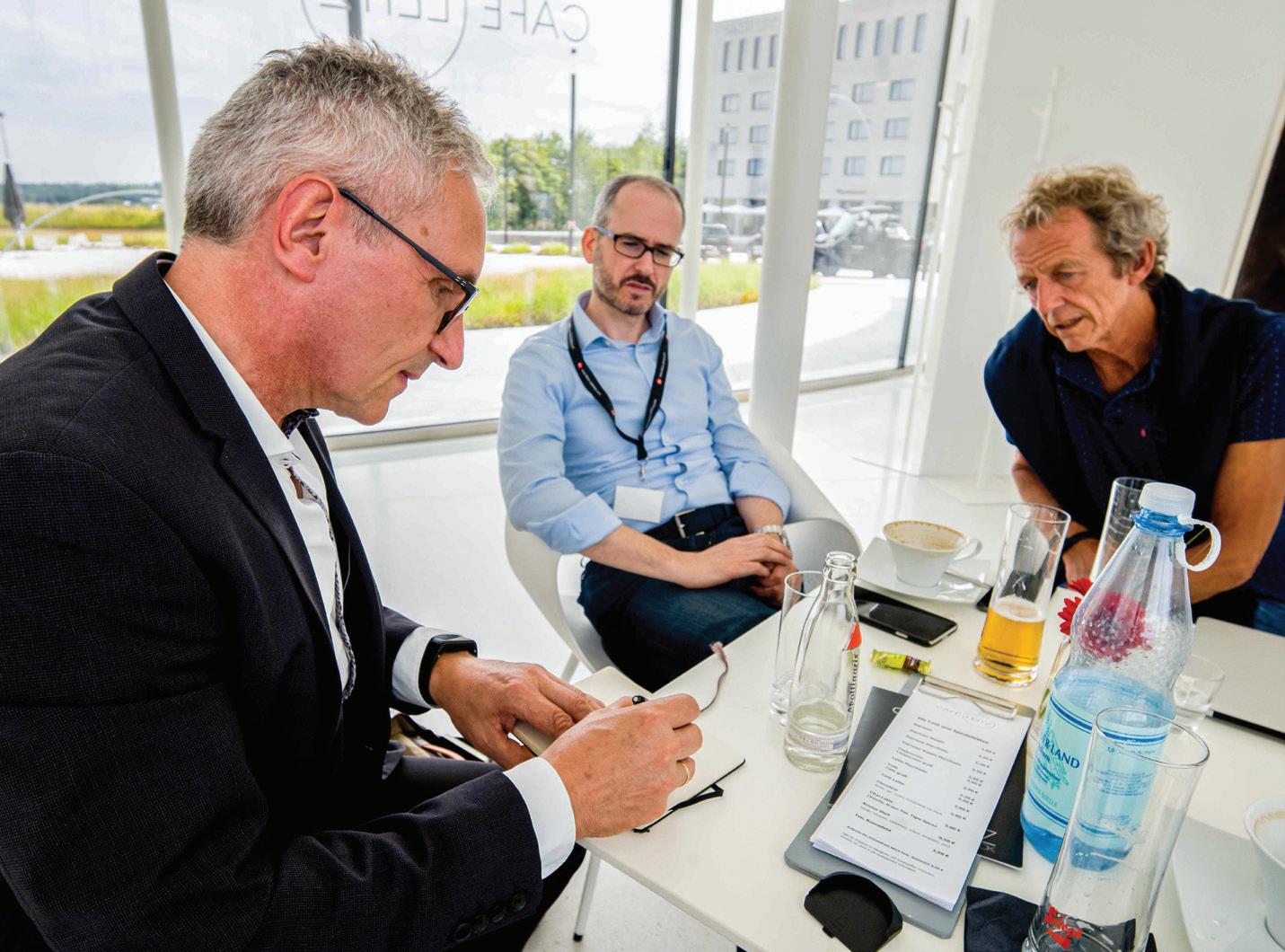
As an interesting aside, I had my PIX with me while at Leitz Park for the dedication of Leitz Park III in 2018. I was sitting with David Farkas, Josh Lehrer, Jono Slack and Alan Weinschel in the Café Leitz when Peter Karbe, Head of Optical Design, joined our group. While explaining one of the finer points of Leica lens design, Peter asked for something to write with to help illustrate what he was talking about. I handed him my PIX, which Peter used with great effect. How appropriate that Peter was using a writing instrument that Oskar Barnack had a hand in designing!
And whatever became of Herr Leistenschneider? As we know, he went from Zeiss Jena to establish his Düsseldorfer Photohaus in 1918. Apparently, Leistenschneider Foto became a great success and is still in business near its original location on Schadowstraße in Düsseldorf and the fourth generation of the family is still involved in the business. They are still Leica dealers, having been one of the first in 1925. There are also branch stores in several other cities in Germany.
I would like to thank Ulf Richter for his help on this story, and for his wonderful book on Barnack’s life. Ulf was very generous with his time explaining the ins and outs of German patent laws and application process, and for helping fill in some of the blanks in this story. Ulf also provided some of the images of the Leistenschneider Photo store and the original Barnack letter in Rolf Fricke’s collection. I’d also like to thank Doug Drumheller for his help in obtaining actual copies of the patents of interest in the history of the PIX. These arcane documents give tremendous insight into how these wonderful little mechanical pencils work. Doug was also the prime mover behind getting Rolf Fricke’s translation of Ulf’s book printed for the LHSA. Thanks also to Hans Freudenblum for providing me with the vintage advertisements of the Montblanc PIX when I purchased a PIX from him. Finally, thanks also to my mom who taught me to appreciate fountain pens and bought me my first Montblanc 149 back in my college days!
sources:
Herrmann, Carl, Erinnerung an Oskar Barnack (Memories of Oskar Barnack), Foto Magazin, 1961, No.1, p.22
Leistenschneider, August, Erinnerung und Feststellungen (Memories and Insights), Photo Magazin, 1949, No.12, p.12
Richter, Ulf, Oskar Barnack – From the Idea to the Leica, Translation by Rolfe Fricke, LHSA, 2009/2017
Rösler, Jens, Montblanc Diary and Collector’s Guide, Christians Verlag, 1993
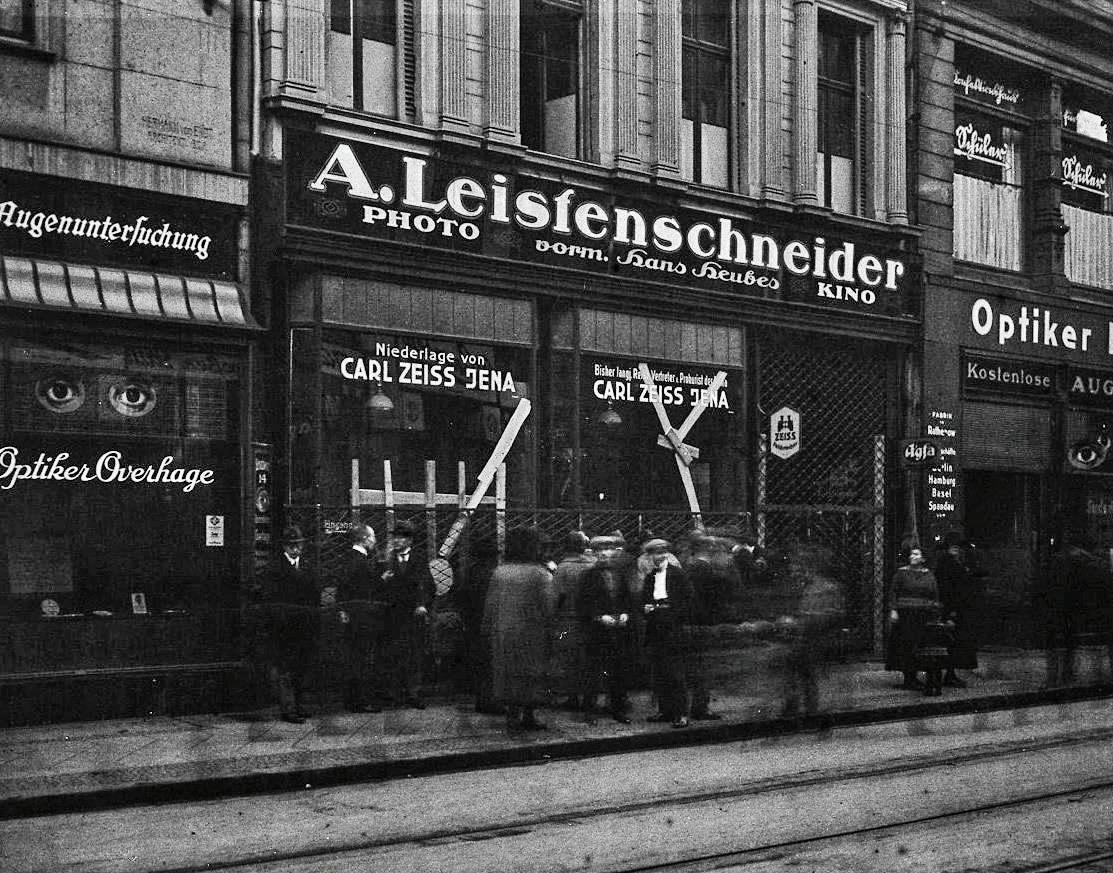
( opposite page ) August Leistenschneider's photo store at Schadowstrasse 16, Düsseldorf in the Winter of 1918-1919. The boards in the windows, and grating over the windows indicate the unsettled times in the immediate Post-War period.
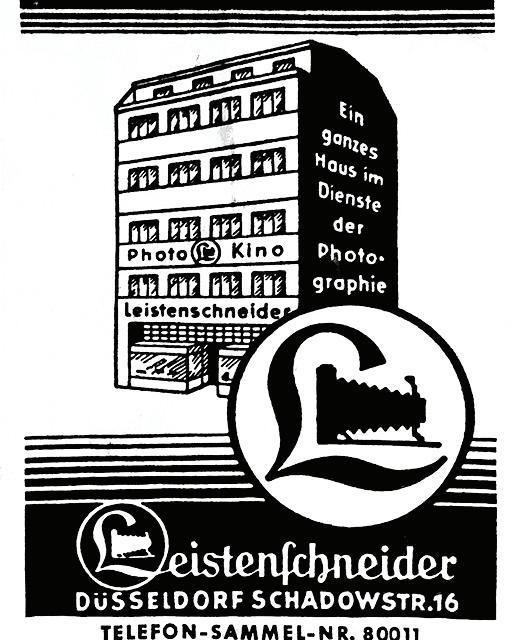
Illustration on the right shows the Leistenschneider store, logo and slogan, "An entire Haus (store) in the service of photography".
(left) Peter Karbe, Chief of Optical Design at Leica, makes a drawing with my PIX, illustrating a lens design to us at the Leitz Cafe, as David Farkas and Jonathan Slack look on.
PAUL WOLFF, DOCTOR
by ED SCHWARTZREICH
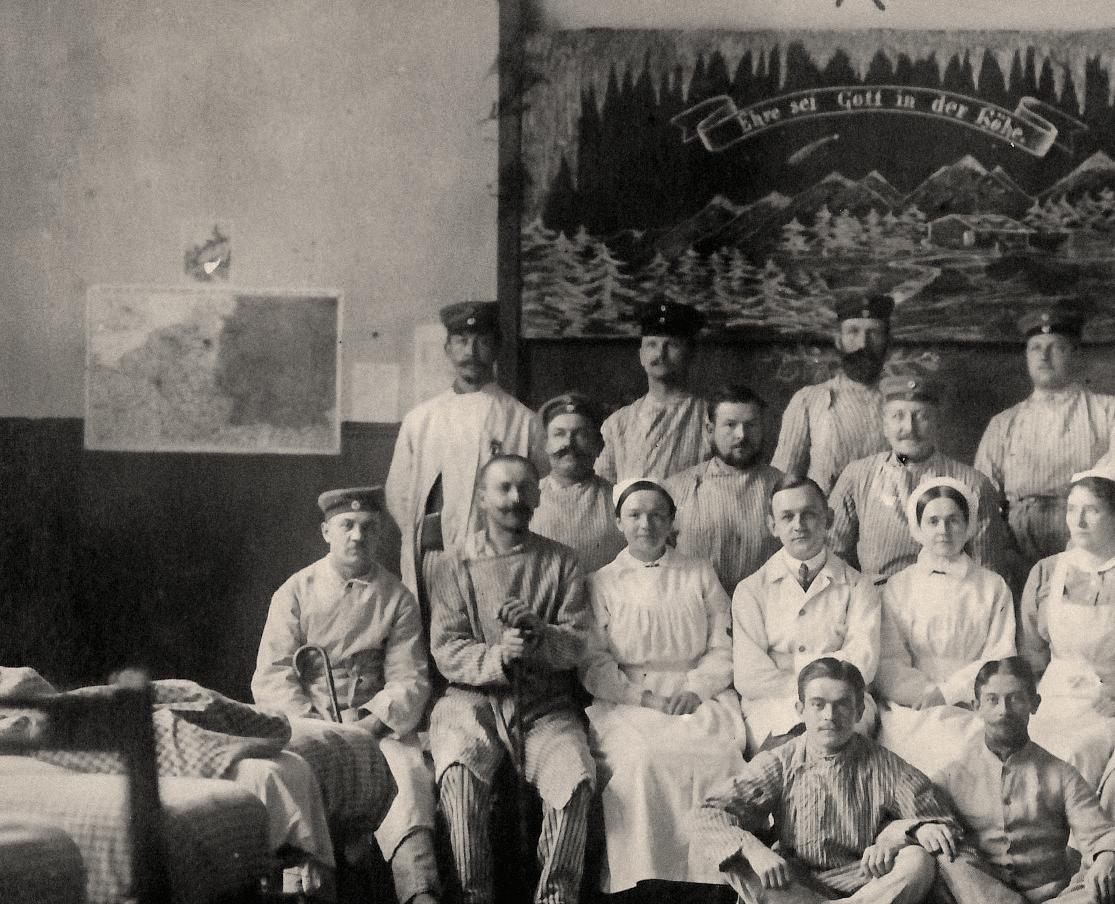
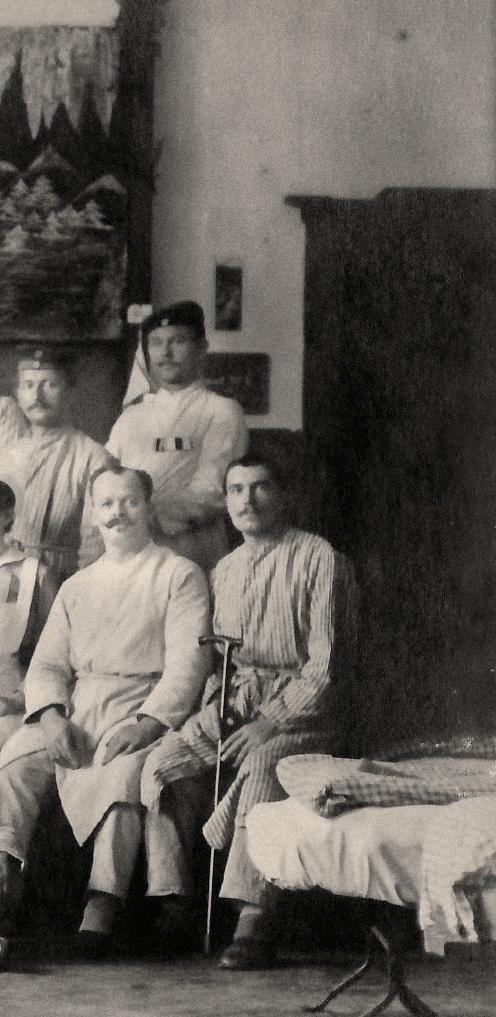
(above) Undated image, possibly ca 1914. On the reverse: J. Fromm, Waisengasse 5, b., Metzgerplatz, Straßburg i. E[lsaß]. Some Photoshop restoration done by the author.
is the last of three articles based upon materials shared by Ashley Wolff, Paul Wolff’s granddaughter. Here, starting with images from Ashley, we will examine what is likely the totality of pictures involving Paul Wolff and doctors. There are only a very few such, and those few are surprisingly perfunctory. We will look at why this might be the case, and what this likely tells us about Wolff as a person.
Years ago, when this author started working on the bibliography of Leica pioneer Paul Wolff and then gradually encountered the related biographical data, he came face to face with the story of Wolff being first a physician (with an avocation of photography) and then later a famous photographer. And not just a famous photographer, but also a person who kept the title “Doktor” even though he had ceased practicing as one at the end of WWI. For Germans, “Doktor” as an honorific refers to the holder of a Ph.D. or an honorary degree, not usually a medical doctor (“Arzt”); however, in Wolff’s time, most medical doctors wrote theses, as also did Wolff. Being a Doktor in Germany has always entitled one to great respect. Likely Wolff kept the “Dr.” because of his academic doctorate and not because of the M.D., but of course they were linked. And quite possibly also he chose “Dr. Paul Wolff” to distinguish himself as a photographer from his contemporary competitor, “Paul Wolff (Dresden)”.
Yet confusion exists as to Wolff’s appellation. For example, years ago the author encountered one historian who, from the ambiguity of available information, doubted that Wolff was indeed a medical doctor, but guessed he was rather a dentist! To that historian, it seemed as though Wolff had something to hide about his title. (This author definitely thinks the historian had grasped a basic psychological truth about Wolff without having put his finger on it, vide infra .) Clearly, being known as “Dr.” was important to Wolff as a signifier, but he simultaneously downplayed his medical career, which then received minimal attention in the historical record. In a 1935 autobiographical sketch (in Meister der Kamera erzählen, Wilhelm Schöppe, editor), 1 Wolff passes over it in a few sentences, saying that while it was easy enough for him to become a doctor, it was too difficult to do this in Frankfurt after the War, because attempts to establish a practice were thwarted by his lack of money during the 1920s hyperinflation. Wolff could only have had about six months of service in Alsace as a doctor before the War; most of his actual medical practice was military. Like many military veterans, Wolff states he actively chose not to pass on details of what had happened around him as a regimental doctor. (“I don’t relish talking about the war. I could report some ghastly things…”) [from Koetzle]. 2 In fact, he relates (in Schöppe) that after the war he destroyed whatever military photographs he had made. It may be instructive here to note that one of the few major subjects on which Wolff never published photographs was the
military; another was nudes. 3 One can potentially add doctors to this list, because there are so few such published images.
During the early 1920s in Frankfurt, after Wolff gave up trying to find employment as a physician, he struggled and was likely repeatedly humiliated attempting to make his avocation, photography, into his profession, 4 likely, in part, because he was not credentialled as such. This added insult to injury. As a further potential conflict, per Wolff’s unpublished autobiography quoted by Koetzle, 5 Wolff’s father had earlier urged him to study medicine and not to devote himself to photography: “…because my father refused to view the profession of photographer as class-appropriate under any circumstances, indeed he described it as a whim”. Circumstantial evidence: one almost never hears about Wolff as physician. He short-circuits the outside observer’s potential empathy here by not really discussing the emotional dimensions of having been forced to switch professions, although he implies that there was difficulty. Wolff apparently did not discuss any feelings about this in his autobiography either, and only gives the minimal facts of what had happened when he could not afford to open a medical practice. 6 However, the little we do know about Wolff the doctor is negatively tinged, and one could surmise that Wolff probably had at least ambivalent, if not painfully depressive or angry feelings about his medical career and how it played out. He could have also internalized his father’s value judgments about the two professions and felt defensive about what he finally chose to do. In essence, the Wolff we know may have tried to minimize or banish such feelings by, for the most part, avoiding this particular subject in his work. Wolff nonetheless kept his socially valuable “Doktor” signifier, setting up possible cognitive dissonance when this title was used, or when he actually did photograph doctors. How he handled his ambivalence in his few doctor pictures may give us a subtle entrée into understanding how his psyche operated on an emotional level.
Let us pause for a moment and actually empathize with all that Paul Wolff had gone through in just the few years of his early maturity: he had been a newly-minted regimental doctor in a gruesome war; he was summarily expelled from his beloved Alsace; he was not able to work and support his young family as a doctor in Germany due the concurrent inflation; and he had to struggle to become the renowned photographer he only later became. This series of events must have had significant psychological impact upon him. It would not be unreasonable to consider Wolff’s photographic vision — his lively Leica images, so well-conceived and made — as being a real emotional relief for him: the images he published were almost always happy ones based on a playful view of their reality; he was in control of what he did and loved doing it; and people really liked his work and paid him large sums of money for it. So, perhaps Wolff’s immersion in his business career and in his unique photographic vision provided a
(above) From an undated (ca 1928) folded flyer / brochure from Wanderer-Werke A.-G., Schönau-Chemnitz. The flyer also contains the name Hermann, which may represent the graphic artist involved.
potent antidote to counteract stress and depression. Think Roger’s and Hammerstein’s “Happy Talk” from South Pacific as a musical reference; substitute “Happy Snaps”.
While there is presently basic evidence of Wolff’s medical bona fides (such as the date of his medical examination, the nature of Wolff’s thesis, and the name of his thesis advisor), the author wishes to present images that were received from Wolff’s granddaughter Ashley that pertain directly or indirectly to Wolff the doctor. All of these are rarities. In over 20 years of research, the author has not ever seen another image of Wolff as an actual practicing doctor, and here first is a group portrait of Dr. Wolff, his staff nurses, and apparently military patients under his care on a hospital ward. From what Dr. Wolff has said elsewhere, this may be the hospital for POWs that he worked at in Metz in 1914 before being sent to the Eastern Front. The reverse of this image has stamped upon it only the name and address of its likely photographer but no date. Wolff is near the center dressed in his hospital whites and necktie, just behind two gents seated on the floor. One assumes that any of the men not wearing military caps or holding canes are possibly hospital orderlies or attendants.
This semi-formal portrait of him in a hospital setting gives a certain tangibility and physicality to his medical role that had otherwise been lacking in the historical narrative. There is also, in a documentary sense, a feeling of pathos and authenticity to this image, with almost everyone making eye contact with the camera.
A second set of “medical” images supplied by Ashley Wolff, in contrast, derive from a small undated (likely ca 1928) folded flyer or brochure. This appeared initially to be also something having to do with Paul Wolff’s role as a doctor. Only upon reading the text, however, one discovers that this flyer was clearly meant for advertising purposes and, as such, its images were staged. In fact, it is likely that the brochure was not Wolff’s own idea, but rather an assignment dictated by the advertiser. 7 Here Wolff used himself as well as Tritschler (in the image with the x-ray) as the model; at that date, he often used his family, his associates, or himself in such a manner, likely to save money. Tritschler, now working with Wolff as an assistant, could have alternated with Wolff taking the pictures, which from the images’ shape, are likely 9 x 12 cm images, not Leica pictures. In any case, Thomas Sommer says these pictures are not in his Archiv.
The idea in the flyer was to convey to medical doctors the usefulness of a relatively new device -- the portable typewriter. The text in the flyer focuses at length on how convenient and rapid it would be for the “Modern Doctor” to be able to type up, by him- or herself, the medical notes or other necessary paperwork following an appointment with a patient. Such notes were of course a medical document, but also were more than
occasionally needed for legal, insurance, or other purposes. And with the portable typewriter, one could easily type such notes (in duplicate or triplicate if needed) without much training and did not require a large, expensive typewriter with a special desk or need a hired typist. So goes the text.
Wolff ‘s modus operandi very often involved him staging his images to make them have some enhanced sense of realitythe scene’s “quintessence”, as Wolff would later define it. Such an essence was almost always a happy one. Even in his best images, where we become almost personally involved in the moment with the people being depicted, Wolff is working as deus ex machina, controlling how we see the image and feel about it. The little doctor flyer is no exception. The author of this article on Wolff is also both a physician and a photographer, and found himself at first gently bemused with these flyer images, easily falling into the reaction of: “Well, well, what do we have here? Here is another rare picture of Paul Wolff as a doctor!” He felt compelled to go along with Wolff’s playful doctor fantasy in the flyer because the images are so convincingly well done. It took reading the text to establish the actual circumstances: viz. that Wolff here is not being depicted as himself professionally at all, but is actually working on assignment, on an advertisement for a typewriter for doctors. He is presenting a quintessential image of a doctor in his office, typing. That is his goal here, expertly done. The flyers images are simply an effective commercial ad which feels quite real and true-to-life even though it has nothing to do with “Paul Wolff, Doktor” really at all. Rather, this is play-acting.
For the author, however, this flyer could well be taken as prima facie evidence of how Wolff handled emotional issues arising in his work: by replacing reality with a plausibly-real yet idealizing construct, and play-acting with us in the way that usually makes his photography so captivating. Wolff’s photo reality is often like Walt Disney’s movie reality - too distilled and perfect to be “really” real, but at the same time superficially persuasive and almost always enjoyable. We happily go along for the ride. But in this flyer, we are dealing not with a factory worker, a coal miner, or a holiday-goer on the beach, but with a doctor, of Wolff’s learned profession, which medical career appears to have raised ambivalent, even uncomfortable memories for him. The author’s premise here: a discerning eye can see that the pair of “medical” images in the flyer lack the tangibility of place, role, and emotion which are present in the hospital image, or even in many of Wolff’s other images of people at work which show character or human interest. The flyer images are expert and sympathetic but quite anodyne and without emotion. The well-groomed “doctors” have nary a hair out of place, and significantly, there is no eye contact or even a view of the subjects’ eyes really at all. What we are given here is a small bit of the artifice which made Wolff a famous photographer: good use of background
(above) Image from 1934 Meine Erfarhrungen mit der Leica. Ein historischer Querschnitt aus fast 10 Jahren Leica-Photographie, Frankfurt am Main, H. Bechhold Verlagsbuchhandlung, 1934, p. 185 & 188.
(above) Image ca 1928 of Paul Wolff at the typewriter. (right) Image of Paul Wolff as doctor reading x-rays. Undated. Provided by Thomas Sommer.
props, good framing, composition, and lighting, hitting all the notes of a successful image that conveys immediate meaning to the viewer, who easily may be drawn into the images personally because they are so well, even playfully, conceived. But for the author, this flyer’s images show Wolff, the consummate professional, simply pushing ahead here for commercial reasons, flying on auto-pilot. 8
There are just a few other explicitly medical images in Wolff’s oeuvre known to the author. These are shown on the opposite page. From Meine Erfahrungen mit der Leica 1934, there are two, one of which derives from a series, (Serie 605, Frauenklinik, Frankfurt/Main, 1933) Women's Clinic, Frankfurt / Main, 1933. The other, of a doctor and a nurse reading x-rays, does show some sense of the personalities of those depicted -- it is an outlier here. There is also known an undated image of a youngish Dr. Wolff dressed as a doctor reading x-rays, which appears very similar to those in the flyer. About these additional images, per Thomas Sommer we do not know specifically why they were made, or even which photographer took them -- Wolff, Tritschler, or some other of the firm’s Mitarbeiter. Of note, there are no medical pictures in either the later 1939 Meine Erfahrungen…, or in the somewhat similarly laid-out 1940 Japanese monograph on Wolff’s work: The Paul Wolff Masterpiece Collection ( バウル, ヴオルフ 傑 作窵眞集 ).
One might think offhand that Wolff would excel at pictures of physicians because of his having been one himself, and especially since he kept the title throughout his life. One might have even expected, from Wolff’s photographic vision, that he would have made Norman Rockwell-like images of the kindly general practitioner in his office with children, happy moments on the maternity ward, or of mass inoculations being given to further the health of the state. But no; suffice to say here that Wolff likely found it unpleasant to photograph medical scenes and doctors. His “medical” images definitely tend to show this by the omission of any affect, and the impersonal rendering of his subjects. One needs only to compare these images to many of Wolff’s famous images of people at work to see the difference made by his apparent avoidance of feelings here, even though Wolff’s best images are discreetly posed to show mostly the Disneyesque “quintessence” that Wolff himself intentionally wanted highlighted. A different and more useful contrast is to put the doctor images in this article next to almost any of the many doctor images made by the late Canadian Leica photographer Ted Grant, where one can immediately feel the intense emotional bond between the photographer and the doctors - no emotional elision and no play acting.
The author, a psychiatrist, thinks it likely that Wolff used his total immersion in his career, his strong abilities at playacting in setting up his images, and the intrinsic happiness of
most of them, to shield himself from both his internal turmoil and also what was happening in Germany at the height of his career. His images of doctors are a possible key to unlock that narrative. But the pursuit of that hypothesis is a story for another time.
1. Meister der Kamera erzählen , Wilhelm Schöppe, editor. Halle, Saale: Knapp, 1935, p. 59
2. H-M Koetzle, in Dr. Paul Wolff & Tritschler: Light and Shadow - Photographs from 1920 to 1950 , Hans-Michael Koetzle editor. Heidelberg: Kehrer Verlag 2019; p. 420
3. Manfred Heiting; personal communication
4. Sabine Hock, in Dr. Paul Wolff & Tritschler: Light and Shadow - Photographs from 1920 to 1950 , Hans-Michael Koetzle editor. Heidelberg: Kehrer Verlag 2019; pp. 132-139
5. Ibid, Koetzle, p. 420 but translated by the author from the original German of Wolff’s autobiography.
6. Thomas Sommer, personal communication.
7. Dr. Kristina Lemke, Wolff researcher, thinks this flyer was likely set up by a clearly defined advertising order with Wanderer-Werke, and involved a graphic artist and probably other persons such as those who supplied the medical equipment. Wolff had likely little personal scope here, in her opinion. Wolff was also involved in other advertising campaigns at the time. Personal communication.
8. Parenthetically, the typewriter aspect of this flyer goes further and may be more important overall for understanding Wolff’s work practices than merely a focus on its doctor aspect. The portable typewriter in the flyer was a new product from Wanderer-Werke called the KLEIN-CONTINENTAL. This model was released near the end of the 1920s which helps us date this flyer. The Klein-Continental was marketed until after WWII, and is apparently a well-known model. There is a familiar circa 1928 image of Dr. Wolff, seated and apparently deep in thought, pipe jauntily hanging from his mouth, flat cap on his head, and this model typewriter in his lap. (fig 4) Could the typewriter in that image have both been the very one depicted in the flyer, and also Wolff’s stipend from Wanderer for producing the flyer? Even if not, Wolff may well have essentially product-placed the typewriter (and himself!) in that later image for possible future use. Wolff was an excellent networker and self-promoter, and just a few years later, in 1935, Wolff perhaps unsurprisingly did major work for Wanderer-Werke, producing one of his industrial books for the 50th Anniversary of that company.
Leica Monté en Sarre
Only 500 Pieces Built in the Saarland
by OLAF NATTENBERG, KAMEN
Leica Monté en Sarre was manufactured in the Saarland after World War II. At that time the Saarland was still under French occupation, and made it possible for the Leitz company to get better access to the French market.
Monté en Sarre means: assembled or manufactured in the Saarland. After the Second World War, German companies were only allowed to export photographic cameras to France under very high customs. Ernst Leitz, Wetzlar granted a license to build the Leica to Saroptico, a company based in the Saarland. This allowed Leitz to legally circumvent existing regulations, and the Leica could then be sold in France without high duties.
The Saroptico production facility in St. Ingbert was managed by Walter Kluck. He later went to Canada (in 1952) as a sales manager to set up the Ernst Leitz branch in Midland, Ontario together with other colleagues.
The Monté en Sarre cameras have this inscription in distinctive lettering on the top plate, under the word "Germany". The serial number range is between 359000 and 359504. Between 1949 and 1951 Saroptico assembled around 500 screwmount Leicas in Saarland. All these cameras were sold to France or the French colonies.
As a rule, the Saar-Leica is a post-war Leica IIIa. However, different pieces have different characteristics. For example,
a number of the units had already elements of the Leica IIIf, which was not to be released until September 1950.
The Saar-Leica, like the IIIa, has a 1/1000 second top speed. The available shutterspeeds are: 1/1000, 1/500, 1/200, 1/100, 1/60, 1/40, 1/30, 1/20, 1s, T, Z. The top plate which houses the rangefinder and viewfinder is separate from the body, which is also characteristic for pre-war Leicas. All cameras are chrome plated, like the IIIa.
The first 100 to 200 copies have the sharkskin vulcanite covering known from the post-war Leica IIIc. However, conventional vulcanite was subsequently reintroduced. Similarly, the chrome plating of the earlier cameras, as with the contemporaneous Leica IIIc’s, is likely to show certain defects in the chrome due to the scarcity of materials used in plating process.
Pre-war Leicas were engraved with DRP (Deutsches Reichs Patent). This can also be found on most Saar Leicas. Nonetheless, there are a few examples that already have the DBP engraving for the Deutsches Bundes Patent, first used with the IIIf in the early 1950s.
IIIf details seen are also the advance knob and the flash synchronization. The advance knob feature appears to offer the possibility to adjust the sensitivity of the film, but it is just a memo disc that has no effect on the actual exposure control. The camera was usually not equipped with flash
synchronization as on the IIIf, but pieces do exist where this was subsequently installed by Leitz.
The Leica Monté en Sarre consists of a combination of pre- and post-war parts that were assembled in St. Ingbert in order to bring the camera to the French market quickly and inexpensively.
Due to its small production numbers, the Leica Monté en Sarre is a very rare and sought-after Leica camera. Nowadays it can usually only be obtained from Leica auctions known in specialist circles.
Olaft
Nattenberg ∙ www.leicapages.org
SILVER CASES
by JIM LAGER
during
the winter of 1978 my dear friend Roger Pelham, the highly respected Leica Dealer specialist in Dayton, Ohio and I ventured to Miami University of Ohio. We braved cold weather and difficult road conditions to inspect the growing Leica collection of Charles Messer, the owner of Messer Construction of Cincinnati, Ohio.
Mr. Messer said the Leicas were in a second floor room of one of the older buildings on campus. Roger and I had permission to evaluate the equipment and take photos as needed. When we entered the small room the entire floor was covered with numbered Haliburton cases. Dozens of cases. We had no inventory list and realized progress would go slowly. Using my Leicaflex SL it took the entire day. Opening each case yielded surprises.
The floor felt a bit wobbly. I used a tripod but still worried about camera shake. Fortunately this was not a problem and the negatives were excellent. Many of the photos were first published in my Leica Illustrated Guides 1975-1979.
In the early 1970's while working in the Leica Technical Department of E.Leitz, Inc. Rockleigh New Jersey it was necessary for me to go to the Service Department to gather information to help a customer. This was a daily occurrence. The technicians knew I was interested in anything Leica.
When they confronted something of interest they asked me to come and take a look. One day I was summoned by a rather excited voice saying “ Jim, you should come now as we have something here that you should see”. Something that Wetzlar trained technicians have never seen? I went immediately.
There in a battered silver Halliburton case rested an M Leica and accessories. A special grip, two lenses, an extension tube, and oversized viewfinder. The body, grip, and viewfinder finished in grey hammertone paint. The heavily worn body engraved MS. Fitted with only three shutter speeds. This was new to us. I reacted immediately and “borrowed” the assemblage and carefully photographed everything. The equipment was forwarded to Ernst Leitz Canada as it was their product. By the mid 1970's we learned this unusual Leica had been prepared for the U.S. Navy. A product of the Cold War.
A parting thought. I suggest if you encounter a closed silver Haliburton case find out what it contains. It could be the surprise of a lifetime.