Newsletter
for health professionals of Coomeva Medicina Prepagada ISSN 2011-3579
Vol. 7
No. 2
May - July 2014
Satisfactory balance
CONTENT 4
HEALT UP TO DAte Slow reduction in maternal mortality in Colombia
8
ebm A test predicts Alzheimer’s with 90% accuracy
promotiOn AND prevention
12
Protocols for patient safety, an urgent affair
FROM COOMEVA
15
• Law news • Important: new statement of account for providers!
MEDICAL WORLD Books reviews and events
17
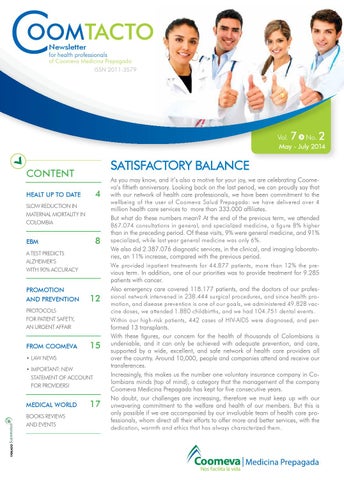
As you may know, and it’s also a motive for your joy, we are celebrating Coomeva’s fiftieth anniversary. Looking back on the last period, we can proudly say that with our network of health care professionals, we have been commitment to the wellbeing of the user of Coomeva Salud Prepagada: we have delivered over 4 million health care services to more than 333.000 affiliates. But what do these numbers mean? At the end of the previous term, we attended 867.074 consultations in general, and specialized medicine, a figure 8% higher than in the preceding period. Of these visits, 9% were general medicine, and 91% specialized, while last year general medicine was only 6%. We also did 2.387.076 diagnostic services, in the clinical, and imaging laboratories, an 11% increase, compared with the previous period. We provided inpatient treatments for 44.877 patients, more than 12% the previous term. In addition, one of our priorities was to provide treatment for 9.285 patients with cancer. Also emergency care covered 118.177 patients, and the doctors of our professional network intervened in 238.444 surgical procedures, and since health promotion, and disease prevention is one of our goals, we administered 49.828 vaccine doses, we attended 1.880 childbirths, and we had 104.751 dental events. Within our high-risk patients, 442 cases of HIV-AIDS were diagnosed, and performed 13 transplants. With these figures, our concern for the health of thousands of Colombians is undeniable, and it can only be achieved with adequate prevention, and care, supported by a wide, excellent, and safe network of health care providers all over the country. Around 10,000, people and companies attend and receive our transferences. Increasingly, this makes us the number one voluntary insurance company in Colombians minds (top of mind), a category that the management of the company Coomeva Medicina Prepagada has kept for five consecutive years. No doubt, our challenges are increasing, therefore we must keep up with our unwavering commitment to the welfare and health of our members. But this is only possible if we are accompanied by our invaluable team of health care professionals, whom direct all their efforts to offer more and better services, with the dedication, warmth and ethics that has always characterized them.
HEALTH UP TO DATE
S
low reduction in maternal mortality in Colombia
The National Institute of Health presented the most recent study on mortality in Colombia. In it the mortality in children declined, but, sadly, it also highlights that maternal mortality goals will not be achieved by 2015. Mothers are still dying because of preventable causes. This is everyone’s responsibility. With the participation of Germán Augusto Gallego Vega Advisor to the direction of promotion and prevention at Ministerio de Salud y Protección Social
Decrease in maternal death rates is part of the Millennium Development Goals. However, evidence suggests that colombian mothers still die because of preventable causes in 95% of the cases, as revealed in the Second Report on Mortality in Colombia, recently presented by the Observatorio Nacional de Salud (ONS), formed by Instituto Nacional de Salud (INS) and Ministerio de Salud y Seguridad Social. Largely this dramatic situation is due to inequalities between the different departments in the country, and multiple barriers that limit access to health care services and other sanitary resources,
45
especially the most vulnerable and secluded areas, as well as regions lacking institutional resources to ensure a safe motherhood and limited sexual and reproductive rights by women.
WHAT WE DIE OF? Knowing about the overall mortality helps health care professionals to understand what is happening with maternity in Colombia. According to this report, mortality figures reached 68.8 cases per 100,000 live births, while the goal for 2015 is 45 per 100,000. Even though during the 14 year period included in the study (between 1998 and 2011) the general mortality rate declined, basically the first 10 death causes remain
©2014 Shutterstock Photos
the same: coronary heart disease is now the first cause of death, and there’s an increase in the mortality rates of other digestive diseases, such as colon, rectum, and other types of cancers, as well as HIV-AIDS. Also they found that mortality due to cardiovascular causes predominated over the age of 75, and diabetes mellitus affected more women, especially after 65. And departments like Caldas, Quindio, Risaralda, San Andrés y Providencia, Norte de Santander, and Valle del Cauca had higher mortality rates because of cardiovascular disease, and diabetes mellitus. On the other hand, violence and traffic accidents caused most deaths. Nevertheless global infant mortality, and mortality rates of children under-five have decreased by 37.5% and 39.0%, respectively, mainly because of public health policies aimed at this population, such as free vaccination for all and postnatal screenings. In this way we meet some Millennium Development Goals, although there are many hurdles and inequalities to overcome in some regions of the country.
The main causes “Pregnancy-related hypertension (preeclampsia and eclampsia), also haemorrhage, and sepsis related interrupted pregnancies, continue to be the major causes of maternal death,” explains German Augusto Gallego Vega, advisor to the direction of promotion and prevention at Ministerio de Salud y Protección Social. ONS report lists causes of maternal mortality in Colombia which have persisted over the last decade: 7% 8%
35%
9%
16% 25%
Maternal mortality context Unequal access to health care services, as well as wealth and power distributions, low incomes, gender inequality, lack of resources in some regions, are the main reasons for the results of the second report assessing maternal and puerperal deaths. Non-obstetric respiratory diseases cause 40 maternal deaths per 100,000 inhabitants, and they are related to H1N1 pandemic influenza. In 2001, Departamento Nacional de Estadística (DANE) reported an increase from 28 deaths in the previous year, to 36 deaths.
TOWARDS A SAFER MATERNITY Public policies are being implemented in a program called Actions for a Safe Motherhood. They seek to ensure that women have a healthy gestation and that newborn children receive the best care available. To accomplish these goals the government requires:
Eclampsia. Complications during childbirth. Pregnancies that ended in abortions. Other gestational complications. Puerperal complications. Bleeding
• Appropriate and timely attention during preconception, pregnancy, childbirth, and puerperium. • Management of risks associated with maternity. • Appropriate complication treatment. “Actions also include strategies to inform, educate and communicate, reinforcing the benefits of early childhood education, and adherence to antenatal maternal and familiar cares, as well as self-care, notions that benefit mothers and their children”, complements the promotion and prevention specialist.
HEALTH UP TO DATE
Health care professionals should be trained in obstetric complications, as well as sexual and reproductive rights of colombian women.
LET’S ACT! Reducing maternal mortality by preventable causes involve all the health care system. The policies for a safe motherhood include the following aspects: • Strengthening promotion and prevention. • Reinforcing maternal morbidity surveillance. • Raising awareness among managers and technicians to respond to maternal and perinatal morbidity and mortality. • Optimize local capacities, and strengthen health care resources with virtual technologies for surveillance of maternal morbidity. • Evaluate the network of health care services available for moderate and complex obstetric emergency care; validating, technically and operationally, the guidelines for the less than 15 year old mother. • Neonatal disease surveillance. • Train health care providers in comprehensive voluntary interruption of pregnancy. • Improving institutions that provide health care services, including the preparation and specialization of human resources, modernizing them, building easy access to hospitals, and ensuring adequate medical supplies adequate for quality attention. • Making a qualified personnel census.
References Instituto Nacional de Salud, Observatorio Nacional de Salud. Segundo informe ONS: mortalidad 1998-2011 y situación de salud en los municipios de frontera terrestre en Colombia. Bogotá, D.C.: Imprenta Nacional de Colombia; 2013. 2 Ídem. 3 Conpes 91. 2005. 1
67
THE ROLE OF MEDICAL PERSONNEL Ministerio de Salud y Protección Social calls health care professionals to support actions preventing maternal mortality with guidelines aimed at the attention of general obstetric complications, with trained personnel, sensitive to the sexual and reproductive rights of colombian women. For now, the government hopes to achieve the goal of 55% on reduction of maternal mortality. Bibliography 1. Organización Mundial de la Salud. Plan de acción para acelerar la reducción de la mortalidad materna y la morbilidad materna grave. Washington D.C.; 2011. 2. Organización Panamericana de la Salud. Indicadores básicos 2010: situación de salud en las Américas [internet]. [Citado 2013 nov 26]. Available from: http://new.paho.org/hq/index. php?option=com_docman&task=doc_ 3. Salud. OMdl. Plan de acción para acelerar la reducción de la mortalidad materna y la morbilidad materna grave. Washington D.C.; 2011. 4. Conpes 140. 5. Social MdlP. Política de Salud Sexual y Reproductiva. 6. Social MdlP. Plan decenal 2012 [internet]. Available from: www.minsalud.gov.co/plandecenal 7. DANE. Clasificación internacional de enfermedades 1998 y 2011. 8. DANE. Normas y recomendaciones para la codificación de la mortalidad materna. 9. Kim HJ, Fay MP, Feuer EJ, Midthune DN. Permutation tests for joinpoint regression with applications to cancer rates. Stat Med 2000;19(3):335-51. 10. Schneider MC, Castillo-Salgado C, Bacallao J, Loyola E, Mujica OJ, Vidaurre M, et al. Métodos de medición de las desigualdades de salud. Rev Panam Salud Pública 2002;12(6):398-414.
EBM
A
test predicts Alzheimer’s with 90% accuracy
For the first time ever, researchers in Georgetown University found markers that establish liability for the development of Alzheimer’s disease. This finding is crucial for patients who could suffer from this disease, their families and medicine in general. In March 2014 researchers at Georgetown University Medical Center, in Washington (United States), published in Nature Medicine the study showing recent findings in the search of an effective treatment for this disease It is the first time markers are used for this purpose before symptoms appear.
Growing interest in therapeutic implications of epigenetics factors led researchers to this pioneering work on markers for preclinical Alzheimer’s. These markers can be found at a molecular, biochemical, and cellular levels. And they could predict whether a person will suffer Alzheimer’s within the next three years.
©2014 Shutterstock Photos
“We believe our results are important steps towards the commercialization of a clinical test for markers of the disease, which could be very useful in large scale screening, in order to identify individuals at
89
©2014 Shutterstock Photos
risk,” predicts neurology professor Howard J. Federoff, one of the authors of this research.
THE BLOOD TEST With a simple blood test, biological markers are identified with a 90% accuracy, if a person could develop shortly cognitive impairment, mild dementia, or Alzheimer’s. If the next phases of the study are positive, this test could fill in an important gap in the strategies against brain degenerative diseases. The test identifies 10 lipid metabolites in plasma, product of the neuronal deterioration that precedes the disease. Even though no drug has been effective preventing it. According to the World Health Organization (WHO) 35.6 million people have Alzheimer’s disease, and by 2050 this figure could rise up to 115 million. Therefore, detecting the disease before symptoms appear may help treat individuals at risk.
“Our blood test offers the possibility of identifying people at risk of progressive cognitive impairment. To identify patients with the preclinical disease is an opportunity to intervene and plan the form of treatment of the disorder”: Federoff.
A TOOL FOR PHYSICIANS The test could have a huge impact on the way patients, families, and health care professionals face the disease. In two years only, it could be ready for use with diagnostic purposes. “Our test offers the possibility of identifying people at risk of progressive cognitive impairment.
©2014 Shutterstock Photos
EBM
Identifying them on the preclinical stage of the disease offers an opportunity to intervene, and to plan the treatment strategies to treat the disease. Markers used to diagnose Alzheimer’s during the asymptomatic period, is critical for the development and implementation of successful therapies”, says Professor Federoff.
RESULTS The Georgetown University team tested participants for memory and cognitive skills, with blood samples yearly, for five years. Then they used mass spectrometry to analyze plasma. The study included 525 healthy participants, 70 years and over, with the required blood samples. During the analysis 74 participants met the diagnostic criteria for mild Alzheimer’s (AD), or mild amnestic cognitive impairment (MACI), with significant memory loss. Of these, 46 were diagnosed initially and 28 developed MACI during the study. In the third year, researchers selected 53 participants who developed MACI/AD. “These findings are very exciting”, said Simon Lovestone, neuroscientist at University of Oxford (United Kingdom), and coordinator of a well recognized European public and private
1011
partnership looking for markers for Alzheimer’s disease, but he also warns that results should be confirmed by independent laboratories, in larger studies, with other age groups and races.
WHAT’S COMIG In order to confirm this discovery, interdisciplinary teams are looking for molecules in cerebrospinal fluid, as well as brain imaging markers. Also, other researchers found differences in the patterns of other molecules in blood samples of people with Alzheimer’s disease and healthy controls. For now, the truth is that this prospective study shows that biomarkers are helping current medicine and people’s health. The full article is found at: http://www.readcube. com/articles/10.1038/nm.3466
BIBLIOGRAPHY PubMed Magazine Nature, http://www.nature.com/news/biomarkers-could-predict-alzheimer-s-before-it-starts-1.14834#/ ref-link-)
PROMOTION AND PREVENTION
P
rotocols for patient safety, an urgent affair
Commitment and responsibility of health care professionals preventing and treating adverse events for patients is growing in Colombia. It is important to strengthen institutional programs in order to minimize risks and implications for everybody, patients, health care professionals, as well as institutions. With the participation of Astolfo Franco, MD General Surgeon Patient safety specialist Universidad del Valle, Cali (Colombia) Clinica Imbanaco de Cali
In resolution 1441 the government defined, in 2013, through Ministerio de Salud y Protección Social, the procedures and conditions that health services providers must comply with in order to enable them to offer health services to the community. In this regulation, health care services are required to design, implement, and evaluate guidelines to handle risks associated with medical treatments.
©2014 Shutterstock Photos
However, there is a lot to be done. In 2013 the accreditation system in Colombia -formed by
1213
Instituto Colombiano de Normas Técnicas y Certificación (Icontec) and Ministerio de Salud y Protección Social-, studied the Health Care Institutions (HCI), and they found that only 30, those that had already accredited high level of complexity, complied with the safety program for the patients, and had guidelines for adverse events. acreditacionensalud@minproteccionsocial.gov.co Only until a few months ago, Ministerio de Salud y Protección Social defined that institutions that delivered health care services must have patient safety guidelines in order to reduce risks associated with health care procedures. “Therefore, to date, the job is just being done. This means that most HCIs have not yet designed, nor implemented, their guidelines for safe practices,
and have not evaluated their impact,” explains Doctor Astolfo Franco, a specialist in this area and a very enthusiastic speaker for the issue of patient safety in Colombia.
WHAT DO WE HAVE NOW Local authorities, at the departmental and municipal levels, require institutions to have guidelines for management and attention, and they are usually fulfilled, however, it is not clear whether these protocols include safety issues to avoid complications and adverse events, much less that they are implemented. What we have are guidelines for patients, not the protocols defining evaluation procedures to establish properly whether or not they are implemented. The task, therefore, is to get inside institutions demanding the development of these risk management guidelines for each and every one of the procedures and pathologies in the population they serve.
WHAT IS THERE TO BE DONE 800 professionals dedicated to the study and promotion of safe clinical practices for patients met in March at the V International Symposium in Cali (Colombia), and asked the national government to enforce these standards, not just to state them in a document without follow-up. “It is important to ensure that standards are working in their design, implementation, and evaluation of clinical risk management programs, and to improve them according to the results found in this manner,”, claims doctor Franco, organizer of the symposium. On the other hand, it is a call to specialists gathered in this event to understand that when they act involuntarily they can also cause harm, sometimes permanent, and even death, adverse events that can be prevented in the majority of cases. “Avoiding those situations is not limited to theoretical or technical knowledge of what doctors do in their clinical practice. It also implies other nontechnical aspects, like leadership, teamwork, proper communication skills, the proper use of
“Knowledge of health care personnel should be promoted in the routine implementation of safe practices in the clinical setting, contributing to successful and safe quality processes”: Astolfo Franco. checklists, and of clinical guidelines. All of this are fundamental elements in our daily work. On the other hand, neglecting them, in the end, as it has been reported in the literature, is the main cause of adverse effects in patient “, concludes the specialist. Health care institutions have a paramount responsibility: to strengthen and ensure the compliance to the guidelines for patient safety, an important quality attribute. To migrate towards the formulation of innovative protocols, to certify their quality, and to reduce the possibility of harming the patient, is the goal. The idea is to develop a safety culture. Providing knowledge in this field allows health care professionals to succeed in every process, minimizing errors, offering quality services for the users.
SOME FIGURES AND CONTEXT In the United States, in 1999, Mistakes are Human reported that 98 thousand people die each year in relation to errors in health care procedures. Of them, about 7 thousand, die in the presence of mistakes in the use of medicines. Lawsuits, on the other hand, exceed 19 billion dollars each year according to the World Health Organization (WHO). Estudio Iberoamericano de Eventos Adversos (IBEAS), an investigation that took place in 2007 in five countries (Colombia, Mexico, Peru, Costa Rica and Argentina), concluded that adverse events in our region behave in the same manner as in other parts of the world. A good doctor
PROMOTION AND PREVENTION patient relationship decreases risks by more than 40%. And 90% of all adverse events are predictable, according to the WHO.
COMPONENTS OF A SECURITY PROGRAM A good medical security program must: • Establish proper management of clinical risk, indicate professional roles, consider clinical guidelines, educate on programs about safe practices, and the rights of the patient, the family, and the health care personnel. • Foster institutional cultures on clinical safety that ensures the implementation of these practices. • Maintain good communications between medical teams, patients, and families. • Comply strictly with safe health care standards within interdisciplinary teams.
THE GOVERNMENT ROLE In addition to authorizing the HCI operation, Ministerio de Salud y Protección Social made and adapted a series of documents and strategies on technical guidelines for good and safe practices, titled, Guía Técnica de Buenas Prácticas en Seguridad del Paciente, which include the following aspects: • Assess the frequency of adverse events. • Watch key aspects related to patient safety. • Detect, prevent, and reduce infectious risks. • Ensure the correct identification of patient and laboratory samples. • Improve safety in the use of medications. • Reduce the risk for cardiovascular patients. • Manage and develop adequate communications between those who care for patients.
1415
©2014 Shutterstock Photos
In Colombia, investigations to come will establish how many deaths are caused by adverse events in hospitals. Even though, recent figures on medical malpractice lawsuits revealed by Sociedad Colombiana de Anestesiología y Reanimación (SCARE) in 2009, indicate that 1,182 patients sued hospitals for this sort of events. • Prevent complications associated with the availability, and management of blood and its components, for transfusions. • Prevent health care personnel fatigue. • Optimize safety in surgery. • Reduce the risk for critical patients. • Ensure the functionality of informed consent procedures. • Prevent pressure ulcers. • Reduce risks for patients with mental illnesses. • Teach the patient self-management and safety. • Ensure the correct identification of patient in all processes. • Prevent malnutrition. • Implement safe emergency procedures for pediatric populations. • Evaluate diagnostic tests before exiting the hospital. • Strengthen security report systems in the intensive care units. REFERENCES 1. Colombia, Ministerio de Salud y Protección Social. Resolución 1441 de 2013. 2. Ministerio de Salud y Protección Social. Lineamientos para la implementación de la política de seguridad del paciente en la República de Colombia. Bogotá; 2008. 3. Ministerio de Salud y Protección Social. Protocolo del estudio IBEAS para los hospitales de Colombia. 2009. 4. Guía técnica de buenas prácticas en seguridad del paciente, 2010. 5. Promoción de la cultura de seguridad del paciente Guía del tutor - Guía del alumno. 6. Protocolo de Londres. Traducción con modificaciones del documento System analysis of clinical incidents: the London protocol. Autores: Sally Taylor-Adams y Charles Vincent (Clinical Safety Research Unit, Imperial College London, UK).
FROM COOMEVA
Law news Withholding tax for health professionals Through the Decree 1070 of 2013, modified by Decree 3032 of 2013, two important elements of the Law 1607 of 2012 were regulated: first, the tax categorisation (according to Article 329 of the tax statute), and, secondly, the calculation of the tax for residents in Colombia to whom some kind of income should be recognized for their work (wages, fees, commissions, personal services, etc.).
Coomeva MP has an executive to your service Andrea Atehortua Urrea Southwest regional CRA. 61 No. 9 - 250 floor 2 (2) - 511 0000 ext. 22814 Cali (Colombia) andrea_atehortua@coomeva.com.co
Regarding the tax category, Decree 1070 sets guidelines for individual responsibilities to inform their tax paying category, for this reason providers should inform Coomeva Salud Prepagada, under the terms and specifications established in the Decree, in which the following tax categories are you classified:
Carolina Londoño Ramirez Northwest regional CRA. 43A No. 16B-138 (4)-9800 Ext. 319. 42114 Medellin (Colombia) carolina_londono@coomeva.com.co
• Employee • Self employed • Other
Susana Catalina Sanchez Sierra Centraleast Regional CRA. 19A No. 78-80 3 floor (1)-9555 Ext. 319. 13012 Bogotá (Colombia) susanac_sanchez@coomeva.com.co
It is important to indicate that Decree 1070 points out consequences if the service provider does not comply with the obligation to provide this information to Coomeva Medicina Prepagada, exposing him to sanctions by DIAN, to whom we should report this situation. This information is essential so that Coomeva Medicina Prepagada can determine the type withholding tax that should be applied according to the provider tax specifications. For further information, please contact the regional medical billing office, where your provider service bills were entered, or write to us at prestadores_coomeva@coomeva.com.co ©2014 Shutterstock Photos
Remember,
Kelly Patricia Caballero Hernandez CL. 85 No. 50-08 (5)-361 0999 ext. 51847 Barranquilla (Colombia) kellyp_caballero@coomeva.com.co Mauricio Ospina Valencia Eje Cafetero Regional AV. circumambulate No. 3B-16 (6)-331 6464 ext. 145 Pereira (Colombia) mauricio_ospina@coomeva.com.co Gilberto Oviedo Peñaranda Northeast Regional CRA. 34 No. 42 - 90 floor 7 (7)-657 1117 ext. 6 Bucaramanga (Colombia) gilberto_oviedo@coomeva.com.co
1617
6
5
Corresponde al valor facturado por el prestador
Fecha en la cual se realizó la recepción de la factura
Fecha que registra en la factura del prestador
5
11
8
7
7
8
Valor total que los usuarios han pagado al prestador
Valor impuesto, se descuenta del valor total facturado
Saldo por pagar al prestador
6
Datos del pago al prestador
2
• If you have any inquiries with respect to your payments, contact National Treasury in Cali area (2) - 318 2400 ext. 25104, or with the regional provider attention executive.
Hace referencia al # de factura presentada por el prestador
4
Datos del prestador
• If you still receive your billing payment in check, you must complete the payment authorization format with a credit to your account.
1
• Payment notifications will then be sent via e-mail reported to Coomeva Medicina Prepagada, and only to providers registered for credit to their accounts. 10
11
12
Cantidad a descontar del pago por un préstamo efectuado al prestador
Cantidad adelantada de un pago al prestador
Corresponde al valor total a pagar al prestador Es la sumatoria del importe factura + IVA mas saldo pendiente, menos los impuestos, valor anticipo, descuento financiero, franquicia
9
Extracto de cuenta para prestadores-personas naturales
• From April 1, the statement of account for health providers has a new and more detailed design, where the invoice value, amount paid, discounts and tax deductions are specified.
4
3
3
©2014 Shutterstock Photos
FROM COOMEVA
Important:
new statement of account for providers!
MEDICAL WORLD EVENTS ‘ISPN Course on Pediatric Neurosurgery’
‘7th Neuroendoscopy International Congress ‘
Date and place: 22-24 may, Medellín Information: Hospital Universitario San Vicente Fundación Phone: (4) 516-7444. E-mail: comunicaciones1@elhospital.org.co eventos@elhospital.org.co Website: www.eventoselhospital.com
Date and place: July 29 to August 2, Villahermosa (Tabasco, Mexico) Information: Colegio de Neurocirujanos de Tabasco Phone: (52) 316-8590. Email: viicongresoneuroendoscopia@gmail.com Website: www.colegiodeneurocirujanosdetabasco.com
‘III Latin American Congress of Respiratory Care, and I International Congress on Mechanical Ventilation and Respiratory Care Research’
‘IV of Gynecology and Obstetrics Congress for General Practitioners’
Date and place: 22-24 may, Cali Information: Universidad Santiago de Cali - Sociedad Latinoamericana de Cuidados Respiratorios (Solacur) Phones: 300 745 3845 - 300 398 6981 - 310-824-6045 Email: congresolatinocali@usc.edu.co Website: congresolatino.usc.edu.co
Date and location: 6 to 8 August, Barranquilla Information: Federación Colombiana de Obstetricia y Ginecología (Fecolsog) Phones: (1) 601 6622 - 601 8801 - 601-8833 Email: congresosyeventos@fecolsog.org Website: www.fecolsog.org
MEDICAL WORLD BOOKS ‘Palliative Care. Therapeutic Recommendations for Primary Care’
‘Intoxications in Clinical Practice’
Joaquín González Otero / Mildred Stable Duharte Without any doubts, this is a user-friendly manual. It allows easy access to drugs available to terminally ill patients, and highlights the most effective. On the other hand, the authors address issues such as communication between patients and caregivers, as well as dietary and hygienic requirements for these patients, and the best rehabilitation conditions for them.
Adriana Zamora Suarez, MD This work is divided into nine parts, it addresses generalities, epidemiology, general measures for the intoxicated pediatric patient, and diagnostic images in toxicology. Likewise, health professional can learn about the peculiarities of several toxic agents, such as pesticides, medicines, psychoactive substances, alcohols, and animal substances. The author includes treatments guidelines, depending on the patient’s symptoms and reactions.
‘ Stomatognathic System ‘
‘5 Minutes Consultation in the ICU’
Adriana B. Actis Aimed at dental anatomy students, this book gives the reader the foundations of the morphophysiology of structures related to mastication, suction, deglutition, phonation, and breathing, through the analysis of clinical cases. Furthermore, each chapter brings a medical case and guidelines for its analysis, and describes the anatomy of the stomatognathic system approached from different areas, dentistry, medicine, nutrition, speech therapy, radiology, physiotherapy, and kinesiology. This book will undoubtedly be an asset for students.
‘Headaches. New Approaches to an Old Problem’ Maria de Lourdes Figuerola The author provides a practical guide to general practitioners, clinicians, neurologists, neurosurgeons, gynecologists, gastroenterologists, otolaryngologists, and other clinicians, to basic principles for cluster headache understanding. Also, physicians may rely on this textbook when facing difficulties diagnosing of headaches, allowing them to provide a better treatment.
1819
Joseph R. Yunén, MD, FCCP This academic work presents the most important aspects of multidisciplinary critical medicine. It is aimed at resident, pharmacists, nurses, and other specialists who work in this area of medicine. The book contains more than 200 entries organized so that it works as a quick reference tool for professionals who daily face pathologies and diagnoses in the intensive care unit setting.
General
manager
Coomeva Medicina Prepagada
Jorge Alberto Zapata Builes
Editorial Meeting
Pascual Estrada Garcés, MD National Medical Director Coomeva Medicina Prepagada Martha Liliana Cifuentes Castaño National Coordinator Relationship with providers Bertha L. Varela, MD National Chief of Medical Audit Mauricio Castillo National Director of International Business Paula Lilián Henao National Communications Analyst Publishing production
mercadeorelacional@legis.com.co Avda. Calle 26 No. 82-70 Bogotá D.C. Phone: (571) 4255255, Exts.: 1314, 1552, 1142, 1486, 1516