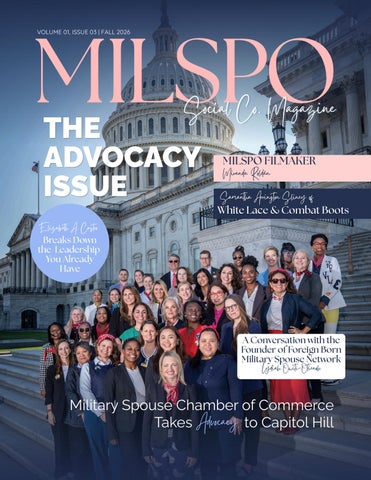
VOLUME 01, ISSUE 03 | FALL 2026
MILSPO Social Co. Magazine
THE ADVOCACY ISSUE
MILSPO FILMAKER Miranda Roldán Samantha Arrington Sliney of
White Lace & Combat Boots Elizabeth A. Castro
Breaks Down the Leadership You Already Have
A Conversation with the Founder of Foreign Born Military Spouse Network
Lydiah Owiti-Otienoh
Military Spouse Chamber of Commerce Takes Advocacy to Capitol Hill
MILSPO
Social Co. Magazine
THE ADVOCACY ISSUE VOLUME 1 ISSUE 3
MILSPO
Social Co. Magazine Kera Sanchez Editor-in-Chief, Founder of MILSPO Social Co. Magazine
Jabin Botsford-Old Liberty Media House
MILSPO Social Co. Mission Statement Our mission is to champion the modern military spouse by amplifying the stories, wisdom, and entrepreneurial spirit of women who live, lead, and rise through the unique challenges of military life. Built on leadership, professional development, empowerment, and camaraderie, we create a platform where military spouses and military-affiliated founders can be seen, supported, and celebrated. Through shared experience and collective strength, we provide inspiration, community, and practical insight—empowering women to build businesses, elevate their voices, and define success on their own terms. More than a magazine, MILSPO Social Co. is a movement—one where women champion each other, grow together, and ignite possibility for the next generation of military spouses.
Cover Photography
Britt Hall
Disclaimer:
Executive Editor & Contributor
Allison Burton
The opinions expressed in this publication are those of the individual authors and do not necessarily reflect the views of MILSPO Social Magazine or Lemons to Legacies, LLC. Content provided is for informational and inspirational purposes only and should not be considered professional legal, financial, or mental health advice.
Contributor
Always consult appropriate professionals before making decisions based on the information provided.
Berlinda Castillo
Select written and visual content in this issue was created or enhanced using AI-based tools. Every piece is curated and refined by our human editors to maintain quality, authenticity, and editorial standards.
Contributor
Elizabeth A. Castro Contributor
Kristi Forbes
Contributor
Monika Jefferson Contributor
MILSPO Social Co. Magazine Created and Published by Lemons to Legacies, LLC Founder & Editor-in-Chief: Kera Sanchez @milsposocialco milsposocialco.com © 2026 Lemons to Legacies, LLC. All rights reserved. No part of this publication may be reproduced or distributed without written permission from the publisher.
MILSPO SOCIAL CO. | VOLUME 01 ISSUE 03
CONT The Advocacy The Advocacy Issue Issue 6 FOMO IS OPTIONAL
Letter from the Editor, Kera Sanchez
8 FROM THE DESK OF A NAVY WIFE Meet Reyna Worthy, MilSpouse Advocate, Podcaster and Mentor
11 SHE BET ON HERSELF
Getting to know the Women Behind The Balanced Business, Devin Francisco
16 RED, WHITE & ROSIE
Behind the scenes of the Military Spouse Advocacy Day on Capitol Hill
DON’T NEED SAVING. 25 WE WE NEED TO BE HEARD
Allison Burton shares why MilSpouses Need a Seat at the Table
29 MADE WITH INTENTION
Inside Amber Budzynski's Handcrafted Mission
CALLING IT 32 STOP VOLUNTEER BURNOUT Berlinda Castillo Shares How Better Leadership Builds Stronger Teams and Stronger Careers
MILSPO SOCIAL CO. | VOLUME 01 ISSUE 03
ENTS
36 WHITE LACE & COMBAT BOOTS 52 DIFFERENT JEANS. SAME THREAD. Meet Samantha Arrington Sliney— the Military Attorney Rewriting the Rules for Military Families
43 THE BACKYARD BOOKSHELF
One Military Spouse’s Mobile Love Letter to Reading
AMSE’s Moni Jefferson Talks the Tie Between Representation and Advocacy
58 UNQUALIFIED IS A STATE OF MIND MILSPO Filmmaker Miranda Roldán
64 BUSINESS CAN BE THE MOVEMENT
FOR A MILITARY Laura Early Breaks down How Advocacy 46 VOLUNTEERING SPOUSE CLUB ON COMMUNITIES Can be Integrated into our business plan. Chief People Officer for Council for Military Spouse Clubs, Kristi Forbes shares her take
48 THE LEADERSHIP YOU ALREADY HAVE
Elizabeth A. Castro Shows us How to Name It Without Waiting for Permission
67 IN BUSINESS, BASICS MATTER Britt Hall Brings us Back to the Basics
71 BETWEEN TWO WORLDS
A Conversation with Lydiah Owiti-Otienoh, Founder of Foreign Born Military Spouse Network
MILSPO SOCIAL CO. | VOLUME 01 ISSUE 03
Letter from the Editor
is optional, babe FOMO
My first go at military life came before I was as “seasoned” with life experience. Truth be told, I’m convinced I complained so much that my husband had no other choice but to get out. Joke’s on me . More than a decade later, with two small kids, that itch to get back in clearly hadn’t gone away. My husband headed to Newport for OCS, and I found myself at 37 with a 2and 4-year-old, juggling a full-time job, a publication, and all the emotions that came with eventually leaving our home—and our sense of normal—for a completely new adventure. During my first stint in Hawaii, I suffered from FOMO. I watched my best friends and sorority sisters back home go out every weekend, and I felt left out. I knew my family was getting together for dinners and weekend BBQs, and I felt like I was missing it all. I compared my reality— piecing together two part-time jobs—to the full-time career as a Spanish teacher I had left behind in Chicago, simply because there wasn’t the same need for my skills in Hawaii. This time around, I knew I couldn’t spend my energy looking back. I had to look forward. I had to create a life that would give other people FOMO. Except this time, that FOMO is completely optional. Getting published in magazines, media outlets, and newspapers isn’t always easy. Yet there are so many women with stories worth telling, insights worth sharing, and brands and businesses worth amplifying who don’t even know where to start. That’s where the whole FOMO being optional thing comes in. This magazine is for us. The application is right there on our website. Together, we remind the world that being a military spouse may be part of our story, but it is absolutely not the most interesting thing about us. So get in, MILSPO. We’re changing the narrative. And FOMO is optional. Let’s go.
xo xo,
Kera Sanchez
Founder and Editor-in-Chief MILSPO SOCIAL CO. | VOLUME 01 ISSUE 03
ADVERTISEMENT
Thursday, November 5th 11:00 AM-12:30 PM EST
½ Page Ad Tips: Make a copy of this template and when finished send the link back to us at MILSPOsocialco@gmail.com We use “Bleed” which means if your image overlaps in the red area, it should extend beyond the page. No text beyond the orange areas Use a combination of QR/Live links since we are both virtual and Print
MILSPO SOCIAL CO. | VOLUME 01 ISSUE 03 MILSPO SOCIAL CO. | VOLUME 01 ISSUE 03
Q : What led you to start “The Desk of a Navy Wife”? Reyna: Twelve years ago as a fresh military spouse, I felt like resources existed but nobody handed them to me or explained them. I started writing things down just to share with people I met. Later, as a government contractor, I discovered even more resources and more people I wanted to reach, and I realized I didn't want to be a gatekeeper. That led me to writing, then podcasting, so people could absorb information even when they didn't have time to sit and read. Everything now lives under The Desk of a Navy Wife, because that's genuinely where I'm sharing it from, my desk.
Q : You recently hosted a summit for military spouses. What inspired it, and what did you want people to walk away with? Reyna: I wanted spouses to have a moment to focus internally instead of being something for everyone else. We opened with a breathing exercise, then had people name what was blocking them and what they wanted next. So many summits are in person and run by companies disconnected from what military spouse life actually looks like, childcare included. I wanted to meet people where they are, so we ran it across Facebook, Instagram, and Zoom, even if that meant someone joining from a chat box with a kid on their lap.
MEET REYNA WORTHY— HELPING SPOUSES WHO FEEL LOST IN THE SHUFFLE THRIVE
Reyna Worthy still remembers being a brand new military spouse twelve years ago, holding resources she didn't know existed and hearing terms like "ombudsman" for the first time with no one to explain them. Instead of staying frustrated, she started writing everything down. What began as a blog and platform grew into a podcast, then a summit, and now a full membership community, each step built to mentor spouses who feel lost in the shuffle. Everything she does lives inside her “Work, Mil Life, Balance framework”— offering authentic, practical tips, essential resources, and personal stories so spouses don't just survive this lifestyle, they actually thrive in it.
Q : How do you turn the adaptability military spouses are told they need into actual leadership? Reyna: It starts internally. I built my whole platform around three pillars: work, military life, and balance. Work means whatever you're building toward, career, education, or personal growth. Military life is the nonstop curveballs. Balance is recognizing you don't have to hold all of it at once, just enough of it, and knowing when to ask for support with the rest.
MILSPO SOCIAL CO. | VOLUME 01 ISSUE 03
Q : Your Empowerment Leads Collective membership includes resume-writing support. How do you use your experience as an HR professional, including your work leading global teams, to help military spouses understand their skills, strengthen their resumes, and figure out what’s next professionally?
The Conversation doesn’t stop here! Want more? Bonus Q & As are on MILSPOSOCIALCO.com!
Reyna: I sit down with people one-on-one and figure out what sector they're aiming for, private, nonprofit, public, or government, because I've worked across all of them. I connect people to organizations most spouses have never heard of unless they've already worked in government, and I'll personally introduce them to contacts in my network when it makes sense. Even applying back to school sometimes requires a resume, which surprises people, so I help with that too.
Q : What do you think is missing from the broader conversation about military spouse empowerment? Reyna: A lot of installation resources come from someone reading off a pamphlet, not someone who's actually lived the lifestyle. If it's not government stamped, it often doesn't get shared, which means entire state programs go unmentioned just because the base never distributed them. That's the gap I'm trying to close, and I hope other spouse-owned platforms keep closing it too.
Q : This issue has an advocacy focus. What does advocacy mean to you personally, and how does it show up in your work? Reyna: Advocacy means owning my story and not letting anyone else control the narrative, whether that's around my health, my family, or my kids. Inside the Empowerment Leads Collective, I built an entire advocacy hub with templates and state representative contacts, because a lot of spouses want to raise their voice and just don't know where to start.
What started as notes scribbled down to hand off to strangers has become a full ecosystem of advocacy tools, career guidance, and community, built specifically for spouses who don't have eight hours to spare or reliable childcare on a random Tuesday. If you've ever felt like the system wasn't built with you in mind, Reyna is proof that you can build the version that is. To learn more about The Desk of A Navy Wife, The Empowerment Leads Collective, Future Summits and Podcast, visit www.deskofanavywife.com MILSPO SOCIAL CO. | VOLUME 01 ISSUE 03
ADVERTISEMENT
@happinesswithsamantha www.happinesswithsamantha.com spouse-ly.com/store/happinessunleashed
My Life. My Passion. Your Vision. Your Joy. Unleash your Inner Happiness with Samantha. MILSPO SOCIAL CO. | VOLUME 01 ISSUE 03
SHE BET ON HERSELF HOW DEVIN FRANCISCO TURNED $900 AND GRIT INTO A BOOMING SIXFIGURE BUSINESS
From an early age, Devin Francisco was taught to believe that the fastest path to success was through education. And while that advice wasn’t necessarily wrong, it didn’t account for the roadblocks life can place in your path—or how often military families are asked to start over. Before building the success she has today, Devin was a single mother at 20, later married to a Marine, and living a story so many military spouses know intimately: overqualified, underemployed, and constantly rebuilding. What employers saw as a liability—a resume filled with gaps and frequent moves—was actually a record of everything she had been carrying. Those gaps held an overseas move, two newborns, a global pandemic, and an MBA she earned while employers repeatedly passed her over because she was preparing to relocate again. She applied for positions that matched her experience and qualifications. Instead, she was offered entry-level roles. So Devin stopped waiting for the traditional career path to make room for her. She built The Balanced Business, a Charlotte-based operations agency that now supports small businesses nationwide by tackling the logistical pieces that slow entrepreneurs from actually doing the thing they love. Currently, the majority of her work involves insurance claims and billing for her clients—medical practice owners. And she built it, in part, because the market had already told her—repeatedly—that her circumstances made her a risk. Devin decided to prove that those same circumstances were actually her greatest asset.
"WHAT IS YOUR BIGGEST STRENGTH? 'ADAPTABILITY 100%.' ... I'M A MILITARY SPOUSE AND THAT'S ALL I HAVE TO SAY." MILSPO SOCIAL CO. | VOLUME 01 ISSUE 03
THE ODDS BEFORE THE ODDS
THE MATH THAT DIDN'T ADD UP
Devin's story doesn't start with the military. It starts in Queens, where she grew up the daughter of immigrant parents who believed, without much room for negotiation, that a college degree was the only acceptable route to safety in this country. She got a scholarship through a program funded by then-mayor Michael Bloomberg for kids from urban communities who wanted to study business, one of the only doors wide open for her. She finished that two-year program pregnant, discharged from the hospital just in time to get to campus for her final exams. She was 20, with a fresh associate's degree and no real plan beyond survival.
By the time Devin was ready to reenter the workforce, she had an MBA, years of medical device sales experience, and a resume gap that made recruiters treat her like she was starting over. She wasn't. She'd spent that gap trying to entertain a toddler while social distancing, and peeling inventory stickers of her furniture, with zero severance and no LinkedIn recommendation to show for it. Companies offered her entry-level roles anyway. Not because she lacked the qualifications, but because that gap filled wide with a global pandemic, new additions to the family, and global PCS moves did the talking before she ever got the chance to.
She went back for her bachelor's because her parents' version of the American Dream didn't leave room to stop, and because raising her son on her own meant she needed more credentialing, not less. She worked, by her own account, ‘like a dog’ for years before life pivoted again: at 23, crashing a wedding as her sister's plus-one, she met the man who would become her husband and love of her life, a Marine about to ship out to Okinawa that January. They fell in love in the three months before he left. She told him she'd wait two years for him to come home. She did. They married in 2018. When Devin eventually followed her new husband to Okinawa, he made her an offer nobody had ever made her before: take the time, get your MBA, you don't have to work. It was the first time since she was 13 years old that she didn't have a job. As uncomfortable as it felt to slow down and focus on her goals, she used it, earning her MBA while stationed overseas. That window closed fast. COVID hit, the job market in Okinawa tightened, a looming PCS made her radioactive to local employers, and she came home pregnant, had two more children back to back, and watched her resume gap grow right alongside her family.
"I couldn't find something that aligned with me," she says. "And I just knew I had to create it myself."
THE BET The equation started with $900. That's what it cost Devin to launch what would become The Balanced Business, after a former colleague, a clinical social worker drowning in unpaid insurance claims, called her in a panic. Devin knew that system inside out from her years in medical sales. She helped. Word spread. What started as one favor turned into a full operations agency, now handling business consulting, virtual and executive assistant support, project management, and audits for small businesses across the country.
"I used to move in a way that if it wasn't perfect, I didn't move forward. And that's only going to leave me behind. I had to move forward regardless of if it's perfect or not. just keep pushing." MILSPO SOCIAL CO. | VOLUME 01 ISSUE 03
She's blunt about what that $900 decision actually felt like. She grew up without money. She worked for every dollar she ever had, especially as a young single mother, and she describes herself as someone who still has to talk herself into spending on her own business, even now that it's clearing six figures. Her business coach gave her the line that finally stuck: it's not you spending it, it's the business. It's a small reframe, but for a woman raised to see every dollar as scared, it was the difference between staying stuck and scaling. That's advocacy too, the internal kind nobody claps for: advocating for your own right to invest in what you built, even when your instincts scream to hoard instead.
"It really wasn't until I started my business and got into this entrepreneurship journey that I am starting to find myself again—and who I am and what I really enjoy."
BALANCE ISN'T A BUZZWORD, IT'S THE WHOLE ARGUMENT The name of Devin's business isn't a branding accident. Balance, for her, isn't the soft, Instagramcaption version of the word. It's a direct rejection of the two options she was handed as a military spouse: hustle yourself into the ground to prove you're still valuable, or step back entirely and let your career go quiet until the next duty station. She refused both. She built a business that runs on fewer than 40 hours a week and still supports her family, because she decided the tradeoff everyone told her was inevitable, career or presence, output or your kids, simply wasn't one she was going to accept. That philosophy runs straight through to who she hires. Devin only hires military spouses, and when Virtforce, a military-spouse-owned staffing partner, posted her job listing, she got almost 200 applications with no applicant-tracking software and no HR team to sort them, just her own read on who needed the role most. She wasn't looking for the most polished resume. She was looking for the spouses who admitted, plainly, that they were home with kids and struggling to find work that respected that reality. Those are the applicants she chose, because those are the women living the exact bind she'd just spent years fighting her way out of. The roles she's offering are contract, 20 to 40 hours a month, not full-time, and she's not pretending that's the finish line. It's a foothold, the kind that lets a spouse keep a foot in her career without having to choose between a paycheck and her kids' school pickup line. That's the advocacy piece worth naming directly. Devin isn't just building a business that happens to accommodate military life. She's arguing, through every hiring decision and every client system she builds, that flexibility isn't a lesser version of ambition. It's a legitimate structure, one that deserves real pay and real respect instead of being treated as a favor. MILSPO SOCIAL CO. | VOLUME 01 ISSUE 03
LEARNING TO ADVOCATE OUT LOUD Betting on yourself financially is one thing. Betting on yourself in a room full of strangers is another, and Devin says that part didn't come naturally. She describes herself as shy, someone who'd rather build the systems behind the scenes than pitch herself to a room. But she's also clear-eyed about what got her clients: not cold emails, not sitting behind a desk waiting to be discovered, but showing up in person to Charlotte's entrepreneurial cohorts and networking rooms and being honest, sometimes uncomfortably so, about what she was building and what she was still figuring out. People buy from people they trust, and trust, she's found, gets built by showing up vulnerable in a twelve-week program, not by having a perfect pitch deck. That's a different kind of advocacy than the policy kind, but it's the same muscle. It's the willingness to say, out loud and without apology, this is what I need, this is what I built, this is why it matters, in rooms that don't always make space for a mom who used to be the applicant nobody would interview above entry level. Devin had to advocate for herself before she ever had the standing to advocate for anyone else, and she's candid that she's still practicing it, not performing mastery of it.
WHAT SHE'S STILL WORKING THROUGH
"I am a heavy believer that what is meant to be will be. What is for you will happen. Pray on it, you know, speak to the universe on it. I'm going to do my part. And if it's meant to be, it will be." THE PART SHE WANTS OTHER SPOUSES TO HEAR Devin doesn't sell the idea that she had it figured out from the start. She knew what she didn't want long before she knew what she did, and she says that's a legitimate place to begin. Rejecting the version of your life that isn't working is its own kind of clarity, even without a five-year plan to back it up. Her advice for anyone standing where she stood, underemployed, underestimated, and quietly certain there had to be another option— it isn't about waiting for the right moment. It's about building the systems that make the leap survivable and then taking it before you feel ready. She started with $900 and a stubborn refusal to accept that her resume gap was the whole story. The women reading this already know what it costs to keep showing up under circumstances designed to make you quit. Devin's business is proof that betting on yourself isn't reckless when you've already survived harder odds than the ones you're choosing.
TO LEARN MORE ABOUT DEVIN AND THE BALANCED BUSINESS, VISIT THEBALANCEDBUSINESS.COM AND FOLLOW ALONG ON INSTAGRAM @THE.BALANCED.BUSINESS
None of this reads as effortless, and Devin doesn't perform it that way. Hiring her first employees outside her own trusted circle has been genuinely nerve-wracking, especially with HIPAA compliance on the line and real legal exposure if something goes wrong. She admits she sat on the need for help for six months longer than she should have, stuck in a perfectionism loop where if a plan wasn't fully buttoned up, she wouldn't move on it at all. Her coach's advice, that it doesn't need to be perfect, is still something she's actively practicing rather than something she's mastered. That honesty matters more than a highlight reel would. A recent local pitch competition, where Devin was selected as one of five Charlotte businesses to present, forced her to talk seriously about growth and projections for the first time, numbers she'd never had to defend before because she hadn't set out to build something huge. It shifted how she sees the ceiling on what she started. She's now imagining a version of the business that runs without her hands on every piece of it, freeing her up for the parts of her life she built this business to protect in the first place: her kids, and the travel habit she picked up living in Okinawa and hasn't had room for since. MILSPO SOCIAL CO. | VOLUME 01 ISSUE 03
ADVERTISEMENT
A NEW DEVOTIONAL FOR MILITARY SPOUSES
Grace for every PCS, every goodbye, & every new beginning. 50 one-page devotionals written by a military spouse, for military spouses. Each one pairs a KJV verse with a question to reflect on and a prayer you can pray today.
Vimbo Watson
Scan to order on Amazon Paperback & Kindle | amazon.com/dp/B0HLBFJZZ1 Vimbo Watson, M.Ed. | VimboWatson.com | @vimbowatson
Red, White
ROSIE
BEHIND THE SCENES OF THE MILITARY SPOUSE ADVOCACY DAY ON CAPITOL HILL, PLANNED AND CURATED BY THE MILITARY SPOUSE CHAMBER OF COMMERCE, ELPR, TEAM B. STRATEGY, AND THE RESERVE ORGANIZATION OF AMERICA
MILSPO SOCIAL CO. | VOLUME 01 ISSUE 03
Proximity to possibility is the name of the game. And in our world, we are surrounded by countless powerful spouses who don’t just complain about what needs to change—they arrive with solutions. That was exactly the scene as Military Spouse Advocates and Members of the Military Spouse Chamber of Commerce walked into the Reserve Organization of America’s (ROoA) large lobby on Constitution Avenue this spring and found dozens of military spouses and their supporters draped in red polka-dot scarves. The look was undeniably chic, but it was also deeply symbolic: a nod to all the Rosies who came before us, the ones who changed the narrative, and did the work that made it possible for women like us to run, build, lead, and demand a seat at the table. Coffee in one hand, talking points in the other, the room hummed with the kind of nervous energy that was really just excitement dressed in red & white polka dots. At a breakfast hosted by the ROoA, military spouses and business owners from every branch and every walk of life, gathered together minutes before heading to Capitol Hill to ask Congress for something real— action. This wasn’t a networking mixer with a step-and-repeat. It was preparation for the kind of advocacy that could change lives. And perhaps that’s one of the most important lessons we can carry with us: asking is not begging. Asking is a strategy. Because proximity creates possibility, but sometimes you have to be willing to walk right up to the possibility and ask for it. And strategy, when worn well, looks incredible in red & white polka dots. MILSPO SOCIAL CO. | VOLUME 01 ISSUE 03
Taking you Inside the Rooms Where it Happened
Army. Navy. Air Force. Marines. Coast Guard. Space Force. Active duty, veteran, reserve, every uniform this country has. That day, the term joint forces stopped being a Pentagon phrase and became the literal movement. Suited up in scarves and professional attire, worn like armor, spouses walked into the congressional offices to make their case. To be taken seriously and have their struggles and ideas heard. Teams weren't just numbered, they were named. Resilience. Tenacity. Fortitude. Valor. Liberty. The names split us into groups, but honestly, the values are what held us together, and every person in that room carried them a little differently. Every single Spouse and Supporter had done their homework, we knew our talking points cold, we'd thought through the questions we'd get, and we knew exactly what we were asking for and why it mattered. Then we did the thing that feels impossible right up until the second you're actually doing it, we walked into the offices of the people who write the laws and told them what we needed. Advocacy isn't about being the loudest voice in the room, it's about being clear, and being willing to stand shoulder to shoulder behind what you're asking for. So many military spouses have spent years being resourceful instead of vocal. We solve the problem, fill the gap, figure it out, and keep it moving, quiet competence becomes muscle memory. Hill Day asked us to rewrite that habit on the spot. We weren't there just to tell our stories. We were there to bring attention the problem, hand over the solution, and make it plain that this was bigger than any one of us in that building. Different branches. Different businesses. Different stories. One ask, one purpose, and one very loud reminder that when we stop trying to figure this out alone and start showing up together, our voices carry a whole lot further. MILSPO SOCIAL CO. | VOLUME 01 ISSUE 03
The Ask Stephanie Brown, CEO and Co-Founder of the Military Spouse Chamber of Commerce, set the tone before anyone bit into their bagel. She looked at a room full of founders and told them they belonged there, every single one, because they had built businesses through PCS moves, through deployments, through state licenses that refused to follow them across a border, starting over and over and doing it anyway. “These systemic barriers have not stopped us,” she reminded the room. “They simply slowed us down. And we deserve to go all in on our businesses, restraints off.” Here’s the breakdown of exactly what we walked in advocating for. The Military Spouse Small Business Recognition Act would classify military spouse owned small businesses as a disadvantaged category under the Small Business Administration’s (SBA) 8(a) Business Development Program, the same recognition already extended to women owned and service disabled veteran owned businesses. It waives SBA loan guarantee fees on loans up to a million dollars. It cuts the equity injection requirement by at least five points, which sounds bureaucratic until you realize it is the difference between needing forty thousand dollars in cash and needing thirty. And it forces the SBA to finally track and publish the data on how military spouses are actually faring inside these programs, because right now, the data simply does not exist. Let the numbers do some of the talking. Twelve million military spouses in this country. Nearly half are either self employed or dreaming about it. Unemployment parked at twenty two percent for the better part of a decade, the highest of any group tracked, a billion dollar plus annual price tag for taxpayers. After World War II, more than forty percent of returning veterans launched businesses, some becoming the biggest names in American industry. Today, that figure sits around five percent. Not because the ambition thinned out. Because nobody ever built the on ramp. Then, the moment finally became ours. Spouses came out of our separate corners of the world, in different seasons of life, working collaboratively to advocate for closing the gap. That is the gap we explained, office after office, all day long, to staffers who had never once heard a military spouse frame unemployment as anything other than a jobs problem. It is not a “jobs” problem. It is a business ownership problem. A job stays behind when the orders come. A business packs its bags and comes with you.
MILSPO SOCIAL CO. | VOLUME 01 ISSUE 03
The Win ( So Far)
Here is the update you have been waiting for. Congressman Van Orden has officially signed on as our bill sponsor, and the campaign has moved into the petition stage, gathering names and momentum for the push through Congress. "We're ready for any objection, and hopefully it will be a bipartisan effort, and everybody will recognize that it's deserving and it will be a big game changer," Brown said. If you are a military spouse business owner reading this, now is the time to be part of the action. You've always had a seat at this table, Claim it at milspousechamber.org/advocacy. MILSPO SOCIAL CO. | VOLUME 01 ISSUE 03
The Part that Actually Changed us The bill was the reason, but our purpose was the part that stayed with us long after we left the Hill.
Every single person in that lobby carried a story— lessons in building a business and the proof of problems that come with our orders. Adversity, setbacks, real challenges, the kind that leave a mark. The blows had been many. And every single time, without exception, they stood back up to continue building. That endurance, that resilience and grit, is honestly unmatched anywhere else I have witnessed it. There is something genuinely electric about a room of strangers turning into a team by lunch. Call it collective efficacy, with the level tenacity you could only find inside of a seasoned Military Spouse. You could feel it build with every office we walked into, momentum with a heartbeat. The piece that made this whole day one of a kind was the camaraderie. We saw each other's stories for exactly what they were and appreciated the struggle underneath them, no filler, no small talk performed for the sake of filling silence. There was zero surface level conversation happening anywhere in that lobby. We bonded from the jump. Somewhere between the second office and the third, we dropped the polished founder persona and started telling each other the truth. The fear. The financial gaps. The years of starting over in a new state with no safety net waiting. And instead of just commiserating, we started trading solutions that actually work. The lender who said yes. The vendor who understood a military move on two weeks notice. Vulnerability turned into strategy. Strangers turned into a network that checks in on each other's businesses to this day. We marched on Capitol Hill—schedules, notes, and stories in hand—and did the thing that felt impossible . Impossible, that is, up until the moment we looked around and realized that we were surrounded by shared stories and a deeper desire to not just talk about making things better, but doing it. Opportunities that once felt like they were out of reach started looking like open doors, new collaborators and fresh solutions. We'd each built businesses while the world moved around us, but that day we asked the world to move for us.
MILSPO SOCIAL CO. | VOLUME 01 ISSUE 03
Meet Some of the Boss Babes who Showed up
The power of advocacy is multifaceted. I felt very refreshed and ignited by the organizers, fellow advocates, and even the Congress and Senate staffers as well.
Jenni Fajardo-Dobbs Active Duty Air Force Spouse
Angela Neal
Veteran Air Force Spouse CEO & Founder of Project Solvers
The path of an entrepreneur is already courageous but to face those hurdles while championing the Homefront support makes the wins more impactful. Building a business as a Military Spouse has created a methodology I live, learn and lead by "Bloom Where You're Planted" - it hasn't failed me yet.
I think we can get this across the finish line. Maybe not today or the next day, but I do believe we can do it and it will have a positive impact on military spouses.
MILSPO SOCIAL CO. | VOLUME 01 ISSUE 03
Krista Gordon
Active Duty Navy Spouse Founder and CEO of House of PRVLG Inc.
Michelle Penczak
Active Duty Marine Spouse CEO and Founder of Squared Away
There is something incredibly powerful about sitting across from decision-makers and being able to say, “This is what this looks like in real life.” Not from a report or a data point, but from lived experience. I walked away reminded that advocacy matters, representation matters, and military spouses deserve more than applause for being resilient. We deserve policies, opportunities, and systems that actually allow us to build careers and lives alongside our families’ service. I left the Hill feeling even more committed to making sure military spouses have a seat at the table, and a voice once we get there.
As a military spouse, I’ve moved nine times in eleven years, rebuilding my career with every PCS. Despite earning my degree from the Fashion Institute of Technology and working in the fashion industry, maintaining a traditional career became increasingly difficult because of the demands of military life. Entrepreneurship gave me the opportunity to build a career that could move with me instead of starting over each time. Throughout the day, I felt a mix of excitement, gratitude, and responsibility. I wasn’t just representing myself—I was representing military spouses whose careers have been interrupted by military life and advocating for policies that help military spouse entrepreneurs build and grow successful businesses.
Vanessa Grbic
Active Duty Air Force Spouse Founder and CEO of Height of Rebellion
The Advocacy is Just Beginning The momentum that started this day is continuing to evolve. As of Mid-September, the Military Spouse Small Business Recognition Act has a secured Congressman Derrick Van Orden as a sponsor! The Military Spouse Chamber has also launched a peition and is looking for signatures. To read more about Bill Specifics, visit milspousechamber.org/advocacy and be sure to sign your name in support! If you are a Military Spouse Owned Small Business, check out the Military Spouse Chamber of Commerce and Learn more about certifying your brand and becoming part of this robust network.
Photography by: Jabin Botsford Old Liberty Media House
MILSPO SOCIAL CO. | VOLUME 01 ISSUE 03
ADVERTISEMENT
rallee.com MILSPO SOCIAL CO. | VOLUME 01 ISSUE 03
Military spouses are often described as resilient, strong, and adaptable. Those words are meant as praise, but too frequently they become a way to avoid asking what spouses actually need. They are paired with a “listening ear” but not a problem-solving mind. Resilience should not be a polite way of saying, “We’re not going to fix that issue. You’ll figure it out.” Military spouses cannot continue to shoulder so much and be expected to stay quiet about it. We deserve to be heard and acknowledged for our skills, our experience, and the solutions we have developed to issues that have plagued our community for far too long.
WE DON’T NEED SAVING. WE NEED TO BE HEARD. WHY MILITARY SPOUSES ARE ASKING FOR A SEAT AT THE TABLE, NOT A SPOTLIGHT FROM THE SIDELINES.
Many military spouses wear the title of “supportive spouse,” “strong friend,” or “default parent” — and some wear all three, plus more on top of those. We fill gaps. We see a need in our community — in care, resources, connection, or support — and we figure out a way to help. Military spouses know what each other are enduring, and we step in when and where we are needed. The number of gaps military spouses fill is enormous. And we’ve been doing it for years.
Allison Burton—a military spouse, writer, speaker, and unapologetic advocate writes about the realities spouses are often expected to endure silently—including identity, invisible labor, power, and the systems that shape military family life— and why spouses deserve more than a seat on the sidelines.
TAP, TAP, TAP — is this thing on? Please turn my microphone up to 11 so everyone in the back can hear every word I’m about to say. Military spouses have spent decades being commended for resilience while being overlooked as leaders and contributors to the challenges in our lives. We don’t need another reminder of how strong we are. We need decisionmakers to recognize that the skills developed through military life — adaptability, crisis management, communication, advocacy, and communitybuilding — are leadership skills. And we deserve a voice in what affects our lives. We aren’t asking to be placed on a pedestal. We’re asking to be invited into the conversations that shape our lives. We’re asking for the mic. Too often, military spouses’ lived experience is viewed through a lens of need rather than expertise. We are treated as people who need resources instead of people who possess knowledge. We are thanked for enduring challenges rather than asked what it would take to actually solve them.
We have built things from nothing because we recognized a need and refused to wait for someone else to solve it. We have organized support networks, advocated for families, connected people to resources, navigated crises, and helped one another survive transitions that can be incredibly difficult. That is leadership. That is power. That knowledge deserves to be understood and utilized to help mitigate the challenges military families face. Yet the titles military spouses are most often given are “strong,” “resilient,” and “supportive.” The titles we should also be wearing are leader, advocate, contributor, problemsolver, and highly qualified professional. These titles represent what military spouses are and what we are capable of. It is time for people to stop speaking about spouses and start including spouses in the conversations that affect them.
MILSPO SOCIAL CO. | VOLUME 01 ISSUE 03
We’ve been called resilient, but resilience isn’t the same as recognition. We’ve been thanked for our sacrifices, but gratitude isn’t the same as inclusion. We’ve been offered resources, but resources without listening don’t solve systemic problems. Military spouses have led through uncertainty, transitions, crises, and community-building. The next step is not “helping” spouses—It’s partnering with them. It’s listening to them. And I do not mean listening with the motive of, “Sure, I’ll hear him or her out so they’ll leave me alone.” I mean listening to understand. Listening to identify what is actually happening. Listening with a willingness to take accountability. And, most importantly, listening with the intention to facilitate change. Belonging within a community means members of that community have a voice in determining what is working and what isn’t. Those conversations shape military life, yet spouses are still too often forced to watch from the sidelines despite our repeated efforts to prove that we belong at the table. When an issue is raised, one of the first things that should happen is asking the people affected by that issue what is actually going on. That should be step one. Always. But sadly, it isn’t that way across the board. It is time for people to stop speaking about spouses and start including spouses in the conversations that affect them. Because eventually, even the strongest people start asking questions like:
Why am I always expected to endure so much in silence? When do I get a say in how policies affect my lifestyle? Does anyone care how I am actually doing or what I might need — or is all of this just performative?
Building rapport within a military community takes work. Building trust takes reciprocity. And trust is not created by asking spouses to speak up and then ignoring what they say. Why the hell would we be honest if we know for certain no one is listening? If you want spouses to engage, ask us what we see. If you want us to trust you, show us that our answers matter. If you want to solve the problems facing military families, stop assuming the people experiencing those problems are simply looking for someone to fix things for them. Sometimes, we’re the people who can help you fix them. So, yes. Turn up the microphone. We have something to say.
To learn more about the author of Silent Ranks, Loud Burdens and founder of Burton Collective, visit www.allisonburton.co and follow her on Instagram @allisonburton_author_speaker.
And if there isn’t a seat at the table for us? Do we need to build one? Because we can. And we’ll build enough for everyone. Just say the word.
MILSPO SOCIAL CO. | VOLUME 01 ISSUE 03
ADVERTISEMENT
MILSPO SOCIAL CO. | VOLUME 01 ISSUE 03
Picture yourself in Print ADVERTISEMENT
NOW CASTING FEMALE MILITARY LEADERS, BRANDS, AND ORGANIZATIONS TO HIGHLIGHT IN FUTURE ISSUES!
Apply on our website milsposocialcomagazine.com/work-with-milspo-social-co-magazine
MILSPO SOCIAL CO. | VOLUME 01 ISSUE 03
MADE WITH intention
INSIDE AMBER BUDZYNSKI'S HANDCRAFTED MISSION
In a world of one-click Amazon orders, Amber Budzynski is betting on something slower. Bud Fam Co. started as a way to make one of a kind hair pieces for her own daughters, using resin, fabric, and beads she designs herself, and it's grown into a business that follows her family from post to post, becoming a fixture of whatever military community she's currently calling home. At Fort Irwin, she became known simply as, "the bow lady." Here's how she's built an intentional brand around community and giving back—one custom bow at a time.
Q: Your work is rooted in slowing down and being intentional, in a world that rewards speed. What drew you to that, and why do you think it matters? Amber: It started with my girls, just me having fun being creative with their hair pieces. I love using different mediums, resin, fabric, beads, whatever lets me try something new. I design a lot of my own patterns digitally and have them printed onto fabric myself, so what I make genuinely doesn't exist anywhere else. When my husband encouraged me to turn it into a business, I knew I wanted to protect that, one of a kind pieces instead of anything mass produced.
Q: What's the one thing you want someone to walk away understanding after visiting your table for the first time? Amber: People assume I'm buying bulk pieces overseas and reselling them, and I love watching their face change when I tell them “no, I made this, I serged the edges, I designed that myself.” You can always buy something cheaper somewhere else, but you're not getting one of a kind work.
Q: How do you juggle a custom craft business that takes real time with the chaos of military family life? Amber: Homeschooling takes my mornings, so most of my custom work happens at night or on weekends. My husband helps a ton, whether it's the kids or hauling heavy stuff at vendor events. In the beginning I said yes to every order because I hated turning people away, but I've learned I genuinely can't do it all at once, and that's been an ongoing lesson.
MILSPO SOCIAL CO. | VOLUME 01 ISSUE 03
Q: How do you advocate for small batch, handmade work in a world that rewards mass production and instant gratification? Amber: I ship ready made pieces quickly, but custom work takes the time it takes, because I refuse to send out anything with a flaw. My name is attached to it, so it has to be right. Beyond that, this business has a purpose behind it. I've been through hard times myself, including relying on state help and food banks, so if I can tell someone wants something but can't afford it, I've gifted plenty of bows. I also donate pieces and auction items off, because this was never just about being a big business.
Amber: My OCP bows. I make them from old uniform fabric, and I don't think that's reached enough people yet. It matters most for lower enlisted families where money is tight, since a bow made from an old OCP is such an easy, meaningful option. If someone doesn't want to send in their own uniform, I've also made bows from donated ACUs and OCPs for a few years now, and the proceeds go toward organizations supporting veterans and suicide awareness, something deeply personal since my husband and I have both lost someone in the military to that.
Whether she's cutting fabric at midnight after homeschooling wraps or shipping out a custom order made from someone's retired uniform, Amber Budzynski has built Bud Fam Co. on the idea that handmade still means something. She's turned a hobby born out of love for her own daughters into a business that follows her family across 3 PCSs to date, absorbing each new community, each new post, each new "bow lady" nickname along the way. What sets her apart isn't just the resin or the laser cut fabric, it's the intention behind every piece, whether that's a bow gifted quietly to a family she knows is struggling or one auctioned off for a cause close to her own story. If you've ever wondered what it looks like to build a brand around slowing down, Amber is proof it's not just possible, it's worth it. Bonus Content contines on our website! More Questions and Answers from Amber at MILSPOSocialco.com WWW.BUDFAMCO.COM | @BUDFAMCO
MILSPO SOCIAL CO. | VOLUME 01 ISSUE 03
SKI ZYN BUD
Q: Is there anything about your work you feel hasn't gotten enough attention that you want people to know?
P FOR PLE U PUR
MILITARY KID
S
ADVERTISEMENT
HEY, MOM!
You know what it’s like to be a
½ Page Ad Tips:
part of a military family.
Make a copy of this template and when finished send the But do you know what it’s like to be the link back to us at MILSPOsocialco@gmail.com military kid? We use “Bleed” which means if your image overlaps in the Home Is Where the Heart Is shares real military teen red area, it should extend beyond the page. stories and creates resources to help military kids No text beyond the orange feel seen—while helpingareas families and communities Use a combination of QR/Live links since weEXPERIENCES. are both bETTER UNDERSTAND THEIR virtual and Print Have a military teen? Share this with them. They might see a story that feels a little too familiar.
@thatmilteen linktr.ee/thatmilteen
MILSPO SOCIAL CO. | VOLUME 01 ISSUE 03
STOP CALLING IT VOLUNTEER BURNOUT How Better Leadership Builds Stronger Teams and Stronger Careers
By: Berlinda Castillo
“Nobody wants to volunteer anymore.” I have heard this statement repeatedly. This sentiment commonly arises after a volunteer resigns, an event underperforms, or an organization struggles to fill leadership roles. Common explanations include busy schedules, shifting priorities, military moves, or perceived lack of commitment. After years of leading volunteer teams, organizing big community projects, and working with amazing military spouses and community leaders, I see things differently. Most volunteers don’t leave because they stop caring. They leave because they stop feeling valued, supported, or successful. We call it volunteer burnout. More often than not, it’s a leadership problem.
Volunteers Are Your Greatest Investment Volunteers are not free labor. They are professionals, parents, entrepreneurs, students, retirees, military spouses, active-duty service members, and community members who have chosen to give their time, the one thing they can never get back. Consider the significance of this choice. They could spend their Saturday with family. They could catch up on work, rest, or simply enjoy a rare day with nothing on the calendar. Instead, they choose to support your mission. This commitment warrants intentional leadership. Many organizations unintentionally create environments where volunteers feel overwhelmed, underutilized, or unrecognized.
Often, those who consistently agree to help are asked to take on additional responsibilities. Organizations may rely on the same dependable volunteers until they leave, then question why others do not step in. Passion alone cannot sustain a volunteer program. Leadership can.
Stop Recruiting Helpers. Start Recruiting Leaders. One of the biggest mistakes organizations make is recruiting volunteers simply to fill vacancies. “We need someone to work registration.” “We need someone to manage social media.” “We need someone to coordinate volunteers.” Instead, organizations should begin by asking a different question: What strengths does this person bring?
MILSPO SOCIAL CO. | VOLUME 01 ISSUE 03
A volunteer who works in finance may be the perfect person to improve your budgeting process. A military spouse with a background in project management might streamline an entire event. A teacher may naturally excel at training new volunteers. A marketing professional may reshape your outreach. When we assign people solely on the basis of our immediate needs rather than their strengths, we miss an opportunity to build both the individual and the organization.
Strong leaders don’t build organizations that depend on one person. They build systems that allow many people to succeed. That means documenting processes, delegating responsibility, creating opportunities for others to lead, and empowering volunteers with ownership rather than merely designating tasks. The goal isn’t to become indispensable. The objective is to become replaceable by developing others so effectively that the mission continues in your absence. That’s leadership.
Strategic Volunteering Is Professional Development
Strategic leadership recognizes individuals for their possible contributions, not just for For military spouses especially, volunteering has often been viewed as something we do between careers, during transitions, or while fulfilling immediate tasks. waiting for the next opportunity. However, volunteering offers much more than this.
Volunteers Deserve an Onboarding Experience
Imagine entering a new job on your first day. No orientation. No expectations. No training. No point of contact. Just a name tag and a smile. However, many organizations welcome new volunteers in this manner. There is often an assumption that enthusiasm will compensate for a lack of structure. It won’t. Clear expectations, documented processes, consistent communication, and accessible leadership not only improve volunteer effectiveness but also foster a feeling of community. Volunteers are unlikely to remain within environments where they are uncertain about their performance.
When approached intentionally, volunteering can serve as a highly valuable career development tool. Volunteer leadership develops skills employers actively seek: project management, event planning, budget oversight, team leadership, public speaking, strategic planning, board governance, operations, marketing and communications, and relationship management. These aren’t “volunteer skills.” They’re leadership skills. Many of my most meaningful professional opportunities began when I volunteered. Volunteering expanded my network, strengthened my confidence, and provided experience beyond what a job description could offer. The key is to be strategic. Choose organizations whose mission aligns with your values. Seek roles that stretch your abilities. Ask for leadership opportunities. Approach every volunteer position with the same professionalism as paid employment. Your efforts are being observed. Future recommendations, partnerships, or career opportunities often begin well before the interview process.
Confidence increases when expectations are clear.
Leadership Is Measured by What You Don’t Carry Many leaders wear busyness like a badge of honor. “I’ll just do it.” “It’s easier if I handle it myself.” “I don’t have time to teach someone.” Initially, this approach may seem productive. Over time, it becomes unsustainable. MILSPO SOCIAL CO. | VOLUME 01 ISSUE 03
The Best Leaders Build People Successful organizations do not retain volunteers solely because of a strong mission. They retain volunteers because individuals feel connected to both the mission and each other. Great leaders remember birthdays. They check in after difficult seasons. They celebrate minor victories. They ask for feedback. They say thank you often. Most importantly, they nurture environments where people leave with greater confidence than when they arrived. Every volunteer should walk away with something. A new skill. A stronger network. Greater confidence. A sense of meaning. If volunteers leave feeling exhausted, discouraged, or uncertain about the value of their contribution, organizations must consider a critical question: Was it really burnout? Or was it our leadership?
A Better Way Forward There is not a shortage of volunteers. Instead, there is an opportunity to lead differently. When organizations recruit intentionally, communicate clearly, invest in development, and recognize the value of each volunteer's time, volunteers are more likely to stay involved. They grow. They become mentors. Board members. Community advocates. Future nonprofit leaders. For military spouses, they become professionals who carry those experiences into new duty stations, new careers, and new communities around the world. Leadership isn’t measured by how much you can carry. It’s measured by how many people you’ve equipped to carry the mission with you. Because the strongest organizations aren’t built on the backs of exhausted volunteers. They are built by leaders who recognize that investing in people is the most meaningful investment they can make. Berlinda Castillo is a military spouse, nonprofit operations leader, and community builder focused on effective leadership and meaningful volunteer engagement. She believes organizations thrive by developing leaders—not simply recruiting volunteers— and is passionate about helping military spouses recognize their skills, build confidence, and turn volunteer experience into career growth. Find her on LinkedIn to keep up with her work! MILSPO SOCIAL CO. | VOLUME 01 ISSUE 03
ADVERTISEMENT
MILSPO SOCIAL CO. | VOLUME 01 ISSUE 03
White Lace & COMBAT BOOTS
Meet Samantha Arrington Sliney— the Military Attorney Rewriting the Rules for Military Families
MILSPO SOCIAL CO. | VOLUME 01 ISSUE 03
T
here is a moment in my conversation with Samantha Arrington Sliney when she pauses mid sentence to redirect her three year old, and then picks right back up explaining how she rewrote federal policy around breast milk shipment for traveling service members. It is, honestly, the most accurate visual I could give you of who she is. Advocacy and motherhood happening in the same breath, neither one waiting politely for the other to finish. Samantha is an Air Force JAG who has served both on active duty and the Air National Guard. She also operates as a Department of Defense state liaison, a mother of four, a children's book author, and the founder of White Lace and Combat Boots— an advocacy platform she built for military spouses who are tired of being told to be resilient and would rather see the policies that put them in that position actually change. If that sounds like a lot, it is. It is also, as she tells it, not a grand plan so much as a series of pinpointed problems she refused to leave unsolved.
FROM JOURNALISM MAJOR TO JAG CORPS Samantha never set out to become a lawyer, let alone an Air Force officer. She started at Florida State as a journalism major, fell for a guy she'd known since middle school, and followed him to North Carolina, much to her parents' dismay, because that is what love and Fort Bragg can do to a person's five year plan. Once there, a First Amendment class rerouted her entirely. She minored in legal studies, went straight into law school, and interned with an Air Force legal office almost by accident, mostly because it was local and came with a stipend. She fell in love with being a JAG before she even meant to. Ten and a half years on active duty followed, most of it spent chasing an employability problem that a lot of military spouses will recognize immediately. Every federal attorney job near Fort Bragg went to former JAGs, so joining the JAG Corps became less a calling and more a strategy, one that turned into a career she genuinely loved. She and her husband started their marriage stationed apart, and continued to be ships passing in the night due to operational tempo. Eventually, with three kids under six and a husband whose career had outpaced hers in terms of what the family could uproot for, she transitioned to the Air National Guard. A short stint as an Army civilian attorney followed, and then the job she still holds today. Working public policy for the Defense-State Liaison Office, a role she almost didn't apply for because her policy experience up to that point had all been unpaid. MILSPO SOCIAL CO. | VOLUME 01 ISSUE 03
THE POLICY THAT STARTED WITH A BREAST PUMP Ask Sam for a concrete example of advocacy in action, and she does not reach for something abstract. She brings up breast milk. While traveling for temporary duty as a lactating service member, she ran into the very expensive, very unglamorous problem of how to get pumped milk back to her baby without going broke in the process. So she shouldered the logistics and costs of traveling with breastmilk without any support, because she had no other option. Then she got curious. How many women were actually facing this? She started asking around, gathering stories, and found she was far from alone. From there she built what she now teaches other people to do, a framework she calls POLICY, which is really just a plain language way of saying: stop yelling into the void and start figuring out who can actually say yes.
MILSPO SOCIAL CO. | VOLUME 01 ISSUE 03
POLICY FRAMEWORK P is for Pinpoint the Barrier or Problem
Get specific about what is actually broken, not just how it feels.
O is for Organize Your Evidence and Stories
Data proves scope. Stories prove it matters to actual humans. You need both.
L is for Leverage Your Relationships
Advocacy, in Sam’s experience, is almost never a solo act. You find the people who already have the decision maker's ear and get to them before the decision maker does.
I is for Identify the Decision-Maker
This is the one she says people skip constantly, spending years talking to well meaning people who have zero authority to change anything.
C is for Craft the Solution
Don't just show up with a complaint. Show up with something they can actually say yes to.
Y is for Yield Change
Which is the part nobody wants to hear, because it means the win rarely comes fast, and it rarely comes all at once. It comes in the National Defense Authorization Act (NDAA) provisions that pass in a partial, imperfect form. It comes after a lot of no's. Her mantra sits underneath all six letters:
“Never take a no from someone who can't give you a yes.” Using exactly that approach, she eventually got a provision into a 2026 NDAA covering breast milk shipment costs for Reserve and Guard servicewomen who must travel for military duty, with plans set on expanding this for military spouses— starting to close a gap that had bothered her for years. It was not the full fix she wanted. She calls it chipping away at the iceberg rather than melting the whole thing, and she acknowledges the fact that most advocacy work looks like that. Slow. Partial. Worth it anyway. MILSPO SOCIAL CO. | VOLUME 01 ISSUE 03
"RESILIENT" IS NOT THE COMPLIMENT YOU THINK IT IS If there is one word Sam would like to retire from military family vocabulary, it is resilient. Her argument is not that resilience is bad. It is that the military has leaned on the word so heavily, and for so long, that it has quietly become an excuse. Call a family resilient often enough and you stop feeling obligated to fix the thing that required their resilience in the first place. She connects this directly to a mental health crisis she believes the constant invocation of resilience has actually contributed to, because resilience, in her words, is not a muscle meant to be flexed all the time. She extends the same skepticism to service before self and to the word sacrifice, particularly when it gets used to wave away legitimate problems. Service members signed up knowing sacrifice was part of the deal, she points out, but military kids did not sign up for anything. They were born into it. Using sacrifice as a catch all excuse, in her view, usually means the person saying it does not want to do the harder work of actually addressing what is broken.
EQUAL PARENTING, ON PAPER AND OFF IT A lot of Samantha's advocacy work traces back to lived experience. Like in the case of parental leave for service members. When the military introduced the terms primary and secondary caregiver, she says she nearly lost it, because the assumption baked into that language— that she would automatically be primary and her husband secondary, felt like it erased him as a parent before either of them had a say in it. This philosophy runs straight through her children's books. The first, co-written with Air Force pilot Megan Biles after the two of them worked together to change policy around flying while pregnant, follows a pregnant mother doing everything while her child watches, an answer to what Mattel once called the dream gap, the point around age seven or eight when young girls quietly start believing certain careers are not for them. The second book flips the lens to a father doing school drop off, laundry, and hair braiding, aimed squarely at the equally quiet conditioning boys absorb about what a man is supposed to provide. A third book, focused on everything a child believes they can do, is currently in the works. She is candid that the maternal mortality crisis in this country, the worst among developed nations, sits underneath a lot of this urgency for her. Expecting women to navigate pregnancy and postpartum largely alone, especially in a military community that moves every few years and rarely gets the luxury of nearby family, is not a personal failing. It is a structural one, and she treats it accordingly.
MILSPO SOCIAL CO. | VOLUME 01 ISSUE 03
THE UNPAID LABOR PROBLEM SHE REFUSES TO SUGARCOAT Perhaps the most pointed thing Samantha said in our conversation was also the most uncomfortable, and she knew it. “Military spouses”, she argues, “will not see systemic change until they stop absorbing the unpaid labor that keeps the system running as is.” Volunteer roles taken on not out of passion but out of quiet obligation, the sense that a spouse's willingness to serve unpaid somehow factors into whether her service member makes the next rank, are, in her view, part of what keeps the whole apparatus from ever having to change.
THE THROUGHLINE The consistent vibe from this conversation is not any single policy win, though the breast milk provision is a genuinely good story. It is the way Sam refuses to separate the personal from the systemic. A frustrating TDY expense becomes a legislative provision. A three year old's misunderstanding about who can serve becomes the plot of a children's book. A colleague too emotionally overwhelmed to sit through her own policy briefing becomes proof that advocacy sometimes means fighting a battle on behalf of someone who cannot fight it that day themselves. She is not waiting for a grand plan to reveal itself. She is pinpointing the next barrier, organizing the next set of stories, and finding the next person who can actually say yes. For military families still being told to simply be resilient, that persistence might be the more useful model.
She is careful to separate this from spouses who genuinely find purpose in that kind of community work. Her issue is with obligation dressed up as choice. It is a distinction worth sitting with, and one she applies to her own life just as readily. These days she blocks her schedule ruthlessly, protects evenings and weekends for her four kids, and has learned to decline meetings that land on family time, even from boards she serves on. She has stopped chasing the word balance entirely, preferring integration instead. Her mother once told her there is only one hundred percent to give, and it cannot go to everything simultaneously. It is math, not failure, and Sam, by her own admission a naturally type-A person, has had to make peace with that.
YOU CAN FIND MORE OF SAM'S WORK, INCLUDING WHITE LACE & COMBAT BOOTS AND HER CHILDREN'S BOOKS, AT WHITELACEANDCOMBATBOOTS.COM
MILSPO SOCIAL CO. | VOLUME 01 ISSUE 03
ADVERTISEMENT
ntta arily en OMe MO Gone
6- 7
STAY FEBRUARY C AY 2027 TION For Moms who need a break WASHINGTON, D.C.
A guilt-free one-night staycation for moms Rest, recharge, and do what brings you joy Community dinner + effortless connection
Get on the invite list today!
www. greatlifeisamust.com/momentarilygone/
American Heritage Hats + Accessories ffhats.com
MILSPO SOCIAL CO. | VOLUME 01 ISSUE 03
Q: What's your story, in a nutshell? How did you find yourself as a mobile bookstore owner? KS: I grew up as a military dependent with no clear plan, until an ROTC scholarship put me in the same room as my now-husband. We spent four years in the Army together, then I got out to raise our kids. Eventually my husband looked at me on a plane and said he didn't think I'd ever be happy behind a desk. He was right. I showed him an Instagram video of renovated book trucks, and a few weeks later we owned a trailer. We named it The Backyard Bookshelf after our boys, who've always called themselves the backyard boys.
Q: How do you decide what goes on the shelves? KS: It's a mix, but I lean hard into kids' books because I was a visual learner growing up, and I never had access to books that were both beautiful and educational. Now illustrated nonfiction is incredible, and graphic novels are doing real work too. Kids show up for Dog Man, but they're also picking up graphic novel versions of Shakespeare and The Giver, planting seeds they'll dig back up years later. For the grown-ups, I stock everything from romance to sci-fi to thrillers, so dads and moms both find something while their kids sprawl out on the floor comparing finds.
THE BACKYARD BOOKSHELF ONE MILITARY SPOUSE'S MOBILE LOVE LETTER TO READING Some entrepreneurs start with a business plan. Kaitlynn Steen, Army Veteran and Army Wife, started with a plane ride, an honest conversation with her husband, and a saved Instagram post of a renovated trailer. Now, The Backyard Bookshelf rolls into military communities across Fort Riley and Junction City, bringing curated books, story times, and a genuine sense of home to towns where the nearest Target is a whole road trip away. Here's what she had to say about building a bookstore on wheels, raising readers, and learning to love the DIY chaos along the way.
Q: What's been your most memorable moment running The Backyard Bookshelf, good or bad? KS: The high: after nine years as a stay-athome mom, I'd genuinely missed the external validation of a job well done. When a stranger walks out and says, "You have an amazing selection in here," that's better than any performance review I ever got. The low: we've rebuilt the entry ramp floor three times because Midwest heat and highway towing do not care about your shelving choices. I've learned more about construction trial and error than I ever expected, but it's made me able to help other people, like the women who want to start a dark romance book truck and came to pick my brain.
MILSPO SOCIAL CO. | VOLUME 01 ISSUE 03
Q: What role do you want The Backyard Bookshelf to play in military communities? KS: I'd love to help military spouses on post sell what they're creating in their own homes. So many spouses have a skill and no clear way to get it in front of people, especially if navigating post resources feels intimidating on its own. If going off post already feels like the easier option, something is broken. I want the truck to be a bridge for that, plus I've started talking to photographers about using it as a bookish photo shoot backdrop, which feels like a fun new lane to explore.
Whether it's parked at a brewery, a county fair, or on the shoulder of a small town that lost its bookstore years ago, The Backyard Bookshelf is proof that the best ideas often start with a problem and a whimsical solution. She didn't wait for the perfect resource to appear in her community, she built it herself, ramp floors and all, and towed it straight into the lives of the military families who needed it most. That's the quiet superpower so many military spouses carry: the ability to look at a gap on post, in a small town, or in their own lives, and fill it, one story time, one shelf, one PCS at a time. If you've been circling your own version of a book truck, let this be your sign to stop scrolling Instagram for inspiration and start renovating your own trailer.
Q: What advice would you give another military spouse who wants to start something but feels scared to take the leap? KS: Find someone who already knows the ropes, because that cuts through so much red tape. And go in expecting it to be slow and frustrating, because if you brace for that up front, you won't feel behind when it takes time. Military spouses are natural problem solvers. We keep hitting the same walls over and over, and we keep figuring out ways through them. That skill doesn't disappear just because it's scary to bet on yourself.
Want more? Check out our website where we continue the conversation with bonus Q&A content with Kaitlynn and The Backyard Bookshelf!
@THEBACKYARDBOOKSHELF MILSPO SOCIAL CO. | VOLUME 01 ISSUE 03
ADVERTISEMENT
@DAINTYFORCES
N WE TAKE A OF TC A
R PLATE? OU FY
W H
THEDAINTYFORCESCO.COM
Flexible business support for growing companies that need help with operations, administration, recruiting, payroll support, projects, and everything in between.
BRIANNA SOLAZZO Founder & Consultant - MILSPO Owned hello@solazzoconsult.com | solazzoconsult.com MILSPO SOCIAL CO. | VOLUME 01 ISSUE 03
WHY VOLUNTEERING FOR A MILITARY SPOUSE CLUB STRENGTHENS COMMUNITIES AND CHANGES LIVES By Kristi Forbes, Chief People Officer for Council for Military Spouse Clubs
In military communities where change is constant and connection can feel short-lived, Military Spouse Clubs serve as a vital anchor. Powered entirely by volunteers, these organizations build relationships, support families, and strengthen the broader military community. Volunteering is not just an act of service, it is a proven force for both community impact and personal growth. Across the United States, volunteerism continues to play a critical role in strengthening communities. According to the U.S. Census Bureau , more than 75.7 million Americans, 28.3% of the population, volunteered through organizations in 2023. Those volunteers contributed nearly 5 billion hours of service valued at over $167 billion. Those numbers highlight what Military Spouse Clubs already know: volunteerdriven efforts are essential to building resilient and connected communities.
FOSTERING CONNECTIONS At the local level, that impact is deeply personal. Military Spouse Clubs create spaces where individuals can quickly form friendships and establish support networks, something especially important during relocations, deployments, and life transitions. In fact, some research shows that volunteerism helps military families reduce isolation, build meaningful relationships, and strengthen overall adaptability.
COMMUNITY SUPPORT
FLEXIBILITY
Beyond fostering connection, these clubs provide tangible support to the community. Volunteers organize charitable initiatives, fund scholarships, and contribute to programs that directly assist service members and their families. With the estimated value of a volunteer hour now exceeding $34.79 nationally, each hour contributed represents not only time, but significant economic and social value. In communities where resources are often stretched, volunteers help fill critical gaps and ensure essential services continue.
Military life demands adaptability, and Spouse Clubs reflect that reality by offering a range of involvement options. Whether serving on a board, volunteering for a single event, or contributing behind the scenes, individuals can choose roles that align with their schedules and interests. This flexibility makes it possible for anyone to participate, whether they have a few hours a month or are seeking a larger leadership role.
PROFESSIONAL DEVELOPMENT For military spouses, volunteering also offers a powerful pathway for professional development. Frequent relocations can disrupt traditional career paths, but Spouse Clubs provide hands-on opportunities to build skills in leadership, event planning, communications, and financial management. These experiences translate directly to the workforce, offering resume-ready accomplishments and valuable networking connections.
MILSPO SOCIAL CO. | VOLUME 01 ISSUE 03
EMPOWERMENT Volunteering also fosters a sense of empowerment. Members are not just participants; they are leaders and decision-makers who shape the direction of their clubs and the impact they have on their communities. This sense of ownership builds confidence and encourages individuals to discover new strengths, take initiative, and create meaningful change. .
EASE OF INTEGRATION For families navigating a Permanent Change of Station (PCS), involvement in a Spouse Club can make all the difference. Joining a volunteer organization helps individuals quickly integrate into a new environment, access local resources, and establish a sense of belonging. In communities where over 80% of military families experience frequent moves, having an immediate connection can significantly ease transitions.
HOW TO GET INVOLVED For those inspired to make a difference, getting started is easier than many expect. Experts recommend beginning with a few simple steps:
Ultimately, Military Spouse Clubs represent the heart of the military community. Volunteers drive every initiative, every program, and every moment of connection. And while the economic value of volunteering is significant, the true impact lies in something less measurable: stronger relationships, greater resilience, and a legacy of service that leaves every duty station better than it was found. For those seeking connection, purpose, and the opportunity to make a lasting difference, volunteering is not just an option, it is a powerful way to serve. Check out the Council for Military Spouse Clubs for more information on spouse clubs around the world. www.councilformsc.org @councilformsc
IDENTIFY YOUR INTERESTS AND STRENGTHS— whether it’s event planning, mentoring, fundraising, or communications.
EXPLORE LOCAL OPPORTUNITIES— such as Military Spouse Clubs, nonprofit organizations, or community programs.
ADVERTISEMENT
For every child waiting for their hero to come home. START SMALL— attend a meeting, volunteer for a one-time event, or join a committee.
A heartfelt picture book about one little girl, her Dada Doll, and finding comfort while Dad is deployed overseas.
CONNECT WITH OTHERS— build relationships that often become lasting support networks.
GROW YOUR INVOLVEMENT OVER TIME— taking on leadership roles or new challenges as your availability allows. The key is simply to begin. Even a few hours of service can create meaningful change for both the volunteer and the community.
AVAILABLE NOW ON AMAZON ninarohrigwrites.com
MILSPO SOCIAL CO. | VOLUME 01 ISSUE 03
By Elizabeth A. Castro
THE LEADERSHIP YOU ALREADY HAVE:
Naming It Without Waiting for Permission MILSPO SOCIAL CO. | VOLUME 01 ISSUE 03
Ask a military spouse to describe their strengths, and watch what happens. They will talk about their kids. They will talk about their spouse's career. They will mention that they are "pretty flexible" and "good in a crisis." Rarely will they say the word leadership, even when everything they just described is leadership. I see this constantly in coaching conversations. A client will spend twenty minutes walking me through a year that included a cross-country move, a job search that started over from zero, a season of solo parenting during a long training cycle, and a volunteer role that somehow kept an entire spouse network functioning. Then I ask them to update their resume, and they freeze. Not because they lack experience. Because no one ever handed them the language for it. That gap, between what you have done and what you know how to call it, is where most of us get stuck. It is also exactly where ‘Starting Strong After Starting Over’ left off (Issue 2). If Recognize is the first step of the RISE™ framework, this is what that step actually looks like when you put it into practice.
Name the Skills You Already Use Here is the exercise I walk clients through, and you can do it right now with a pen and a blank page. Step one: Pick a single season of change. Not your whole life story, just one chapter. A PCS. A deployment. A homecoming. Write down everything you were responsible for during that stretch, including the parts that feel too ordinary to count. The school transfer paperwork. The budget you stretched across a move to a higher cost of living. The neighbor you checked on. The group chat you ran because eleven other spouses needed the same answers you did. Step two: For each item, ask yourself one question. What would this be called if I had done it inside a company instead of inside my own life? Coordinating a household's finances through a mid-year relocation is budget management under changing constraints. Keeping a spouse network informed and calm during a deployment is stakeholder communication during a high-stress transition. Rebuilding a family's entire routine around a new duty station in under sixty days is change management on a fixed deadline with no extensions. Step three: Notice the pattern. You are probably not short on stories. You are short on a category to put them in. Leadership. Program management. Crisis response. Logistics. Community organizing. Most of what you wrote down in step one already belongs to a category any hiring manager, client, or board member would recognize immediately. You just have not labeled it that way yet. Step four: Write one sentence for each item. Not a paragraph. Not an apology. One sentence, in this shape: "I coordinated [what you did], resulting in [what happened], under [the constraint you were working with]." That sentence is not a stretch and it is not spin. It is simply the truth about your last year, translated into a language the rest of the world already speaks.
This Is Translation, Not Spin I want to be clear about what this is not. It is not about dressing up your life to sound impressive. It is about closing the gap between the leadership you are already practicing and the leadership you feel permitted to claim. Military spouses tend to wait for someone else to hand them that permission. A job offer. A title. A promotion. A formal invitation to call themselves a leader. But permission was never really the missing piece. Language was. When you can name what you have built, something shifts. You stop introducing yourself with a disclaimer. You stop saying "I don't really have much experience, but..." before a sentence that is, in fact, full of experience. You start walking into interviews, client calls, and rooms full of strangers already speaking the language those rooms expect, because you translated your own story instead of waiting for someone else to do it for you. This matters beyond any single resume or interview. It is also how community gets built. When one spouse names their leadership out loud, they give the next spouse standing next to them permission to do the same. That is not a small thing inside a community that moves every two to three years and has to rebuild its sense of belonging every single time.
Try It This Week Pick one season. Write down what you carried. Translate it, line by line, using the four steps above. You may be surprised how quickly a page that started out feeling like a list of ordinary tasks turns into something that reads like a leadership resume. The leadership was never missing. It was just waiting for you to recognize it, out loud, in words other people could see.
Elizabeth A. Castro is a military spouse, educator, speaker, and founder of RISE™ by Elizabeth. Through RISE™, she helps military spouses recognize and confidently claim the leadership they have built through military life. Learn more at risebyelizabeth.com.
MILSPO SOCIAL CO. | VOLUME 01 ISSUE 03
ADVERTISEMENT
Title
THE ENTRE PRENEURI AL CONVERS ATI CONTINUEONS ... Check out the latest edition of the Military Spouse Entrepreneur Guide Brought to you by AMSE and Stars and Stripes
MILSPO SOCIAL CO. | VOLUME 01 ISSUE 03
ADVERTISEMENT
a MILSPO Social Co. Magazine Production
e i s o R
FROM RIVETS TO PIVOTS— Short Micro-Episodes Exploring Skill Transfers Dive into engaging micro-episodes that highlight the incredible journey of real female military spouse entrepreneurs and women creating their brands. Discover how skills can be transferred from the most unexpected places!
AVAILABLE ON:
MILSPO SOCIAL CO. | VOLUME 01 ISSUE 03
anchez aS
Host, Ke r u o r y
Wit h
THE PIVOTER PODCAST
We’re not cut from the same cloth— But we can be the thread that ties us together. On August 3, 2026, the President signed an executive order establishing the President’s Military Spouse Commission. My first reaction was relief. Then came the eyebrow raise. Relief because after years of military spouses talking about the same issues — employment gaps, PCS chaos, licensing nightmares — there is finally a formal body tasked with putting those issues in front of the President. The eyebrow raise? Because when somebody builds a shiny new table, I count the chairs. And then I ask who isn’t sitting in one. Thirteen years of doing this work has taught me that a seat at the table means very little if only one “flavor” of military spouse is invited. We have to stop pretending we’re all cut from the same cloth. Just like jeans, Military spouse life isn’t one-size-fits-all. Neither are our families, careers, identities, or challenges. The jeans that fit one spouse perfectly might not fit another at all. But we can still be the thread that ties us together. I’ve watched well-funded, well-meaning initiatives launch with press conferences and hashtags, only to fizzle into PDFs nobody outside DC reads. I’d love for this one to be different. I also know “would love” and “will hold accountable” are two very different postures, and I’m choosing the second one.
MILSPO SOCIAL CO. | VOLUME 01 ISSUE 03
BY: MONI JEFFERSON
DIFFERENT JEANS. SAME THREAD.
The Commission is chaired by the spouse of the Secretary of War and made up of spouses of senior military and defense leaders. Its charge includes employment, housing, healthcare, education, childcare, and deployment-related support. Those are big issues. They’re also issues military spouses have been talking about for a very long time. There’s an opportunity here to address employment portability so spouses aren’t starting over every time they PCS. To address professional licensing so ten years of experience doesn’t somehow disappear when a spouse crosses a state line. To address childcare waitlists that can stretch so long they become career plans.
THE COMMISSION: A SEAT AT THE TABLE ISN’T ENOUGH
But none of that works if the conversation only reflects the military spouse experience that photographs well for a press release. Consider the Army wife running a med spa out of a rental house at duty station number four. The Marine husband maintaining a remote consulting contract across three time zones. The spouse whose “flexible career” is actually three side hustles ducttaped together with Canva and spite because the childcare waitlist is two years long. The spouse of color building a business from a folding table because she doesn’t have the generational safety nets other entrepreneurs might have. The LGBTQ+ spouse figuring out what “family support” actually looks like when they arrive at a new installation and state. The Guard and Reserve spouse who gets left out of conversations because their military life doesn’t fit the active-duty template. That’s the community. Not one image. Not one story. Not one income bracket. Not one business model. We’re not cut from the same cloth. And honestly, we shouldn’t be.
MILSPO SOCIAL CO. | VOLUME 01 ISSUE 03
ADVOCACY ADVERTISED AS ONE-SIZE-FITS-ALL LOOKS TERRIBLE ON EVERYONE I didn’t build AMSE to help curate anyone’s highlight reel. I built it because the highlight reel was never going to pay my members’ bills, and it sure wasn’t going to fix a licensure system that treats a cosmetologist’s ten years of experience like it evaporates the second she crosses a state line. When we submitted public comment to the Commission, we didn’t ask for another networking mixer. We didn’t ask for another “just breathe and manifest it” resilience webinar. Bless those webinars, truly, but breathing exercises don’t renew a business license. We asked for real data collection. Real policy recommendations. Real followthrough that reflects the breadth of who is actually building something while living this lifestyle. AMSE has been collecting data on military spouse entrepreneurship for years — from our members, across all 50 states and 14 countries, across every branch, background, and business model. From the spouse running an 11 p.m. Etsy shop after the kids go to bed to the entrepreneur running a seven-figure agency with a full payroll. We handed that data over as part of our public comment. Want the receipts? Read AMSE’s latest Impact Report. Because advocacy without data is just a really passionate opinion. And passionate opinions have their place. But when you’re asking policymakers to change systems, you need evidence that shows what those systems are actually doing to people.
MILSPO SOCIAL CO. | VOLUME 01 ISSUE 03
KEEPING THE SEAMS STRONG So what does inclusive advocacy actually require? First, it requires showing up — even when you aren’t automatically invited. Organizations like AMSE exist because grassroots military spouse entrepreneurs deserve a documented, undeniable voice in rooms where they weren’t necessarily handed the keys. Nobody is putting the folding-table Etsy seller on the Commission roster next to four-star spouses. But organized noise can still get that entrepreneur’s data onto the desk. Second, it requires refusing to flatten “military spouse” into one stockphoto image. We are not all smiling in sundresses, holding a coffee cup, and somehow thriving through every PCS. Our community spans every race, faith, income bracket, sexuality, career path, and business model. Nobody’s “the” military spouse. We’re all of us, or the word doesn’t mean anything. Advocacy that edits out the harder stories because they’re less marketable isn’t advocacy. It’s branding. And finally, it requires holding new efforts accountable to outcomes, not optics. Pretty photo ops don’t pay a licensing fee or cover childcare. A White House signing ceremony is a start. It is not the finish line. The Commission only matters if the spouse living in a small apartment near a rural installation, without a network or a LinkedIn connection, can point to something two years from now and say, “That changed my life.” That’s the only scorecard that matters to me. Not the press coverage. Not who got photographed at the signing. Whether her life is measurably easier.
MILSPO SOCIAL CO. | VOLUME 01 ISSUE 03
PULLING MORE THREADS INTO THE FABRIC If you have proximity to power, pull more chairs to the table. Not fewer. Because access can tempt people to protect the relationship instead of protecting the mission. AMSE isn’t on the Commission. We don’t need to be. We spent 12 years building from a Facebook group into a global community across 14 countries. We didn’t do that just to go quiet when officials started paying attention. We’re going to keep documenting the real, unglamorous, unfiltered data on military spouse entrepreneurship. We’re going to keep pushing that data toward policymakers. And we’re going to keep making sure the loudest voices in the room aren’t the only voices being heard. That’s what our comment to the Commission was. It’s what this article is. Every chapter leader. Every AMSE member. Every military spouse building something in a life that forces them to restart — sometimes just when their business finally starts to click. We aren’t interested in a one-off appearance or a nice quote. We’re interested in following up a year from now and asking: What changed? Employment portability should become an actual policy a spouse can point to at the next PCS — not another line item nobody revisits after two years. Advocacy isn’t about making everyone fit the same pair of jeans It's about making sure every seam is included in the creation. We don’t have to be cut from the same cloth to sit together. We don’t need one-size-fits-all advocacy. We need to be the thread that ties different experiences, different voices, and different stories together. Because the goal isn’t to create one perfect version of the military spouse story. It’s to make sure the whole story gets told — the messy, resilient, entrepreneurial, complicated truth backed by data. That’s the advocacy worth doing.
Monika Jefferson is the Founder & CEO of the Association of Military Spouse Entrepreneurs (AMSE), a global membership organization serving military spouse entrepreneurs across fourteen countries. @monijefferson @amseagency | amseagency.com
MILSPO SOCIAL CO. | VOLUME 01 ISSUE 03
ADVERTISEMENT
REPLAY NO W AVAILABLE !
Moni Jefferson
Kera Sanchez
VISIBILITY THAT CONVERTS WORKSHOP
YOU CAN STILL CATCH THE REPLAY FOR THIS FREE VIRTUAL WEBINAR! Visit milsposocialco.com and sign up for intel—link to the video playback will go straight to your inbox! (Bottom of our homepage) MILSPO SOCIAL CO. | VOLUME 01 ISSUE 03
Unqualified
is a state of mind
Inside the world of the multifaceted Miranda Roldán and her directorial debut
MILSPO SOCIAL CO. | VOLUME 01 ISSUE 03
T
here is a moment, about halfway through a conversation with Miranda Roldán, when you realize she has just described three completely different careers in the span of one breath, and somehow none of it sounded like bragging. It sounded like Tuesday for many Military Spouses across the globe. Actor. Entrepreneur. Military spouse. Soon to be a mother of two. First time filmmaker who wrote, produced, codirected (with Maggie Perrotta), and starred in her own project because, as she put it, “the film is fictional but rooted in lived experience—she was the ideal avatar and the most affordable option.” She said this with a laugh, but underneath the joke is the whole thesis of her life. If nobody is going to hand you the box that fits, you build your own. Roldán has spent fifteen years in an industry that runs almost entirely on rejection, and five years as a military spouse to a husband whose Army Reserve career has somehow logged more stamps and stints than most active duty timelines. Put those two lives side by side and you get a woman who has made an art form out of the word no. Not fighting it. Not pretending it does not sting. Just refusing to let it be the last word.
The Three Lives, One Woman
"If you can be in this acting career longer than five years, you're probably going to be okay. You've dealt with some of the hardest parts of it."
Ask Roldán to describe herself and she will tell you, almost apologetically, that she never fit into one box. There is Miranda the performer, the girl who grew up dancing and eventually found her way into commercial and film work. There is Miranda the entrepreneur, a former registered dental hygienist now finishing a functional medicine certification with plans to open her own tele-health practice this fall. And there is Miranda the military spouse, a role that arrived five years ago and rearranged everything she thought she knew about flexibility. The common thread running through all three, she says, is a kind of forced fluency in uncertainty. Acting does not run on a nine to five. Neither does military life. Her husband was recently activated for a full year after twenty two years of service split between active duty stints and reserve status, which means the family's entire rhythm shifted overnight, right as Roldán finished her MBA. Instead of stepping into the next chapter of her career, she pivoted back into full time military spouse mode, rearranging her son's summer, her husband's overnight shifts, and her own ambitions around a schedule none of them anticipated. This is an undervalued professional skill set, one she thinks deserves a line on a resume. "If you can be in this acting career longer than five years, you're probably going to be okay," she says, "because you've dealt with some of the hardest parts of it." Add a military marriage on top of that and you have got a resilience muscle most corporate hiring managers have never had to build for themselves.
MILSPO SOCIAL CO. | VOLUME 01 ISSUE 03
A No That Would Not Take The origin story of Roldán’s film, Unqualified, began with a rejection letter. After fifteen years outside a traditional academic track, she applied to business school with a professional history that refused to fit neatly into one box: acting, healthcare, consulting, leadership, motherhood, and the realities of military spouse life. The question she kept coming back to was simple: Were fifteen-plus years of professional experience and leadership not enough? Her GI Bill and Yellow Ribbon eligibility offered a clear source of tuition funding—something many universities actively highlight when recruiting military-connected students—but even that was only one piece of the larger picture. The deeper problem was that her career path was nonlinear, and the admissions process did not seem to know how to understand it. Like so many military spouses, Roldán had built a career around circumstances that required flexibility, reinvention, and constant adaptation. Yet those same experiences could make it harder to prove, on paper, that she belonged in a traditional academic or professional pipeline.
Roldán was genuinely caught off guard by the rejection. She had always viewed education as a safe haven: a place to build on what she already had, or, if necessary, to start over. So she pushed back. The school brought in senior faculty to essentially re-interview her—a panel that included an academic who struggled to understand her career path and a consultant who immediately understood what she was talking about. When the conversation turned to military spouse life, the GI Bill, and the broader question of what a military spouse actually brings to the table, something shifted. She was admitted. She went on to become class president. Her husband, a graduate of the same university, handed her the diploma on stage while she carried their toddler across it because he would not stop crying through the two-and-a-halfhour ceremony. It is the kind of photo that does not need a caption. But for Roldán, the victory was bigger than getting accepted. She believes military spouses have to continue advocating for themselves because too many people simply do not understand the realities of a nonlinear career shaped by military life. There is still an enormous amount of attention given to service members and veterans, while spouses remain adjacent to that conversation—and often misunderstood. Sometimes advocacy means being willing to educate the uneducated. She hopes that was part of what happened in that admissions room. Yes, she earned her place in the program, but she also believes the officials walked away with a better understanding of what military spouses bring to the table. And maybe, she hopes, the next candidate with a nonlinear background will be viewed with a little more openness.
MILSPO SOCIAL CO. | VOLUME 01 ISSUE 03
That experience became the backbone, quite literally, of Unqualified, a fictional short film inspired by Roldán’s own hardships and the lived experiences of other military spouses she spoke with along the way. The story follows Valentina as she navigates an admissions process that echoes Roldán’s own, including a deliberately gendered dynamic between Valentina Martínez and her interviewer that Roldán built into the story to explore the quiet tension between women who have built careers around motherhood and women who built careers instead of it.
Directing Herself Ask Roldán what surprised her most about the process and she will tell you it was the mental whiplash of directing herself. Getting into character requires one kind of focus. Watching a monitor for blocking and continuity requires the opposite kind. She managed it by leaning hard on her team and trusting the people she had put alongside her to catch what she could not catch mid-scene. Still, she admits there is a version of the next film where she stays fully behind the camera and lets someone else carry the lead, though she is not sure she could actually stop herself from sneaking back in f ront of it anyway.
Advocacy Without the Bitterness What sets Roldán apart from a lot of advocacy work in the military spouse space is what she leaves out. She is not interested in complaining, and she draws a clean line between that and genuine advocacy. "I never let motherhood or military life stop me from pursuing what I wanted to do," she says, "because honestly, I think I'd be really resentful of that." Her strategy is simple: keep something in motion that is entirely yours. For her, that has meant never putting all her identity into motherhood alone and always having a project that keeps her moving toward something with meaning. She hopes Unqualified lands the same way for its audience. Not as a lecture about how hard military spouse life is, but as a mirror for anyone who has ever been told by someone else's definition of success that they were not enough. She wants viewers, and especially military spouses, to walk away understanding that the invisible labor of holding down a household is not a lesser form of service. It is, in her words “my love letter to Military Spouses.”
That kind of self-awareness points to something bigger about how she approaches filmmaking. She is not precious about control for control's sake. She built a team specifically so she did not have to be everywhere at once, then trusted that team enough to let her own performance breathe.
“I really filmed this thing on a shoestring budget and I'm really proud of that. I feel like I was very resourceful, as military spouses are." MILSPO SOCIAL CO. | VOLUME 01 ISSUE 03
"I never let motherhood or military life stop me from pursuing what I wanted to do."
Follow Miranda at: @unqualified_thefilm @mirandaroldantv To be the first receive updates, subscribe at mirandaroldan.com/unqualifiedthefilm
The Marriage Behind the Mission None of this happened without a partner who is actually rooting for her. She met her husband in New York while working as an actor, and he supported Miranda through every aspect of that journey, from fancy red carpets to reinvention through Graduate School. Acting and military life, it turns out, run on nearly identical fuel: unpredictability and a requirement that both people trust the relationship will hold even when the schedule will not cooperate. As much as there is struggle behind the mission, she is profoundly proud of her titles, Military Spouse being one that she is most proud of. “I've had this whole new perspective and love and appreciation for this country as a result of this title.”
What Comes Next Unqualified is currently moving through the film festival circuit, and while festival rules keep her from wide release just yet, she is planning a private donor screening in Tampa before her second child arrives. Roldán is not stopping there. In 2027, Unqualified enters its next chapter, evolving from a film into a teaching tool with a much bigger mission: helping universities, organizations, and employers better understand military life—and, in turn, recognize the talent military spouses bring with them. For Roldán, telling the story is only the beginning. She wants the film to open conversations in the rooms where military spouses are too often misunderstood: admissions offices, workplaces, leadership teams, and organizations making decisions about who belongs and what a career is supposed to look like. The goal is not simply to tell people about military spouses, but to give them the context to see the value in the experiences they already bring to the table. If there is a single thread tying the whole Miranda Roldán story together, it is this: she has never waited for permission to be qualified. She built the resume, wrote the script, challenged the room, cast herself in the lead, and stayed in the conversation until people understood what she was bringing to the table. For a community of women who are so often asked to explain, justify, or shrink their nonlinear paths, that is more than a nice story. That is main-character energy in full force. MILSPO SOCIAL CO. | VOLUME 01 ISSUE 03
ADVERTISEMENT
BEAUTIFUL PAGES FOR YOUR
Beautiful Ideas FINE ART PHOTOGRAPHY MEETS EVERYDAY WRITING IN THIS COLLECTION OF THOUGHTFULLY DESIGNED JOURNALS—MADE FOR NOTES, DREAMS, LISTS, AND EVERYTHING IN BETWEEN.
BRING A LITTLE BEAUTY TO YOUR EVERYDAY. SCAN TO SHOP.
SPOUSE-LY.COM/STORE/BRITT-SKYE-PHOTOGRAPHY @BRITTSKYE_PHOTOGRAPHY MILSPO SOCIAL CO. | VOLUME 01 ISSUE 03
BUSINESS CAN BE
the Movement By Laura Early
When we think about advocacy, we often think about speaking up. We think about awareness campaigns, policy change, panels, petitions, or using our platforms to tell people why something needs to change.
WE BUILT WHAT WE NEEDED
All of those things matter. But sometimes advocacy looks like building the thing you wish already existed.
We built a remote company before remote work was cool and common. We created opportunities designed to move with people. And we built a business around what we already knew to be true: military spouses weren't a workforce that needed to be accommodated. They were a workforce businesses were overlooking.
Ten years ago, my business partner, Diana, and I weren't looking at the challenges facing military spouses from the outside. We were military spouses. We were living them. We knew what it felt like to build a career around PCS moves, deployments, childcare, changing schedules, and the needs of the military. We knew how much talent existed within the military spouse community, and we also knew how often that talent was overlooked because traditional employment wasn't built for lives like ours. So we started asking a different question: What if we built something that was? That question became WISE.
WISE started with a simple idea: military spouses shouldn't have to choose between meaningful work and the realities of military life.
Over the last decade, that idea has grown into something much bigger than the two of us sitting in a Panera Bread trying to figure out how to make it work. ADVOCACY IN NUMBERS 200+ military spouses employed $2M+ paid directly to military families 700+ businesses supported 100% military-connected team Those numbers matter to me because we know what sits behind them. A spouse who didn't have to start over professionally after a PCS. A family with another source of income. A woman who could continue building her career while navigating military life. A military spouse whose experience became an asset to a business instead of something she had to explain away.
Military spouses shouldn't have to choose between meaningful work and the realities of military life. ADVOCACY DOESN'T ALWAYS NEED A MICROPHONE I've learned that advocacy can happen in the ordinary decisions we make as leaders. It's in who we hire. It's in the policies we create. It's whether flexibility is something we talk about or something people can actually use. It's recognizing that someone's circumstances may change without their talent, ambition, or value changing. At WISE, we haven't gotten every one of those decisions right. We've had to learn, adapt, and sometimes rethink what support actually looks like as our team and the company have grown. But we've always believed something fundamental: Military spouses don't need someone to lower the bar for them. They need fewer unnecessary barriers standing between them and the opportunity to clear it. That's the kind of advocacy I want WISE to represent. MILSPO SOCIAL CO. | VOLUME 01 ISSUE 03
YOUR BUSINESS CAN ADVOCATE, TOO You don't have to build a social enterprise or launch a nonprofit for your business to be part of a movement. Start by looking at the decisions already within your control. Ask yourself: Who is unintentionally excluded by the way we've always done things? What barrier could we remove without lowering our standards? Do our policies reflect the people we say we value? Where could our hiring, purchasing, partnerships, or leadership practices create opportunity? What problem do we keep talking about that we actually have the power to help solve? Advocacy doesn't always have to be something your business supports from the sidelines. Sometimes your business itself can become the advocacy. WISE became ours. We built it because we needed something different, and then discovered that hundreds of other military spouses needed it too. Ten years later, I still believe one of the most powerful ways we can advocate for military spouses is not simply by telling the world what they are capable of.
Laura Early is the Founder and CXO of WISE, where she helps founders operationalize growth through scalable systems, customer experience design, and high-performing teams. She has supported more than 700 organizations in building the infrastructure needed to grow efficiently and sustainably. She is also an advocate for military spouses in the workforce and writes about leadership, life abroad, and building something meaningful in the margins.
MILSPO SOCIAL CO. | VOLUME 01 ISSUE 03
@wiseadviseteam wiseadviseteam.com
It's building the opportunities that allow them to show it.
ADVERTISEMENT
FINANCIAL WELL-BEING FOR EVERY STAGE OF LIFE. From first piggy banks to first paychecks, career decisions to retirement, Dr. Darla Bishop makes money conversations practical, engaging, and relevant.
WORKSHOPS • KEYNOTES • YOUTH & FAMILY PROGRAMS • EMPLOYEE FINANCIAL WELLNESS • TRAININGS
Dr. Darla Bishop— military spouse, author, financial wellness educator, and public health strategist delivers financial education for ages 4-94
DARLABISHOP.COM/PROGRAMS IN-PERSON + VIRTUAL • AVAILABLE WORLDWIDE • LOCATED IN ARLINGTON, VA.
MILSPO SOCIAL CO. | VOLUME 01 ISSUE 03
In Business, In Business, the Basics the Basics Still Still Matter Matter By Britt By Britt Hall Hall
A reminder to small businesses that good marketing can’t fix missing information— The Digital Literacy Gap
Same Problem, Different Audience
One of the many industries I’ve had the privilege of working in was tech—more specifically, tech in academia.
Now, as a resident of a very remote town for a little over five years, I’m experiencing those same barriers to digital literacy—but this time among small business owners rather than professors.
While I worked on the tech support team for the University of Central Florida’s Distributed Learning Center, I was often asked to go beyond the usual steps of clearing cache and cookies. My role regularly expanded into assisting Instructional Designers as they educated professors on how to use the Learning Management System.
I want to be clear: new systems and tools come with both internal resistance and external learning curves. Not seeing the immediate benefit, feeling like an exception to the rule, or having fears around learning something new is incredibly common—especially at the rate technology is evolving. There truly is an app for everything.
What I noticed again and again was a barrier of thought. Very educated, experienced, and intelligent educators struggled to transfer their real-world understanding of organization and information management into a digital context. Despite the presence of icons modeled after the very manila folders hanging in their filing cabinets, concepts like naming conventions and categorization didn’t always click.
Still, the basic level of digital literacy required to keep up—whether you aspire to teach or to run a business with any degree of consistency—is far less overwhelming than it often appears.
When Basic Business Information Was Non‑Negotiable Once upon a time, most business information lived in newspapers, church newsletters, phone books, and community bulletin boards. This was how people put information out into the market. Businesses communicated the basics that drove customers to them: addresses, directions based on main thoroughfares, what kind of establishment they were, and when they were open. Sometimes there was a clever hook to draw readers in—but without the foundational information, the hook was useless.
MILSPO SOCIAL CO. | VOLUME 01 ISSUE 03
Small towns and small business owners now lean heavily on social media for marketing—and rightly so. It’s inexpensive, widely used, and often the first place people look for restaurants, boutiques, and services. Despite the fact that these platforms could ban users, dissolve, or change direction at any moment, they remain powerful tools when the goal is keeping overhead low. The issue isn’t using social media—it’s how poorly these tools are often wielded. They’re framed as intimidating, and in the process, the very information that can determine whether a business survives beyond the five-year mark is left out. According to the U.S. Bureau of Labor Statistics and the Small Business Administration, roughly 49.4% of small businesses fail within their first five years. I don’t believe that’s because what these businesses offer isn’t “good,” or because their pricing can’t compete with big-box juggernauts. I think it has far more to do with the amount of heavy lifting small businesses don’t realize they’re asking potential customers to do.
Leading Customers Down Empty Trails More than once since moving here, I’ve seen an event announcement or store opening that genuinely sparked my interest. But after clicking the link or following the ad, I’m taken to a Facebook Page or Instagram account where the trail runs dry. Dates and times are missing from posts. Locations and hours of operation are absent from bios and About sections. The curiosity hook exists—but the followthrough doesn’t. This isn’t a failure of advanced marketing strategy. It’s a breakdown at the most basic level of communication. It’s the same information you’d provide if you were inviting friends over for dinner or organizing a birthday lunch. In personal relationships, someone might intentionally leave out details to exclude a person—but in business, the goal should be the opposite. You want as much necessary information as possible in the hands of the people whose patronage you’re seeking. Failing to provide that information may be turning away more customers than many small businesses realize. In short: if you want my money, I hope you’ll do the bare minimum to make it easy for me to give it to you. Tell me where you are. Tell me when you’re open. Tell me how this exchange is supposed to work. As a military spouse, I already spend enough time navigating phone trees just to get basic questions answered. I don’t need that experience replicated in the private sector—especially not in for-profit spaces that have every incentive to do better. MILSPO SOCIAL CO. | VOLUME 01 ISSUE 03
Why Missing Information Erodes Trust I’m not proud to say it, but I’ve come to view missing information as a deterrent. I felt this way long before I ever put on the hat of entrepreneurship. I’m fully aware of the scarier things that take up mental real estate for business owners—legal contracts, ongoing expenses, taxes, sales targets. The list is endless. But I’ve been a customer and a client far longer than I’ve been a business owner, and I’ve always seen it as a missed opportunity when businesses forget the perspective of the people they serve. After all, even business owners are customers too. Taking the time to do a simple digital review—once a year—can go a surprisingly long way.
The Bare Minimum Every Business Should Make Easy to Find Whether you have a website, social media profiles, or both, there are a few essentials that I believe should take up permanent residence in your About, Contact, or Bio sections. Many of these apply to digital businesses as well: Where are you located? Provide your physical address if you have a storefront. If you’re e-commerce based, clearly link to a shop or booking page. When are you open? List your hours of operation. For digital businesses, include order processing timelines or expected response windows. What do you do? Be explicit about the products or services people can expect to find. How do I interact with you?
The Basics about my Businesses Because this issue is about small businesses, I want to share a little about my own ventures.
I launched Britt Skye Photography in 2024 after people started asking where they could purchase my work. (See…where you are really matters!) What began as a hobby quickly became a mission to show that art collecting is for everyone. I offer accessible, escapist photography for people who love art and beauty without the premium price tag—or need a giant space to display it. I launched Pattern + Purpose™ at the end of last year, helping clients gain clarity, find ease, and live in alignment through better time management, follow-through, and navigating major life transitions. I create space to quiet the outside noise and tap into what clients already know about themselves. I also run Entrepreneurs on Orders, a Facebook group connecting active-duty service members and military spouses with resources and support to build sustainable businesses while navigating military life.
If parking is tricky, say so. If you don’t accept cash, tell people ahead of time. If inventory is limited or services book out, make that clear. Let people know what the experience of working with you actually looks like.
Accessibility Is a Business Strategy Without the basics—where, when, what, and how—even the most lauded marketing strategies won’t keep a business afloat. Accessibility isn’t just about your website or platforms. It shows up on event posters, flyers, business cards, and anywhere else your name appears. It is not your client’s job to go on a long, winding quest—no matter how unique or remarkable what you offer may be. It’s your job to make it easy for them to come to you. MILSPO SOCIAL CO. | VOLUME 01 ISSUE 03
SPOUSELEY.COM MILSPO SOCIAL CO. | VOLUME 01 ISSUE 03
BETWEEN TWO WORLDS Life as a Foreign-Born Military Spouse
A Conversation with Lydiah Owiti-Otienoh— Founder of The Foreign Born Military Spouse Network
MILSPO SOCIAL CO. | VOLUME 01 ISSUE 03
When Lydiah Owiti-Otienoh moved to the United States from Kenya as a trained attorney married to a U.S. Army service member, she quickly encountered a reality shared by thousands of foreign-born military spouses: profound isolation, confusion, and a systemic lack of direction. Despite her professional qualifications, navigating two intricate systems simultaneously—immigrating to a new country and adjusting to the demanding culture of military life—left her feeling invisible. Refusing to let those barriers define her journey, Lydiah turned to LinkedIn with a raw, honest post asking if anyone else felt like an outsider. The overwhelming response proved she was far from alone, sparking the birth of the Foreign-Born Military Spouse Network (FMSN). Today, FMSN supports thousands of spouses globally, driving major policy breakthroughs—including securing DoW-funded credential evaluation vouchers and partner mentorship programs with organizations like American Corporate Partners (ACP). Recently Recognized as part of the Mighty 25 and Winning 3rd place for the Military Influencer Conference Impact Awards, Lydiah sits down with MILSPO Social Co. Magazine to share her journey, recent advocacy wins, the launch of the Foreign Military Spouse Academy, and how the military community can build true belonging.
Q&
A
MILSPO SOCIAL CO. MAGAZINE: Before this network existed, what was happening in your own life that made you realize foreignborn spouses needed something specifically tailored for them?
Things only began to open up once I learned my identity as a military spouse about three years in. But even within general military spouse groups, there was still that added layer of being an immigrant. I couldn’t find that psychological safety or familiarity in someone who didn’t share the immigrant experience. So I used my own LinkedIn platform to ask: "I’m from Kenya, married to an Army service member for eight years, and just found out I’m something called a military spouse. Am I the most ignorant lawyer on earth? If you relate to this, I’d appreciate any connection." That single post opened up the world. People kept tagging others, saying, "Me too, me too." That curiosity grew into a community.
MILSPO SOCIAL CO. MAGAZINE: You were an educated, established professional in Kenya before entering this lifestyle. How did you come to realize that being qualified doesn’t always translate into access to opportunities?
LYDIAH OWITI-OTIENOH: That was one of the biggest hurdles I had to accept. I moved from blaming myself to realizing that my education had nothing to do with the resources available to people like me. Foreign-born spouses have been in the military community for decades, yet our unique experiences were never factored into policy formulation or resource allocation. Our mission at FMSN is to address that disconnect—to identify extra barriers, remove them, and ensure foreign-born spouses can fully take advantage of existing resources without having to reinvent the wheel.
LYDIAH OWITI-OTIENOH: I found myself wallowing in confusion, isolation, and a lack of direction and sense of belonging. Every time, I felt like the problem was me: "Why can’t I get people to talk to about my experience? Why can’t I get the job I’m craving? Why am I feeling this way?" The lack of support took me into a dark place of self-blame.
MILSPO SOCIAL CO. | VOLUME 01 ISSUE 03
MILSPO SOCIAL CO. MAGAZINE: What are some specific advocacy wins FMSN has achieved recently?
LYDIAH OWITI-OTIENOH: First, creating partnerships that drive awareness so spouses know we exist, which immediately reduces anxiety and isolation. Second, influencing organizational programming. For instance, ACP (American Corporate Partners) now actively pairs foreign-born spouses with immigrant mentors or sensitizes mentors to our specific needs. And third—one of our biggest breakthroughs, as of recently, the Department of War has established a partnership and voucher system to cover free credential evaluations for foreign-born spouses! Evaluating foreign credentials costs thousands of dollars out-ofpocket on a single income. Having the DoD provide these vouchers removes a massive hurdle. When I heard the news, I thought, "Thank goodness I opened my mouth."
MILSPO SOCIAL CO. MAGAZINE: What is your next major goal or hurdle?
LYDIAH OWITI-OTIENOH: We are laser-focused on building an online self-paced learning platform called the Foreign Military Spouse Academy. On average, transitioning into America takes a general immigrant one to three years, but for military spouses, it takes five to seven years because military life adds layers of complexity. Our pilot data shows we can reduce that transition period down to just one year. The Academy covers mental preparation, career translation, military systems, taxes, finances, cross cultural training, school systems, and immigration status maintenance and a lot more. Shifting to a self-paced online format releases valuable volunteer time and allows us to reach hundreds and thousands of spouses simultaneously.
MILSPO SOCIAL CO. MAGAZINE: How can general military spouses and community members be better allies to foreign-born spouses?
LYDIAH OWITI-OTIENOH: Spread the word: Tell others about the Foreign Born Military Spouse Network. Just knowing a dedicated community exists provides an immediate sense of relief. Be the one to make the first move: Culturally, many immigrants are reserved and wait for the host to extend a welcoming hand. Be the person who says: "Hi, my name is Kera. Welcome! Where are you from?" Extending that warm welcome gives them permission to open up and feel included.
MILSPO SOCIAL CO. | VOLUME 01 ISSUE 03
Lydiah was recently honored at The Mighty 25, an annual list by We Are The Mighty that celebrates 25 influential leaders, advocates, entrepreneurs, and changemakers in the military and veteran community. MILSPO SOCIAL CO. MAGAZINE: What has building this organization taught you about leadership?
MILSPO SOCIAL CO. MAGAZINE: Looking ahead five years, what is your ultimate vision for the foreign-born military community?
LYDIAH OWITI-OTIENOH: Two vital lessons:
LYDIAH OWITI-OTIENOH: I see a world where every foreign-born spouse is immediately welcomed upon entering military life, given access to the Academy, and guided smoothly into thriving. Beyond spouses, we are also noticing an influx of foreign-born service members, veterans seeking citizenship support, and immigrant children.
Be responsive to needs: Lead based on the community's feedback and data, not just your own single experience. Just do it: Action over perfection. Don't spend time worrying about how you look or how perfect something is. Do it afraid, do it unprepared, and do it with questions still unanswered. One step leads to the next.
me in so s helped FMSN ha When I was still ys. many wa through my going migration ip and im citizensh MSN was a great journey, F information and f source o ading about the Re support. nces of other experie o were going wh members same journey as e through thve me hope and I was ga ce. reassuran
Eventually, I dream of hosting an annual Foreign Born Military Spouse Summit & Cultural Expo—a vibrant gathering where spouses showcase their cultures, share traditional regalia and food, and celebrate the beautiful tapestry of our global military family.
IMPACT ider Bianca R pouse S Military g the Navigatin ystem on S Immigrati upport of S e th h wit FMSN
TO LEARN MORE ABOUT THE FOREIGN BORN MILITARY SPOUSE NETWORK AND SUPPORT THEIR MISSION, VISIT THEIR OFFICIAL COMMUNITY CHANNELS AND FOLLOW LYDIAH OWITI-OTIENOH'S ADVOCACY WORK ON LINKEDIN. FBMNETWORK.COM @FBMILSPOUSE
I am s receivingo grateful for th from FM e assistance SN foreign d for my egree evaluatio virtual m n. FMSN hosted Kay Joh eeti for the evngs with ECE Recipient of nson aluation proc foreign cred the free immenseess which en ly h e lp FMSN pr tials ed me understa n d ov w ides h at I have to do and through th eir Partner out Isabe then I reached lb ECE(Edu kind of lo ecause I was st w Credential cational applicati ith the Evaluators) on.
MILSPO SOCIAL CO. | VOLUME 01 ISSUE 03
O U O T R U PARTNE O Y K N RS THA to collaboration and prov idi ng resources Committed f o r S y r a t i p l i o u s M e e L l e a a ders Fem
MILSPO SOCIAL CO. | VOLUME 01 ISSUE 03
MILSPOSOCIALCO.COM @MILSPOSOCIALCO