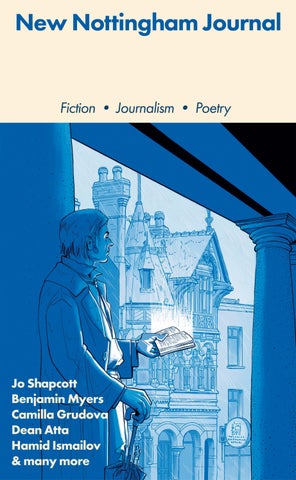
New Nottingham Journal
ISSUE 2 EDITOR-IN-CHIEF – Andrew Tucker Leavis MANAGING EDITOR – André Forget ASSOCIATE EDITOR – George Newton EDITORIAL ASSISTANT – Aurora Amaryllis COPY EDITOR – Hannah Cox EVENTS COORDINATOR – Kibrina Davey READER – Suzy Dougherty READER – Irina Sadovina READER – Ethan Calder COVER DESIGNER – Jim Brown EDITORIAL DESIGNER – Karen Constanti FEATURED ILLUSTRATOR – April Seaworth FEATURED ILLUSTRATOR – Theo Lonic FEATURED PHOTOGRAPHER – Nicola Davison Reed FEATURED PHOTOGRAPHER – Harvey Tomlinson ADVISORY BOARD Amy Acre Isabella Barber Hongwei Bao Becky Cullen Isobel Leaviss Rebecca Morris-Buck
Hannah Trevarthen Rory Waterman Matthew Welton Robert Weston Jared Wilson
this issue is dedicated to the memory of jim leaviss, the journal’s first supporter.
© 2026 New Nottingham Journal Ltd. All rights reserved. Back cover photograph © Harvey Tomlinson. The New Nottingham Journal is bound and printed in Cornwall by TJ Books. This journal is printed on paper that has been certified by the Forest Stewardship Council (FSC). New Nottingham Journal Ltd. Registered in England and Wales 16346485.
5
6
Photo by Harvey Tomlinson
7
Contents Editor’s Letter
Andrew Tucker Leavis
The Admiral
Richard O’Brien
Power Does Not Decay Teo Eve
Nottingham (A Wiki-Poem) Cara Thompson
Henry Golden & Co. Benjamin Myers
August Cocktail Sean Kelly
Philip Larkin told me about the dark Ewen Glass
Death and The Milestone Tapes Susie Halksworth
Not Sleeping on the Ward in May Jo Shapcott
Two Poems
Emily Freeman
Parakeet on Ice Dan Power
Mr Telletot’s Brown Study Geraldine Clarkson
Do Not See Your Lover this Week If You Have One Camilla Grudova
Miraflores
Geraldine Clarkson
Selkie
Heather Mead
In an Ideal World: Orality, Writing, and the New Age of AI Hamid Ismailov
Imagining a Father From a Photograph Kate Vanhinsbergh
My Father’s Body Returned to the Village Jonathan Chibuike Ukah
10 15 22 24 29 36 37 40 48 49 56 57 59 70 74 76 84 87
Out of Gas
James Aitcheson
Self-portrait as a dead wasp in a shop window display Leanne Moden
Two Poems
Suzannah Evans Furnass
No One Crosses Alone Aram Woon
Ice pole
Sophie Diver
Breakfast in the City Ella B. Winters
The Time Fountain Lucy Brouwer
Litany
Junaid Ahangar
There won’t be any violence in this poem Ashish Kumar Singh
You Know I Don’t Like Grapefruit, and I Know You Don’t Believe in Marriage Dean Atta
(O)VOID
Sarah Doyle
Genesis
Emily Bilman
For Papplewick: Water Power, Climate Change, and a Word on Lawrence Phil Shaw
Velveteen and Svelte Geraldine Clarkson
89 98 100 104 114 116 118 126 128
130 131 132
134 148
The Patriot
Sadegh Hedayat Translated by Niloufar-Lily Soltani
151
Contributors Supporters and Subscribers
172 180
The Slatecomers A letter from the editor
If you want to see a Radio 6 mainstay before they hit it big (or before they hit it medium, even) The Grove should become your customary Nottingham haunt. The sloping wall under the stairs provides a handy index of the promising artists who’ve played there in the two years it’s been open: the musicians all write their names on the wall. This isn’t the first gig venue to have the idea, of course, but it’s been interesting to watch this record-keeping happen in real time. Those who played at the beginning announced themselves in expansive foot-high letters, and the later ones – even as they’ve become more high profile – have had to squeeze their titles in the gaps between. By the time The Grove has the cachet to host King Gizzard and the Lizard Wizard, they’ll have to scribble it on the light fitting. A blank slate is a wonderful thing. We’ve all been there once, says John Locke in his Essay Concerning Human Understanding. People start life, he says, as ‘white paper, void of all characters, without any ideas’. It’s the nib of experience, he reckons, that starts colouring us in. Last year, a thought kept intruding: ‘hang on, there’s no such thing as the New Nottingham Journal’. That seemed to matter less and less as our backers gave us the impetus, each step compelling the next: we promised organisational partners we’d get submissions, then we promised submitters that we’d get funding; we promised Kickstarter backers that we’d learn to design a book, and we promised our designers that they’d have a copy for their portfolios. 10
It was that self-reinforcing loop that carried us forwards, and much of the caffeine-high came from how open the possibility seemed: from the tone of the pieces to the dimensions of the pages, the NNJ was arriving on clear paper and might still become anything. Even better than starting with a blank slate is returning to one. This summer the algorithm marked me as a victim of Nolanmania (male, millennial, dreary). In The Dark Knight Rises, which I did submit to watch, Anne Hathaway is a cat burglar who disguises herself as hospitality staff to steal the hero’s fingerprints. Ben Mendelsohn, hanging on to an American accent for dear life, has offered her a deal – he says he’ll give her a piece of software that will wipe away her criminal record. It’s called, somewhat on-the-nosedly, the Clean Slate. As the Journal’s built up from a person to a team this year, it’s been tempting to want to start it all again, even as we’ve been learning to work within a new set of rules: we’re trying to consolidate rather than to invent from whole cloth. We’re like one of the later bands to play at The Grove, in that way: the big gaps have been filled and we’re writing in between the letters; our tabula rasa is a bit more tabula obscura. In the first issue I touched on D.H. Lawrence’s emblem, the phoenix. Several pieces dealt with fire and rebirth, an idea of wiping and starting anew. The pieces that arrived this year are surrounded by water instead, lapping at the sides, though there’s not enough of it to wipe the slate entirely clean. In Richard O’Brien’s opening story you might begin to hear the ‘waves on the middens’; in Benjamin Myers’ piece imposterdom emerges gleefully among ‘tar-black waters’; several liquids, I should forewarn, play a role in Camilla Grudova’s tale of sinister eroticism. The poems are water-marked too. Jo Shapcott keeps vigil on a sleepless hospital ward, watching the night through a watered eye, while Emily Bilman’s ‘Genesis’ begins its life in an amniotic pool. 11
We’re also immensely excited to publish what we believe to be the first English translation of a short story by Sadegh Hedayat, arguably the leading Iranian author of the 20th century. ‘The Patriot’ is a full-bodied satire in which water plays a threatening role. A heavy rain can sometimes bring people together; on launch night Storm Claudia rolled over Nottingham, along with warnings not to travel. A hundred and fifty of you came to the Central Library nevertheless, and this journal became a real thing overnight. Here we are a year later. This issue has been a real group effort, and I’m thankful to the bright, incisive people whose names you can find in the masthead. I talked about John Sheffield last time, the founder of the Nottingham Quarterly, who’d compared launching a new journal to setting sail in a sieve. I’m sure this vessel comes with many holes, but it’s still miraculously afloat thanks to its crew. Phil Shaw’s essay in this issue is another we greatly enjoyed: it includes the fifth Lord Byron using a river as a weapon, and D.H. Lawrence deciding to flood his characters’ homes, as he seemed to do fairly often. Lawrence was a bit like Anne Hathaway’s Catwoman – not in that he wore a tight black skinsuit, as far as records show – but in that he often wanted to get back to a clean slate. Nottingham in the 1910s seemed to him coal-dimmed and compromised, and he couldn’t stand the social order of his time, despite having risen within it. One of his favourite habits was to convince friends to help him set up a commune in Florida by the name of ‘Rananim’, although they seemed to know him too well to find the idea particularly alluring. At the end of The Rainbow, Lawrence’s great modern heroine Ursula Brangwen finds her hope in a story that’s persisted for thousands of years. As in Gilgamesh or Genesis, she imagines a great flood that will wipe the slate of the world entirely clean, seeing ‘in the rainbow the earth’s 12
new architecture, the old, brittle corruption of houses and factories swept away…’ It’s a tempting impulse to want to begin with white paper again. It doesn’t take much reading about current affairs to want to shake the human etch-a-sketch pretty vigorously. But one perk of getting older is finding that balm of continuity, in accepting that your slate has darkened, in finding the new gaps to write in. Welcome back, friends, and thanks for darkening our door again.
Andrew Tucker Leavis – Editor-in-Chief
13
Illustration by April Seaworth
14
The Admiral Richard O’Brien I could see him from the car park of the pub down the street from my house. Even on a cloudy night he was lit up nicely, standing tall and proud. There was a stretch of the coast that curved round between us, so I was on one headland and he was on the next. That’s how it started – just looking out after the pub in the evening, sometimes sending the old boy a little salute. He was somebody I remembered from school. Well, more than that: our houses had all been named after worthies from that time – Brunel, Cornwallis – and we had him. His name was up above the whatsit, the lintel. So moving up here, when I first saw him… it was a pleasant surprise. Made me feel more at home, I suppose. The people might not have been that friendly, but there he was, watching over us: a little bit of my childhood. I never did get an Action Man, but we spent a lot of time on the history of this country, you know, all the old victories and the naval campaigns. I might have fancied the navy myself, but I had funny turns and a dicky heart and they didn’t give out prizes for second place in those days, did they? But the bravery of the stories, that’s what I remember. They were heroes to me – to all of us, you know. I didn’t like that pub much, to tell you the truth. It used to be something better – more real. A proper old fishermen’s boozer, with a backroom where they’d get washed and changed after getting home safe from the sea. They were braver than us, eh? I never saw it like that myself, mind, but I’d heard tell. Folk around here were always talking about the old times. They knew all the bars and the stairs up and down to the quay by their old names. I couldn’t keep up so I stopped asking. It was shit now, anyway – pardon my 15
O’BRIEN – FICTION
French – poncey calamari for twelve quid and those neoncoloured drinks in the big round glasses. The young lasses falling all over themselves. They’ve put that nasty cladding all around the outside too – it was meant to look like wood but you can tell it’s some kind of plastic chipboard, raindrops don’t slide off real wood like that. Could you imagine that on a ship in the middle of battle, just wiping clean? He’d have loved that at Trafalgar. But it’s an insult, isn’t it? A building four hundred years old, looking like some flat-pack made in China. I’ve got off track, haven’t I? The point is, after a while I stopped going into the pub. I didn’t know many people in there anyway and the young ones didn’t want to listen. So I’d just stand in the car park. And then I’d come back later at night when it was actually still, actually quiet. You could hear the waves on the middens like something being washed clean, and sometimes you’d see a few gulls go across the sky one after the other like a great black cloud. I started bringing my telescope. I’d bought it for the boy when we were all living together, but when his mum moved out they hadn’t taken it with them. Too old for it now, I guess. He was always better with it than me, knew all the names – Ursula Minor and all that tack – but then he got into his music, his mum got much more out of that than I did, and it was like we were strangers again. To be honest, I probably wouldn’t recognise him if he was here today. Nothing personal, but when it’s not biological you don’t have that connection, do you? A few years in each other’s lives and then out on my own again – ships in the night they say, don’t they? Well. Anyway. I didn’t see many ships from up there. It isn’t busy like it was. Sometimes, after a couple of whiskeys, when I was waiting for it to get dark, I’d just be on my phone looking things up. There was one young lad I liked: what was the name of his page again? The Yardarm, that was it. He showed you how to build things, the old crafts, recipes for hard-tack, that was quite interesting. He had a couple of tattoos on his 16
O’BRIEN – FICTION
arms but he was quite clean-looking, you know, presentable, not like some of them. And when it knows a bit about your interests you can just scroll, can’t you? History Defenders, that was another one that came up. Lovely old pictures there, all the adverts for the old Tyne Brand pies, you can’t get them now. Sometimes you can start to think you’re the only one who remembers how it used to be. And then I’d start getting stuff about the statues and all, stuff that wasn’t in the news, even. And the net zero types on the bridges: ‘locking on,’ they called it. Well, I didn’t agree with their reasoning, but I admired the balls of it. You have to stay vigilant, don’t you? Otherwise next thing you know it’s all gone past you and there’s not a thing you can do about it. It wasn’t long after that that the fencing started going up, all across the slope leading up to the monument. They tell me now it was for maintenance, and maybe that’s true, but there was no indication at the time. Nothing in the letterbox, nothing on the council website. They don’t communicate. And after all the runaround they’d given me about my bins and the on-street parking, I didn’t trust them an inch. It looked like he was in danger. I thought: that’s how they’ll do it, right? In winter, when they think nobody’s looking. They’ll come in the night and it’ll be as if these heroes were never there. When I was out there on my own and it got late enough I’d see the beams of the lighthouse sweeping over his face, and his features looked so fine and fragile. After all he’d withstood, it didn’t seem fair. ‘Hang in there old boy,’ that was what I thought to myself. ‘I’m here, I’ll help you. Not on my watch.’ I started counting the beams as they went past – one for yes, two for no. Are you scared up there, are you lonely? They make them look so stoical, don’t they, but when the lights passed over his lips it looked like he was smiling. I felt as if he wanted me to do it. Through the telescope I looked for the best place to get attached – there wasn’t any kind of railing, you could walk 17
O’BRIEN – FICTION
right up to him, but his hand was resting on a sort of bollard wrapped in rope. I had the handcuffs in a drawer already – must have had them since the eighties – and I figured I could get them around his arm, and then mine. ‘Sex game gone wrong’, that’s what they say on the news, isn’t it? I don’t think I’ve ever had a sex game go right. I looked once more before setting out: two blinks. It was like the medals on his chest were shining. Even from that distance I could tell he needed a clean, but nobody was taking care of him – and if he wasn’t worth protecting, what hope did the rest of us have? It was about two-thirty when I put the plan in motion. Along the sea-wall, up the steps, wind blowing cold enough to freeze your tits off, but I had a thick hiking jacket on and a bottle in my pocket. It was just to make a point, like – they’d see me in the morning, and they’d have to take the fences down and reconsider, actually listen for a change. In my head it was as simple as that. Maybe I hadn’t thought it through properly, I can say that now, but all I was thinking was: this called for a show of courage, and that’s what he had always meant in my mind. Courage. Taking risks. Walking along the hatches, crunching an apple, bold as brass, while the French cannons blazed in the distance. He set an example to the men. We needed that kind of example, us boys. It was a medical school, I don’t know what they call it now. Not for backward kids, not ‘special’, just – weak. Ten of us in a room in those beds with the metal frames that would chill your fingers to the bone if you happened to brush against them in the night. Convalescent, that was the word. We needed strong examples and we were glad to get them. It did feel special to be up there in the dark, just him and me. Like in a way we’d always been together. It was a struggle hoisting myself up to the base of him – I’d got a nifty little extendable ladder off Amazon, but he was higher up than I thought from a distance – and a bit of the marble crumbled off while I was trying to get myself properly attached, but it was only his sleeve, I didn’t do anything to hurt the old boy. 18
O’BRIEN – FICTION
A couple of clicks and that was me set, we were in it to win it. I only realised after that that I wouldn’t be able to reach the bottle I’d brought. It must have been half-three by then anyway, that’s what I was thinking, not long till sunrise. Well, you don’t need me to tell you the rest. It was awful. The cold started at my wrists, they were exposed up there, and then it set into the whole of me. Then my foot slipped off the plinth, and I was just hanging there, twisting like a flag in the breeze. Whenever I tried to wriggle up, the coils of stone rope would scrape against my spine. I hadn’t checked the weather forecast and I didn’t know that there was a storm predicted. Maybe the old fishermen would have known, maybe I should have asked them, if I’d known who to talk to. Too late now, isn’t it? When the hail started it was like a bucket of ice chucked down my back. That’s the sort of thing they used to do at the school too. Didn’t help. I could feel my fingers cramping up – even in the dark I knew that they were turning pink and then blue. I rattled and rattled but I couldn’t get anywhere. I even called for help. Nobody answered. Tells you something. Passed out for a few hours after that, apparently. Pneumonia. They said I was lucky to be alive, with my heart. Does anything about this look lucky to you? I’ll never forget the firefighter leaning over my face in the morning, shivering and wretched, saying, ‘Sir, how long have you had this equipment?’ Rusty as sin those cuffs were, the key practically crumbled into dust when they tried it in the lock. There was something about the rainwater and the metal they said, some kind of reaction with the stone. Like I was fused to it. And he wasn’t as stable as he looked on the plinth – that’s why they were doing the maintenance – if they went at me with a saw he could topple over from the vibrations and crush me, or the houses behind us. I was at risk of losing the arm at best, unless they could remove him from the equation and get a clearer go at me. 19
O’BRIEN – FICTION
It wasn’t as easy as just prising him off. They had to go through his ankles. It was humiliating. Then they hooked him up to a helicopter and carted him off like some deposed dictator. I know he’s in the museum now, but I won’t be going. Flat on his back with a plaque telling you what to think of him. I don’t want to see him like that. The last thing in my mind was to cause him any damage – I loved him. But apparently that isn’t a defence.
20
21
Power Does Not Decay Teo Eve and still his name is etched in rock, his face, though cracked, the beat of the poet’s song while those scribes who scrawled in hieroglyphs I am Ozymandias are one with desert dust, and the sculptor – progenitor to Michelangelo – is unnamed, unknown. They’d chisel out faces of rival kings rewriting history, but those pharaohs who suffered second deaths already enjoyed an afterlife of fame – we’re immortal so long as they know our names. Shelley breathed life into a broken statue, delayed time’s decay, stitched shut cracks in that shattered visage so we could deface it again.
22
Photos by Harvey Tomlinson
23
Nottingham (A Wiki-Poem) Cara Thompson Nottingham (/ˈnɒtɪŋəm/ NOT-ing-əm) is a city an home o Robin Hood’s belligerent Sheriff of Nottingham, and is historically associated with the lace-making, bicycle and and the settlement Literature “. meaning ‘homestead of the Snotingas’ (that is, “theot”). The loss of tng ‘cave house’. It is unclea The written h building a fortress on the south bank of the Trent. Following a castle in Nottingh The Anglo- surrounded by a substann the hill opposite. Eventually the space between was built on as the town grew and the Old Market Square became the focus of It was bod, Nottingham Castle is the scene o the final showdown between the sheriff and the hero outlaw.[29] It is believed that during the Black Death o population died but that migration from other parts of En the process of population recovery.[30]
24
THOMPSON – POETRY
By the 1self as the centre of a thriving exporous sculpture made from Nottingham alabaster.[31 During reason why a small number ofrter, “for eternity’. The Castle and ecame an internationally important centre of lacemanufacture. In 1831 citizens riot ed in protest against the Duke of Newcastle’s opposition to the Reform Act 1832, setting fire to buildin s in the Lace Market district have be en restored and put n centres, which ave engulfed former rural villages such as Bilborough, uth of the river there has also been expansion with new areach as Edwalton aingham’s urban sprawl. re on the green belt asd that surroundgham remains…1
Wikipedia contributors (2026) ‘Nottingham’, Wikipedia. Available at: https://en.wikipedia.org/wiki/Nottingham 1
25
26
Photo by Harvey Tomlinson
27
Illustration by April Seaworth
28
Henry Golden & Co. Benjamin Myers He had dabbled in all the things that the weekend supplement had suggested. Yoga and Pilates, meditation and acupuncture. Cold water swimming, cognitive behavioural therapy and various other forms of counselling. He had tried Buddhism on for size but, for various reasons – cynicism, idleness, western prejudice – felt it didn’t quite fit the way that he had expected. It felt like trying to squeeze a glove over a foot. There were drink and drugs, of course. Years of both. Before that, when he was younger and there was still a shabby doomed glamour to it all, there had been brief flirtations with bulimia and self-harming, which proved to be hard work, inconvenient and generally messy. Prescription pills – they had helped too, sometimes, when he could get his hands on the ones that were worth swallowing. The sugar-coated, low-dose placebo pills that they handed out like M&Ms were barely worth the hassle of having to make appointments to see his GP though, and even doubling the recommended dose didn’t bring him close to banishing the anxiety that he had experienced for as long as he could remember, and which at its worst felt as if it were a dark malevolent force cast across his every waking moment like a tall pallbearer’s stretching shadow. Now and again it abated and sometimes he enjoyed several weeks without worry, but for the most part anxiety stalked him everywhere. It was a small faceless creature forever just beyond his peripheral vision, waiting to leap out at the most inopportune and unexpected moment. This isn’t metaphor; he genuinely saw it as a real physical entity, like something from a grim, or Grimm, fairy tale – a gremlin perhaps or a troll in the traditional sense of the word, or a boggart, as they called them in his area. 29
MYERS – FICTION
So one morning upon waking – that’s if you can call it that, for it felt like he had merely listlessly laid in the half-dark chamber of his bedroom, surrounded by a polyphonic chorus of chattering voices for seven hours – with a knot in his stomach and a trapped rat in his chest, he decided he would become someone else for the day, if only in name. After everything, the idea just came to him. Reinvention, he reasoned, was the only remaining route in which he might enjoy some respite from the insidious creature that stalked him and appeared intent on forcing him to tolerate a life devoid of colour, joy and abandonment. Yes, he decided, today he would become a different person. It was the only way. He would be – The name had to be right, so he lay there thinking about it a little longer, considering various possibilities which he quickly rejected. He would be – It had to be something strong, the name of someone who resolutely would not be swayed by something as pifflingly esoteric and intangible as a little niggling sprat of a thing known as anxiety, for goodness’ sake. He would be – Henry Golden. Yes, that would do it. He rolled out of bed with a greater sense of purpose than he had experienced of late, went to the bathroom and when he closed the mirrored door of the medicine cabinet, Henry Golden stared back at him. Henry Golden smiled. And so the day proceeded as it always did: breakfast, work, errands, lunch, and so forth. Only this time he did everything with a bit more pep in his step. None of it was burdensome, nor did each little task feel like it was a concrete block chained to his ankles. Today there was sunshine beaming down upon him, and an identifiable sense of purpose that had otherwise been lacking in his day-to-day business. 30
MYERS – FICTION
He didn’t need to tell people he was Henry Golden either, he simply had to embrace the new persona entirely. Commit to it. Which he did, gladly, because as the hours wore on he felt a sense of warmth and lightness that was both physically and mentally uplifting. By mid-afternoon he even fancied a coffee, which was something he had had to give up several months ago, as it always frayed his nerves and jangled his mind in a manner that was entirely unfavourable. He found an expensive packet of beans in the back of his kitchen cupboard and went through the elaborate ritual of grinding them, filling a pot and placing it on the stove, then waiting for the sound of it to hit a rolling boil, and for the sight of a few stray black bubbles squeezing their way out, then becoming tiny jewels skittering across the surface of the electric hob. When he drank the cup of coffee, sitting on the back step, it was beautiful. Henry Golden made a good coffee, no doubt about it. Perhaps he was the type of person who fetishised the drink, and harboured something of a snobbish approach to it, and this thought excited him a little, if only because it was a light-hearted distraction from the usual worries that over the course of any given day would ordinarily squash him down to size like a car in a scrapyard crusher. Henry Golden slept well that night. Nearly nine hours, all the way through. There was no insomnia or recurring dreams of nervously trying – and failing – to cross an unfamiliar city at night, for Henry. No, instead he awoke feeling calm and satisfied and went to the bathroom, where Mooch Mello winked at him from the mirror. Interesting, he thought. Mooch Mello. Sounds like a jazz trumpeter from the 50s. And so he went about the following day with ease and confidence, unfazed by any small obstacles that happened to be placed in his way. He felt different to how he had yesterday when he was Henry Golden; looser of limb, perhaps, 31
MYERS – FICTION
and generally more louche. Life was a joke and he had long been made privy to the punchline. He found himself craving and then drinking a whisky in the early evening, and instead of it making him feel maudlin and inevitably forcing him to forensically examine the minutiae of what he perceived as a lifetime’s failings, it instead improved his already favourable mood further still. Ah, so Mooch Mello was a whisky man, he thought. It was better than heroin, which some of those old-time jazzmen were prone to dabbling in. And on it went, each day a new persona. On Wednesday he was The Midnight Badger and on Thursday morning he was surprised to discover upon waking that he was Punjabi Muscleman. When Friday came around, a day that was no more pleasurable to him than a Monday is to most people, he awoke as Lord Winsome, King of the Relaxed Cats. An odd name, for sure, but a persona he readily slipped into as if it were a nice warm bath full of gently popping bubbles. Lord Winsome, he discovered when he went to the supermarket, had impeccable manners and liked to start a cheery conversation with just about anybody he encountered. Anxiety had not tapped upon his shoulder, or run scurrying around the floor of his bedroom at 4.36am, once this week. Whenever he did think about it, it was with an indifferent shrug, as if it were something that had absolutely no bearing on his life, like golf clubs, Korean pop bands or military coups in far-flung countries. It was a creature banished; it simply did not feature in the worlds of Henry Golden & Co. He began to adjust his wardrobe somewhat, finding himself purchasing garments of clothing or shoes or accessories – accessories, for Christ’s sake – that he would never otherwise consider. New brogues and bright flowing scarves one day, tracksuits the next. On Monday a Homburg, on Tuesday mirrored sunglasses. For years people around him had been suggesting the age-old adage ‘just be yourself’, when in fact being oneself 32
MYERS – FICTION
was the root of so many psychological and social problems. Was he breaking new ground here? He couldn’t be certain, nor did he particularly care, as the growing excitement at not knowing who he was going to be from one day to the next got him out of bed in an instant. Perhaps ‘actually, just be someone else’ was too radical a maxim to be widely circulated, being as it would surely put a big dent in the pharmaceutical and psychiatric industries for starters, if it caught on. And though his was a technique that he implicitly understood would not necessarily work for everyone, he had found a cure for his own anxiety, and felt compelled to celebrate this breakthrough by further altering his existence in a manner befitting a rebirth of sorts, or at the very least spreading the word about his findings. But how? He could write a blog about his discoveries, but under which name? Maybe he could call it Be Someone Else and write anonymously, but no one actually bothered to read blogs anymore. They only existed to be written, and then ignored. Far too much effort. Maybe he could start dating or go on holiday, to one of those big hotels where they have ‘all-you-can-eat’ buffets that sound like a challenge, and which say so much about western desire and entitlement, a thought that would normally send him spiralling into despair but which he now was pleased to learn could be viewed objectively, and was therefore unlikely to destroy his entire day. But how much luggage would he need to take to accommodate the differing daily personae? And then there was the issue of a passport. He certainly couldn’t use his existing one; just to see his old name and his old sad face would likely trigger a panic attack potentially so powerful that it could send him slip-sliding down the slick serpent’s back, all the way to square one. He didn’t want to go back to square one. He wanted to keep climbing the ladder towards contentment and happiness that Henry Golden and Co. had helped him on to. 33
MYERS – FICTION
The next morning he leapt from his bed and dropped immediately to the floor, to execute fifty aggressive pressups. Strange, he thought, as the tip of his nose touched the carpet. Not my usual routine. Then again, there was no longer a usual routine beyond seeing who would greet him in the bathroom mirror each day. That was the point of this perpetual reinvention, this personality renewal. He then did sit-ups until his abdominal muscles screamed in pain. He walked to the bathroom and first had a glass of water, and then faced the mirror. Gareth Pinner stared back, blankly. Gareth Pinner had cold, indifferent eyes, each like a spent lightbulb, as if behind them something had irrevocably cracked forever. His entire posture, he noticed, was geared towards confrontation and intimidation and, in this moment, his lips parted slightly into a sneer that he saw had been shaped by experience over the years to now both advertise trouble and to repel. There was a quiet, coiled violence to what he saw in the mirror. There were things he could not hide there, for beneath the calm surface he clearly understood that whirlpools of hatred, violence and abuse were spiralling up through the tar-black waters towards the surface. He had his breakfast, showered, dressed and left the house and for the rest of the day Gareth Pinner embarked upon a prolonged crime spree so severe and ruthless that it included armed robbery, assault with a deadly weapon, assault of a police officer, grievous bodily harm, sexual assault, common assault, theft, racial abuse, rape and finally a triple murder committed in the most heinous and barbaric manner. He didn’t think he much liked Gareth Pinner. Events happened so quickly that it took several hours of mayhem before he was finally picked up by the police, who were surprised that this meek and mild man was the same one who fit the description of the person who had committed 34
MYERS – FICTION
all these heinous crimes – and had indeed been caught on camera for several of them – over the course of just one day. When finally cuffed, his identification and a quick computer check confirmed him to be Stephen Brown, a freelance web designer with no previous criminal record. He was taken down to the station and booked in just as several curious officers arrived, all keen to get a glimpse of the man, a spree killer no less, who had brought a reign of terror to the community, and who now in a quiet, almost robotic, voice that was entirely devoid of emotion or feeling, kept saying ‘It wasn’t me, it was Gareth Pinner’, over and over again.
35
August Cocktail Sean Kelly
Walking to work. A dead bird on the tarmac path. Head gone; feathers, guts everywhere. Maybe I’m supposed to look at this terrified, living thing that refused to die but did anyway and remember the bodies I’ve held and sighed over, hearts I’ve buried; that I’m still breathing (which is definitely something), that a blue sky will do as it pleases. Or that I still want god to be up there, behind the bar in tie, waistcoat, peroxide hair, shaking cocktails like summer’s about to die.
36
Philip Larkin told me about the dark Ewen Glass in his hangdog face, salted philtrum; his head would suit a halo, I thought, and burned my hand by text. Marriage? No thank you, he and I; imagination can go so far and not so far as families, childhood bedrooms, competitive darkness. I showered in it but didn’t understand until he knocked me awake with formal fucks and bloody. But perhaps the dark was only ink; bodies might just be bodies, discrete with frustrations, producing all the dark themselves.
37
38
39
Photo by Harvey Tomlinson