



Graduating from university is a huge achievement and an exciting milestone marking your progression into graduate employability.
While making this next step might be challenging at first, there are plenty of opportunities ahead.
If you are unsure where to begin, don‘t worry – we’ve created this handy graduate guide to help you get on the right track towards a successful career.
The best way to support yourself as a graduate is by accessing careers advice from Careers+Placements.
Did you know that as a graduate of Leeds Trinity University, you can access support from us for up to 3 years after you graduate?
Get started by heading to mycareer.leedstrinity.ac.uk registering for your alumni account with your personal email.
Once your account is ready to go, you can browse and apply to job vacancies posted by employers
and book on to events, for example career workshops and employer networking sessions.
Additionally, you can book appointments with our dedicated Graduate Careers Advisor.
"I’m here to support you with the transition from university into the workplace, guiding you through the application process and helping you secure your first role or further study course after graduation."





There are multiple graduate job routes that you can take so we want to help you understand what each of them do:
Usually consists of a structured training programme within your employment. They are often 1–3-year fixed-term contracts, however, a lot of companies will offer opportunities to secure a permanent job if you demonstrate high performance.
They often involve rotation between departments, offering more variety than a standard graduate job. Some graduate schemes have qualifications attached to them; for example, a Professional Services company may offer you a CIMA/ACCA finance qualification alongside your programme.
Unlike a graduate scheme, you will typically stay in one area, carrying out a specific job. There is usually less formal training structure than on a graduate scheme, and you will learn primarily by doing the job rather than following a dedicated training programme.
Graduate jobs often require less expectations of previous experience. Employers are looking for new talent and are willing to invest in them and support employees as they develop.
Internships are fixed-term opportunities (typically lasting from a few weeks up to 12 months) where you work for an organisation, giving you the chance to develop new skills and explore a certain industry.
Internships may involve working on specific projects or shadowing a variety of different areas in a business.
Apprenticeships allow you to gain a work-based qualification alongside undertaking your day-to-day role. They are an great way of converting your degree knowledge and experience and channelling it into a work specific qualification.
Keep in mind, apprenticeships are highly competitive and require you demonstrate that you will be learning new skills. For example, if you have already studied a Digital Marketing degree, you would generally not be eligible for a Digital Marketing apprenticeship.
Finding your first graduate job starts with knowing where to look. While some large job boards such as Indeed advertise a wide range of opportunities, there are also specialist websites dedicated to graduate and entry-level roles.
These platforms can help you discover vacancies tailored to recent graduates, making it easier to find opportunities that match your skills, interests and career goals. Explore the websites below to start your search and discover roles that would be the perfect fit for you.
Job Site
MyCareer
URL
mycareer.leedstrinity.ac.uk
MilkRound milkround.com
Bright Network brightnetwork.co.uk
Prospects prospects.ac.uk
Gradcracker gradcracker.com
TargetJobs targetjobs.co.uk
LinkedIn linkedin.com



1. Your contact details: Your name, email, phone number and city you live in is enough.
2. A personal statement: This is a chance to introduce yourself, your key strengths and what your career aims are.
3. Your education: List and date all current and previous education, your most recent being first. Include the qualifications you have received or are on track to receive.
4. Work experience: Put your experience in date order, most recent first. List your key responsibilities, achievements and importantly, your results within the job.
5. Skills and achievements: Add in any skills you think are relevant to the job you are applying for. This could include IT packages you can use, languages you speak or any professional certificates you hold.
6. Interests and Hobbies: Any hobbies or interests you add to your CV must be relevant to the job. For example, if you are looking for a journalism role you may tell them you write your own blog.
7. References: You do not need to provide the names of references on your CV. This is likely to be requested during the application process when required by the employer.
It is important to keep your CV concise, use bullet points so employers can pick out important information easily. We recommend you keep your CV to no more than two pages. Always tailor your CV to the specific role you are applying to. Use the job description to highlight key skills and values the employer holds. Avoid using ‘we’ throughout your CV. Always focus on what your contribution was. ‘I was responsible for….’ ‘I researched…’ Book an Application Check Appointment on MyCareer to get useful feedback about your CVmycareer.leedstrinity.ac.uk/leap/appointments.html?types=34
Do cover letters leave you confused? Are you wondering how they are different from your CV?
Use our template below to help you make the best first impression on an employer.
Tip: If an application does not specify whether to send a CV and a cover letter, we recommend that you send both. Take advantage of the opportunity to share additional information and stand out from other applicants!
Dear ‘Named Person’ [If you are struggling to find a specific name then you could write to ‘Head of Design’, or ‘The Purchasing Manager’ etc – but avoid using the generic ‘Dear Sir/Madam’ or ‘To Whom it May Concern’.]
Paragraph One
• Open with how excited you are to be applying for the role with their organisation.
• Establish a personal link – e.g. any previous interactions you have had with them or any experience you have in that sector.
• Show you have an insight into what the job requires and that you have the skills they are looking for. Use key words from the job description/person specification.
Paragraphs Two and Three
Focus on the top 2 or 3 skills/attributes from the job description/person specification and highlight how you align to these or have demonstrated them in practice, mirroring the language and terminology they use in the job description.
1. I (lead/delivered/assisted) with (situation).
2. My task was to (insert what had to be achieved).
3. I actioned this by (insert what you did to drive this forward/help the situation).
4. The outcome of this was (show the result, e.g. 20% increase in social media followers, a situation with a customer was resolved without escalation to a manager etc).’
5. Through this experience, I developed and demonstrated (insert skills), which are key requirements for this position.
Repeat this paragraph with 2 to 3 different examples.
Final Paragraph/Summary
End your cover letter with a clear call to action. Include how you are looking forward to hearing from them and your desire to speak to them in an interview.
Yours sincerely, [or ‘yours faithfully’ if you don’t know their name] (Your name)
Interviews can feel daunting, whether it’s your first or your fiftieth, but preparation is key to building your confidence.
Follow our advice below to perform your best at interview!
• Ensure you know the company’s mission, values, products, and culture.
• Visit their website, check out recent news or press releases, and explore their social media profiles to understand their goals and current projects.
• Go through the job description and person specification carefully. Highlight every skill, attribute or company value they mention. Think of examples of when and how you have demonstrated these through your experiences.
• Prepare answers to common interview questions. These include questions like "Tell me about yourself," "What are your strengths and weaknesses?" and "Where do you see yourself in five years?".
• Use the STAR method (Situation, Task, Action, Result) to prepare for role-specific questions. This will help you give structured answers with concrete examples that shows how your experience aligns to the role.
• Rehearse aloud. Practice speaking your responses to build confidence and improve your delivery.
• Express genuine interest in the company and role. Employers want to hire candidates who are excited about the opportunity.
• Ask thoughtful questions during and at the end of the interview. Show the employer you have done your research and are invested in understanding more about the team, company culture, and expectations.
• Show your passion for the industry, be enthusiastic about the impact of your skills and how they align with the company’s goals.
• Ensure personal grooming is neat (e.g. hair, nails, and overall presentation) to make a professional impression. Remember - first impressions count!
• Consider the company culture and dress appropriately. If you are unsure, it is always best to go in business dress.
• Take deep breaths if you’re nervous and give yourself time to think before answering difficult questions. If you don’t know the answer to something, it’s okay to admit it - but focus on how you’ll tackle the problem or learn what’s necessary.
• Keep your answers clear and concise. Avoid rambling and stay on topic. If you get nervous, try to slow down your speech and focus on delivering your answers with clarity.
Our Careers Advisors are here to help you prepare for any upcoming interviews and take you through some practice questions to help build your confidence and technique.
Book an an appointment direct on MyCareermycareer.leedstrinity.ac.uk/leap/appointments.html?types=36

LinkedIn (linkedin.com) is a global networking platform used to make connections with colleagues, network with employers and apply for jobs. It is a great place to showcase your skills, acting as an interactive CV and way to demonstrate your personal brand.
Firstly, you will need a suitable profile picture. Members with profile pictures receive up to 21 times more profile views and 9 times more connection requests than those without one!
Here are some useful tips to remember when picking a photo to use:
• Choose a picture that looks like you.
• Wear suitable clothing – something you would be happy to wear in the workplace.
• Make sure the quality is clear and that you are the only person in the picture.
• A plain background will make your picture look more professional.
Employers will look at your LinkedIn to see anything you may have posted yourself or reposted from others.
There is so much you could share on LinkedIn; here are some ideas to get you started:
• Events/networking sessions you have attended.
• Any courses you have completed or badges you have earned.
• Highlight any volunteering you have done (this could be related to your industry, but if it isn’t it’s still a great thing to add).
• Extra-curriculars you take part in.
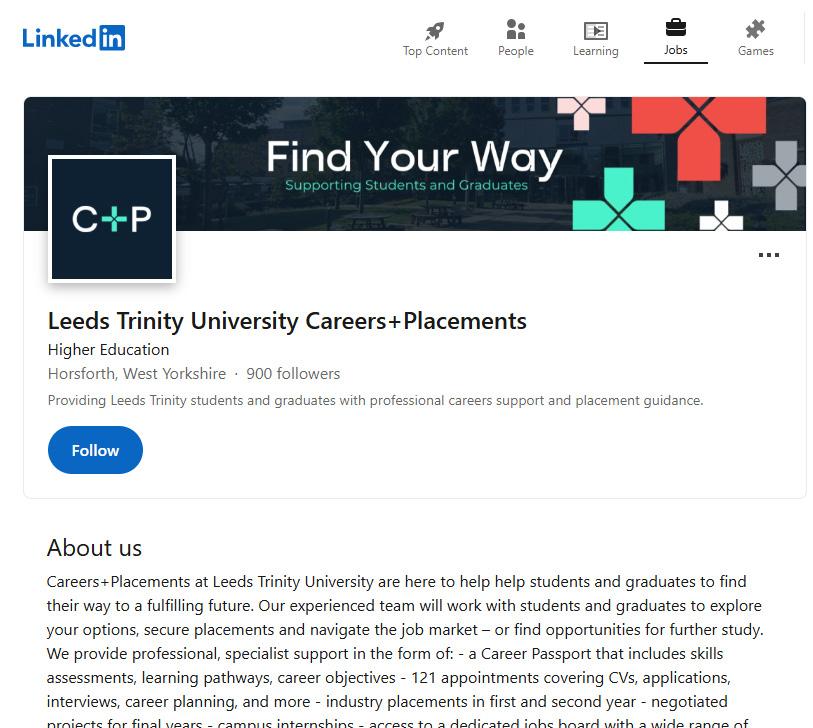
Did you know we're on LinkedIn?
Follow us to find out about the latest graduate opportunities, when the next careers workshops will take place, and much more! linkedin.com/showcase/leedstrinitycp

It’s easy to compare your graduate journey to someone else’s. You may see friends on LinkedIn posting about job offers, or someone on your course has completed a work experience opportunity at a great organisation.
The important thing to remember is that this feeling is not unique to you. LinkedIn is a highlight reel of someone’s graduate experience, not the full picture. There are many graduates who may also be struggling with this next step, so try not to worry if you don’t get your dream job straight away!
While it’s natural to compare yourself to others, there are practical steps you can take to stay motivated, manage your wellbeing and focus on your own journey, these include:
• Limiting your LinkedIn usage if you are overwhelmed, allowing yourself time to reset before returning with a more positive mindset.
• Treating applications like you would a job itself, remember to take regular breaks to avoid burnout.
• Accessing support from Careers+Placements - you don’t have to tackle the graduate job hunt alone!

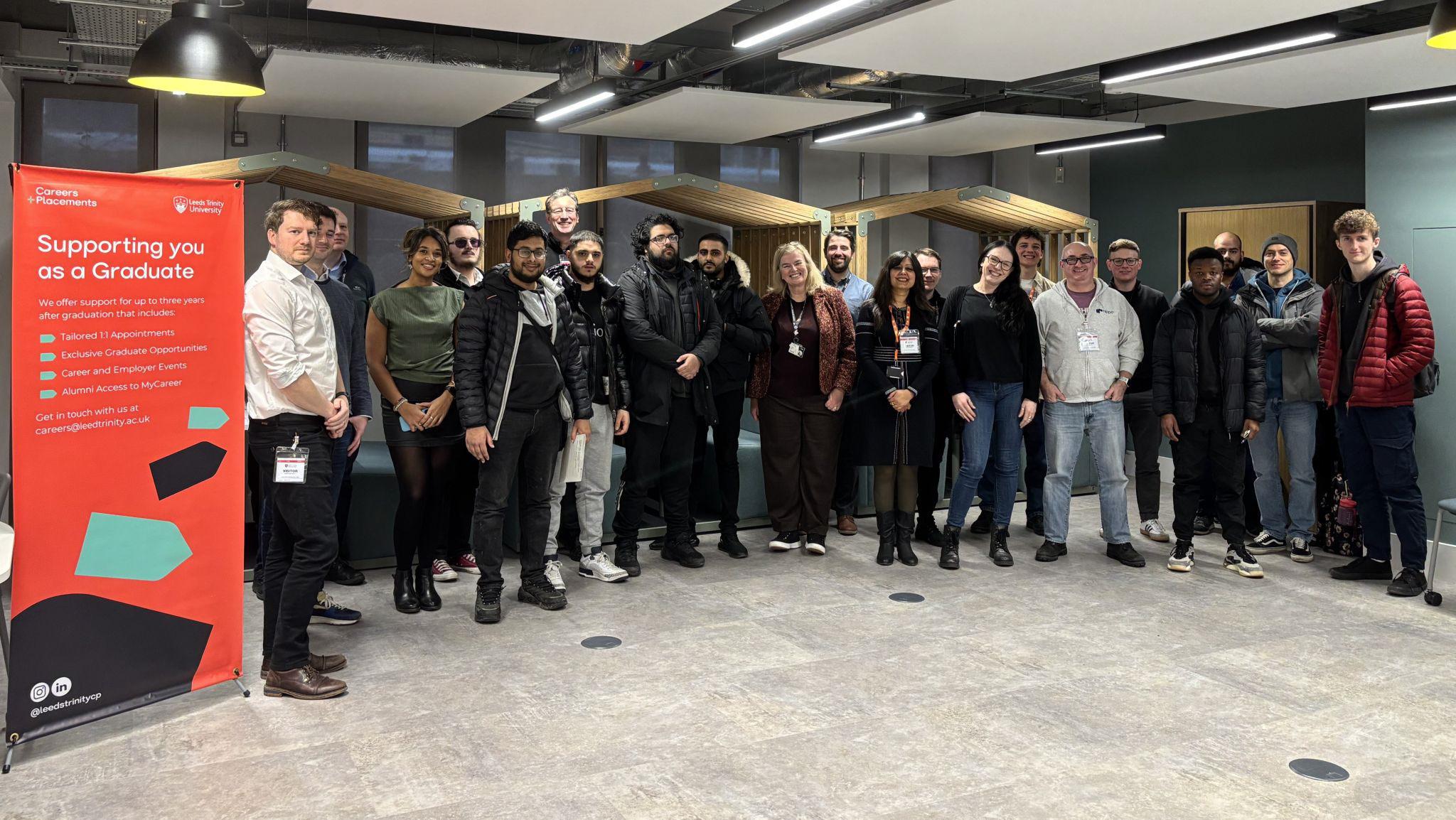
The word ‘networking’ can mean many things to different people, and it is common for people to feel nervous about doing it.
But don’t over think it, the Oxford Languages definition is: “the action or process of interacting with others to exchange information and develop professional or social contacts.”
• Opens doors to opportunities: Making a professional contact at a careers event, can be an advantage when applying to their organisation.
• Builds confidence and communication skills: Practicing professional conversations and dialogue, prepares you for future interviews and workplace interactions.
• Gives insider insights: Learn more about a company culture, roles and industry directly from professionals already in the sector.
Networking opportunities can be online or regional. One of the best places to search is Eventbrite (eventbrite.co.uk), an events platform which is used to promote employer events.
Other websites you can use include:
Job Site URL
MyCareer
mycareer.leedstrinity.ac.uk
Bright Network brightnetwork.co.uk
Sanctuary Graduates sanctuarygraduates.co.uk/jobs-board
About their experience:
• What is your favourite part about working at [company name]?
• Could you share a bit about your career journey and the key skills that helped you succeed?
• What made you choose [company name]?
Candidate qualities:
• What advice would you give a graduate like me hoping to enter this field
• What qualities or skills do you seek in applicants for your positions?
• Do you prefer candidates with work experience or extra-curricular involvement?
Applications and hiring process
• What’s the best way for a graduate to stand out when applying?
• Do you offer volunteering, work experience, placements, graduate roles? (Choose applicable)
• Are there common mistakes graduates make when applying?
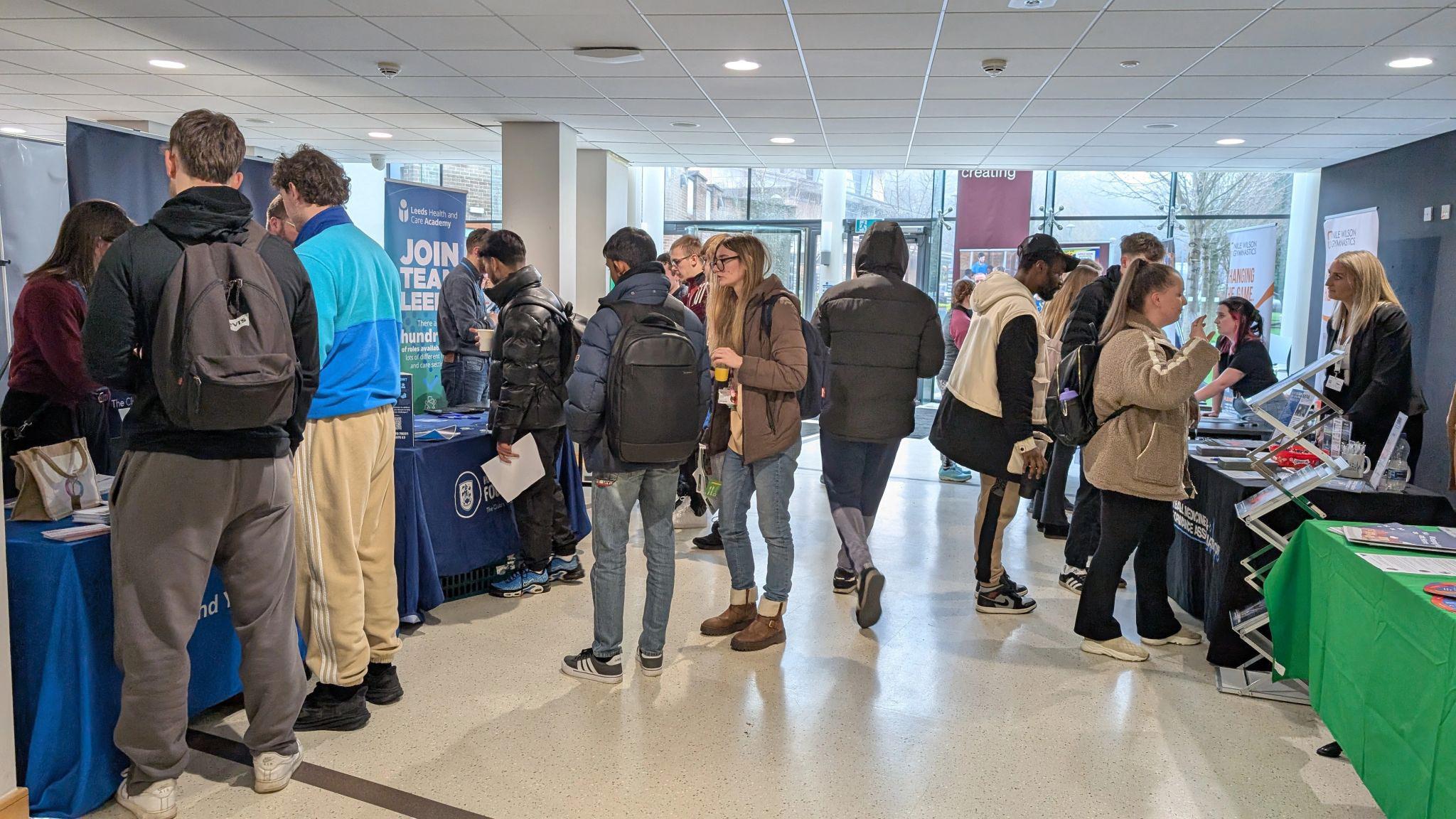

You will be invited to complete the Graduate Outcomes Survey via email and SMS 15 months after you have completed your studies. It captures the diverse perspectives and accomplishments of the graduate community to help future students. This is your chance to make your voice count.

We're here to support you throughout your early graduate career.
To access support and advice, please get in touch via one of the following:
careers@leedstrinity.ac.uk
AG12 (Horsforth Campus) | TS0-03 (Leeds City Campus)
You can also connect with us on LinkedIn and Instagram where we share the latest graduate opportunities, career workshops, tips and more:


Leeds Trinity University Careers+Placements
@leedstrinitycp
Information correct at time of publication: July 2026
We can supply this information in alternative formats, please call 0113 283 7151 or email careers@leedstrinity.ac.uk. 0113 283 7151